June 2019: Paper 2

320 marks · 24 question parts · Paper, mark scheme and report on AQA's site · AQA no longer hosts this series; the questions are from a copy of AQA's original paper

Question by question

QTopicMarksAOType
1 Identity and age, disability, ethnicity, gender, nationality, sexuality and class, Socialisation and the agencies of socialisation 10AO1=5,AO2=3,AO3=2Outline and explain
2 Self, identity and difference, Socialisation and the agencies of socialisation 10AO1=3,AO2=4,AO3=3Analyse
3 Conceptions of culture: subculture, mass, folk, high, popular and global culture 20AO1=8,AO2=6,AO3=6Essay
4 Demographic trends: birth rates, death rates, ageing and migration, The family, social structure, the economy and state policies 10AO1=5,AO2=3,AO3=2Outline and explain
5 Childhood and the changing status of children, Marriage, divorce, cohabitation and family diversity 10AO1=3,AO2=4,AO3=3Analyse
6 Gender roles, domestic labour and power in the family, The family, social structure, the economy and state policies 20AO1=8,AO2=6,AO3=6Essay
7 The social construction of health, illness, disability and the body, Medicine, the health professions and the globalised health industry 10AO1=5,AO2=3,AO3=2Outline and explain
8 Medicine, the health professions and the globalised health industry 10AO1=3,AO2=4,AO3=3Analyse
9 Health inequalities by class, gender, ethnicity and region, Inequalities in the provision of and access to health care 20AO1=8,AO2=6,AO3=6Essay
10 Work, worklessness and life chances, The distribution of poverty, wealth and income 10AO1=5,AO2=3,AO3=2Outline and explain
11 Responses and solutions to poverty: the state and welfare providers 10AO1=3,AO2=4,AO3=3Analyse
12 The labour process: division of labour, technology and deskilling 20AO1=8,AO2=6,AO3=6Essay
13 Religion, social change and social stability 10AO1=5,AO2=3,AO3=2Outline and explain
14 Secularisation and the global spread of religion, Ideology, science and religion 10AO1=3,AO2=4,AO3=3Analyse
15 Religion and social groups: gender, ethnicity, age and class 20AO1=8,AO2=6,AO3=6Essay
16 Globalisation and development, Development, underdevelopment and global inequality (modernisation and dependency theory) 10AO1=5,AO2=3,AO3=2Outline and explain
17 Aid, trade, industrialisation, urbanisation, environment and war 10AO1=3,AO2=4,AO3=3Analyse
18 Transnational corporations, NGOs and international agencies, Globalisation and development 20AO1=8,AO2=6,AO3=6Essay
19 The new media, Media representations of age, class, ethnicity, gender, sexuality and disability 10AO1=5,AO2=3,AO3=2Outline and explain
20 The media and audiences 10AO1=3,AO2=4,AO3=3Analyse
21 Selection and presentation of the news, Ownership and control of the media 20AO1=8,AO2=6,AO3=6Essay
22 Social mobility, Changing structures of inequality and the transnational capitalist class 10AO1=5,AO2=3,AO3=2Outline and explain
23 Defining and measuring social class 10AO1=3,AO2=4,AO3=3Analyse
24 Class, status, power and life chances, Stratification and differentiation by class, gender, ethnicity and age 20AO1=8,AO2=6,AO3=6Essay

The questions

123456789101112131415161718192021222324
June 2019 · Paper 2 · Q1 10 marks AO1=5, AO2=3, AO3=2 Outline and explain identity class gender ethnicitysocialisation
Topic A1  Culture and Identity
0 1
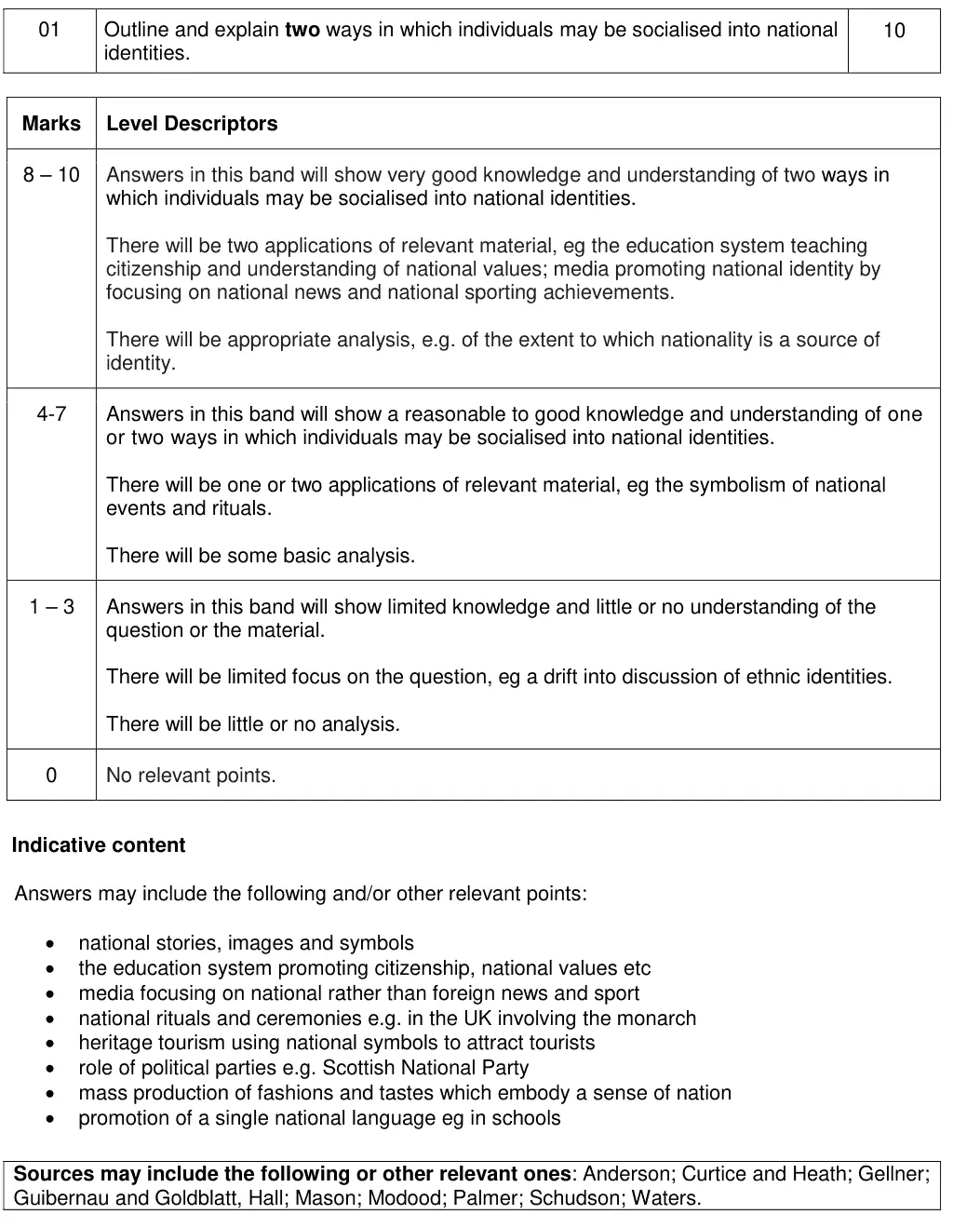
Outline and explain two ways in which individuals may be socialised into national
identities.
[10 marks]
June 2019 · Paper 2 · Q2 10 marks AO1=3, AO2=4, AO3=3 Analyse self identity and differencesocialisation
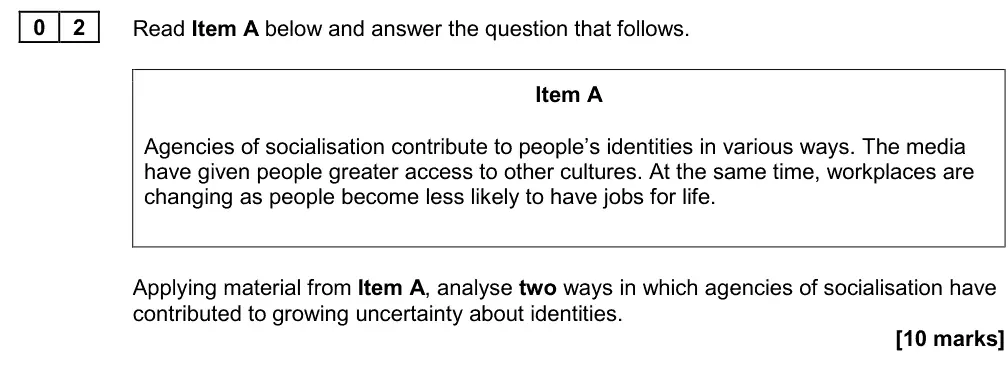
0 2
Read Item A below and answer the question that follows.
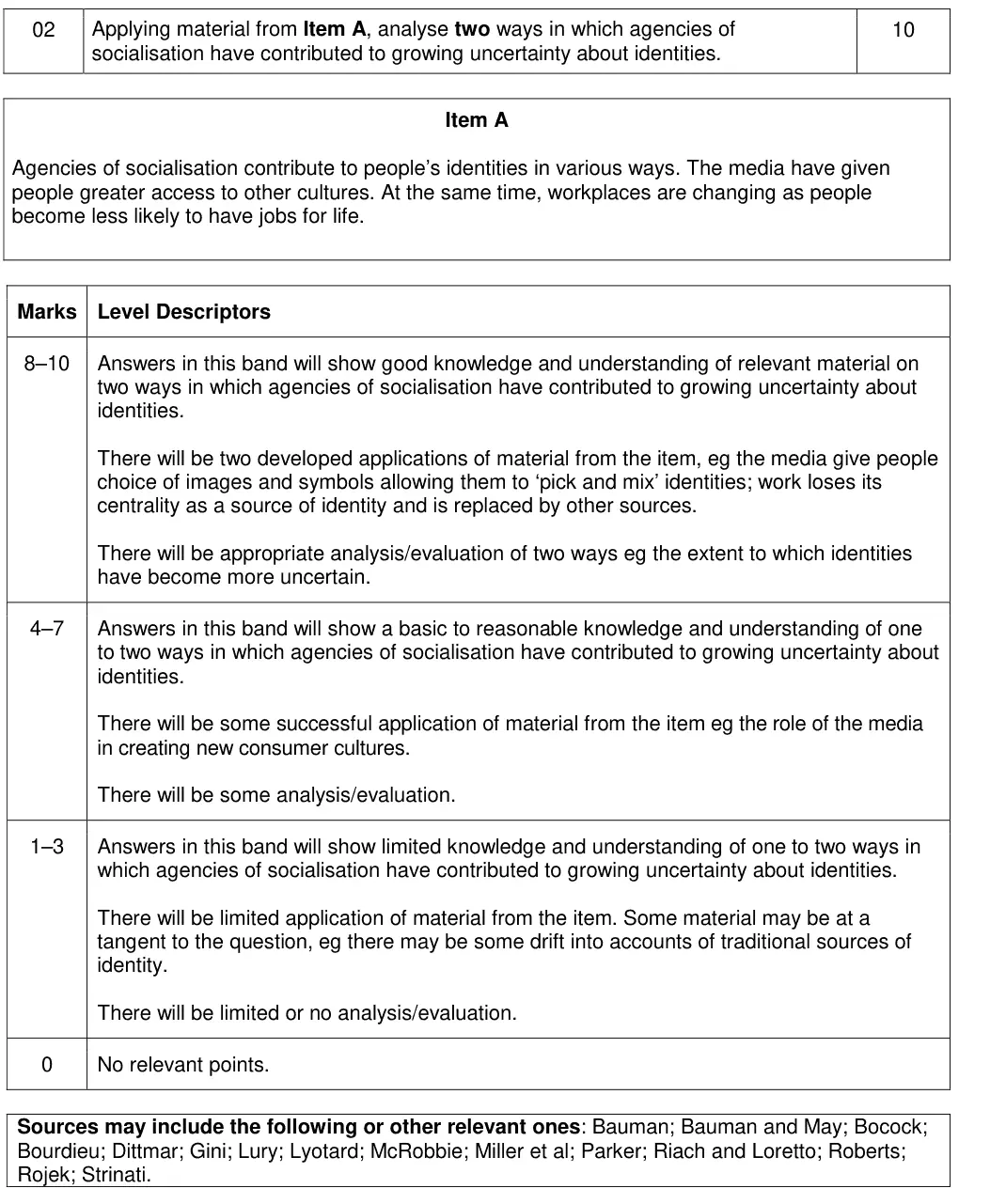
Item A
Agencies of socialisation contribute to people’s identities in various ways. The media
have given people greater access to other cultures. At the same time, workplaces are
changing as people become less likely to have jobs for life.
Applying material from Item A, analyse two ways in which agencies of socialisation have
contributed to growing uncertainty about identities.
[10 marks]
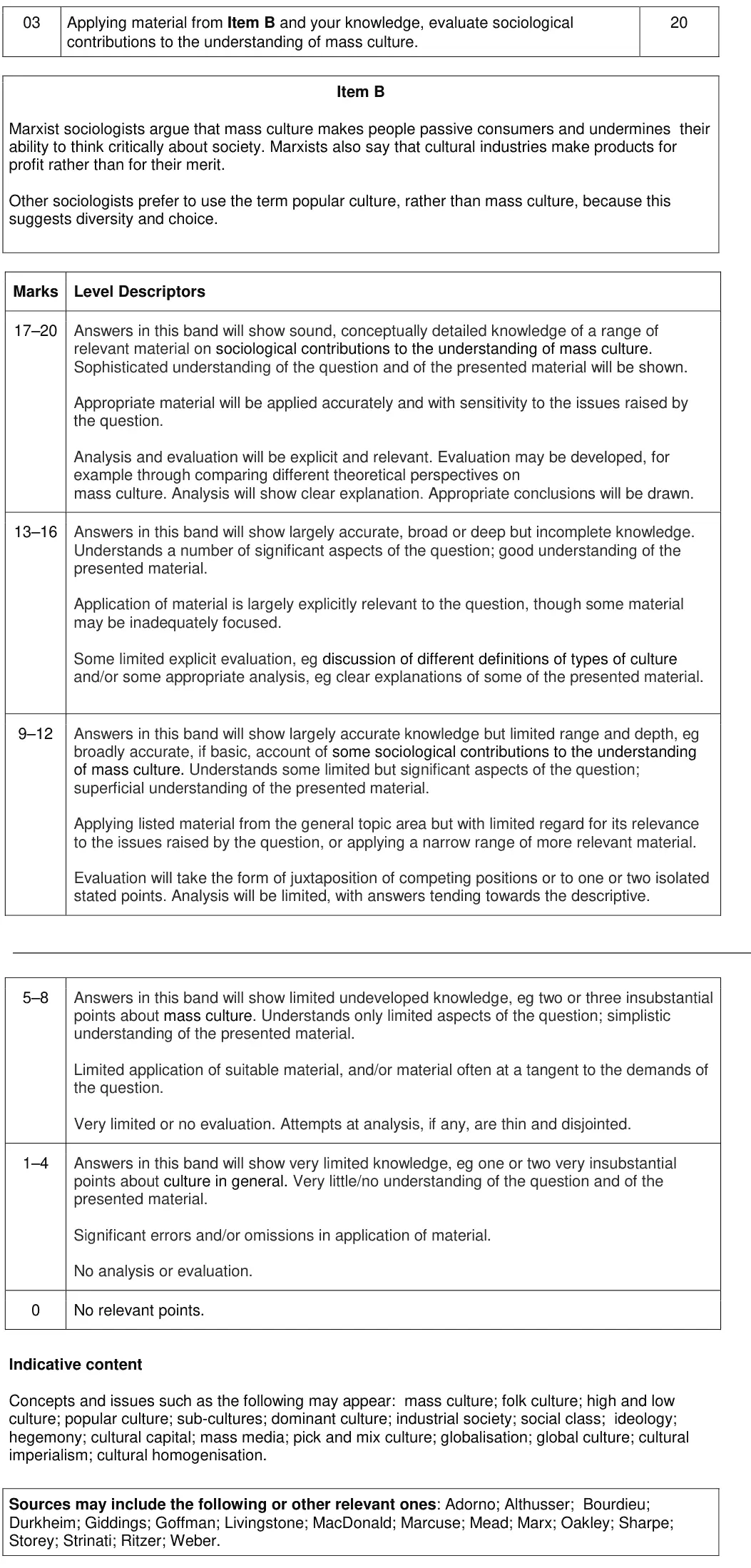
June 2019 · Paper 2 · Q3 20 marks AO1=8, AO2=6, AO3=6 20-mark essay conceptions of culture
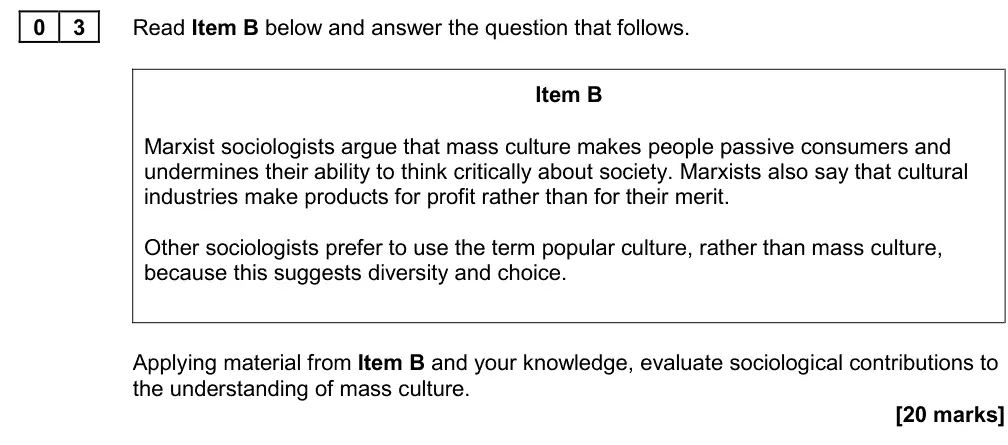
0 3
Read Item B below and answer the question that follows.
Item B
Marxist sociologists argue that mass culture makes people passive consumers and
undermines their ability to think critically about society. Marxists also say that cultural
industries make products for profit rather than for their merit.
Other sociologists prefer to use the term popular culture, rather than mass culture,
because this suggests diversity and choice.
Applying material from Item B and your knowledge, evaluate sociological contributions to
the understanding of mass culture.
[20 marks]
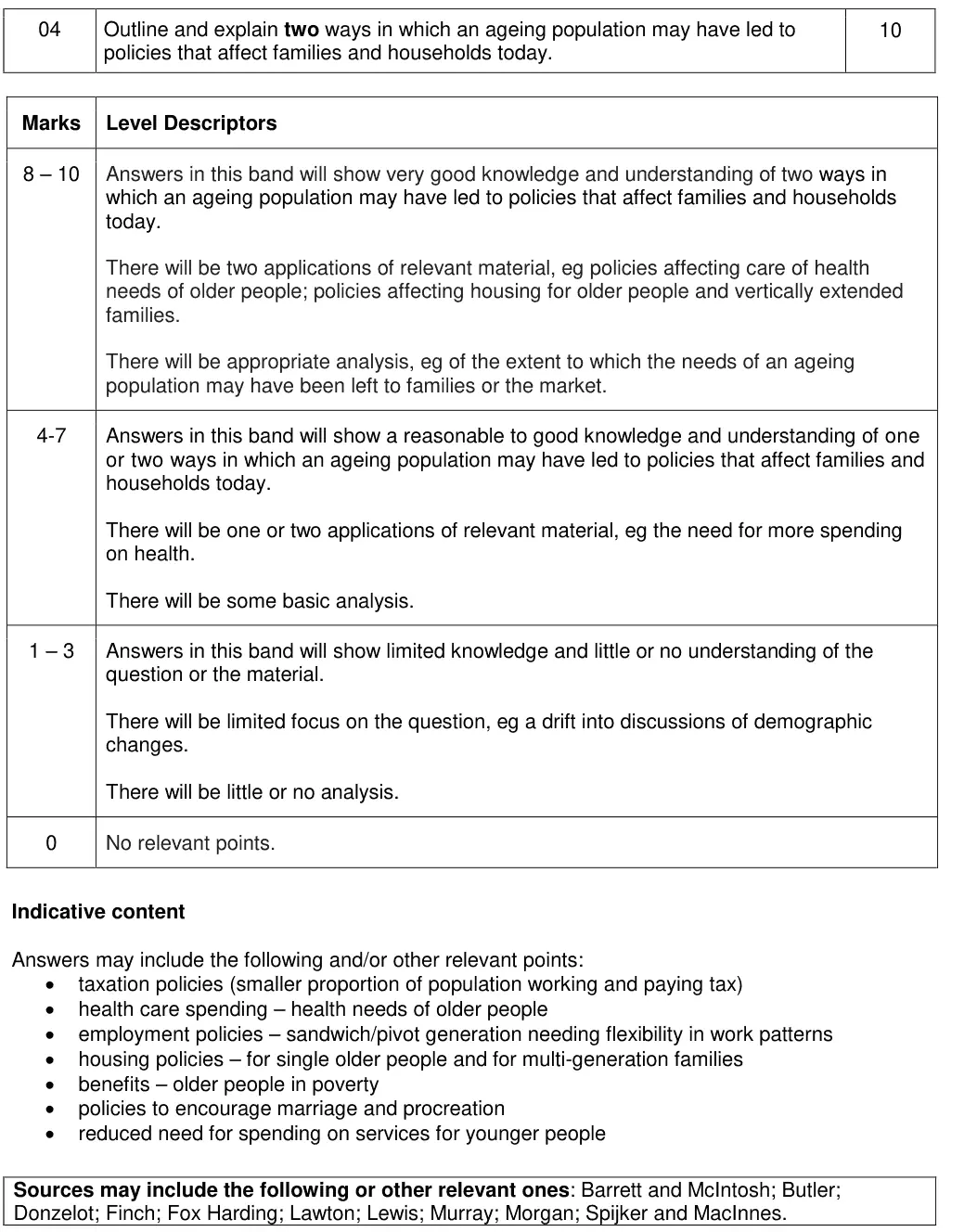
June 2019 · Paper 2 · Q4 10 marks AO1=5, AO2=3, AO3=2 Outline and explain demographic trendsfamily and social structure
0 4
Outline and explain two ways in which an ageing population may have led to policies that
affect families and households today.
[10 marks]
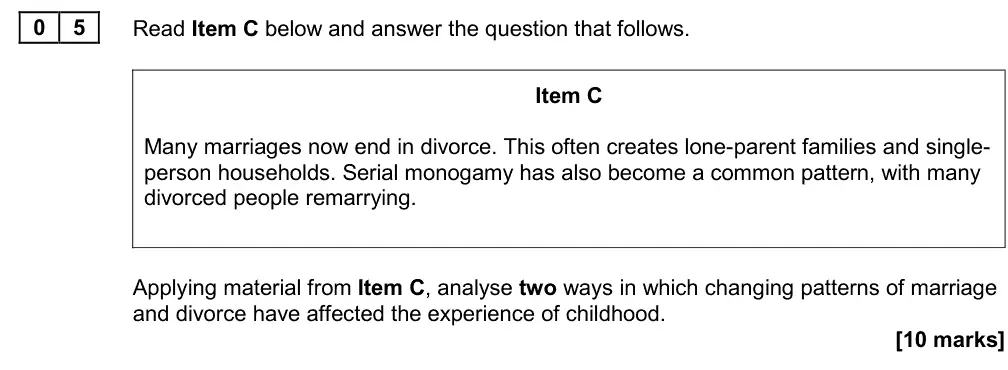
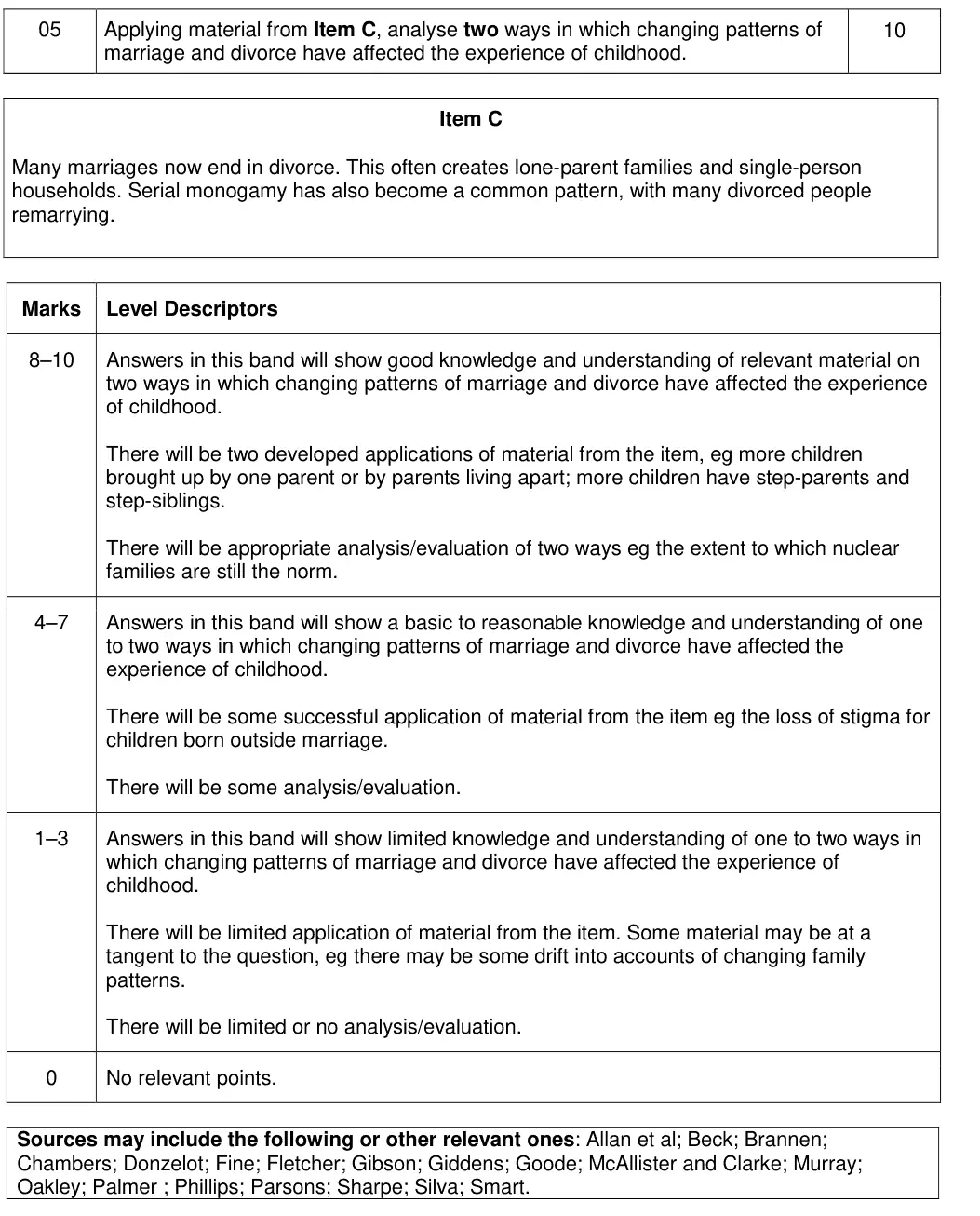
June 2019 · Paper 2 · Q5 10 marks AO1=3, AO2=4, AO3=3 Analyse childhoodmarriage divorce and family diversity
0 5
Read Item C below and answer the question that follows.
Item C
Many marriages now end in divorce. This often creates lone-parent families and single-
person households. Serial monogamy has also become a common pattern, with many
divorced people remarrying.
Applying material from Item C, analyse two ways in which changing patterns of marriage
and divorce have affected the experience of childhood.
[10 marks]
June 2019 · Paper 2 · Q6 20 marks AO1=8, AO2=6, AO3=6 20-mark essay gender roles and domestic labourfamily and social structure
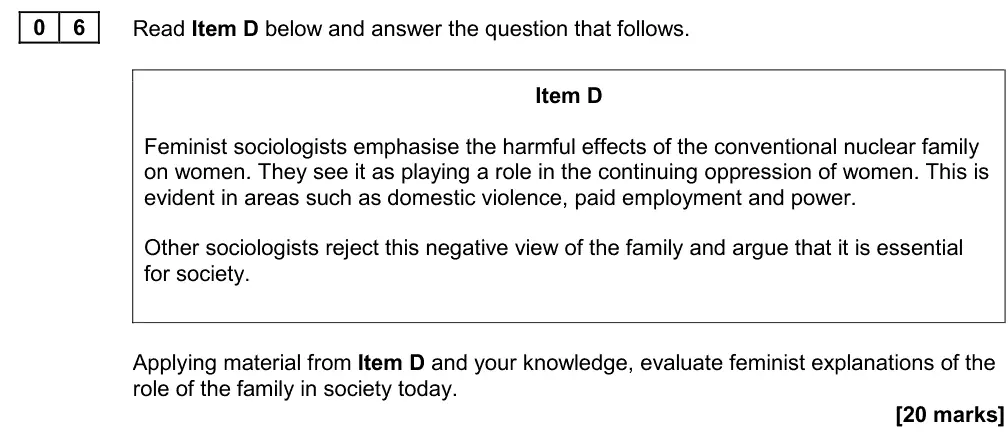
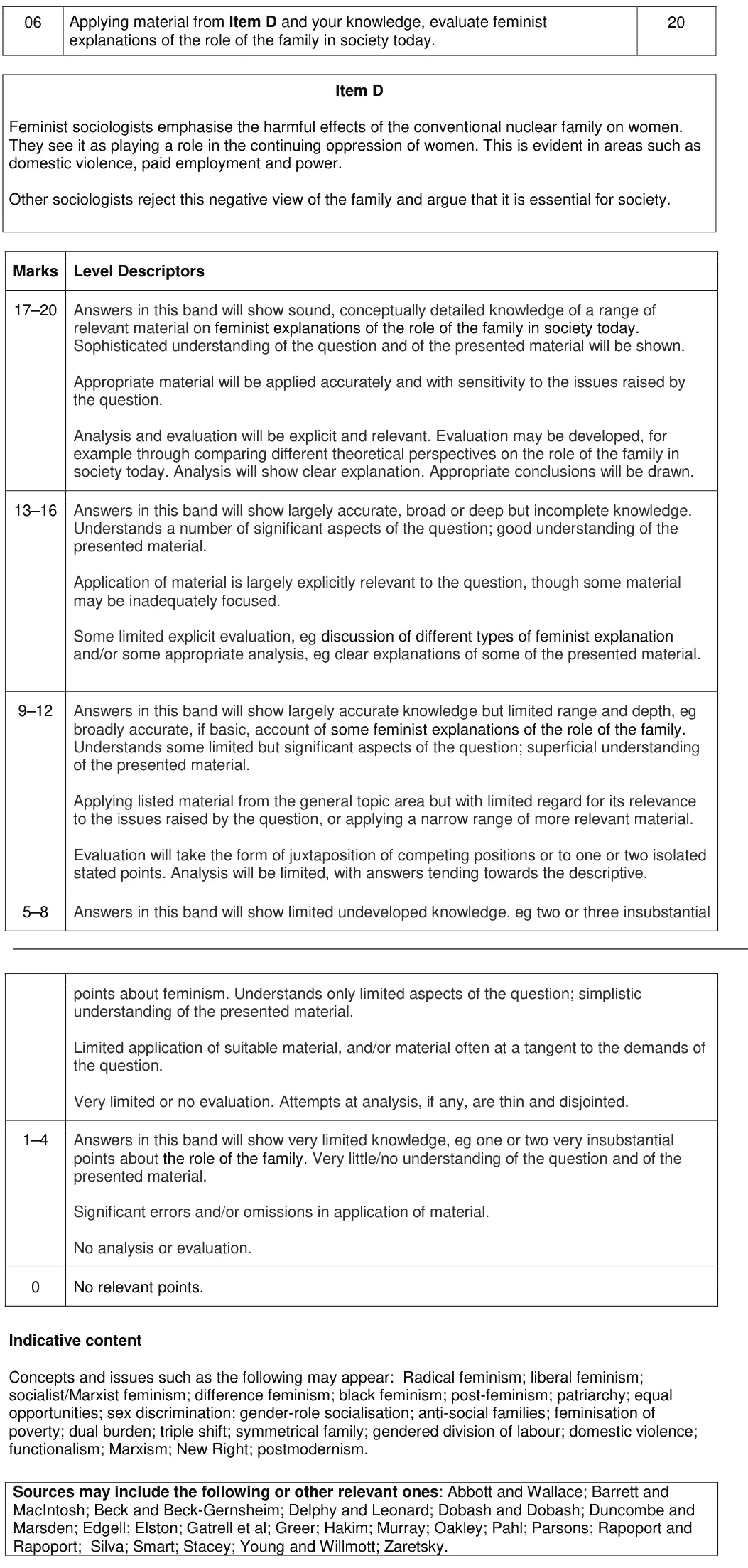
0 6
Read Item D below and answer the question that follows.
Item D
Feminist sociologists emphasise the harmful effects of the conventional nuclear family
on women. They see it as playing a role in the continuing oppression of women. This is
evident in areas such as domestic violence, paid employment and power.
Other sociologists reject this negative view of the family and argue that it is essential
for society.
Applying material from Item D and your knowledge, evaluate feminist explanations of the
role of the family in society today.
[20 marks]
June 2019 · Paper 2 · Q7 10 marks AO1=5, AO2=3, AO3=2 Outline and explain social construction of healthmedicine and health professions
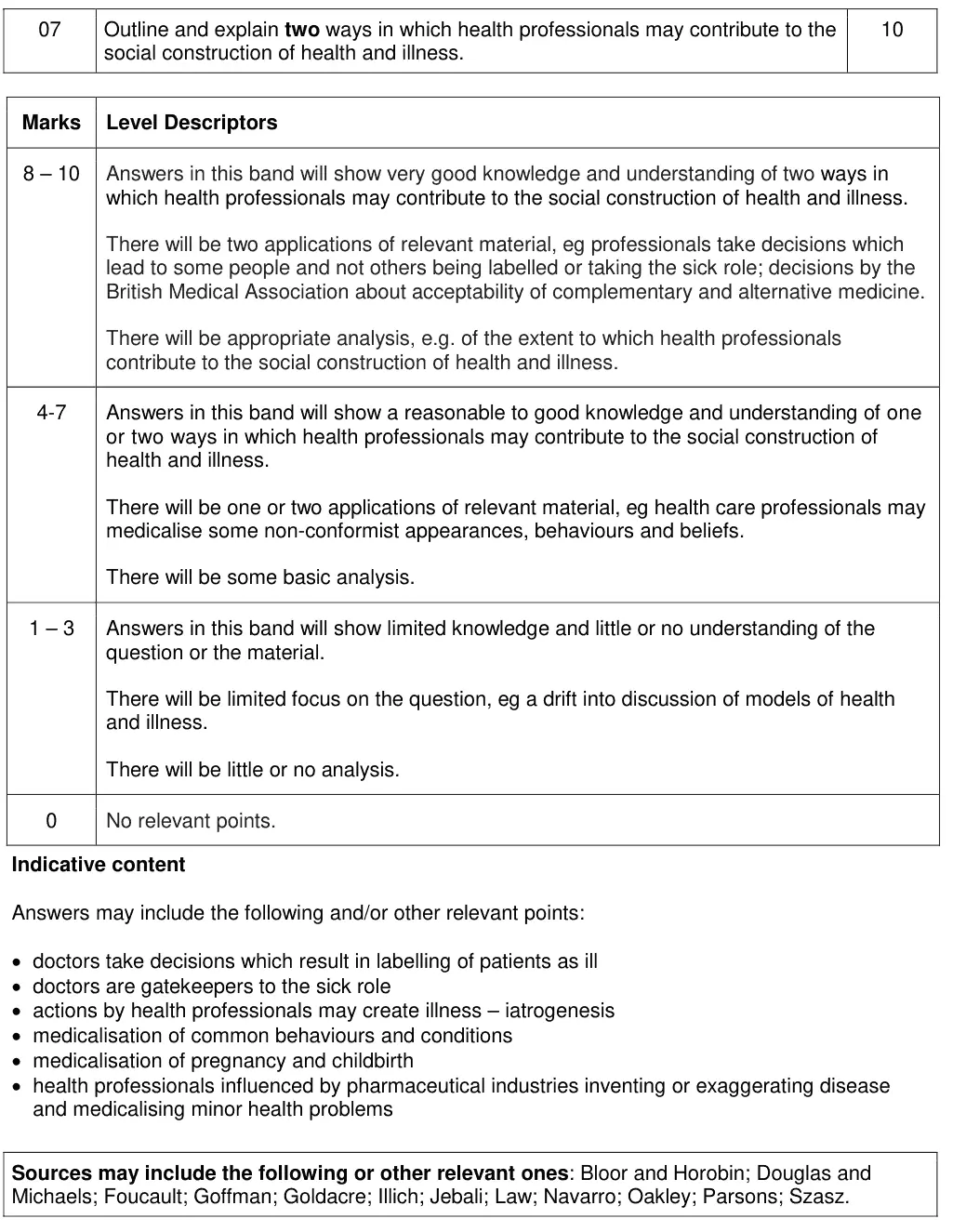
0 7
Outline and explain two ways in which health professionals may contribute to the social
construction of health and illness.
[10 marks]
June 2019 · Paper 2 · Q8 10 marks AO1=3, AO2=4, AO3=3 Analyse medicine and health professions
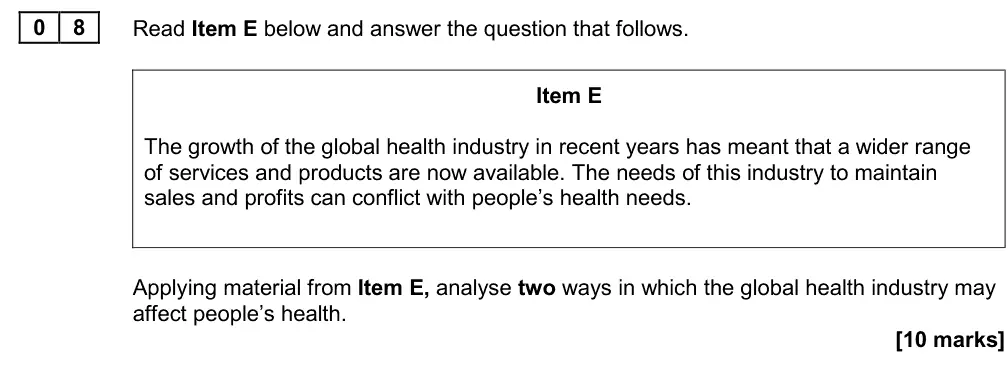
0 8
Read Item E below and answer the question that follows.
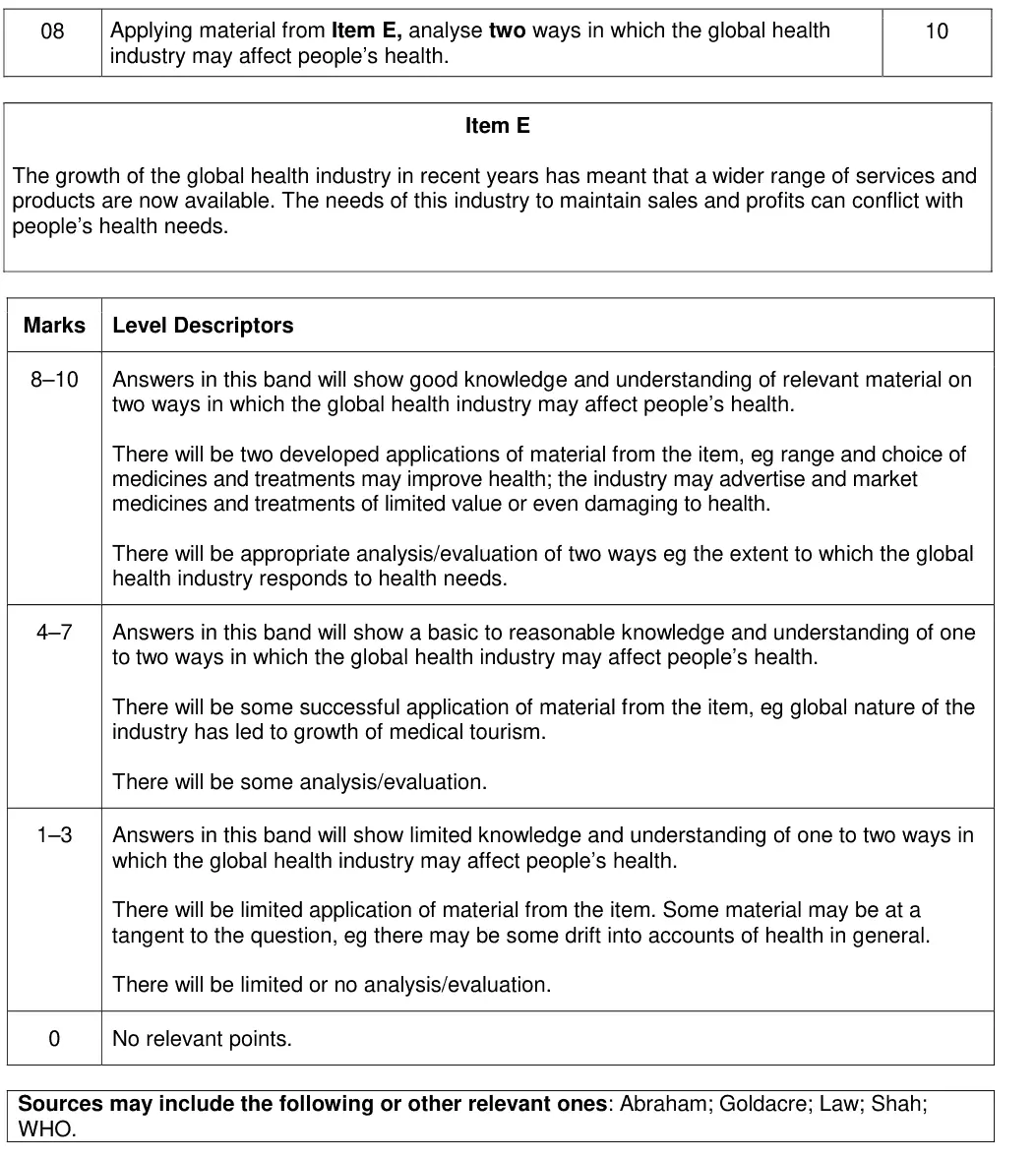
Item E
The growth of the global health industry in recent years has meant that a wider range
of services and products are now available. The needs of this industry to maintain
sales and profits can conflict with people’s health needs.
Applying material from Item E, analyse two ways in which the global health industry may
affect people’s health.
[10 marks]
June 2019 · Paper 2 · Q9 20 marks AO1=8, AO2=6, AO3=6 20-mark essay health inequalitiesaccess to health care
0 9
Read Item F below and answer the question that follows.
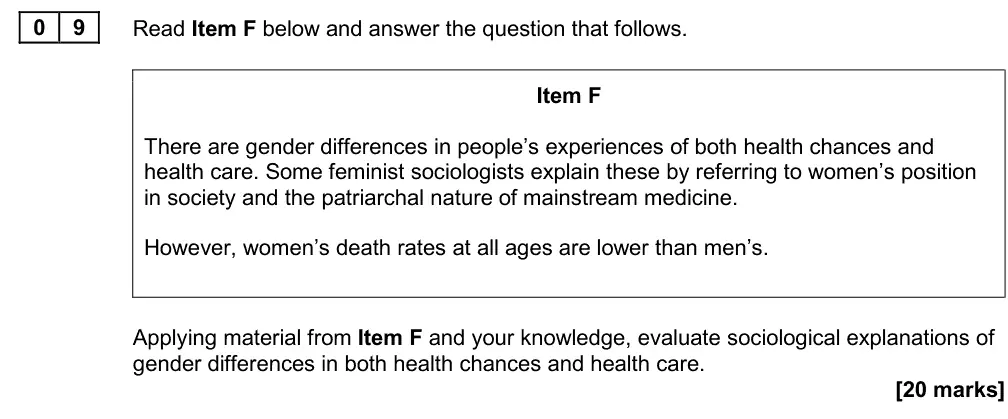
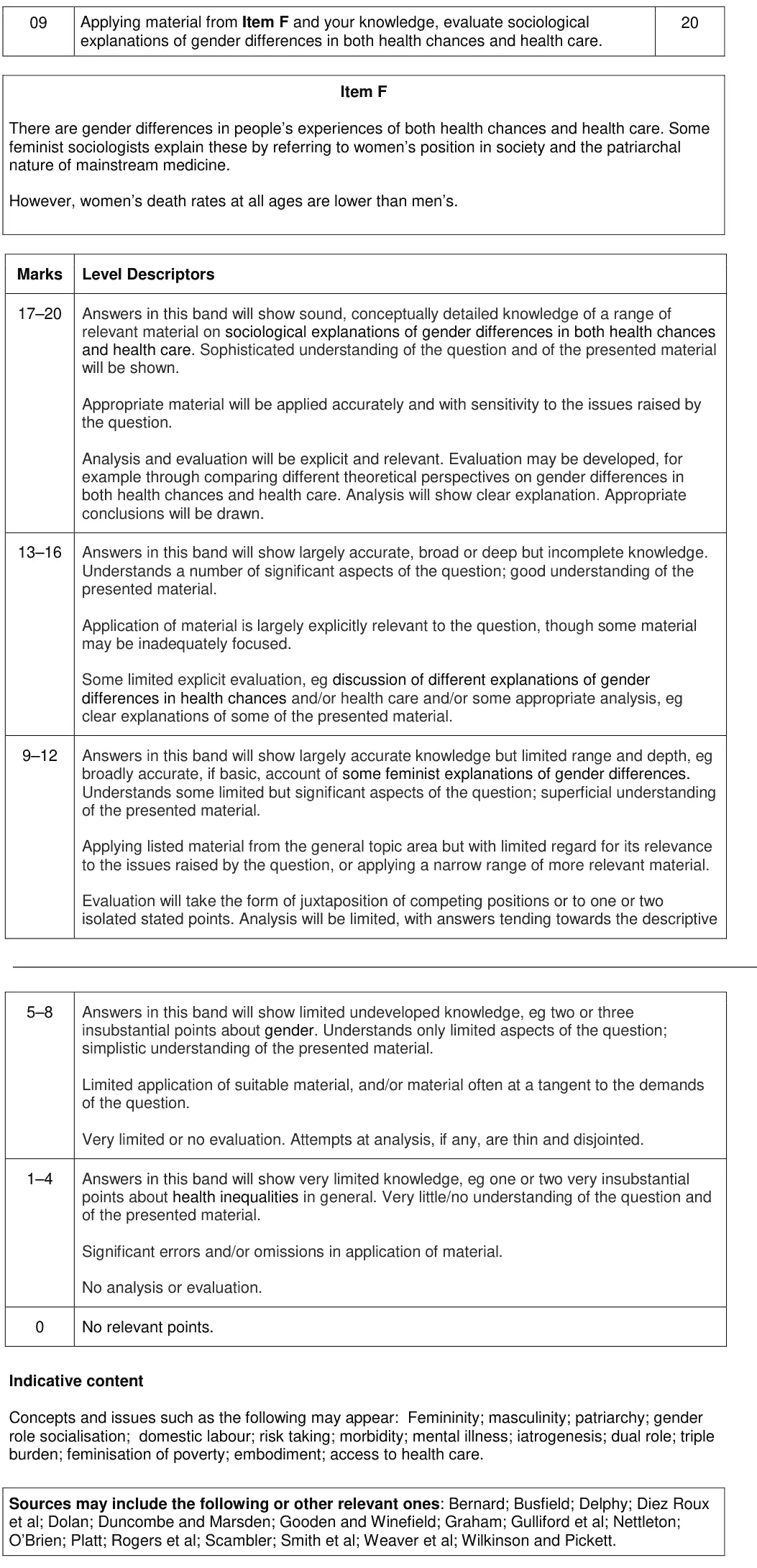
Item F
There are gender differences in people’s experiences of both health chances and
health care. Some feminist sociologists explain these by referring to women’s position
in society and the patriarchal nature of mainstream medicine.
However, women’s death rates at all ages are lower than men’s.
Applying material from Item F and your knowledge, evaluate sociological explanations of
gender differences in both health chances and health care.
[20 marks]
June 2019 · Paper 2 · Q10 10 marks AO1=5, AO2=3, AO3=2 Outline and explain work and worklessnessdistribution of wealth and income
1 0
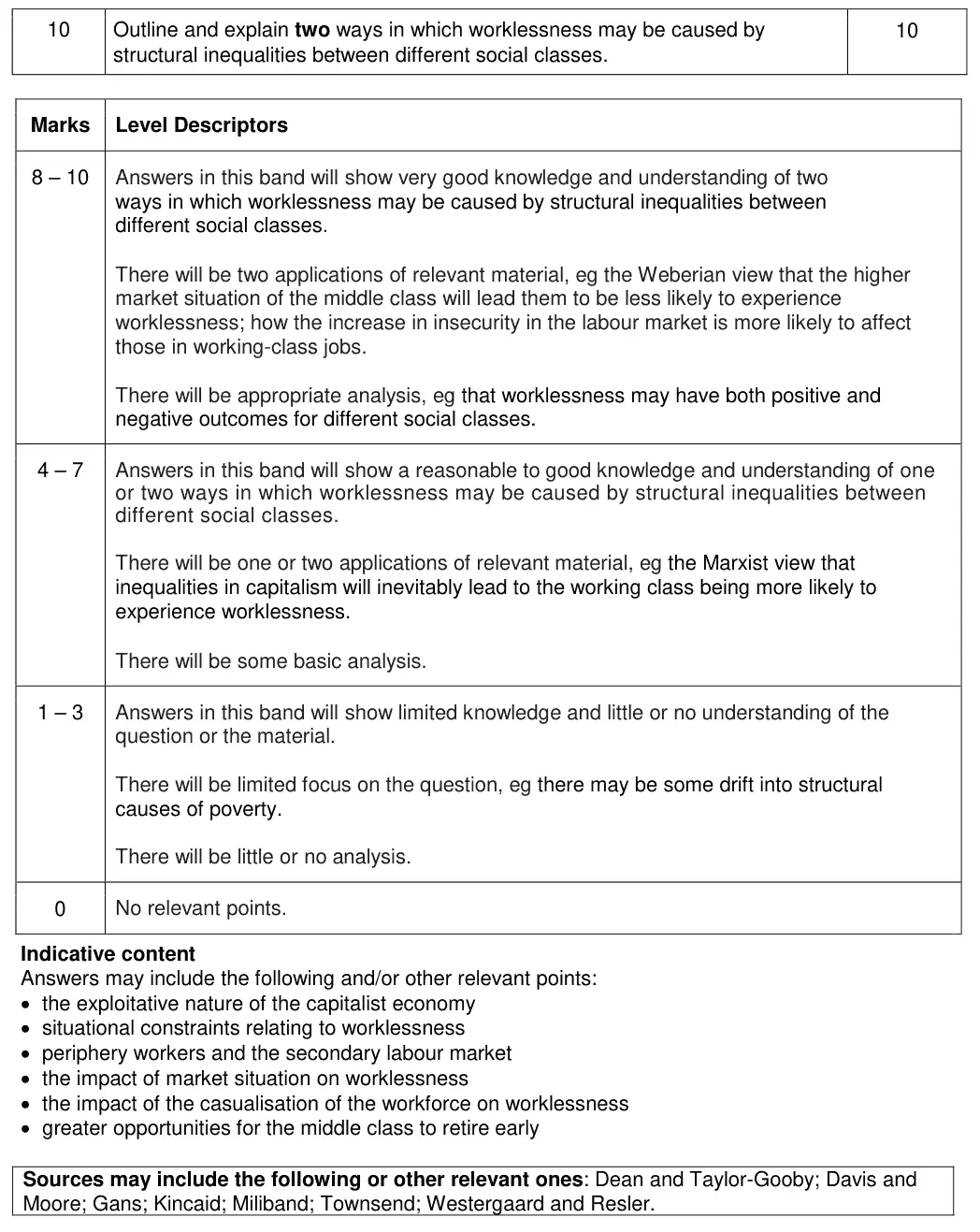
Outline and explain two ways in which worklessness may be caused by structural
inequalities between different social classes.
[10 marks]
June 2019 · Paper 2 · Q11 10 marks AO1=3, AO2=4, AO3=3 Analyse responses to poverty
1 1
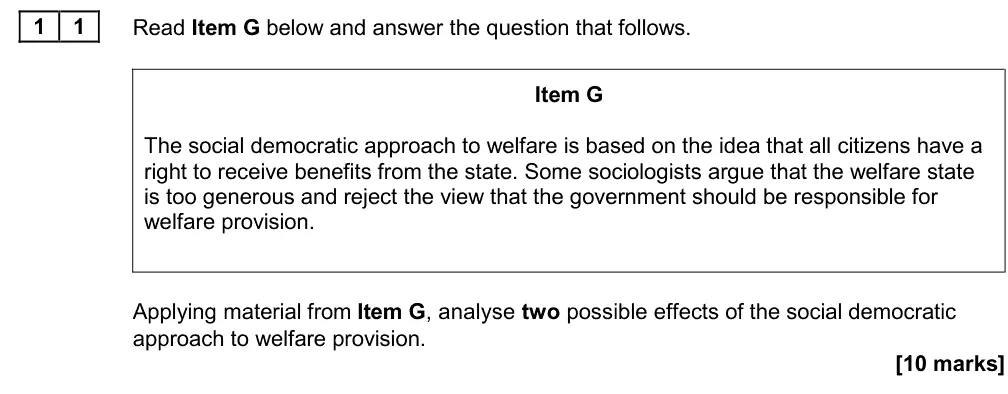
Read Item G below and answer the question that follows.
Item G
The social democratic approach to welfare is based on the idea that all citizens have a
right to receive benefits from the state. Some sociologists argue that the welfare state
is too generous and reject the view that the government should be responsible for
welfare provision.
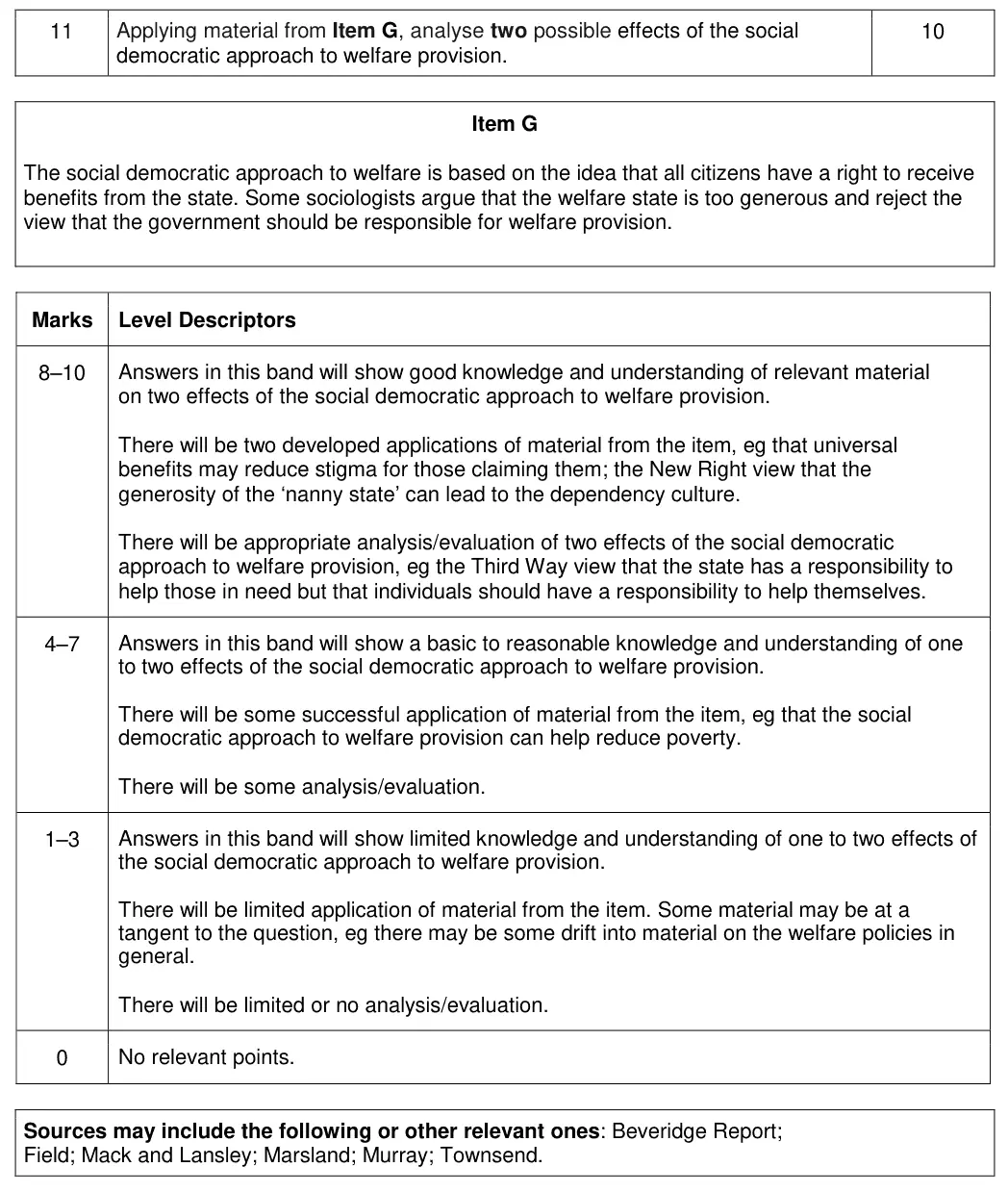
Applying material from Item G, analyse two possible effects of the social democratic
approach to welfare provision.
[10 marks]
June 2019 · Paper 2 · Q12 20 marks AO1=8, AO2=6, AO3=6 20-mark essay labour process
1 2
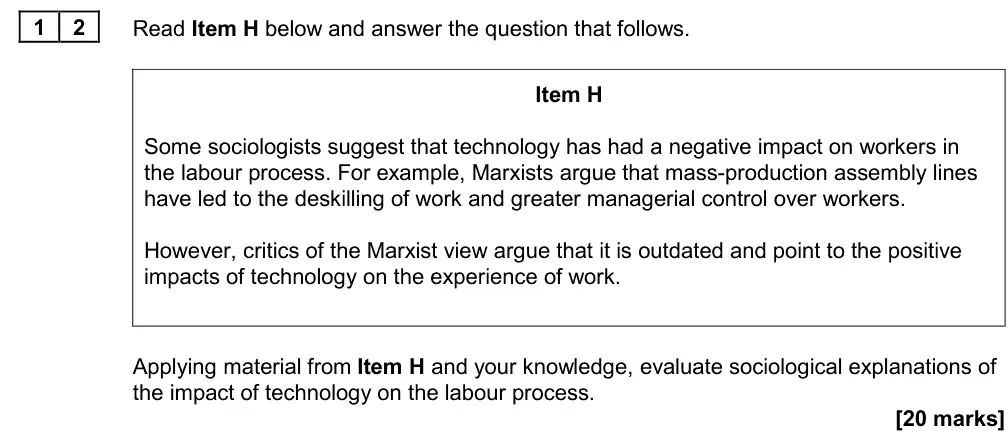
Read Item H below and answer the question that follows.
Item H
Some sociologists suggest that technology has had a negative impact on workers in
the labour process. For example, Marxists argue that mass-production assembly lines
have led to the deskilling of work and greater managerial control over workers.
However, critics of the Marxist view argue that it is outdated and point to the positive
impacts of technology on the experience of work.
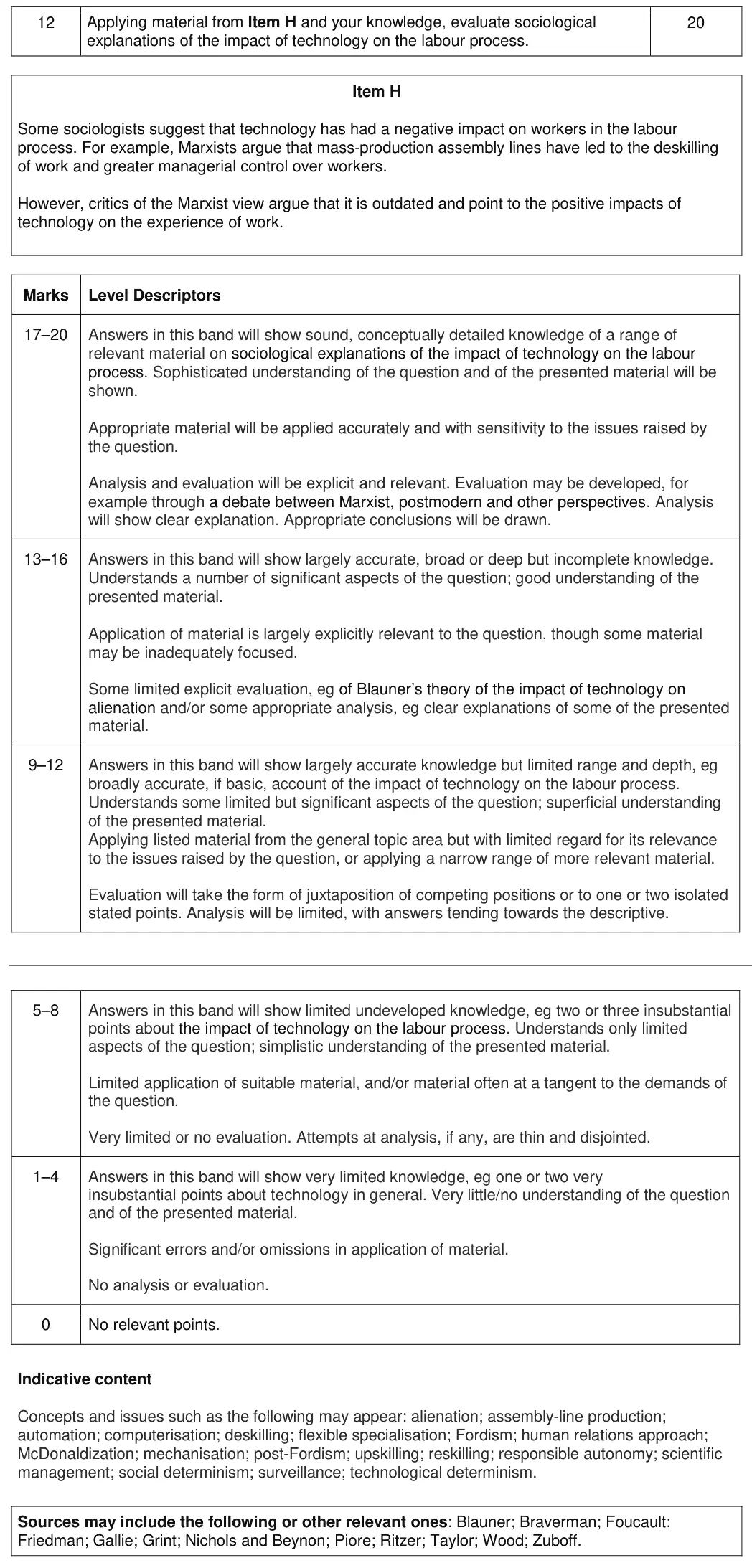
Applying material from Item H and your knowledge, evaluate sociological explanations of
the impact of technology on the labour process.
[20 marks]
June 2019 · Paper 2 · Q13 10 marks AO1=5, AO2=3, AO3=2 Outline and explain religion and social change
1 3
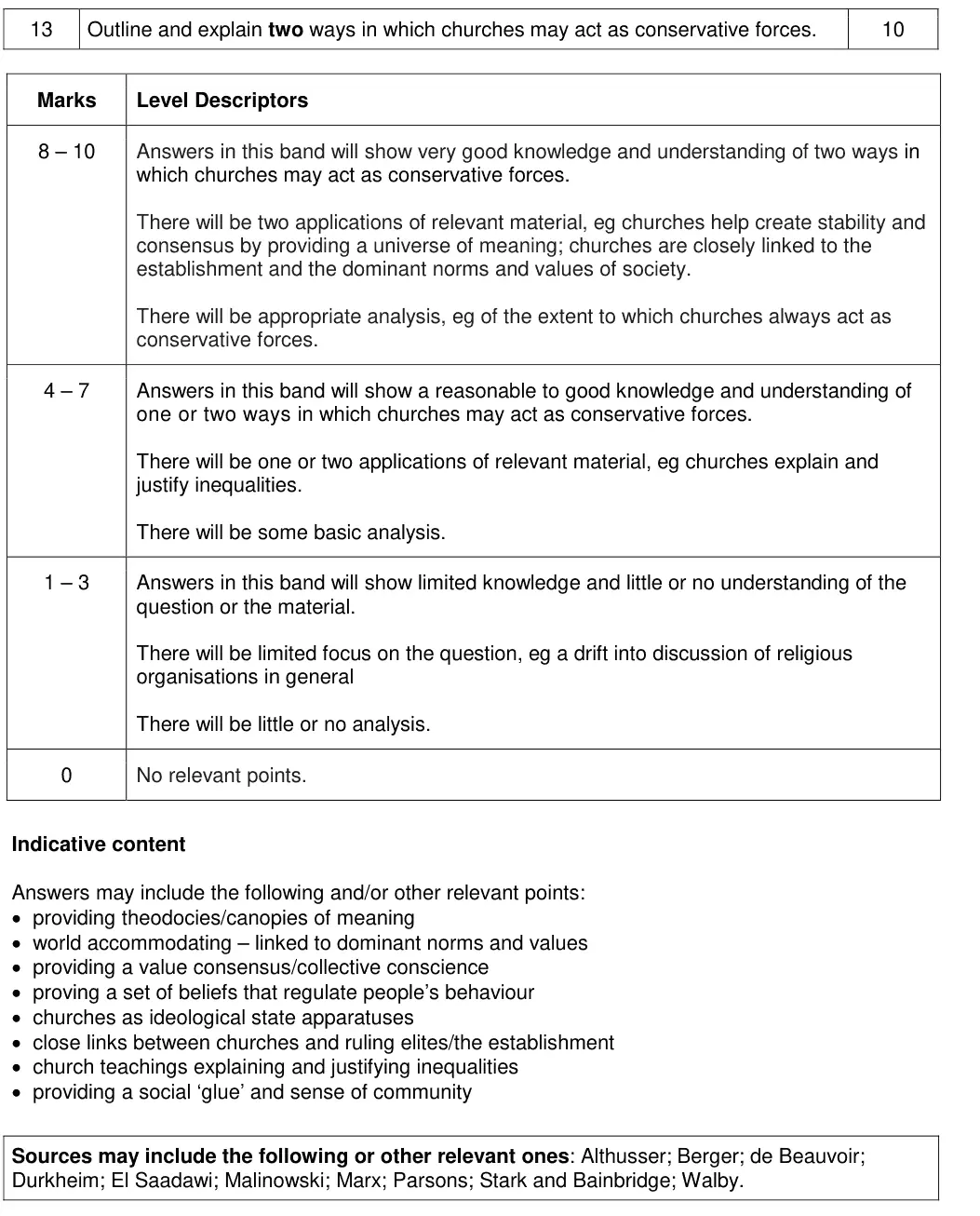
Outline and explain two ways in which churches may act as conservative forces.
[10 marks]
June 2019 · Paper 2 · Q14 10 marks AO1=3, AO2=4, AO3=3 Analyse secularisationideology science and religion
1 4
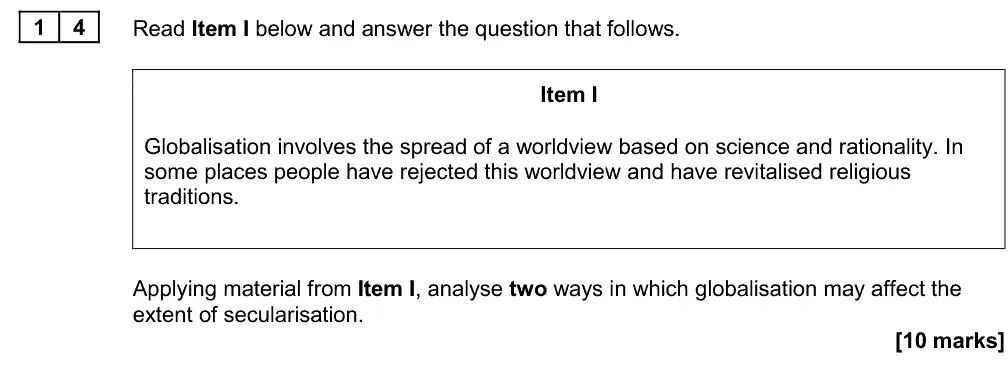
Read Item I below and answer the question that follows.
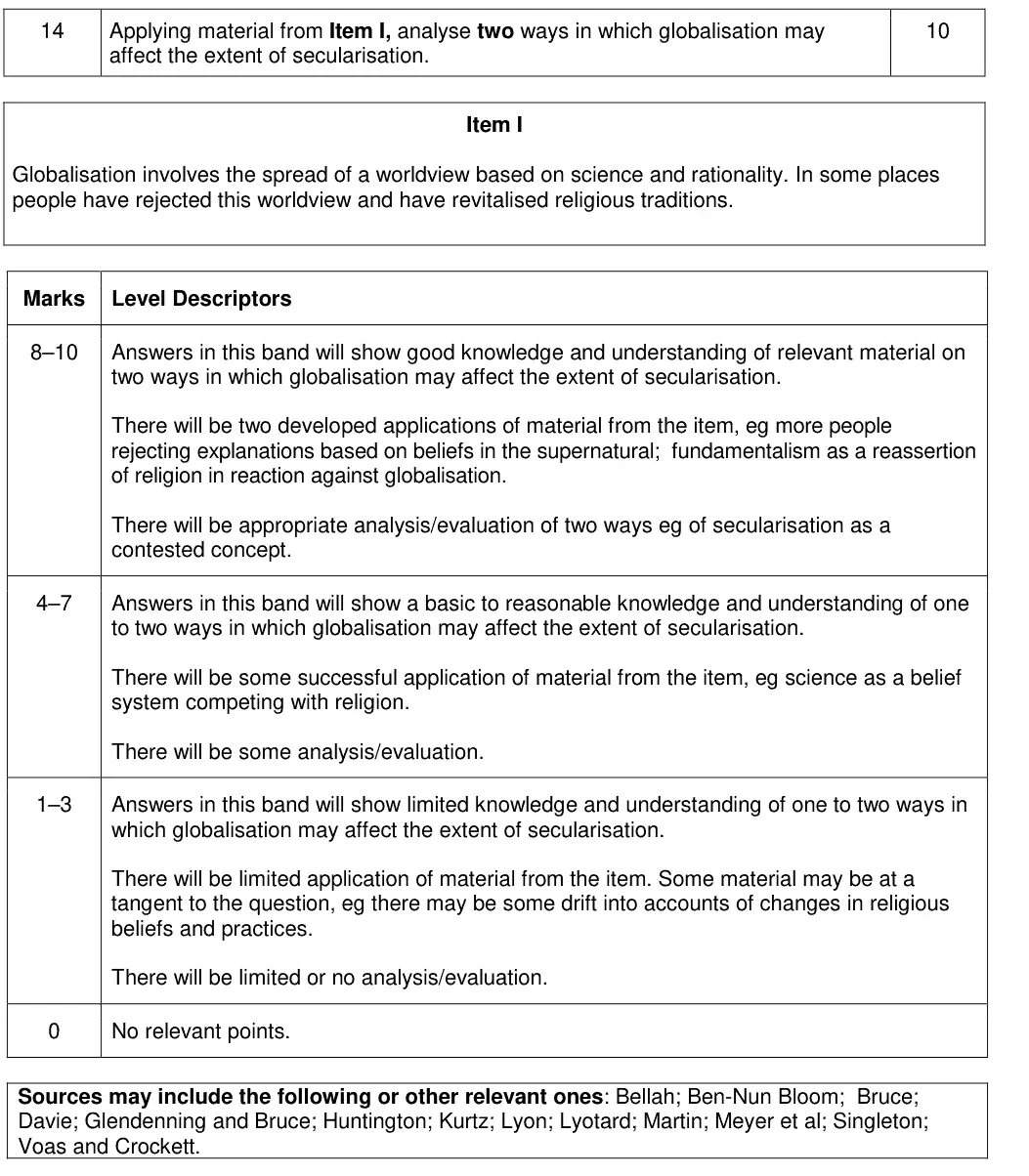
Item I
Globalisation involves the spread of a worldview based on science and rationality. In
some places people have rejected this worldview and have revitalised religious
traditions.
Applying material from Item I, analyse two ways in which globalisation may affect the
extent of secularisation.
[10 marks]
June 2019 · Paper 2 · Q15 20 marks AO1=8, AO2=6, AO3=6 20-mark essay religion and social groups
1 5
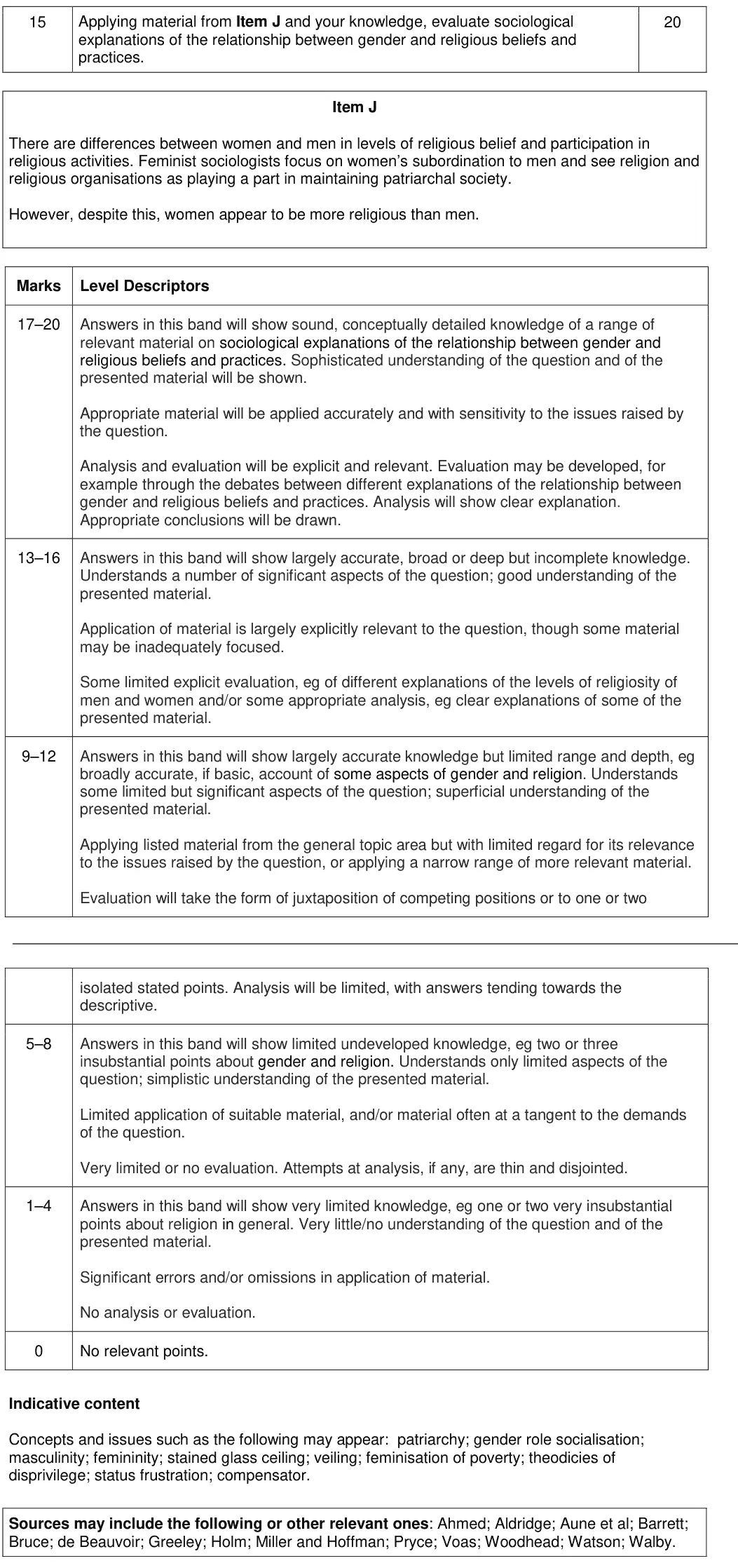
Read Item J below and answer the question that follows.
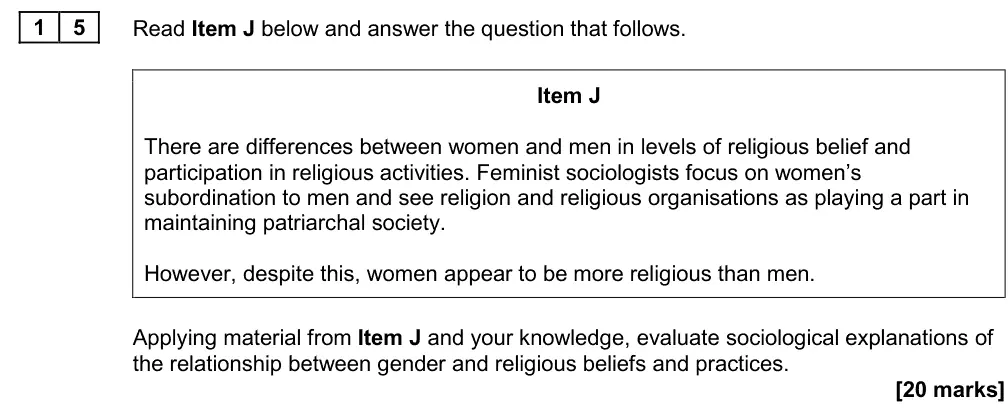
Item J
There are differences between women and men in levels of religious belief and
participation in religious activities. Feminist sociologists focus on women’s
subordination to men and see religion and religious organisations as playing a part in
maintaining patriarchal society.
However, despite this, women appear to be more religious than men.
Applying material from Item J and your knowledge, evaluate sociological explanations of
the relationship between gender and religious beliefs and practices.
[20 marks]
June 2019 · Paper 2 · Q16 10 marks AO1=5, AO2=3, AO3=2 Outline and explain globalisation and developmentdevelopment and underdevelopment
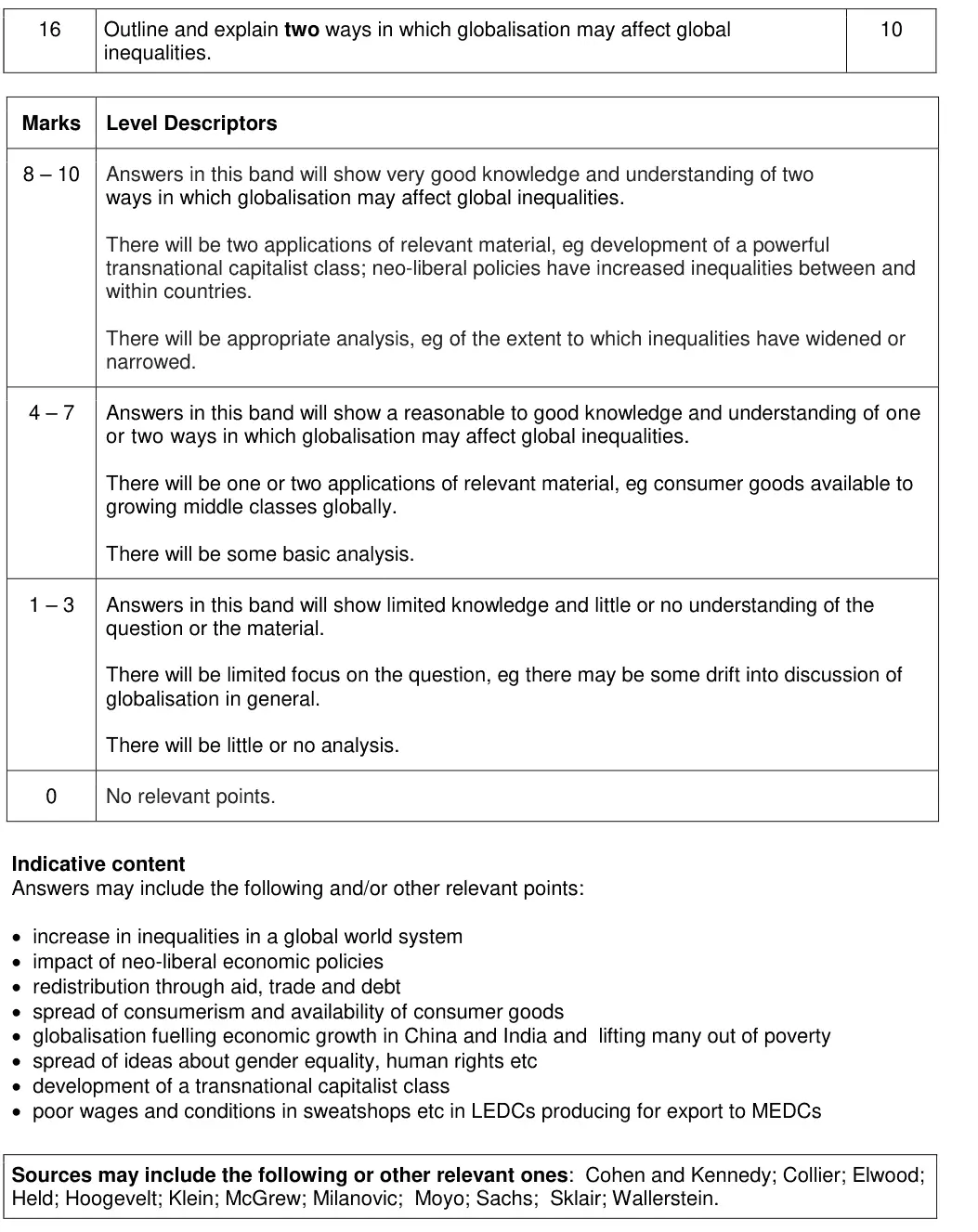
1 6
Outline and explain two ways in which globalisation may affect global inequalities.
[10 marks]
June 2019 · Paper 2 · Q17 10 marks AO1=3, AO2=4, AO3=3 Analyse aid trade and industrialisation
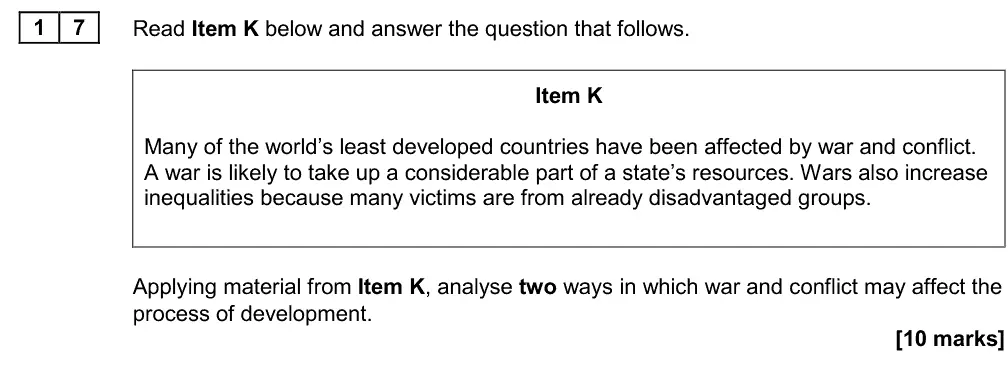
1 7
Read Item K below and answer the question that follows.
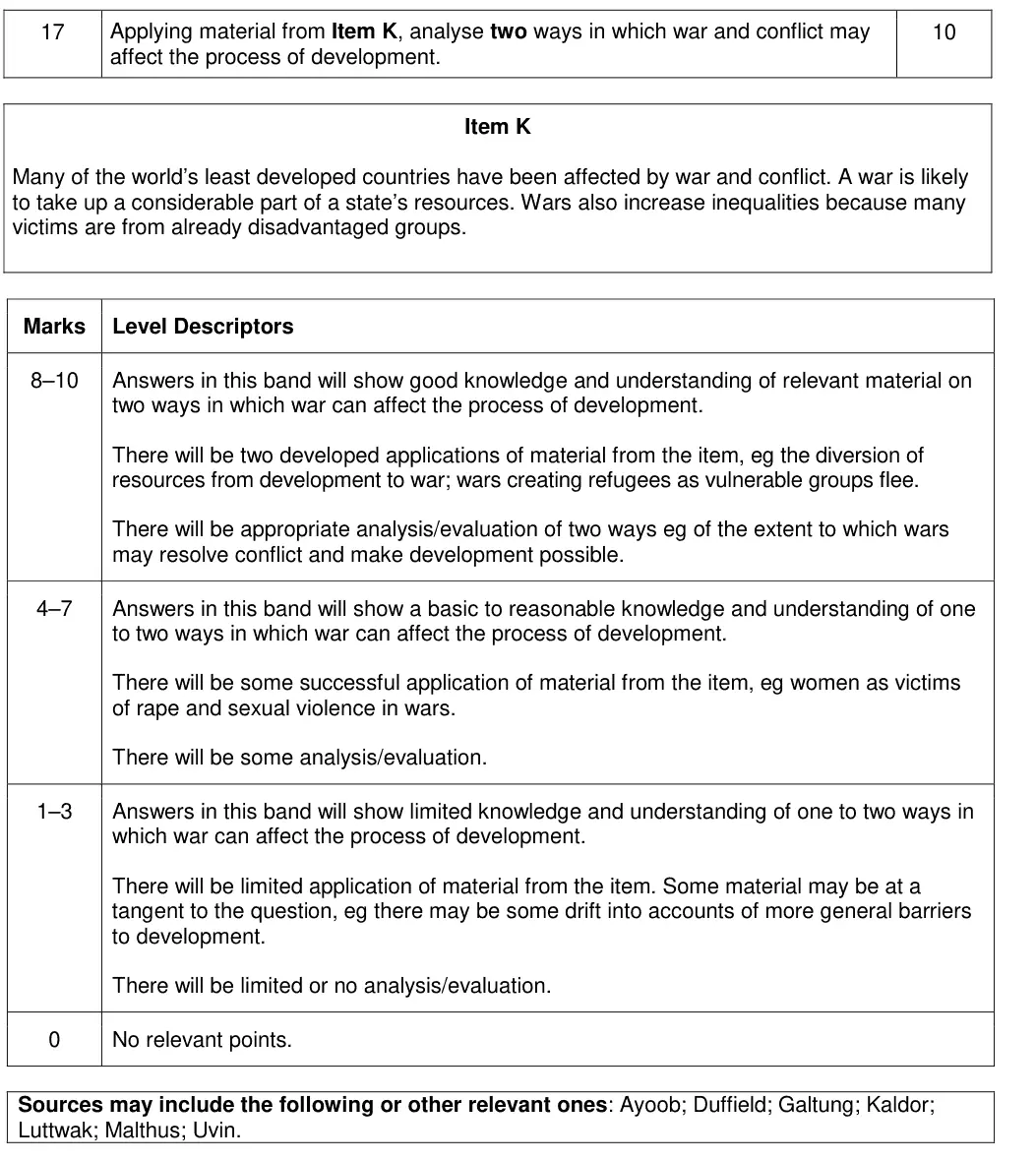
Item K
Many of the world’s least developed countries have been affected by war and conflict.
A war is likely to take up a considerable part of a state’s resources. Wars also increase
inequalities because many victims are from already disadvantaged groups.
Applying material from Item K, analyse two ways in which war and conflict may affect the
process of development.
[10 marks]
June 2019 · Paper 2 · Q18 20 marks AO1=8, AO2=6, AO3=6 20-mark essay tncs ngos and international agenciesglobalisation and development
1 8
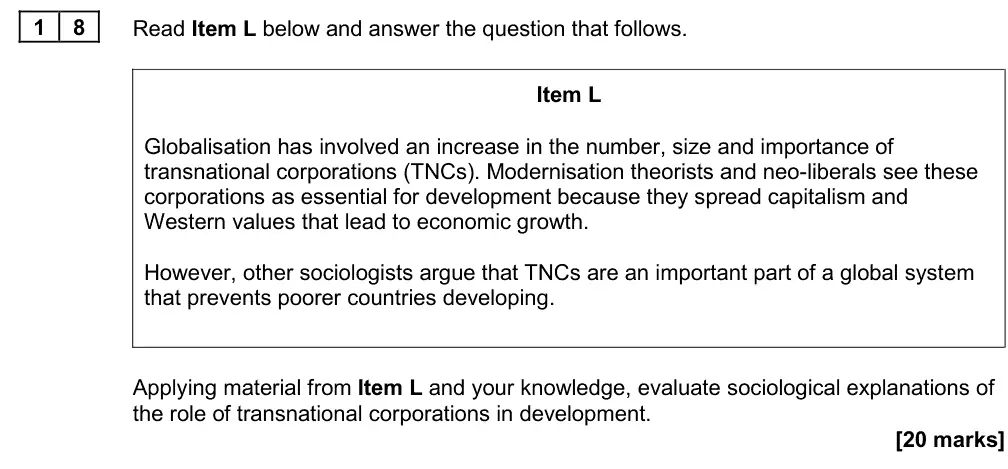
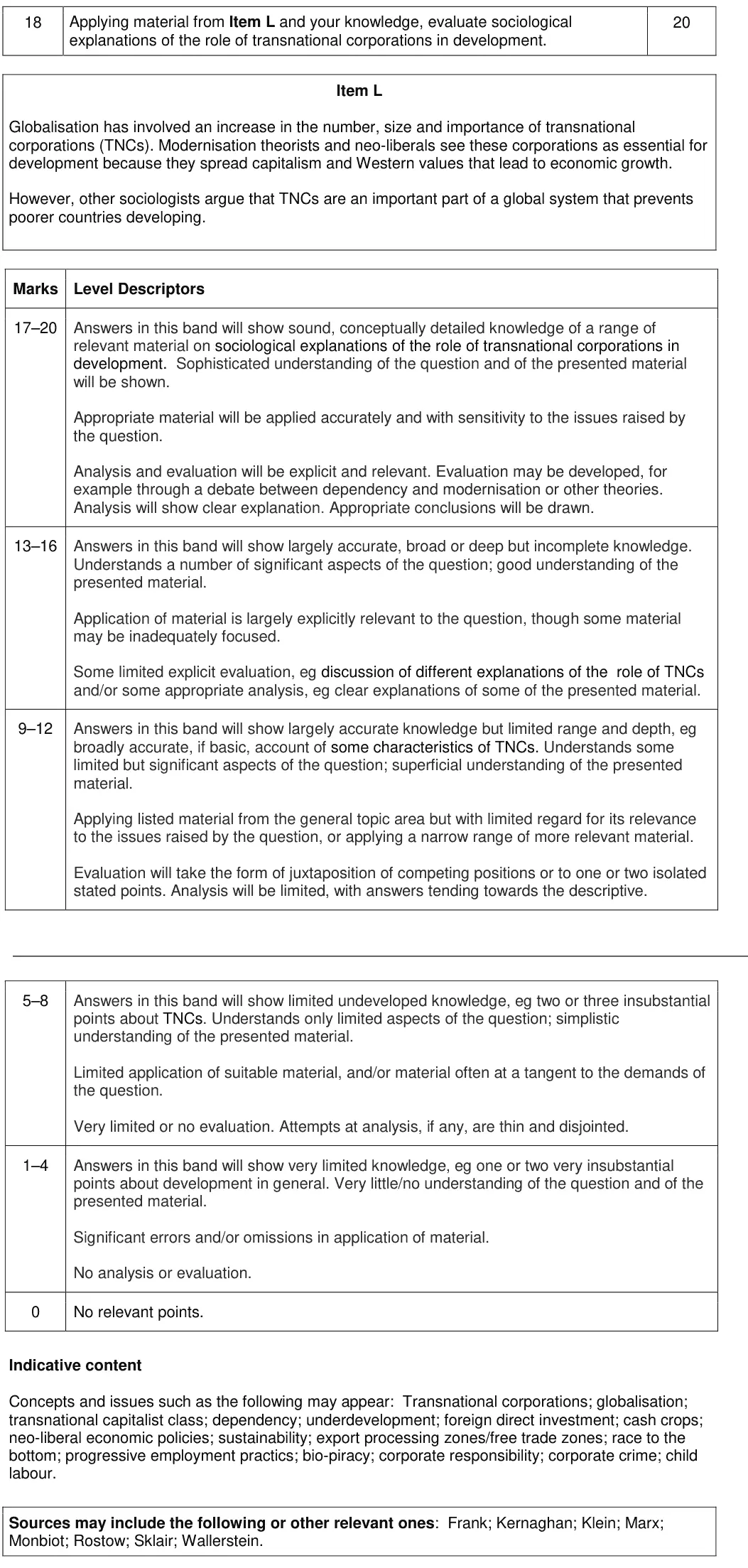
Read Item L below and answer the question that follows.
Item L
Globalisation has involved an increase in the number, size and importance of
transnational corporations (TNCs). Modernisation theorists and neo-liberals see these
corporations as essential for development because they spread capitalism and
Western values that lead to economic growth.
However, other sociologists argue that TNCs are an important part of a global system
that prevents poorer countries developing.
Applying material from Item L and your knowledge, evaluate sociological explanations of
the role of transnational corporations in development.
[20 marks]
June 2019 · Paper 2 · Q19 10 marks AO1=5, AO2=3, AO3=2 Outline and explain new mediamedia representations
1 9
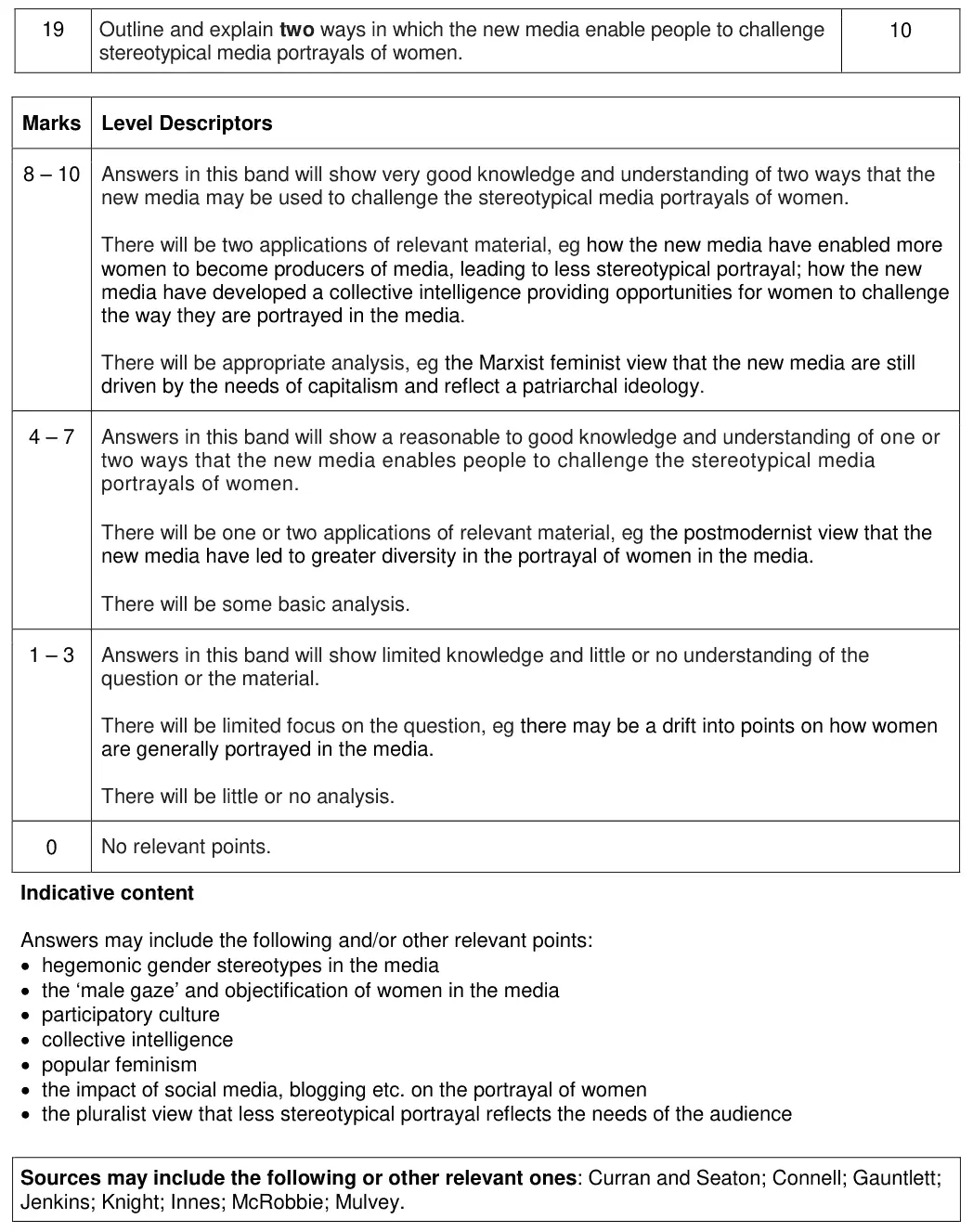
Outline and explain two ways in which the new media enable people to challenge
stereotypical media portrayals of women.
[10 marks]
June 2019 · Paper 2 · Q20 10 marks AO1=3, AO2=4, AO3=3 Analyse media audiences
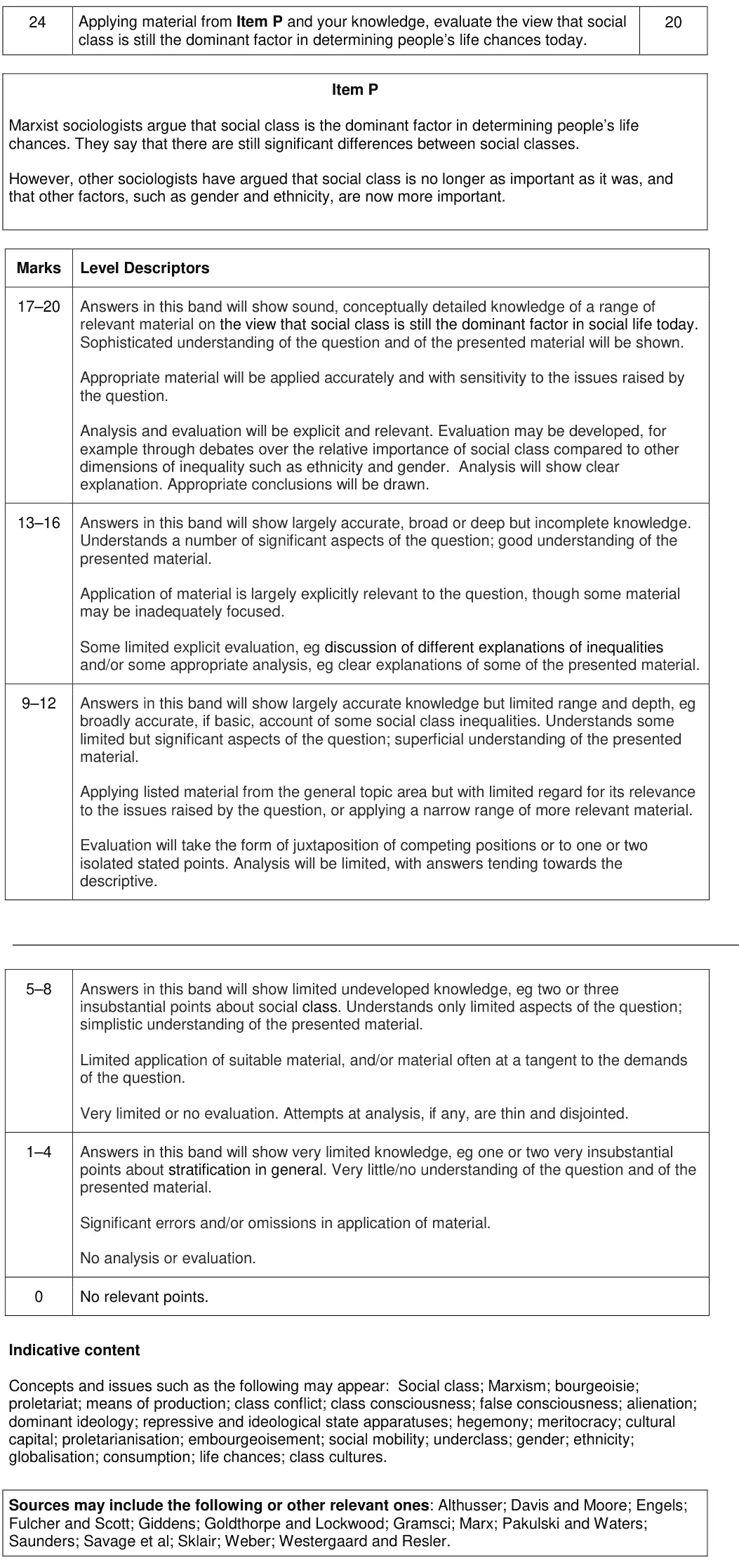
2 0
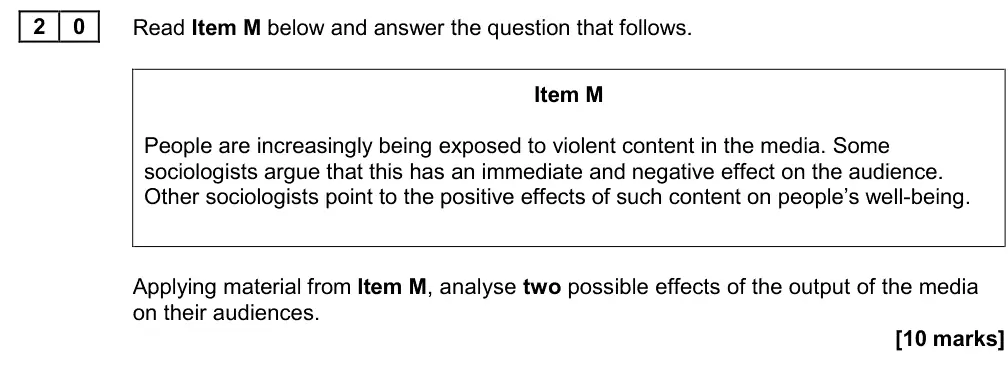
Read Item M below and answer the question that follows.
Item M
People are increasingly being exposed to violent content in the media. Some
sociologists argue that this has an immediate and negative effect on the audience.
Other sociologists point to the positive effects of such content on people’s well-being.
Applying material from Item M, analyse two possible effects of the output of the media
on their audiences.
[10 marks]
June 2019 · Paper 2 · Q21 20 marks AO1=8, AO2=6, AO3=6 20-mark essay news selection and presentationmedia ownership and control
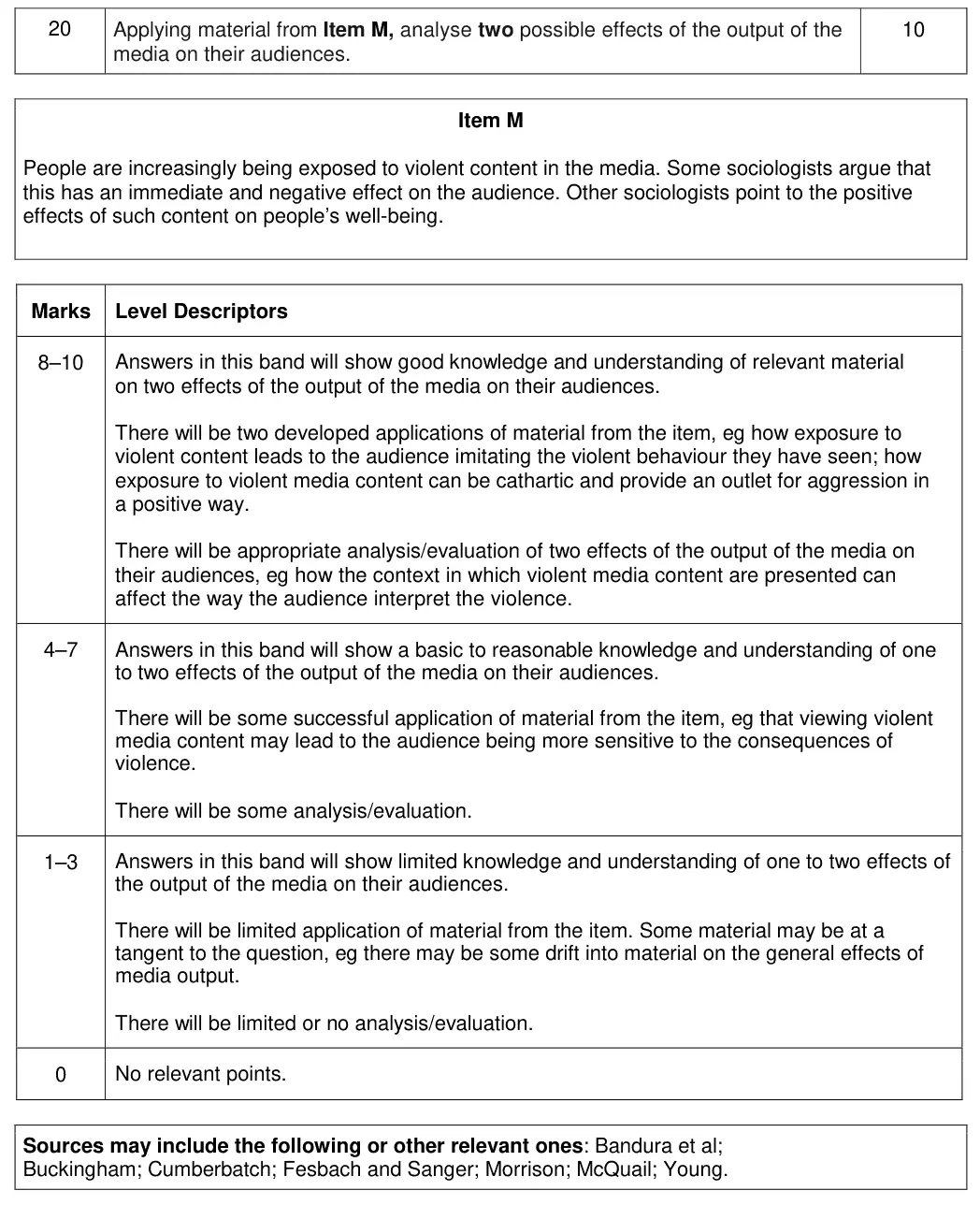
2 1
Read Item N below and answer the question that follows.
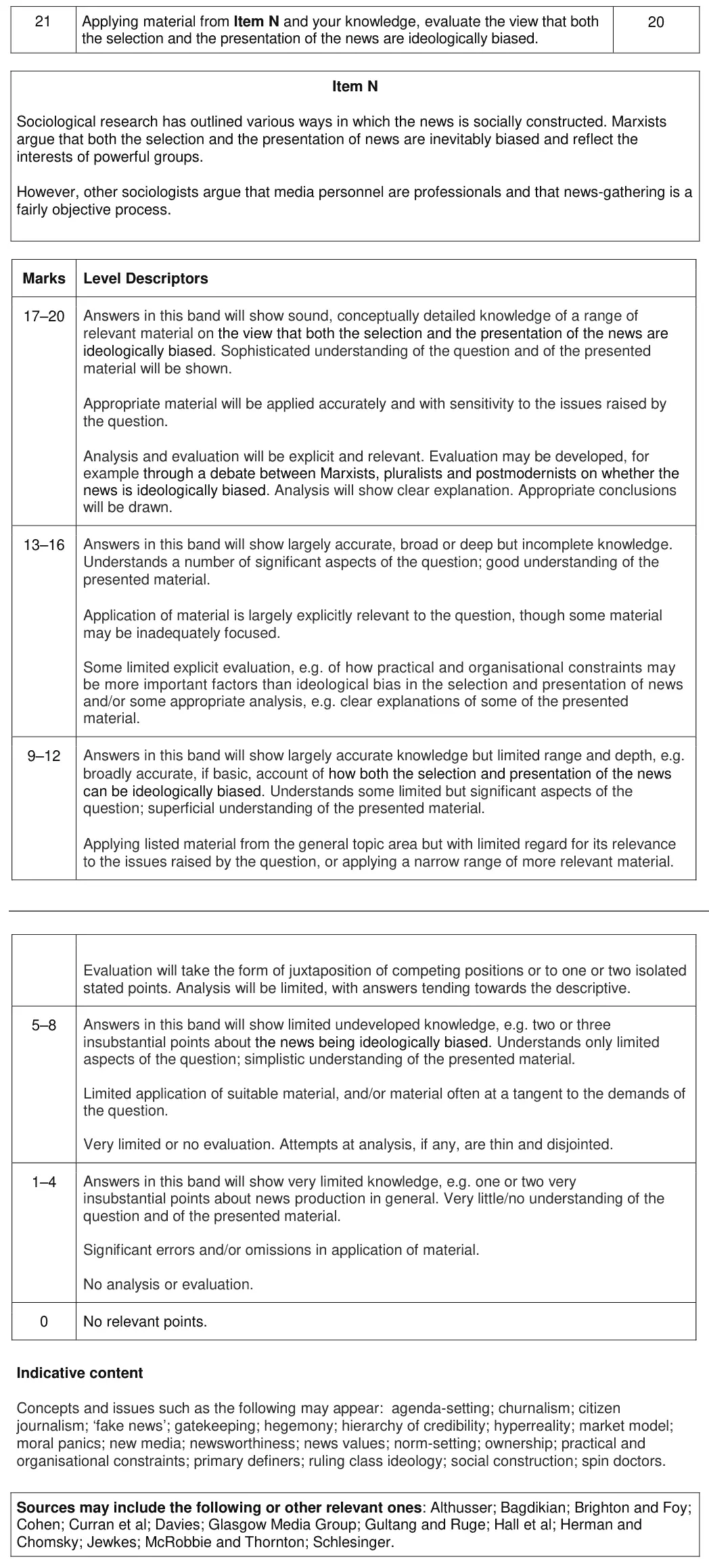
Item N
Sociological research has outlined various ways in which the news is socially
constructed. Marxists argue that both the selection and the presentation of news are
inevitably biased and reflect the interests of powerful groups.
However, other sociologists argue that media personnel are professionals and that
news-gathering is a fairly objective process.
Applying material from Item N and your knowledge, evaluate the view that both the
selection and the presentation of the news are ideologically biased.
[20 marks]
June 2019 · Paper 2 · Q22 10 marks AO1=5, AO2=3, AO3=2 Outline and explain social mobilitychanging structures of inequality
2 2
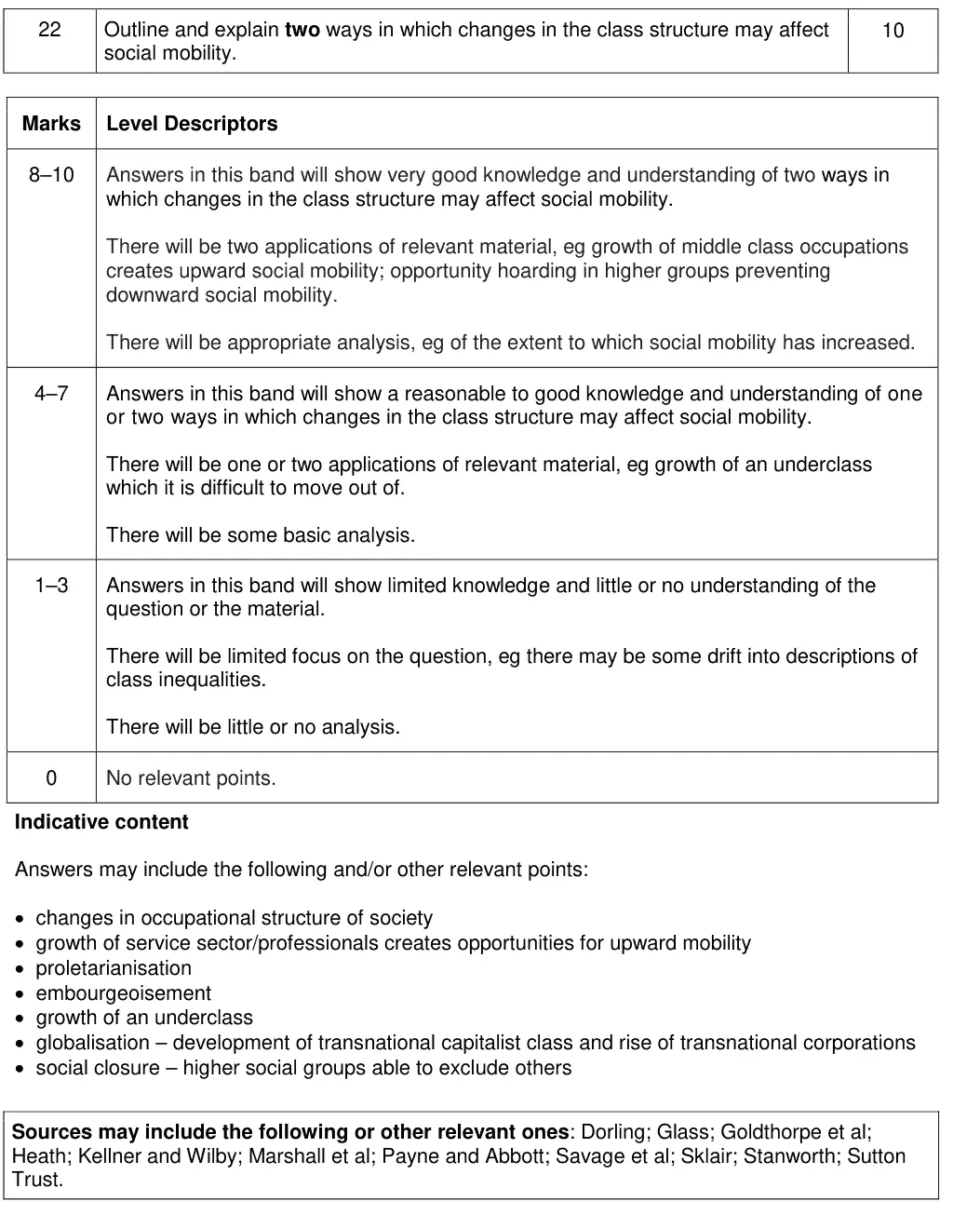
Outline and explain two ways in which changes in the class structure may affect social
mobility.
[10 marks]
June 2019 · Paper 2 · Q23 10 marks AO1=3, AO2=4, AO3=3 Analyse measuring social class
2 3
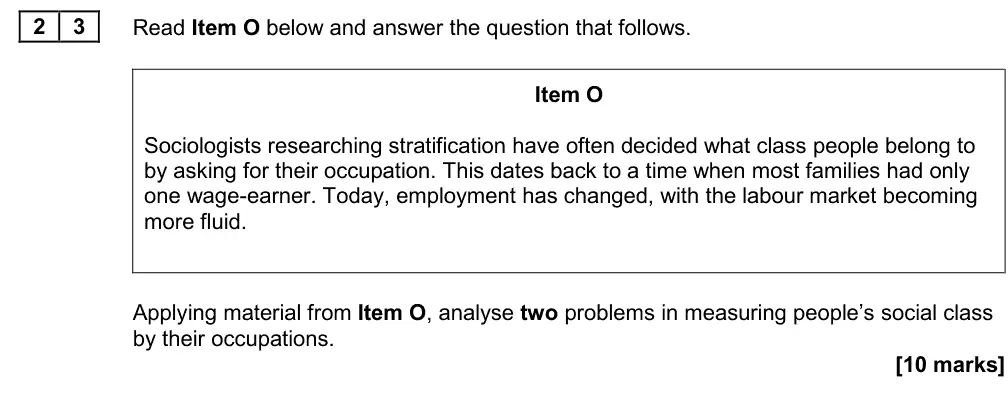
Read Item O below and answer the question that follows.
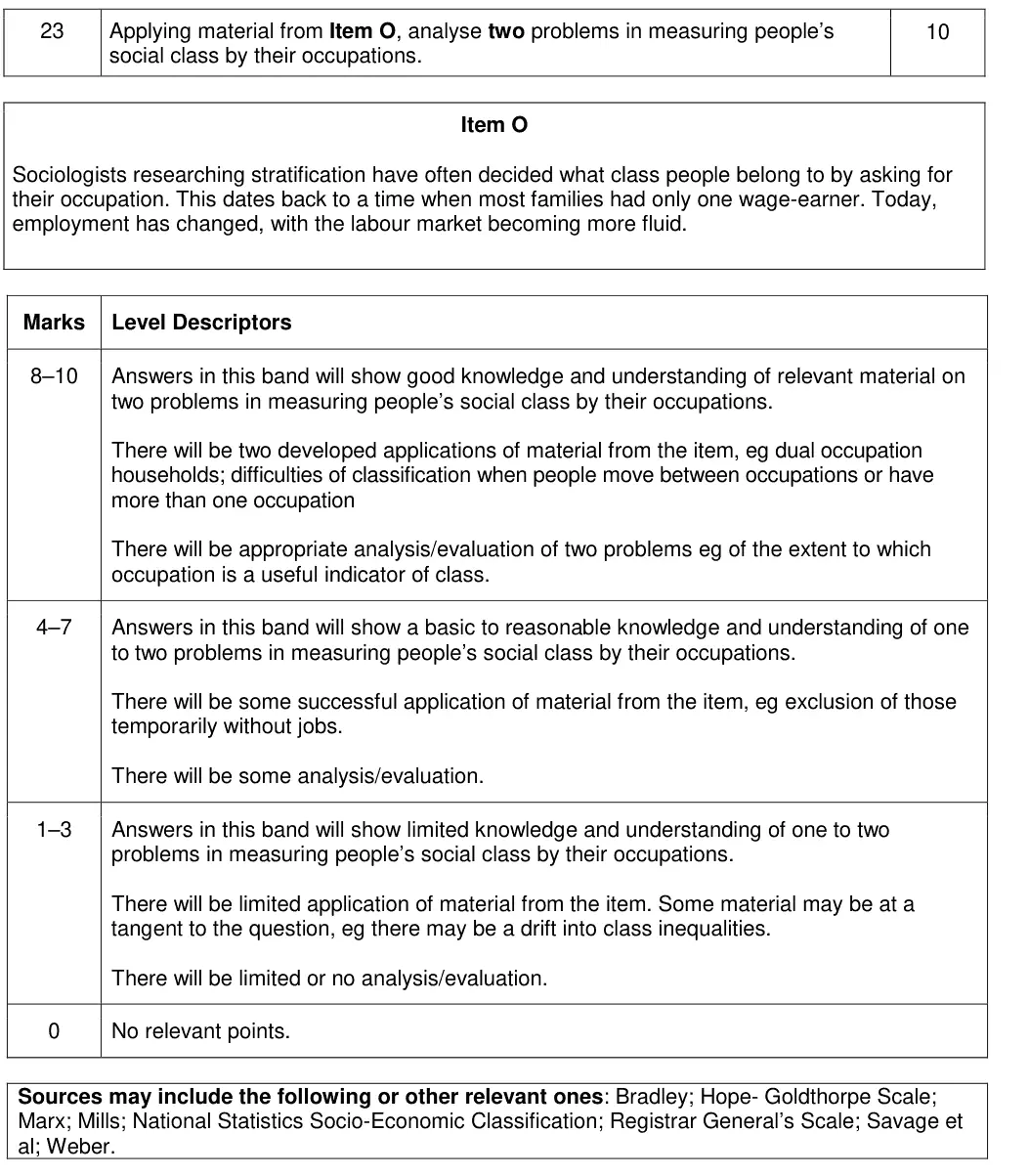
Item O
Sociologists researching stratification have often decided what class people belong to
by asking for their occupation. This dates back to a time when most families had only
one wage-earner. Today, employment has changed, with the labour market becoming
more fluid.
Applying material from Item O, analyse two problems in measuring people’s social class
by their occupations.
[10 marks]
June 2019 · Paper 2 · Q24 20 marks AO1=8, AO2=6, AO3=6 20-mark essay class status and powerstratification and differentiation
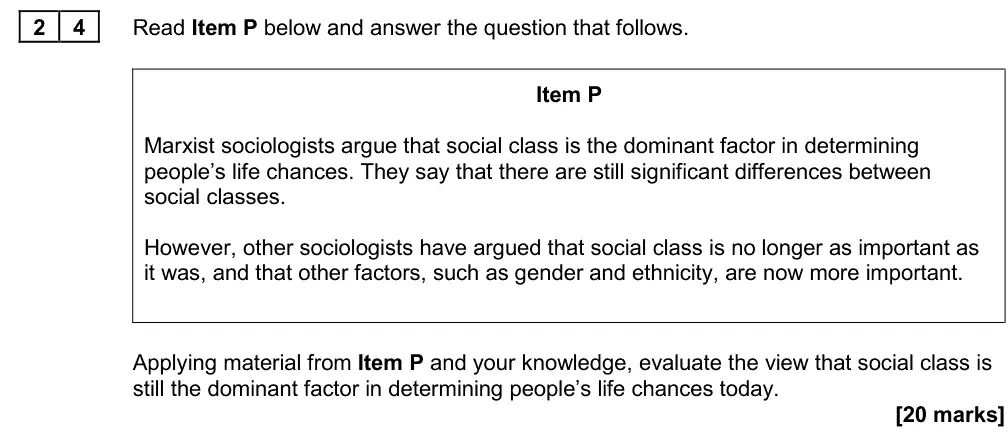
2 4
Read Item P below and answer the question that follows.
Item P
Marxist sociologists argue that social class is the dominant factor in determining
people’s life chances. They say that there are still significant differences between
social classes.
However, other sociologists have argued that social class is no longer as important as
it was, and that other factors, such as gender and ethnicity, are now more important.
Applying material from Item P and your knowledge, evaluate the view that social class is
still the dominant factor in determining people’s life chances today.
[20 marks]

Work with an AQA sociology tutor

Want a paper marked and gone through with you? Message us.

Prefer email? Send an enquiry

If you are under 18, please include a parent's contact details. Enquiries go to enquiries@alevelsociologytutor.com and are deleted once handled. All tutoring is online.