Key-term cards for this topic are being written by our tutor. The past-paper questions below are ready now.
Specification statements
4.2.6-03 the role of transnational corporations, non-governmental organisations and international agencies in local and global strategies for development
Tap a question to zoom it. The mark scheme (with the level descriptors and indicative content) and the examiner's comment open underneath.
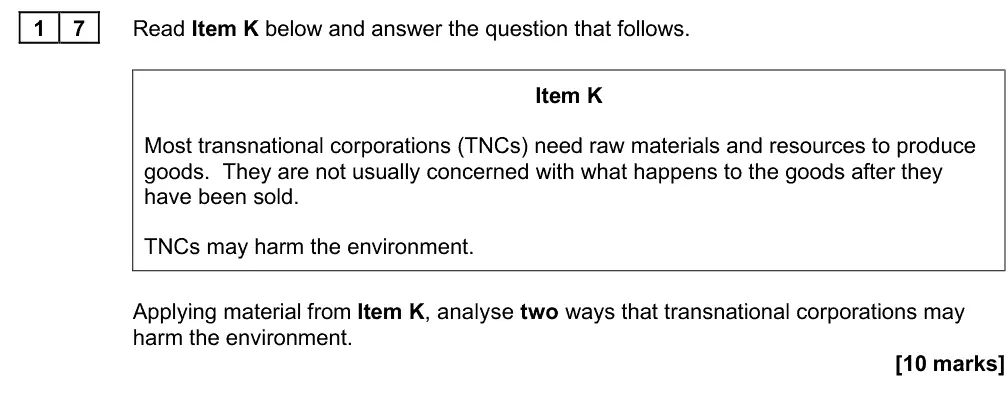
June 2024 · Paper 2 · Q1710 marksAO1=3, AO2=4, AO3=3Analyse
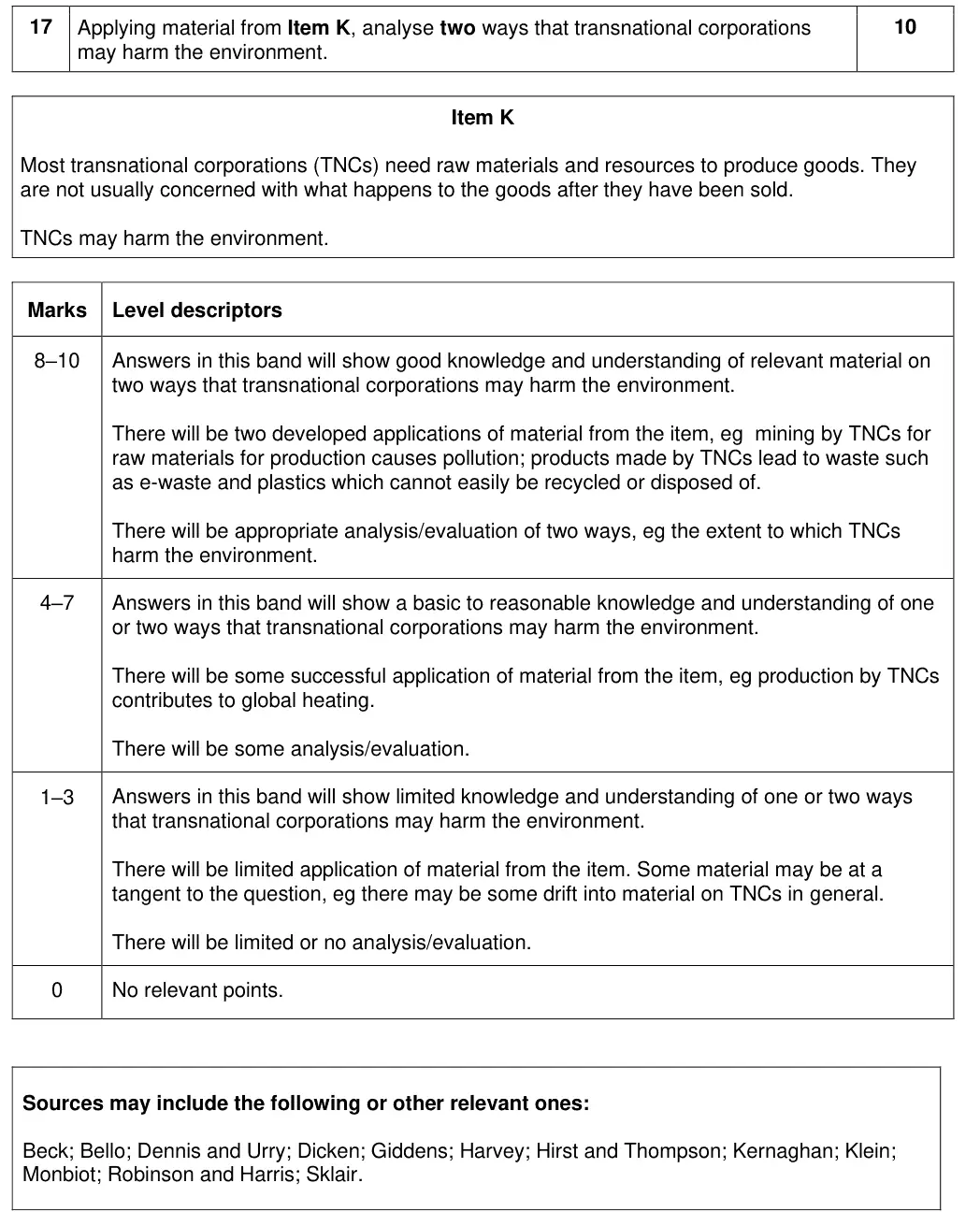
Mark scheme, including the levels grid and indicative content
Examiner's comment
The nature of these questions means that students cannot rely on reciting knowledge. Questions will ask them to bring together aspects of their sociological knowledge in ways they will not have done before. It is therefore important for students to allow time to think about how to answer the question. Students should be made aware that there are two types of 10 mark questions. These have different requirements and different mark schemes . There are different marks available for the assessment objectives. A breakdown of the marks awarded by assessment objective can be found in the mark scheme. The items for 10 mark “analyse” questions are written to give prompts or “hooks” for student answers. These have to be used to access application marks. Answers can indicate use of hooks by quoting, by a reference in parentheses or by wording ( eg “As the item says…”). Items end with a sentence restating the question; the hooks are in the preceding part of the item. Students should avoid writing all they know about a “hook”, and focus on applying the idea to the question. Introductions and conclusions are not required for 10 mark questions; they take up time and rarely improve the mark. It is helpful if answers are set out to clearly indicate the two answers, with wording such as “One way/reason is…”, or by starting a new paragraph for the second point. Answers that give more than two points are unlikely to develop two of them sufficiently. Q17: Answers to this question were mostly example driven; it is good to make a general point before giving answers. Responses often referred to pollution, deforestation and exploitation of raw materials and these were often linked to actions of specific transnational corporations. Some students did not use the “hooks” provided and so did not demonstrate the application required.
Notes from the mark scheme and report
two developed applications from Item K (need for raw materials
no concern for goods after sale), e.g. pollution from extraction, e-waste and plastics
drift into TNCs in general is a tangent
answers were example-driven, better to state a general point then exemplify
some ignored the hooks so showed no application
November 2021 · Paper 2 · Q1610 marksAO1=5, AO2=3, AO3=2Outline and explain
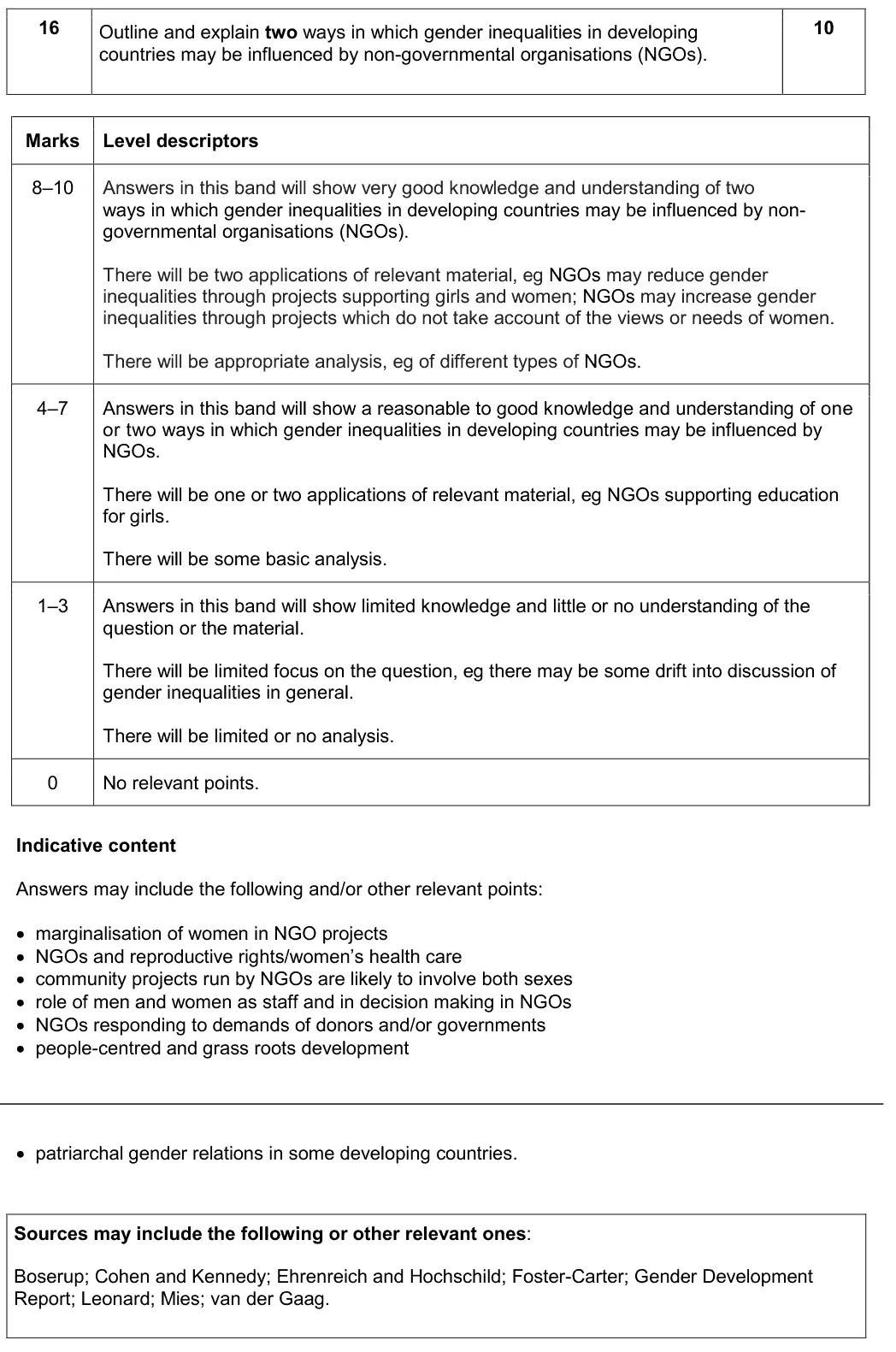
Mark scheme, including the levels grid and indicative content
Notes from the mark scheme and report
no marks for evaluation in this question type
ways can reduce or increase inequality, e.g. projects supporting girls' education and women's health, or projects ignoring women's views and needs
drift into gender inequality in general = 1–3
no examiners' report comment for this part
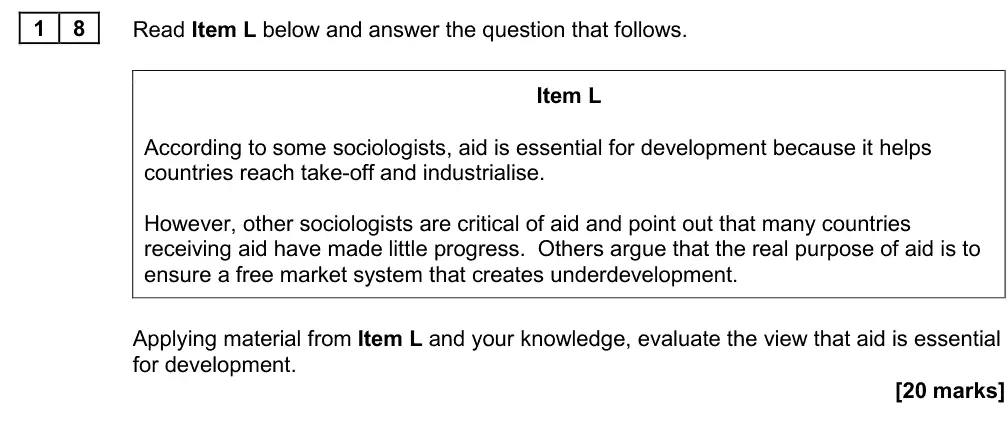
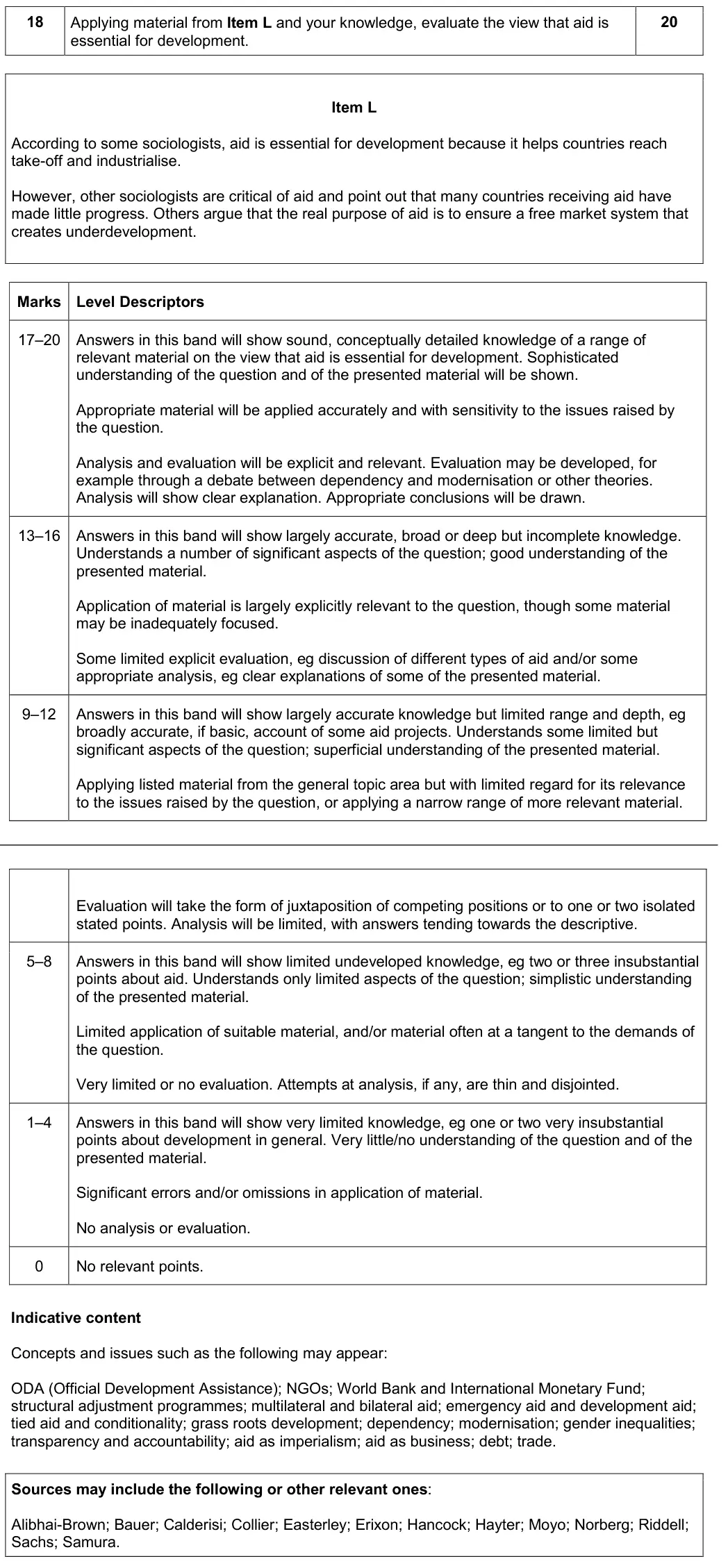
November 2020 · Paper 2 · Q1820 marksAO1=8, AO2=6, AO3=620-mark essay
Mark scheme, including the levels grid and indicative content
Notes from the mark scheme and report
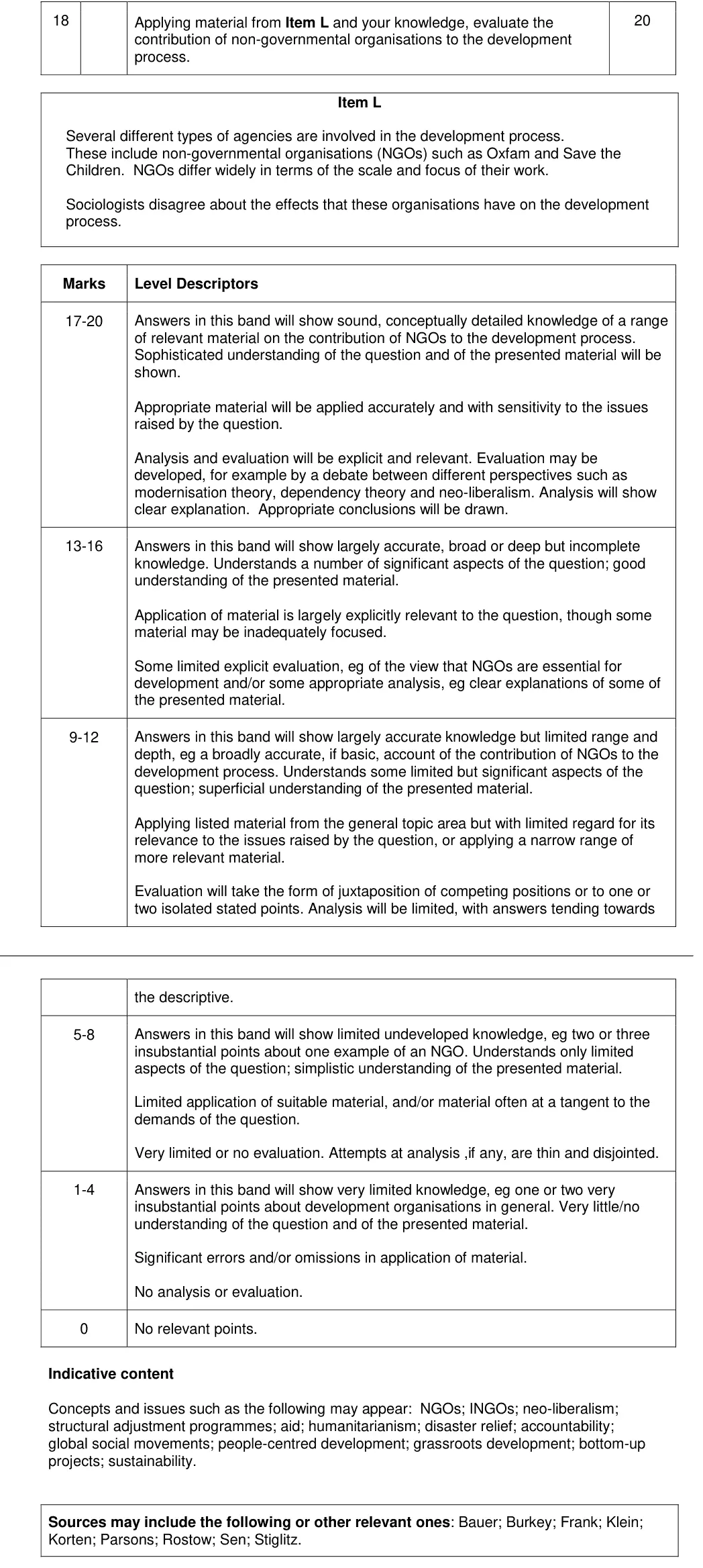
apply Item L (aid helps take-off vs little progress and aid creating underdevelopment)
evaluation via modernisation vs dependency or other theories, or different types of aid
a basic account of aid projects = 9-12
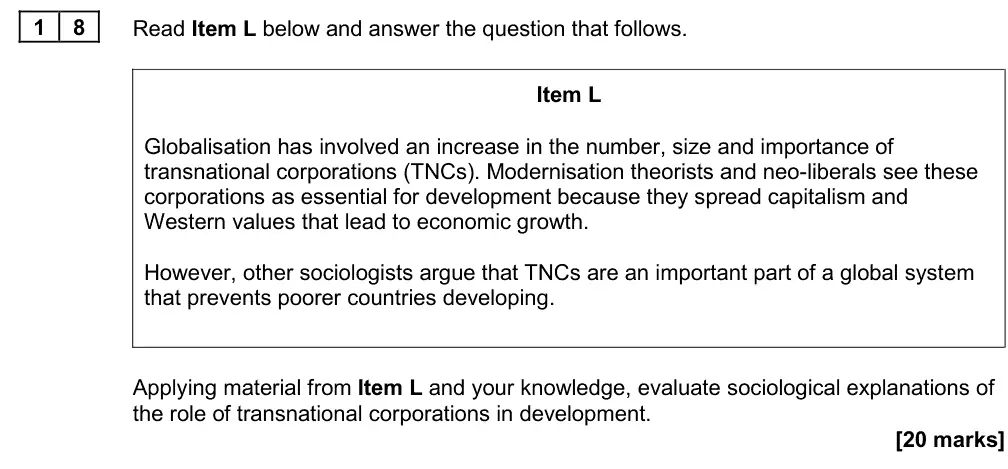
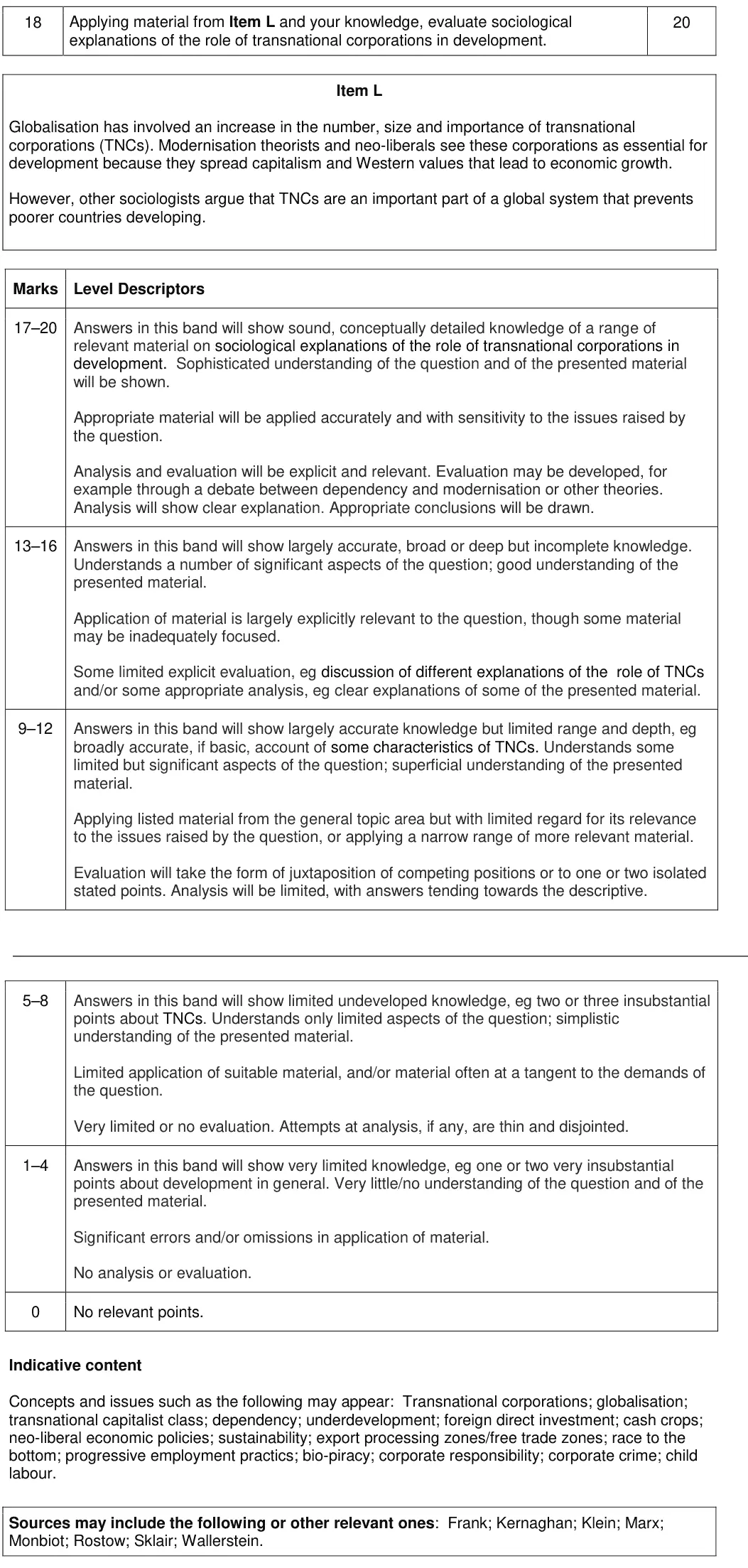
June 2019 · Paper 2 · Q1820 marksAO1=8, AO2=6, AO3=620-mark essay
Mark scheme, including the levels grid and indicative content
Examiner's comment
They therefore answered the section B 20 mark essay question last, and for many this was, as last year, a relatively brief and often apparently unfinished answer. This suggests that time management continues to be a problem for many students on this paper. As last year, many scripts had one substantial answer to the Section A 20-mark question and one significantly briefer one for Section B, suggesting problems with timing. There was often little evidence of planning. A wide range of material can be relevant to these questions, and students are not expected to include everything. They need to carefully choose the content and to plan their answers. The best answers will be both empirical and theoretical, for example showing knowledge of research findings and examples, and knowledge of theoretical perspectives. Some answers amounted to lists of theoretical perspectives, with learned points of criticism, and lost focus on the question itself. While the items are intended as a helpful starting point for answers, they should not be taken by students as a full list of what is relevant; better answers will draw in other relevant knowledge and ideas. Many answers were in effect a comparison of modernisation and development theories with only some brief references to transnational corporations, often without adding named examples. Stronger answers went beyond the content of the item to draw in other theories and to discuss, for example, environmental impacts, gender issues, employment practices and movement of profits.
Notes from the mark scheme and report
must keep TNCs central
many just compared modernisation and dependency theories with few references to TNCs or named examples
stronger answers covered environment, gender, employment practices and profit flows
AO split from AQA's standard grid for this paper (this year's mark scheme does not print it).
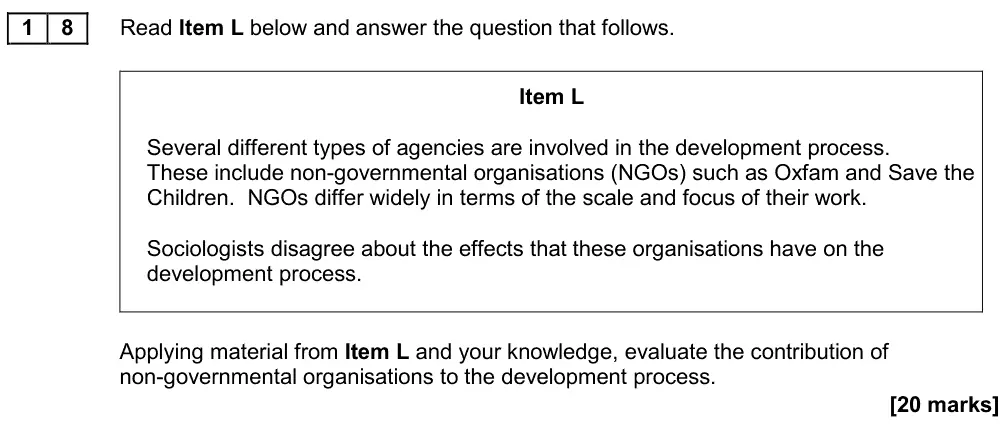
June 2017 · Paper 2 · Q1820 marksAO1=8, AO2=6, AO3=620-mark essay
Mark scheme, including the levels grid and indicative content
Examiner's comment
Most students answered their chosen questions in the order in which they appeared on the question paper. They therefore answered the 20 mark essay question in Section B last, and for many this was a relatively brief and often unfinished answer. This suggests that time management was a problem. Many scripts had one substantial, well developed answer to a 20 mark question and one significantly briefer one, again suggesting problems with time management. It is often the case that a wide range of material can be relevant to these questions, and students will need to be selective. For example, it may be more effective to cover a limited number of views or theories in some depth, rather than to include every possible theory. There was a tendency for answers to progressively lose sight of the question and to become a list of different views. The best answers will address all aspects of the question and will draw on theories, concepts and empirical examples or evidence. Evaluation which meets the demands of the questions is better than points of criticism which have been learned and included, regardless of the specific question that has been set. Students should also be aware that evaluation includes awareness of the strengths, as well as the weaknesses, of an argument or theory. There were some excellent answers here, blending empirical and theoretical knowledge to reach a balanced judgement on the role of NGOs, including different types of NGOs, often comparing them with other organisations that play a part in development. Some students, however, were unsure as to what NGOs are, despite the item, and there were relatively few examples used (rather than just named). Some answers lost the focus on NGOs and became discussions of aid in general.
Notes from the mark scheme and report
top band debates modernisation, dependency and neo-liberal views of NGOs
best answers blended empirical and theoretical material and compared NGOs with other agencies
some unsure what NGOs are or drifted into aid in general
few examples were actually used rather than named
Specimen set 1 · Paper 2 · Q1610 marksAO1=5, AO2=3, AO3=2Outline and explain
Mark scheme, including the levels grid and indicative content
Notes from the mark scheme and report
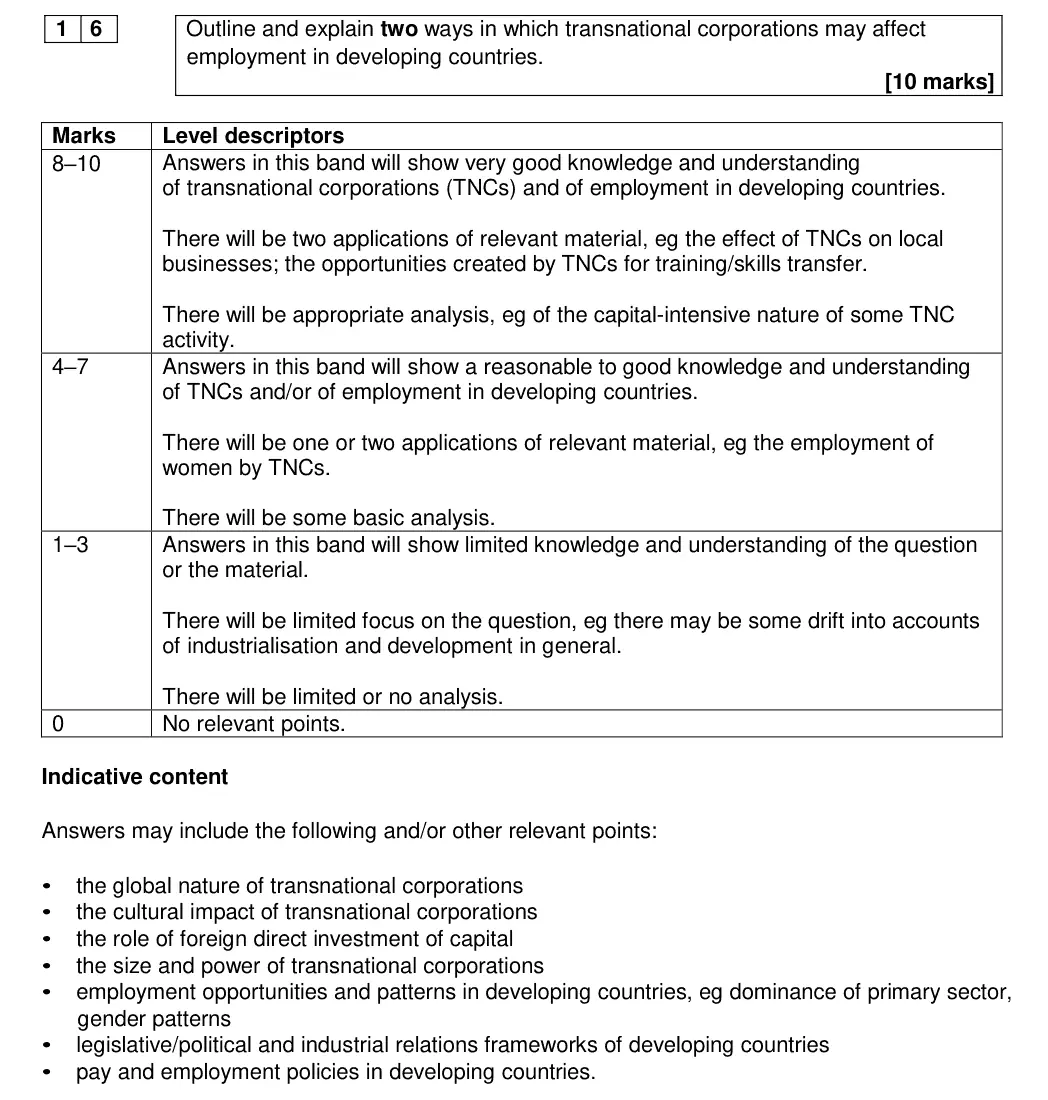
top band e.g. TNCs undercutting local businesses, training and skills transfer
analysis of capital-intensive TNC activity
drift into industrialisation and development in general = 1–3 band
Specimen set 1 · Paper 2 · Q1710 marksAO1=3, AO2=4, AO3=3Analyse
Mark scheme, including the levels grid and indicative content
Notes from the mark scheme and report
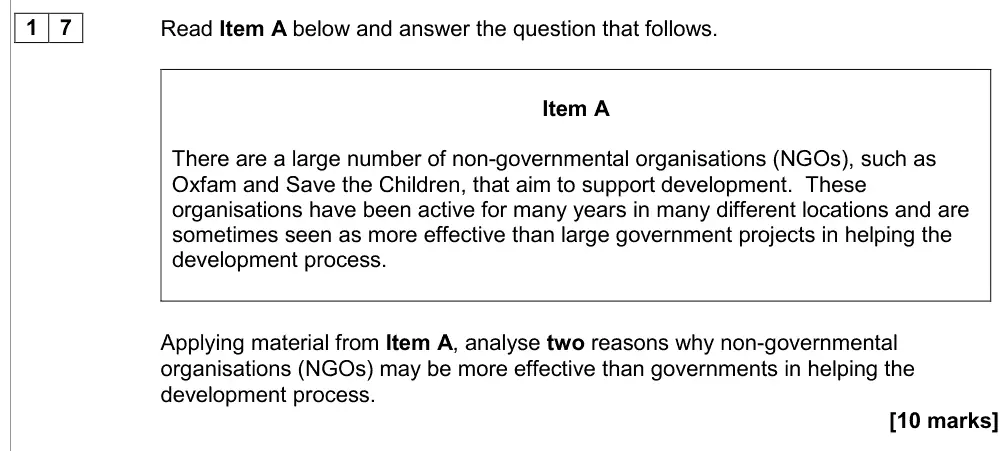
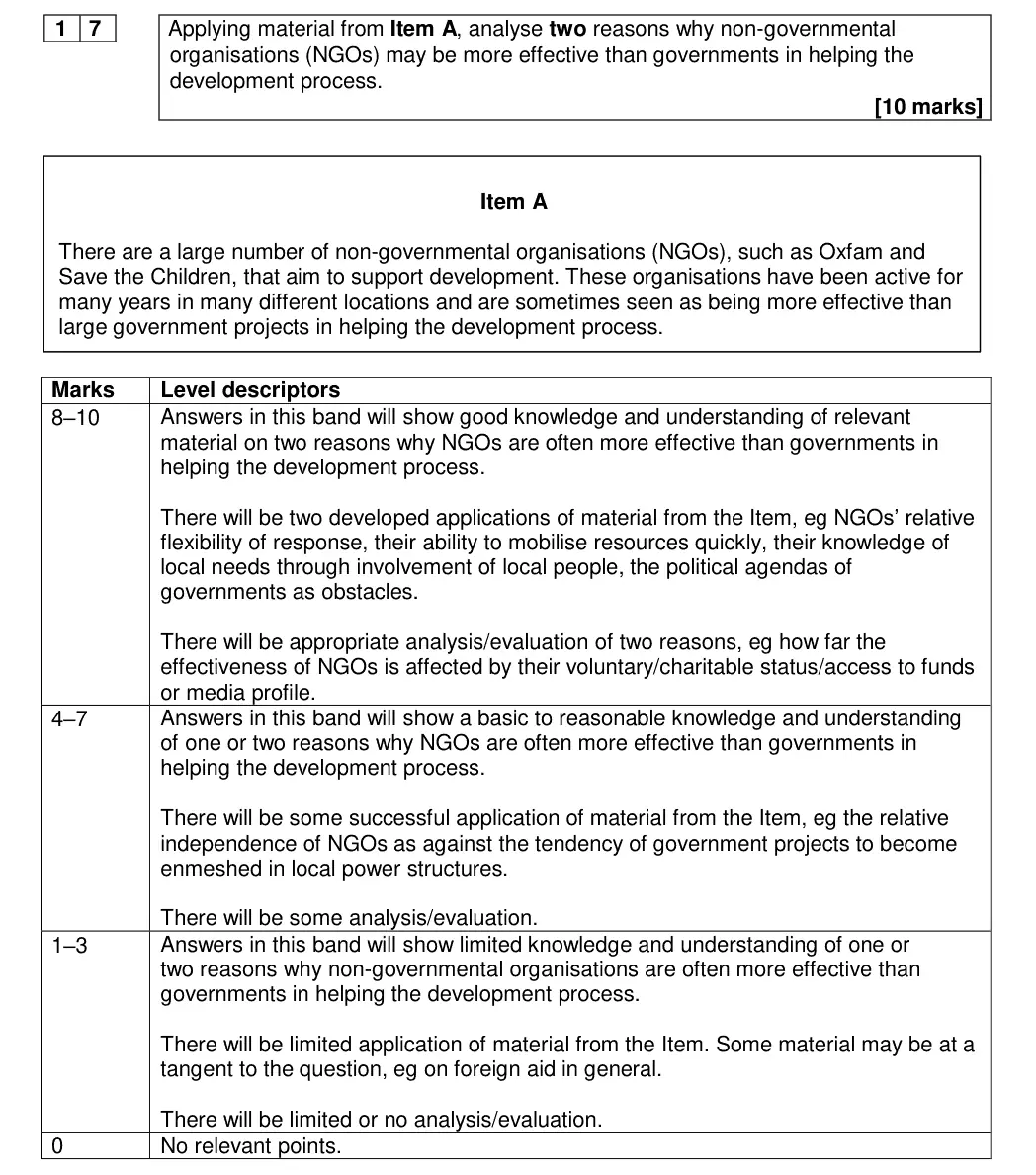
item hooks: long-standing NGOs across many locations vs large government projects
top band e.g. flexibility, rapid mobilisation, local knowledge, freedom from political agendas
analysis of dependence on charitable funds and media profile
foreign aid in general is a tangent
Work with an AQA sociology tutor
Essays stuck in the middle band, or losing marks on the 10-markers? Book a trial lesson with Mark, a former AQA examiner.