Tap a question to zoom it. The mark scheme (with the level descriptors and indicative content) and the examiner's comment open underneath.
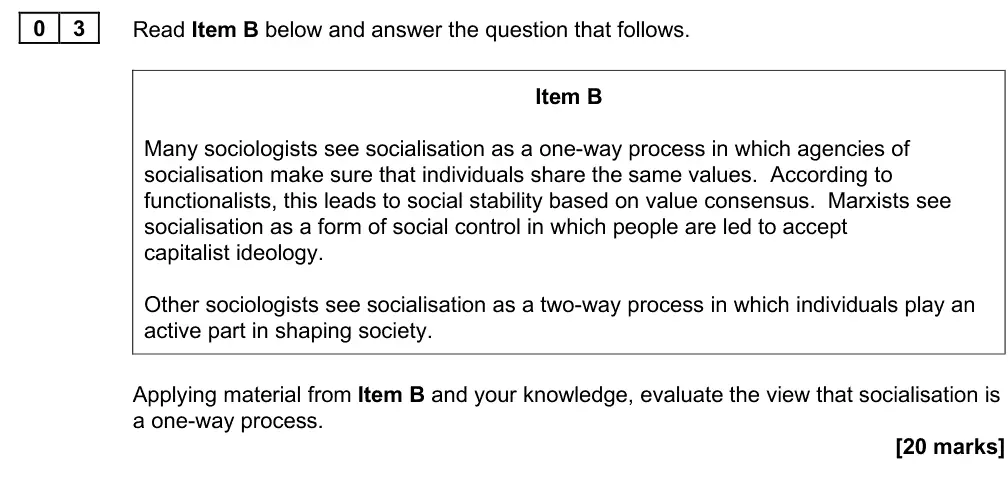
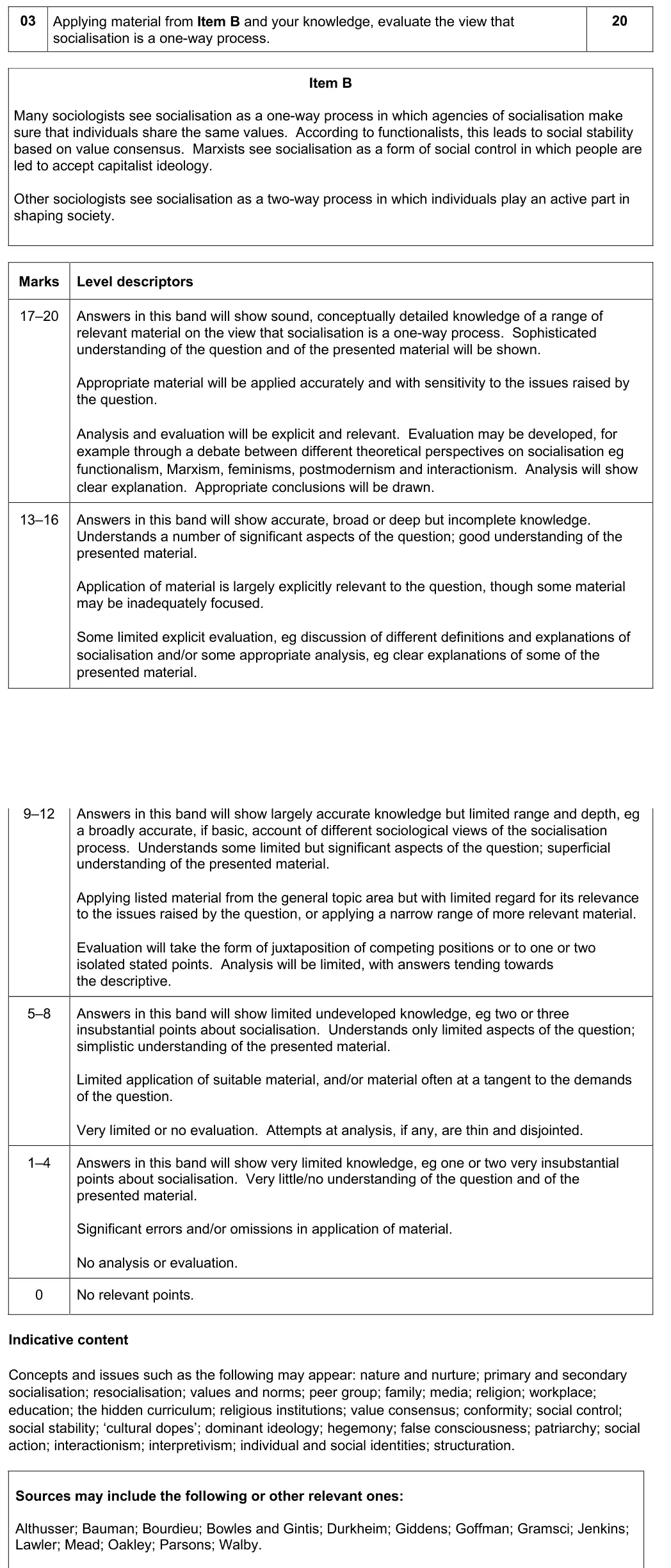
June 2025 · Paper 2 · Q320 marksAO1=8, AO2=6, AO3=620-mark essay
Mark scheme, including the levels grid and indicative content
Examiner's comment
These require answers that are essays and are best written in paragraphs. A brief introduction can help set out the argument of the essay. It will not attract marks if it only repeats the question or parts of the item. The purpose of the items for these questions is to suggest a few starting points for students, including ways into evaluation. Students are expected to also bring in further ideas (“and your knowledge” in the instruction) rather than relying only on the item. A wide range of material can be relevant to these questions, so students need to be selective. It is more effective to cover a limited number of views/theories in depth rather than to try to include everything. Students should keep to the question. When a question is about a particular view, other views can be used for evaluation but without writing all that the student knows about them. There was a tendency for answers to progressively lose sight of the question and to become a list of different views. Students who made brief essay plans appeared to benefit by having more structured and coherent responses. Most students understood the difference between socialisation as a one-way process and as a two-way process. Most were also able to use appropriate studies and perspectives, including interactionism for evaluation. The greater interactivity of social media featured in some successful answers.
Notes from the mark scheme and report
top band debates one-way (functionalist, Marxist) against two-way (interactionist, postmodern, feminist) views of socialisation
most handled the one-way/two-way distinction well
interactivity of social media used in some strong answers
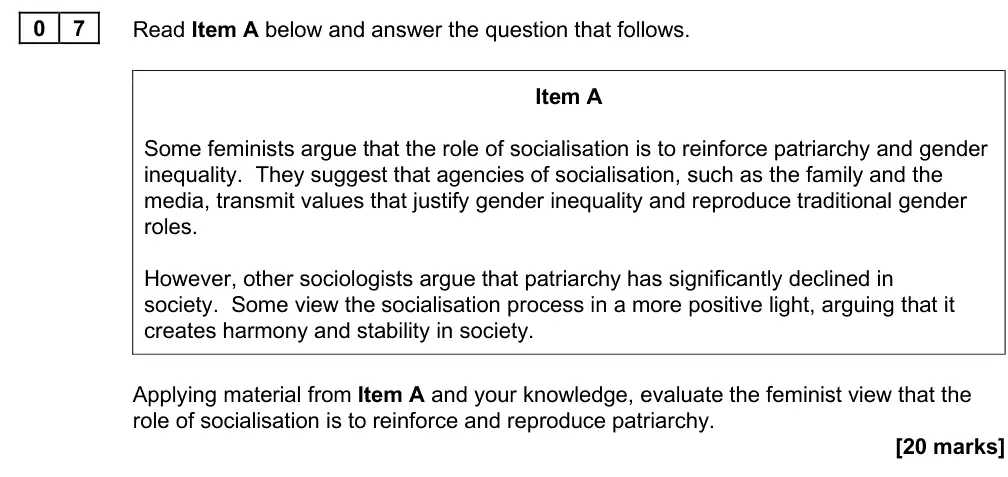
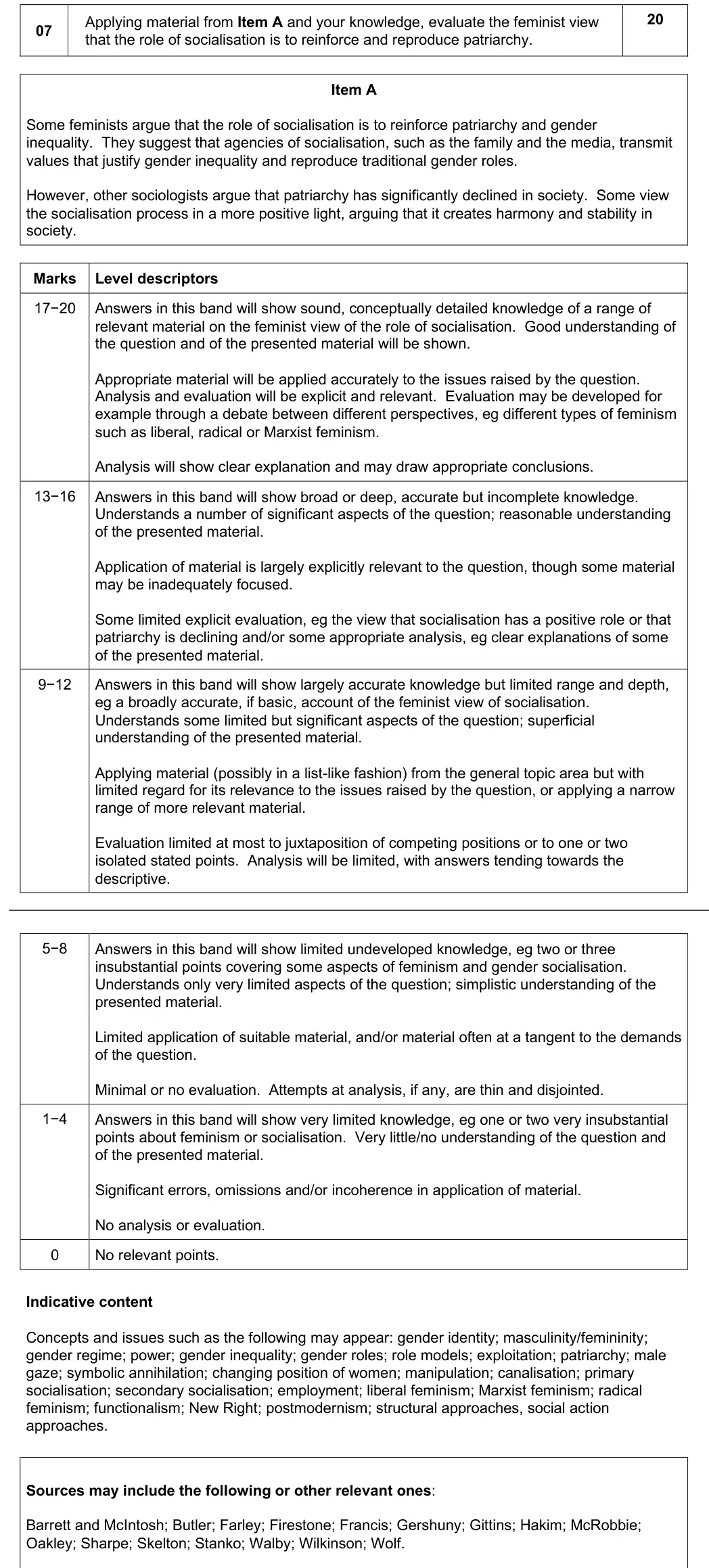
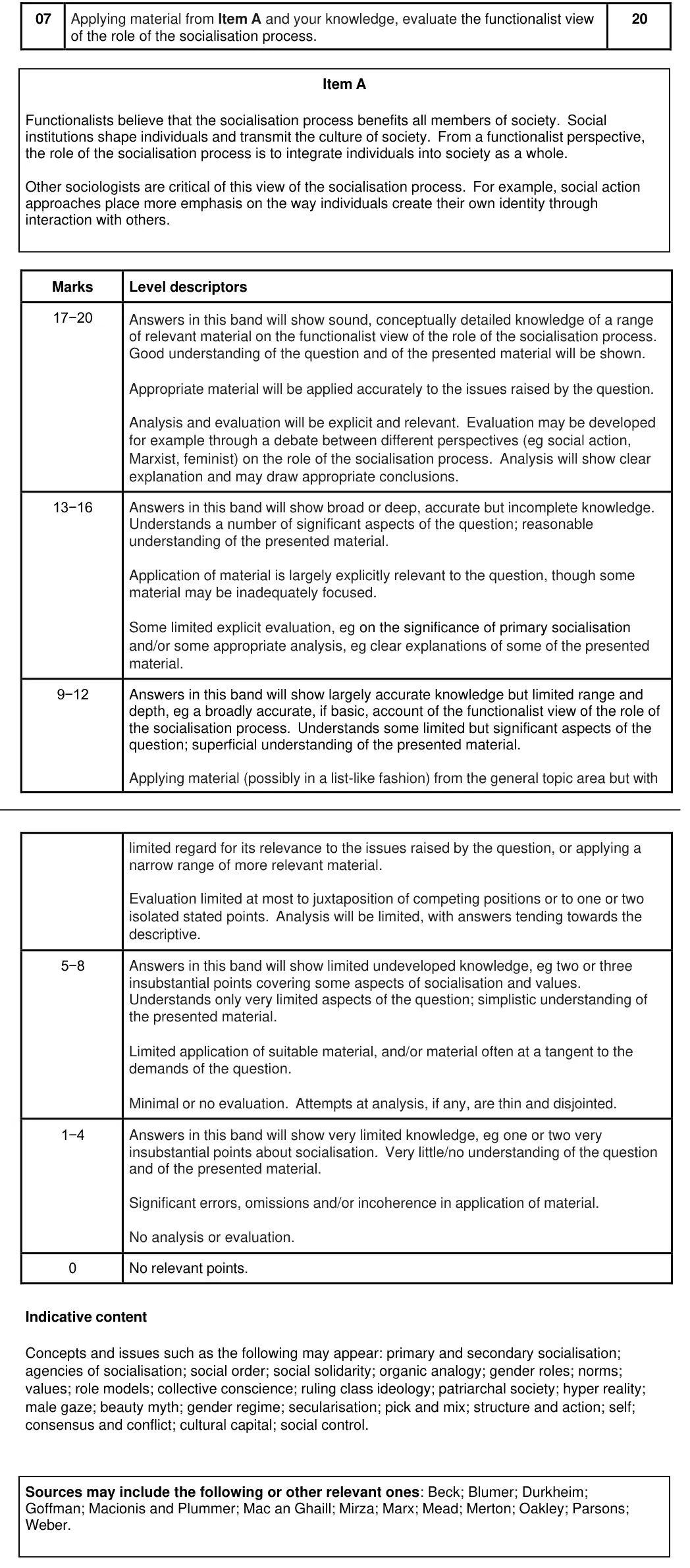
June 2025 · AS Paper 2 · Q720 marksAO1=8, AO2=6, AO3=620-mark essay
Mark scheme, including the levels grid and indicative content
Examiner's comment
This question proved to be straightforward. Responses were often well-focused and developed. Answers frequently made a tour of the agencies of socialisation. Oakley was often used in discussions of the family and gender socialisation whilst education and the media were commonly explored as examples of secondary socialisation related to gender. A minority of responses incorporated ideas around masculinity, including toxic masculinity which added breadth to the answer. Evaluation was sometimes limited to a basic juxtaposition of feminist and functionalist perspectives.
Notes from the mark scheme and report
apply Item A (agencies transmit patriarchal values vs patriarchy declining and socialisation creating harmony)
evaluation via liberal, radical, Marxist feminism or the view that patriarchy is declining
most toured family (Oakley), education, media
masculinity/toxic masculinity added breadth
evaluation often only feminist vs functionalist juxtaposition
June 2024 · AS Paper 2 · Q610 marksAO1=5, AO2=3, AO3=2Outline and explain
Mark scheme, including the levels grid and indicative content
Examiner's comment
The ‘outline and explain’ 10-mark question. Here students would benefit more if an explicit identification of a way / reason / factor was made then leading to an explanation of it. So, making the student’s answer more cogent. This question proved to be straightforward. Generally, students managed to identify two agencies of socialisation and suggest a way in which they could shape identity. Where students found the question more challenging was in developing the identified way to include wider sociological material and include analysis. For example, the notion of the media stereotyping young people could be developed via use of moral panics or the view that stereotypes might be challenged through the more open access of social media. Students who developed their answers in ways like these produced more creditworthy response.
Notes from the mark scheme and report
name an agency and explain how it shapes age identity
drift into general accounts of age identity = 1–3
top band analysis e.g. how gender interacts with age
better answers developed media stereotyping through moral panics or challenge via social media
June 2024 · AS Paper 2 · Q720 marksAO1=8, AO2=6, AO3=620-mark essay
Mark scheme, including the levels grid and indicative content
Examiner's comment
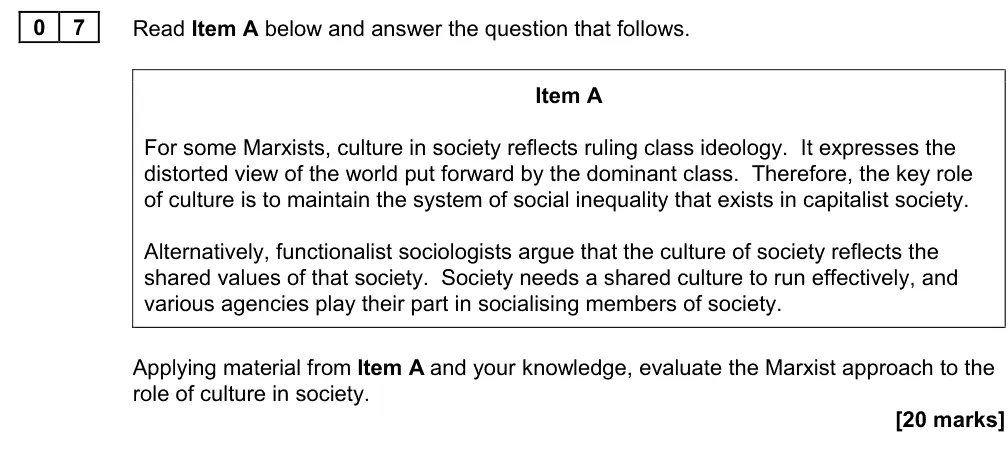
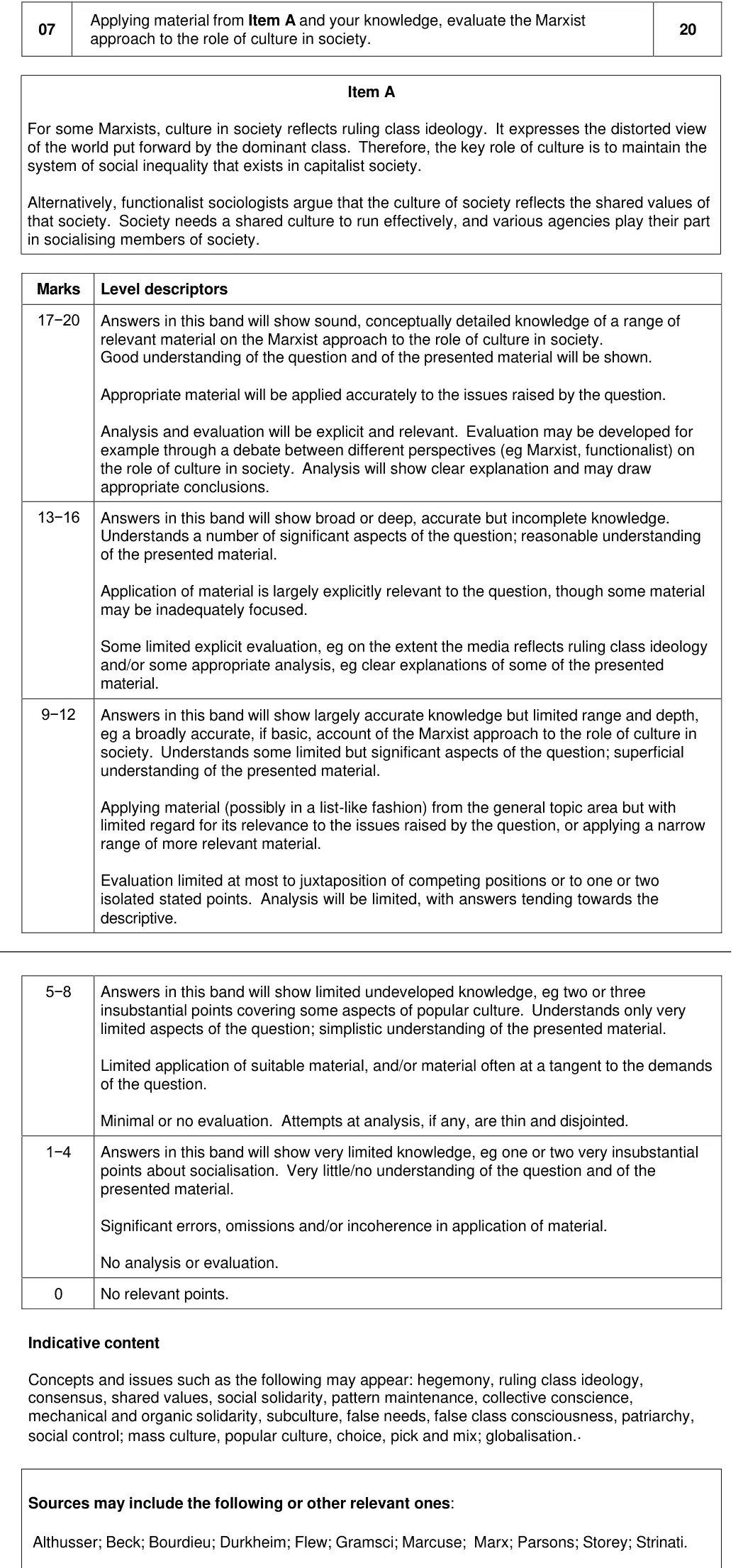
Most students found this question to be straightforward. Use of the item to structure responses was common, though some students found it challenging to focus on the role of culture in society rather than present general theories of society. Marxism juxtaposed with functionalism featured heavily alongside feminism which was offered as further evaluation. Few students used interactionism or postmodernism in debates between perspectives but those that did were rewarded accordingly.
Notes from the mark scheme and report
must stay on the role of culture, not general theories of society
top band debates Marxist and functionalist views
mostly Marxism juxtaposed with functionalism plus feminism
interactionist or postmodern evaluation was rare but rewarded
June 2023 · Paper 2 · Q210 marksAO1=3, AO2=4, AO3=3Analyse
Mark scheme, including the levels grid and indicative content
Examiner's comment
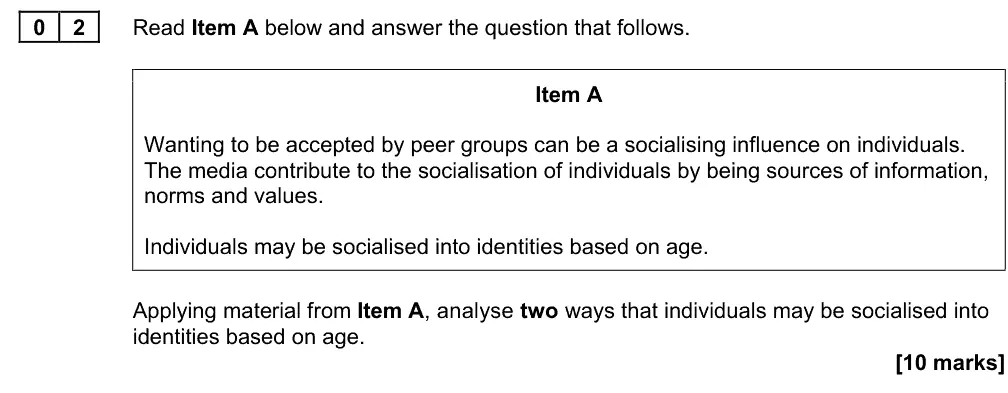
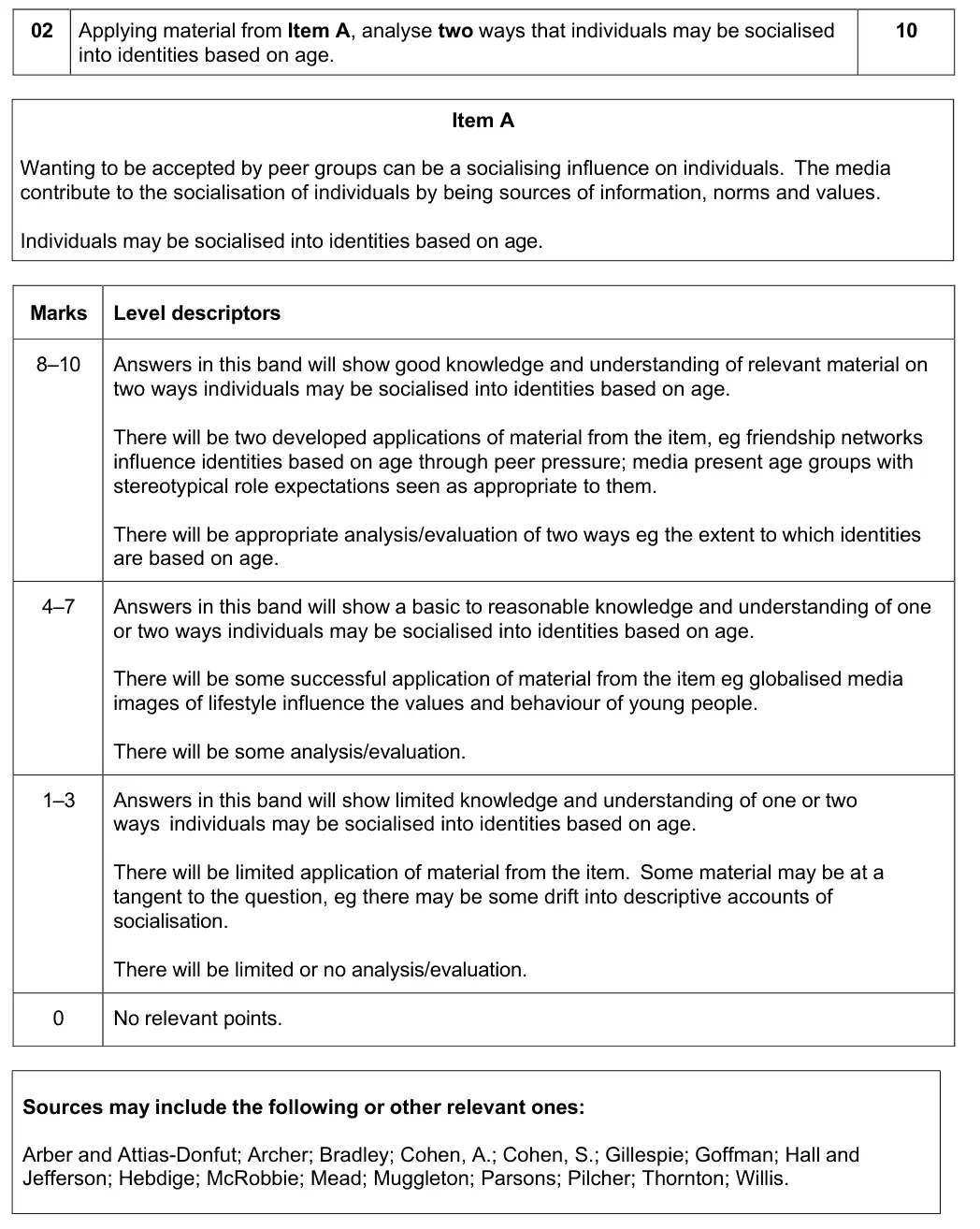
The nature of these questions means that students cannot rely on reciting knowledge. Questions will ask them to bring together aspects of their sociological knowledge in ways they are unlikely to have done before. It is therefore important for students to allow time to think about how to answer the question. Students should be made aware that there are two types of 10 mark questions. These have different requirements and different mark schemes. There are different marks available for the assessment objectives. The items for 10 mark “analyse” questions are written to give prompts or “hooks” for student answers. These have to be used to access application marks. Answers can indicate use of hooks by quoting, by a reference in parentheses or by wording (eg “As the item says…”). Items end with a sentence restating the question; the hooks are in the preceding part of the item. Introductions and conclusions are not required for 10 mark questions and take up valuable time. It is helpful if answers are set out to clearly indicate the two separate points, with wording such as “One way/reason is…” or by starting a new paragraph for the second point. Answers that give more than two points are unlikely to develop two of them sufficiently. Question 2: Again, this was generally well answered but some wrote about other agencies of socialisation than those given in the item.
Notes from the mark scheme and report
hooks: peer groups and the media as agencies
e.g. peer pressure in friendship networks, media age stereotypes
drift into descriptive accounts of socialisation = 1–3
some wrote about agencies not given in the item
June 2022 · Paper 2 · Q110 marksAO1=5, AO2=3, AO3=2Outline and explain
Mark scheme, including the levels grid and indicative content
Examiner's comment
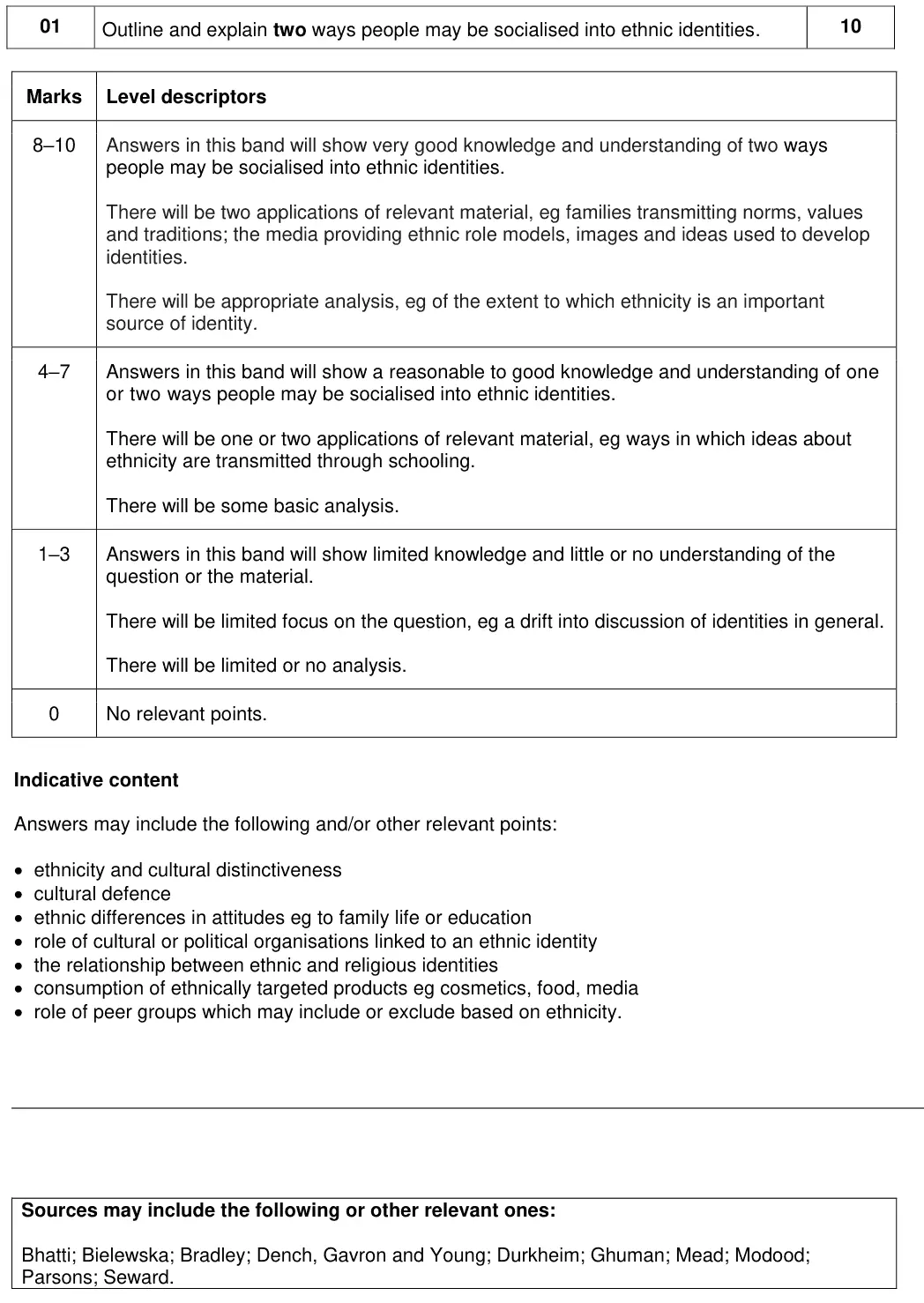
The nature of these questions means that students cannot rely on reciting knowledge. The questions will ask them to bring together aspects of their sociological knowledge in a way that they are unlikely to have done before. There was a tendency, however, to attempt to answer the question by giving knowledge based on words or phrases in the question, rather than meeting the demands of the question. Students are advised to spend time reading the question, and, where there is one the item, to ensure that they are answering the question. Some students seemed unaware of the different demands of the two types of questions. The marks awarded for the assessment objectives are different in the two types of ten mark questions, and students should be aware of this. In particular, it should be noted that there are no marks available for evaluation in “outline and explain” (no item) questions. There is no need for an introduction or conclusion for 10 mark questions. It is helpful if answers are set out to clearly indicate the two answers, with wording such as “One way is…” or by starting a new paragraph for the second point. The best answers to 10 mark questions were focused, clearly stating a point that addressed the question and then developing it, using sociological concepts, evidence and, where appropriate, theory. Answers need to address all aspects of the question. Q1 Answers here often considered agencies of socialisation and the ways in which they can socialise people into ethnic identities. There were some very good answers to this question.
Notes from the mark scheme and report
top band: two ways, e.g. family transmitting norms and traditions, media role models
analysis of how important ethnicity is as a source of identity
drift into identity in general = 1–3 band
agencies of socialisation were the usual route and there were some very good answers
June 2022 · AS Paper 2 · Q42 marksAO2=2Brief explain
Mark scheme
Examiner's comment
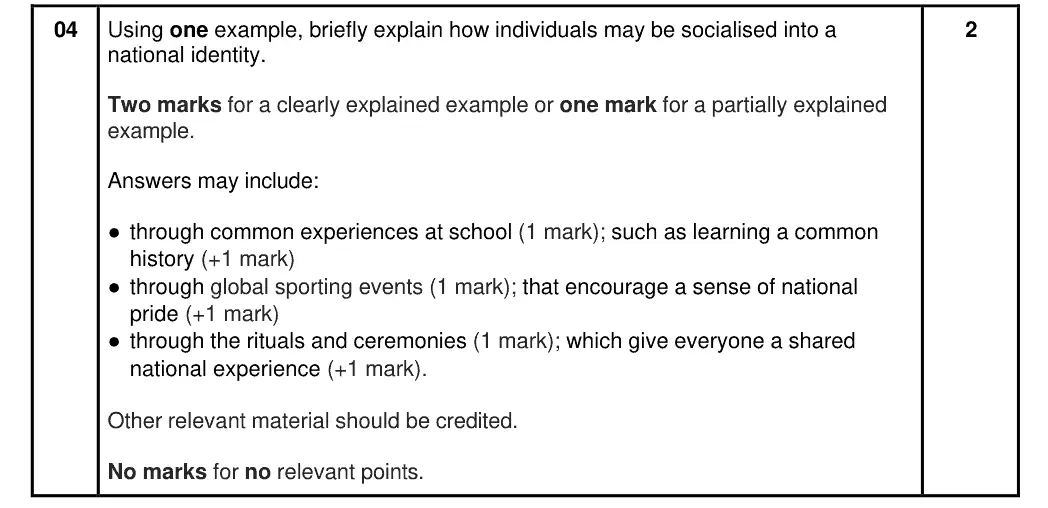
For low mark tariff questions where candidates are required to either define, explain or outline, care should be taken to ensure that points are not just identified. This question proved to be difficult for many students, with few scoring full marks. The most successful answers used the example of education and the teaching of British history. The most common responses used the example of religion without linking this to national identity and failed to score.
Notes from the mark scheme and report
1 mark for the example +1 for explaining the link to national identity (school teaching a common history, international sport, national rituals)
found difficult
religion without a link to national identity scored nothing
June 2022 · AS Paper 2 · Q720 marksAO1=8, AO2=6, AO3=620-mark essay
Mark scheme, including the levels grid and indicative content
Examiner's comment
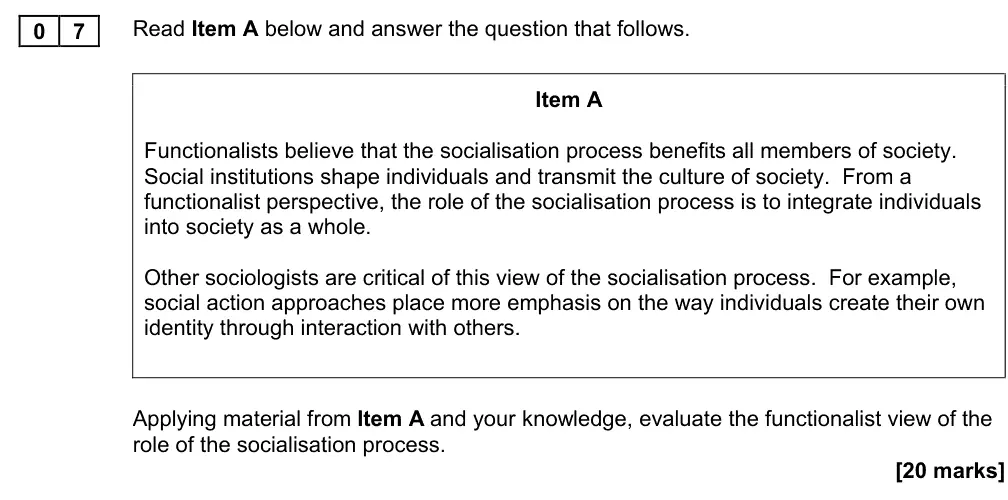
Answers to essay questions were sometimes disjointed; it would be worth students considering making a brief plan for the 16 and 20 mark questions. Many students found this question challenging but were able to outline some key features of the functionalist view of the socialisation process; however, essays were often disjointed, lacking a clear structure. Successful answers were able to discuss primary and secondary socialisation using key functionalist writers. The role of the family and education were the most common agencies applied. Evaluation was generally shown by juxtaposition with other theoretical views of socialisation, most commonly Marxism and Feminism. Social action approaches were mentioned in the item but rarely applied in answers. Answers to this question were often much shorter than would be expected for a 20 mark response.
Notes from the mark scheme and report
top band debates functionalism against social action, Marxist and feminist views of socialisation
social action hook in the item was rarely used
best answers covered primary and secondary socialisation with key functionalists
evaluation usually juxtaposed
many essays short and disjointed
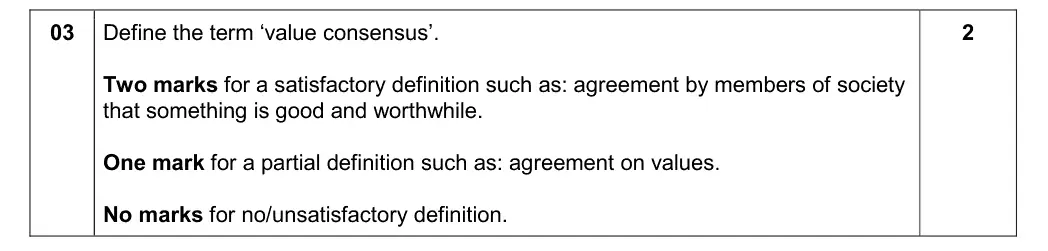
November 2020 · AS Paper 2 · Q32 marksAO1=2Define
Mark scheme
Notes from the mark scheme and report
2 marks for agreement among society's members that certain things are good and worthwhile
1 for 'agreement on values' alone
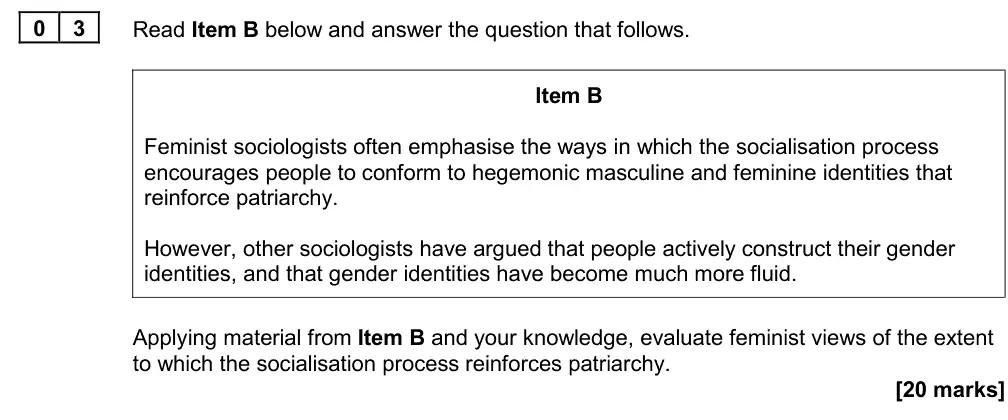
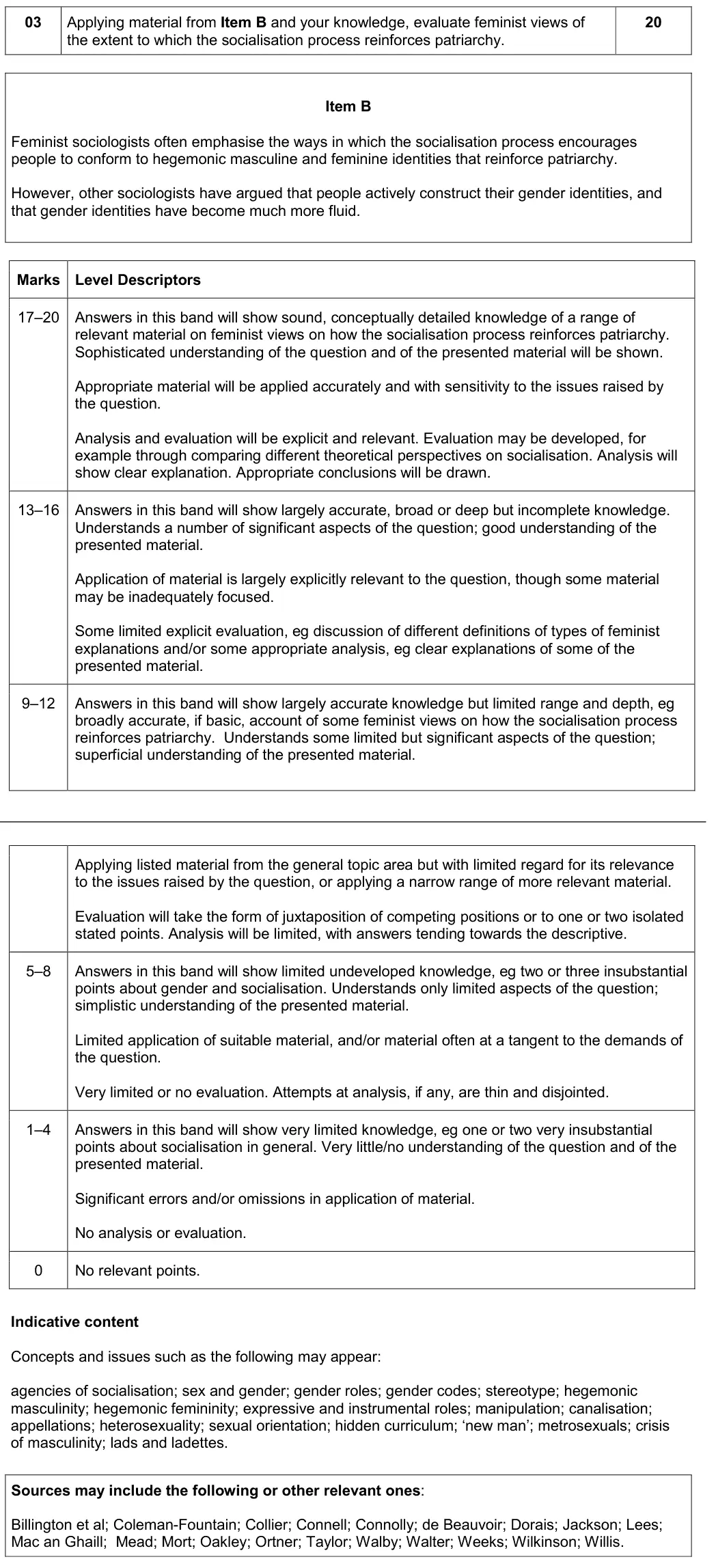
November 2020 · Paper 2 · Q320 marksAO1=8, AO2=6, AO3=620-mark essay
Mark scheme, including the levels grid and indicative content
Notes from the mark scheme and report
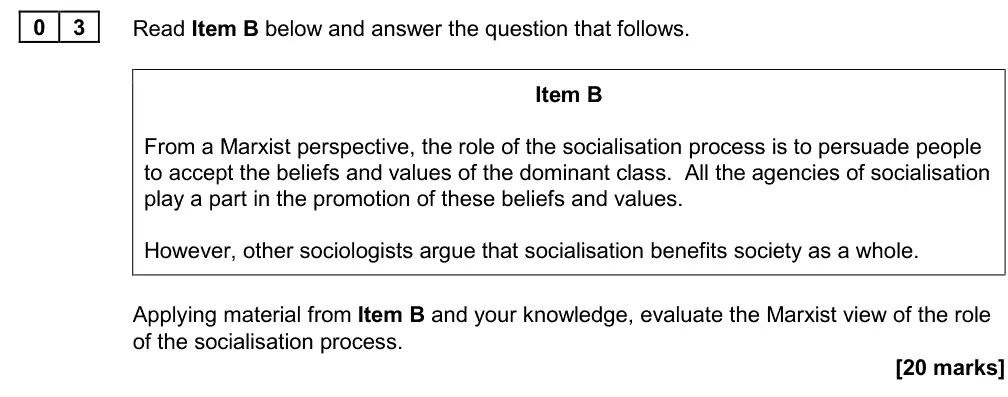
apply Item B (conforming to hegemonic masculine and feminine identities vs actively constructed, fluid gender identities)
evaluation via other perspectives on socialisation or different types of feminism
a basic account of feminist views only = 9-12
November 2020 · AS Paper 2 · Q610 marksAO1=5, AO2=3, AO3=2Outline and explain
Mark scheme, including the levels grid and indicative content
Notes from the mark scheme and report
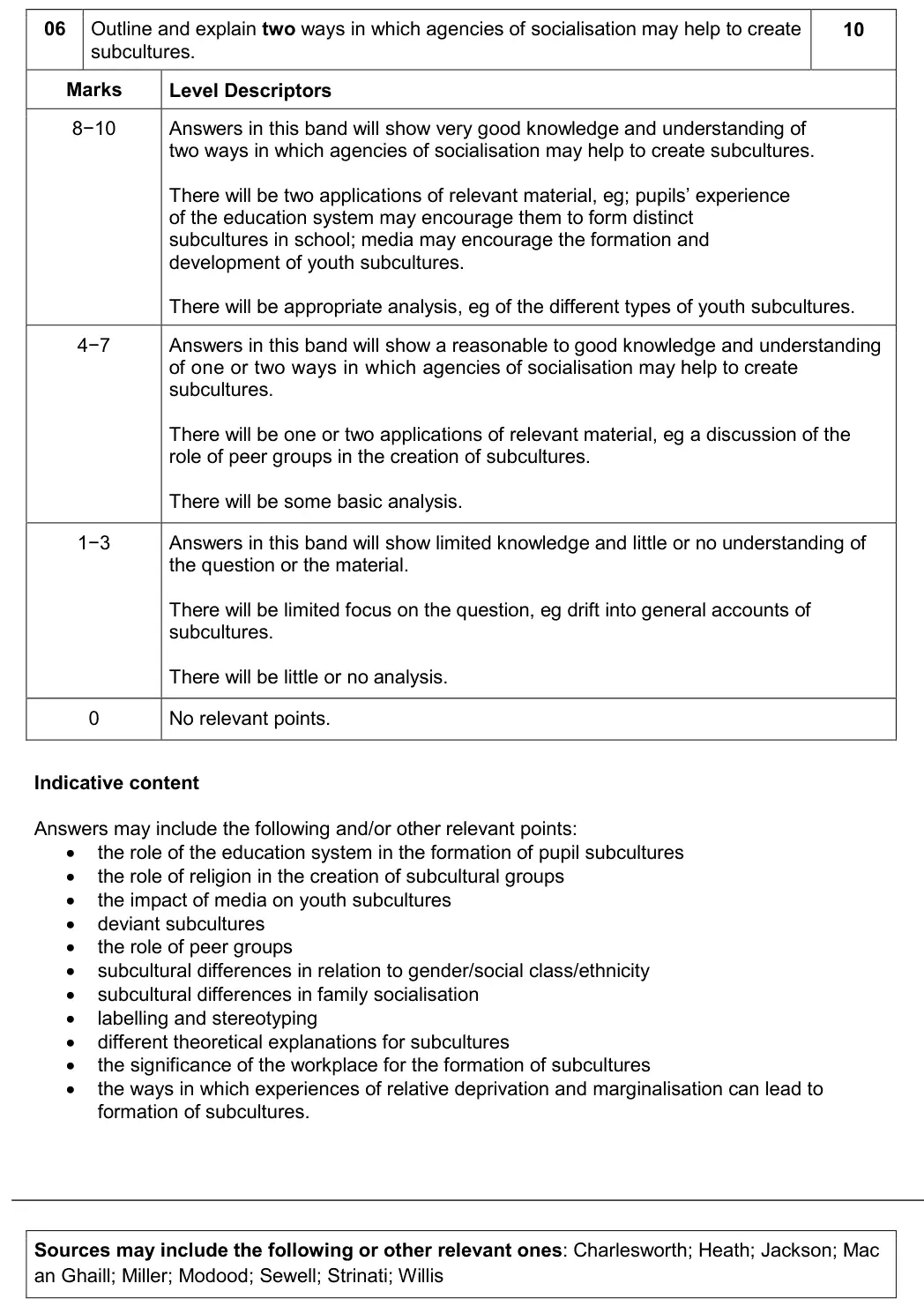
must link a named agency (education, media, peer group, religion, family, workplace) to the creation of subcultures
general accounts of subcultures = 1–3 band
top band analyses different types of youth subculture
June 2019 · Paper 2 · Q110 marksAO1=5, AO2=3, AO3=2Outline and explain
Mark scheme, including the levels grid and indicative content
Examiner's comment
Some students wrote introductory paragraphs and/or conclusions. These are not necessary, and are unlikely to gain additional marks; they also take up time. Some students made only one point in their answers, or three or more, rather than the two asked for. The word ‘two’ is put in bold in the question to try and draw students’ attention to this. Sometimes it was not clear how many points were being made. It is helpful for students to clearly indicate their two answers, with wording such as “One way is…” or by starting a new paragraph for their second point. Notably, some students wrote far more than was needed for a 10-mark response. The two types of 10-mark question, “outline and explain” and “analysis” types, are marked differently as the assessment objectives have different weightings. It is important that students are aware of this. In particular they should note that evaluation is not a requirement for answers to 10 mark “outline and explain” questions. For 10 mark “outline and explain” questions, students cannot rely on reciting knowledge; these questions will ask them to bring together aspects of their sociological knowledge of the topic in a way that they are unlikely to have done before. The best answers to 10-mark questions were focused, clearly stating a point and then developing it, and used sociological concepts, studies, evidence and theory as appropriate. Most students were able to explain two ways in which individuals can be socialised into national identities. Popular answers included within the home (e.g. celebrating a national festival or event), at school, and through the media. A small number did not understand what was meant by national identity.
Notes from the mark scheme and report
AO grid not printed in this mark scheme
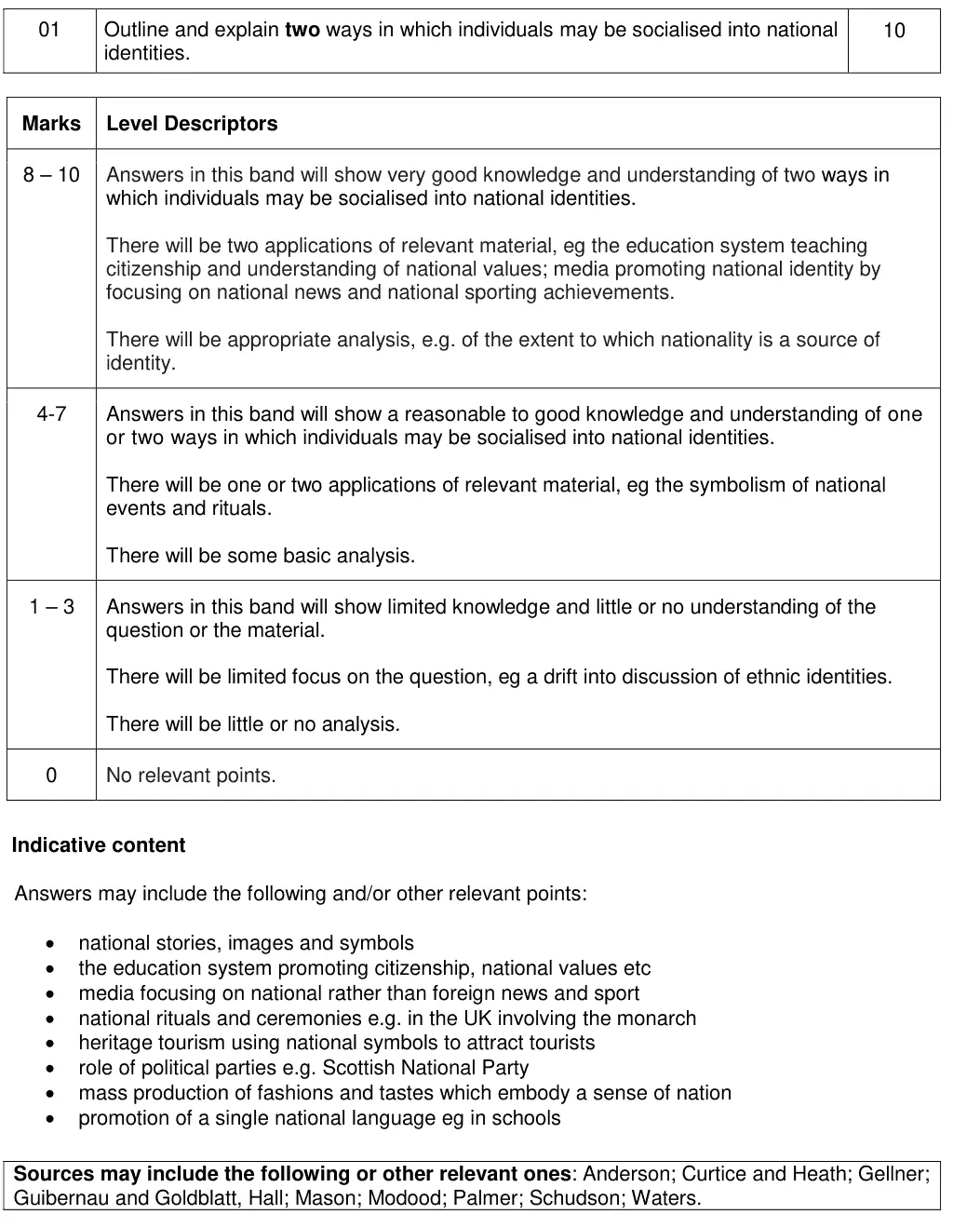
two ways each developed, with analysis of how far nationality is a source of identity
drift into ethnic identity = 1–3
popular answers: family celebrations of national events, school citizenship, national news and sport in the media
a few did not understand national identity
AO split from AQA's standard grid for this paper (this year's mark scheme does not print it).
June 2019 · Paper 2 · Q210 marksAO1=3, AO2=4, AO3=3Analyse
Mark scheme, including the levels grid and indicative content
Examiner's comment
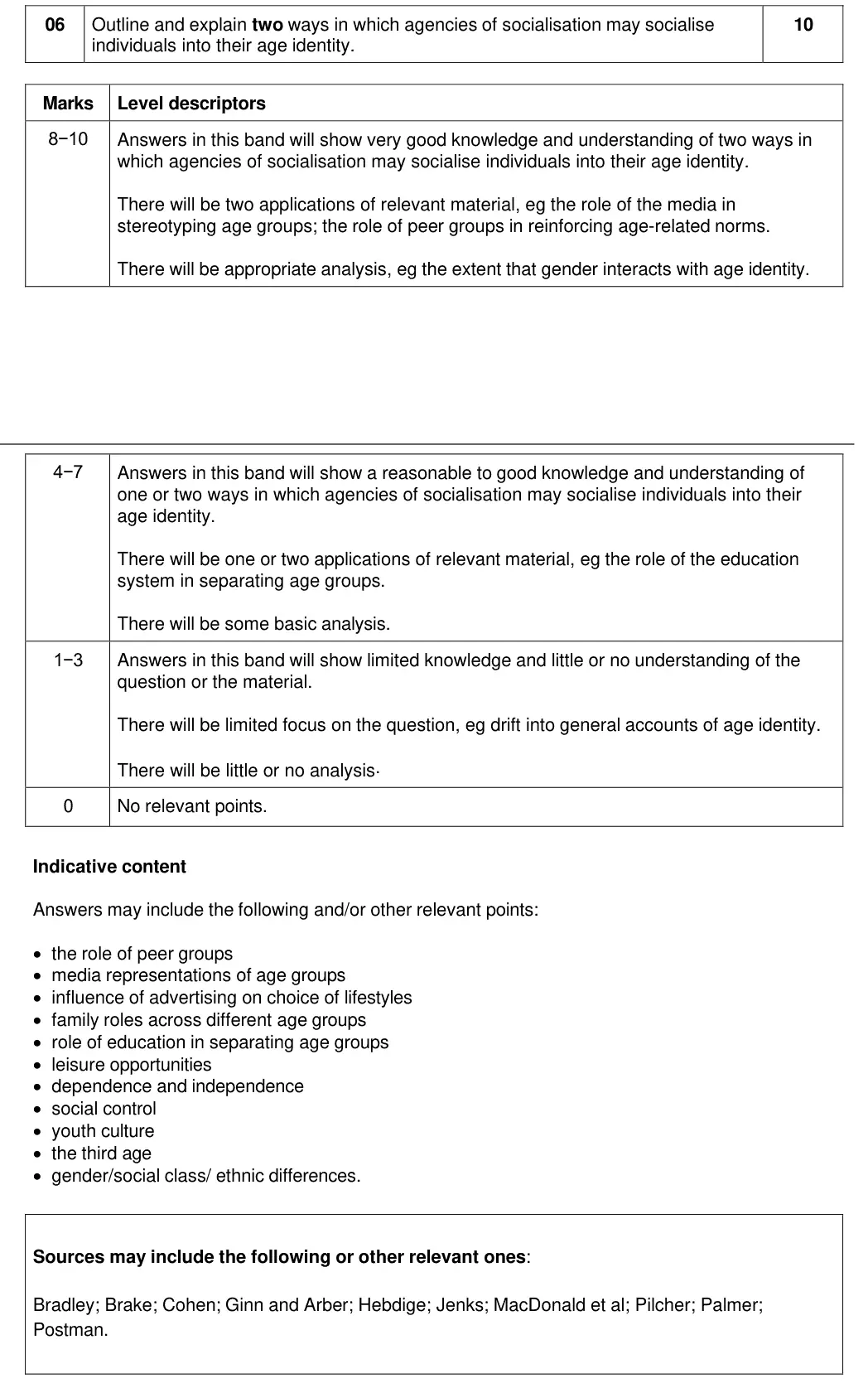
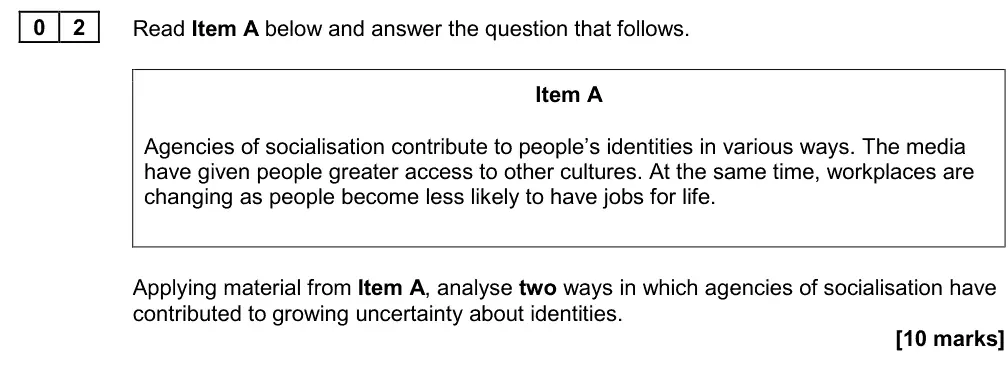
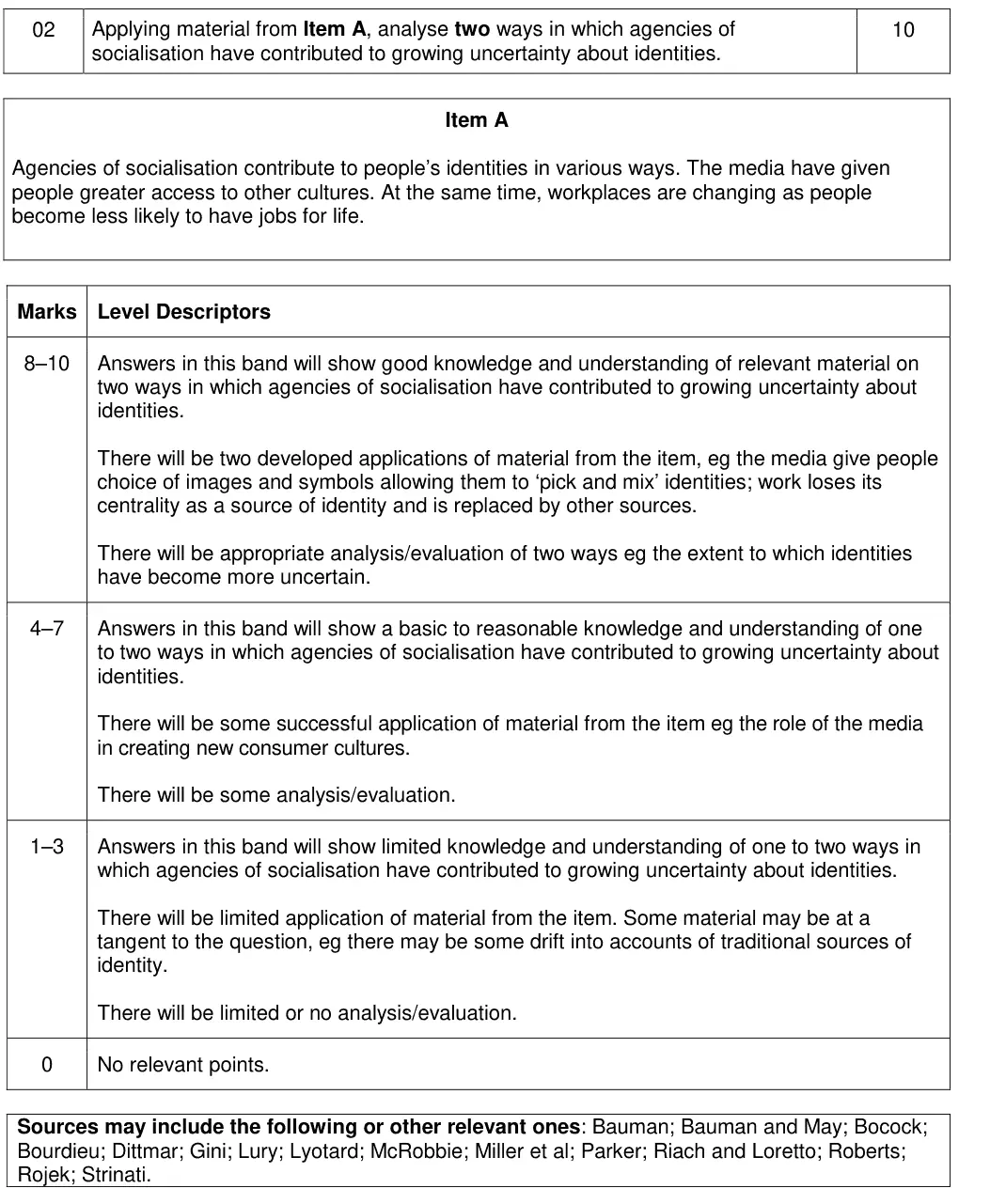
Some students wrote introductory paragraphs and/or conclusions. These are not necessary, and are unlikely to gain additional marks; they also take up time. Some students made only one point in their answers, or three or more, rather than the two asked for. The word ‘two’ is put in bold in the question to try and draw students’ attention to this. Sometimes it was not clear how many points were being made. It is helpful for students to clearly indicate their two answers, with wording such as “One way is…” or by starting a new paragraph for their second point. Notably, some students wrote far more than was needed for a 10-mark response. The two types of 10-mark question, “outline and explain” and “analysis” types, are marked differently as the assessment objectives have different weightings. It is important that students are aware of this. For 10 mark “analyse” questions, the parts of the item being used should be clearly indicated, preferably by exact words being quoted. It is acceptable for two different points to be drawn from one part of the item, but answers which do not use the item cannot access the application marks. The best answers to 10-mark questions were focused, clearly stating a point and then developing it, and used sociological concepts, studies, evidence and theory as appropriate. Most students were able to give two ways in which agencies of socialisation have contributed to growing uncertainty about identities. To be successful, answers needed to discuss the role played in this by the agencies named in the item: the media, and the workplace. A small number of answers focused instead on other agencies, and could not get application marks. Popular responses included ‘pick and mix’ or ‘hybrid identities’ and ‘masculinity’ in workplaces.
Notes from the mark scheme and report
must use the agencies named in the item (media, workplace)
answers built on other agencies could not gain application marks
drift into traditional sources of identity = 1–3
popular answers: pick-and-mix or hybrid identities, changing masculinity at work
AO split from AQA's standard grid for this paper (this year's mark scheme does not print it).
June 2019 · AS Paper 2 · Q610 marksAO1=5, AO2=3, AO3=2Outline and explain
Mark scheme, including the levels grid and indicative content
Examiner's comment
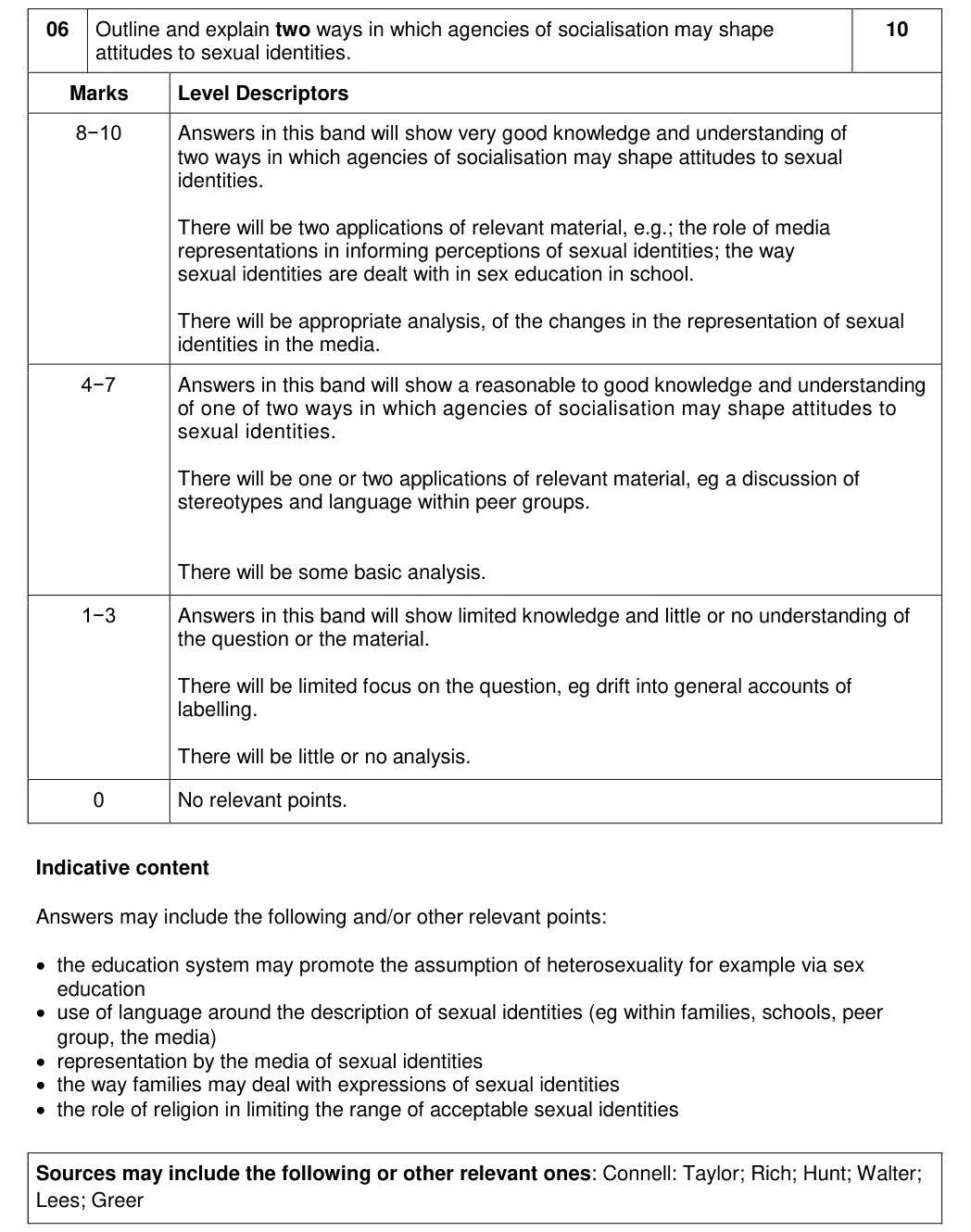
The requirements of the 10-mark question seem to be well understood by the majority of students. In general, this question was answered poorly with limited knowledge and understanding shown. While students were familiar with agencies of socialisation, they were less clear about sexual identities and often answers drifted into accounts of gender role socialisation with limited success. Successful answers were able to discuss the role of schools in shaping sexual identities via the teaching of sex education or via the heterosexual assumptions of everyday interactions in school. Others referred to the role of religion or the media in promoting particular sexual identities. Answers that focused on the family as an agent of socialisation tended to get diverted into a discussion of gender roles rather than attitudes to sexual identities.
Notes from the mark scheme and report
AO grid not printed
no marks for evaluation in this question type
two ways each developed, e.g. media representations, sex education and heterosexual assumptions in school, religion, peer-group language
generally poorly answered: many drifted into gender role socialisation
drift into general labelling = 1–3
AO split from AQA's standard grid for this paper (this year's mark scheme does not print it).
June 2018 · Paper 2 · Q320 marksAO1=8, AO2=6, AO3=620-mark essay
Mark scheme, including the levels grid and indicative content
Examiner's comment
Many scripts had one substantial well developed answer to a 20 mark question and one significantly briefer one, suggesting problems with timing. It is often the case that a wide range of material can be relevant to these questions, and students need to carefully choose the content they wish to use by planning their answers. For example, it may be more effective to cover a limited number of views or theories in some depth rather than to include every possible theory. There was a tendency for answers to progressively lose sight of the question and to become a list of different views. The best answers will address all aspects of the question and will draw on theories, concepts and empirical examples or evidence. Evaluation which meets the demands of the questions is better than points of criticism which have been learned and included, regardless of the question. Students should also be aware that evaluation includes awareness of the strengths as well as the weaknesses of an argument, theory or piece of evidence. This question produced some good answers. Some approached the question by discussing agencies of socialisation one by one, others by discussing different theories, starting with Marxism and moving on, usually, to functionalism and feminism. Both approaches could be successful, but students should be encouraged to make evaluative points throughout rather than leaving these for a conclusion.
Notes from the mark scheme and report
top band compares perspectives on the role of socialisation (e.g. functionalist, feminist, interactionist)
basic account of agencies promoting ruling-class ideology = 9–12
agency-by-agency or theory-by-theory structures both work but evaluation should run throughout, not be saved for the conclusion
AO split from AQA's standard grid for this paper (this year's mark scheme does not print it).
June 2018 · AS Paper 2 · Q610 marksAO1=5, AO2=3, AO3=2Outline and explain
Mark scheme, including the levels grid and indicative content
Examiner's comment
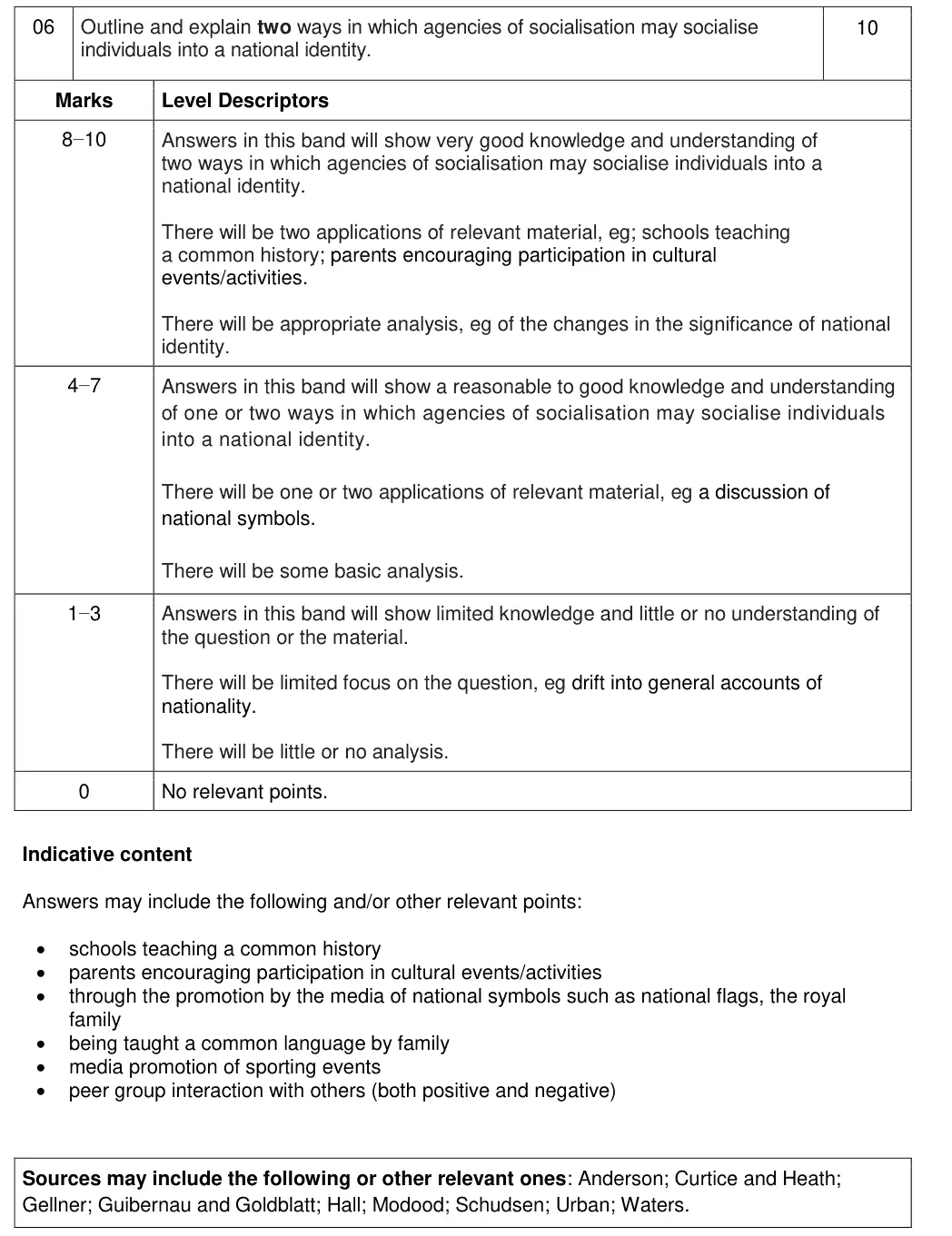
The 10 mark outline and explain question requires students to link two aspects of the specification. The best answers took note of both aspects of the question, clearly identified two separate points and developed them in relation to the second part of the question. Weaker answers either ignored one aspect of the question or attempted to cover a number of ideas rather than focusing on two. In general, this question was answered poorly with limited knowledge and understanding shown. While students were familiar with agencies of socialisation, they were less clear about national identity. Many answers struggled to find anything specific to say about national identity and instead made generic comments about socialisation and norms and values. Some answers conflated national identity with religious and ethnic identity and often found it difficult to explain how agencies socialise individuals into a national identity. Successful answers were able to discuss the role of schools in shaping national identity via the teaching of history or literature. Others referred to the role of the media in giving people a sense of shared national identity through sporting events, royal weddings or even during wartime.
Notes from the mark scheme and report
two ways agencies create national identity
examples: schools teaching common history, family and cultural events, media national symbols and sport, common language
drift into general accounts of nationality = 1-3
answered poorly overall: generic norms-and-values socialisation, or conflating national with religious/ethnic identity
AO split from AQA's standard grid for this paper (this year's mark scheme does not print it).
June 2018 · AS Paper 2 · Q720 marksAO1=8, AO2=6, AO3=620-mark essay
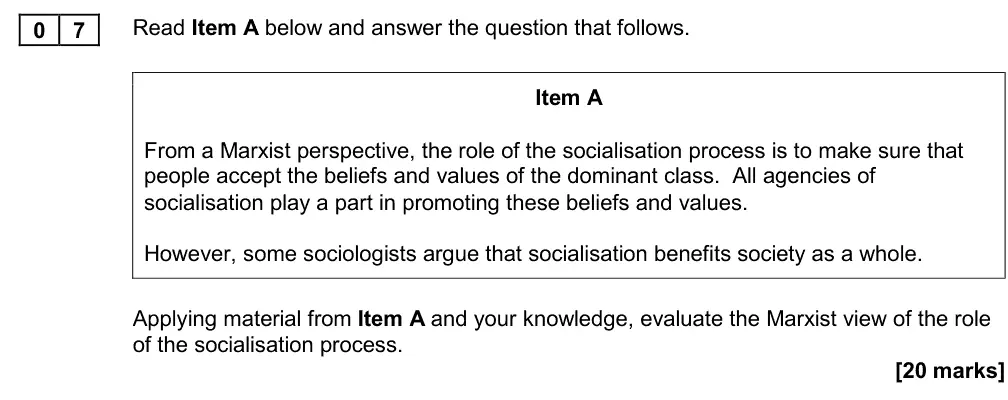
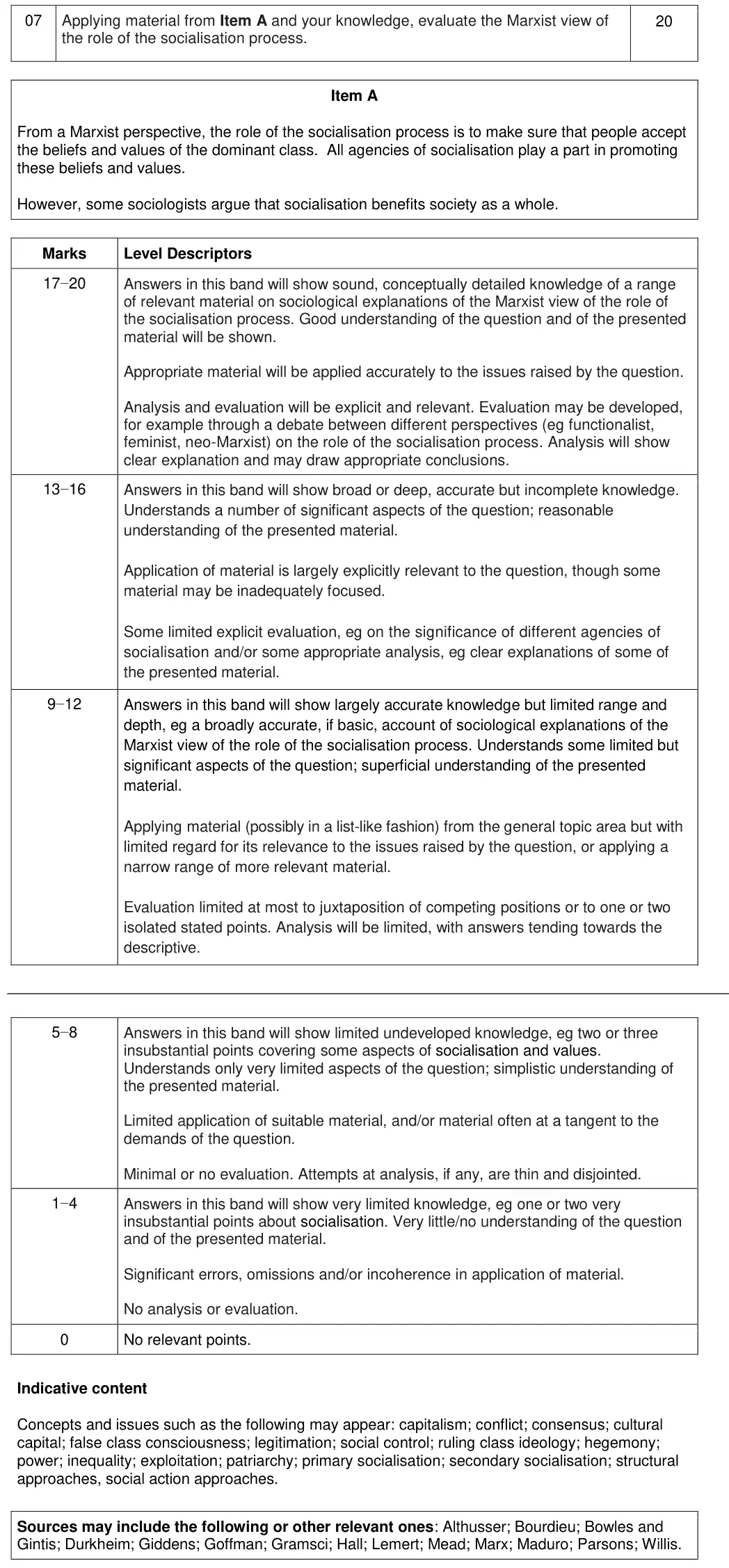
Mark scheme, including the levels grid and indicative content
Examiner's comment
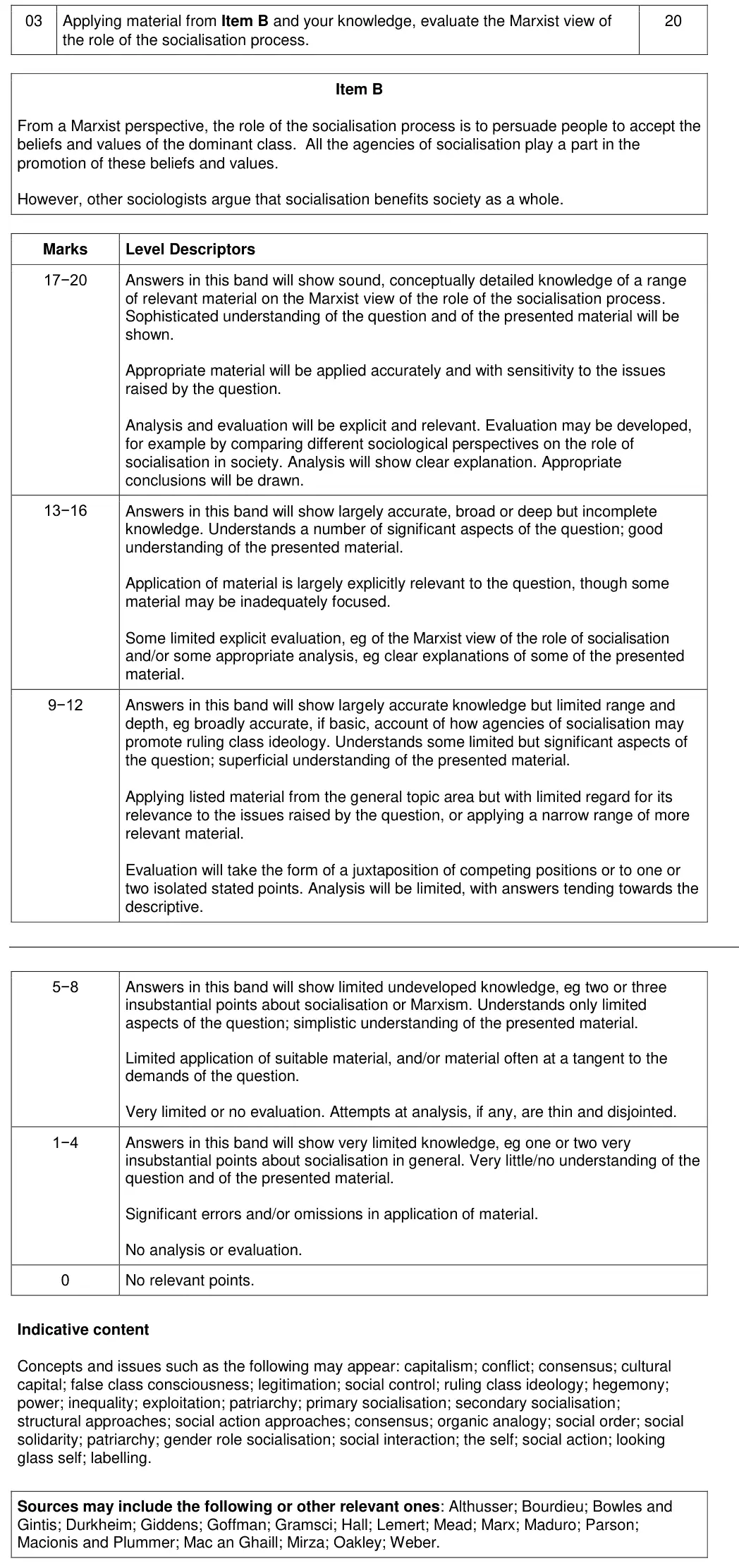
The best answers made reference to different agencies of socialisation (usually education and the family) and the part they play in socialising people into ruling class ideology. This framework allowed students to discuss the Marxist view of the role of the socialisation process, and then to discuss alternative views. Good answers retained the focus on Marxist views and used alternative perspectives as a commentary on Marxist views. Other more limited answers had self-contained sections on different perspectives of socialisation that were unrelated to each other. A number of other weaker answers started with an agency of socialisation such as education and then drifted off into a discussion of the role of education in society rather than the specifics of the socialisation process. There were some very good responses that distinguished between different Marxist approaches to socialisation and the role of structural factors as opposed to individual agency.
Notes from the mark scheme and report
apply Item A (dominant-class values via all agencies vs socialisation benefits society)
evaluation via functionalist, feminist, neo-Marxist views or the significance of different agencies
good answers kept the Marxist focus and used other views as commentary
self-contained sections on perspectives, or drifting into the role of education in general, scored lower
best distinguished Marxist approaches and structure vs agency
AO split from AQA's standard grid for this paper (this year's mark scheme does not print it).
June 2017 · AS Paper 2 · Q610 marksAO1=5, AO2=3, AO3=2Outline and explain
Mark scheme, including the levels grid and indicative content
Examiner's comment
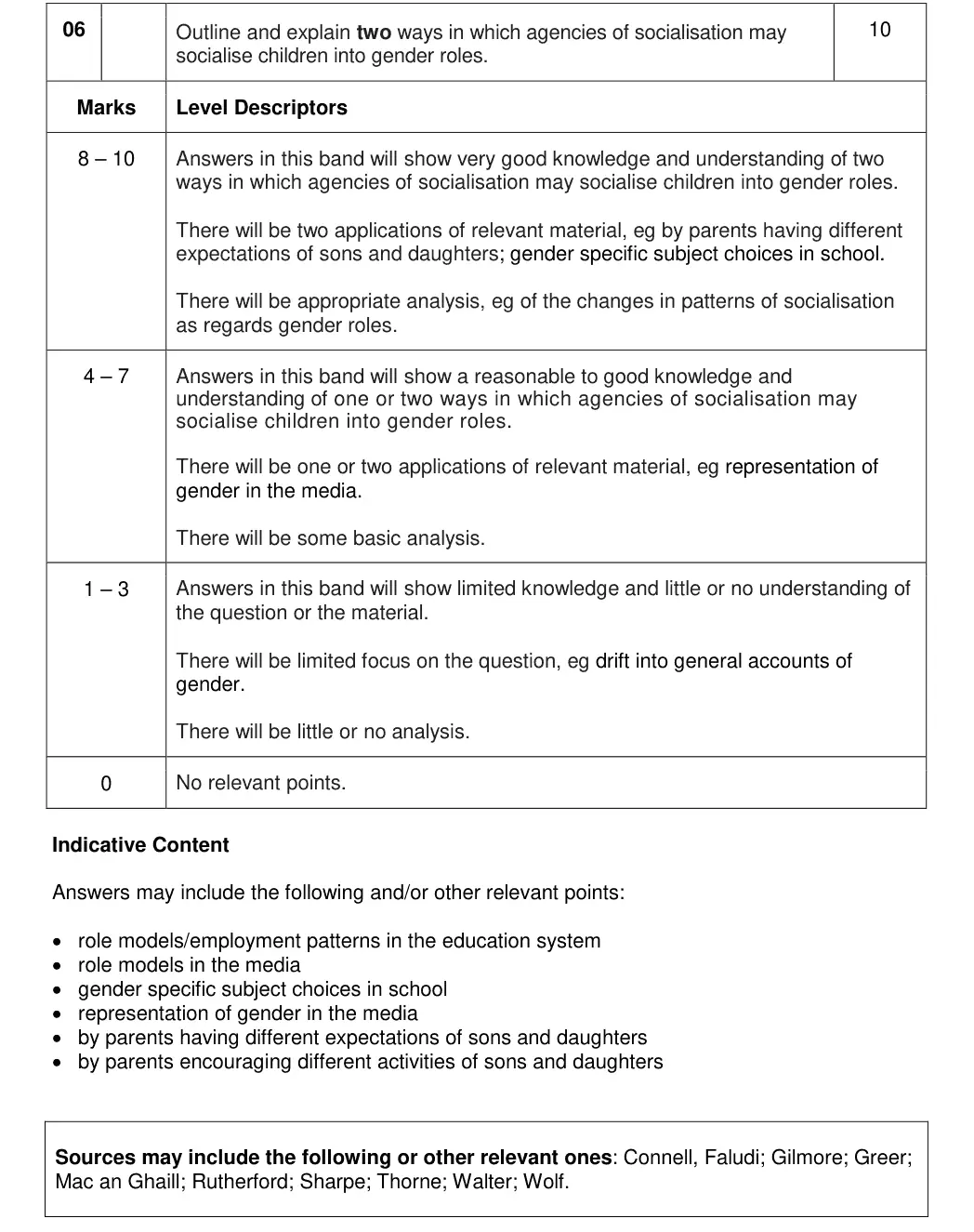
The 10 mark outline and explain question requires students to link two aspects of the specification. The best answers took note of both aspects of the question, clearly identified two separate points and developed them in relation to the second part of the question. Weaker answers either ignored one aspect of the question or attempted to cover a number of ideas rather than focusing on two. This question was answered well with some good knowledge and understanding shown. Some students scored well by developing Oakley’s ideas on gender socialisation. Others approached the question in terms of two different agencies of socialisation and their contribution to socialising children into gender roles. The best answers were able to clearly explain how agencies may socialise children in to gender roles (usually family and education). These answers were detailed in their account of the process and they were also able to discuss the way in which these processes applied to girls and boys. They also discussed the way these processes were changing.
Notes from the mark scheme and report
no marks for evaluation in this question type
two ways each developed, e.g. parents' different expectations of sons and daughters, gendered subject choice at school
drift into general accounts of gender = 1–3
best answers explained the process for both girls and boys (often family and education, e.g. Oakley) and how it is changing
June 2016 · AS Paper 2 · Q32 marksAO1=2Define
Mark scheme
Examiner's comment
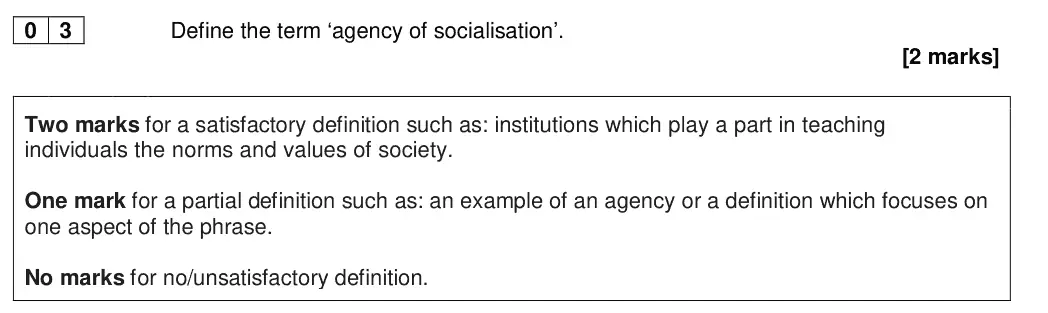
Centres are reminded that questions asking for a definition of a concept that contains more than one word within quotation marks are best answered by ensuring that all the words are defined. Most students were able to define ‘agency of socialisation’ satisfactorily, usually by reference to an institution that teaches people society’s norms and values. Examples of agencies with no development were awarded one mark.
Notes from the mark scheme and report
2 marks for an institution that teaches norms and values
naming an example agency only = 1 mark
most students defined it well
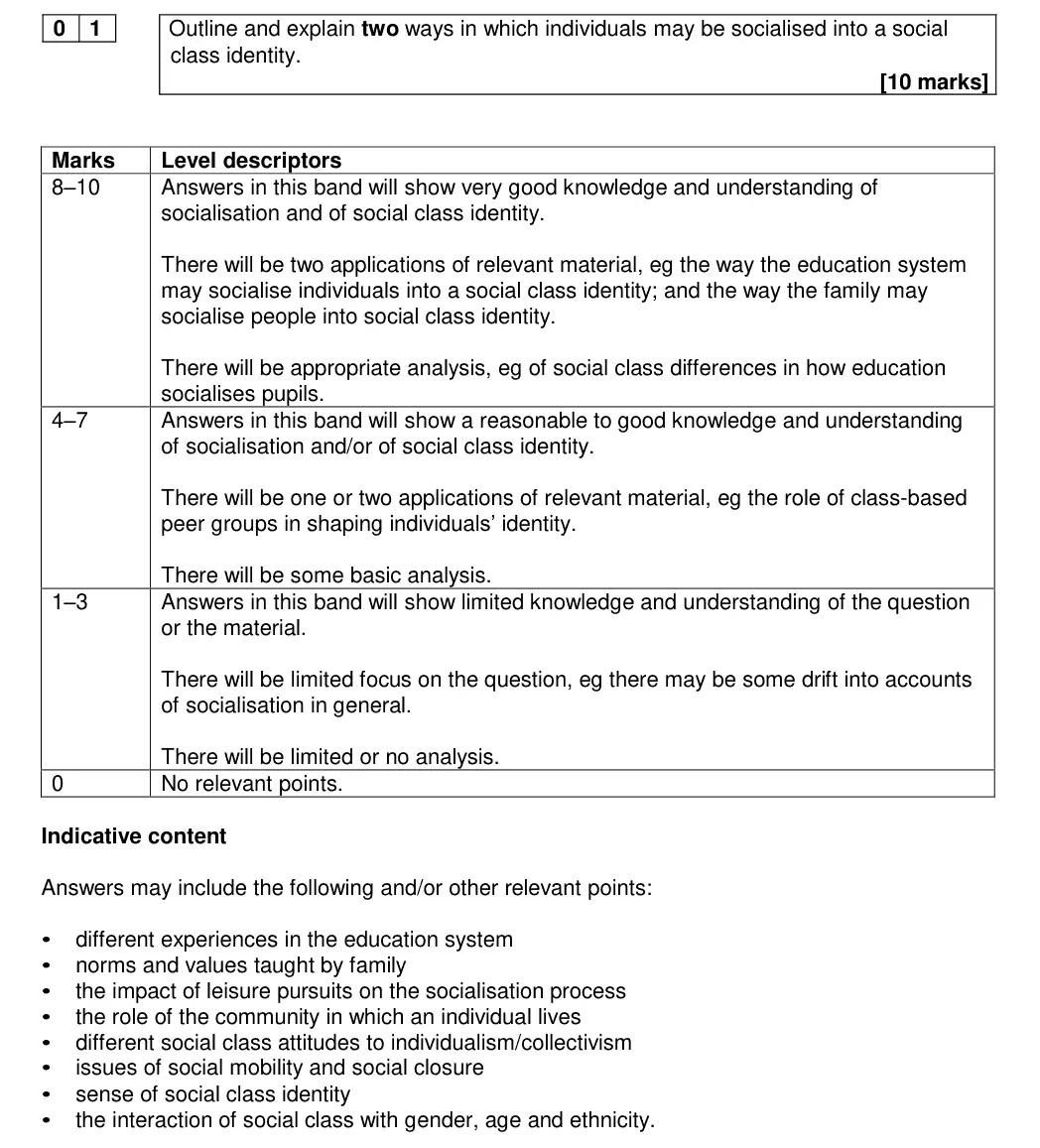
Specimen set 1 · Paper 2 · Q110 marksAO1=5, AO2=3, AO3=2Outline and explain
Mark scheme, including the levels grid and indicative content
Notes from the mark scheme and report
specimen paper, no examiners' report
top band: two agencies (e.g. education and family) applied to class identity, with analysis of class differences in how education socialises
drift into socialisation in general = 1–3 band
Work with an AQA sociology tutor
Essays stuck in the middle band, or losing marks on the 10-markers? Book a trial lesson with Mark, a former AQA examiner.