Tap a question to zoom it. The mark scheme (with the level descriptors and indicative content) and the examiner's comment open underneath.
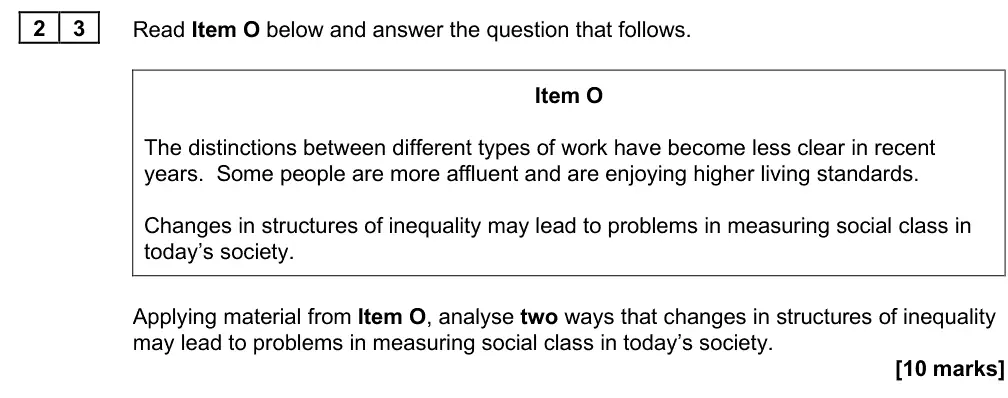
June 2025 · Paper 2 · Q2310 marksAO1=3, AO2=4, AO3=3Analyse
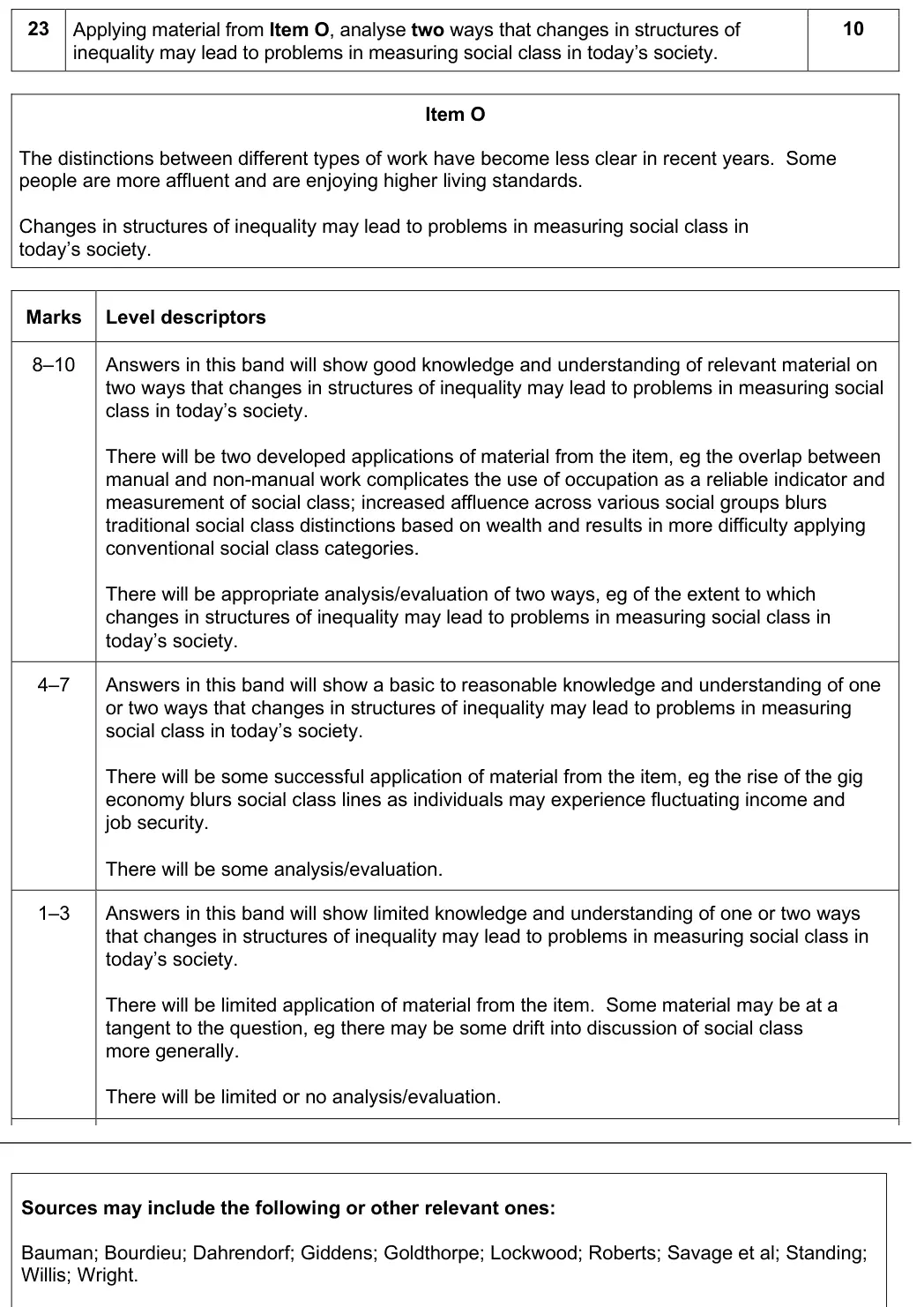
Mark scheme, including the levels grid and indicative content
Examiner's comment
The nature of these questions means that students cannot rely on reciting knowledge. Questions will ask them to bring together aspects of their sociological knowledge in ways they have not done before. It is therefore important for students to allow time to think about how to answer the question. Students should be aware that there are two types of ten-mark questions. These have different requirements and different mark schemes. There are different marks available for the assessment objectives. The items for 10 mark “analyse” questions are written to give prompts or “hooks” for student answers. These must be used to access application marks. Answers can indicate use of hooks by quoting, by a reference in parentheses or by wording (e.g. “As the item says…”). Items end with a sentence restating the question; the hooks are in the preceding part of the item. Introductions and conclusions are not required for 10-mark questions, are unlikely to help students and take up time. It is helpful if answers are set out to clearly indicate the two answers, with wording such as “One way/reason is…” or by starting a new paragraph for the second point. Answers that give more than two answers are unlikely to develop two of them sufficiently. The most successful answers to 10-mark questions were focused, clearly stating a point that addressed the question and then developing it, using sociological concepts, evidence such as an example and, where appropriate, theory. Some answers showed difficulty in developing effective answers from the hooks. Examples of the convergence of different types of occupation and how that process might pose issues of categorisation for classifications such as the National Statistics Socio-economic Classification only featured in a minority of answers.
Notes from the mark scheme and report
item hooks: blurring of manual/non-manual work (occupation as indicator) and rising affluence (blurring class lines)
few linked this to classification schemes such as NS-SEC
drift into class in general = 1–3
June 2024 · Paper 2 · Q2210 marksAO1=5, AO2=3, AO3=2Outline and explain
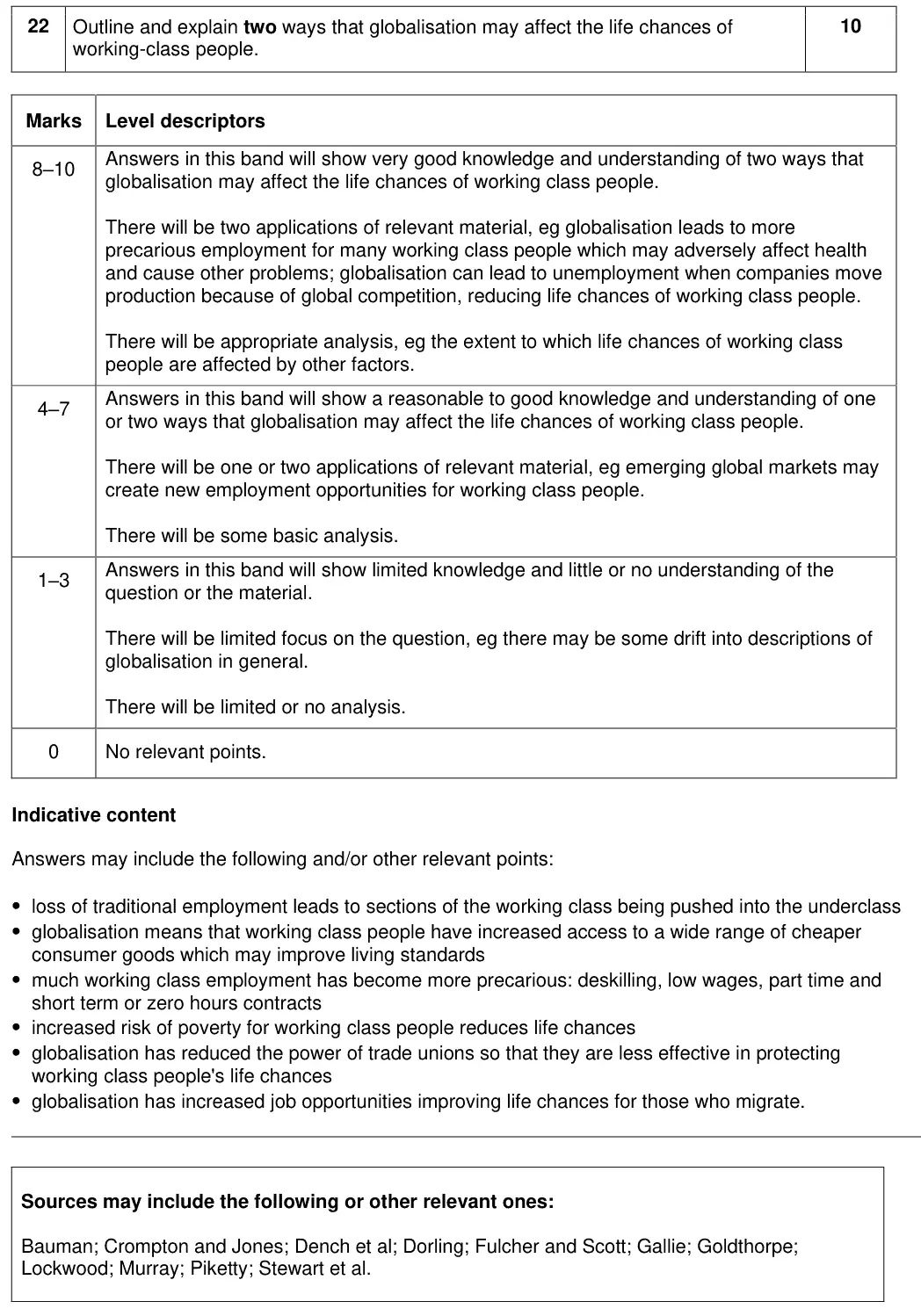
Mark scheme, including the levels grid and indicative content
Examiner's comment
The nature of these questions means that students cannot rely on reciting knowledge. Questions will ask them to bring together aspects of their sociological knowledge in ways they will not have done before. It is therefore important for students to allow time to think about how to answer the question. Students should be made aware that there are two types of 10 mark questions. These have different requirements and different mark schemes . There are different marks available for the assessment objectives. A breakdown of the marks awarded by assessment objective can be found in the mark scheme. 10 mark “outline and explain” questions have more marks available for knowledge and understanding, and none for evaluation. Introductions and conclusions are not required for 10 mark questions; they take up time and rarely improve the mark. It is helpful if answers are set out to clearly indicate the two answers, with wording such as “One way/reason is…”, or by starting a new paragraph for the second point. Answers that give more than two points are unlikely to develop two of them sufficiently. Q22: Answers often discussed the creation of new jobs and opportunities or the outsourcing of production so leading to a reduction of employment opportunities. For some students developing the ways by explaining the effects on life chances proved difficult. A minority of students linked globalisation and life chances to other features such as globalisation enabling advances in health care, so improving life chances.
Notes from the mark scheme and report
two ways each linked to working-class life chances (e.g. precarious employment, job losses from relocated production, cheaper consumer goods, weaker unions, migration opportunities)
describing globalisation in general = 1–3
explaining the effect on life chances was the difficult step
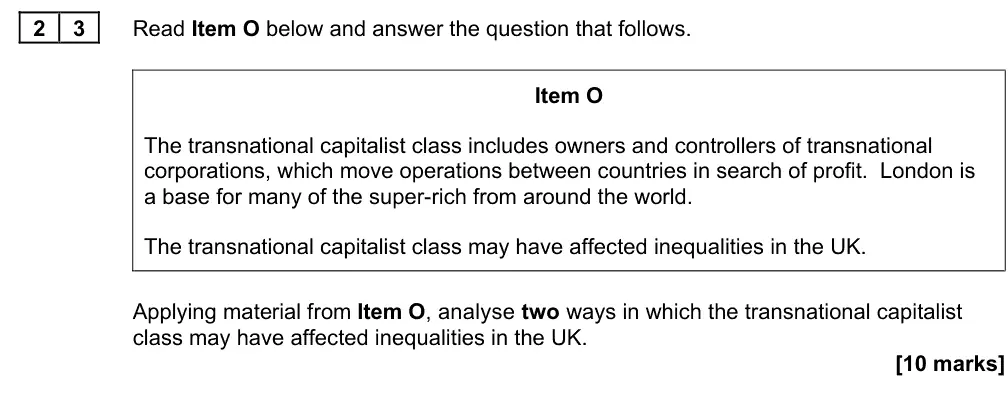
June 2023 · Paper 2 · Q2310 marksAO1=3, AO2=4, AO3=3Analyse
Mark scheme, including the levels grid and indicative content
Examiner's comment
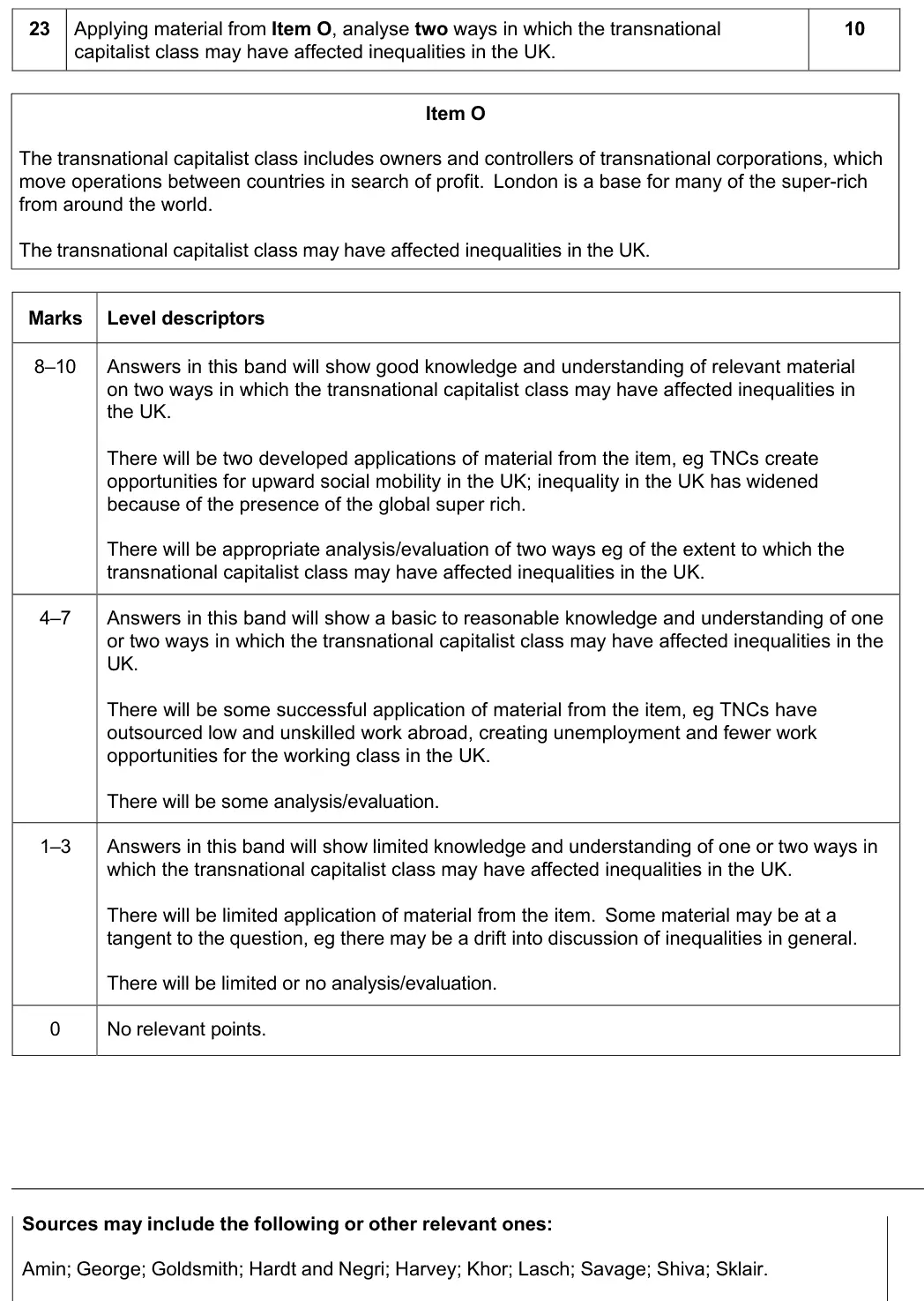
The nature of these questions means that students cannot rely on reciting knowledge. Questions will ask them to bring together aspects of their sociological knowledge in ways they are unlikely to have done before. It is therefore important for students to allow time to think about how to answer the question. Students should be made aware that there are two types of 10 mark questions. These have different requirements and different mark schemes. There are different marks available for the assessment objectives. The items for 10 mark “analyse” questions are written to give prompts or “hooks” for student answers. These have to be used to access application marks. Answers can indicate use of hooks by quoting, by a reference in parentheses or by wording (eg “As the item says…”). Items end with a sentence restating the question; the hooks are in the preceding part of the item. Introductions and conclusions are not required for 10 mark questions and take up valuable time. It is helpful if answers are set out to clearly indicate the two separate points, with wording such as “One way/reason is…” or by starting a new paragraph for the second point. Answers that give more than two points are unlikely to develop two of them sufficiently. Question 23: Most students were able to develop two points from the item. Some students seemed not to recognise the term ‘transnational capitalist class’, although it is part of the specification for this topic.
Notes from the mark scheme and report
hooks: TNCs moving operations for profit, London as a base for the super-rich
e.g. outsourcing low-skilled jobs, widening inequality
drift into inequalities in general = 1–3
some did not recognise the term 'transnational capitalist class' though it is in the spec
June 2022 · Paper 2 · Q2210 marksAO1=5, AO2=3, AO3=2Outline and explain
Mark scheme, including the levels grid and indicative content
Examiner's comment
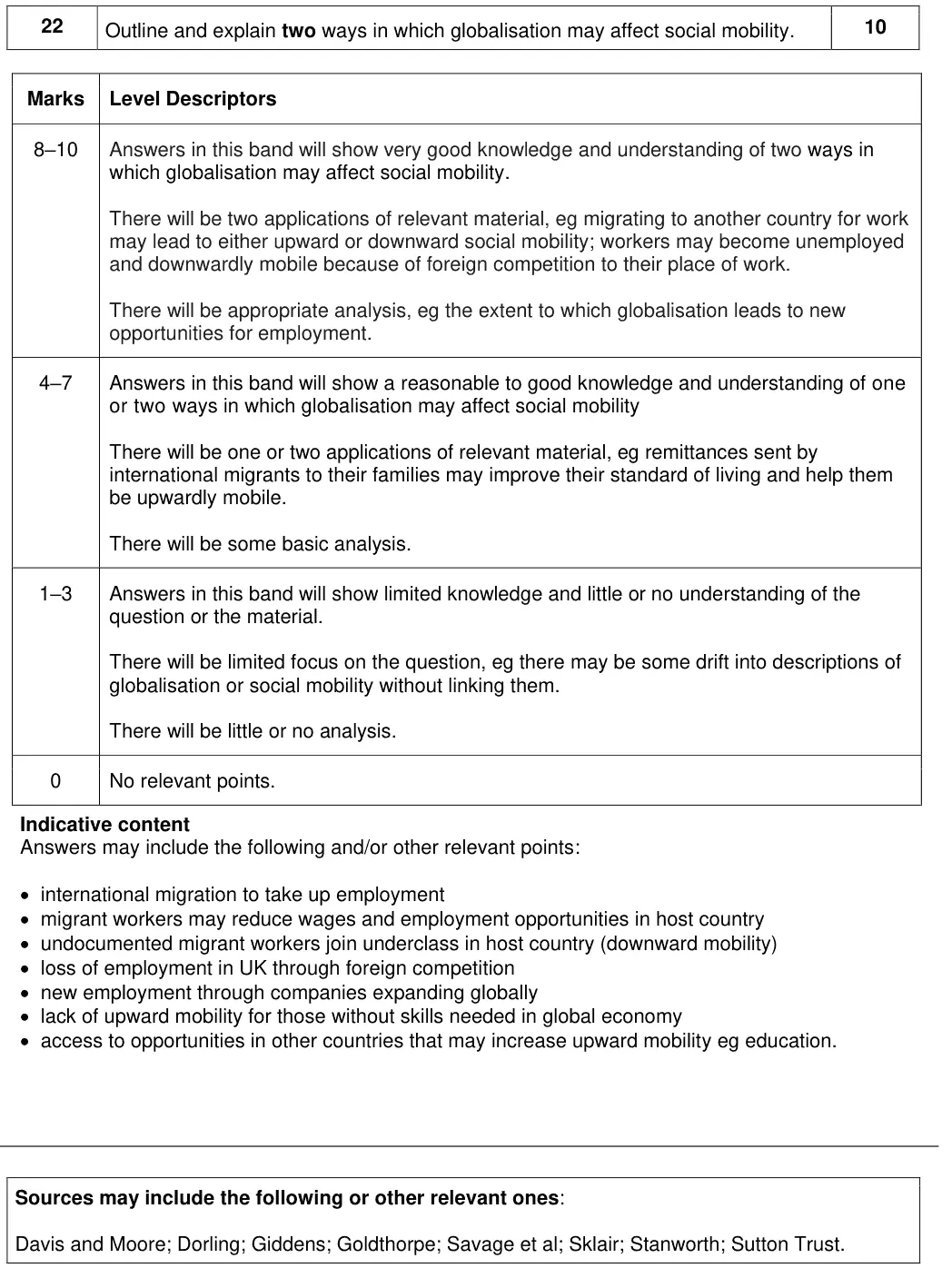
The nature of these questions means that students cannot rely on reciting knowledge. The questions will ask them to bring together aspects of their sociological knowledge in a way that they are unlikely to have done before. There was a tendency, however, to attempt to answer the question by giving knowledge based on words or phrases in the question, rather than meeting the demands of the question. Students are advised to spend time reading the question, and, where there is one the item, to ensure that they are answering the question. Some students seemed unaware of the different demands of the two types of questions. The marks awarded for the assessment objectives are different in the two types of ten mark questions, and students should be aware of this. In particular, it should be noted that there are no marks available for evaluation in “outline and explain” (no item) questions. There is no need for an introduction or conclusion for 10 mark questions. It is helpful if answers are set out to clearly indicate the two answers, with wording such as “One way is…” or by starting a new paragraph for the second point. The best answers to 10 mark questions were focused, clearly stating a point that addressed the question and then developing it, using sociological concepts, evidence and, where appropriate, theory. Answers need to address all aspects of the question. Q22 Most candidates were aware of ways in which globalisation may affect social mobility. Answers included both social mobility for migrants, ability to move to take advantage of employment and lifestyle opportunities, and threats to employment in the UK, leading to downward social mobility, as companies close down or relocate.
Notes from the mark scheme and report
must link globalisation to mobility
describing either alone = 1–3 band
answers covered migrants' mobility and UK job losses from relocation and foreign competition (downward mobility)
June 2019 · Paper 2 · Q2210 marksAO1=5, AO2=3, AO3=2Outline and explain
Mark scheme, including the levels grid and indicative content
Examiner's comment
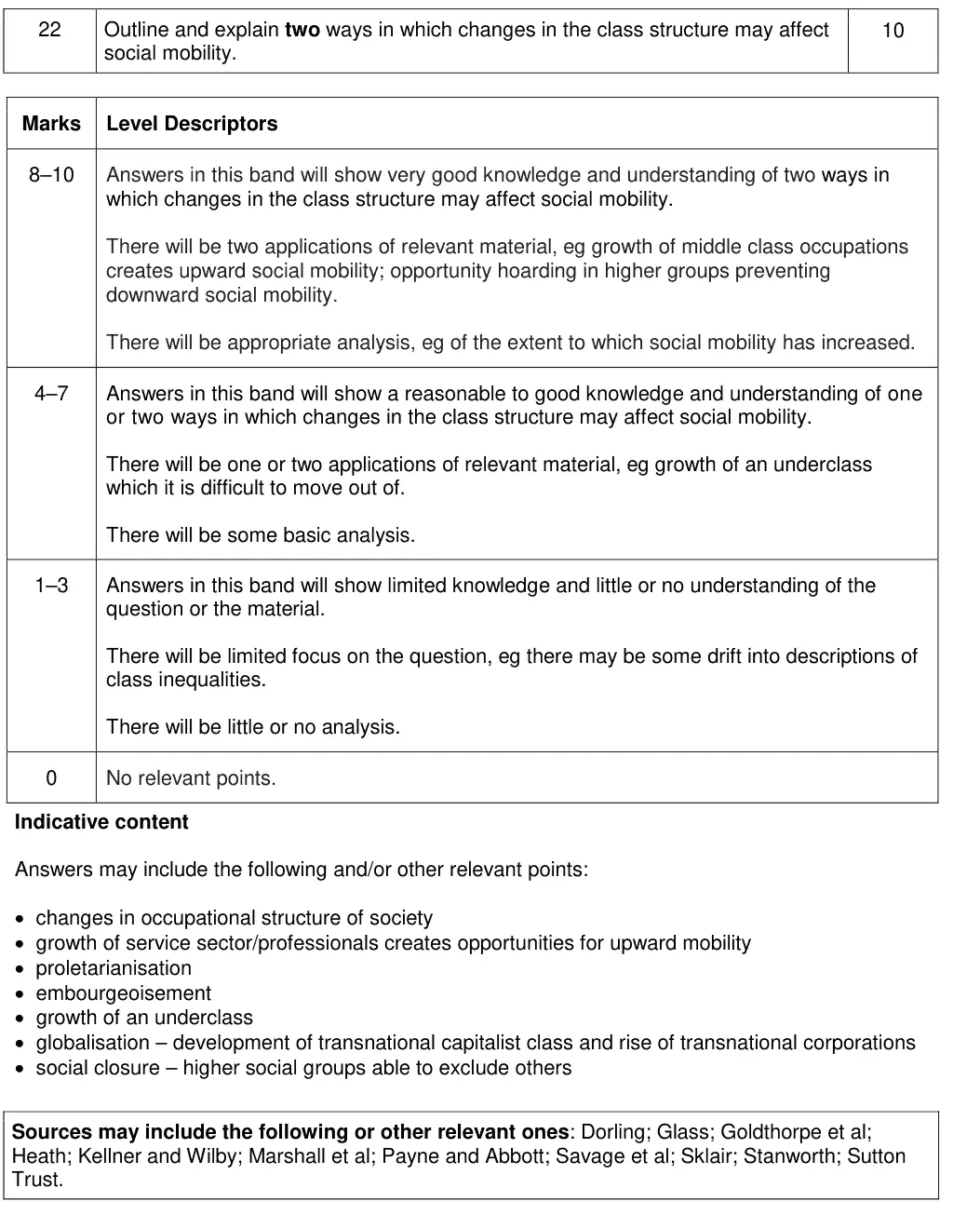
Some students wrote introductory paragraphs and/or conclusions. These are not necessary, and are unlikely to gain additional marks; they also take up time. Some students made only one point in their answers, or three or more, rather than the two asked for. The word ‘two’ is put in bold in the question to try and draw students’ attention to this. Sometimes it was not clear how many points were being made. It is helpful for students to clearly indicate their two answers, with wording such as “One way is…” or by starting a new paragraph for their second point. Notably, some students wrote far more than was needed for a 10-mark response. The two types of 10-mark question, “outline and explain” and “analysis” types, are marked differently as the assessment objectives have different weightings. It is important that students are aware of this. In particular they should note that evaluation is not a requirement for answers to 10 mark “outline and explain” questions. For 10 mark “outline and explain” questions, students cannot rely on reciting knowledge; these questions will ask them to bring together aspects of their sociological knowledge of the topic in a way that they are unlikely to have done before. The best answers to 10-mark questions were focused, clearly stating a point and then developing it, and used sociological concepts, studies, evidence and theory as appropriate. Some students found it difficult to identify “changes in the class structure” and therefore to explain ways in which these might affect social mobility. Answers included the growth of an underclass, which people found it hard to move out of, and the growth of middle-class occupations, creating opportunities for upward mobility into them.
Notes from the mark scheme and report
must identify a change in the class structure and its effect on mobility
drift into class inequality = 1–3
common answers: growth of middle-class jobs (upward mobility), an underclass that is hard to leave
AO split from AQA's standard grid for this paper (this year's mark scheme does not print it).
June 2018 · Paper 2 · Q2310 marksAO1=3, AO2=4, AO3=3Analyse
Mark scheme, including the levels grid and indicative content
Examiner's comment
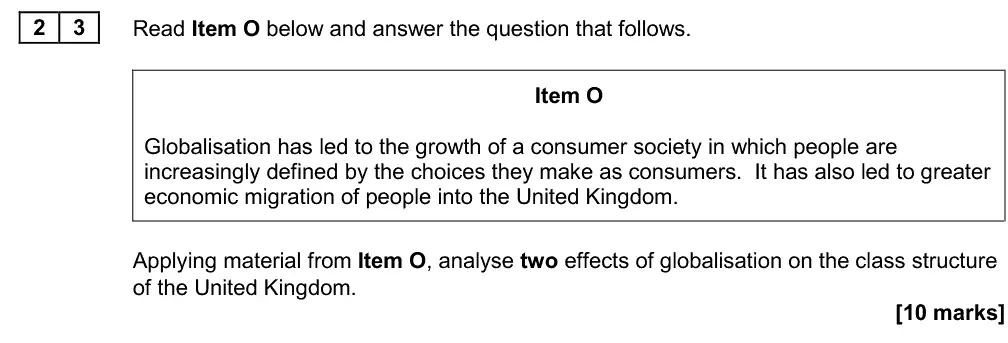
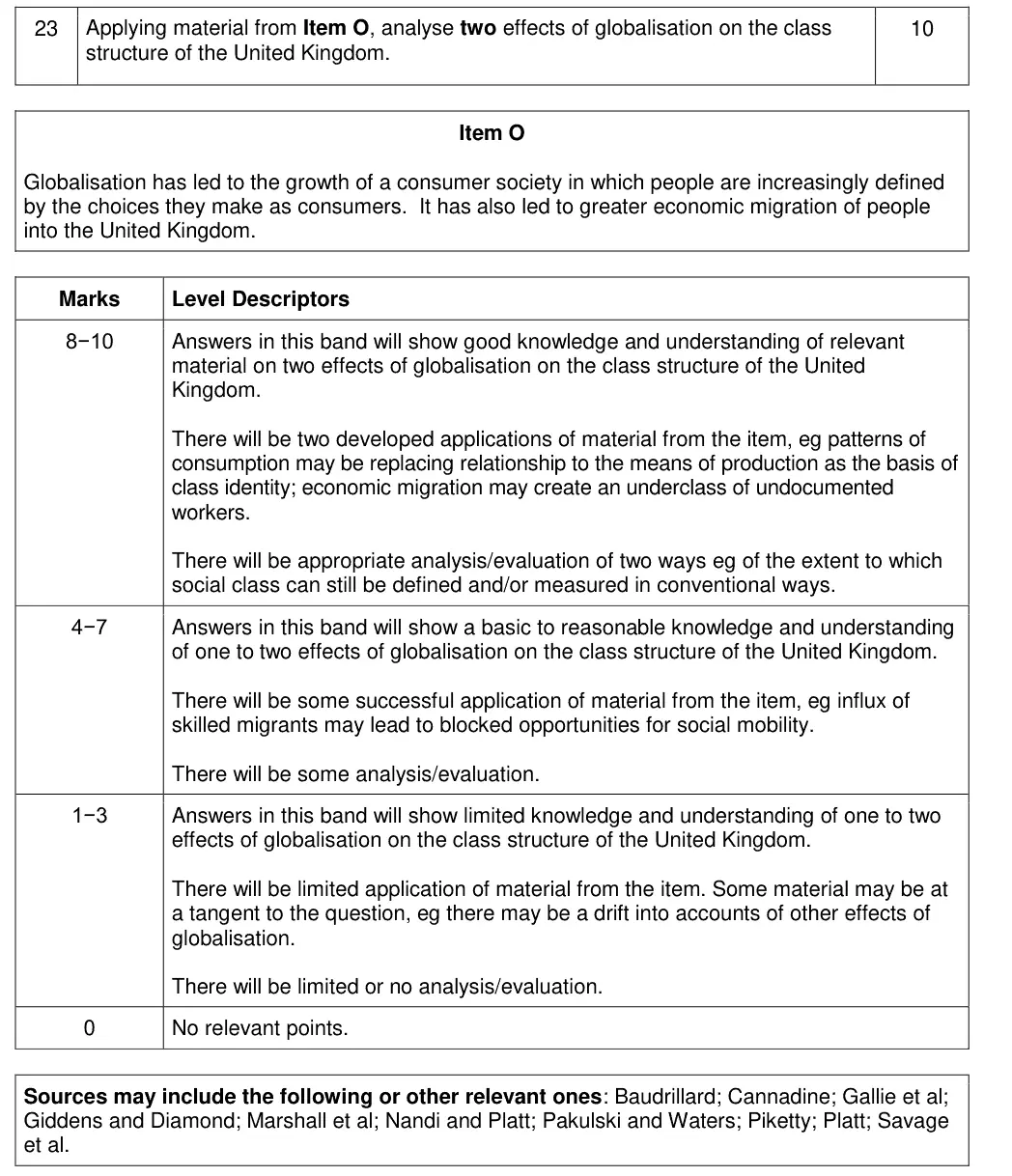
Some students wrote introductory paragraphs and/or conclusions. These are not necessary, and are unlikely to gain additional marks, and they also take up time. Some students made only one point in their answers, or three or more, rather than the two asked for in the question. Sometimes it was unclear how many points were being made. It is helpful for students to clearly indicate their two answers, with wording such as “One way is…” or by starting a new paragraph for their second point. Evaluation is not a requirement for answers to 10 mark “outline and explain” questions. The marks awarded for the assessment objectives being targeted are different in the two types of ten mark questions, and students should be made aware of this. The best answers to 10 mark questions were focused, clearly stating a point and then developing it, using sociological concepts, evidence and theory where appropriate. In some questions students tended to focus on the first aspect of the question at the expense of the second. Students need guidance on how to approach these questions and how to best demonstrate their sociological understanding. The nature of these questions means that students cannot rely on reciting knowledge. These questions will ask them to bring together aspects of their sociological knowledge in a way that they are unlikely to have done before. Most responses went for migration causing an underclass and consumer goods either increasing or decreasing the gap between rich and poor. Overall there was limited evidence that ‘class structure’ was well understood. Migrants were variously seen as skilled or, more frequently, unskilled who thus added to the working or middle class. Some better answers discussed the formation of a transnational ruling class.
Notes from the mark scheme and report
two developed applications from Item O (consumer society, economic migration), e.g. consumption replacing production as basis of class identity, migrant underclass
drift into other effects of globalisation is a tangent
'class structure' poorly understood
better answers discussed a transnational capitalist class
AO split from AQA's standard grid for this paper (this year's mark scheme does not print it).
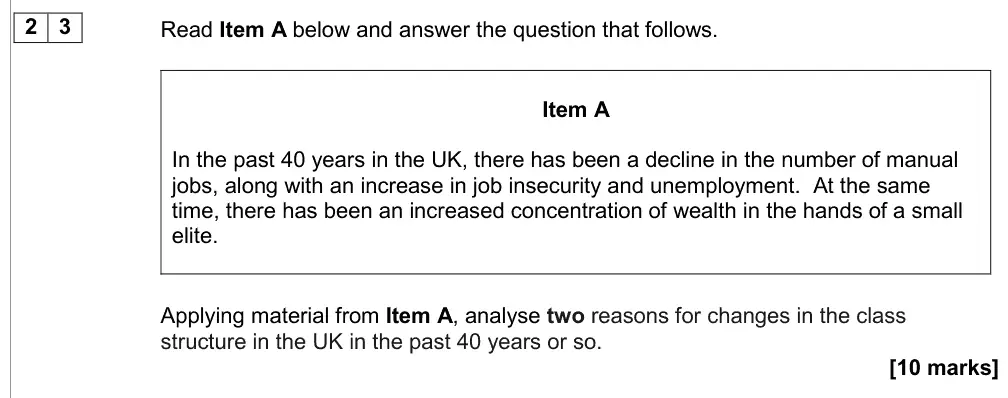
Specimen set 1 · Paper 2 · Q2310 marksAO1=3, AO2=4, AO3=3Analyse
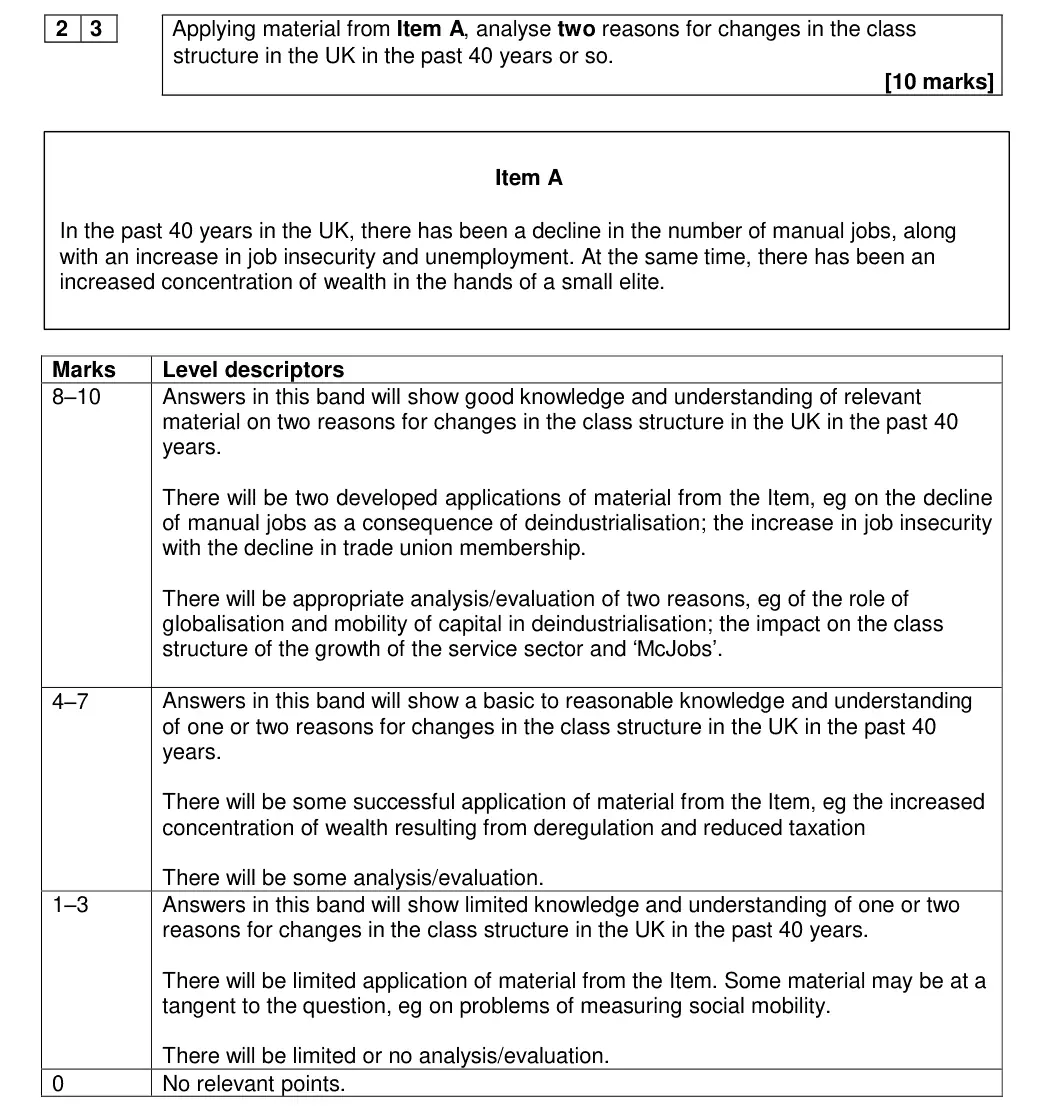
Mark scheme, including the levels grid and indicative content
Notes from the mark scheme and report
item hooks: decline of manual jobs, job insecurity, wealth concentration
top band e.g. deindustrialisation, decline of unions
analysis via globalisation and capital mobility, service sector and McJobs
problems of measuring mobility are a tangent
Work with an AQA sociology tutor
Essays stuck in the middle band, or losing marks on the 10-markers? Book a trial lesson with Mark, a former AQA examiner.