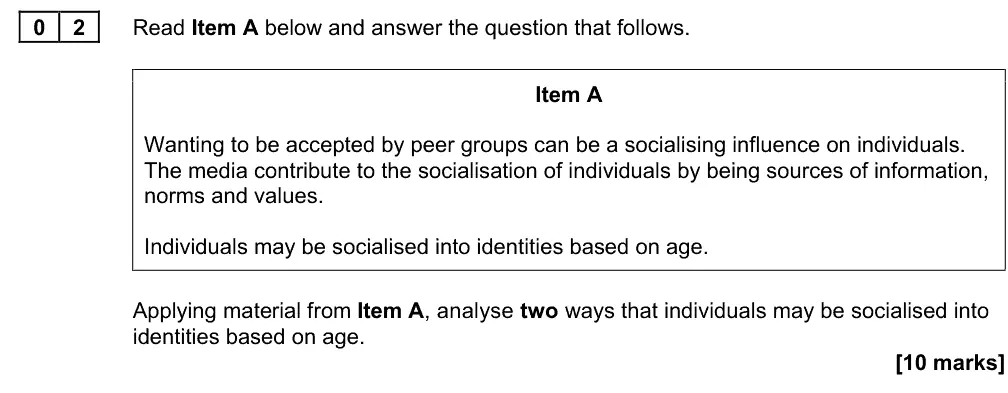
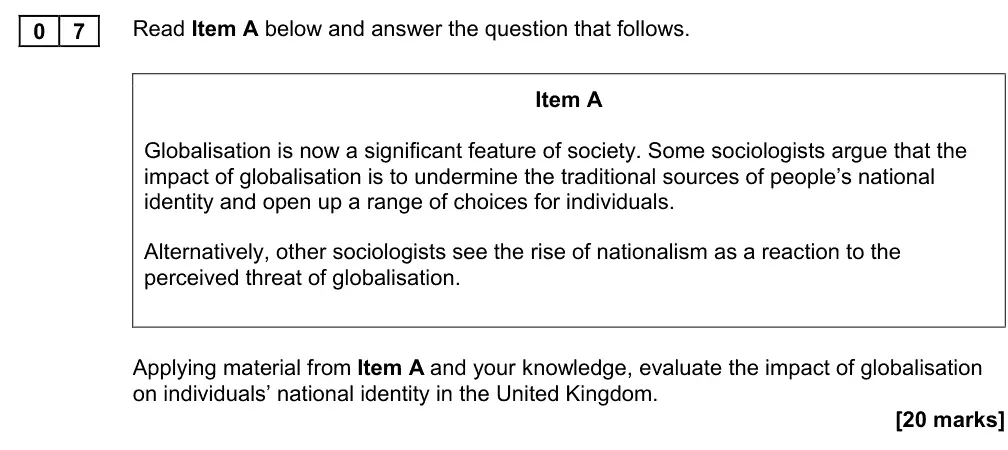
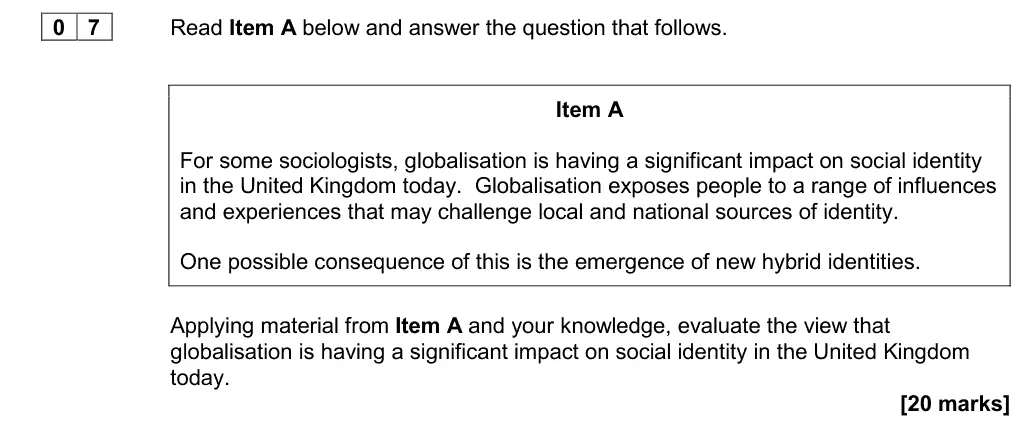
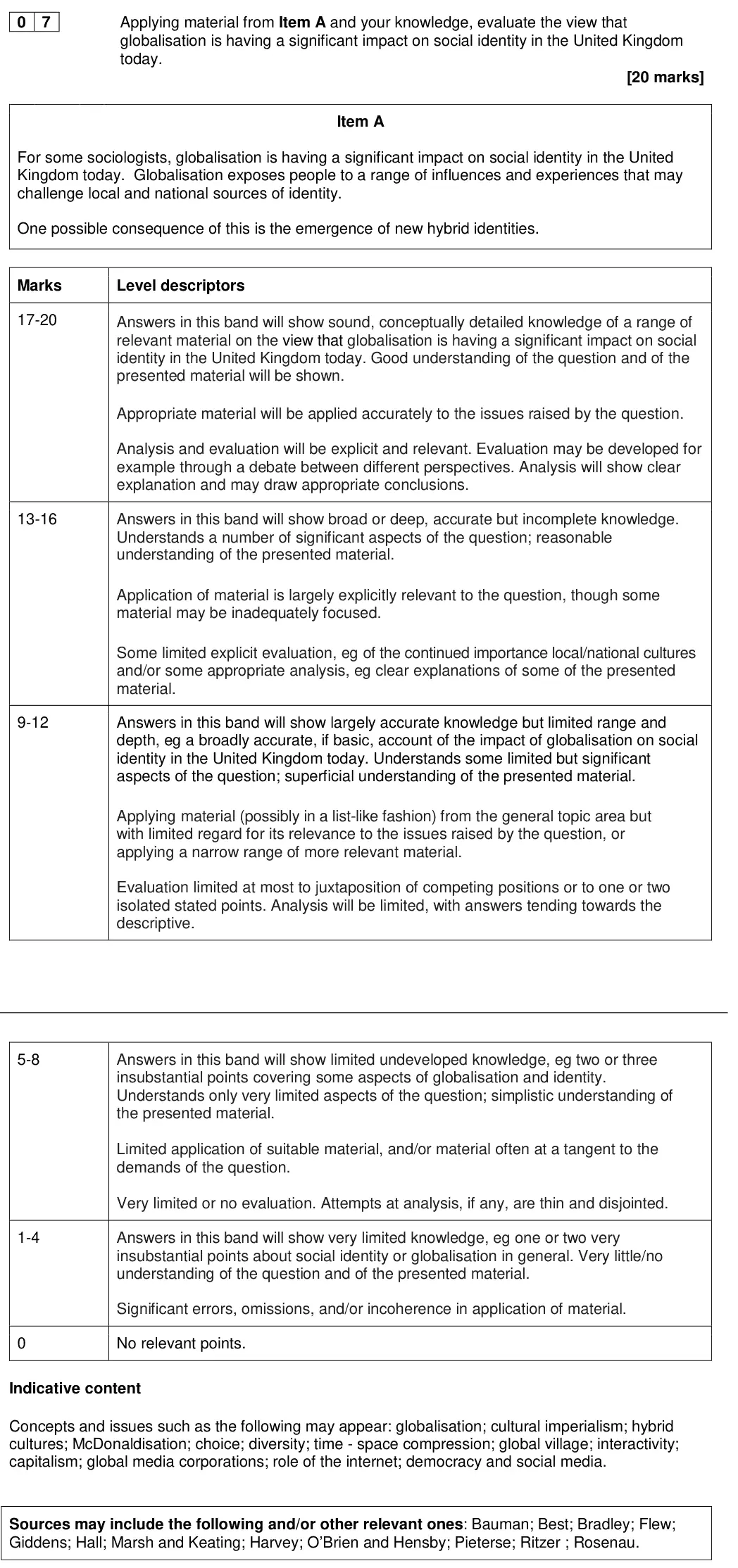
Applying material from Item A and your knowledge, evaluate the view that globalisation is having a significant impact on social identity in the United Kingdom today.
Tap a question to zoom it. The mark scheme (with the level descriptors and indicative content) and the examiner's comment open underneath.
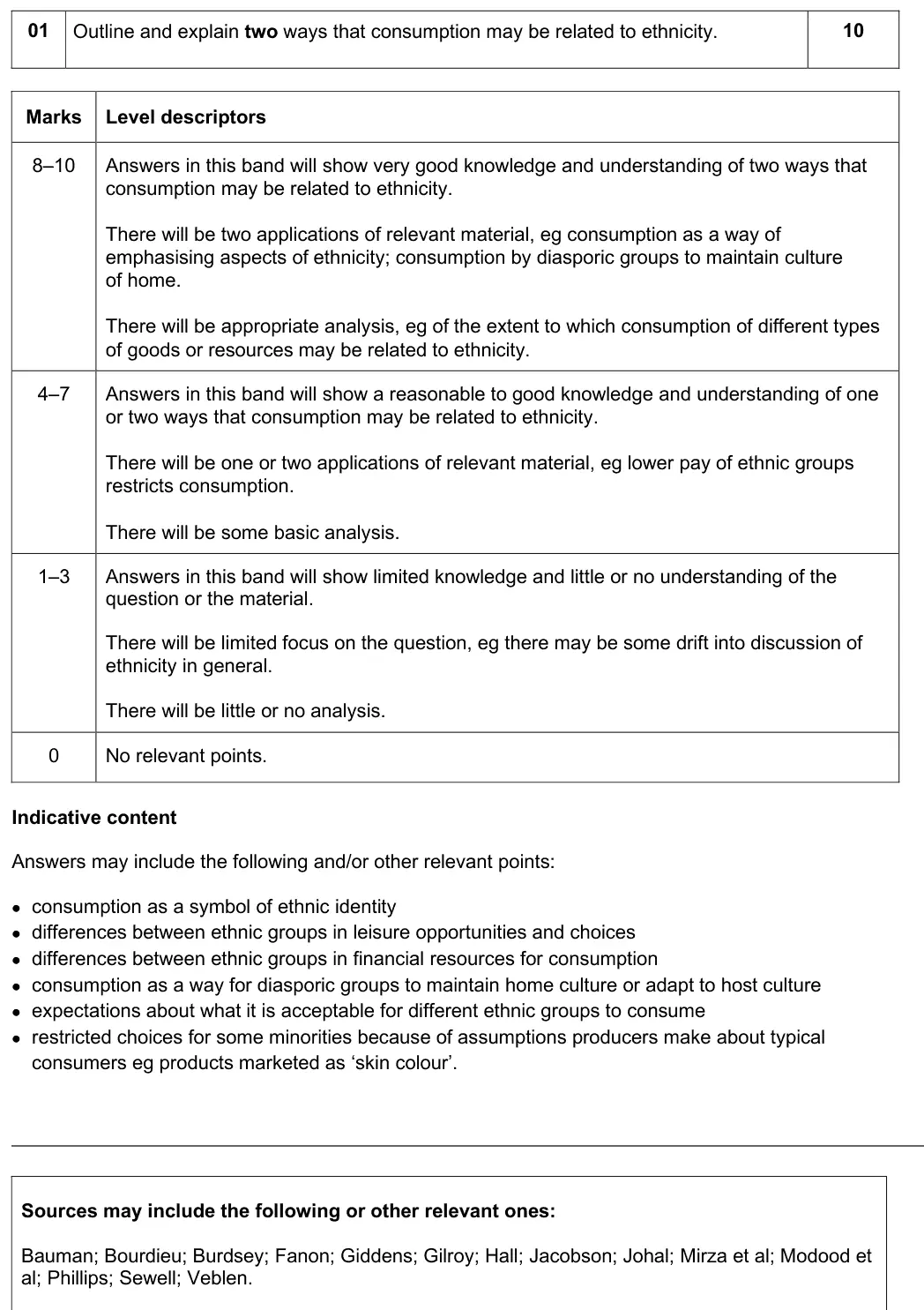
June 2025 · Paper 2 · Q110 marksAO1=5, AO2=3, AO3=2Outline and explain
Mark scheme, including the levels grid and indicative content
Examiner's comment
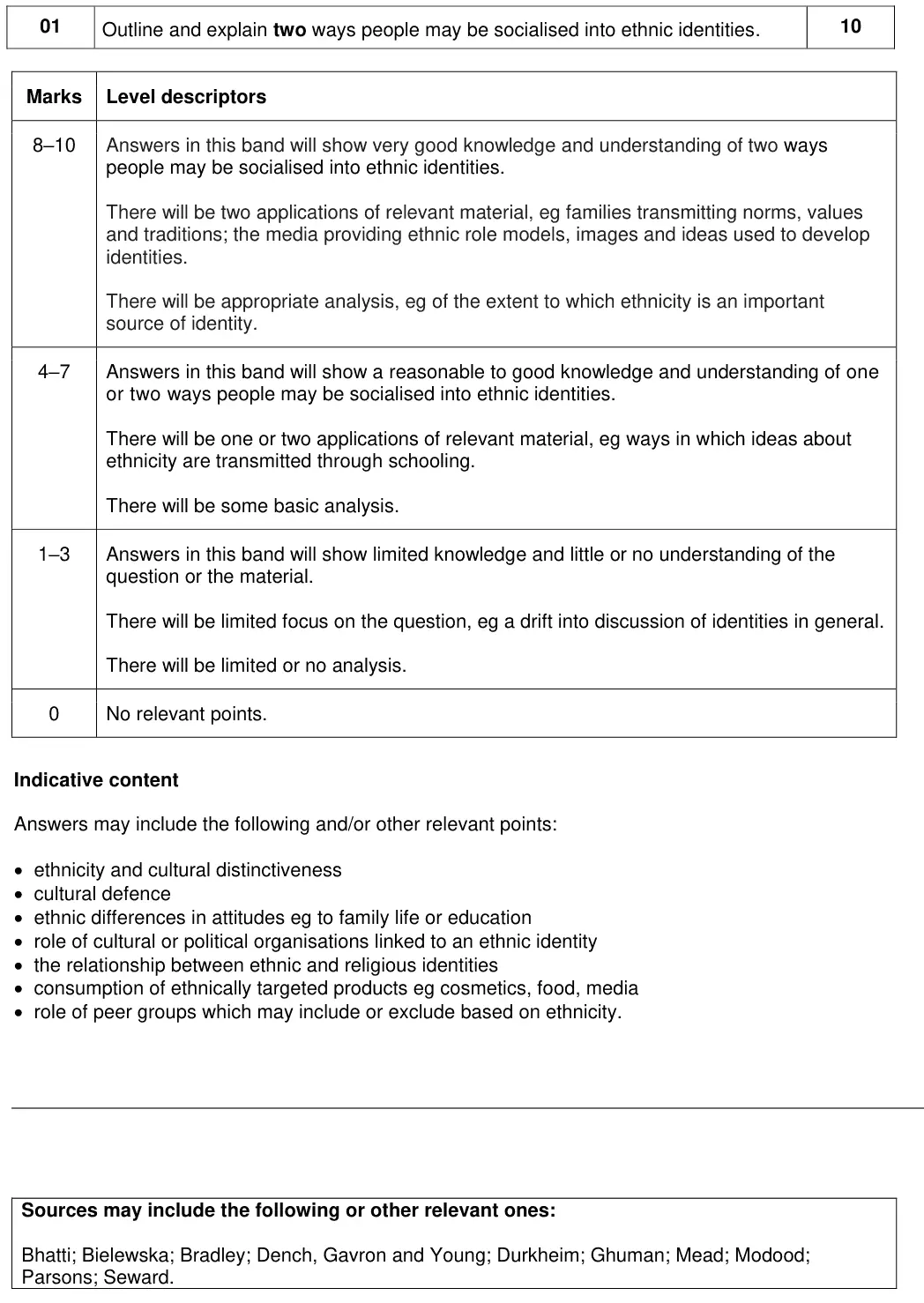
The nature of these questions means that students cannot rely on reciting knowledge. Questions will ask them to bring together aspects of their sociological knowledge in ways they have not done before. It is therefore important for students to allow time to think about how to answer the question. Students should be aware that there are two types of ten-mark questions. These have different requirements and different mark schemes. There are different marks available for the assessment objectives. 10 mark “outline and explain” questions have more marks available for knowledge and understanding, and none for evaluation. Introductions and conclusions are not required for 10-mark questions, are unlikely to help students and take up time. It is helpful if answers are set out to clearly indicate the two answers, with wording such as “One way/reason is…” or by starting a new paragraph for the second point. Answers that give more than two answers are unlikely to develop two of them sufficiently. The most successful answers to 10-mark questions were focused, clearly stating a point that addressed the question and then developing it, using sociological concepts, evidence such as an example and, where appropriate, theory. This question was not as well answered as expected, with answers sometimes not explicitly focused on ethnic groups. The better answers made connections between ethnicity and consumption by, for example, considering the role of consumption in maintaining cultures based on ethnicity, or comparing consumption between ethnic groups.
Notes from the mark scheme and report
answers must focus explicitly on ethnic groups
drift into ethnicity in general = 1–3
top band: consumption to express ethnic identity or keep diasporic culture, and comparing consumption between groups
not as well answered as expected
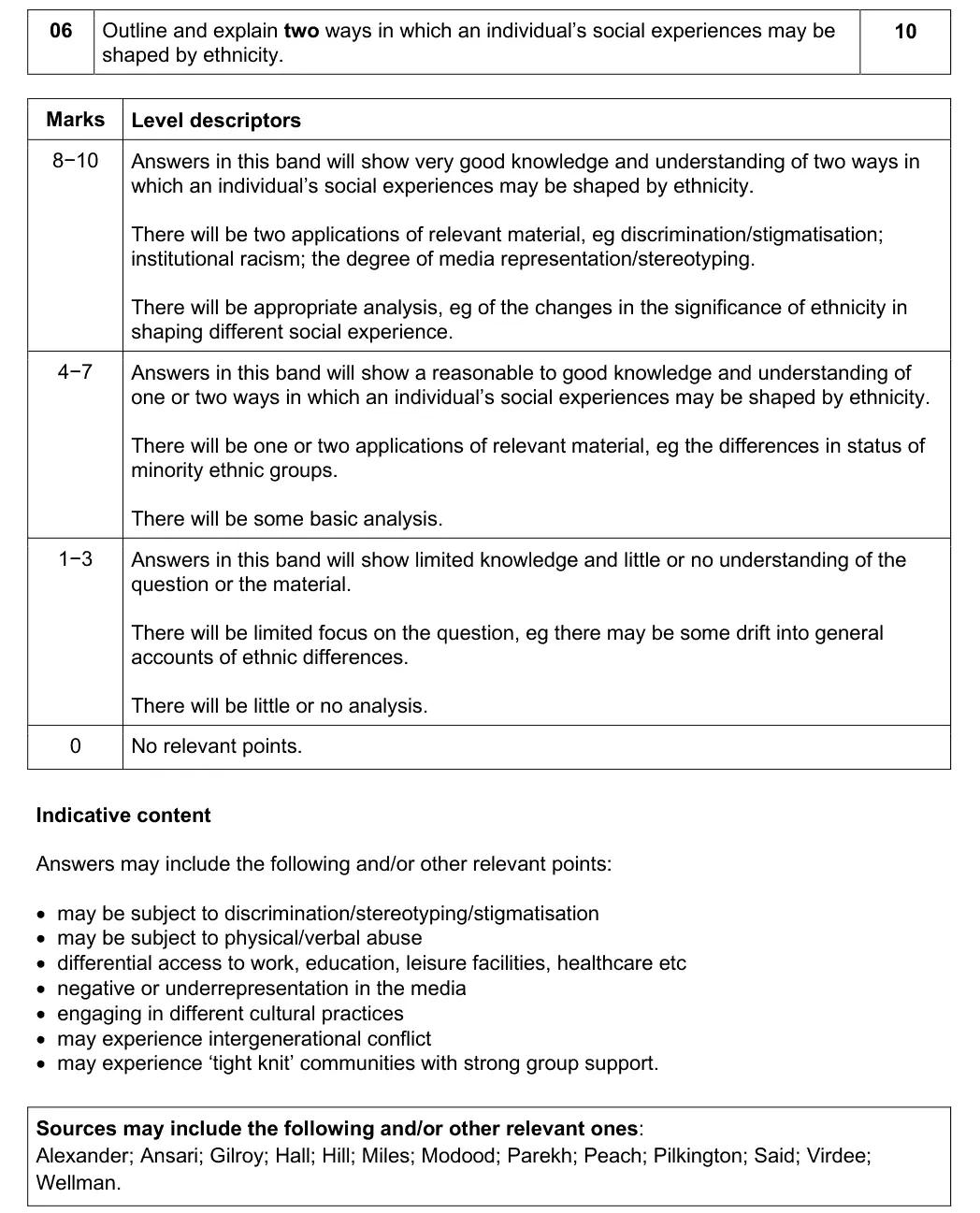
June 2025 · AS Paper 2 · Q610 marksAO1=5, AO2=3, AO3=2Outline and explain
Mark scheme, including the levels grid and indicative content
Examiner's comment
On the 10-mark 'outline and explain' question (the fourth question in each topic area), and the 6-mark 'outline three...' question (the third question in each topic). For the 10-mark 'outline and explain' questions, students would benefit from clearly identifying a specific way, reason, or factor, followed by a developed explanation. This approach would help make their answers more coherent, structured and easier to reward. This question appeared accessible to most students and some effective answers were given. Some students focused primarily on ethnicity and life chances rather than broadening the scope of their answers out to consider the totality of “experience” as a whole. More successful responses often drew on content from the education topic, exploring concepts such as labelling and the self-fulfilling prophecy. Discrimination was the most frequently mentioned theme, with higher-level answers developing this further into discussions of institutional racism.
Notes from the mark scheme and report
two ways, each developed
examples: discrimination/stigma, institutional racism, media stereotyping or under-representation, differential access, cultural practices, close communities
drift into general accounts of ethnic differences = 1-3
some narrowed to life chances rather than experience as a whole
best developed discrimination into institutional racism
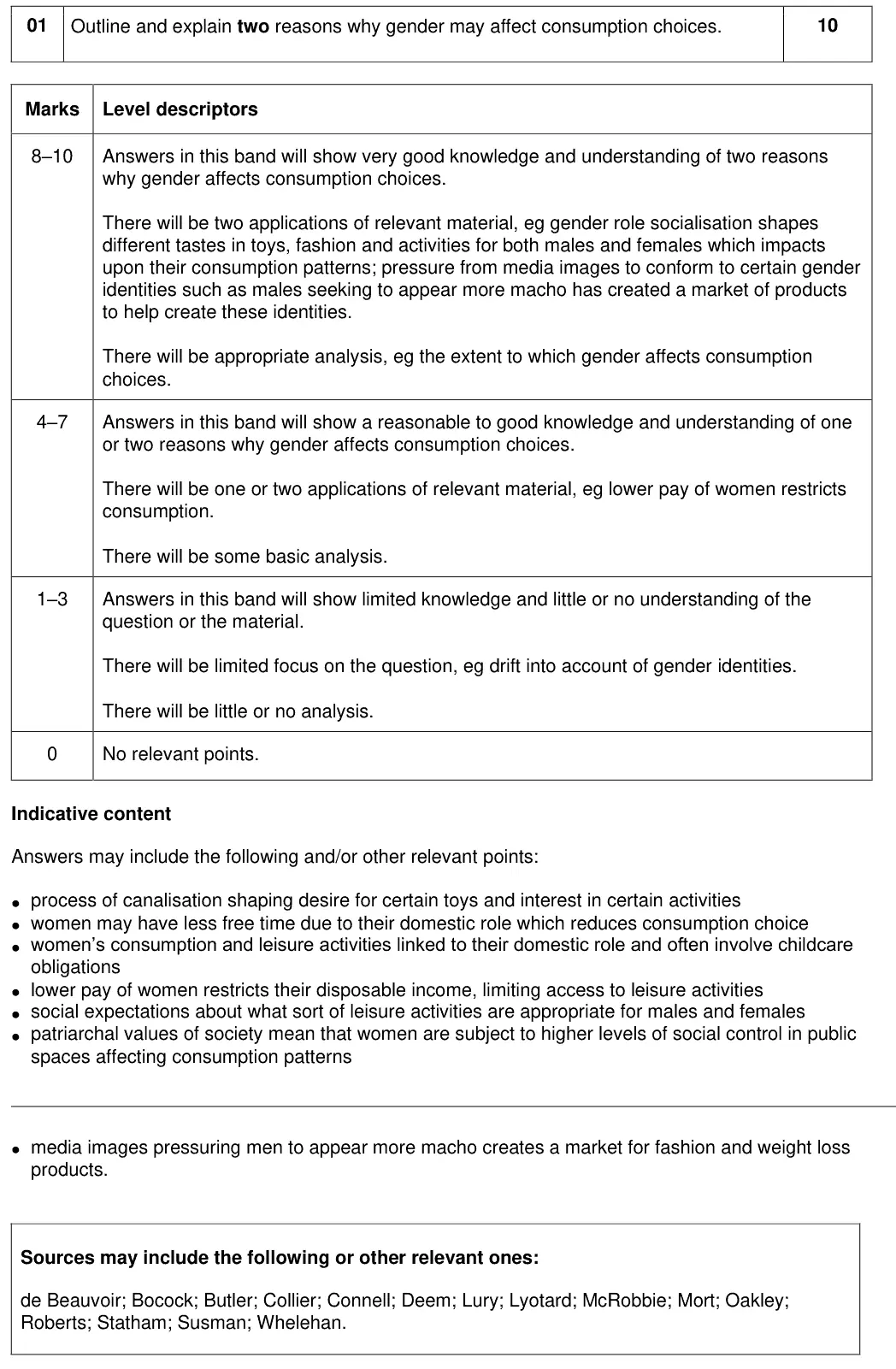
June 2024 · Paper 2 · Q110 marksAO1=5, AO2=3, AO3=2Outline and explain
Mark scheme, including the levels grid and indicative content
Examiner's comment
The nature of these questions means that students cannot rely on reciting knowledge. Questions will ask them to bring together aspects of their sociological knowledge in ways they will not have done before. It is therefore important for students to allow time to think about how to answer the question. Students should be made aware that there are two types of 10 mark questions. These have different requirements and different mark schemes . There are different marks available for the assessment objectives. A breakdown of the marks awarded by assessment objective can be found in the mark scheme. 10 mark “outline and explain” questions have more marks available for knowledge and understanding, and none for evaluation. Introductions and conclusions are not required for 10 mark questions; they take up time and rarely improve the mark. It is helpful if answers are set out to clearly indicate the two answers, with wording such as “One way/reason is…”, or by starting a new paragraph for the second point. Answers that give more than two points are unlikely to develop two of them sufficiently. Q1: Most students could identify two reasons why gender may influence consumption choices. Canalisation was the most cited reason, with the use of toys and activities as examples to elaborate the answer. The influence of media was another common reason given. The impact on consumption choices was not always thoroughly analysed, which limited the potential marks awarded.
Notes from the mark scheme and report
two reasons each developed (e.g. canalisation and gender role socialisation shaping tastes, media pressure on male and female identities creating markets, women's lower pay and less free time)
drift into gender identities in general = 1–3
canalisation with toys and media influence were the most common reasons
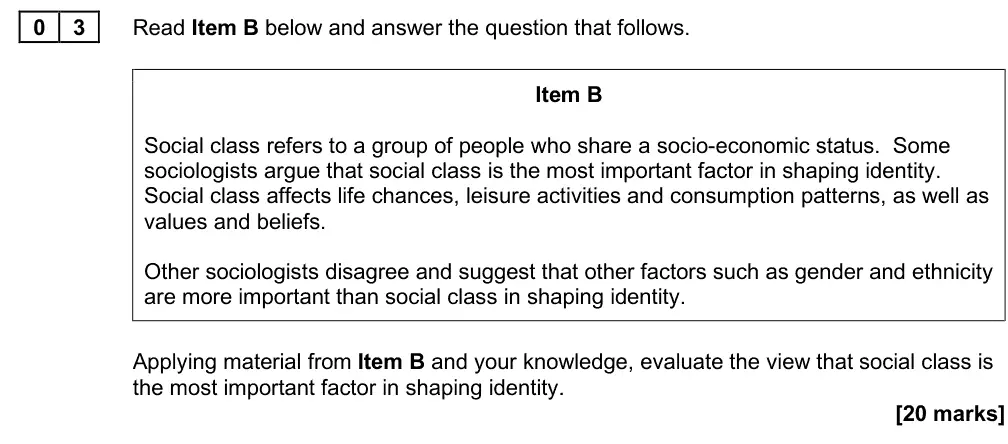
June 2024 · Paper 2 · Q320 marksAO1=8, AO2=6, AO3=620-mark essay
Mark scheme, including the levels grid and indicative content
Examiner's comment
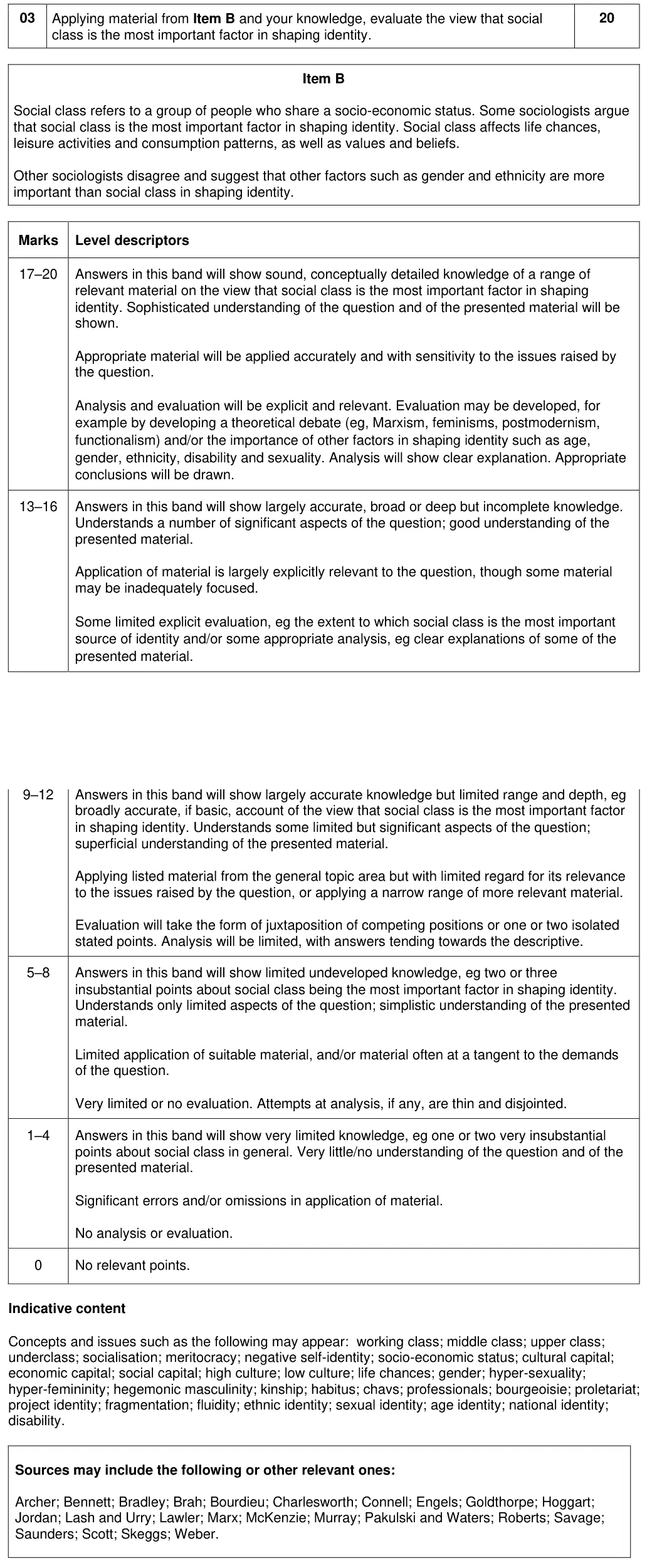
The items for these questions have a different purpose to those for 10 mark “analyse” questions. The items will suggest a few starting points for students, including ways into evaluation. Students are expected to also bring in further ideas (“and your knowledge” in the instruction). A wide range of material can be relevant to these questions, so students need to be selective. It is more effective to cover a limited number of points in depth rather than to try to include everything. Students who made essay plans appeared to benefit by having more structured and coherent responses. Q3: This question posed challenges for some students. While many relied on the item, they struggled to extend beyond broadly accurate knowledge focused on social class and identity. Stronger responses incorporated a broader spectrum of knowledge, both conceptual and theoretical.
Notes from the mark scheme and report
top band weighs class against age, gender, ethnicity, disability and sexuality or develops a theoretical debate (Marxism, feminisms, postmodernism, functionalism)
many leaned on the item and stayed at a broadly accurate account of class and identity
stronger answers used a wider conceptual and theoretical range
June 2024 · AS Paper 2 · Q56 marksAO1=6Outline
Mark scheme
Examiner's comment
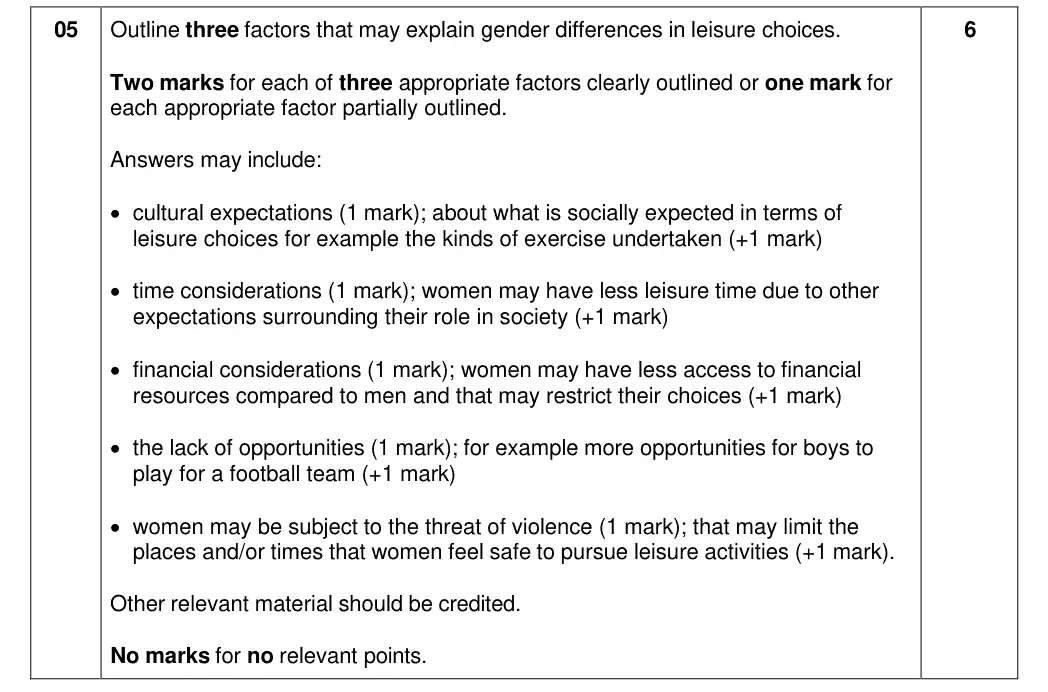
The ‘outline three …’ 6-mark question. Students could easily improve outcomes on this question by realising the need to provide a line or so outlining the criticism / feature etc they have identified. Many students found gaining more than two marks for this question difficult. This was because answers often gave an example of a cultural expectation (for example that men maybe expected to engage in lifting weights in the gym whereas women might be expected to do Pilates) which was then repeated using an example of a different cultural expectation which capped the mark at two.
Notes from the mark scheme and report
2 marks for each of three factors clearly outlined, 1 if only partially outlined
factors must be different: several examples of cultural expectations counted as one factor, capping many at 2 marks
others credited: time, money, opportunities, threat of violence
June 2024 · AS Paper 2 · Q610 marksAO1=5, AO2=3, AO3=2Outline and explain
Mark scheme, including the levels grid and indicative content
Examiner's comment
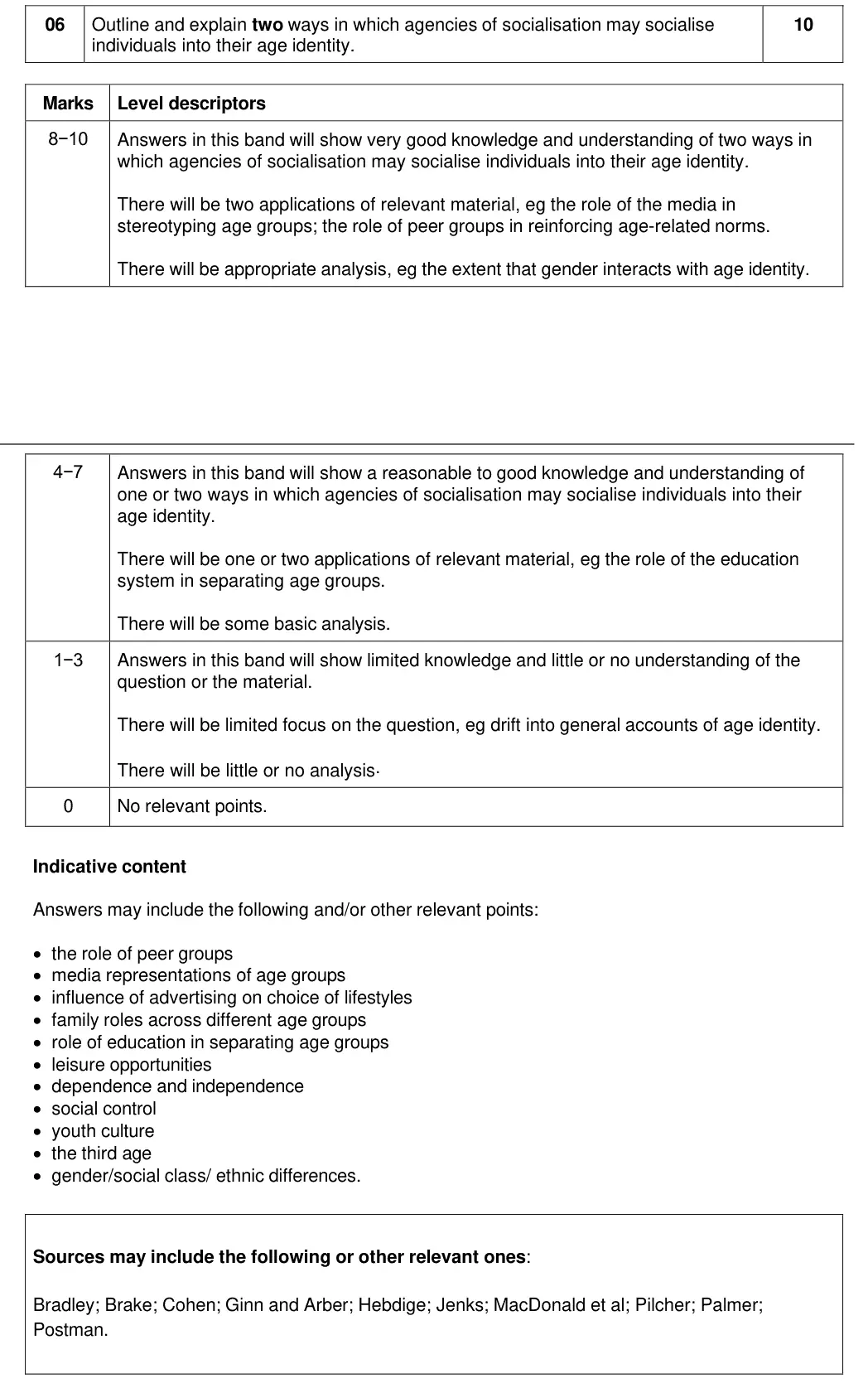
The ‘outline and explain’ 10-mark question. Here students would benefit more if an explicit identification of a way / reason / factor was made then leading to an explanation of it. So, making the student’s answer more cogent. This question proved to be straightforward. Generally, students managed to identify two agencies of socialisation and suggest a way in which they could shape identity. Where students found the question more challenging was in developing the identified way to include wider sociological material and include analysis. For example, the notion of the media stereotyping young people could be developed via use of moral panics or the view that stereotypes might be challenged through the more open access of social media. Students who developed their answers in ways like these produced more creditworthy response.
Notes from the mark scheme and report
name an agency and explain how it shapes age identity
drift into general accounts of age identity = 1–3
top band analysis e.g. how gender interacts with age
better answers developed media stereotyping through moral panics or challenge via social media
June 2023 · Paper 2 · Q110 marksAO1=5, AO2=3, AO3=2Outline and explain
Mark scheme, including the levels grid and indicative content
Examiner's comment
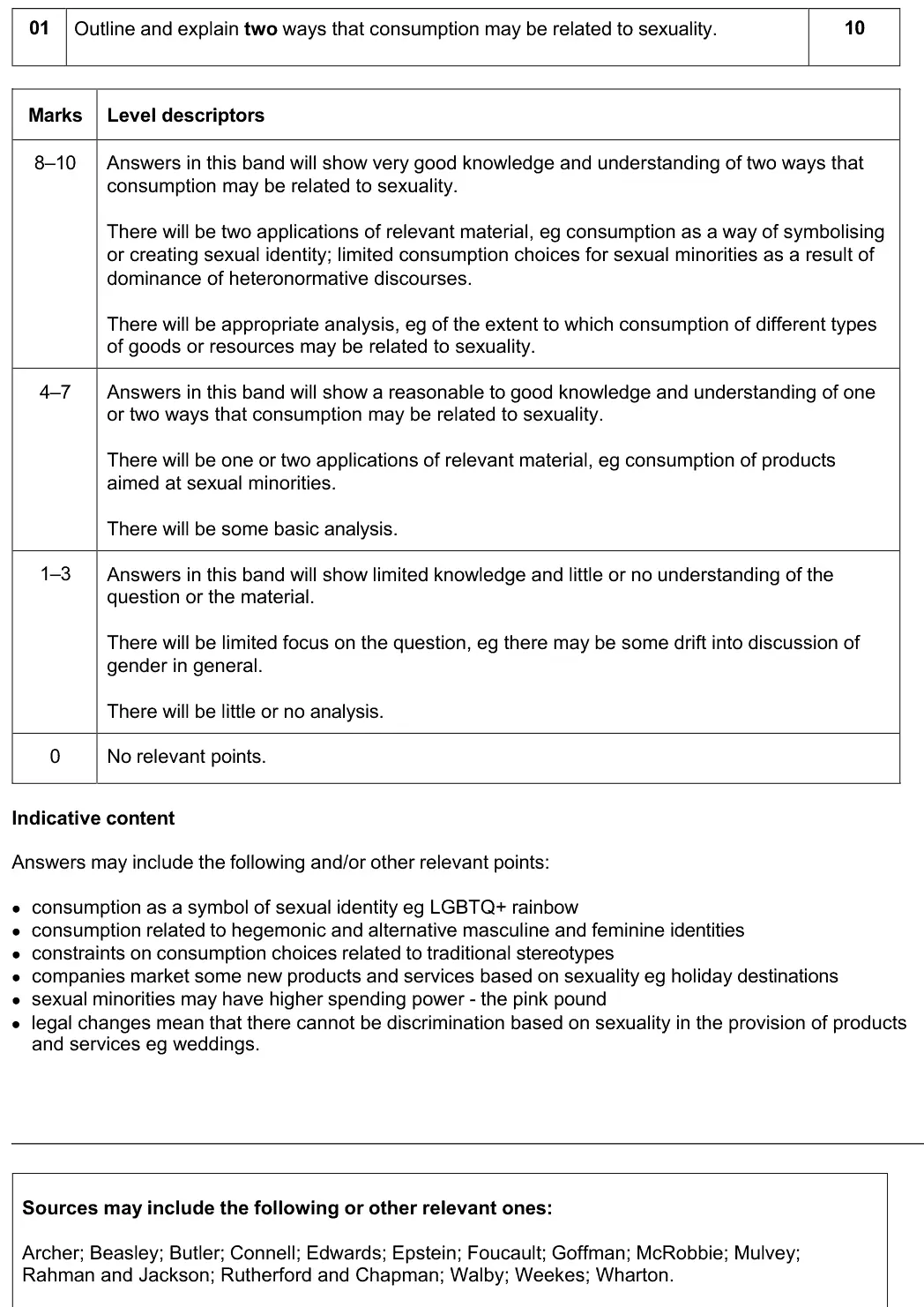
The nature of these questions means that students cannot rely on reciting knowledge. Questions will ask them to bring together aspects of their sociological knowledge in ways they are unlikely to have done before. It is therefore important for students to allow time to think about how to answer the question. Students should be made aware that there are two types of 10 mark questions. These have different requirements and different mark schemes. There are different marks available for the assessment objectives. 10 mark “outline and explain” questions have more marks available for knowledge and understanding, and none for evaluation. Introductions and conclusions are not required for 10 mark questions and take up valuable time. It is helpful if answers are set out to clearly indicate the two separate points, with wording such as “One way/reason is…” or by starting a new paragraph for the second point. Answers that give more than two points are unlikely to develop two of them sufficiently. Question 1: This was well answered. Students were able to develop points about, for example, products or services based on sexuality and ways that consumption can symbolise sexual identity.
Notes from the mark scheme and report
two ways consumption relates to sexuality (symbolising sexual identity, products/services marketed to sexual minorities, the pink pound, heteronormative constraints)
drift into gender in general = 1–3
well answered
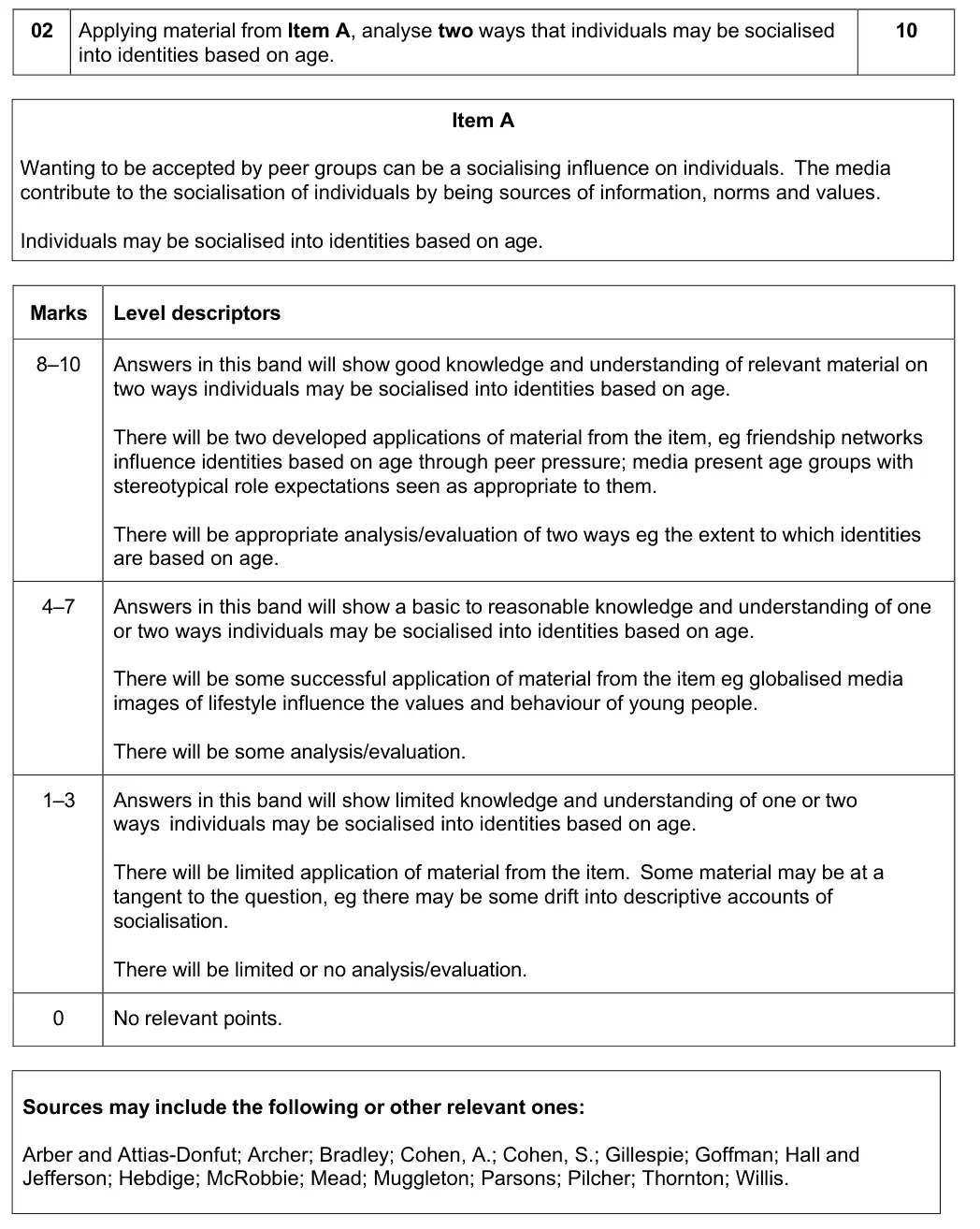
June 2023 · Paper 2 · Q210 marksAO1=3, AO2=4, AO3=3Analyse
Mark scheme, including the levels grid and indicative content
Examiner's comment
The nature of these questions means that students cannot rely on reciting knowledge. Questions will ask them to bring together aspects of their sociological knowledge in ways they are unlikely to have done before. It is therefore important for students to allow time to think about how to answer the question. Students should be made aware that there are two types of 10 mark questions. These have different requirements and different mark schemes. There are different marks available for the assessment objectives. The items for 10 mark “analyse” questions are written to give prompts or “hooks” for student answers. These have to be used to access application marks. Answers can indicate use of hooks by quoting, by a reference in parentheses or by wording (eg “As the item says…”). Items end with a sentence restating the question; the hooks are in the preceding part of the item. Introductions and conclusions are not required for 10 mark questions and take up valuable time. It is helpful if answers are set out to clearly indicate the two separate points, with wording such as “One way/reason is…” or by starting a new paragraph for the second point. Answers that give more than two points are unlikely to develop two of them sufficiently. Question 2: Again, this was generally well answered but some wrote about other agencies of socialisation than those given in the item.
Notes from the mark scheme and report
hooks: peer groups and the media as agencies
e.g. peer pressure in friendship networks, media age stereotypes
drift into descriptive accounts of socialisation = 1–3
some wrote about agencies not given in the item
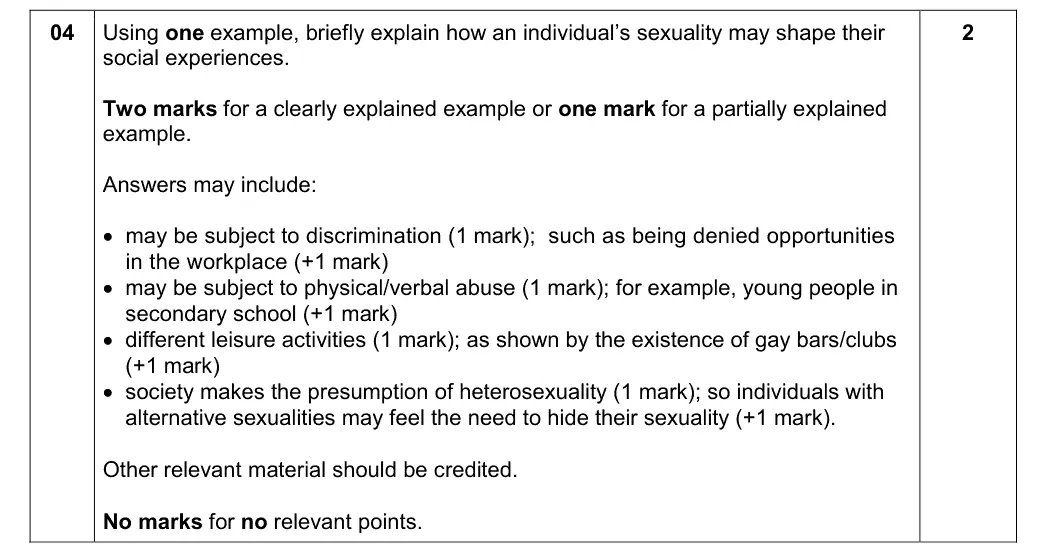
June 2023 · AS Paper 2 · Q42 marksAO2=2Brief explain
Mark scheme
Examiner's comment
This question was answered in the main successfully and most answers went down the route of sexuality being liable to be subject to various forms of discrimination. One limitation to the effectiveness of student responses was to focus overly on gender and gender identity as opposed to sexuality.
Notes from the mark scheme and report
1 mark for the way sexuality shapes experience, +1 for explaining it (e.g. workplace discrimination, abuse at school, presumption of heterosexuality leading to concealment)
answers focused on gender or gender identity rather than sexuality lose credit
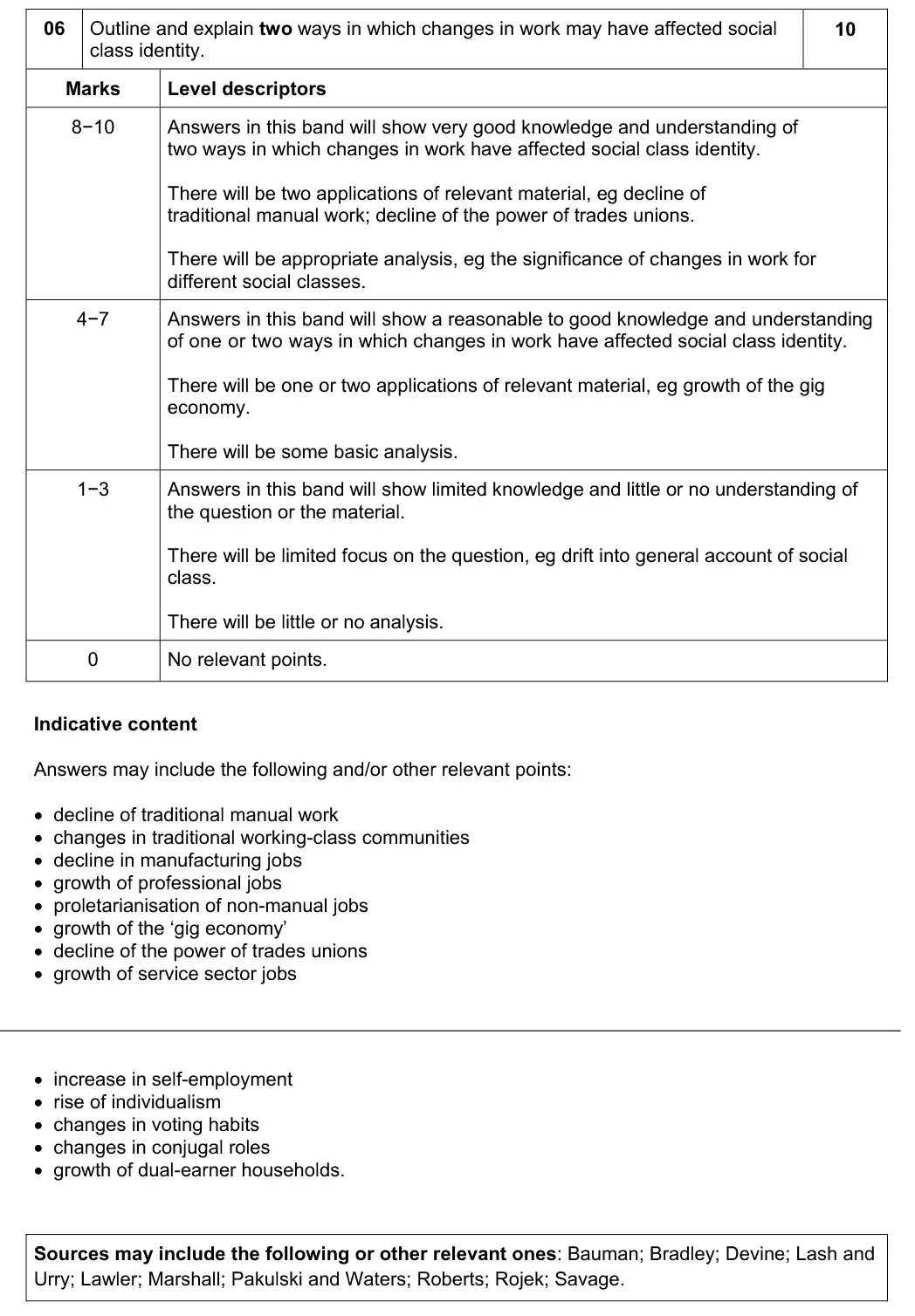
June 2023 · AS Paper 2 · Q610 marksAO1=5, AO2=3, AO3=2Outline and explain
Mark scheme, including the levels grid and indicative content
Examiner's comment
The ‘outline and explain two’ 10 mark question (the fourth question in every topic area). Here students would benefit more if an explicit identification of a way / reason / factor was made, then leading to an explanation of it, making the student’s answer more cogent. Students found this question difficult. The challenge to identify a change in work / working arrangements and then make a suggestion as to how that change might have impacted on how a group / individual may see themselves or those around them proved a step too far for many. Answers tended to make an attempt at the first part but not the second. As a result, marks tended to reside at the lower half of the middle mark band.
Notes from the mark scheme and report
two changes in work each linked to how people see their class identity (e.g. decline of manual work and unions, gig economy, service sector, proletarianisation)
drift into social class in general = 1–3
most identified a change in work but did not take the second step to identity, so marks clustered in the lower part of 4–7
June 2023 · AS Paper 2 · Q720 marksAO1=8, AO2=6, AO3=620-mark essay
Mark scheme, including the levels grid and indicative content
Examiner's comment
Many students found this question initially challenging however most were able to identify features of the globalising process such as the movement of peoples within processes of migration. From there they were able to make points about how such features might affect identity – such as generating a more homogenised identity or provoking a reaction to it. Within these answers the application to nationalism was implicit rather than explicit. Evaluation tended to feature when perspectives were brought to bear on the globalising process. Postmodernism featured mostly here.
Notes from the mark scheme and report
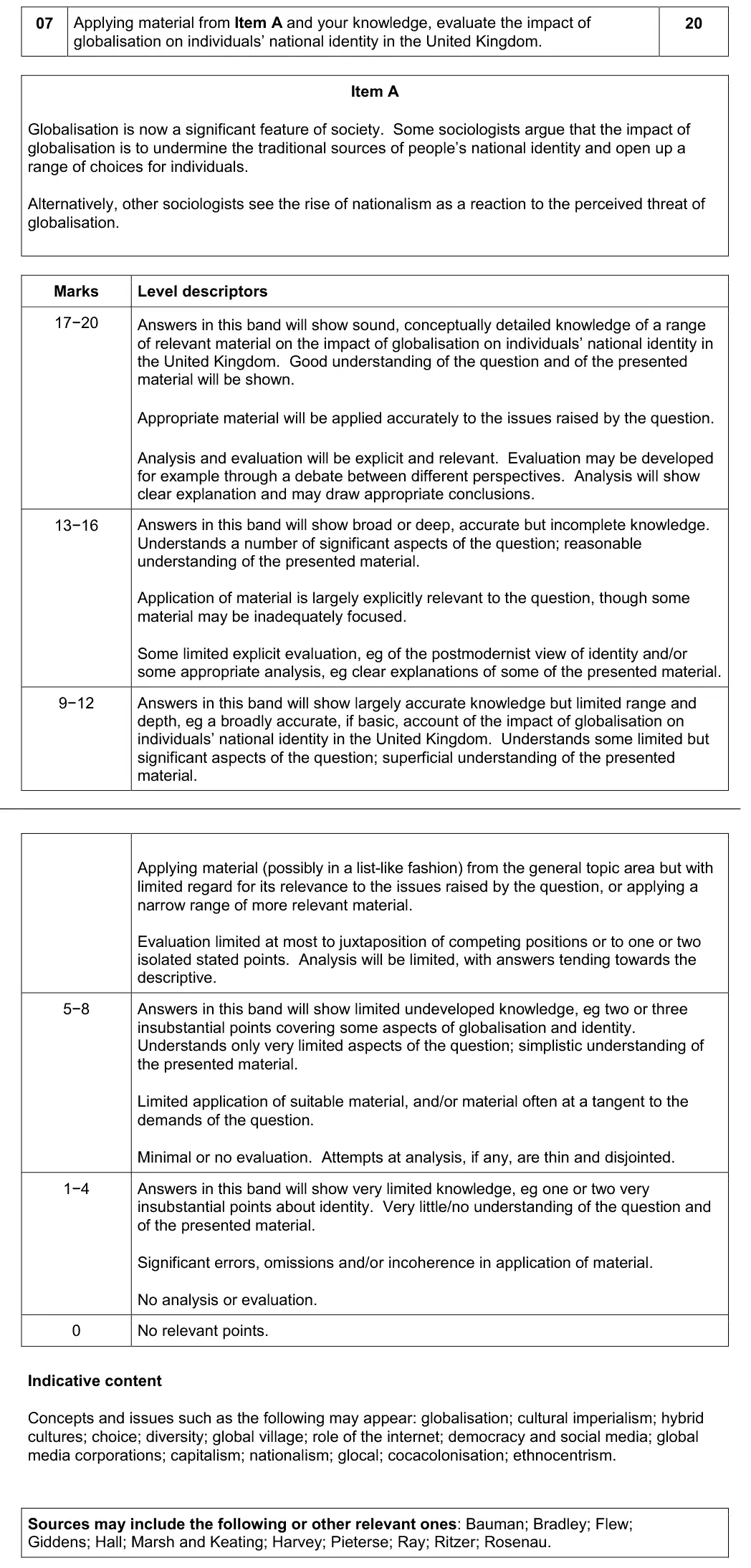
top band debates perspectives on how globalisation affects national identity in the UK (undermining it and widening choice vs nationalist reaction)
many discussed migration and homogenised or reactive identities but left nationalism implicit
evaluation mainly through postmodernism
June 2022 · Paper 2 · Q110 marksAO1=5, AO2=3, AO3=2Outline and explain
Mark scheme, including the levels grid and indicative content
Examiner's comment
The nature of these questions means that students cannot rely on reciting knowledge. The questions will ask them to bring together aspects of their sociological knowledge in a way that they are unlikely to have done before. There was a tendency, however, to attempt to answer the question by giving knowledge based on words or phrases in the question, rather than meeting the demands of the question. Students are advised to spend time reading the question, and, where there is one the item, to ensure that they are answering the question. Some students seemed unaware of the different demands of the two types of questions. The marks awarded for the assessment objectives are different in the two types of ten mark questions, and students should be aware of this. In particular, it should be noted that there are no marks available for evaluation in “outline and explain” (no item) questions. There is no need for an introduction or conclusion for 10 mark questions. It is helpful if answers are set out to clearly indicate the two answers, with wording such as “One way is…” or by starting a new paragraph for the second point. The best answers to 10 mark questions were focused, clearly stating a point that addressed the question and then developing it, using sociological concepts, evidence and, where appropriate, theory. Answers need to address all aspects of the question. Q1 Answers here often considered agencies of socialisation and the ways in which they can socialise people into ethnic identities. There were some very good answers to this question.
Notes from the mark scheme and report
top band: two ways, e.g. family transmitting norms and traditions, media role models
analysis of how important ethnicity is as a source of identity
drift into identity in general = 1–3 band
agencies of socialisation were the usual route and there were some very good answers
June 2022 · Paper 2 · Q210 marksAO1=3, AO2=4, AO3=3Analyse
Mark scheme, including the levels grid and indicative content
Examiner's comment
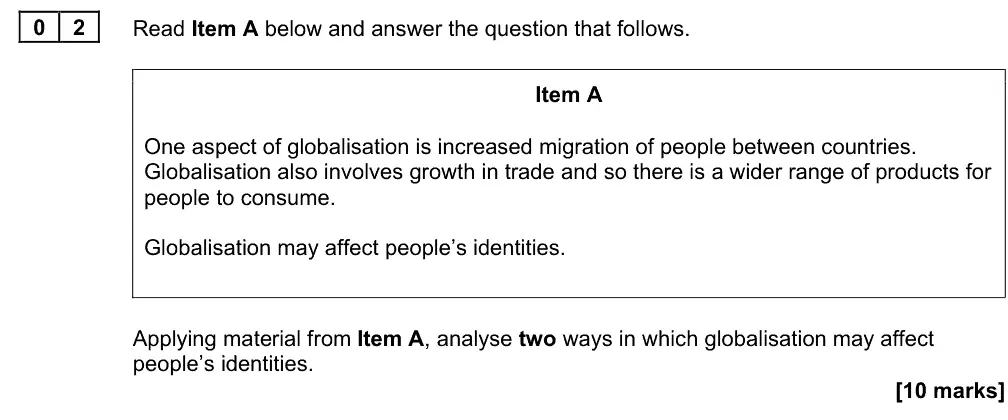
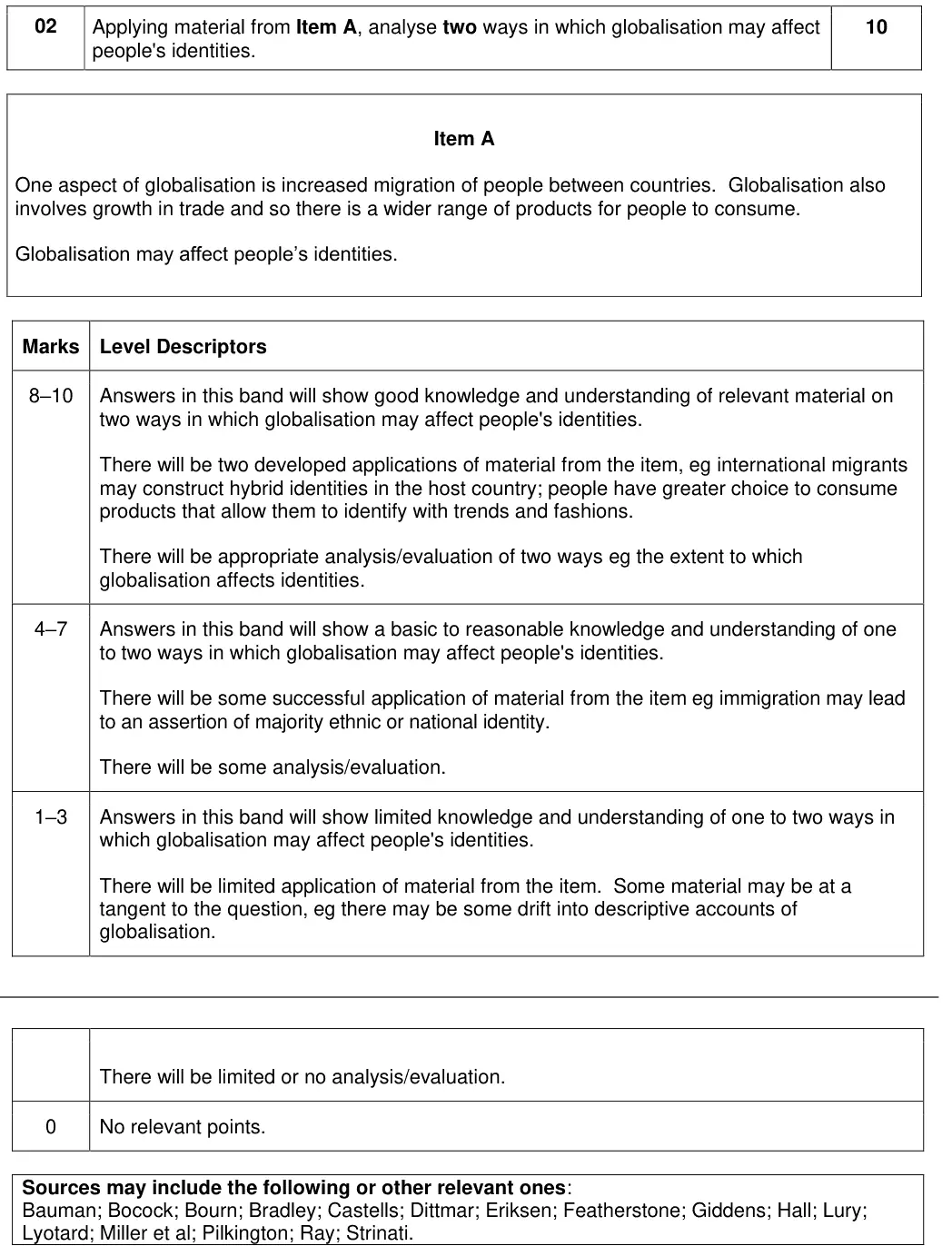
The nature of these questions means that students cannot rely on reciting knowledge. The questions will ask them to bring together aspects of their sociological knowledge in a way that they are unlikely to have done before. There was a tendency, however, to attempt to answer the question by giving knowledge based on words or phrases in the question, rather than meeting the demands of the question. Students are advised to spend time reading the question, and, where there is one the item, to ensure that they are answering the question. Some students seemed unaware of the different demands of the two types of questions. The marks awarded for the assessment objectives are different in the two types of ten mark questions, and students should be aware of this. In “analyse” (with item) questions, the answers need to be clearly based on the prompts or “hooks” in the item, not just on the final sentence of the item which restates the question. There is no need for an introduction or conclusion for 10 mark questions. It is helpful if answers are set out to clearly indicate the two answers, with wording such as “One way is…” or by starting a new paragraph for the second point. The best answers to 10 mark questions were focused, clearly stating a point that addressed the question and then developing it, using sociological concepts, evidence and, where appropriate, theory. Answers need to address all aspects of the question. Q2 Most answers were able to take from the item two points which could then be analysed. The item allowed students to base answers on ideas about migration and greater choice as consumers. There were a range of successful answers.
Notes from the mark scheme and report
item hooks: migration and wider range of consumer products
top band e.g. hybrid identities among migrants, consumption choices to follow trends
descriptive accounts of globalisation = 1–3 band
most took two points from the item and analysed them
June 2022 · AS Paper 2 · Q42 marksAO2=2Brief explain
Mark scheme
Examiner's comment
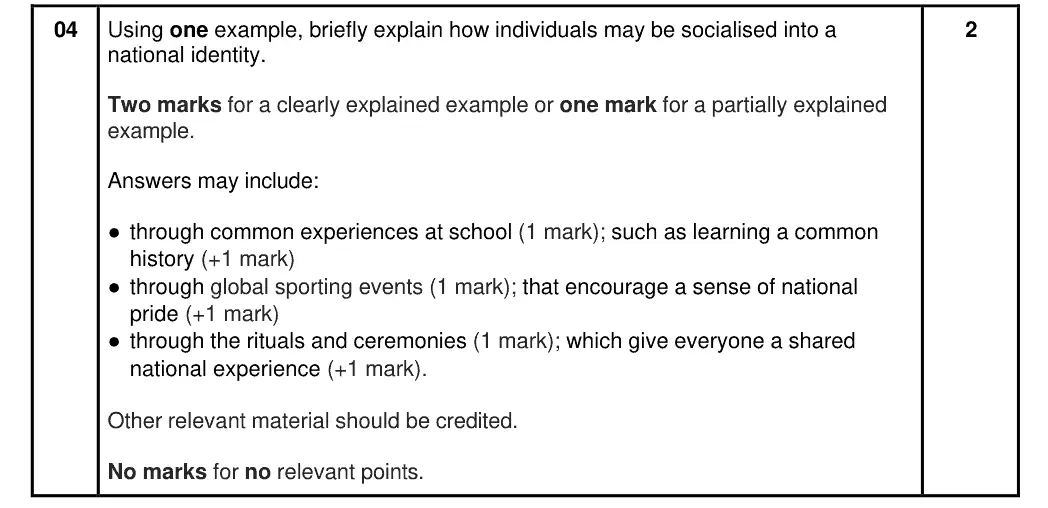
For low mark tariff questions where candidates are required to either define, explain or outline, care should be taken to ensure that points are not just identified. This question proved to be difficult for many students, with few scoring full marks. The most successful answers used the example of education and the teaching of British history. The most common responses used the example of religion without linking this to national identity and failed to score.
Notes from the mark scheme and report
1 mark for the example +1 for explaining the link to national identity (school teaching a common history, international sport, national rituals)
found difficult
religion without a link to national identity scored nothing
June 2022 · AS Paper 2 · Q56 marksAO1=6Outline
Mark scheme
Examiner's comment
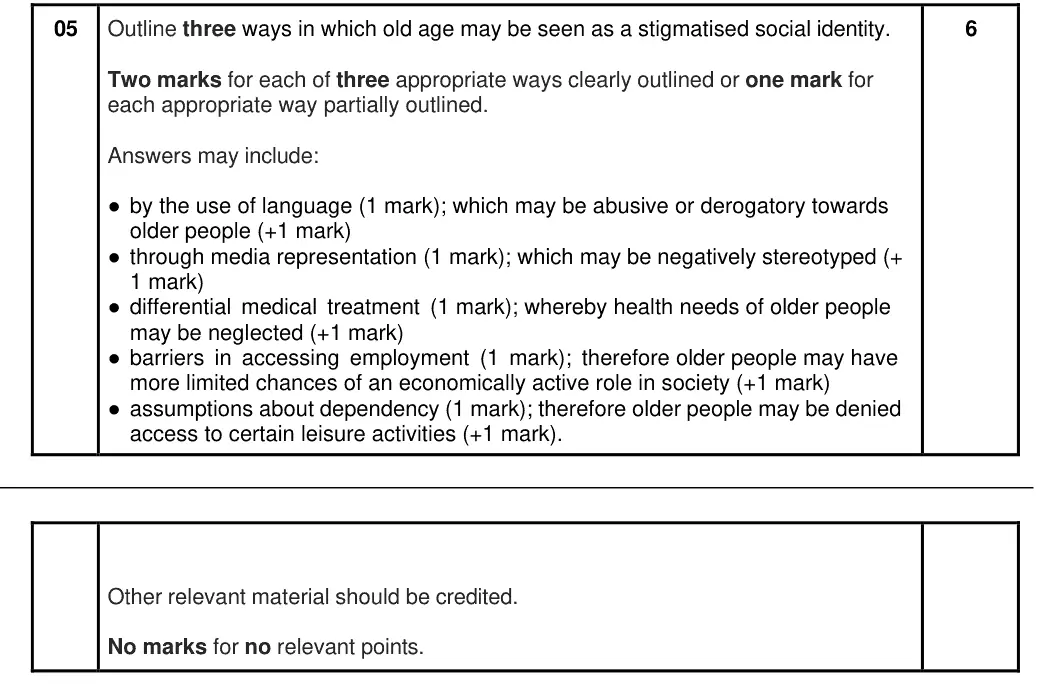
For low mark tariff questions where candidates are required to either define, explain or outline, care should be taken to ensure that points are not just identified. Many students struggled with this question. Most were able to outline at least one way in which old age may be a stigmatised identity. The most common response was derogatory language but often this was repeated using different examples and only gained credit once. Assumptions about dependency and barriers to employment were often identified but only partially outlined.
Notes from the mark scheme and report
2 marks for each of three ways clearly outlined, 1 if only partially outlined
e.g. derogatory language, negative media stereotypes, neglect in health care, employment barriers, assumptions of dependency
repeating derogatory language with different examples credited once only
June 2022 · AS Paper 2 · Q610 marksAO1=5, AO2=3, AO3=2Outline and explain
Mark scheme, including the levels grid and indicative content
Examiner's comment
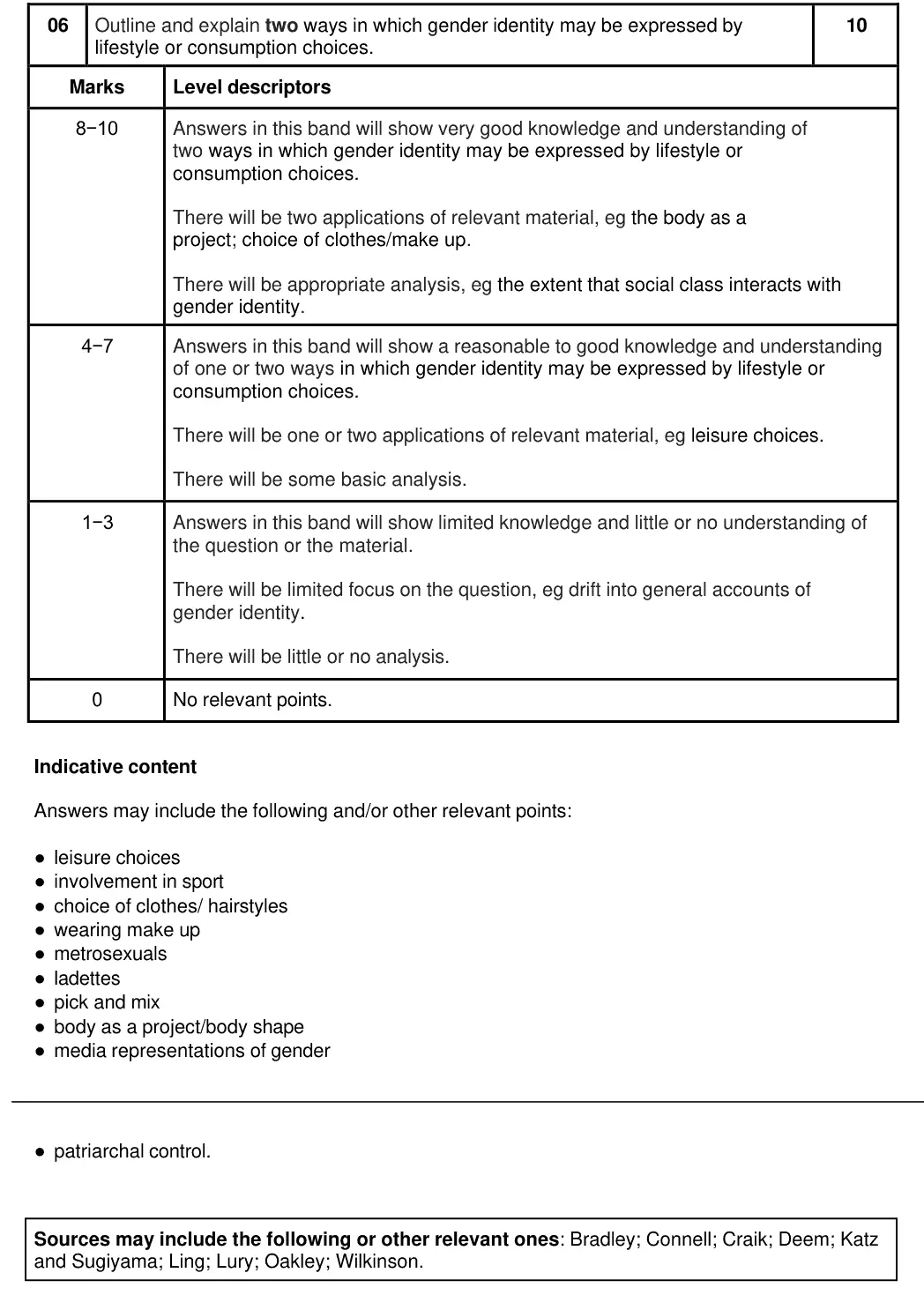
In general, this question was answered poorly, with limited knowledge and understanding shown. While students were familiar with the concept of gender identity, they often failed to focus on lifestyle and consumption choices in their responses. Answers often drifted into accounts of conjugal roles in the family or subject choices in education with limited success. Another approach was to write about gender role socialisation or gender stereotypes with limited direct application to the question set. Successful answers were able to discuss involvement in sport or consumption choices such as clothes and make-up as expressions of gender identity.
Notes from the mark scheme and report
two ways gender identity is expressed through lifestyle/consumption (body as project, clothes and make-up, sport and leisure, metrosexuals, ladettes)
drift into general accounts of gender identity = 1–3
answered poorly
many drifted into conjugal roles, subject choice or gender socialisation
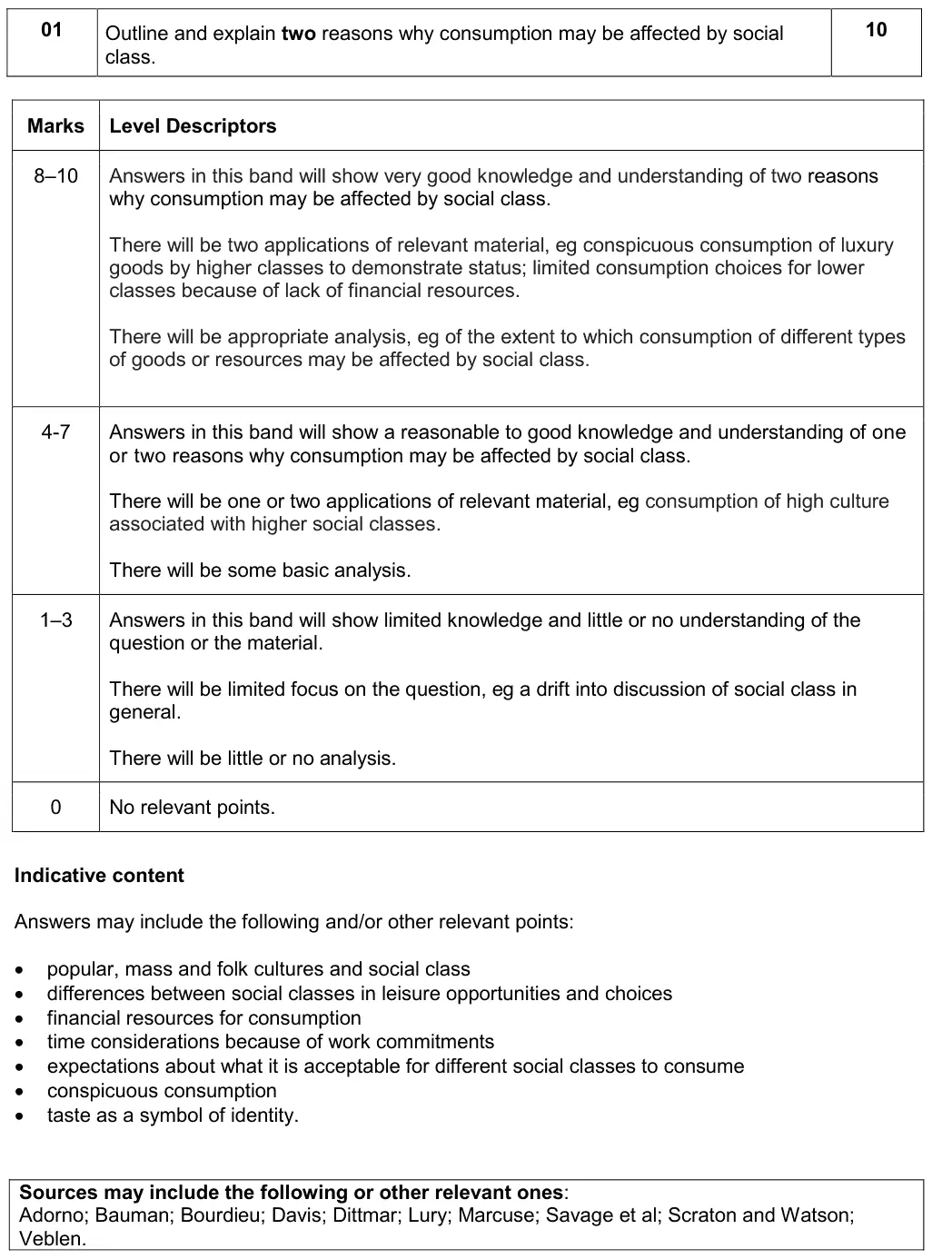
November 2021 · Paper 2 · Q110 marksAO1=5, AO2=3, AO3=2Outline and explain
Mark scheme, including the levels grid and indicative content
Notes from the mark scheme and report
no marks for evaluation in this question type
two reasons each developed, e.g. conspicuous consumption to show status, limited choice from lack of money, taste as a marker of class (Bourdieu, Veblen)
drift into social class in general = 1–3
no examiners' report comment for this part
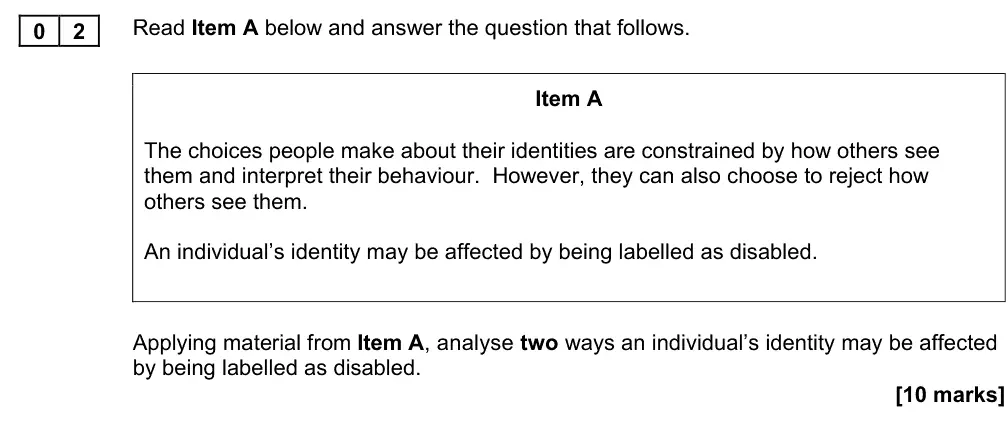
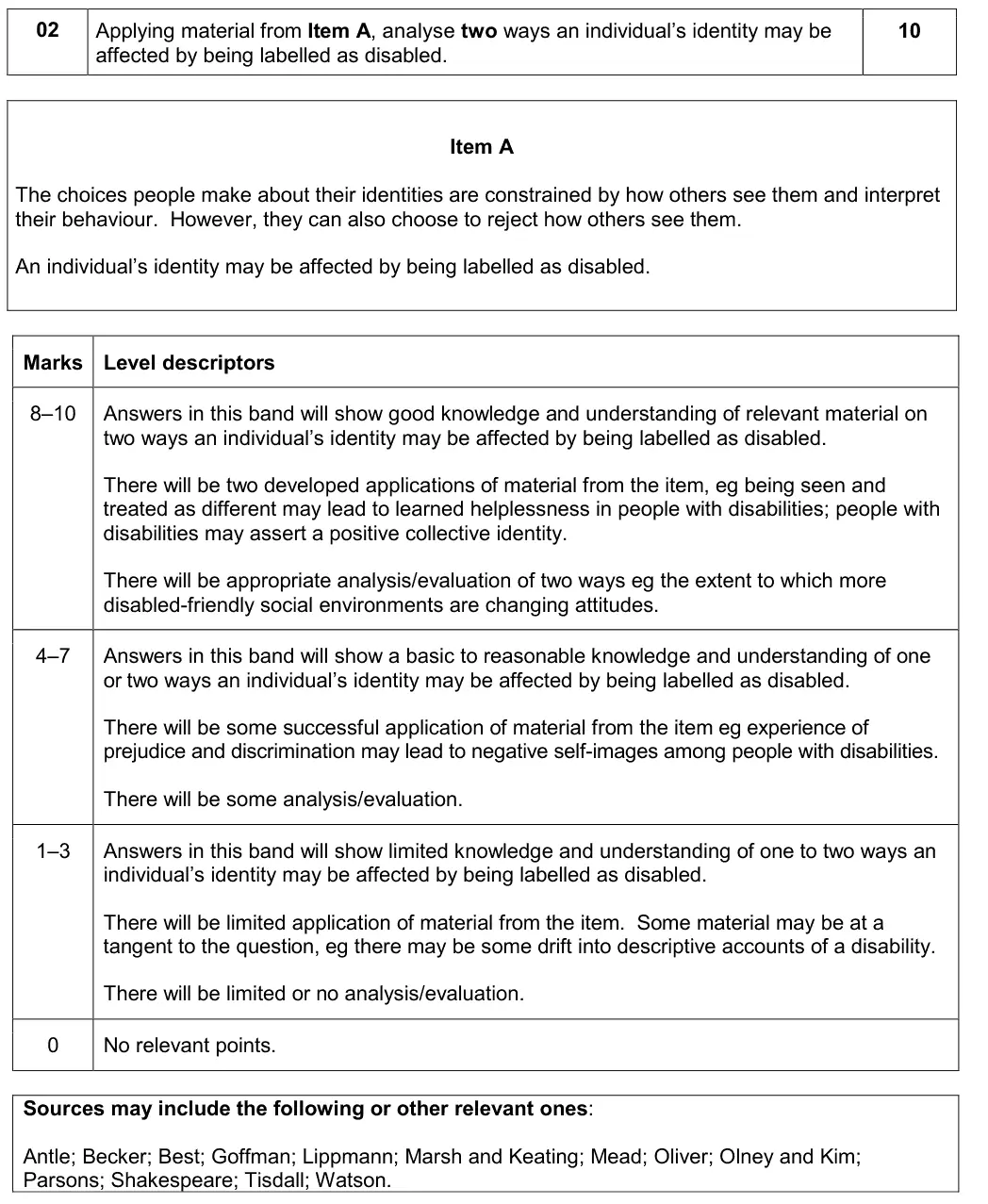
November 2021 · Paper 2 · Q210 marksAO1=3, AO2=4, AO3=3Analyse
Mark scheme, including the levels grid and indicative content
Notes from the mark scheme and report
must develop hooks from Item A (identity constrained by how others see us
choosing to reject that view)
the last line restates the question and is not a hook
credited: learned helplessness or negative self-image from being treated as different, asserting a positive collective disabled identity
descriptive accounts of a disability = 1–3
no examiners' report comment for this part
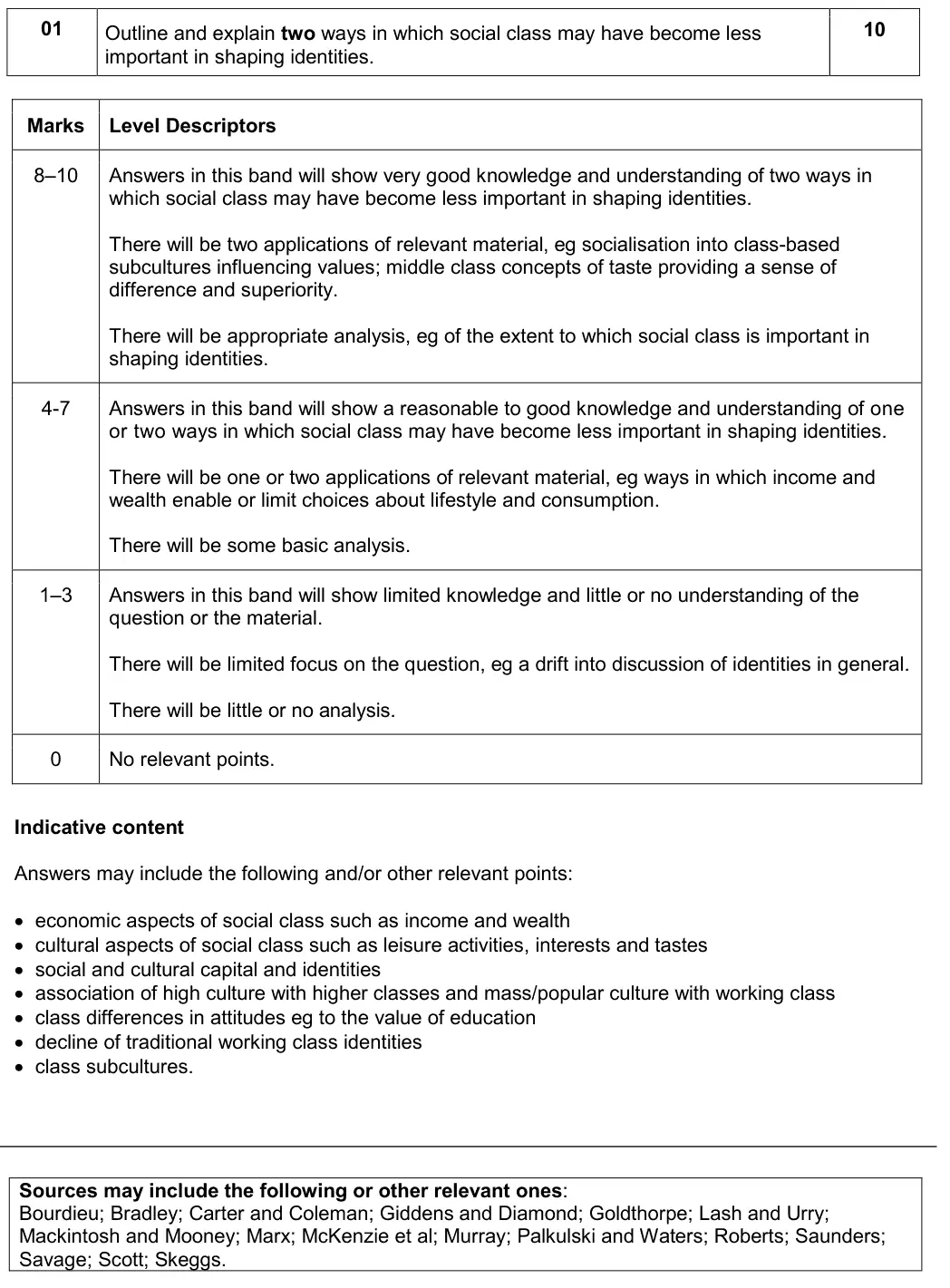
November 2020 · Paper 2 · Q110 marksAO1=5, AO2=3, AO3=2Outline and explain
Mark scheme, including the levels grid and indicative content
Notes from the mark scheme and report
two ways class has become LESS important for identity, e.g. decline of traditional working-class identities, consumption and lifestyle choice
drift into identities in general = 1-3
the mark scheme's top-band examples (class subcultures, middle-class taste) describe class still mattering, which reads as a mismatch with the question
no marks for evaluation in this question type (examiners' report general remark)
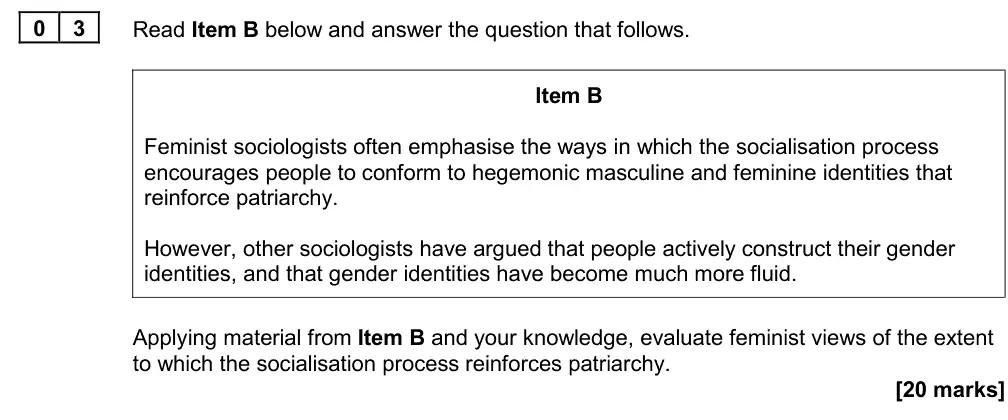
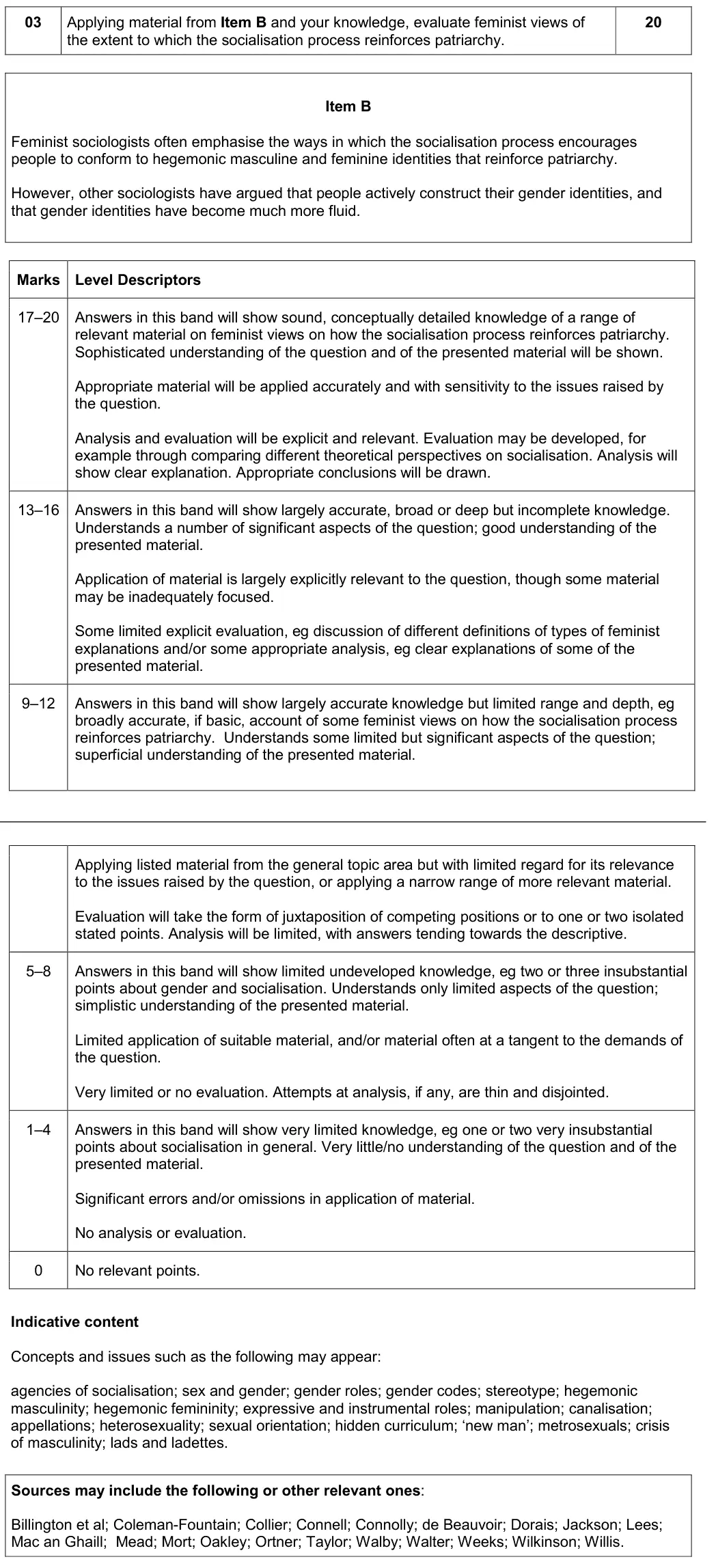
November 2020 · Paper 2 · Q320 marksAO1=8, AO2=6, AO3=620-mark essay
Mark scheme, including the levels grid and indicative content
Notes from the mark scheme and report
apply Item B (conforming to hegemonic masculine and feminine identities vs actively constructed, fluid gender identities)
evaluation via other perspectives on socialisation or different types of feminism
a basic account of feminist views only = 9-12
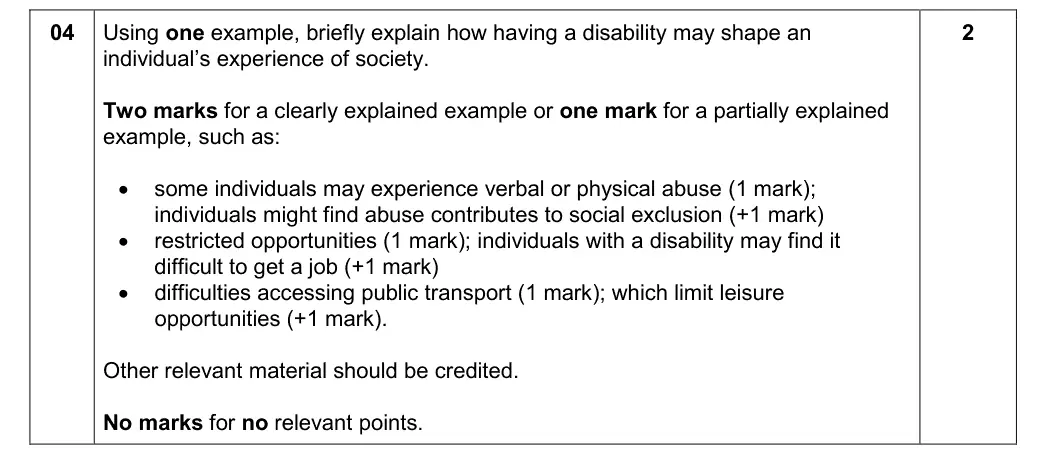
November 2020 · AS Paper 2 · Q42 marksAO2=2Brief explain
Mark scheme
Notes from the mark scheme and report
1 mark for a way disability shapes experience (abuse, restricted job opportunities, transport access), +1 for its consequence (e.g. social exclusion, limited leisure)
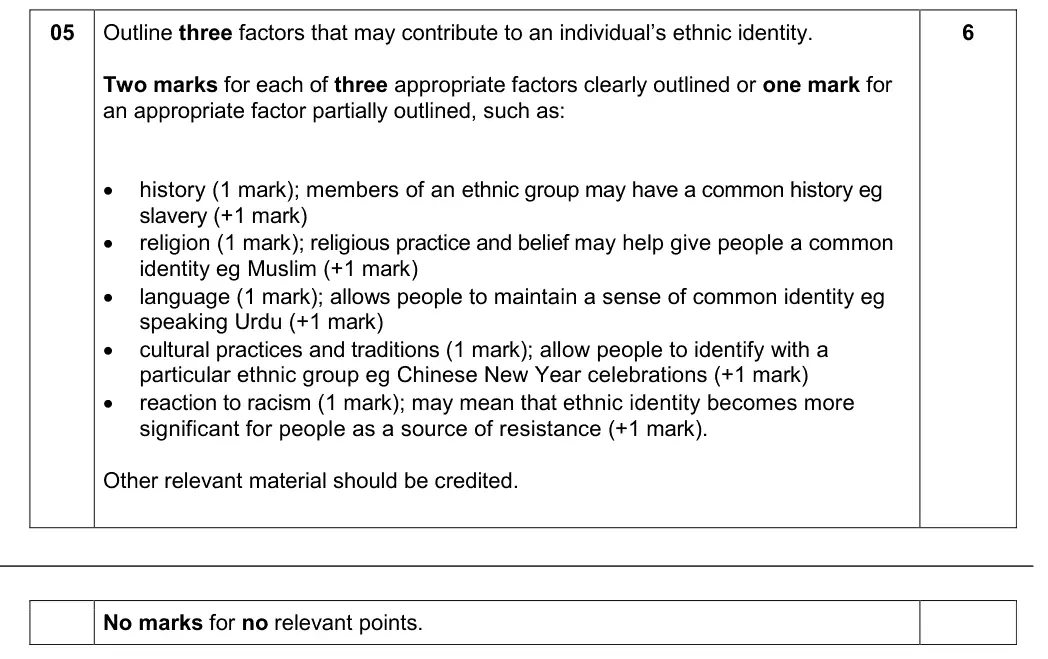
November 2020 · AS Paper 2 · Q56 marksAO1=6Outline
Mark scheme
Notes from the mark scheme and report
2 marks for each of three factors clearly outlined, 1 if partial
creditable: shared history, religion, language, cultural traditions, reaction to racism
developing mark usually needs an example (e.g. Urdu, Chinese New Year)
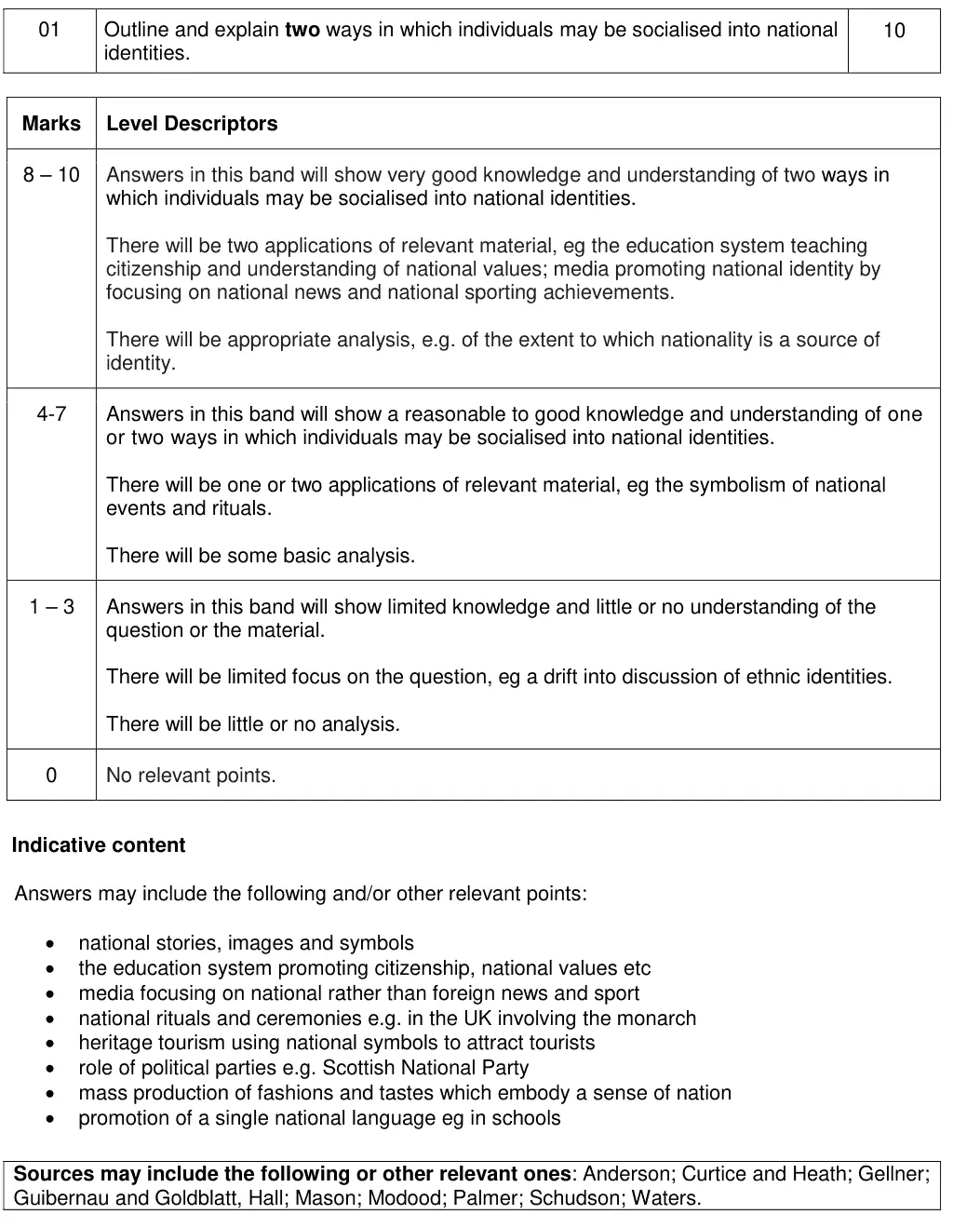
June 2019 · Paper 2 · Q110 marksAO1=5, AO2=3, AO3=2Outline and explain
Mark scheme, including the levels grid and indicative content
Examiner's comment
Some students wrote introductory paragraphs and/or conclusions. These are not necessary, and are unlikely to gain additional marks; they also take up time. Some students made only one point in their answers, or three or more, rather than the two asked for. The word ‘two’ is put in bold in the question to try and draw students’ attention to this. Sometimes it was not clear how many points were being made. It is helpful for students to clearly indicate their two answers, with wording such as “One way is…” or by starting a new paragraph for their second point. Notably, some students wrote far more than was needed for a 10-mark response. The two types of 10-mark question, “outline and explain” and “analysis” types, are marked differently as the assessment objectives have different weightings. It is important that students are aware of this. In particular they should note that evaluation is not a requirement for answers to 10 mark “outline and explain” questions. For 10 mark “outline and explain” questions, students cannot rely on reciting knowledge; these questions will ask them to bring together aspects of their sociological knowledge of the topic in a way that they are unlikely to have done before. The best answers to 10-mark questions were focused, clearly stating a point and then developing it, and used sociological concepts, studies, evidence and theory as appropriate. Most students were able to explain two ways in which individuals can be socialised into national identities. Popular answers included within the home (e.g. celebrating a national festival or event), at school, and through the media. A small number did not understand what was meant by national identity.
Notes from the mark scheme and report
AO grid not printed in this mark scheme
two ways each developed, with analysis of how far nationality is a source of identity
drift into ethnic identity = 1–3
popular answers: family celebrations of national events, school citizenship, national news and sport in the media
a few did not understand national identity
AO split from AQA's standard grid for this paper (this year's mark scheme does not print it).
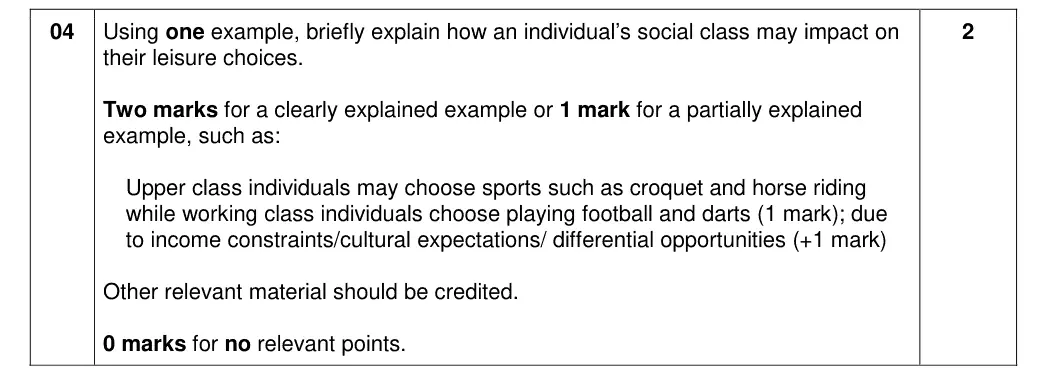
June 2019 · AS Paper 2 · Q42 marksAO2=2Brief explain
Mark scheme
Examiner's comment
This question proved to be relatively straight forward for most students. The most common successful answers were able to relate social class to income and the impact financial constraints have on leisure choices. Partial answers merely gave examples of class-based leisure activities.
Notes from the mark scheme and report
AO grid not printed
1 mark for a class-based leisure example (e.g. horse riding vs football and darts), +1 for explaining why (income, cultural expectations, different opportunities)
best answers linked class to income and financial limits
just naming class-based activities = partial
AO split from AQA's standard grid for this paper (this year's mark scheme does not print it).
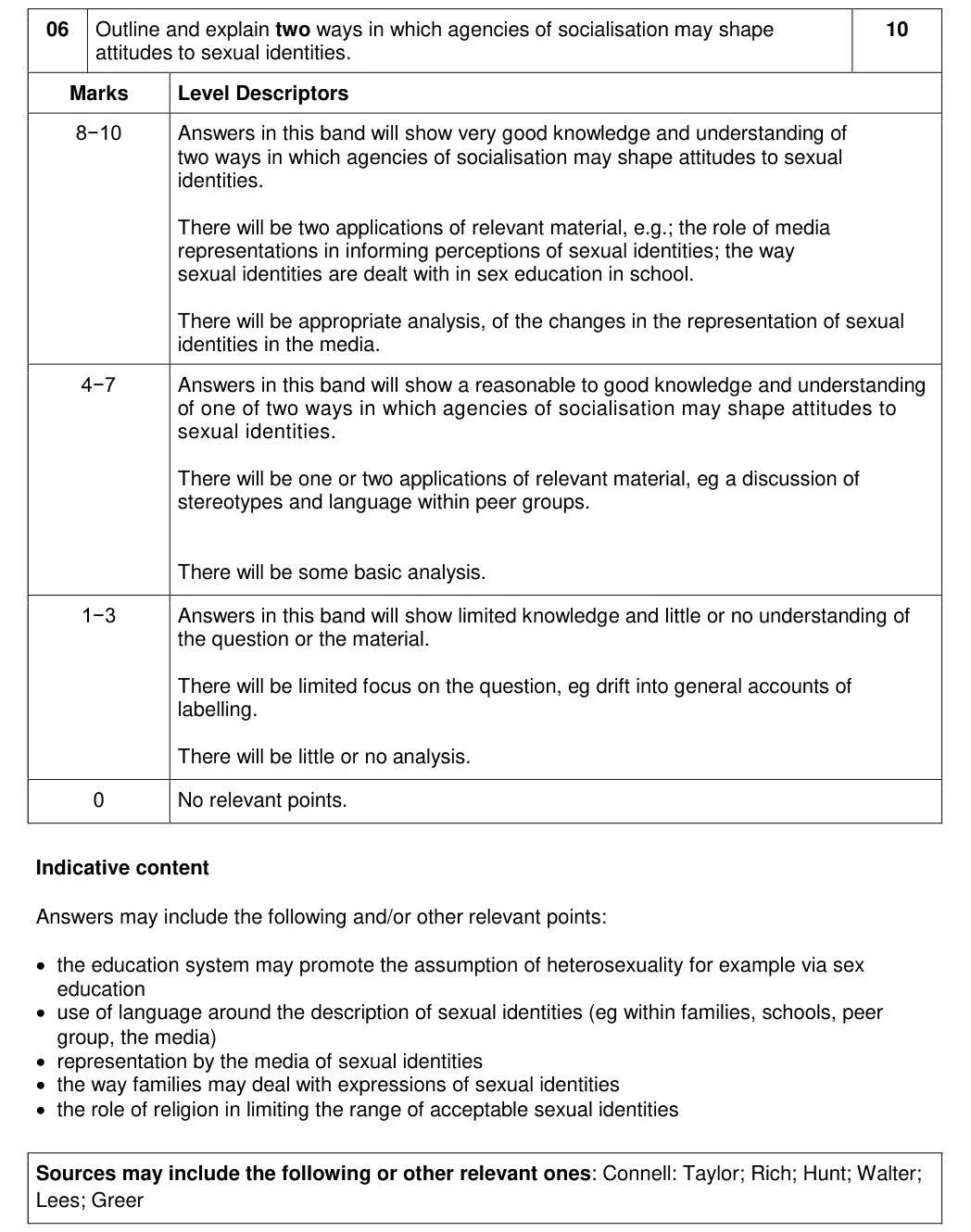
June 2019 · AS Paper 2 · Q610 marksAO1=5, AO2=3, AO3=2Outline and explain
Mark scheme, including the levels grid and indicative content
Examiner's comment
The requirements of the 10-mark question seem to be well understood by the majority of students. In general, this question was answered poorly with limited knowledge and understanding shown. While students were familiar with agencies of socialisation, they were less clear about sexual identities and often answers drifted into accounts of gender role socialisation with limited success. Successful answers were able to discuss the role of schools in shaping sexual identities via the teaching of sex education or via the heterosexual assumptions of everyday interactions in school. Others referred to the role of religion or the media in promoting particular sexual identities. Answers that focused on the family as an agent of socialisation tended to get diverted into a discussion of gender roles rather than attitudes to sexual identities.
Notes from the mark scheme and report
AO grid not printed
no marks for evaluation in this question type
two ways each developed, e.g. media representations, sex education and heterosexual assumptions in school, religion, peer-group language
generally poorly answered: many drifted into gender role socialisation
drift into general labelling = 1–3
AO split from AQA's standard grid for this paper (this year's mark scheme does not print it).
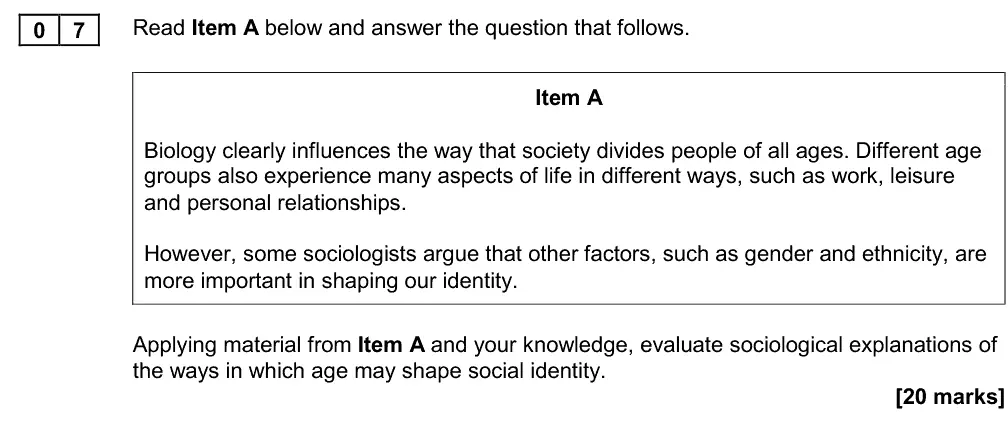
June 2019 · AS Paper 2 · Q720 marksAO1=8, AO2=6, AO3=620-mark essay
Mark scheme, including the levels grid and indicative content
Examiner's comment
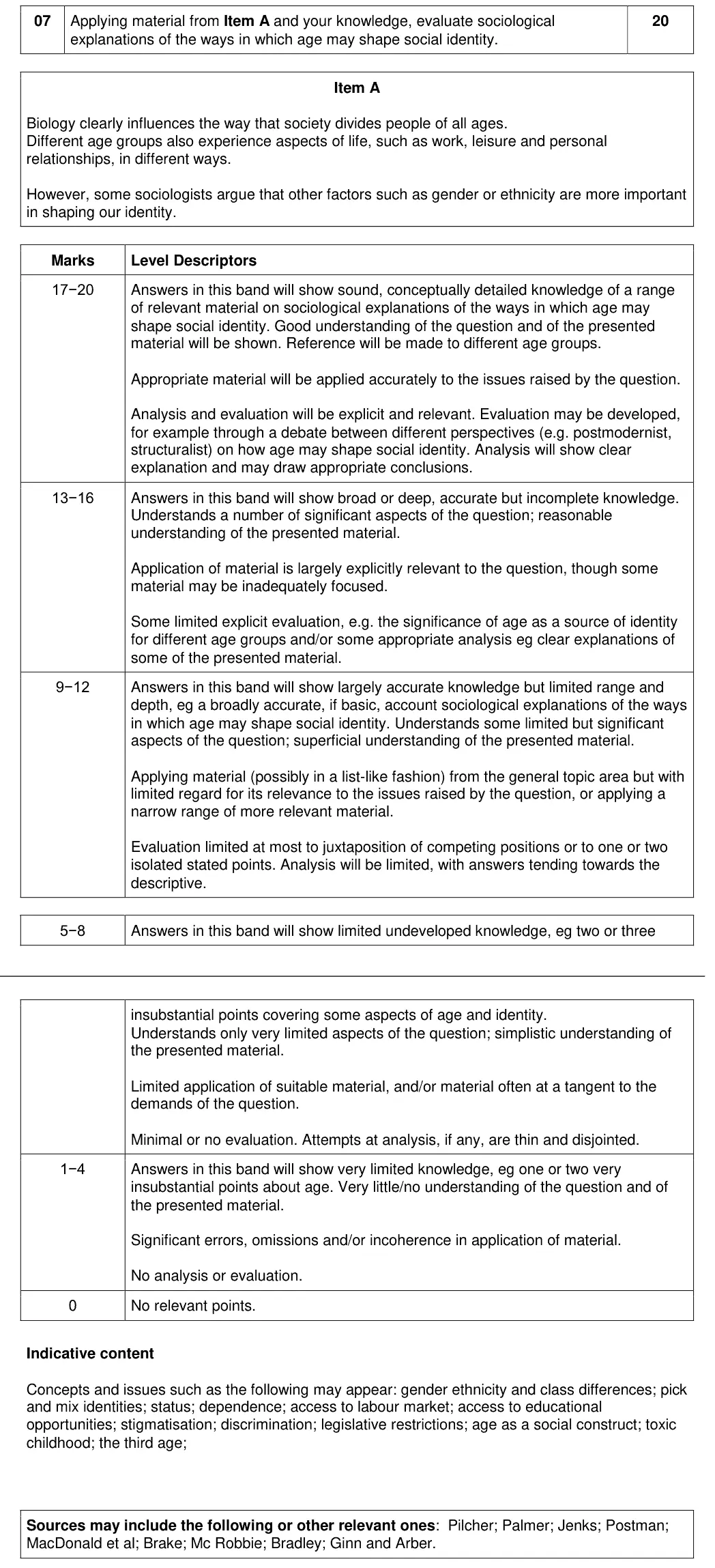
The majority of students seemed unprepared for this question. The most common response was to outline some stereotypical statements about old people and leisure activities, and then move on to gender and ethnicity. Very few students were able to provide a theoretical structure to their answer in relation to age and identity. Many students assumed that age meant old age and limited their responses accordingly. Relatively few answers covered more than one age group. Successful answers often discussed age and identity in relation to work and retirement, as well as notions of status and dependence. Some excellent responses were able to explore the significance of age for identity at different stages of people’s life cycle.
Notes from the mark scheme and report
AO grid not printed
must apply Item A
top band refers to different age groups and may debate postmodernist vs structuralist views
many treated age as old age only and drifted into gender and ethnicity
best answers used work, retirement, status and dependence across the life course
AO split from AQA's standard grid for this paper (this year's mark scheme does not print it).
June 2018 · Paper 2 · Q110 marksAO1=5, AO2=3, AO3=2Outline and explain
Mark scheme, including the levels grid and indicative content
Examiner's comment
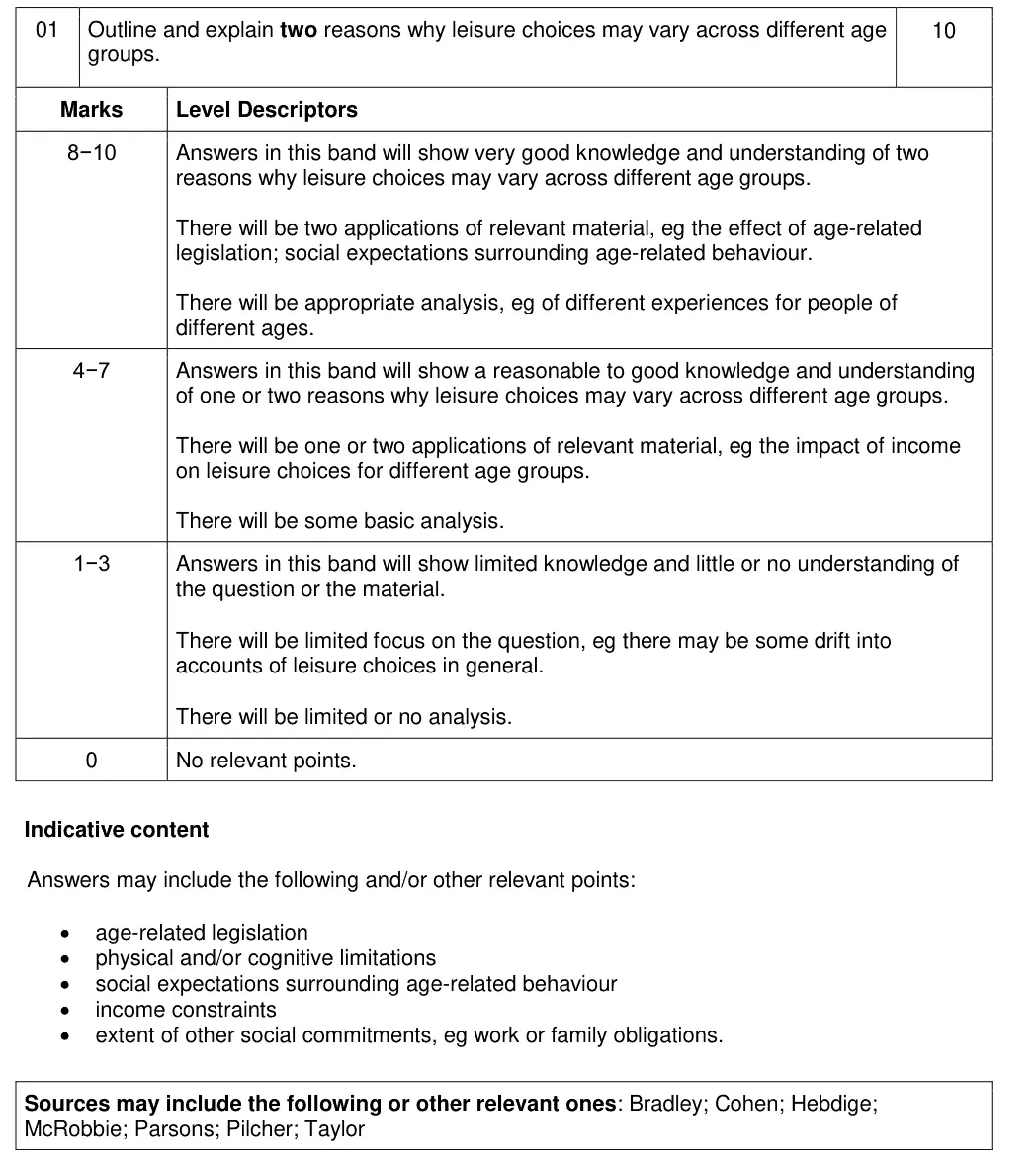
Some students wrote introductory paragraphs and/or conclusions. These are not necessary, and are unlikely to gain additional marks, and they also take up time. Some students made only one point in their answers, or three or more, rather than the two asked for in the question. Sometimes it was unclear how many points were being made. It is helpful for students to clearly indicate their two answers, with wording such as “One way is…” or by starting a new paragraph for their second point. Evaluation is not a requirement for answers to 10 mark “outline and explain” questions. The marks awarded for the assessment objectives being targeted are different in the two types of ten mark questions, and students should be made aware of this. The best answers to 10 mark questions were focused, clearly stating a point and then developing it, using sociological concepts, evidence and theory where appropriate. In some questions students tended to focus on the first aspect of the question at the expense of the second. Students need guidance on how to approach these questions and how to best demonstrate their sociological understanding. The nature of these questions means that students cannot rely on reciting knowledge. These questions will ask them to bring together aspects of their sociological knowledge in a way that they are unlikely to have done before. Most students were able to apply their sociological knowledge and to explain two reasons why leisure choices vary across different age groups. Popular answers included constraints of income, age-related legislation and physical limitations. Only a few answers recognised that there might be other age groups than ‘young people’ and ‘the elderly’.
Notes from the mark scheme and report
two reasons each applied to differences between age groups (e.g. age-related legislation, social expectations of age-appropriate behaviour, income constraints, physical limits, work/family commitments)
drift into leisure choices in general = 1–3
only a few answers looked beyond 'young people' and 'the elderly'
AO split from AQA's standard grid for this paper (this year's mark scheme does not print it).
June 2018 · Paper 2 · Q210 marksAO1=3, AO2=4, AO3=3Analyse
Mark scheme, including the levels grid and indicative content
Examiner's comment
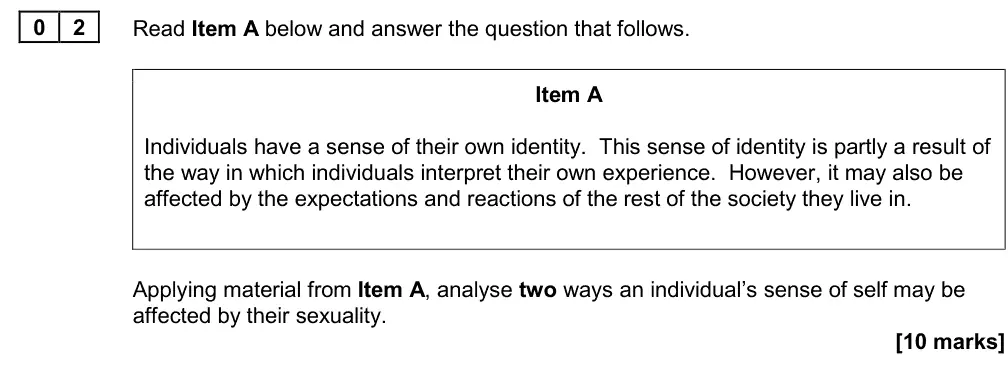
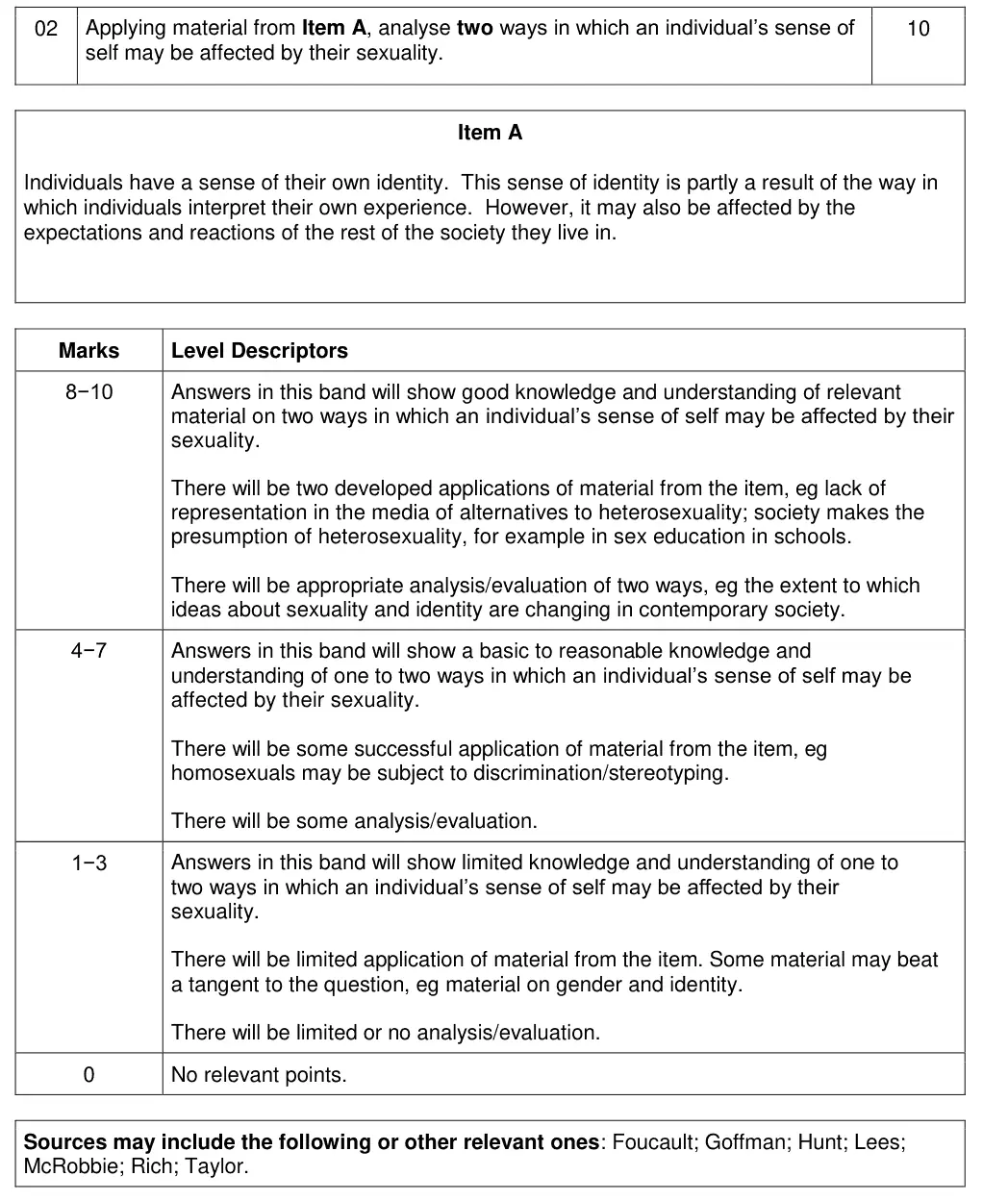
Some students wrote introductory paragraphs and/or conclusions. These are not necessary, and are unlikely to gain additional marks, and they also take up time. Some students made only one point in their answers, or three or more, rather than the two asked for in the question. Sometimes it was unclear how many points were being made. It is helpful for students to clearly indicate their two answers, with wording such as “One way is…” or by starting a new paragraph for their second point. Evaluation is not a requirement for answers to 10 mark “outline and explain” questions. The marks awarded for the assessment objectives being targeted are different in the two types of ten mark questions, and students should be made aware of this. The best answers to 10 mark questions were focused, clearly stating a point and then developing it, using sociological concepts, evidence and theory where appropriate. In some questions students tended to focus on the first aspect of the question at the expense of the second. Students need guidance on how to approach these questions and how to best demonstrate their sociological understanding. The nature of these questions means that students cannot rely on reciting knowledge. These questions will ask them to bring together aspects of their sociological knowledge in a way that they are unlikely to have done before. Most students were able to give two ways in which an individual’s sense of self may be affected by their sexuality. Most focused on homosexuality with only a minority considering, for example, the connection between heterosexuality and hegemonic masculinities. There was some overlap between the ‘ways’ suggested by the item. For example, labelling and stigmatised identity, although different (and so two different ‘ways’), can be part of a reflexive process. Evaluation using these ideas featured in some of the best answers.
Notes from the mark scheme and report
two developed applications from Item A (self-interpretation vs others' expectations and reactions), e.g. media under-representation, presumption of heterosexuality
drift into gender and identity is a tangent
most focused only on homosexuality, few linked heterosexuality to hegemonic masculinity
best used labelling/stigma and reflexivity evaluatively
AO split from AQA's standard grid for this paper (this year's mark scheme does not print it).
June 2018 · AS Paper 2 · Q42 marksAO2=2Brief explain
Mark scheme
Examiner's comment
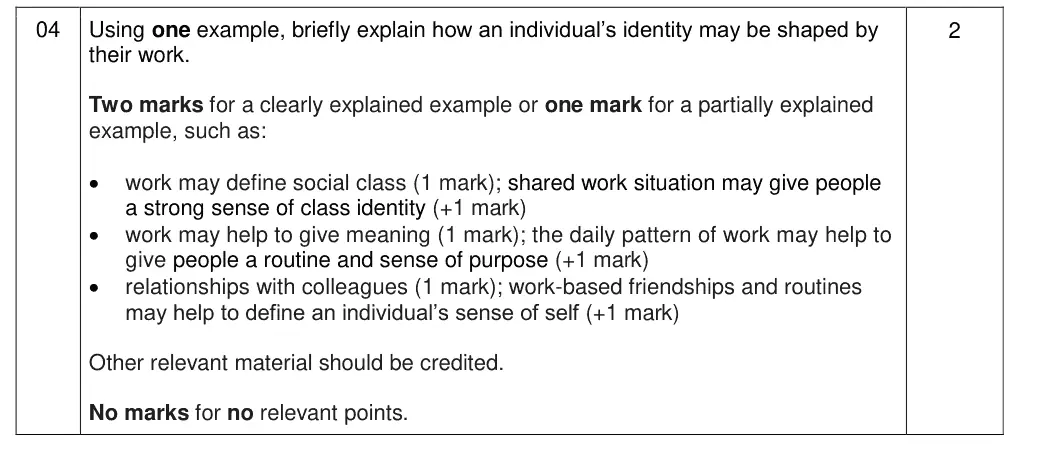
This question proved to be more difficult than anticipated. Some answers focused on the impact of social class on choice of leisure activity but did not relate this to an individual’s identity. The most common successful answers were able to relate work to class identity or some sort of work- based relationships that helped individual’s see themselves as part of a group.
Notes from the mark scheme and report
credited: work defining class identity through a shared work situation, work routine giving meaning and purpose, colleague friendships defining sense of self
harder than expected
class and leisure choices not linked to identity gained little
successful answers used class identity or work-based group belonging
AO split from AQA's standard grid for this paper (this year's mark scheme does not print it).
June 2018 · AS Paper 2 · Q610 marksAO1=5, AO2=3, AO3=2Outline and explain
Mark scheme, including the levels grid and indicative content
Examiner's comment
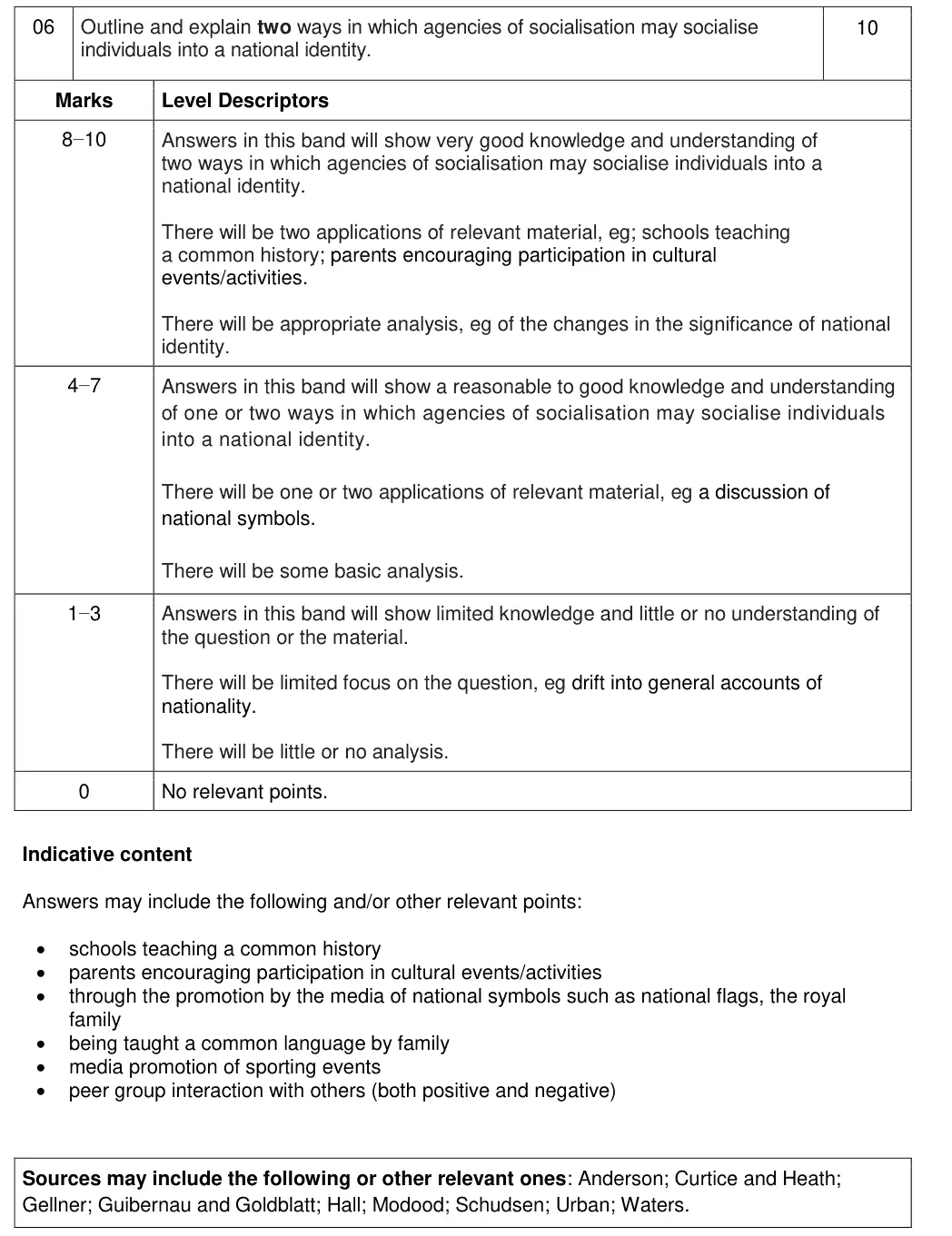
The 10 mark outline and explain question requires students to link two aspects of the specification. The best answers took note of both aspects of the question, clearly identified two separate points and developed them in relation to the second part of the question. Weaker answers either ignored one aspect of the question or attempted to cover a number of ideas rather than focusing on two. In general, this question was answered poorly with limited knowledge and understanding shown. While students were familiar with agencies of socialisation, they were less clear about national identity. Many answers struggled to find anything specific to say about national identity and instead made generic comments about socialisation and norms and values. Some answers conflated national identity with religious and ethnic identity and often found it difficult to explain how agencies socialise individuals into a national identity. Successful answers were able to discuss the role of schools in shaping national identity via the teaching of history or literature. Others referred to the role of the media in giving people a sense of shared national identity through sporting events, royal weddings or even during wartime.
Notes from the mark scheme and report
two ways agencies create national identity
examples: schools teaching common history, family and cultural events, media national symbols and sport, common language
drift into general accounts of nationality = 1-3
answered poorly overall: generic norms-and-values socialisation, or conflating national with religious/ethnic identity
AO split from AQA's standard grid for this paper (this year's mark scheme does not print it).
June 2017 · Paper 2 · Q210 marksAO1=3, AO2=4, AO3=3Analyse
Mark scheme, including the levels grid and indicative content
Examiner's comment
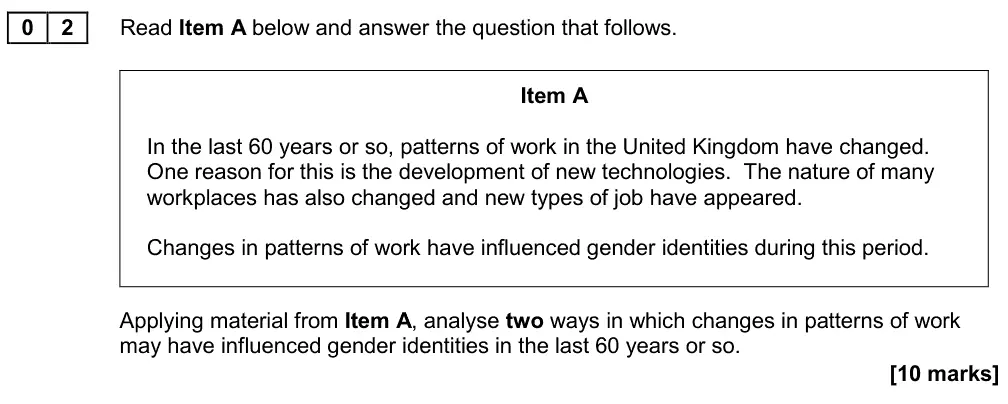
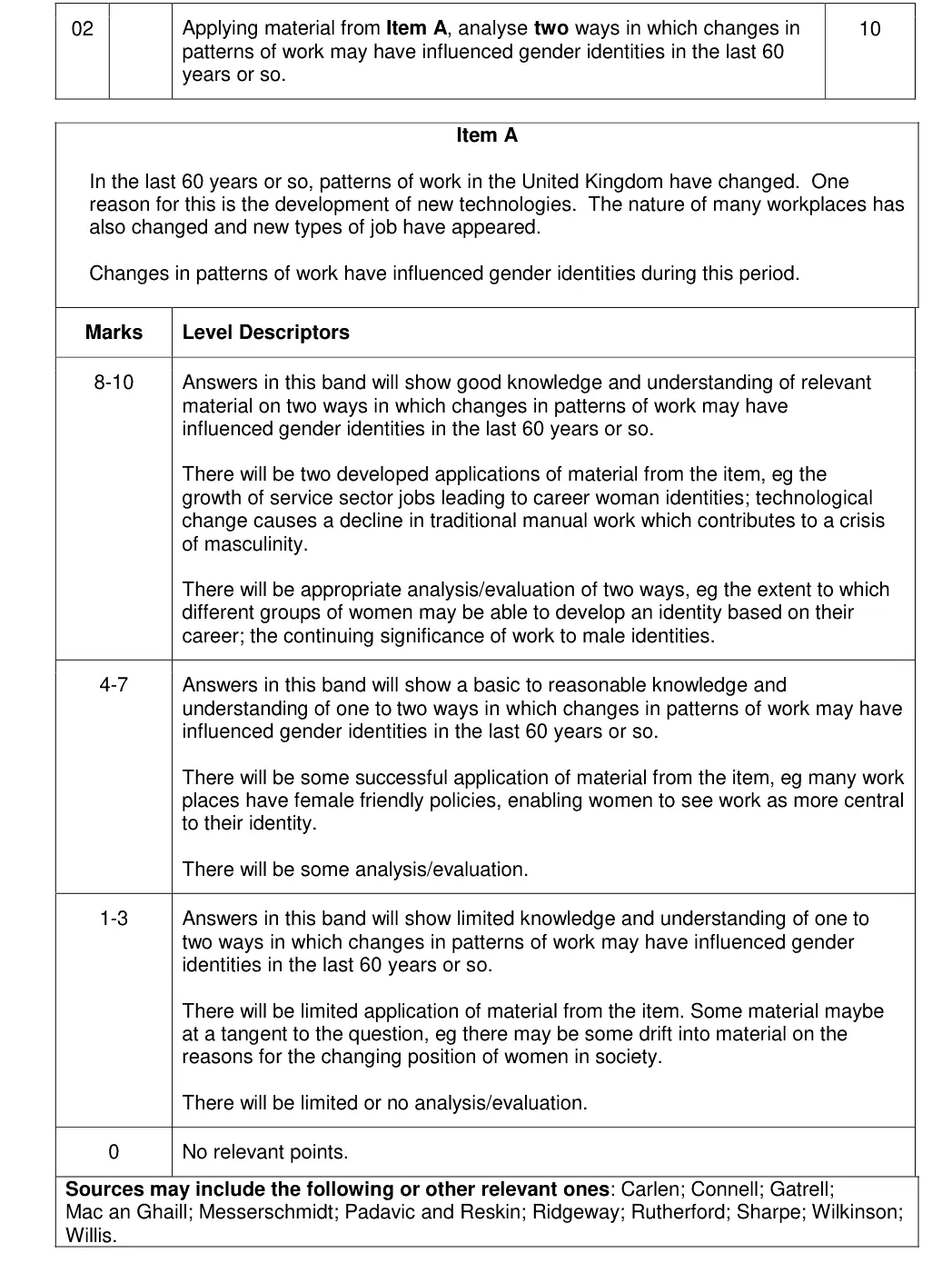
A number of students wrote introductory paragraphs and/or conclusions. These are not necessary, and are unlikely to gain additional marks. A number of students made only one point in their answer, or three or more, rather than the two asked for. In these cases, the two best answers were rewarded and will be in future series. It is helpful for students to clearly indicate their two answers, with wording such as “One way is…” or by starting a new paragraph for their second point. The assessment objective allocations are different in the two types of 10 mark questions, and students should be made aware of this. There was a wide range of responses to these questions. A minority of students wrote very brief answers. For these 10 mark items, a simple statement of two ways, reasons or factors, without development, is not sufficient to access more than the lower marks in the mark range. The best answers were focused, clearly stating a point and then developing it, with use of sociological concepts, evidence and theory where appropriate, in ways that demonstrated the skills expected from the targeted assessment objectives. There was a tendency, however, for many answers to focus on the first aspect of the question at the expense of the second. Students need guidance on how to approach these questions and how to best demonstrate their sociological understanding. The nature of these questions means that students cannot rely on reciting knowledge. They require students to bring together two aspects of their sociological knowledge in a way that they are unlikely to have done before. Answers will sometimes require claims that students may be unsure of because they do not know of specific evidence (for example, in question 5, whether migrants from Eastern Europe who are single workers tend to live alone or in shared households). However, answers that are sociologically plausible will be accepted. Most answers were able to develop ideas from the item references to new technologies, the changing nature of workplaces and new types of job. These were not always successfully related to gender identities.
Notes from the mark scheme and report
hooks: new technologies, changing workplaces, new types of job
e.g. service-sector growth and career-woman identities, decline of manual work and crisis of masculinity
drift into reasons for women's changing position = 1–3
item points often not tied back to gender identity
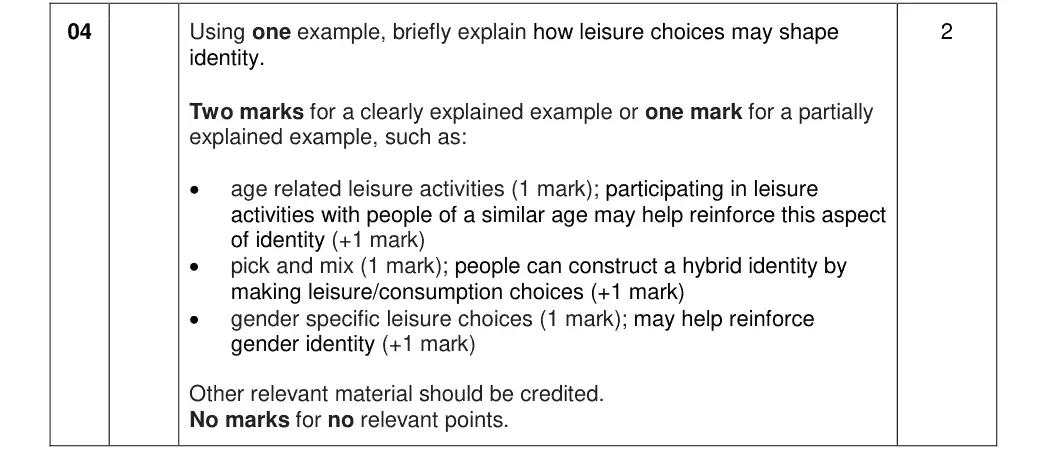
June 2017 · AS Paper 2 · Q42 marksAO2=2Brief explain
Mark scheme
Examiner's comment
The most common successful answers were able to relate age or gender or social class and leisure choices, and then explain how they shaped identity. Weaker answers described a leisure activity and then often struggled to make some connection with identity.
Notes from the mark scheme and report
2 marks for a clearly explained example, 1 if partial
best answers linked leisure choices to age, gender or class and then to identity
weaker answers described a leisure activity with no clear link to identity
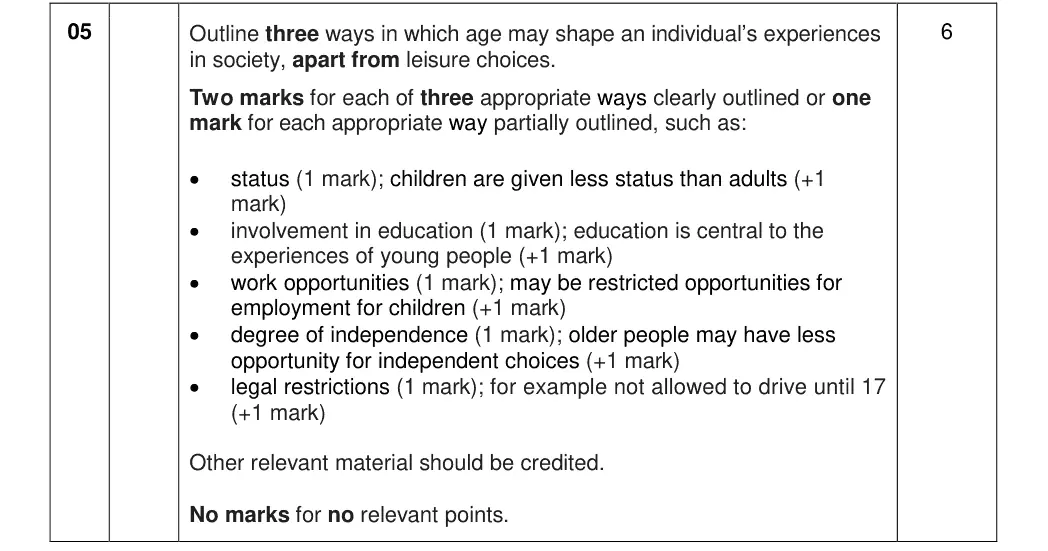
June 2017 · AS Paper 2 · Q56 marksAO1=6Outline
Mark scheme
Examiner's comment
Additionally, some students are writing far too much on the 6 mark questions. This time could be better spent on the longer essay questions. Some answers gave numerous examples of age-related stereotyping and consequently were only credited once. More successful answers made reference to aspects of society, such as age-related legislation, work opportunities and involvement in education, as well as status and independence.
Notes from the mark scheme and report
must be apart from leisure choices
2 marks for each of three ways clearly outlined
several examples of age stereotyping were credited only once
good answers used age-related laws, work opportunities, education, status and independence
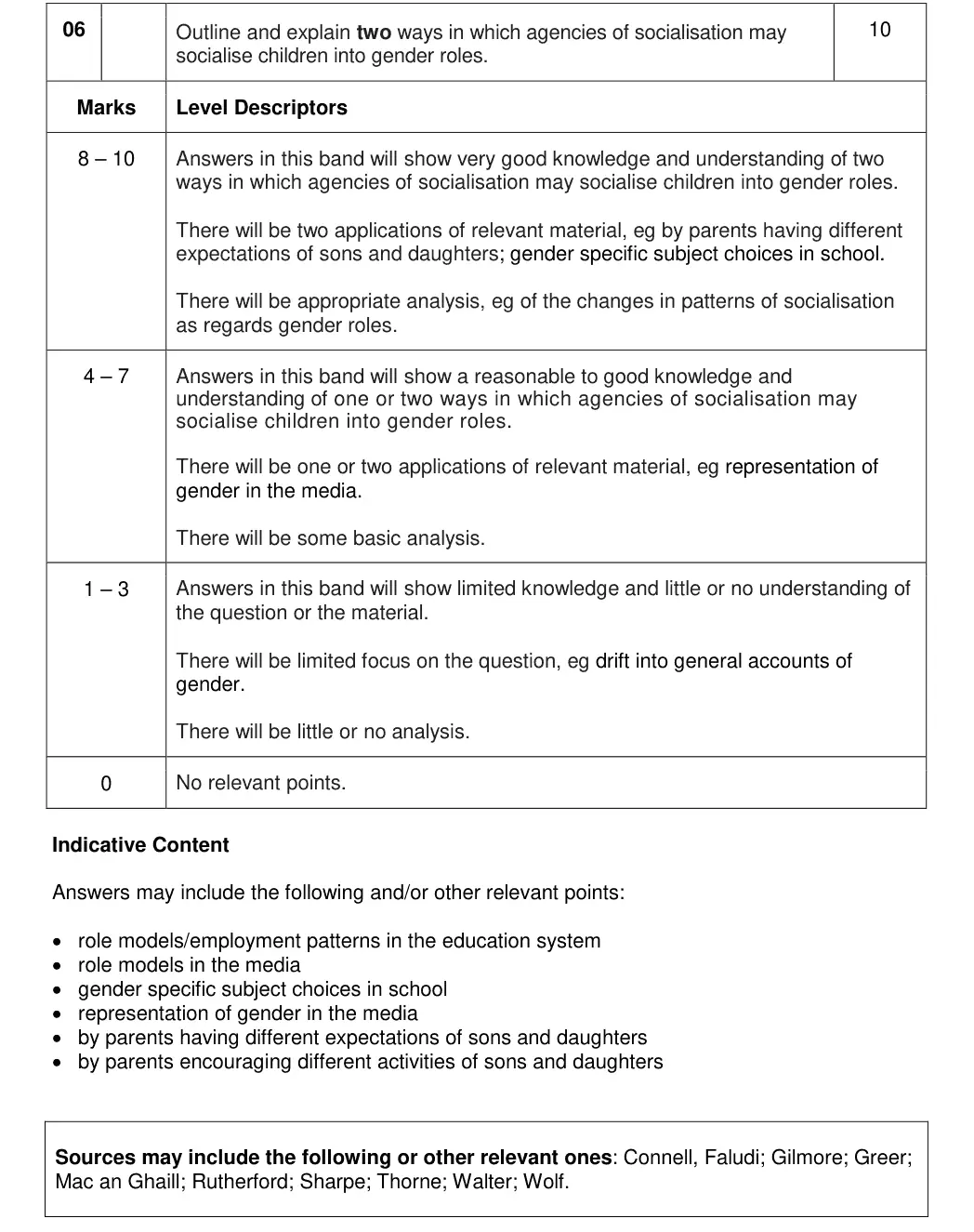
June 2017 · AS Paper 2 · Q610 marksAO1=5, AO2=3, AO3=2Outline and explain
Mark scheme, including the levels grid and indicative content
Examiner's comment
The 10 mark outline and explain question requires students to link two aspects of the specification. The best answers took note of both aspects of the question, clearly identified two separate points and developed them in relation to the second part of the question. Weaker answers either ignored one aspect of the question or attempted to cover a number of ideas rather than focusing on two. This question was answered well with some good knowledge and understanding shown. Some students scored well by developing Oakley’s ideas on gender socialisation. Others approached the question in terms of two different agencies of socialisation and their contribution to socialising children into gender roles. The best answers were able to clearly explain how agencies may socialise children in to gender roles (usually family and education). These answers were detailed in their account of the process and they were also able to discuss the way in which these processes applied to girls and boys. They also discussed the way these processes were changing.
Notes from the mark scheme and report
no marks for evaluation in this question type
two ways each developed, e.g. parents' different expectations of sons and daughters, gendered subject choice at school
drift into general accounts of gender = 1–3
best answers explained the process for both girls and boys (often family and education, e.g. Oakley) and how it is changing
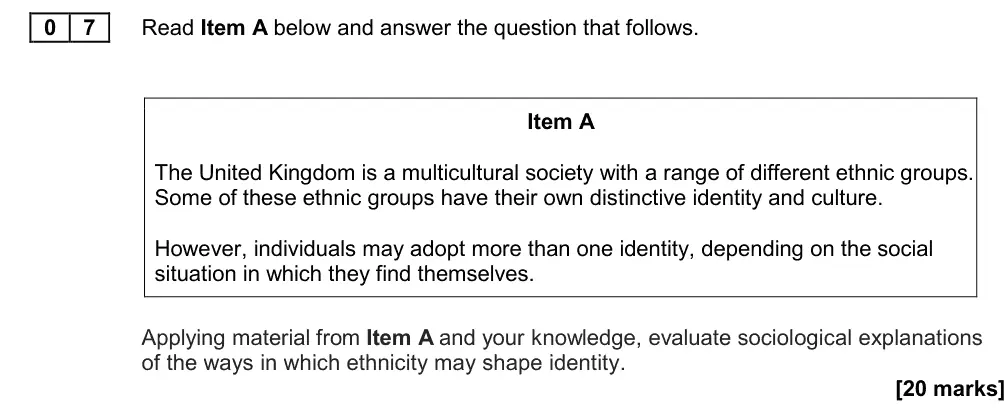
June 2017 · AS Paper 2 · Q720 marksAO1=8, AO2=6, AO3=620-mark essay
Mark scheme, including the levels grid and indicative content
Examiner's comment
The best answers made reference to different ethnic minorities as well as the ethnic majority. Some of these answers made good use of material from the education topic to discuss the relevance of experiences of education on ethnicity and identity. Good answers retained the focus on identity and were able to discuss ideas of cultural navigation and cultural defence in relation to ethnicity and identity. These answers often referred to studies by Modood, Johal and Ballard. Weaker responses tended to drift into life chances rather than identity or simply described some experiences of different ethnic minorities, often in a fairly stereotyped way.
Notes from the mark scheme and report
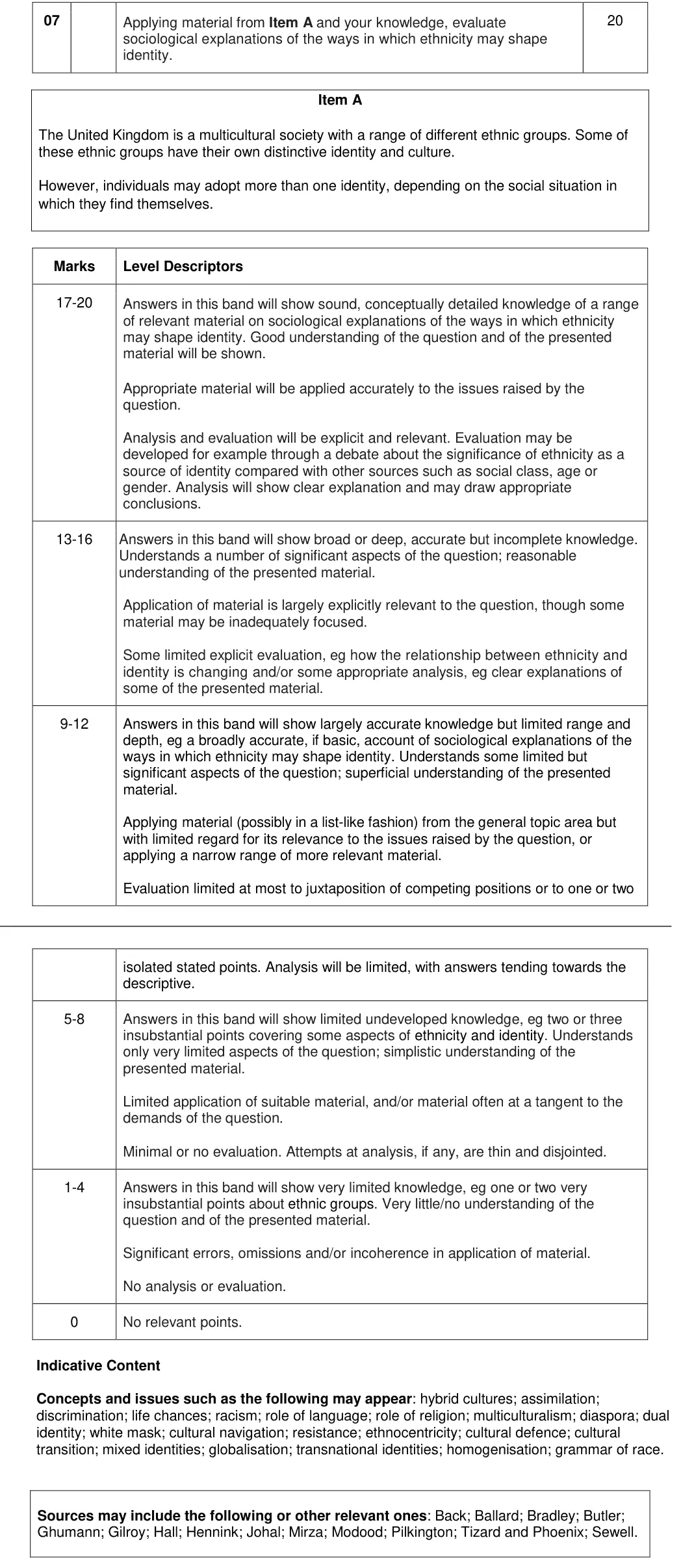
must apply Item A (multicultural UK, multiple identities depending on situation)
top band may weigh ethnicity against class, age or gender as sources of identity
best answers covered majority as well as minority groups and used cultural navigation and cultural defence (Modood, Johal, Ballard)
weaker answers drifted into life chances or stereotyped descriptions
June 2016 · AS Paper 2 · Q610 marksAO1=5, AO2=3, AO3=2Outline and explain
Mark scheme, including the levels grid and indicative content
Examiner's comment
The 10 mark ‘Outline and explain’ question requires students to link two aspects of the specification. The best answers took note of both aspects of the question, clearly identified two separate points and developed them together them in relation to the question as a whole. Weaker answers either ignored one aspect of the question, or attempted to cover a number of ideas rather than focusing on the two required. The most successful answers tended to focus on firstly, experiences around access to work, leisure and education, and, secondly, experiences based on stereotyping and labelling. Better answers were able to expand on the issue they were discussing and then develop a number of links from that issue to the social experiences of a disabled person. Weaker answers tended to describe some aspect of an individual’s social experiences, for example limited wheelchair access, without fully explaining the impact it may have on those individuals.
Notes from the mark scheme and report
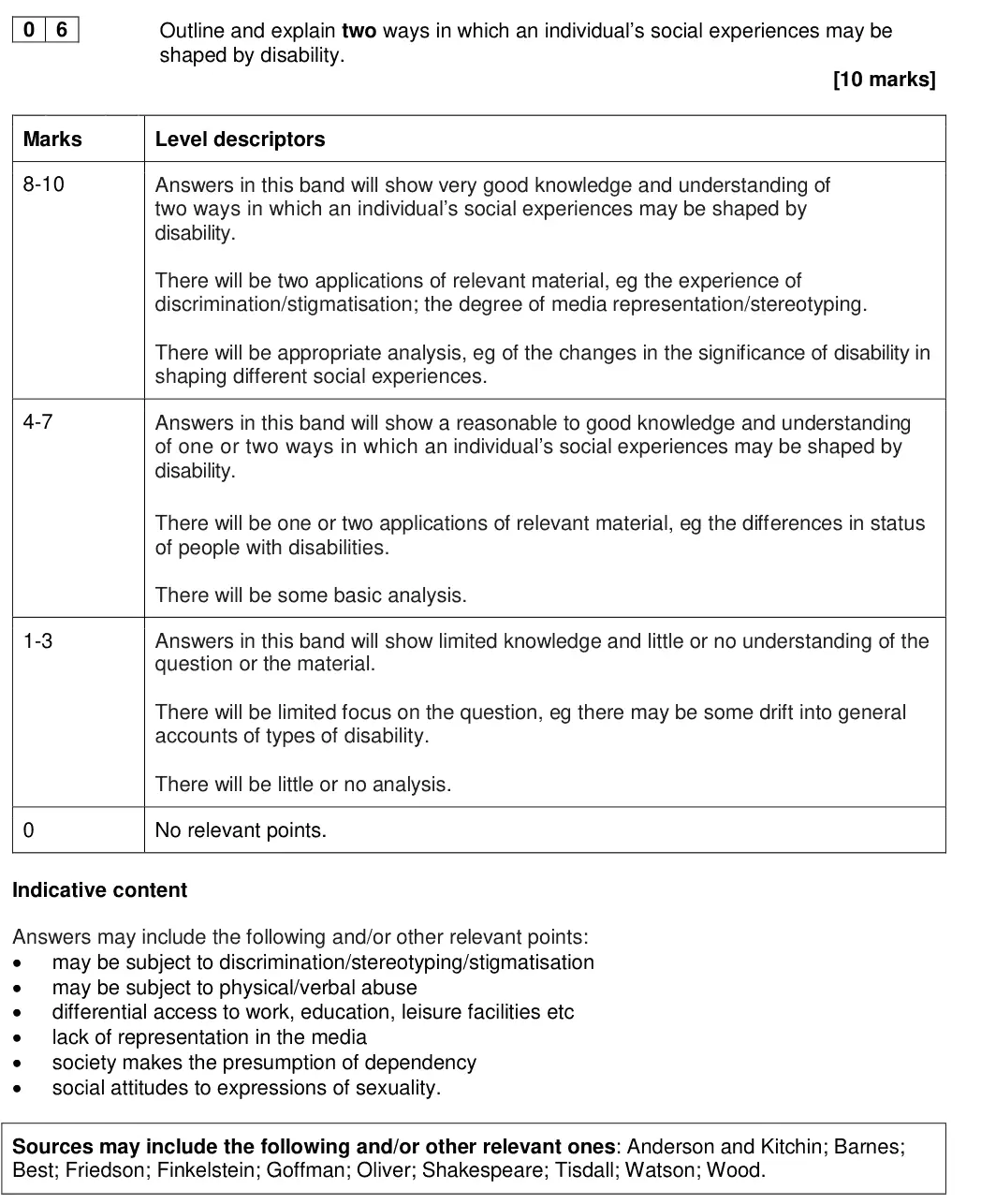
two ways, each applied and analysed
examples: discrimination/stigma, media under-representation, differential access to work, education and leisure
drift into accounts of types of disability = 1-3
weaker answers described an experience (e.g. wheelchair access) without explaining its impact on the person
June 2016 · AS Paper 2 · Q720 marksAO1=8, AO2=6, AO3=620-mark essay
Mark scheme, including the levels grid and indicative content
Examiner's comment
The usual approach to this question was to discuss the role of globalisation in shaping a sense of national identity. This proved to be a fairly productive source of material as students were often able to make reference to changes in (usually) British identity in the face of migration from around the world, and go on to discuss the emergence of hybrid cultures. These points were often contrasted with a more traditional view of national culture and traditions. Better answers explored these ideas in more detail and were able to evaluate the competing arguments. Relatively few students moved beyond this discussion to consider issues such as cultural imperialism, global media and the sense of individuals being global citizens. Those that did were able to open up their discussion in a very productive manner and discuss other aspects of identity besides national identity.
Notes from the mark scheme and report
apply Item A hooks (challenge to local and national identity, hybrid identities)
evaluation e.g. continued importance of local/national cultures
most answers focused narrowly on national identity and migration
few moved on to cultural imperialism, global media or global citizenship, which opened up stronger answers
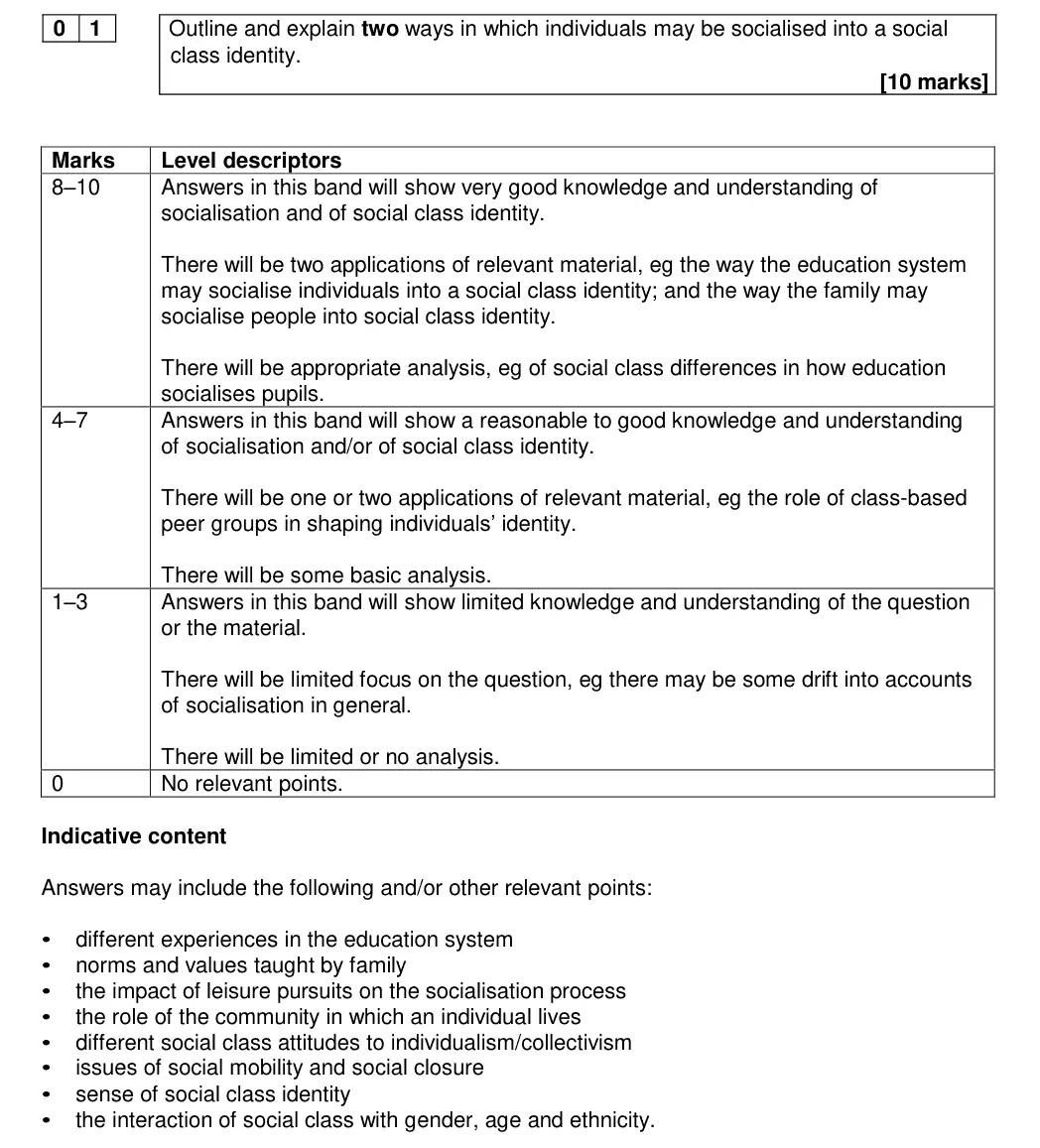
Specimen set 1 · Paper 2 · Q110 marksAO1=5, AO2=3, AO3=2Outline and explain
Mark scheme, including the levels grid and indicative content
Notes from the mark scheme and report
specimen paper, no examiners' report
top band: two agencies (e.g. education and family) applied to class identity, with analysis of class differences in how education socialises
drift into socialisation in general = 1–3 band
Work with an AQA sociology tutor
Essays stuck in the middle band, or losing marks on the 10-markers? Book a trial lesson with Mark, a former AQA examiner.