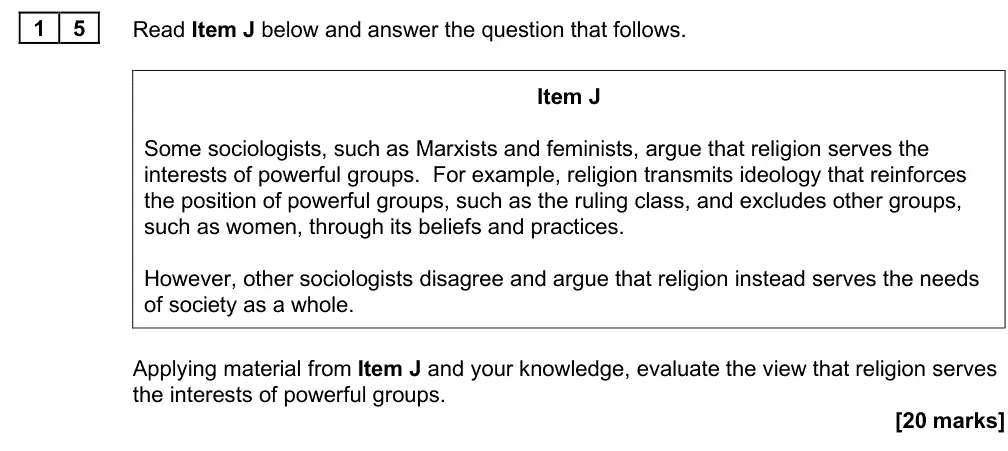
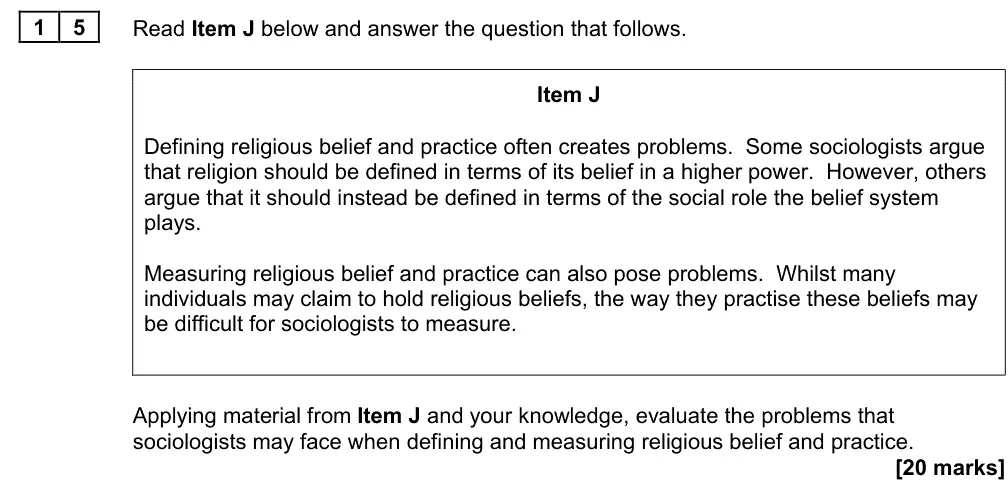
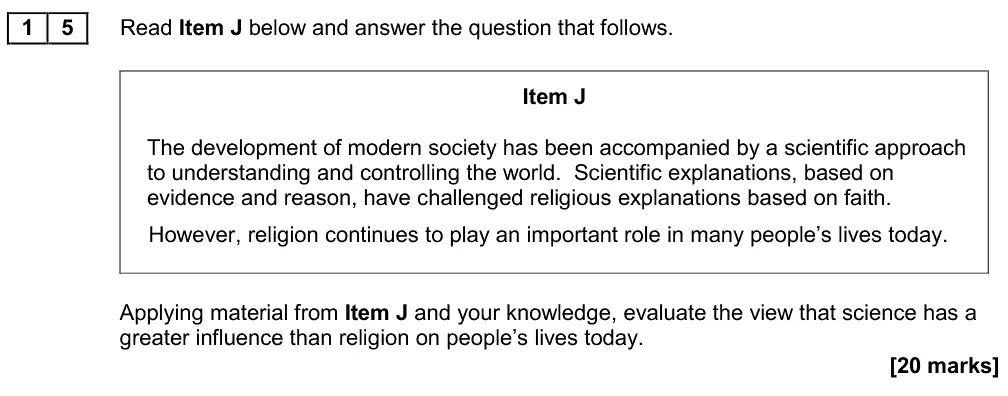
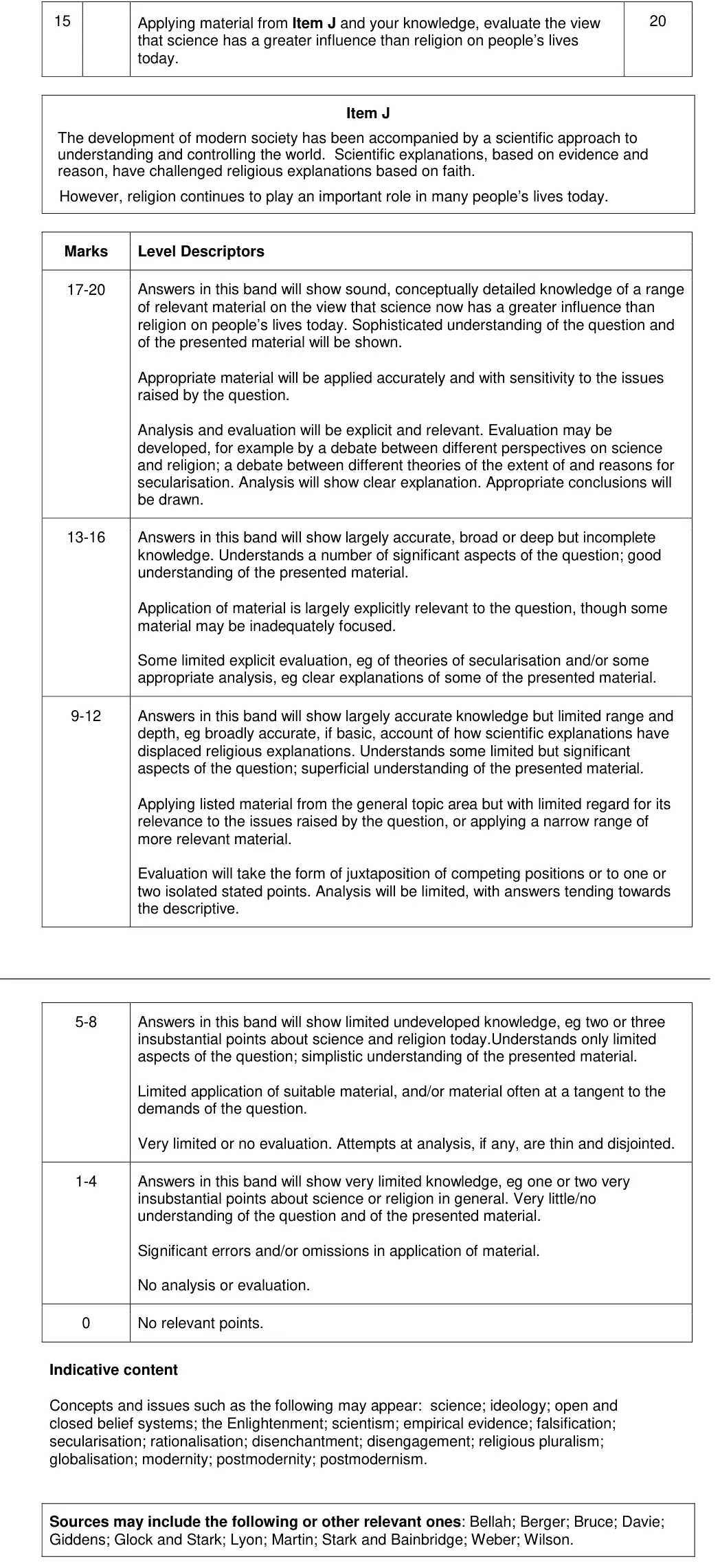
Applying material from Item J and your knowledge, evaluate the problems that sociologists may face when defining and measuring religious belief and practice.
Tap a question to zoom it. The mark scheme (with the level descriptors and indicative content) and the examiner's comment open underneath.
June 2025 · Paper 2 · Q1520 marksAO1=8, AO2=6, AO3=620-mark essay
Mark scheme, including the levels grid and indicative content
Examiner's comment
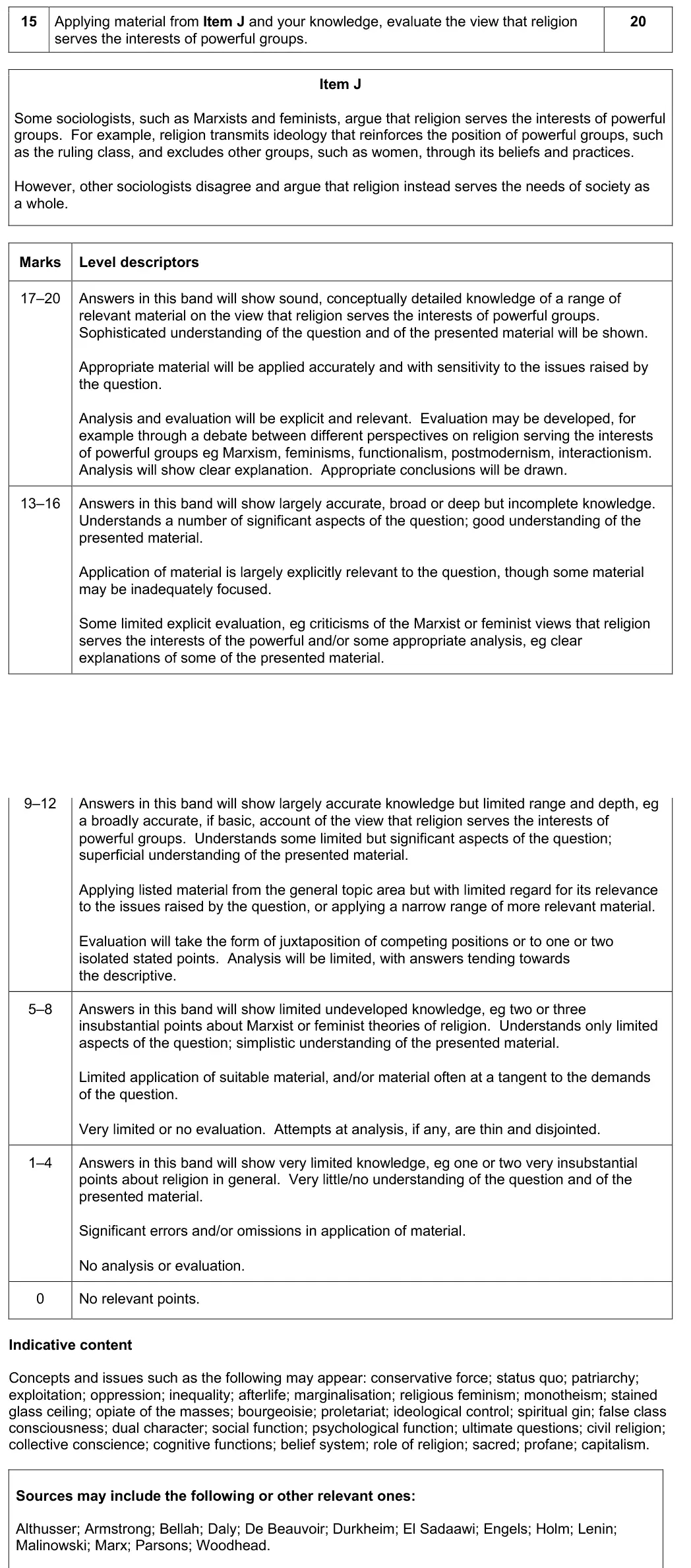
These require answers that are essays and are best written in paragraphs. A brief introduction can help set out the argument of the essay. It will not attract marks if it only repeats the question or parts of the item. The purpose of the items for these questions is to suggest a few starting points for students, including ways into evaluation. Students are expected to also bring in further ideas (“and your knowledge” in the instruction) rather than relying only on the item. A wide range of material can be relevant to these questions, so students need to be selective. It is more effective to cover a limited number of views/theories in depth rather than to try to include everything. Students should keep to the question. When a question is about a particular view, other views can be used for evaluation but without writing all that the student knows about them. There was a tendency for answers to progressively lose sight of the question and to become a list of different views. Students who made brief essay plans appeared to benefit by having more structured and coherent responses. Most responses successfully focused on the concept of powerful groups. Marxism and feminism featured strongly, often contrasted with functionalism. Better answers were able to apply a range of studies and when attempting to evaluate avoided drifting into listing functions. A minority answered the question more as if it were about religiosity by class or gender.
Notes from the mark scheme and report
top band debates Marxism and feminisms against functionalism, postmodernism and interactionism
evaluation should not drift into listing functions
a minority wrongly treated it as religiosity by class or gender
June 2024 · Paper 2 · Q1410 marksAO1=3, AO2=4, AO3=3Analyse
Mark scheme, including the levels grid and indicative content
Examiner's comment
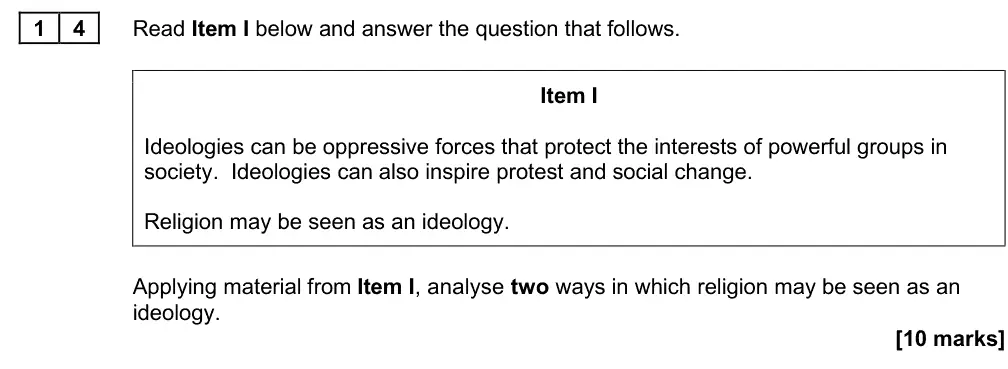
The nature of these questions means that students cannot rely on reciting knowledge. Questions will ask them to bring together aspects of their sociological knowledge in ways they will not have done before. It is therefore important for students to allow time to think about how to answer the question. Students should be made aware that there are two types of 10 mark questions. These have different requirements and different mark schemes . There are different marks available for the assessment objectives. A breakdown of the marks awarded by assessment objective can be found in the mark scheme. The items for 10 mark “analyse” questions are written to give prompts or “hooks” for student answers. These have to be used to access application marks. Answers can indicate use of hooks by quoting, by a reference in parentheses or by wording ( eg “As the item says…”). Items end with a sentence restating the question; the hooks are in the preceding part of the item. Students should avoid writing all they know about a “hook”, and focus on applying the idea to the question. Introductions and conclusions are not required for 10 mark questions; they take up time and rarely improve the mark. It is helpful if answers are set out to clearly indicate the two answers, with wording such as “One way/reason is…”, or by starting a new paragraph for the second point. Answers that give more than two points are unlikely to develop two of them sufficiently. Q14: Some responses were too descriptive, failing to engage with the item's “hooks”. There were, however, some outstanding answers that demonstrated a deep understanding by incorporating concepts, religious examples, and theory. There was a tendency for answers using the second “hook” to just give an example when a more general point, then exemplified, would have been better.
Notes from the mark scheme and report
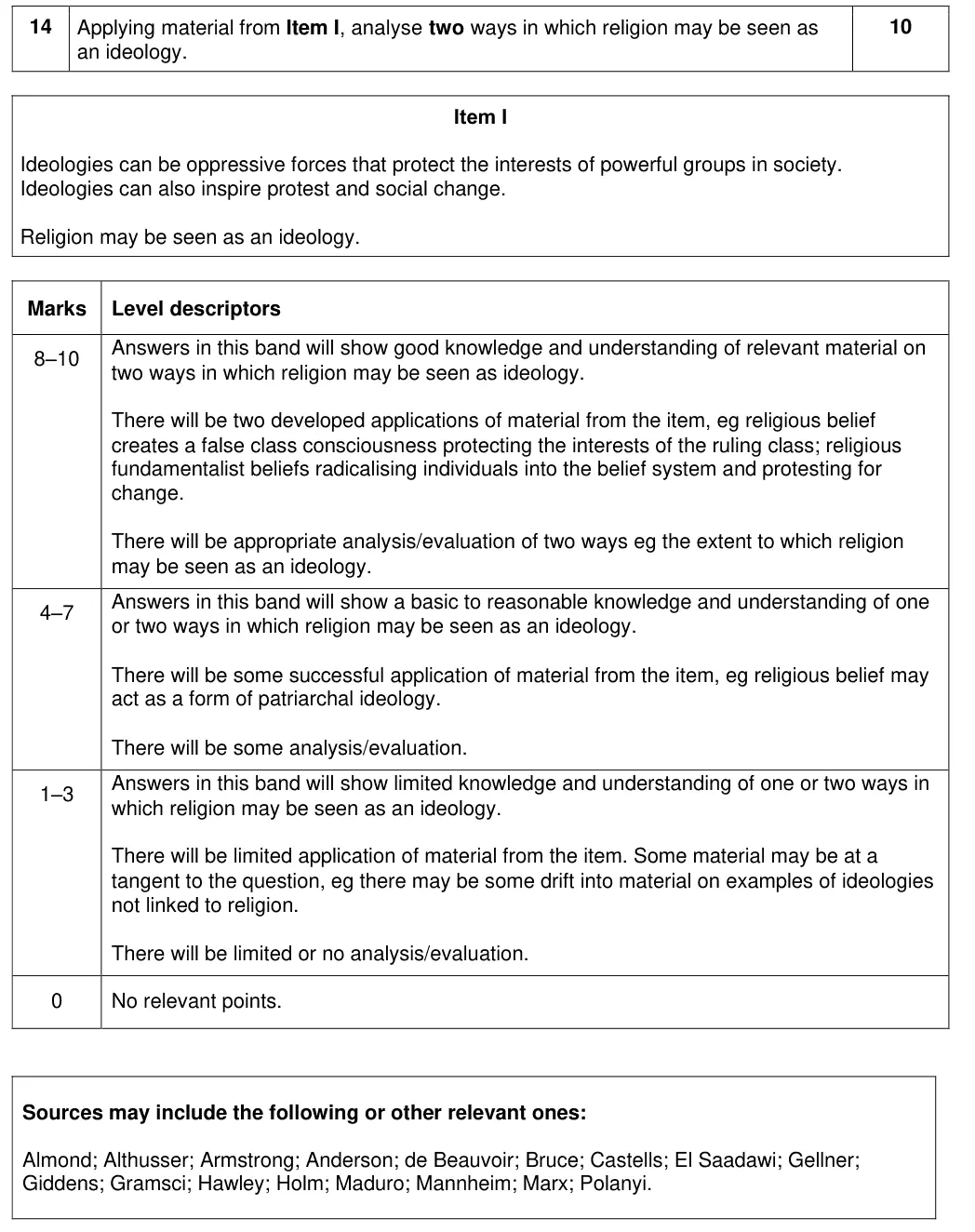
two developed applications from Item I (oppressive ideology protecting the powerful
inspiring protest and change), e.g. false class consciousness, patriarchal ideology, fundamentalism driving change
drift into non-religious ideologies is a tangent
descriptive answers missed the hooks
with the second hook make a general point then exemplify rather than just give an example
June 2023 · Paper 2 · Q1410 marksAO1=3, AO2=4, AO3=3Analyse
Mark scheme, including the levels grid and indicative content
Examiner's comment
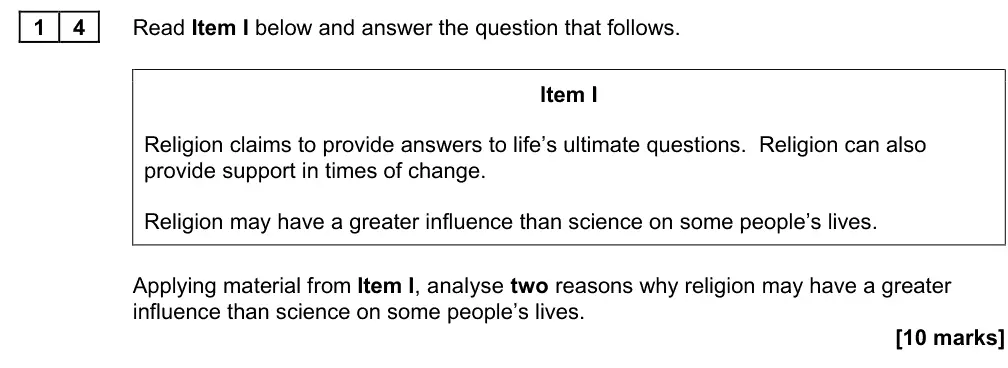
The nature of these questions means that students cannot rely on reciting knowledge. Questions will ask them to bring together aspects of their sociological knowledge in ways they are unlikely to have done before. It is therefore important for students to allow time to think about how to answer the question. Students should be made aware that there are two types of 10 mark questions. These have different requirements and different mark schemes. There are different marks available for the assessment objectives. The items for 10 mark “analyse” questions are written to give prompts or “hooks” for student answers. These have to be used to access application marks. Answers can indicate use of hooks by quoting, by a reference in parentheses or by wording (eg “As the item says…”). Items end with a sentence restating the question; the hooks are in the preceding part of the item. Introductions and conclusions are not required for 10 mark questions and take up valuable time. It is helpful if answers are set out to clearly indicate the two separate points, with wording such as “One way/reason is…” or by starting a new paragraph for the second point. Answers that give more than two points are unlikely to develop two of them sufficiently. Question 14: This was generally answered well. Sometimes there was overlap between the two reasons, or the claim about religion lacked a comparison with science. A small minority of students misread the question, reading it as asking why science had a greater influence than religion.
Notes from the mark scheme and report
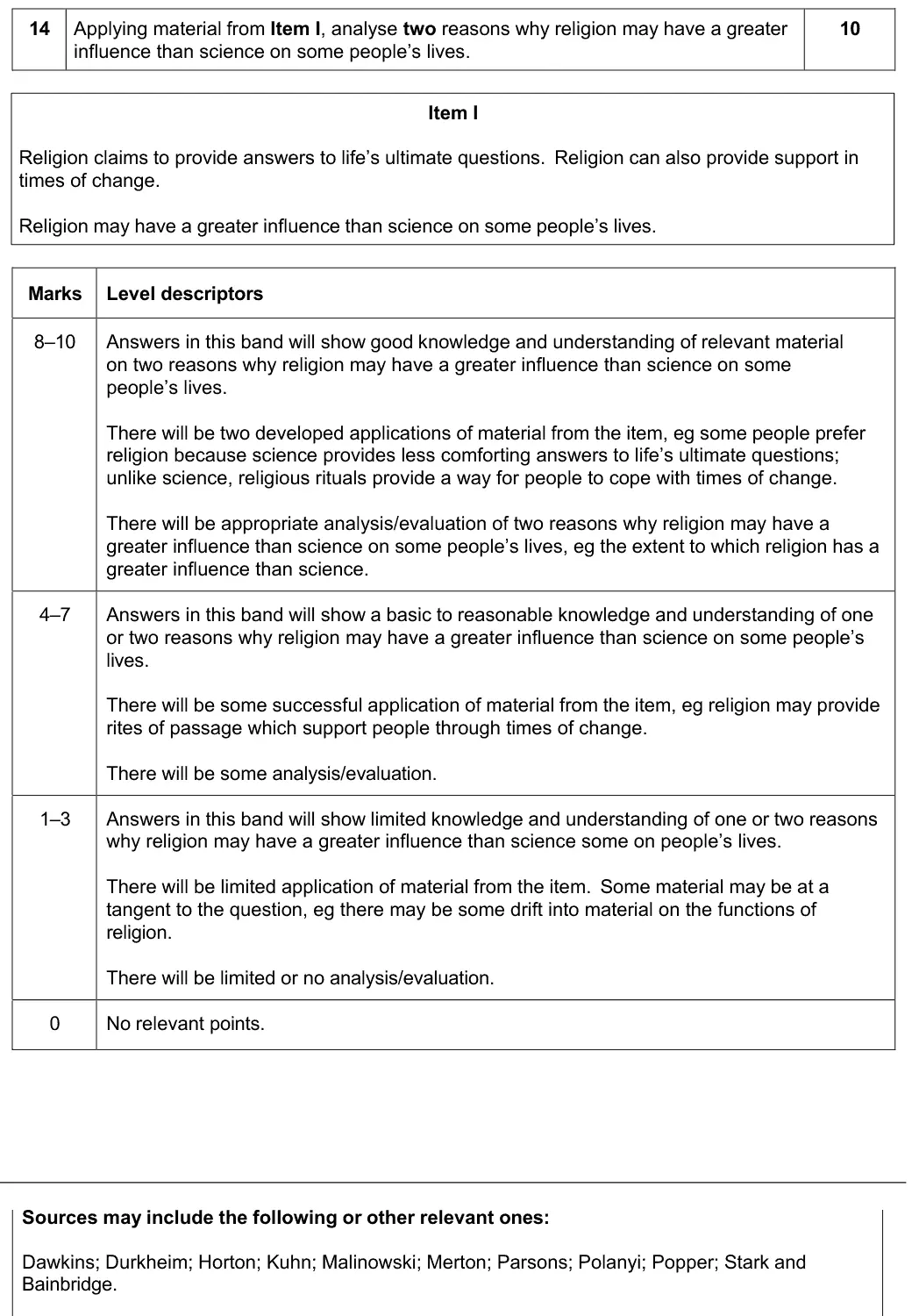
hooks: answers to ultimate questions and support in times of change
must compare with science
drift into the functions of religion in general = 1–3
reasons sometimes overlapped or lacked the science comparison
a few reversed the question
June 2022 · Paper 2 · Q1520 marksAO1=8, AO2=6, AO3=620-mark essay
Mark scheme, including the levels grid and indicative content
Examiner's comment
Most candidates answered their chosen questions in the order in which they appeared on the question paper. They therefore answered the section B 20 mark essay question last, and for many this was a relatively brief and often apparently unfinished answer. This suggests that timing is a problem for many candidates. The items for 20 mark questions are written to provide a number of ideas on which students can begin to build their answers. Students are expected to also bring in further ideas (hence “and your knowledge” in the instruction). It is often the case that a wide range of material can be relevant to these questions, and students need to be selective. For example, it may be more effective to cover a limited number of views or theories in some depth rather than to include every possible theory. There was a tendency for answers to progressively lose sight of the question and to become a list of different views. Many attempts at evaluation were learned criticisms. Evaluation is more effective where it is focused on the demands of the question. Students should also be aware that evaluation includes awareness of the strengths as well as the weaknesses of an argument or theory. Following feedback from centres regarding the advance information for the 20 mark questions, we have monitored the marking of these questions, as well as carrying out statistical analysis on student performance. Based on this analysis, we can confirm that students have performed as we expected them to on these questions, and their performance on these questions is in line with previous series. Q15 This question produced a number of thoughtful responses covering a range of relevant issues about definitions and measurement. Areas applied included church attendance, believing without belonging, private worship, online religion, televangelism, New Religious Movements, New Age Movements and various aspects of secularisation.
Notes from the mark scheme and report
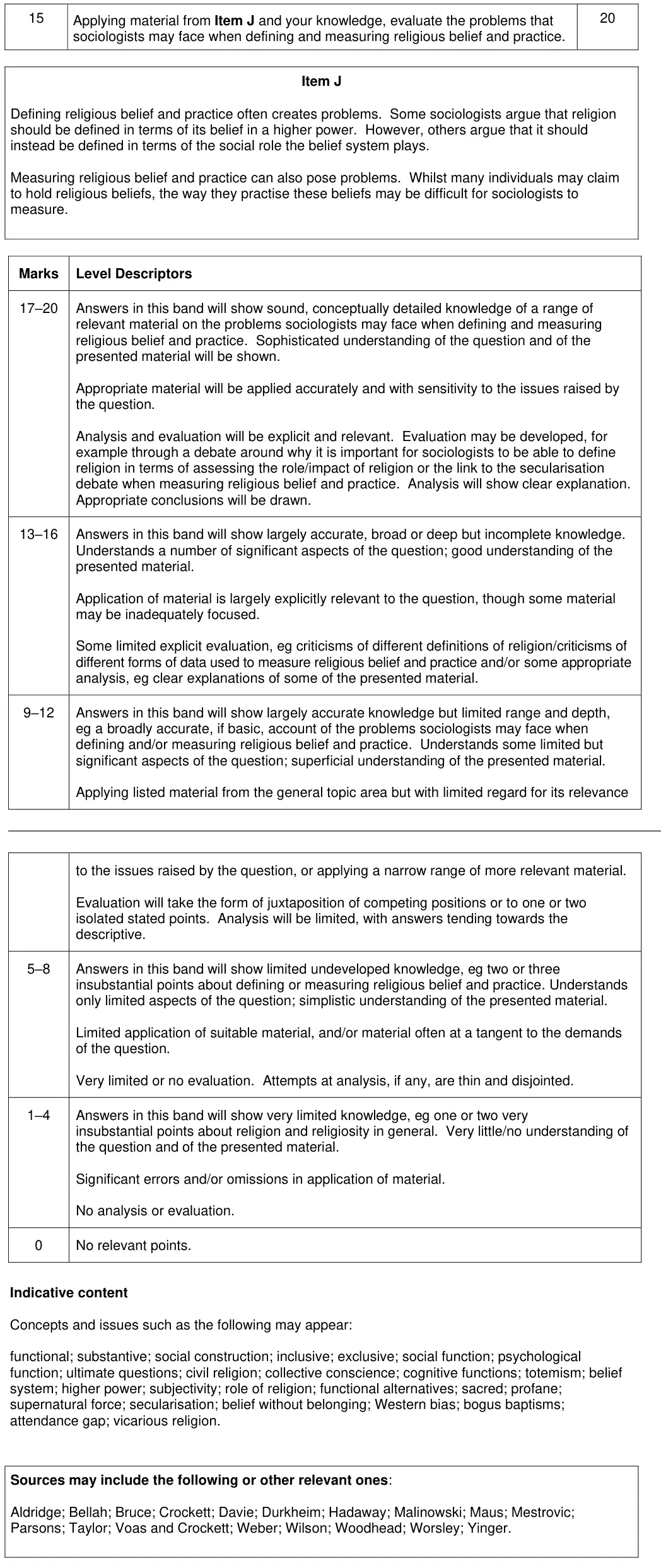
covers both defining (substantive vs functional, inclusive vs exclusive) and measuring (attendance, believing without belonging, vicarious religion)
top band links measurement problems to the secularisation debate
many thoughtful answers using online religion, televangelism, NRMs and New Age movements
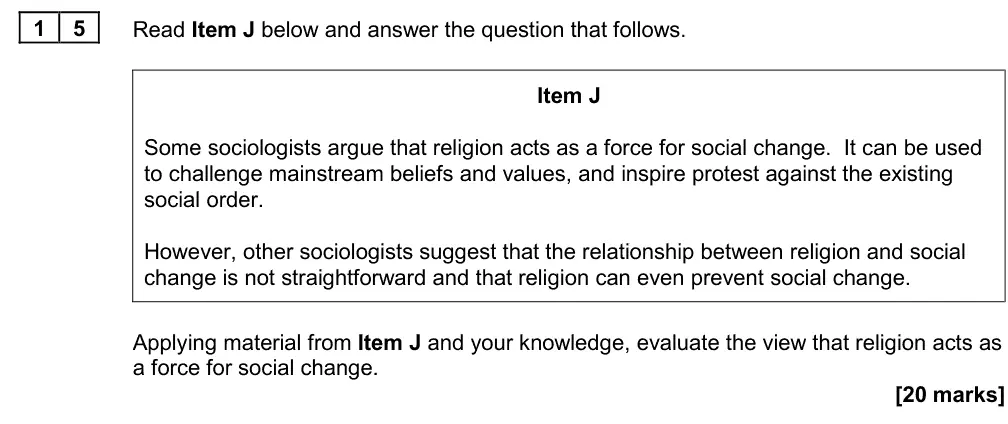
November 2020 · Paper 2 · Q1520 marksAO1=8, AO2=6, AO3=620-mark essay
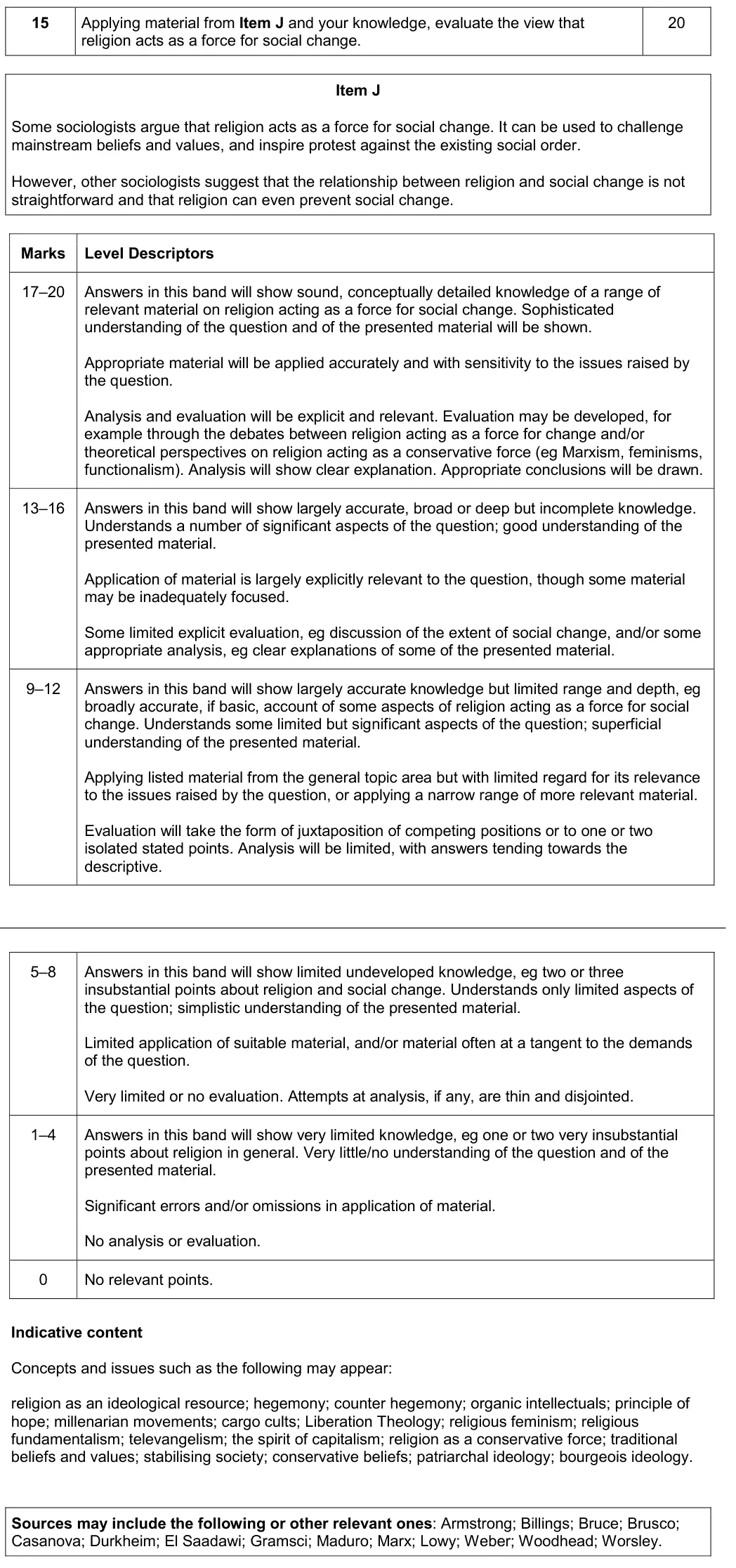
Mark scheme, including the levels grid and indicative content
Examiner's comment
There was some good knowledge shown in answers both for and against the view that religion acts as a force for social change. Examples were sometimes well evaluated (eg the extent to which religion was important in the US Civil Rights movement) but there were noticeably few contemporary examples. This was often the last question students attempted, and answers were sometimes brief, suggesting students still find time management for this paper difficult. For 20-mark questions, the item will provide useful starting points for answers but students should be encouraged to bring into their answers other points and ideas from their own knowledge. It is understandable that because of time pressure many answers lack a conclusion, but a conclusion weighing up arguments and evidence to reach a judgement will show analytical and evaluative skills that will be credited.
Notes from the mark scheme and report
apply Item J (religion inspiring protest vs preventing change)
evaluation via Marxist, feminist, functionalist views of religion as conservative or the extent of change
good use of examples such as the US Civil Rights movement but few contemporary examples
often the last question attempted, with brief answers and no conclusion
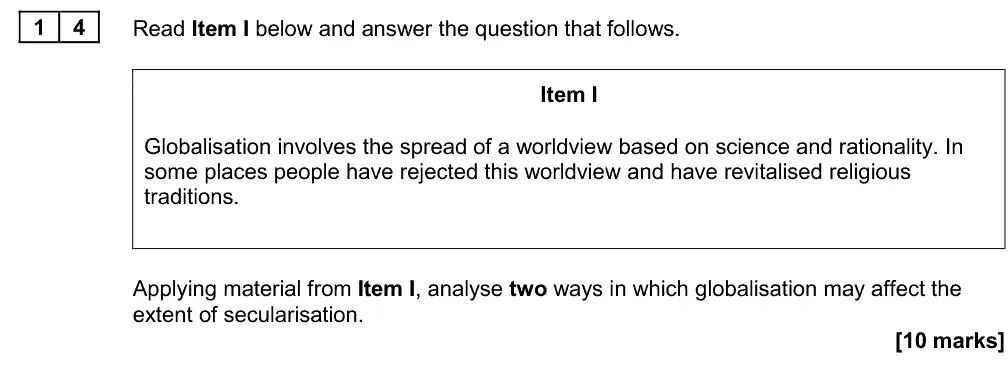
June 2019 · Paper 2 · Q1410 marksAO1=3, AO2=4, AO3=3Analyse
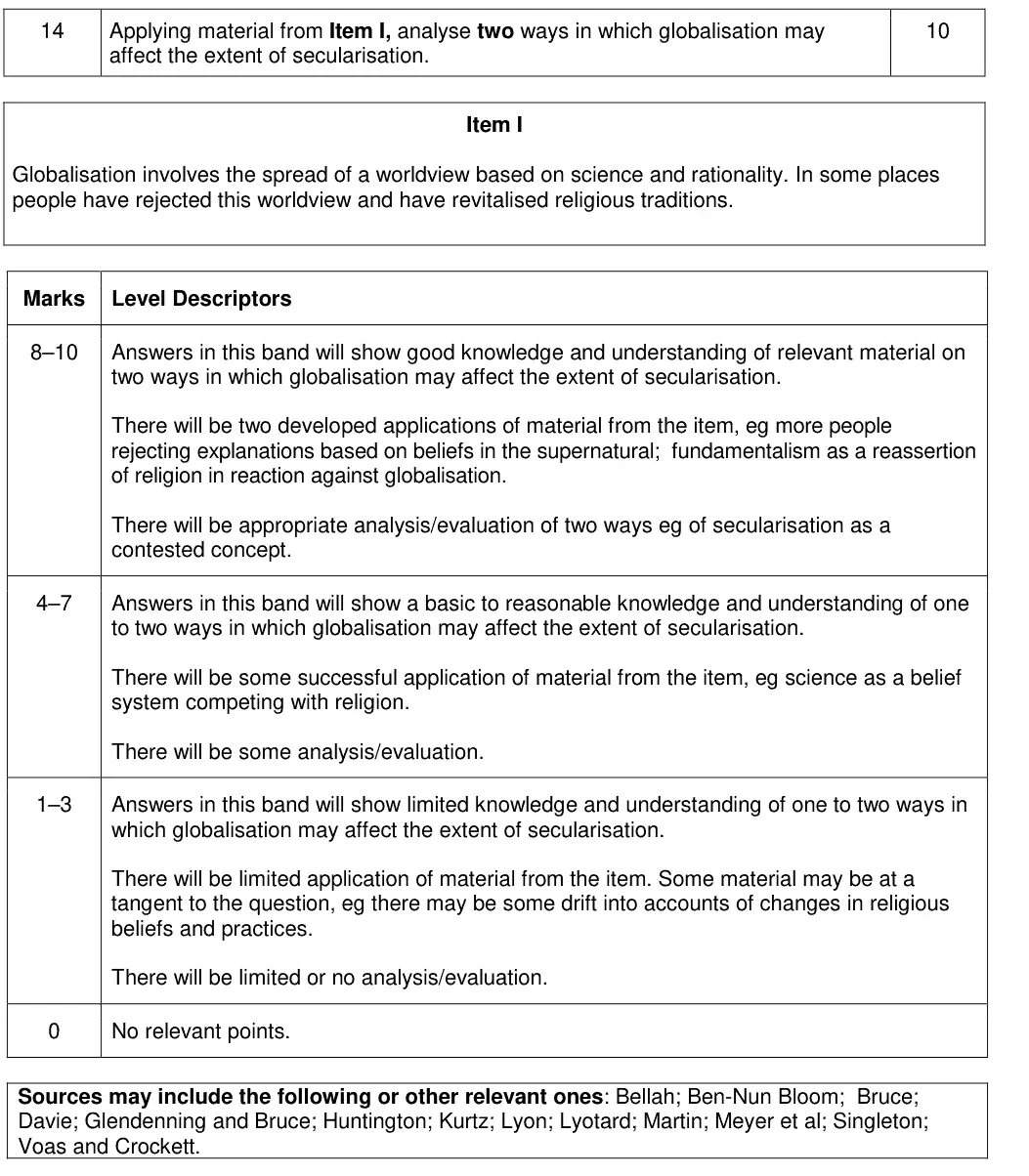
Mark scheme, including the levels grid and indicative content
Examiner's comment
Some students wrote introductory paragraphs and/or conclusions. These are not necessary, and are unlikely to gain additional marks; they also take up time. Some students made only one point in their answers, or three or more, rather than the two asked for. The word ‘two’ is put in bold in the question to try and draw students’ attention to this. Sometimes it was not clear how many points were being made. It is helpful for students to clearly indicate their two answers, with wording such as “One way is…” or by starting a new paragraph for their second point. Notably, some students wrote far more than was needed for a 10-mark response. The two types of 10-mark question, “outline and explain” and “analysis” types, are marked differently as the assessment objectives have different weightings. It is important that students are aware of this. For 10 mark “analyse” questions, the parts of the item being used should be clearly indicated, preferably by exact words being quoted. It is acceptable for two different points to be drawn from one part of the item, but answers which do not use the item cannot access the application marks. The best answers to 10-mark questions were focused, clearly stating a point and then developing it, and used sociological concepts, studies, evidence and theory as appropriate. This question was generally answered well though not all used the references in the item effectively. Some students with good knowledge neglected, in their haste, to show how their answer drew from the item and so could not reach the level of credit for which their knowledge gave them the potential. For example, many students used the reference to ‘a worldview based on science and rationality’ to argue that secularisation was spreading, while the reference to ‘revitalising religious traditions’ led to discussions of fundamentalism.
Notes from the mark scheme and report
must show which item hook each point comes from: science and rationality (secularisation spreading) and revitalised traditions (fundamentalism)
good knowledge without explicit item use could not reach the top band
AO split from AQA's standard grid for this paper (this year's mark scheme does not print it).
June 2017 · Paper 2 · Q1520 marksAO1=8, AO2=6, AO3=620-mark essay
Mark scheme, including the levels grid and indicative content
Examiner's comment
Most students answered their chosen questions in the order in which they appeared on the question paper. They therefore answered the 20 mark essay question in Section B last, and for many this was a relatively brief and often unfinished answer. This suggests that time management was a problem. Many scripts had one substantial, well developed answer to a 20 mark question and one significantly briefer one, again suggesting problems with time management. It is often the case that a wide range of material can be relevant to these questions, and students will need to be selective. For example, it may be more effective to cover a limited number of views or theories in some depth, rather than to include every possible theory. There was a tendency for answers to progressively lose sight of the question and to become a list of different views. The best answers will address all aspects of the question and will draw on theories, concepts and empirical examples or evidence. Evaluation which meets the demands of the questions is better than points of criticism which have been learned and included, regardless of the specific question that has been set. Students should also be aware that evaluation includes awareness of the strengths, as well as the weaknesses, of an argument or theory. There were some very good answers, with appropriate theories and concepts addressing both science and religion, often focused on the secularisation debate. Some weaker students approached this question without applying sociological knowledge. Despite the word ‘today’ in the question, some older material, such as the work of Malinowski, sometimes appeared, often in a descriptive way. Students should be encouraged to apply more contemporary material where appropriate.
Notes from the mark scheme and report
must address both science and religion
top band debates theories of secularisation and perspectives on science vs religion
question says 'today', so contemporary material is needed (older material such as Malinowski often descriptive)
weaker answers lacked sociological knowledge
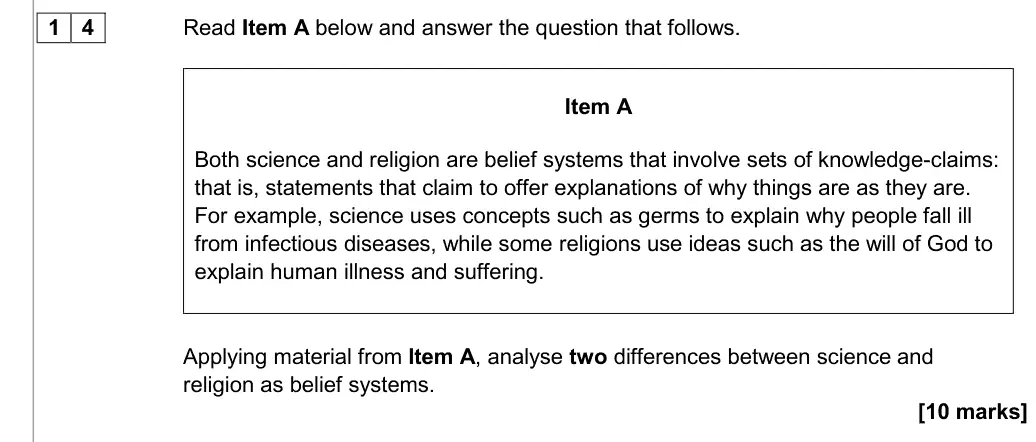
Specimen set 1 · Paper 2 · Q1410 marksAO1=3, AO2=4, AO3=3Analyse
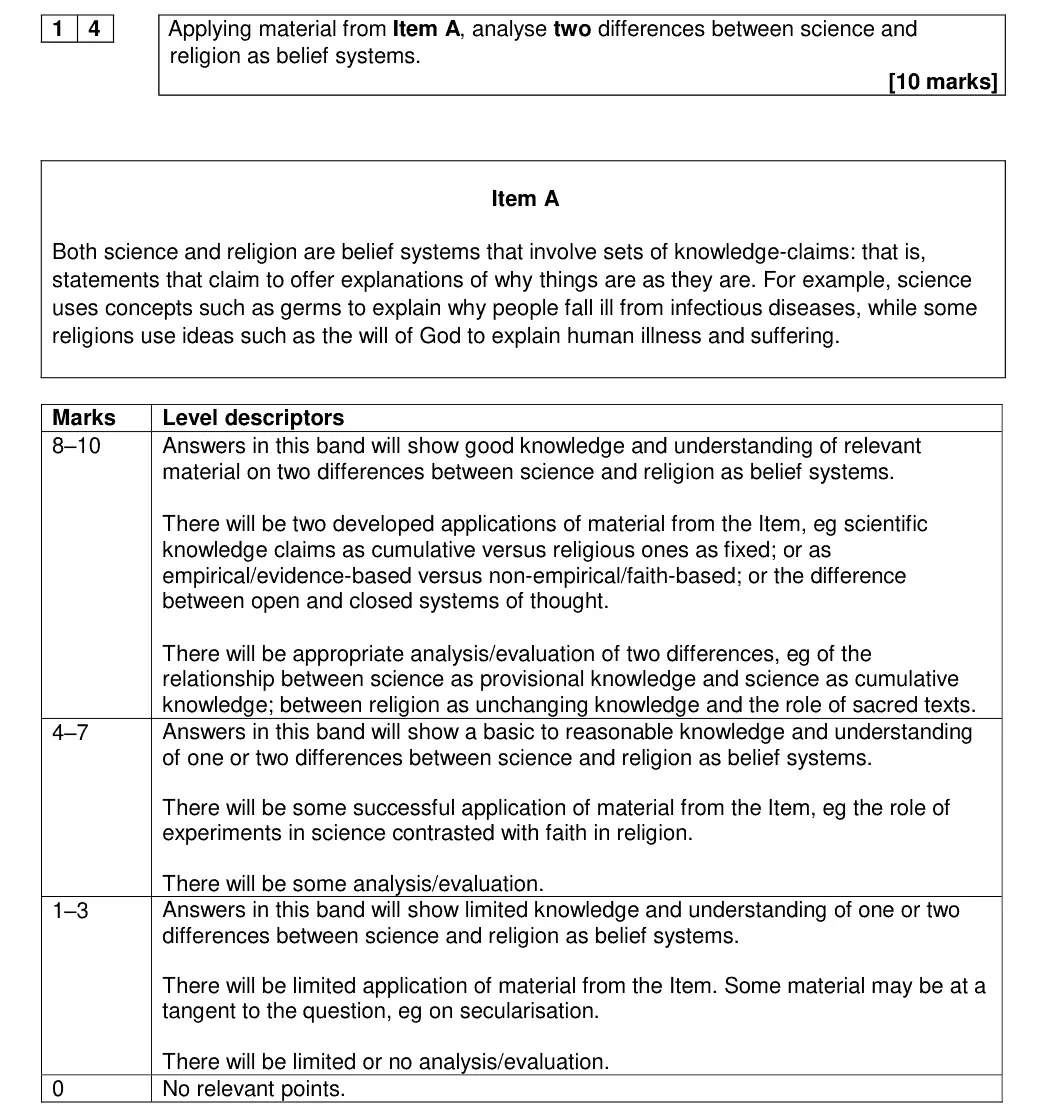
Mark scheme, including the levels grid and indicative content
Notes from the mark scheme and report
item hooks: knowledge claims, germs vs the will of God
top band e.g. cumulative vs fixed knowledge, empirical vs faith-based, open vs closed belief systems
material on secularisation is a tangent
Work with an AQA sociology tutor
Essays stuck in the middle band, or losing marks on the 10-markers? Book a trial lesson with Mark, a former AQA examiner.