Key-term cards for this topic are being written by our tutor. The past-paper questions below are ready now.
Specification statements
4.2.1-01 different conceptions of culture, including subculture, mass culture, folk culture, high and low culture, popular culture and global cultureAS
Tap a question to zoom it. The mark scheme (with the level descriptors and indicative content) and the examiner's comment open underneath.
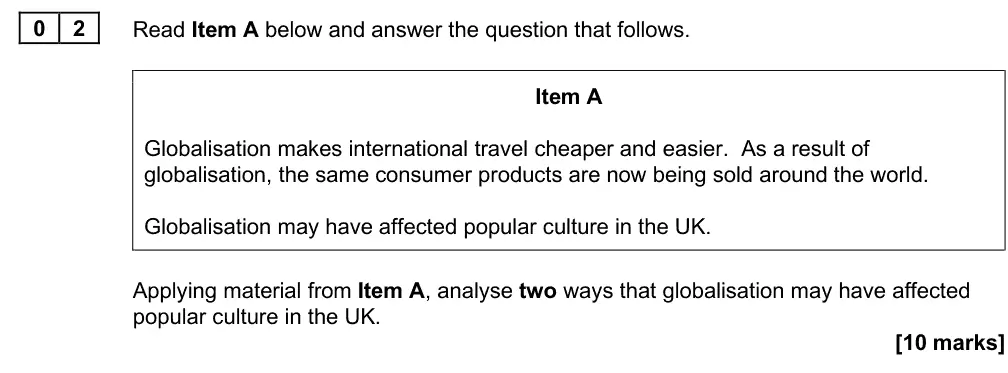
June 2025 · Paper 2 · Q210 marksAO1=3, AO2=4, AO3=3Analyse
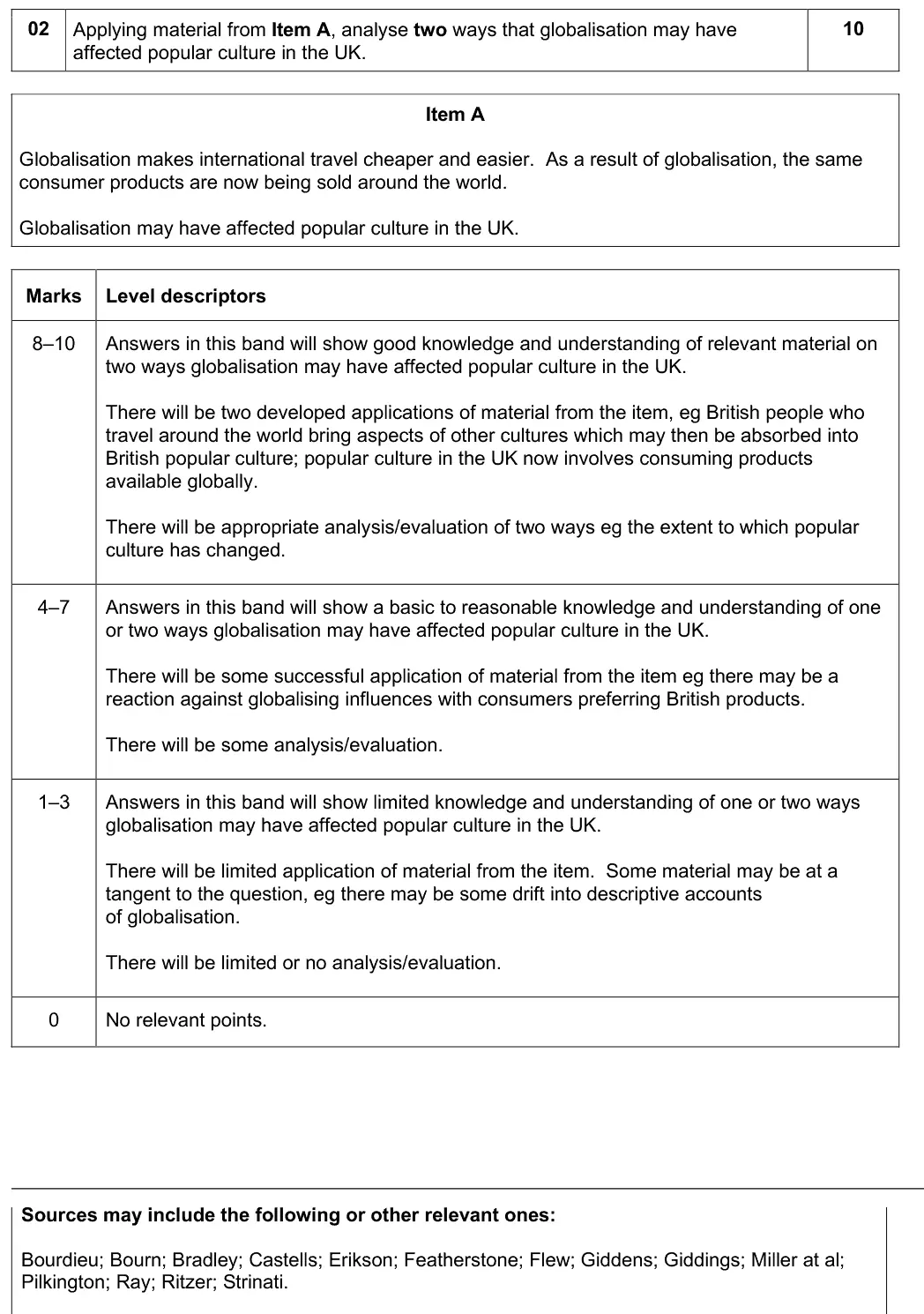
Mark scheme, including the levels grid and indicative content
Examiner's comment
The nature of these questions means that students cannot rely on reciting knowledge. Questions will ask them to bring together aspects of their sociological knowledge in ways they have not done before. It is therefore important for students to allow time to think about how to answer the question. Students should be aware that there are two types of ten-mark questions. These have different requirements and different mark schemes. There are different marks available for the assessment objectives. The items for 10 mark “analyse” questions are written to give prompts or “hooks” for student answers. These must be used to access application marks. Answers can indicate use of hooks by quoting, by a reference in parentheses or by wording (e.g. “As the item says…”). Items end with a sentence restating the question; the hooks are in the preceding part of the item. Introductions and conclusions are not required for 10-mark questions, are unlikely to help students and take up time. It is helpful if answers are set out to clearly indicate the two answers, with wording such as “One way/reason is…” or by starting a new paragraph for the second point. Answers that give more than two answers are unlikely to develop two of them sufficiently. The most successful answers to 10-mark questions were focused, clearly stating a point that addressed the question and then developing it, using sociological concepts, evidence such as an example and, where appropriate, theory. Answers were able to identify the hooks, but the development of the two ways globalisation may be linked to popular culture was often limited to brief examples. Some struggled with how to develop international travel being cheaper and easier, in relation to culture. The second hook was often better developed, using concepts such as homogenisation and cultural imperialism and often referring to the role of transnational corporations.
Notes from the mark scheme and report
item hooks: cheaper travel (bringing other cultures into UK popular culture) and the same products sold worldwide
drift into descriptive accounts of globalisation = 1–3
travel hook often undeveloped
product hook better handled via homogenisation, cultural imperialism and TNCs
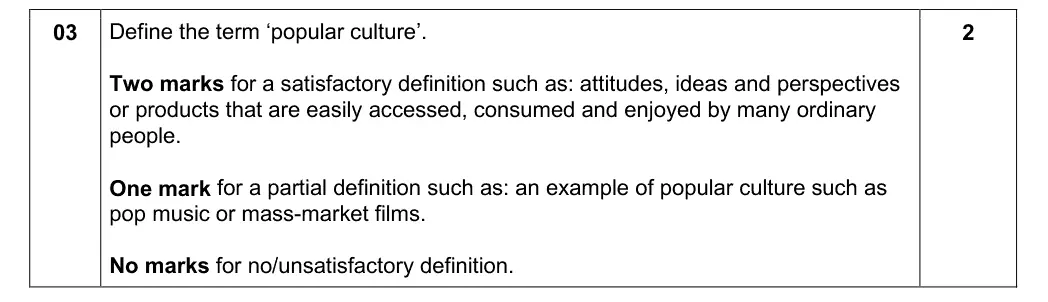
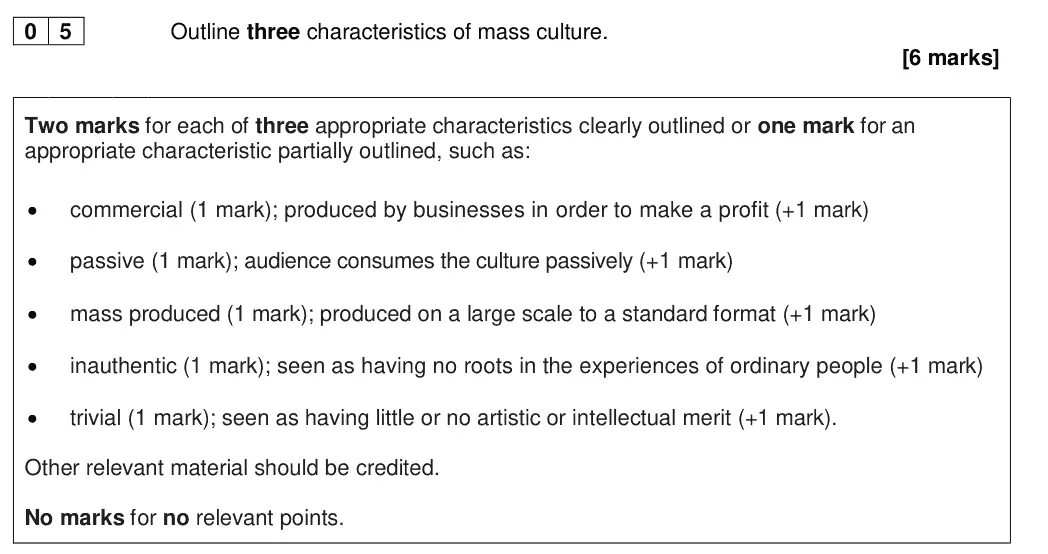
June 2025 · AS Paper 2 · Q32 marksAO1=2Define
Mark scheme
Examiner's comment
This question was drawn directly from the specification where the term mass culture features. Some students referred to mass culture as being synonymous with popular culture which was not creditworthy. Only a few answers managed to give the two-mark definition: attitudes, ideas and perspectives easily accessed. More commonly answers gained credit via examples including music and soap operas. A phrase that appeared frequently in responses was ‘liked by many people’ which was not creditworthy.
Notes from the mark scheme and report
2 marks for ideas or products easily accessed and enjoyed by many ordinary people
an example (pop music, soaps) = 1 mark
treating it as identical to mass culture or 'liked by many people' not creditworthy
few gained 2 marks
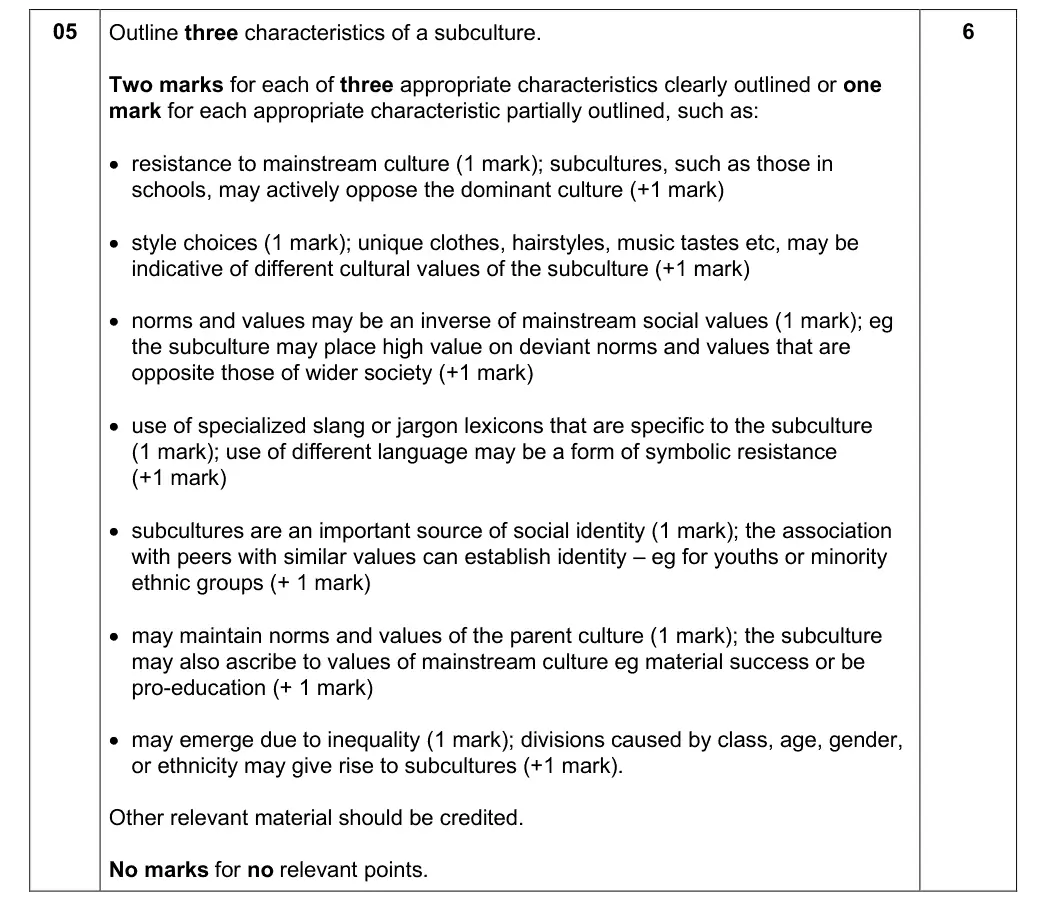
June 2025 · AS Paper 2 · Q56 marksAO1=6Outline
Mark scheme
Examiner's comment
On the 10-mark 'outline and explain' question (the fourth question in each topic area), and the 6-mark 'outline three...' question (the third question in each topic). In the 6-mark 'outline three...' questions, students could improve their performance by including a brief explanation of each identified point—such as a criticism or feature—rather than simply listing them. This question produced a wide variety of responses. Answers generally focused on differences in norms between a subculture and the dominant/mainstream culture. Successful responses referred to the “inverse” aspect of subcultures. Examples of subcultures (clothing / music ) were often used to help support answers.
Notes from the mark scheme and report
credited: resistance to mainstream, style, inverse norms and values, slang, source of identity, sharing parent-culture values, arising from inequality
best answers used the inverse-values idea
examples like clothing and music supported points
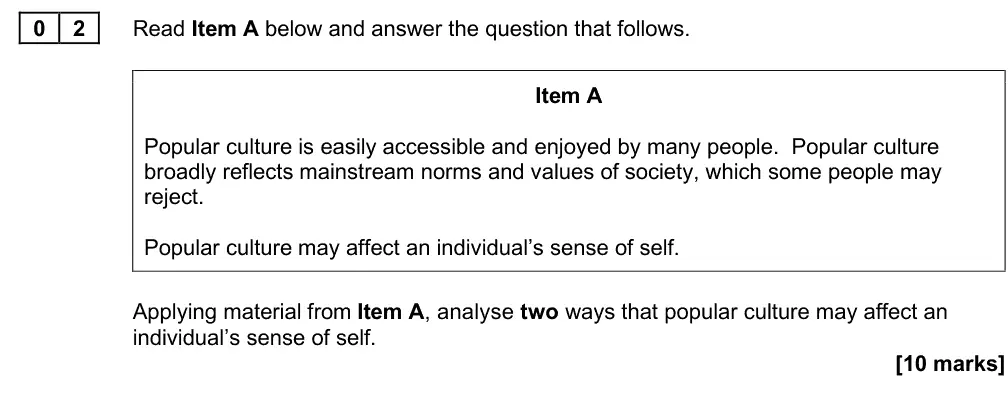
June 2024 · Paper 2 · Q210 marksAO1=3, AO2=4, AO3=3Analyse
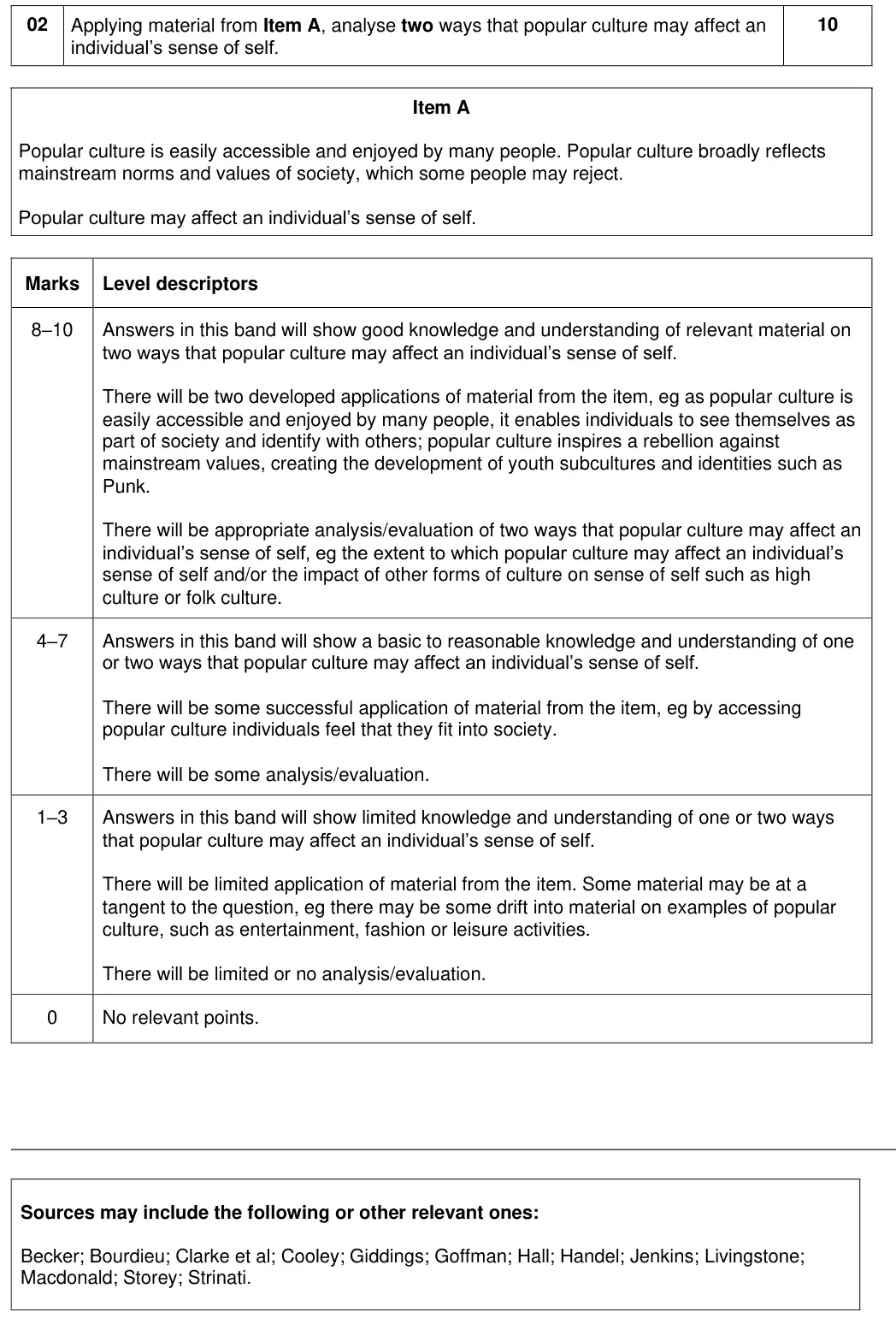
Mark scheme, including the levels grid and indicative content
Examiner's comment
The nature of these questions means that students cannot rely on reciting knowledge. Questions will ask them to bring together aspects of their sociological knowledge in ways they will not have done before. It is therefore important for students to allow time to think about how to answer the question. Students should be made aware that there are two types of 10 mark questions. These have different requirements and different mark schemes . There are different marks available for the assessment objectives. A breakdown of the marks awarded by assessment objective can be found in the mark scheme. The items for 10 mark “analyse” questions are written to give prompts or “hooks” for student answers. These have to be used to access application marks. Answers can indicate use of hooks by quoting, by a reference in parentheses or by wording ( eg “As the item says…”). Items end with a sentence restating the question; the hooks are in the preceding part of the item. Students should avoid writing all they know about a “hook”, and focus on applying the idea to the question. Introductions and conclusions are not required for 10 mark questions; they take up time and rarely improve the mark. It is helpful if answers are set out to clearly indicate the two answers, with wording such as “One way/reason is…”, or by starting a new paragraph for the second point. Answers that give more than two points are unlikely to develop two of them sufficiently. Q2: Many students were able to suggest two ways derived from the “hooks” in the item. Not all suggestions were fully developed in relation to the individual’s sense of self. Many students discussed how people reject popular culture through youth subcultures and drew on concepts like hegemony. Answers that included Marxist and postmodernist perspectives provided more comprehensive analyses and evaluations.
Notes from the mark scheme and report
two developed applications from Item A (accessible and widely enjoyed
reflects mainstream values some reject), e.g. identifying with others and fitting in, rebellion through youth subcultures such as punk
drift into examples of popular culture (fashion, entertainment) is a tangent
ways not always developed back to sense of self
good use of hegemony
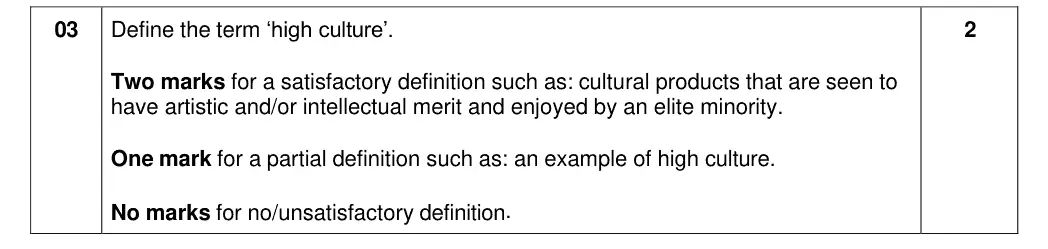
June 2024 · AS Paper 2 · Q32 marksAO1=2Define
Mark scheme
Examiner's comment
This question was drawn directly from the specification where the term high culture is listed. A significant minority of students did not appear to know the term and could not answer the question. Successful answers often made reference to the elite nature of high culture and paired it with an example of high culture such as opera / ballet / polo.
Notes from the mark scheme and report
2 marks need artistic or intellectual merit enjoyed by an elite minority
an example alone = 1 mark
a significant minority did not know the term
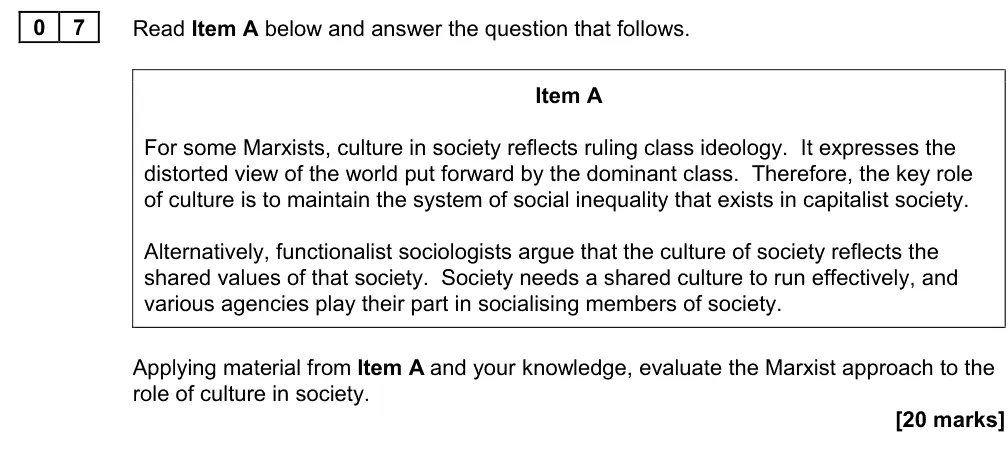
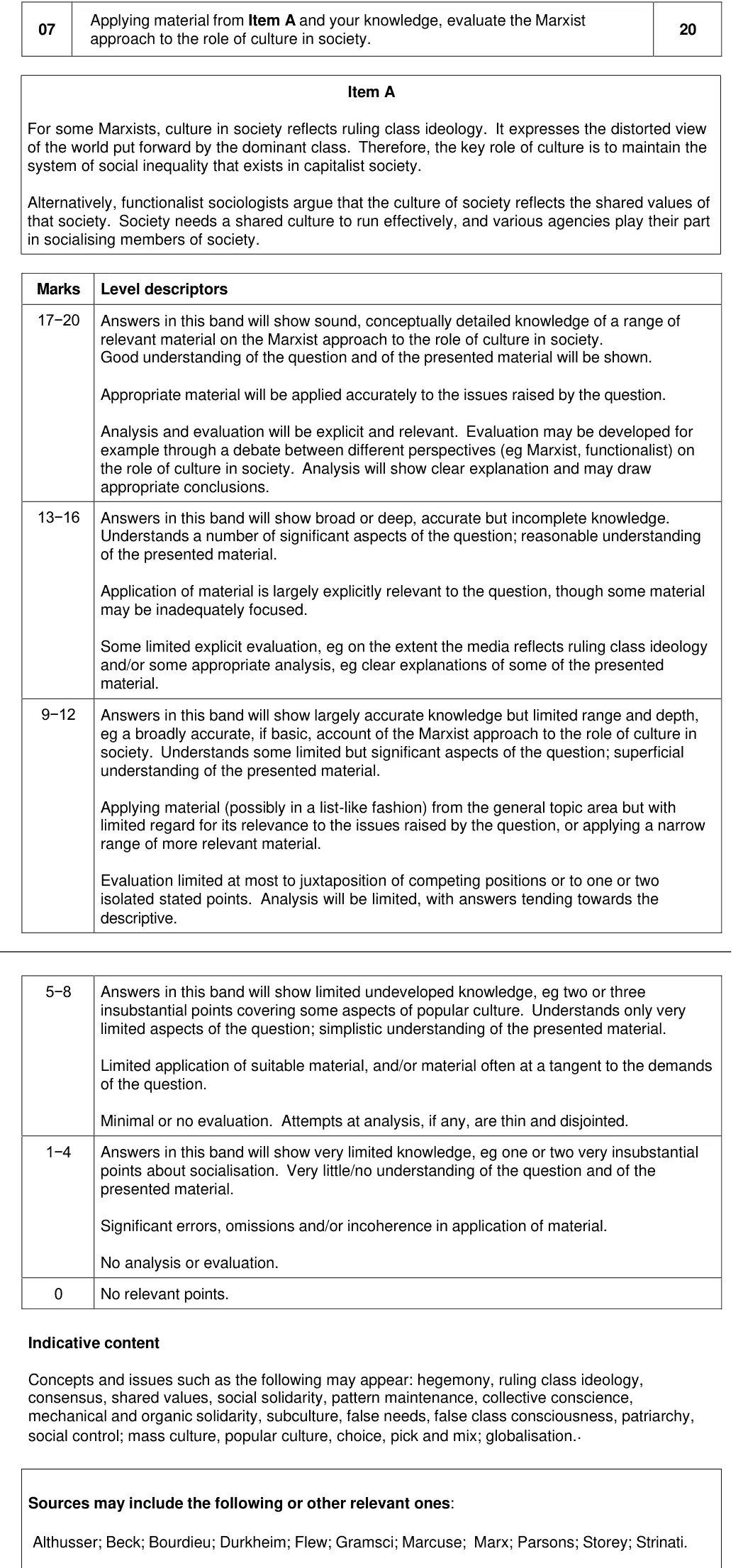
June 2024 · AS Paper 2 · Q720 marksAO1=8, AO2=6, AO3=620-mark essay
Mark scheme, including the levels grid and indicative content
Examiner's comment
Most students found this question to be straightforward. Use of the item to structure responses was common, though some students found it challenging to focus on the role of culture in society rather than present general theories of society. Marxism juxtaposed with functionalism featured heavily alongside feminism which was offered as further evaluation. Few students used interactionism or postmodernism in debates between perspectives but those that did were rewarded accordingly.
Notes from the mark scheme and report
must stay on the role of culture, not general theories of society
top band debates Marxist and functionalist views
mostly Marxism juxtaposed with functionalism plus feminism
interactionist or postmodern evaluation was rare but rewarded
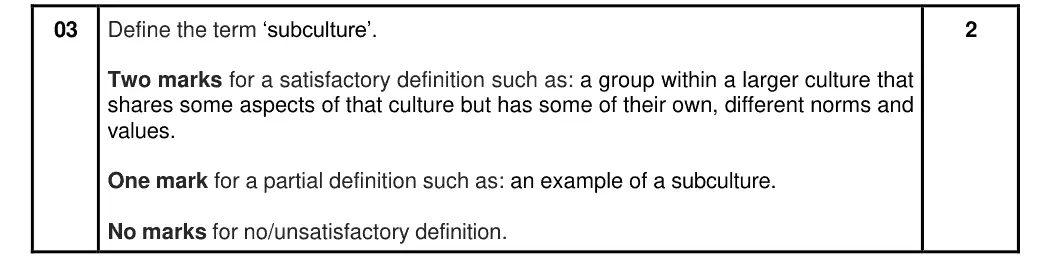
June 2022 · AS Paper 2 · Q32 marksAO1=2Define
Mark scheme
Examiner's comment
For low mark tariff questions where candidates are required to either define, explain or outline, care should be taken to ensure that points are not just identified. The majority of answers showed an understanding of a group that shared norms but failed to develop the definition in terms of sharing some aspects of larger culture. Partial marks were given for an example of a subculture. The most common examples given were class subcultures and youth subcultures such as goths.
Notes from the mark scheme and report
2 marks for a group within a wider culture sharing some of its norms and values but having distinctive ones of its own
1 mark for an example only
many omitted the link to the wider culture
common examples: youth subcultures such as goths, class subcultures
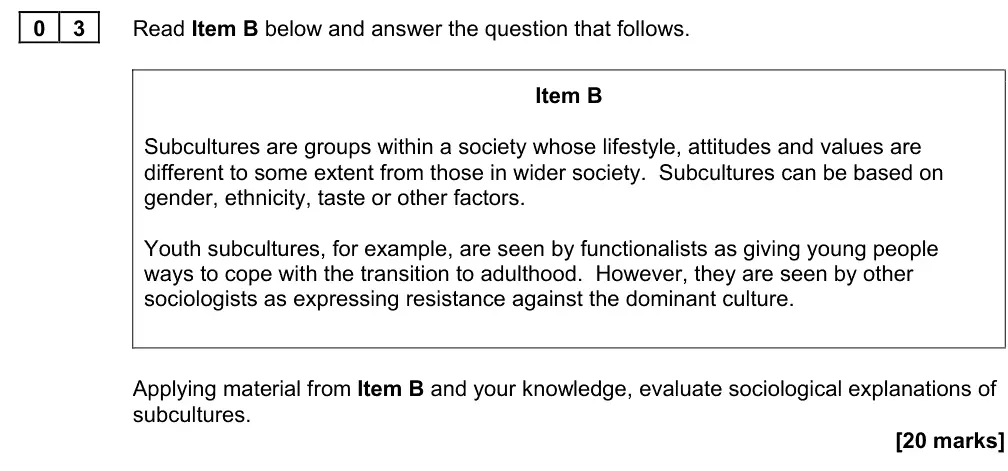
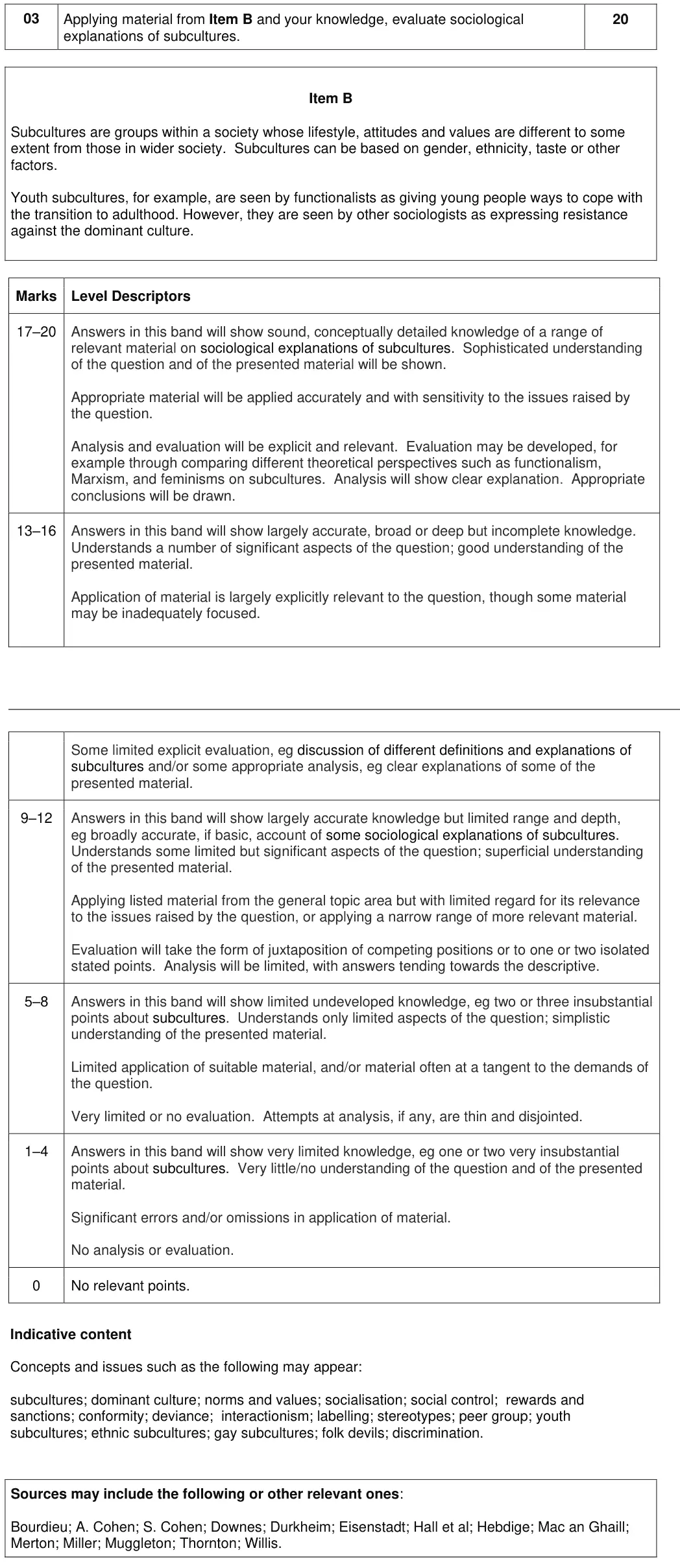
June 2022 · Paper 2 · Q320 marksAO1=8, AO2=6, AO3=620-mark essay
Mark scheme, including the levels grid and indicative content
Examiner's comment
The items for 20 mark questions are written to provide a number of ideas on which students can begin to build their answers. Students are expected to also bring in further ideas (hence “and your knowledge” in the instruction). It is often the case that a wide range of material can be relevant to these questions, and students need to be selective. For example, it may be more effective to cover a limited number of views or theories in some depth rather than to include every possible theory. There was a tendency for answers to progressively lose sight of the question and to become a list of different views. Many attempts at evaluation were learned criticisms. Evaluation is more effective where it is focused on the demands of the question. Students should also be aware that evaluation includes awareness of the strengths as well as the weaknesses of an argument or theory. Following feedback from centres regarding the advance information for the 20 mark questions, we have monitored the marking of these questions, as well as carrying out statistical analysis on student performance. Based on this analysis, we can confirm that students have performed as we expected them to on these questions, and their performance on these questions is in line with previous series. Q3 Taking their lead from the item, many answers chose youth subcultures as examples but the best drew on a range of examples of other types of subcultures as well. A range of theories were applied in the more successful answers.
Notes from the mark scheme and report
top band compares perspectives on subcultures (functionalism, Marxism, feminisms)
13–16 discusses different definitions and explanations
many stuck to youth subcultures from the item, best answers added other types (ethnic, gay, taste-based)
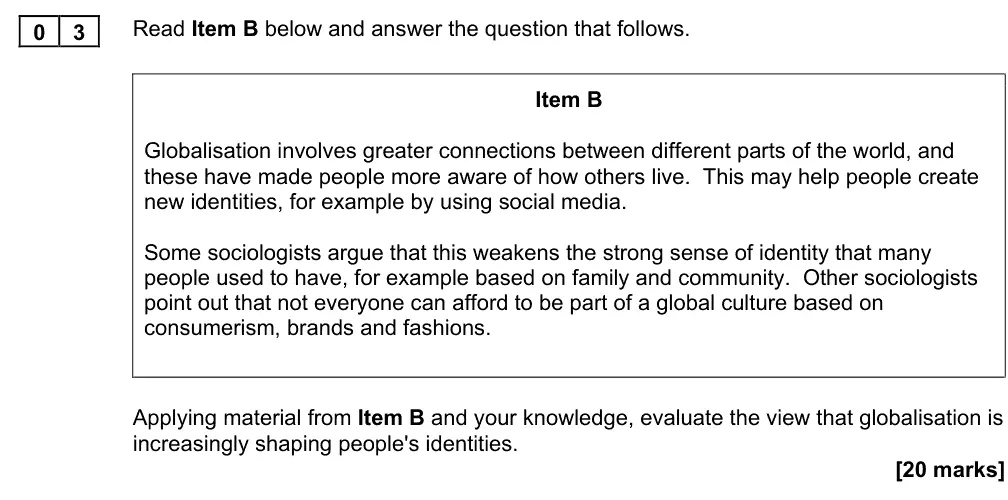
November 2021 · Paper 2 · Q320 marksAO1=8, AO2=6, AO3=620-mark essay
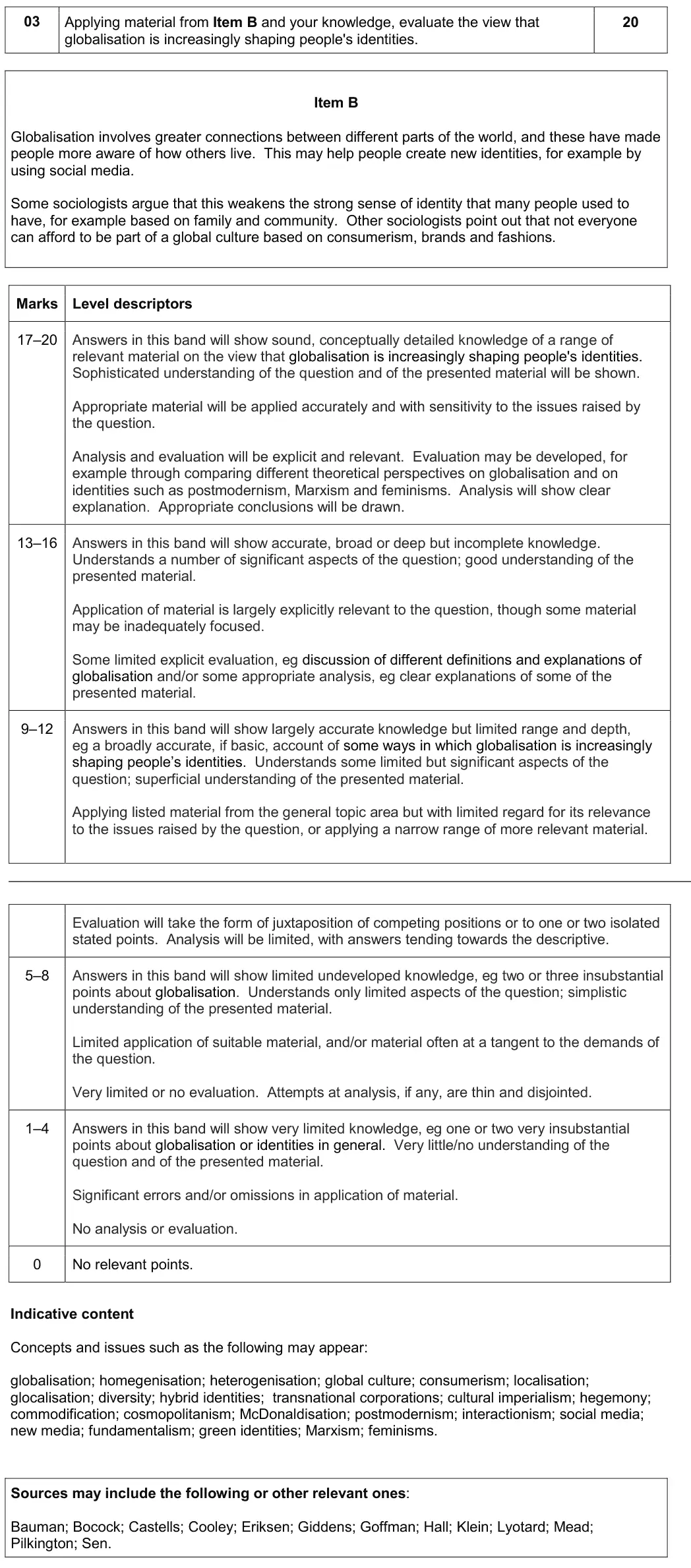
Mark scheme, including the levels grid and indicative content
Notes from the mark scheme and report
must apply Item B (social media and new identities, weakening of family and community identity, cost of global consumer culture)
top band compares perspectives such as postmodernism, Marxism and feminisms or different definitions of globalisation
concepts include hybridity, glocalisation, cultural imperialism
no examiners' report comment for this part
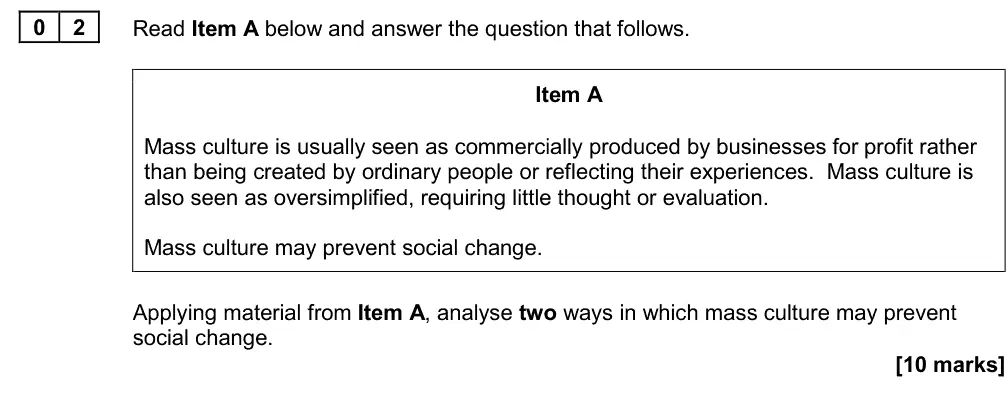
November 2020 · Paper 2 · Q210 marksAO1=3, AO2=4, AO3=3Analyse
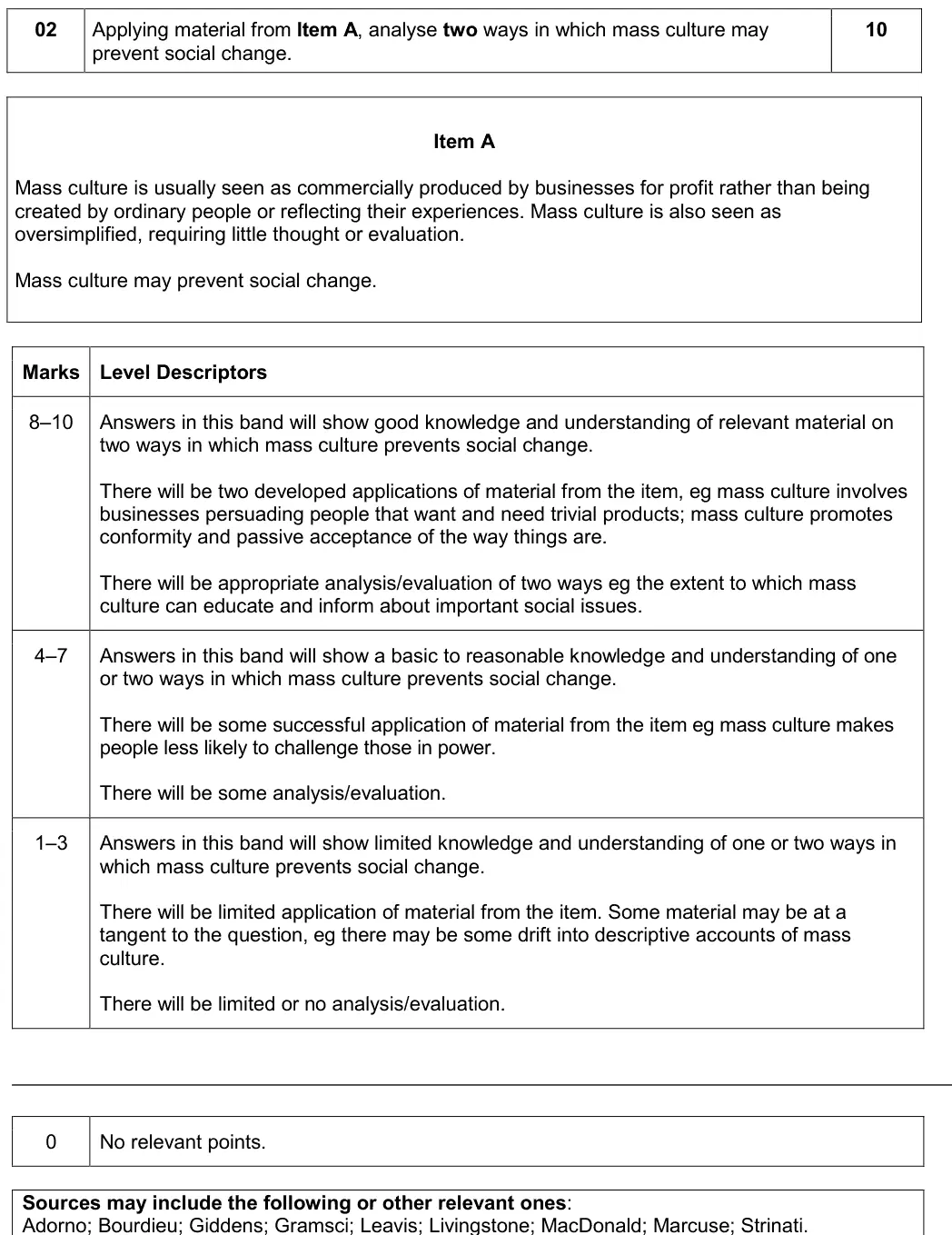
Mark scheme, including the levels grid and indicative content
Notes from the mark scheme and report
must use Item A hooks (commercial production for profit, oversimplified content needing little thought)
top band e.g. businesses creating wants for trivial products, conformity and passive acceptance
evaluation e.g. mass culture can inform about social issues
descriptive accounts of mass culture = tangent
answers not using the item cannot reach higher marks
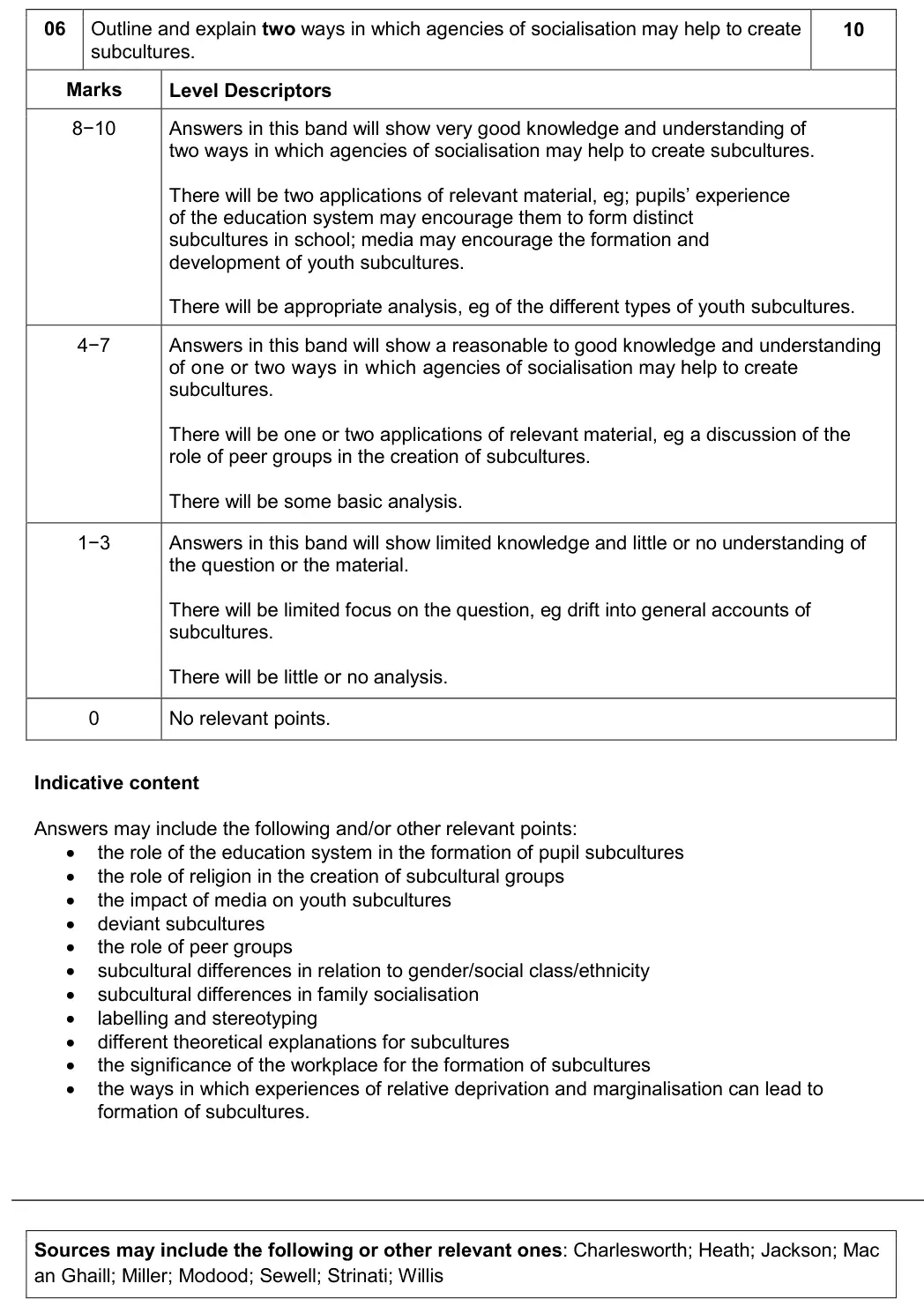
November 2020 · AS Paper 2 · Q610 marksAO1=5, AO2=3, AO3=2Outline and explain
Mark scheme, including the levels grid and indicative content
Notes from the mark scheme and report
must link a named agency (education, media, peer group, religion, family, workplace) to the creation of subcultures
general accounts of subcultures = 1–3 band
top band analyses different types of youth subculture
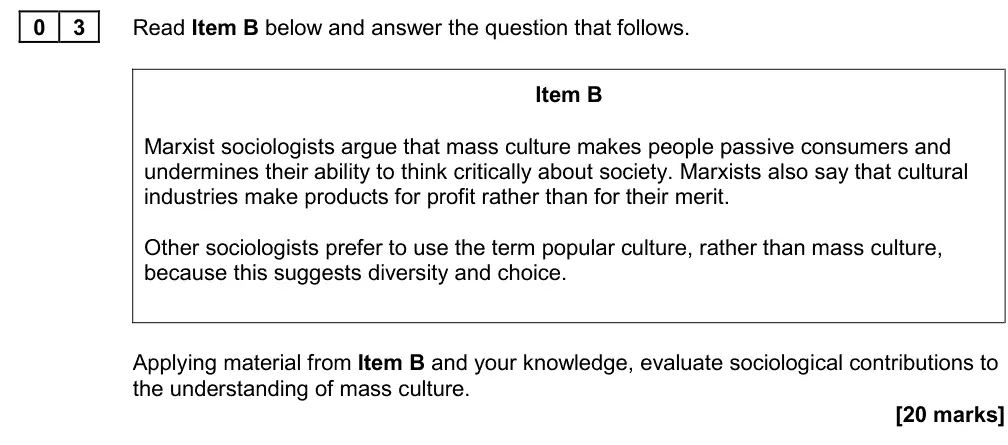
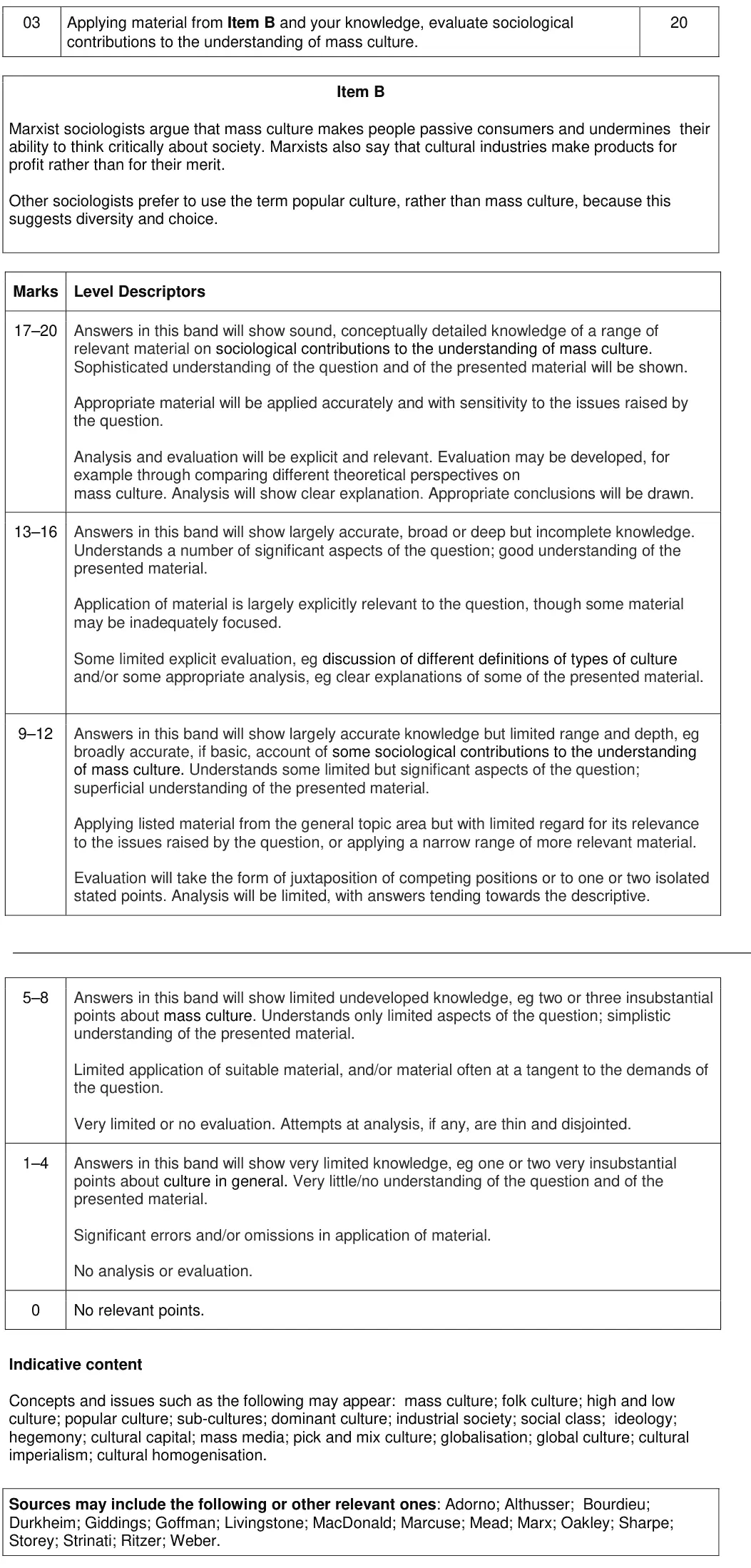
June 2019 · Paper 2 · Q320 marksAO1=8, AO2=6, AO3=620-mark essay
Mark scheme, including the levels grid and indicative content
Examiner's comment
As last year, many scripts had one substantial answer to the Section A 20-mark question and one significantly briefer one for Section B, suggesting problems with timing. There was often little evidence of planning. A wide range of material can be relevant to these questions, and students are not expected to include everything. They need to carefully choose the content and to plan their answers. The best answers will be both empirical and theoretical, for example showing knowledge of research findings and examples, and knowledge of theoretical perspectives. Some answers amounted to lists of theoretical perspectives, with learned points of criticism, and lost focus on the question itself. While the items are intended as a helpful starting point for answers, they should not be taken by students as a full list of what is relevant; better answers will draw in other relevant knowledge and ideas. Most answers showed a good understanding of mass culture, with examples, and many were able to compare mass culture with other types of culture (popular, high, folk etc) with varying degrees of success. Better answers were able to develop and discuss sociologically ideas from the item such as the view that consumers are passive and that cultural industries exist primarily to make a profit.
Notes from the mark scheme and report
top band compares theoretical perspectives on mass culture
better answers developed item hooks (passive consumers, profit-driven cultural industries) and contrasted mass with popular, high and folk culture
AO split from AQA's standard grid for this paper (this year's mark scheme does not print it).
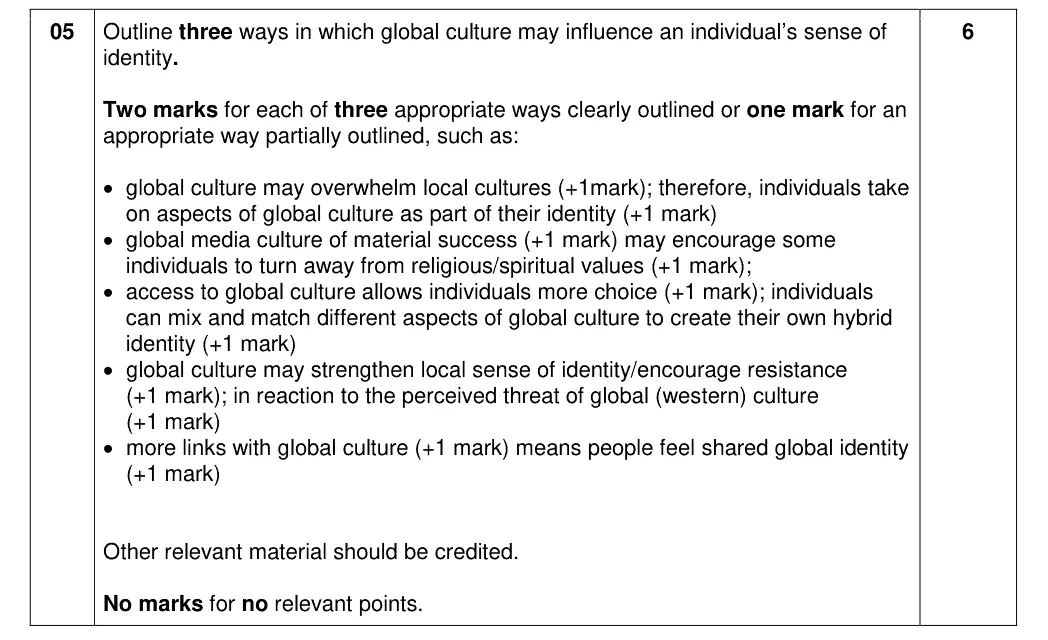
June 2019 · AS Paper 2 · Q56 marksAO1=6Outline
Mark scheme
Examiner's comment
Many students struggled with this question. Successful answers identified the way global culture can give individuals more choice to create hybrid identities. Other popular responses included the idea that global culture may strengthen local sense of identity as resistance to the perceived threat of global culture. However, a lot of answers just outlined examples of global culture without relating them to the idea of an individual’s sense of identity.
Notes from the mark scheme and report
AO grid not printed
2 marks for each of three ways clearly outlined
credited: hybrid identities through choice, local resistance to global culture, shared global identity, local cultures overwhelmed
many just gave examples of global culture with no link to the individual's identity
AO split from AQA's standard grid for this paper (this year's mark scheme does not print it).
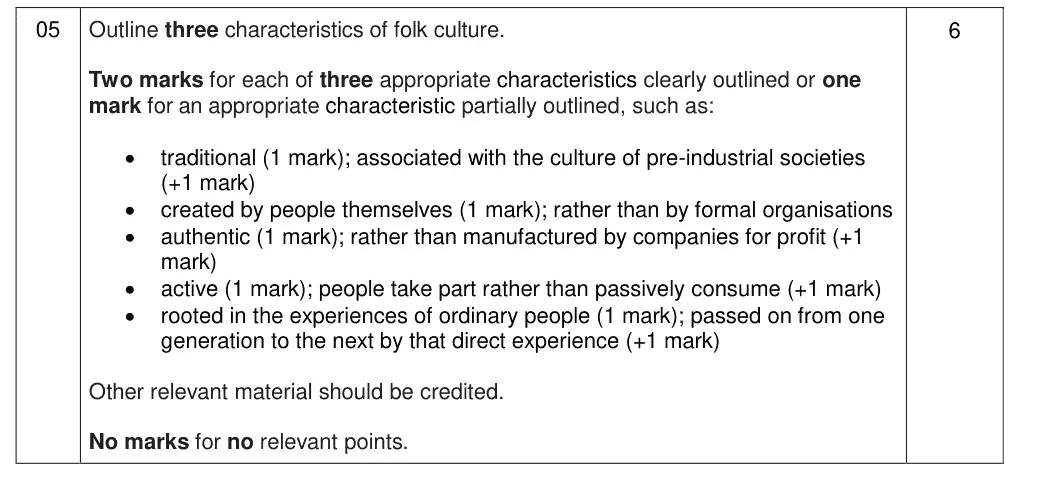
June 2018 · AS Paper 2 · Q56 marksAO1=6Outline
Mark scheme
Examiner's comment
Successful answers made reference to characteristics such as, authentic, traditional and rooted in the experiences of ordinary people. Most of these answers were able elaborate on these to gain the additional mark. For example, folk culture is an authentic culture as opposed to culture manufactured by commercial organisations. A number of students seemed unfamiliar with the concept of folk culture.
Notes from the mark scheme and report
2 marks per characteristic clearly outlined
credited: traditional/pre-industrial, made by people themselves, authentic not commercial, active participation, rooted in ordinary people's experience and passed down
many unfamiliar with the term
mark scheme omits the +1 on the 'created by people themselves' bullet
AO split from AQA's standard grid for this paper (this year's mark scheme does not print it).
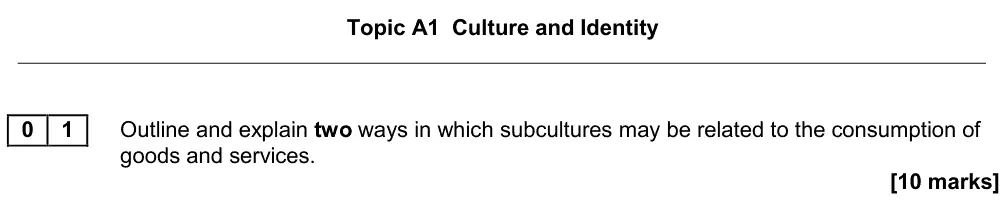
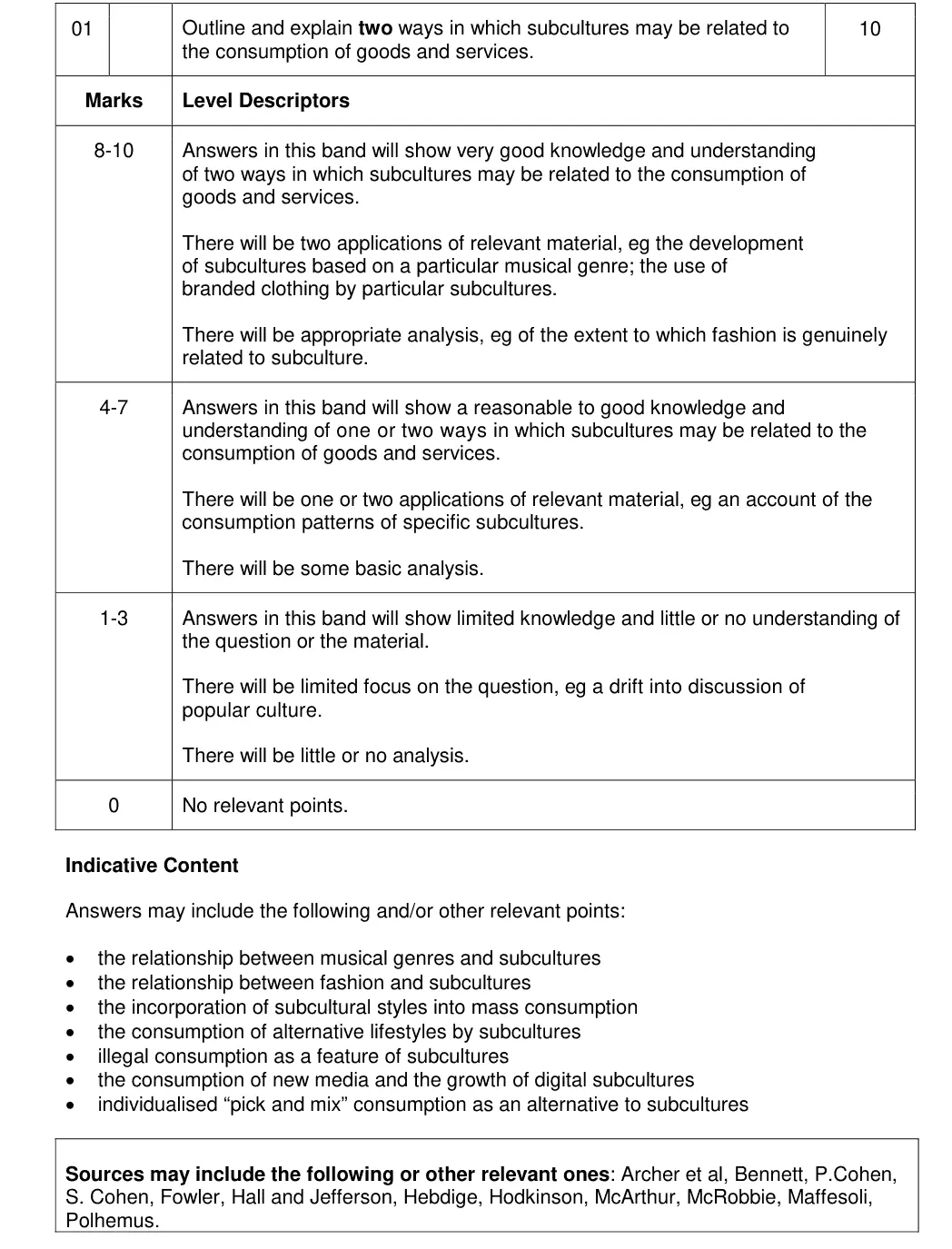
June 2017 · Paper 2 · Q110 marksAO1=5, AO2=3, AO3=2Outline and explain
Mark scheme, including the levels grid and indicative content
Examiner's comment
A number of students wrote introductory paragraphs and/or conclusions. These are not necessary, and are unlikely to gain additional marks. A number of students made only one point in their answer, or three or more, rather than the two asked for. In these cases, the two best answers were rewarded and will be in future series. It is helpful for students to clearly indicate their two answers, with wording such as “One way is…” or by starting a new paragraph for their second point. Schools and colleges should note that there is no reference in the mark scheme for 10 mark ‘outline and explain’ questions to evaluation, and that evaluation is not a requirement for answers to these questions. The assessment objective allocations are different in the two types of 10 mark questions, and students should be made aware of this. There was a wide range of responses to these questions. A minority of students wrote very brief answers. For these 10 mark items, a simple statement of two ways, reasons or factors, without development, is not sufficient to access more than the lower marks in the mark range. The best answers were focused, clearly stating a point and then developing it, with use of sociological concepts, evidence and theory where appropriate, in ways that demonstrated the skills expected from the targeted assessment objectives. There was a tendency, however, for many answers to focus on the first aspect of the question at the expense of the second. Students need guidance on how to approach these questions and how to best demonstrate their sociological understanding. The nature of these questions means that students cannot rely on reciting knowledge. They require students to bring together two aspects of their sociological knowledge in a way that they are unlikely to have done before. Answers will sometimes require claims that students may be unsure of because they do not know of specific evidence (for example, in question 5, whether migrants from Eastern Europe who are single workers tend to live alone or in shared households). However, answers that are sociologically plausible will be accepted. Many answered this by describing features, such as style of dress or preferred music, of particular subcultures with less success in developing general points about the relationship between subcultures and the consumption of goods and services.
Notes from the mark scheme and report
two ways subcultures relate to consumption (music genres, branded clothing/fashion, incorporation into mass consumption, pick-and-mix consumption)
drift into popular culture in general = 1–3
many just described the dress or music of particular subcultures without making a general point about consumption
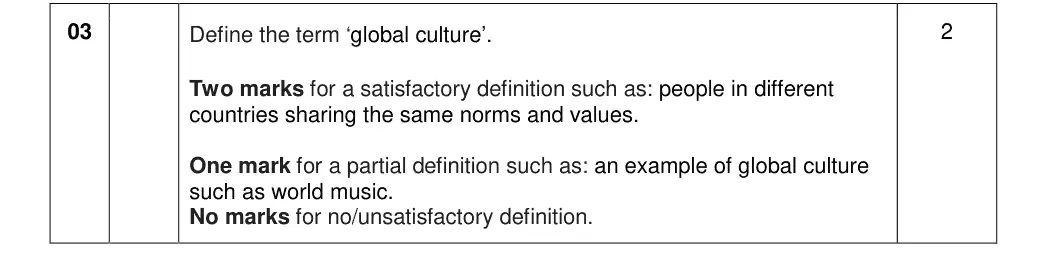
June 2017 · AS Paper 2 · Q32 marksAO1=2Define
Mark scheme
Examiner's comment
The majority of answers were able to explain ‘global’ with reference to people in different countries. More often the cultural aspect was more difficult to define. Successful students were able to discuss the idea of shared norms and values.
Notes from the mark scheme and report
2 marks: people in different countries sharing the same norms and values
1 mark for an example such as world music
the 'culture' part was harder to define than 'global'
June 2016 · AS Paper 2 · Q56 marksAO1=6Outline
Mark scheme
Examiner's comment
In the 6 mark question some students are writing far too much, thereby losing focus on the precise wording of the question. This question proved quite difficult. A number of students seemed unfamiliar with the term and instead discussed changing aspects of popular culture, with limited reference to the question. Successful answers identified the passive, commercial, trivial and mass produced aspects of mass culture.
Notes from the mark scheme and report
2 marks per characteristic clearly outlined
credited: commercial, passive audience, mass produced, inauthentic, trivial
many did not know the term and drifted into popular culture
found difficult
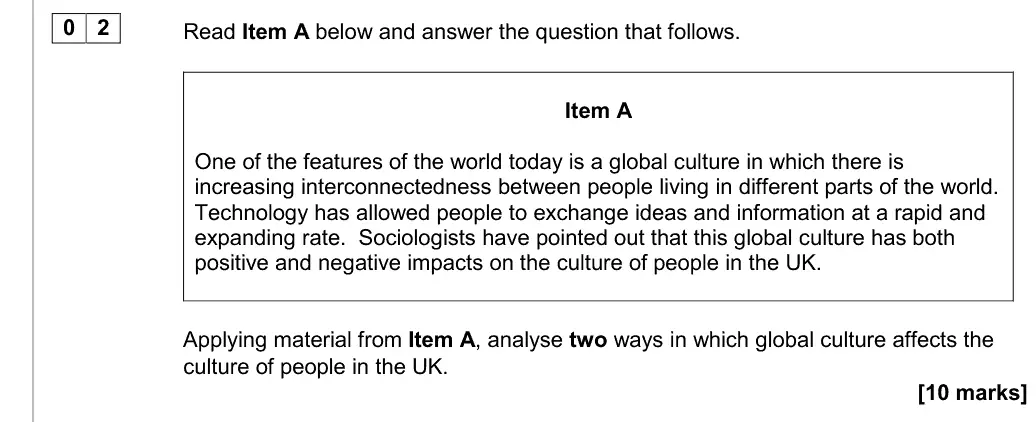
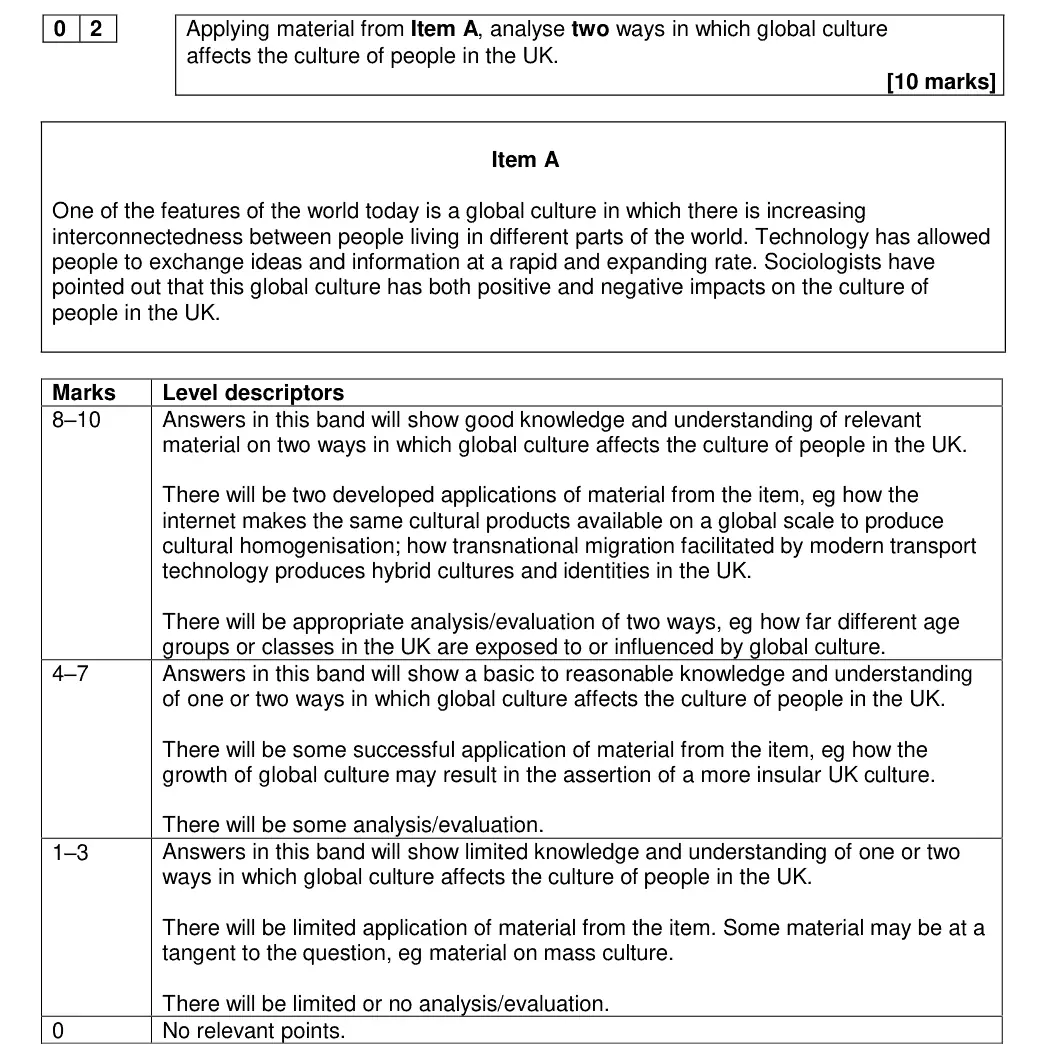
Specimen set 1 · Paper 2 · Q210 marksAO1=3, AO2=4, AO3=3Analyse
Mark scheme, including the levels grid and indicative content
Notes from the mark scheme and report
item hooks: global interconnectedness and technology
top band e.g. cultural homogenisation via the internet, hybrid cultures through migration
analysis of how exposure differs by age or class
material on mass culture is a tangent
Work with an AQA sociology tutor
Essays stuck in the middle band, or losing marks on the 10-markers? Book a trial lesson with Mark, a former AQA examiner.