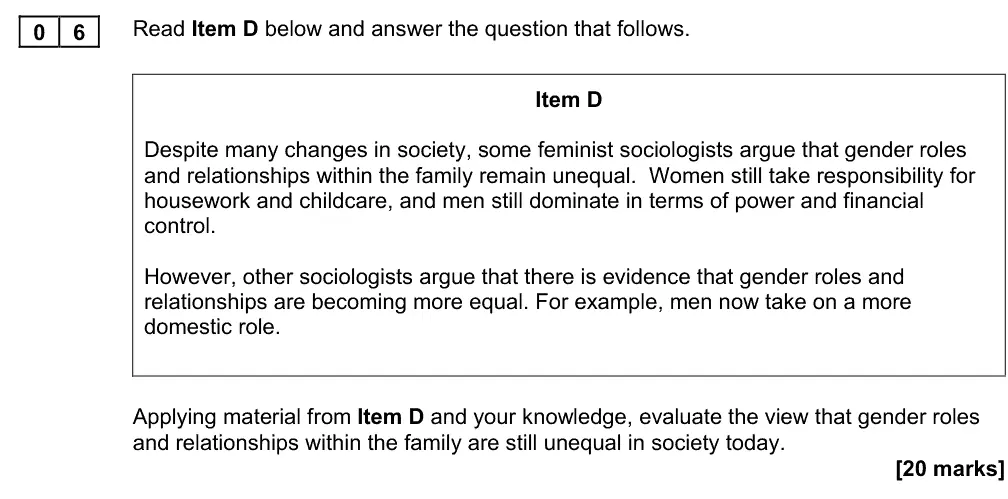
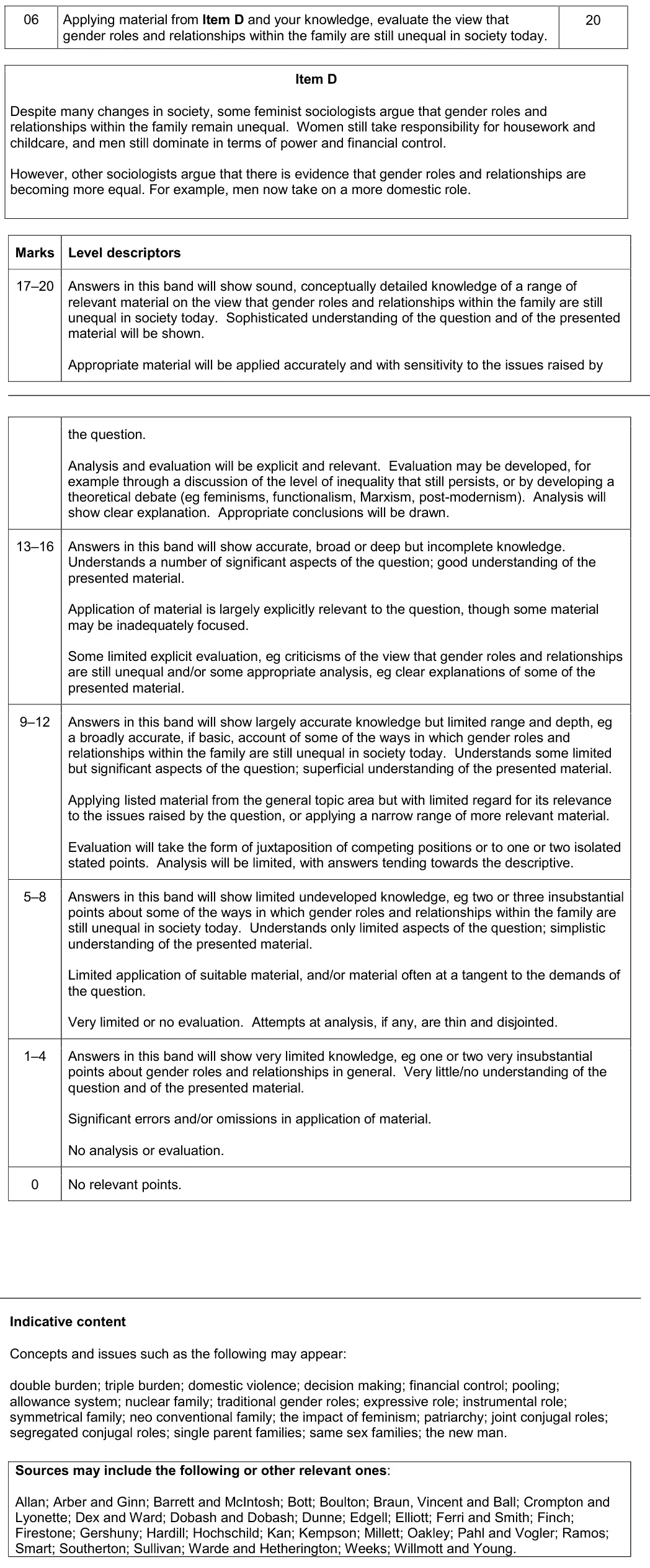
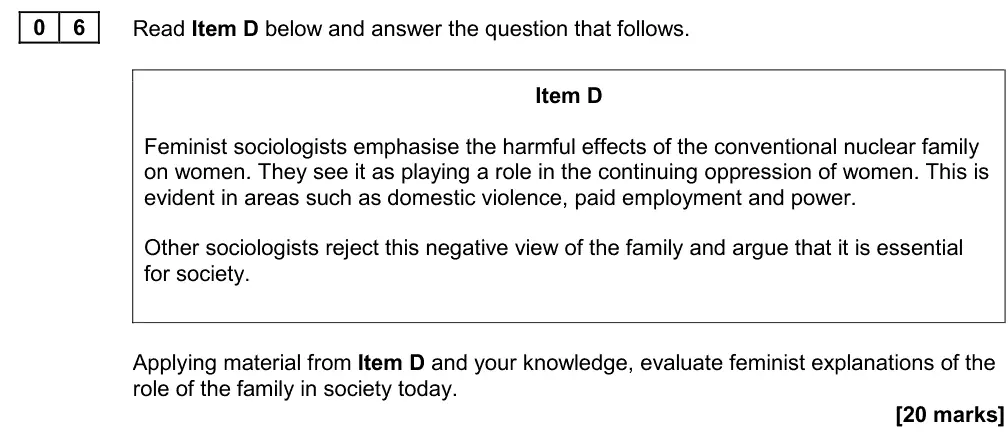
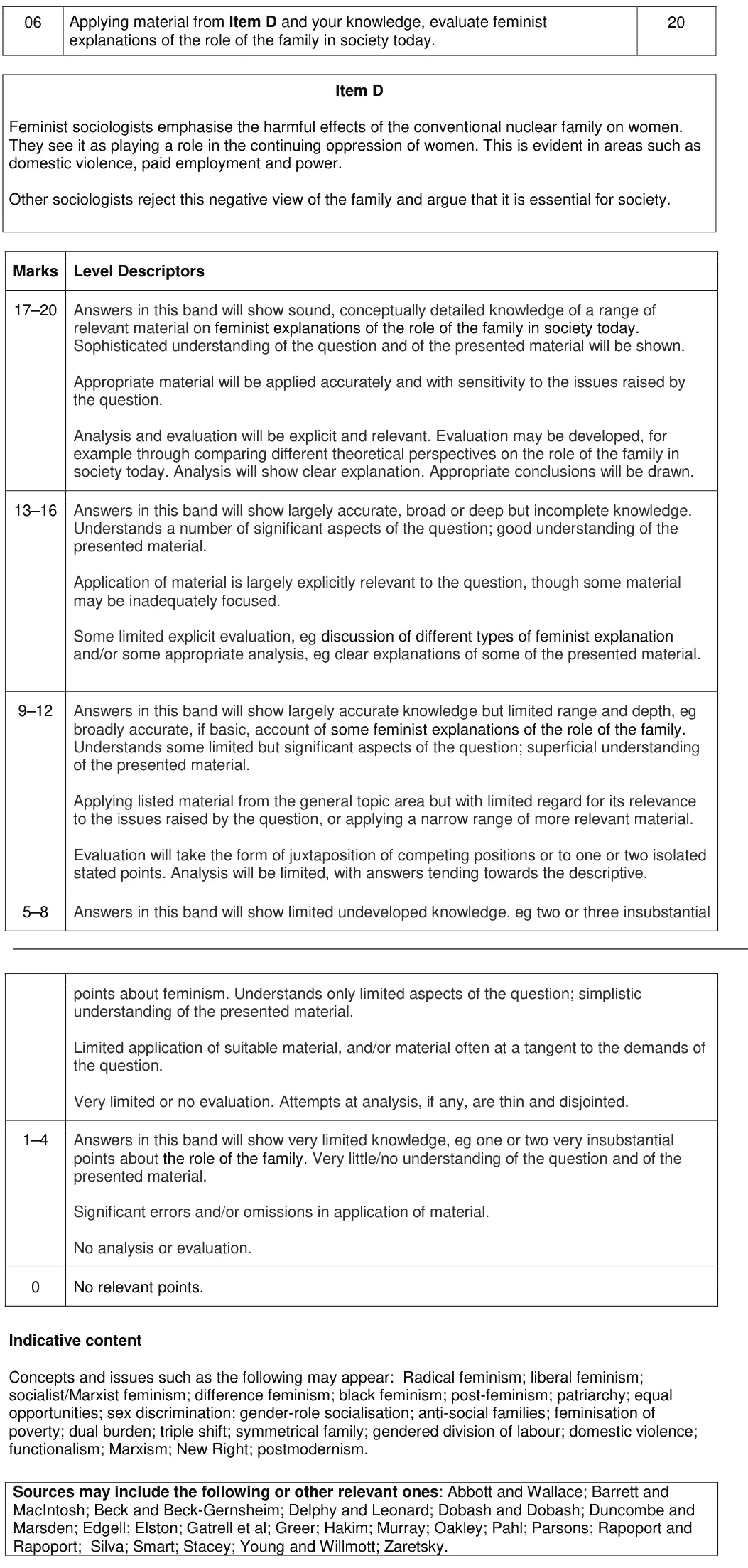
Applying material from Item D and your knowledge, evaluate the view that gender roles and relationships within the family are still unequal in society today.
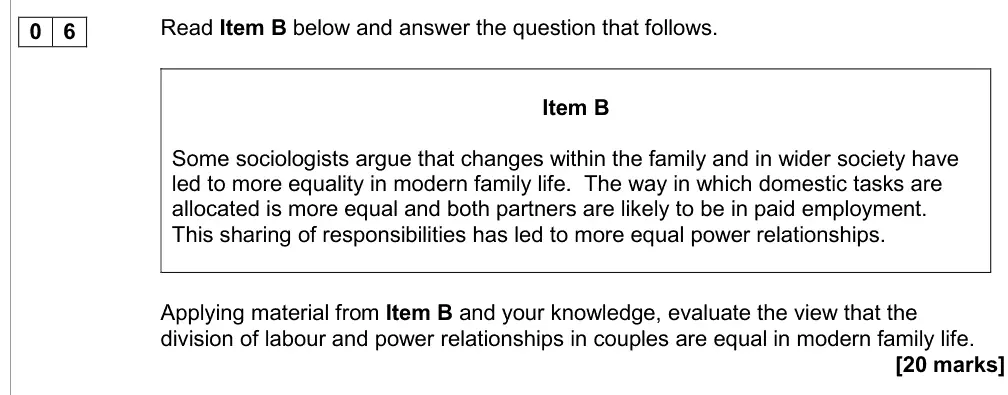
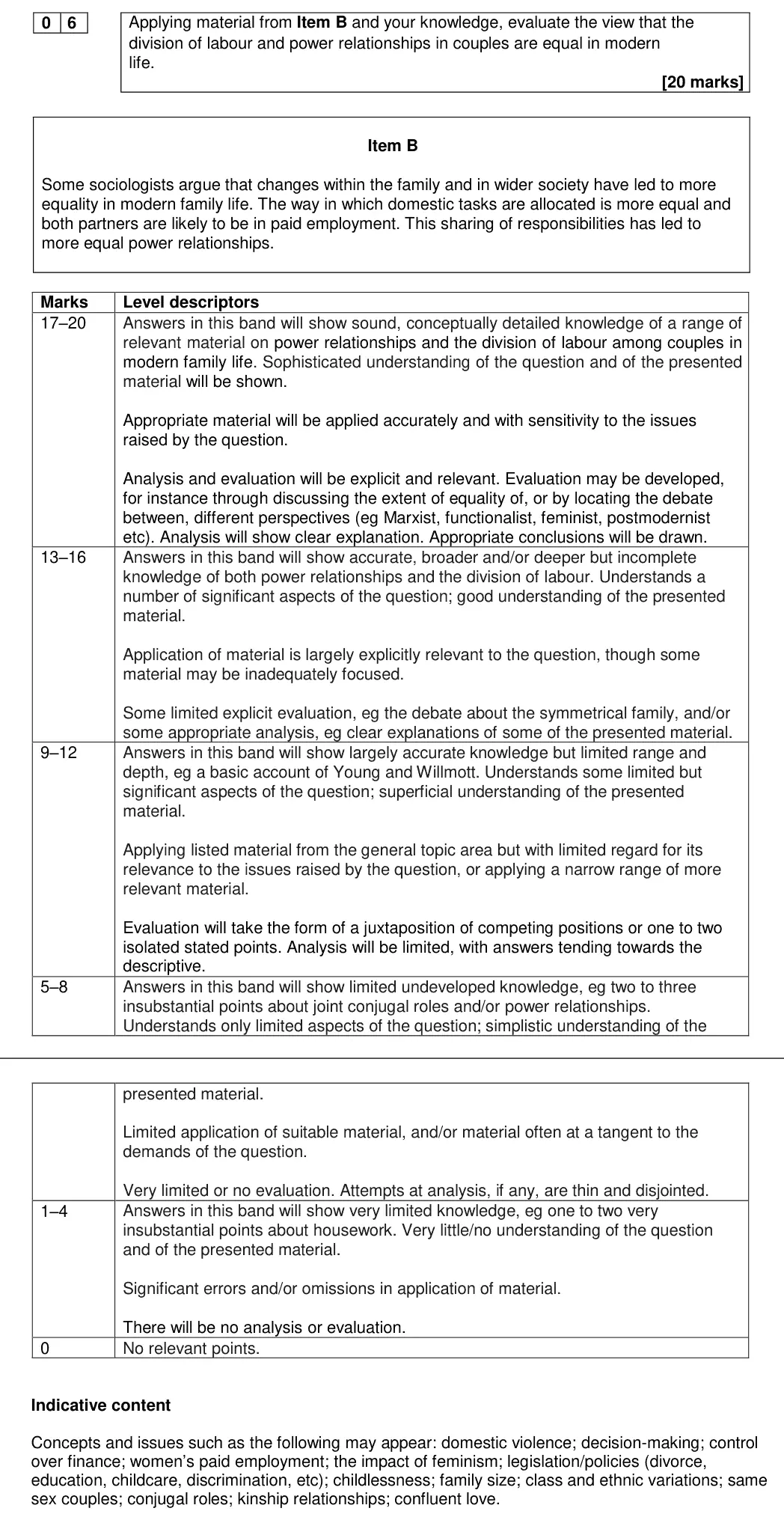
Applying material from Item B and your knowledge, evaluate the view that the division of labour and power relationships in couples are equal in modern family life.
Tap a question to zoom it. The mark scheme (with the level descriptors and indicative content) and the examiner's comment open underneath.
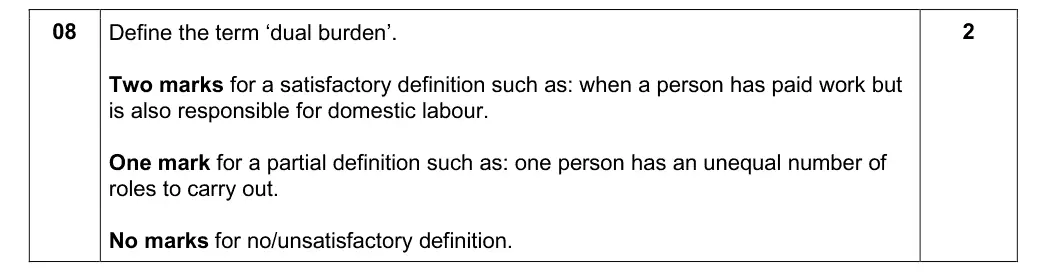
June 2025 · AS Paper 2 · Q82 marksAO1=2Define
Mark scheme
Examiner's comment
For both marks students needed to identify the instrumental element (paid work) and the expressive element (housework) of the dual burden to and the majority of answers managed this.
Notes from the mark scheme and report
2 marks need both paid work and responsibility for domestic labour
unequal number of roles = 1 mark
mostly well answered
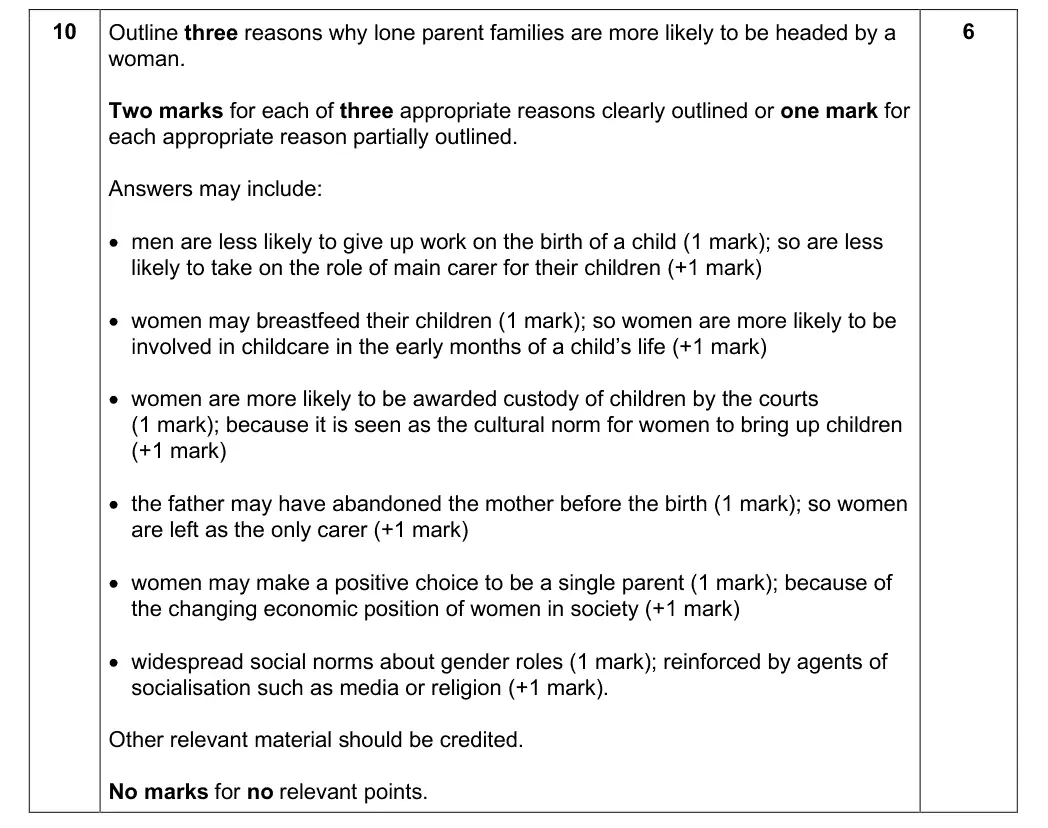
June 2025 · AS Paper 2 · Q106 marksAO1=6Outline
Mark scheme
Examiner's comment
On the 10-mark 'outline and explain' question (the fourth question in each topic area), and the 6-mark 'outline three...' question (the third question in each topic). In the 6-mark 'outline three...' questions, students could improve their performance by including a brief explanation of each identified point—such as a criticism or feature—rather than simply listing them. This question was answered very well, with many students providing a wide range of reasons for the lone parent families being headed by a woman. Women being awarded custody, general expectations of society and male abandonment proved popular reasons. The phenomena of some responses giving a valid reason being without it being developed (and so not gaining full marks) remains.
Notes from the mark scheme and report
credited: men less likely to leave work, breastfeeding, courts awarding custody to mothers, father abandonment, women choosing lone parenthood, gender norms
answered very well
undeveloped reasons still lost the second mark
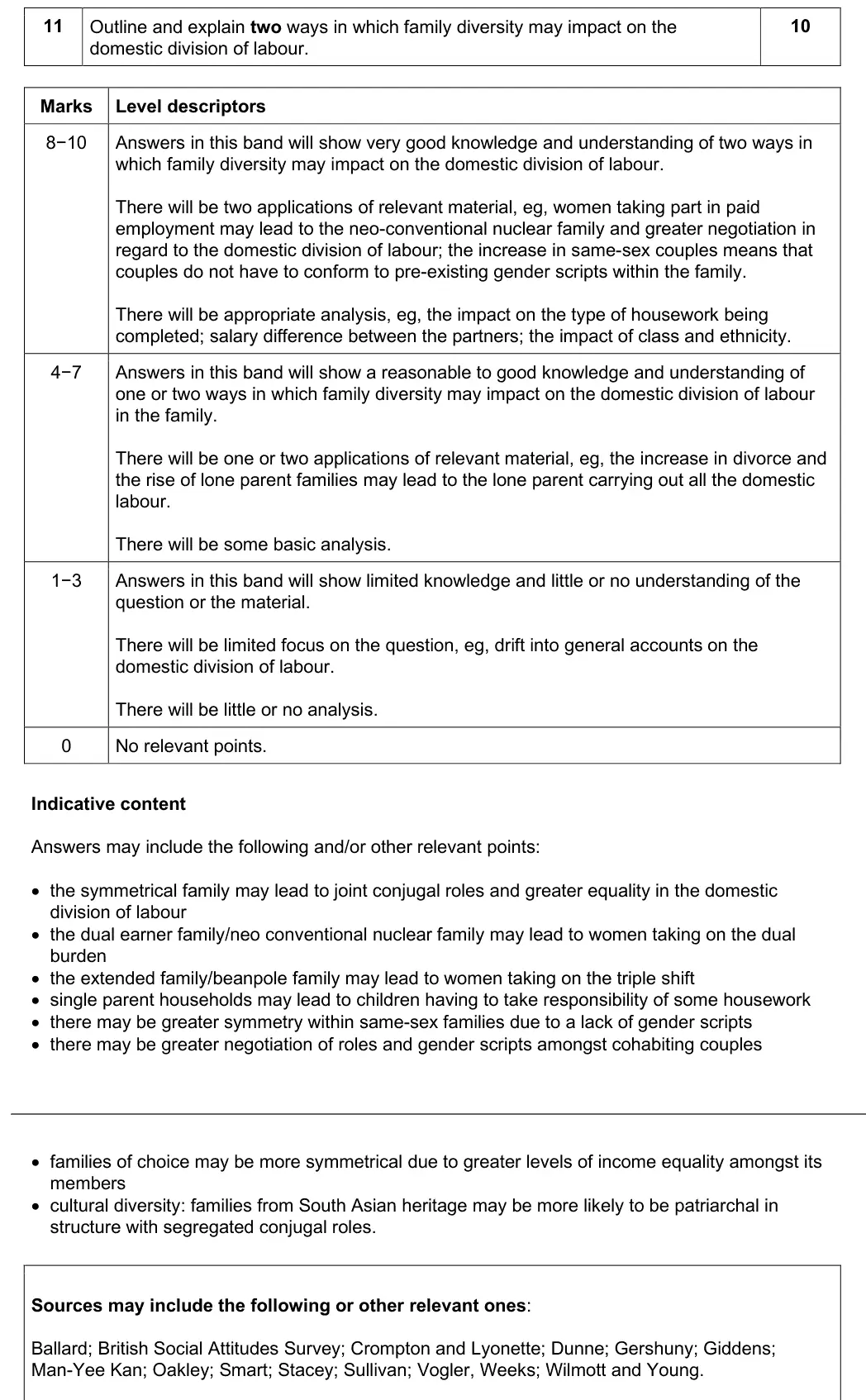
June 2025 · AS Paper 2 · Q1110 marksAO1=5, AO2=3, AO3=2Outline and explain
Mark scheme, including the levels grid and indicative content
Examiner's comment
On the 10-mark 'outline and explain' question (the fourth question in each topic area), and the 6-mark 'outline three...' question (the third question in each topic). For the 10-mark 'outline and explain' questions, students would benefit from clearly identifying a specific way, reason, or factor, followed by a developed explanation. This approach would help make their answers more coherent, structured and easier to reward. This question required students to name a diverse family form type, for example the lone parent family and suggest how that family form may impact on the domestic division of labour. One common way to do this was found in answers which suggested that in lone parent families the lone parent carried out the entirety of the roles and tasks making up the domestic division of labour. Answers which named a family type generally went on to be developed in an effective way. Where a diverse family type was not named, the development of the answer was limited and often could not gain credit.
Notes from the mark scheme and report
must name a diverse family type and link it to the division of labour
examples: dual-earner/neo-conventional, same-sex couples without gender scripts, lone parents doing all tasks, beanpole/extended and triple shift, cultural diversity
general accounts of domestic division of labour = 1-3
unnamed family types rarely earned credit
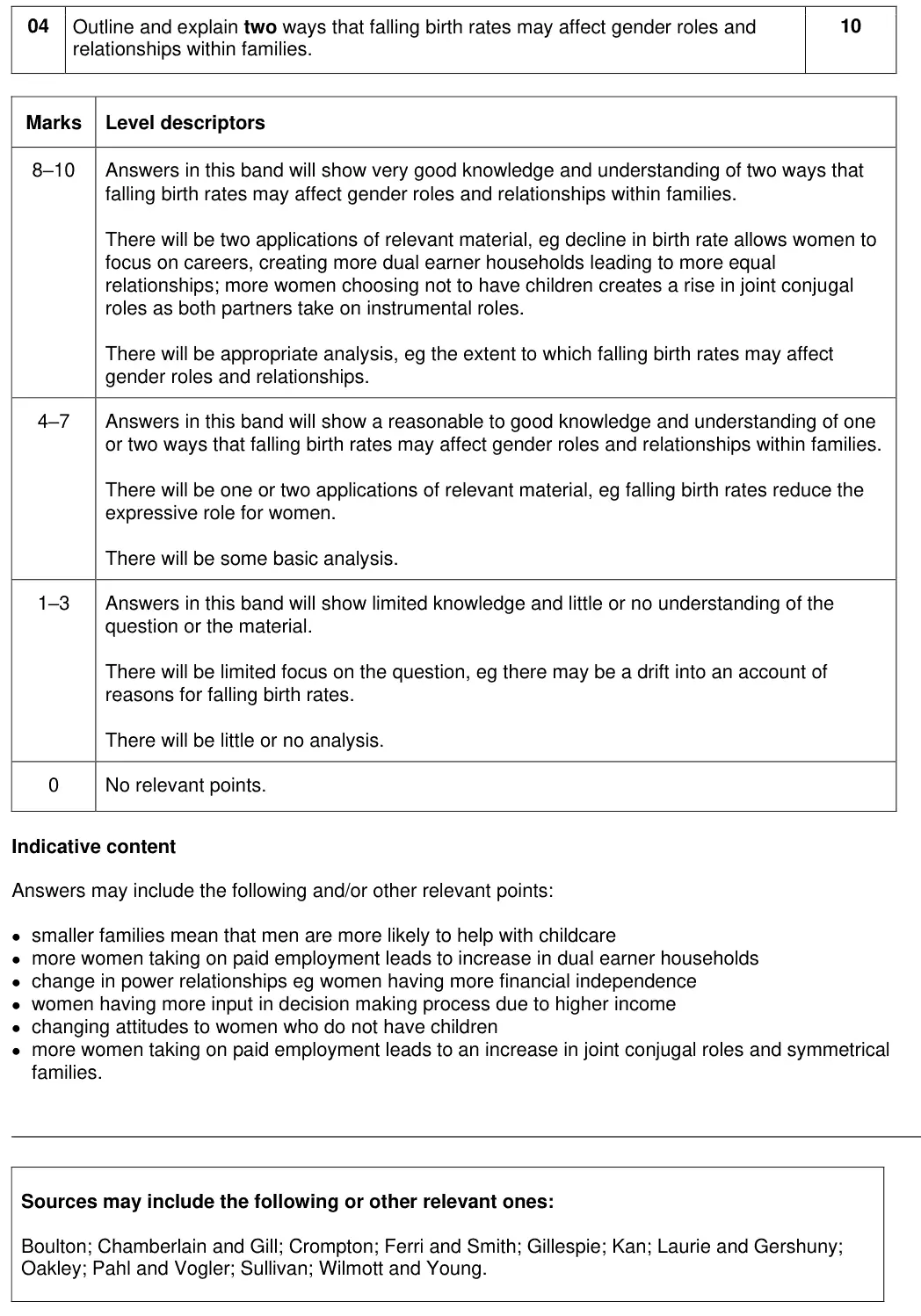
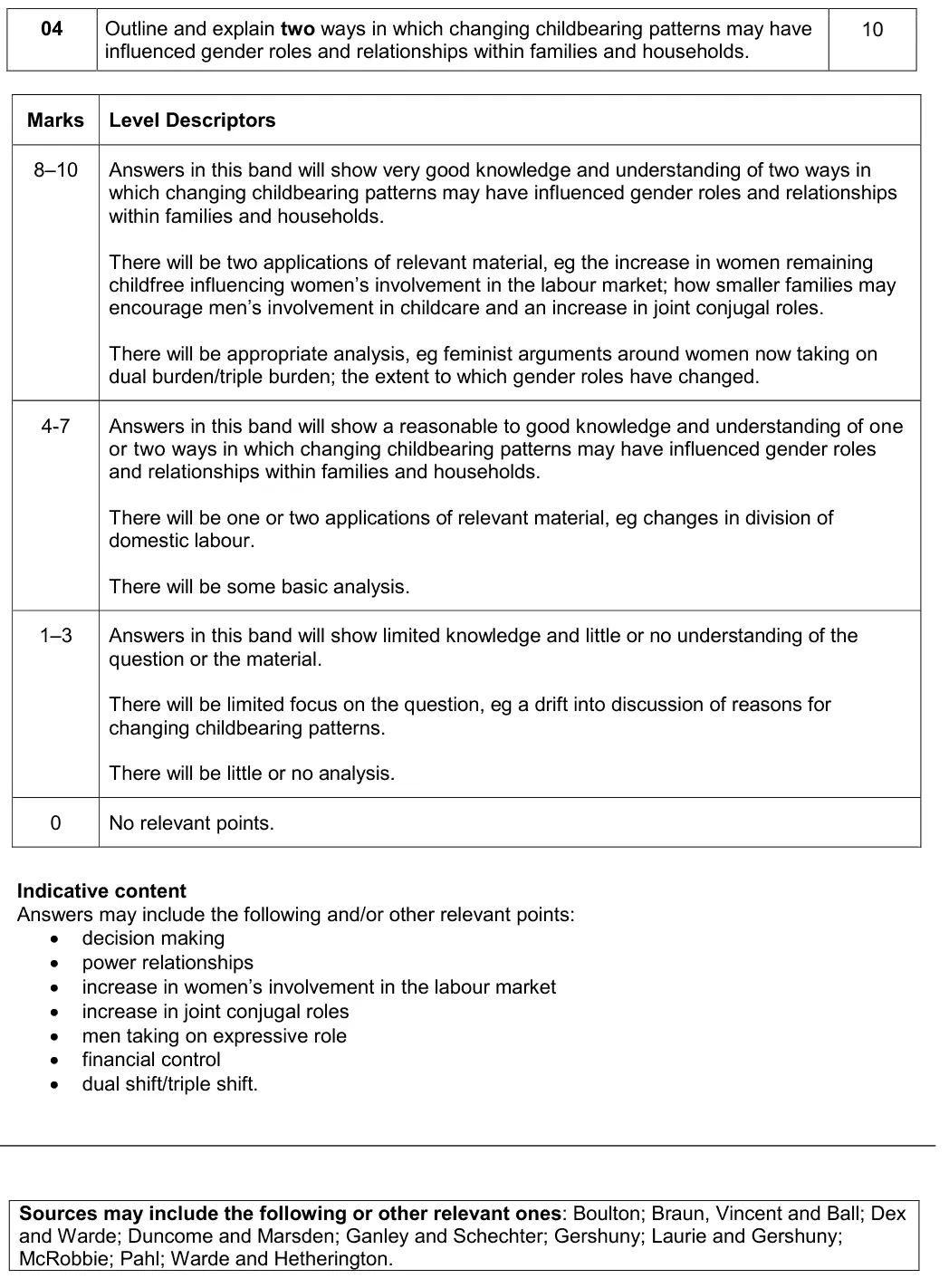
June 2024 · Paper 2 · Q410 marksAO1=5, AO2=3, AO3=2Outline and explain
Mark scheme, including the levels grid and indicative content
Examiner's comment
The nature of these questions means that students cannot rely on reciting knowledge. Questions will ask them to bring together aspects of their sociological knowledge in ways they will not have done before. It is therefore important for students to allow time to think about how to answer the question. Students should be made aware that there are two types of 10 mark questions. These have different requirements and different mark schemes . There are different marks available for the assessment objectives. A breakdown of the marks awarded by assessment objective can be found in the mark scheme. 10 mark “outline and explain” questions have more marks available for knowledge and understanding, and none for evaluation. Introductions and conclusions are not required for 10 mark questions; they take up time and rarely improve the mark. It is helpful if answers are set out to clearly indicate the two answers, with wording such as “One way/reason is…”, or by starting a new paragraph for the second point. Answers that give more than two points are unlikely to develop two of them sufficiently. For example, Topic A2 Question 4 asked about how falling birth rates may affect gender roles and relationships within families; some answers included a lot of material on why birth rates fall, which was not asked for. Q4: The responses to this question achieved mixed success. Most students managed to identify at least one way in which falling birth rates have influenced gender roles and relationships. The most thoroughly explored aspect was the shift towards women engaging in paid work, a change driven by evolving attitudes towards education and careers. The feminist perspective was effectively employed to examine the repercussions on family roles and relationships.
Notes from the mark scheme and report
two ways each linked to gender roles or relationships (e.g. women in paid work and dual-earner households, joint conjugal roles, women's financial independence and decision-making)
explaining why birth rates fell is not asked for and drifts to 1–3
most developed the shift to women's paid work
June 2024 · AS Paper 2 · Q1110 marksAO1=5, AO2=3, AO3=2Outline and explain
Mark scheme, including the levels grid and indicative content
Examiner's comment
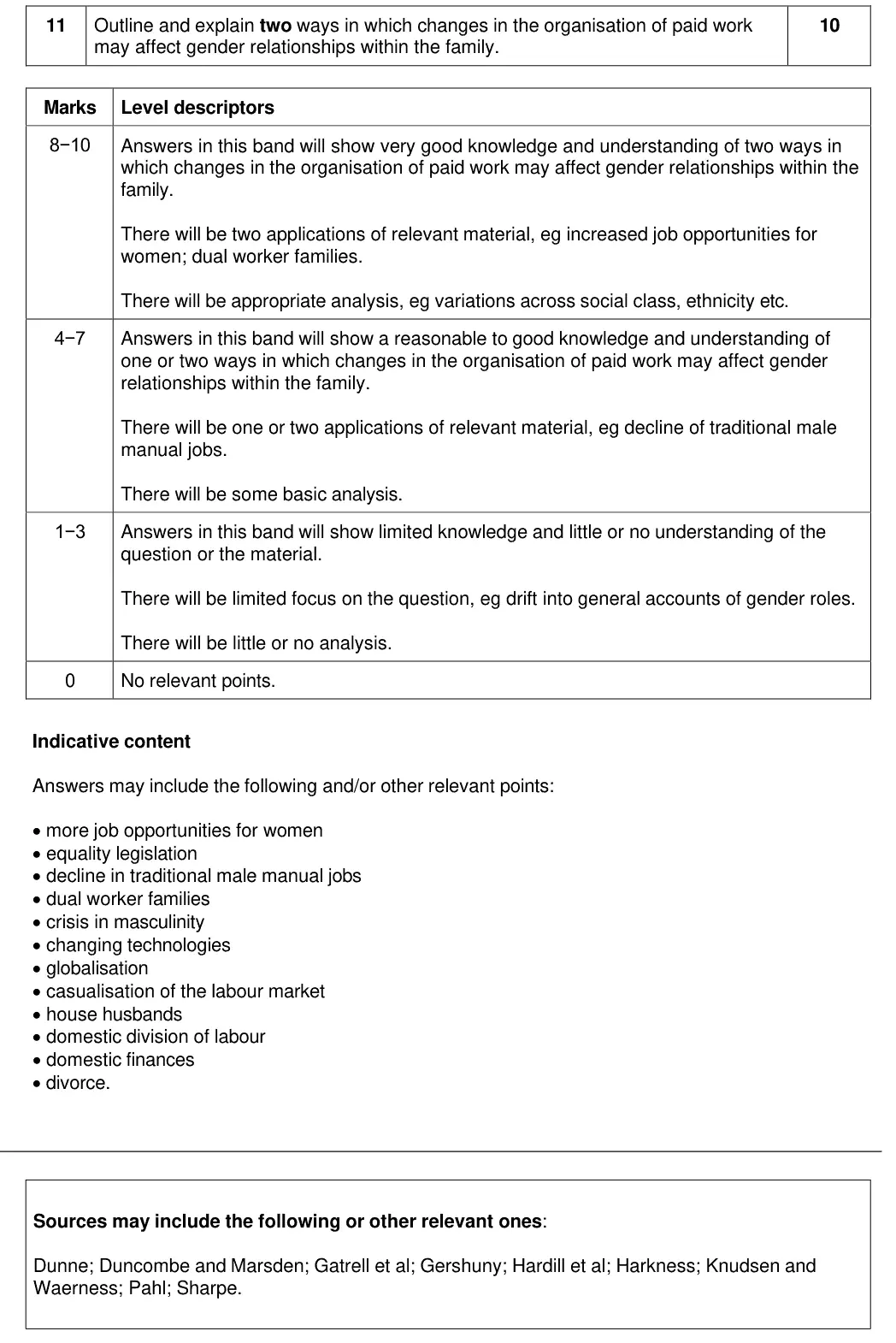
The ‘outline and explain’ 10-mark question. Here students would benefit more if an explicit identification of a way / reason / factor was made then leading to an explanation of it. So, making the student’s answer more cogent. This question required students to identify a change in the organisation of paid work and suggest a way in which that change might impact on gender relationships in the family. This question proved more challenging for students. Answers sometimes spent a long time describing changes without connecting them to an impact on gender relationships. A sizeable minority did not refer to changes in the organisation of paid work except to say women now work. Analysis was often developed by reflecting on the response of various perspectives to the change for example functionalism and the new right.
Notes from the mark scheme and report
must identify a change in the organisation of paid work and link it to gender relationships in the family
drift into general gender roles = 1–3
many described changes without the effect, or said only that women now work
top band analysis e.g. class and ethnic variation
June 2023 · Paper 2 · Q510 marksAO1=3, AO2=4, AO3=3Analyse
Mark scheme, including the levels grid and indicative content
Examiner's comment
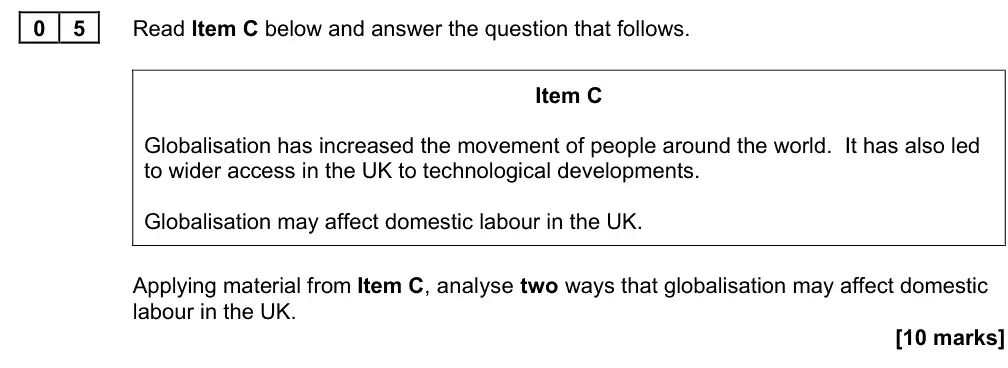
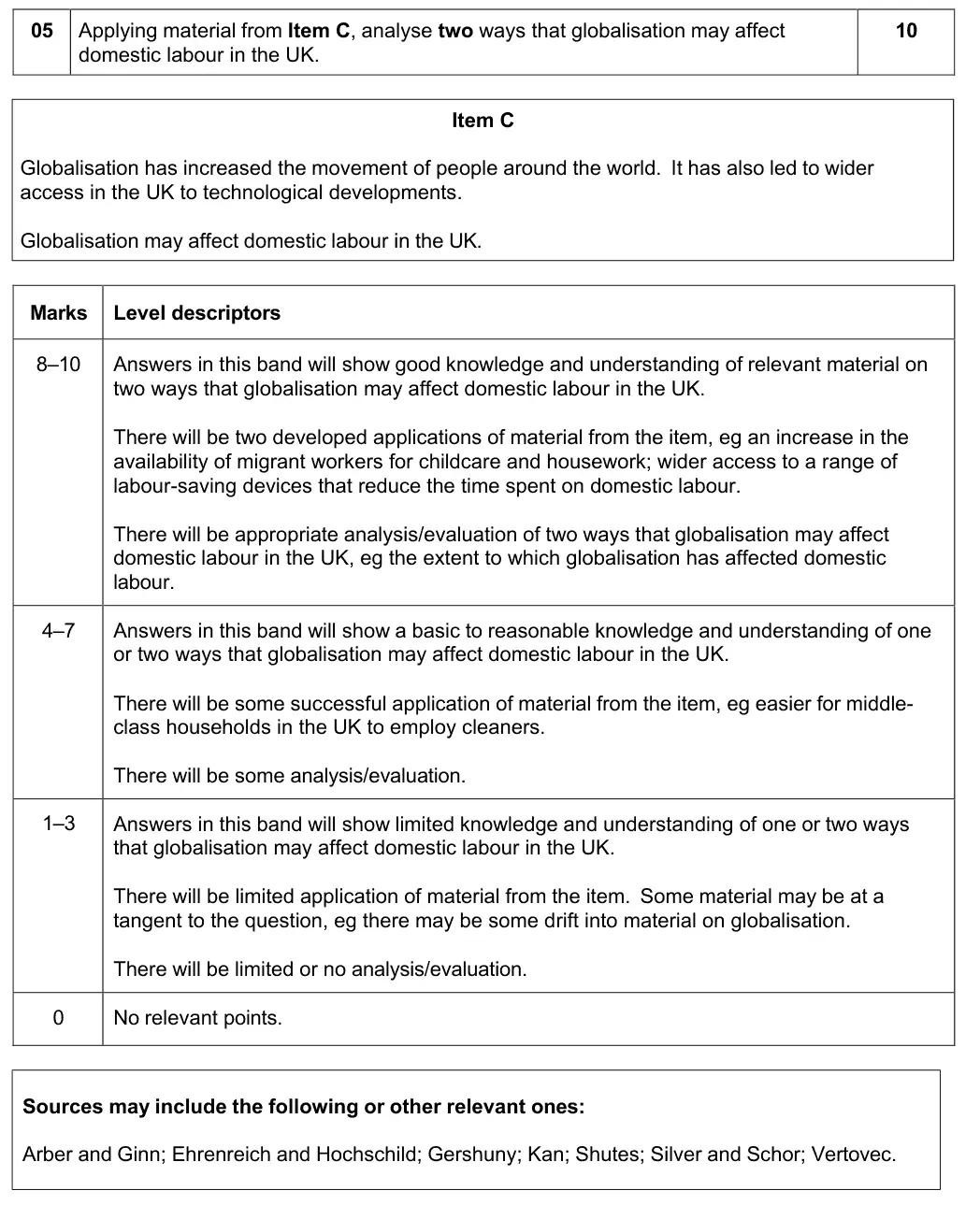
The nature of these questions means that students cannot rely on reciting knowledge. Questions will ask them to bring together aspects of their sociological knowledge in ways they are unlikely to have done before. It is therefore important for students to allow time to think about how to answer the question. Students should be made aware that there are two types of 10 mark questions. These have different requirements and different mark schemes. There are different marks available for the assessment objectives. The items for 10 mark “analyse” questions are written to give prompts or “hooks” for student answers. These have to be used to access application marks. Answers can indicate use of hooks by quoting, by a reference in parentheses or by wording (eg “As the item says…”). Items end with a sentence restating the question; the hooks are in the preceding part of the item. Introductions and conclusions are not required for 10 mark questions and take up valuable time. It is helpful if answers are set out to clearly indicate the two separate points, with wording such as “One way/reason is…” or by starting a new paragraph for the second point. Answers that give more than two points are unlikely to develop two of them sufficiently. Question 5: Some did not approach this as a Families and Households question, focusing instead on employment and taking “domestic” as the opposite of “foreign”. Most were able to draw on the item to develop points about migration and household appliances. Some of the best answers developed these ideas through gendered division of domestic labour, analysing the impact on conjugal roles.
Notes from the mark scheme and report
hooks: movement of people and wider access to technology
e.g. migrant workers for childcare/cleaning, labour-saving devices
drift into globalisation in general = 1–3
some misread 'domestic' as the opposite of foreign and wrote about employment
best answers linked to the gendered division of labour and conjugal roles
June 2023 · AS Paper 2 · Q106 marksAO1=6Outline
Mark scheme
Examiner's comment
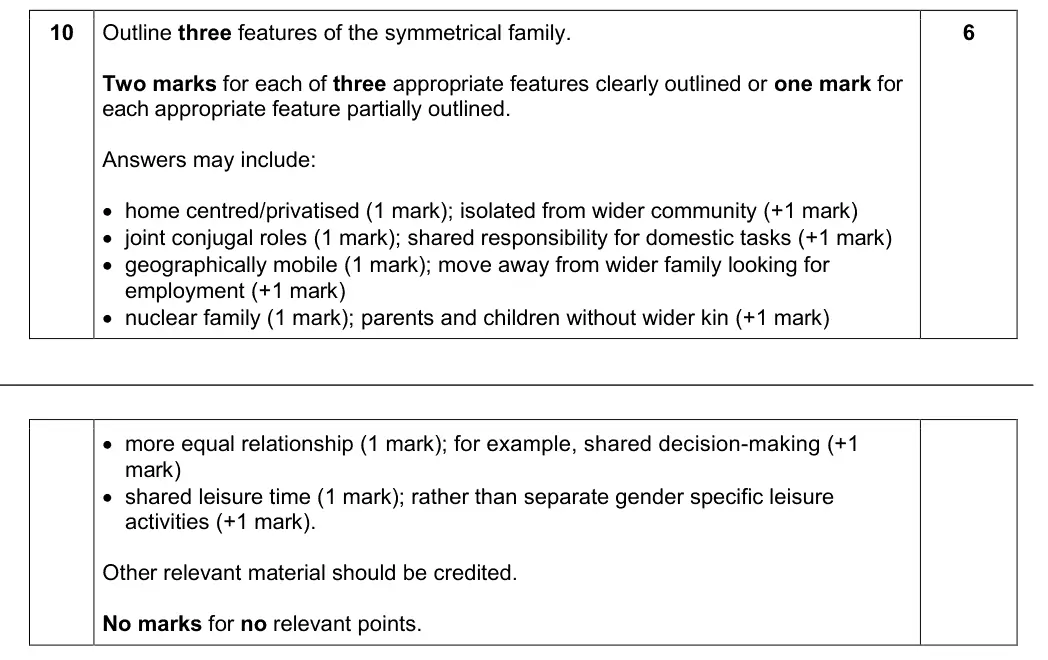
The ‘outline three’ 6 mark question (the third question in every topic area). Students could easily improve outcomes on this question by realising the need to briefly (eg a line or so) expand upon the criticism / feature etc being outlined. Many students scored well in this question and were able to identify three features of the symmetrical family. Many answers offered up more than the three features required indicating that students have a good understanding of the symmetrical family. Answers that did not attract full marks tended to list features but not (briefly) expand upon them.
Notes from the mark scheme and report
2 marks for each of three features clearly outlined, 1 if partial (e.g. home-centred/privatised, joint conjugal roles, geographically mobile nuclear unit, shared decisions and leisure)
features listed without brief expansion lose the second mark
June 2023 · AS Paper 2 · Q1110 marksAO1=5, AO2=3, AO3=2Outline and explain
Mark scheme, including the levels grid and indicative content
Examiner's comment
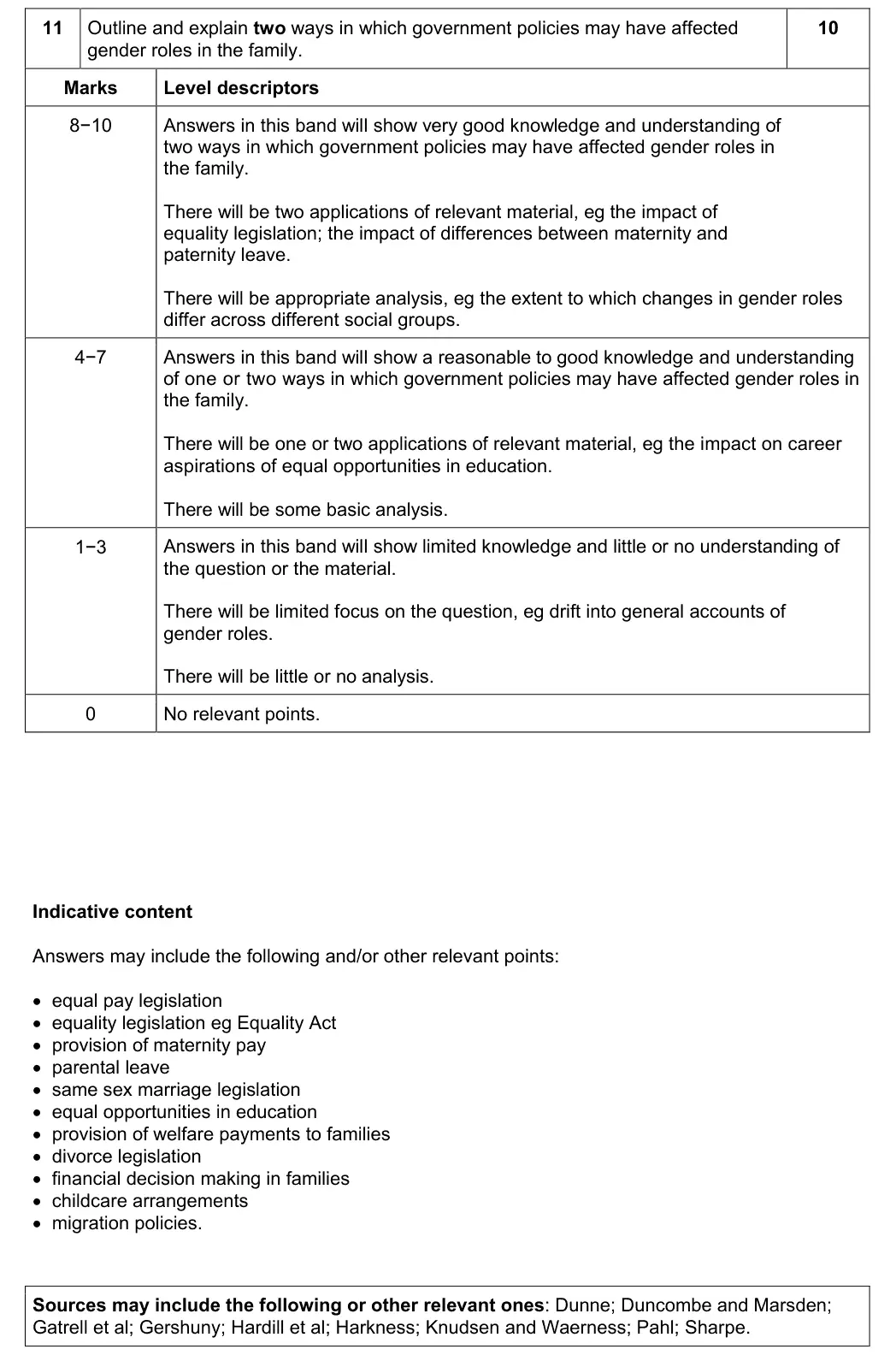
The ‘outline and explain two’ 10 mark question (the fourth question in every topic area). Here students would benefit more if an explicit identification of a way / reason / factor was made, then leading to an explanation of it, making the student’s answer more cogent. The majority of students could identify two policies – though some answers were generic (eg policies/laws divorce laws etc) – and make a connection to gender roles in the family. The standard approach taken was to identify a policy, for example equal pay, and then apply its impact on the domestic division of labour – typically whether the policy strengthened or weakened traditional instrumental/expressive gender roles. Analysis was frequently generated by reviewing the response of various theories and perspectives to the impact or the change described. For answers which did not gain credit in this question, this was often the result of identifying policies but failing to connect them to gender roles inside the family.
Notes from the mark scheme and report
two policies each linked to gender roles in the family (e.g. equal pay and equality legislation, maternity vs paternity leave, childcare, welfare payments)
drift into gender roles in general = 1–3
generic 'laws' weaken answers
most common failing was naming a policy without connecting it to roles inside the family
June 2022 · AS Paper 2 · Q106 marksAO1=6Outline
Mark scheme
Examiner's comment
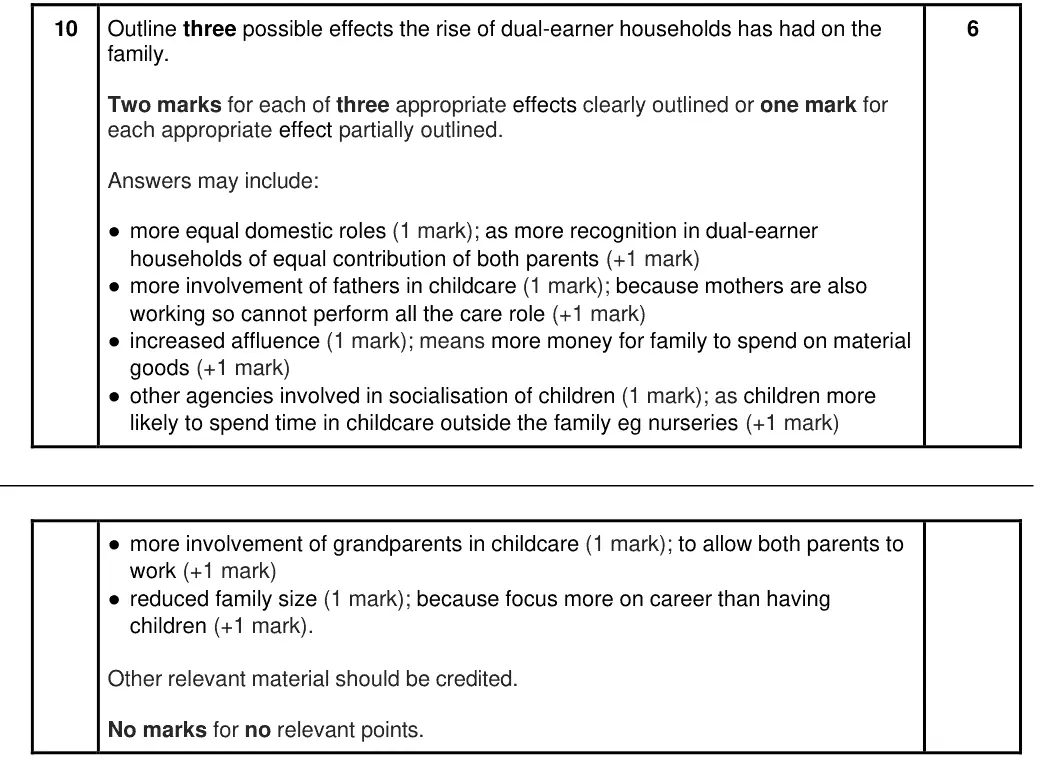
For low mark tariff questions where candidates are required to either define, explain or outline, care should be taken to ensure that points are not just identified. Many students scored well in this question and were able to identify three effects and explain them briefly. Some answers to this question were longer than necessary; some included references to, and descriptions of, research. Partial marks were achieved when an effect was identified but developed in an incorrect way. For example, parents may see less of their children as they are at work, which gained credit, but then developed by claiming the children will miss out on socialisation so won’t know right from wrong which is incorrect. Some answers drifted to effects on women’s careers rather than on the family. Occasionally students confused what was meant by dual earner and went into descriptions of househusbands ie role reversal.
Notes from the mark scheme and report
2 marks for each of three effects clearly outlined, 1 if only partially outlined
e.g. more equal domestic roles, more father involvement, grandparent or nursery childcare, affluence, smaller families
incorrect development (e.g. children not learning right from wrong) limits to 1
drift into women's careers or role reversal not credited
long answers unnecessary
November 2021 · Paper 2 · Q620 marksAO1=8, AO2=6, AO3=620-mark essay
Mark scheme, including the levels grid and indicative content
Examiner's comment
Many students were able to answer this question well, applying ideas in the item and from their own knowledge to make relevant points about gender roles and relationships today. Most were able to address both aspects of the debate, looking at evidence for continuing inequalities as well as progress towards greater equality, and to use a range of theories, concepts and studies. It was good to see in some answers findings from recent research studies, showing recognition of the value of empirical evidence.
Notes from the mark scheme and report
must apply Item D (feminist view of continuing inequality in housework, childcare, power and money vs men's greater domestic role)
top band weighs how much inequality persists or debates feminisms, functionalism, Marxism, postmodernism
many answered well on both sides
recent empirical research was credited
November 2020 · Paper 2 · Q410 marksAO1=5, AO2=3, AO3=2Outline and explain
Mark scheme, including the levels grid and indicative content
Examiner's comment
Answers tended to be significantly stronger on gender roles and relationships than on ways in which these might be derived from changes in childbearing patterns. Some students wrote only about changes in gender roles without mentioning changes in childbearing patterns. Better answers often considered how having fewer children and having the first child later had enabled women to engage in paid work more and, importantly, went on to discuss how this might have affected roles and relationships within families. The 10-mark “outline and explain” questions produced variable answers. A common fault was to focus on one element of the question only, rather than recognising that the question required connections to be made between different elements. Students need guidance from their teachers to appreciate that these questions may require them to bring together learning from different sections of the specification within the topic. Students also need to be aware that there are no marks available for evaluation on this question.
Notes from the mark scheme and report
must link childbearing change (fewer children, later first child, childfree women) to gender roles and relationships
e.g. more women in paid work, joint conjugal roles, dual/triple shift
drift into reasons for changing childbearing = 1-3
answers often strong on gender roles but did not link them to childbearing
no marks for evaluation in this question type (examiners' report general remark)
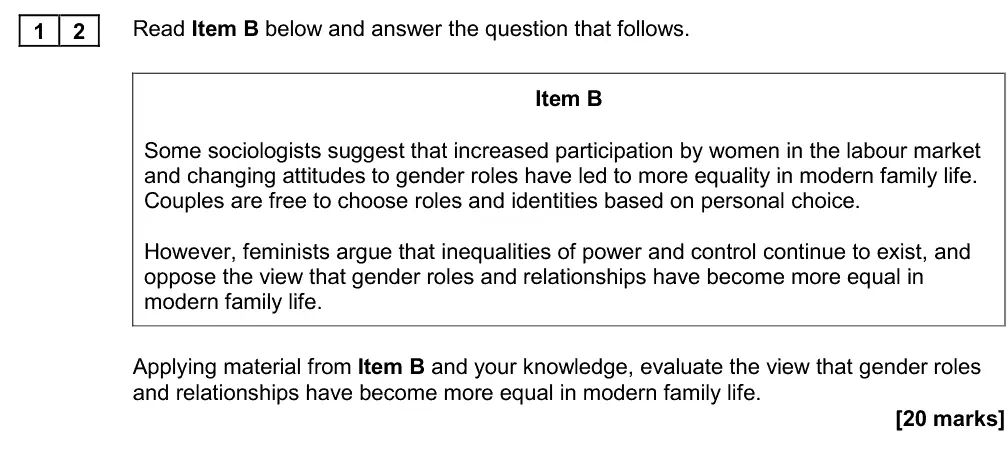
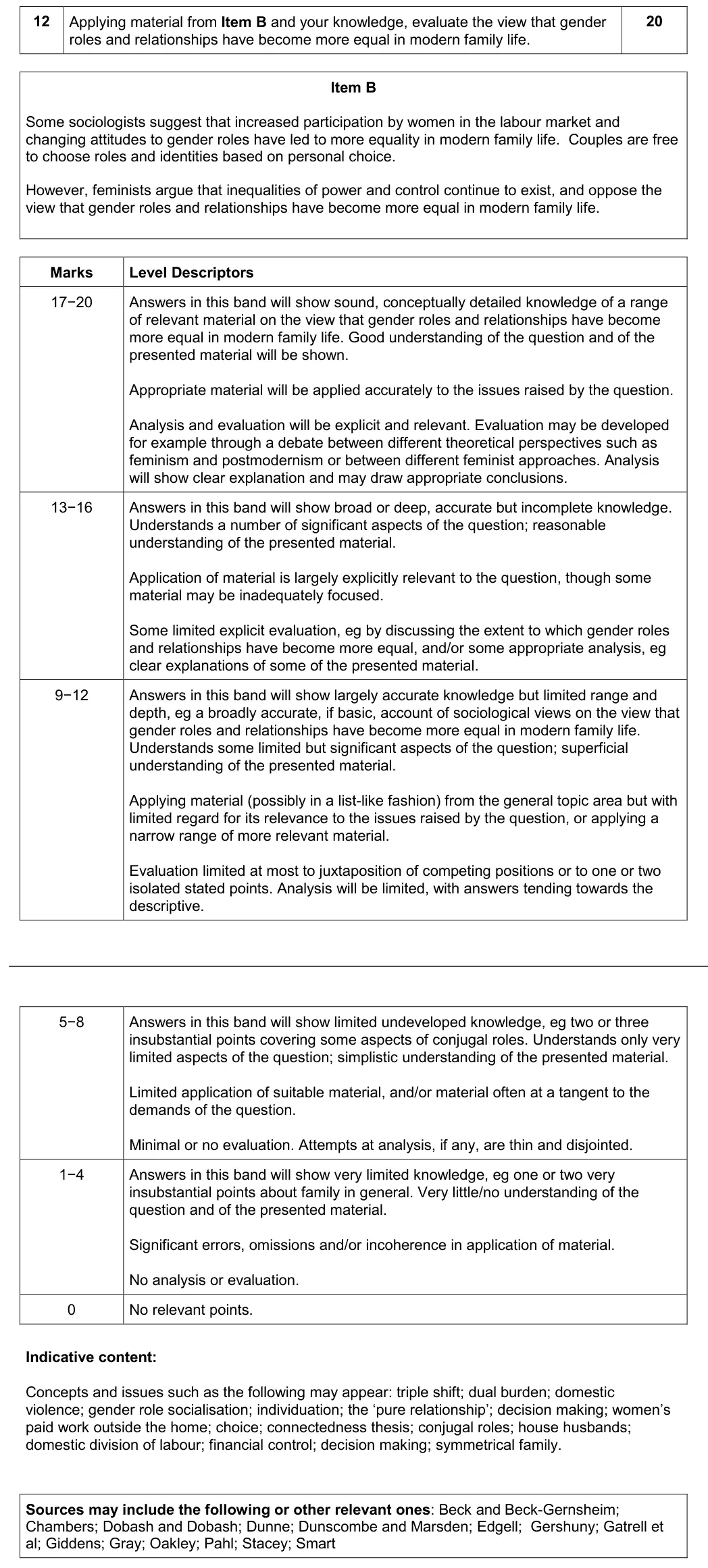
November 2020 · AS Paper 2 · Q1220 marksAO1=8, AO2=6, AO3=620-mark essay
Mark scheme, including the levels grid and indicative content
Notes from the mark scheme and report
item hooks: women's paid work and changing attitudes vs feminist claims of continuing inequality of power and control
top band debates feminism with postmodernism or between feminisms
June 2019 · Paper 2 · Q620 marksAO1=8, AO2=6, AO3=620-mark essay
Mark scheme, including the levels grid and indicative content
Examiner's comment
As last year, many scripts had one substantial answer to the Section A 20-mark question and one significantly briefer one for Section B, suggesting problems with timing. There was often little evidence of planning. A wide range of material can be relevant to these questions, and students are not expected to include everything. They need to carefully choose the content and to plan their answers. The best answers will be both empirical and theoretical, for example showing knowledge of research findings and examples, and knowledge of theoretical perspectives. Some answers amounted to lists of theoretical perspectives, with learned points of criticism, and lost focus on the question itself. While the items are intended as a helpful starting point for answers, they should not be taken by students as a full list of what is relevant; better answers will draw in other relevant knowledge and ideas. Many more successful answers showed good knowledge of a range of issues related to gender and the family, often using the item as their starting point, and demonstrating awareness of several strands of feminism. Less successful answers provided lists of theories together with learned criticisms; such answers tended to lose sight of the question, and some also lacked any empirical evidence by for example referring to research findings and studies.
Notes from the mark scheme and report
top band compares feminist views with other perspectives on the family
better answers distinguished several strands of feminism and used research evidence
list-like theories with learned criticisms lost focus
AO split from AQA's standard grid for this paper (this year's mark scheme does not print it).
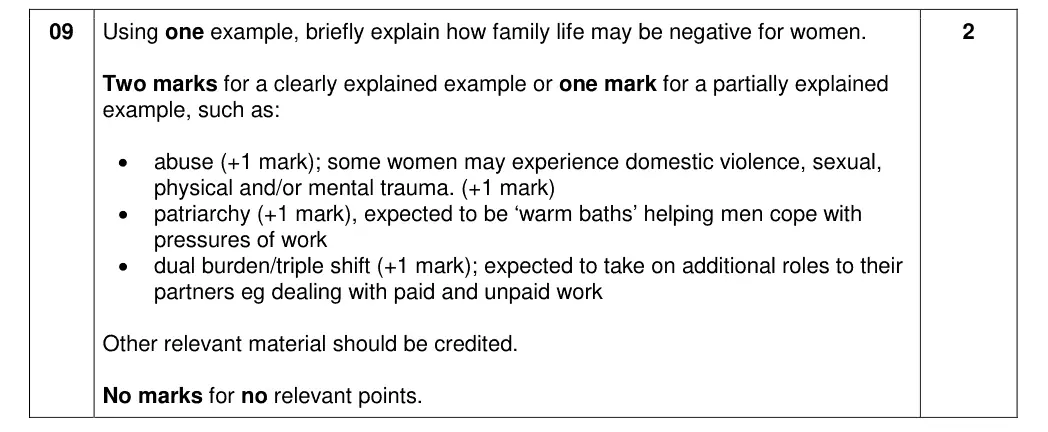
June 2019 · AS Paper 2 · Q92 marksAO2=2Brief explain
Mark scheme
Examiner's comment
The most common response was to make a reference to the ‘triple shift’ or ‘domestic violence’ and these were rewarded accordingly. Some answers described conjugal roles but omitted to explain the negative side for women of the aspect of family life that they identified.
Notes from the mark scheme and report
AO grid not printed
2 marks for a clearly explained example, 1 if partial
common answers: triple shift, domestic violence, warm bath for men
describing conjugal roles without saying why they are negative for women = partial
AO split from AQA's standard grid for this paper (this year's mark scheme does not print it).
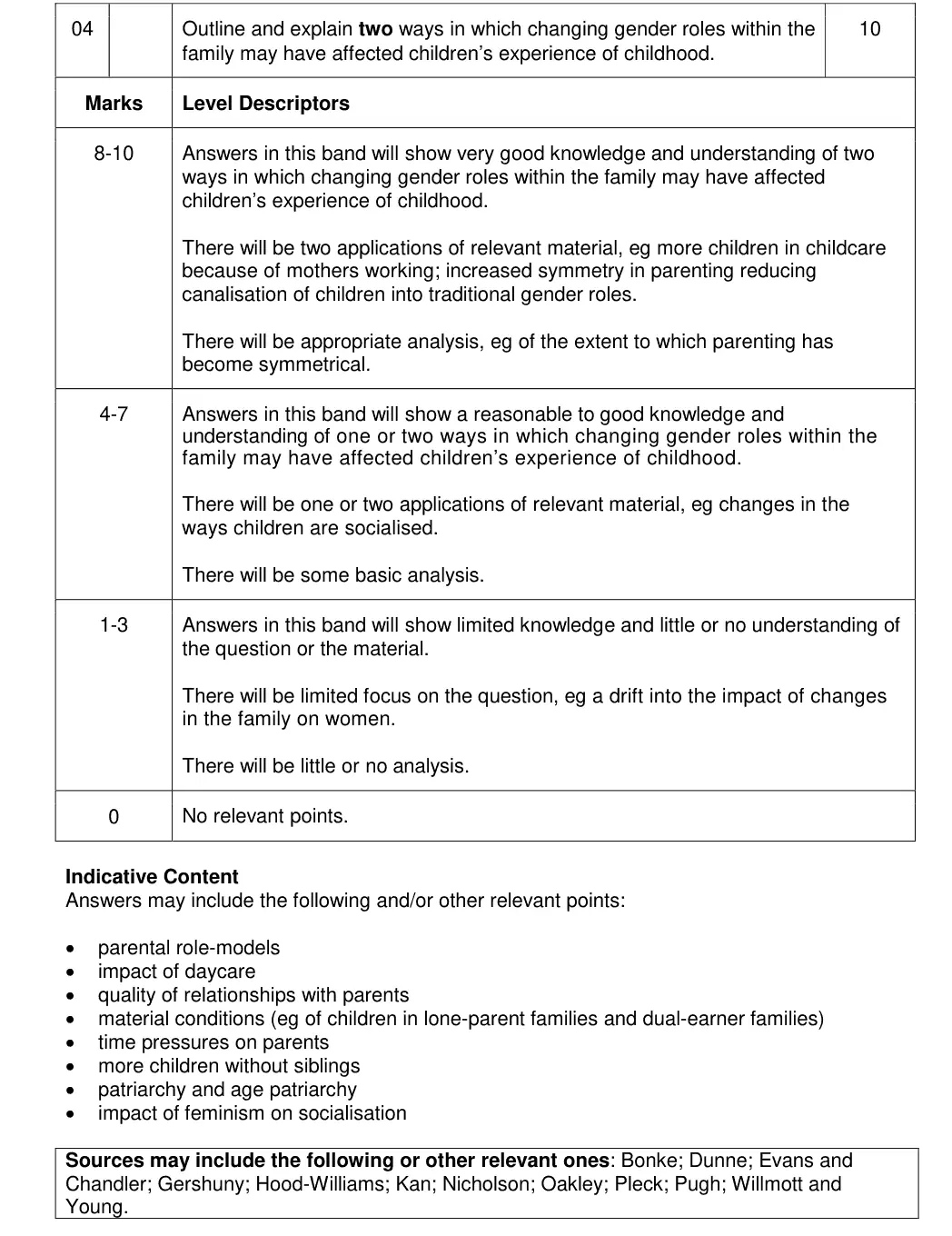
June 2017 · Paper 2 · Q410 marksAO1=5, AO2=3, AO3=2Outline and explain
Mark scheme, including the levels grid and indicative content
Examiner's comment
A number of students wrote introductory paragraphs and/or conclusions. These are not necessary, and are unlikely to gain additional marks. A number of students made only one point in their answer, or three or more, rather than the two asked for. In these cases, the two best answers were rewarded and will be in future series. It is helpful for students to clearly indicate their two answers, with wording such as “One way is…” or by starting a new paragraph for their second point. Schools and colleges should note that there is no reference in the mark scheme for 10 mark ‘outline and explain’ questions to evaluation, and that evaluation is not a requirement for answers to these questions. The assessment objective allocations are different in the two types of 10 mark questions, and students should be made aware of this. There was a wide range of responses to these questions. A minority of students wrote very brief answers. For these 10 mark items, a simple statement of two ways, reasons or factors, without development, is not sufficient to access more than the lower marks in the mark range. The best answers were focused, clearly stating a point and then developing it, with use of sociological concepts, evidence and theory where appropriate, in ways that demonstrated the skills expected from the targeted assessment objectives. There was a tendency, however, for many answers to focus on the first aspect of the question at the expense of the second. For example, in question 4, many answers gave detailed responses on changing gender roles but said little on how these had affected the experience of childhood. Students need guidance on how to approach these questions and how to best demonstrate their sociological understanding. The nature of these questions means that students cannot rely on reciting knowledge. They require students to bring together two aspects of their sociological knowledge in a way that they are unlikely to have done before. Answers will sometimes require claims that students may be unsure of because they do not know of specific evidence (for example, in question 5, whether migrants from Eastern Europe who are single workers tend to live alone or in shared households). However, answers that are sociologically plausible will be accepted. Most were able to identify two ways and clearly addressed changing gender roles, but often there was little development on the experience of childhood beyond stating that it had become more positive or negative. Popular answers included parents in symmetrical families as good role models, material conditions (such as dual-earners) and changes in socialisation. Some made the error of writing about traditional gender roles rather than how they have changed.
Notes from the mark scheme and report
must link changing gender roles to children's experience of childhood (role models, daycare, socialisation, dual earners)
drift into effects on women = 1–3
childhood effects often left undeveloped ('better' or 'worse')
some wrote about traditional rather than changing roles
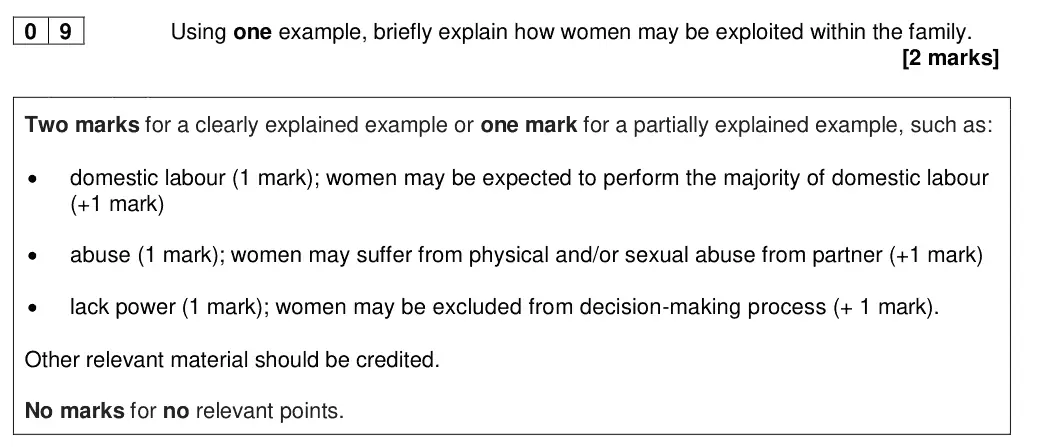
June 2016 · AS Paper 2 · Q92 marksAO2=2Brief explain
Mark scheme
Examiner's comment
This question was generally answered well and a high proportion of students gained full marks. The majority referred to the dual burden or the triple shift as the form that exploitation takes, and were then able to explain what the term meant. Others answered successfully by citing and explaining unpaid domestic labour, emotion work or domestic violence.
Notes from the mark scheme and report
credited: domestic labour, abuse, lack of power in decisions
most used dual burden/triple shift, also emotion work and domestic violence
generally well answered
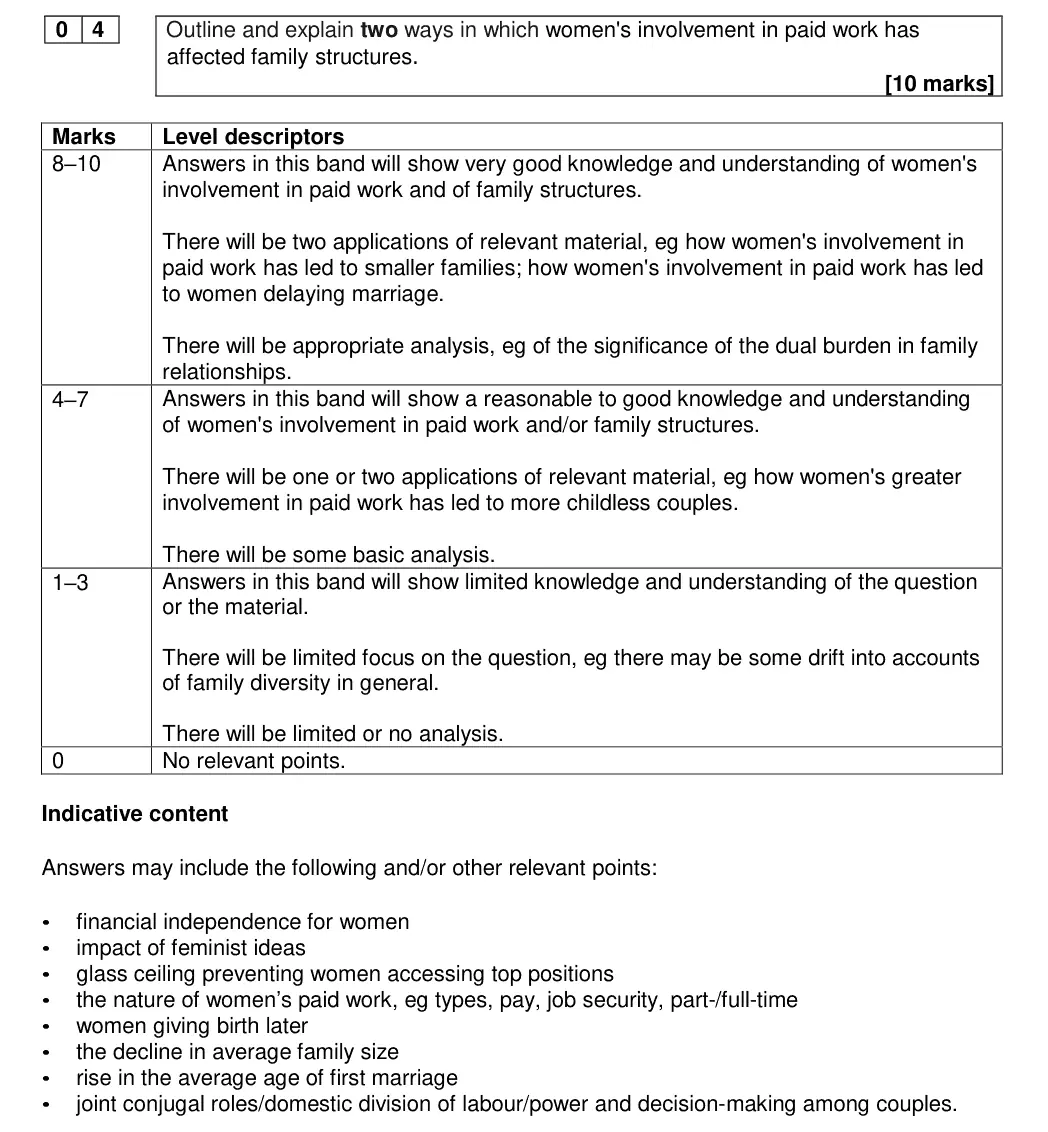
Specimen set 1 · Paper 2 · Q410 marksAO1=5, AO2=3, AO3=2Outline and explain
Mark scheme, including the levels grid and indicative content
Notes from the mark scheme and report
must link women's paid work to family structures (smaller families, delayed marriage, childlessness)
analysis e.g. dual burden in relationships
drift into family diversity in general = 1–3 band
Specimen set 1 · Paper 2 · Q620 marksAO1=8, AO2=6, AO3=620-mark essay
Mark scheme, including the levels grid and indicative content
Notes from the mark scheme and report
must cover both division of labour and power relationships (13–16 requires both)
top band debates the extent of equality or locates it between Marxist, functionalist, feminist and postmodernist views
basic account of Young and Willmott = 9–12
mark scheme wording omits 'family' ('in modern life')
Work with an AQA sociology tutor
Essays stuck in the middle band, or losing marks on the 10-markers? Book a trial lesson with Mark, a former AQA examiner.