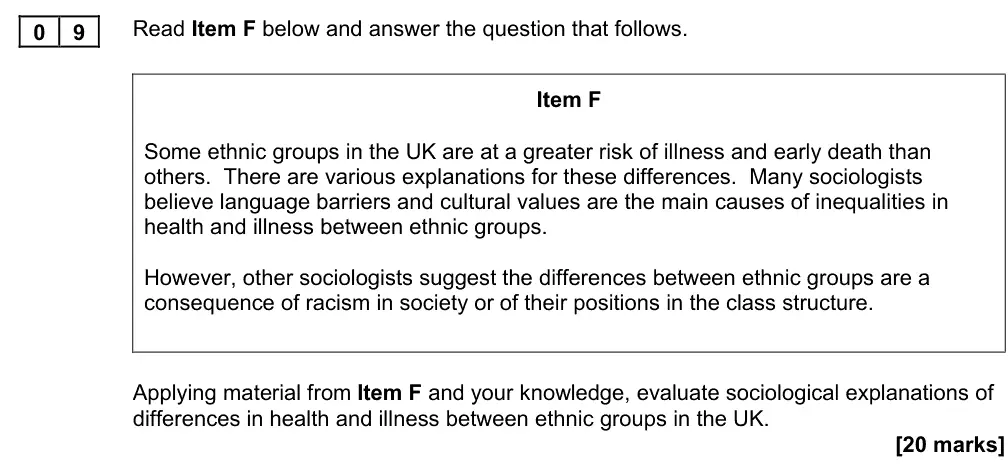
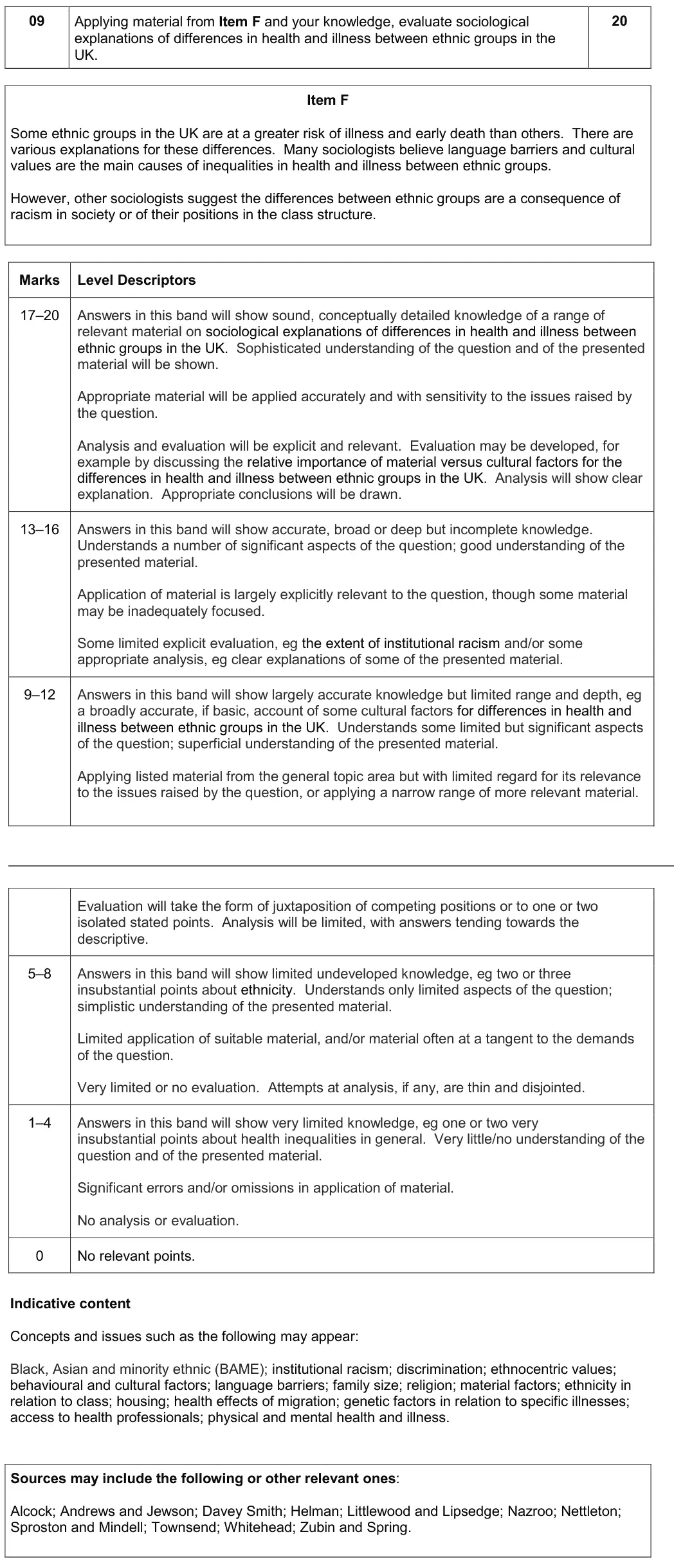
Applying material from Item F and your knowledge, evaluate sociological explanations of differences in health and illness between ethnic groups in the UK.
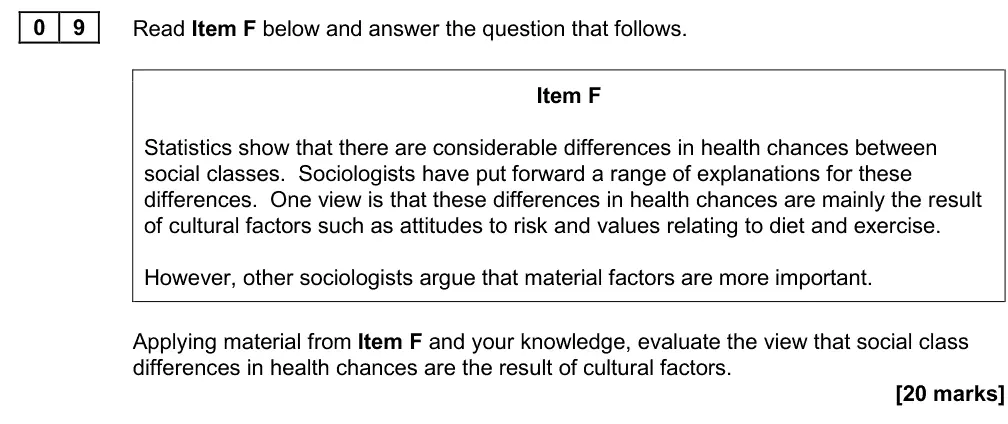
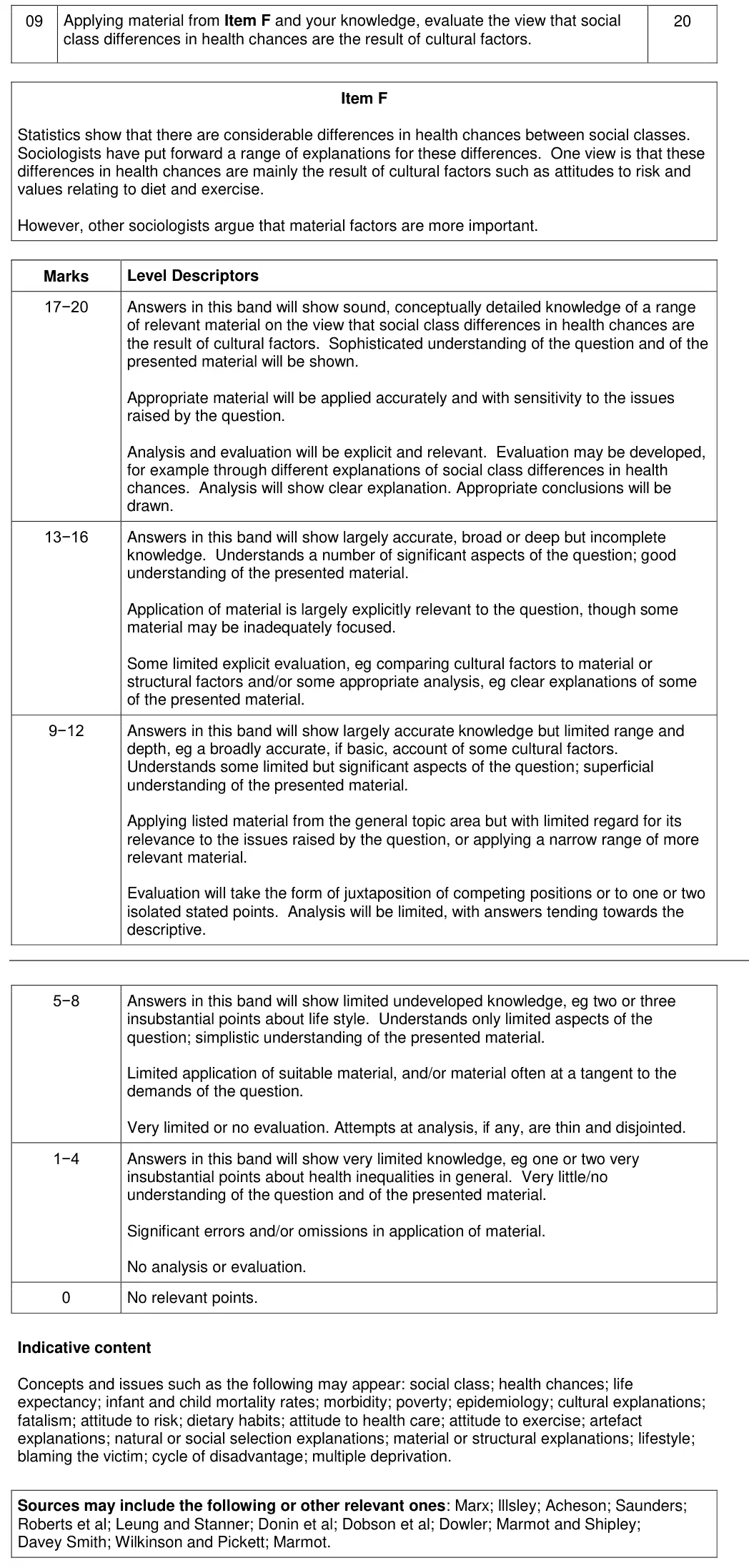
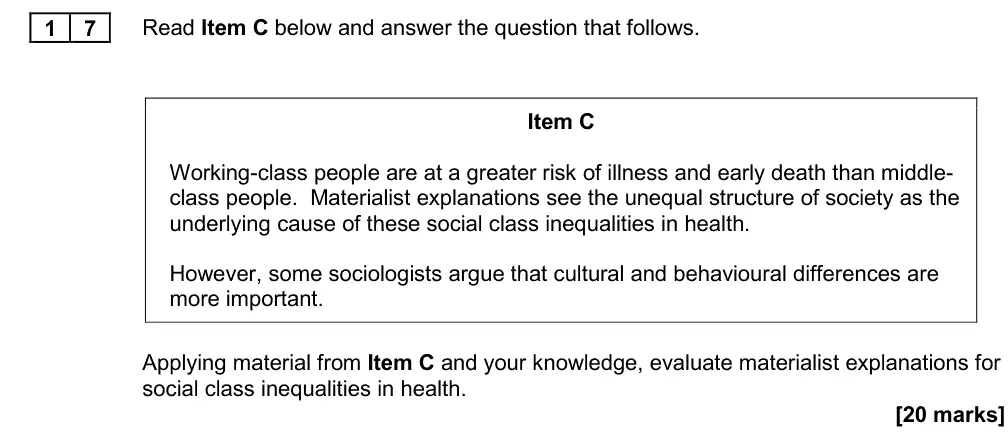
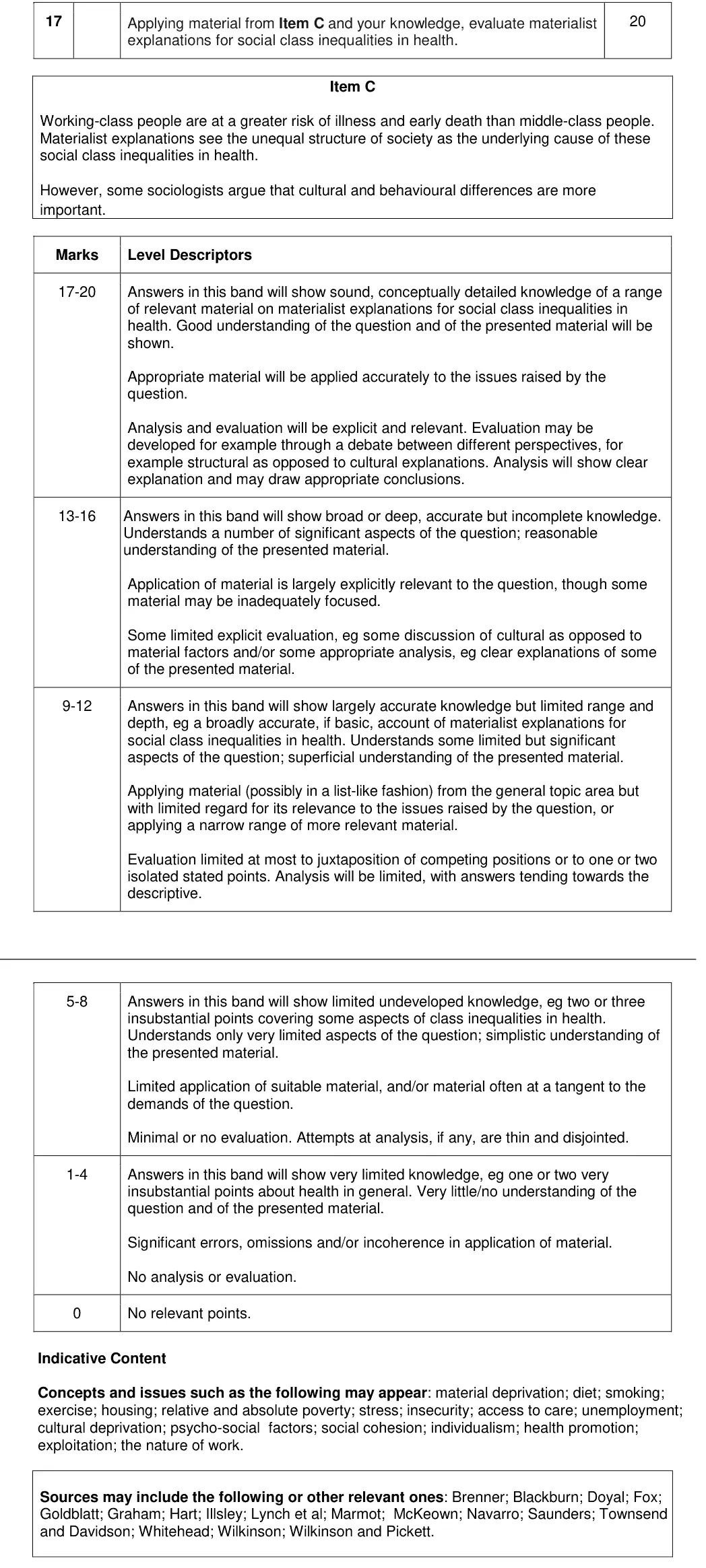
Applying material from Item F and your knowledge, evaluate the view that social class differences in health chances are the result of cultural factors.
Tap a question to zoom it. The mark scheme (with the level descriptors and indicative content) and the examiner's comment open underneath.
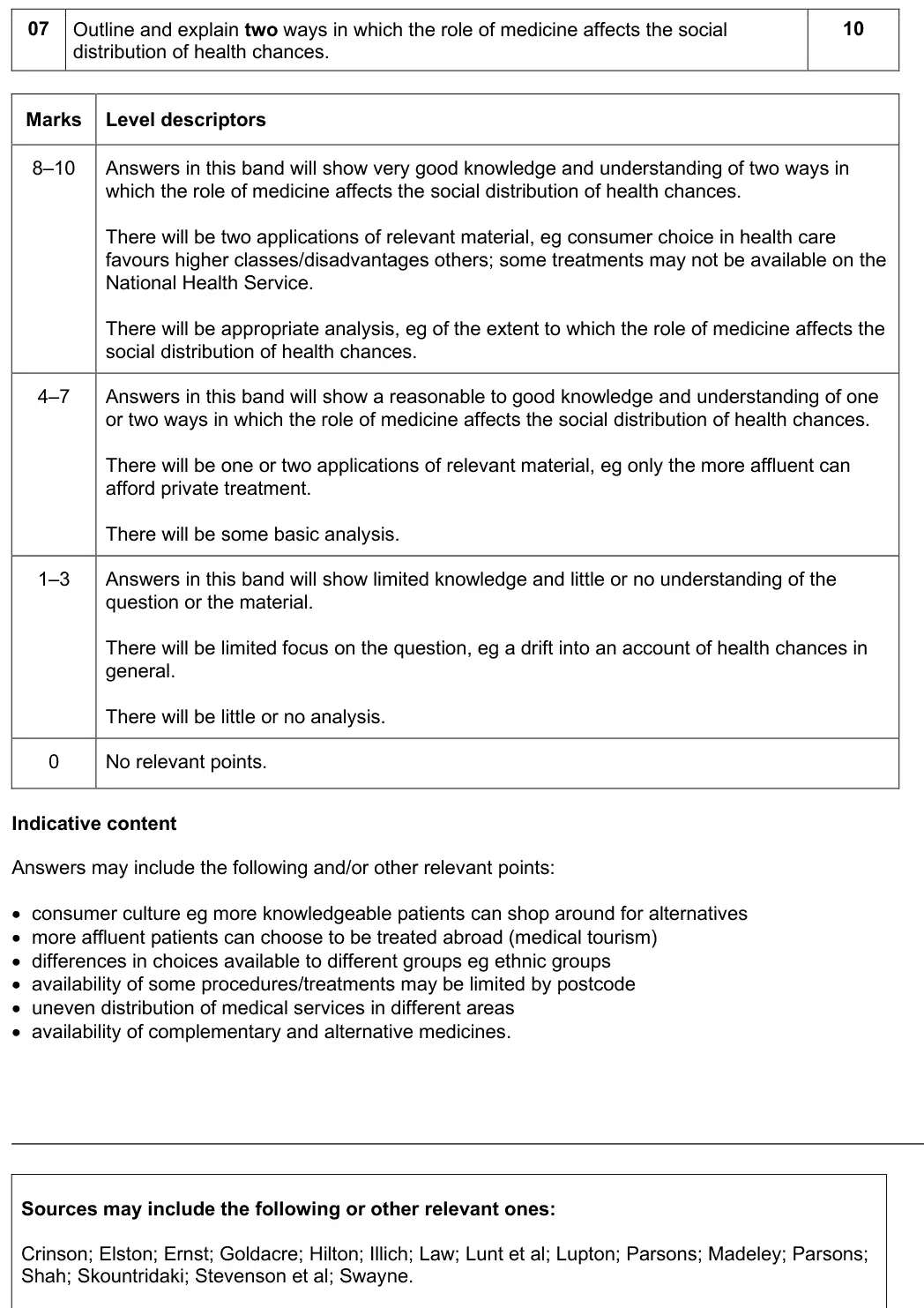
June 2025 · Paper 2 · Q710 marksAO1=5, AO2=3, AO3=2Outline and explain
Mark scheme, including the levels grid and indicative content
Examiner's comment
The nature of these questions means that students cannot rely on reciting knowledge. Questions will ask them to bring together aspects of their sociological knowledge in ways they have not done before. It is therefore important for students to allow time to think about how to answer the question. Students should be aware that there are two types of ten-mark questions. These have different requirements and different mark schemes. There are different marks available for the assessment objectives. 10 mark “outline and explain” questions have more marks available for knowledge and understanding, and none for evaluation. Introductions and conclusions are not required for 10-mark questions, are unlikely to help students and take up time. It is helpful if answers are set out to clearly indicate the two answers, with wording such as “One way/reason is…” or by starting a new paragraph for the second point. Answers that give more than two answers are unlikely to develop two of them sufficiently. The most successful answers to 10-mark questions were focused, clearly stating a point that addressed the question and then developing it, using sociological concepts, evidence such as an example and, where appropriate, theory. Students generally chose to interpret this question by focusing on access to health care and how this affected the distribution of health chances. The idea that more affluent individuals resided in places with better health care provision was a common way to do this and the inverse care law frequently featured.
Notes from the mark scheme and report
must link medicine (consumer choice, private treatment, postcode availability) to the social distribution of health chances
drift into health chances in general = 1–3
most answered through access to care and the inverse care law
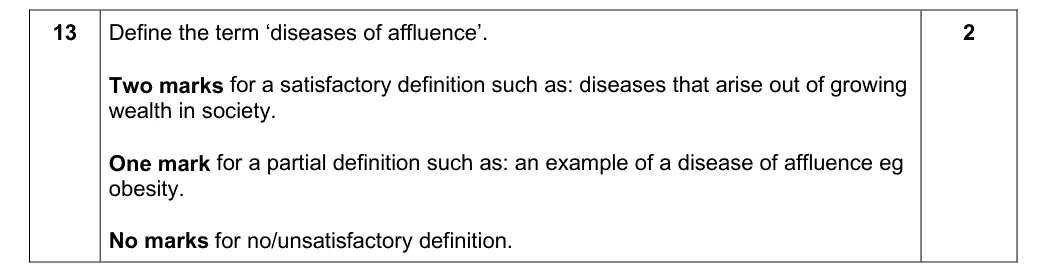
June 2025 · AS Paper 2 · Q132 marksAO1=2Define
Mark scheme
Examiner's comment
This was a new question but most students who answered gained full credit, obesity was often given as an example.
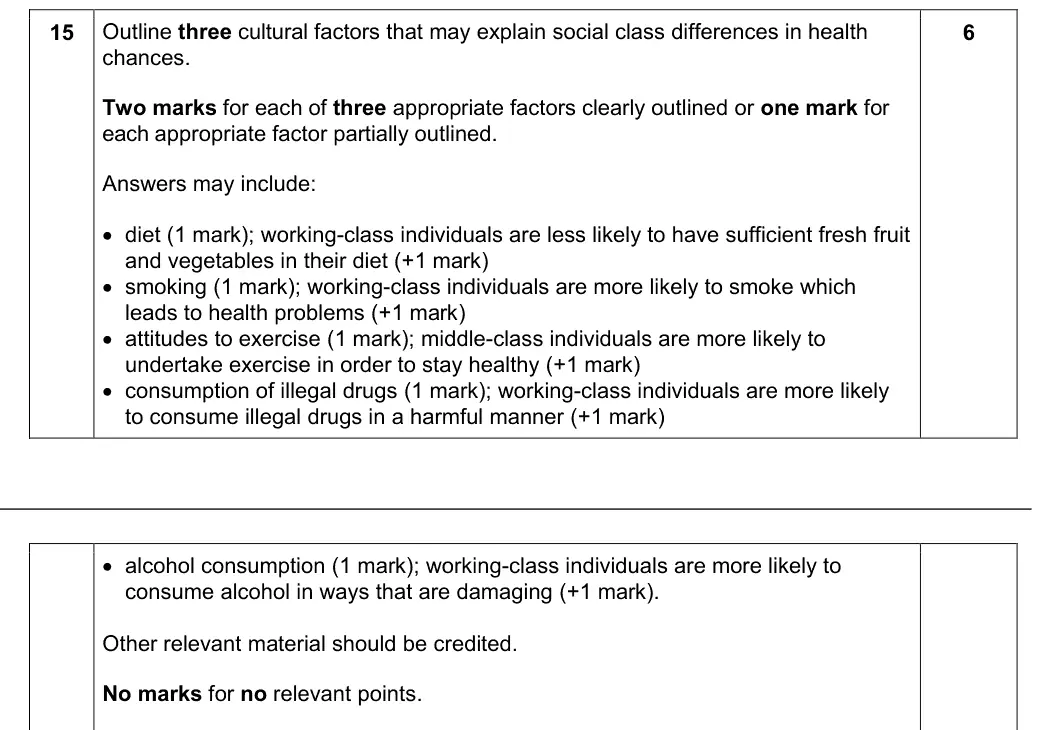
Notes from the mark scheme and report
2 marks for diseases arising from growing wealth
an example such as obesity = 1 mark
most gained full marks
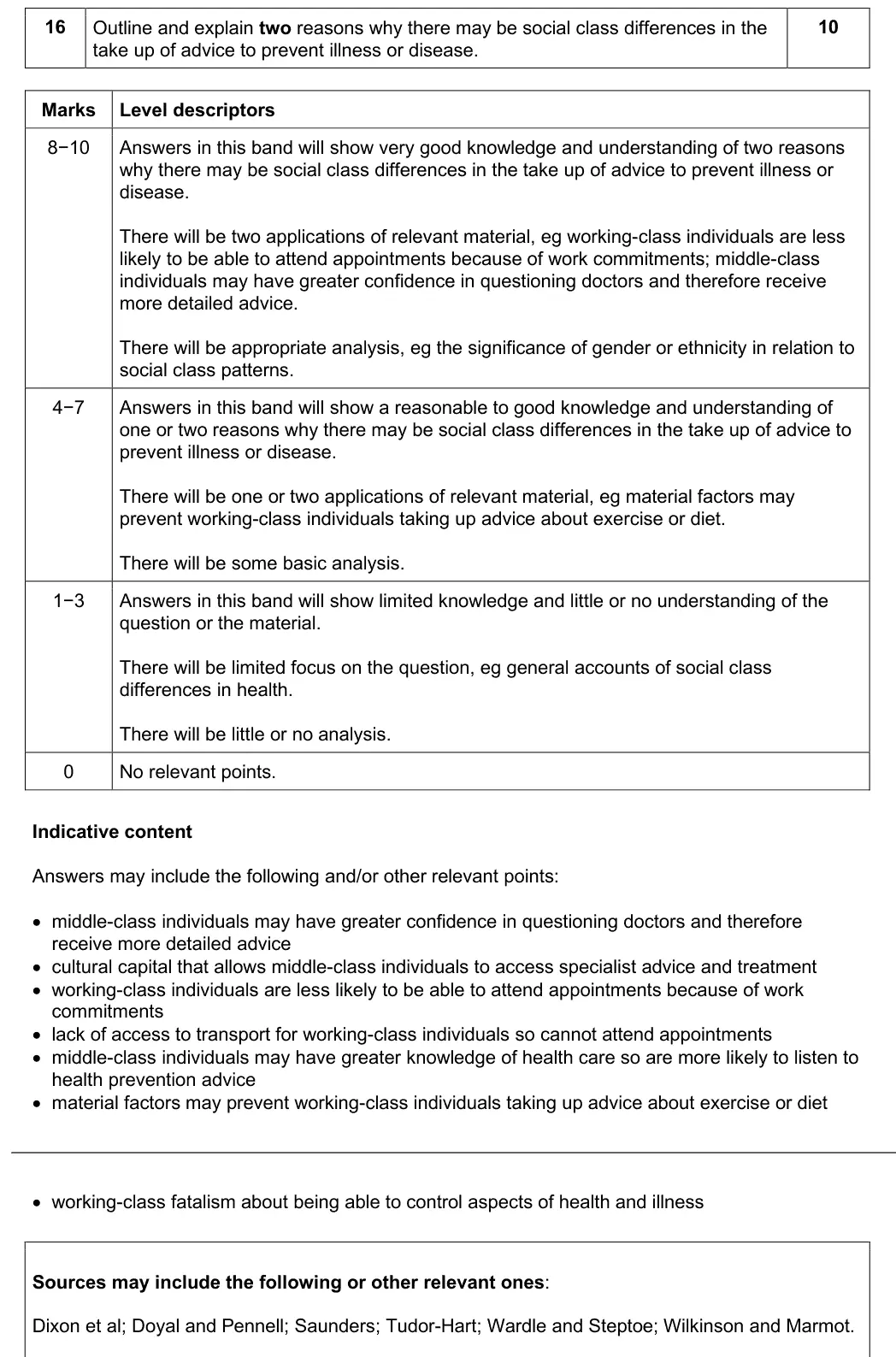
June 2025 · AS Paper 2 · Q1610 marksAO1=5, AO2=3, AO3=2Outline and explain
Mark scheme, including the levels grid and indicative content
Examiner's comment
On the 10-mark 'outline and explain' question (the fourth question in each topic area), and the 6-mark 'outline three...' question (the third question in each topic). For the 10-mark 'outline and explain' questions, students would benefit from clearly identifying a specific way, reason, or factor, followed by a developed explanation. This approach would help make their answers more coherent, structured and easier to reward. This question proved to be difficult for students. The expected responses were ideas such as the working class having a more fatalistic attitudes to life and therefore choosing to ignore medical advice. Instead, most students focused not on the “advice take” up part of the question but more general issues of access to health care. As a result, many of these answers were not well applied to the question and struggled to gain credit. Better responses focused on themes of understanding advice, material factors influencing the ability to act on the advice and so on.
Notes from the mark scheme and report
about take-up of preventive ADVICE by class
examples: middle-class confidence with doctors, cultural capital, work commitments and transport, health knowledge, material limits on diet/exercise, working-class fatalism
most drifted into general access to health care and gained little
general accounts of class health differences = 1-3
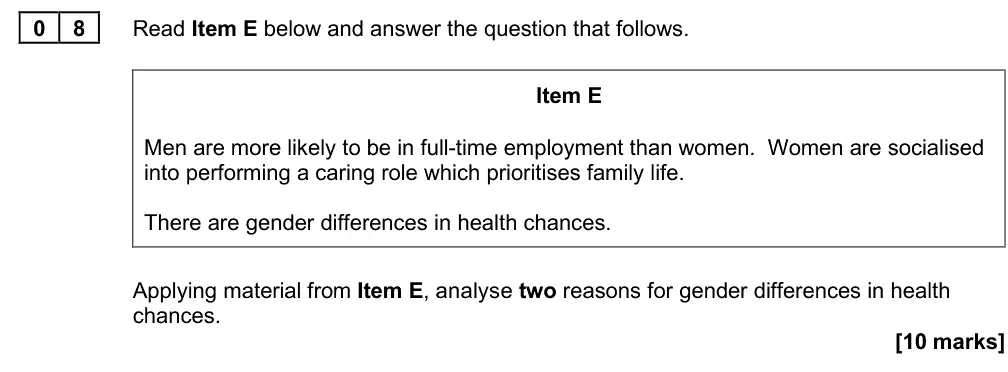
June 2024 · Paper 2 · Q810 marksAO1=3, AO2=4, AO3=3Analyse
Mark scheme, including the levels grid and indicative content
Examiner's comment
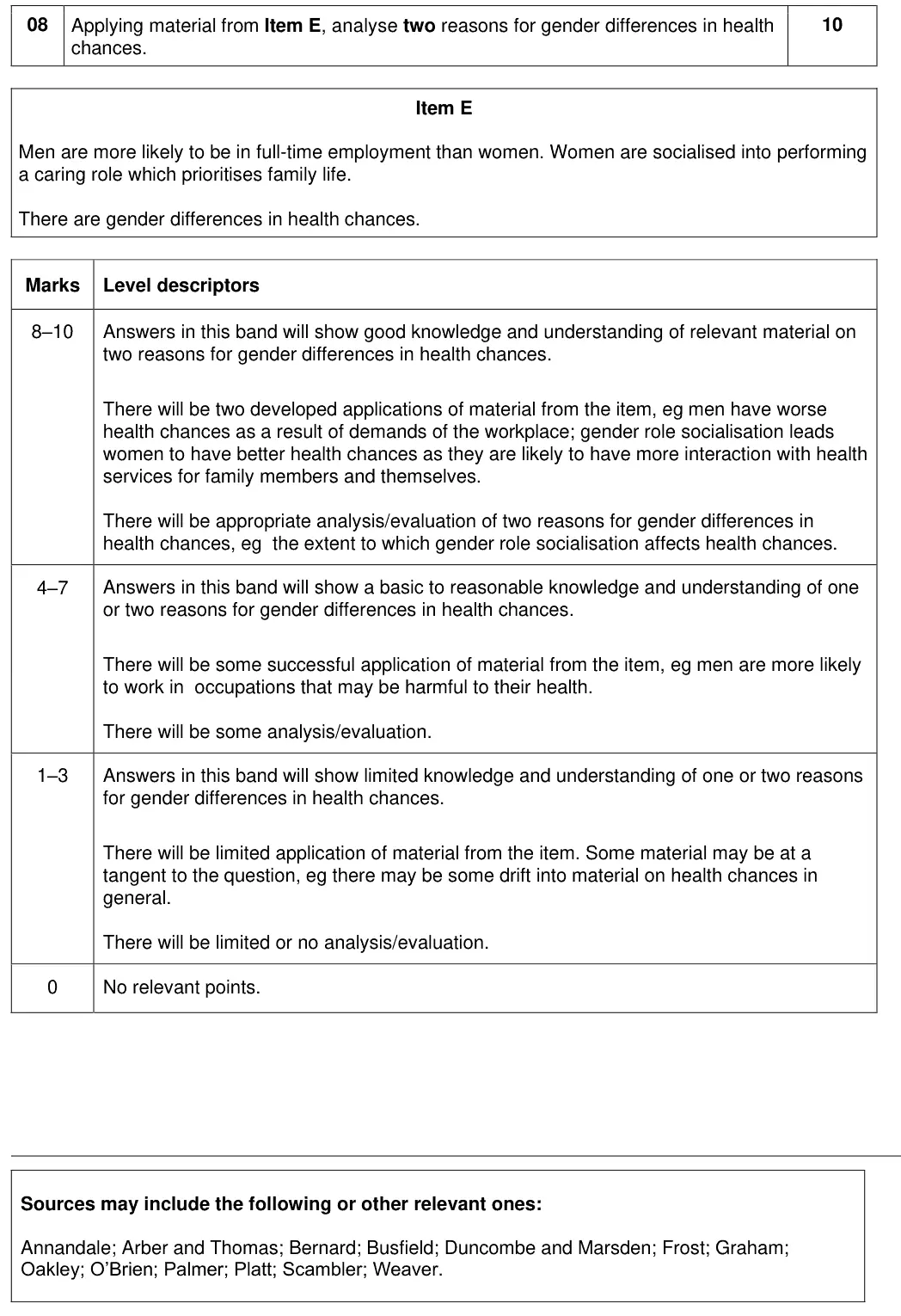
The nature of these questions means that students cannot rely on reciting knowledge. Questions will ask them to bring together aspects of their sociological knowledge in ways they will not have done before. It is therefore important for students to allow time to think about how to answer the question. Students should be made aware that there are two types of 10 mark questions. These have different requirements and different mark schemes . There are different marks available for the assessment objectives. A breakdown of the marks awarded by assessment objective can be found in the mark scheme. The items for 10 mark “analyse” questions are written to give prompts or “hooks” for student answers. These have to be used to access application marks. Answers can indicate use of hooks by quoting, by a reference in parentheses or by wording ( eg “As the item says…”). Items end with a sentence restating the question; the hooks are in the preceding part of the item. Students should avoid writing all they know about a “hook”, and focus on applying the idea to the question. Introductions and conclusions are not required for 10 mark questions; they take up time and rarely improve the mark. It is helpful if answers are set out to clearly indicate the two answers, with wording such as “One way/reason is…”, or by starting a new paragraph for the second point. Answers that give more than two points are unlikely to develop two of them sufficiently. Q8: There was some good understanding in responses to this question. Successful answers often discussed issues of work-related hazard or stress or not having the time to have health concerns checked out. Women being socialised into the caring role was also frequently developed by linking caring to a willingness to seek out medical help or to stress from a dual burden or triple shift.
Notes from the mark scheme and report
two developed applications from Item E (men in full-time work
women socialised into caring), e.g. workplace hazards and stress for men, women's caring role increasing contact with health services
drift into health chances in general is a tangent
good answers also linked caring to dual burden or triple shift stress
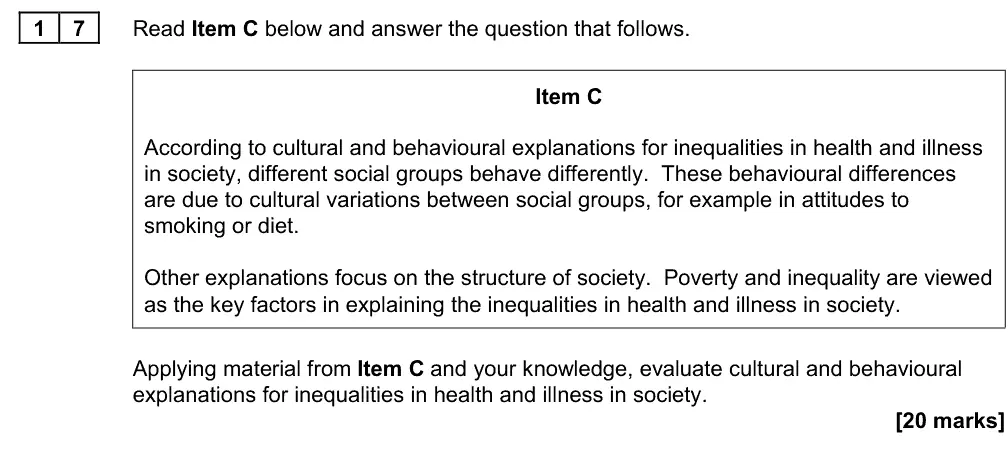
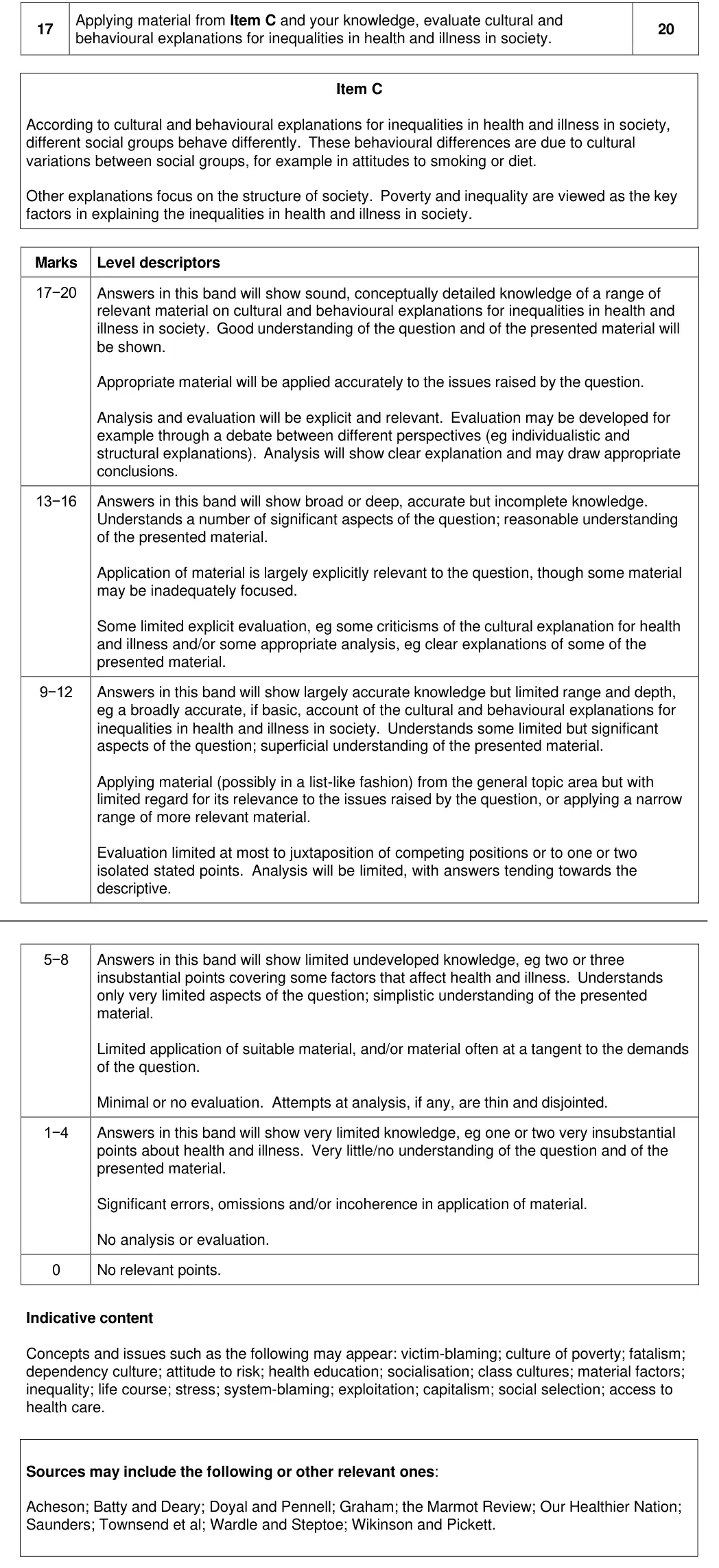
June 2024 · AS Paper 2 · Q1720 marksAO1=8, AO2=6, AO3=620-mark essay
Mark scheme, including the levels grid and indicative content
Examiner's comment
There were some well-structured, detailed and analytical responses to this question. Better answers offered juxtaposition between cultural and behavioural explanations and structural explanations for inequalities in health and illness in society. Less successful responses tended to merge together cultural and behavioural factors or simply listed factors explaining differences in health and illness amongst different groups in society. Some responses focussed on patterns of behaviour in different social groups in relation to smoking and diet with little if any focus on culture.
Notes from the mark scheme and report
top band debates cultural/behavioural (individualistic) against structural/material explanations
weaker answers merged cultural with behavioural factors, listed factors, or described smoking and diet with no link to culture
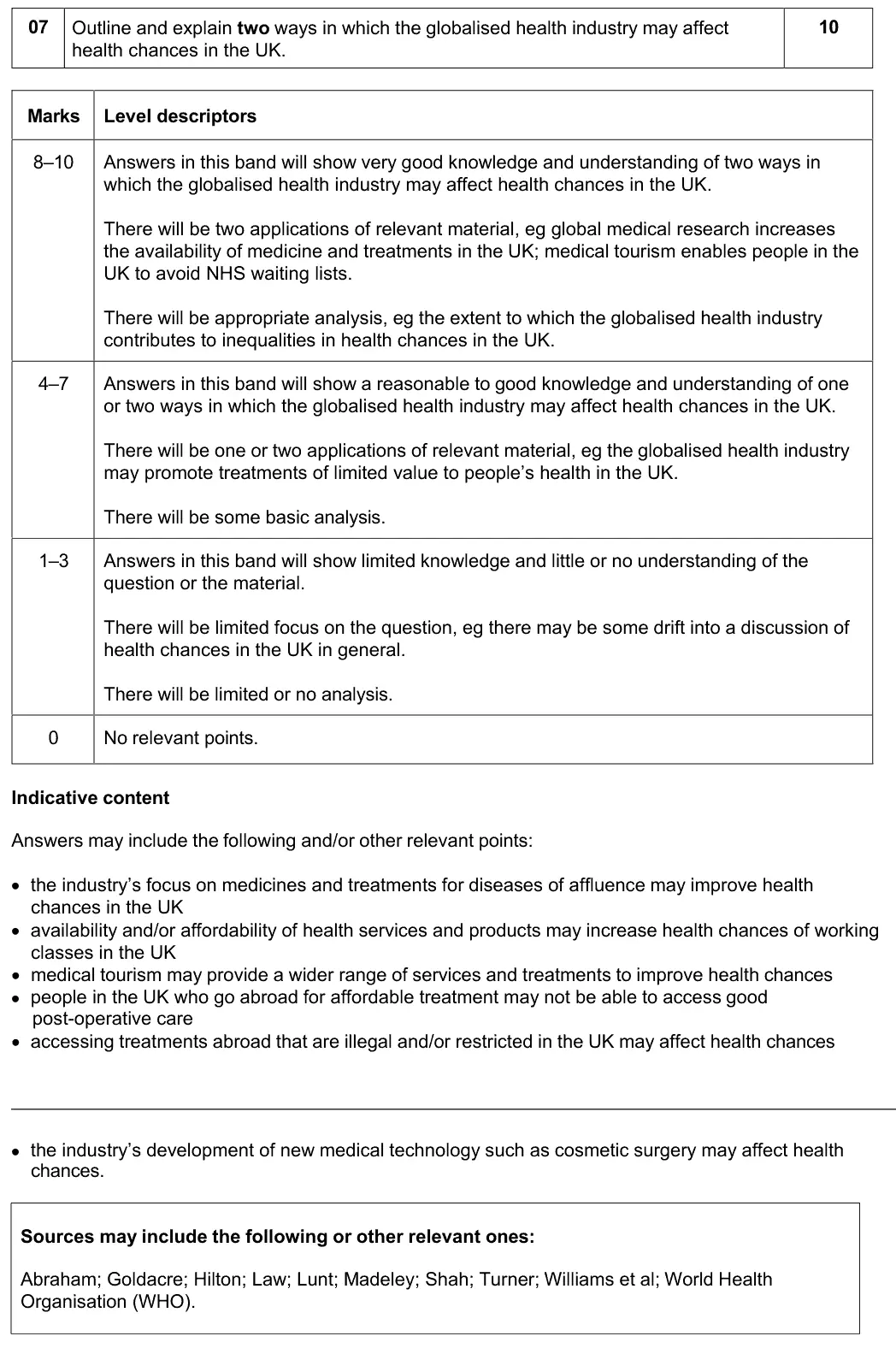
June 2023 · Paper 2 · Q710 marksAO1=5, AO2=3, AO3=2Outline and explain
Mark scheme, including the levels grid and indicative content
Examiner's comment
The nature of these questions means that students cannot rely on reciting knowledge. Questions will ask them to bring together aspects of their sociological knowledge in ways they are unlikely to have done before. It is therefore important for students to allow time to think about how to answer the question. Students should be made aware that there are two types of 10 mark questions. These have different requirements and different mark schemes. There are different marks available for the assessment objectives. 10 mark “outline and explain” questions have more marks available for knowledge and understanding, and none for evaluation. Introductions and conclusions are not required for 10 mark questions and take up valuable time. It is helpful if answers are set out to clearly indicate the two separate points, with wording such as “One way/reason is…” or by starting a new paragraph for the second point. Answers that give more than two points are unlikely to develop two of them sufficiently. Question 7: Successful answers developed points about, for example, medical tourism and the availability (or not) in the UK of medicines and procedures.
Notes from the mark scheme and report
two ways the global health industry affects UK health chances (global research and drug availability, medical tourism, aftercare problems, treatments of limited value)
drift into UK health chances in general = 1–3
successful answers used medical tourism and availability of medicines/procedures
June 2023 · AS Paper 2 · Q156 marksAO1=6Outline
Mark scheme
Examiner's comment
The ‘outline three’ 6 mark question (the third question in every topic area). Students could easily improve outcomes on this question by realising the need to briefly (eg a line or so) expand upon the criticism / feature etc being outlined. Students found this question difficult. There were two main stumbling points. The first was answers that focussed on health care rather than health chances as demanded by the question. These answers could receive only minimum credit. The second was not identifying cultural factors – such as working class culture may encourage heavier drinking which presents a health risk – as opposed to other factors. The main diversion away from identifying cultural factors tended to be to identify material factors instead, such as a lack of money for food / heating. Again, answers following this path could gain only minimum credit.
Notes from the mark scheme and report
2 marks for each of three cultural factors clearly outlined, 1 if partial (e.g. diet, smoking, exercise, drug and alcohol use linked to class)
answers about health care rather than health chances, or giving material factors such as lack of money, get minimal credit
June 2023 · AS Paper 2 · Q1610 marksAO1=5, AO2=3, AO3=2Outline and explain
Mark scheme, including the levels grid and indicative content
Examiner's comment
The ‘outline and explain two’ 10 mark question (the fourth question in every topic area). Here students would benefit more if an explicit identification of a way / reason / factor was made, then leading to an explanation of it, making the student’s answer more cogent. Most students were able to engage with this question. The question required students to link a number of elements together. Students could often give good reasons as to why women might seek out health care more than men and why men may do the opposite. This was the most successful part of student answers. Moving on to making a link between the higher/lower morbidity patterns that gender related access created was a less successful feature of student answers.
Notes from the mark scheme and report
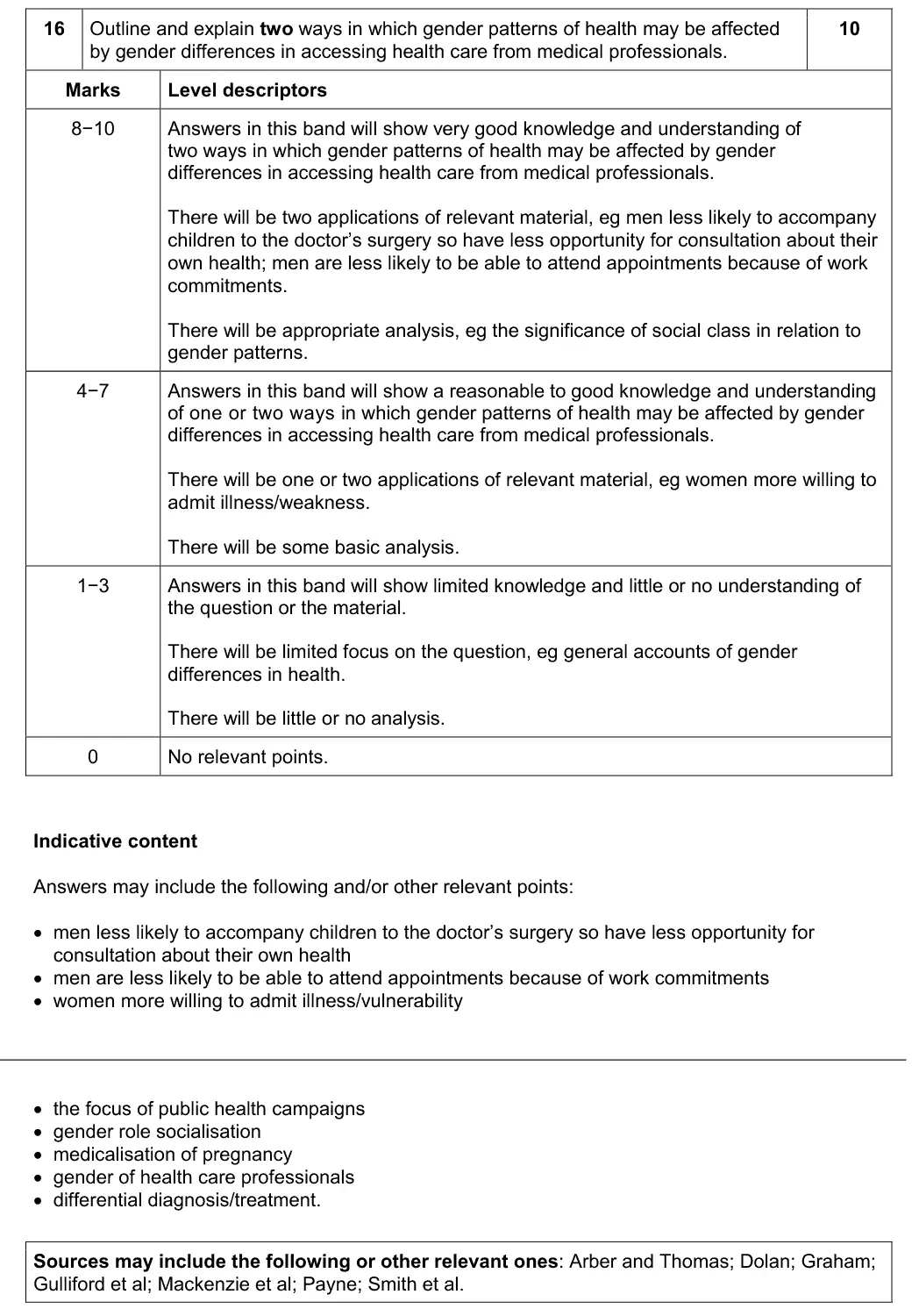
two ways gendered access to professionals shapes gender patterns of health (e.g. men less likely to attend surgeries or take time off work, women more willing to admit illness, public health campaigns, gender of professionals)
general accounts of gender differences in health = 1–3
many explained why women seek care more but did not link this back to morbidity patterns
June 2022 · AS Paper 2 · Q156 marksAO1=6Outline
Mark scheme
Examiner's comment
For low mark tariff questions where candidates are required to either define, explain or outline, care should be taken to ensure that points are not just identified. This question was generally answered well. Exam technique was good with very few examples of long answers. The most common responses were language barriers, experiences of racism and social class. Social class sometimes gained a partial mark when not explicitly linked to ethnicity.
Notes from the mark scheme and report
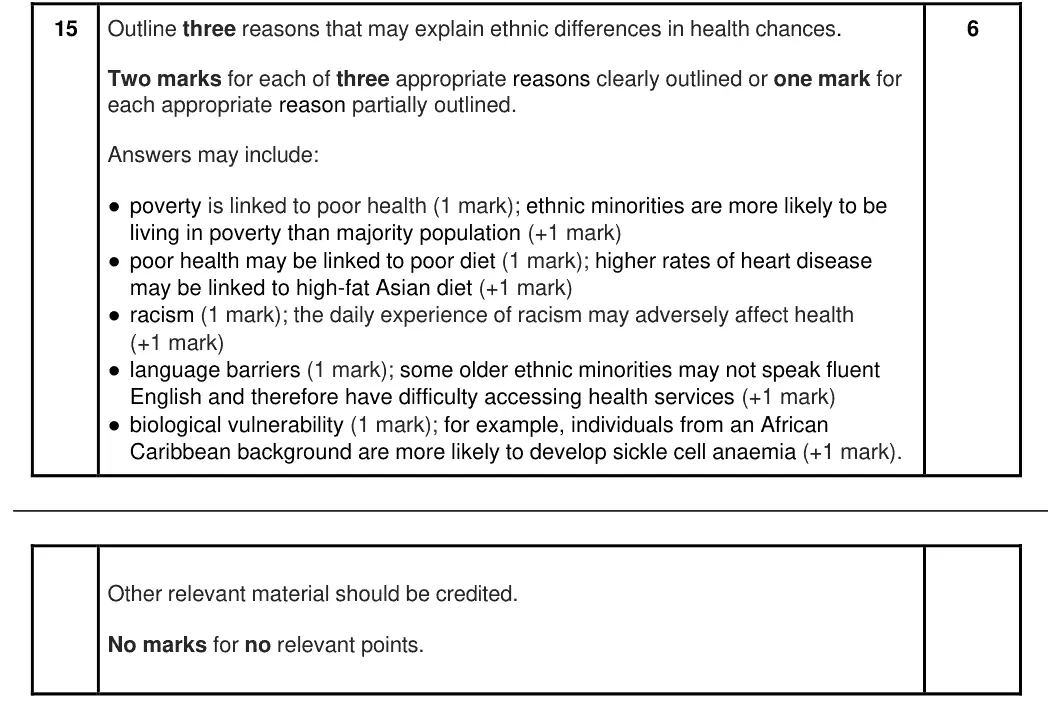
2 marks for each of three reasons clearly outlined, 1 if only partially outlined
e.g. poverty, diet, racism, language barriers, biological vulnerability
answered well
social class not linked to ethnicity got only 1
November 2021 · Paper 2 · Q920 marksAO1=8, AO2=6, AO3=620-mark essay
Mark scheme, including the levels grid and indicative content
Notes from the mark scheme and report
must apply Item F (language and cultural values vs racism and class position)
top band weighs material against cultural explanations
credited: institutional racism, class position, housing, migration effects, access to care, physical and mental health
no examiners' report comment for this part
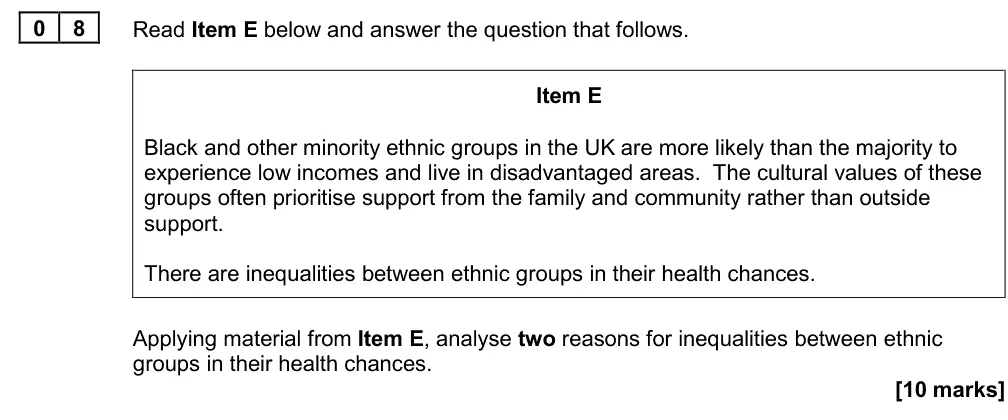
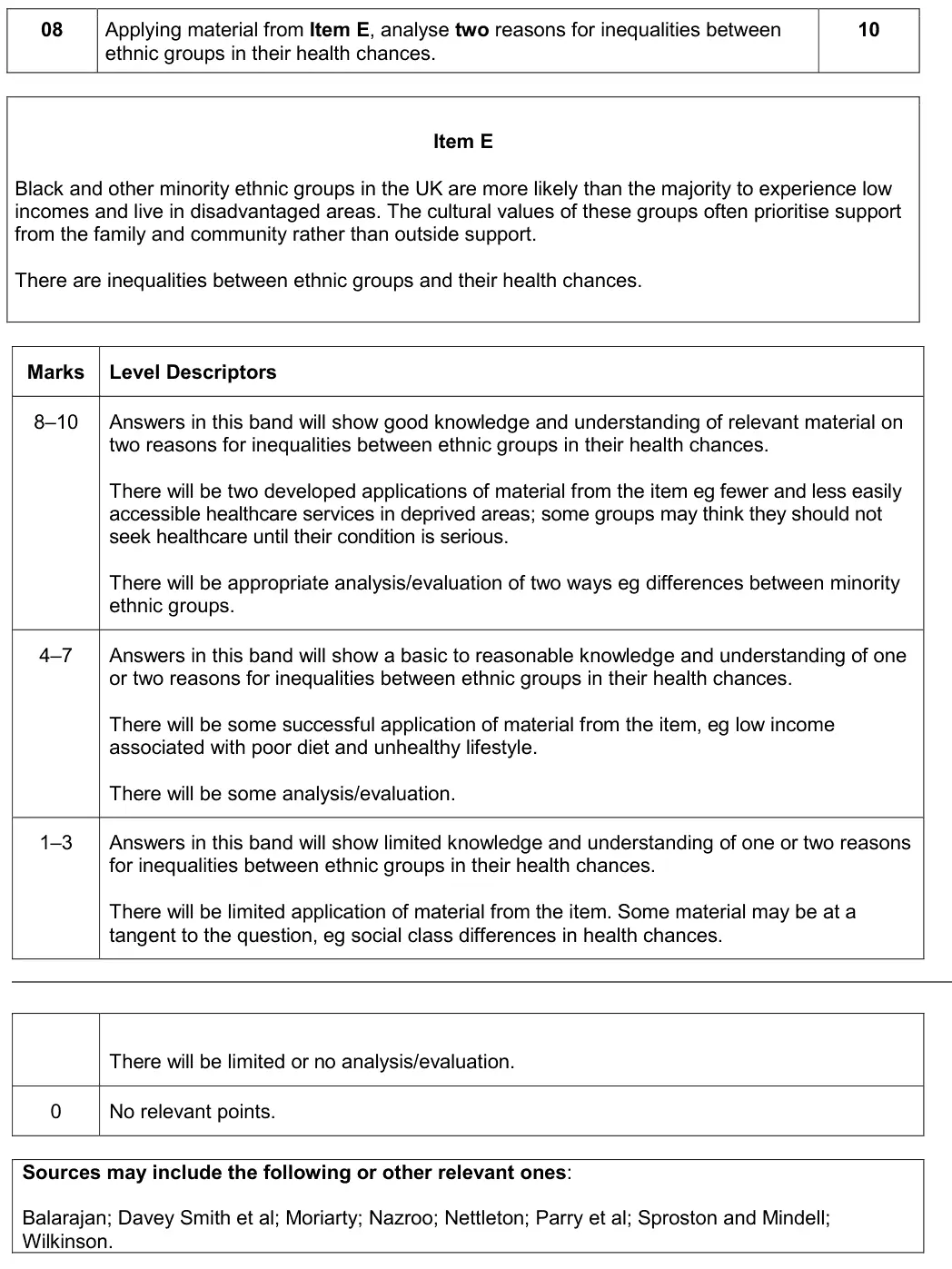
November 2020 · Paper 2 · Q810 marksAO1=3, AO2=4, AO3=3Analyse
Mark scheme, including the levels grid and indicative content
Notes from the mark scheme and report
apply Item E (low income, disadvantaged areas, preference for family/community support)
e.g. fewer accessible services in deprived areas, delaying seeking care, poor diet linked to low income
evaluation e.g. differences between minority ethnic groups
class differences in health = tangent
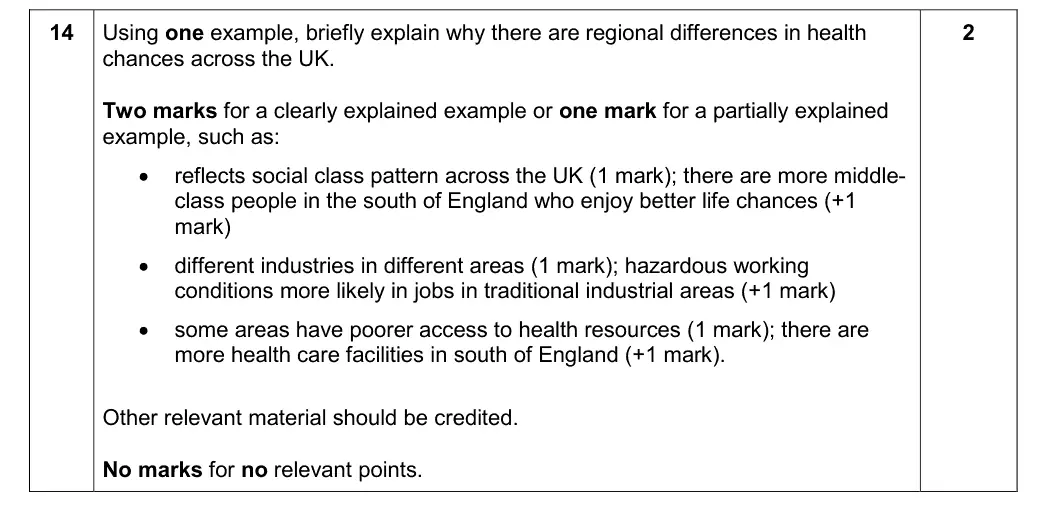
November 2020 · AS Paper 2 · Q142 marksAO2=2Brief explain
Mark scheme
Notes from the mark scheme and report
1 mark for a reason (class make-up of regions, hazardous industries, uneven access to health care), +1 for explaining it
November 2020 · AS Paper 2 · Q1720 marksAO1=8, AO2=6, AO3=620-mark essay
Mark scheme, including the levels grid and indicative content
Notes from the mark scheme and report
item hooks: gender roles and social expectations vs class combined with gender
top band distinguishes gender patterns in mortality from those in morbidity
June 2019 · Paper 2 · Q920 marksAO1=8, AO2=6, AO3=620-mark essay
Mark scheme, including the levels grid and indicative content
Examiner's comment
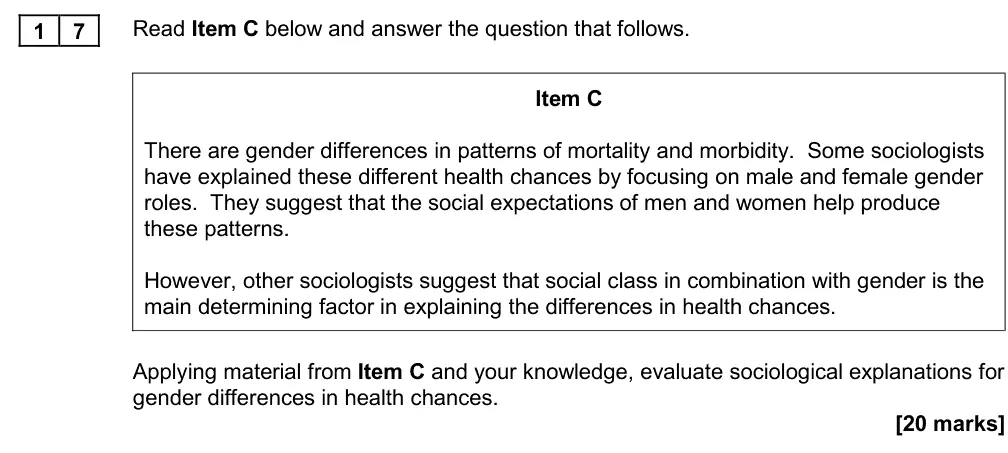
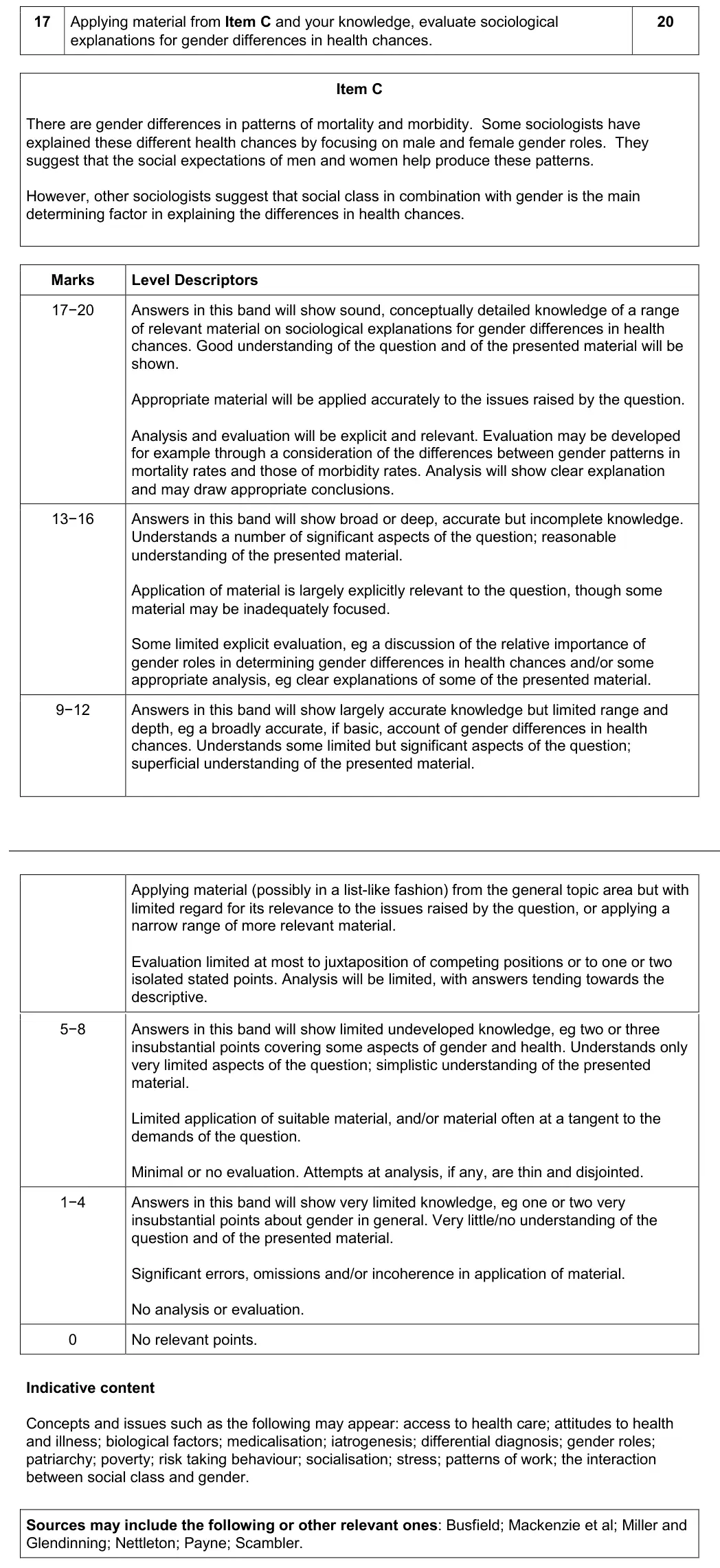
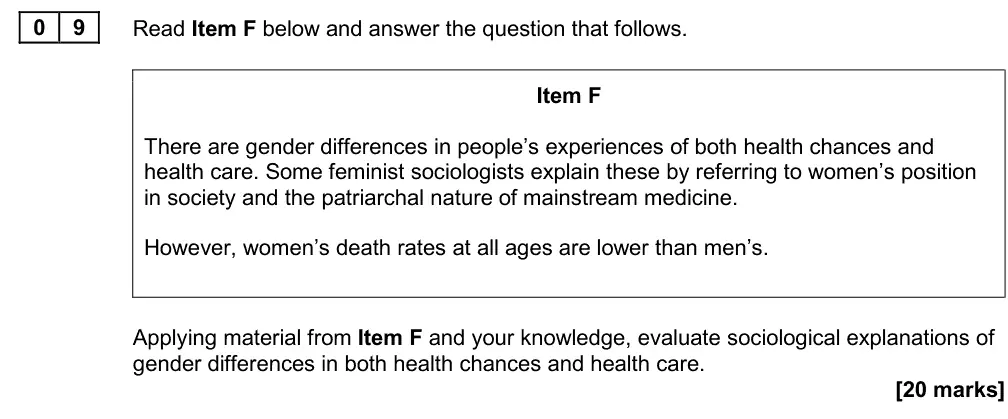
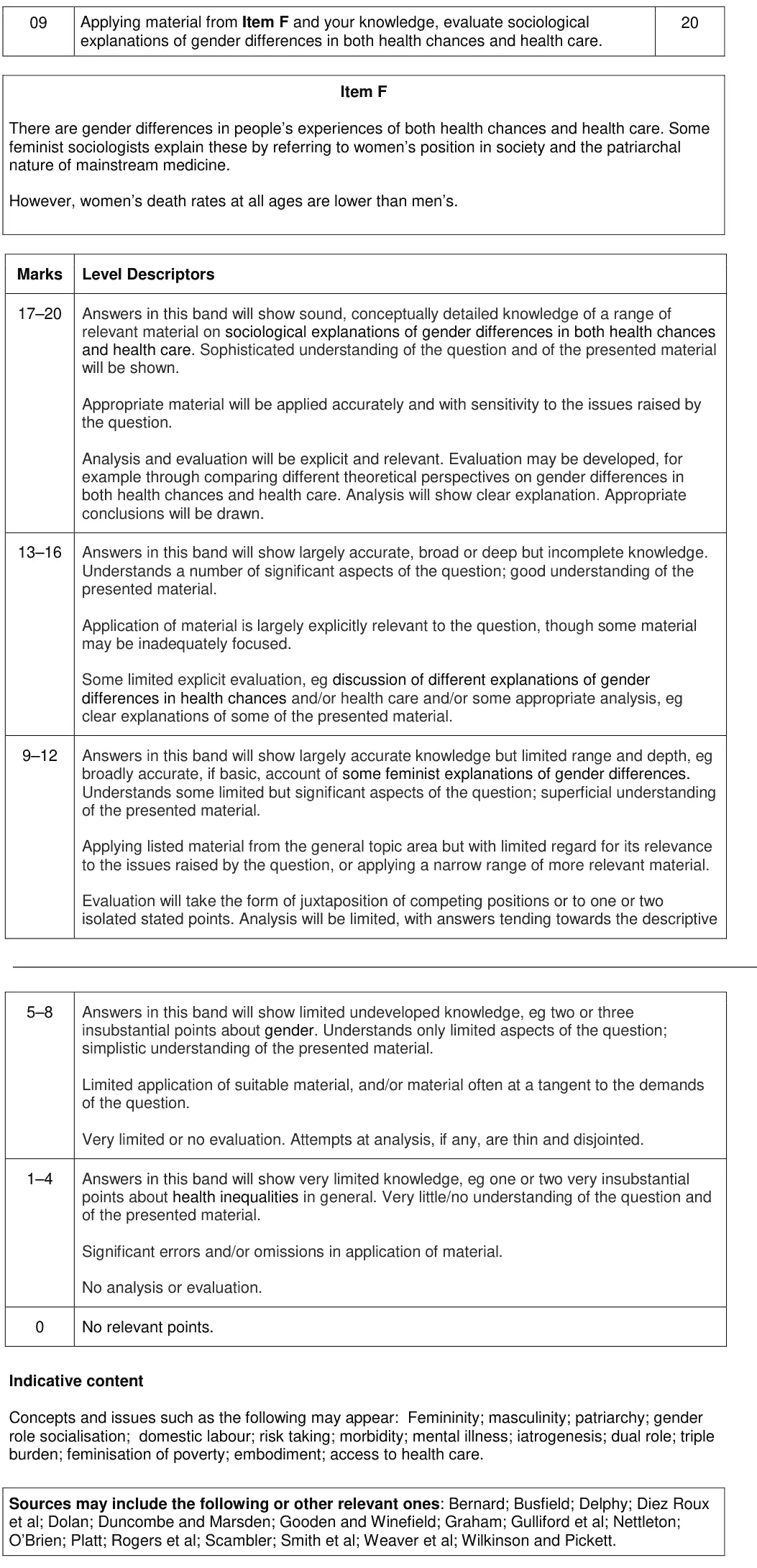
As last year, many scripts had one substantial answer to the Section A 20-mark question and one significantly briefer one for Section B, suggesting problems with timing. There was often little evidence of planning. A wide range of material can be relevant to these questions, and students are not expected to include everything. They need to carefully choose the content and to plan their answers. The best answers will be both empirical and theoretical, for example showing knowledge of research findings and examples, and knowledge of theoretical perspectives. Some answers amounted to lists of theoretical perspectives, with learned points of criticism, and lost focus on the question itself. While the items are intended as a helpful starting point for answers, they should not be taken by students as a full list of what is relevant; better answers will draw in other relevant knowledge and ideas. Most students were able to use a range of sociological knowledge and understanding to answer this question and to address both “health chances” and “heath care” in their responses.
Notes from the mark scheme and report
must address both health chances and health care
top band compares perspectives
item hook: women's lower death rates despite patriarchal medicine
AO split from AQA's standard grid for this paper (this year's mark scheme does not print it).
June 2019 · AS Paper 2 · Q132 marksAO1=2Define
Mark scheme
Examiner's comment
Relatively few students were able to define the term adequately. Most partial answers struggled to capture the idea of ‘rate’ and simply expressed the idea as the number of deaths. Some answers confused the term with life expectancy.
Notes from the mark scheme and report
AO grid not printed
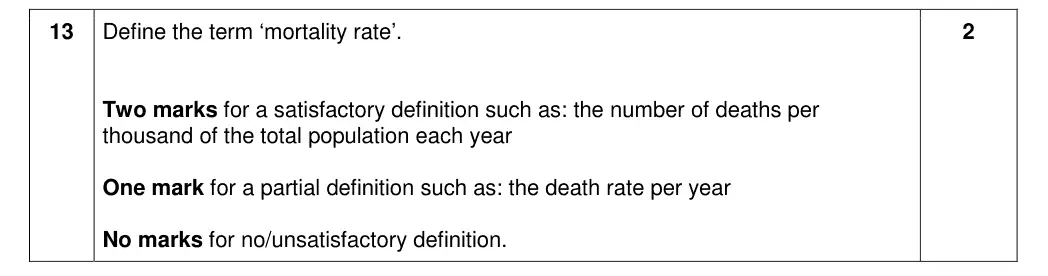
2 marks: deaths per thousand of the population per year
1 mark: death rate per year
many missed the idea of a rate or confused it with life expectancy
AO split from AQA's standard grid for this paper (this year's mark scheme does not print it).
June 2019 · AS Paper 2 · Q1720 marksAO1=8, AO2=6, AO3=620-mark essay
Mark scheme, including the levels grid and indicative content
Examiner's comment
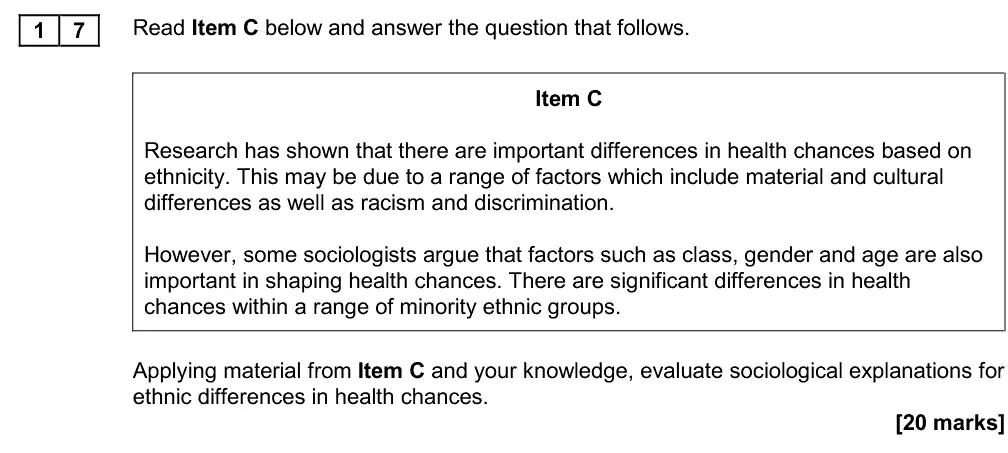
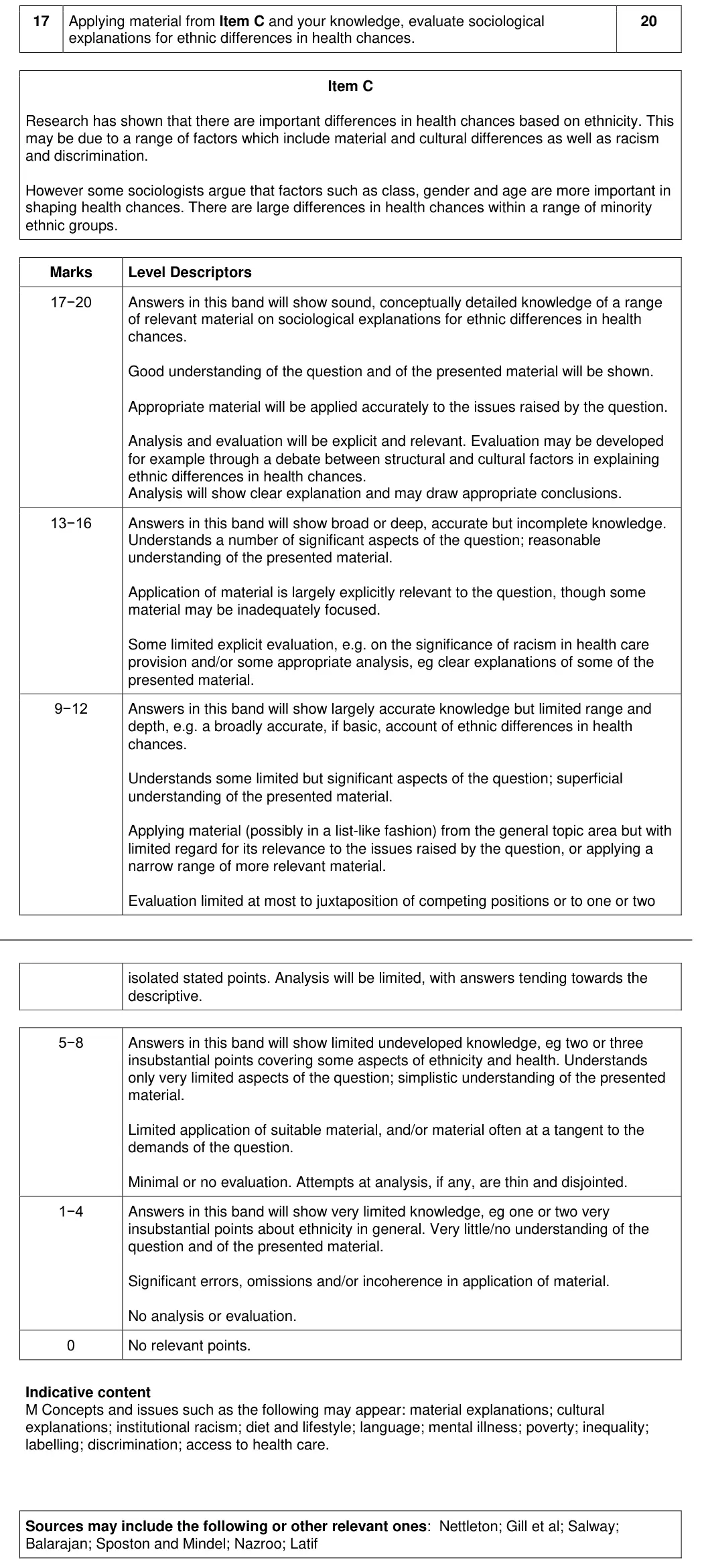
The answers to this question were generally disappointing. Some weaker answers made limited and simplistic stereotypical comments concerning the poor education and language skills of ethnic minorities. The best answers were able to discuss numerous sociological explanations for ethnic differences in health chances. These answers typically referred to a range of factors including material and cultural factors, labelling, racism and bias in health care provision as well as attitudes to health care provision. Better answers distinguished between different ethnic groups and the relevance of particular factors in explaining the health chances of specific ethnic groups. Such response also discussed health chances in relation to both physical and mental health and were often able to frame their answers with reference to different types of explanations such as material or cultural. An additional feature of good answers was the ability to analyse and evaluate their points. For example, a point about bias and racism among health care professionals would be discussed in relation to changing employment patterns in the NHS in relation to different ethnic groups and an appropriate conclusion would be reached.
Notes from the mark scheme and report
AO grid not printed
must apply Item C
QP Item C says class, gender and age are 'also' important but the MS version says 'more' important
top band: structural vs cultural debate
best answers distinguished different ethnic groups and covered mental as well as physical health
weaker answers were stereotyped (language, education)
AO split from AQA's standard grid for this paper (this year's mark scheme does not print it).
June 2018 · Paper 2 · Q920 marksAO1=8, AO2=6, AO3=620-mark essay
Mark scheme, including the levels grid and indicative content
Examiner's comment
Many scripts had one substantial well developed answer to a 20 mark question and one significantly briefer one, suggesting problems with timing. It is often the case that a wide range of material can be relevant to these questions, and students need to carefully choose the content they wish to use by planning their answers. For example, it may be more effective to cover a limited number of views or theories in some depth rather than to include every possible theory. There was a tendency for answers to progressively lose sight of the question and to become a list of different views. The best answers will address all aspects of the question and will draw on theories, concepts and empirical examples or evidence. Evaluation which meets the demands of the questions is better than points of criticism which have been learned and included, regardless of the question. Students should also be aware that evaluation includes awareness of the strengths as well as the weaknesses of an argument, theory or piece of evidence. Most students were able to use a range of sociological knowledge and understanding to answer this question. There was however some uncertainty as to what was meant by ‘cultural factors’, with some students taking this to include, for example, not being able to afford to eat healthily or exercise. Other answers strayed from social class differences to differences between ethnic groups (without making clear how these might be related to social class). Better answers built on points in the item, including values and attitudes to risk, to effectively compare cultural factors with, for example, material and structural factors.
Notes from the mark scheme and report
top band evaluates cultural against material/structural (and artefact, selection) explanations
confusion about 'cultural factors', with some counting inability to afford healthy food as cultural
drift into ethnic differences not linked to class
best built on the item's attitudes to risk and diet
AO split from AQA's standard grid for this paper (this year's mark scheme does not print it).
June 2018 · AS Paper 2 · Q156 marksAO1=6Outline
Mark scheme
Examiner's comment
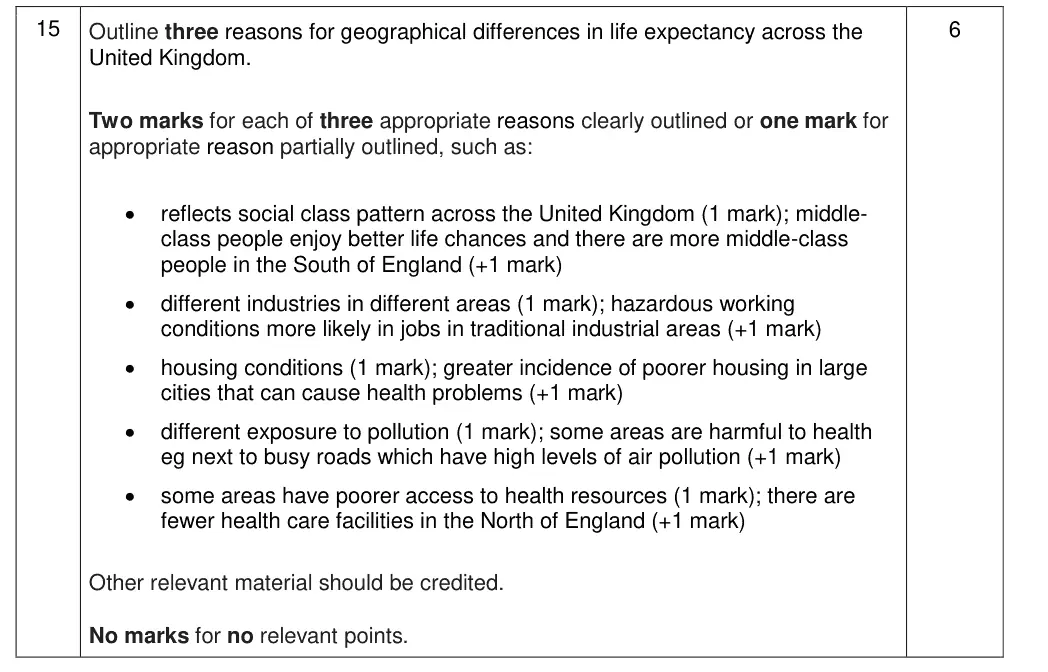
Some students seemed unfamiliar with the concept of geographical differences in life expectancy and just outlined differences based on gender or social class or ethnicity. Other unsuccessful answers failed to discuss variations across the United Kingdom and instead drew international comparisons. Good answers tended to identify reasons such as how some areas have poorer access to health resources; how the geographical pattern reflects social class pattern across the United Kingdom; different exposure to pollution. In order to score both marks for each point students needed to outline clearly for example, what the pattern of access to health care resources is across the United Kingdom rather than just state that there is a variation.
Notes from the mark scheme and report
reasons for regional differences within the UK: class geography, local industries, housing, pollution, access to health care
errors: class/gender/ethnicity differences only, or international comparisons
second mark needs the actual regional pattern
AO split from AQA's standard grid for this paper (this year's mark scheme does not print it).
June 2018 · AS Paper 2 · Q1610 marksAO1=5, AO2=3, AO3=2Outline and explain
Mark scheme, including the levels grid and indicative content
Examiner's comment
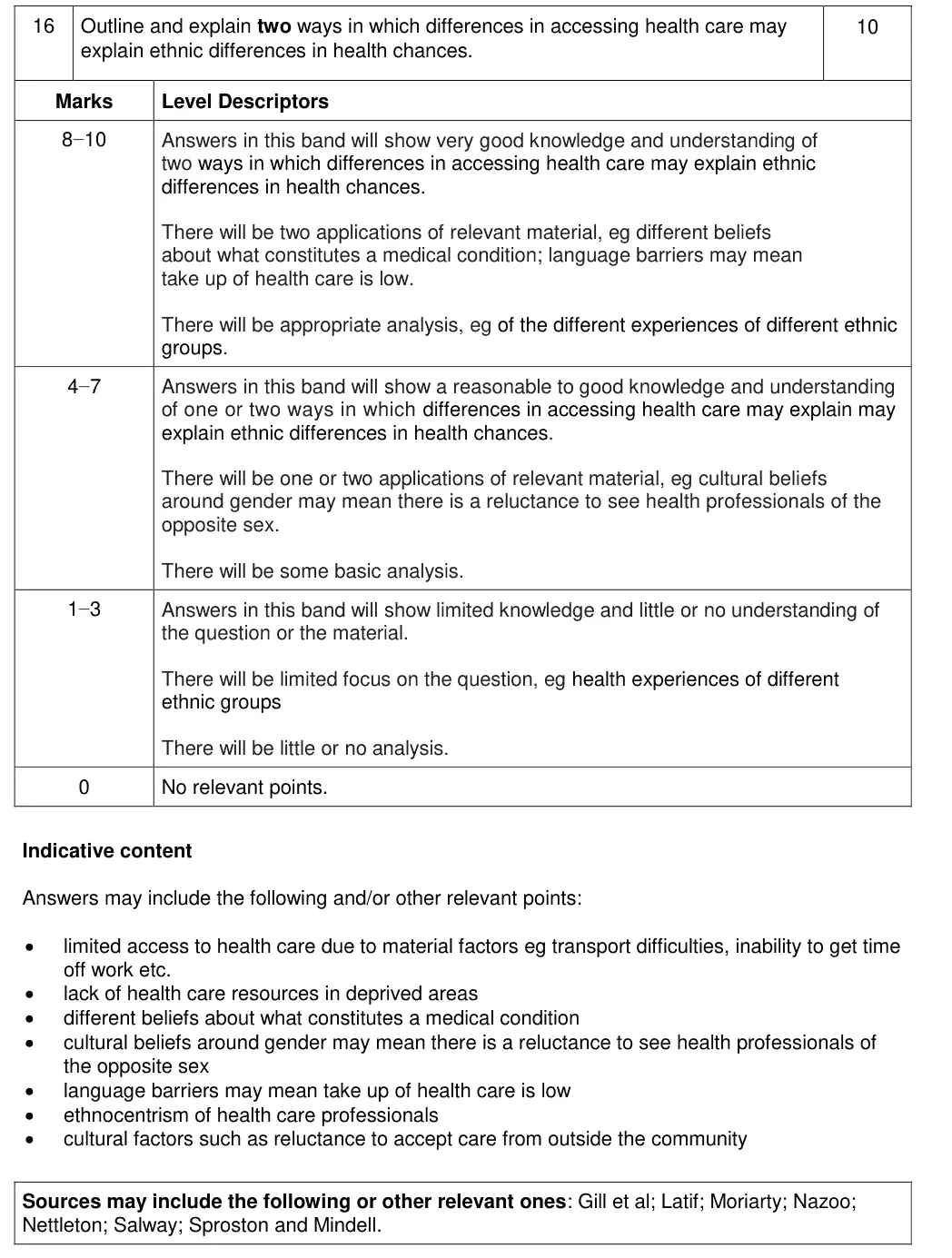
The 10 mark outline and explain question requires students to link two aspects of the specification. The best answers took note of both aspects of the question, clearly identified two separate points and developed them in relation to the second part of the question. Weaker answers either ignored one aspect of the question or attempted to cover a number of ideas rather than focusing on two. Limited access to health care due to material factors, cultural beliefs, language barriers and racism of health professionals were the most common ways offered by successful students. Differential beliefs about what constitutes a medical condition and different attitudes to traditional remedies were also popular responses. Successful answers were able to explain how these ways affected differences in accessing health care and explained explicitly how these led to ethnic differences in health chances. Less successful students tended to make unsupported statements about, for example, the educational levels of different ethnic groups, or tended just to assert the reason without any appropriate discussion or analysis.
Notes from the mark scheme and report
two ways access to care explains ethnic health differences
examples: material barriers, language, beliefs about illness, gender norms about doctors, ethnocentrism of staff
drift into ethnic health experiences in general = 1-3
must link access to health chances
unsupported claims about education levels of groups gained little
AO split from AQA's standard grid for this paper (this year's mark scheme does not print it).
June 2017 · AS Paper 2 · Q1610 marksAO1=5, AO2=3, AO3=2Outline and explain
Mark scheme, including the levels grid and indicative content
Examiner's comment
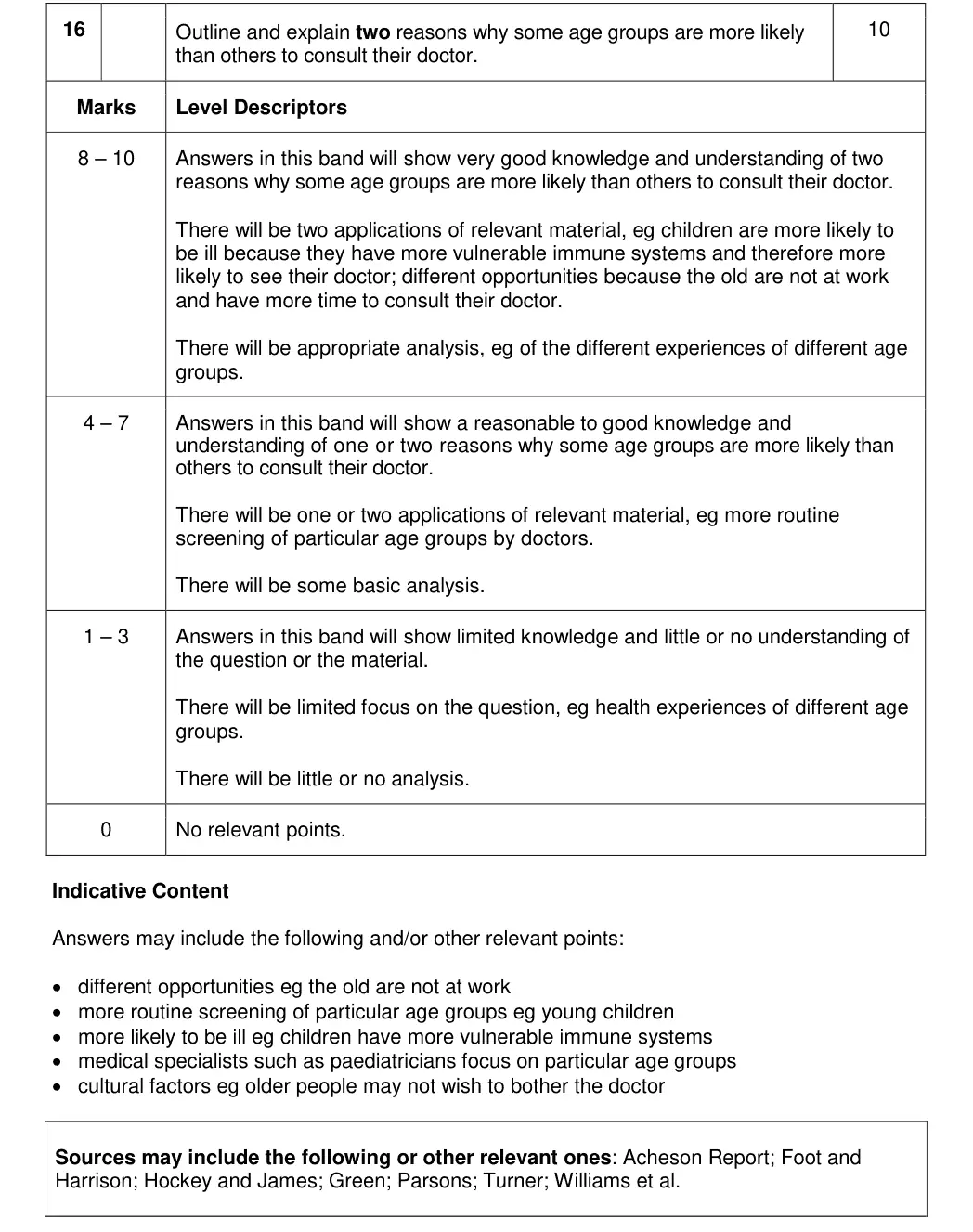
The 10 mark outline and explain question requires students to link two aspects of the specification. The best answers took note of both aspects of the question, clearly identified two separate points and developed them in relation to the second part of the question. Weaker answers either ignored one aspect of the question or attempted to cover a number of ideas rather than focusing on two. Cultural factors around older people’s expectations of health and attitudes to consulting the doctor were the most common reasons offered by successful students. Differential work opportunities and differences in immune systems were also popular responses. Successful answers were able to explain how these factors affected different age groups and explained explicitly how they led to differences between age groups regarding consultation rates. Less successful students tended to drift away from age into considerations of gender or ethnicity, or tended just to assert the reason without any appropriate discussion or analysis.
Notes from the mark scheme and report
no marks for evaluation in this question type
two reasons each developed and explicitly linked to consultation rates, e.g. older people not at work, children's vulnerable immune systems, routine screening
common answer: cultural attitudes of older people
drift into gender or ethnicity limits marks
June 2017 · AS Paper 2 · Q1720 marksAO1=8, AO2=6, AO3=620-mark essay
Mark scheme, including the levels grid and indicative content
Examiner's comment
Some answers were unable to distinguish between cultural and material explanations for social class inequalities in health and just wrote very descriptively about smoking, diet or access to healthcare. A number of students were more comfortable with discussing cultural explanations as opposed to material explanations, and these answers were often unbalanced. The best answers referred to a number of material factors, such as poverty, stress, insecurity, unemployment, housing, the nature of work, social cohesion, and access to health care. These answers tended to weave cultural factors into the discussion rather than have two identifiable sections. For example by discussing to what extent poor diet was about material deprivation, poor health education or a cultural choice. These answers were often able to frame their answers with reference to sociological perspectives and arrive at a reasoned conclusion.
Notes from the mark scheme and report
must apply Item C
top band: structural vs cultural/behavioural debate
many could not separate material from cultural explanations or wrote unbalanced answers favouring cultural factors
best answers covered poverty, stress, housing, work, unemployment, social cohesion and access to care and wove cultural factors into the discussion
June 2016 · AS Paper 2 · Q132 marksAO1=2Define
Mark scheme
Examiner's comment
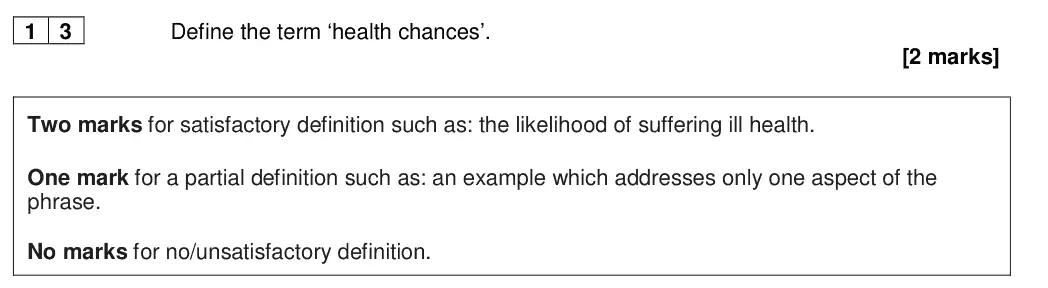
Centres are reminded that questions asking for a definition of a concept that contains more than one word within quotation marks are best answered by ensuring that all the words are defined. This proved to be quite a difficult question for students. The word ‘chances’ was often used tautologically to define itself. Also quite a number of answers drifted into discussing differences in access to care, and subsequently struggled to explain the term.
Notes from the mark scheme and report
2 marks for the likelihood of suffering ill health
tautological use of 'chances' common
drift into access to care
found difficult
June 2016 · AS Paper 2 · Q142 marksAO2=2Brief explain
Mark scheme
Examiner's comment
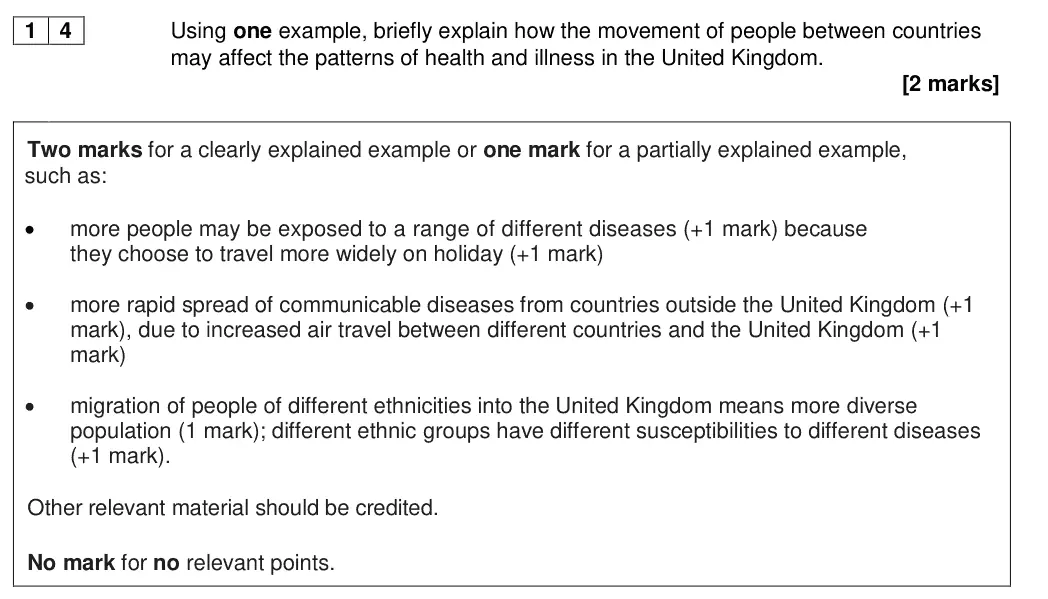
Successful answers were able to identify the consequences of travel and the spread of communicable diseases as affecting the patterns of health and illness in the United Kingdom. Some students were able to identify different susceptibilities to different diseases among different ethnic groups, but failed to link it back to movement of people between countries. Answers that discussed health tourism often struggled to explain how this might affect patterns of health and illness in the United Kingdom.
Notes from the mark scheme and report
credited: travel and spread of communicable disease, migration bringing groups with different susceptibilities
must link back to movement between countries
health tourism answers struggled to explain the effect on patterns of illness
Specimen set 1 · Paper 2 · Q810 marksAO1=3, AO2=4, AO3=3Analyse
Mark scheme, including the levels grid and indicative content
Notes from the mark scheme and report
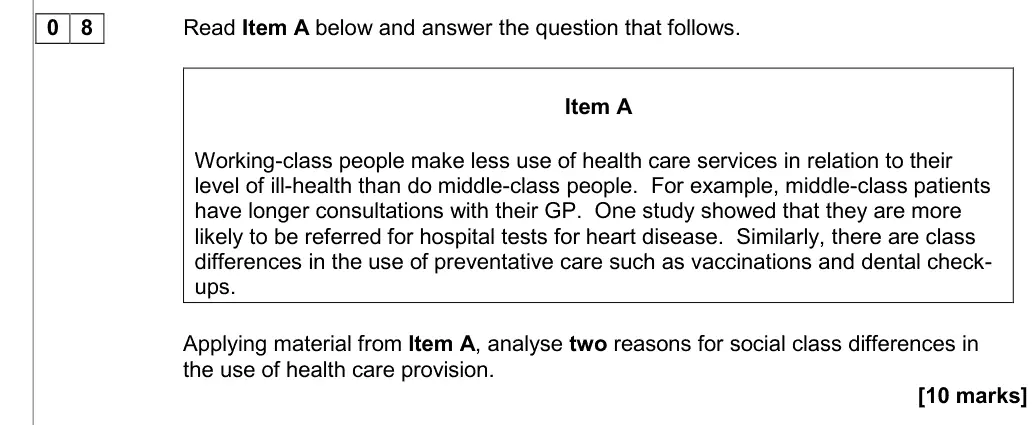
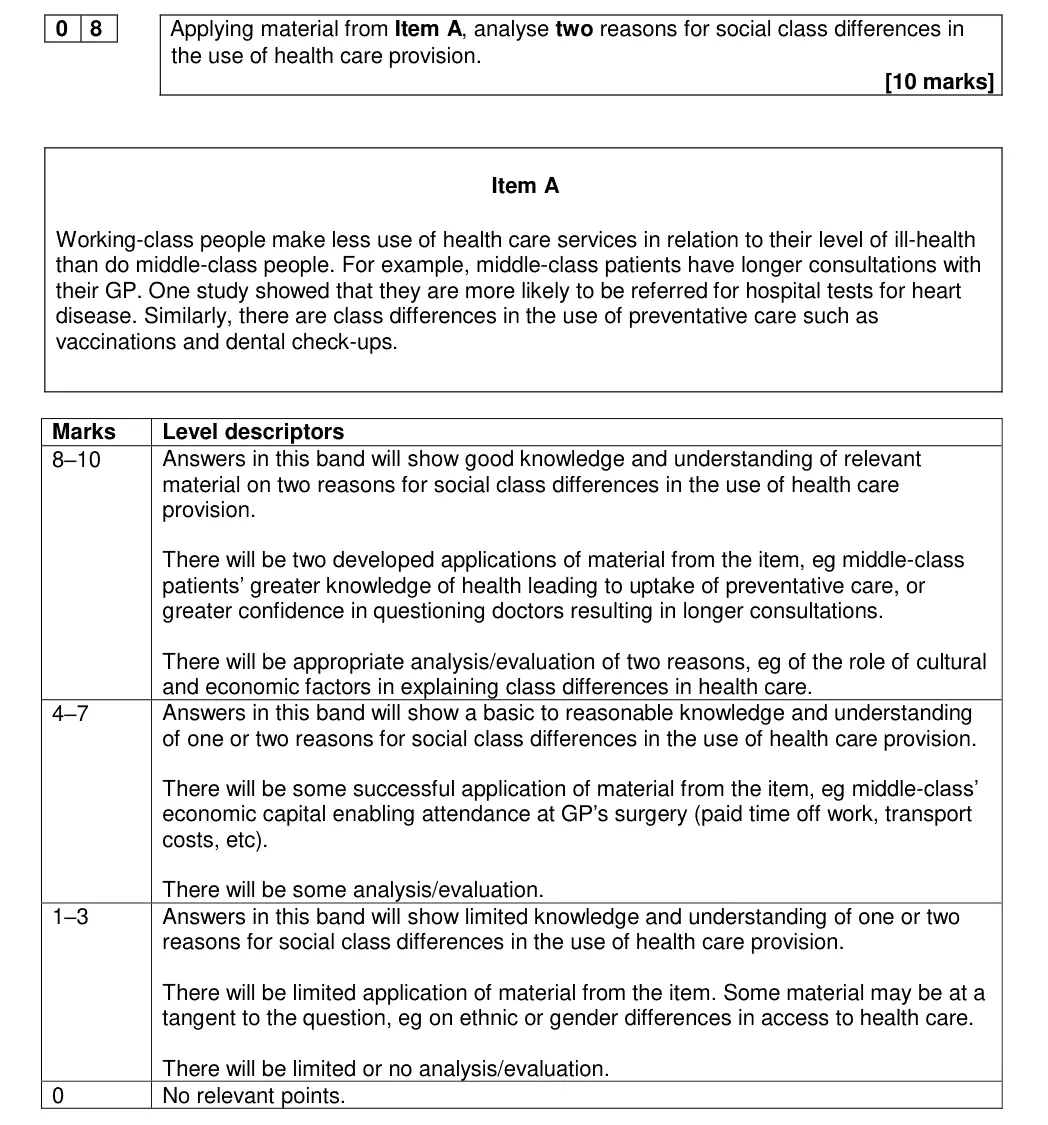
item hooks: longer GP consultations, referrals, preventative care
top band e.g. middle-class health knowledge and confidence with doctors
analysis of cultural vs economic factors
ethnic or gender differences in access are a tangent
Work with an AQA sociology tutor
Essays stuck in the middle band, or losing marks on the 10-markers? Book a trial lesson with Mark, a former AQA examiner.