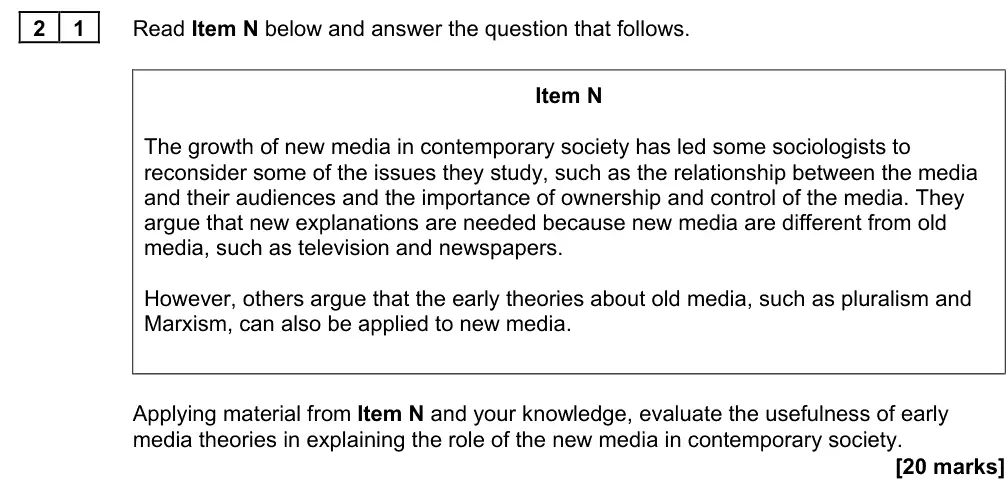
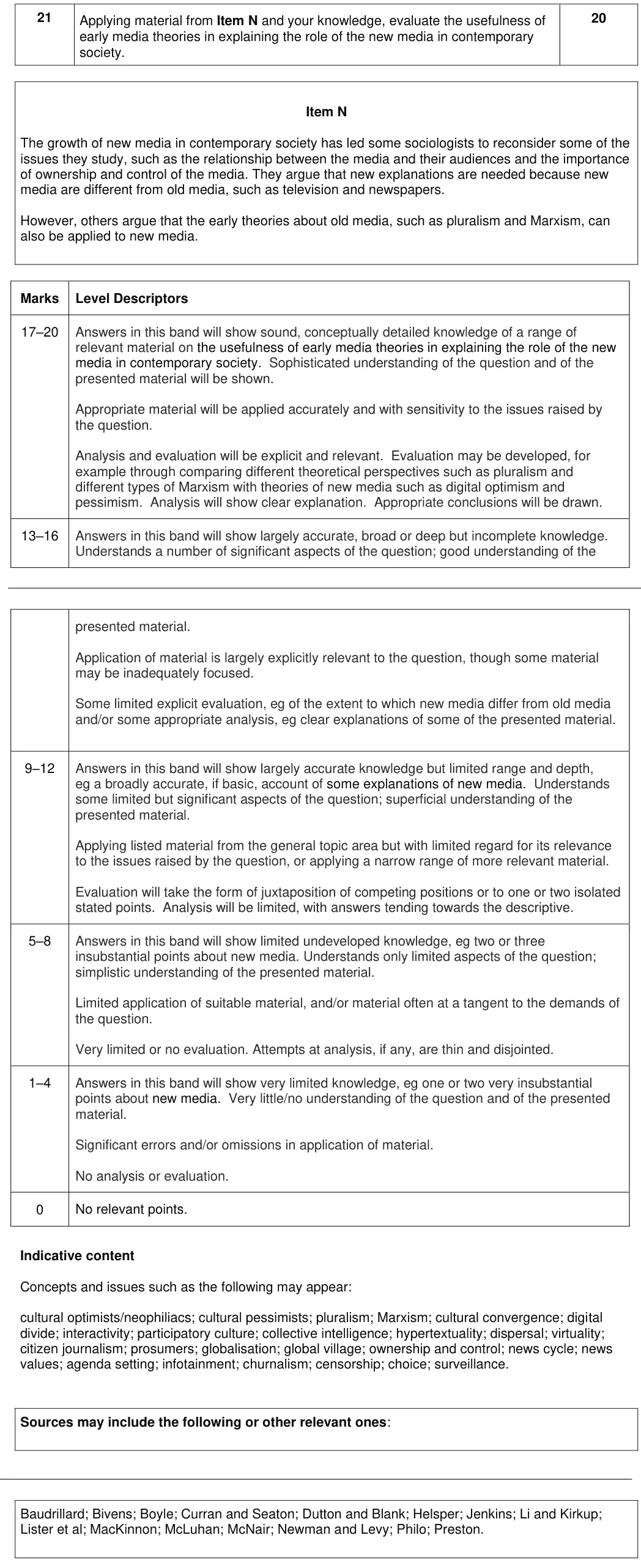
Applying material from Item N and your knowledge, evaluate the usefulness of early media theories in explaining the role of the new media in contemporary society.
Tap a question to zoom it. The mark scheme (with the level descriptors and indicative content) and the examiner's comment open underneath.
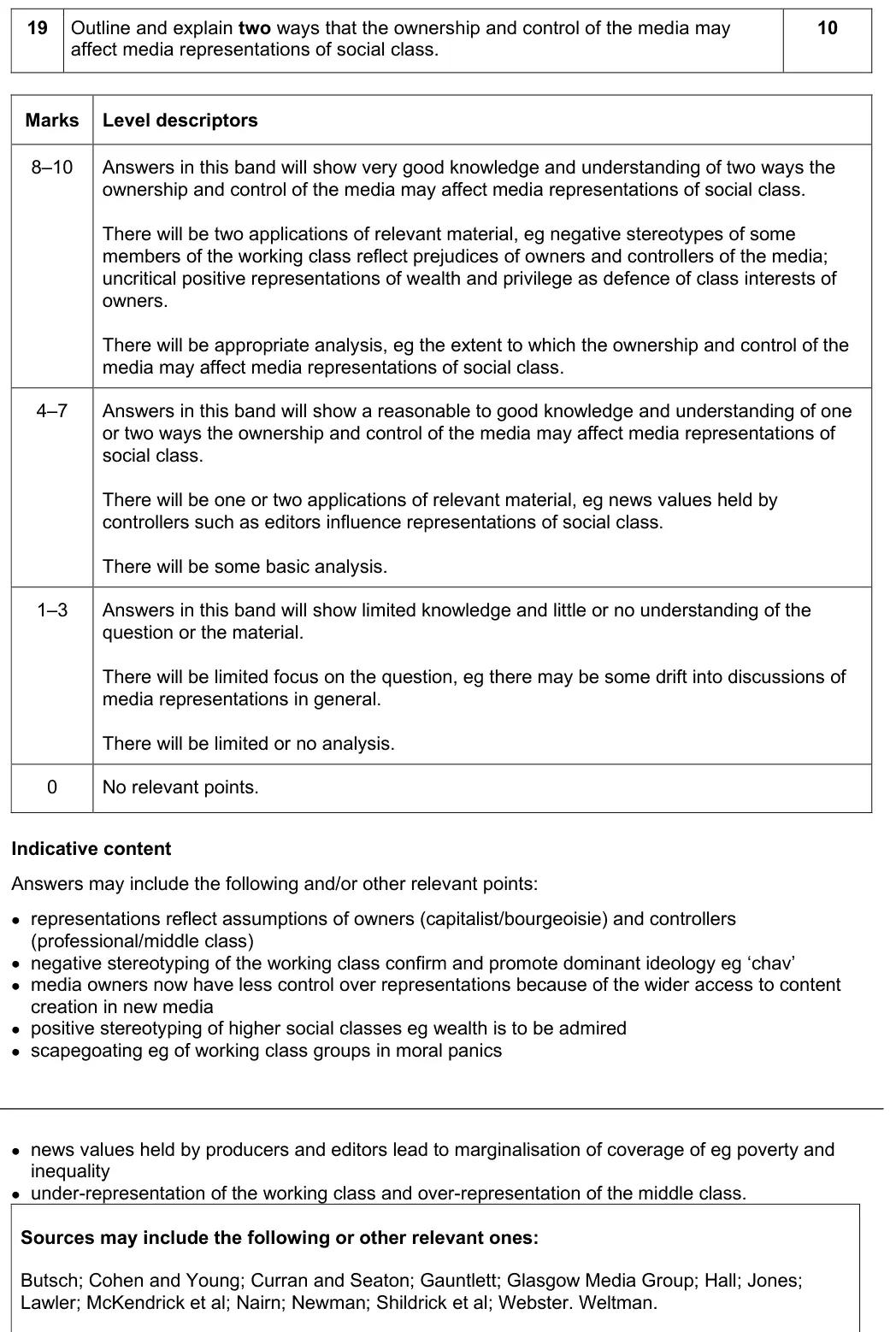
June 2025 · Paper 2 · Q1910 marksAO1=5, AO2=3, AO3=2Outline and explain
Mark scheme, including the levels grid and indicative content
Examiner's comment
The nature of these questions means that students cannot rely on reciting knowledge. Questions will ask them to bring together aspects of their sociological knowledge in ways they have not done before. It is therefore important for students to allow time to think about how to answer the question. Students should be aware that there are two types of ten-mark questions. These have different requirements and different mark schemes. There are different marks available for the assessment objectives. 10 mark “outline and explain” questions have more marks available for knowledge and understanding, and none for evaluation. Introductions and conclusions are not required for 10-mark questions, are unlikely to help students and take up time. It is helpful if answers are set out to clearly indicate the two answers, with wording such as “One way/reason is…” or by starting a new paragraph for the second point. Answers that give more than two answers are unlikely to develop two of them sufficiently. The most successful answers to 10-mark questions were focused, clearly stating a point that addressed the question and then developing it, using sociological concepts, evidence such as an example and, where appropriate, theory. Answers often showed good knowledge and understanding of some issues around this area but did not always manage to make a clear connection between ownership or control and representations of social class. Better answers often gave one way based on ownership (e.g. by media oligarchs) and one on control (e.g. new media allowing the audience to contribute some content).
Notes from the mark scheme and report
must link ownership or control to representations of class
drift into representations in general = 1–3
better answers gave one way based on ownership (owner interests, chav stereotypes) and one on control (editors' news values, user-generated content)
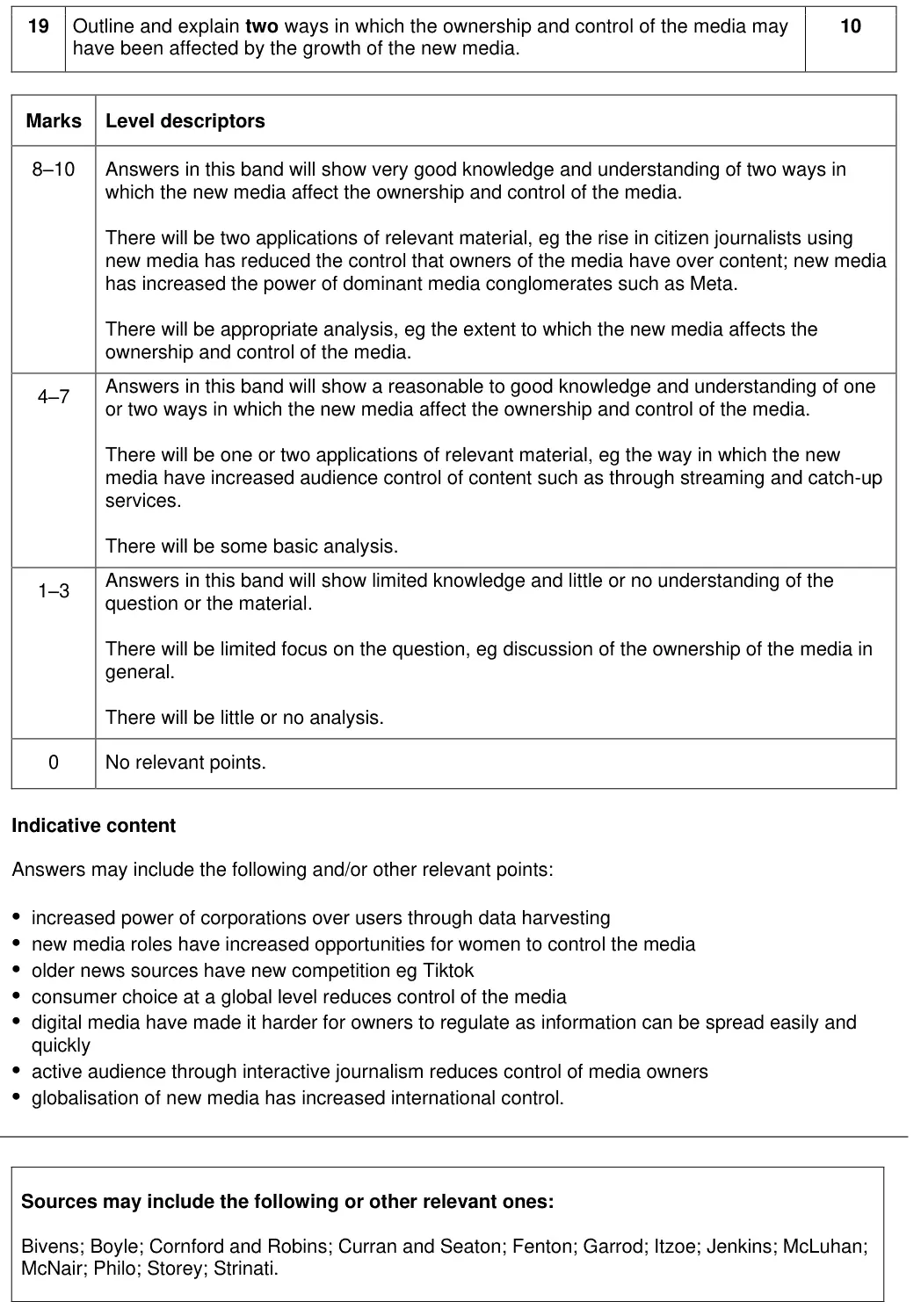
June 2024 · Paper 2 · Q1910 marksAO1=5, AO2=3, AO3=2Outline and explain
Mark scheme, including the levels grid and indicative content
Examiner's comment
The nature of these questions means that students cannot rely on reciting knowledge. Questions will ask them to bring together aspects of their sociological knowledge in ways they will not have done before. It is therefore important for students to allow time to think about how to answer the question. Students should be made aware that there are two types of 10 mark questions. These have different requirements and different mark schemes . There are different marks available for the assessment objectives. A breakdown of the marks awarded by assessment objective can be found in the mark scheme. 10 mark “outline and explain” questions have more marks available for knowledge and understanding, and none for evaluation. Introductions and conclusions are not required for 10 mark questions; they take up time and rarely improve the mark. It is helpful if answers are set out to clearly indicate the two answers, with wording such as “One way/reason is…”, or by starting a new paragraph for the second point. Answers that give more than two points are unlikely to develop two of them sufficiently. Q19: Globalisation, increased choice, and citizen journalism were commonly referred to in responses. Some were unable to develop their points and others lost focus on new media. Better answers were aware that ownership and control are not the same, and gave examples.
Notes from the mark scheme and report
two ways new media changed ownership and control (e.g. citizen journalism weakening owners' control of content, growth of conglomerates such as Meta, data harvesting, competition for old news sources, harder regulation)
discussing ownership in general = 1–3
better answers knew ownership and control are different
some lost focus on new media
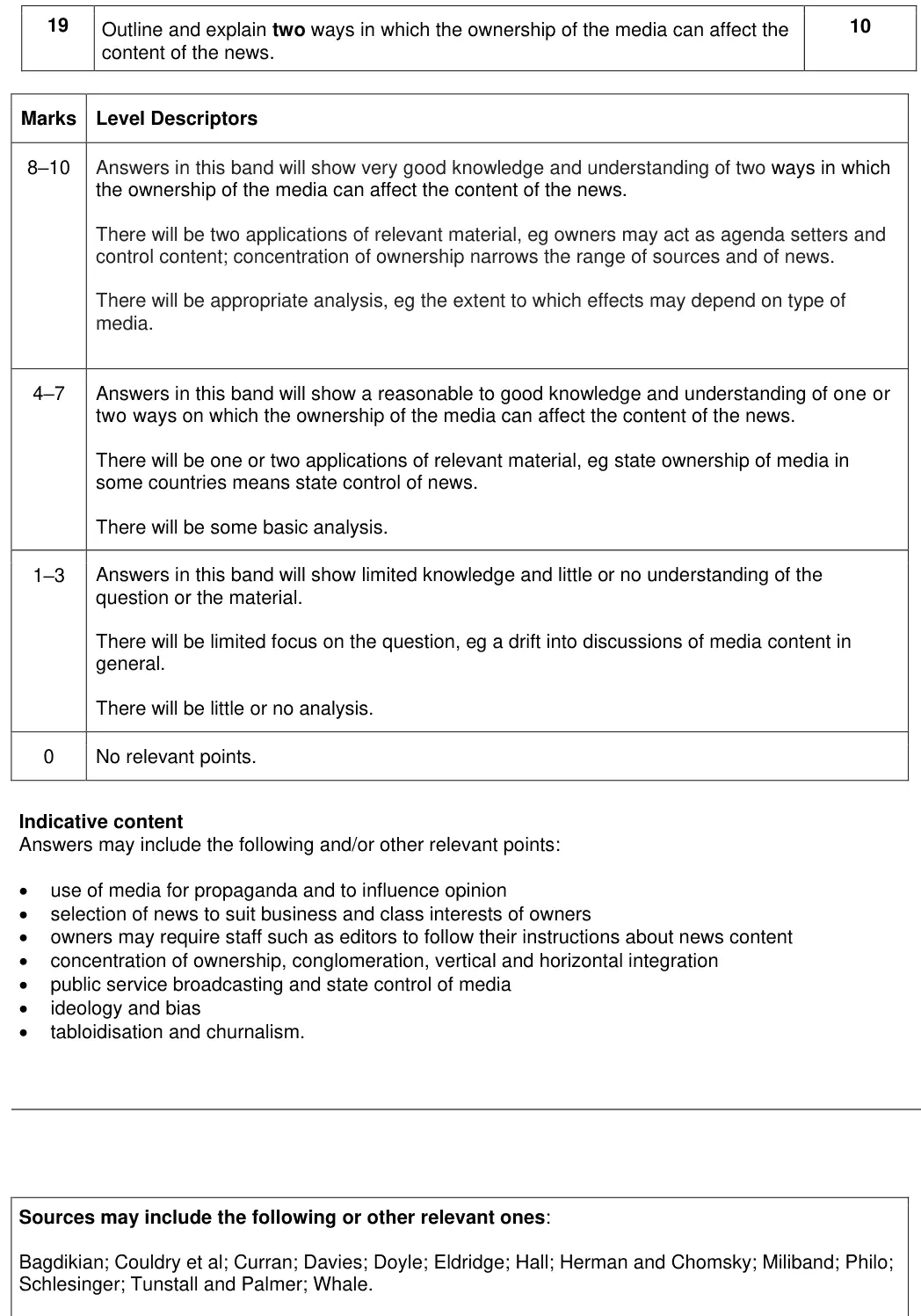
June 2022 · Paper 2 · Q1910 marksAO1=5, AO2=3, AO3=2Outline and explain
Mark scheme, including the levels grid and indicative content
Examiner's comment
The nature of these questions means that students cannot rely on reciting knowledge. The questions will ask them to bring together aspects of their sociological knowledge in a way that they are unlikely to have done before. There was a tendency, however, to attempt to answer the question by giving knowledge based on words or phrases in the question, rather than meeting the demands of the question. Students are advised to spend time reading the question, and, where there is one the item, to ensure that they are answering the question. Some students seemed unaware of the different demands of the two types of questions. The marks awarded for the assessment objectives are different in the two types of ten mark questions, and students should be aware of this. In particular, it should be noted that there are no marks available for evaluation in “outline and explain” (no item) questions. There is no need for an introduction or conclusion for 10 mark questions. It is helpful if answers are set out to clearly indicate the two answers, with wording such as “One way is…” or by starting a new paragraph for the second point. The best answers to 10 mark questions were focused, clearly stating a point that addressed the question and then developing it, using sociological concepts, evidence and, where appropriate, theory. Answers need to address all aspects of the question. Q19 There were a number of strong answers to this question drawing for example on ways that owners use their power to shape content and on censorship and propaganda.
Notes from the mark scheme and report
top band e.g. owners as agenda setters, concentration of ownership narrowing news
analysis of how effects vary by type of media
drift into media content in general = 1–3 band
strong answers on owners' power, censorship and propaganda
June 2022 · Paper 2 · Q2120 marksAO1=8, AO2=6, AO3=620-mark essay
Mark scheme, including the levels grid and indicative content
Examiner's comment
Most candidates answered their chosen questions in the order in which they appeared on the question paper. They therefore answered the section B 20 mark essay question last, and for many this was a relatively brief and often apparently unfinished answer. This suggests that timing is a problem for many candidates. The items for 20 mark questions are written to provide a number of ideas on which students can begin to build their answers. Students are expected to also bring in further ideas (hence “and your knowledge” in the instruction). It is often the case that a wide range of material can be relevant to these questions, and students need to be selective. For example, it may be more effective to cover a limited number of views or theories in some depth rather than to include every possible theory. There was a tendency for answers to progressively lose sight of the question and to become a list of different views. Many attempts at evaluation were learned criticisms. Evaluation is more effective where it is focused on the demands of the question. Students should also be aware that evaluation includes awareness of the strengths as well as the weaknesses of an argument or theory. Following feedback from centres regarding the advance information for the 20 mark questions, we have monitored the marking of these questions, as well as carrying out statistical analysis on student performance. Based on this analysis, we can confirm that students have performed as we expected them to on these questions, and their performance on these questions is in line with previous series. Q21 This question enabled students to apply their knowledge and understanding of media theories to new media. Better answers avoided reciting all they knew about a theory and focused on the question, often making insightful points on the changing nature of media. There was a tendency to focus on the positive aspects of new media (such as interactivity and citizen journalism) without always recognising more negative aspects such as the power of large corporations and the implications of surveillance and data harvesting.
Notes from the mark scheme and report
top band compares pluralism and varieties of Marxism with new-media theories (digital optimism and pessimism)
better answers avoided reciting whole theories
many stressed positives (interactivity, citizen journalism) and neglected corporate power, surveillance and data harvesting
November 2021 · Paper 2 · Q2120 marksAO1=8, AO2=6, AO3=620-mark essay
Mark scheme, including the levels grid and indicative content
Notes from the mark scheme and report
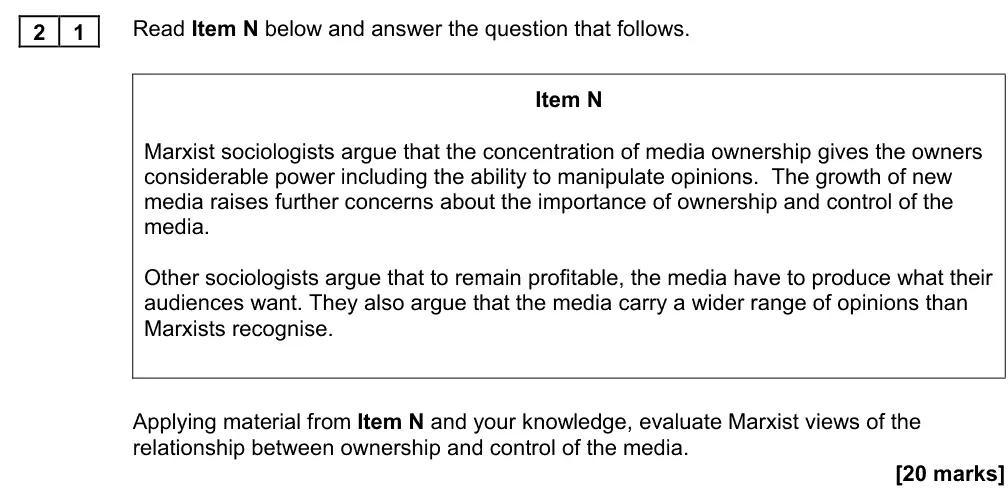
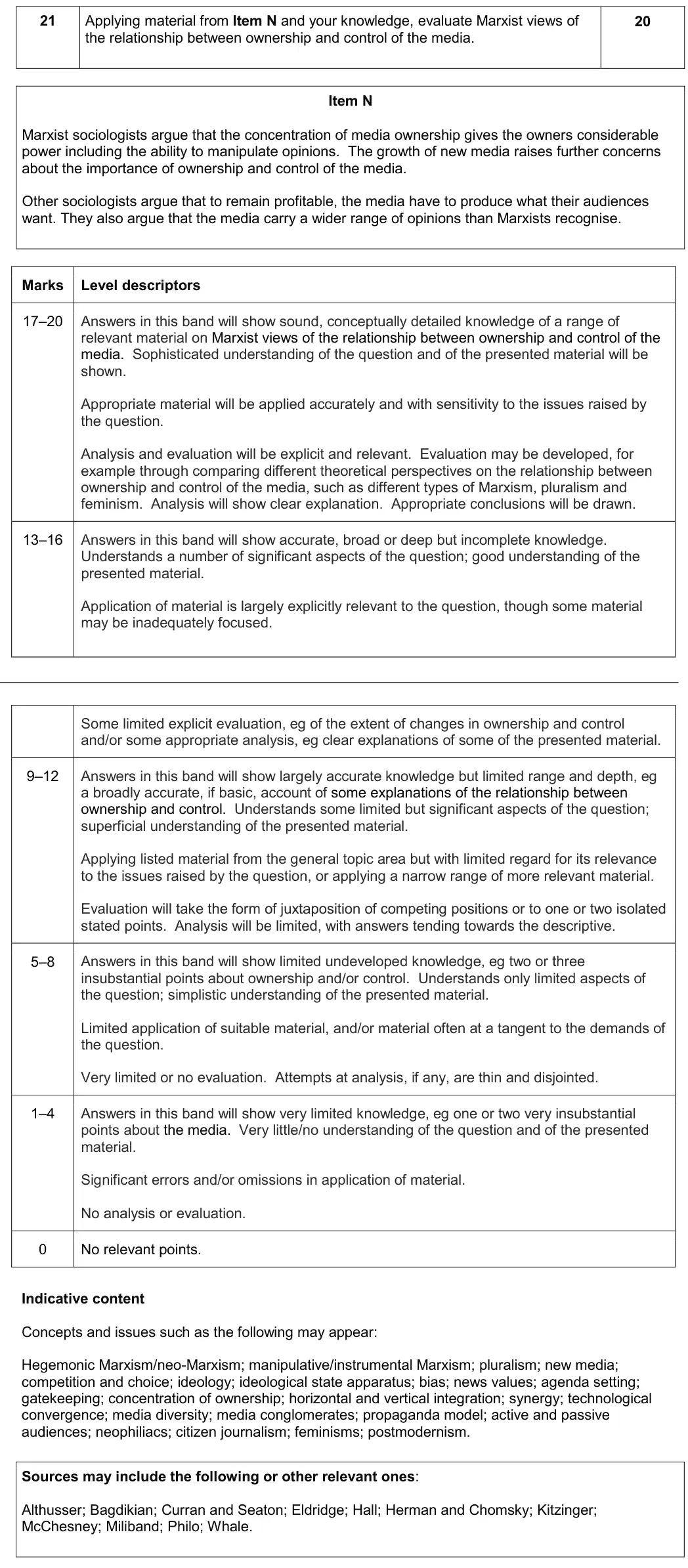
must apply Item N (concentration of ownership, new media, profit and audience demand, range of opinion)
top band compares instrumental and hegemonic Marxism, pluralism and feminism
concepts include propaganda model, conglomerates, citizen journalism
no examiners' report comment for this part
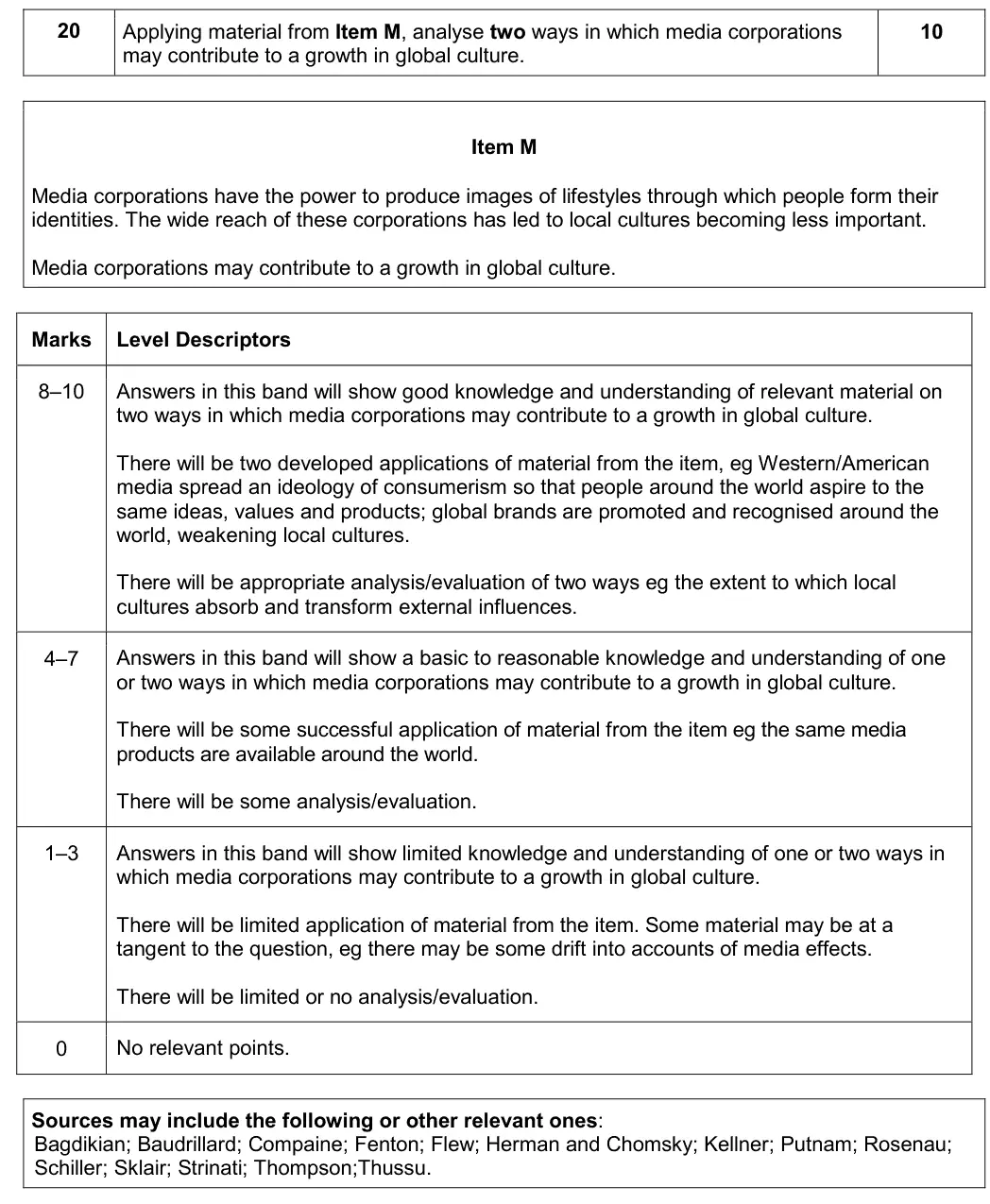
November 2020 · Paper 2 · Q2010 marksAO1=3, AO2=4, AO3=3Analyse
Mark scheme, including the levels grid and indicative content
Notes from the mark scheme and report
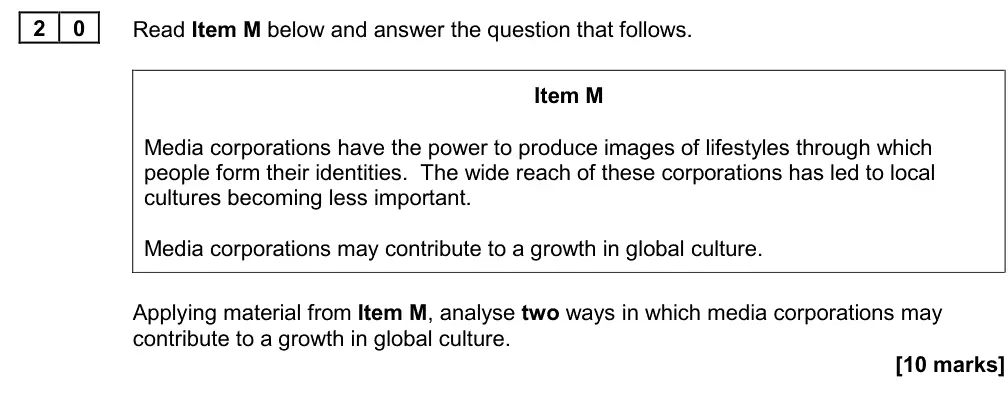
apply Item M (corporations shaping lifestyle images, reach weakening local cultures)
e.g. Western consumerist ideology, global brands
evaluation e.g. local cultures absorbing and transforming external influences
drift into media effects = tangent
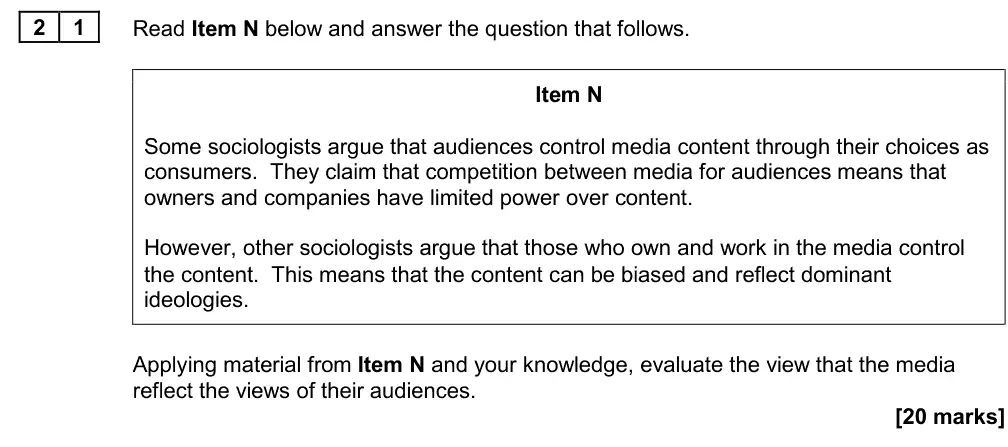
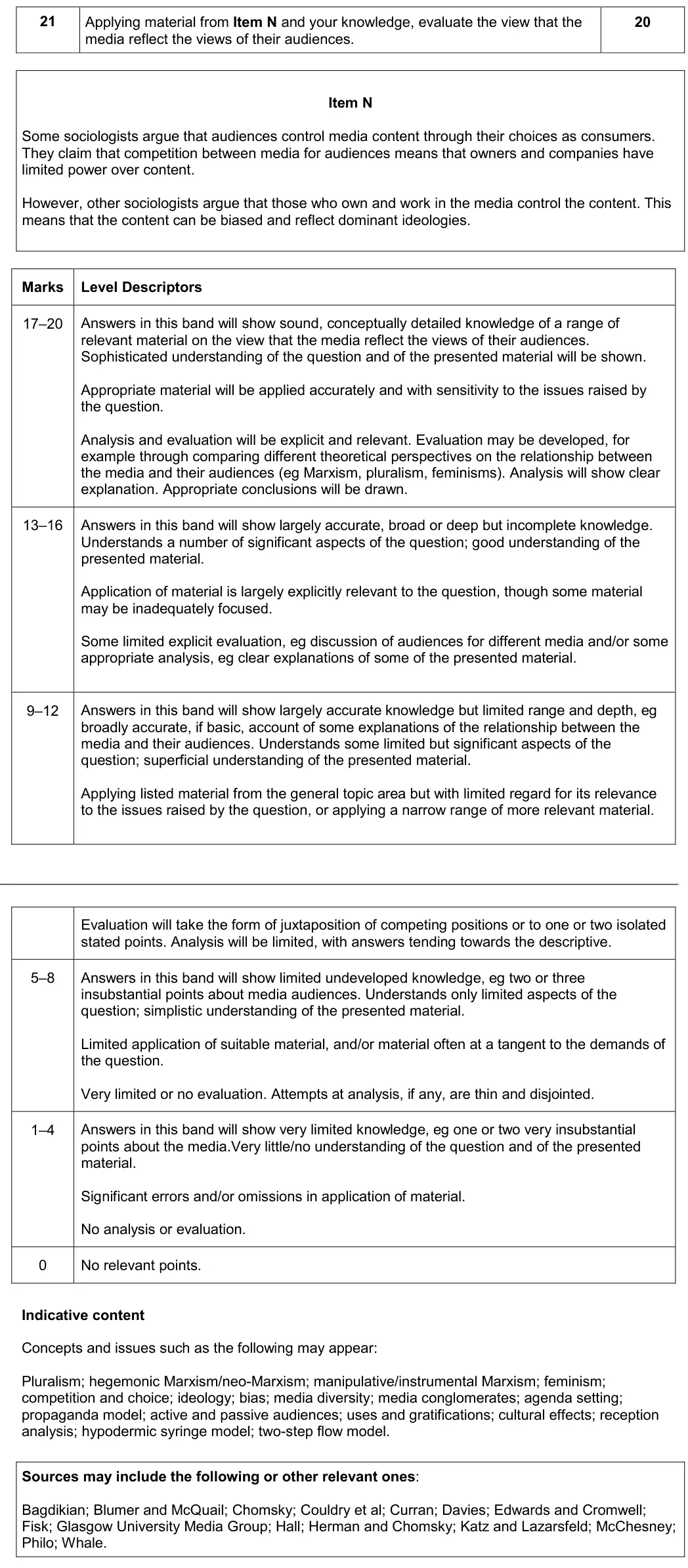
November 2020 · Paper 2 · Q2120 marksAO1=8, AO2=6, AO3=620-mark essay
Mark scheme, including the levels grid and indicative content
Notes from the mark scheme and report
apply Item N (audiences control content through consumer choice vs owners/workers control biased content)
evaluation via pluralism, Marxism, feminisms or audiences for different media
basic account of media-audience relationship = 9-12
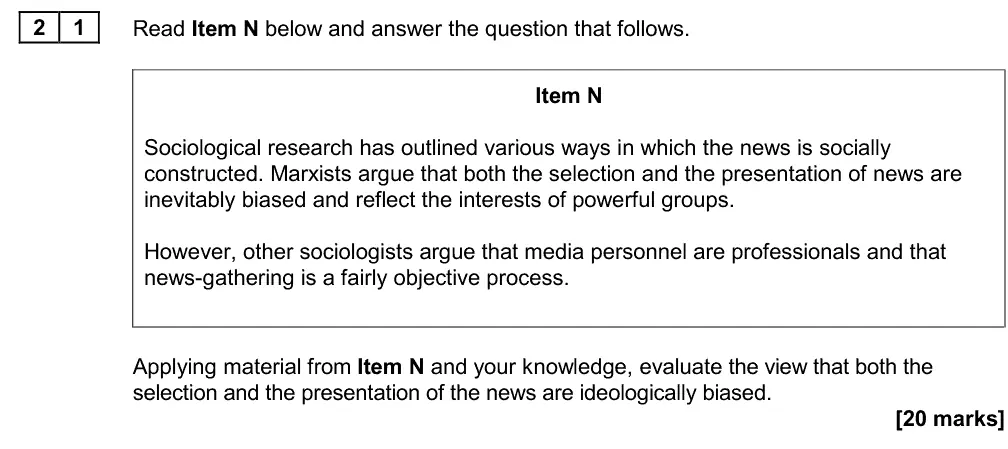
June 2019 · Paper 2 · Q2120 marksAO1=8, AO2=6, AO3=620-mark essay
Mark scheme, including the levels grid and indicative content
Examiner's comment
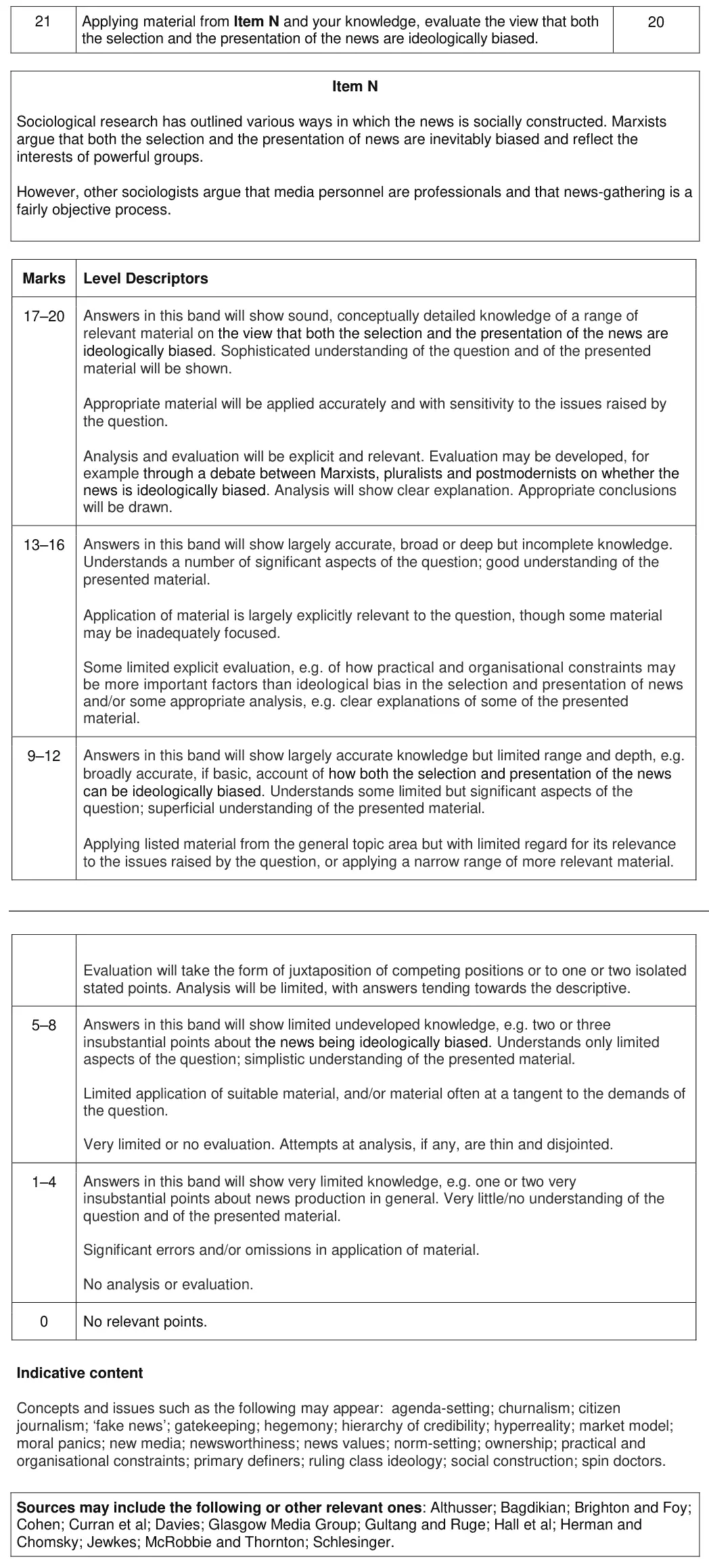
They therefore answered the section B 20 mark essay question last, and for many this was, as last year, a relatively brief and often apparently unfinished answer. This suggests that time management continues to be a problem for many students on this paper. As last year, many scripts had one substantial answer to the Section A 20-mark question and one significantly briefer one for Section B, suggesting problems with timing. There was often little evidence of planning. A wide range of material can be relevant to these questions, and students are not expected to include everything. They need to carefully choose the content and to plan their answers. The best answers will be both empirical and theoretical, for example showing knowledge of research findings and examples, and knowledge of theoretical perspectives. Some answers amounted to lists of theoretical perspectives, with learned points of criticism, and lost focus on the question itself. While the items are intended as a helpful starting point for answers, they should not be taken by students as a full list of what is relevant; better answers will draw in other relevant knowledge and ideas. Answers to this question varied in quality; the best were able to apply a range of theories, including Marxism, neo-Marxism and pluralism, to discriminate within these between selection and presentation of the news and to include relevant examples. Examples tended not to be recent (for example, the Glasgow Media Group on strikes) and relatively few answers brought in contemporary material on, for example, news on social media and globalisation.
Notes from the mark scheme and report
must cover both selection and presentation
top band debates Marxist, neo-Marxist, pluralist and postmodern views
practical and organisational constraints as alternative to ideology
examples often dated (Glasgow Media Group), little on social media
AO split from AQA's standard grid for this paper (this year's mark scheme does not print it).
June 2017 · Paper 2 · Q2120 marksAO1=8, AO2=6, AO3=620-mark essay
Mark scheme, including the levels grid and indicative content
Examiner's comment
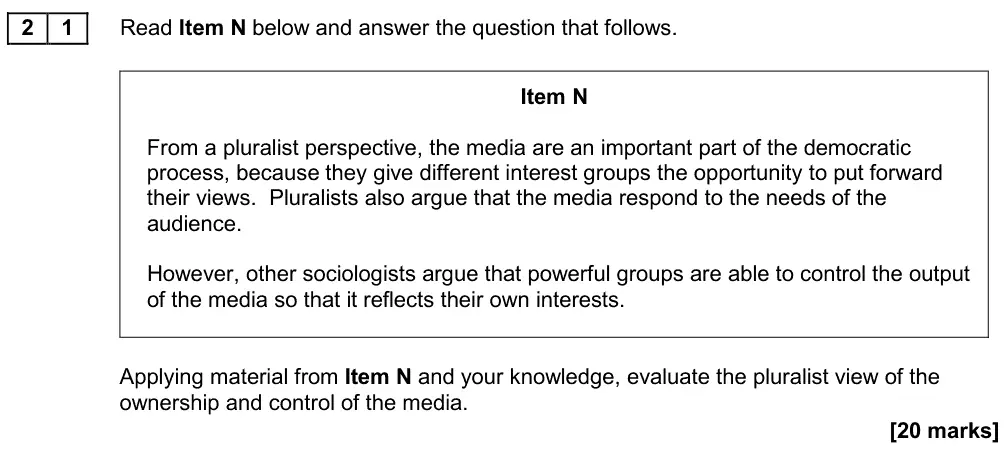
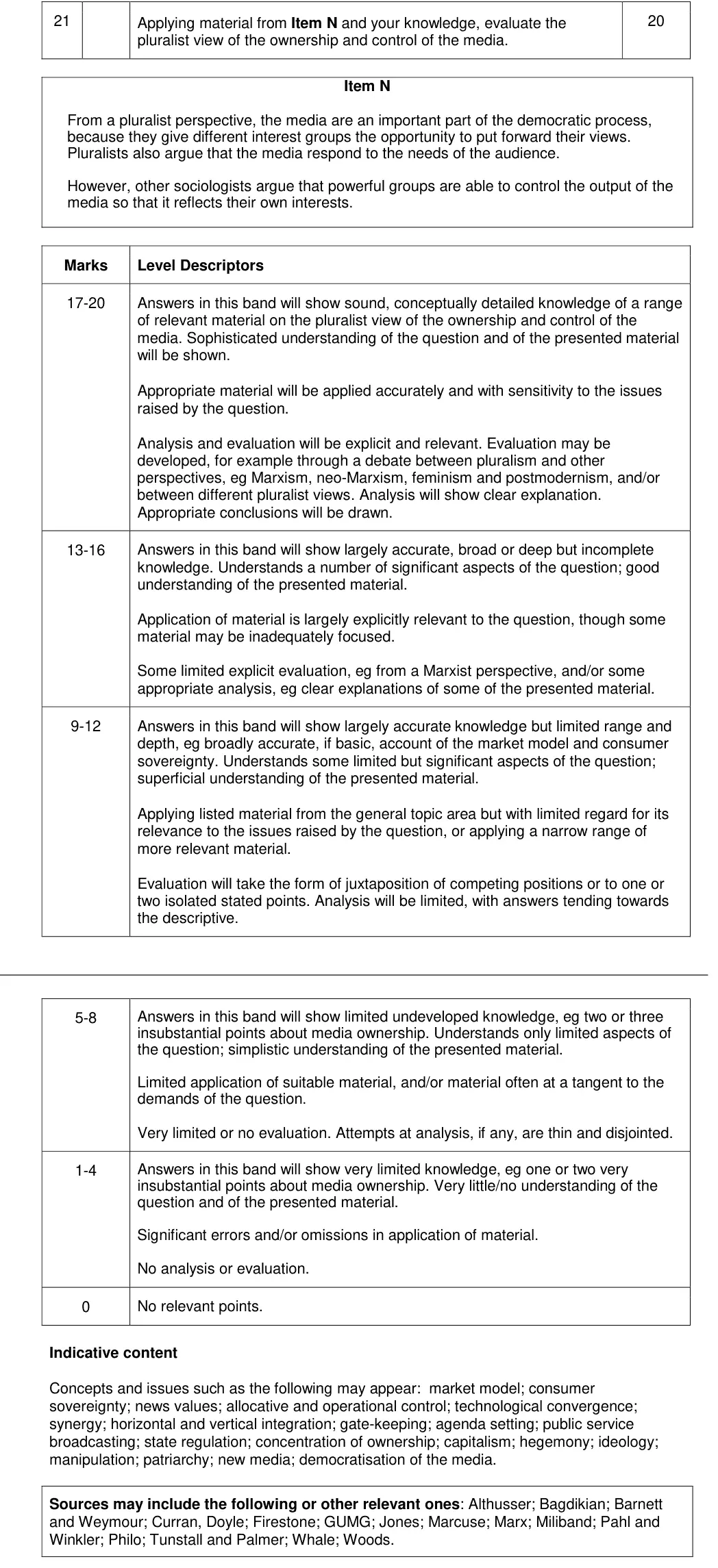
Most students answered their chosen questions in the order in which they appeared on the question paper. They therefore answered the 20 mark essay question in Section B last, and for many this was a relatively brief and often unfinished answer. This suggests that time management was a problem. Many scripts had one substantial, well developed answer to a 20 mark question and one significantly briefer one, again suggesting problems with time management. It is often the case that a wide range of material can be relevant to these questions, and students will need to be selective. For example, it may be more effective to cover a limited number of views or theories in some depth, rather than to include every possible theory. There was a tendency for answers to progressively lose sight of the question and to become a list of different views. The best answers will address all aspects of the question and will draw on theories, concepts and empirical examples or evidence. Evaluation which meets the demands of the questions is better than points of criticism which have been learned and included, regardless of the specific question that has been set. Students should also be aware that evaluation includes awareness of the strengths, as well as the weaknesses, of an argument or theory. Many answers showed a fairly limited knowledge of pluralism, and tended to answer the question through comparisons with other theories, such as Marxism and neo-Marxism, often with rather more detail on these rather than pluralism. Better answers avoided a listing of theories and constructed a more focused evaluative essay.
Notes from the mark scheme and report
top band debates pluralism against Marxism, neo-Marxism, feminism, postmodernism and between pluralist views
many knew little pluralism and wrote more about Marxism
better answers avoided listing theories
Specimen set 1 · Paper 2 · Q1910 marksAO1=5, AO2=3, AO3=2Outline and explain
Mark scheme, including the levels grid and indicative content
Notes from the mark scheme and report
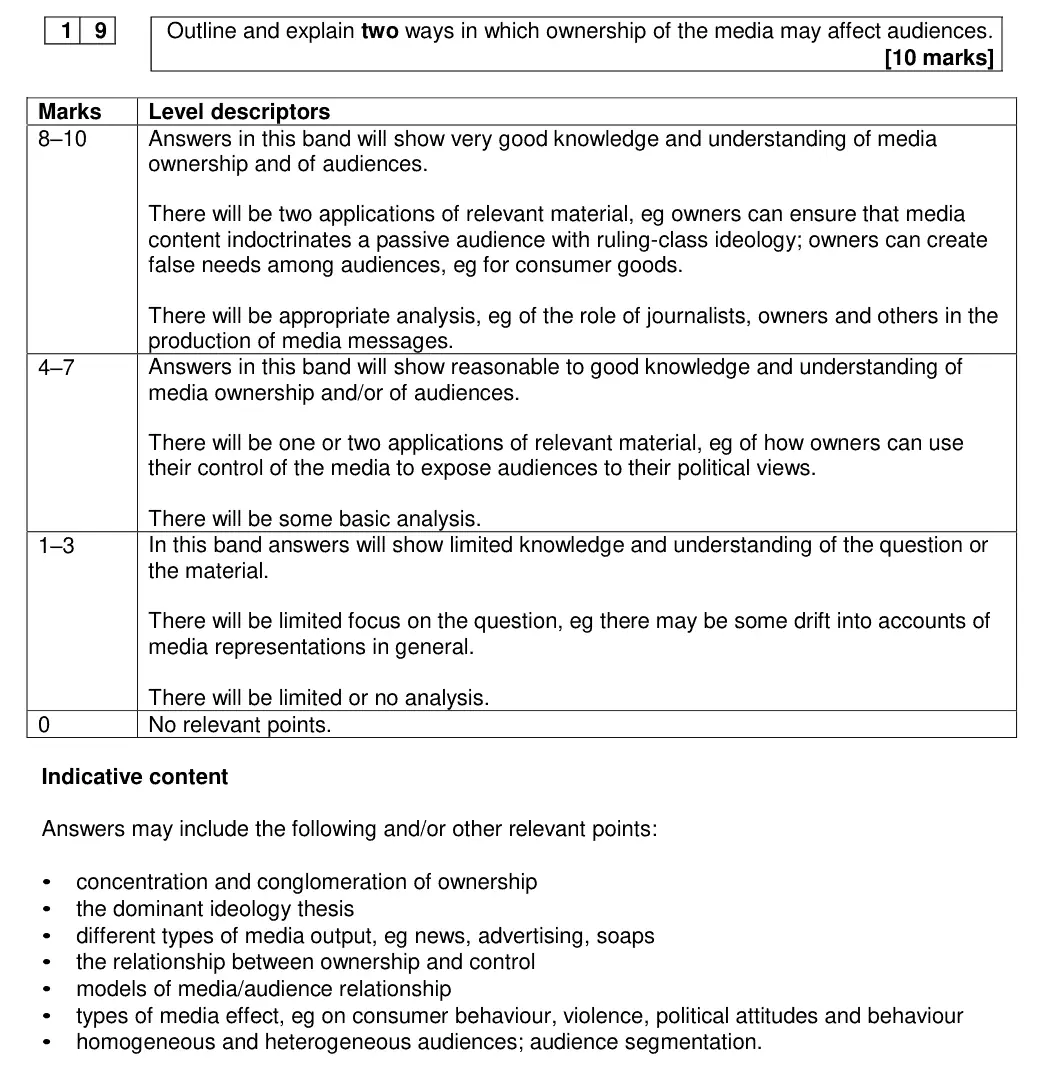
must link ownership to effects on audiences (e.g. ideology for a passive audience, false needs)
analysis of the roles of owners and journalists in producing messages
drift into media representations in general = 1–3 band
Work with an AQA sociology tutor
Essays stuck in the middle band, or losing marks on the 10-markers? Book a trial lesson with Mark, a former AQA examiner.