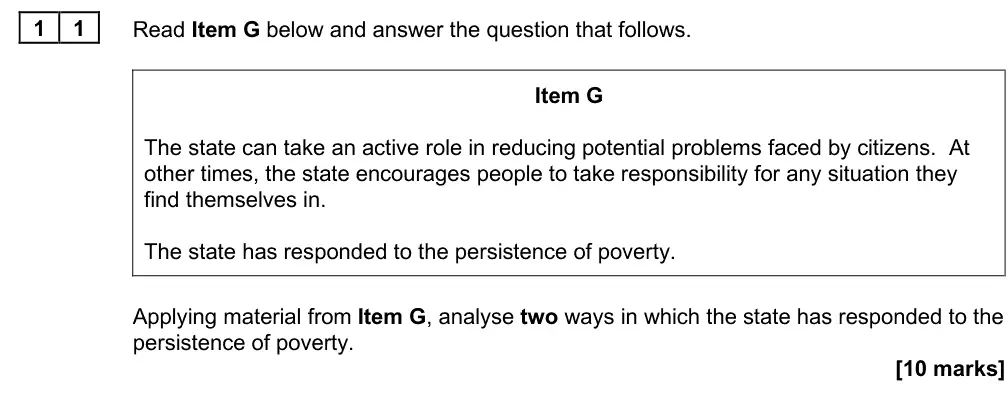
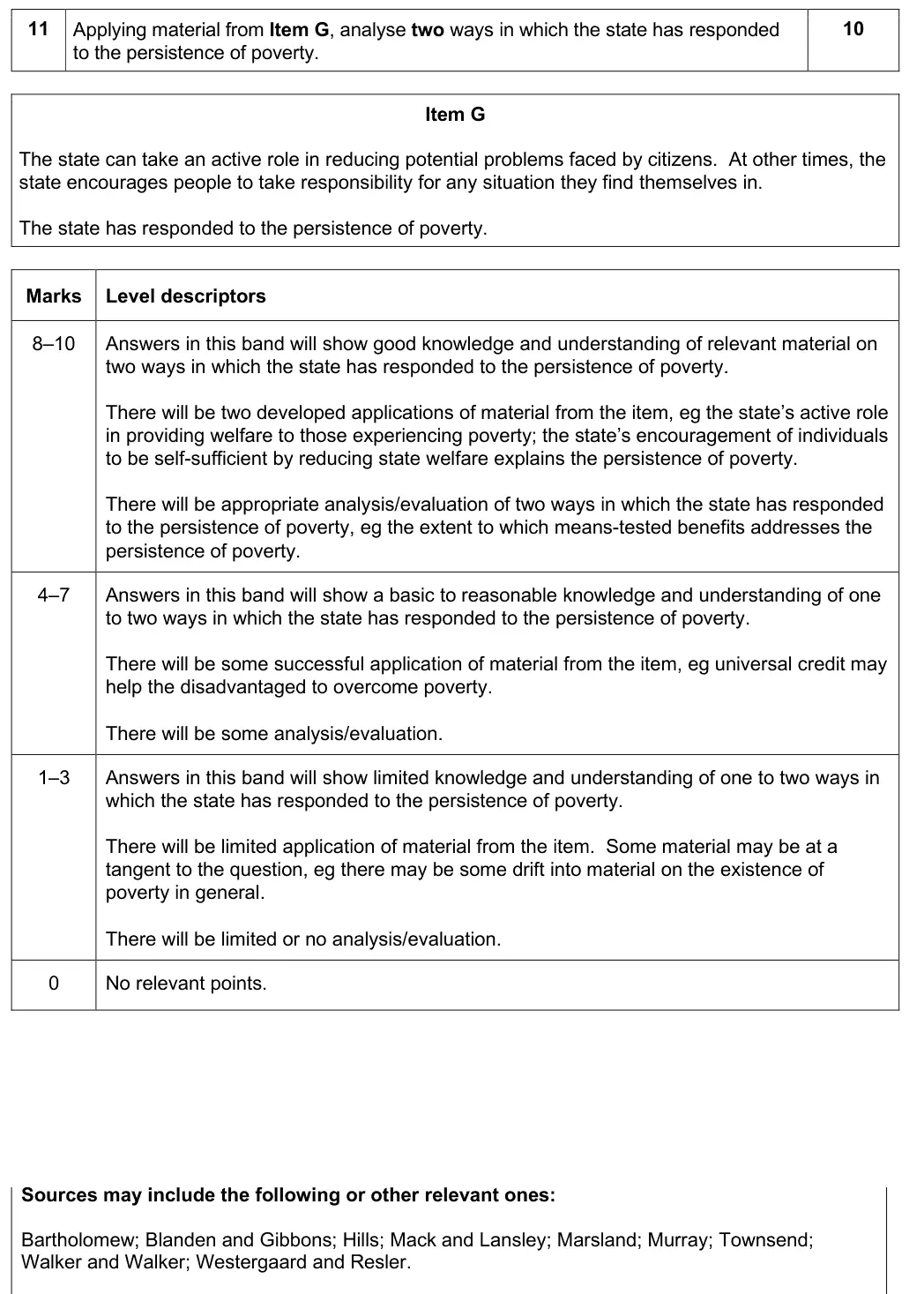
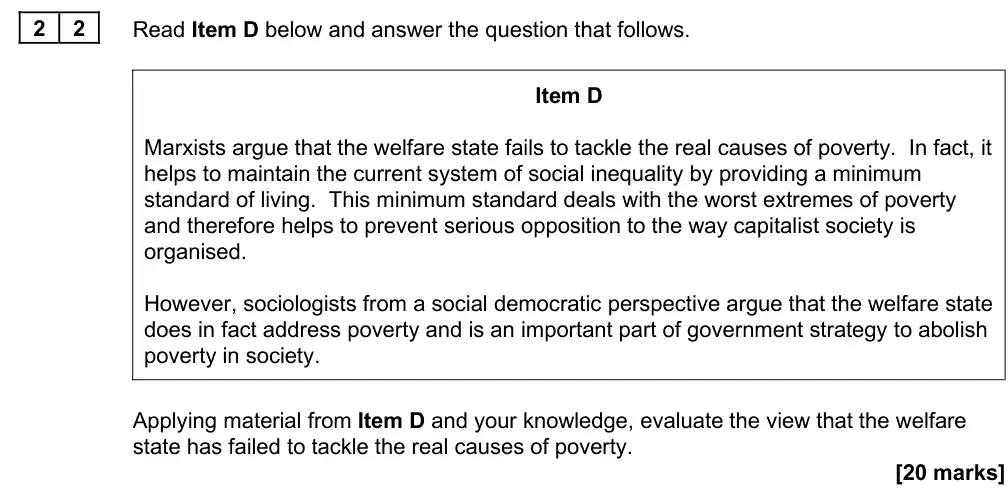
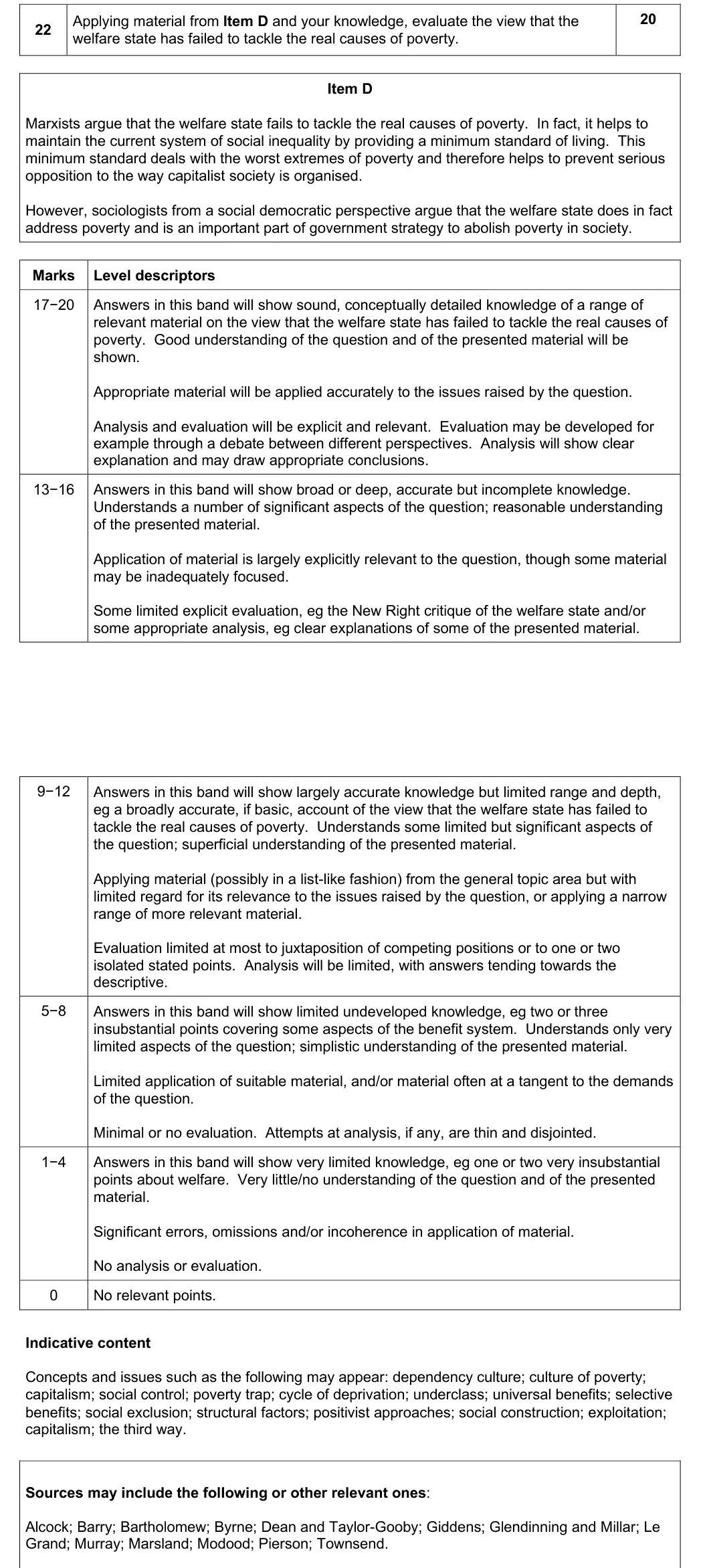
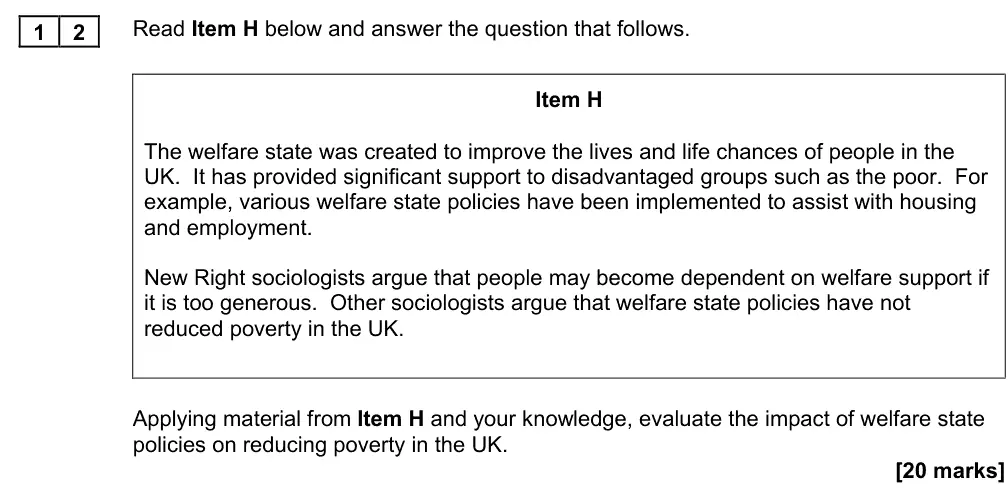
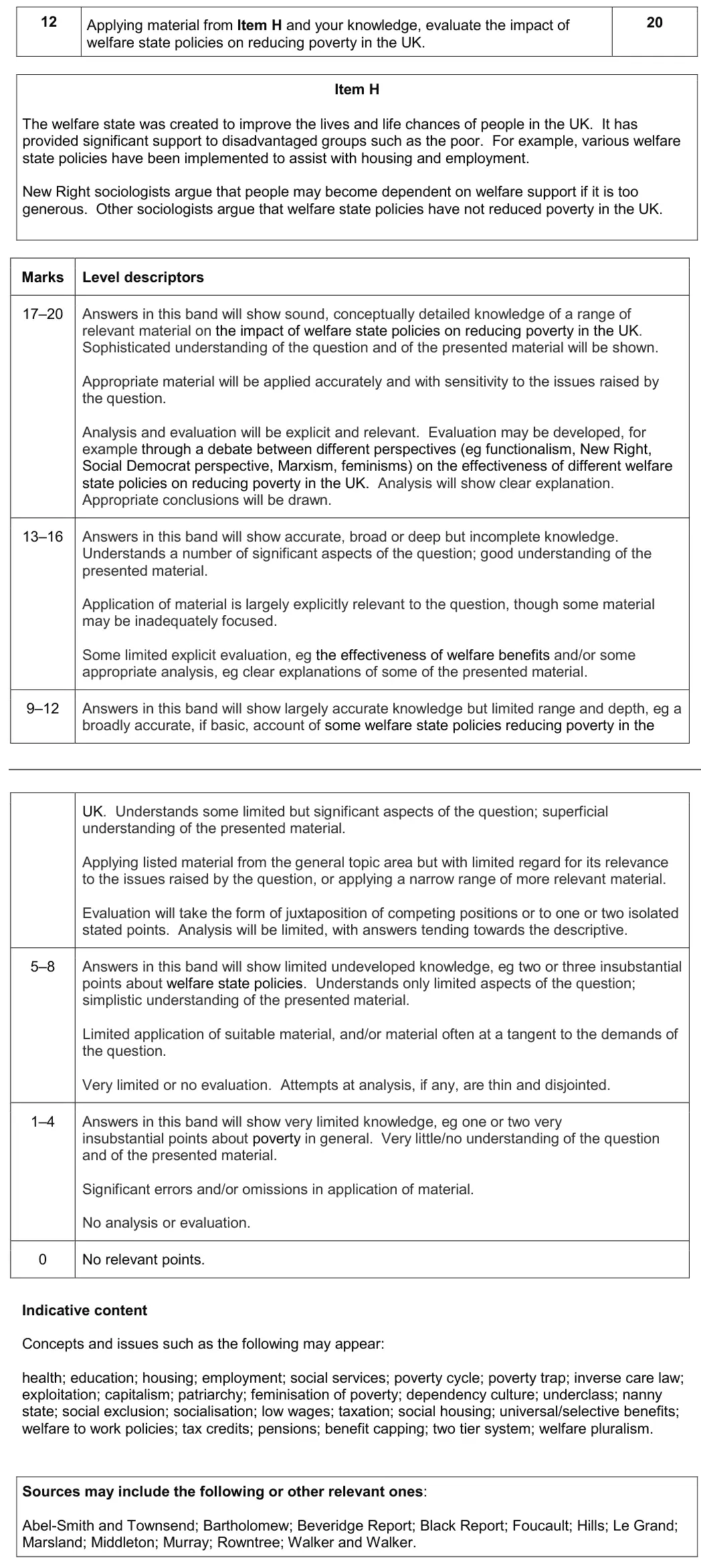
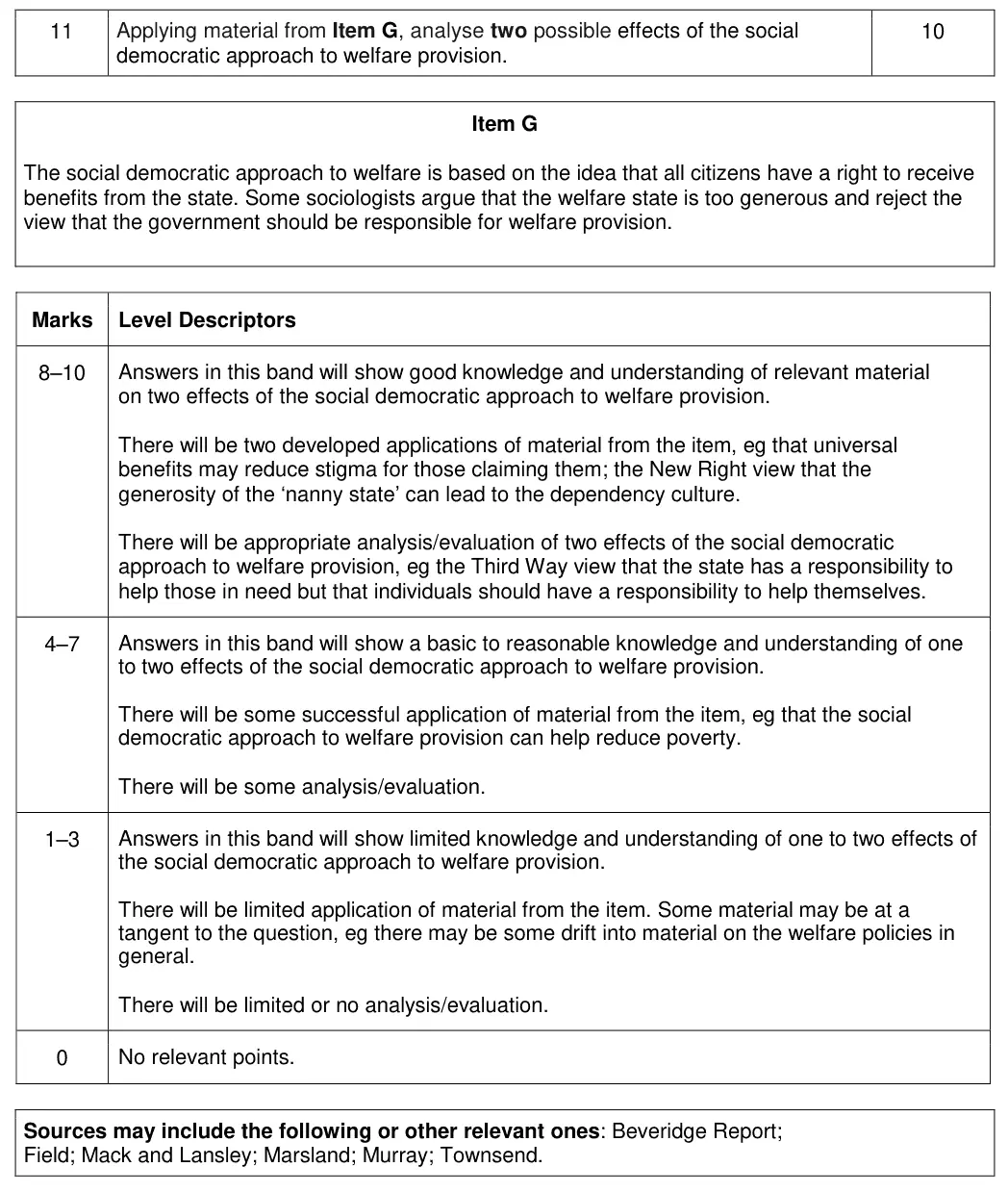
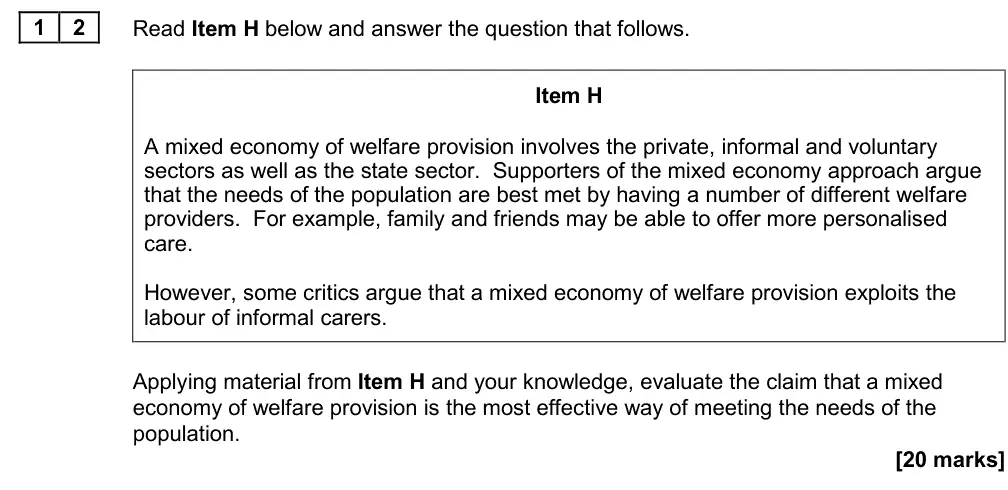
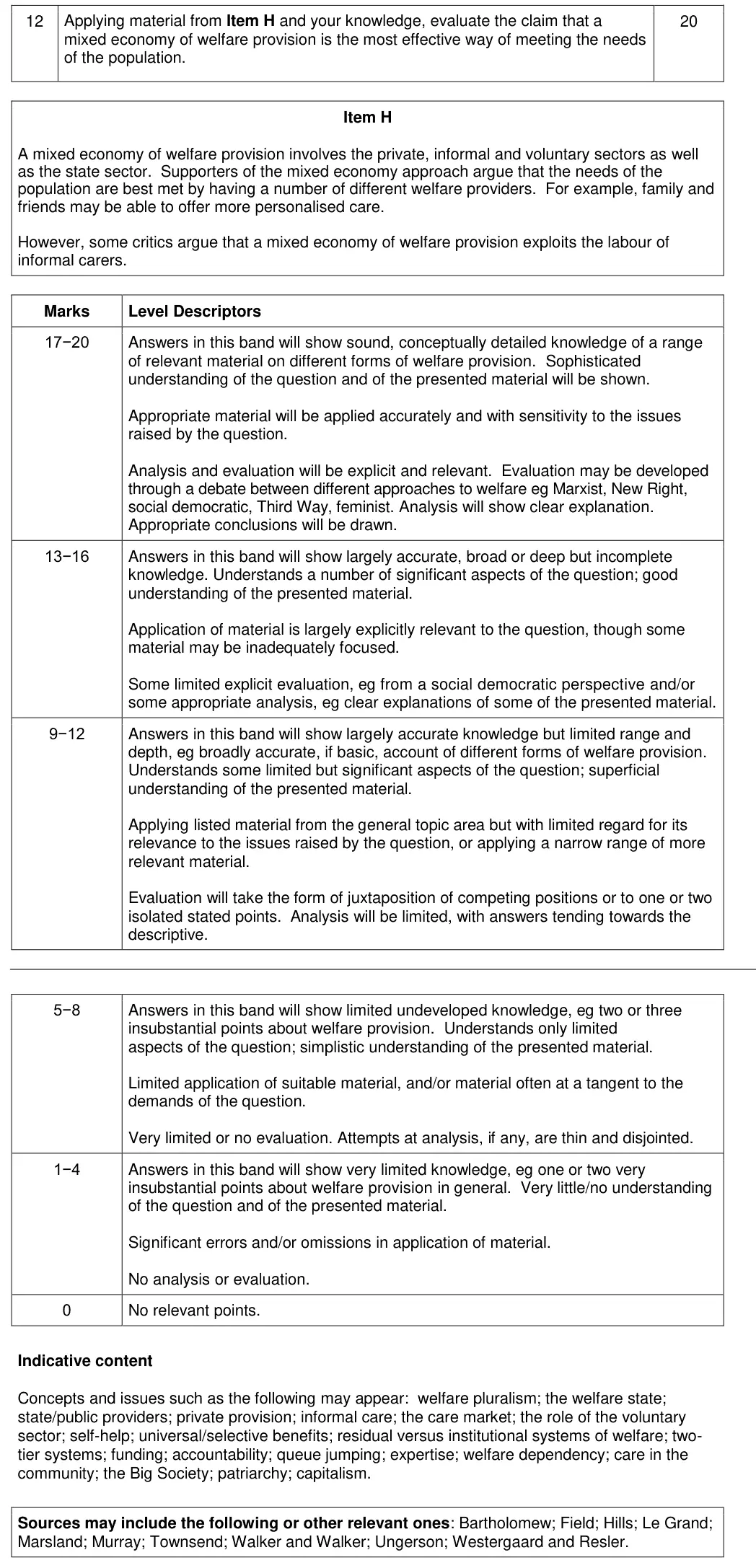
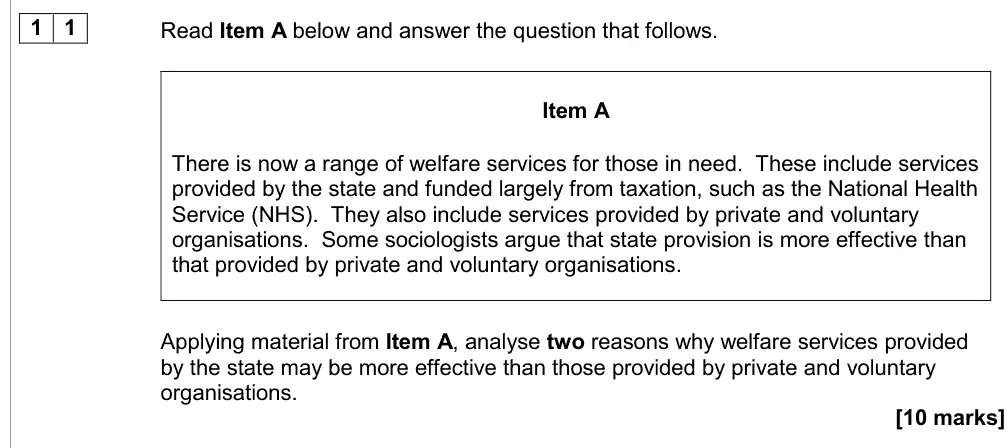
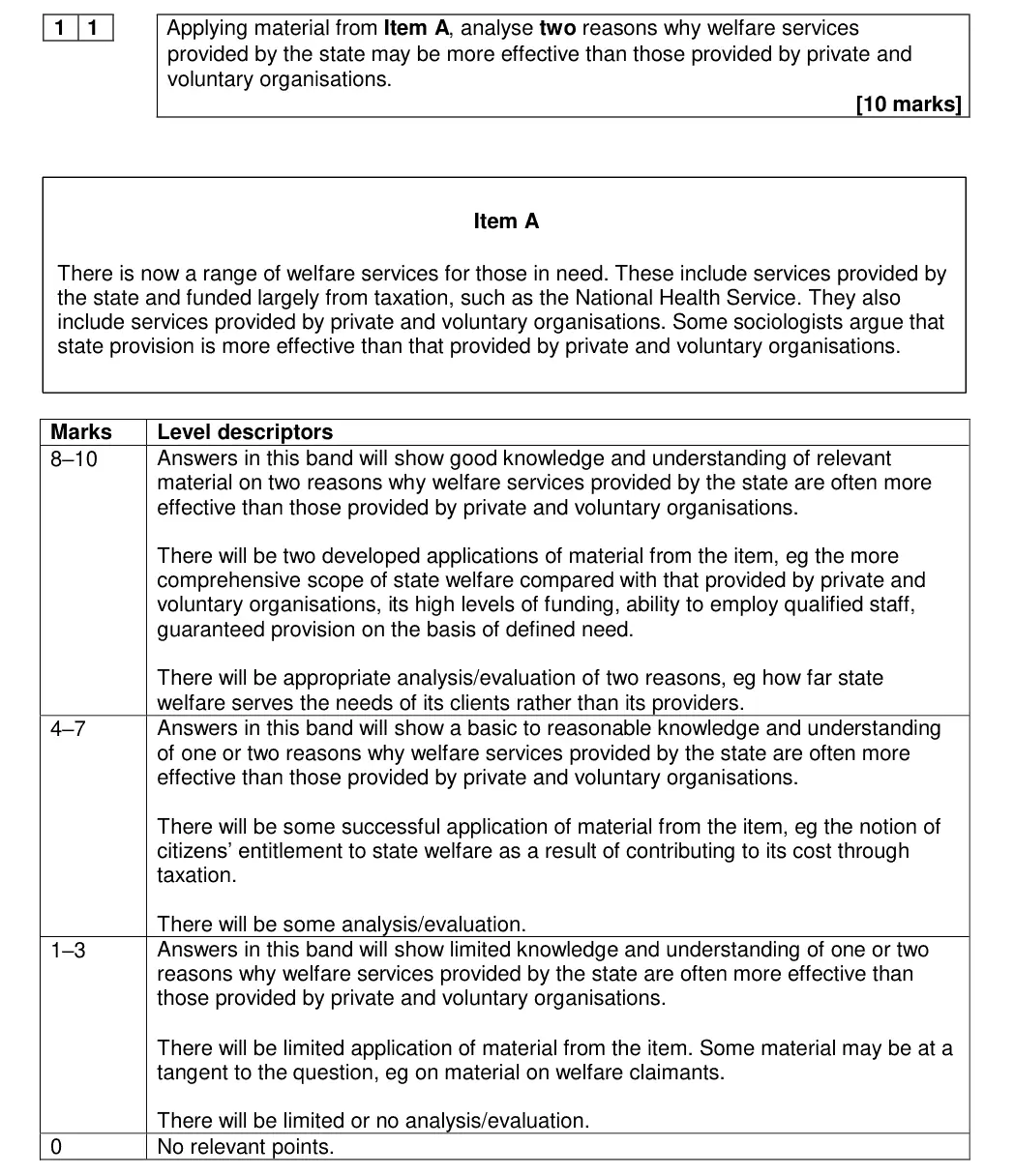
Applying material from Item H and your knowledge, evaluate the claim that a mixed economy of welfare provision is the most effective way of meeting the needs of the population.
Tap a question to zoom it. The mark scheme (with the level descriptors and indicative content) and the examiner's comment open underneath.
June 2025 · Paper 2 · Q1110 marksAO1=3, AO2=4, AO3=3Analyse
Mark scheme, including the levels grid and indicative content
Examiner's comment
The nature of these questions means that students cannot rely on reciting knowledge. Questions will ask them to bring together aspects of their sociological knowledge in ways they have not done before. It is therefore important for students to allow time to think about how to answer the question. Students should be aware that there are two types of ten-mark questions. These have different requirements and different mark schemes. There are different marks available for the assessment objectives. The items for 10 mark “analyse” questions are written to give prompts or “hooks” for student answers. These must be used to access application marks. Answers can indicate use of hooks by quoting, by a reference in parentheses or by wording (e.g. “As the item says…”). Items end with a sentence restating the question; the hooks are in the preceding part of the item. Introductions and conclusions are not required for 10-mark questions, are unlikely to help students and take up time. It is helpful if answers are set out to clearly indicate the two answers, with wording such as “One way/reason is…” or by starting a new paragraph for the second point. Answers that give more than two answers are unlikely to develop two of them sufficiently. The most successful answers to 10-mark questions were focused, clearly stating a point that addressed the question and then developing it, using sociological concepts, evidence such as an example and, where appropriate, theory. Most answers were able to make two points based on the hooks in the item and showed some knowledge of welfare policies. Ways based on the second hook tended to be less well developed than those based on the first.
Notes from the mark scheme and report
item hooks: active state welfare provision vs encouraging self-reliance (reduced welfare)
drift into the existence of poverty in general = 1–3
the second hook was usually less developed
June 2025 · AS Paper 2 · Q2220 marksAO1=8, AO2=6, AO3=620-mark essay
Mark scheme, including the levels grid and indicative content
Examiner's comment
The item for this question provided two ways to view the welfare state and many students took the lead given by first examining the Marxist view of the welfare state followed by the social democratic perspective. The most effective answers expanded the breadth of the debate into a consideration of the functionalist, New Right, feminist and postmodern views on welfare and the welfare state.
Notes from the mark scheme and report
apply Item D (Marxist: welfare state maintains inequality and prevents opposition vs social democratic: tackles poverty)
13-16 e.g. New Right critique
most followed the item's two views
best widened to functionalist, New Right, feminist and postmodern views
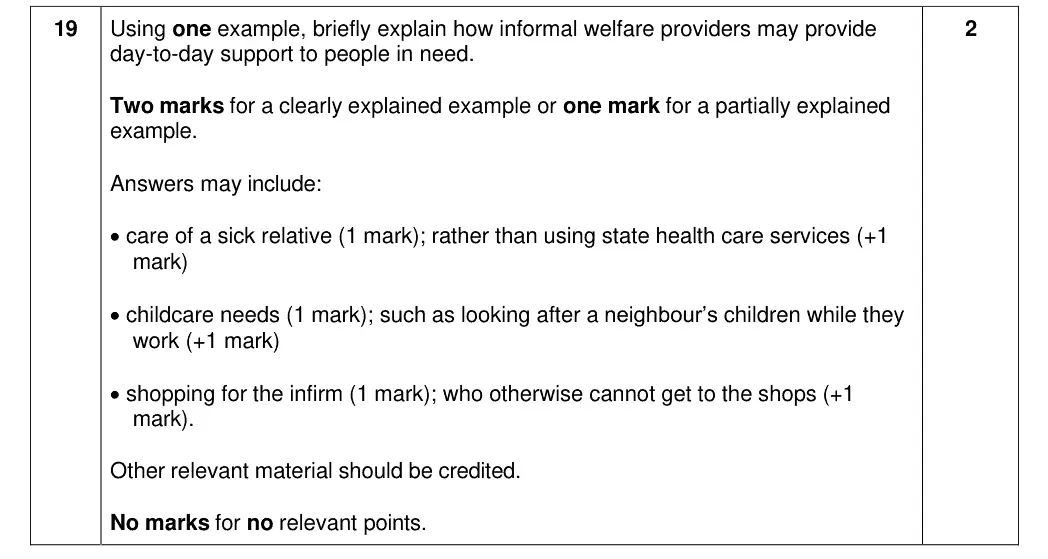
June 2024 · AS Paper 2 · Q192 marksAO2=2Brief explain
Mark scheme
Examiner's comment
Many students did not understand what “informal” welfare was as opposed to other types such as public etc. As a result, finding examples of how informal welfare might provide day to day support proved difficult. “Voluntary” examples of welfare such as food banks were often presented in answers as a type of informal welfare but could not be credited.
Notes from the mark scheme and report
2 marks for a clearly explained example of informal care (family, friends, neighbours)
voluntary-sector examples such as food banks not credited
many confused informal with other types of welfare
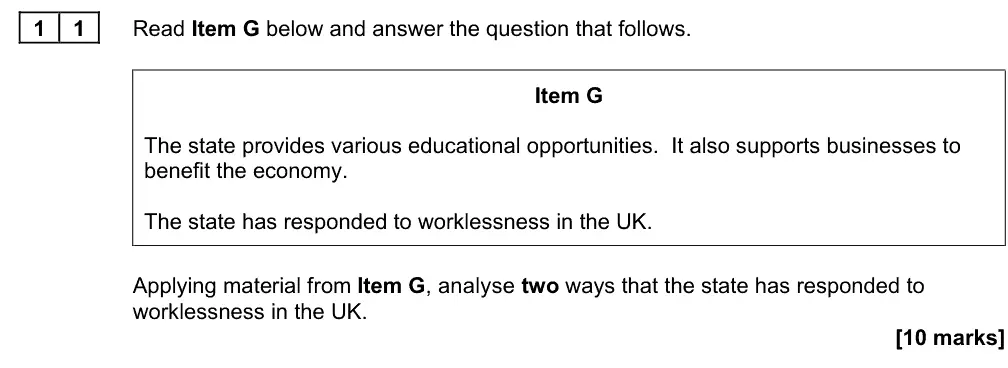
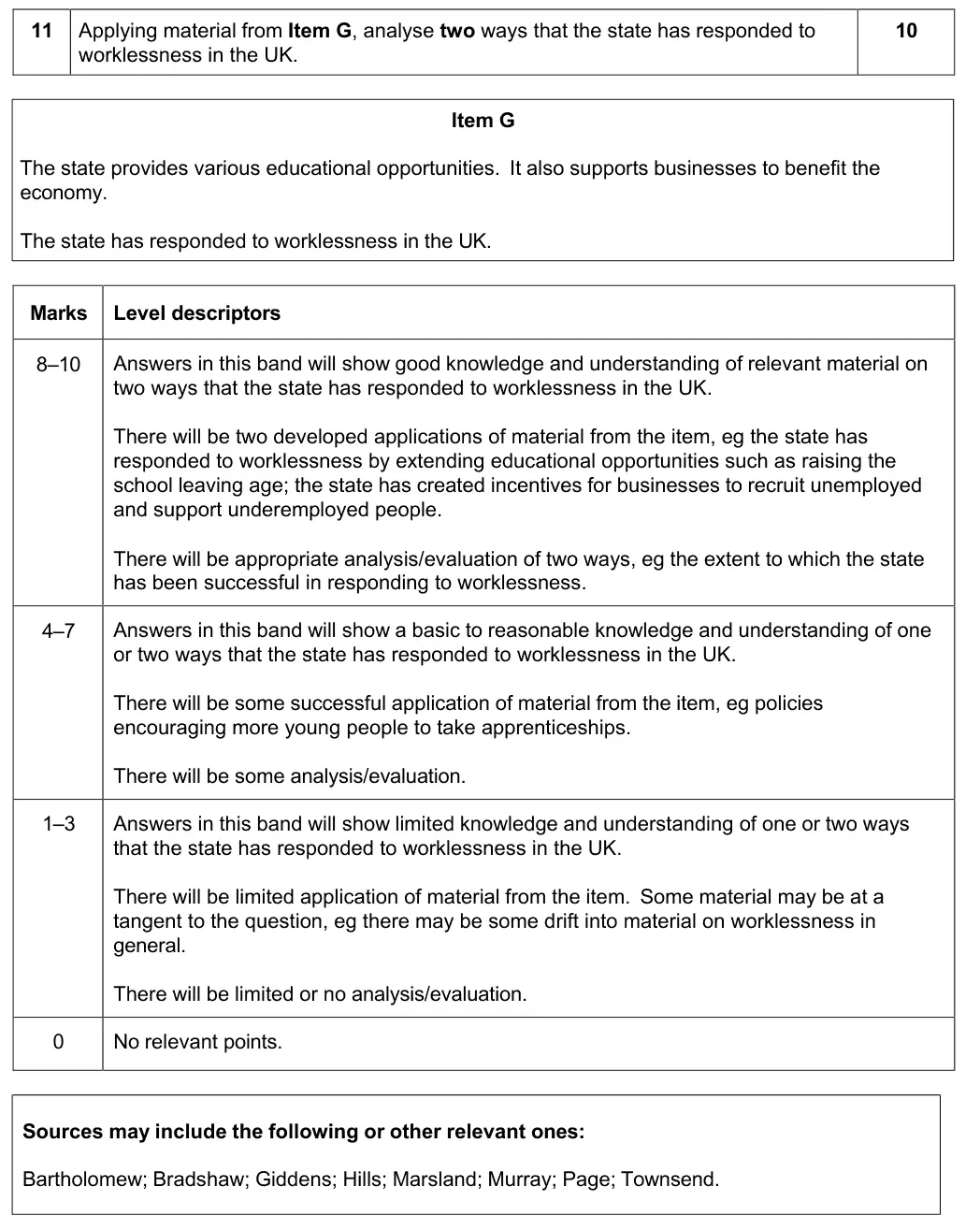
June 2023 · Paper 2 · Q1110 marksAO1=3, AO2=4, AO3=3Analyse
Mark scheme, including the levels grid and indicative content
Examiner's comment
The nature of these questions means that students cannot rely on reciting knowledge. Questions will ask them to bring together aspects of their sociological knowledge in ways they are unlikely to have done before. It is therefore important for students to allow time to think about how to answer the question. Students should be made aware that there are two types of 10 mark questions. These have different requirements and different mark schemes. There are different marks available for the assessment objectives. The items for 10 mark “analyse” questions are written to give prompts or “hooks” for student answers. These have to be used to access application marks. Answers can indicate use of hooks by quoting, by a reference in parentheses or by wording (eg “As the item says…”). Items end with a sentence restating the question; the hooks are in the preceding part of the item. Introductions and conclusions are not required for 10 mark questions and take up valuable time. It is helpful if answers are set out to clearly indicate the two separate points, with wording such as “One way/reason is…” or by starting a new paragraph for the second point. Answers that give more than two points are unlikely to develop two of them sufficiently. Question 11: Answers developed from “educational opportunities” in the item to discuss, for example, apprenticeships. Points from the reference in the item to support for businesses tended to be less well developed.
Notes from the mark scheme and report
hooks: educational opportunities and support for businesses
e.g. raising the leaving age, apprenticeships, incentives to recruit unemployed people
drift into worklessness in general = 1–3
business-support hook less well developed
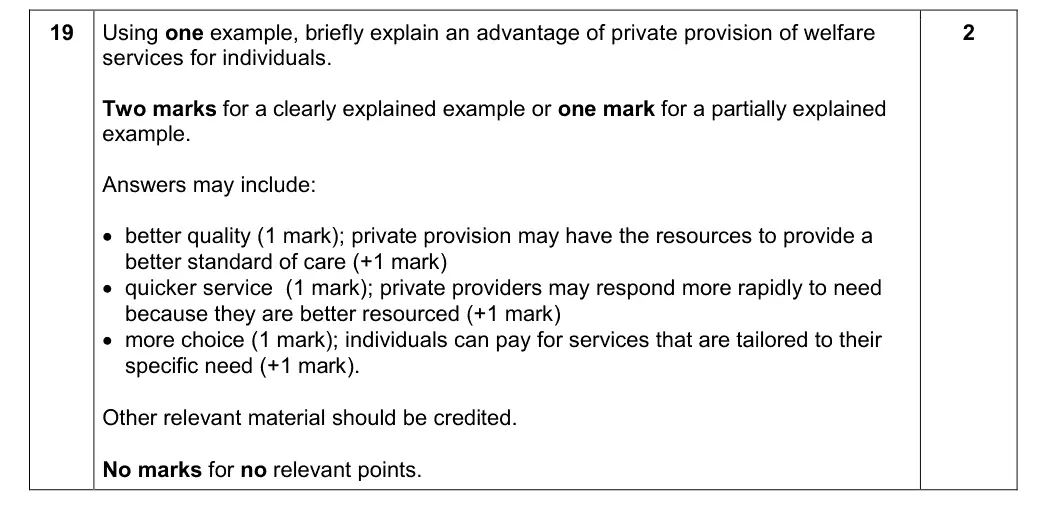
June 2023 · AS Paper 2 · Q192 marksAO2=2Brief explain
Mark scheme
Examiner's comment
Many students did not understand what “private” welfare was as opposed to other types such as public etc. As a result, identifying appropriate advantages proved difficult. The most common approach taken by students was therefore to reach for various advantages of different kinds of welfare provision, some of which were creditworthy and others not, so producing uneven responses.
Notes from the mark scheme and report
1 mark for the advantage, +1 for explaining it (e.g. better quality, quicker service, more tailored choice)
many did not know what private welfare is and gave uneven advantages of welfare in general
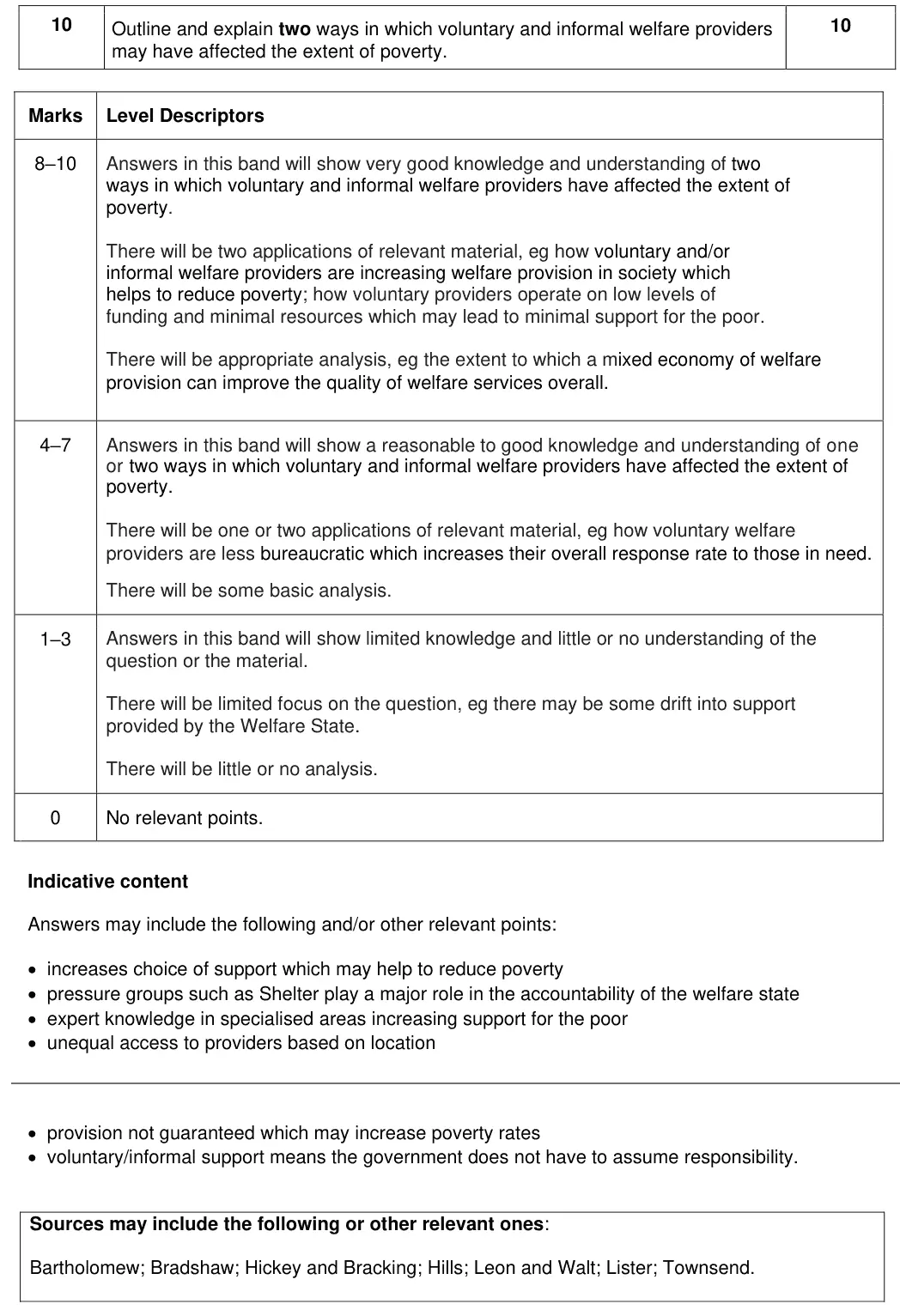
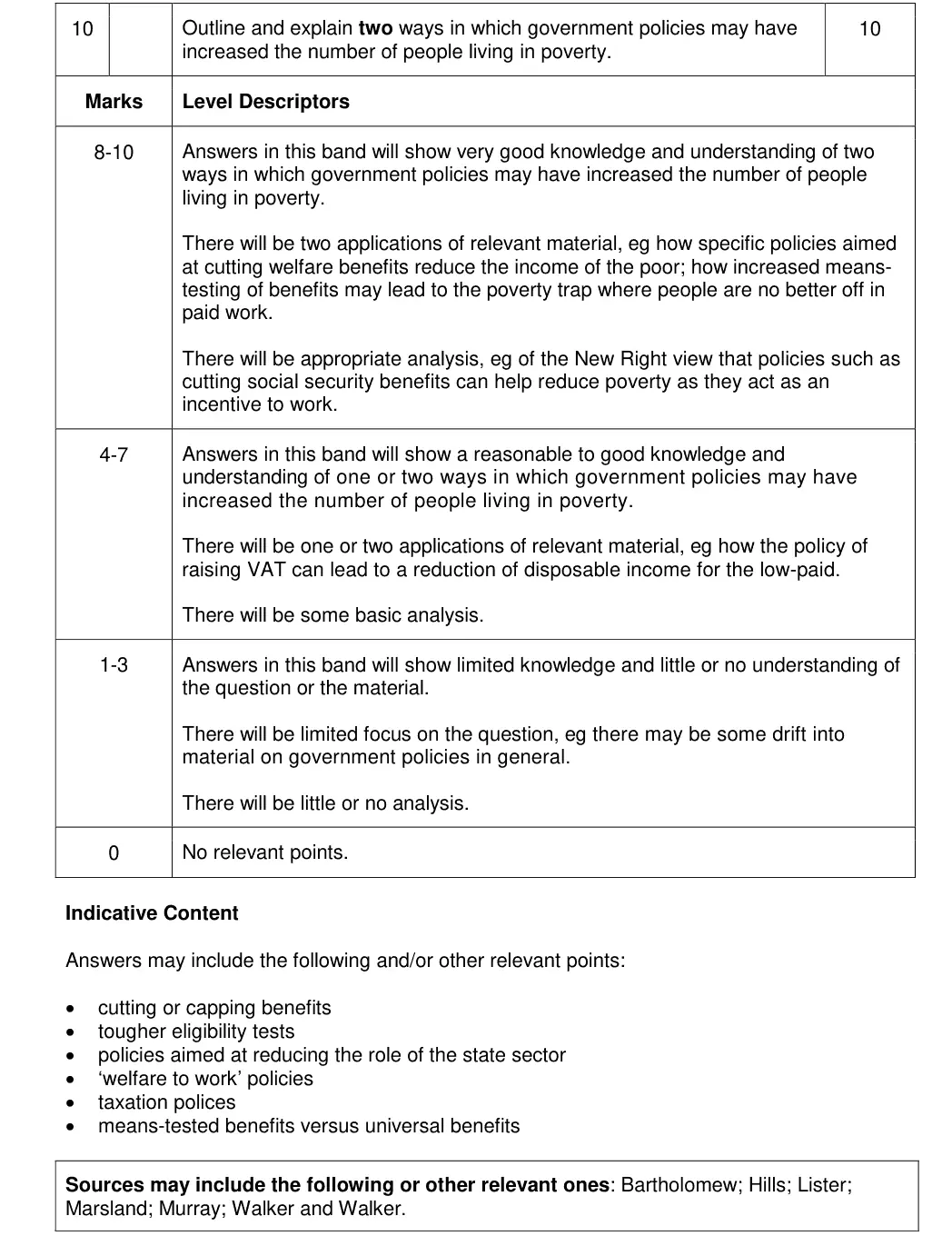
June 2022 · Paper 2 · Q1010 marksAO1=5, AO2=3, AO3=2Outline and explain
Mark scheme, including the levels grid and indicative content
Examiner's comment
The nature of these questions means that students cannot rely on reciting knowledge. The questions will ask them to bring together aspects of their sociological knowledge in a way that they are unlikely to have done before. There was a tendency, however, to attempt to answer the question by giving knowledge based on words or phrases in the question, rather than meeting the demands of the question. Students are advised to spend time reading the question, and, where there is one the item, to ensure that they are answering the question. Some students seemed unaware of the different demands of the two types of questions. The marks awarded for the assessment objectives are different in the two types of ten mark questions, and students should be aware of this. In particular, it should be noted that there are no marks available for evaluation in “outline and explain” (no item) questions. There is no need for an introduction or conclusion for 10 mark questions. It is helpful if answers are set out to clearly indicate the two answers, with wording such as “One way is…” or by starting a new paragraph for the second point. The best answers to 10 mark questions were focused, clearly stating a point that addressed the question and then developing it, using sociological concepts, evidence and, where appropriate, theory. Answers need to address all aspects of the question. Q10 There were some very good answers to this question. Many chose to give one positive effect, such as voluntary providers such as foodbanks reducing poverty, and one negative effect, such as their being unable to provide support on the scale that governments can. Good answers usually gave named examples of voluntary or informal welfare providers.
Notes from the mark scheme and report
must be voluntary and informal providers, not the welfare state (drift = 1–3 band)
many gave one positive effect (e.g. food banks reducing poverty) and one negative (cannot match state scale, patchy provision)
named providers improved answers
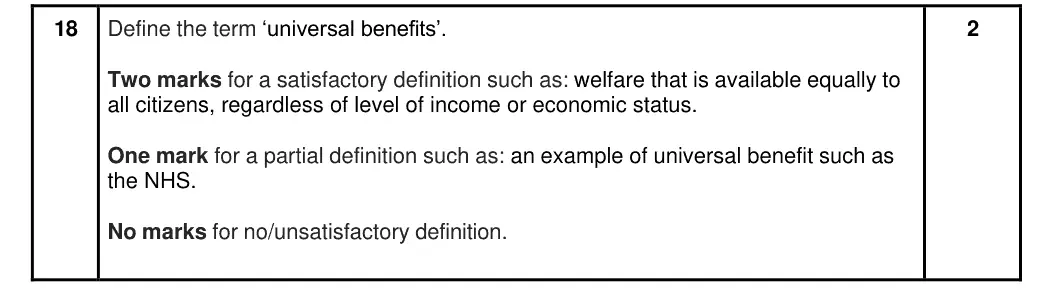
June 2022 · AS Paper 2 · Q182 marksAO1=2Define
Mark scheme
Examiner's comment
For low mark tariff questions where candidates are required to either define, explain or outline, care should be taken to ensure that points are not just identified. Very few responses gained full marks for this question. Almost all students referred to groups who need support or those who don't earn enough money. Perhaps mistaking universal benefits for universal credit. A few were able to give an example of the NHS as a universal benefit.
Notes from the mark scheme and report
2 marks for welfare available to all regardless of income
1 mark for an example only (e.g. NHS)
very few full marks
many described support for the needy, possibly confusing with universal credit
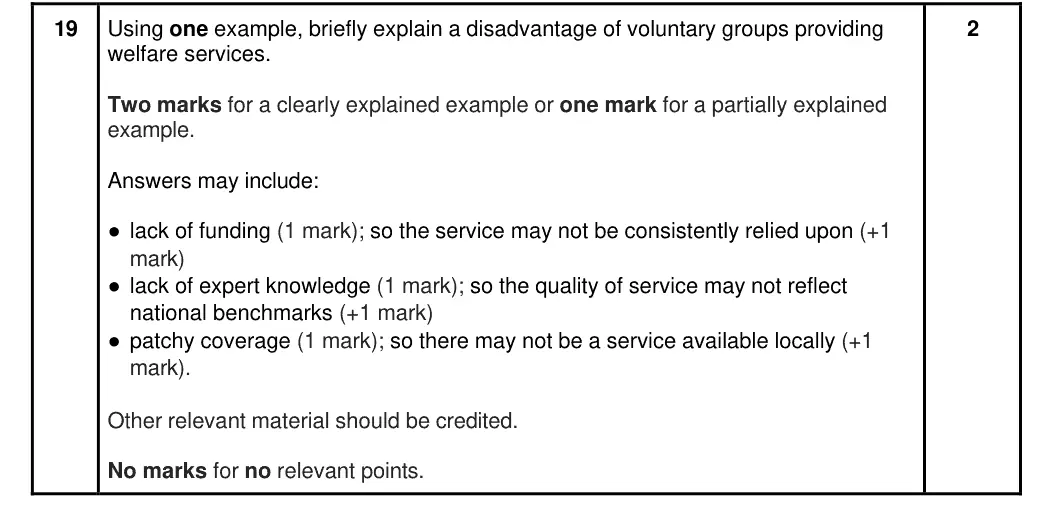
June 2022 · AS Paper 2 · Q192 marksAO2=2Brief explain
Mark scheme
Examiner's comment
For low mark tariff questions where candidates are required to either define, explain or outline, care should be taken to ensure that points are not just identified. The most common response to this question was the idea that volunteers are not paid therefore they will provide a worse service, indicating a lack of understanding of the disadvantages of voluntary groups providing welfare services. Some responses identified patchy coverage or lack of expert knowledge but this usually gained partial marks only.
Notes from the mark scheme and report
1 mark for the example +1 for explaining the disadvantage (unreliable funding, lack of expertise, patchy coverage)
'volunteers are unpaid so give a worse service' showed misunderstanding
patchy coverage and expertise usually only partially explained
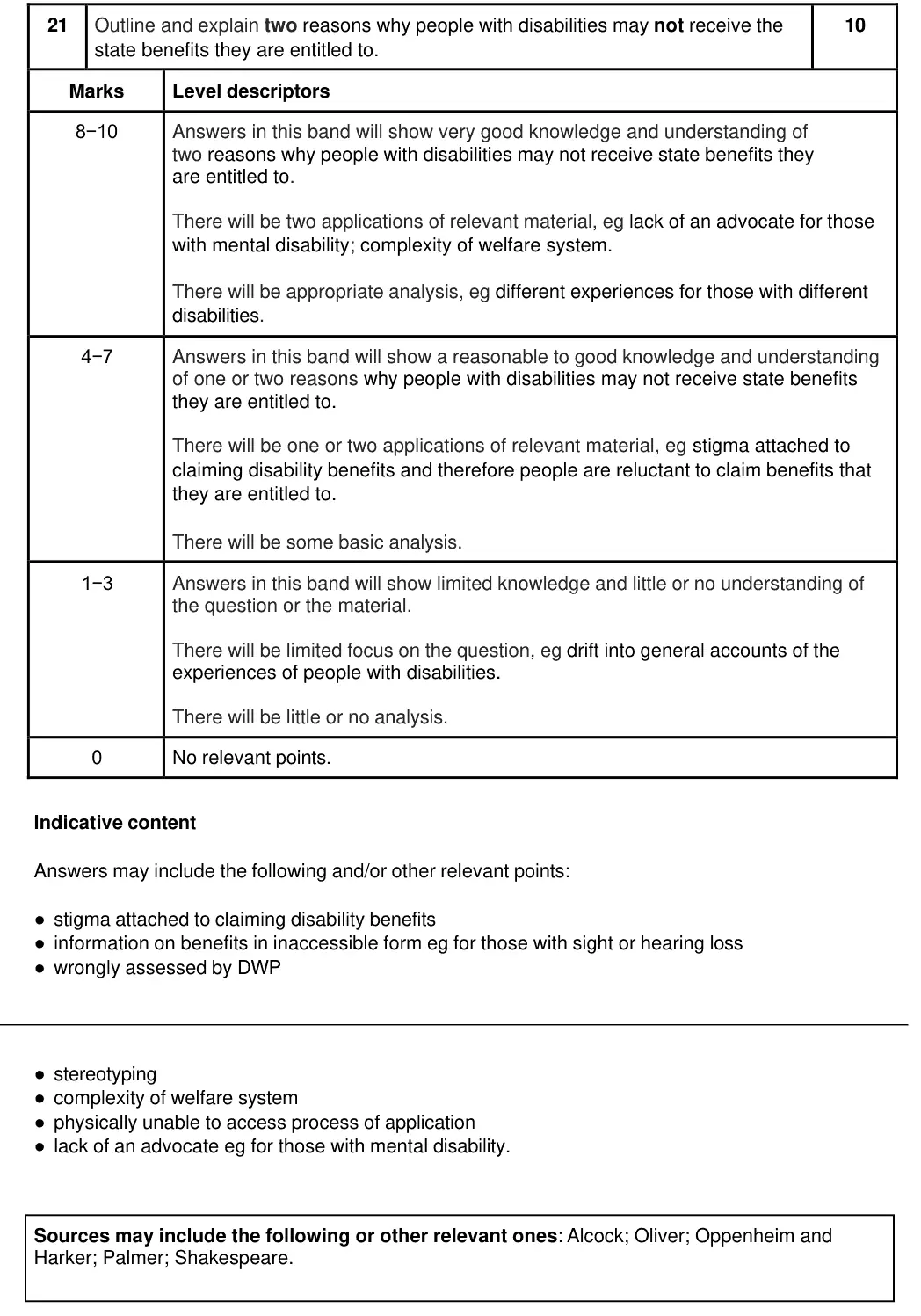
June 2022 · AS Paper 2 · Q2110 marksAO1=5, AO2=3, AO3=2Outline and explain
Mark scheme, including the levels grid and indicative content
Examiner's comment
There were some good answers to this question but most students found it difficult to identify and develop two applications successfully. There were some generic responses about the benefits system being difficult to access but this was not applied to disability specifically. The concept of entitlement seemed not to be understood as a common response was that disabled people don’t need benefits as their carers provide for them or they have enough money without claiming benefits. The most common responses related to a lack of awareness of entitlement or incorrect assessments by government agencies.
Notes from the mark scheme and report
two reasons for non-take-up (stigma, inaccessible information, wrong DWP assessments, complexity, no advocate)
drift into general experiences of disabled people = 1–3
generic points about access to benefits not applied to disability
some misunderstood entitlement
November 2021 · Paper 2 · Q1220 marksAO1=8, AO2=6, AO3=620-mark essay
Mark scheme, including the levels grid and indicative content
Notes from the mark scheme and report
must apply Item H (welfare state support for housing and employment, New Right dependency view, view that poverty has not been reduced)
top band: debate between functionalism, New Right, social democratic, Marxist and feminist views on the effectiveness of specific policies
no examiners' report comment for this part
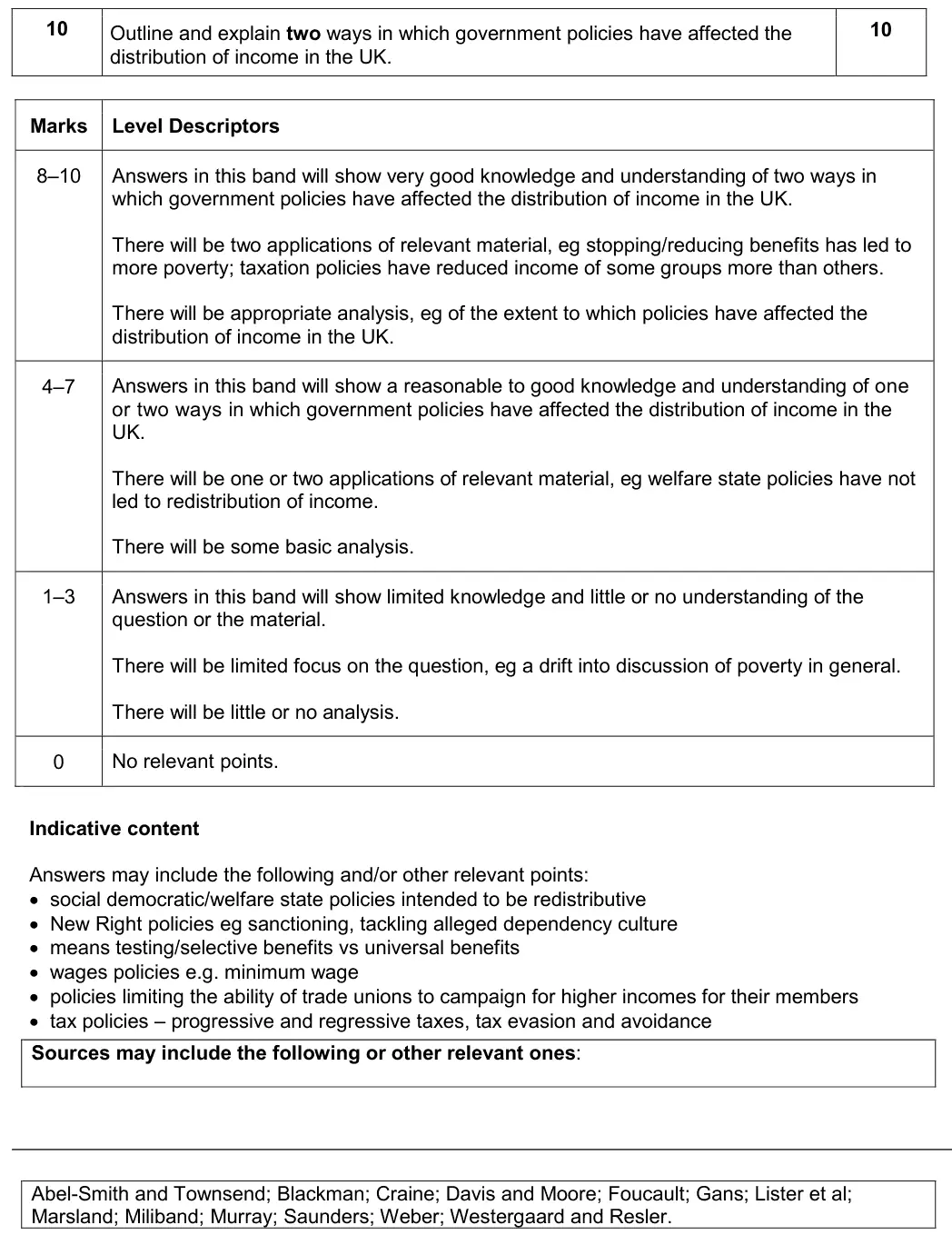
November 2020 · Paper 2 · Q1010 marksAO1=5, AO2=3, AO3=2Outline and explain
Mark scheme, including the levels grid and indicative content
Notes from the mark scheme and report
two policies and their effect on income distribution
e.g. benefit cuts and sanctions, progressive/regressive tax, minimum wage, trade union limits, universal vs means-tested benefits
drift into poverty in general = 1-3
no marks for evaluation in this question type (examiners' report general remark)
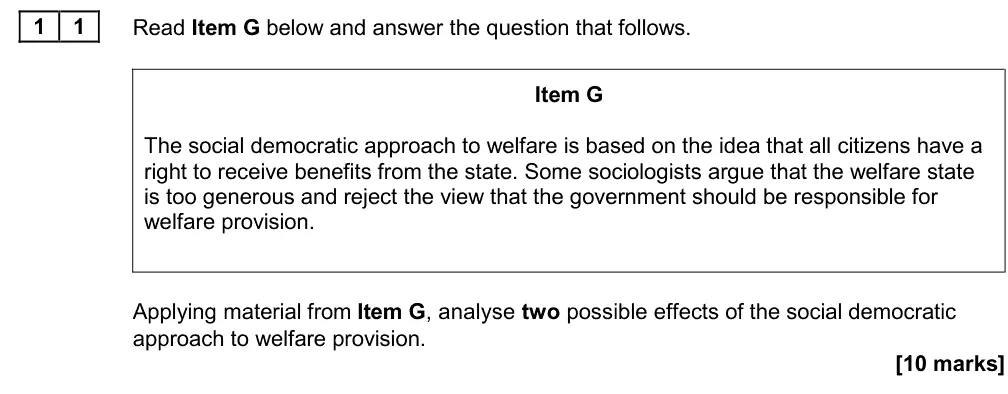
June 2019 · Paper 2 · Q1110 marksAO1=3, AO2=4, AO3=3Analyse
Mark scheme, including the levels grid and indicative content
Examiner's comment
Some students wrote introductory paragraphs and/or conclusions. These are not necessary, and are unlikely to gain additional marks; they also take up time. Some students made only one point in their answers, or three or more, rather than the two asked for. The word ‘two’ is put in bold in the question to try and draw students’ attention to this. Sometimes it was not clear how many points were being made. It is helpful for students to clearly indicate their two answers, with wording such as “One way is…” or by starting a new paragraph for their second point. Notably, some students wrote far more than was needed for a 10-mark response. The two types of 10-mark question, “outline and explain” and “analysis” types, are marked differently as the assessment objectives have different weightings. It is important that students are aware of this. For 10 mark “analyse” questions, the parts of the item being used should be clearly indicated, preferably by exact words being quoted. It is acceptable for two different points to be drawn from one part of the item, but answers which do not use the item cannot access the application marks. The best answers to 10-mark questions were focused, clearly stating a point and then developing it, and used sociological concepts, studies, evidence and theory as appropriate. Some students were unsure of the term ‘social democratic approach’ to welfare provision but were often still able to develop answers from the item. The reference to ‘the welfare state is too generous’ was used to develop points from the New Right about cultures of dependency and the reference to ‘all citizens’ to discuss how this might reduce the stigma of receiving welfare.
Notes from the mark scheme and report
effects of universal state welfare, e.g. reduced stigma ('all citizens' hook) vs New Right dependency culture ('too generous' hook)
drift into welfare policy in general = 1–3
some unsure what social democratic approach means
AO split from AQA's standard grid for this paper (this year's mark scheme does not print it).
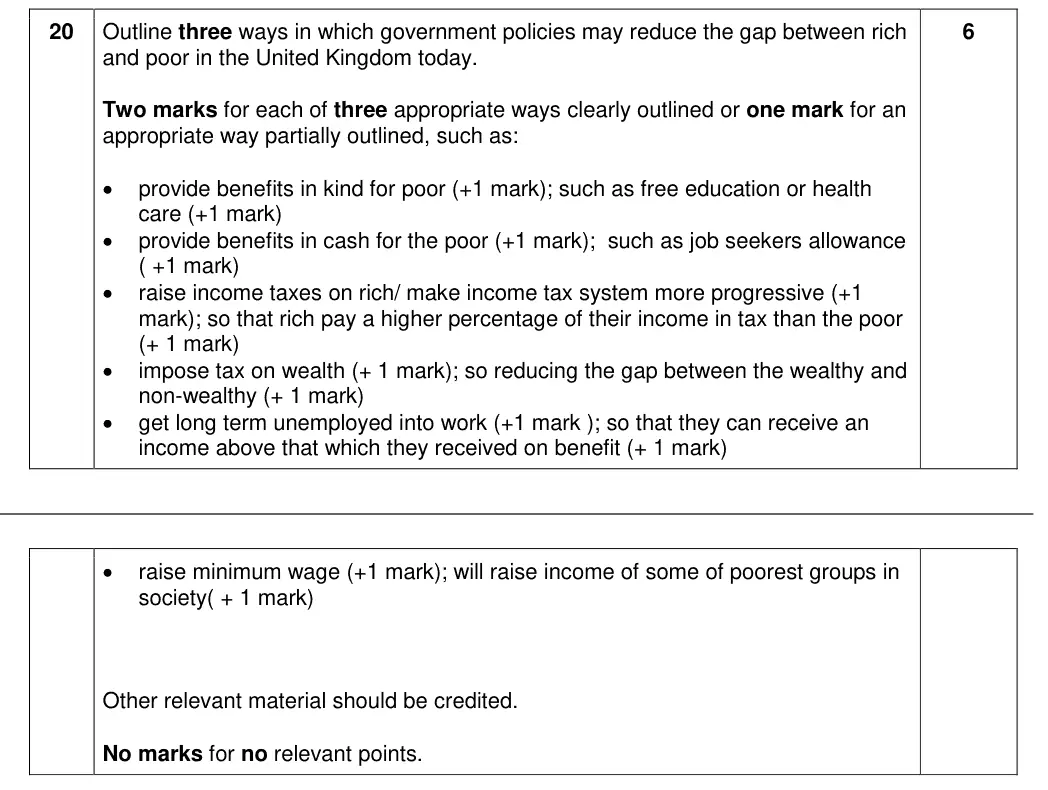
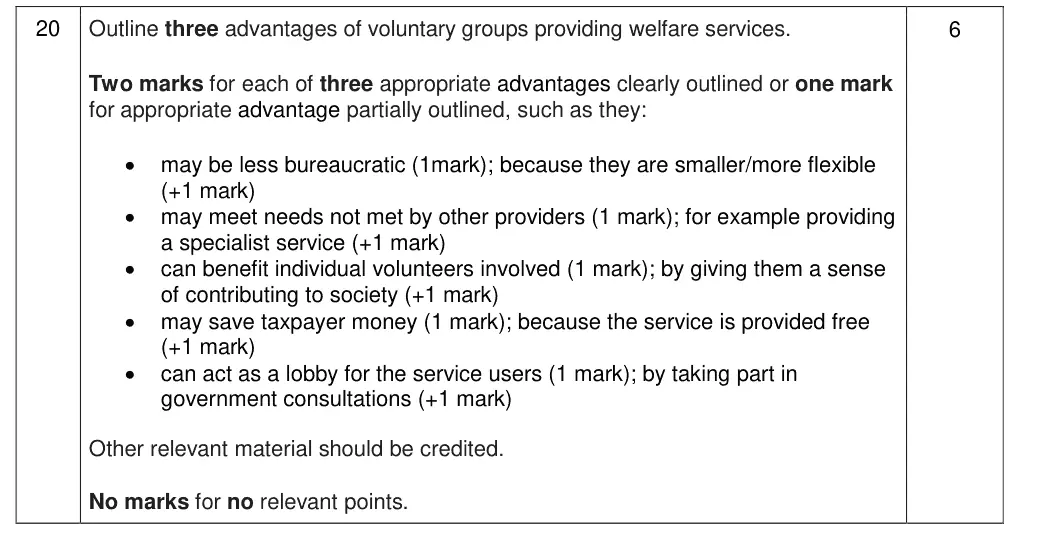
June 2019 · AS Paper 2 · Q206 marksAO1=6Outline
Mark scheme
Examiner's comment
Many students struggled with this question. Answers were often vague about government policies and how these policies might reduce the gap between rich and poor. For example, some answers referred to ‘the tax system’ without really explain how such a policy might work. Better answers were able to be specific about a policy. For example, making the income tax system more progressive, or targeting the wealth of the rich through a wealth tax.
Notes from the mark scheme and report
AO grid not printed
2 marks for each of three ways clearly outlined
policy must be specific and its effect on the gap explained, e.g. progressive income tax, wealth tax, minimum wage, benefits in cash or kind
vague references to 'the tax system' = partial
AO split from AQA's standard grid for this paper (this year's mark scheme does not print it).
June 2018 · Paper 2 · Q1220 marksAO1=8, AO2=6, AO3=620-mark essay
Mark scheme, including the levels grid and indicative content
Examiner's comment
Many scripts had one substantial well developed answer to a 20 mark question and one significantly briefer one, suggesting problems with timing. It is often the case that a wide range of material can be relevant to these questions, and students need to carefully choose the content they wish to use by planning their answers. For example, it may be more effective to cover a limited number of views or theories in some depth rather than to include every possible theory. There was a tendency for answers to progressively lose sight of the question and to become a list of different views. The best answers will address all aspects of the question and will draw on theories, concepts and empirical examples or evidence. Evaluation which meets the demands of the questions is better than points of criticism which have been learned and included, regardless of the question. Students should also be aware that evaluation includes awareness of the strengths as well as the weaknesses of an argument, theory or piece of evidence. Answers here tended to describe welfare provision by the private and state sectors, making some comparisons and evaluative points. Students tended to have less to say on the informal and voluntary sectors. Most understood the idea of a mixed economy and so answers were generally focussed on the question, though tended towards the list-like.
Notes from the mark scheme and report
top band debates approaches to welfare (Marxist, New Right, social democratic, Third Way, feminist)
answers concentrated on state and private sectors with little on informal and voluntary care
tended to be list-like
AO split from AQA's standard grid for this paper (this year's mark scheme does not print it).
June 2018 · AS Paper 2 · Q206 marksAO1=6Outline
Mark scheme
Examiner's comment
Many students struggled with this question. Some answers confused voluntary groups with private commercial providers or with informal carers. Many successful answers made reference to advantages such as: they may save the taxpayer money; they can benefit the individuals involved; they may meet needs not met by other providers. Some students gave examples of services that voluntary groups may provide without outlining the underlying advantages that these groups may bring. These were credited as partial answers.
Notes from the mark scheme and report
credited: less bureaucratic, meet unmet needs, benefit volunteers, save taxpayers' money, lobby for users
many confused voluntary with private or informal care
examples of services without the advantage = partial
AO split from AQA's standard grid for this paper (this year's mark scheme does not print it).
June 2017 · Paper 2 · Q1010 marksAO1=5, AO2=3, AO3=2Outline and explain
Mark scheme, including the levels grid and indicative content
Examiner's comment
A number of students wrote introductory paragraphs and/or conclusions. These are not necessary, and are unlikely to gain additional marks. A number of students made only one point in their answer, or three or more, rather than the two asked for. In these cases, the two best answers were rewarded and will be in future series. It is helpful for students to clearly indicate their two answers, with wording such as “One way is…” or by starting a new paragraph for their second point. Schools and colleges should note that there is no reference in the mark scheme for 10 mark ‘outline and explain’ questions to evaluation, and that evaluation is not a requirement for answers to these questions. The assessment objective allocations are different in the two types of 10 mark questions, and students should be made aware of this. There was a wide range of responses to these questions. A minority of students wrote very brief answers. For these 10 mark items, a simple statement of two ways, reasons or factors, without development, is not sufficient to access more than the lower marks in the mark range. The best answers were focused, clearly stating a point and then developing it, with use of sociological concepts, evidence and theory where appropriate, in ways that demonstrated the skills expected from the targeted assessment objectives. There was a tendency, however, for many answers to focus on the first aspect of the question at the expense of the second. Students need guidance on how to approach these questions and how to best demonstrate their sociological understanding. The nature of these questions means that students cannot rely on reciting knowledge. They require students to bring together two aspects of their sociological knowledge in a way that they are unlikely to have done before. Answers will sometimes require claims that students may be unsure of because they do not know of specific evidence (for example, in question 5, whether migrants from Eastern Europe who are single workers tend to live alone or in shared households). However, answers that are sociologically plausible will be accepted. Students often showed an impressive knowledge of recent and current government policies, such as the bedroom tax and changes to benefits. A few chose zero hours contracts, which are not a government policy. However, it was possible to use this by arguing that government policy was to allow these.
Notes from the mark scheme and report
two ways policy increased poverty (benefit cuts/caps, means-testing and the poverty trap, tax changes such as VAT)
drift into government policy in general = 1–3
good answers used current policies e.g. bedroom tax
zero-hours contracts are not a policy unless framed as government permitting them
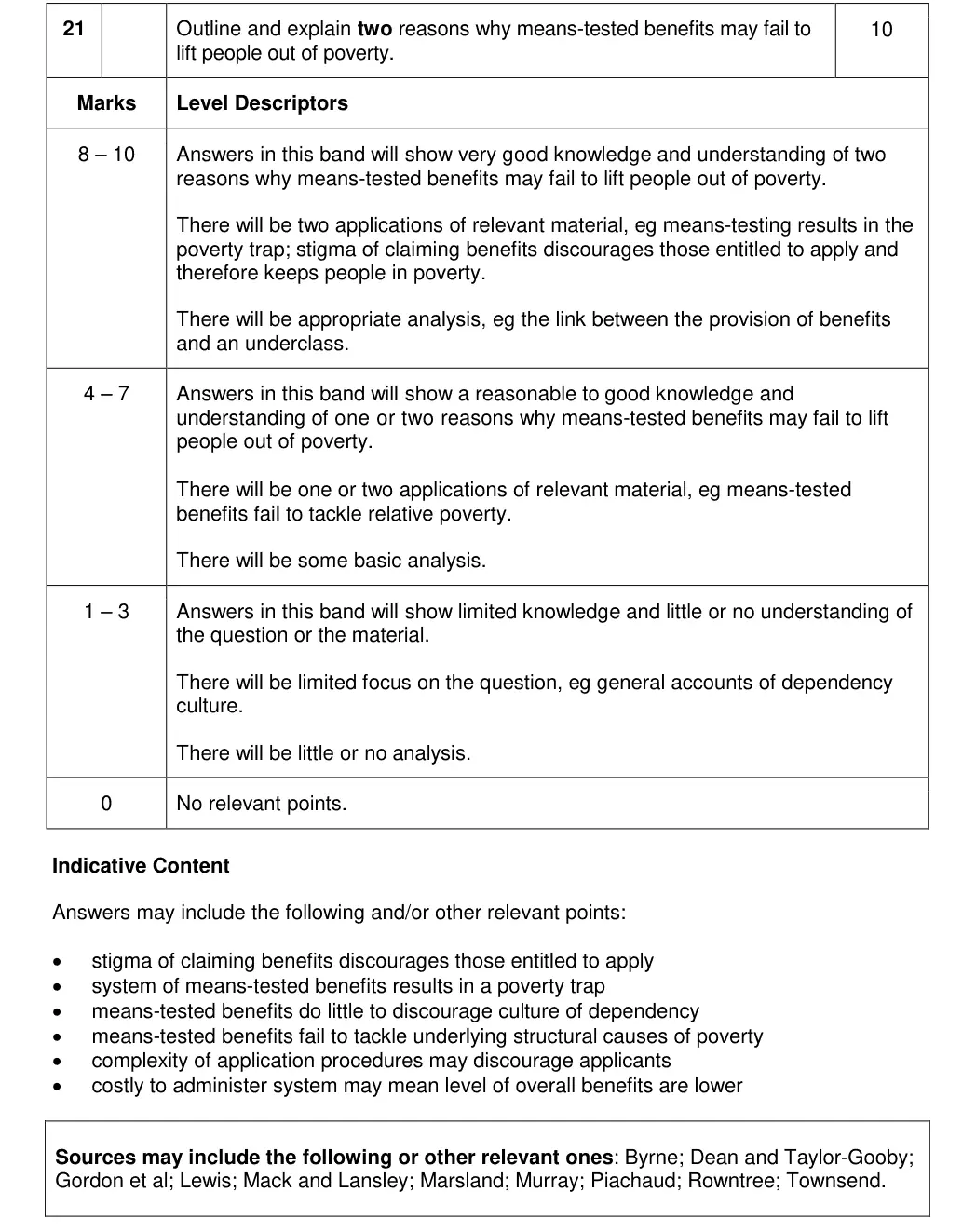
June 2017 · AS Paper 2 · Q2110 marksAO1=5, AO2=3, AO3=2Outline and explain
Mark scheme, including the levels grid and indicative content
Examiner's comment
The 10 mark outline and explain question requires students to link two aspects of the specification. The best answers took note of both aspects of the question, clearly identified two separate points and developed them in relation to the second part of the question. Weaker answers either ignored one aspect of the question or attempted to cover a number of ideas rather than focusing on two. Some students were hampered in their attempts to answer this question because they were unclear about what means tested benefits are. These answers often developed into general criticisms of the provision of welfare benefits and struggled to make relevant points. Successful answers made reference to problems such as the complexity of the system, the stigma attached to claiming and the relatively low amount of money received. Top band answers were able to explain these problems in terms of their effect or scope or underlying causes. For example, by discussing stigma in the context of media stereotypes, the effect this had on claimants and illustrating the issues with examples, such as the provision of free school meals.
Notes from the mark scheme and report
no marks for evaluation in this question type
two reasons each developed, e.g. poverty trap, stigma deterring claims, complexity, low levels of benefit
general dependency-culture accounts = 1–3
many were unsure what means-tested benefits are and wrote general criticisms of welfare
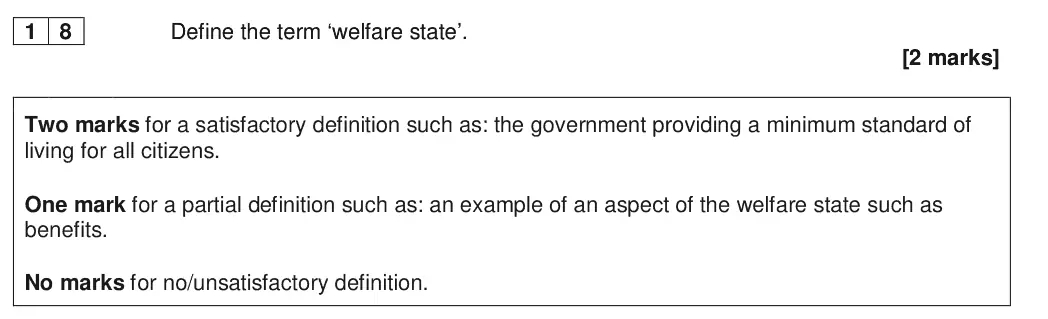
June 2016 · AS Paper 2 · Q182 marksAO1=2Define
Mark scheme
Examiner's comment
Centres are reminded that questions asking for a definition of a concept that contains more than one word within quotation marks are best answered by ensuring that all the words are defined. The most popular and successful approach made reference to government providing a minimum standard of living. However, many students struggled to define the term satisfactorily, and tended to give examples of an aspect of the welfare state for which they received one mark as a partial definition.
Notes from the mark scheme and report
2 marks for government providing a minimum standard of living for all
an example such as benefits = 1 mark
many gave only examples
June 2016 · AS Paper 2 · Q2110 marksAO1=5, AO2=3, AO3=2Outline and explain
Mark scheme, including the levels grid and indicative content
Examiner's comment
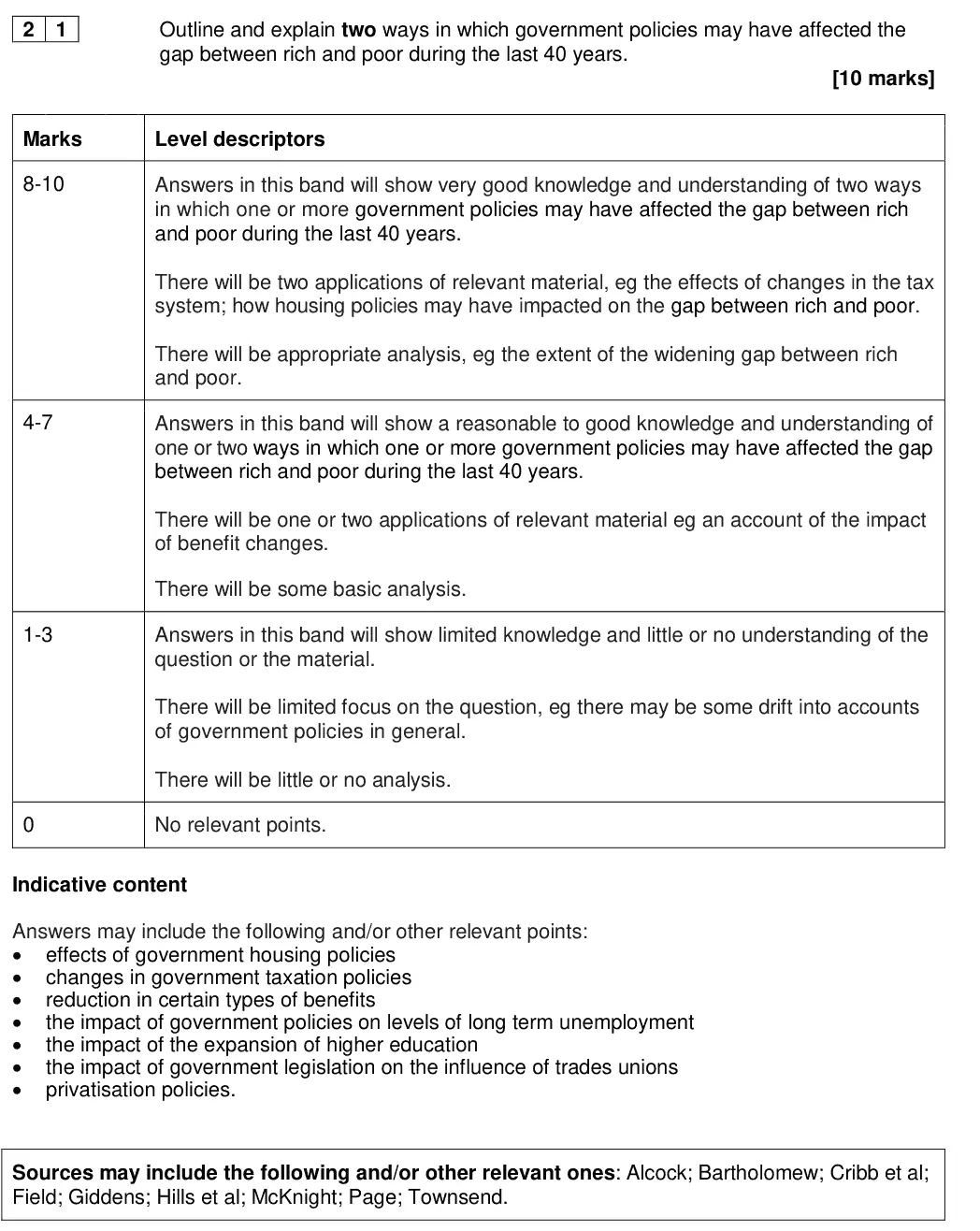
The 10 mark ‘Outline and explain’ question requires students to link two aspects of the specification. The best answers took note of both aspects of the question, clearly identified two separate points and developed them together them in relation to the question as a whole. Weaker answers either ignored one aspect of the question, or attempted to cover a number of ideas rather than focusing on the two required. Good answers were able to identify two government policies (often tax and benefit policies) and explain clearly how these have impacted on the gap between rich and poor during the last 40 years. Weaker answers were either less than clear about the policy, and/or failed to explain its impact on the gap between rich and poor. The most common successful approach was a discussion of minimum wage legislation, with a clear description of what this is coupled with some analysis of its potential impact on the poorest sections of society.
Notes from the mark scheme and report
two policies and their effect on the gap between rich and poor