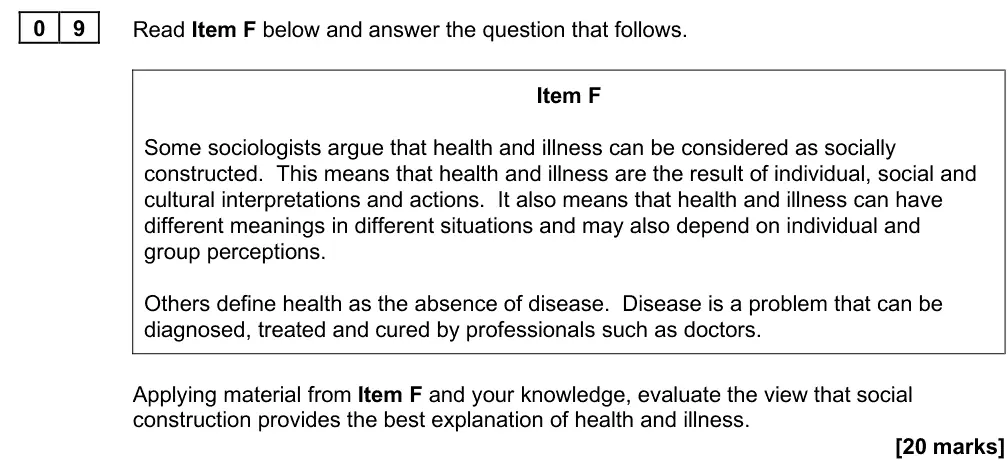
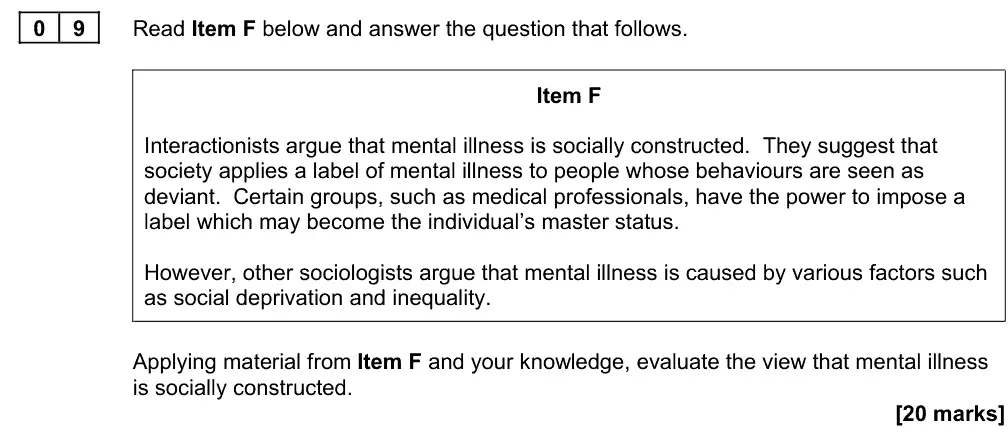
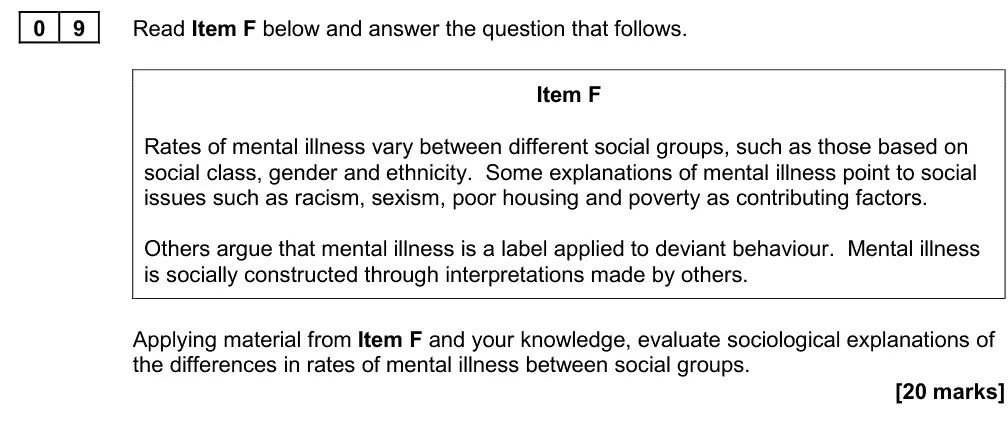
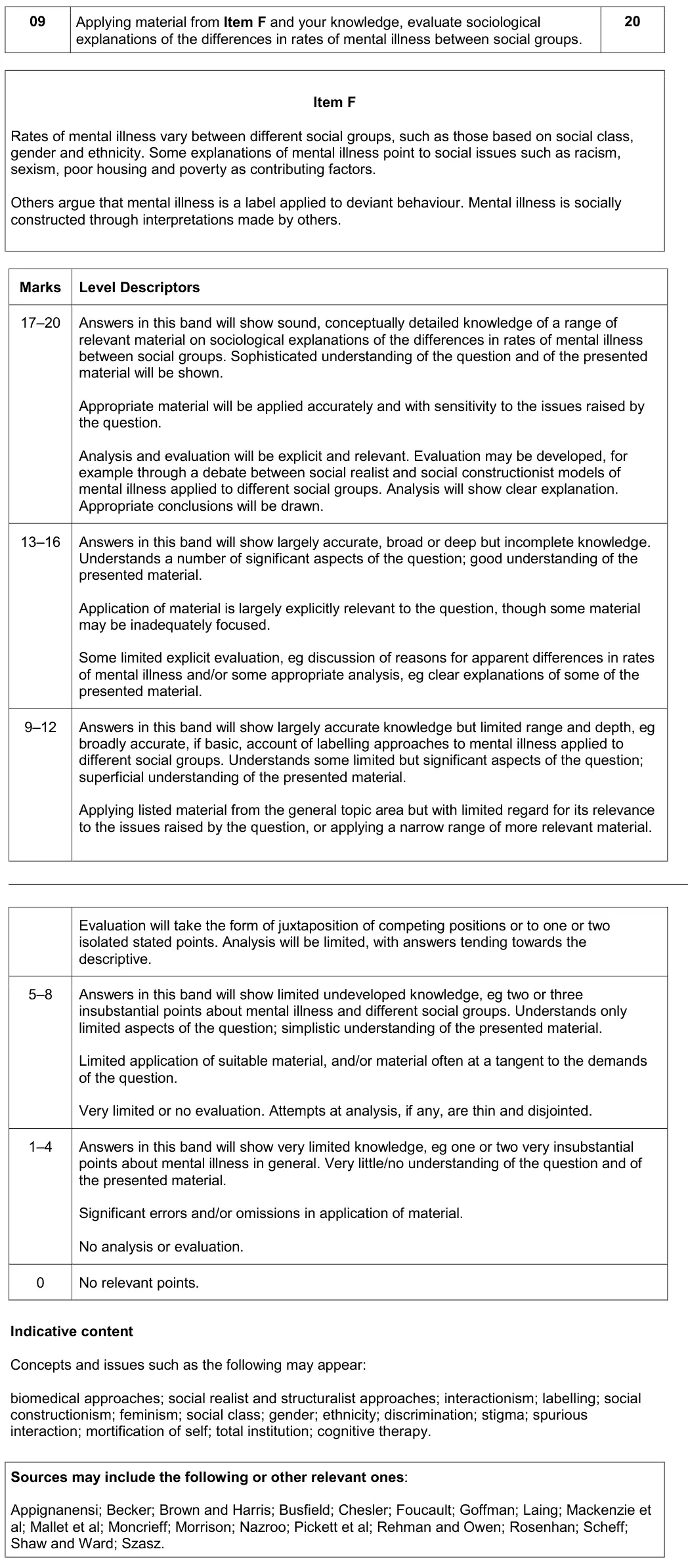
Applying material from Item F and your knowledge, evaluate sociological explanations of the differences in rates of mental illness between social groups.
Tap a question to zoom it. The mark scheme (with the level descriptors and indicative content) and the examiner's comment open underneath.
June 2025 · Paper 2 · Q920 marksAO1=8, AO2=6, AO3=620-mark essay
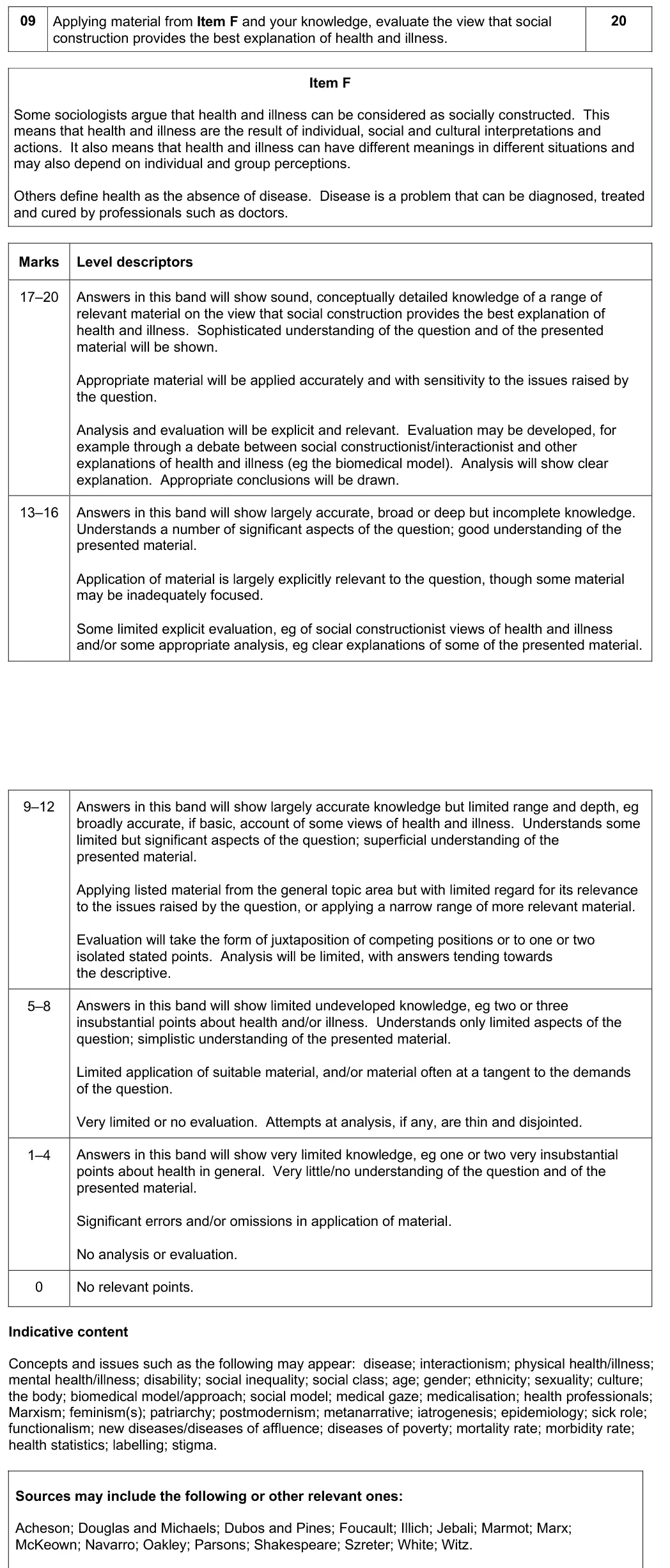
Mark scheme, including the levels grid and indicative content
Examiner's comment
These require answers that are essays and are best written in paragraphs. A brief introduction can help set out the argument of the essay. It will not attract marks if it only repeats the question or parts of the item. The purpose of the items for these questions is to suggest a few starting points for students, including ways into evaluation. Students are expected to also bring in further ideas (“and your knowledge” in the instruction) rather than relying only on the item. A wide range of material can be relevant to these questions, so students need to be selective. It is more effective to cover a limited number of views/theories in depth rather than to try to include everything. Students should keep to the question. When a question is about a particular view, other views can be used for evaluation but without writing all that the student knows about them. There was a tendency for answers to progressively lose sight of the question and to become a list of different views. Students who made brief essay plans appeared to benefit by having more structured and coherent responses. Most answers showed some knowledge and understanding of social construction as applied to health and illness. This was often illustrated by using examples relating to disability and impairment. Answers were then often developed by juxtaposing other explanations such as the biomedical model and the social construction view. This could be successful but often drifted into accounts of these explanations rather than them being used to evaluate the social construction view.
Notes from the mark scheme and report
top band debates social construction/interactionism against the biomedical model
disability and impairment examples common
many described rival explanations instead of using them to evaluate social construction
June 2025 · AS Paper 2 · Q142 marksAO2=2Brief explain
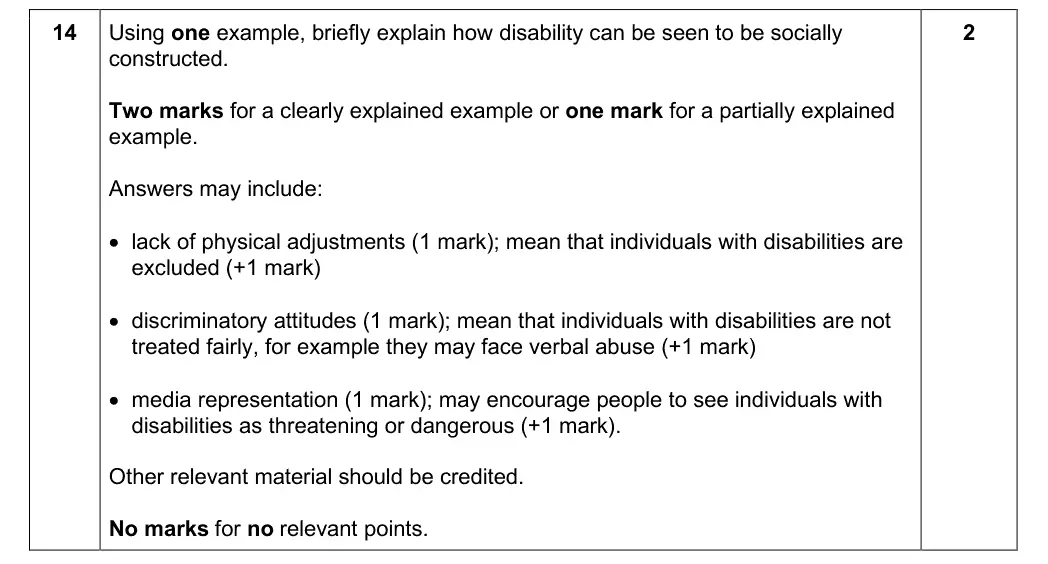
Mark scheme
Examiner's comment
This question was answered well. Lack of physical adjustments for example and absence of ramps, lifts and other variants was the most popular way of tackling the question.
Notes from the mark scheme and report
credited: lack of physical adjustments excluding people, discriminatory attitudes, media representation
ramps/lifts was the most popular route
June 2024 · AS Paper 2 · Q132 marksAO1=2Define
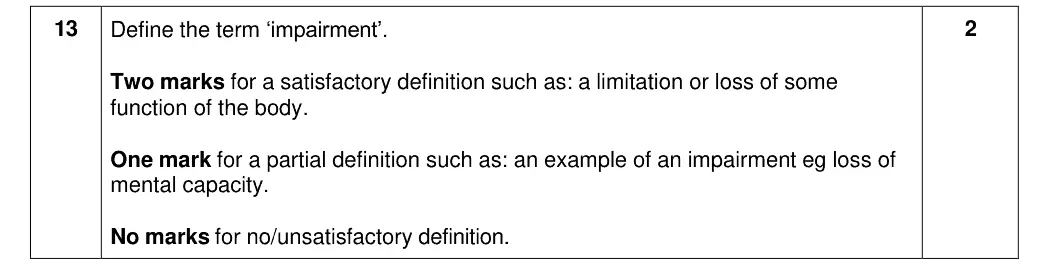
Mark scheme
Examiner's comment
Most students who answered this question gained full credit and could find a synonym for impairment.
Notes from the mark scheme and report
2 marks for limitation or loss of a bodily function
an example alone = 1 mark
most gained full marks
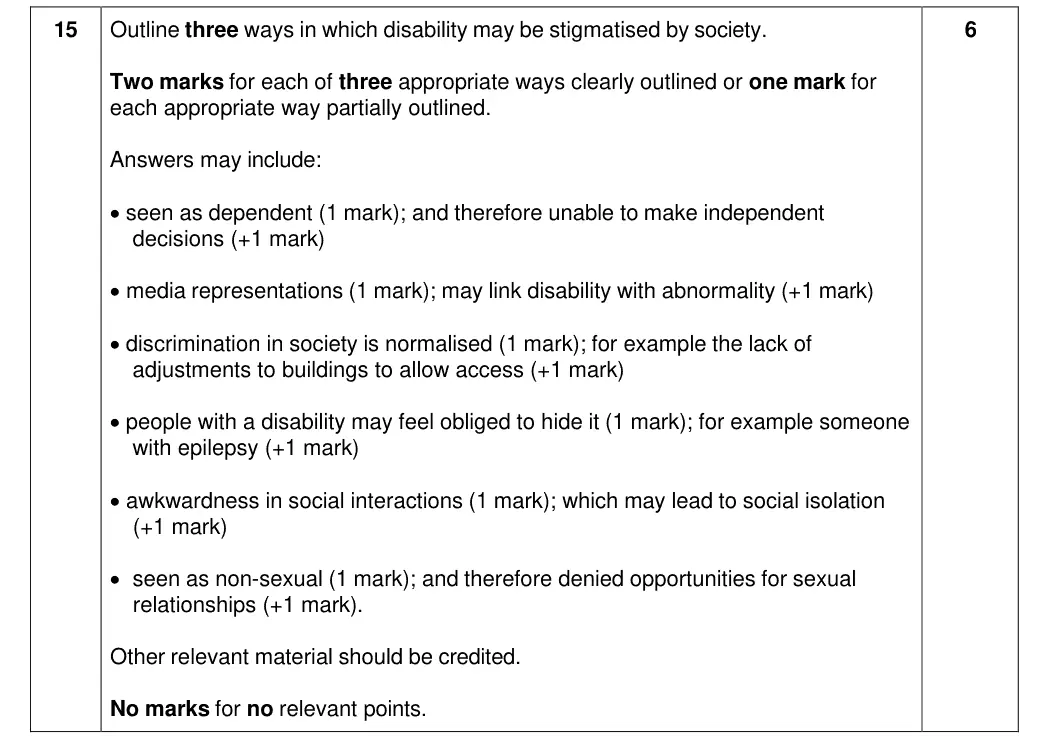
June 2024 · AS Paper 2 · Q156 marksAO1=6Outline
Mark scheme
Examiner's comment
The ‘outline three …’ 6-mark question. Students could easily improve outcomes on this question by realising the need to provide a line or so outlining the criticism / feature etc they have identified. Students seemed confident in answering this question. Popular approaches focussed on lack of access to buildings and discrimination and employment opportunities. Answers that were less successful often only identified two ways or the ways suggested overlapped.
Notes from the mark scheme and report
2 marks for each of three ways clearly outlined, 1 if only partially outlined
popular answers: access to buildings, discrimination in employment
overlapping ways or only two ways lost marks
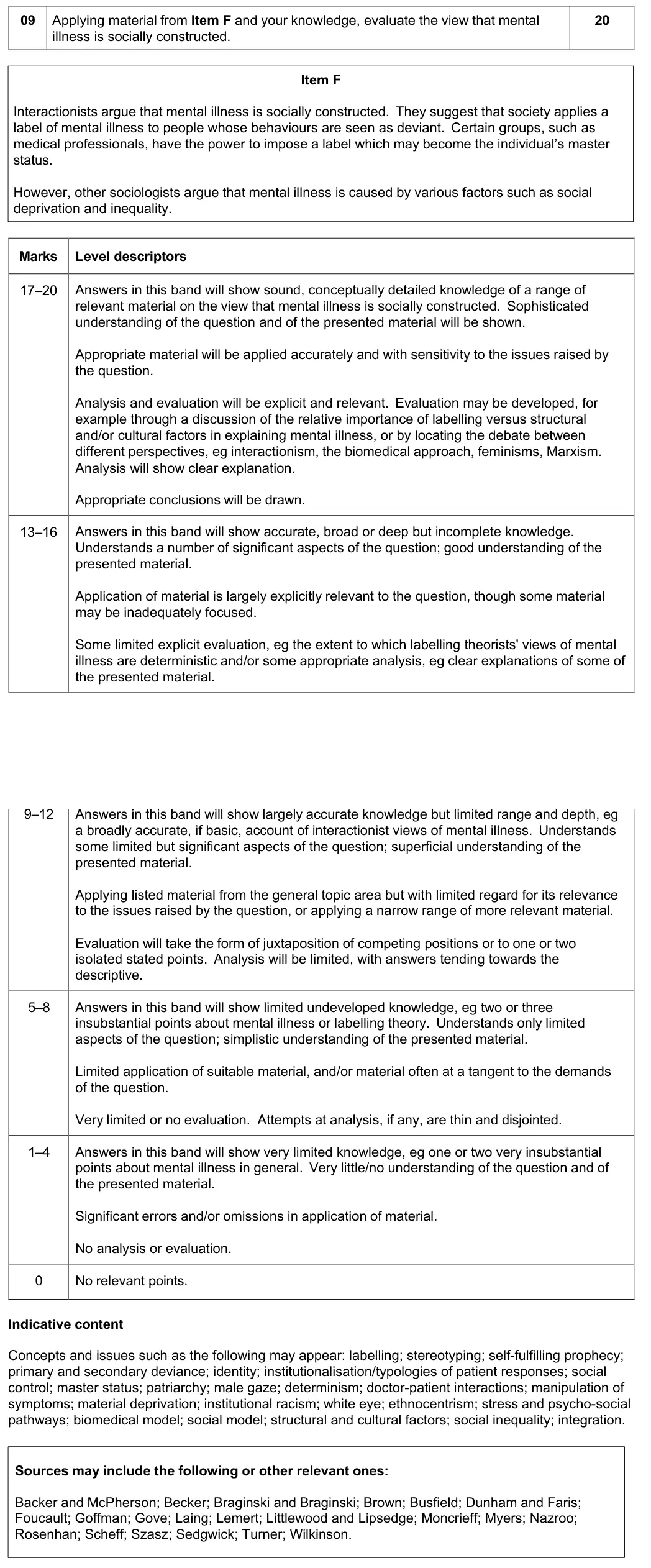
June 2023 · Paper 2 · Q920 marksAO1=8, AO2=6, AO3=620-mark essay
Mark scheme, including the levels grid and indicative content
Examiner's comment
The purpose of the items for these questions is to suggest a few starting points for students, including ways into evaluation. Students are expected to also bring in further ideas (“and your knowledge” in the instruction). A wide range of material can be relevant to these questions, so students need to be selective. It is more effective to cover a limited number of views/theories in depth rather than to include every possible theory. Students who made essay plans appeared to benefit by having more structured and coherent responses. Question 9: Answers showed awareness of the debate between the different perspectives on labelling, structural and cultural factors in explaining mental illness. Better answers were able to use points from the item effectively, expand on them and bring in other relevant material.
Notes from the mark scheme and report
top band weighs labelling against structural/cultural factors, or interactionism vs biomedical, feminist, Marxist views
labelling theory as deterministic is credited evaluation
better answers developed item points and added material
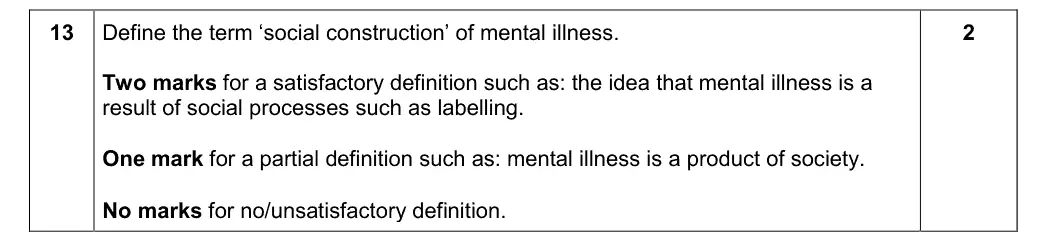
June 2023 · AS Paper 2 · Q132 marksAO1=2Define
Mark scheme
Examiner's comment
Most students who answered this question gained full credit and could find a synonym for both the social and the construction part of the answer.
Notes from the mark scheme and report
2 marks for the idea that mental illness results from social processes such as labelling
1 for 'a product of society'
most who attempted it scored full marks
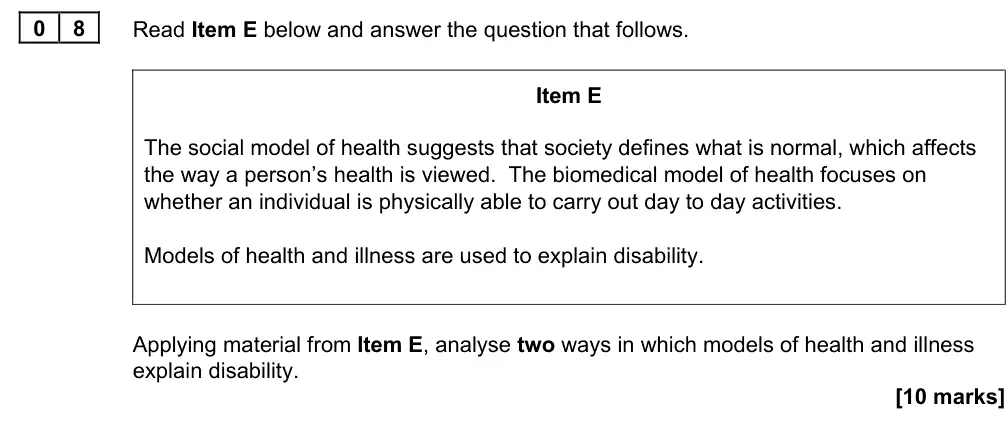
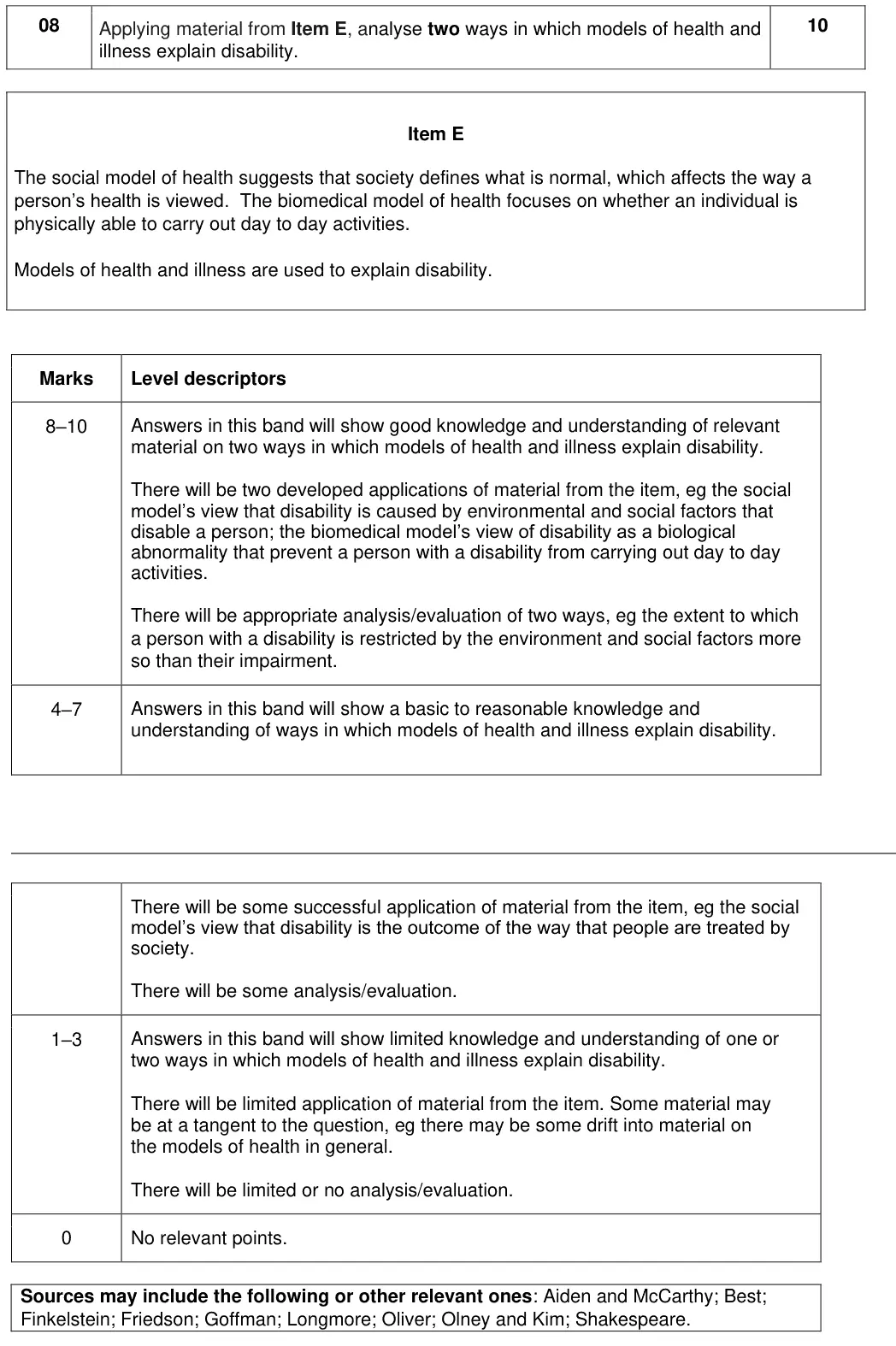
June 2022 · Paper 2 · Q810 marksAO1=3, AO2=4, AO3=3Analyse
Mark scheme, including the levels grid and indicative content
Examiner's comment
The nature of these questions means that students cannot rely on reciting knowledge. The questions will ask them to bring together aspects of their sociological knowledge in a way that they are unlikely to have done before. There was a tendency, however, to attempt to answer the question by giving knowledge based on words or phrases in the question, rather than meeting the demands of the question. Students are advised to spend time reading the question, and, where there is one the item, to ensure that they are answering the question. Some students seemed unaware of the different demands of the two types of questions. The marks awarded for the assessment objectives are different in the two types of ten mark questions, and students should be aware of this. In “analyse” (with item) questions, the answers need to be clearly based on the prompts or “hooks” in the item, not just on the final sentence of the item which restates the question. There is no need for an introduction or conclusion for 10 mark questions. It is helpful if answers are set out to clearly indicate the two answers, with wording such as “One way is…” or by starting a new paragraph for the second point. The best answers to 10 mark questions were focused, clearly stating a point that addressed the question and then developing it, using sociological concepts, evidence and, where appropriate, theory. Answers need to address all aspects of the question. Q8 The item here gave brief information about the two models, and then asked for application of this to disability. Most answers showed some understanding of the models but there was sometimes some confusion between them and also problems in developing the answer sufficiently to access higher marks.
Notes from the mark scheme and report
apply the item's social and biomedical models to disability (disabling environment vs individual biological impairment)
drift into models of health in general = 1–3 band
some confused the two models or did not develop enough for higher marks
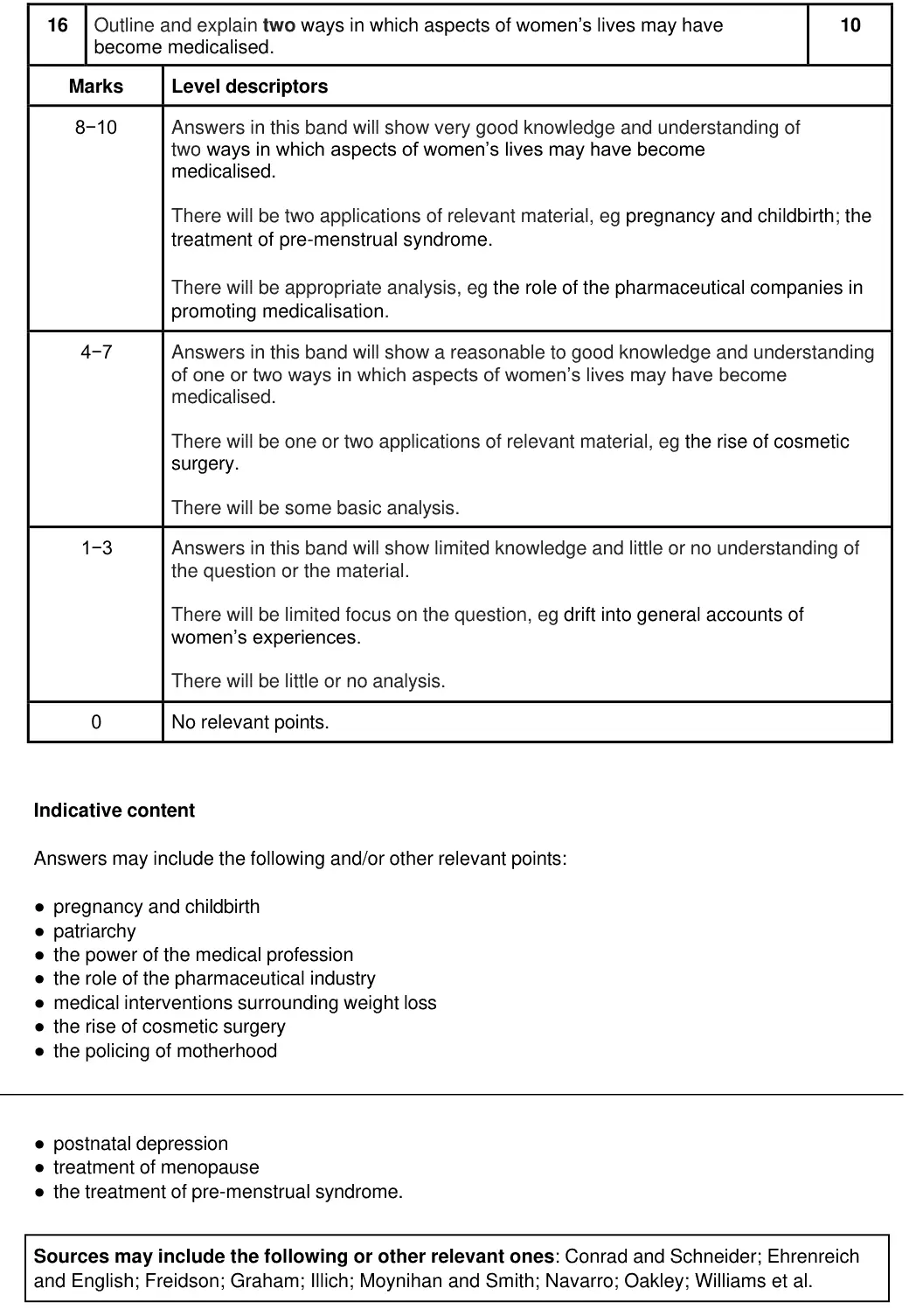
June 2022 · AS Paper 2 · Q1610 marksAO1=5, AO2=3, AO3=2Outline and explain
Mark scheme, including the levels grid and indicative content
Examiner's comment
This question was generally answered well by students who had not chosen questions from every topic. Successful answers clearly understood the term medicalisation and successfully applied it to relevant aspects of women’s lives. The most common response was pregnancy and childbirth which was often analysed using historical and cross-cultural comparisons. Some students included applications of body-projects and cosmetic surgery. Less successful responses did not show understanding of the concept of medicalisation and tended to identify health screening for women with little elaboration.
Notes from the mark scheme and report
two ways women's lives are medicalised (pregnancy and childbirth, PMS, menopause, cosmetic surgery)
drift into women's experiences in general = 1–3
best answers analysed childbirth with historical/cross-cultural comparison
weaker answers did not grasp medicalisation (health screening only)
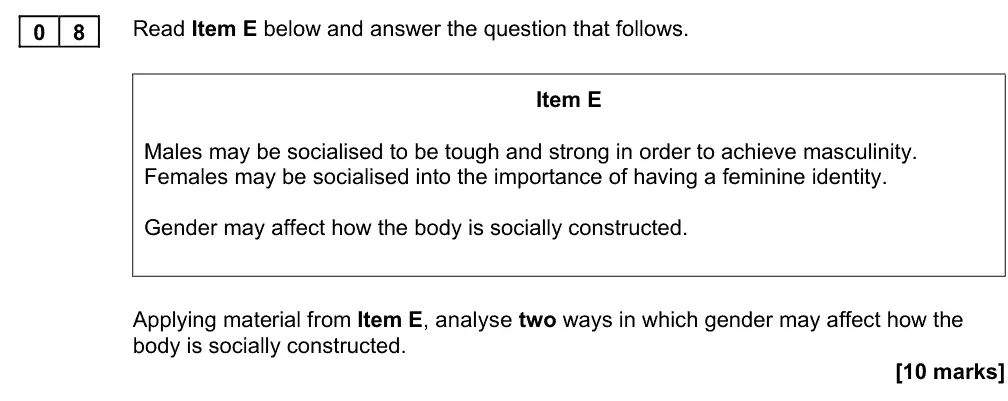
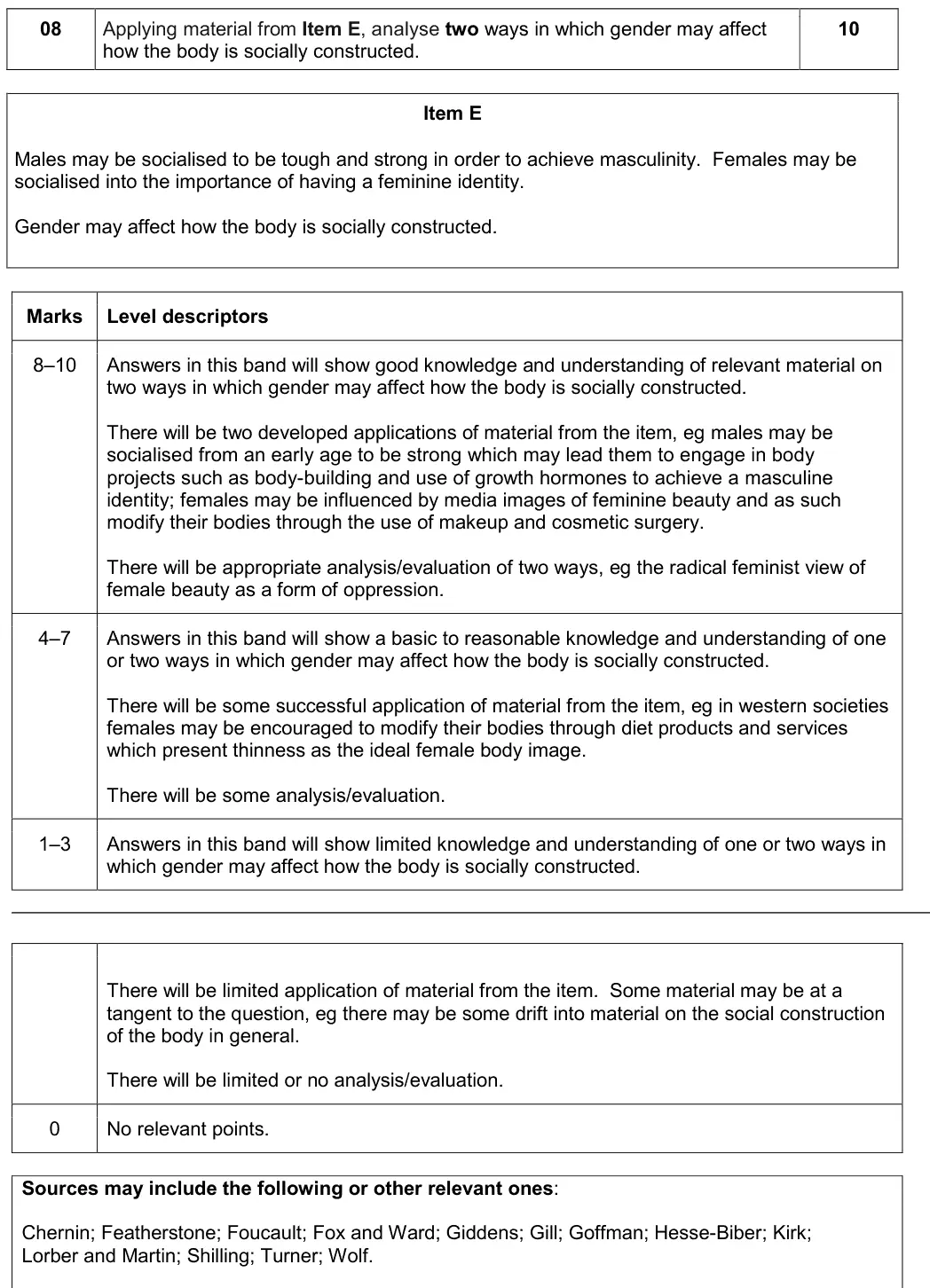
November 2021 · Paper 2 · Q810 marksAO1=3, AO2=4, AO3=3Analyse
Mark scheme, including the levels grid and indicative content
Notes from the mark scheme and report
must develop hooks from Item E (male toughness, feminine identity)
the last line restates the question and is not a hook
credited: male body projects such as body-building, female beauty ideals and cosmetic modification
analysis e.g. radical feminist view of beauty as oppression
drift into social construction of the body in general = 1–3
no examiners' report comment for this part
November 2020 · Paper 2 · Q920 marksAO1=8, AO2=6, AO3=620-mark essay
Mark scheme, including the levels grid and indicative content
Notes from the mark scheme and report
must explain differences between social groups (class, gender, ethnicity)
evaluation via social realist/structural vs social constructionist/labelling explanations applied to groups
a basic labelling account applied to groups = 9-12
general points on mental illness = 1-4
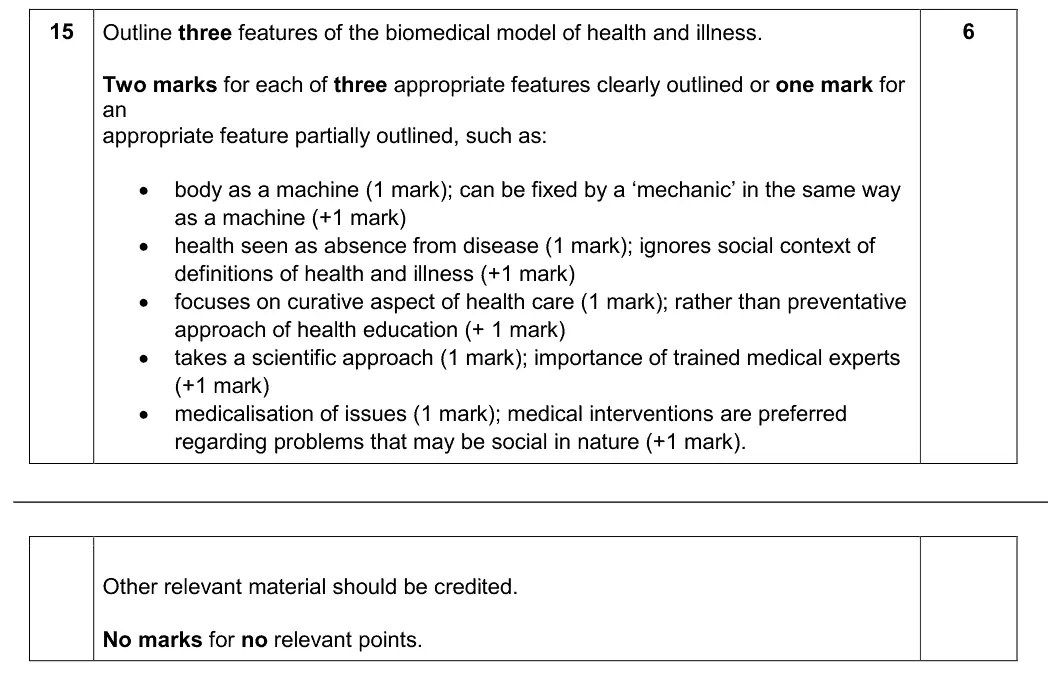
November 2020 · AS Paper 2 · Q156 marksAO1=6Outline
Mark scheme
Notes from the mark scheme and report
2 marks for each of three features clearly outlined, 1 if partial
creditable: body as machine, health as absence of disease, curative focus, scientific expertise, medicalisation of social problems
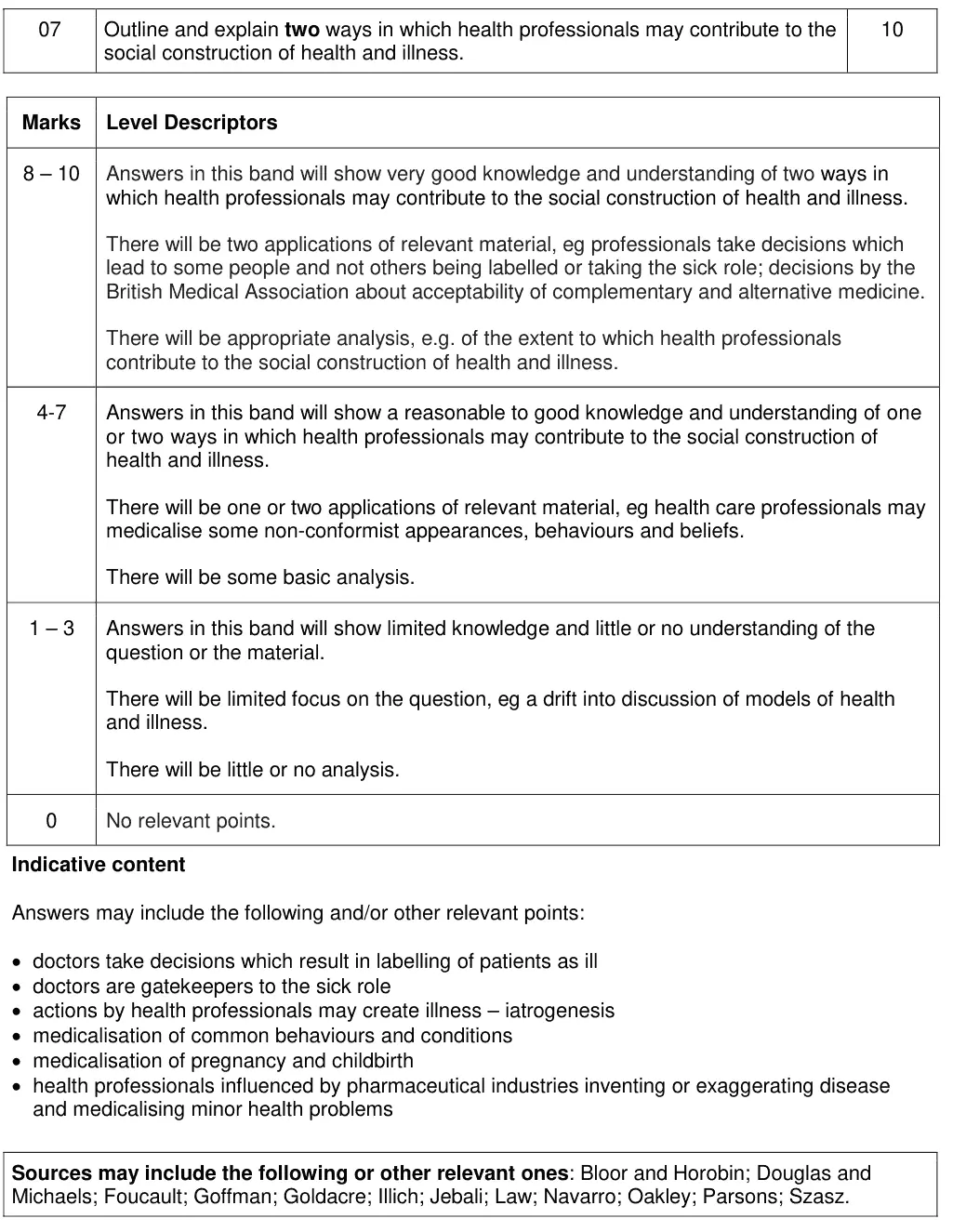
June 2019 · Paper 2 · Q710 marksAO1=5, AO2=3, AO3=2Outline and explain
Mark scheme, including the levels grid and indicative content
Examiner's comment
Some students wrote introductory paragraphs and/or conclusions. These are not necessary, and are unlikely to gain additional marks; they also take up time. Some students made only one point in their answers, or three or more, rather than the two asked for. The word ‘two’ is put in bold in the question to try and draw students’ attention to this. Sometimes it was not clear how many points were being made. It is helpful for students to clearly indicate their two answers, with wording such as “One way is…” or by starting a new paragraph for their second point. Notably, some students wrote far more than was needed for a 10-mark response. The two types of 10-mark question, “outline and explain” and “analysis” types, are marked differently as the assessment objectives have different weightings. It is important that students are aware of this. In particular they should note that evaluation is not a requirement for answers to 10 mark “outline and explain” questions. For 10 mark “outline and explain” questions, students cannot rely on reciting knowledge; these questions will ask them to bring together aspects of their sociological knowledge of the topic in a way that they are unlikely to have done before. The best answers to 10-mark questions were focused, clearly stating a point and then developing it, and used sociological concepts, studies, evidence and theory as appropriate. Most students were able to successfully explain two ways, using ideas such as labelling, the medicalisation of childbirth and the sick role.
Notes from the mark scheme and report
must be ways health professionals construct health and illness
drift into models of health in general = 1–3
common answers: labelling, gatekeeping the sick role, medicalisation of childbirth, iatrogenesis
AO split from AQA's standard grid for this paper (this year's mark scheme does not print it).
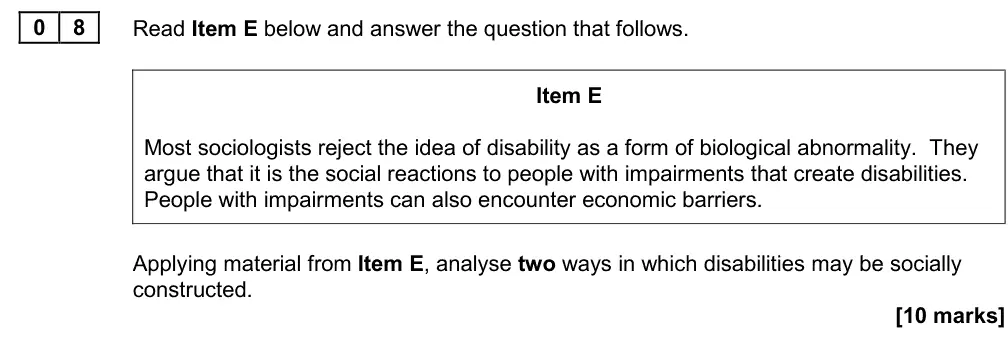
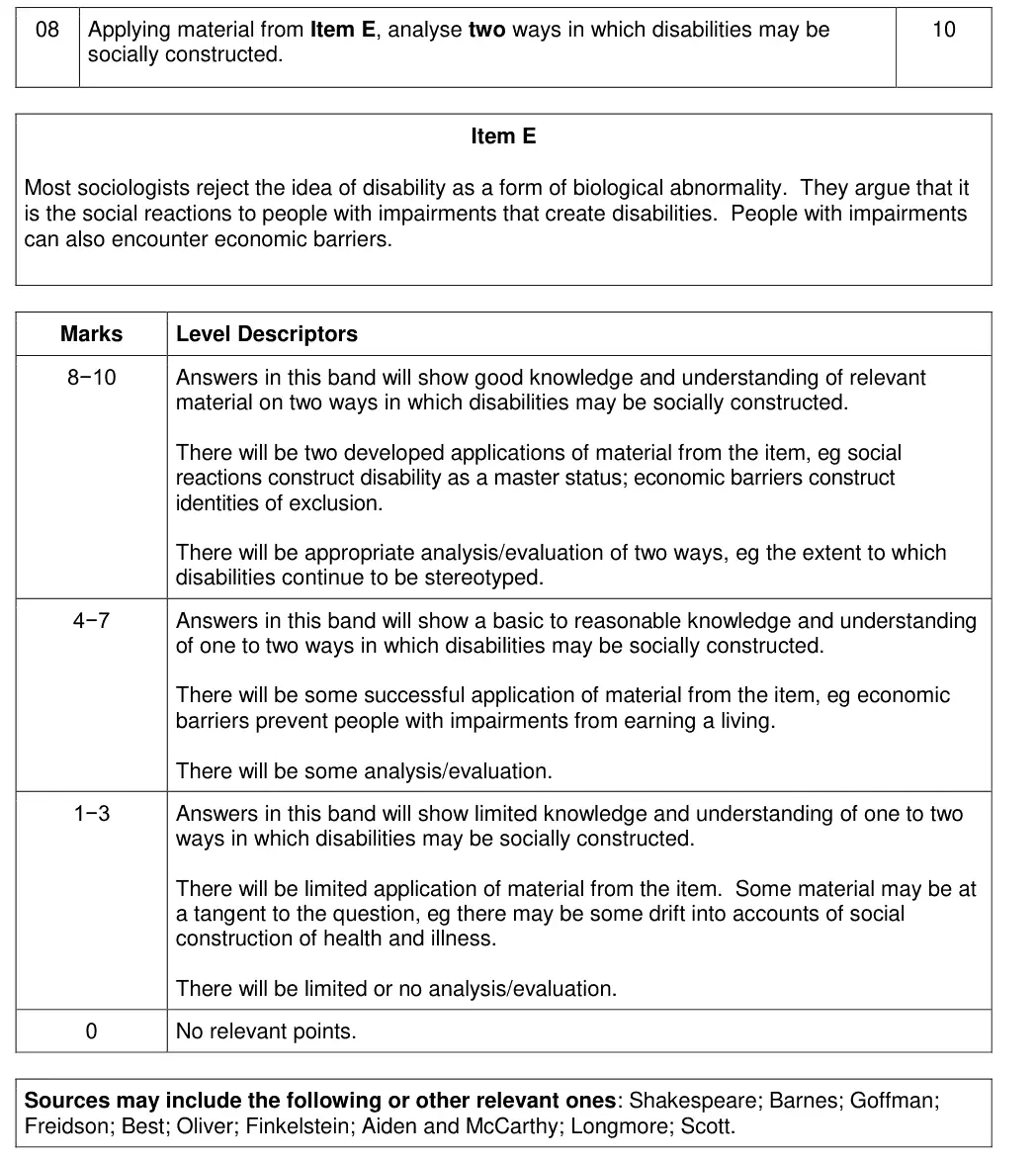
June 2018 · Paper 2 · Q810 marksAO1=3, AO2=4, AO3=3Analyse
Mark scheme, including the levels grid and indicative content
Examiner's comment
Some students wrote introductory paragraphs and/or conclusions. These are not necessary, and are unlikely to gain additional marks, and they also take up time. Some students made only one point in their answers, or three or more, rather than the two asked for in the question. Sometimes it was unclear how many points were being made. It is helpful for students to clearly indicate their two answers, with wording such as “One way is…” or by starting a new paragraph for their second point. Evaluation is not a requirement for answers to 10 mark “outline and explain” questions. The marks awarded for the assessment objectives being targeted are different in the two types of ten mark questions, and students should be made aware of this. The best answers to 10 mark questions were focused, clearly stating a point and then developing it, using sociological concepts, evidence and theory where appropriate. In some questions students tended to focus on the first aspect of the question at the expense of the second. Students need guidance on how to approach these questions and how to best demonstrate their sociological understanding. The nature of these questions means that students cannot rely on reciting knowledge. These questions will ask them to bring together aspects of their sociological knowledge in a way that they are unlikely to have done before. This question produced some very different responses, with some students writing at length about physical barriers, such as lack of wheelchair ramps or street furniture, rather than building on the points in the item. Answers tended to be more confident and sociological when writing about social reactions to people with disabilities than when considering economic barriers.
Notes from the mark scheme and report
two developed applications from Item E (social reactions, economic barriers), e.g. disability as master status, economic exclusion
drift into social construction of health and illness generally is a tangent
many wrote about physical barriers like ramps rather than building on the item
economic barriers handled less sociologically than social reactions
AO split from AQA's standard grid for this paper (this year's mark scheme does not print it).
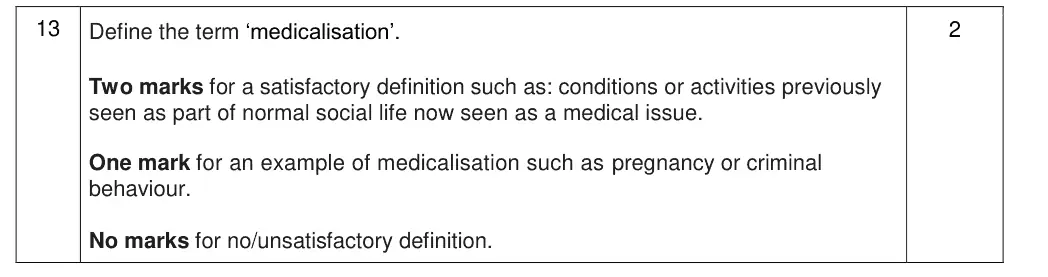
June 2018 · AS Paper 2 · Q132 marksAO1=2Define
Mark scheme
Examiner's comment
Most students had some idea about this. Successful students were able to explain the idea of something that was previously seen as part of normal life now seen as a medical issue. Partial answers tended to give an example of medicalisation, usually pregnancy.
Notes from the mark scheme and report
2 marks for normal life now treated as a medical issue
an example (e.g. pregnancy) = 1 mark
AO split from AQA's standard grid for this paper (this year's mark scheme does not print it).
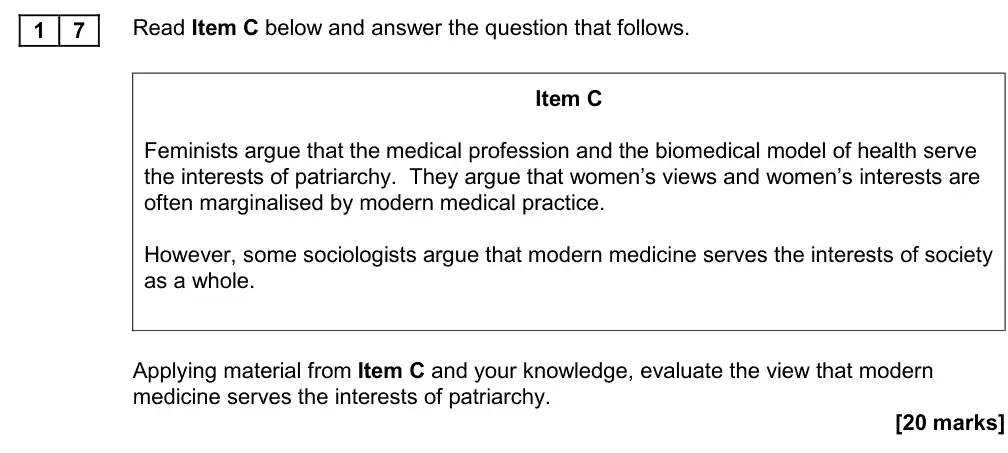
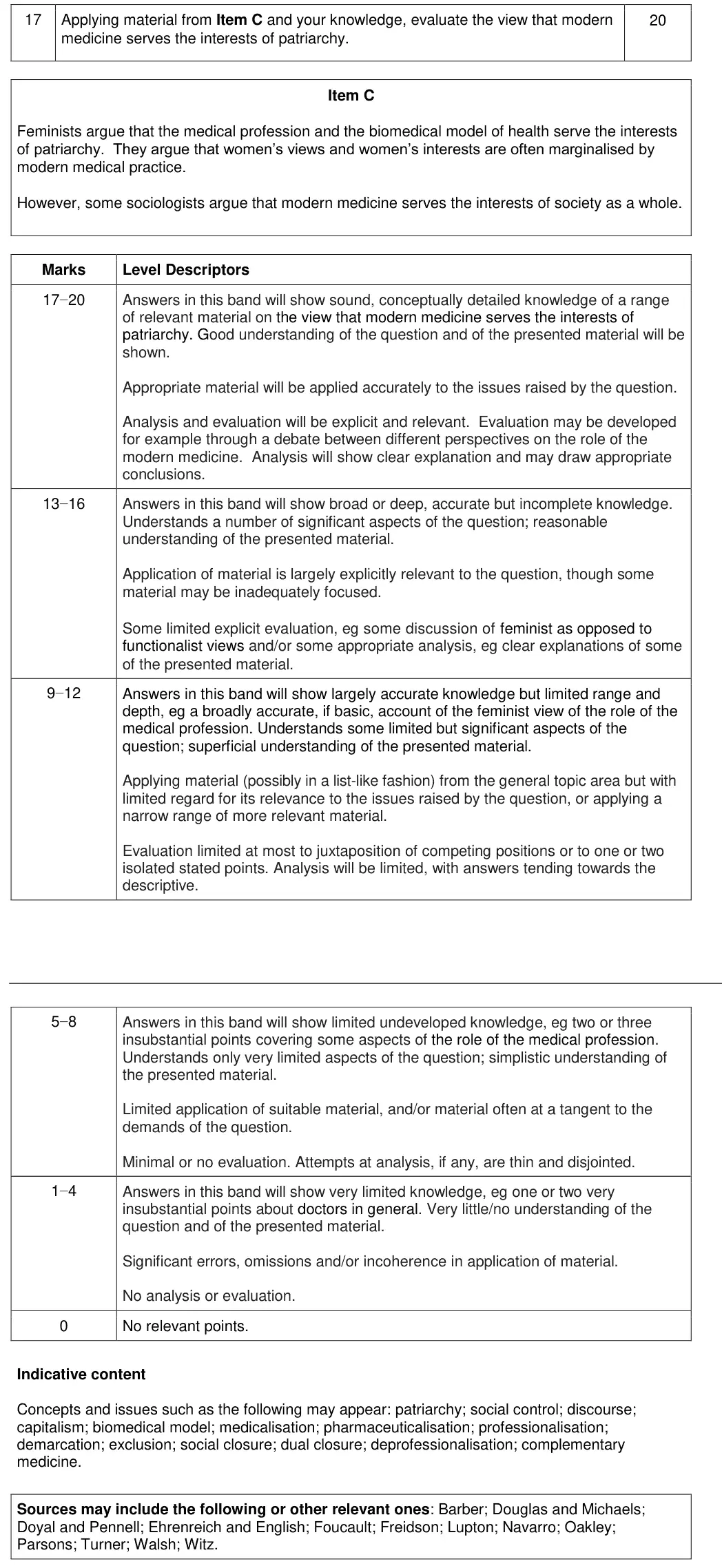
June 2018 · AS Paper 2 · Q1720 marksAO1=8, AO2=6, AO3=620-mark essay
Mark scheme, including the levels grid and indicative content
Examiner's comment
Some students took this as an opportunity to present material from different perspectives on the nature of modern medicine. These answers tended to only briefly consider the question in the title and various feminist views and instead produce varied accounts of Marxist, functionalist and Weberian approaches to the medical profession. The best answers were able to discuss numerous ways in which it can be argued that modern medicine serves the interest of patriarchy. These answers typically referred to employment patterns in the health care professions, the gendered experiences of patients, attitudes to complimentary medicine, as well as aspects and implications of the bio-medical model of health. These answers were often able to frame their answers with reference to different sociological perspectives and arrive at a reasoned conclusion. Weaker answers listed separate approaches in distinct sections while answers that were more effective were able to weave different perspectives into a discussion about particular aspects of modern medicine.
Notes from the mark scheme and report
apply Item C (biomedical model and profession serve patriarchy vs serve society)
evaluation via other perspectives on medicine
drifting into Marxist/functionalist/Weberian accounts of medicine without the feminist question scored lower
best used gendered employment in health, patients' experiences, complementary medicine, biomedical model, and wove views together
AO split from AQA's standard grid for this paper (this year's mark scheme does not print it).
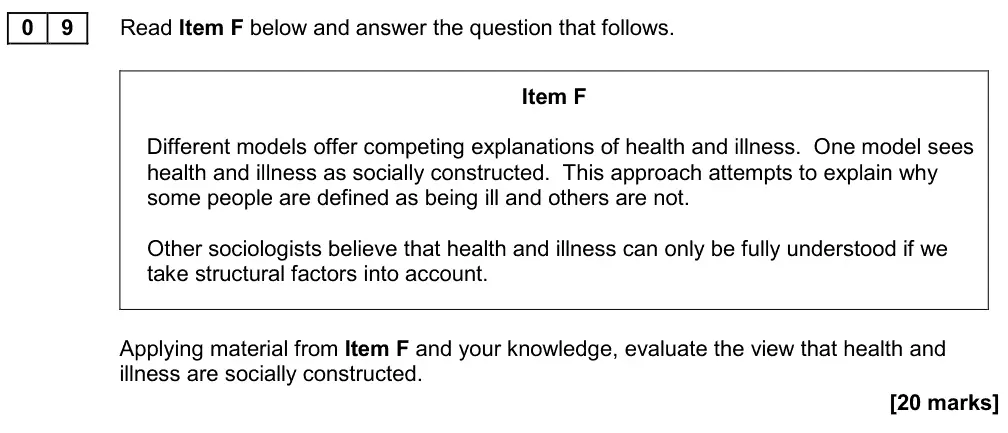
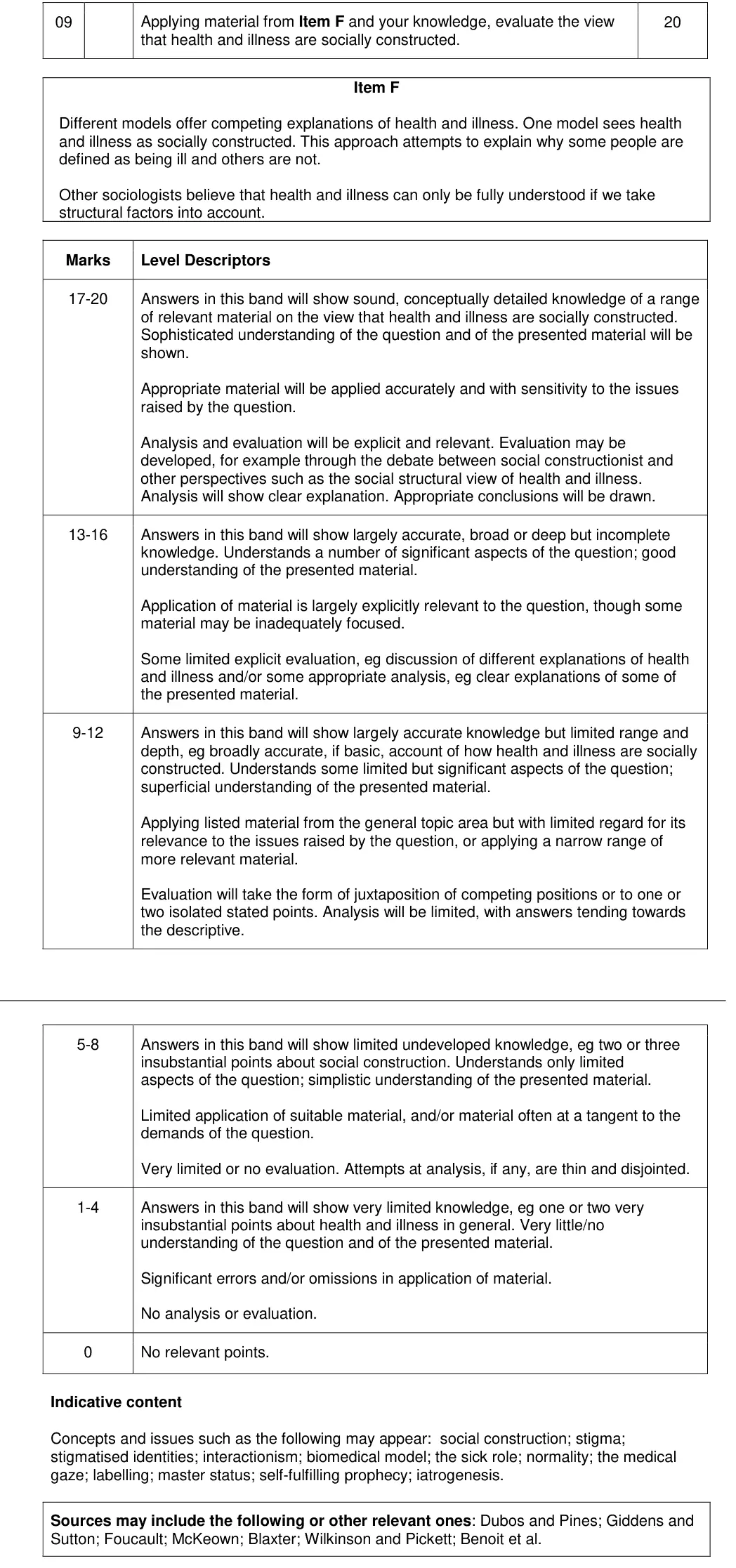
June 2017 · Paper 2 · Q920 marksAO1=8, AO2=6, AO3=620-mark essay
Mark scheme, including the levels grid and indicative content
Examiner's comment
Many scripts had one substantial, well developed answer to a 20 mark question and one significantly briefer one, again suggesting problems with time management. It is often the case that a wide range of material can be relevant to these questions, and students will need to be selective. For example, it may be more effective to cover a limited number of views or theories in some depth, rather than to include every possible theory. There was a tendency for answers to progressively lose sight of the question and to become a list of different views. The best answers will address all aspects of the question and will draw on theories, concepts and empirical examples or evidence. Evaluation which meets the demands of the questions is better than points of criticism which have been learned and included, regardless of the specific question that has been set. Students should also be aware that evaluation includes awareness of the strengths, as well as the weaknesses, of an argument or theory. Students were often well informed on different definitions of, and approaches to, health and illness, but were often less confident on the social constructionist approach than on others. Some gave a list of approaches with limited application to the question. The better answers were more integrated with analysis and evaluation focused on the question.
Notes from the mark scheme and report
top band debates social constructionism against structural (and biomedical) views, as cued by the item
students often more secure on other models than social constructionism
listing approaches limits marks
better answers integrated evaluation
June 2017 · AS Paper 2 · Q132 marksAO1=2Define
Mark scheme
Examiner's comment
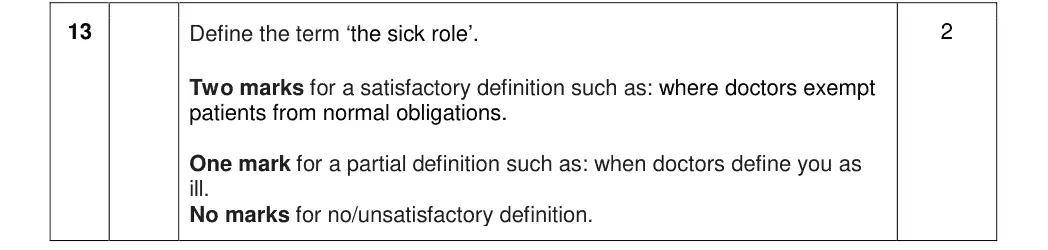
Most students had some idea about this. The successful ones were able to explain the idea of the rights and obligations involved, and the role of doctors as the gatekeepers of this process. Partial answers tended to express the idea in terms of ‘being allowed time off work’ or similar.
Notes from the mark scheme and report
2 marks: doctors exempt patients from normal obligations
1 mark: being defined as ill by a doctor
best answers covered rights and obligations and doctors as gatekeepers
'time off work' only partial
June 2016 · AS Paper 2 · Q1720 marksAO1=8, AO2=6, AO3=620-mark essay
Mark scheme, including the levels grid and indicative content
Examiner's comment
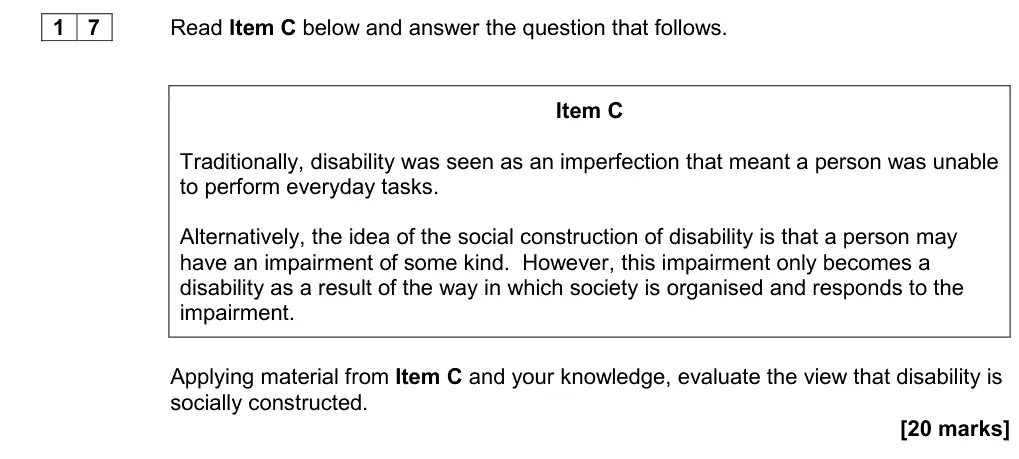
Some answers conflated the social construction of disability with the social construction of illness, especially mental illness, and subsequently struggled to focus on the specifics of the question. Good answers were able to explain clearly how disability might be socially constructed, with reference to cultural and historical differences as well as to aspects of labelling and stereotyping led by the media, and also to various access issues. Many answers identified modifications (or lack of) to the built environment as a focus for their discussion on the social construction of disability. Weaker answers often limited themselves to this, and tended to drift into descriptive accounts of the various challenges disabled people may face in society. The best answers were able to explain a range of ways in which disability is socially constructed, and then contrast this with a biomedical view of disability, including a discussion of the relative merits of different approaches.
Notes from the mark scheme and report
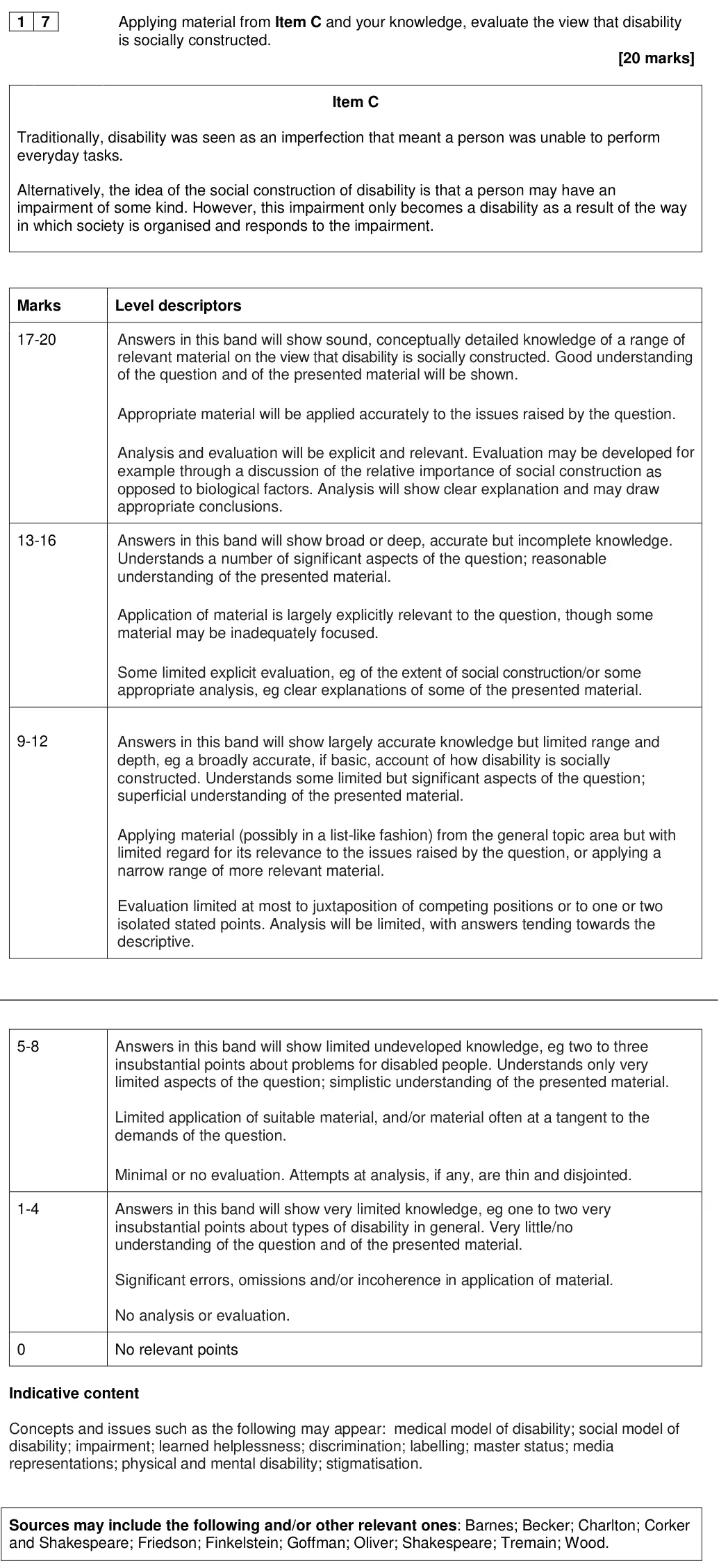
apply Item C (traditional/medical view vs impairment becoming disability through social organisation)
evaluation via social construction vs biological factors
some conflated it with social construction of illness/mental illness
weaker answers limited to the built environment and drifted into descriptions of problems disabled people face
best contrasted social and biomedical models
Specimen set 1 · Paper 2 · Q710 marksAO1=5, AO2=3, AO3=2Outline and explain
Mark scheme, including the levels grid and indicative content
Notes from the mark scheme and report
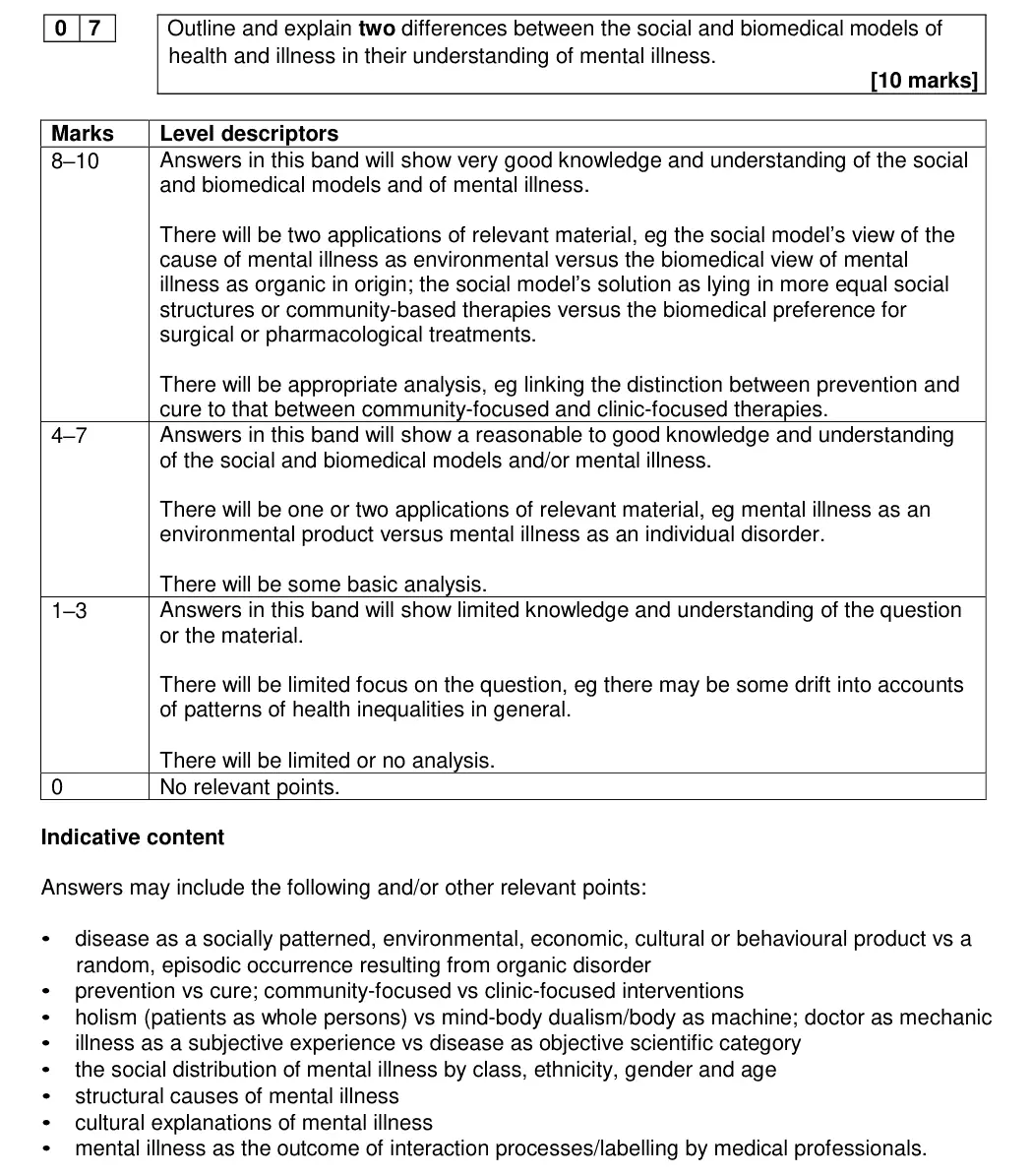
each difference must contrast the social and biomedical models on mental illness (environmental vs organic cause
community vs pharmacological or surgical treatment)
analysis e.g. prevention vs cure
drift into health inequalities in general = 1–3 band
Work with an AQA sociology tutor
Essays stuck in the middle band, or losing marks on the 10-markers? Book a trial lesson with Mark, a former AQA examiner.