Tap a question to zoom it. The mark scheme (with the level descriptors and indicative content) and the examiner's comment open underneath.
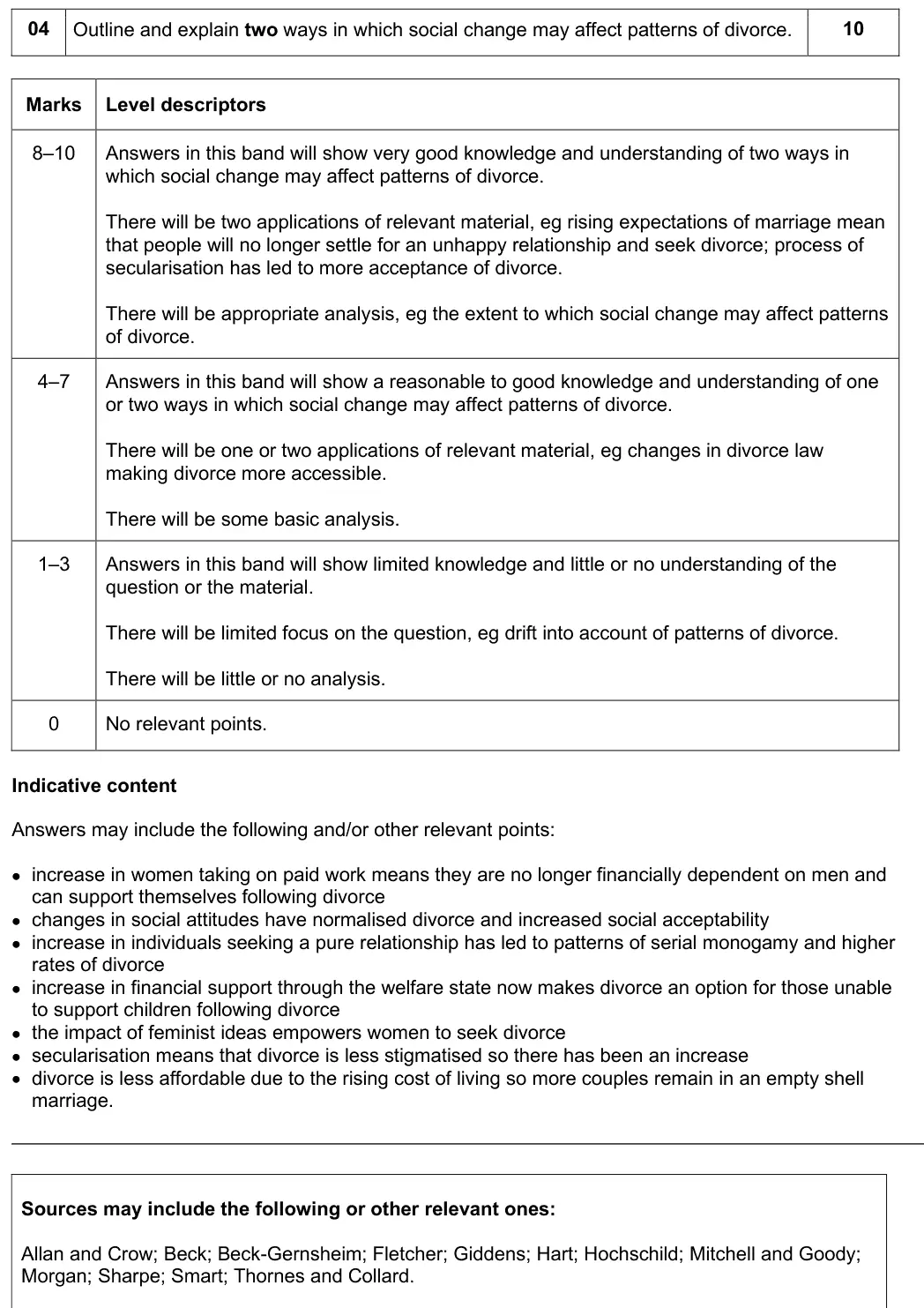
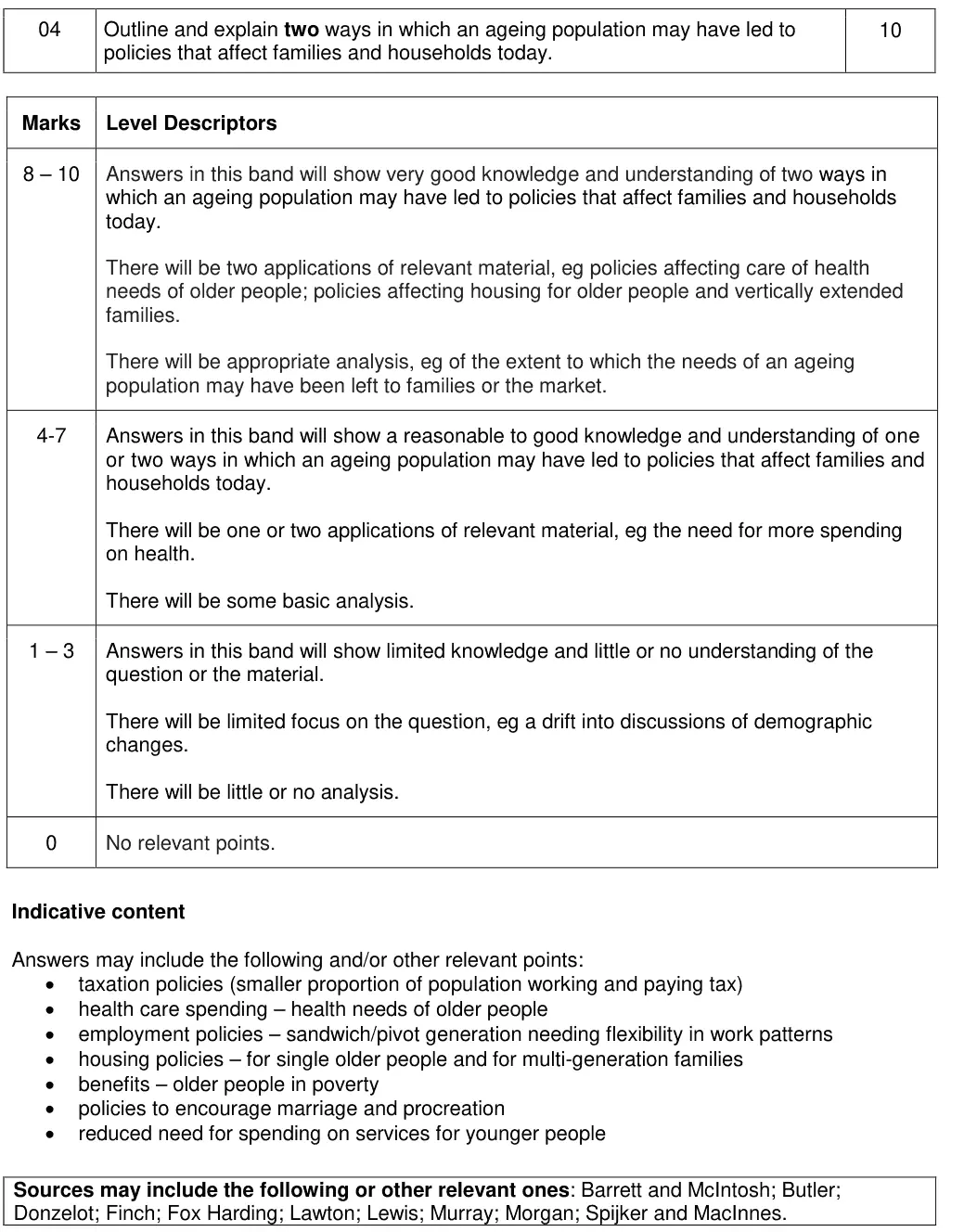
June 2025 · Paper 2 · Q410 marksAO1=5, AO2=3, AO3=2Outline and explain
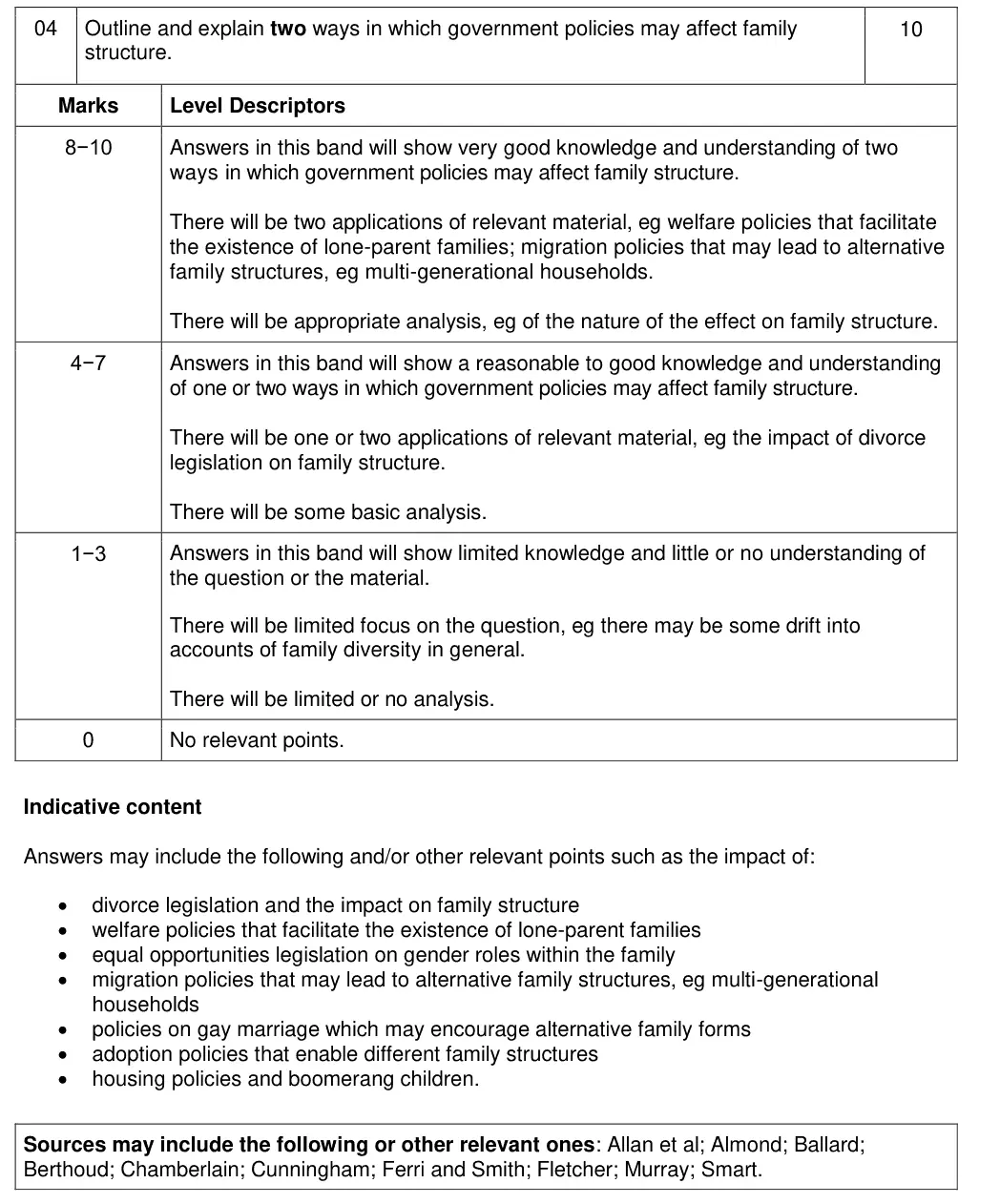
Mark scheme, including the levels grid and indicative content
Examiner's comment
The nature of these questions means that students cannot rely on reciting knowledge. Questions will ask them to bring together aspects of their sociological knowledge in ways they have not done before. It is therefore important for students to allow time to think about how to answer the question. Students should be aware that there are two types of ten-mark questions. These have different requirements and different mark schemes. There are different marks available for the assessment objectives. 10 mark “outline and explain” questions have more marks available for knowledge and understanding, and none for evaluation. Introductions and conclusions are not required for 10-mark questions, are unlikely to help students and take up time. It is helpful if answers are set out to clearly indicate the two answers, with wording such as “One way/reason is…” or by starting a new paragraph for the second point. Answers that give more than two answers are unlikely to develop two of them sufficiently. The most successful answers to 10-mark questions were focused, clearly stating a point that addressed the question and then developing it, using sociological concepts, evidence such as an example and, where appropriate, theory. This was generally answered well. Most responses focused on social changes such as the growth of feminism, changes in women’s ambitions and secularisation. Most answers showed understanding of the effects of change in patterns of divorce. It was good to see some students looking at divorce decreasing due to pure love and cohabitation.
Notes from the mark scheme and report
must link a social change to divorce patterns
drift into describing divorce patterns = 1–3
common answers: feminism and women's independence, secularisation, rising expectations, law changes
credit also for change reducing divorce (pure relationships, cohabitation, cost of living)
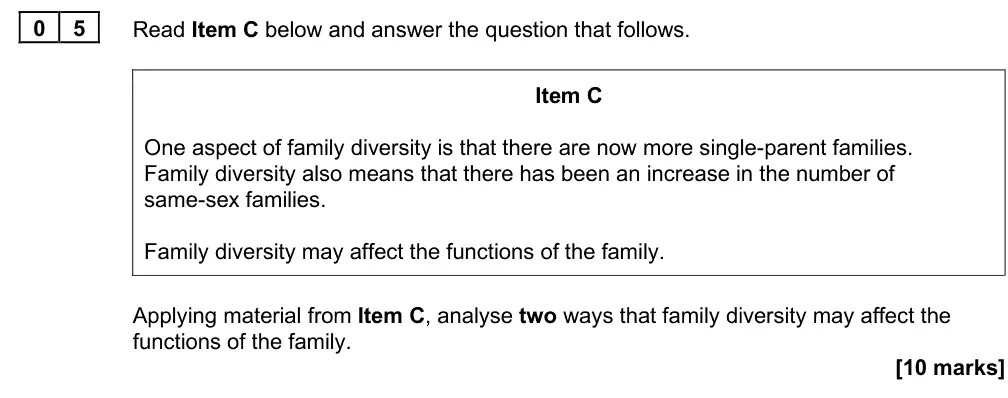
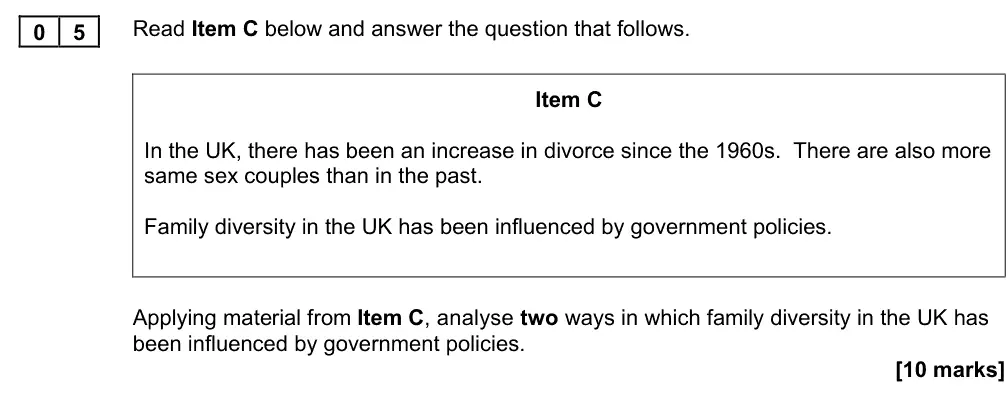
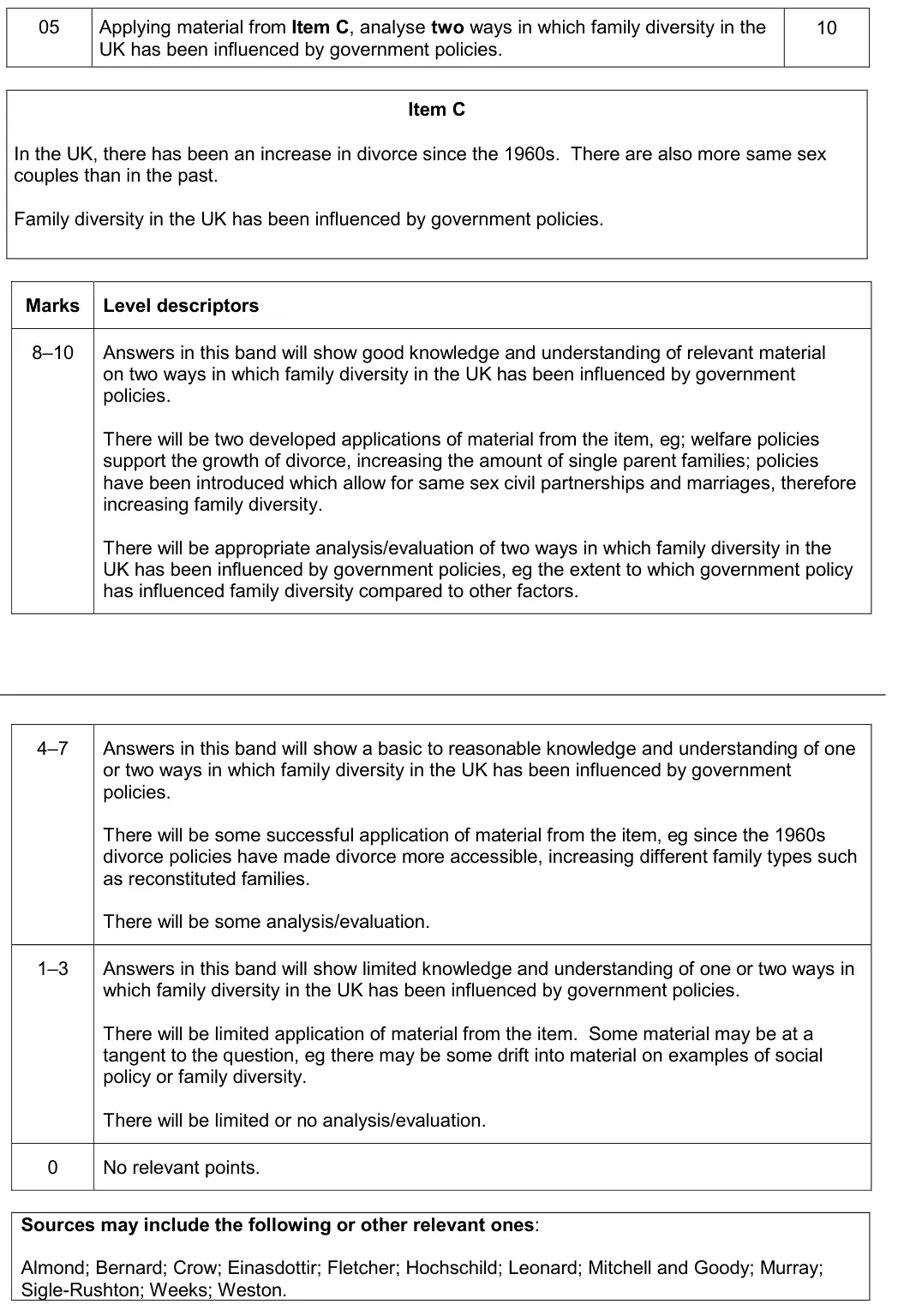
June 2025 · Paper 2 · Q510 marksAO1=3, AO2=4, AO3=3Analyse
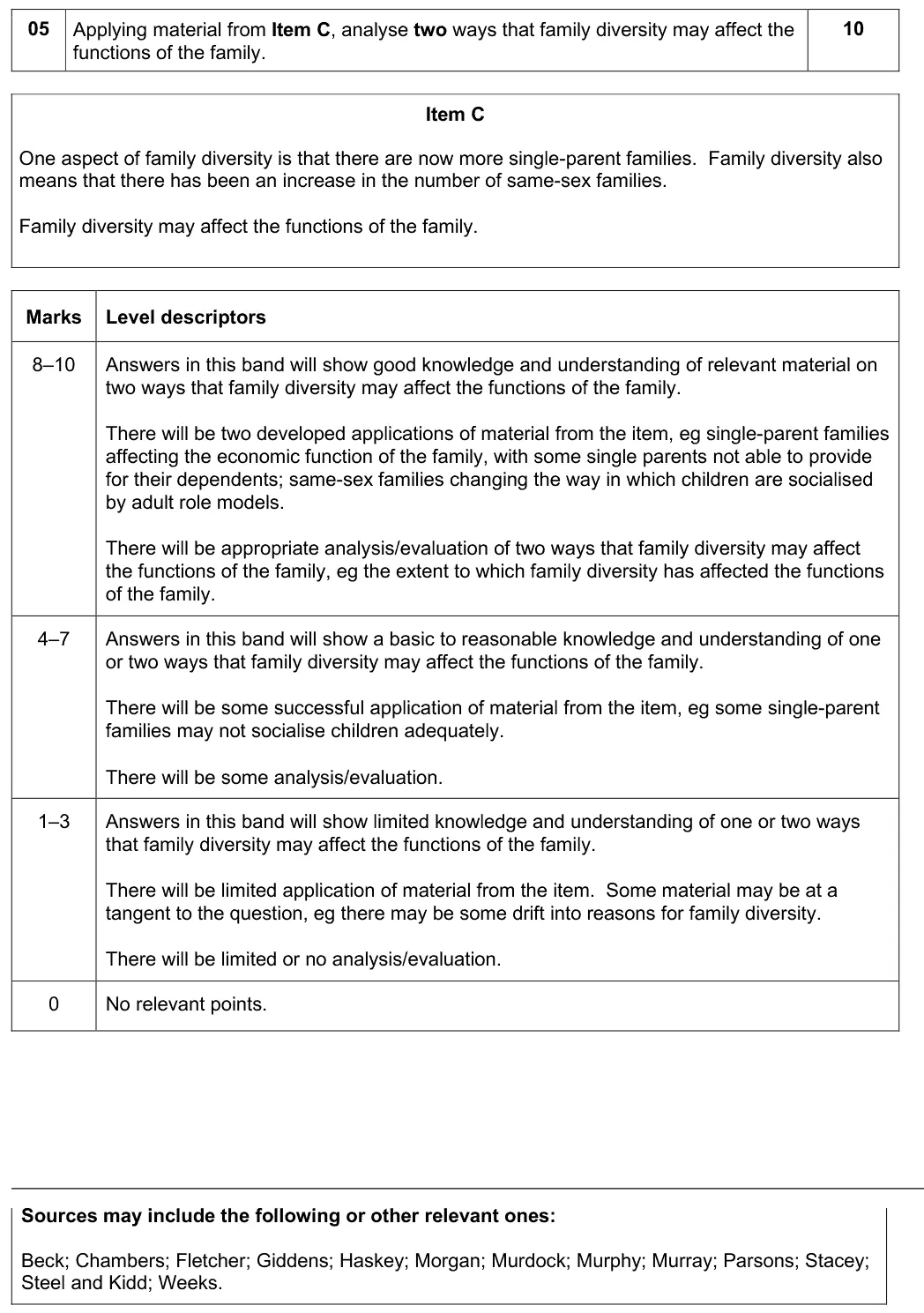
Mark scheme, including the levels grid and indicative content
Examiner's comment
The nature of these questions means that students cannot rely on reciting knowledge. Questions will ask them to bring together aspects of their sociological knowledge in ways they have not done before. It is therefore important for students to allow time to think about how to answer the question. Students should be aware that there are two types of ten-mark questions. These have different requirements and different mark schemes. There are different marks available for the assessment objectives. The items for 10 mark “analyse” questions are written to give prompts or “hooks” for student answers. These must be used to access application marks. Answers can indicate use of hooks by quoting, by a reference in parentheses or by wording (e.g. “As the item says…”). Items end with a sentence restating the question; the hooks are in the preceding part of the item. Introductions and conclusions are not required for 10-mark questions, are unlikely to help students and take up time. It is helpful if answers are set out to clearly indicate the two answers, with wording such as “One way/reason is…” or by starting a new paragraph for the second point. Answers that give more than two answers are unlikely to develop two of them sufficiently. The most successful answers to 10-mark questions were focused, clearly stating a point that addressed the question and then developing it, using sociological concepts, evidence such as an example and, where appropriate, theory. Many answers tended to discuss gender roles rather than functions of the family. Some became more relevant by touching on, for example, the functions of primary socialisation and reproduction. There was also a tendency to write all that was known about, for example, lone parent families rather than analysing an effect on functions of families.
Notes from the mark scheme and report
must analyse effects on functions of the family (e.g. economic provision, primary socialisation, reproduction) from the single-parent and same-sex hooks
many drifted into gender roles or everything known about lone parents
reasons for diversity = 1–3
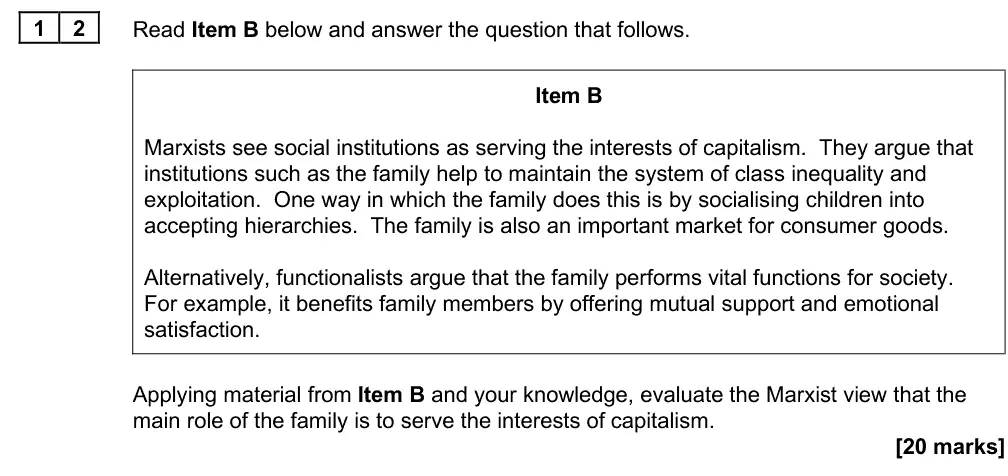
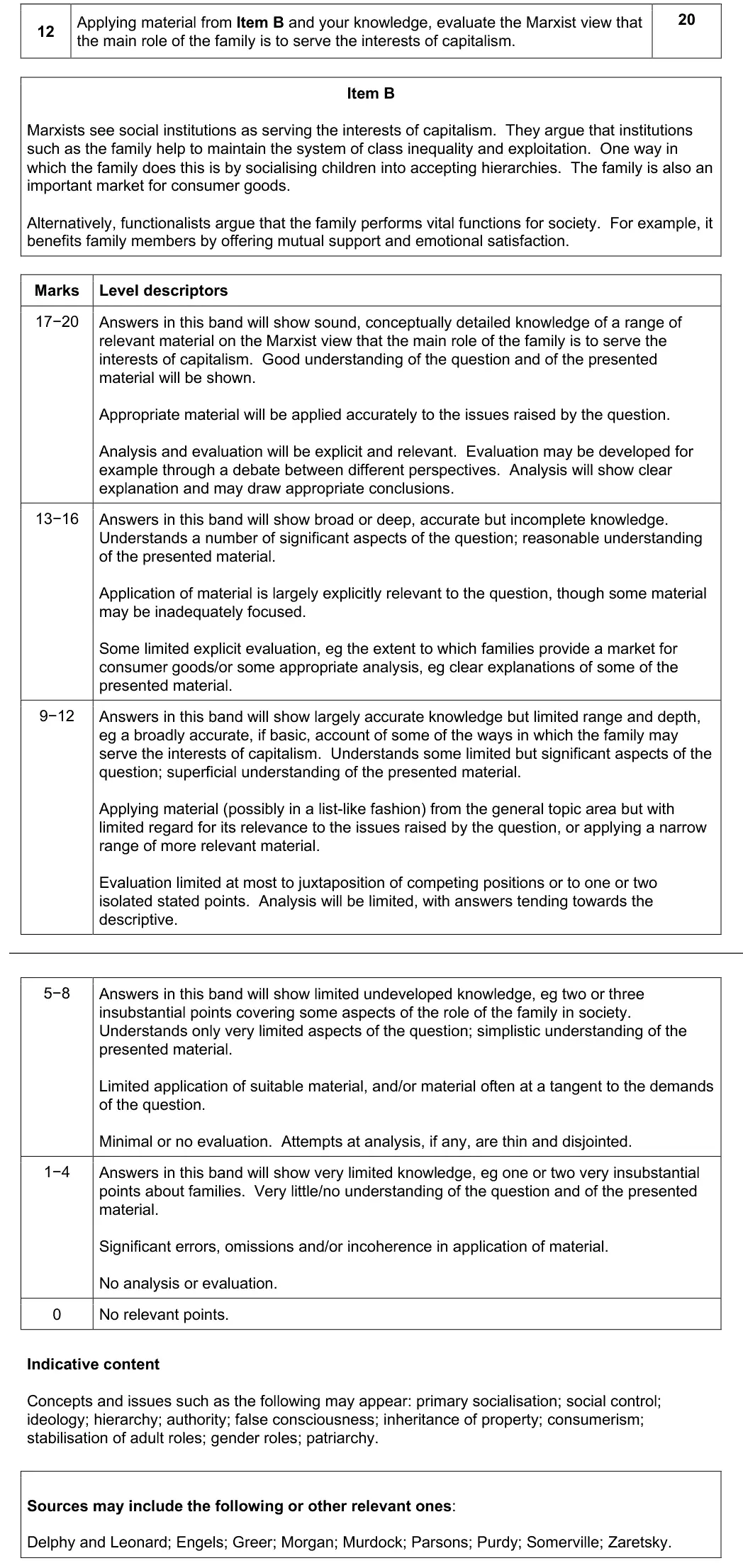
June 2025 · AS Paper 2 · Q1220 marksAO1=8, AO2=6, AO3=620-mark essay
Mark scheme, including the levels grid and indicative content
Examiner's comment
This question was accessible to most students, many of whom had some strong content to draw upon in shaping their responses. The item was helpful and generally got students off to a sound start. Popular approaches to answering the question began with the Marxist view and then considered other views of the role of the family, typically feminist views and those of functionalism. More successful answers went further and examined more recent contributions to understanding the family such as Beck, Giddens and Smart considering ideas such as risk, pure relationships and fictive kin.
Notes from the mark scheme and report
apply Item B (socialising into hierarchy, family as a market for consumer goods, functionalist mutual support)
evaluation via other perspectives or the extent families act as consumer market
common route: Marxist view then feminist and functionalist
best brought in Beck, Giddens, Smart (risk, pure relationships, fictive kin)
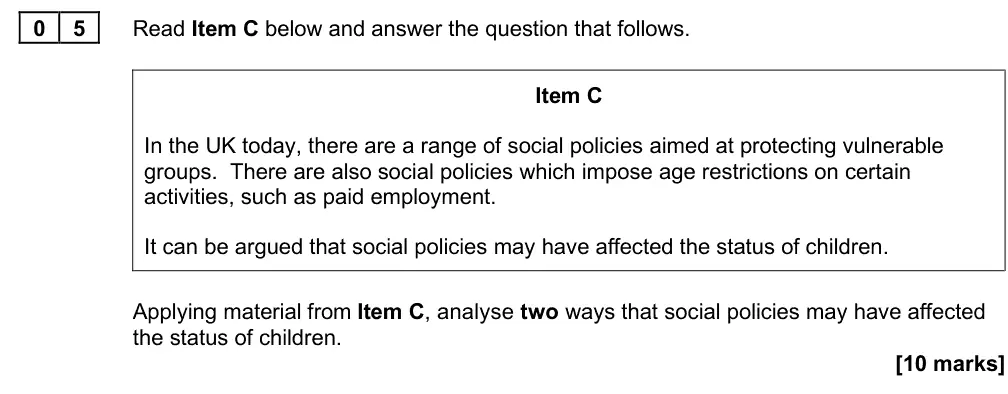
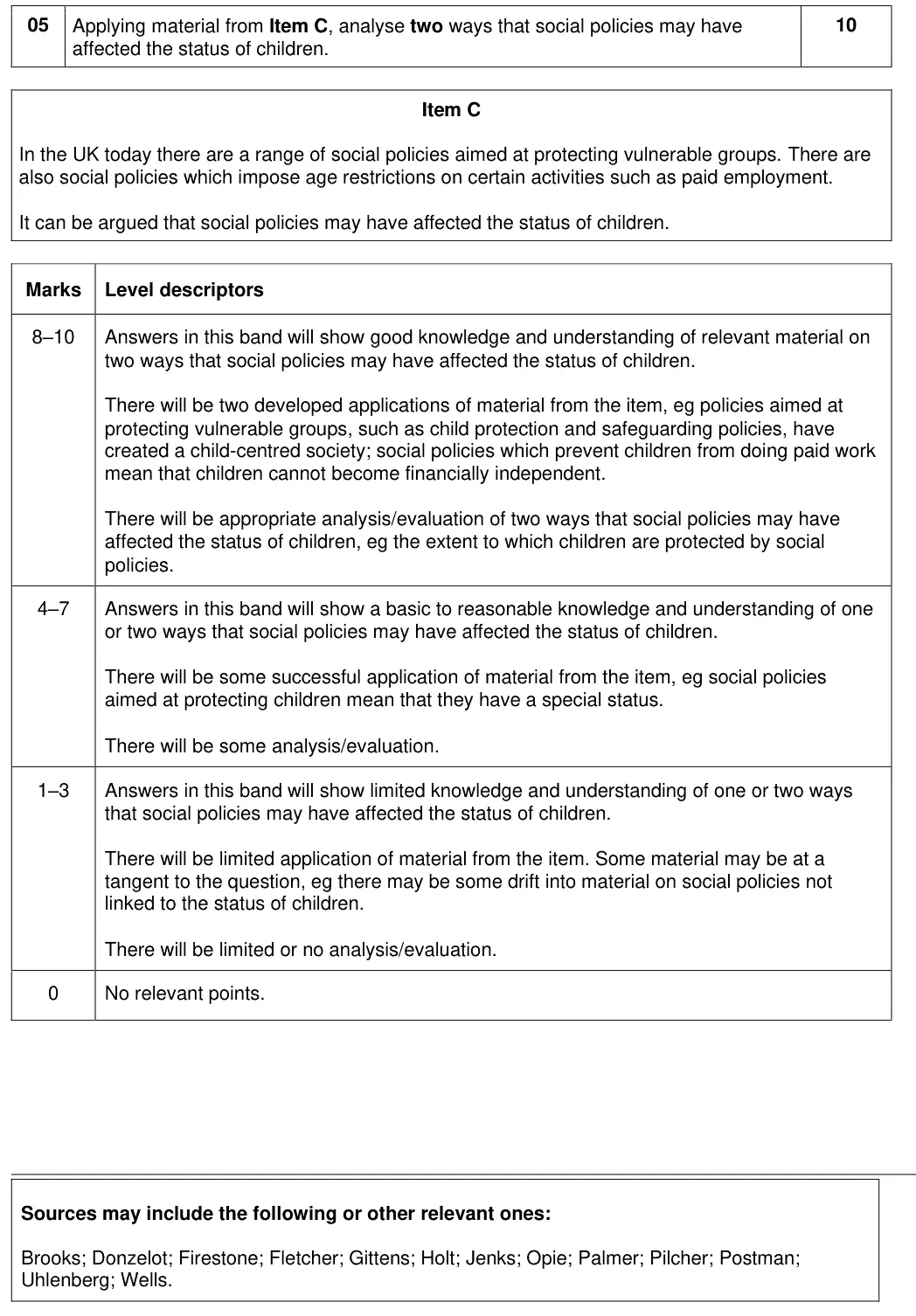
June 2024 · Paper 2 · Q510 marksAO1=3, AO2=4, AO3=3Analyse
Mark scheme, including the levels grid and indicative content
Examiner's comment
The nature of these questions means that students cannot rely on reciting knowledge. Questions will ask them to bring together aspects of their sociological knowledge in ways they will not have done before. It is therefore important for students to allow time to think about how to answer the question. Students should be made aware that there are two types of 10 mark questions. These have different requirements and different mark schemes . There are different marks available for the assessment objectives. A breakdown of the marks awarded by assessment objective can be found in the mark scheme. The items for 10 mark “analyse” questions are written to give prompts or “hooks” for student answers. These have to be used to access application marks. Answers can indicate use of hooks by quoting, by a reference in parentheses or by wording ( eg “As the item says…”). Items end with a sentence restating the question; the hooks are in the preceding part of the item. Students should avoid writing all they know about a “hook”, and focus on applying the idea to the question. Introductions and conclusions are not required for 10 mark questions; they take up time and rarely improve the mark. It is helpful if answers are set out to clearly indicate the two answers, with wording such as “One way/reason is…”, or by starting a new paragraph for the second point. Answers that give more than two points are unlikely to develop two of them sufficiently. Q5: A small number of students failed to effectively utilise any "hooks" from the provided material. Instead they offered knowledge on a variety of social policies or accounts of the history of childhood, rather than effects of policies on children's status. Many were, however, able to successfully connect at least one of the two “hooks” from the item to the changing status of children. One way of doing this was by illustrating the shift from being an economic asset to becoming an economic liability.
Notes from the mark scheme and report
two developed applications from Item C (protective policies
age restrictions on activities such as paid work), e.g. safeguarding creating child-centredness, ban on paid work preventing financial independence
drift into policies not linked to children's status, or histories of childhood, scores little
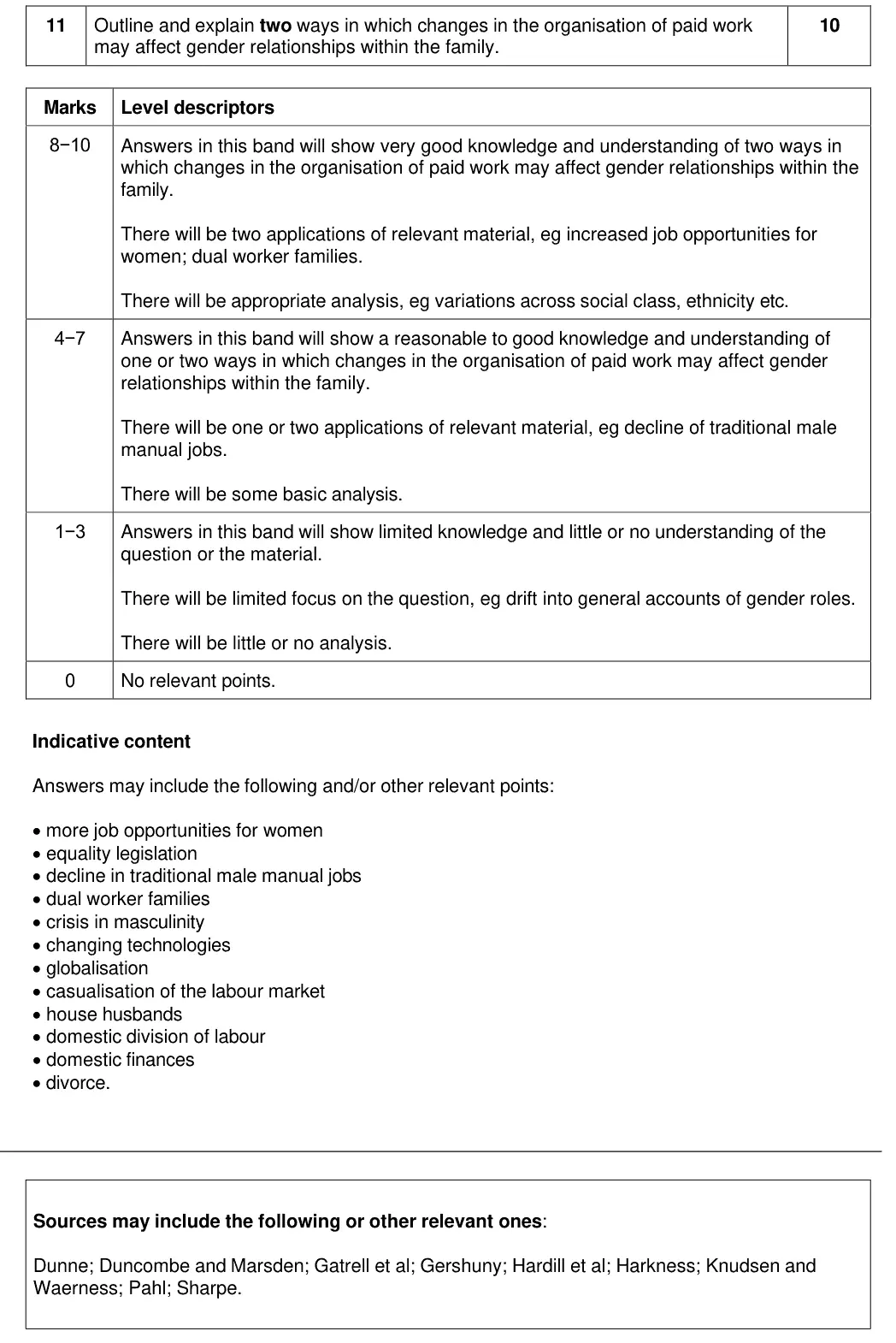
June 2024 · AS Paper 2 · Q1110 marksAO1=5, AO2=3, AO3=2Outline and explain
Mark scheme, including the levels grid and indicative content
Examiner's comment
The ‘outline and explain’ 10-mark question. Here students would benefit more if an explicit identification of a way / reason / factor was made then leading to an explanation of it. So, making the student’s answer more cogent. This question required students to identify a change in the organisation of paid work and suggest a way in which that change might impact on gender relationships in the family. This question proved more challenging for students. Answers sometimes spent a long time describing changes without connecting them to an impact on gender relationships. A sizeable minority did not refer to changes in the organisation of paid work except to say women now work. Analysis was often developed by reflecting on the response of various perspectives to the change for example functionalism and the new right.
Notes from the mark scheme and report
must identify a change in the organisation of paid work and link it to gender relationships in the family
drift into general gender roles = 1–3
many described changes without the effect, or said only that women now work
top band analysis e.g. class and ethnic variation
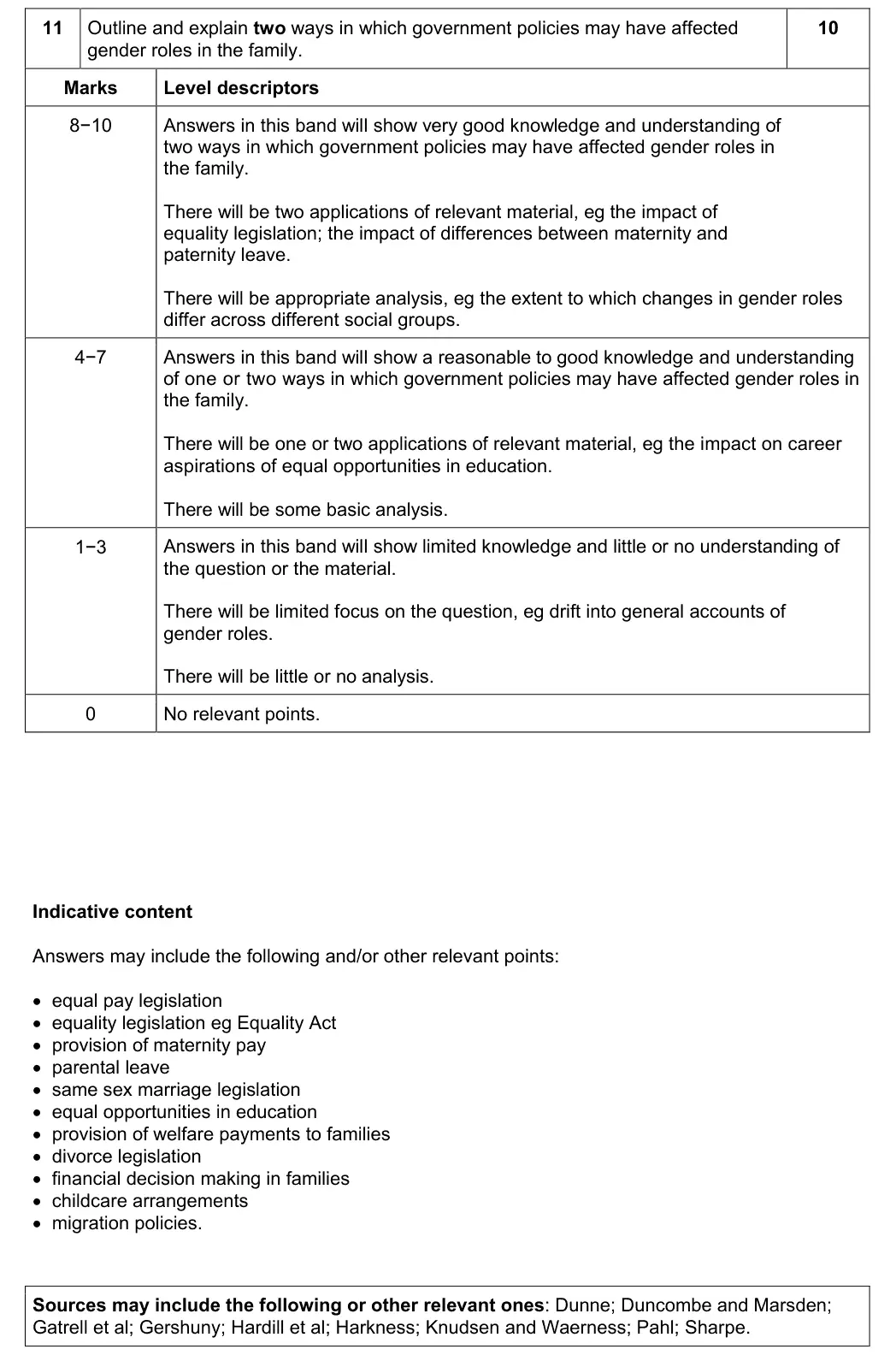
June 2023 · AS Paper 2 · Q1110 marksAO1=5, AO2=3, AO3=2Outline and explain
Mark scheme, including the levels grid and indicative content
Examiner's comment
The ‘outline and explain two’ 10 mark question (the fourth question in every topic area). Here students would benefit more if an explicit identification of a way / reason / factor was made, then leading to an explanation of it, making the student’s answer more cogent. The majority of students could identify two policies – though some answers were generic (eg policies/laws divorce laws etc) – and make a connection to gender roles in the family. The standard approach taken was to identify a policy, for example equal pay, and then apply its impact on the domestic division of labour – typically whether the policy strengthened or weakened traditional instrumental/expressive gender roles. Analysis was frequently generated by reviewing the response of various theories and perspectives to the impact or the change described. For answers which did not gain credit in this question, this was often the result of identifying policies but failing to connect them to gender roles inside the family.
Notes from the mark scheme and report
two policies each linked to gender roles in the family (e.g. equal pay and equality legislation, maternity vs paternity leave, childcare, welfare payments)
drift into gender roles in general = 1–3
generic 'laws' weaken answers
most common failing was naming a policy without connecting it to roles inside the family
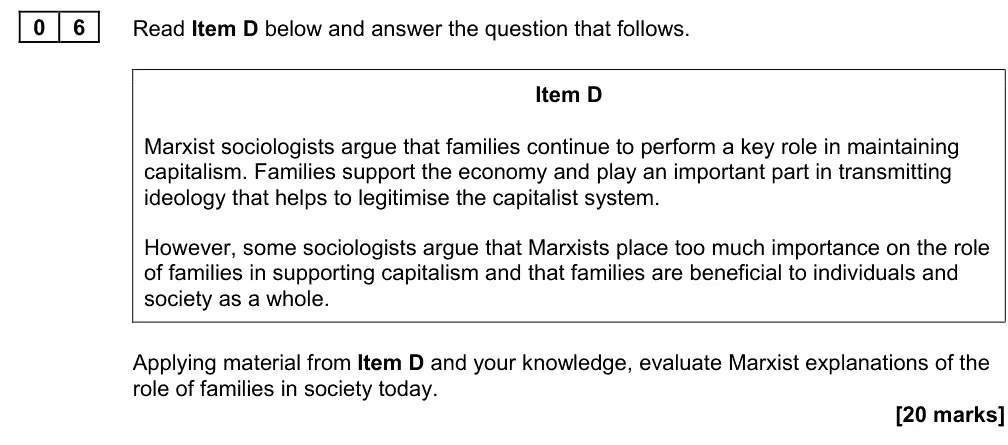
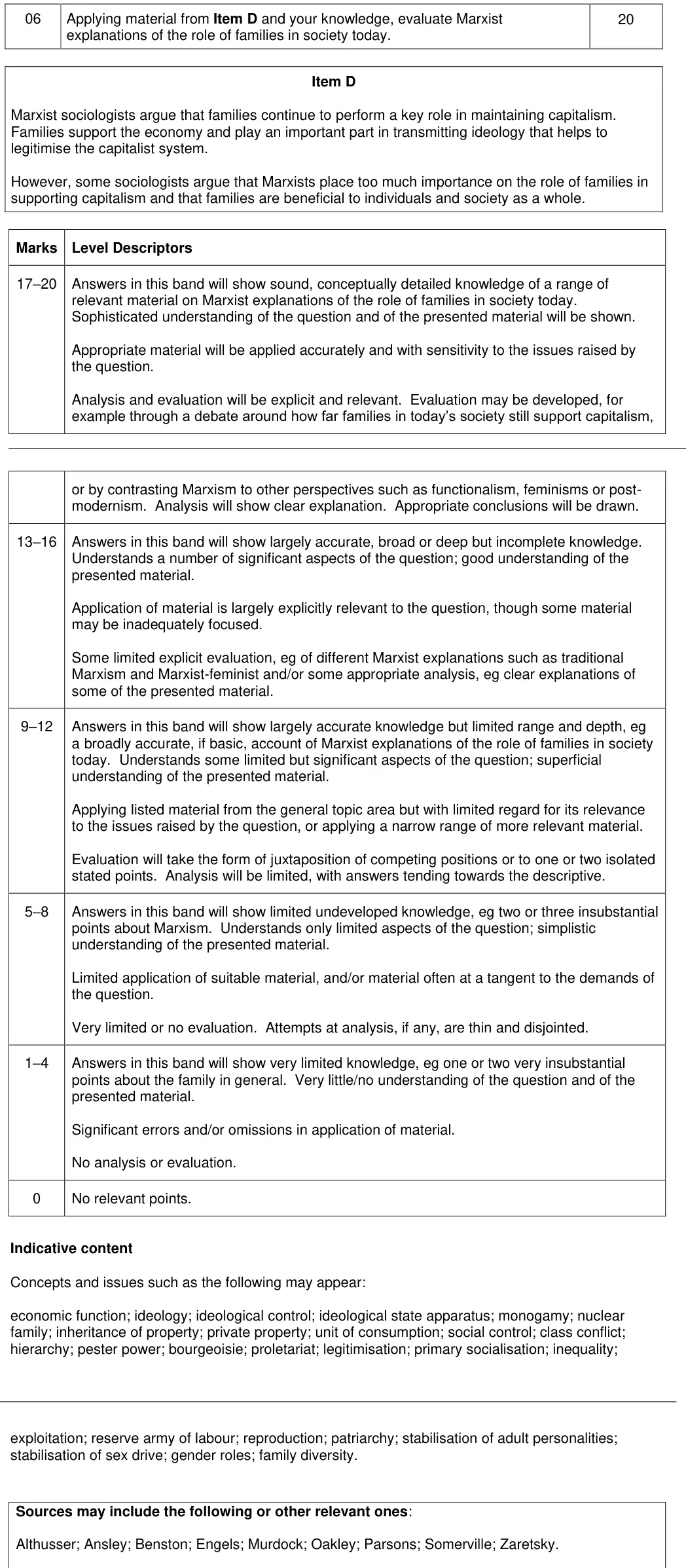
June 2022 · Paper 2 · Q620 marksAO1=8, AO2=6, AO3=620-mark essay
Mark scheme, including the levels grid and indicative content
Examiner's comment
The items for 20 mark questions are written to provide a number of ideas on which students can begin to build their answers. Students are expected to also bring in further ideas (hence “and your knowledge” in the instruction). It is often the case that a wide range of material can be relevant to these questions, and students need to be selective. For example, it may be more effective to cover a limited number of views or theories in some depth rather than to include every possible theory. There was a tendency for answers to progressively lose sight of the question and to become a list of different views. This applied particularly to question 6 (A2 Families and Households) where in some cases a paragraph or two on Marxist views on families was followed by accounts of other theories with no reference or comparison to Marxism. Many attempts at evaluation were learned criticisms. Evaluation is more effective where it is focused on the demands of the question. Students should also be aware that evaluation includes awareness of the strengths as well as the weaknesses of an argument or theory. Following feedback from centres regarding the advance information for the 20 mark questions, we have monitored the marking of these questions, as well as carrying out statistical analysis on student performance. Based on this analysis, we can confirm that students have performed as we expected them to on these questions, and their performance on these questions is in line with previous series. Q6 Many students were aware of the work of a number of Marxist writers on the family, such as Engels, Zaretsky and Althusser. Answers tended to draw heavily on the item. Better answers made evaluative points about Marxist views by applying ideas from other perspectives or applying research findings.
Notes from the mark scheme and report
evaluation must engage with Marxism: a paragraph on Marxism followed by unrelated accounts of other theories was criticised, as were learned stock criticisms
top band debates how far families still support capitalism or contrasts functionalism, feminisms, postmodernism
common sources Engels, Zaretsky, Althusser
answers leaned heavily on the item
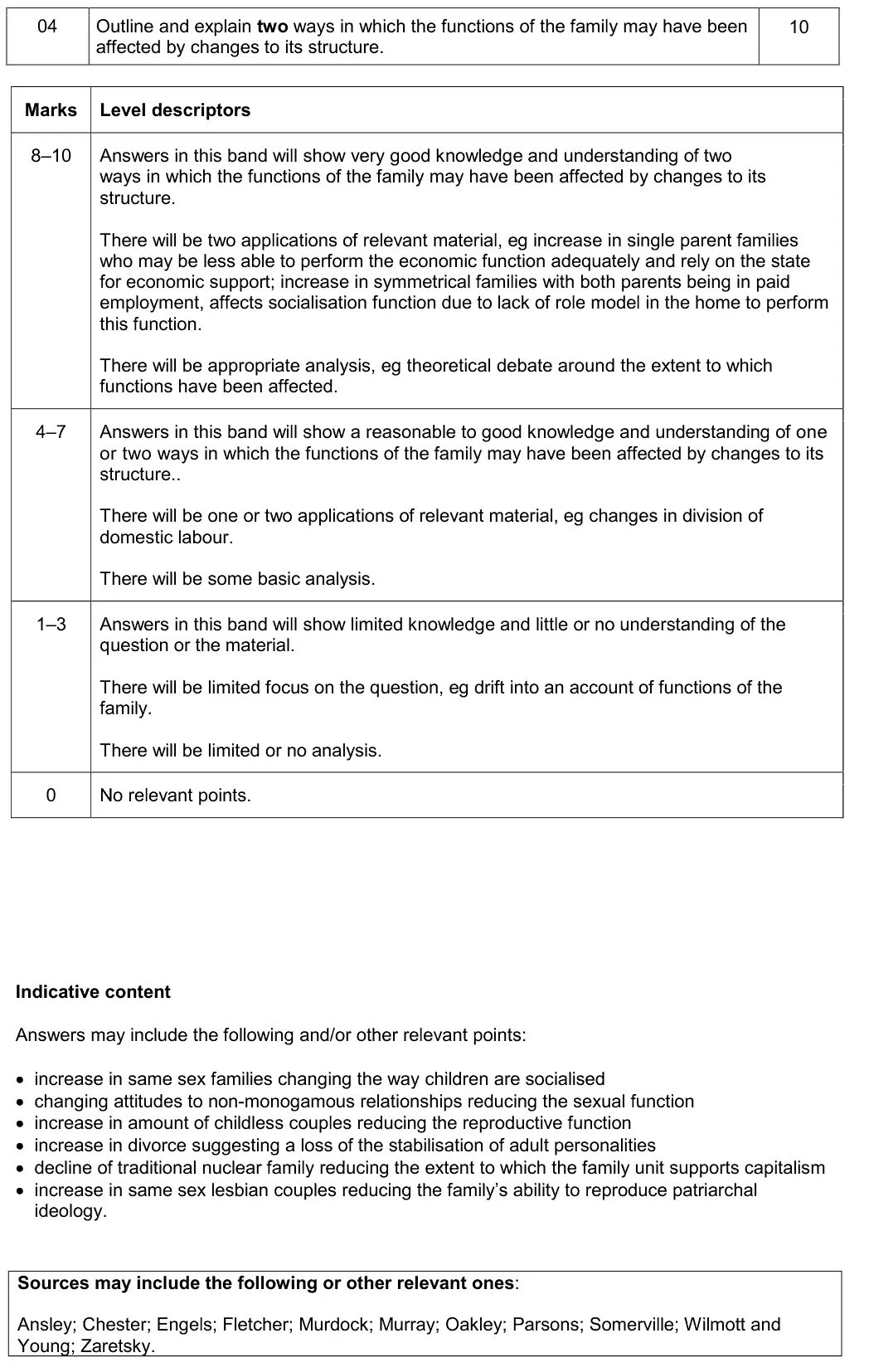
November 2021 · Paper 2 · Q410 marksAO1=5, AO2=3, AO3=2Outline and explain
Mark scheme, including the levels grid and indicative content
Examiner's comment
This question required knowledge and understanding of functions of families; these could be from functionalist, Marxist, feminist or other perspectives. Discussion of changing roles within families was accepted as being about functions. Some students concentrated on outlining changes to the structure of the family without referring sufficiently to functions. The particular requirements of both types of 10 mark questions mean that the role of the teacher in explaining the format of questions and, for ‘analyse’ questions, the structure and content of the items, is essential, as is practice followed by constructive feedback. Students need to be aware that these questions will always require connections to be made between different parts of the specification for the topic, and that this will require thinking in the examination about how the two aspects are connected.
Notes from the mark scheme and report
no marks for evaluation in this question type
each way must link a structural change (lone-parent, dual-earner, same-sex, childless families, divorce) to a family function
functions from any perspective were accepted and changing roles counted as functions
many described structural change without linking it to functions
drift into an account of functions = 1–3
November 2021 · Paper 2 · Q510 marksAO1=3, AO2=4, AO3=3Analyse
Mark scheme, including the levels grid and indicative content
Examiner's comment
As information was given in the item about family diversity, students needed in their answers to focus on government policies. This could be done either by referring to specific acts of parliament or equivalent, or by more general discussion of the impact of, for example, provision of welfare benefits; both approaches were acceptable and could be equally successful. The particular requirements of both types of 10 mark questions mean that the role of the teacher in explaining the format of questions and, for ‘analyse’ questions, the structure and content of the items, is essential, as is practice followed by constructive feedback. Students need to be aware that these questions will always require connections to be made between different parts of the specification for the topic, and that this will require thinking in the examination about how the two aspects are connected.
Notes from the mark scheme and report
must develop hooks from Item C (rising divorce, more same-sex couples)
the last line restates the question and is not a hook
the item already gives the diversity, so answers had to focus on government policy, either named laws (divorce reform, civil partnership, same-sex marriage) or welfare provision in general
drift into examples of policy or diversity alone = 1–3
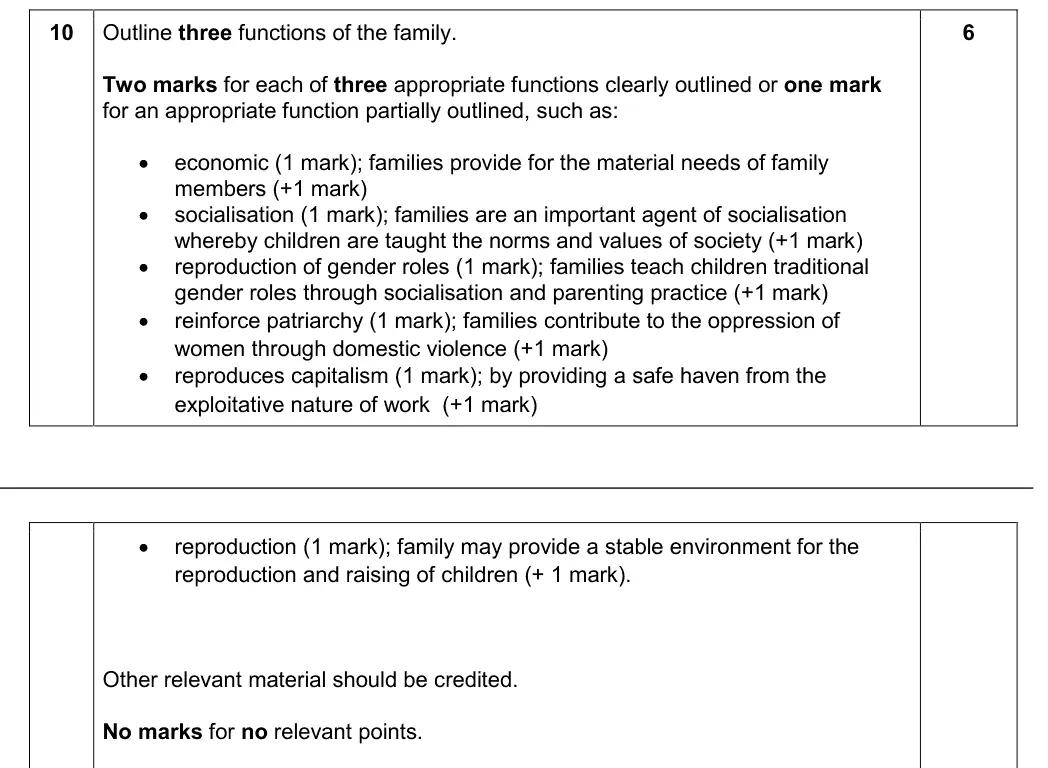
November 2020 · AS Paper 2 · Q106 marksAO1=6Outline
Mark scheme
Notes from the mark scheme and report
2 marks for each of three functions clearly outlined, 1 if partial
functionalist, Marxist and feminist functions all creditable (economic, socialisation, reproduction, gender roles, reproducing patriarchy or capitalism)
June 2019 · Paper 2 · Q410 marksAO1=5, AO2=3, AO3=2Outline and explain
Mark scheme, including the levels grid and indicative content
Examiner's comment
Some students wrote introductory paragraphs and/or conclusions. These are not necessary, and are unlikely to gain additional marks; they also take up time. Some students made only one point in their answers, or three or more, rather than the two asked for. The word ‘two’ is put in bold in the question to try and draw students’ attention to this. Sometimes it was not clear how many points were being made. It is helpful for students to clearly indicate their two answers, with wording such as “One way is…” or by starting a new paragraph for their second point. Notably, some students wrote far more than was needed for a 10-mark response. The two types of 10-mark question, “outline and explain” and “analysis” types, are marked differently as the assessment objectives have different weightings. It is important that students are aware of this. In particular they should note that evaluation is not a requirement for answers to 10 mark “outline and explain” questions. For 10 mark “outline and explain” questions, students cannot rely on reciting knowledge; these questions will ask them to bring together aspects of their sociological knowledge of the topic in a way that they are unlikely to have done before. The best answers to 10-mark questions were focused, clearly stating a point and then developing it, and used sociological concepts, studies, evidence and theory as appropriate. Some students found this question challenging, being unsure of how to relate the ageing population to policies affecting families. However, there were some very good answers. Detailed knowledge of policies was not required and better answers focused on how families had been affected by policies. Many answers considered retirement ages and, for example, how this might affect grandparents as carers of grandchildren, or the policy of making social care an individual and family responsibility and the effect of this on women in the pivot or sandwich generation. There were also some good answers referring to policies in other countries, such as Singapore’s “have three or more”. Some answers struggled with the connection between the ‘ageing population’ and ‘policies’, sometimes suggesting policies that were in place well before there was an ageing population.
Notes from the mark scheme and report
must link the ageing population to policies and then to effects on families
drift into demographic change = 1–3
detailed policy knowledge not needed
good answers: retirement age and grandparent childcare, social care left to families and the effect on women in the sandwich generation, pro-natalist policies abroad
some cited policies older than the ageing population
AO split from AQA's standard grid for this paper (this year's mark scheme does not print it).
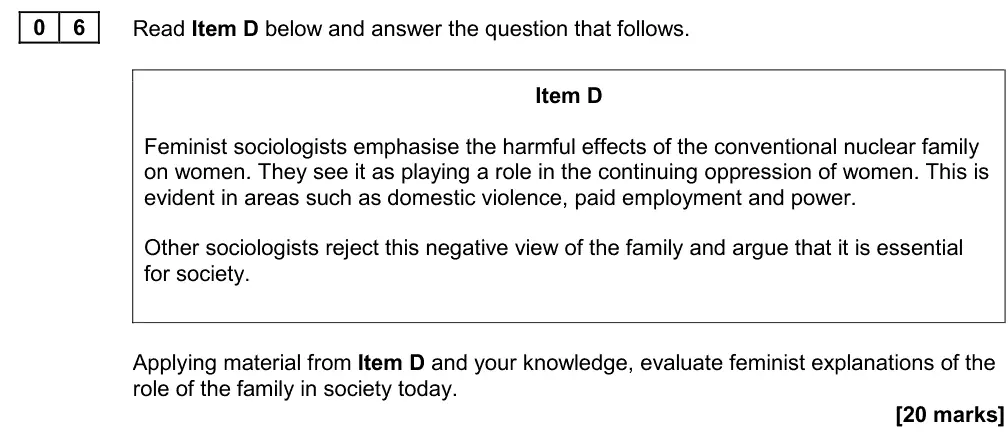
June 2019 · Paper 2 · Q620 marksAO1=8, AO2=6, AO3=620-mark essay
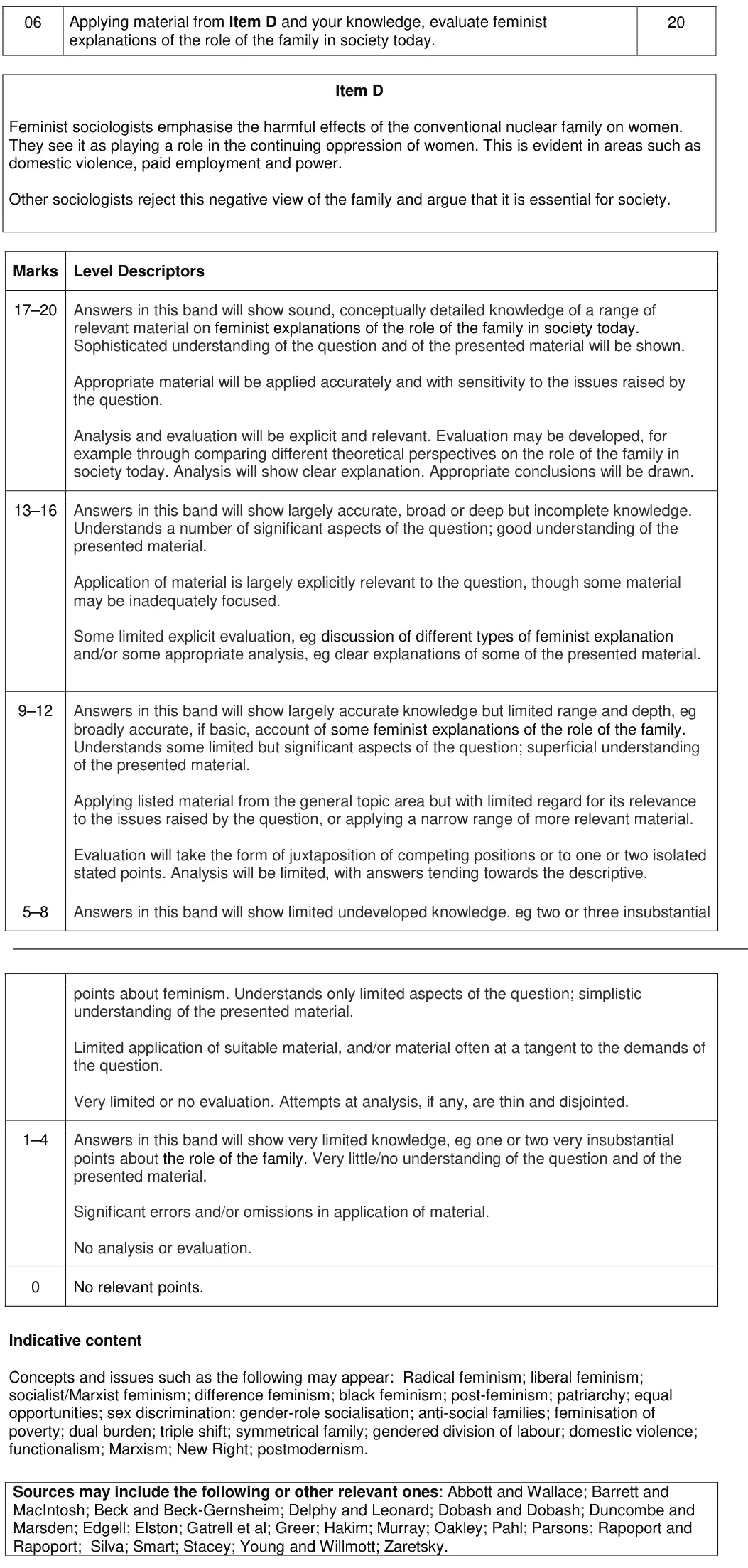
Mark scheme, including the levels grid and indicative content
Examiner's comment
As last year, many scripts had one substantial answer to the Section A 20-mark question and one significantly briefer one for Section B, suggesting problems with timing. There was often little evidence of planning. A wide range of material can be relevant to these questions, and students are not expected to include everything. They need to carefully choose the content and to plan their answers. The best answers will be both empirical and theoretical, for example showing knowledge of research findings and examples, and knowledge of theoretical perspectives. Some answers amounted to lists of theoretical perspectives, with learned points of criticism, and lost focus on the question itself. While the items are intended as a helpful starting point for answers, they should not be taken by students as a full list of what is relevant; better answers will draw in other relevant knowledge and ideas. Many more successful answers showed good knowledge of a range of issues related to gender and the family, often using the item as their starting point, and demonstrating awareness of several strands of feminism. Less successful answers provided lists of theories together with learned criticisms; such answers tended to lose sight of the question, and some also lacked any empirical evidence by for example referring to research findings and studies.
Notes from the mark scheme and report
top band compares feminist views with other perspectives on the family
better answers distinguished several strands of feminism and used research evidence
list-like theories with learned criticisms lost focus
AO split from AQA's standard grid for this paper (this year's mark scheme does not print it).
June 2018 · Paper 2 · Q410 marksAO1=5, AO2=3, AO3=2Outline and explain
Mark scheme, including the levels grid and indicative content
Examiner's comment
Some students wrote introductory paragraphs and/or conclusions. These are not necessary, and are unlikely to gain additional marks, and they also take up time. Some students made only one point in their answers, or three or more, rather than the two asked for in the question. Sometimes it was unclear how many points were being made. It is helpful for students to clearly indicate their two answers, with wording such as “One way is…” or by starting a new paragraph for their second point. Evaluation is not a requirement for answers to 10 mark “outline and explain” questions. The marks awarded for the assessment objectives being targeted are different in the two types of ten mark questions, and students should be made aware of this. The best answers to 10 mark questions were focused, clearly stating a point and then developing it, using sociological concepts, evidence and theory where appropriate. In some questions students tended to focus on the first aspect of the question at the expense of the second. Students need guidance on how to approach these questions and how to best demonstrate their sociological understanding. The nature of these questions means that students cannot rely on reciting knowledge. These questions will ask them to bring together aspects of their sociological knowledge in a way that they are unlikely to have done before. There was a tendency to go into detail about the chosen policies rather than to discuss effects on family structures. Some answers assumed an effect and did not take the opportunity to use their sociological understanding to explore the ideas in greater depth. For example, some answers said that changes to divorce laws (often described in detail) increased the number of lone parent families, but few discussed increases in reconstituted families or bi-nuclear families. Similarly the Marriage (Same Sex Couples) Act of 2013 was recognised as increasing the number of same sex married couples but also led to same sex divorces, changes in adoption, surrogacy and so on.
Notes from the mark scheme and report
two policies each linked to an effect on family structure (e.g. divorce law, welfare and lone parents, migration and multi-generational households, same-sex marriage, housing and boomerang children)
drift into family diversity in general = 1–3
many described the policy in detail but assumed the effect
few explored reconstituted or bi-nuclear families
AO split from AQA's standard grid for this paper (this year's mark scheme does not print it).
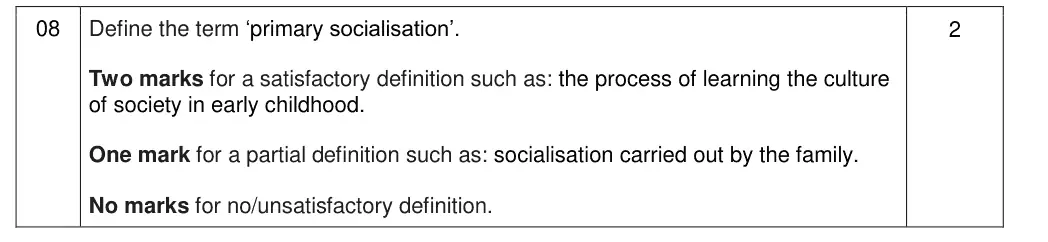
June 2018 · AS Paper 2 · Q82 marksAO1=2Define
Mark scheme
Examiner's comment
Most students were able to define both aspects of the term. Some answers failed to say what socialisation was and hence only provided a partial definition. Less often answers failed to explain the primary aspect of the question.
Notes from the mark scheme and report
2 marks for learning society's culture in early childhood
socialisation by the family alone = 1 mark
some omitted what socialisation means or the 'primary' part
AO split from AQA's standard grid for this paper (this year's mark scheme does not print it).
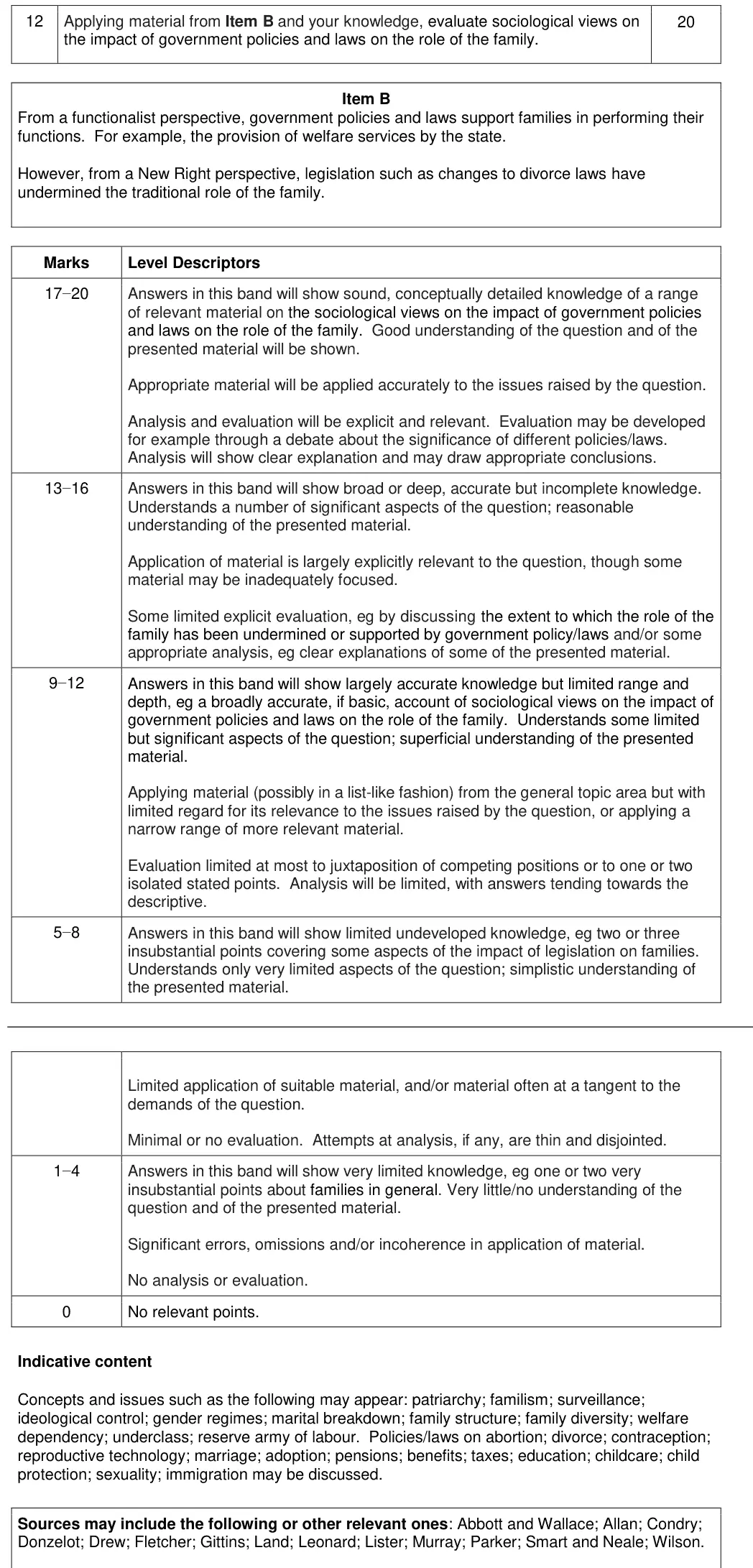
June 2018 · AS Paper 2 · Q1220 marksAO1=8, AO2=6, AO3=620-mark essay
Mark scheme, including the levels grid and indicative content
Examiner's comment
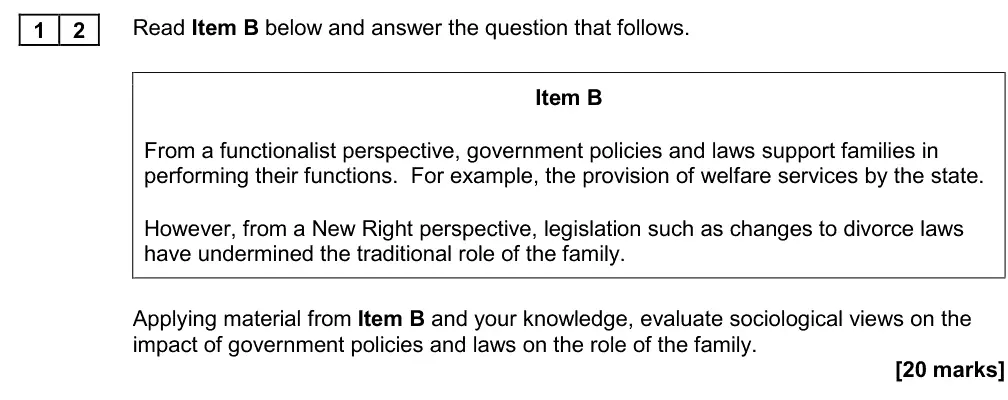
The best responses were able to link specific policies to the impact they had on the role of the family in society. Application of policies such as the Welfare State to the functions identified by Murdock and Parsons were evident in some responses, particularly the economic function and the socialisation function. The New Right view was often taken from the item and developed into a general description of the negative impact of welfare benefits on family structure. Very few of these answers focused on the role of the family, and therefore few students discussed the ability of lone parent families to fulfil the socialisation function adequately. The majority of students had clearly learned some relevant material and were able to write at length about different sociological perspectives on family policy, but relatively few of these answers dealt with the specifics of the impact on the role of the family. Some students interpreted role of the family as conjugal roles and therefore their answers lacked focus. Others wrote at length about the detail of social policies and legislation and again struggled to focus on the question of impact on the role of the family. The more students were able to link policies to the impact on the functions of the family the higher up the mark bands they progressed. Top band answers had explicit evaluation of the debates and a more conceptual sense of the theories.
Notes from the mark scheme and report
apply Item B (functionalist support via welfare vs New Right view that divorce law undermined the family)
must link specific policies to the role/functions of the family
many described New Right views on benefits or policy detail without the impact on family role
reading 'role' as conjugal roles lost focus
top band evaluated debates explicitly
AO split from AQA's standard grid for this paper (this year's mark scheme does not print it).
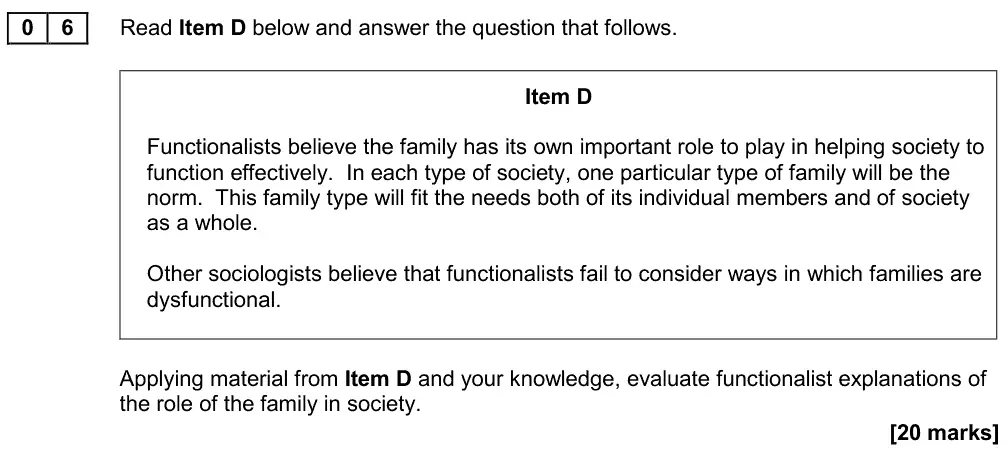
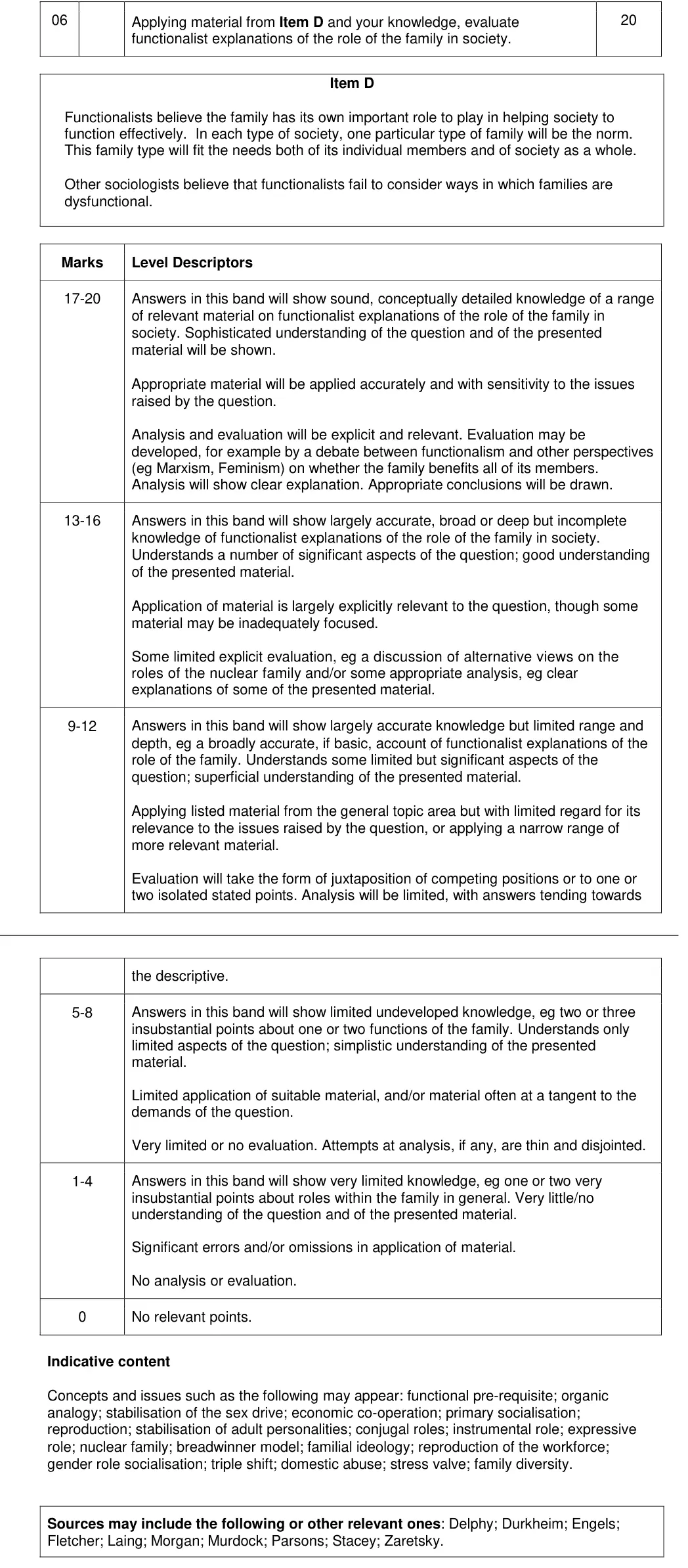
June 2017 · Paper 2 · Q620 marksAO1=8, AO2=6, AO3=620-mark essay
Mark scheme, including the levels grid and indicative content
Examiner's comment
Many scripts had one substantial, well developed answer to a 20 mark question and one significantly briefer one, again suggesting problems with time management. It is often the case that a wide range of material can be relevant to these questions, and students will need to be selective. For example, it may be more effective to cover a limited number of views or theories in some depth, rather than to include every possible theory. There was a tendency for answers to progressively lose sight of the question and to become a list of different views. The best answers will address all aspects of the question and will draw on theories, concepts and empirical examples or evidence. Evaluation which meets the demands of the questions is better than points of criticism which have been learned and included, regardless of the specific question that has been set. Students should also be aware that evaluation includes awareness of the strengths, as well as the weaknesses, of an argument or theory. Many students were knowledgeable on functions of the family as discussed by Murdock and Parsons, and some were able to go beyond this by discussing, for example, functional fit and structural differentiation. Most approached the question by using Marxism and different types of feminism to make critical points. Weaker answers tended to lack concepts and to spend too long describing a limited number of functions or the suitability of nuclear families for geographical mobility.
Notes from the mark scheme and report
top band debates functionalism against Marxism/feminism on whether the family benefits all members
hook: families can be dysfunctional
good answers went beyond Murdock and Parsons to functional fit and structural differentiation
weaker answers lacked concepts and over-described a few functions
June 2017 · AS Paper 2 · Q92 marksAO2=2Brief explain
Mark scheme
Examiner's comment
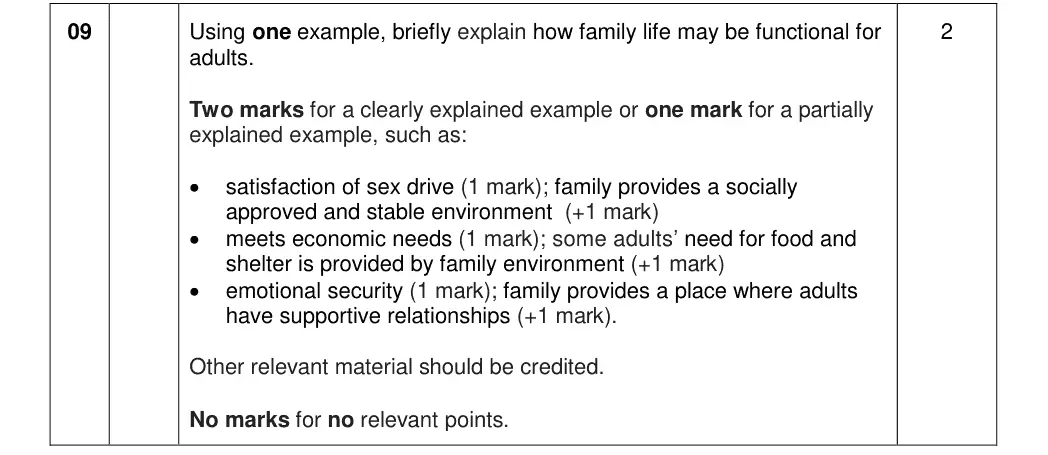
The most common answer was ’the warm bath’, closely followed by ’satisfaction of sexual drive’, while a few referred to the economic benefits. Stabilisation of the adult personality was often developed well as was ‘meeting emotional needs’. The most frequent error made was to confuse functions with roles, or to talk about the functions the family fulfils for society (eg reproduction, primary socialisation).
Notes from the mark scheme and report
2 marks for a clearly explained example, 1 if partial
common answers: warm bath, sex drive, stabilisation of adult personality, economic needs
common error: confusing functions with roles or giving functions for society (reproduction, primary socialisation) rather than for adults
June 2016 · AS Paper 2 · Q1110 marksAO1=5, AO2=3, AO3=2Outline and explain
Mark scheme, including the levels grid and indicative content
Examiner's comment
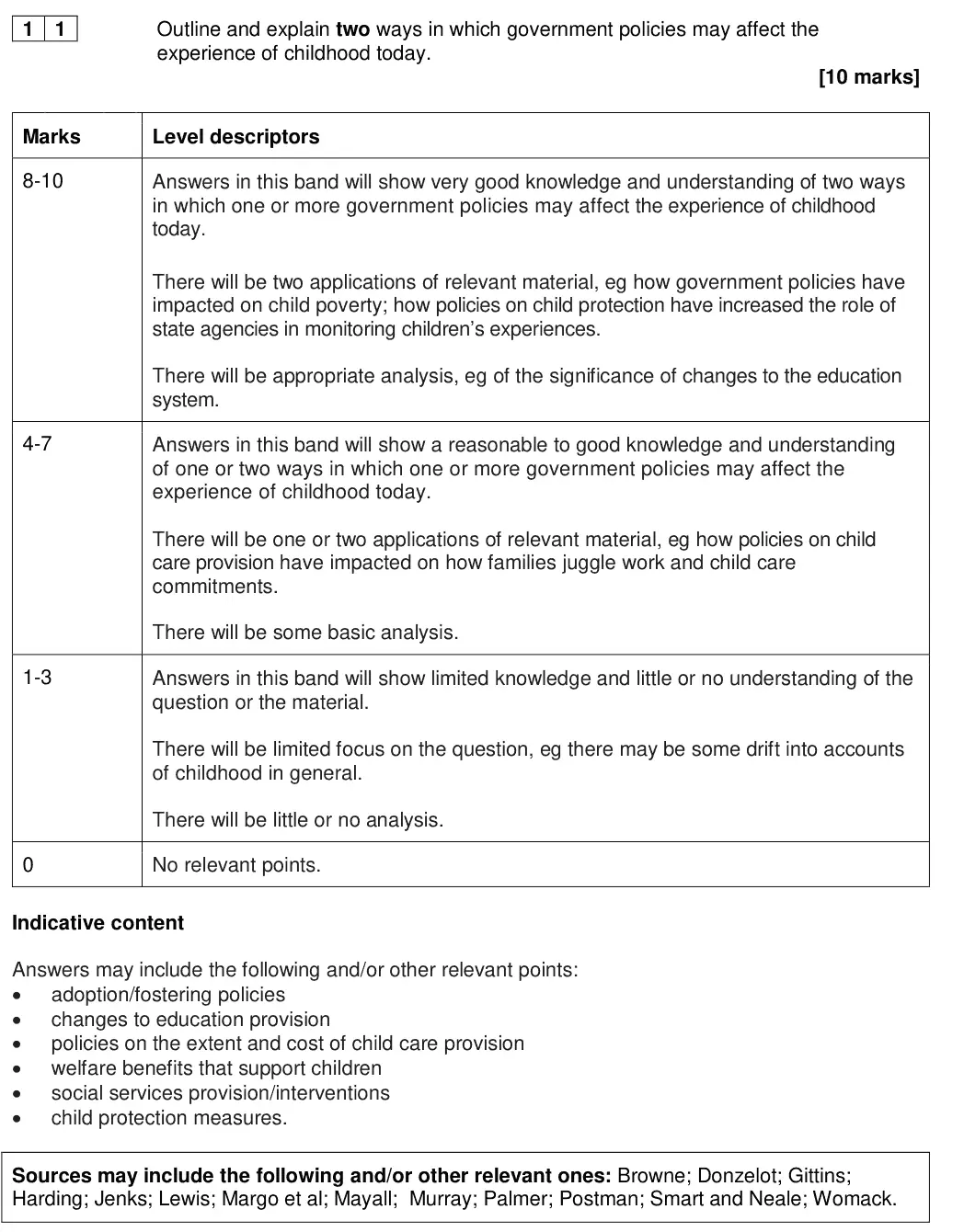
The 10 mark ‘Outline and explain’ question requires students to link two aspects of the specification. The best answers took note of both aspects of the question, clearly identified two separate points and developed them together them in relation to the question as a whole. Weaker answers either ignored one aspect of the question, or attempted to cover a number of ideas rather than focusing on the two required. Most students were able to give two examples of government policies, even if these were not very specific or accurate. Some particularly vague answers described policy areas rather than identifying a specific policy. There was some difficulty in linking policies to a specific impact on the experience of childhood today. Many candidates just said it was ‘better’, whilst others linked the policy to benefits in the future, eg better jobs. Some gave quite lengthy descriptions on the changes in childhood or various sociologists' views on the position of childhood today. Whilst sociological knowledge was often good, they failed to apply this explicitly to the question, resulting in limited marks. Others identified two policies, but then described just one way that it affected childhood. Some identified two policies and two ways, but very briefly with no development. Overall, relatively few students explained the effects on childhood experiences sufficiently effectively for top band marks. The policies most frequently cited were the extension of the school leaving-age, child protection policies, and various benefits. Weaker students then wrote only briefly about the extension of childhood, it being 'better' or more dependence on parents. Some wrote at a tangent, for example, about New Right views of benefits. Only a small proportion managed to identify a policy and link its effects well to several points about changed childhood experiences (eg through the effects of divorce law changes, or the arrival of legal gay marriage).
vague policy areas rather than named policies, saying childhood is just 'better', or future effects only limited marks
drift into general accounts of childhood = 1-3
June 2016 · AS Paper 2 · Q1220 marksAO1=8, AO2=6, AO3=620-mark essay
Mark scheme, including the levels grid and indicative content
Examiner's comment
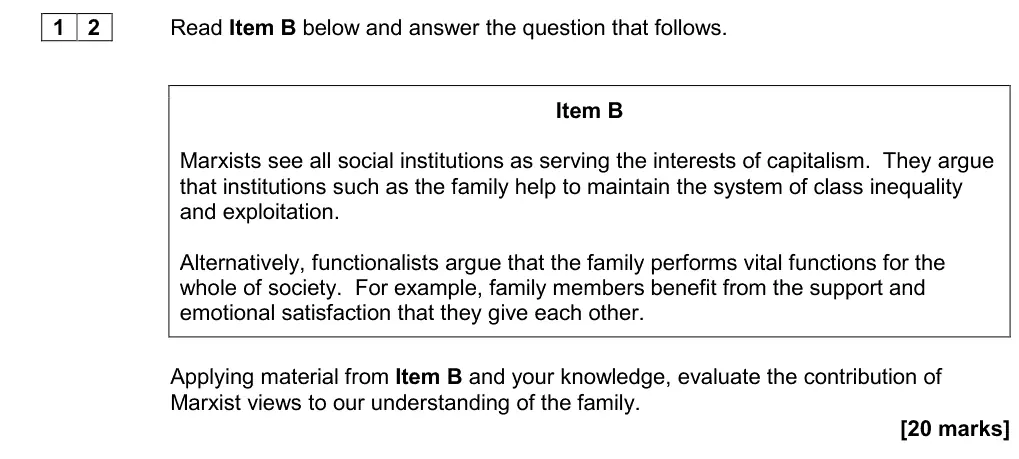
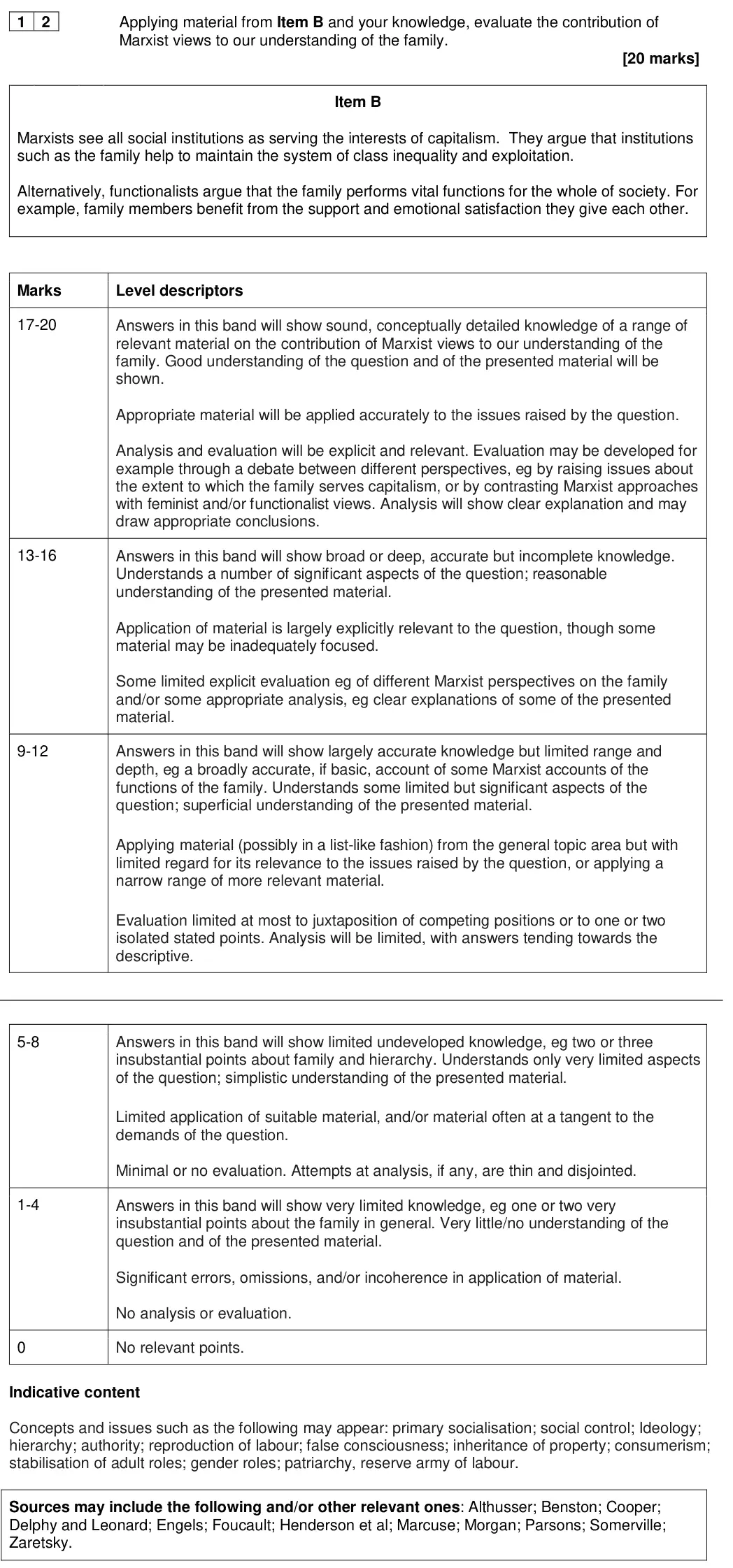
There were some very good answers to this question. Some students gave very detailed and thorough accounts of the Marxist perspective on the family, with explicit analysis and evaluation. These were often accompanied by the inclusion of a range of sources. References were made to inheritance, socialisation, ideology, consumption, 'safe haven', reserve army, reproduction of labour, patriarchy, etc, often incorporating Marxist-feminism. Other responses were more juxtaposed, providing detailed accounts of different perspectives on the family one after the other. Weaker candidates touched on just one or two issues and did not explain them well. These type of responses tended to rely on restating/rewording phrases in the item. Some better answers were able to use functionalist, feminist and post-modernist views as evaluation as they worked their way through these. Many more inserted paragraphs on these other perspectives, but did not use them as evaluation, showing no linkage whatsoever to Marxist views. A significant number of students seemed to know a lot more about these other perspectives (especially functionalism) as opposed to Marxist views on the family.
Notes from the mark scheme and report
evaluation via the extent the family serves capitalism or contrast with feminist/functionalist views
best answers covered inheritance, ideology, consumption, safe haven, reserve army, reproduction of labour, Marxist feminism
other perspectives inserted without linking to Marxism earn little evaluation credit
many knew functionalism better than Marxism
restating the item kept weak answers low
Work with an AQA sociology tutor
Essays stuck in the middle band, or losing marks on the 10-markers? Book a trial lesson with Mark, a former AQA examiner.