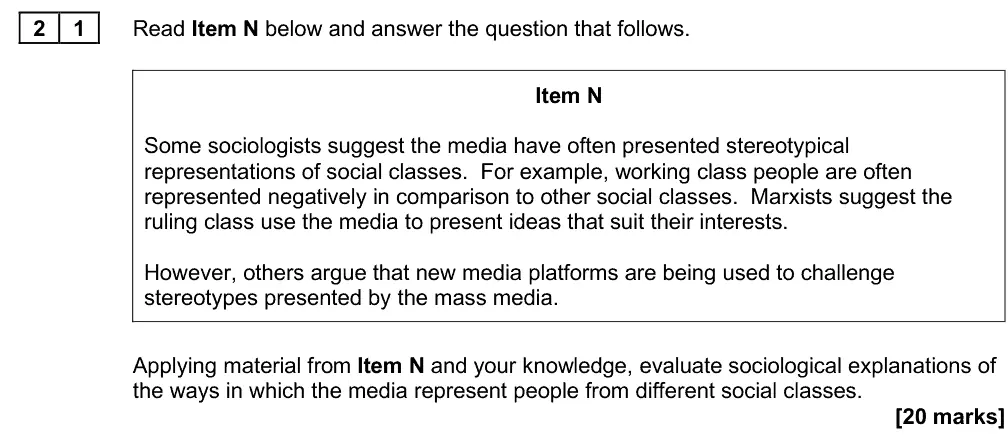
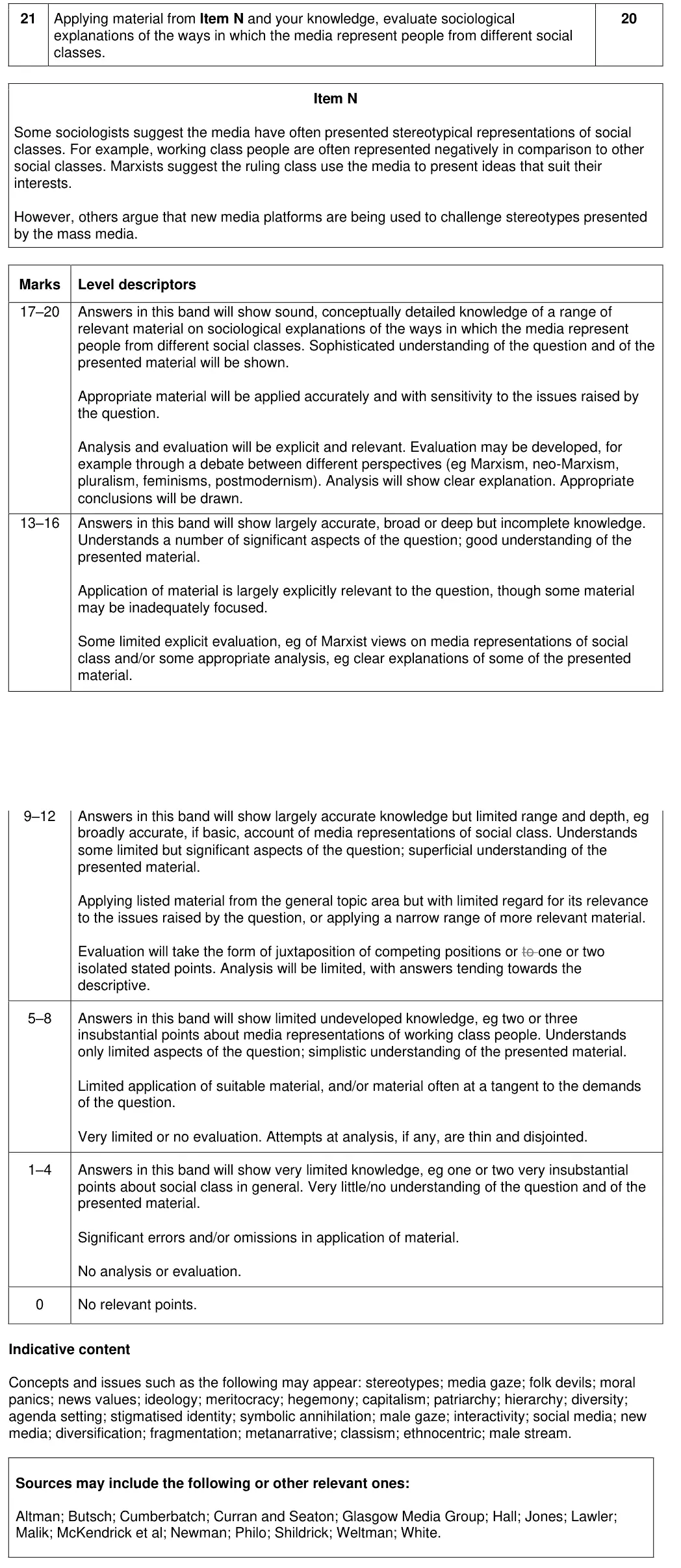
Applying material from Item N and your knowledge, evaluate sociological explanations of the ways in which the media represent people from different social classes.
Tap a question to zoom it. The mark scheme (with the level descriptors and indicative content) and the examiner's comment open underneath.
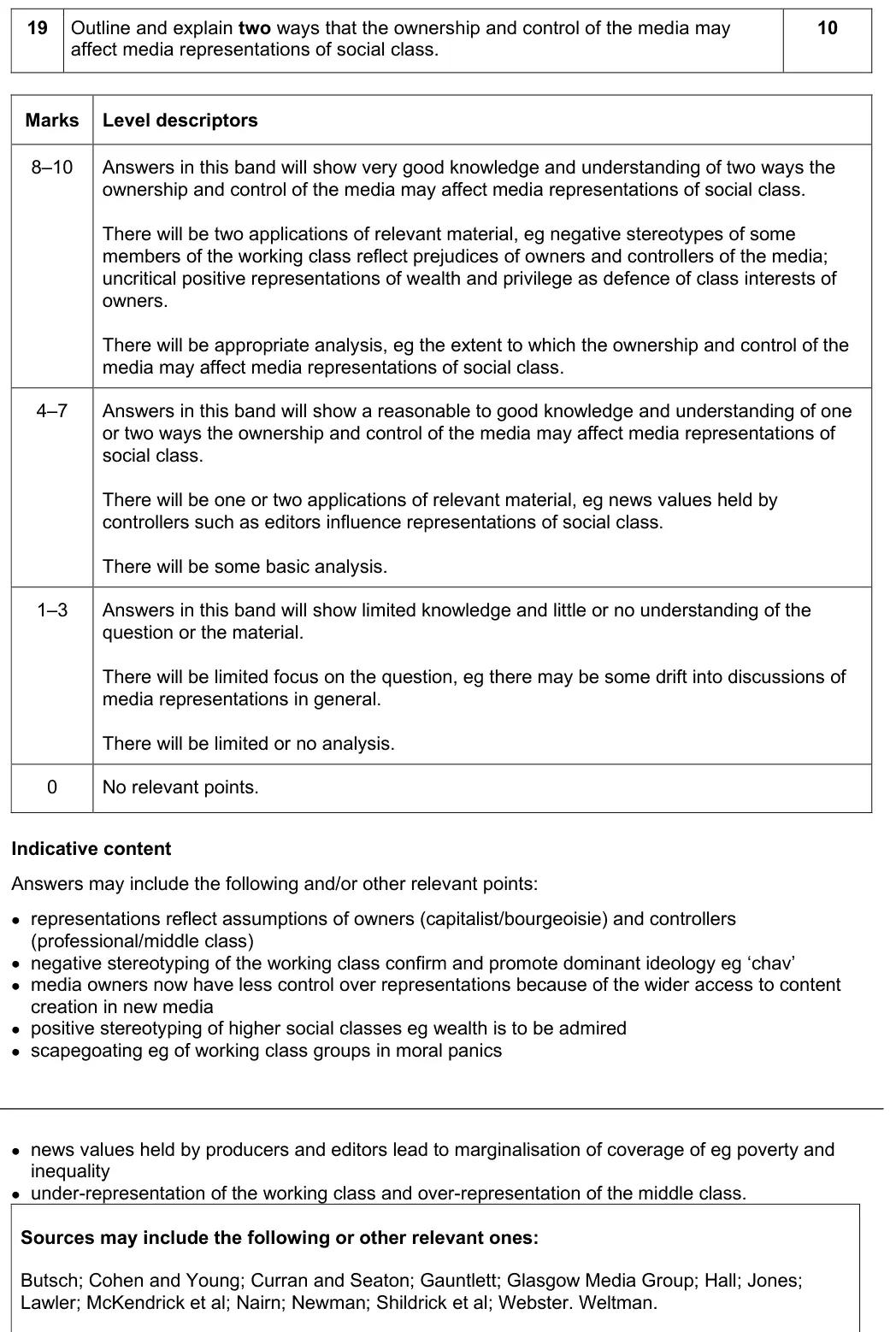
June 2025 · Paper 2 · Q1910 marksAO1=5, AO2=3, AO3=2Outline and explain
Mark scheme, including the levels grid and indicative content
Examiner's comment
The nature of these questions means that students cannot rely on reciting knowledge. Questions will ask them to bring together aspects of their sociological knowledge in ways they have not done before. It is therefore important for students to allow time to think about how to answer the question. Students should be aware that there are two types of ten-mark questions. These have different requirements and different mark schemes. There are different marks available for the assessment objectives. 10 mark “outline and explain” questions have more marks available for knowledge and understanding, and none for evaluation. Introductions and conclusions are not required for 10-mark questions, are unlikely to help students and take up time. It is helpful if answers are set out to clearly indicate the two answers, with wording such as “One way/reason is…” or by starting a new paragraph for the second point. Answers that give more than two answers are unlikely to develop two of them sufficiently. The most successful answers to 10-mark questions were focused, clearly stating a point that addressed the question and then developing it, using sociological concepts, evidence such as an example and, where appropriate, theory. Answers often showed good knowledge and understanding of some issues around this area but did not always manage to make a clear connection between ownership or control and representations of social class. Better answers often gave one way based on ownership (e.g. by media oligarchs) and one on control (e.g. new media allowing the audience to contribute some content).
Notes from the mark scheme and report
must link ownership or control to representations of class
drift into representations in general = 1–3
better answers gave one way based on ownership (owner interests, chav stereotypes) and one on control (editors' news values, user-generated content)
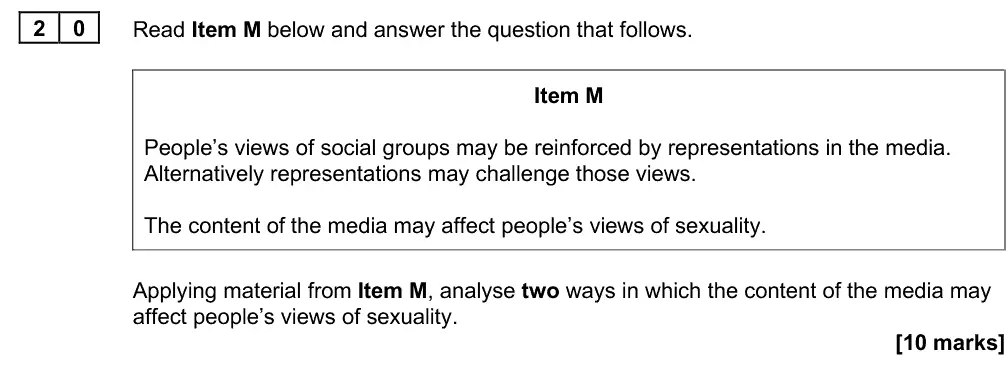
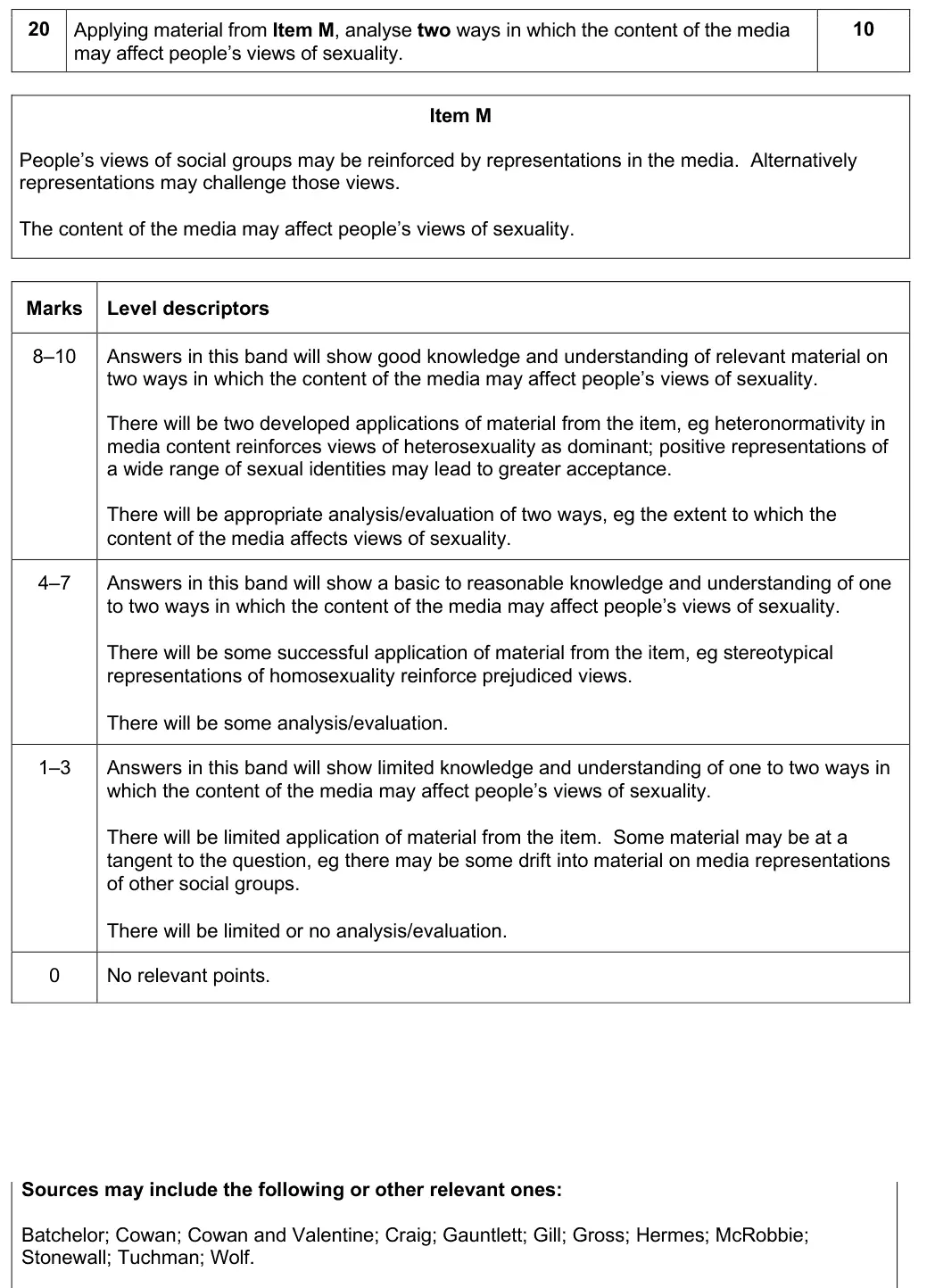
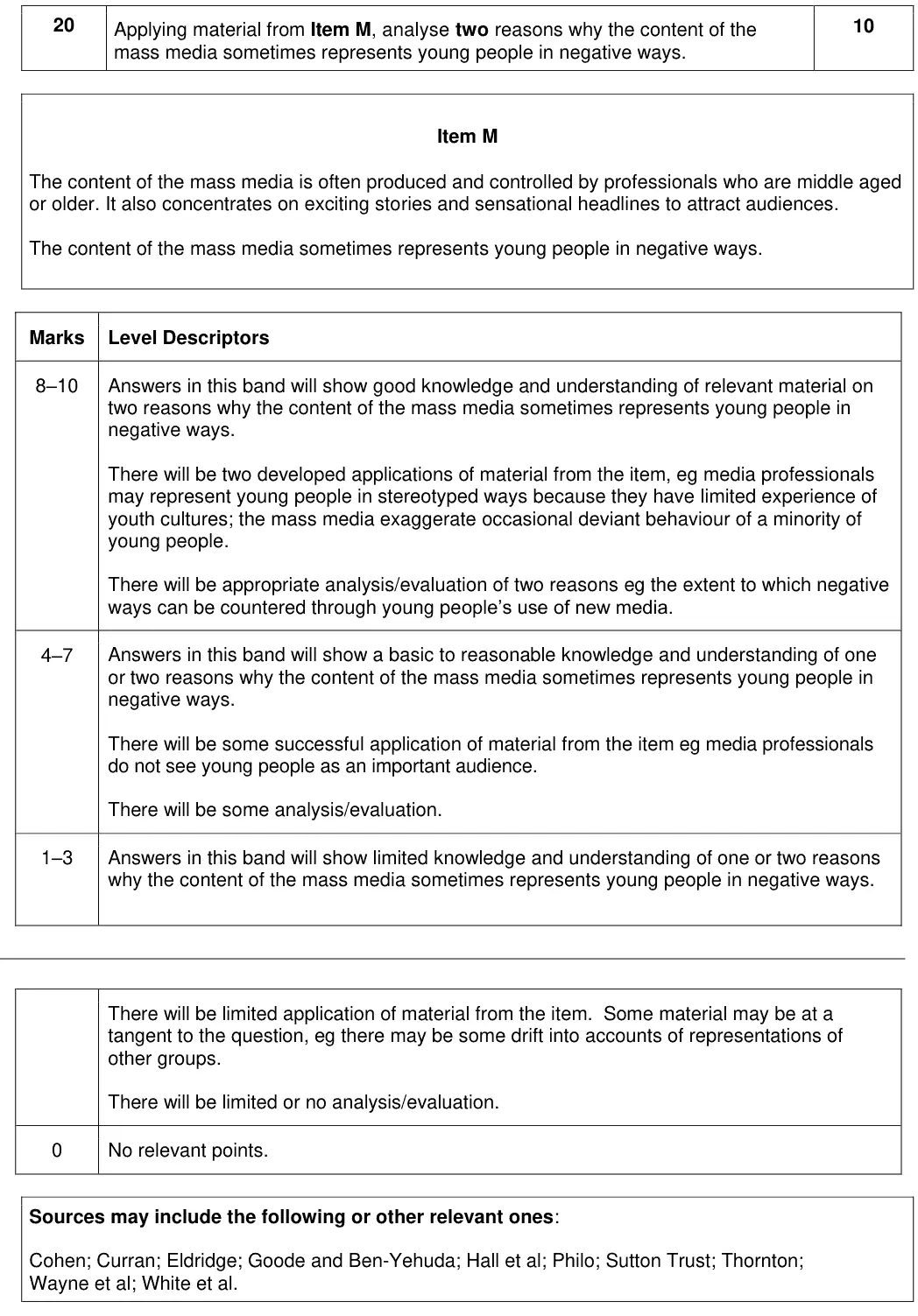
June 2025 · Paper 2 · Q2010 marksAO1=3, AO2=4, AO3=3Analyse
Mark scheme, including the levels grid and indicative content
Examiner's comment
The nature of these questions means that students cannot rely on reciting knowledge. Questions will ask them to bring together aspects of their sociological knowledge in ways they have not done before. It is therefore important for students to allow time to think about how to answer the question. Students should be aware that there are two types of ten-mark questions. These have different requirements and different mark schemes. There are different marks available for the assessment objectives. The items for 10 mark “analyse” questions are written to give prompts or “hooks” for student answers. These must be used to access application marks. Answers can indicate use of hooks by quoting, by a reference in parentheses or by wording (e.g. “As the item says…”). Items end with a sentence restating the question; the hooks are in the preceding part of the item. Introductions and conclusions are not required for 10-mark questions, are unlikely to help students and take up time. It is helpful if answers are set out to clearly indicate the two answers, with wording such as “One way/reason is…” or by starting a new paragraph for the second point. Answers that give more than two answers are unlikely to develop two of them sufficiently. The most successful answers to 10-mark questions were focused, clearly stating a point that addressed the question and then developing it, using sociological concepts, evidence such as an example and, where appropriate, theory. A small number of students took this as a gender question rather than a sexuality question. covered both with gender points that were about sex, using concepts such as the male gaze. Most were able to apply the hooks and develop their analysis of two ways, using concepts such as heteronormativity. Some found it difficult to go beyond representations and discuss effects on people’s views.
Notes from the mark scheme and report
must cover effects on views of sexuality, not just representations
item hooks: reinforcing (heteronormativity, stereotypes) vs challenging (diverse positive portrayals)
a few answered on gender instead
drift into other groups = 1–3
June 2024 · Paper 2 · Q2120 marksAO1=8, AO2=6, AO3=620-mark essay
Mark scheme, including the levels grid and indicative content
Examiner's comment
The items for these questions have a different purpose to those for 10 mark “analyse” questions. The items will suggest a few starting points for students, including ways into evaluation. Students are expected to also bring in further ideas (“and your knowledge” in the instruction). A wide range of material can be relevant to these questions, so students need to be selective. It is more effective to cover a limited number of points in depth rather than to try to include everything. Students who made essay plans appeared to benefit by having more structured and coherent responses. Q21: Most responses demonstrated accurate knowledge but were confined to a narrow scope. Many were generalised, relying on clichéd examples of working and middle-class representations on television without deeply connecting them to the question. Debates tended to lack depth, with most answers touching on Marxist perspectives but offering little evidence. The best answers drew on a range of media, on examples that do not conform to stereotypes as well as those that do, and on other perspectives.
Notes from the mark scheme and report
top band debates Marxism, neo-Marxism, pluralism, feminisms, postmodernism on class representations and how new media challenge stereotypes
most were narrow, using clichéd TV examples of working- and middle-class portrayal
debate mostly Marxist with little evidence
June 2023 · Paper 2 · Q2120 marksAO1=8, AO2=6, AO3=620-mark essay
Mark scheme, including the levels grid and indicative content
Examiner's comment
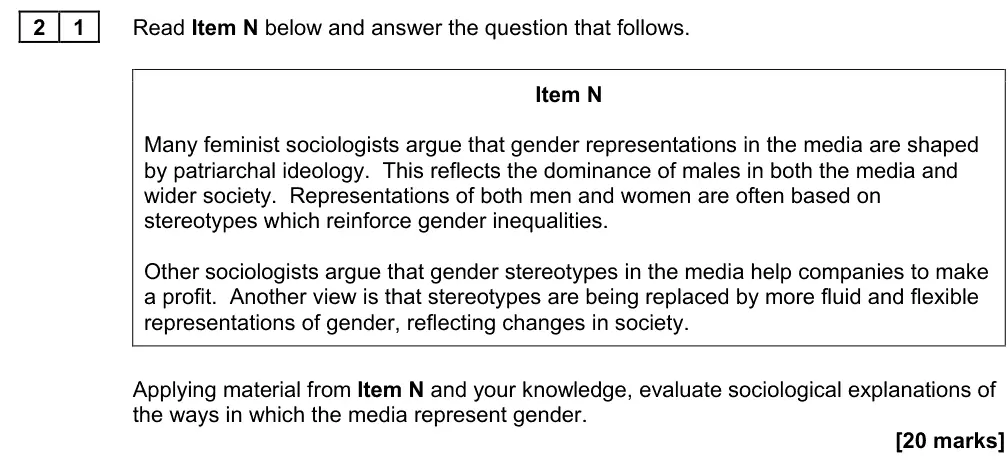
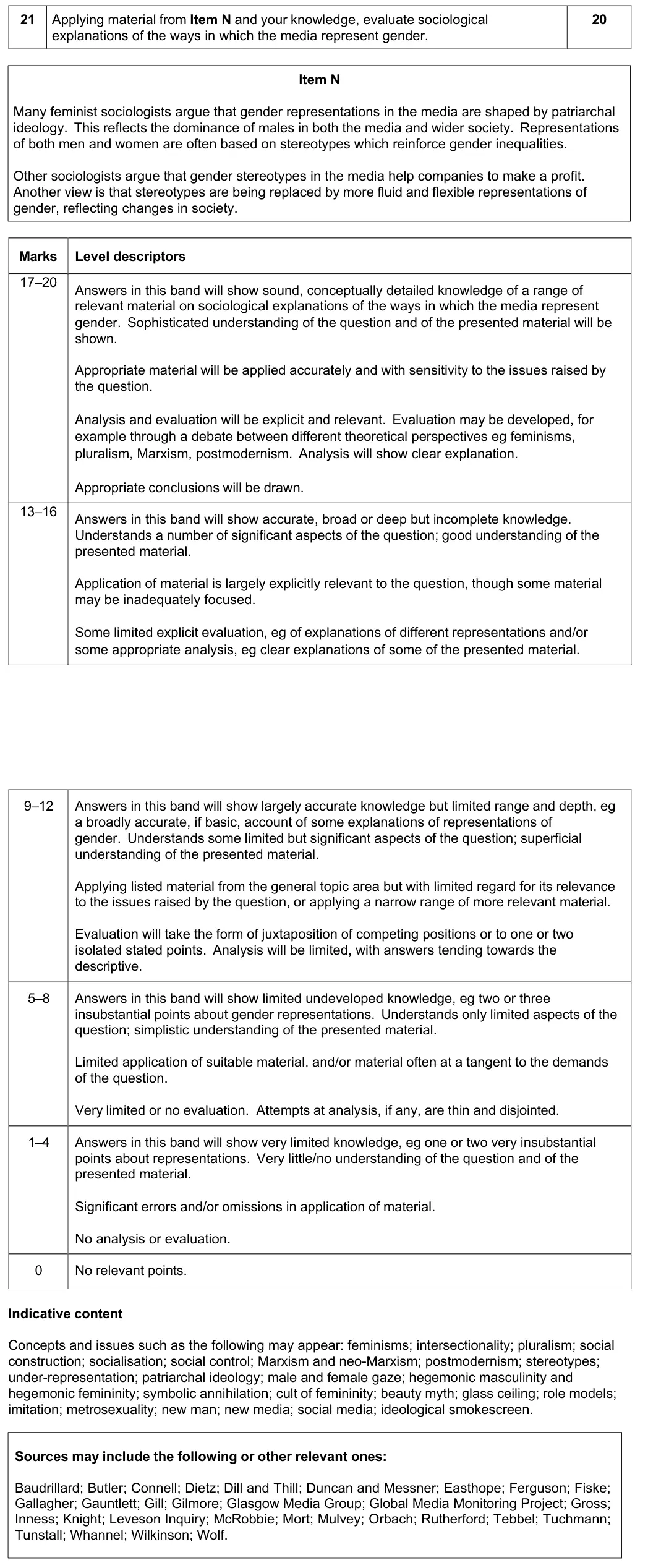
Most students answered their chosen questions in the order in which they appeared on the question paper. They therefore answered the section B 20 mark question last. For some this was a relatively brief and often apparently unfinished answer. This suggests that students need to track carefully time spent on each question. The purpose of the items for these questions is to suggest a few starting points for students, including ways into evaluation. Students are expected to also bring in further ideas (“and your knowledge” in the instruction). A wide range of material can be relevant to these questions, so students need to be selective. It is more effective to cover a limited number of views/theories in depth rather than to include every possible theory. Students who made essay plans appeared to benefit by having more structured and coherent responses. Question 21: There were a wide range of responses with some sophisticated answers applying conceptually detailed knowledge supported by theories and examples. Weaker answers made insubstantial points and had undeveloped examples, or considered only females.
Notes from the mark scheme and report
top band debates feminisms, pluralism, Marxism and postmodernism on gender representation
weaker answers made insubstantial points or considered only women
June 2022 · Paper 2 · Q2010 marksAO1=3, AO2=4, AO3=3Analyse
Mark scheme, including the levels grid and indicative content
Examiner's comment
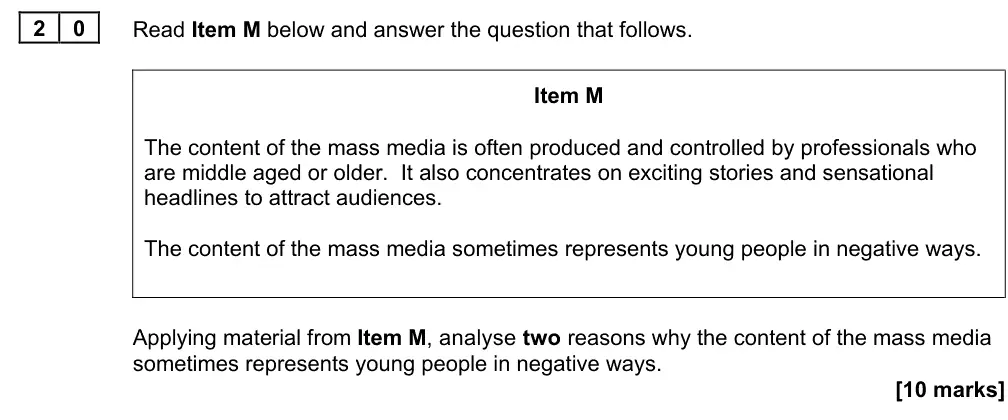
The nature of these questions means that students cannot rely on reciting knowledge. The questions will ask them to bring together aspects of their sociological knowledge in a way that they are unlikely to have done before. There was a tendency, however, to attempt to answer the question by giving knowledge based on words or phrases in the question, rather than meeting the demands of the question. Students are advised to spend time reading the question, and, where there is one the item, to ensure that they are answering the question. Some students seemed unaware of the different demands of the two types of questions. The marks awarded for the assessment objectives are different in the two types of ten mark questions, and students should be aware of this. In “analyse” (with item) questions, the answers need to be clearly based on the prompts or “hooks” in the item, not just on the final sentence of the item which restates the question. There is no need for an introduction or conclusion for 10 mark questions. It is helpful if answers are set out to clearly indicate the two answers, with wording such as “One way is…” or by starting a new paragraph for the second point. The best answers to 10 mark questions were focused, clearly stating a point that addressed the question and then developing it, using sociological concepts, evidence and, where appropriate, theory. Answers need to address all aspects of the question. Q20 Answers to this question were generally successful in explaining that controllers can have stereotypical views, and that news values shape selection and presentation. Relatively few answers addressed why it might be young people, rather than other groups, who are then represented in negative ways.
Notes from the mark scheme and report
hooks: older media professionals and news values favouring sensational stories
analysis e.g. young people countering this through new media
few explained why it is young people rather than other groups who are represented negatively
drift into representations of other groups = 1–3 band
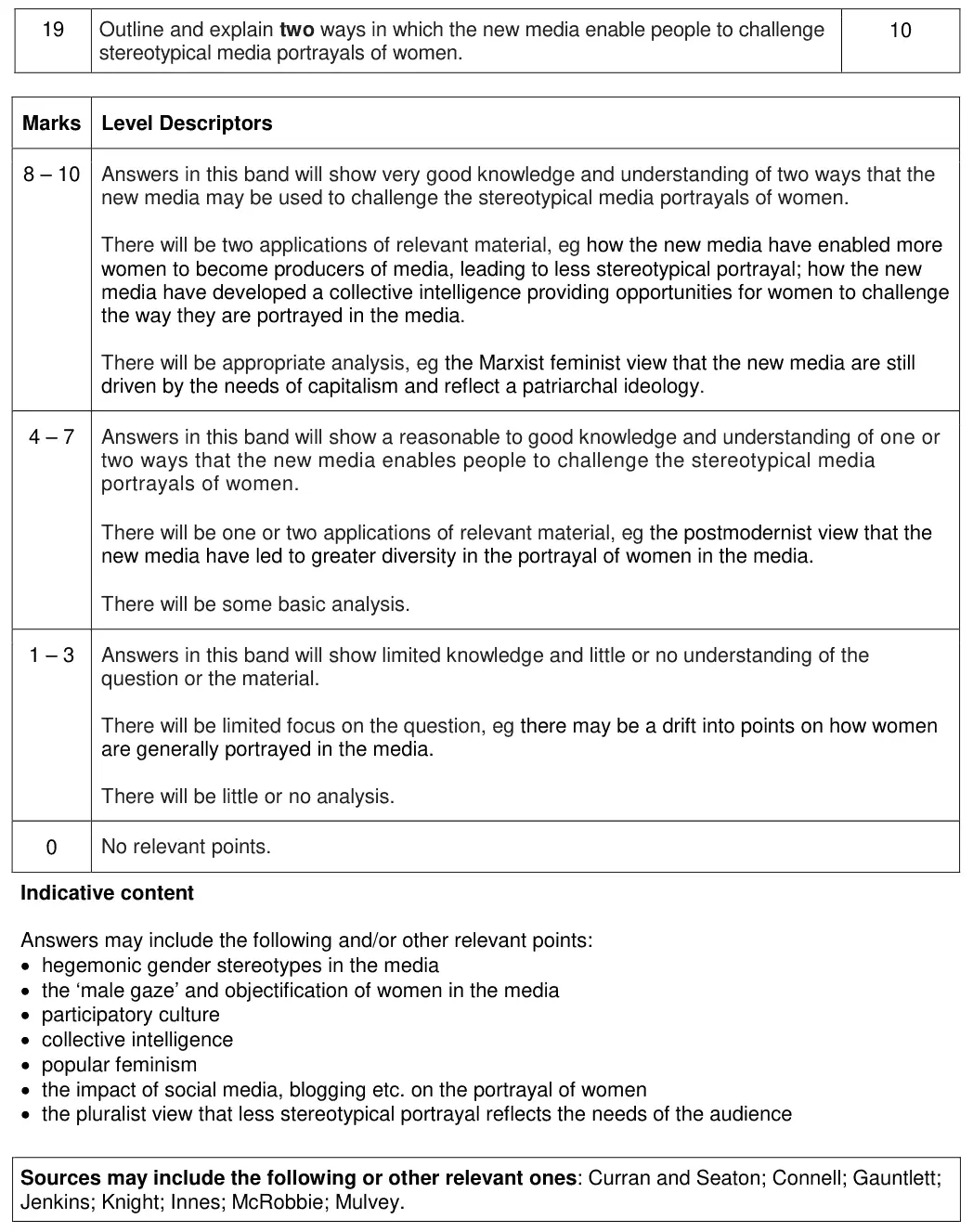
June 2019 · Paper 2 · Q1910 marksAO1=5, AO2=3, AO3=2Outline and explain
Mark scheme, including the levels grid and indicative content
Examiner's comment
Some students wrote introductory paragraphs and/or conclusions. These are not necessary, and are unlikely to gain additional marks; they also take up time. Some students made only one point in their answers, or three or more, rather than the two asked for. The word ‘two’ is put in bold in the question to try and draw students’ attention to this. Sometimes it was not clear how many points were being made. It is helpful for students to clearly indicate their two answers, with wording such as “One way is…” or by starting a new paragraph for their second point. Notably, some students wrote far more than was needed for a 10-mark response. The two types of 10-mark question, “outline and explain” and “analysis” types, are marked differently as the assessment objectives have different weightings. It is important that students are aware of this. In particular they should note that evaluation is not a requirement for answers to 10 mark “outline and explain” questions. For 10 mark “outline and explain” questions, students cannot rely on reciting knowledge; these questions will ask them to bring together aspects of their sociological knowledge of the topic in a way that they are unlikely to have done before. The best answers to 10-mark questions were focused, clearly stating a point and then developing it, and used sociological concepts, studies, evidence and theory as appropriate. While many students showed good knowledge of stereotypical media portrayals of women and of how they could be challenged, they were less clear on how the new media enabled challenges. Some presented two examples of new media platforms as different ‘ways’, and these could only be credited as one way.
Notes from the mark scheme and report
must explain how new media enable challenge, not just describe stereotyped portrayals of women (drift = 1–3)
two platforms making the same point count as one way
AO split from AQA's standard grid for this paper (this year's mark scheme does not print it).
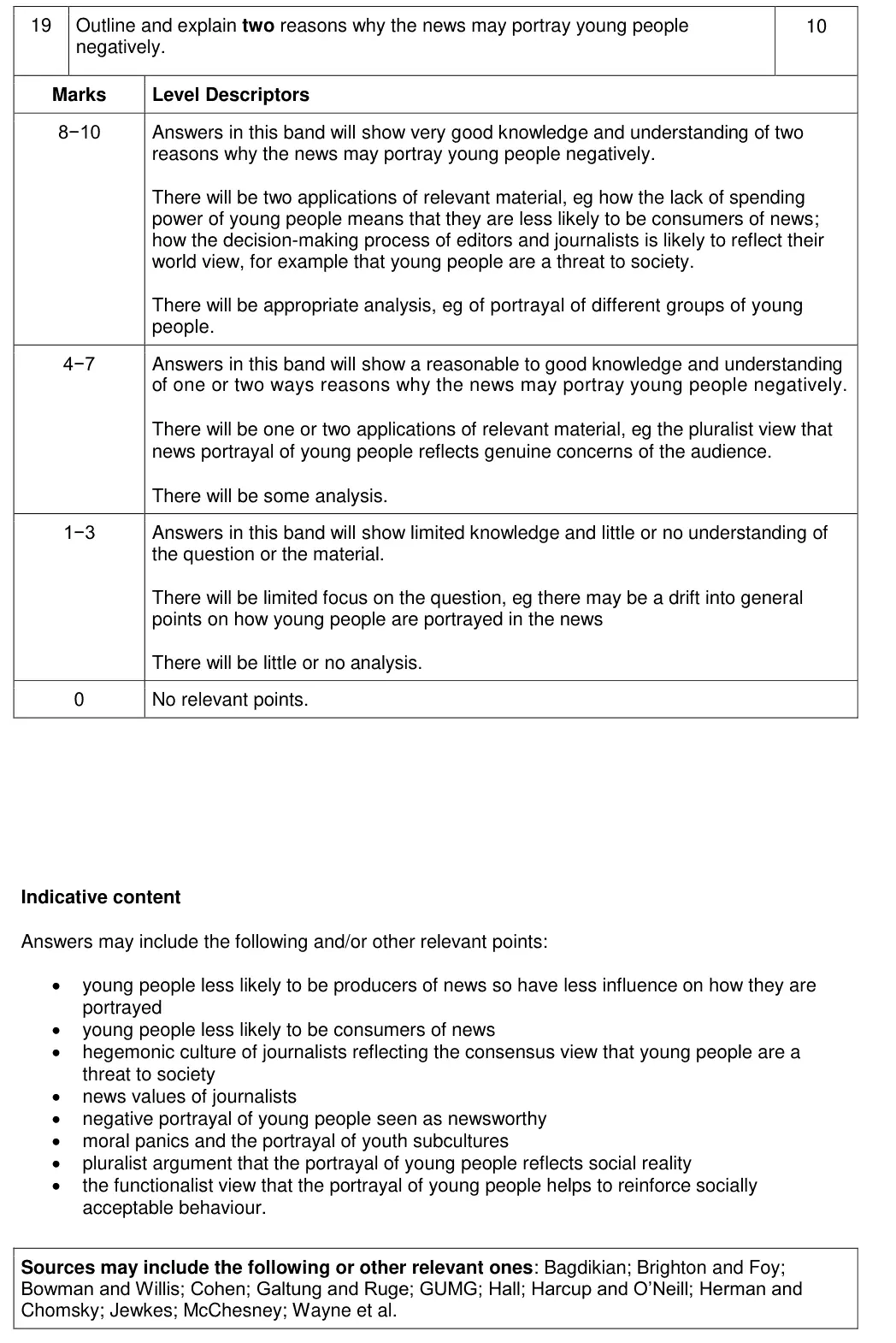
June 2018 · Paper 2 · Q1910 marksAO1=5, AO2=3, AO3=2Outline and explain
Mark scheme, including the levels grid and indicative content
Examiner's comment
Some students wrote introductory paragraphs and/or conclusions. These are not necessary, and are unlikely to gain additional marks, and they also take up time. Some students made only one point in their answers, or three or more, rather than the two asked for in the question. Sometimes it was unclear how many points were being made. It is helpful for students to clearly indicate their two answers, with wording such as “One way is…” or by starting a new paragraph for their second point. Evaluation is not a requirement for answers to 10 mark “outline and explain” questions. The marks awarded for the assessment objectives being targeted are different in the two types of ten mark questions, and students should be made aware of this. The best answers to 10 mark questions were focused, clearly stating a point and then developing it, using sociological concepts, evidence and theory where appropriate. In some questions students tended to focus on the first aspect of the question at the expense of the second. Students need guidance on how to approach these questions and how to best demonstrate their sociological understanding. The nature of these questions means that students cannot rely on reciting knowledge. These questions will ask them to bring together aspects of their sociological knowledge in a way that they are unlikely to have done before. Many answers chose to discuss moral panics, often drawing heavily on a description of Cohen’s mods and rockers, or other examples. Some, however, did not go beyond this to consider, for example, why young people in particular should tend to be cast as folk devils. Some good answers considered, for example, negative news values, the age of those controlling the media and the age of audiences, a reflection of reality linked to pluralism and functionalism’s need for boundary maintenance.
Notes from the mark scheme and report
two reasons for negative news portrayal of youth (e.g. young people not producers or consumers of news, journalists' hegemonic values, news values, moral panics, pluralist reflection of reality)
describing how youth are portrayed without explaining why = 1–3
many retold Cohen's mods and rockers without explaining why youth become folk devils
AO split from AQA's standard grid for this paper (this year's mark scheme does not print it).
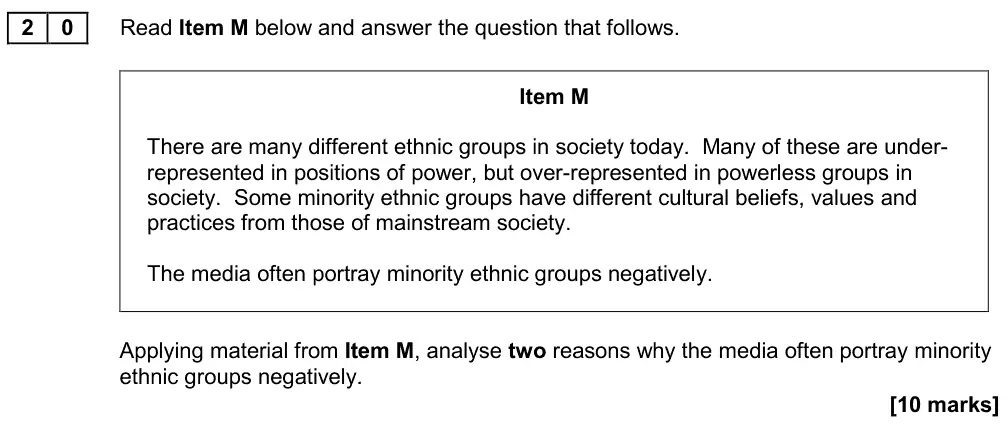
June 2017 · Paper 2 · Q2010 marksAO1=3, AO2=4, AO3=3Analyse
Mark scheme, including the levels grid and indicative content
Examiner's comment
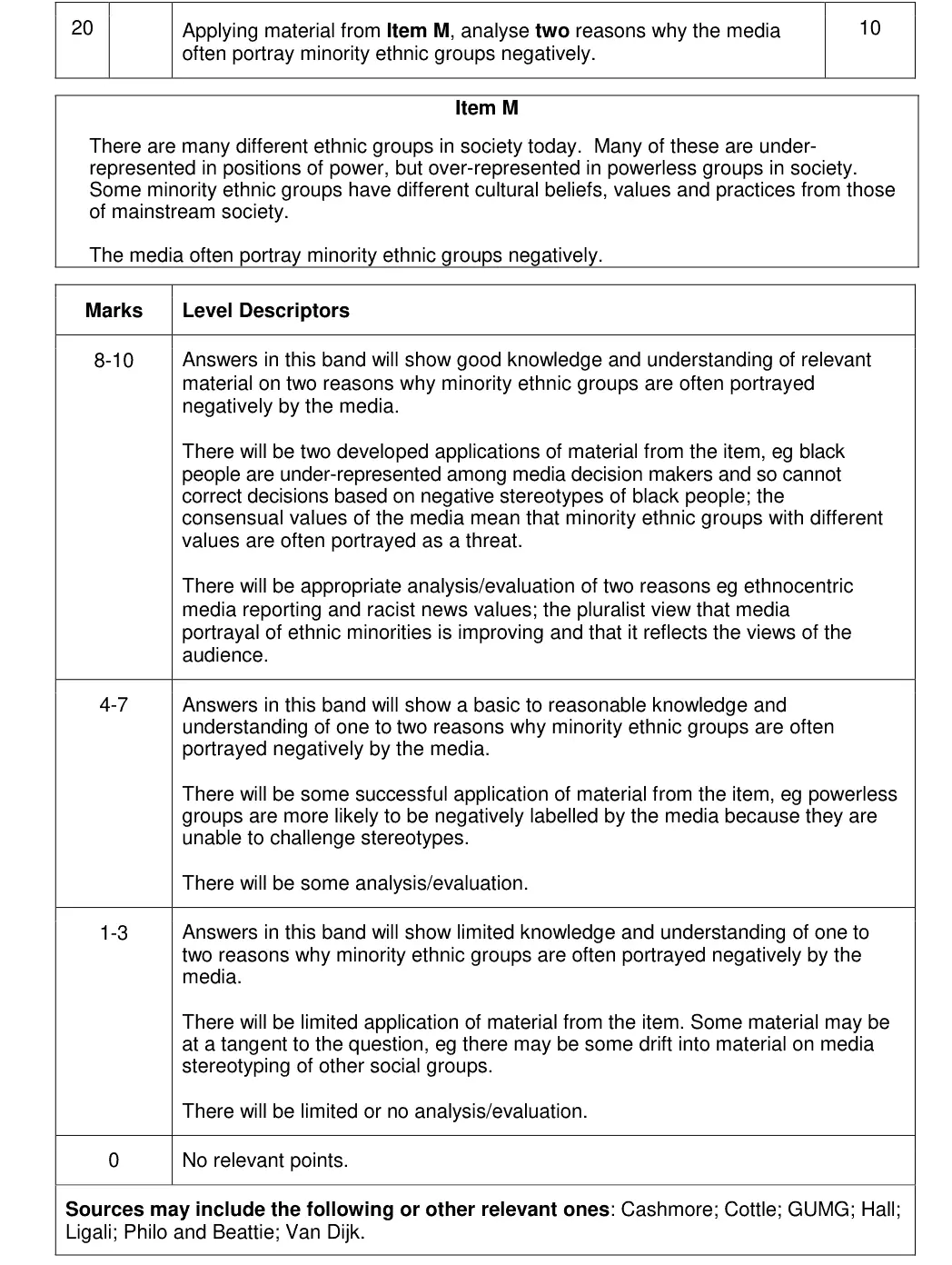
A number of students wrote introductory paragraphs and/or conclusions. These are not necessary, and are unlikely to gain additional marks. A number of students made only one point in their answer, or three or more, rather than the two asked for. In these cases, the two best answers were rewarded and will be in future series. It is helpful for students to clearly indicate their two answers, with wording such as “One way is…” or by starting a new paragraph for their second point. The assessment objective allocations are different in the two types of 10 mark questions, and students should be made aware of this. There was a wide range of responses to these questions. A minority of students wrote very brief answers. For these 10 mark items, a simple statement of two ways, reasons or factors, without development, is not sufficient to access more than the lower marks in the mark range. The best answers were focused, clearly stating a point and then developing it, with use of sociological concepts, evidence and theory where appropriate, in ways that demonstrated the skills expected from the targeted assessment objectives. There was a tendency, however, for many answers to focus on the first aspect of the question at the expense of the second. Students need guidance on how to approach these questions and how to best demonstrate their sociological understanding. The nature of these questions means that students cannot rely on reciting knowledge. They require students to bring together two aspects of their sociological knowledge in a way that they are unlikely to have done before. Answers will sometimes require claims that students may be unsure of because they do not know of specific evidence (for example, in question 5, whether migrants from Eastern Europe who are single workers tend to live alone or in shared households). However, answers that are sociologically plausible will be accepted. There was a tendency to simply describe examples of minority ethnic groups being portrayed in a negative way. The question asked for reasons for such portrayals with references in the item to power and to different cultures, beliefs and practices to guide students towards appropriate points to analyse. Popular appropriate answers included analytical points about the under-representation of minority ethnic groups amongst decision makers in the media and the media reflecting stereotypical views held by the majority audience.
Notes from the mark scheme and report
must give reasons, not describe negative portrayals
hooks: under-representation in power and different cultures/values
good answers: lack of minority decision makers, media reflecting the majority audience's stereotypes
drift into stereotyping of other groups = 1–3
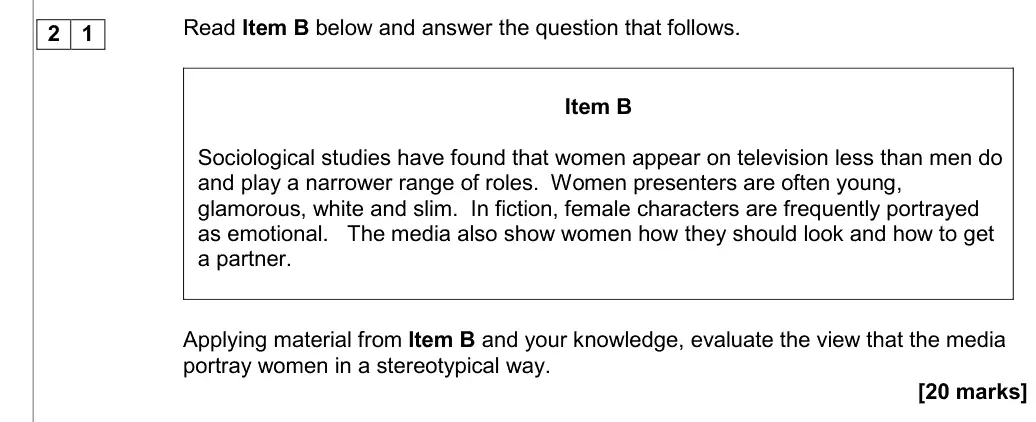
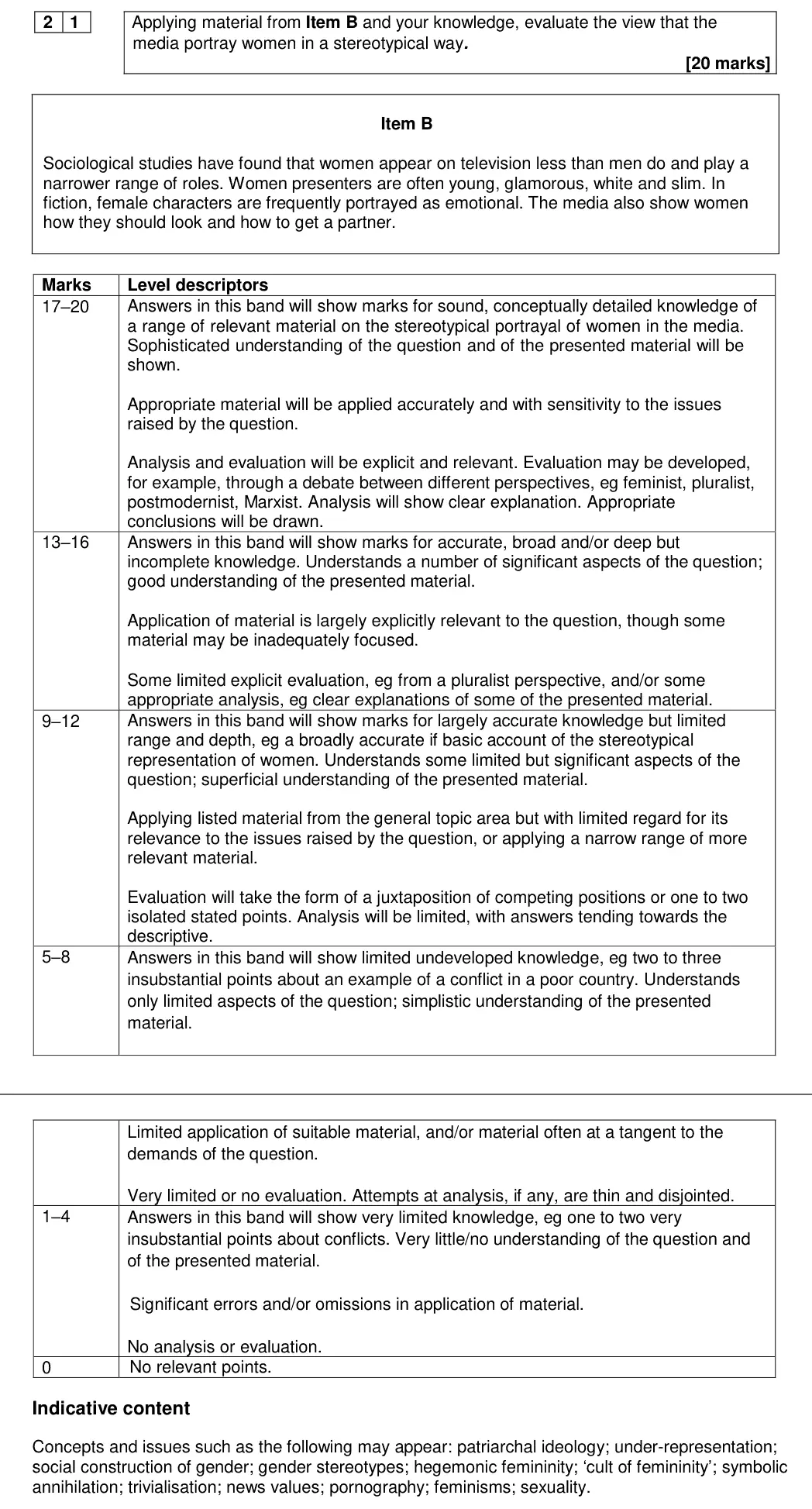
Specimen set 1 · Paper 2 · Q2120 marksAO1=8, AO2=6, AO3=620-mark essay
Mark scheme, including the levels grid and indicative content
Notes from the mark scheme and report
top band debates feminist, pluralist, postmodernist and Marxist views
misprint: the 5–8 and 1–4 descriptors refer to conflict in a poor country (copied from Q18)
Work with an AQA sociology tutor
Essays stuck in the middle band, or losing marks on the 10-markers? Book a trial lesson with Mark, a former AQA examiner.