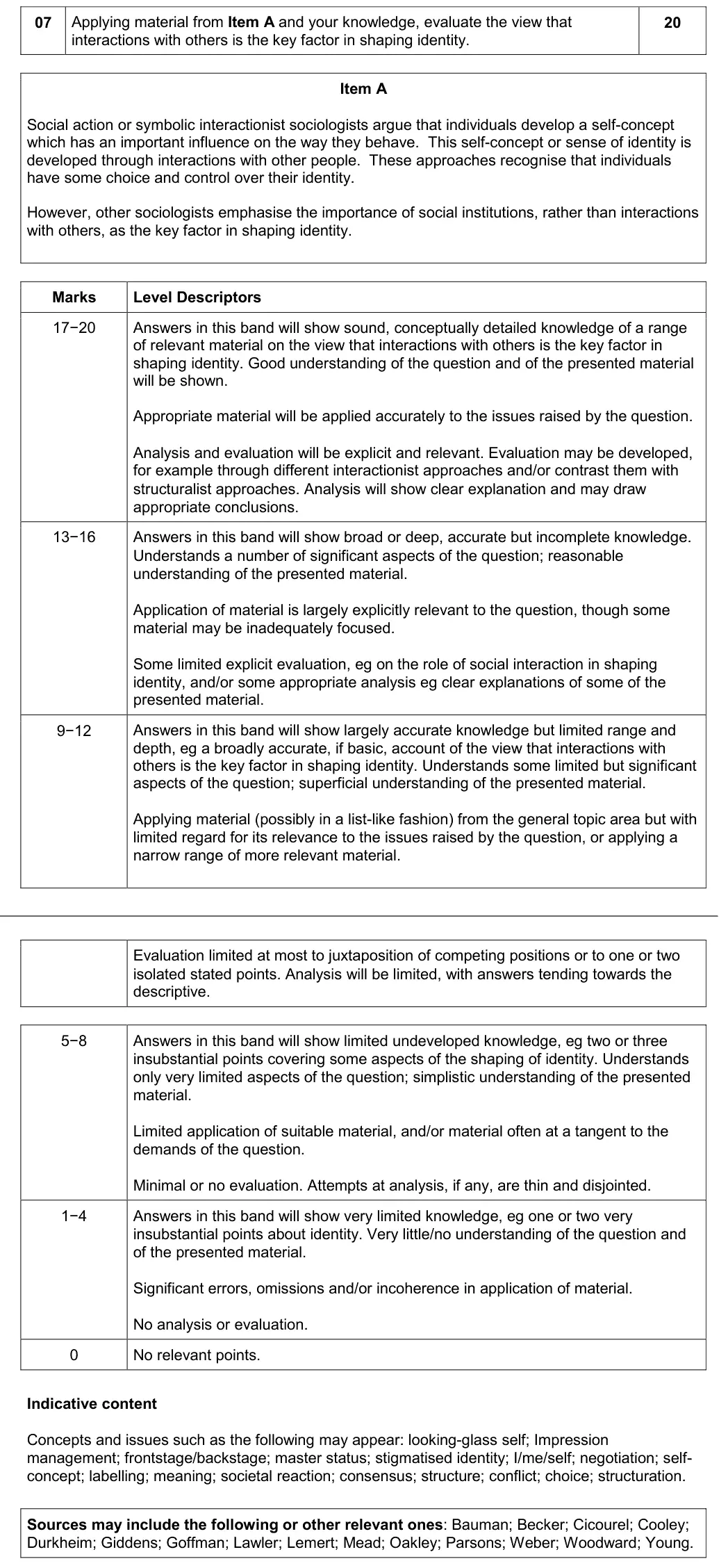
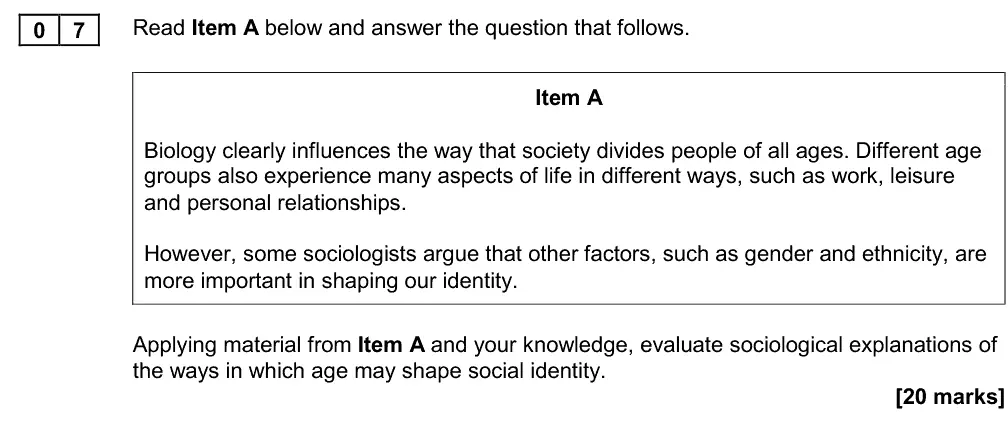
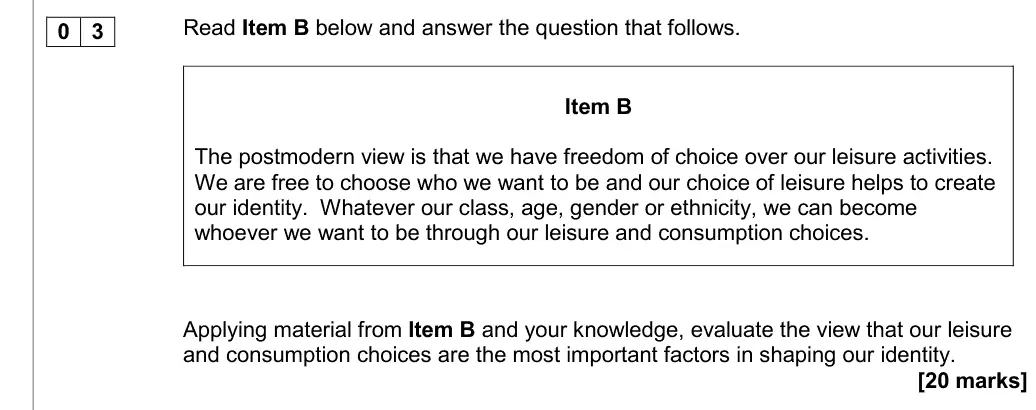
Applying material from Item B and your knowledge, evaluate the view that our leisure and consumption choices are the most important factors in shaping our identity.
Tap a question to zoom it. The mark scheme (with the level descriptors and indicative content) and the examiner's comment open underneath.
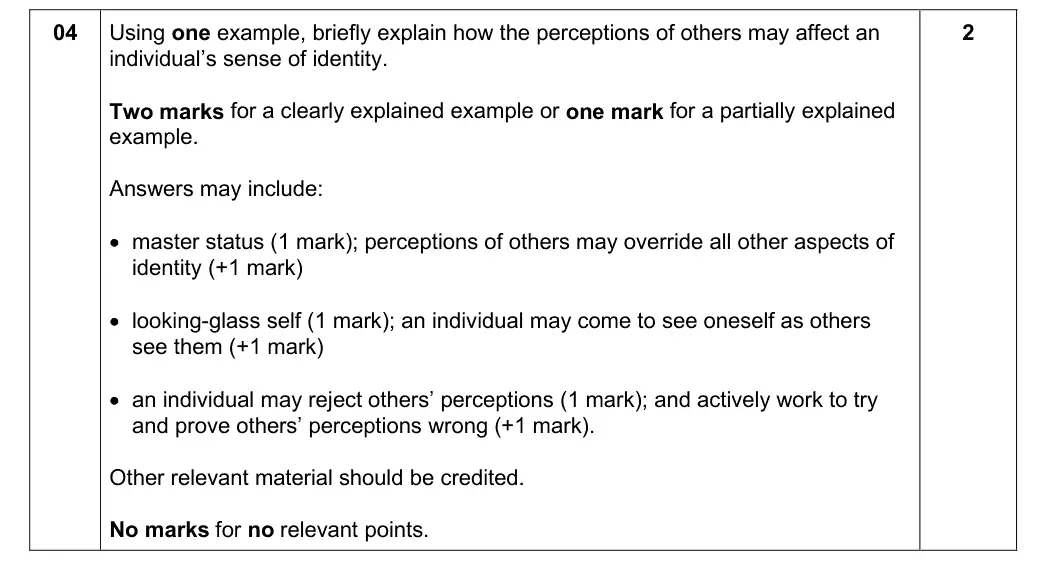
June 2025 · AS Paper 2 · Q42 marksAO2=2Brief explain
Mark scheme
Examiner's comment
This question was successfully answered by most students. Popular approaches involved using aspects of interactionist theory labelling or the looking glass self to gain credit.
labelling and looking-glass self were popular and successful
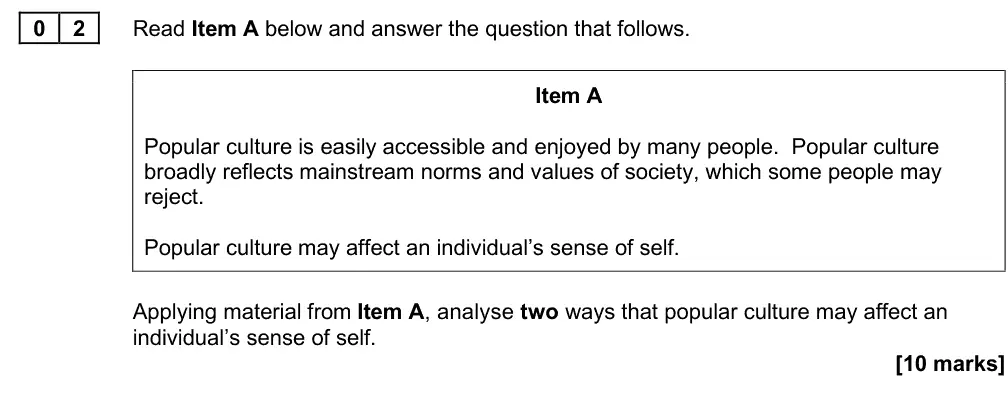
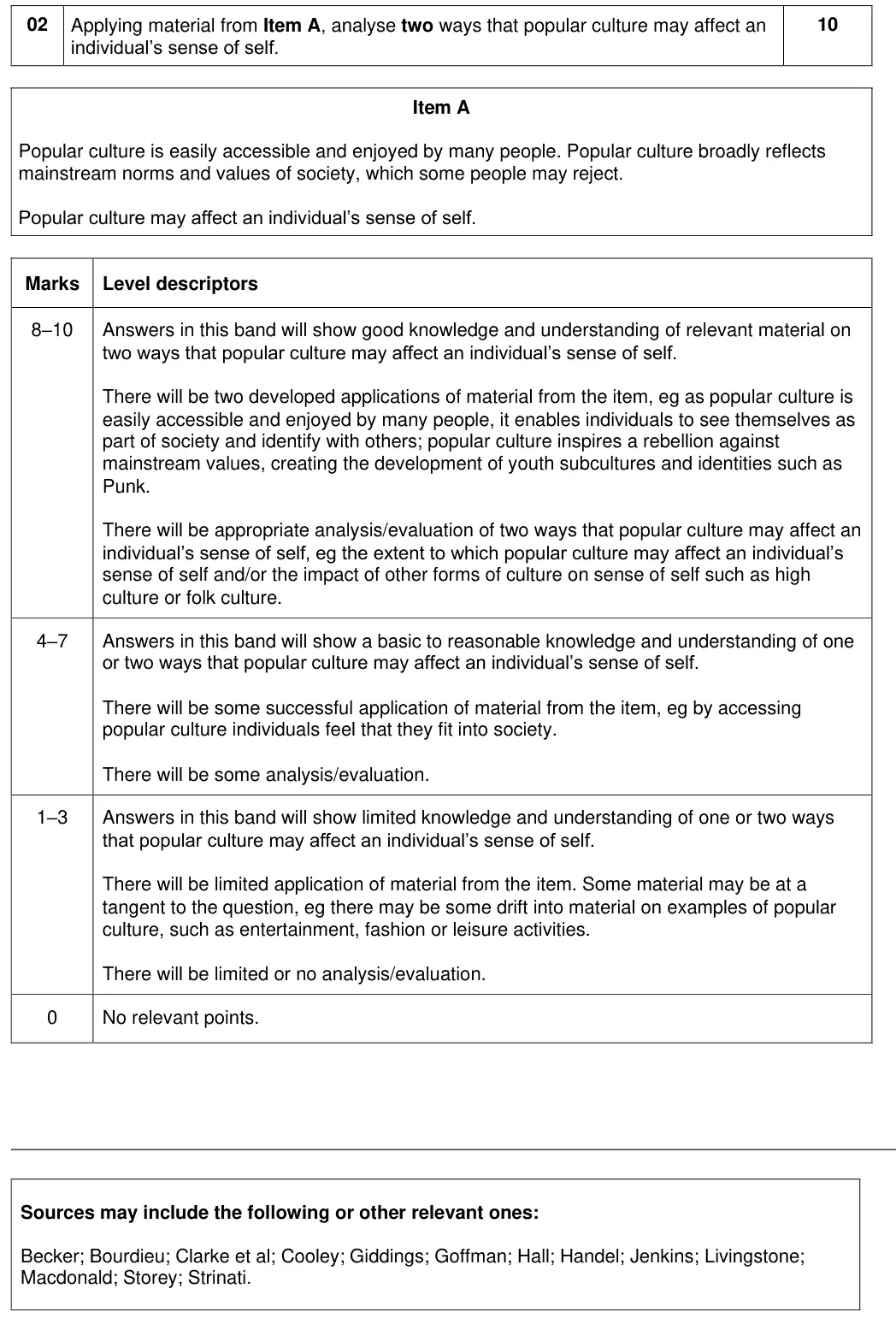
June 2024 · Paper 2 · Q210 marksAO1=3, AO2=4, AO3=3Analyse
Mark scheme, including the levels grid and indicative content
Examiner's comment
The nature of these questions means that students cannot rely on reciting knowledge. Questions will ask them to bring together aspects of their sociological knowledge in ways they will not have done before. It is therefore important for students to allow time to think about how to answer the question. Students should be made aware that there are two types of 10 mark questions. These have different requirements and different mark schemes . There are different marks available for the assessment objectives. A breakdown of the marks awarded by assessment objective can be found in the mark scheme. The items for 10 mark “analyse” questions are written to give prompts or “hooks” for student answers. These have to be used to access application marks. Answers can indicate use of hooks by quoting, by a reference in parentheses or by wording ( eg “As the item says…”). Items end with a sentence restating the question; the hooks are in the preceding part of the item. Students should avoid writing all they know about a “hook”, and focus on applying the idea to the question. Introductions and conclusions are not required for 10 mark questions; they take up time and rarely improve the mark. It is helpful if answers are set out to clearly indicate the two answers, with wording such as “One way/reason is…”, or by starting a new paragraph for the second point. Answers that give more than two points are unlikely to develop two of them sufficiently. Q2: Many students were able to suggest two ways derived from the “hooks” in the item. Not all suggestions were fully developed in relation to the individual’s sense of self. Many students discussed how people reject popular culture through youth subcultures and drew on concepts like hegemony. Answers that included Marxist and postmodernist perspectives provided more comprehensive analyses and evaluations.
Notes from the mark scheme and report
two developed applications from Item A (accessible and widely enjoyed
reflects mainstream values some reject), e.g. identifying with others and fitting in, rebellion through youth subcultures such as punk
drift into examples of popular culture (fashion, entertainment) is a tangent
ways not always developed back to sense of self
good use of hegemony
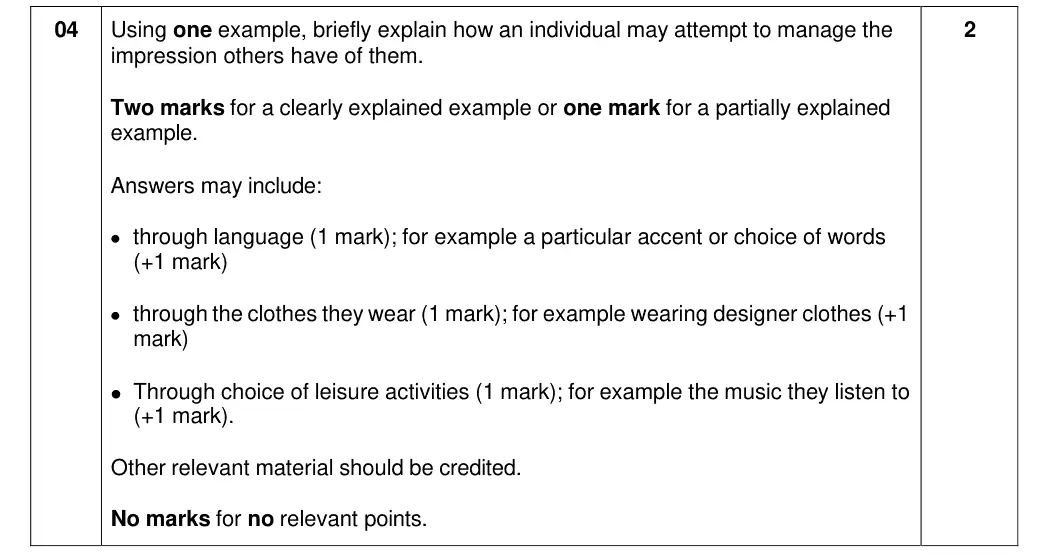
June 2024 · AS Paper 2 · Q42 marksAO2=2Brief explain
Mark scheme
Examiner's comment
This question was successfully answered by most students. Popular approaches involved using aspects of interactionist theory backstage / frontstage for example. Choice of leisure activities and clothes / fashion were also popular and successful approaches.
Notes from the mark scheme and report
2 marks for a clearly explained example (e.g. language, clothes, leisure choices) with how it shapes the impression given
front-stage/back-stage ideas popular and credited
June 2023 · AS Paper 2 · Q32 marksAO1=2Define
Mark scheme
Examiner's comment
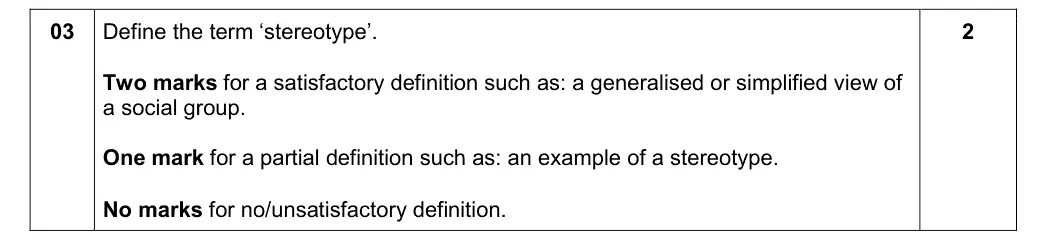
The majority of answers were able to manage the notion of a stereotype as applying to a group and being generalised. Labelling of a group was one common way this was done. If only the group or the generalised aspect was featured in the answer a partial mark was given.
Notes from the mark scheme and report
2 marks for a generalised or simplified view of a social group
1 for only an example, or for only the group or only the generalised aspect
June 2023 · Paper 2 · Q320 marksAO1=8, AO2=6, AO3=620-mark essay
Mark scheme, including the levels grid and indicative content
Examiner's comment
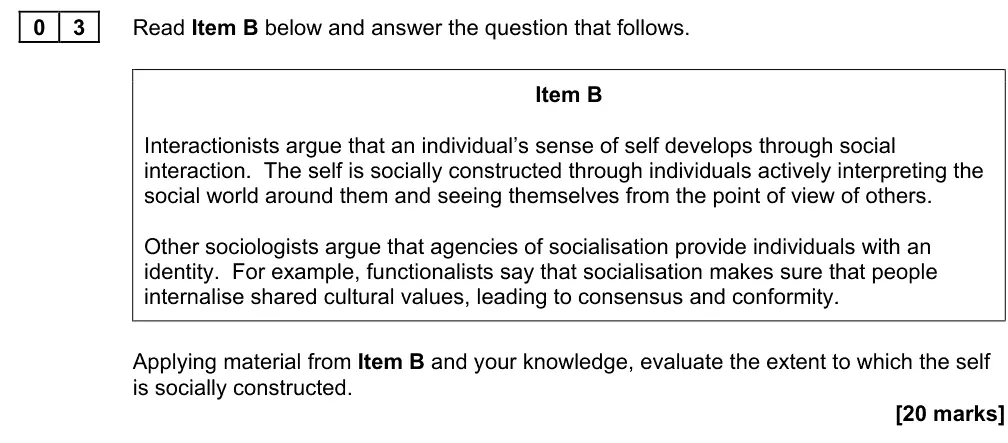
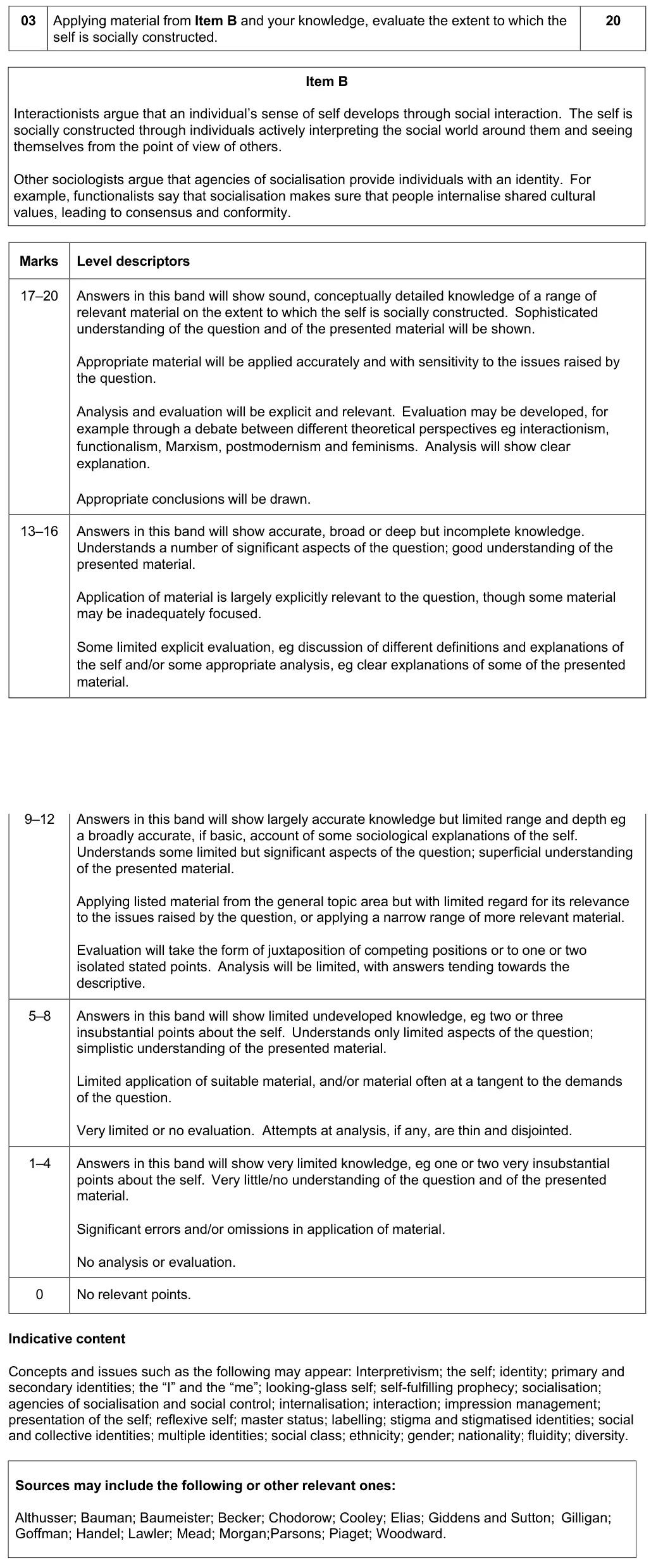
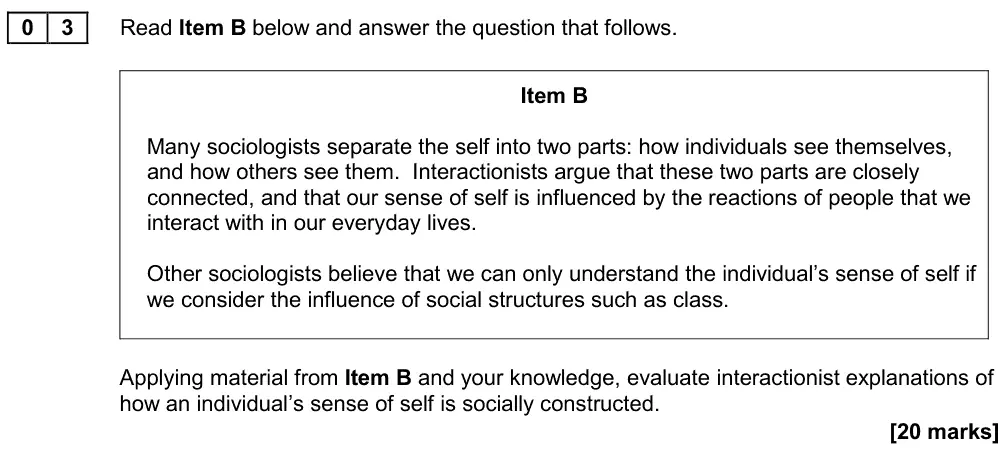
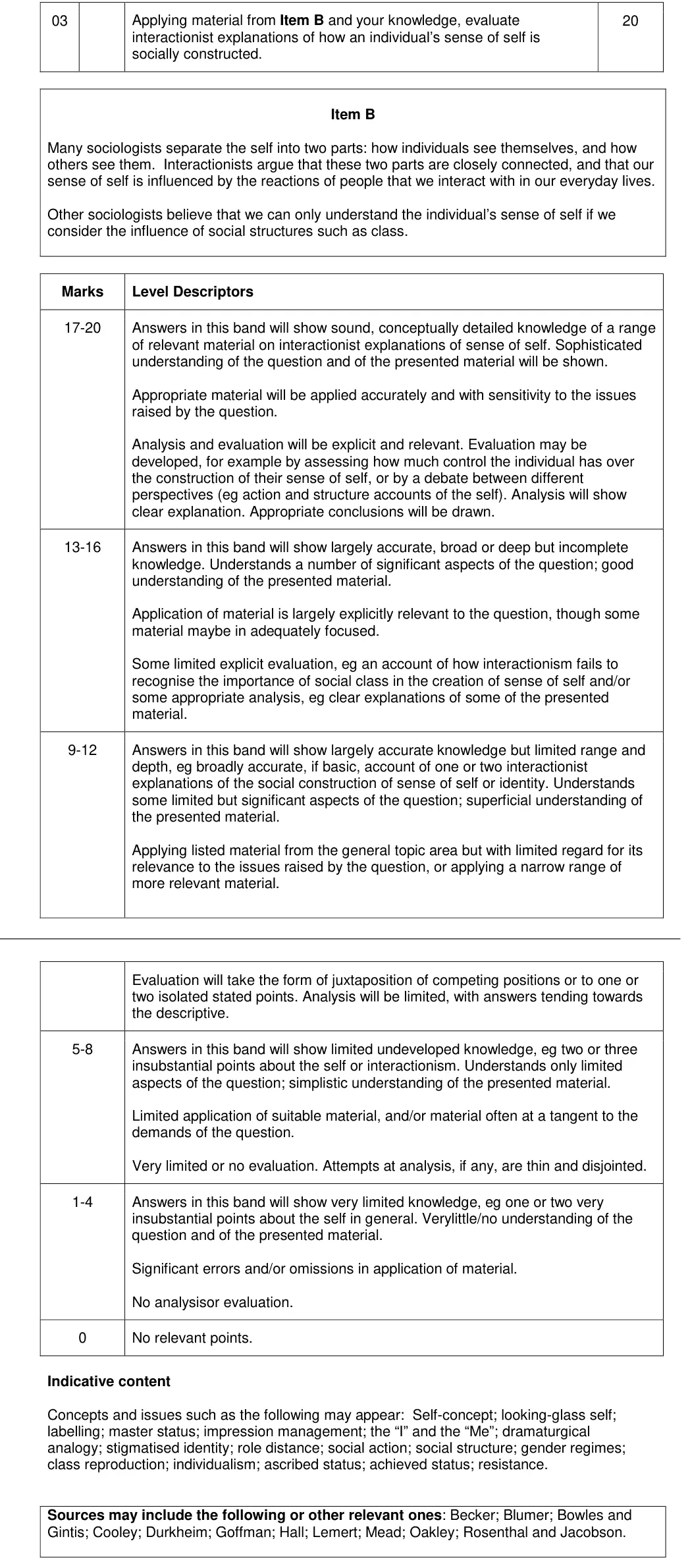
The purpose of the items for these questions is to suggest a few starting points for students, including ways into evaluation. Students are expected to also bring in further ideas (“and your knowledge” in the instruction). A wide range of material can be relevant to these questions, so students need to be selective. It is more effective to cover a limited number of views/theories in depth rather than to include every possible theory. Students who made essay plans appeared to benefit by having more structured and coherent responses. Question 3: This produced some good answers. Most were aware of sociological ideas about the self and interpretivism. They were also able to evaluate using Marxism and other theories.
Notes from the mark scheme and report
top band debates interactionism, functionalism, Marxism, postmodernism and feminisms on how far the self is socially constructed
most knew interactionist ideas of the self and evaluated with Marxism and other theories
June 2023 · AS Paper 2 · Q56 marksAO1=6Outline
Mark scheme
Examiner's comment
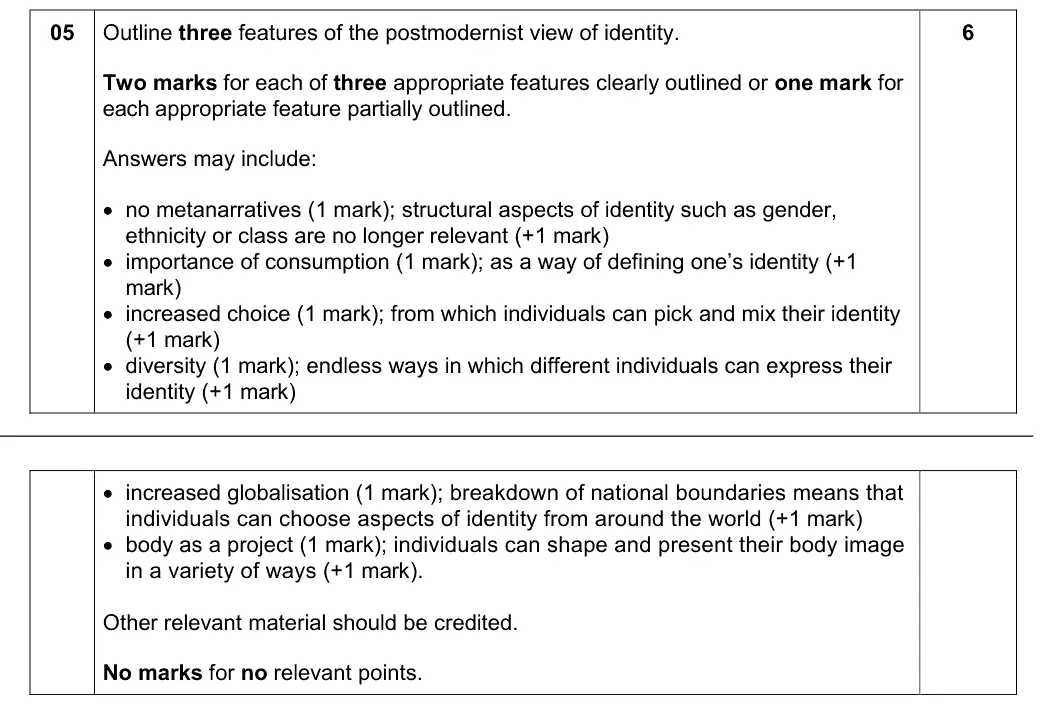
The ‘outline three’ 6 mark question (the third question in every topic area). Students could easily improve outcomes on this question by realising the need to briefly (eg a line or so) expand upon the criticism / feature etc being outlined. Many students struggled with this question, with the discriminating factor being whether the students had any knowledge of postmodernism or not. Those that did were able to use a wide variety of features such as pick and mix / increased choice / hybridity etc to gain credit – the mark scheme was quite generous here. It is worth noting that the students who did this and did not receive full marks mostly did not add a line or so to explain the meaning of the feature so leaving the point undeveloped. If this was the case they received a partial mark.
Notes from the mark scheme and report
2 marks for each of three features clearly outlined, 1 if partial (e.g. no metanarratives, consumption, pick and mix choice, diversity, globalisation, body as project)
the deciding factor was whether students knew postmodernism at all
listing a feature without a line of explanation gets 1 mark
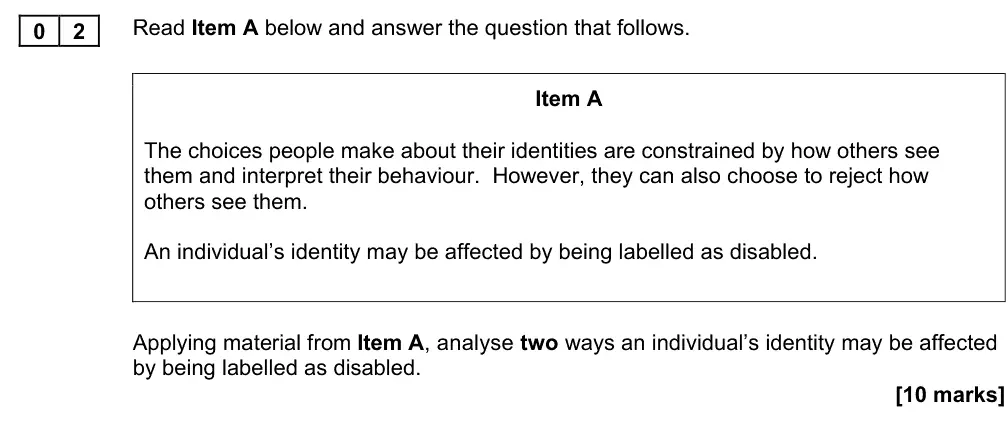
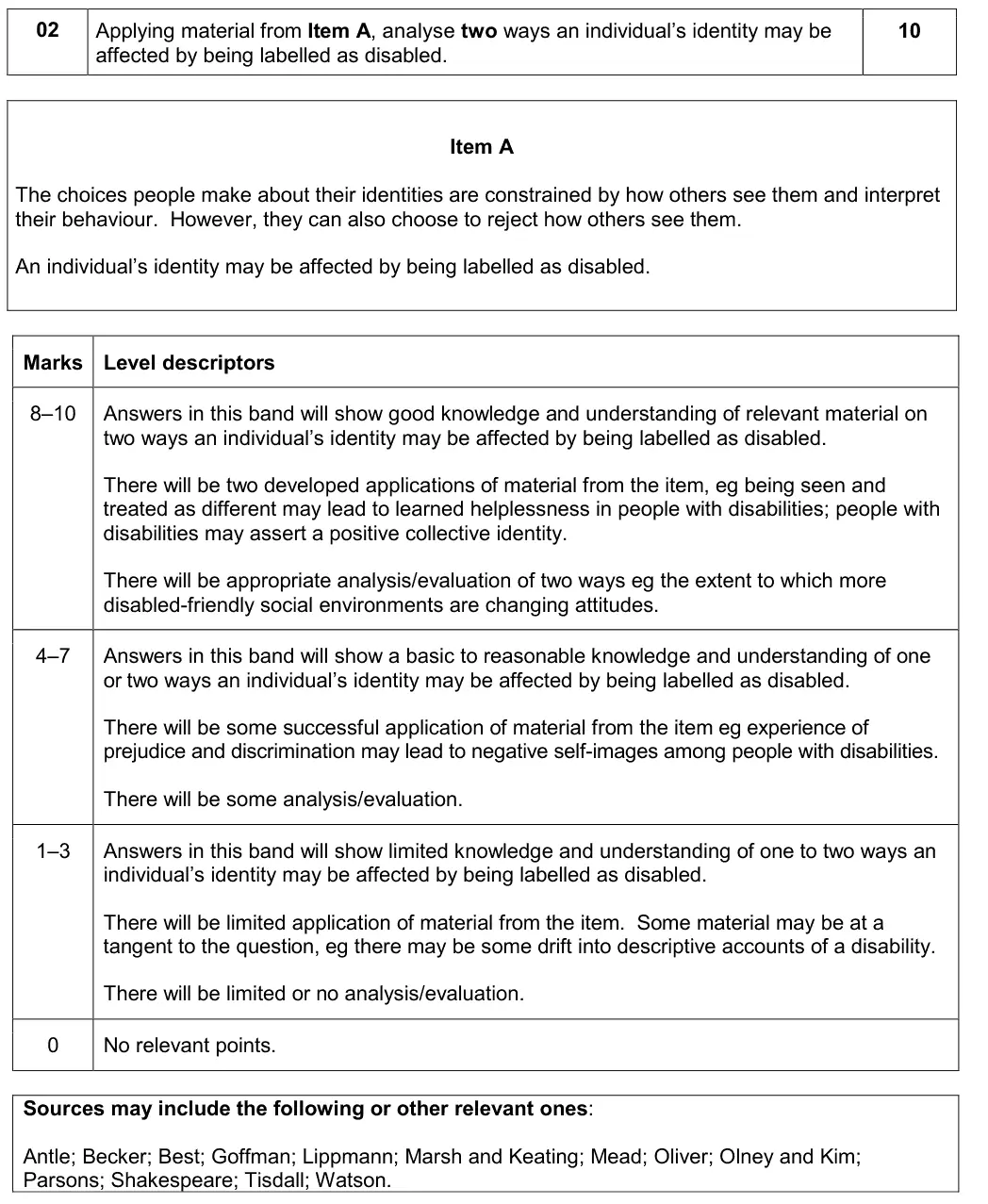
November 2021 · Paper 2 · Q210 marksAO1=3, AO2=4, AO3=3Analyse
Mark scheme, including the levels grid and indicative content
Notes from the mark scheme and report
must develop hooks from Item A (identity constrained by how others see us
choosing to reject that view)
the last line restates the question and is not a hook
credited: learned helplessness or negative self-image from being treated as different, asserting a positive collective disabled identity
descriptive accounts of a disability = 1–3
no examiners' report comment for this part
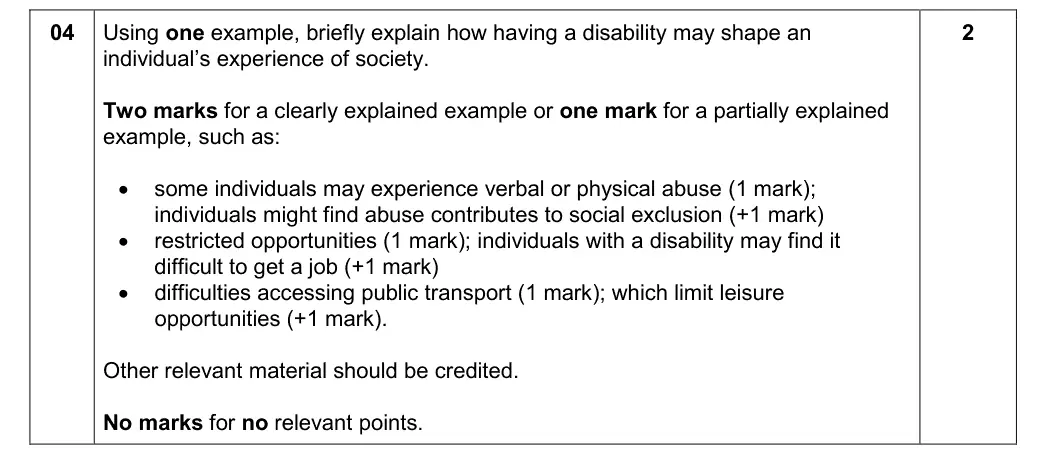
November 2020 · AS Paper 2 · Q42 marksAO2=2Brief explain
Mark scheme
Notes from the mark scheme and report
1 mark for a way disability shapes experience (abuse, restricted job opportunities, transport access), +1 for its consequence (e.g. social exclusion, limited leisure)
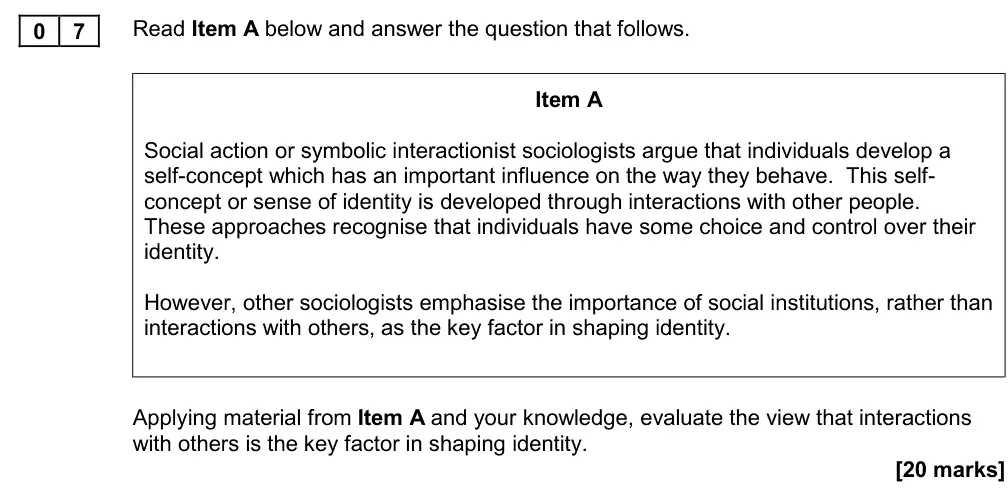
November 2020 · AS Paper 2 · Q720 marksAO1=8, AO2=6, AO3=620-mark essay
Mark scheme, including the levels grid and indicative content
Notes from the mark scheme and report
top band evaluates through different interactionist approaches and/or contrasts them with structural approaches stressing institutions
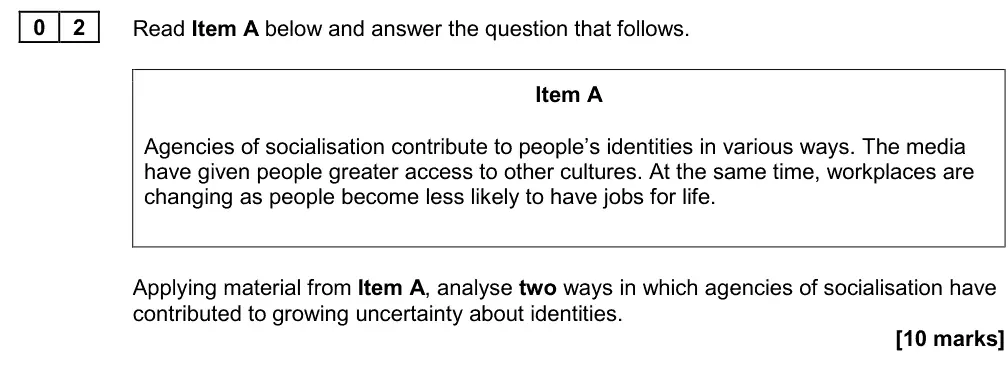
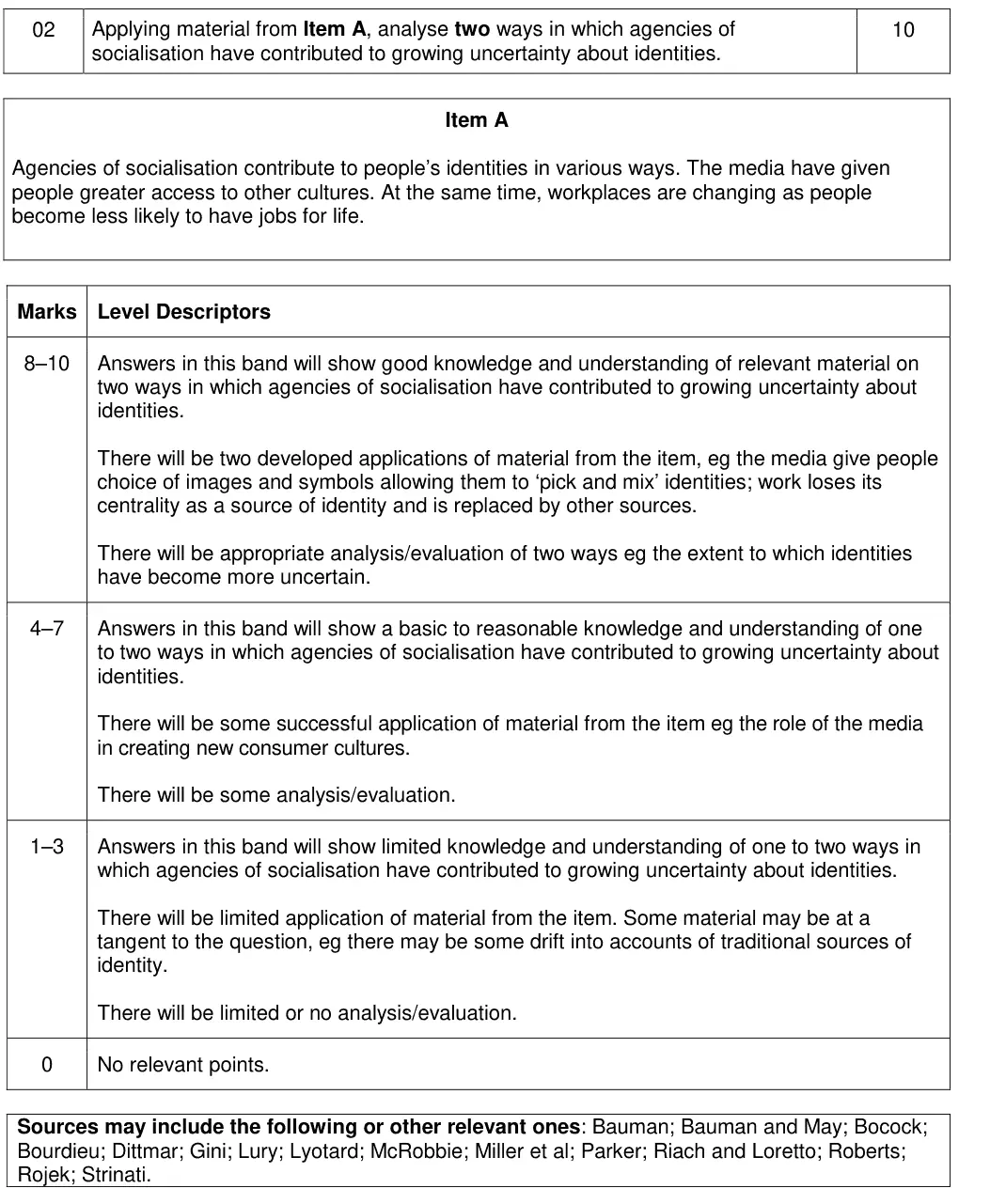
June 2019 · Paper 2 · Q210 marksAO1=3, AO2=4, AO3=3Analyse
Mark scheme, including the levels grid and indicative content
Examiner's comment
Some students wrote introductory paragraphs and/or conclusions. These are not necessary, and are unlikely to gain additional marks; they also take up time. Some students made only one point in their answers, or three or more, rather than the two asked for. The word ‘two’ is put in bold in the question to try and draw students’ attention to this. Sometimes it was not clear how many points were being made. It is helpful for students to clearly indicate their two answers, with wording such as “One way is…” or by starting a new paragraph for their second point. Notably, some students wrote far more than was needed for a 10-mark response. The two types of 10-mark question, “outline and explain” and “analysis” types, are marked differently as the assessment objectives have different weightings. It is important that students are aware of this. For 10 mark “analyse” questions, the parts of the item being used should be clearly indicated, preferably by exact words being quoted. It is acceptable for two different points to be drawn from one part of the item, but answers which do not use the item cannot access the application marks. The best answers to 10-mark questions were focused, clearly stating a point and then developing it, and used sociological concepts, studies, evidence and theory as appropriate. Most students were able to give two ways in which agencies of socialisation have contributed to growing uncertainty about identities. To be successful, answers needed to discuss the role played in this by the agencies named in the item: the media, and the workplace. A small number of answers focused instead on other agencies, and could not get application marks. Popular responses included ‘pick and mix’ or ‘hybrid identities’ and ‘masculinity’ in workplaces.
Notes from the mark scheme and report
must use the agencies named in the item (media, workplace)
answers built on other agencies could not gain application marks
drift into traditional sources of identity = 1–3
popular answers: pick-and-mix or hybrid identities, changing masculinity at work
AO split from AQA's standard grid for this paper (this year's mark scheme does not print it).
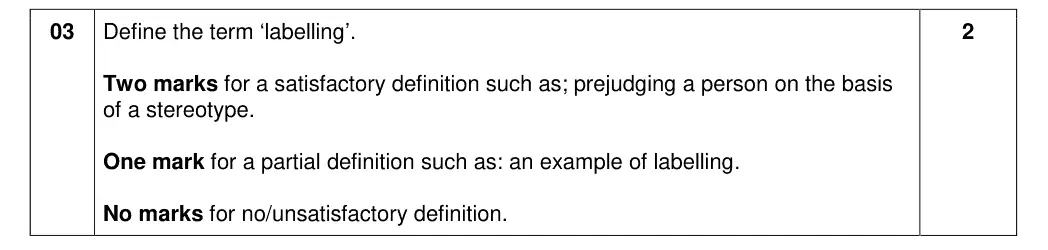
June 2019 · AS Paper 2 · Q32 marksAO1=2Define
Mark scheme
Examiner's comment
The majority of answers were able to explain labelling with reference to stereotyping based on some characteristic of an individual or group. A minority of students explained labelling in terms of being labelled and subsequently failed to score any marks.
Notes from the mark scheme and report
AO grid not printed
2 marks: prejudging a person on the basis of a stereotype
an example of labelling only = 1 mark
most linked it to stereotyping by some characteristic
defining it as 'being labelled' scored nothing
AO split from AQA's standard grid for this paper (this year's mark scheme does not print it).
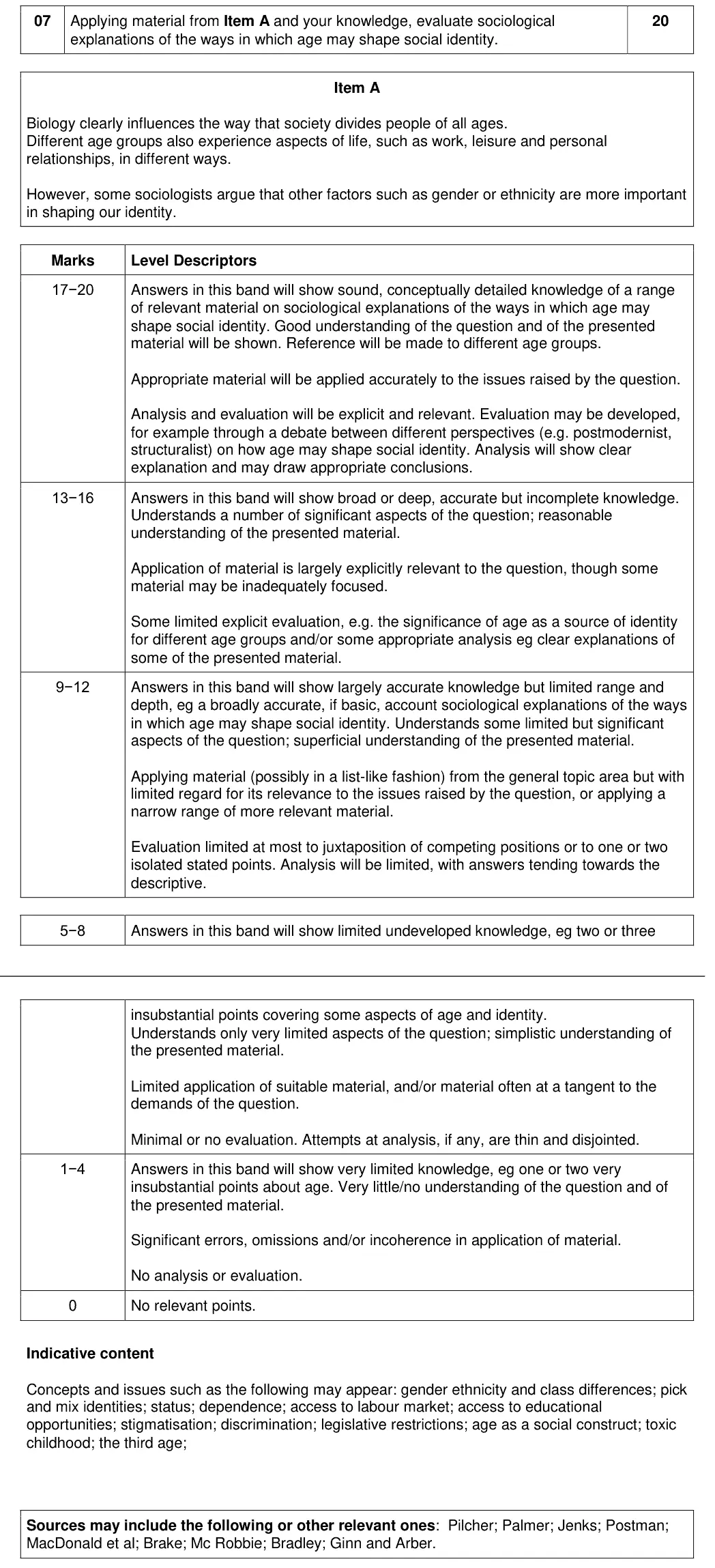
June 2019 · AS Paper 2 · Q720 marksAO1=8, AO2=6, AO3=620-mark essay
Mark scheme, including the levels grid and indicative content
Examiner's comment
The majority of students seemed unprepared for this question. The most common response was to outline some stereotypical statements about old people and leisure activities, and then move on to gender and ethnicity. Very few students were able to provide a theoretical structure to their answer in relation to age and identity. Many students assumed that age meant old age and limited their responses accordingly. Relatively few answers covered more than one age group. Successful answers often discussed age and identity in relation to work and retirement, as well as notions of status and dependence. Some excellent responses were able to explore the significance of age for identity at different stages of people’s life cycle.
Notes from the mark scheme and report
AO grid not printed
must apply Item A
top band refers to different age groups and may debate postmodernist vs structuralist views
many treated age as old age only and drifted into gender and ethnicity
best answers used work, retirement, status and dependence across the life course
AO split from AQA's standard grid for this paper (this year's mark scheme does not print it).
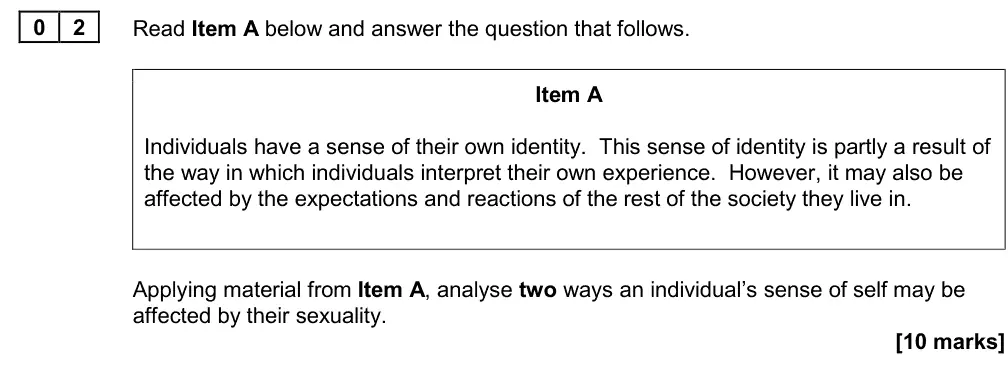
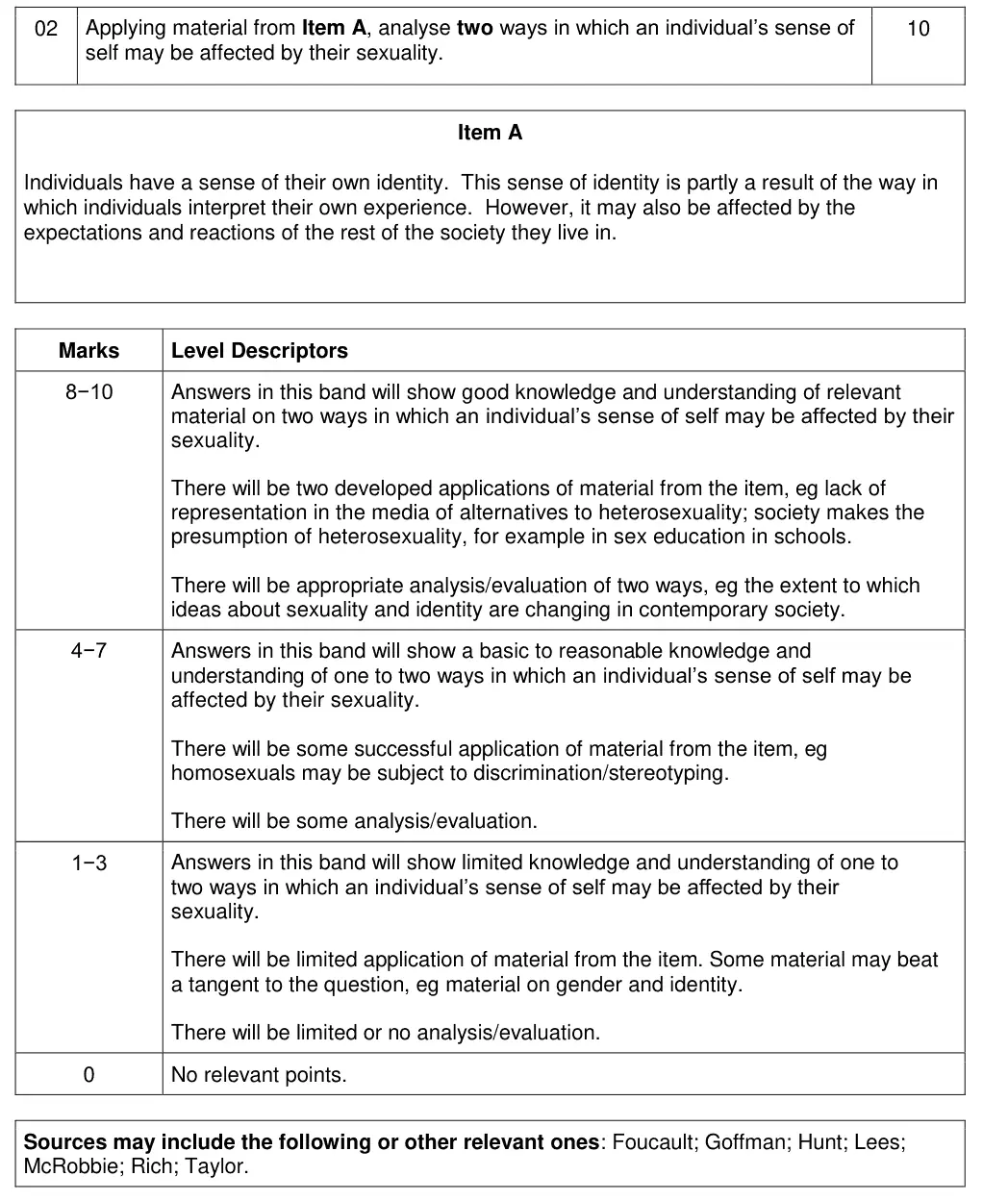
June 2018 · Paper 2 · Q210 marksAO1=3, AO2=4, AO3=3Analyse
Mark scheme, including the levels grid and indicative content
Examiner's comment
Some students wrote introductory paragraphs and/or conclusions. These are not necessary, and are unlikely to gain additional marks, and they also take up time. Some students made only one point in their answers, or three or more, rather than the two asked for in the question. Sometimes it was unclear how many points were being made. It is helpful for students to clearly indicate their two answers, with wording such as “One way is…” or by starting a new paragraph for their second point. Evaluation is not a requirement for answers to 10 mark “outline and explain” questions. The marks awarded for the assessment objectives being targeted are different in the two types of ten mark questions, and students should be made aware of this. The best answers to 10 mark questions were focused, clearly stating a point and then developing it, using sociological concepts, evidence and theory where appropriate. In some questions students tended to focus on the first aspect of the question at the expense of the second. Students need guidance on how to approach these questions and how to best demonstrate their sociological understanding. The nature of these questions means that students cannot rely on reciting knowledge. These questions will ask them to bring together aspects of their sociological knowledge in a way that they are unlikely to have done before. Most students were able to give two ways in which an individual’s sense of self may be affected by their sexuality. Most focused on homosexuality with only a minority considering, for example, the connection between heterosexuality and hegemonic masculinities. There was some overlap between the ‘ways’ suggested by the item. For example, labelling and stigmatised identity, although different (and so two different ‘ways’), can be part of a reflexive process. Evaluation using these ideas featured in some of the best answers.
Notes from the mark scheme and report
two developed applications from Item A (self-interpretation vs others' expectations and reactions), e.g. media under-representation, presumption of heterosexuality
drift into gender and identity is a tangent
most focused only on homosexuality, few linked heterosexuality to hegemonic masculinity
best used labelling/stigma and reflexivity evaluatively
AO split from AQA's standard grid for this paper (this year's mark scheme does not print it).
June 2018 · AS Paper 2 · Q32 marksAO1=2Define
Mark scheme
Examiner's comment
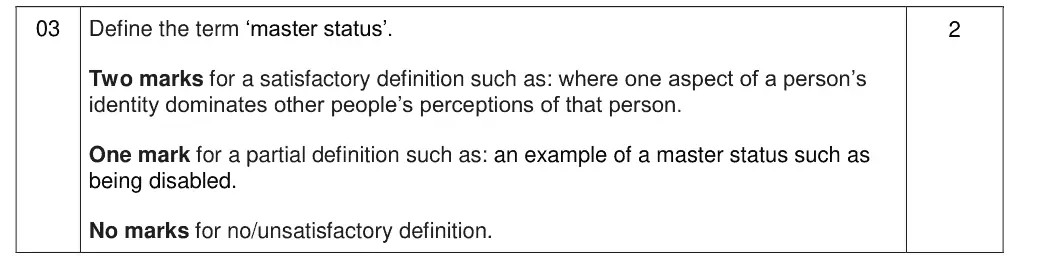
The majority of answers were able to explain master status with reference to an aspect of a person’s identity that dominates other people’s perception of that person. Some students were unfamiliar with the concept and thought it was something to do with social hierarchy.
Notes from the mark scheme and report
2 marks for one aspect of identity dominating how others see the person
an example (e.g. being disabled) = 1 mark
most defined it well
some thought it was about social hierarchy
AO split from AQA's standard grid for this paper (this year's mark scheme does not print it).
June 2017 · Paper 2 · Q320 marksAO1=8, AO2=6, AO3=620-mark essay
Mark scheme, including the levels grid and indicative content
Examiner's comment
Many scripts had one substantial, well developed answer to a 20 mark question and one significantly briefer one, again suggesting problems with time management. It is often the case that a wide range of material can be relevant to these questions, and students will need to be selective. For example, it may be more effective to cover a limited number of views or theories in some depth, rather than to include every possible theory. There was a tendency for answers to progressively lose sight of the question and to become a list of different views. The best answers will address all aspects of the question and will draw on theories, concepts and empirical examples or evidence. Evaluation which meets the demands of the questions is better than points of criticism which have been learned and included, regardless of the specific question that has been set. Students should also be aware that evaluation includes awareness of the strengths, as well as the weaknesses, of an argument or theory. Some answers showed an impressive understanding of interactionism, often through the ideas of Mead, Cooley and Goffman, and were able to compare the approach with structural and other perspectives. A minority of students showed very limited knowledge or relied on what they knew of interactionism from studying other topics.
Notes from the mark scheme and report
top band evaluates how much control individuals have over the self, or action vs structure accounts (hook: structures such as class)
best answers used Mead, Cooley, Goffman and compared with structural views
weaker answers knew little interactionism beyond other topics
June 2017 · AS Paper 2 · Q720 marksAO1=8, AO2=6, AO3=620-mark essay
Mark scheme, including the levels grid and indicative content
Examiner's comment
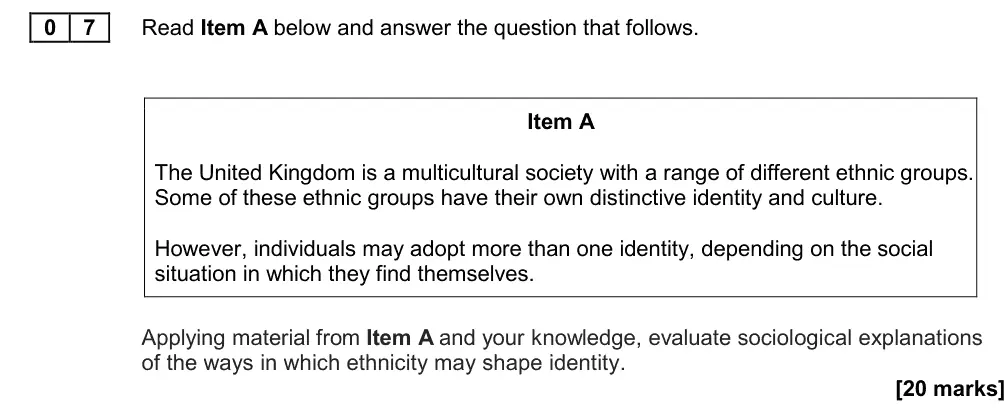
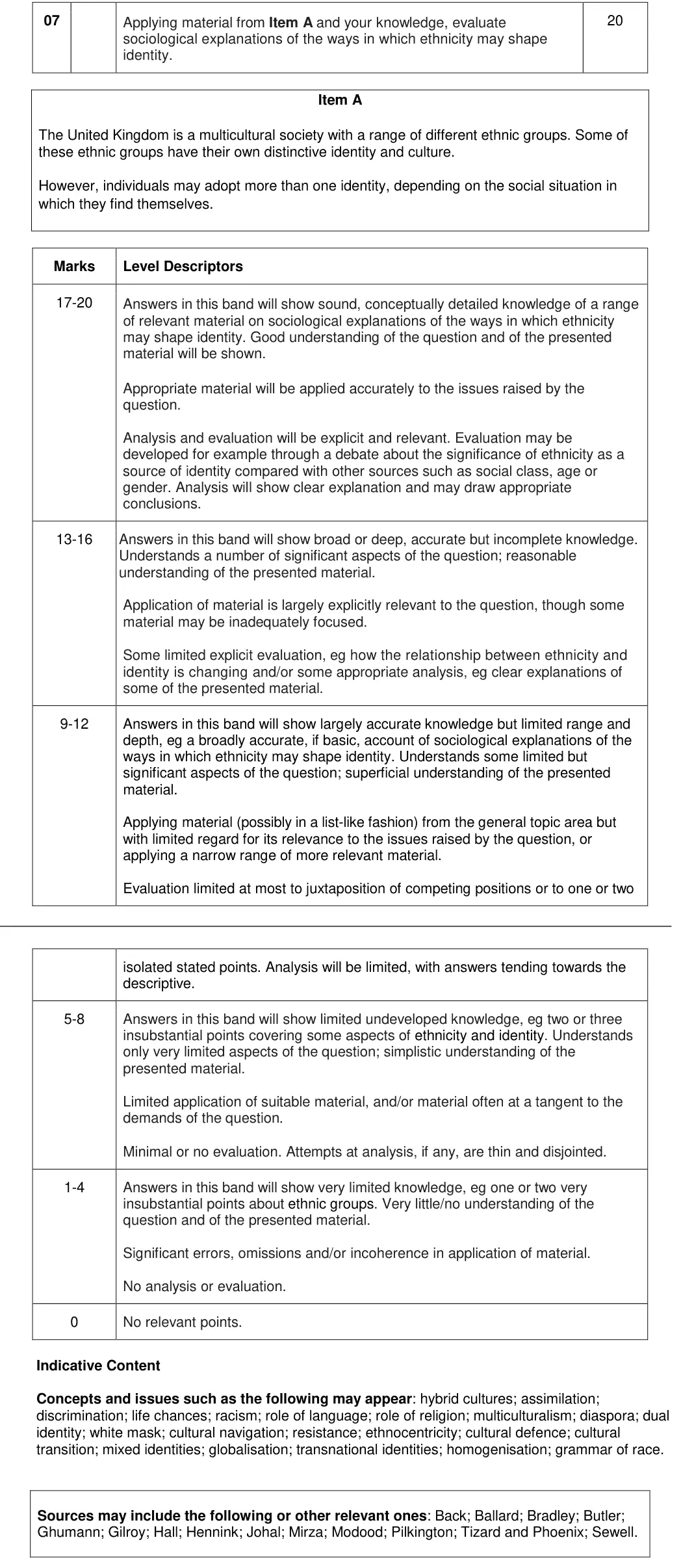
The best answers made reference to different ethnic minorities as well as the ethnic majority. Some of these answers made good use of material from the education topic to discuss the relevance of experiences of education on ethnicity and identity. Good answers retained the focus on identity and were able to discuss ideas of cultural navigation and cultural defence in relation to ethnicity and identity. These answers often referred to studies by Modood, Johal and Ballard. Weaker responses tended to drift into life chances rather than identity or simply described some experiences of different ethnic minorities, often in a fairly stereotyped way.
Notes from the mark scheme and report
must apply Item A (multicultural UK, multiple identities depending on situation)
top band may weigh ethnicity against class, age or gender as sources of identity
best answers covered majority as well as minority groups and used cultural navigation and cultural defence (Modood, Johal, Ballard)
weaker answers drifted into life chances or stereotyped descriptions
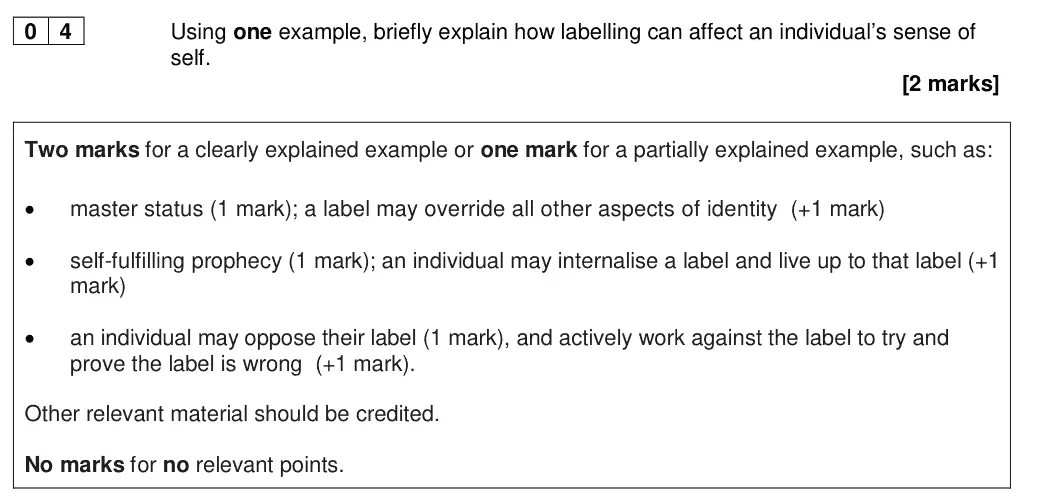
June 2016 · AS Paper 2 · Q42 marksAO2=2Brief explain
Mark scheme
Examiner's comment
The key to this question was to link the idea of labelling to the individual as opposed to linking it to the general impact of labelling on society. Most successful answers tended to discuss the self- fulfilling prophecy and the idea that an individual may internalise their label.
Notes from the mark scheme and report
must link labelling to the individual, not to society in general
credited: master status, self-fulfilling prophecy, resisting the label
best answers used internalising the label/self-fulfilling prophecy
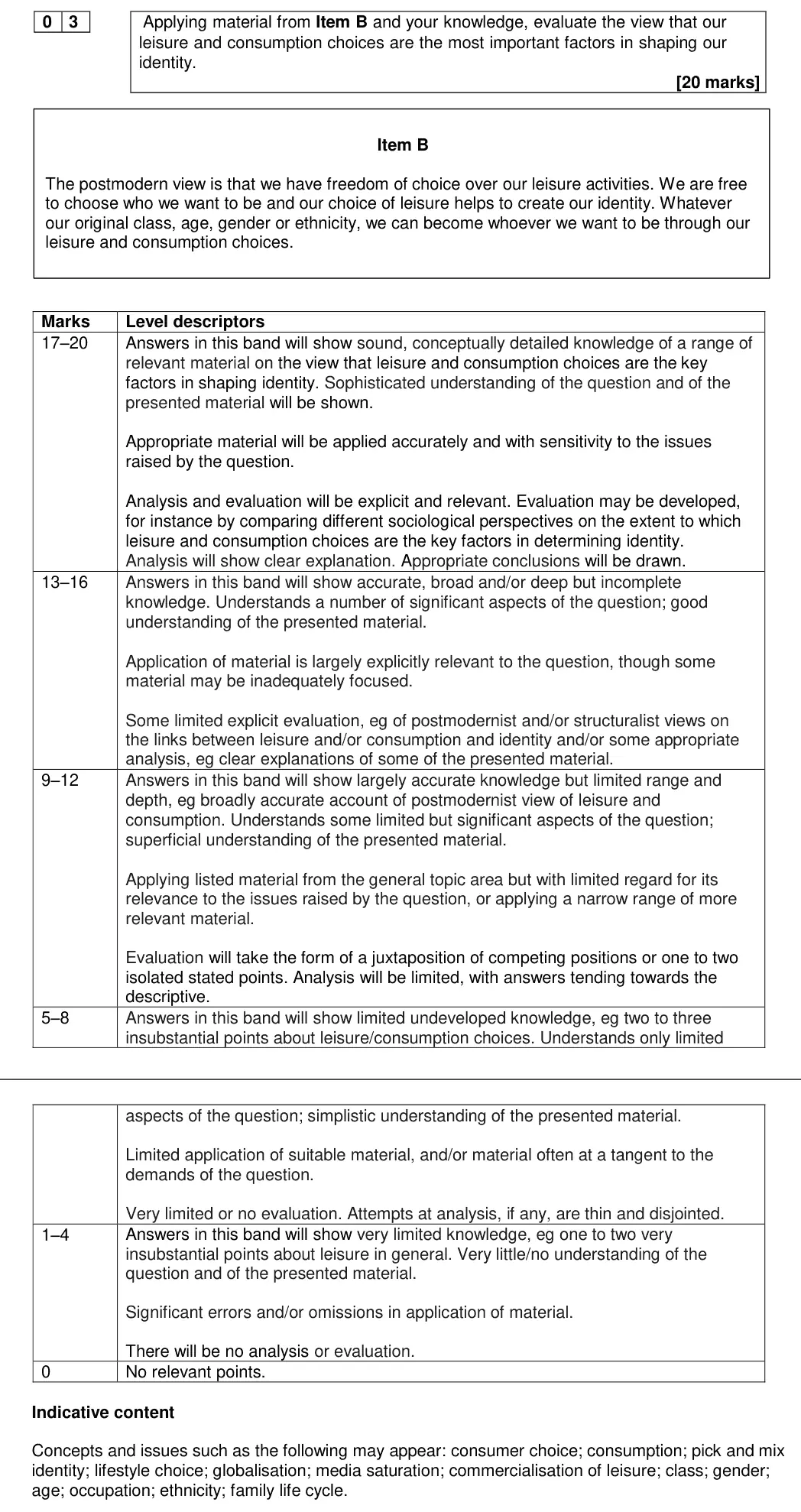
Specimen set 1 · Paper 2 · Q320 marksAO1=8, AO2=6, AO3=620-mark essay
Mark scheme, including the levels grid and indicative content
Notes from the mark scheme and report
item states the postmodern view of free choice
top band compares perspectives on how far leisure and consumption shape identity
13–16 weighs postmodernist against structuralist views (class, gender, age, ethnicity as constraints)
a basic postmodernist account alone = 9–12
Work with an AQA sociology tutor
Essays stuck in the middle band, or losing marks on the 10-markers? Book a trial lesson with Mark, a former AQA examiner.