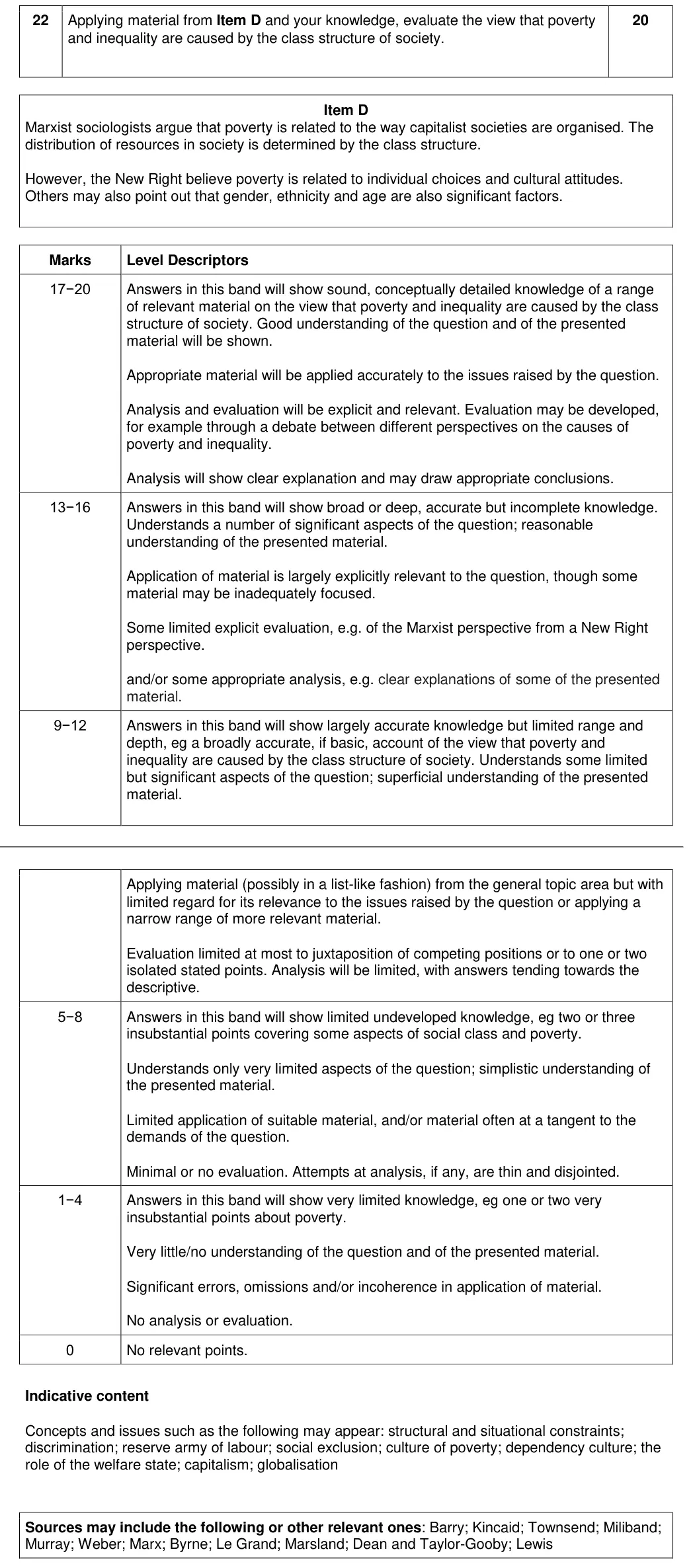
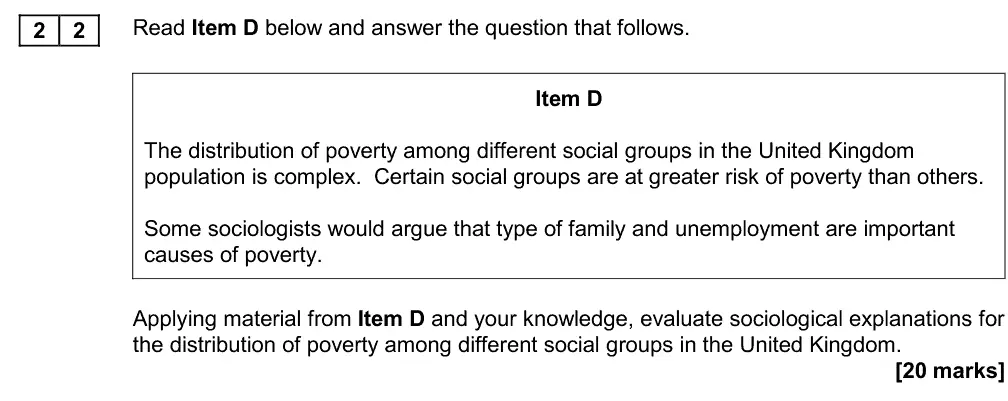
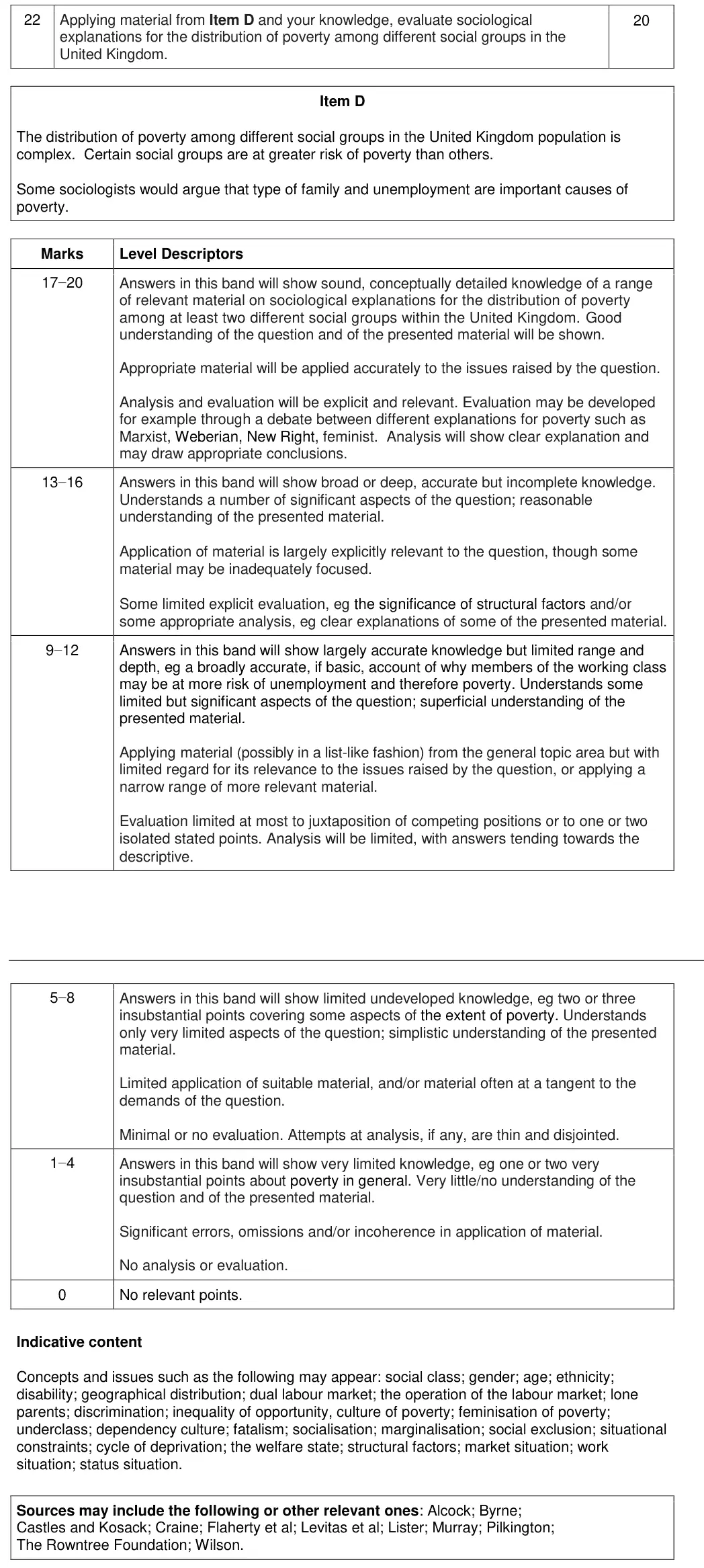
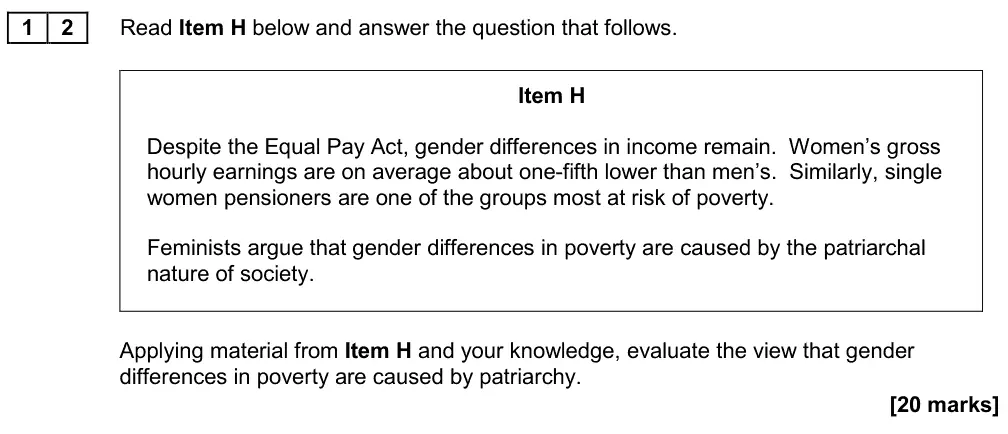
Applying material from Item D and your knowledge, evaluate sociological explanations for the distribution of poverty among different social groups in the United Kingdom.
Tap a question to zoom it. The mark scheme (with the level descriptors and indicative content) and the examiner's comment open underneath.
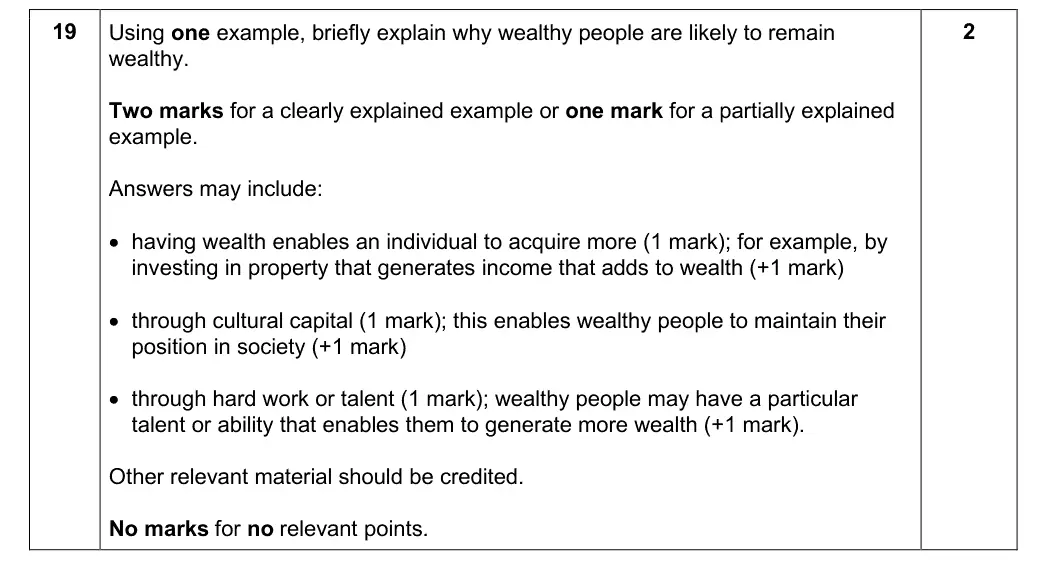
June 2025 · AS Paper 2 · Q192 marksAO2=2Brief explain
Mark scheme
Examiner's comment
This question was quite intuitive, and most students could suggest why wealthy people are likely to stay wealthy for example through inheritance or being enabled by their wealth to be able to make investments.
Notes from the mark scheme and report
credited: wealth generating more wealth through investment, cultural capital, talent
inheritance and investment were common
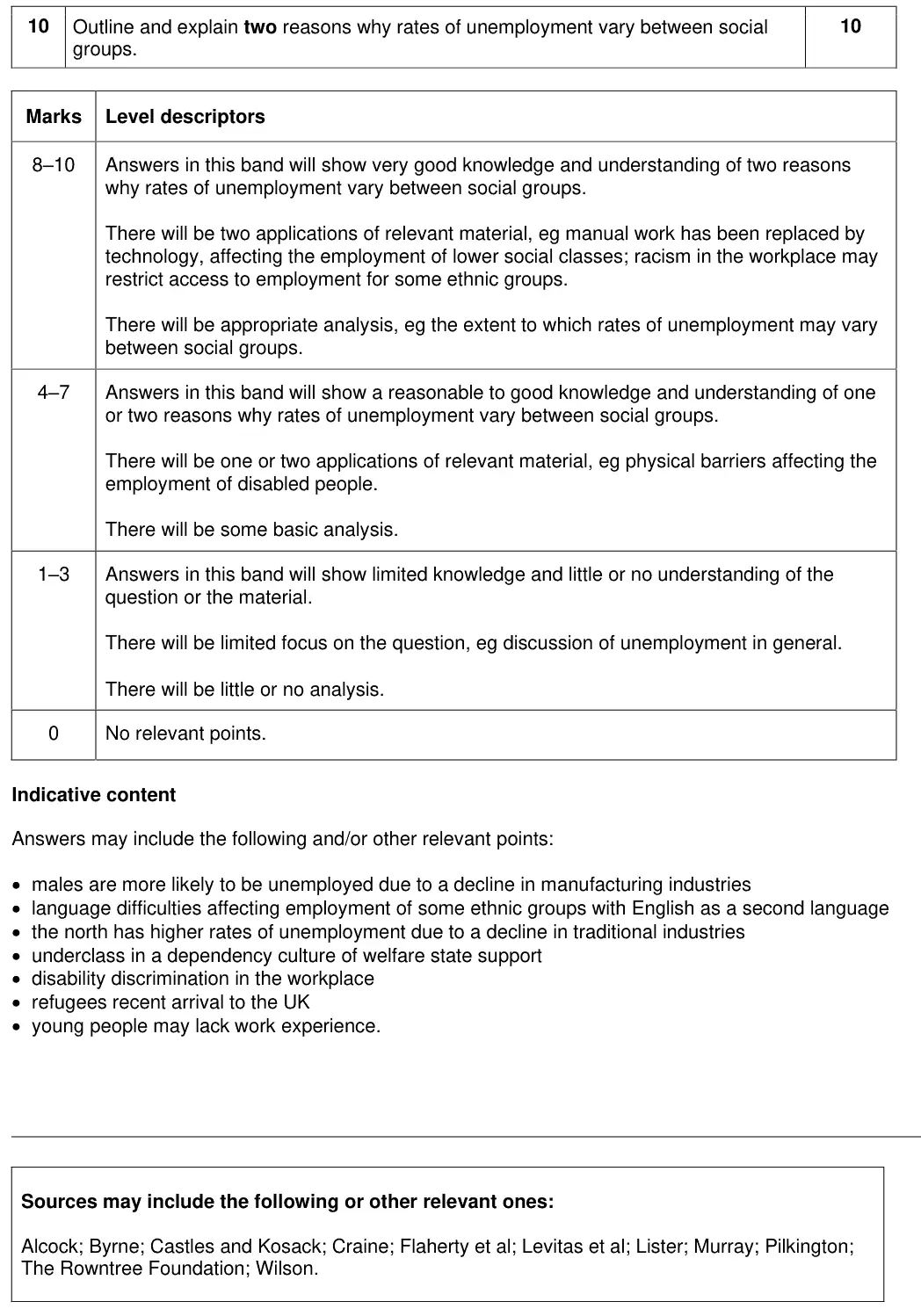
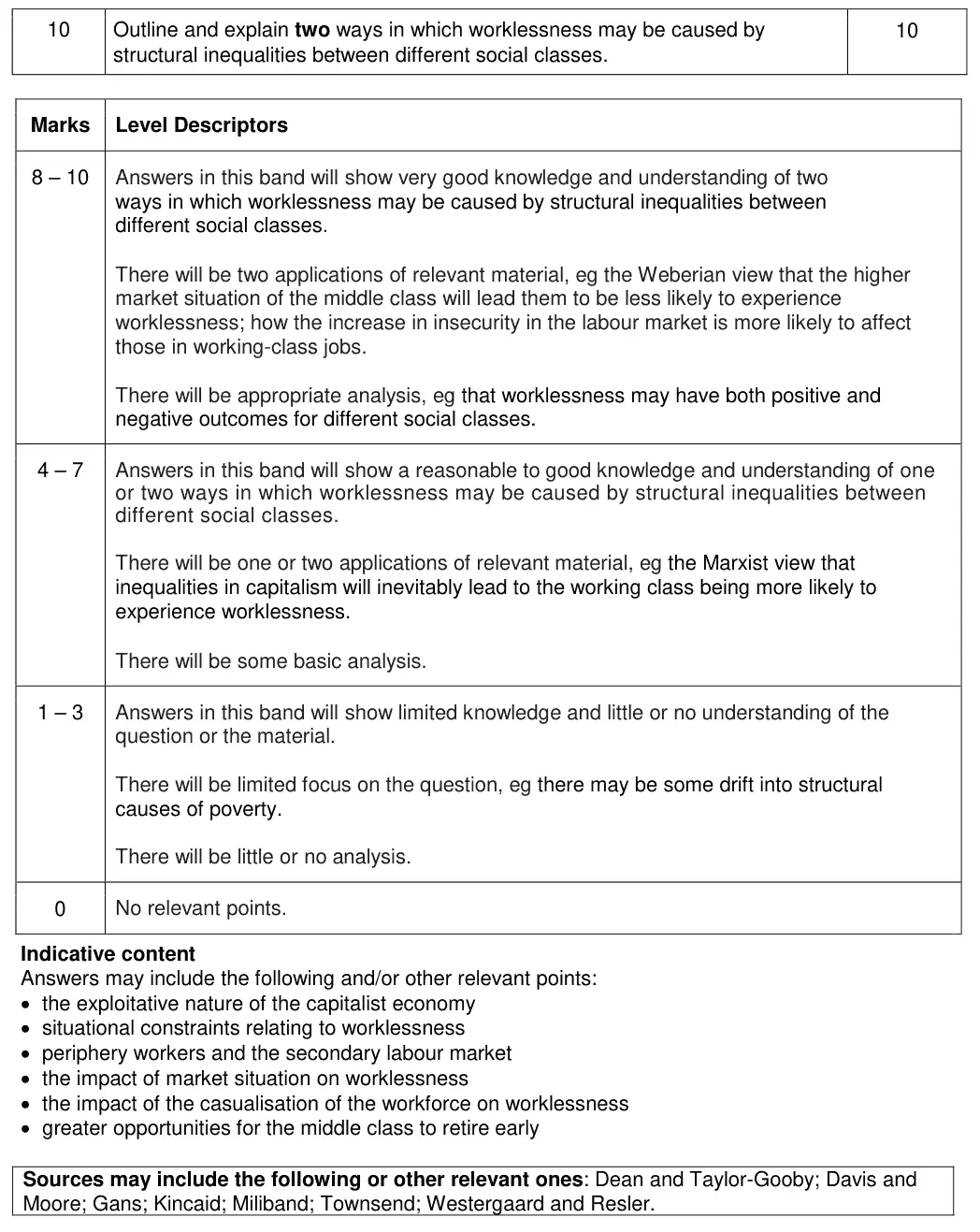
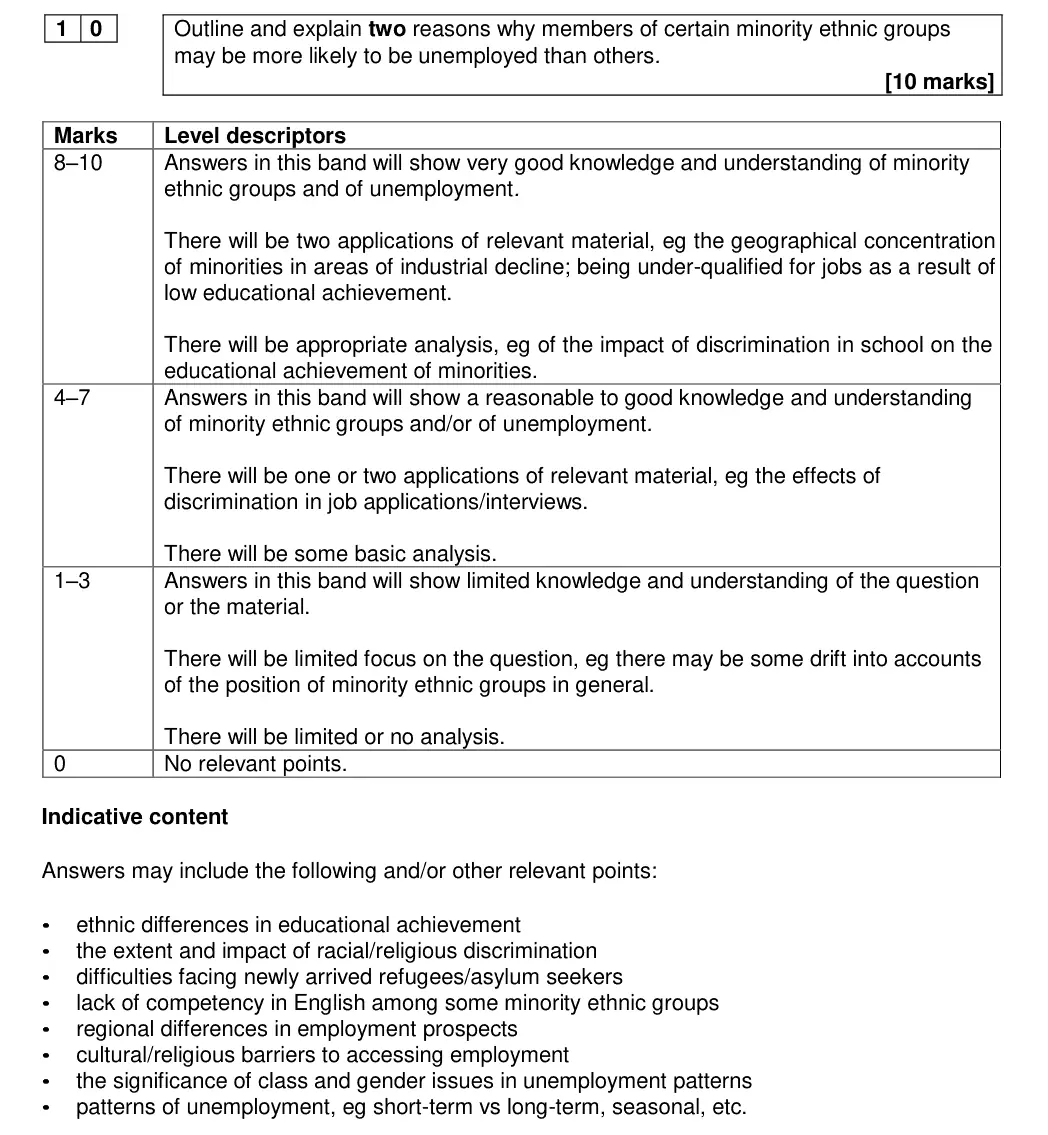
June 2024 · Paper 2 · Q1010 marksAO1=5, AO2=3, AO3=2Outline and explain
Mark scheme, including the levels grid and indicative content
Examiner's comment
The nature of these questions means that students cannot rely on reciting knowledge. Questions will ask them to bring together aspects of their sociological knowledge in ways they will not have done before. It is therefore important for students to allow time to think about how to answer the question. Students should be made aware that there are two types of 10 mark questions. These have different requirements and different mark schemes . There are different marks available for the assessment objectives. A breakdown of the marks awarded by assessment objective can be found in the mark scheme. 10 mark “outline and explain” questions have more marks available for knowledge and understanding, and none for evaluation. Introductions and conclusions are not required for 10 mark questions; they take up time and rarely improve the mark. It is helpful if answers are set out to clearly indicate the two answers, with wording such as “One way/reason is…”, or by starting a new paragraph for the second point. Answers that give more than two points are unlikely to develop two of them sufficiently. Q10: Successful answers identified two reasons such as the reduction in traditional employment for working-class males and the emergence of an underclass. Social groups discussed included those based on gender or ethnicity, and people with disabilities. Some students found it difficult to develop the identified reasons. Better answers usually brought in one or more theoretical perspectives.
Notes from the mark scheme and report
two reasons each developed for differences between groups (e.g. decline of manual and manufacturing work for working-class men, racism or language barriers, disability discrimination, regional decline, youth inexperience, underclass)
discussing unemployment in general = 1–3
development of reasons was the main difficulty
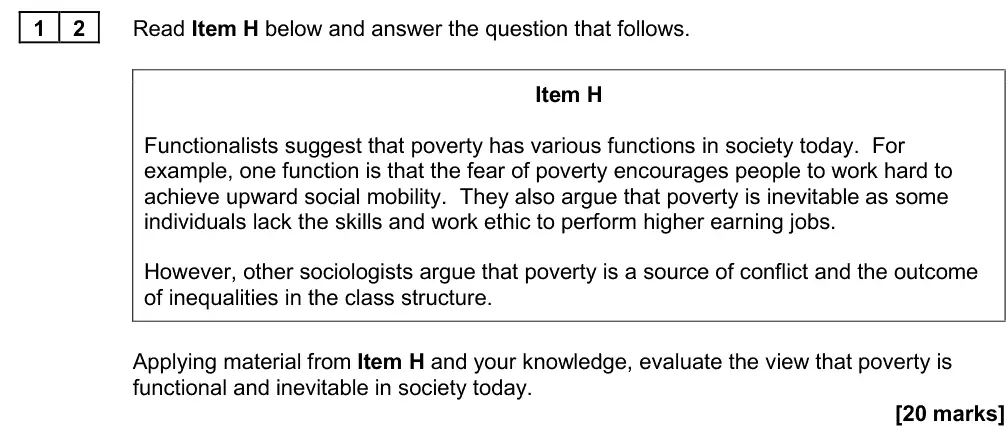
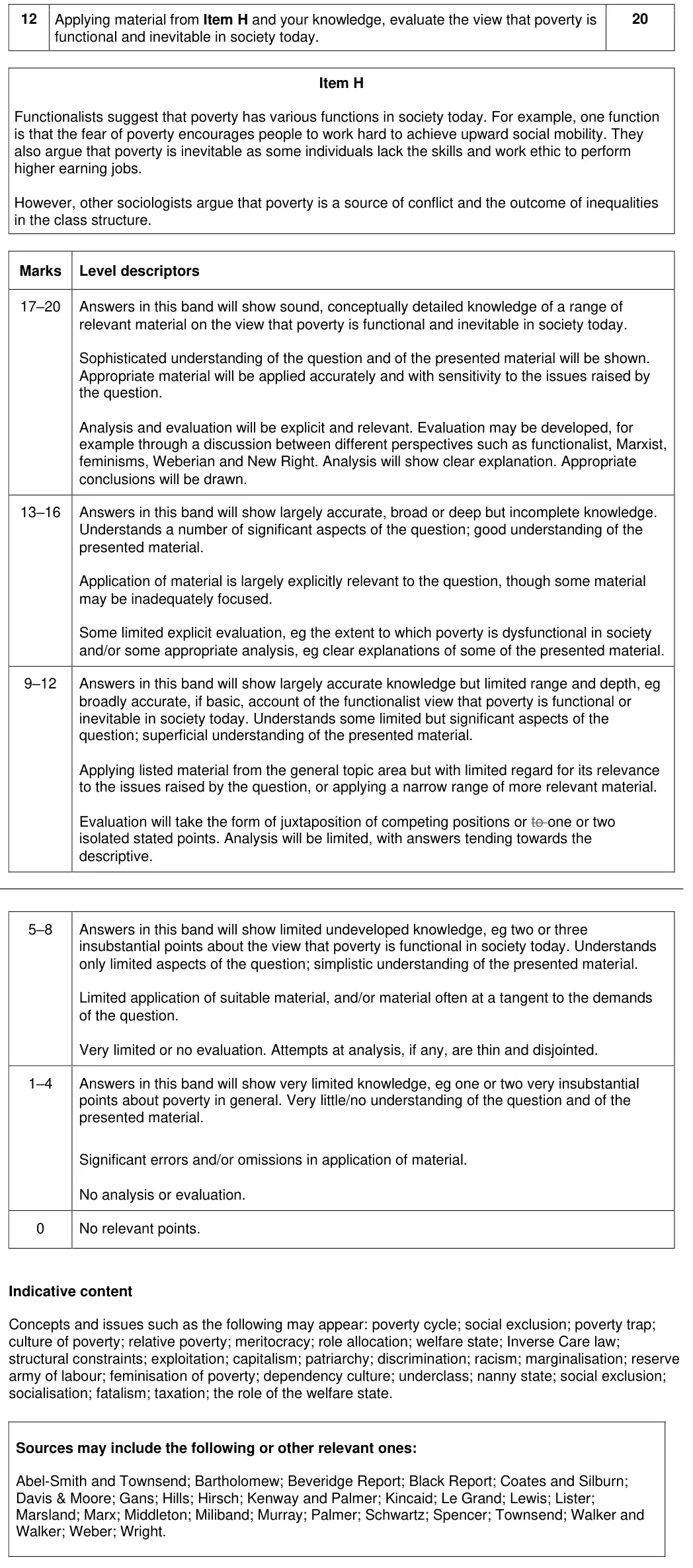
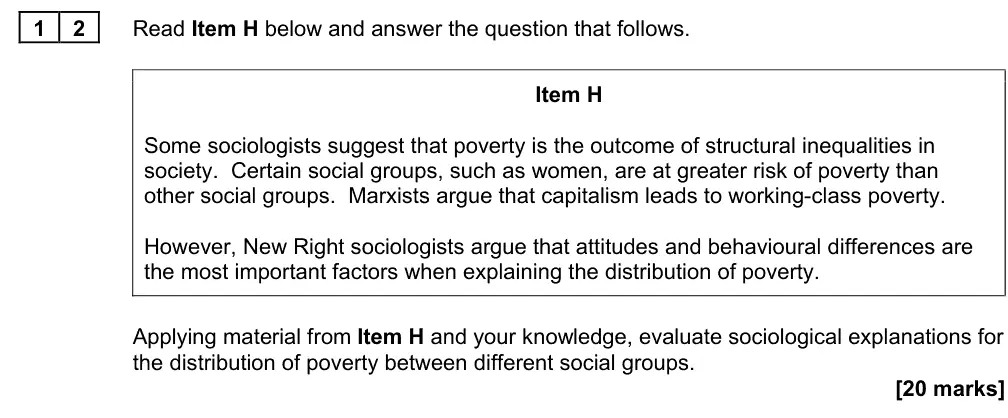
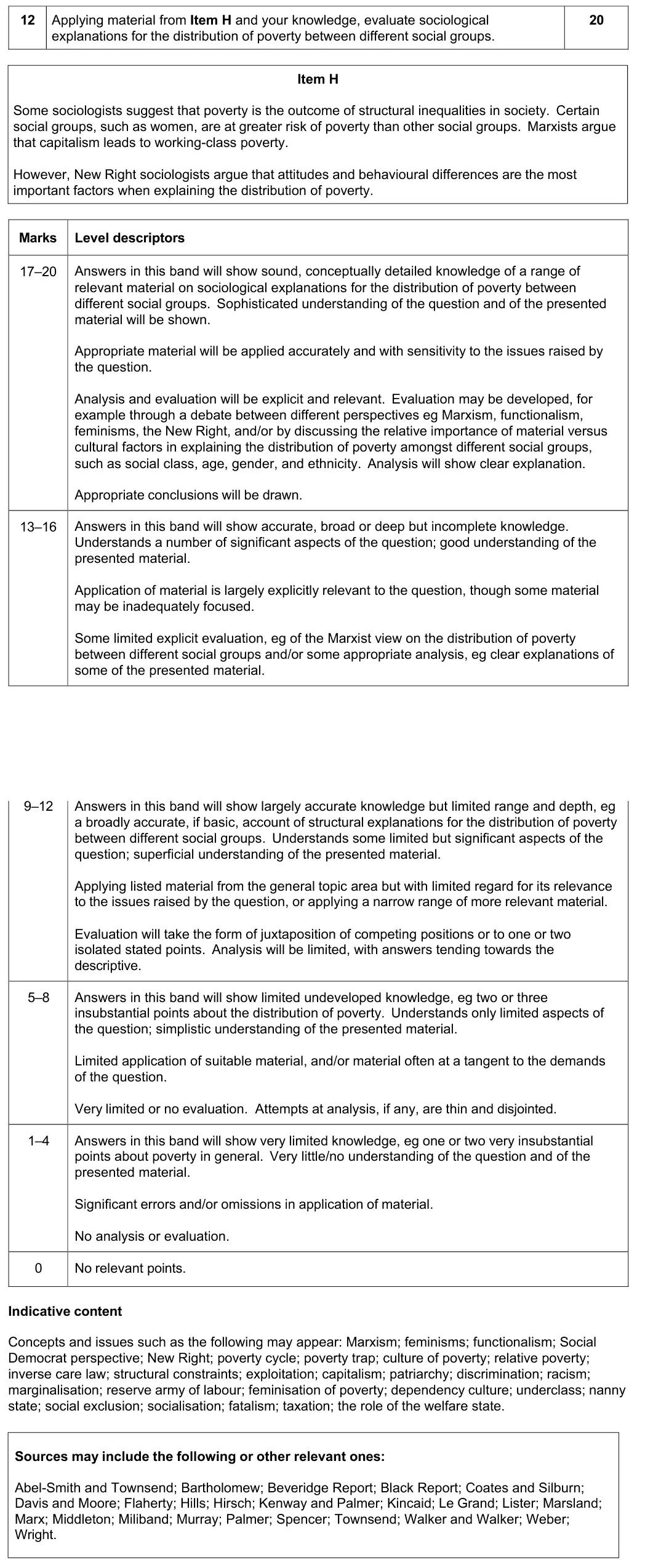
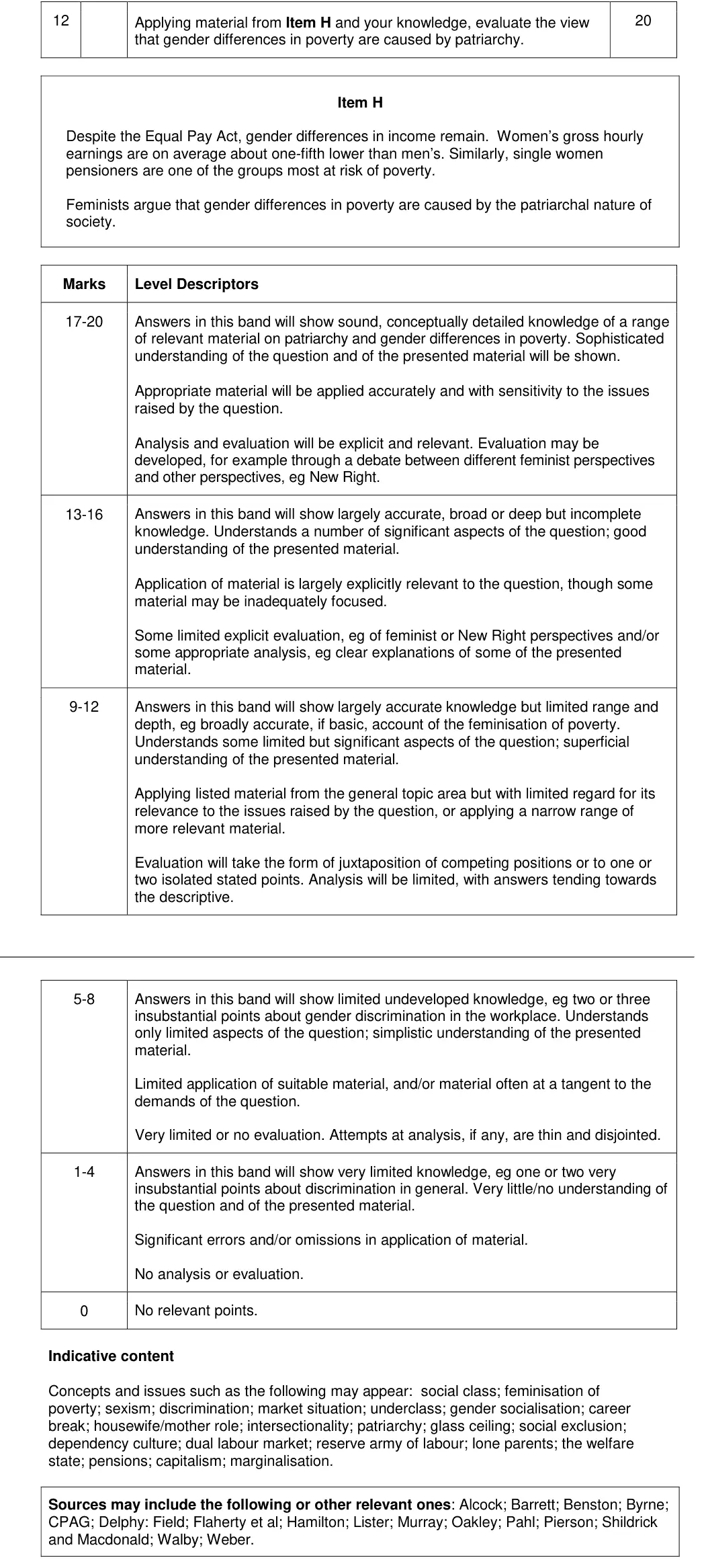
June 2024 · Paper 2 · Q1220 marksAO1=8, AO2=6, AO3=620-mark essay
Mark scheme, including the levels grid and indicative content
Examiner's comment
The items for these questions have a different purpose to those for 10 mark “analyse” questions. The items will suggest a few starting points for students, including ways into evaluation. Students are expected to also bring in further ideas (“and your knowledge” in the instruction). A wide range of material can be relevant to these questions, so students need to be selective. It is more effective to cover a limited number of points in depth rather than to try to include everything. Students who made essay plans appeared to benefit by having more structured and coherent responses. Q12: These answers were largely accurate and some made good use of contemporary material of, for example, food banks and homelessness. There was though a tendency to rely heavily on the item and to not show detailed conceptual knowledge or engage in a theoretical debate. Some potentially relevant discussion on functionalist and other views on meritocracy and social mobility was not directly related to poverty.
Notes from the mark scheme and report
top band debates functionalist, Marxist, feminist, Weberian and New Right views of poverty
good use of contemporary material (food banks, homelessness)
heavy reliance on the item without conceptual depth or theoretical debate
meritocracy and mobility material not tied back to poverty
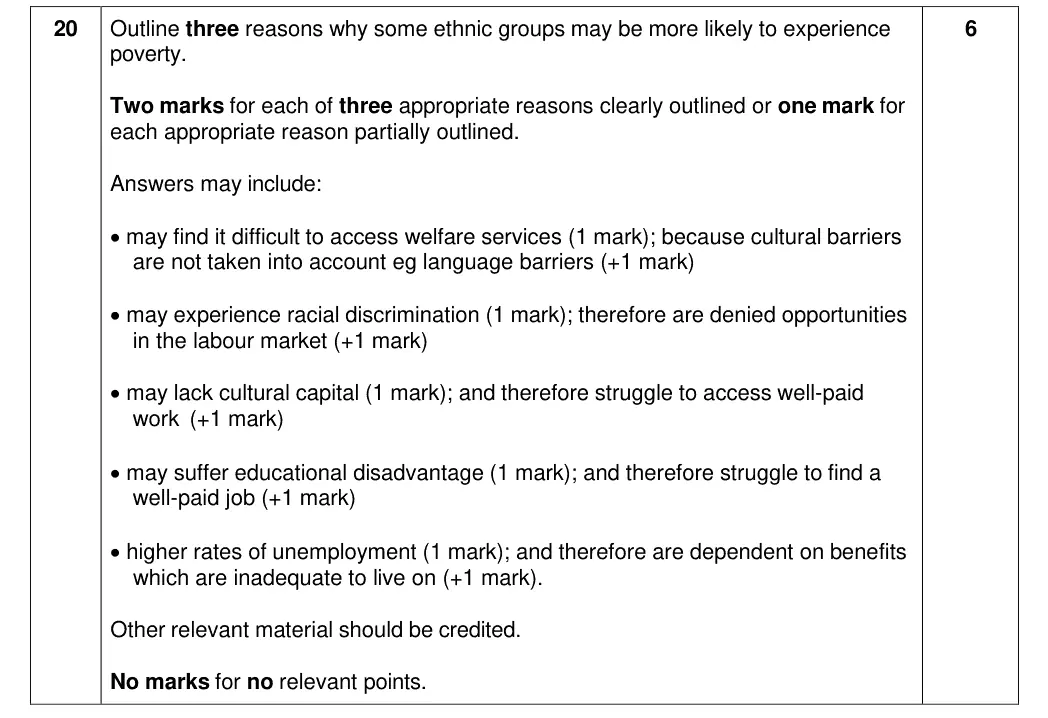
June 2024 · AS Paper 2 · Q206 marksAO1=6Outline
Mark scheme
Examiner's comment
The ‘outline three …’ 6-mark question. Students could easily improve outcomes on this question by realising the need to provide a line or so outlining the criticism / feature etc they have identified. Students found this question straight forward and frequently used examples from education relating to different ethnic groups to provide effective answers. Discrimination in the workplace and levels of unemployment also featured as popular ways of answering the question.
Notes from the mark scheme and report
2 marks for each of three reasons clearly outlined, 1 if only partially outlined
common answers: educational disadvantage, labour-market discrimination, higher unemployment, barriers to welfare
June 2023 · Paper 2 · Q1220 marksAO1=8, AO2=6, AO3=620-mark essay
Mark scheme, including the levels grid and indicative content
Examiner's comment
The purpose of the items for these questions is to suggest a few starting points for students, including ways into evaluation. Students are expected to also bring in further ideas (“and your knowledge” in the instruction). A wide range of material can be relevant to these questions, so students need to be selective. It is more effective to cover a limited number of views/theories in depth rather than to include every possible theory. Students who made essay plans appeared to benefit by having more structured and coherent responses. Question 12: Answers showed a good range of knowledge on sociological explanations of the distribution of poverty. Because of the number of explanations that could be discussed, this was a question where it benefited students to be selective. This gave the opportunity for some depth to answers.
Notes from the mark scheme and report
top band debates Marxist, functionalist, feminist and New Right views and/or material vs cultural explanations across class, age, gender, ethnicity
many explanations available, so selectivity allowed depth
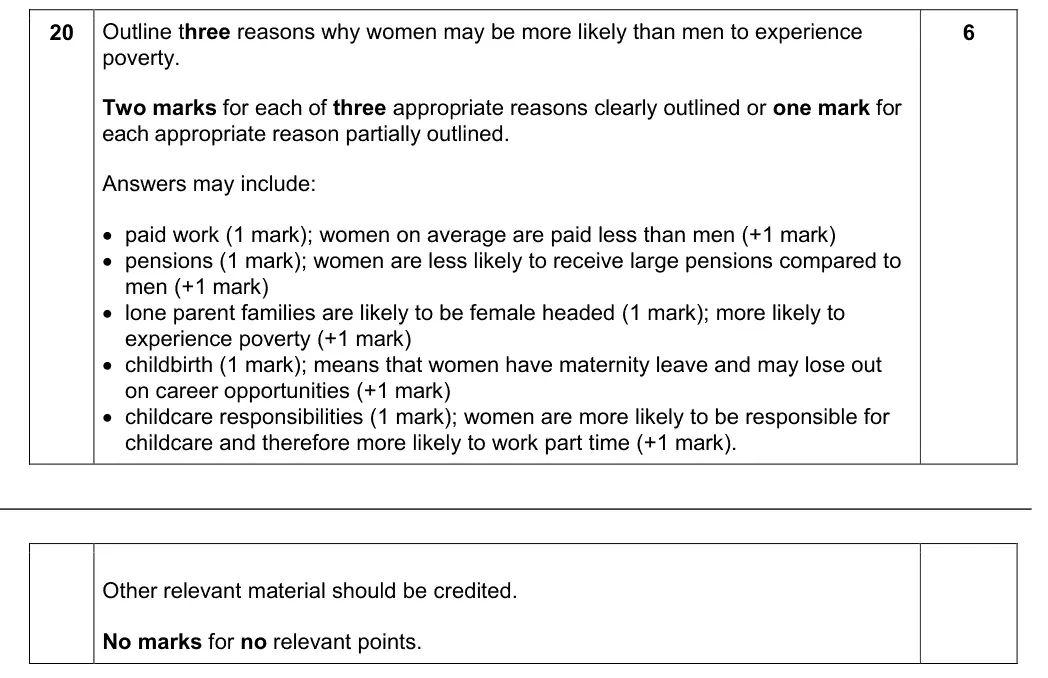
June 2023 · AS Paper 2 · Q206 marksAO1=6Outline
Mark scheme
Examiner's comment
The ‘outline three’ 6 mark question (the third question in every topic area). Students could easily improve outcomes on this question by realising the need to briefly (eg a line or so) expand upon the criticism / feature etc being outlined. Students found this question straight forward. Where students lacked specific understanding regarding gender and poverty they were readily able to adapt general gender based material such as gender roles / childcare responsibilities etc and apply it to the question. Many students gained full marks for this question.
Notes from the mark scheme and report
2 marks for each of three reasons clearly outlined, 1 if partial (e.g. lower pay, smaller pensions, female-headed lone-parent families, career breaks for childbirth, part-time work due to childcare)
found straightforward, many full marks
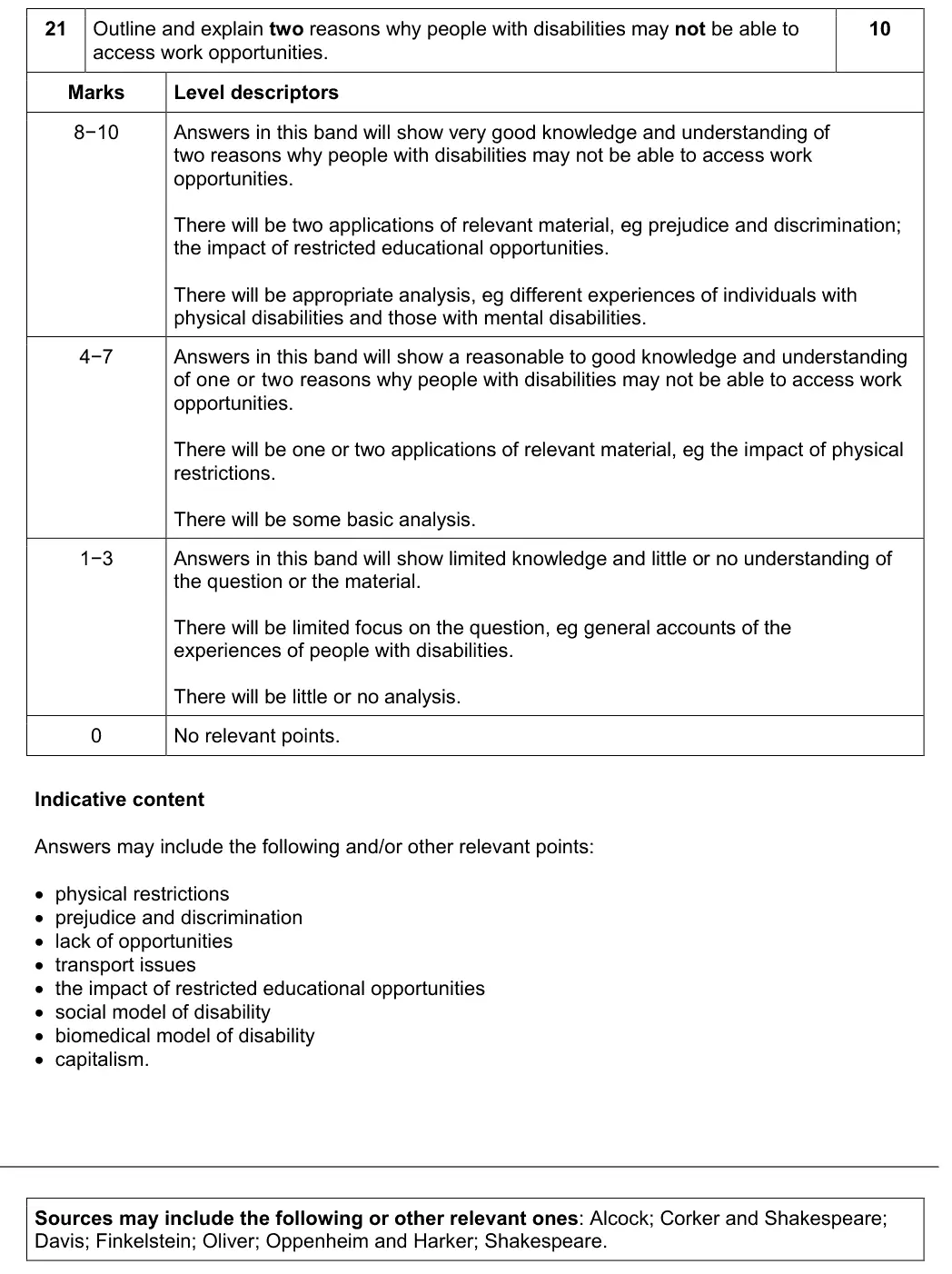
June 2023 · AS Paper 2 · Q2110 marksAO1=5, AO2=3, AO3=2Outline and explain
Mark scheme, including the levels grid and indicative content
Examiner's comment
The ‘outline and explain two’ 10 mark question (the fourth question in every topic area). Here students would benefit more if an explicit identification of a way / reason / factor was made, then leading to an explanation of it, making the student’s answer more cogent. Students generally had no difficulty in finding reasons why people with disabilities may not be able to access work opportunities: discrimination, transport to and from the work place; lack of access within the workplace all featured. The development of the given reasons was the limiting factor for some students who found it difficult to connect the reason to further exploration of it - such as its impact on the individual, its connection with broader sociological perspectives and so on.
Notes from the mark scheme and report
two reasons each developed (e.g. prejudice and discrimination, restricted education, physical and transport barriers, social vs biomedical model)
general accounts of disabled people's experiences = 1–3
reasons were easy to find but development (impact on the individual, links to perspectives) limited marks
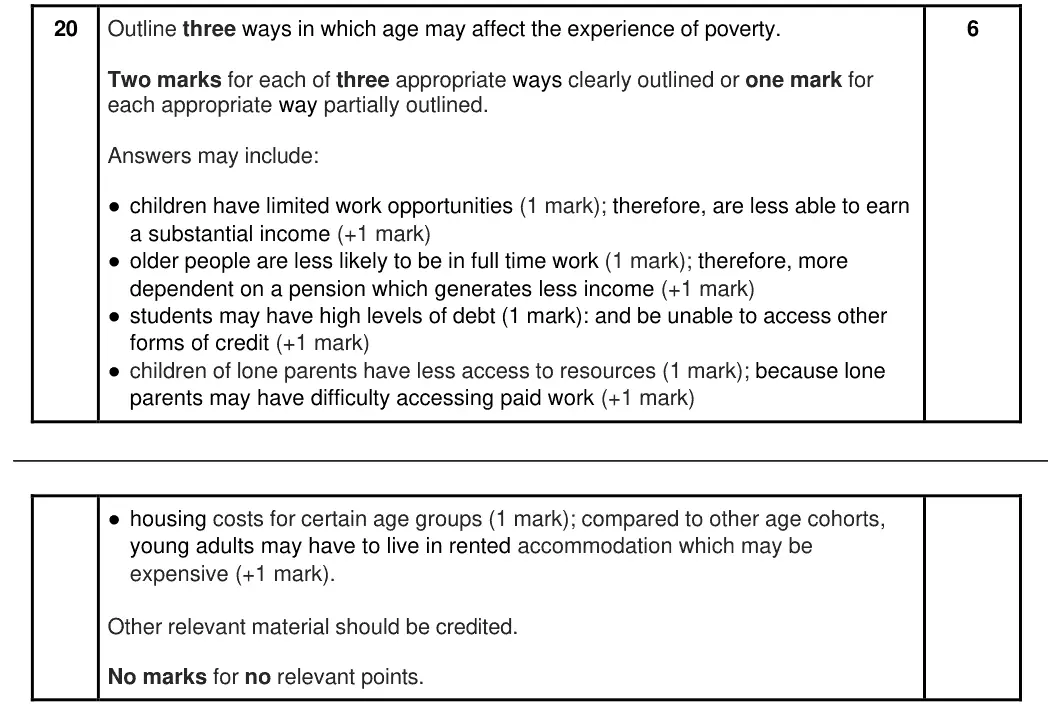
June 2022 · AS Paper 2 · Q206 marksAO1=6Outline
Mark scheme
Examiner's comment
For low mark tariff questions where candidates are required to either define, explain or outline, care should be taken to ensure that points are not just identified. Many candidates struggled with this question, interpreting it as a question about the needs of people of different ages and reasons why they can’t afford to meet the needs. Most students were able to refer to different age groups. Better answers were able to link the experience of poverty to work or income opportunities available to people of different ages.
Notes from the mark scheme and report
2 marks for each of three ways clearly outlined, 1 if only partially outlined
e.g. children's lack of earnings, pensioners' reliance on pensions, student debt, young adults' housing costs
many wrote about needs of age groups rather than experience of poverty
better answers linked to work and income
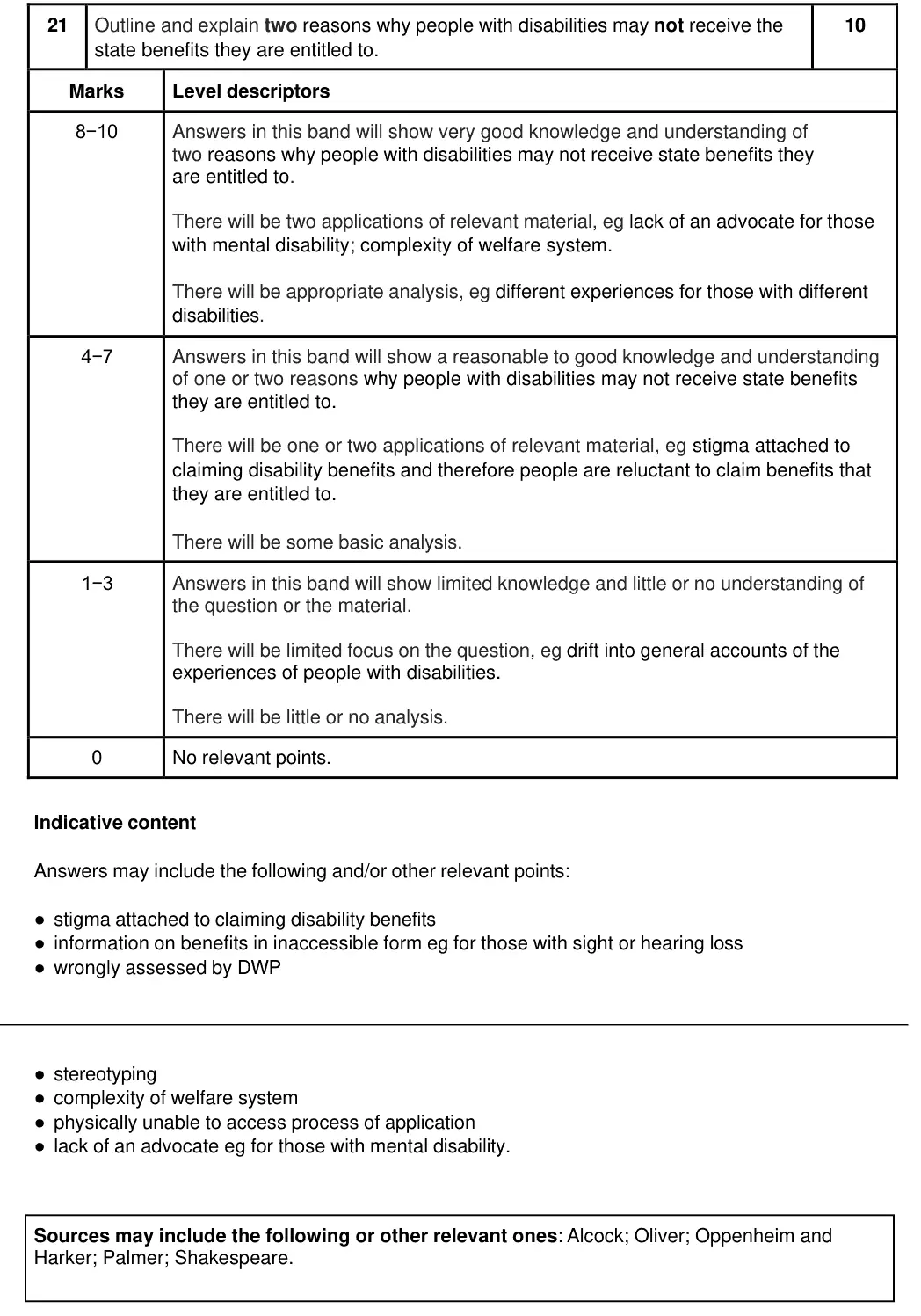
June 2022 · AS Paper 2 · Q2110 marksAO1=5, AO2=3, AO3=2Outline and explain
Mark scheme, including the levels grid and indicative content
Examiner's comment
There were some good answers to this question but most students found it difficult to identify and develop two applications successfully. There were some generic responses about the benefits system being difficult to access but this was not applied to disability specifically. The concept of entitlement seemed not to be understood as a common response was that disabled people don’t need benefits as their carers provide for them or they have enough money without claiming benefits. The most common responses related to a lack of awareness of entitlement or incorrect assessments by government agencies.
Notes from the mark scheme and report
two reasons for non-take-up (stigma, inaccessible information, wrong DWP assessments, complexity, no advocate)
drift into general experiences of disabled people = 1–3
generic points about access to benefits not applied to disability
some misunderstood entitlement
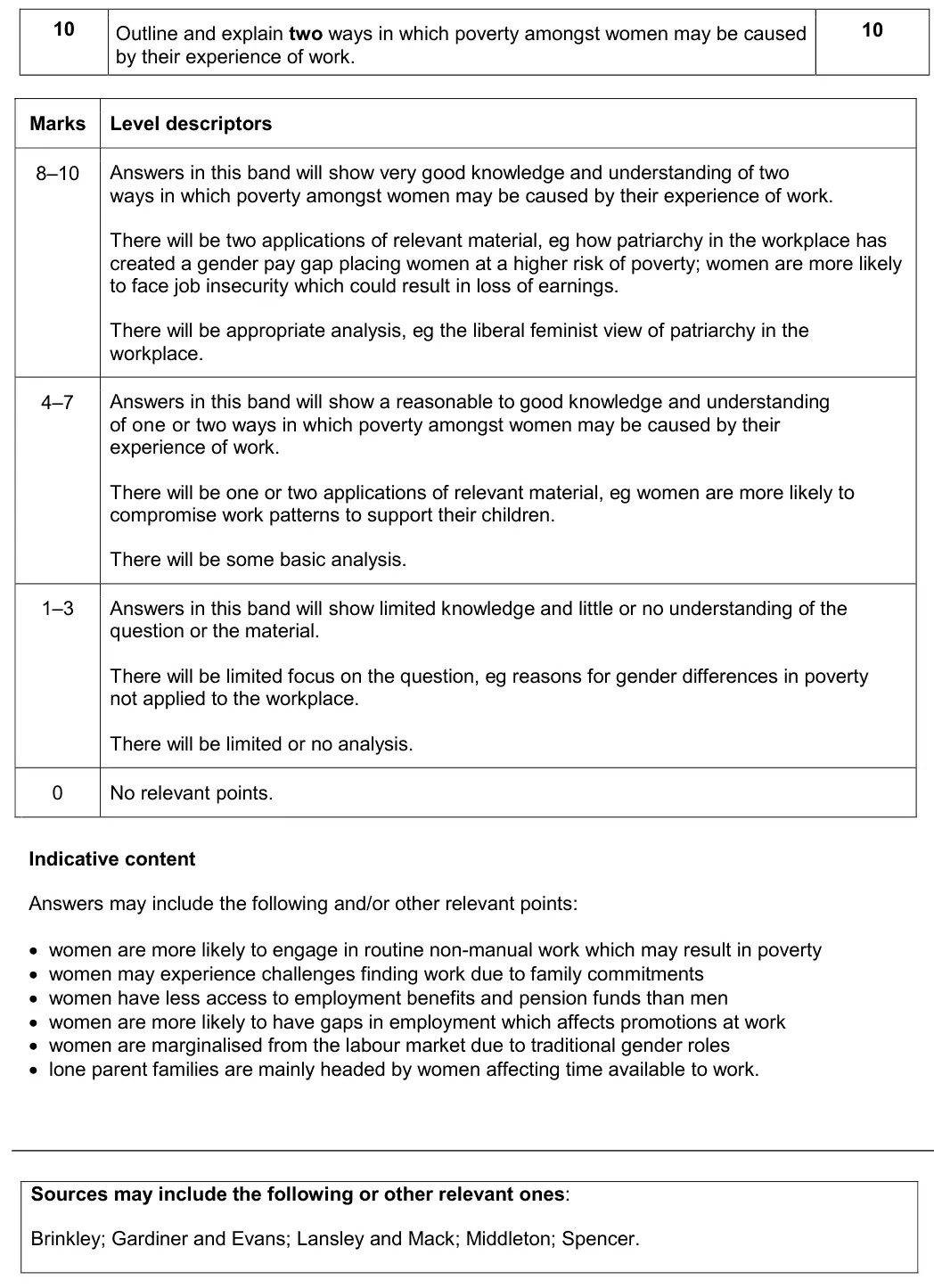
November 2021 · Paper 2 · Q1010 marksAO1=5, AO2=3, AO3=2Outline and explain
Mark scheme, including the levels grid and indicative content
Notes from the mark scheme and report
no marks for evaluation in this question type
ways must be about women's experience of work, e.g. gender pay gap, insecure or part-time work, career breaks, less pension provision
gender differences in poverty not linked to work = 1–3
no examiners' report comment for this part
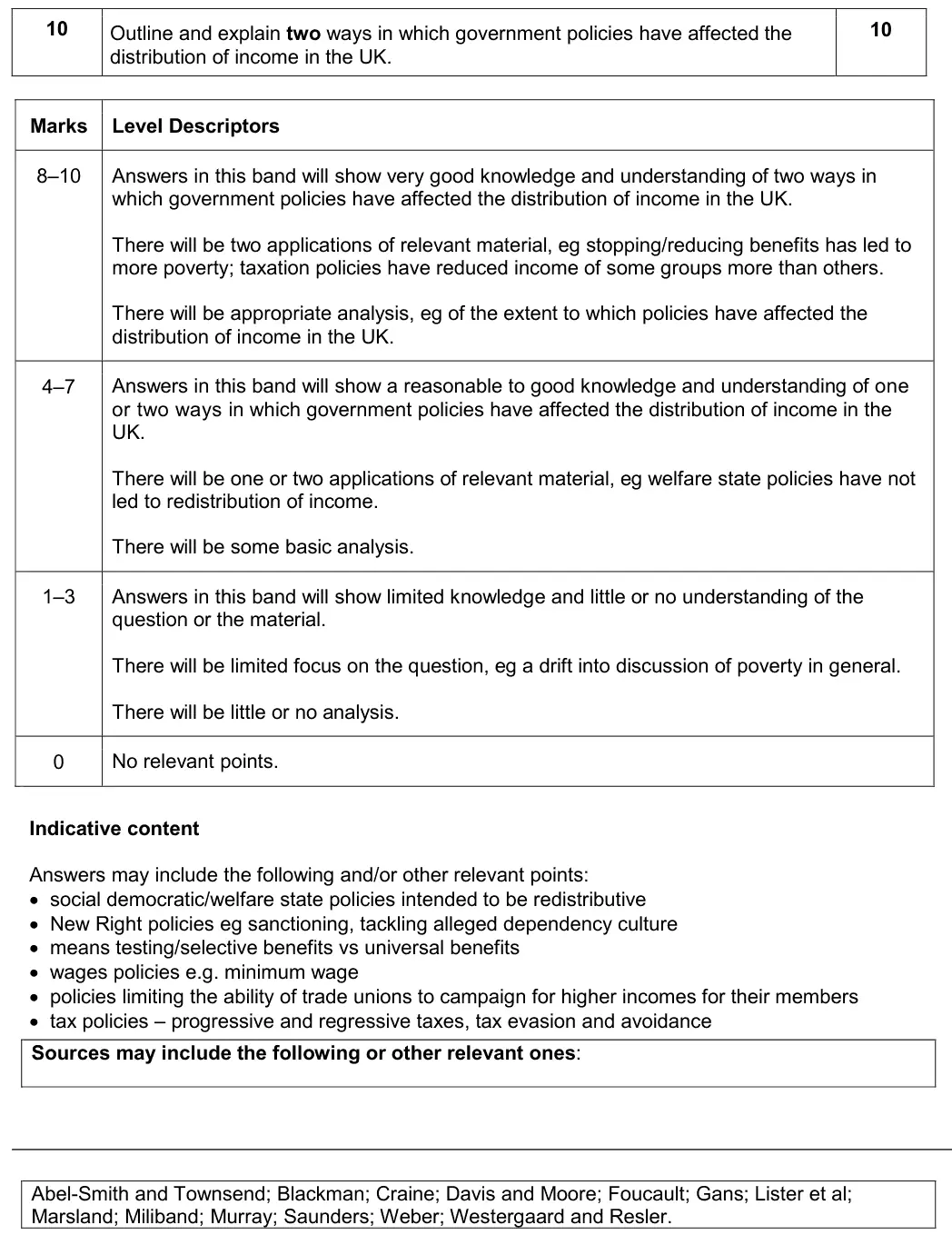
November 2020 · Paper 2 · Q1010 marksAO1=5, AO2=3, AO3=2Outline and explain
Mark scheme, including the levels grid and indicative content
Notes from the mark scheme and report
two policies and their effect on income distribution
e.g. benefit cuts and sanctions, progressive/regressive tax, minimum wage, trade union limits, universal vs means-tested benefits
drift into poverty in general = 1-3
no marks for evaluation in this question type (examiners' report general remark)
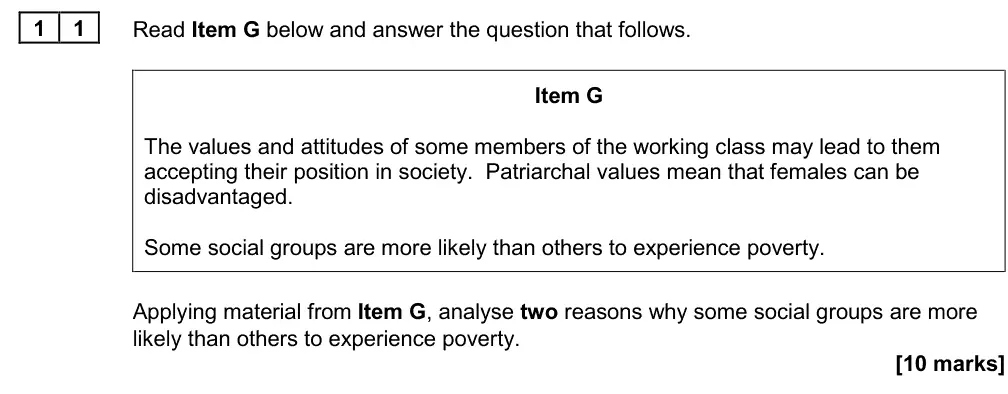
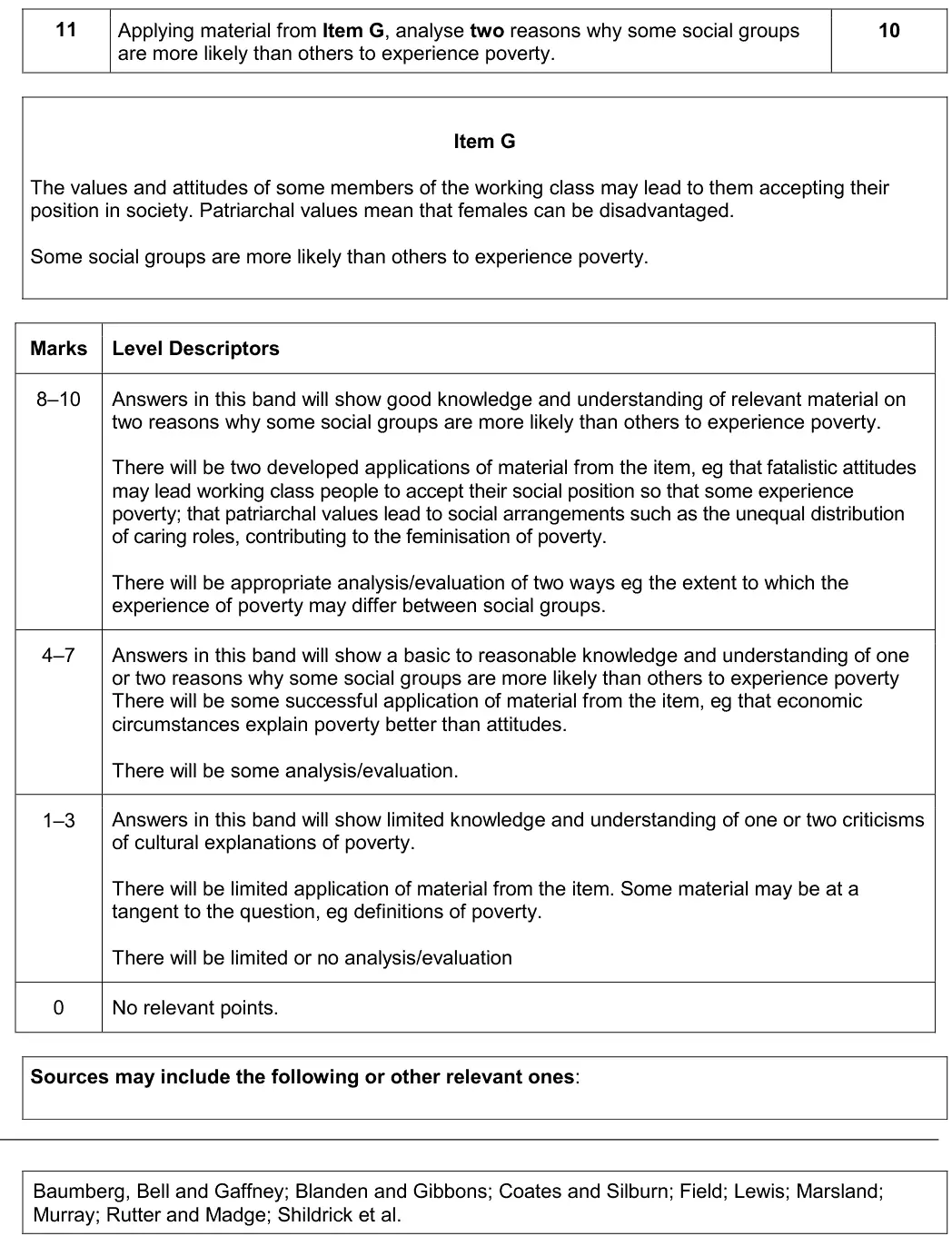
November 2020 · Paper 2 · Q1110 marksAO1=3, AO2=4, AO3=3Analyse
Mark scheme, including the levels grid and indicative content
Notes from the mark scheme and report
apply Item G (working-class fatalism, patriarchal values)
e.g. fatalism leading to acceptance of position, unequal caring roles and the feminisation of poverty
evaluation e.g. how poverty experience differs between groups
definitions of poverty = tangent
the 1-3 descriptor wrongly refers to 'criticisms of cultural explanations of poverty' (mark-scheme slip)
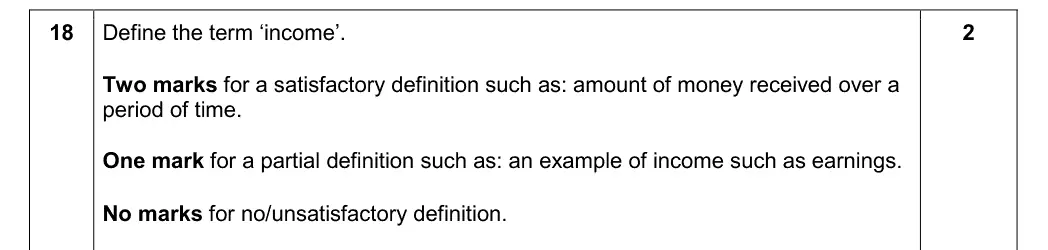
November 2020 · AS Paper 2 · Q182 marksAO1=2Define
Mark scheme
Notes from the mark scheme and report
2 marks for money received over a period of time
giving only an example such as earnings = 1
June 2019 · Paper 2 · Q1010 marksAO1=5, AO2=3, AO3=2Outline and explain
Mark scheme, including the levels grid and indicative content
Examiner's comment
Some students wrote introductory paragraphs and/or conclusions. These are not necessary, and are unlikely to gain additional marks; they also take up time. Some students made only one point in their answers, or three or more, rather than the two asked for. The word ‘two’ is put in bold in the question to try and draw students’ attention to this. Sometimes it was not clear how many points were being made. It is helpful for students to clearly indicate their two answers, with wording such as “One way is…” or by starting a new paragraph for their second point. Notably, some students wrote far more than was needed for a 10-mark response. The two types of 10-mark question, “outline and explain” and “analysis” types, are marked differently as the assessment objectives have different weightings. It is important that students are aware of this. In particular they should note that evaluation is not a requirement for answers to 10 mark “outline and explain” questions. For 10 mark “outline and explain” questions, students cannot rely on reciting knowledge; these questions will ask them to bring together aspects of their sociological knowledge of the topic in a way that they are unlikely to have done before. The best answers to 10-mark questions were focused, clearly stating a point and then developing it, and used sociological concepts, studies, evidence and theory as appropriate. A number of students were unsure of the meaning of “structural inequalities”, and some discussed cultural reasons for worklessness, such as welfare dependency or a culture of poverty. There was a tendency also to interpret ‘worklessness’ as only unemployment.
Notes from the mark scheme and report
must be structural class inequalities
cultural explanations (dependency culture, culture of poverty) not credited
drift into structural causes of poverty = 1–3
many misread worklessness as unemployment only
AO split from AQA's standard grid for this paper (this year's mark scheme does not print it).
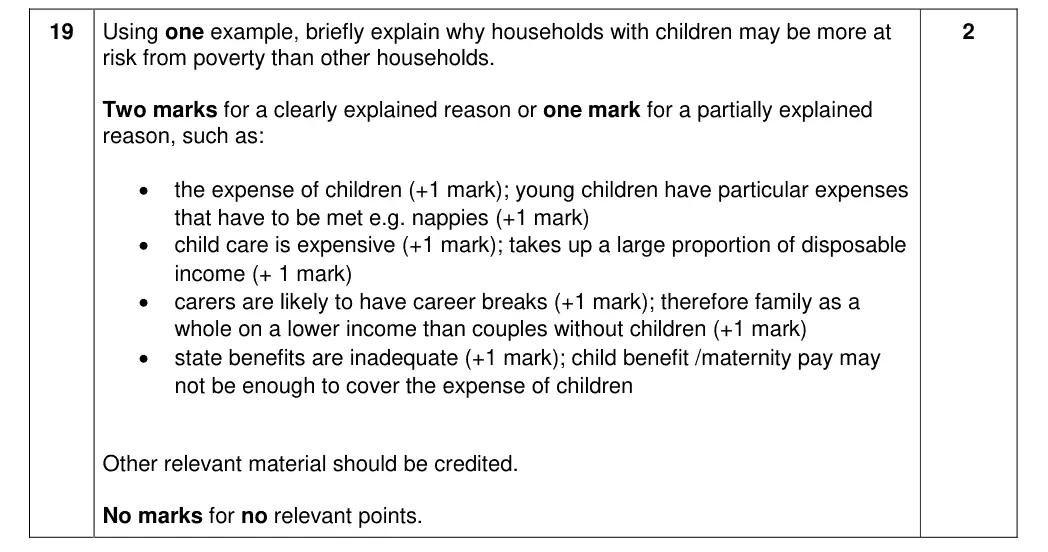
June 2019 · AS Paper 2 · Q192 marksAO2=2Brief explain
Mark scheme
Examiner's comment
Most students were able to explain why households with children may be more at risk from poverty with reference to the cost of children for families. This was often developed by discussing the specific expenses that children incur, or in relation to having to give up work, wholly or partially, to care for children.
Notes from the mark scheme and report
AO grid not printed
2 marks for a clearly explained reason, 1 if partial
common answers: cost of children and childcare, carers giving up work, inadequate benefits
AO split from AQA's standard grid for this paper (this year's mark scheme does not print it).
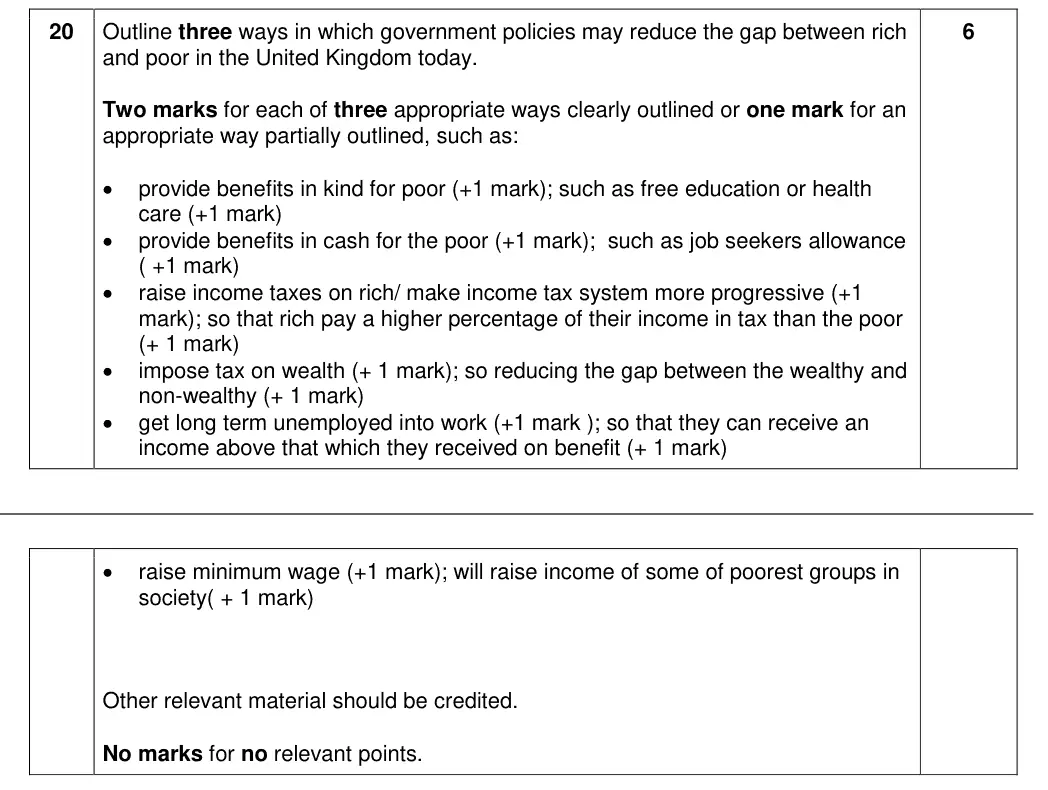
June 2019 · AS Paper 2 · Q206 marksAO1=6Outline
Mark scheme
Examiner's comment
Many students struggled with this question. Answers were often vague about government policies and how these policies might reduce the gap between rich and poor. For example, some answers referred to ‘the tax system’ without really explain how such a policy might work. Better answers were able to be specific about a policy. For example, making the income tax system more progressive, or targeting the wealth of the rich through a wealth tax.
Notes from the mark scheme and report
AO grid not printed
2 marks for each of three ways clearly outlined
policy must be specific and its effect on the gap explained, e.g. progressive income tax, wealth tax, minimum wage, benefits in cash or kind
vague references to 'the tax system' = partial
AO split from AQA's standard grid for this paper (this year's mark scheme does not print it).
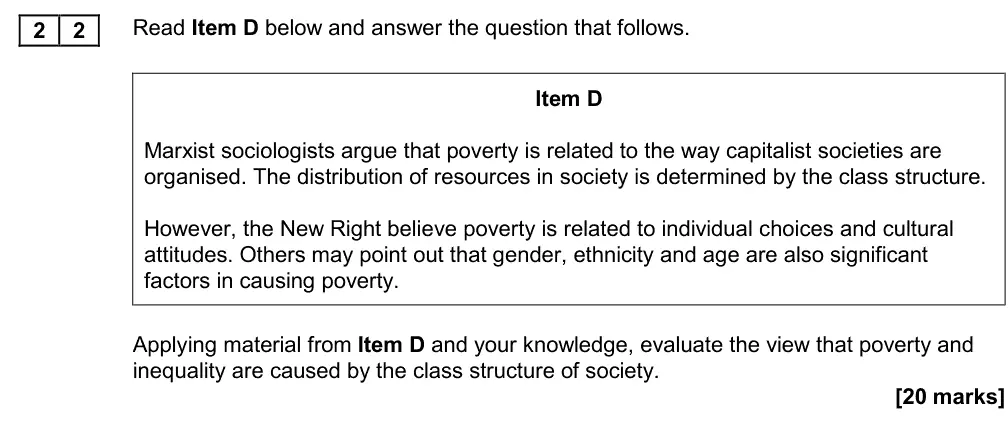
June 2019 · AS Paper 2 · Q2220 marksAO1=8, AO2=6, AO3=620-mark essay
Mark scheme, including the levels grid and indicative content
Examiner's comment
Most answers were able to use the item as a stimulus to discuss structuralist views on the causes of poverty and inequality in society. The best responses were able to locate this discussion in Marxist and sometimes Weberian approaches to social inequality with reference to appropriate sociological concepts. They were then able to evaluate these approaches by discussing some criticisms and strengths of this structuralist approach, often in contrast to cultural and individualistic explanations of social inequality and poverty. A less successful approach was simply to juxtapose these alternative explanations of class inequality or to move rapidly away from discussing class inequality and instead to describe other forms of social inequality based on either gender, age or ethnicity. In general answers that discussed a more limited range of points in more detail were more successful than those that listed a larger number of points with more limited discussion.
Notes from the mark scheme and report
AO grid not printed
must apply Item D
top band: debate between perspectives on causes of poverty, e.g. Marxist or Weberian structural views against New Right cultural and individual explanations
juxtaposition or drifting into gender, age and ethnicity inequality limits marks
a few points in depth scored better than long lists
AO split from AQA's standard grid for this paper (this year's mark scheme does not print it).
June 2018 · AS Paper 2 · Q2220 marksAO1=8, AO2=6, AO3=620-mark essay
Mark scheme, including the levels grid and indicative content
Examiner's comment
Answers to this question often took two different approaches. The first approach was to go through different social groups in the United Kingdom and describe why they might experience poverty. These answers tended to be very descriptive and lacking in sociological analysis. The alternative approach was to explain various sociological perspectives on the causes of poverty. They would explain functionalist, Weberian, Marxist, feminist and New Right approaches often in self-contained sections. The best answers adopted some combination of these approaches by, for example, locating a discussion about why people with disabilities may be more likely to experience poverty in a Marxist context of the value of individuals and groups in a capitalist society. Typical answers referred to social class, age, family type, gender, ethnicity as well as disability. Many successful students were able to contrast structural explanations with more individualistic explanations for poverty.
Notes from the mark scheme and report
top band needs explanations for at least two social groups
apply Item D (family type, unemployment)
evaluation via Marxist, Weberian, New Right, feminist explanations or structural vs individual
group-by-group description or self-contained perspective sections both limited
best combined the two
AO split from AQA's standard grid for this paper (this year's mark scheme does not print it).
June 2017 · Paper 2 · Q1220 marksAO1=8, AO2=6, AO3=620-mark essay
Mark scheme, including the levels grid and indicative content
Examiner's comment
Many scripts had one substantial, well developed answer to a 20 mark question and one significantly briefer one, again suggesting problems with time management. It is often the case that a wide range of material can be relevant to these questions, and students will need to be selective. For example, it may be more effective to cover a limited number of views or theories in some depth, rather than to include every possible theory. There was a tendency for answers to progressively lose sight of the question and to become a list of different views. The best answers will address all aspects of the question and will draw on theories, concepts and empirical examples or evidence. Evaluation which meets the demands of the questions is better than points of criticism which have been learned and included, regardless of the specific question that has been set. Students should also be aware that evaluation includes awareness of the strengths, as well as the weaknesses, of an argument or theory. There was a range in the quality of responses to this question. Better answers were able to apply different theories and concepts to gender differences in poverty, but others struggled to move beyond a descriptive account, often of discrimination at work, with little reference to poverty.
Notes from the mark scheme and report
top band debates feminist views against others such as New Right
many stayed with a description of workplace discrimination with little link to poverty
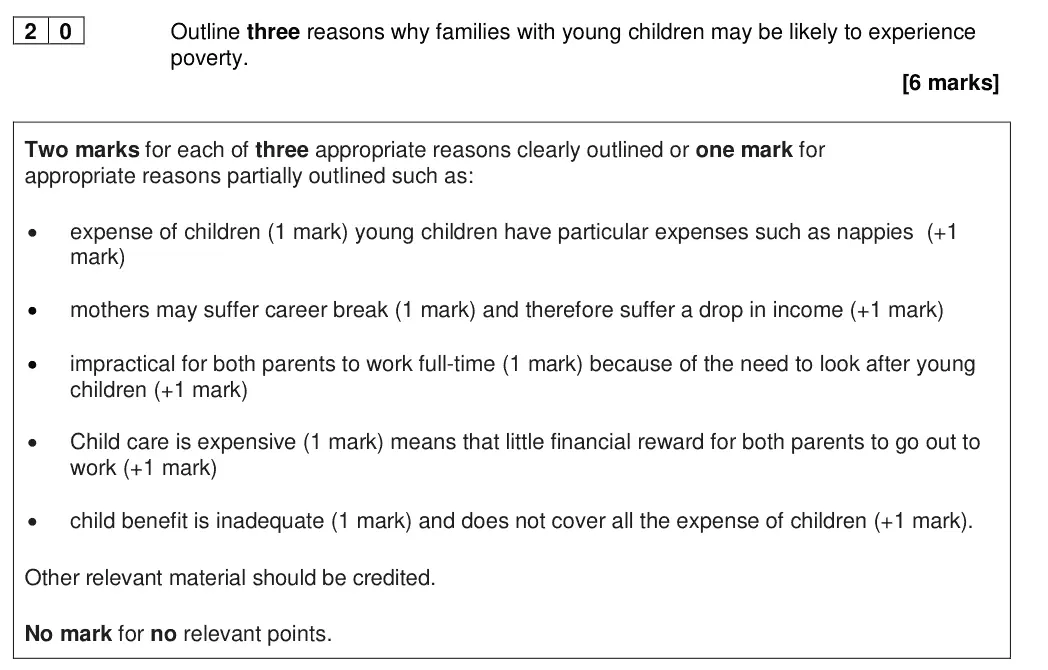
June 2016 · AS Paper 2 · Q206 marksAO1=6Outline
Mark scheme
Examiner's comment
In the 6 mark question some students are writing far too much, thereby losing focus on the precise wording of the question. Most students were able to identify some reasons why families with young children may be likely to experience poverty. These usually cited the expense of bringing up children, the inability to do paid work full time, the expense of child care, and/or the necessity for some mothers to have a career break. Failure to get maximum marks was usually due to the point being too general, or not spelling out explicitly the significance of, or reason for, the point raised, for example stating that ‘children are expensive’ without explaining why young children incur particular expenses. or refrerring to a ‘career break’ without explaining the consequences of this for family income.
Notes from the mark scheme and report
credited: costs of young children, mothers' career breaks, both parents unable to work full time, childcare costs, inadequate child benefit
marks lost by general points (e.g. 'children are expensive') without saying why or what the consequence for income is
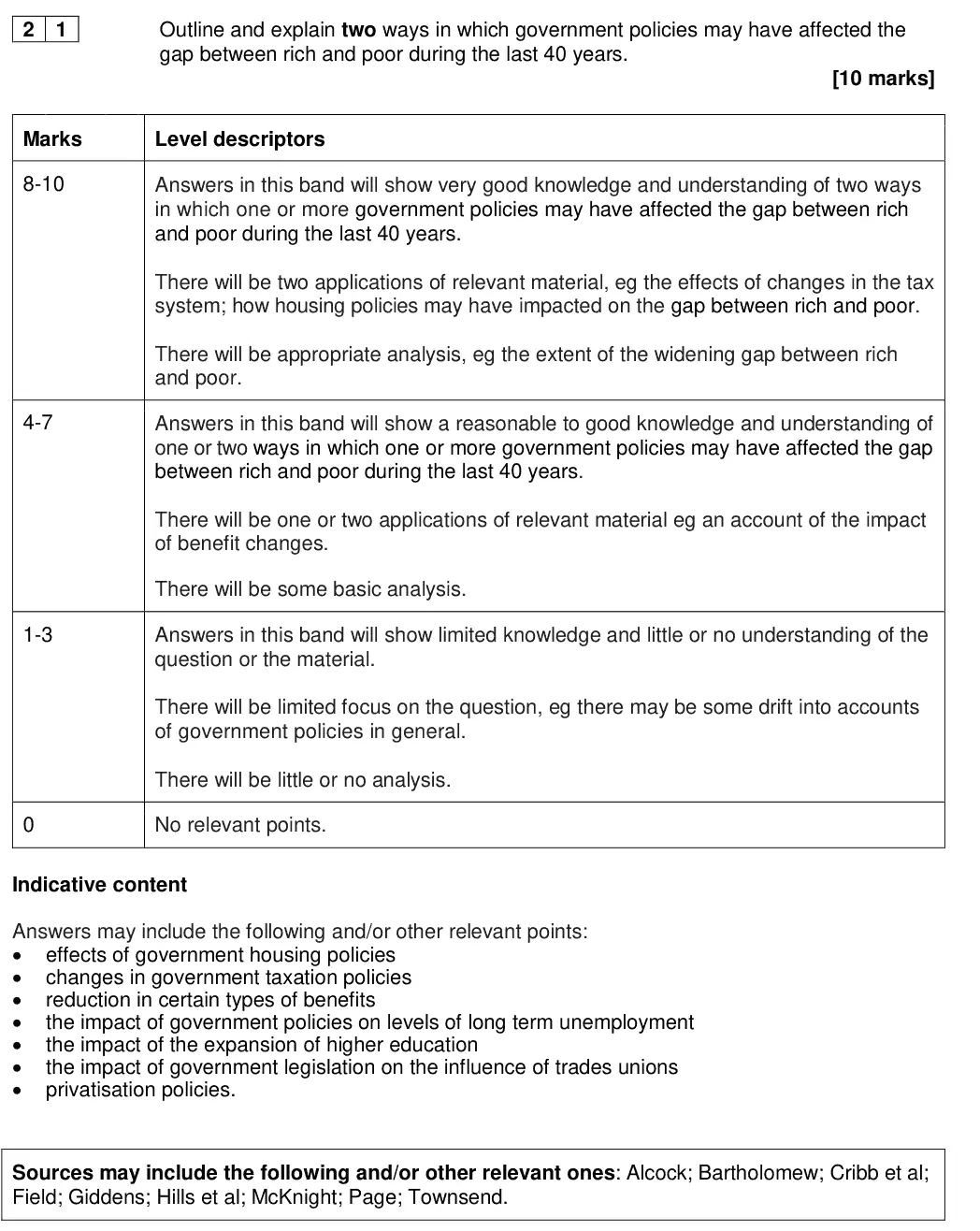
June 2016 · AS Paper 2 · Q2110 marksAO1=5, AO2=3, AO3=2Outline and explain
Mark scheme, including the levels grid and indicative content
Examiner's comment
The 10 mark ‘Outline and explain’ question requires students to link two aspects of the specification. The best answers took note of both aspects of the question, clearly identified two separate points and developed them together them in relation to the question as a whole. Weaker answers either ignored one aspect of the question, or attempted to cover a number of ideas rather than focusing on the two required. Good answers were able to identify two government policies (often tax and benefit policies) and explain clearly how these have impacted on the gap between rich and poor during the last 40 years. Weaker answers were either less than clear about the policy, and/or failed to explain its impact on the gap between rich and poor. The most common successful approach was a discussion of minimum wage legislation, with a clear description of what this is coupled with some analysis of its potential impact on the poorest sections of society.
Notes from the mark scheme and report
two policies and their effect on the gap between rich and poor