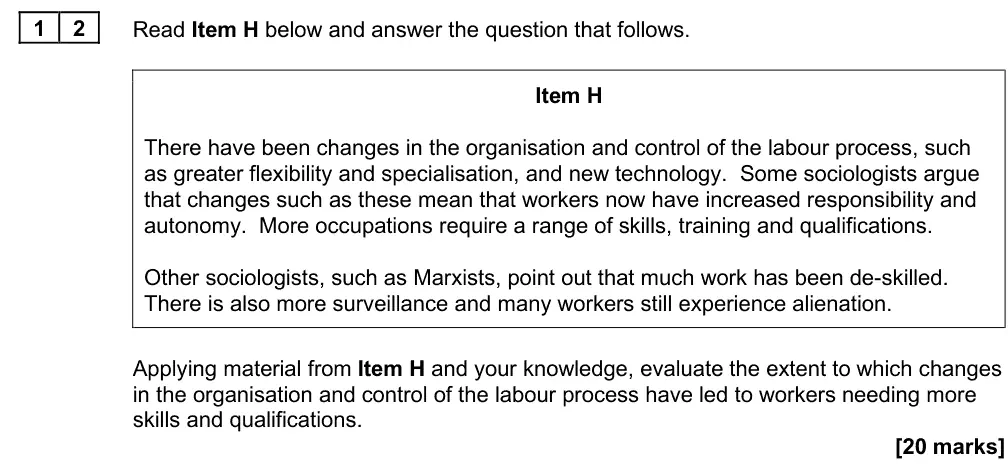
Applying material from Item H and your knowledge, evaluate the extent to which changes in the organisation and control of the labour process have led to workers needing more skills and qualifications.
Tap a question to zoom it. The mark scheme (with the level descriptors and indicative content) and the examiner's comment open underneath.
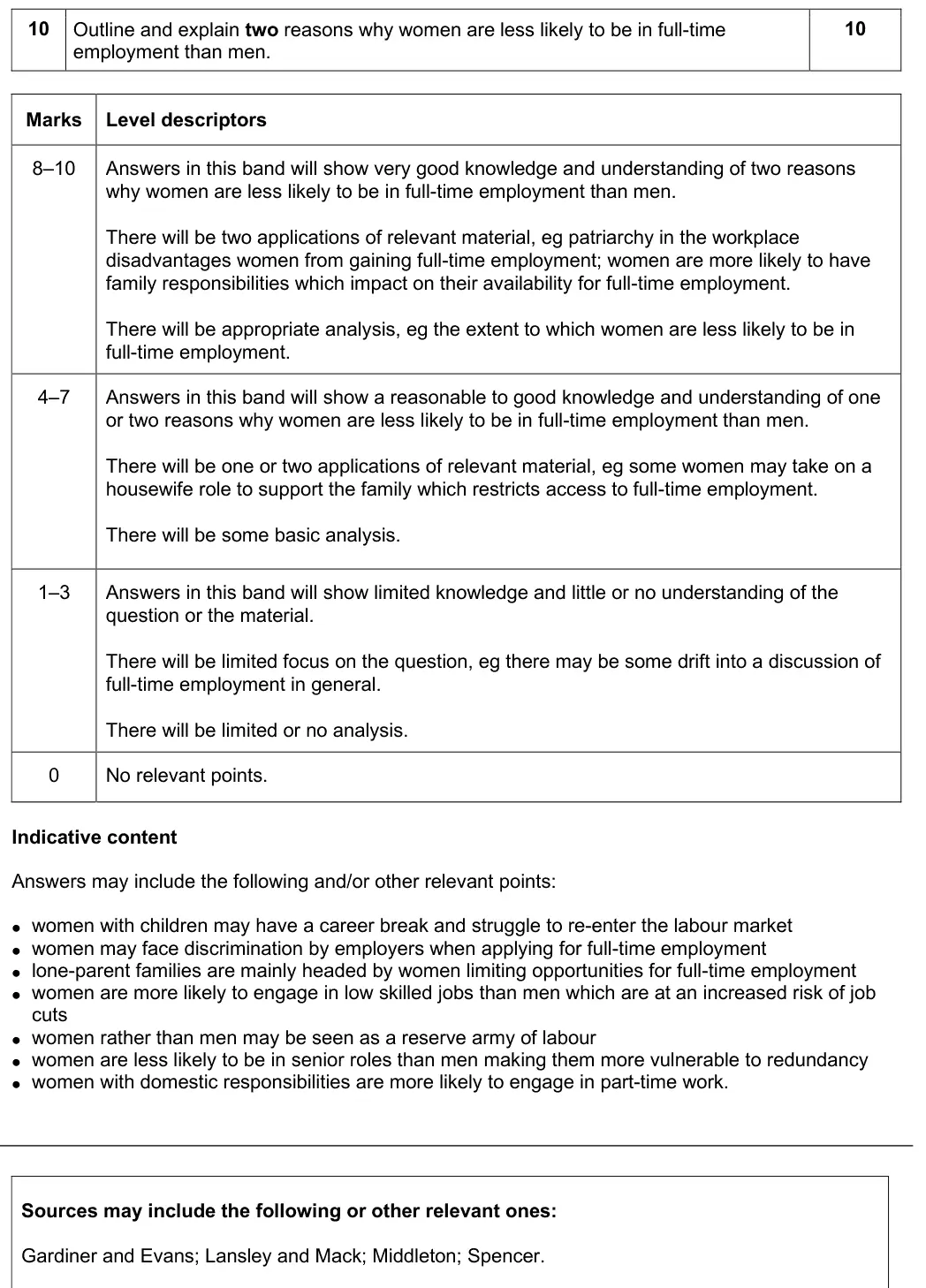
June 2025 · Paper 2 · Q1010 marksAO1=5, AO2=3, AO3=2Outline and explain
Mark scheme, including the levels grid and indicative content
Examiner's comment
The nature of these questions means that students cannot rely on reciting knowledge. Questions will ask them to bring together aspects of their sociological knowledge in ways they have not done before. It is therefore important for students to allow time to think about how to answer the question. Students should be aware that there are two types of ten-mark questions. These have different requirements and different mark schemes. There are different marks available for the assessment objectives. 10 mark “outline and explain” questions have more marks available for knowledge and understanding, and none for evaluation. Introductions and conclusions are not required for 10-mark questions, are unlikely to help students and take up time. It is helpful if answers are set out to clearly indicate the two answers, with wording such as “One way/reason is…” or by starting a new paragraph for the second point. Answers that give more than two answers are unlikely to develop two of them sufficiently. The most successful answers to 10-mark questions were focused, clearly stating a point that addressed the question and then developing it, using sociological concepts, evidence such as an example and, where appropriate, theory. Most answers showed understand of why women might be prevented from entering full time employment. Some of the most successful answers used intersectionality, for example considering how ethnic minority women may face a double oppression of racism and patriarchy that affects employment opportunities.
Notes from the mark scheme and report
drift into full-time employment in general = 1–3
common reasons: family responsibilities, employer discrimination, reserve army of labour
best answers used intersectionality (e.g. ethnic minority women facing racism and patriarchy)
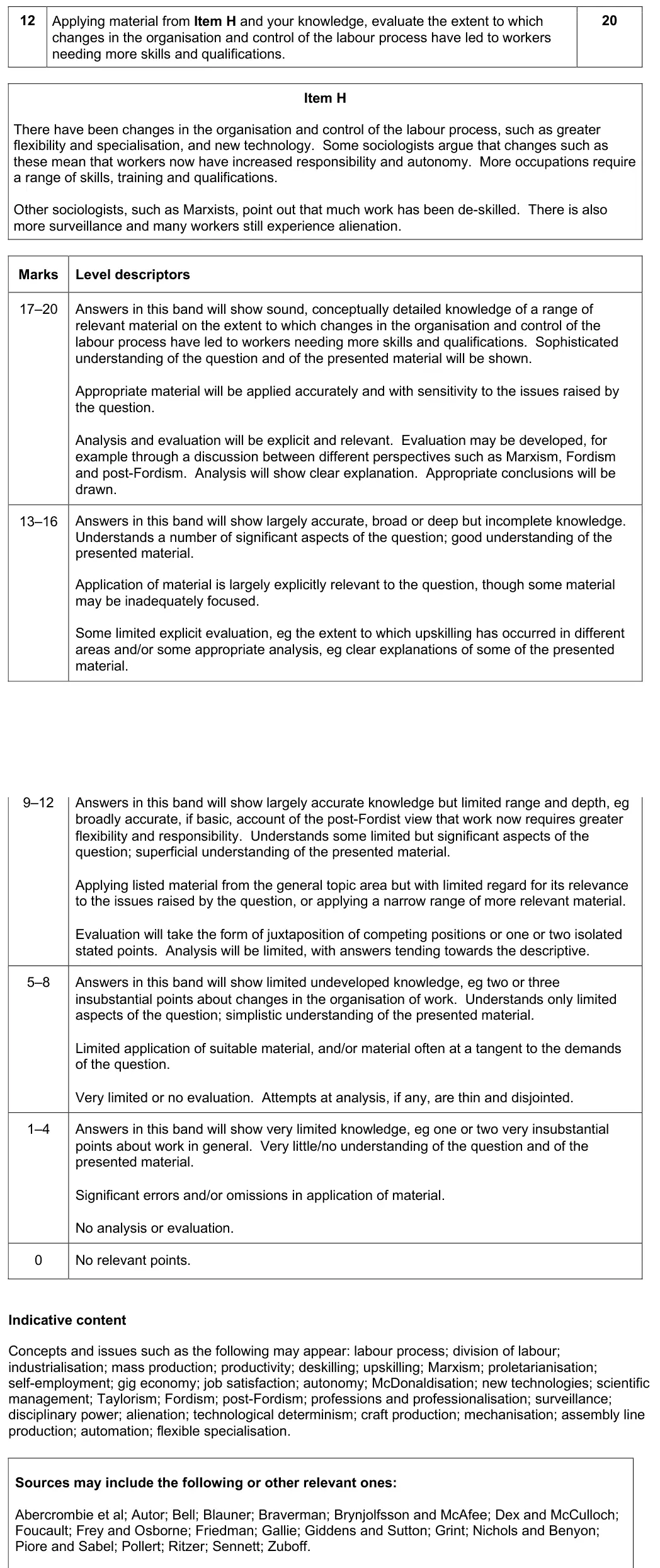
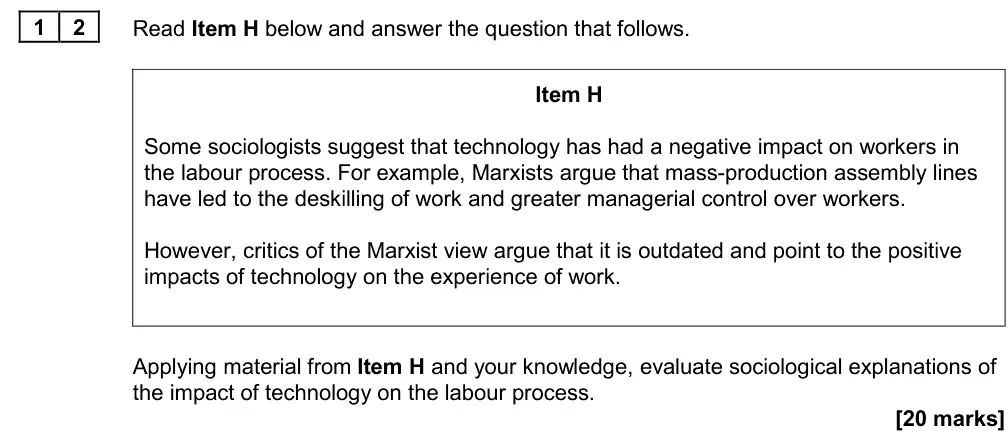
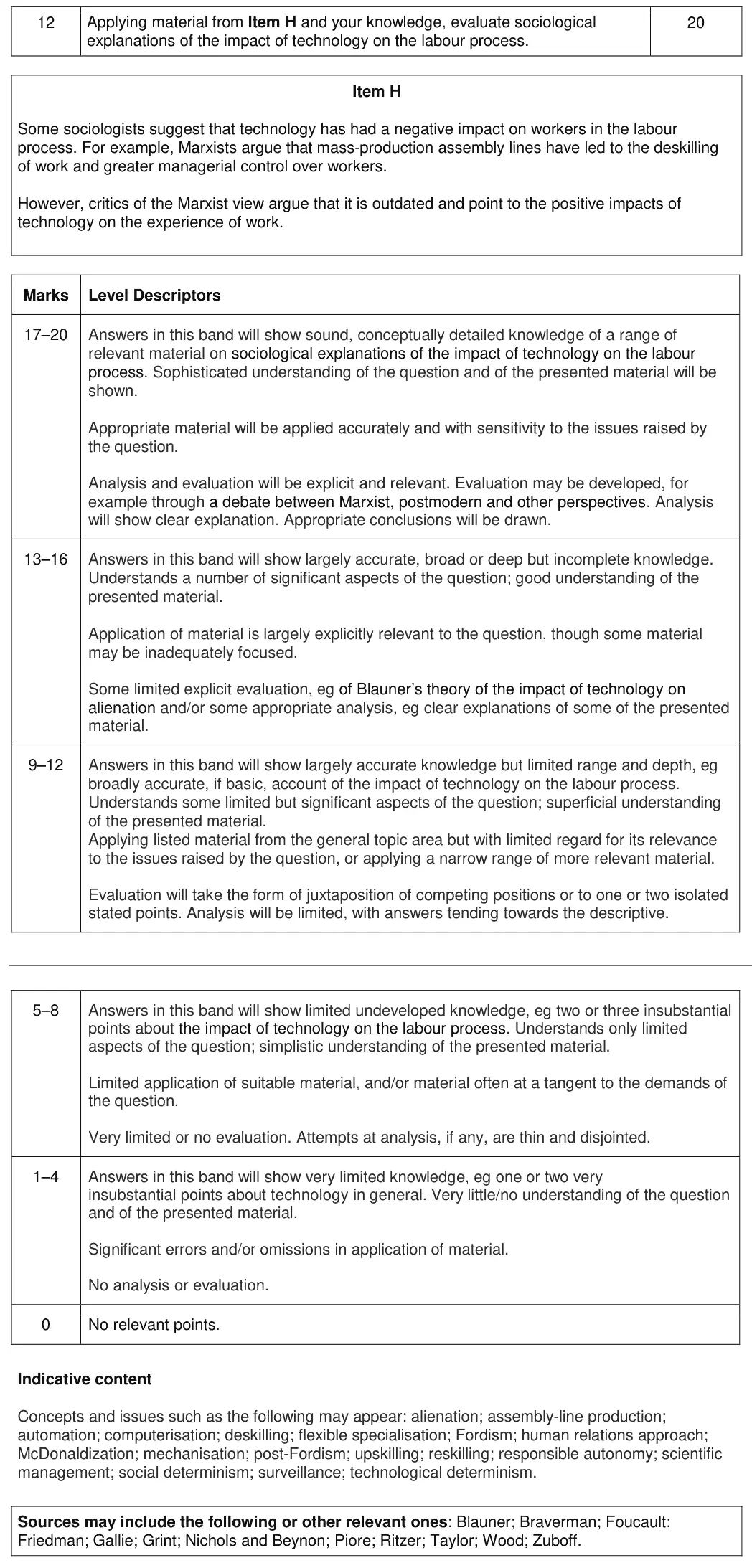
June 2025 · Paper 2 · Q1220 marksAO1=8, AO2=6, AO3=620-mark essay
Mark scheme, including the levels grid and indicative content
Examiner's comment
These require answers that are essays and are best written in paragraphs. A brief introduction can help set out the argument of the essay. It will not attract marks if it only repeats the question or parts of the item. The purpose of the items for these questions is to suggest a few starting points for students, including ways into evaluation. Students are expected to also bring in further ideas (“and your knowledge” in the instruction) rather than relying only on the item. A wide range of material can be relevant to these questions, so students need to be selective. It is more effective to cover a limited number of views/theories in depth rather than to try to include everything. Students should keep to the question. When a question is about a particular view, other views can be used for evaluation but without writing all that the student knows about them. There was a tendency for answers to progressively lose sight of the question and to become a list of different views. Students who made brief essay plans appeared to benefit by having more structured and coherent responses. Most answers were able to consider both the positive aspects, such as upskilling, and negative ones such as automation and deskilling. The best answers often discussed how the quality of life and life chances may improve because of manual labour declining. Less successful answers often lacked studies and relied on anecdotal evidence.
Notes from the mark scheme and report
top band debates Marxist deskilling against Fordist/post-Fordist upskilling views
best answers weighed upskilling against automation and deskilling
weaker answers lacked studies and relied on anecdote
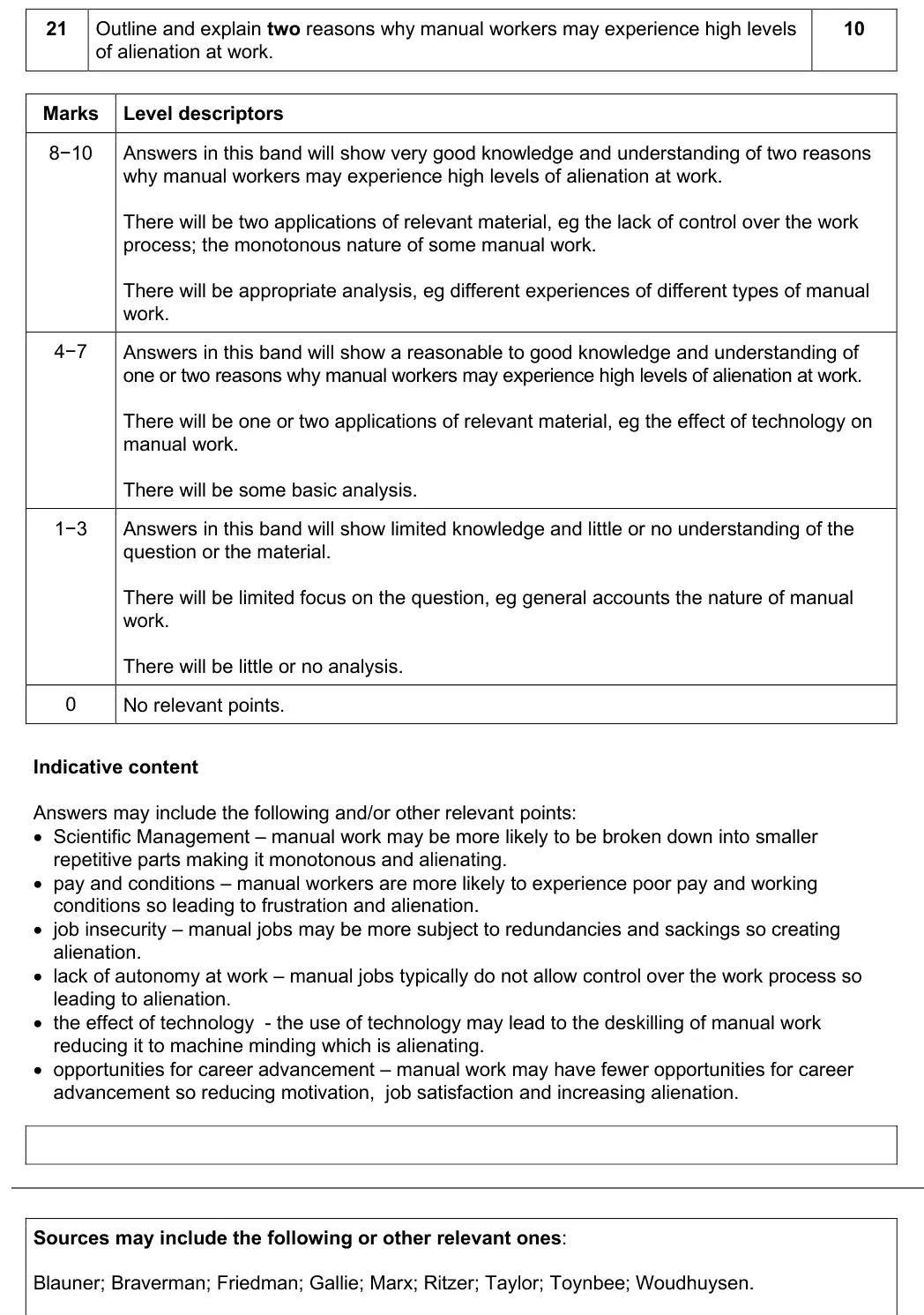
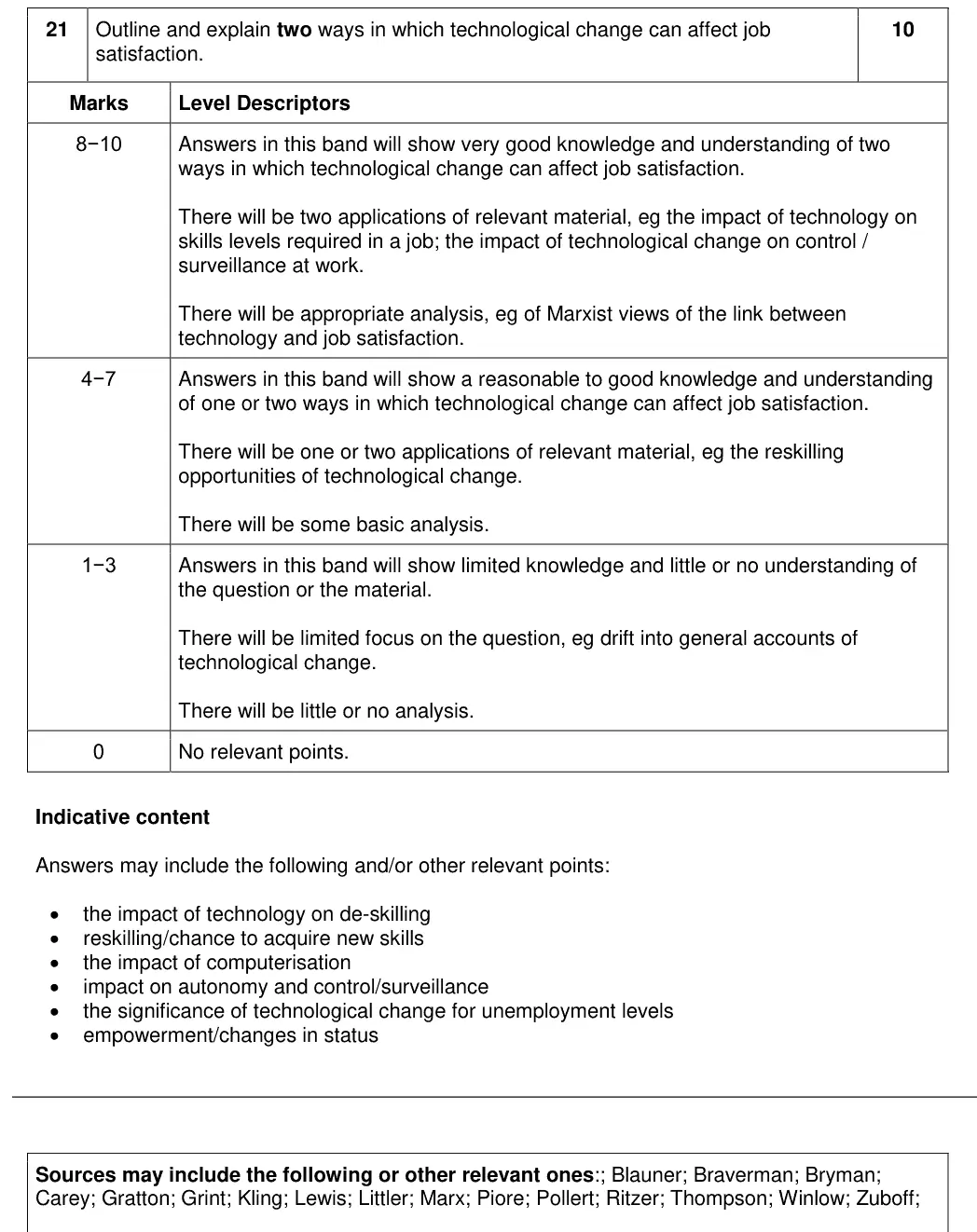
June 2025 · AS Paper 2 · Q2110 marksAO1=5, AO2=3, AO3=2Outline and explain
Mark scheme, including the levels grid and indicative content
Examiner's comment
On the 10-mark 'outline and explain' question (the fourth question in each topic area), and the 6-mark 'outline three...' question (the third question in each topic). For the 10-mark 'outline and explain' questions, students would benefit from clearly identifying a specific way, reason, or factor, followed by a developed explanation. This approach would help make their answers more coherent, structured and easier to reward. Students generally had no difficulty in finding reasons why manual workers may experience high levels of alienation. Answers often suggested: the various impacts of scientific management, poor pay and conditions, the negative impact of technology including surveillance and job insecurity. The development of the given reasons was often the limiting factor for some students. Some found it difficult to connect the reason to further development of it.
Notes from the mark scheme and report
two reasons each developed
examples: scientific management and monotony, poor pay and conditions, insecurity, lack of autonomy, deskilling by technology, few promotion chances
general accounts of manual work = 1-3
development was the usual limit
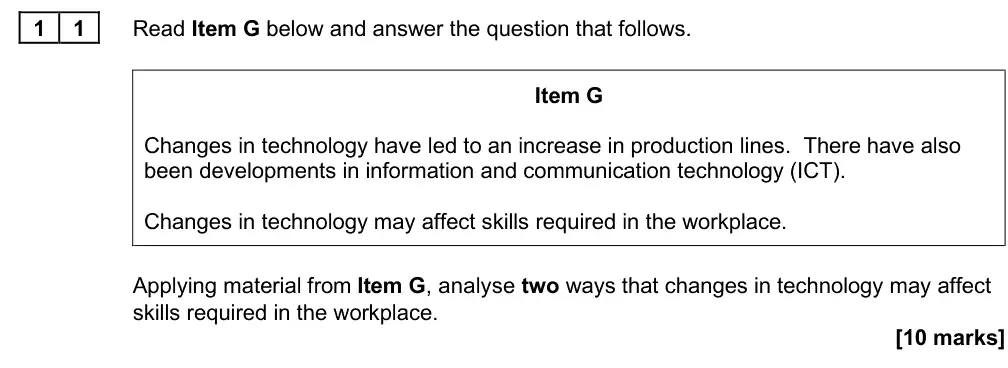
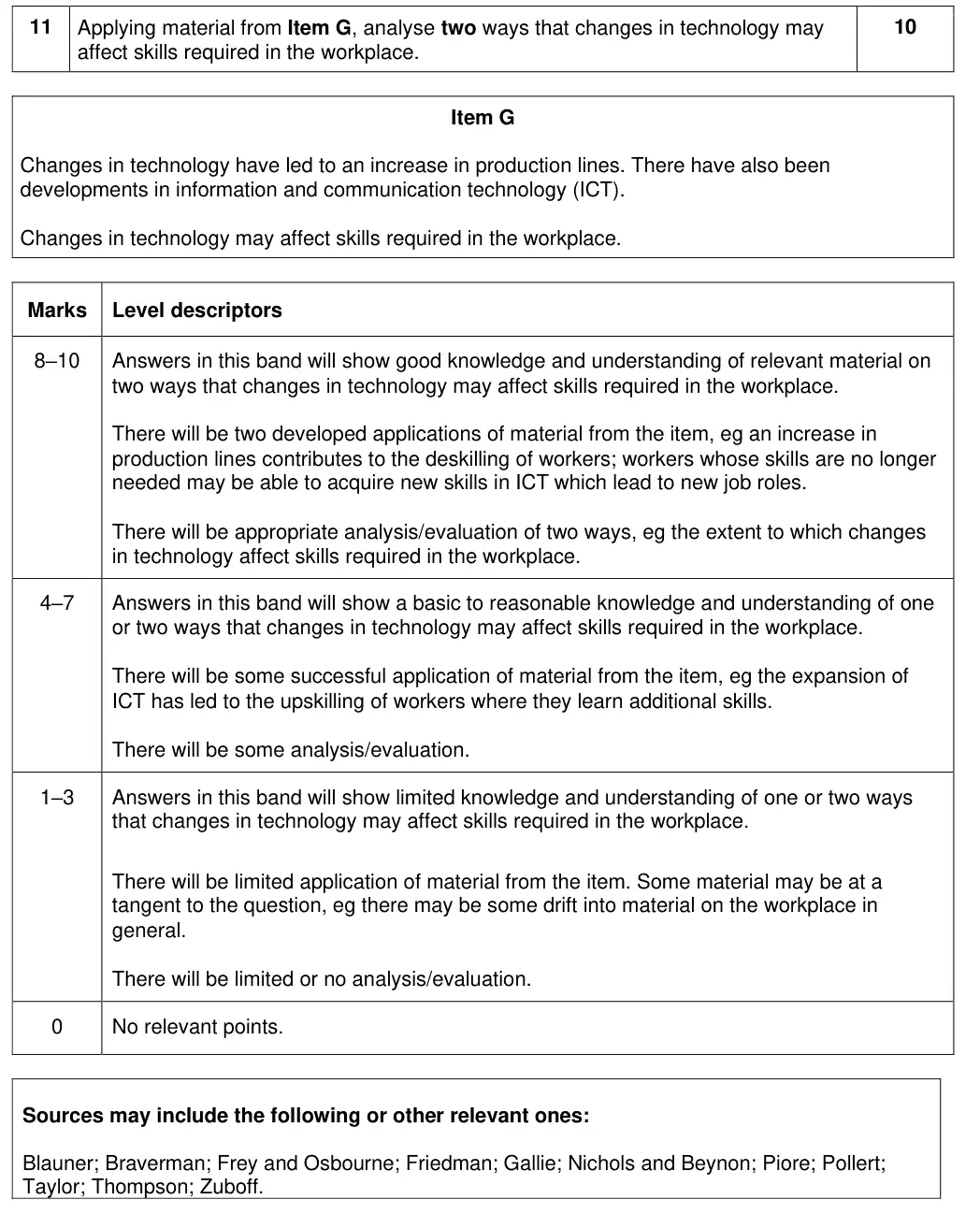
June 2024 · Paper 2 · Q1110 marksAO1=3, AO2=4, AO3=3Analyse
Mark scheme, including the levels grid and indicative content
Examiner's comment
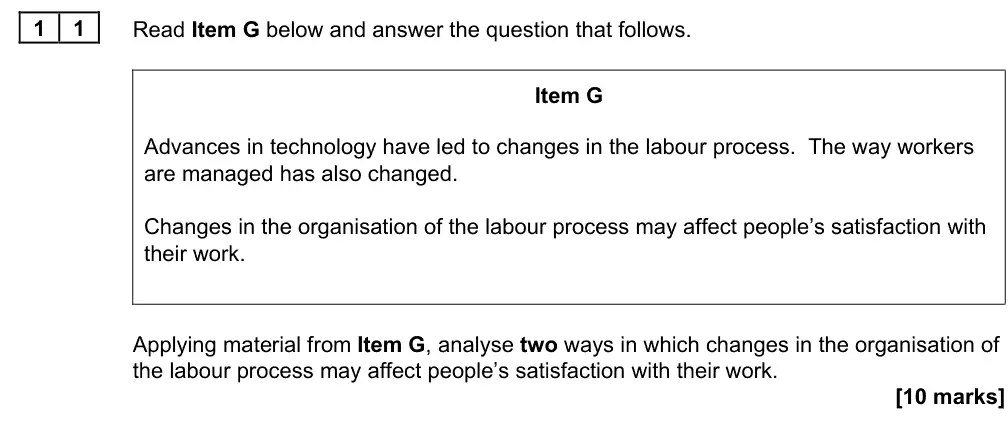
The nature of these questions means that students cannot rely on reciting knowledge. Questions will ask them to bring together aspects of their sociological knowledge in ways they will not have done before. It is therefore important for students to allow time to think about how to answer the question. Students should be made aware that there are two types of 10 mark questions. These have different requirements and different mark schemes . There are different marks available for the assessment objectives. A breakdown of the marks awarded by assessment objective can be found in the mark scheme. The items for 10 mark “analyse” questions are written to give prompts or “hooks” for student answers. These have to be used to access application marks. Answers can indicate use of hooks by quoting, by a reference in parentheses or by wording ( eg “As the item says…”). Items end with a sentence restating the question; the hooks are in the preceding part of the item. Students should avoid writing all they know about a “hook”, and focus on applying the idea to the question. Introductions and conclusions are not required for 10 mark questions; they take up time and rarely improve the mark. It is helpful if answers are set out to clearly indicate the two answers, with wording such as “One way/reason is…”, or by starting a new paragraph for the second point. Answers that give more than two points are unlikely to develop two of them sufficiently. Q11: Answers demonstrated reasonable knowledge and were able to apply the “hooks” with some degree of success. Some answers referred to the effects of deskilling due to the increase in production lines, or to the idea of upskilling.
Notes from the mark scheme and report
two developed applications from Item G (production lines
ICT), e.g. deskilling on production lines, upskilling or reskilling through ICT
drift into the workplace in general is a tangent
answers showed reasonable knowledge and used the hooks fairly well
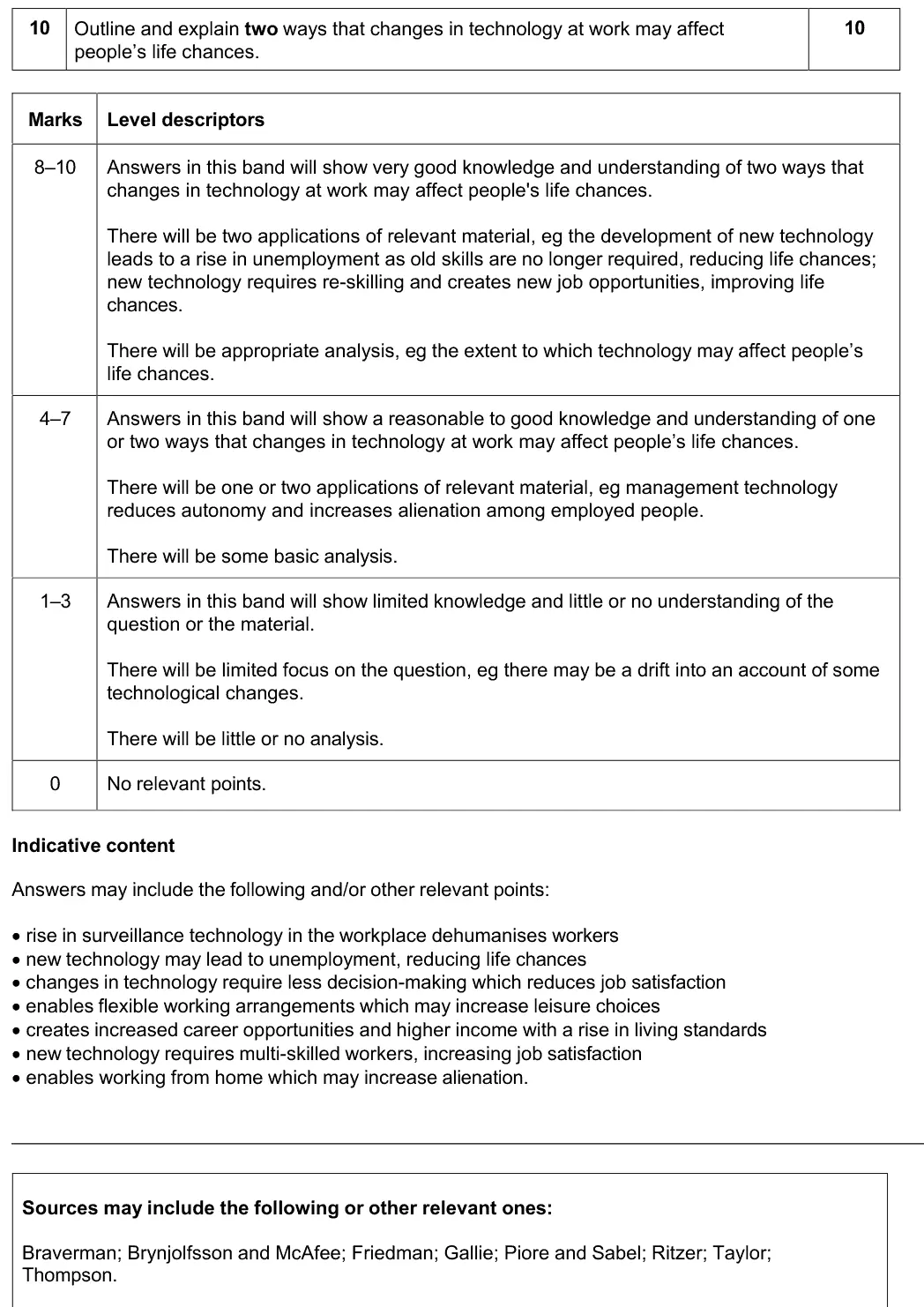
June 2023 · Paper 2 · Q1010 marksAO1=5, AO2=3, AO3=2Outline and explain
Mark scheme, including the levels grid and indicative content
Examiner's comment
The nature of these questions means that students cannot rely on reciting knowledge. Questions will ask them to bring together aspects of their sociological knowledge in ways they are unlikely to have done before. It is therefore important for students to allow time to think about how to answer the question. Students should be made aware that there are two types of 10 mark questions. These have different requirements and different mark schemes. There are different marks available for the assessment objectives. 10 mark “outline and explain” questions have more marks available for knowledge and understanding, and none for evaluation. Introductions and conclusions are not required for 10 mark questions and take up valuable time. It is helpful if answers are set out to clearly indicate the two separate points, with wording such as “One way/reason is…” or by starting a new paragraph for the second point. Answers that give more than two points are unlikely to develop two of them sufficiently. Question 10: Answers often considered how new technology can both make some skills and jobs redundant and can create new opportunities. “Life chances” tended to be taken as employment; looking beyond this would give greater scope for developing points.
Notes from the mark scheme and report
two ways workplace technology affects life chances (deskilling and unemployment, re-skilling and new jobs, surveillance, flexible/home working)
drift into describing technological change = 1–3
answers often treated life chances as employment only, limiting development
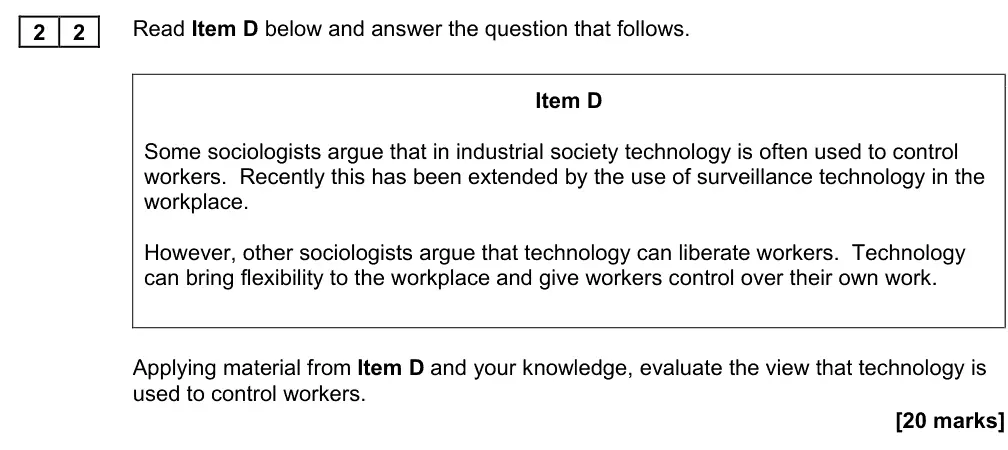
June 2023 · AS Paper 2 · Q2220 marksAO1=8, AO2=6, AO3=620-mark essay
Mark scheme, including the levels grid and indicative content
Examiner's comment
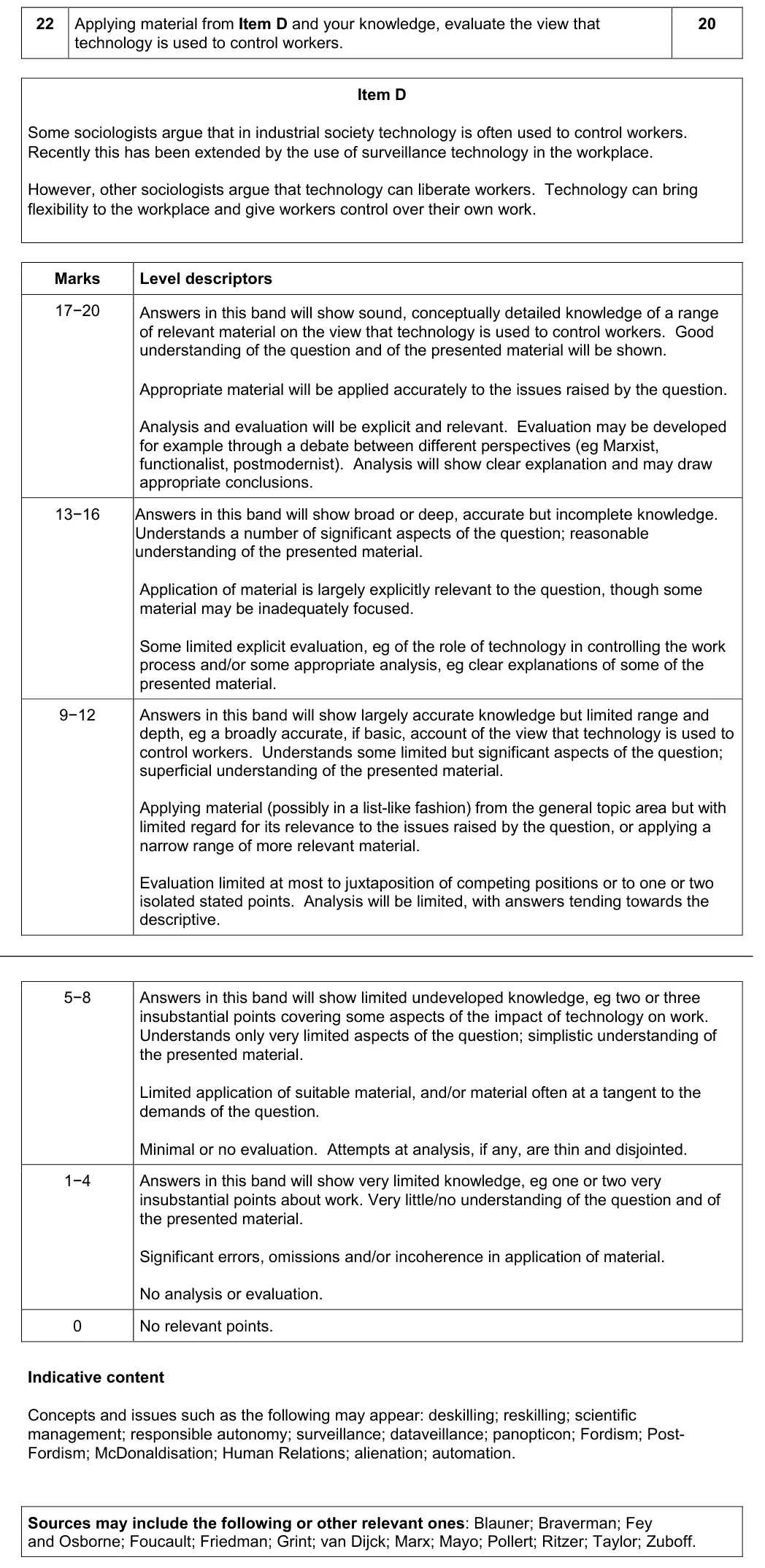
This was a question most students found themselves well prepared for and were able to offer responses which covered many of the debates around technology in a ‘for and against’ style of approach: upskilling vs deskilling / freeing the worker from tedium vs increasing alienation. Many students were able to use the item and its focus on surveillance to talk about time work discipline. Some higher level explanations made reference to surveillance making the workplace fairer by identifying those not carrying their weight for example. The most effective answers addressed the debate surrounding the role of technology by locating it within the theoretical framework of Marxism, feminisms and postmodernism.
Notes from the mark scheme and report
top band debates perspectives (Marxist, functionalist, postmodernist) on technology controlling or liberating workers
most used for-and-against framing (deskilling vs upskilling, alienation vs freedom from tedium) and the item's surveillance hook
best located the debate in Marxist, feminist and postmodern frameworks
June 2022 · Paper 2 · Q1110 marksAO1=3, AO2=4, AO3=3Analyse
Mark scheme, including the levels grid and indicative content
Examiner's comment
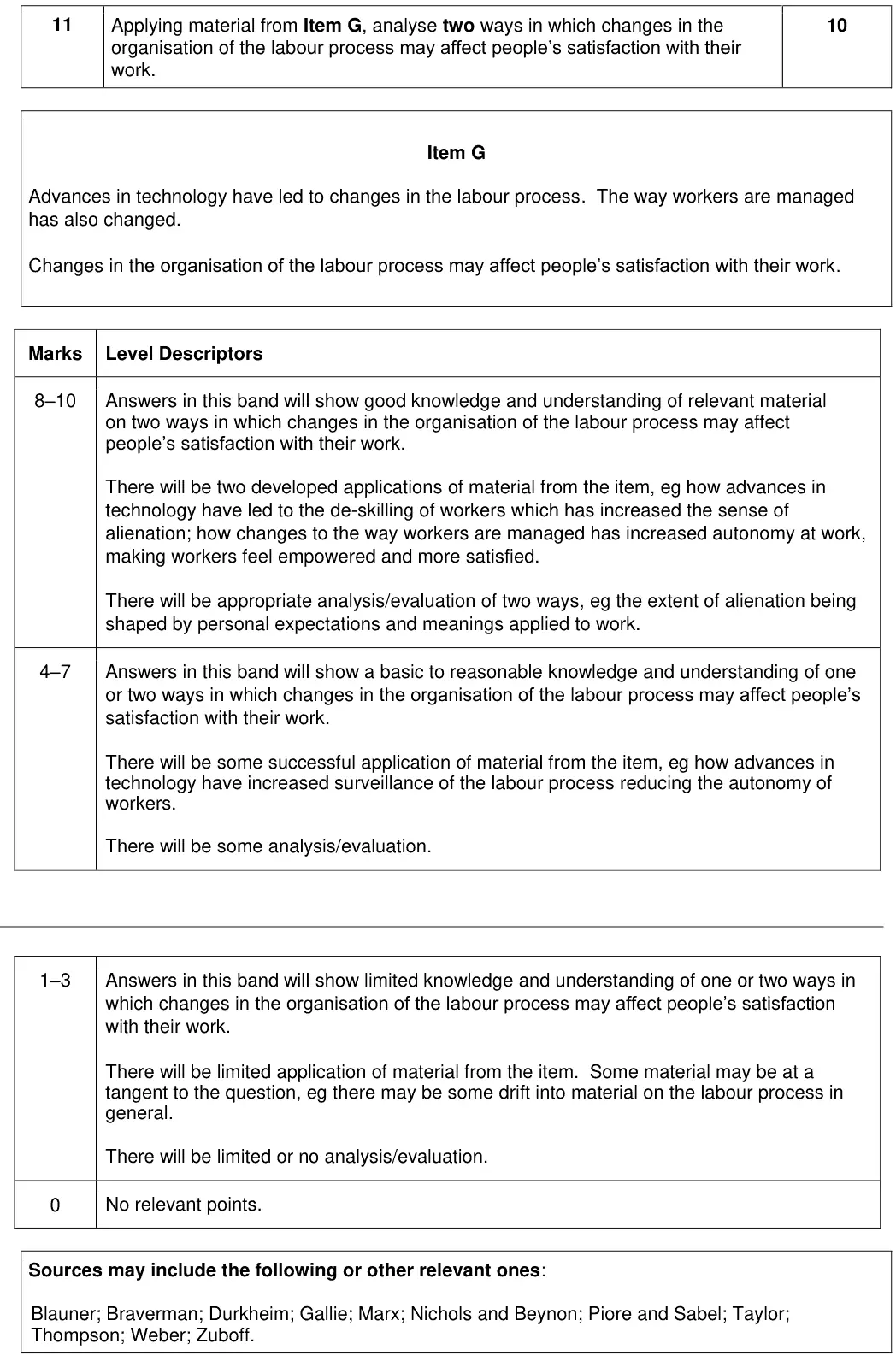
The nature of these questions means that students cannot rely on reciting knowledge. The questions will ask them to bring together aspects of their sociological knowledge in a way that they are unlikely to have done before. There was a tendency, however, to attempt to answer the question by giving knowledge based on words or phrases in the question, rather than meeting the demands of the question. Students are advised to spend time reading the question, and, where there is one the item, to ensure that they are answering the question. Some students seemed unaware of the different demands of the two types of questions. The marks awarded for the assessment objectives are different in the two types of ten mark questions, and students should be aware of this. In “analyse” (with item) questions, the answers need to be clearly based on the prompts or “hooks” in the item, not just on the final sentence of the item which restates the question. There is no need for an introduction or conclusion for 10 mark questions. It is helpful if answers are set out to clearly indicate the two answers, with wording such as “One way is…” or by starting a new paragraph for the second point. The best answers to 10 mark questions were focused, clearly stating a point that addressed the question and then developing it, using sociological concepts, evidence and, where appropriate, theory. Answers need to address all aspects of the question. Q11 For advances in technology, answers focused on, for example, Taylorism, assembly line production and mechanisation, leading to alienation. For changes in the way workers are managed, successful answers included increased surveillance and deskilling and how these may increase stress.
Notes from the mark scheme and report
hooks: technology and changes in management
top band e.g. deskilling increasing alienation, more autonomy raising satisfaction
analysis of how expectations shape alienation
drift into the labour process in general = 1–3 band
common material Taylorism, assembly lines, surveillance, stress
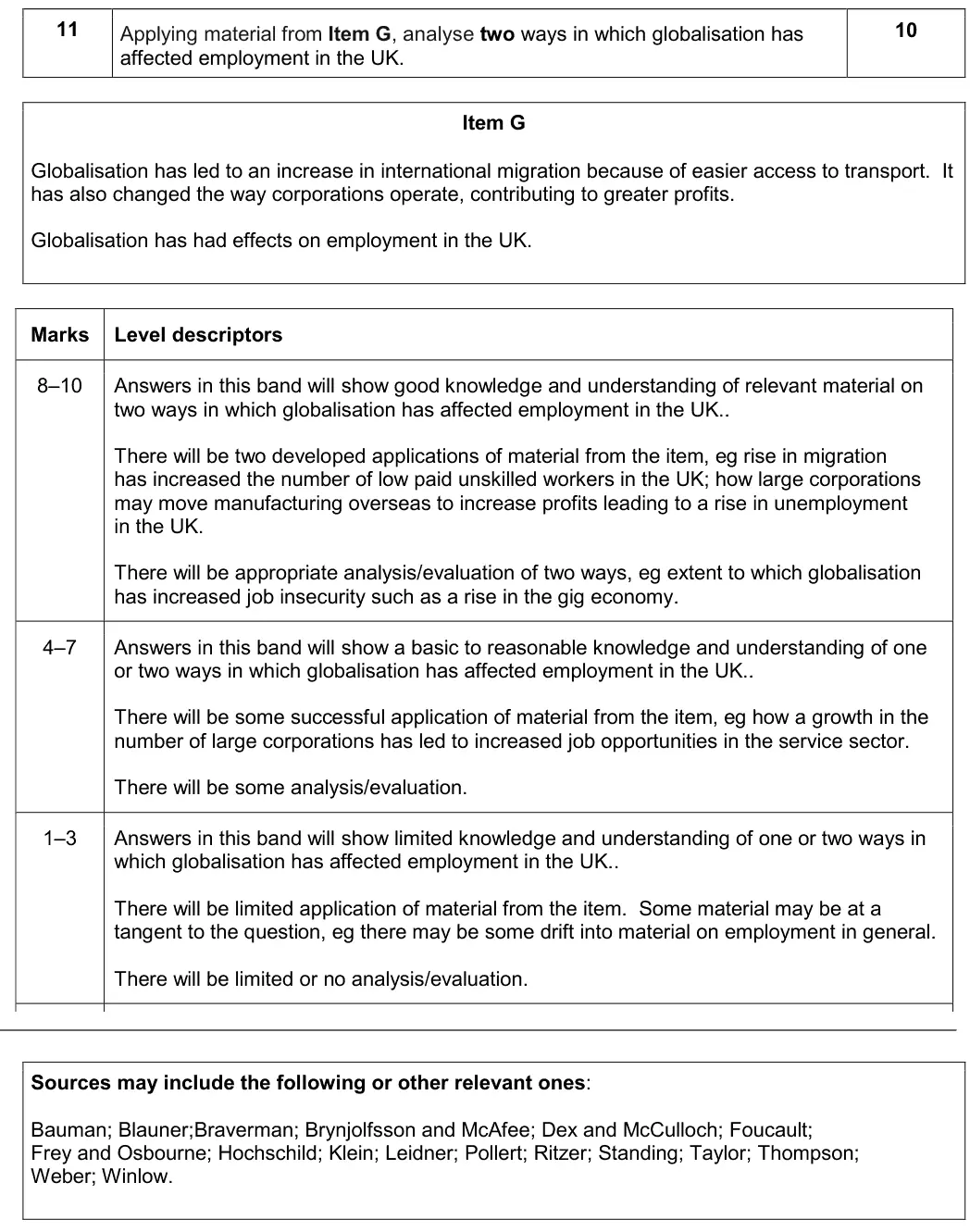
November 2021 · Paper 2 · Q1110 marksAO1=3, AO2=4, AO3=3Analyse
Mark scheme, including the levels grid and indicative content
Notes from the mark scheme and report
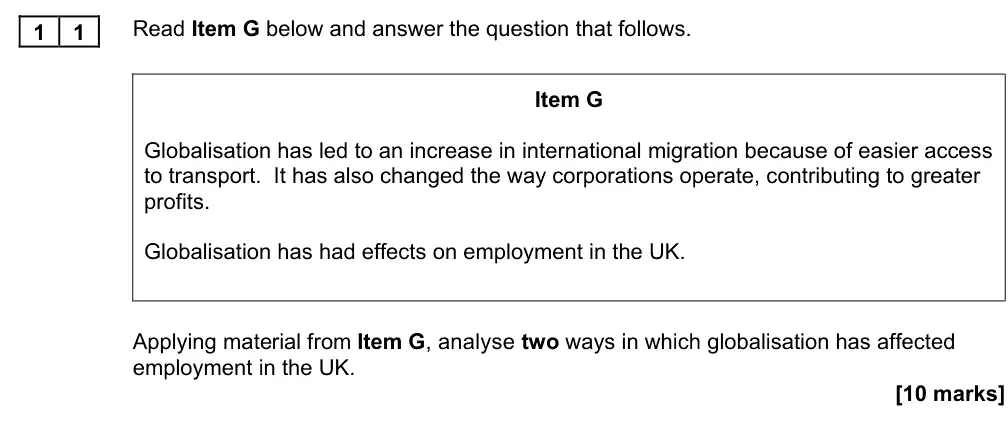
must develop hooks from Item G (migration, corporations seeking profit)
the last line restates the question and is not a hook
credited: more low-paid migrant labour, offshoring manufacturing and job losses, service-sector jobs, gig economy insecurity
drift into employment in general = 1–3
no examiners' report comment for this part
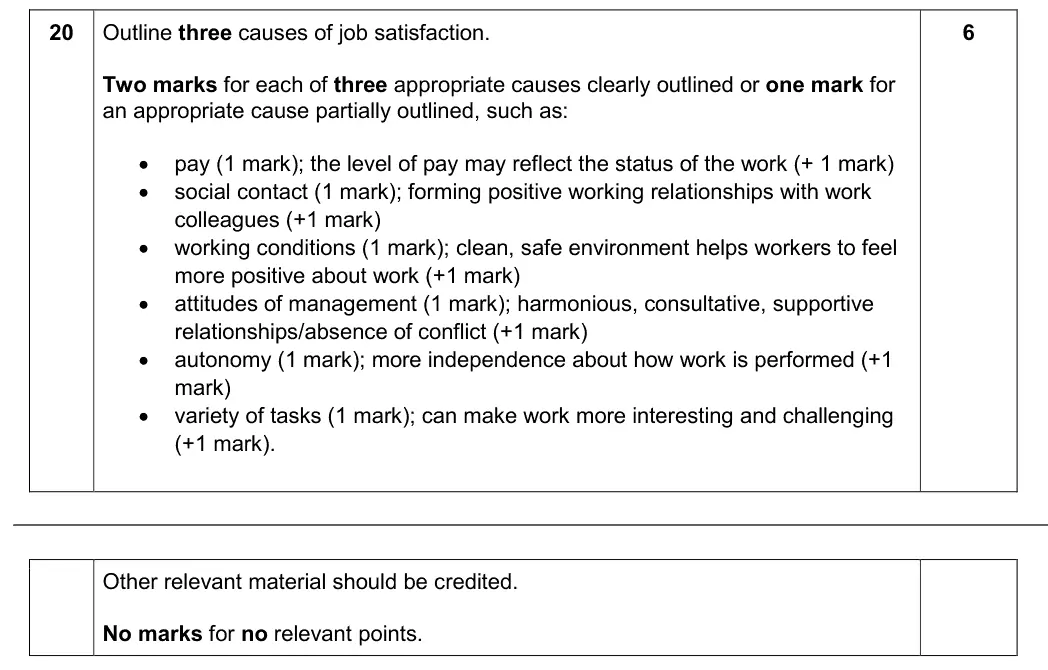
November 2020 · AS Paper 2 · Q206 marksAO1=6Outline
Mark scheme
Notes from the mark scheme and report
2 marks for each of three causes clearly outlined, 1 if partial
creditable: pay, social contact, working conditions, management attitudes, autonomy, task variety
June 2019 · Paper 2 · Q1220 marksAO1=8, AO2=6, AO3=620-mark essay
Mark scheme, including the levels grid and indicative content
Examiner's comment
As last year, many scripts had one substantial answer to the Section A 20-mark question and one significantly briefer one for Section B, suggesting problems with timing. There was often little evidence of planning. A wide range of material can be relevant to these questions, and students are not expected to include everything. They need to carefully choose the content and to plan their answers. The best answers will be both empirical and theoretical, for example showing knowledge of research findings and examples, and knowledge of theoretical perspectives. Some answers amounted to lists of theoretical perspectives, with learned points of criticism, and lost focus on the question itself. While the items are intended as a helpful starting point for answers, they should not be taken by students as a full list of what is relevant; better answers will draw in other relevant knowledge and ideas. This question was answered well by most students, with accounts of Taylorism and Fordism often providing starting points for discussion of deskilling, proletarianisation, the routinisation of white- collar work, and so on.
Notes from the mark scheme and report
top band debates Marxist, postmodern and other views (e.g. Blauner on alienation)
common starting points Taylorism and Fordism, then deskilling, proletarianisation and routinised white-collar work
AO split from AQA's standard grid for this paper (this year's mark scheme does not print it).
June 2019 · AS Paper 2 · Q2110 marksAO1=5, AO2=3, AO3=2Outline and explain
Mark scheme, including the levels grid and indicative content
Examiner's comment
The requirements of the 10-mark question seem to be well understood by the majority of students. The best answers tended to start with job satisfaction and discuss the impact of technological change on skill levels. Many answers referred to alienation and these answers were able to provide a fuller account of the impact of technological change on job satisfaction. Some answers were able to discuss at length Fordism and the views of Braverman on autonomy and control in the workplace. Weaker answers focused on technological change and often neglected to relate these ideas to the workplace, let alone to job satisfaction.
Notes from the mark scheme and report
AO grid not printed
no marks for evaluation in this question type
two ways each developed, e.g. de-skilling or re-skilling, control and surveillance
best answers started from job satisfaction and used alienation, Braverman, Blauner
general accounts of technological change not tied to work = 1–3
AO split from AQA's standard grid for this paper (this year's mark scheme does not print it).
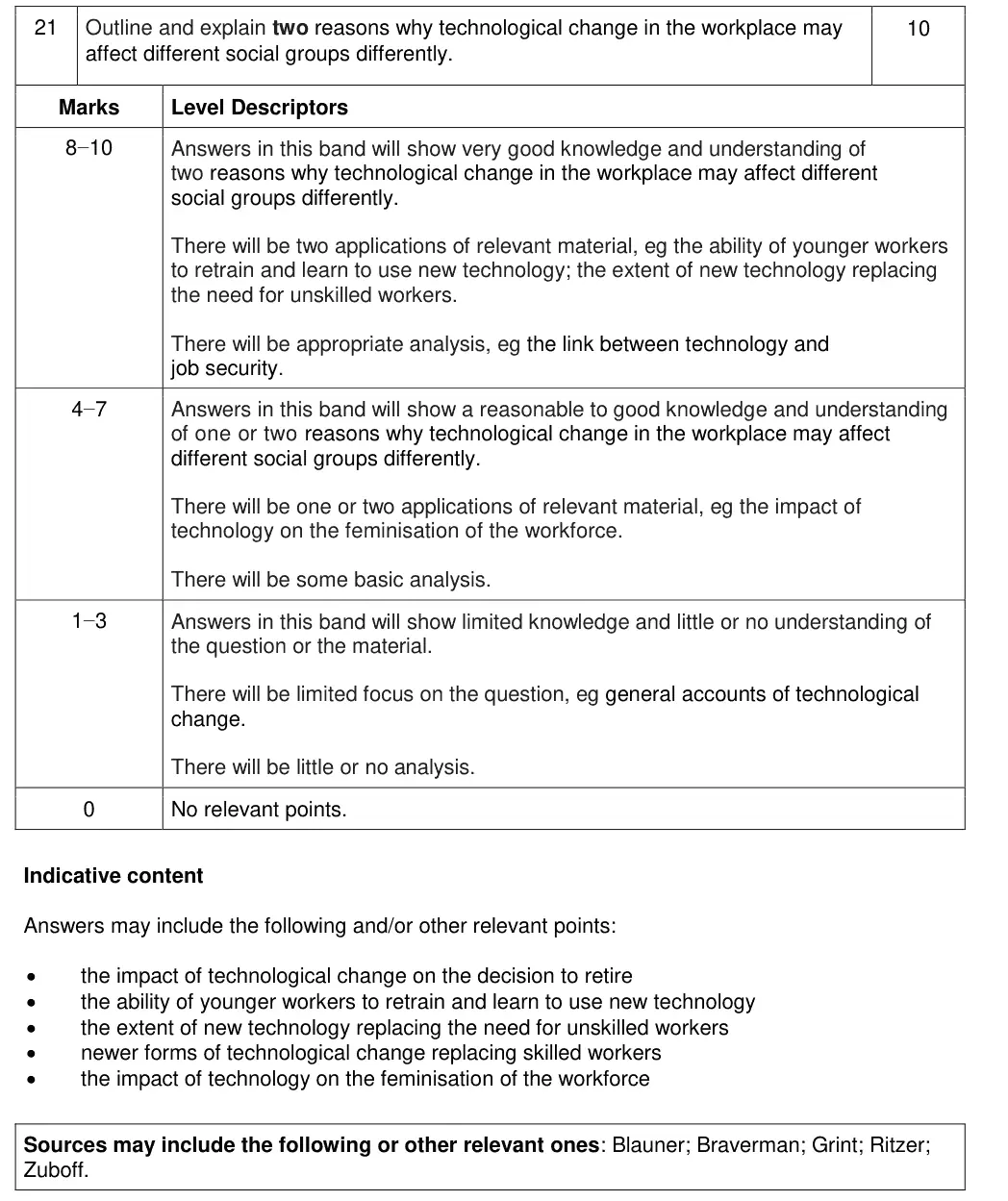
June 2018 · AS Paper 2 · Q2110 marksAO1=5, AO2=3, AO3=2Outline and explain
Mark scheme, including the levels grid and indicative content
Examiner's comment
The 10 mark outline and explain question requires students to link two aspects of the specification. The best answers took note of both aspects of the question, clearly identified two separate points and developed them in relation to the second part of the question. Weaker answers either ignored one aspect of the question or attempted to cover a number of ideas rather than focusing on two. Some answers focused on the impact of technological change and were able to discuss at length Fordism and the views of Braverman on autonomy and control in the workplace. Although knowledgeable, these answers often struggled to identify different social groups and tended to talk in general terms about the effect on the work place. More successful answers discussed the different impact on different types of workers such as skilled/ unskilled or manual/non manual or young/old. These answers were then able explain the impact of technological change in a more focused manner. The impact on workers with disability was also a successful approach taken by some students.
general accounts of technological change (Fordism, Braverman) without groups = 1-3
best compared skilled/unskilled, manual/non-manual, young/old, disabled workers
AO split from AQA's standard grid for this paper (this year's mark scheme does not print it).
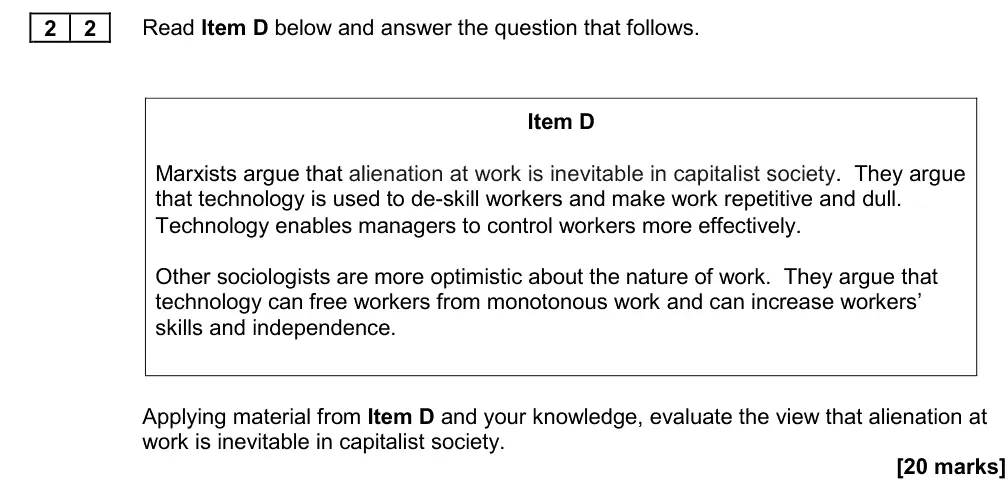
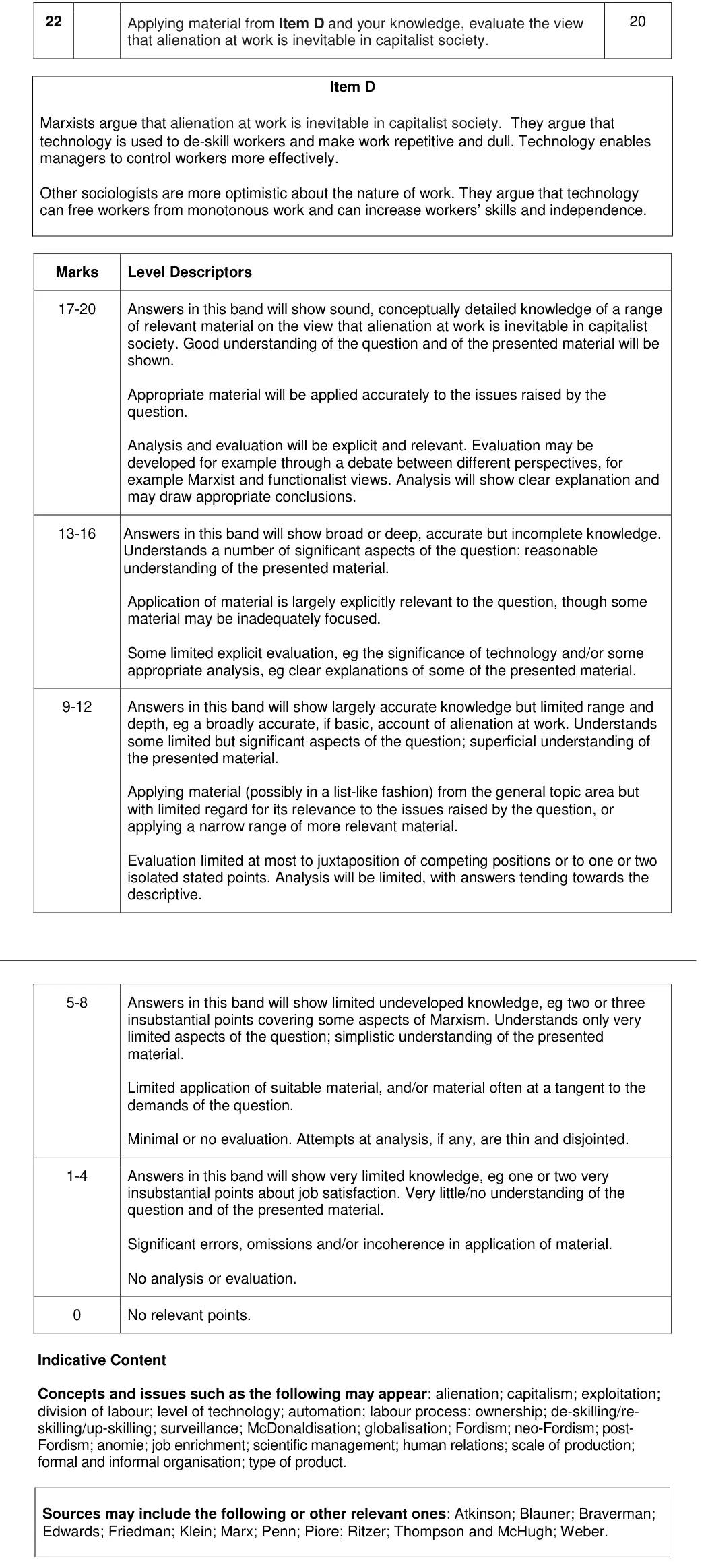
June 2017 · AS Paper 2 · Q2220 marksAO1=8, AO2=6, AO3=620-mark essay
Mark scheme, including the levels grid and indicative content
Examiner's comment
There were some very good responses to this question. Many answers gave a clear account of different aspects of alienation and were able to discuss different perspectives on the issue of whether alienation is inevitable in capitalist society. These answers often started with the Marxist view of alienation and then discussed the impact of technology on the labour process. Typical answers referred to automation, deskilling, re-skilling, Fordism, post-Fordism, job enrichment as well as issues of control and job satisfaction. Weaker answers either had a much narrower view of alienation (usually job satisfaction) and/or spent a long time discussing the impact of technology in the work place without tying it explicitly to the issue of alienation. Some weaker answers merely presented general material on the nature of changes to work in contemporary society.
Notes from the mark scheme and report
must apply Item D (de-skilling, managerial control, optimistic view of technology)
top band: debate between Marxist and other (e.g. functionalist, post-Fordist) views
weaker answers reduced alienation to job satisfaction or discussed technology without tying it to alienation
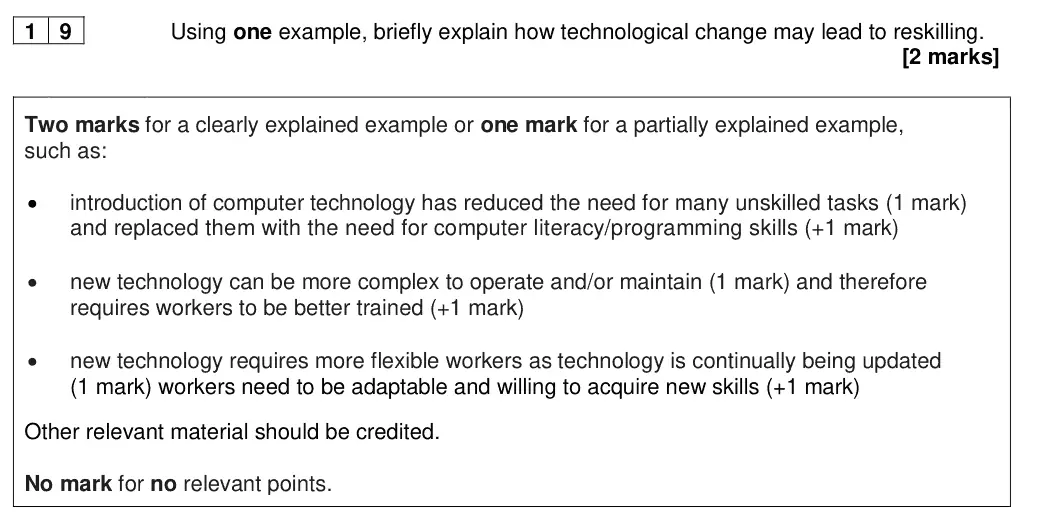
June 2016 · AS Paper 2 · Q192 marksAO2=2Brief explain
Mark scheme
Examiner's comment
Most answers were able to explain how technological change may lead to reskilling, usually with reference to the introduction of computer technology.
Notes from the mark scheme and report
credited: computers replacing unskilled tasks with new skills, more complex equipment needing training, flexible workers who keep updating skills
mostly well answered via computer technology
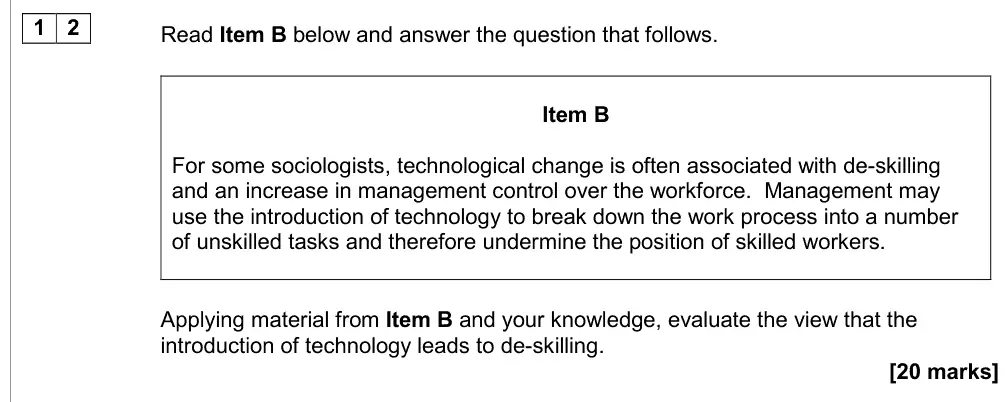
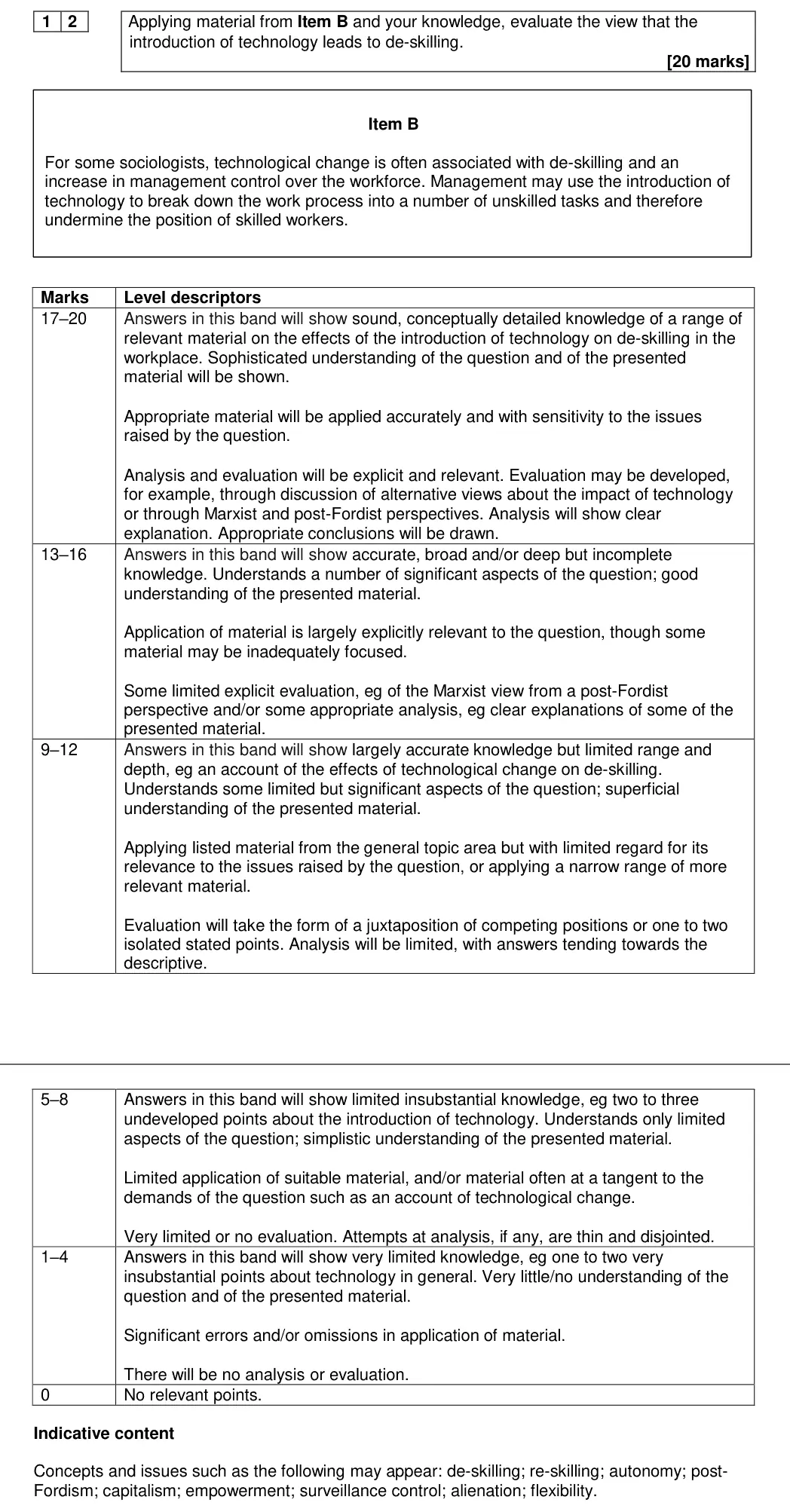
Specimen set 1 · Paper 2 · Q1220 marksAO1=8, AO2=6, AO3=620-mark essay
Mark scheme, including the levels grid and indicative content
Notes from the mark scheme and report
item gives the Braverman-style deskilling and management control view
top band evaluates via alternative views of technology, e.g. Marxist vs post-Fordist (reskilling, autonomy, flexibility)
a mere account of technological change = 5–8
Work with an AQA sociology tutor
Essays stuck in the middle band, or losing marks on the 10-markers? Book a trial lesson with Mark, a former AQA examiner.