Tap a question to zoom it. The mark scheme (with the level descriptors and indicative content) and the examiner's comment open underneath.
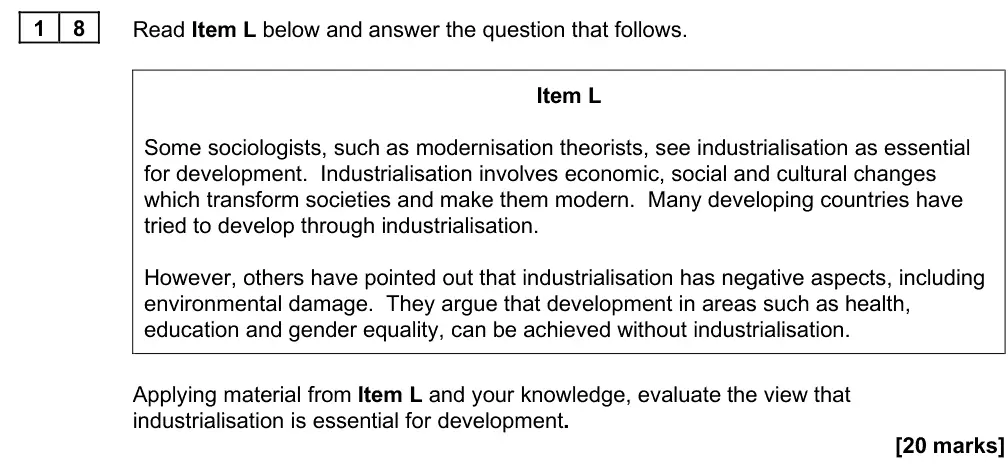
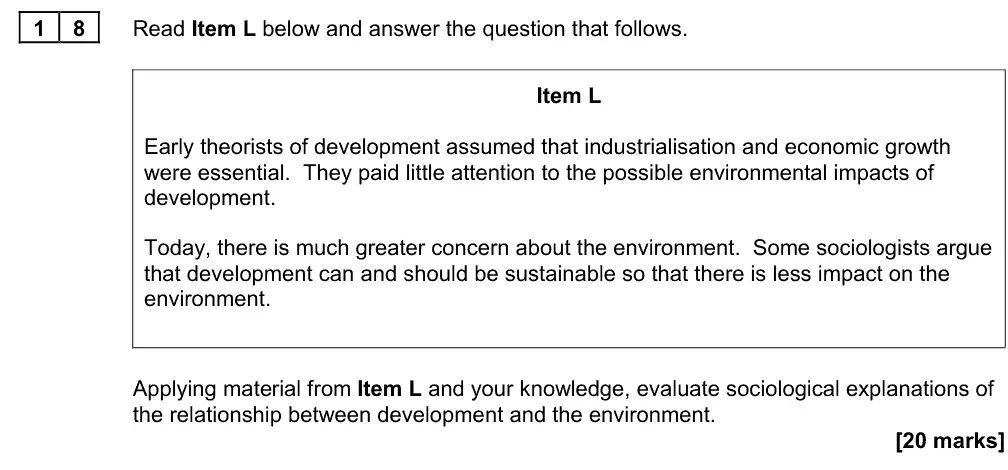
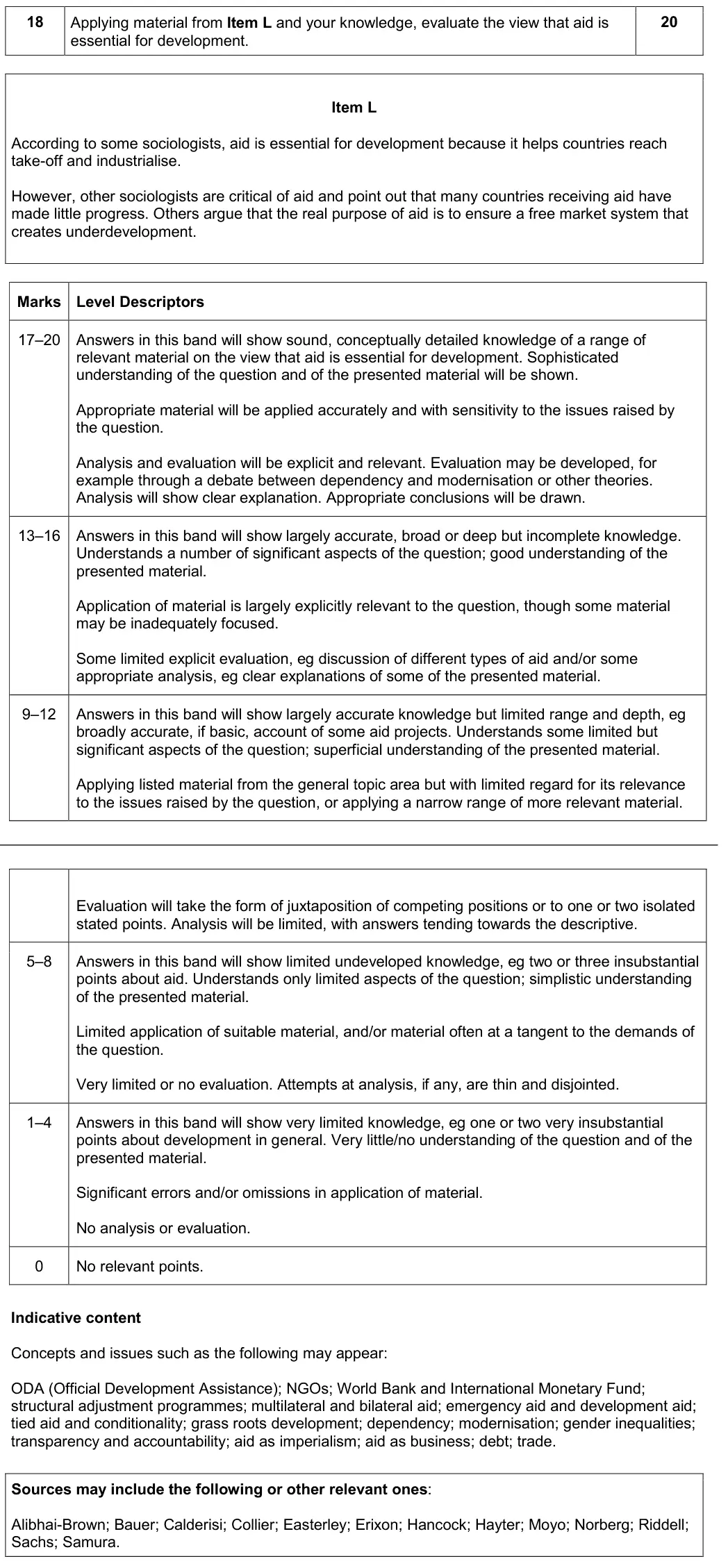
June 2025 · Paper 2 · Q1820 marksAO1=8, AO2=6, AO3=620-mark essay
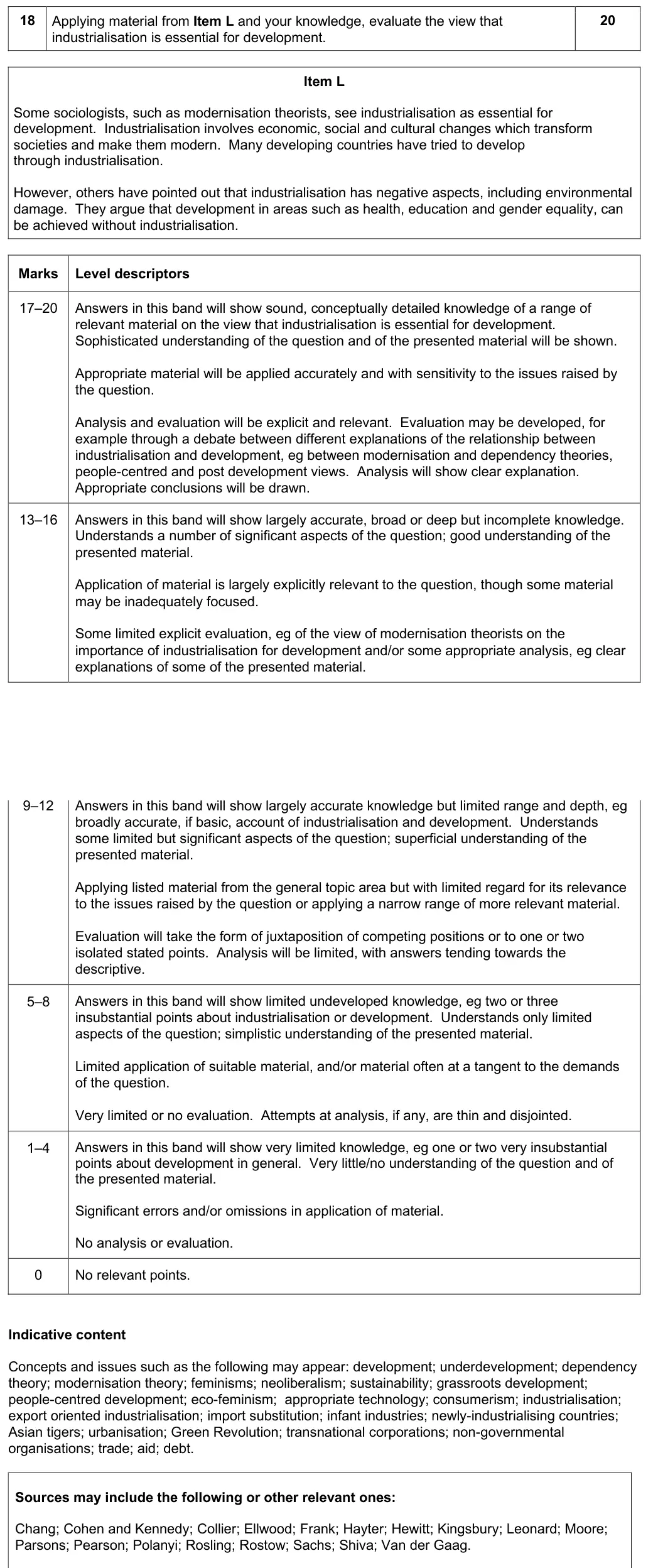
Mark scheme, including the levels grid and indicative content
Examiner's comment
These require answers that are essays and are best written in paragraphs. A brief introduction can help set out the argument of the essay. It will not attract marks if it only repeats the question or parts of the item. The purpose of the items for these questions is to suggest a few starting points for students, including ways into evaluation. Students are expected to also bring in further ideas (“and your knowledge” in the instruction) rather than relying only on the item. A wide range of material can be relevant to these questions, so students need to be selective. It is more effective to cover a limited number of views/theories in depth rather than to try to include everything. Students should keep to the question. When a question is about a particular view, other views can be used for evaluation but without writing all that the student knows about them. There was a tendency for answers to progressively lose sight of the question and to become a list of different views. Students who made brief essay plans appeared to benefit by having more structured and coherent responses. Most answers showed good knowledge and understanding of different theories of industrialisation, though some lacked range. There was a tendency to give information about modernisation and dependency theories without relating these clearly to industrialisation. Answers could often have been stronger with detailed examples of countries that have followed different paths to development.
Notes from the mark scheme and report
top band debates modernisation against dependency, people-centred and post-development views
many described the theories without tying them to industrialisation
named country examples of different paths would strengthen answers
June 2024 · Paper 2 · Q1610 marksAO1=5, AO2=3, AO3=2Outline and explain
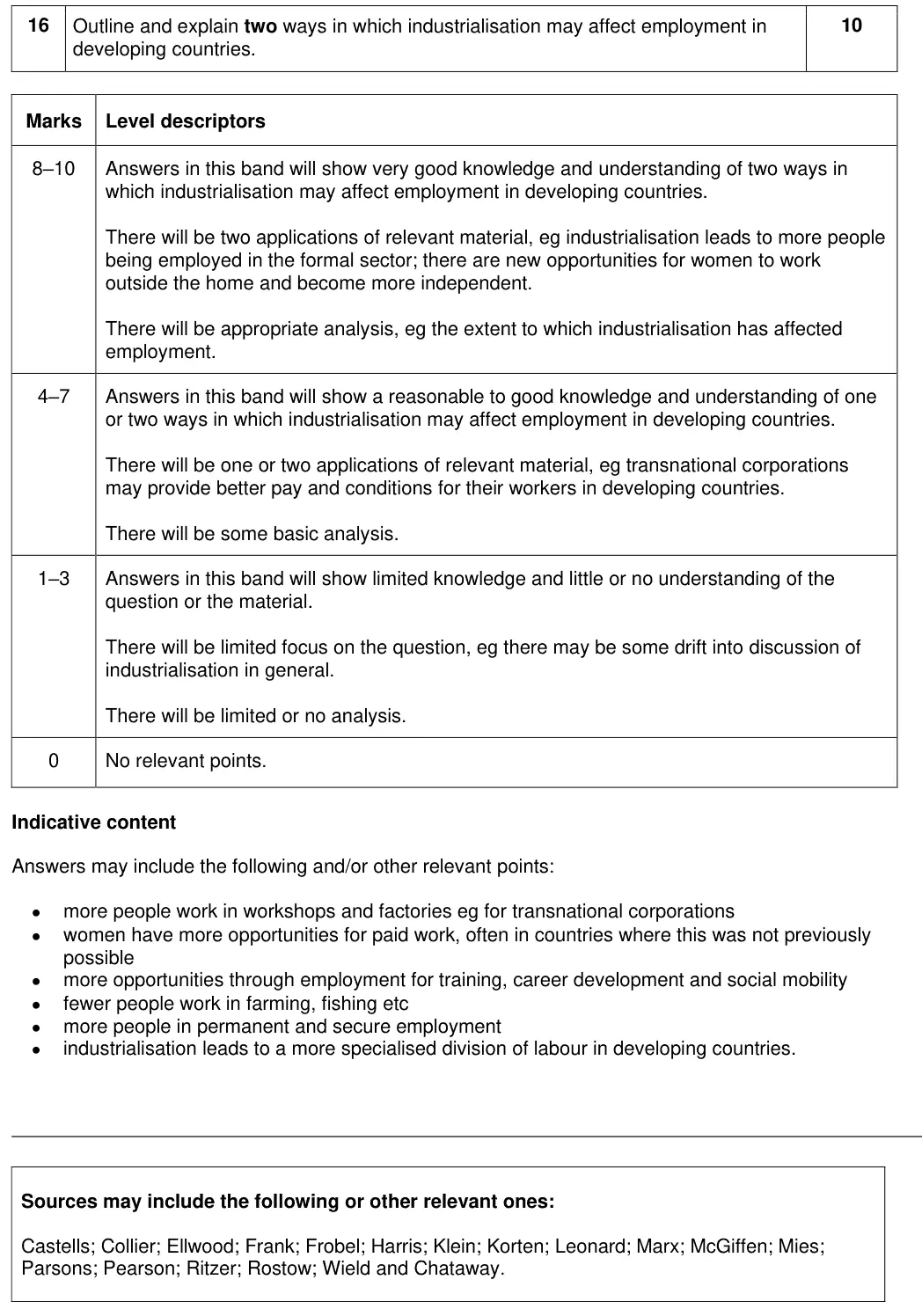
Mark scheme, including the levels grid and indicative content
Examiner's comment
The nature of these questions means that students cannot rely on reciting knowledge. Questions will ask them to bring together aspects of their sociological knowledge in ways they will not have done before. It is therefore important for students to allow time to think about how to answer the question. Students should be made aware that there are two types of 10 mark questions. These have different requirements and different mark schemes . There are different marks available for the assessment objectives. A breakdown of the marks awarded by assessment objective can be found in the mark scheme. 10 mark “outline and explain” questions have more marks available for knowledge and understanding, and none for evaluation. Introductions and conclusions are not required for 10 mark questions; they take up time and rarely improve the mark. It is helpful if answers are set out to clearly indicate the two answers, with wording such as “One way/reason is…”, or by starting a new paragraph for the second point. Answers that give more than two points are unlikely to develop two of them sufficiently. Q16: Most students were able to identify two ways, for example industrialisation increasing employment or creating unemployment by undermining traditional employment patterns. For some students developing the ways proved difficult, though others used perspectives such as dependency or modernisation theories to provide a route.
Notes from the mark scheme and report
two ways each developed (e.g. growth of formal factory employment, new paid work for women, training and mobility, decline of farming and fishing, loss of traditional work)
drift into industrialisation in general = 1–3
some used dependency or modernisation theory to develop points
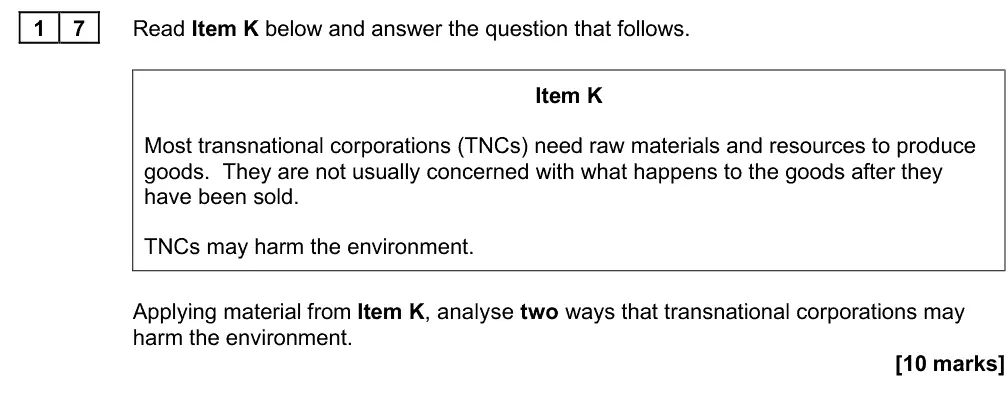
June 2024 · Paper 2 · Q1710 marksAO1=3, AO2=4, AO3=3Analyse
Mark scheme, including the levels grid and indicative content
Examiner's comment
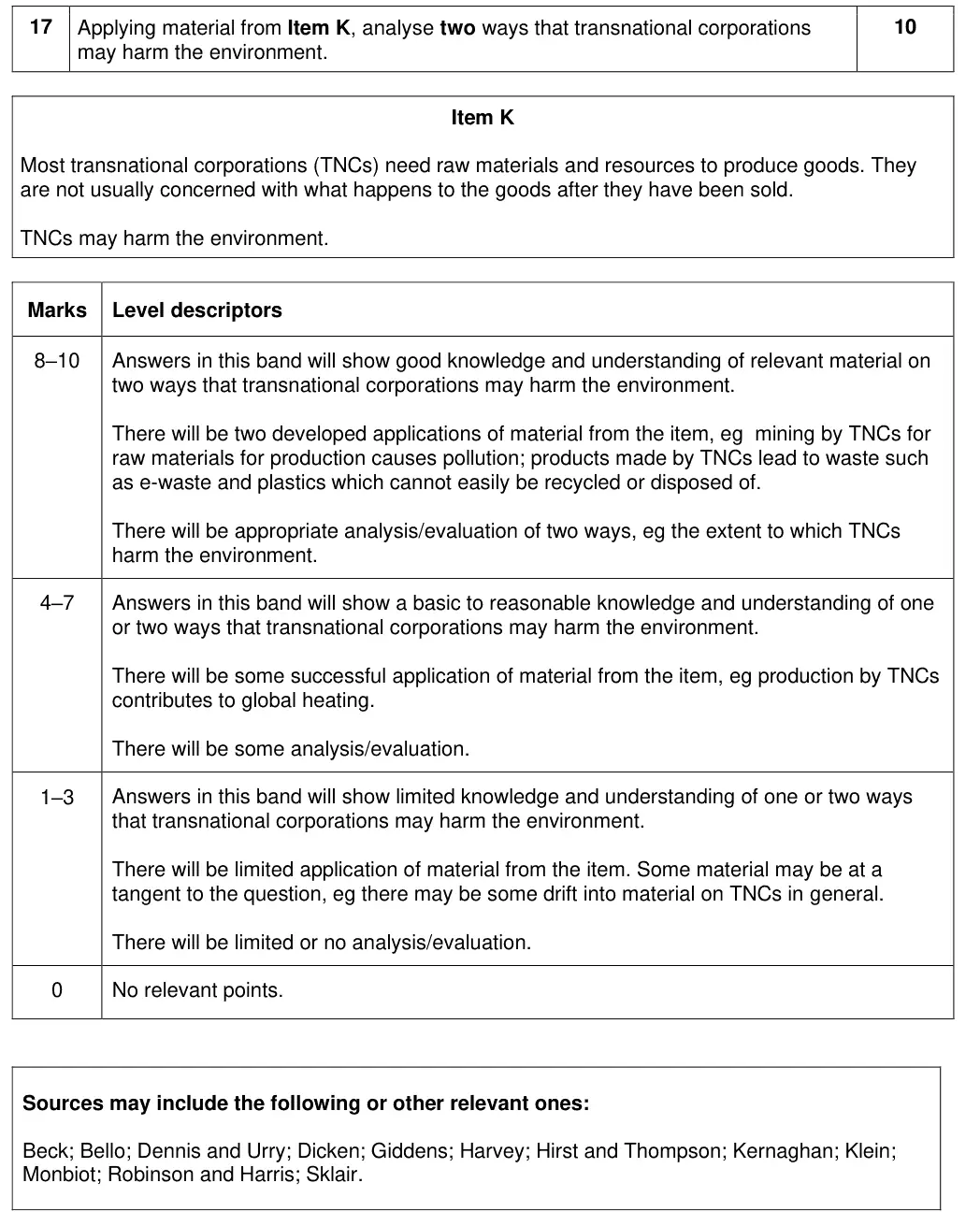
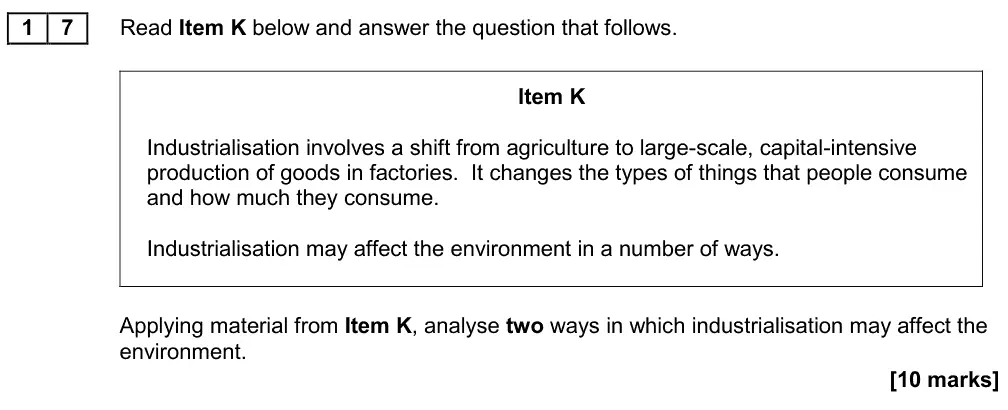
The nature of these questions means that students cannot rely on reciting knowledge. Questions will ask them to bring together aspects of their sociological knowledge in ways they will not have done before. It is therefore important for students to allow time to think about how to answer the question. Students should be made aware that there are two types of 10 mark questions. These have different requirements and different mark schemes . There are different marks available for the assessment objectives. A breakdown of the marks awarded by assessment objective can be found in the mark scheme. The items for 10 mark “analyse” questions are written to give prompts or “hooks” for student answers. These have to be used to access application marks. Answers can indicate use of hooks by quoting, by a reference in parentheses or by wording ( eg “As the item says…”). Items end with a sentence restating the question; the hooks are in the preceding part of the item. Students should avoid writing all they know about a “hook”, and focus on applying the idea to the question. Introductions and conclusions are not required for 10 mark questions; they take up time and rarely improve the mark. It is helpful if answers are set out to clearly indicate the two answers, with wording such as “One way/reason is…”, or by starting a new paragraph for the second point. Answers that give more than two points are unlikely to develop two of them sufficiently. Q17: Answers to this question were mostly example driven; it is good to make a general point before giving answers. Responses often referred to pollution, deforestation and exploitation of raw materials and these were often linked to actions of specific transnational corporations. Some students did not use the “hooks” provided and so did not demonstrate the application required.
Notes from the mark scheme and report
two developed applications from Item K (need for raw materials
no concern for goods after sale), e.g. pollution from extraction, e-waste and plastics
drift into TNCs in general is a tangent
answers were example-driven, better to state a general point then exemplify
some ignored the hooks so showed no application
June 2022 · Paper 2 · Q1710 marksAO1=3, AO2=4, AO3=3Analyse
Mark scheme, including the levels grid and indicative content
Examiner's comment
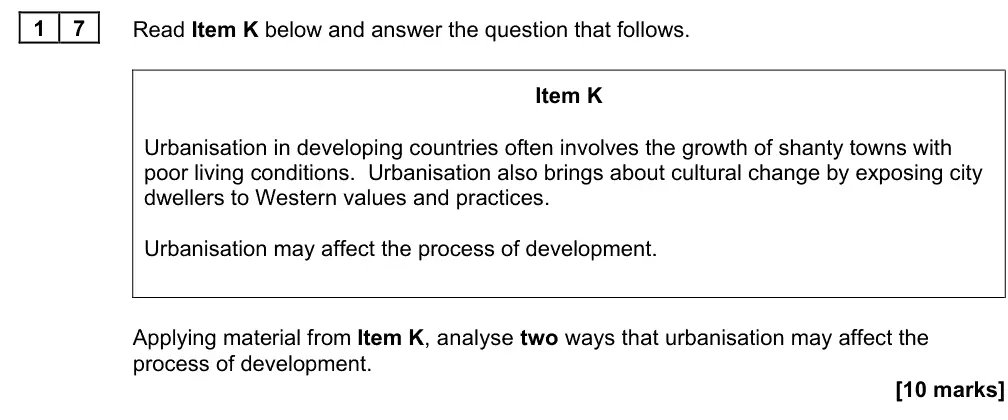
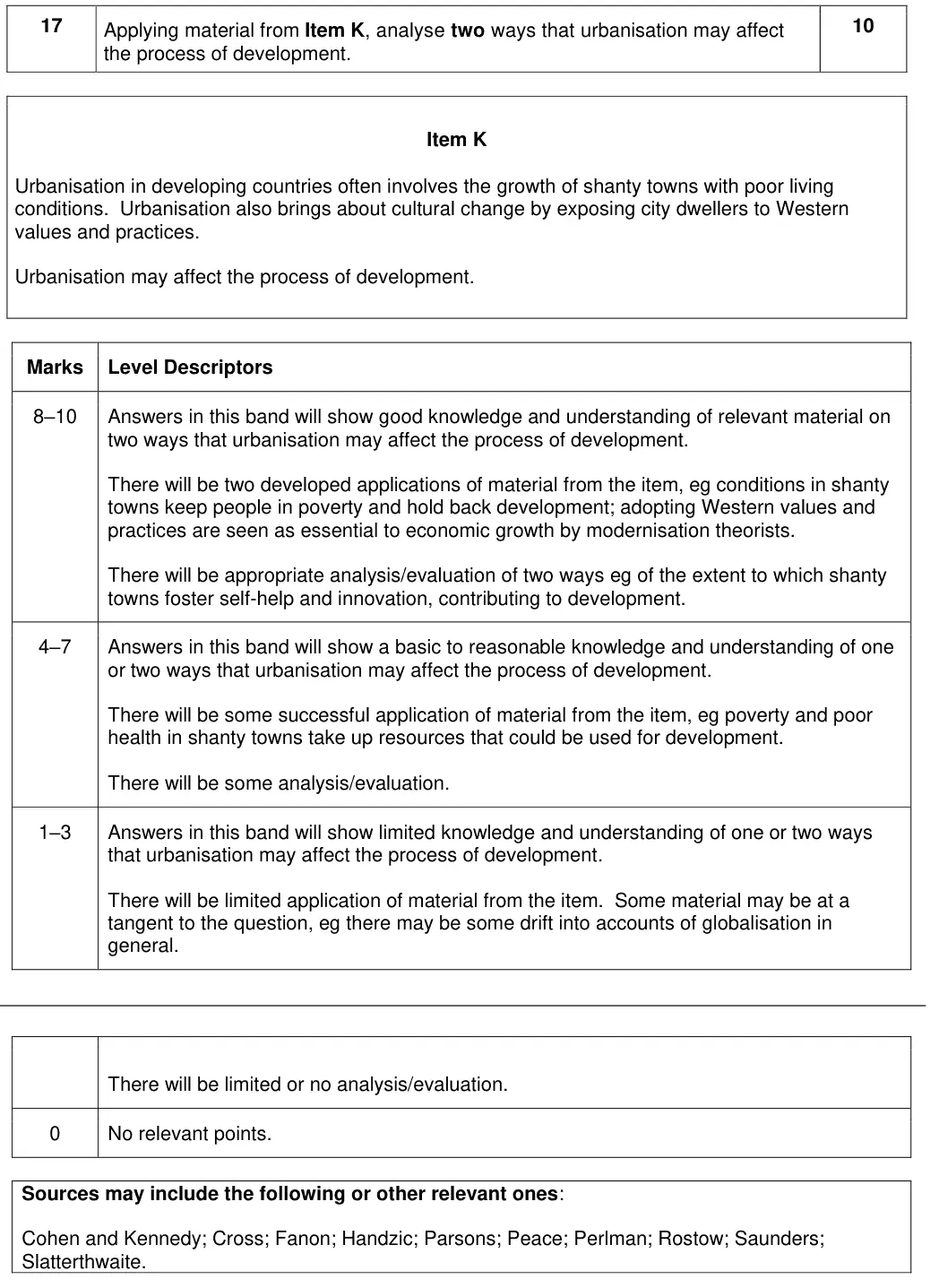
The nature of these questions means that students cannot rely on reciting knowledge. The questions will ask them to bring together aspects of their sociological knowledge in a way that they are unlikely to have done before. There was a tendency, however, to attempt to answer the question by giving knowledge based on words or phrases in the question, rather than meeting the demands of the question. Students are advised to spend time reading the question, and, where there is one the item, to ensure that they are answering the question. Some students seemed unaware of the different demands of the two types of questions. The marks awarded for the assessment objectives are different in the two types of ten mark questions, and students should be aware of this. In “analyse” (with item) questions, the answers need to be clearly based on the prompts or “hooks” in the item, not just on the final sentence of the item which restates the question. There is no need for an introduction or conclusion for 10 mark questions. It is helpful if answers are set out to clearly indicate the two answers, with wording such as “One way is…” or by starting a new paragraph for the second point. The best answers to 10 mark questions were focused, clearly stating a point that addressed the question and then developing it, using sociological concepts, evidence and, where appropriate, theory. Answers need to address all aspects of the question. Q17 This question was generally answered well. Popular answers applied the item by discussing how conditions in shanty towns might keep people in poverty and hold back development, or how cities act as places where people are exposed to values and practices which can be seen as necessary for development. There was also some good application of theories.
Notes from the mark scheme and report
hooks: shanty towns keeping people in poverty, exposure to Western values seen by modernisation theory as aiding growth
analysis e.g. shanty towns fostering self-help
generally answered well with good use of theory
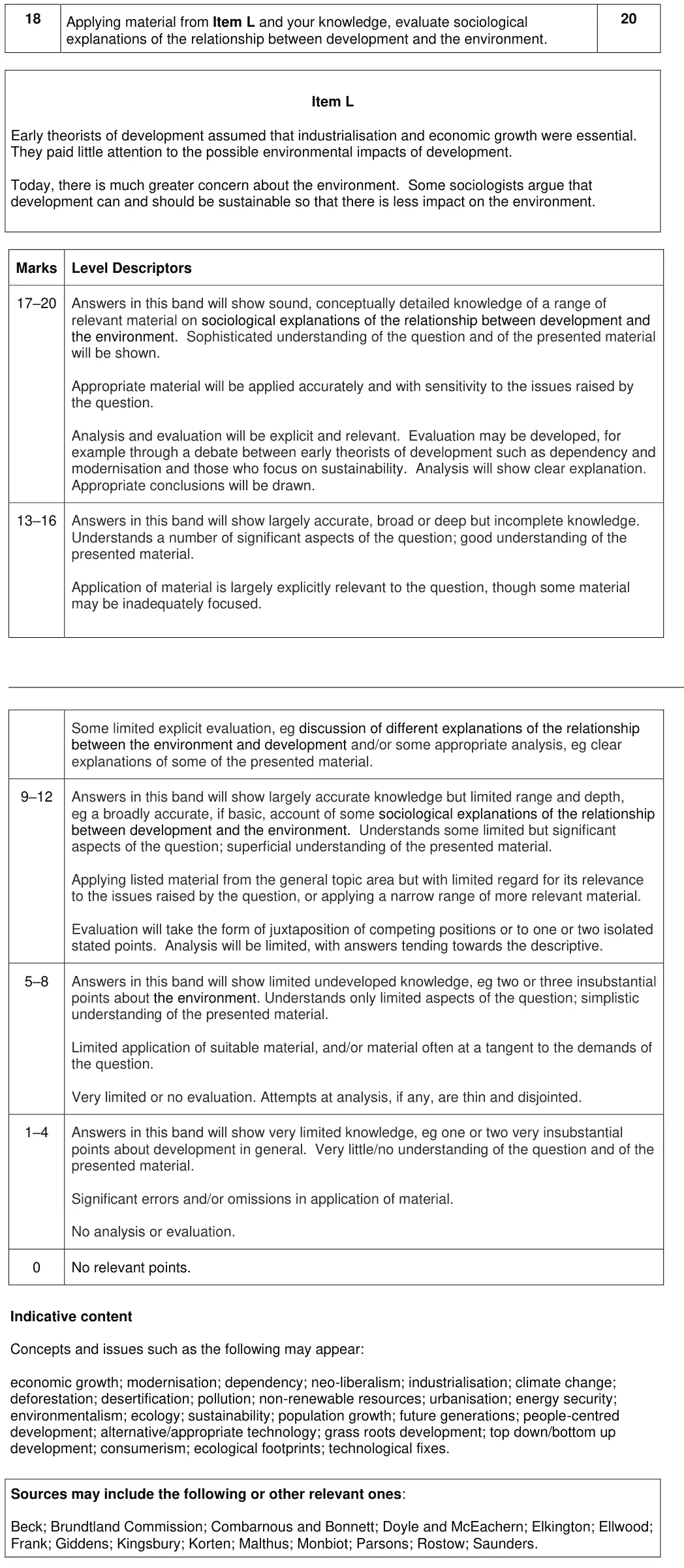
June 2022 · Paper 2 · Q1820 marksAO1=8, AO2=6, AO3=620-mark essay
Mark scheme, including the levels grid and indicative content
Examiner's comment
Most candidates answered their chosen questions in the order in which they appeared on the question paper. They therefore answered the section B 20 mark essay question last, and for many this was a relatively brief and often apparently unfinished answer. This suggests that timing is a problem for many candidates. The items for 20 mark questions are written to provide a number of ideas on which students can begin to build their answers. Students are expected to also bring in further ideas (hence “and your knowledge” in the instruction). It is often the case that a wide range of material can be relevant to these questions, and students need to be selective. For example, it may be more effective to cover a limited number of views or theories in some depth rather than to include every possible theory. There was a tendency for answers to progressively lose sight of the question and to become a list of different views. Many attempts at evaluation were learned criticisms. Evaluation is more effective where it is focused on the demands of the question. Students should also be aware that evaluation includes awareness of the strengths as well as the weaknesses of an argument or theory. Following feedback from centres regarding the advance information for the 20 mark questions, we have monitored the marking of these questions, as well as carrying out statistical analysis on student performance. Based on this analysis, we can confirm that students have performed as we expected them to on these questions, and their performance on these questions is in line with previous series. Q18 Answers were strong on environmental problems, with good discussions of how development is linked to, for example, global heating, pollution of land, sea and air, deforestation and loss of species. Discussion of solutions and positive aspects of development, such as sustainability and grass roots or people-centered development, were less evident. There was some application of theories.
Notes from the mark scheme and report
top band debates early theories (modernisation, dependency) against sustainable development
answers strong on environmental damage but weaker on sustainability and people-centred or grass-roots solutions
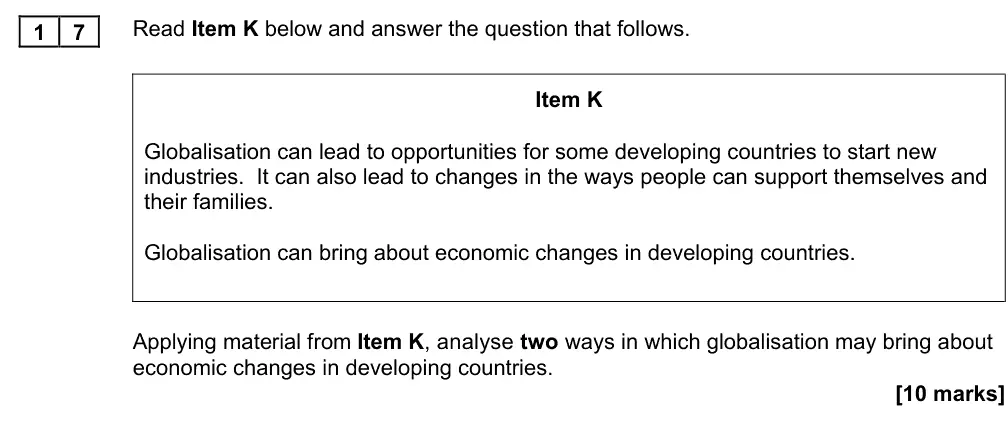
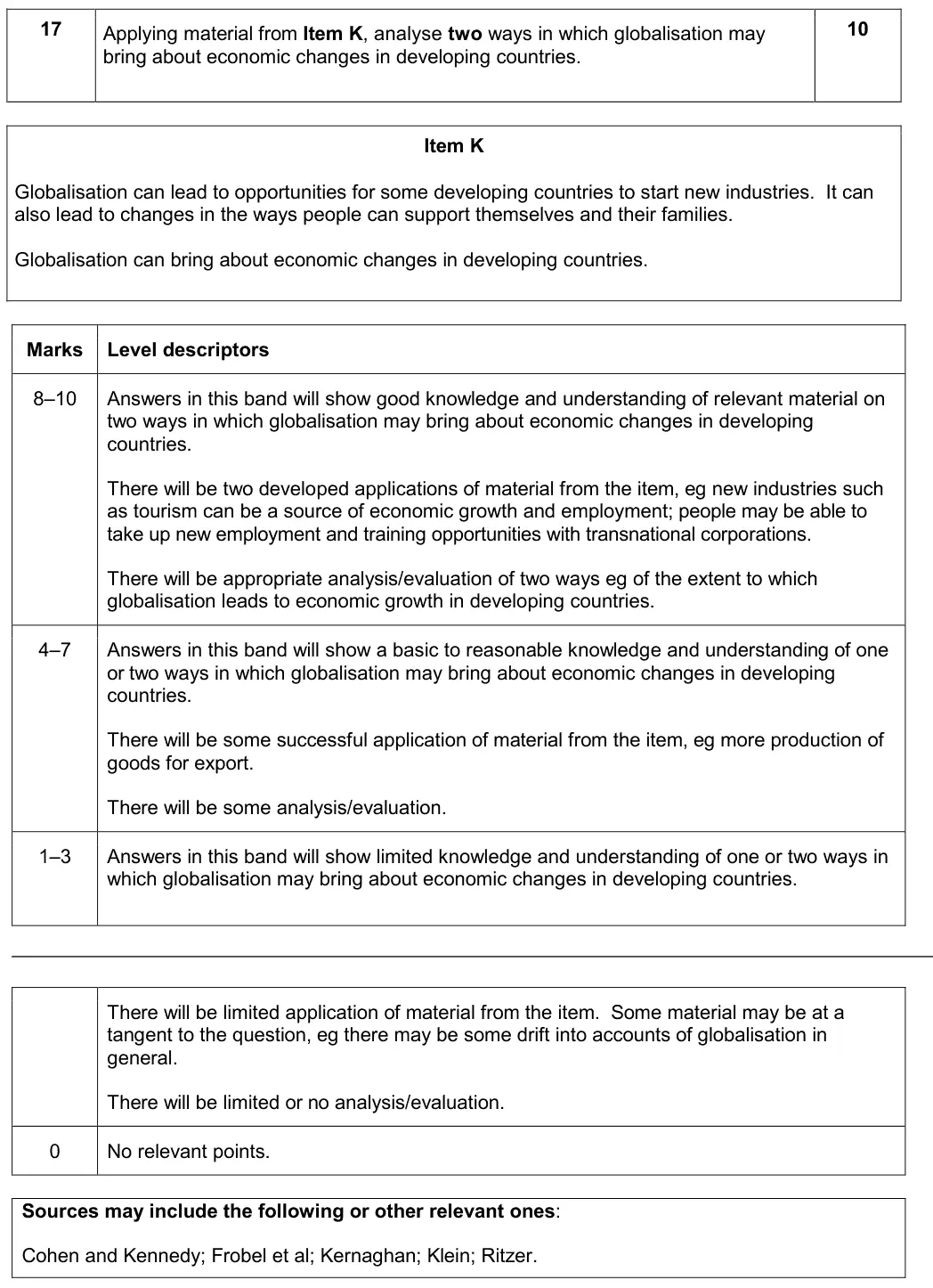
November 2021 · Paper 2 · Q1710 marksAO1=3, AO2=4, AO3=3Analyse
Mark scheme, including the levels grid and indicative content
Notes from the mark scheme and report
must develop hooks from Item K (new industries, new ways to support families)
the last line restates the question and is not a hook
credited: tourism and export industries, employment and training with TNCs
drift into globalisation in general = 1–3
no examiners' report comment for this part
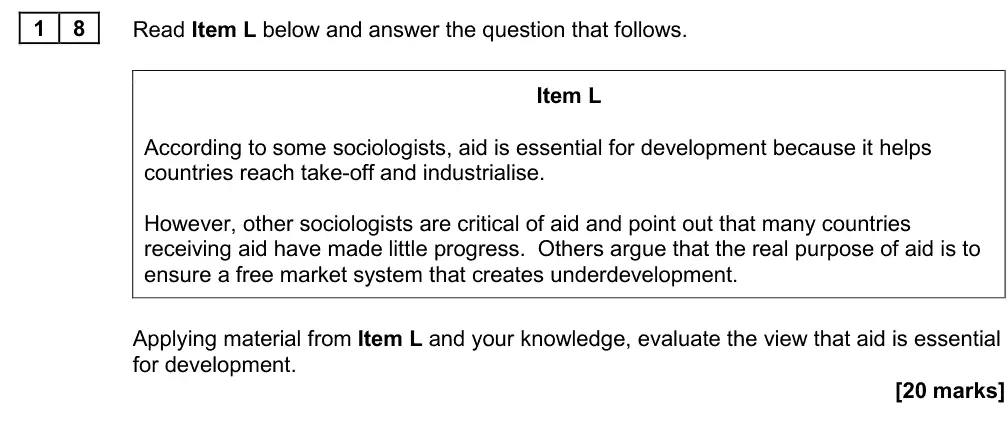
November 2020 · Paper 2 · Q1820 marksAO1=8, AO2=6, AO3=620-mark essay
Mark scheme, including the levels grid and indicative content
Notes from the mark scheme and report
apply Item L (aid helps take-off vs little progress and aid creating underdevelopment)
evaluation via modernisation vs dependency or other theories, or different types of aid
a basic account of aid projects = 9-12
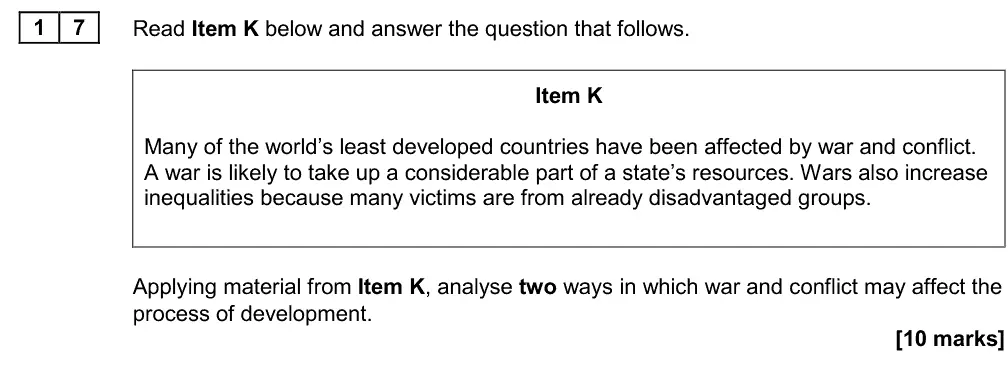
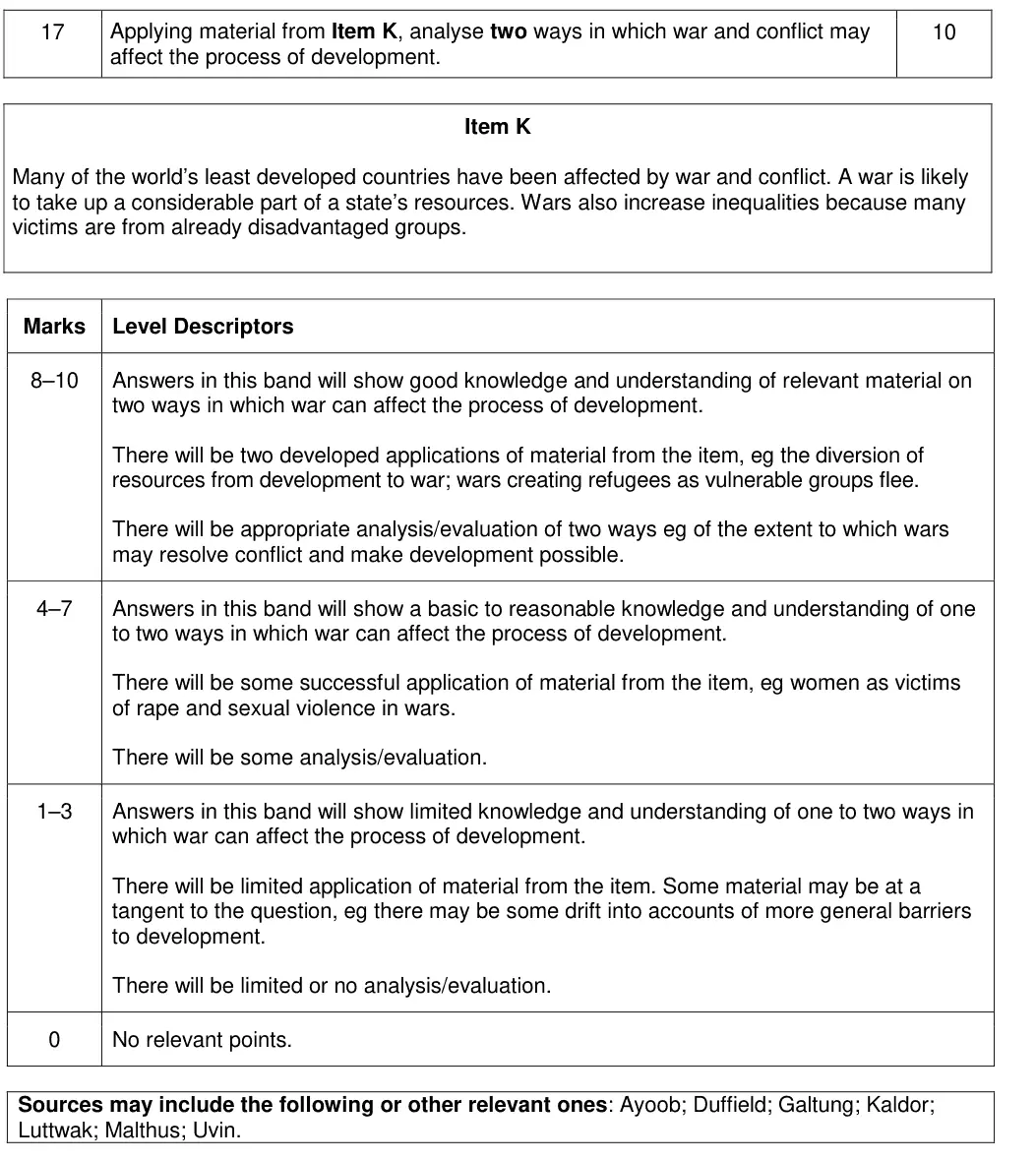
June 2019 · Paper 2 · Q1710 marksAO1=3, AO2=4, AO3=3Analyse
Mark scheme, including the levels grid and indicative content
Examiner's comment
Some students wrote introductory paragraphs and/or conclusions. These are not necessary, and are unlikely to gain additional marks; they also take up time. Some students made only one point in their answers, or three or more, rather than the two asked for. The word ‘two’ is put in bold in the question to try and draw students’ attention to this. Sometimes it was not clear how many points were being made. It is helpful for students to clearly indicate their two answers, with wording such as “One way is…” or by starting a new paragraph for their second point. Notably, some students wrote far more than was needed for a 10-mark response. The two types of 10-mark question, “outline and explain” and “analysis” types, are marked differently as the assessment objectives have different weightings. It is important that students are aware of this. For 10 mark “analyse” questions, the parts of the item being used should be clearly indicated, preferably by exact words being quoted. It is acceptable for two different points to be drawn from one part of the item, but answers which do not use the item cannot access the application marks. The best answers to 10-mark questions were focused, clearly stating a point and then developing it, and used sociological concepts, studies, evidence and theory as appropriate. This question was also answered well, on the whole, with students able to use the item to identify and discuss two ways war and conflict might affect development. Students needed to use their sociological understanding to see how the diversion of resources towards war might affect development. Too few answers used examples of recent or current wars, which might have helped them explain the points they had made.
Notes from the mark scheme and report
item hooks: resources diverted from development to war, and harm to already disadvantaged groups (e.g. refugees)
drift into general barriers to development = 1–3
too few used recent named wars as examples
AO split from AQA's standard grid for this paper (this year's mark scheme does not print it).
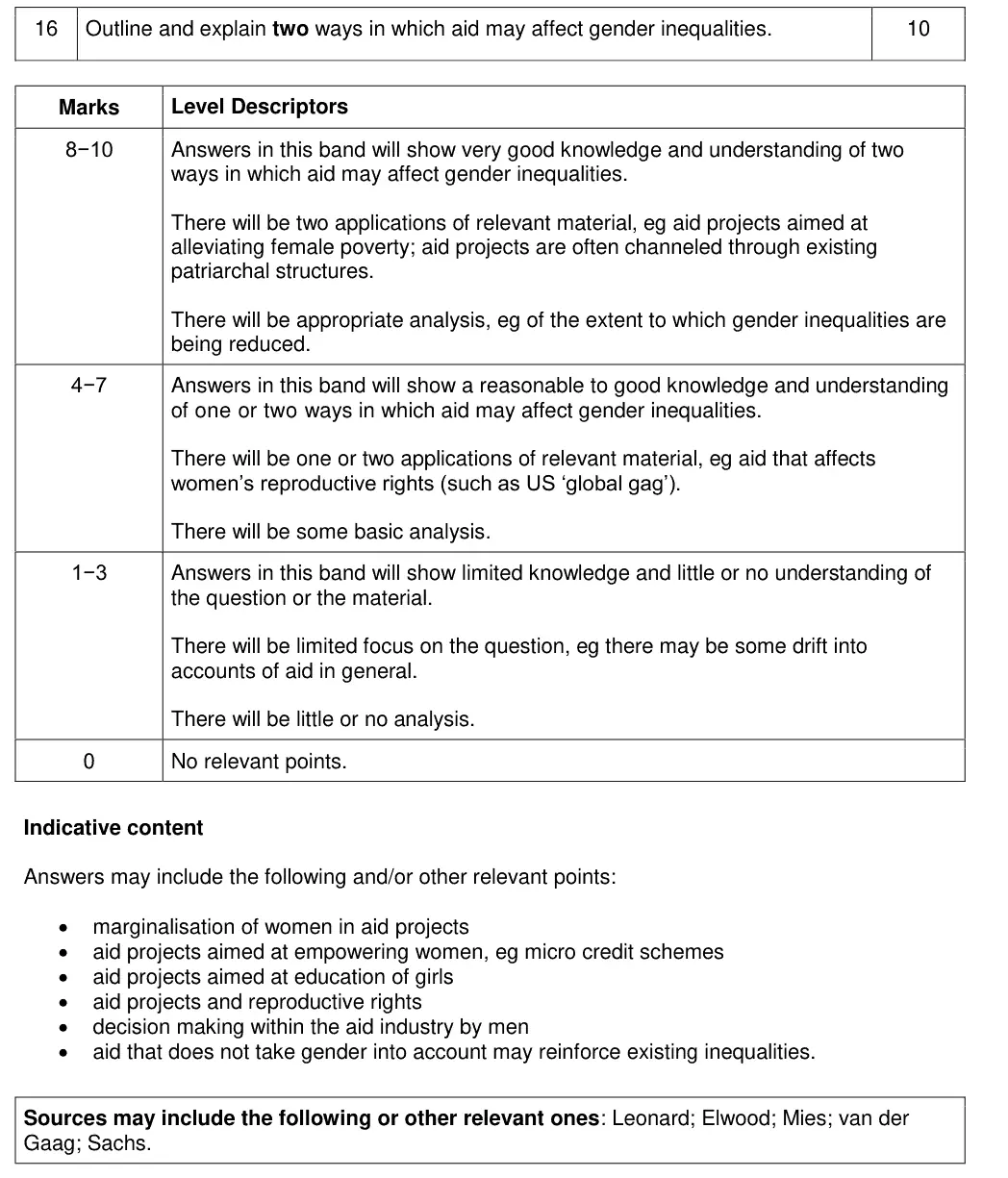
June 2018 · Paper 2 · Q1610 marksAO1=5, AO2=3, AO3=2Outline and explain
Mark scheme, including the levels grid and indicative content
Examiner's comment
Some students wrote introductory paragraphs and/or conclusions. These are not necessary, and are unlikely to gain additional marks, and they also take up time. Some students made only one point in their answers, or three or more, rather than the two asked for in the question. Sometimes it was unclear how many points were being made. It is helpful for students to clearly indicate their two answers, with wording such as “One way is…” or by starting a new paragraph for their second point. Evaluation is not a requirement for answers to 10 mark “outline and explain” questions. The marks awarded for the assessment objectives being targeted are different in the two types of ten mark questions, and students should be made aware of this. The best answers to 10 mark questions were focused, clearly stating a point and then developing it, using sociological concepts, evidence and theory where appropriate. In some questions students tended to focus on the first aspect of the question at the expense of the second. Students need guidance on how to approach these questions and how to best demonstrate their sociological understanding. The nature of these questions means that students cannot rely on reciting knowledge. These questions will ask them to bring together aspects of their sociological knowledge in a way that they are unlikely to have done before. This question tested the ability of students to bring together their knowledge and understanding of aid and of gender inequalities. Many were able to suggest ways in which aid might have increased or reduced gender inequalities, with answers focusing on, for example, aid aimed at education or health issues. There was recognition that aid might help girls achieve an education and improve their life chances, and that in a patriarchal society educational aid might benefit males more than females. There was some misunderstanding of aid with some answers focusing on transnational corporations rather than aid agencies and IGOs.
Notes from the mark scheme and report
two ways aid increases or reduces gender inequality (e.g. micro-credit, girls' education, reproductive rights, aid channelled through patriarchal structures)
drift into aid in general = 1–3
some confused aid with TNC activity
AO split from AQA's standard grid for this paper (this year's mark scheme does not print it).
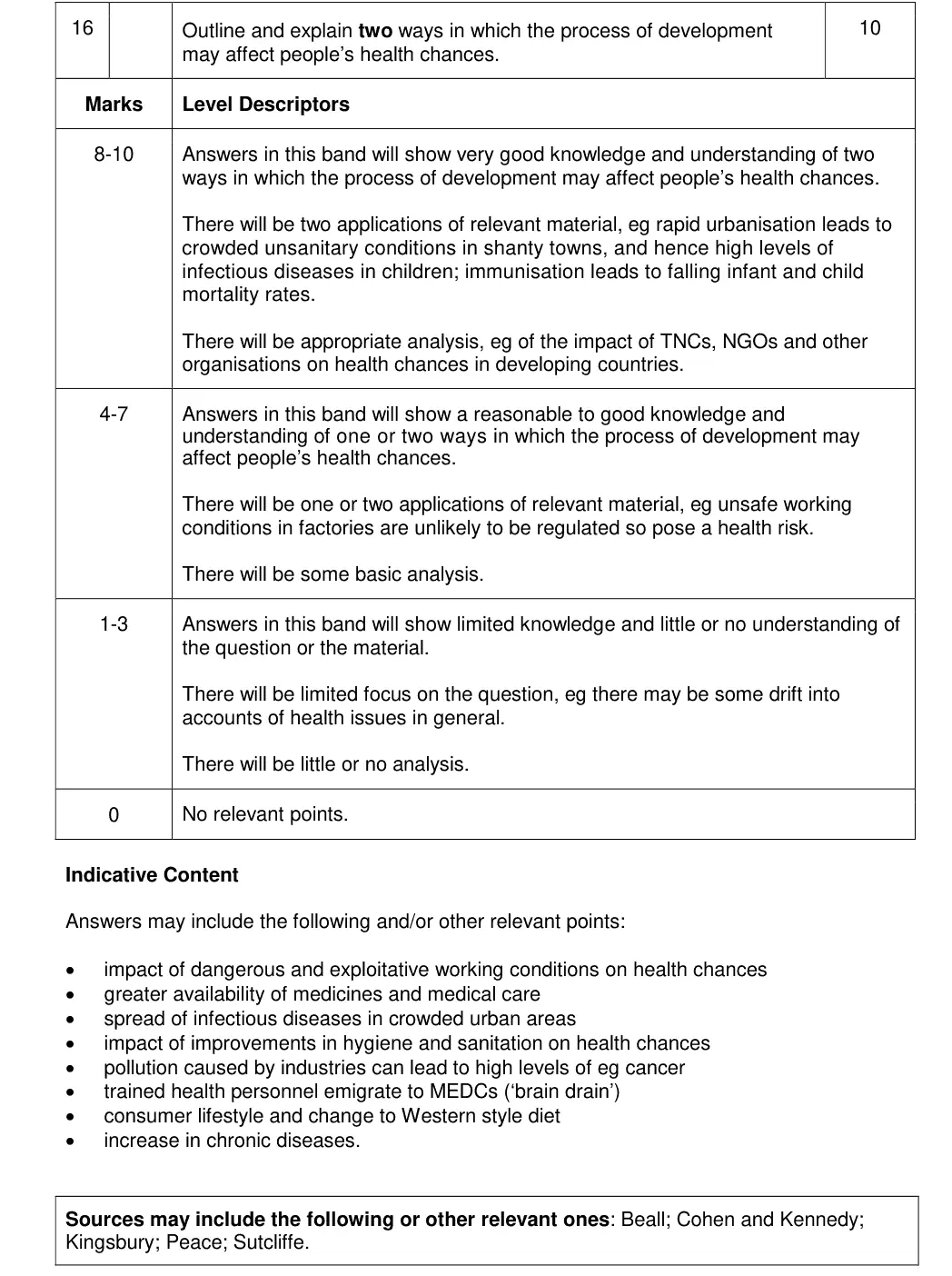
June 2017 · Paper 2 · Q1610 marksAO1=5, AO2=3, AO3=2Outline and explain
Mark scheme, including the levels grid and indicative content
Examiner's comment
A number of students wrote introductory paragraphs and/or conclusions. These are not necessary, and are unlikely to gain additional marks. A number of students made only one point in their answer, or three or more, rather than the two asked for. In these cases, the two best answers were rewarded and will be in future series. It is helpful for students to clearly indicate their two answers, with wording such as “One way is…” or by starting a new paragraph for their second point. Schools and colleges should note that there is no reference in the mark scheme for 10 mark ‘outline and explain’ questions to evaluation, and that evaluation is not a requirement for answers to these questions. The assessment objective allocations are different in the two types of 10 mark questions, and students should be made aware of this. There was a wide range of responses to these questions. A minority of students wrote very brief answers. For these 10 mark items, a simple statement of two ways, reasons or factors, without development, is not sufficient to access more than the lower marks in the mark range. The best answers were focused, clearly stating a point and then developing it, with use of sociological concepts, evidence and theory where appropriate, in ways that demonstrated the skills expected from the targeted assessment objectives. There was a tendency, however, for many answers to focus on the first aspect of the question at the expense of the second. Students need guidance on how to approach these questions and how to best demonstrate their sociological understanding. The nature of these questions means that students cannot rely on reciting knowledge. They require students to bring together two aspects of their sociological knowledge in a way that they are unlikely to have done before. Answers will sometimes require claims that students may be unsure of because they do not know of specific evidence (for example, in question 5, whether migrants from Eastern Europe who are single workers tend to live alone or in shared households). However, answers that are sociologically plausible will be accepted. Most were able to identify two ways. Many chose one ‘positive’ way, such as the introduction of Western health care and medical technology, and one ‘negative’ way, such as the increase in diseases of affluence associated with a changing lifestyle. A few neglected the ‘process’ aspect of the question and gave accounts of health problems in LEDCs, such as high infant mortality rates.
Notes from the mark scheme and report
must address the process of development (urbanisation and disease, immunisation, unsafe factory work, diseases of affluence)
drift into health issues in general = 1–3
many gave one positive and one negative way
some just described health problems in LEDCs
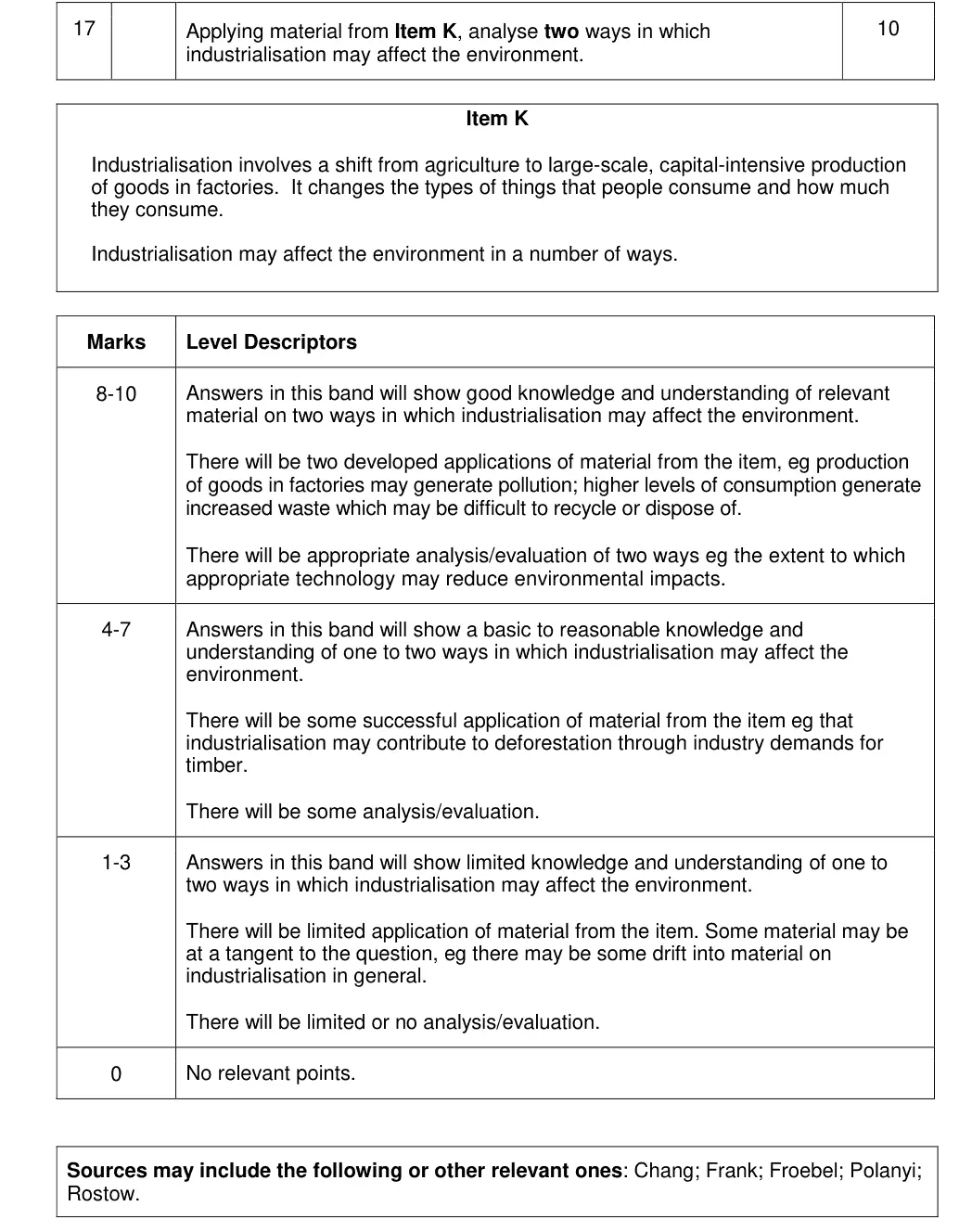
June 2017 · Paper 2 · Q1710 marksAO1=3, AO2=4, AO3=3Analyse
Mark scheme, including the levels grid and indicative content
Examiner's comment
A number of students wrote introductory paragraphs and/or conclusions. These are not necessary, and are unlikely to gain additional marks. A number of students made only one point in their answer, or three or more, rather than the two asked for. In these cases, the two best answers were rewarded and will be in future series. It is helpful for students to clearly indicate their two answers, with wording such as “One way is…” or by starting a new paragraph for their second point. The assessment objective allocations are different in the two types of 10 mark questions, and students should be made aware of this. There was a wide range of responses to these questions. A minority of students wrote very brief answers. For these 10 mark items, a simple statement of two ways, reasons or factors, without development, is not sufficient to access more than the lower marks in the mark range. The best answers were focused, clearly stating a point and then developing it, with use of sociological concepts, evidence and theory where appropriate, in ways that demonstrated the skills expected from the targeted assessment objectives. There was a tendency, however, for many answers to focus on the first aspect of the question at the expense of the second. Students need guidance on how to approach these questions and how to best demonstrate their sociological understanding. The nature of these questions means that students cannot rely on reciting knowledge. They require students to bring together two aspects of their sociological knowledge in a way that they are unlikely to have done before. Answers will sometimes require claims that students may be unsure of because they do not know of specific evidence (for example, in question 5, whether migrants from Eastern Europe who are single workers tend to live alone or in shared households). However, answers that are sociologically plausible will be accepted. Answers included pollution, deforestation, depletion of resources, waste and loss of habitats and biodiversity, with explanations of how industrialisation could lead to these. Some also discussed positive aspects, such as industrialisation eventually making possible more sustainable production, distribution and consumption. A few students strayed on to consequences of industrialisation on people’s health.
Notes from the mark scheme and report
hooks: factory production and changed consumption
e.g. pollution, waste, deforestation, resource depletion
drift into industrialisation in general = 1–3
some strayed into effects on people's health
some credited positive effects such as more sustainable production
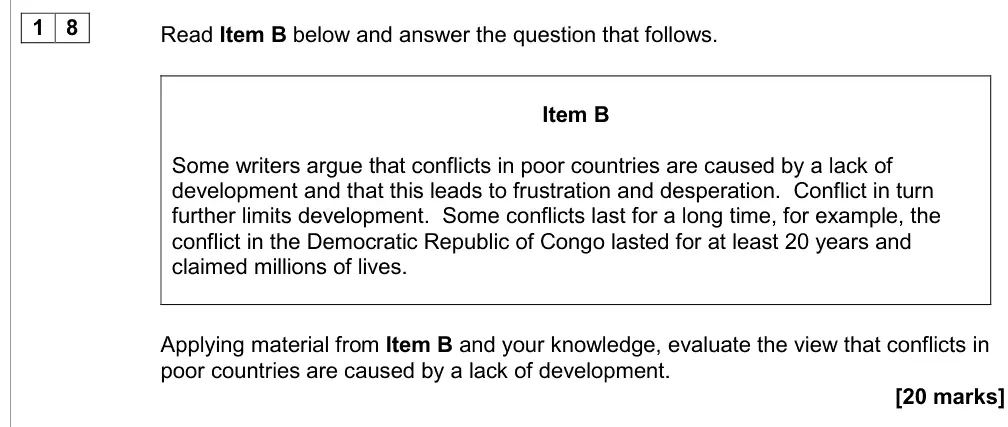
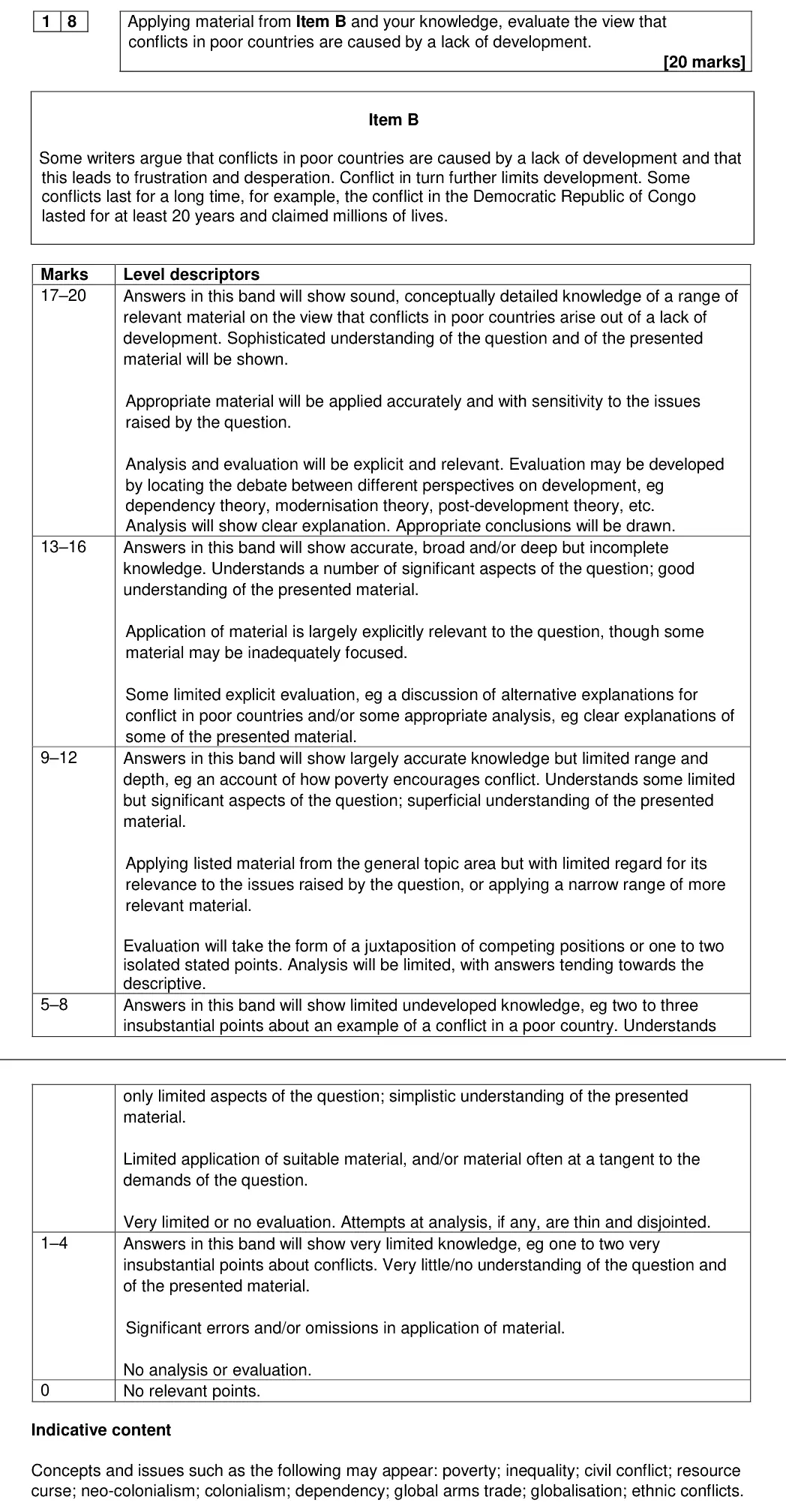
Specimen set 1 · Paper 2 · Q1820 marksAO1=8, AO2=6, AO3=620-mark essay
Mark scheme, including the levels grid and indicative content
Notes from the mark scheme and report
item hook: lack of development causing frustration and conflict, conflict limiting development (DRC)
top band locates the debate between modernisation, dependency and post-development theories
alternative causes include resource curse, colonial legacy, arms trade, ethnic conflict
Work with an AQA sociology tutor
Essays stuck in the middle band, or losing marks on the 10-markers? Book a trial lesson with Mark, a former AQA examiner.