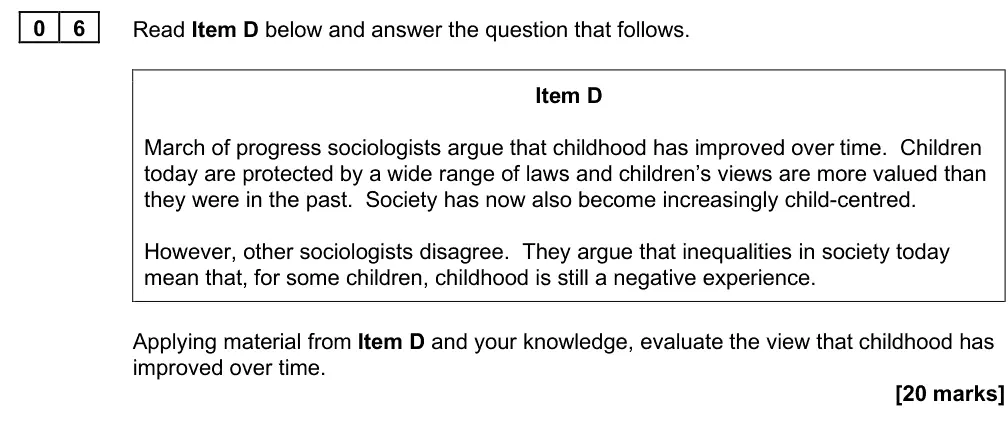
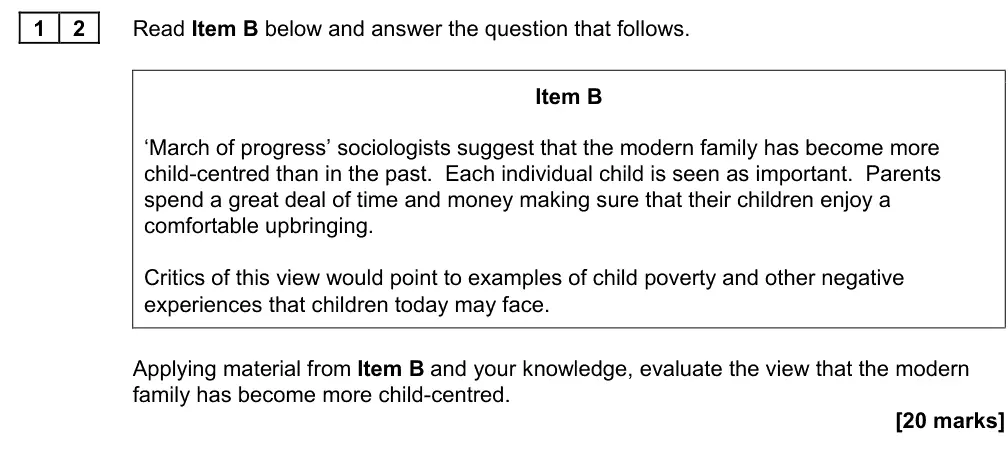
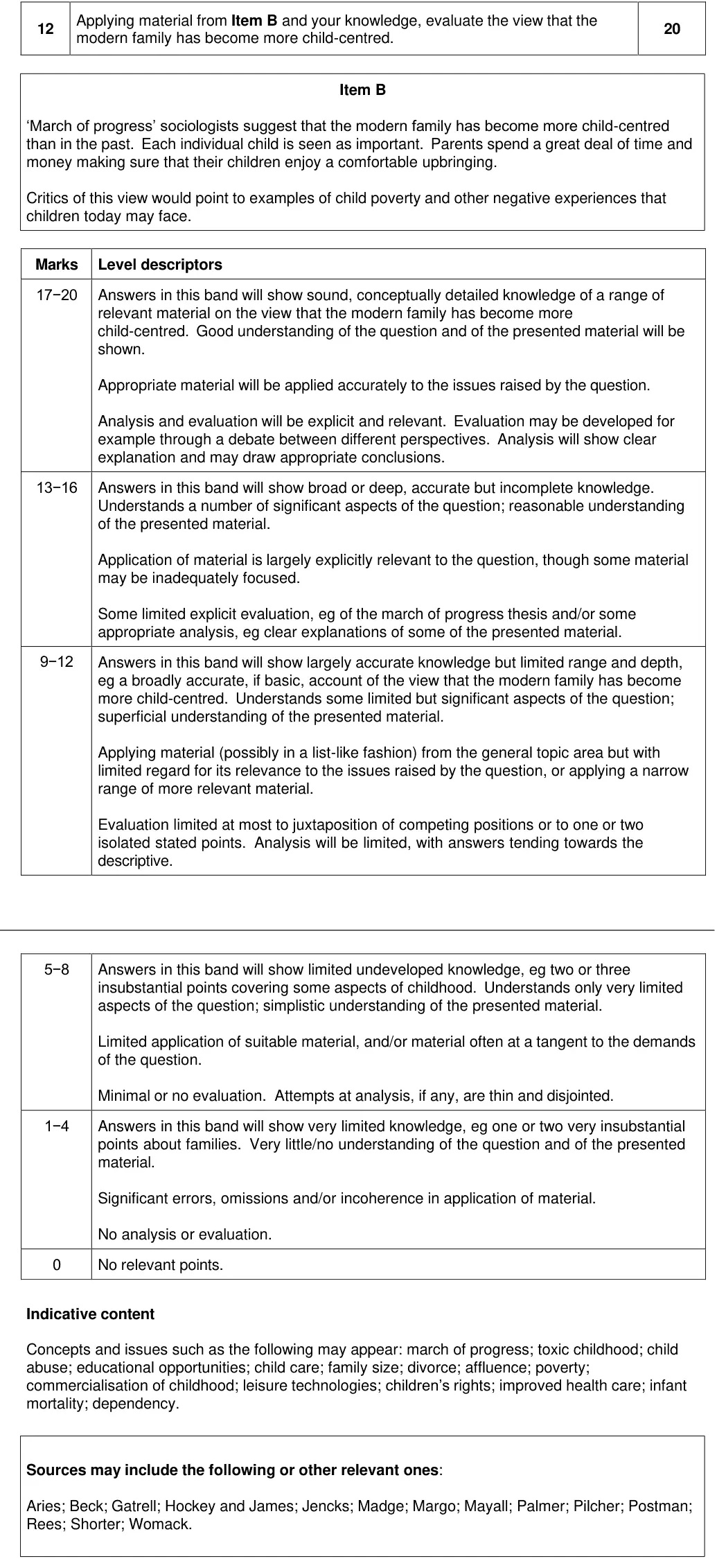
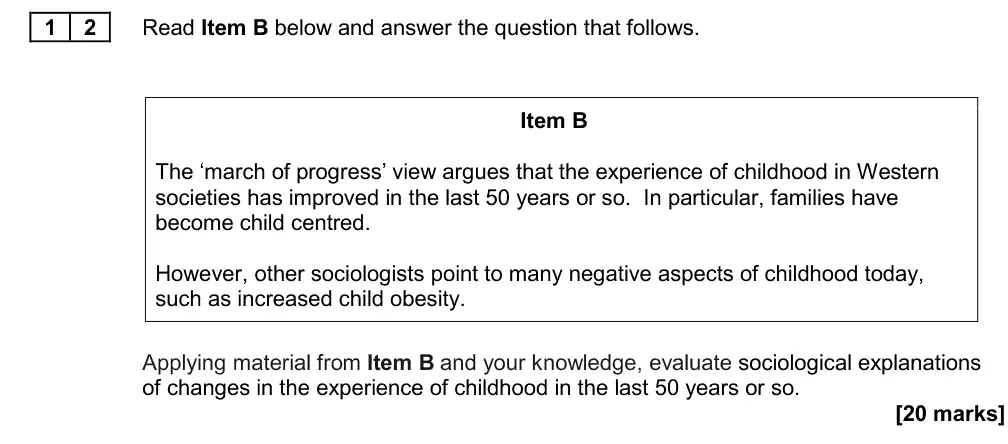
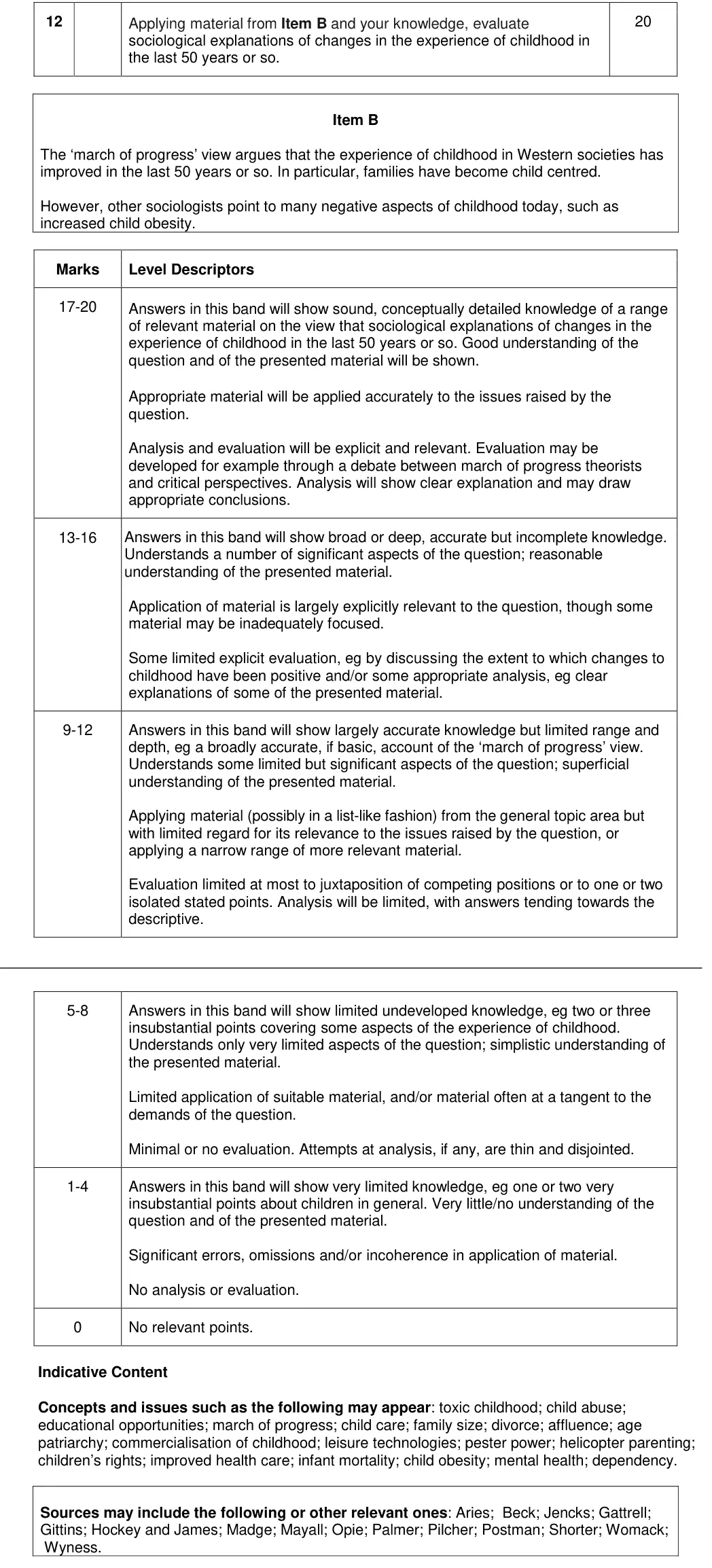
Applying material from Item B and your knowledge, evaluate sociological explanations of changes in the experience of childhood in the last 50 years or so.
Tap a question to zoom it. The mark scheme (with the level descriptors and indicative content) and the examiner's comment open underneath.
June 2025 · Paper 2 · Q620 marksAO1=8, AO2=6, AO3=620-mark essay
Mark scheme, including the levels grid and indicative content
Examiner's comment
These require answers that are essays and are best written in paragraphs. A brief introduction can help set out the argument of the essay. It will not attract marks if it only repeats the question or parts of the item. The purpose of the items for these questions is to suggest a few starting points for students, including ways into evaluation. Students are expected to also bring in further ideas (“and your knowledge” in the instruction) rather than relying only on the item. A wide range of material can be relevant to these questions, so students need to be selective. It is more effective to cover a limited number of views/theories in depth rather than to try to include everything. Students should keep to the question. When a question is about a particular view, other views can be used for evaluation but without writing all that the student knows about them. There was a tendency for answers to progressively lose sight of the question and to become a list of different views. Students who made brief essay plans appeared to benefit by having more structured and coherent responses. Most answers showed good knowledge of changes in childhood over time. Most were aware of the different laws in place to improve childhood and some were aware of differences between childhood in developed and less developed countries. Some contemporary examples, such as tracking apps on mobile phones, were used well. Better answers were able to evaluate through considering ways in which childhood may not have improved, such as limits on freedom and the idea of toxic childhood.
Notes from the mark scheme and report
top band debates march of progress against toxic childhood, feminist, Marxist, New Right and postmodern views
better answers evaluated via limits on freedom and toxic childhood
contemporary examples (tracking apps) and global comparisons used well
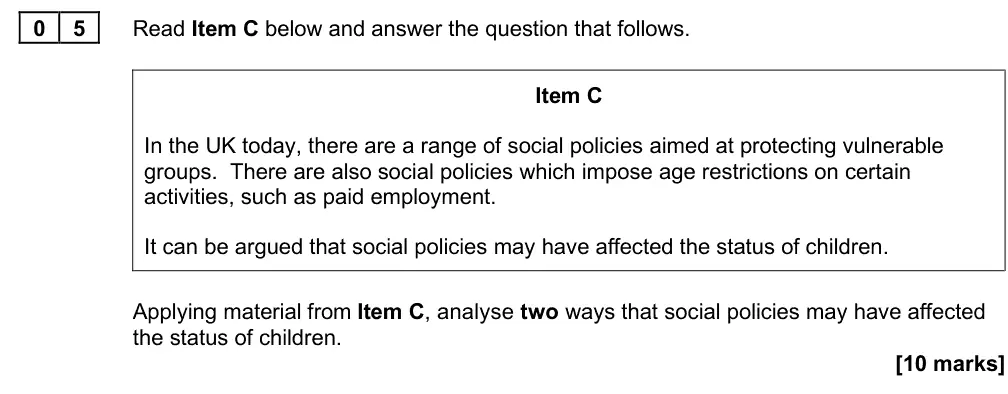
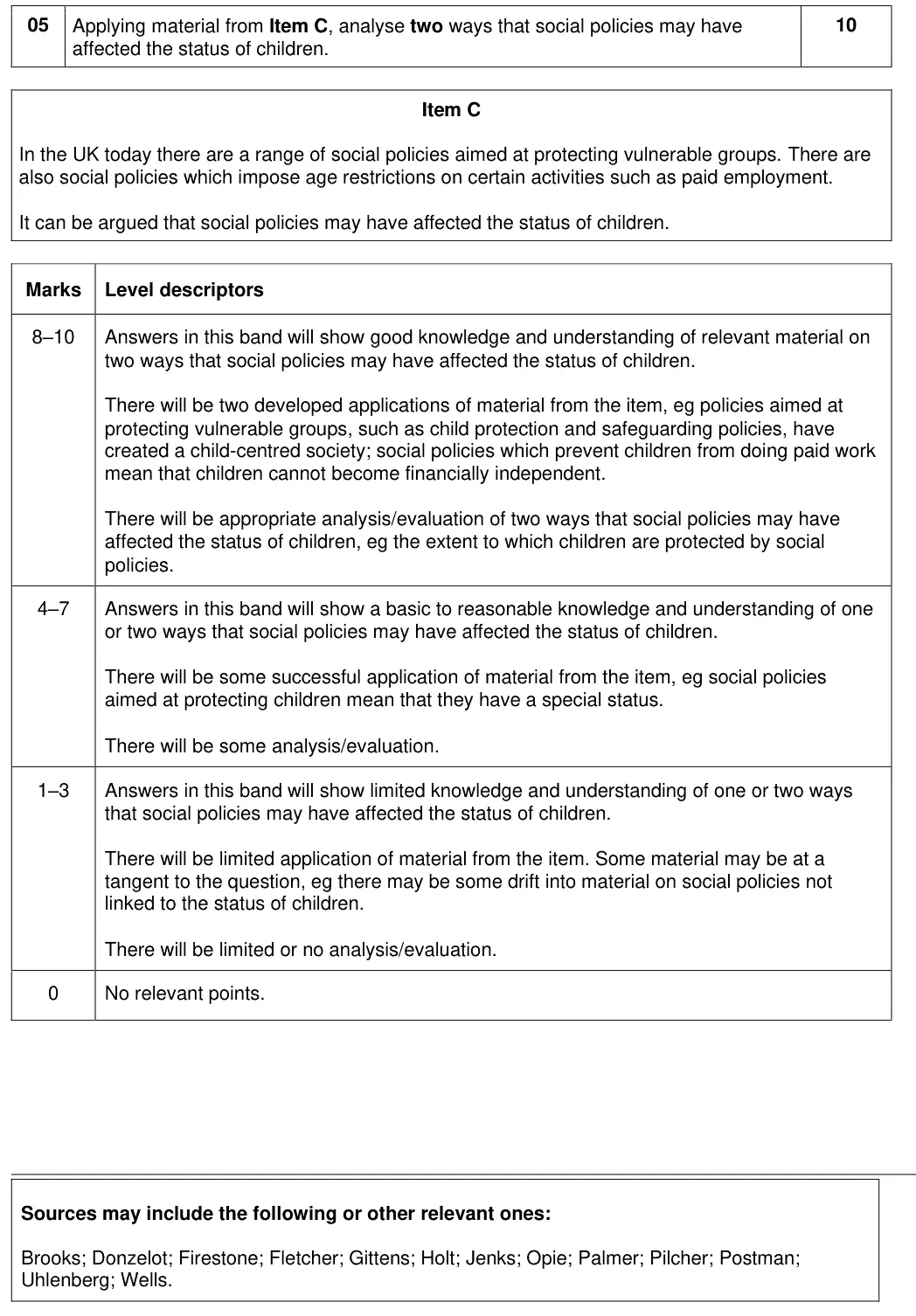
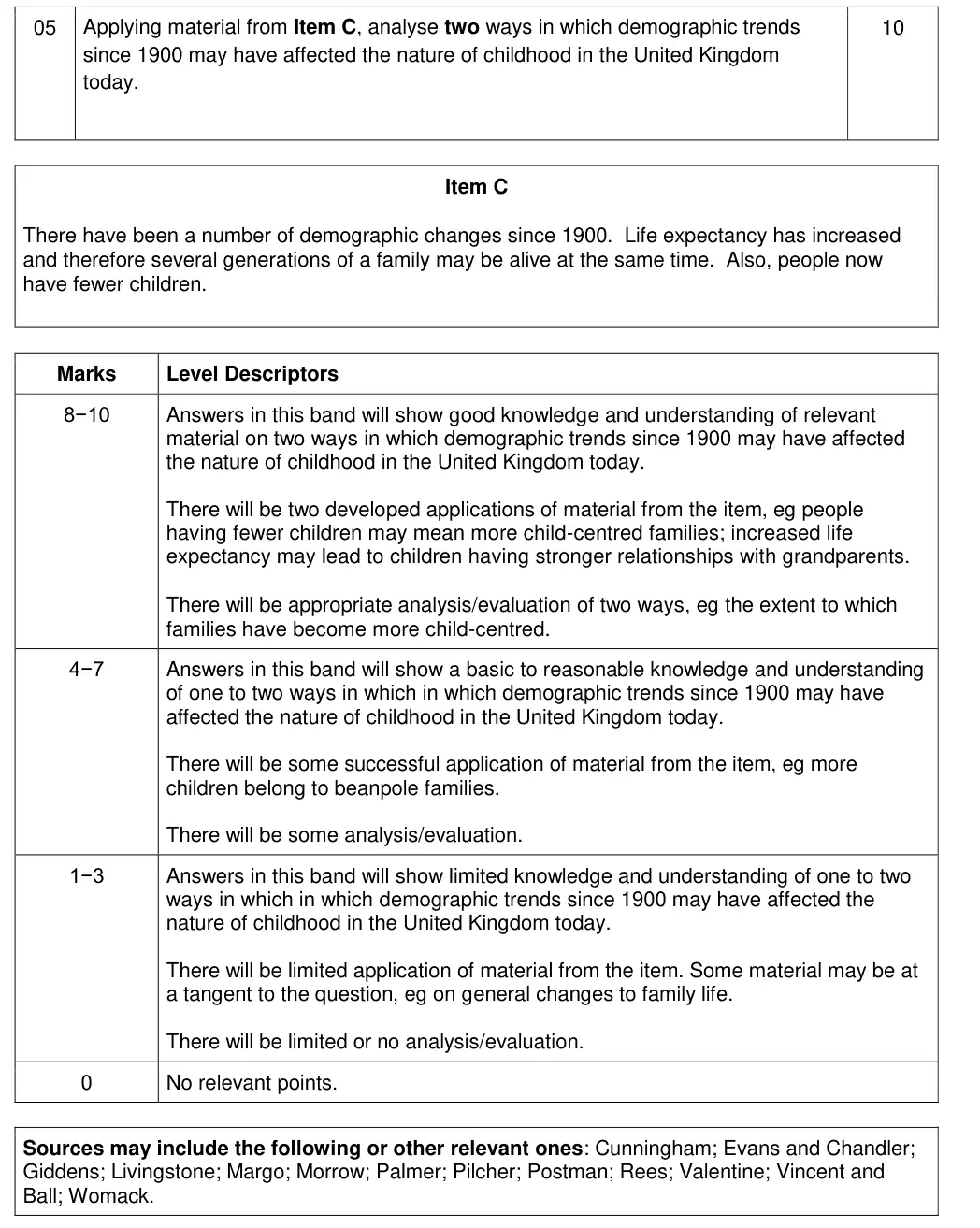
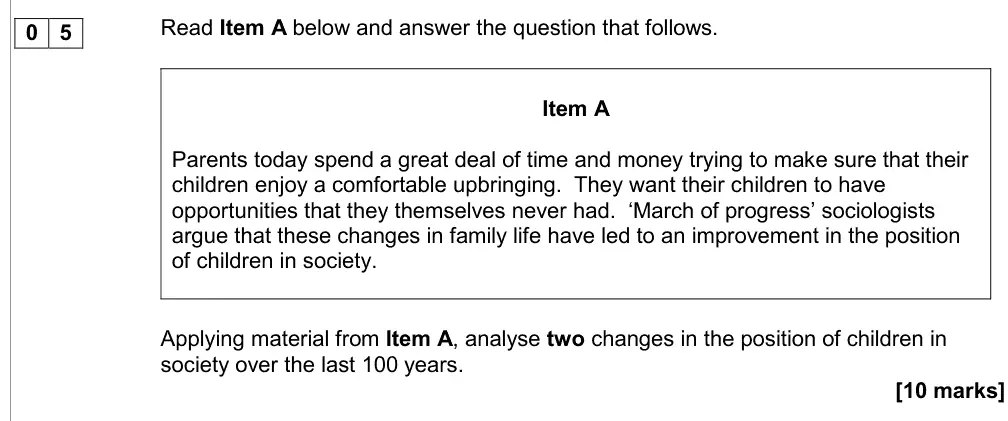
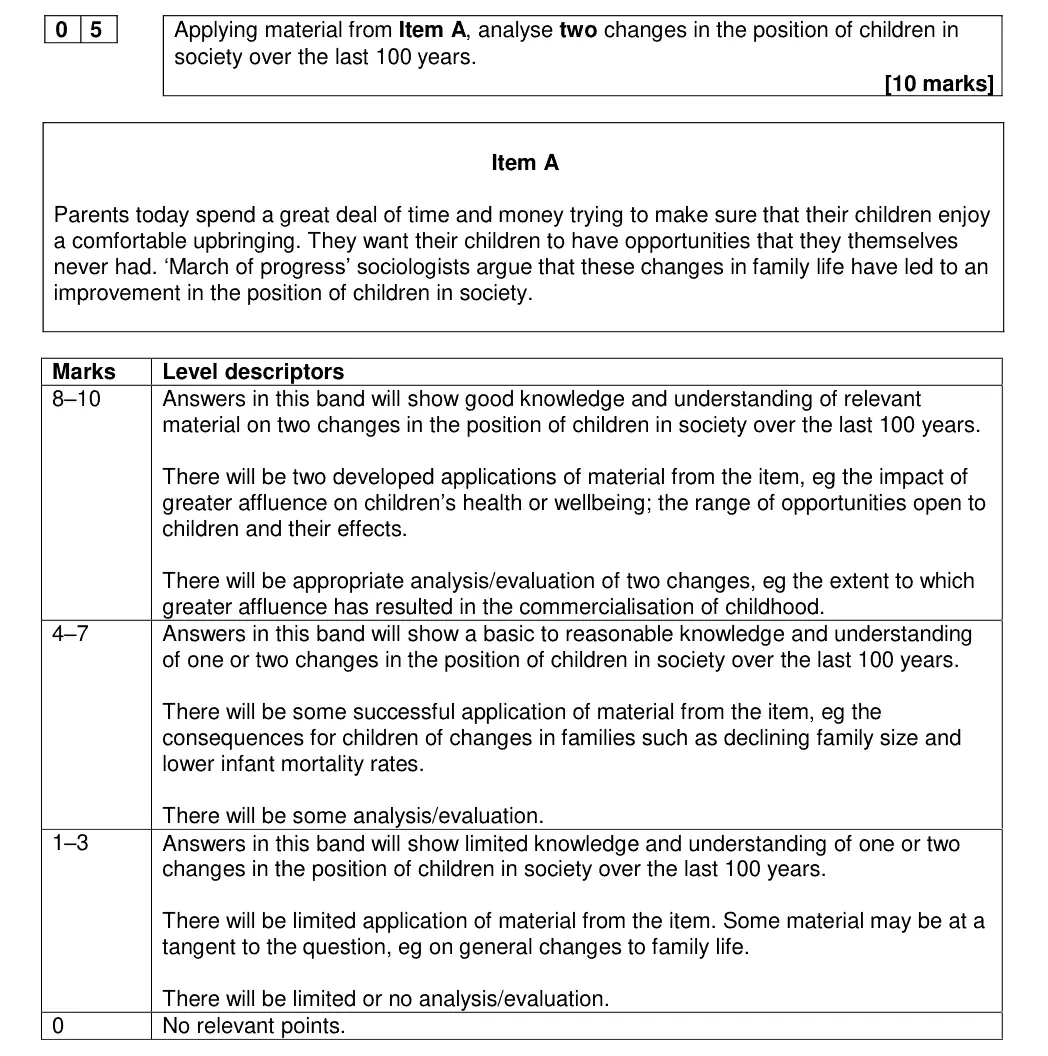
June 2024 · Paper 2 · Q510 marksAO1=3, AO2=4, AO3=3Analyse
Mark scheme, including the levels grid and indicative content
Examiner's comment
The nature of these questions means that students cannot rely on reciting knowledge. Questions will ask them to bring together aspects of their sociological knowledge in ways they will not have done before. It is therefore important for students to allow time to think about how to answer the question. Students should be made aware that there are two types of 10 mark questions. These have different requirements and different mark schemes . There are different marks available for the assessment objectives. A breakdown of the marks awarded by assessment objective can be found in the mark scheme. The items for 10 mark “analyse” questions are written to give prompts or “hooks” for student answers. These have to be used to access application marks. Answers can indicate use of hooks by quoting, by a reference in parentheses or by wording ( eg “As the item says…”). Items end with a sentence restating the question; the hooks are in the preceding part of the item. Students should avoid writing all they know about a “hook”, and focus on applying the idea to the question. Introductions and conclusions are not required for 10 mark questions; they take up time and rarely improve the mark. It is helpful if answers are set out to clearly indicate the two answers, with wording such as “One way/reason is…”, or by starting a new paragraph for the second point. Answers that give more than two points are unlikely to develop two of them sufficiently. Q5: A small number of students failed to effectively utilise any "hooks" from the provided material. Instead they offered knowledge on a variety of social policies or accounts of the history of childhood, rather than effects of policies on children's status. Many were, however, able to successfully connect at least one of the two “hooks” from the item to the changing status of children. One way of doing this was by illustrating the shift from being an economic asset to becoming an economic liability.
Notes from the mark scheme and report
two developed applications from Item C (protective policies
age restrictions on activities such as paid work), e.g. safeguarding creating child-centredness, ban on paid work preventing financial independence
drift into policies not linked to children's status, or histories of childhood, scores little
June 2024 · AS Paper 2 · Q1220 marksAO1=8, AO2=6, AO3=620-mark essay
Mark scheme, including the levels grid and indicative content
Examiner's comment
This was a question most students found themselves well prepared for and were able to offer responses which covered many of the debates around childhood. The item was well used in general and helped guide students into the debate about the nature of childhood and in particular whether childhood is a “golden time” or not. Many students were able to move though a range of contributors to the debate, Palmer, Postman, Firestone, Pilcher etc showing this topic area to be a familiar one. Where answers were less effective was often due to a drift in the response into all aspects of childhood. Two common examples of this were overlong accounts of what parents buy for children and how divorce may affect them. Many answers attempted to locate the debate about childhood within the theoretical framework of Marxism, feminisms, functionalism and the new right. This was a legitimate approach but needed to keep the focus on child centredness and not move into general views of the perspectives on the family.
Notes from the mark scheme and report
keep the focus on child-centredness
drift into all aspects of childhood (spending on children, effects of divorce) or general perspectives on the family limits marks
good answers used march of progress vs toxic childhood (Palmer, Postman, Pilcher)
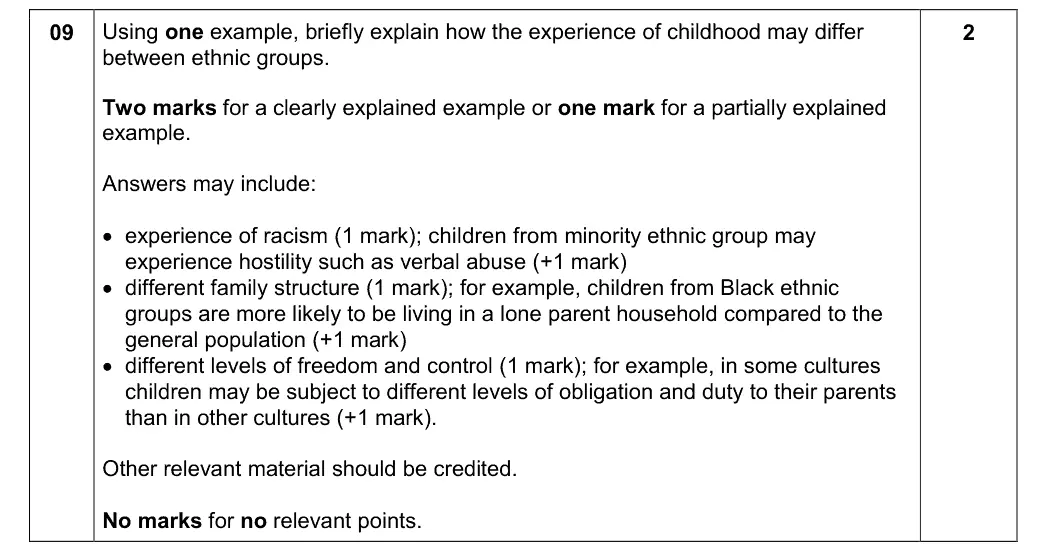
June 2023 · AS Paper 2 · Q92 marksAO2=2Brief explain
Mark scheme
Examiner's comment
Most students found this question straight forward and accessible and in general the question was answered well. The most popular responses referenced differences in levels of parental control, different experiences resulting from specific family forms such as extended or lone parent and differences in the length of childhood.
Notes from the mark scheme and report
1 mark for the difference, +1 for explaining it (e.g. experience of racism, family structure such as lone-parent or extended households, levels of parental control and obligation)
accessible, answered well
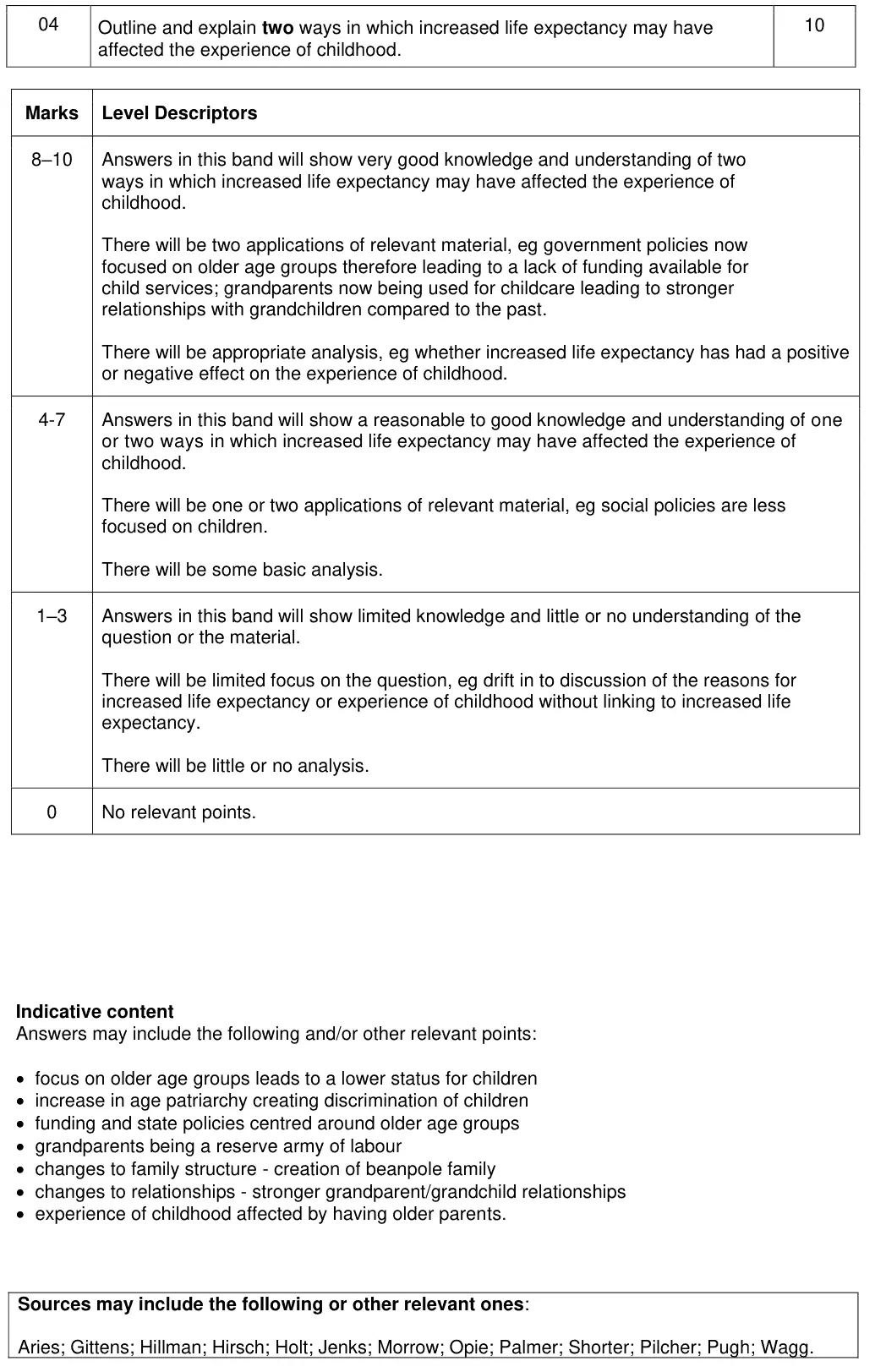
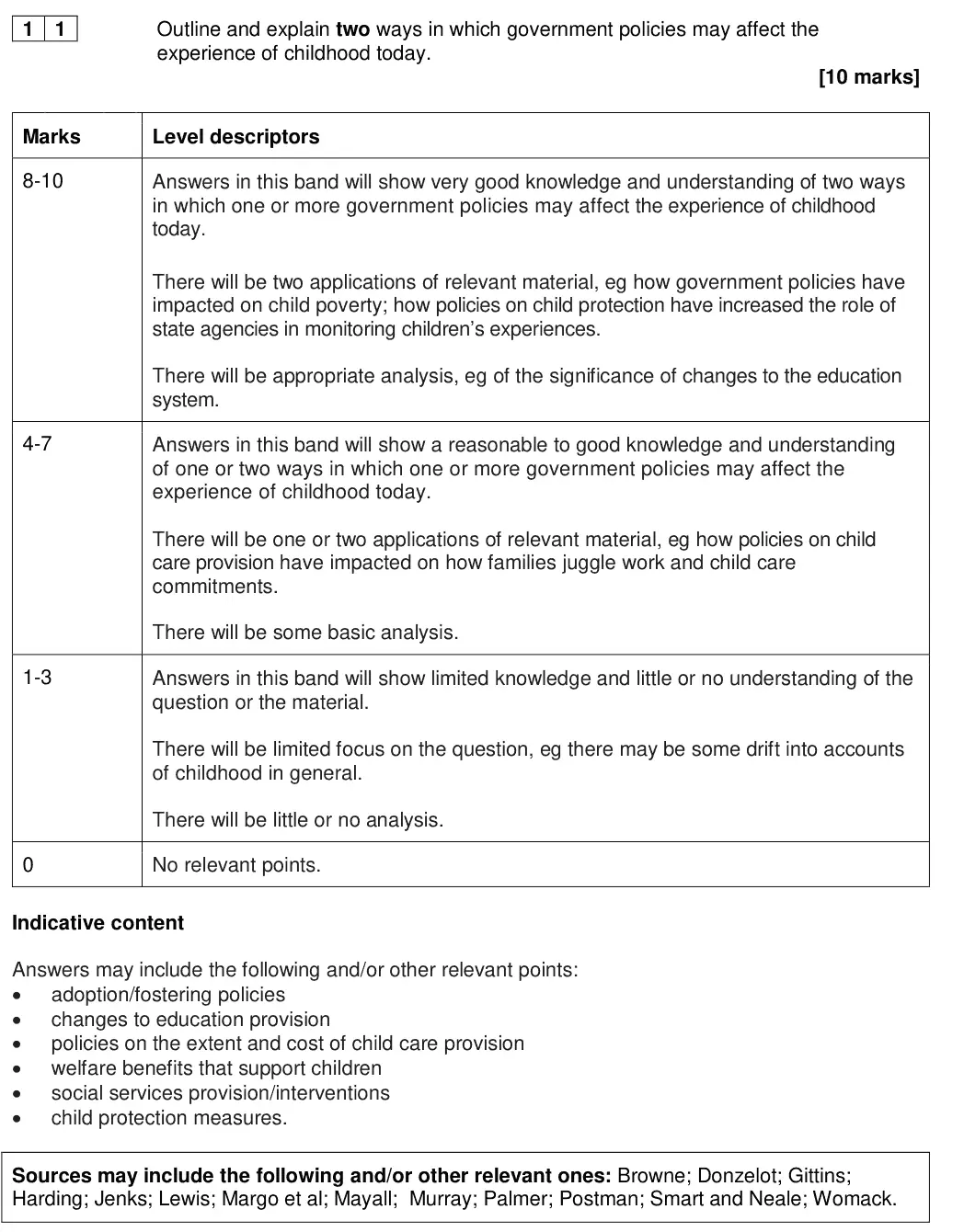
June 2022 · Paper 2 · Q410 marksAO1=5, AO2=3, AO3=2Outline and explain
Mark scheme, including the levels grid and indicative content
Examiner's comment
The nature of these questions means that students cannot rely on reciting knowledge. The questions will ask them to bring together aspects of their sociological knowledge in a way that they are unlikely to have done before. There was a tendency, however, to attempt to answer the question by giving knowledge based on words or phrases in the question, rather than meeting the demands of the question. For example, some answers to question 4, which asked for effects of increased life expectancy on the experience of childhood, gave reasons for increased life expectancy. Students are advised to spend time reading the question, and, where there is one the item, to ensure that they are answering the question. Some students seemed unaware of the different demands of the two types of questions. The marks awarded for the assessment objectives are different in the two types of ten mark questions, and students should be aware of this. In particular, it should be noted that there are no marks available for evaluation in “outline and explain” (no item) questions. There is no need for an introduction or conclusion for 10 mark questions. It is helpful if answers are set out to clearly indicate the two answers, with wording such as “One way is…” or by starting a new paragraph for the second point. The best answers to 10 mark questions were focused, clearly stating a point that addressed the question and then developing it, using sociological concepts, evidence and, where appropriate, theory. Answers need to address all aspects of the question. Q4 Better answers made points about vertically extended families, the role of grandparents as carers or in socialising, and smaller numbers of siblings.
Notes from the mark scheme and report
must link longer life expectancy to childhood
giving reasons for increased life expectancy, or childhood without that link, = 1–3 band (singled out in the report as a misread question)
better answers used beanpole and vertically extended families, grandparents as carers, fewer siblings, policy shifting towards older people
June 2022 · AS Paper 2 · Q92 marksAO2=2Brief explain
Mark scheme
Examiner's comment
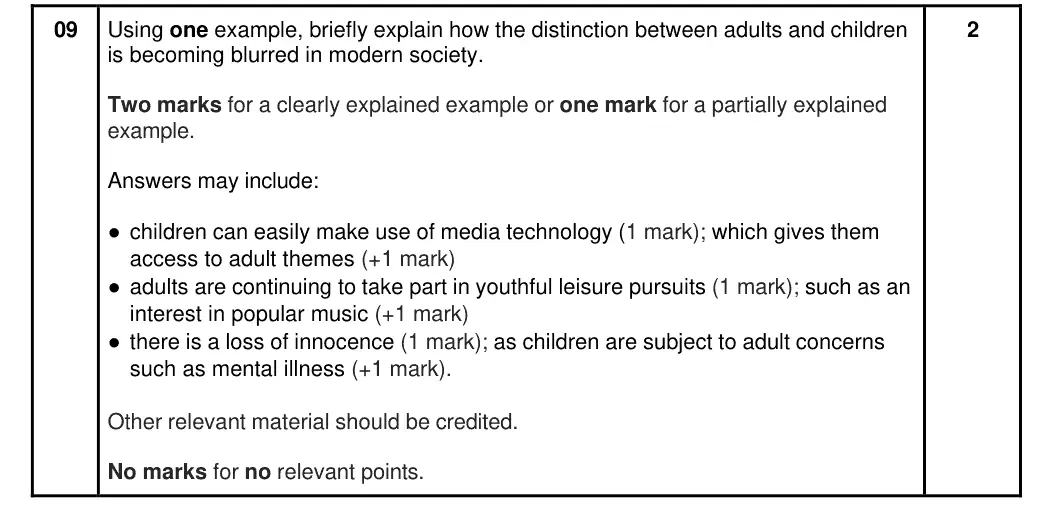
For low mark tariff questions where candidates are required to either define, explain or outline, care should be taken to ensure that points are not just identified. In general, this question was answered well. In stronger responses there was a clear idea of blurring with an example and brief explanation. The most common response was new media technology resulting in exposure to adult knowledge. Partial responses identified an example but failed to develop it, for example ‘same clothing’. There were a number of incorrect responses such as an increase in teenage pregnancies.
Notes from the mark scheme and report
1 mark for the example +1 for explaining the blurring (media technology giving children access to adult themes, adults in youthful leisure, loss of innocence)
answered well, mostly via new media
undeveloped examples (same clothing) got 1
teenage pregnancy not credited
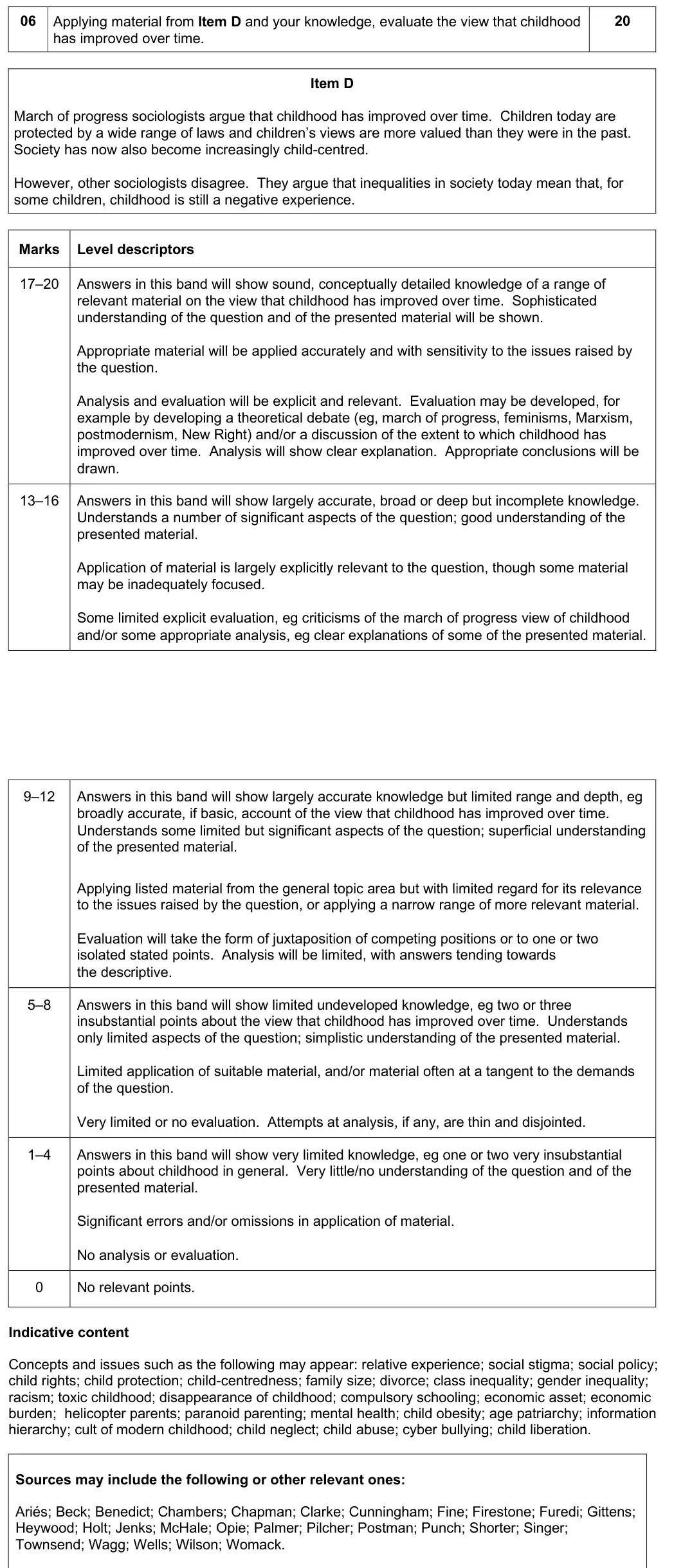
November 2020 · Paper 2 · Q620 marksAO1=8, AO2=6, AO3=620-mark essay
Mark scheme, including the levels grid and indicative content
Examiner's comment
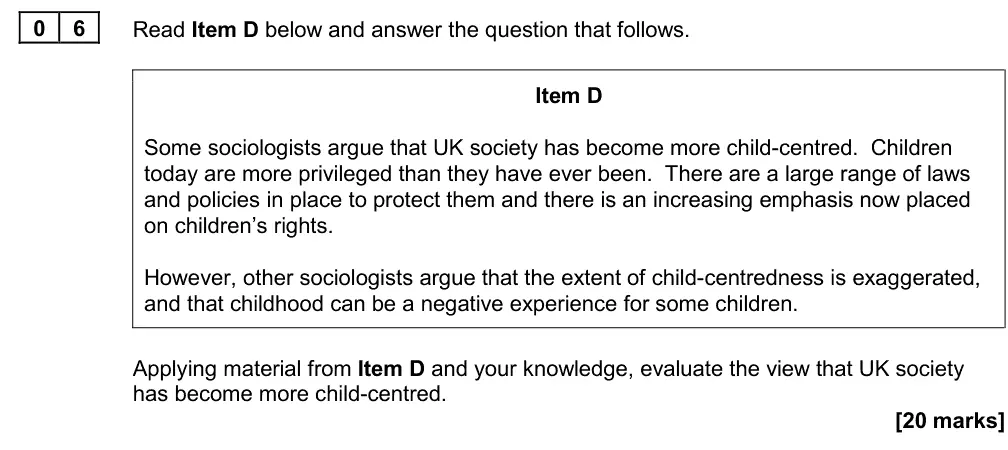
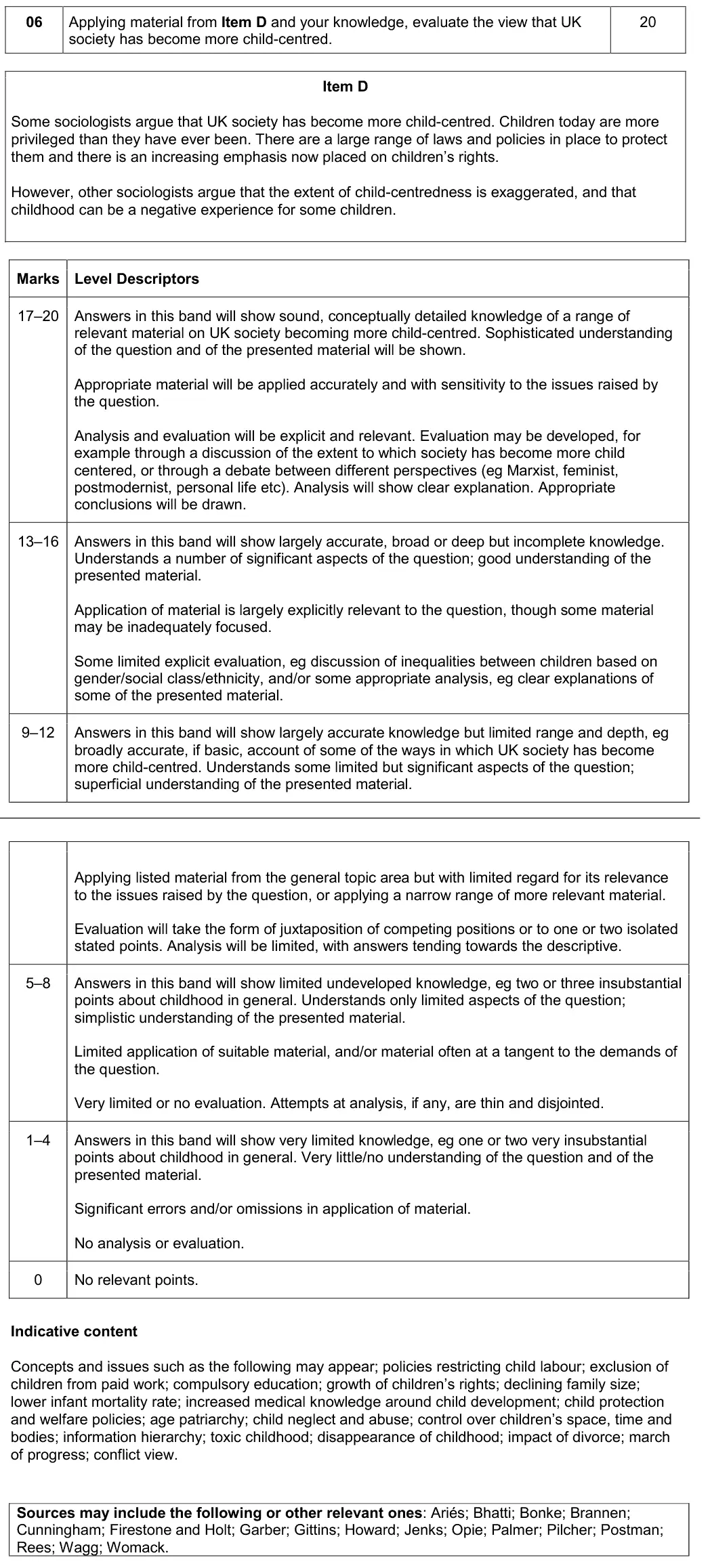
Better answers here recognised the need to discuss the idea of a “child-centred society” rather than only child-centred families. For 20-mark questions, the item will provide useful starting points for answers but students should be encouraged to bring into their answers other points and ideas from their own knowledge. It is understandable that because of time pressure many answers lack a conclusion, but a conclusion weighing up arguments and evidence to reach a judgement will show analytical and evaluative skills that will be credited.
Notes from the mark scheme and report
apply Item D (privileged children, protective laws and rights vs exaggerated child-centredness, negative childhoods)
evaluation via extent of child-centredness, Marxist/feminist/postmodernist/personal life views, or inequalities between children by class, gender, ethnicity
better answers discussed a child-centred society, not only child-centred families
November 2020 · AS Paper 2 · Q92 marksAO2=2Brief explain
Mark scheme
Notes from the mark scheme and report
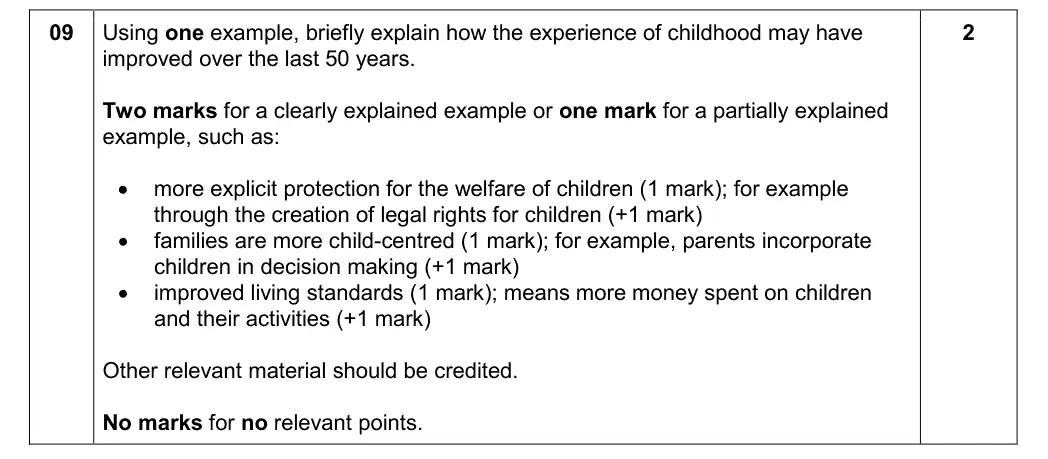
1 mark for an improvement (legal protection and rights, child-centred families, higher living standards), +1 for explaining it
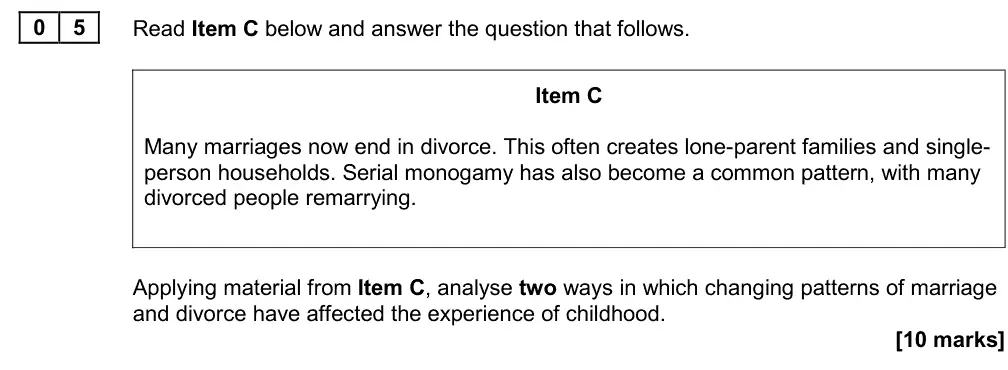
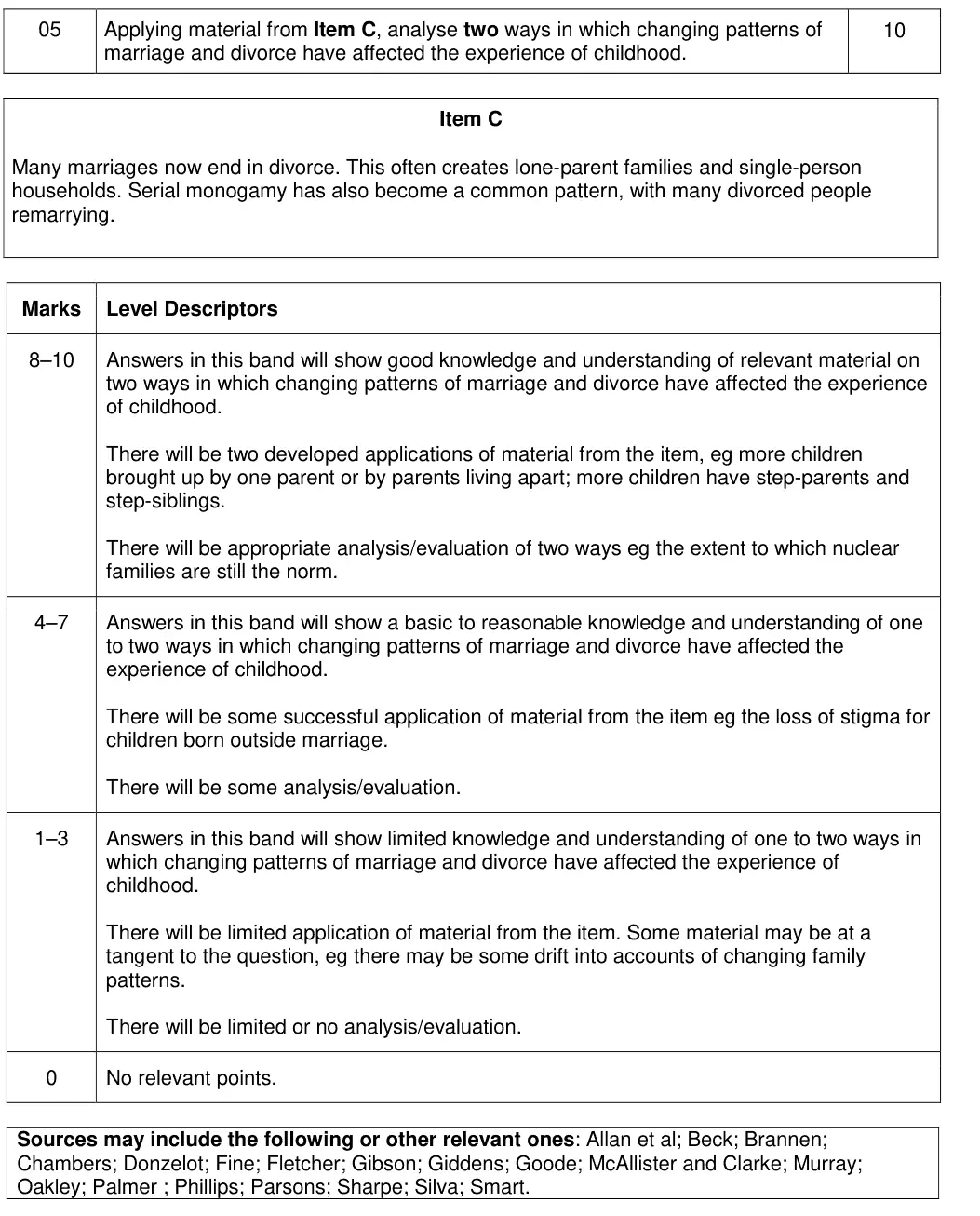
June 2019 · Paper 2 · Q510 marksAO1=3, AO2=4, AO3=3Analyse
Mark scheme, including the levels grid and indicative content
Examiner's comment
Some students wrote introductory paragraphs and/or conclusions. These are not necessary, and are unlikely to gain additional marks; they also take up time. Some students made only one point in their answers, or three or more, rather than the two asked for. The word ‘two’ is put in bold in the question to try and draw students’ attention to this. Sometimes it was not clear how many points were being made. It is helpful for students to clearly indicate their two answers, with wording such as “One way is…” or by starting a new paragraph for their second point. Notably, some students wrote far more than was needed for a 10-mark response. The two types of 10-mark question, “outline and explain” and “analysis” types, are marked differently as the assessment objectives have different weightings. It is important that students are aware of this. For 10 mark “analyse” questions, the parts of the item being used should be clearly indicated, preferably by exact words being quoted. It is acceptable for two different points to be drawn from one part of the item, but answers which do not use the item cannot access the application marks. The best answers to 10-mark questions were focused, clearly stating a point and then developing it, and used sociological concepts, studies, evidence and theory as appropriate. Those answers that simply went into reasons for the changing patterns of marriage and divorce could not be credited. Popular answers used the reference in the item to ‘lone parent’ in both the New Right’s views of inadequate socialisation, and in contrasting views of how lone parent families might be a positive experience for many children. The reference in the item to ‘serial monogamy’ and ‘remarrying’ was used by many as a basis for discussion of those children within reconstituted families and the possible difficulties of adapting to a divorce - extended family with step relatives. Less successful answers were often focused on changes in marriage and divorce rather than how these have affected the experience of childhood.
Notes from the mark scheme and report
must be effects on the experience of childhood, not reasons for divorce or changes in family patterns
popular hooks: lone parents (New Right socialisation fears vs positive experiences) and serial monogamy/remarriage (reconstituted families, step-relatives)
AO split from AQA's standard grid for this paper (this year's mark scheme does not print it).
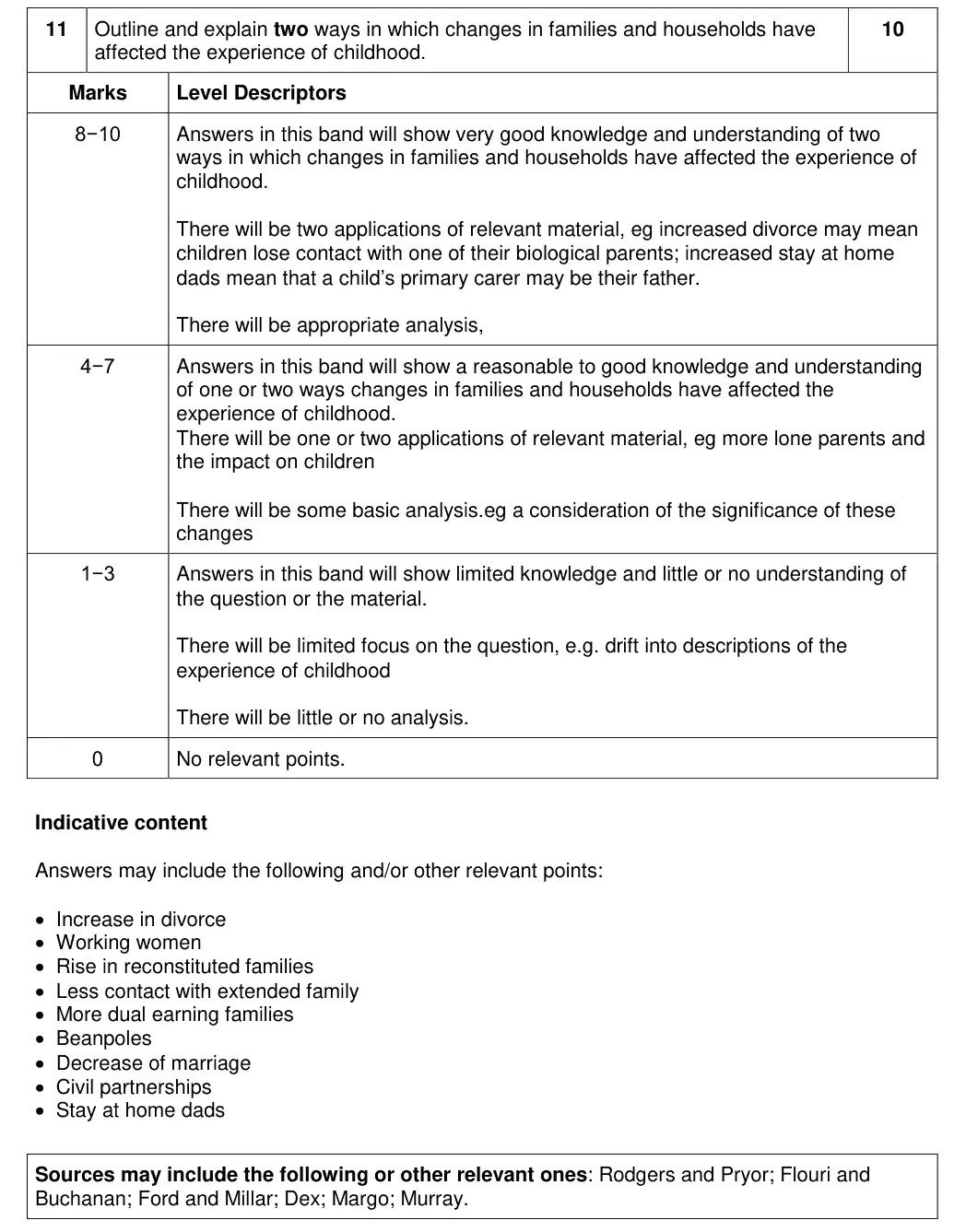
June 2019 · AS Paper 2 · Q1110 marksAO1=5, AO2=3, AO3=2Outline and explain
Mark scheme, including the levels grid and indicative content
Examiner's comment
The requirements of the 10-mark question seem to be well understood by the majority of students. Many answers either discussed changes in families and households without explaining how these affected the experience of childhood, or more frequently discussed changes to the experience of childhood without relating these to changes in families and households. For example, students that discussed the disappearance of childhood and the negative aspects of modern technology, or the changes in child labour laws, often failed to make any link to families and households changes. The best answers had a clear example of family change such as increased divorce or decline in family size and were then able to explain how this change had impacted on the experience of childhood. Child centeredness, same sex parents, and changes to gender roles were all common themes. Good answers analysed the impact, both positive and negative, of these changes to the experience of childhood. For example, some answers identified that families in general are more affluent today than in the past. This has had a positive impact on childhood in terms of access to resources and technology but may have come at a price, as both parents are too busy to spend as much time with their children as parents did previously. These ideas could then be developed with reference to toxic childhood or diminished role of parents in the socialisation process vis a vis media or other agents.
Notes from the mark scheme and report
AO grid not printed
no marks for evaluation in this question type
each way must link a family or household change (divorce, working mothers, reconstituted families, stay-at-home dads) to children's experience
many described changes to childhood (toxic childhood, technology, child labour laws) with no family link
drift into descriptions of childhood = 1–3
AO split from AQA's standard grid for this paper (this year's mark scheme does not print it).
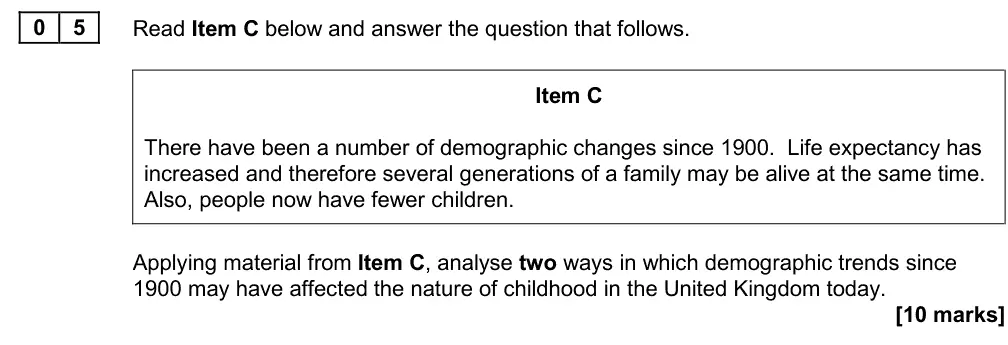
June 2018 · Paper 2 · Q510 marksAO1=3, AO2=4, AO3=3Analyse
Mark scheme, including the levels grid and indicative content
Examiner's comment
Some students wrote introductory paragraphs and/or conclusions. These are not necessary, and are unlikely to gain additional marks, and they also take up time. Some students made only one point in their answers, or three or more, rather than the two asked for in the question. Sometimes it was unclear how many points were being made. It is helpful for students to clearly indicate their two answers, with wording such as “One way is…” or by starting a new paragraph for their second point. Evaluation is not a requirement for answers to 10 mark “outline and explain” questions. The marks awarded for the assessment objectives being targeted are different in the two types of ten mark questions, and students should be made aware of this. The best answers to 10 mark questions were focused, clearly stating a point and then developing it, using sociological concepts, evidence and theory where appropriate. In some questions students tended to focus on the first aspect of the question at the expense of the second. For example, in question 5, some answers gave detailed responses on demographic changes but said little on how these had affected the nature of childhood in the United Kingdom today. Students need guidance on how to approach these questions and how to best demonstrate their sociological understanding. The nature of these questions means that students cannot rely on reciting knowledge. These questions will ask them to bring together aspects of their sociological knowledge in a way that they are unlikely to have done before. Many answers went into reasons for the demographic changes referred to in the item rather than focus on effects on childhood. Others discussed childhood a hundred years ago or earlier. However, many did develop points about child centeredness by looking at its positive consequences for childhood and then developing this to link it to over protectiveness, age patriarchy, pester power, toxic childhood and so on. Similarly, the presence of grandparents was in better answers not merely described but analysed as to how it could be both positive and negative in contributing to socialisation and childcare and in adding to the burden of care for the family with some children becoming young carers. Better answers were distinguished by, as the mark scheme says, ‘developed applications’, going beyond the immediately apparent.
Notes from the mark scheme and report
two developed applications from Item C (fewer children, longer life expectancy), e.g. child-centredness, closer relationships with grandparents
many explained the causes of the demographic changes or described childhood 100 years ago instead of effects today
best developed child-centredness into over-protection, age patriarchy, toxic childhood and grandparents as both support and burden (young carers)
AO split from AQA's standard grid for this paper (this year's mark scheme does not print it).
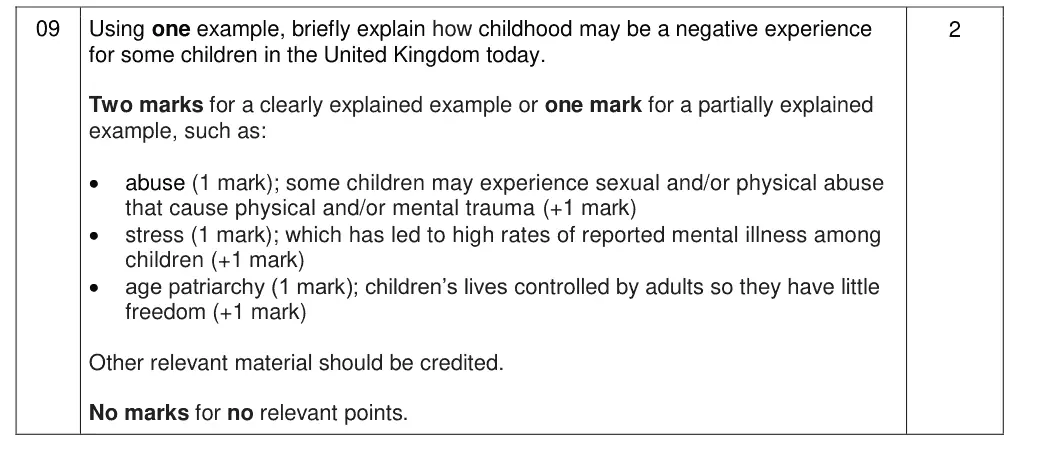
June 2018 · AS Paper 2 · Q92 marksAO2=2Brief explain
Mark scheme
Examiner's comment
The most common answer was "toxic childhood ", with an example explained. Many answers referred to negative aspects of technology and problems of children’s exposure to it. Those who failed to score usually omitted to explain what was negative about the experience that they identified. For example identified ‘poverty’ or ‘divorce’ without explaining what the negative consequence was.
Notes from the mark scheme and report
credited: abuse, stress and mental illness, age patriarchy
toxic childhood and technology were common
naming poverty or divorce without the negative consequence = no credit
AO split from AQA's standard grid for this paper (this year's mark scheme does not print it).
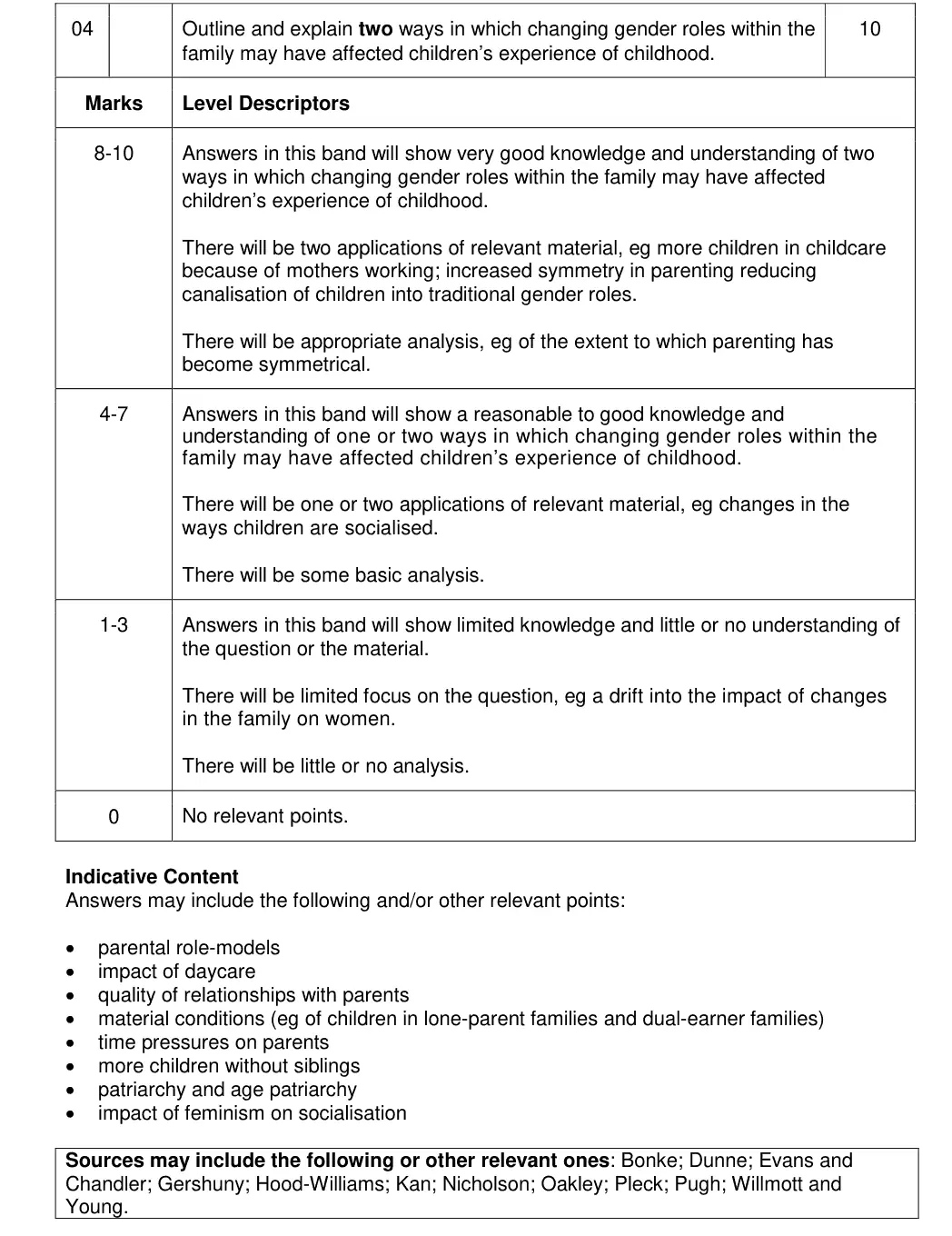
June 2017 · Paper 2 · Q410 marksAO1=5, AO2=3, AO3=2Outline and explain
Mark scheme, including the levels grid and indicative content
Examiner's comment
A number of students wrote introductory paragraphs and/or conclusions. These are not necessary, and are unlikely to gain additional marks. A number of students made only one point in their answer, or three or more, rather than the two asked for. In these cases, the two best answers were rewarded and will be in future series. It is helpful for students to clearly indicate their two answers, with wording such as “One way is…” or by starting a new paragraph for their second point. Schools and colleges should note that there is no reference in the mark scheme for 10 mark ‘outline and explain’ questions to evaluation, and that evaluation is not a requirement for answers to these questions. The assessment objective allocations are different in the two types of 10 mark questions, and students should be made aware of this. There was a wide range of responses to these questions. A minority of students wrote very brief answers. For these 10 mark items, a simple statement of two ways, reasons or factors, without development, is not sufficient to access more than the lower marks in the mark range. The best answers were focused, clearly stating a point and then developing it, with use of sociological concepts, evidence and theory where appropriate, in ways that demonstrated the skills expected from the targeted assessment objectives. There was a tendency, however, for many answers to focus on the first aspect of the question at the expense of the second. For example, in question 4, many answers gave detailed responses on changing gender roles but said little on how these had affected the experience of childhood. Students need guidance on how to approach these questions and how to best demonstrate their sociological understanding. The nature of these questions means that students cannot rely on reciting knowledge. They require students to bring together two aspects of their sociological knowledge in a way that they are unlikely to have done before. Answers will sometimes require claims that students may be unsure of because they do not know of specific evidence (for example, in question 5, whether migrants from Eastern Europe who are single workers tend to live alone or in shared households). However, answers that are sociologically plausible will be accepted. Most were able to identify two ways and clearly addressed changing gender roles, but often there was little development on the experience of childhood beyond stating that it had become more positive or negative. Popular answers included parents in symmetrical families as good role models, material conditions (such as dual-earners) and changes in socialisation. Some made the error of writing about traditional gender roles rather than how they have changed.
Notes from the mark scheme and report
must link changing gender roles to children's experience of childhood (role models, daycare, socialisation, dual earners)
drift into effects on women = 1–3
childhood effects often left undeveloped ('better' or 'worse')
some wrote about traditional rather than changing roles
June 2017 · AS Paper 2 · Q1220 marksAO1=8, AO2=6, AO3=620-mark essay
Mark scheme, including the levels grid and indicative content
Examiner's comment
The majority of students had clearly learned some relevant material and were able to write at length about different contributions to a sociological understanding of childhood. Most used the item to structure their responses into a debate between the ‘march of progress’ view and more critical views. There were many responses that listed material from the general topic area rather than applying the material to the question set. For example the requirement to focus on the last 50 years or so was often not recognised and Aries was the starting point for many. This meant that they often got bogged down in Aries and/or cross-cultural studies, and failed to address significant aspects of the question. The better answers were able to use Pilcher, Palmer and Postman among others to develop a critical discussion. These answers were broader and deeper with a focus on different arguments about contemporary changes to childhood. There was occasional brief evaluation, such as cross-cultural examples of childhood or class or gender differences. Top band answers had explicit evaluation of the debates and a more conceptual sense of the theories.
Notes from the mark scheme and report
must apply Item B
focus is the last 50 years or so, so long accounts of Aries or cross-cultural studies miss the question
top band: debate between march of progress and critical views (toxic childhood, Palmer, Postman, Pilcher)
many listed general childhood material rather than applying it
June 2016 · AS Paper 2 · Q1110 marksAO1=5, AO2=3, AO3=2Outline and explain
Mark scheme, including the levels grid and indicative content
Examiner's comment
The 10 mark ‘Outline and explain’ question requires students to link two aspects of the specification. The best answers took note of both aspects of the question, clearly identified two separate points and developed them together them in relation to the question as a whole. Weaker answers either ignored one aspect of the question, or attempted to cover a number of ideas rather than focusing on the two required. Most students were able to give two examples of government policies, even if these were not very specific or accurate. Some particularly vague answers described policy areas rather than identifying a specific policy. There was some difficulty in linking policies to a specific impact on the experience of childhood today. Many candidates just said it was ‘better’, whilst others linked the policy to benefits in the future, eg better jobs. Some gave quite lengthy descriptions on the changes in childhood or various sociologists' views on the position of childhood today. Whilst sociological knowledge was often good, they failed to apply this explicitly to the question, resulting in limited marks. Others identified two policies, but then described just one way that it affected childhood. Some identified two policies and two ways, but very briefly with no development. Overall, relatively few students explained the effects on childhood experiences sufficiently effectively for top band marks. The policies most frequently cited were the extension of the school leaving-age, child protection policies, and various benefits. Weaker students then wrote only briefly about the extension of childhood, it being 'better' or more dependence on parents. Some wrote at a tangent, for example, about New Right views of benefits. Only a small proportion managed to identify a policy and link its effects well to several points about changed childhood experiences (eg through the effects of divorce law changes, or the arrival of legal gay marriage).