Key-term cards for this topic are being written by our tutor. The past-paper questions below are ready now.
Specification statements
4.2.2-05 demographic trends in the United Kingdom since 1900: birth rates, death rates, family size, life expectancy, ageing population, and migration and globalisationAS
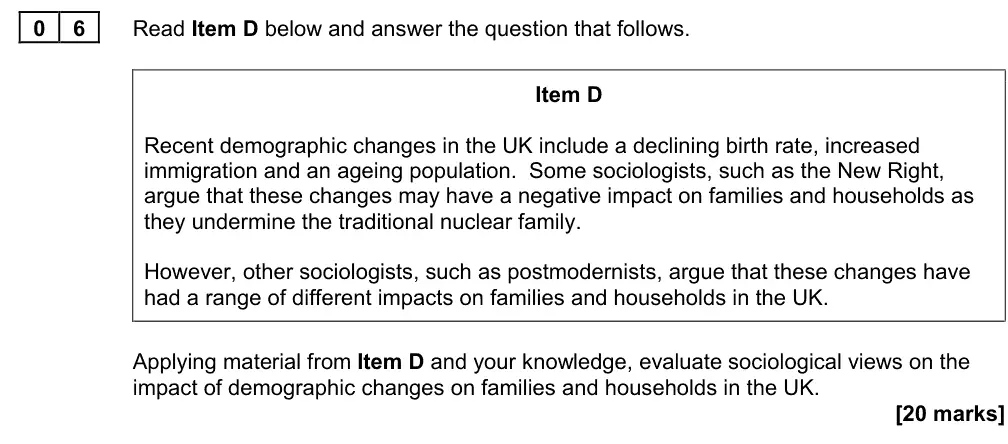
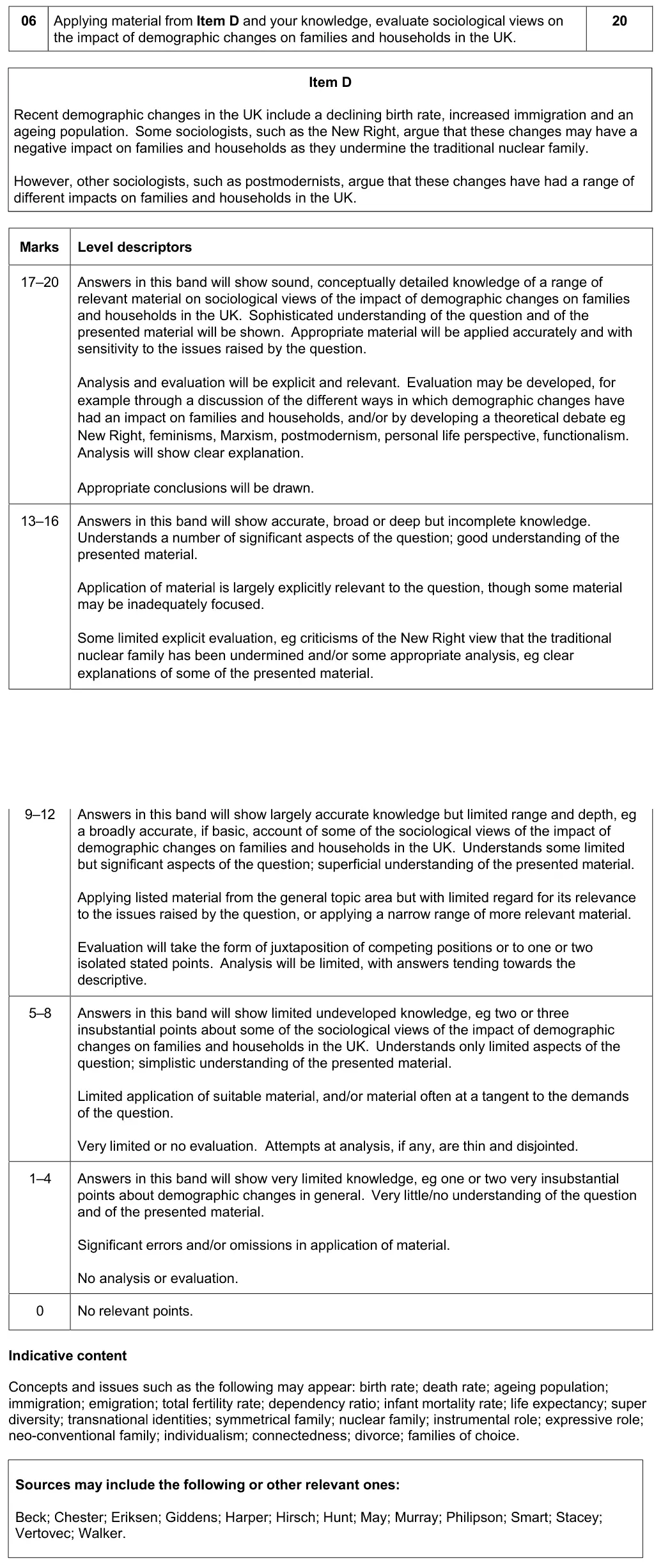
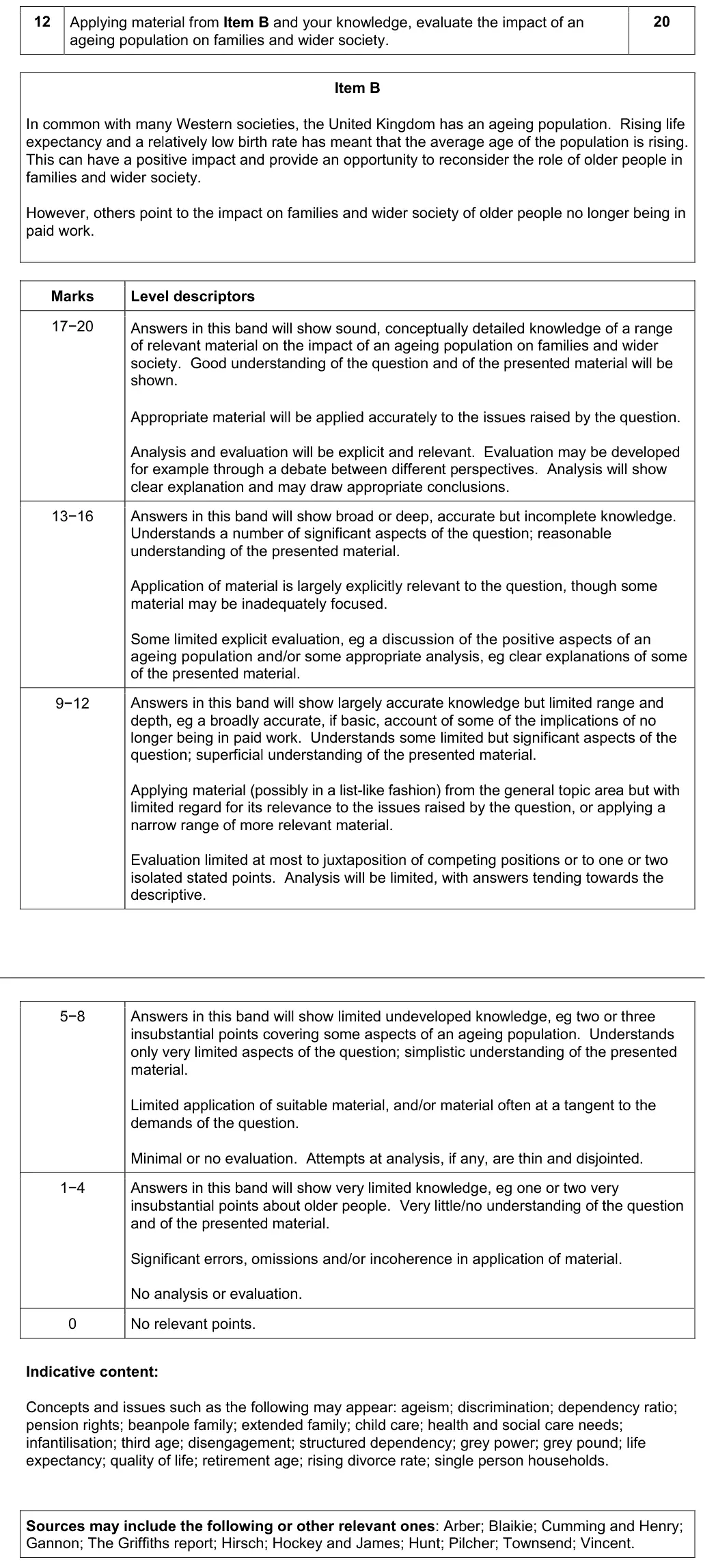
Applying material from Item D and your knowledge, evaluate sociological views on the impact of demographic changes on families and households in the UK.
Tap a question to zoom it. The mark scheme (with the level descriptors and indicative content) and the examiner's comment open underneath.
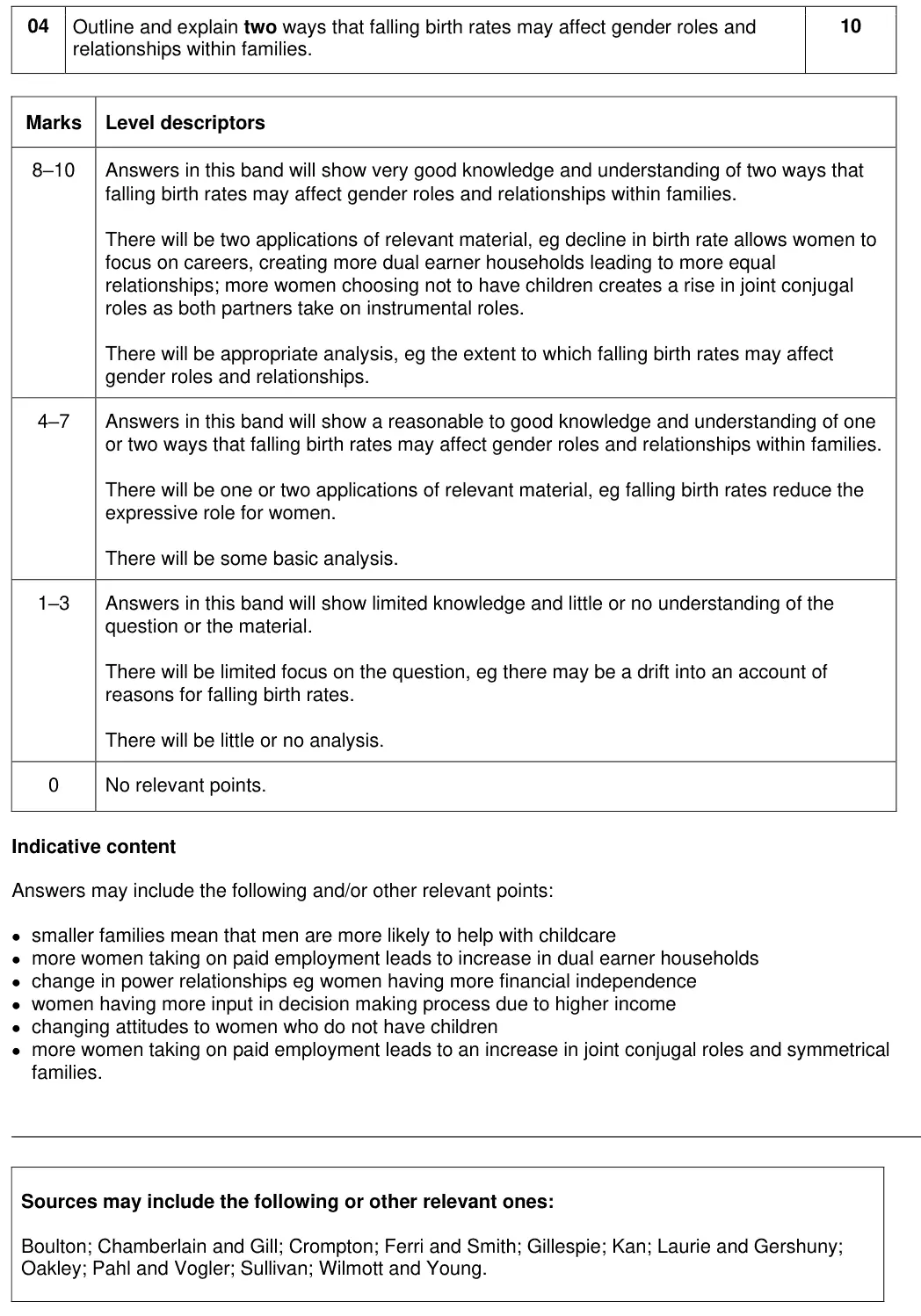
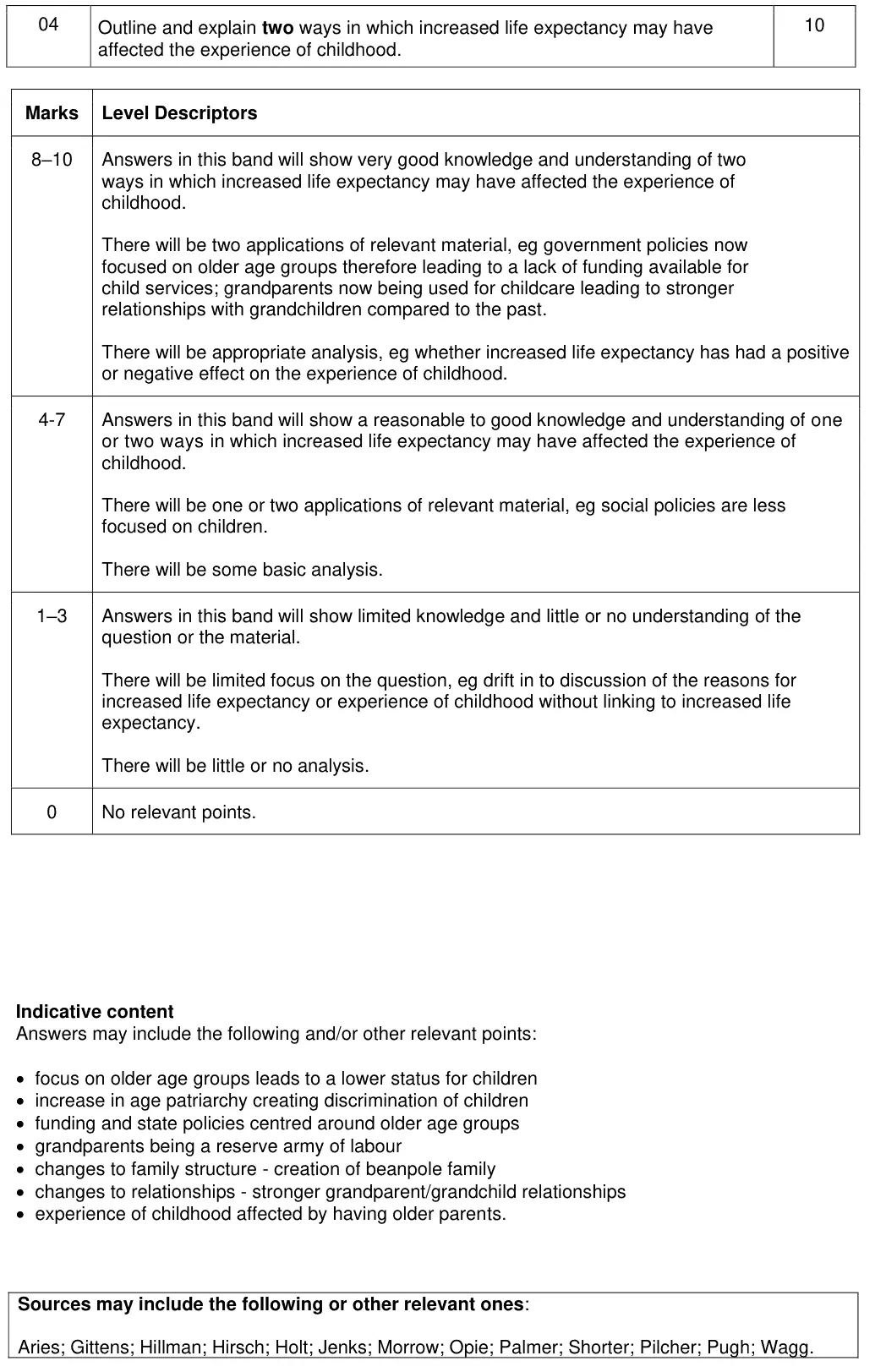
June 2024 · Paper 2 · Q410 marksAO1=5, AO2=3, AO3=2Outline and explain
Mark scheme, including the levels grid and indicative content
Examiner's comment
The nature of these questions means that students cannot rely on reciting knowledge. Questions will ask them to bring together aspects of their sociological knowledge in ways they will not have done before. It is therefore important for students to allow time to think about how to answer the question. Students should be made aware that there are two types of 10 mark questions. These have different requirements and different mark schemes . There are different marks available for the assessment objectives. A breakdown of the marks awarded by assessment objective can be found in the mark scheme. 10 mark “outline and explain” questions have more marks available for knowledge and understanding, and none for evaluation. Introductions and conclusions are not required for 10 mark questions; they take up time and rarely improve the mark. It is helpful if answers are set out to clearly indicate the two answers, with wording such as “One way/reason is…”, or by starting a new paragraph for the second point. Answers that give more than two points are unlikely to develop two of them sufficiently. For example, Topic A2 Question 4 asked about how falling birth rates may affect gender roles and relationships within families; some answers included a lot of material on why birth rates fall, which was not asked for. Q4: The responses to this question achieved mixed success. Most students managed to identify at least one way in which falling birth rates have influenced gender roles and relationships. The most thoroughly explored aspect was the shift towards women engaging in paid work, a change driven by evolving attitudes towards education and careers. The feminist perspective was effectively employed to examine the repercussions on family roles and relationships.
Notes from the mark scheme and report
two ways each linked to gender roles or relationships (e.g. women in paid work and dual-earner households, joint conjugal roles, women's financial independence and decision-making)
explaining why birth rates fell is not asked for and drifts to 1–3
most developed the shift to women's paid work
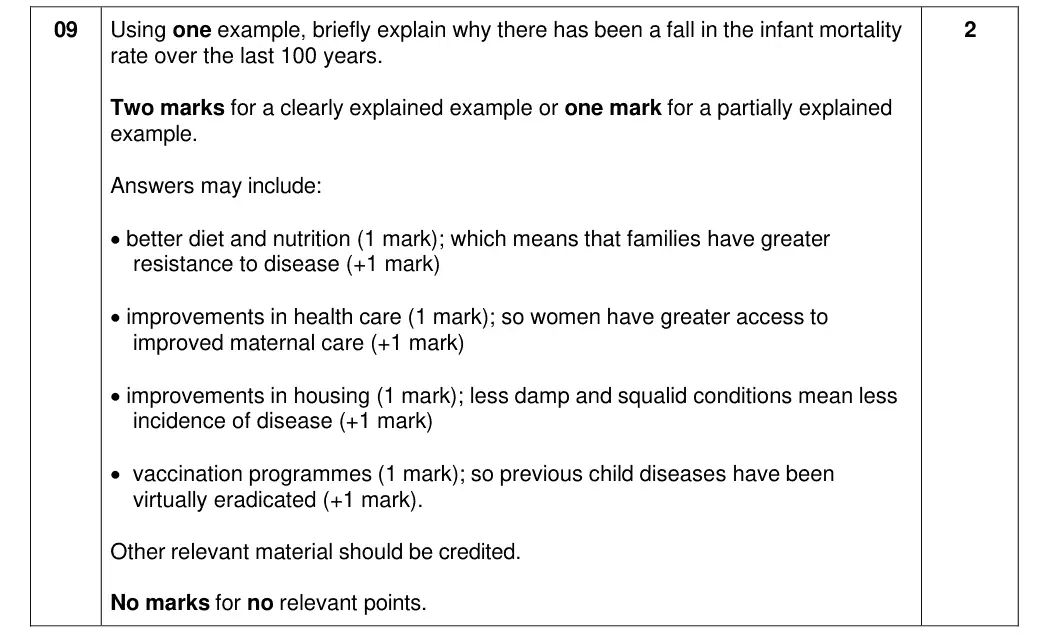
June 2024 · AS Paper 2 · Q92 marksAO2=2Brief explain
Mark scheme
Examiner's comment
Most students had little difficulty in answering this question and as a result gained both marks. There were many reasons to explain a fall in infant mortality over the last 100 years. The majority of answers focussed on improvements in the nature of health care and provision.
Notes from the mark scheme and report
2 marks for a clearly explained reason (diet, health care, housing, vaccination) with its effect
most gained both marks, usually via health care improvements
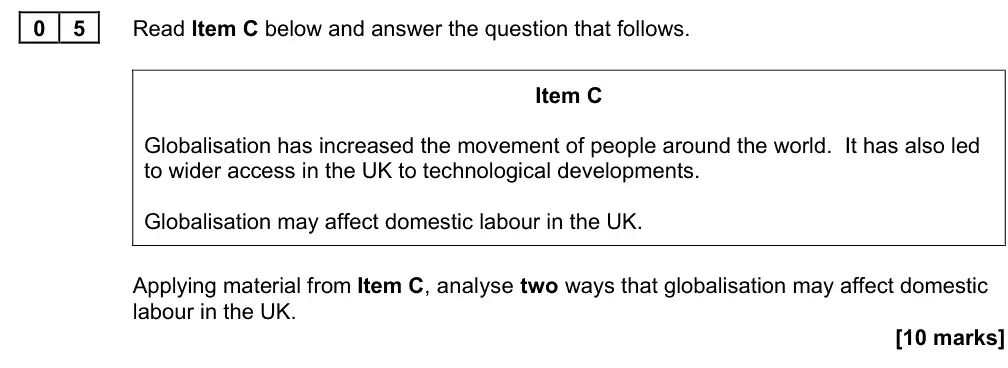
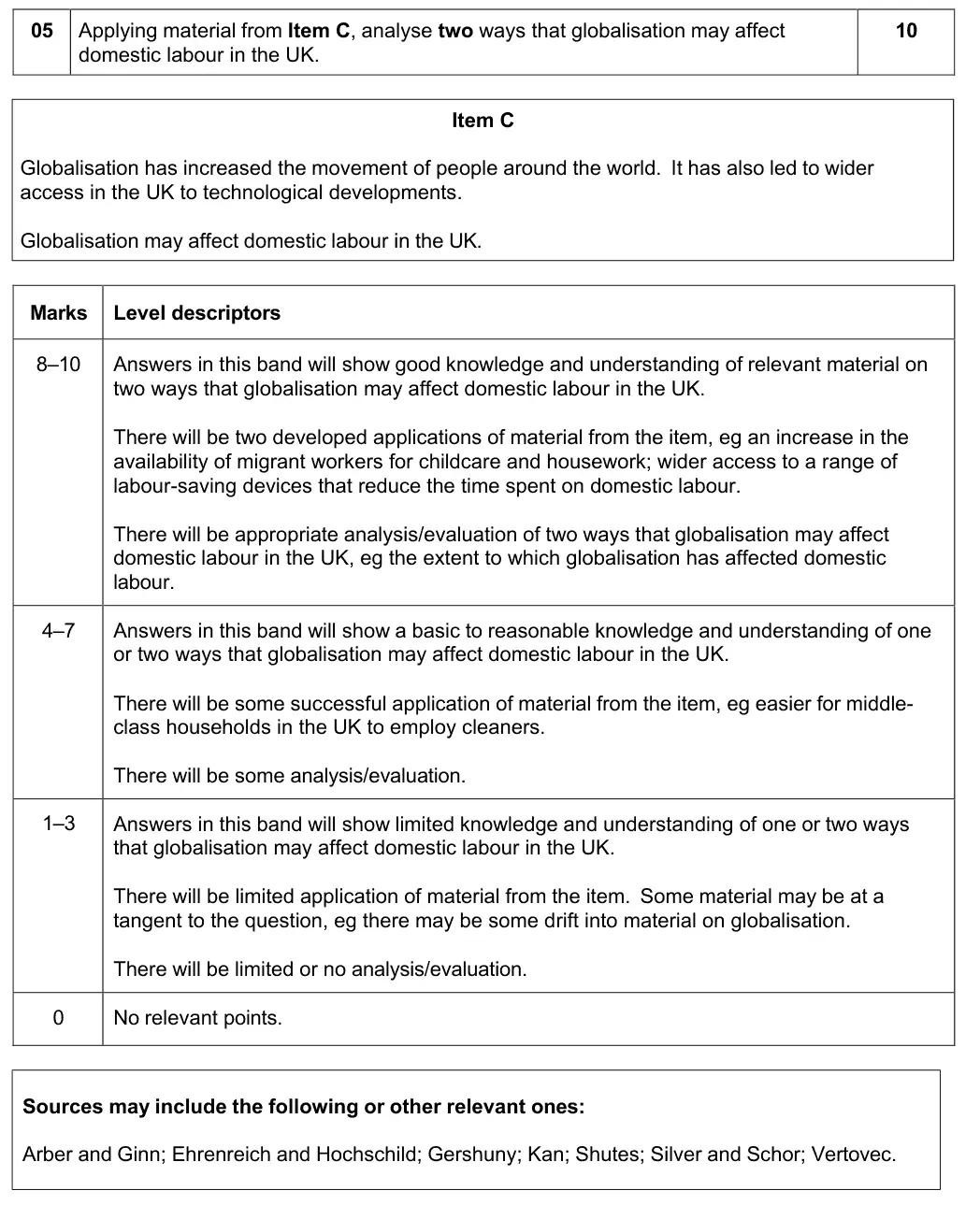
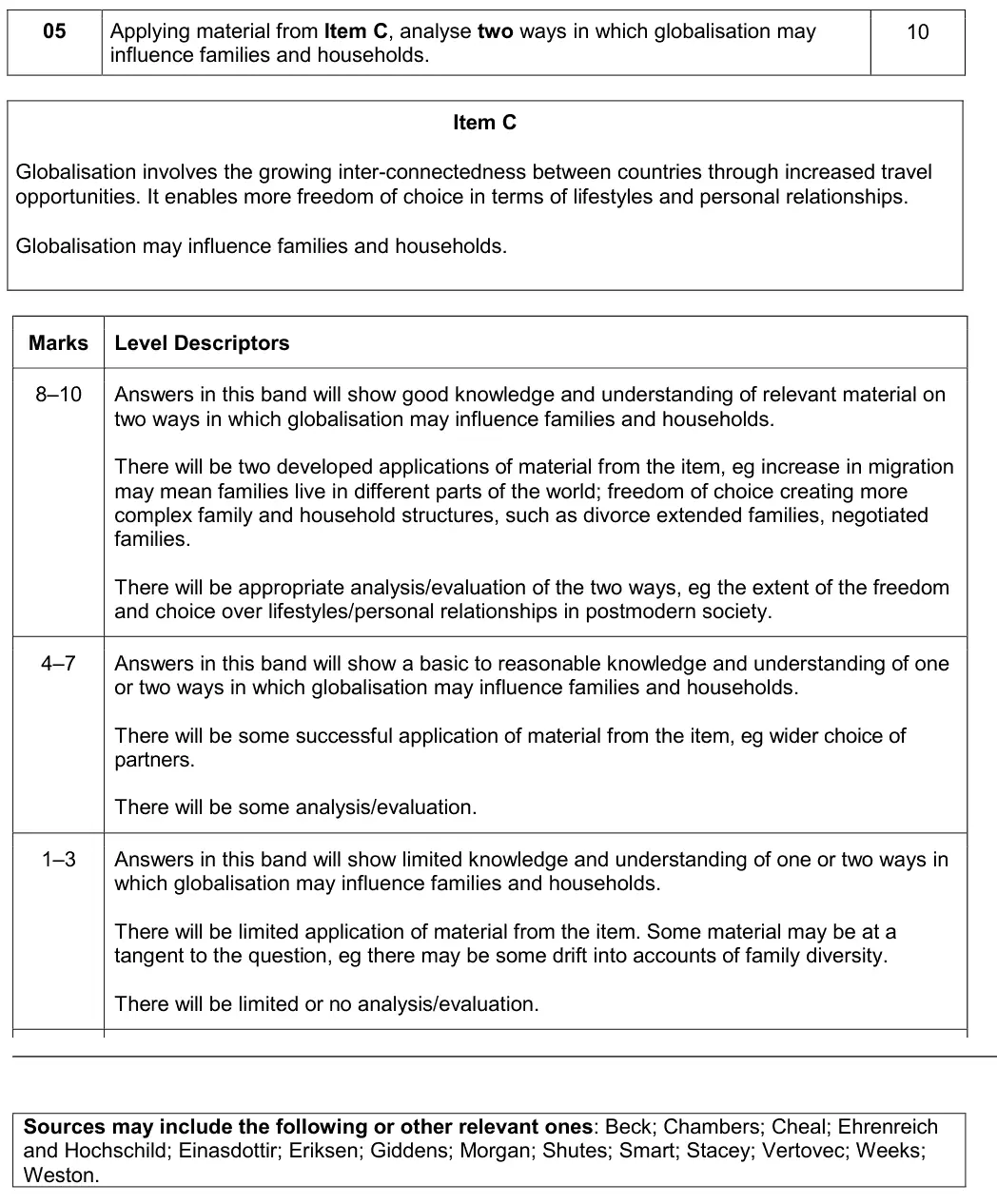
June 2023 · Paper 2 · Q510 marksAO1=3, AO2=4, AO3=3Analyse
Mark scheme, including the levels grid and indicative content
Examiner's comment
The nature of these questions means that students cannot rely on reciting knowledge. Questions will ask them to bring together aspects of their sociological knowledge in ways they are unlikely to have done before. It is therefore important for students to allow time to think about how to answer the question. Students should be made aware that there are two types of 10 mark questions. These have different requirements and different mark schemes. There are different marks available for the assessment objectives. The items for 10 mark “analyse” questions are written to give prompts or “hooks” for student answers. These have to be used to access application marks. Answers can indicate use of hooks by quoting, by a reference in parentheses or by wording (eg “As the item says…”). Items end with a sentence restating the question; the hooks are in the preceding part of the item. Introductions and conclusions are not required for 10 mark questions and take up valuable time. It is helpful if answers are set out to clearly indicate the two separate points, with wording such as “One way/reason is…” or by starting a new paragraph for the second point. Answers that give more than two points are unlikely to develop two of them sufficiently. Question 5: Some did not approach this as a Families and Households question, focusing instead on employment and taking “domestic” as the opposite of “foreign”. Most were able to draw on the item to develop points about migration and household appliances. Some of the best answers developed these ideas through gendered division of domestic labour, analysing the impact on conjugal roles.
Notes from the mark scheme and report
hooks: movement of people and wider access to technology
e.g. migrant workers for childcare/cleaning, labour-saving devices
drift into globalisation in general = 1–3
some misread 'domestic' as the opposite of foreign and wrote about employment
best answers linked to the gendered division of labour and conjugal roles
June 2023 · Paper 2 · Q620 marksAO1=8, AO2=6, AO3=620-mark essay
Mark scheme, including the levels grid and indicative content
Examiner's comment
For example, A2 question 6 asked about how demographic changes had affected families. Some answers included a lot of material on reasons for demographic changes, which were not asked for. The purpose of the items for these questions is to suggest a few starting points for students, including ways into evaluation. Students are expected to also bring in further ideas (“and your knowledge” in the instruction). A wide range of material can be relevant to these questions, so students need to be selective. It is more effective to cover a limited number of views/theories in depth rather than to include every possible theory. Students who made essay plans appeared to benefit by having more structured and coherent responses. Question 6: Students were knowledgeable about demographic changes but some gave descriptive accounts rather than focusing on effects on families. Many included a debate about nuclear families as opposed to family diversity, using theories. This sometimes focused on more general arguments rather than connecting these with demographic changes.
Notes from the mark scheme and report
must focus on effects of demographic change (birth rate, immigration, ageing) on families, not reasons for the changes
top band debates New Right, feminist, Marxist, postmodernist, personal life and functionalist views
general nuclear-vs-diversity debate often not connected to demographic change
June 2023 · AS Paper 2 · Q82 marksAO1=2Define
Mark scheme
Examiner's comment
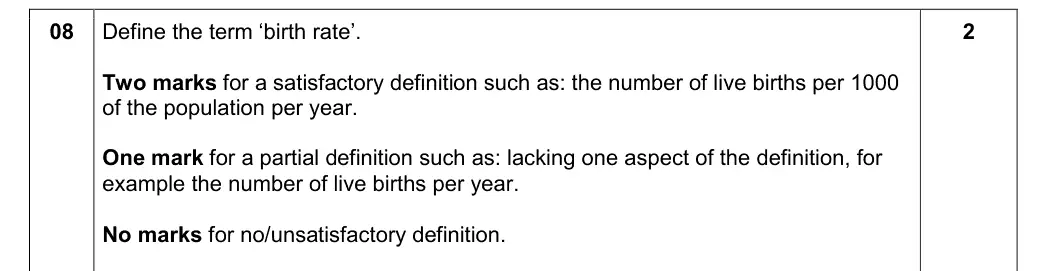
As with previous series, when we have asked questions requiring the definition of a demographic rate for a two mark question, this question proved to be a strong discriminator. Well prepared students managed both aspects of the definition needed for both marks, which was the number of live births per 1000 of the population / per year. Overall only a small number of students gained no marks for this question.
Notes from the mark scheme and report
2 marks need both parts: live births per 1000 of the population per year
1 mark if one aspect missing
demographic definitions are a strong discriminator
June 2023 · AS Paper 2 · Q1220 marksAO1=8, AO2=6, AO3=620-mark essay
Mark scheme, including the levels grid and indicative content
Examiner's comment
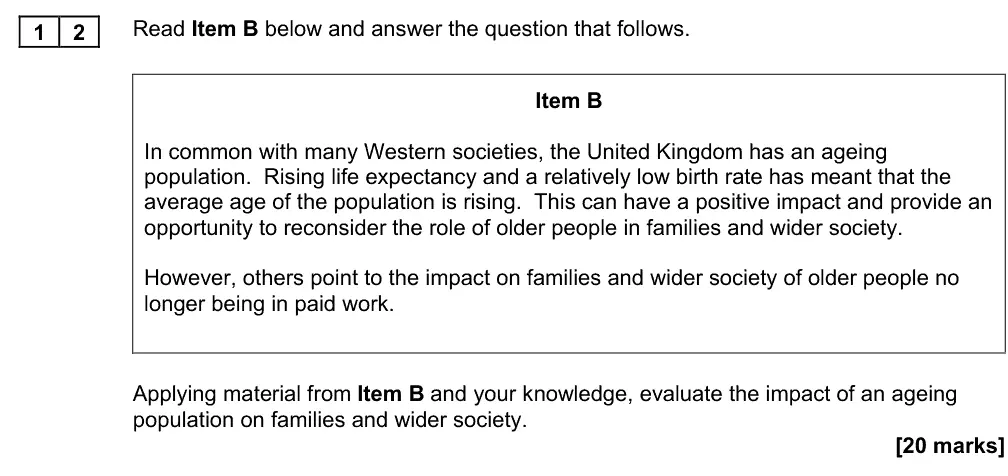
This was a question that most students found accessible and had good material with which to frame their answers. Students who were able to look at the various impacts of an ageing population and link these to sociological concepts and theory were well rewarded. There were two types of approach which emerged that did not manage the above and so limited the reward available. The first kind of response documented often in great detail the causes and reasons for the emergence of an ageing population rather than looking at the impact of the ageing population on the family and wider society. The second type of response focussed on the impact by listing illustrations of the changes and impact: eg the greater preponderance of grandparents helping out with childcare, without linking the illustration to sociological concepts or theories. For example, the emerging child care role of grandparents could be viewed as contributing to a new kind of modified extended family. Evaluation and analysis in this question often took the form of reviewing various theories’ stance towards the impact of an ageing population, the New Right view of beanpole families for example.
Notes from the mark scheme and report
top band evaluates impacts on families and wider society through perspective debates (e.g. New Right on beanpole families)
two weak approaches: describing causes of population ageing instead of its impact, and listing impacts (grandparent childcare) without concepts such as the modified extended family
June 2022 · Paper 2 · Q410 marksAO1=5, AO2=3, AO3=2Outline and explain
Mark scheme, including the levels grid and indicative content
Examiner's comment
The nature of these questions means that students cannot rely on reciting knowledge. The questions will ask them to bring together aspects of their sociological knowledge in a way that they are unlikely to have done before. There was a tendency, however, to attempt to answer the question by giving knowledge based on words or phrases in the question, rather than meeting the demands of the question. For example, some answers to question 4, which asked for effects of increased life expectancy on the experience of childhood, gave reasons for increased life expectancy. Students are advised to spend time reading the question, and, where there is one the item, to ensure that they are answering the question. Some students seemed unaware of the different demands of the two types of questions. The marks awarded for the assessment objectives are different in the two types of ten mark questions, and students should be aware of this. In particular, it should be noted that there are no marks available for evaluation in “outline and explain” (no item) questions. There is no need for an introduction or conclusion for 10 mark questions. It is helpful if answers are set out to clearly indicate the two answers, with wording such as “One way is…” or by starting a new paragraph for the second point. The best answers to 10 mark questions were focused, clearly stating a point that addressed the question and then developing it, using sociological concepts, evidence and, where appropriate, theory. Answers need to address all aspects of the question. Q4 Better answers made points about vertically extended families, the role of grandparents as carers or in socialising, and smaller numbers of siblings.
Notes from the mark scheme and report
must link longer life expectancy to childhood
giving reasons for increased life expectancy, or childhood without that link, = 1–3 band (singled out in the report as a misread question)
better answers used beanpole and vertically extended families, grandparents as carers, fewer siblings, policy shifting towards older people
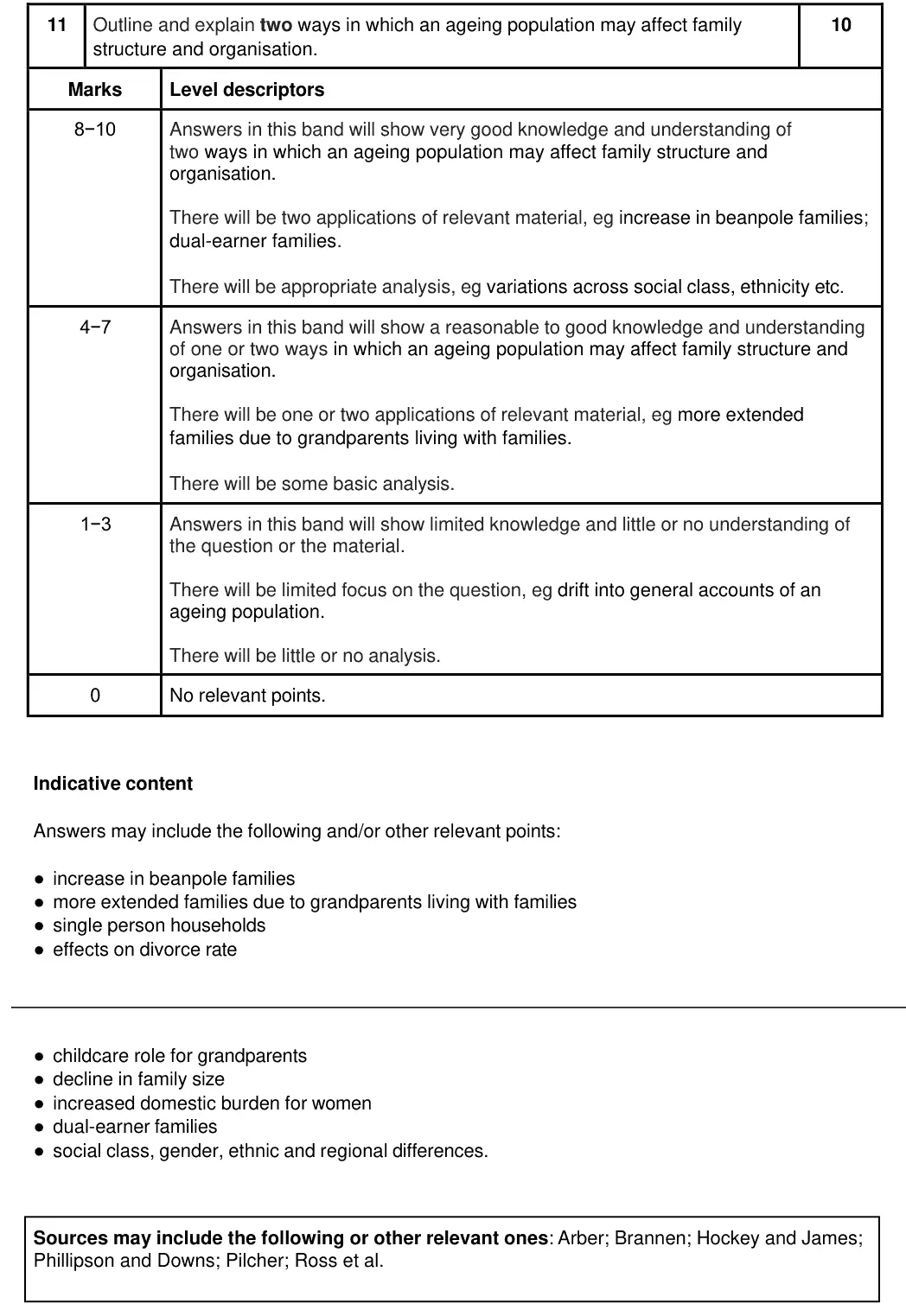
June 2022 · AS Paper 2 · Q1110 marksAO1=5, AO2=3, AO3=2Outline and explain
Mark scheme, including the levels grid and indicative content
Examiner's comment
The majority of students understood the demands of this question and were able to apply their knowledge of the ageing population to the affects on family organisation and structure. The most common responses were the increase in extended families, grandparents providing childcare and beanpole families. The extent to which the application was developed was variable and this is reflected in the marks awarded. Weaker responses focused on the effects of the ageing population on the wider society, by discussing the dependency ratio for example.
Notes from the mark scheme and report
two ways an ageing population affects family structure/organisation (beanpole families, three-generation households, grandparent childcare, single-person households)
drift into general effects on society such as the dependency ratio = 1–3
development of application varied
November 2020 · Paper 2 · Q510 marksAO1=3, AO2=4, AO3=3Analyse
Mark scheme, including the levels grid and indicative content
Examiner's comment
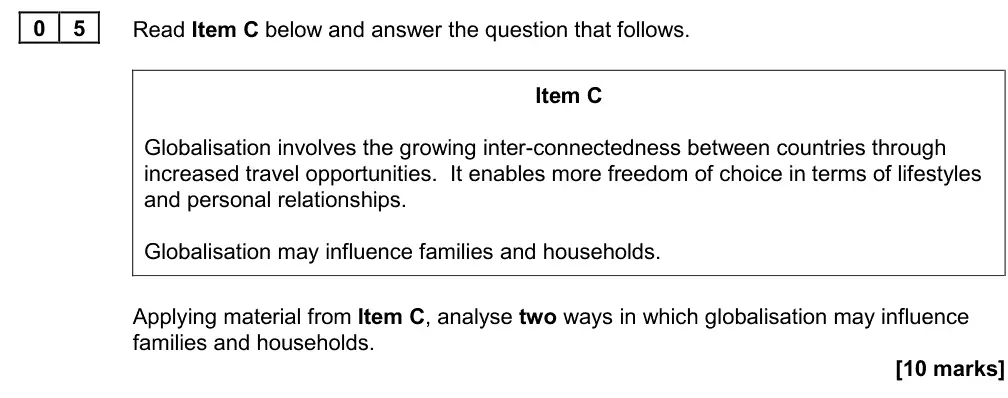
While there were some very good answers to this question, others focused on changes arising from mid-twentieth century immigration rather than more recent ways globalisation may have influenced families and households. The 10-mark “analyse” questions require use of the item, which will provide a starting point for answers. Answers which do not use the item will be unable to access higher marks.
Notes from the mark scheme and report
apply Item C (travel and inter-connectedness, freedom of lifestyle and relationship choice)
e.g. transnational families through migration, more complex negotiated families, wider choice of partners
drift into family diversity = tangent
weaker answers dwelt on mid-twentieth-century immigration rather than recent globalisation
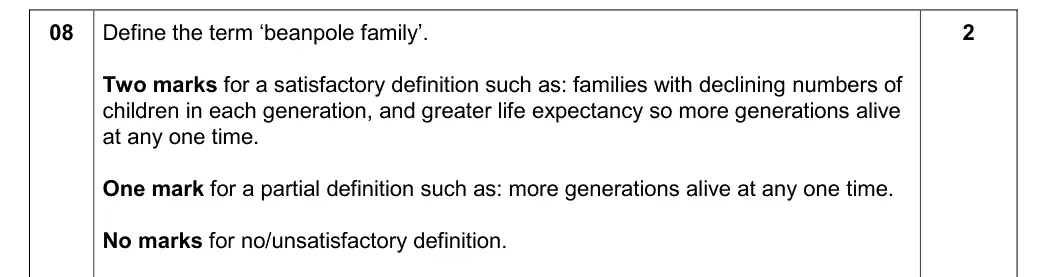
November 2020 · AS Paper 2 · Q82 marksAO1=2Define
Mark scheme
Notes from the mark scheme and report
2 marks needs both fewer children per generation and more generations alive (longer life expectancy)
'more generations alive at once' alone = 1
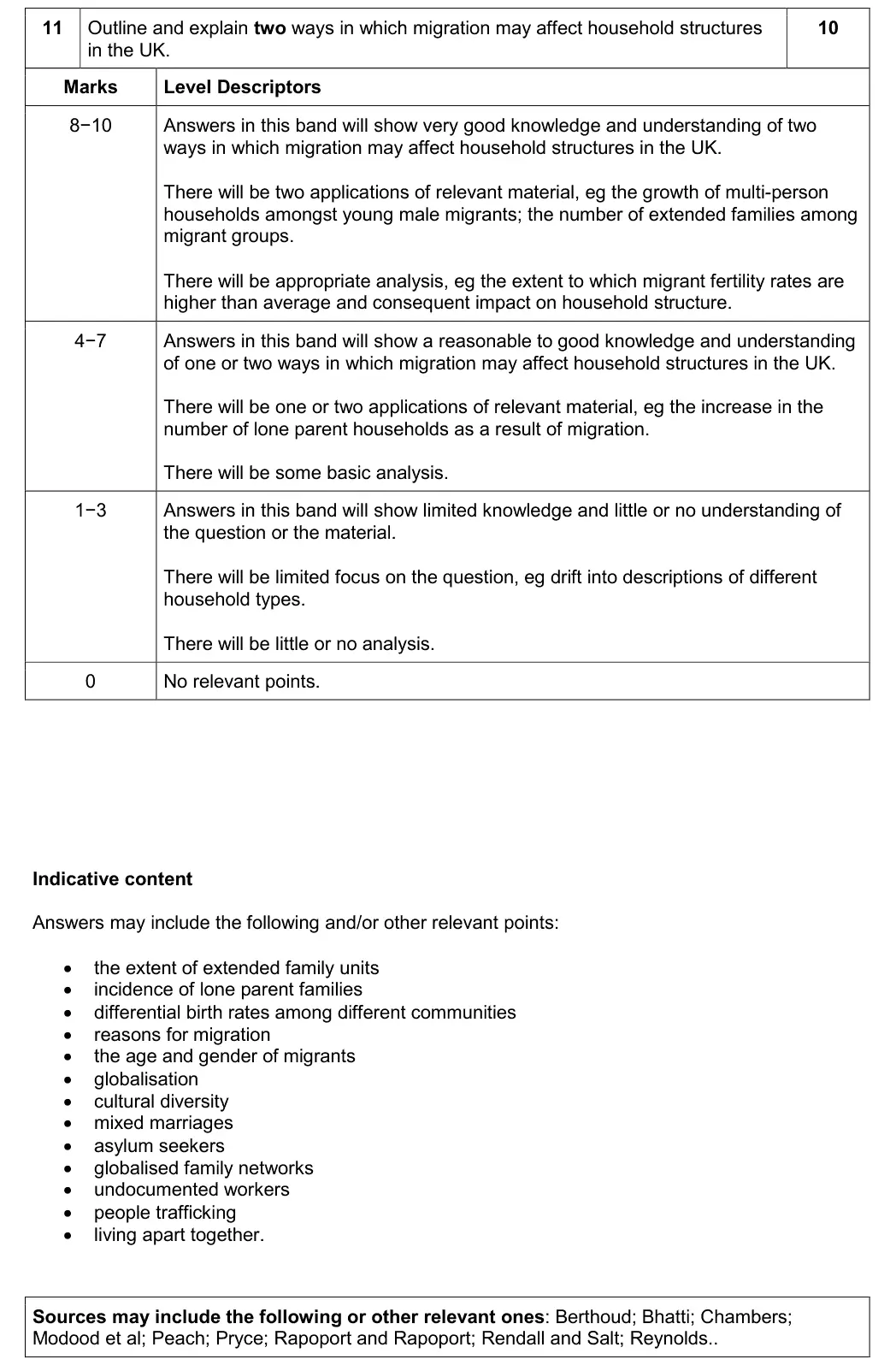
November 2020 · AS Paper 2 · Q1110 marksAO1=5, AO2=3, AO3=2Outline and explain
Mark scheme, including the levels grid and indicative content
Notes from the mark scheme and report
must link migration to UK household structures (e.g. multi-person households of young migrants, extended families, lone-parent households)
describing household types without the migration link = 1–3 band
analysis e.g. migrant fertility rates
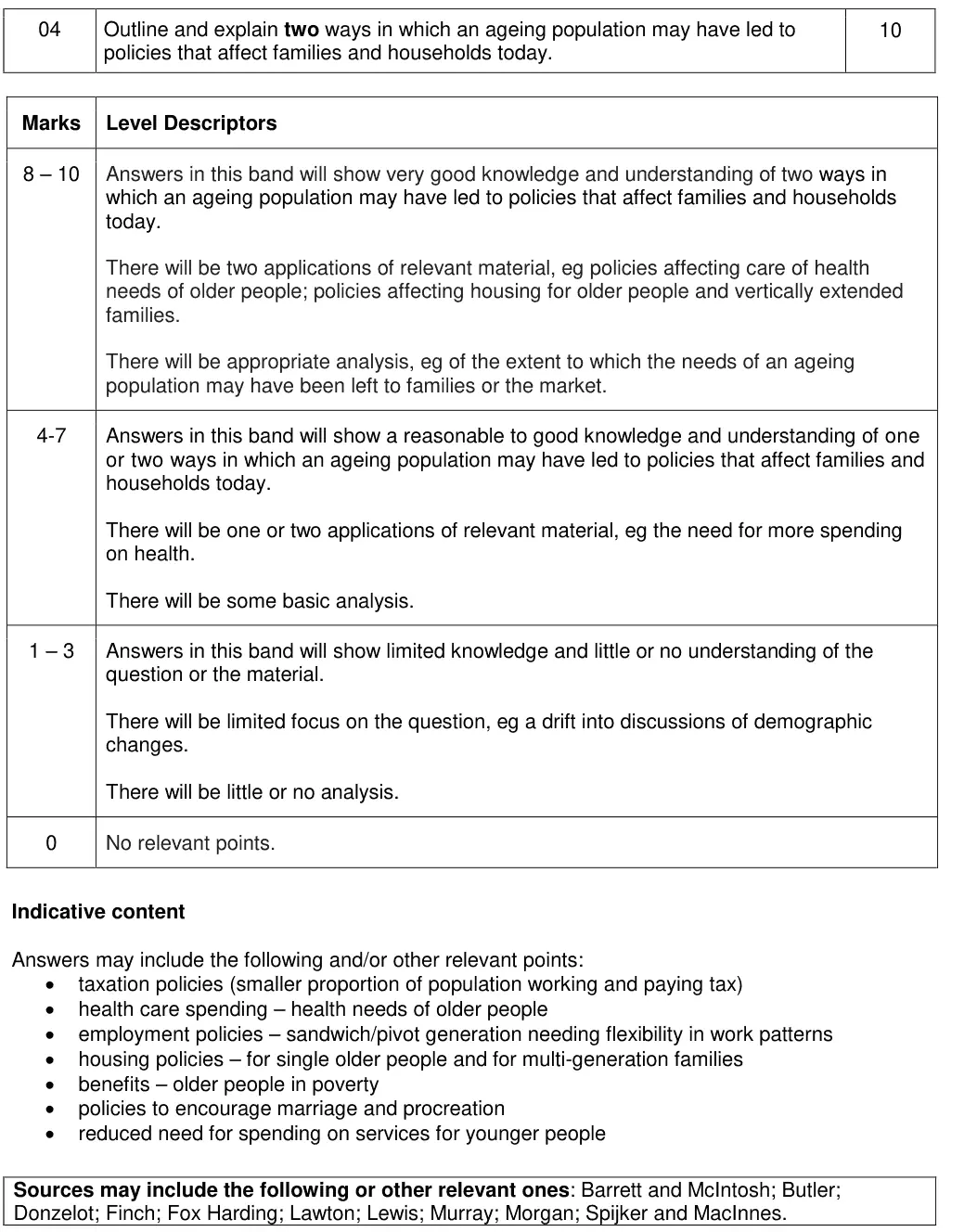
June 2019 · Paper 2 · Q410 marksAO1=5, AO2=3, AO3=2Outline and explain
Mark scheme, including the levels grid and indicative content
Examiner's comment
Some students wrote introductory paragraphs and/or conclusions. These are not necessary, and are unlikely to gain additional marks; they also take up time. Some students made only one point in their answers, or three or more, rather than the two asked for. The word ‘two’ is put in bold in the question to try and draw students’ attention to this. Sometimes it was not clear how many points were being made. It is helpful for students to clearly indicate their two answers, with wording such as “One way is…” or by starting a new paragraph for their second point. Notably, some students wrote far more than was needed for a 10-mark response. The two types of 10-mark question, “outline and explain” and “analysis” types, are marked differently as the assessment objectives have different weightings. It is important that students are aware of this. In particular they should note that evaluation is not a requirement for answers to 10 mark “outline and explain” questions. For 10 mark “outline and explain” questions, students cannot rely on reciting knowledge; these questions will ask them to bring together aspects of their sociological knowledge of the topic in a way that they are unlikely to have done before. The best answers to 10-mark questions were focused, clearly stating a point and then developing it, and used sociological concepts, studies, evidence and theory as appropriate. Some students found this question challenging, being unsure of how to relate the ageing population to policies affecting families. However, there were some very good answers. Detailed knowledge of policies was not required and better answers focused on how families had been affected by policies. Many answers considered retirement ages and, for example, how this might affect grandparents as carers of grandchildren, or the policy of making social care an individual and family responsibility and the effect of this on women in the pivot or sandwich generation. There were also some good answers referring to policies in other countries, such as Singapore’s “have three or more”. Some answers struggled with the connection between the ‘ageing population’ and ‘policies’, sometimes suggesting policies that were in place well before there was an ageing population.
Notes from the mark scheme and report
must link the ageing population to policies and then to effects on families
drift into demographic change = 1–3
detailed policy knowledge not needed
good answers: retirement age and grandparent childcare, social care left to families and the effect on women in the sandwich generation, pro-natalist policies abroad
some cited policies older than the ageing population
AO split from AQA's standard grid for this paper (this year's mark scheme does not print it).
June 2019 · AS Paper 2 · Q82 marksAO1=2Define
Mark scheme
Examiner's comment
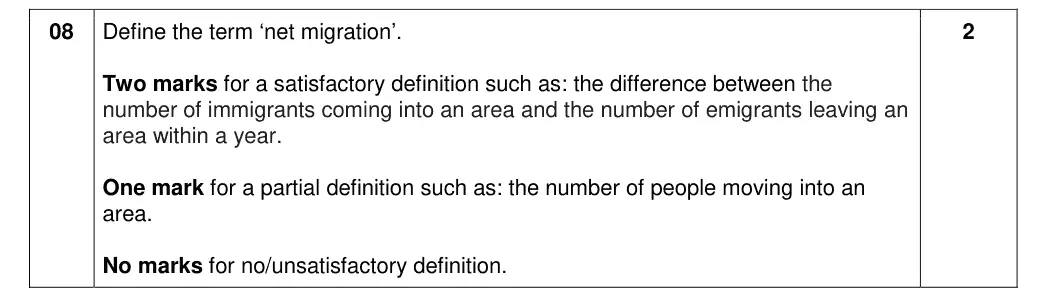
Many students were able to define both aspects of the term. Some answers struggled to explain the meaning of ‘net’ and hence only provided a partial definition. A sizeable minority seemed to be unfamiliar with the concept and were unable to give a satisfactory definition at all.
Notes from the mark scheme and report
AO grid not printed
2 marks: difference between immigrants and emigrants for an area over a year
just people moving in = 1 mark
many could not explain 'net'
AO split from AQA's standard grid for this paper (this year's mark scheme does not print it).
June 2019 · AS Paper 2 · Q106 marksAO1=6Outline
Mark scheme
Examiner's comment
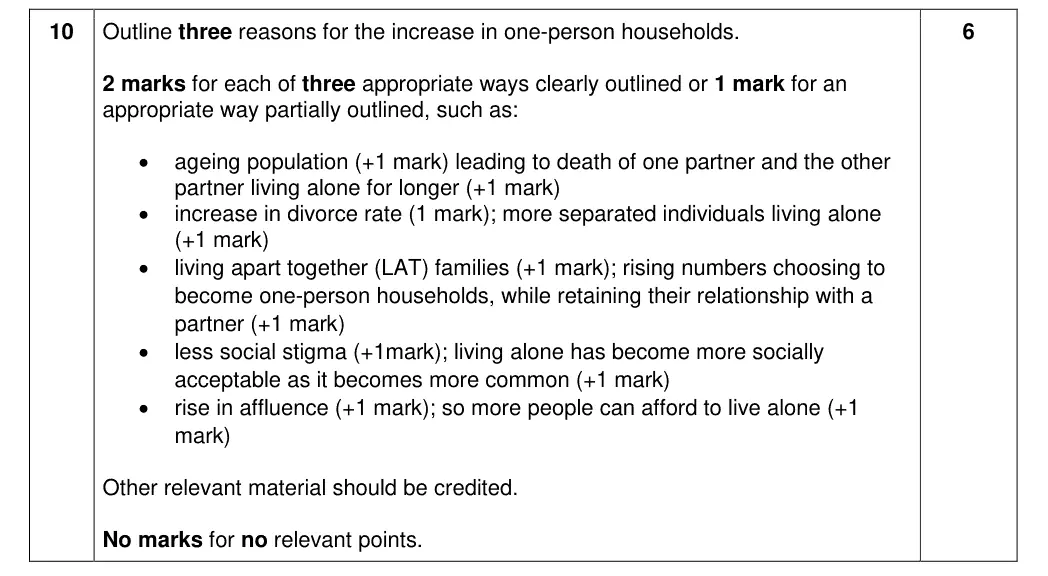
Some answers confused one-person households with lone parent households and therefore struggled to make appropriate points. Many students successfully identified and outlined three reasons for the increase in one-person households. The most common responses mentioned were an increase in the divorce rate, the decline of stigma in living alone, and women’s greater on focus on education and career. Partial answers failed to identify any change affecting the increase in one-person households or alternatively were sometimes unclear about the link to the increase to one-person households.
Notes from the mark scheme and report
AO grid not printed
2 marks for each of three reasons clearly outlined
credited: divorce, ageing population and widowhood, living apart together, less stigma, affluence, women's careers
some confused one-person with lone-parent households
reason must be linked to the increase
AO split from AQA's standard grid for this paper (this year's mark scheme does not print it).
June 2018 · Paper 2 · Q510 marksAO1=3, AO2=4, AO3=3Analyse
Mark scheme, including the levels grid and indicative content
Examiner's comment
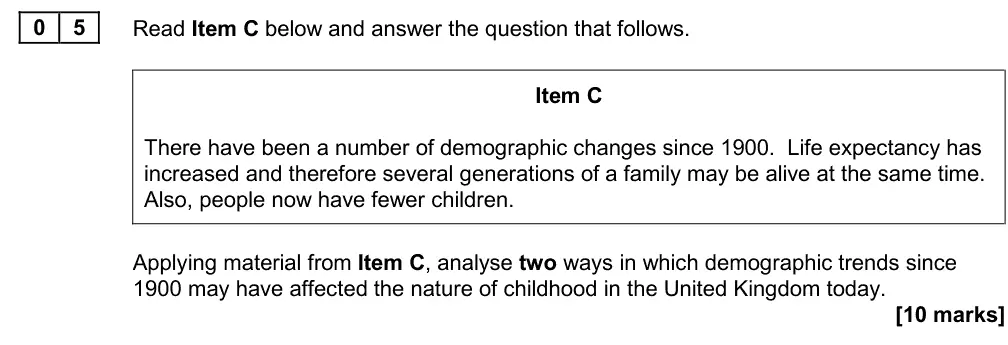
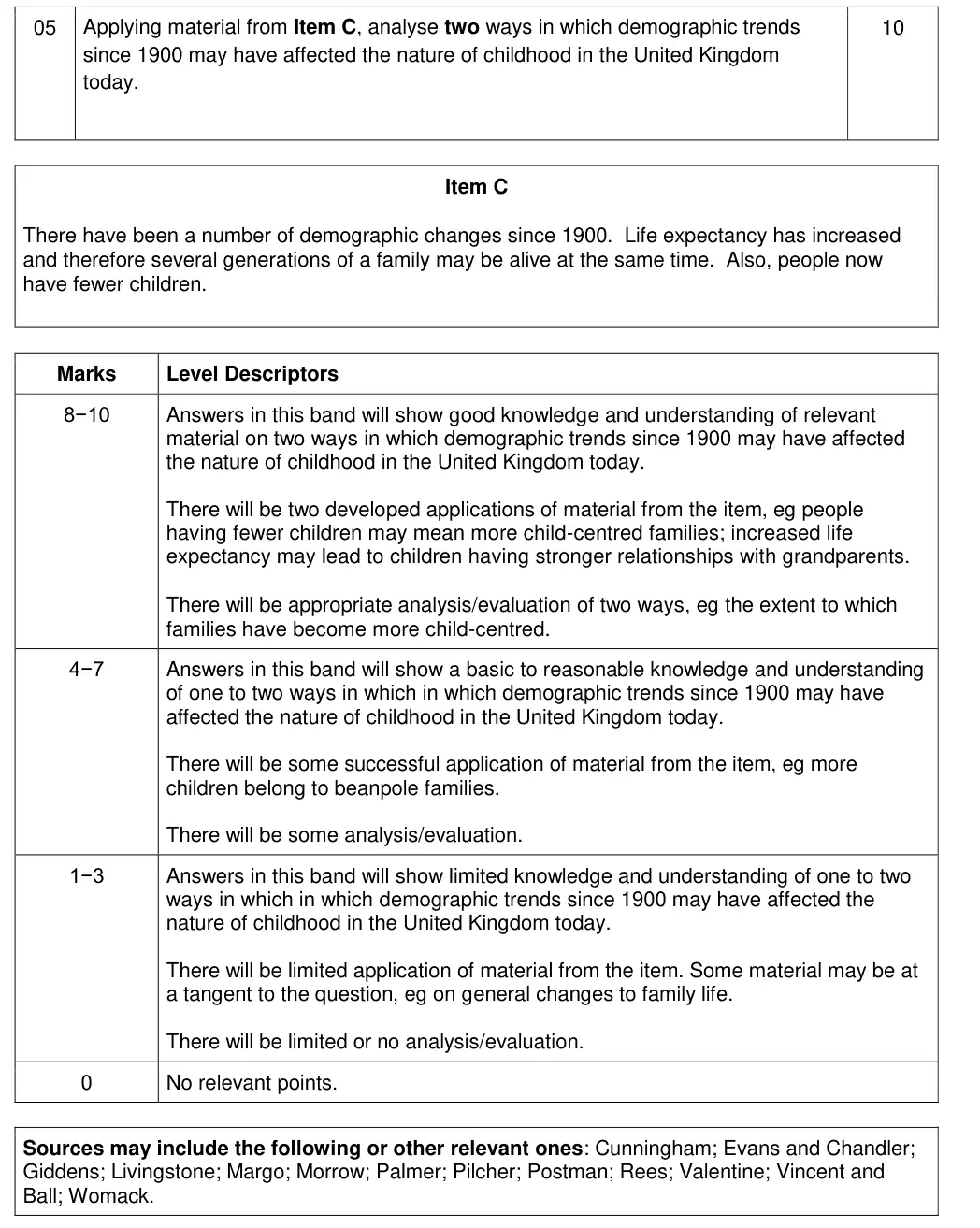
Some students wrote introductory paragraphs and/or conclusions. These are not necessary, and are unlikely to gain additional marks, and they also take up time. Some students made only one point in their answers, or three or more, rather than the two asked for in the question. Sometimes it was unclear how many points were being made. It is helpful for students to clearly indicate their two answers, with wording such as “One way is…” or by starting a new paragraph for their second point. Evaluation is not a requirement for answers to 10 mark “outline and explain” questions. The marks awarded for the assessment objectives being targeted are different in the two types of ten mark questions, and students should be made aware of this. The best answers to 10 mark questions were focused, clearly stating a point and then developing it, using sociological concepts, evidence and theory where appropriate. In some questions students tended to focus on the first aspect of the question at the expense of the second. For example, in question 5, some answers gave detailed responses on demographic changes but said little on how these had affected the nature of childhood in the United Kingdom today. Students need guidance on how to approach these questions and how to best demonstrate their sociological understanding. The nature of these questions means that students cannot rely on reciting knowledge. These questions will ask them to bring together aspects of their sociological knowledge in a way that they are unlikely to have done before. Many answers went into reasons for the demographic changes referred to in the item rather than focus on effects on childhood. Others discussed childhood a hundred years ago or earlier. However, many did develop points about child centeredness by looking at its positive consequences for childhood and then developing this to link it to over protectiveness, age patriarchy, pester power, toxic childhood and so on. Similarly, the presence of grandparents was in better answers not merely described but analysed as to how it could be both positive and negative in contributing to socialisation and childcare and in adding to the burden of care for the family with some children becoming young carers. Better answers were distinguished by, as the mark scheme says, ‘developed applications’, going beyond the immediately apparent.
Notes from the mark scheme and report
two developed applications from Item C (fewer children, longer life expectancy), e.g. child-centredness, closer relationships with grandparents
many explained the causes of the demographic changes or described childhood 100 years ago instead of effects today
best developed child-centredness into over-protection, age patriarchy, toxic childhood and grandparents as both support and burden (young carers)
AO split from AQA's standard grid for this paper (this year's mark scheme does not print it).
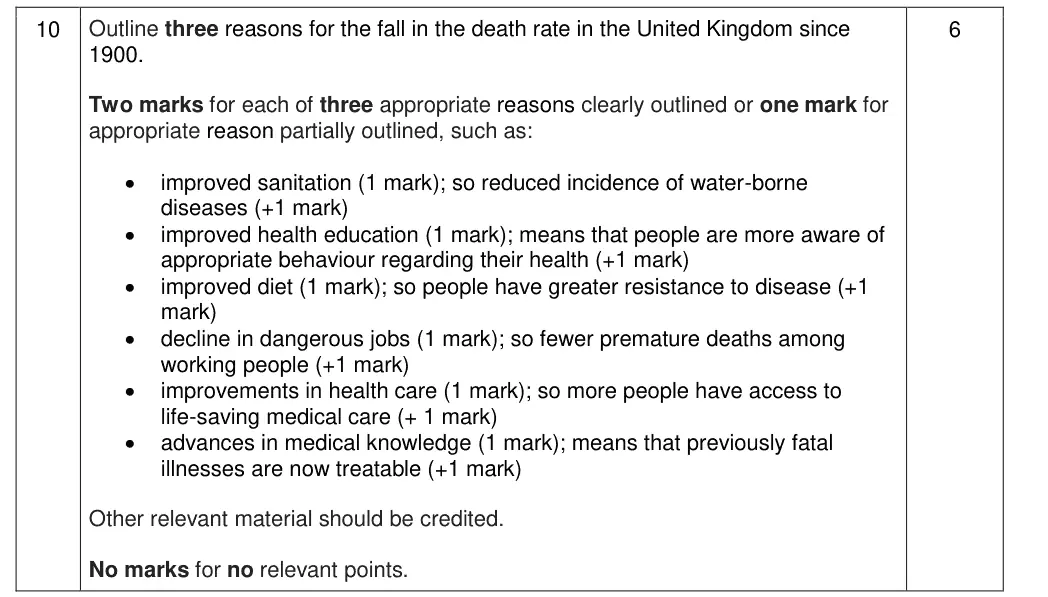
June 2018 · AS Paper 2 · Q106 marksAO1=6Outline
Mark scheme
Examiner's comment
Many students successfully identified and outlined three reasons for the fall in the death rate since 1900. The most common responses mentioned were medical improvements, better access to health care, less dangerous occupations and decreased smoking rates. Weaker answers failed to outline the reason and it was sometimes unclear how the factor influenced the death rate. A number of answers suggested that a falling birth rate was a reason for a falling death rate or suggested that people were living longer so the death rate had declined.
Notes from the mark scheme and report
credited: sanitation, health education, diet, fewer dangerous jobs, health care access, medical advances
must say how the factor lowers deaths
errors: falling birth rate or 'people living longer' given as causes
AO split from AQA's standard grid for this paper (this year's mark scheme does not print it).
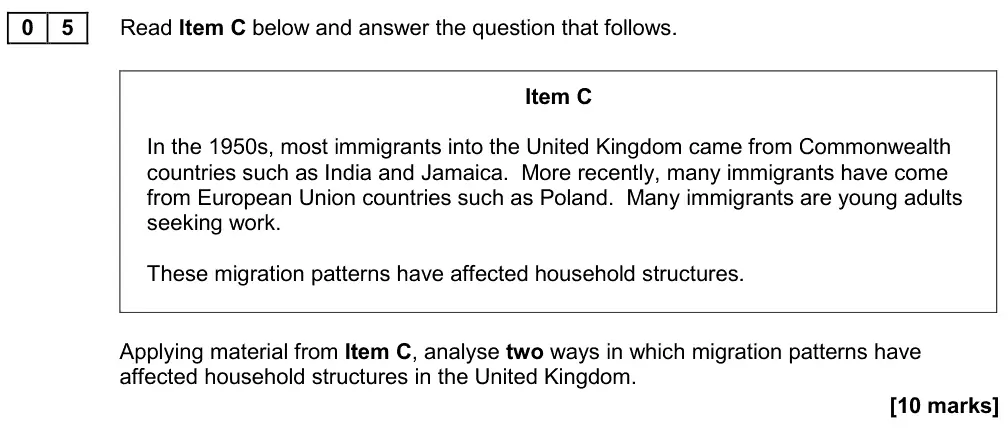
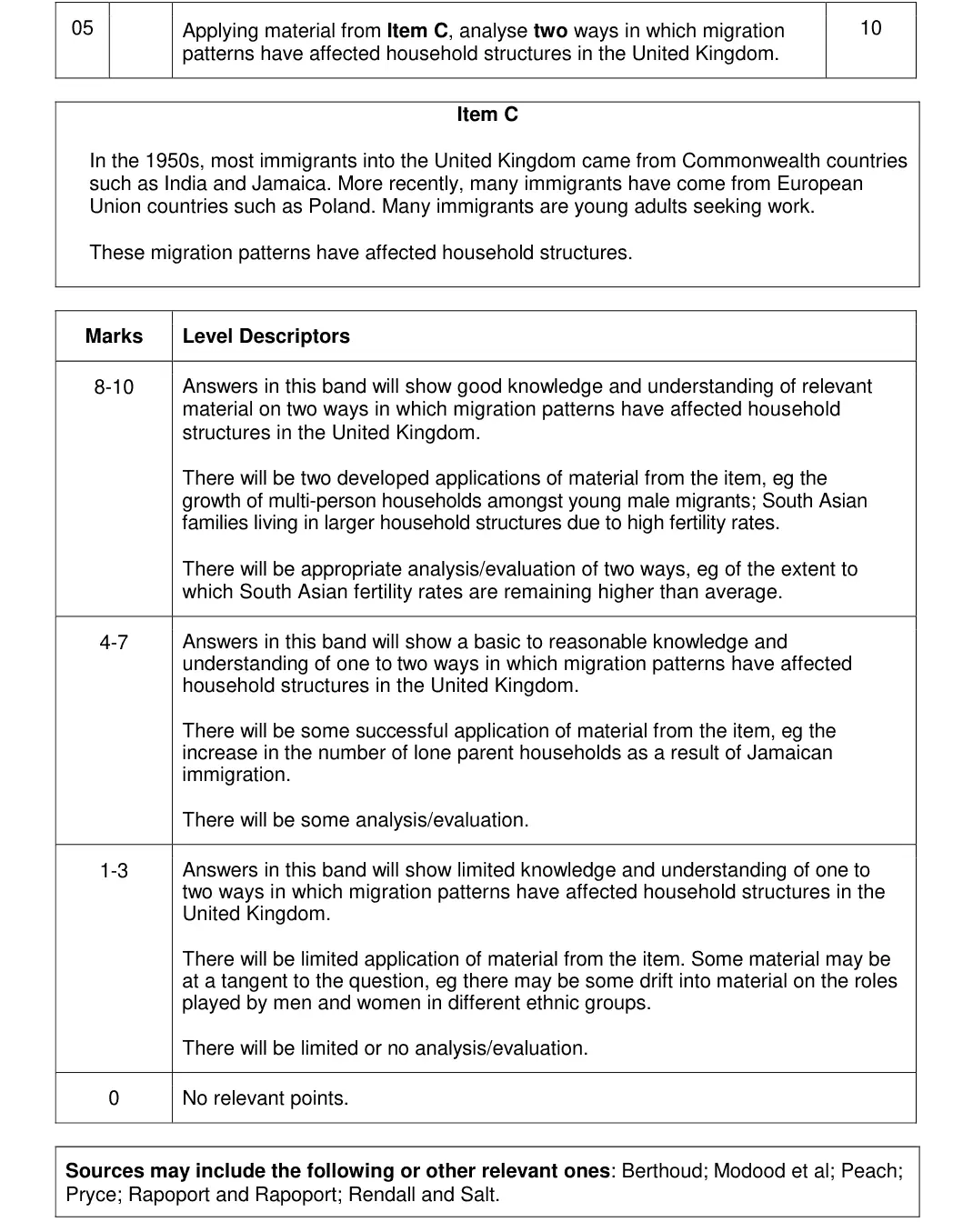
June 2017 · Paper 2 · Q510 marksAO1=3, AO2=4, AO3=3Analyse
Mark scheme, including the levels grid and indicative content
Examiner's comment
A number of students wrote introductory paragraphs and/or conclusions. These are not necessary, and are unlikely to gain additional marks. A number of students made only one point in their answer, or three or more, rather than the two asked for. In these cases, the two best answers were rewarded and will be in future series. It is helpful for students to clearly indicate their two answers, with wording such as “One way is…” or by starting a new paragraph for their second point. The assessment objective allocations are different in the two types of 10 mark questions, and students should be made aware of this. There was a wide range of responses to these questions. A minority of students wrote very brief answers. For these 10 mark items, a simple statement of two ways, reasons or factors, without development, is not sufficient to access more than the lower marks in the mark range. The best answers were focused, clearly stating a point and then developing it, with use of sociological concepts, evidence and theory where appropriate, in ways that demonstrated the skills expected from the targeted assessment objectives. There was a tendency, however, for many answers to focus on the first aspect of the question at the expense of the second. Students need guidance on how to approach these questions and how to best demonstrate their sociological understanding. The nature of these questions means that students cannot rely on reciting knowledge. They require students to bring together two aspects of their sociological knowledge in a way that they are unlikely to have done before. Answers will sometimes require claims that students may be unsure of because they do not know of specific evidence (for example, in question 5, whether migrants from Eastern Europe who are single workers tend to live alone or in shared households). However, answers that are sociologically plausible will be accepted. Most answers were able to use the item to develop points about extended families (India), matrifocal families (Jamaica) and single person or shared occupancy households (Eastern Europe). A few were uncertain as to the difference between households and families, and a few mistakenly focused on the nature of households in countries of origin, for example grandparents looking after children because the parents had emigrated for work. There was also misuse of the term ‘beanpole family’.
Notes from the mark scheme and report
hooks: Commonwealth (India, Jamaica) and EU (Poland) migration, young adults seeking work
credited extended South Asian households, matrifocal/lone-parent households, multi-occupancy households
drift into conjugal roles in ethnic groups = 1–3
some confused households with families, wrote about households in the countries of origin, or misused 'beanpole family'
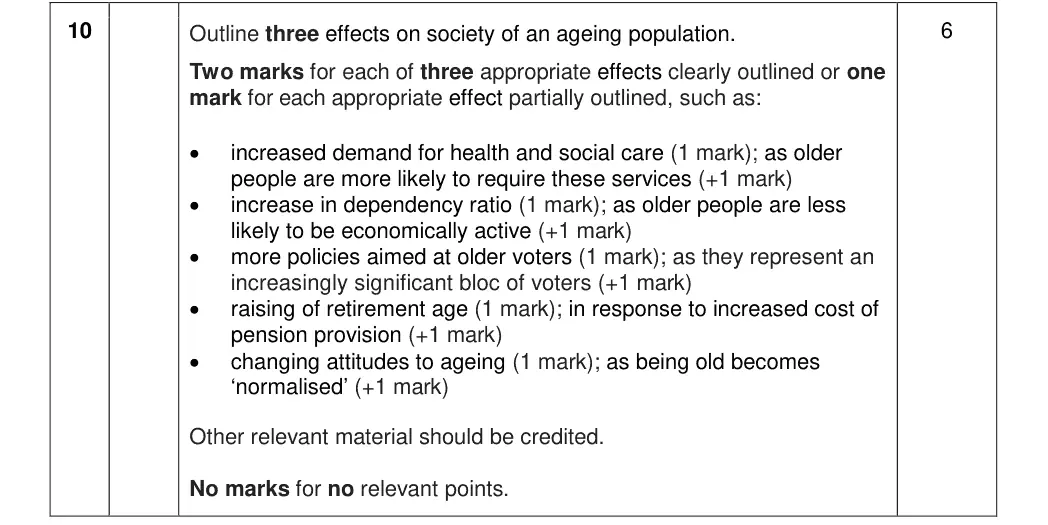
June 2017 · AS Paper 2 · Q106 marksAO1=6Outline
Mark scheme
Examiner's comment
Additionally, some students are writing far too much on the 6 mark questions. This time could be better spent on the longer essay questions. This question generated a wide range of responses. Many students successfully identified three effects on society of an ageing population. Common responses were focused around increase in dependency ratio, strain on public/health services, the impact on housing or other issues, such as the increase in extended/beanpole families. Weaker responses suggested a vague idea of the issues but some students seemed to have problems articulating the precise nature of the problem as they saw it. Other weaker answers repeated dependency ratio, but in another form, or referred to public services/health twice. Some students were very confused about the effects and argued that the birth rate would increase because more old people were dying. Some answers were far too long given the amount of marks (and therefore time) available for the question.
Notes from the mark scheme and report
2 marks for each of three effects clearly outlined
common answers: dependency ratio, demand on health and care services, housing, beanpole families
repeating the same effect in another form not credited twice
some answers far too long for the marks
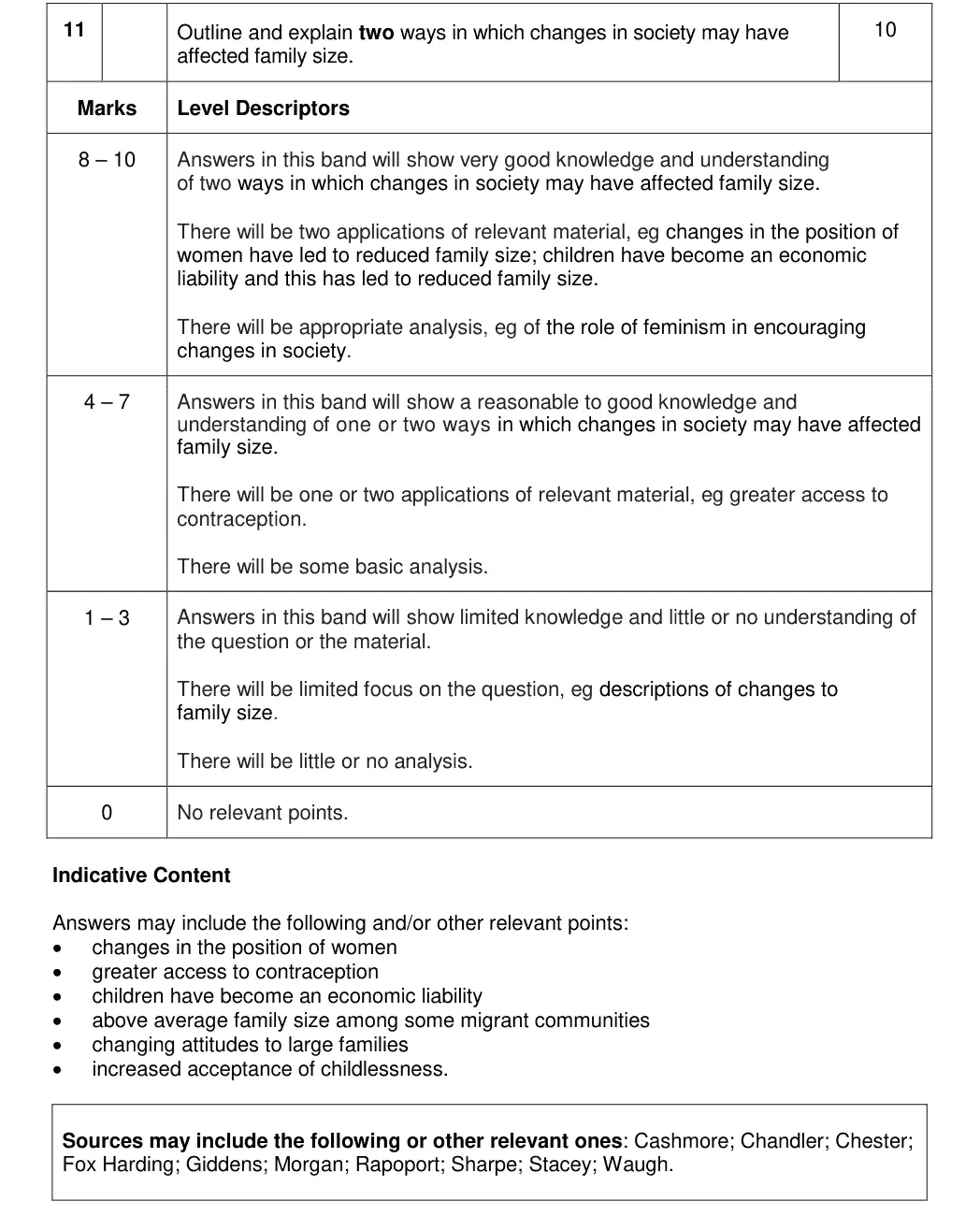
June 2017 · AS Paper 2 · Q1110 marksAO1=5, AO2=3, AO3=2Outline and explain
Mark scheme, including the levels grid and indicative content
Examiner's comment
The 10 mark outline and explain question requires students to link two aspects of the specification. The best answers took note of both aspects of the question, clearly identified two separate points and developed them in relation to the second part of the question. Weaker answers either ignored one aspect of the question or attempted to cover a number of ideas rather than focusing on two. Top band answers were able to identify and develop two ways, such as changes in the position of women in society sometimes linked to other changes, such as divorce law with application to delaying childbirth and smaller family size. Changes to childhood, such as child-centred or economic liability, also successfully developed and applied to smaller family size were also rewarded well, as well as a number of responses that discussed the impact of industrialisation on family size. Occasionally more successful answers discussed how changes could increase or decrease family size, such as the re-emergence of the divorced extended family or one person households following divorce. Good answers analysed the underlying reasons for these changes, for example by referring to the growth of feminism. Weaker answers often lost focus on family size and instead discussed general changes to society or family. Alternatively they covered a number of possible changes in society that affected family size without developing any one of them sufficiently.
Notes from the mark scheme and report
no marks for evaluation in this question type
two ways each developed, e.g. changing position of women, children as an economic liability, contraception
descriptions of changing family size without causes = 1–3
best answers analysed underlying causes such as feminism
weaker answers lost focus on family size
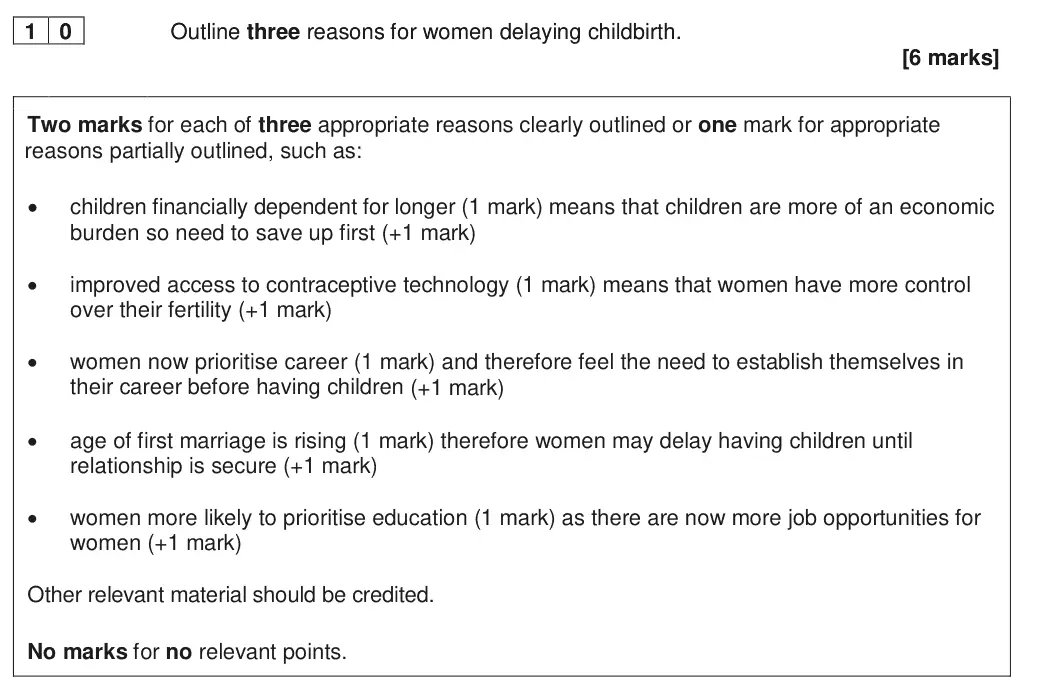
June 2016 · AS Paper 2 · Q106 marksAO1=6Outline
Mark scheme
Examiner's comment
In the 6 mark question some students are writing far too much, thereby losing focus on the precise wording of the question. On the whole this was answered well. Most students could identify reasons that potentially led to delayed childbirth, though some did not receive the second mark as they developed their response in relation to not having children at all, rather than just a delay. Typical responses identified the growth of the female labour force, increased numbers staying in education, more opportunities, and more independence as reasons. Other reasons used effectively were the need for financial stability, later marriage and longer life expectancy, the expense of parenthood, and the decline in stigma towards older mothers.
Notes from the mark scheme and report
reasons for delay, not for remaining childless (second mark lost when developed as not having children)
credited: career, education, contraception, later marriage, financial stability, cost of children
Work with an AQA sociology tutor
Essays stuck in the middle band, or losing marks on the 10-markers? Book a trial lesson with Mark, a former AQA examiner.