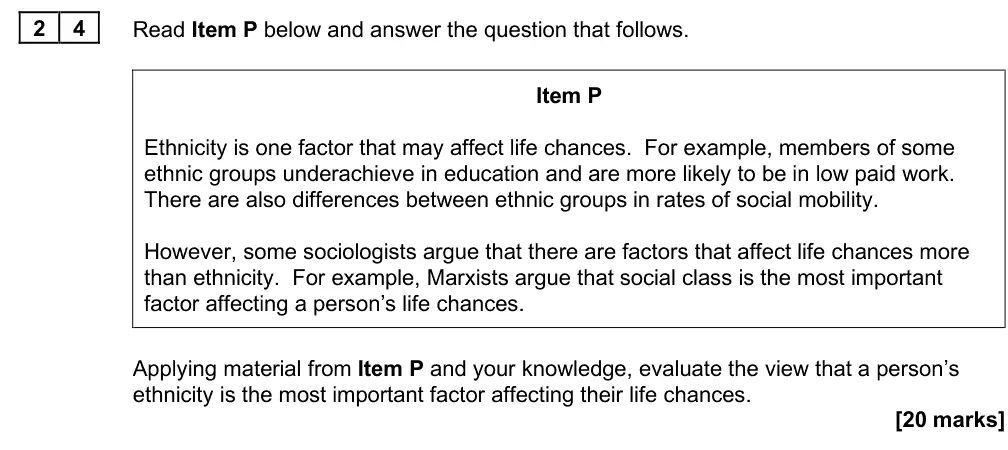
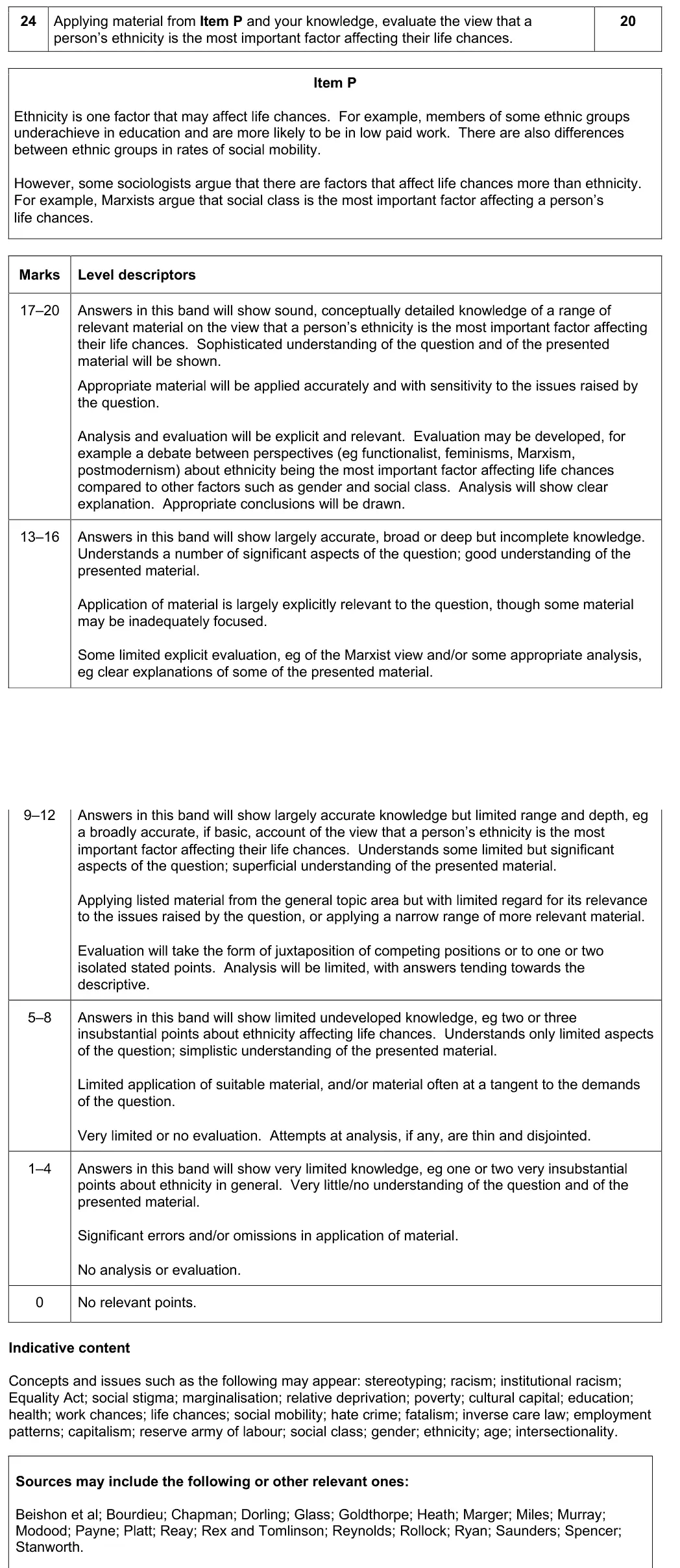
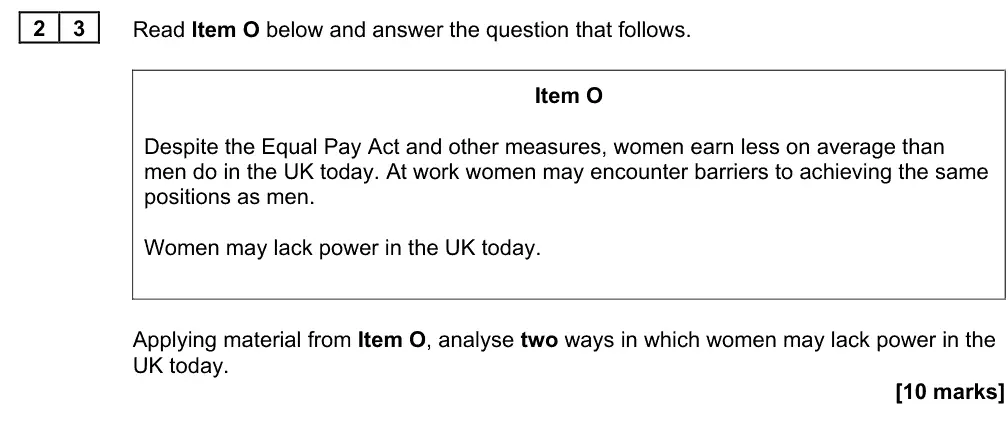
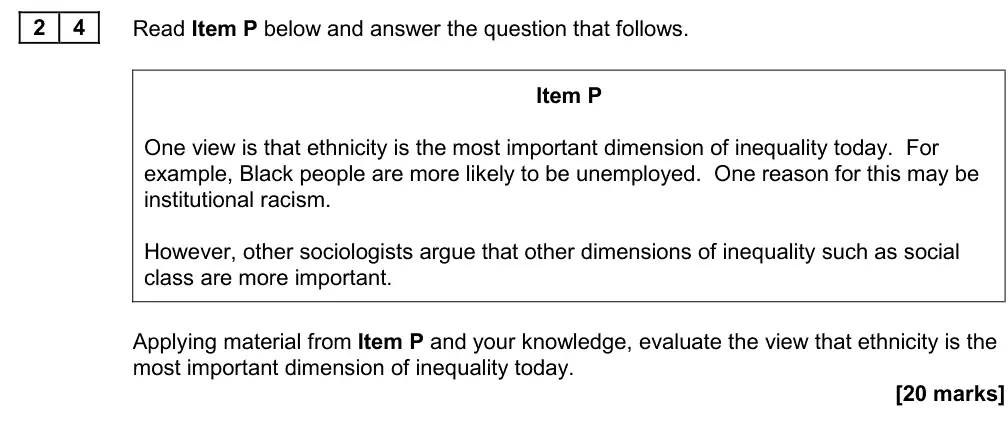
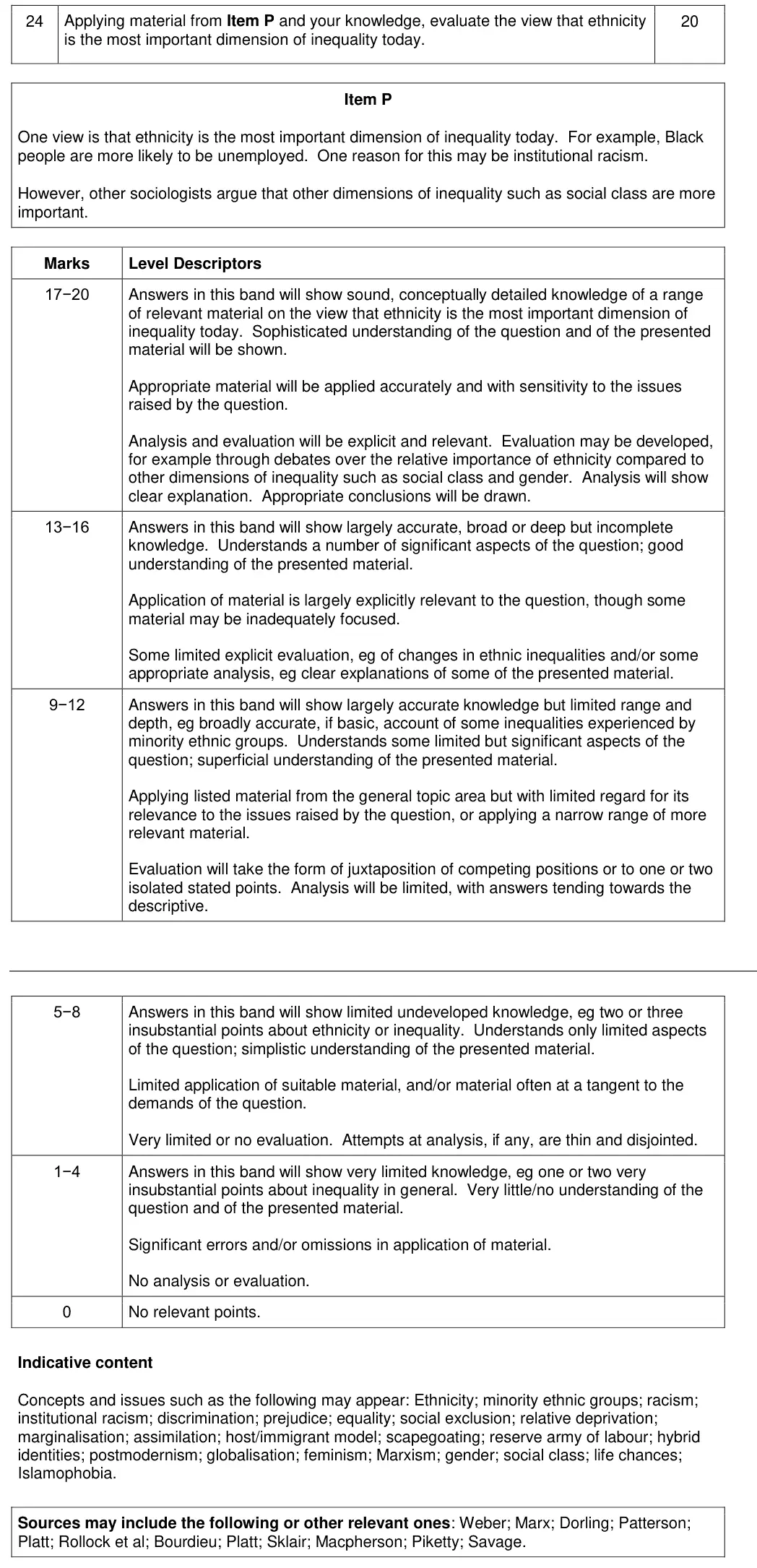
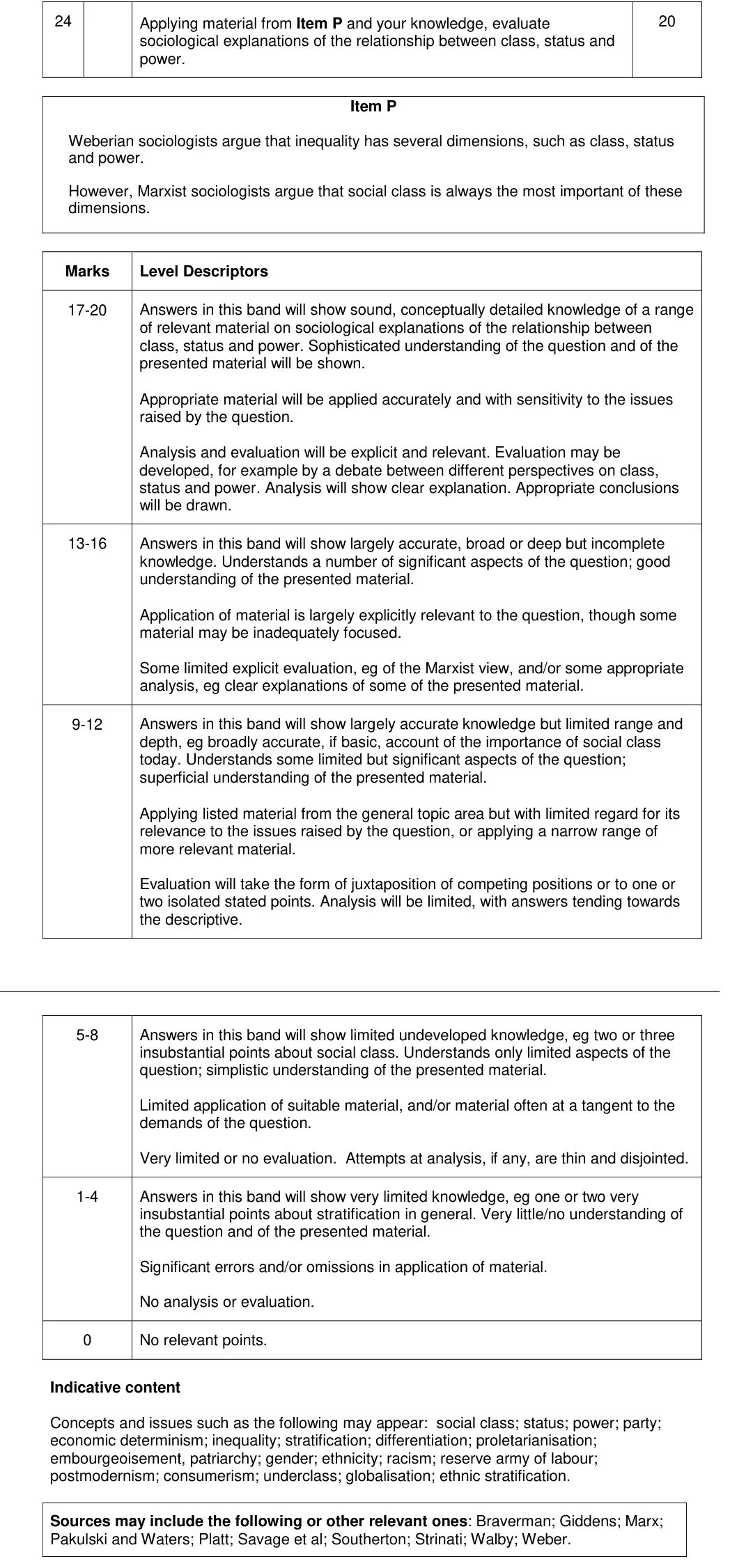
Applying material from Item P and your knowledge, evaluate the view that a person’s ethnicity is the most important factor affecting their life chances.
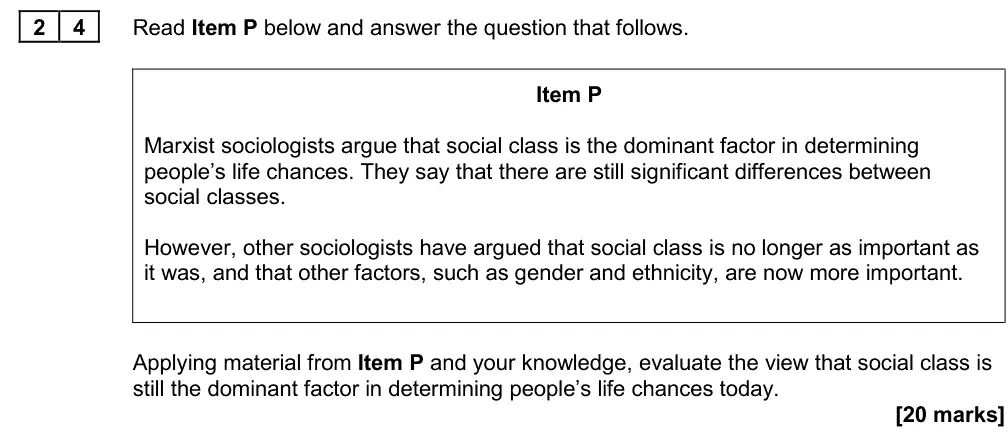
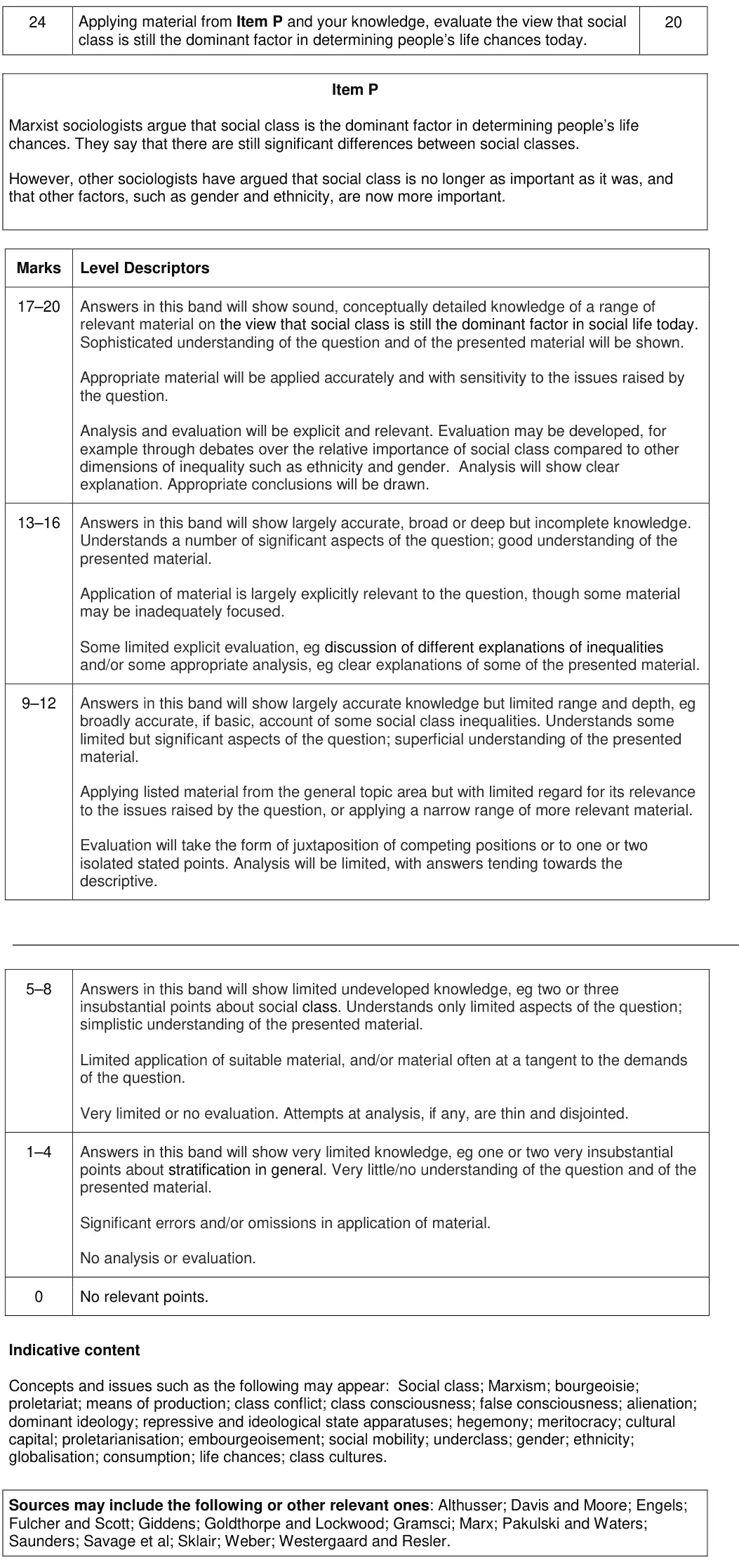
Applying material from Item P and your knowledge, evaluate the view that social class is still the dominant factor in determining people’s life chances today.
Tap a question to zoom it. The mark scheme (with the level descriptors and indicative content) and the examiner's comment open underneath.
June 2025 · Paper 2 · Q2420 marksAO1=8, AO2=6, AO3=620-mark essay
Mark scheme, including the levels grid and indicative content
Examiner's comment
These require answers that are essays and are best written in paragraphs. A brief introduction can help set out the argument of the essay. It will not attract marks if it only repeats the question or parts of the item. The purpose of the items for these questions is to suggest a few starting points for students, including ways into evaluation. Students are expected to also bring in further ideas (“and your knowledge” in the instruction) rather than relying only on the item. A wide range of material can be relevant to these questions, so students need to be selective. It is more effective to cover a limited number of views/theories in depth rather than to try to include everything. Students should keep to the question. When a question is about a particular view, other views can be used for evaluation but without writing all that the student knows about them. There was a tendency for answers to progressively lose sight of the question and to become a list of different views. Students who made brief essay plans appeared to benefit by having more structured and coherent responses. Students generally produced answers which applied relevant material to the question. Popular approaches were to expand on cues given in the item, for example unpacking ethnicity as applied to education or another topic area. Evaluation and analysis were often based on theories that view ethnicity as not being the most central factor in determining life chances, most commonly Marxism (following the item) and feminism.
Notes from the mark scheme and report
top band weighs ethnicity against class, gender and other factors in life chances
common approach unpacked ethnicity in education and work, evaluated mainly via Marxism and feminism
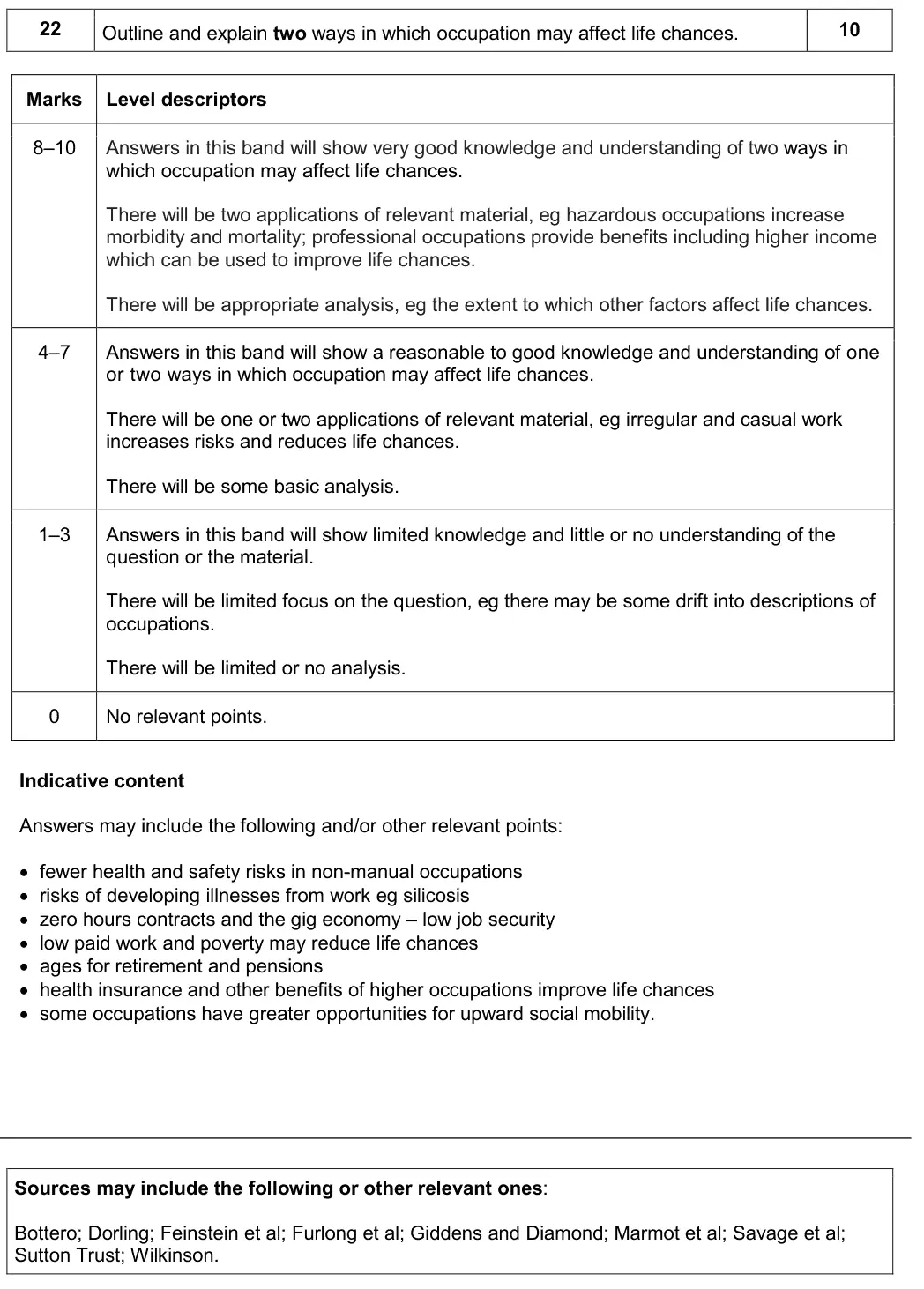
June 2024 · Paper 2 · Q2210 marksAO1=5, AO2=3, AO3=2Outline and explain
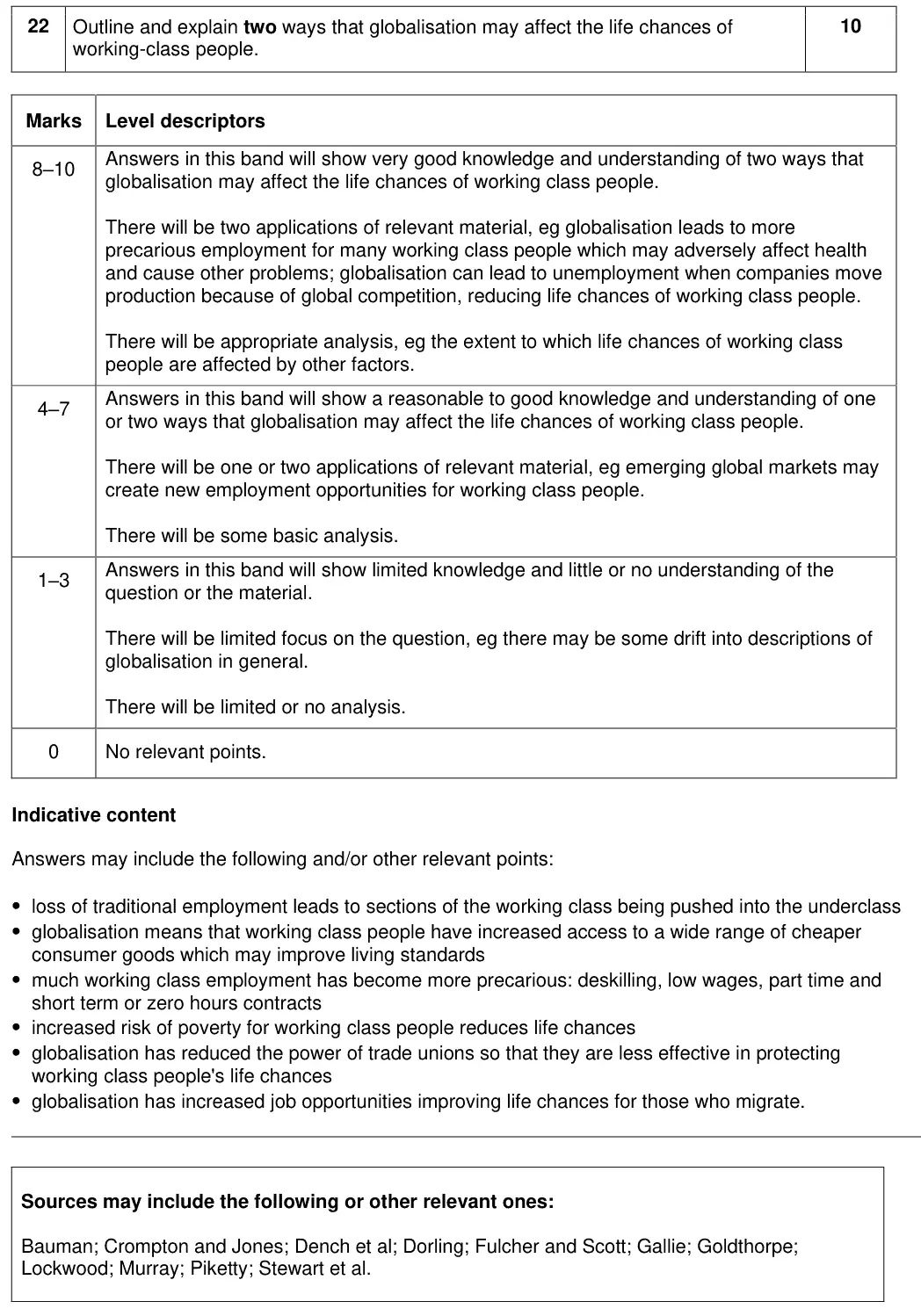
Mark scheme, including the levels grid and indicative content
Examiner's comment
The nature of these questions means that students cannot rely on reciting knowledge. Questions will ask them to bring together aspects of their sociological knowledge in ways they will not have done before. It is therefore important for students to allow time to think about how to answer the question. Students should be made aware that there are two types of 10 mark questions. These have different requirements and different mark schemes . There are different marks available for the assessment objectives. A breakdown of the marks awarded by assessment objective can be found in the mark scheme. 10 mark “outline and explain” questions have more marks available for knowledge and understanding, and none for evaluation. Introductions and conclusions are not required for 10 mark questions; they take up time and rarely improve the mark. It is helpful if answers are set out to clearly indicate the two answers, with wording such as “One way/reason is…”, or by starting a new paragraph for the second point. Answers that give more than two points are unlikely to develop two of them sufficiently. Q22: Answers often discussed the creation of new jobs and opportunities or the outsourcing of production so leading to a reduction of employment opportunities. For some students developing the ways by explaining the effects on life chances proved difficult. A minority of students linked globalisation and life chances to other features such as globalisation enabling advances in health care, so improving life chances.
Notes from the mark scheme and report
two ways each linked to working-class life chances (e.g. precarious employment, job losses from relocated production, cheaper consumer goods, weaker unions, migration opportunities)
describing globalisation in general = 1–3
explaining the effect on life chances was the difficult step
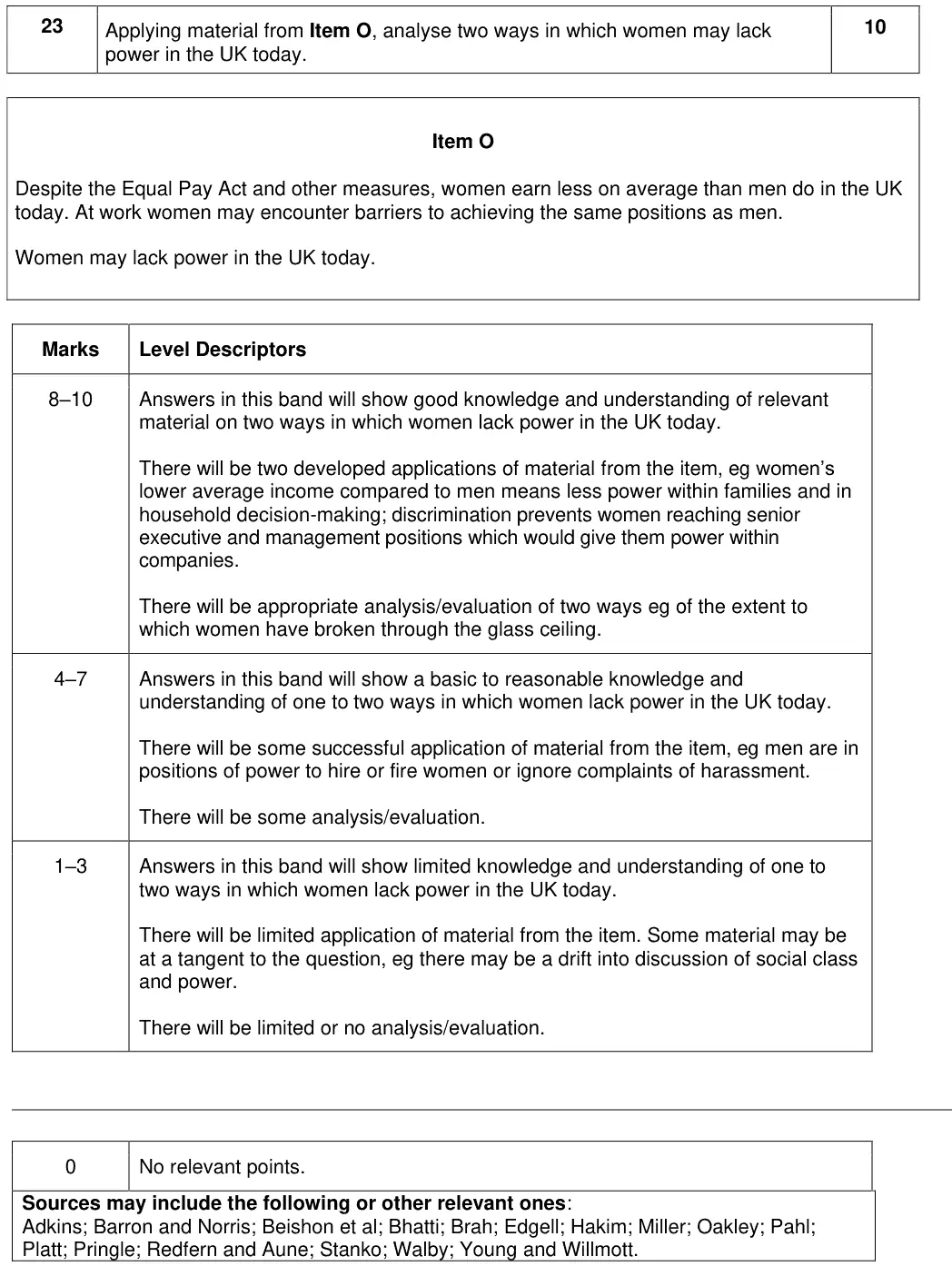
June 2024 · Paper 2 · Q2310 marksAO1=3, AO2=4, AO3=3Analyse
Mark scheme, including the levels grid and indicative content
Examiner's comment
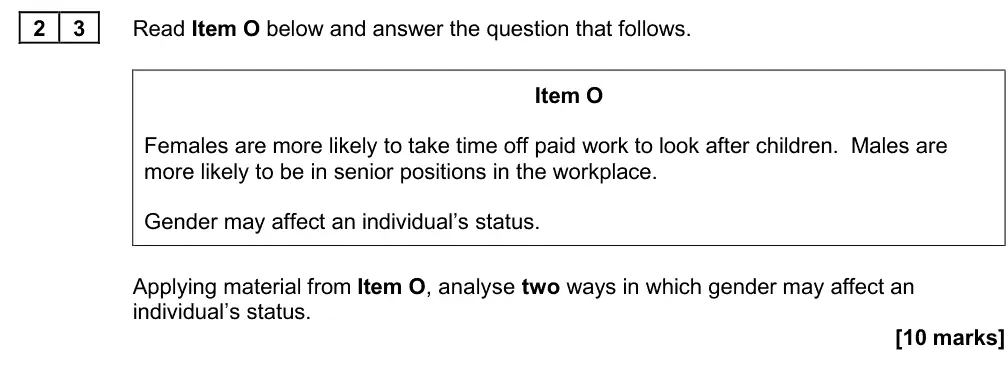
The nature of these questions means that students cannot rely on reciting knowledge. Questions will ask them to bring together aspects of their sociological knowledge in ways they will not have done before. It is therefore important for students to allow time to think about how to answer the question. Students should be made aware that there are two types of 10 mark questions. These have different requirements and different mark schemes . There are different marks available for the assessment objectives. A breakdown of the marks awarded by assessment objective can be found in the mark scheme. The items for 10 mark “analyse” questions are written to give prompts or “hooks” for student answers. These have to be used to access application marks. Answers can indicate use of hooks by quoting, by a reference in parentheses or by wording ( eg “As the item says…”). Items end with a sentence restating the question; the hooks are in the preceding part of the item. Students should avoid writing all they know about a “hook”, and focus on applying the idea to the question. Introductions and conclusions are not required for 10 mark questions; they take up time and rarely improve the mark. It is helpful if answers are set out to clearly indicate the two answers, with wording such as “One way/reason is…”, or by starting a new paragraph for the second point. Answers that give more than two points are unlikely to develop two of them sufficiently. Q23: Some answers had an overlap between the two “ways” they analysed. The status of women was discussed in terms of breaks in work, discrimination in the workplace, the glass ceiling and so on. Points about men were sometimes limited to these issues not applying to men. Few students considered changes in the workplace or to the balance of domestic labour which might have helped development of points.
Notes from the mark scheme and report
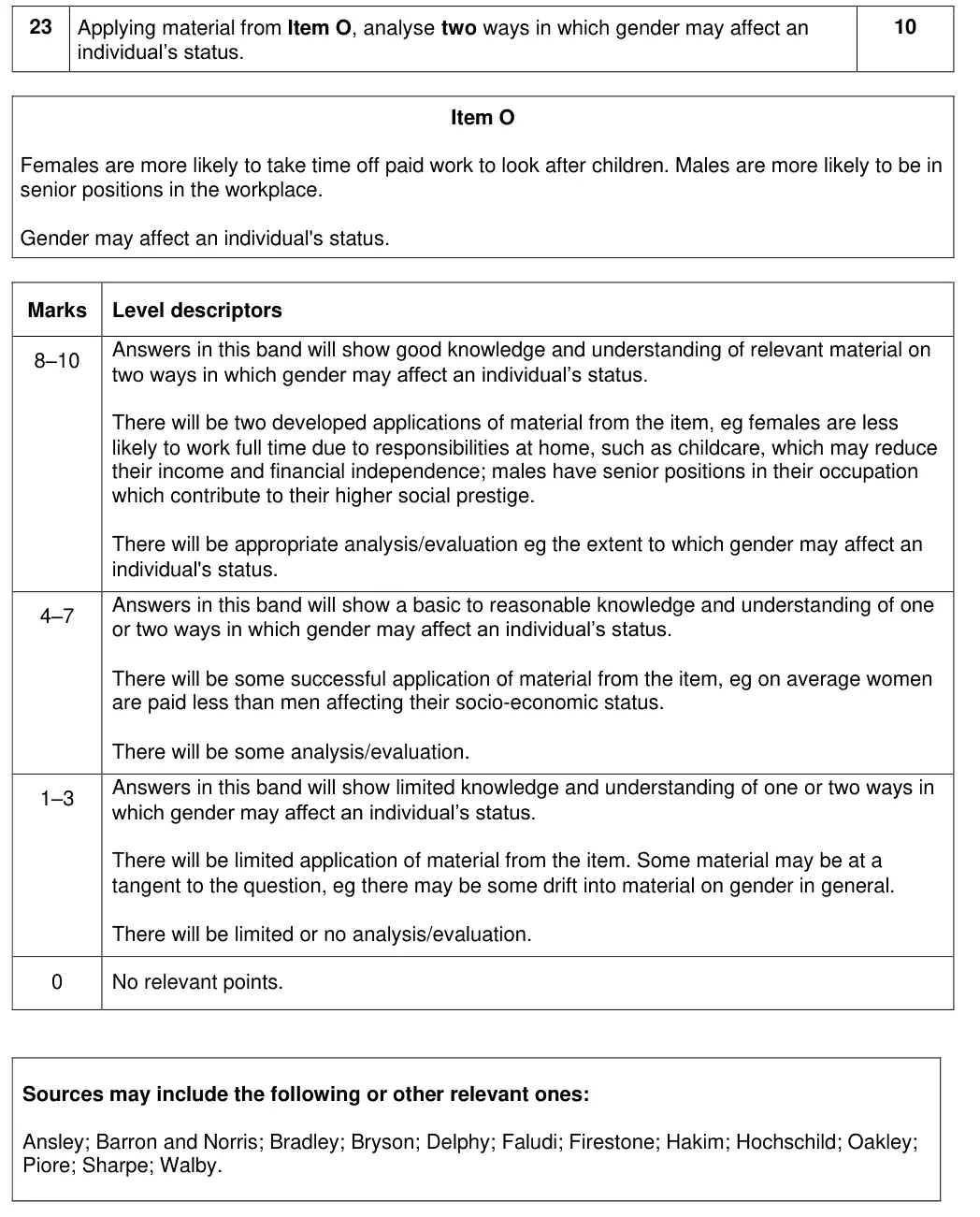
two developed applications from Item O (women taking time off for childcare
men in senior posts), e.g. reduced income and independence, men's occupational prestige
drift into gender in general is a tangent
the two ways often overlapped
points about men were often just the absence of women's disadvantages
June 2023 · Paper 2 · Q2210 marksAO1=5, AO2=3, AO3=2Outline and explain
Mark scheme, including the levels grid and indicative content
Examiner's comment
The nature of these questions means that students cannot rely on reciting knowledge. Questions will ask them to bring together aspects of their sociological knowledge in ways they are unlikely to have done before. It is therefore important for students to allow time to think about how to answer the question. Students should be made aware that there are two types of 10 mark questions. These have different requirements and different mark schemes. There are different marks available for the assessment objectives. 10 mark “outline and explain” questions have more marks available for knowledge and understanding, and none for evaluation. Introductions and conclusions are not required for 10 mark questions and take up valuable time. It is helpful if answers are set out to clearly indicate the two separate points, with wording such as “One way/reason is…” or by starting a new paragraph for the second point. Answers that give more than two points are unlikely to develop two of them sufficiently. Question 22: Most were able to answer this question adequately. Many focused on discrimination and restricted access as ways, but some lacked sociology and were very generalised.
Notes from the mark scheme and report
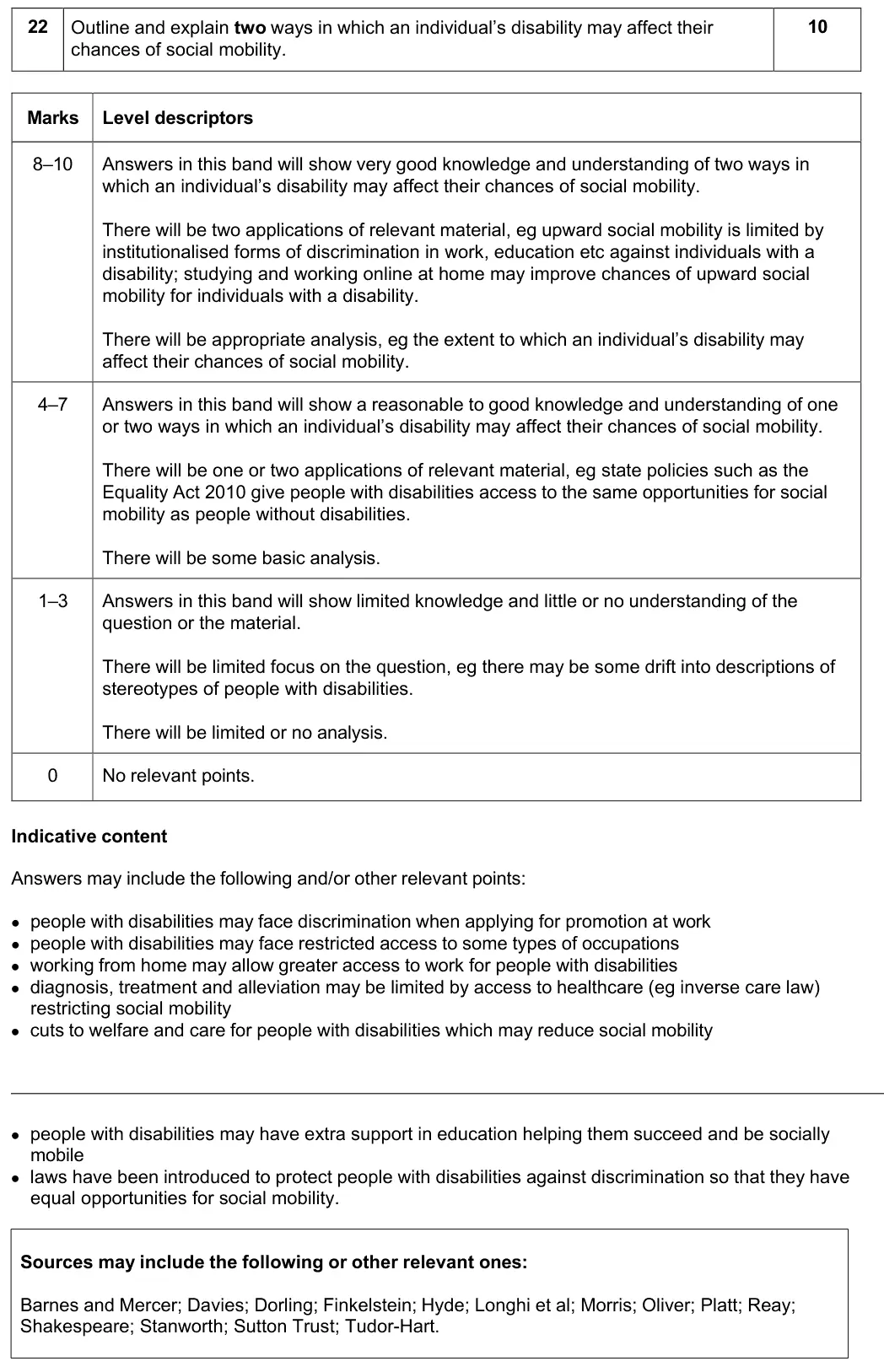
two ways disability affects social mobility (institutional discrimination, restricted access to occupations, home working, educational support, equality law)
drift into stereotypes of disabled people = 1–3
many focused on discrimination and access but some answers were generalised and lacked sociology
June 2023 · Paper 2 · Q2420 marksAO1=8, AO2=6, AO3=620-mark essay
Mark scheme, including the levels grid and indicative content
Examiner's comment
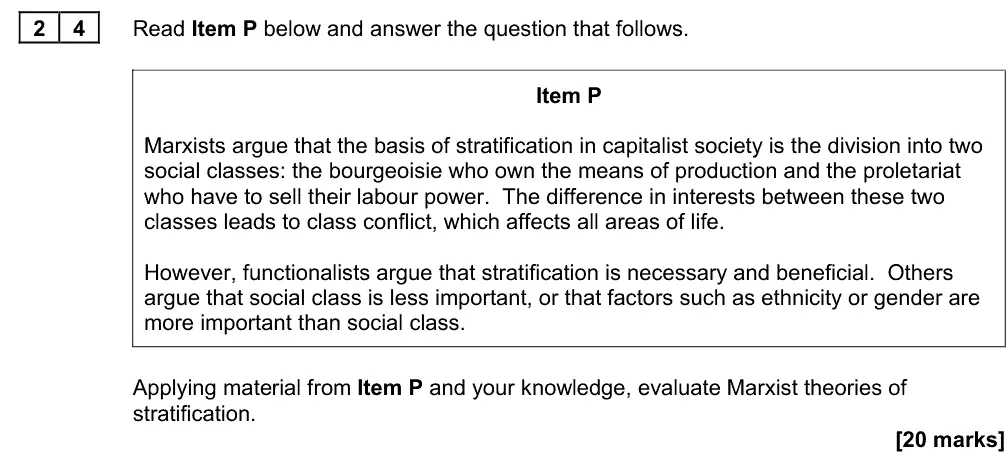
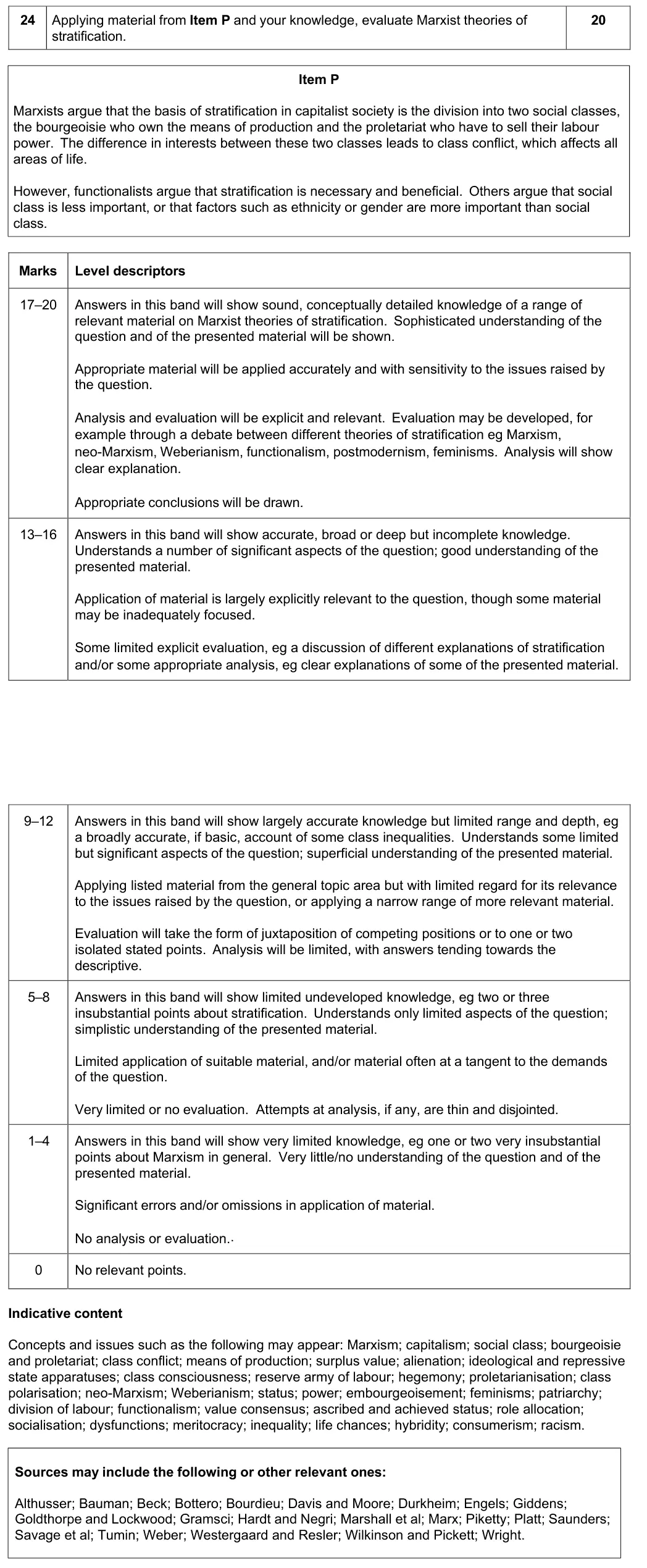
Most students answered their chosen questions in the order in which they appeared on the question paper. They therefore answered the section B 20 mark question last. For some this was a relatively brief and often apparently unfinished answer. This suggests that students need to track carefully time spent on each question. The purpose of the items for these questions is to suggest a few starting points for students, including ways into evaluation. Students are expected to also bring in further ideas (“and your knowledge” in the instruction). A wide range of material can be relevant to these questions, so students need to be selective. It is more effective to cover a limited number of views/theories in depth rather than to include every possible theory. Students who made essay plans appeared to benefit by having more structured and coherent responses. Question 24: There were some good outlines of Marxist views, and most answers compared and contrasted Marxism with other perspectives. This was less effective when the other perspectives interrogated each other rather than Marxism. Sections on, for example, functionalist criticisms of feminism, drifted a long way from the question.
Notes from the mark scheme and report
top band debates Marxism against neo-Marxism, Weberianism, functionalism, postmodernism and feminisms
other perspectives must be used to evaluate Marxism, not each other
drift such as functionalist critiques of feminism lost focus
June 2022 · Paper 2 · Q2310 marksAO1=3, AO2=4, AO3=3Analyse
Mark scheme, including the levels grid and indicative content
Examiner's comment
The nature of these questions means that students cannot rely on reciting knowledge. The questions will ask them to bring together aspects of their sociological knowledge in a way that they are unlikely to have done before. There was a tendency, however, to attempt to answer the question by giving knowledge based on words or phrases in the question, rather than meeting the demands of the question. Students are advised to spend time reading the question, and, where there is one the item, to ensure that they are answering the question. Some students seemed unaware of the different demands of the two types of questions. The marks awarded for the assessment objectives are different in the two types of ten mark questions, and students should be aware of this. In “analyse” (with item) questions, the answers need to be clearly based on the prompts or “hooks” in the item, not just on the final sentence of the item which restates the question. There is no need for an introduction or conclusion for 10 mark questions. It is helpful if answers are set out to clearly indicate the two answers, with wording such as “One way is…” or by starting a new paragraph for the second point. The best answers to 10 mark questions were focused, clearly stating a point that addressed the question and then developing it, using sociological concepts, evidence and, where appropriate, theory. Answers need to address all aspects of the question. Q23 Good answers here applied the item, usually by looking at ways in which women’s lower average earnings affected power within families, and at how routes to management and higher positions within companies can be blocked for women, affecting their power within businesses. This question referred specifically to the United Kingdom and so answers about other countries could not be credited.
Notes from the mark scheme and report
hooks: lower pay (less power in household decisions) and barriers at work (glass ceiling, blocked routes to management)
answers about other countries not credited as the question specifies the UK
drift into class and power = 1–3 band
November 2021 · Paper 2 · Q2210 marksAO1=5, AO2=3, AO3=2Outline and explain
Mark scheme, including the levels grid and indicative content
Notes from the mark scheme and report
no marks for evaluation in this question type
two ways each developed, e.g. hazardous jobs raising morbidity and mortality, professional pay and benefits, insecure gig work, mobility opportunities
descriptions of occupations = 1–3
no examiners' report comment for this part
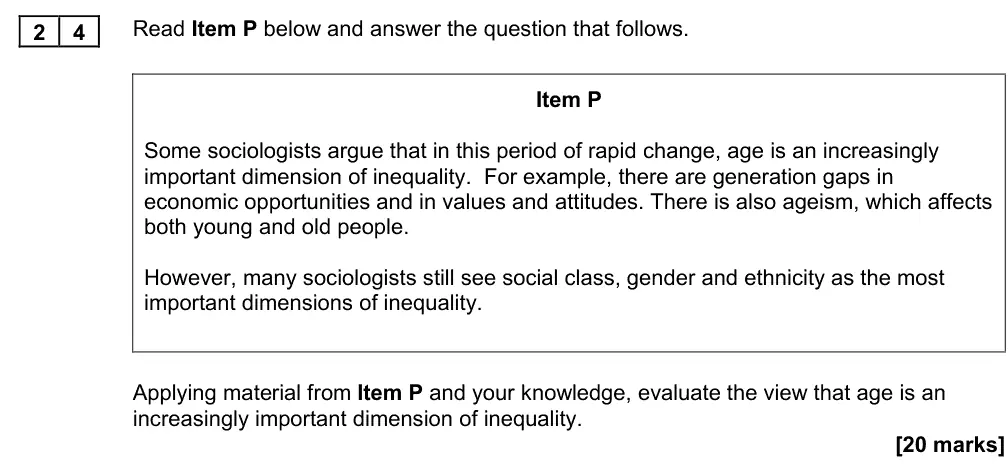
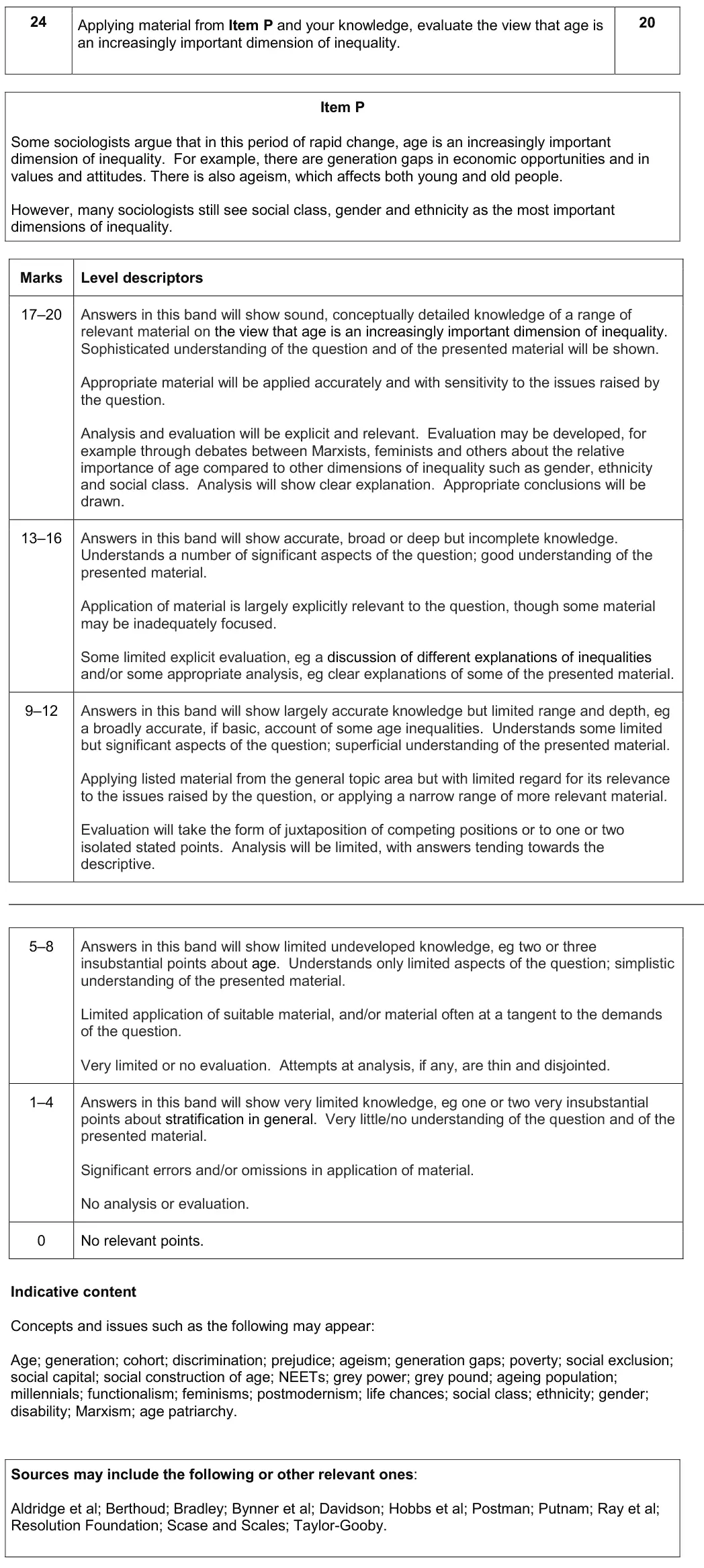
November 2021 · Paper 2 · Q2420 marksAO1=8, AO2=6, AO3=620-mark essay
Mark scheme, including the levels grid and indicative content
Notes from the mark scheme and report
must apply Item P (generation gaps, ageism affecting young and old, class, gender and ethnicity as main dimensions)
top band weighs age against other dimensions through Marxist, feminist and other debates
a basic account of age inequalities = 9–12
no examiners' report comment for this part
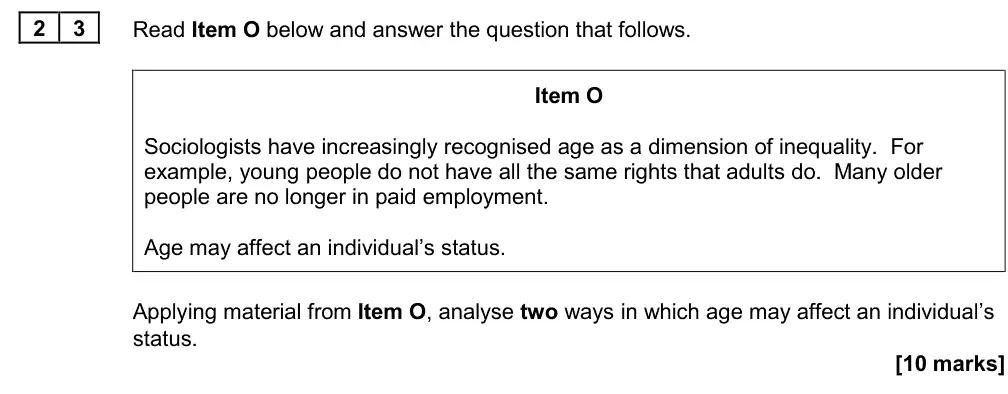
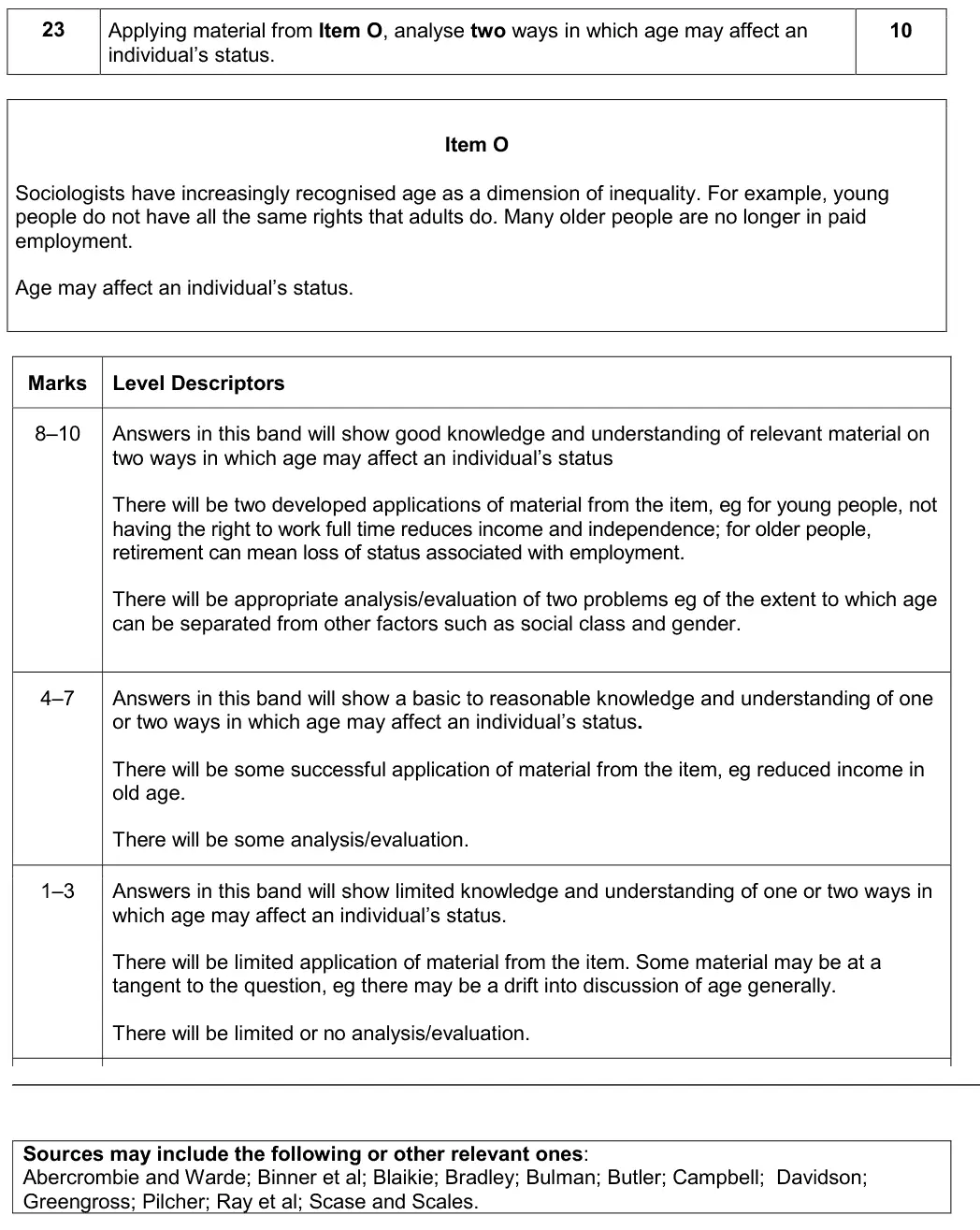
November 2020 · Paper 2 · Q2310 marksAO1=3, AO2=4, AO3=3Analyse
Mark scheme, including the levels grid and indicative content
Notes from the mark scheme and report
apply Item O (young people's limited rights, older people outside paid work)
e.g. restricted income and independence for the young, loss of work status on retirement
evaluation e.g. separating age from class and gender
general discussion of age = tangent
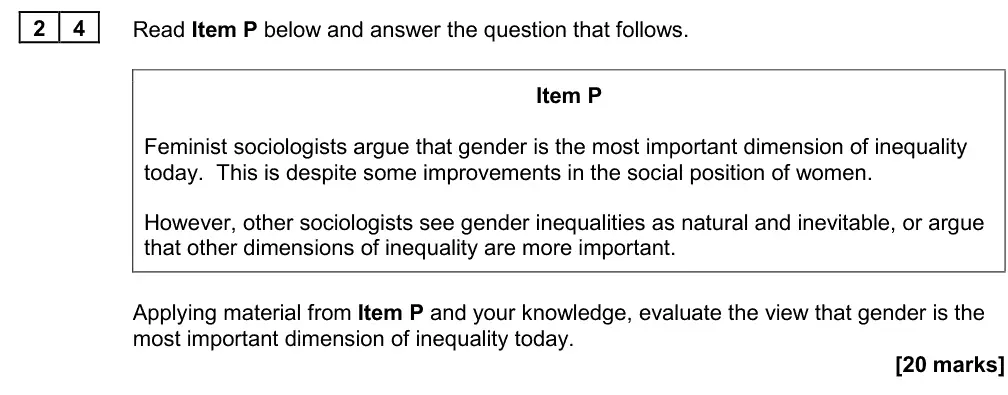
November 2020 · Paper 2 · Q2420 marksAO1=8, AO2=6, AO3=620-mark essay
Mark scheme, including the levels grid and indicative content
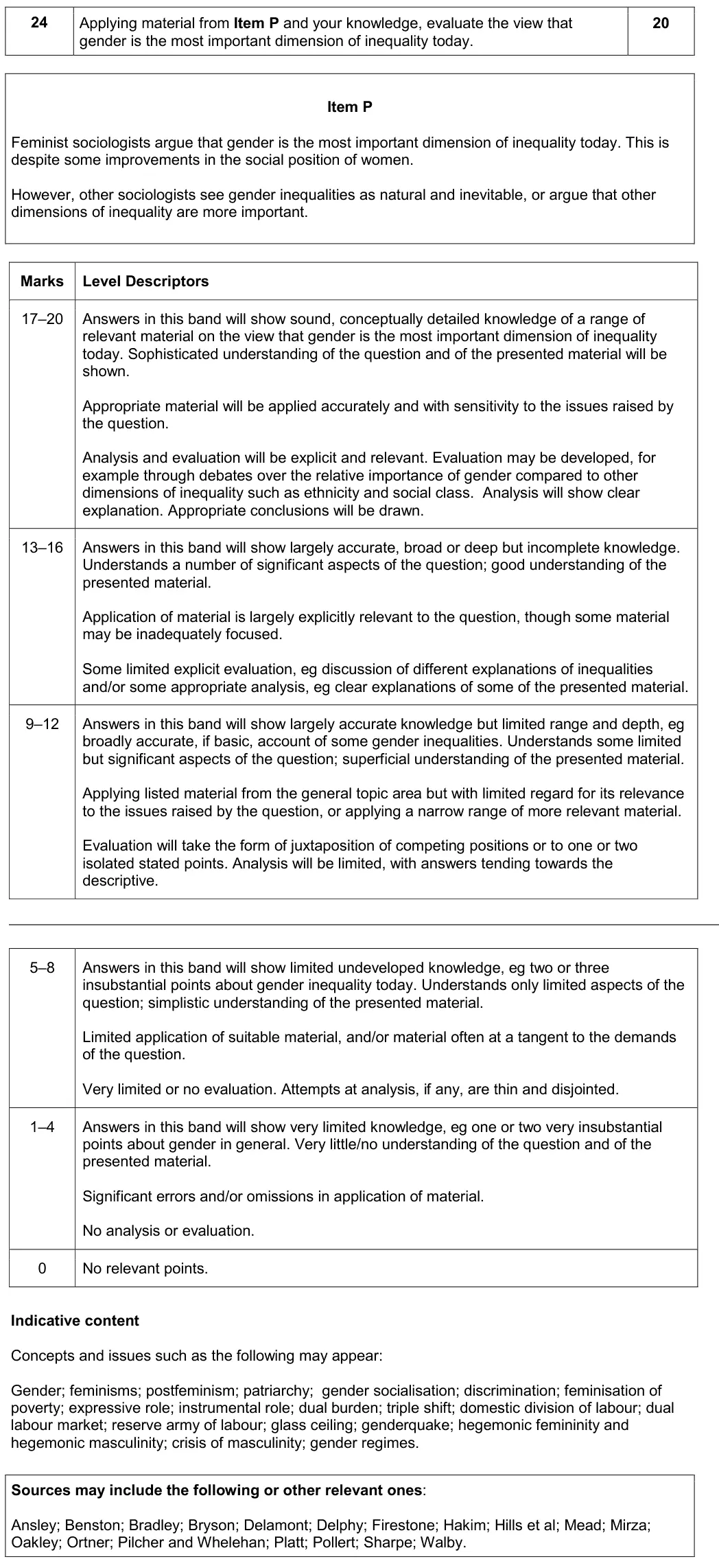
Notes from the mark scheme and report
apply Item P (gender most important despite women's gains vs natural or other dimensions more important)
top band weighs gender against class and ethnicity
a basic account of gender inequalities = 9-12
June 2019 · Paper 2 · Q2420 marksAO1=8, AO2=6, AO3=620-mark essay
Mark scheme, including the levels grid and indicative content
Examiner's comment
They therefore answered the section B 20 mark essay question last, and for many this was, as last year, a relatively brief and often apparently unfinished answer. This suggests that time management continues to be a problem for many students on this paper. As last year, many scripts had one substantial answer to the Section A 20-mark question and one significantly briefer one for Section B, suggesting problems with timing. There was often little evidence of planning. A wide range of material can be relevant to these questions, and students are not expected to include everything. They need to carefully choose the content and to plan their answers. The best answers will be both empirical and theoretical, for example showing knowledge of research findings and examples, and knowledge of theoretical perspectives. Some answers amounted to lists of theoretical perspectives, with learned points of criticism, and lost focus on the question itself. While the items are intended as a helpful starting point for answers, they should not be taken by students as a full list of what is relevant; better answers will draw in other relevant knowledge and ideas. This question was mostly well understood, with some good answers showing evaluating skills through considering the effects of gender, ethnicity and other factors determining people’s life chances, compared to social class.
Notes from the mark scheme and report
top band weighs class against gender, ethnicity and other factors in life chances
AO split from AQA's standard grid for this paper (this year's mark scheme does not print it).
June 2018 · Paper 2 · Q2210 marksAO1=5, AO2=3, AO3=2Outline and explain
Mark scheme, including the levels grid and indicative content
Examiner's comment
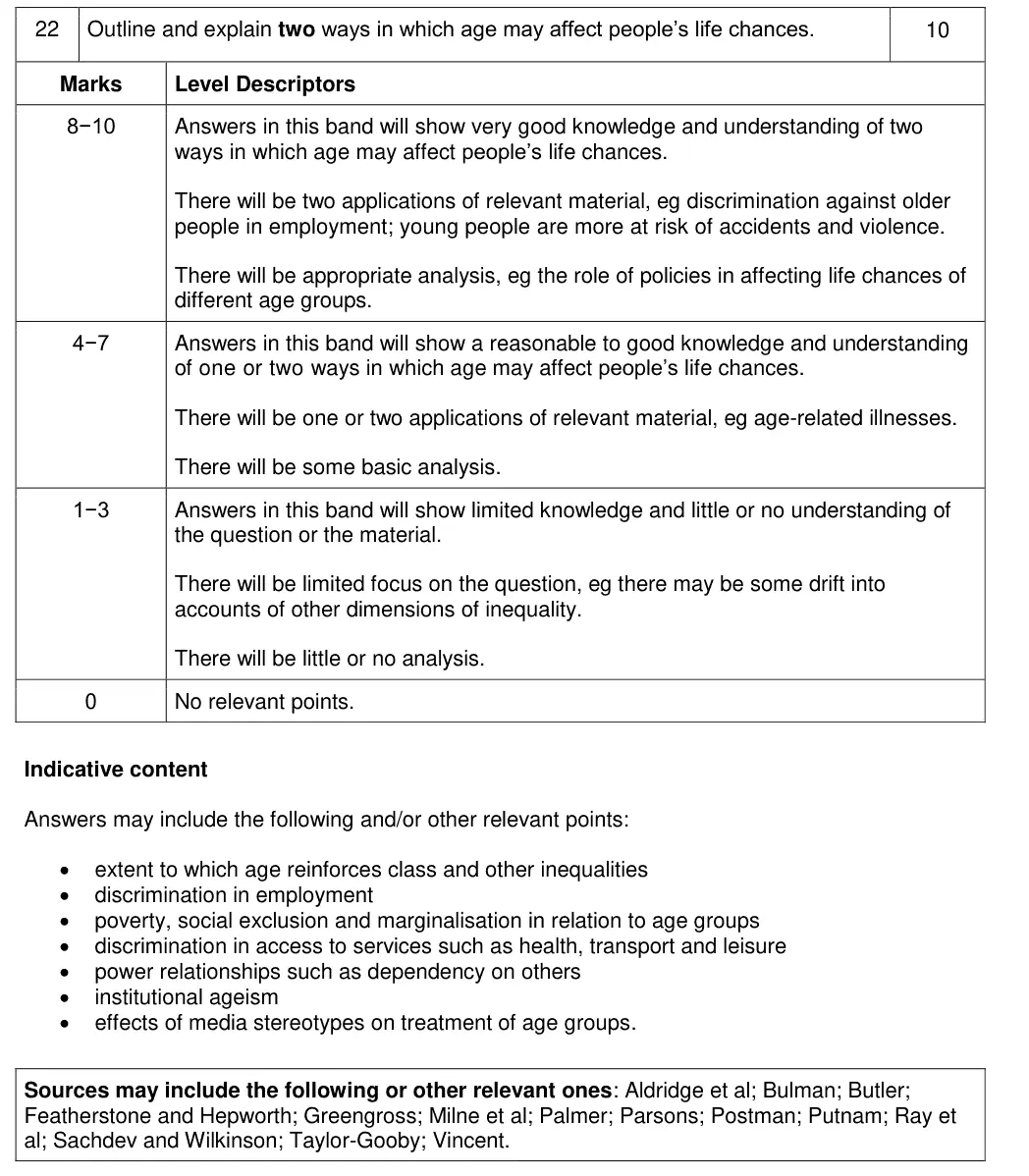
Some students wrote introductory paragraphs and/or conclusions. These are not necessary, and are unlikely to gain additional marks, and they also take up time. Some students made only one point in their answers, or three or more, rather than the two asked for in the question. Sometimes it was unclear how many points were being made. It is helpful for students to clearly indicate their two answers, with wording such as “One way is…” or by starting a new paragraph for their second point. Evaluation is not a requirement for answers to 10 mark “outline and explain” questions. The marks awarded for the assessment objectives being targeted are different in the two types of ten mark questions, and students should be made aware of this. The best answers to 10 mark questions were focused, clearly stating a point and then developing it, using sociological concepts, evidence and theory where appropriate. In some questions students tended to focus on the first aspect of the question at the expense of the second. Students need guidance on how to approach these questions and how to best demonstrate their sociological understanding. The nature of these questions means that students cannot rely on reciting knowledge. These questions will ask them to bring together aspects of their sociological knowledge in a way that they are unlikely to have done before. This question produced an imaginative range of suggestions as to how age may affect life chances, not all informed by sociological knowledge and understanding. Most answers chose to focus on discrimination in employment and in access to services, with some displaying the students’ frustrations with the limits placed on young people, especially around the minimum wage. Studies, concepts and theories were rarely used in answers to this question.
Notes from the mark scheme and report
two ways age affects life chances (e.g. employment discrimination, risk of accidents and violence, access to services, dependency, institutional ageism)
drift into other dimensions of inequality = 1–3
studies, concepts and theories rarely used
AO split from AQA's standard grid for this paper (this year's mark scheme does not print it).
June 2018 · Paper 2 · Q2420 marksAO1=8, AO2=6, AO3=620-mark essay
Mark scheme, including the levels grid and indicative content
Examiner's comment
Most students answered their chosen questions in the order in which they appeared on the question paper. They therefore answered the 20 mark essay question in section B last. Some student responses to this question were relatively brief and seemingly unfinished. This suggests that timing was a problem for some students. Many scripts had one substantial well developed answer to a 20 mark question and one significantly briefer one, suggesting problems with timing. It is often the case that a wide range of material can be relevant to these questions, and students need to carefully choose the content they wish to use by planning their answers. For example, it may be more effective to cover a limited number of views or theories in some depth rather than to include every possible theory. There was a tendency for answers to progressively lose sight of the question and to become a list of different views. The best answers will address all aspects of the question and will draw on theories, concepts and empirical examples or evidence. Evaluation which meets the demands of the questions is better than points of criticism which have been learned and included, regardless of the question. Students should also be aware that evaluation includes awareness of the strengths as well as the weaknesses of an argument, theory or piece of evidence. In many answers, the evidence on ethnicity was limited to studies showing discrimination against job applicants with different names, and the item’s reference to institutional racism. Otherwise ethnicity’s role in inequality was mainly asserted. Answers often then juxtaposed social class and gender (mostly) inequality, citing some evidence for the latter and less for class. Weaker responses then tended to drift into feminist evidence and leave the question behind. Only a few better answers addressed the relative importance of dimensions of inequality and fewer still looked at the interactions between dimensions.
Notes from the mark scheme and report
top band weighs ethnicity against class and gender
evidence on ethnicity often limited to name-discrimination studies and the item, otherwise asserted
class and gender juxtaposed rather than compared
weaker answers drifted into feminism
few considered interaction between dimensions
AO split from AQA's standard grid for this paper (this year's mark scheme does not print it).
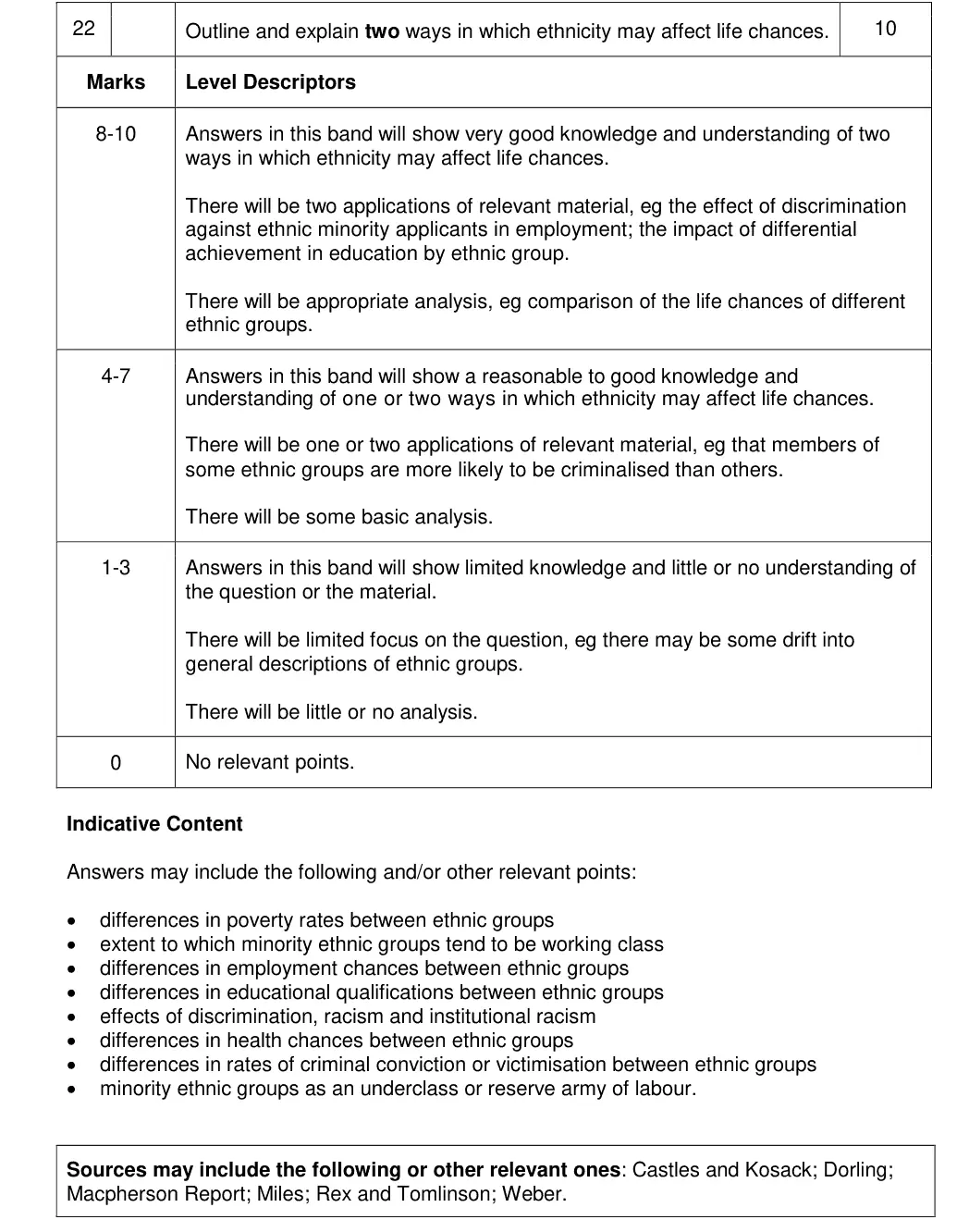
June 2017 · Paper 2 · Q2210 marksAO1=5, AO2=3, AO3=2Outline and explain
Mark scheme, including the levels grid and indicative content
Examiner's comment
A number of students wrote introductory paragraphs and/or conclusions. These are not necessary, and are unlikely to gain additional marks. A number of students made only one point in their answer, or three or more, rather than the two asked for. In these cases, the two best answers were rewarded and will be in future series. It is helpful for students to clearly indicate their two answers, with wording such as “One way is…” or by starting a new paragraph for their second point. Schools and colleges should note that there is no reference in the mark scheme for 10 mark ‘outline and explain’ questions to evaluation, and that evaluation is not a requirement for answers to these questions. The assessment objective allocations are different in the two types of 10 mark questions, and students should be made aware of this. There was a wide range of responses to these questions. A minority of students wrote very brief answers. For these 10 mark items, a simple statement of two ways, reasons or factors, without development, is not sufficient to access more than the lower marks in the mark range. The best answers were focused, clearly stating a point and then developing it, with use of sociological concepts, evidence and theory where appropriate, in ways that demonstrated the skills expected from the targeted assessment objectives. There was a tendency, however, for many answers to focus on the first aspect of the question at the expense of the second. Students need guidance on how to approach these questions and how to best demonstrate their sociological understanding. The nature of these questions means that students cannot rely on reciting knowledge. They require students to bring together two aspects of their sociological knowledge in a way that they are unlikely to have done before. Answers will sometimes require claims that students may be unsure of because they do not know of specific evidence (for example, in question 5, whether migrants from Eastern Europe who are single workers tend to live alone or in shared households). However, answers that are sociologically plausible will be accepted. Good answers were able to identify two ways by selecting life chances, such as those in employment, health and education, but some had less success in developing these points. Better answers were able to explain the ‘way’ through appropriate use of sociological knowledge, for example, using theories, or concepts such as the underclass and the reserve army of labour.
Notes from the mark scheme and report
two ways ethnicity affects life chances (employment discrimination, education, health, criminalisation, underclass/reserve army)
drift into general descriptions of ethnic groups = 1–3
development often weak
better answers used theory and concepts
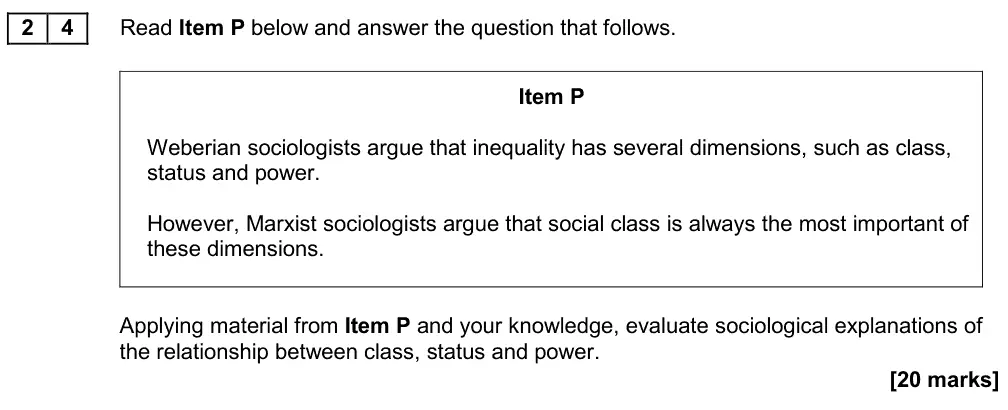
June 2017 · Paper 2 · Q2420 marksAO1=8, AO2=6, AO3=620-mark essay
Mark scheme, including the levels grid and indicative content
Examiner's comment
Most students answered their chosen questions in the order in which they appeared on the question paper. They therefore answered the 20 mark essay question in Section B last, and for many this was a relatively brief and often unfinished answer. This suggests that time management was a problem. Many scripts had one substantial, well developed answer to a 20 mark question and one significantly briefer one, again suggesting problems with time management. It is often the case that a wide range of material can be relevant to these questions, and students will need to be selective. For example, it may be more effective to cover a limited number of views or theories in some depth, rather than to include every possible theory. There was a tendency for answers to progressively lose sight of the question and to become a list of different views. The best answers will address all aspects of the question and will draw on theories, concepts and empirical examples or evidence. Evaluation which meets the demands of the questions is better than points of criticism which have been learned and included, regardless of the specific question that has been set. Students should also be aware that evaluation includes awareness of the strengths, as well as the weaknesses, of an argument or theory. Answers tended to be stronger on Marxist views of class, status and power than on Weberian views. Good answers were often characterised by differentiating the key terms of class, status and power, and by the application of other views, such as those of feminists.
Notes from the mark scheme and report
top band debates Weberian and Marxist (and other) perspectives on class, status and power
answers stronger on Marxist than Weberian views
good answers distinguished the three terms and brought in feminist views
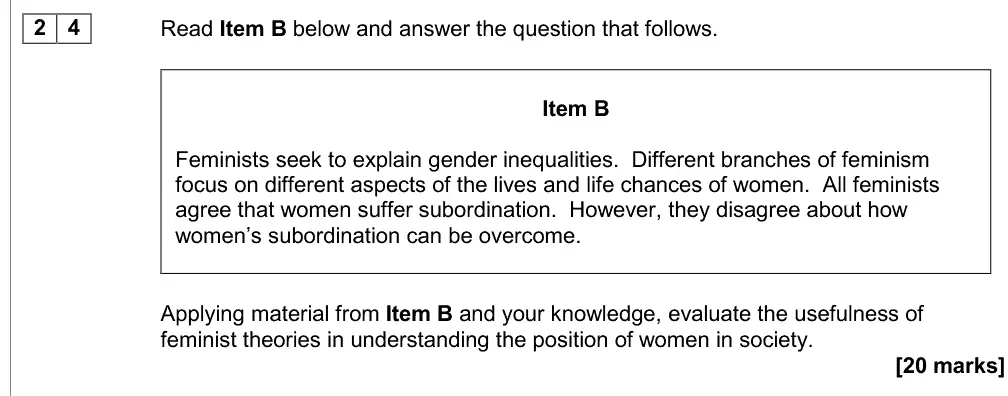
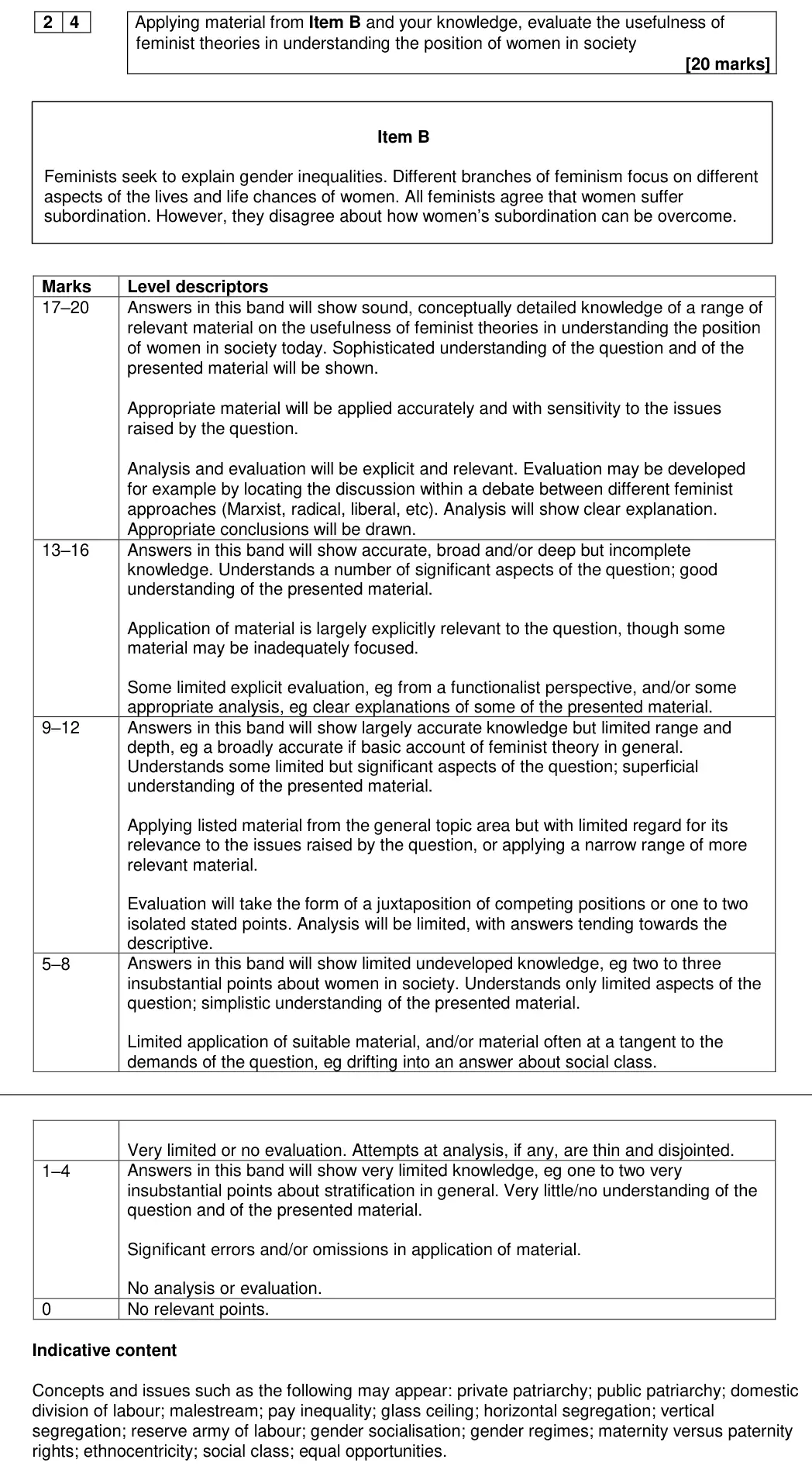
Specimen set 1 · Paper 2 · Q2420 marksAO1=8, AO2=6, AO3=620-mark essay
Mark scheme, including the levels grid and indicative content
Notes from the mark scheme and report
top band locates discussion in a debate between feminisms (Marxist, radical, liberal)
13–16 may evaluate from functionalism
a general account of feminism = 9–12
drifting into social class = 5–8
Work with an AQA sociology tutor
Essays stuck in the middle band, or losing marks on the 10-markers? Book a trial lesson with Mark, a former AQA examiner.