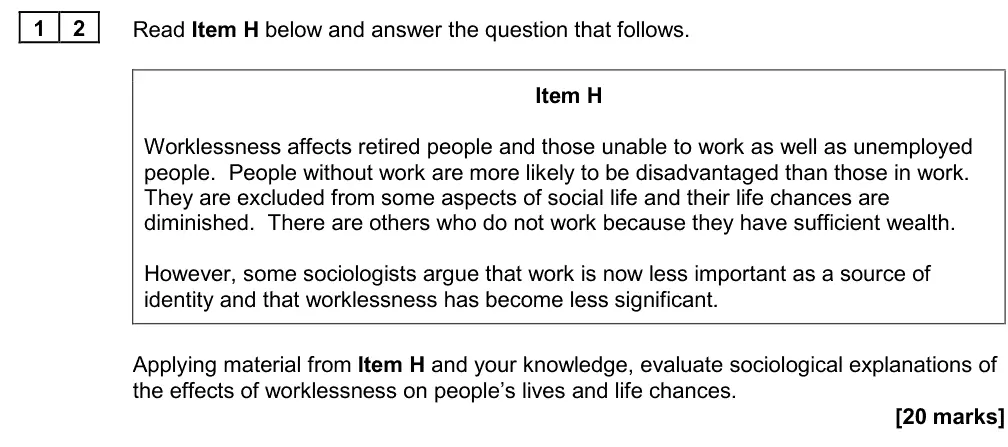
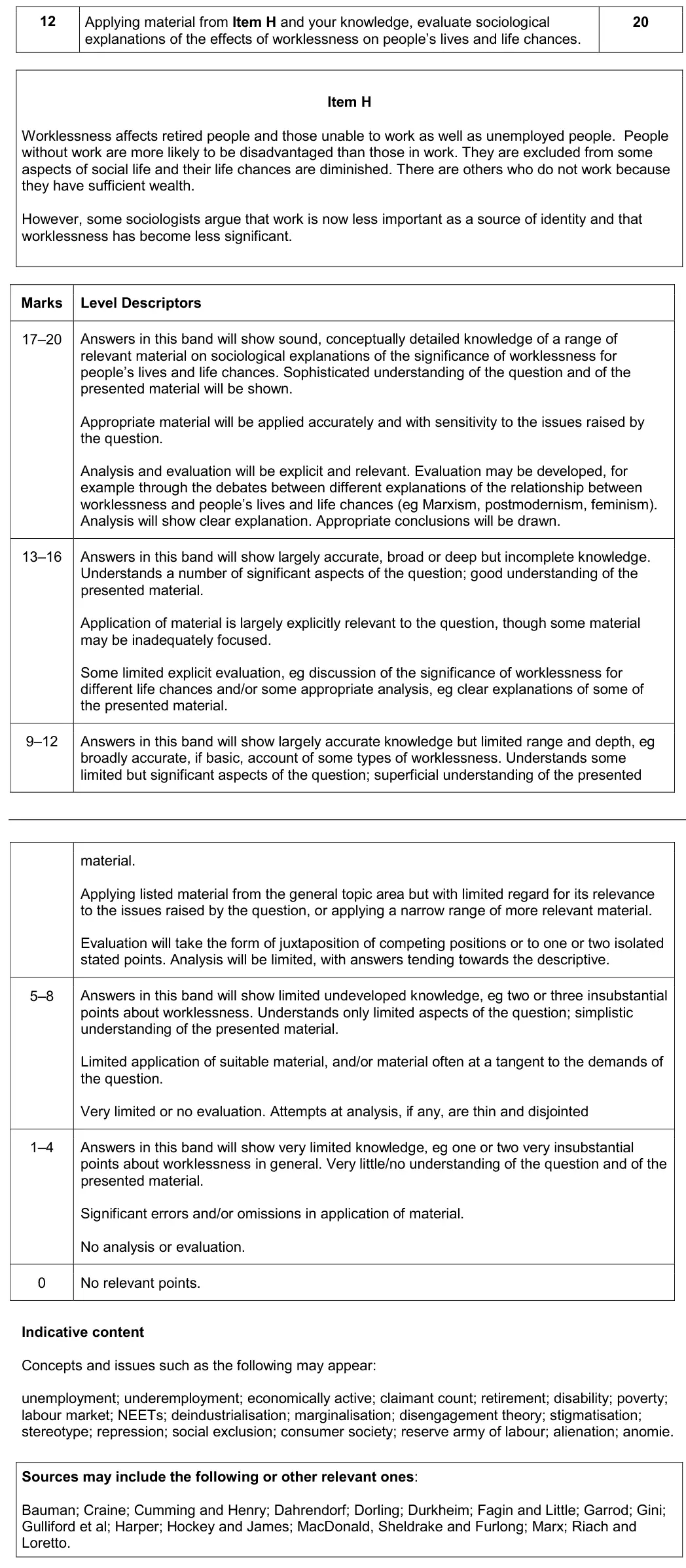
Applying material from Item H and your knowledge, evaluate sociological explanations of the effects of worklessness on people’s lives and life chances.
Tap a question to zoom it. The mark scheme (with the level descriptors and indicative content) and the examiner's comment open underneath.
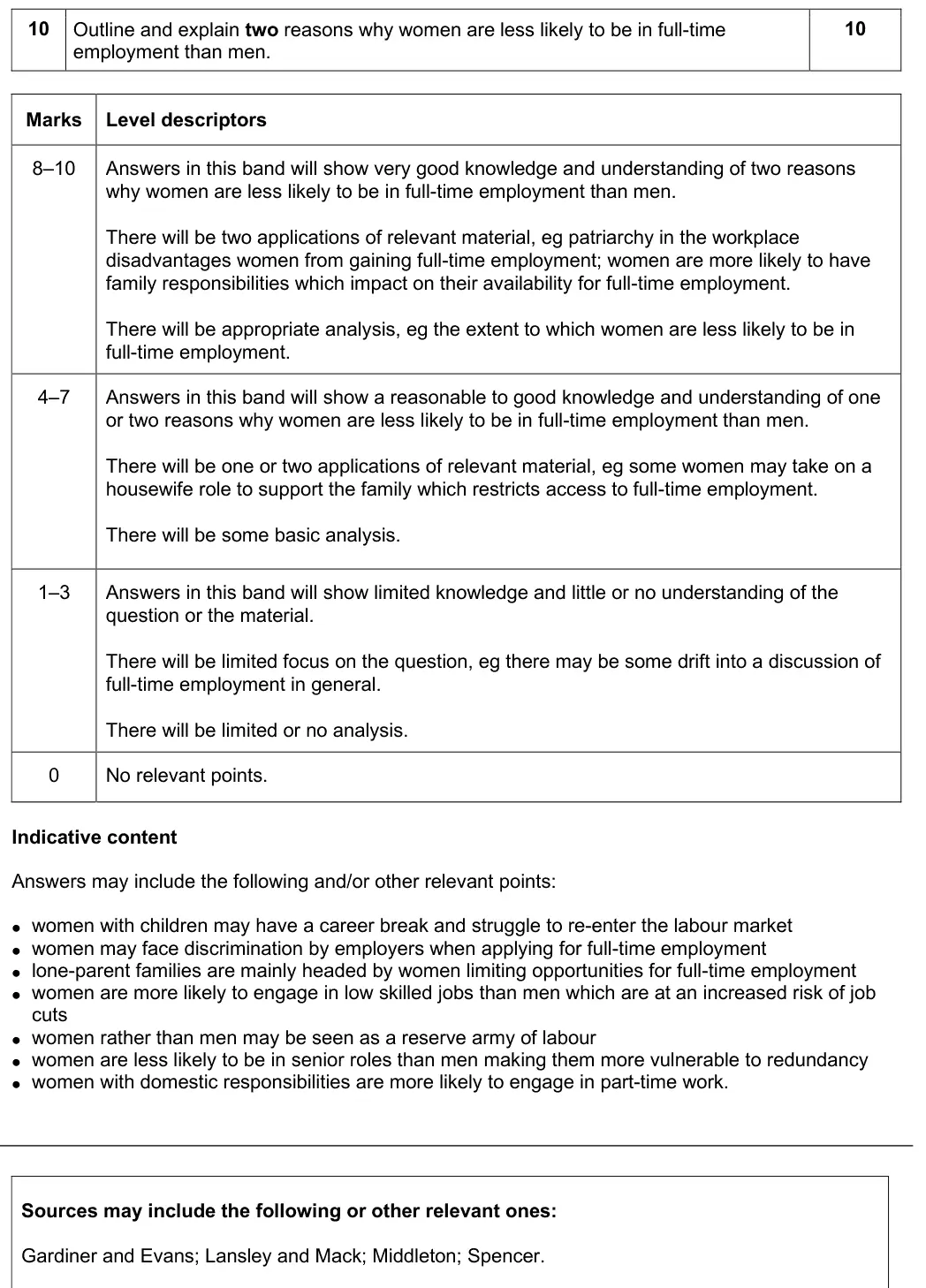
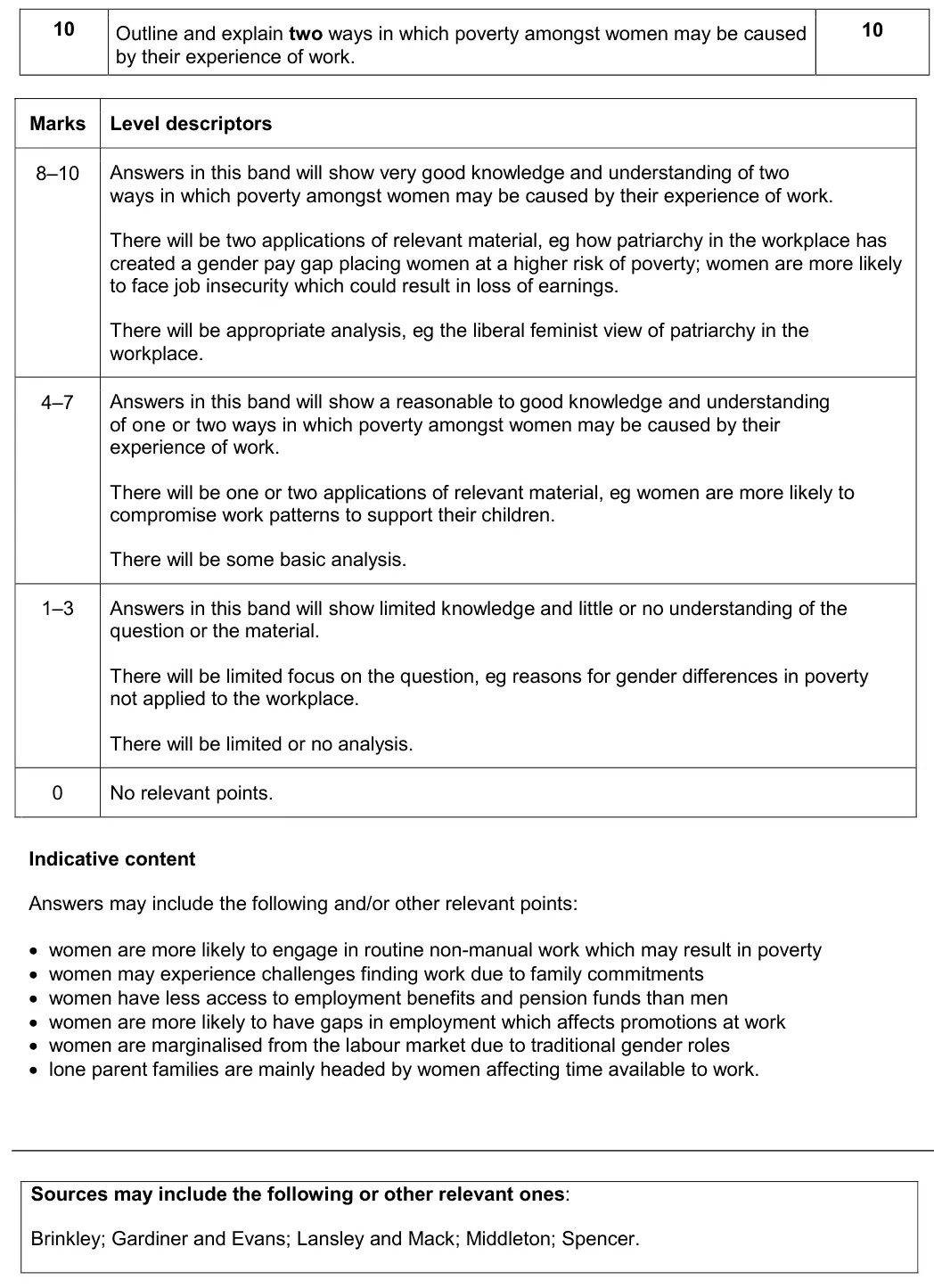
June 2025 · Paper 2 · Q1010 marksAO1=5, AO2=3, AO3=2Outline and explain
Mark scheme, including the levels grid and indicative content
Examiner's comment
The nature of these questions means that students cannot rely on reciting knowledge. Questions will ask them to bring together aspects of their sociological knowledge in ways they have not done before. It is therefore important for students to allow time to think about how to answer the question. Students should be aware that there are two types of ten-mark questions. These have different requirements and different mark schemes. There are different marks available for the assessment objectives. 10 mark “outline and explain” questions have more marks available for knowledge and understanding, and none for evaluation. Introductions and conclusions are not required for 10-mark questions, are unlikely to help students and take up time. It is helpful if answers are set out to clearly indicate the two answers, with wording such as “One way/reason is…” or by starting a new paragraph for the second point. Answers that give more than two answers are unlikely to develop two of them sufficiently. The most successful answers to 10-mark questions were focused, clearly stating a point that addressed the question and then developing it, using sociological concepts, evidence such as an example and, where appropriate, theory. Most answers showed understand of why women might be prevented from entering full time employment. Some of the most successful answers used intersectionality, for example considering how ethnic minority women may face a double oppression of racism and patriarchy that affects employment opportunities.
Notes from the mark scheme and report
drift into full-time employment in general = 1–3
common reasons: family responsibilities, employer discrimination, reserve army of labour
best answers used intersectionality (e.g. ethnic minority women facing racism and patriarchy)
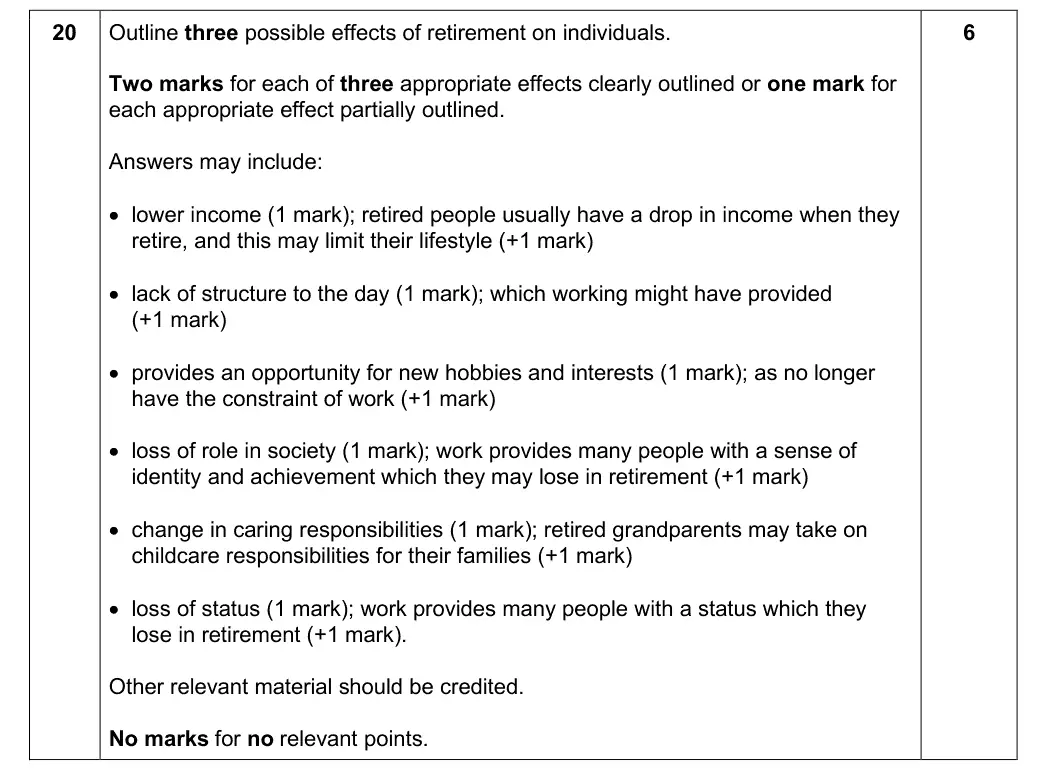
June 2025 · AS Paper 2 · Q206 marksAO1=6Outline
Mark scheme
Examiner's comment
On the 10-mark 'outline and explain' question (the fourth question in each topic area), and the 6-mark 'outline three...' question (the third question in each topic). In the 6-mark 'outline three...' questions, students could improve their performance by including a brief explanation of each identified point—such as a criticism or feature—rather than simply listing them. This was a novel question but one that students had a range of responses for. Popular possible effects of retirement that were suggested included: reduced income / poverty, increased time for leisure pursuits, lack of identity through the absence of work and loneliness.
Notes from the mark scheme and report
credited: lower income, lack of daily structure, time for hobbies, loss of role or identity, caring for grandchildren, loss of status
loneliness also used
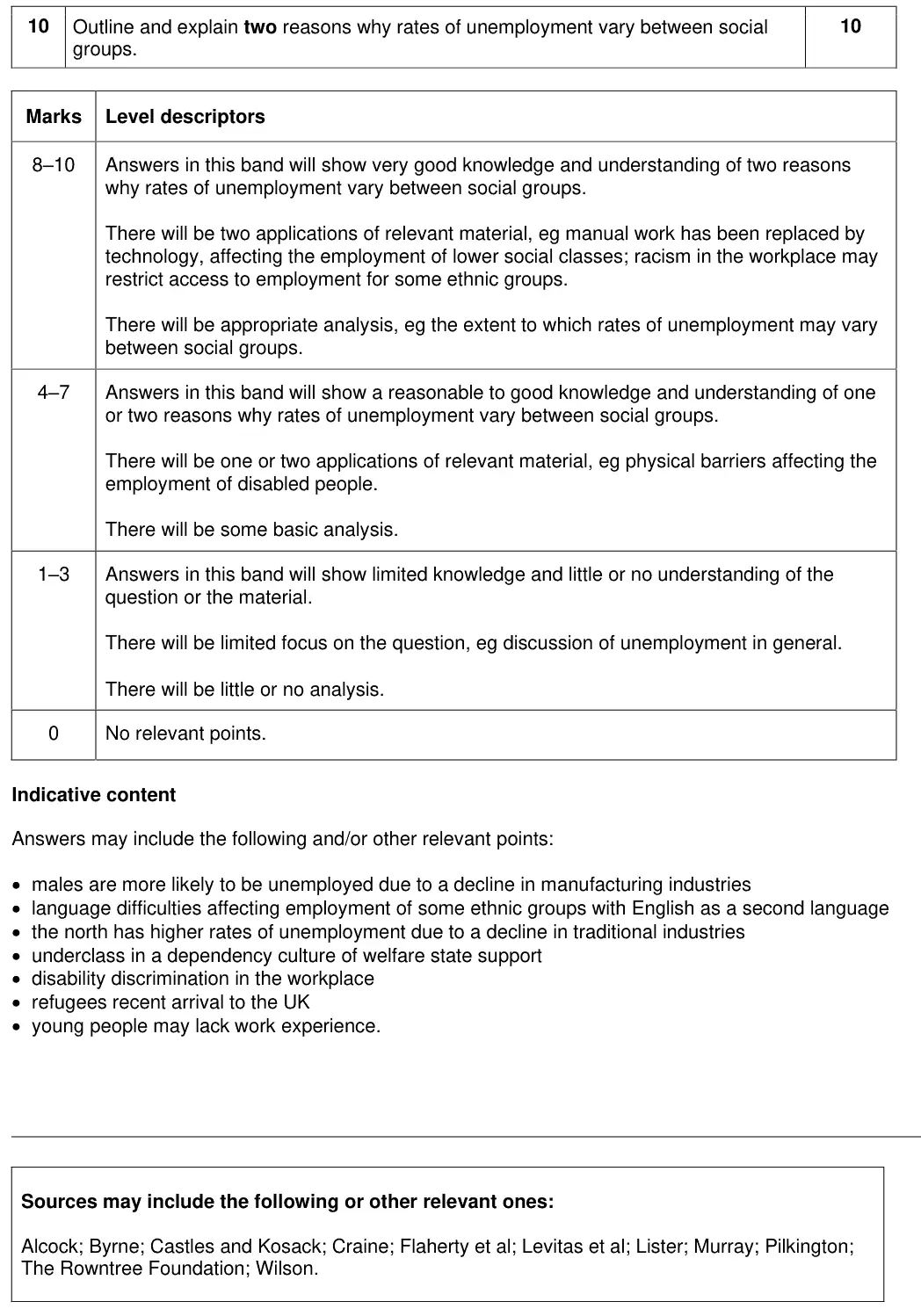
June 2024 · Paper 2 · Q1010 marksAO1=5, AO2=3, AO3=2Outline and explain
Mark scheme, including the levels grid and indicative content
Examiner's comment
The nature of these questions means that students cannot rely on reciting knowledge. Questions will ask them to bring together aspects of their sociological knowledge in ways they will not have done before. It is therefore important for students to allow time to think about how to answer the question. Students should be made aware that there are two types of 10 mark questions. These have different requirements and different mark schemes . There are different marks available for the assessment objectives. A breakdown of the marks awarded by assessment objective can be found in the mark scheme. 10 mark “outline and explain” questions have more marks available for knowledge and understanding, and none for evaluation. Introductions and conclusions are not required for 10 mark questions; they take up time and rarely improve the mark. It is helpful if answers are set out to clearly indicate the two answers, with wording such as “One way/reason is…”, or by starting a new paragraph for the second point. Answers that give more than two points are unlikely to develop two of them sufficiently. Q10: Successful answers identified two reasons such as the reduction in traditional employment for working-class males and the emergence of an underclass. Social groups discussed included those based on gender or ethnicity, and people with disabilities. Some students found it difficult to develop the identified reasons. Better answers usually brought in one or more theoretical perspectives.
Notes from the mark scheme and report
two reasons each developed for differences between groups (e.g. decline of manual and manufacturing work for working-class men, racism or language barriers, disability discrimination, regional decline, youth inexperience, underclass)
discussing unemployment in general = 1–3
development of reasons was the main difficulty
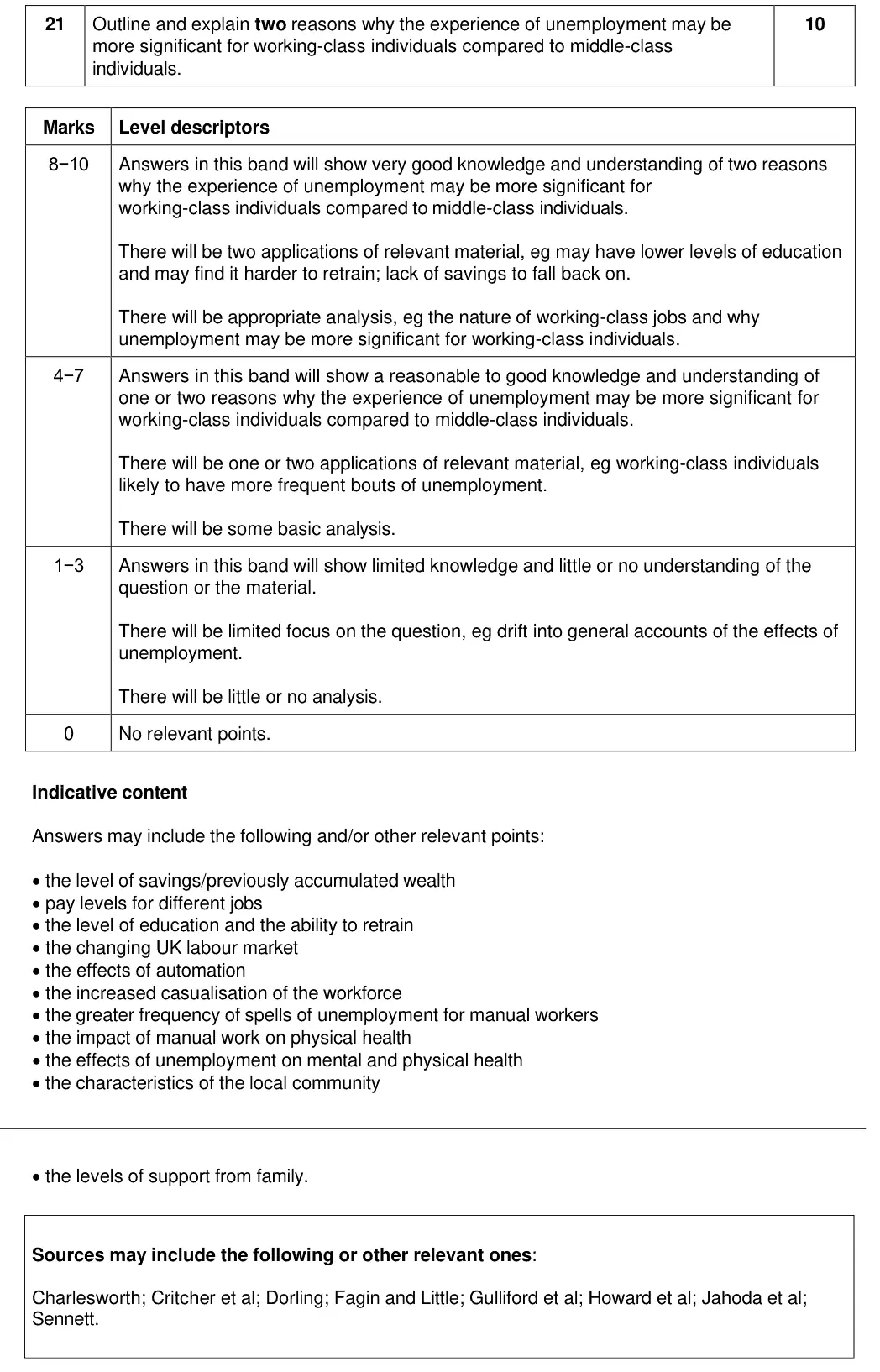
June 2024 · AS Paper 2 · Q2110 marksAO1=5, AO2=3, AO3=2Outline and explain
Mark scheme, including the levels grid and indicative content
Examiner's comment
The ‘outline and explain’ 10-mark question. Here students would benefit more if an explicit identification of a way / reason / factor was made then leading to an explanation of it. So, making the student’s answer more cogent. Responses to this question often used levels of education and accumulated money as their starting point. For example, higher levels of education of the middle class making it easier for them to avoid long periods of unemployment and to be able to find work again quickly. Answers that used money focussed on money providing the middle class with a cushion not available to the working class so making unemployment more significant for the working class. Less effective answers talked about material or educational differences between the working and middle class without bringing them back to bear on how they might affect the significance of unemployment.
Notes from the mark scheme and report
must explain why unemployment matters more for the working class than the middle class
drift into general effects of unemployment = 1–3
common answers: savings as a cushion, education and ability to retrain
weaker answers described class differences without linking them to unemployment
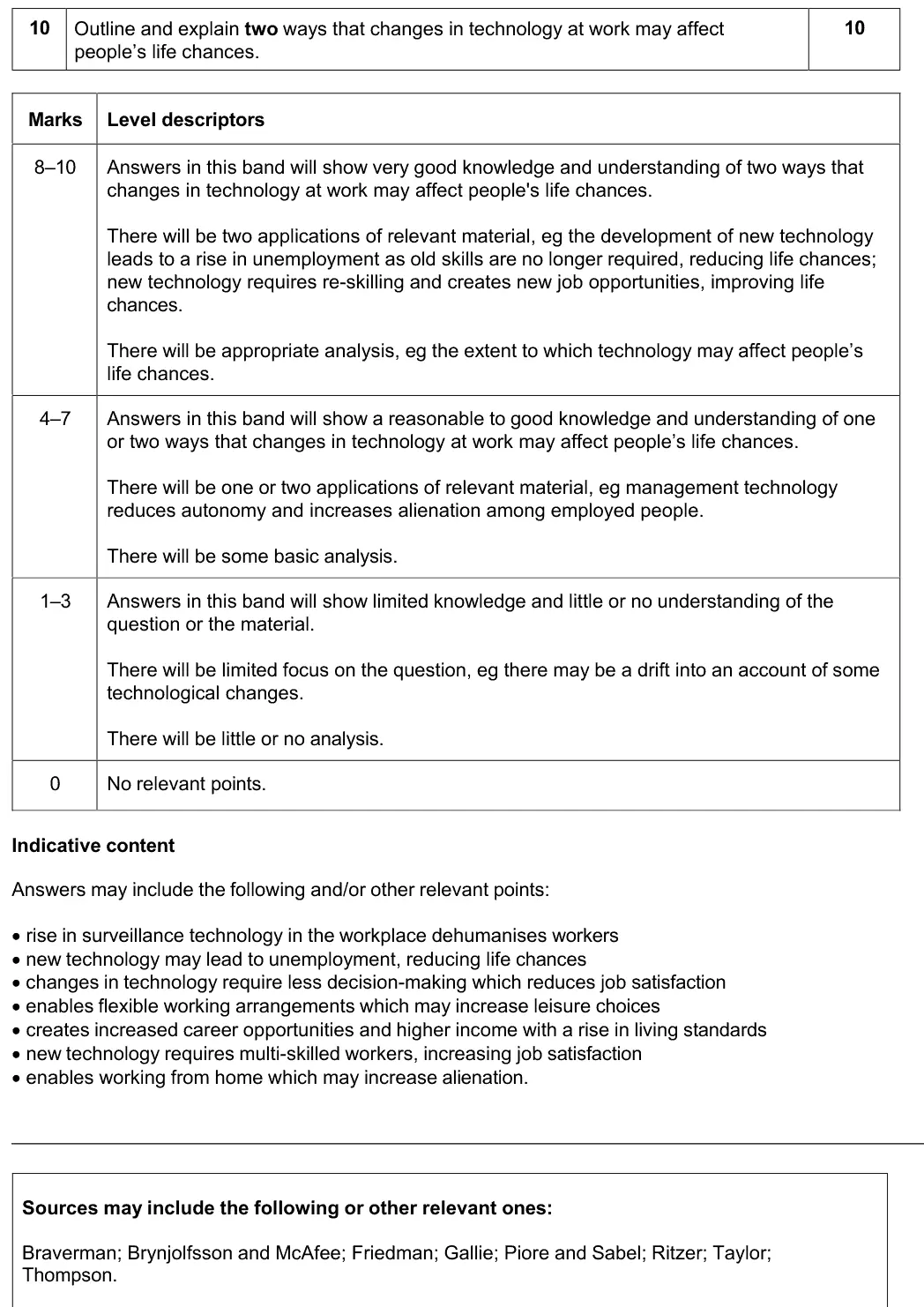
June 2023 · Paper 2 · Q1010 marksAO1=5, AO2=3, AO3=2Outline and explain
Mark scheme, including the levels grid and indicative content
Examiner's comment
The nature of these questions means that students cannot rely on reciting knowledge. Questions will ask them to bring together aspects of their sociological knowledge in ways they are unlikely to have done before. It is therefore important for students to allow time to think about how to answer the question. Students should be made aware that there are two types of 10 mark questions. These have different requirements and different mark schemes. There are different marks available for the assessment objectives. 10 mark “outline and explain” questions have more marks available for knowledge and understanding, and none for evaluation. Introductions and conclusions are not required for 10 mark questions and take up valuable time. It is helpful if answers are set out to clearly indicate the two separate points, with wording such as “One way/reason is…” or by starting a new paragraph for the second point. Answers that give more than two points are unlikely to develop two of them sufficiently. Question 10: Answers often considered how new technology can both make some skills and jobs redundant and can create new opportunities. “Life chances” tended to be taken as employment; looking beyond this would give greater scope for developing points.
Notes from the mark scheme and report
two ways workplace technology affects life chances (deskilling and unemployment, re-skilling and new jobs, surveillance, flexible/home working)
drift into describing technological change = 1–3
answers often treated life chances as employment only, limiting development
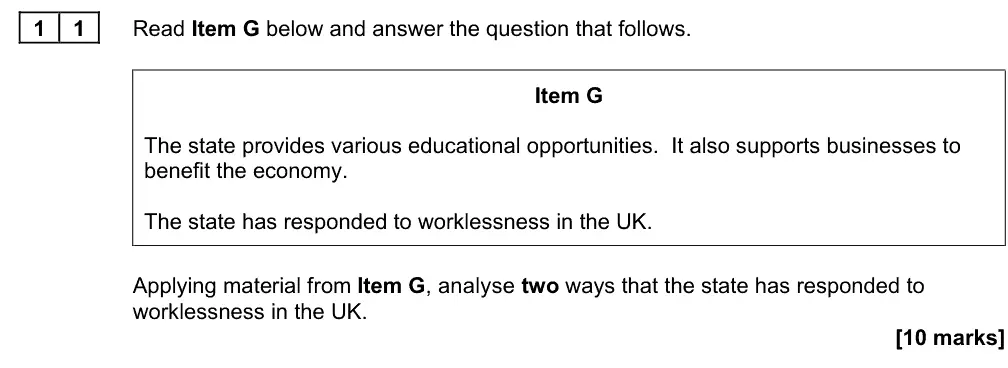
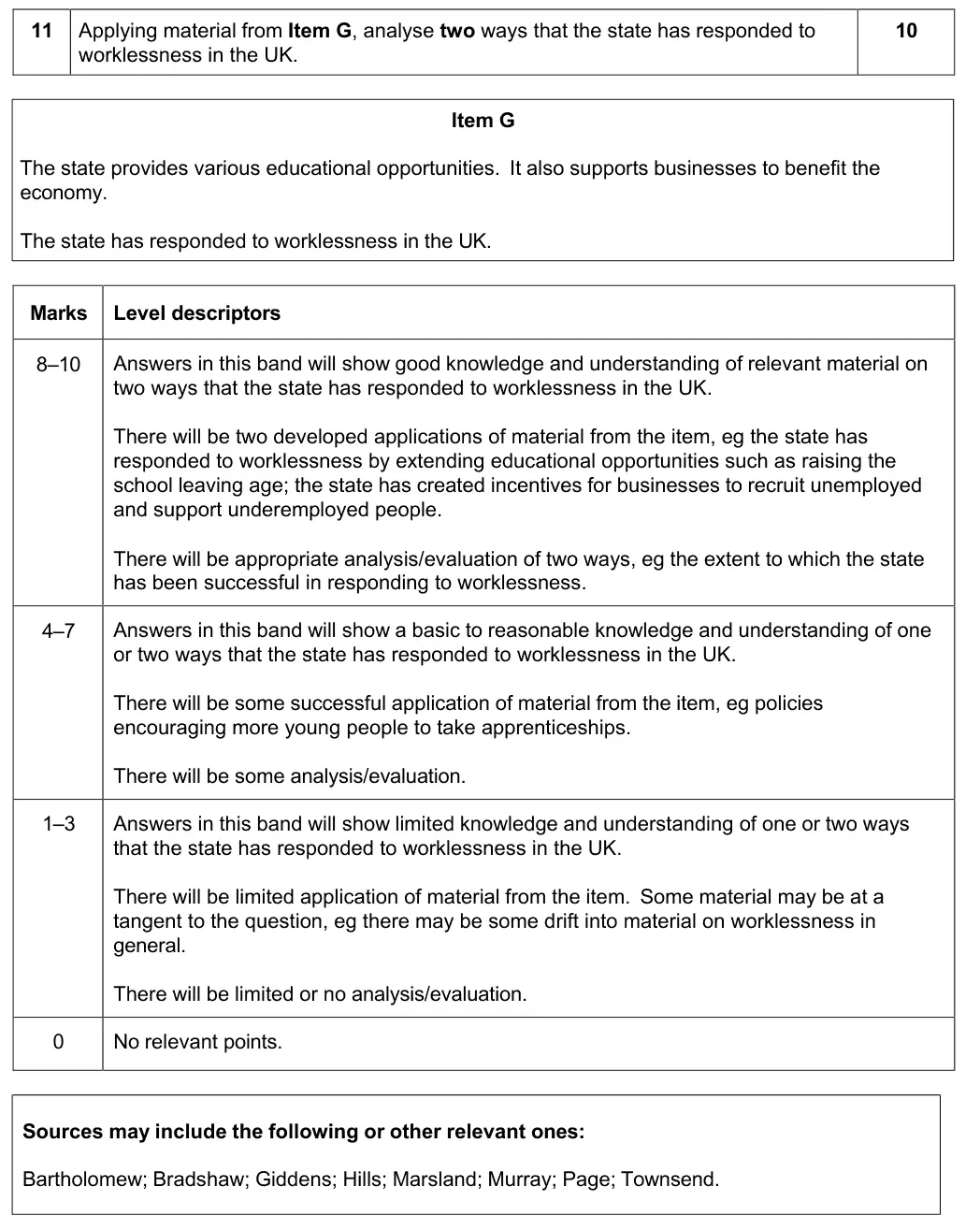
June 2023 · Paper 2 · Q1110 marksAO1=3, AO2=4, AO3=3Analyse
Mark scheme, including the levels grid and indicative content
Examiner's comment
The nature of these questions means that students cannot rely on reciting knowledge. Questions will ask them to bring together aspects of their sociological knowledge in ways they are unlikely to have done before. It is therefore important for students to allow time to think about how to answer the question. Students should be made aware that there are two types of 10 mark questions. These have different requirements and different mark schemes. There are different marks available for the assessment objectives. The items for 10 mark “analyse” questions are written to give prompts or “hooks” for student answers. These have to be used to access application marks. Answers can indicate use of hooks by quoting, by a reference in parentheses or by wording (eg “As the item says…”). Items end with a sentence restating the question; the hooks are in the preceding part of the item. Introductions and conclusions are not required for 10 mark questions and take up valuable time. It is helpful if answers are set out to clearly indicate the two separate points, with wording such as “One way/reason is…” or by starting a new paragraph for the second point. Answers that give more than two points are unlikely to develop two of them sufficiently. Question 11: Answers developed from “educational opportunities” in the item to discuss, for example, apprenticeships. Points from the reference in the item to support for businesses tended to be less well developed.
Notes from the mark scheme and report
hooks: educational opportunities and support for businesses
e.g. raising the leaving age, apprenticeships, incentives to recruit unemployed people
drift into worklessness in general = 1–3
business-support hook less well developed
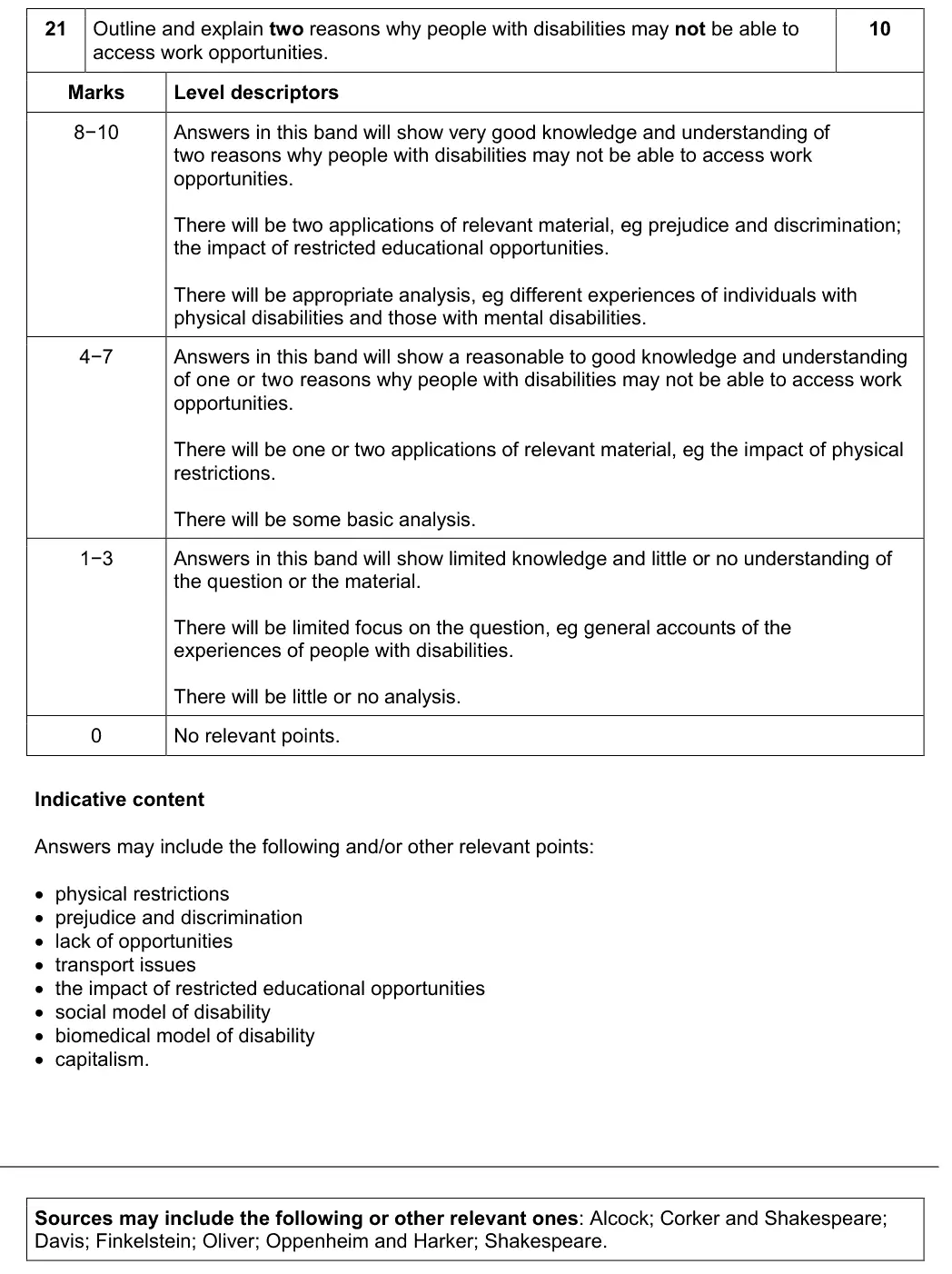
June 2023 · AS Paper 2 · Q2110 marksAO1=5, AO2=3, AO3=2Outline and explain
Mark scheme, including the levels grid and indicative content
Examiner's comment
The ‘outline and explain two’ 10 mark question (the fourth question in every topic area). Here students would benefit more if an explicit identification of a way / reason / factor was made, then leading to an explanation of it, making the student’s answer more cogent. Students generally had no difficulty in finding reasons why people with disabilities may not be able to access work opportunities: discrimination, transport to and from the work place; lack of access within the workplace all featured. The development of the given reasons was the limiting factor for some students who found it difficult to connect the reason to further exploration of it - such as its impact on the individual, its connection with broader sociological perspectives and so on.
Notes from the mark scheme and report
two reasons each developed (e.g. prejudice and discrimination, restricted education, physical and transport barriers, social vs biomedical model)
general accounts of disabled people's experiences = 1–3
reasons were easy to find but development (impact on the individual, links to perspectives) limited marks
June 2022 · Paper 2 · Q1110 marksAO1=3, AO2=4, AO3=3Analyse
Mark scheme, including the levels grid and indicative content
Examiner's comment
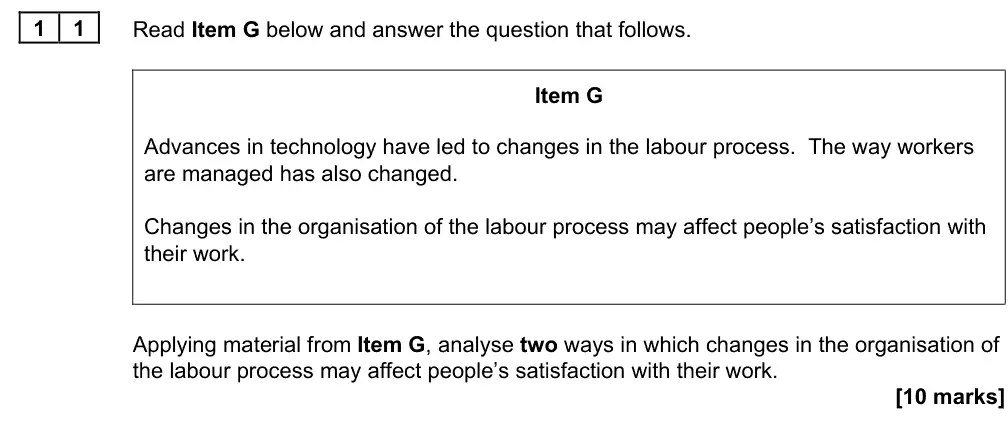
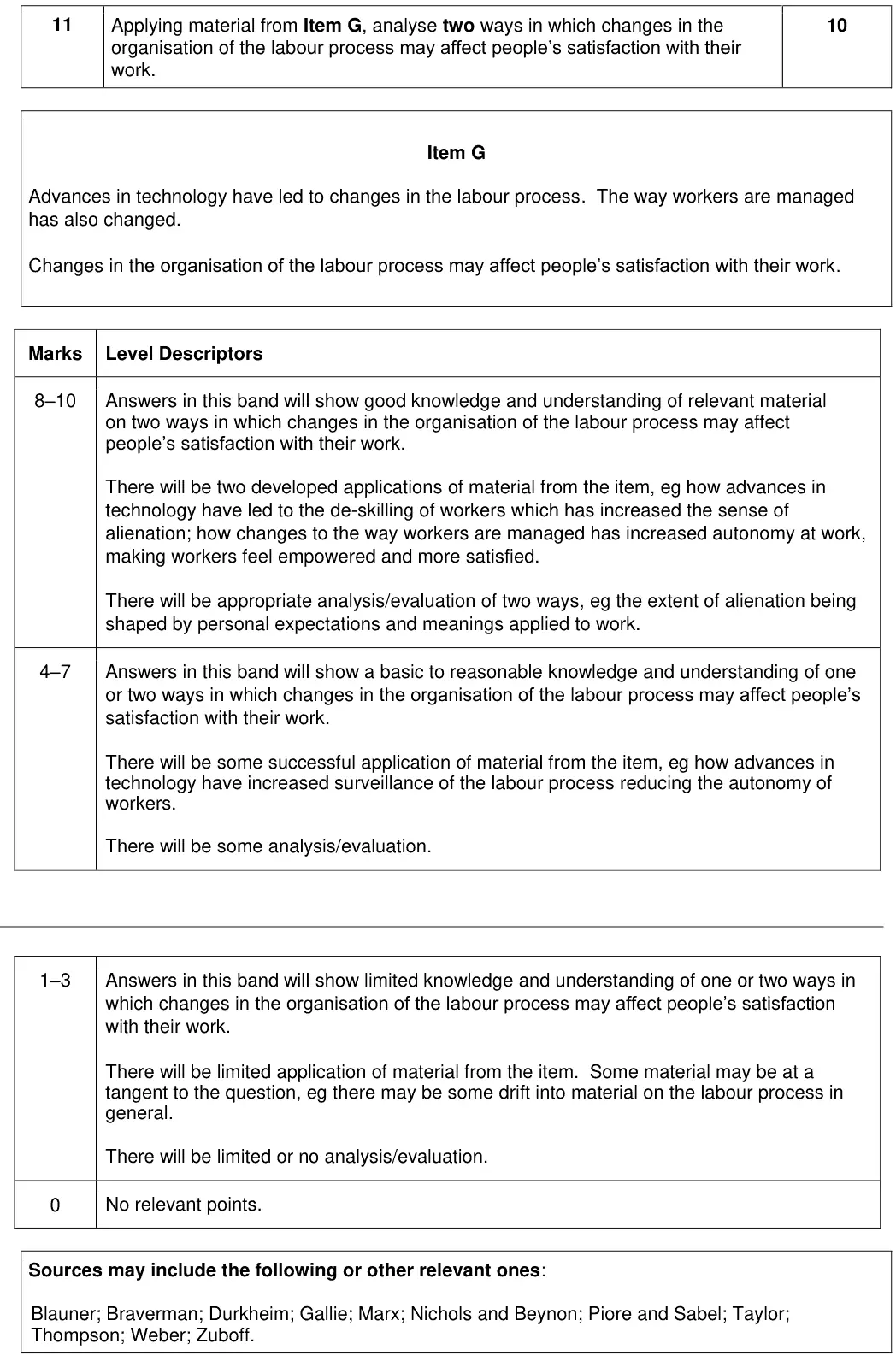
The nature of these questions means that students cannot rely on reciting knowledge. The questions will ask them to bring together aspects of their sociological knowledge in a way that they are unlikely to have done before. There was a tendency, however, to attempt to answer the question by giving knowledge based on words or phrases in the question, rather than meeting the demands of the question. Students are advised to spend time reading the question, and, where there is one the item, to ensure that they are answering the question. Some students seemed unaware of the different demands of the two types of questions. The marks awarded for the assessment objectives are different in the two types of ten mark questions, and students should be aware of this. In “analyse” (with item) questions, the answers need to be clearly based on the prompts or “hooks” in the item, not just on the final sentence of the item which restates the question. There is no need for an introduction or conclusion for 10 mark questions. It is helpful if answers are set out to clearly indicate the two answers, with wording such as “One way is…” or by starting a new paragraph for the second point. The best answers to 10 mark questions were focused, clearly stating a point that addressed the question and then developing it, using sociological concepts, evidence and, where appropriate, theory. Answers need to address all aspects of the question. Q11 For advances in technology, answers focused on, for example, Taylorism, assembly line production and mechanisation, leading to alienation. For changes in the way workers are managed, successful answers included increased surveillance and deskilling and how these may increase stress.
Notes from the mark scheme and report
hooks: technology and changes in management
top band e.g. deskilling increasing alienation, more autonomy raising satisfaction
analysis of how expectations shape alienation
drift into the labour process in general = 1–3 band
common material Taylorism, assembly lines, surveillance, stress
June 2022 · AS Paper 2 · Q2220 marksAO1=8, AO2=6, AO3=620-mark essay
Mark scheme, including the levels grid and indicative content
Examiner's comment
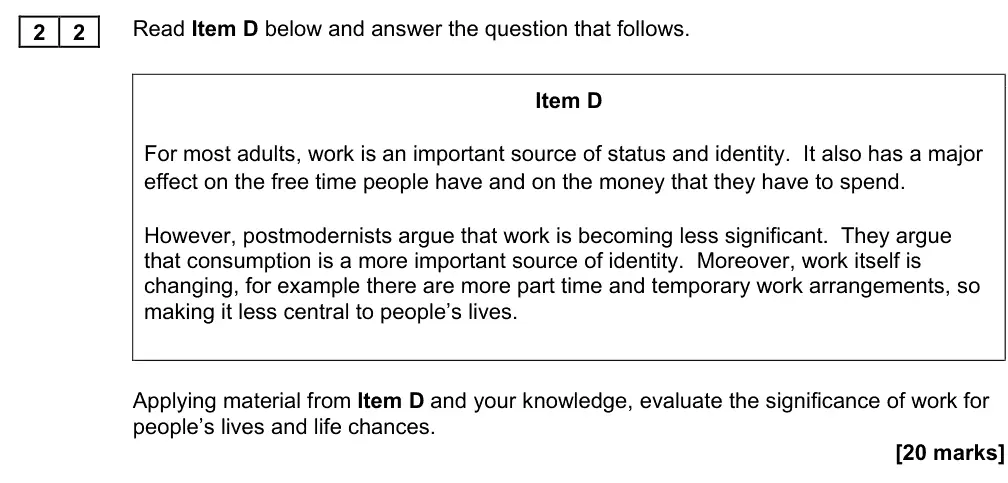
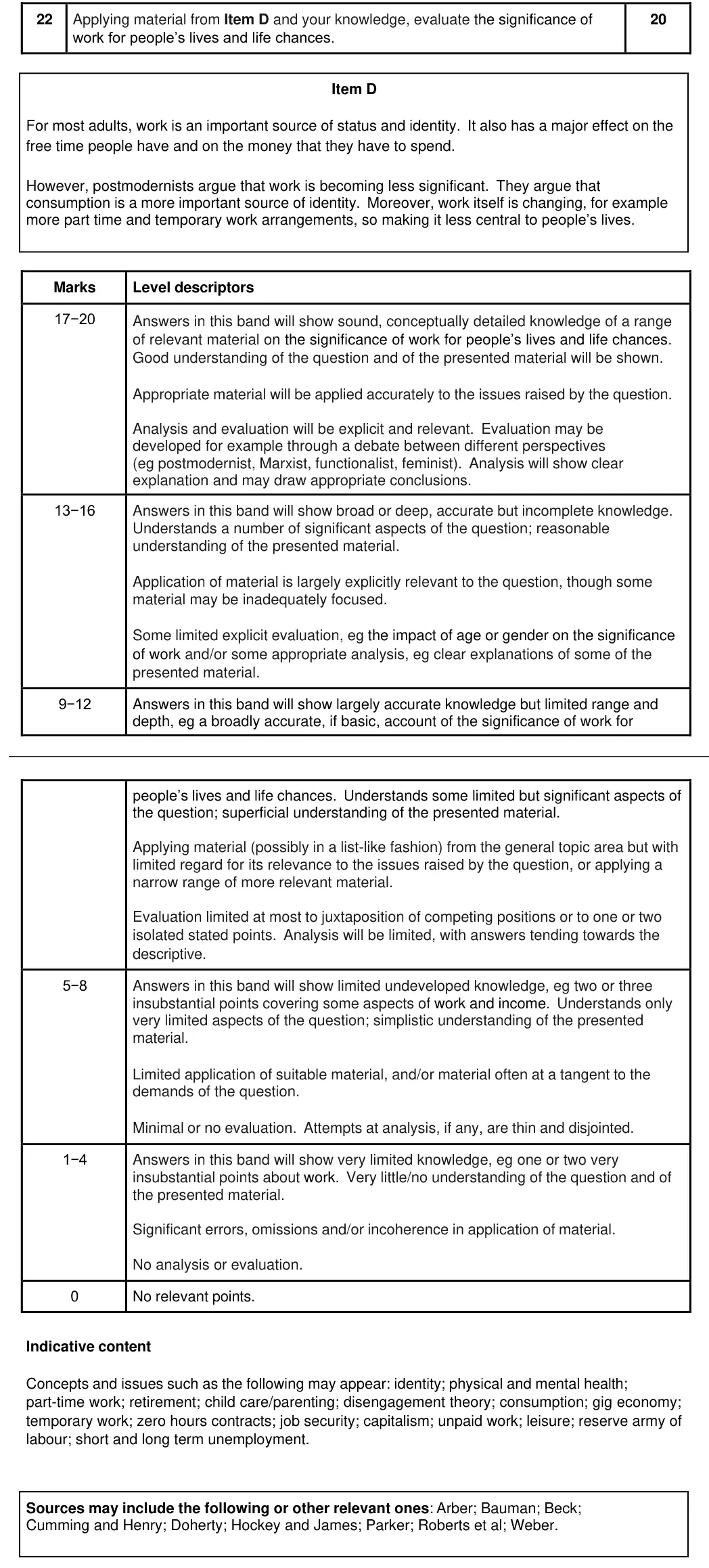
Answers to essay questions were sometimes disjointed; it would be worth students considering making a brief plan for the 16 and 20 mark questions. There were a number of different types of responses to this question. Some tended to discuss the significance of work to income and why money is important in terms of social status. This was sometimes linked to a discussion of social class and life chances, particularly the risk of unemployment. Ethnicity and gender were sometimes applied effectively when considering the significance of work for people’s lives and life chances. Part-time work was often presented as an opportunity to pursue hobbies and interests; the drop in income was rarely considered. Marxism was sometimes applied to work and life chances; postmodernism was often stated in answers and linked to choice of work. The best answers addressed the debate surrounding the significance of work by locating it within the theoretical framework of Marxism, feminisms and postmodernism.
Notes from the mark scheme and report
top band debates postmodernist, Marxist, functionalist and feminist views of the significance of work
hooks: status, identity, consumption, part-time and temporary work
best answers located the debate in Marxist, feminist and postmodern theory
part-time work rarely linked to loss of income
November 2021 · Paper 2 · Q1010 marksAO1=5, AO2=3, AO3=2Outline and explain
Mark scheme, including the levels grid and indicative content
Notes from the mark scheme and report
no marks for evaluation in this question type
ways must be about women's experience of work, e.g. gender pay gap, insecure or part-time work, career breaks, less pension provision
gender differences in poverty not linked to work = 1–3
no examiners' report comment for this part
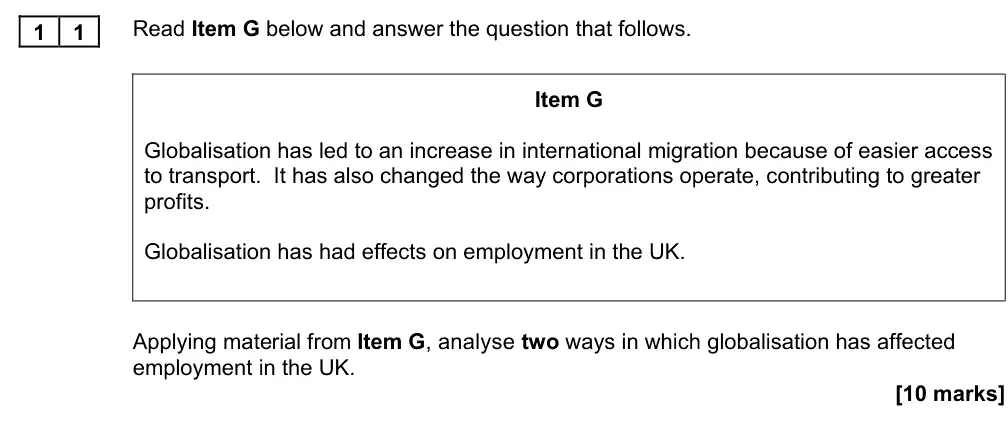
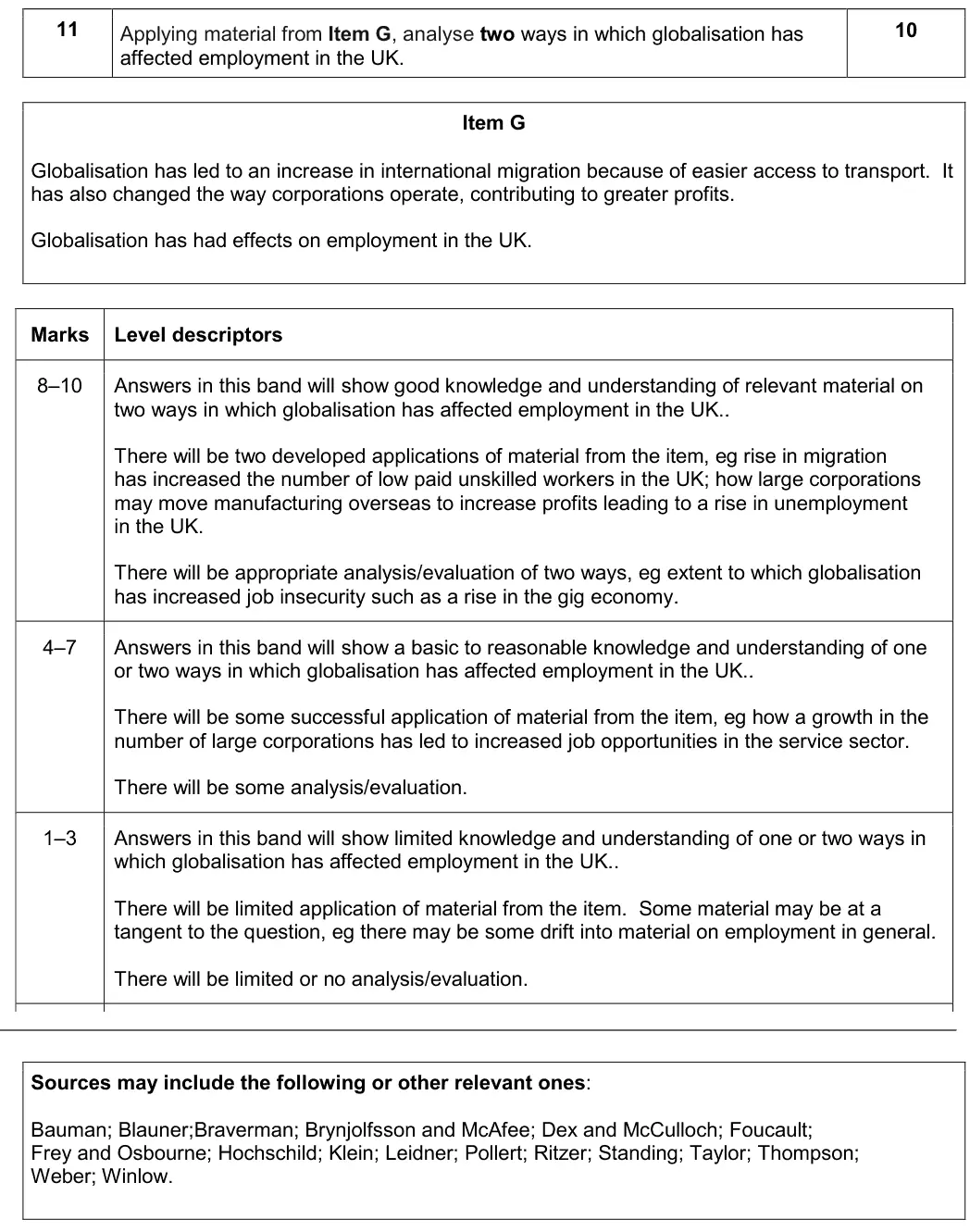
November 2021 · Paper 2 · Q1110 marksAO1=3, AO2=4, AO3=3Analyse
Mark scheme, including the levels grid and indicative content
Notes from the mark scheme and report
must develop hooks from Item G (migration, corporations seeking profit)
the last line restates the question and is not a hook
credited: more low-paid migrant labour, offshoring manufacturing and job losses, service-sector jobs, gig economy insecurity
drift into employment in general = 1–3
no examiners' report comment for this part
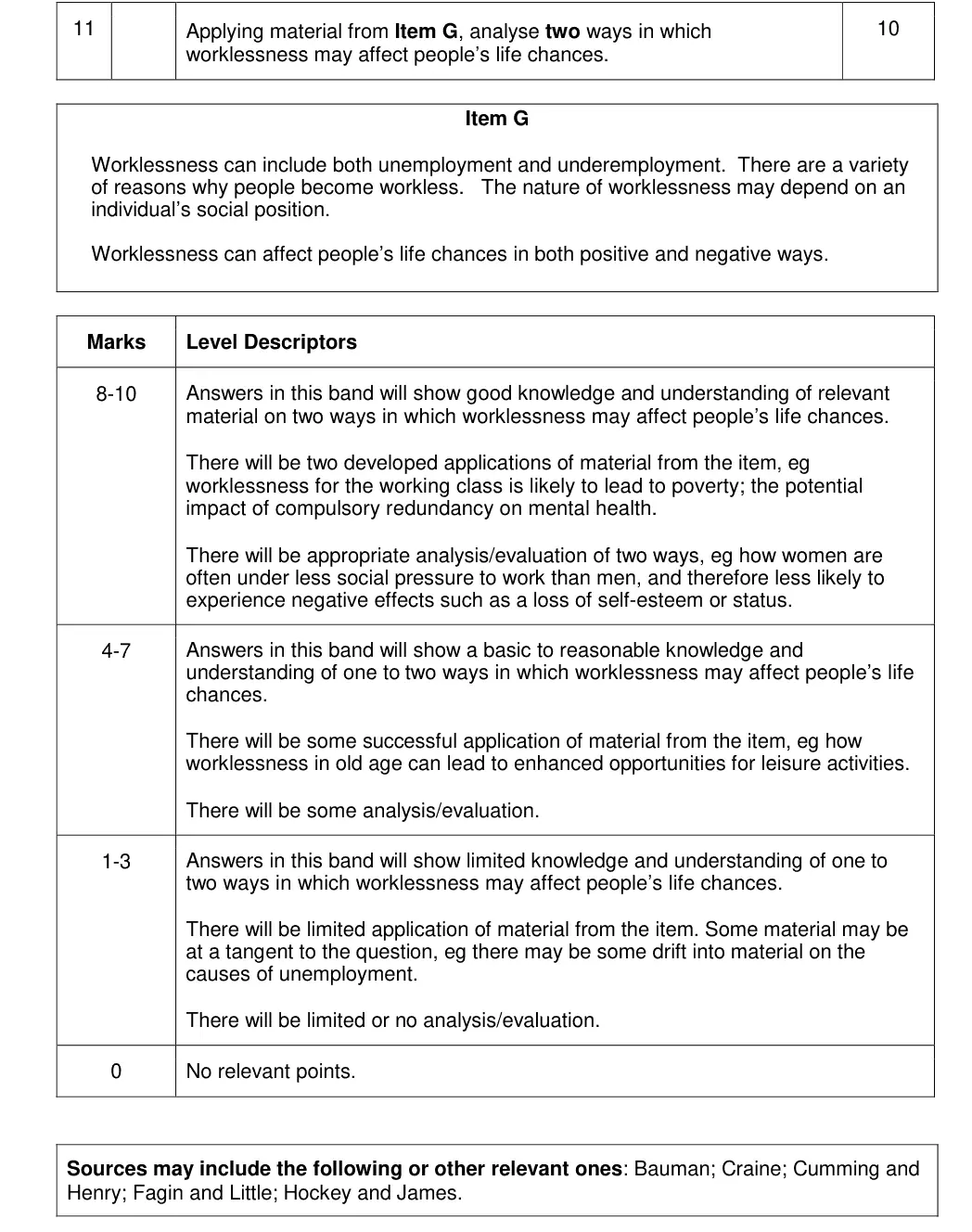
November 2020 · Paper 2 · Q1220 marksAO1=8, AO2=6, AO3=620-mark essay
Mark scheme, including the levels grid and indicative content
Notes from the mark scheme and report
apply Item H (retired, unable to work, unemployed, wealthy non-workers
work less central to identity)
evaluation via Marxist, postmodernist, feminist explanations or the significance for different life chances
a basic account of types of worklessness = 9-12
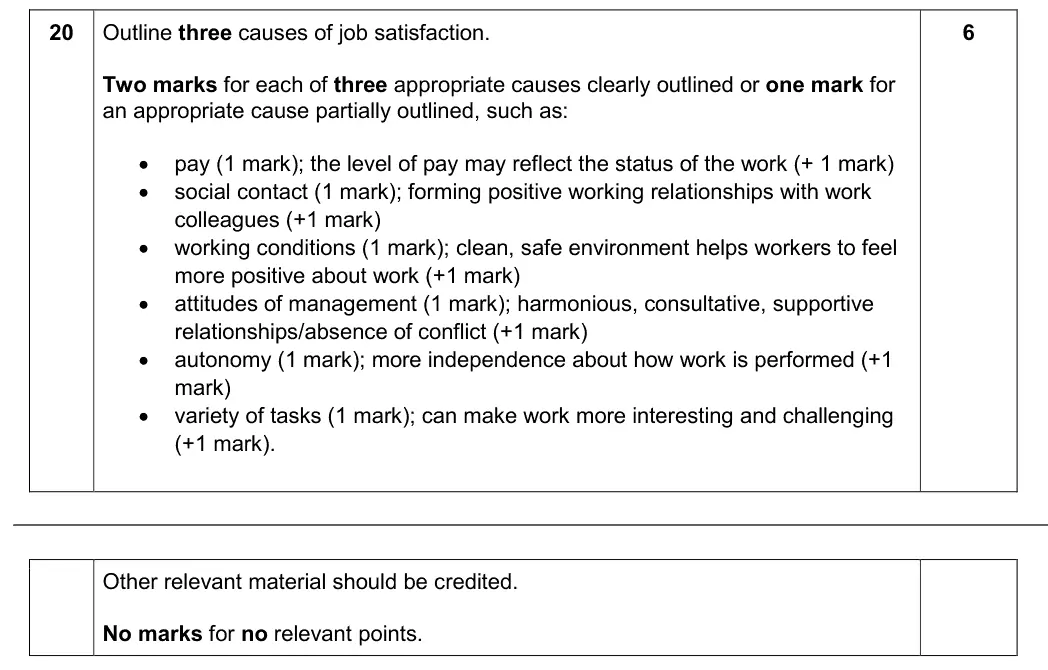
November 2020 · AS Paper 2 · Q206 marksAO1=6Outline
Mark scheme
Notes from the mark scheme and report
2 marks for each of three causes clearly outlined, 1 if partial
creditable: pay, social contact, working conditions, management attitudes, autonomy, task variety
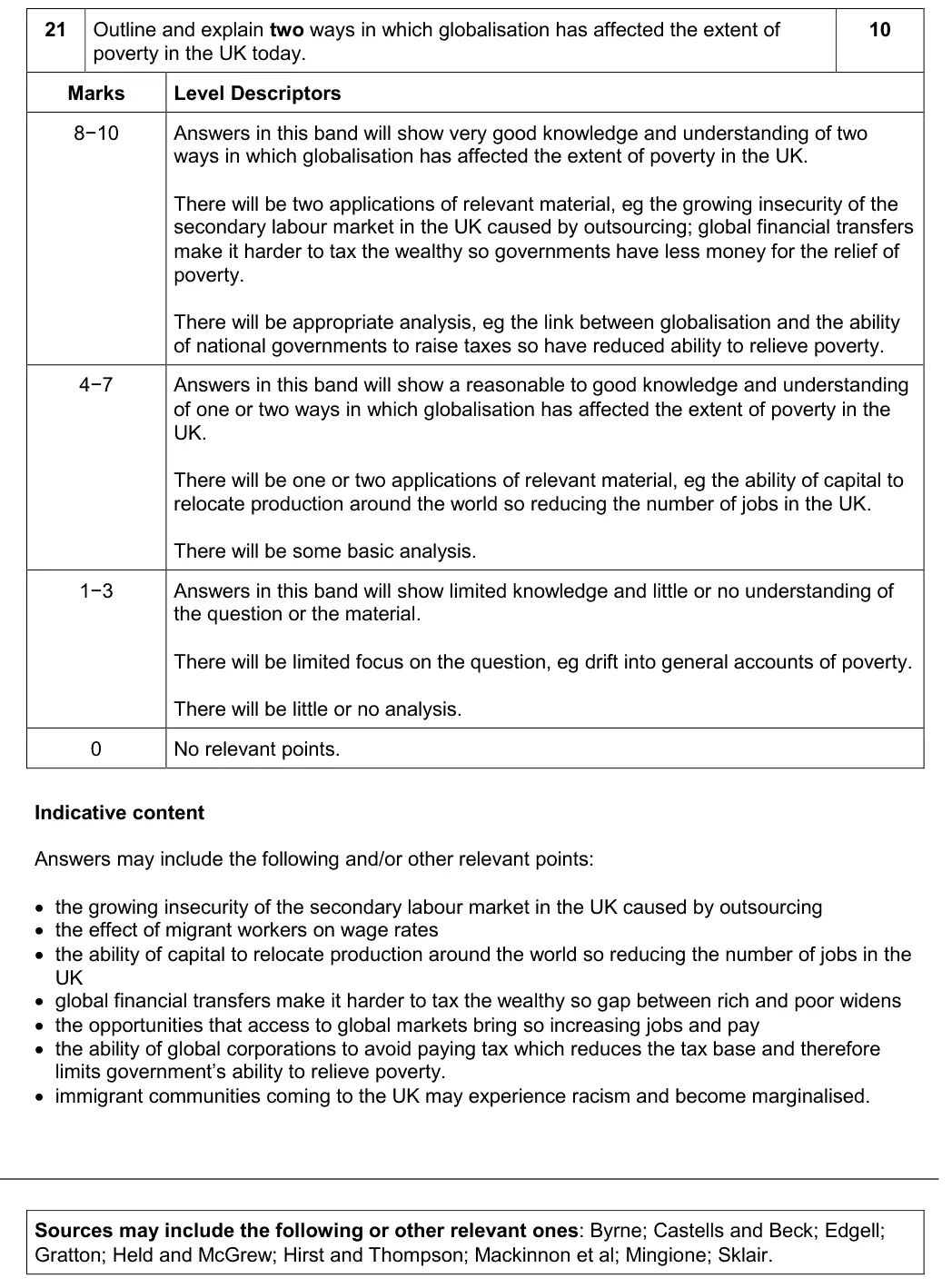
November 2020 · AS Paper 2 · Q2110 marksAO1=5, AO2=3, AO3=2Outline and explain
Mark scheme, including the levels grid and indicative content
Notes from the mark scheme and report
must link globalisation to the extent of poverty in the UK (outsourcing and insecure secondary labour market, relocation of jobs, tax avoidance reducing state relief)
general accounts of poverty = 1–3 band
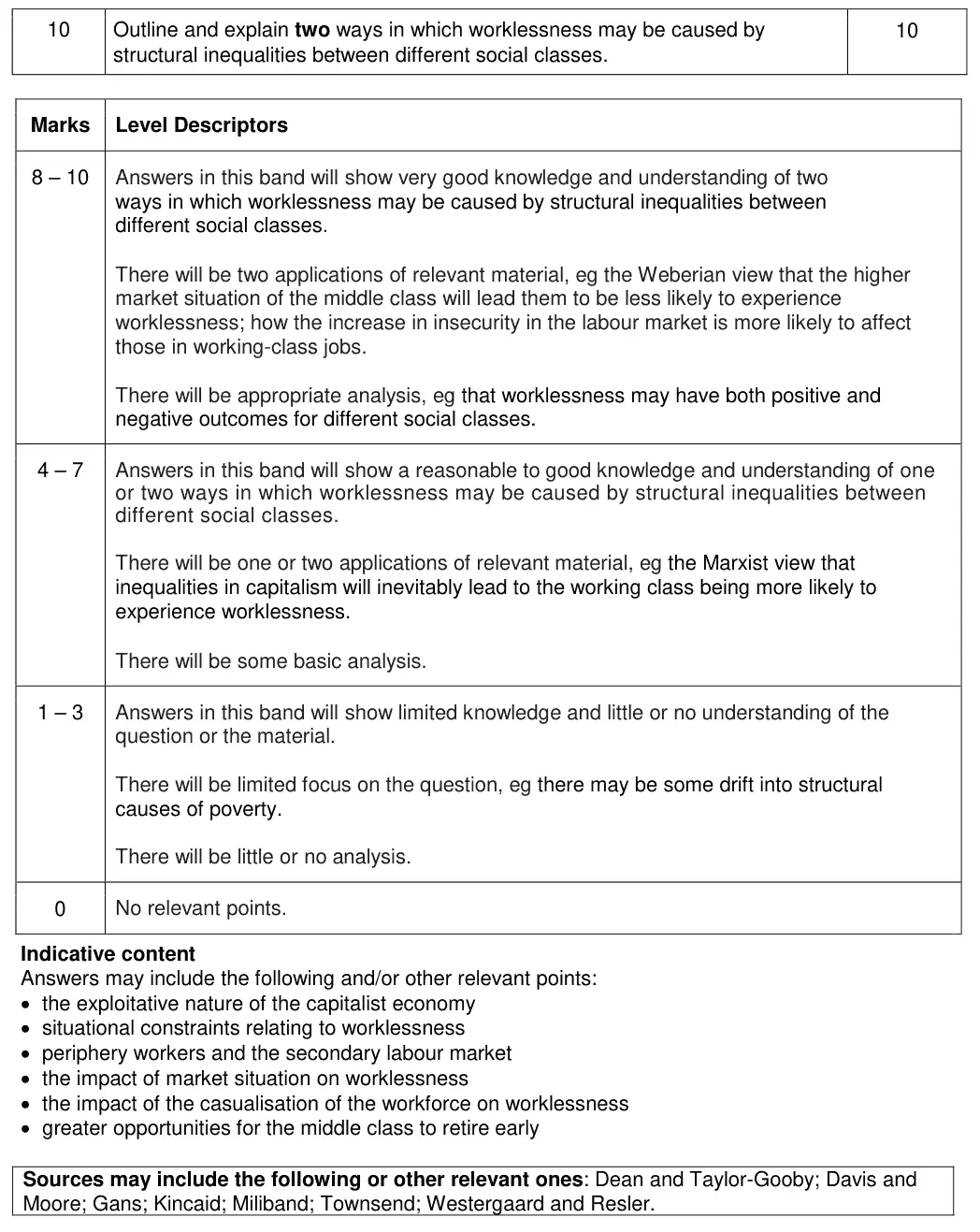
June 2019 · Paper 2 · Q1010 marksAO1=5, AO2=3, AO3=2Outline and explain
Mark scheme, including the levels grid and indicative content
Examiner's comment
Some students wrote introductory paragraphs and/or conclusions. These are not necessary, and are unlikely to gain additional marks; they also take up time. Some students made only one point in their answers, or three or more, rather than the two asked for. The word ‘two’ is put in bold in the question to try and draw students’ attention to this. Sometimes it was not clear how many points were being made. It is helpful for students to clearly indicate their two answers, with wording such as “One way is…” or by starting a new paragraph for their second point. Notably, some students wrote far more than was needed for a 10-mark response. The two types of 10-mark question, “outline and explain” and “analysis” types, are marked differently as the assessment objectives have different weightings. It is important that students are aware of this. In particular they should note that evaluation is not a requirement for answers to 10 mark “outline and explain” questions. For 10 mark “outline and explain” questions, students cannot rely on reciting knowledge; these questions will ask them to bring together aspects of their sociological knowledge of the topic in a way that they are unlikely to have done before. The best answers to 10-mark questions were focused, clearly stating a point and then developing it, and used sociological concepts, studies, evidence and theory as appropriate. A number of students were unsure of the meaning of “structural inequalities”, and some discussed cultural reasons for worklessness, such as welfare dependency or a culture of poverty. There was a tendency also to interpret ‘worklessness’ as only unemployment.
Notes from the mark scheme and report
must be structural class inequalities
cultural explanations (dependency culture, culture of poverty) not credited
drift into structural causes of poverty = 1–3
many misread worklessness as unemployment only
AO split from AQA's standard grid for this paper (this year's mark scheme does not print it).
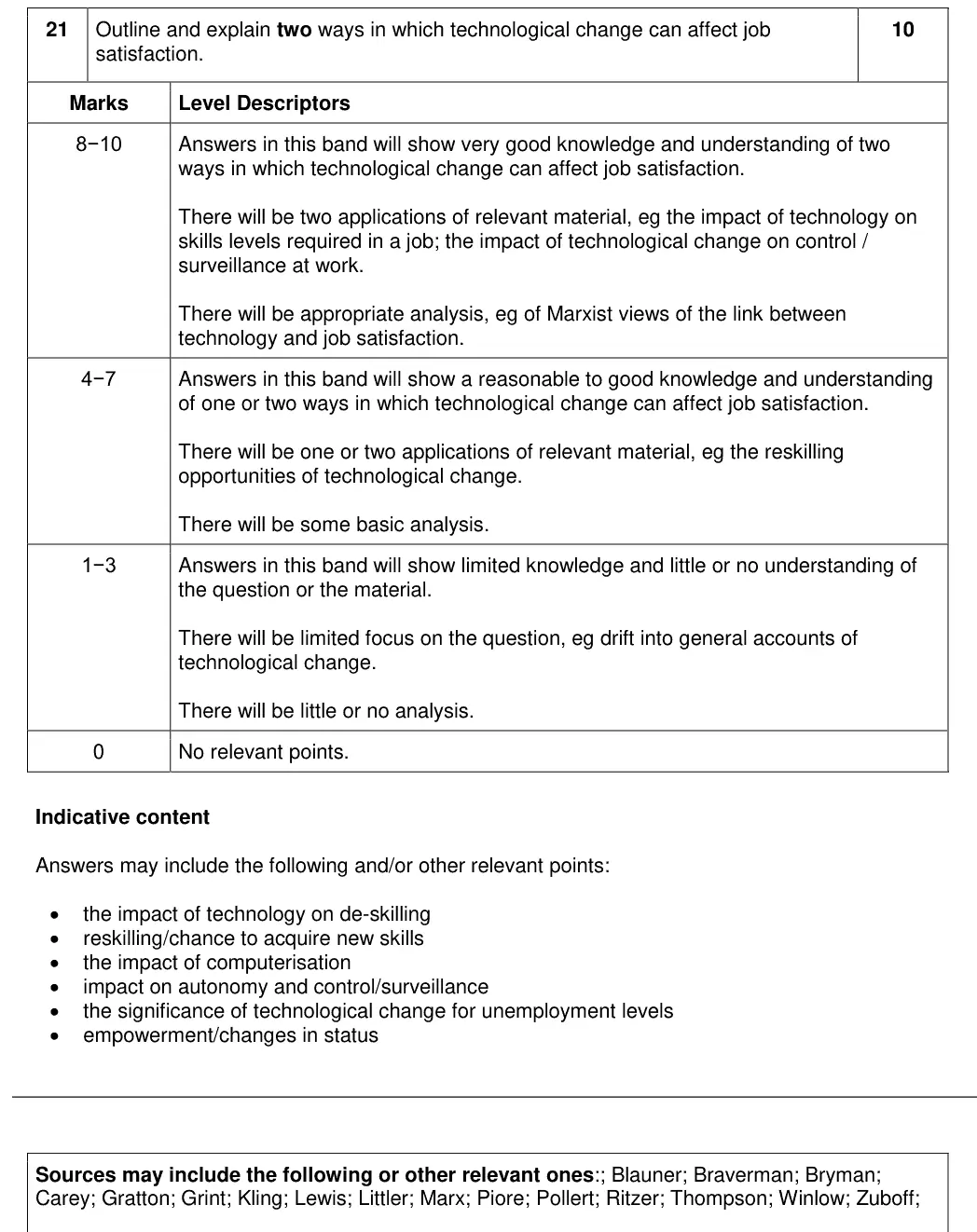
June 2019 · AS Paper 2 · Q2110 marksAO1=5, AO2=3, AO3=2Outline and explain
Mark scheme, including the levels grid and indicative content
Examiner's comment
The requirements of the 10-mark question seem to be well understood by the majority of students. The best answers tended to start with job satisfaction and discuss the impact of technological change on skill levels. Many answers referred to alienation and these answers were able to provide a fuller account of the impact of technological change on job satisfaction. Some answers were able to discuss at length Fordism and the views of Braverman on autonomy and control in the workplace. Weaker answers focused on technological change and often neglected to relate these ideas to the workplace, let alone to job satisfaction.
Notes from the mark scheme and report
AO grid not printed
no marks for evaluation in this question type
two ways each developed, e.g. de-skilling or re-skilling, control and surveillance
best answers started from job satisfaction and used alienation, Braverman, Blauner
general accounts of technological change not tied to work = 1–3
AO split from AQA's standard grid for this paper (this year's mark scheme does not print it).
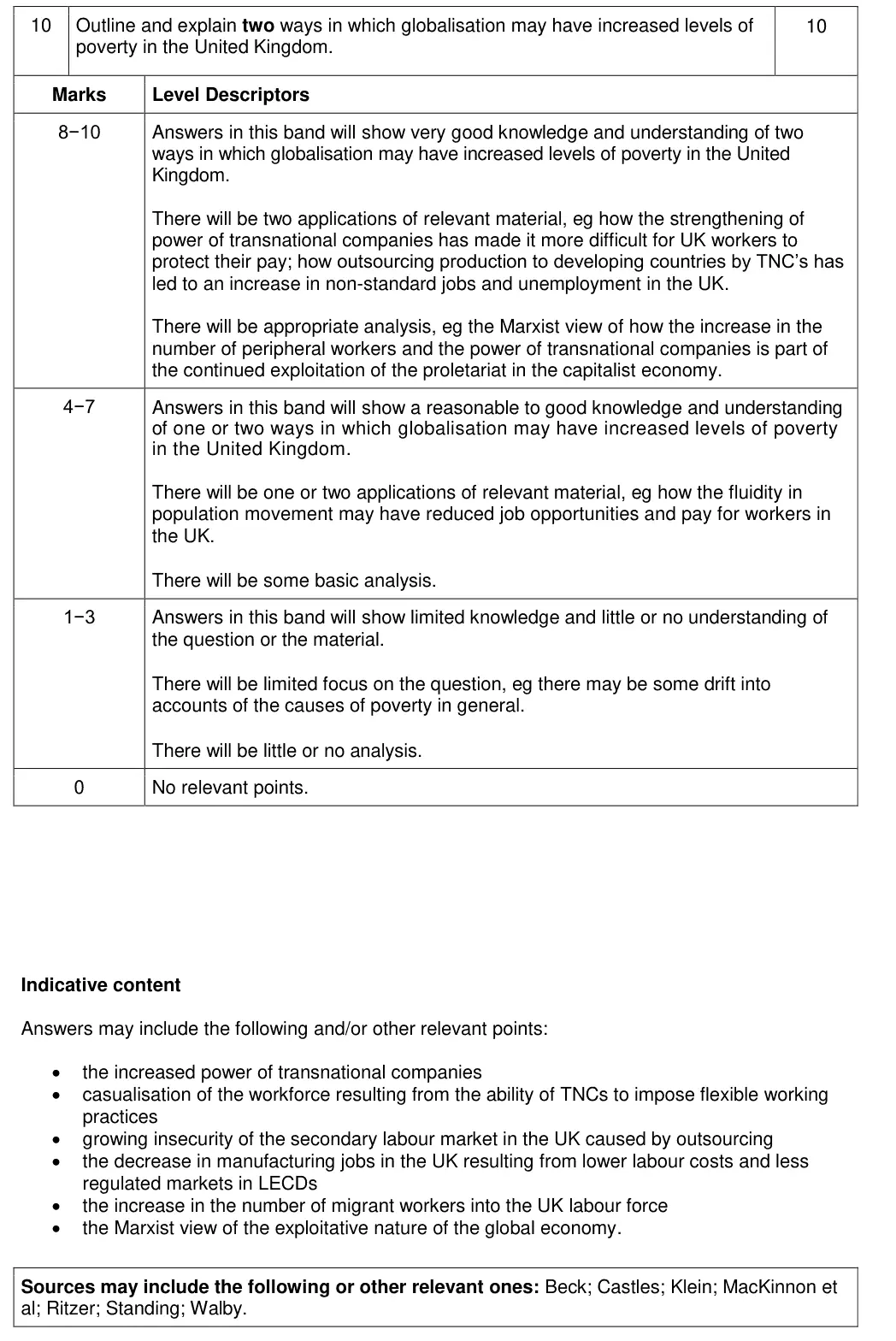
June 2018 · Paper 2 · Q1010 marksAO1=5, AO2=3, AO3=2Outline and explain
Mark scheme, including the levels grid and indicative content
Examiner's comment
Some students wrote introductory paragraphs and/or conclusions. These are not necessary, and are unlikely to gain additional marks, and they also take up time. Some students made only one point in their answers, or three or more, rather than the two asked for in the question. Sometimes it was unclear how many points were being made. It is helpful for students to clearly indicate their two answers, with wording such as “One way is…” or by starting a new paragraph for their second point. Evaluation is not a requirement for answers to 10 mark “outline and explain” questions. The marks awarded for the assessment objectives being targeted are different in the two types of ten mark questions, and students should be made aware of this. The best answers to 10 mark questions were focused, clearly stating a point and then developing it, using sociological concepts, evidence and theory where appropriate. In some questions students tended to focus on the first aspect of the question at the expense of the second. Students need guidance on how to approach these questions and how to best demonstrate their sociological understanding. The nature of these questions means that students cannot rely on reciting knowledge. These questions will ask them to bring together aspects of their sociological knowledge in a way that they are unlikely to have done before. Most students were aware of ways in which globalization may have increased levels of poverty in the United Kingdom. A small number misinterpreted the question by including material on poverty in countries other than the United Kingdom. Popular ‘ways’ in answer to this question included outsourcing and migration.
Notes from the mark scheme and report
two ways globalisation raised poverty in the UK (e.g. TNC power and outsourcing, casualisation, loss of manufacturing jobs, migration)
poverty in other countries not credited
drift into causes of poverty in general = 1–3
AO split from AQA's standard grid for this paper (this year's mark scheme does not print it).
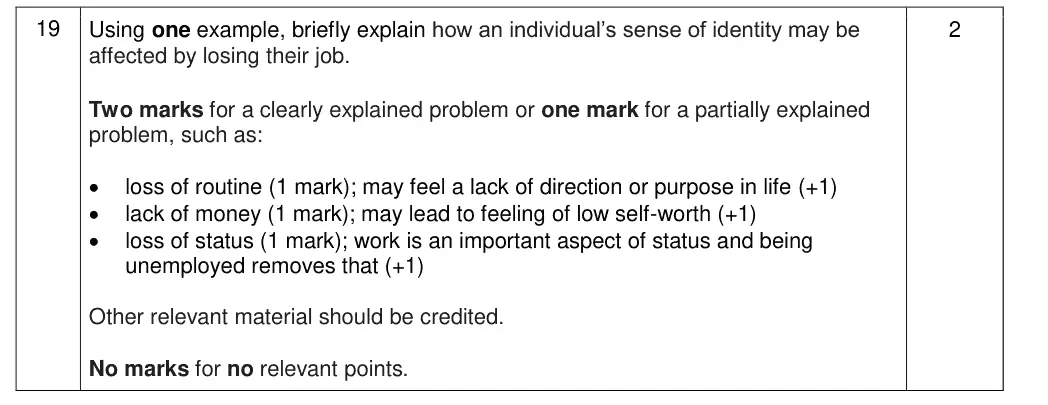
June 2018 · AS Paper 2 · Q192 marksAO2=2Brief explain
Mark scheme
Examiner's comment
The most common responses explained the impact of loss of routine or loss of purpose on an individual’s sense of identity. Unsuccessful answers tended to repeat the question without actually explain the impact of loss of job on identity.
Notes from the mark scheme and report
credited: loss of routine/purpose, lack of money and self-worth, loss of status
repeating the question without the effect on identity = no credit
AO split from AQA's standard grid for this paper (this year's mark scheme does not print it).
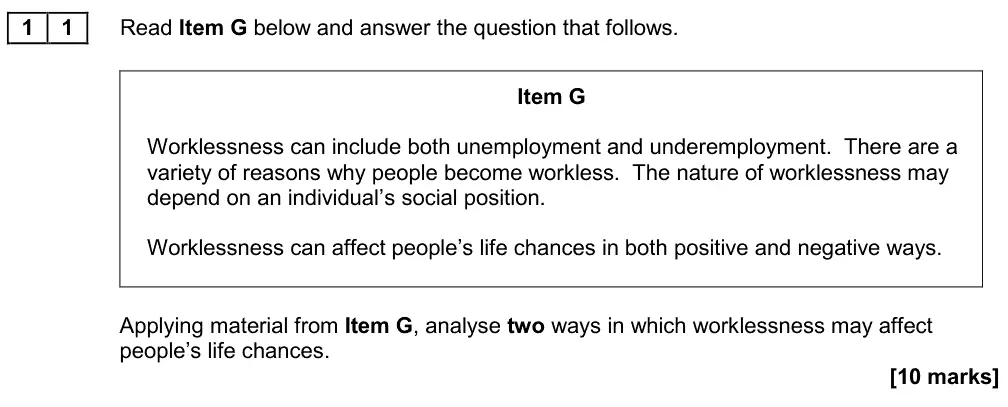
June 2017 · Paper 2 · Q1110 marksAO1=3, AO2=4, AO3=3Analyse
Mark scheme, including the levels grid and indicative content
Examiner's comment
A number of students wrote introductory paragraphs and/or conclusions. These are not necessary, and are unlikely to gain additional marks. A number of students made only one point in their answer, or three or more, rather than the two asked for. In these cases, the two best answers were rewarded and will be in future series. It is helpful for students to clearly indicate their two answers, with wording such as “One way is…” or by starting a new paragraph for their second point. The assessment objective allocations are different in the two types of 10 mark questions, and students should be made aware of this. There was a wide range of responses to these questions. A minority of students wrote very brief answers. For these 10 mark items, a simple statement of two ways, reasons or factors, without development, is not sufficient to access more than the lower marks in the mark range. The best answers were focused, clearly stating a point and then developing it, with use of sociological concepts, evidence and theory where appropriate, in ways that demonstrated the skills expected from the targeted assessment objectives. There was a tendency, however, for many answers to focus on the first aspect of the question at the expense of the second. Students need guidance on how to approach these questions and how to best demonstrate their sociological understanding. The nature of these questions means that students cannot rely on reciting knowledge. They require students to bring together two aspects of their sociological knowledge in a way that they are unlikely to have done before. Answers will sometimes require claims that students may be unsure of because they do not know of specific evidence (for example, in question 5, whether migrants from Eastern Europe who are single workers tend to live alone or in shared households). However, answers that are sociologically plausible will be accepted. There was a tendency, despite the item, for worklessness to be seen as synonymous with unemployment. Some answers gave reasons for worklessness rather than analysing ways in which life chances were affected. Better answers moved beyond basic points about lack of income to using concepts such as anomie and marginalisation.
Notes from the mark scheme and report
item defines worklessness as unemployment and underemployment, with positive and negative effects
many still treated it as unemployment only
drift into causes of unemployment = 1–3
better answers went beyond income loss to anomie and marginalisation
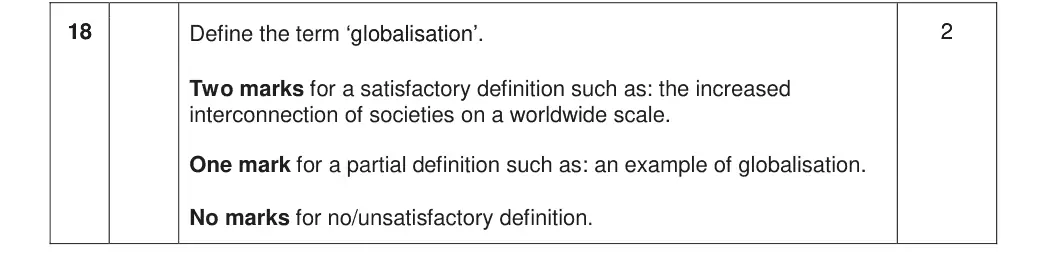
June 2017 · AS Paper 2 · Q182 marksAO1=2Define
Mark scheme
Examiner's comment
Most successful answers made reference to the interconnectedness of countries. Partial answers tended to provide an example of globalisation, such as a transnational corporation.
Notes from the mark scheme and report
2 marks: increasing interconnection of societies worldwide
an example only (e.g. a TNC) = 1 mark
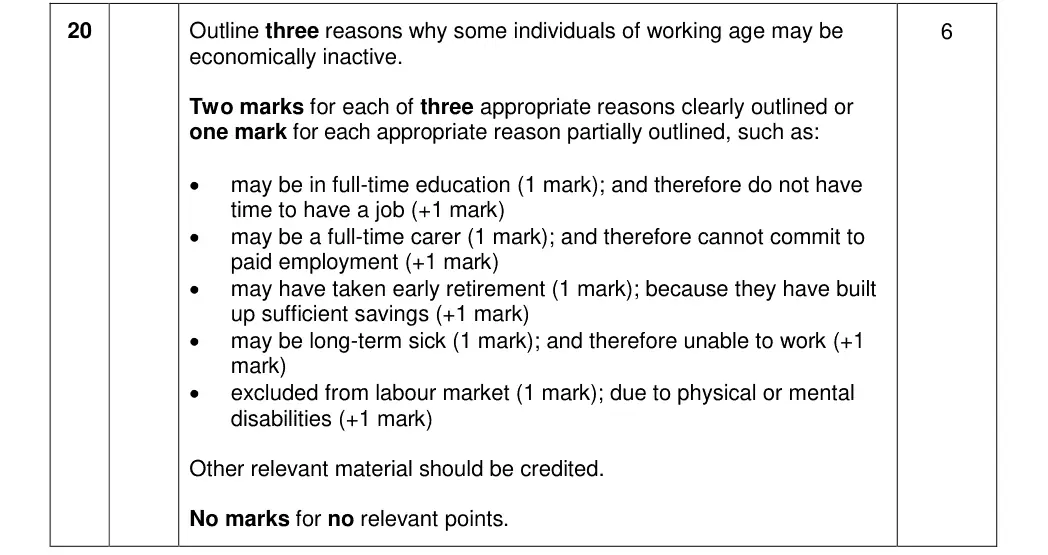
June 2017 · AS Paper 2 · Q206 marksAO1=6Outline
Mark scheme
Examiner's comment
Additionally, some students are writing far too much on the 6 mark questions. This time could be better spent on the longer essay questions. In general, many students struggled with this question. They seemed to be unfamiliar with the idea that economically inactive did not include those who are unemployed (ie looking for work). Many answers therefore defaulted into an explanation for unemployment. Some students took this question as an opportunity to express the idea that those on benefit were lazy and undeserving of support. These answers often struggled to address the actual question. Successful answers made reference to groups such as full time carers, those who were disabled or long term sick and therefore unable to work, people who had taken early retirement and people who were in higher education.
Notes from the mark scheme and report
2 marks for each of three reasons clearly outlined
economically inactive excludes the unemployed (who are seeking work), so many wrongly explained unemployment
credited: full-time education, carers, early retirement, long-term sick or disabled
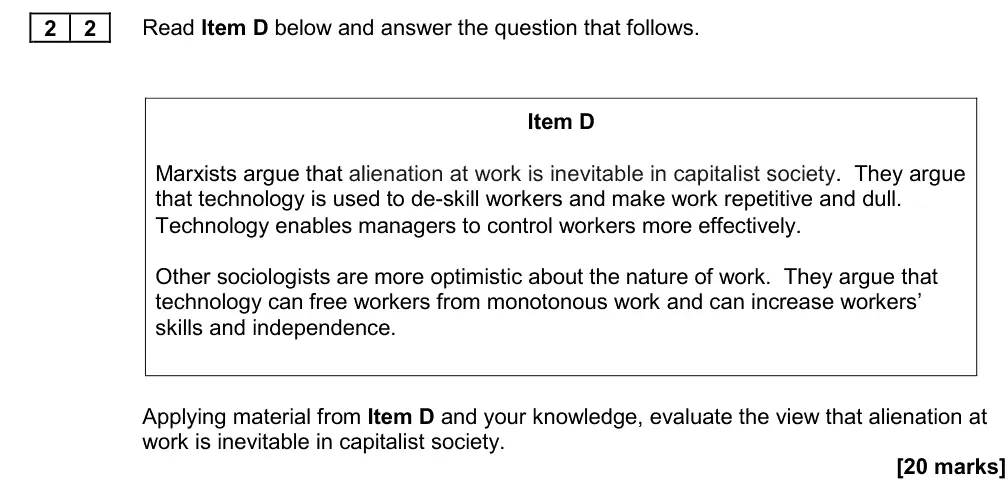
June 2017 · AS Paper 2 · Q2220 marksAO1=8, AO2=6, AO3=620-mark essay
Mark scheme, including the levels grid and indicative content
Examiner's comment
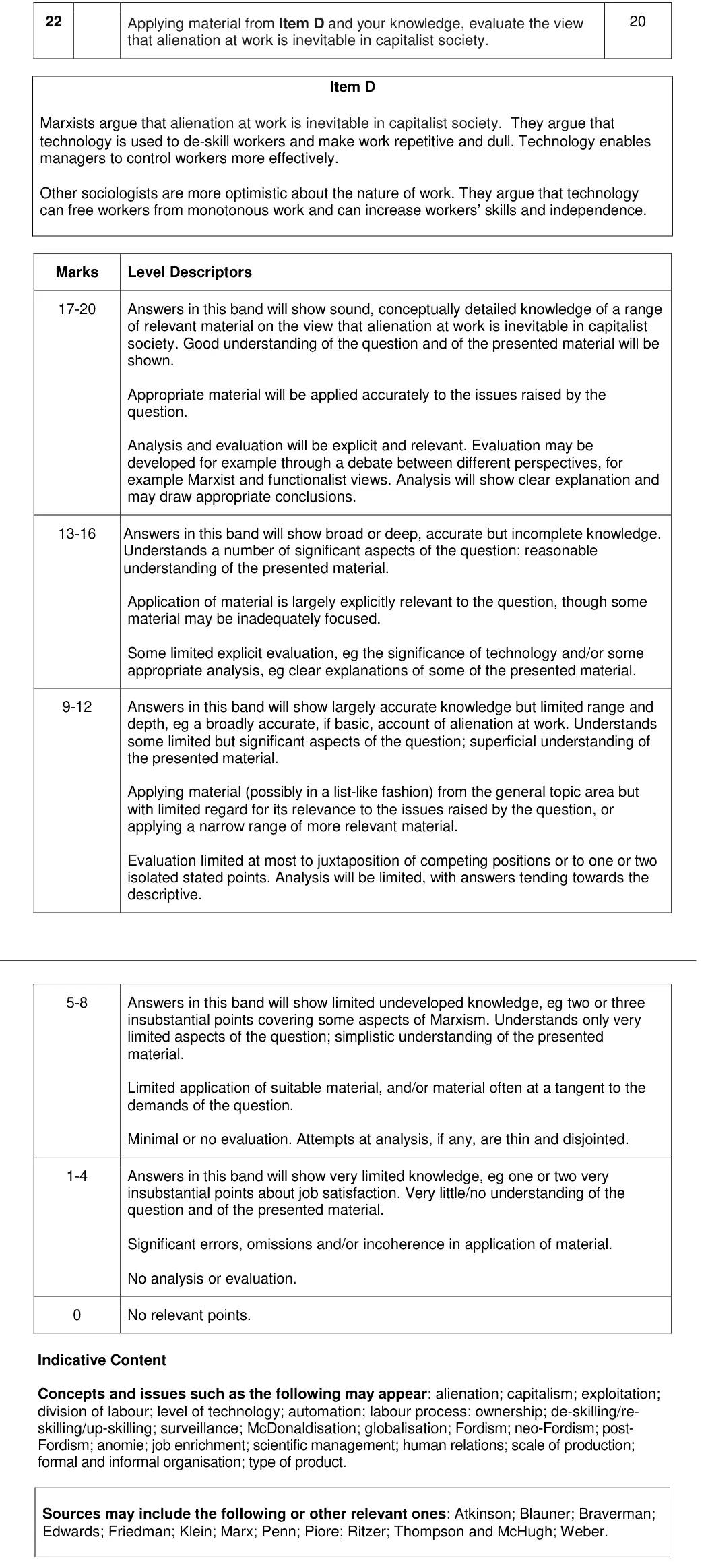
There were some very good responses to this question. Many answers gave a clear account of different aspects of alienation and were able to discuss different perspectives on the issue of whether alienation is inevitable in capitalist society. These answers often started with the Marxist view of alienation and then discussed the impact of technology on the labour process. Typical answers referred to automation, deskilling, re-skilling, Fordism, post-Fordism, job enrichment as well as issues of control and job satisfaction. Weaker answers either had a much narrower view of alienation (usually job satisfaction) and/or spent a long time discussing the impact of technology in the work place without tying it explicitly to the issue of alienation. Some weaker answers merely presented general material on the nature of changes to work in contemporary society.
Notes from the mark scheme and report
must apply Item D (de-skilling, managerial control, optimistic view of technology)
top band: debate between Marxist and other (e.g. functionalist, post-Fordist) views
weaker answers reduced alienation to job satisfaction or discussed technology without tying it to alienation
June 2016 · AS Paper 2 · Q2220 marksAO1=8, AO2=6, AO3=620-mark essay
Mark scheme, including the levels grid and indicative content
Examiner's comment
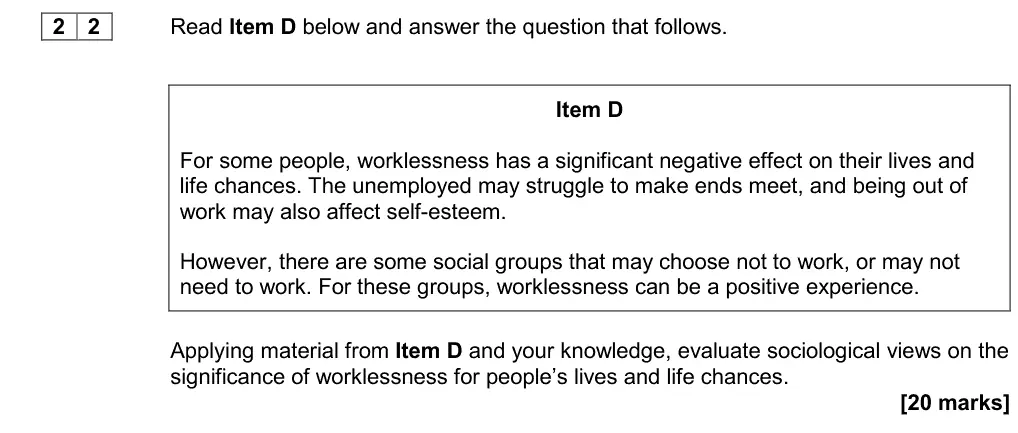
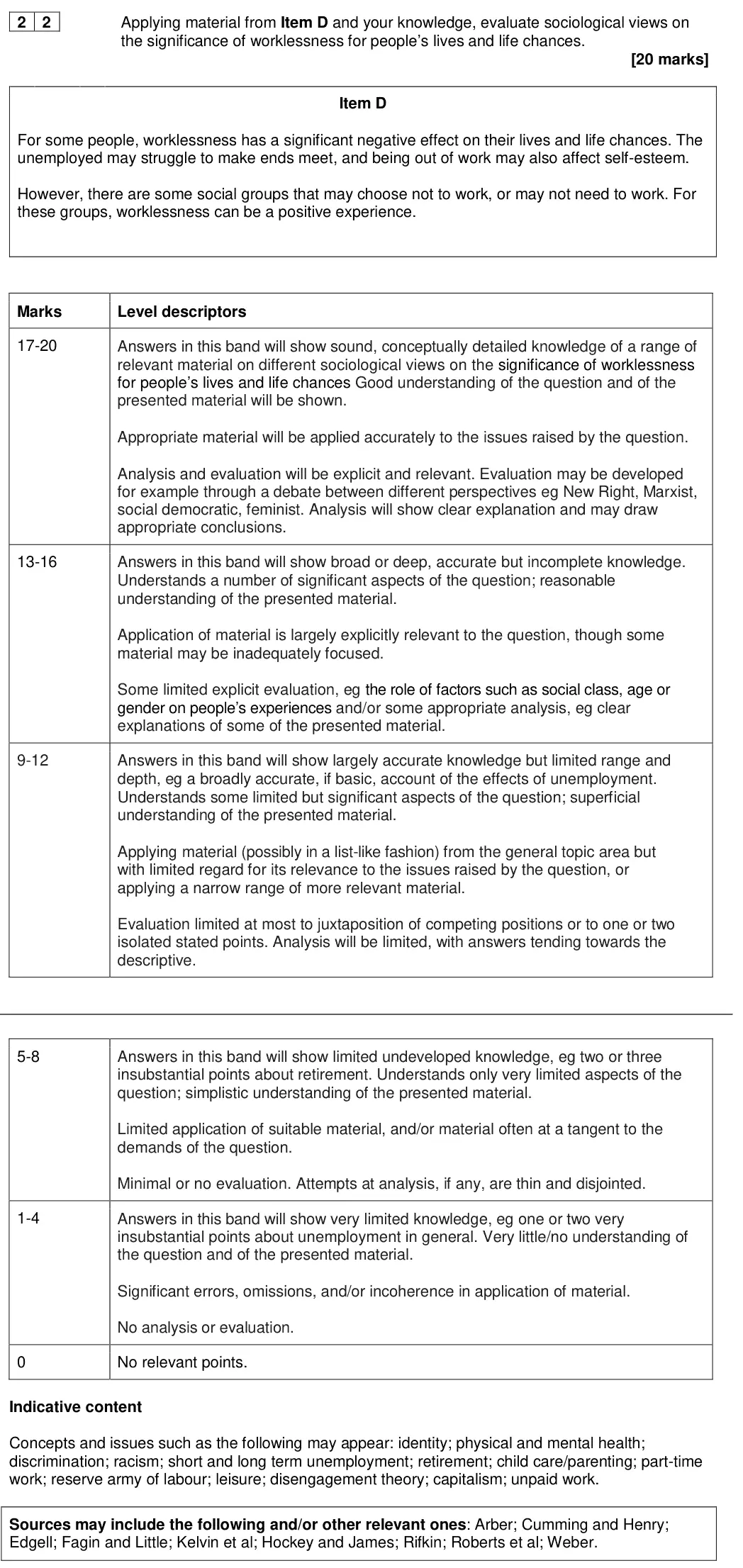
The majority of answers took quite a narrow view of the question. Most students responded by discussing the impact of unemployment on individuals. These answers often identified the physical and mental consequences of long term unemployment on life chances and on identity. Some students tried to broaden the discussion onto ideas about people on benefits making a positive lifestyle choice, but these answers often failed to get beyond various simplistic assertions. There were relatively few students who really explored the idea of worklessness beyond unemployment. Those that did tended to discuss sociological aspects of retirement and were rewarded appropriately.
Notes from the mark scheme and report
apply Item D (negative effects on life chances and self-esteem vs groups choosing or not needing to work)
evaluation through New Right, Marxist, social democratic and feminist views or by class, age and gender
most answers narrowly about unemployment
few explored worklessness beyond unemployment (e.g. retirement), which was rewarded
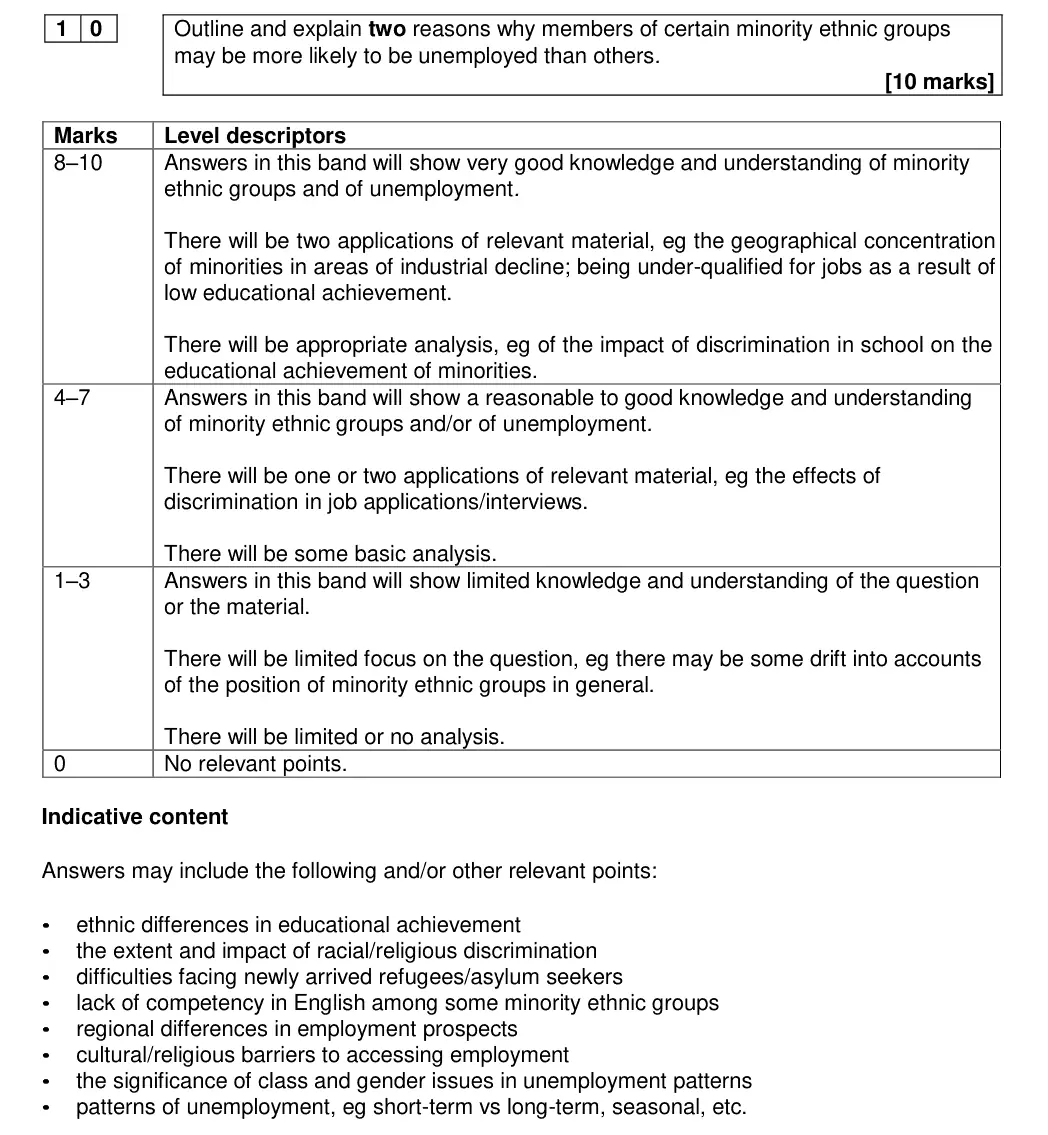
Specimen set 1 · Paper 2 · Q1010 marksAO1=5, AO2=3, AO3=2Outline and explain
Mark scheme, including the levels grid and indicative content
Notes from the mark scheme and report
top band e.g. concentration in areas of industrial decline, lower qualifications
analysis of school discrimination affecting achievement
general accounts of minority ethnic groups' position = 1–3 band
Work with an AQA sociology tutor
Essays stuck in the middle band, or losing marks on the 10-markers? Book a trial lesson with Mark, a former AQA examiner.