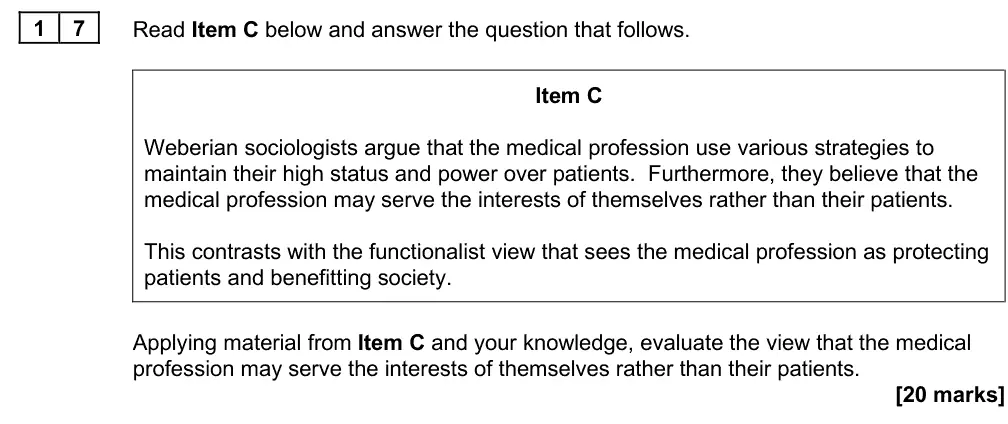
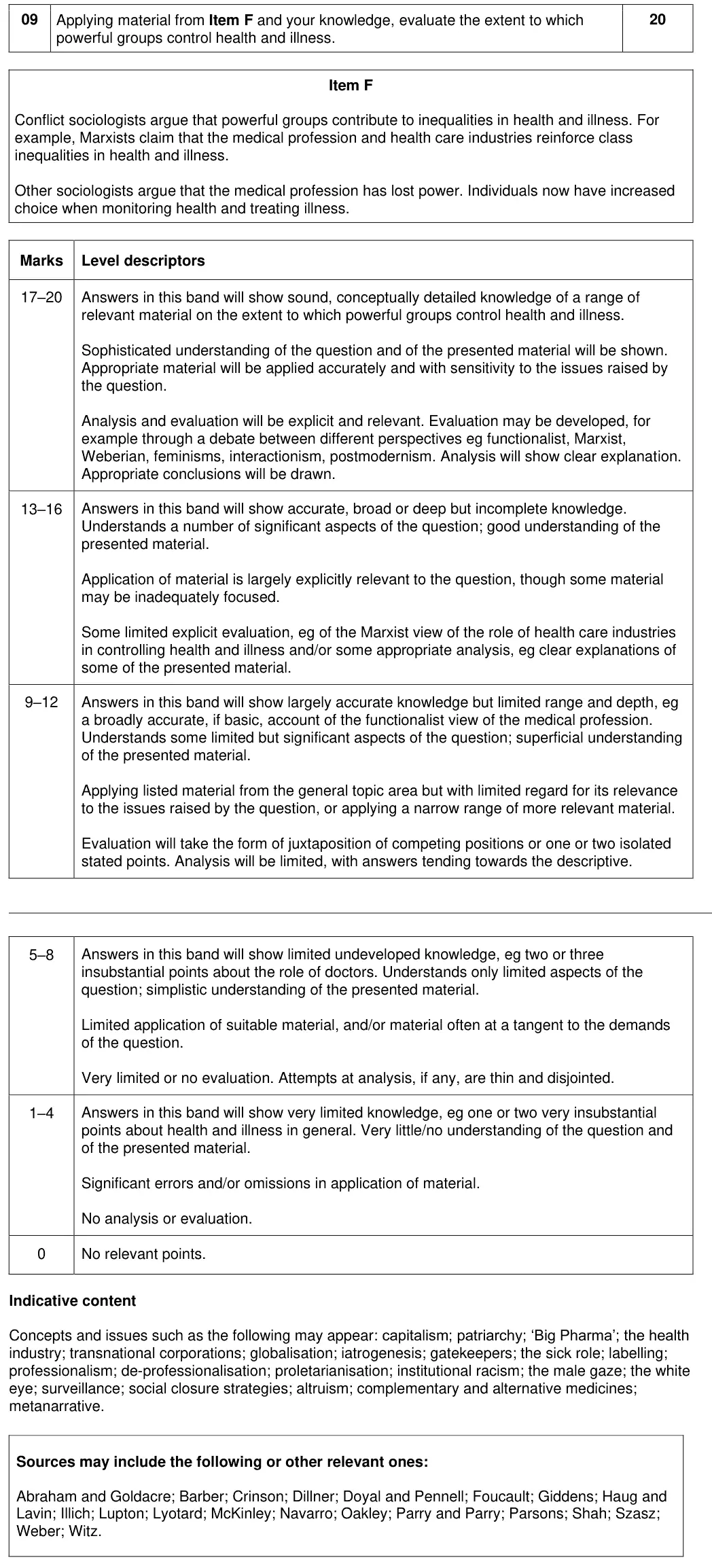
Applying material from Item C and your knowledge, evaluate the view that the medical profession may serve the interests of themselves rather than their patients.
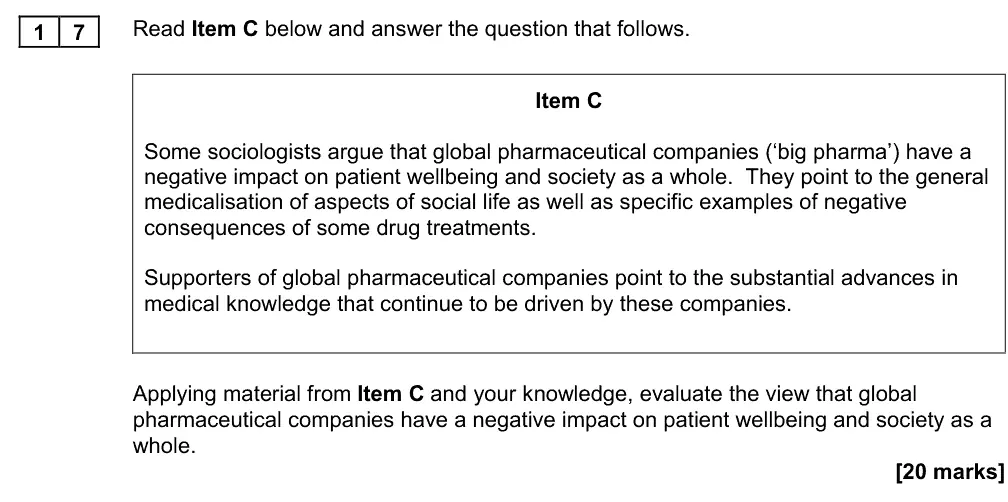
Applying material from Item C and your knowledge, evaluate the view that global pharmaceutical companies have a negative impact on patient wellbeing and society as a whole.
Tap a question to zoom it. The mark scheme (with the level descriptors and indicative content) and the examiner's comment open underneath.
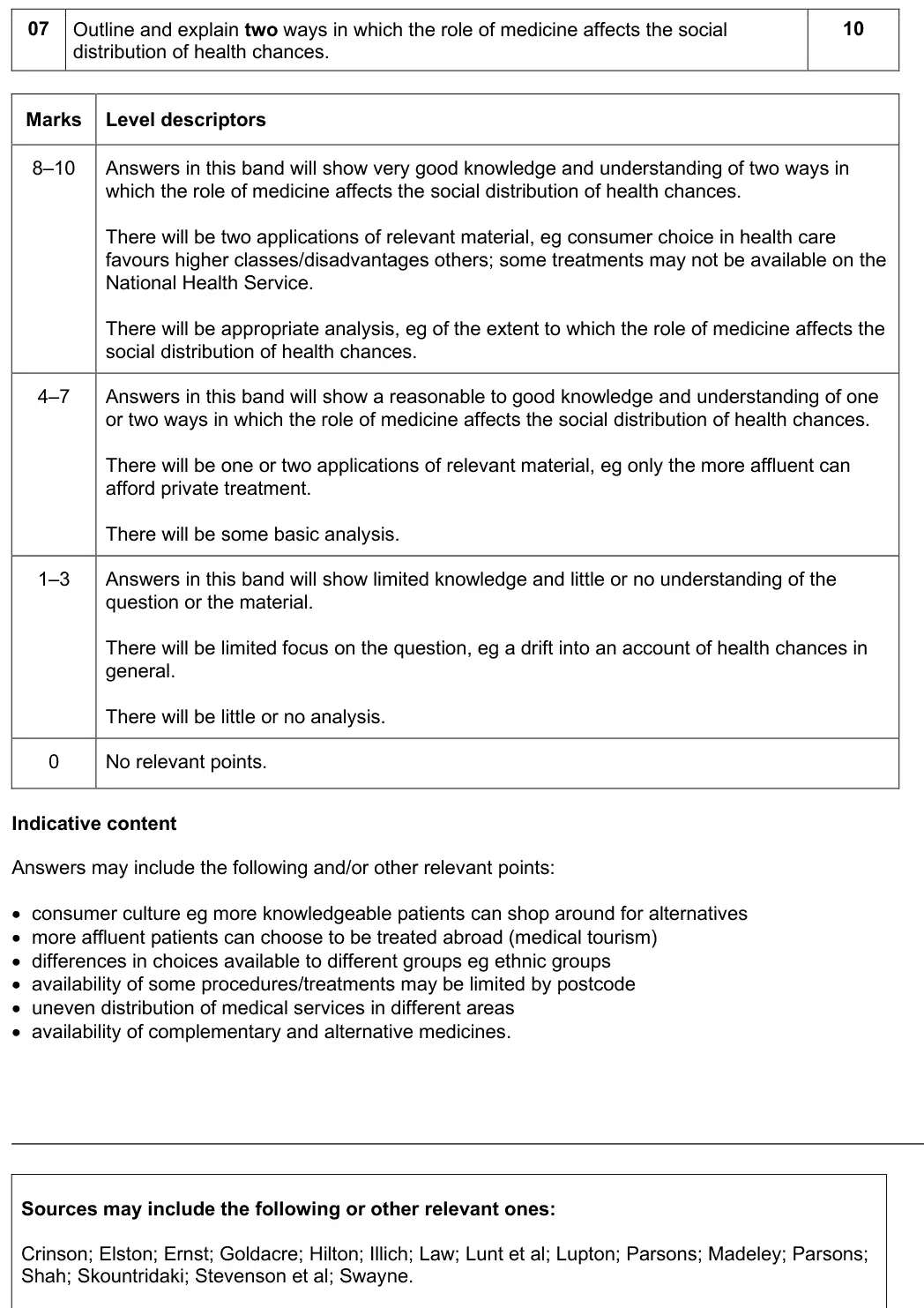
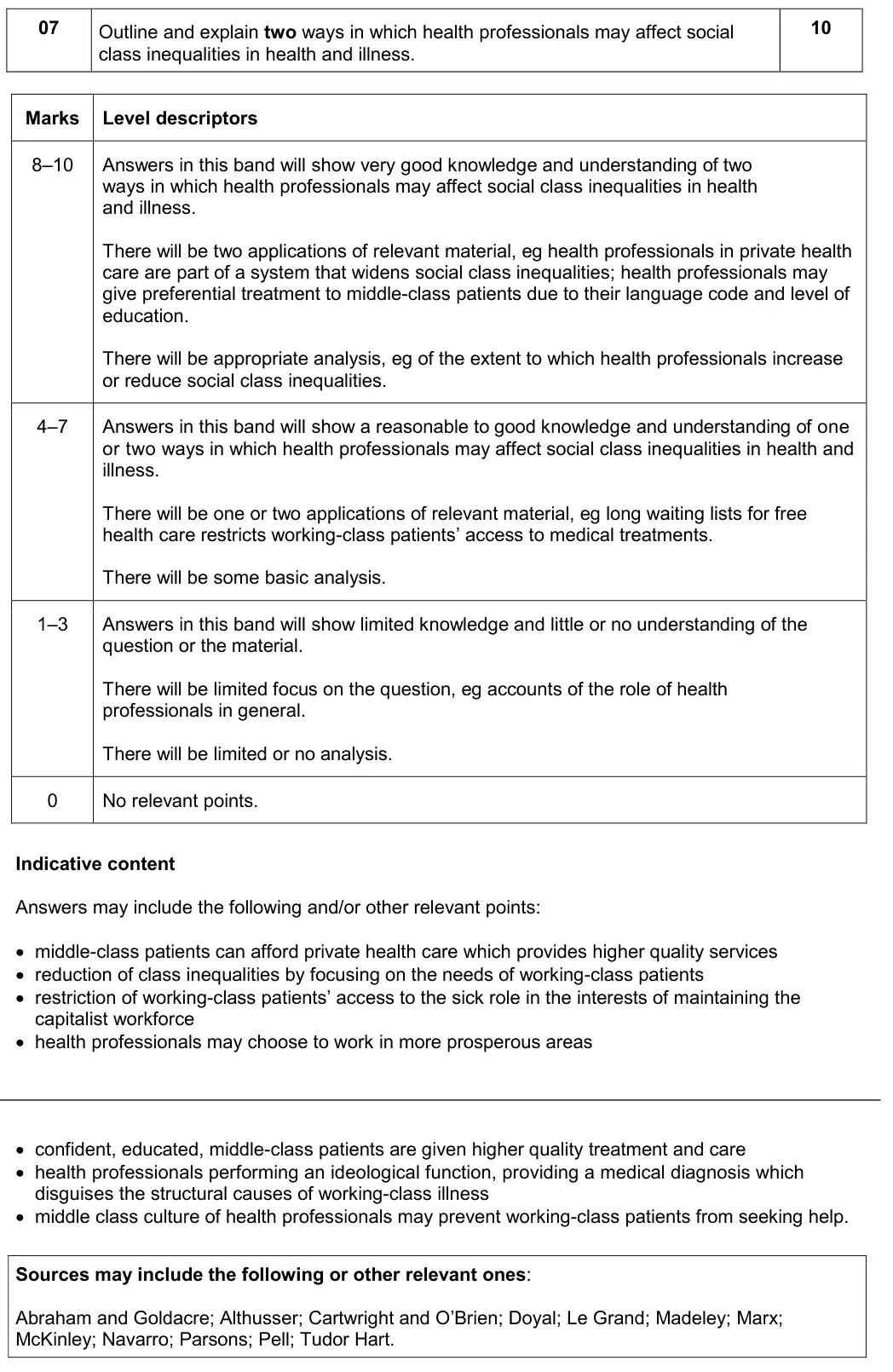
June 2025 · Paper 2 · Q710 marksAO1=5, AO2=3, AO3=2Outline and explain
Mark scheme, including the levels grid and indicative content
Examiner's comment
The nature of these questions means that students cannot rely on reciting knowledge. Questions will ask them to bring together aspects of their sociological knowledge in ways they have not done before. It is therefore important for students to allow time to think about how to answer the question. Students should be aware that there are two types of ten-mark questions. These have different requirements and different mark schemes. There are different marks available for the assessment objectives. 10 mark “outline and explain” questions have more marks available for knowledge and understanding, and none for evaluation. Introductions and conclusions are not required for 10-mark questions, are unlikely to help students and take up time. It is helpful if answers are set out to clearly indicate the two answers, with wording such as “One way/reason is…” or by starting a new paragraph for the second point. Answers that give more than two answers are unlikely to develop two of them sufficiently. The most successful answers to 10-mark questions were focused, clearly stating a point that addressed the question and then developing it, using sociological concepts, evidence such as an example and, where appropriate, theory. Students generally chose to interpret this question by focusing on access to health care and how this affected the distribution of health chances. The idea that more affluent individuals resided in places with better health care provision was a common way to do this and the inverse care law frequently featured.
Notes from the mark scheme and report
must link medicine (consumer choice, private treatment, postcode availability) to the social distribution of health chances
drift into health chances in general = 1–3
most answered through access to care and the inverse care law
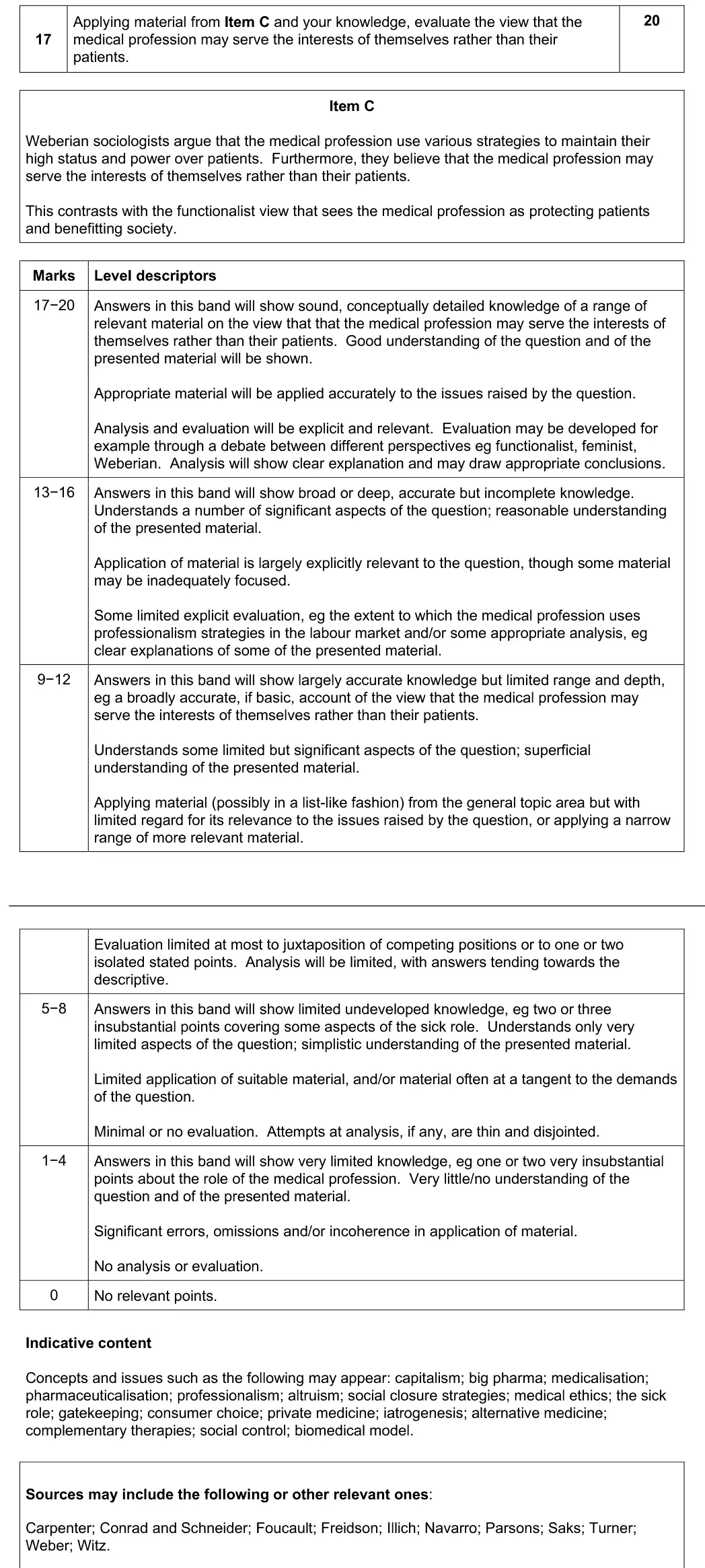
June 2025 · AS Paper 2 · Q1720 marksAO1=8, AO2=6, AO3=620-mark essay
Mark scheme, including the levels grid and indicative content
Examiner's comment
Some students produced well-structured, detailed, and analytical responses to this question. Successful answers effectively contrasted a range of view on the medical profession which mostly included functionalist, Weberian, feminist and Marxist views. Answers that adopted this approach often used a juxtapositional style of evaluation. The impact of ‘Big pharma’ was also present in some better responses along with more specialist concepts such as iatrogenesis.
Notes from the mark scheme and report
apply Item C (Weberian professional strategies for status and power vs functionalist protecting patients)
evaluation via functionalist, feminist, Weberian views or extent of professional strategies in the labour market
sick-role-only answers = 5-8
best covered big pharma and iatrogenesis
many evaluated only by juxtaposition
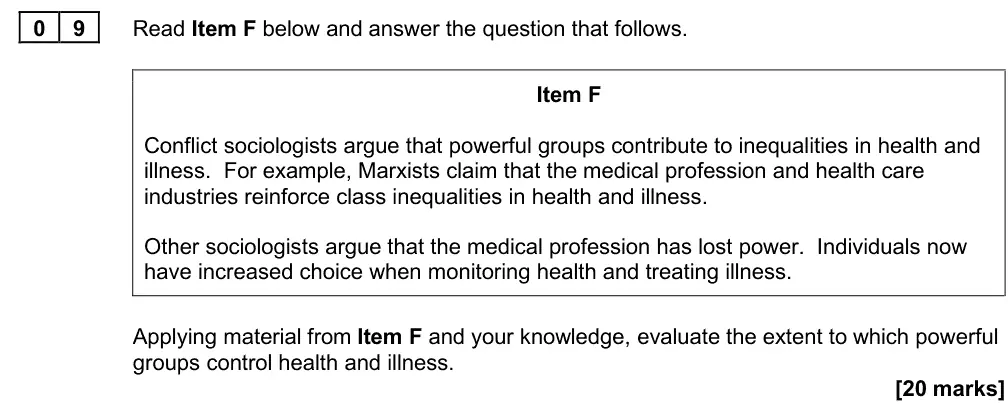
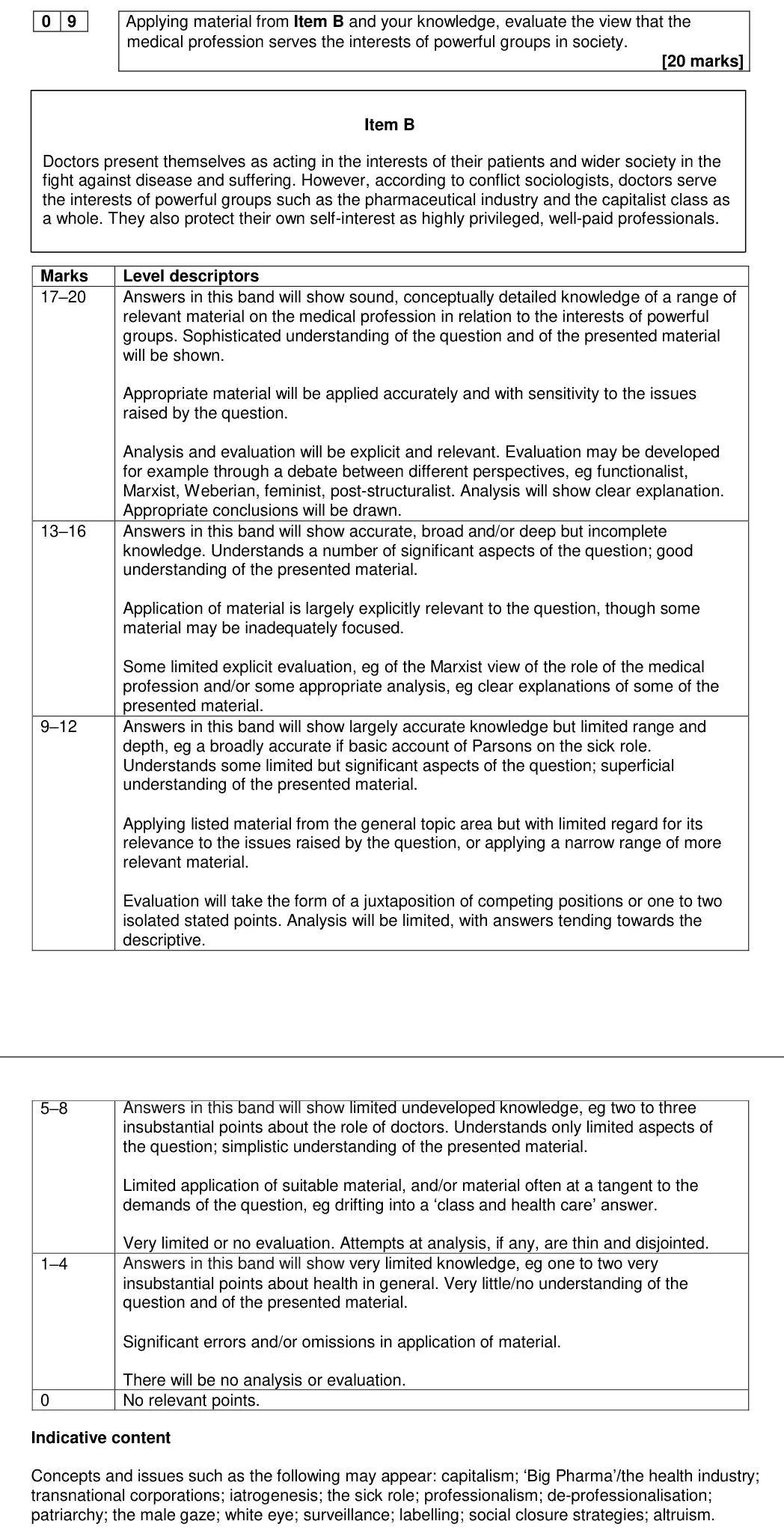
June 2024 · Paper 2 · Q920 marksAO1=8, AO2=6, AO3=620-mark essay
Mark scheme, including the levels grid and indicative content
Examiner's comment
The items for these questions have a different purpose to those for 10 mark “analyse” questions. The items will suggest a few starting points for students, including ways into evaluation. Students are expected to also bring in further ideas (“and your knowledge” in the instruction). A wide range of material can be relevant to these questions, so students need to be selective. It is more effective to cover a limited number of points in depth rather than to try to include everything. Students who made essay plans appeared to benefit by having more structured and coherent responses. Q9: Some students were unable to move beyond generic approaches such as the Marxist or functionalist views of medical professionals being either harmful or benign. Better responses managed a wider consideration of specific groups who might be considered powerful in health and illness such as “Big Pharma”. Some also discussed ways groups perceived as powerful may be being challenged, for example by the availability of alternatives giving greater health consumer choice.
Notes from the mark scheme and report
top band debates perspectives (functionalist, Marxist, Weberian, feminist, interactionist, postmodernist) on control of health and illness
generic 'doctors harmful or benign' accounts limited marks
better answers considered specific powerful groups such as big pharma and challenges to their power through consumer choice and alternative medicine
June 2024 · AS Paper 2 · Q1610 marksAO1=5, AO2=3, AO3=2Outline and explain
Mark scheme, including the levels grid and indicative content
Examiner's comment
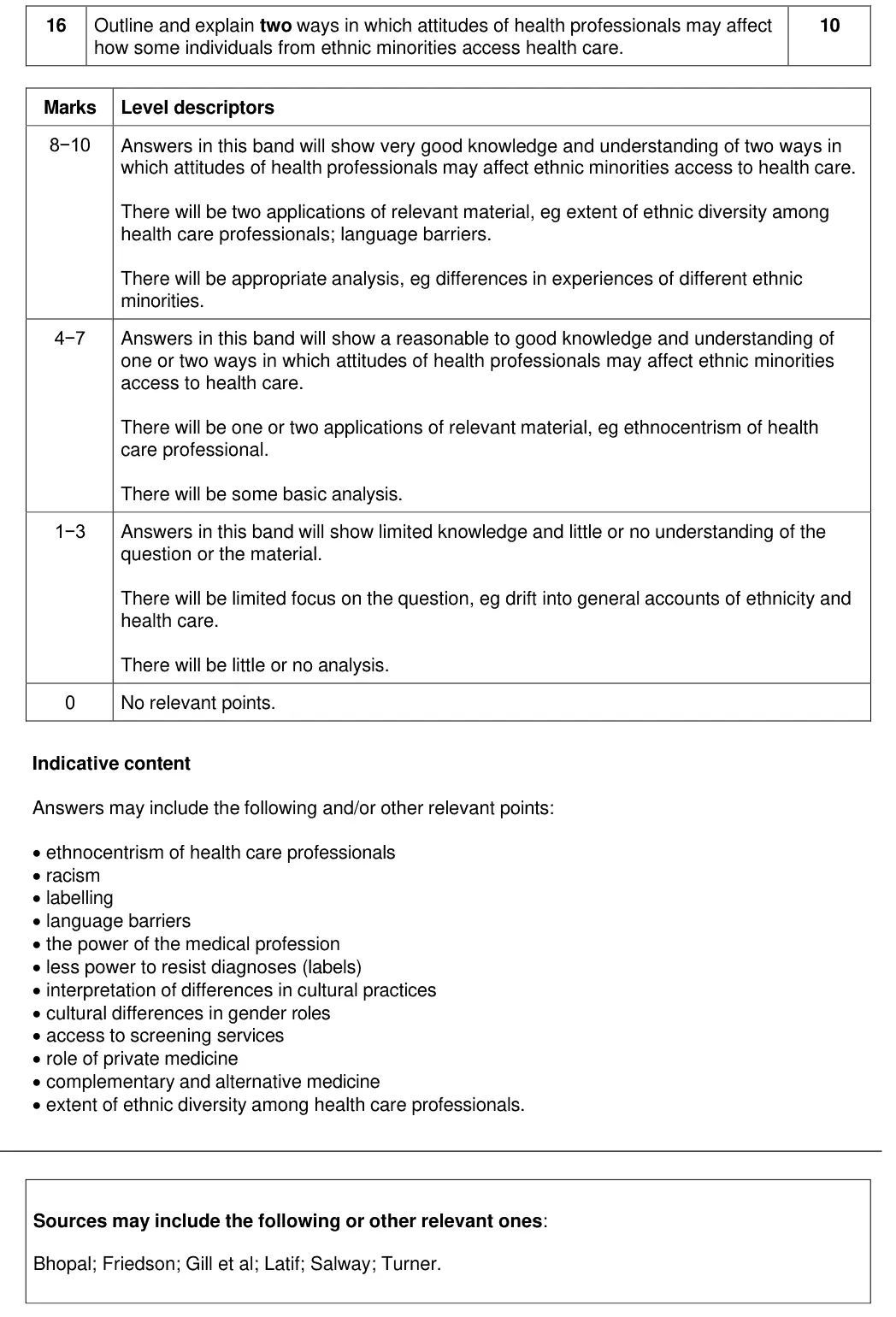
The ‘outline and explain’ 10-mark question. Here students would benefit more if an explicit identification of a way / reason / factor was made then leading to an explanation of it. So, making the student’s answer more cogent. This question was not answered well, and many students did not seem clear on what the question wanted them to do. Some students talked about health chances rather than health care – which limited the amount of credit they could be given. Popular approaches to the question focussed on language barriers and racism / ethnocentrism amongst some health care professionals.
Notes from the mark scheme and report
must be professionals' attitudes affecting access to health care, not health chances
drift into general ethnicity and health = 1–3
common answers: language barriers, racism/ethnocentrism
top band analysis of differences between minority groups
not answered well
June 2023 · Paper 2 · Q710 marksAO1=5, AO2=3, AO3=2Outline and explain
Mark scheme, including the levels grid and indicative content
Examiner's comment
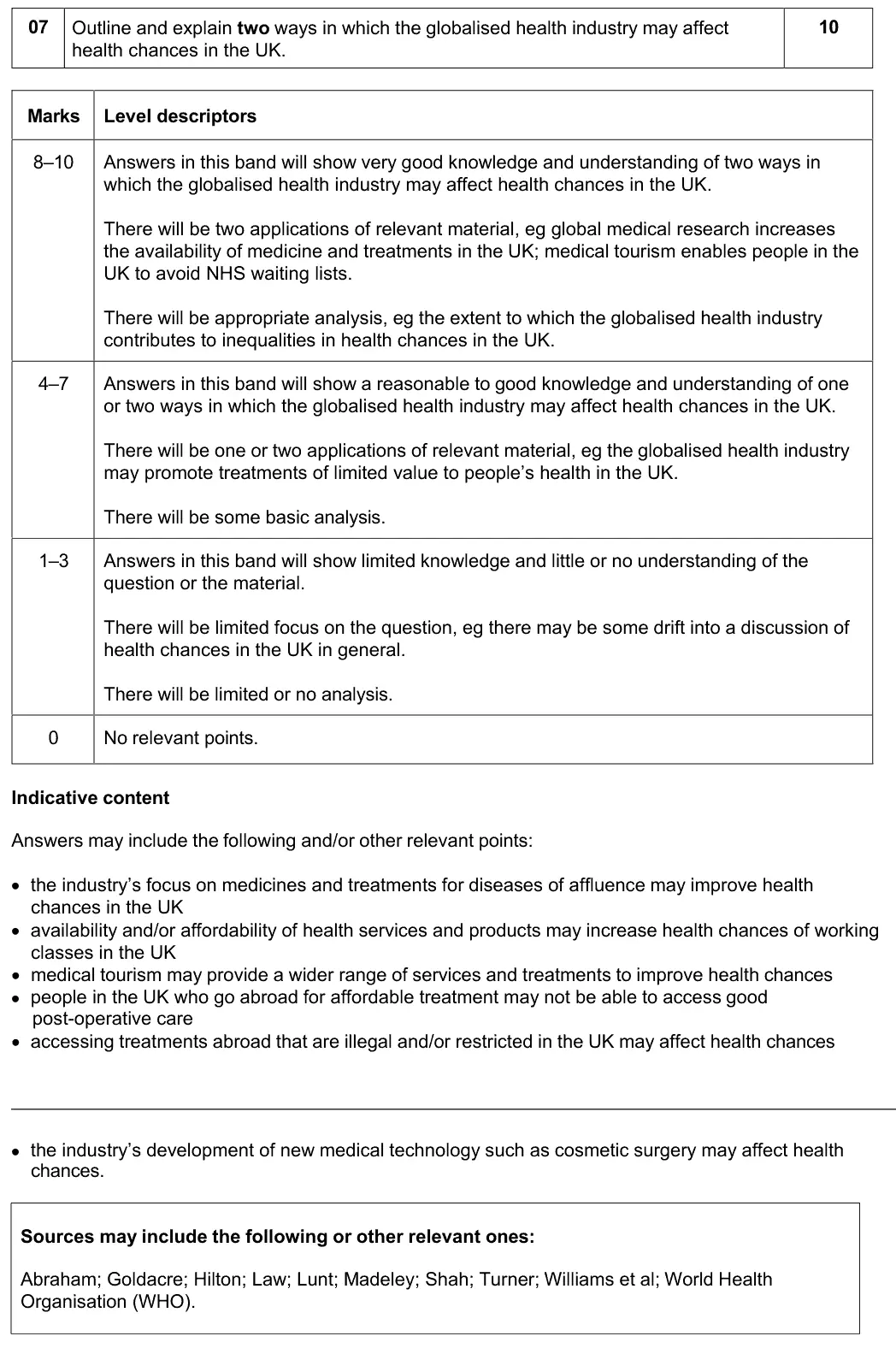
The nature of these questions means that students cannot rely on reciting knowledge. Questions will ask them to bring together aspects of their sociological knowledge in ways they are unlikely to have done before. It is therefore important for students to allow time to think about how to answer the question. Students should be made aware that there are two types of 10 mark questions. These have different requirements and different mark schemes. There are different marks available for the assessment objectives. 10 mark “outline and explain” questions have more marks available for knowledge and understanding, and none for evaluation. Introductions and conclusions are not required for 10 mark questions and take up valuable time. It is helpful if answers are set out to clearly indicate the two separate points, with wording such as “One way/reason is…” or by starting a new paragraph for the second point. Answers that give more than two points are unlikely to develop two of them sufficiently. Question 7: Successful answers developed points about, for example, medical tourism and the availability (or not) in the UK of medicines and procedures.
Notes from the mark scheme and report
two ways the global health industry affects UK health chances (global research and drug availability, medical tourism, aftercare problems, treatments of limited value)
drift into UK health chances in general = 1–3
successful answers used medical tourism and availability of medicines/procedures
June 2023 · AS Paper 2 · Q1720 marksAO1=8, AO2=6, AO3=620-mark essay
Mark scheme, including the levels grid and indicative content
Examiner's comment
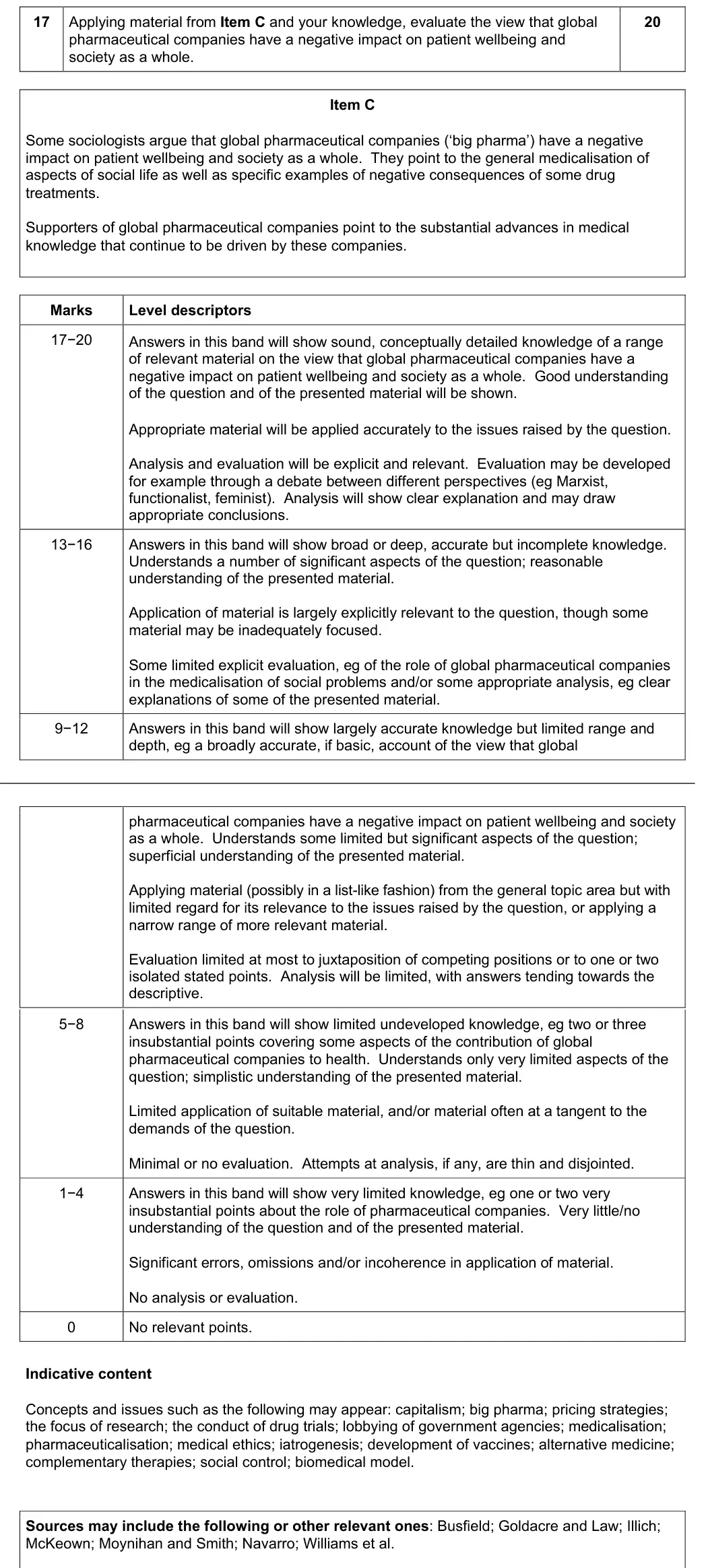
The main discriminatory factor explaining student outcomes for this question was whether the students knew what “big pharma” was. For those who were knowledgeable the question was relatively straight forward, inviting a pros and cons approach to the activities and impacts of global pharmaceutical companies often accompanied by a perspectives based assessment of such activities (Marxism vs functionalism for example). For students who had no or very limited knowledge of “big pharma” answers tended to list material which was not applied effectively to the demands of the question and so could not score highly.
Notes from the mark scheme and report
top band debates perspectives (Marxist, functionalist, feminist) on the impact of global pharmaceutical companies
the key discriminator was knowing what 'big pharma' is
those who did used pros and cons with medicalisation, drug trials and pricing
others listed unapplied material
June 2022 · Paper 2 · Q920 marksAO1=8, AO2=6, AO3=620-mark essay
Mark scheme, including the levels grid and indicative content
Examiner's comment
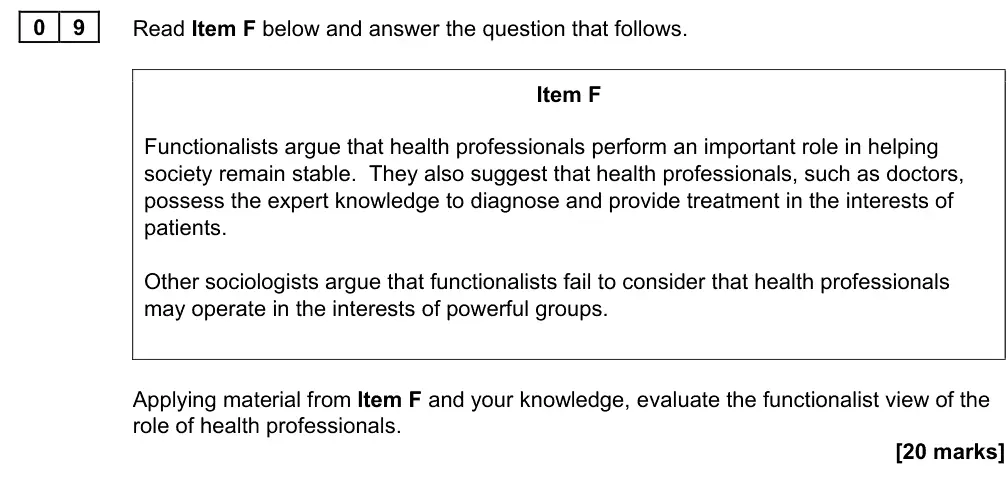
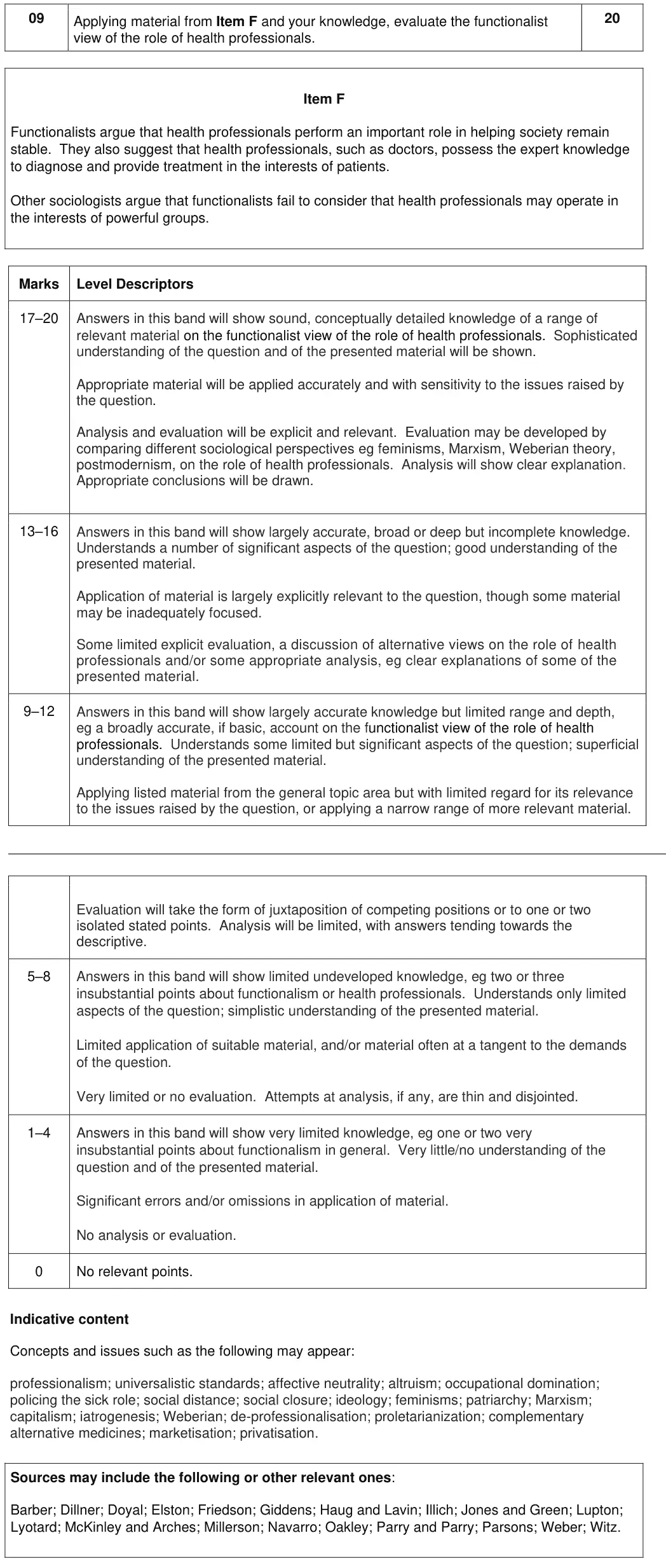
The items for 20 mark questions are written to provide a number of ideas on which students can begin to build their answers. Students are expected to also bring in further ideas (hence “and your knowledge” in the instruction). It is often the case that a wide range of material can be relevant to these questions, and students need to be selective. For example, it may be more effective to cover a limited number of views or theories in some depth rather than to include every possible theory. There was a tendency for answers to progressively lose sight of the question and to become a list of different views. Many attempts at evaluation were learned criticisms. Evaluation is more effective where it is focused on the demands of the question. Students should also be aware that evaluation includes awareness of the strengths as well as the weaknesses of an argument or theory. Following feedback from centres regarding the advance information for the 20 mark questions, we have monitored the marking of these questions, as well as carrying out statistical analysis on student performance. Based on this analysis, we can confirm that students have performed as we expected them to on these questions, and their performance on these questions is in line with previous series. Q9 There was some reasonable to good knowledge of functionalist views on the role of health professionals, though with reliance on the item. Evaluation was usually by comparisons with Marxist and/or feminist approaches. Some answers drifted away from the question to general accounts of theories.
Notes from the mark scheme and report
top band compares feminist, Marxist, Weberian and postmodern views of health professionals
answers relied heavily on the item
evaluation usually via Marxism and feminism
some drifted into general accounts of theories
June 2022 · AS Paper 2 · Q1610 marksAO1=5, AO2=3, AO3=2Outline and explain
Mark scheme, including the levels grid and indicative content
Examiner's comment
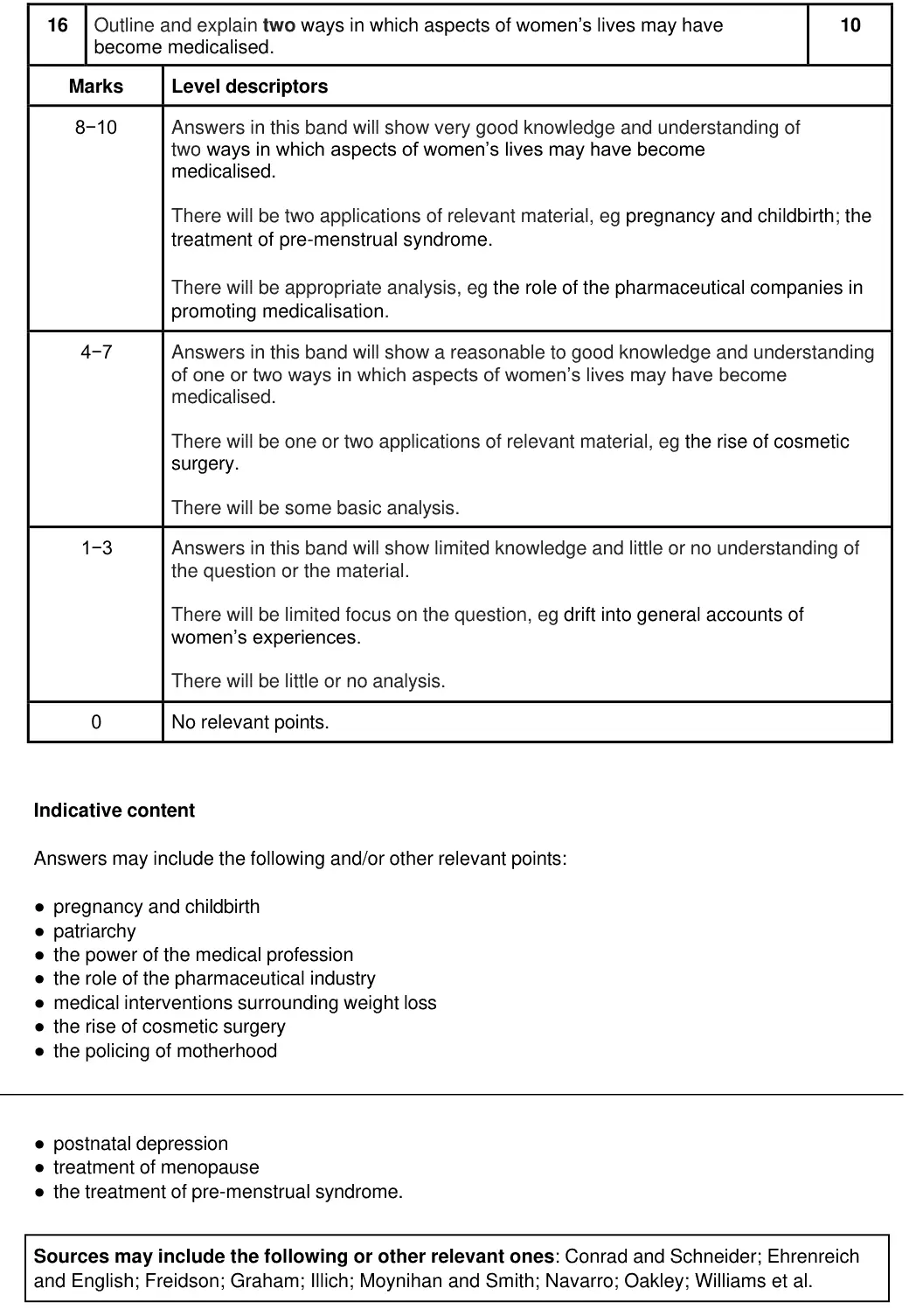
This question was generally answered well by students who had not chosen questions from every topic. Successful answers clearly understood the term medicalisation and successfully applied it to relevant aspects of women’s lives. The most common response was pregnancy and childbirth which was often analysed using historical and cross-cultural comparisons. Some students included applications of body-projects and cosmetic surgery. Less successful responses did not show understanding of the concept of medicalisation and tended to identify health screening for women with little elaboration.
Notes from the mark scheme and report
two ways women's lives are medicalised (pregnancy and childbirth, PMS, menopause, cosmetic surgery)
drift into women's experiences in general = 1–3
best answers analysed childbirth with historical/cross-cultural comparison
weaker answers did not grasp medicalisation (health screening only)
November 2021 · Paper 2 · Q710 marksAO1=5, AO2=3, AO3=2Outline and explain
Mark scheme, including the levels grid and indicative content
Notes from the mark scheme and report
no marks for evaluation in this question type
two ways each developed, e.g. private health care widening inequality, preferential treatment of articulate middle-class patients, inverse care law, ideological role of diagnosis
general accounts of health professionals = 1–3
no examiners' report comment for this part
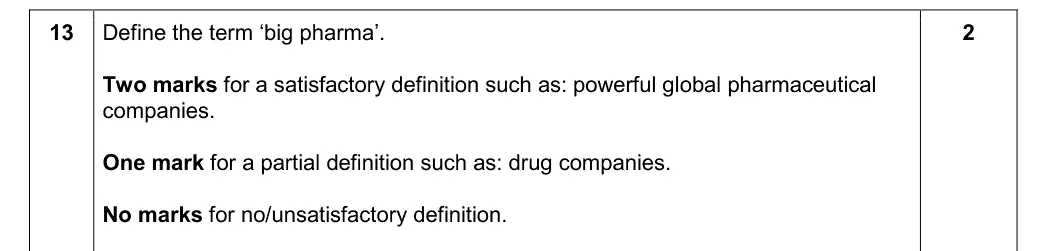
November 2020 · AS Paper 2 · Q132 marksAO1=2Define
Mark scheme
Notes from the mark scheme and report
2 marks for powerful global pharmaceutical companies
'drug companies' alone = 1
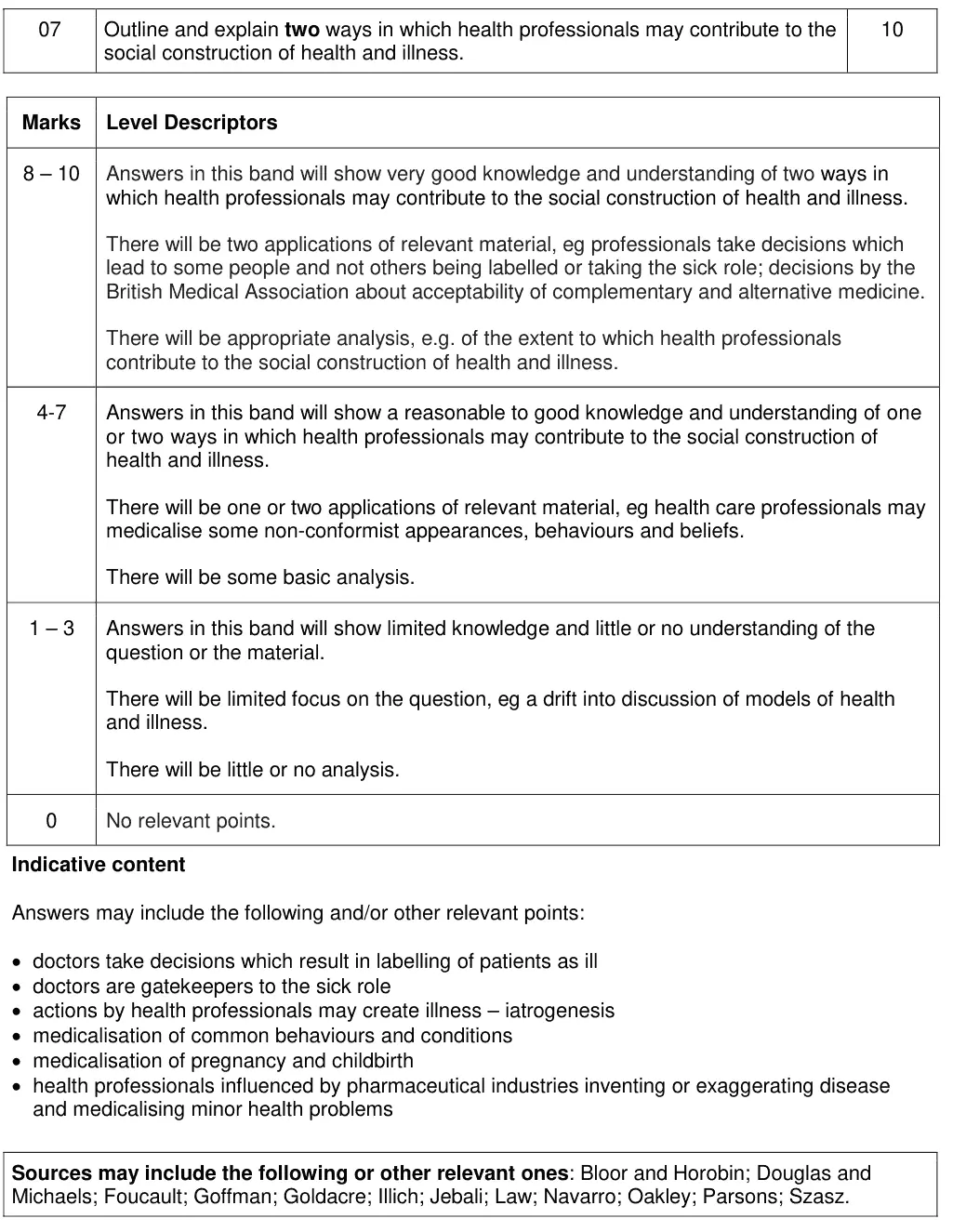
June 2019 · Paper 2 · Q710 marksAO1=5, AO2=3, AO3=2Outline and explain
Mark scheme, including the levels grid and indicative content
Examiner's comment
Some students wrote introductory paragraphs and/or conclusions. These are not necessary, and are unlikely to gain additional marks; they also take up time. Some students made only one point in their answers, or three or more, rather than the two asked for. The word ‘two’ is put in bold in the question to try and draw students’ attention to this. Sometimes it was not clear how many points were being made. It is helpful for students to clearly indicate their two answers, with wording such as “One way is…” or by starting a new paragraph for their second point. Notably, some students wrote far more than was needed for a 10-mark response. The two types of 10-mark question, “outline and explain” and “analysis” types, are marked differently as the assessment objectives have different weightings. It is important that students are aware of this. In particular they should note that evaluation is not a requirement for answers to 10 mark “outline and explain” questions. For 10 mark “outline and explain” questions, students cannot rely on reciting knowledge; these questions will ask them to bring together aspects of their sociological knowledge of the topic in a way that they are unlikely to have done before. The best answers to 10-mark questions were focused, clearly stating a point and then developing it, and used sociological concepts, studies, evidence and theory as appropriate. Most students were able to successfully explain two ways, using ideas such as labelling, the medicalisation of childbirth and the sick role.
Notes from the mark scheme and report
must be ways health professionals construct health and illness
drift into models of health in general = 1–3
common answers: labelling, gatekeeping the sick role, medicalisation of childbirth, iatrogenesis
AO split from AQA's standard grid for this paper (this year's mark scheme does not print it).
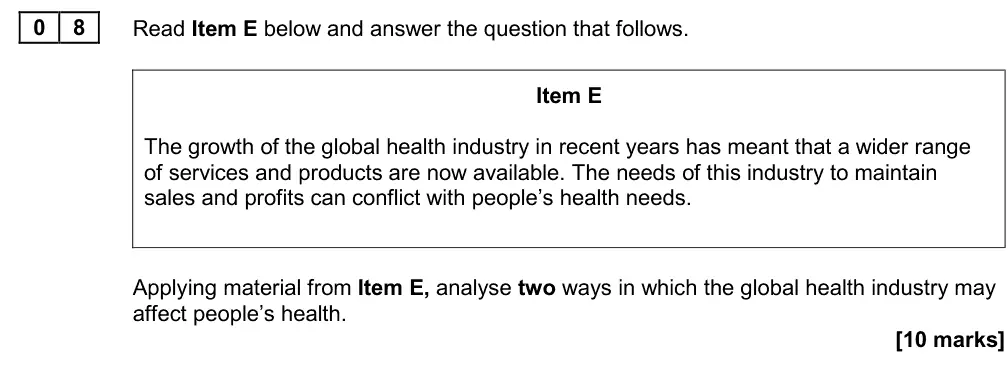
June 2019 · Paper 2 · Q810 marksAO1=3, AO2=4, AO3=3Analyse
Mark scheme, including the levels grid and indicative content
Examiner's comment
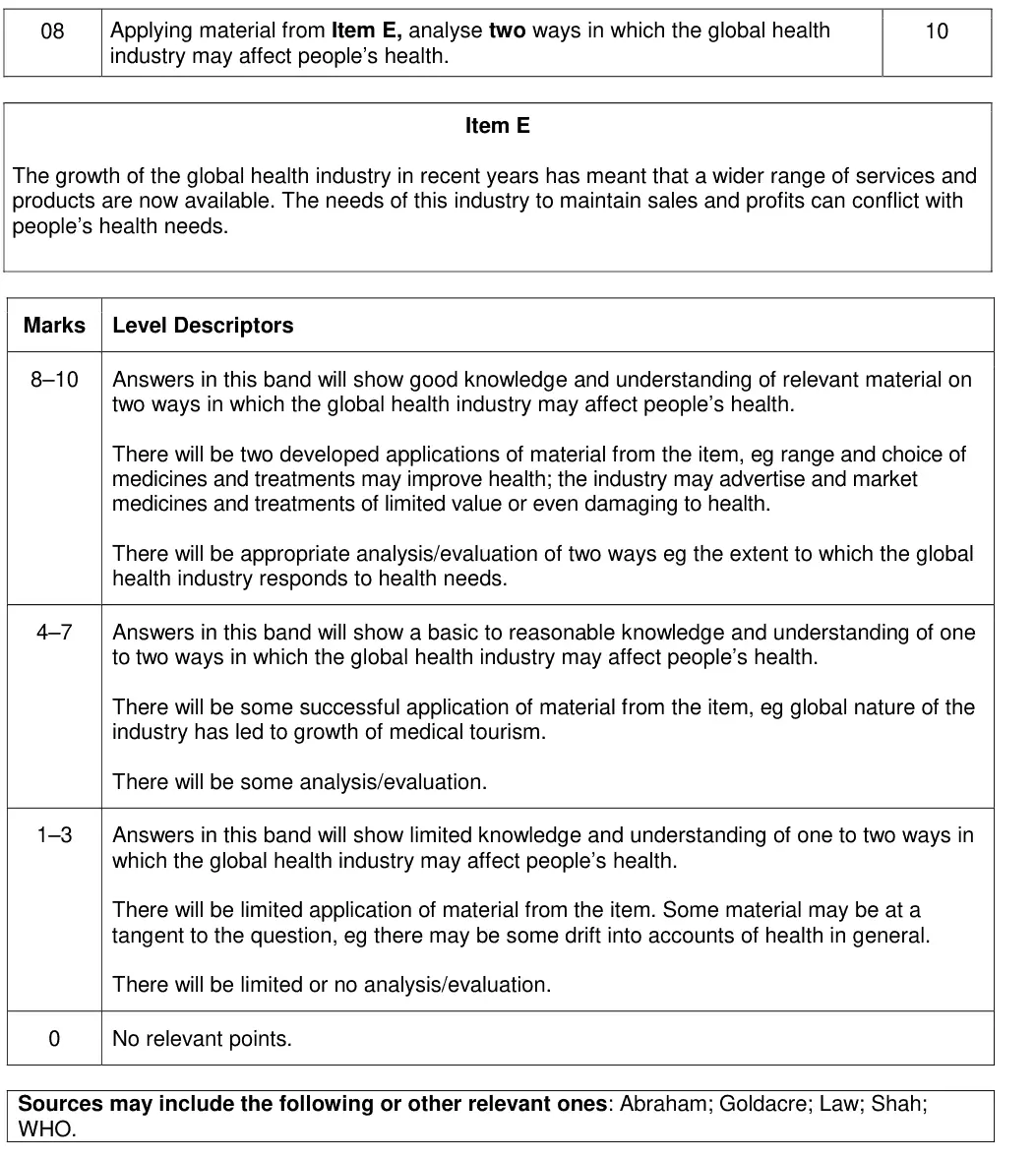
Some students wrote introductory paragraphs and/or conclusions. These are not necessary, and are unlikely to gain additional marks; they also take up time. Some students made only one point in their answers, or three or more, rather than the two asked for. The word ‘two’ is put in bold in the question to try and draw students’ attention to this. Sometimes it was not clear how many points were being made. It is helpful for students to clearly indicate their two answers, with wording such as “One way is…” or by starting a new paragraph for their second point. Notably, some students wrote far more than was needed for a 10-mark response. The two types of 10-mark question, “outline and explain” and “analysis” types, are marked differently as the assessment objectives have different weightings. It is important that students are aware of this. For 10 mark “analyse” questions, the parts of the item being used should be clearly indicated, preferably by exact words being quoted. It is acceptable for two different points to be drawn from one part of the item, but answers which do not use the item cannot access the application marks. The best answers to 10-mark questions were focused, clearly stating a point and then developing it, and used sociological concepts, studies, evidence and theory as appropriate. This question was on the whole well answered, with students able to identify and develop the references in the item to “wider range of services and products” (usually seen as positive, with a postmodernist emphasis on choice) and to ‘profits can conflict with people’s health needs’ (usually seen as negative).
Notes from the mark scheme and report
develop both item hooks: wider range of services and products (often a positive, choice-based view) and profit conflicting with health needs (negative)
drift into health in general = 1–3
AO split from AQA's standard grid for this paper (this year's mark scheme does not print it).
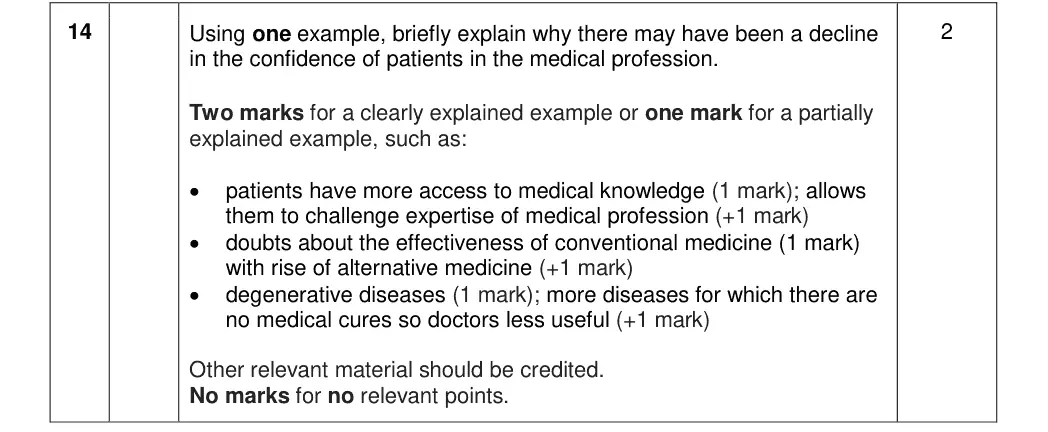
June 2019 · AS Paper 2 · Q142 marksAO2=2Brief explain
Mark scheme
Examiner's comment
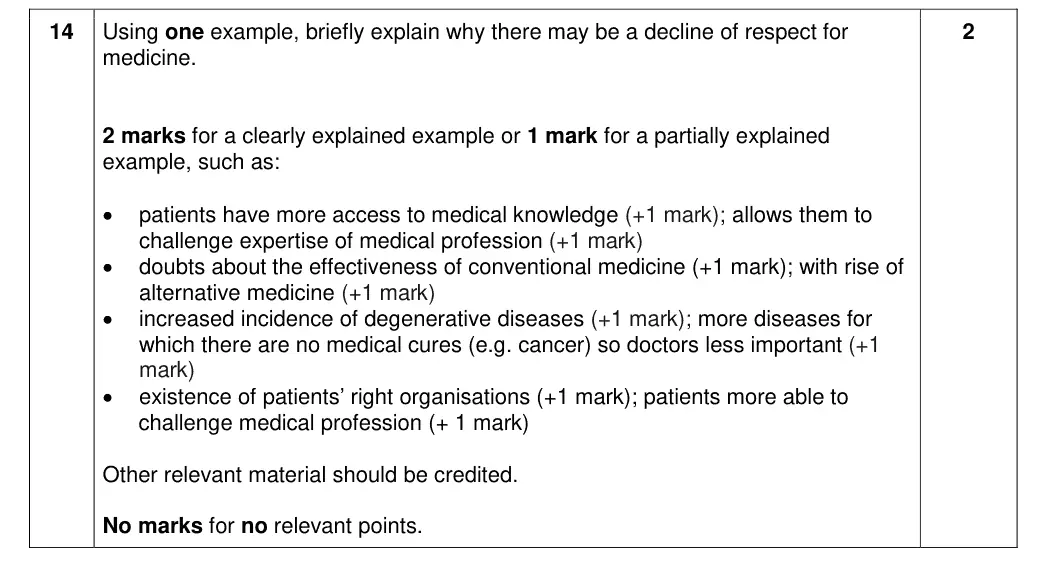
In general, this was answered well. Many responses referred to examples of the medical profession causing harm to patients and the resulting decline in public respect for medicine. Some successful answers made reference to the rise of alternative medicine. Others discussed the role of the internet as a source of knowledge that has enabled patients to more readily challenge the medical profession.
Notes from the mark scheme and report
AO grid not printed
2 marks for a clearly explained example, 1 if partial
credited: medical harm and scandals, alternative medicine, internet knowledge to challenge doctors, degenerative diseases, patients' rights groups
AO split from AQA's standard grid for this paper (this year's mark scheme does not print it).
June 2018 · Paper 2 · Q710 marksAO1=5, AO2=3, AO3=2Outline and explain
Mark scheme, including the levels grid and indicative content
Examiner's comment
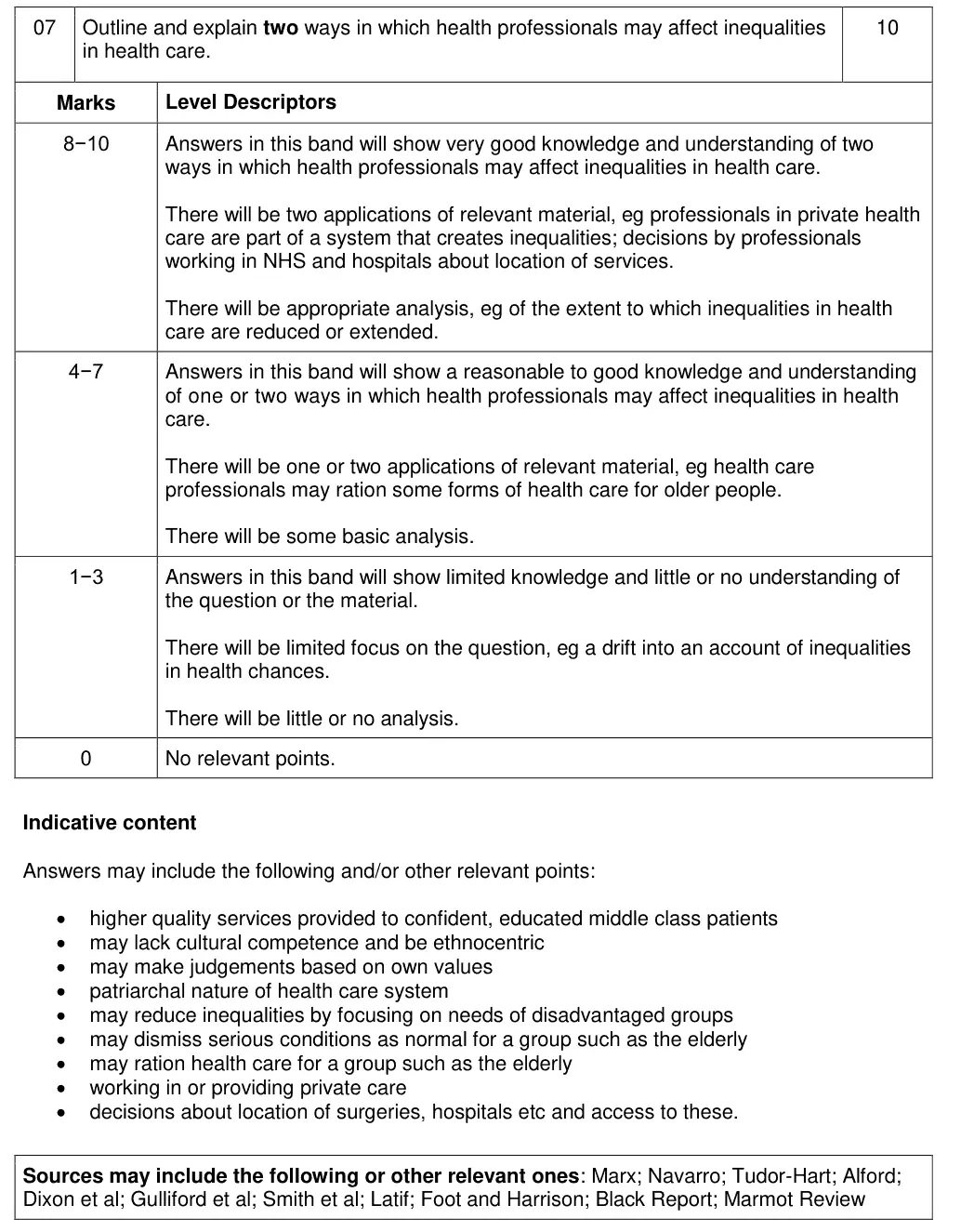
Some students wrote introductory paragraphs and/or conclusions. These are not necessary, and are unlikely to gain additional marks, and they also take up time. Some students made only one point in their answers, or three or more, rather than the two asked for in the question. Sometimes it was unclear how many points were being made. It is helpful for students to clearly indicate their two answers, with wording such as “One way is…” or by starting a new paragraph for their second point. Evaluation is not a requirement for answers to 10 mark “outline and explain” questions. The marks awarded for the assessment objectives being targeted are different in the two types of ten mark questions, and students should be made aware of this. The best answers to 10 mark questions were focused, clearly stating a point and then developing it, using sociological concepts, evidence and theory where appropriate. In some questions students tended to focus on the first aspect of the question at the expense of the second. Students need guidance on how to approach these questions and how to best demonstrate their sociological understanding. The nature of these questions means that students cannot rely on reciting knowledge. These questions will ask them to bring together aspects of their sociological knowledge in a way that they are unlikely to have done before. Most students were able to explain two ways in which health professionals affect inequalities in health care. Inequalities addressed included those based on age, social class, ethnicity and region, with popular answers including the distribution of resources and the ways in which different quality services might be provided to different groups.
Notes from the mark scheme and report
two ways professionals widen or reduce inequalities in health care (e.g. better service for middle-class patients, ethnocentrism, rationing for the elderly, private practice, location of services)
drift into inequalities in health chances = 1–3
good answers covered age, class, ethnicity and region
AO split from AQA's standard grid for this paper (this year's mark scheme does not print it).
June 2018 · AS Paper 2 · Q132 marksAO1=2Define
Mark scheme
Examiner's comment
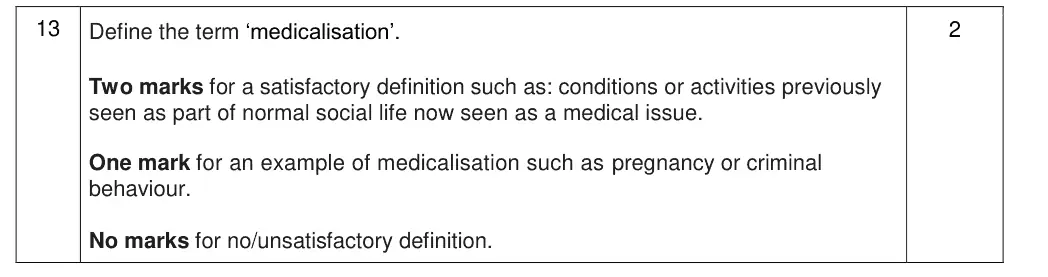
Most students had some idea about this. Successful students were able to explain the idea of something that was previously seen as part of normal life now seen as a medical issue. Partial answers tended to give an example of medicalisation, usually pregnancy.
Notes from the mark scheme and report
2 marks for normal life now treated as a medical issue
an example (e.g. pregnancy) = 1 mark
AO split from AQA's standard grid for this paper (this year's mark scheme does not print it).
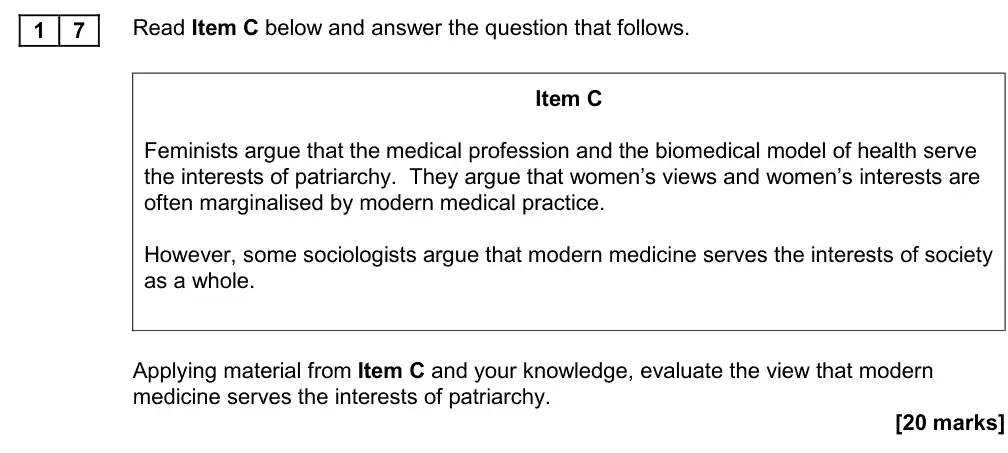
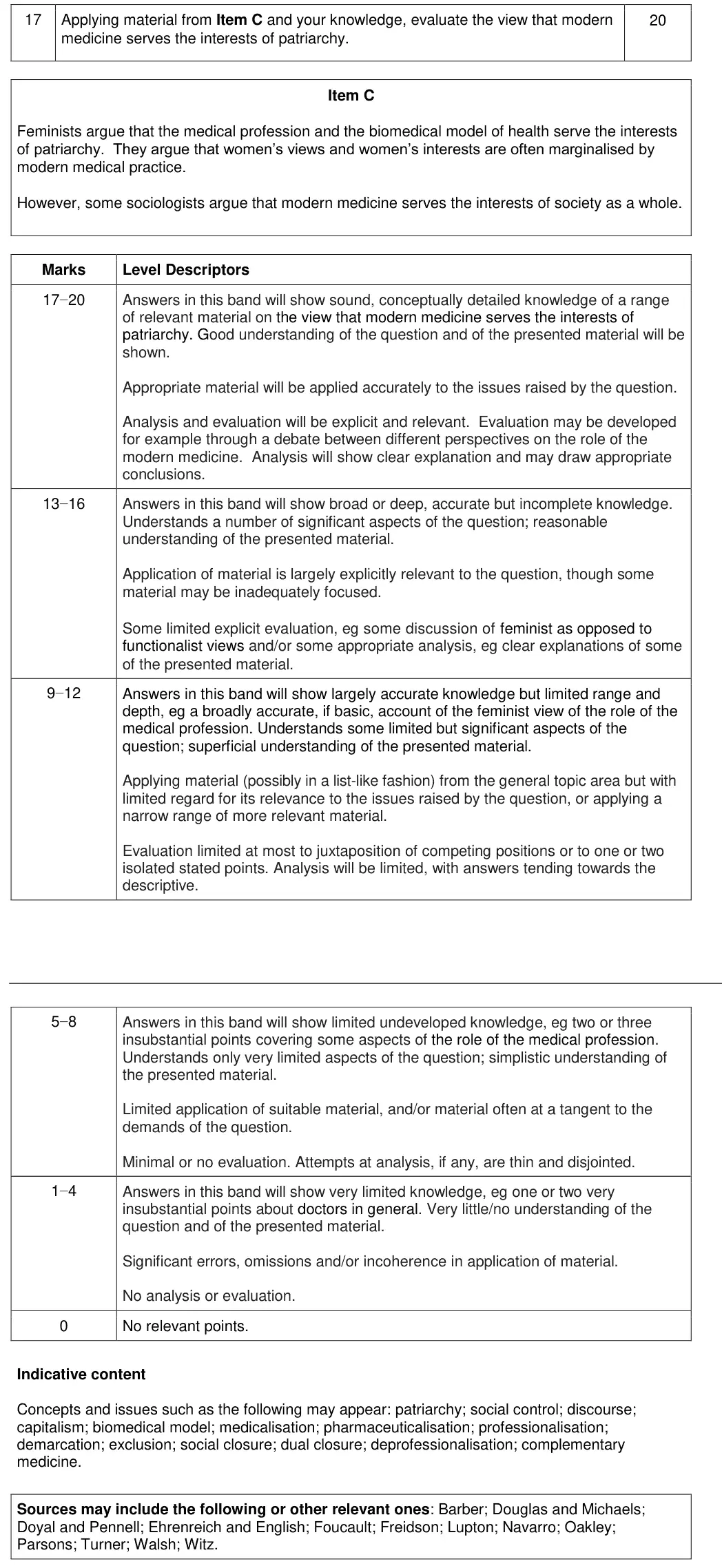
June 2018 · AS Paper 2 · Q1720 marksAO1=8, AO2=6, AO3=620-mark essay
Mark scheme, including the levels grid and indicative content
Examiner's comment
Some students took this as an opportunity to present material from different perspectives on the nature of modern medicine. These answers tended to only briefly consider the question in the title and various feminist views and instead produce varied accounts of Marxist, functionalist and Weberian approaches to the medical profession. The best answers were able to discuss numerous ways in which it can be argued that modern medicine serves the interest of patriarchy. These answers typically referred to employment patterns in the health care professions, the gendered experiences of patients, attitudes to complimentary medicine, as well as aspects and implications of the bio-medical model of health. These answers were often able to frame their answers with reference to different sociological perspectives and arrive at a reasoned conclusion. Weaker answers listed separate approaches in distinct sections while answers that were more effective were able to weave different perspectives into a discussion about particular aspects of modern medicine.
Notes from the mark scheme and report
apply Item C (biomedical model and profession serve patriarchy vs serve society)
evaluation via other perspectives on medicine
drifting into Marxist/functionalist/Weberian accounts of medicine without the feminist question scored lower
best used gendered employment in health, patients' experiences, complementary medicine, biomedical model, and wove views together
AO split from AQA's standard grid for this paper (this year's mark scheme does not print it).
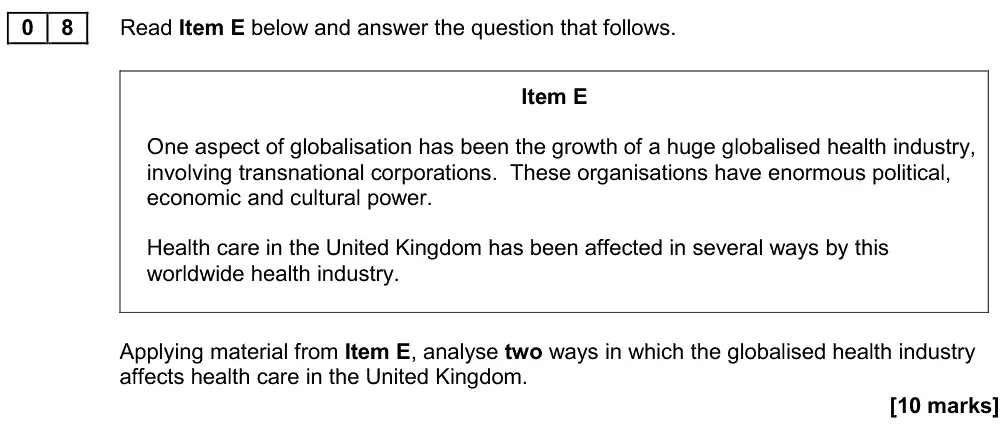
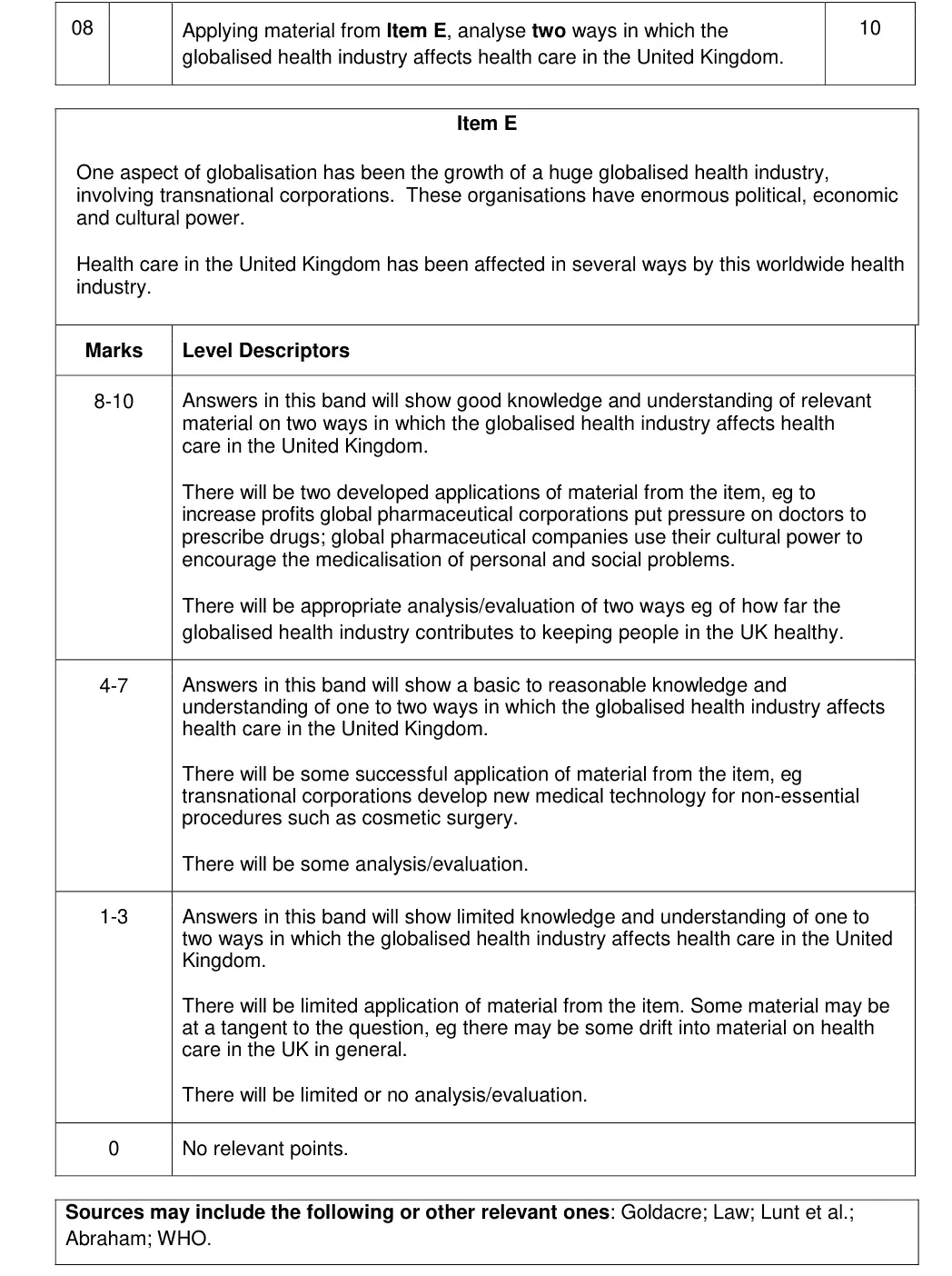
June 2017 · Paper 2 · Q810 marksAO1=3, AO2=4, AO3=3Analyse
Mark scheme, including the levels grid and indicative content
Examiner's comment
A number of students wrote introductory paragraphs and/or conclusions. These are not necessary, and are unlikely to gain additional marks. A number of students made only one point in their answer, or three or more, rather than the two asked for. In these cases, the two best answers were rewarded and will be in future series. It is helpful for students to clearly indicate their two answers, with wording such as “One way is…” or by starting a new paragraph for their second point. The assessment objective allocations are different in the two types of 10 mark questions, and students should be made aware of this. There was a wide range of responses to these questions. A minority of students wrote very brief answers. For these 10 mark items, a simple statement of two ways, reasons or factors, without development, is not sufficient to access more than the lower marks in the mark range. The best answers were focused, clearly stating a point and then developing it, with use of sociological concepts, evidence and theory where appropriate, in ways that demonstrated the skills expected from the targeted assessment objectives. There was a tendency, however, for many answers to focus on the first aspect of the question at the expense of the second. Students need guidance on how to approach these questions and how to best demonstrate their sociological understanding. The nature of these questions means that students cannot rely on reciting knowledge. They require students to bring together two aspects of their sociological knowledge in a way that they are unlikely to have done before. Answers will sometimes require claims that students may be unsure of because they do not know of specific evidence (for example, in question 5, whether migrants from Eastern Europe who are single workers tend to live alone or in shared households). However, answers that are sociologically plausible will be accepted. Students found it difficult to make connections between their knowledge of the globalised health industry on the one hand and health care in the UK on the other, and some wrote about one with little, if any, reference to the other. Better answers often identified one positive effect, such as availability of medicines or procedures, and one negative effect, such as the pursuit of profit by transnational pharmaceuticals leading to less money being available for health care.
Notes from the mark scheme and report
must connect the global health industry to UK health care
e.g. pharmaceutical pressure on prescribing, medicalisation
drift into UK health care in general = 1–3
many wrote about one side with little reference to the other
better answers gave one positive (availability of drugs/procedures) and one negative (profit draining NHS funds) effect
June 2017 · AS Paper 2 · Q142 marksAO2=2Brief explain
Mark scheme
Examiner's comment
This question proved to be quite difficult for many students. Partial answers tended to ignore the aspect of declining confidence in the question and just tended to assert that doctors did not operate in the best interests of their patients. More successful students cited the increased use of the internet undermining the traditional authority of the medical profession. Other good answers made direct reference to recent scandals involving the medical profession and related these to a decline in confidence in the medical profession.
Notes from the mark scheme and report
2 marks for a clearly explained example, 1 if partial
good answers: internet access to medical knowledge, alternative medicine, medical scandals
many ignored the 'decline in confidence' and just asserted doctors act against patients' interests
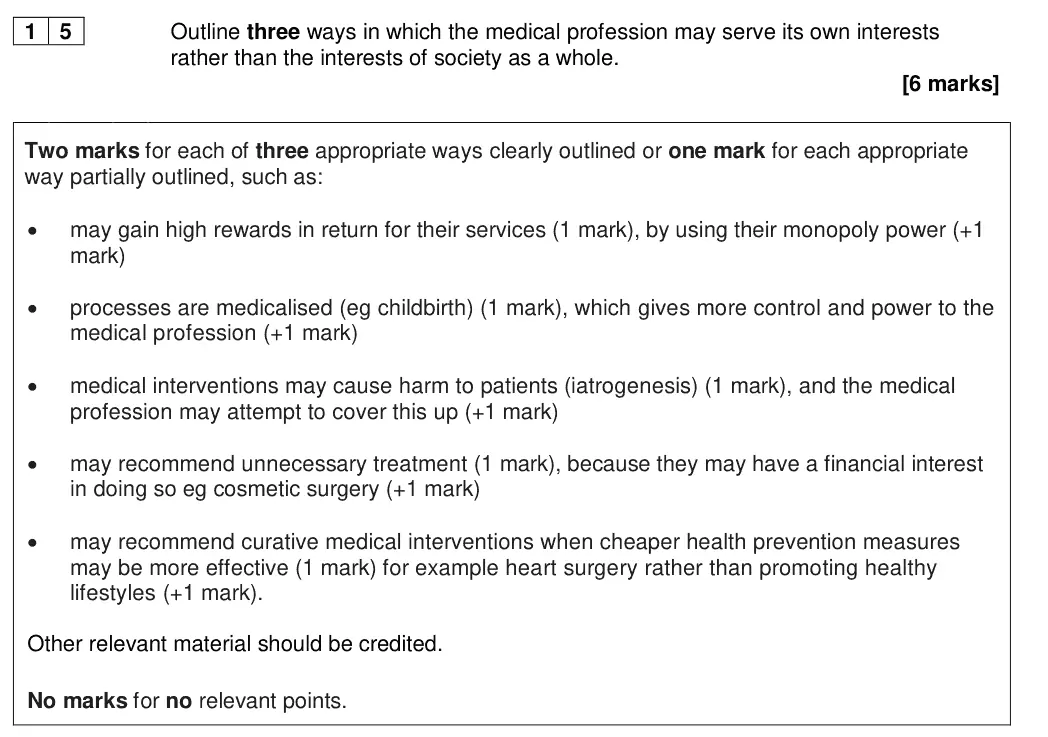
June 2016 · AS Paper 2 · Q156 marksAO1=6Outline
Mark scheme
Examiner's comment
In the 6 mark question some students are writing far too much, thereby losing focus on the precise wording of the question. Many students took this question as an opportunity to discuss the social class/ethnic/gender biases of medical treatment without being able to relate these comments back to how these aspects of provision benefited the medical profession. Similarly, many students discussed iatrogenesis, the various practices of drug companies or the inverse care law, but failed to explain how these benefited the medical profession. More successful responses identified ways such as: recommending treatment that benefited the medical profession financially; the ability of the medical profession to restrict access to the profession, so again benefiting financially; the medicalisation of social problems that has led to increased power and status in society for the medical profession.
Notes from the mark scheme and report
must show the benefit to the medical profession
credited: high rewards via monopoly, medicalisation increasing power, covering up iatrogenesis, unnecessary treatment
many discussed class/ethnic/gender bias, drug companies or inverse care law without linking to professional self-interest
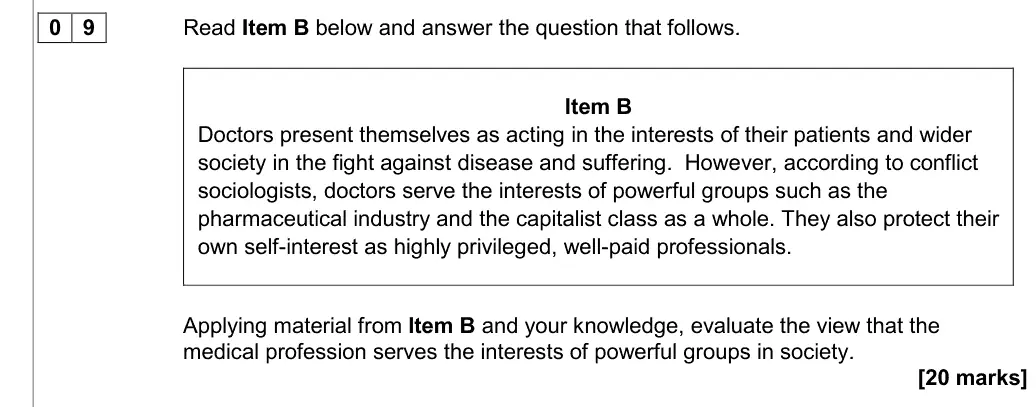
Specimen set 1 · Paper 2 · Q920 marksAO1=8, AO2=6, AO3=620-mark essay
Mark scheme, including the levels grid and indicative content
Notes from the mark scheme and report
item sets doctors' service ideal against conflict views (big pharma, capitalist class, professional self-interest)
top band debates functionalist, Marxist, Weberian, feminist and post-structuralist views
basic Parsons sick role account = 9–12
drifting into class and health care = 5–8
Work with an AQA sociology tutor
Essays stuck in the middle band, or losing marks on the 10-markers? Book a trial lesson with Mark, a former AQA examiner.