4.2.5-05 the significance of religion and religiosity in the contemporary world, including the nature and extent of secularisation in a global context, and globalisation and the spread of religions
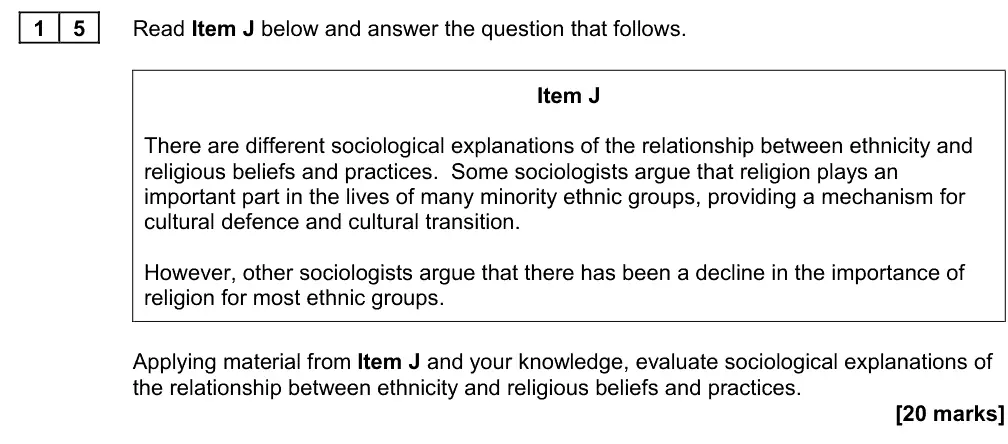
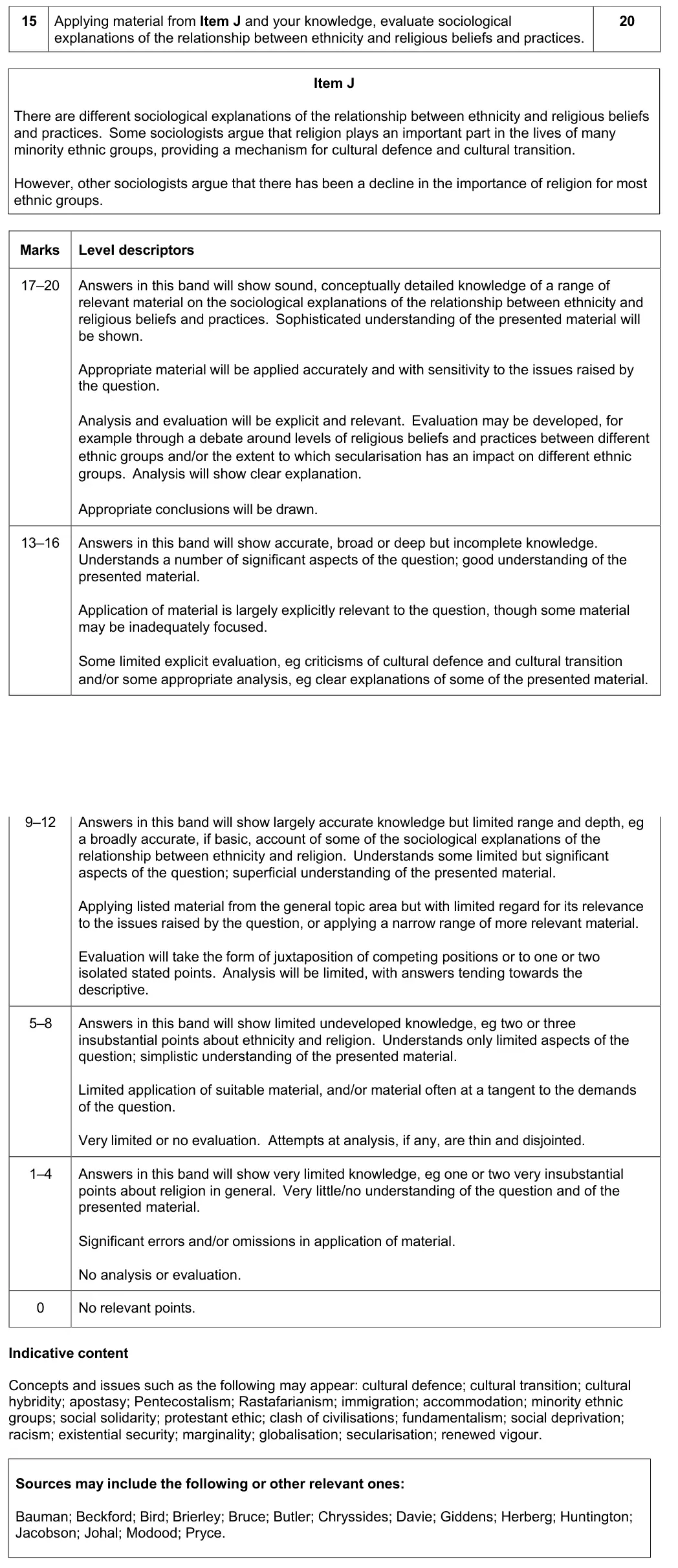
Applying material from Item J and your knowledge, evaluate sociological explanations of the relationship between ethnicity and religious beliefs and practices.
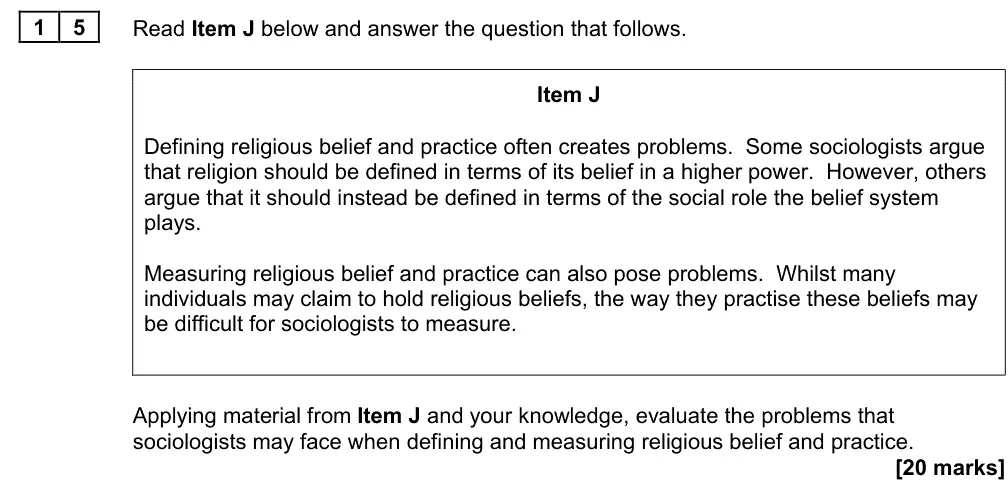
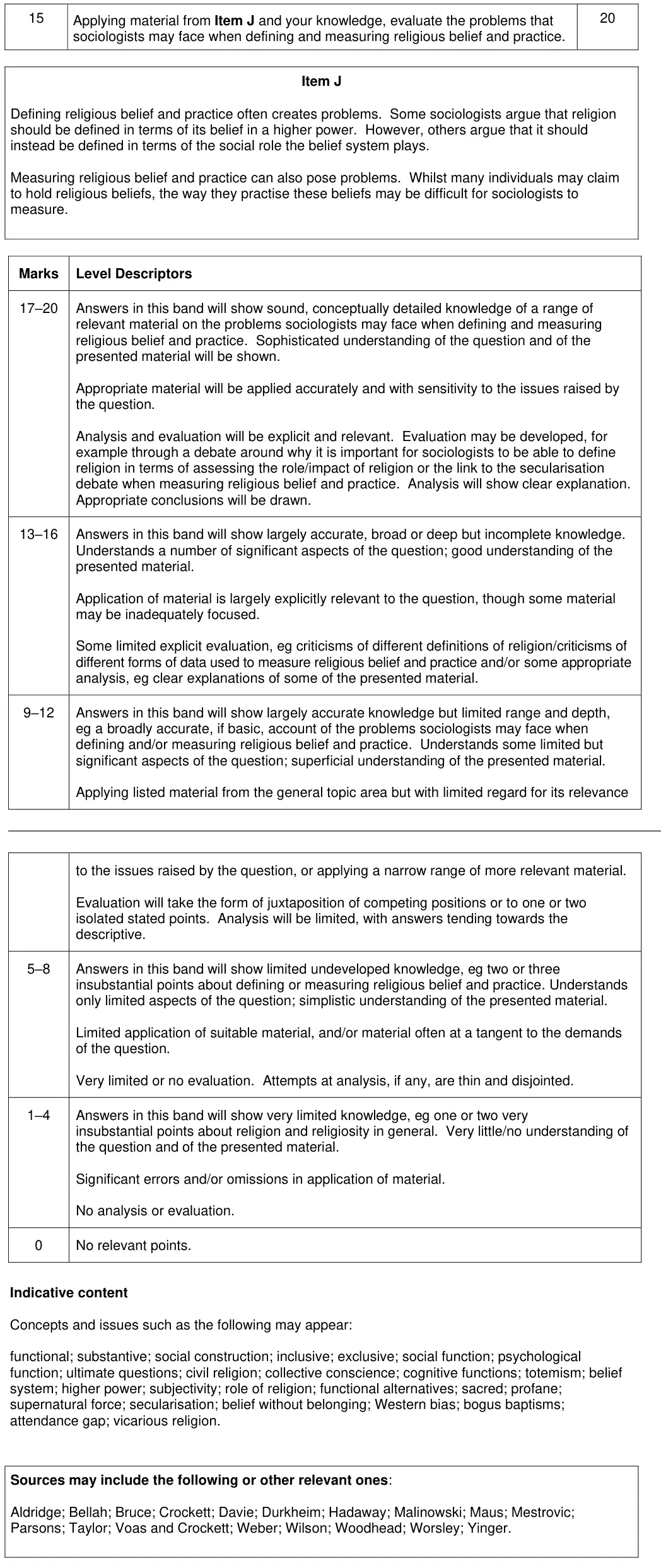
Applying material from Item J and your knowledge, evaluate the problems that sociologists may face when defining and measuring religious belief and practice.
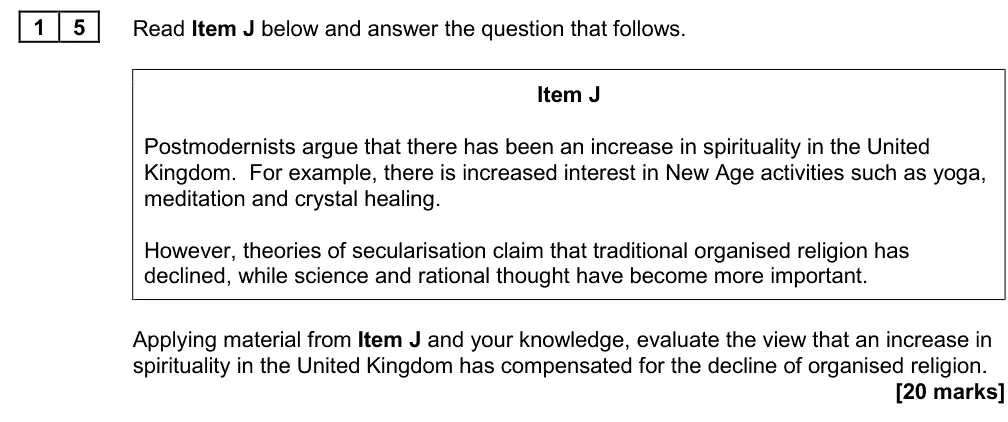
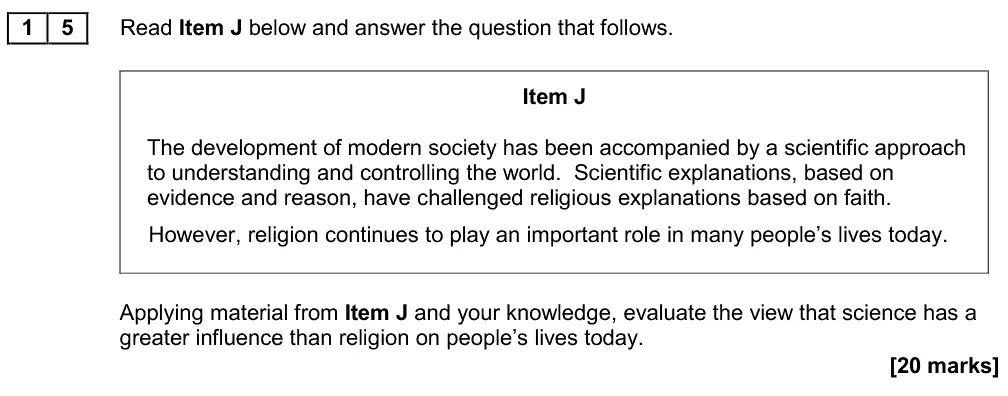
Applying material from Item J and your knowledge, evaluate the view that an increase in spirituality in the United Kingdom has compensated for the decline of organised religion.
Tap a question to zoom it. The mark scheme (with the level descriptors and indicative content) and the examiner's comment open underneath.
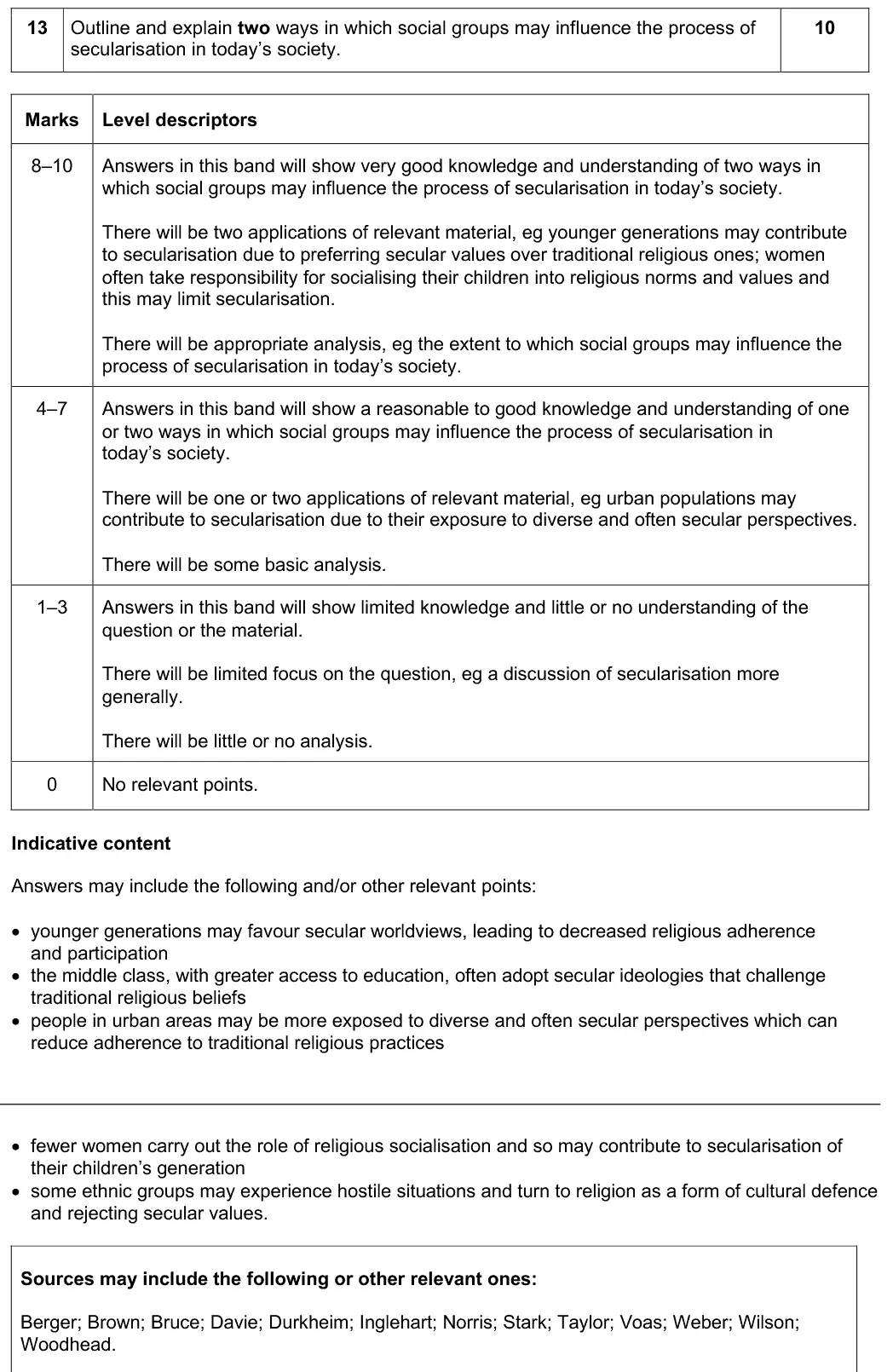
June 2025 · Paper 2 · Q1310 marksAO1=5, AO2=3, AO3=2Outline and explain
Mark scheme, including the levels grid and indicative content
Examiner's comment
The nature of these questions means that students cannot rely on reciting knowledge. Questions will ask them to bring together aspects of their sociological knowledge in ways they have not done before. It is therefore important for students to allow time to think about how to answer the question. Students should be aware that there are two types of ten-mark questions. These have different requirements and different mark schemes. There are different marks available for the assessment objectives. 10 mark “outline and explain” questions have more marks available for knowledge and understanding, and none for evaluation. Introductions and conclusions are not required for 10-mark questions, are unlikely to help students and take up time. It is helpful if answers are set out to clearly indicate the two answers, with wording such as “One way/reason is…” or by starting a new paragraph for the second point. Answers that give more than two answers are unlikely to develop two of them sufficiently. The most successful answers to 10-mark questions were focused, clearly stating a point that addressed the question and then developing it, using sociological concepts, evidence such as an example and, where appropriate, theory. Some students found it difficult to interpret “social groups”, although this term is in the specification, and gave two reasons for secularisation rather than addressing the question. There were some unorthodox social groups, but credit as given where these were reasonable and plausible. Many better answers focused on age and ethnicity; for example, ethnic minorities and cultural defence slowing secularisation down and young people no longer feeling religious speeding it up.
Notes from the mark scheme and report
must be how social groups (age, class, ethnicity, gender, urban populations) influence secularisation, not general reasons for secularisation (= 1–3)
plausible unorthodox groups credited
good answers: ethnic minorities' cultural defence slowing it, young people speeding it
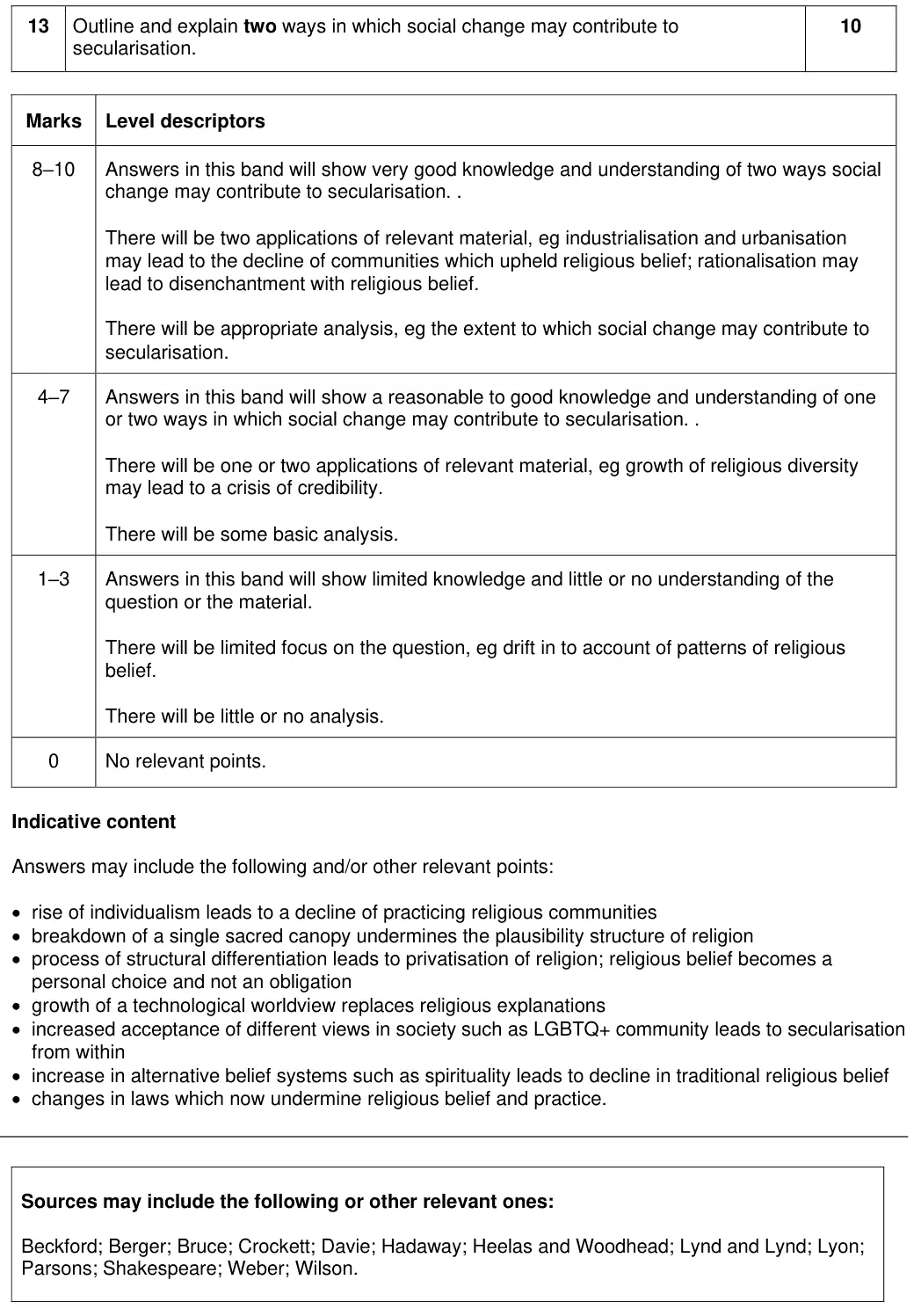
June 2024 · Paper 2 · Q1310 marksAO1=5, AO2=3, AO3=2Outline and explain
Mark scheme, including the levels grid and indicative content
Examiner's comment
The nature of these questions means that students cannot rely on reciting knowledge. Questions will ask them to bring together aspects of their sociological knowledge in ways they will not have done before. It is therefore important for students to allow time to think about how to answer the question. Students should be made aware that there are two types of 10 mark questions. These have different requirements and different mark schemes . There are different marks available for the assessment objectives. A breakdown of the marks awarded by assessment objective can be found in the mark scheme. 10 mark “outline and explain” questions have more marks available for knowledge and understanding, and none for evaluation. Introductions and conclusions are not required for 10 mark questions; they take up time and rarely improve the mark. It is helpful if answers are set out to clearly indicate the two answers, with wording such as “One way/reason is…”, or by starting a new paragraph for the second point. Answers that give more than two points are unlikely to develop two of them sufficiently. Q13: Most students successfully identified two ways in which social change might lead to secularisation. Popular responses included individualism and personal choice, the privatisation of religion, and rationalisation alongside scientific advancements. Explicit 'connections' to secularisation were often underdeveloped. Some answers focused on changes within religions, which are themselves aspects of secularisation, and so lost focus on the question.
Notes from the mark scheme and report
two ways social change drives secularisation (e.g. industrialisation and urbanisation breaking up religious communities, rationalisation and disenchantment, structural differentiation and privatisation, individualism, pluralism undermining the sacred canopy)
drift into patterns of belief = 1–3
explicit links to secularisation often underdeveloped
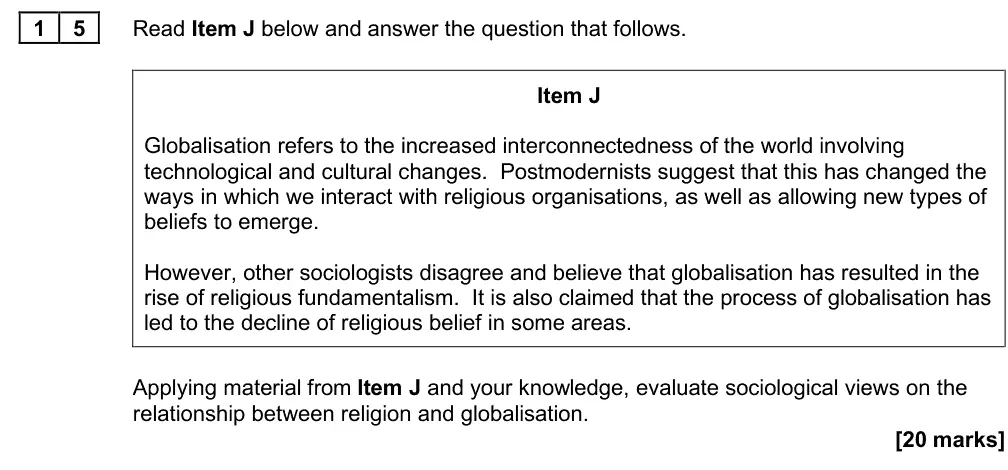
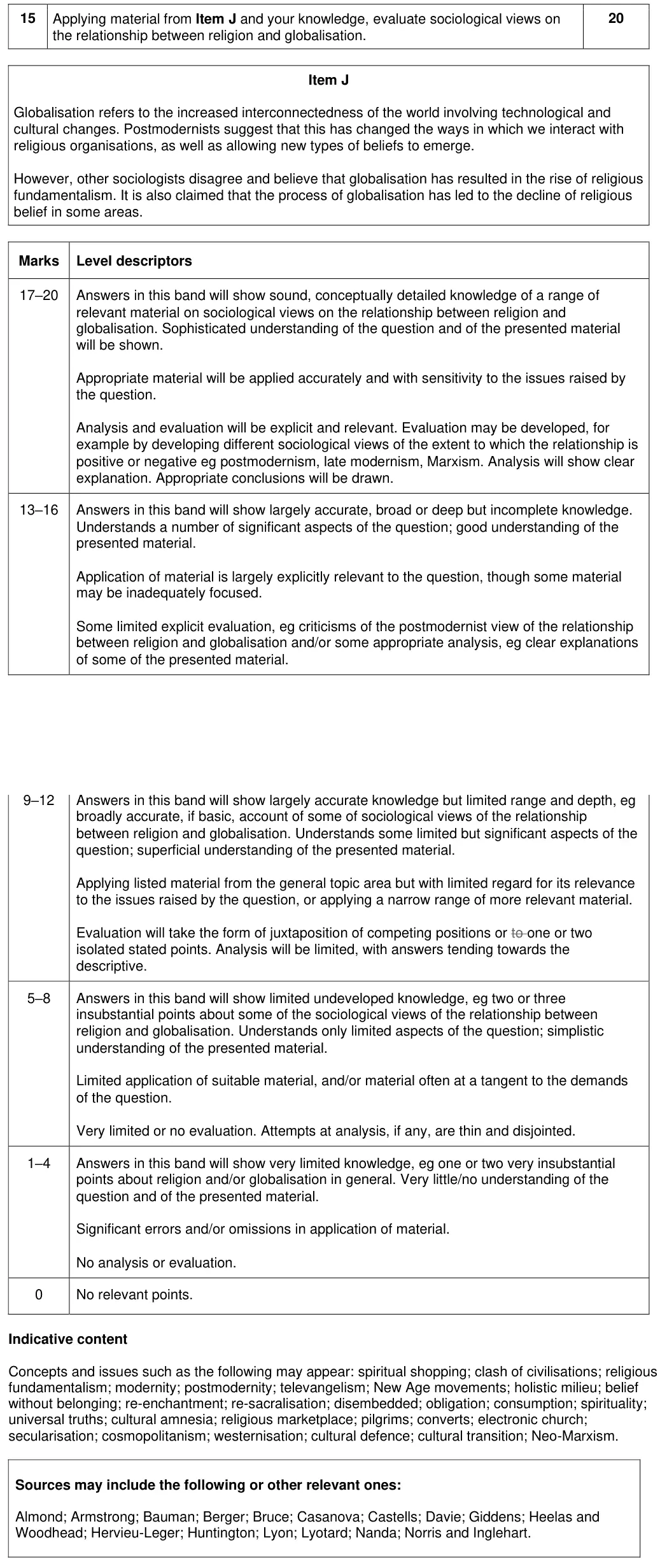
June 2024 · Paper 2 · Q1520 marksAO1=8, AO2=6, AO3=620-mark essay
Mark scheme, including the levels grid and indicative content
Examiner's comment
The items for these questions have a different purpose to those for 10 mark “analyse” questions. The items will suggest a few starting points for students, including ways into evaluation. Students are expected to also bring in further ideas (“and your knowledge” in the instruction). A wide range of material can be relevant to these questions, so students need to be selective. It is more effective to cover a limited number of points in depth rather than to try to include everything. Students who made essay plans appeared to benefit by having more structured and coherent responses. Q15. There were some outstanding answers, but a few students did not complete the question, while others relied on repeating the item with little development of the points. It was disappointing to note the limited understanding of the relationship between religion and globalisation among many students. Some responses assumed that any recent social change was part of globalisation.
Notes from the mark scheme and report
top band evaluates views (postmodernism, late modernism, Marxism) on whether the relationship is positive or negative: new beliefs and ways of engaging, fundamentalism, decline of belief
many repeated the item with little development
understanding of the religion–globalisation link was often limited
some did not finish
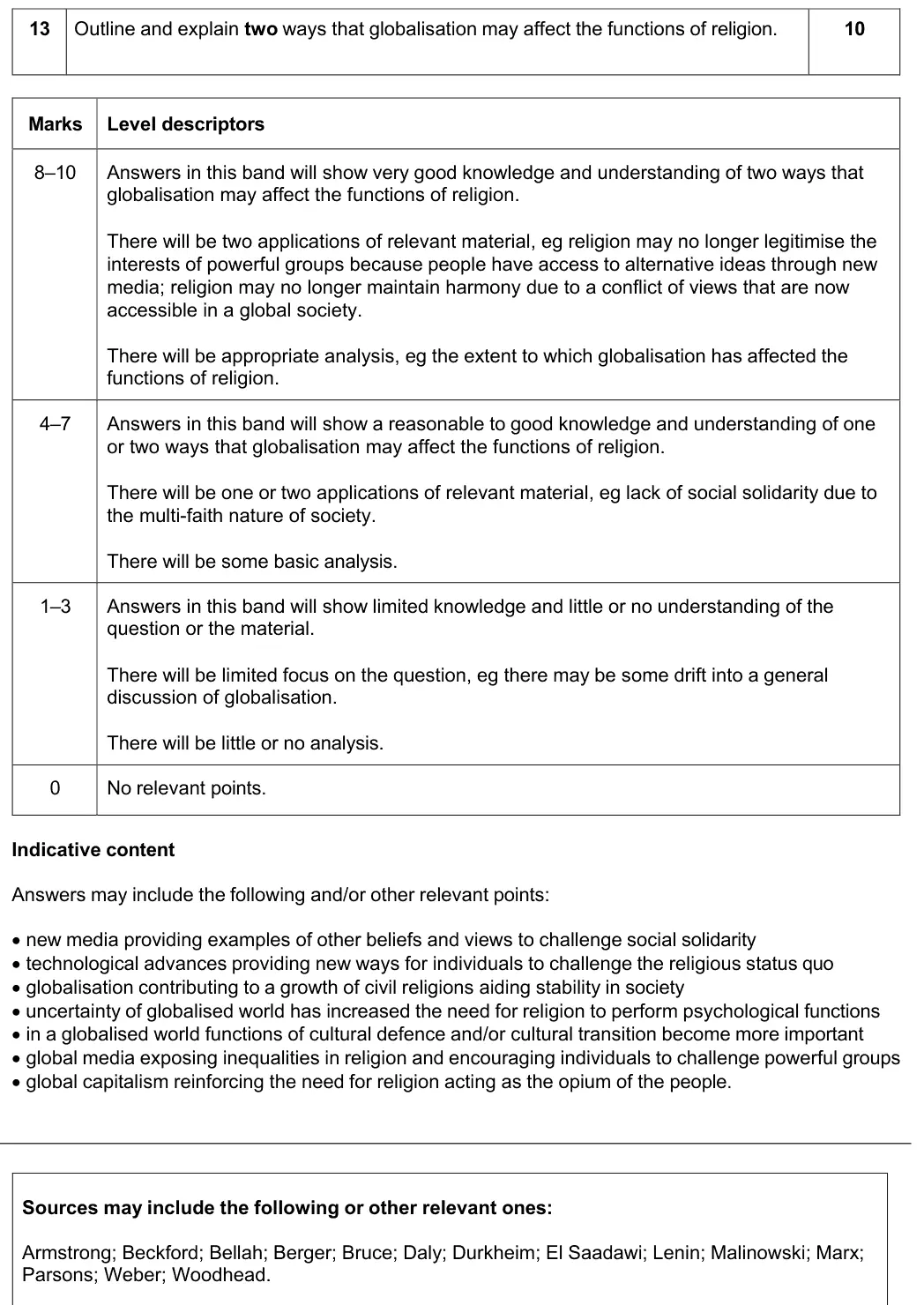
June 2023 · Paper 2 · Q1310 marksAO1=5, AO2=3, AO3=2Outline and explain
Mark scheme, including the levels grid and indicative content
Examiner's comment
The nature of these questions means that students cannot rely on reciting knowledge. Questions will ask them to bring together aspects of their sociological knowledge in ways they are unlikely to have done before. It is therefore important for students to allow time to think about how to answer the question. Students should be made aware that there are two types of 10 mark questions. These have different requirements and different mark schemes. There are different marks available for the assessment objectives. 10 mark “outline and explain” questions have more marks available for knowledge and understanding, and none for evaluation. Introductions and conclusions are not required for 10 mark questions and take up valuable time. It is helpful if answers are set out to clearly indicate the two separate points, with wording such as “One way/reason is…” or by starting a new paragraph for the second point. Answers that give more than two points are unlikely to develop two of them sufficiently. Question 13: Many answers were able to identify two ways that globalisation has affected religion, for example how new media can provide access to a range of beliefs online. The connection to the functions of religion was often less clear and led to less successful answers.
Notes from the mark scheme and report
must link globalisation to the functions of religion (legitimation, social solidarity, cultural defence, psychological support)
drift into globalisation in general = 1–3
many identified effects on religion (e.g. online access to beliefs) without connecting them to functions
June 2023 · Paper 2 · Q1520 marksAO1=8, AO2=6, AO3=620-mark essay
Mark scheme, including the levels grid and indicative content
Examiner's comment
Most students answered their chosen questions in the order in which they appeared on the question paper. They therefore answered the section B 20 mark question last. For some this was a relatively brief and often apparently unfinished answer. This suggests that students need to track carefully time spent on each question. The purpose of the items for these questions is to suggest a few starting points for students, including ways into evaluation. Students are expected to also bring in further ideas (“and your knowledge” in the instruction). A wide range of material can be relevant to these questions, so students need to be selective. It is more effective to cover a limited number of views/theories in depth rather than to include every possible theory. Students who made essay plans appeared to benefit by having more structured and coherent responses. Question 15: The best answers here were very good, applying a range of ideas from across the topic to ethnicity. Some answers were brief, perhaps because this question was being answered last. Others drifted from the question to, for example, a general discussion of secularisation.
Notes from the mark scheme and report
top band debates religiosity across ethnic groups and the impact of secularisation
criticism of cultural defence/transition is credited evaluation
some drifted into general secularisation
some answers brief, perhaps done last
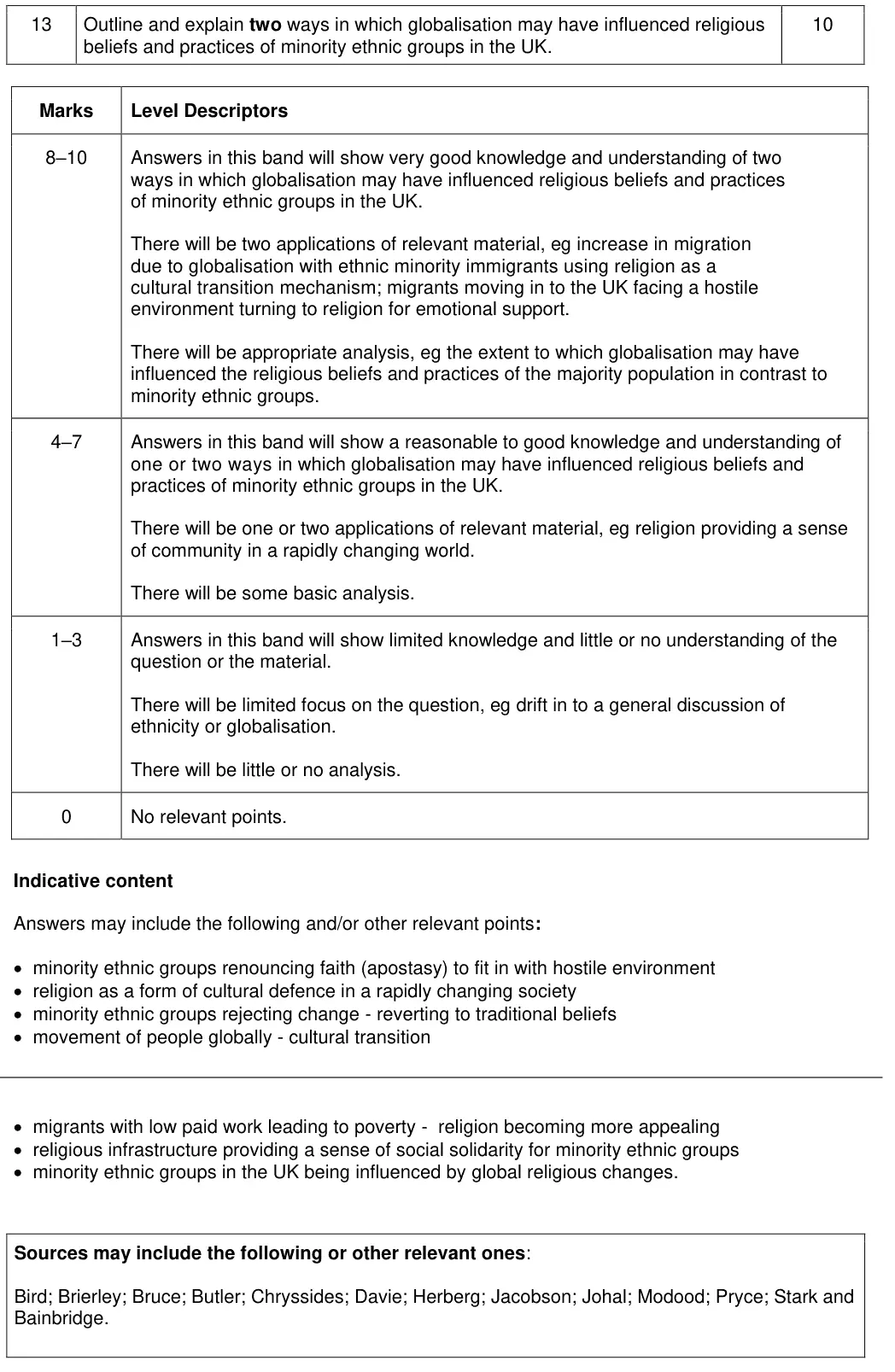
June 2022 · Paper 2 · Q1310 marksAO1=5, AO2=3, AO3=2Outline and explain
Mark scheme, including the levels grid and indicative content
Examiner's comment
The nature of these questions means that students cannot rely on reciting knowledge. The questions will ask them to bring together aspects of their sociological knowledge in a way that they are unlikely to have done before. There was a tendency, however, to attempt to answer the question by giving knowledge based on words or phrases in the question, rather than meeting the demands of the question. Students are advised to spend time reading the question, and, where there is one the item, to ensure that they are answering the question. Some students seemed unaware of the different demands of the two types of questions. The marks awarded for the assessment objectives are different in the two types of ten mark questions, and students should be aware of this. In particular, it should be noted that there are no marks available for evaluation in “outline and explain” (no item) questions. There is no need for an introduction or conclusion for 10 mark questions. It is helpful if answers are set out to clearly indicate the two answers, with wording such as “One way is…” or by starting a new paragraph for the second point. The best answers to 10 mark questions were focused, clearly stating a point that addressed the question and then developing it, using sociological concepts, evidence and, where appropriate, theory. Answers need to address all aspects of the question. Q13 A number of answers to this question wrote in general terms about effects of globalisation on religious beliefs and practices rather than focusing on minority ethnic groups in the UK. Answers which leant themselves to a focus on minority ethnic groups included cultural defence and cultural transition. Among more general answers were those that looked at the growth of private worship and online religion.
Notes from the mark scheme and report
must focus on minority ethnic groups in the UK
many wrote generally about globalisation and religion (online religion, private worship) and drifted
cultural defence and cultural transition were the most fitting answers
June 2022 · Paper 2 · Q1520 marksAO1=8, AO2=6, AO3=620-mark essay
Mark scheme, including the levels grid and indicative content
Examiner's comment
Most candidates answered their chosen questions in the order in which they appeared on the question paper. They therefore answered the section B 20 mark essay question last, and for many this was a relatively brief and often apparently unfinished answer. This suggests that timing is a problem for many candidates. The items for 20 mark questions are written to provide a number of ideas on which students can begin to build their answers. Students are expected to also bring in further ideas (hence “and your knowledge” in the instruction). It is often the case that a wide range of material can be relevant to these questions, and students need to be selective. For example, it may be more effective to cover a limited number of views or theories in some depth rather than to include every possible theory. There was a tendency for answers to progressively lose sight of the question and to become a list of different views. Many attempts at evaluation were learned criticisms. Evaluation is more effective where it is focused on the demands of the question. Students should also be aware that evaluation includes awareness of the strengths as well as the weaknesses of an argument or theory. Following feedback from centres regarding the advance information for the 20 mark questions, we have monitored the marking of these questions, as well as carrying out statistical analysis on student performance. Based on this analysis, we can confirm that students have performed as we expected them to on these questions, and their performance on these questions is in line with previous series. Q15 This question produced a number of thoughtful responses covering a range of relevant issues about definitions and measurement. Areas applied included church attendance, believing without belonging, private worship, online religion, televangelism, New Religious Movements, New Age Movements and various aspects of secularisation.
Notes from the mark scheme and report
covers both defining (substantive vs functional, inclusive vs exclusive) and measuring (attendance, believing without belonging, vicarious religion)
top band links measurement problems to the secularisation debate
many thoughtful answers using online religion, televangelism, NRMs and New Age movements
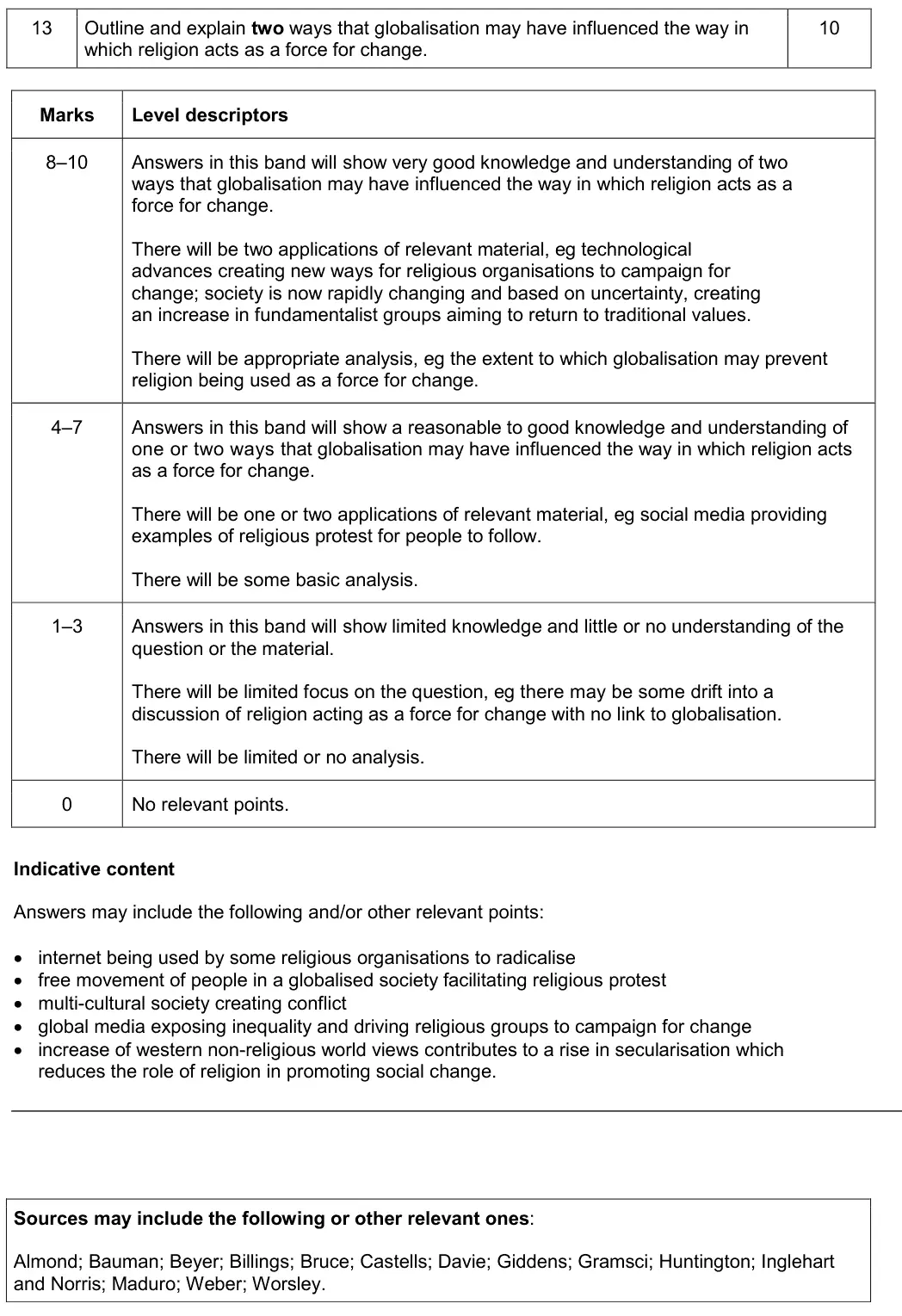
November 2021 · Paper 2 · Q1310 marksAO1=5, AO2=3, AO3=2Outline and explain
Mark scheme, including the levels grid and indicative content
Examiner's comment
Some answers here recounted examples of change influenced by religion, such as the US Civil Rights Movement of the 1960s, without being able to make clear connections to globalisation. Those that approached the question by considering aspects of globalisation (such as Westernisation, technology and social media, diasporas and migration) tended to have more success. The particular requirements of both types of 10 mark questions mean that the role of the teacher in explaining the format of questions and, for ‘analyse’ questions, the structure and content of the items, is essential, as is practice followed by constructive feedback. Students need to be aware that these questions will always require connections to be made between different parts of the specification for the topic, and that this will require thinking in the examination about how the two aspects are connected.
Notes from the mark scheme and report
no marks for evaluation in this question type
each way must link an aspect of globalisation (technology and social media, migration and diasporas, Westernisation) to religion as a force for change, e.g. fundamentalism as a response to uncertainty
examples of religious change (e.g. US civil rights) with no link to globalisation = 1–3
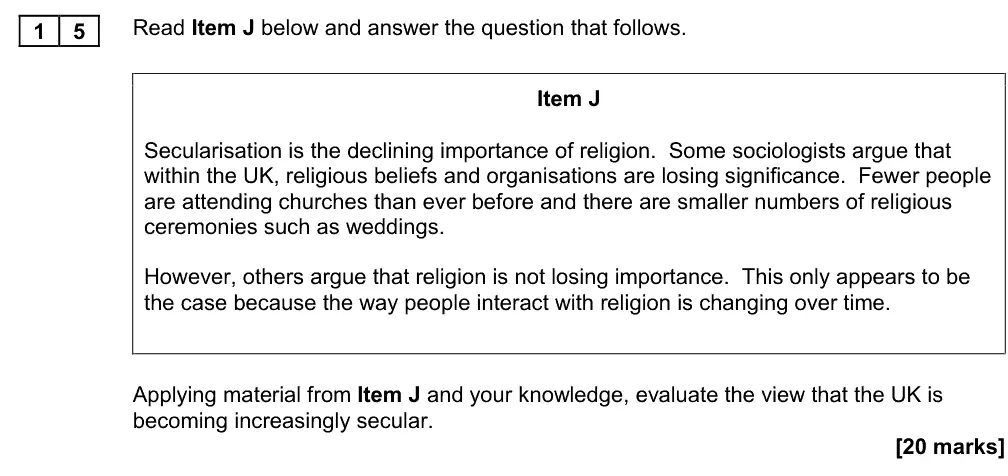
November 2021 · Paper 2 · Q1520 marksAO1=8, AO2=6, AO3=620-mark essay
Mark scheme, including the levels grid and indicative content
Examiner's comment
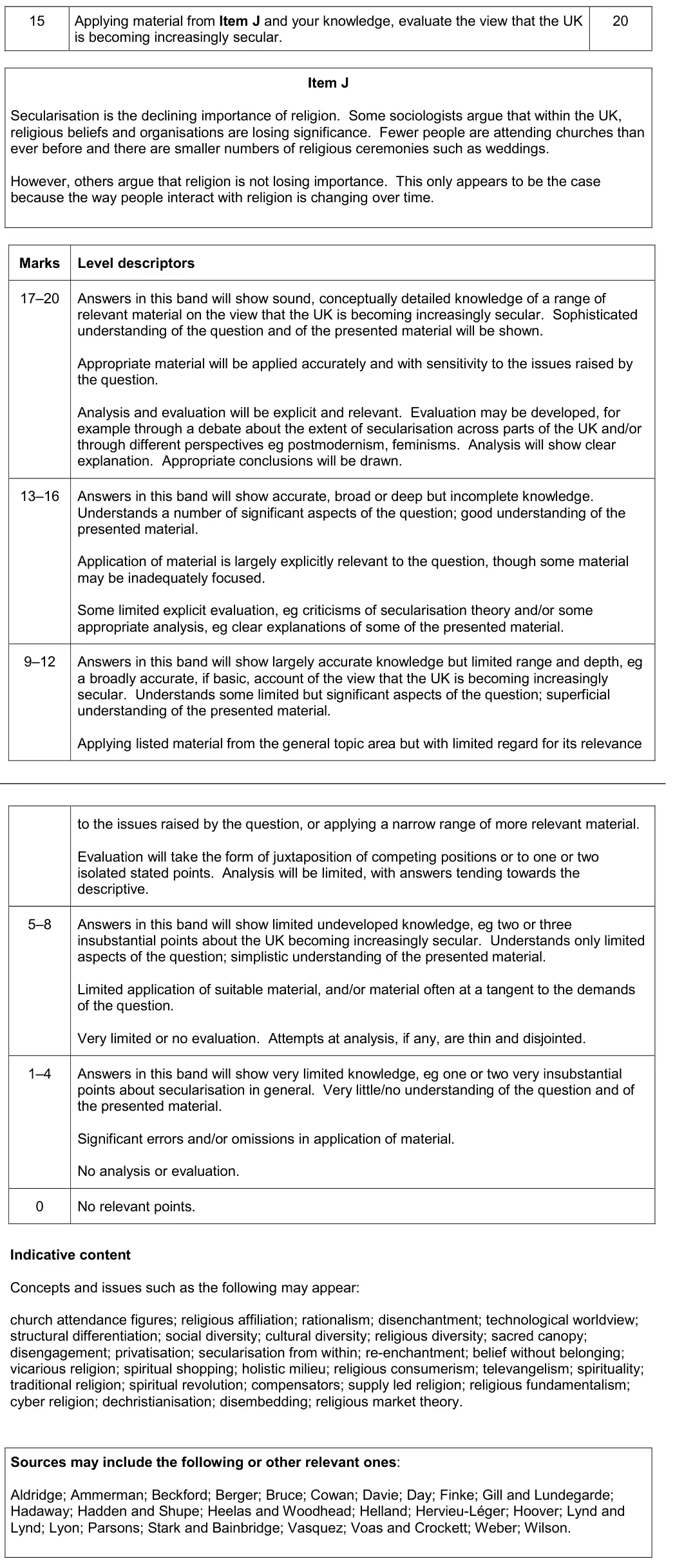
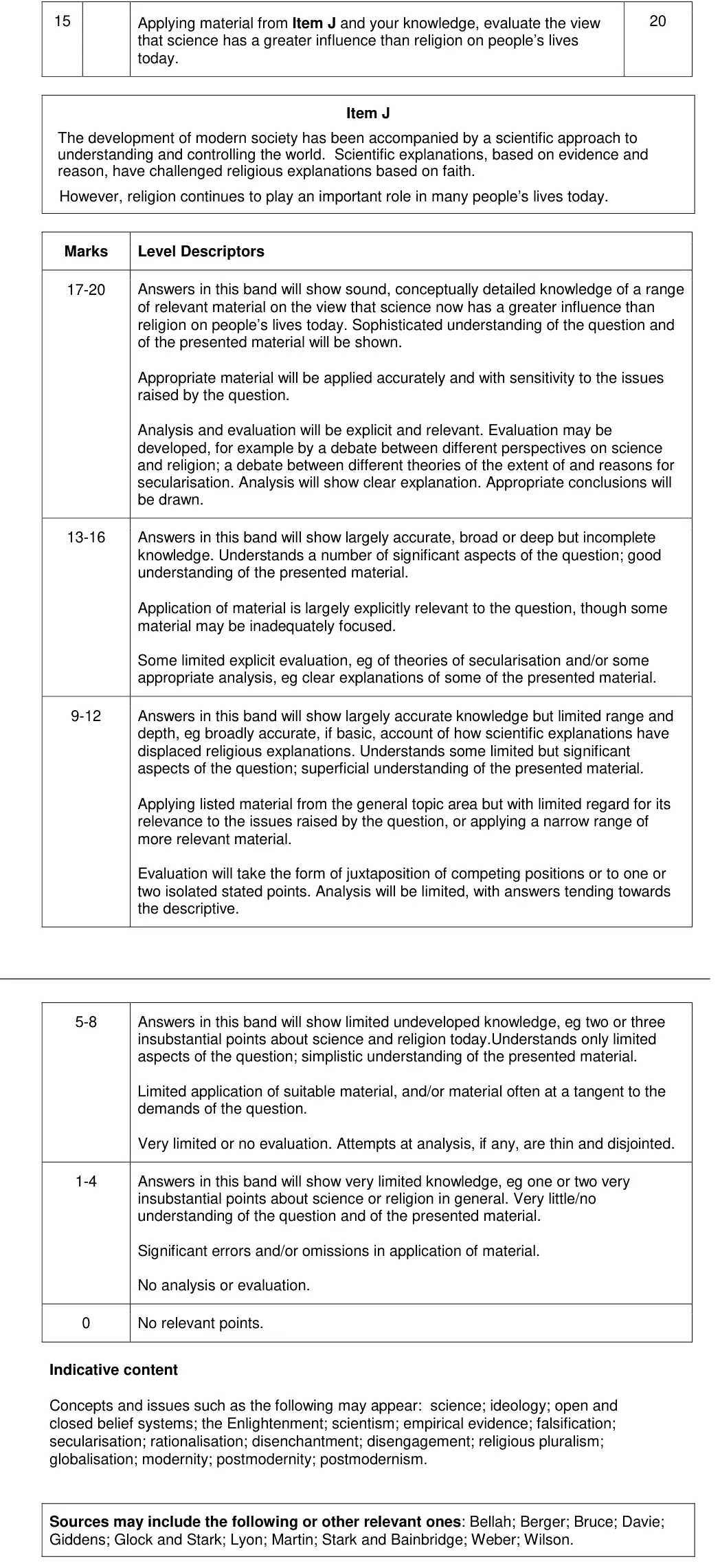
There was some good knowledge both for and against the view that the UK is becoming increasingly secular. Answers tended to follow the points in the item, with, as in previous series, lack of time preventing students from bringing in more of their own knowledge later in the essay.
Notes from the mark scheme and report
must apply Item J (falling attendance and ceremonies vs changing forms of religion)
top band debates the extent of secularisation across the UK or through postmodernism and feminisms
answers tended to follow the item and ran short of time to add their own knowledge
November 2020 · Paper 2 · Q1410 marksAO1=3, AO2=4, AO3=3Analyse
Mark scheme, including the levels grid and indicative content
Examiner's comment
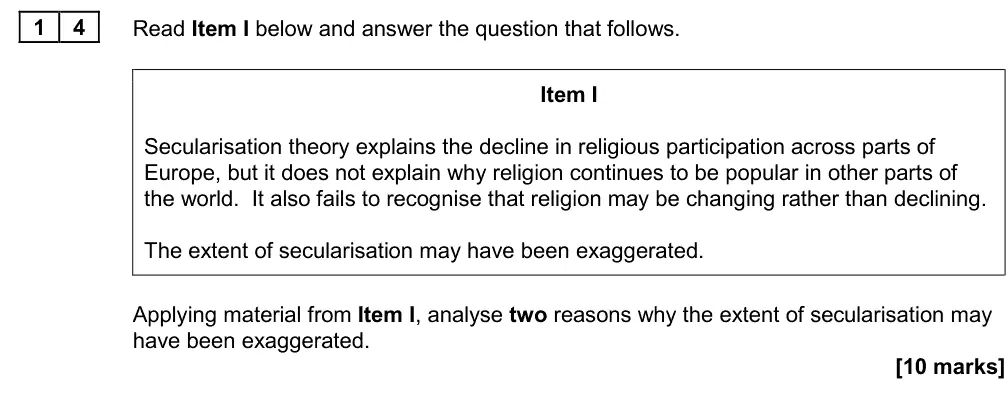
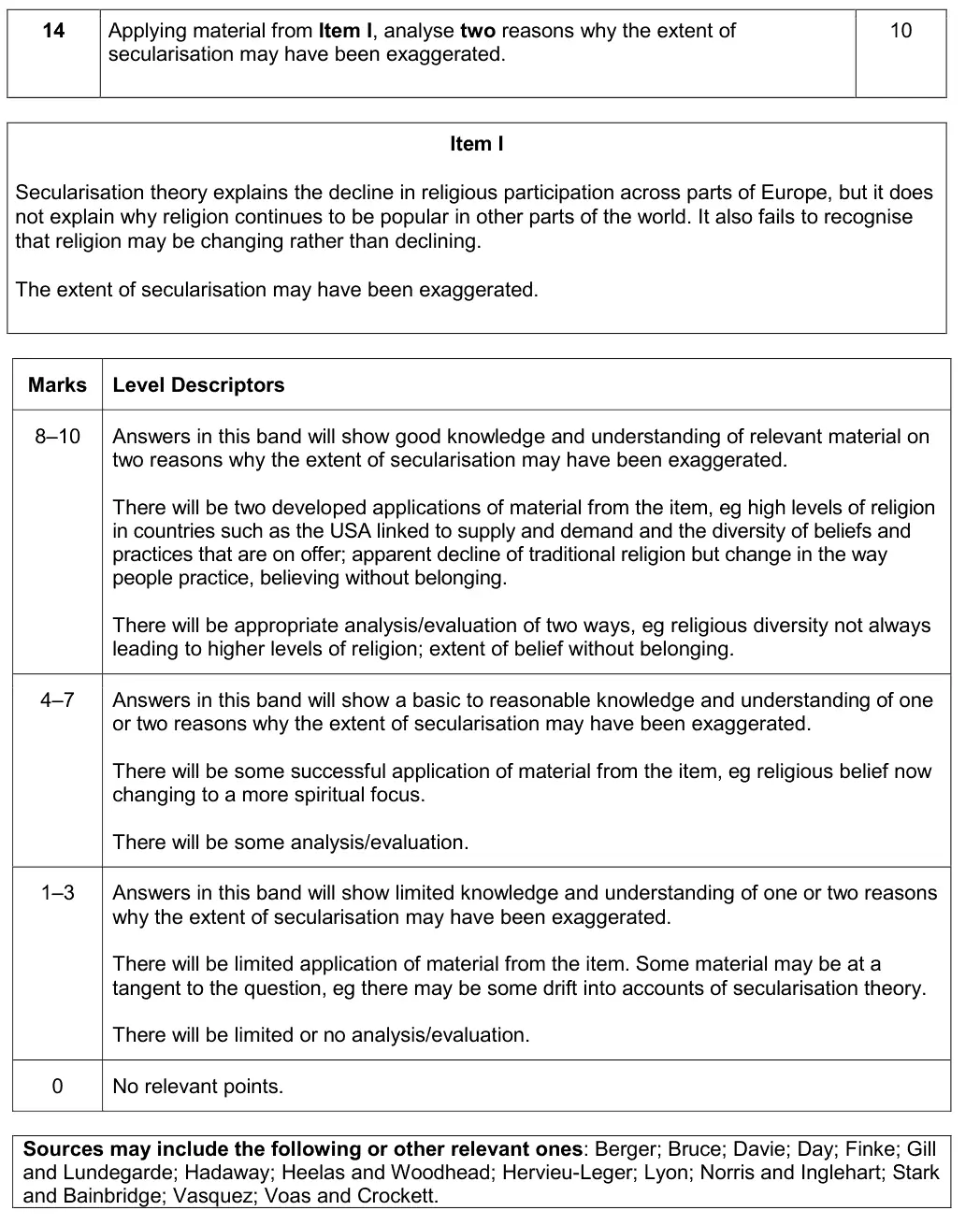
Many students were able to answer this question well, applying ideas in the item to make relevant points about, for example, the strength of religion in many countries and changes towards religious beliefs and practices being less visible and so harder to measure. The 10-mark “analyse” questions require use of the item, which will provide a starting point for answers. Answers which do not use the item will be unable to access higher marks.
Notes from the mark scheme and report
apply Item I (religion strong outside Europe, changing not declining)
e.g. religious market and diversity in the USA, believing without belonging and spirituality
evaluation e.g. extent of belief without belonging
drift into secularisation theory = tangent
many answered well on less visible, harder-to-measure religion
June 2019 · Paper 2 · Q1410 marksAO1=3, AO2=4, AO3=3Analyse
Mark scheme, including the levels grid and indicative content
Examiner's comment
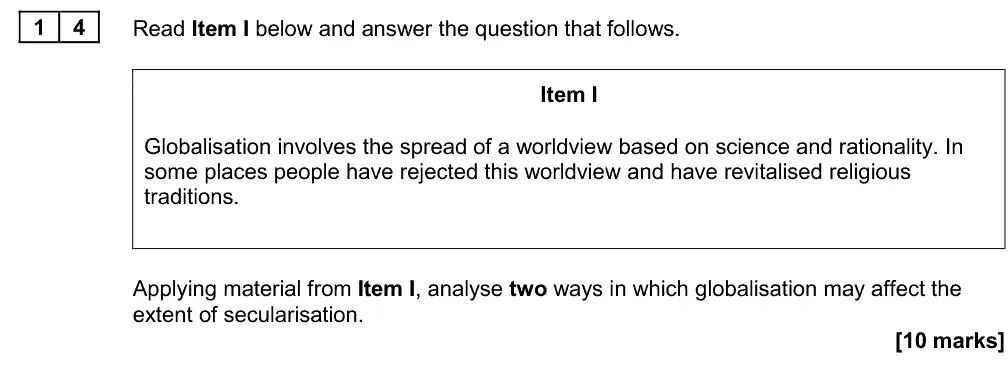
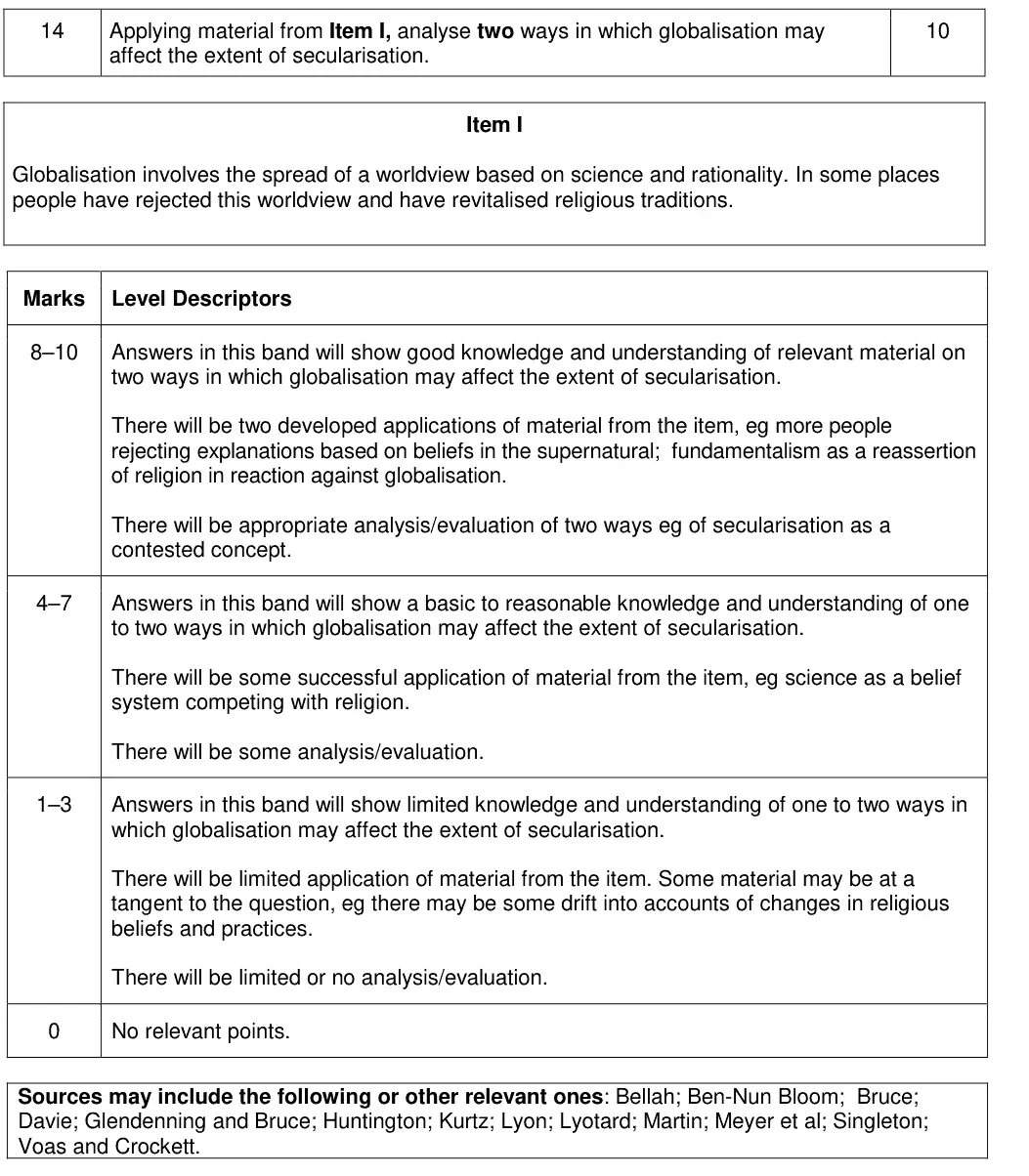
Some students wrote introductory paragraphs and/or conclusions. These are not necessary, and are unlikely to gain additional marks; they also take up time. Some students made only one point in their answers, or three or more, rather than the two asked for. The word ‘two’ is put in bold in the question to try and draw students’ attention to this. Sometimes it was not clear how many points were being made. It is helpful for students to clearly indicate their two answers, with wording such as “One way is…” or by starting a new paragraph for their second point. Notably, some students wrote far more than was needed for a 10-mark response. The two types of 10-mark question, “outline and explain” and “analysis” types, are marked differently as the assessment objectives have different weightings. It is important that students are aware of this. For 10 mark “analyse” questions, the parts of the item being used should be clearly indicated, preferably by exact words being quoted. It is acceptable for two different points to be drawn from one part of the item, but answers which do not use the item cannot access the application marks. The best answers to 10-mark questions were focused, clearly stating a point and then developing it, and used sociological concepts, studies, evidence and theory as appropriate. This question was generally answered well though not all used the references in the item effectively. Some students with good knowledge neglected, in their haste, to show how their answer drew from the item and so could not reach the level of credit for which their knowledge gave them the potential. For example, many students used the reference to ‘a worldview based on science and rationality’ to argue that secularisation was spreading, while the reference to ‘revitalising religious traditions’ led to discussions of fundamentalism.
Notes from the mark scheme and report
must show which item hook each point comes from: science and rationality (secularisation spreading) and revitalised traditions (fundamentalism)
good knowledge without explicit item use could not reach the top band
AO split from AQA's standard grid for this paper (this year's mark scheme does not print it).
June 2018 · Paper 2 · Q1310 marksAO1=5, AO2=3, AO3=2Outline and explain
Mark scheme, including the levels grid and indicative content
Examiner's comment
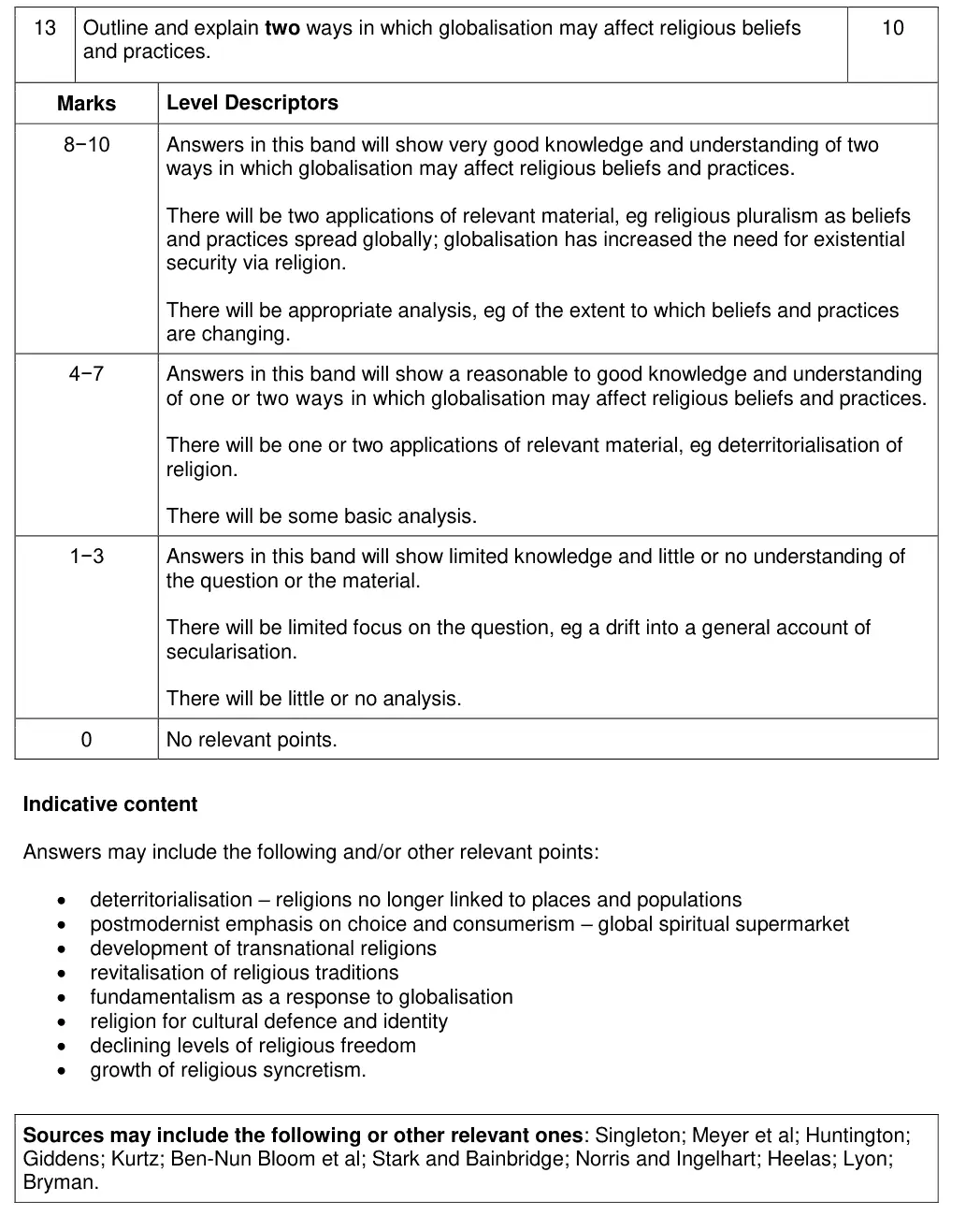
Some students wrote introductory paragraphs and/or conclusions. These are not necessary, and are unlikely to gain additional marks, and they also take up time. Some students made only one point in their answers, or three or more, rather than the two asked for in the question. Sometimes it was unclear how many points were being made. It is helpful for students to clearly indicate their two answers, with wording such as “One way is…” or by starting a new paragraph for their second point. Evaluation is not a requirement for answers to 10 mark “outline and explain” questions. The marks awarded for the assessment objectives being targeted are different in the two types of ten mark questions, and students should be made aware of this. The best answers to 10 mark questions were focused, clearly stating a point and then developing it, using sociological concepts, evidence and theory where appropriate. In some questions students tended to focus on the first aspect of the question at the expense of the second. Students need guidance on how to approach these questions and how to best demonstrate their sociological understanding. The nature of these questions means that students cannot rely on reciting knowledge. These questions will ask them to bring together aspects of their sociological knowledge in a way that they are unlikely to have done before. There were some good answers with most students able to explain two ways in which globalisation may have affected religious beliefs and practices. There was a range of ideas with popular answers including pluralism and greater choice, deterritorialisation (although usually without using this concept) and the growth of fundamentalism. Some weaker answers described recent changes in beliefs or practices without making the role of globalisation clear.
Notes from the mark scheme and report
two ways globalisation affects beliefs and practices (e.g. pluralism, deterritorialisation, fundamentalism, cultural defence, spiritual supermarket)
general account of secularisation = 1–3
weaker answers described change without making the role of globalisation clear
AO split from AQA's standard grid for this paper (this year's mark scheme does not print it).
June 2018 · Paper 2 · Q1520 marksAO1=8, AO2=6, AO3=620-mark essay
Mark scheme, including the levels grid and indicative content
Examiner's comment
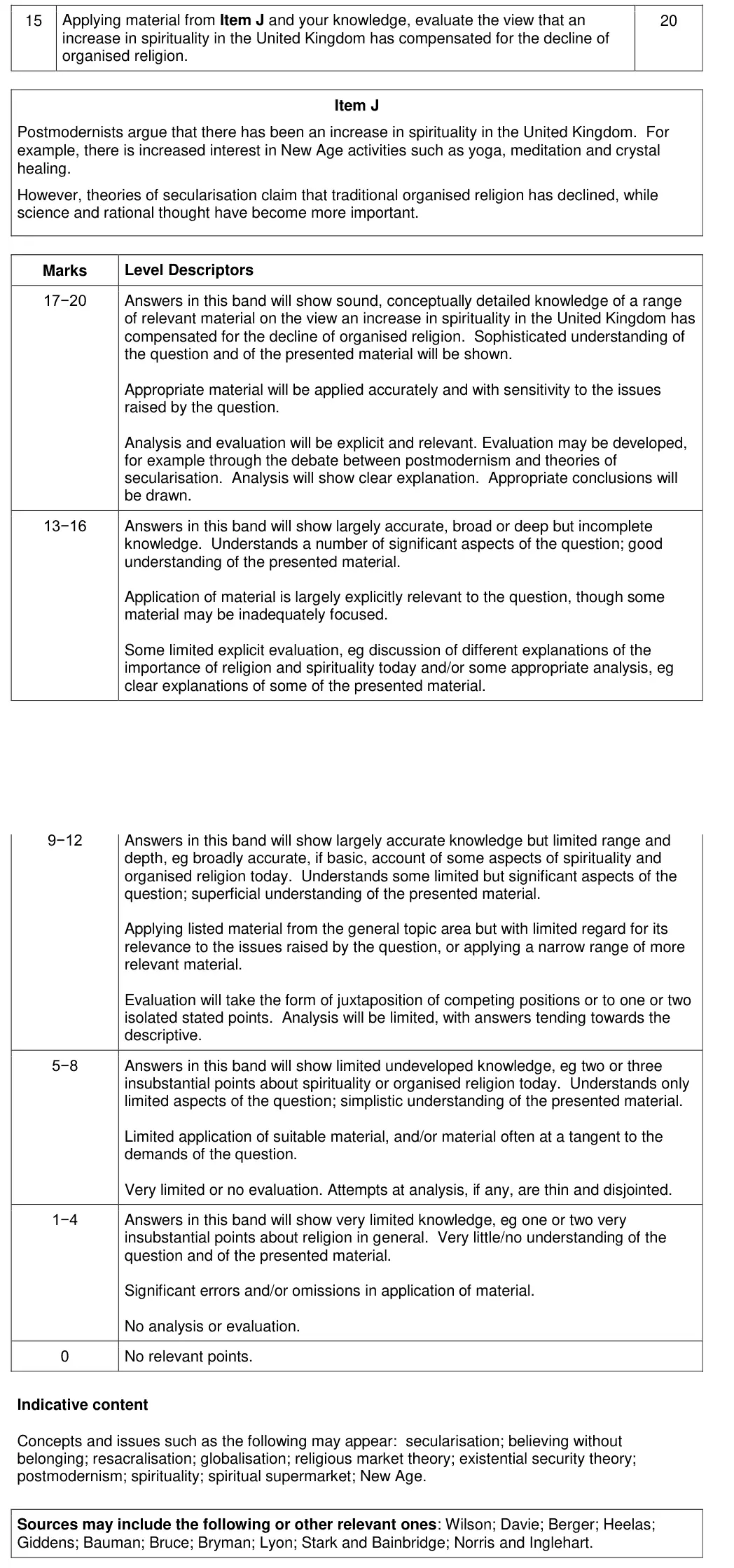
Most students answered their chosen questions in the order in which they appeared on the question paper. They therefore answered the 20 mark essay question in section B last. Some student responses to this question were relatively brief and seemingly unfinished. This suggests that timing was a problem for some students. Many scripts had one substantial well developed answer to a 20 mark question and one significantly briefer one, suggesting problems with timing. It is often the case that a wide range of material can be relevant to these questions, and students need to carefully choose the content they wish to use by planning their answers. For example, it may be more effective to cover a limited number of views or theories in some depth rather than to include every possible theory. There was a tendency for answers to progressively lose sight of the question and to become a list of different views. The best answers will address all aspects of the question and will draw on theories, concepts and empirical examples or evidence. Evaluation which meets the demands of the questions is better than points of criticism which have been learned and included, regardless of the question. Students should also be aware that evaluation includes awareness of the strengths as well as the weaknesses of an argument, theory or piece of evidence. Answers here showed a good range of knowledge. Most students took cues from the item and discussed a range of developments, such as variations of secularisation, growth of science and rationality and the growth of New Age activities. There was pleasing evidence of knowledge of contemporary postmodern approaches but only the best answers explicitly addressed spirituality or considered that there might be a difference between the spiritual and the religious.
Notes from the mark scheme and report
top band develops the debate between postmodernism and secularisation theory
only the best addressed spirituality explicitly and distinguished the spiritual from the religious
many just surveyed secularisation, rationality and New Age growth
AO split from AQA's standard grid for this paper (this year's mark scheme does not print it).
June 2017 · Paper 2 · Q1520 marksAO1=8, AO2=6, AO3=620-mark essay
Mark scheme, including the levels grid and indicative content
Examiner's comment
Most students answered their chosen questions in the order in which they appeared on the question paper. They therefore answered the 20 mark essay question in Section B last, and for many this was a relatively brief and often unfinished answer. This suggests that time management was a problem. Many scripts had one substantial, well developed answer to a 20 mark question and one significantly briefer one, again suggesting problems with time management. It is often the case that a wide range of material can be relevant to these questions, and students will need to be selective. For example, it may be more effective to cover a limited number of views or theories in some depth, rather than to include every possible theory. There was a tendency for answers to progressively lose sight of the question and to become a list of different views. The best answers will address all aspects of the question and will draw on theories, concepts and empirical examples or evidence. Evaluation which meets the demands of the questions is better than points of criticism which have been learned and included, regardless of the specific question that has been set. Students should also be aware that evaluation includes awareness of the strengths, as well as the weaknesses, of an argument or theory. There were some very good answers, with appropriate theories and concepts addressing both science and religion, often focused on the secularisation debate. Some weaker students approached this question without applying sociological knowledge. Despite the word ‘today’ in the question, some older material, such as the work of Malinowski, sometimes appeared, often in a descriptive way. Students should be encouraged to apply more contemporary material where appropriate.
Notes from the mark scheme and report
must address both science and religion
top band debates theories of secularisation and perspectives on science vs religion
question says 'today', so contemporary material is needed (older material such as Malinowski often descriptive)
weaker answers lacked sociological knowledge
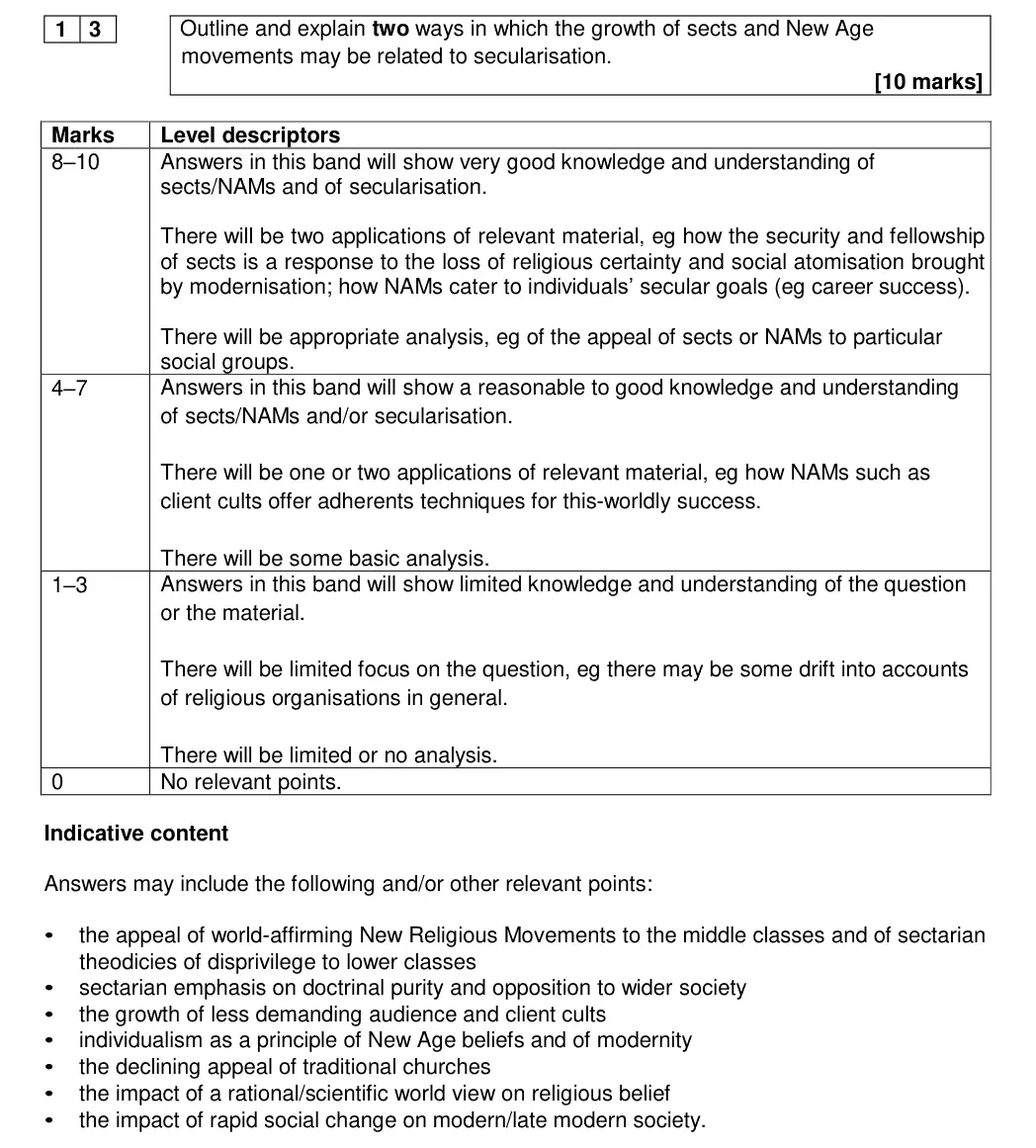
Specimen set 1 · Paper 2 · Q1310 marksAO1=5, AO2=3, AO3=2Outline and explain
Mark scheme, including the levels grid and indicative content
Notes from the mark scheme and report
must link sects and NAMs to secularisation (sects as response to lost certainty and atomisation
NAMs serving secular, this-worldly goals)
analysis of their appeal to particular social groups
general accounts of religious organisations = 1–3 band
Work with an AQA sociology tutor
Essays stuck in the middle band, or losing marks on the 10-markers? Book a trial lesson with Mark, a former AQA examiner.