Specimen set 1: Paper 2

320 marks · 24 question parts · Paper, mark scheme and report on AQA's site

Question by question

QTopicMarksAOType
1 Identity and age, disability, ethnicity, gender, nationality, sexuality and class, Socialisation and the agencies of socialisation 10AO1=5,AO2=3,AO3=2Outline and explain
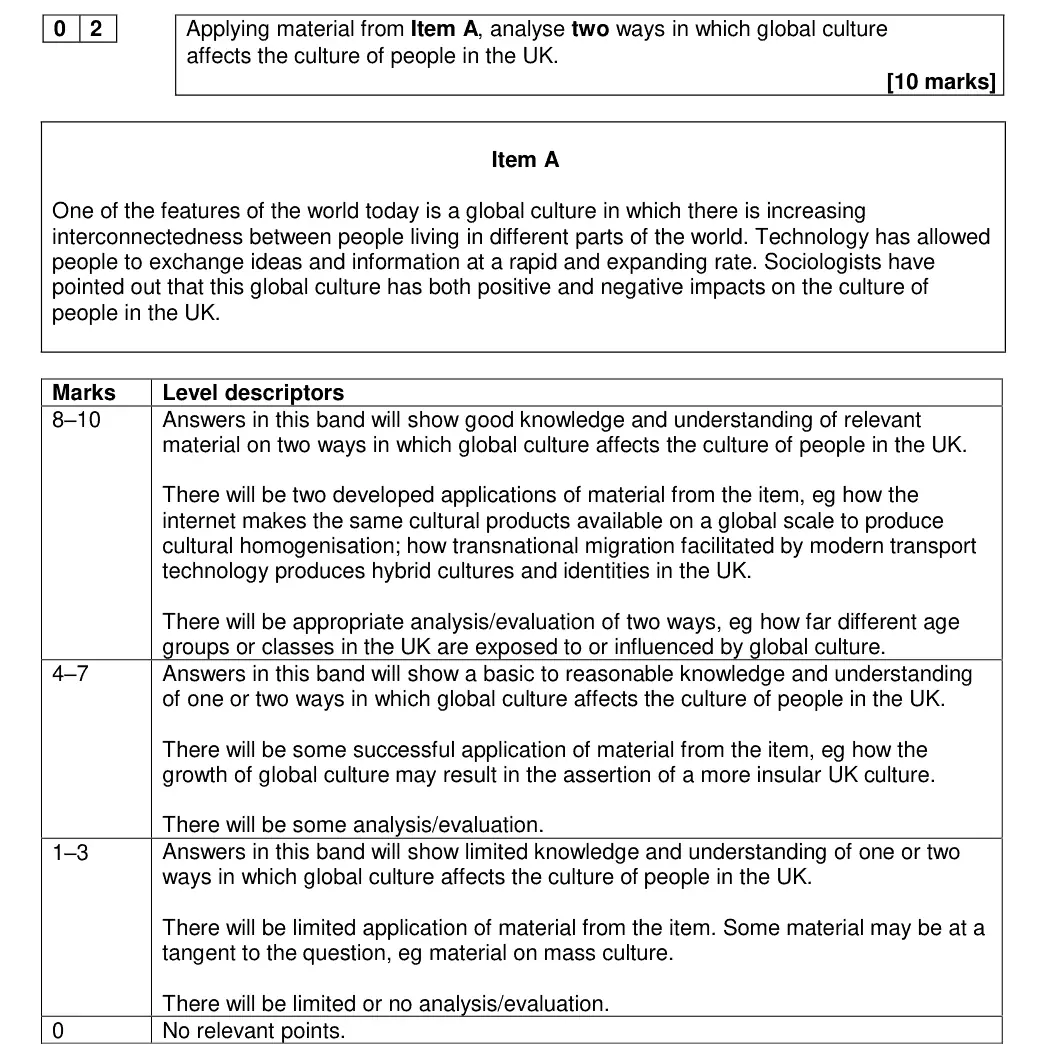
2 Conceptions of culture: subculture, mass, folk, high, popular and global culture, Identity, production, consumption and globalisation 10AO1=3,AO2=4,AO3=3Analyse
3 Identity, production, consumption and globalisation, Self, identity and difference 20AO1=8,AO2=6,AO3=6Essay
4 Marriage, divorce, cohabitation and family diversity, Gender roles, domestic labour and power in the family 10AO1=5,AO2=3,AO3=2Outline and explain
5 Childhood and the changing status of children 10AO1=3,AO2=4,AO3=3Analyse
6 Gender roles, domestic labour and power in the family 20AO1=8,AO2=6,AO3=6Essay
7 The social construction of health, illness, disability and the body, Mental illness 10AO1=5,AO2=3,AO3=2Outline and explain
8 Inequalities in the provision of and access to health care, Health inequalities by class, gender, ethnicity and region 10AO1=3,AO2=4,AO3=3Analyse
9 Medicine, the health professions and the globalised health industry 20AO1=8,AO2=6,AO3=6Essay
10 Work, worklessness and life chances, The distribution of poverty, wealth and income 10AO1=5,AO2=3,AO3=2Outline and explain
11 Responses and solutions to poverty: the state and welfare providers 10AO1=3,AO2=4,AO3=3Analyse
12 The labour process: division of labour, technology and deskilling 20AO1=8,AO2=6,AO3=6Essay
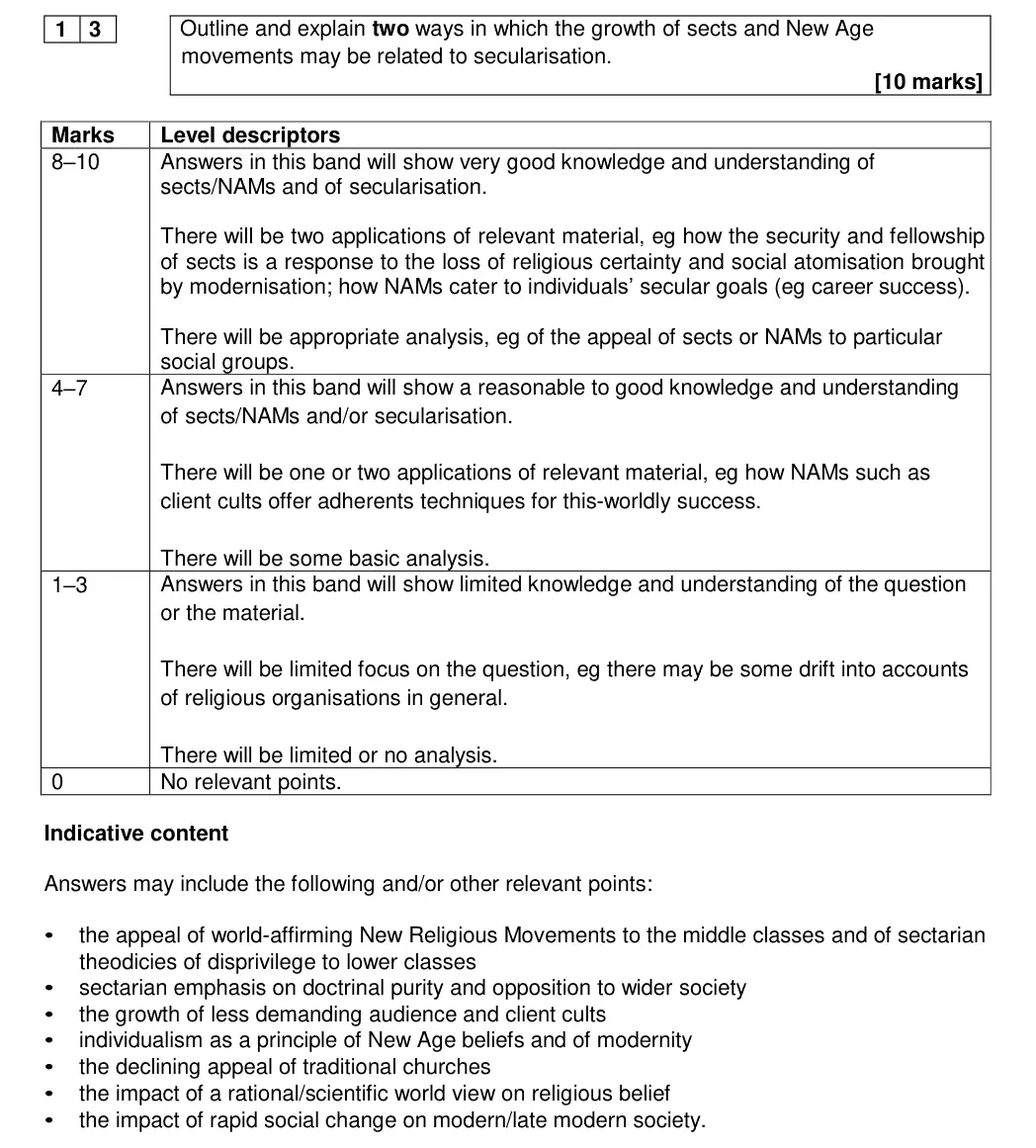
13 Religious organisations: churches, sects, cults and New Age movements, Secularisation and the global spread of religion 10AO1=5,AO2=3,AO3=2Outline and explain
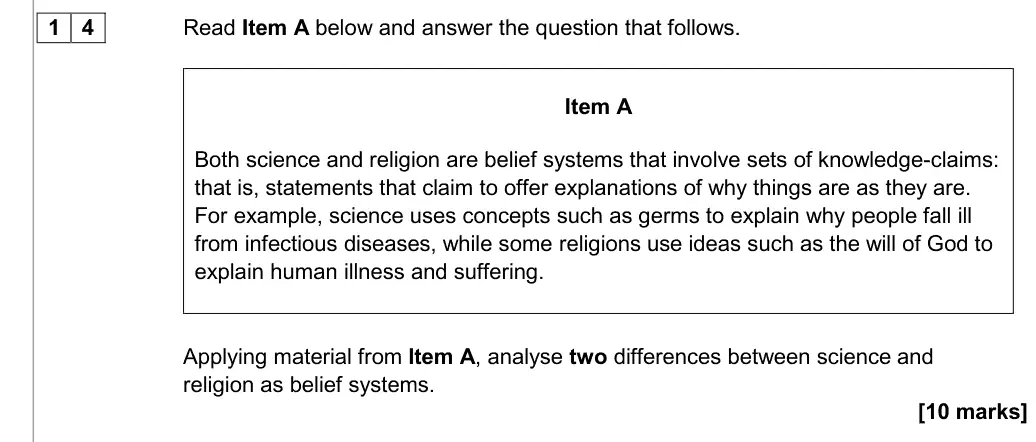
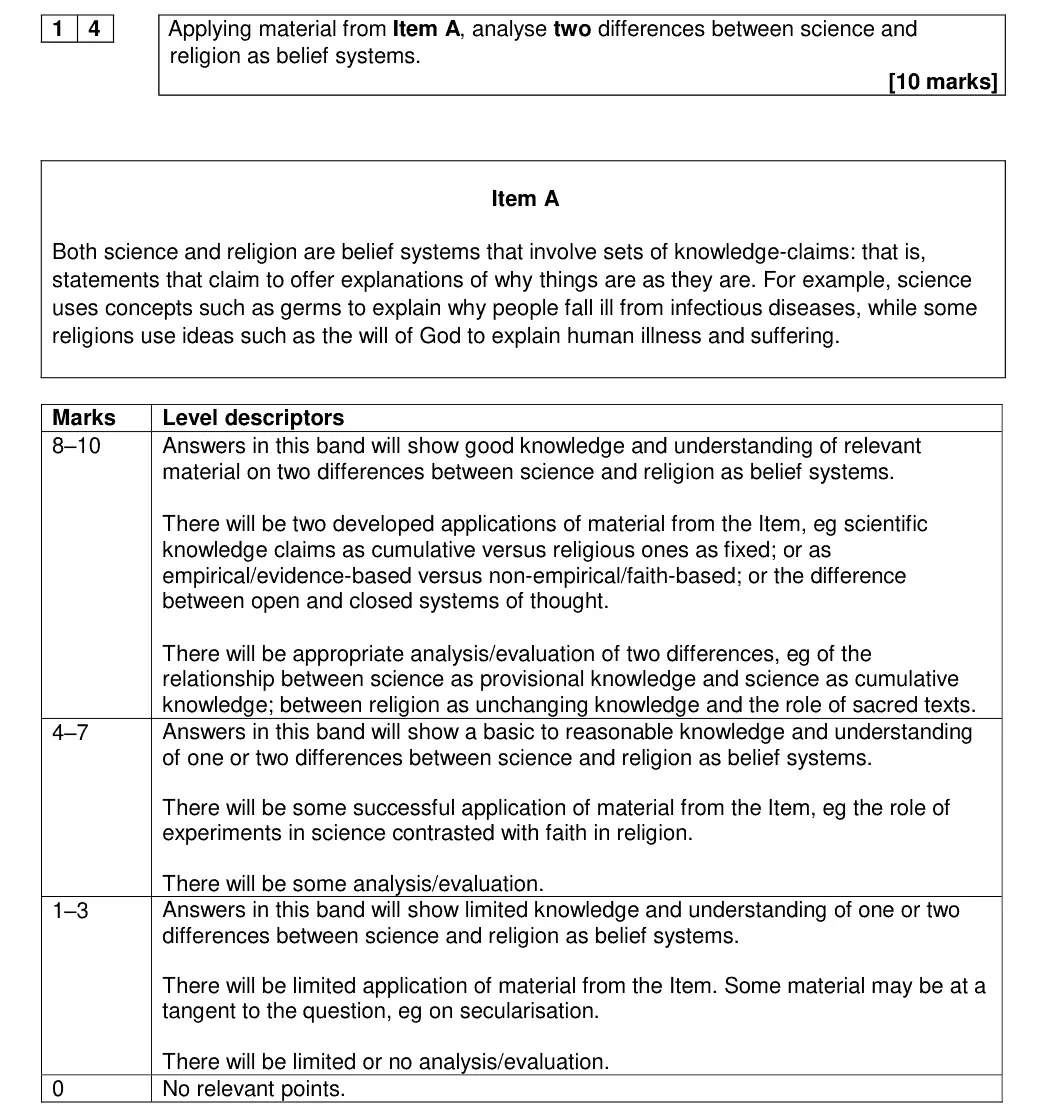
14 Ideology, science and religion 10AO1=3,AO2=4,AO3=3Analyse
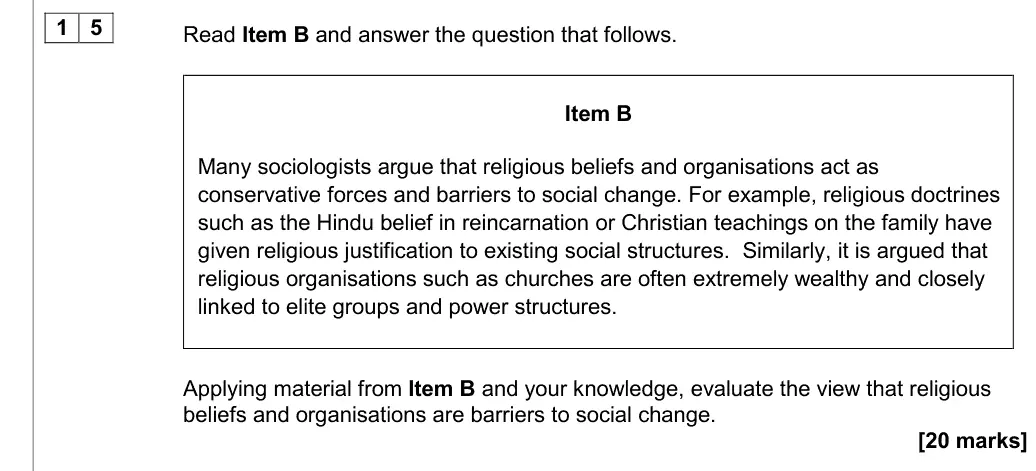
15 Religion, social change and social stability 20AO1=8,AO2=6,AO3=6Essay
16 Transnational corporations, NGOs and international agencies, Employment, education, health, demography and gender in development 10AO1=5,AO2=3,AO3=2Outline and explain
17 Transnational corporations, NGOs and international agencies 10AO1=3,AO2=4,AO3=3Analyse
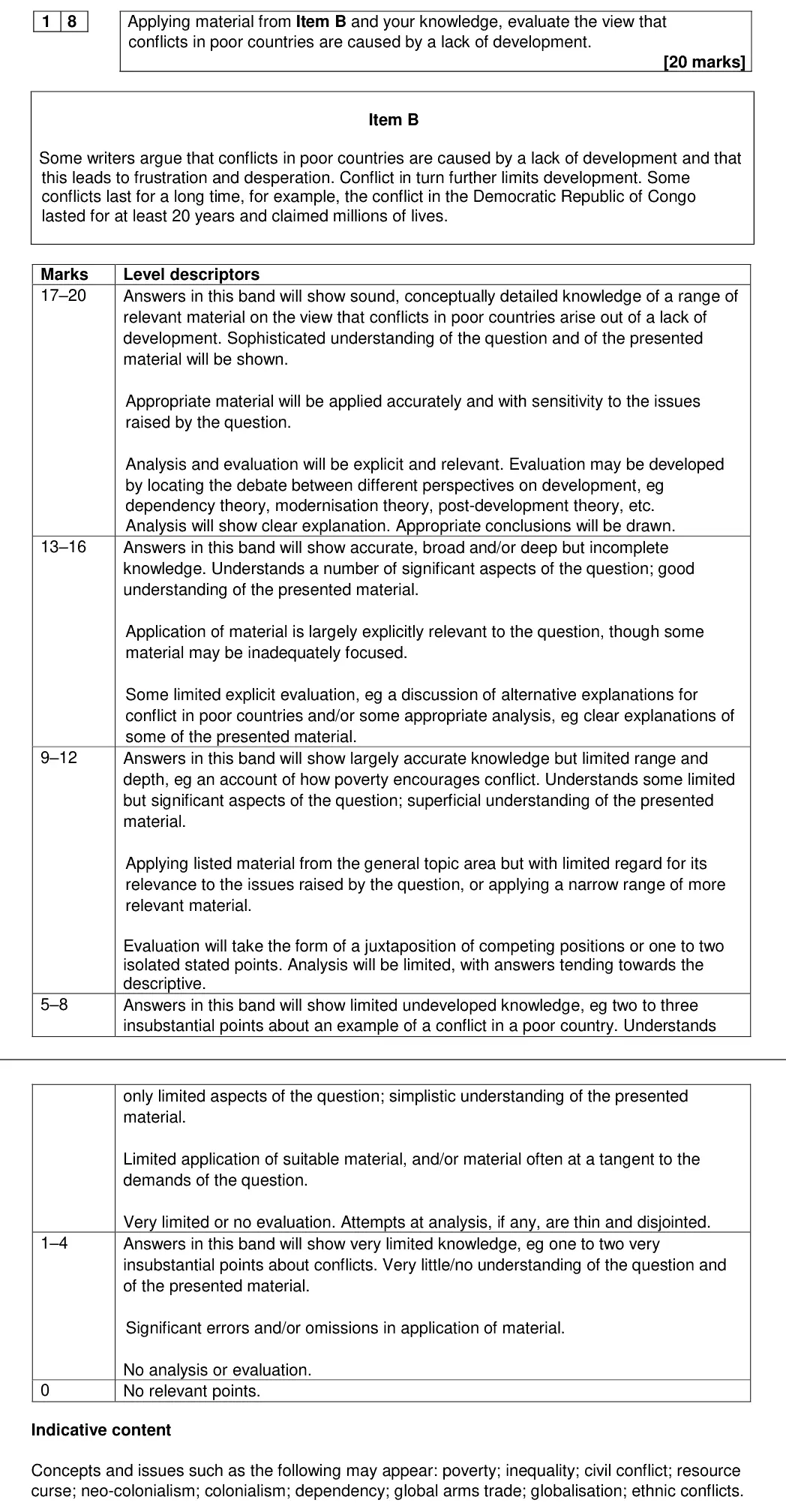
18 Aid, trade, industrialisation, urbanisation, environment and war, Development, underdevelopment and global inequality (modernisation and dependency theory) 20AO1=8,AO2=6,AO3=6Essay
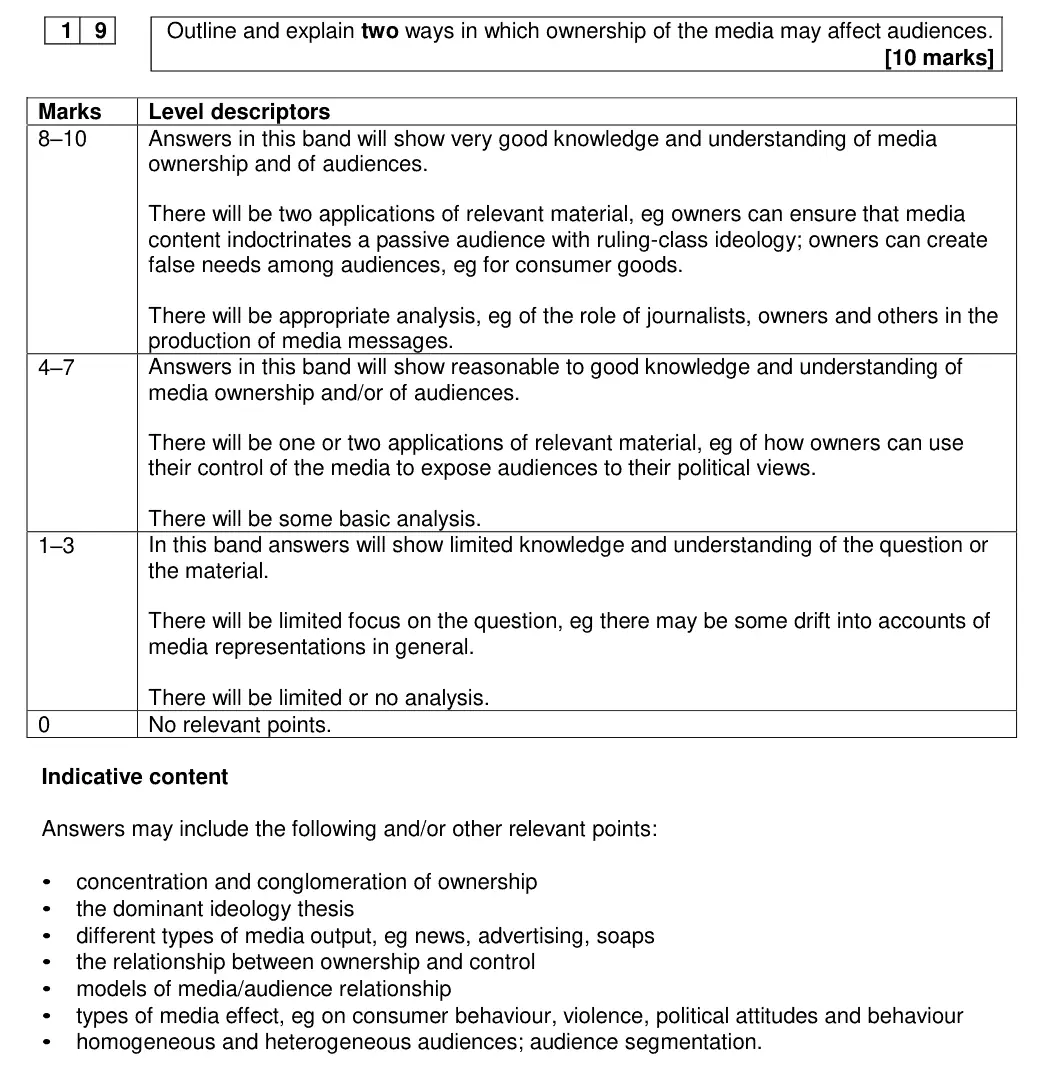
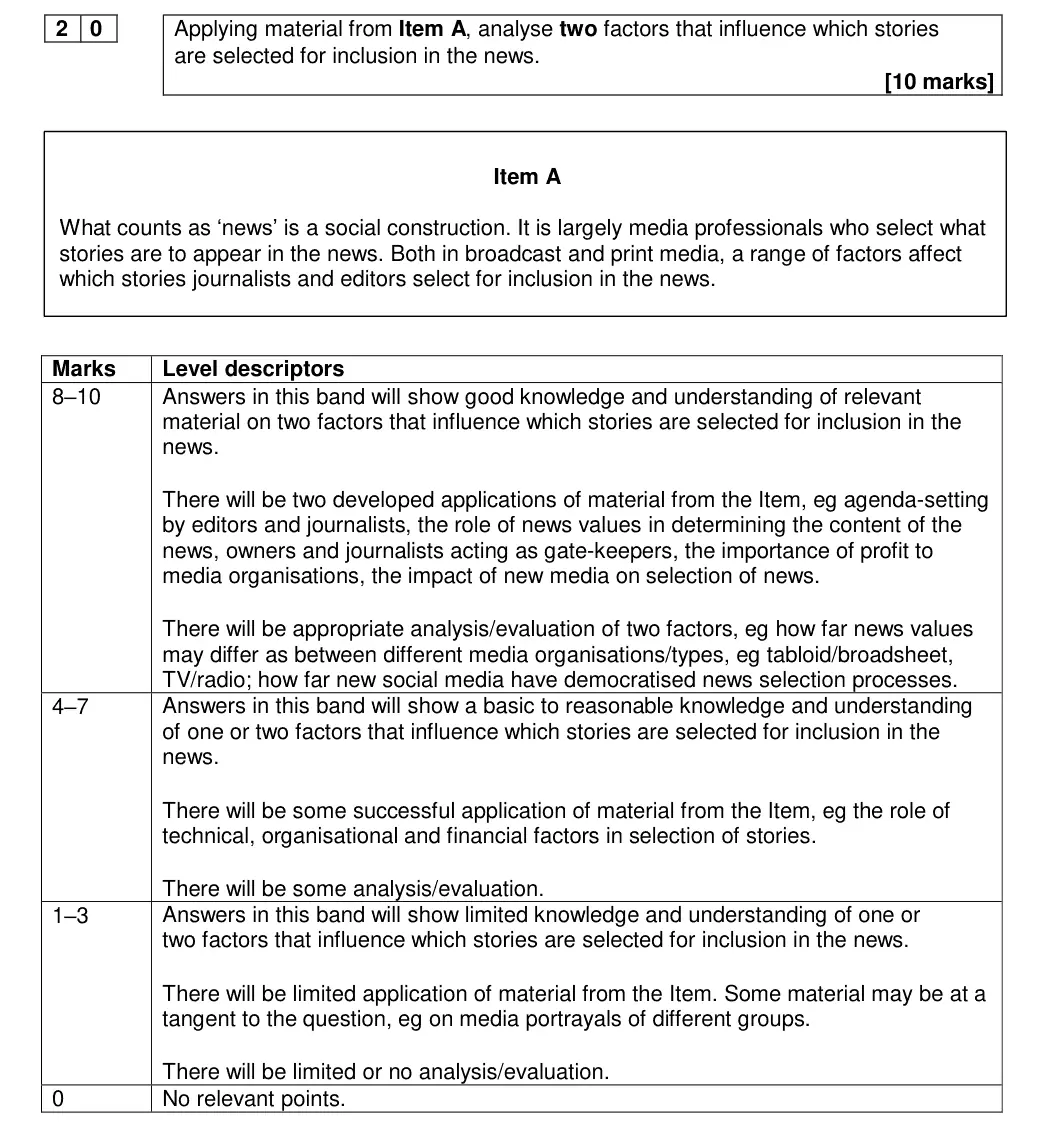
19 Ownership and control of the media, The media and audiences 10AO1=5,AO2=3,AO3=2Outline and explain
20 Selection and presentation of the news 10AO1=3,AO2=4,AO3=3Analyse
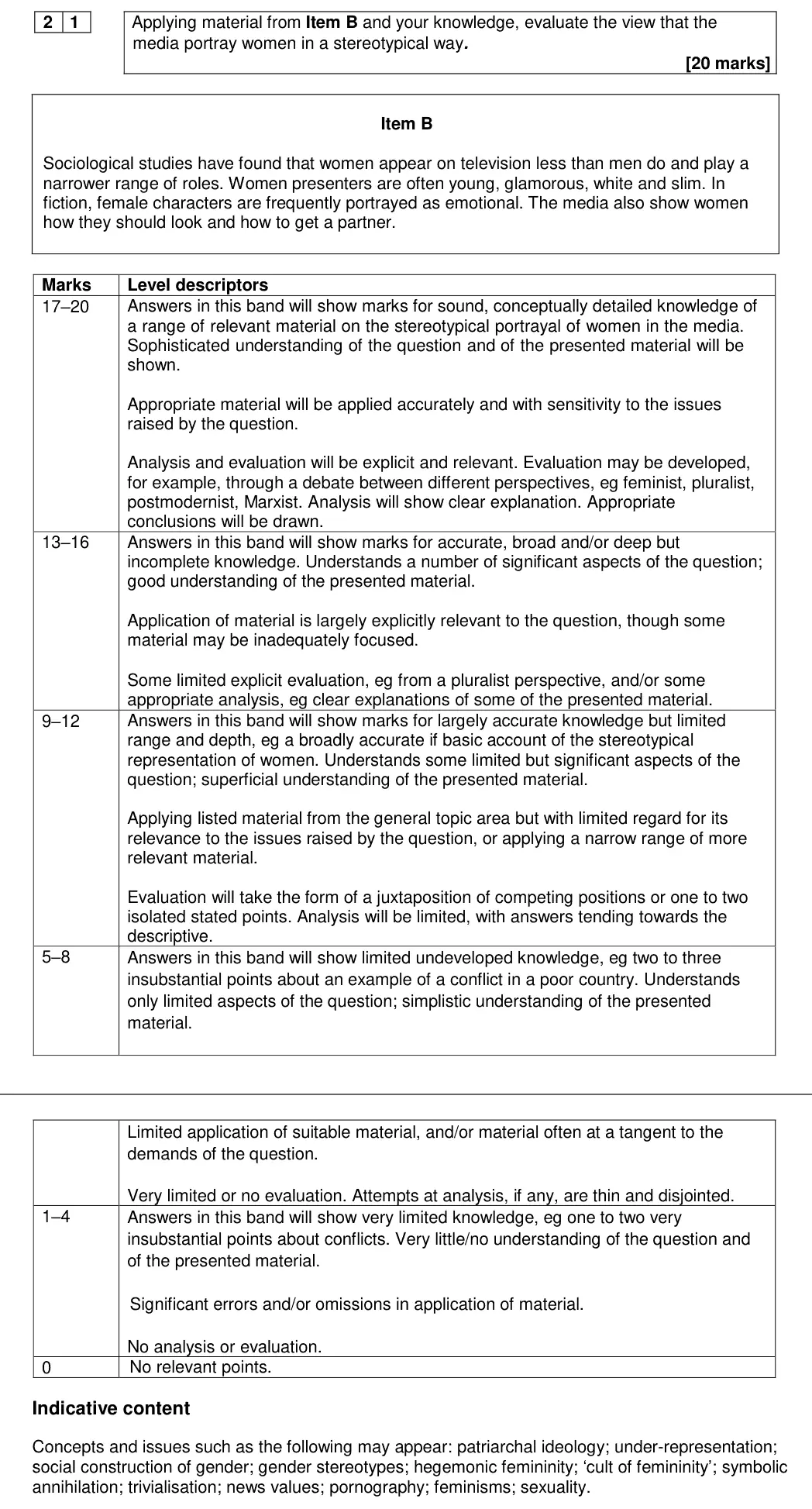
21 Media representations of age, class, ethnicity, gender, sexuality and disability 20AO1=8,AO2=6,AO3=6Essay
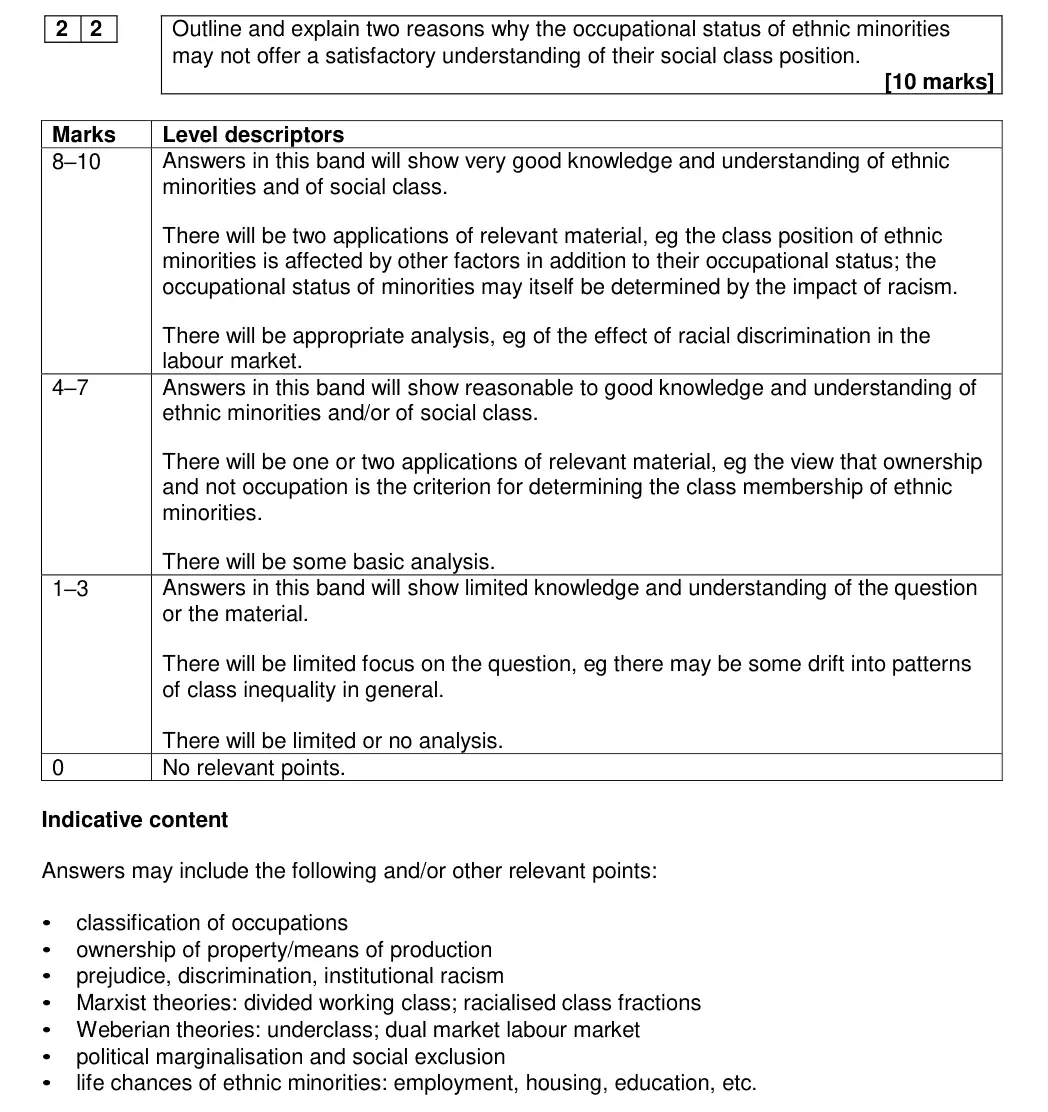
22 Defining and measuring social class, Stratification and differentiation by class, gender, ethnicity and age 10AO1=5,AO2=3,AO3=2Outline and explain
23 Changing structures of inequality and the transnational capitalist class 10AO1=3,AO2=4,AO3=3Analyse
24 Stratification and differentiation by class, gender, ethnicity and age, Class, status, power and life chances 20AO1=8,AO2=6,AO3=6Essay

The questions

123456789101112131415161718192021222324
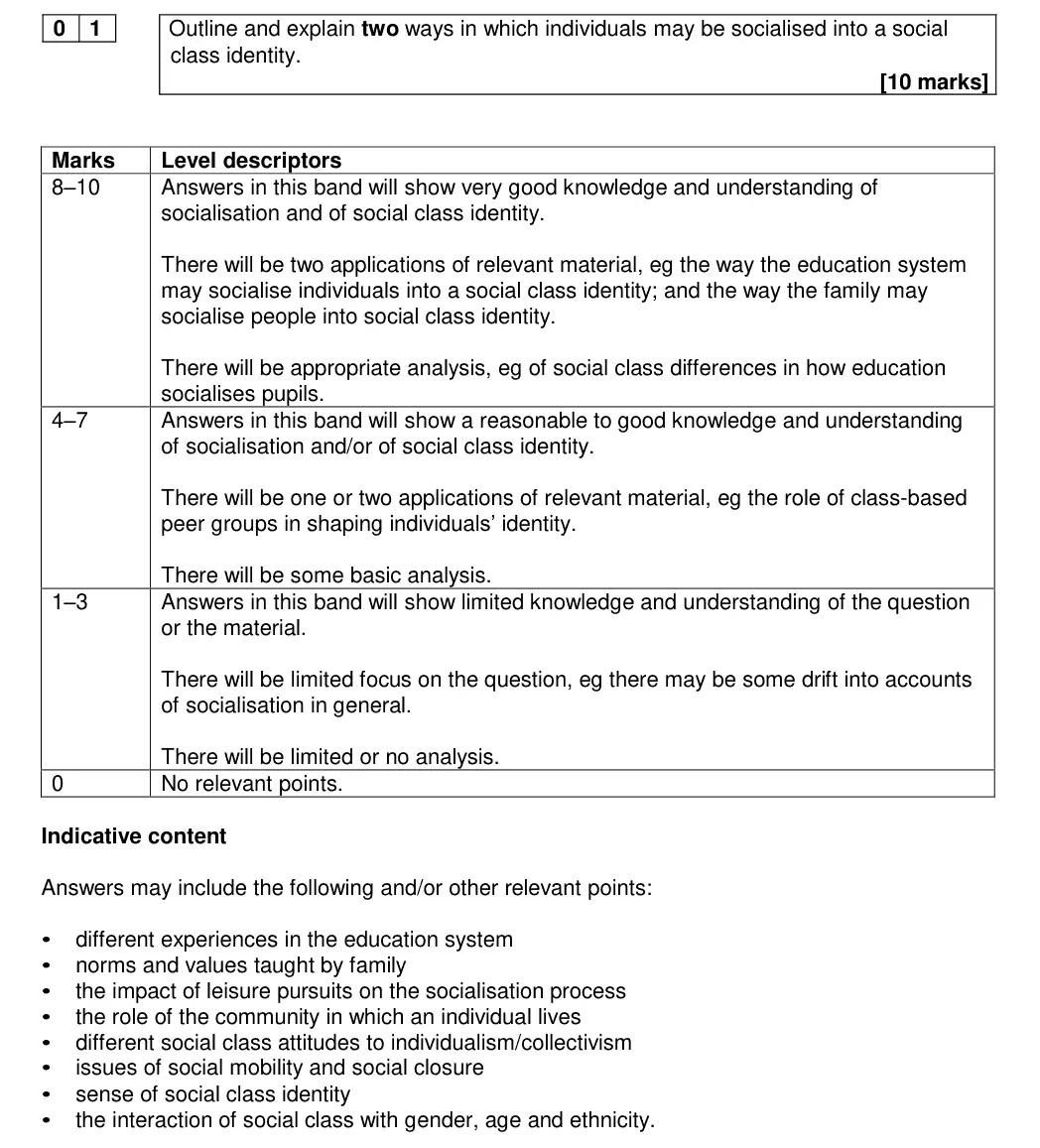
Specimen set 1 · Paper 2 · Q1 10 marks AO1=5, AO2=3, AO3=2 Outline and explain identity class gender ethnicitysocialisation
Topic A1 Culture and Identity
0 1
Outline and explain two ways in which individuals may be socialised into a social
class identity.
[10 marks]
Specimen set 1 · Paper 2 · Q2 10 marks AO1=3, AO2=4, AO3=3 Analyse conceptions of cultureidentity consumption and globalisation
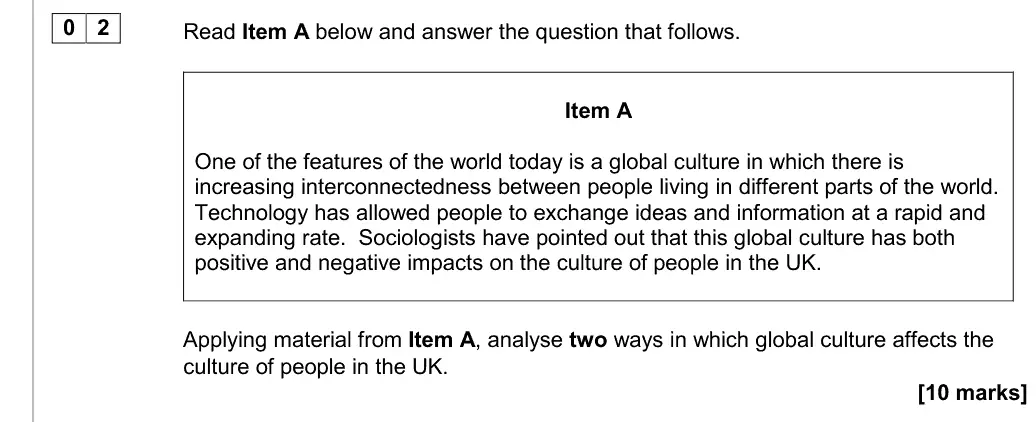
0 2
Read Item A below and answer the question that follows.
Item A
One of the features of the world today is a global culture in which there is
increasing interconnectedness between people living in different parts of the world.
Technology has allowed people to exchange ideas and information at a rapid and
expanding rate.  Sociologists have pointed out that this global culture has both
positive and negative impacts on the culture of people in the UK.
Applying material from Item A, analyse two ways in which global culture affects the
culture of people in the UK.
[10 marks]
Specimen set 1 · Paper 2 · Q3 20 marks AO1=8, AO2=6, AO3=6 20-mark essay identity consumption and globalisationself identity and difference
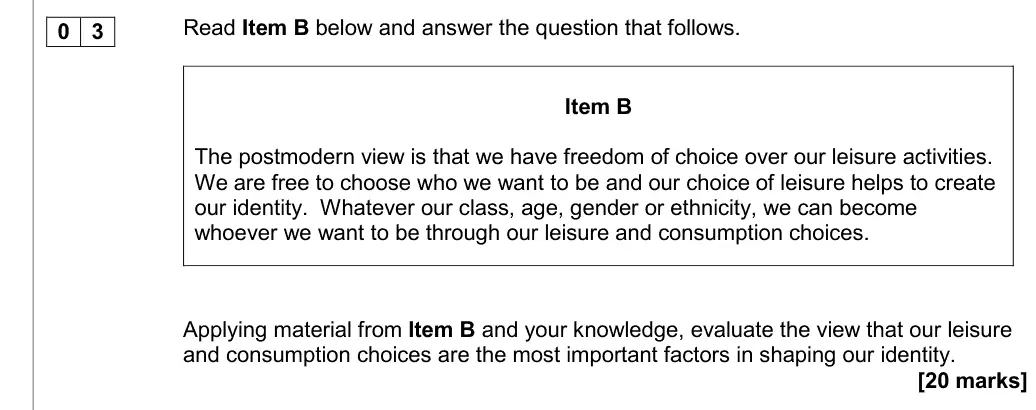
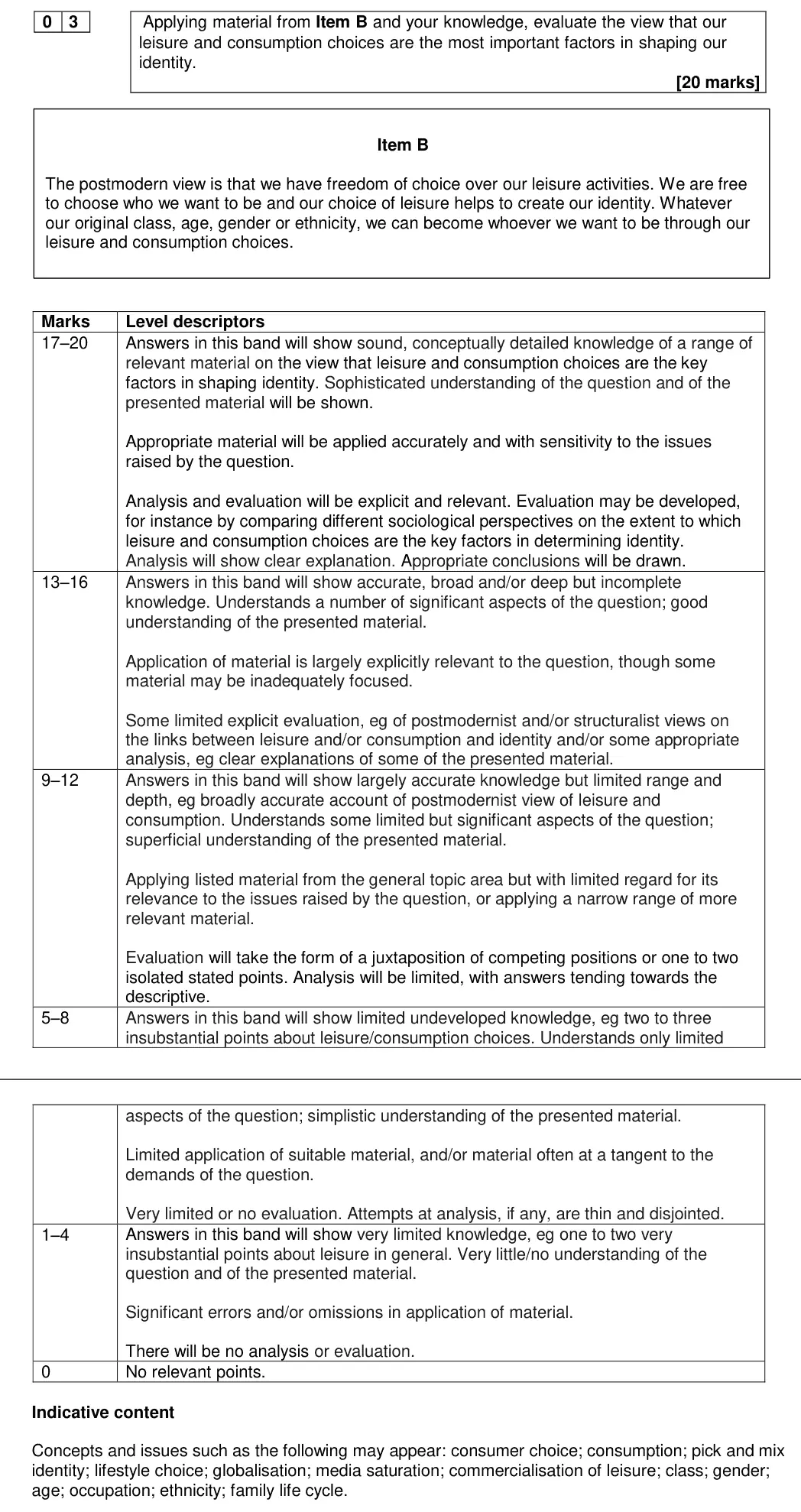
0 3
Read Item B below and answer the question that follows.
Item B
The postmodern view is that we have freedom of choice over our leisure activities.
We are free to choose who we want to be and our choice of leisure helps to create
our identity.  Whatever our class, age, gender or ethnicity, we can become
whoever we want to be through our leisure and consumption choices.
Applying material from Item B and your knowledge, evaluate the view that our leisure
and consumption choices are the most important factors in shaping our identity.
[20 marks]
Specimen set 1 · Paper 2 · Q4 10 marks AO1=5, AO2=3, AO3=2 Outline and explain marriage divorce and family diversitygender roles and domestic labour
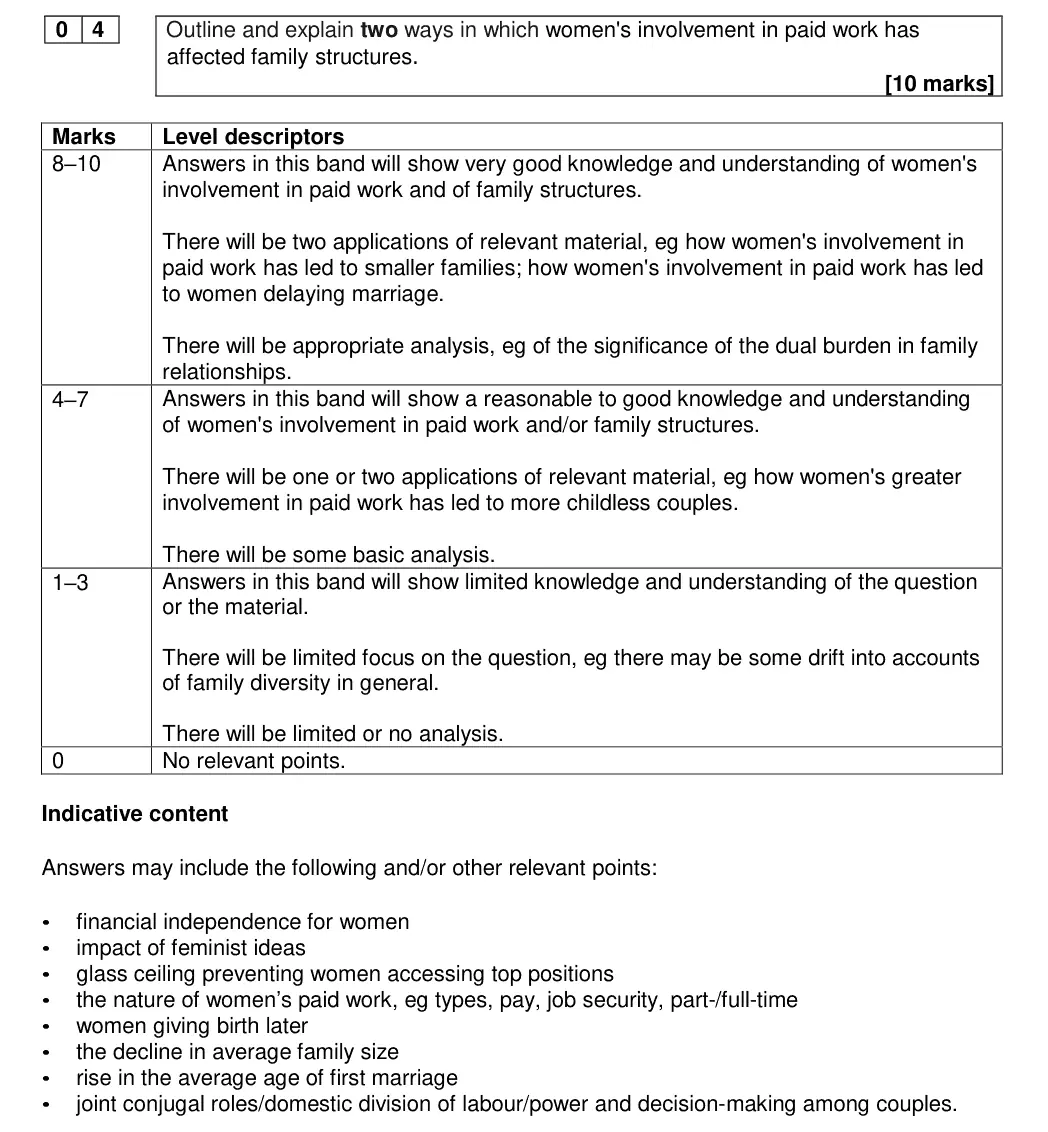
0 4
Outline and explain two ways in which women's involvement in paid work has
affected family structures.
[10 marks]
Specimen set 1 · Paper 2 · Q5 10 marks AO1=3, AO2=4, AO3=3 Analyse childhood
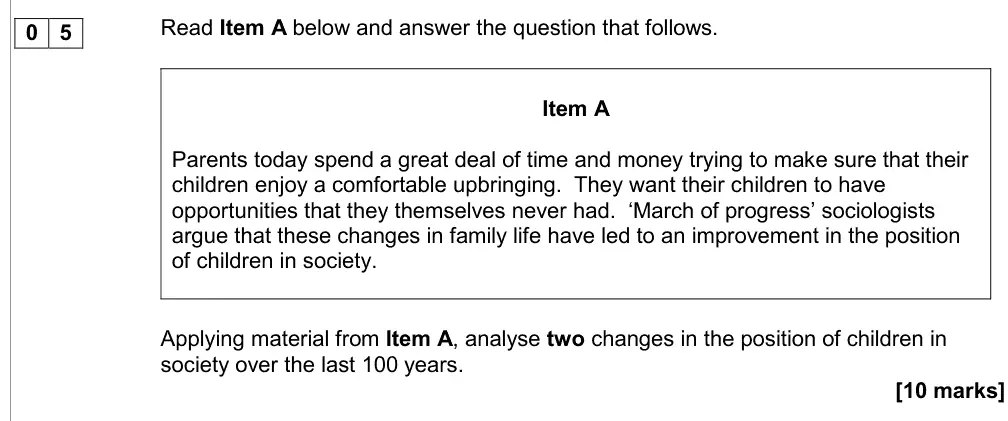
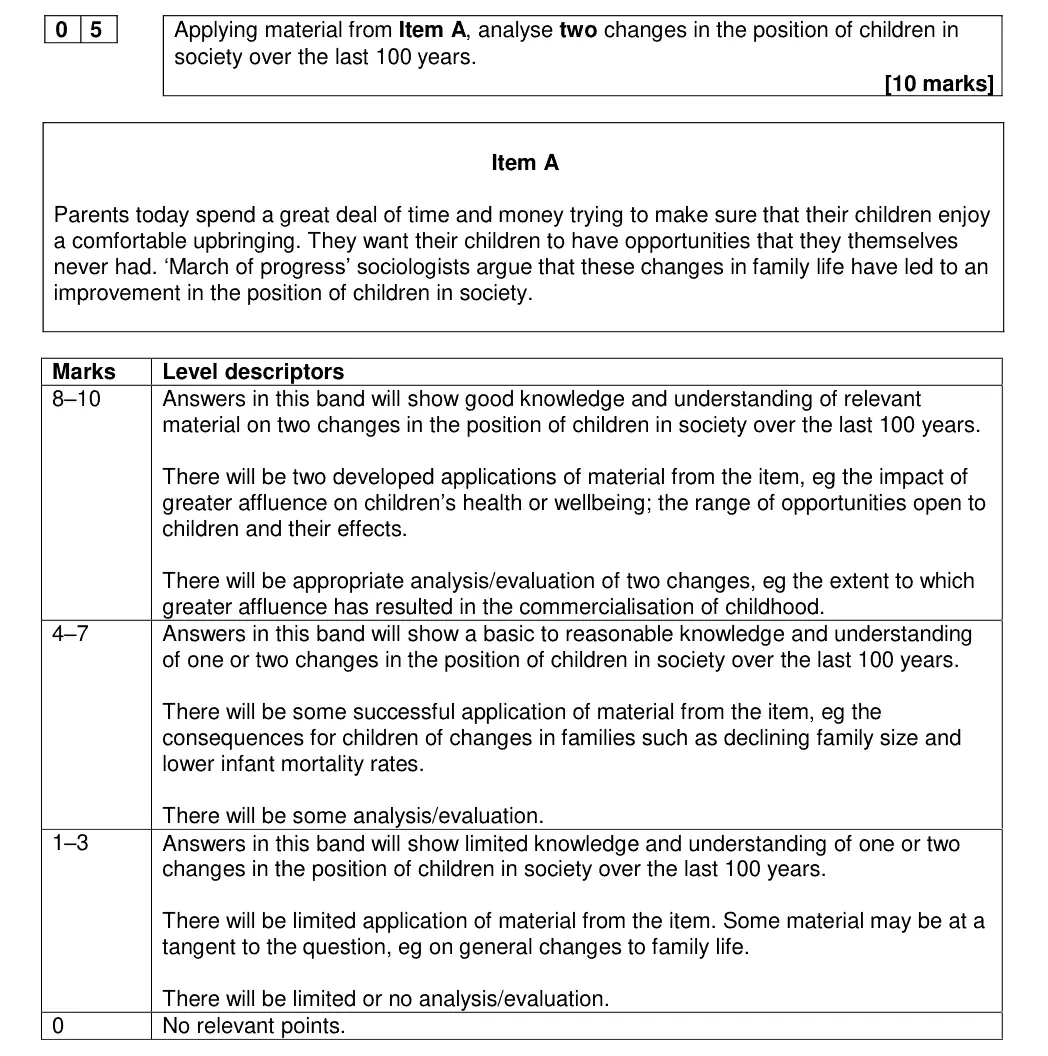
0 5
Read Item A below and answer the question that follows.
Item A
Parents today spend a great deal of time and money trying to make sure that their
children enjoy a comfortable upbringing.  They want their children to have
opportunities that they themselves never had.  ‘March of progress’ sociologists
argue that these changes in family life have led to an improvement in the position
of children in society.
Applying material from Item A, analyse two changes in the position of children in
society over the last 100 years.
[10 marks]
Specimen set 1 · Paper 2 · Q6 20 marks AO1=8, AO2=6, AO3=6 20-mark essay gender roles and domestic labour
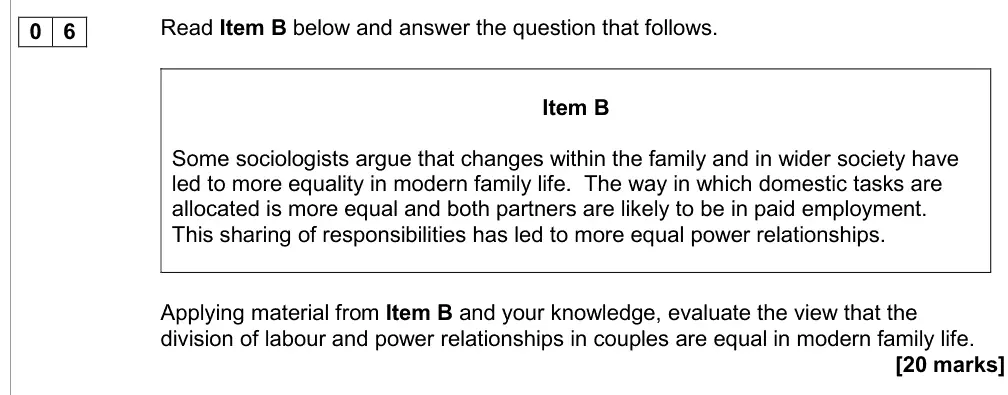
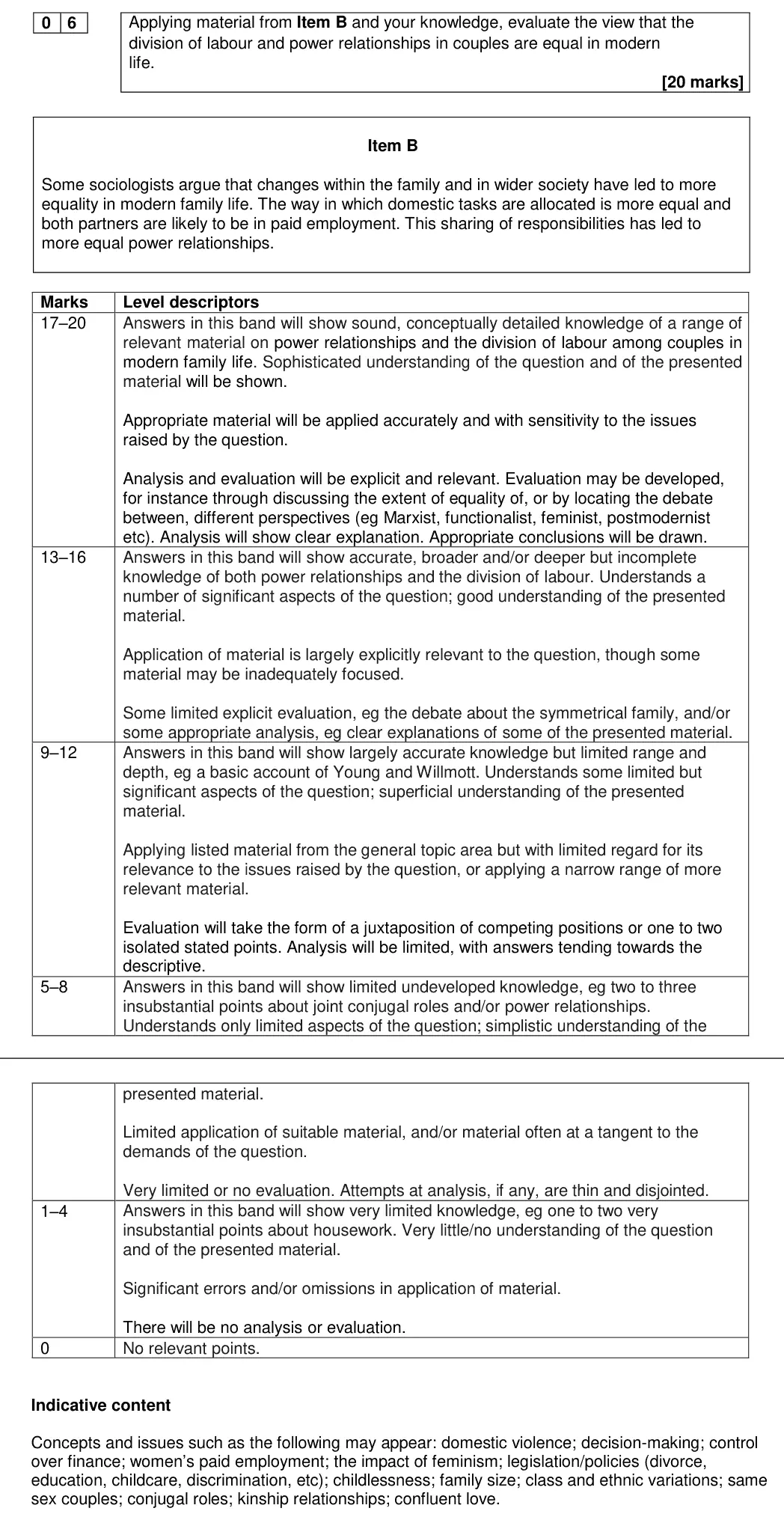
0 6
Read Item B below and answer the question that follows.
Item B
Some sociologists argue that changes within the family and in wider society have
led to more equality in modern family life.  The way in which domestic tasks are
allocated is more equal and both partners are likely to be in paid employment.
This sharing of responsibilities has led to more equal power relationships.
Applying material from Item B and your knowledge, evaluate the view that the
division of labour and power relationships in couples are equal in modern family life.
[20 marks]
Specimen set 1 · Paper 2 · Q7 10 marks AO1=5, AO2=3, AO3=2 Outline and explain social construction of healthmental illness
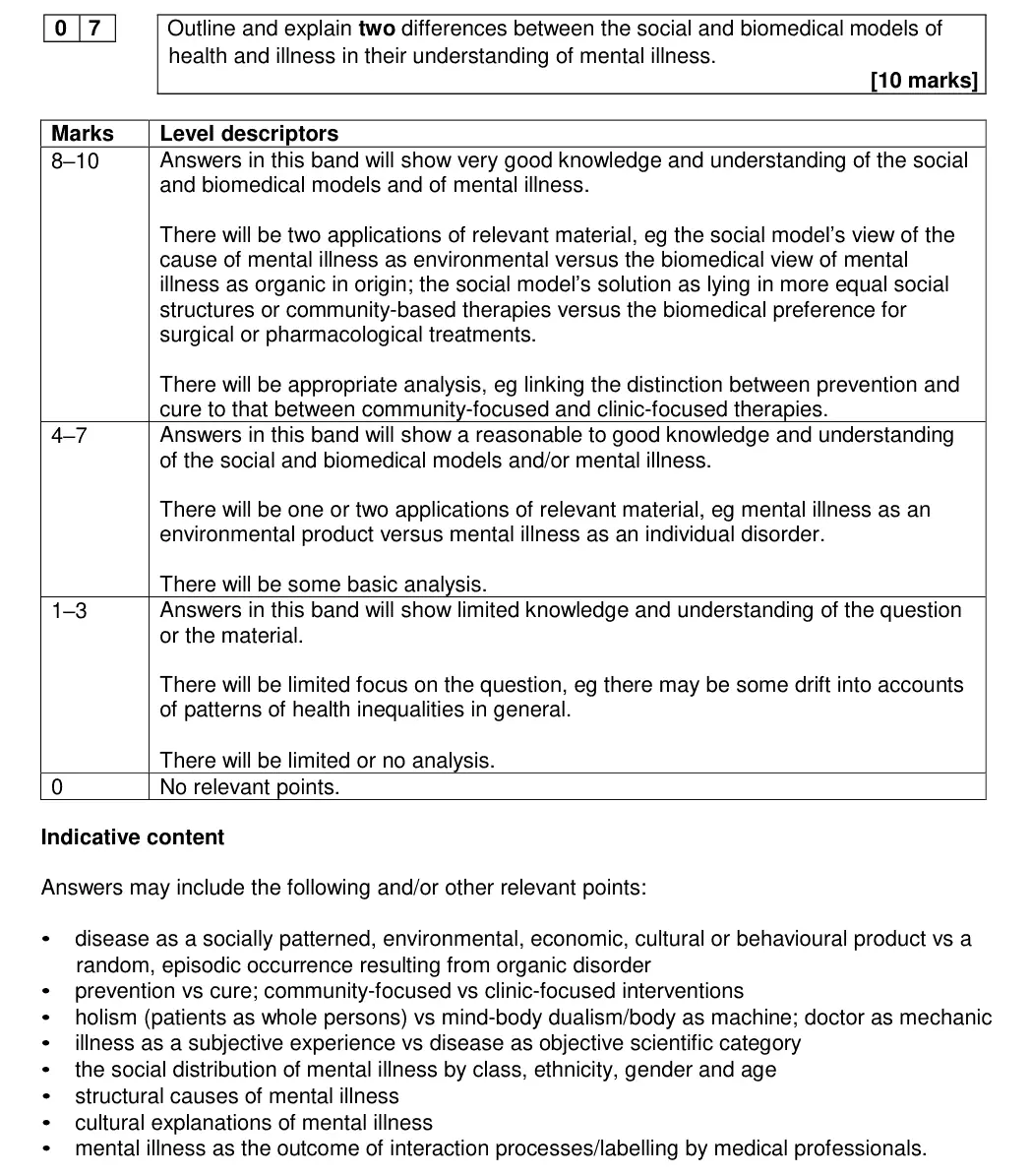
0 7
Outline and explain two differences between the social and biomedical models of
health and illness in their understanding of mental illness.
[10 marks]
Specimen set 1 · Paper 2 · Q8 10 marks AO1=3, AO2=4, AO3=3 Analyse access to health carehealth inequalities
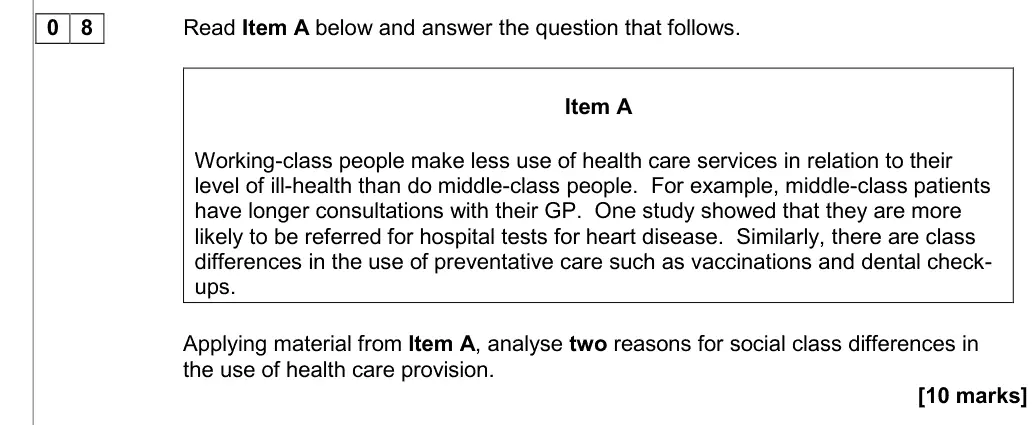
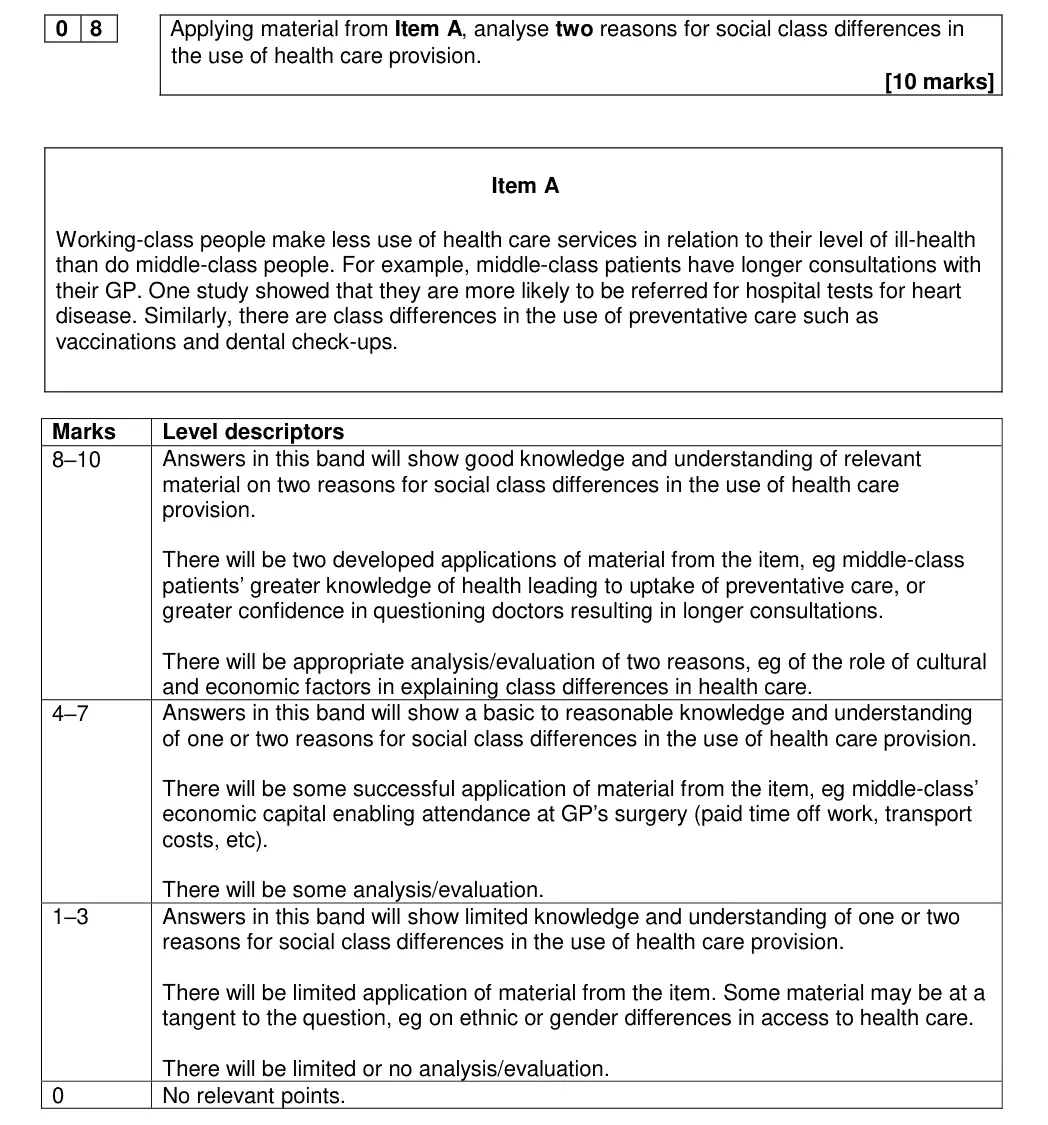
0 8
Read Item A below and answer the question that follows.
Item A
Working-class people make less use of health care services in relation to their
level of ill-health than do middle-class people.  For example, middle-class patients
have longer consultations with their GP.  One study showed that they are more
likely to be referred for hospital tests for heart disease.  Similarly, there are class
differences in the use of preventative care such as vaccinations and dental check-
ups.
Applying material from Item A, analyse two reasons for social class differences in
the use of health care provision.
[10 marks]
Specimen set 1 · Paper 2 · Q9 20 marks AO1=8, AO2=6, AO3=6 20-mark essay medicine and health professions
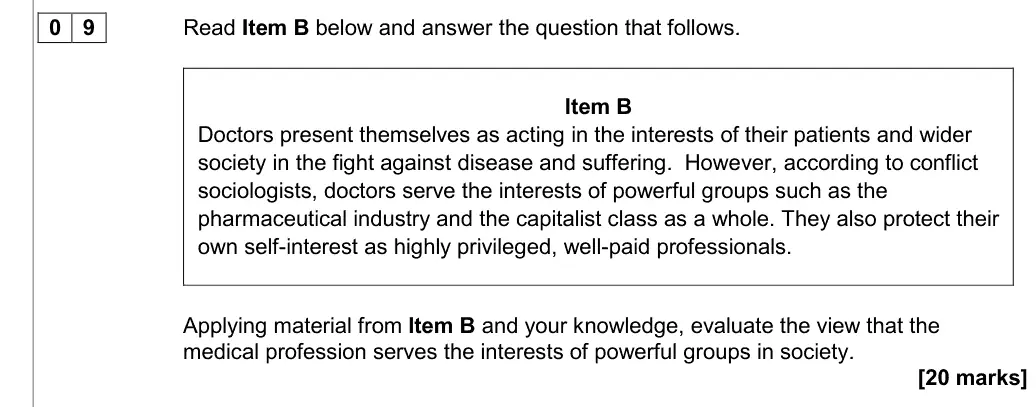
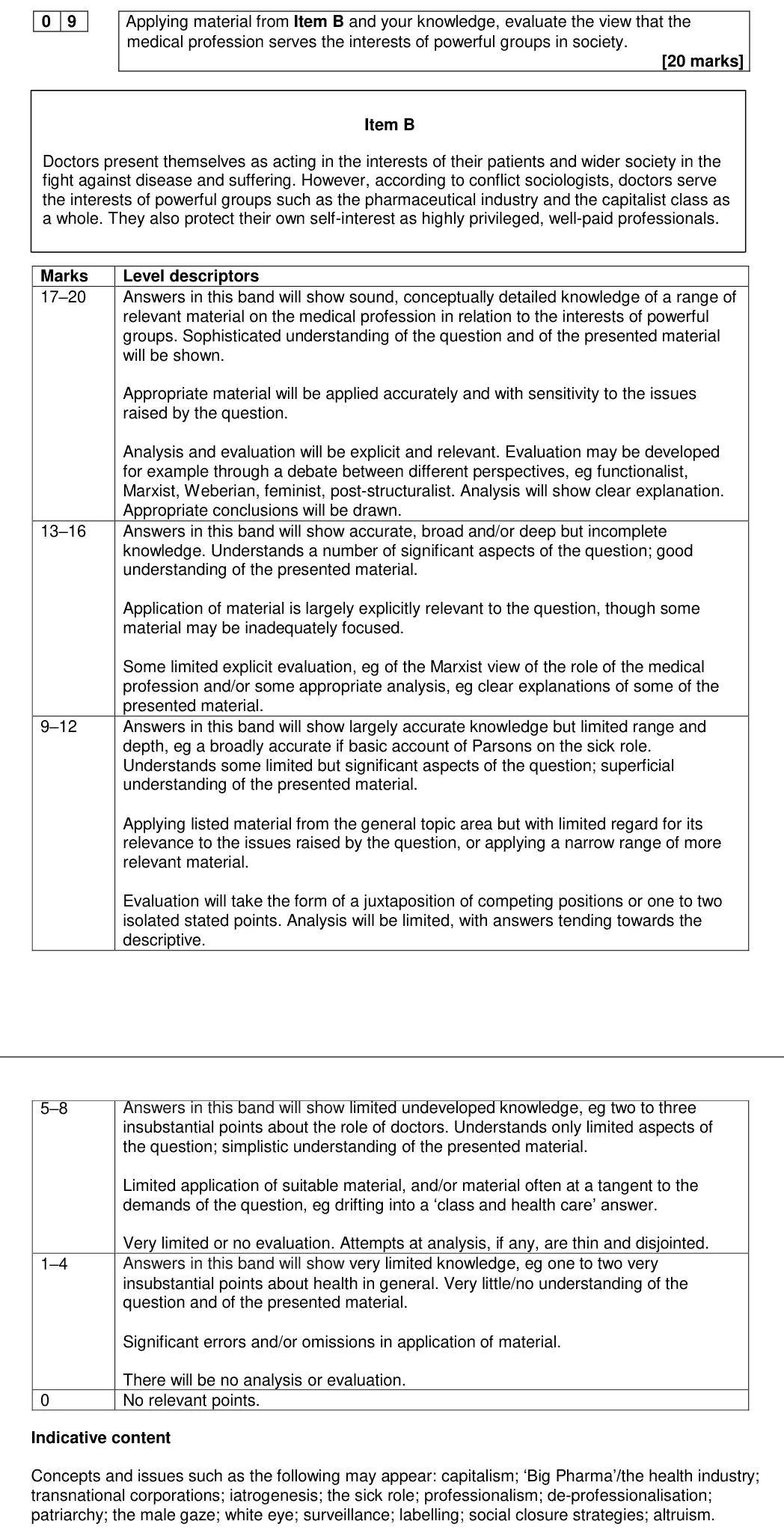
0 9
Read Item B below and answer the question that follows.
Item B
Doctors present themselves as acting in the interests of their patients and wider
society in the fight against disease and suffering.  However, according to conflict
sociologists, doctors serve the interests of powerful groups such as the
pharmaceutical industry and the capitalist class as a whole. They also protect their
own self-interest as highly privileged, well-paid professionals.
Applying material from Item B and your knowledge, evaluate the view that the
medical profession serves the interests of powerful groups in society.
[20 marks]
Specimen set 1 · Paper 2 · Q10 10 marks AO1=5, AO2=3, AO3=2 Outline and explain work and worklessnessdistribution of wealth and income
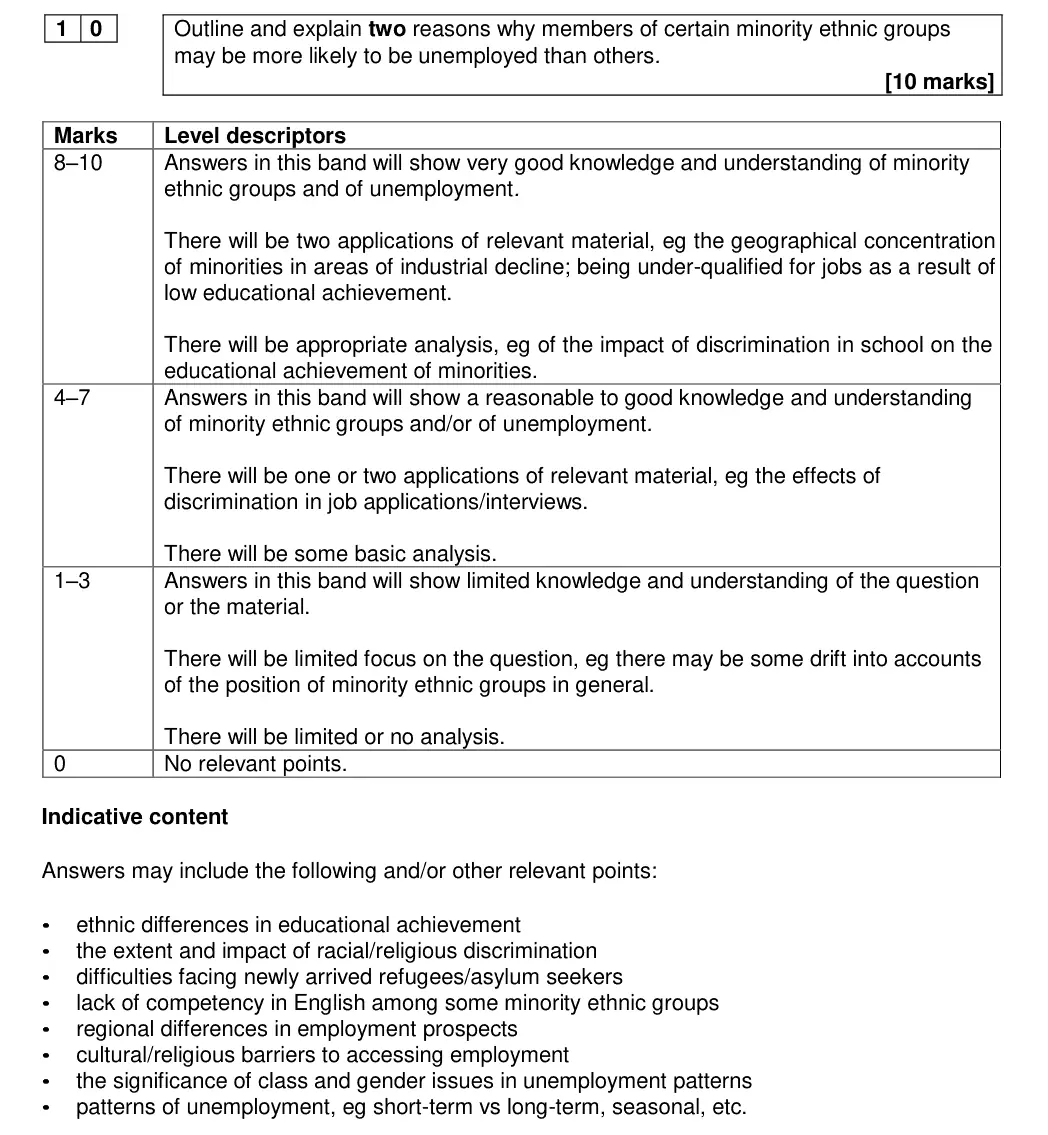
1 0
Outline and explain two reasons why members of certain minority ethnic groups may
be more likely to be unemployed than others.
[10 marks]
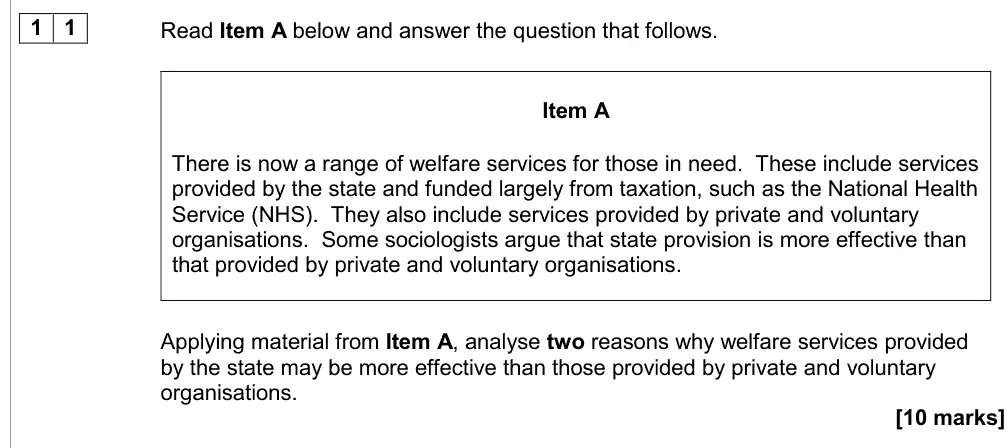
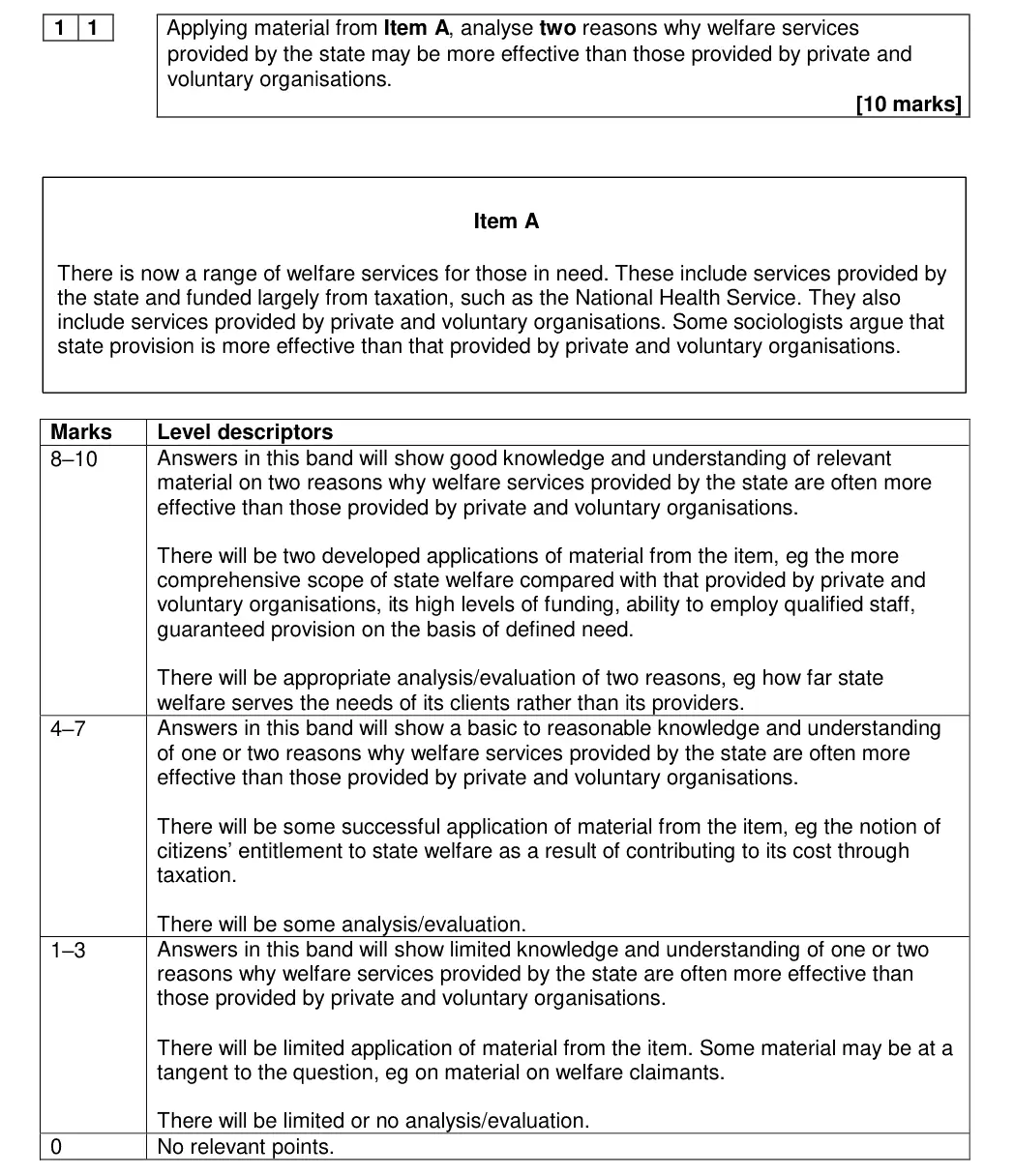
Specimen set 1 · Paper 2 · Q11 10 marks AO1=3, AO2=4, AO3=3 Analyse responses to poverty
1 1
Read Item A below and answer the question that follows.
Item A
There is now a range of welfare services for those in need.  These include services
provided by the state and funded largely from taxation, such as the National Health
Service (NHS).  They also include services provided by private and voluntary
organisations.  Some sociologists argue that state provision is more effective than
that provided by private and voluntary organisations.
Applying material from Item A, analyse two reasons why welfare services provided
by the state may be more effective than those provided by private and voluntary
organisations.
[10 marks]
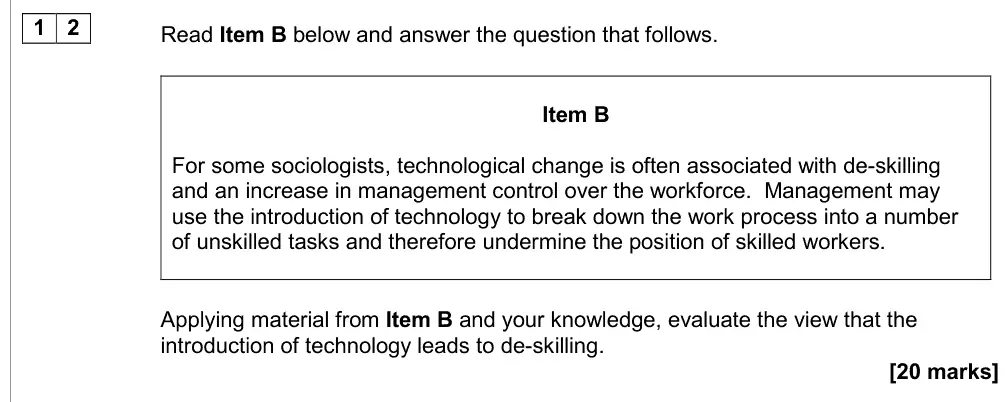
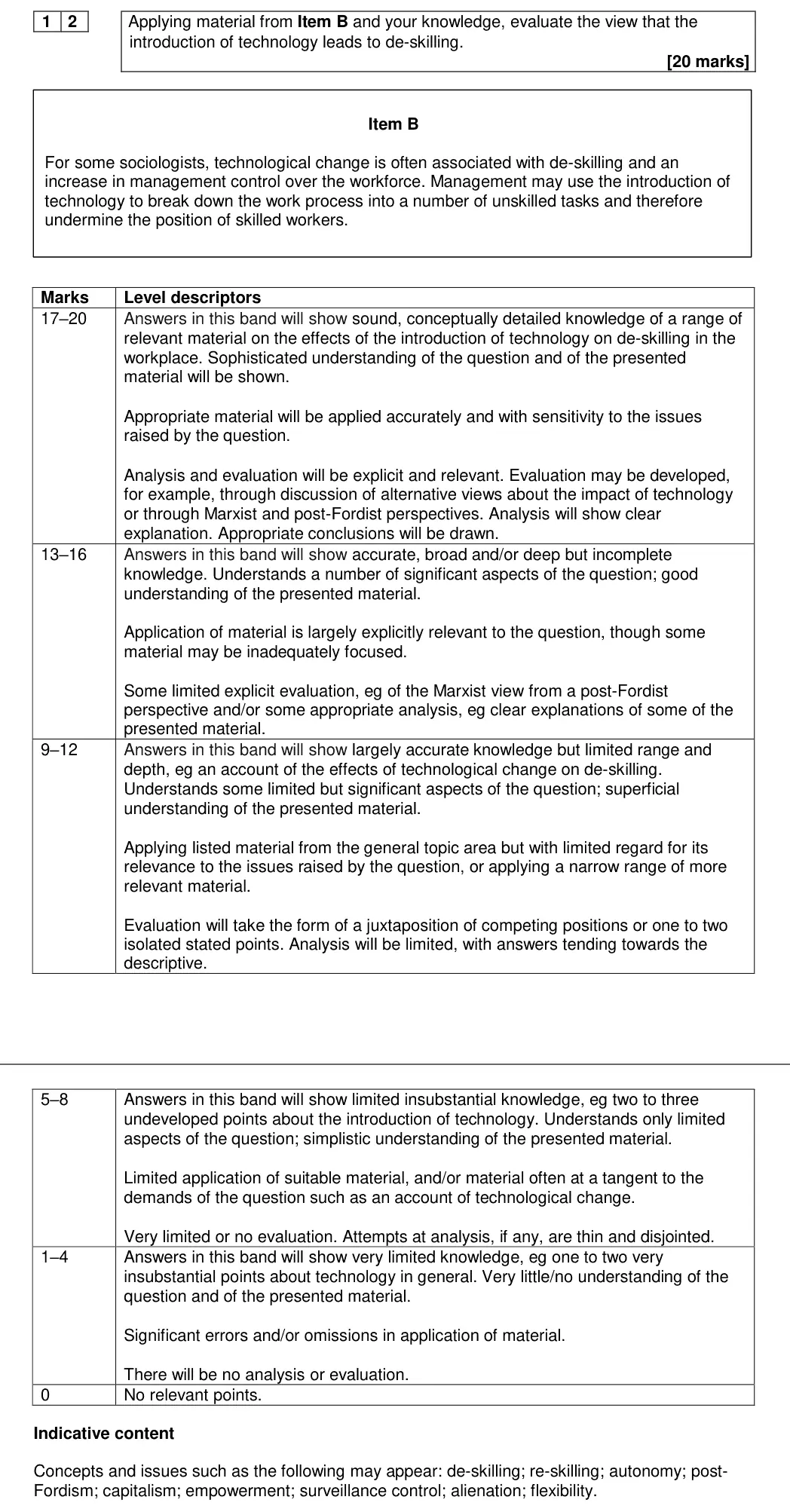
Specimen set 1 · Paper 2 · Q12 20 marks AO1=8, AO2=6, AO3=6 20-mark essay labour process
1 2
Read Item B below and answer the question that follows.
Item B
For some sociologists, technological change is often associated with de-skilling
and an increase in management control over the workforce.  Management may
use the introduction of technology to break down the work process into a number
of unskilled tasks and therefore undermine the position of skilled workers.
Applying material from Item B and your knowledge, evaluate the view that the
introduction of technology leads to de-skilling.
[20 marks]
Specimen set 1 · Paper 2 · Q13 10 marks AO1=5, AO2=3, AO3=2 Outline and explain religious organisationssecularisation
1 3
Outline and explain two ways in which the growth of sects and New Age movements
may be related to secularisation.
[10 marks]
Specimen set 1 · Paper 2 · Q14 10 marks AO1=3, AO2=4, AO3=3 Analyse ideology science and religion
1 4
Read Item A below and answer the question that follows.
Item A
Both science and religion are belief systems that involve sets of knowledge-claims:
that is, statements that claim to offer explanations of why things are as they are.
For example, science uses concepts such as germs to explain why people fall ill
from infectious diseases, while some religions use ideas such as the will of God to
explain human illness and suffering.
Applying material from Item A, analyse two differences between science and
religion as belief systems.
[10 marks]
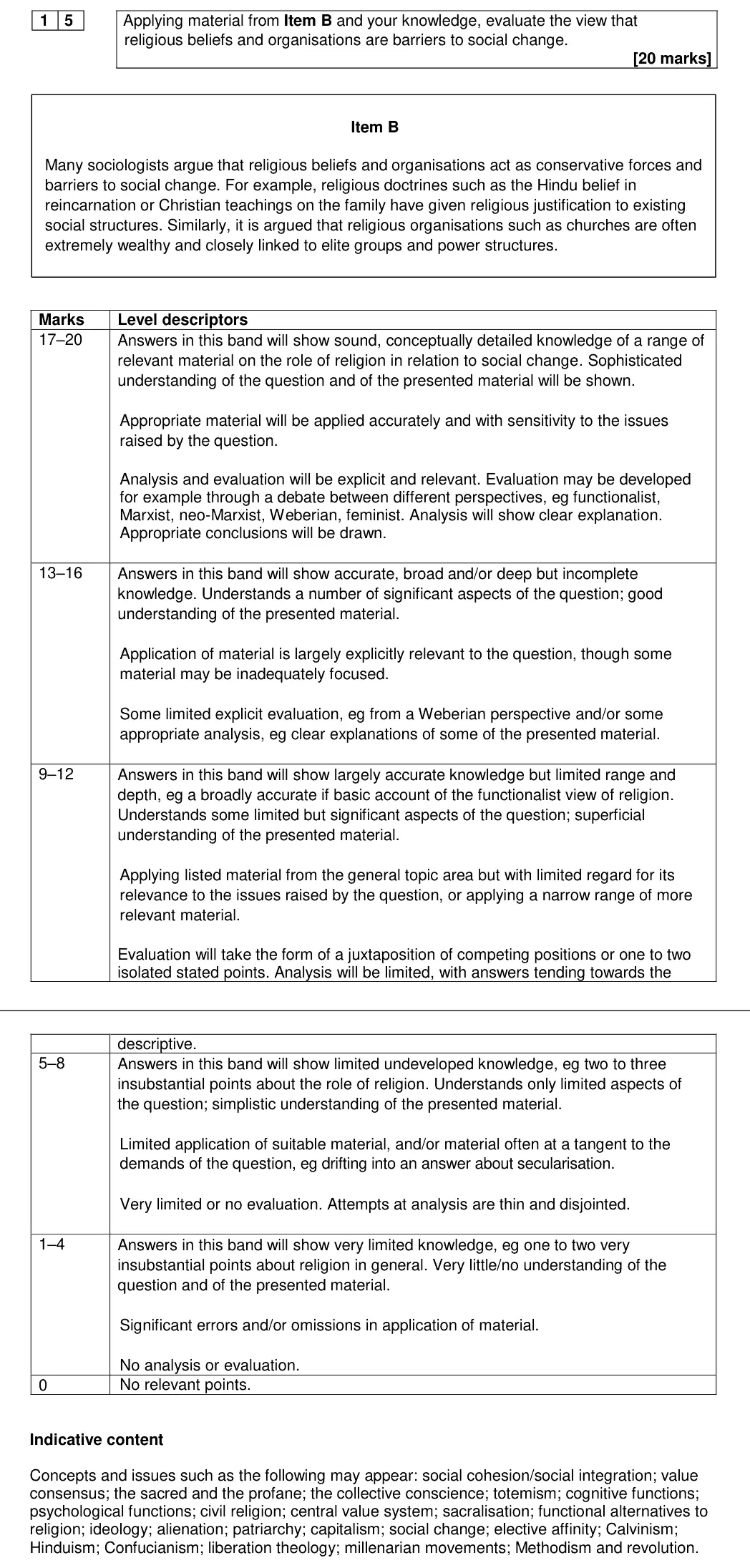
Specimen set 1 · Paper 2 · Q15 20 marks AO1=8, AO2=6, AO3=6 20-mark essay religion and social change
1 5
Read Item B and answer the question that follows.
Item B
Many sociologists argue that religious beliefs and organisations act as
conservative forces and barriers to social change. For example, religious doctrines
such as the Hindu belief in reincarnation or Christian teachings on the family have
given religious justification to existing social structures.  Similarly, it is argued that
religious organisations such as churches are often extremely wealthy and closely
linked to elite groups and power structures.
Applying material from Item B and your knowledge, evaluate the view that religious
beliefs and organisations are barriers to social change.
[20 marks]
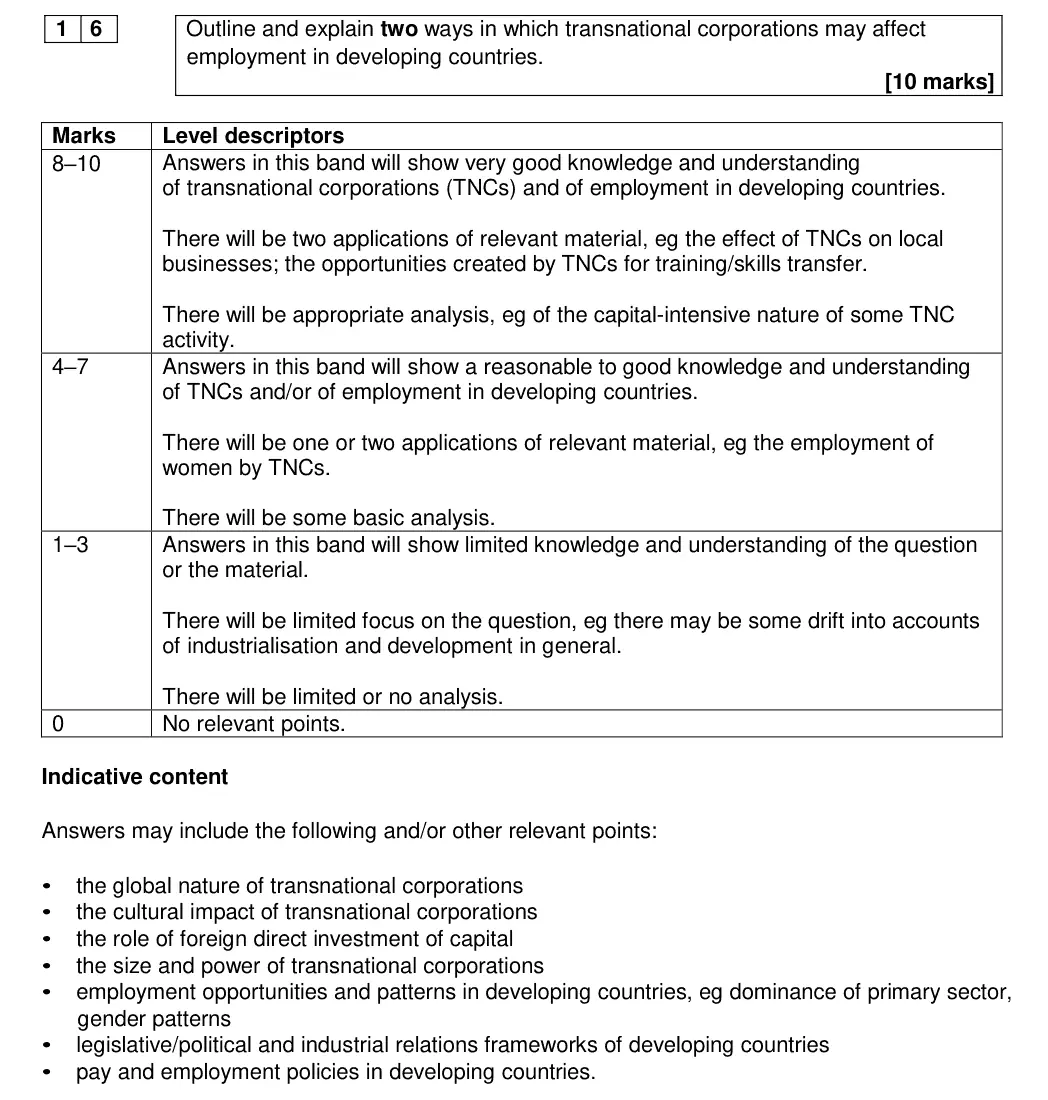
Specimen set 1 · Paper 2 · Q16 10 marks AO1=5, AO2=3, AO3=2 Outline and explain tncs ngos and international agenciesdevelopment gender health education
1 6
Outline and explain two ways in which transnational corporations may affect
employment in developing countries.
[10 marks]
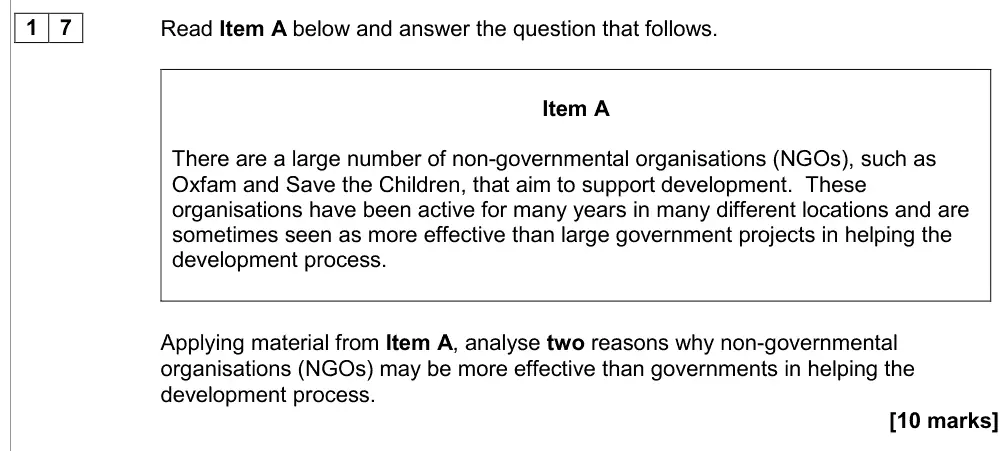
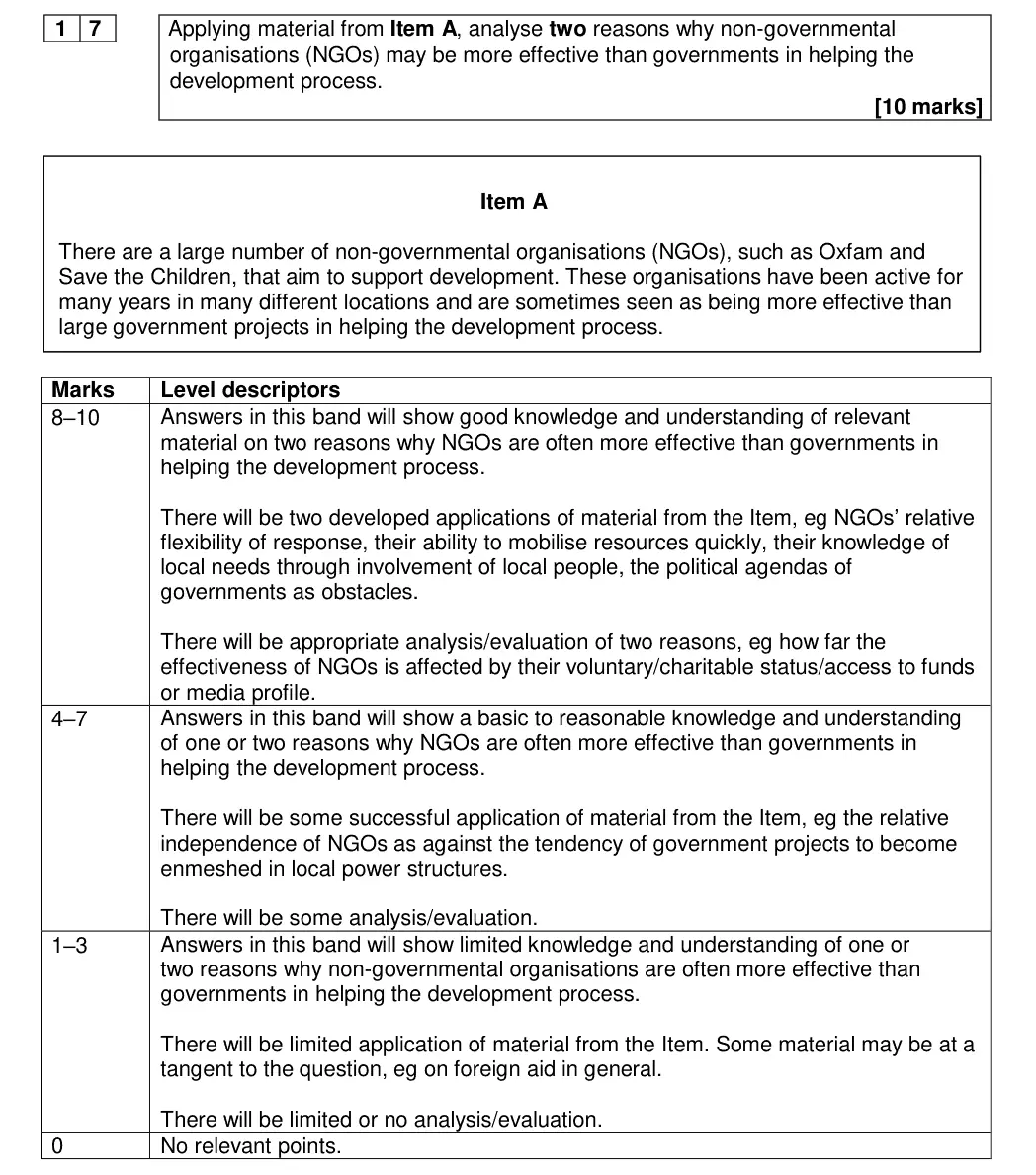
Specimen set 1 · Paper 2 · Q17 10 marks AO1=3, AO2=4, AO3=3 Analyse tncs ngos and international agencies
1 7
Read Item A below and answer the question that follows.
Item A
There are a large number of non-governmental organisations (NGOs), such as
Oxfam and Save the Children, that aim to support development.  These
organisations have been active for many years in many different locations and are
sometimes seen as more effective than large government projects in helping the
development process.
Applying material from Item A, analyse two reasons why non-governmental
organisations (NGOs) may be more effective than governments in helping the
development process.
[10 marks]
Specimen set 1 · Paper 2 · Q18 20 marks AO1=8, AO2=6, AO3=6 20-mark essay aid trade and industrialisationdevelopment and underdevelopment
1 8
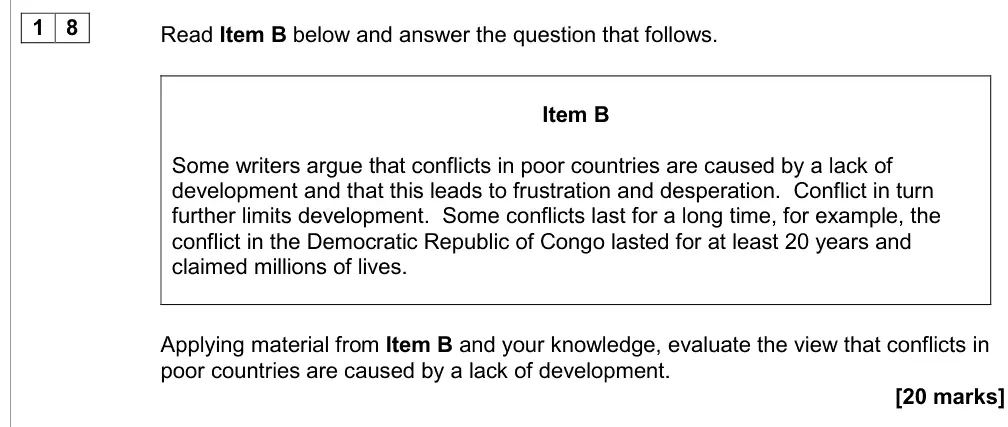
Read Item B below and answer the question that follows.
Item B
Some writers argue that conflicts in poor countries are caused by a lack of
development and that this leads to frustration and desperation.  Conflict in turn
further limits development.  Some conflicts last for a long time, for example, the
conflict in the Democratic Republic of Congo lasted for at least 20 years and
claimed millions of lives.
Applying material from Item B and your knowledge, evaluate the view that conflicts in
poor countries are caused by a lack of development.
[20 marks]
Specimen set 1 · Paper 2 · Q19 10 marks AO1=5, AO2=3, AO3=2 Outline and explain media ownership and controlmedia audiences
1 9
Outline and explain two ways in which ownership of the media may affect audiences.
[10 marks]
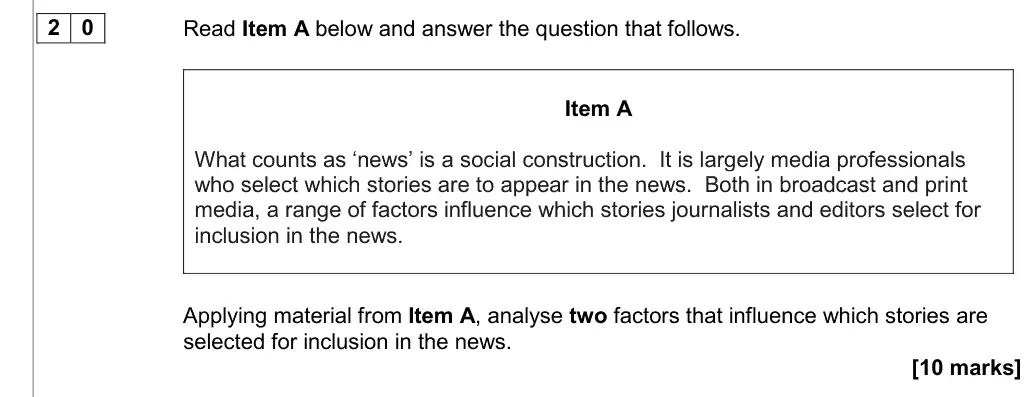
Specimen set 1 · Paper 2 · Q20 10 marks AO1=3, AO2=4, AO3=3 Analyse news selection and presentation
2 0
Read Item A below and answer the question that follows.
Item A
What counts as ‘news’ is a social construction.  It is largely media professionals
who select which stories are to appear in the news.  Both in broadcast and print
media, a range of factors influence which stories journalists and editors select for
inclusion in the news.
Applying material from Item A, analyse two factors that influence which stories are
selected for inclusion in the news.
[10 marks]
Specimen set 1 · Paper 2 · Q21 20 marks AO1=8, AO2=6, AO3=6 20-mark essay media representations
2 1
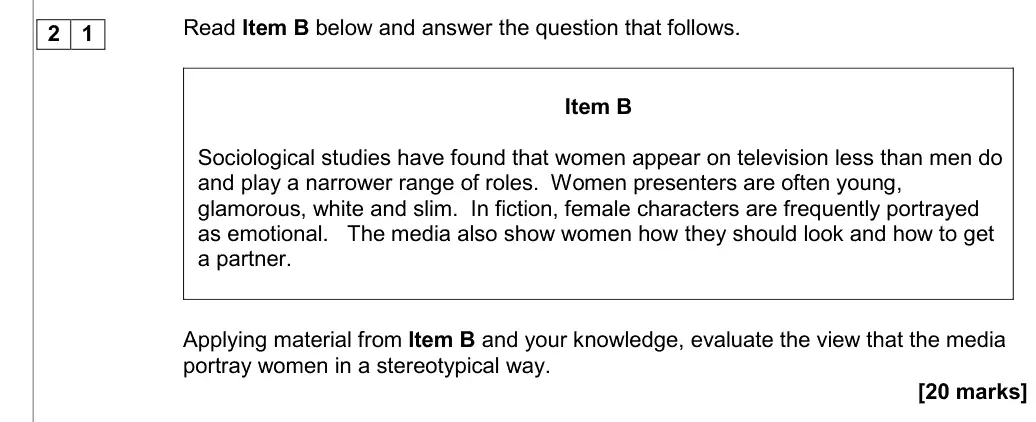
Read Item B below and answer the question that follows.
Item B
Sociological studies have found that women appear on television less than men do
and play a narrower range of roles.  Women presenters are often young,
glamorous, white and slim.  In fiction, female characters are frequently portrayed
as emotional.   The media also show women how they should look and how to get
a partner.
Applying material from Item B and your knowledge, evaluate the view that the media
portray women in a stereotypical way.
[20 marks]
Specimen set 1 · Paper 2 · Q22 10 marks AO1=5, AO2=3, AO3=2 Outline and explain measuring social classstratification and differentiation
2 2
Outline and explain two reasons why the occupational status of ethnic minorities may
not offer a satisfactory understanding of their social class position.
[10 marks]
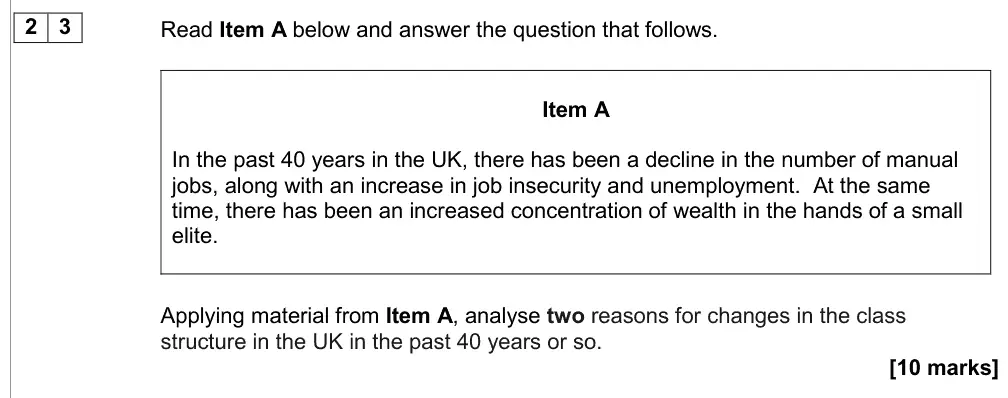
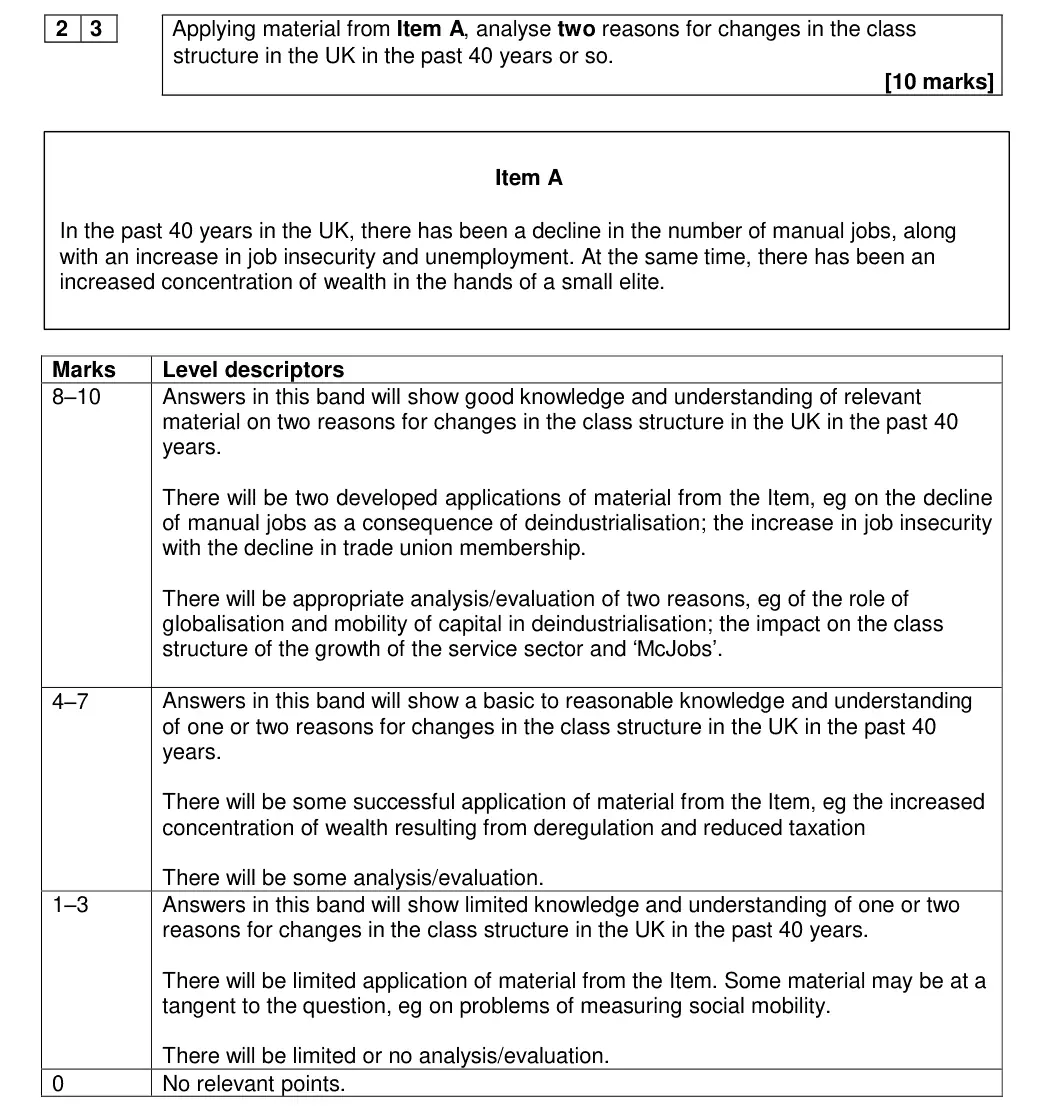
Specimen set 1 · Paper 2 · Q23 10 marks AO1=3, AO2=4, AO3=3 Analyse changing structures of inequality
2 3
Read Item A below and answer the question that follows.
Item A
In the past 40 years in the UK, there has been a decline in the number of manual
jobs, along with an increase in job insecurity and unemployment.  At the same
time, there has been an increased concentration of wealth in the hands of a small
elite.
Applying material from Item A, analyse two reasons for changes in the class
structure in the UK in the past 40 years or so.
[10 marks]
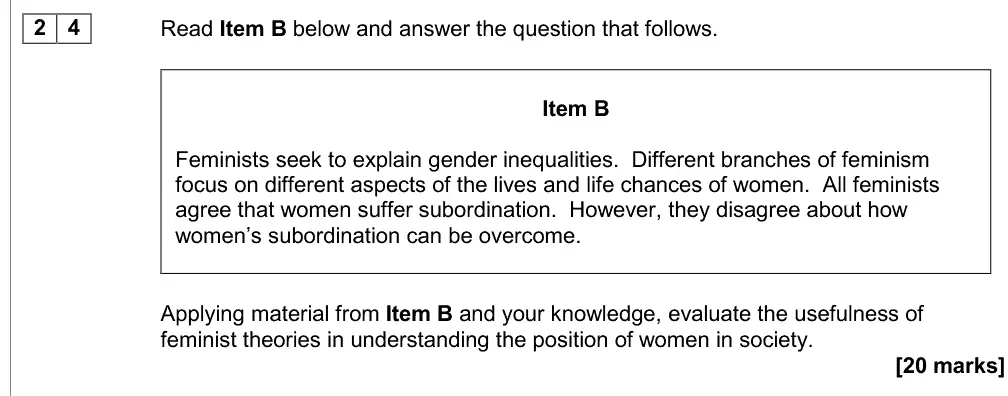
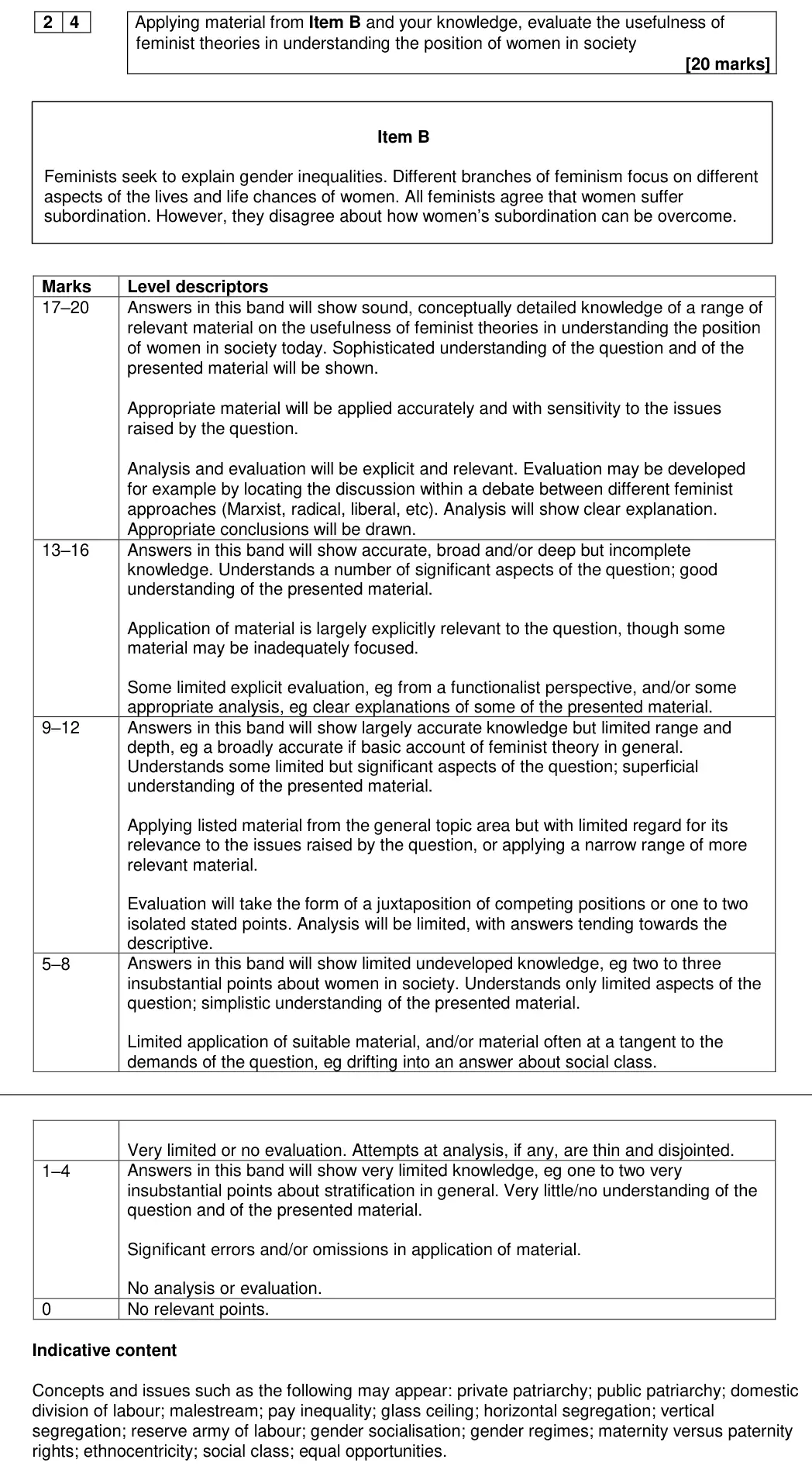
Specimen set 1 · Paper 2 · Q24 20 marks AO1=8, AO2=6, AO3=6 20-mark essay stratification and differentiationclass status and power
2 4
Read Item B below and answer the question that follows.
Item B
Feminists seek to explain gender inequalities.  Different branches of feminism
focus on different aspects of the lives and life chances of women.  All feminists
agree that women suffer subordination.  However, they disagree about how
women’s subordination can be overcome.
Applying material from Item B and your knowledge, evaluate the usefulness of
feminist theories in understanding the position of women in society.
[20 marks]

Work with an AQA sociology tutor

Want a paper marked and gone through with you? Message us.

Prefer email? Send an enquiry

If you are under 18, please include a parent's contact details. Enquiries go to enquiries@alevelsociologytutor.com and are deleted once handled. All tutoring is online.