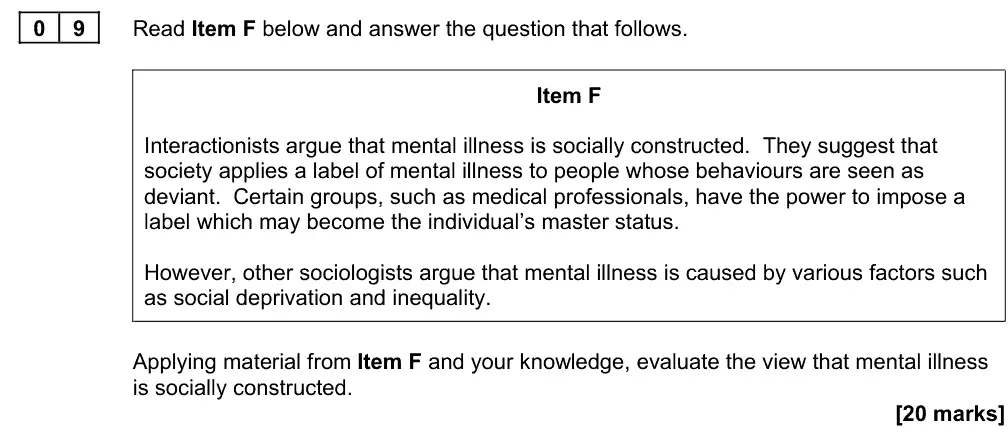
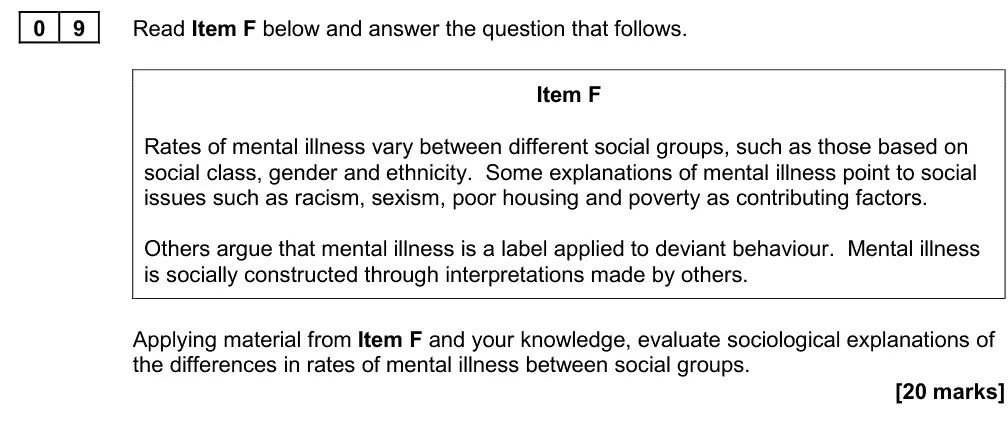
Applying material from Item F and your knowledge, evaluate sociological explanations of the differences in rates of mental illness between social groups.
Tap a question to zoom it. The mark scheme (with the level descriptors and indicative content) and the examiner's comment open underneath.
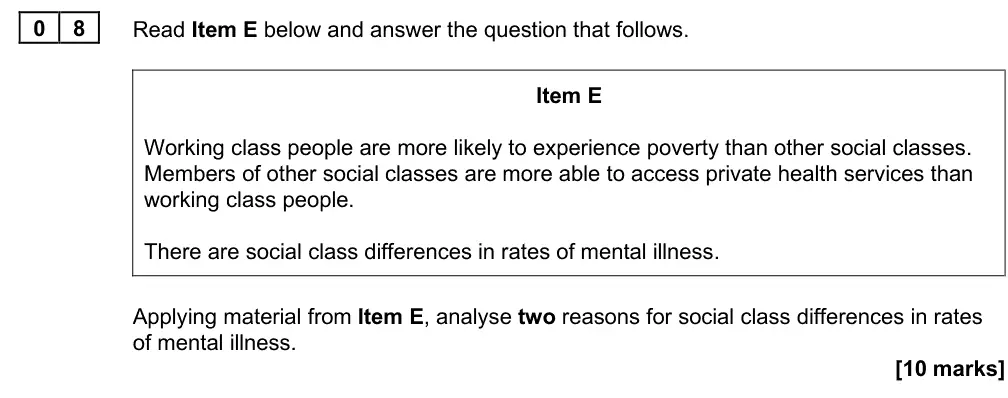
June 2025 · Paper 2 · Q810 marksAO1=3, AO2=4, AO3=3Analyse
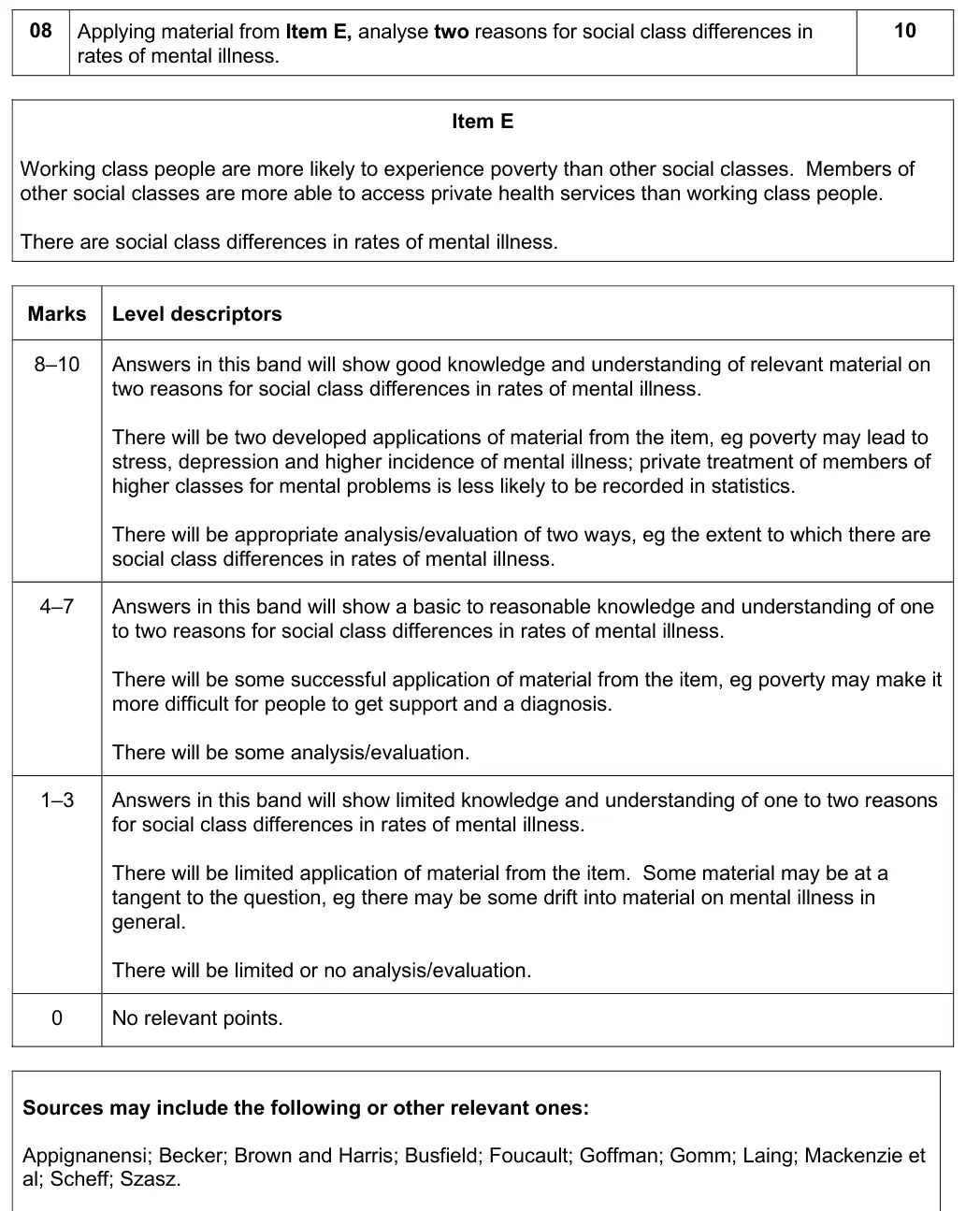
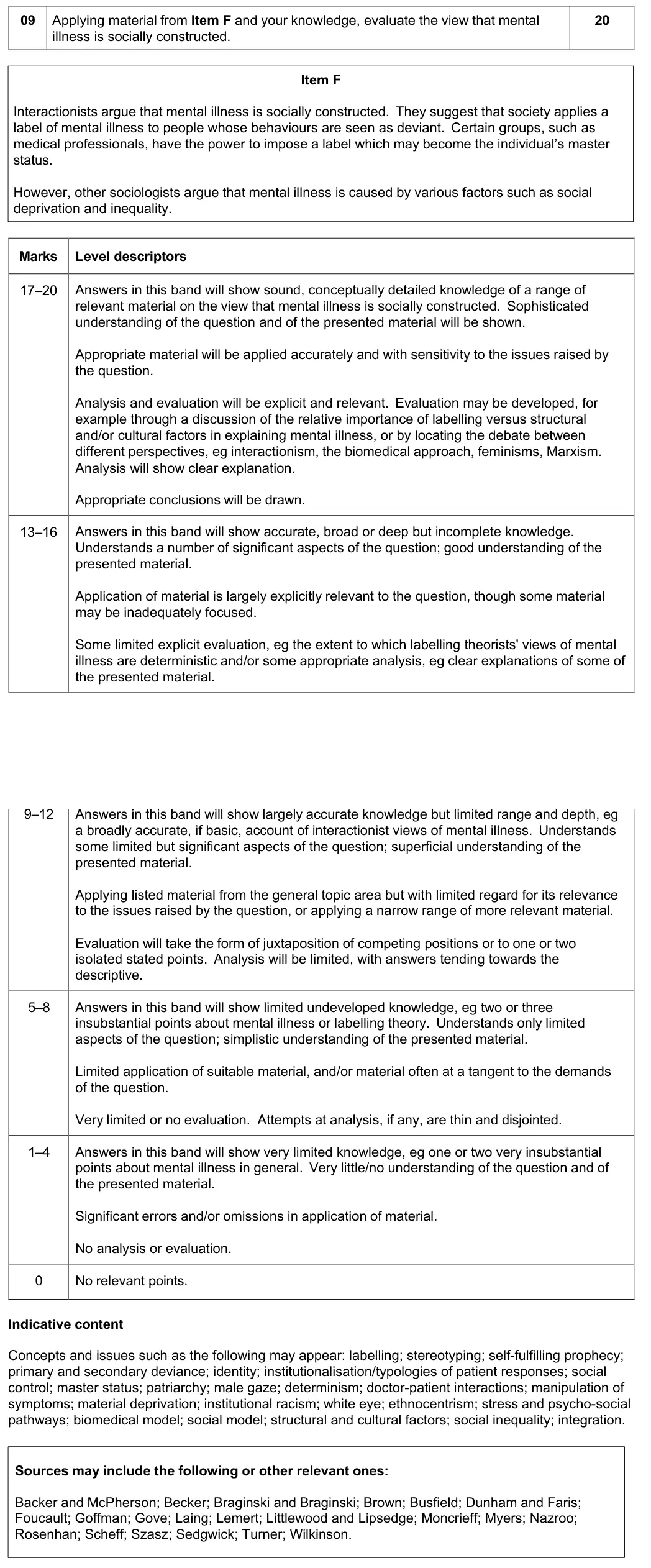
Mark scheme, including the levels grid and indicative content
Examiner's comment
The nature of these questions means that students cannot rely on reciting knowledge. Questions will ask them to bring together aspects of their sociological knowledge in ways they have not done before. It is therefore important for students to allow time to think about how to answer the question. Students should be aware that there are two types of ten-mark questions. These have different requirements and different mark schemes. There are different marks available for the assessment objectives. The items for 10 mark “analyse” questions are written to give prompts or “hooks” for student answers. These must be used to access application marks. Answers can indicate use of hooks by quoting, by a reference in parentheses or by wording (e.g. “As the item says…”). Items end with a sentence restating the question; the hooks are in the preceding part of the item. Introductions and conclusions are not required for 10-mark questions, are unlikely to help students and take up time. It is helpful if answers are set out to clearly indicate the two answers, with wording such as “One way/reason is…” or by starting a new paragraph for the second point. Answers that give more than two answers are unlikely to develop two of them sufficiently. The most successful answers to 10-mark questions were focused, clearly stating a point that addressed the question and then developing it, using sociological concepts, evidence such as an example and, where appropriate, theory. Answers often linked being poor or working class to higher levels of stress and a greater prevalence of anxiety or depression. Access to private health care was frequently linked to more affluent classes securing a wider range of effective treatments and therapies. Some effective responses used empirical material to bring out the extent of differences in rates of mental illness between classes.
Notes from the mark scheme and report
item hooks: poverty causing stress and depression
private treatment of higher classes (better treatment, and less likely to be recorded in statistics)
drift into mental illness in general = 1–3
empirical data on the size of class differences strengthened answers
June 2025 · AS Paper 2 · Q156 marksAO1=6Outline
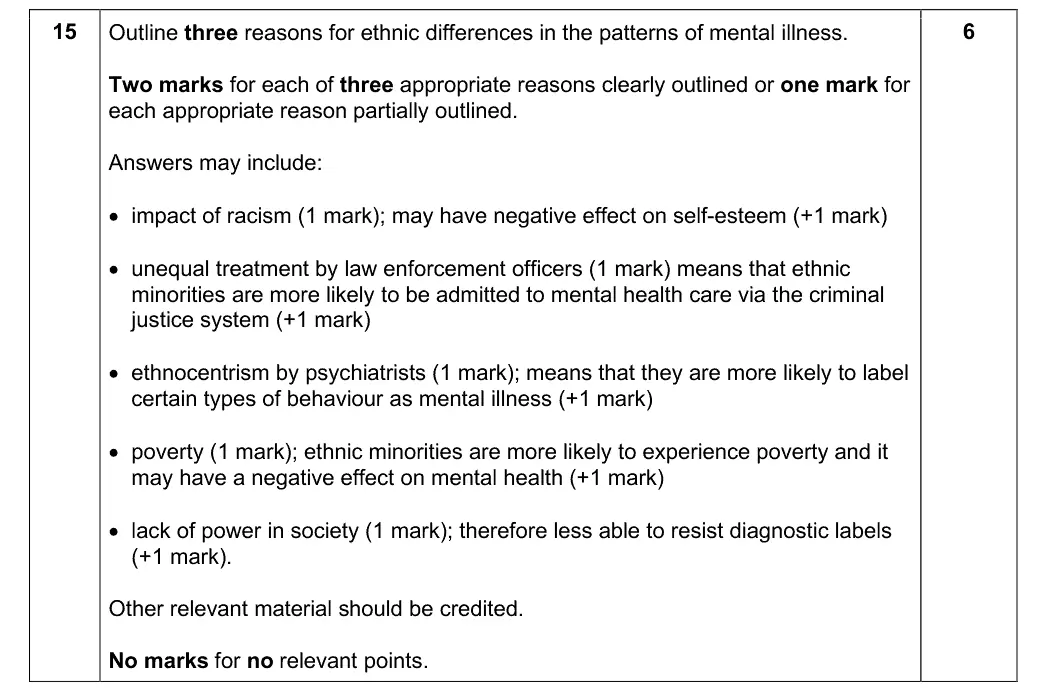
Mark scheme
Examiner's comment
On the 10-mark 'outline and explain' question (the fourth question in each topic area), and the 6-mark 'outline three...' question (the third question in each topic). In the 6-mark 'outline three...' questions, students could improve their performance by including a brief explanation of each identified point—such as a criticism or feature—rather than simply listing them. Students were generally confident in answering this question. Popular approaches focused on the ethnocentrism of medical practitioners, racism in society in general and the unequal treatment of ethnic minorities by law enforcement officers.
Notes from the mark scheme and report
credited: racism and self-esteem, police/criminal-justice routes into care, psychiatric ethnocentrism, poverty, lack of power to resist labels
generally answered confidently
June 2024 · AS Paper 2 · Q142 marksAO2=2Brief explain
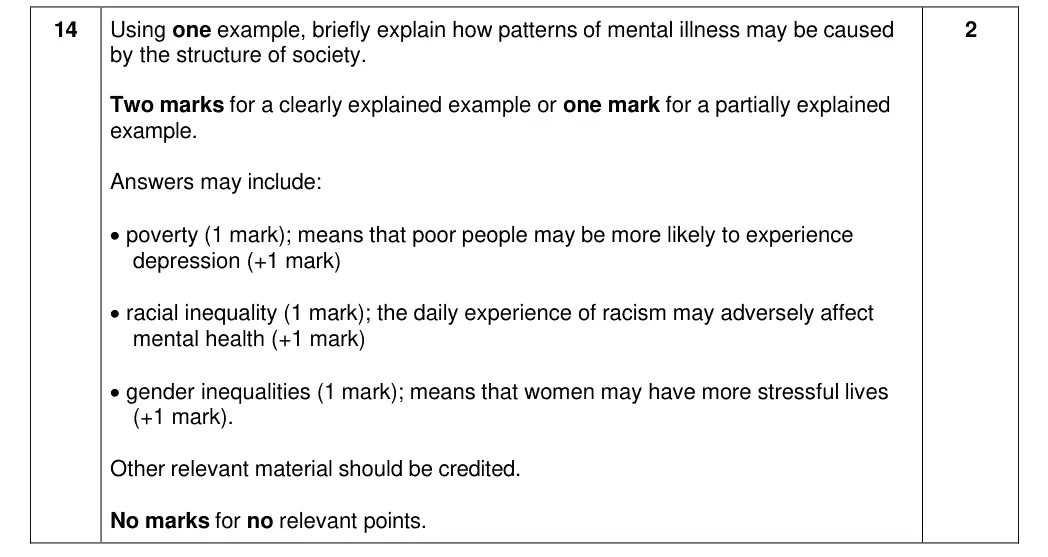
Mark scheme
Examiner's comment
This question was broad in nature and in general answered well. Students could select any aspect of society and how it might impact on any type of mental illness. Popular answers featured gender inequality and stress, and racism and its impact on stress / anxiety / depression.
Notes from the mark scheme and report
2 marks for a structural factor (poverty, racism, gender inequality) explained as causing a pattern of mental illness
any structural aspect and any mental illness credited
ER comment for Q14 also printed under Q13
June 2023 · Paper 2 · Q920 marksAO1=8, AO2=6, AO3=620-mark essay
Mark scheme, including the levels grid and indicative content
Examiner's comment
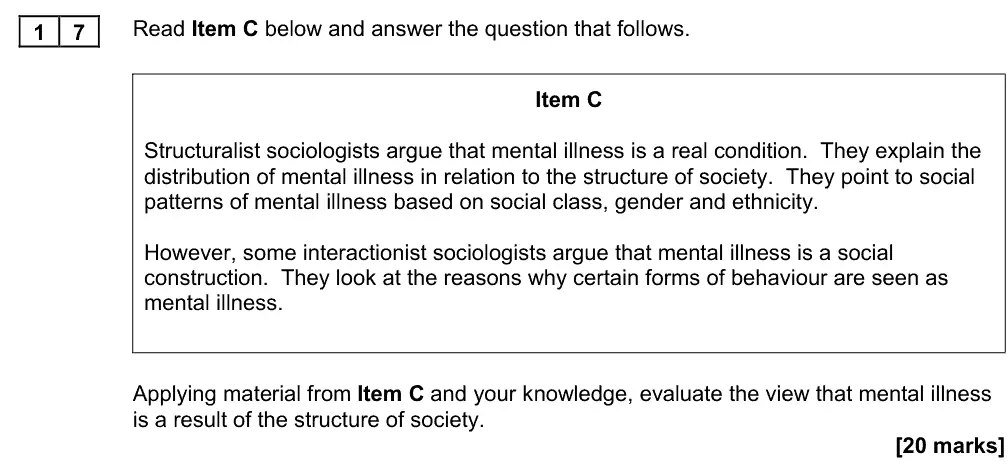
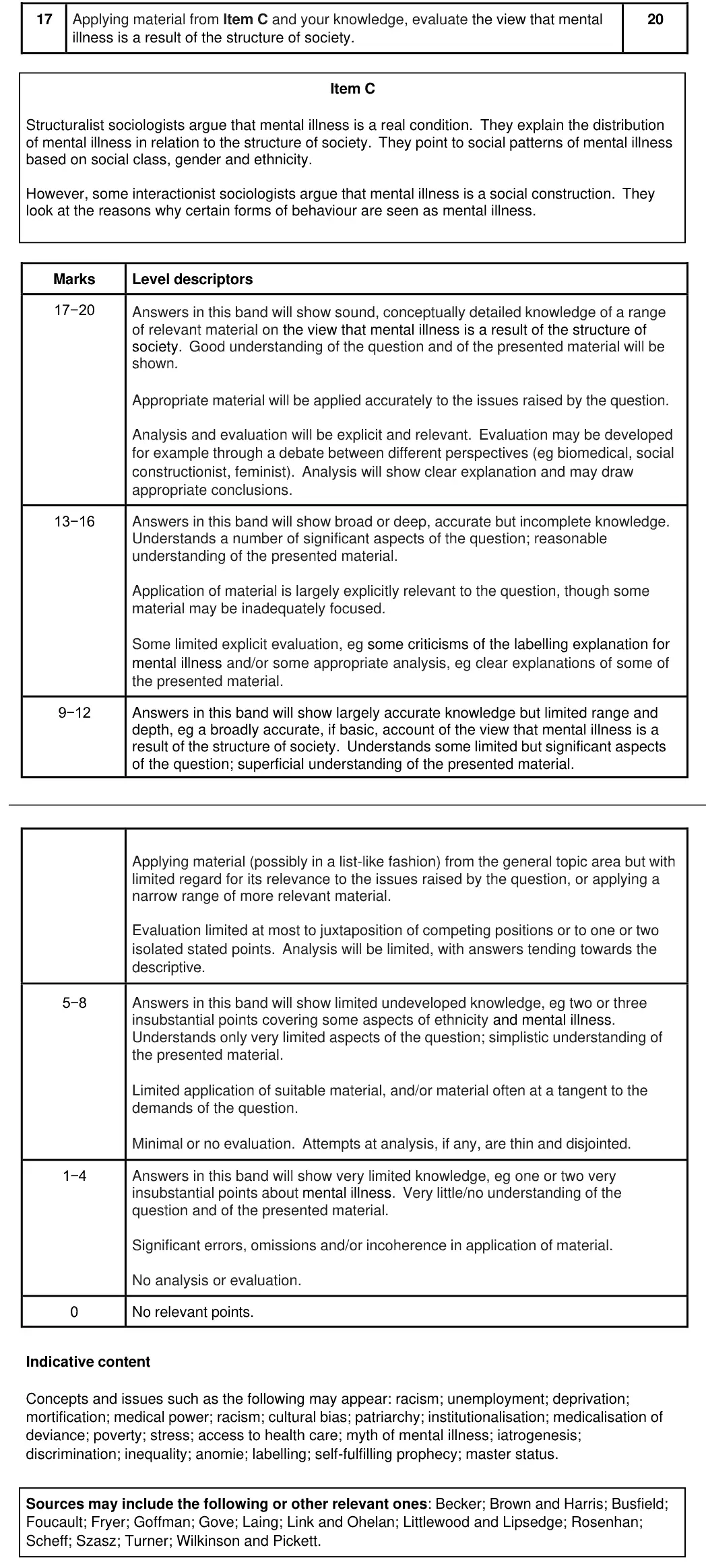
The purpose of the items for these questions is to suggest a few starting points for students, including ways into evaluation. Students are expected to also bring in further ideas (“and your knowledge” in the instruction). A wide range of material can be relevant to these questions, so students need to be selective. It is more effective to cover a limited number of views/theories in depth rather than to include every possible theory. Students who made essay plans appeared to benefit by having more structured and coherent responses. Question 9: Answers showed awareness of the debate between the different perspectives on labelling, structural and cultural factors in explaining mental illness. Better answers were able to use points from the item effectively, expand on them and bring in other relevant material.
Notes from the mark scheme and report
top band weighs labelling against structural/cultural factors, or interactionism vs biomedical, feminist, Marxist views
labelling theory as deterministic is credited evaluation
better answers developed item points and added material
June 2023 · AS Paper 2 · Q132 marksAO1=2Define
Mark scheme
Examiner's comment
Most students who answered this question gained full credit and could find a synonym for both the social and the construction part of the answer.
Notes from the mark scheme and report
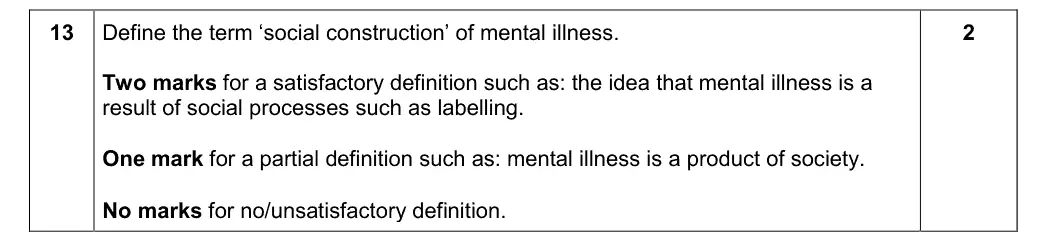
2 marks for the idea that mental illness results from social processes such as labelling
1 for 'a product of society'
most who attempted it scored full marks
June 2022 · Paper 2 · Q710 marksAO1=5, AO2=3, AO3=2Outline and explain
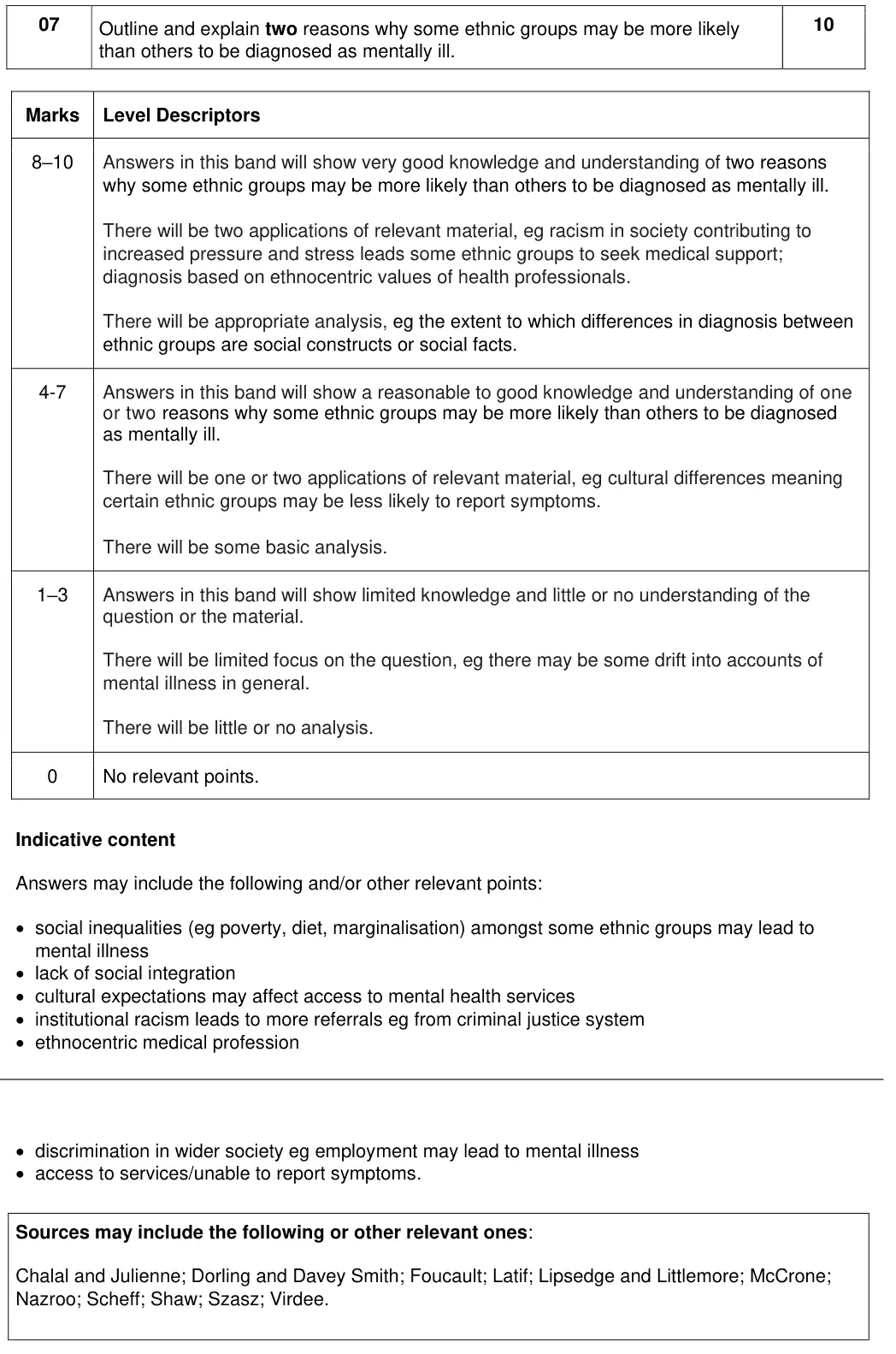
Mark scheme, including the levels grid and indicative content
Examiner's comment
The nature of these questions means that students cannot rely on reciting knowledge. The questions will ask them to bring together aspects of their sociological knowledge in a way that they are unlikely to have done before. There was a tendency, however, to attempt to answer the question by giving knowledge based on words or phrases in the question, rather than meeting the demands of the question. Students are advised to spend time reading the question, and, where there is one the item, to ensure that they are answering the question. Some students seemed unaware of the different demands of the two types of questions. The marks awarded for the assessment objectives are different in the two types of ten mark questions, and students should be aware of this. In particular, it should be noted that there are no marks available for evaluation in “outline and explain” (no item) questions. There is no need for an introduction or conclusion for 10 mark questions. It is helpful if answers are set out to clearly indicate the two answers, with wording such as “One way is…” or by starting a new paragraph for the second point. The best answers to 10 mark questions were focused, clearly stating a point that addressed the question and then developing it, using sociological concepts, evidence and, where appropriate, theory. Answers need to address all aspects of the question. Q7 Most candidates were able to explain two reasons why some ethnic groups may be more likely than others to be diagnosed as mentally ill. Many gave one cultural reason, such as norms and values related to mental health, and one structural or material reason, such as access to professionals able to give a diagnosis or material deprivation leading to mental problems.
Notes from the mark scheme and report
top band e.g. racism causing stress, ethnocentric diagnosis by professionals
analysis of whether differences are social constructs or social facts
drift into mental illness in general = 1–3 band
most gave one cultural and one structural or material reason
June 2022 · AS Paper 2 · Q1720 marksAO1=8, AO2=6, AO3=620-mark essay
Mark scheme, including the levels grid and indicative content
Examiner's comment
Answers to essay questions were sometimes disjointed; it would be worth students considering making a brief plan for the 16 and 20 mark questions. Some students interpreted this question as an opportunity to present material on patterns of mental health between different social groups and the causes of these patterns. These answers tended to focus on structural explanations of mental illness mainly from Marxist and feminist perspectives. Weaker answers listed patterns in a superficial manner in distinct sections with little or no reference to how these patterns were socially constructed. The best answers were able to evaluate by applying the biomedical and social constructionist theories to the patterns of mental illness outlined in the item. These answers were often able to reach a reasoned justified conclusion. Labelling theory was often developed effectively and supported with reference to relevant research evidence.
Notes from the mark scheme and report
top band debates structural, biomedical, social constructionist and feminist views
many just listed patterns by class, gender, ethnicity
best answers applied biomedical and social constructionist (labelling) views to the item's patterns and reached a justified conclusion
November 2020 · Paper 2 · Q920 marksAO1=8, AO2=6, AO3=620-mark essay
Mark scheme, including the levels grid and indicative content
Notes from the mark scheme and report
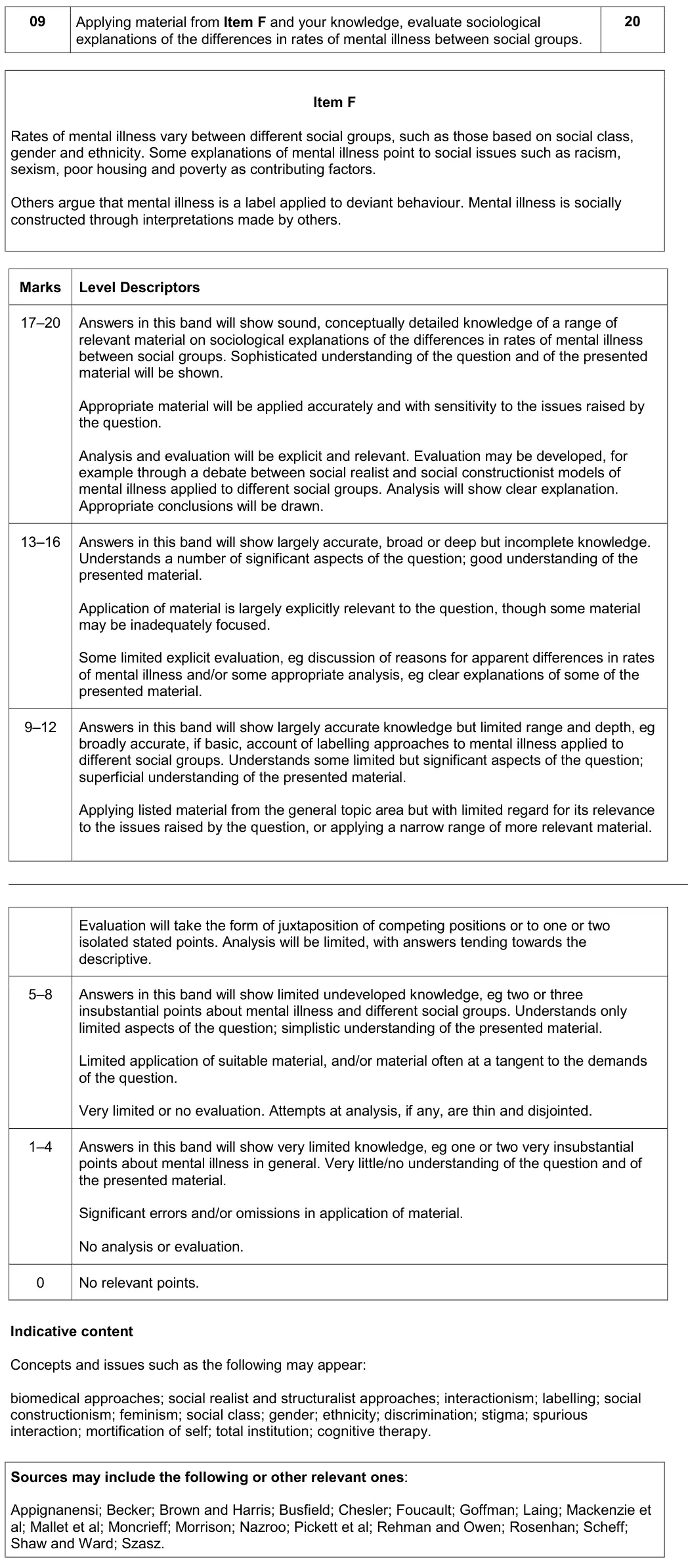
must explain differences between social groups (class, gender, ethnicity)
evaluation via social realist/structural vs social constructionist/labelling explanations applied to groups
a basic labelling account applied to groups = 9-12
general points on mental illness = 1-4
November 2020 · AS Paper 2 · Q1610 marksAO1=5, AO2=3, AO3=2Outline and explain
Mark scheme, including the levels grid and indicative content
Notes from the mark scheme and report
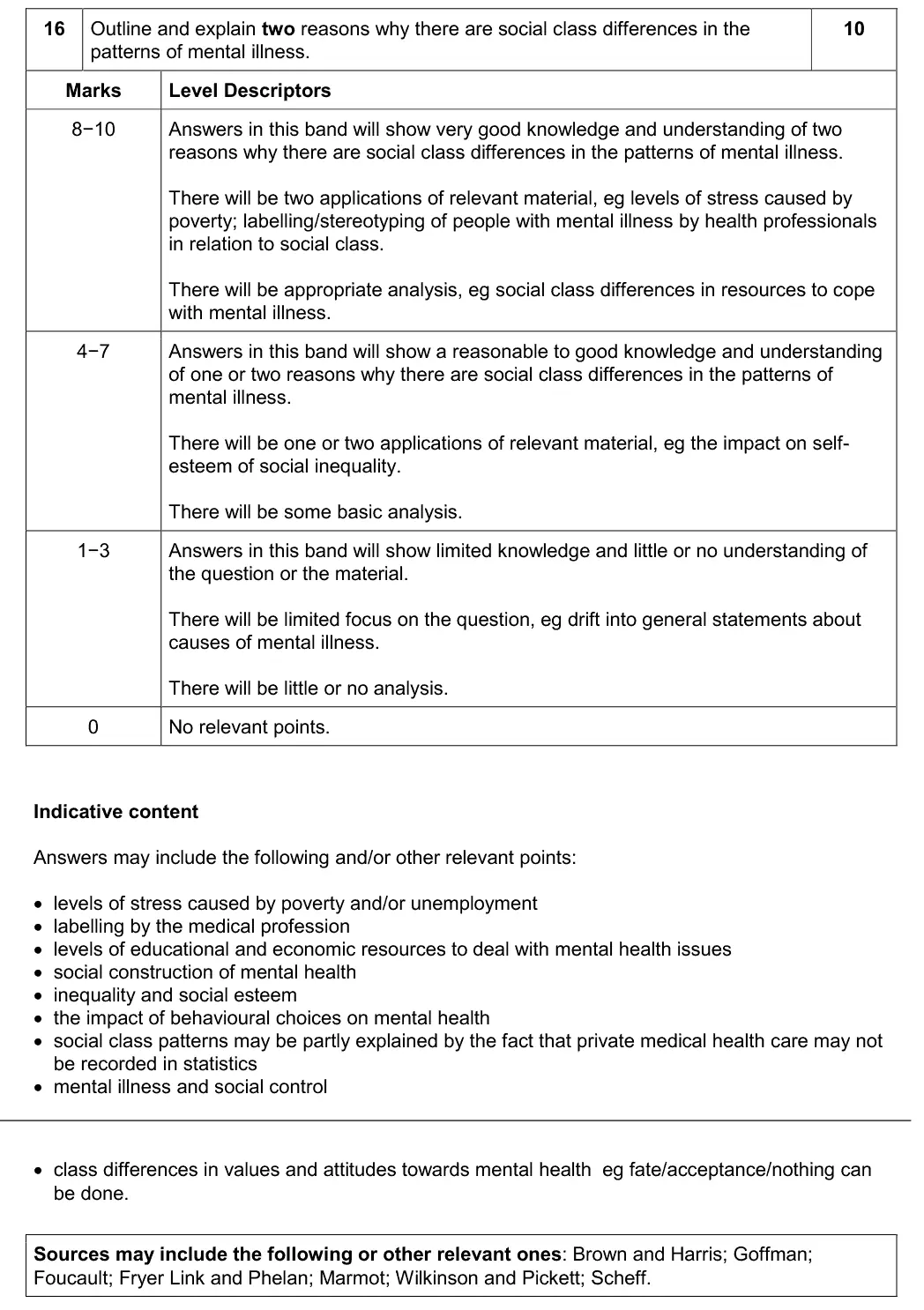
top band e.g. stress of poverty and labelling by professionals
analysis of class differences in resources to cope
general causes of mental illness = 1–3 band
June 2019 · AS Paper 2 · Q156 marksAO1=6Outline
Mark scheme
Examiner's comment
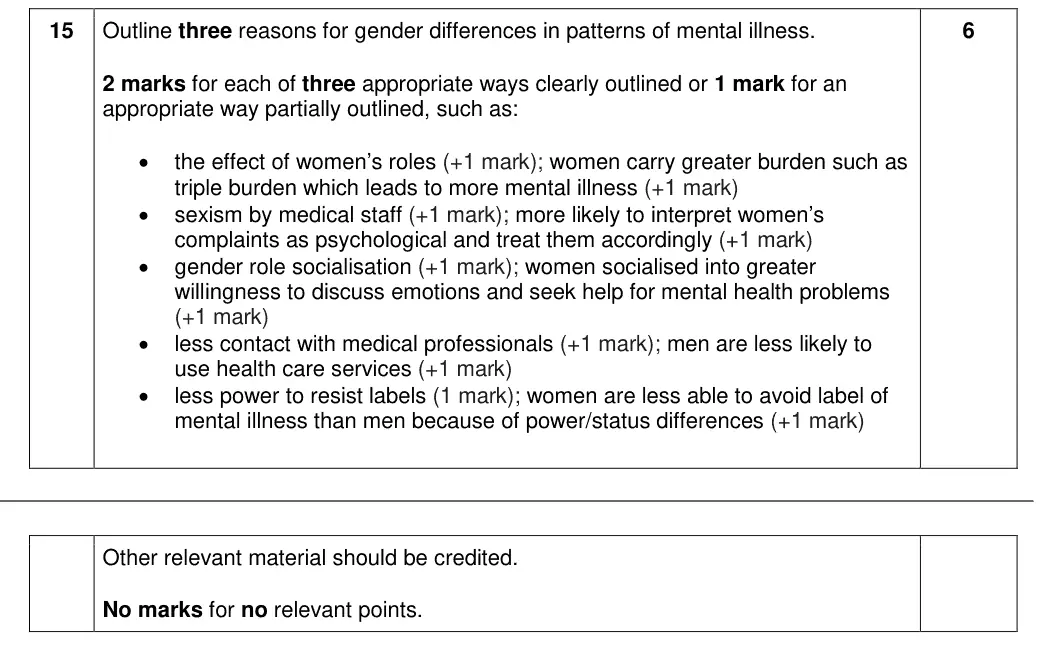
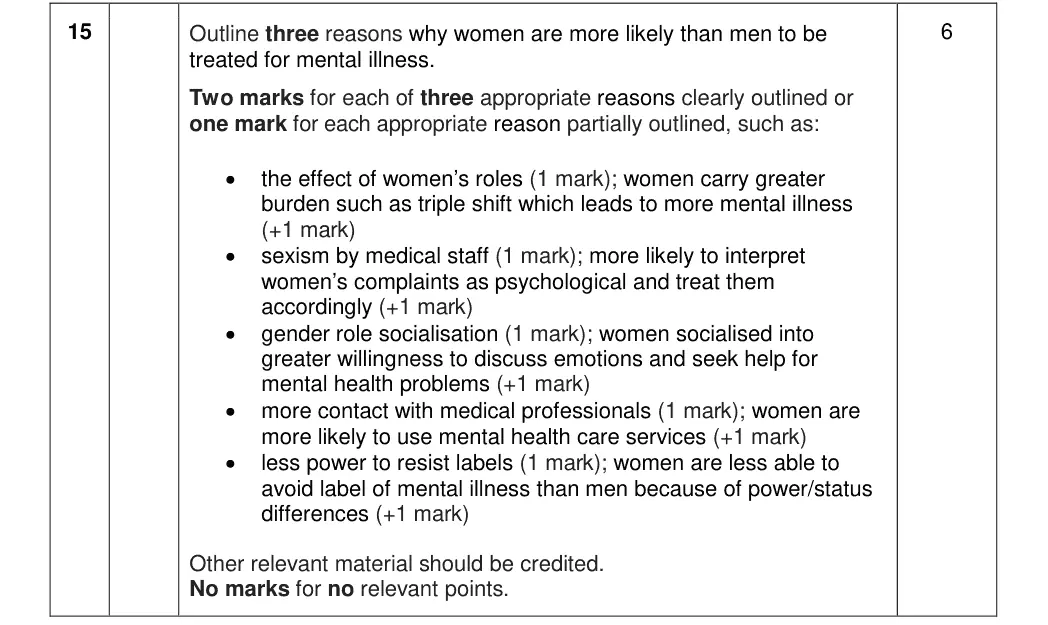
Almost all students were able to suggest appropriate reasons for gender differences in patterns of mental illness. Most answers made reference to the effect of women’s roles in society, labelling by the medical profession, differences in willingness to seek medical help and gender role socialisation.
Notes from the mark scheme and report
AO grid not printed
2 marks for each of three reasons clearly outlined
common answers: women's roles and burdens, labelling and sexism by doctors, willingness to seek help, gender socialisation
generally well answered
AO split from AQA's standard grid for this paper (this year's mark scheme does not print it).
June 2018 · AS Paper 2 · Q142 marksAO2=2Brief explain
Mark scheme
Examiner's comment
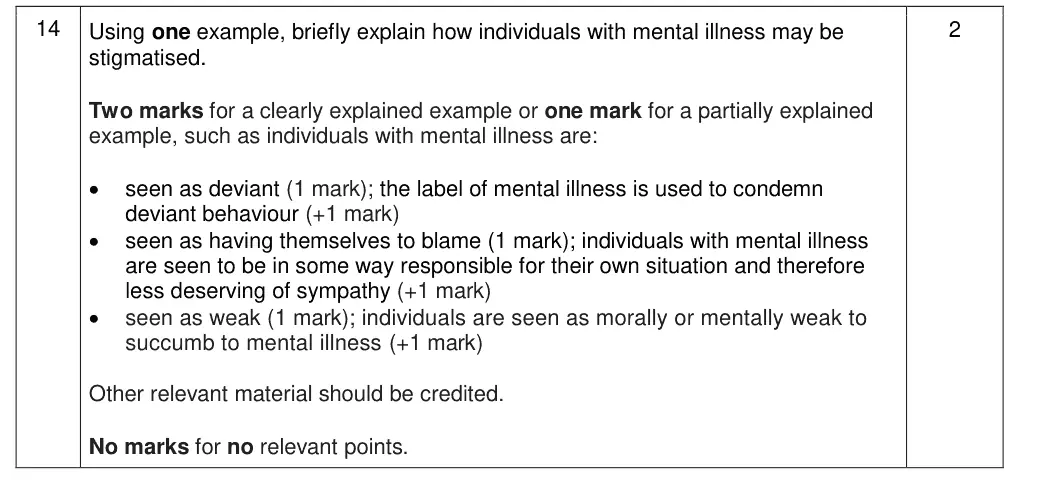
Some students struggled to explain how individuals with mental illness may be stigmatised. These answers tended to describe labelling without being clear about what the labels were or how they were stigmatised labels. Answers that were more successful were able to explain with reference to individuals seen as deviant in some way or as somehow culpable for their own situation and therefore not deserving of any sympathy.
Notes from the mark scheme and report
credited: seen as deviant, blamed for own condition, seen as weak
describing labelling without saying what the stigmatising label is did poorly
AO split from AQA's standard grid for this paper (this year's mark scheme does not print it).
June 2017 · Paper 2 · Q710 marksAO1=5, AO2=3, AO3=2Outline and explain
Mark scheme, including the levels grid and indicative content
Examiner's comment
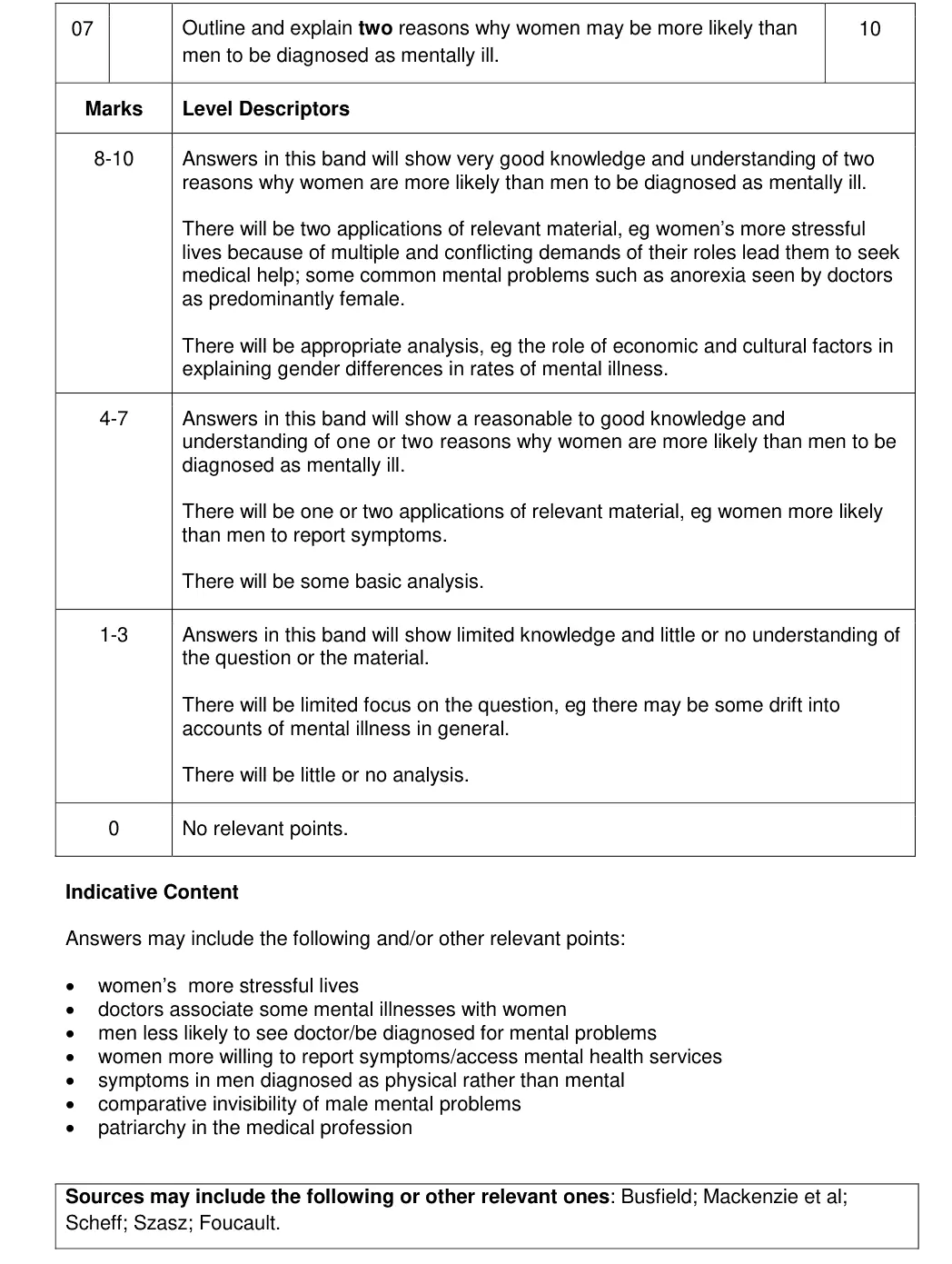
A number of students wrote introductory paragraphs and/or conclusions. These are not necessary, and are unlikely to gain additional marks. A number of students made only one point in their answer, or three or more, rather than the two asked for. In these cases, the two best answers were rewarded and will be in future series. It is helpful for students to clearly indicate their two answers, with wording such as “One way is…” or by starting a new paragraph for their second point. Schools and colleges should note that there is no reference in the mark scheme for 10 mark ‘outline and explain’ questions to evaluation, and that evaluation is not a requirement for answers to these questions. The assessment objective allocations are different in the two types of 10 mark questions, and students should be made aware of this. There was a wide range of responses to these questions. A minority of students wrote very brief answers. For these 10 mark items, a simple statement of two ways, reasons or factors, without development, is not sufficient to access more than the lower marks in the mark range. The best answers were focused, clearly stating a point and then developing it, with use of sociological concepts, evidence and theory where appropriate, in ways that demonstrated the skills expected from the targeted assessment objectives. There was a tendency, however, for many answers to focus on the first aspect of the question at the expense of the second. Students need guidance on how to approach these questions and how to best demonstrate their sociological understanding. The nature of these questions means that students cannot rely on reciting knowledge. They require students to bring together two aspects of their sociological knowledge in a way that they are unlikely to have done before. Answers will sometimes require claims that students may be unsure of because they do not know of specific evidence (for example, in question 5, whether migrants from Eastern Europe who are single workers tend to live alone or in shared households). However, answers that are sociologically plausible will be accepted. The most common answers here discussed stress or other factors in women’s lives and the role of doctors in diagnosis.
Notes from the mark scheme and report
two reasons for higher female diagnosis (stressful multiple roles, doctors' gendered diagnoses, women more likely to report symptoms, male problems hidden)
drift into mental illness in general = 1–3
common answers: stress in women's lives and role of doctors in diagnosis
June 2017 · AS Paper 2 · Q156 marksAO1=6Outline
Mark scheme
Examiner's comment
Additionally, some students are writing far too much on the 6 mark questions. This time could be better spent on the longer essay questions. The most common reasons suggested by students involved the effect of women‘s roles, an aspect of gender role socialisation, and more contact with medical staff. Most students were able to gain the full two marks for each of these points by explaining how they led to women being more likely than men to be treated for mental illness. A common mistake was to make points that were the reverse of each other. For example, saying that women are more likely to be socialised to discuss emotions and seek help with mental health problems, then as an separate point say that men are socialised not to open up about mental health. In these cases, this was credited as one reason rather than two separate reasons.
Notes from the mark scheme and report
2 marks for each of three reasons clearly outlined
common answers: women's roles and triple shift, gender role socialisation, more contact with doctors
a point and its reverse (women open up, men do not) credited as one reason only
June 2016 · AS Paper 2 · Q1610 marksAO1=5, AO2=3, AO3=2Outline and explain
Mark scheme, including the levels grid and indicative content
Examiner's comment
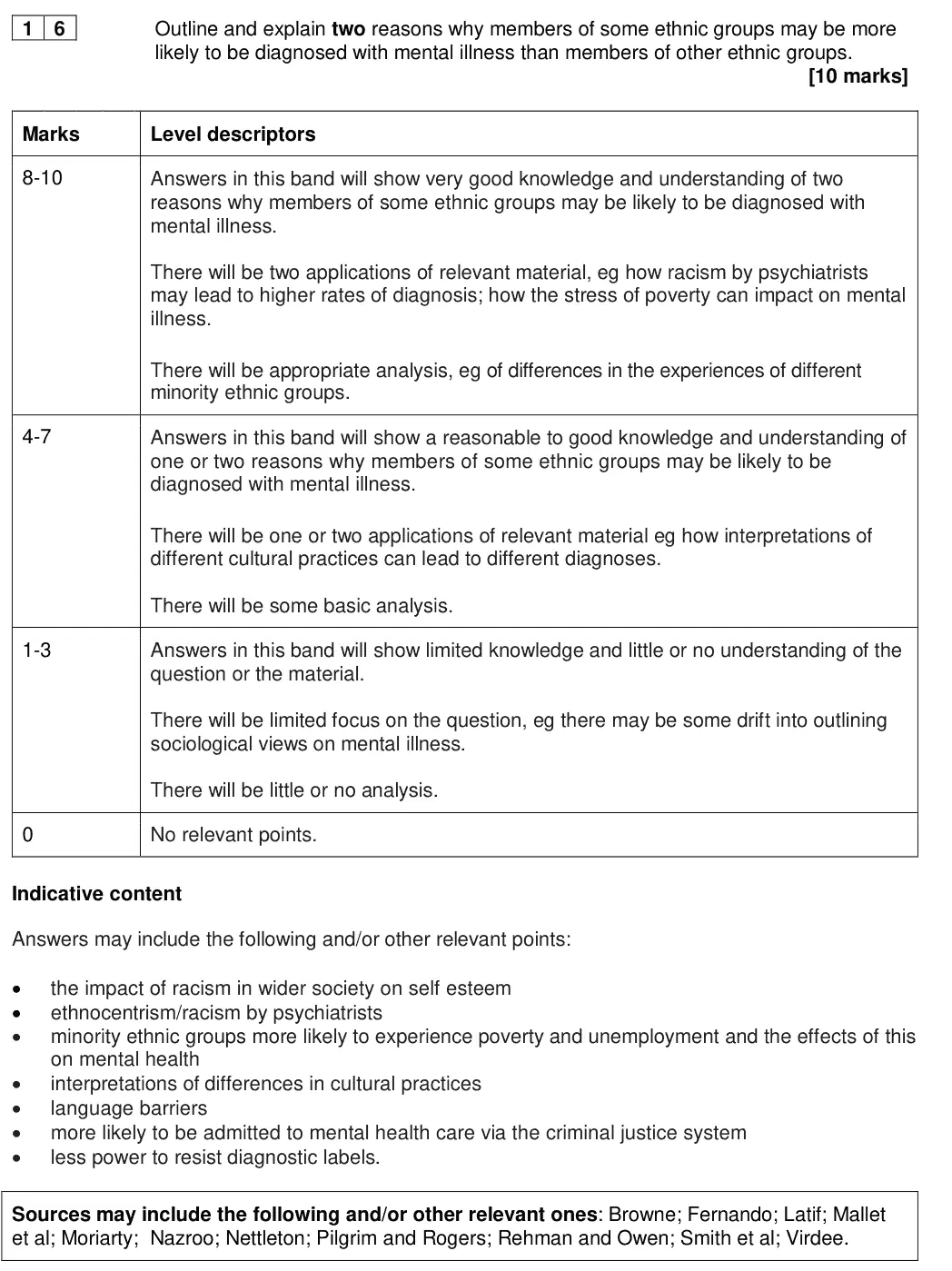
The 10 mark ‘Outline and explain’ question requires students to link two aspects of the specification. The best answers took note of both aspects of the question, clearly identified two separate points and developed them together them in relation to the question as a whole. Weaker answers either ignored one aspect of the question, or attempted to cover a number of ideas rather than focusing on the two required. Most students were able to identify two reasons why members of some ethnic groups may be more likely to be diagnosed with mental illness than members of other ethnic groups. The most common reasons given were racism, labelling/stereotyping, poverty and cultural differences. Successful answers were able to explain clearly how the reason identified was a feature of some ethnic groups, and also how this led to a higher incidence of mental illness. For example, how poverty might lead to stress, lower status, feelings of inadequacy, loss of independence, frustration and so on. Less successful answers spent too long describing the differences in diagnosis rather than the reasons, or discussed differences between ethnic groups without relating them to differential diagnoses of mental illness.
Notes from the mark scheme and report
reasons for higher diagnosis rates, not descriptions of the differences
examples: psychiatric racism/ethnocentrism, stress of poverty, cultural misinterpretation, language barriers, entry via criminal justice system
drift into general views of mental illness = 1-3
best answers explained how the reason affects the group and leads to diagnosis
Specimen set 1 · Paper 2 · Q710 marksAO1=5, AO2=3, AO3=2Outline and explain
Mark scheme, including the levels grid and indicative content
Notes from the mark scheme and report
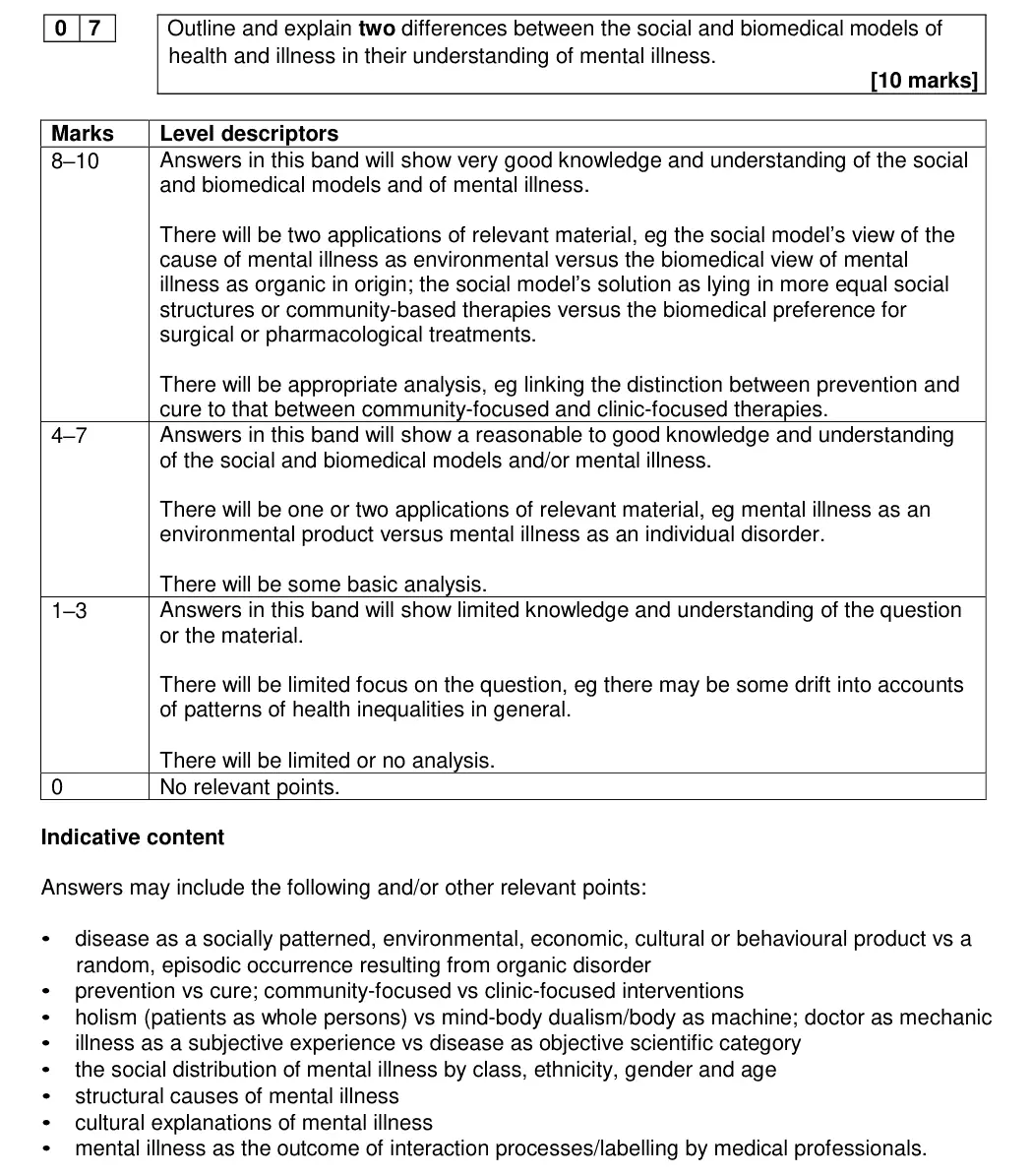
each difference must contrast the social and biomedical models on mental illness (environmental vs organic cause
community vs pharmacological or surgical treatment)
analysis e.g. prevention vs cure
drift into health inequalities in general = 1–3 band
Work with an AQA sociology tutor
Essays stuck in the middle band, or losing marks on the 10-markers? Book a trial lesson with Mark, a former AQA examiner.