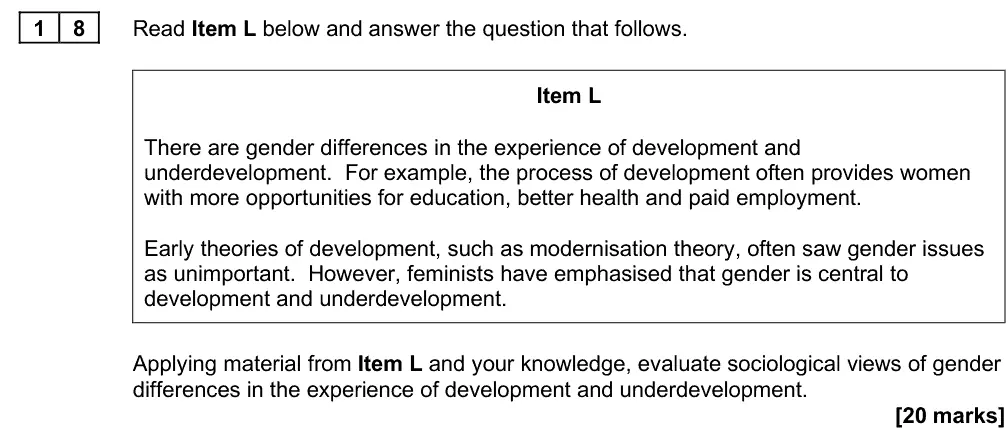
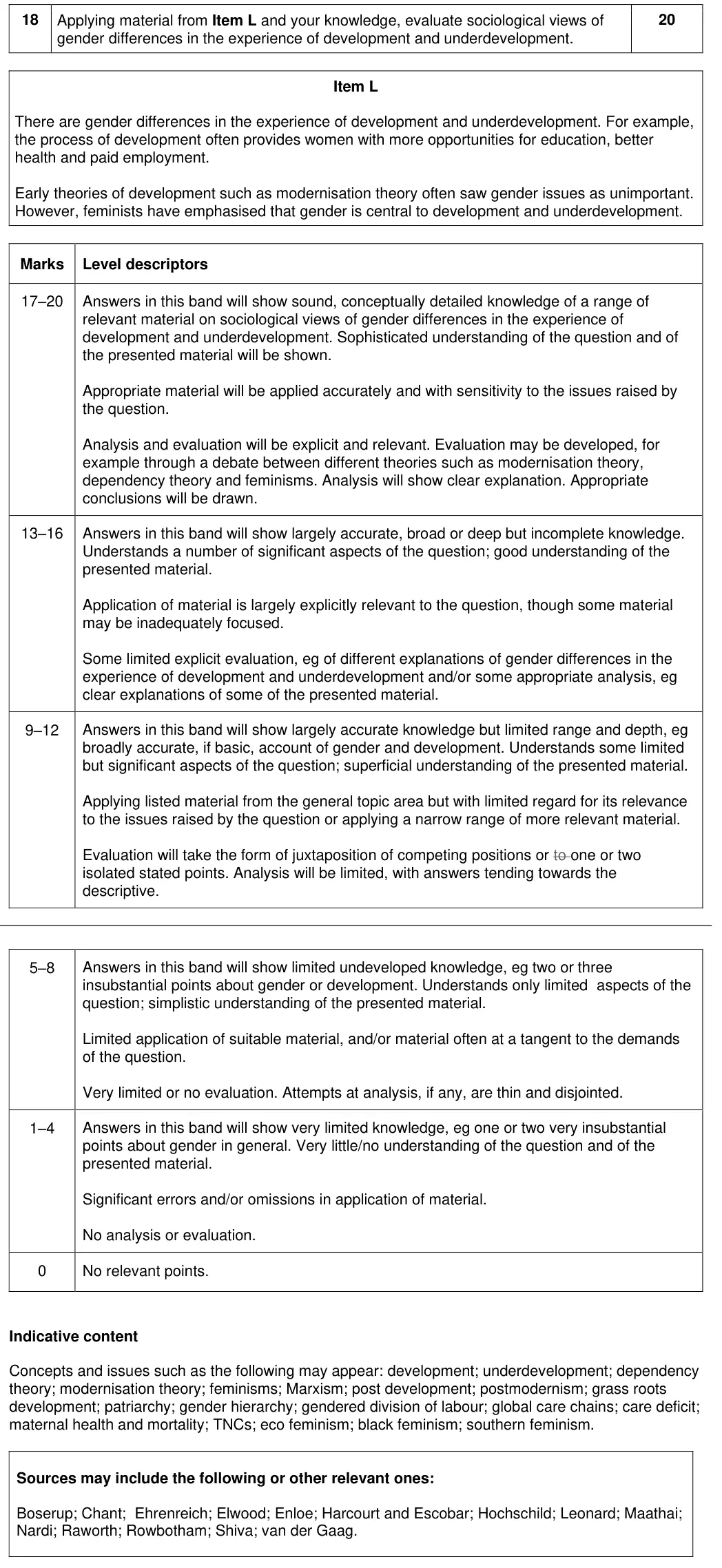
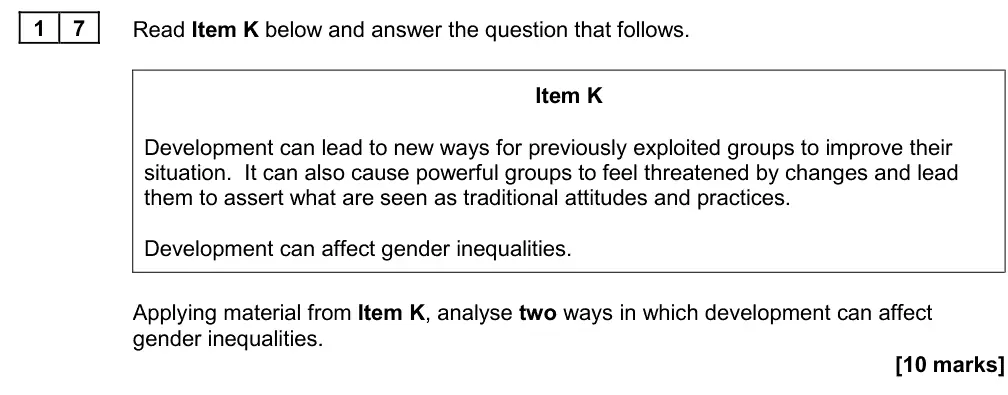
Applying material from Item L and your knowledge, evaluate sociological views of gender differences in the experience of development and underdevelopment.
Tap a question to zoom it. The mark scheme (with the level descriptors and indicative content) and the examiner's comment open underneath.
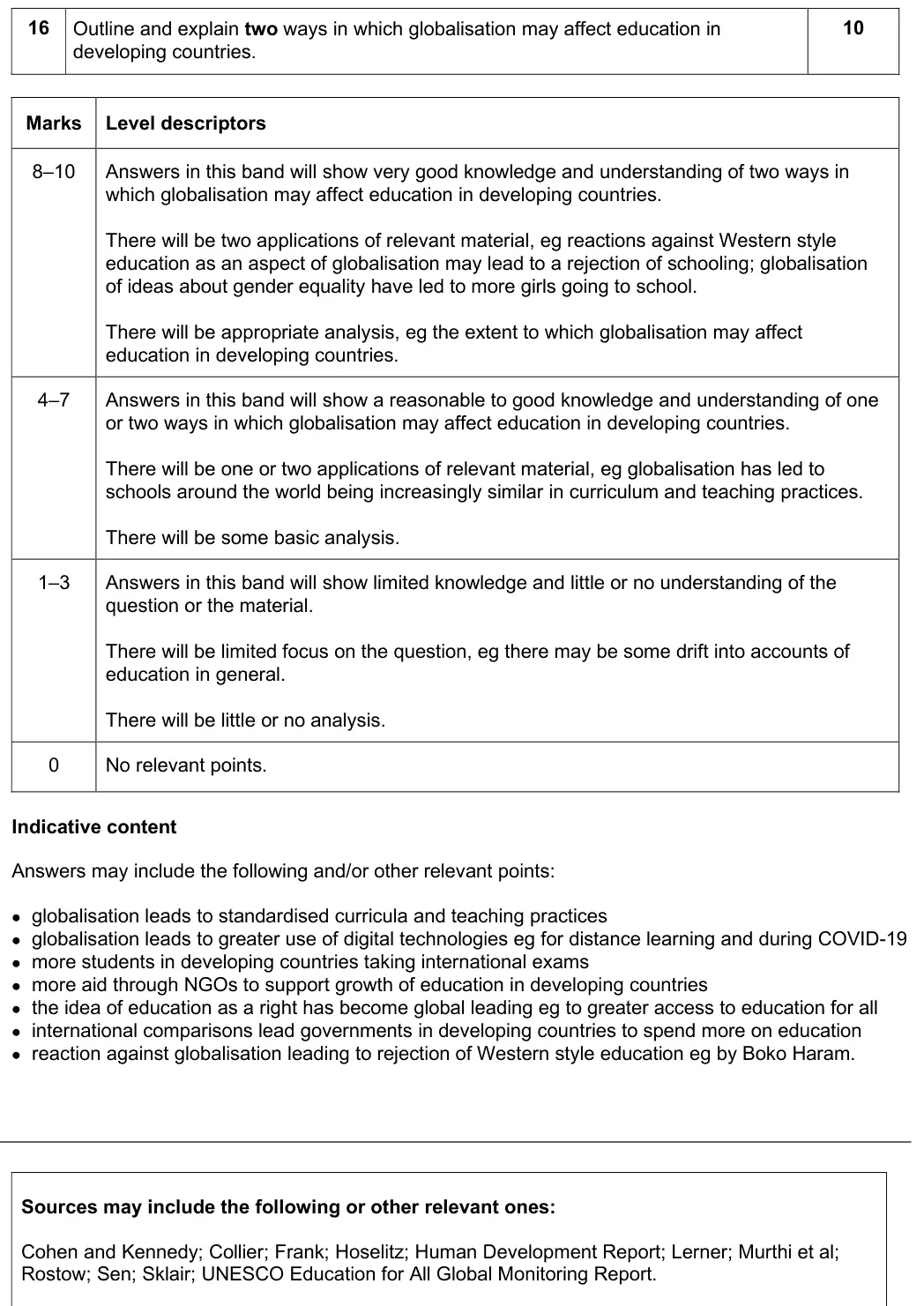
June 2025 · Paper 2 · Q1610 marksAO1=5, AO2=3, AO3=2Outline and explain
Mark scheme, including the levels grid and indicative content
Examiner's comment
The nature of these questions means that students cannot rely on reciting knowledge. Questions will ask them to bring together aspects of their sociological knowledge in ways they have not done before. It is therefore important for students to allow time to think about how to answer the question. Students should be aware that there are two types of ten-mark questions. These have different requirements and different mark schemes. There are different marks available for the assessment objectives. 10 mark “outline and explain” questions have more marks available for knowledge and understanding, and none for evaluation. Introductions and conclusions are not required for 10-mark questions, are unlikely to help students and take up time. It is helpful if answers are set out to clearly indicate the two answers, with wording such as “One way/reason is…” or by starting a new paragraph for the second point. Answers that give more than two answers are unlikely to develop two of them sufficiently. The most successful answers to 10-mark questions were focused, clearly stating a point that addressed the question and then developing it, using sociological concepts, evidence such as an example and, where appropriate, theory. This question was generally well answered with successful answers often discussing standardised Western teaching practices spreading globally and ways in which aid from non- governmental organisations may affect education.
Notes from the mark scheme and report
drift into education in general = 1–3
common answers: spread of standardised Western teaching, NGO aid for schooling
also global ideas on girls' education and reaction against Western schooling
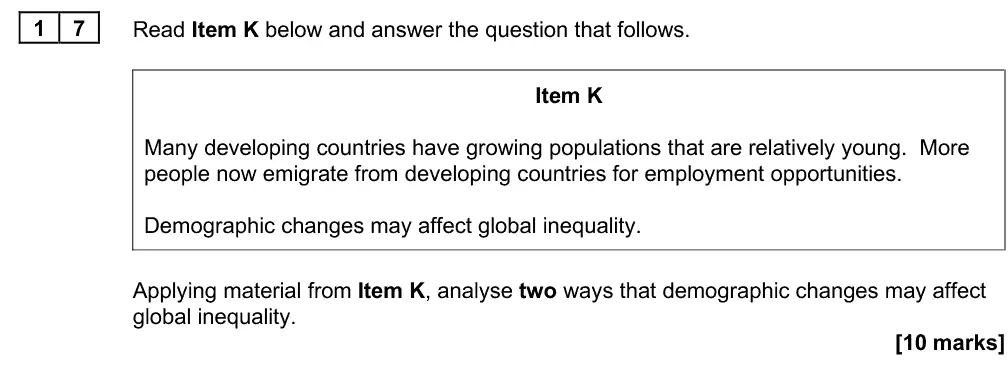
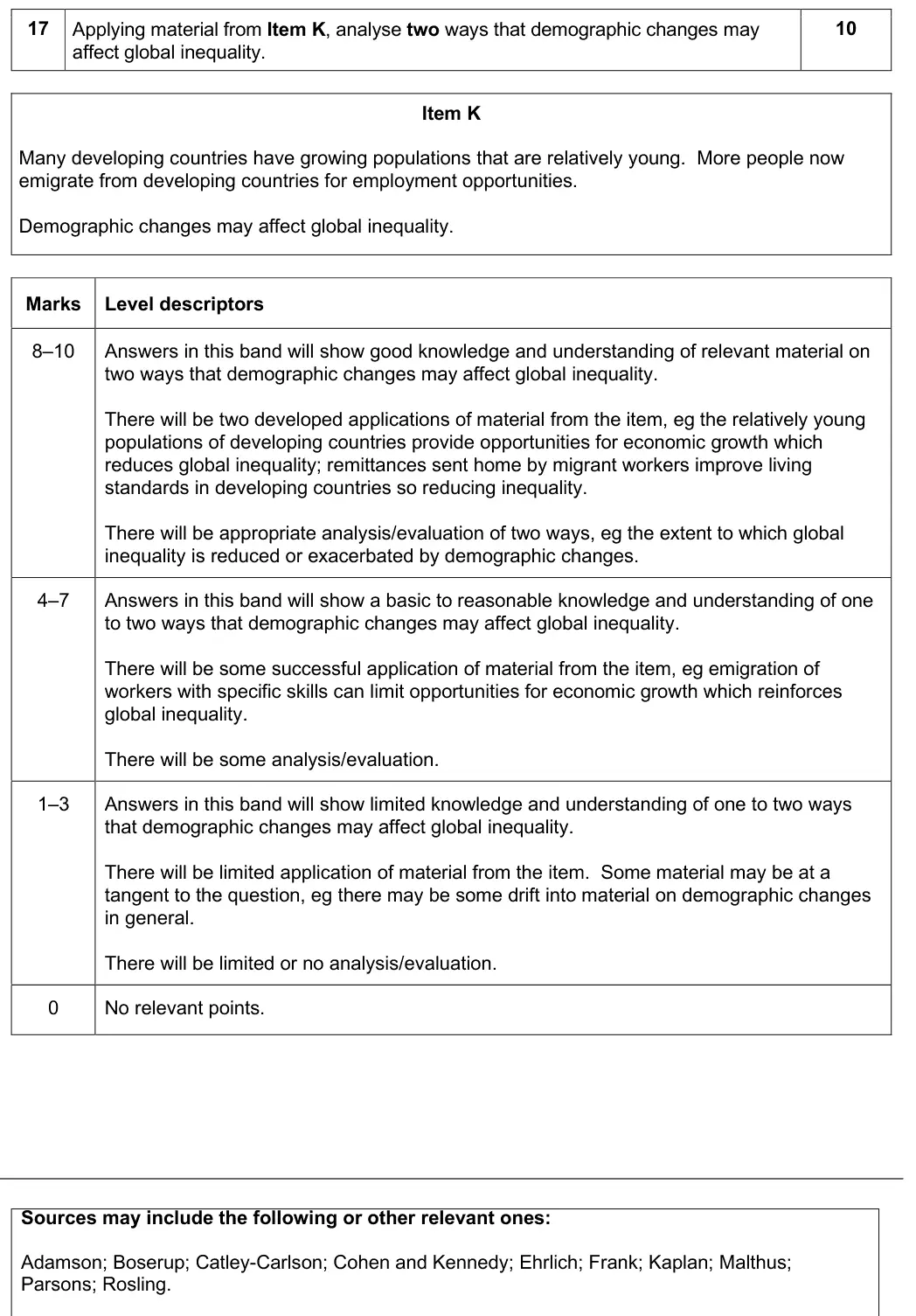
June 2025 · Paper 2 · Q1710 marksAO1=3, AO2=4, AO3=3Analyse
Mark scheme, including the levels grid and indicative content
Examiner's comment
The nature of these questions means that students cannot rely on reciting knowledge. Questions will ask them to bring together aspects of their sociological knowledge in ways they have not done before. It is therefore important for students to allow time to think about how to answer the question. Students should be aware that there are two types of ten-mark questions. These have different requirements and different mark schemes. There are different marks available for the assessment objectives. The items for 10 mark “analyse” questions are written to give prompts or “hooks” for student answers. These must be used to access application marks. Answers can indicate use of hooks by quoting, by a reference in parentheses or by wording (e.g. “As the item says…”). Items end with a sentence restating the question; the hooks are in the preceding part of the item. Introductions and conclusions are not required for 10-mark questions, are unlikely to help students and take up time. It is helpful if answers are set out to clearly indicate the two answers, with wording such as “One way/reason is…” or by starting a new paragraph for the second point. Answers that give more than two answers are unlikely to develop two of them sufficiently. The most successful answers to 10-mark questions were focused, clearly stating a point that addressed the question and then developing it, using sociological concepts, evidence such as an example and, where appropriate, theory. Most students showed some knowledge of the information in the hooks but some had difficulty making a connection with global inequalities. This was particularly the case for the first hook. Good answers often explored how having a young population provided workers who could help a country develop. The second hook led to more developed answers, often considering how remittances from emigrants could reduce poverty in the country of origin.
Notes from the mark scheme and report
must link demographic change to global inequality
item hooks: young populations (workforce for growth) and emigration (remittances vs brain drain)
first hook often poorly linked
drift into demography in general = 1–3
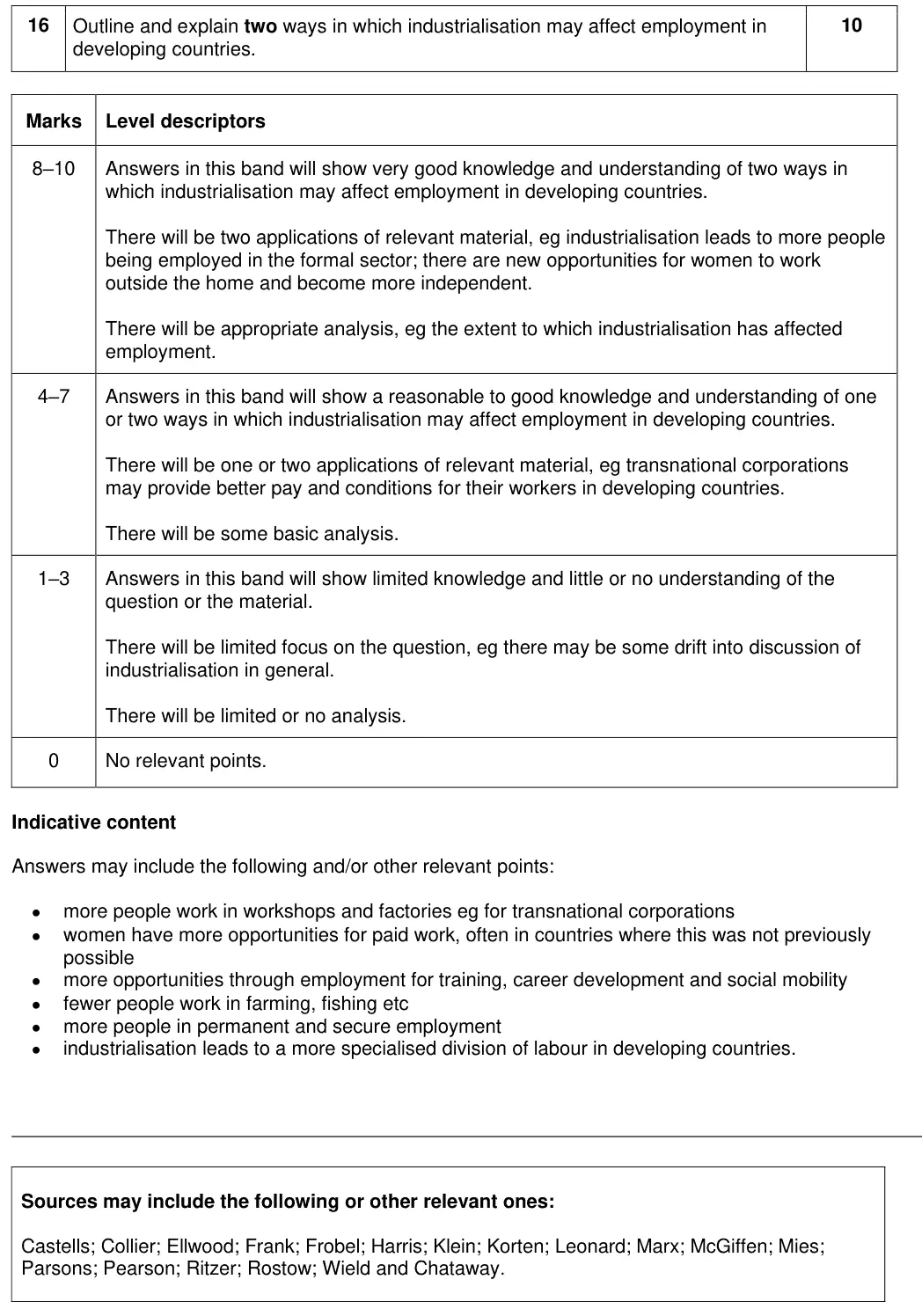
June 2024 · Paper 2 · Q1610 marksAO1=5, AO2=3, AO3=2Outline and explain
Mark scheme, including the levels grid and indicative content
Examiner's comment
The nature of these questions means that students cannot rely on reciting knowledge. Questions will ask them to bring together aspects of their sociological knowledge in ways they will not have done before. It is therefore important for students to allow time to think about how to answer the question. Students should be made aware that there are two types of 10 mark questions. These have different requirements and different mark schemes . There are different marks available for the assessment objectives. A breakdown of the marks awarded by assessment objective can be found in the mark scheme. 10 mark “outline and explain” questions have more marks available for knowledge and understanding, and none for evaluation. Introductions and conclusions are not required for 10 mark questions; they take up time and rarely improve the mark. It is helpful if answers are set out to clearly indicate the two answers, with wording such as “One way/reason is…”, or by starting a new paragraph for the second point. Answers that give more than two points are unlikely to develop two of them sufficiently. Q16: Most students were able to identify two ways, for example industrialisation increasing employment or creating unemployment by undermining traditional employment patterns. For some students developing the ways proved difficult, though others used perspectives such as dependency or modernisation theories to provide a route.
Notes from the mark scheme and report
two ways each developed (e.g. growth of formal factory employment, new paid work for women, training and mobility, decline of farming and fishing, loss of traditional work)
drift into industrialisation in general = 1–3
some used dependency or modernisation theory to develop points
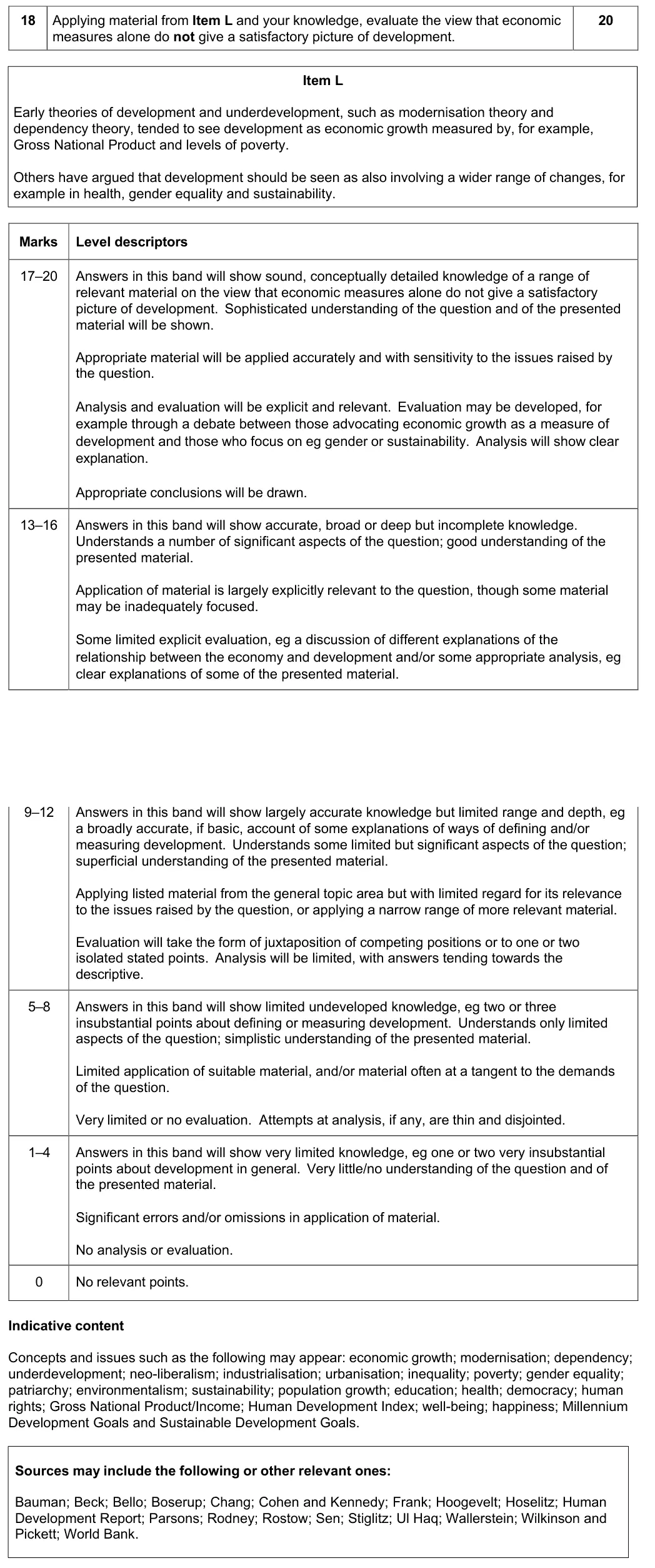
June 2024 · Paper 2 · Q1820 marksAO1=8, AO2=6, AO3=620-mark essay
Mark scheme, including the levels grid and indicative content
Examiner's comment
The items for these questions have a different purpose to those for 10 mark “analyse” questions. The items will suggest a few starting points for students, including ways into evaluation. Students are expected to also bring in further ideas (“and your knowledge” in the instruction). A wide range of material can be relevant to these questions, so students need to be selective. It is more effective to cover a limited number of points in depth rather than to try to include everything. Students who made essay plans appeared to benefit by having more structured and coherent responses. Q18: Students generally had some good knowledge and understanding of gender and development. Less effective answers drifted into generic feminist material regarding male dominance and patriarchy without linking to development and underdevelopment. Evaluation was often through contrasting the gender blind theories of modernisation and dependency with more modern theories and examples.
Notes from the mark scheme and report
top band debates modernisation, dependency and feminist theories of gendered development
drift into generic feminism on patriarchy not linked to development limits marks
evaluation often contrasted gender-blind modernisation and dependency with later theories
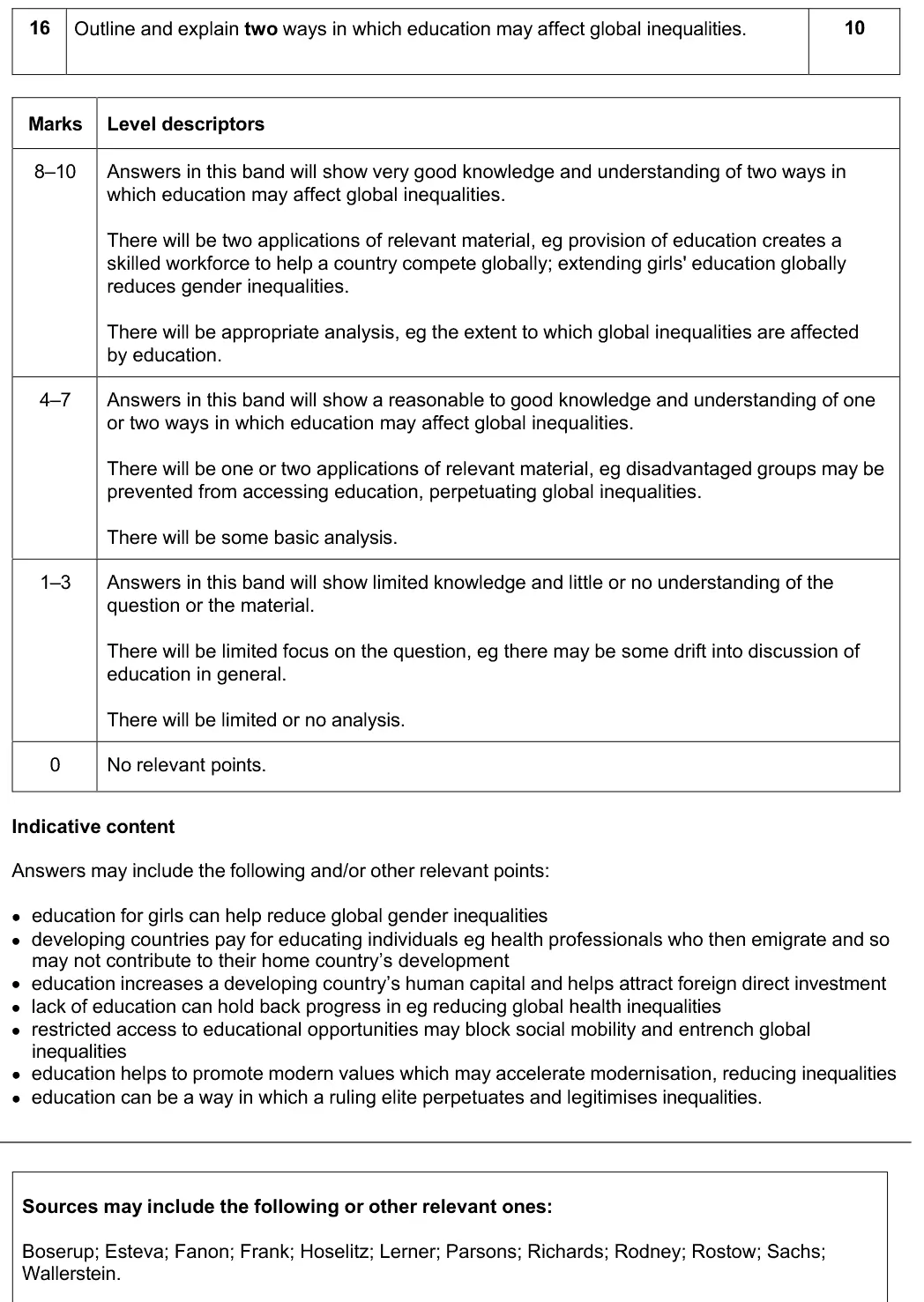
June 2023 · Paper 2 · Q1610 marksAO1=5, AO2=3, AO3=2Outline and explain
Mark scheme, including the levels grid and indicative content
Examiner's comment
The nature of these questions means that students cannot rely on reciting knowledge. Questions will ask them to bring together aspects of their sociological knowledge in ways they are unlikely to have done before. It is therefore important for students to allow time to think about how to answer the question. Students should be made aware that there are two types of 10 mark questions. These have different requirements and different mark schemes. There are different marks available for the assessment objectives. 10 mark “outline and explain” questions have more marks available for knowledge and understanding, and none for evaluation. Introductions and conclusions are not required for 10 mark questions and take up valuable time. It is helpful if answers are set out to clearly indicate the two separate points, with wording such as “One way/reason is…” or by starting a new paragraph for the second point. Answers that give more than two points are unlikely to develop two of them sufficiently. Question 16: Most answers were able to identify two ways education affects global inequalities. Ways included how girls are often disadvantaged in education or how education can help girls escape restrictive roles. Others looked at how education can help redress inequalities in aspects of development such as health.
Notes from the mark scheme and report
two ways education affects global inequalities (skilled workforce and competitiveness, girls' education, brain drain, elite legitimation)
drift into education in general = 1–3
common answers on girls' education and education improving health
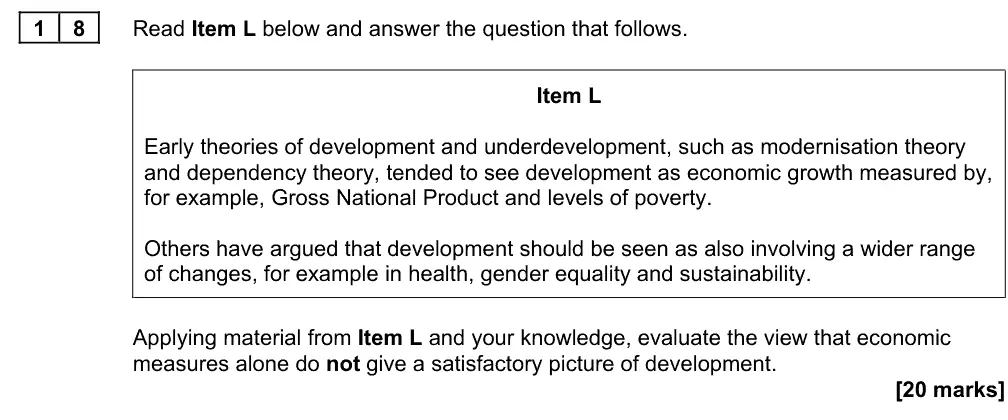
June 2023 · Paper 2 · Q1820 marksAO1=8, AO2=6, AO3=620-mark essay
Mark scheme, including the levels grid and indicative content
Examiner's comment
Most students answered their chosen questions in the order in which they appeared on the question paper. They therefore answered the section B 20 mark question last. For some this was a relatively brief and often apparently unfinished answer. This suggests that students need to track carefully time spent on each question. The purpose of the items for these questions is to suggest a few starting points for students, including ways into evaluation. Students are expected to also bring in further ideas (“and your knowledge” in the instruction). A wide range of material can be relevant to these questions, so students need to be selective. It is more effective to cover a limited number of views/theories in depth rather than to include every possible theory. Students who made essay plans appeared to benefit by having more structured and coherent responses. Question 18: There were some very good answers analysing other measures of development such as the Human Development Index, Sustainable Development Goals and indices of sustainability and happiness. Most students showed a good knowledge of theories as well. Sometimes, however, discussion of a theory led to a loss of focus on the question.
Notes from the mark scheme and report
top band debates economic-growth measures (GNP) against wider measures (HDI, SDGs, gender, sustainability, happiness)
strong answers analysed alternative indices
theory discussion sometimes lost focus on measurement
June 2022 · Paper 2 · Q1610 marksAO1=5, AO2=3, AO3=2Outline and explain
Mark scheme, including the levels grid and indicative content
Examiner's comment
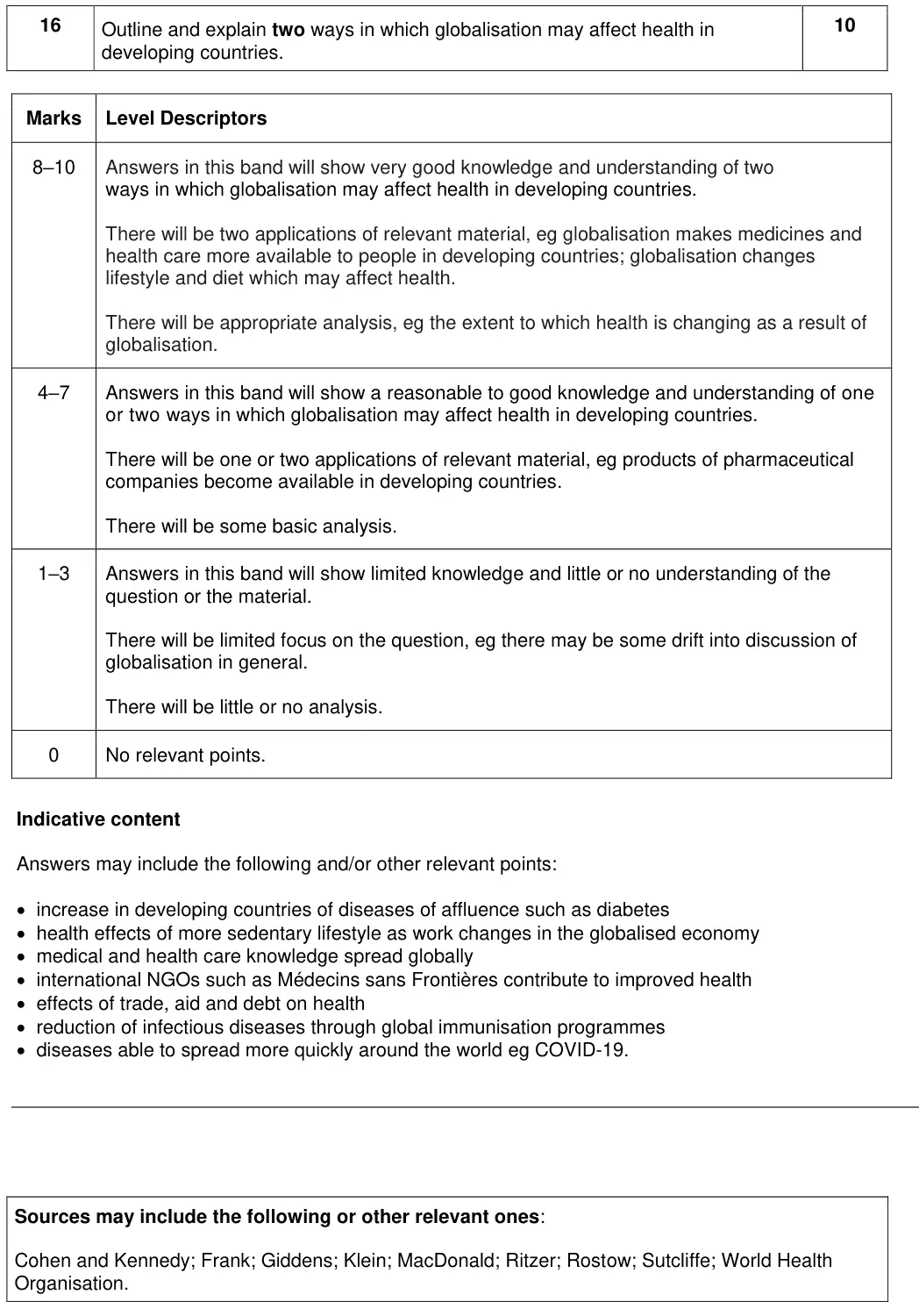
The nature of these questions means that students cannot rely on reciting knowledge. The questions will ask them to bring together aspects of their sociological knowledge in a way that they are unlikely to have done before. There was a tendency, however, to attempt to answer the question by giving knowledge based on words or phrases in the question, rather than meeting the demands of the question. Students are advised to spend time reading the question, and, where there is one the item, to ensure that they are answering the question. Some students seemed unaware of the different demands of the two types of questions. The marks awarded for the assessment objectives are different in the two types of ten mark questions, and students should be aware of this. In particular, it should be noted that there are no marks available for evaluation in “outline and explain” (no item) questions. There is no need for an introduction or conclusion for 10 mark questions. It is helpful if answers are set out to clearly indicate the two answers, with wording such as “One way is…” or by starting a new paragraph for the second point. The best answers to 10 mark questions were focused, clearly stating a point that addressed the question and then developing it, using sociological concepts, evidence and, where appropriate, theory. Answers need to address all aspects of the question. Q16 There were some very good answers to this question. Many chose to give one positive effect, such as improved health care and inoculations and availability of medicines, and one negative effect, such as vulnerability to diseases from external sources or increases in diseases associated with affluence. Better answers usually included examples of specific health problems or incidents.
Notes from the mark scheme and report
drift into globalisation in general = 1–3 band
many gave one positive effect (medicines, immunisation) and one negative (spread of disease, diseases of affluence)
better answers named specific health problems or incidents
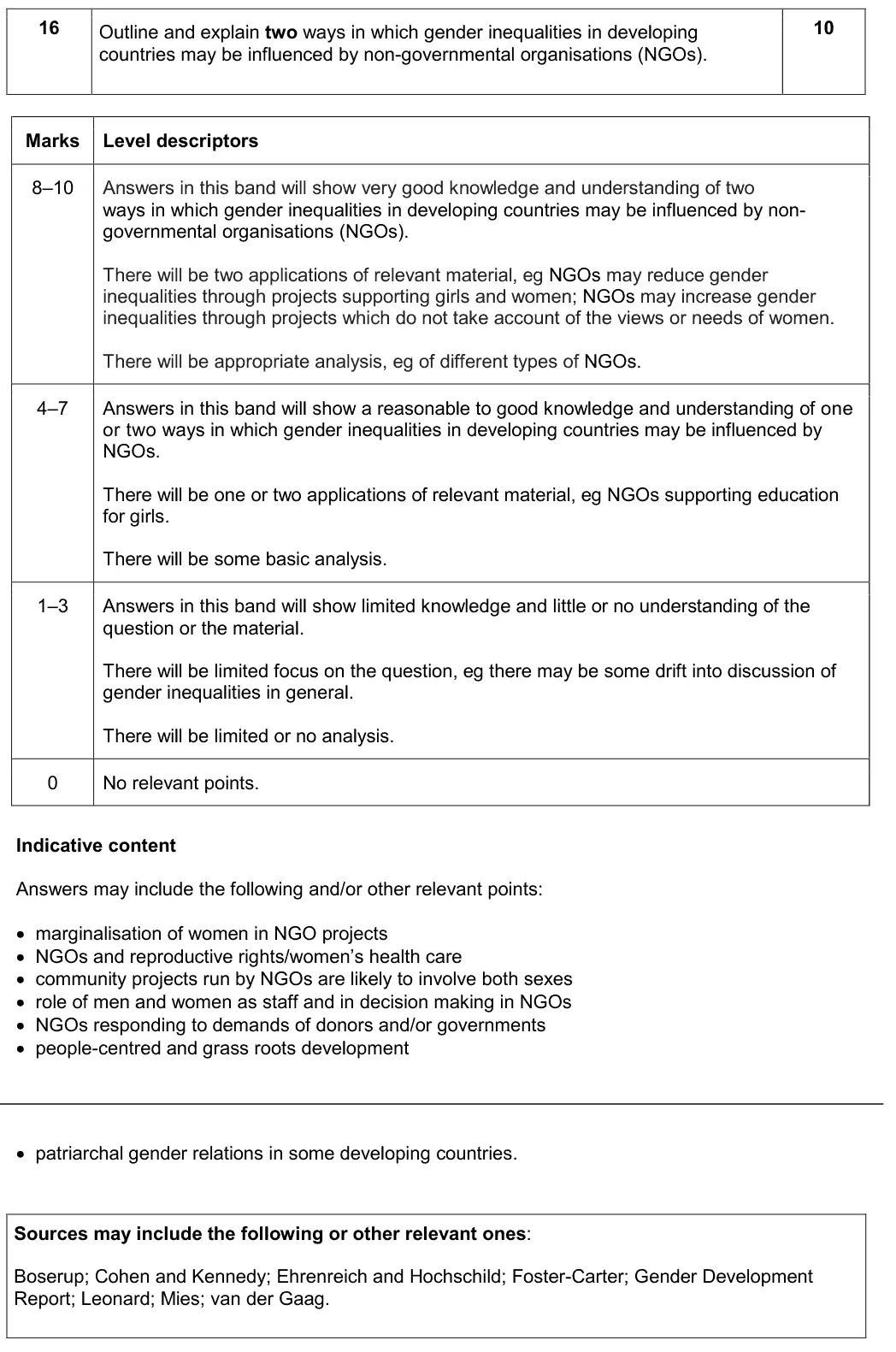
November 2021 · Paper 2 · Q1610 marksAO1=5, AO2=3, AO3=2Outline and explain
Mark scheme, including the levels grid and indicative content
Notes from the mark scheme and report
no marks for evaluation in this question type
ways can reduce or increase inequality, e.g. projects supporting girls' education and women's health, or projects ignoring women's views and needs
drift into gender inequality in general = 1–3
no examiners' report comment for this part
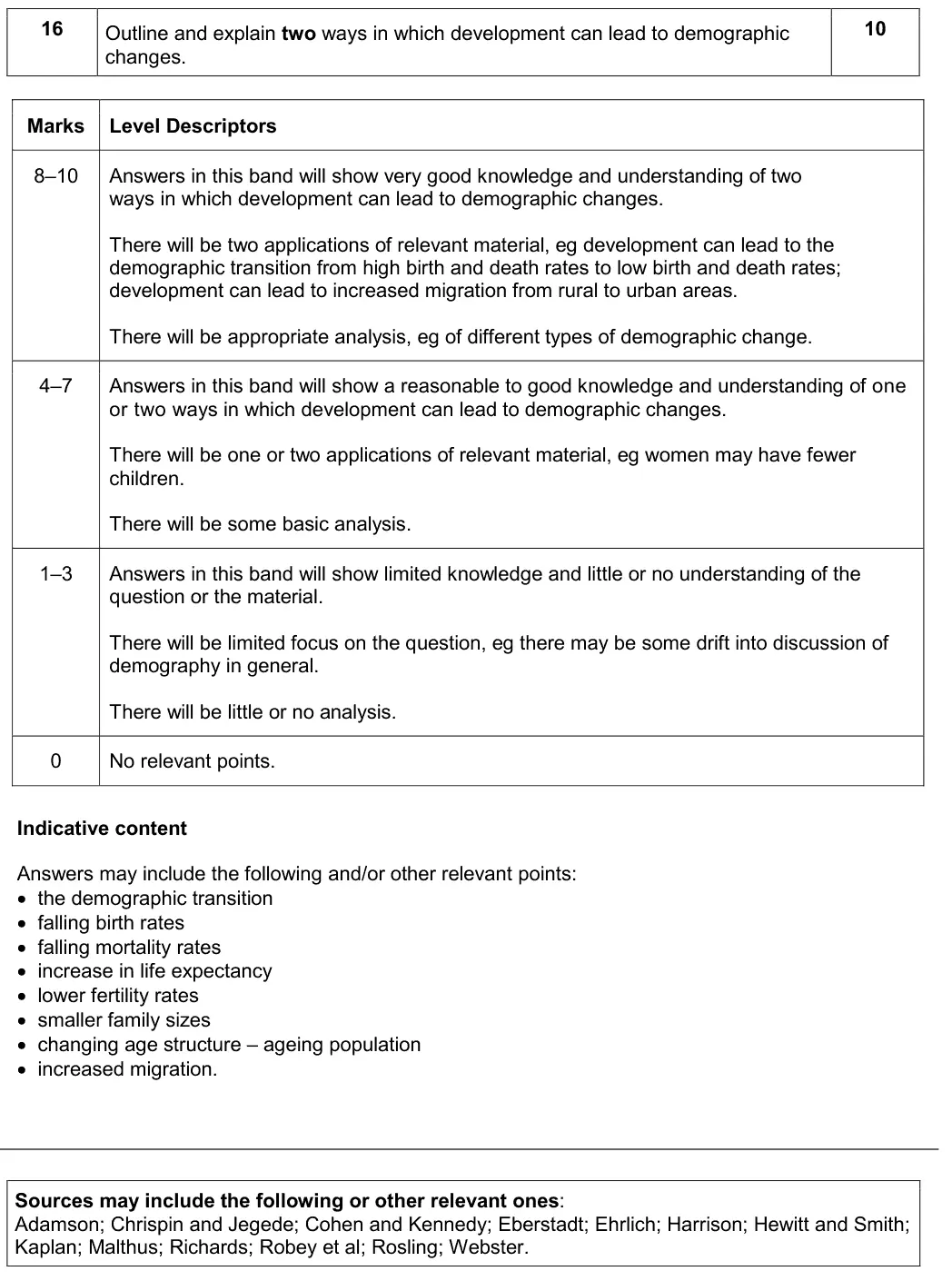
November 2020 · Paper 2 · Q1610 marksAO1=5, AO2=3, AO3=2Outline and explain
Mark scheme, including the levels grid and indicative content
Notes from the mark scheme and report
e.g. demographic transition (high to low birth and death rates), rural-urban migration, falling fertility, longer life expectancy, ageing
drift into demography in general = 1-3
no marks for evaluation in this question type (examiners' report general remark)
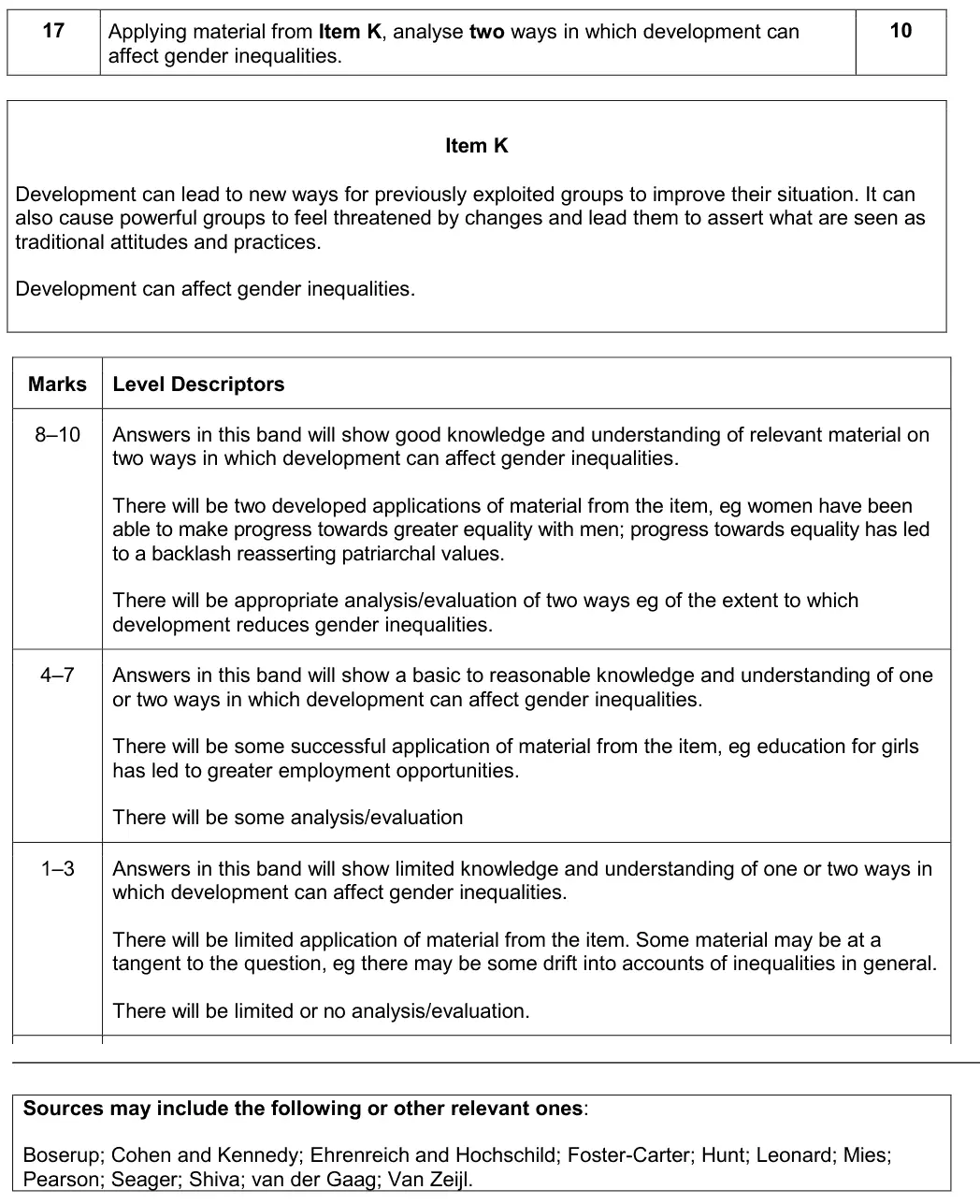
November 2020 · Paper 2 · Q1710 marksAO1=3, AO2=4, AO3=3Analyse
Mark scheme, including the levels grid and indicative content
Notes from the mark scheme and report
apply Item K (new opportunities for exploited groups vs powerful groups reasserting tradition)
e.g. women's progress through education and work, patriarchal backlash
evaluation e.g. extent development reduces gender inequality
general inequality accounts = tangent
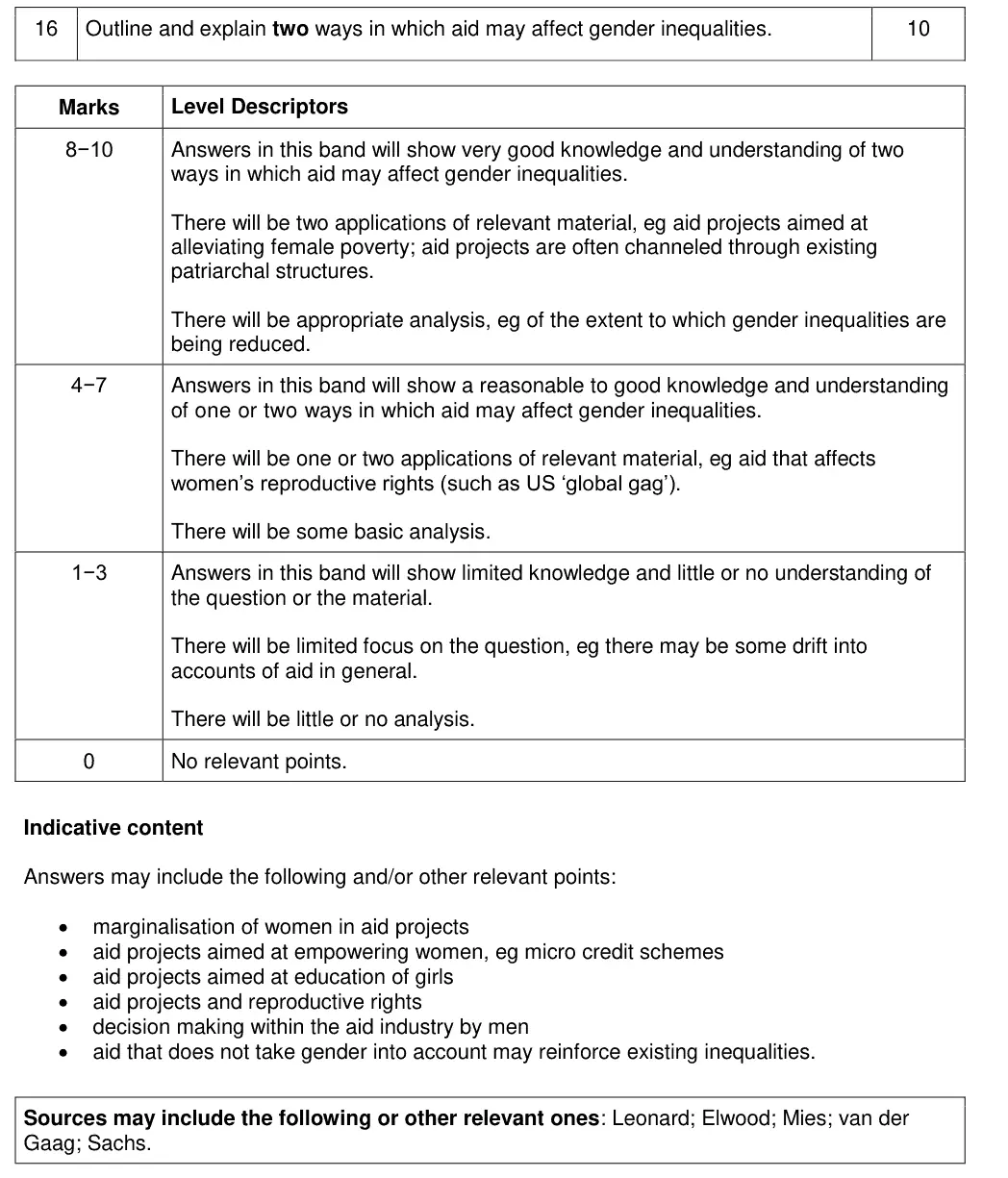
June 2018 · Paper 2 · Q1610 marksAO1=5, AO2=3, AO3=2Outline and explain
Mark scheme, including the levels grid and indicative content
Examiner's comment
Some students wrote introductory paragraphs and/or conclusions. These are not necessary, and are unlikely to gain additional marks, and they also take up time. Some students made only one point in their answers, or three or more, rather than the two asked for in the question. Sometimes it was unclear how many points were being made. It is helpful for students to clearly indicate their two answers, with wording such as “One way is…” or by starting a new paragraph for their second point. Evaluation is not a requirement for answers to 10 mark “outline and explain” questions. The marks awarded for the assessment objectives being targeted are different in the two types of ten mark questions, and students should be made aware of this. The best answers to 10 mark questions were focused, clearly stating a point and then developing it, using sociological concepts, evidence and theory where appropriate. In some questions students tended to focus on the first aspect of the question at the expense of the second. Students need guidance on how to approach these questions and how to best demonstrate their sociological understanding. The nature of these questions means that students cannot rely on reciting knowledge. These questions will ask them to bring together aspects of their sociological knowledge in a way that they are unlikely to have done before. This question tested the ability of students to bring together their knowledge and understanding of aid and of gender inequalities. Many were able to suggest ways in which aid might have increased or reduced gender inequalities, with answers focusing on, for example, aid aimed at education or health issues. There was recognition that aid might help girls achieve an education and improve their life chances, and that in a patriarchal society educational aid might benefit males more than females. There was some misunderstanding of aid with some answers focusing on transnational corporations rather than aid agencies and IGOs.
Notes from the mark scheme and report
two ways aid increases or reduces gender inequality (e.g. micro-credit, girls' education, reproductive rights, aid channelled through patriarchal structures)
drift into aid in general = 1–3
some confused aid with TNC activity
AO split from AQA's standard grid for this paper (this year's mark scheme does not print it).
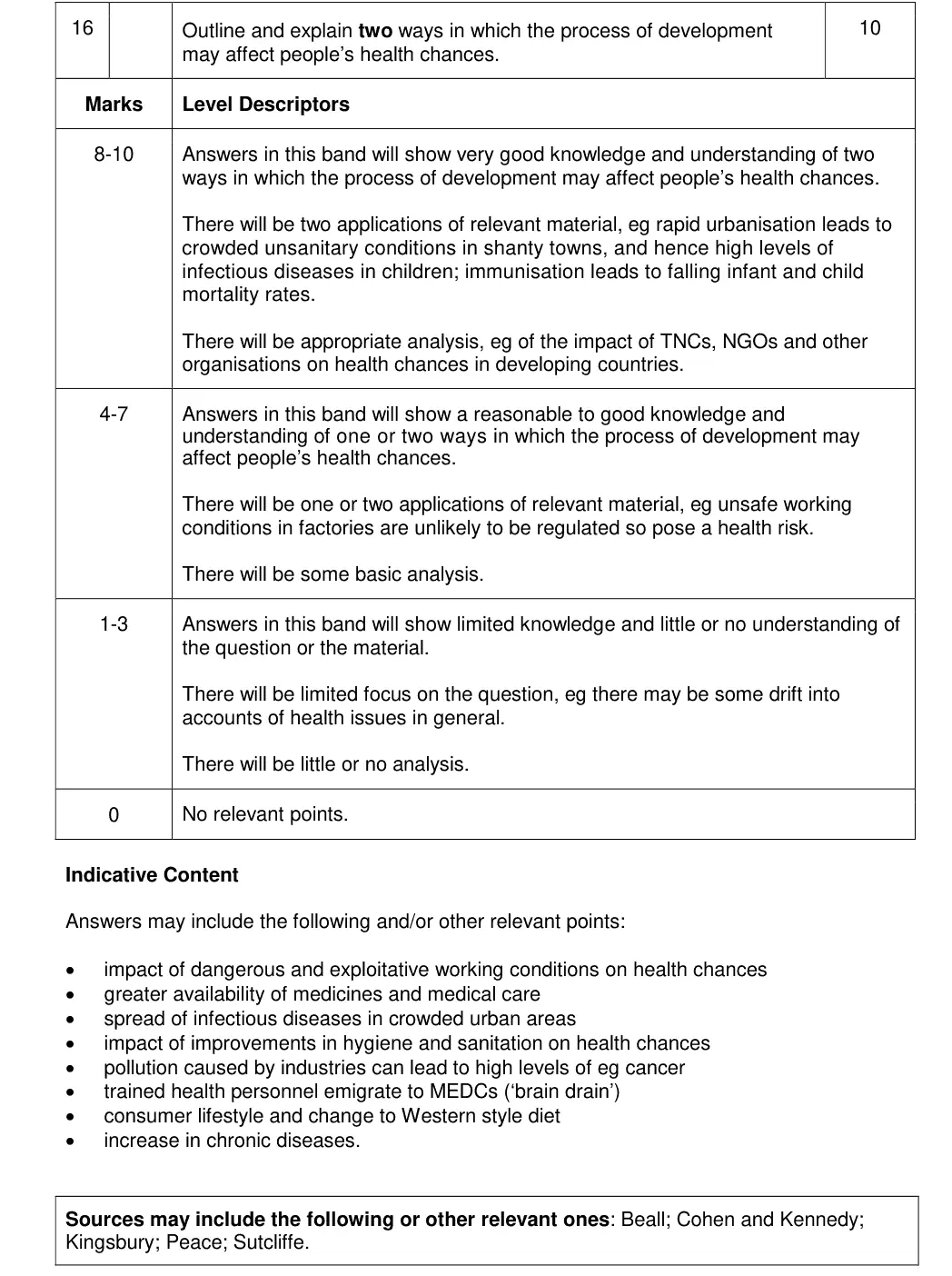
June 2017 · Paper 2 · Q1610 marksAO1=5, AO2=3, AO3=2Outline and explain
Mark scheme, including the levels grid and indicative content
Examiner's comment
A number of students wrote introductory paragraphs and/or conclusions. These are not necessary, and are unlikely to gain additional marks. A number of students made only one point in their answer, or three or more, rather than the two asked for. In these cases, the two best answers were rewarded and will be in future series. It is helpful for students to clearly indicate their two answers, with wording such as “One way is…” or by starting a new paragraph for their second point. Schools and colleges should note that there is no reference in the mark scheme for 10 mark ‘outline and explain’ questions to evaluation, and that evaluation is not a requirement for answers to these questions. The assessment objective allocations are different in the two types of 10 mark questions, and students should be made aware of this. There was a wide range of responses to these questions. A minority of students wrote very brief answers. For these 10 mark items, a simple statement of two ways, reasons or factors, without development, is not sufficient to access more than the lower marks in the mark range. The best answers were focused, clearly stating a point and then developing it, with use of sociological concepts, evidence and theory where appropriate, in ways that demonstrated the skills expected from the targeted assessment objectives. There was a tendency, however, for many answers to focus on the first aspect of the question at the expense of the second. Students need guidance on how to approach these questions and how to best demonstrate their sociological understanding. The nature of these questions means that students cannot rely on reciting knowledge. They require students to bring together two aspects of their sociological knowledge in a way that they are unlikely to have done before. Answers will sometimes require claims that students may be unsure of because they do not know of specific evidence (for example, in question 5, whether migrants from Eastern Europe who are single workers tend to live alone or in shared households). However, answers that are sociologically plausible will be accepted. Most were able to identify two ways. Many chose one ‘positive’ way, such as the introduction of Western health care and medical technology, and one ‘negative’ way, such as the increase in diseases of affluence associated with a changing lifestyle. A few neglected the ‘process’ aspect of the question and gave accounts of health problems in LEDCs, such as high infant mortality rates.
Notes from the mark scheme and report
must address the process of development (urbanisation and disease, immunisation, unsafe factory work, diseases of affluence)
drift into health issues in general = 1–3
many gave one positive and one negative way
some just described health problems in LEDCs
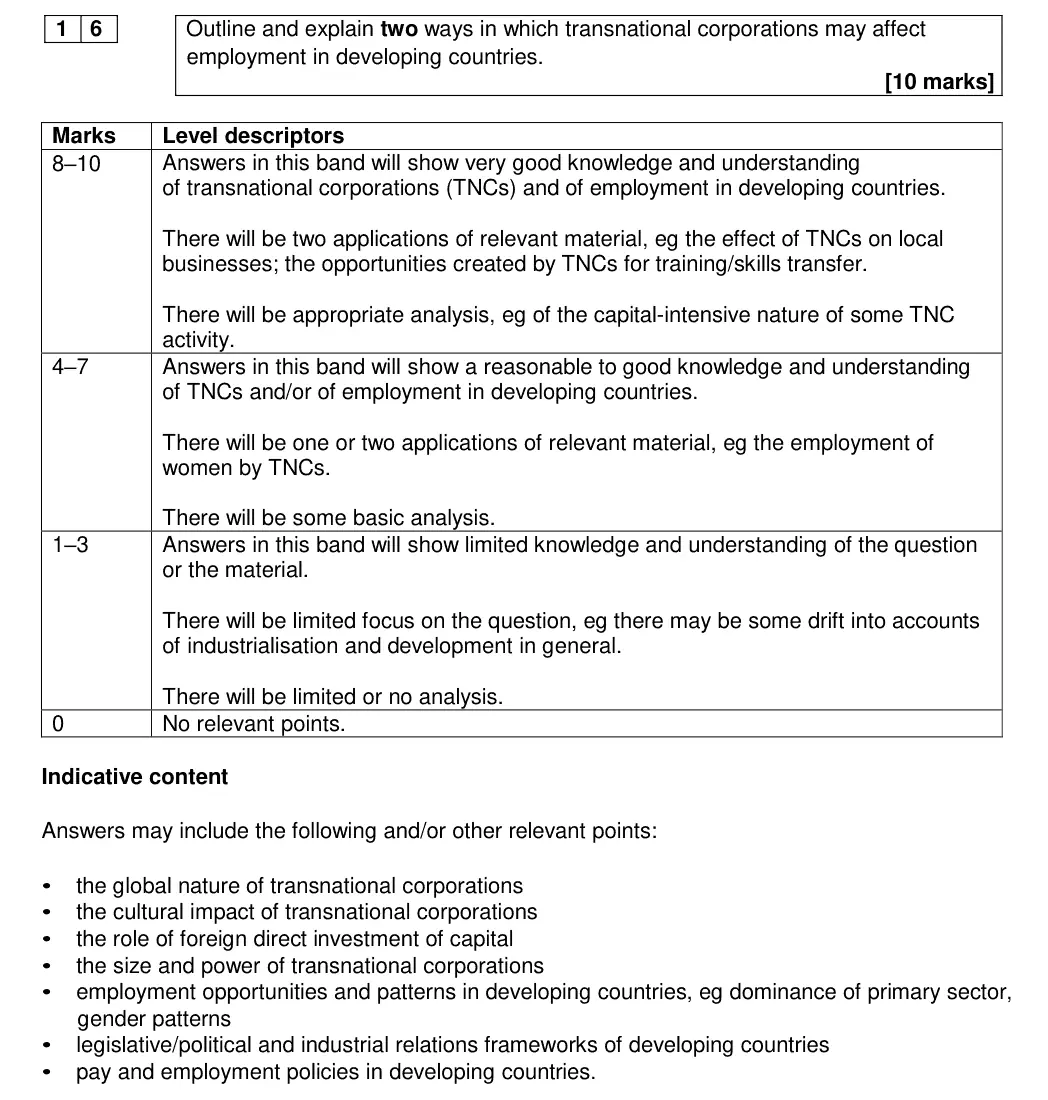
Specimen set 1 · Paper 2 · Q1610 marksAO1=5, AO2=3, AO3=2Outline and explain
Mark scheme, including the levels grid and indicative content
Notes from the mark scheme and report
top band e.g. TNCs undercutting local businesses, training and skills transfer
analysis of capital-intensive TNC activity
drift into industrialisation and development in general = 1–3 band
Work with an AQA sociology tutor
Essays stuck in the middle band, or losing marks on the 10-markers? Book a trial lesson with Mark, a former AQA examiner.