June 2018: Paper 2

320 marks · 24 question parts · Paper, mark scheme and report on AQA's site · AQA no longer hosts this series; the questions are from a copy of AQA's original paper

Question by question

QTopicMarksAOType
1 Identity, production, consumption and globalisation, Identity and age, disability, ethnicity, gender, nationality, sexuality and class 10AO1=5,AO2=3,AO3=2Outline and explain
2 Identity and age, disability, ethnicity, gender, nationality, sexuality and class, Self, identity and difference 10AO1=3,AO2=4,AO3=3Analyse
3 Socialisation and the agencies of socialisation 20AO1=8,AO2=6,AO3=6Essay
4 The family, social structure, the economy and state policies, Marriage, divorce, cohabitation and family diversity 10AO1=5,AO2=3,AO3=2Outline and explain
5 Childhood and the changing status of children, Demographic trends: birth rates, death rates, ageing and migration 10AO1=3,AO2=4,AO3=3Analyse
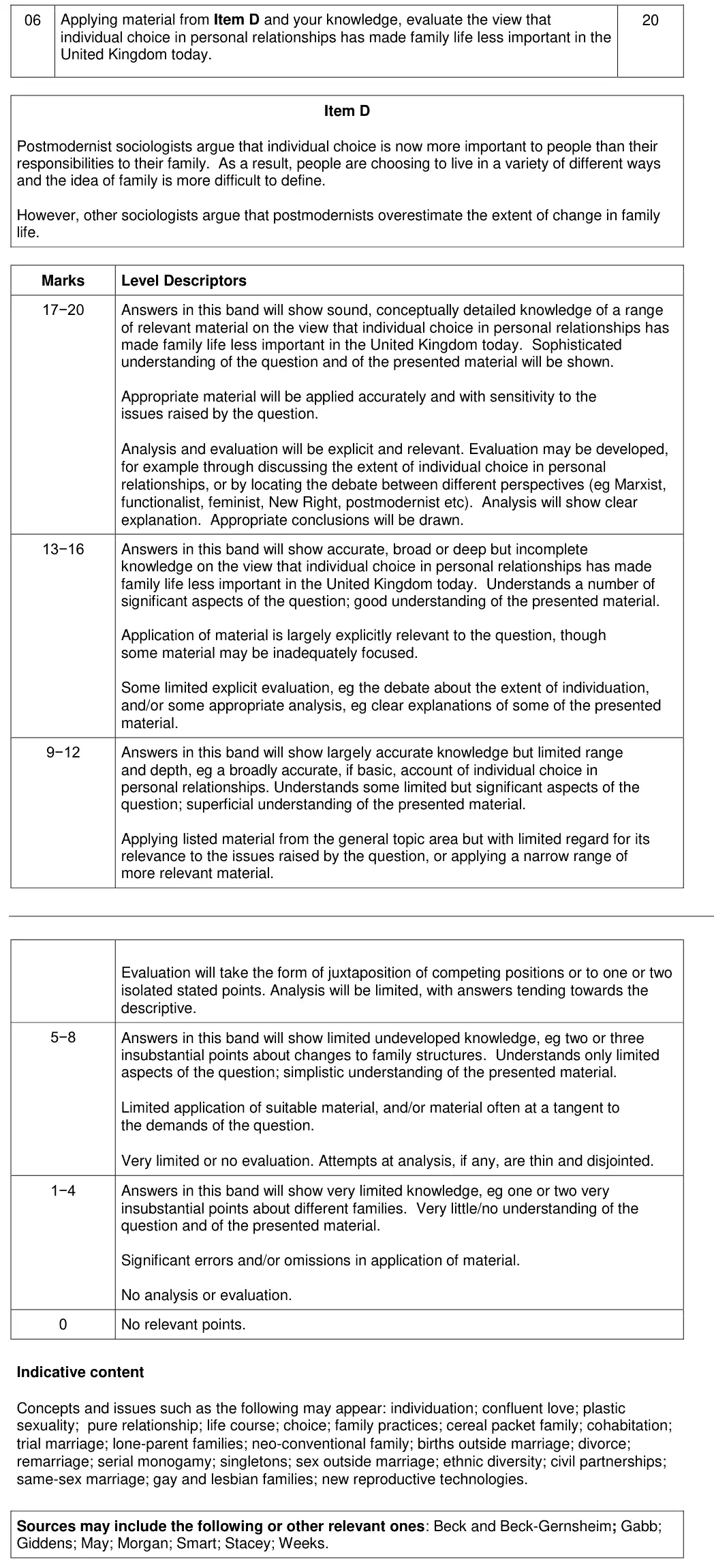
6 Marriage, divorce, cohabitation and family diversity 20AO1=8,AO2=6,AO3=6Essay
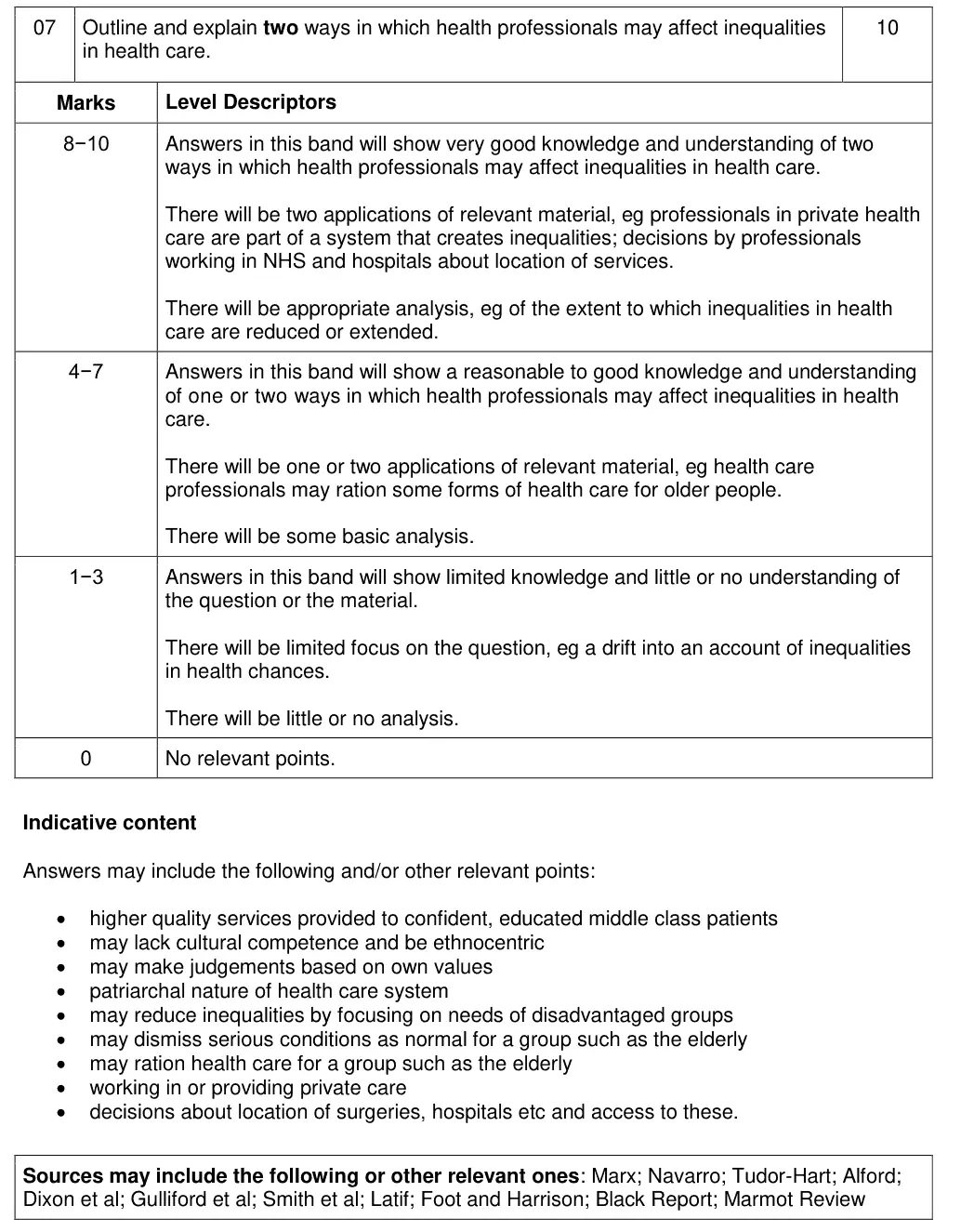
7 Inequalities in the provision of and access to health care, Medicine, the health professions and the globalised health industry 10AO1=5,AO2=3,AO3=2Outline and explain
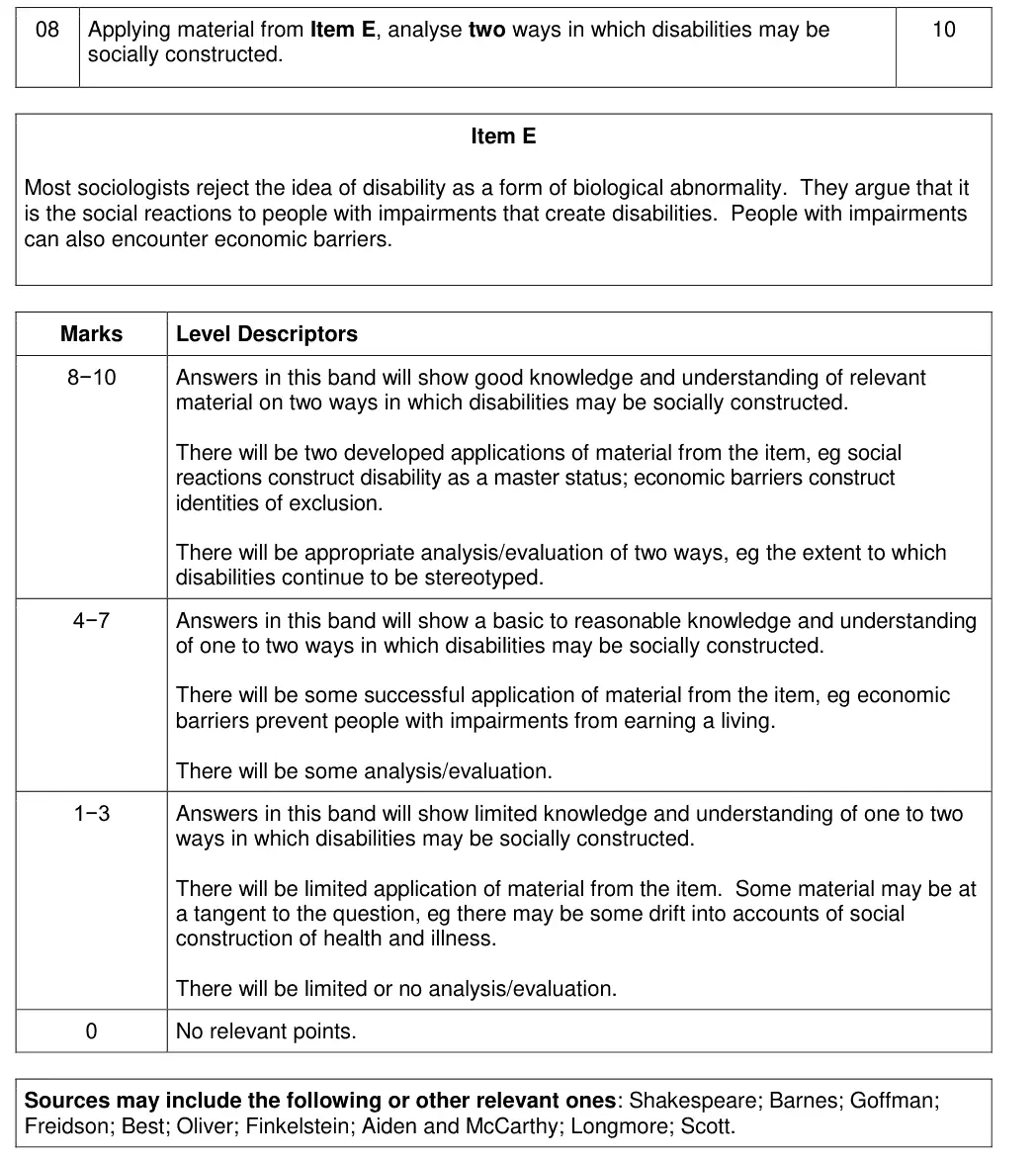
8 The social construction of health, illness, disability and the body 10AO1=3,AO2=4,AO3=3Analyse
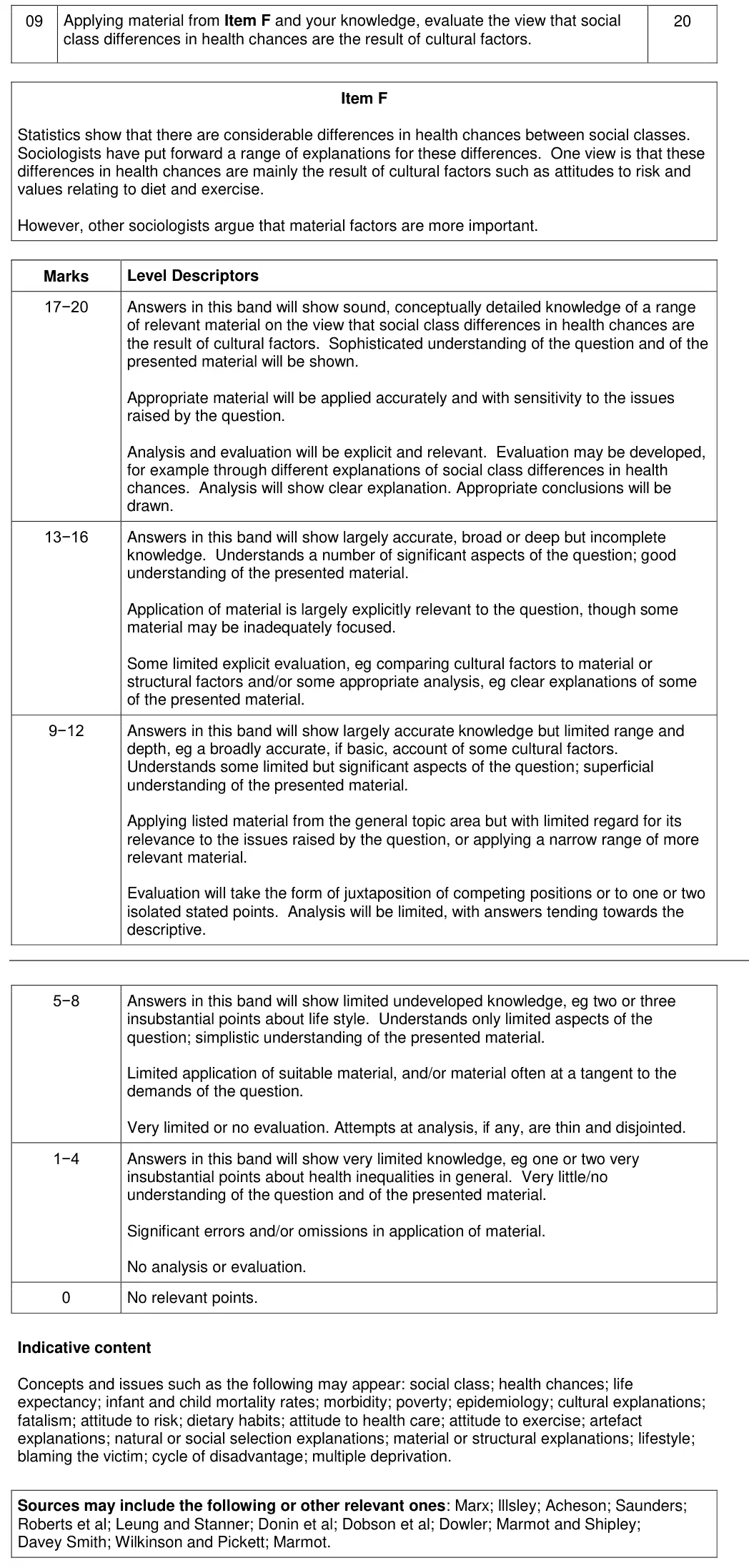
9 Health inequalities by class, gender, ethnicity and region 20AO1=8,AO2=6,AO3=6Essay
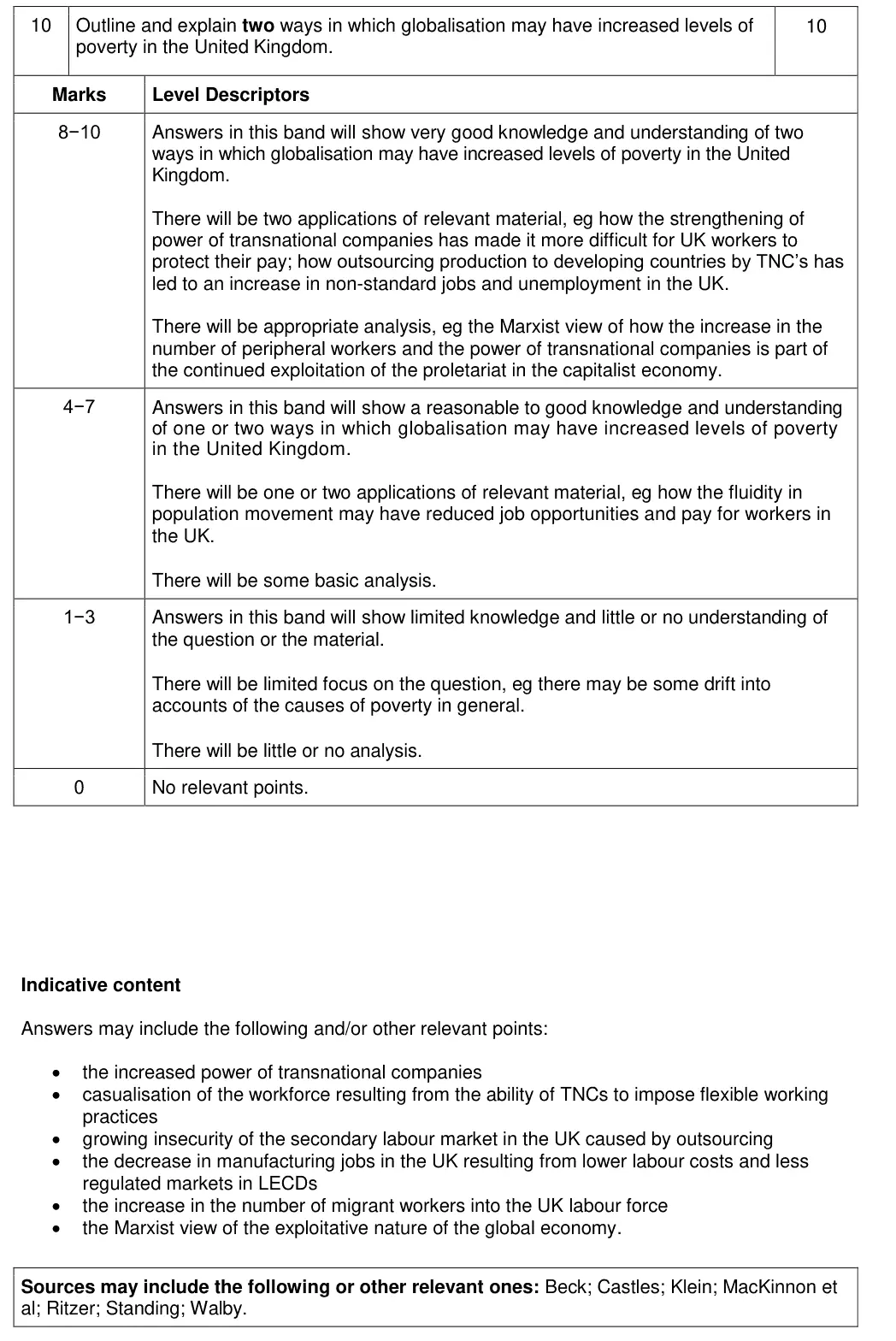
10 The nature, existence and persistence of poverty, Work, worklessness and life chances 10AO1=5,AO2=3,AO3=2Outline and explain
11 The nature, existence and persistence of poverty 10AO1=3,AO2=4,AO3=3Analyse
12 Responses and solutions to poverty: the state and welfare providers 20AO1=8,AO2=6,AO3=6Essay
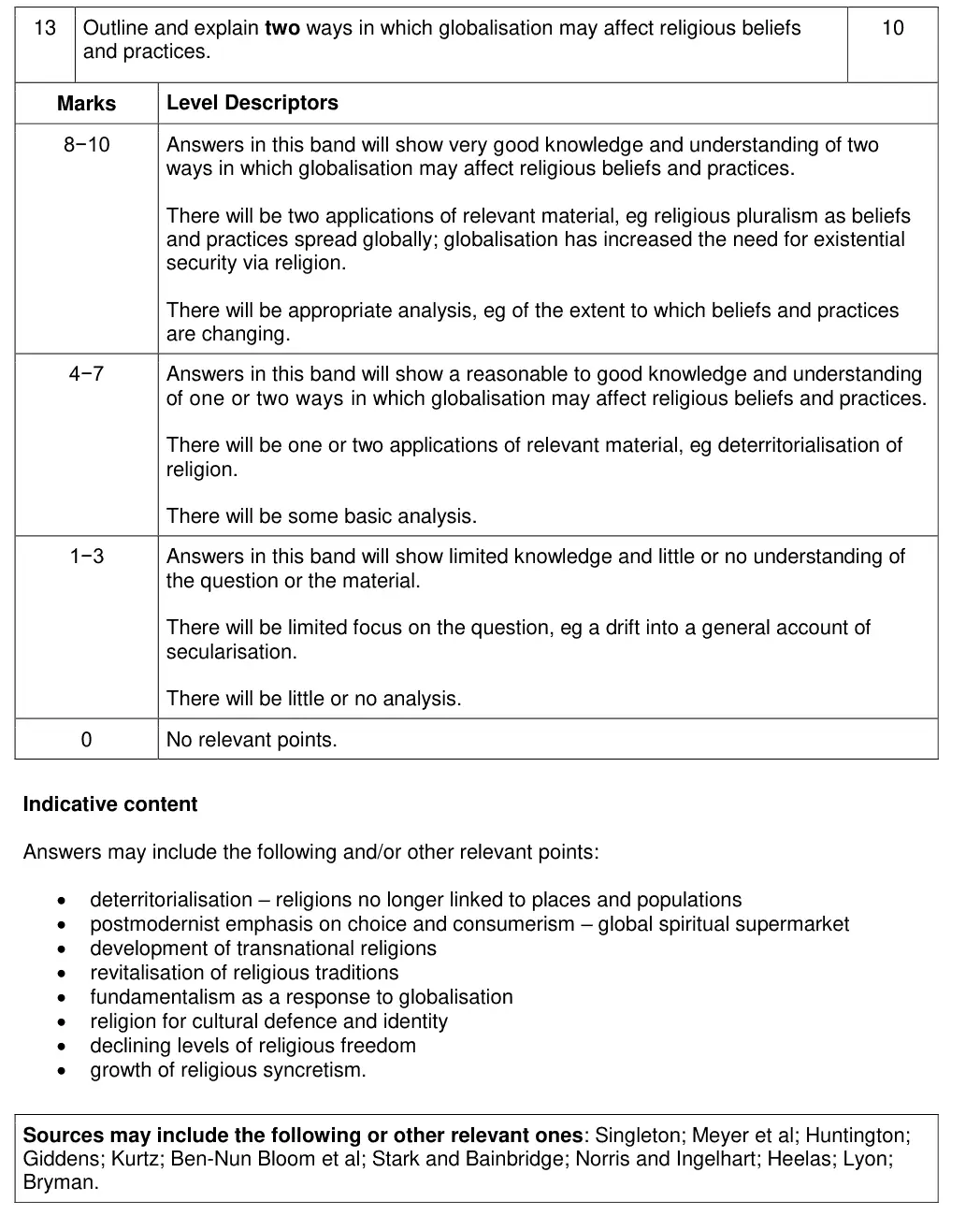
13 Secularisation and the global spread of religion 10AO1=5,AO2=3,AO3=2Outline and explain
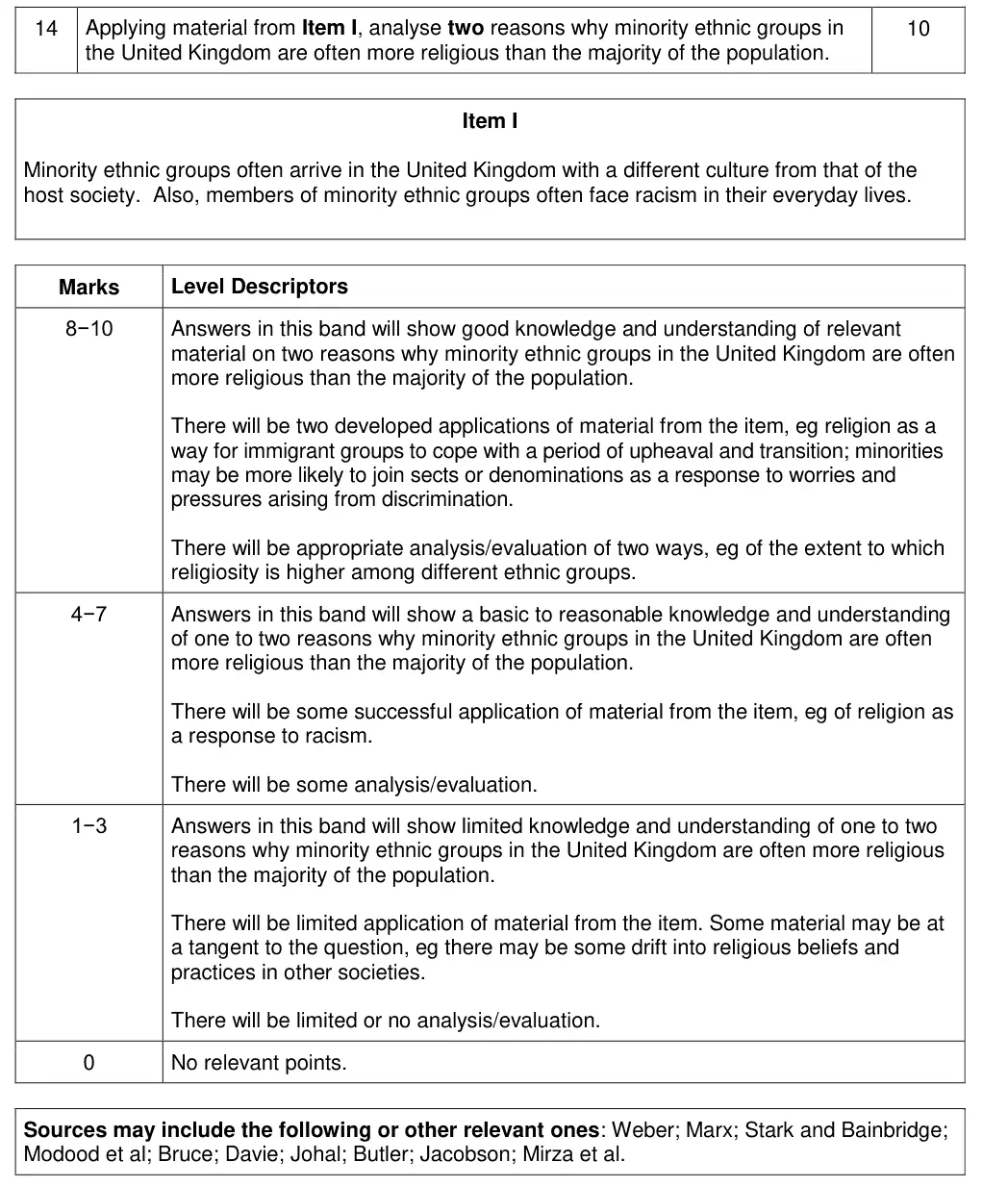
14 Religion and social groups: gender, ethnicity, age and class 10AO1=3,AO2=4,AO3=3Analyse
15 Secularisation and the global spread of religion, Religious organisations: churches, sects, cults and New Age movements 20AO1=8,AO2=6,AO3=6Essay
16 Aid, trade, industrialisation, urbanisation, environment and war, Employment, education, health, demography and gender in development 10AO1=5,AO2=3,AO3=2Outline and explain
17 Globalisation and development 10AO1=3,AO2=4,AO3=3Analyse
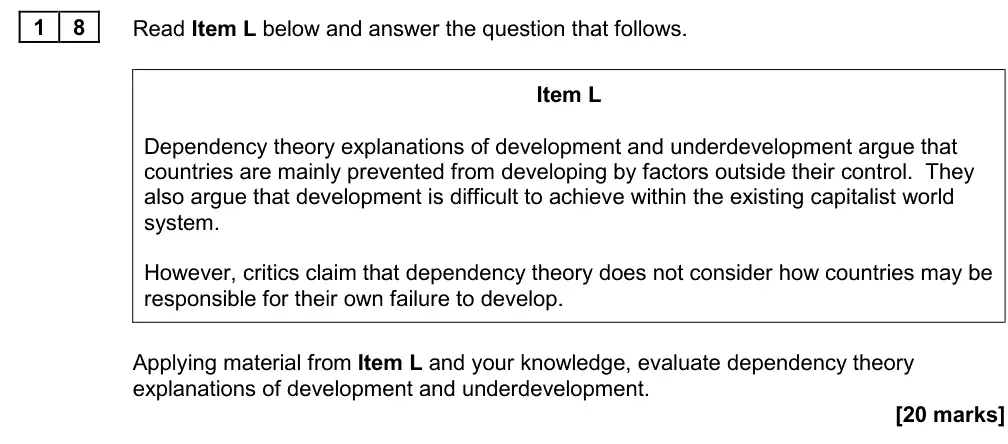
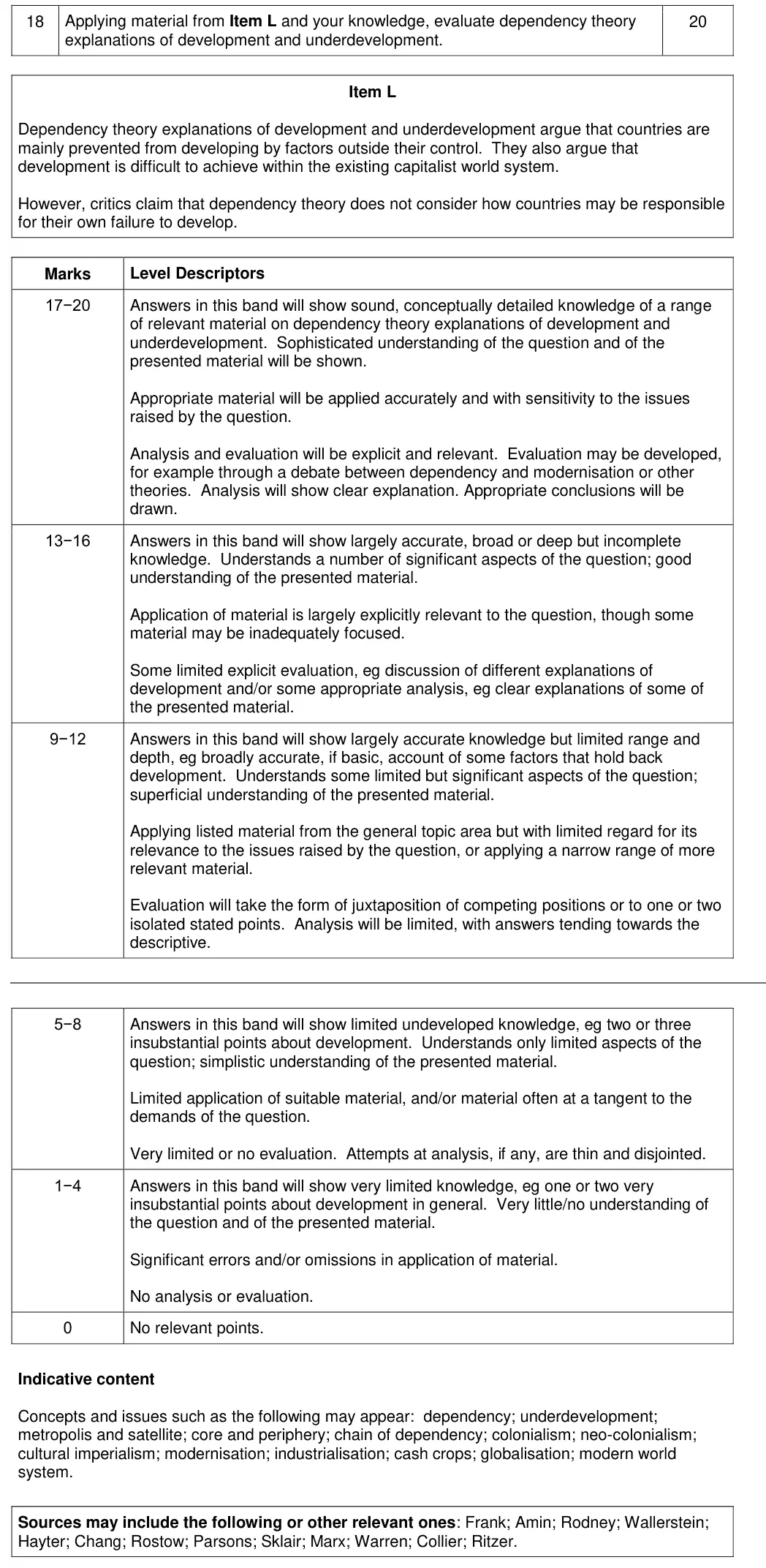
18 Development, underdevelopment and global inequality (modernisation and dependency theory) 20AO1=8,AO2=6,AO3=6Essay
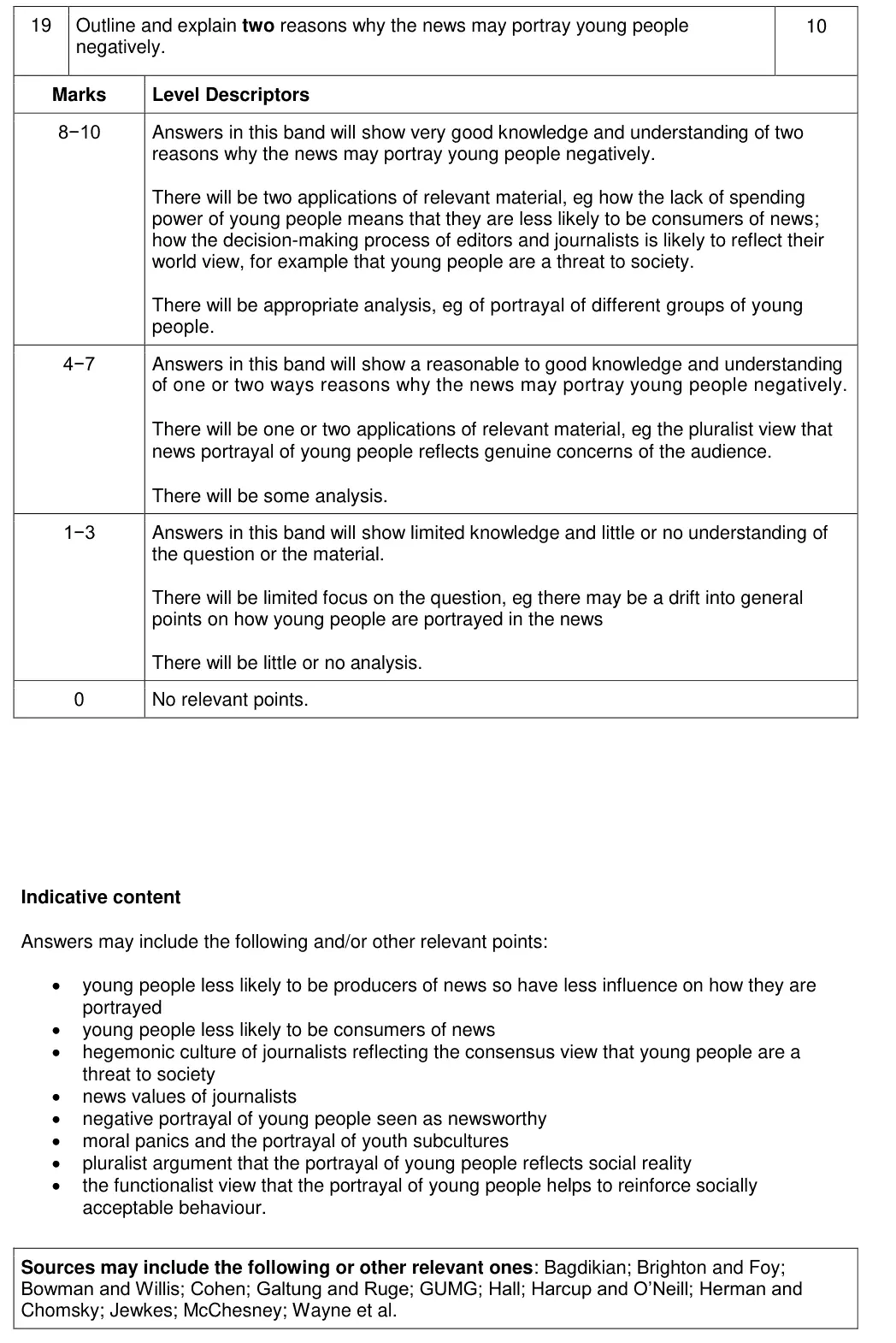
19 Media representations of age, class, ethnicity, gender, sexuality and disability, Selection and presentation of the news 10AO1=5,AO2=3,AO3=2Outline and explain
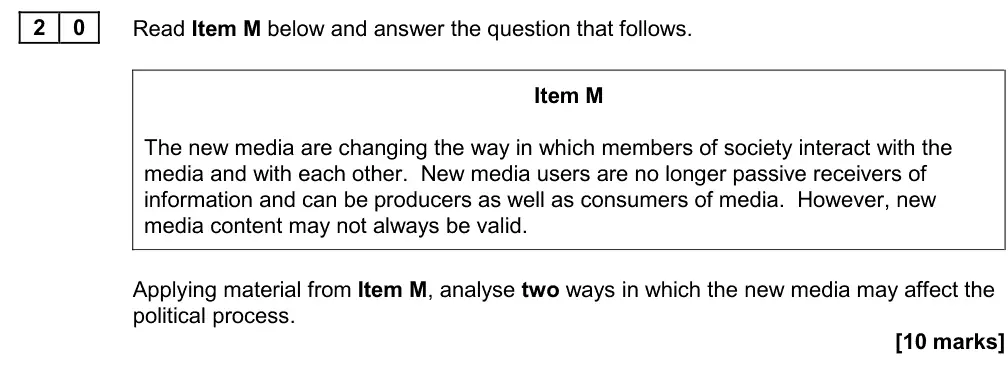
20 The new media 10AO1=3,AO2=4,AO3=3Analyse
21 The media and audiences 20AO1=8,AO2=6,AO3=6Essay
22 Class, status, power and life chances, Stratification and differentiation by class, gender, ethnicity and age 10AO1=5,AO2=3,AO3=2Outline and explain
23 Changing structures of inequality and the transnational capitalist class, Defining and measuring social class 10AO1=3,AO2=4,AO3=3Analyse
24 Stratification and differentiation by class, gender, ethnicity and age, Class, status, power and life chances 20AO1=8,AO2=6,AO3=6Essay

The questions

123456789101112131415161718192021222324
June 2018 · Paper 2 · Q1 10 marks AO1=5, AO2=3, AO3=2 Outline and explain identity consumption and globalisationidentity class gender ethnicity
Topic A1  Culture and Identity
0 1
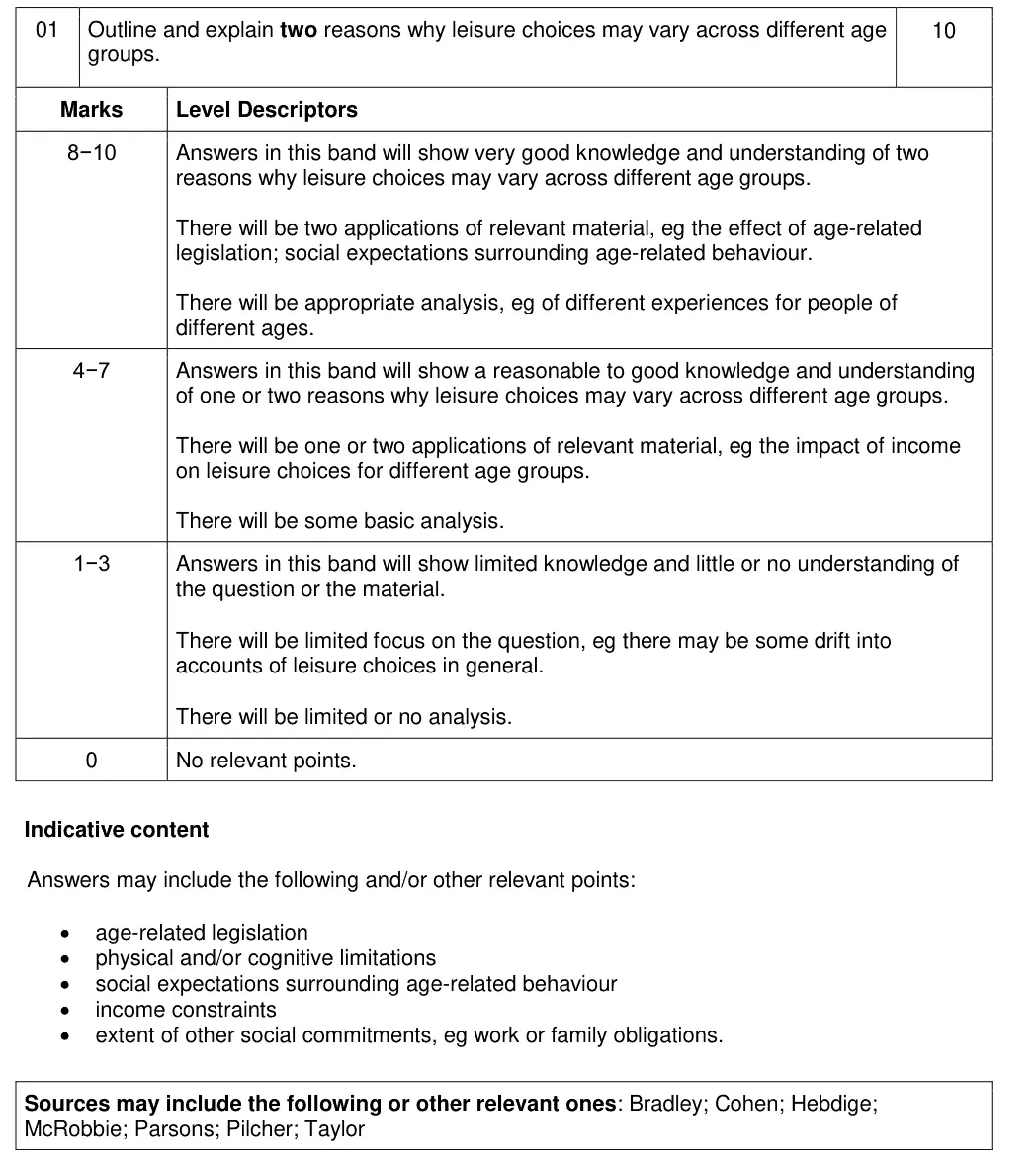
Outline and explain two reasons why leisure choices may vary across different age
groups.
[10 marks]
June 2018 · Paper 2 · Q2 10 marks AO1=3, AO2=4, AO3=3 Analyse identity class gender ethnicityself identity and difference
0 2
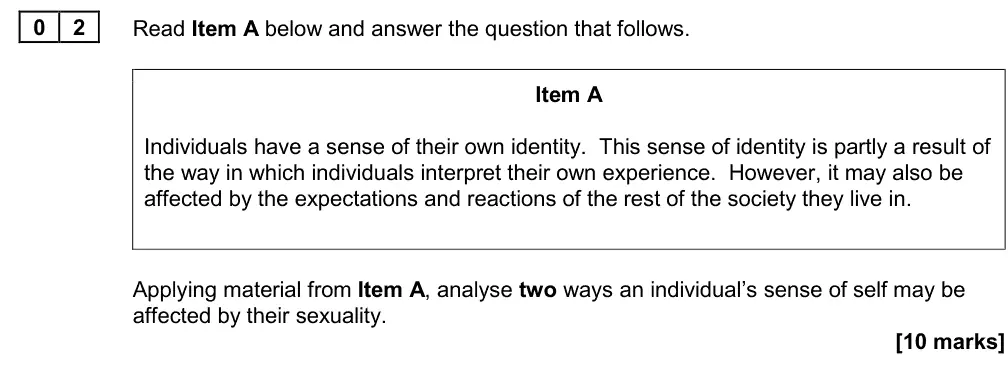
Read Item A below and answer the question that follows.
Item A
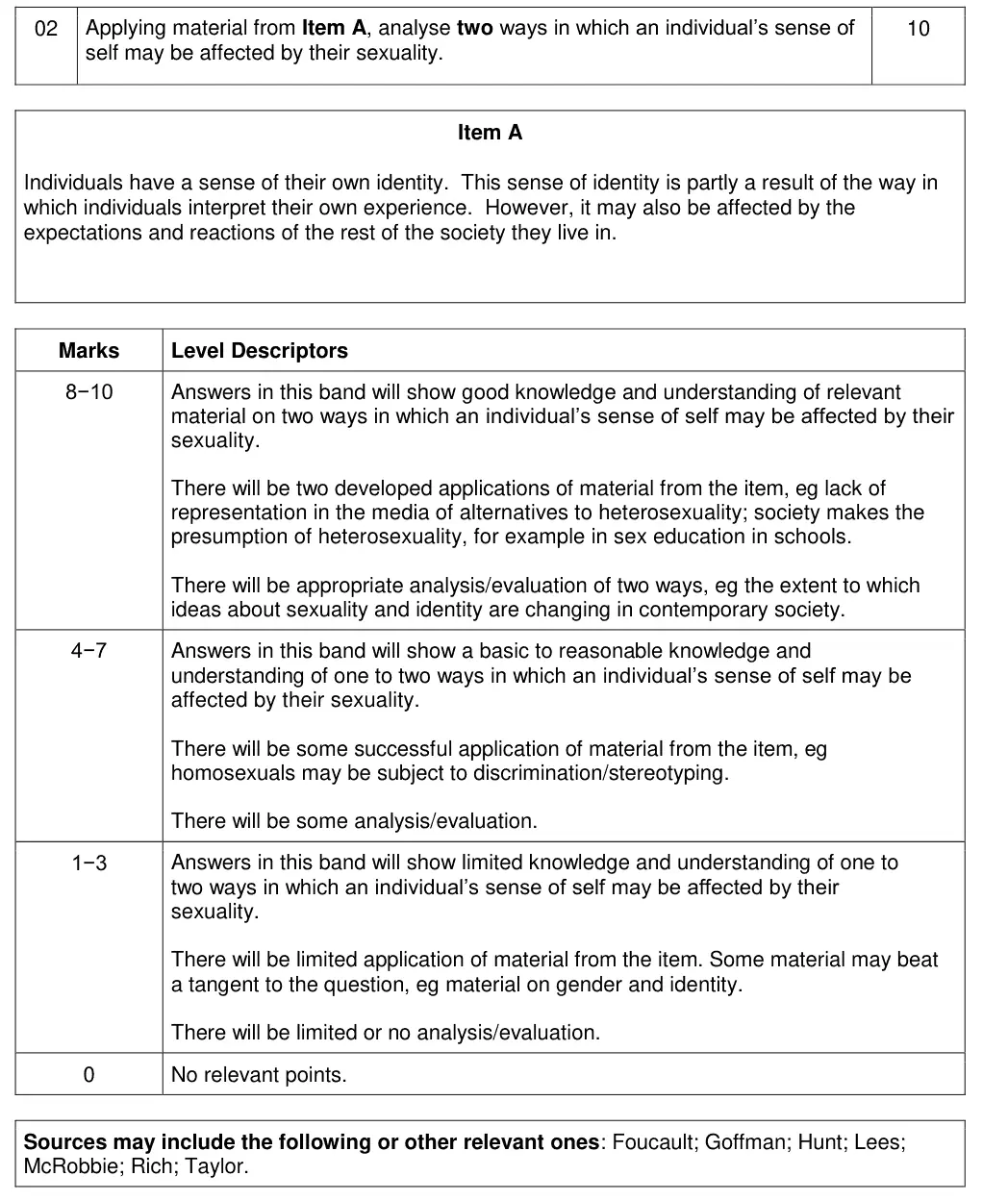
Individuals have a sense of their own identity.  This sense of identity is partly a result of
the way in which individuals interpret their own experience.  However, it may also be
affected by the expectations and reactions of the rest of the society they live in.
Applying material from Item A, analyse two ways an individual’s sense of self may be
affected by their sexuality.
[10 marks]
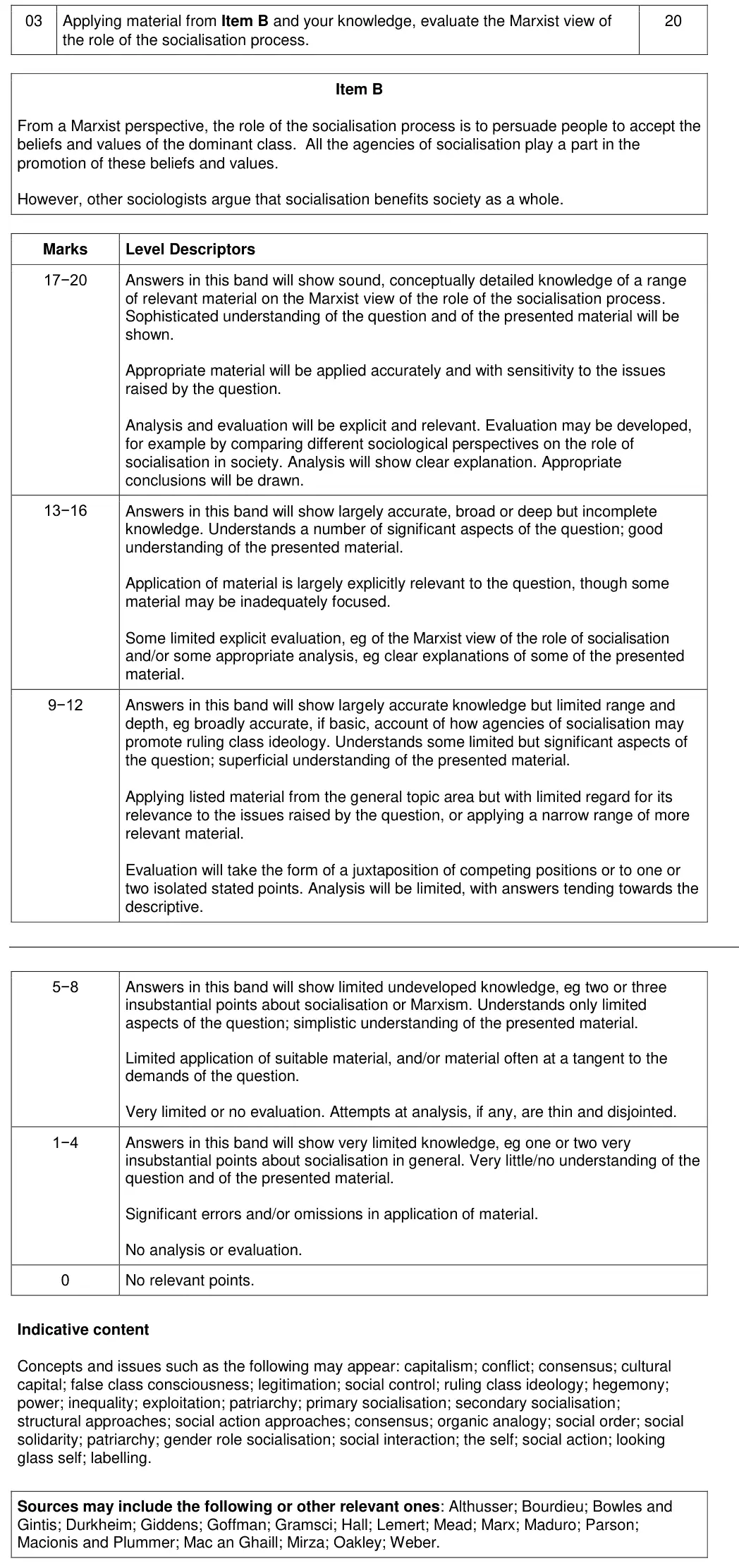
June 2018 · Paper 2 · Q3 20 marks AO1=8, AO2=6, AO3=6 20-mark essay socialisation
0 3
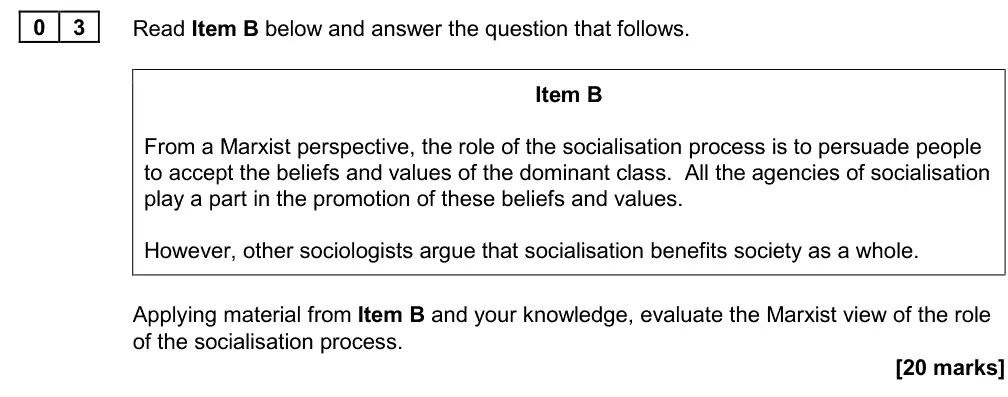
Read Item B below and answer the question that follows.
Item B
From a Marxist perspective, the role of the socialisation process is to persuade people
to accept the beliefs and values of the dominant class.  All the agencies of socialisation
play a part in the promotion of these beliefs and values.
However, other sociologists argue that socialisation benefits society as a whole.
Applying material from Item B and your knowledge, evaluate the Marxist view of the role
of the socialisation process.
[20 marks]
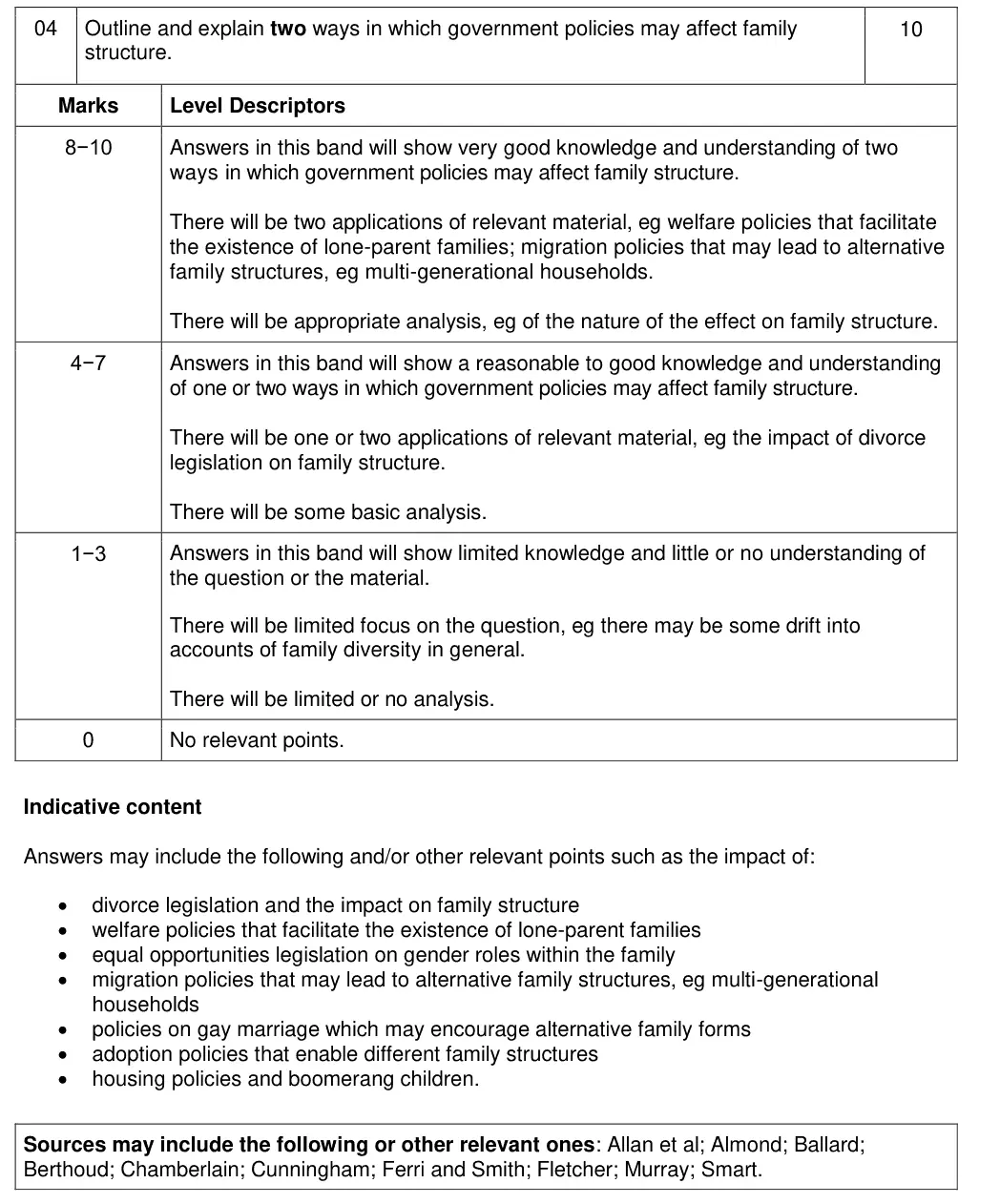
June 2018 · Paper 2 · Q4 10 marks AO1=5, AO2=3, AO3=2 Outline and explain family and social structuremarriage divorce and family diversity
0 4
Outline and explain two ways in which government policies may affect family structure.
[10 marks]
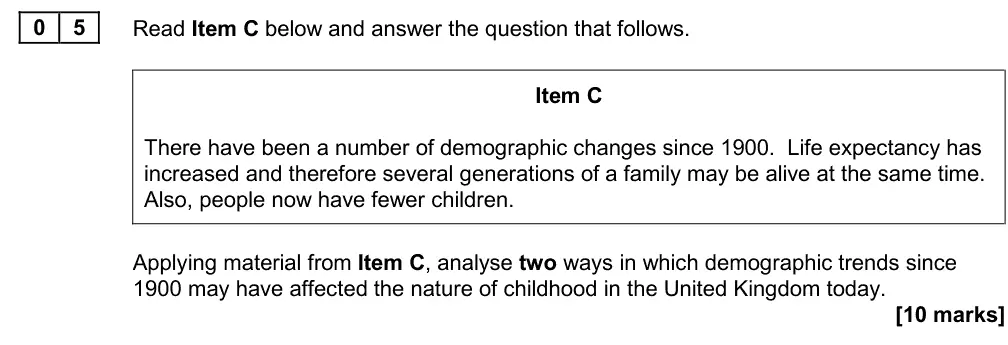
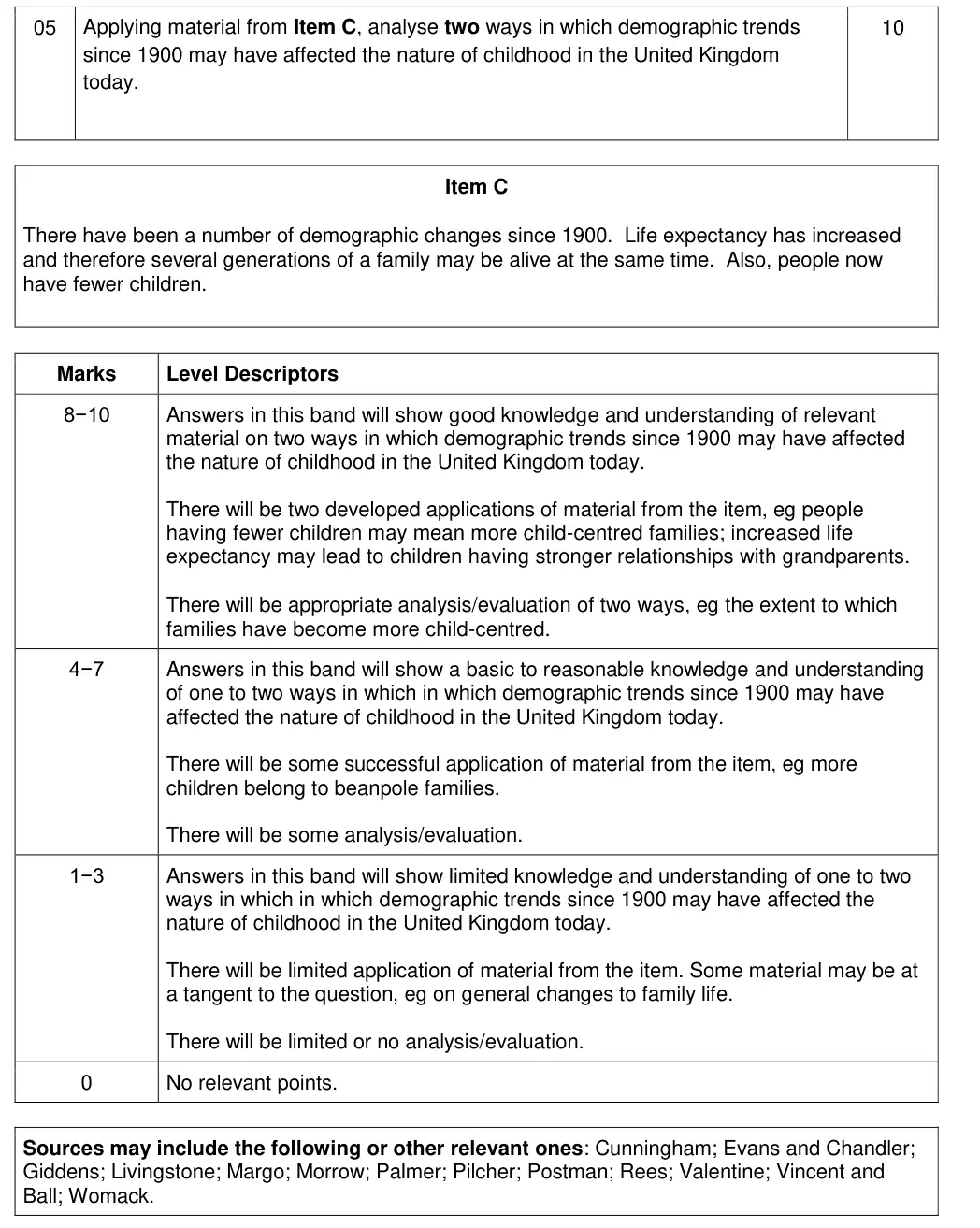
June 2018 · Paper 2 · Q5 10 marks AO1=3, AO2=4, AO3=3 Analyse childhooddemographic trends
0 5
Read Item C below and answer the question that follows.
Item C
There have been a number of demographic changes since 1900.  Life expectancy has
increased and therefore several generations of a family may be alive at the same time.
Also, people now have fewer children.
Applying material from Item C, analyse two ways in which demographic trends since
1900 may have affected the nature of childhood in the United Kingdom today.
[10 marks]
June 2018 · Paper 2 · Q6 20 marks AO1=8, AO2=6, AO3=6 20-mark essay marriage divorce and family diversity
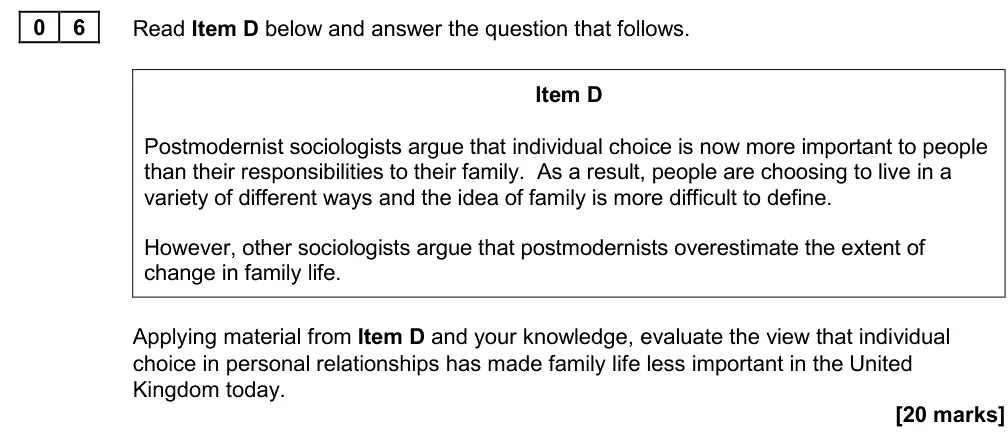
0 6
Read Item D below and answer the question that follows.
Item D
Postmodernist sociologists argue that individual choice is now more important to people
than their responsibilities to their family.  As a result, people are choosing to live in a
variety of different ways and the idea of family is more difficult to define.
However, other sociologists argue that postmodernists overestimate the extent of
change in family life.
Applying material from Item D and your knowledge, evaluate the view that individual
choice in personal relationships has made family life less important in the United
Kingdom today.
[20 marks]
June 2018 · Paper 2 · Q7 10 marks AO1=5, AO2=3, AO3=2 Outline and explain access to health caremedicine and health professions
0 7
Outline and explain two ways in which health professionals may affect inequalities in
health care.
[10 marks]
June 2018 · Paper 2 · Q8 10 marks AO1=3, AO2=4, AO3=3 Analyse social construction of health
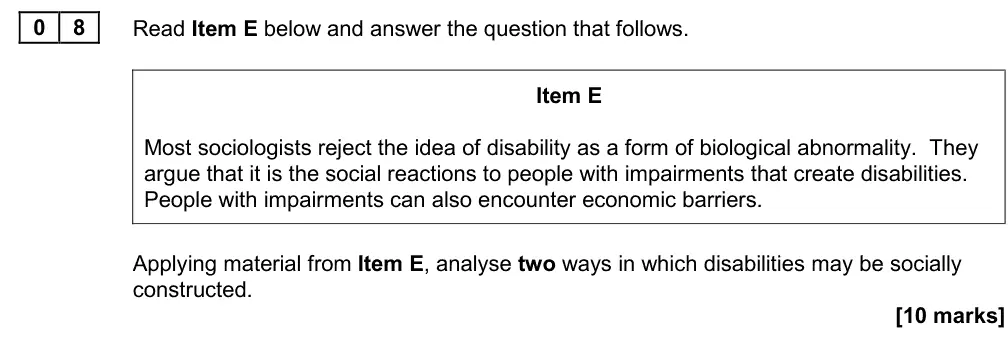
0 8
Read Item E below and answer the question that follows.
Item E
Most sociologists reject the idea of disability as a form of biological abnormality.  They
argue that it is the social reactions to people with impairments that create disabilities.
People with impairments can also encounter economic barriers.
Applying material from Item E, analyse two ways in which disabilities may be socially
constructed.
[10 marks]
June 2018 · Paper 2 · Q9 20 marks AO1=8, AO2=6, AO3=6 20-mark essay health inequalities
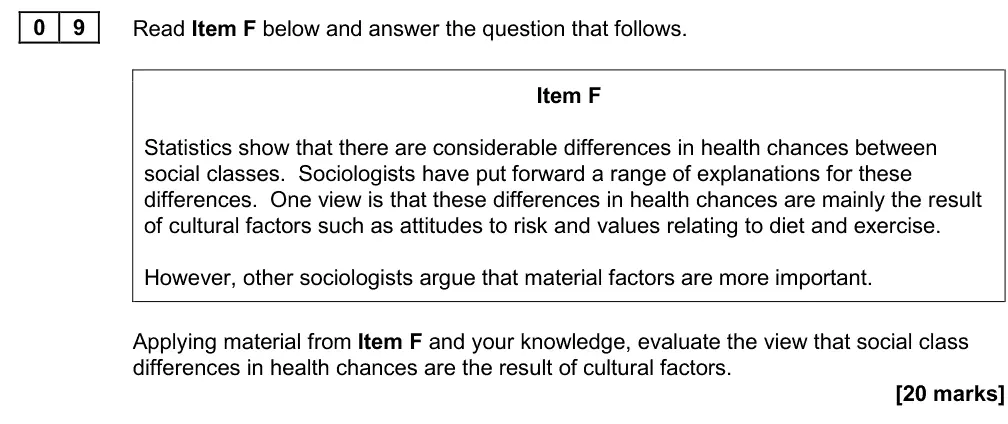
0 9
Read Item F below and answer the question that follows.
Item F
Statistics show that there are considerable differences in health chances between
social classes.  Sociologists have put forward a range of explanations for these
differences.  One view is that these differences in health chances are mainly the result
of cultural factors such as attitudes to risk and values relating to diet and exercise.
However, other sociologists argue that material factors are more important.
Applying material from Item F and your knowledge, evaluate the view that social class
differences in health chances are the result of cultural factors.
[20 marks]
June 2018 · Paper 2 · Q10 10 marks AO1=5, AO2=3, AO3=2 Outline and explain povertywork and worklessness
1 0
Outline and explain two ways in which globalisation may have increased levels of poverty
in the United Kingdom.
[10 marks]
June 2018 · Paper 2 · Q11 10 marks AO1=3, AO2=4, AO3=3 Analyse poverty
1 1
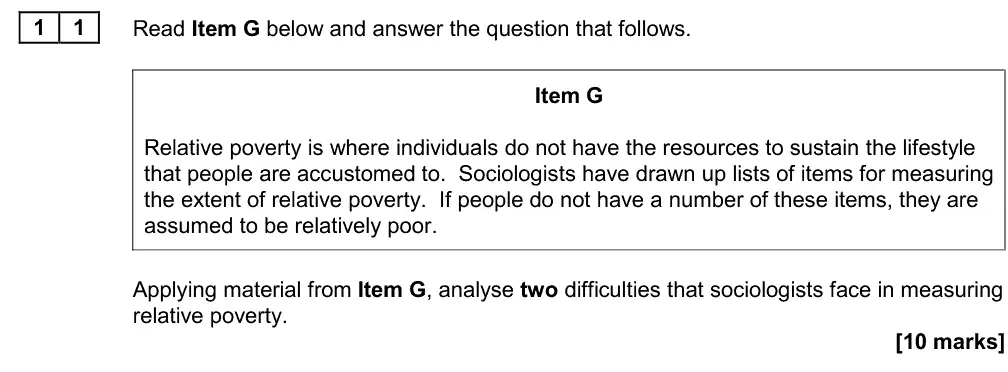
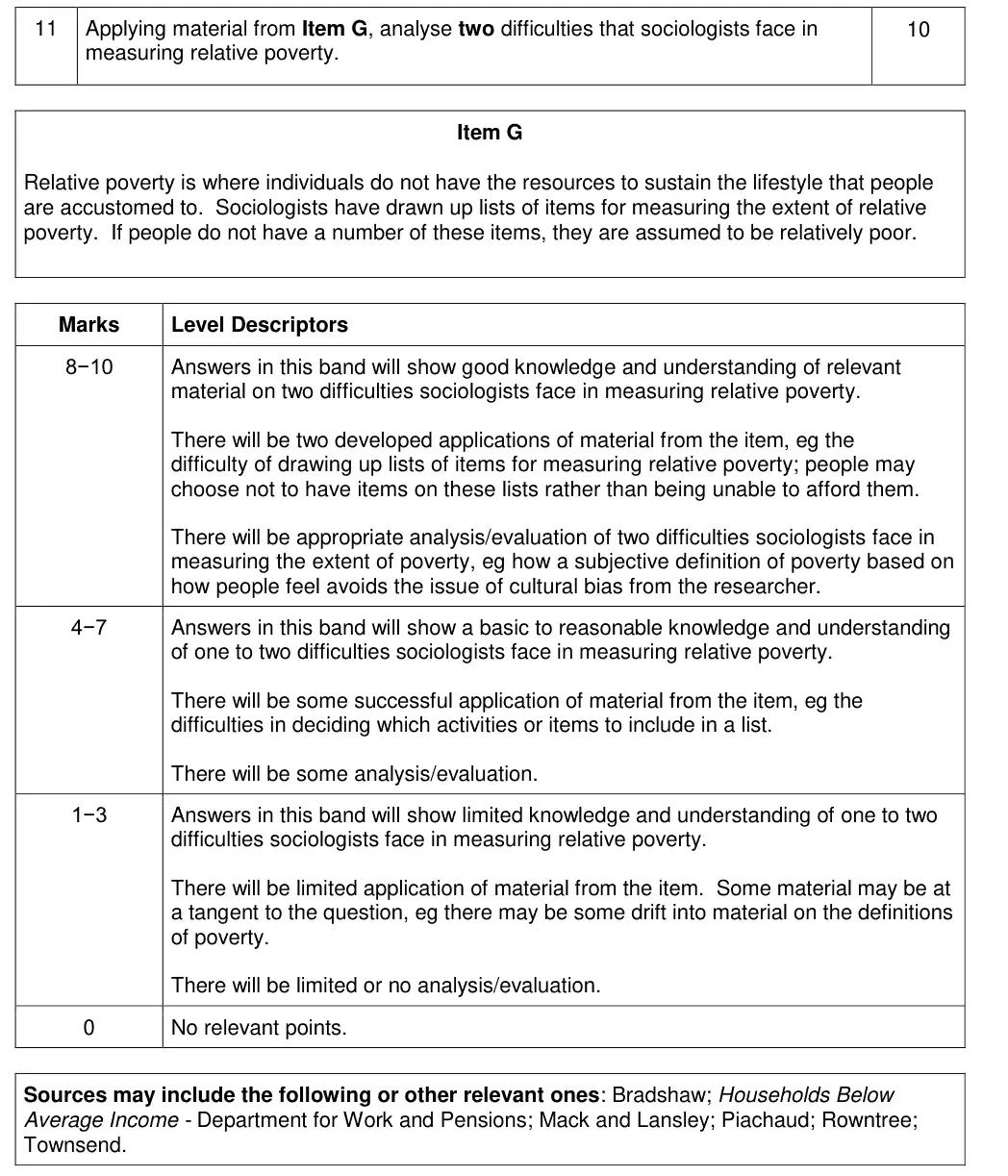
Read Item G below and answer the question that follows.
Item G
Relative poverty is where individuals do not have the resources to sustain the lifestyle
that people are accustomed to.  Sociologists have drawn up lists of items for measuring
the extent of relative poverty.  If people do not have a number of these items, they are
assumed to be relatively poor.
Applying material from Item G, analyse two difficulties that sociologists face in measuring
relative poverty.
[10 marks]
June 2018 · Paper 2 · Q12 20 marks AO1=8, AO2=6, AO3=6 20-mark essay responses to poverty
1 2
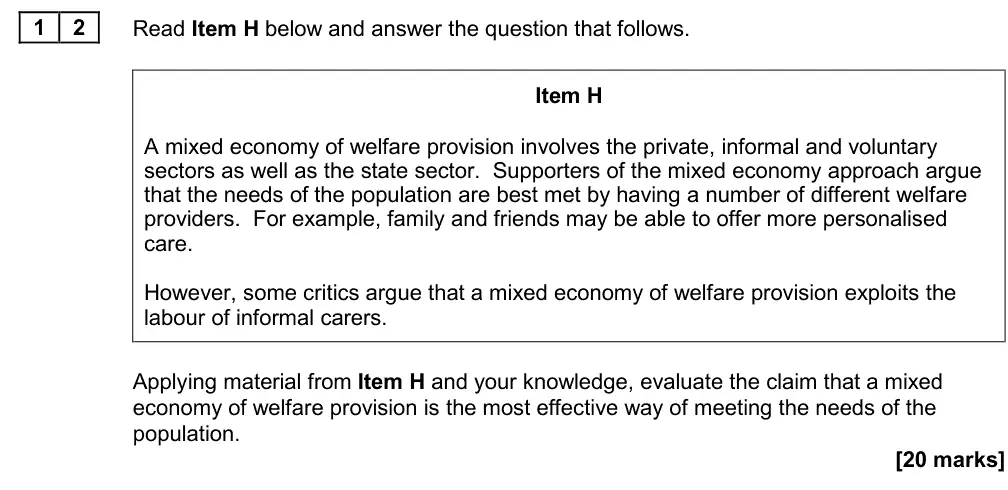
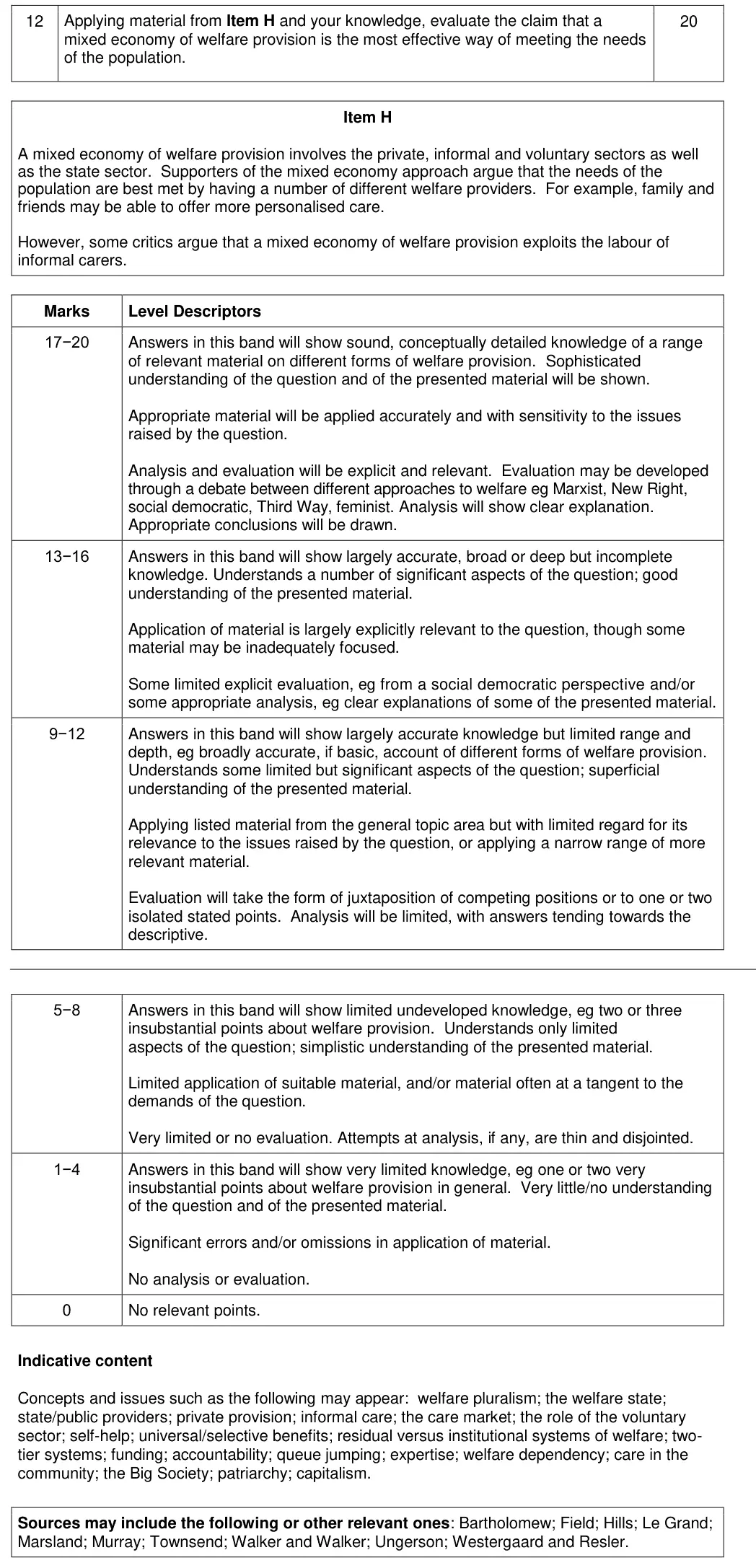
Read Item H below and answer the question that follows.
Item H
A mixed economy of welfare provision involves the private, informal and voluntary
sectors as well as the state sector.  Supporters of the mixed economy approach argue
that the needs of the population are best met by having a number of different welfare
providers.  For example, family and friends may be able to offer more personalised
care.
However, some critics argue that a mixed economy of welfare provision exploits the
labour of informal carers.
Applying material from Item H and your knowledge, evaluate the claim that a mixed
economy of welfare provision is the most effective way of meeting the needs of the
population.
[20 marks]
June 2018 · Paper 2 · Q13 10 marks AO1=5, AO2=3, AO3=2 Outline and explain secularisation
1 3
Outline and explain two ways in which globalisation may affect religious beliefs and
practices.
[10 marks]
June 2018 · Paper 2 · Q14 10 marks AO1=3, AO2=4, AO3=3 Analyse religion and social groups
1 4
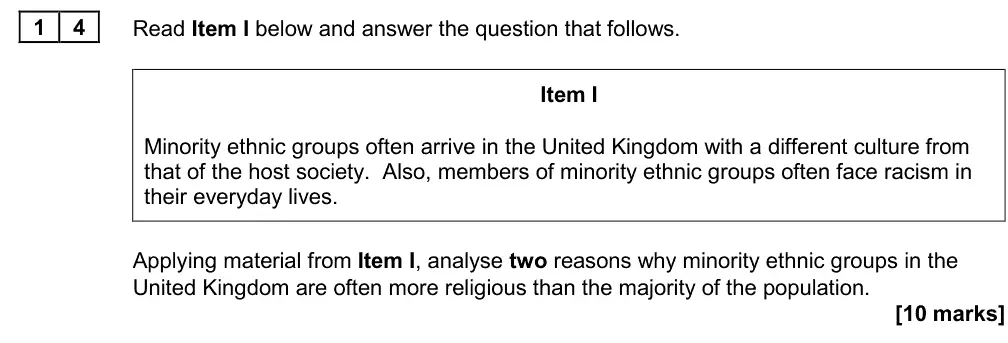
Read Item I below and answer the question that follows.
Item I
Minority ethnic groups often arrive in the United Kingdom with a different culture from
that of the host society.  Also, members of minority ethnic groups often face racism in
their everyday lives.
Applying material from Item I, analyse two reasons why minority ethnic groups in the
United Kingdom are often more religious than the majority of the population.
[10 marks]
June 2018 · Paper 2 · Q15 20 marks AO1=8, AO2=6, AO3=6 20-mark essay secularisationreligious organisations
1 5
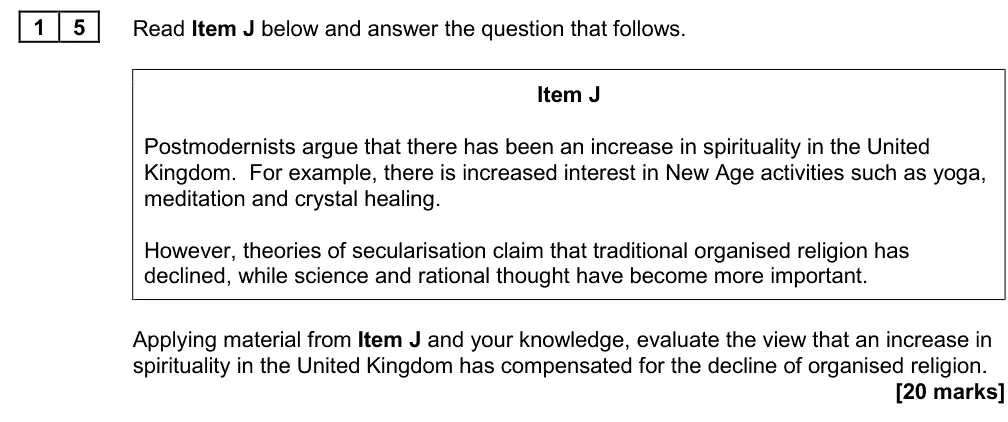
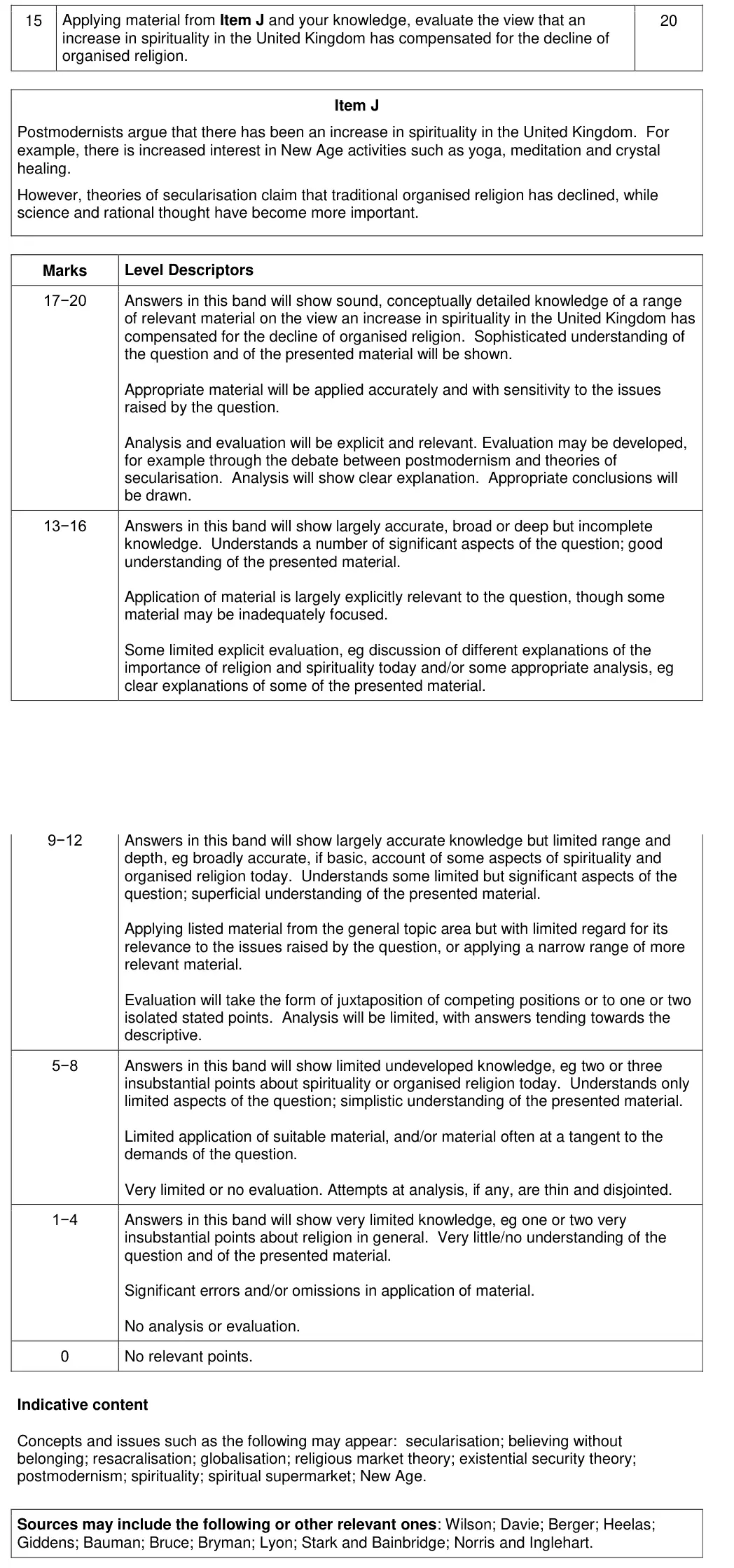
Read Item J below and answer the question that follows.
Item J
Postmodernists argue that there has been an increase in spirituality in the United
Kingdom.  For example, there is increased interest in New Age activities such as yoga,
meditation and crystal healing.
However, theories of secularisation claim that traditional organised religion has
declined, while science and rational thought have become more important.
Applying material from Item J and your knowledge, evaluate the view that an increase in
spirituality in the United Kingdom has compensated for the decline of organised religion.
[20 marks]
June 2018 · Paper 2 · Q16 10 marks AO1=5, AO2=3, AO3=2 Outline and explain aid trade and industrialisationdevelopment gender health education
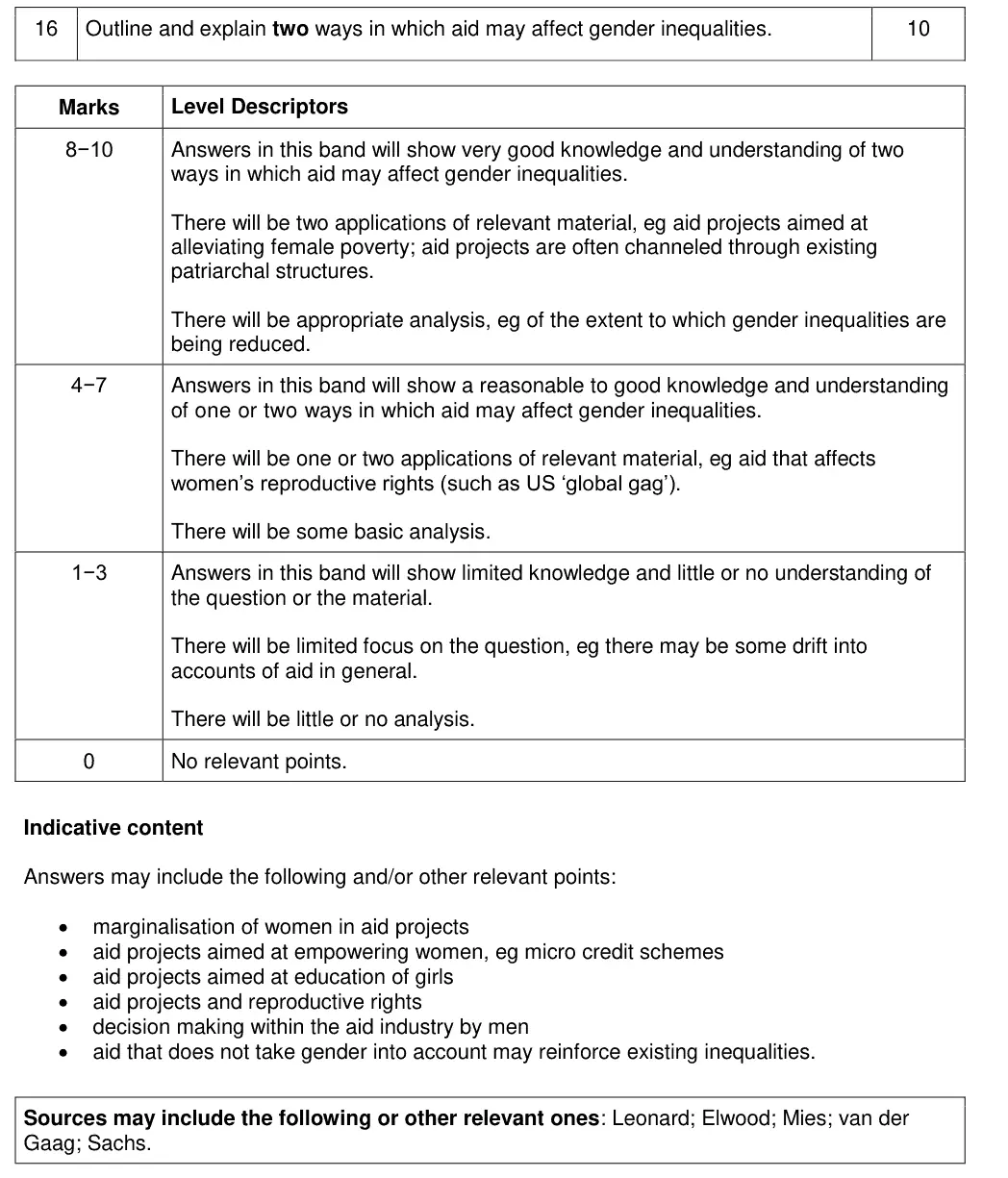
1 6
Outline and explain two ways in which aid may affect gender inequalities.
[10 marks]
June 2018 · Paper 2 · Q17 10 marks AO1=3, AO2=4, AO3=3 Analyse globalisation and development
1 7
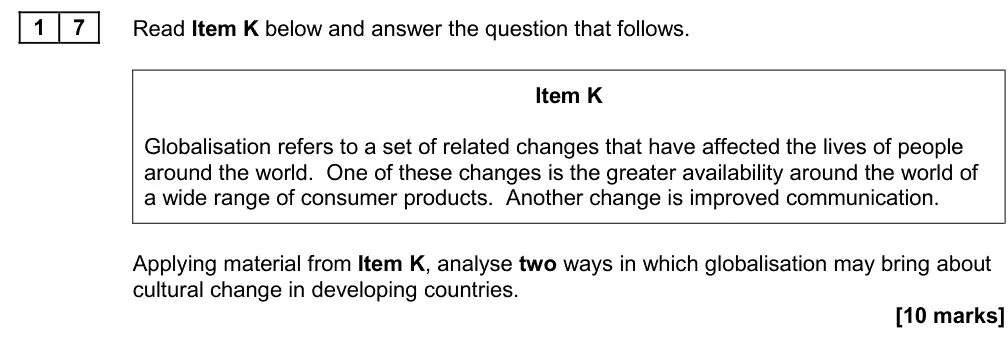
Read Item K below and answer the question that follows.
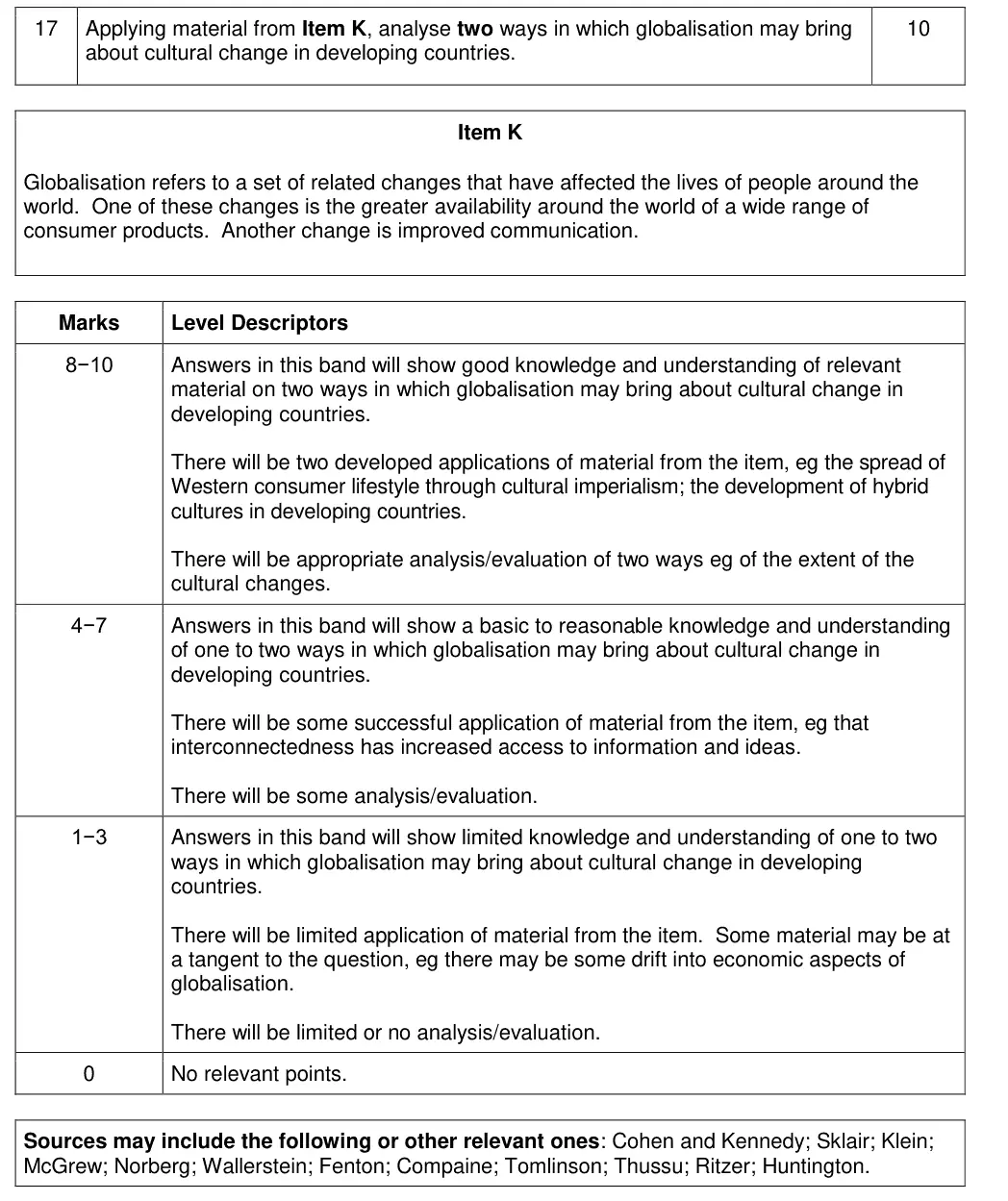
Item K
Globalisation refers to a set of related changes that have affected the lives of people
around the world.  One of these changes is the greater availability around the world of
a wide range of consumer products.  Another change is improved communication.
Applying material from Item K, analyse two ways in which globalisation may bring about
cultural change in developing countries.
[10 marks]
June 2018 · Paper 2 · Q18 20 marks AO1=8, AO2=6, AO3=6 20-mark essay development and underdevelopment
1 8
Read Item L below and answer the question that follows.
Item L
Dependency theory explanations of development and underdevelopment argue that
also argue that development is difficult to achieve within the existing capitalist world
system.
However, critics claim that dependency theory does not consider how countries may be
responsible for their own failure to develop.
Applying material from Item L and your knowledge, evaluate dependency theory
explanations of development and underdevelopment.
[20 marks]
June 2018 · Paper 2 · Q19 10 marks AO1=5, AO2=3, AO3=2 Outline and explain media representationsnews selection and presentation
1 9
Outline and explain two reasons why the news may portray young people negatively.
[10 marks]
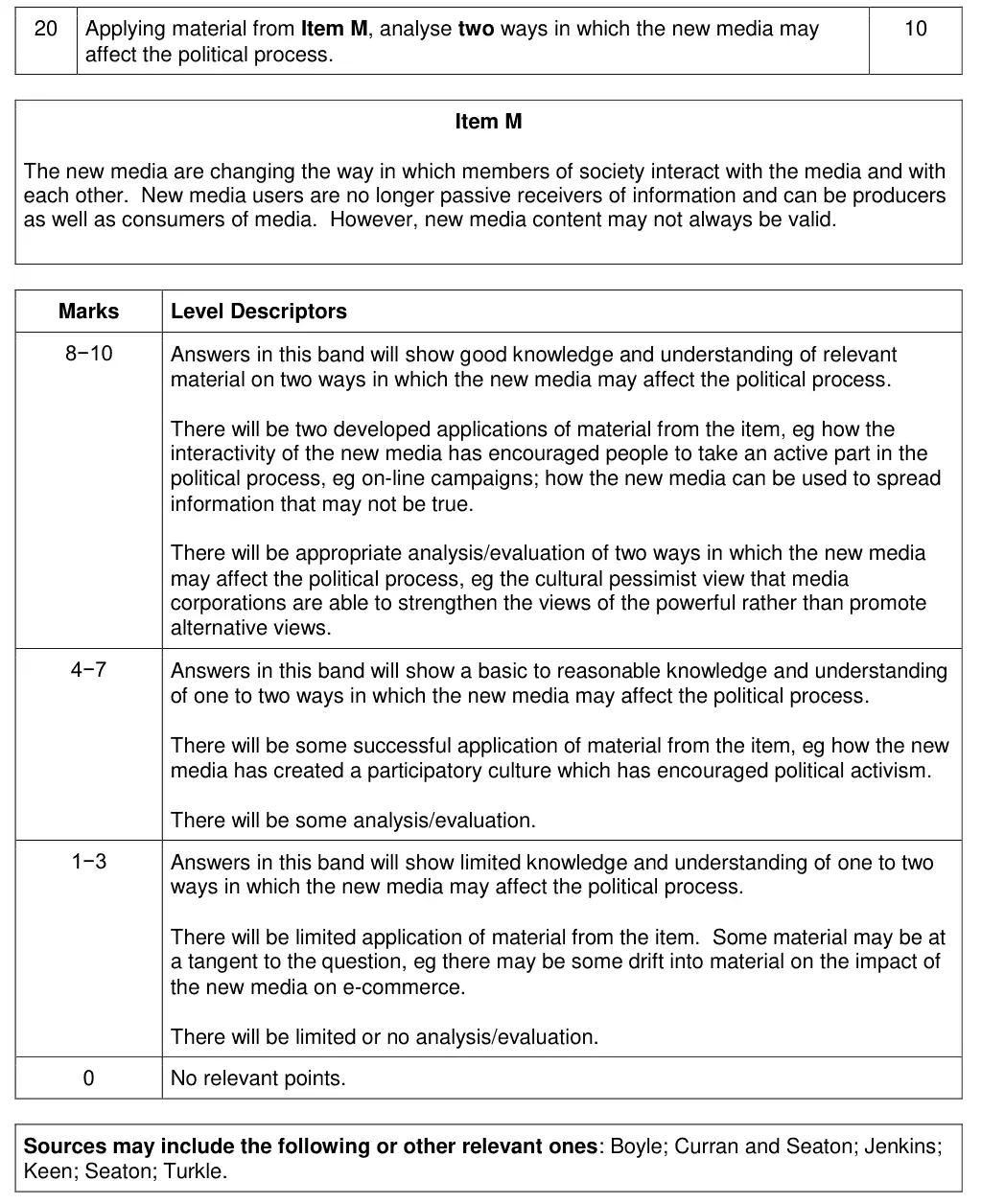
June 2018 · Paper 2 · Q20 10 marks AO1=3, AO2=4, AO3=3 Analyse new media
2 0
Read Item M below and answer the question that follows.
Item M
The new media are changing the way in which members of society interact with the
media and with each other.  New media users are no longer passive receivers of
information and can be producers as well as consumers of media.  However, new
media content may not always be valid.
Applying material from Item M, analyse two ways in which the new media may affect the
political process.
[10 marks]
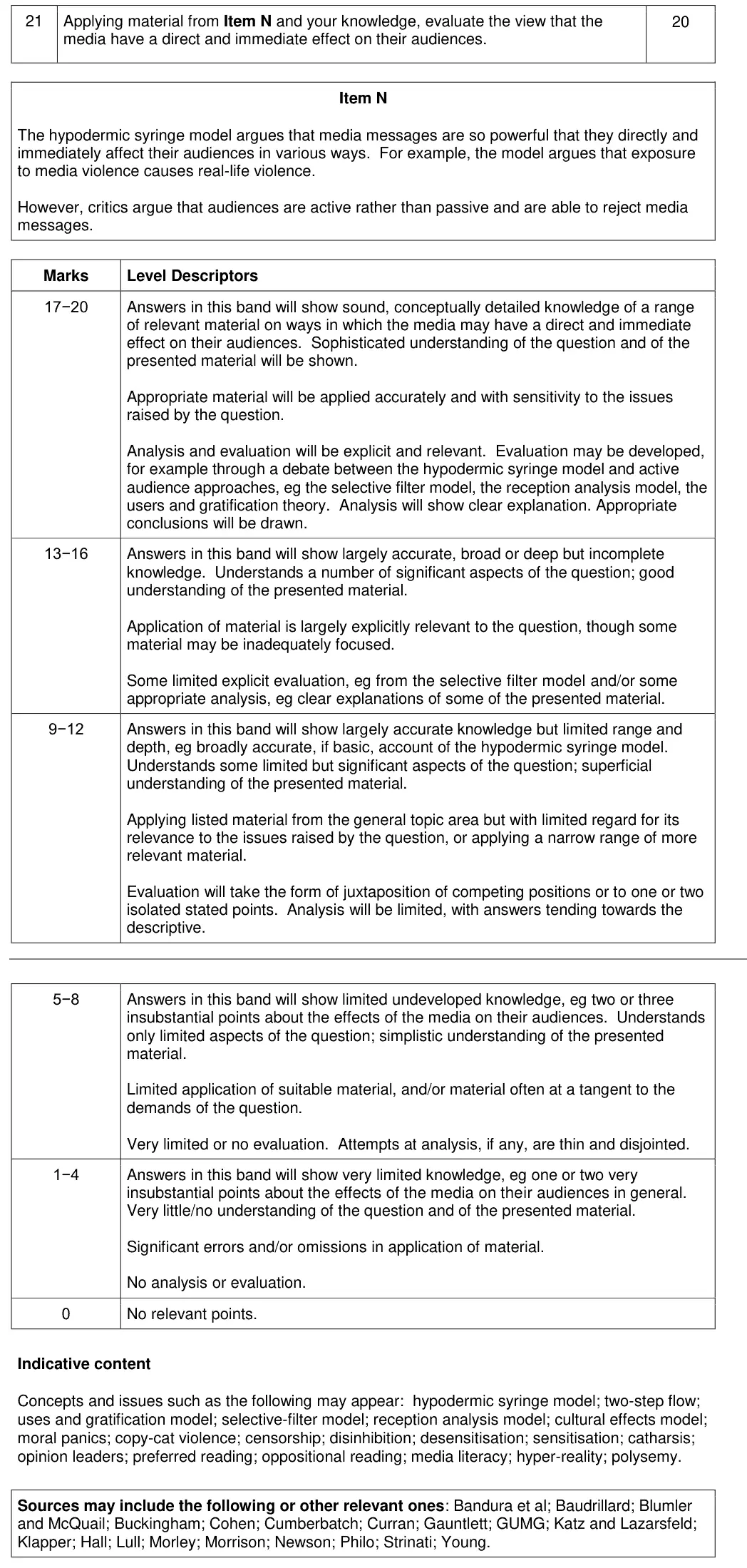
June 2018 · Paper 2 · Q21 20 marks AO1=8, AO2=6, AO3=6 20-mark essay media audiences
2 1
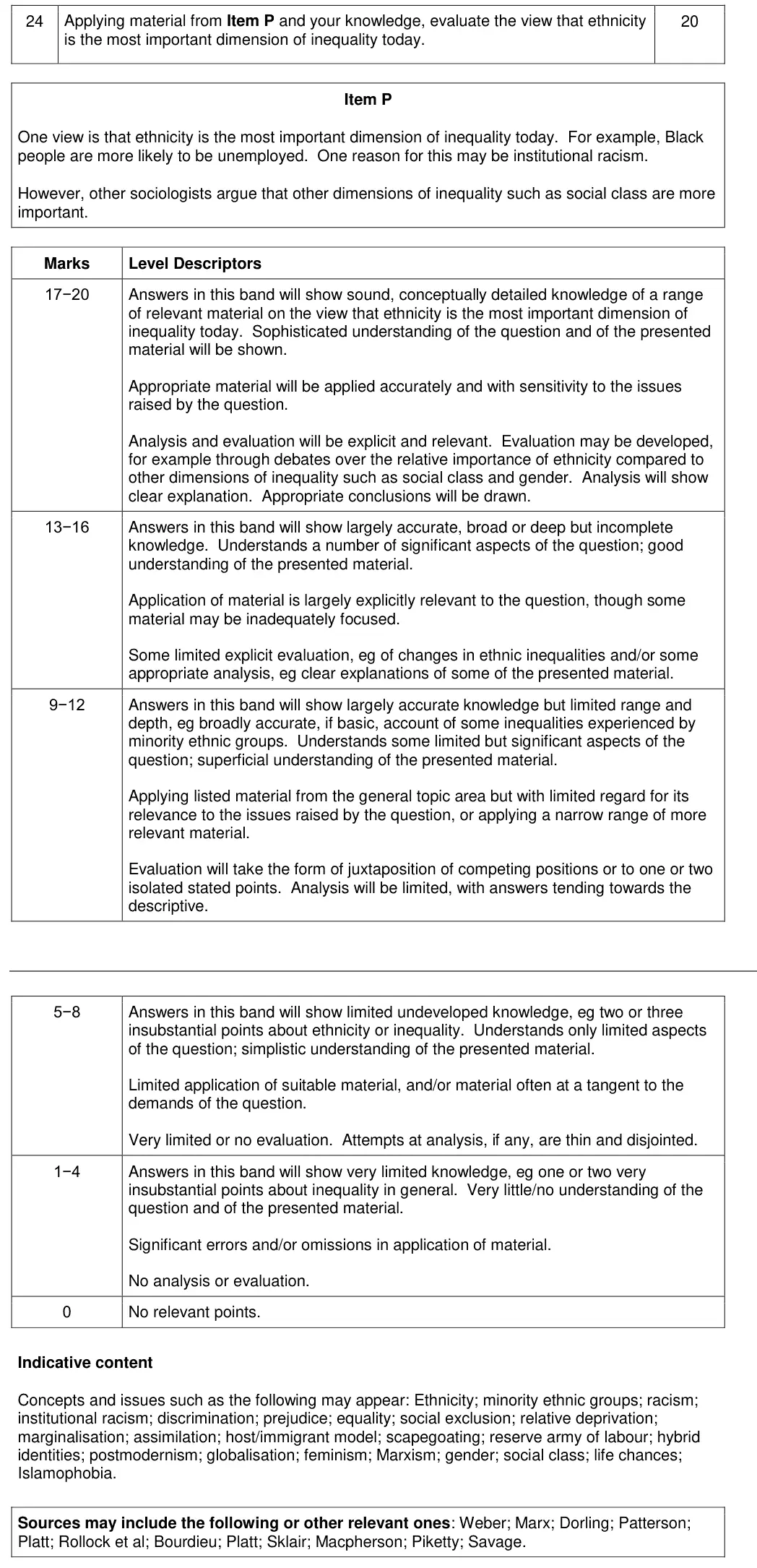
Read Item N below and answer the question that follows.
Item N
The hypodermic syringe model argues that media messages are so powerful that they
directly and immediately affect their audiences in various ways.  For example, the
model argues that exposure to media violence causes real-life violence.
However, critics argue that audiences are active rather than passive and are able to
reject media messages.
Applying material from Item N and your knowledge, evaluate the view that the media
have a direct and immediate effect on their audiences.
[20 marks]
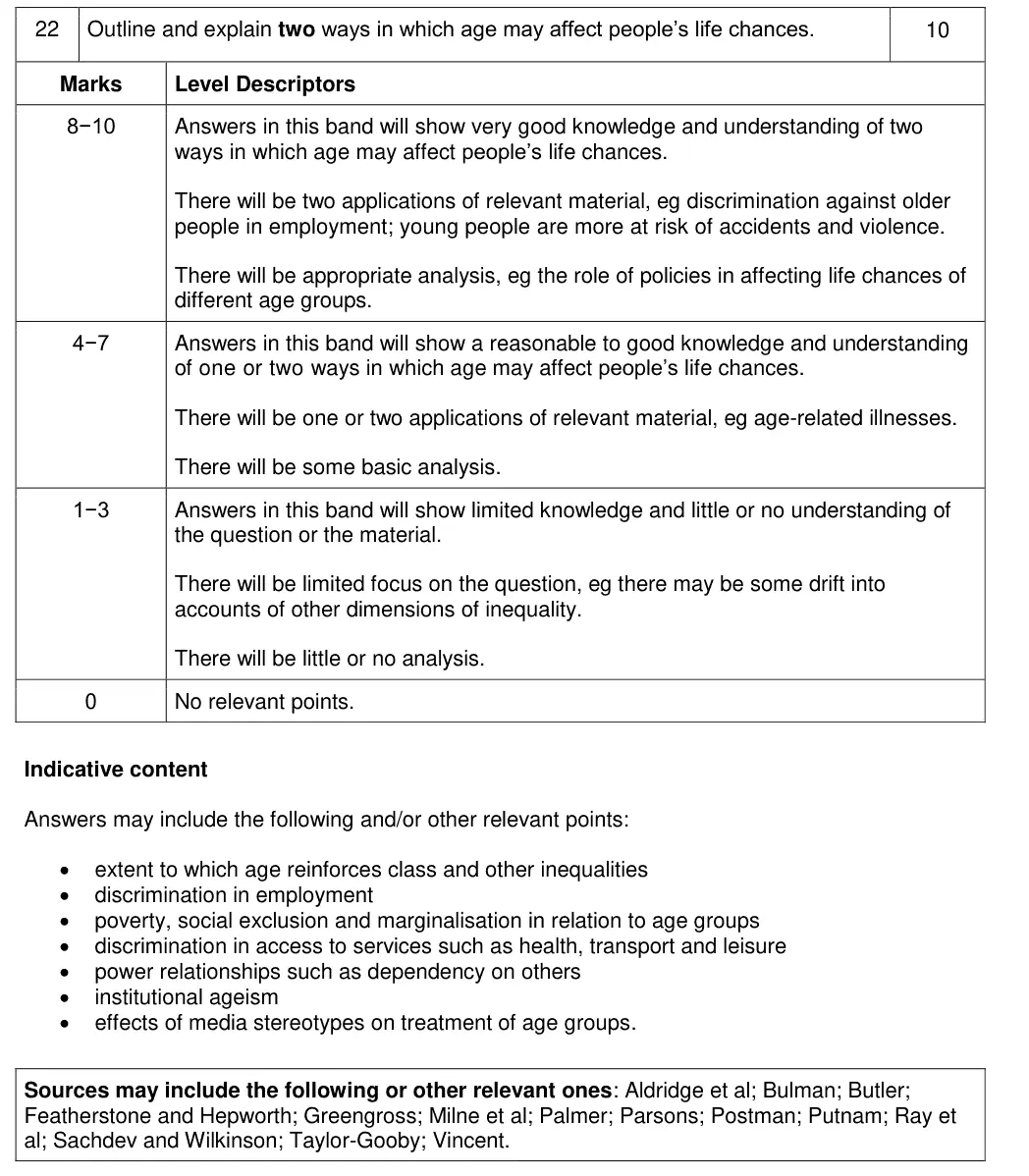
June 2018 · Paper 2 · Q22 10 marks AO1=5, AO2=3, AO3=2 Outline and explain class status and powerstratification and differentiation
2 2
Outline and explain two ways in which age may affect people’s life chances.
[10 marks]
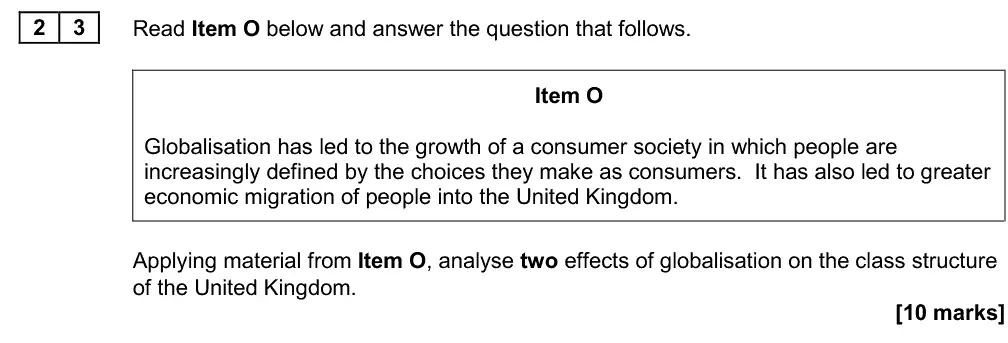
June 2018 · Paper 2 · Q23 10 marks AO1=3, AO2=4, AO3=3 Analyse changing structures of inequalitymeasuring social class
2 3
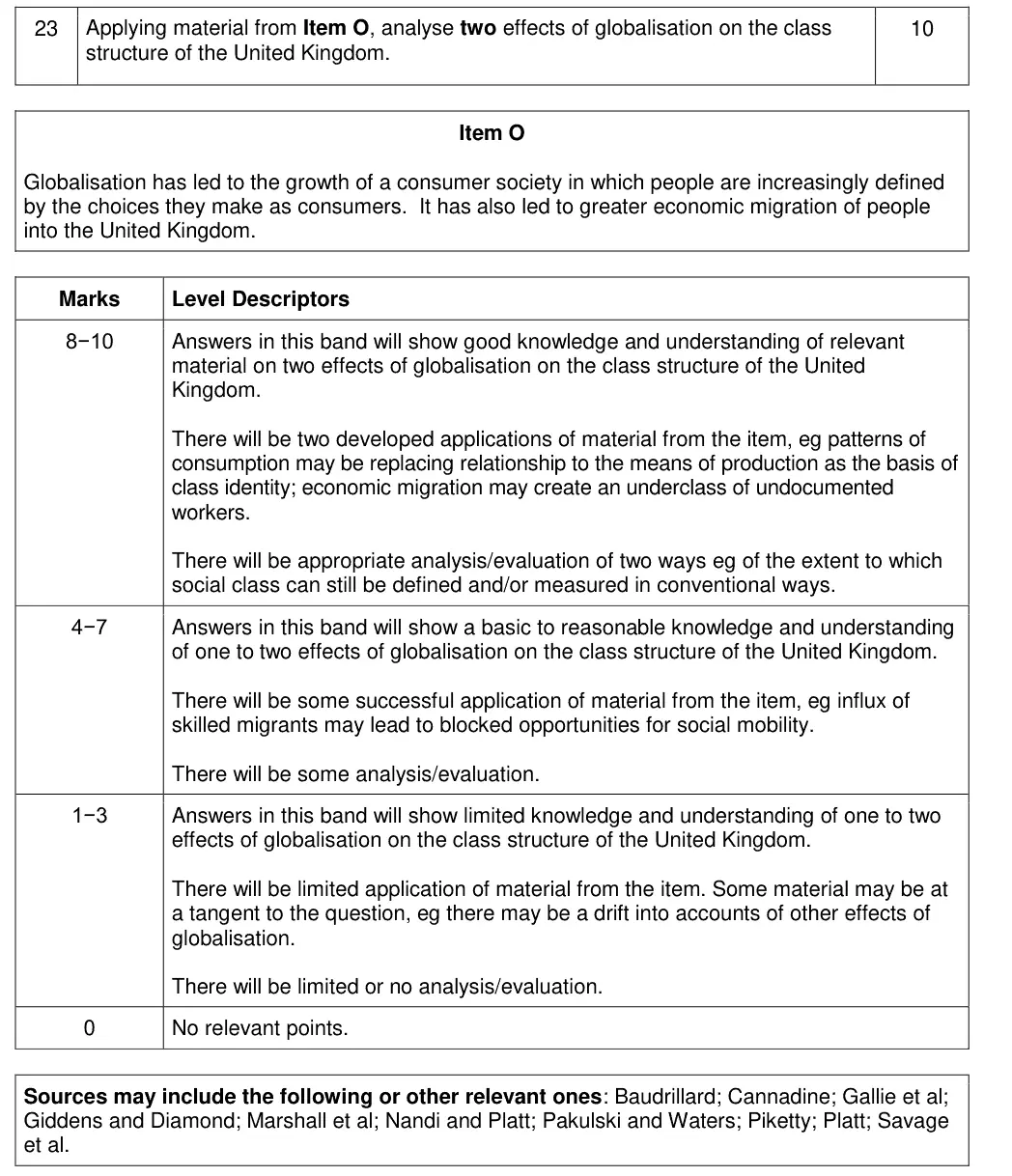
Read Item O below and answer the question that follows.
Item O
Globalisation has led to the growth of a consumer society in which people are
increasingly defined by the choices they make as consumers.  It has also led to greater
economic migration of people into the United Kingdom.
Applying material from Item O, analyse two effects of globalisation on the class structure
of the United Kingdom.
[10 marks]
June 2018 · Paper 2 · Q24 20 marks AO1=8, AO2=6, AO3=6 20-mark essay stratification and differentiationclass status and power
2 4
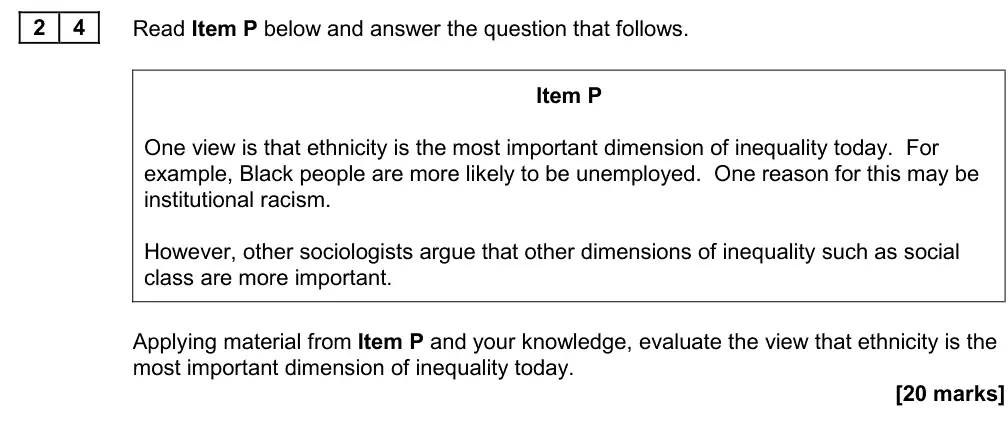
Read Item P below and answer the question that follows.
Item P
One view is that ethnicity is the most important dimension of inequality today.  For
example, Black people are more likely to be unemployed.  One reason for this may be
institutional racism.
However, other sociologists argue that other dimensions of inequality such as social
class are more important.
Applying material from Item P and your knowledge, evaluate the view that ethnicity is the
most important dimension of inequality today.
[20 marks]

Work with an AQA sociology tutor

Want a paper marked and gone through with you? Message us.

Prefer email? Send an enquiry

If you are under 18, please include a parent's contact details. Enquiries go to enquiries@alevelsociologytutor.com and are deleted once handled. All tutoring is online.