November 2020: Paper 1

80 marks · 6 question parts · Paper, mark scheme and report on AQA's site · Printed for the cancelled summer 2020 exams

Question by question

QTopicMarksAOType
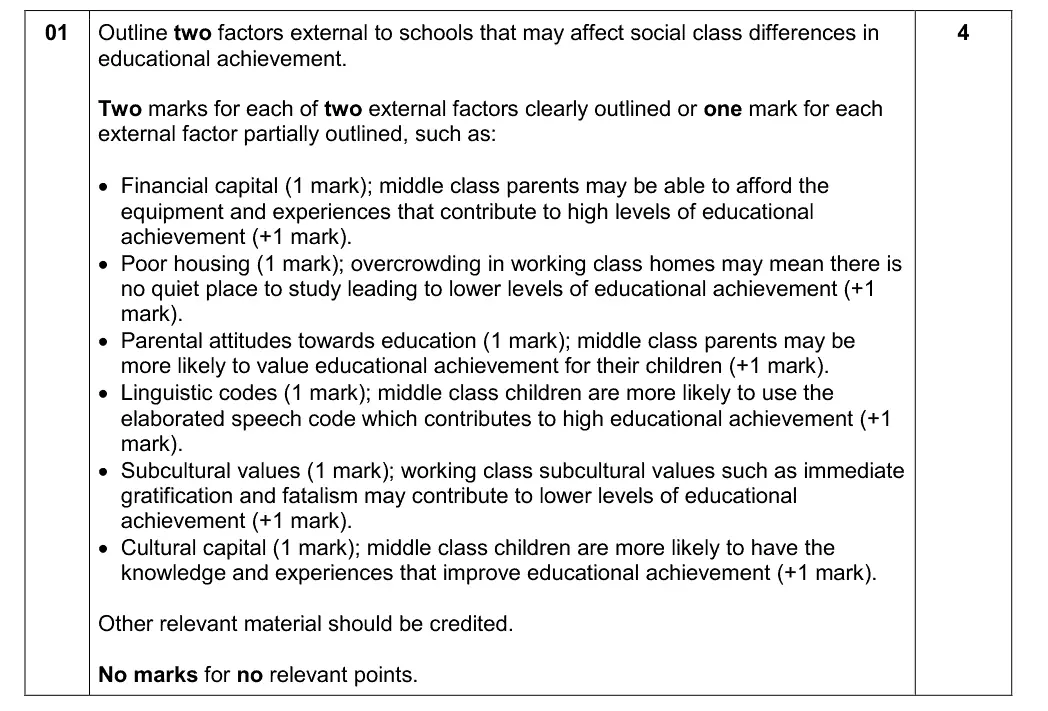
1 Differential educational achievement: class, gender and ethnicity 4AO1=4Outline
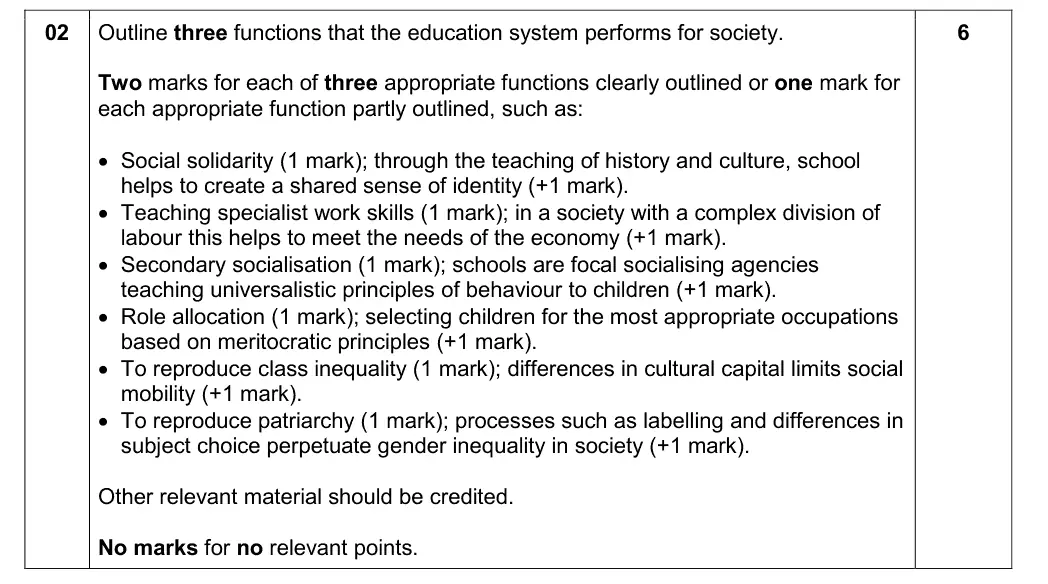
2 Role and functions of education (functionalist, Marxist, New Right) 6AO1=3,AO2=3Outline
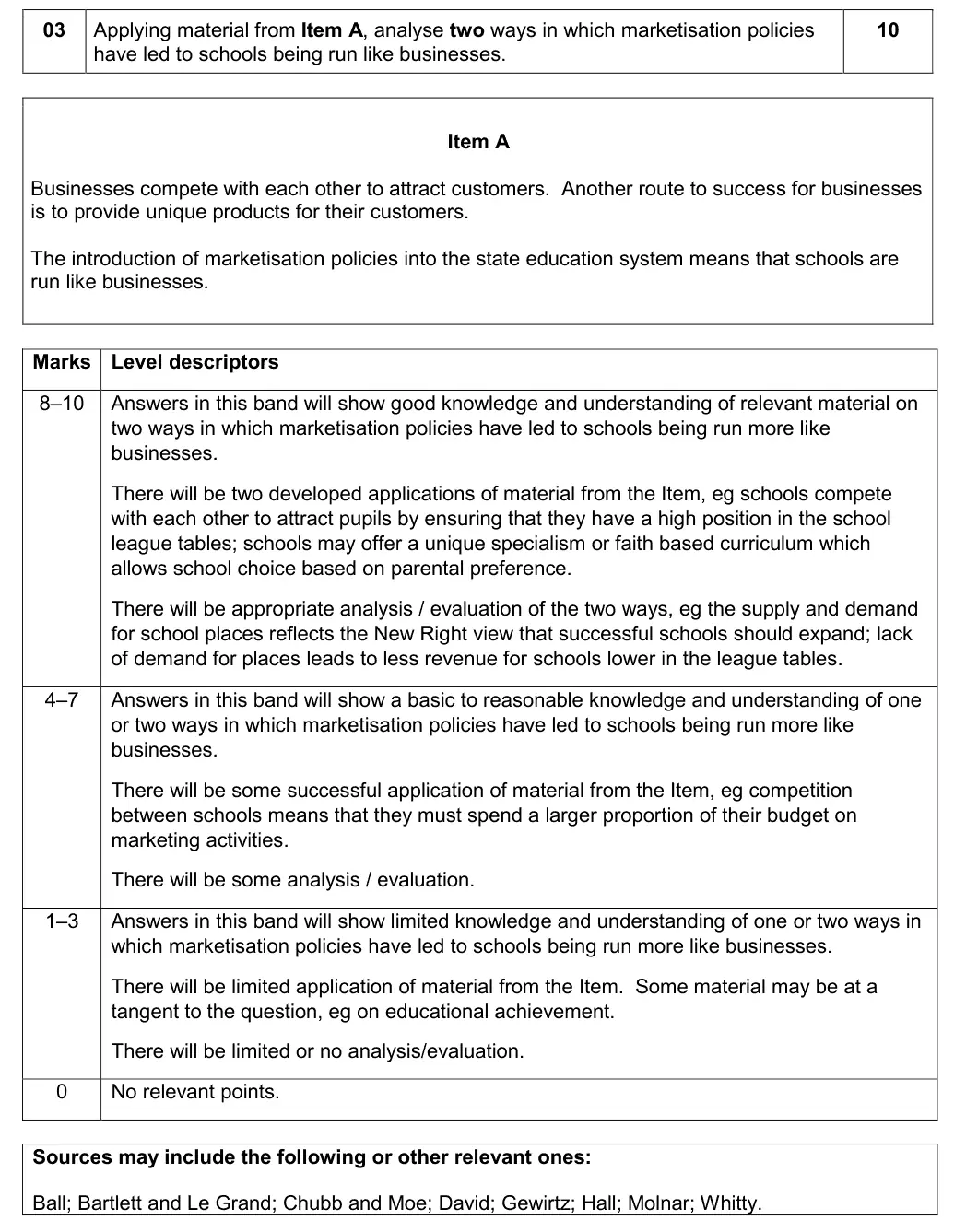
3 Educational policy, marketisation and globalisation 10AO1=3,AO2=4,AO3=3Analyse
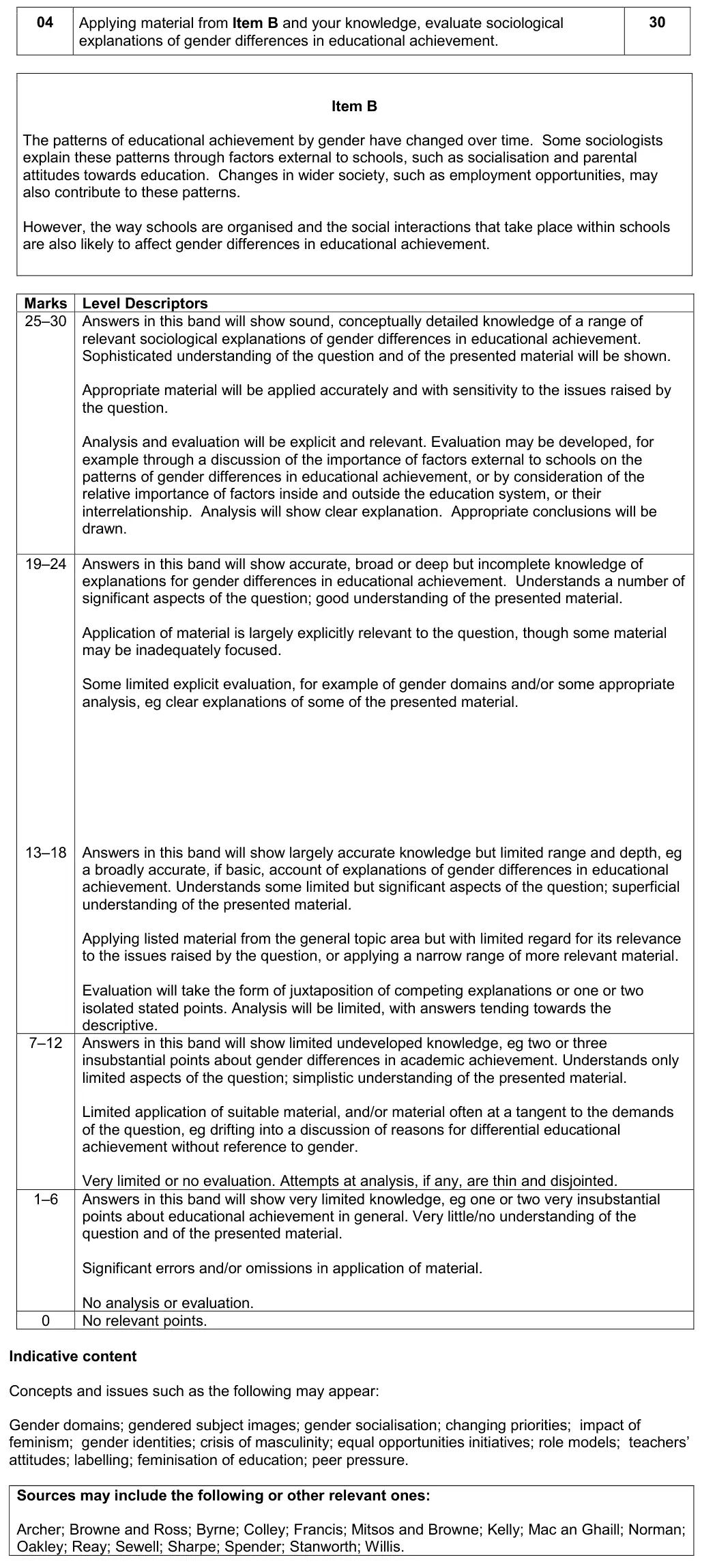
4 Differential educational achievement: class, gender and ethnicity, Processes within schools: labelling, subcultures and the hidden curriculum 30AO1=12,AO2=9,AO3=9Essay
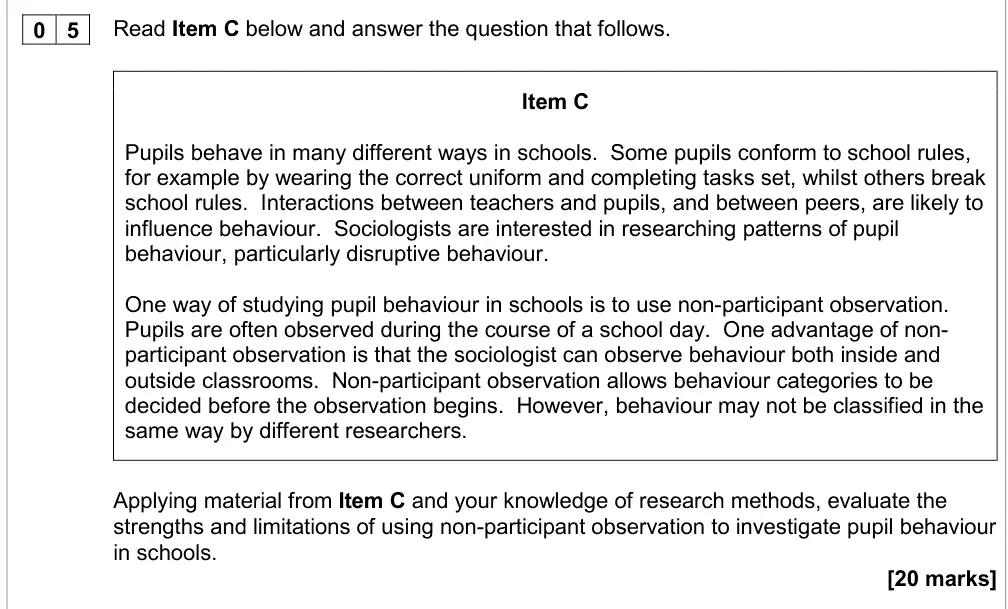
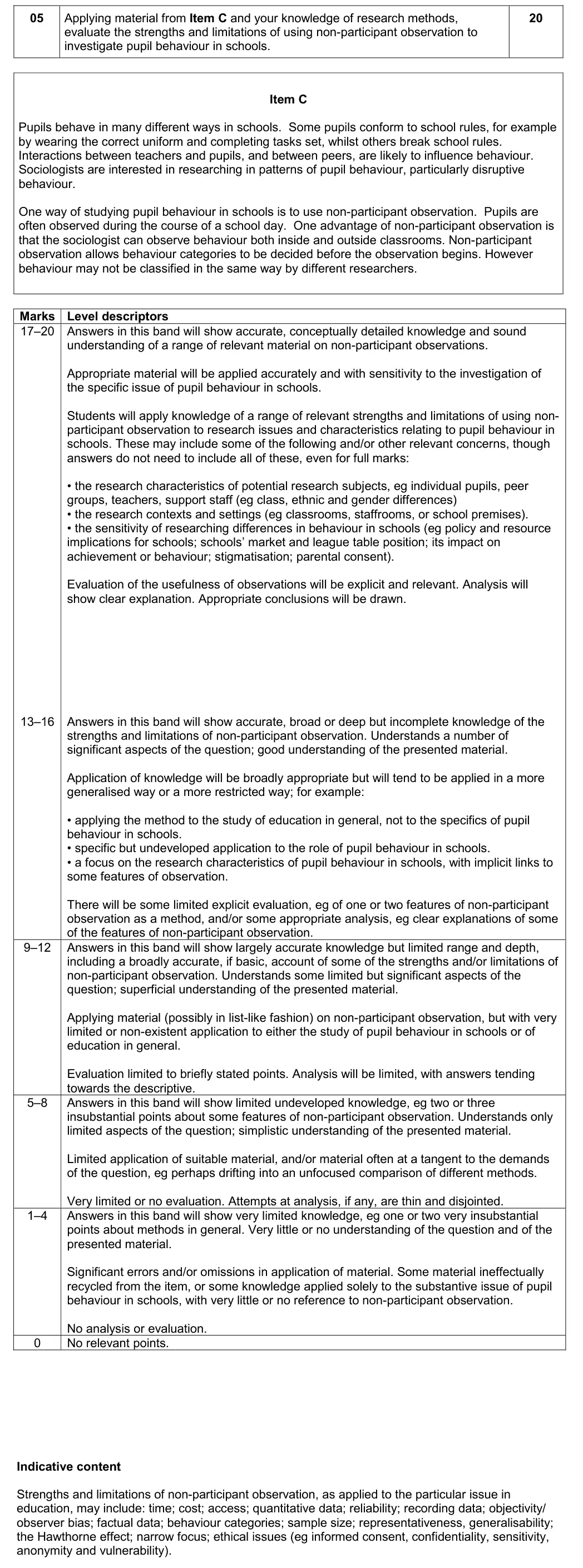
5 Methods in Context: research methods applied to education, Research methods: questionnaires, interviews, observation, experiments, documents and official statistics, Quantitative and qualitative methods and research design 20AO1=8,AO2=8,AO3=4Methods in context
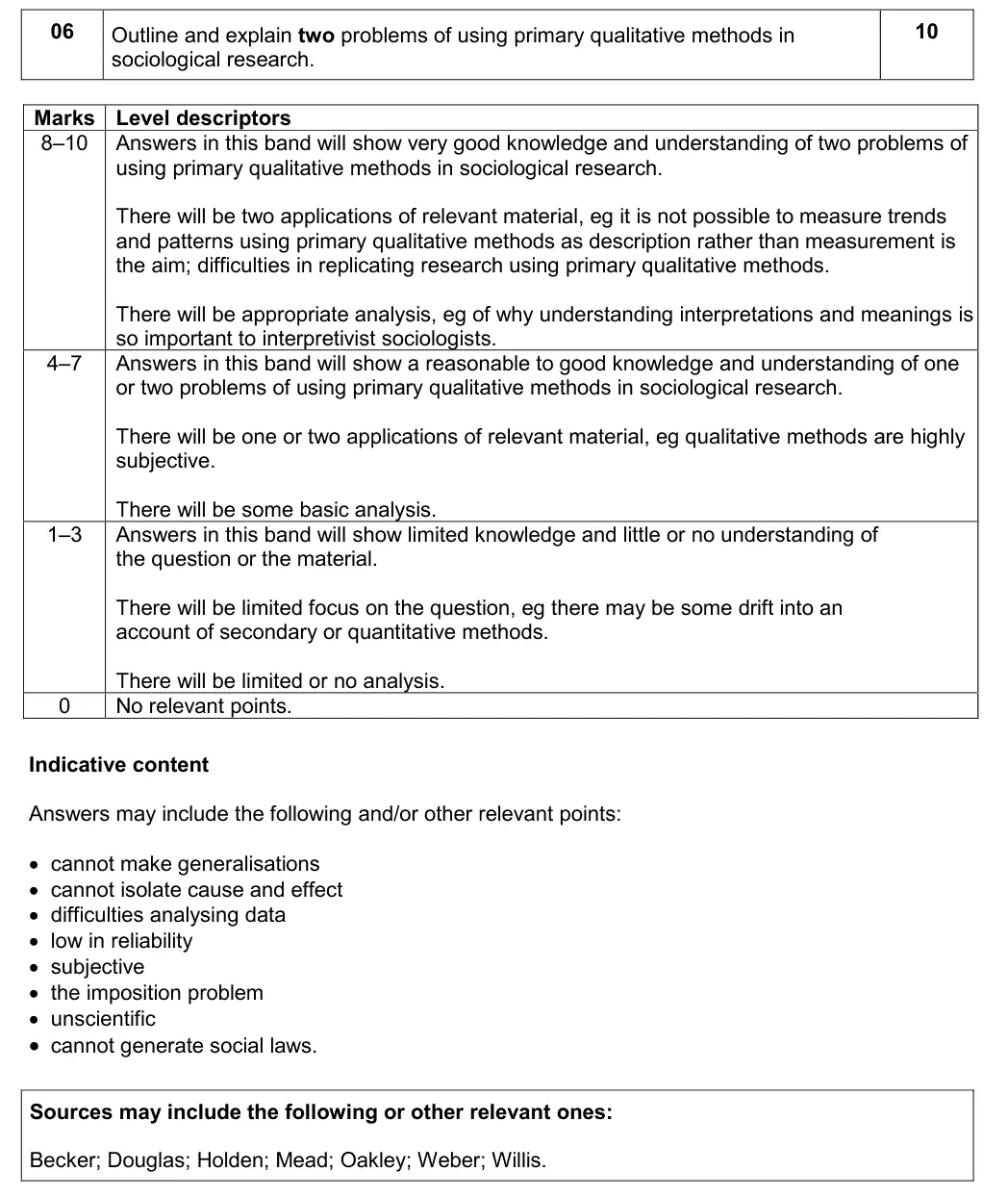
6 Quantitative and qualitative methods and research design, Primary and secondary data, quantitative and qualitative data, Positivism, interpretivism and social facts 10AO1=5,AO2=3,AO3=2Outline and explain

The questions

123456
November 2020 · Paper 1 · Q1 4 marks AO1=4 Outline educational achievement
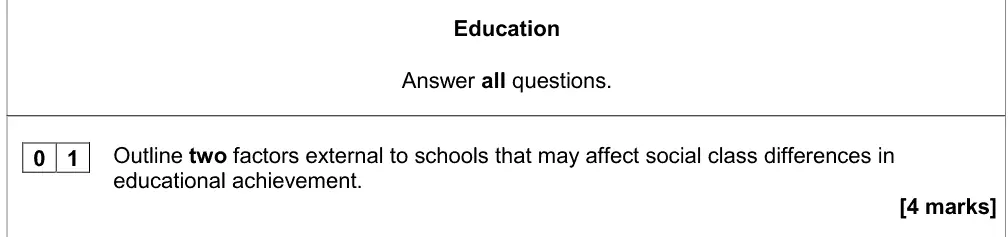
Education
0 1
Outline two factors external to schools that may affect social class differences in
educational achievement.
[4 marks]
November 2020 · Paper 1 · Q2 6 marks AO1=3, AO2=3 Outline role of education
0 2
Outline three functions that the education system performs for society.
[6 marks]
November 2020 · Paper 1 · Q3 10 marks AO1=3, AO2=4, AO3=3 Analyse education policy
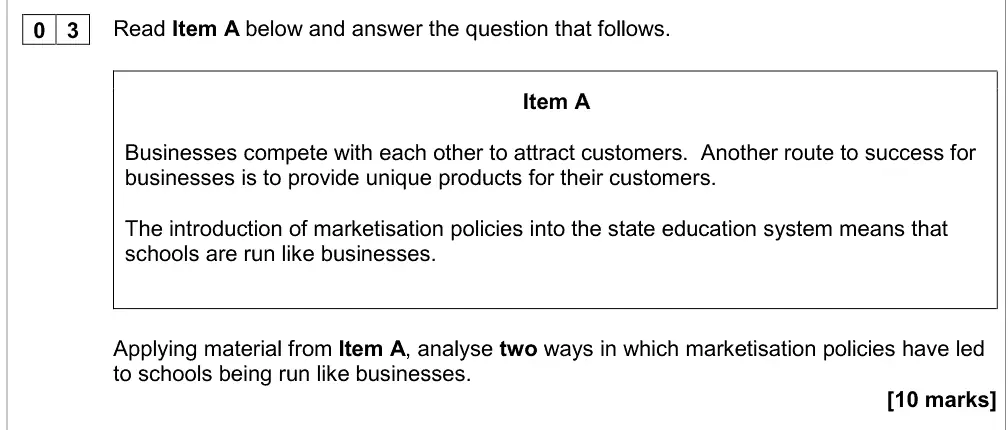
0 3
Read Item A below and answer the question that follows.
Item A
Businesses compete with each other to attract customers.  Another route to success for
businesses is to provide unique products for their customers.
The introduction of marketisation policies into the state education system means that
schools are run like businesses.
Applying material from Item A, analyse two ways in which marketisation policies have led
to schools being run like businesses.
[10 marks]
November 2020 · Paper 1 · Q4 30 marks AO1=12, AO2=9, AO3=9 30-mark essay educational achievementprocesses within schools
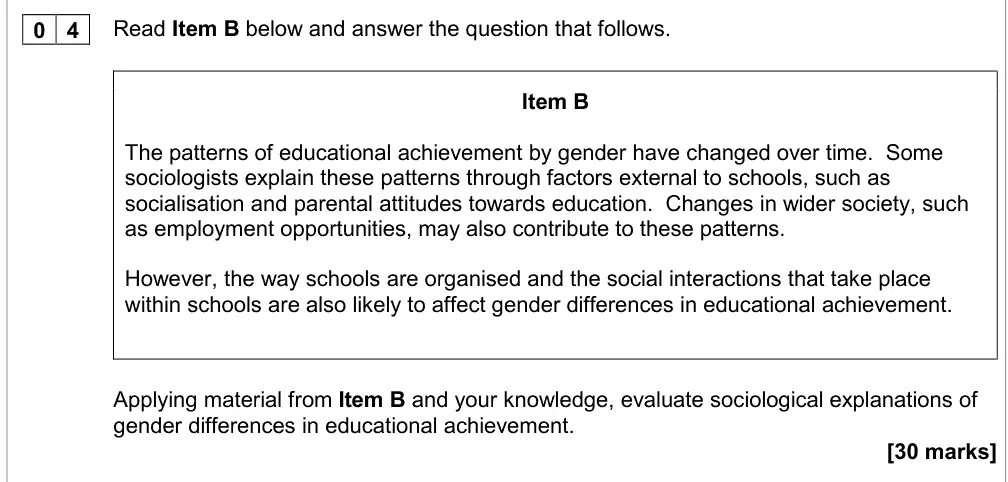
0 4
Read Item B below and answer the question that follows.
Item B
The patterns of educational achievement by gender have changed over time.  Some
sociologists explain these patterns through factors external to schools, such as
socialisation and parental attitudes towards education.  Changes in wider society, such
as employment opportunities, may also contribute to these patterns.
However, the way schools are organised and the social interactions that take place
within schools are also likely to affect gender differences in educational achievement.
Applying material from Item B and your knowledge, evaluate sociological explanations of
gender differences in educational achievement.
[30 marks]
Extra space
November 2020 · Paper 1 · Q5 20 marks AO1=8, AO2=8, AO3=4 Methods in context methods in contextresearch methodsquantitative and qualitative methods
0 5
Read Item C below and answer the question that follows.
Item C
Pupils behave in many different ways in schools.  Some pupils conform to school rules,
for example by wearing the correct uniform and completing tasks set, whilst others break
school rules.  Interactions between teachers and pupils, and between peers, are likely to
influence behaviour.  Sociologists are interested in researching patterns of pupil
behaviour, particularly disruptive behaviour.
One way of studying pupil behaviour in schools is to use non-participant observation.
Pupils are often observed during the course of a school day.  One advantage of non-
participant observation is that the sociologist can observe behaviour both inside and
outside classrooms.  Non-participant observation allows behaviour categories to be
decided before the observation begins.  However, behaviour may not be classified in the
same way by different researchers.
Applying material from Item C and your knowledge of research methods, evaluate the
strengths and limitations of using non-participant observation to investigate pupil behaviour
in schools.
[20 marks]
Extra space
November 2020 · Paper 1 · Q6 10 marks AO1=5, AO2=3, AO3=2 Outline and explain quantitative and qualitative methodsprimary and secondary datapositivism and interpretivism
0 6
Outline and explain two problems of using primary qualitative methods in sociological
research.
[10 marks]

Work with an AQA sociology tutor

Want a paper marked and gone through with you? Message us.

Prefer email? Send an enquiry

If you are under 18, please include a parent's contact details. Enquiries go to enquiries@alevelsociologytutor.com and are deleted once handled. All tutoring is online.