4.1.1-04 the significance of educational policies, including policies of selection, marketisation and privatisation, and policies to achieve greater equality of opportunity or outcome, for an understanding of the structure, role, impact and experience of and access to education; the impact of globalisation on educational policyAS
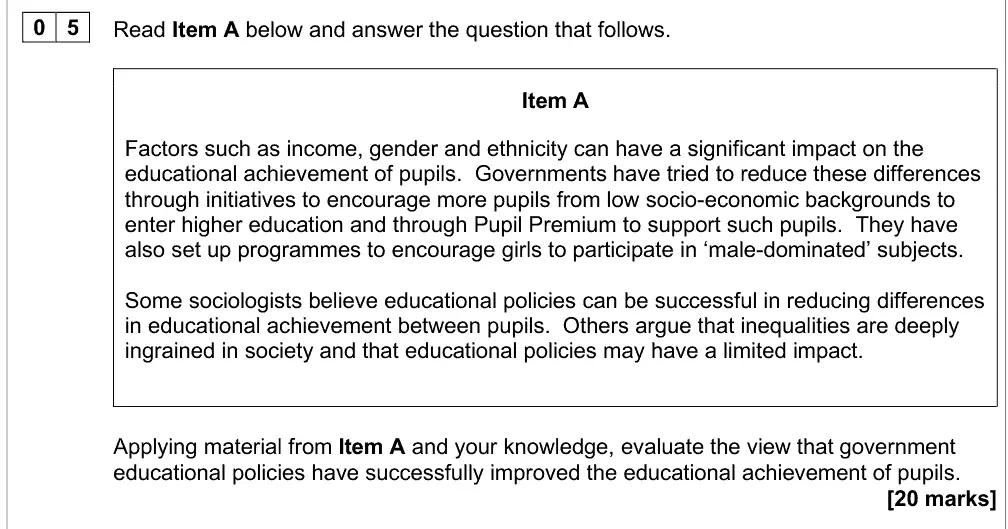
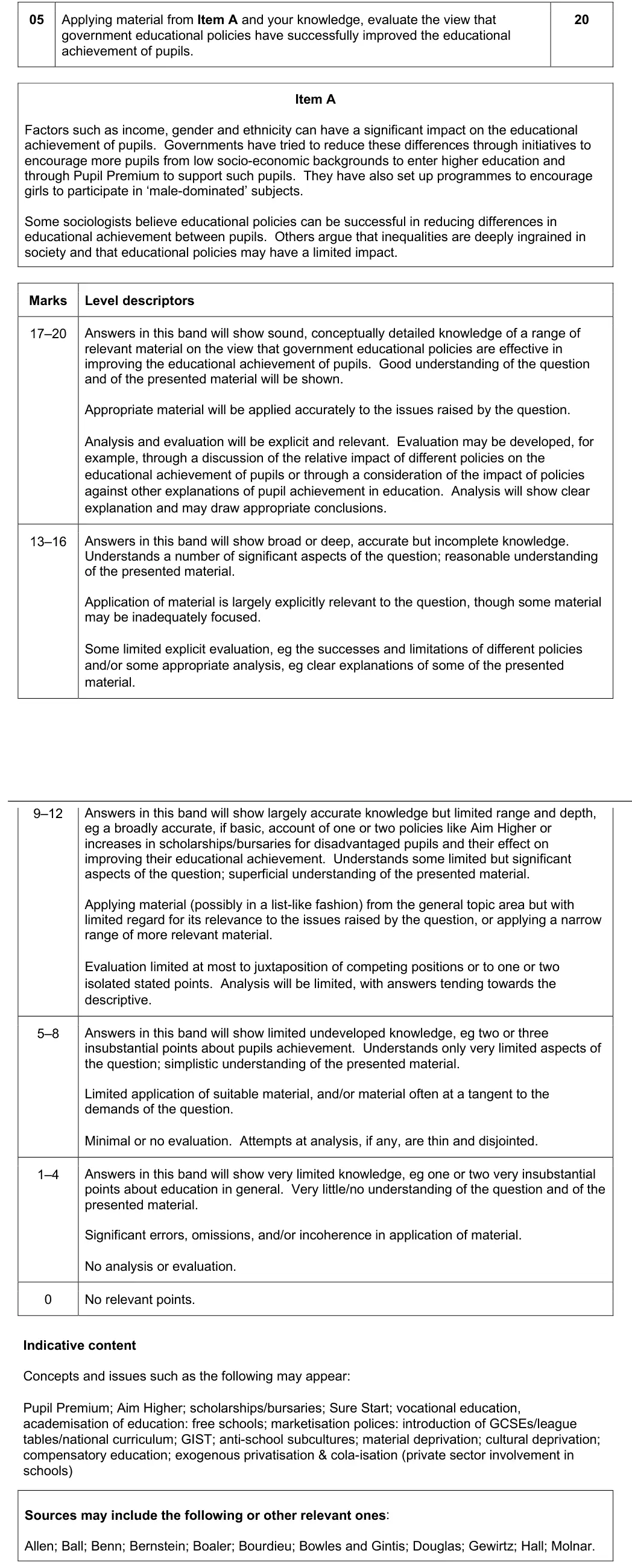
Applying material from Item A and your knowledge, evaluate the view that government educational policies have successfully improved the educational achievement of pupils.
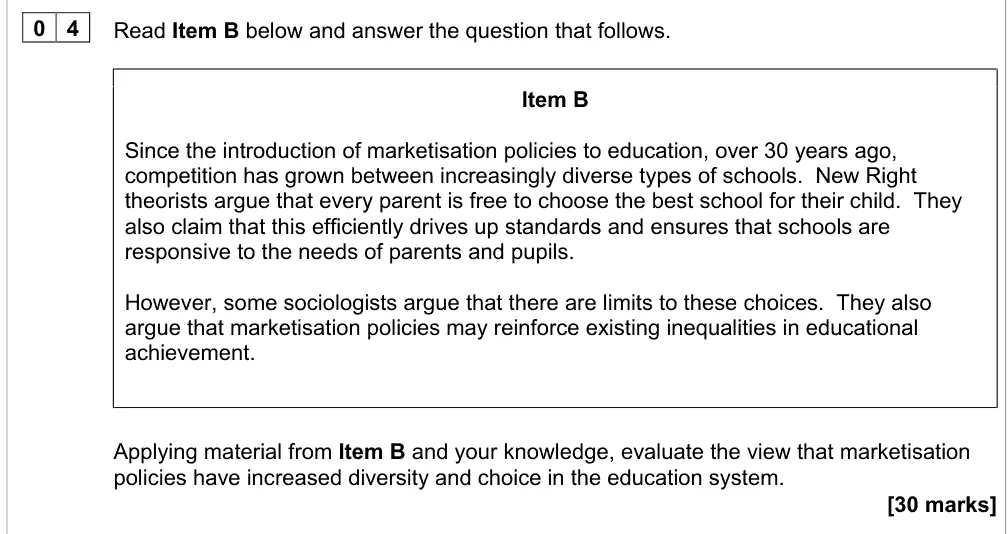
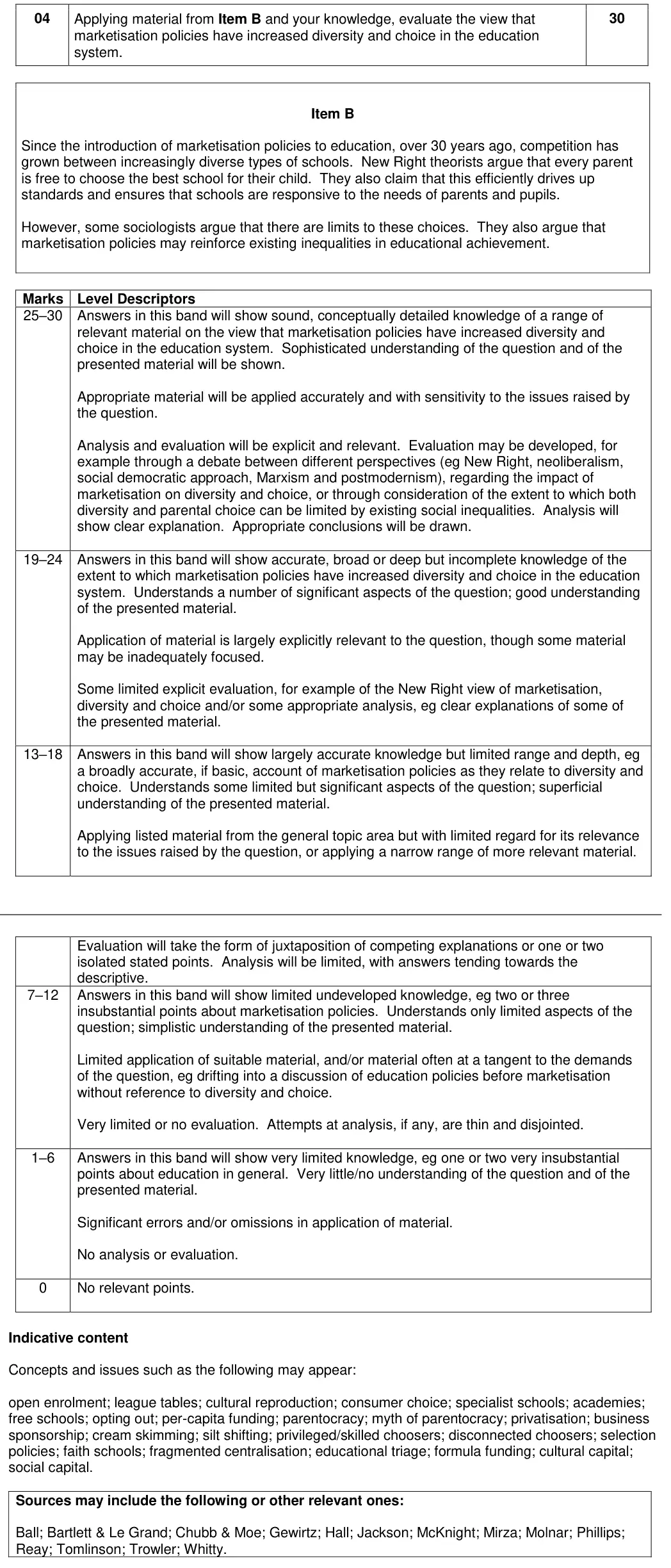
Applying material from Item B and your knowledge, evaluate the view that marketisation policies have increased diversity and choice in the education system.
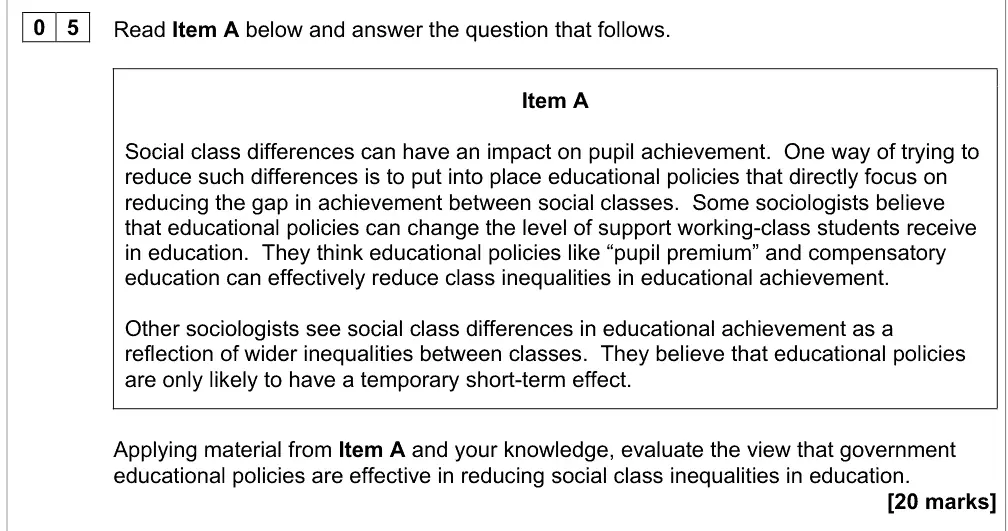
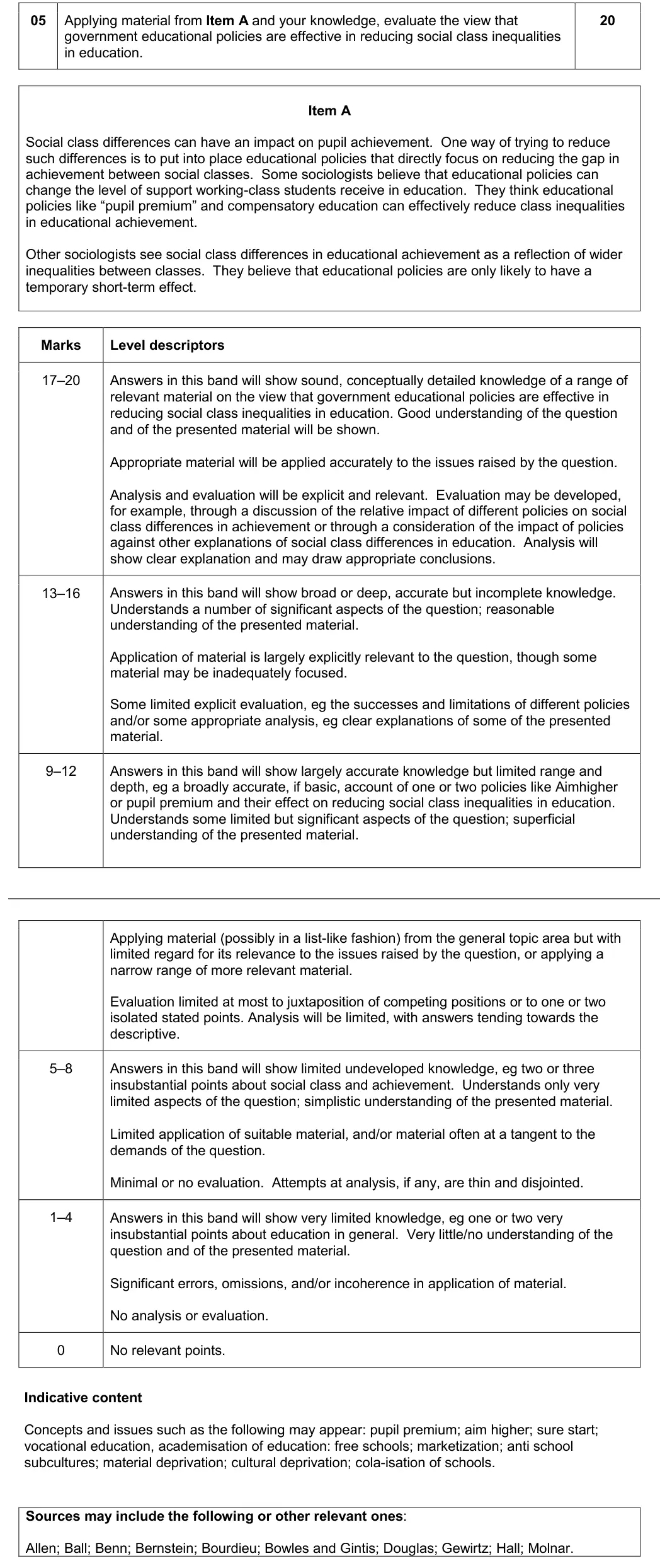
Applying material from Item A and your knowledge, evaluate the view that government educational policies are effective in reducing social class inequalities in education.
Tap a question to zoom it. The mark scheme (with the level descriptors and indicative content) and the examiner's comment open underneath.
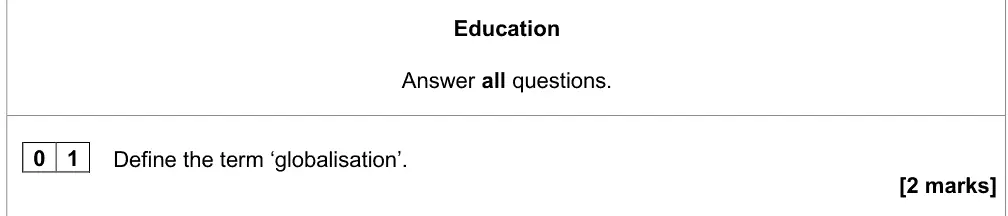
June 2025 · AS Paper 1 · Q12 marksAO1=2Define
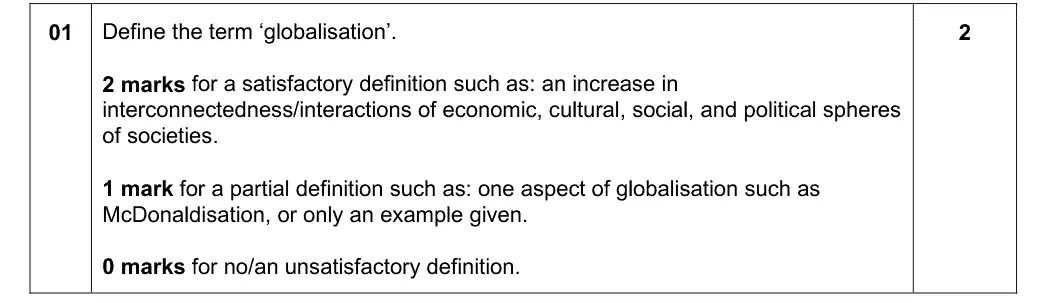
Mark scheme
Examiner's comment
Most students found this question accessible. Credit was given for a range of different definitions, given the contested nature of globalisation. Some merely repeated the term or a contracted version of it in their answer. Some students were able to give an example of a policy related to globalisation or an implication of it and received partial credit.
Notes from the mark scheme and report
2 marks for growing interconnectedness of economic, cultural, social and political spheres
one aspect (e.g. McDonaldisation), a related policy or just an example = 1 mark
repeating the term not credited
a range of definitions accepted as the concept is contested
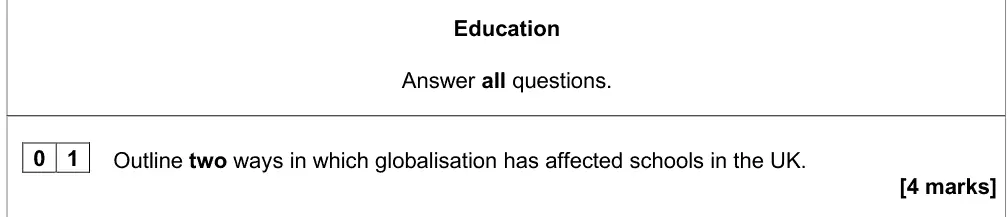
June 2025 · Paper 1 · Q14 marksAO1=4Outline
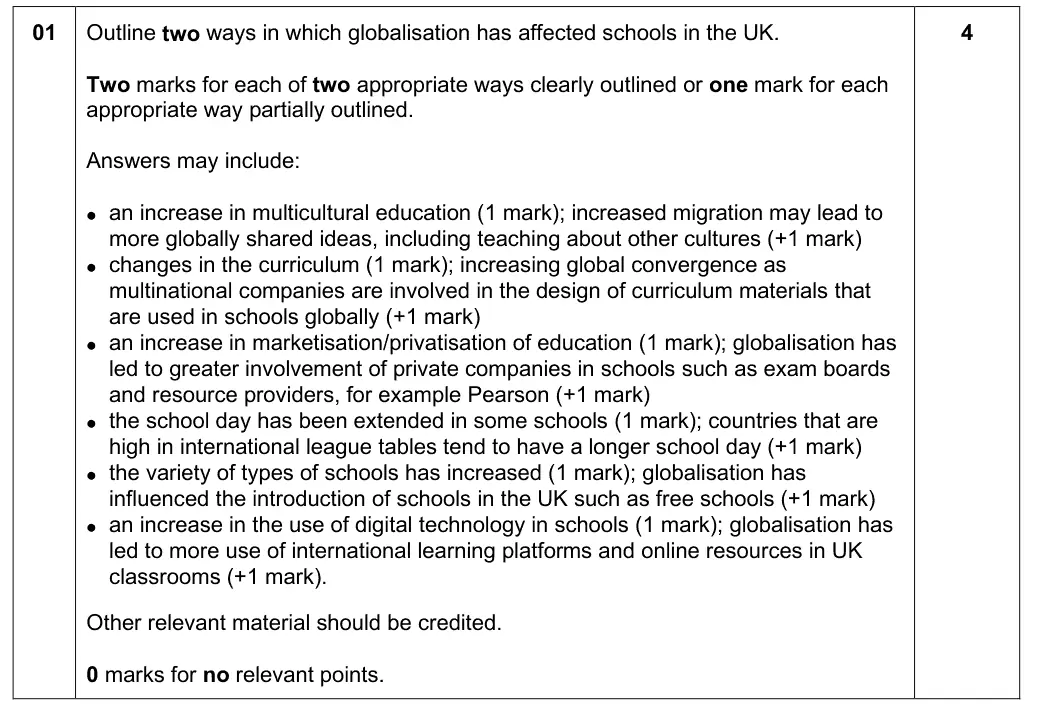
Mark scheme
Notes from the mark scheme and report
2 marks for each of two ways clearly outlined, 1 if partially outlined
credited: multicultural education, global curriculum convergence, private/global companies in schools (e.g. Pearson), longer school day after international league-table comparisons, new school types such as free schools, global digital platforms
no examiners' report published
June 2025 · AS Paper 1 · Q520 marksAO1=8, AO2=6, AO3=620-mark essay
Mark scheme, including the levels grid and indicative content
Examiner's comment
Students had a good knowledge of policies in relation to this question. Not all were able to relate this knowledge to improving the educational achievement of pupils. There was also some confusion about the details of some policies that were deployed for example the way pupil premium operates. Higher-scoring students were able to identify a policy and its impact on achievement and then use theory/sociological perspectives to analyse and evaluate its impact. Furthermore, at the high end of the mark scheme, students were able to offer a contested viewpoint about some policies in order to develop their evaluation. At the lower end, this was juxtaposition. Many students used the item to expand on their knowledge and/or provide prompts.
Notes from the mark scheme and report
must link each policy to its impact on achievement
top band weighs policies against each other and against other explanations of achievement, with contested views of policies
lower answers juxtaposed
some confused how policies such as Pupil Premium work
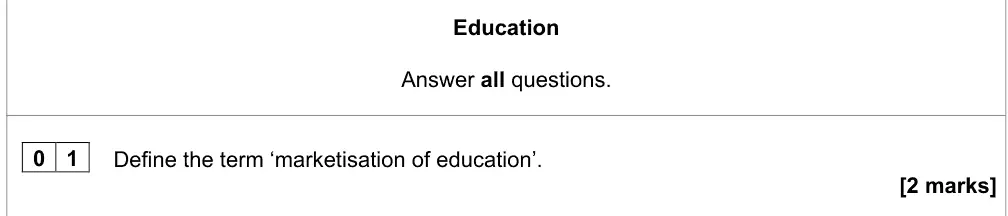
June 2024 · AS Paper 1 · Q12 marksAO1=2Define
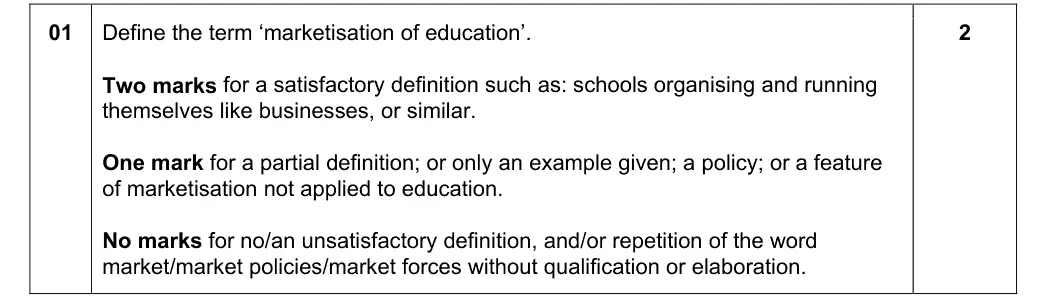
Mark scheme
Examiner's comment
Question 01: Students were awarded full marks for a complete definition of the meaning of the marketisation of education. Some students merely repeated the word they were seeking to define, and centres would be well advised to warn against this when completing practice responses in future. Some students knew examples of marketisation policies but not what the term itself meant and were able to gain partial credit.
Notes from the mark scheme and report
2 marks for schools organising and running themselves like businesses
1 for a partial definition, only an example or policy, or a market feature not applied to education
repeating 'market' without elaboration gets nothing
some knew marketisation policies but not what the term means
June 2024 · Paper 1 · Q14 marksAO1=4Outline
Mark scheme
Examiner's comment
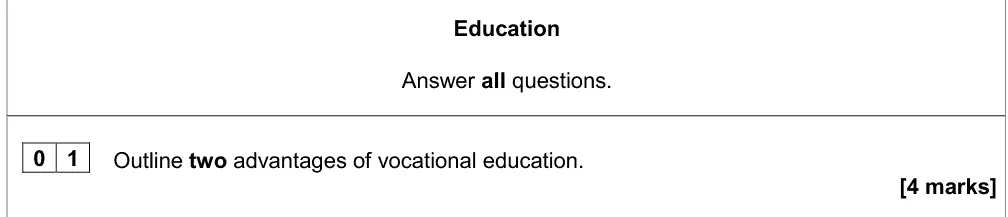
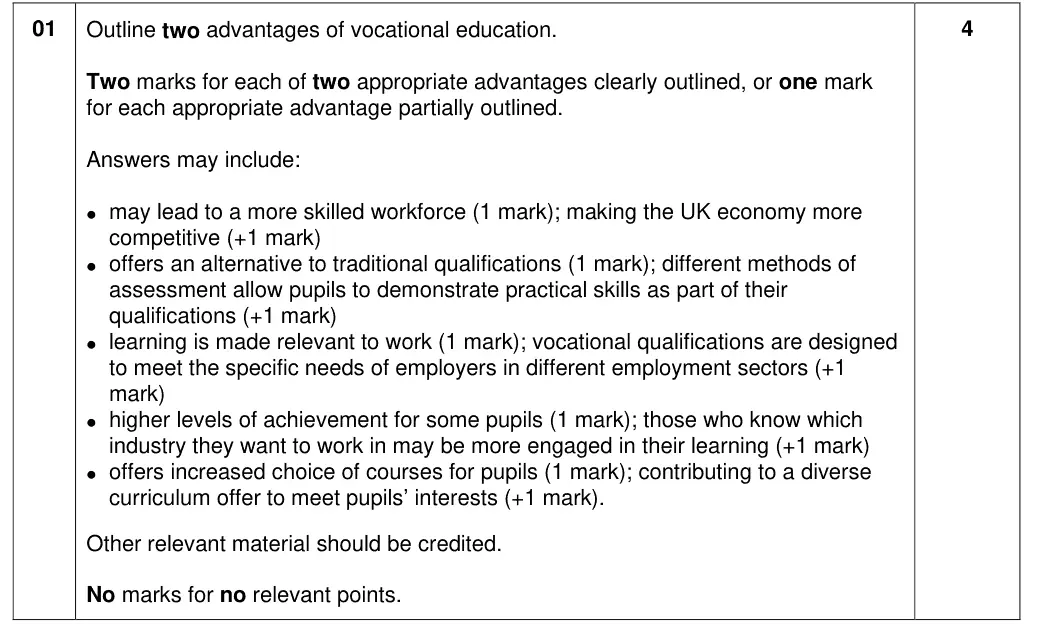
Most students performed well on this question, typically identifying that vocational education prepares students for the workforce by providing relevant skills and knowledge. Common answers included that vocational education offers alternatives to traditional academic routes, allowing some students to achieve higher. However, some responses were too general, such as stating that ‘it prepares students for jobs’, without specifically linking this to vocational education. These generic answers could easily apply to both vocational and non-vocational education, which limited the marks that could be awarded.
Notes from the mark scheme and report
2 marks for each of two advantages clearly outlined, 1 if only partially outlined
e.g. skilled workforce and competitiveness, alternative assessment of practical skills, work-relevant learning, higher achievement for some, wider choice
generic points that fit any education ('prepares students for jobs') limited marks
June 2024 · Paper 1 · Q26 marksAO1=3, AO2=3Outline
Mark scheme
Examiner's comment
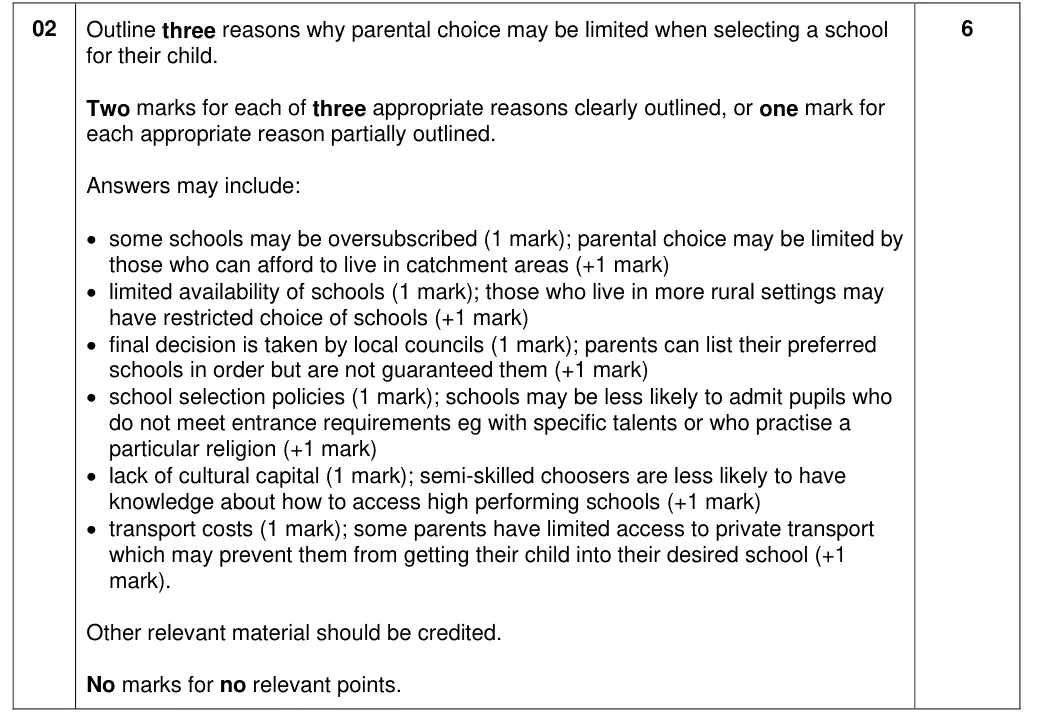
This was generally a high-performing question, with the vast majority of students able to score at least some marks. A significant proportion of students were able to achieve full marks, taking advantage of the wide range of possible responses. Students commonly discussed issues such as school oversubscription, geographical limitations, and the influence of socio-economic status and cultural capital on accessing high-performing schools of choice. These responses were well-developed and demonstrated a clear understanding of the factors limiting parental choice in school selection. However, some responses were too generic, often mentioning concepts like the ‘myth of parentocracy’ without elaborating on how or why it limits parental choice or providing specific examples. In these cases, students sometimes relied on broad statements without adequately applying their knowledge to the specifics of the question. To score higher, students could improve by providing more detailed examples and explanations, clearly linking their points to how these factors specifically limit parental choice.
Notes from the mark scheme and report
2 marks for each of three reasons clearly outlined, 1 if only partially outlined
e.g. oversubscription and catchment areas, few schools in rural areas, council decides, selection criteria, lack of cultural capital, transport costs
high-performing question
naming the 'myth of parentocracy' without explaining how it limits choice gained little
June 2023 · Paper 1 · Q26 marksAO1=3, AO2=3Outline
Mark scheme
Examiner's comment
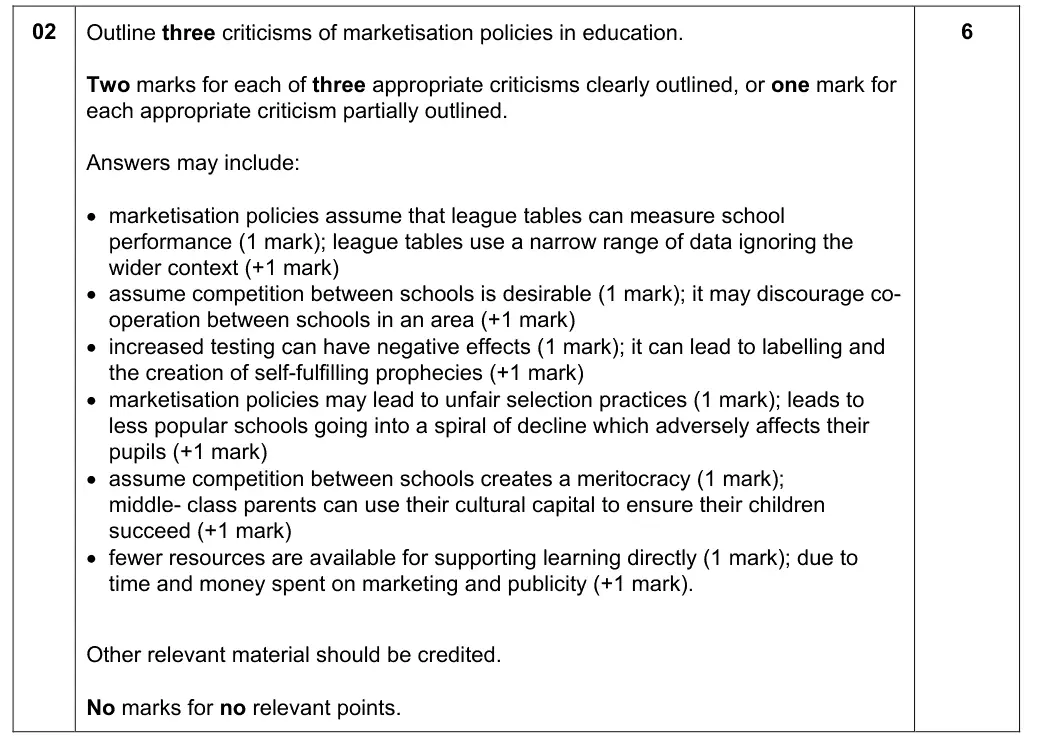
There were a wide range of answers to this question. Many students took the approach of criticising marketisation policies generally. Students commonly referred to the ‘myth of parentocracy’ and/or that these policies may have led to greater inequalities as some schools may select students from some social groups over others. Other students referred to criticisms of specific marketisation policies, for example, that league tables may produce a misleading and inaccurate picture of the success of a school. Some less successful students drifted into criticisms of privatisation in education without any success of linking this in any way to marketisation. Some others referred to more general and non-relevant policies such as the tripartite system.
Notes from the mark scheme and report
2 marks for each of three criticisms clearly outlined, 1 if only partially outlined
common answers: myth of parentocracy, greater inequality through selection, league tables misleading
weaker answers drifted into privatisation or unrelated policies such as the tripartite system
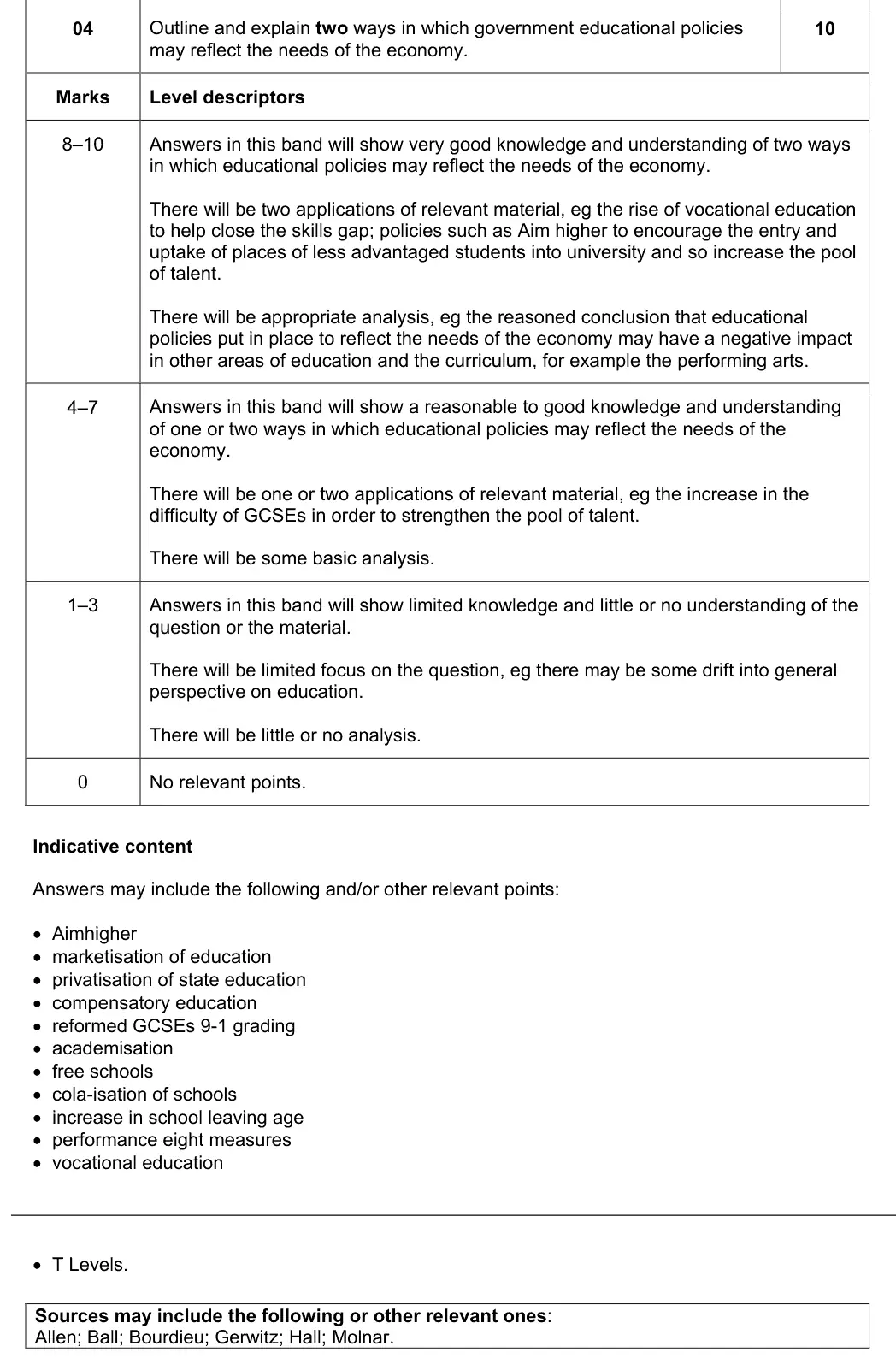
June 2023 · AS Paper 1 · Q410 marksAO1=5, AO2=3, AO3=2Outline and explain
Mark scheme, including the levels grid and indicative content
Examiner's comment
In the questions where extended prose was required (10 and 20 mark questions) most students showed their understanding of the different balance of skills required in each question. Question 04: This question required students to be able to apply two government education policies to the needs of the economy. Centres have clearly taught educational policy well and a large proportion of students understood what the economy was and were able to use their knowledge and application skills to answer the question. Raising the school leaving age and the National Curriculum were popular policy choices, as were several from within the 1988 Educational Reform Act. There were several sophisticated responses that applied a policy intended to raise standards in education with a global economy and a greater need for a highly educated workforce. Students were still able to gain credit where they made some link to the economy, eg keeping school leavers out of poverty and families benefitting from being spared the expense of providing food/resources. However, there were a minority of students who missed the intention of the question by suggesting policies that were internal to specific schools, policies that weren’t educational in focus, or not understanding the term ‘economy’.
analysis e.g. economy-driven policy squeezing the arts
drift into general perspectives on education = 1-3
raising school leaving age, National Curriculum and 1988 Education Reform Act were popular
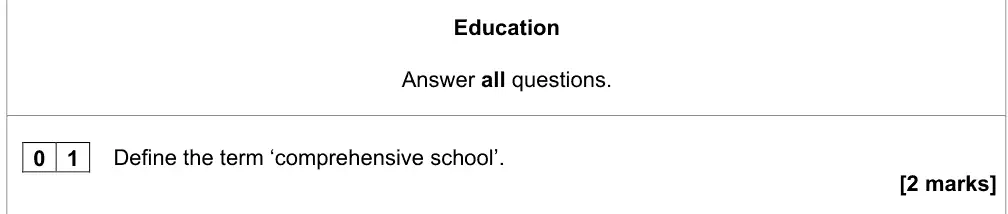
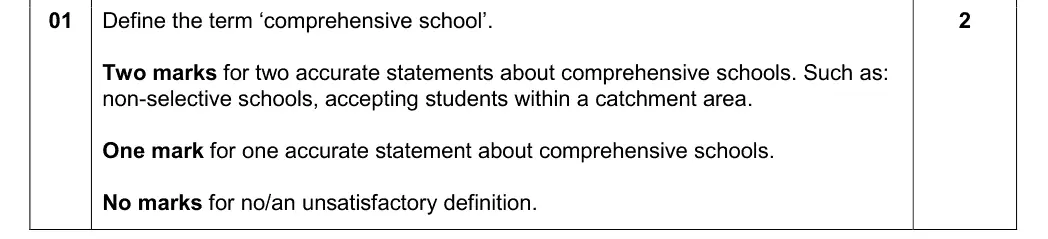
June 2022 · AS Paper 1 · Q12 marksAO1=2Define
Mark scheme
Examiner's comment
Students were awarded marks for being able to state correct and specific information about comprehensives schools. Many were aware that comprehensives admit students from a local catchment area and that they do not take an examination to gain entry to the school. Unfortunately, many students made generic statements that did not gain credit, as they could equally be applied to other types of school, for example that comprehensives do not charge fees to attend.
Notes from the mark scheme and report
1 mark per accurate statement, 2 statements needed (e.g. non-selective, admits pupils from a local catchment area)
generic points that fit other school types (e.g. no fees) not credited
June 2022 · Paper 1 · Q430 marksAO1=12, AO2=9, AO3=930-mark essay
Mark scheme, including the levels grid and indicative content
Examiner's comment
This question worked well in providing varying levels of challenge and there was a clear range of marks across all levels. Unfortunately, some answers drifted into lengthy discussions of policies that were not linked to marketisation, for example the tripartite system or the development of comprehensives. However, most students were able to provide at least some basic knowledge and understanding of marketisation policies which usually included open enrolment, formula funding, academies and free schools etc. As a result, most students (maybe partly a result of some of the advance information released from the exam board) were able to score marks towards the top end of the 13-18 level and higher. Weaker responses had a narrower range of these policies and were outlined in a more general and descriptive way. The better answers were able to develop and explain how these policies affected diversity and choice for students, parents and schools. It was also pleasing to see that some answers were able to clearly differentiate between diversity and choice in their analysis of the effects of these marketisation policies. In general, there was a pleasing range of relevant theories and studies used in students’ responses which included New Right theorists Chubb & Moe as well as Bartlett and Gilbourn & Youdell. Furthermore, there were a range of relevant and useful concepts (to varying levels of success) which included ‘parentocracy’, ‘cultural capital’ and ‘skilled choosers’ etc. Stronger answers were then able to provide specific evaluation, including the ‘myth of parentocracy’, in challenging the extent to which marketisation policies enabled choice and diversity for everyone equally.
Notes from the mark scheme and report
top band debates perspectives (New Right, neoliberal, social democratic, Marxist, postmodernist) or how class inequalities limit diversity and choice
drift into pre-marketisation policies (tripartite system, comprehensives) = 7–12
better answers distinguished diversity from choice and used myth of parentocracy, skilled choosers, cultural capital
June 2022 · AS Paper 1 · Q520 marksAO1=8, AO2=6, AO3=620-mark essay
Mark scheme, including the levels grid and indicative content
Examiner's comment
This question was answered well by students. It was clear that centres had prepared students to be confident in their knowledge of educational policies. Many students were able to successfully identify a range of appropriate policies and the impact they had on social class inequalities. The best responses were able to separate intention from consequences and were able to give a critical account of the short-term and long-term impact of government educational interventions.
Notes from the mark scheme and report
top band weighs the impact of different policies, or policies against wider class inequality as an explanation (hook in Item A)
e.g. pupil premium, Aimhigher, Sure Start, academies, marketisation
answered well with a good range of policies
November 2021 · Paper 1 · Q14 marksAO1=4Outline
Mark scheme
Examiner's comment
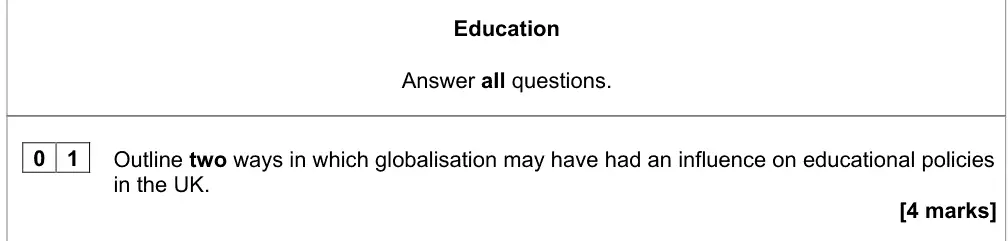
However, there was generally a lower quality and standard of answers in comparison to previous normal summer entries with a number of students finding Q1 and Q5 more difficult in particular. Similarly to previous years, some students wrote lengthy answers to the 4-mark and 6-mark questions which may explain why a few of these students seemed to run out of time in answering the final question(s). This question seemed to cause students some difficulties. There were a wide range of answers offered but many students appeared to be confused or demonstrate little knowledge and understanding of this area of the specification. There were a number of answers that focused either on globalisation or educational policies more generally rather than the ways that globalisation may have influenced educational policies. Stronger answers were able to outline international testing programmes and marketisation policies, in particular, as ways (or examples) of globalisation influencing educational policies in the UK.
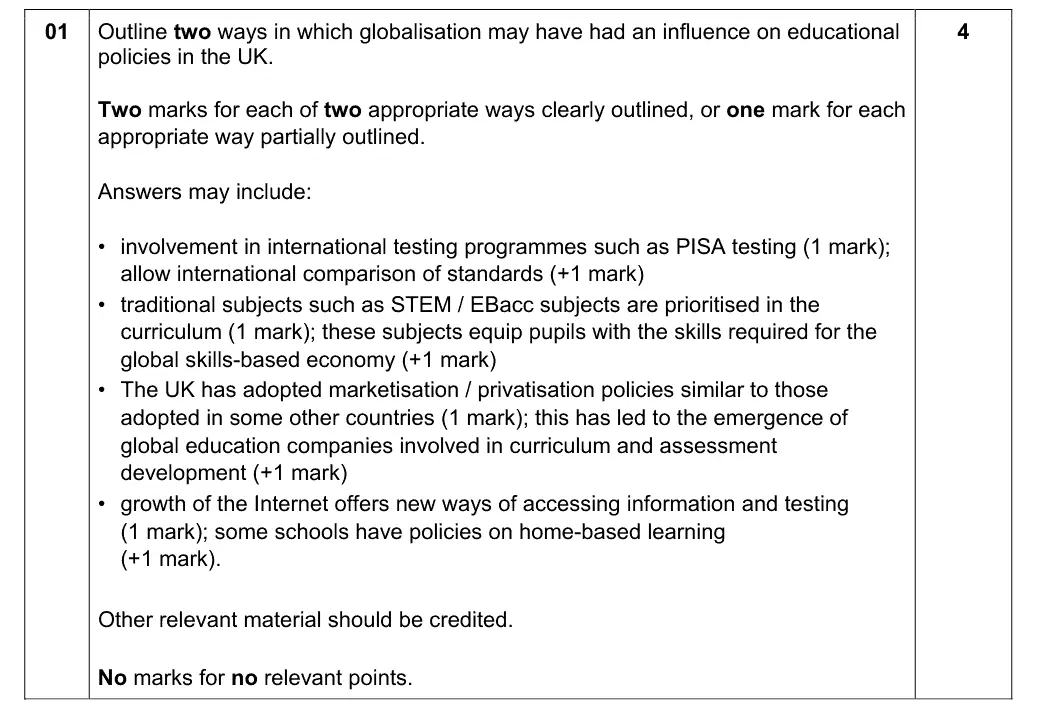
Notes from the mark scheme and report
2 marks for each of two ways clearly outlined, 1 if partial
credited: PISA and international comparison, STEM/EBacc for a global economy, marketisation and global education companies, internet-based learning
many wrote about globalisation or education policy in general rather than the link between them
November 2020 · AS Paper 1 · Q22 marksAO2=2Brief explain
Mark scheme
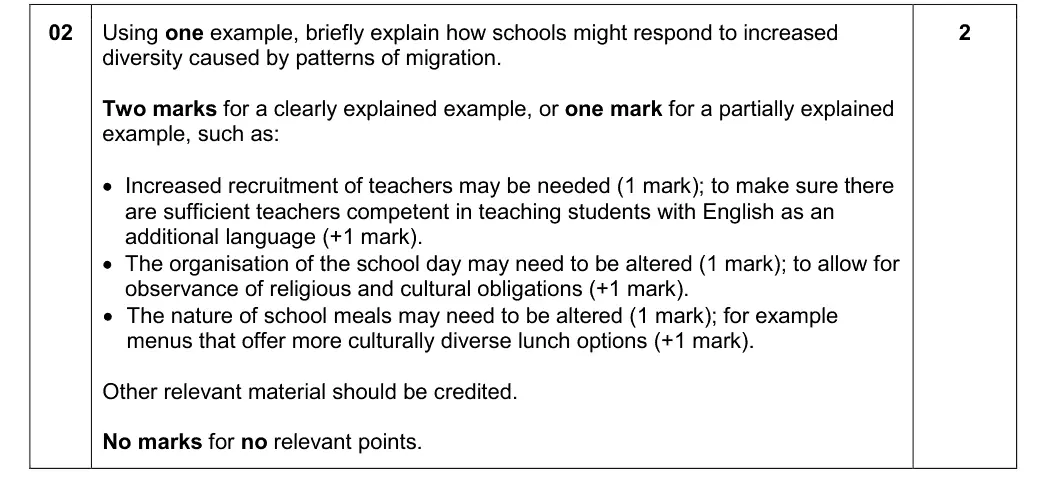
Notes from the mark scheme and report
1 mark for the school response +1 for explaining it (recruiting EAL-competent teachers, adjusting the school day for religious observance, culturally diverse menus)
no examiners' report for this series
November 2020 · Paper 1 · Q310 marksAO1=3, AO2=4, AO3=3Analyse
Mark scheme, including the levels grid and indicative content
Examiner's comment
This question generally proved problematic for students. Although many could apply the notion of schools competing with each other, the majority failed to develop the Item hook about providing unique products. The failure to develop two applications from the Item meant that many answers scored lower in the 4−7 level. Some answers demonstrated sound use of marketisation policies such as formula funding, ERA and league tables. However, often the focus in the development of these policies was more on the promotion of parentocracy rather than showing how schools operated more like businesses. Stronger responses maintained a focus on how these policies encouraged schools to act like a business, sometimes drawing direct comparisons with typical business practices. Furthermore, some students were able to develop further analysis and evaluation in discussing issues of differences in economic and cultural capital resulting in some parents benefitting from schools being run like businesses and therefore increasing inequality of opportunity in achievement between social groups.
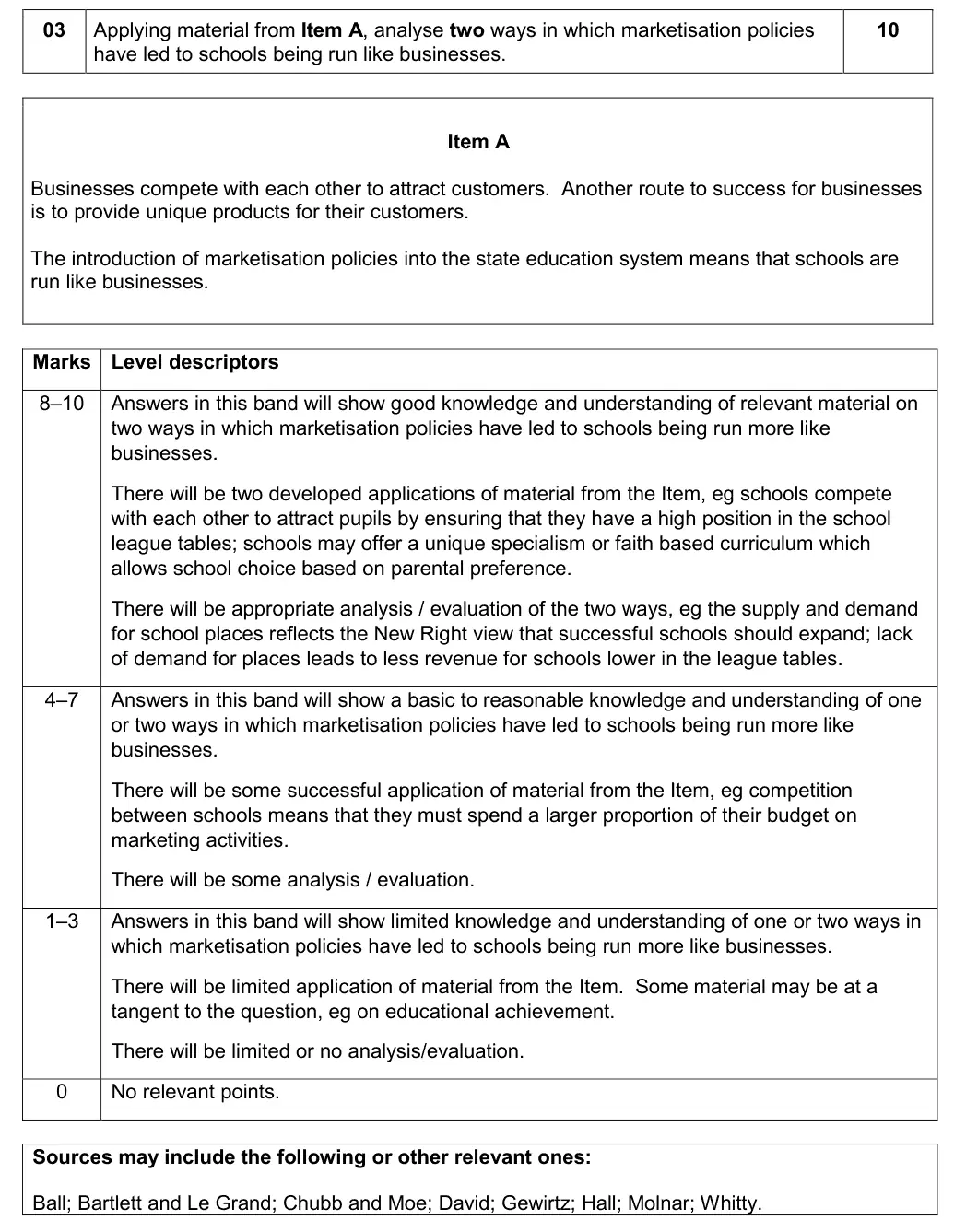
Notes from the mark scheme and report
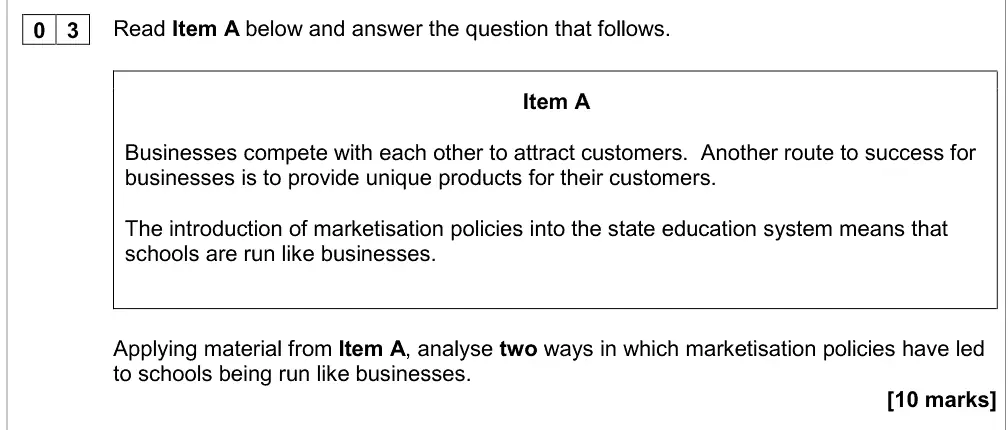
two developed applications from Item A (competing for customers
unique products), e.g. league tables and competition for pupils, specialisms or faith schools
drift into educational achievement is a tangent
most failed to develop the unique-products hook so stayed low in 4–7
focusing on parentocracy rather than schools acting like businesses misses the point
good evaluation via unequal economic and cultural capital among parents
June 2019 · Paper 1 · Q14 marksAO1=4Outline
Mark scheme
Examiner's comment
A significant number of students wrote too much for the 4-mark and 6-mark questions, although fewer than in the two previous years. Centres are reminded that these small-mark questions are best answered with a clear ‘point’ and ‘development’ structure, rather than lengthy continuous prose. Most students could identify at least one criticism of selecting by ability and were able to explain their criticism adequately to get the additional mark. Common responses made reference to disadvantaging different social groups, the late developer, lowering student self-esteem and the problems of measuring and defining intelligence. A number of responses also focused on how schools selected externally using an entrance exam or internally, by way of setting and streaming. However, this question did create problems for some students. Less effective responses failed to focus on the ‘by ability’ element in the question and discussed schools selecting higher performing pupils by choice, rather than by testing ability. A significant number of responses failed to score any marks because they either did not identify a specific group that might be disadvantaged or instead outlined characteristics of the selection process, rather than a critiquing them. A number of students failed to gain a second mark by either not giving an adequate explanation of the criticism or by repeating their first explanation.
Notes from the mark scheme and report
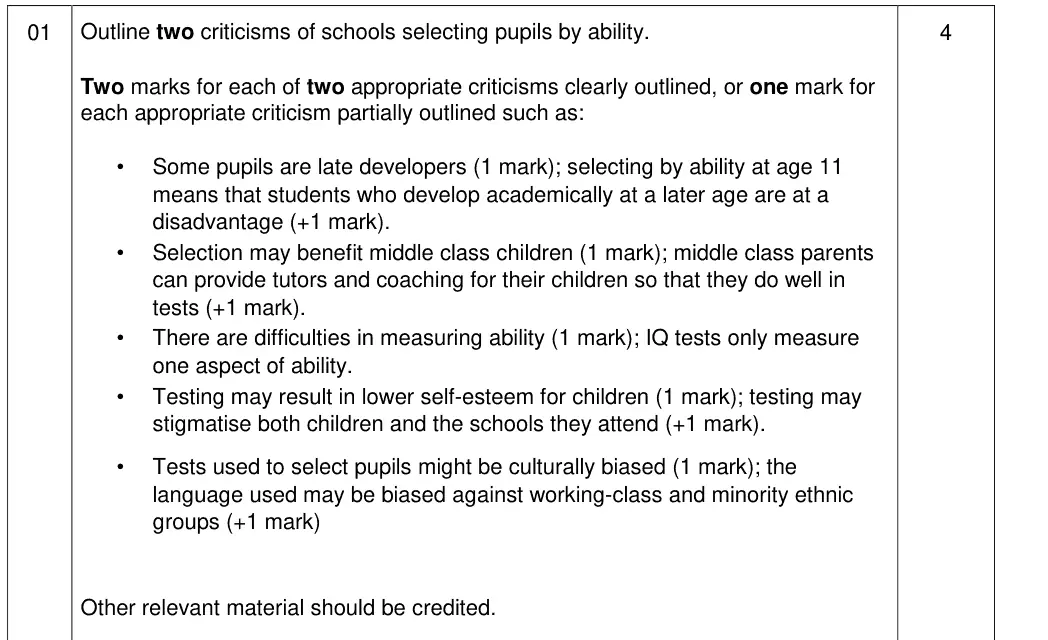
2 marks for each of two criticisms clearly outlined, 1 if partial
credited: late developers, middle-class coaching advantage, difficulty measuring ability, lower self-esteem and stigma, culturally biased tests
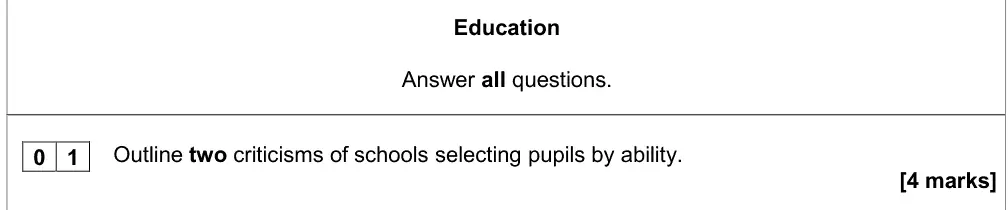
must focus on selection by ability, not schools choosing pupils in general
saying a group is disadvantaged without naming it, or describing the process rather than criticising it, scored nothing
June 2019 · AS Paper 1 · Q22 marksAO2=2Brief explain
Mark scheme
Examiner's comment
There was a wide range of answers provided for this question. A large number of students struggled to identify an explicit way in which schools select students. For example, many offered ‘social class’ as a way that schools select without mentioning any explicit way in which schools select on that basis. Furthermore, despite the question stating ‘other than by academic ability’, many students offered selection criteria that referred to ability, for example ‘by testing students’. Most students that offered ‘social class’ as a selection criterion then went on to explain that this was because it would help schools to improve their ranking in league tables, and so was implicitly about ability and therefore not credit worthy. In addition, most students who offered selection by ‘sex’ then went on to explain that this is because girls do better in tests and portray the school in a more positive light, and therefore was again about ability and not worthy of the full 2 marks. Other students offered ‘cream skimming’ without any mention of the process of selection. More successful answers were often based around the ideas of ‘catchment area’ or ‘faith’ which then were explained by, for example, stating ‘by selecting students who live in a certain proximity of the school’ or ‘selecting students that could demonstrate church attendance’.
Notes from the mark scheme and report
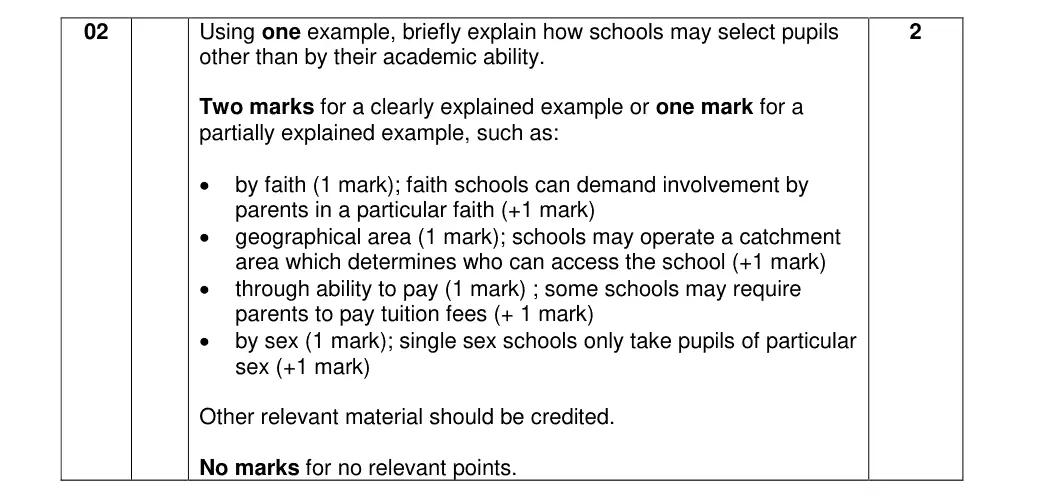
must name an explicit selection method and explain it
anything based on ability (tests, league-table motives, cream-skimming without the mechanism) not credited
'social class' alone is not a selection method
best answers used catchment area or faith (e.g. proof of church attendance)
June 2019 · AS Paper 1 · Q410 marksAO1=5, AO2=3, AO3=2Outline and explain
Mark scheme, including the levels grid and indicative content
Examiner's comment
There was clear evidence of teachers preparing students well to answer this question, for example by ensuring that students answered the question with two distinct paragraphs, and without the need for an introduction or conclusion. Students found no difficulty in identifying two relevant policies that have influenced gender differences in achievement, either directly such as through the National Curriculum, coursework, GIST/WISE; or indirectly, by means of the Equal Pay Act or Sex Discrimination Act. However, students then struggled to achieve answers in the top band due to their inability to develop their answers, and/or clearly explain how their chosen policy may have influenced differences in educational achievement between males and females. There was a tendency to over focus on female achievement rather than on explaining gender differences, and this failure by a large number of students to explore how polices may have helped females and discouraged males, meant many students remained in the middle band. Some answers drifted into subject choice or identified polices which were clearly more associated with social class rather than gender differences and as a result they failed to apply their answer specifically to the question set.
Notes from the mark scheme and report
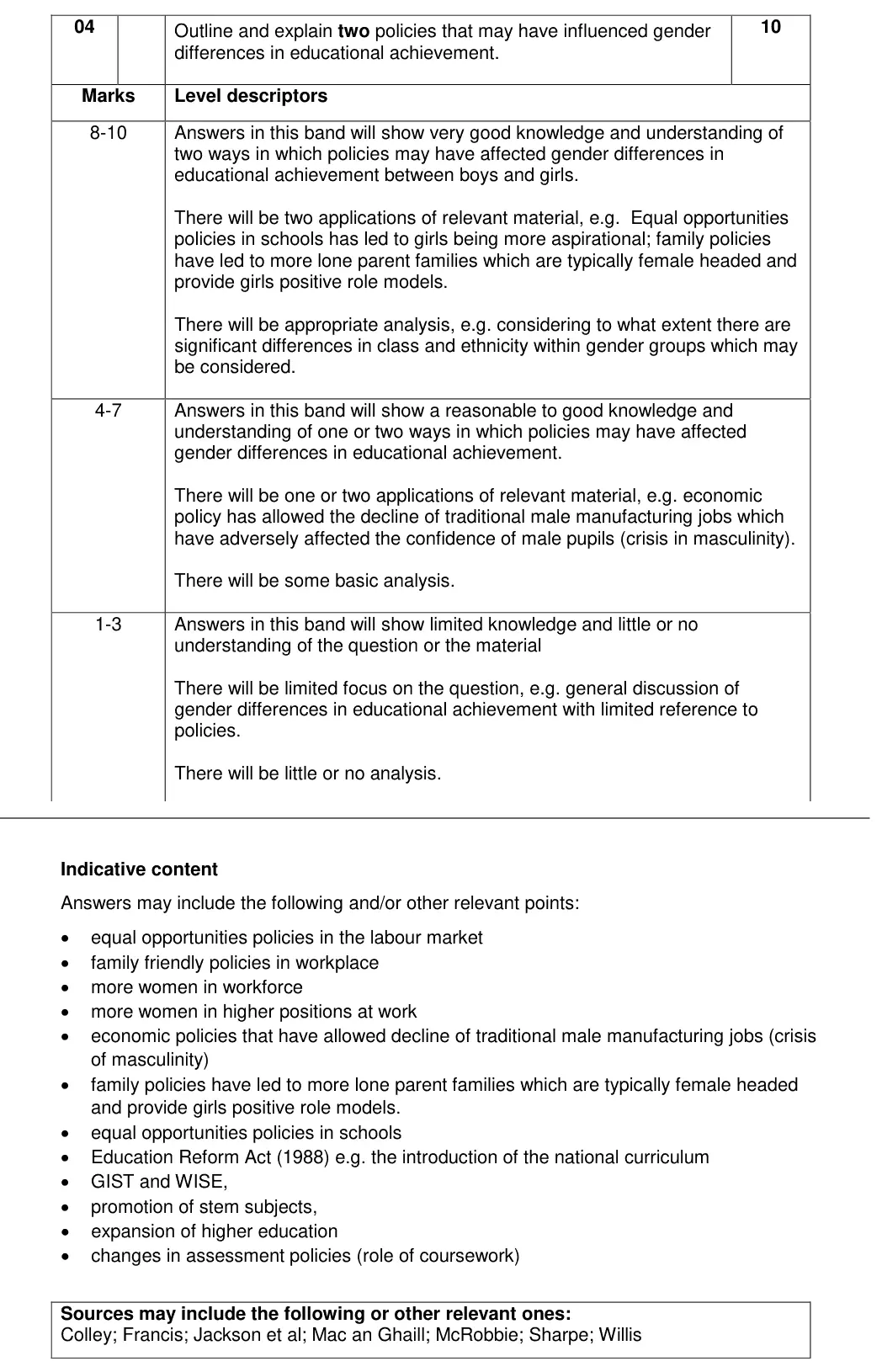
must explain how each policy affected the gap between boys and girls, not just girls' achievement
generic gender and achievement with little on policy = 1–3
drift into subject choice or class-based policies not credited
common policies: National Curriculum, coursework changes, GIST/WISE, Equal Pay and Sex Discrimination Acts
top band considers class and ethnicity within gender groups
June 2018 · Paper 1 · Q14 marksAO1=4Outline
Mark scheme
Examiner's comment
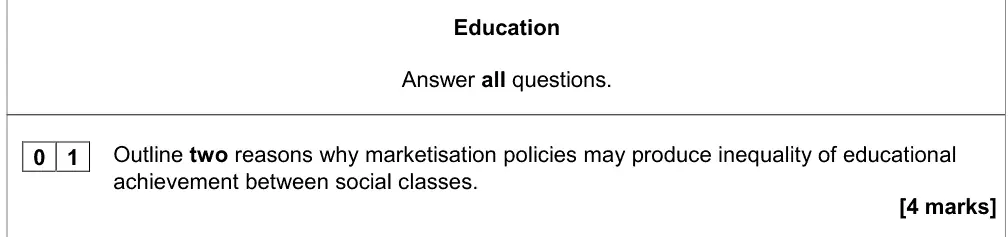
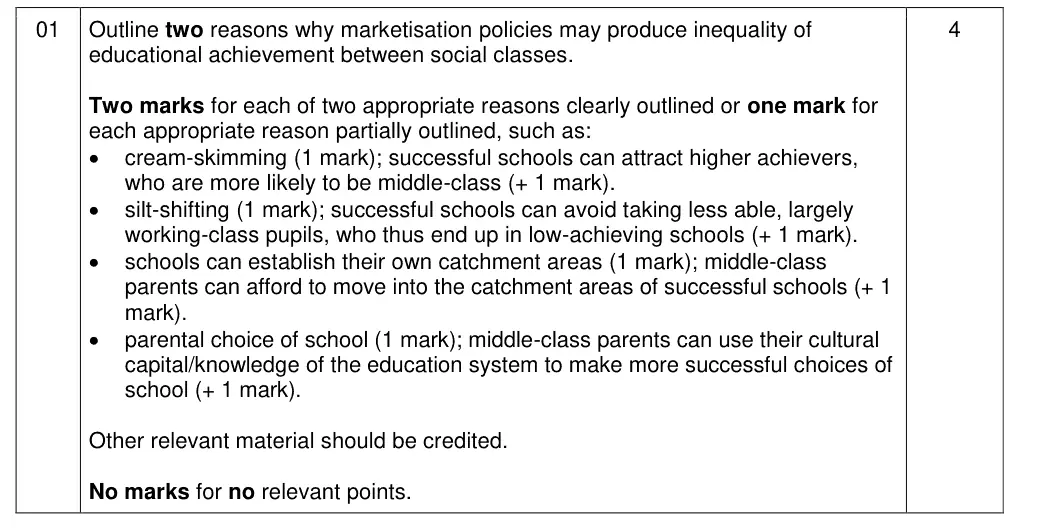
Whilst not as frequently as in the first sitting of the new specification, a significant number of students are writing too much for the 4 and 6 mark questions. Centres are reminded that these small-mark questions are best answered with a clear ‘point’ and ‘development’ structure, rather than lengthy continuous prose. Most students could identify two ways in which marketisation may create inequality of educational achievement, usually via two specific policies. Common responses made reference to marketisation polices enabling middle class parents to choose a better school (due to cultural and/or economic, capital) and higher achieving schools being able to pick middle-class students to maintain their position on the league tables. However, this question did create problems for many students. A significant number misunderstood the question by stating policies of marketisation such as league tables as the identification rather than the reason why marketisation produces inequality. Sometimes the connection to inequality of achievement was not made effectively enough to gain full marks. A few students selected policies that were not associated with marketisation, for example, the 1944 Act, or referred to private schools producing inequality of achievement between the classes.
Notes from the mark scheme and report
2 marks for each of two reasons clearly outlined, 1 if only partially outlined
credited cream-skimming, silt-shifting, selection by catchment/mortgage, middle-class cultural capital in school choice
naming a policy (e.g. league tables) is not itself a reason
must link to class inequality of achievement
some cited non-marketisation policies (1944 Act) or private schools
June 2018 · AS Paper 1 · Q36 marksAO1=3, AO2=3Outline
Mark scheme
Examiner's comment
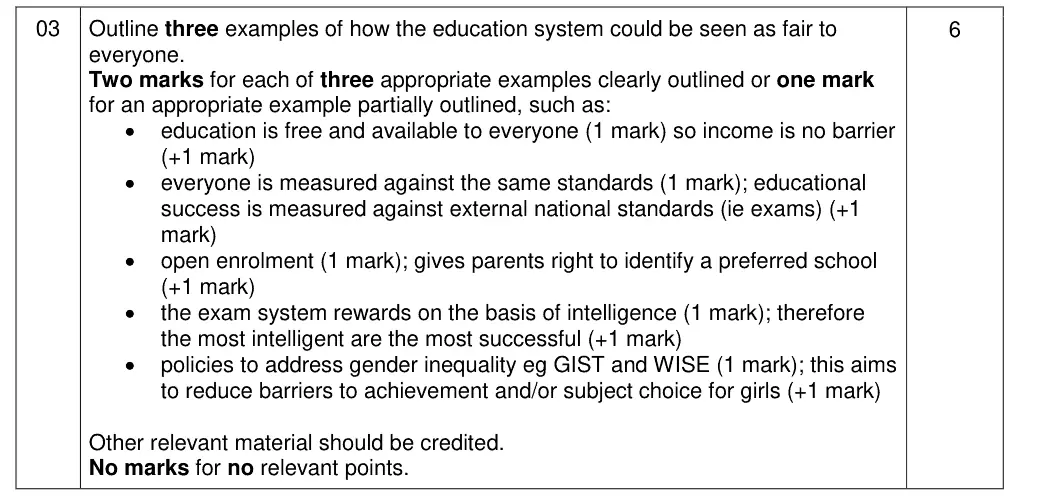
Students were able to offer a wide range of ways that the education system could be seen as fair to everyone. The most common responses referenced compensatory policies such as GIST/WISE, Sure Start and Free school meals. Other popular responses included ‘free education for all’, ‘taking the same exams’ and ‘following the same (National) curriculum’. Successful answers were then able to develop and qualify how this could be seen as fair for everyone. The most common error was to simply state that ‘students are able to work hard and achieve’ or to meritocracy more generally, without qualifying how this meant that the education system was fair to everyone.
Notes from the mark scheme and report
2 marks for each of three examples clearly outlined, 1 if partial
common answers: free education for all, same exams and National Curriculum, compensatory policies such as GIST/WISE, Sure Start, free school meals
saying pupils can simply work hard and achieve, or meritocracy in general, was not credited unless qualified
June 2017 · AS Paper 1 · Q22 marksAO2=2Brief explain
Mark scheme
Examiner's comment
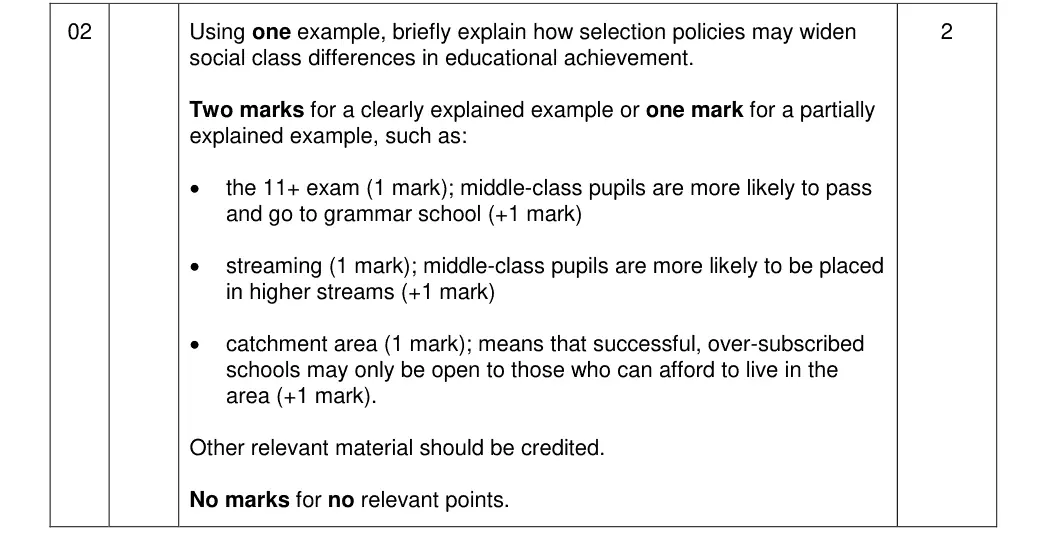
Students offered a wide variety of responses to this question. Some students were unable to clearly identify a selection policy and instead offered policies, such as league tables, Ofsted and marketisation. Others referred generally to the effects, processes or elected to discuss social class differences in general, without relation to a specific selection policy. Some students conflated choice with selection and referred generally to parental choice (or parentocracy), rather than the school choosing. More successful students were able to identify a range of selection policies, with most referring to the 11+ exam, setting and streaming, and entrance exams. The most successful answers were then able to explain how the identified policy may advantage middle-class pupils or disadvantage working-class pupils in terms of educational achievement.
Notes from the mark scheme and report
1 mark for the selection policy, +1 for explaining how it advantages middle-class or disadvantages working-class pupils (e.g. 11+, streaming, catchment areas)
league tables, Ofsted or general marketisation are not selection policies
parental choice confused with schools selecting pupils
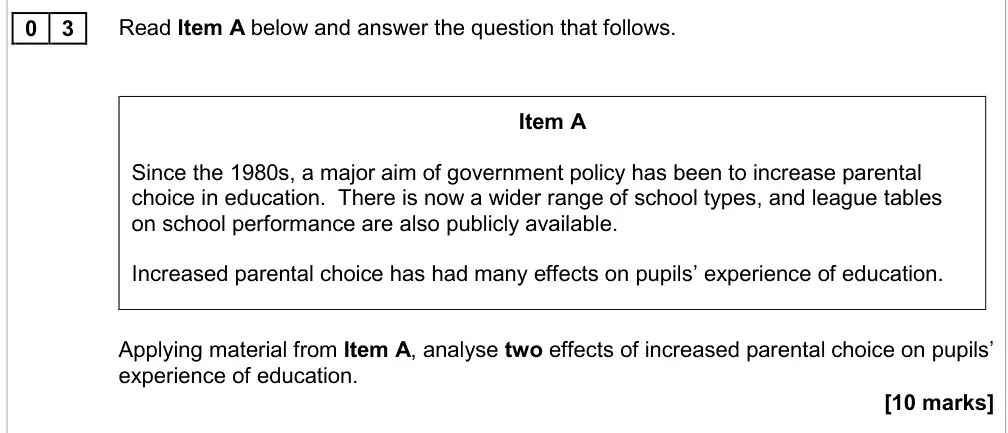
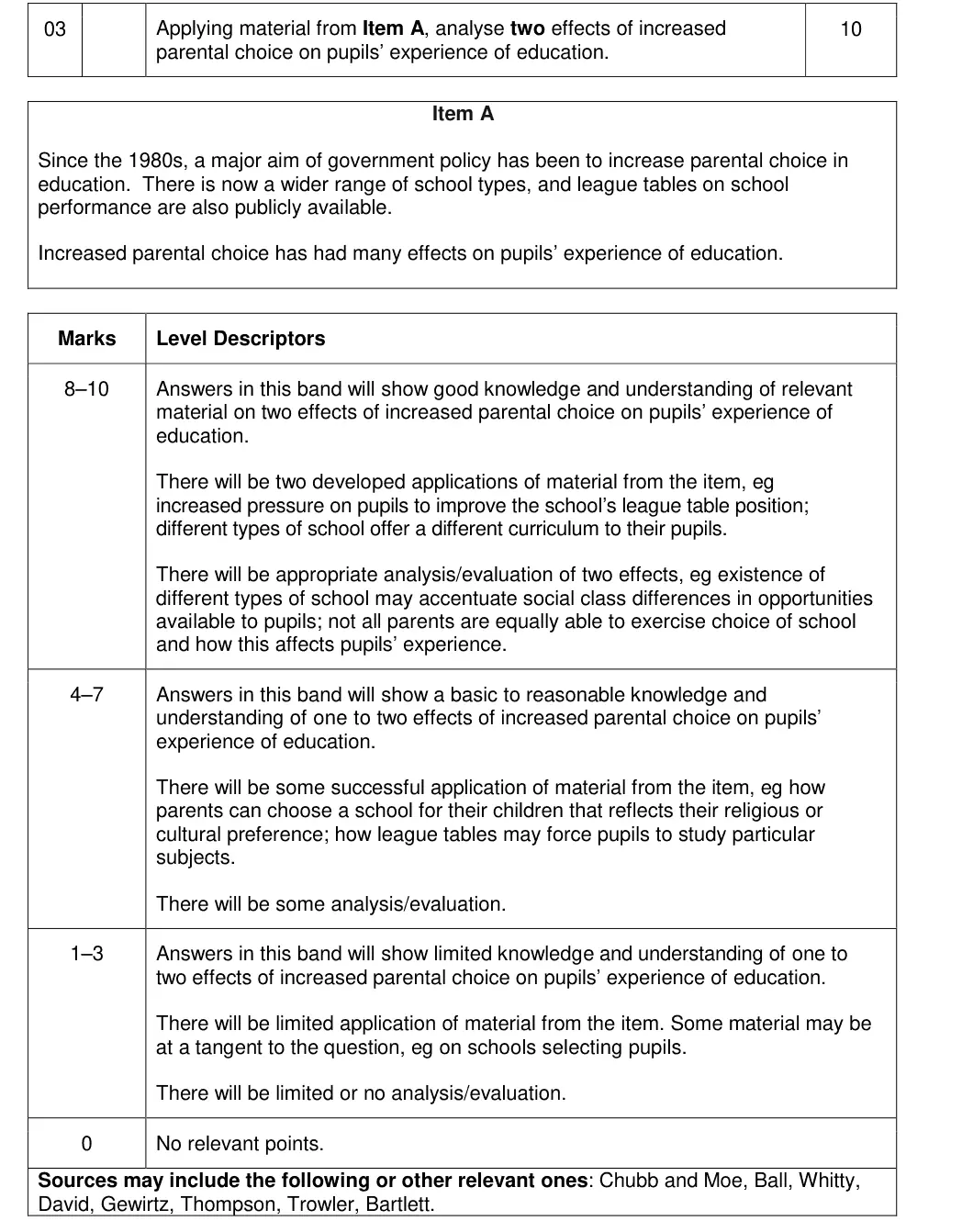
June 2017 · Paper 1 · Q310 marksAO1=3, AO2=4, AO3=3Analyse
Mark scheme, including the levels grid and indicative content
Examiner's comment
For question 03 there was limited application to the specific issue of pupils’ experience. This question required students to apply material from the Item and connect these with pupils’ experience. The more successful responses were able to identify two explicit hooks from the Item (league tables or wider range of school types), apply these to a discussion of parental choice and connect to pupils’ experience. They were able to analyse and evaluate these by drawing on different social class pupil experiences through a discussion of issues such as how league tables have led to educational triage and the work of Gerwitz. A number of students were not able to apply the hooks relating to increased parental choice from the Item and so were unable to score beyond the bottom band. Instead, many went on to develop concepts such as parentocracy, the A-C economy and marketisation that were not explicit in the Item. While most were able to identify at least one hook from the Item, students were less successful in applying these explicitly to pupils’ experience. Many responses stopped short at ”leads to better experience of school” and ”parents getting their children in to a good school and getting results”. Often responses focused solely on school or parental choice rather than pupils’ experience. In their analysis of a wider range of schools, a number of students referred to material on the tripartite system and private schools, and therefore did not refer to increased parental choice.
Notes from the mark scheme and report
must develop hooks from Item A (league tables, wider range of school types)
no use of the item = max 3
focus must be pupils' experience, not parents' or schools' choice
concepts not in the item (parentocracy, A-C economy) do not count as hooks
tripartite system and private schools are not increased parental choice
best answers used educational triage and Gewirtz on class differences
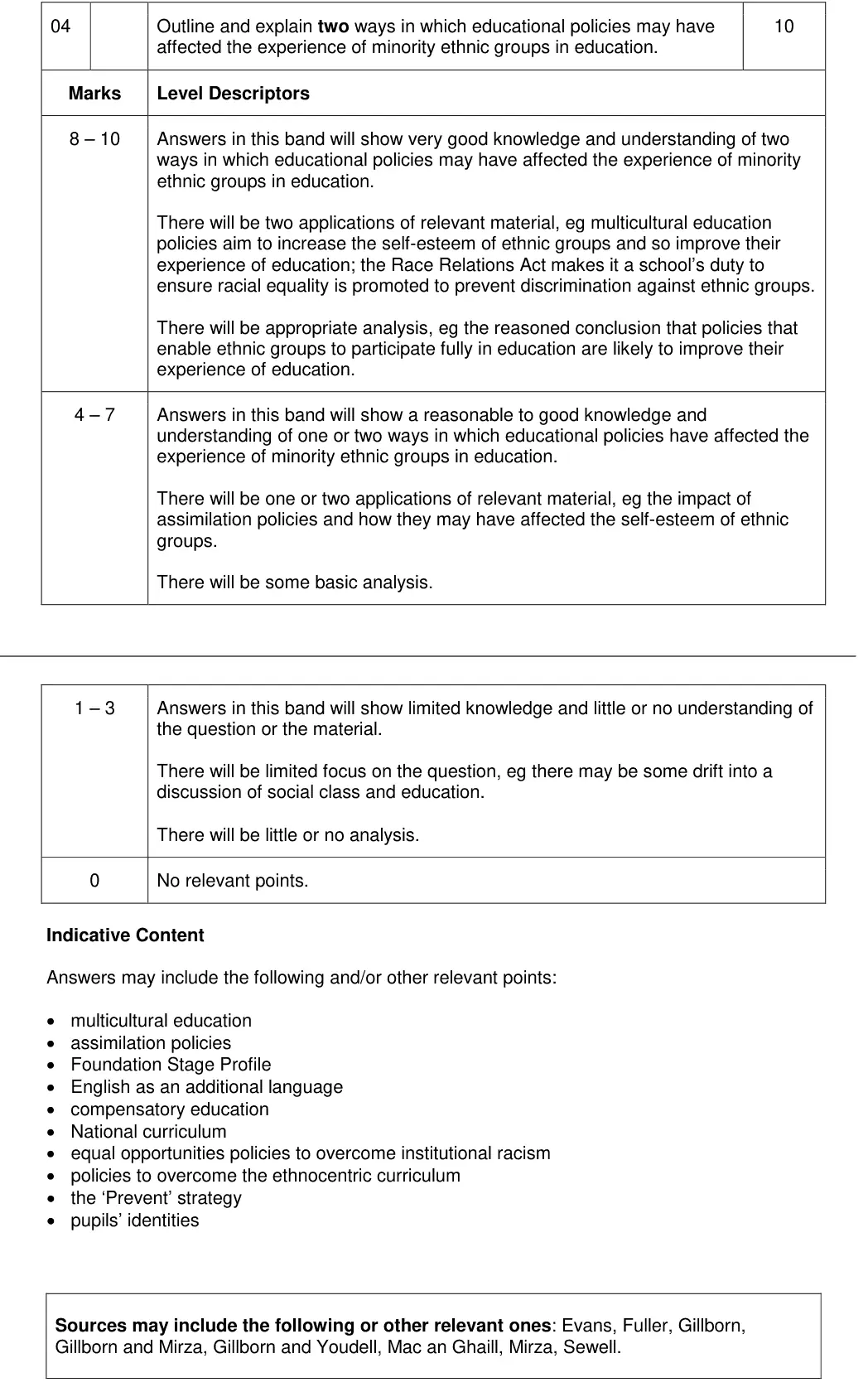
June 2017 · AS Paper 1 · Q410 marksAO1=5, AO2=3, AO3=2Outline and explain
Mark scheme, including the levels grid and indicative content
Examiner's comment
As the application questions are new in this specification, it is not surprising that students find this style of question more challenging than traditional essay writing. This question required students to apply their knowledge of one area of the specification (educational policies) to another area (ethnic minorities’ experience). A number of responses remained in the bottom band due to being solely focused on outlining some of the factors or processes affecting the achievements of minority ethnic groups without attempting to link these to a specific policy. A common example of this was a discussion of the ethnocentric curriculum and teacher labelling only in relation to achievement. More commonly, many students were able to identify two policies with at least some explanation. A wide range of policies were identified, such as Sure Start, compensatory education, or a collection or policies such as multi-cultural education and EAL support. Some students were able to clearly link a policy towards the experience of education. However, as in the previous year, many referred to social class or religion more generally as a proxy to ethnicity and therefore remained in the middle band. The most successful answers demonstrated knowledge of two policies (one in each paragraph) and applied these explicitly to the experience of minority ethnic groups, such as the impact on achievement, self-esteem and increased opportunities. Popular responses looked at how the National Curriculum appears ethnocentric, applying examples from different subjects across the curriculum. These responses also showed good conceptual knowledge, with studies and/or key concepts and analysis of how and why there may have been an impact on the experience of ethnic minority groups.
Notes from the mark scheme and report
two policies each applied explicitly to minority ethnic pupils' experience (e.g. multicultural education, Race Relations Act duty, EAL, National Curriculum ethnocentrism)
describing factors such as labelling or the ethnocentric curriculum without linking to a policy stays in the bottom band
using social class or religion as a proxy for ethnicity caps in the middle band
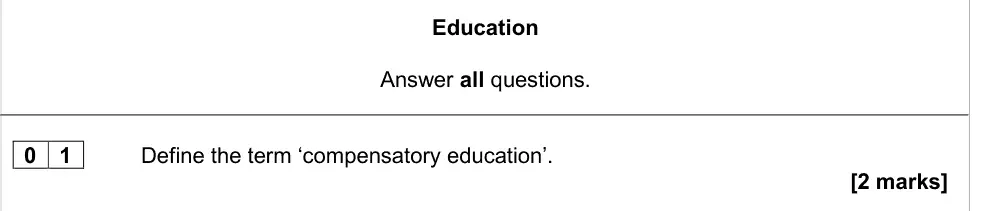
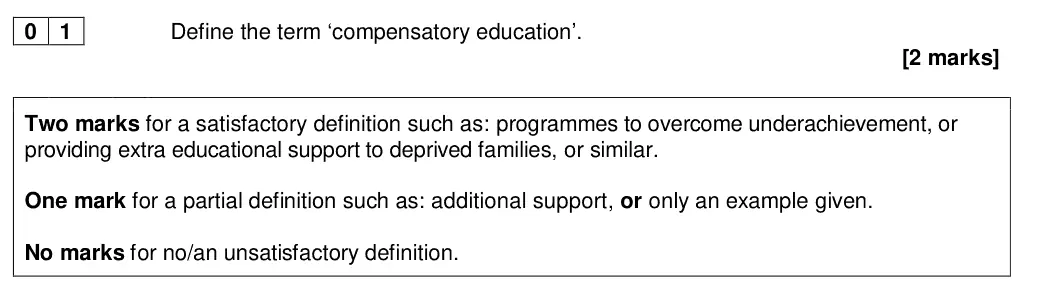
June 2016 · AS Paper 1 · Q12 marksAO1=2Define
Mark scheme
Examiner's comment
Most students answered this successfully by identifying extra support for disadvantaged groups. Many provided examples such as Sure Start to illustrate or clarify their answers. However, some had no clear idea of the meaning of the term, substituting instead definitions of comprehensive or compulsory education.
Notes from the mark scheme and report
2 marks for a full definition (e.g. extra support/programmes for deprived groups to overcome underachievement)
1 mark for a partial definition or an example only
most answered well, often citing Sure Start
some confused it with comprehensive or compulsory education
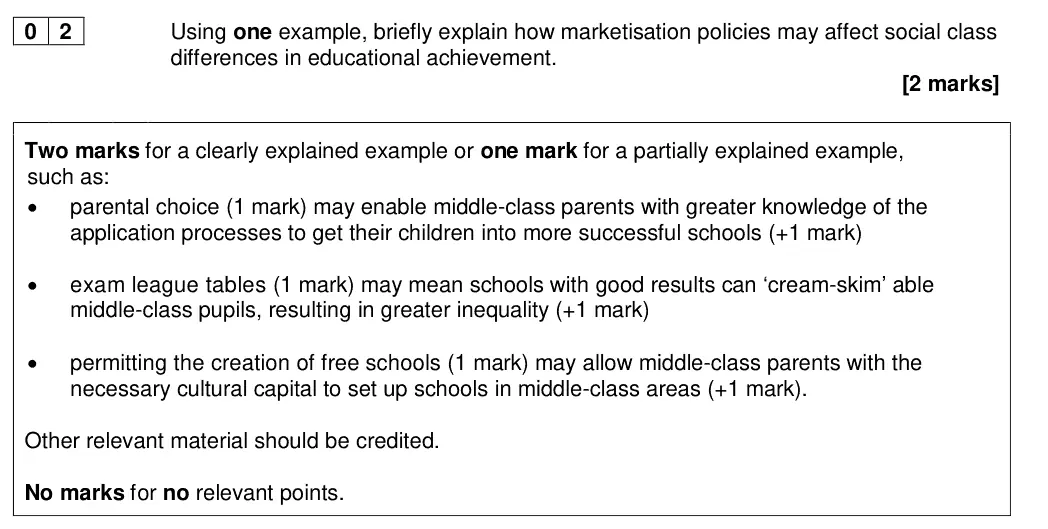
June 2016 · AS Paper 1 · Q22 marksAO2=2Brief explain
Mark scheme
Examiner's comment
The most popular response was to identify league tables or parental choice as a marketisation policy and then explain how this may advantage middle-class pupils because of their parents’ greater cultural or economic capital. However, a significant minority failed to identify any specific marketisation policy, while a few misidentified the tripartite or comprehensive systems as examples of marketisation policies. Some scored one mark for identifying a relevant policy without explaining its effect on class differences in achievement.
Notes from the mark scheme and report
1 mark for a named marketisation policy (parental choice, league tables, free schools) +1 for explaining its effect on class differences
common answers: league tables or parental choice favouring middle-class pupils via cultural/economic capital
some named no specific policy or wrongly cited the tripartite or comprehensive systems
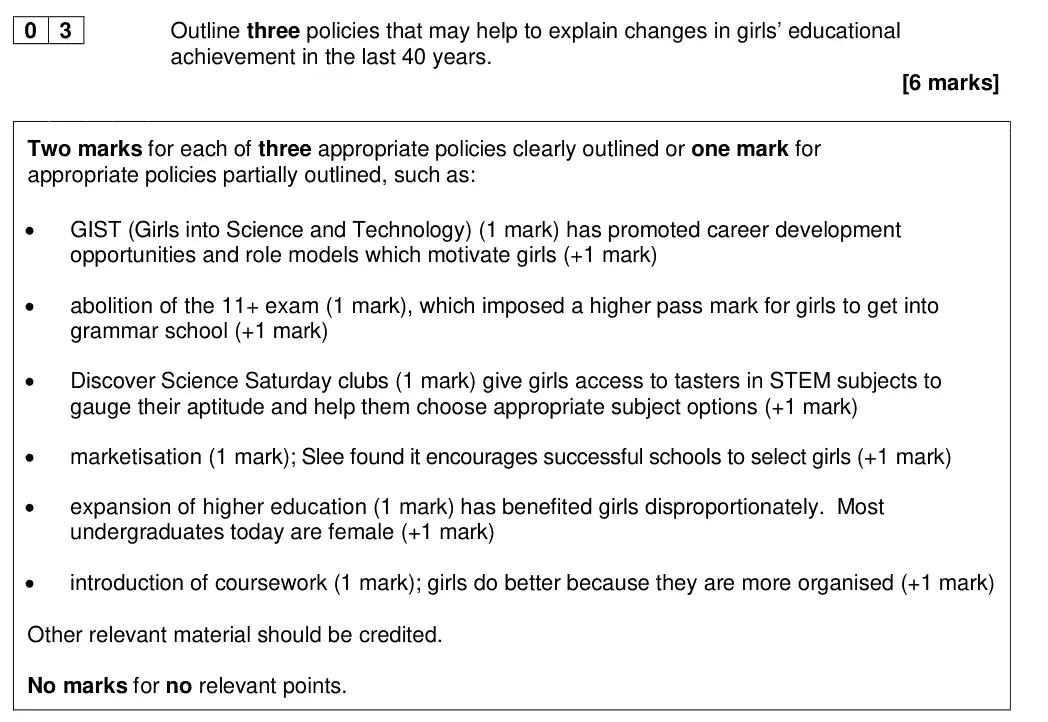
June 2016 · AS Paper 1 · Q36 marksAO1=3, AO2=3Outline
Mark scheme
Examiner's comment
A wide range of policies from both within and outside the education system were identified, such as GIST or WISE, the Equal Pay Act, the Sex Discrimination Act, the Divorce Law Reform Act and the introduction of coursework. Most students who identified such policies were able to explain how these may have affected girls’ achievement. However, others misunderstood the policy thrust of the question and offered examples of non-policy factors, such as the influence of feminist ideas on girls. These responses failed to score.
Notes from the mark scheme and report
2 marks for each of three policies clearly outlined, 1 if only partially outlined
creditworthy policies included GIST/WISE, coursework, equal opportunities legislation, expansion of higher education
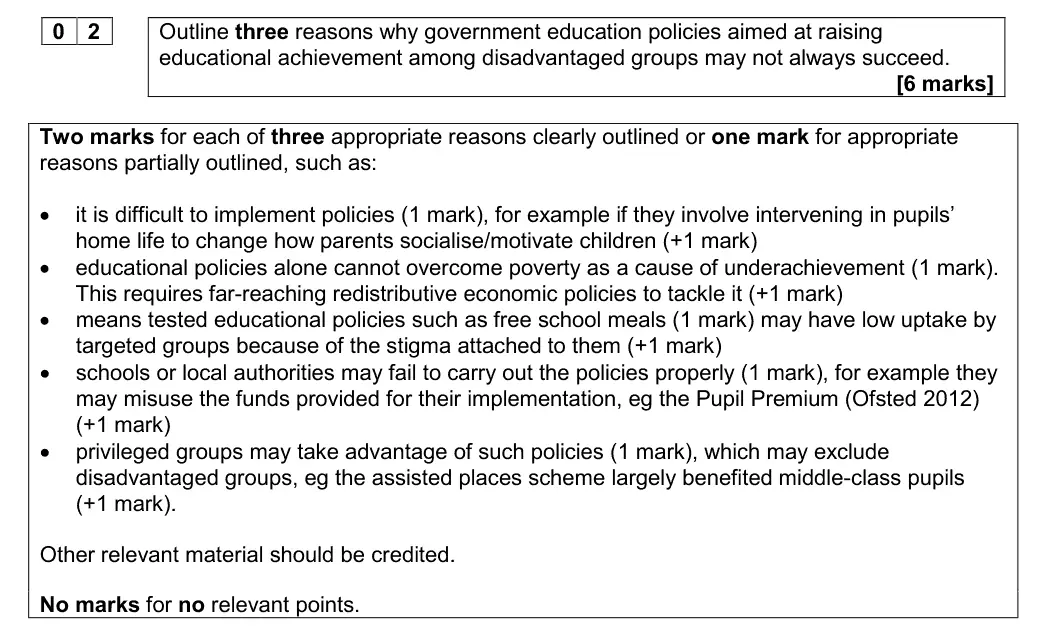
Specimen set 1 · Paper 1 · Q26 marksAO1=3, AO2=3Outline
Mark scheme
Notes from the mark scheme and report
specimen paper, no examiners' report
2 marks for each of three reasons clearly outlined
credited: hard to change home socialisation, education alone cannot overcome poverty, stigma lowering uptake of means-tested help, poor implementation or misuse of funds (Pupil Premium), middle-class take-up (assisted places scheme)
Work with an AQA sociology tutor
Essays stuck in the middle band, or losing marks on the 10-markers? Book a trial lesson with Mark, a former AQA examiner.