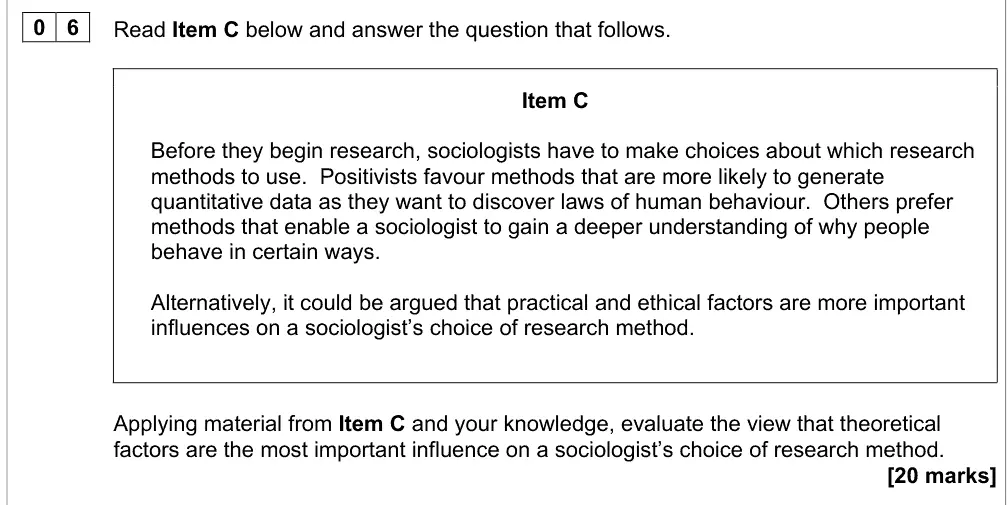
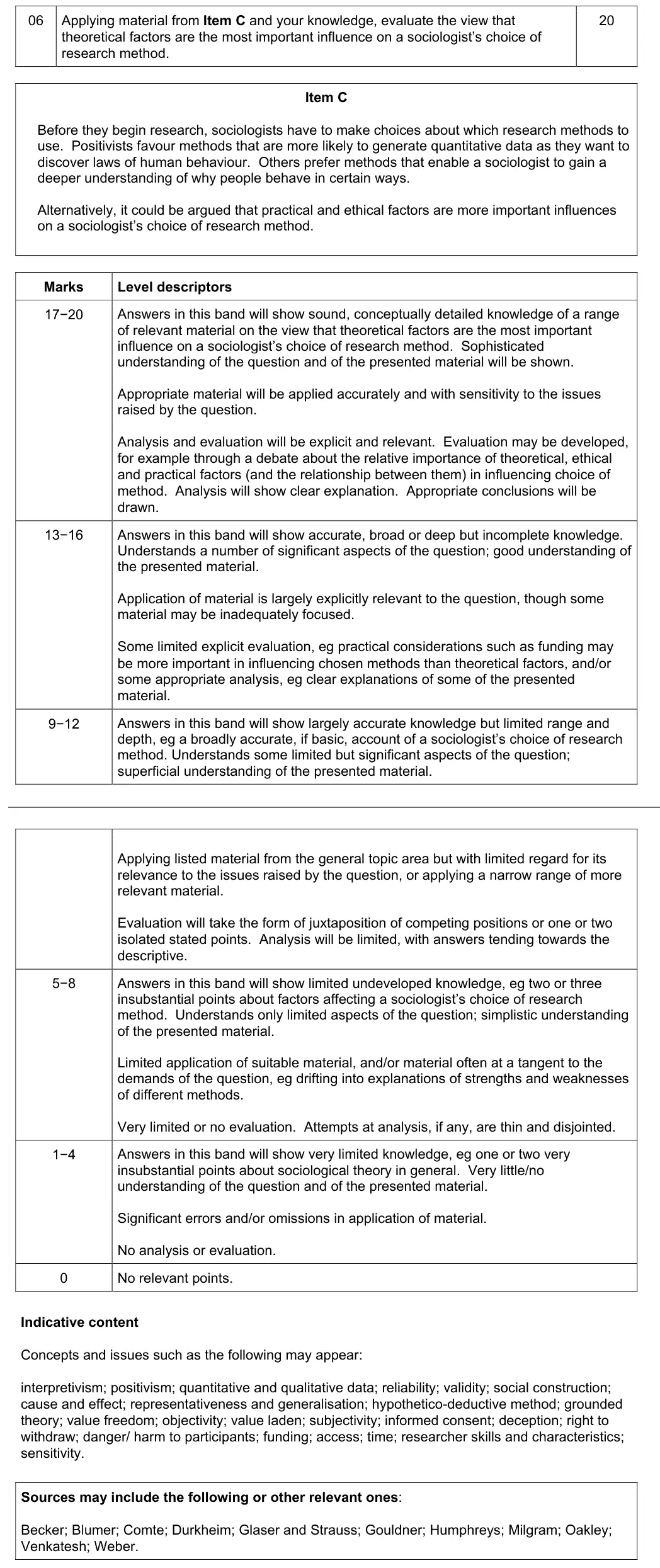
Applying material from Item C and your knowledge, evaluate the view that theoretical factors are the most important influence on a sociologist’s choice of research method.
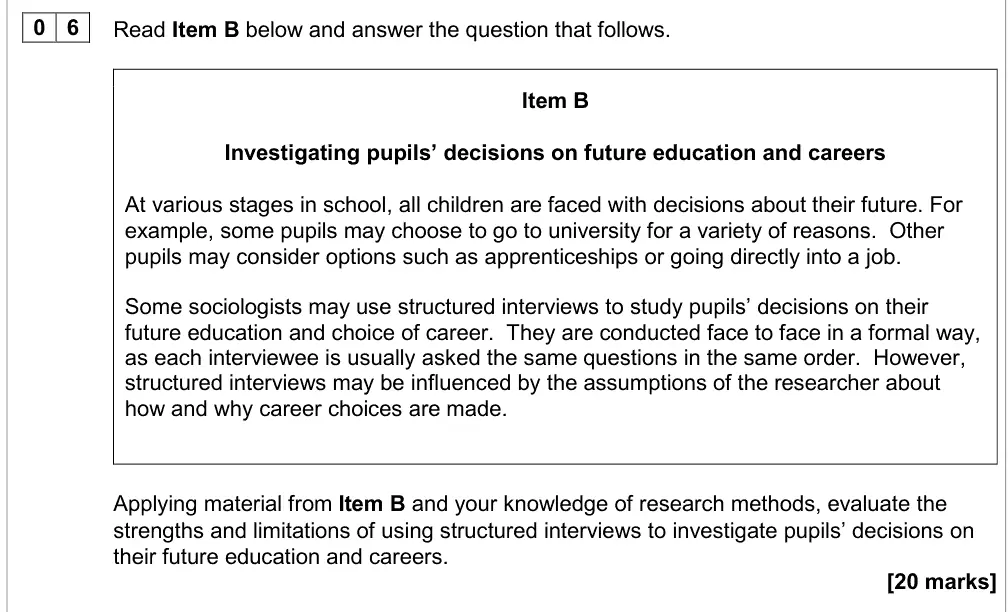
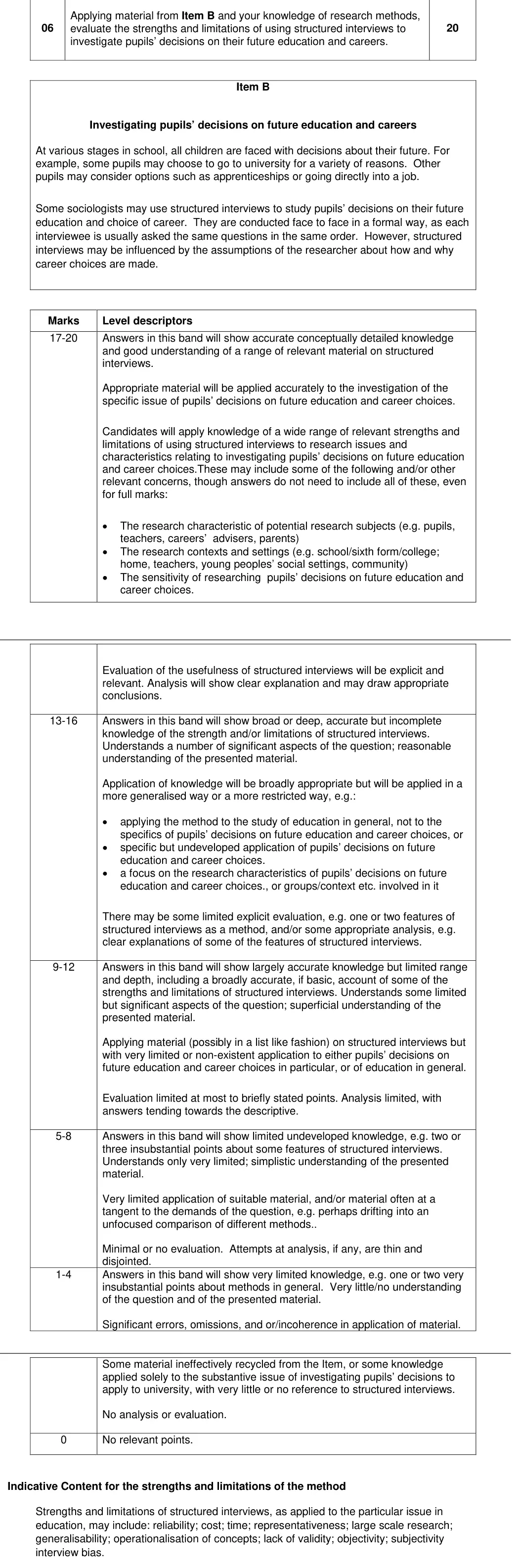
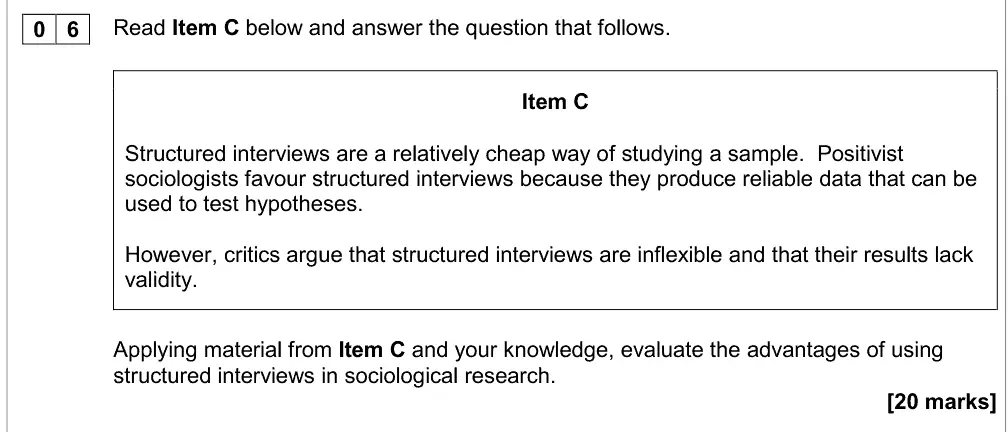
Applying material from Item B and your knowledge of research methods, evaluate the strengths and limitations of using structured interviews to investigate pupils’ decisions on their future education and careers.
Tap a question to zoom it. The mark scheme (with the level descriptors and indicative content) and the examiner's comment open underneath.
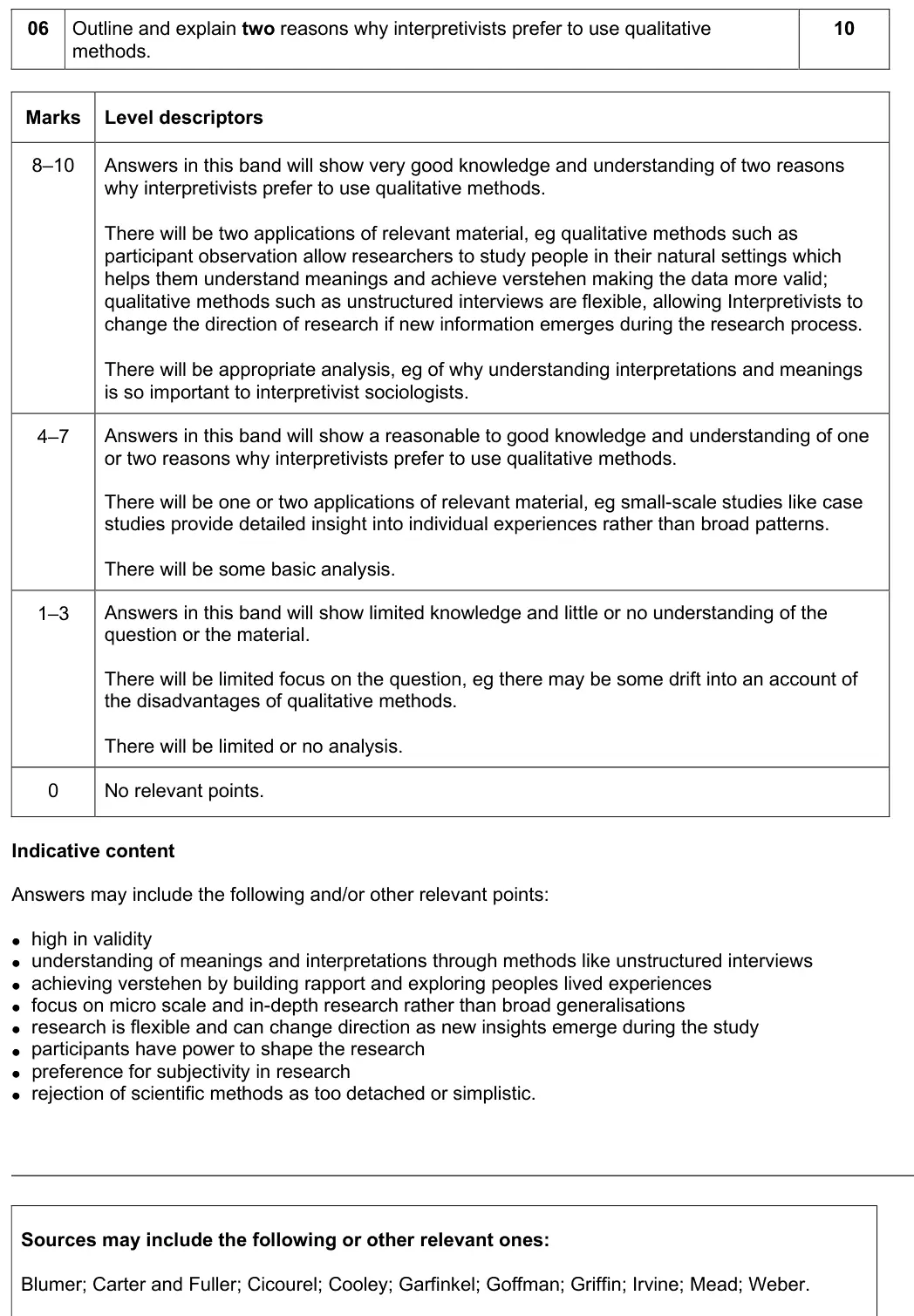
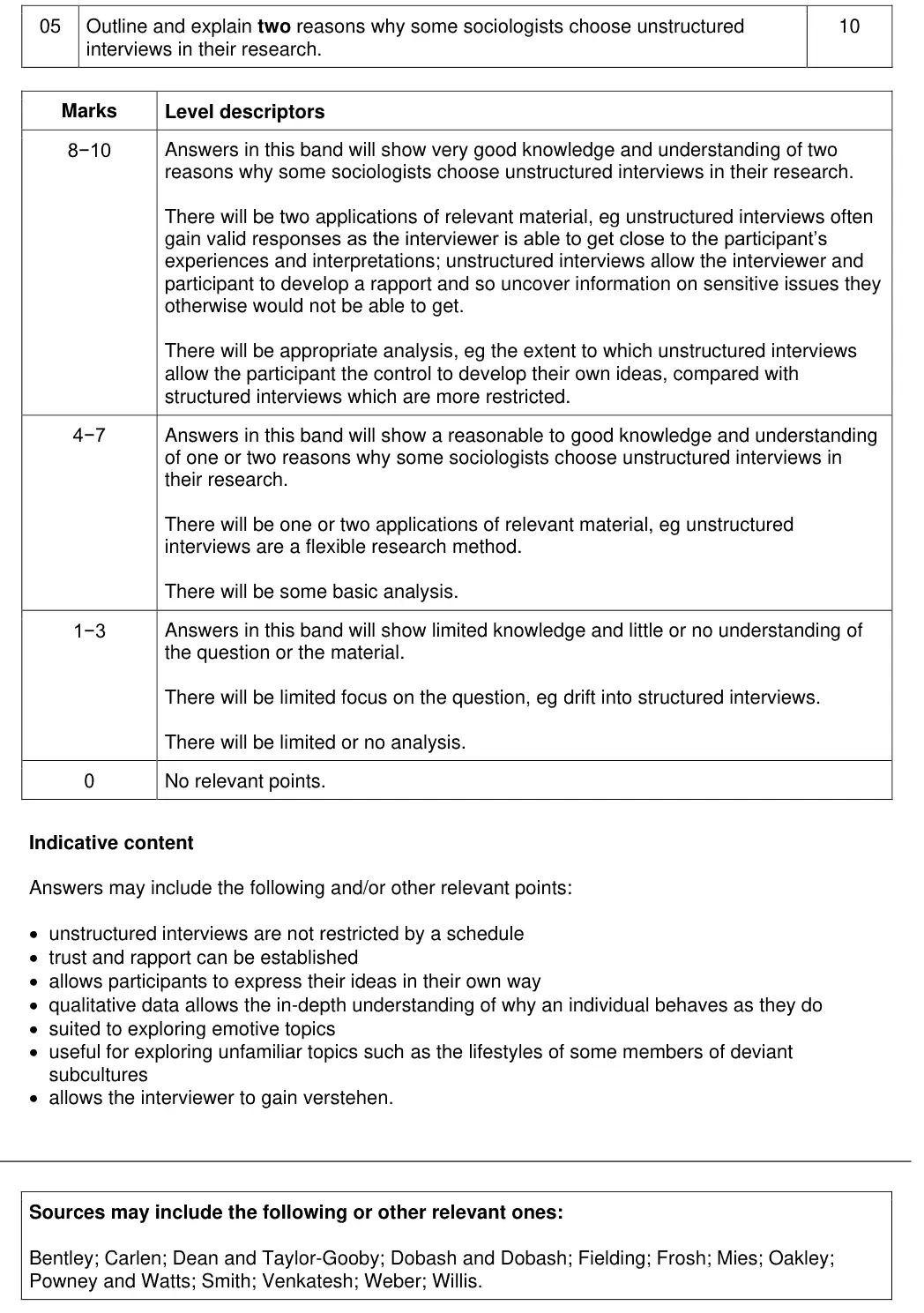
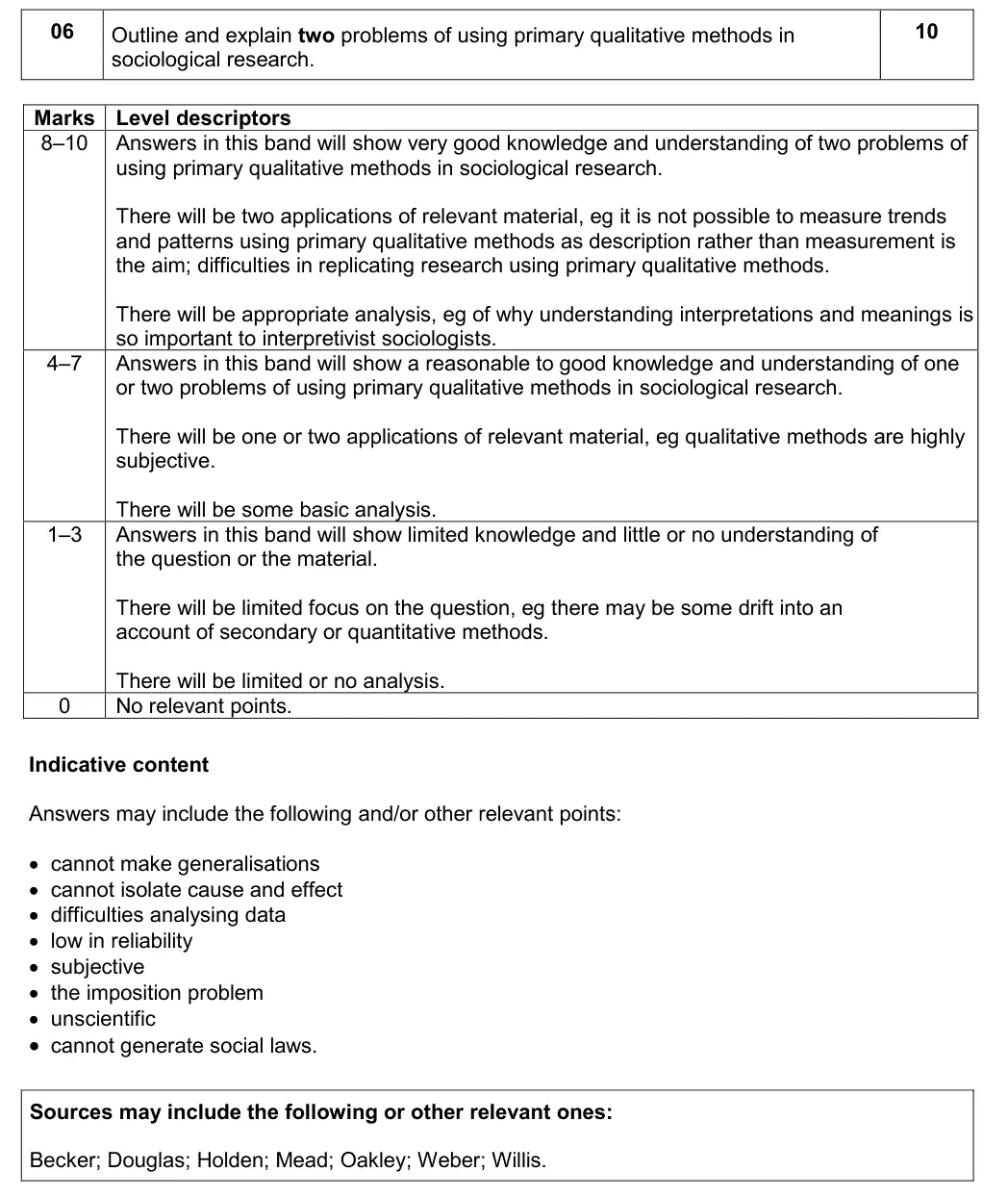
June 2025 · Paper 1 · Q610 marksAO1=5, AO2=3, AO3=2Outline and explain
Mark scheme, including the levels grid and indicative content
Notes from the mark scheme and report
drifting into disadvantages of qualitative methods = 1-3
top band: two reasons each developed, e.g. natural settings giving verstehen and validity, flexibility of unstructured interviews, with analysis of why meanings matter to interpretivists
no examiners' report published
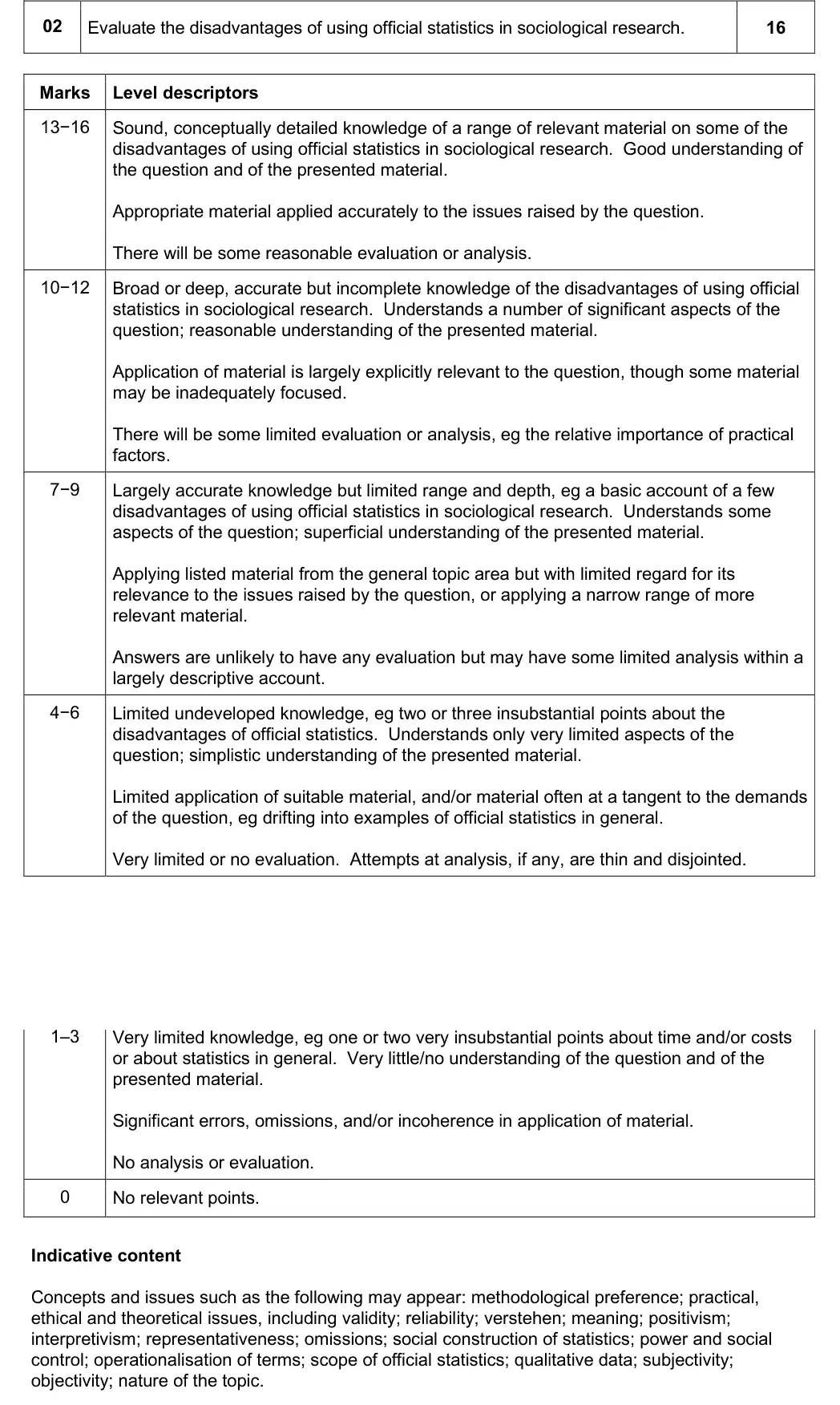
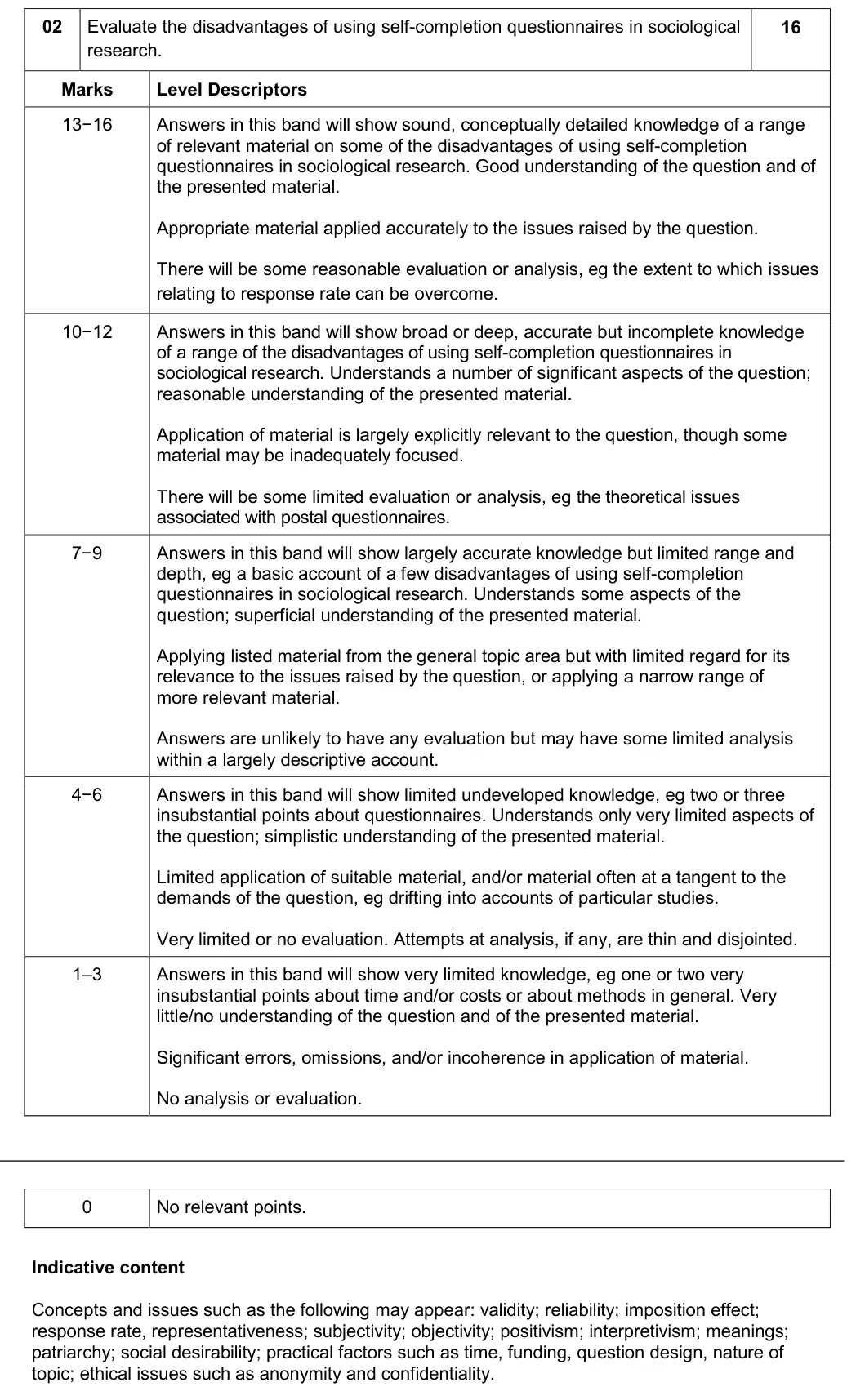
June 2025 · AS Paper 2 · Q216 marksAO1=6, AO2=5, AO3=516-mark essay
Mark scheme, including the levels grid and indicative content
Examiner's comment
This question for most students was one they could answer, as official statistics feature as a main stay of sociological research methods. Obvious disadvantages, such as official statistics being often gathered for a purpose different to which the sociologist wishes to use them, gained credit. Where a student suggested a disadvantage that was not self-evident, they needed to explain and unpack the point to gain credit. For example, some students suggested official statistics are time consuming to use. This disadvantage could gain credit if it were developed, for example by suggesting that analysing and working though large amounts of statistics could be laborious. Ethics was an area which a significant minority of students declared as a problem but were unable to show how ethical concerns were an issue regarding official statistics. The most successful answers made links to perspectives and the objections of interpretivists to the use of official statistics.
Notes from the mark scheme and report
focus is disadvantages of official statistics
content: validity, reliability, social construction of statistics, verstehen, interpretivist objections, collected for other purposes, operationalisation
drift into examples of statistics in general = 4-6
points like 'time-consuming' or 'ethics' need explaining to earn credit
best linked to interpretivist critique
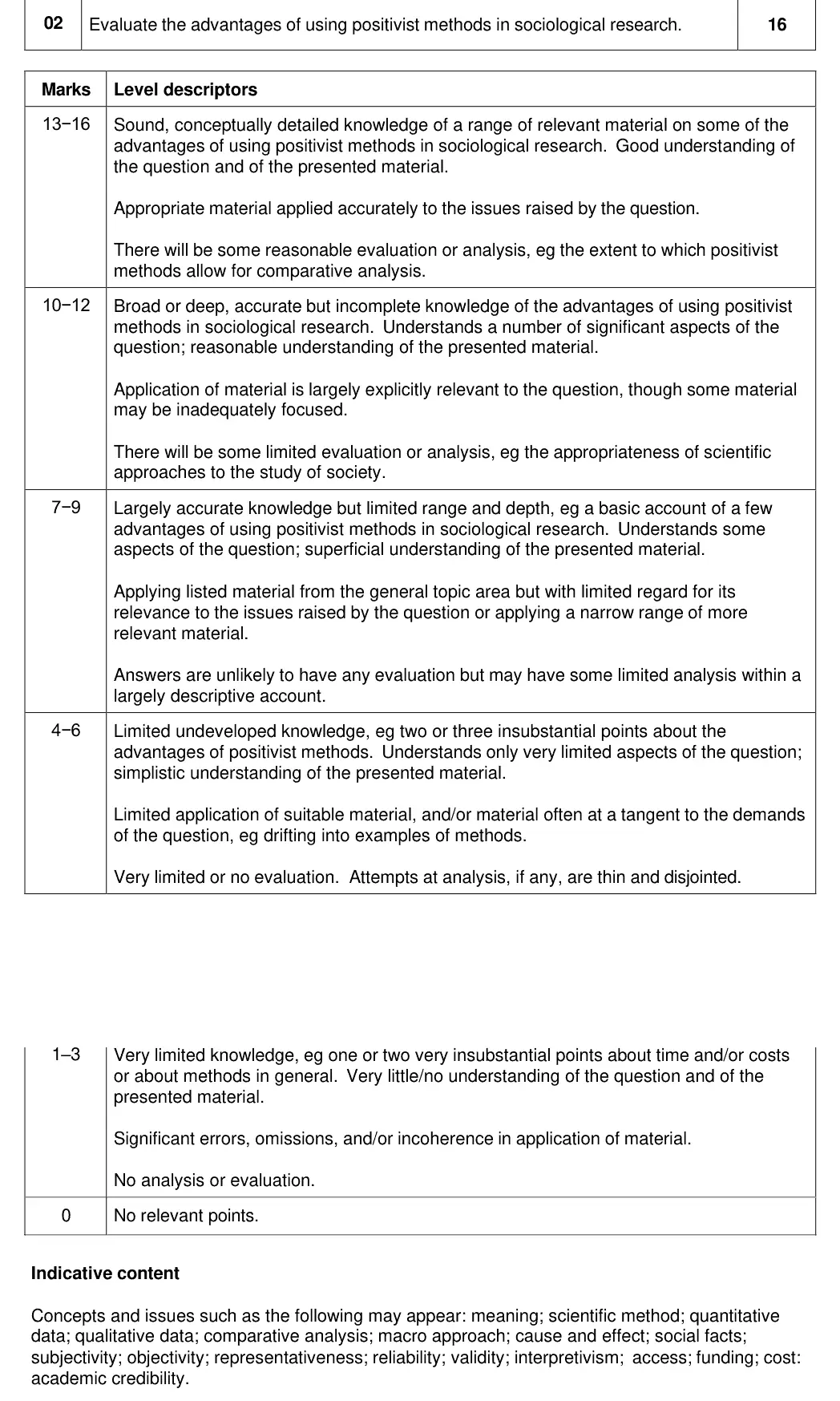
June 2024 · AS Paper 2 · Q216 marksAO1=6, AO2=5, AO3=516-mark essay
Mark scheme, including the levels grid and indicative content
Examiner's comment
This question for most students was one they could answer with a varied range of material. The students who were more successful managed to link the basic preferences of the positivist choice of method (quantitative / reliable / representative and techniques of investigation such as Laboratory experiments etc) to the wider aims of positivism. The aims of trying to show sociology to be a science, to produce social facts to attempt an objective understanding of society; what might be loosely termed the positivist method. A small minority of students did not know what was meant by positivism and could not answer the question effectively.
Notes from the mark scheme and report
evaluate advantages only
top band analyses e.g. comparative analysis
drift into examples of methods = 4–6
only time/cost points = 1–3
best answers linked quantitative, reliable, representative methods to positivist aims (science, social facts, objectivity)
a few did not know what positivism is
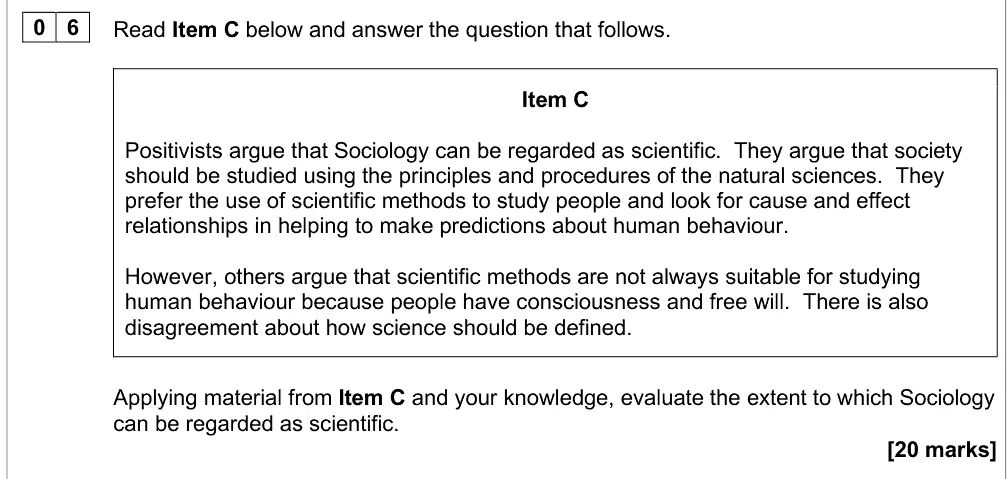
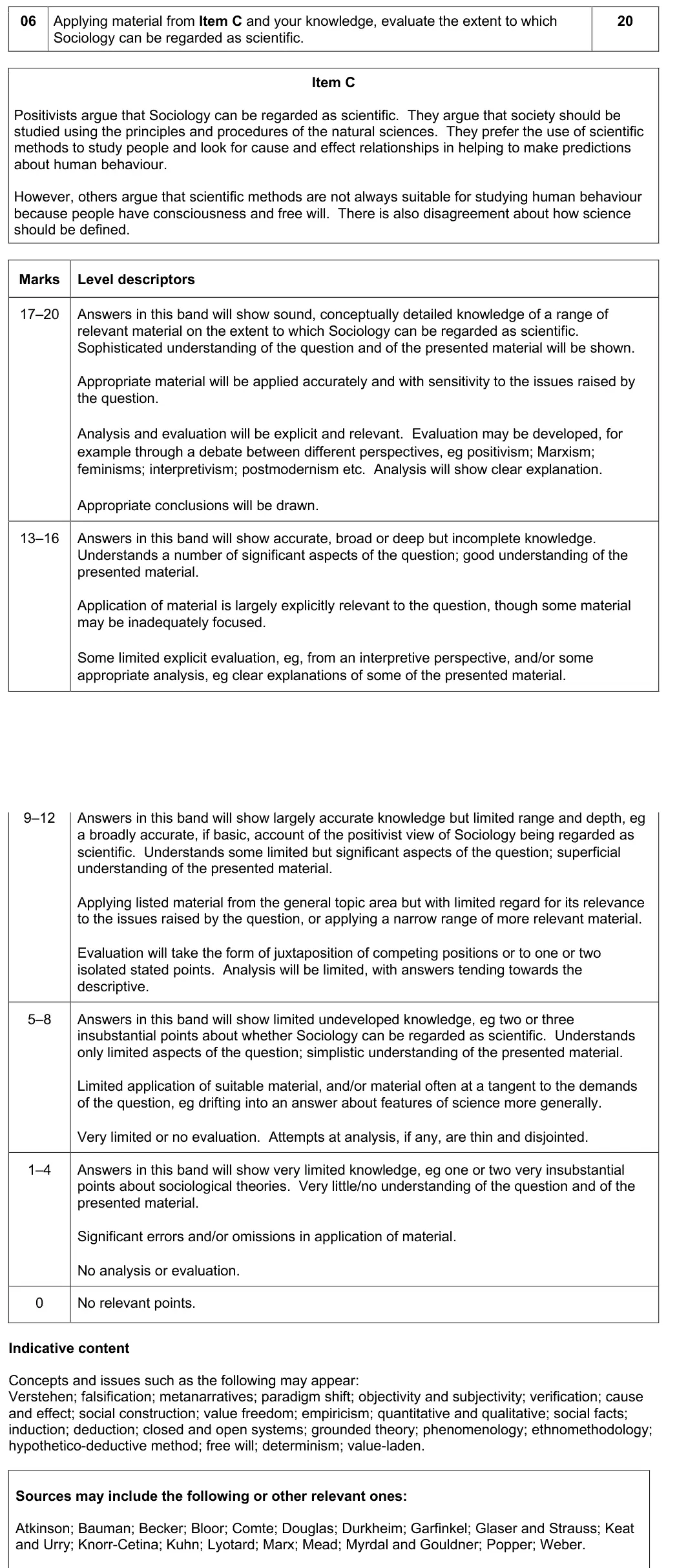
June 2024 · Paper 3 · Q620 marksAO1=8, AO2=6, AO3=620-mark essay
Mark scheme, including the levels grid and indicative content
Examiner's comment
This was answered well, and it was clear students were well prepared. There were different approaches in answering the question; some chose to go down a classical theory route; students developed mainly the work of Popper, Kuhn and Durkheim; some were able to develop the ideas of these thinkers and provide appropriate evaluation. Many students referenced positivism and interpretivism and linked this to research methods. Both approaches worked well when examples were given and ideas were developed with examples, such as ‘falsification’ or ‘objectivity vs subjectivity’ The evaluation skill was the weakest area for students although the question meant there were hooks in the item for evaluation. Many students were able to use the hooks and develop them. This meant evaluation was better than in the other questions. Note lengthy introductions are not required for this question; students are under time constraints.
Notes from the mark scheme and report
top band debates positivism, interpretivism, Marxism, feminisms and postmodernism on sociology as science
drift into features of science in general = 5–8
well prepared, using Popper (falsification), Kuhn (paradigms) and Durkheim
evaluation weakest skill though the item's hooks helped
long introductions unnecessary
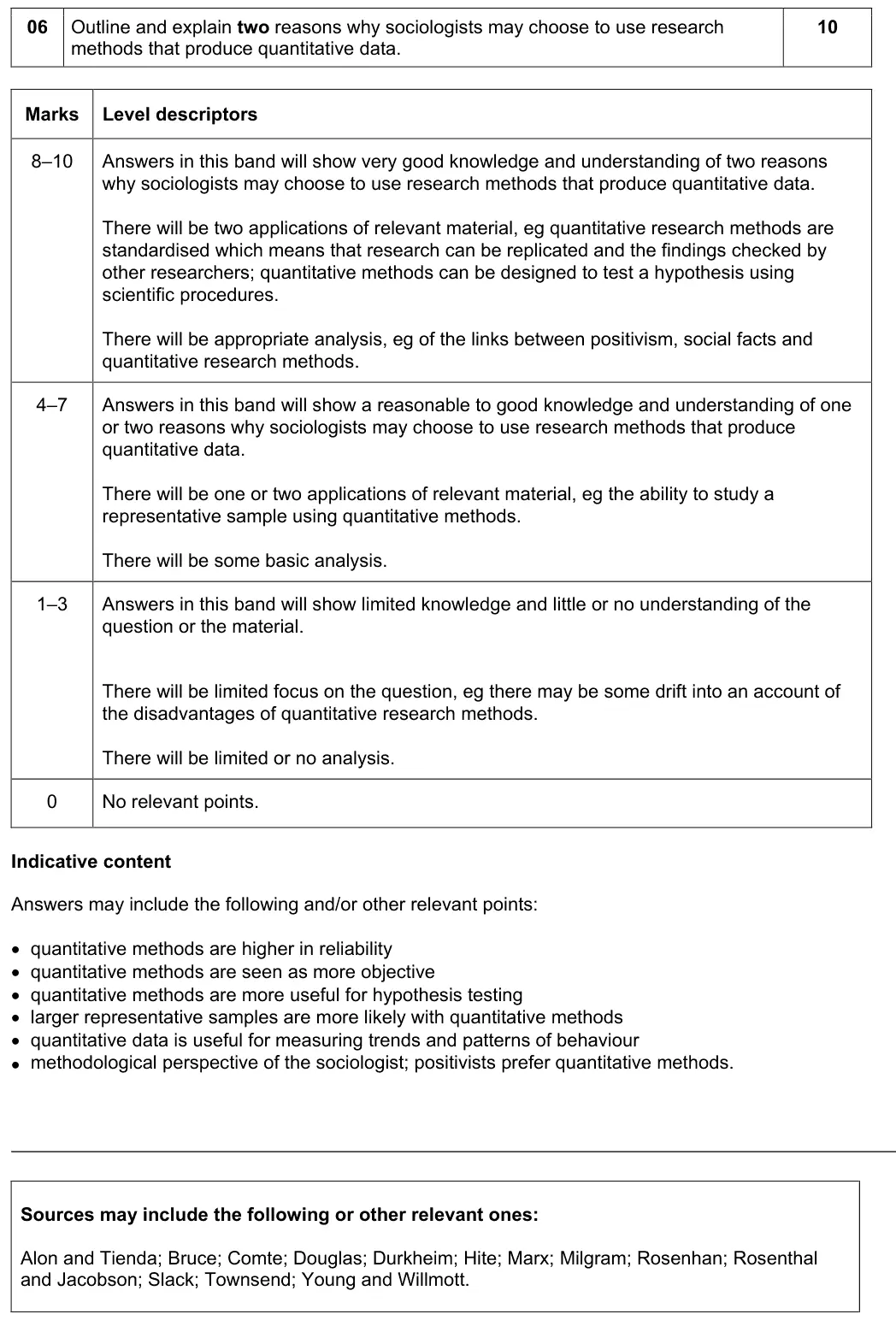
June 2023 · Paper 1 · Q610 marksAO1=5, AO2=3, AO3=2Outline and explain
Mark scheme, including the levels grid and indicative content
Examiner's comment
It was really pleasing to see that the vast majority of students were at least able to attempt this question. This indicated better time management or that this question was more accessible when compared with some other questions in previous series. There were a range of reasons offered for why sociologists may choose to use research methods that produce quantitative data. A number of answers provided a list of reasons as part of their answer. The more successful answers focussed on two reasons and were able to develop these with concepts and examples to illustrate. For example, some students explained that methods that produce quantitative data are more likely to be able to establish cause and effect relationships and that this data is favoured by positivists who prefer to study ‘social facts’ and use this data to be able to make predictions about human behaviour in society. Some were able to apply examples, such as Durkheim’s study of suicide, to illustrate these arguments. There were a number of students who proceeded to evaluate the reasons they provided for this question. Students should be reminded that there are no available marks for evaluation in this question type.
Notes from the mark scheme and report
no marks for evaluation in this question type
drifting into disadvantages of quantitative methods = 1–3 band
two reasons each developed, not a list
best answers linked quantitative data to positivism and social facts (e.g. Durkheim's study of suicide)
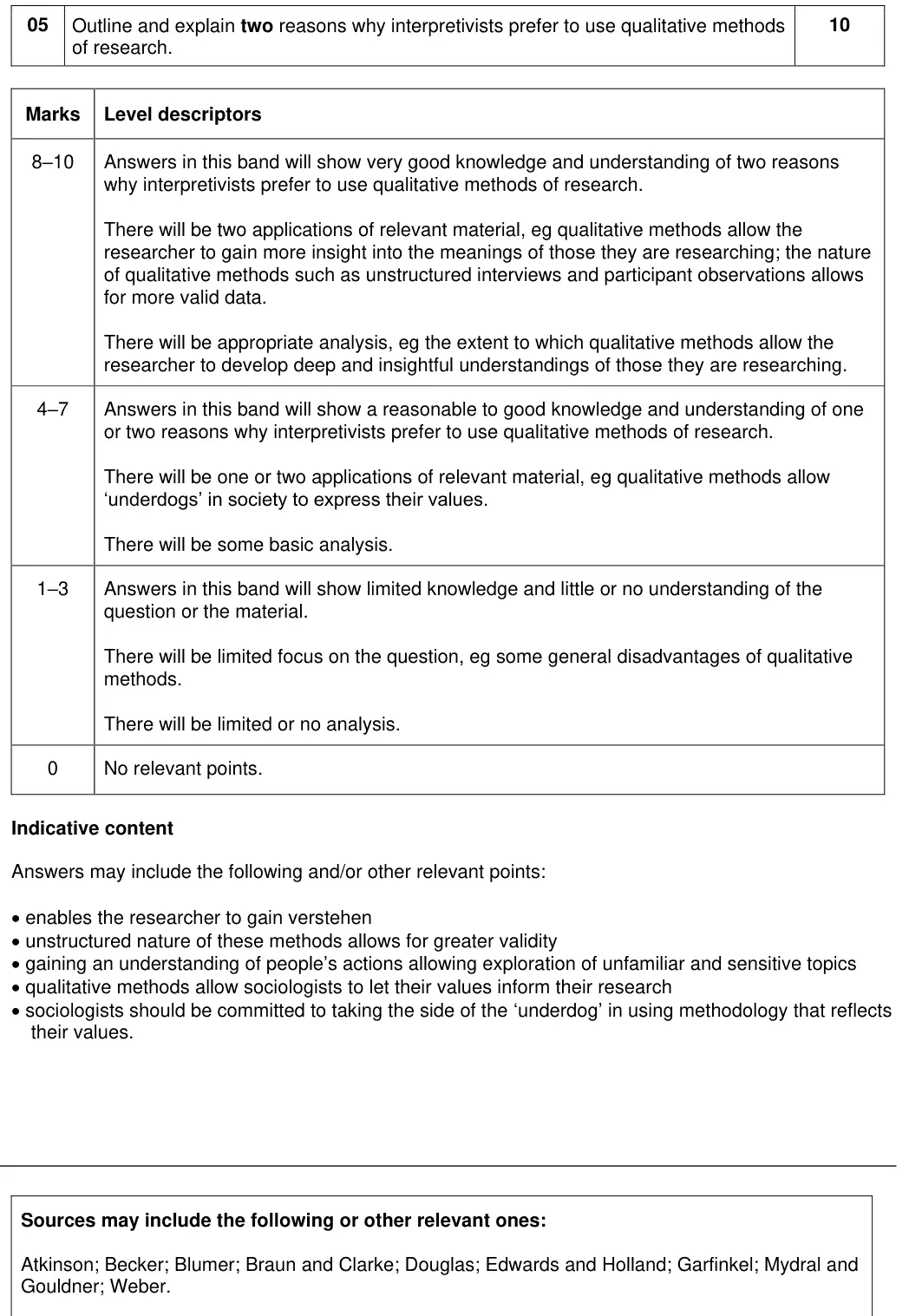
June 2023 · Paper 3 · Q510 marksAO1=5, AO2=3, AO3=2Outline and explain
Mark scheme, including the levels grid and indicative content
Examiner's comment
Students should be made aware that there are two types of ten mark questions. These have different requirements and different mark schemes. There are different marks available for the assessment objectives. 10 mark “outline and explain” questions have more marks available for knowledge and understanding, and none for evaluation. Yet some students include evaluation in their responses to this type of question, which is not creditworthy. There is a need to read the question carefully, some students focused on a comparison of interpretivism with positivism which did not meet the demands of the question. There is a level of challenge for students using theory and concepts correctly with some confusing reliability and validity.
Notes from the mark scheme and report
no marks for evaluation in this question type
two reasons each developed, e.g. verstehen and meanings, validity of unstructured methods, siding with the underdog
general disadvantages of qualitative methods = 1–3
comparing interpretivism with positivism missed the question
some confused reliability and validity
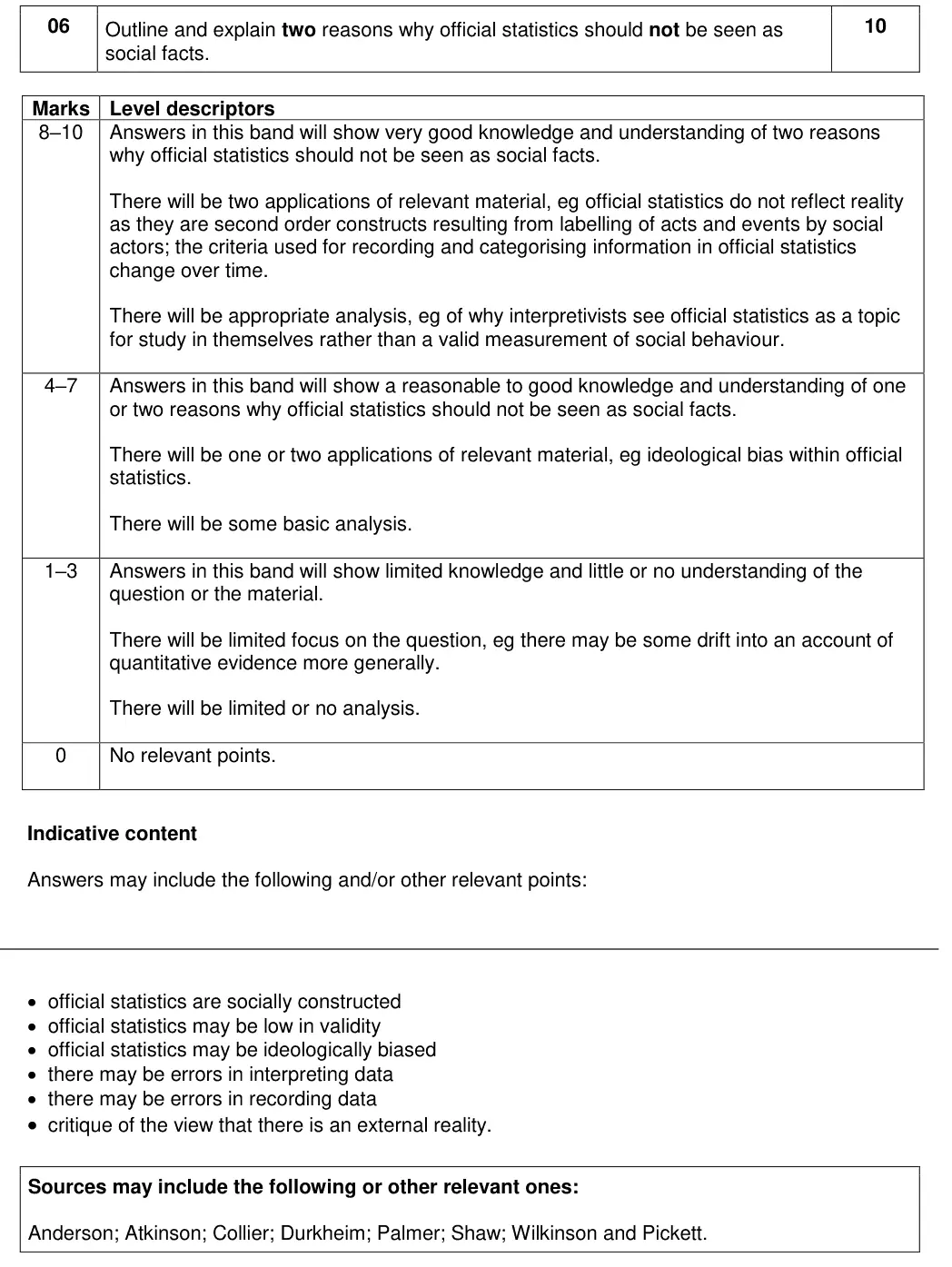
June 2022 · Paper 1 · Q610 marksAO1=5, AO2=3, AO3=2Outline and explain
Mark scheme, including the levels grid and indicative content
Examiner's comment
However, knowledge and understanding of group interviews (question 5) and of ‘social facts’ (question 6) tended to be less developed in comparison. The vast majority of students attempted all questions. However, there was a small number of students who did not attempt question 6. This may have been as a result of running out of time or finding the question too challenging. This question was generally challenging and students were much less successful i compared with others on the paper. There were some non-responses to this question which may have been a result of a lack of understanding, or of running out of time. Some others were at least able to offer some limitations of official statistics (or quantitative data) more generally. These often included some general explanations of official statistics not being able to provide the researcher with detailed insights into the reasons behind the statistics or not being able to provide the researcher with ‘verstehen’. However, many of the answers limited to the 1-3 mark band seldom made any reference to why official statistics are not seen as ‘social facts’. It was evident that a number of students were not familiar with this term. Better answers were able to explain, at least in part, one or two reasons why official statistics should not be seen as social facts. The most common reasons tended to focus on official statistics lacking validity due to the way they are socially constructed and therefore should not be seen as truthful and as facts. Stronger answers were able to provide some detailed analysis and application of useful examples to demonstrate these reasons which were drawn from different areas of social life; for example, using crime statistics.
Notes from the mark scheme and report
no marks for evaluation in this question type
two reasons each developed, e.g. statistics are second-order social constructions from labelling decisions, recording criteria change over time
general limits of quantitative data (no verstehen) without reference to social facts = 1–3
many did not know the term 'social facts'
hardest question on the paper
good answers used crime statistics as examples
June 2022 · Paper 3 · Q510 marksAO1=5, AO2=3, AO3=2Outline and explain
Mark scheme, including the levels grid and indicative content
Examiner's comment
This question was accessed by students very well. There were very few no responses to this question. The vast majority of students were able to select two reasons why and develop them. Many students were able to support their reasons with sociological research studies as examples and this was best practice.
Notes from the mark scheme and report
no marks for evaluation in this question type
drift into structured interviews = 1–3
top band: validity and rapport on sensitive topics, with analysis of participant control vs structured interviews
best practice was supporting each reason with a named study
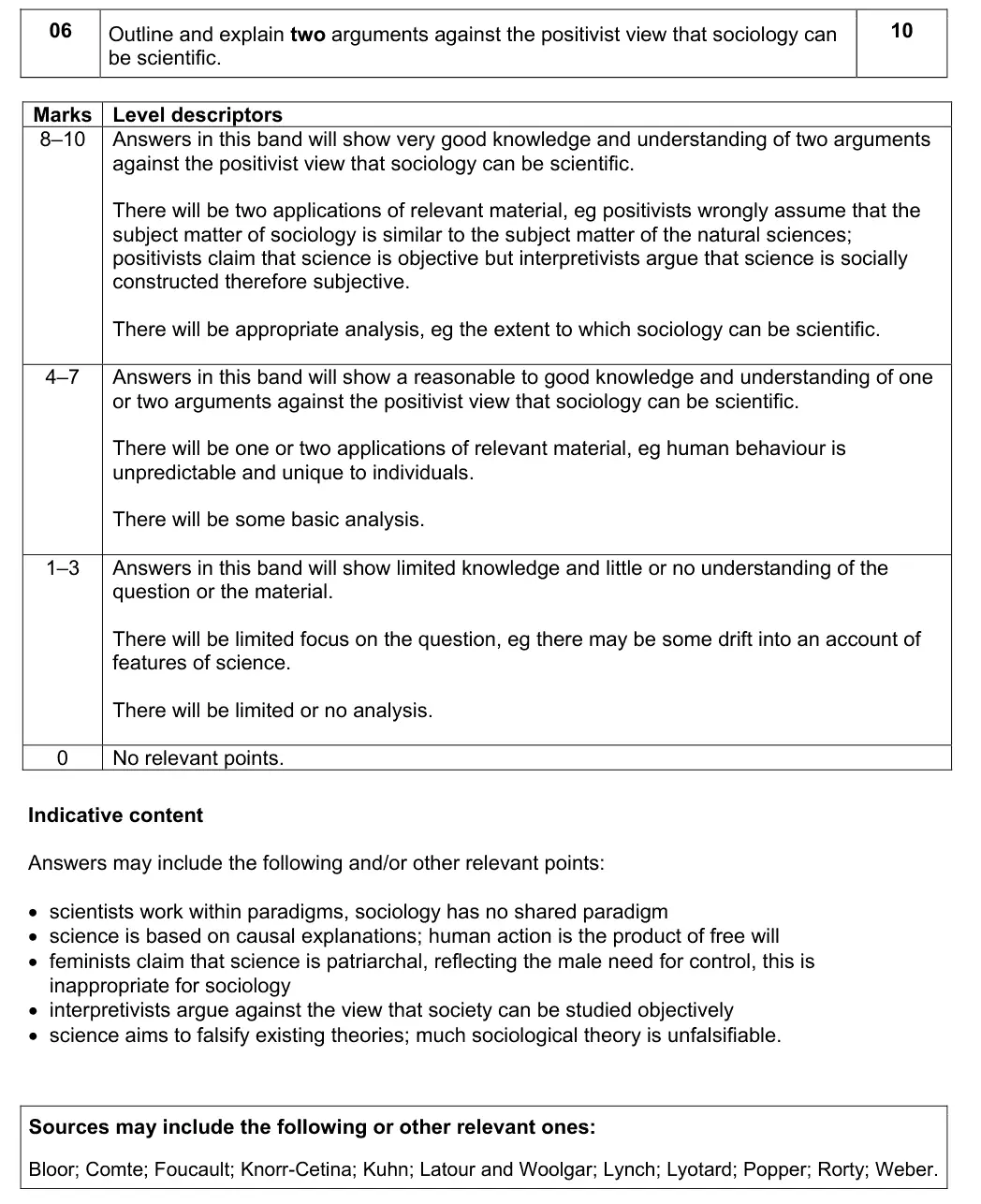
November 2021 · Paper 1 · Q610 marksAO1=5, AO2=3, AO3=2Outline and explain
Mark scheme, including the levels grid and indicative content
Examiner's comment
However, a small number of students left questions unanswered (particularly question 5 and/ or 6). Similarly to previous years, some students wrote lengthy answers to the 4-mark and 6-mark questions which may explain why a few of these students seemed to run out of time in answering the final question(s). Many students also seemed to struggle with this question. Some students were unable to offer a clear argument against the positivist view of Sociology being scientific, with some muddled and confused ideas being presented. Others were able to offer some clarity of response in offering arguments, which included difficulties of studying Sociology objectively. However, these were often written with limited or basic analysis. The more successful answers offered more developed application and analysis, for example, in explaining the reasons why studying issues such as divorce, achievement or criminal behaviours are difficult to study objectively and went on to outline reasons why they should not be regarded as ‘social facts’. However, knowledge and skills in the methods in context and Theory & Methods questions were generally weaker than previous series. It appeared that students had prepared less well for these topics and questions.
Notes from the mark scheme and report
no marks for evaluation in this question type
arguments must be against the positivist view, e.g. subject matter differs from natural science, science is socially constructed, paradigms (Kuhn), unfalsifiability (Popper), free will
drift into features of science = 1–3
many muddled
best answers explained why topics such as divorce or crime cannot be treated as social facts
November 2021 · Paper 3 · Q620 marksAO1=8, AO2=6, AO3=620-mark essay
Mark scheme, including the levels grid and indicative content
Examiner's comment
This question needed development. Students were able to use the item, but many found it difficult to go beyond this. Those students who did answer this well used examples such as Durkheim and his study on suicide. AO1 was the strongest skill in this question. AO3 needed focused development. If students did run out of time, there was an impact on this question. This could be addressed by centres via the process of timing practice in assessments.
Notes from the mark scheme and report
top band weighs theoretical against practical and ethical factors and how they relate
drift into strengths and weaknesses of methods = 5–8 band
many could not go beyond the item
best answers used Durkheim's study of suicide
evaluation needed more focus
the report notes Theory and Methods was weaker than previous series in this small November cohort
November 2020 · Paper 1 · Q610 marksAO1=5, AO2=3, AO3=2Outline and explain
Mark scheme, including the levels grid and indicative content
Examiner's comment
However, a few students left questions unanswered (particularly Question 6). Similarly to summer 2019, a significant number of students wrote very lengthy answers to the 4-mark and 6-mark questions which may explain why some seemed to run out of time in answering the final question. Unfortunately, students performed less well on this question compared with the rest of the paper. Many were able to offer two problems of primary qualitative methods, usually referring to practical issues of time taken and costs involved. However, few were able to develop their ideas with any real depth and analysis. A common problem with many answers was confusing and conflating theoretical issues of validity and reliability. A large number of responses seemed to mix or list points together in a confused way. For example, some confused problems of sampling and not being able to generalise with theoretical issues of reliability and/or validity in a rather random way. However, knowledge and skills in the Methods in Context and Theory and Methods questions were generally weaker than in previous series. It appeared that students had prepared less well for these topics and questions.
Notes from the mark scheme and report
no marks for evaluation in this question type
two problems each developed (e.g. cannot measure trends or generalise, hard to replicate, subjectivity, imposition, cannot establish cause and effect)
drift into secondary or quantitative methods = 1–3
most gave only practical time and cost problems with little depth
validity and reliability often confused or conflated with sampling and generalisability
November 2020 · AS Paper 2 · Q216 marksAO1=6, AO2=5, AO3=516-mark essay
Mark scheme, including the levels grid and indicative content
Notes from the mark scheme and report
no item on this question
top band needs reasoned evaluation e.g. how far low response rates can be overcome
10–12 may cover theoretical issues of postal questionnaires
drift into accounts of particular studies = 4–6
only time and cost points = 1–3
key concepts validity, imposition, response rate, representativeness, social desirability
June 2019 · AS Paper 1 · Q620 marksAO1=8, AO2=8, AO3=4Methods in context
Mark scheme, including the levels grid and indicative content
Examiner's comment
In general, students tended to find this question difficult, with a large number of answers only demonstrating limited knowledge and understanding of structured interviews. There was some confusion about the strengths and limitations of structured interviews, as many drifted into a discussion of alternative methods, and in particular unstructed interviews. A number of students were uncertain about the type of data obtained from using structured interviews, and there was further confusion between the issues of reliability and validity and of the differences between positivist and interpretivist theories. Students who used the item were often more successful in their understanding of the methodology. It is clear that students are now being well prepared to use their application skills to ‘apply’ methodology issues and to studying education more generally, for example with many students referring to the practical issues with gaining access through the ‘gatekeepers’. Some were then able to apply this further to the method by explaining, for example, that gatekeepers such as headteachers would be unlikely to permit many students to be out of lessons for interviewing. However, the most sophisticated applications occurred when students were able to apply the strengths and limitations of structured interviews to the specific issue in the question ie to pupils’ decisions on their career choices. For example, some students were able to identify the lack of a rapport gained using structured interviews, and how it leads to an inability of students wanting to discuss their future if they felt embarrassed by the job or career they wanted to do, or the type of university they planned to attend.
Notes from the mark scheme and report
must apply the method to the specific issue (pupils' decisions on future education and careers)
application to education in general only caps at 13–16
little or no reference to structured interviews = max 4
many drifted into unstructured interviews or confused reliability with validity and positivism with interpretivism
best answers linked lack of rapport to pupils' reluctance to discuss embarrassing career or university plans
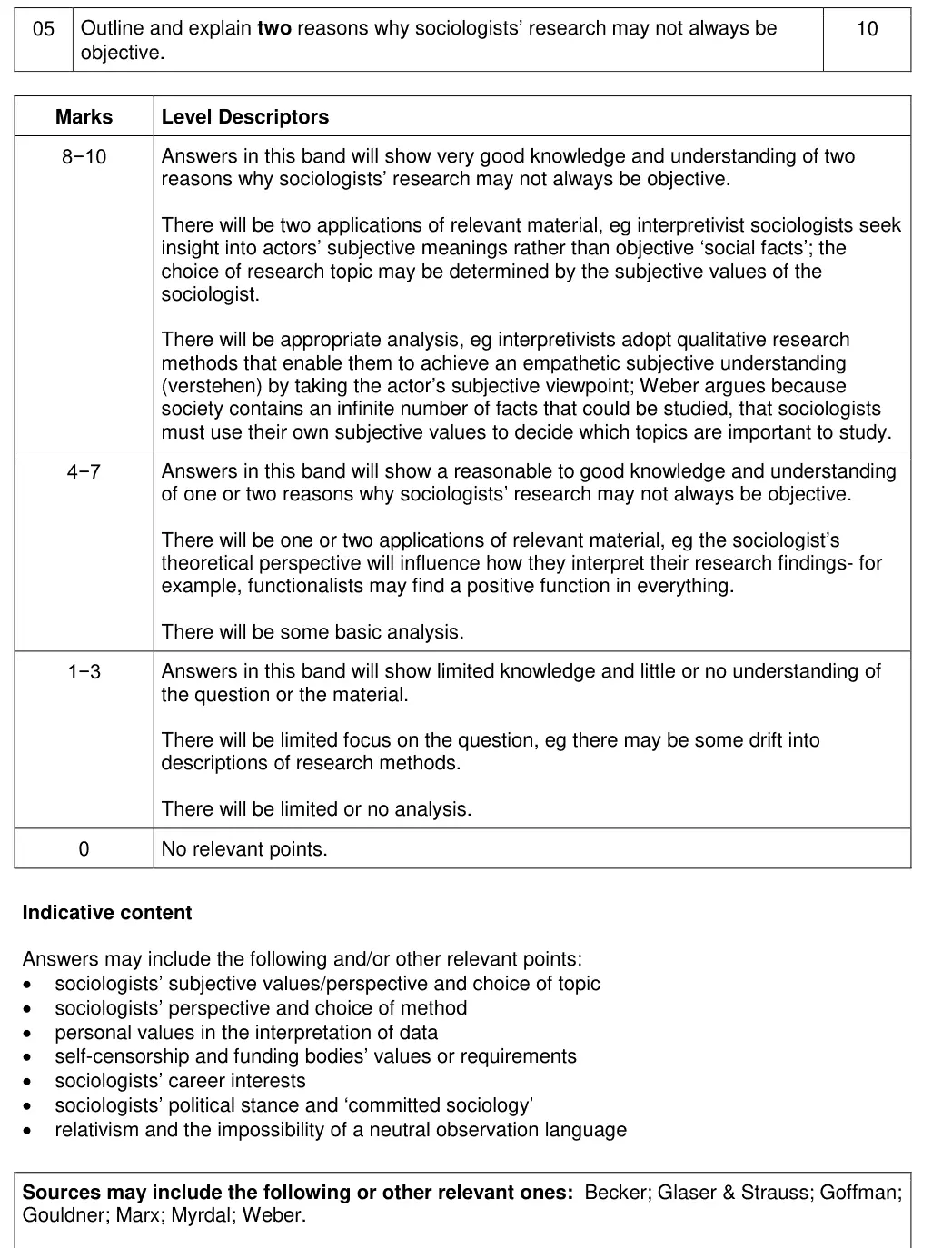
June 2019 · Paper 3 · Q510 marksAO1=5, AO2=3, AO3=2Outline and explain
Mark scheme, including the levels grid and indicative content
Examiner's comment
This question proved difficult for many students. Some had no real idea as to what objectivity meant, often confusing it with reliability, representativeness or validity. At best, these answers made a passing connection with relevant issues in a largely tangential response. Somewhat better responses had an understanding of the meaning of objectivity, but were unable to sustain a discussion for long. For example, some focused on how the participants in research might all have different subjective views, rather than focusing on the idea that it is the researcher's subjectivity that is at issue here. Strong answers developed explanations focusing on the influence of the researcher's preferred perspective, personal values, political commitment or career interests, or on the influence of funding bodies. These answers often addressed the impact of such factors on methodology, research findings and their interpretation. Reference to the work of Becker, Gouldner, Weber and interpretivists often appeared in these answers.
Notes from the mark scheme and report
AO grid not printed
many confused objectivity with reliability, validity or representativeness
the point is the researcher's subjectivity, not participants' differing views
drift into describing methods = 1–3 band
best answers used values in choice of topic (Weber), perspective, political commitment (Becker, Gouldner), career interests and funding bodies
AO split from AQA's standard grid for this paper (this year's mark scheme does not print it).
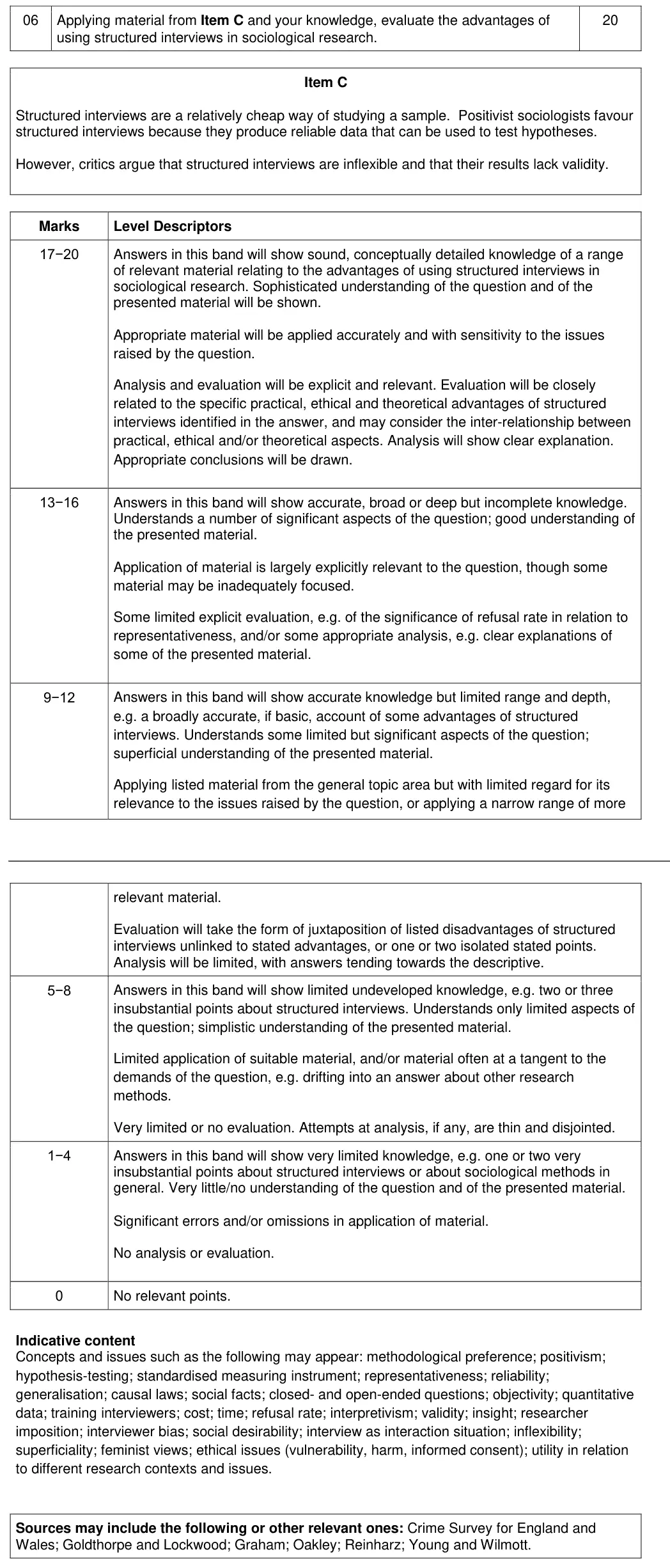
June 2018 · Paper 3 · Q620 marksAO1=8, AO2=6, AO3=620-mark essay
Mark scheme, including the levels grid and indicative content
Examiner's comment
This question proved to be quite challenging for some students. Most were able to put together a list of positivist characteristics as advantages, such as objectivity, reliability, quantification and generalisability. However, most could not evaluate these advantages. Instead a typical response, having provided a paragraph or two on the advantages, gave a list of disadvantages, or a list of reasons why interpretivist sociologists would not like the method. The result was an essay of two halves with little to link them into a coherent answer to the set question. Some generic ‘methods’ material appeared in weaker responses, for example drifting into a description of an alternative research method that the student asserted were ‘better’ than structured interviews. The weakest answers sometimes confused structured and unstructured interviews, reliability and validity, and even positivism and interpretivism.
Notes from the mark scheme and report
top band evaluates each practical, ethical and theoretical advantage directly and may link them
listing disadvantages unlinked to stated advantages = juxtaposition, max 9–12
drifting into other methods = 5–8
typical answers were two halves (positivist advantages then interpretivist objections)
weakest confused structured and unstructured interviews, reliability and validity, positivism and interpretivism
AO split from AQA's standard grid for this paper (this year's mark scheme does not print it).
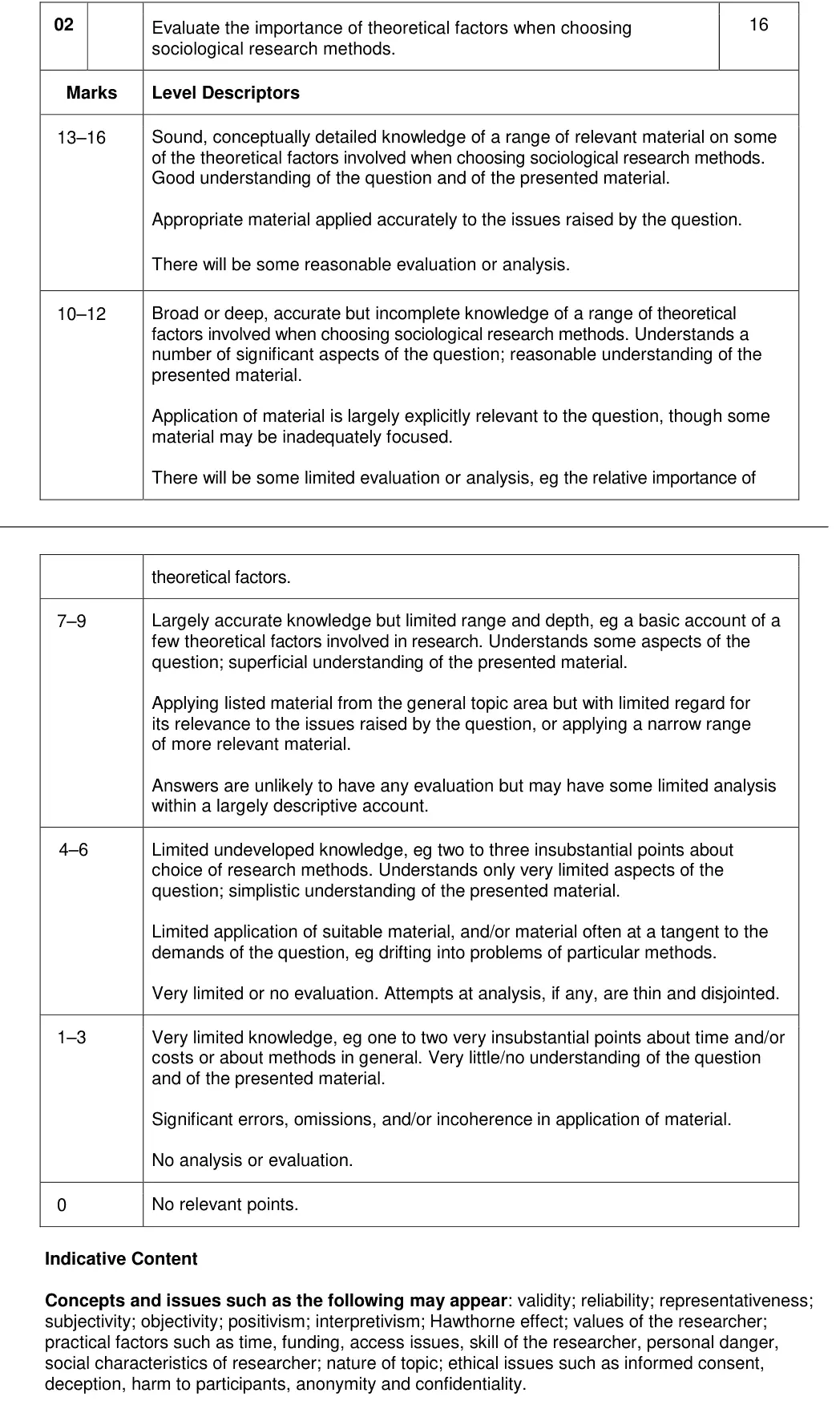
June 2017 · AS Paper 2 · Q216 marksAO1=6, AO2=5, AO3=516-mark essay
Mark scheme, including the levels grid and indicative content
Examiner's comment
This question attracted a wide range of responses. Better answers explored issues of validity, reliability, representativeness and generalisability. However, a significant number appeared uncertain about what some of these key concepts meant. There were also some students who had little understanding of what theoretical factors were, and cited practical and ethical issues in their place. Some students gave long accounts of examples of research and their methods without really getting to grips with the question. The best answers were able to explain the link between positivist and interpretivist approaches and choice of method. Key theoretical terms were explained and analysed. The very best answers were able to come to a conclusion about the relative importance of theoretical factors when choosing sociological research methods.
Notes from the mark scheme and report
focus is theoretical factors (validity, reliability, representativeness, positivism vs interpretivism)
many confused theoretical with practical and ethical factors
long descriptions of studies without addressing the question
best answers linked positivist and interpretivist approaches to method choice and concluded on the relative importance of theoretical factors
Specimen set 1 · Paper 1 · Q610 marksAO1=5, AO2=3, AO3=2Outline and explain
Mark scheme, including the levels grid and indicative content
Notes from the mark scheme and report
specimen paper, no examiners' report
no marks for evaluation in this question type
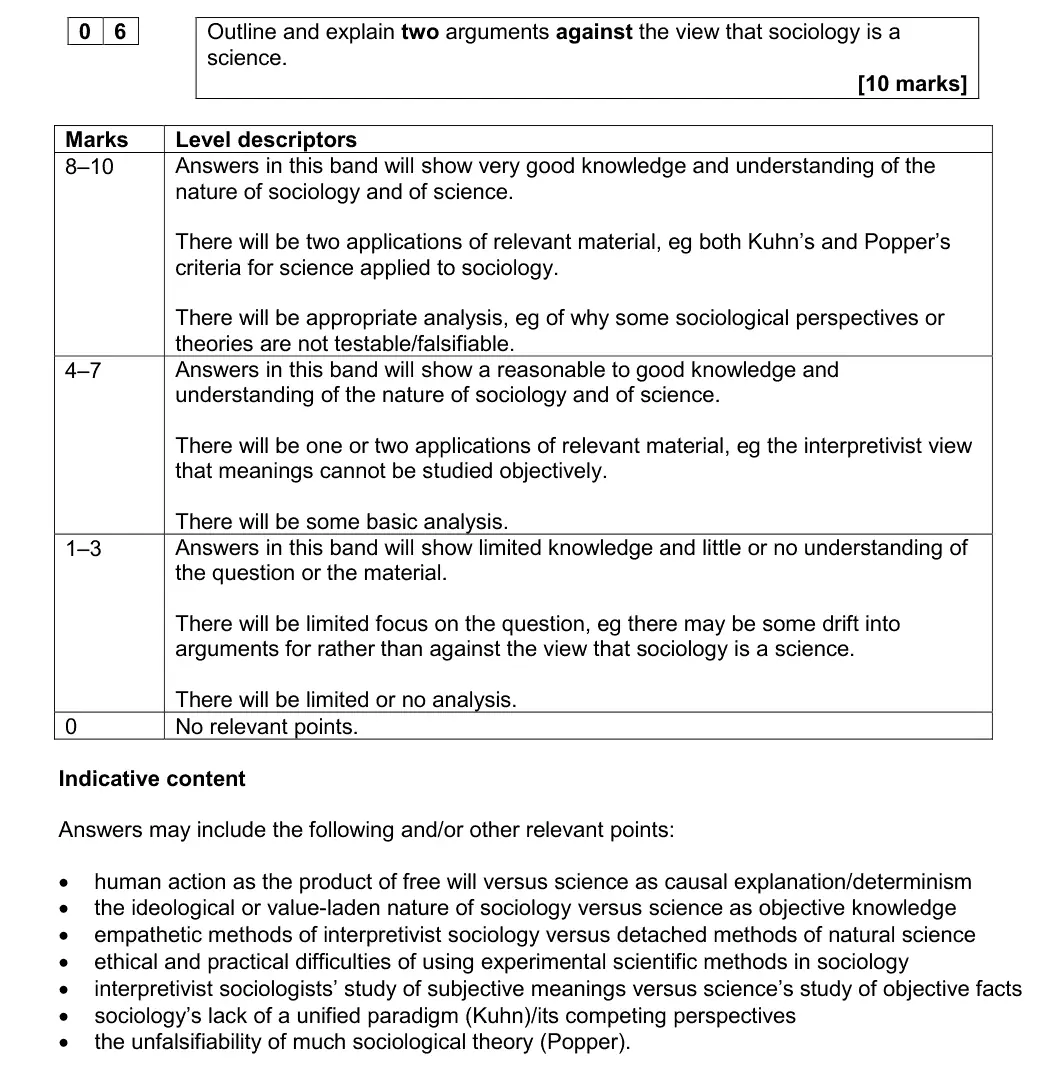
arguments must be against sociology as a science
drift into arguments for = 1–3
top band applies criteria such as Kuhn's paradigms and Popper's falsification
other credited points: free will vs determinism, value-laden sociology, interpretivist study of meanings
Specimen set 1 · Paper 3 · Q510 marksAO1=5, AO2=3, AO3=2Outline and explain
Mark scheme, including the levels grid and indicative content
Notes from the mark scheme and report
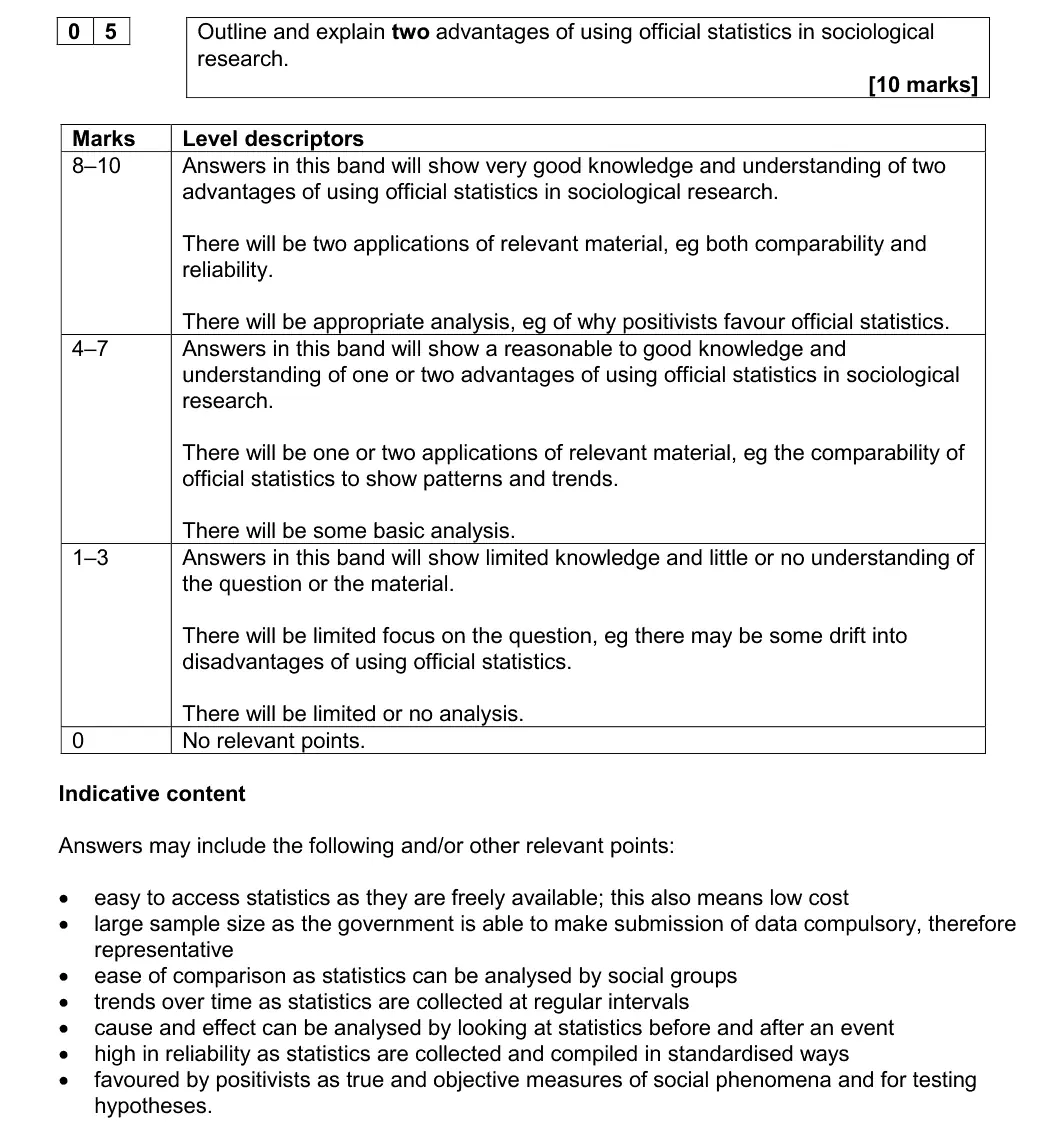
two advantages, e.g. comparability and reliability
analysis of why positivists favour official statistics
other creditable points: cheap and accessible, large representative coverage, trends over time, cause and effect
discussing disadvantages = 1–3 band
Work with an AQA sociology tutor
Essays stuck in the middle band, or losing marks on the 10-markers? Book a trial lesson with Mark, a former AQA examiner.