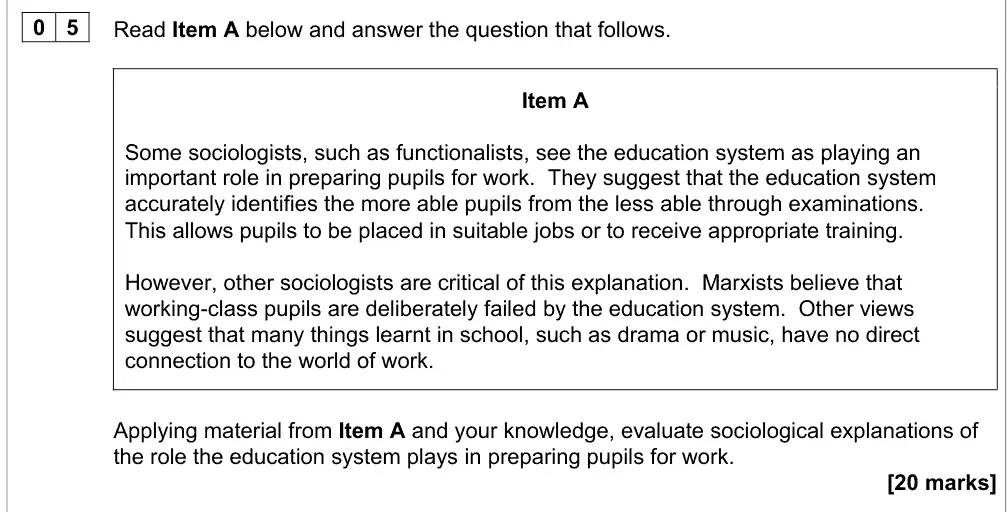
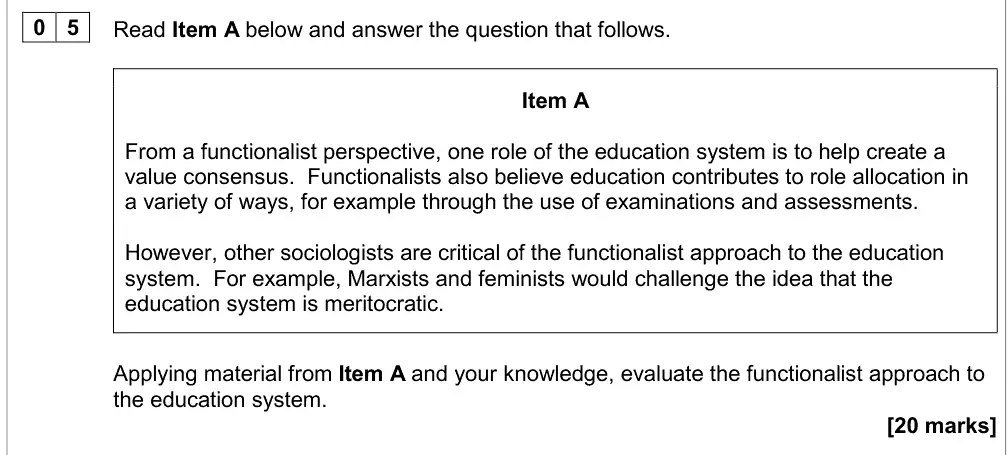
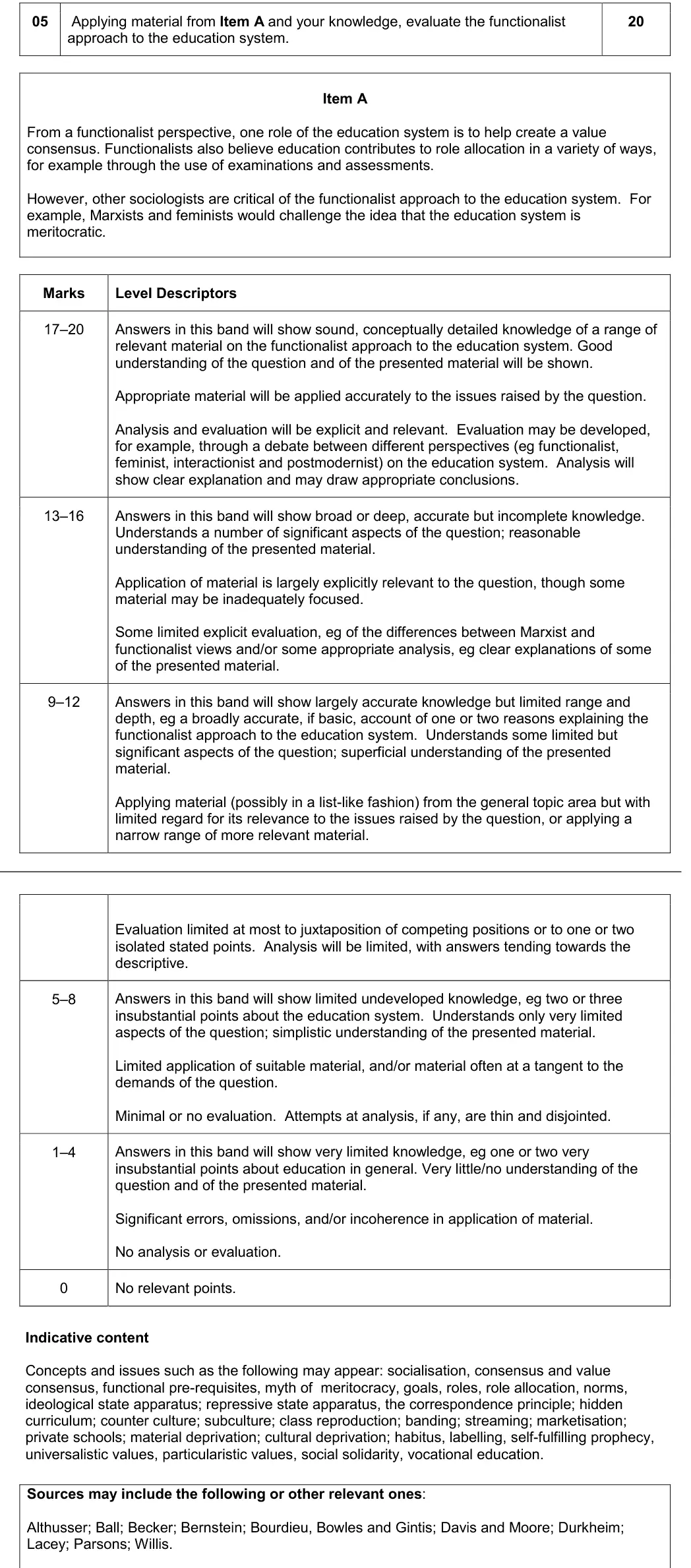
Applying material from Item A and your knowledge, evaluate sociological explanations of the role the education system plays in preparing pupils for work.
Tap a question to zoom it. The mark scheme (with the level descriptors and indicative content) and the examiner's comment open underneath.
June 2025 · AS Paper 1 · Q36 marksAO1=3, AO2=3Outline
Mark scheme
Examiner's comment
This question was well answered on the whole. Some students repeated their points or had issues with adequate elaboration to get the mark for development. A very small minority of students got confused regarding theories.
Notes from the mark scheme and report
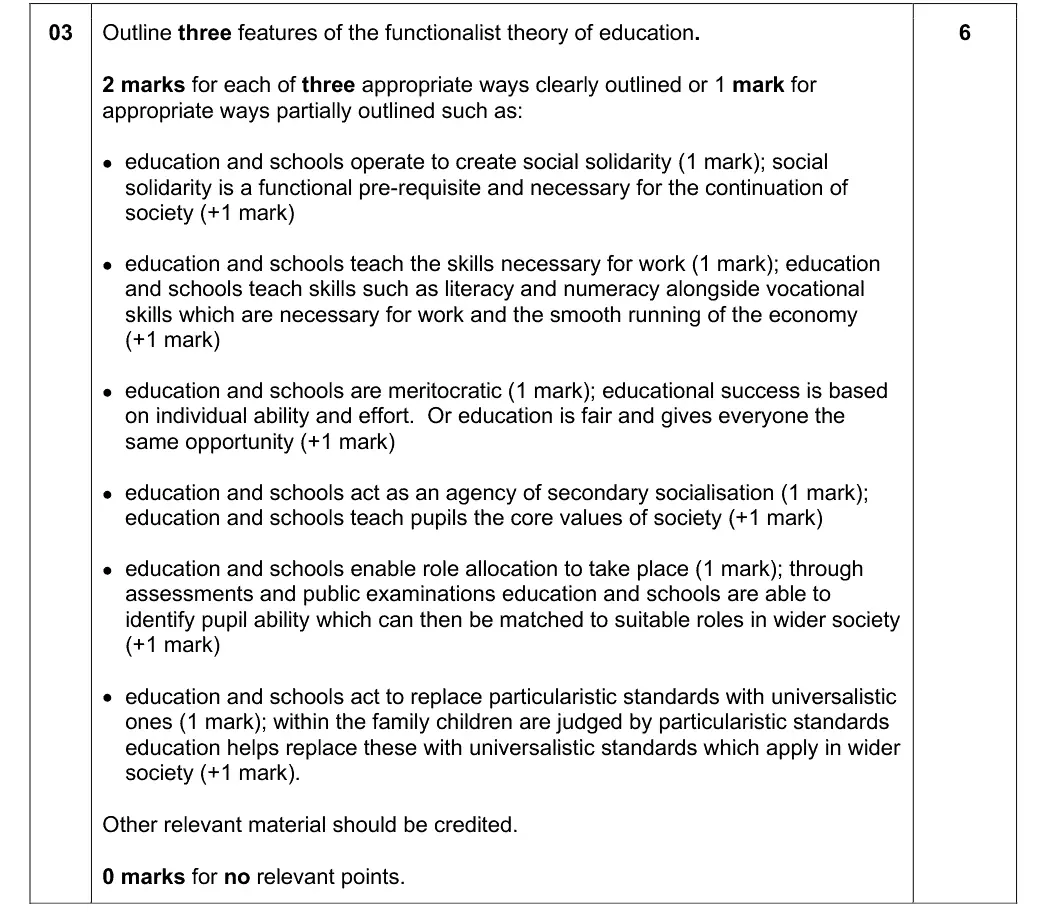
2 marks for each of three features clearly outlined, 1 if only partially outlined
credited: social solidarity, skills for work, meritocracy, secondary socialisation, role allocation, universalistic standards
marks lost by repeating points or not developing them
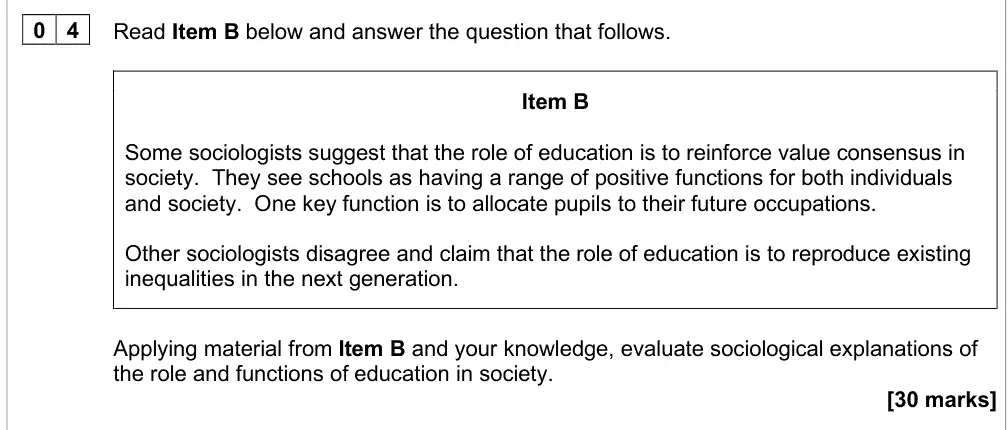
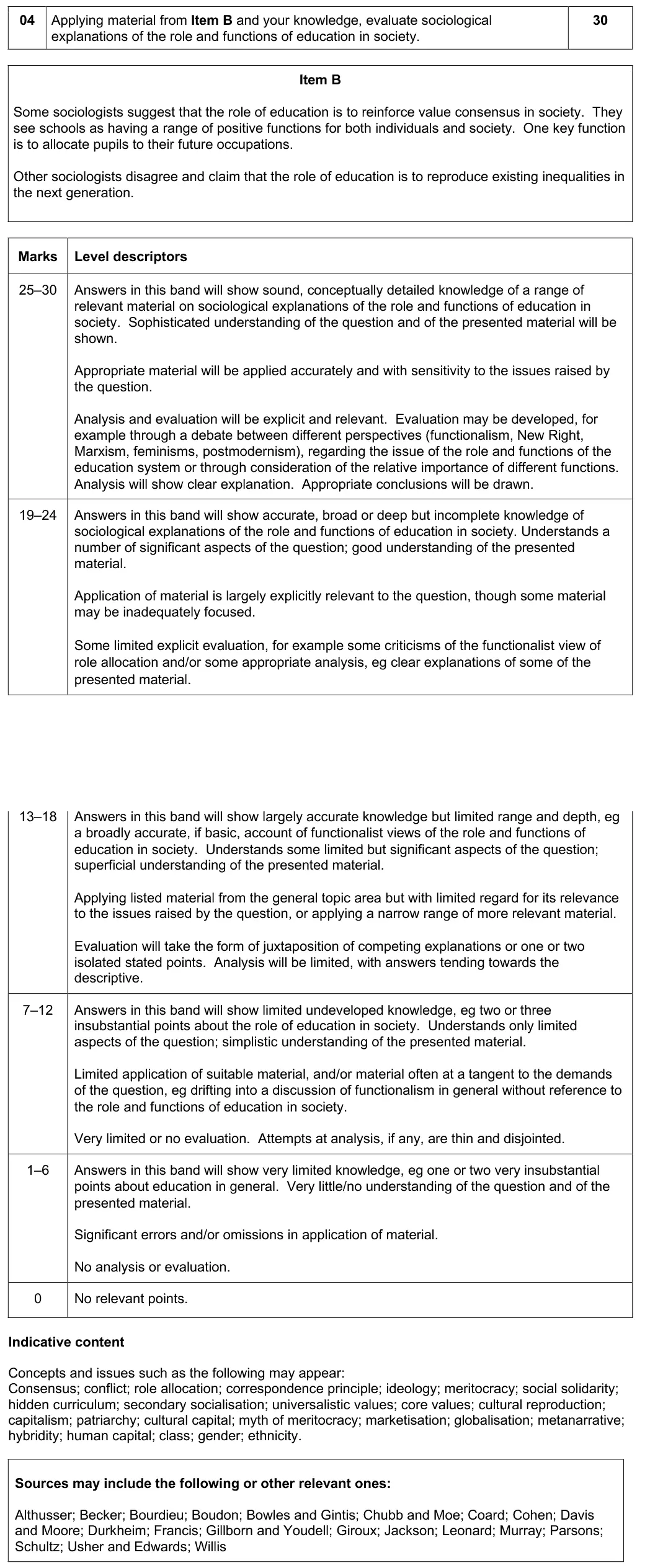
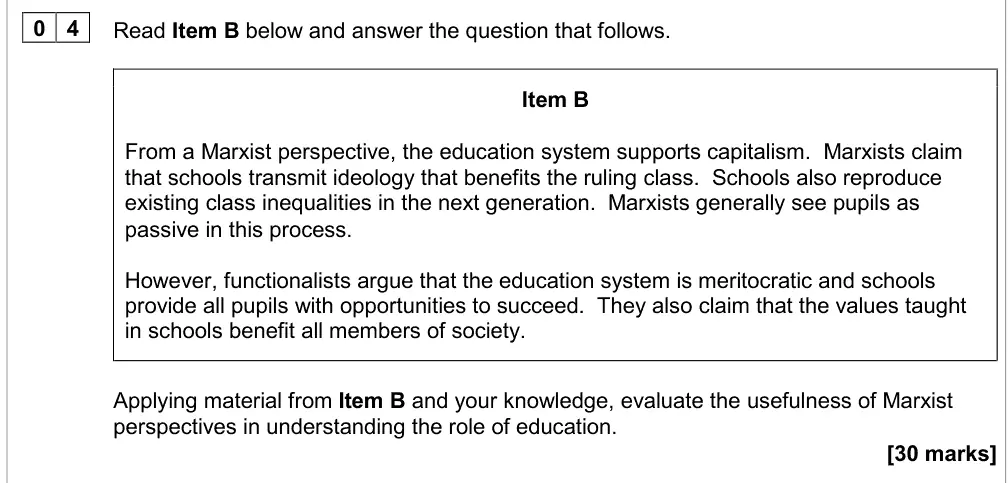
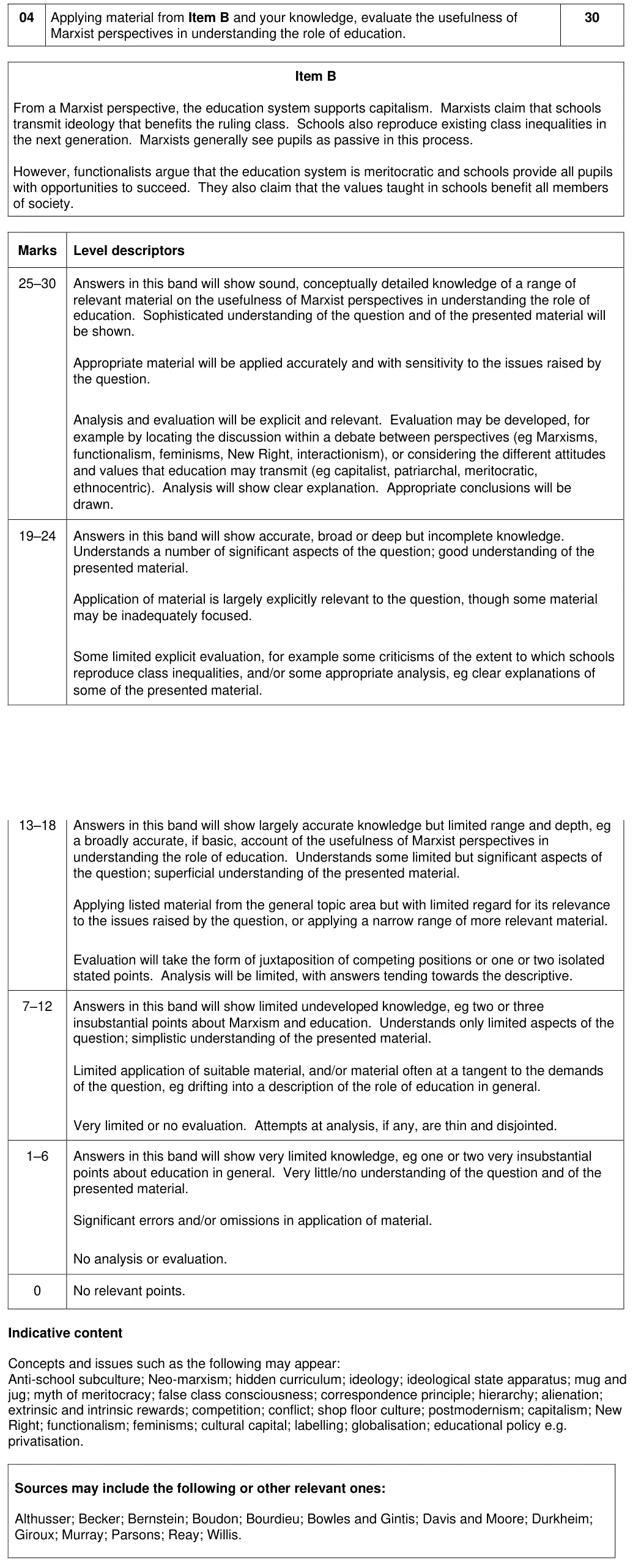
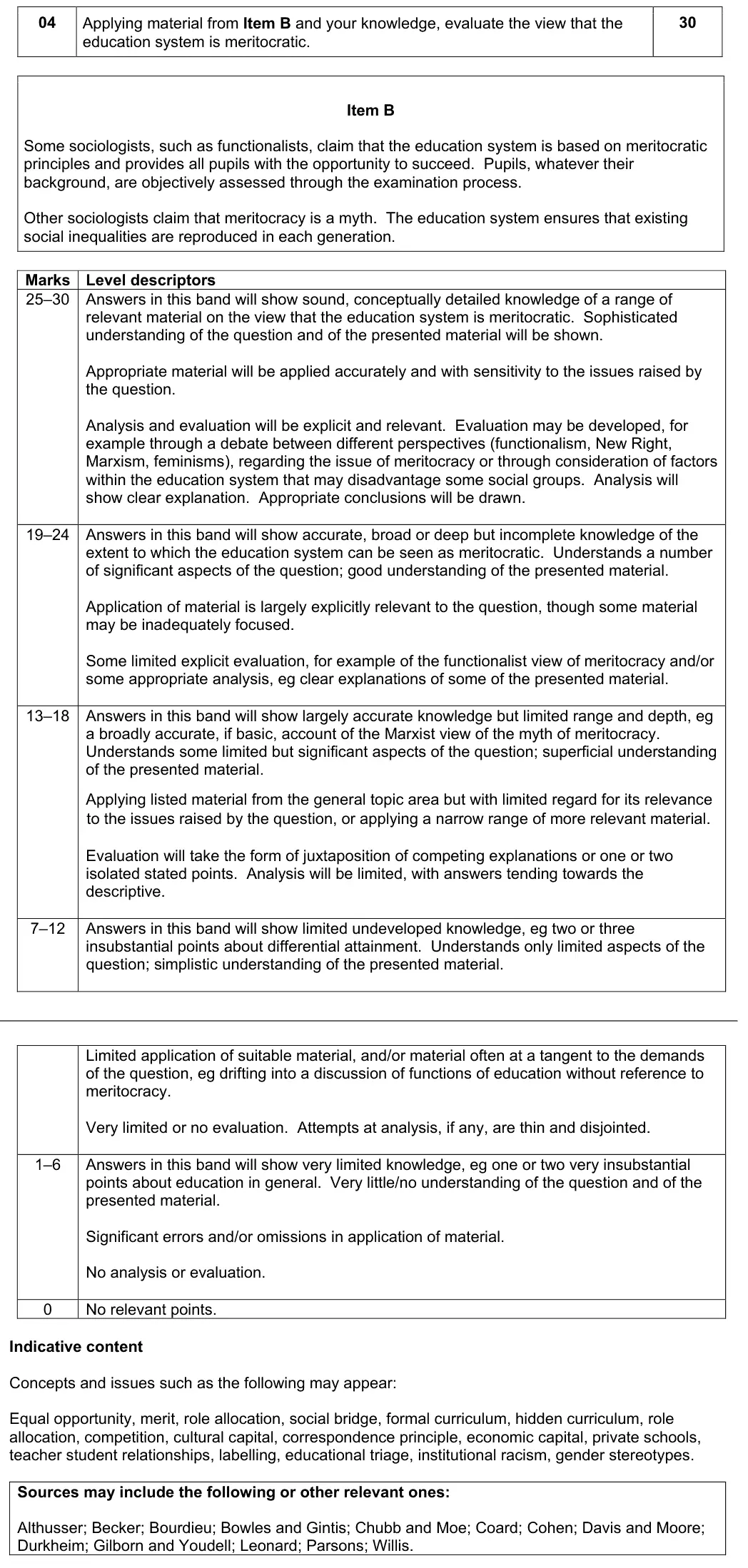
June 2025 · Paper 1 · Q430 marksAO1=12, AO2=9, AO3=930-mark essay
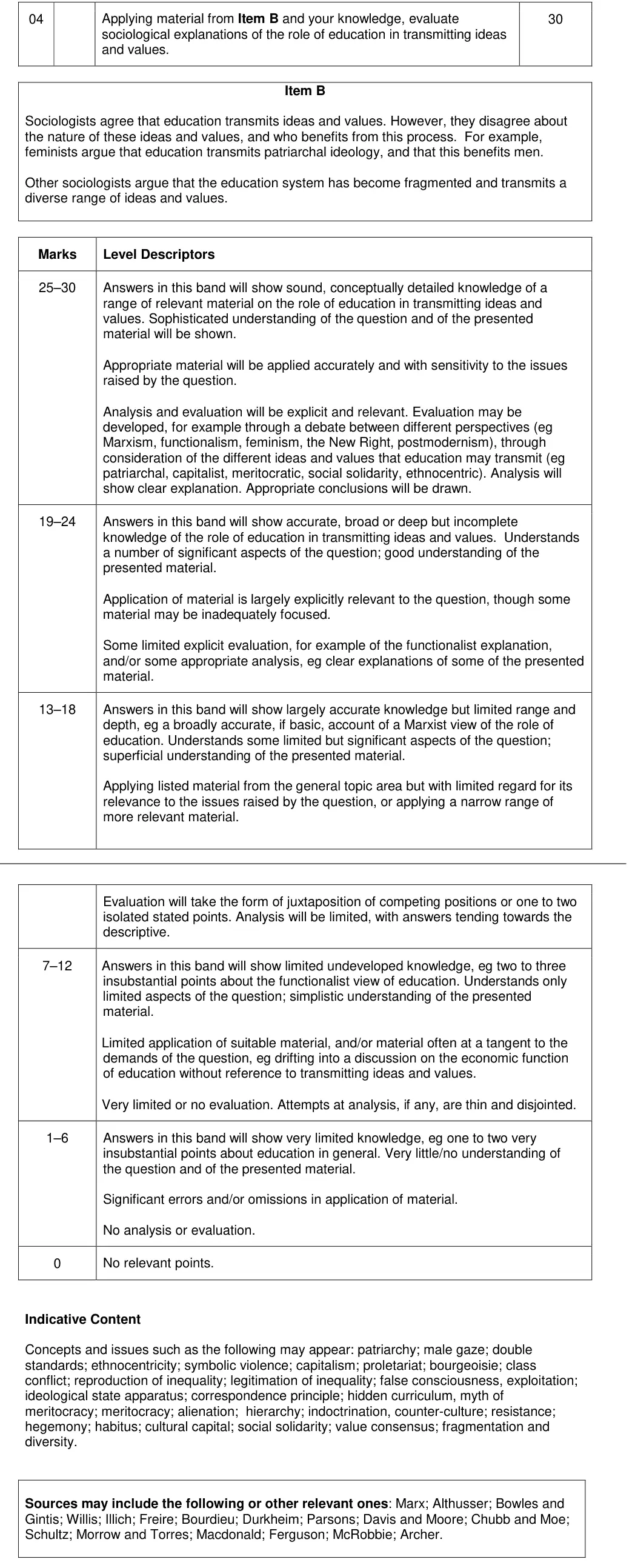
Mark scheme, including the levels grid and indicative content
Notes from the mark scheme and report
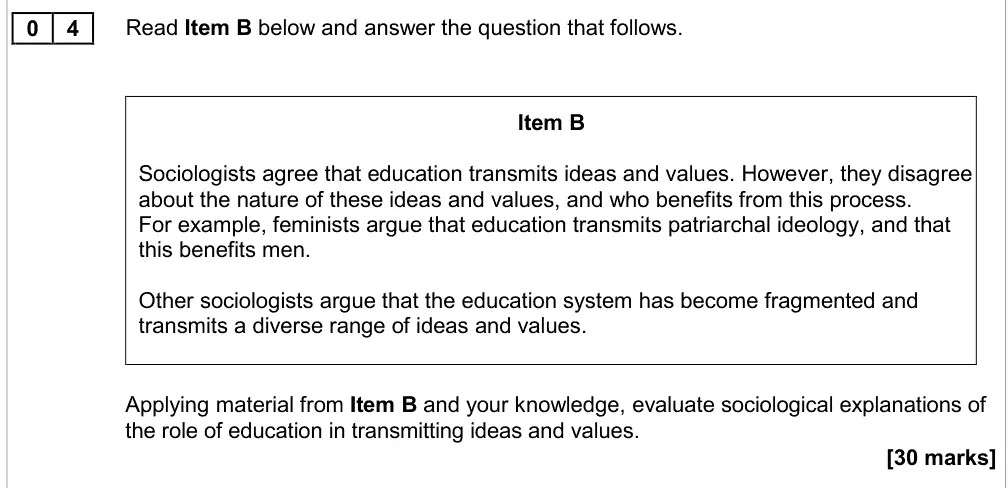
apply Item B (value consensus and role allocation vs reproducing inequality)
evaluation via functionalism, New Right, Marxism, feminisms, postmodernism or the relative importance of functions
criticisms of role allocation reach 19-24
a basic functionalist account only = 13-18
drift into functionalism in general without education = 7-12
no examiners' report published
June 2024 · AS Paper 1 · Q36 marksAO1=3, AO2=3Outline
Mark scheme
Examiner's comment
Question 03: This question was answered well on the whole. However, a significant minority of students did not read the question carefully and provided feminist criticisms of the education system. There were also issues with repetition by some students. For example, making the same point from a Marxist perspective.
Notes from the mark scheme and report
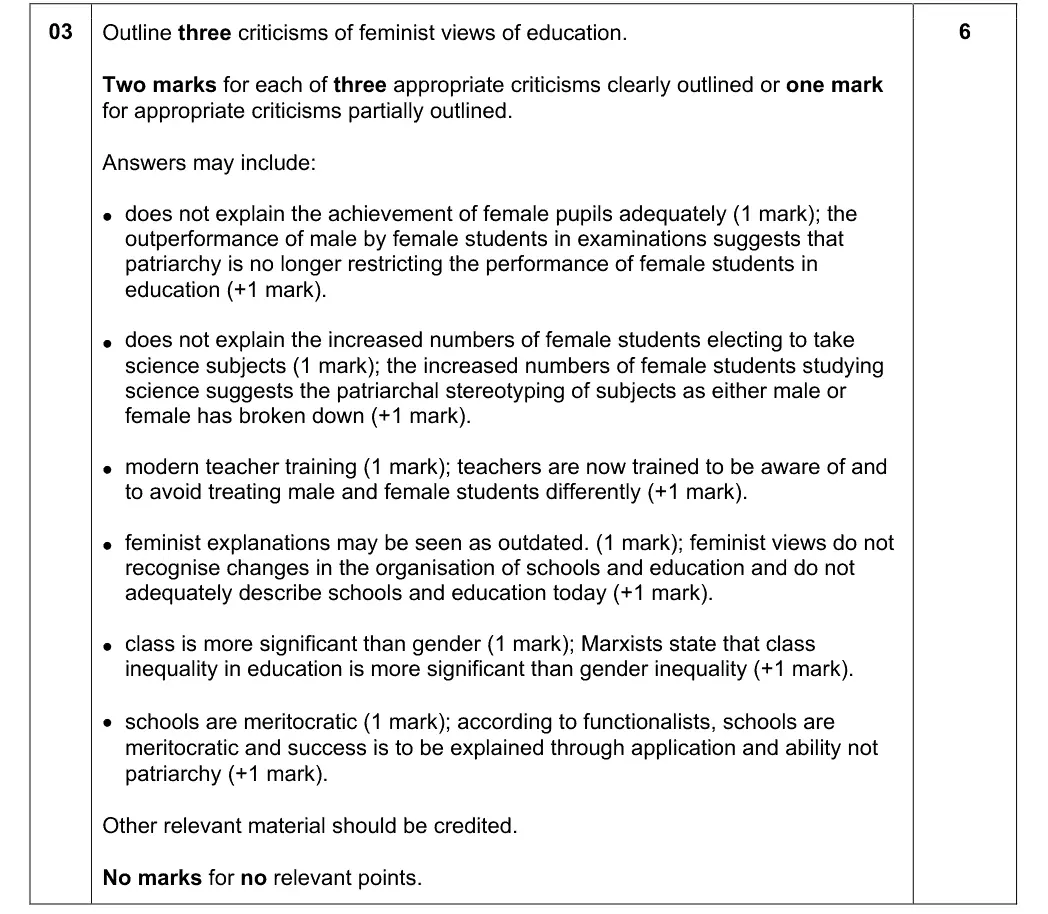
2 marks for each of three criticisms clearly outlined, 1 if partial
creditable: girls now outperform boys, more girls in science, teacher training, outdated, class matters more (Marxism), schools are meritocratic (functionalism)
some misread the question and gave feminist criticisms of education instead
repetition cost marks
June 2024 · Paper 1 · Q430 marksAO1=12, AO2=9, AO3=930-mark essay
Mark scheme, including the levels grid and indicative content
Examiner's comment
This question saw some excellent responses, with students engaging deeply with Marxist perspectives on the role of education such as Althusser's ‘Ideological State Apparatus’, Bowles and Gintis's ‘Myth of Meritocracy’ (perpetuating inequality) and the ‘Correspondence Theory’ (preparation for working in a capitalist society). The best answers demonstrated deep analysis, unpacking these concepts and critically assessing their relevance and applicability in modern education. For example, some students discussed the ‘Myth of Meritocracy’, exploring how it might manifest in contemporary educational practices and whether policies like ‘pupil premium funding’ effectively counteract these views. The best responses were well-focused on the usefulness of Marxist perspectives in understanding the role of education today. A common approach was to offer juxtaposed arguments, presenting alternative perspectives such as functionalism, New Right, or postmodernism alongside Marxist perspectives. While this approach is not necessarily problematic, it can be more limiting in terms of the marks awarded, as it may lack a deeper connection to a critique or evaluation of the Marxist perspectives. Additionally, there were responses that provided general accounts of social class differences or explanations for differences in achievement. While these points have potential relevance, they were often presented in a very general manner and were not specifically linked to the role of the education system, which was central to the question.
Notes from the mark scheme and report
top band locates Marxism in a debate with functionalism, feminisms, New Right, interactionism, or considers the different values education transmits
best answers unpacked ISA, myth of meritocracy and correspondence principle and judged their relevance today (e.g. pupil premium)
juxtaposed alternative perspectives limited marks
general accounts of class achievement not linked to the role of education
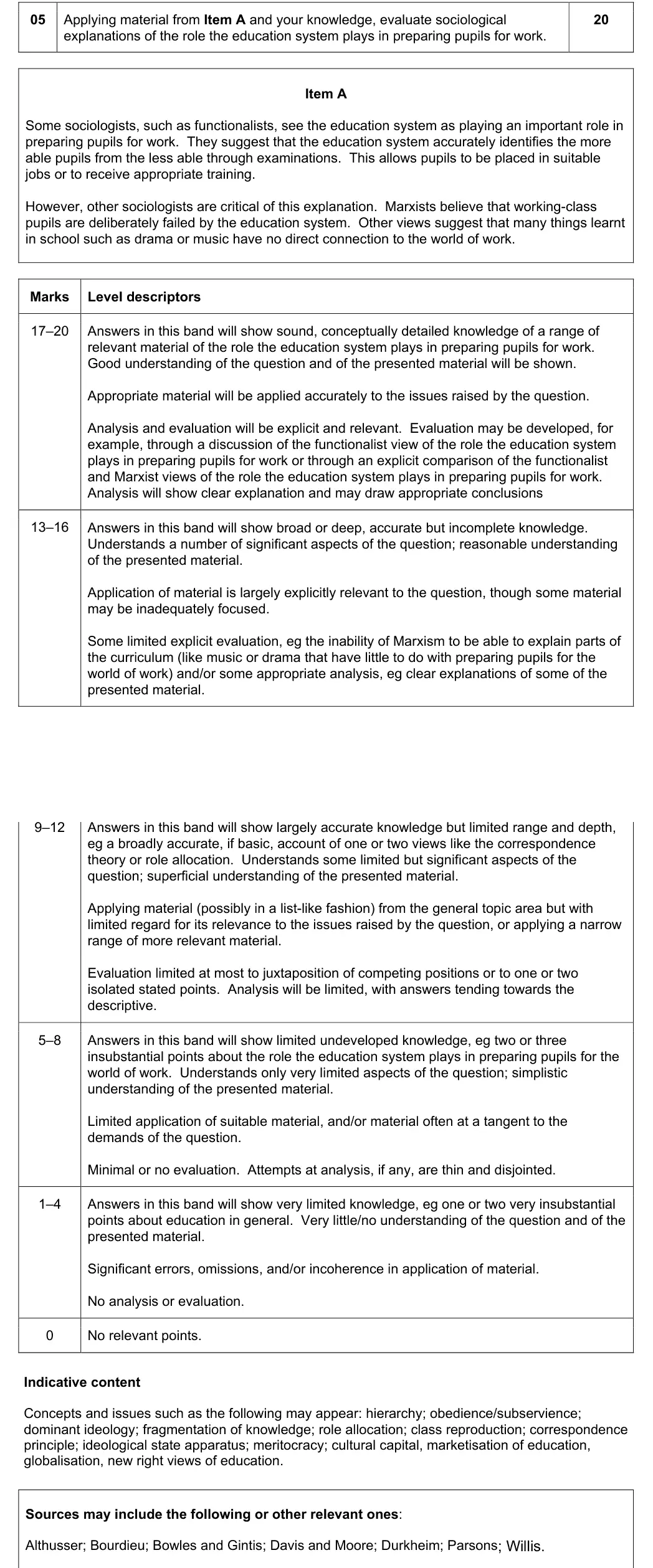
June 2024 · AS Paper 1 · Q520 marksAO1=8, AO2=6, AO3=620-mark essay
Mark scheme, including the levels grid and indicative content
Examiner's comment
Question 05: This question was accessible to most students. Students who scored highly were able to deploy a wide range of theories and apply them to the issue of preparing pupils for work. The item was used well and provided ‘hooks’ that enabled students to develop their knowledge, analysis and evaluation. In better responses, there was developed analysis and evaluation as well as conceptual depth and detail. Some responses were able to develop evaluation by comparing and contrasting different theoretical approaches directly; other less sophisticated responses did this by juxtaposition. In some cases, answers merely provided catch-all theoretical responses that did not apply their knowledge to preparing for work; others drifted into this.
Notes from the mark scheme and report
top band evaluates the functionalist view or explicitly compares functionalist and Marxist views of preparing pupils for work
item hook on drama and music can be used to show Marxism's limits
correspondence theory or role allocation alone = 9–12
high scorers applied a wide range of theories and used the item's hooks well
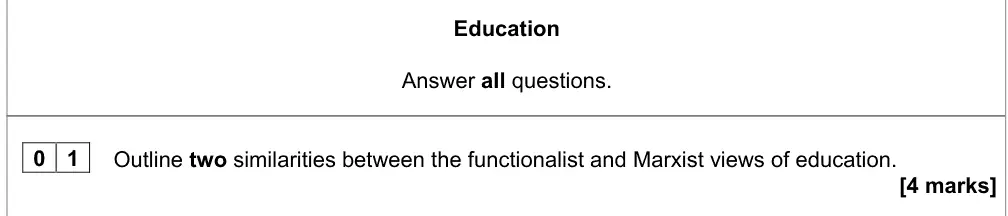
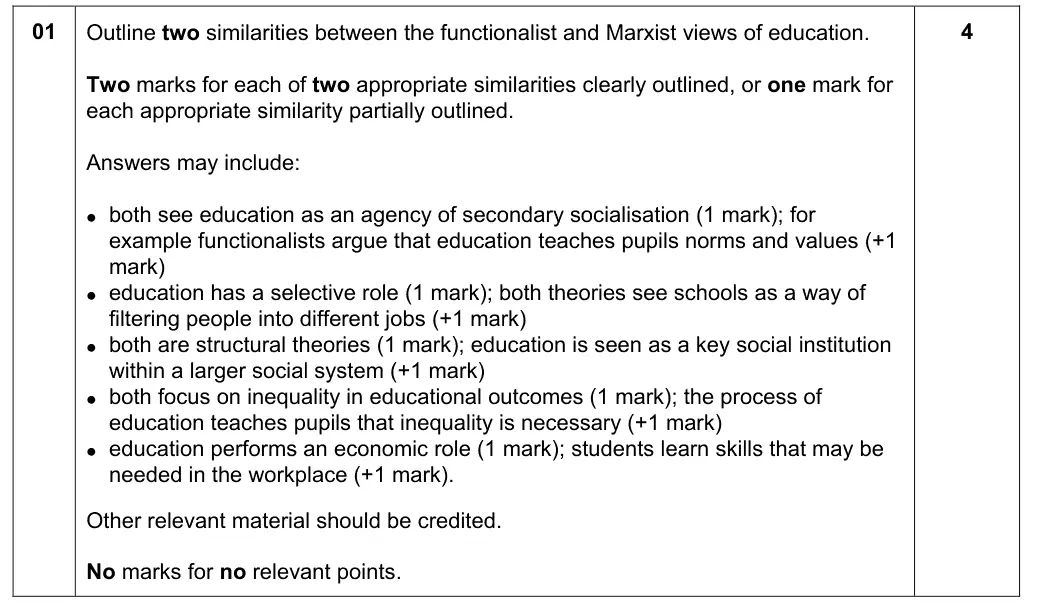
June 2023 · Paper 1 · Q14 marksAO1=4Outline
Mark scheme
Examiner's comment
A small number of students struggled with this question, perhaps because the theories are more often presented as being different rather than in terms of their similarities. However, most students were able to offer at least one similarity between functionalist and Marxist views of education. The most common answers were that both views argue that education prepares students for the workplace and/or that education is a secondary agent of socialisation. Most students then developed these points by providing an example from either or both of the functionalist or Marxist perspectives.
Notes from the mark scheme and report
2 marks for each of two similarities clearly outlined, 1 if only partially outlined
some students struggled because the two theories are usually taught as contrasting
most common answers: both see education as preparing pupils for work, and as an agency of secondary socialisation
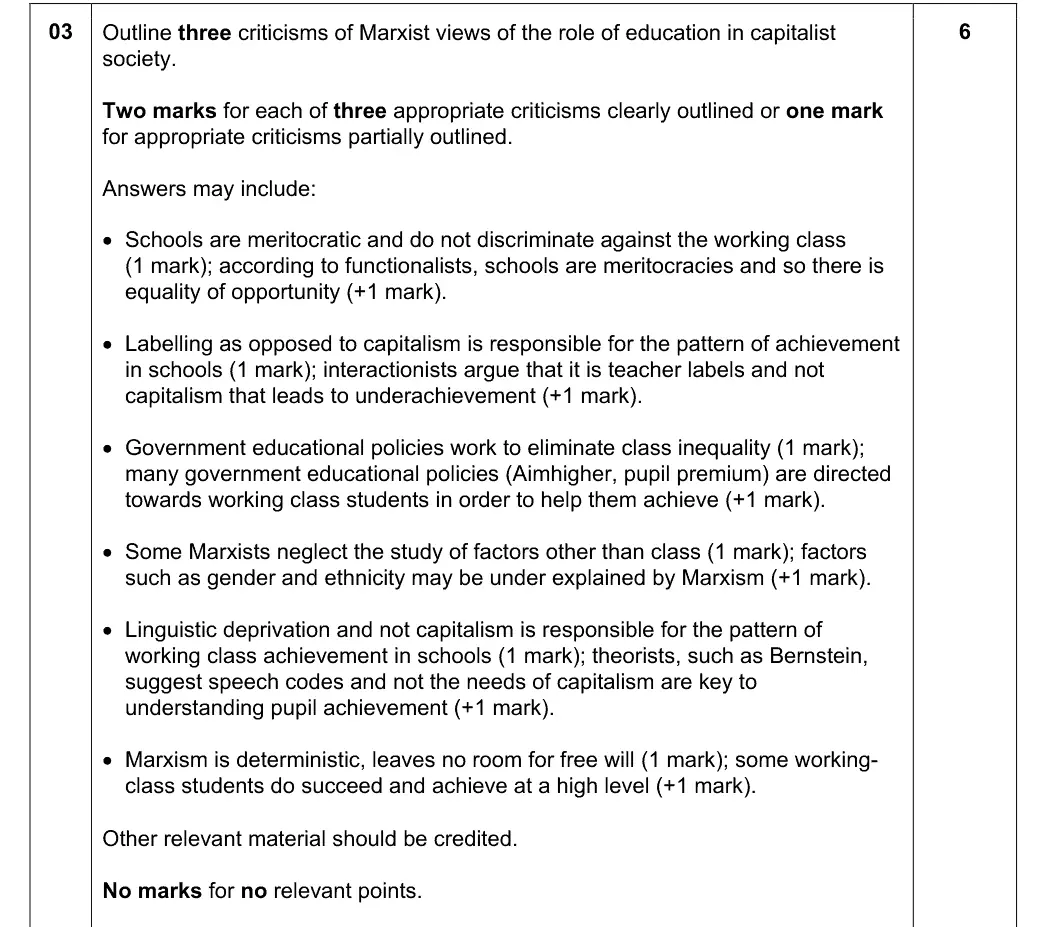
June 2023 · AS Paper 1 · Q36 marksAO1=3, AO2=3Outline
Mark scheme
Examiner's comment
It was evident that students had been well-prepared to understand the demands of the different styles of questions, giving appropriately short responses to the 2 mark questions and using bullet points in their answers to question 3. Question 03: Students generally had a good understanding of Marxist theories of education. However, this question caused difficulties for a number of students. Unfortunately, under the pressure of the examination, many didn’t read the question fully to understand that the response required criticisms of Marxist theory, not the ways in which Marxists would criticise the education system. Where students did understand the requirements of the question, many were able to identify criticisms and develop them appropriately.
Notes from the mark scheme and report
criticisms OF Marxist views, not Marxist criticisms of education (a common misreading)
credited: functionalist meritocracy, interactionist labelling, equality policies, neglect of gender and ethnicity, Bernstein speech codes, determinism ignoring working-class success
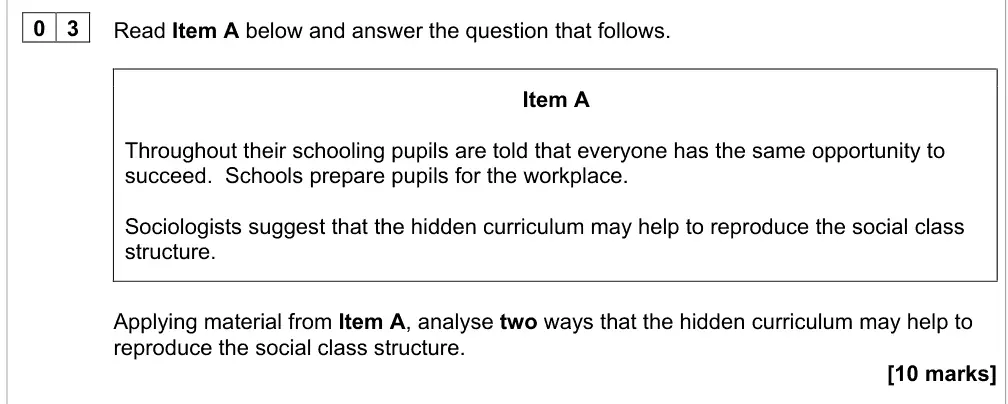
June 2023 · Paper 1 · Q310 marksAO1=3, AO2=4, AO3=3Analyse
Mark scheme, including the levels grid and indicative content
Examiner's comment
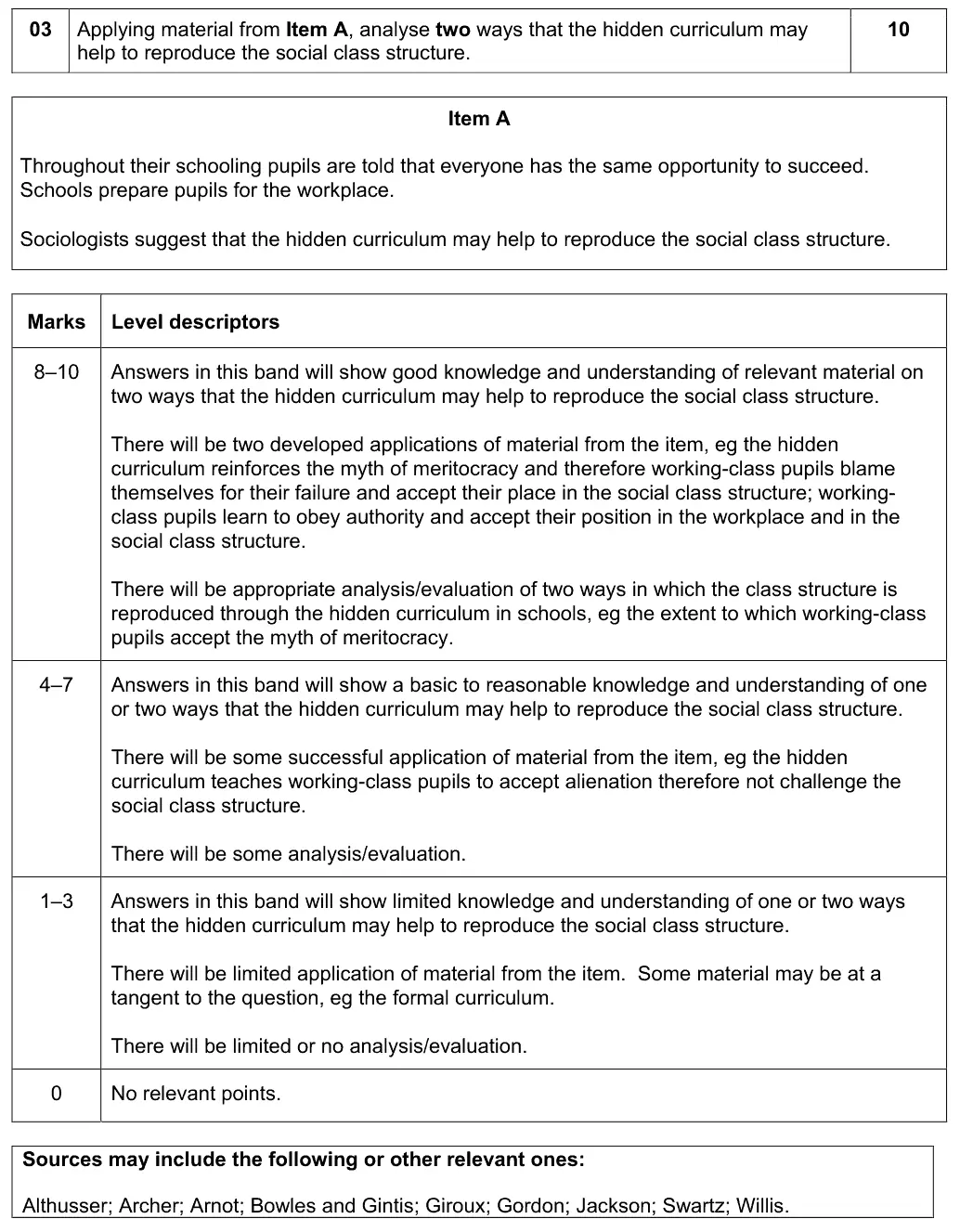
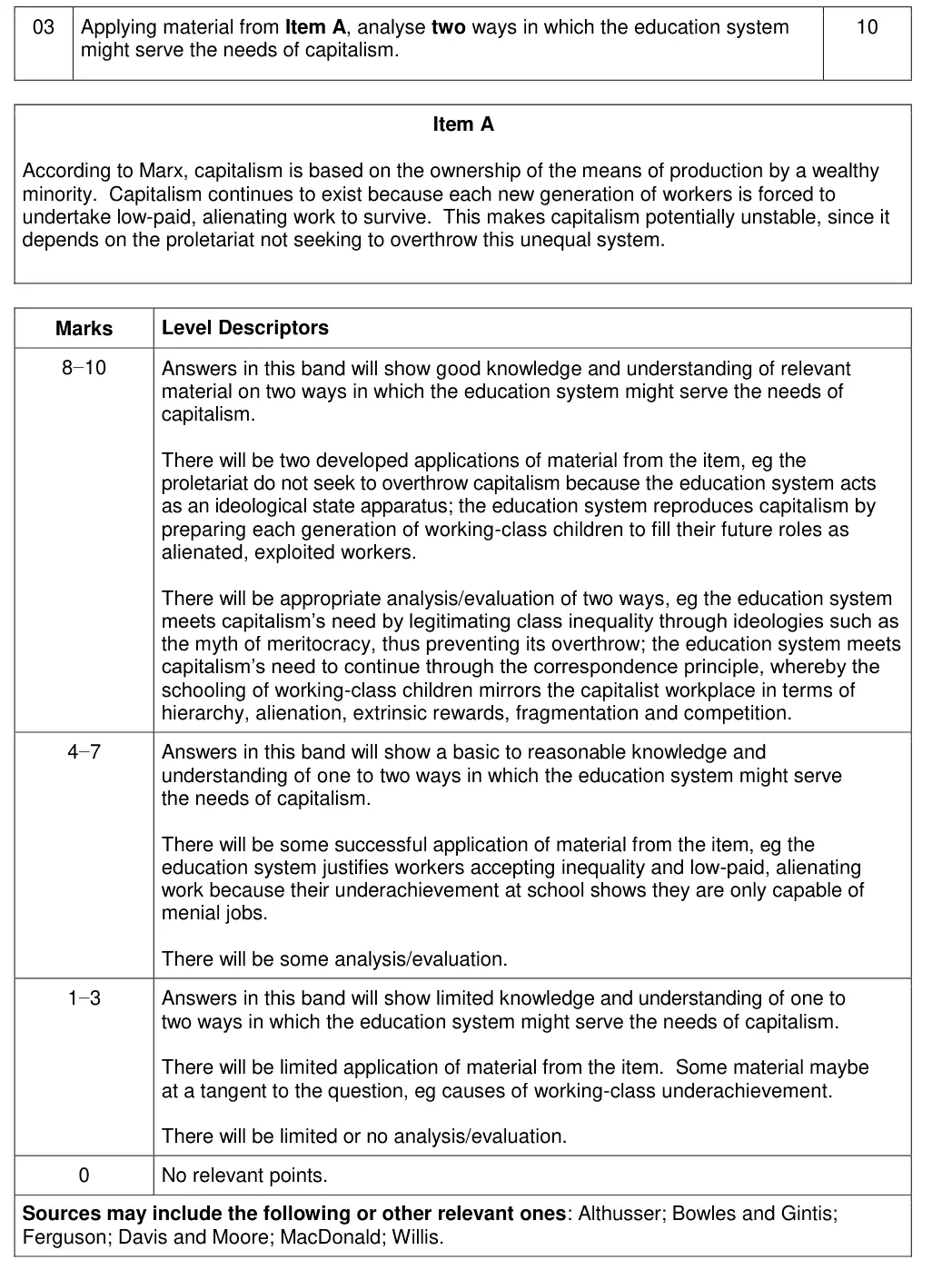
In general, this question was answered well and students were able to apply good knowledge and understanding of the ways that the hidden curriculum may help to reproduce the social class structure. Most students were able to recognise the hooks in the item and then develop these to varying degrees of success. For example, many were able to develop the hook that ‘pupils are told that everyone has the same opportunity to succeed’ with discussion of Bowles and Gintis theory of the ‘myth of meritocracy’. Some students were then able to develop this further and explain with examples how labelling and setting and streaming may contribute to the myth of meritocracy. The most successful answers were then able to explain how these processes, as part of the hidden curriculum, then help to reproduce the social class structure. For example, some explained that the working class were more likely to be placed in lower sets and therefore miss out on top knowledge that prevents them from achieving upward social mobility. There were some students who attempted to use the item by making reference to the last line of the item which is a rewording of the question and should not be seen as a valid use of any hook that requires development. However, a small number of students ignored the item and made no reference to the hooks in their answer and therefore were not able to achieve marks in the 4-7 level (or higher). Less successful answers focussed on functionalist explanations of how schools can be meritoracatic but were then unable to say how this helps to reproduce the social class structure. Some answers also drifted into external factors with no clear reference to the hidden curriculum.
Notes from the mark scheme and report
must develop hooks from Item A
no reference to the item = max 3 marks
the last line of the item restates the question and is not a hook
formal curriculum is a tangent
weaker answers drifted into external factors or functionalist meritocracy without linking to class reproduction
best answers linked the myth of meritocracy, labelling and setting to reproduction of class
June 2023 · AS Paper 1 · Q410 marksAO1=5, AO2=3, AO3=2Outline and explain
Mark scheme, including the levels grid and indicative content
Examiner's comment
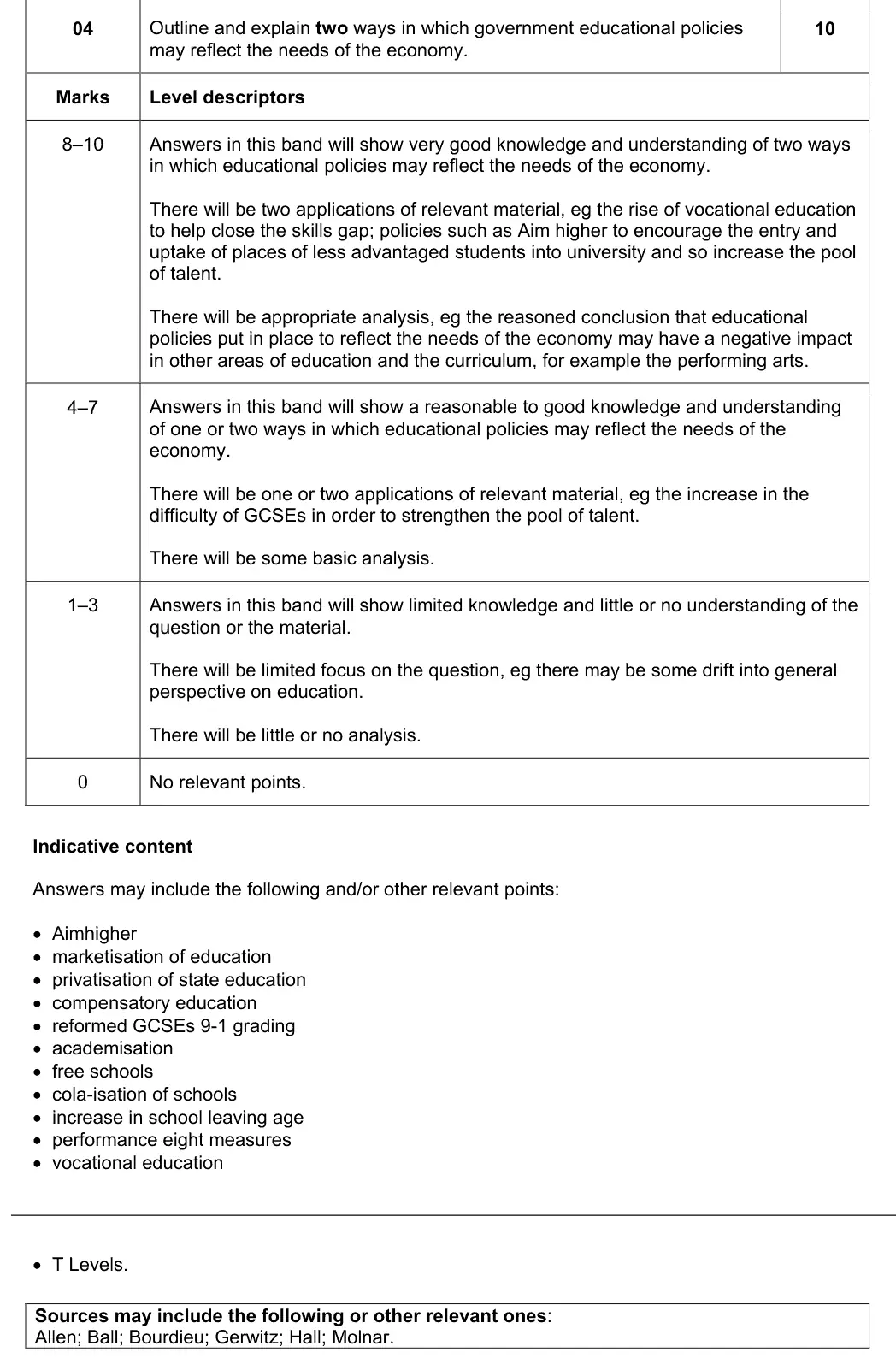
In the questions where extended prose was required (10 and 20 mark questions) most students showed their understanding of the different balance of skills required in each question. Question 04: This question required students to be able to apply two government education policies to the needs of the economy. Centres have clearly taught educational policy well and a large proportion of students understood what the economy was and were able to use their knowledge and application skills to answer the question. Raising the school leaving age and the National Curriculum were popular policy choices, as were several from within the 1988 Educational Reform Act. There were several sophisticated responses that applied a policy intended to raise standards in education with a global economy and a greater need for a highly educated workforce. Students were still able to gain credit where they made some link to the economy, eg keeping school leavers out of poverty and families benefitting from being spared the expense of providing food/resources. However, there were a minority of students who missed the intention of the question by suggesting policies that were internal to specific schools, policies that weren’t educational in focus, or not understanding the term ‘economy’.
analysis e.g. economy-driven policy squeezing the arts
drift into general perspectives on education = 1-3
raising school leaving age, National Curriculum and 1988 Education Reform Act were popular
June 2022 · AS Paper 1 · Q22 marksAO2=2Brief explain
Mark scheme
Examiner's comment
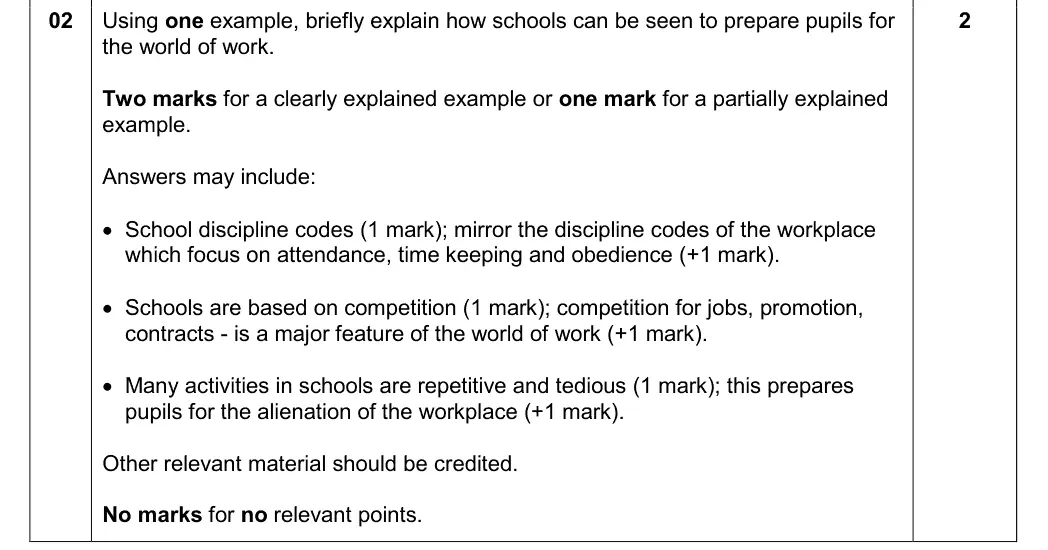
This question was answered very well by most students. Centres have clearly taught the correspondence principle well and this was used by many students to gain full marks. Other students were equally successful using a less theoretical approach, giving practical examples from schools. Where some students missed available marks, they tended to lack an explicit link to the world of work.
Notes from the mark scheme and report
1 mark for the example +1 for explaining the link to work (discipline codes and punctuality, competition, repetitive tasks and alienation)
answered well, often via the correspondence principle or practical school examples
November 2021 · Paper 1 · Q430 marksAO1=12, AO2=9, AO3=930-mark essay
Mark scheme, including the levels grid and indicative content
Examiner's comment
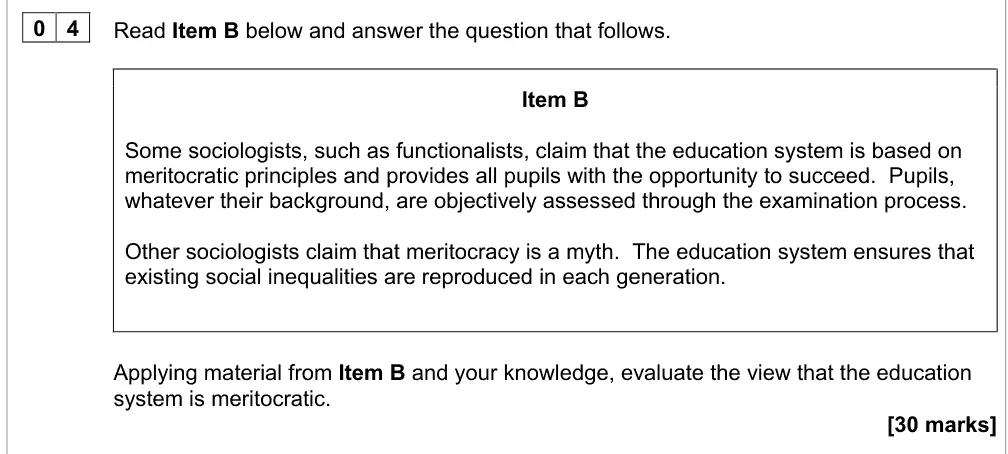
Despite the much lower than usual entry, there was some range in the responses to this question. Many students were able to outline a debate for and against the view that the education system is meritocratic, to varying levels of success. For example, some made reference to the national curriculum and external exams to outline how the education system could be seen as a fair and equal system whilst labelling by teachers, setting and streaming and the ethnocentric curriculum could mean that education is biased and unfair. The most successful answers were able to present their arguments and evidence through a debate between sociological perspectives. For example, many students outlined Parson’s views of the education system being meritocratic and the ways that education is the ‘bridge’ between the family and wider society and enabling people to gain achieved status. Some continued to apply Davis and Moore’s view of the ‘selective role’ that the education system performs in ‘sifting and sorting’ pupils into the appropriate positions in the workplace. This was often counter-argued with Marxist views. For example, many argued that Bourdieu’s concept of ‘cultural capital’ provides the middle class with an advantage that means they are more likely to achieve in school. Some also included feminist theories and viewpoints in explaining gender differences in achievement and opportunities as well as discussions of the extent to which some ethnic minority groups may experience obstacles to achieving well in the education system. Less effective answers tended to be descriptive and had a limited range of explanations and viewpoints. Some students referred more generally to functionalist and Marxist theories of education and struggled to apply these to views of meritocracy and/ or to the education system. The most successful answers demonstrated more sophisticated analysis and evaluation in debating the extent to which the education system is meritocratic or whether there is a ‘myth of meritocracy.
Notes from the mark scheme and report
must apply Item B (functionalist meritocracy vs myth of meritocracy and reproduction of inequality)
top band: debate between functionalism, New Right, Marxism and feminisms or school factors disadvantaging some groups
drift into functions of education without meritocracy = 7–12
best answers used Parsons, Davis and Moore against Bourdieu and Bowles and Gintis
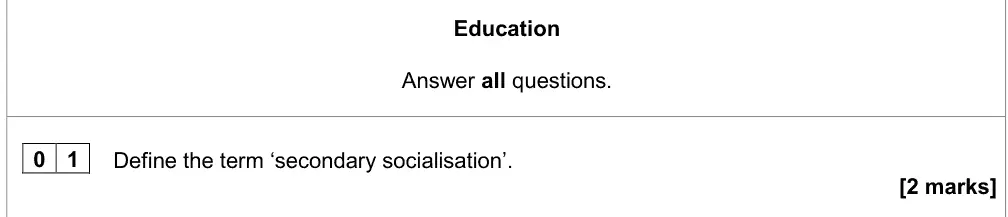
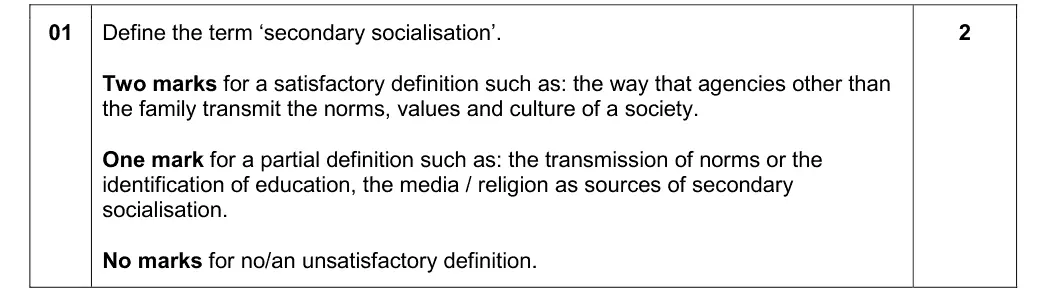
November 2020 · AS Paper 1 · Q12 marksAO1=2Define
Mark scheme
Notes from the mark scheme and report
2 marks for agencies other than the family transmitting a society's norms, values and culture
1 mark for a partial answer (transmission of norms only, or just naming education/media/religion as agencies)
no examiners' report for this series
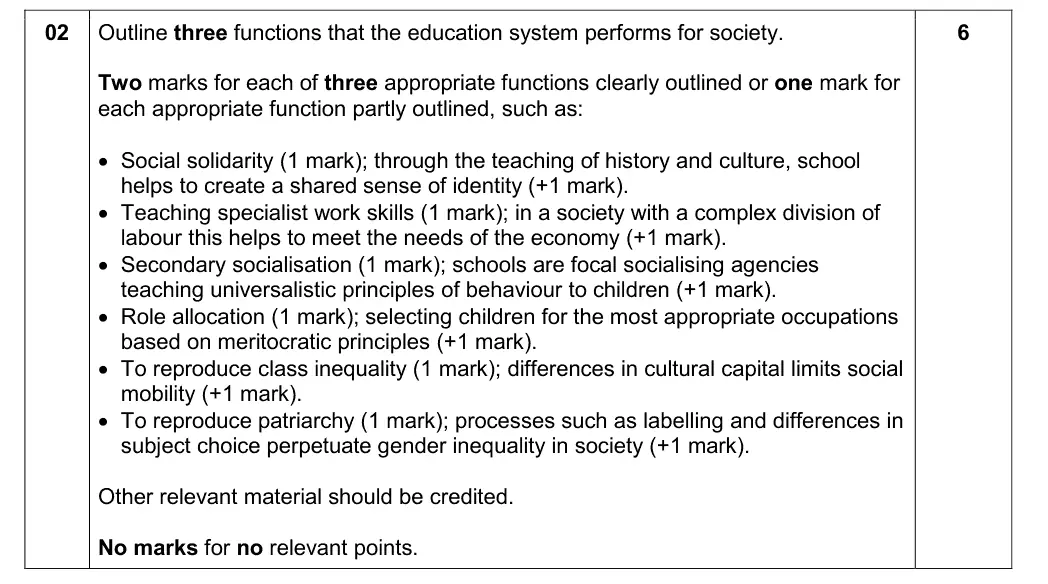
November 2020 · Paper 1 · Q26 marksAO1=3, AO2=3Outline
Mark scheme
Examiner's comment
Similarly to summer 2019, a significant number of students wrote very lengthy answers to the 4-mark and 6-mark questions which may explain why some seemed to run out of time in answering the final question. Most students could offer two or three functions that the education system performs. These drew from functionalist, Marxist and feminist perspectives, including such functions as role allocation, promotion of social solidarity, ideological purpose and supporting patriarchal values. Many were then able to develop their point further to gain the additional mark. For example, a number of students developed the point of role allocation in explaining that outcomes of exams help ‘sift and sort’ students into suitable occupations. In less successful answers, students gave responses that were too similar or overlapping to be credited separately.
Notes from the mark scheme and report
2 marks for each of three functions clearly outlined, 1 if partial
functions from functionalist, Marxist and feminist views all credited (e.g. social solidarity, specialist skills, secondary socialisation, role allocation, reproducing class inequality or patriarchy)
functions too similar or overlapping not credited separately
November 2020 · AS Paper 1 · Q520 marksAO1=8, AO2=6, AO3=620-mark essay
Mark scheme, including the levels grid and indicative content
Notes from the mark scheme and report
hooks: value consensus, role allocation through exams, Marxist and feminist challenge to meritocracy
top band debates functionalist, feminist, interactionist and postmodernist views
Marxist vs functionalist contrast credited as limited evaluation
no examiners' report for this series
June 2019 · Paper 1 · Q26 marksAO1=3, AO2=3OutlineEasy
Mark scheme
Examiner's comment
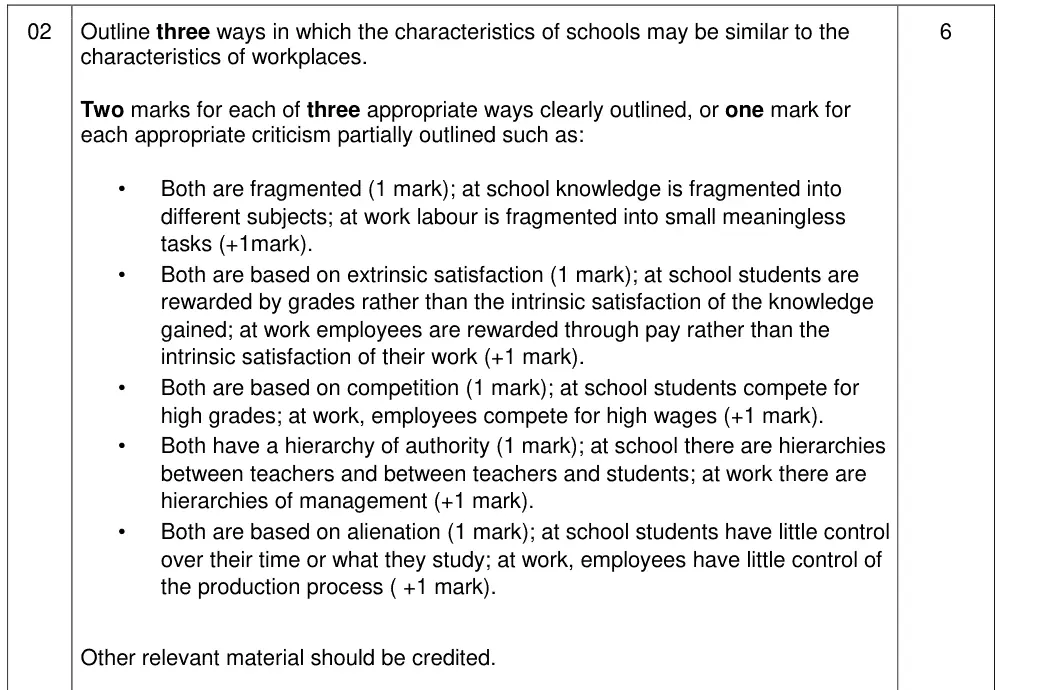
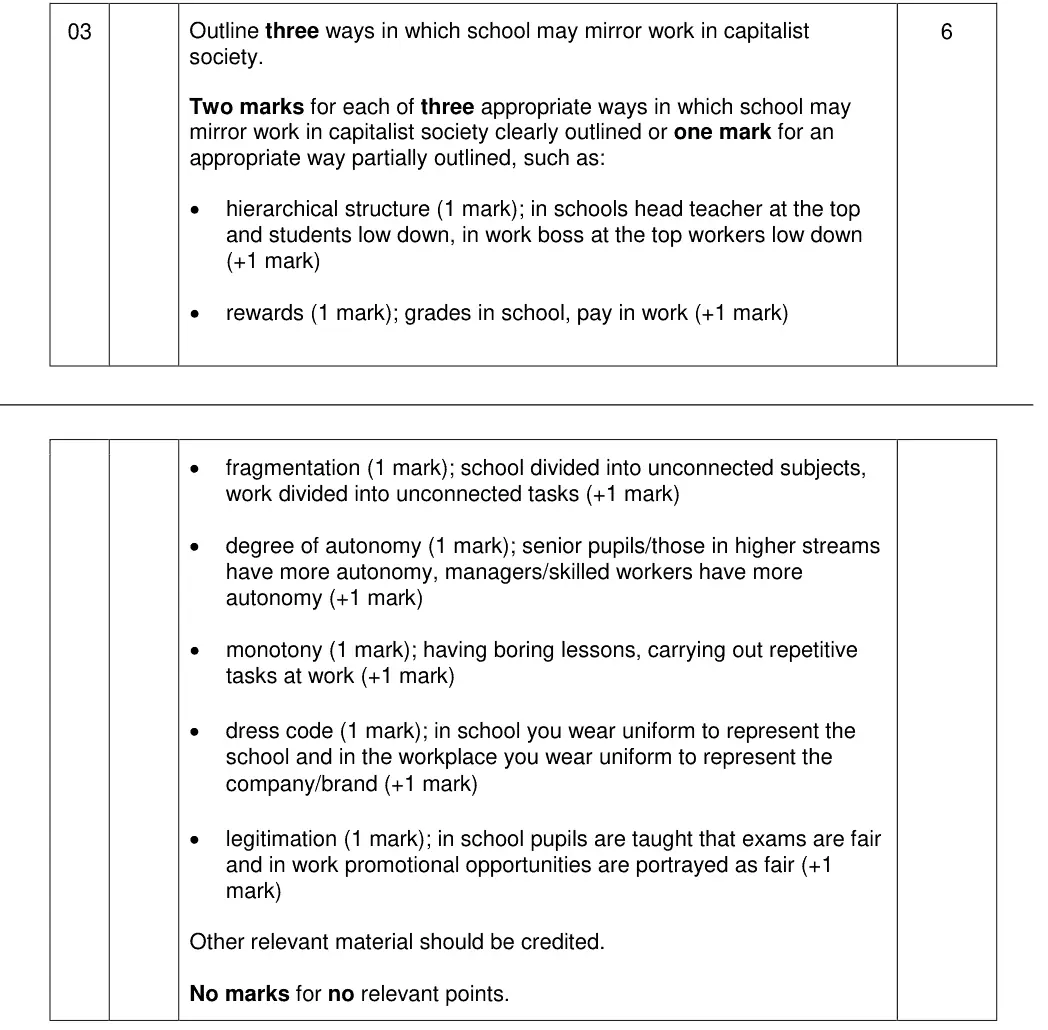
A significant number of students wrote too much for the 4-mark and 6-mark questions, although fewer than in the two previous years. Centres are reminded that these small-mark questions are best answered with a clear ‘point’ and ‘development’ structure, rather than lengthy continuous prose. The question produced a wide range of answers, with most students able to identify and explain at least two reasons. This question had the highest mean mark (79%), as a percentage of maximum mark. Common successful responses gave the examples of hierarchy, dress codes, attendance and punctuality, rewards and punishments and fragmentation of tasks. Students who wrote about the functions of schools from a theoretical perspective, without referring to a characteristic, were less successful. Many students were not awarded a second mark because they failed to give an example of how the characteristics of the school were mirrored in the workplace.
Notes from the mark scheme and report
2 marks for each of three ways clearly outlined
each characteristic must be shown in both school and workplace for the second mark
theoretical accounts of school functions without naming a characteristic did less well
highest-scoring question on the paper
June 2019 · AS Paper 1 · Q36 marksAO1=3, AO2=3Outline
Mark scheme
Examiner's comment
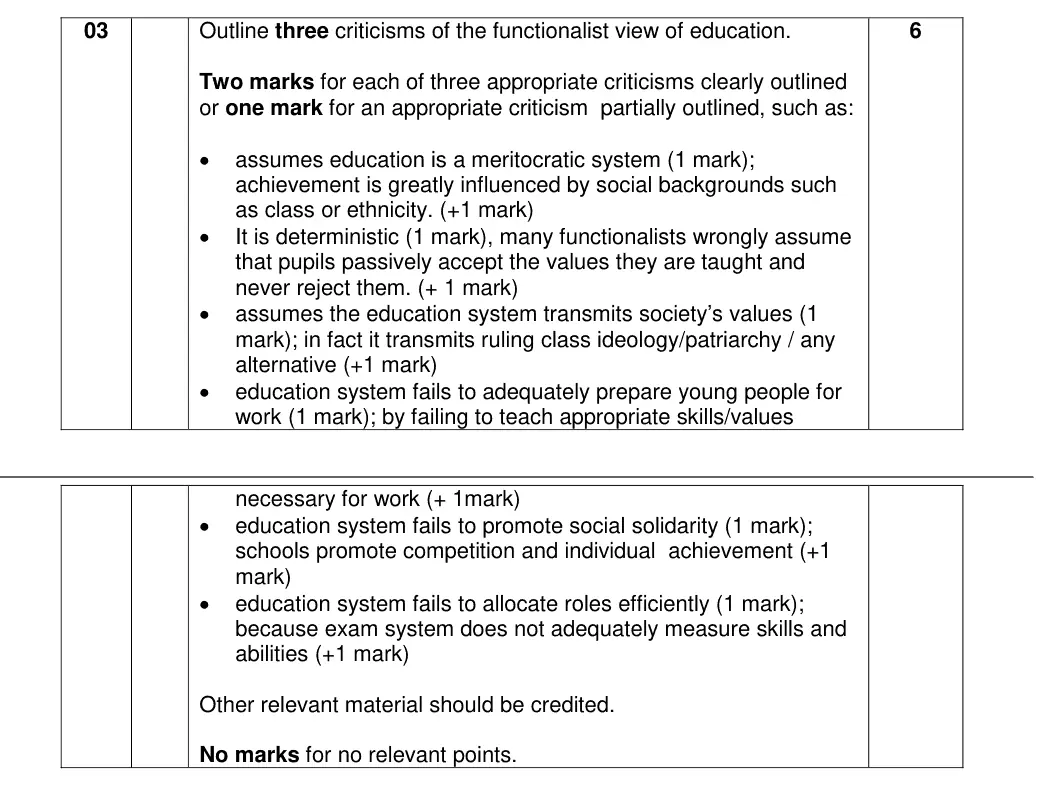
This question seemed challenging to many students. Although some were able to successfully outline three criticisms, most struggled to offer more than one or two. Many answers were centred around the criticism of schools being a meritocracy and then explained the criticism with reference to Marxism or social class. The better answers were able to clearly identify the functionalist view on education in order to highlight a weakness of that view, for example that functionalism was overly positive; too deterministic; failed to look at micro interactions; and lacking in training students with specialist skills etc. Unfortunately, however, many students simply provided alternative views from alternative theories and perspectives, without applying their answer explicitly to functionalism.
Notes from the mark scheme and report
2 marks for each of three criticisms clearly outlined, 1 if only partially outlined
criticisms must be explicitly of the functionalist view, not just alternative theories
many managed only one or two, mostly the myth of meritocracy
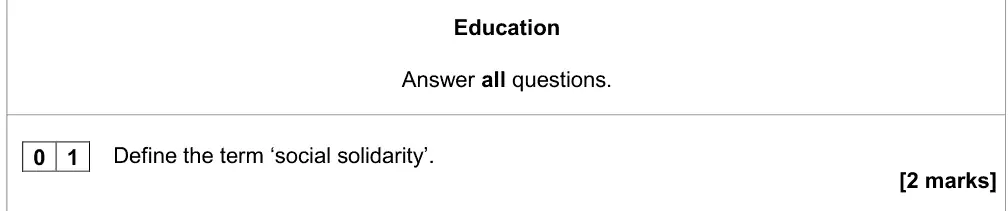
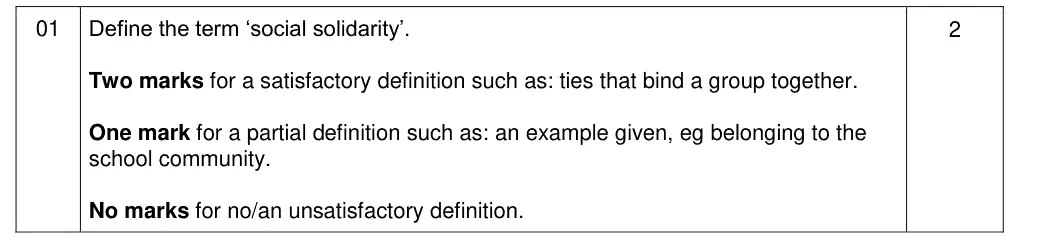
A small number of students left questions unanswered (particularly question 1), but more positively, there was evidence that students had been prepared well as they demonstrated good knowledge and understanding and were able to apply this appropriately. While many students were able to convey some understanding of the term ‘social solidarity’, a large number failed to gain both marks. There was recognition that the term is associated with Functionalism but many were only able to offer a partial response. The most common partial response was ‘shared norms and values’ - mentioning of value consensus without reference to people being bound together in some way or failing to refer to the group aspect of social solidarity. Many also referred to examples of how schools helped foster social solidarity e.g. via assemblies or school uniform.
Notes from the mark scheme and report
2 marks for ties binding a group together
1 for a partial definition or an example (e.g. belonging to the school community)
many lost a mark by saying only 'shared norms and values' without the idea of people being bound together as a group
most linked the term to functionalism
June 2018 · AS Paper 1 · Q36 marksAO1=3, AO2=3Outline
Mark scheme
Examiner's comment
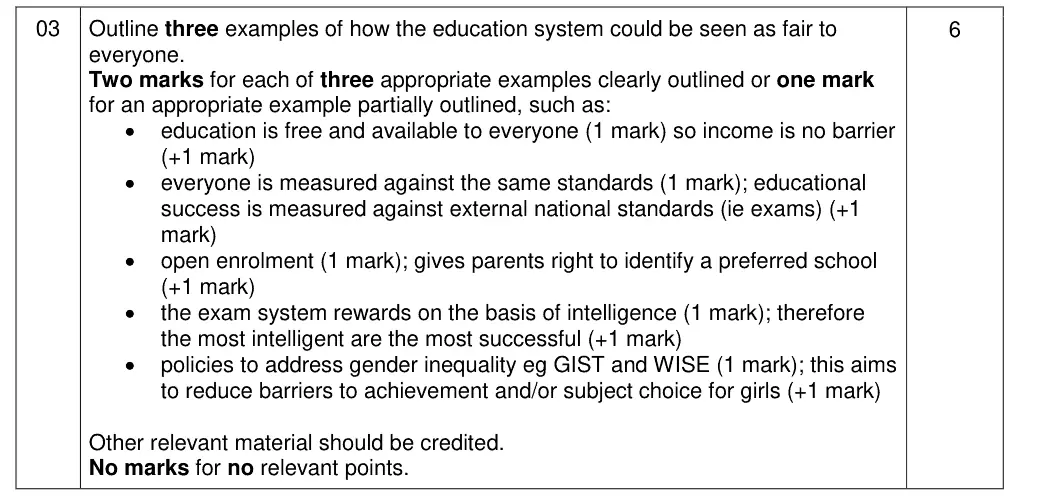
Students were able to offer a wide range of ways that the education system could be seen as fair to everyone. The most common responses referenced compensatory policies such as GIST/WISE, Sure Start and Free school meals. Other popular responses included ‘free education for all’, ‘taking the same exams’ and ‘following the same (National) curriculum’. Successful answers were then able to develop and qualify how this could be seen as fair for everyone. The most common error was to simply state that ‘students are able to work hard and achieve’ or to meritocracy more generally, without qualifying how this meant that the education system was fair to everyone.
Notes from the mark scheme and report
2 marks for each of three examples clearly outlined, 1 if partial
common answers: free education for all, same exams and National Curriculum, compensatory policies such as GIST/WISE, Sure Start, free school meals
saying pupils can simply work hard and achieve, or meritocracy in general, was not credited unless qualified
June 2018 · Paper 1 · Q310 marksAO1=3, AO2=4, AO3=3Analyse
Mark scheme, including the levels grid and indicative content
Examiner's comment
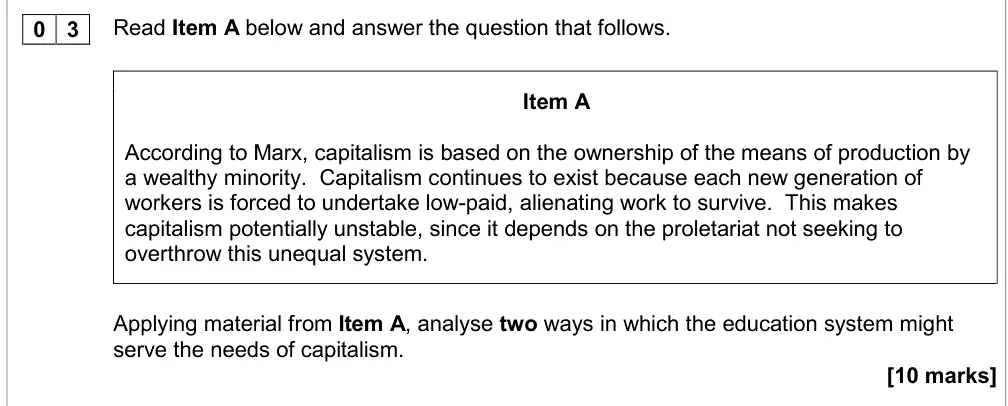
This was particularly the case for Question 03 where a far greater proportion of students were able to gain marks on this style of question than in the previous exam series. Many centres had clearly spent time with students focusing on application skills and how to use material from the item. The majority of students were able to identify one or two ‘hooks’ from the Item and most were able to link at least one of these to the two ways of reproduction and legitimation of class inequality. More effective answers then developed the hook appropriately utilising relevant concepts. For example, taking ‘not seeking to overthrow this unequal system’ and developing it in terms of education as an ideological state apparatus which creates false class consciousness through developing the myth of meritocracy which makes working-class students believe the system is fair. Successful responses drew on the work of Althusser and Bowles and Gintis and evaluated these arguments with reference to a critique from a functionalist or less frequently, postmodern perspective. However, many students struggled to get into the top band even though their knowledge of Marxist views on the roles of education in serving the needs of capitalism was sound. This was often due to students not being able to clearly link the hook from the Item with the appropriate ‘way’ in which education serves the needs of capitalism. For example they identified the ‘reproduction of class inequality’ hook but then proceeded to write about the legitimation function, and vice versa. Some students were able to develop one hook successfully, but not a second but very few did not understand that it was necessary to utilise elements from the Item.
Notes from the mark scheme and report
hooks: proletariat not overthrowing the system (ideological state apparatus, myth of meritocracy, legitimation) and each generation forced into alienating work (reproduction, correspondence principle)
drift into causes of working-class underachievement = 1–3
many mismatched hook and way (reproduction hook then wrote about legitimation)
best answers used Althusser and Bowles and Gintis with functionalist or postmodern critique
June 2017 · AS Paper 1 · Q36 marksAO1=3, AO2=3Outline
Mark scheme
Examiner's comment
This question required students to outline ways in which schools mirror work in a capitalist society, which then needed development to show how each one is found in both school and in the work place. Many students were keen to show their knowledge of the correspondence principle and were able to identify Bowles and Gintis as authors of the study. Although this showed good knowledge, it was not explicitly necessary in this question. Popular responses referred to hierarchy, rewards, dress codes and fragmentation. A number of responses did not score an additional mark for an outline due to not identifying a specific example from school and work, with some referring to capitalist society in general. Some students missed the second point, having assumed that the mirror didn't need further, explicit development when only providing an example from either school or work. Some students gave two ways, which were too similar to both be credited, for example, the existence of a hierarchy and the requirement to show respect to superiors. Some students described functions rather than mirroring.
Notes from the mark scheme and report
2 marks for each of three ways clearly outlined, 1 if partial
each way needs a parallel in both school and work (e.g. hierarchy, rewards, fragmentation, uniform, legitimation)
naming Bowles and Gintis not required
two ways too similar (hierarchy and respect for superiors) not both credited
describing functions rather than mirroring missed the point
June 2017 · Paper 1 · Q430 marksAO1=12, AO2=9, AO3=930-mark essayEasy
Mark scheme, including the levels grid and indicative content
Examiner's comment
There was evidence of some very well taught and well prepared students with good knowledge of relevant material. This was particularly the case for question 04. There were a range of different responses to this question and many made appropriate use of the Item. The question was generally dealt with well by students, especially considering this was the first year of this type of question. The majority of students were at least able to get into the 13-18 mark band, which explains the mean mark of 18 for the question. The majority of students had reasonable to good knowledge on the Marxist and functionalist perspectives on the role of education and could apply these to some extent to ideas and values. Feminism and particularly post-modernism were applied with more varied levels of success. The most effective responses were based on substantial knowledge and understanding, but also demonstrated a wide range of AO2/3 skills. Such answers maintained a full focus on ideas and values, and had sustained evaluation throughout, applying material directly to the question. Many students were able to differentiate between radical and liberal feminist perspectives. However, references to interactionist and New Right perspectives generally lacked application to the transmission of ideas and values. Weaker answers were very descriptive and tended to provide a more superficial analysis of functionalism and Marxism. Evaluation was mainly by juxtaposition with limited attempts to apply material to the question. In some answers material on economic functions was not applied specifically to the issue of transmission of idea and values and there was a drift into factors relating to achievement.
Notes from the mark scheme and report
must stay focused on transmitting ideas and values
drift into the economic function or achievement limits marks
top band: debate between perspectives (Marxism, functionalism, feminism, New Right, postmodernism) and the different values transmitted
postmodern fragmentation hook from the item handled less well
interactionist and New Right material often not applied
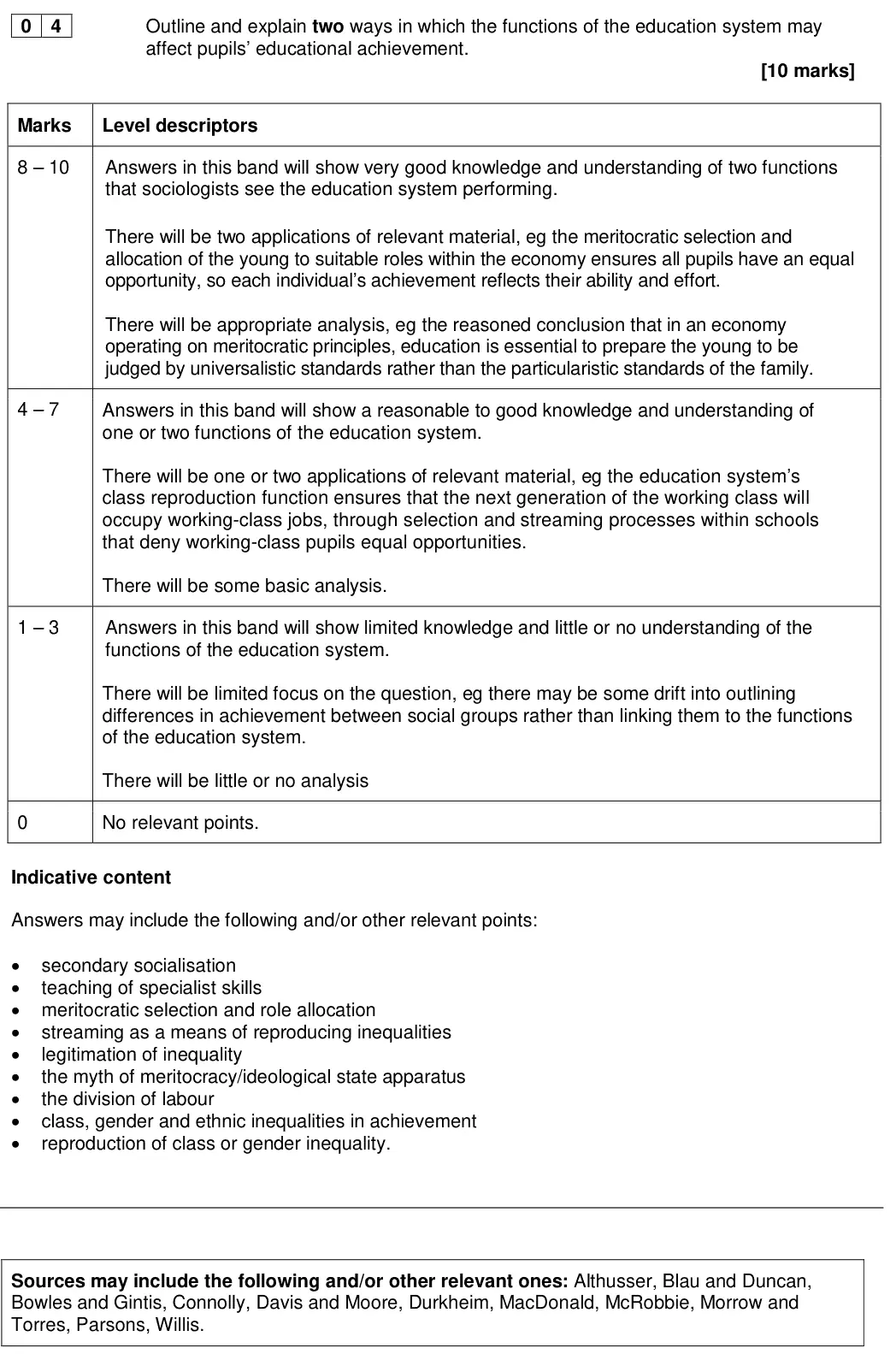
June 2016 · AS Paper 1 · Q410 marksAO1=5, AO2=3, AO3=2Outline and explain
Mark scheme, including the levels grid and indicative content
Examiner's comment
This question required students to apply their knowledge of one area of the specification (the role of the education system) to another area (educational achievement). However, weaker answers often focused solely on outlining some of the factors affecting pupils’ achievement without attempting to link these to the functions of education. Better answers had knowledge of one or more functions of the education system, usually from a functionalist and/or Marxist perspective. These included role allocation, socialisation into shared values, transmission of specialist skills, or reproduction of class inequality. However, this knowledge was sometimes patchy, often accompanied by a tendency to present a loose amalgam of different functions rather than a clear and coherent account. The best answers applied a good knowledge and understanding of the functions of the education system to the issue of achievement. For example, an account of the meritocratic nature of selection (from a functionalist perspective) led onto the idea that equal opportunities and being judged by universalistic standards would raise achievement levels by motivating all pupils to achieve to the maximum of their abilities.
Notes from the mark scheme and report
must link functions of education to achievement, not just list factors affecting achievement (drift caps at 1–3)
best answers took a clear functionalist or Marxist function (meritocratic role allocation, class reproduction) and applied it to achievement
weaker answers offered a loose mix of functions
Work with an AQA sociology tutor
Essays stuck in the middle band, or losing marks on the 10-markers? Book a trial lesson with Mark, a former AQA examiner.