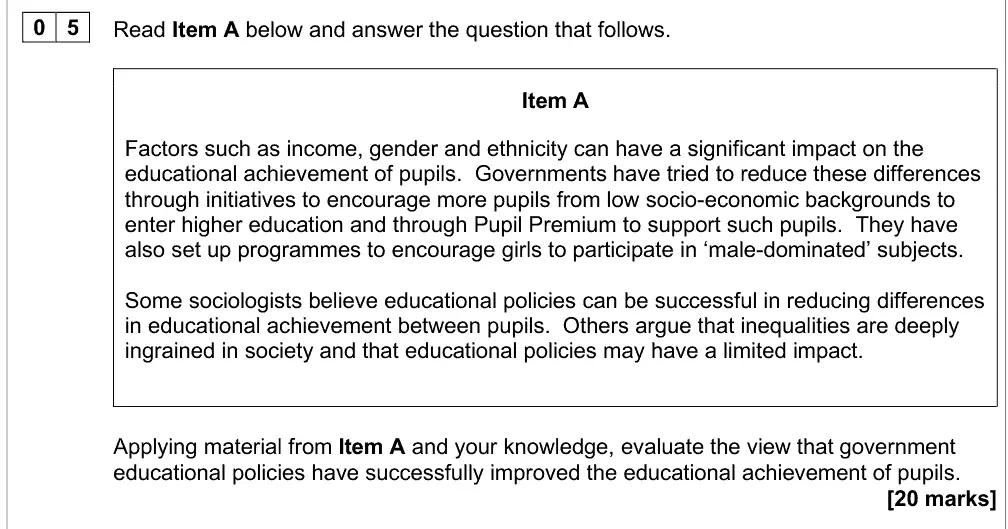
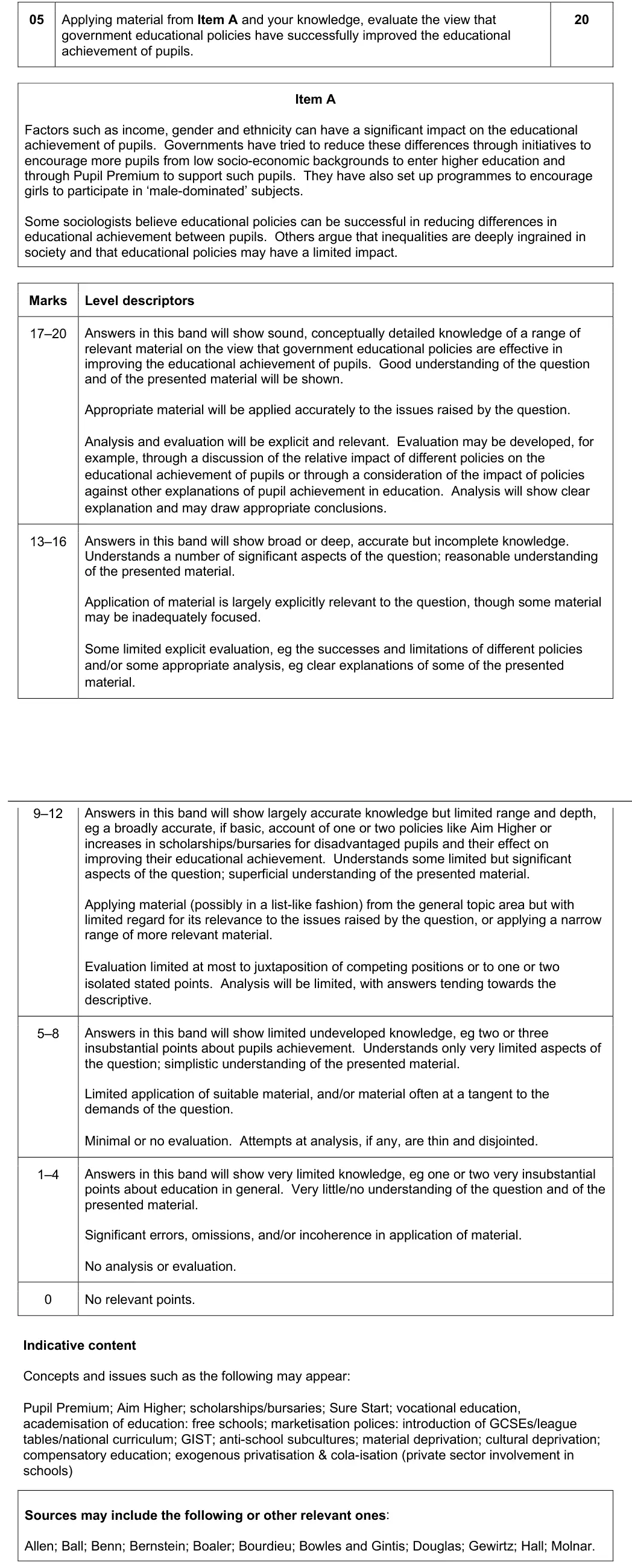
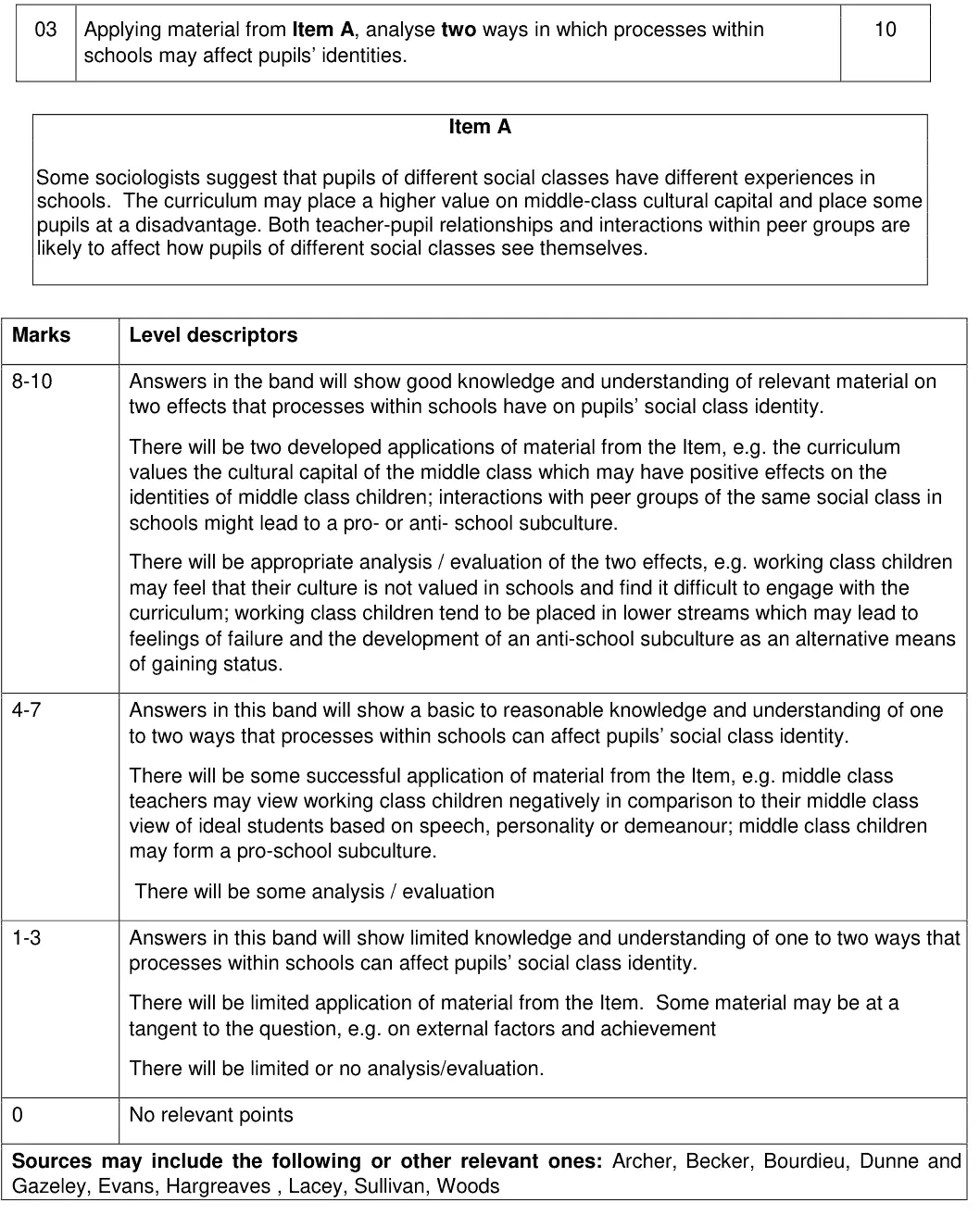
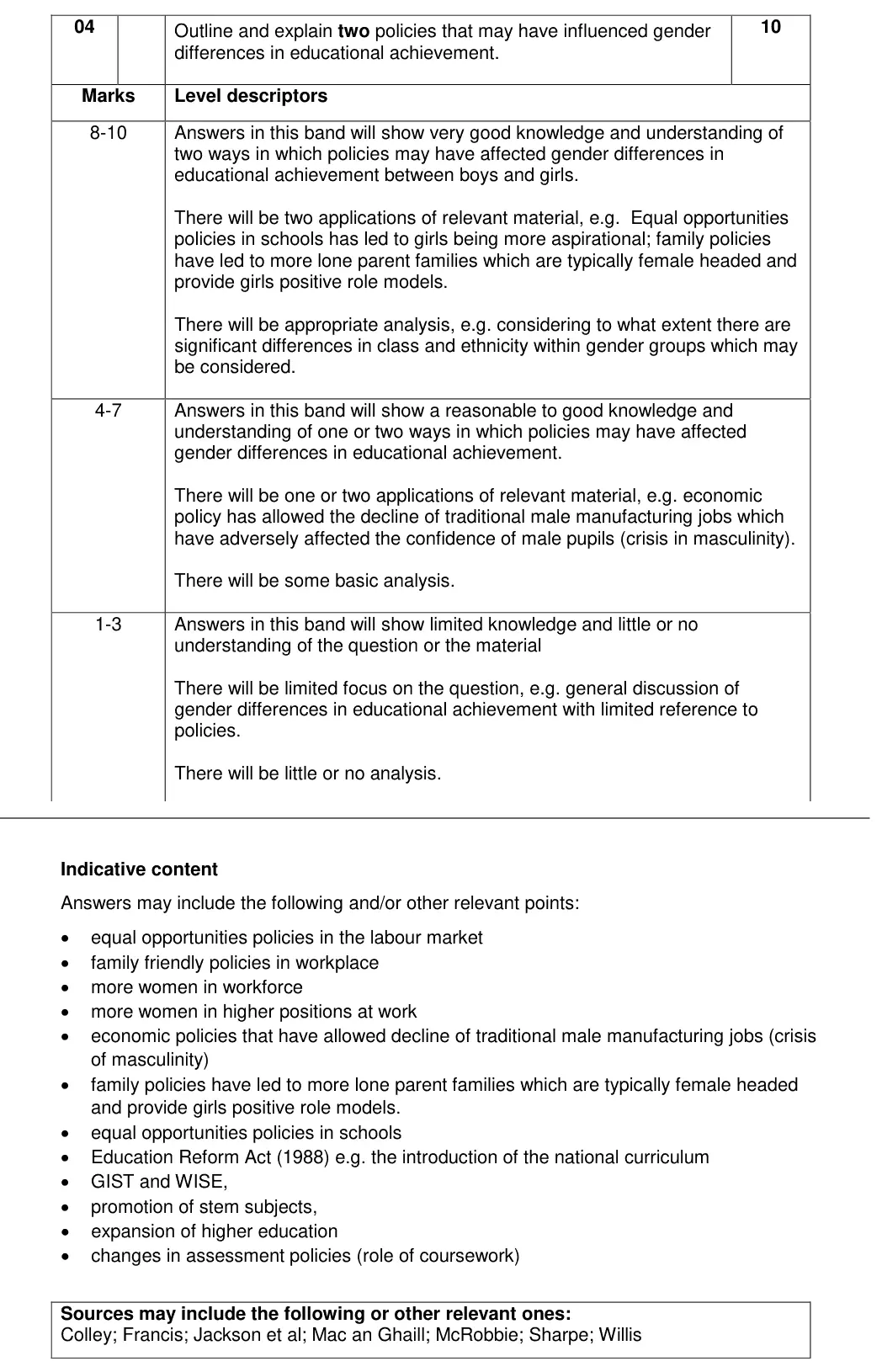
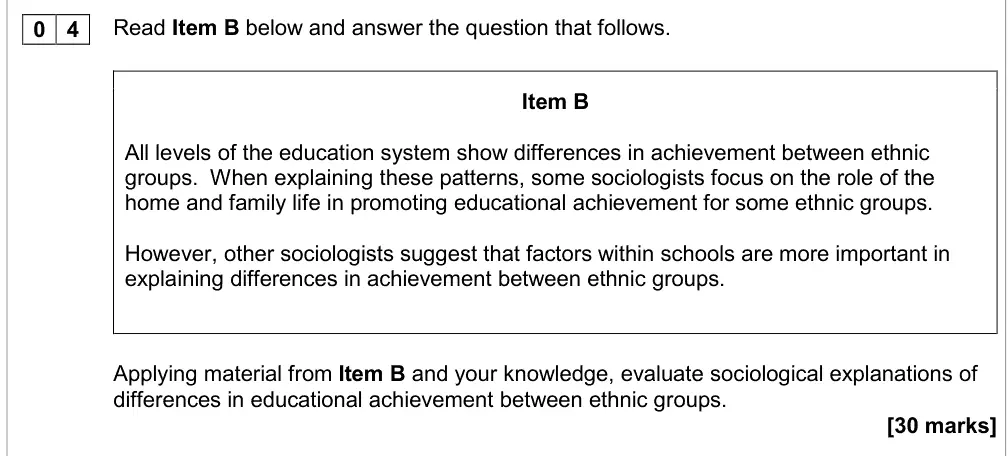
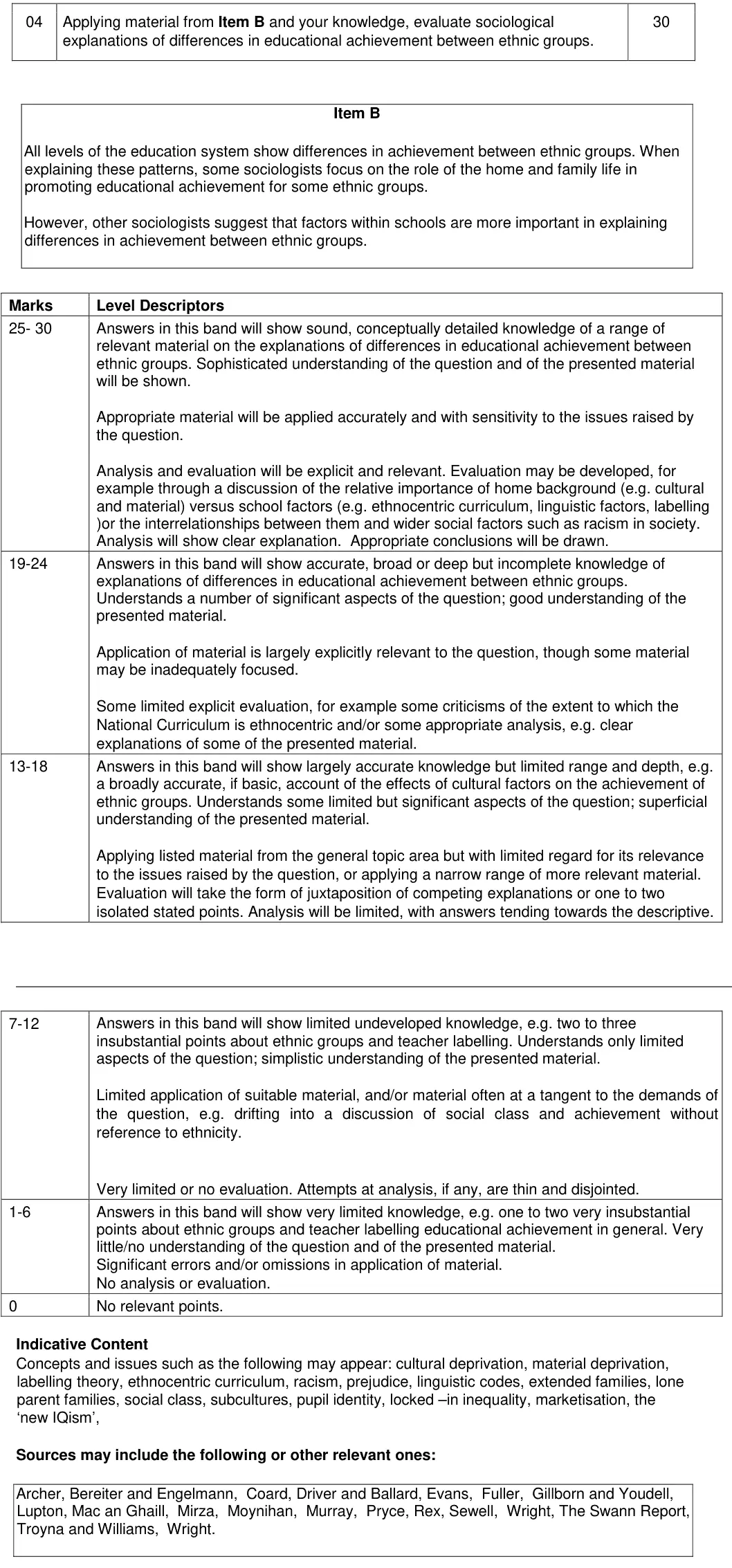
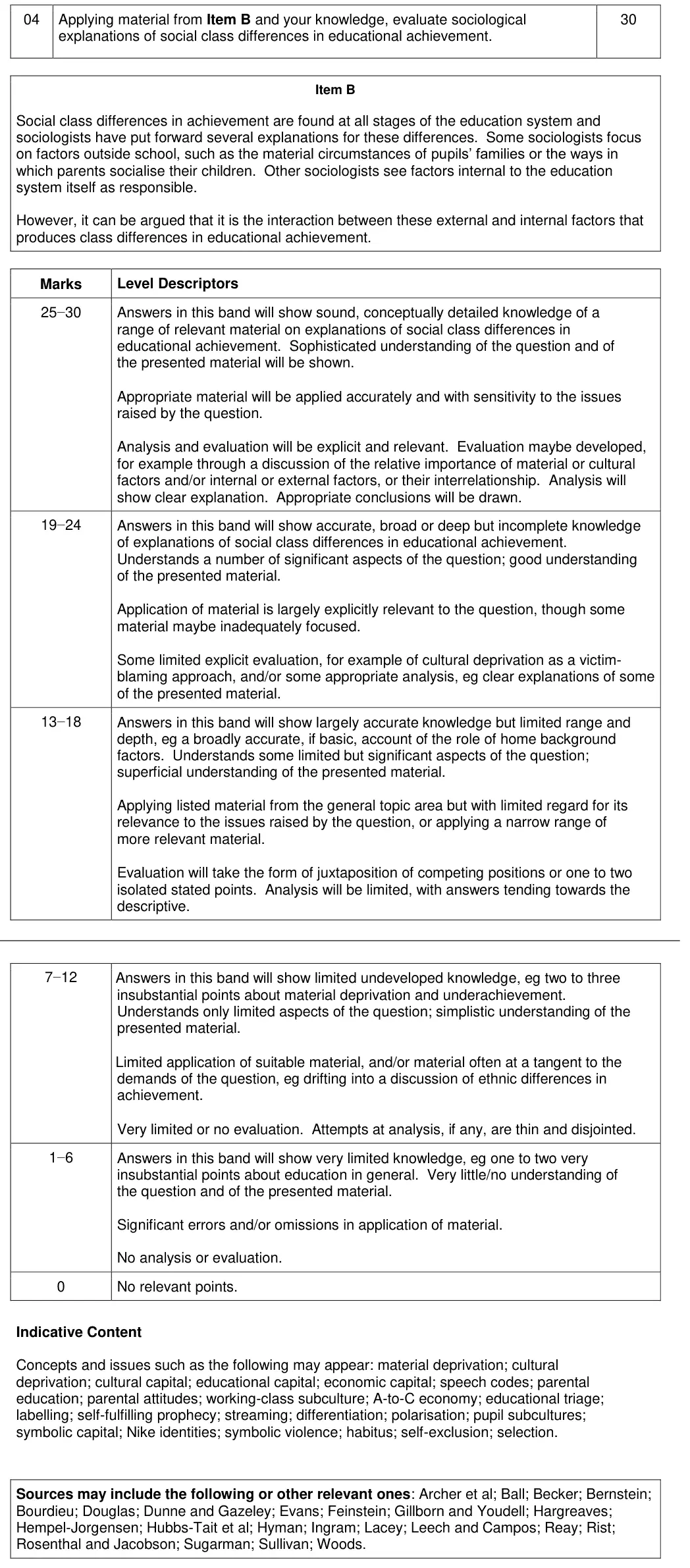
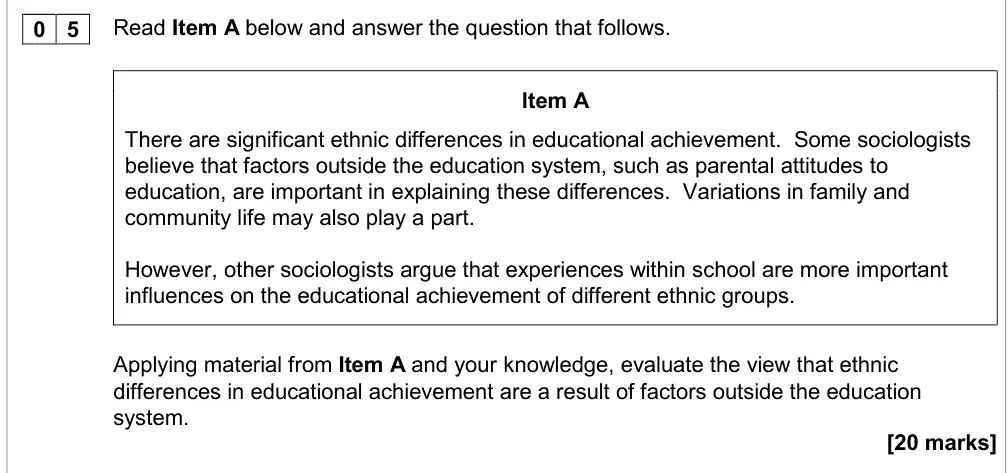
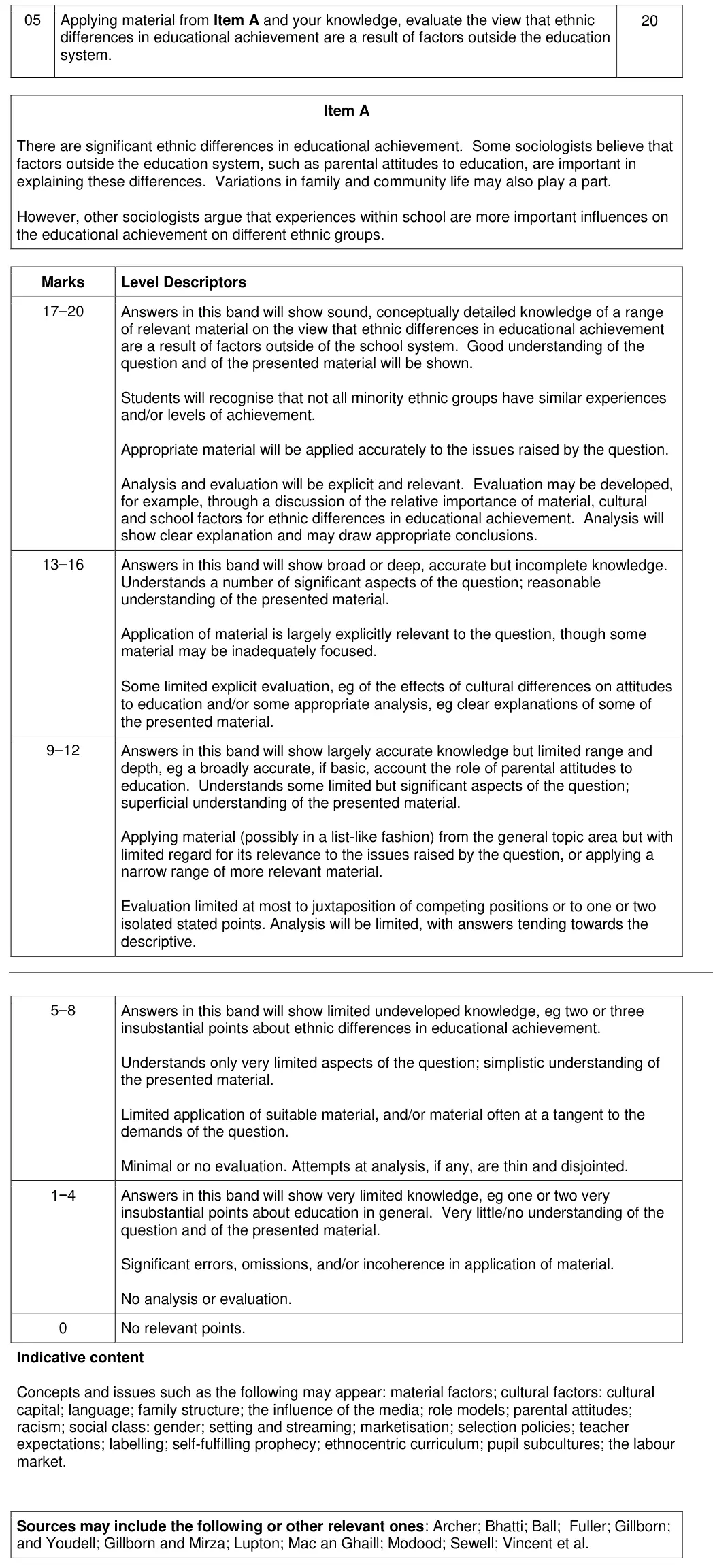
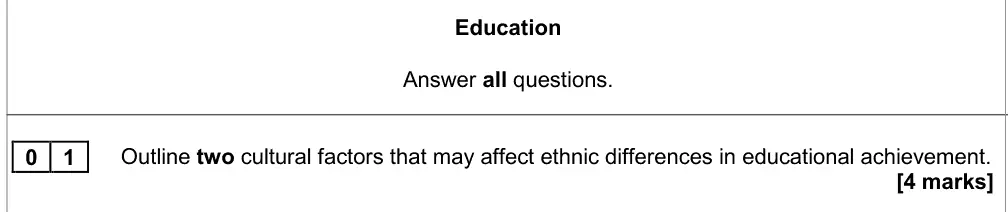
Applying material from Item A and your knowledge, evaluate the view that government educational policies have successfully improved the educational achievement of pupils.
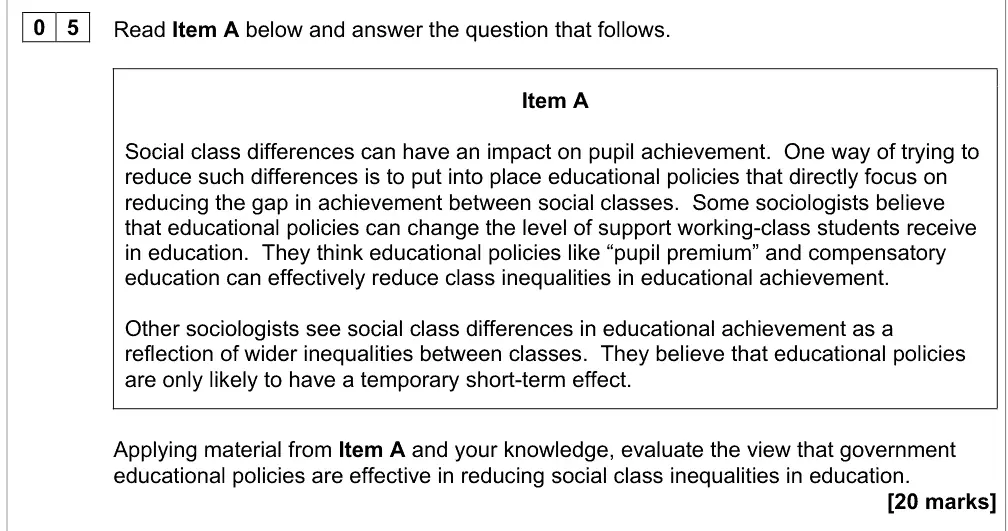
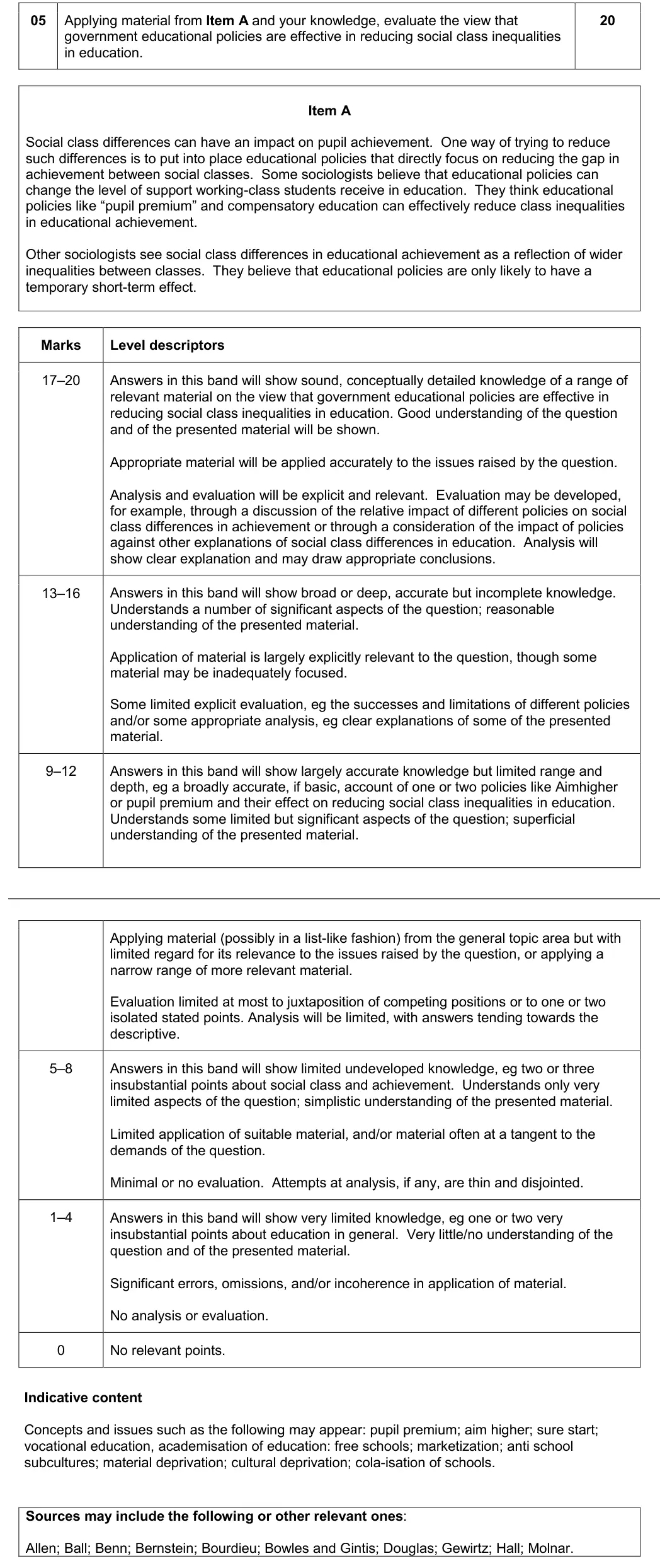
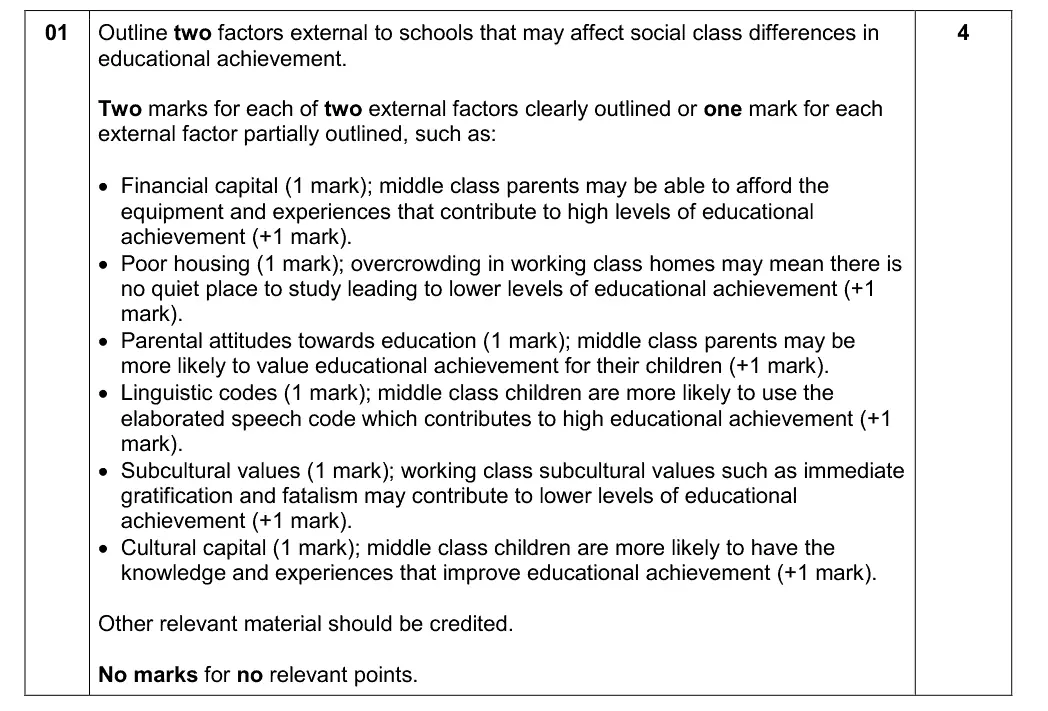
Applying material from Item A and your knowledge, evaluate the view that government educational policies are effective in reducing social class inequalities in education.
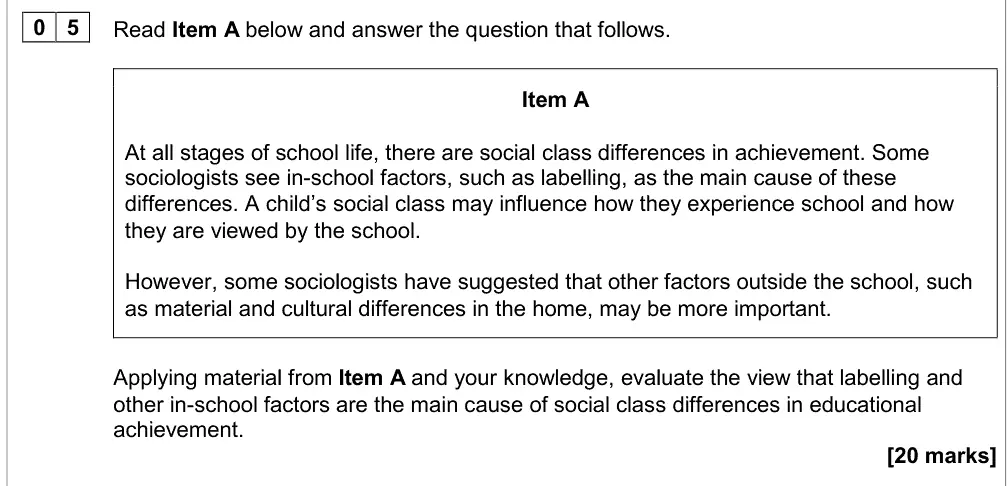
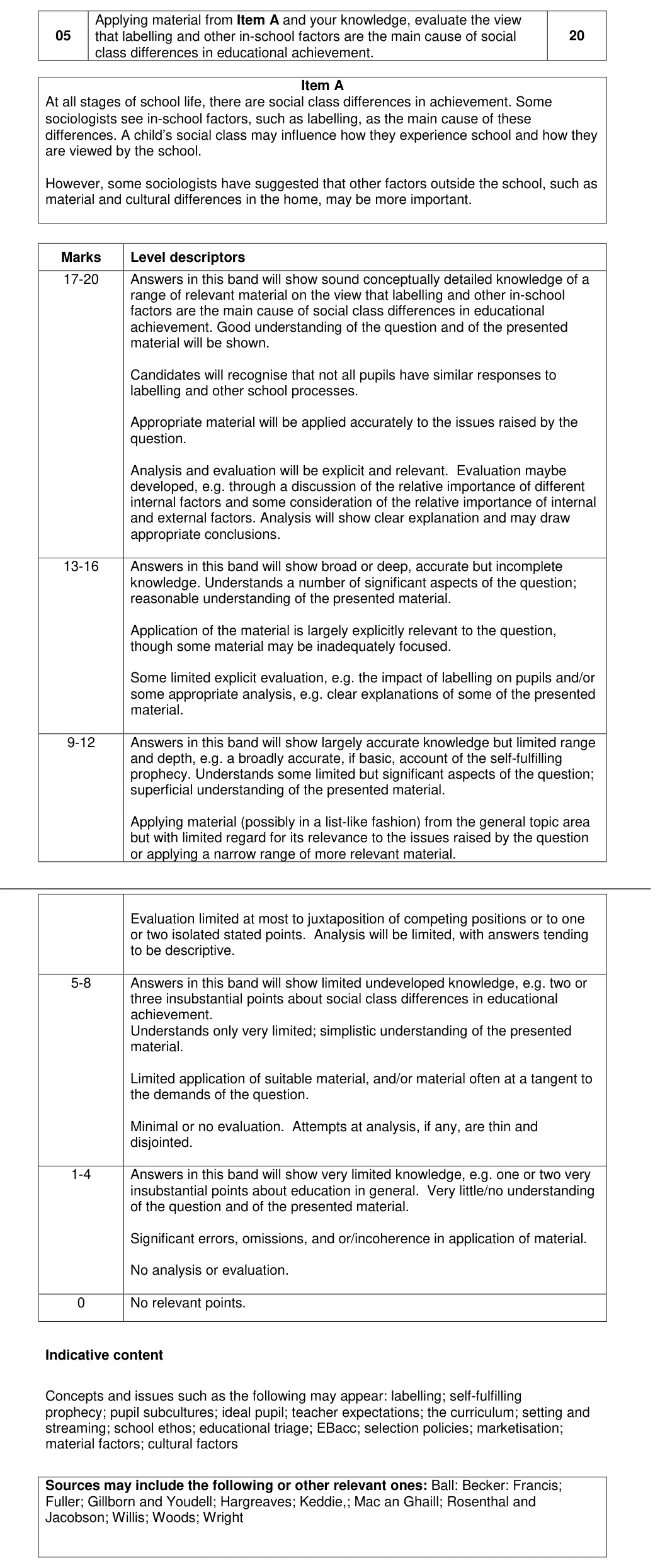
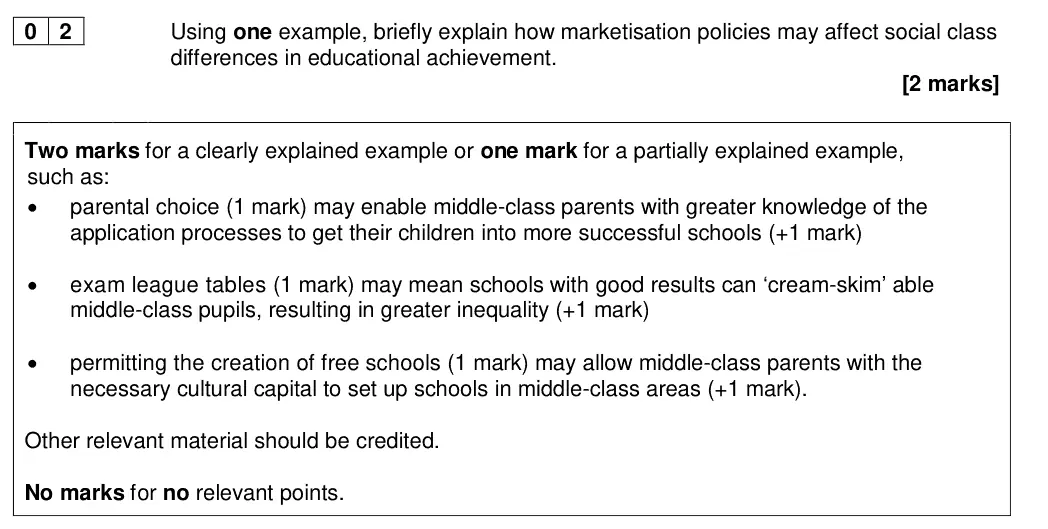
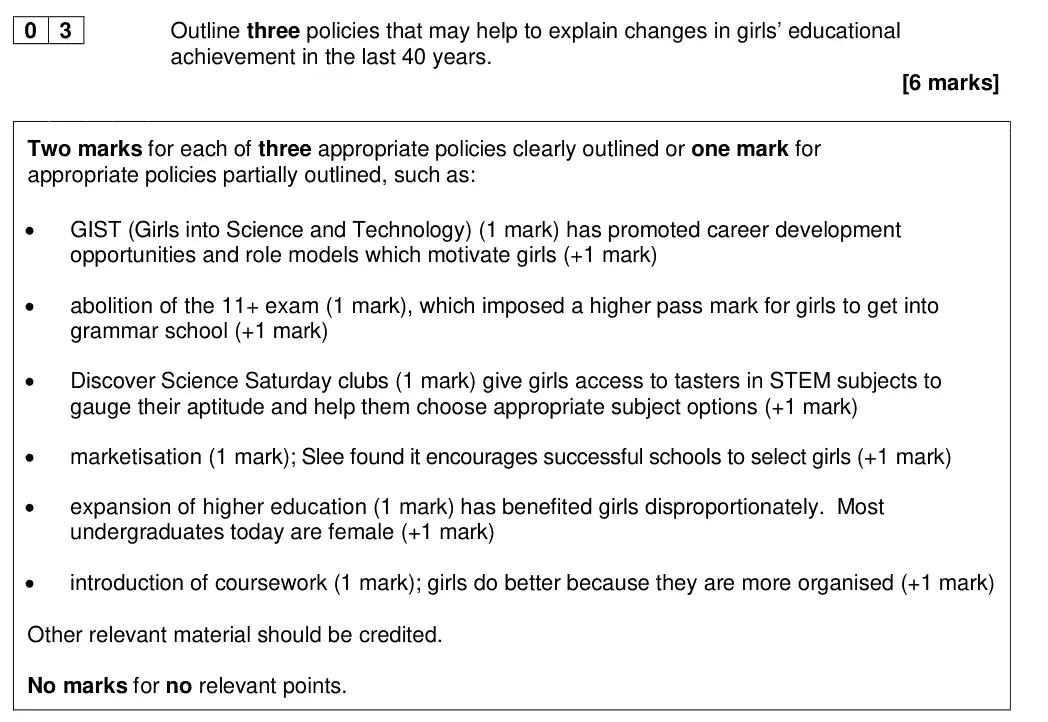
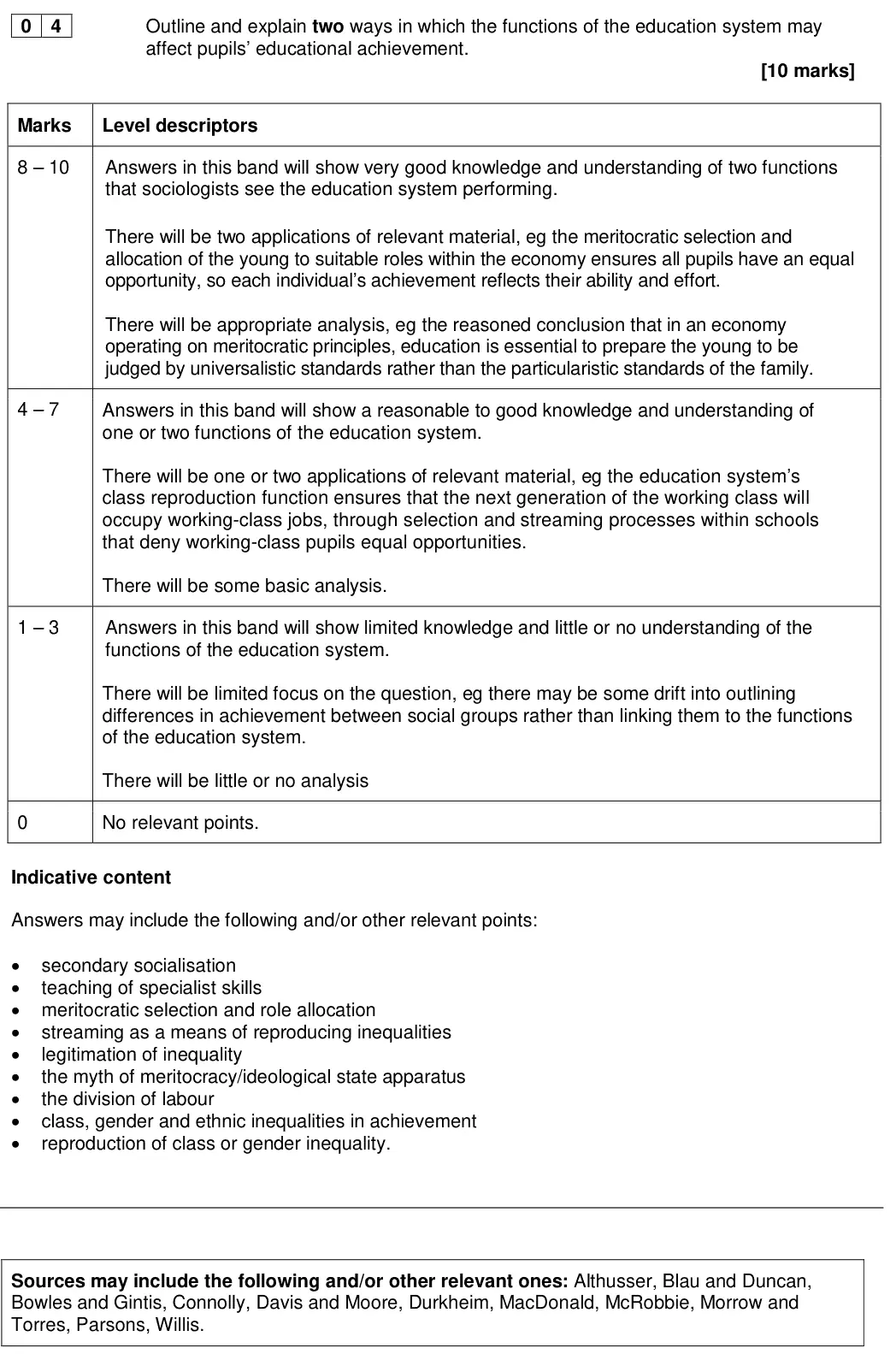
Applying material from Item A and your knowledge, evaluate the view that labelling and other in-school factors are the main cause of social class differences in educational achievement.
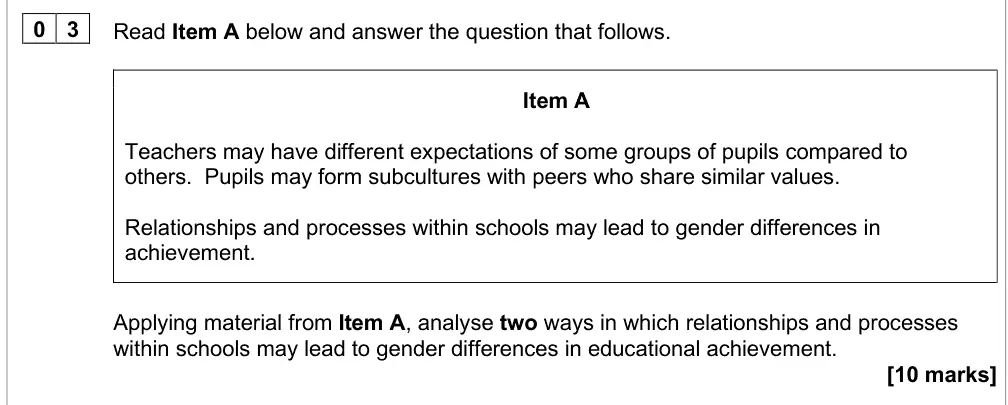
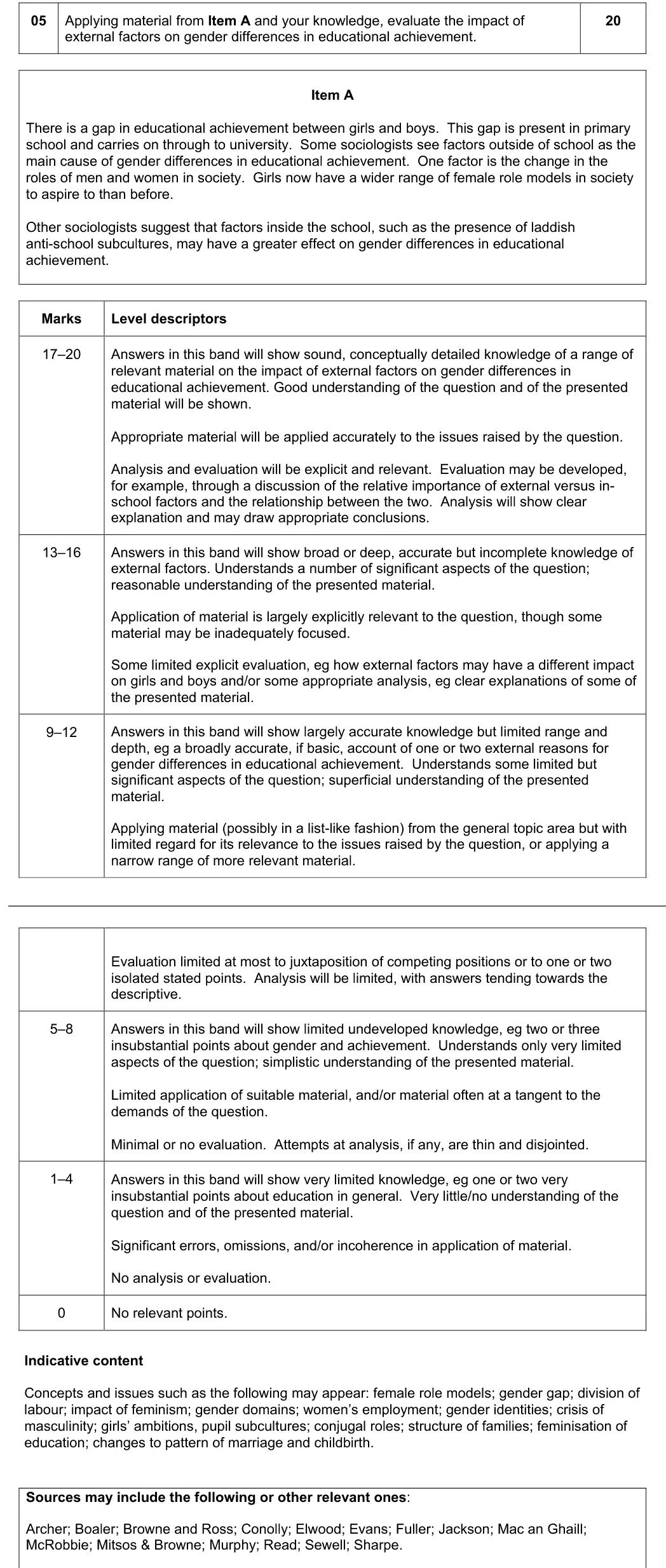
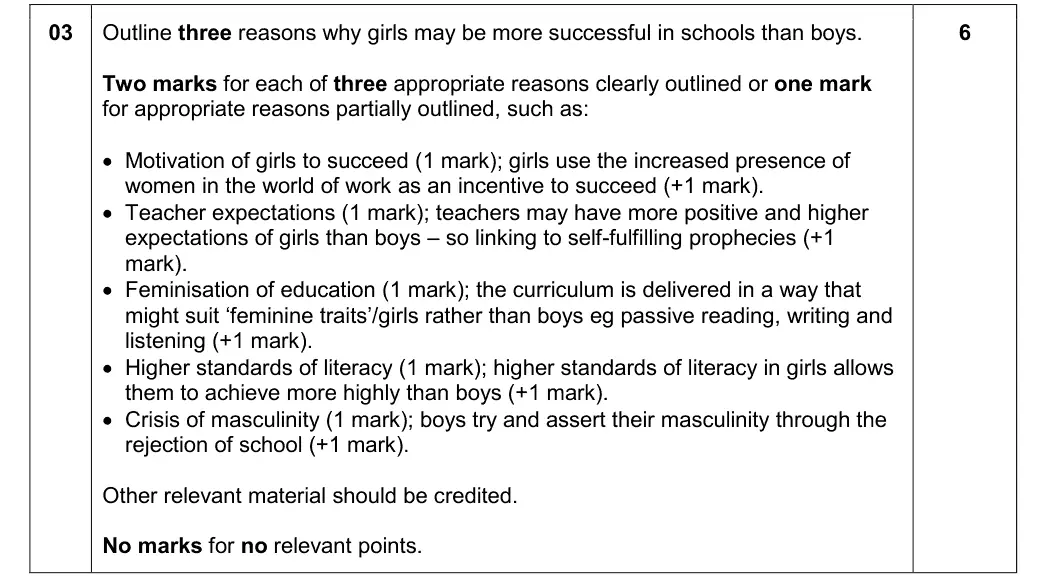
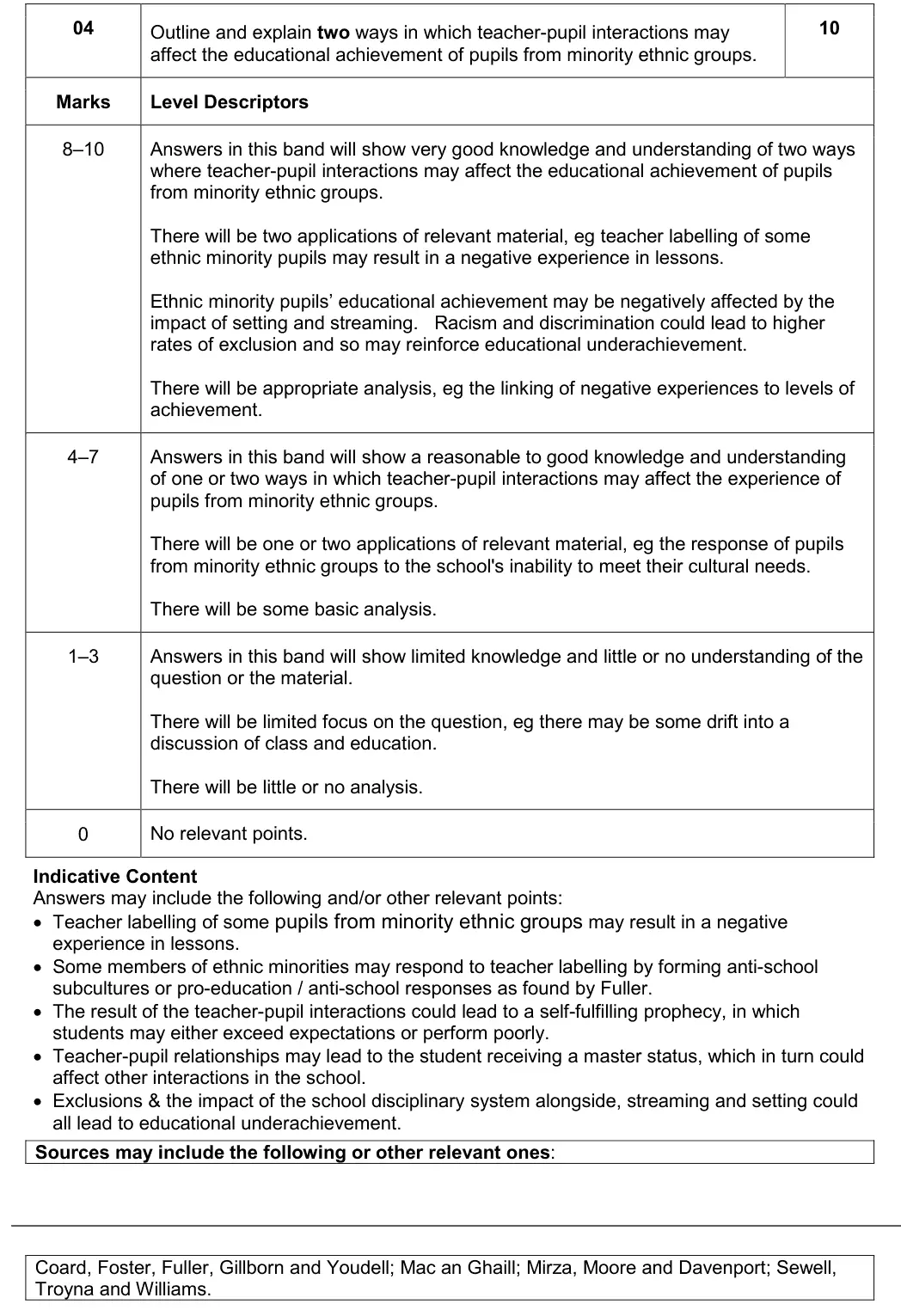
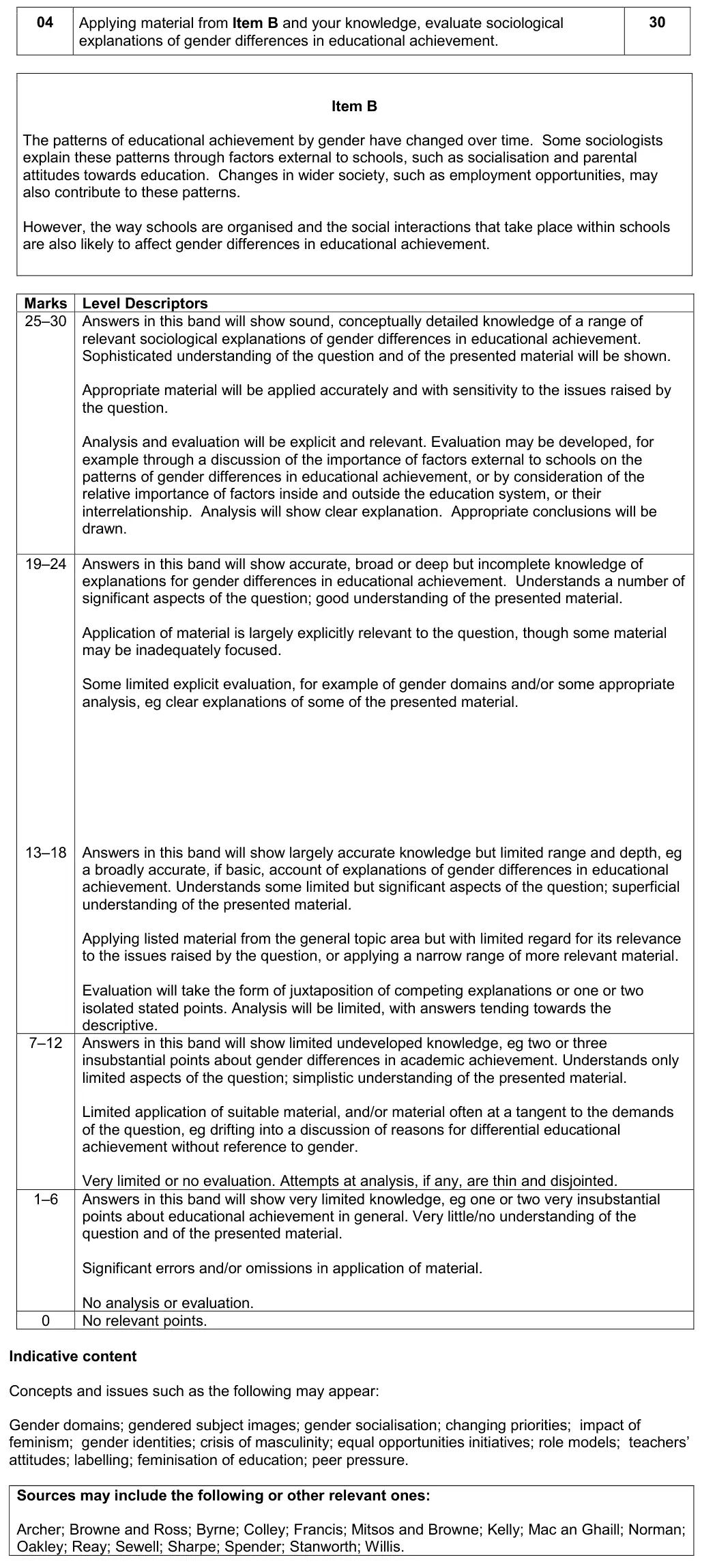
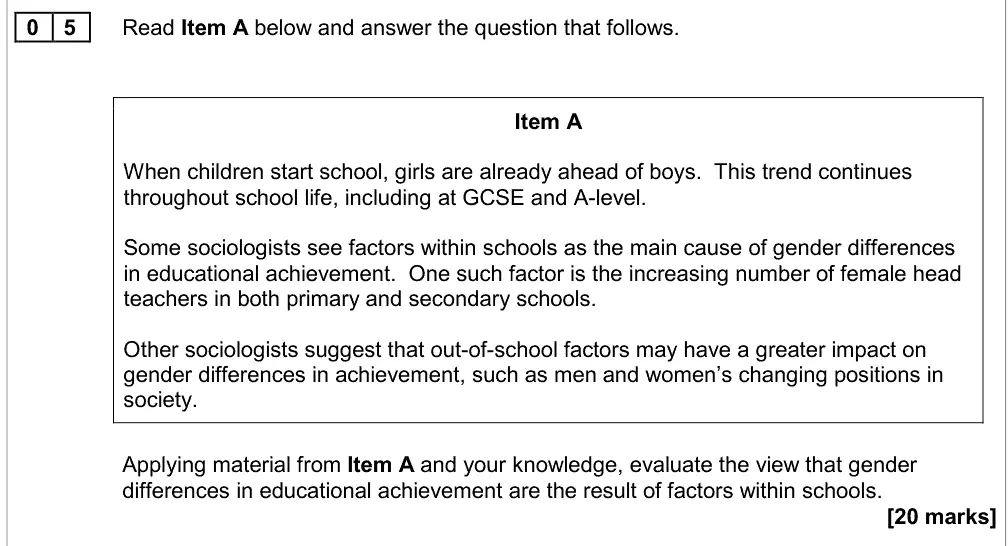
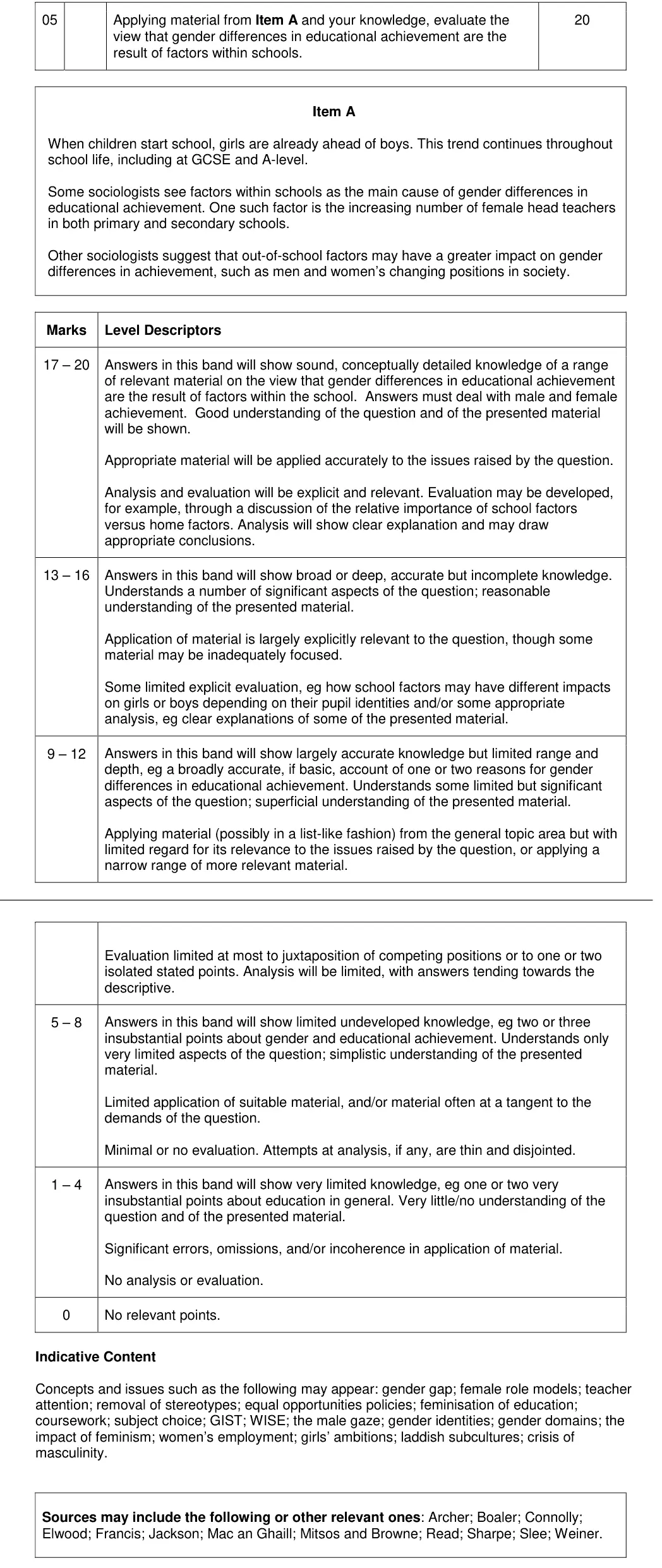
Applying material from Item A and your knowledge, evaluate the view that gender differences in educational achievement are the result of factors within schools.
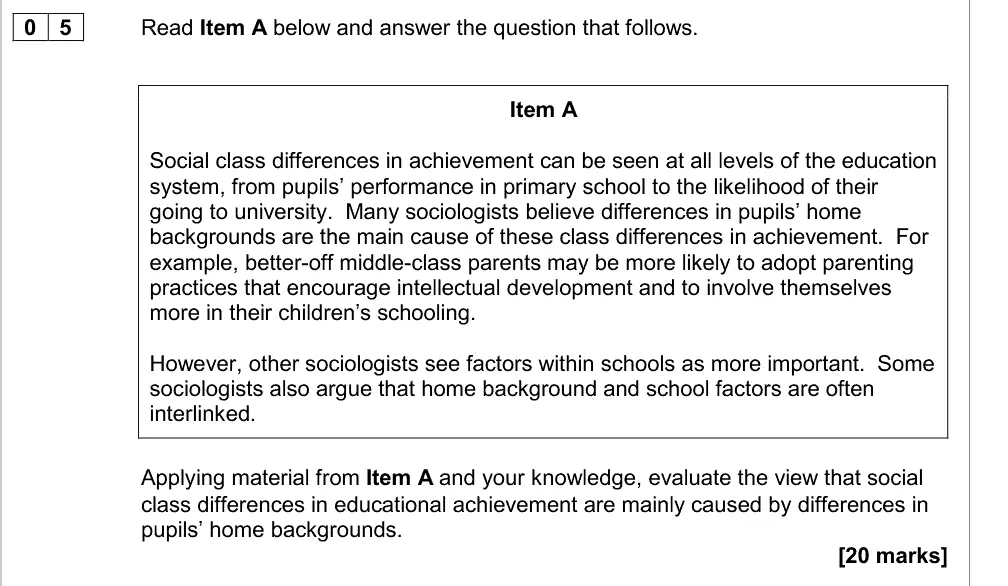
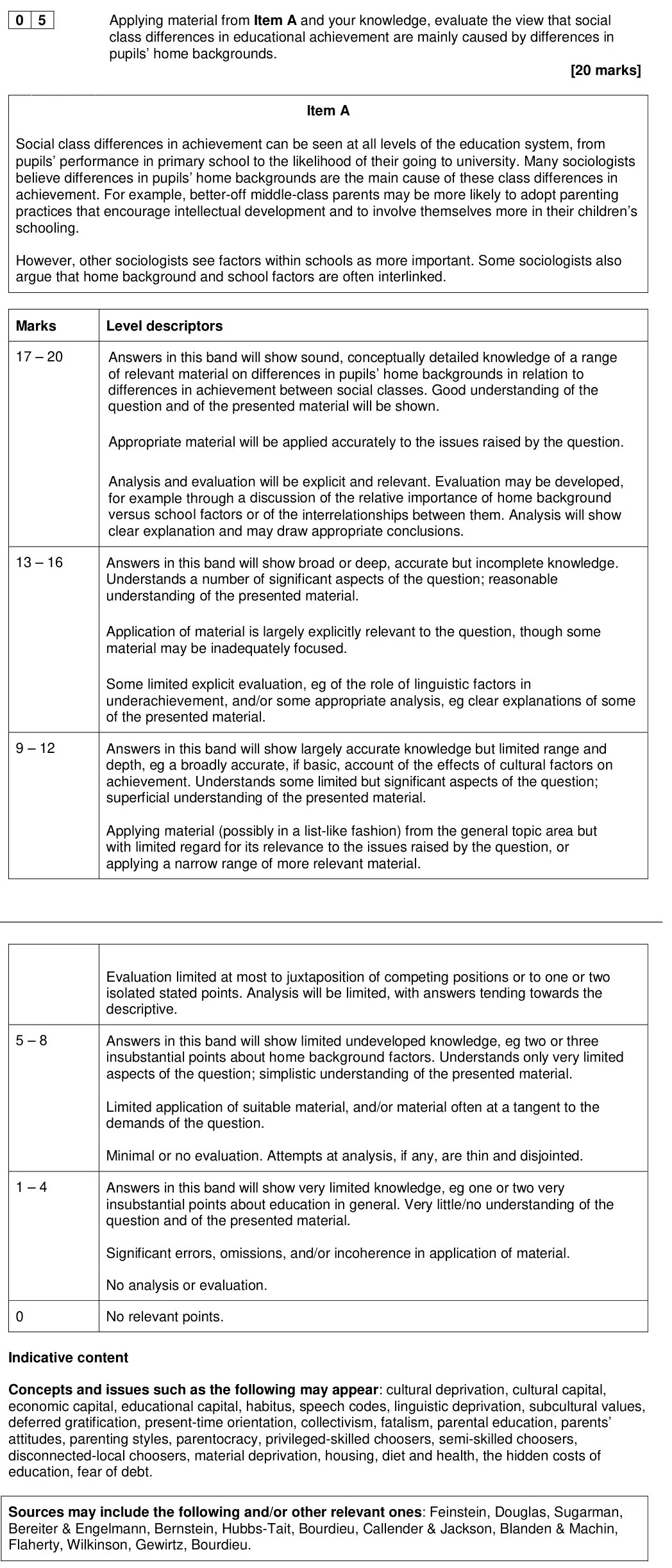
Applying material from Item A and your knowledge, evaluate the view that social class differences in educational achievement are mainly caused by differences in pupils’ home backgrounds. 20
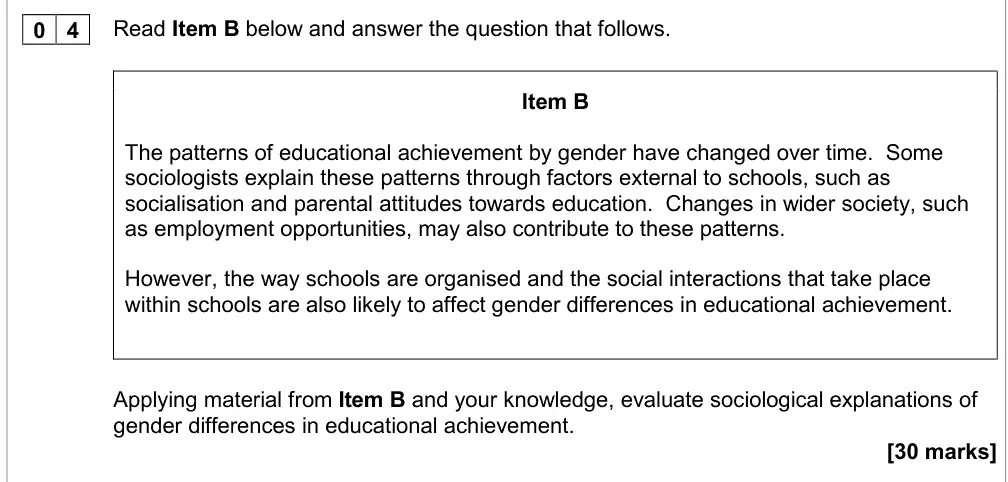
Applying material from Item B and your knowledge, evaluate the view that gender differences in both subject choice and educational achievement are mainly the result of the influence of wider society.
Tap a question to zoom it. The mark scheme (with the level descriptors and indicative content) and the examiner's comment open underneath.
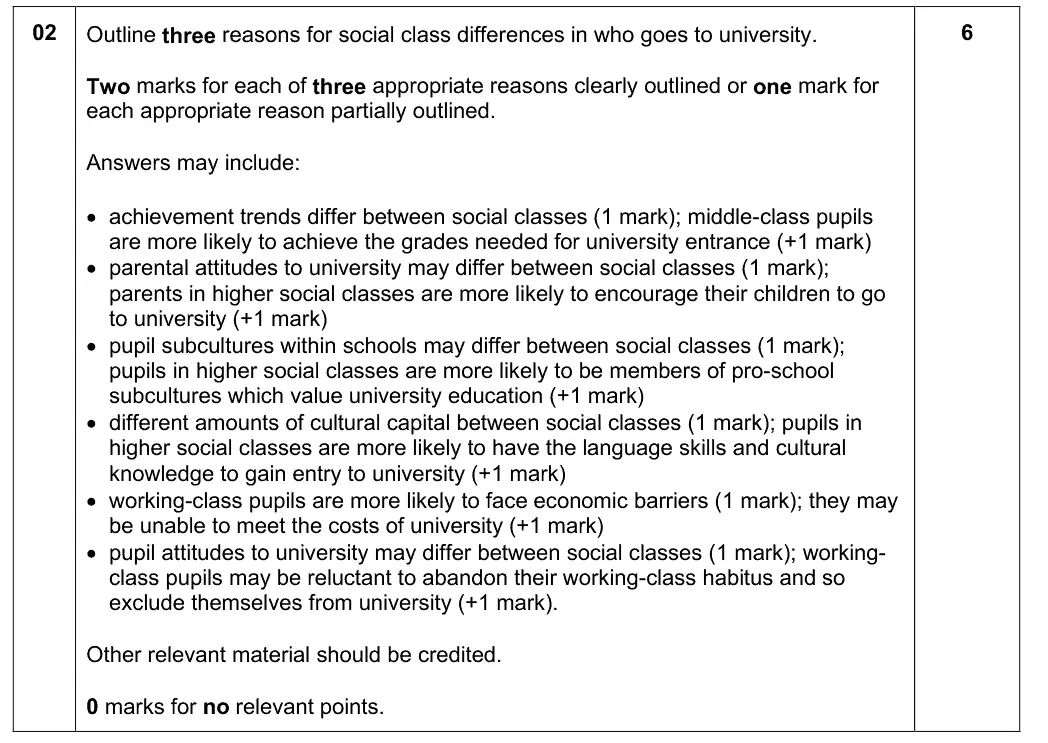
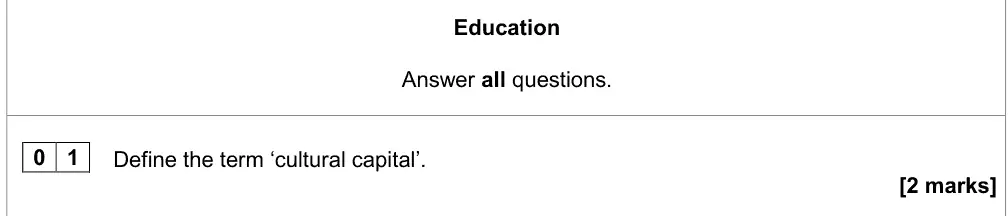
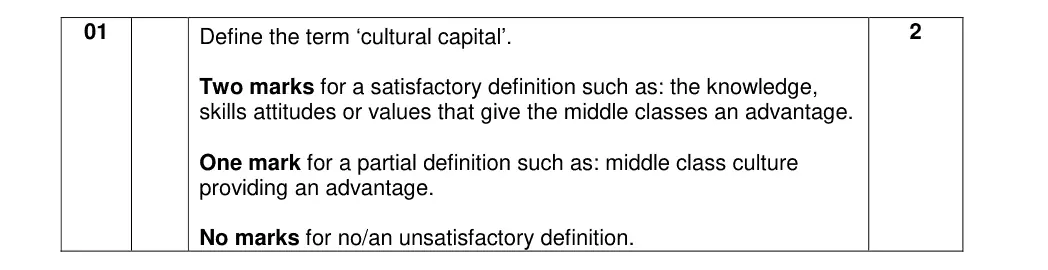
June 2025 · Paper 1 · Q26 marksAO1=3, AO2=3Outline
Mark scheme
Notes from the mark scheme and report
2 marks for each of three reasons clearly outlined
credited: attainment gaps, parental attitudes, pro-school subcultures, cultural capital, cost of university, working-class habitus and self-exclusion
no examiners' report published
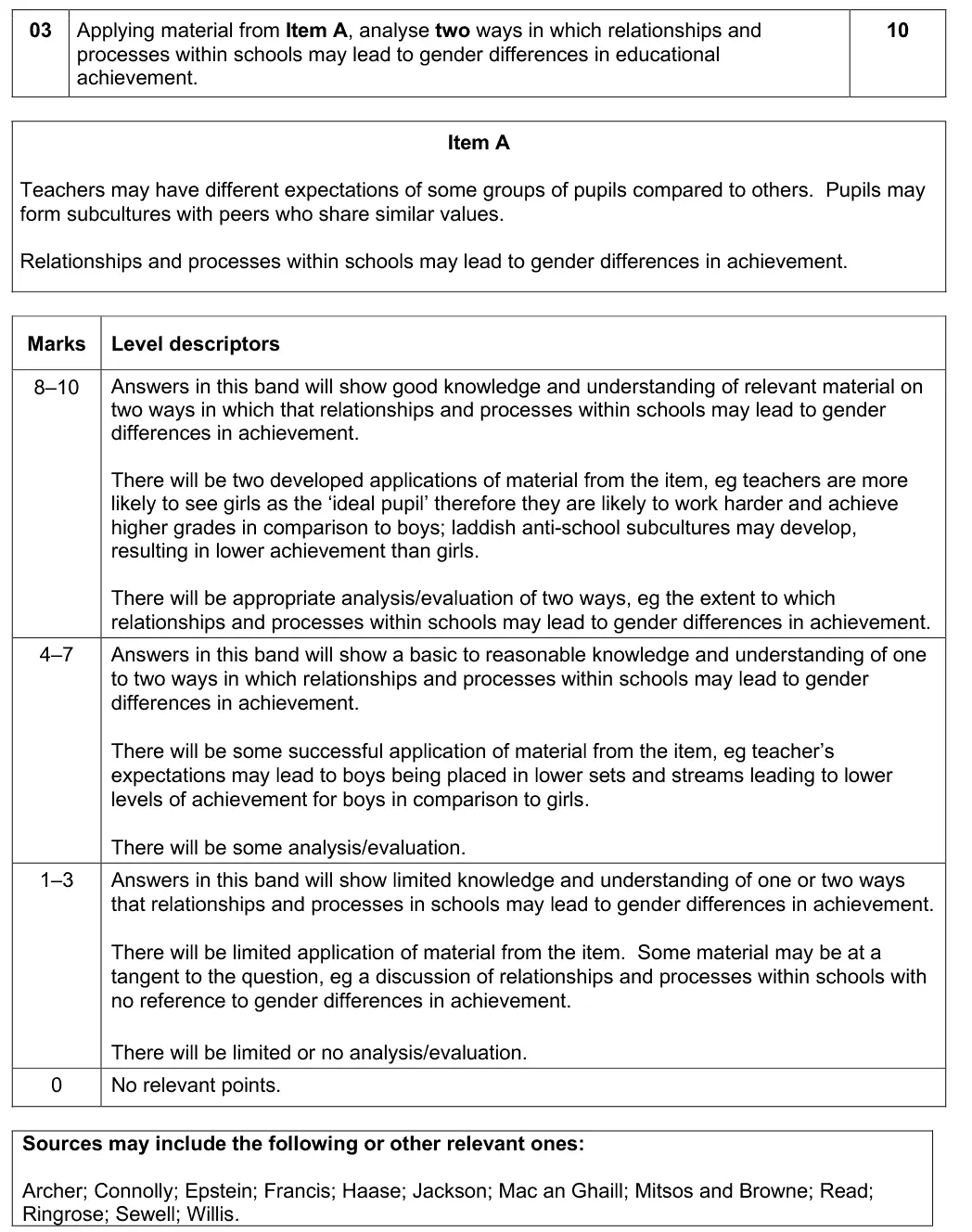
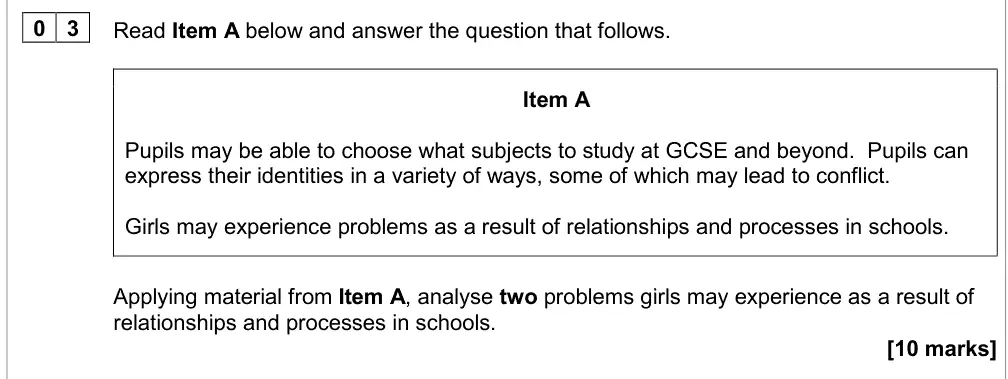
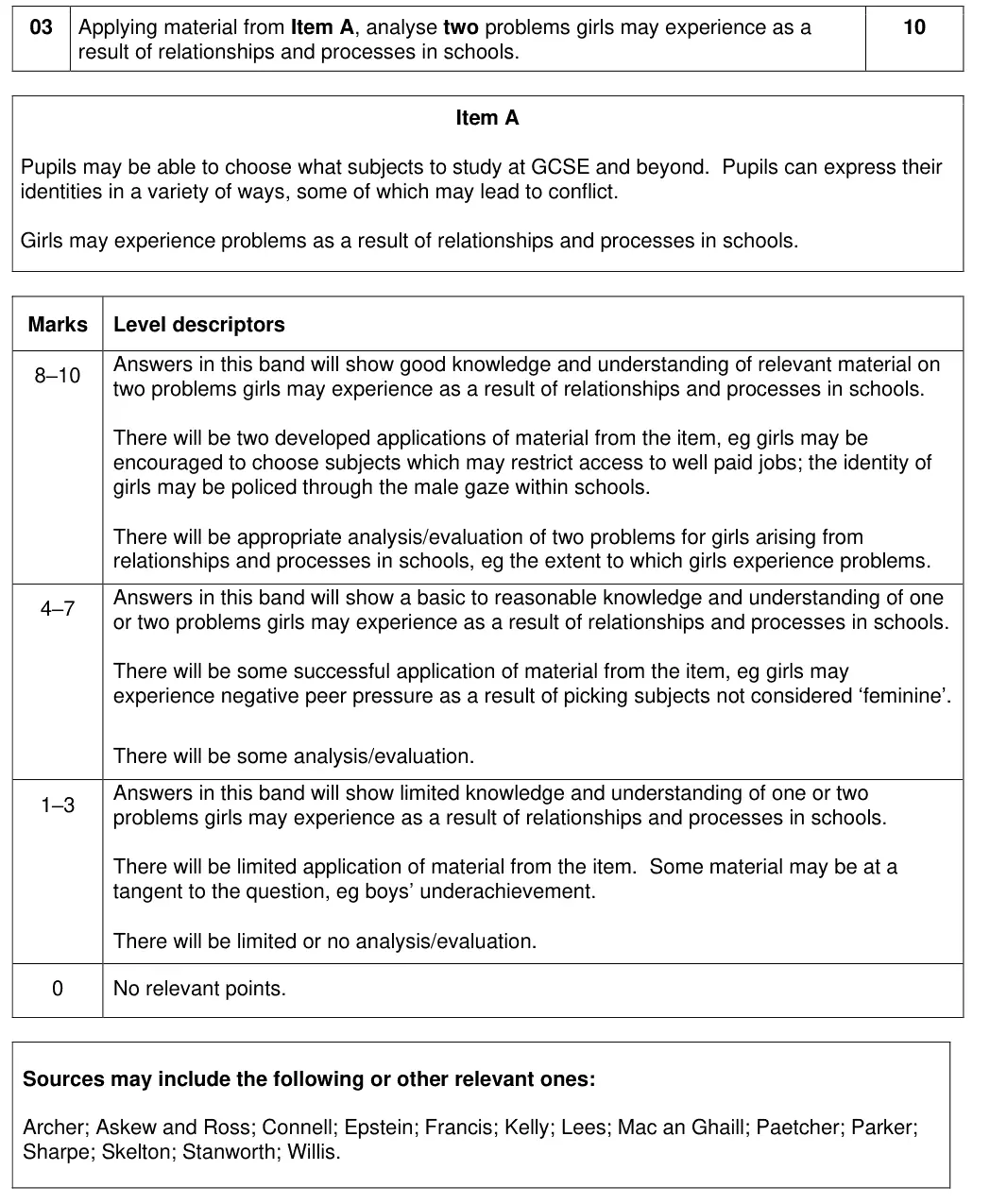
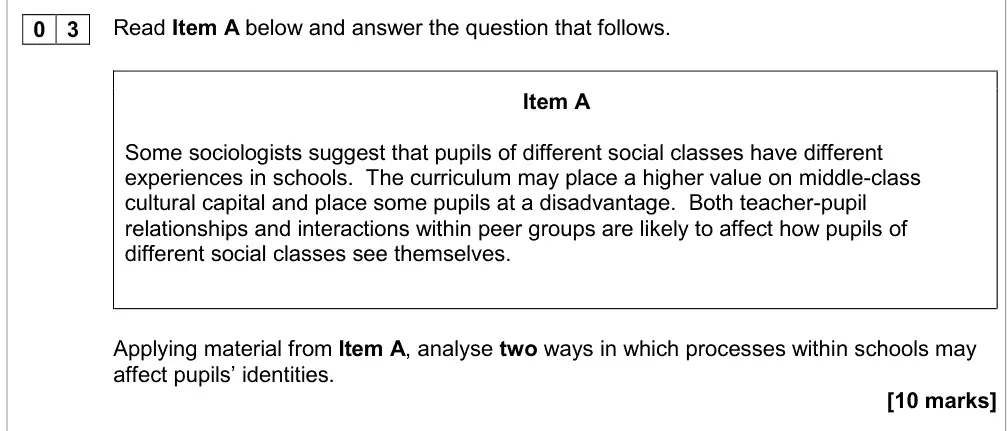
June 2025 · Paper 1 · Q310 marksAO1=3, AO2=4, AO3=3Analyse
Mark scheme, including the levels grid and indicative content
Notes from the mark scheme and report
must develop hooks from Item A (teacher expectations, peer subcultures)
top band: two developed applications, e.g. girls seen as the ideal pupil, laddish anti-school subcultures
boys placed in lower sets is a 4-7 example
relationships and processes with no link to gender achievement are a tangent
the last line of the item restates the question
no examiners' report published
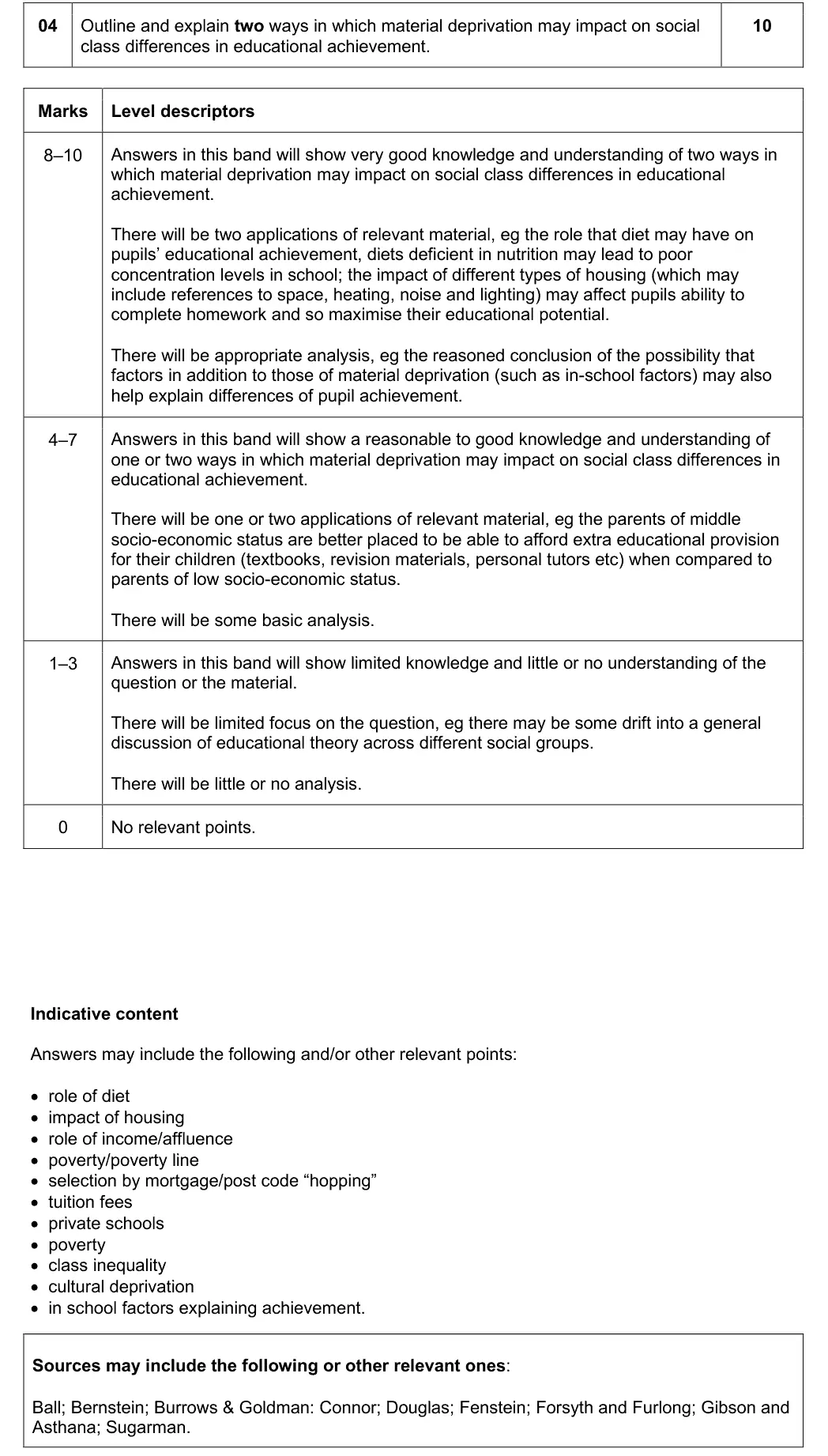
June 2025 · AS Paper 1 · Q410 marksAO1=5, AO2=3, AO3=2Outline and explain
Mark scheme, including the levels grid and indicative content
Examiner's comment
Students had a good understanding of material deprivation identifying and developing a range of different factors. Better responses were able to develop and analyse these. Following a logical chain of discussion and reasoning. Some students engaged in repetition and or got material factors confused with other internal and external factors.
Notes from the mark scheme and report
must be material factors (diet, housing, income, extra resources)
confusing them with cultural or in-school factors loses focus
drift into general theory = 1–3
top band analysis e.g. a reasoned conclusion that in-school factors also matter
June 2025 · AS Paper 1 · Q520 marksAO1=8, AO2=6, AO3=620-mark essay
Mark scheme, including the levels grid and indicative content
Examiner's comment
Students had a good knowledge of policies in relation to this question. Not all were able to relate this knowledge to improving the educational achievement of pupils. There was also some confusion about the details of some policies that were deployed for example the way pupil premium operates. Higher-scoring students were able to identify a policy and its impact on achievement and then use theory/sociological perspectives to analyse and evaluate its impact. Furthermore, at the high end of the mark scheme, students were able to offer a contested viewpoint about some policies in order to develop their evaluation. At the lower end, this was juxtaposition. Many students used the item to expand on their knowledge and/or provide prompts.
Notes from the mark scheme and report
must link each policy to its impact on achievement
top band weighs policies against each other and against other explanations of achievement, with contested views of policies
lower answers juxtaposed
some confused how policies such as Pupil Premium work
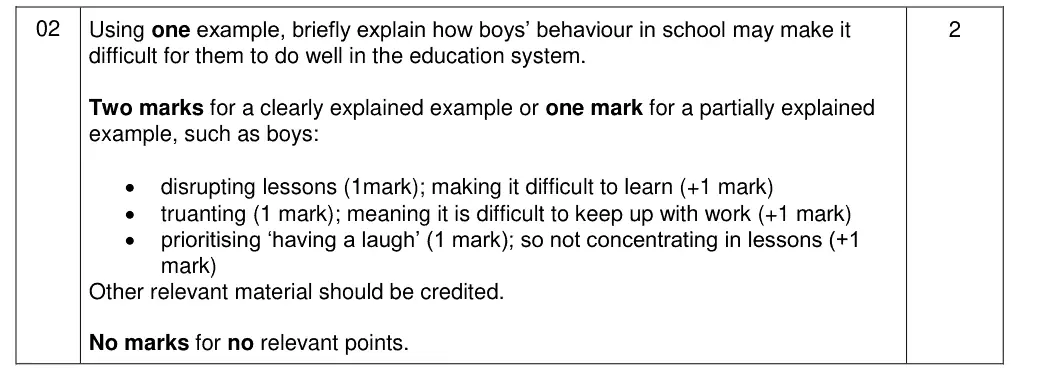
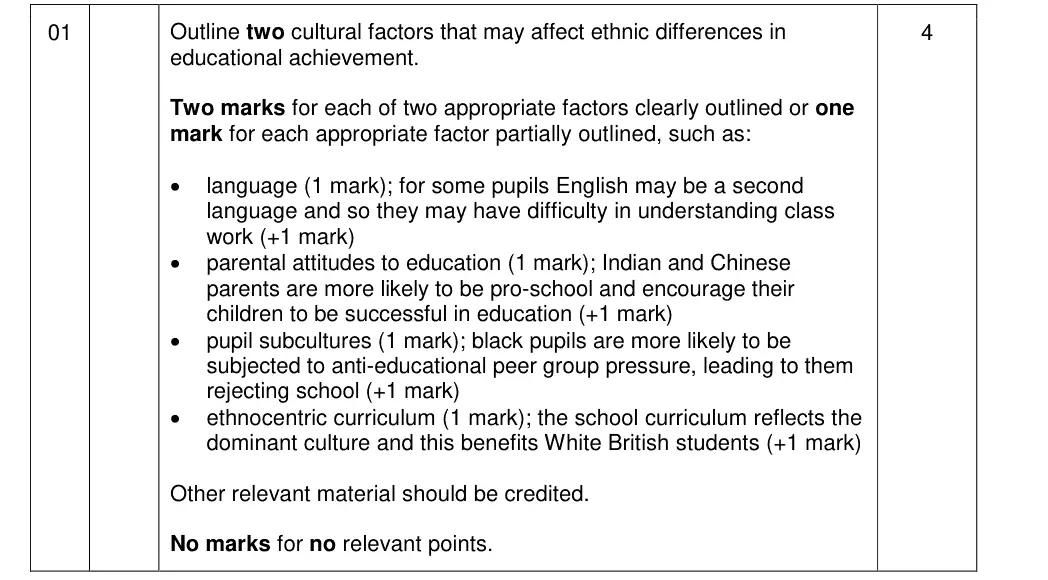
June 2024 · AS Paper 1 · Q22 marksAO2=2Brief explain
Mark scheme
Examiner's comment
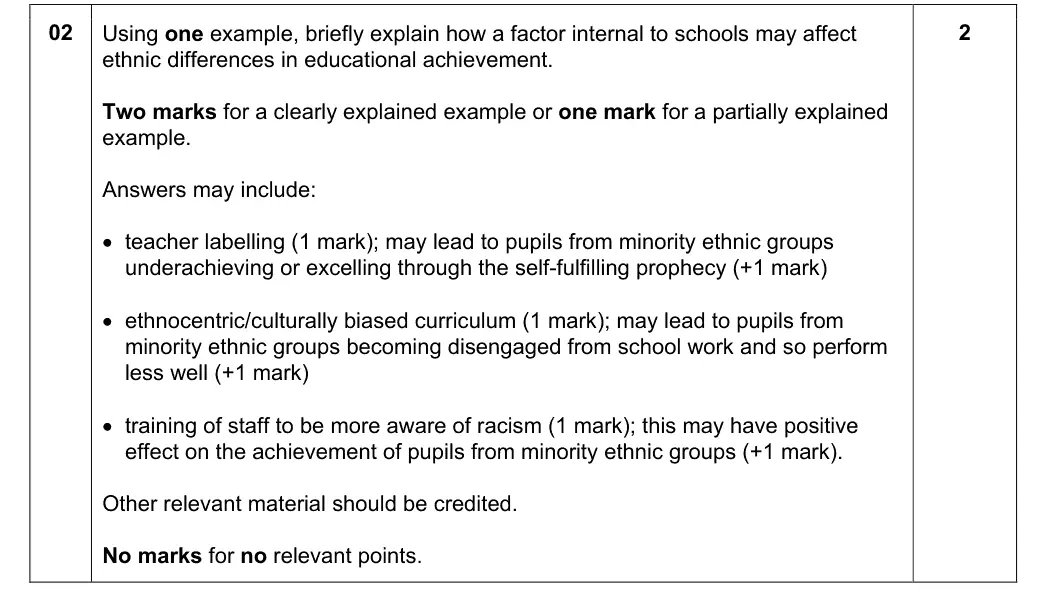
Question 02: This question was answered well by most students. They were able to identify an internal factor and then apply it to differential achievement amongst different ethnic groups. A minority identified external factors. This could still be awarded if then linked to an internal factor eg. language barriers in the school. However, some students did not make the link. Partial credit was given for identification but an insufficient link to achievement.
Notes from the mark scheme and report
1 mark for an internal factor (e.g. labelling, ethnocentric curriculum, anti-racism training), +1 for linking it to ethnic differences in achievement
answered well
a minority wrongly gave external factors
June 2024 · AS Paper 1 · Q36 marksAO1=3, AO2=3Outline
Mark scheme
Examiner's comment
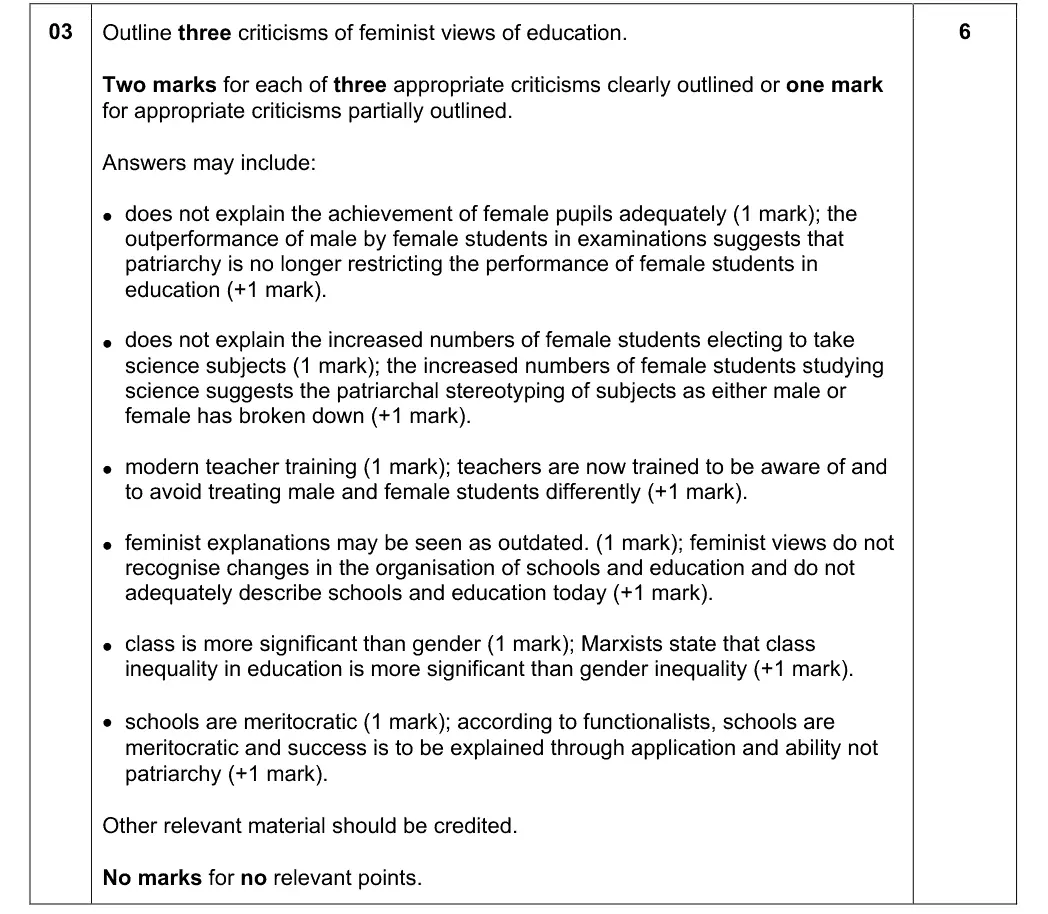
Question 03: This question was answered well on the whole. However, a significant minority of students did not read the question carefully and provided feminist criticisms of the education system. There were also issues with repetition by some students. For example, making the same point from a Marxist perspective.
Notes from the mark scheme and report
2 marks for each of three criticisms clearly outlined, 1 if partial
creditable: girls now outperform boys, more girls in science, teacher training, outdated, class matters more (Marxism), schools are meritocratic (functionalism)
some misread the question and gave feminist criticisms of education instead
repetition cost marks
June 2024 · Paper 1 · Q310 marksAO1=3, AO2=4, AO3=3Analyse
Mark scheme, including the levels grid and indicative content
Examiner's comment
This question appeared to pose more challenges than in previous years, particularly regarding the use and application of the ‘hooks’ (prompts to be developed) provided in the item. While many students effectively utilised the first hook, concerning subject choice and its potential problems for girls, there was variation in how well the second hook about identity expression and conflict was addressed. Some students mistakenly focused on boys' experiences despite the question specifically asking about girls. It is crucial to emphasise that the last sentence of the item, which paraphrases the question, is not intended to be used as a hook for developing answers. This has been highlighted in previous examiner reports and continues to be an issue. Students should be reminded that these sentences that simply paraphrase the question should not be used as a hook for developing responses. The subject choice hook was developed in various ways, to varying degrees of success. There were excellent responses that discussed how career guidance and societal expectations might influence girls' subject choices. These responses pointed out that girls are often guided away from traditionally male- dominated fields like STEM, impacting their future career opportunities. Moreover, some students provided thorough evaluations by discussing recent efforts in schools, such as gender-neutral policies and initiatives (including GIST and WISE) aimed at encouraging more inclusive subject choices. This critical engagement demonstrated a deep understanding of the topic and an ability to connect theoretical concepts to practical educational policies. While the second hook about identity expression and conflict was not as commonly well-utilised, there were notable examples where it was effectively addressed. Some students explored issues like hyper- heterosexual identities and the male gaze, discussing how these factors could affect girls' experiences in school and their educational outcomes. These responses provided a nuanced analysis of how identity expression can lead to conflicts or challenges within the school environment.
Notes from the mark scheme and report
hooks: subject choice and identity expression leading to conflict
the last line of the item restates the question and is not a hook
e.g. gendered subject choice and careers advice steering girls from STEM, policing of girls' identities by the male gaze
drift into boys' underachievement = 1–3
identity hook less often used well
GIST/WISE credited as evaluation
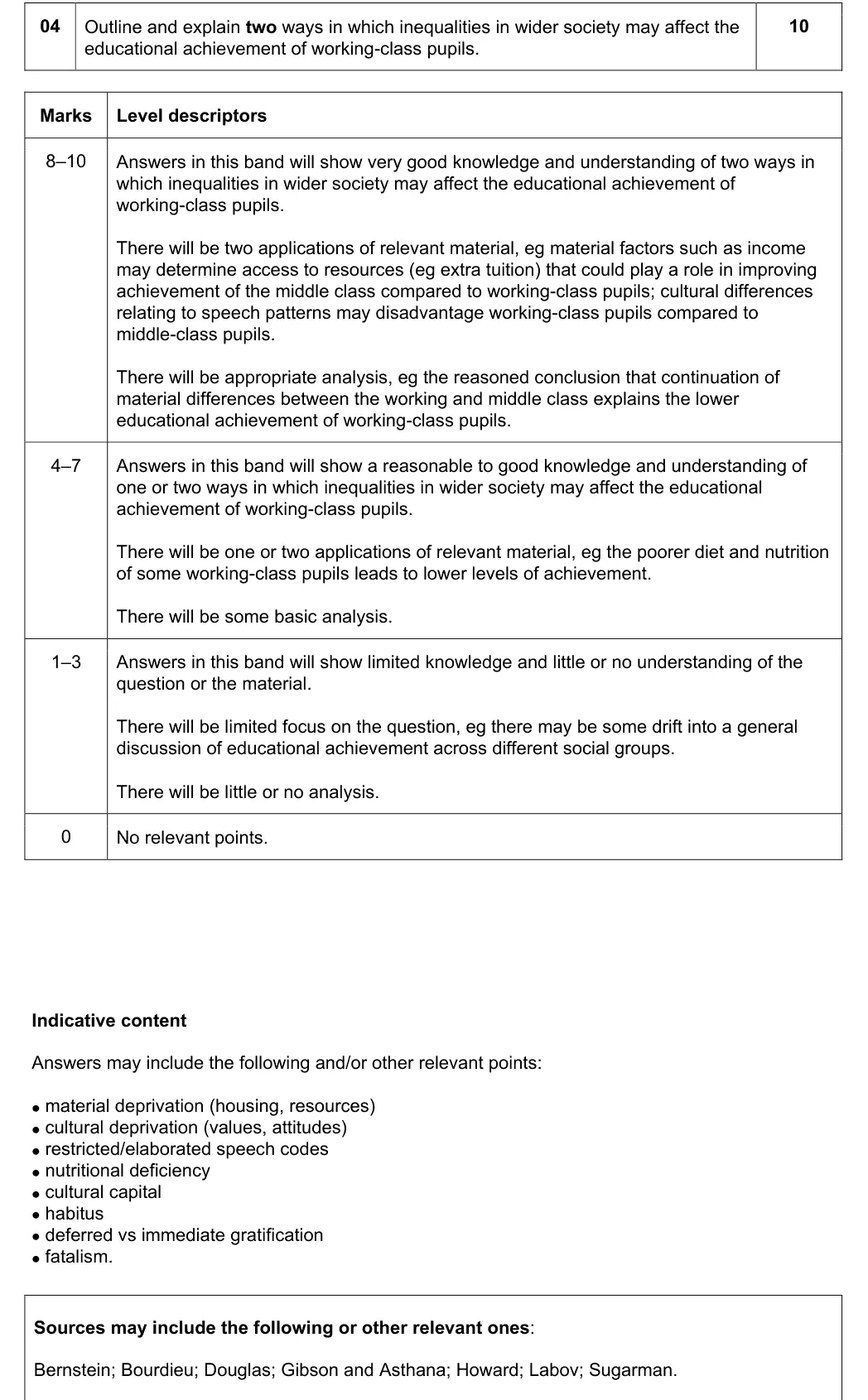
June 2024 · AS Paper 1 · Q410 marksAO1=5, AO2=3, AO3=2Outline and explain
Mark scheme, including the levels grid and indicative content
Examiner's comment
Question 04: In order to produce a good response to this question, students were required to show an understanding of how two inequalities in wider society impact the achievement of working-class pupils. Most students found this to be accessible and were able to identify at least one way. Good responses were able to identify two ways and develop them.
Notes from the mark scheme and report
must be inequalities outside school (material deprivation, speech codes, cultural capital, habitus, fatalism) linked to working-class achievement
drift into achievement of social groups in general = 1–3 band
most managed one way, good answers developed two
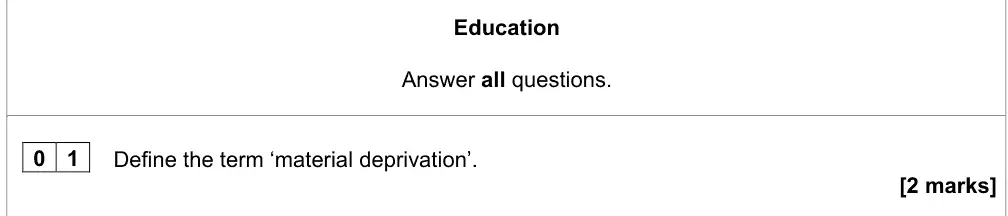
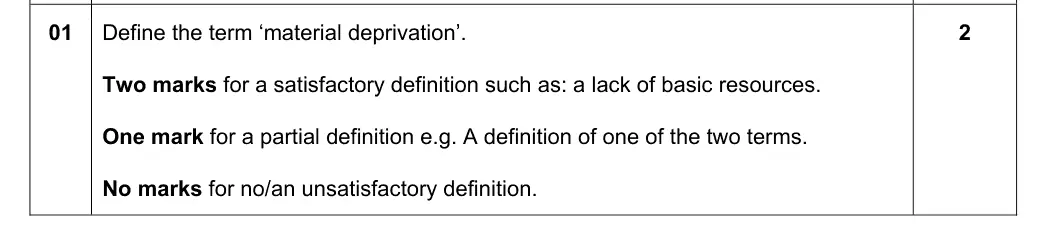
June 2023 · AS Paper 1 · Q12 marksAO1=2Define
Mark scheme
Examiner's comment
It was evident that students had been well-prepared to understand the demands of the different styles of questions, giving appropriately short responses to the 2 mark questions and using bullet points in their answers to question 3. Question 01: Material deprivation is a concept that students grasp with confidence and this was evident in the responses to this question. Students were required to define both the terms ‘material’ and ‘deprivation’ without repeating those terms to gain full marks. The majority of students were able to do so, with just a few making the error of using one of the terms they were being asked to define. Whilst it was a pleasure to see the confidence in knowledge that many students expressed by giving additional application to theory/ examples, this isn’t needed for the 2 marks available.
Notes from the mark scheme and report
2 marks for a lack of basic resources
defining only one of the two words = 1 mark
must not reuse 'material' or 'deprivation' in the definition
mostly well answered
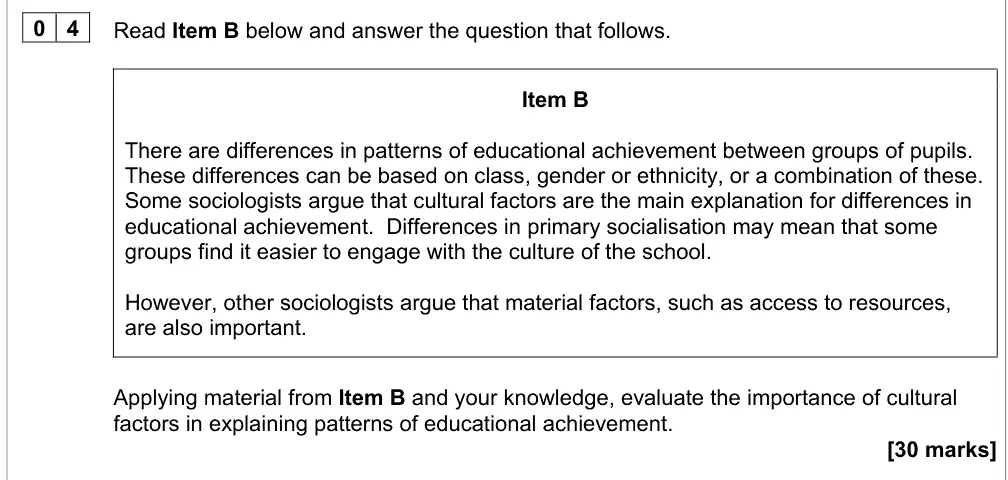
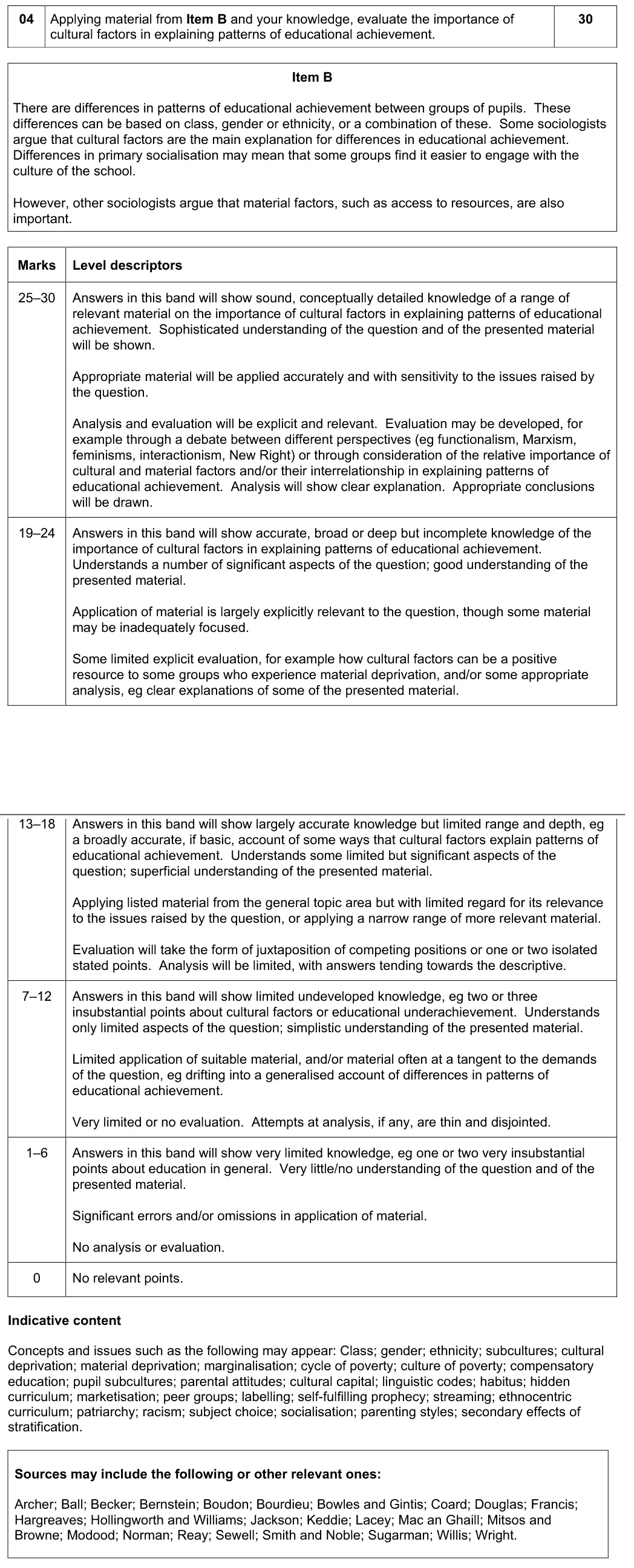
June 2023 · Paper 1 · Q430 marksAO1=12, AO2=9, AO3=930-mark essay
Mark scheme, including the levels grid and indicative content
Examiner's comment
This question provided opportunities for students to draw upon their knowledge and understanding across the education topic. Many students referred to Bernstein’s study of ‘speech codes’ in explaining the ways in which language may effect educational achievement. Additionally, many used Sugarman’s study to explain the ways that ‘delayed gratification’ or having ‘fatalistic’ attitudes, for example, may affect achievement. Furthermore, successful answers included reference to Boudieu’s work on ‘cultural capital’ in outlining ways in which cultural factors may explain patterns of educational achievement. However, some students were less clear on what is and is not a ‘cultural factor’. A number of students saw cultural factors as synonymous with external factors and structured their answers around external vs internal factors explaining differential achievement between social groups. Many of these answers did not explain how these internal factors, such as labelling, are linked to cultural factors. Furthermore, some students then continued to offer bolt-on evaluation of these explanations without any clear explanation for the relevance to this question. Most students focussed on cultural factors related to social class in particular, as well as ethnicity. A number of students who referred to gender tended to present this as an alternative argument with no clear application to culture and therefore not applied clearly to this particular question. A large number of answers referred to material factors as evaluation, usually juxtaposed. Some students gave lengthy explanations of a range of material factors but did not always make this relevant to cultural factors. As well as having good range and depth of cultural factors, the more successful answers were able to explain how material factors may underpin cultural factors; that they may compensate for cultural factors and/ or that material and cultural factors are intertwined. Furthermore, the more successful students were able to provide further explicit evaluation of the cultural factors outlined. For example, some students criticised ‘cultural deprivation’ explanations as victim blaming and/or that these explanations do not account for why some groups of students still manage to achieve well despite being ‘culturally deprived’.
Notes from the mark scheme and report
many treated cultural factors as the same as external factors and structured answers as external vs internal
material factors offered only as juxtaposed evaluation limits marks
top band: how cultural and material factors interrelate or compensate
common sources Bernstein, Sugarman, Bourdieu
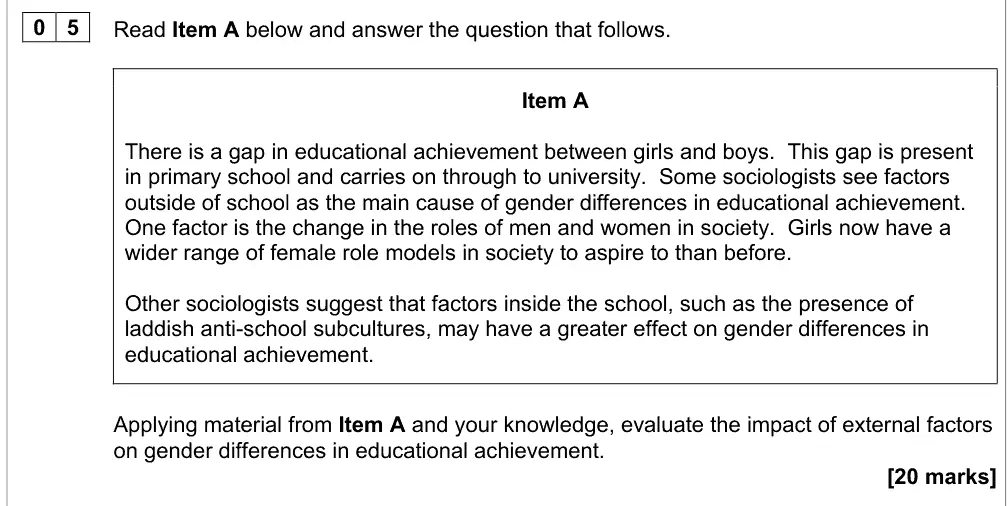
June 2023 · AS Paper 1 · Q520 marksAO1=8, AO2=6, AO3=620-mark essay
Mark scheme, including the levels grid and indicative content
Examiner's comment
In the questions where extended prose was required (10 and 20 mark questions) most students showed their understanding of the different balance of skills required in each question. In particular, students were well prepared to provide a range of factors that impact gender and achievement. However, it would be worth noting that, in a question requiring evaluation of ‘external’ factors that answers should focus on directing each paragraph to answering the question, rather than splitting the answer between external versus internal factors. Question 05: Gender is clearly an area of the specification that centres have ensured students feel very confident about, which is excellent. Students had benefitted from being taught a range of factors and many were able to draw upon significant examples of concepts and research. The strongest responses understood that this question asked students to evaluate the impact of external factors on gender differences in educational achievement. This meant that they outlined the factor using concepts, theory and evidence before explaining how and why it had an impact on gender and achievement. To evaluate, they discussed the relative importance of the factor, or showed how it was inter-linked with an internal factor. Weaker responses tended to juxtapose external factors with internal factors - often an essay with a balance of the two types of factors. When the internal factors were not linked to an external factor, this was not directly answering the question and gained less credit.
Notes from the mark scheme and report
apply Item A (changing gender roles and role models outside school vs laddish subcultures inside)
top band evaluates external vs in-school factors and how they interrelate
13-16 e.g. external factors affecting girls and boys differently
basic account of one or two external reasons = 9-12
strongest answers kept to evaluating the impact of external factors
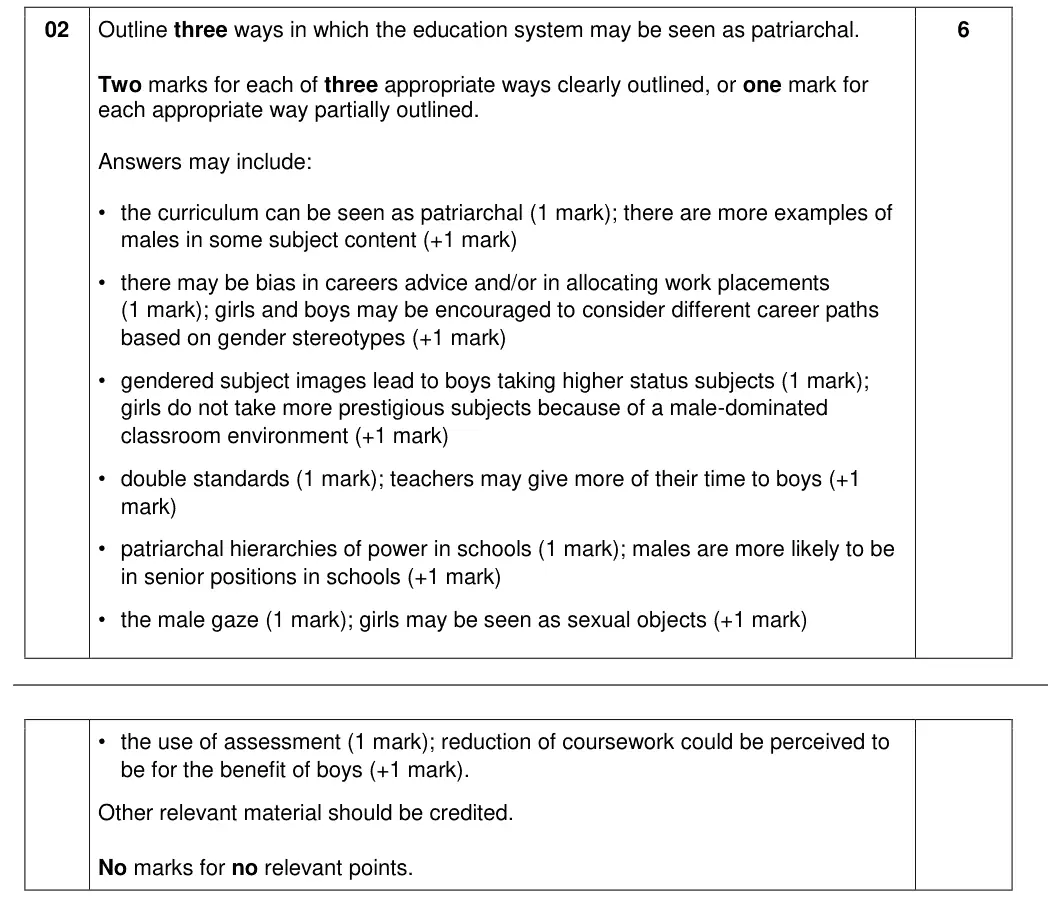
June 2022 · Paper 1 · Q26 marksAO1=3, AO2=3Outline
Mark scheme
Examiner's comment
This question was generally answered well. The majority of students were able to offer at least one or two ways that the education system may be seen as patriarchal. There was a wide range of responses which included male dominance in more senior roles within schools and gender bias in careers advice. Some students struggled to gain full credit for their answers where their response was generic and not linked clearly to differences in power. For example, some simply stated ‘subject choice’ whereas more successful answers included the way that females may be less encouraged to choose more prestigious subjects as a result of existing gendered stereotypes. A very small number of students did not seem to understand the term ‘patriarchy’ and their answers focussed instead, for example, on social class inequalities.
Notes from the mark scheme and report
2 marks for each of three ways clearly outlined, 1 if partial (e.g. male-centred curriculum, gendered careers advice, men in senior posts, teacher attention, male gaze, assessment changes favouring boys)
bare 'subject choice' without a link to gendered power gets partial credit
a few misunderstood patriarchy and wrote about social class
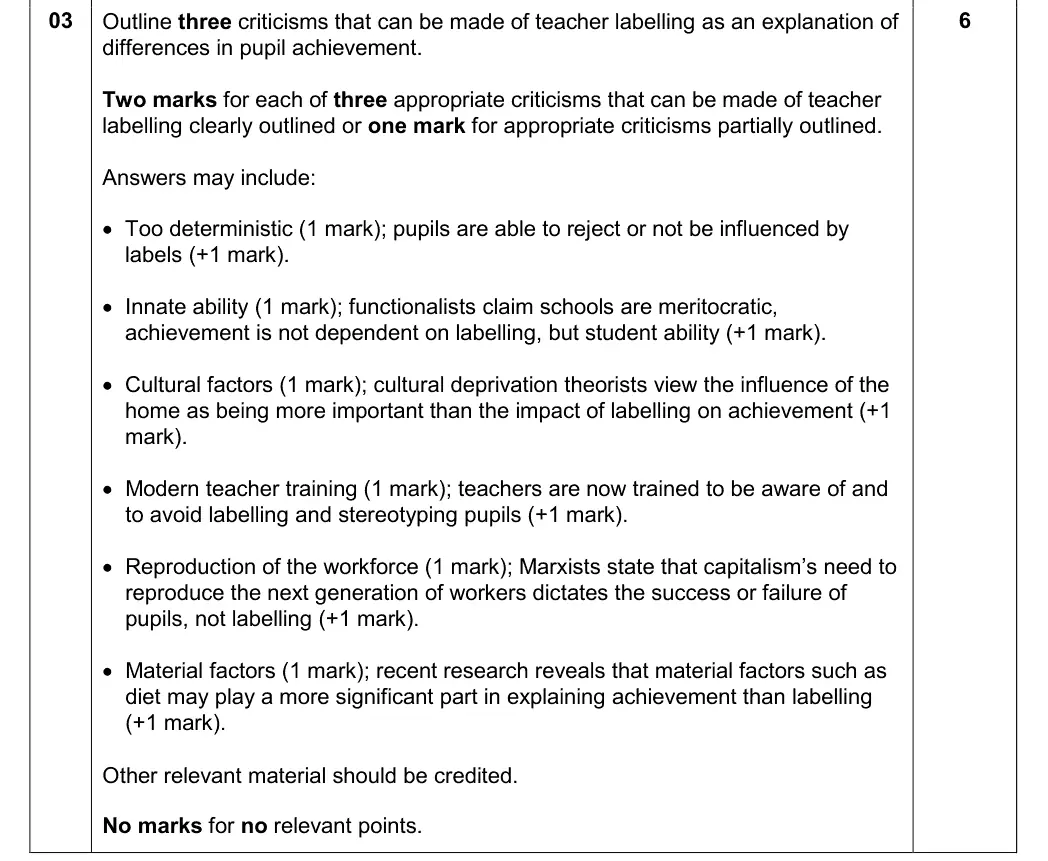
June 2022 · AS Paper 1 · Q36 marksAO1=3, AO2=3Outline
Mark scheme
Examiner's comment
The responses to this question showed that students have a good deal of knowledge about labelling theory. Unfortunately, many students did not gain credit, as their responses critiqued the process of labelling itself, rather than criticising the theory of labelling. Those who were able to gain marks in this question often used the example of the self-refuting prophecy to show that the theory can be too deterministic.
Notes from the mark scheme and report
2 marks for each of three criticisms clearly outlined, 1 if only partially outlined
credited: too deterministic, innate ability/meritocracy, cultural or material factors more important, teacher training, Marxist reproduction
many criticised the labelling process itself rather than the theory and scored nothing
self-refuting prophecy used well for determinism
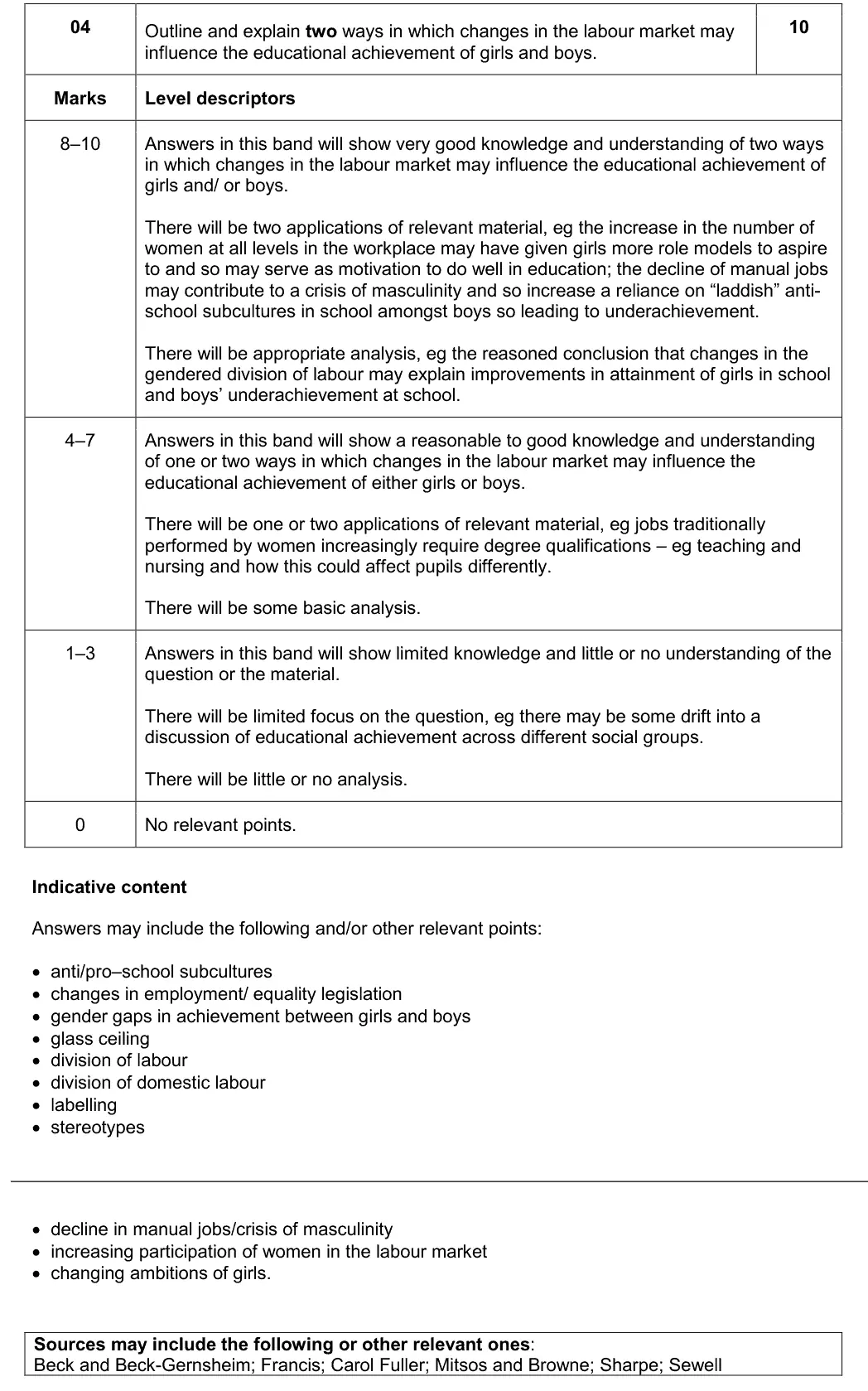
June 2022 · AS Paper 1 · Q410 marksAO1=5, AO2=3, AO3=2Outline and explain
Mark scheme, including the levels grid and indicative content
Examiner's comment
In order to produce a good response to this question, students were required to show an understanding of two changes that have taken place in the labour market and then to use their application and analysis skills to relate this to the achievement of boys and/ or girls in education. Unfortunately, many students found the term ‘labour market’ difficult and their response dealt with changes made by the Labour government, or focussed on marketisation. Good responses often referred to declining manual labour opportunities in the UK and the impact this has had on boys in schools, along with equality laws that had a positive impact on the employment of women.
Notes from the mark scheme and report
must link labour-market change to girls' and/or boys' achievement (more women in work as role models, decline of manual jobs and crisis of masculinity, equality laws)
drift into achievement of other social groups = 1–3
many misread 'labour market' as Labour government policy or marketisation
June 2022 · AS Paper 1 · Q520 marksAO1=8, AO2=6, AO3=620-mark essay
Mark scheme, including the levels grid and indicative content
Examiner's comment
This question was answered well by students. It was clear that centres had prepared students to be confident in their knowledge of educational policies. Many students were able to successfully identify a range of appropriate policies and the impact they had on social class inequalities. The best responses were able to separate intention from consequences and were able to give a critical account of the short-term and long-term impact of government educational interventions.
Notes from the mark scheme and report
top band weighs the impact of different policies, or policies against wider class inequality as an explanation (hook in Item A)
e.g. pupil premium, Aimhigher, Sure Start, academies, marketisation
answered well with a good range of policies
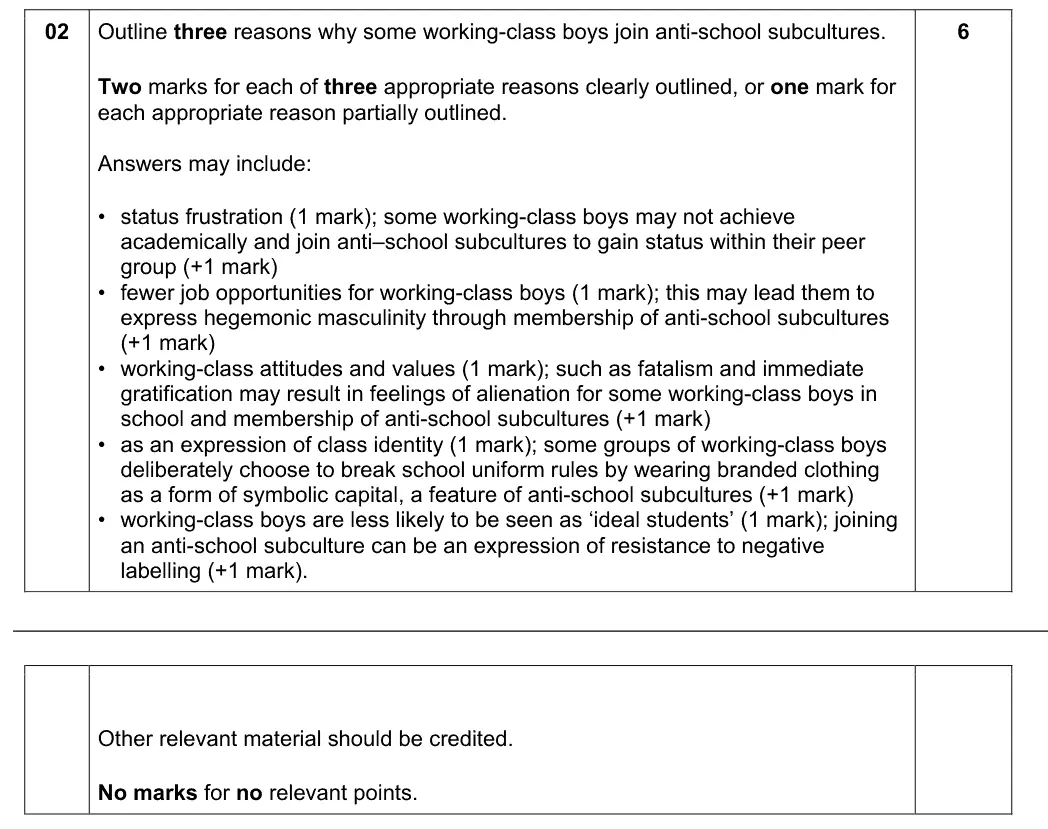
November 2021 · Paper 1 · Q26 marksAO1=3, AO2=3Outline
Mark scheme
Examiner's comment
Similarly to previous years, some students wrote lengthy answers to the 4-mark and 6-mark questions which may explain why a few of these students seemed to run out of time in answering the final question(s). Most students could offer at least one or two reasons why some working-class boys join anti- school subcultures. Answers tended to refer to labelling and the self-fulfilling prophecy as well as expressions of identity and/ or fatalistic attitudes. Some students outlined reasons linked more specifically to ethnicity, such as the ethnocentric curriculum, rather than working class boys and therefore were less successful in gaining marks.
Notes from the mark scheme and report
2 marks for each of three reasons clearly outlined
credited: status frustration, labelling and not being the 'ideal pupil', fatalism and immediate gratification, class identity, hegemonic masculinity with fewer jobs
reasons tied to ethnicity (e.g. ethnocentric curriculum) rather than working-class boys were less successful
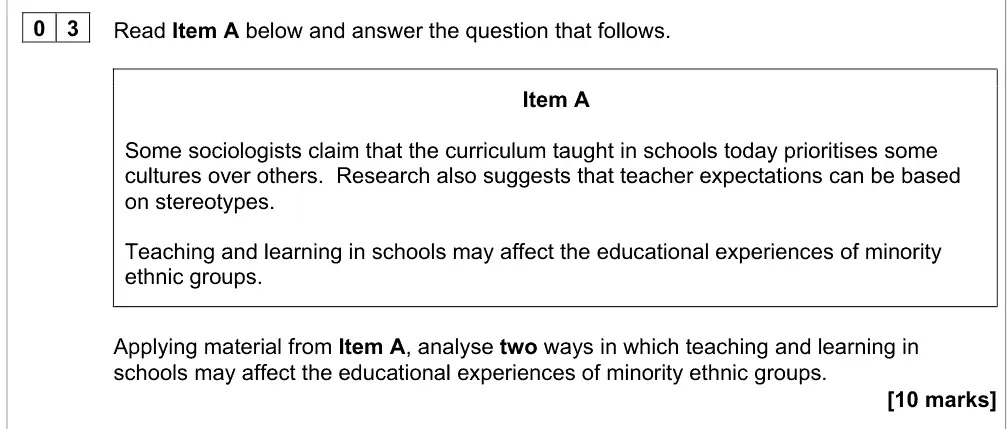
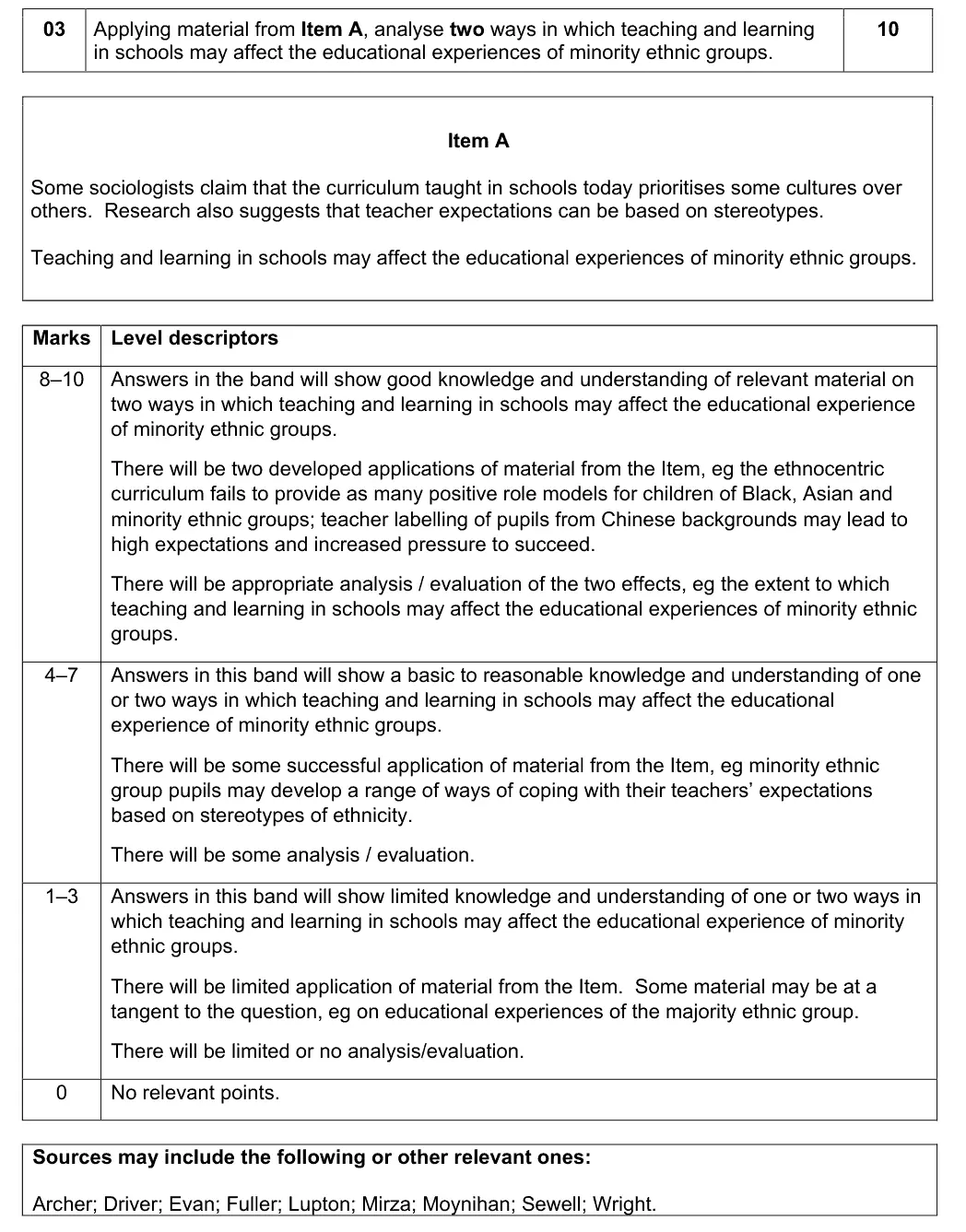
November 2021 · Paper 1 · Q310 marksAO1=3, AO2=4, AO3=3Analyse
Mark scheme, including the levels grid and indicative content
Examiner's comment
In general, this was a well answered question. Most students were able to identify the hooks in the item i.e ‘curriculum prioritising some cultures’ and ‘teacher expectations based on stereotypes’. Many were then able to develop these hooks in explaining ways in which the ethnocentric curriculum and teacher labelling may affect the experiences of some minority ethnic groups, for example, leading to the self-fulfilling prophecy and affecting their self-esteem. Additionally, the most successful answers were able to apply studies and research in providing further detail and analysis of the ways in which minority ethnic groups may be affected by these processes. Furthermore, some were able to provide some explicit evaluation and discussion of the extent to which minority ethnic groups are affected, for example by labelling, in applying Fuller’s research that outlines the ways that pupils may reject their labels.
Notes from the mark scheme and report
must develop hooks from Item A (curriculum prioritising some cultures, stereotyped teacher expectations)
the last line restates the question and is not a hook
credited: ethnocentric curriculum and lack of role models, labelling and self-fulfilling prophecy, high expectations of Chinese pupils
best answers evaluated, e.g. Fuller on rejecting labels
drift into the majority ethnic group = 1–3
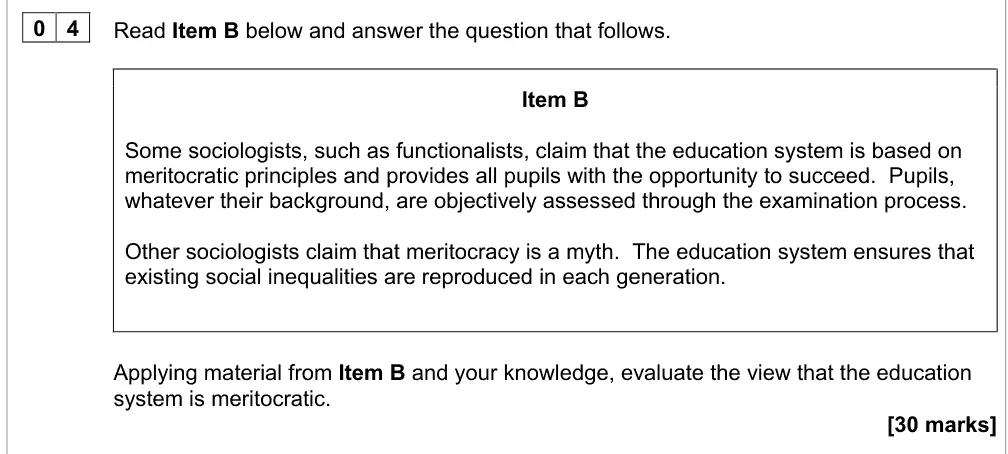
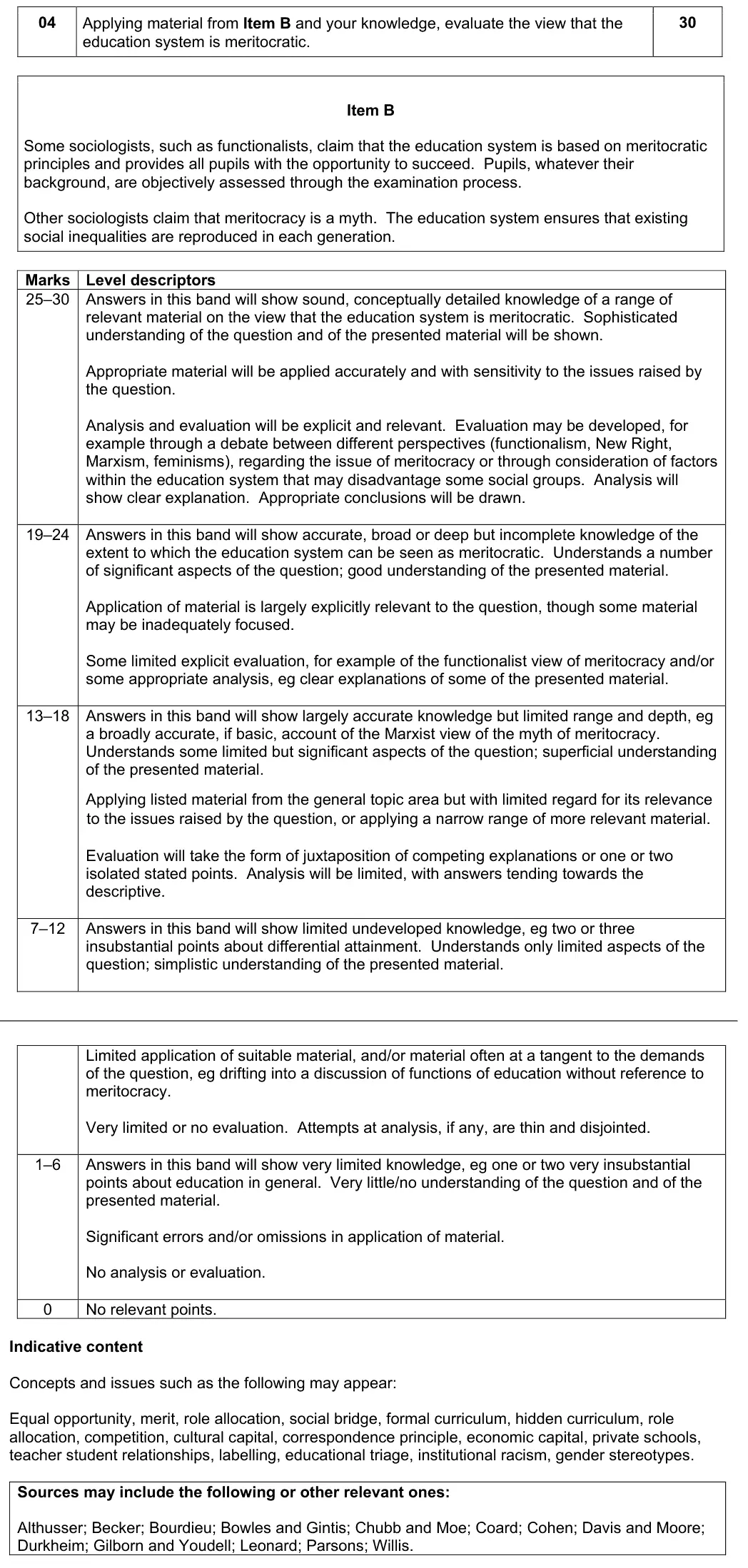
November 2021 · Paper 1 · Q430 marksAO1=12, AO2=9, AO3=930-mark essay
Mark scheme, including the levels grid and indicative content
Examiner's comment
Despite the much lower than usual entry, there was some range in the responses to this question. Many students were able to outline a debate for and against the view that the education system is meritocratic, to varying levels of success. For example, some made reference to the national curriculum and external exams to outline how the education system could be seen as a fair and equal system whilst labelling by teachers, setting and streaming and the ethnocentric curriculum could mean that education is biased and unfair. The most successful answers were able to present their arguments and evidence through a debate between sociological perspectives. For example, many students outlined Parson’s views of the education system being meritocratic and the ways that education is the ‘bridge’ between the family and wider society and enabling people to gain achieved status. Some continued to apply Davis and Moore’s view of the ‘selective role’ that the education system performs in ‘sifting and sorting’ pupils into the appropriate positions in the workplace. This was often counter-argued with Marxist views. For example, many argued that Bourdieu’s concept of ‘cultural capital’ provides the middle class with an advantage that means they are more likely to achieve in school. Some also included feminist theories and viewpoints in explaining gender differences in achievement and opportunities as well as discussions of the extent to which some ethnic minority groups may experience obstacles to achieving well in the education system. Less effective answers tended to be descriptive and had a limited range of explanations and viewpoints. Some students referred more generally to functionalist and Marxist theories of education and struggled to apply these to views of meritocracy and/ or to the education system. The most successful answers demonstrated more sophisticated analysis and evaluation in debating the extent to which the education system is meritocratic or whether there is a ‘myth of meritocracy.
Notes from the mark scheme and report
must apply Item B (functionalist meritocracy vs myth of meritocracy and reproduction of inequality)
top band: debate between functionalism, New Right, Marxism and feminisms or school factors disadvantaging some groups
drift into functions of education without meritocracy = 7–12
best answers used Parsons, Davis and Moore against Bourdieu and Bowles and Gintis
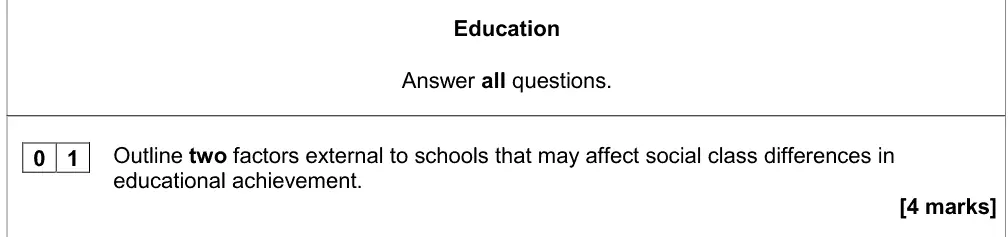
November 2020 · Paper 1 · Q14 marksAO1=4Outline
Mark scheme
Examiner's comment
Similarly to summer 2019, a significant number of students wrote very lengthy answers to the 4-mark and 6-mark questions which may explain why some seemed to run out of time in answering the final question. Unsurprisingly, this question seemed to pose very few problems for students. Most could identify two (with many offering more) external factors and of these, the majority could develop their point further to gain the additional mark. Common responses referred to material deprivation, cultural deprivation and cultural capital. Others gave specific examples such as poor diet, parental support and language codes as part of their answer. Unfortunately, a small number of students failed to gain marks as they offered internal factors.
Notes from the mark scheme and report
2 marks for each of two external factors clearly outlined, 1 if partial (e.g. financial capital, poor housing, parental attitudes, linguistic codes, subcultural values, cultural capital)
few problems, common answers material and cultural deprivation and cultural capital
internal (in-school) factors not credited
November 2020 · AS Paper 1 · Q36 marksAO1=3, AO2=3Outline
Mark scheme
Notes from the mark scheme and report
2 marks for each of three reasons clearly outlined, 1 if only partially outlined
e.g. girls' motivation from women's employment, higher teacher expectations, feminisation of education, literacy, crisis of masculinity
no examiners' report for this series
November 2020 · AS Paper 1 · Q410 marksAO1=5, AO2=3, AO3=2Outline and explain
Mark scheme, including the levels grid and indicative content
Notes from the mark scheme and report
must link teacher-pupil interaction to minority ethnic achievement (labelling and self-fulfilling prophecy, setting and streaming, exclusions and racism, pupil responses such as subcultures)
drift into class and education = 1–3
no examiners' report for this series
November 2020 · Paper 1 · Q430 marksAO1=12, AO2=9, AO3=930-mark essay
Mark scheme, including the levels grid and indicative content
Examiner's comment
There were a range of responses to this question with a variety of explanations offered - both internal and external to schools. For example, explanations offered included differences in socialisation, feminism, labelling and the self-fulfilling prophecy. Less effective responses tended to be descriptive and limited in the range of explanations offered. A small number of students seemed to focus almost entirely on explaining why ‘girls are underachieving’ and appeared to offer a rather historical account of these differences. More successful answers referred to more recent studies and relevant concepts as they covered a broader range of explanations. Some less effective answers were descriptive of explanations and studies and general to gender differences in schools. Others drifted into explanations of gender differences in subject choice or gender identity without explaining their relevance to achievement. Furthermore, some answers drifted into accounts of social class and/or ethnicity without any reference to differences in gender and achievement. However, more effective answers indicated how these social groups may be interrelated or that, for example, that males and females are not homogenous groups. The better responses clearly applied explanations for gender differences with a focus on achievement. Many students offered basic analysis in their explanations of gender differences in educational achievement, for example, applying these explanations to either males or females separately. A number of responses offered juxtaposed evaluation of internal versus external factors in explaining these gender differences. More successful answers were able to apply some of the explanations in a more analytical way by comparing and contrasting males and females in explaining differences in achievement. Furthermore, these answers were able to offer more critical evaluation in discussing ways that internal and external explanations are interrelated and contribute to differences in gender and achievement. The more effective answers were able to offer explicit evaluation.
Notes from the mark scheme and report
top band weighs external against internal factors or their interrelationship
drift into general differential achievement without gender = 7–12
drift into subject choice or gender identity without linking to achievement
dated accounts of girls underachieving
best compared boys and girls directly, noted they are not homogeneous groups, and used recent studies
June 2019 · AS Paper 1 · Q12 marksAO1=2Define
Mark scheme
Examiner's comment
Most students had some understanding of the term ‘cultural capital’, but many only gained one mark for a partial definition. This was mostly as a result of students recognising the ‘cultural’ part of the question: eg referring to aspects of knowledge; way of life; language that the middle class students possess but neglecting to refer to ‘capital’ or the idea of providing them with an advantage. Some students confused cultural with economic advantages. More successful answers referred to the middle class way of life, for example by identifying language provided middle-class children with an advantage at school or helped them to achieve educational success, with some students (although not necessary for the 2 marks) referring directly to Bourdieu’s work.
Notes from the mark scheme and report
2 marks need the idea of advantage (the 'capital' part), not just middle-class culture or knowledge
many got only 1 mark for describing culture without the advantage
some confused cultural with economic advantage
naming Bourdieu not required
June 2019 · Paper 1 · Q310 marksAO1=3, AO2=4, AO3=3Analyse
Mark scheme, including the levels grid and indicative content
Examiner's comment
The 10-mark item question continues to provide a good illustration of application skills; fewer students than previously failed to identify a ‘hook’ in the item, and fewer failed to apply points successfully from the item, as this question requires. The majority of students were able to explicitly refer to one or two ‘hooks’ from the Item. The hooks that were most commonly used were concerned with the curriculum, teacher-pupil relationships and interaction with peers. The majority of students were able to apply at least one of these key hooks and then successfully link this to processes such as labelling, the use of language codes, subcultures and streaming and how it impacted on the pupil’s identity. Many of the successful responses also drew on the work of Bernstein, Bourdieu, Becker, Lacey and Archer and were able to use studies on pupil identity based on class, gender or ethnicity. Less successful responses mentioned students ‘feeling negative’ and often drifted into issues relating to achievement. However, a minority of students were unable to refer to hooks from the item and wrote about labelling, streaming and pupil subcultures. Despite often giving a detailed knowledge of a process, these responses were unable to score beyond the 1-3 band. Many students found it difficult to relate the process to the appropriate hook, or had limited application to identity, so ended in the 4-7 band. Only a minority of answers were able to get into the 8-10 band by taking two hooks, explaining two processes and applying these to identity, through analysis and evaluation. Often attempts to evaluate were generic and so did not score well. More successful examples of evaluation were applied specifically to the question, such as identify being shaped by external factors, rather than processes in schools.
Notes from the mark scheme and report
must develop hooks from Item A (curriculum and middle-class cultural capital, teacher–pupil relationships, peer groups)
no reference to the item = max 3 marks
focus is pupils' class identity, not achievement
drift into external factors = 1–3
best answers linked two hooks to labelling, streaming, subcultures or speech codes and then to identity
generic evaluation scored poorly
June 2019 · AS Paper 1 · Q410 marksAO1=5, AO2=3, AO3=2Outline and explain
Mark scheme, including the levels grid and indicative content
Examiner's comment
There was clear evidence of teachers preparing students well to answer this question, for example by ensuring that students answered the question with two distinct paragraphs, and without the need for an introduction or conclusion. Students found no difficulty in identifying two relevant policies that have influenced gender differences in achievement, either directly such as through the National Curriculum, coursework, GIST/WISE; or indirectly, by means of the Equal Pay Act or Sex Discrimination Act. However, students then struggled to achieve answers in the top band due to their inability to develop their answers, and/or clearly explain how their chosen policy may have influenced differences in educational achievement between males and females. There was a tendency to over focus on female achievement rather than on explaining gender differences, and this failure by a large number of students to explore how polices may have helped females and discouraged males, meant many students remained in the middle band. Some answers drifted into subject choice or identified polices which were clearly more associated with social class rather than gender differences and as a result they failed to apply their answer specifically to the question set.
Notes from the mark scheme and report
must explain how each policy affected the gap between boys and girls, not just girls' achievement
generic gender and achievement with little on policy = 1–3
drift into subject choice or class-based policies not credited
common policies: National Curriculum, coursework changes, GIST/WISE, Equal Pay and Sex Discrimination Acts
top band considers class and ethnicity within gender groups
June 2019 · Paper 1 · Q430 marksAO1=12, AO2=9, AO3=930-mark essay
Mark scheme, including the levels grid and indicative content
Examiner's comment
There was also evidence of some very well taught and well prepared students, which was particularly evident amongst responses for Question 04. Most students were able to demonstrate a range of external and internal factors that have an impact on differences in educational achievement between ethnic groups. The majority of students used the item to structure their answers, particularly focussing on “home and family life”, in terms of external factors and ideas around labelling to explore “factors within school”. Many students demonstrated clearly a large amount of conceptual knowledge and a significant number of studies that were accurately applied to the question, particularly the work of Sewell, Bereiter and Engelmann, Fuller, Mirza, Gillborn and Youdell and Archer. The large majority of students were able to get into the 13-18 mark band, and the mean mark for the question was ‘18’. Stronger responses showed both breadth and depth of knowledge with a good range of concepts. Materials were presented analytically with explanations being unpacked. These responses typically identified specific ethnic groups, rather than applying an explanation to all ethnic minorities or to a supposed homogenous group such as ‘Asians’, and therefore were successful in highlighting which ethnic groups over-achieved and which ones underachieved. The very best answers contained specific evaluation and could identify and explain links between internal and external factors, for example in the way language crosses over from the home background to the school. However, only a minority of students mentioned that these factors could be interrelated and most that did failed to discuss explicitly how external and internal factors impacted on each other. Less effective answers were often class-based rather than referring specifically to ethnicity. Some answers offered only highly generic material which was equally applicable to social class as to ethnicity, especially on material deprivation and labelling. Few responses were able to show the evaluation required for the very top band. Evaluation was often by juxtaposition, mainly of internal and external factors. Better evaluation occurred when students were critical throughout their answer, rather than giving a few instances of undeveloped points. The majority of students had conclusions that were not evaluative and were largely a recap of previous points, and so did not score well.
Notes from the mark scheme and report
must apply Item B (home and family vs factors within schools)
top band: relative importance of home and school factors and how they interrelate with wider racism
best answers named specific ethnic groups rather than 'ethnic minorities' or 'Asians'
drifting into class without ethnicity = 7–12
evaluation often juxtaposition of internal and external factors
June 2019 · AS Paper 1 · Q520 marksAO1=8, AO2=6, AO3=620-mark essay
Mark scheme, including the levels grid and indicative content
Examiner's comment
Students confidently offered a wide range of factors, from both inside and outside the school, to explain the differences in achievement between social classes. Some were able to use the item to gear the answer in exploring issues relating to labelling and other internal processes, as well as cultural and material factors. Less successful answers did not apply their answer explicitly to the question, for example by focusing on differences in achievement, and often became descriptive rather than analytical. Others insisted on giving large accounts of studies, for example by Becker and Rist, but without explaining the relevance to the question, and therefore were presented as a regurgitation of revised notes about social class and education more generally, rather than a reasoned response to the question. In general, students appeared to prefer external factors that related to material and cultural deprivation, in particular language and cultural capital deprivation, and provided only a very thin account of internal factors. Furthermore, there was an overwhelming tendency to offer a range of internal and external factors in a list like fashion which were juxtaposed and lacked a clear debate for the top bands. More sophisticated answers were able to explore, in depth, a range of internal factors and offered some explicit evaluation of the significance of these factors in relation to both working class and middle class achievement. Successful evaluation also included the ability to explore how internal and external factors were inextricably linked, and being able to offer a well-informed conclusion to the question.
Notes from the mark scheme and report
must evaluate labelling and other in-school factors against out-of-school factors
top band recognises not all pupils respond to labelling in the same way and weighs internal factors against each other and against external factors
many gave thin internal factors and long material/cultural deprivation accounts
list-like juxtaposition and retold studies (Becker, Rist) without relevance limited marks
best answers showed how internal and external factors interlink
June 2018 · Paper 1 · Q14 marksAO1=4Outline
Mark scheme
Examiner's comment
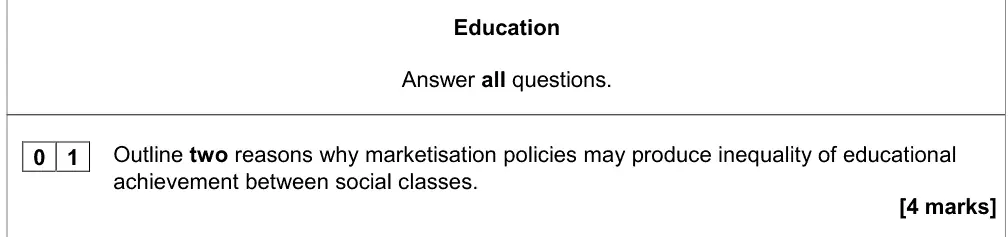
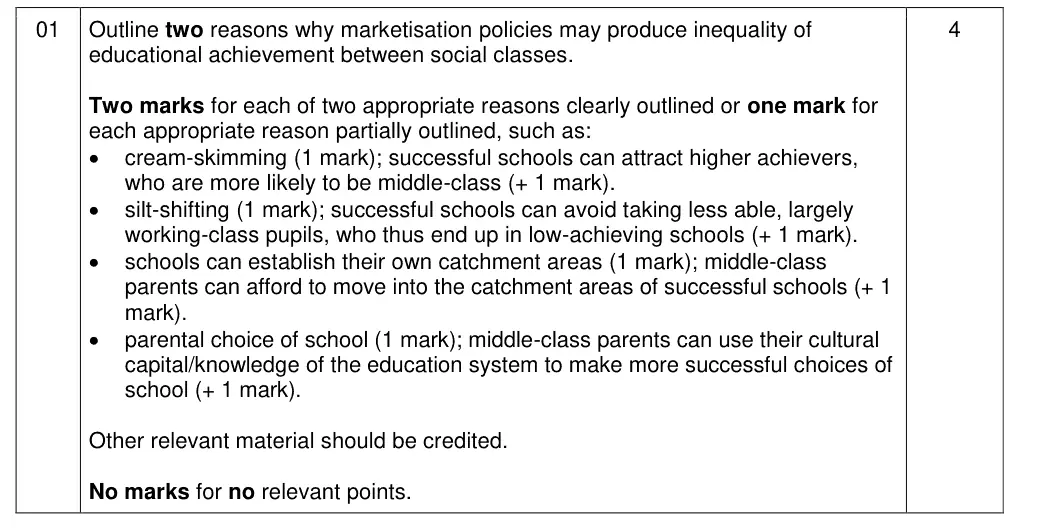
Whilst not as frequently as in the first sitting of the new specification, a significant number of students are writing too much for the 4 and 6 mark questions. Centres are reminded that these small-mark questions are best answered with a clear ‘point’ and ‘development’ structure, rather than lengthy continuous prose. Most students could identify two ways in which marketisation may create inequality of educational achievement, usually via two specific policies. Common responses made reference to marketisation polices enabling middle class parents to choose a better school (due to cultural and/or economic, capital) and higher achieving schools being able to pick middle-class students to maintain their position on the league tables. However, this question did create problems for many students. A significant number misunderstood the question by stating policies of marketisation such as league tables as the identification rather than the reason why marketisation produces inequality. Sometimes the connection to inequality of achievement was not made effectively enough to gain full marks. A few students selected policies that were not associated with marketisation, for example, the 1944 Act, or referred to private schools producing inequality of achievement between the classes.
Notes from the mark scheme and report
2 marks for each of two reasons clearly outlined, 1 if only partially outlined
credited cream-skimming, silt-shifting, selection by catchment/mortgage, middle-class cultural capital in school choice
naming a policy (e.g. league tables) is not itself a reason
must link to class inequality of achievement
some cited non-marketisation policies (1944 Act) or private schools
June 2018 · AS Paper 1 · Q22 marksAO2=2Brief explain
Mark scheme
Examiner's comment
This question produced a wide range of answers. Successful responses clearly identified an aspect of boys’ behaviour which could lead to educational underachievement. The most common behaviours identified included ‘messing around/ being disruptive’, ‘truanting’ and ‘not bothering with work’. Many were then able to go on and explain, for example, that ‘therefore boys miss out on their learning and underachieve’. Some students were able to offer an example of boys’ behaviour but were less successful in explaining how this leads to them doing less well in education. Unsuccessful answers were unable to explicitly identify an example of boys’ behaviour, for example, mentioning ‘laddish subcultures’ or ‘anti-school subcultures’ more generally. Others referred to ‘teacher labelling’ but did not link this to how boys’ behaviours change as a result and so did not gain credit.
Notes from the mark scheme and report
1 mark for a specific behaviour, +1 for explaining how it hinders achievement (e.g. disrupting lessons, truanting, 'having a laugh')
naming 'laddish' or anti-school subcultures in general without a specific behaviour gained nothing
teacher labelling only credited if linked to boys' behaviour
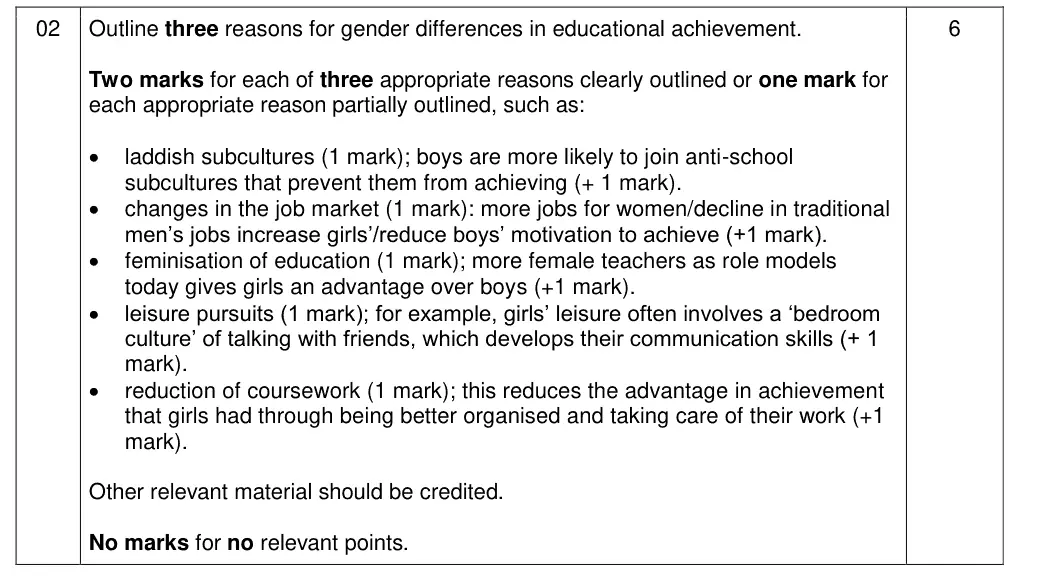
June 2018 · Paper 1 · Q26 marksAO1=3, AO2=3Outline
Mark scheme
Examiner's comment
Whilst not as frequently as in the first sitting of the new specification, a significant number of students are writing too much for the 4 and 6 mark questions. Centres are reminded that these small-mark questions are best answered with a clear ‘point’ and ‘development’ structure, rather than lengthy continuous prose. This question was, in the main, dealt with very effectively, with most students able to identify and explain at least two reasons. Common successful responses included laddish subcultures, the feminisation of education, coursework, changing employment opportunities for males and teacher labelling of males. Some students gave reasons that were too vague to be rewarded such as socialisation and peer group, while others focussed on gender differences in subject choice rather than achievement. Many students were not rewarded the second mark as they failed to apply their reason fully to gender or educational achievement.
Notes from the mark scheme and report
2 marks for each of three reasons clearly outlined, 1 if only partially outlined
common answers: laddish subcultures, feminisation of education, coursework, changing job market, teacher labelling of boys
vague reasons (socialisation, peer group) not credited
subject choice is not achievement
second mark often lost for not linking to gender and achievement
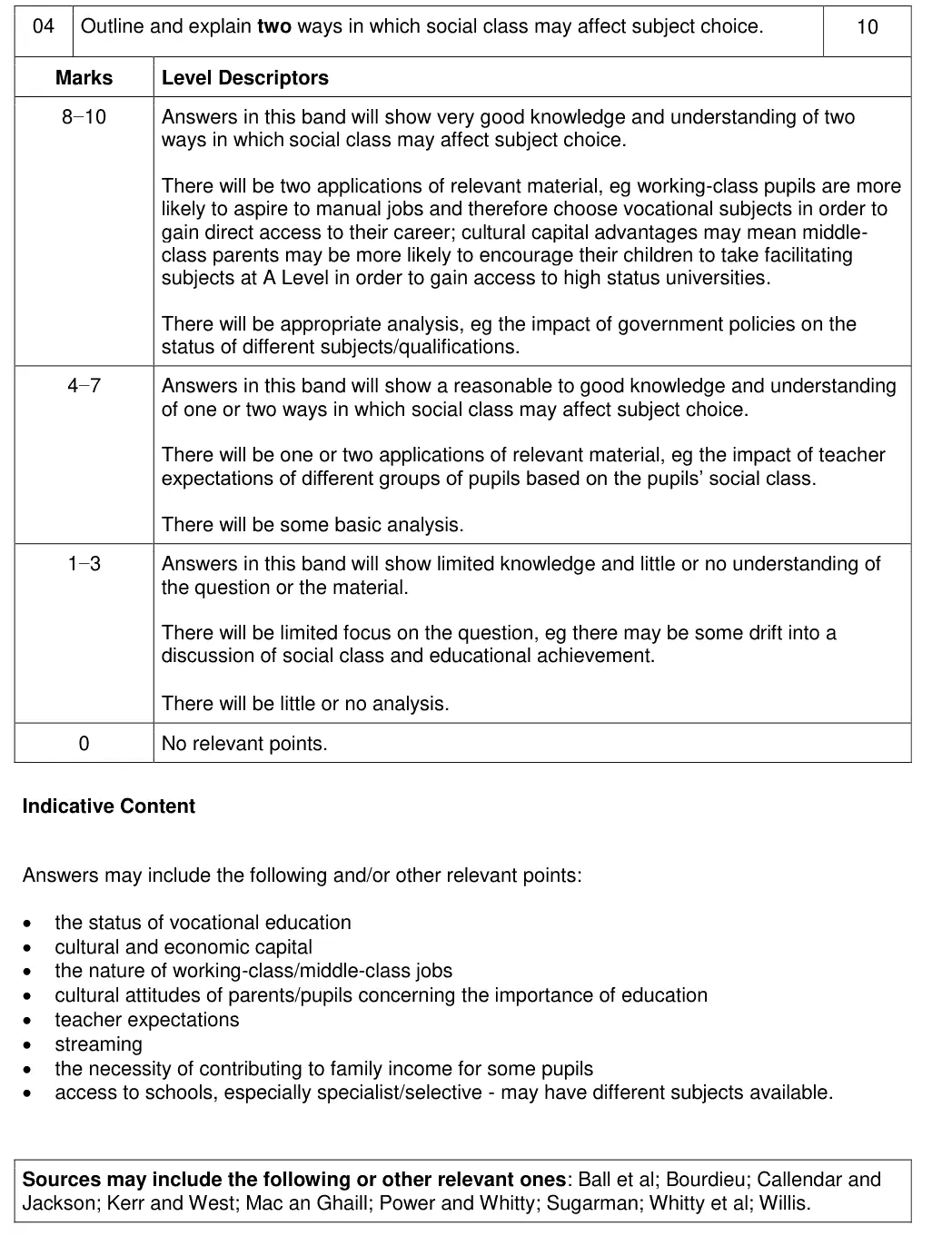
June 2018 · AS Paper 1 · Q410 marksAO1=5, AO2=3, AO3=2Outline and explain
Mark scheme, including the levels grid and indicative content
Examiner's comment
This question required students to apply their knowledge of one area of the specification (external factors and processes within schools that influence class achievement) to another area (subject choice). Many students had been well prepared for this question and structured their answer with two distinct paragraphs (without the need to include an introduction and conclusion) and demonstrated skills of application and analysis by connecting different aspects of the question. However, weaker answers often focused solely on outlining some of the factors affecting social class and achievement without attempting to link these to subject choice. Additionally, a significant number of responses focused solely on gender and subject choice and therefore did not score as highly. Better answers unpacked knowledge on factors such as parental aspirations, cultural capital, language codes and teacher labelling and applied this in explaining how they affect the subject choices of working and middle class pupils. The most successful responses referred to specific subject choices such as the working class being more likely to opt for vocational courses such as engineering or health and beauty due to their working class habitus.
Notes from the mark scheme and report
must link class to subject choice, not class and achievement in general (drift = 1–3 band)
answers on gender and subject choice scored low
two distinct developed ways, no introduction or conclusion needed
best answers used habitus, cultural capital, parental aspirations and labelling to explain specific choices such as vocational courses
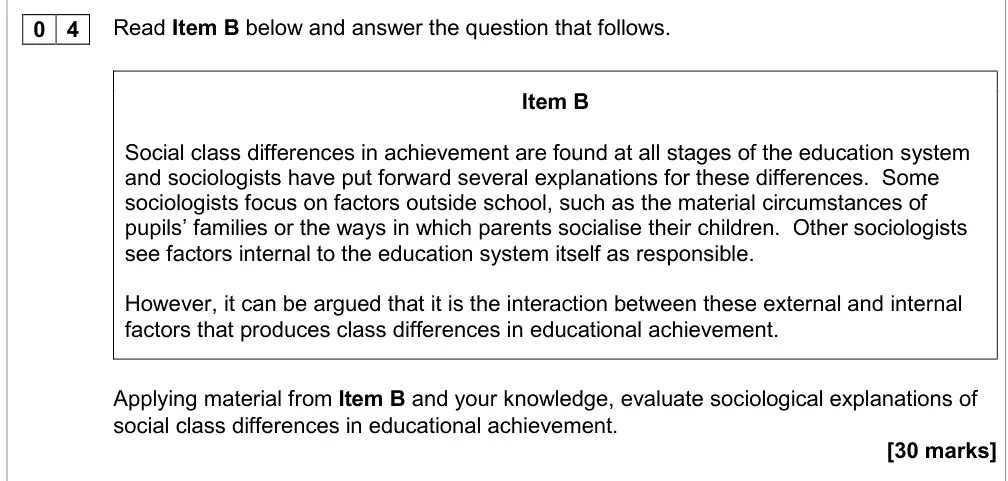
June 2018 · Paper 1 · Q430 marksAO1=12, AO2=9, AO3=930-mark essay
Mark scheme, including the levels grid and indicative content
Examiner's comment
This was balanced with some very strong responses to the 30-mark social class and educational achievement question. Most students managed their time appropriately however a small minority left some questions unanswered. This mainly occurred for Question 06, often resulting from students giving a very broad answer for Question 04. Most students were able to demonstrate a range of external and internal factors that have an impact on social class and achievement. The vast majority of students were at least able to get into the 13-18 mark band. Stronger responses showed both breadth and depth of knowledge with a good range of concepts. Material was presented analytically with explanations being unpacked. They also offered strong evaluation by comparing the experience of different social classes and how social policies had been introduced to support disadvantage. The very best answers contained specific evaluation and could identify and explain links between factors, for example, in the way language crosses over from the home background to the school. Weaker responses had a narrower range of explanations and factors or could not present much in the way of studies to support their claims. Such answers tended to be descriptive, limited in terms of concepts and lacked analysis and evaluation. They were also not always applied to social class or achievement, often drifting into a discussion of ethnicity and gender.
Notes from the mark scheme and report
top band weighs material vs cultural and internal vs external factors or their interaction (hook in Item B)
cultural deprivation as victim-blaming is credited evaluation
drift into ethnicity or gender lowers marks
best answers linked factors (e.g. language from home to school) and used policy in evaluation
June 2018 · AS Paper 1 · Q520 marksAO1=8, AO2=6, AO3=620-mark essay
Mark scheme, including the levels grid and indicative content
Examiner's comment
A few students asked for additional pages (particularly for question 5) but did not consistently number or make clear which question the additional content referred to. Students were able to offer a wide range of factors from both outside the school and inside the school in explaining the difference in achievement of different ethnic groups. Weaker answers reflected a limited knowledge and understanding of external factors and only offered a thin, undeveloped account of one or two of these with few, if any, sociological concepts. Furthermore, some failed to differentiate between different ethnic groups and made sweeping generalisations to all groups, incorrectly asserting that all ethnic minority groups are underachieving. Furthermore, a significant number of responses failed to achieve higher than the 8-12 band due to listing external factors without referencing how these have impacted on specific ethnic groups or drifting into explanations of social class more generally. This was particularly the case when material deprivation as a factor effecting achievement was discussed. More sophisticated responses were able to differentiate between how external factors, such as family structure, impacted on different ethnic groups. Other concepts that were commonly discussed included speech codes, parental aspirations and cultural/economic capital. Many went on to consider factors within school such as teachers labelling, streaming and pupil subcultures. However, some were content to describe these internal processes without linking them explicitly to external factors or to achievement and therefore were juxtaposed. By contrast, in better responses students were able to apply their knowledge explicitly to ethnic differences in achievement and were able to suggest that internal and external factors might be interlinked. Overall, there was a lack of specific evaluation of external factors. Some students offered stand- alone evaluation points of internal factors, e.g. using Fullers study to reject the impact of teacher labels, which therefore were not directly relevant to the question.
Notes from the mark scheme and report
top band must recognise that minority ethnic groups do not all achieve or experience alike
sweeping claims that all minority groups underachieve were penalised
listing external factors without linking to specific groups, or drifting into social class generally, capped around 8–12
internal factors offered only as juxtaposed evaluation limit marks
best answers showed how internal and external factors interlink
June 2017 · Paper 1 · Q14 marksAO1=4Outline
Mark scheme
Examiner's comment
However, in the 4 and 6 mark questions, some students are writing far too much, thereby losing focus on the precise wording of the question. Most students answered this question successfully and were able to identify two cultural factors. Common responses included reference to family structure, language and parental attitudes. However, a significant number of partial responses failed to specify a link to a particular ethnic group in their answers or had class-based developments. Incorrect answers included generalised discussions about cultural deprivation and cultural capital, or examples of material rather than cultural factors.
Notes from the mark scheme and report
2 marks for each of two cultural factors clearly outlined, 1 if only partially outlined
common answers: family structure, language, parental attitudes
partial answers did not link the factor to a particular ethnic group or developed it in class terms
material factors and generalised cultural deprivation/cultural capital points not credited
June 2017 · AS Paper 1 · Q22 marksAO2=2Brief explain
Mark scheme
Examiner's comment
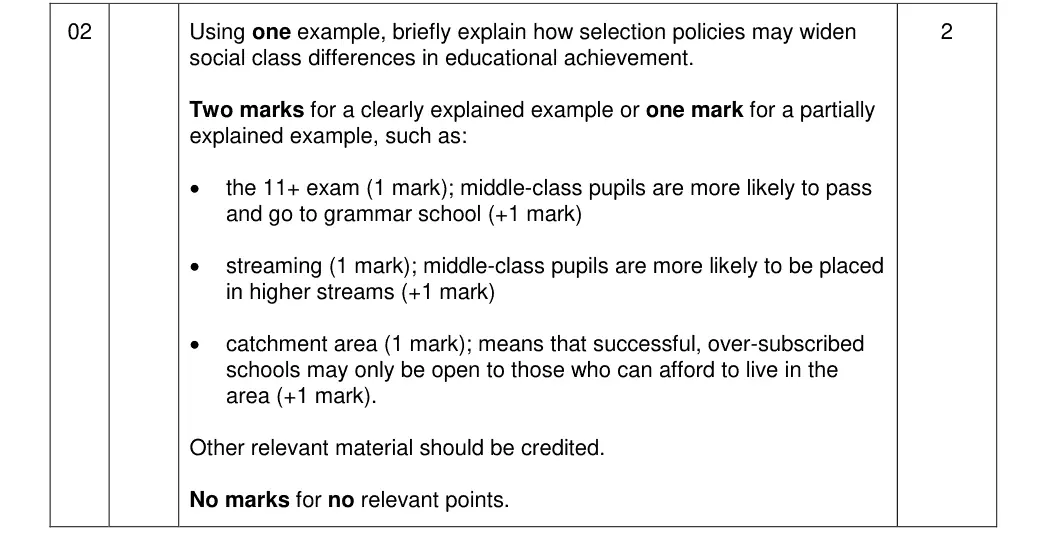
Students offered a wide variety of responses to this question. Some students were unable to clearly identify a selection policy and instead offered policies, such as league tables, Ofsted and marketisation. Others referred generally to the effects, processes or elected to discuss social class differences in general, without relation to a specific selection policy. Some students conflated choice with selection and referred generally to parental choice (or parentocracy), rather than the school choosing. More successful students were able to identify a range of selection policies, with most referring to the 11+ exam, setting and streaming, and entrance exams. The most successful answers were then able to explain how the identified policy may advantage middle-class pupils or disadvantage working-class pupils in terms of educational achievement.
Notes from the mark scheme and report
1 mark for the selection policy, +1 for explaining how it advantages middle-class or disadvantages working-class pupils (e.g. 11+, streaming, catchment areas)
league tables, Ofsted or general marketisation are not selection policies
parental choice confused with schools selecting pupils
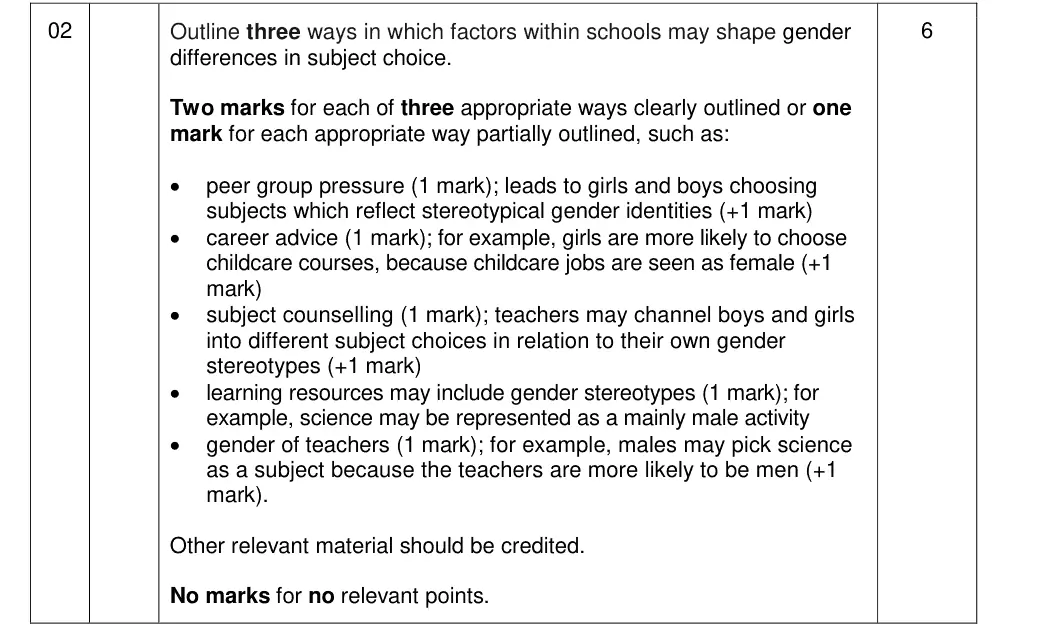
June 2017 · Paper 1 · Q26 marksAO1=3, AO2=3Outline
Mark scheme
Examiner's comment
However, in the 4 and 6 mark questions, some students are writing far too much, thereby losing focus on the precise wording of the question. This question was, in the main, dealt with very effectively, with most students able to identify and explain at least two factors. Common successful responses included coursework, peer group pressure, textbooks containing gender stereotypes and the gender of teachers. Many of these were then able to go on and explain how it influenced their subject choice. Where marks were not awarded was often the result of overlapping factors being presented, or through making general points about gender and achievement, losing focus on subject choice. Other incorrect responses discussed external socialisation or career expectations without linking these to internal factors.
Notes from the mark scheme and report
2 marks for each of three in-school factors clearly outlined, 1 if only partially outlined
common answers: peer pressure, gender of teachers, stereotyped textbooks, coursework
overlapping factors, drift into gender and achievement, or external socialisation/career expectations not linked to school lost marks
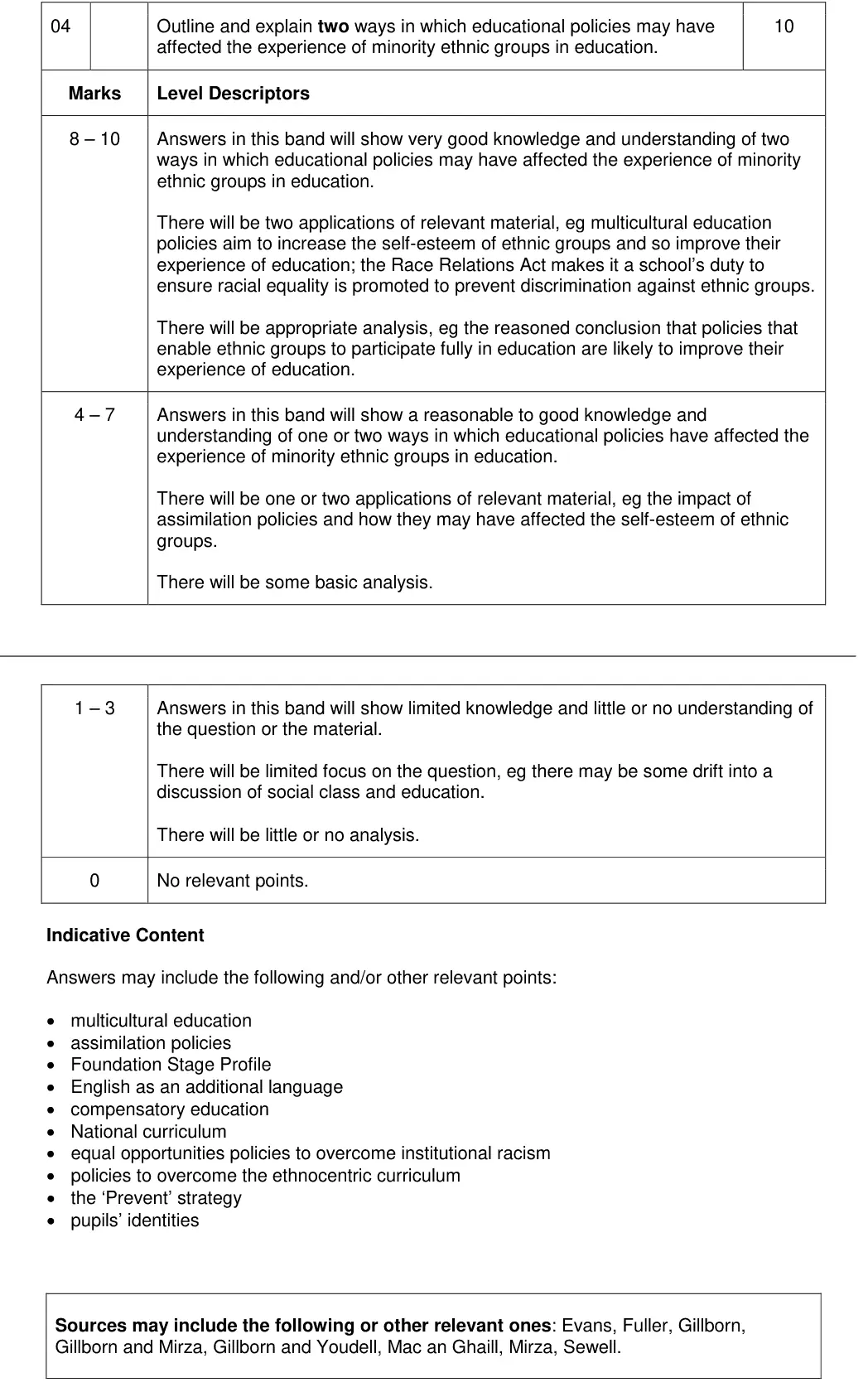
June 2017 · AS Paper 1 · Q410 marksAO1=5, AO2=3, AO3=2Outline and explain
Mark scheme, including the levels grid and indicative content
Examiner's comment
As the application questions are new in this specification, it is not surprising that students find this style of question more challenging than traditional essay writing. This question required students to apply their knowledge of one area of the specification (educational policies) to another area (ethnic minorities’ experience). A number of responses remained in the bottom band due to being solely focused on outlining some of the factors or processes affecting the achievements of minority ethnic groups without attempting to link these to a specific policy. A common example of this was a discussion of the ethnocentric curriculum and teacher labelling only in relation to achievement. More commonly, many students were able to identify two policies with at least some explanation. A wide range of policies were identified, such as Sure Start, compensatory education, or a collection or policies such as multi-cultural education and EAL support. Some students were able to clearly link a policy towards the experience of education. However, as in the previous year, many referred to social class or religion more generally as a proxy to ethnicity and therefore remained in the middle band. The most successful answers demonstrated knowledge of two policies (one in each paragraph) and applied these explicitly to the experience of minority ethnic groups, such as the impact on achievement, self-esteem and increased opportunities. Popular responses looked at how the National Curriculum appears ethnocentric, applying examples from different subjects across the curriculum. These responses also showed good conceptual knowledge, with studies and/or key concepts and analysis of how and why there may have been an impact on the experience of ethnic minority groups.
Notes from the mark scheme and report
two policies each applied explicitly to minority ethnic pupils' experience (e.g. multicultural education, Race Relations Act duty, EAL, National Curriculum ethnocentrism)
describing factors such as labelling or the ethnocentric curriculum without linking to a policy stays in the bottom band
using social class or religion as a proxy for ethnicity caps in the middle band
June 2017 · AS Paper 1 · Q520 marksAO1=8, AO2=6, AO3=620-mark essay
Mark scheme, including the levels grid and indicative content
Examiner's comment
There were a range of different responses to this question and many made appropriate use of the item. Weaker answers reflected a limited knowledge and understanding of internal factors and only offered a thin, undeveloped account of one or two of these, with few, if any sociological concepts. Others showed more developed knowledge and understanding of relevant material, such as educational policies (eg GIST & WISE), the feminisation of education, GCSEs and coursework, labelling and issues relating to pupil identities. Many students were able to apply a range of factors to the attainment of girls but fewer were able to deal with both boys and girls, and/or apply knowledge in explaining differences in achievement. There was a tendency for some students to drift into an account of subject choice and did not apply this specifically to differences in achievement. Better answers demonstrated application of knowledge explicitly to gender differences in achievement. Many went on to consider factors outside of school, such as the impact of feminism, changes in the family and changing girls’ priorities. However, a significant number of responses failed to link these factors explicitly to internal factors and therefore were awarded for juxtaposition, rather than developed evaluation. Many answers lacked explicit evaluation of the role or importance of the factors that they had discussed. Explicit evaluation in terms of the relative weight attached to each (internal and external), or the interaction between the two was rare. The very best responses were able to give a wide range of factors, connected to concepts and studies with external factors being used in an evaluative way, ie they were clearly linked back to internal factors to stay focused on the question.
Notes from the mark scheme and report
top band must deal with both male and female achievement
evaluation through relative weight of school vs home/out-of-school factors
external factors merely juxtaposed rather than linked back to in-school factors limit marks
drift into subject choice not linked to achievement
good material: GIST/WISE, feminisation, coursework, pupil identities, labelling
June 2016 · AS Paper 1 · Q12 marksAO1=2Define
Mark scheme
Examiner's comment
Most students answered this successfully by identifying extra support for disadvantaged groups. Many provided examples such as Sure Start to illustrate or clarify their answers. However, some had no clear idea of the meaning of the term, substituting instead definitions of comprehensive or compulsory education.
Notes from the mark scheme and report
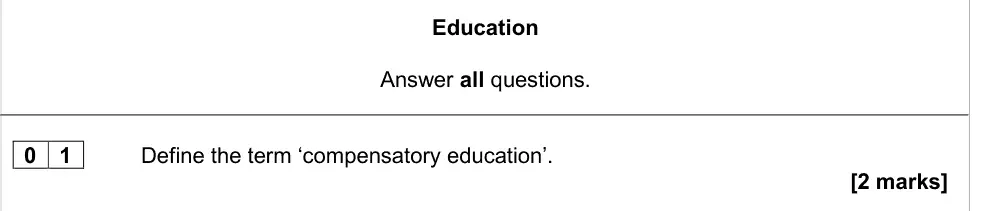
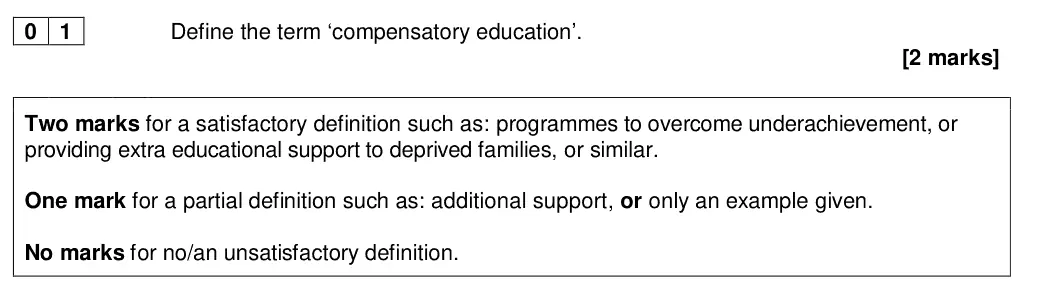
2 marks for a full definition (e.g. extra support/programmes for deprived groups to overcome underachievement)
1 mark for a partial definition or an example only
most answered well, often citing Sure Start
some confused it with comprehensive or compulsory education
June 2016 · AS Paper 1 · Q22 marksAO2=2Brief explain
Mark scheme
Examiner's comment
The most popular response was to identify league tables or parental choice as a marketisation policy and then explain how this may advantage middle-class pupils because of their parents’ greater cultural or economic capital. However, a significant minority failed to identify any specific marketisation policy, while a few misidentified the tripartite or comprehensive systems as examples of marketisation policies. Some scored one mark for identifying a relevant policy without explaining its effect on class differences in achievement.
Notes from the mark scheme and report
1 mark for a named marketisation policy (parental choice, league tables, free schools) +1 for explaining its effect on class differences
common answers: league tables or parental choice favouring middle-class pupils via cultural/economic capital
some named no specific policy or wrongly cited the tripartite or comprehensive systems
June 2016 · AS Paper 1 · Q36 marksAO1=3, AO2=3Outline
Mark scheme
Examiner's comment
A wide range of policies from both within and outside the education system were identified, such as GIST or WISE, the Equal Pay Act, the Sex Discrimination Act, the Divorce Law Reform Act and the introduction of coursework. Most students who identified such policies were able to explain how these may have affected girls’ achievement. However, others misunderstood the policy thrust of the question and offered examples of non-policy factors, such as the influence of feminist ideas on girls. These responses failed to score.
Notes from the mark scheme and report
2 marks for each of three policies clearly outlined, 1 if only partially outlined
creditworthy policies included GIST/WISE, coursework, equal opportunities legislation, expansion of higher education
June 2016 · AS Paper 1 · Q410 marksAO1=5, AO2=3, AO3=2Outline and explain
Mark scheme, including the levels grid and indicative content
Examiner's comment
This question required students to apply their knowledge of one area of the specification (the role of the education system) to another area (educational achievement). However, weaker answers often focused solely on outlining some of the factors affecting pupils’ achievement without attempting to link these to the functions of education. Better answers had knowledge of one or more functions of the education system, usually from a functionalist and/or Marxist perspective. These included role allocation, socialisation into shared values, transmission of specialist skills, or reproduction of class inequality. However, this knowledge was sometimes patchy, often accompanied by a tendency to present a loose amalgam of different functions rather than a clear and coherent account. The best answers applied a good knowledge and understanding of the functions of the education system to the issue of achievement. For example, an account of the meritocratic nature of selection (from a functionalist perspective) led onto the idea that equal opportunities and being judged by universalistic standards would raise achievement levels by motivating all pupils to achieve to the maximum of their abilities.
Notes from the mark scheme and report
must link functions of education to achievement, not just list factors affecting achievement (drift caps at 1–3)
best answers took a clear functionalist or Marxist function (meritocratic role allocation, class reproduction) and applied it to achievement
weaker answers offered a loose mix of functions
June 2016 · AS Paper 1 · Q520 marksAO1=8, AO2=6, AO3=620-mark essay
Mark scheme, including the levels grid and indicative content
Examiner's comment
There were a range of different responses to this question and many made appropriate use of the Item. Weaker answers reflected a limited knowledge and understanding of home background factors and only offered a thin, undeveloped account of one or two of these, with few if any sociological concepts. Others showed more developed knowledge and understanding of relevant material. This often included the concepts of cultural and material deprivation, and featured home background factors such as speech codes; parental education, interest, attitudes or income; cultural and economic capital; housing; diet; the cost of ‘free’ schooling; and selection by mortgage. Many went on to consider factors within school such as teachers’ labelling, streaming and pupil subcultures. However, some were content to describe these internal processes without linking them explicitly to social class or to achievement, while a few drifted into ethnic or gender differences instead. By contrast, in better answers students were able to apply their knowledge explicitly to class differences in achievement. Most answers tended to lack explicit evaluation of the role or importance of the factors that they had discussed, but some good responses considered the suggestion in the Item that internal and external factors might be interlinked and used this to good effect in evaluation.
Notes from the mark scheme and report
top band weighs home background against school factors or their interrelationship (hook in Item A)
weaker answers thin on home factors and light on concepts
some described internal processes without linking them to class or achievement, or drifted into gender/ethnicity
evaluation often missing
Specimen set 1 · Paper 1 · Q14 marksAO1=4Outline
Mark scheme
Notes from the mark scheme and report
specimen paper, no examiners' report
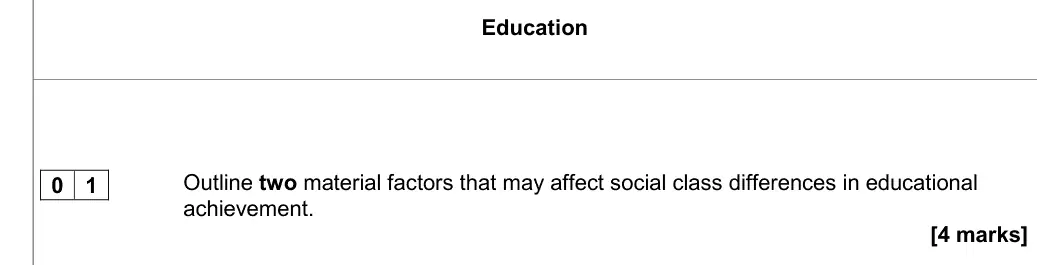
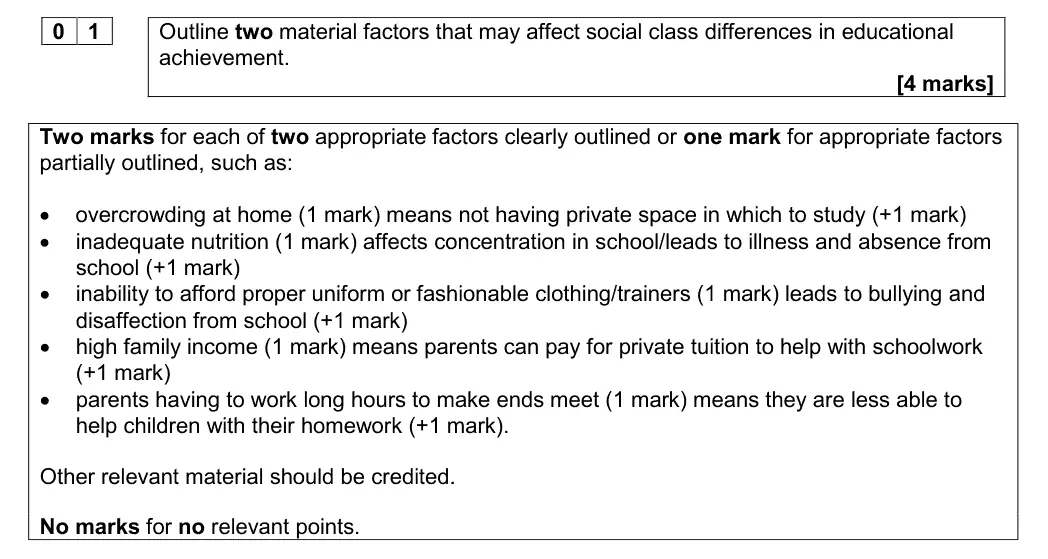
must be material (not cultural) factors
2 marks for each of two factors clearly outlined, 1 if partial
credited: overcrowding and no study space, poor nutrition and absence, cost of uniform leading to bullying, private tuition, parents' long working hours
Specimen set 1 · Paper 1 · Q26 marksAO1=3, AO2=3Outline
Mark scheme
Notes from the mark scheme and report
specimen paper, no examiners' report
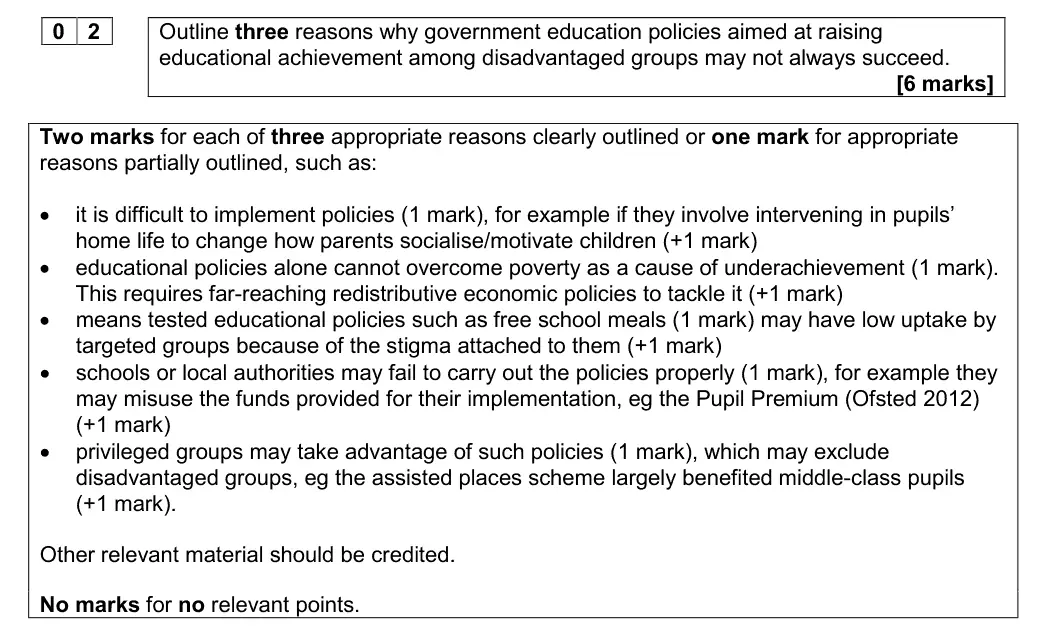
2 marks for each of three reasons clearly outlined
credited: hard to change home socialisation, education alone cannot overcome poverty, stigma lowering uptake of means-tested help, poor implementation or misuse of funds (Pupil Premium), middle-class take-up (assisted places scheme)
Specimen set 1 · Paper 1 · Q310 marksAO1=3, AO2=4, AO3=3Analyse
Mark scheme, including the levels grid and indicative content
Notes from the mark scheme and report
specimen paper, no examiners' report
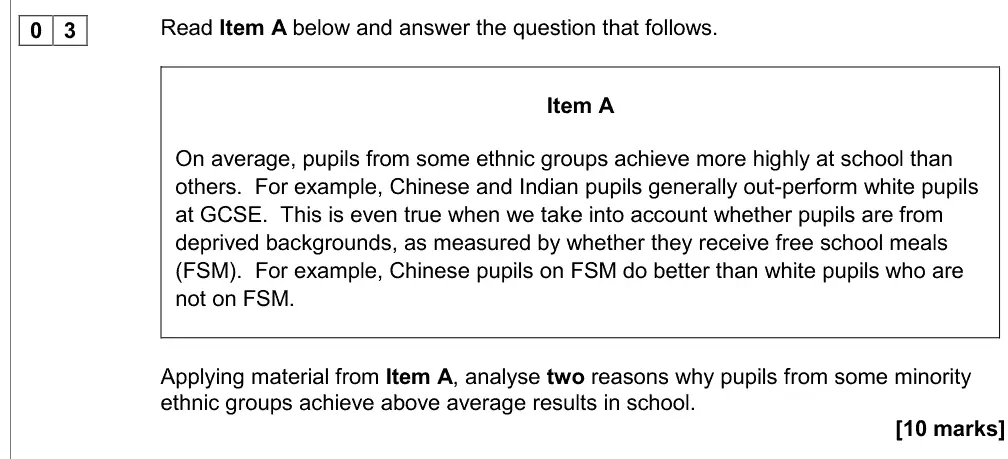
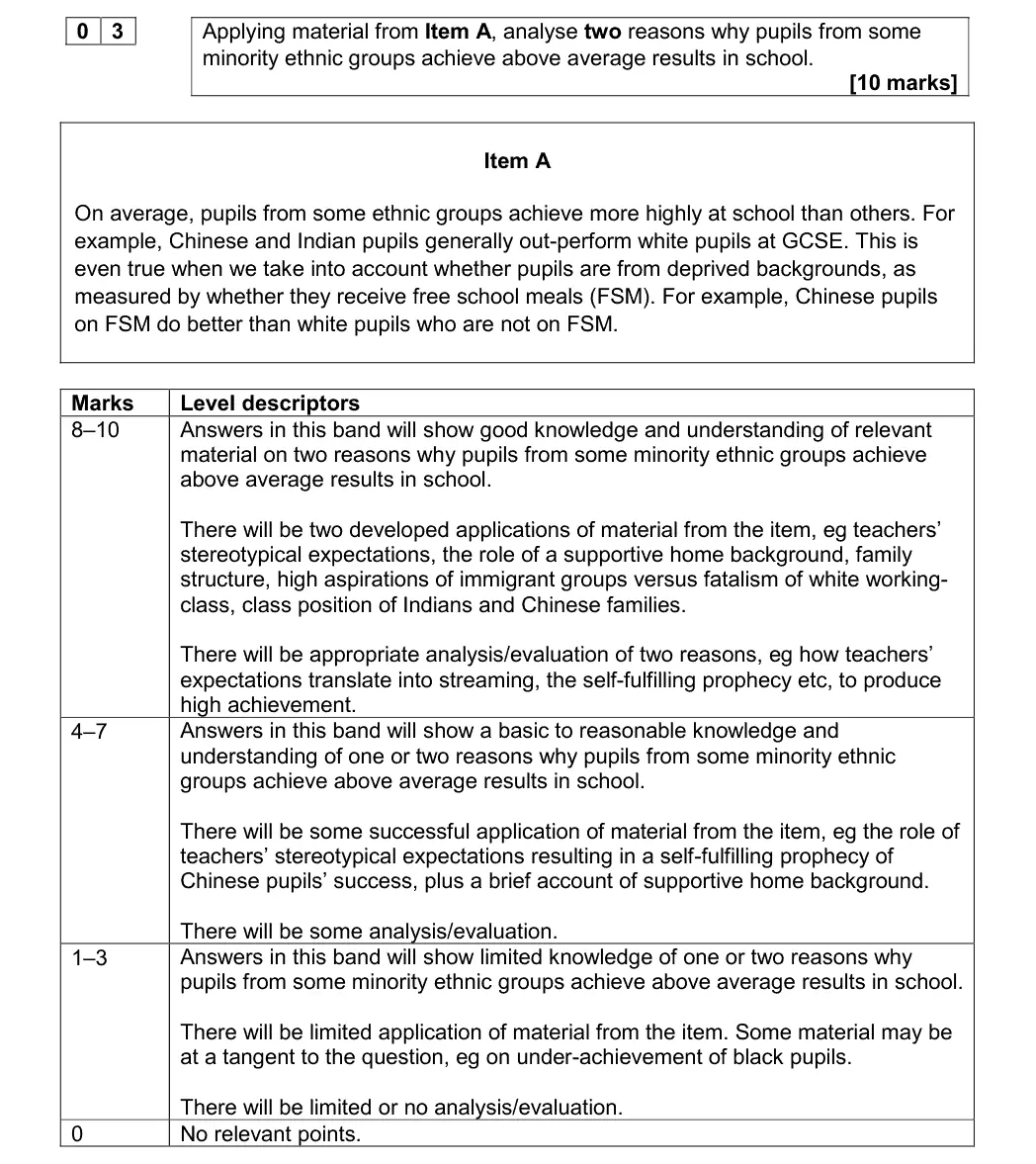
must develop hooks from Item A (Chinese and Indian pupils out-perform white pupils even on FSM)
focus is above-average achievement
credited: positive teacher stereotypes and self-fulfilling prophecy, supportive home and family structure, immigrant aspirations vs white working-class fatalism, class position of Indian and Chinese families
drift into black underachievement = 1–3
Specimen set 1 · Paper 1 · Q430 marksAO1=12, AO2=9, AO3=930-mark essay
Mark scheme, including the levels grid and indicative content
Notes from the mark scheme and report
specimen paper, no examiners' report
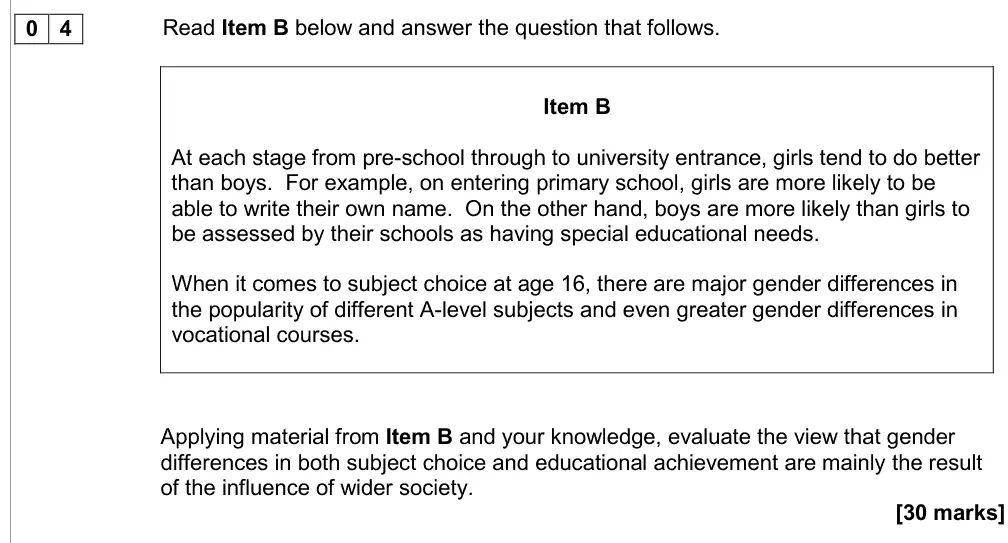
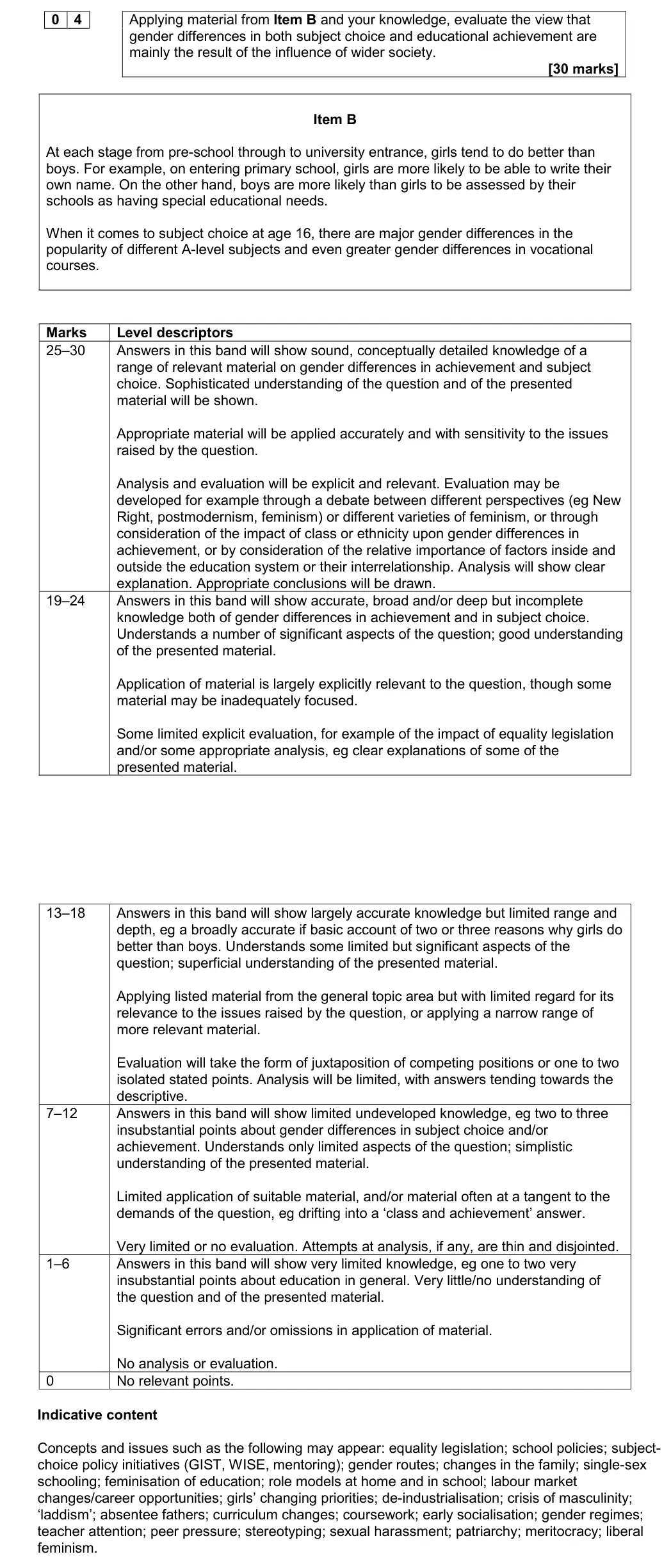
must address both subject choice and achievement (top two bands need both)
must apply Item B
top band: debate between perspectives (New Right, postmodernism, varieties of feminism), impact of class and ethnicity, or relative importance of factors inside vs outside school
drift into class and achievement = 7–12
Work with an AQA sociology tutor
Essays stuck in the middle band, or losing marks on the 10-markers? Book a trial lesson with Mark, a former AQA examiner.