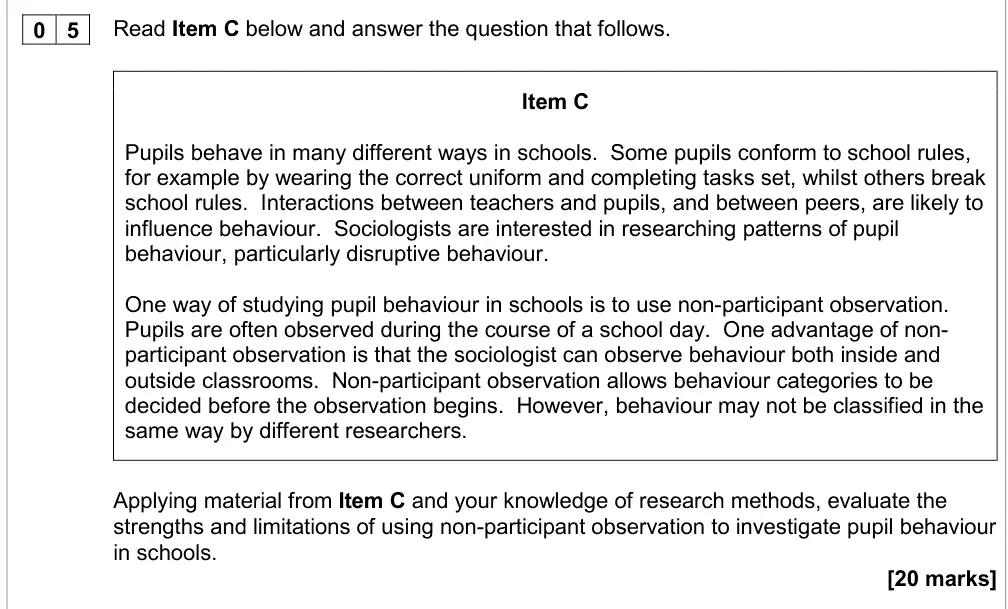
Applying material from Item C and your knowledge of research methods, evaluate the strengths and limitations of using non-participant observation to investigate pupil behaviour in schools.
Tap a question to zoom it. The mark scheme (with the level descriptors and indicative content) and the examiner's comment open underneath.
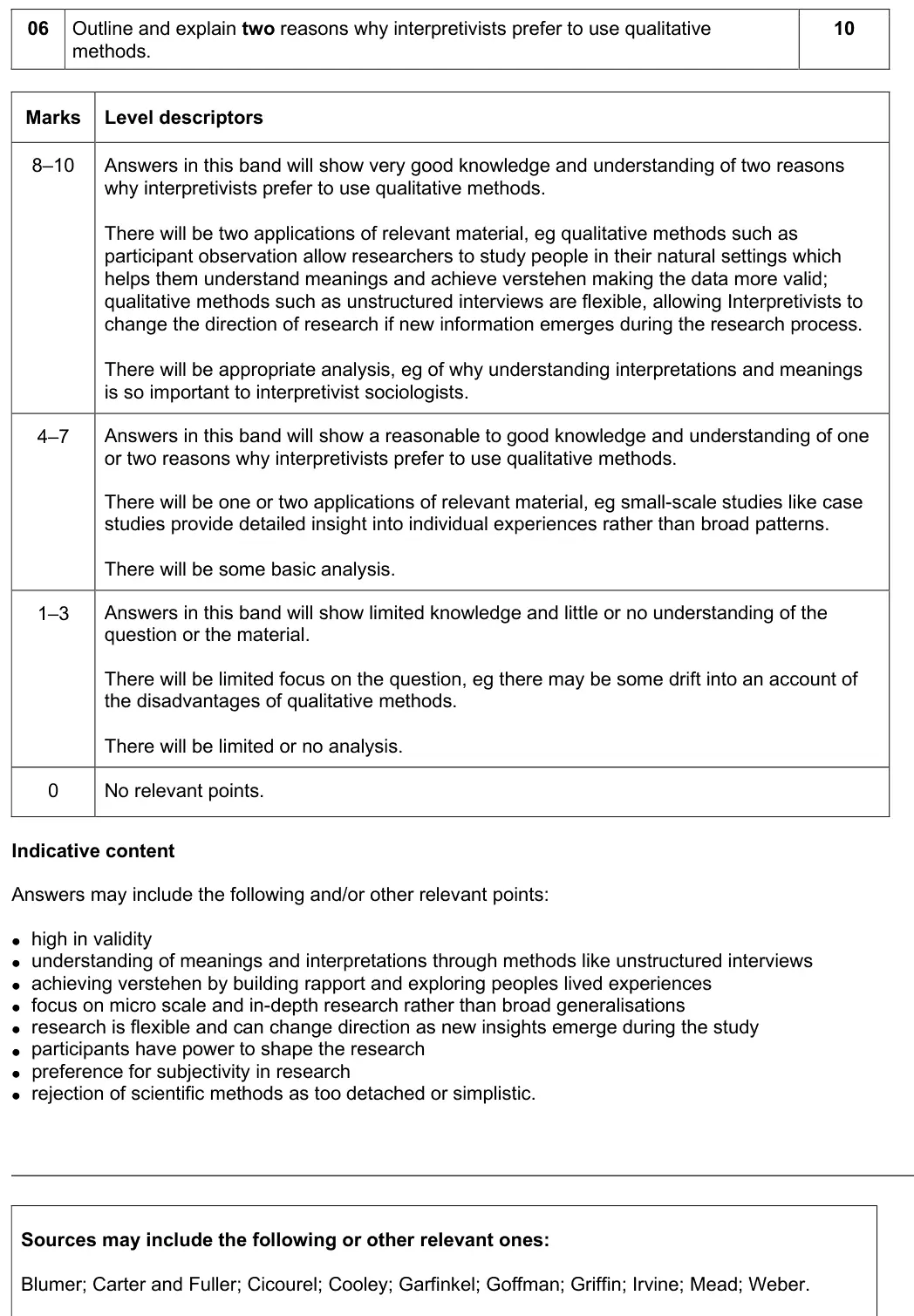
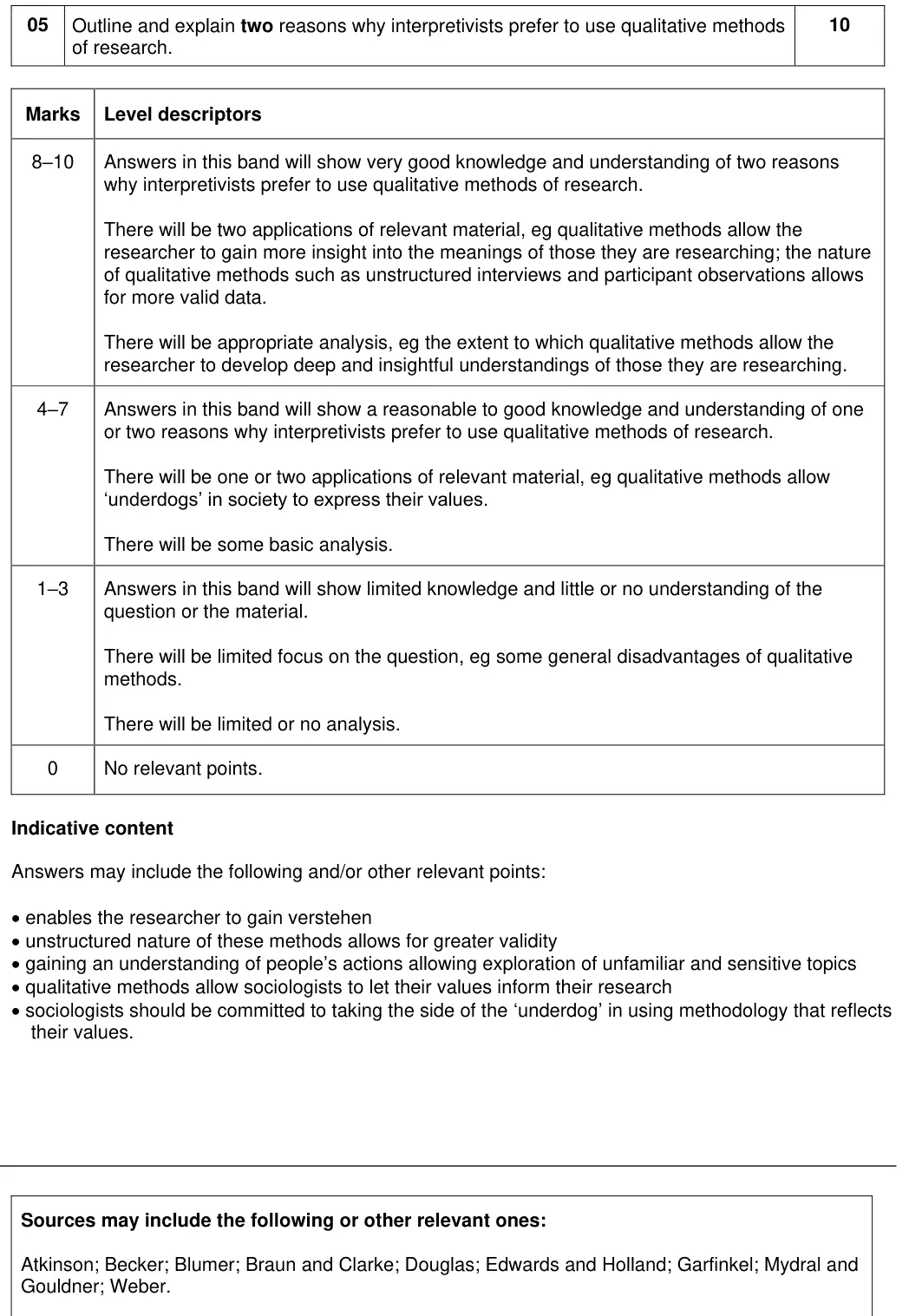
June 2025 · Paper 1 · Q610 marksAO1=5, AO2=3, AO3=2Outline and explain
Mark scheme, including the levels grid and indicative content
Notes from the mark scheme and report
drifting into disadvantages of qualitative methods = 1-3
top band: two reasons each developed, e.g. natural settings giving verstehen and validity, flexibility of unstructured interviews, with analysis of why meanings matter to interpretivists
no examiners' report published
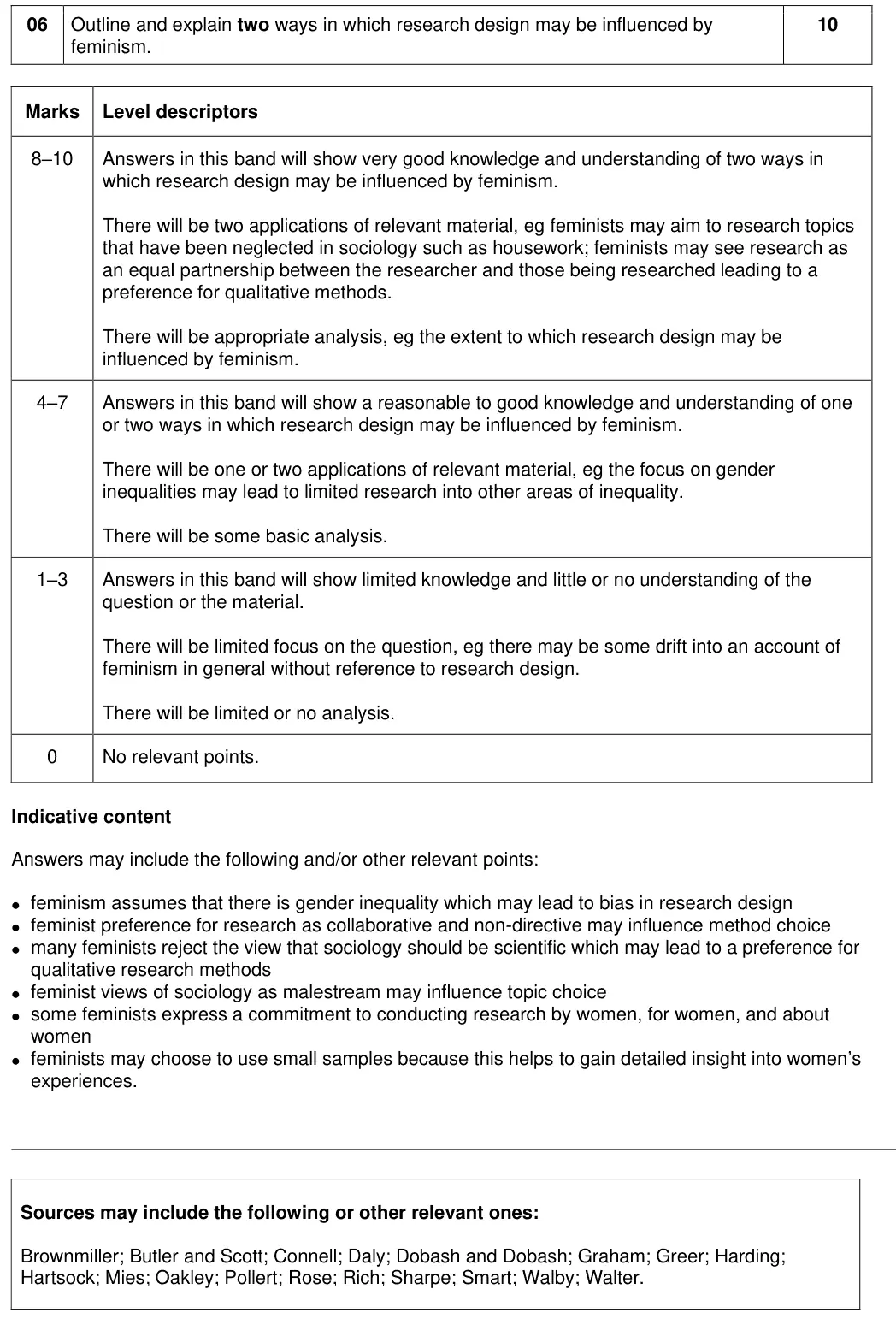
June 2024 · Paper 1 · Q610 marksAO1=5, AO2=3, AO3=2Outline and explain
Mark scheme, including the levels grid and indicative content
Examiner's comment
This question presented significant challenges, with many students struggling to understand and address the concept of ‘research design’ as influenced by feminism. Despite this concept being explicitly included in the specification, many responses discussed the impact of feminism in general terms without linking it specifically to aspects of research design. However, there were examples of students who interpreted the question as intended and effectively discussed, for instance, feminist preferences for qualitative methods and the importance of building rapport. Many of the more successful answers referred to feminist researchers often favouring qualitative approaches, such as unstructured interviews, to explore sensitive topics and prioritise participants' perspectives. In addition, some students then cited studies such as Dobash and Dobash's research on domestic violence, illustrating how feminist methodologies can provide deeper insights into women's experiences. They discussed how these methods aim to challenge traditional power dynamics in research, emphasising collaboration and empathy. Despite these strong examples, there were still many responses that failed to connect feminist theoretical perspectives with specific methodological choices, limiting the depth and specificity of the analysis.
Notes from the mark scheme and report
must link feminism to research design (topic choice such as housework, collaborative research and preference for qualitative methods, small samples, research by and for women)
drift into feminism in general = 1–3
many did not grasp 'research design' though it is in the spec
good answers used unstructured interviews, rapport and Dobash and Dobash
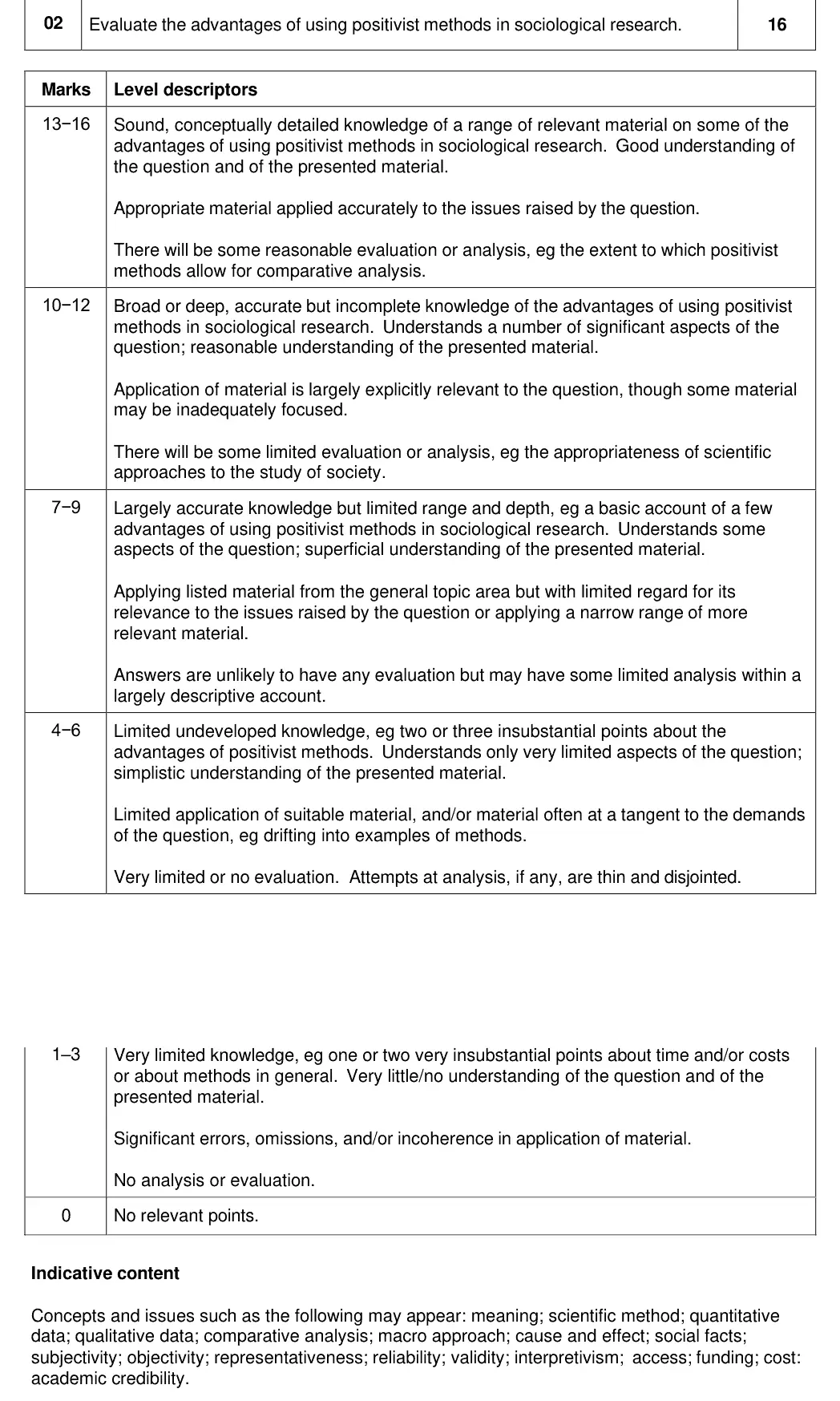
June 2024 · AS Paper 2 · Q216 marksAO1=6, AO2=5, AO3=516-mark essay
Mark scheme, including the levels grid and indicative content
Examiner's comment
This question for most students was one they could answer with a varied range of material. The students who were more successful managed to link the basic preferences of the positivist choice of method (quantitative / reliable / representative and techniques of investigation such as Laboratory experiments etc) to the wider aims of positivism. The aims of trying to show sociology to be a science, to produce social facts to attempt an objective understanding of society; what might be loosely termed the positivist method. A small minority of students did not know what was meant by positivism and could not answer the question effectively.
Notes from the mark scheme and report
evaluate advantages only
top band analyses e.g. comparative analysis
drift into examples of methods = 4–6
only time/cost points = 1–3
best answers linked quantitative, reliable, representative methods to positivist aims (science, social facts, objectivity)
a few did not know what positivism is
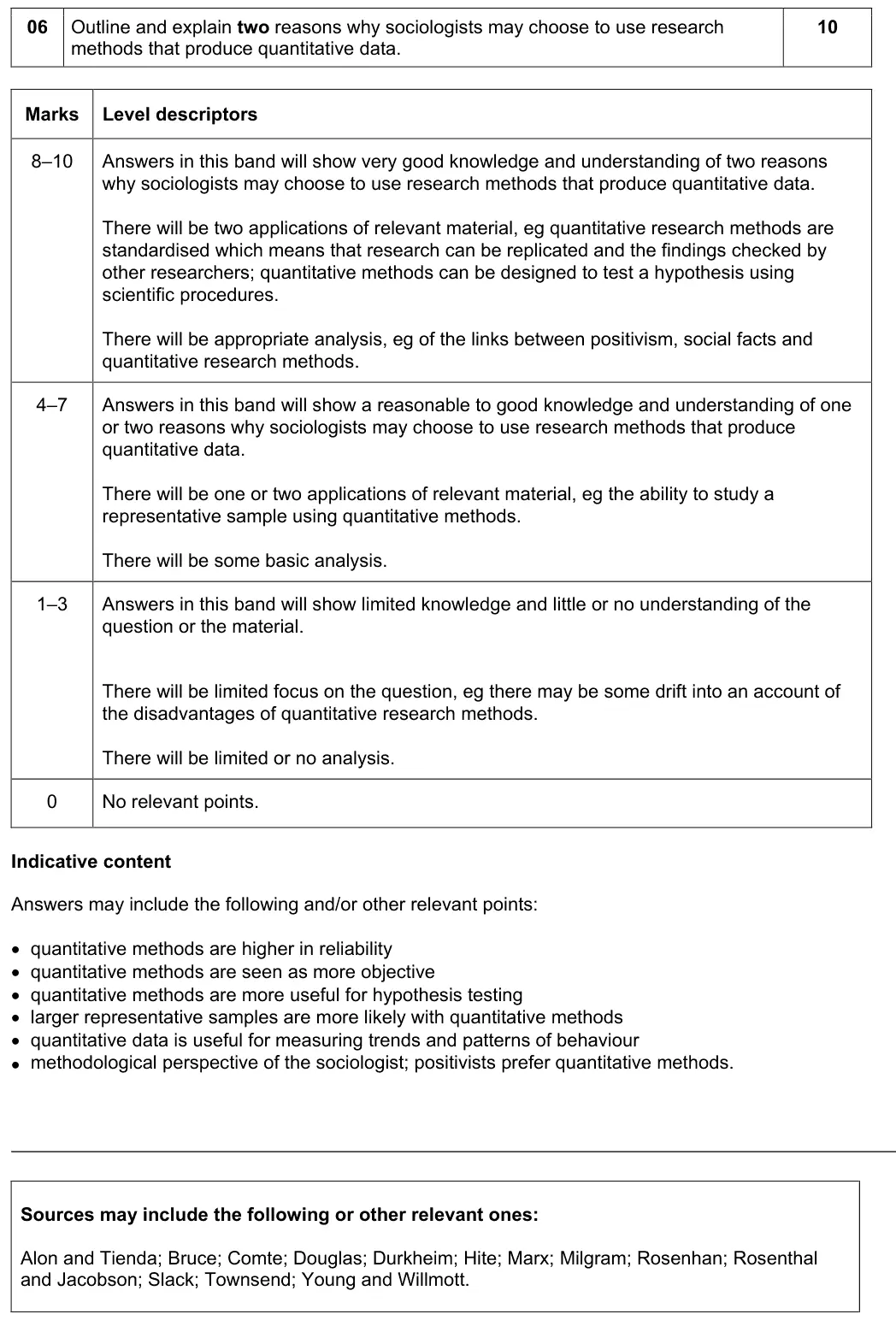
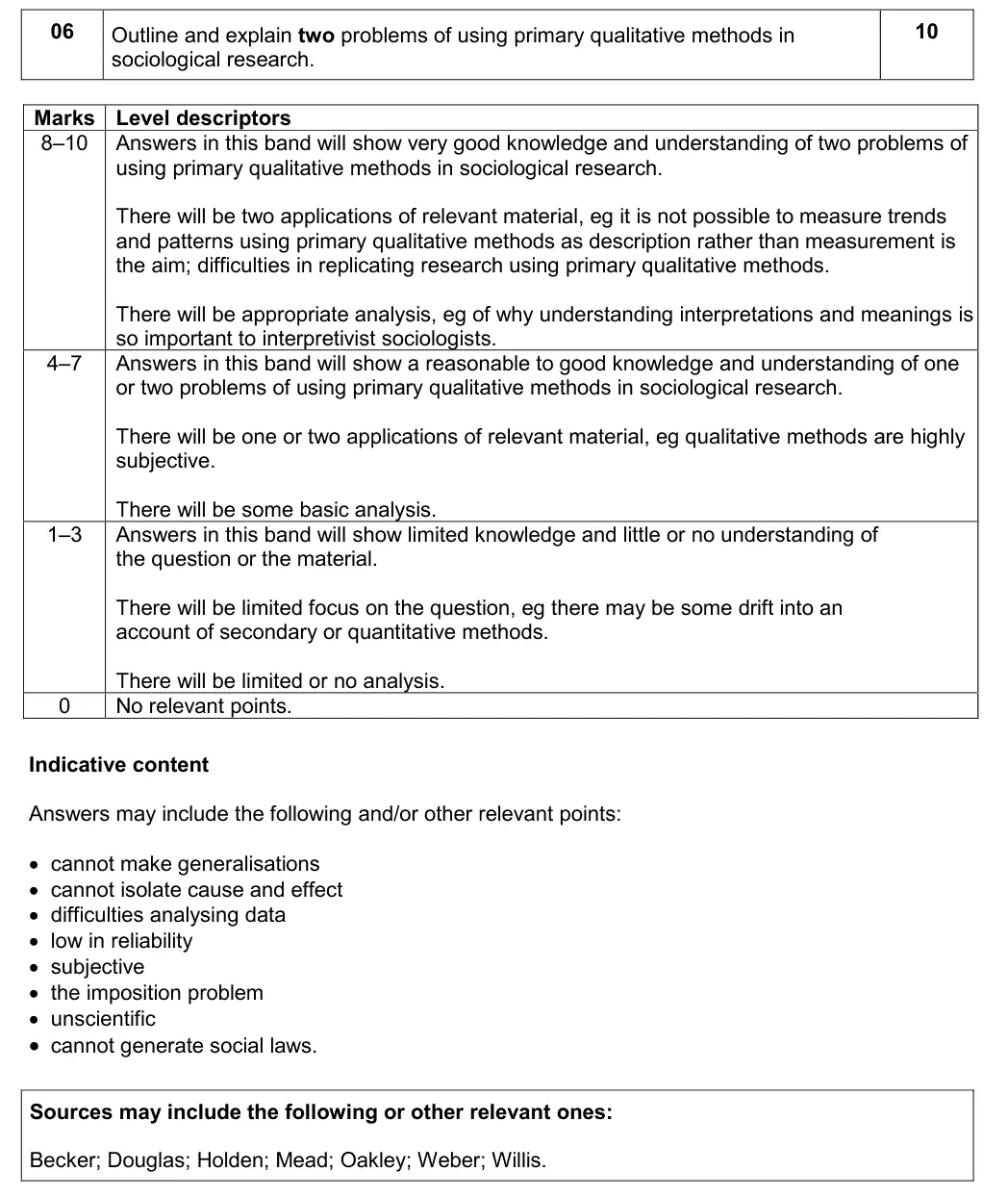
June 2023 · Paper 1 · Q610 marksAO1=5, AO2=3, AO3=2Outline and explain
Mark scheme, including the levels grid and indicative content
Examiner's comment
It was really pleasing to see that the vast majority of students were at least able to attempt this question. This indicated better time management or that this question was more accessible when compared with some other questions in previous series. There were a range of reasons offered for why sociologists may choose to use research methods that produce quantitative data. A number of answers provided a list of reasons as part of their answer. The more successful answers focussed on two reasons and were able to develop these with concepts and examples to illustrate. For example, some students explained that methods that produce quantitative data are more likely to be able to establish cause and effect relationships and that this data is favoured by positivists who prefer to study ‘social facts’ and use this data to be able to make predictions about human behaviour in society. Some were able to apply examples, such as Durkheim’s study of suicide, to illustrate these arguments. There were a number of students who proceeded to evaluate the reasons they provided for this question. Students should be reminded that there are no available marks for evaluation in this question type.
Notes from the mark scheme and report
no marks for evaluation in this question type
drifting into disadvantages of quantitative methods = 1–3 band
two reasons each developed, not a list
best answers linked quantitative data to positivism and social facts (e.g. Durkheim's study of suicide)
June 2023 · Paper 3 · Q510 marksAO1=5, AO2=3, AO3=2Outline and explain
Mark scheme, including the levels grid and indicative content
Examiner's comment
Students should be made aware that there are two types of ten mark questions. These have different requirements and different mark schemes. There are different marks available for the assessment objectives. 10 mark “outline and explain” questions have more marks available for knowledge and understanding, and none for evaluation. Yet some students include evaluation in their responses to this type of question, which is not creditworthy. There is a need to read the question carefully, some students focused on a comparison of interpretivism with positivism which did not meet the demands of the question. There is a level of challenge for students using theory and concepts correctly with some confusing reliability and validity.
Notes from the mark scheme and report
no marks for evaluation in this question type
two reasons each developed, e.g. verstehen and meanings, validity of unstructured methods, siding with the underdog
general disadvantages of qualitative methods = 1–3
comparing interpretivism with positivism missed the question
some confused reliability and validity
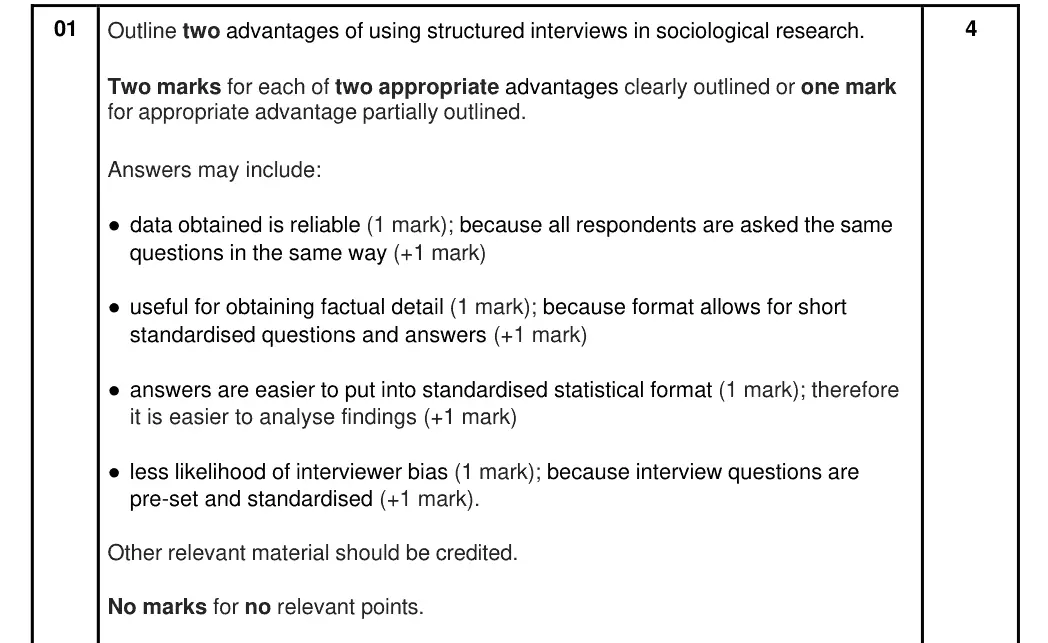
June 2022 · AS Paper 2 · Q14 marksAO1=2, AO3=2Outline
Mark scheme
Examiner's comment
For low mark tariff questions where candidates are required to either define, explain or outline, care should be taken to ensure that points are not just identified. The demands of this question were generally understood and most students were able to score at least 2 marks. Partial marks were relatively common as students did not always develop points in terms of a specific characteristic of structured interviews. The most common errors were confusion with unstructured interviews, or outlining disadvantages of structured interviews.
Notes from the mark scheme and report
2 marks for each of two advantages clearly outlined, 1 if only partially outlined
e.g. reliability through standardised questions, factual data, easy to quantify, less interviewer bias
partial marks common when the point was not tied to a feature of structured interviews
errors: confusing with unstructured interviews, giving disadvantages
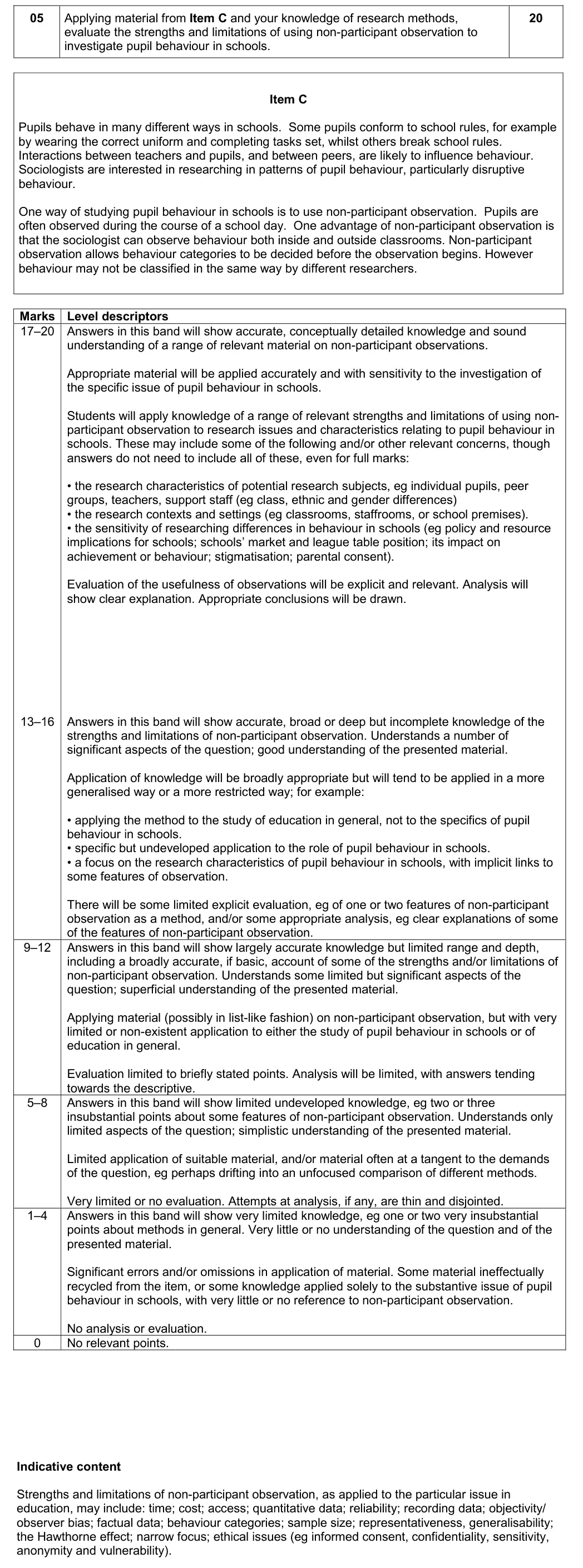
November 2020 · Paper 1 · Q520 marksAO1=8, AO2=8, AO3=4Methods in context
Mark scheme, including the levels grid and indicative content
Examiner's comment
Many students were able to demonstrate some basic knowledge and understanding of non- participant observation (NPO), although this was often in relation to observations more generally. In many answers, there was a limited focus on the non-participant aspect of the method. Instead, there was a tendency to discuss strengths and limitations of covert versus overt observations with some making assertions that NPOs are always covert. There were attempts at applying knowledge of studying education more generally. Many responses highlighted issues such as gaining access to schools (including gatekeepers) and the problem with those being excluded from research. However, these tended to be rather generic to any research. Better answers were able to apply some of these issues to using NPOs in particular. Unfortunately, there were few responses that were able to demonstrate application of NPOs to the specific issue and research characteristics of investigating pupil behaviour in schools, for example in the way that being detached and an outsider in the observation you are less likely to understand the reasons and meanings that younger students might attach to the observed behaviours within their anti-school or pro-school subcultures. However, knowledge and skills in the Methods in Context and Theory and Methods questions were generally weaker than in previous series. It appeared that students had prepared less well for these topics and questions.
Notes from the mark scheme and report
must apply non-participant observation to pupil behaviour in schools
education in general only caps at 13–16
recycling the item or writing only about pupil behaviour with little on the method = 1–4
many discussed observation in general or covert vs overt, wrongly assuming NPO is always covert
access and gatekeeper points often generic
best explained that a detached outsider may miss the meanings pupils in pro- or anti-school subcultures attach to behaviour
November 2020 · Paper 1 · Q610 marksAO1=5, AO2=3, AO3=2Outline and explain
Mark scheme, including the levels grid and indicative content
Examiner's comment
However, a few students left questions unanswered (particularly Question 6). Similarly to summer 2019, a significant number of students wrote very lengthy answers to the 4-mark and 6-mark questions which may explain why some seemed to run out of time in answering the final question. Unfortunately, students performed less well on this question compared with the rest of the paper. Many were able to offer two problems of primary qualitative methods, usually referring to practical issues of time taken and costs involved. However, few were able to develop their ideas with any real depth and analysis. A common problem with many answers was confusing and conflating theoretical issues of validity and reliability. A large number of responses seemed to mix or list points together in a confused way. For example, some confused problems of sampling and not being able to generalise with theoretical issues of reliability and/or validity in a rather random way. However, knowledge and skills in the Methods in Context and Theory and Methods questions were generally weaker than in previous series. It appeared that students had prepared less well for these topics and questions.
Notes from the mark scheme and report
no marks for evaluation in this question type
two problems each developed (e.g. cannot measure trends or generalise, hard to replicate, subjectivity, imposition, cannot establish cause and effect)
drift into secondary or quantitative methods = 1–3
most gave only practical time and cost problems with little depth
validity and reliability often confused or conflated with sampling and generalisability
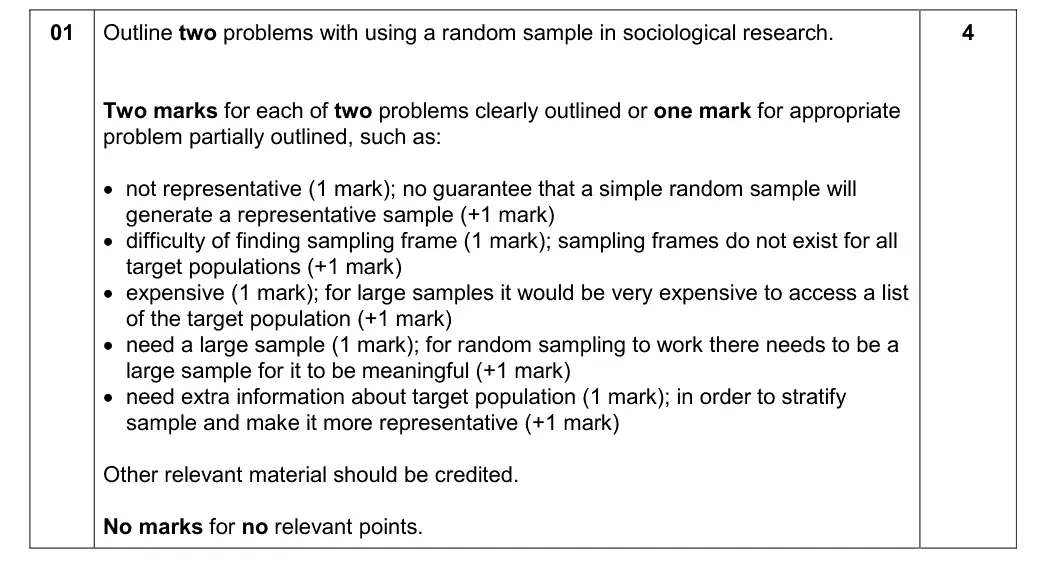
November 2020 · AS Paper 2 · Q14 marksAO1=2, AO3=2Outline
Mark scheme
Notes from the mark scheme and report
no examiners' report for this series
2 marks for each of two problems clearly outlined, 1 if partial
creditable: no guarantee of representativeness, no sampling frame for some populations, cost, need for a large sample, extra information needed to stratify
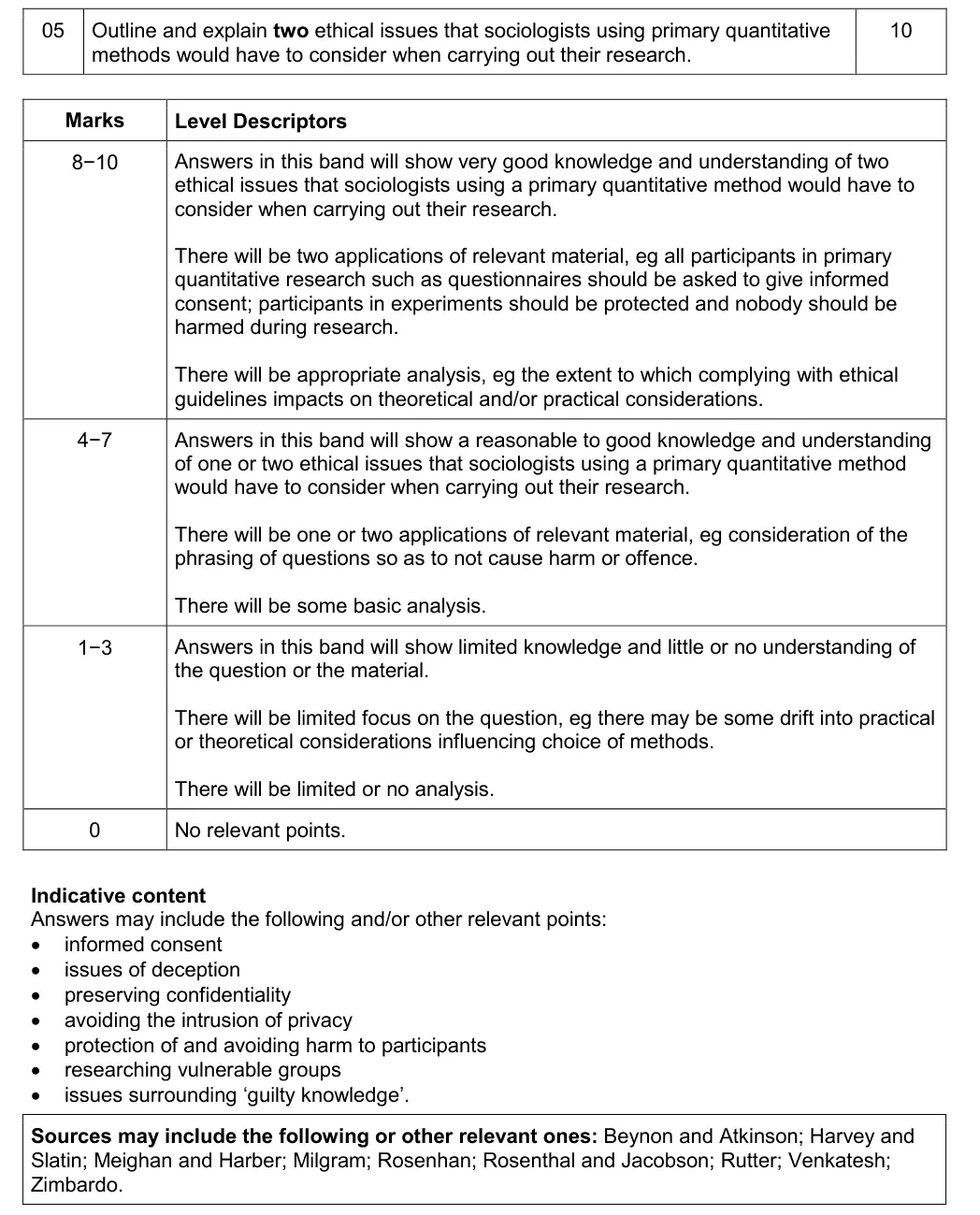
November 2020 · Paper 3 · Q510 marksAO1=5, AO2=3, AO3=2Outline and explain
Mark scheme, including the levels grid and indicative content
Examiner's comment
The majority of responses could identify two ethical issues. However, there was confusion over which research methods were primary quantitative methods. Some students did not address this at all, and this had an impact on the marks awarded. Other students who answered this question well were able to link the ethical consideration to an appropriate study. This displayed excellent knowledge and understanding of both ethical concerns and primary quantitative research methods. Generally, more attention to detail in the research methods 10-mark question (Question 5) must be given.
Notes from the mark scheme and report
ethical issues must be applied to primary quantitative methods (questionnaires, structured interviews, experiments)
many were unsure which methods these are or ignored the method
drift into practical or theoretical issues = 1–3
best answers linked each issue to a study
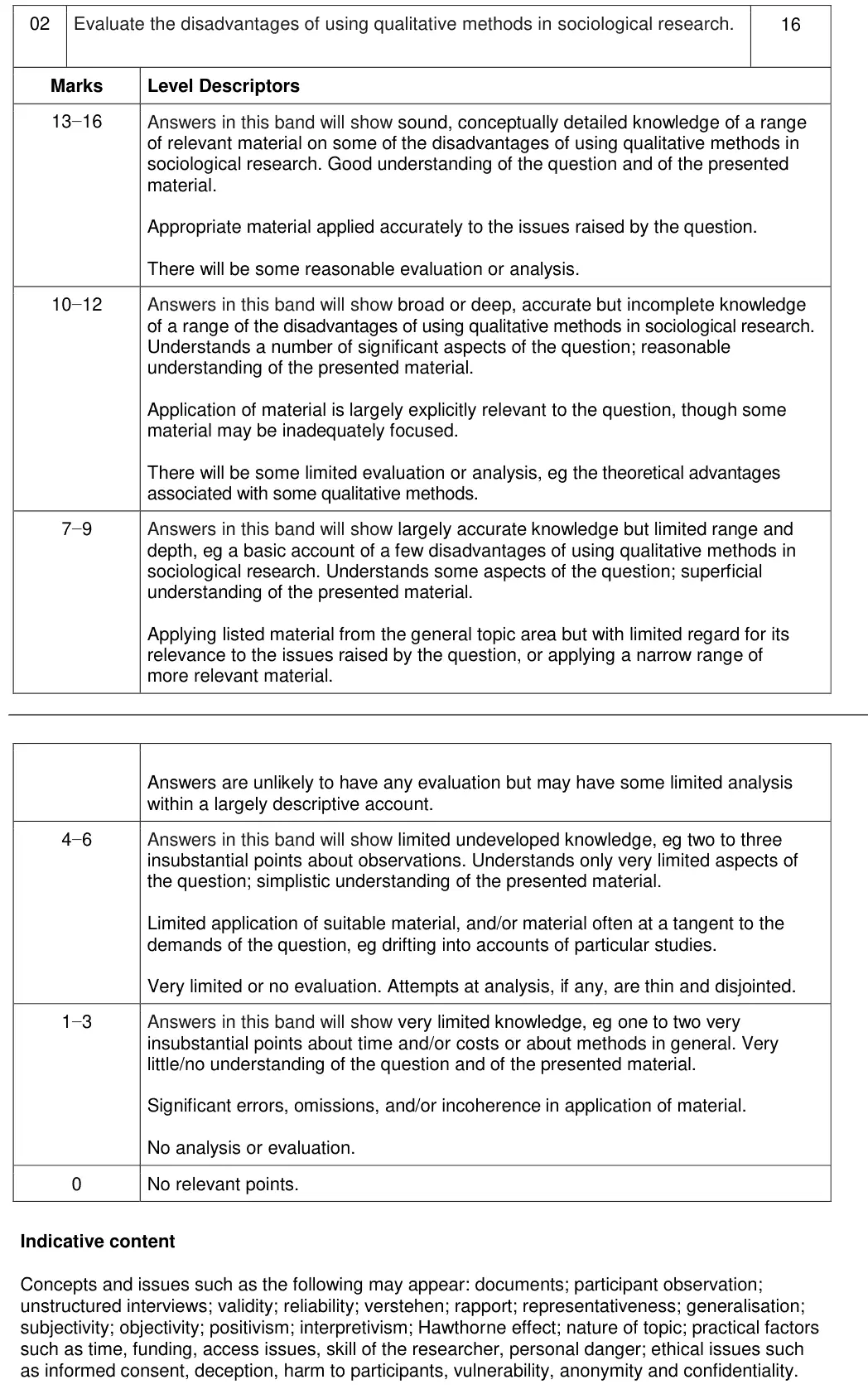
June 2018 · AS Paper 2 · Q216 marksAO1=6, AO2=5, AO3=516-mark essay
Mark scheme, including the levels grid and indicative content
Examiner's comment
This attracted a wide range of responses. Better answers explored issues of validity, reliability, representativeness and generalisability. However, a significant number appeared uncertain about what some of these key concepts meant. Many students used a framework of practical, ethical and theoretical factors to help structure their answers and this often proved a successful approach. Others took different examples of qualitative methods and went through them in a descriptive rather than analytical manner. Better responses were able to identify a range of disadvantages of qualitative methods and discuss some advantages that came out of those disadvantages. For example using qualitative methods may mean that there is a problem with subjectivity and the researcher becoming too involved with the subjects of the research. On the other hand, this involvement may mean that rapport is built up and this may improve the depth and quality of the research, which boosts validity. Answers that took this approach were more successful than those that listed disadvantages and advantages with little connection between them. Some students used examples of research to help illustrate the points they were making. While this proved helpful in some cases, there was tendency to discuss issues related to the particular subject of research rather than draw conclusions about the nature of qualitative methods.
Notes from the mark scheme and report
focus is disadvantages of qualitative methods (documents, participant observation, unstructured interviews)