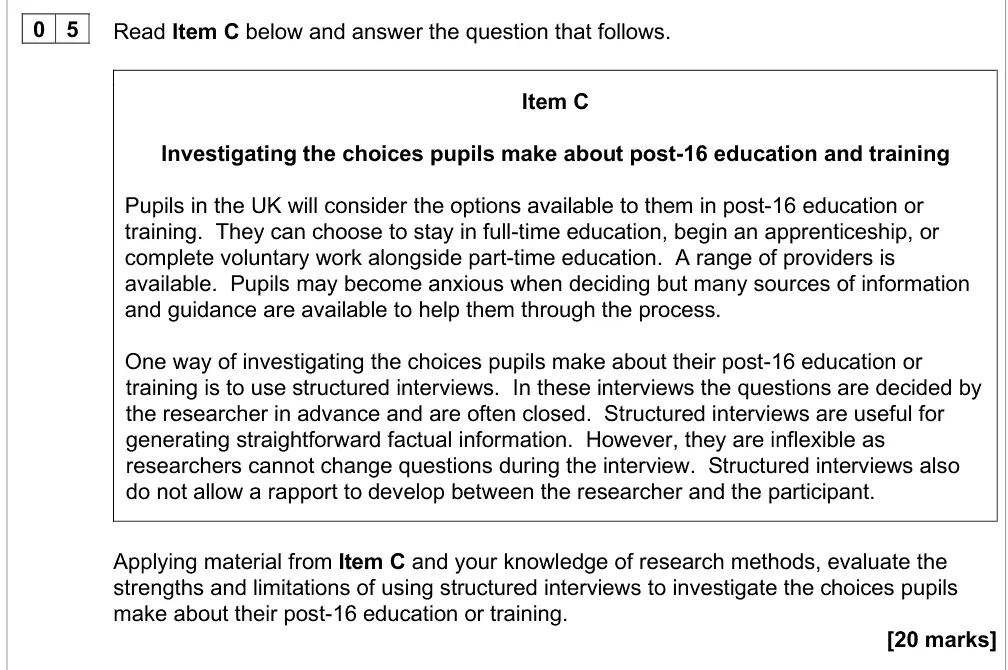
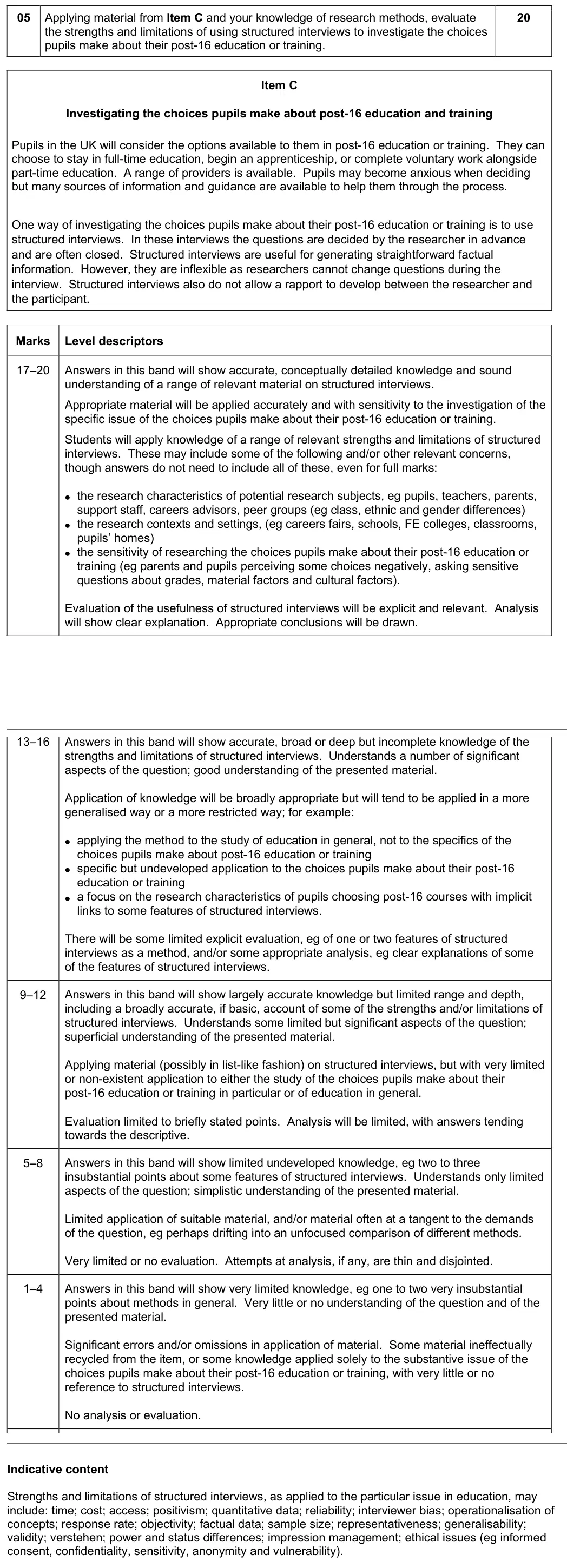
Applying material from Item C and your knowledge of research methods, evaluate the strengths and limitations of using structured interviews to investigate the choices pupils make about their post-16 education or training.
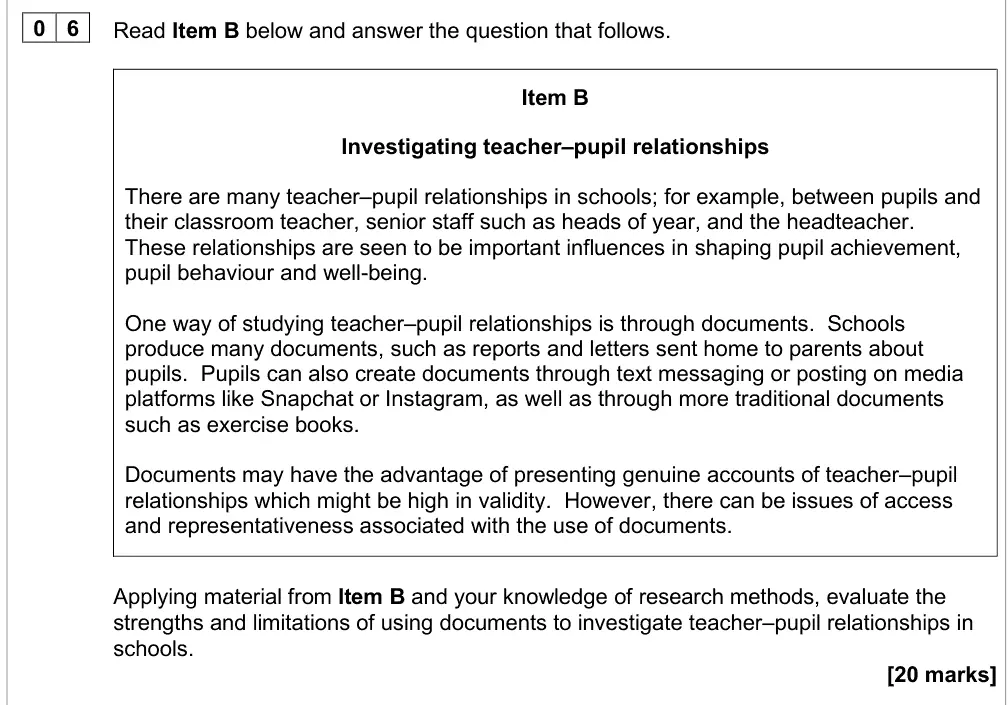
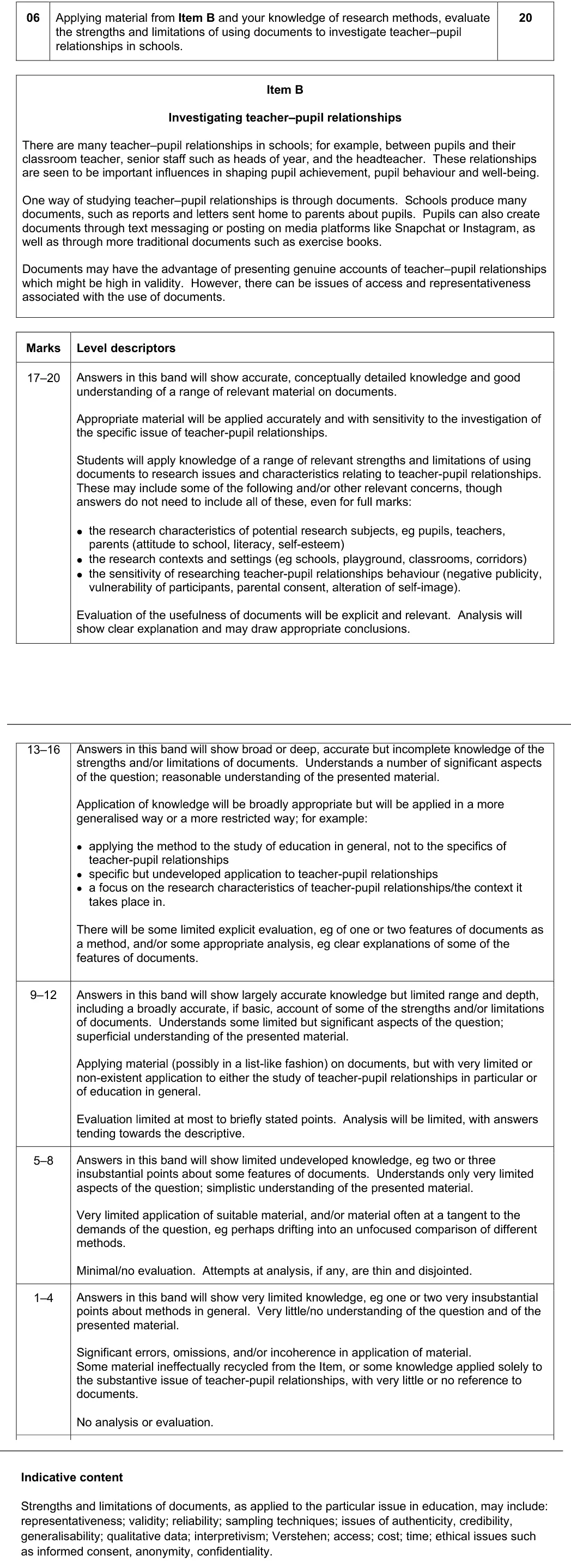
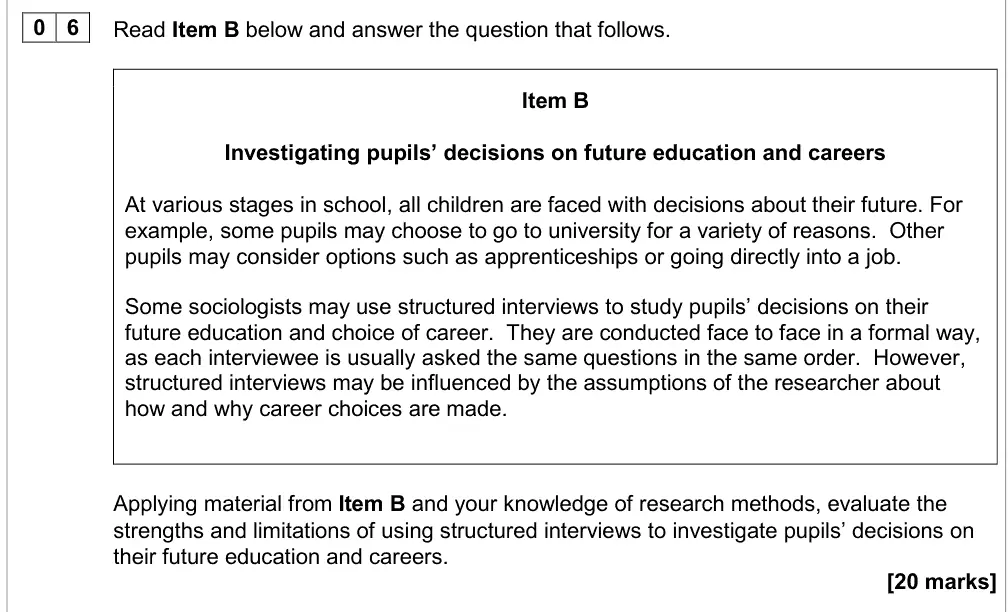
Applying material from Item B and your knowledge of research methods, evaluate the strengths and limitations of using documents to investigate teacher–pupil relationships in schools.
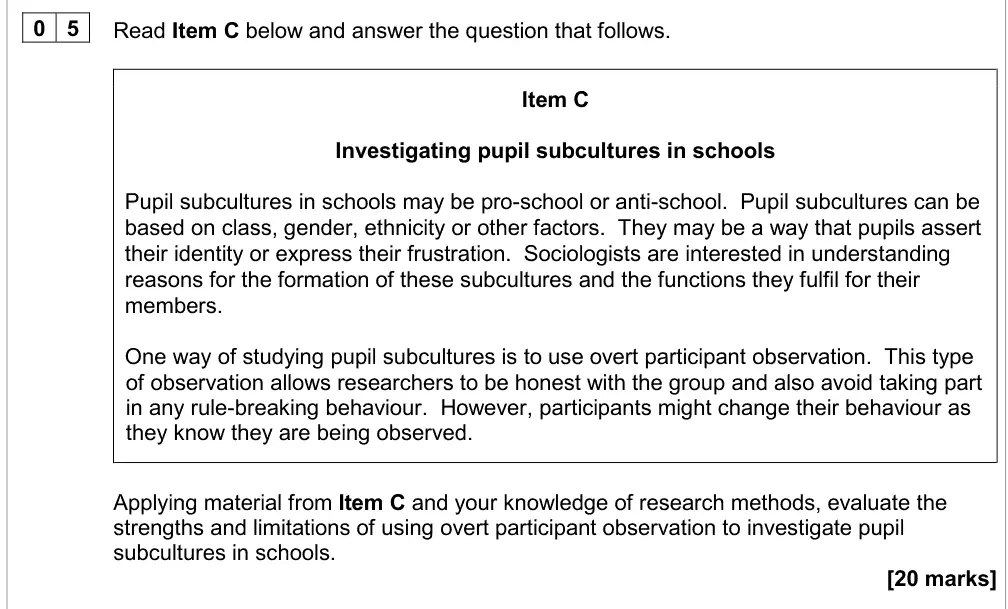
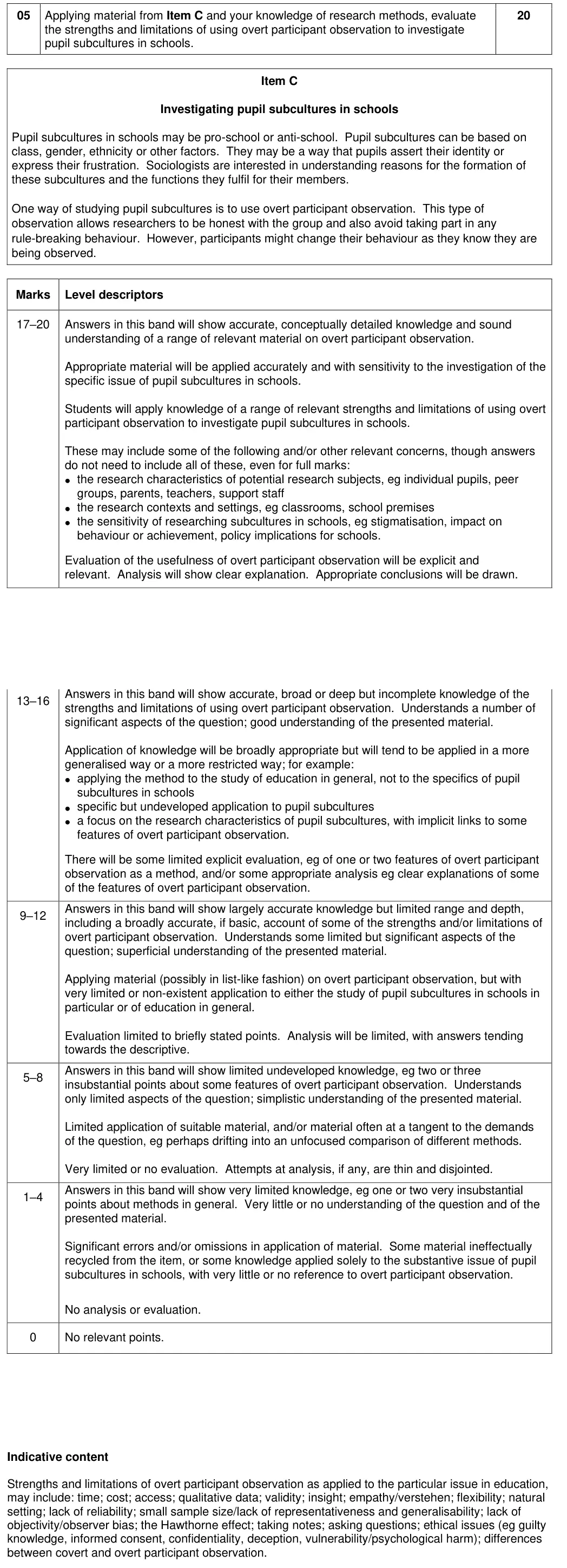
Applying material from Item C and your knowledge of research methods, evaluate the strengths and limitations of using overt participant observation to investigate pupil subcultures in schools.
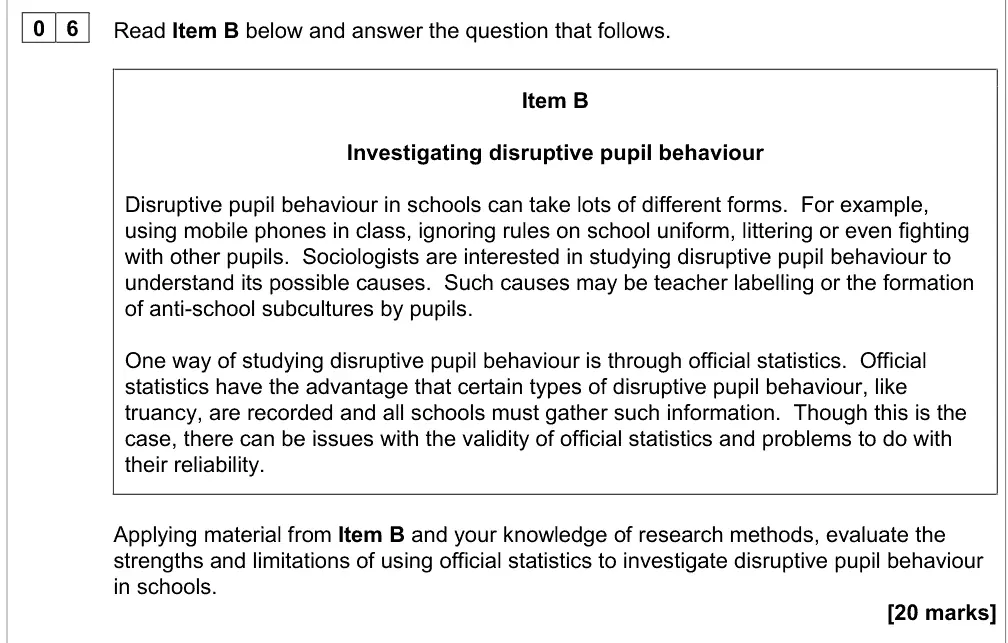
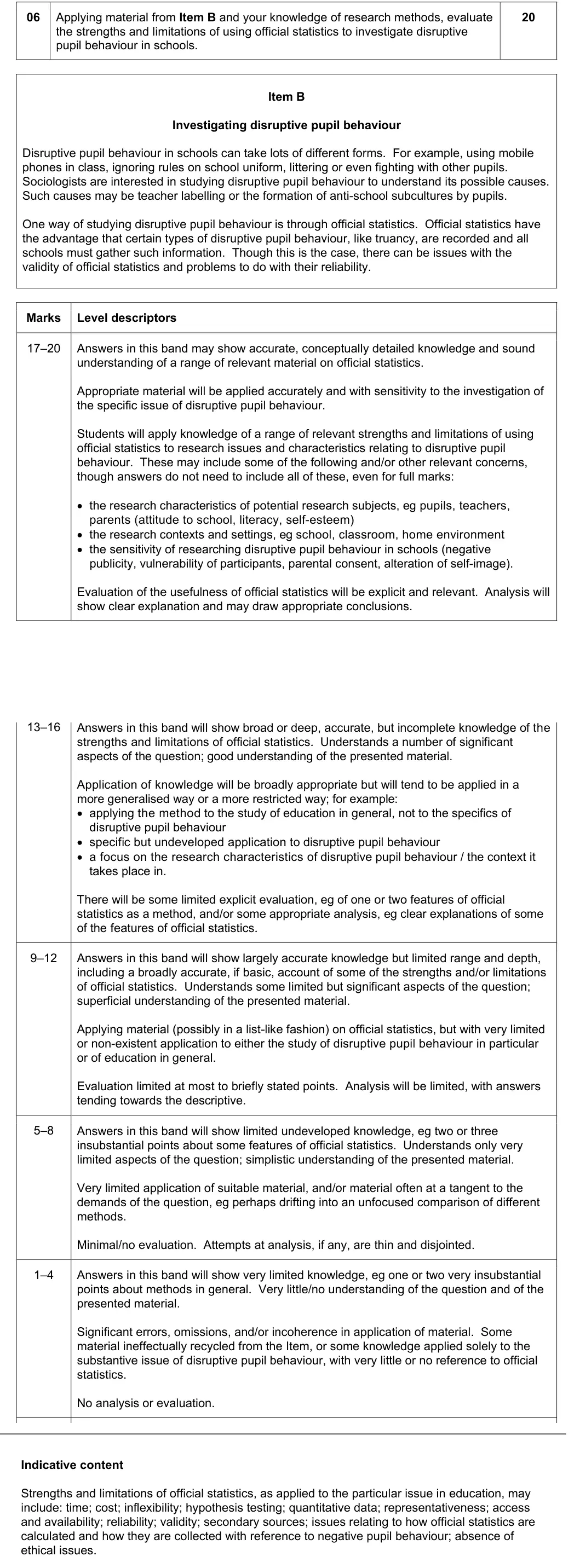
Applying material from Item B and your knowledge of research methods, evaluate the strengths and limitations of using official statistics to investigate disruptive pupil behaviour in schools.
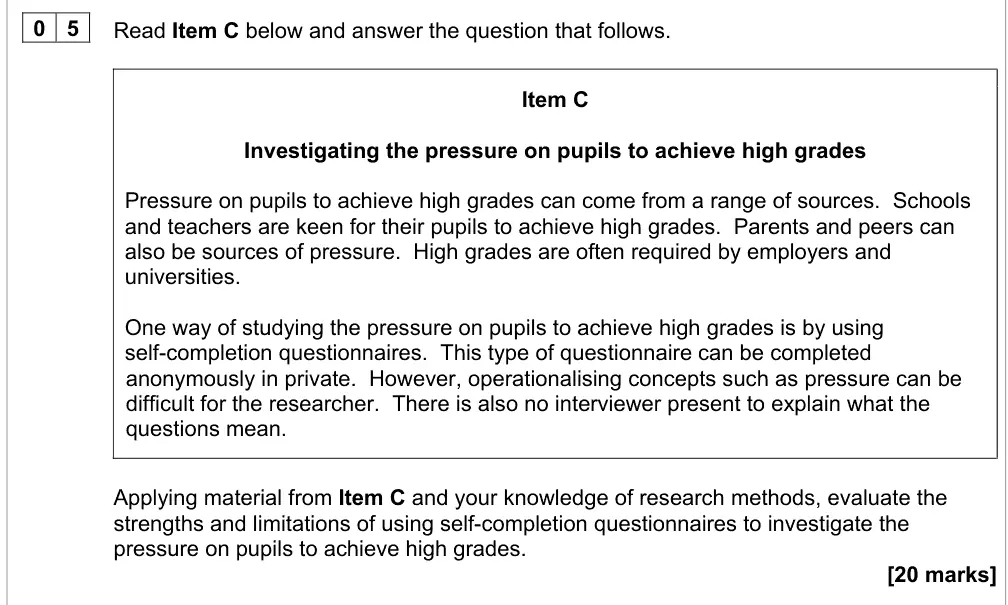
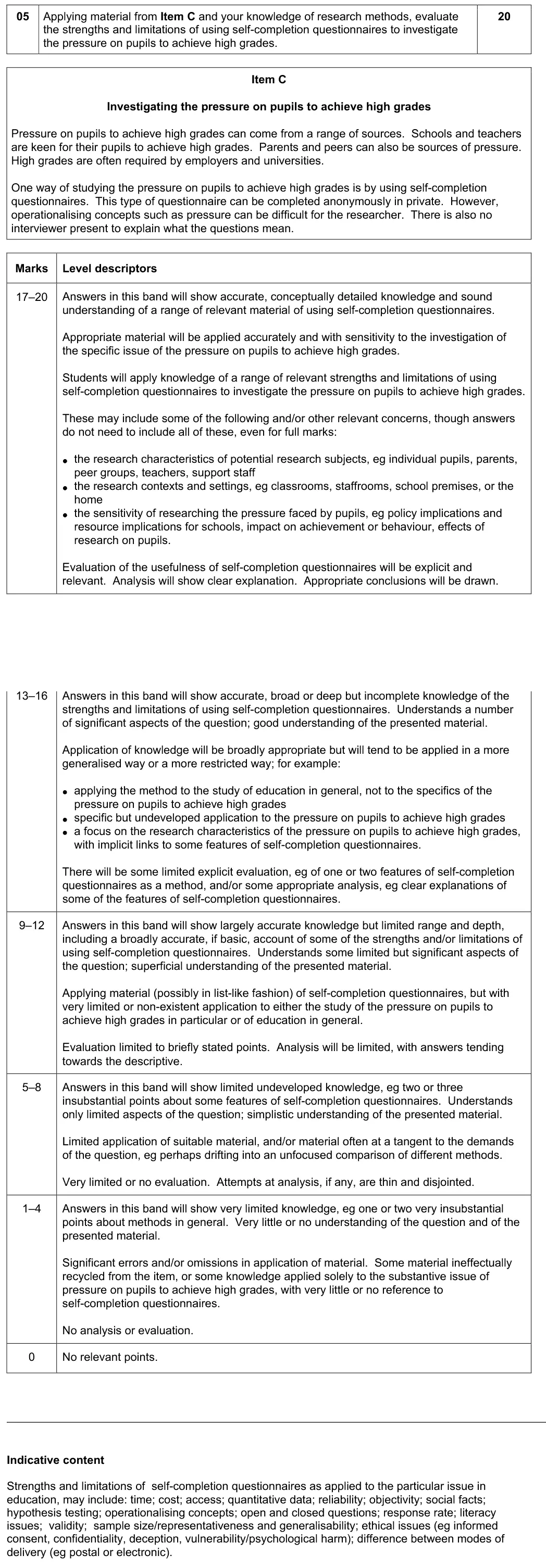
Applying material from Item C and your knowledge of research methods, evaluate the strengths and limitations of using self-completion questionnaires to investigate the pressure on pupils to achieve high grades.
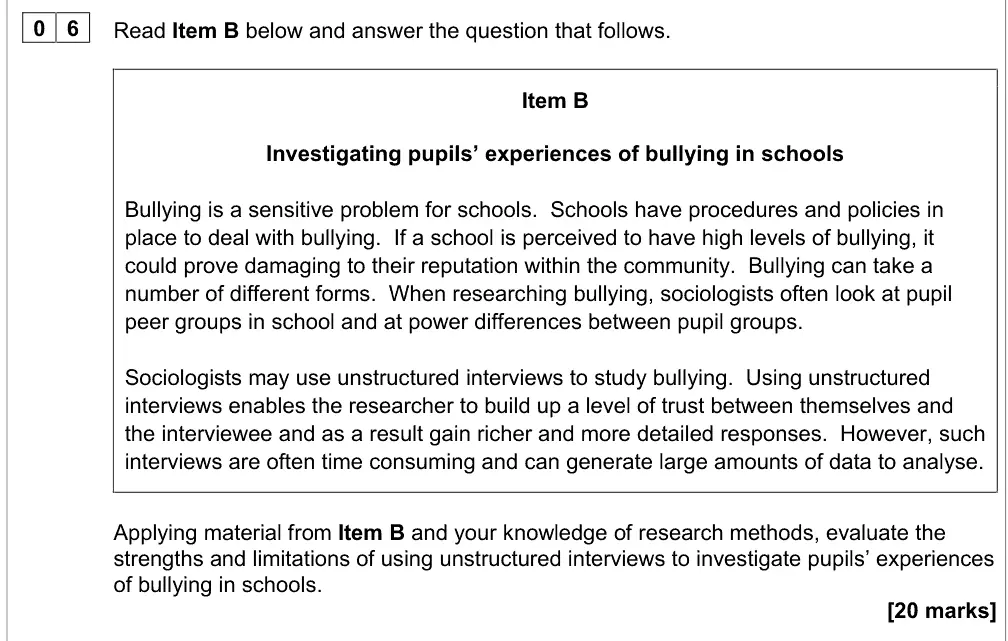
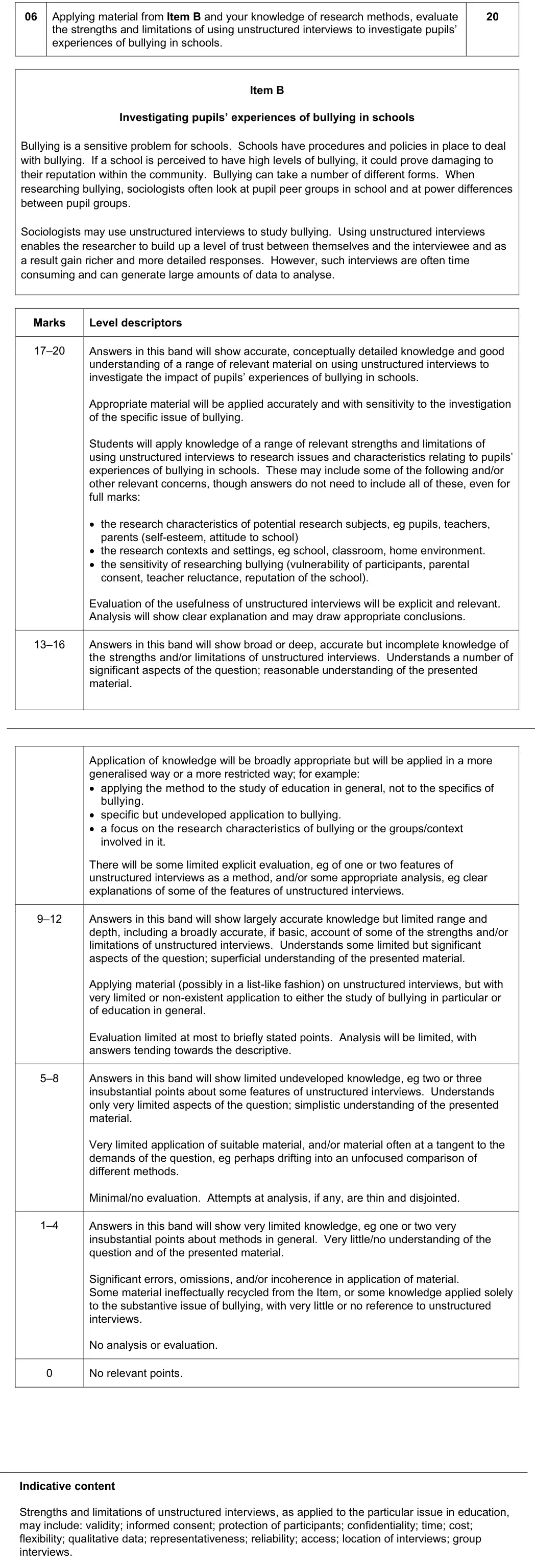
Applying material from Item B and your knowledge of research methods, evaluate the strengths and limitations of using unstructured interviews to investigate pupils’ experiences of bullying in schools.
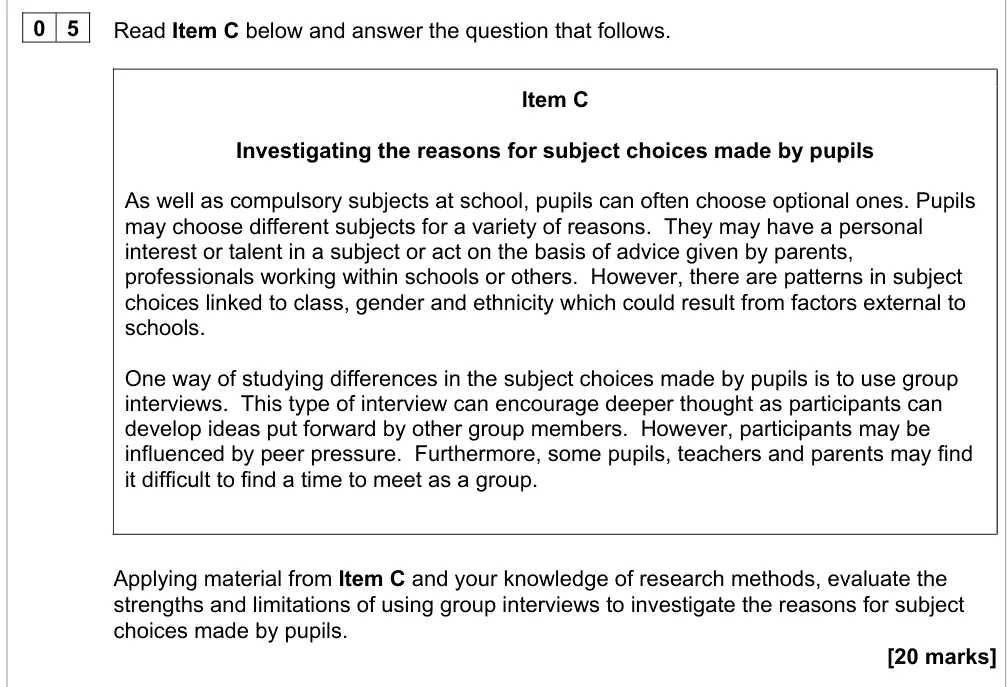
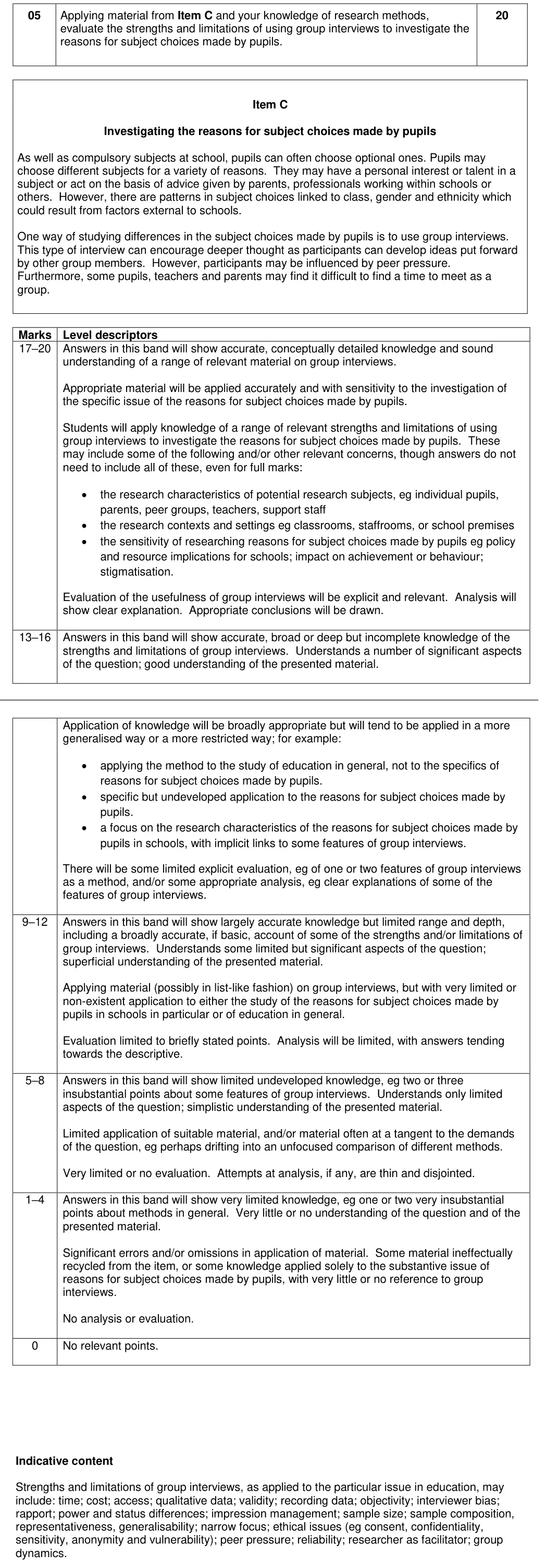
Applying material from Item C and your knowledge of research methods, evaluate the strengths and limitations of using group interviews to investigate the reasons for subject choices made by pupils.
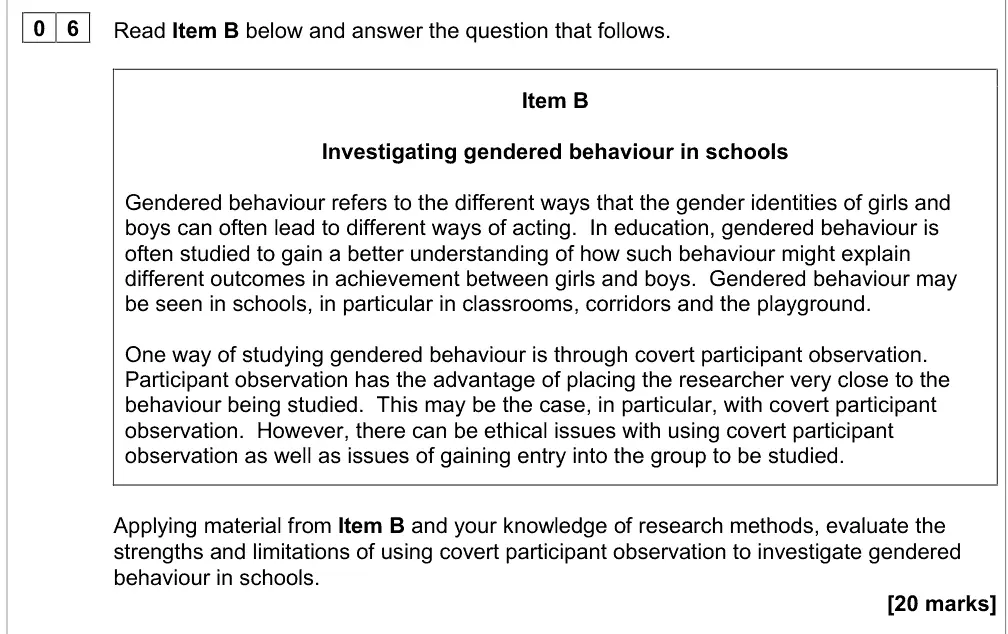
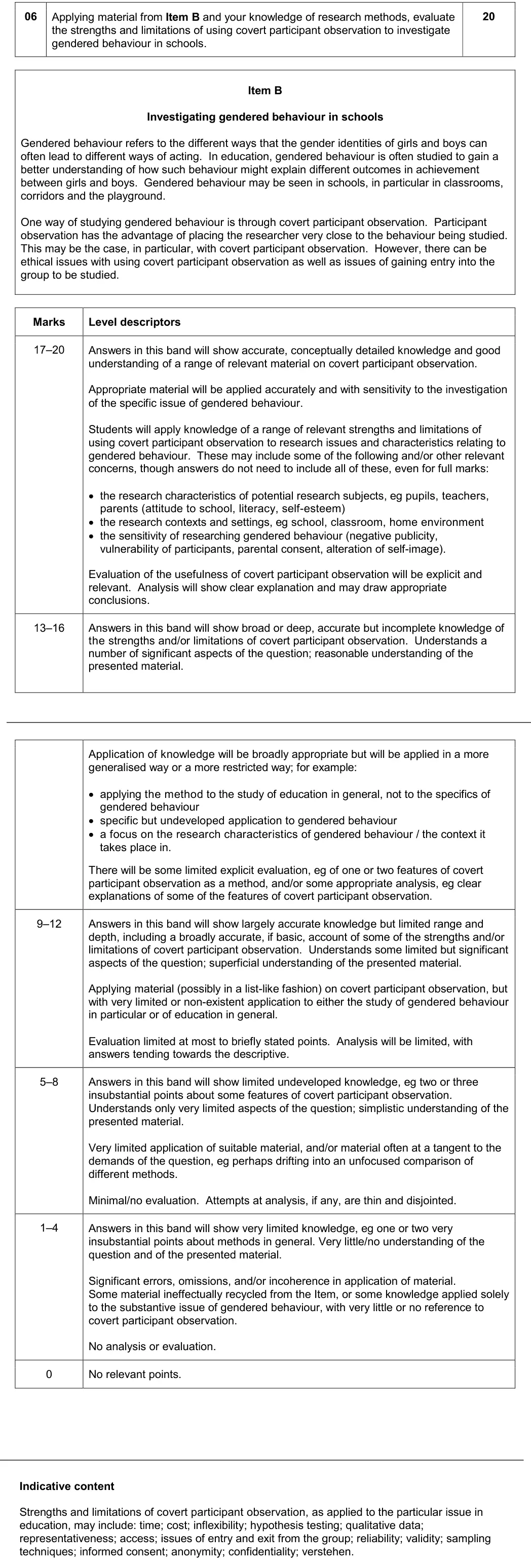
Applying material from Item B and your knowledge of research methods, evaluate the strengths and limitations of using covert participant observation to investigate gendered behaviour in schools.
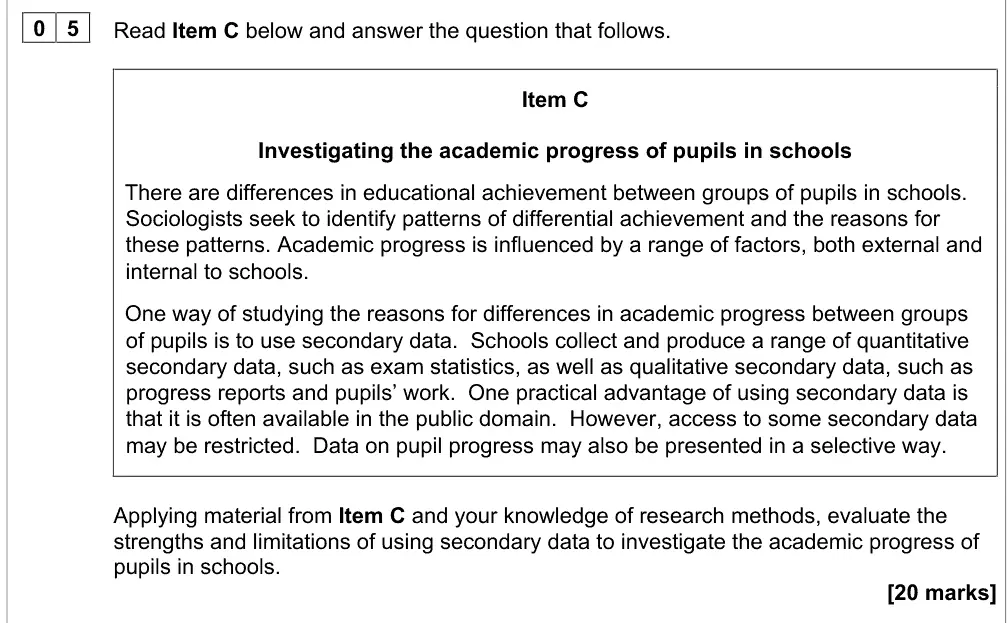
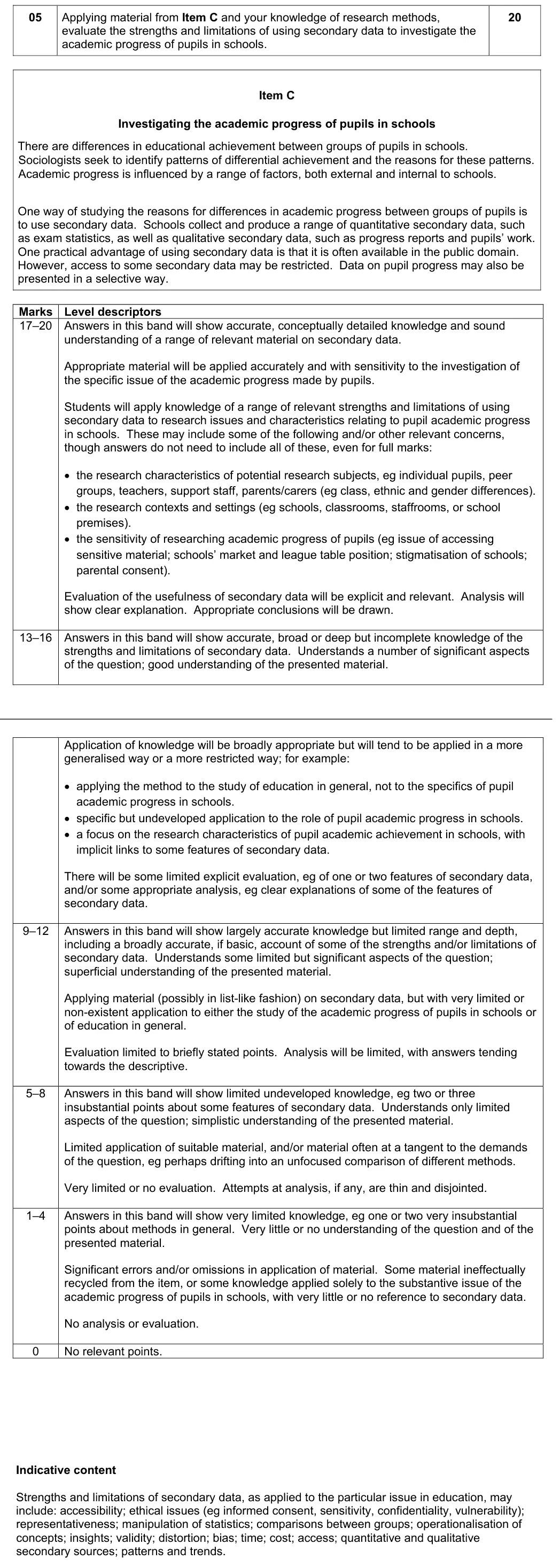
Applying material from Item C and your knowledge of research methods, evaluate the strengths and limitations of using secondary data to investigate the academic progress of pupils in schools.
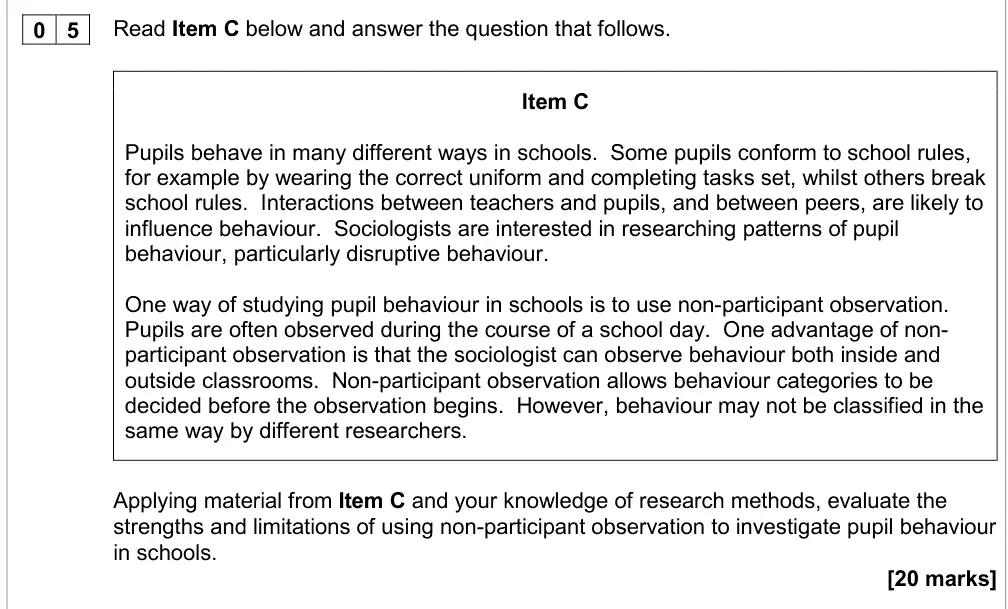
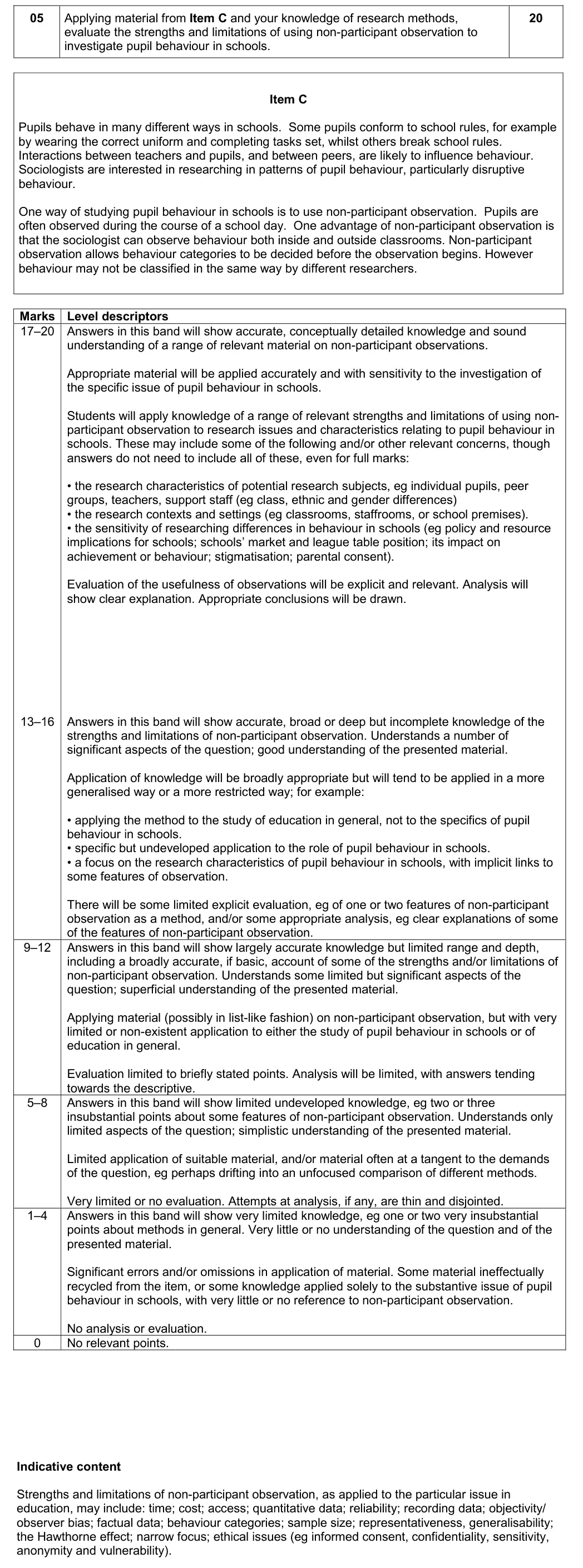
Applying material from Item C and your knowledge of research methods, evaluate the strengths and limitations of using non-participant observation to investigate pupil behaviour in schools.
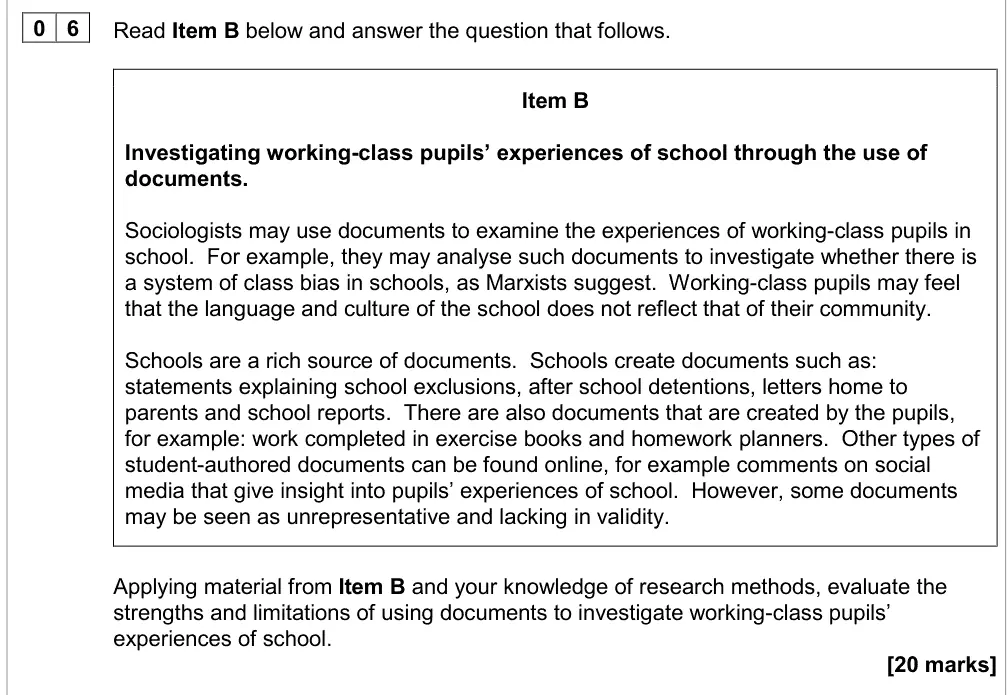
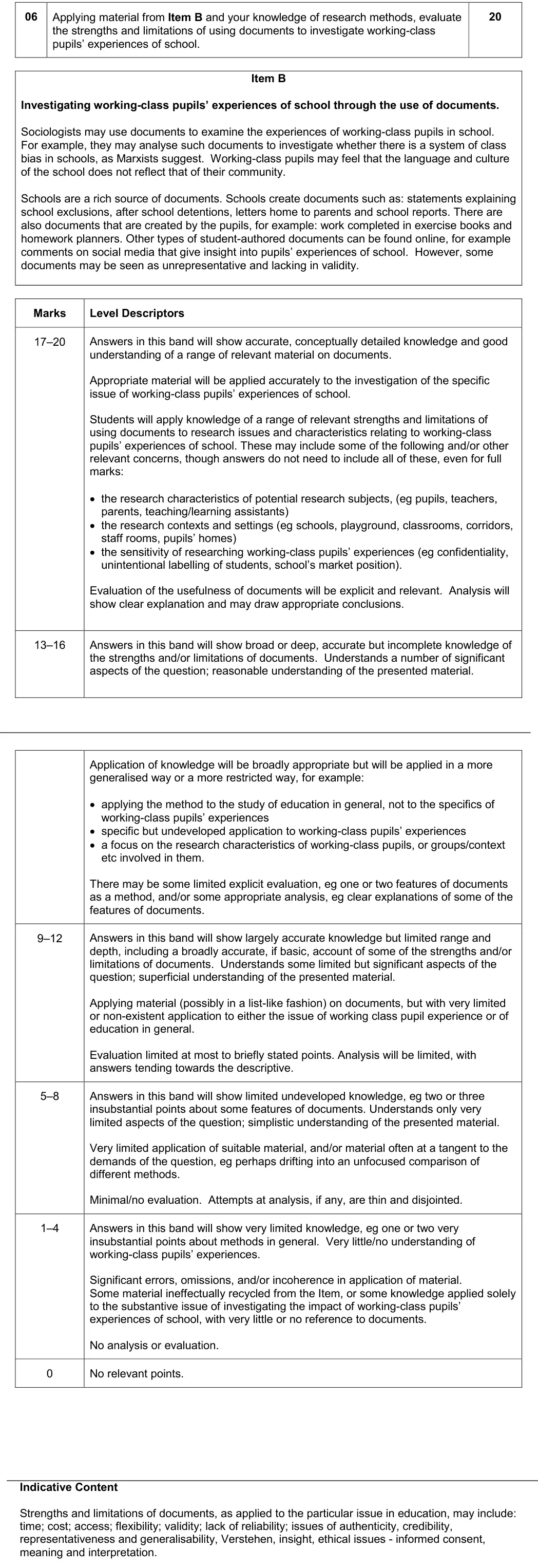
Applying material from Item B and your knowledge of research methods, evaluate the strengths and limitations of using documents to investigate working-class pupils’ experiences of school.
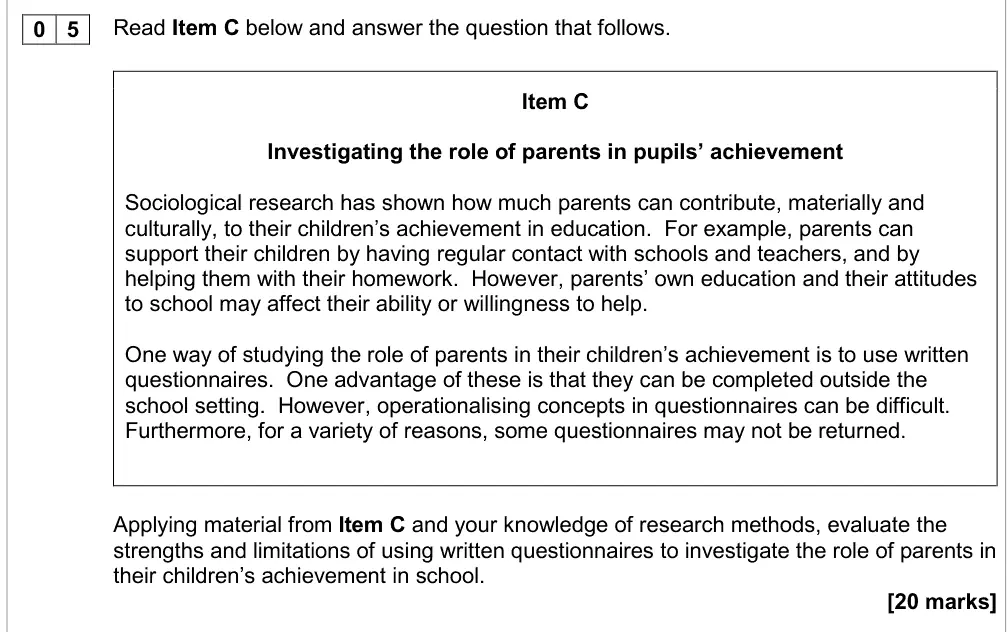
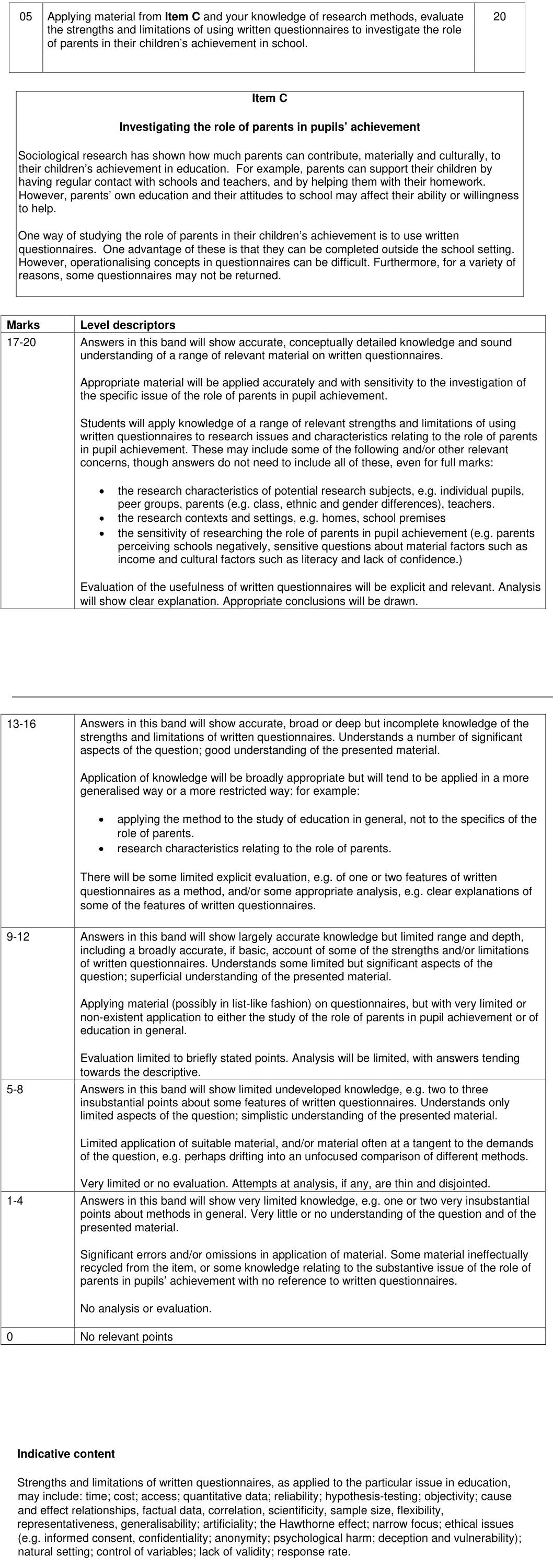
Applying material from Item C and your knowledge of research methods, evaluate the strengths and limitations of using written questionnaires to investigate the role of parents in their children’s achievement in school.
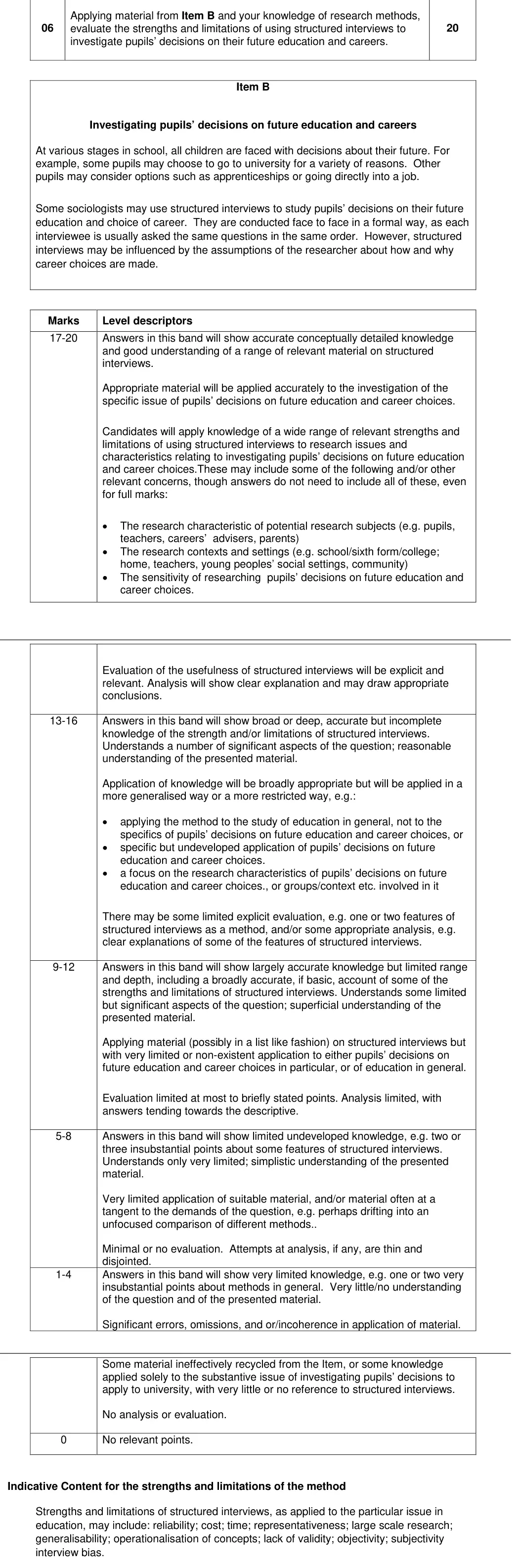
Applying material from Item B and your knowledge of research methods, evaluate the strengths and limitations of using structured interviews to investigate pupils’ decisions on their future education and careers.
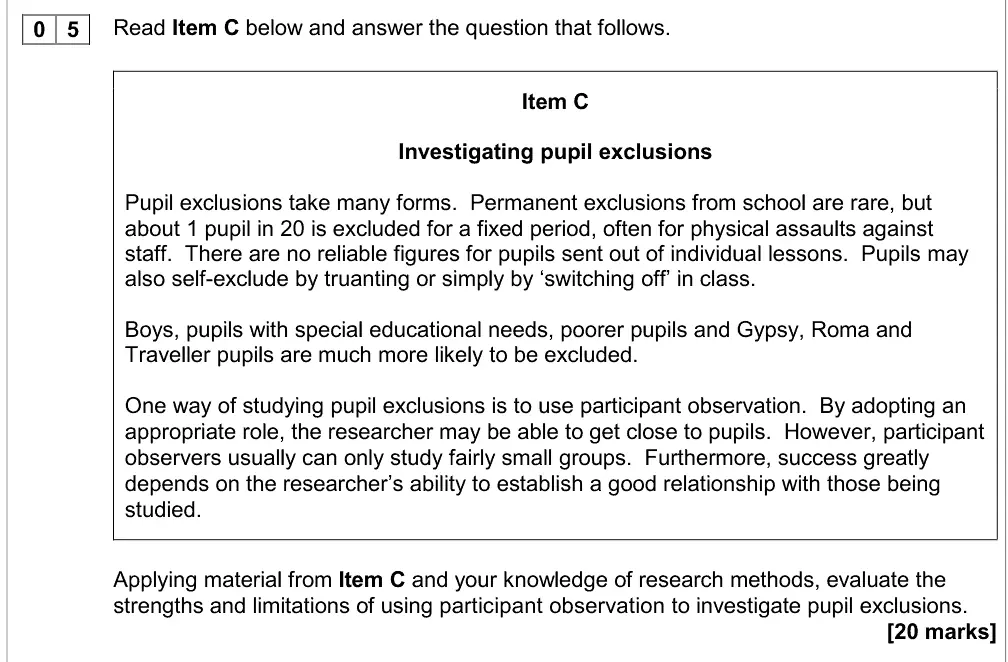
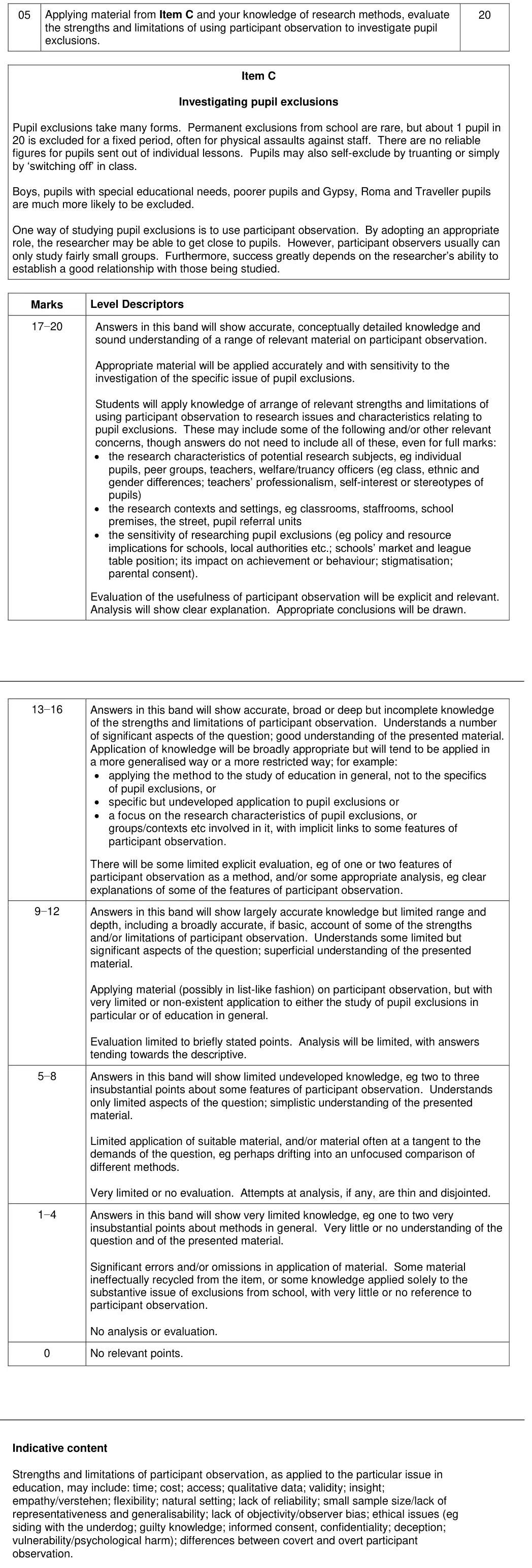
Applying material from Item C and your knowledge of research methods, evaluate the strengths and limitations of using participant observation to investigate pupil exclusions.
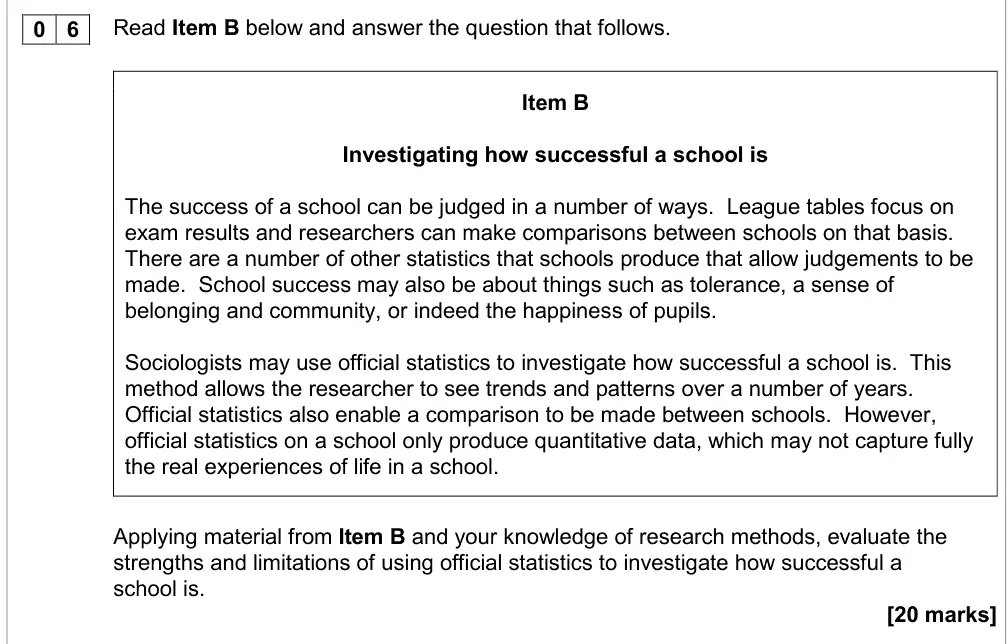
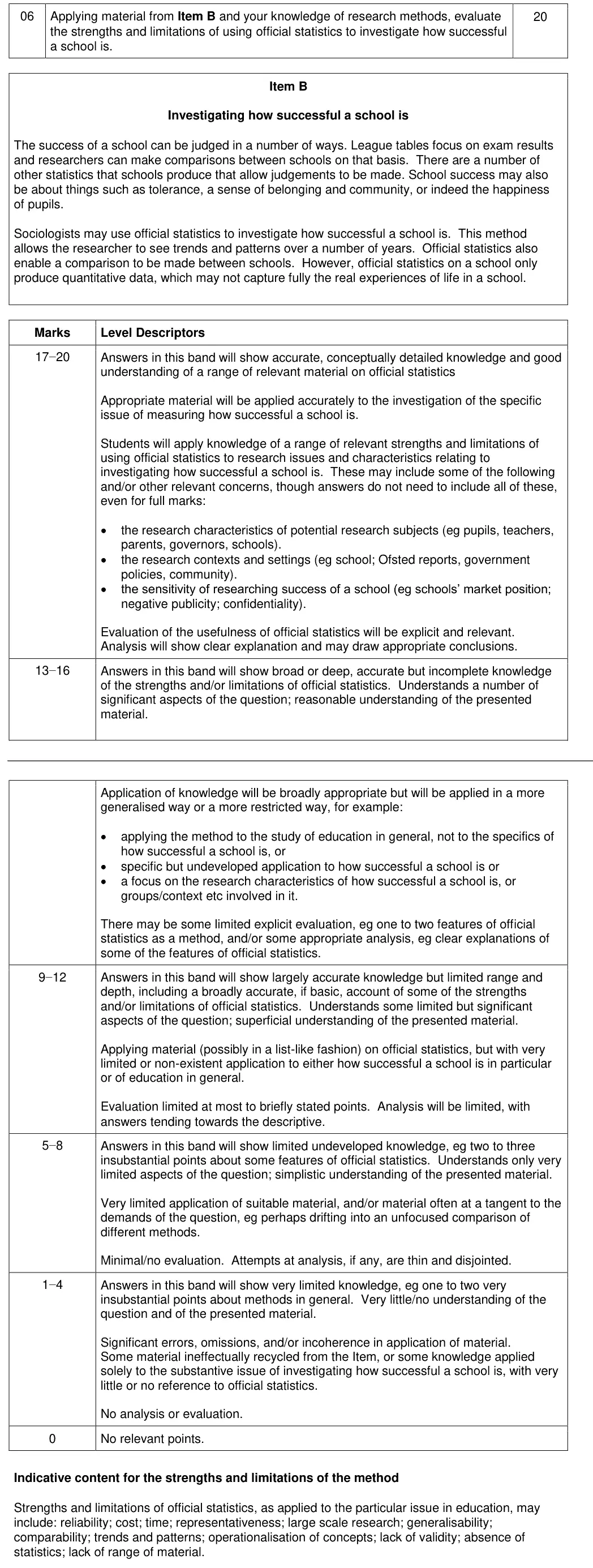
Applying material from Item B and your knowledge of research methods, evaluate the strengths and limitations of using official statistics to investigate how successful a school is.
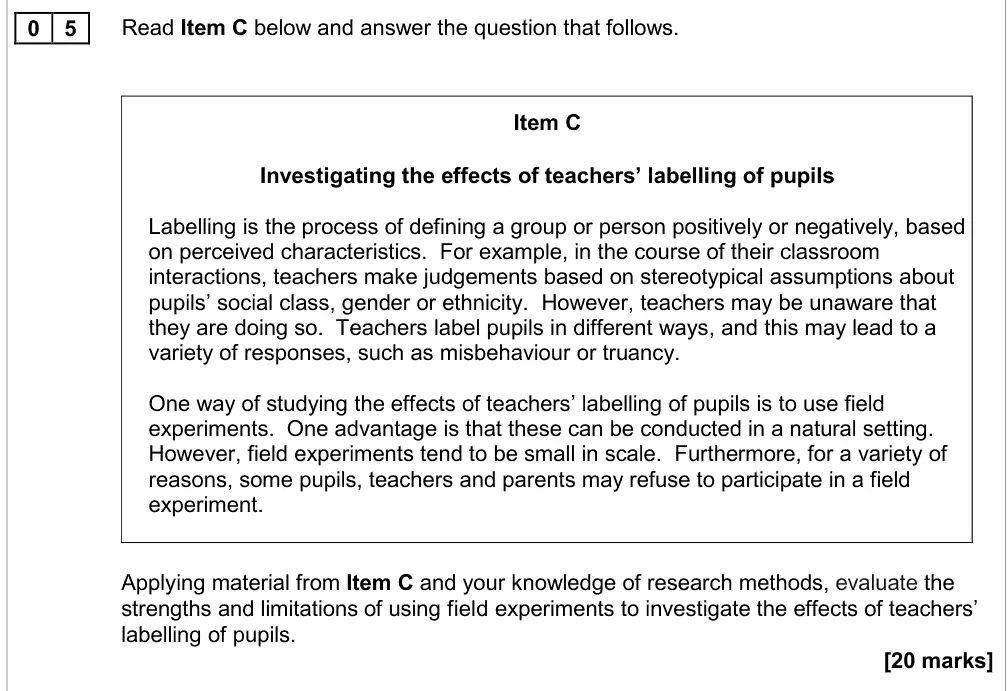
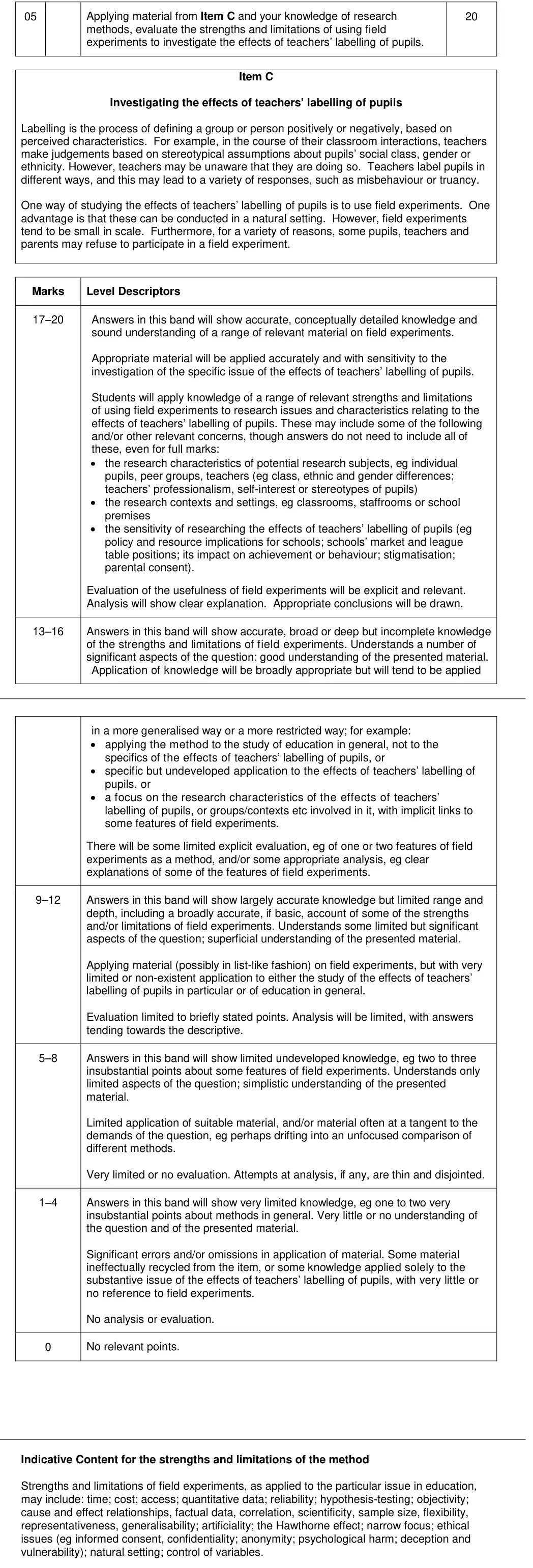
Applying material from Item C and your knowledge of research methods, evaluate the strengths and limitations of using field experiments to investigate the effects of teachers’ labelling of pupils.
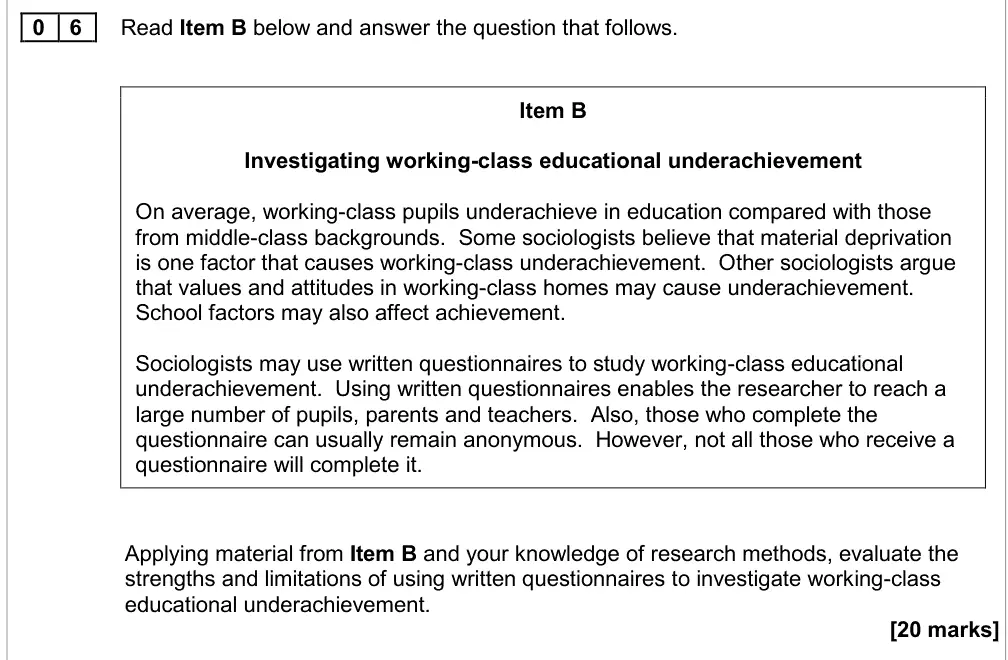
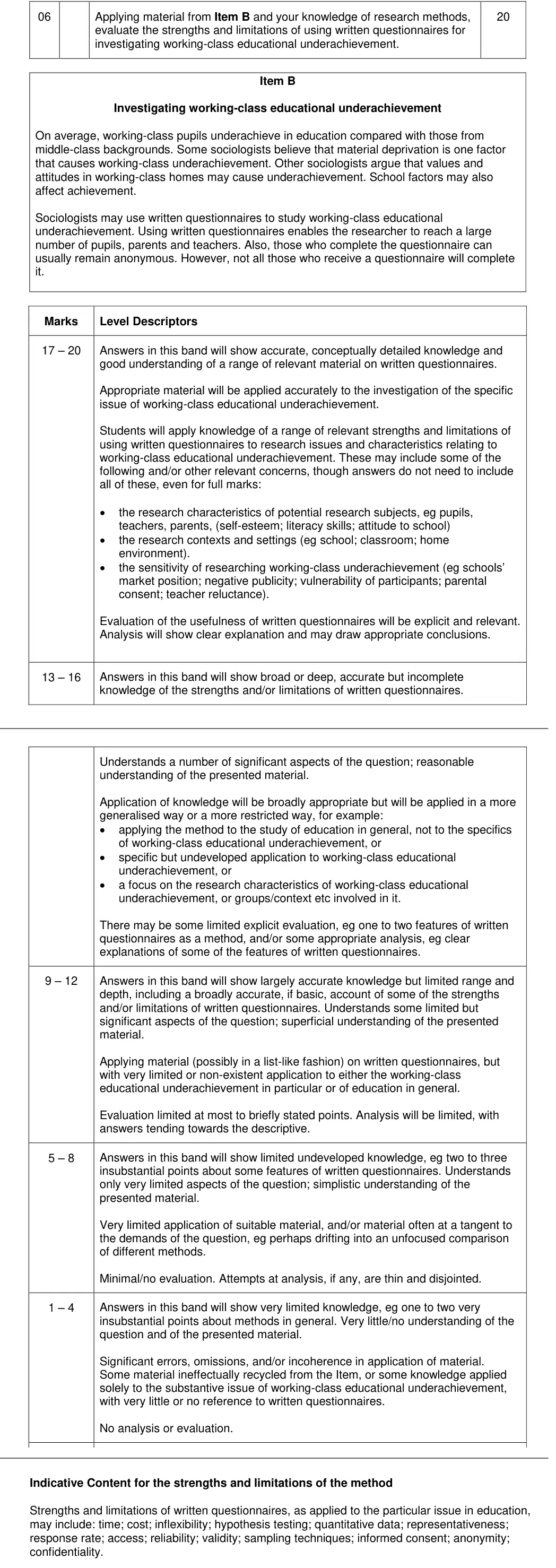
Applying material from Item B and your knowledge of research methods, evaluate the strengths and limitations of using written questionnaires to investigate working-class educational underachievement.
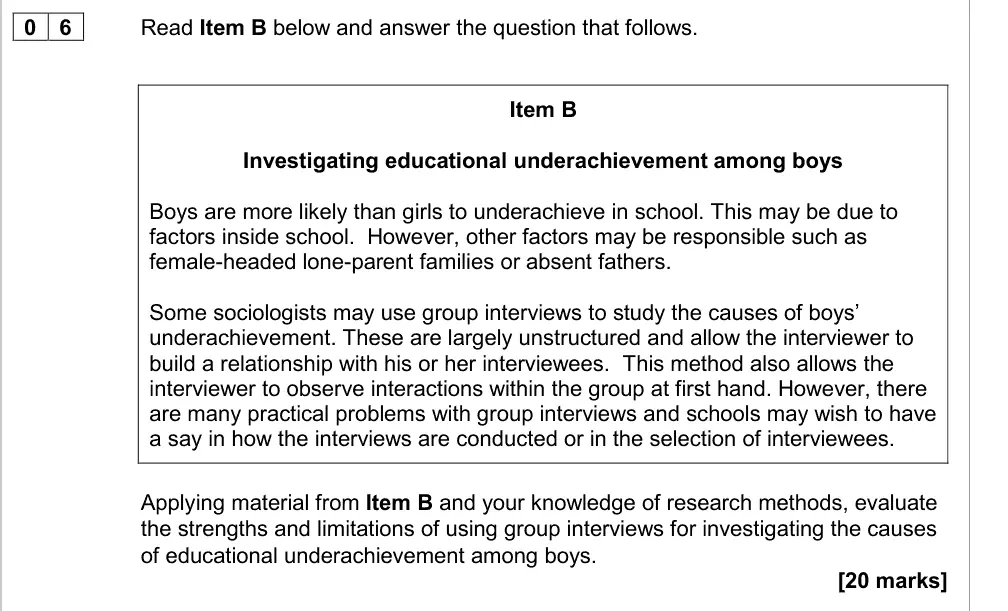
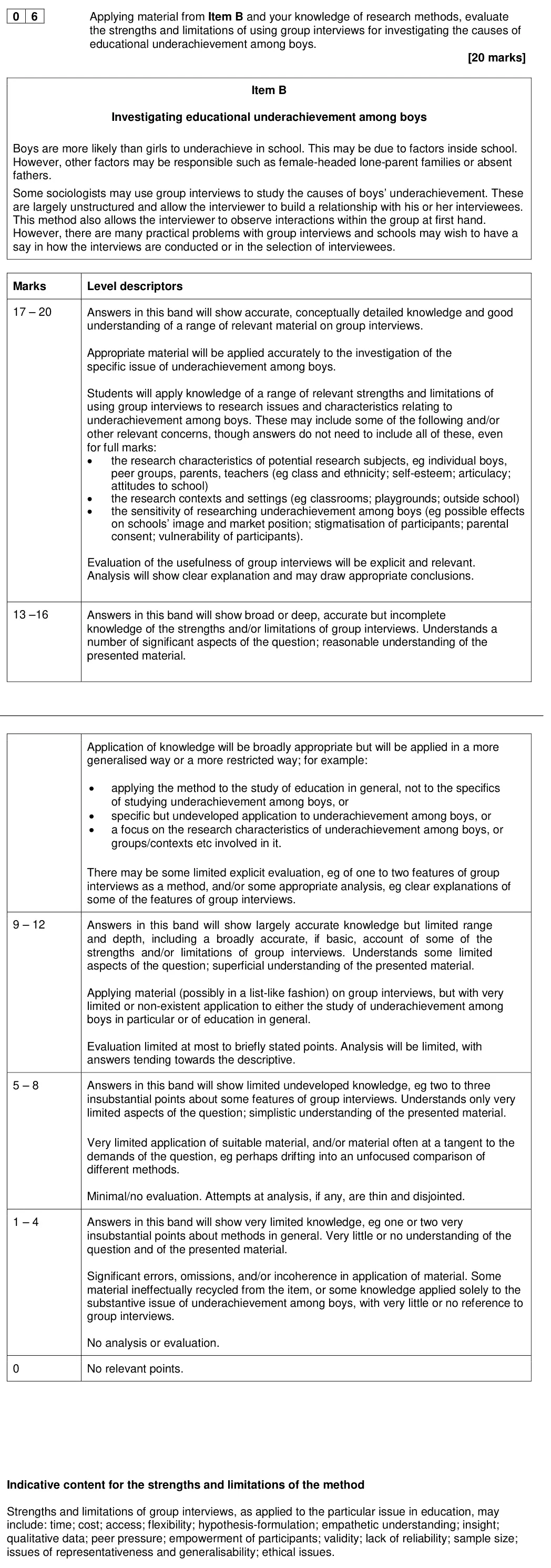
Applying material from Item B and your knowledge of research methods, evaluate the strengths and limitations of using group interviews for investigating the causes of educational underachievement among boys. 20
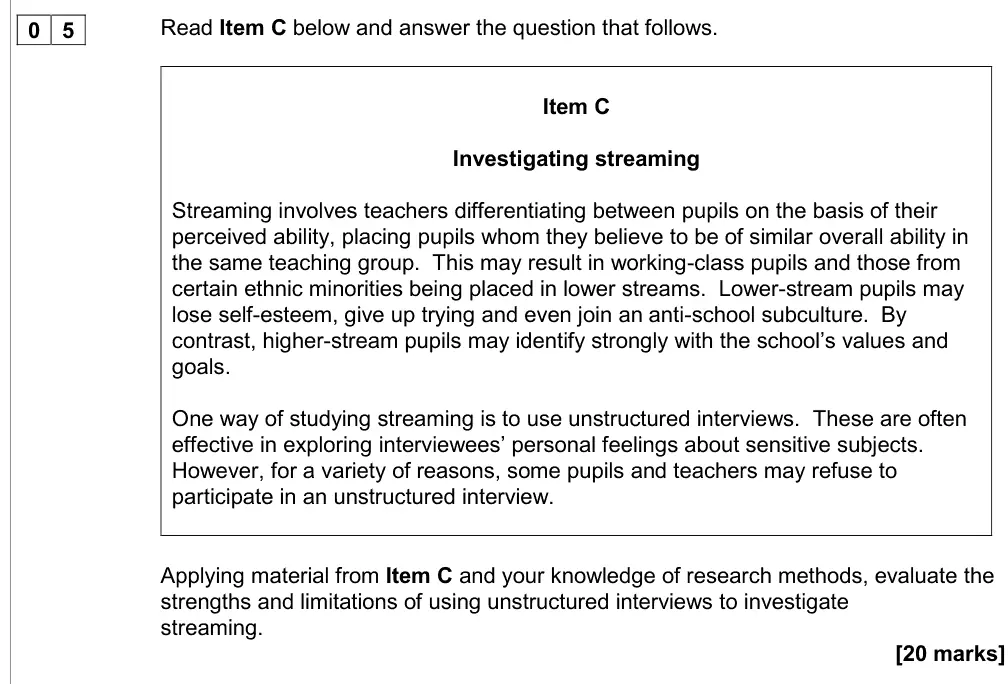
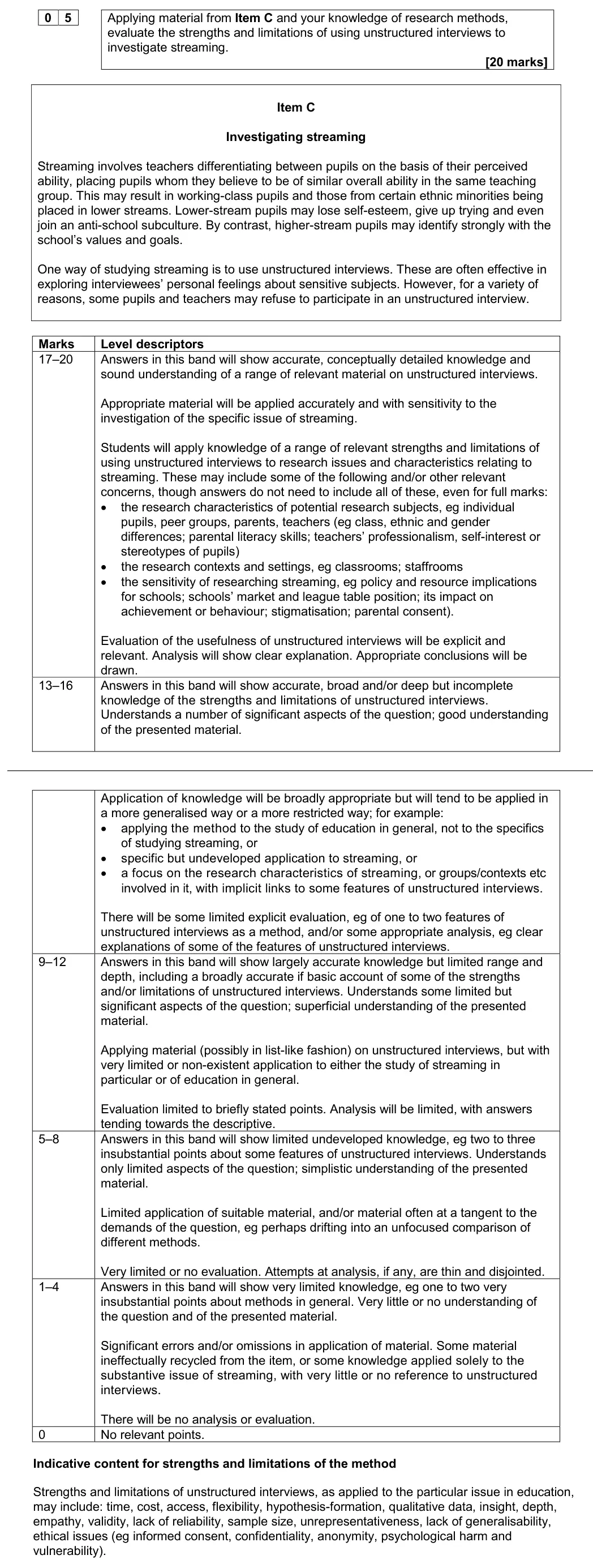
Applying material from Item C and your knowledge of research methods, evaluate the strengths and limitations of using unstructured interviews to investigate streaming.
Tap a question to zoom it. The mark scheme (with the level descriptors and indicative content) and the examiner's comment open underneath.
June 2025 · Paper 1 · Q520 marksAO1=8, AO2=8, AO3=4Methods in context
Mark scheme, including the levels grid and indicative content
Notes from the mark scheme and report
must apply structured interviews to post-16 choices specifically
education in general or undeveloped application = max 13-16
writing on post-16 choices with little reference to structured interviews = 1-4
sensitivity e.g. questions about grades, family attitudes to choices, material and cultural factors
content includes reliability, interviewer bias, operationalisation, rapport and validity
no examiners' report published
June 2025 · AS Paper 1 · Q620 marksAO1=8, AO2=8, AO3=4Methods in context
Mark scheme, including the levels grid and indicative content
Examiner's comment
This question was generally answered competently by most students, though only up to a certain point. A notable proportion demonstrated a lack of understanding regarding the secondary nature of documents. Several responses appeared to rely on pre-learned material concerning research in education that was relevant only to primary methods. As these points were not applicable to secondary sources, they could not be credited. Additionally, some students showed limited understanding of the nature of documents and the processes by which they are compiled and collected, despite the item offering some guidance in this regard. Nevertheless, a number of students produced rich, detailed, and varied responses that effectively addressed the suitability of using documents to investigate educational issues. The most advanced responses not only engaged critically with the item but also extended the discussion to the study of teacher–pupil relationships, incorporating prompts from the item and introducing further relevant methodological considerations.
Notes from the mark scheme and report
must apply the method to the specific issue (teacher–pupil relationships)
application to education in general only caps at 13–16
little or no reference to documents = max 4
many did not grasp that documents are secondary data and used primary-method points that could not be credited
best answers used item hooks (validity, access, representativeness, school and pupil-made documents)
June 2024 · Paper 1 · Q520 marksAO1=8, AO2=8, AO3=4Methods in context
Mark scheme, including the levels grid and indicative content
Examiner's comment
Students seemed to find this question more accessible than last year's, showing varying degrees of understanding of overt participant observation. Many discussed concepts like the ‘Hawthorne effect’, noting that the presence of a researcher might alter the behaviour of participants who know they are being observed. Some students effectively linked the aspects of being both a participant and overt, highlighting how this dual role can influence the research, such as by introducing biases due to the researcher's visible presence and potential influence on participants' behaviour. However, most students tackled the aspects of overt and participant observation separately, discussing them as distinct components rather than integrating them fully. These responses could still gain good credit if they were developed well and/ or applied to the specific issue of studying pupil subcultures. Additionally, some weaker answers referred to observations more generally, discussing advantages and disadvantages that could apply to any type of observation. These responses were more limited in terms of the marks awarded, as they lacked specificity in addressing overt participant observation and the context of studying pupil subcultures. Amongst the highest performing answers are those that can apply the advantages of aspects of overt participant observation to the study of pupil subcultures. For example, some students applied the concept of the ‘Hawthorne effect’ more specifically in explaining how student subcultures in schools might alter their behaviour, becoming either more conformist or rebellious (perhaps due to peer pressure), knowing they are being observed by a researcher who is visibly present (and may present as a ‘teacher in disguise’). This example effectively demonstrated the potential disadvantages of this method, highlighting issues such as reduced authenticity of the data collected. There was also a trend of students providing accounts of issues in educational research more generally, such as difficulties in gaining access past ‘gatekeepers’, without specifically linking these points to overt participant observation and/ or the issue of studying pupil subcultures. The strongest responses provided specific applications and detailed discussions, effectively linking relevant concepts, such as gaining more verstehen, to the specific disadvantages of overt participant observation in the study of pupil subcultures. Weaker answers tended to rely on rote-learned material without adequate context.
Notes from the mark scheme and report
must apply overt participant observation to pupil subcultures specifically
education in general caps at 13–16
little or no reference to overt participant observation = max 4
many treated 'overt' and 'participant' separately
generic observation points limited marks
best answers applied the Hawthorne effect to subcultures acting more conformist or rebellious in front of a visible researcher
June 2024 · AS Paper 1 · Q620 marksAO1=8, AO2=8, AO3=4Methods in context
Mark scheme, including the levels grid and indicative content
Examiner's comment
Question 06: This question was answered well up to a point by most students. A significant proportion did not understand the secondary nature of official statistics. Some seemed to be bringing up pre-learned responses about researching in education that only applied to primary methods. The fact that these did not apply to secondary methods meant that they could not be rewarded. Others did not really understand the nature of official statistics and how they are collated and collected. The item did give some hints concerning this. Despite this, some students deployed rich, detailed and varied responses that dealt with the applicability of using official statistics to examine issues in education. The most sophisticated responses developed and applied this to the issue of studying disruptive pupil behaviour sometimes developing item prompts and also thinking of further issues.
Notes from the mark scheme and report
must apply official statistics to disruptive pupil behaviour specifically
education in general caps at 13–16
many did not grasp that official statistics are secondary data and recycled pre-learned points about primary research in schools
item hooks: truancy recorded by all schools, validity and reliability issues
June 2023 · Paper 1 · Q520 marksAO1=8, AO2=8, AO3=4Methods in context
Mark scheme, including the levels grid and indicative content
Examiner's comment
This question showed a range of knowledge and understanding of strengths and limitations of self-completion questionnaires. For example, many students outlined strengths and limitations linked to practical issues (such as costs and distribution), response rates and accuracy of the information gained from self-completion questionnaires. Whilst some were able to develop these strengths and limitations using correct conceptual language, others did conflate and/or confuse concepts such as validity and reliability. Some answers also made assertions about self-completion questions (eg ‘not being valid’) whereas better answers were able to explain that issues of validity and reliability are more nuanced. Similarly, to previous series, a number of students developed some of these strengths and limitations of self-completion questionnaires to issues of studying education more generally. For example, some students explained that self-completion questionnaires are more likely to get permission from gatekeepers (school leaders and parents) as they are less likely to interrupt lessons in the same way as other methods. The most successful students were able to apply the strengths and limitations to the specifics of the issue in the question. For example, as self-completion questionnaires are often completed in private and are anonymous, respondents (such as students) may be more likely to express their opinions about the pressures that their parents or teachers may be putting on them without fear of any repercussions or upsetting them. Additionally, some were able to develop the issue of ‘operationalising’ in the item, in explaining the issue with measuring and defining ‘pressure’ and ‘high grades’ when completing a questionnaire in the absence of any researcher that may be able to clarify any misunderstanding.
Notes from the mark scheme and report
must apply the method to the specific issue (pressure on pupils to achieve high grades)
application to education in general only caps at 13–16
little or no reference to self-completion questionnaires = max 4
validity and reliability often conflated
best answers used anonymity/privacy and the difficulty of operationalising 'pressure'
June 2023 · AS Paper 1 · Q620 marksAO1=8, AO2=8, AO3=4Methods in context
Mark scheme, including the levels grid and indicative content
Examiner's comment
In the questions where extended prose was required (10 and 20 mark questions) most students showed their understanding of the different balance of skills required in each question. Question 06: Both the method (unstructured interviews) and the issue (experience of bullying) were well understood by students in this paper. Centres have prepared their students well to understand that the practical, ethical and theoretical strengths/ limitations of the method are of upmost importance and that writing about the issue without linking it to the method will attain limited credit. We saw many cases where students were able to successfully link the idea that schools would be concerned about Ofsted, league tables and falling numbers on roll if the researcher were to uncover significant issues with bullying and that, as a consequence, access would be difficult for a researcher. Another popular response was that unstructured interviews take longer than other methods, especially when discussing bullying, as time to build rapport and trust is required. They then inferred that teachers and parents would be less likely to give consent for students to miss out on learning. Weaker responses tended to include descriptions of learned sociological studies or discussed alternative methods. It is important that students only consider the strengths and limitations of the method in the question and that they avoid comparing/ contrasting with another method.
Notes from the mark scheme and report
must apply unstructured interviews to the specific issue of pupils' bullying experiences
application to education in general only = max 13-16
writing about bullying without the method = 1-4
sensitivity (vulnerable pupils, parental consent, school reputation) central
best answers linked school concern over Ofsted, league tables and rolls to difficulty of access
June 2022 · Paper 1 · Q520 marksAO1=8, AO2=8, AO3=4Methods in context
Mark scheme, including the levels grid and indicative content
Examiner's comment
However, knowledge and understanding of group interviews (question 5) and of ‘social facts’ (question 6) tended to be less developed in comparison. This question produced a wide range of responses. Most students were able to offer at least some very basic knowledge and understanding of some strengths and limitations of group interviews. Weaker answers tended to recycle and re use material provided in the item and added very little or no knowledge of group interviews at all. Some responses drifted into accounts of other research methods but were seldom used to illustrate the strengths or limitations of group interviews. Others were able to gain some credit with more general discussions of strengths and limitations of interviews . Better responses were able to develop some of their strengths and limitations of interviews and apply them to the group nature of group interviews. For example, some students developed the idea of peer pressure from the item in discussing why some students may answer in more ‘socially desirable’ ways to please their friends or that some students may dominate the discussion over others. Many answers discussed general characteristics of studying education such as the difficulties of getting past gate keepers (including the headteacher) or that students are vulnerable and extra care needs to be taken. However, these were not always applied clearly, or at all, to strengths and limitations of group interviews. Better answers were also able to apply some of the strengths and limitations of using group interviews to these generic research characteristics of investigating education such as the disruptive nature of taking larger numbers of students out of lessons at any time or that it might be difficult to find spaces in schools to conduct larger group interviews. The most successful answers were able to apply their knowledge and understanding of group interviews to the specific issue of researching reasons for subject choice made my pupils. The most common example included developing the idea of ‘peer pressure’ from the item in explaining how this could result in some students answering in ‘socially desirable ways’. This was applied specifically to the issue of subject choice, for example, in explaining that some males may not admit to choosing subjects outside of their gender domain as they fear being ridiculed by their peers and therefore reducing the validity of the group interview.
Notes from the mark scheme and report
must apply group interviews to reasons for pupils' subject choices
education in general only caps at 13–16
recycling the item or writing only about subject choice with little on group interviews = 1–4
drift into other methods
generic interview points gain some credit but best tied them to the group setting (peer pressure, socially desirable answers, dominant members, removing many pupils from lessons, finding rooms)
June 2022 · AS Paper 1 · Q620 marksAO1=8, AO2=8, AO3=4Methods in context
Mark scheme, including the levels grid and indicative content
Examiner's comment
The majority of students were able to give a good account of the strengths and limitations of using covert participant observation to investigate education. Many had a good understanding of the ethical implications of deception and the theoretical benefit of validity. Students were often able to show application of one part of the method (eg covert or participant) to the problem of gaining entry to a school. To receive marks in the top level, students needed to be able to show that they had understood each element of the method (covert and participant and observation) and be able to apply this to gendered behaviour in schools. The difficulty of doing this is reflected in the mark scheme that the full application is only required for the top level. However, lots of students were successful in partial application and it was clear that they had been prepared to think practically about completing research in an educational setting.
Notes from the mark scheme and report
must apply covert participant observation to gendered behaviour in schools
education in general caps at 13–16
little or no reference to covert participant observation = max 4
most knew ethics of deception and validity well
application often only to gaining entry to a school
November 2021 · Paper 1 · Q520 marksAO1=8, AO2=8, AO3=4Methods in context
Mark scheme, including the levels grid and indicative content
Examiner's comment
However, there was generally a lower quality and standard of answers in comparison to previous normal summer entries with a number of students finding Q1 and Q5 more difficult in particular. However, a small number of students left questions unanswered (particularly question 5 and/ or 6). Similarly to previous years, some students wrote lengthy answers to the 4-mark and 6-mark questions which may explain why a few of these students seemed to run out of time in answering the final question(s). Unfortunately, students generally struggled with this question. Despite the prompts provided in the item, many students seemed to view ‘secondary data’ as being exclusively about secondary quantitative data or official statistics. Therefore, there were many assertions and generalisations made about secondary quantitative data that were applied and generalised to all secondary data. For example, a number of students referred to (all) secondary data as being high in reliability and low in validity, with generalised, and (often) inaccurate explanations. Stronger answers were able to draw out the strengths and limitations of the different types of secondary data types available in comparing the strengths and limitations of official statistics, for example, with the range of more qualitative documents that are available within schools. Unfortunately, a small number of students devoted large sections of their answers to discussions of alternative methods which were rarely creditworthy (unless they were used as a comparison to exemplify strengths and limitations of secondary data). There were some attempts at explaining and discussing issues with studying education more generally. For example, some explained the difficulties of accessing some school documents (such as exercise books and pupil reports) due to the different gatekeepers’ permissions needed. Unfortunately, there were only a very small number of responses that made attempts at developing and applying the strengths and limitations of using secondary data to study the specific issue ie the academic progress in schools. For example, while using league tables of exam results will enable the researcher to look for correlations and trends between the progress of pupils between schools, they do not provide any detail of the reasons why the pupils may or may not have made progress, to the various experiences they have outside of schools . However, knowledge and skills in the methods in context and Theory & Methods questions were generally weaker than previous series. It appeared that students had prepared less well for these topics and questions.
Notes from the mark scheme and report
must apply the method to the specific issue (academic progress of pupils)
application to education in general caps at 13–16
many treated all secondary data as official statistics and asserted high reliability, low validity
best answers contrasted quantitative (exam statistics, league tables) with qualitative school documents (reports, pupils' work) and gatekeeper access
long discussion of alternative methods rarely credited
November 2020 · Paper 1 · Q520 marksAO1=8, AO2=8, AO3=4Methods in context
Mark scheme, including the levels grid and indicative content
Examiner's comment
Many students were able to demonstrate some basic knowledge and understanding of non- participant observation (NPO), although this was often in relation to observations more generally. In many answers, there was a limited focus on the non-participant aspect of the method. Instead, there was a tendency to discuss strengths and limitations of covert versus overt observations with some making assertions that NPOs are always covert. There were attempts at applying knowledge of studying education more generally. Many responses highlighted issues such as gaining access to schools (including gatekeepers) and the problem with those being excluded from research. However, these tended to be rather generic to any research. Better answers were able to apply some of these issues to using NPOs in particular. Unfortunately, there were few responses that were able to demonstrate application of NPOs to the specific issue and research characteristics of investigating pupil behaviour in schools, for example in the way that being detached and an outsider in the observation you are less likely to understand the reasons and meanings that younger students might attach to the observed behaviours within their anti-school or pro-school subcultures. However, knowledge and skills in the Methods in Context and Theory and Methods questions were generally weaker than in previous series. It appeared that students had prepared less well for these topics and questions.
Notes from the mark scheme and report
must apply non-participant observation to pupil behaviour in schools
education in general only caps at 13–16
recycling the item or writing only about pupil behaviour with little on the method = 1–4
many discussed observation in general or covert vs overt, wrongly assuming NPO is always covert
access and gatekeeper points often generic
best explained that a detached outsider may miss the meanings pupils in pro- or anti-school subcultures attach to behaviour
November 2020 · AS Paper 1 · Q620 marksAO1=8, AO2=8, AO3=4Methods in context
Mark scheme, including the levels grid and indicative content
Notes from the mark scheme and report
must apply documents to working-class pupils' experiences of school specifically
education in general caps at 13–16
little or no reference to documents = max 4
item offers school-produced, pupil-produced and online documents and flags representativeness and validity
no examiners' report for this series
June 2019 · Paper 1 · Q520 marksAO1=8, AO2=8, AO3=4Methods in context
Mark scheme, including the levels grid and indicative content
Examiner's comment
However, for the Methods in Context question few students were able to apply their knowledge of the given research method to the issue specified in the question. The majority of students appeared to be confident in their understanding of written questionnaires and could include a range of practical, ethical and theoretical issues relating to the method. Most students provided balanced answers which examined both strengths and weaknesses. Less effective answers were often relatively strong on their understanding of written questionnaires, but the strengths and limitations of the method were not applied effectively to either the issue or to the study of education in general. The significant number of students who focused on the method alone, even when this was done well, could get no higher than the 9-12 mark band, without making reference to the research issue. A significant minority of students interpreted written questionnaires as ‘open questions’ and confused written questionnaires as being an interpretivist approach. They therefore incorrectly described the method as providing qualitative data with higher levels of depth and validity. A smaller minority seemed unsure about whether the method was a qualitative or quantitative one. There were also a larger number of students who wrote a ‘catch all’ conclusion which recapped previous points and referred to alternative methods and the need to triangulate. This type of conclusion tended to add little or nothing to the response. The majority of students were able to make use of the Item, for example, by applying ‘some questionnaires may not be returned’ to low response rate and ‘completed outside the home’ to parents being able to complete them in their own time. However, the ‘hook’ of ‘operationalising of concepts’ was less well applied, such as to the issue of it leading to a lack of validity in responses. With weaker responses, students just repeated sections of the item without any significant development. The main limitation of many responses was not explicitly addressing the link to ‘their children’s achievement’. Most attempts at application to the issue stopped at the ‘role of parents’ although often implicitly referring to achievement by discussing parental involvement in their child’s education. Many students focused on the differences between working-class and middle-class parents in relation to issues such as linguistic and literary skills, on parents’ own experience of education, and on the likelihood of impression management as they represented themselves as ‘good’ parents. However, very few responses offered one or more application of the method to the specific issue of the role of parents in pupils’ achievement, for example in the way parents may give socially desirable responses that lack validity, such as ticking boxes stating that they ‘strongly agree’ with the statement that they are very involved in helping their child achieve in school. It was good to see that a large number of students were able to advance characteristics of the method such as access and development of a gatekeeper issue beyond education in general. However, few students were able to apply a characteristic of the role of parents in pupils’ achievement to the method of written questionnaires to reach the requirements of the top band.
Notes from the mark scheme and report
must apply the method to the specific issue (role of parents in children's achievement)
application to education in general caps at 13–16
method only with no link to the issue = max 12
some wrongly treated written questionnaires as open, qualitative and interpretivist
best answers used the item hooks (completed outside school, response rate, operationalising)
'catch-all' triangulation conclusions added little
June 2019 · AS Paper 1 · Q620 marksAO1=8, AO2=8, AO3=4Methods in context
Mark scheme, including the levels grid and indicative content
Examiner's comment
In general, students tended to find this question difficult, with a large number of answers only demonstrating limited knowledge and understanding of structured interviews. There was some confusion about the strengths and limitations of structured interviews, as many drifted into a discussion of alternative methods, and in particular unstructed interviews. A number of students were uncertain about the type of data obtained from using structured interviews, and there was further confusion between the issues of reliability and validity and of the differences between positivist and interpretivist theories. Students who used the item were often more successful in their understanding of the methodology. It is clear that students are now being well prepared to use their application skills to ‘apply’ methodology issues and to studying education more generally, for example with many students referring to the practical issues with gaining access through the ‘gatekeepers’. Some were then able to apply this further to the method by explaining, for example, that gatekeepers such as headteachers would be unlikely to permit many students to be out of lessons for interviewing. However, the most sophisticated applications occurred when students were able to apply the strengths and limitations of structured interviews to the specific issue in the question ie to pupils’ decisions on their career choices. For example, some students were able to identify the lack of a rapport gained using structured interviews, and how it leads to an inability of students wanting to discuss their future if they felt embarrassed by the job or career they wanted to do, or the type of university they planned to attend.
Notes from the mark scheme and report
must apply the method to the specific issue (pupils' decisions on future education and careers)
application to education in general only caps at 13–16
little or no reference to structured interviews = max 4
many drifted into unstructured interviews or confused reliability with validity and positivism with interpretivism
best answers linked lack of rapport to pupils' reluctance to discuss embarrassing career or university plans
June 2018 · Paper 1 · Q520 marksAO1=8, AO2=8, AO3=4Methods in context
Mark scheme, including the levels grid and indicative content
Examiner's comment
For Question 05 however, there continues to be a pattern of very few students being able to apply their knowledge of the research method to the specific issue in the question. Students appeared to be confident in their understanding of participant observation. Less effective answers were often relatively strong on the method, but the strengths and limitations of participant observation were not applied effectively to either the issue or to the study of education in general. Another characteristic of weaker answers was that they were less explicit in distinguishing between overt and covert participant observation, for example, stating that a problem of participant observation was the Hawthorne effect. Most students were able to make use of the Item, although some focused in on ‘small groups’ and ‘establishing a good relationship’ without relating these to the strengths and limitations of the method or to the issue. However, stronger responses did take advantage of the hooks from the Item, for example, applying ‘establishing a good relationship’ to issues of validity drawing on the researcher adopting an appropriate role such as a teaching assistant. The most effective responses could offer one or more application of the method to the specific issue of pupil exclusions, for example, in the way excluded pupils are by definition unlikely to be in school and so cannot be observed in classrooms where the process of exclusion usually begins. Many also were able to advance characteristics of the method such as access and development of a gatekeeper issue, beyond education in general. However, the majority of students were unable to apply a characteristic of pupil exclusions to the method of participant observation to reach the requirements of the top band. For example that a head teacher may only give the researcher restricted access to observe to avoid being ‘uncovered’ as a school that excludes too many pupils, therefore damaging its reputation in the education market.
Notes from the mark scheme and report
must apply participant observation to pupil exclusions specifically
education in general caps at 13–16
little or no reference to participant observation = max 4
weaker answers did not distinguish overt and covert (e.g. Hawthorne effect cited as a general problem)
best answers used item hooks such as adopting a role (e.g. teaching assistant) and building relationships for validity
June 2018 · AS Paper 1 · Q620 marksAO1=8, AO2=8, AO3=4Methods in context
Mark scheme, including the levels grid and indicative content
Examiner's comment
The most important factor in answering this question successfully was the extent to which students applied their understanding of official statistics to the specific issue of investigating how successful a school is. However, some students were content on simply presenting strengths and limitations of the method without applying them to the issue in the question. Students generally found this method problematic and had a limited range of points. There was a high incidence of students recycling the item, particularly on official statistics allowing the researcher to see ‘patterns and trends’ and enabling ‘comparisons between schools’. Very few students were able to develop these ‘hooks’ both in terms of the methods and applying them to the issue in the question. This was also the case for the weakness stated in the item ‘which may not capture fully the experiences of the life of the school’. However, many students were able to relate this to official statistics lacking validity. Other responses presented some generic research characteristics of investigating education, such as that head teachers may wish to protect the reputation of the school. However, a large number of students discussed this in terms of official statistics being a primary method (e.g. references to pupils and teachers not wanting to fill out questionnaires). Better responses were able to apply this as a strength of official statistics in that the researcher does not have to face the problems of access or ethical issues that can apply to primary methods. The most successful answers were able to apply a characteristic of successful schools to the method of official statistics to reach the requirements of the top band. For example, some explained the problem of definitions used in official statistics to measure ‘successful schools’ has changed (such as the move from A*-C to Progress 8) meaning that comparisons over time cannot be easily made. Others explored ways that schools might manipulate the statistics by not entering students for the exams or the way that schools can hide attendance issues to make the school appear more successful and therefore not valid.
Notes from the mark scheme and report
must apply official statistics to the specific issue of measuring school success
education in general caps at 13–16
recycling item hooks (trends and patterns, comparisons between schools) without development was common
treating official statistics as a primary method (pupils filling in questionnaires) misses the point
best answers used changing measures (A*–C to Progress 8) undermining comparisons over time and schools manipulating statistics
June 2017 · Paper 1 · Q520 marksAO1=8, AO2=8, AO3=4Methods in context
Mark scheme, including the levels grid and indicative content
Examiner's comment
For the Methods in Context question, very few students were able to apply their knowledge of the research methods to the specific issue in the question. The most important factor in answering this question successfully was the extent to which students applied their understanding of field experiments to the specific issue of the effects of teachers’ labelling of pupils. This question proved to be quite demanding of students mainly because of confusion over the nature of field experiments. Few students could locate field experiments within a positivist theoretical framework. Often students made statements about the research method that were more appropriate to forms of observation than field experiments. The lack of clear understanding of the strengths and limitations of field experiments also made it difficult for many students to link these to specific research characteristics of labelling. As a result, answers were often generic responses based on the research method with very limited, if any, relationship to studying either education in general or labelling in particular. Other responses presented some generic research characteristics of investigating education, such as that head teachers may wish to protect the reputation of their school and therefore be unwilling to allow research to take place. More developed versions of this approach pointed to the possible negative consequences for a school’s reputation in a marketised education system and of research into the effects of teachers labelling pupils. Most students were able to make use of the Item, although many focused in on the “small scale” and “natural setting” without relating these to the strengths and limitations of the method or to the issue. However, stronger responses did take advantage of the hooks from the Item, for example, applying “small scale” to issues of generalisation and representativeness, drawing on sampling and problems of isolating variables to the characteristics of labelling. Better responses were able to connect features of the method, such as the difficulty in controlling variables, to issues relating to characteristics of studying labelling, for example that it can be caused by a number of both in- school and external factors. However, the majority of students were unable to apply a characteristic of labelling to the method of field experiments to reach the requirements of the top band.
Notes from the mark scheme and report
must apply the method to the specific issue (effects of teachers' labelling)
application to education in general only caps at 13–16
little or no reference to field experiments = max 4
many confused field experiments with observation and few linked them to positivism
best answers used item hooks such as small scale (representativeness) and control of variables
June 2017 · AS Paper 1 · Q620 marksAO1=8, AO2=8, AO3=4Methods in context
Mark scheme, including the levels grid and indicative content
Examiner's comment
Schools and colleges have been more adept in preparing their students for the methods in context question than last year. Many students were able to apply the method to researching education as a closed space, especially in terms of understanding access issues. Good responses identified specific characteristics of working-class underachievement, for example that students may be members of class based, anti-school subcultures, and may therefore refuse to cooperate or fill out the questionnaire accurately. Some responses were able to meet the criteria for the top band in developing the point that working-class parents may not return the questionnaire or may give socially desirable responses due to not wanting to appear to be seen as a bad parent if their child is underachieving and from a working class background. A few answers pursued tangents describing research findings on this topic. Most students were confident in their understanding of questionnaires, although a minority assumed that written questionnaires must use open questions that produce qualitative data and are therefore favoured by interpretivists. Similarly, it was often asserted that anonymity would lead to honesty, without an explanation as to why. Anonymity was often confounded with confidentiality, and the advantage of more candid answers was often stated to be ethical, when it is one of validity. The ethical issue of upsetting respondents with a sensitive question is not removed by anonymity, though it is likely to reduce embarrassment. Another widespread assertion was that this is a sensitive topic. This needs some explanation since sociologists rarely investigate phenomena that are not sensitive, especially in the context of schools. Some students were content with simply presenting a range of strengths and limitations of the method without applying them to the issue in the question. Some of these answers picked up on the idea in the item that questionnaires could be distributed to a large number of people but failed to apply this point beyond the item. Better answers made good use of formulae to help them cover a range of factors, and were able to make some connections to the research setting (school, classroom, homes) and/or the likely participants (pupils and parents). Few students thought to consider teachers as sources of information. There were many attempts to link the method with the issue, but often the students focused too much on the sensitivity of studying working class underachievement rather than linking this issue specifically to questionnaires. There were many cases of students reaching level 4 rather than fully developing their point to get into level 5. On the whole, many were able to connect using questionnaires to social class, but found it more difficult to add in the additional final layer of educational achievement.
Notes from the mark scheme and report
must apply written questionnaires to working-class underachievement specifically
application to education in general only caps at 13–16
knowledge applied only to the substantive issue with little reference to questionnaires = 1–4
good answers: anti-school subcultures refusing to cooperate, working-class parents not returning questionnaires or giving socially desirable answers
errors: assuming questionnaires must be open/qualitative, anonymity confused with confidentiality, candour treated as an ethical rather than validity gain, 'sensitive topic' asserted without explanation
June 2016 · AS Paper 1 · Q620 marksAO1=8, AO2=8, AO3=4Methods in context
Mark scheme, including the levels grid and indicative content
Examiner's comment
The most important factor in answering this question successfully was the extent to which students applied their understanding of group interviews to the specific issue of boys’ underachievement. However, some students were content simply to present a range of strengths and limitations of the method without applying them to the issue in the question. Some of these answers picked up on the idea in the Item that group interviews tend to be largely unstructured and then focused on an account of unstructured interviews without further reference to the ‘group’ dimension. Other responses presented some generic research characteristics of investigating education, such as that head teachers may wish to protect the reputation of their school and therefore be unwilling to allow research to take place. More developed versions of this approach pointed to the possible negative consequences for a school’s reputation, in a marketised education system, of research into underachievement among its pupils. Better responses identified specific characteristics of underachieving boys, for example that they may be members of anti-school subcultures, and may therefore treat the interviewer as an authority figure to be mocked, refuse to cooperate, or be truanting and thus be unavailable for interview. The best responses connected issues such as these to the strengths or limitations that result from the group nature of the method. For example, some argued that peer pressure arising from an anti-school subculture within the group, or embarrassment at having to talk about the reasons for their underachievement (such as their home and family life) in front of friends, may distort the outcome of the group interview.
Notes from the mark scheme and report
must apply group interviews to boys' underachievement specifically
education in general caps at 13–16
little or no reference to group interviews = max 4
many treated it as unstructured interviews and ignored the group dimension
best answers linked peer pressure in anti-school subcultures and embarrassment in front of friends to validity
Specimen set 1 · Paper 1 · Q520 marksAO1=8, AO2=8, AO3=4Methods in context
Mark scheme, including the levels grid and indicative content
Notes from the mark scheme and report
specimen paper, no examiners' report
must apply the method to the specific issue (streaming)
application to education in general caps at 13–16
method only with no application = max 12
knowledge only about streaming with little on unstructured interviews = 1–4
relevant issues: pupils' and teachers' characteristics, classroom and staffroom settings, sensitivity of streaming for schools and pupils
Work with an AQA sociology tutor
Essays stuck in the middle band, or losing marks on the 10-markers? Book a trial lesson with Mark, a former AQA examiner.