4.1.1-03 relationships and processes within schools, with particular reference to teacher/pupil relationships, pupil identities and subcultures, the hidden curriculum, and the organisation of teaching and learningAS
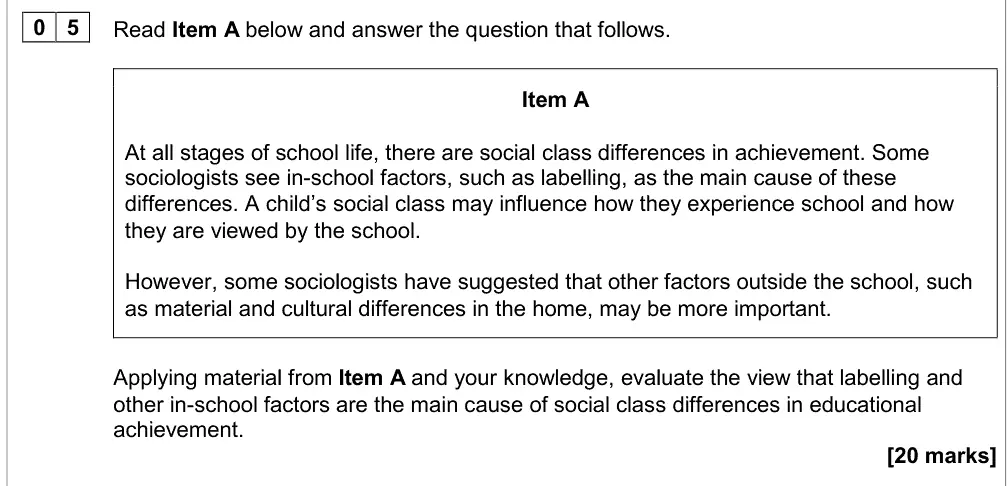
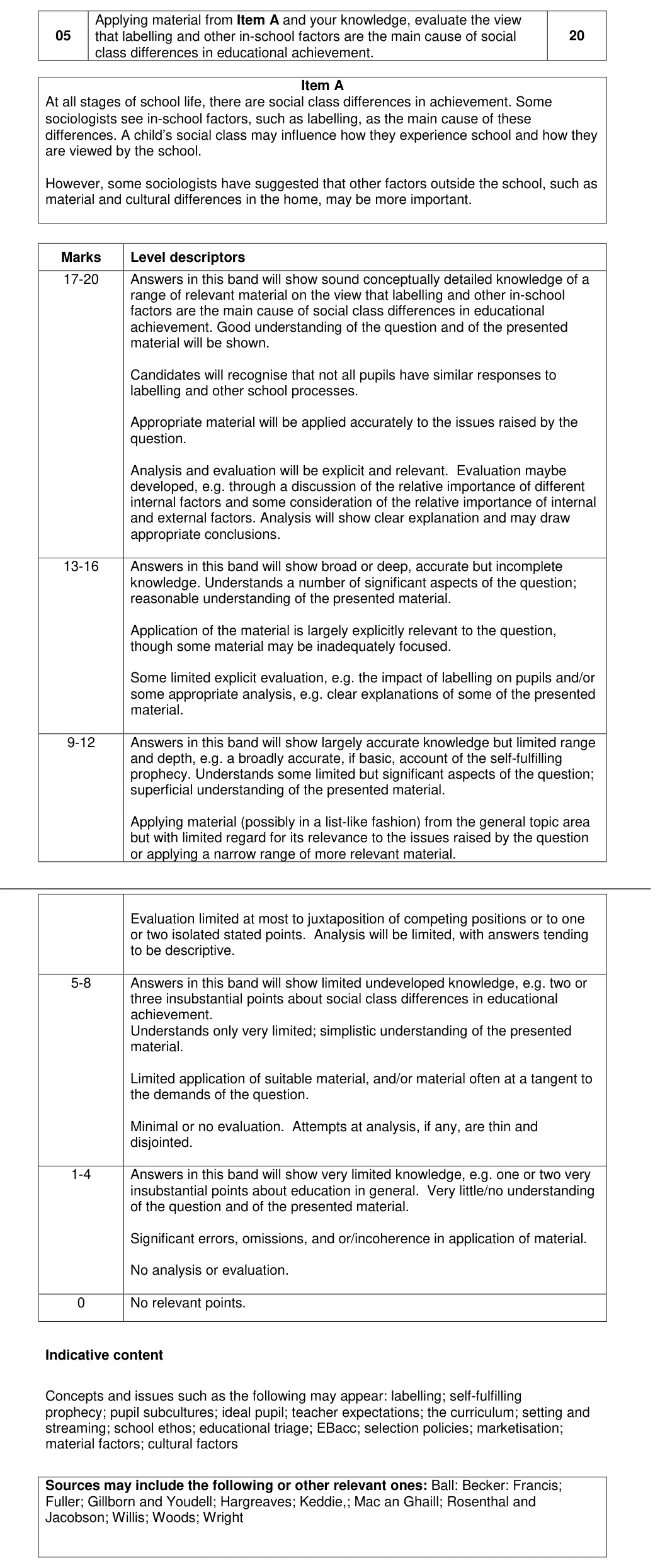
Applying material from Item A and your knowledge, evaluate the view that labelling and other in-school factors are the main cause of social class differences in educational achievement.
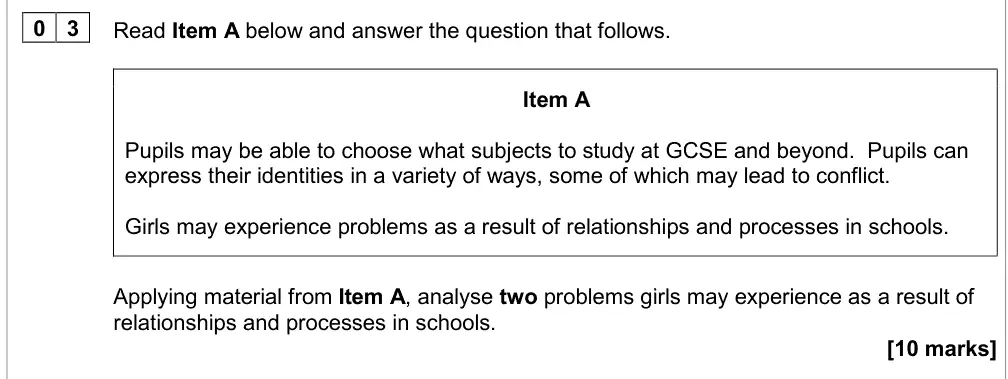
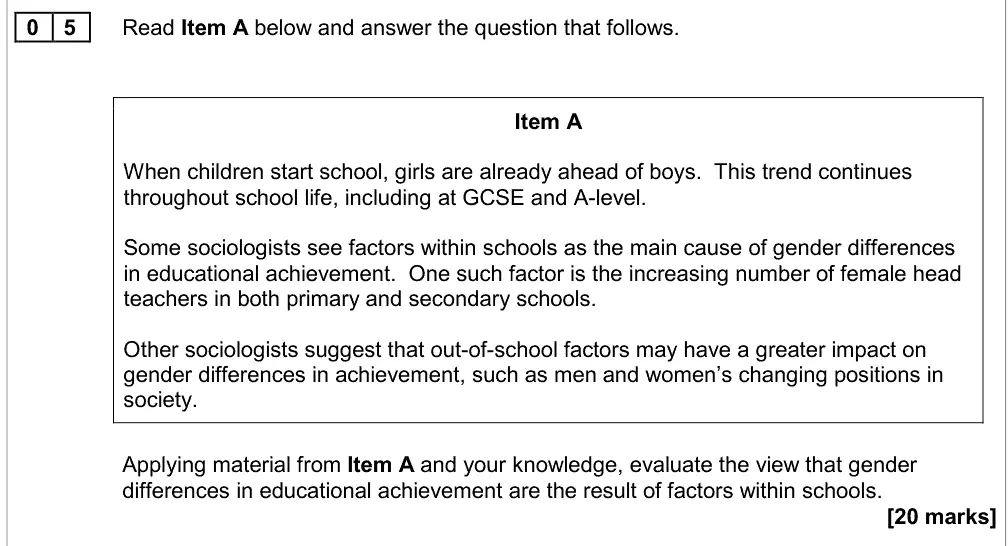
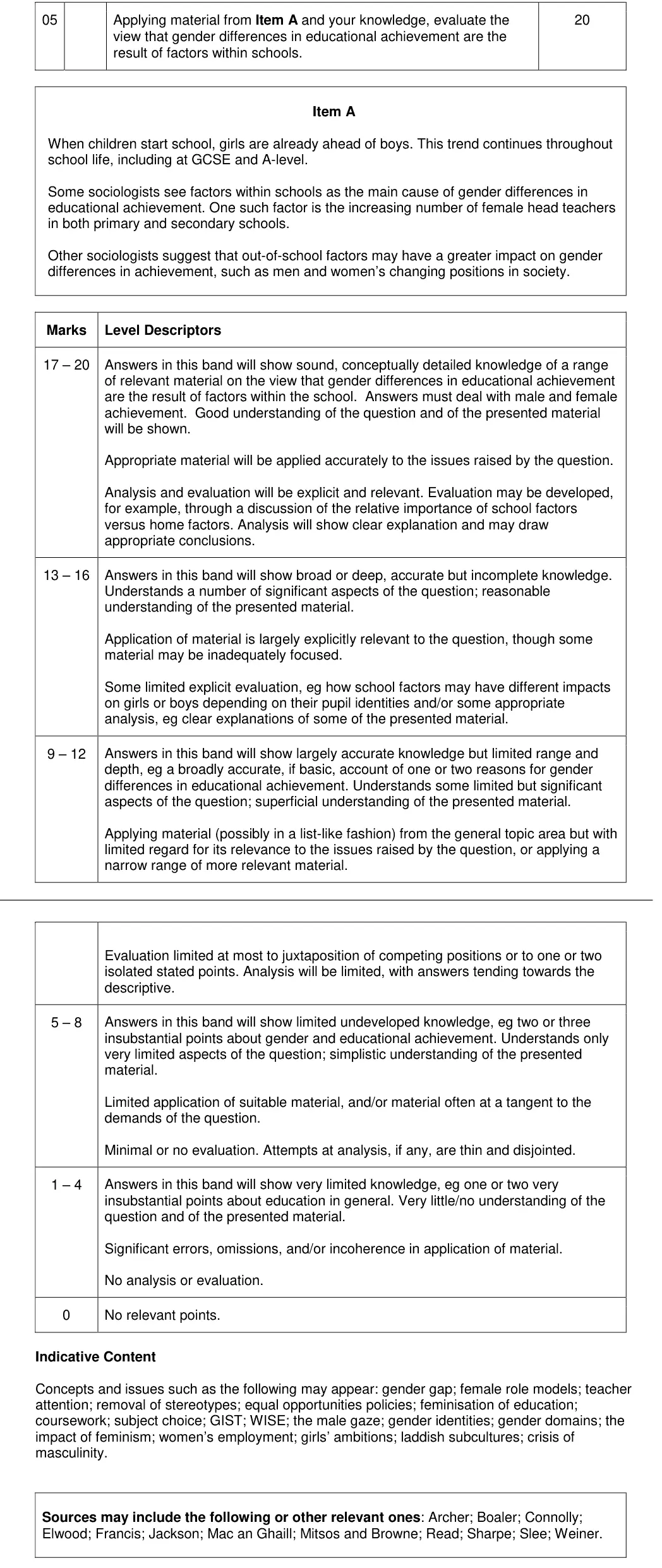
Applying material from Item A and your knowledge, evaluate the view that gender differences in educational achievement are the result of factors within schools.
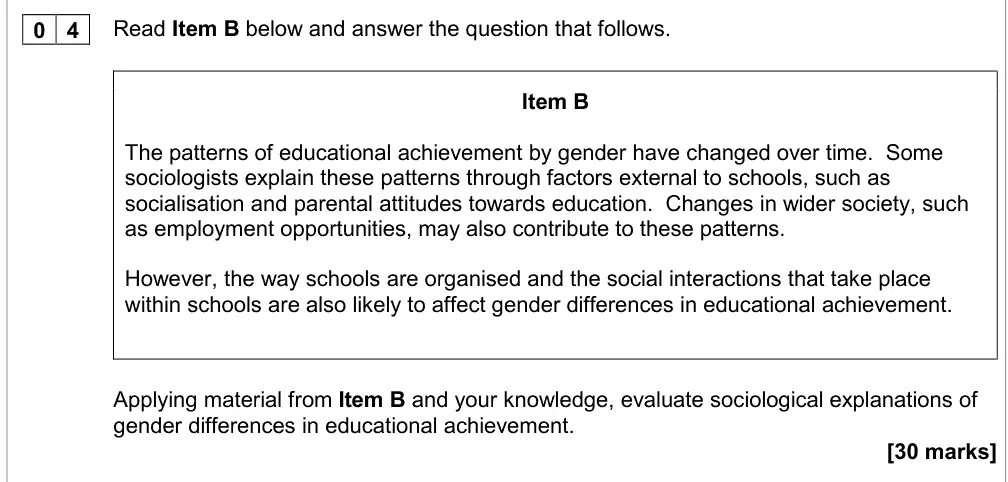
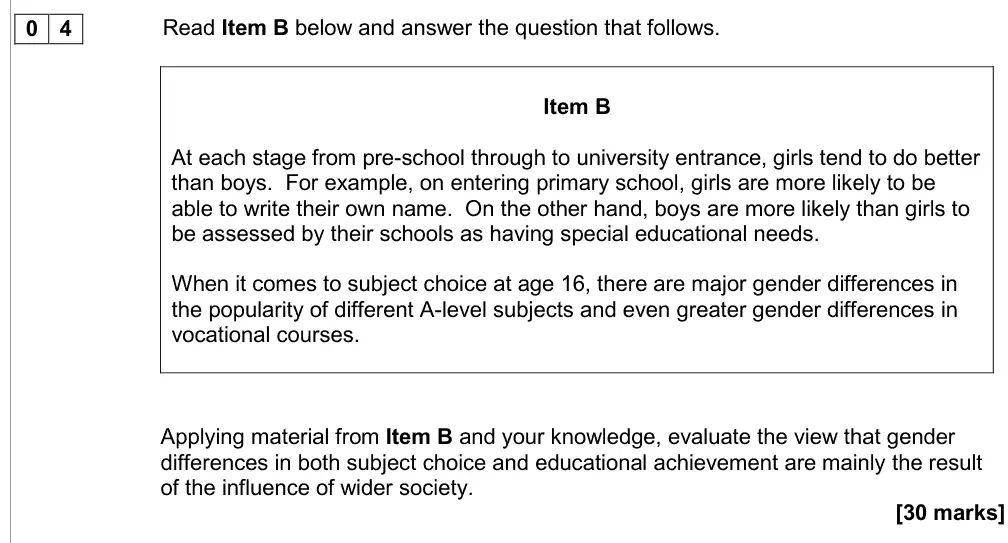
Applying material from Item B and your knowledge, evaluate the view that gender differences in both subject choice and educational achievement are mainly the result of the influence of wider society.
Tap a question to zoom it. The mark scheme (with the level descriptors and indicative content) and the examiner's comment open underneath.
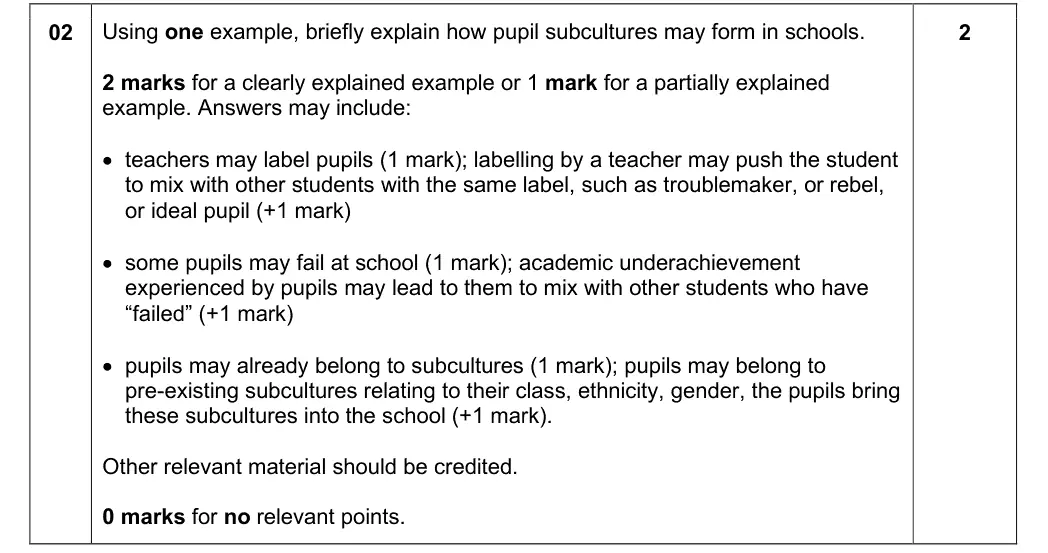
June 2025 · AS Paper 1 · Q22 marksAO2=2Brief explain
Mark scheme
Examiner's comment
This question was well answered on the whole. Many students were able to select a reason that may prompt the formation of a subculture, gaining the first mark. However, fewer were able to expand on this and relate this to how this results in the group forming. Credit was given for both pro and anti-school subcultures along with other pupil adaptations.
Notes from the mark scheme and report
2 marks for a cause (labelling, academic failure, pre-existing class/ethnic/gender subcultures) explained as leading pupils to group together
many gave the cause but not how the group forms
pro- and anti-school subcultures both credited
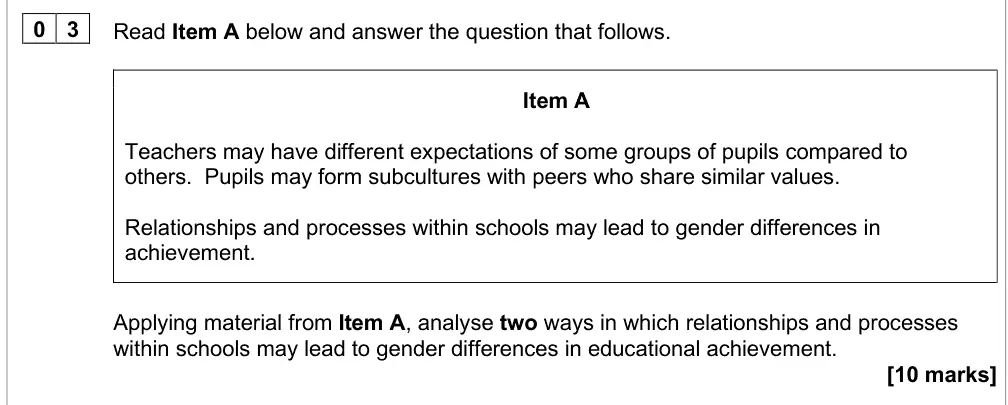
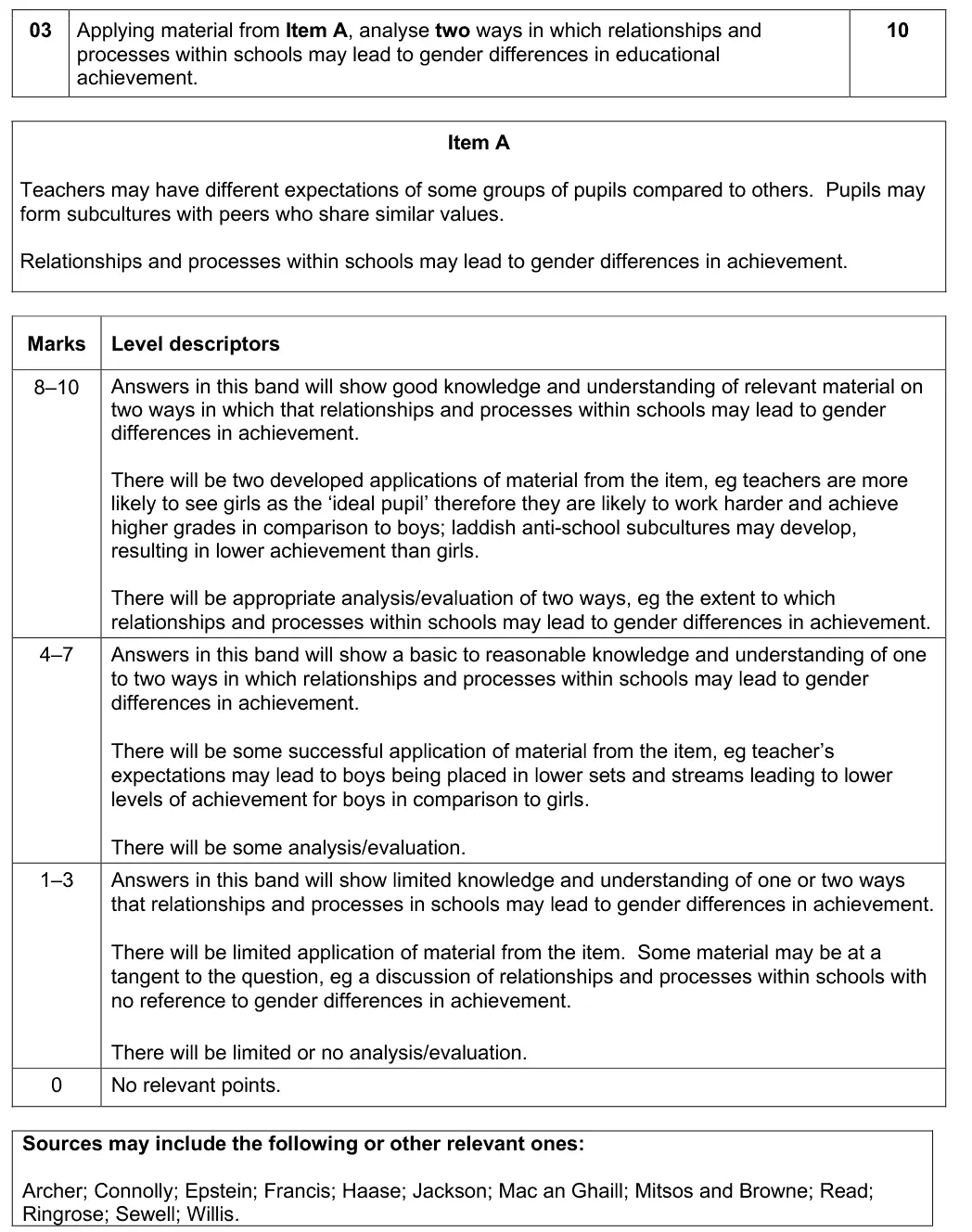
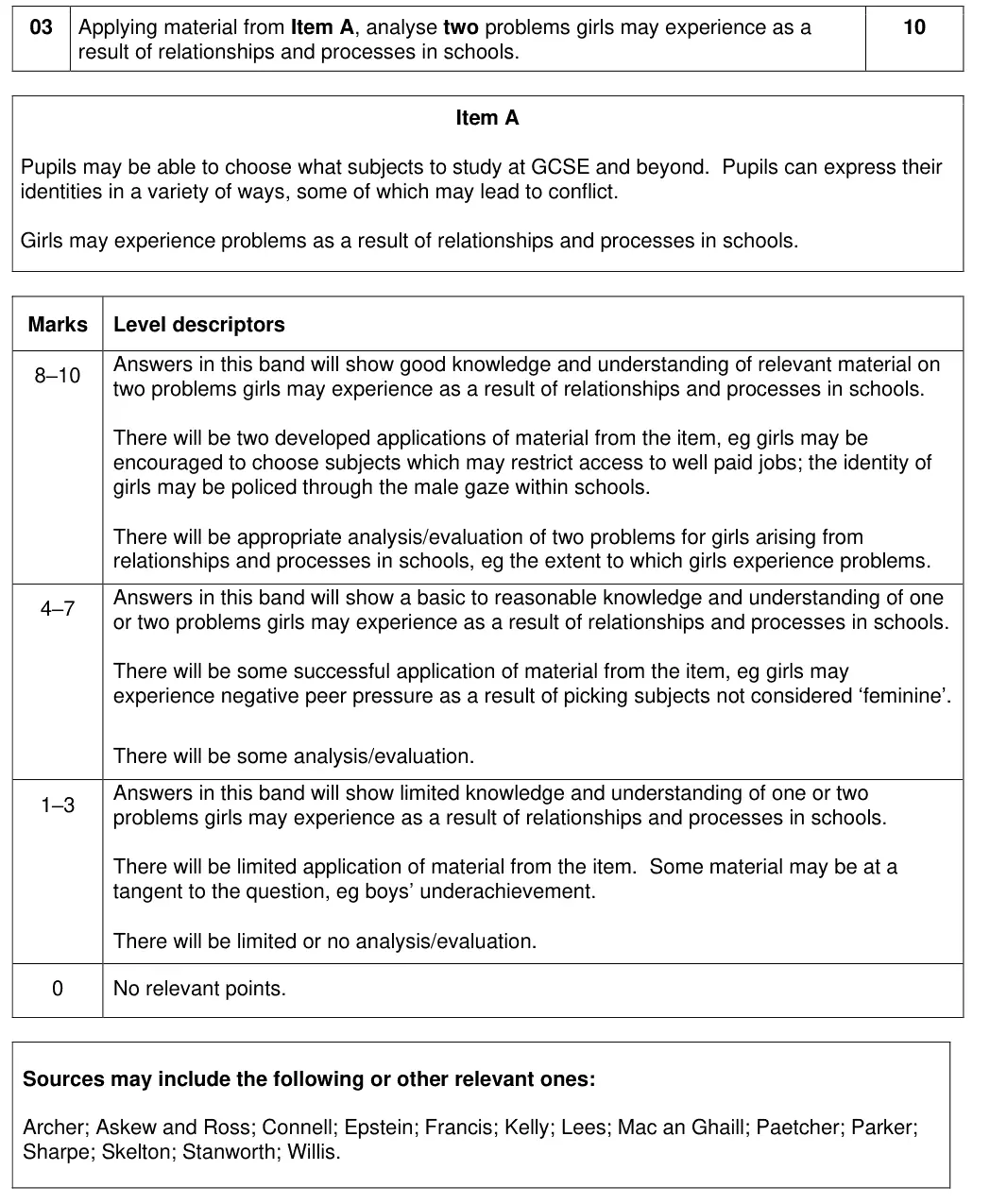
June 2025 · Paper 1 · Q310 marksAO1=3, AO2=4, AO3=3Analyse
Mark scheme, including the levels grid and indicative content
Notes from the mark scheme and report
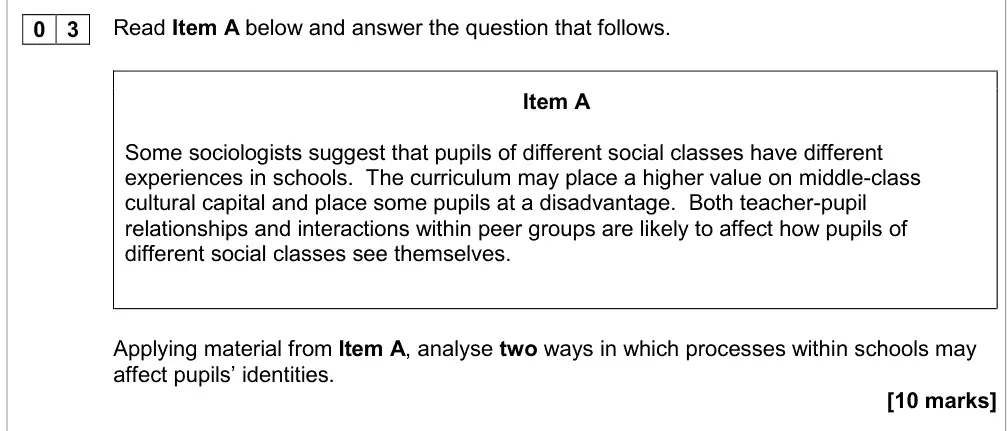
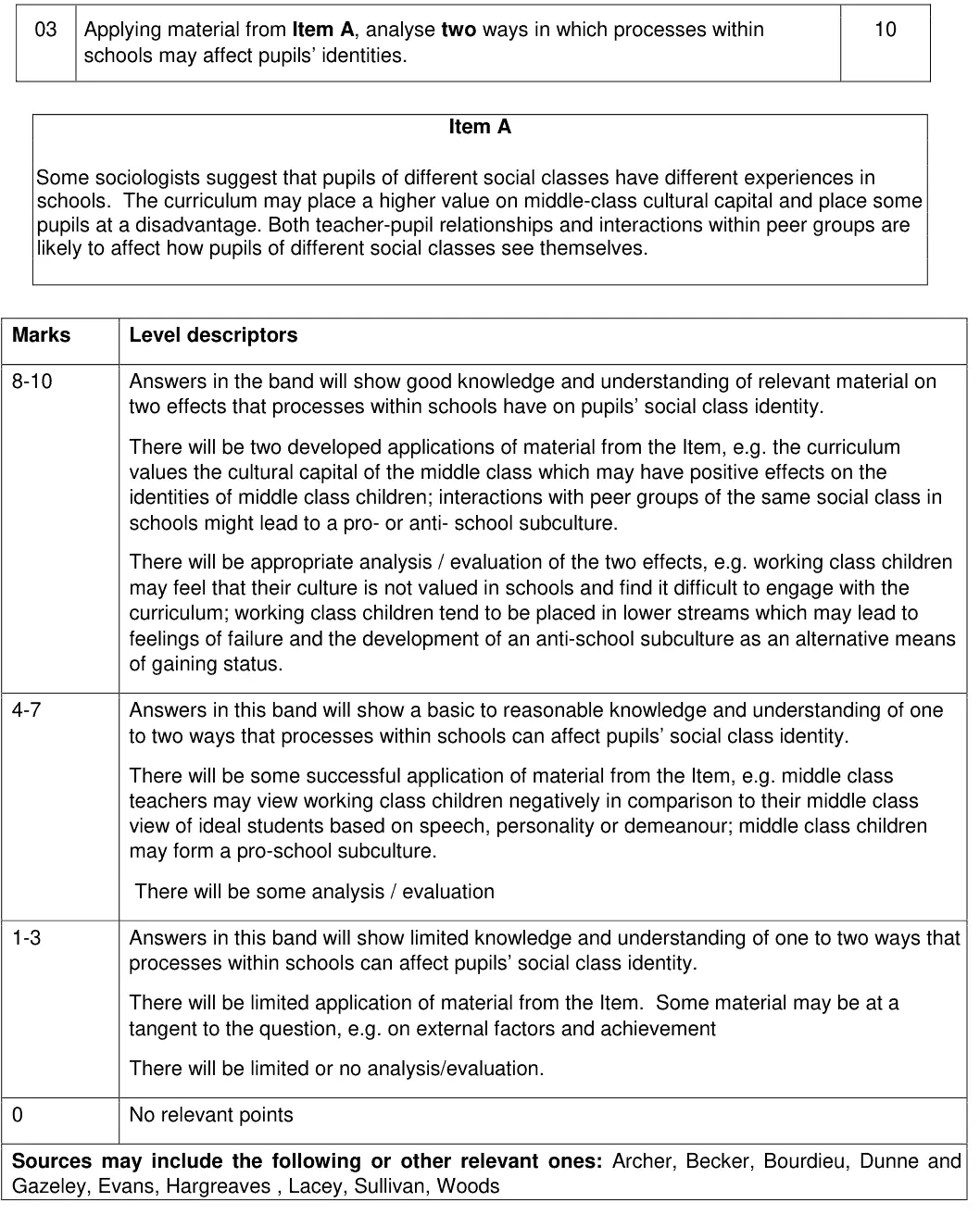
must develop hooks from Item A (teacher expectations, peer subcultures)
top band: two developed applications, e.g. girls seen as the ideal pupil, laddish anti-school subcultures
boys placed in lower sets is a 4-7 example
relationships and processes with no link to gender achievement are a tangent
the last line of the item restates the question
no examiners' report published
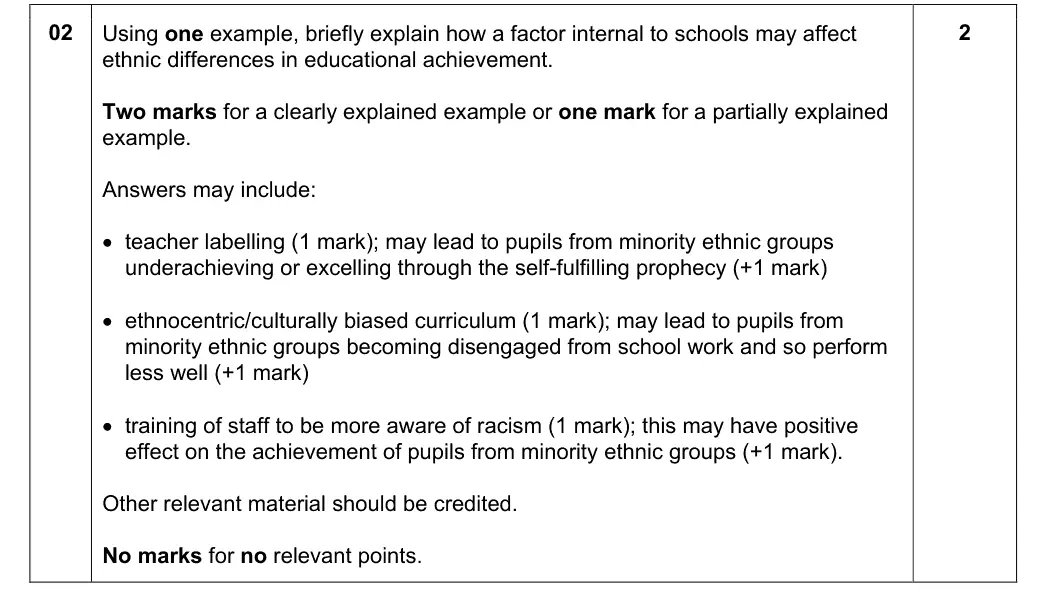
June 2024 · AS Paper 1 · Q22 marksAO2=2Brief explain
Mark scheme
Examiner's comment
Question 02: This question was answered well by most students. They were able to identify an internal factor and then apply it to differential achievement amongst different ethnic groups. A minority identified external factors. This could still be awarded if then linked to an internal factor eg. language barriers in the school. However, some students did not make the link. Partial credit was given for identification but an insufficient link to achievement.
Notes from the mark scheme and report
1 mark for an internal factor (e.g. labelling, ethnocentric curriculum, anti-racism training), +1 for linking it to ethnic differences in achievement
answered well
a minority wrongly gave external factors
June 2024 · Paper 1 · Q310 marksAO1=3, AO2=4, AO3=3Analyse
Mark scheme, including the levels grid and indicative content
Examiner's comment
This question appeared to pose more challenges than in previous years, particularly regarding the use and application of the ‘hooks’ (prompts to be developed) provided in the item. While many students effectively utilised the first hook, concerning subject choice and its potential problems for girls, there was variation in how well the second hook about identity expression and conflict was addressed. Some students mistakenly focused on boys' experiences despite the question specifically asking about girls. It is crucial to emphasise that the last sentence of the item, which paraphrases the question, is not intended to be used as a hook for developing answers. This has been highlighted in previous examiner reports and continues to be an issue. Students should be reminded that these sentences that simply paraphrase the question should not be used as a hook for developing responses. The subject choice hook was developed in various ways, to varying degrees of success. There were excellent responses that discussed how career guidance and societal expectations might influence girls' subject choices. These responses pointed out that girls are often guided away from traditionally male- dominated fields like STEM, impacting their future career opportunities. Moreover, some students provided thorough evaluations by discussing recent efforts in schools, such as gender-neutral policies and initiatives (including GIST and WISE) aimed at encouraging more inclusive subject choices. This critical engagement demonstrated a deep understanding of the topic and an ability to connect theoretical concepts to practical educational policies. While the second hook about identity expression and conflict was not as commonly well-utilised, there were notable examples where it was effectively addressed. Some students explored issues like hyper- heterosexual identities and the male gaze, discussing how these factors could affect girls' experiences in school and their educational outcomes. These responses provided a nuanced analysis of how identity expression can lead to conflicts or challenges within the school environment.
Notes from the mark scheme and report
hooks: subject choice and identity expression leading to conflict
the last line of the item restates the question and is not a hook
e.g. gendered subject choice and careers advice steering girls from STEM, policing of girls' identities by the male gaze
drift into boys' underachievement = 1–3
identity hook less often used well
GIST/WISE credited as evaluation
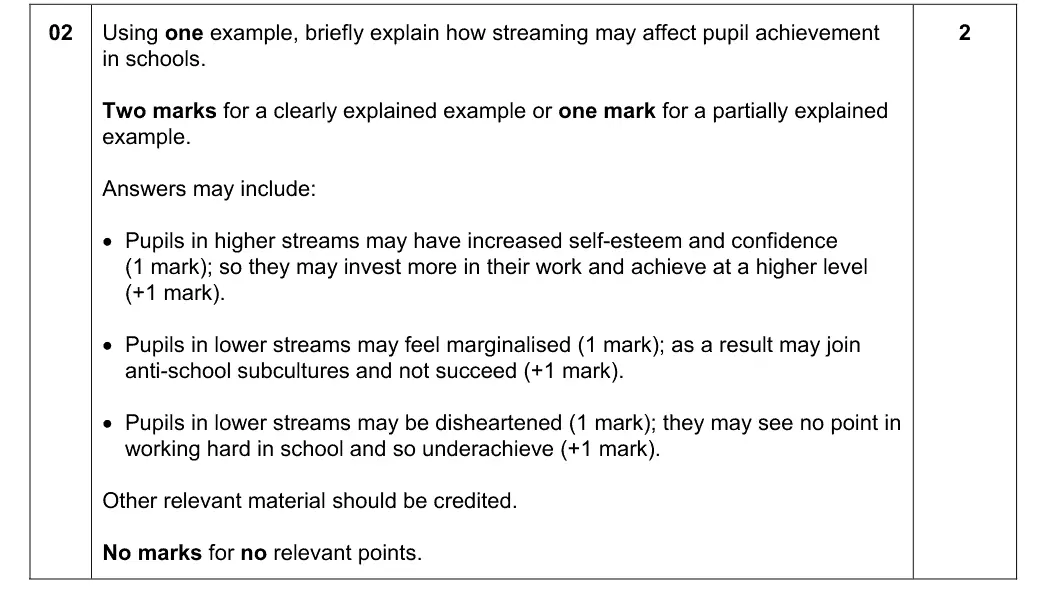
June 2023 · AS Paper 1 · Q22 marksAO2=2Brief explain
Mark scheme
Examiner's comment
It was evident that students had been well-prepared to understand the demands of the different styles of questions, giving appropriately short responses to the 2 mark questions and using bullet points in their answers to question 3. Question 02: This question required students to show an understanding of how streaming (as a cause) may impact student achievement (effect). In order to do so, students needed to show an understanding of ability grouping within a school setting and that there is an element of being in a ‘higher’ or ‘lower’ ability group. Many were able to show this skill, with students most frequently suggesting that being in a lower ability grouping could place a label of ‘low achiever’ on a pupil which they would then internalise to create a self-fulfilling prophecy by attaining low grades in final exams. Where answers didn’t receive full credit, generally this was due to a description of a school class in general (no link to high/ low ability), or that they compared different types of schools.
Notes from the mark scheme and report
must show cause (streaming) and effect on achievement
credited: higher streams gain confidence, lower streams feel marginalised and join anti-school subcultures or give up
most common answer: lower-stream label internalised as a self-fulfilling prophecy
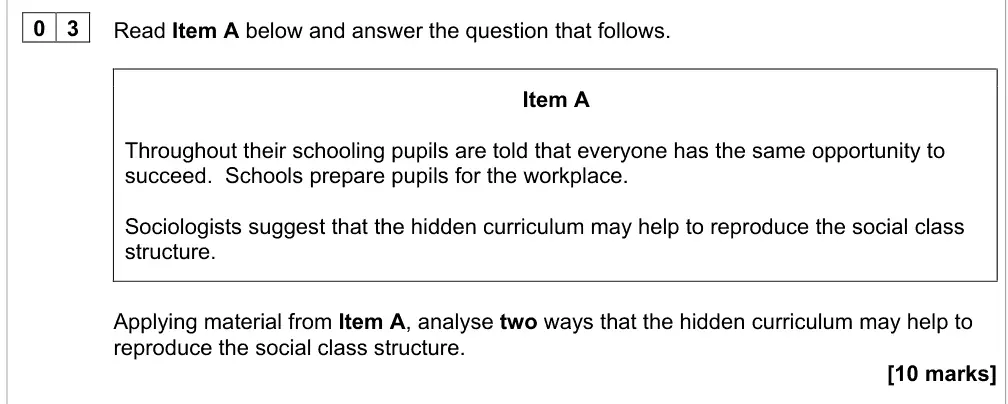
June 2023 · Paper 1 · Q310 marksAO1=3, AO2=4, AO3=3Analyse
Mark scheme, including the levels grid and indicative content
Examiner's comment
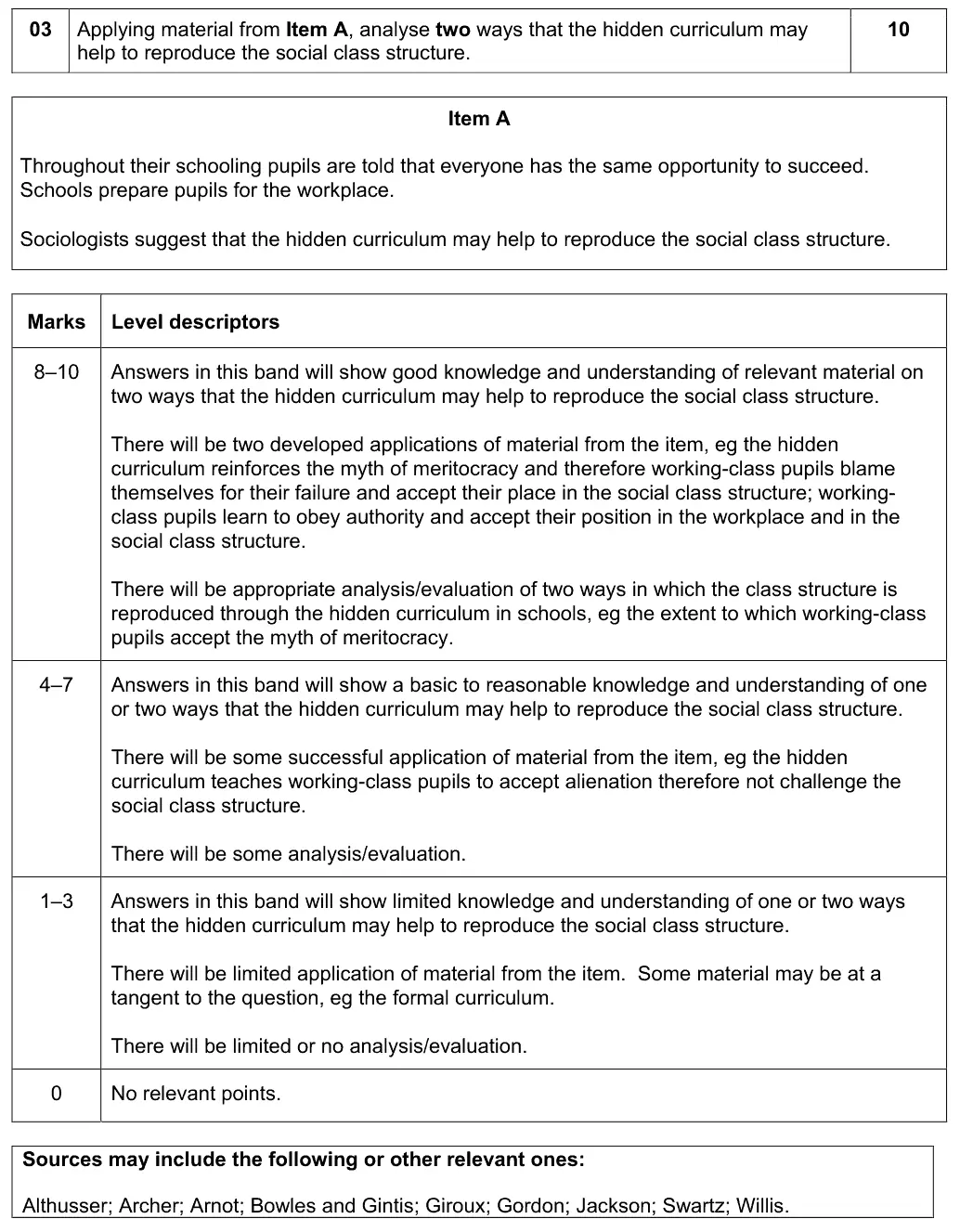
In general, this question was answered well and students were able to apply good knowledge and understanding of the ways that the hidden curriculum may help to reproduce the social class structure. Most students were able to recognise the hooks in the item and then develop these to varying degrees of success. For example, many were able to develop the hook that ‘pupils are told that everyone has the same opportunity to succeed’ with discussion of Bowles and Gintis theory of the ‘myth of meritocracy’. Some students were then able to develop this further and explain with examples how labelling and setting and streaming may contribute to the myth of meritocracy. The most successful answers were then able to explain how these processes, as part of the hidden curriculum, then help to reproduce the social class structure. For example, some explained that the working class were more likely to be placed in lower sets and therefore miss out on top knowledge that prevents them from achieving upward social mobility. There were some students who attempted to use the item by making reference to the last line of the item which is a rewording of the question and should not be seen as a valid use of any hook that requires development. However, a small number of students ignored the item and made no reference to the hooks in their answer and therefore were not able to achieve marks in the 4-7 level (or higher). Less successful answers focussed on functionalist explanations of how schools can be meritoracatic but were then unable to say how this helps to reproduce the social class structure. Some answers also drifted into external factors with no clear reference to the hidden curriculum.
Notes from the mark scheme and report
must develop hooks from Item A
no reference to the item = max 3 marks
the last line of the item restates the question and is not a hook
formal curriculum is a tangent
weaker answers drifted into external factors or functionalist meritocracy without linking to class reproduction
best answers linked the myth of meritocracy, labelling and setting to reproduction of class
June 2022 · Paper 1 · Q14 marksAO1=4Outline
Mark scheme
Examiner's comment
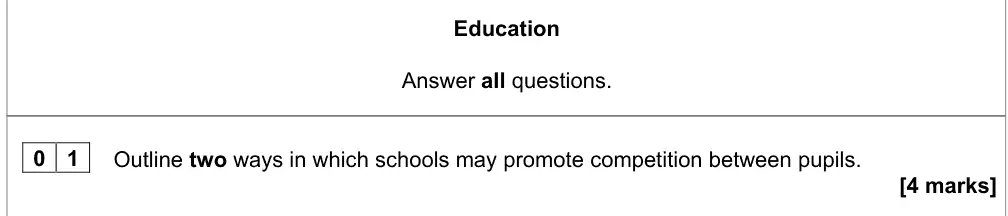
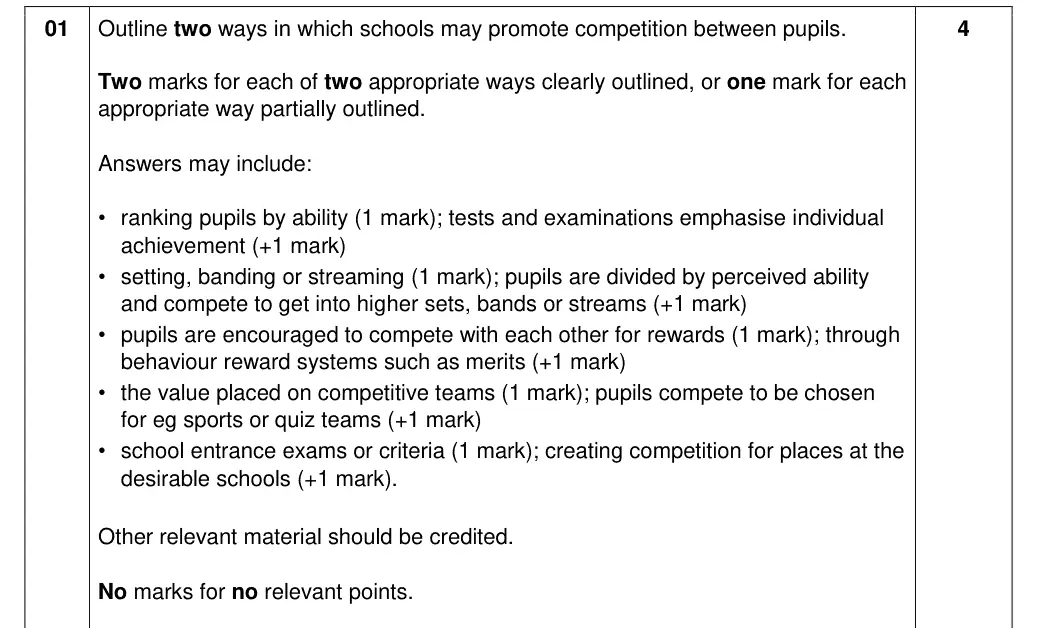
This question appeared very accessible to students. Most were able to outline at least one way that schools promote competition between pupils with half of the cohort achieving all of the available marks. The majority of successful answers included the way schools set assessments to rank pupils, school reward systems and competitive teams within schools. Unsuccessful answers focused on government policies such as league tables without any reference to the way that schools then promoted competition between pupils.
Notes from the mark scheme and report
2 marks for each of two ways clearly outlined, 1 if partial (e.g. ranking by tests, setting/streaming, reward systems such as merits, competitive teams, entrance exams)
accessible, half the cohort scored full marks
government policies such as league tables with no link to how schools make pupils compete were not credited
June 2022 · AS Paper 1 · Q22 marksAO2=2Brief explain
Mark scheme
Examiner's comment
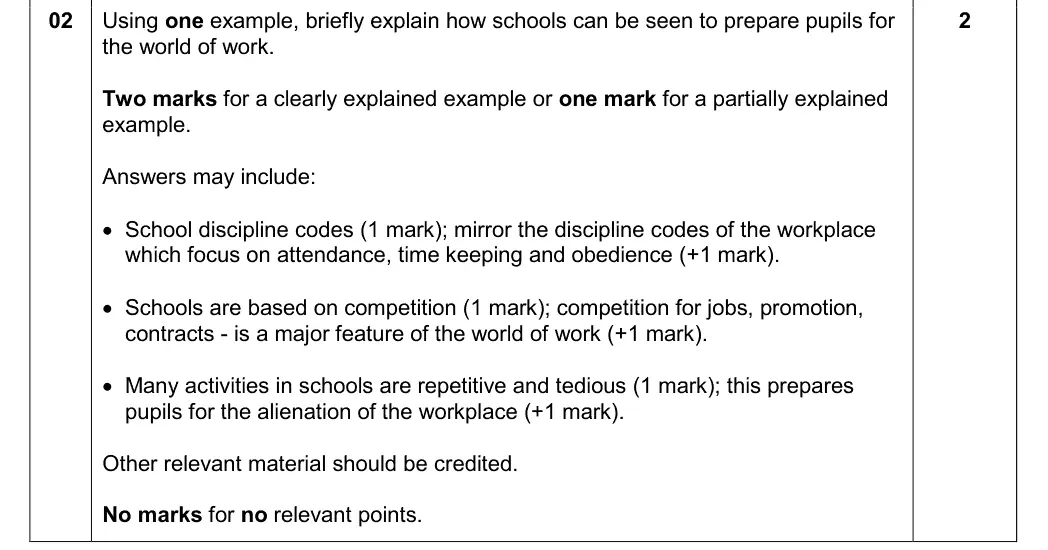
This question was answered very well by most students. Centres have clearly taught the correspondence principle well and this was used by many students to gain full marks. Other students were equally successful using a less theoretical approach, giving practical examples from schools. Where some students missed available marks, they tended to lack an explicit link to the world of work.
Notes from the mark scheme and report
1 mark for the example +1 for explaining the link to work (discipline codes and punctuality, competition, repetitive tasks and alienation)
answered well, often via the correspondence principle or practical school examples
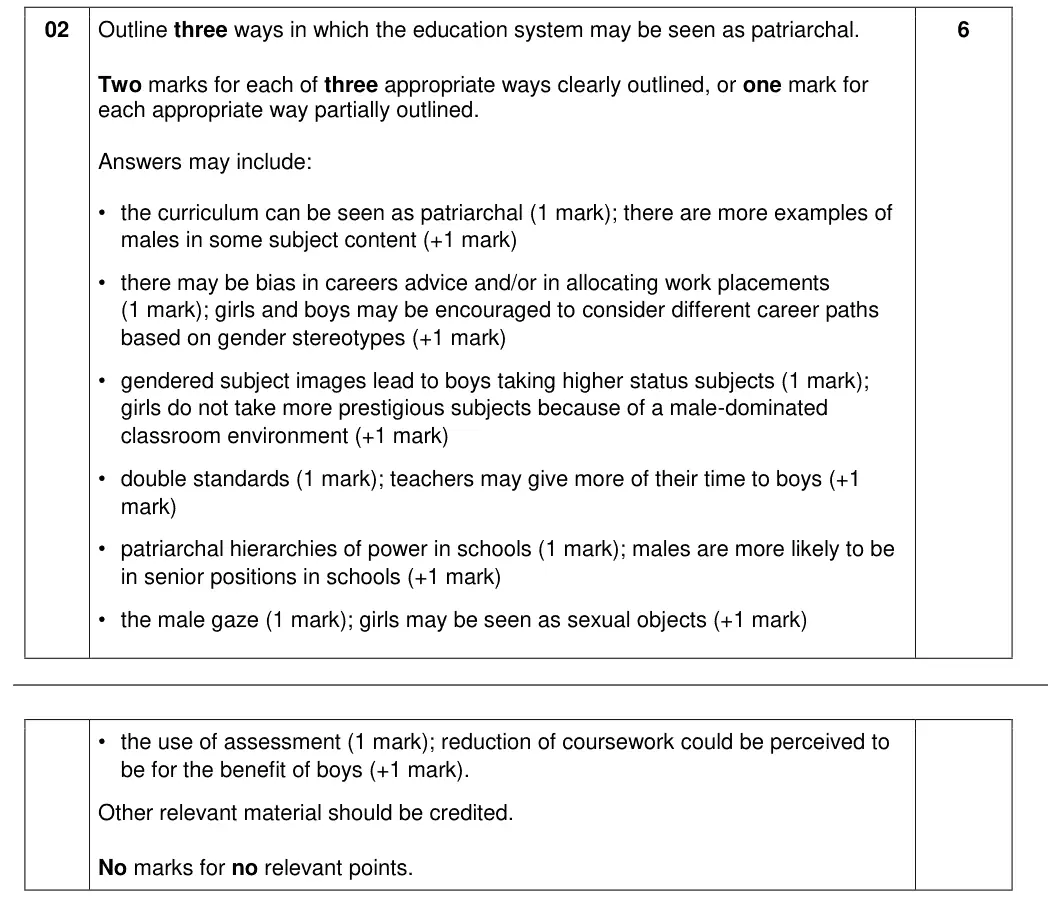
June 2022 · Paper 1 · Q26 marksAO1=3, AO2=3Outline
Mark scheme
Examiner's comment
This question was generally answered well. The majority of students were able to offer at least one or two ways that the education system may be seen as patriarchal. There was a wide range of responses which included male dominance in more senior roles within schools and gender bias in careers advice. Some students struggled to gain full credit for their answers where their response was generic and not linked clearly to differences in power. For example, some simply stated ‘subject choice’ whereas more successful answers included the way that females may be less encouraged to choose more prestigious subjects as a result of existing gendered stereotypes. A very small number of students did not seem to understand the term ‘patriarchy’ and their answers focussed instead, for example, on social class inequalities.
Notes from the mark scheme and report
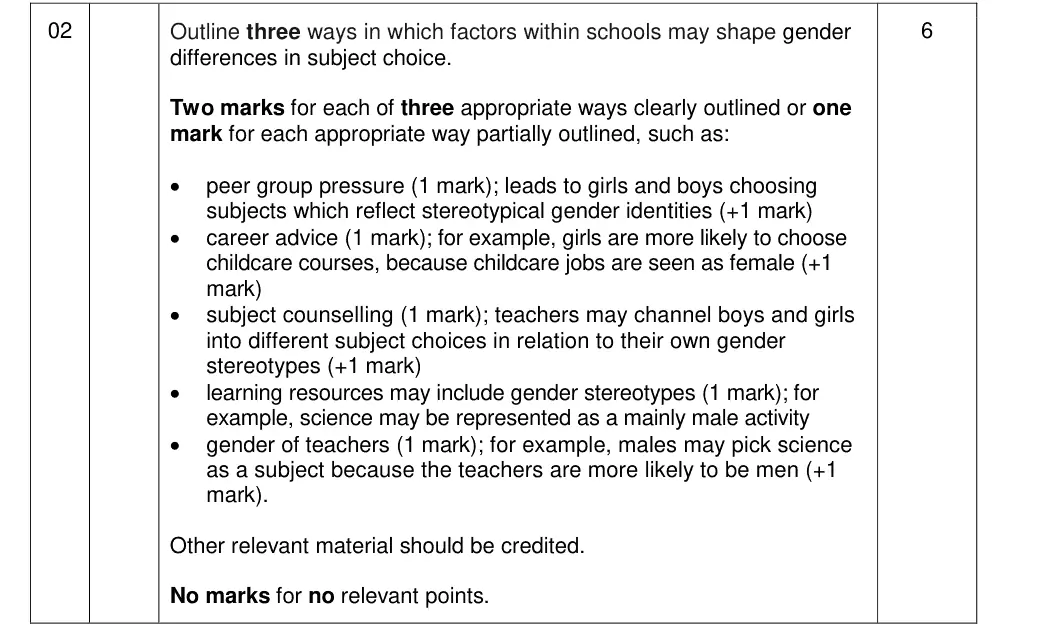
2 marks for each of three ways clearly outlined, 1 if partial (e.g. male-centred curriculum, gendered careers advice, men in senior posts, teacher attention, male gaze, assessment changes favouring boys)
bare 'subject choice' without a link to gendered power gets partial credit
a few misunderstood patriarchy and wrote about social class
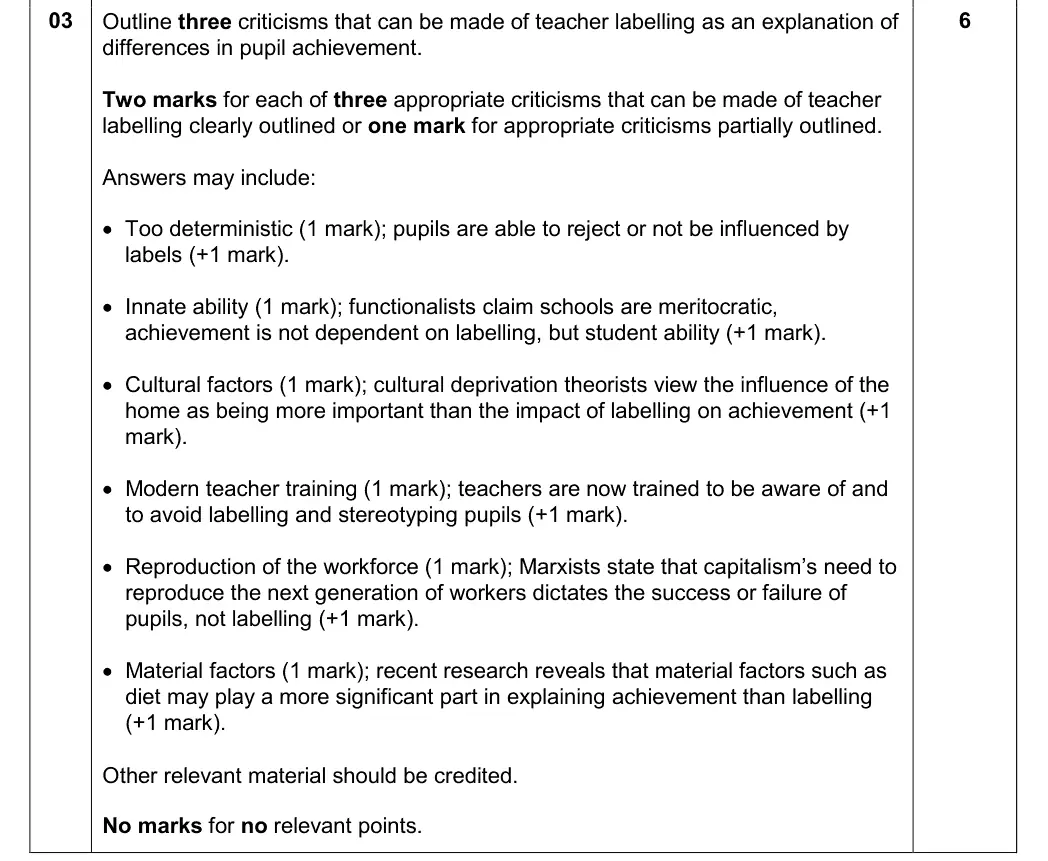
June 2022 · AS Paper 1 · Q36 marksAO1=3, AO2=3Outline
Mark scheme
Examiner's comment
The responses to this question showed that students have a good deal of knowledge about labelling theory. Unfortunately, many students did not gain credit, as their responses critiqued the process of labelling itself, rather than criticising the theory of labelling. Those who were able to gain marks in this question often used the example of the self-refuting prophecy to show that the theory can be too deterministic.
Notes from the mark scheme and report
2 marks for each of three criticisms clearly outlined, 1 if only partially outlined
credited: too deterministic, innate ability/meritocracy, cultural or material factors more important, teacher training, Marxist reproduction
many criticised the labelling process itself rather than the theory and scored nothing
self-refuting prophecy used well for determinism
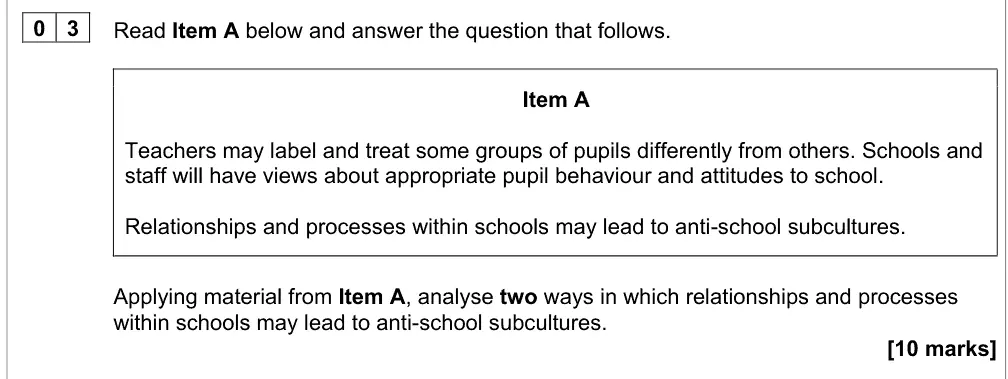
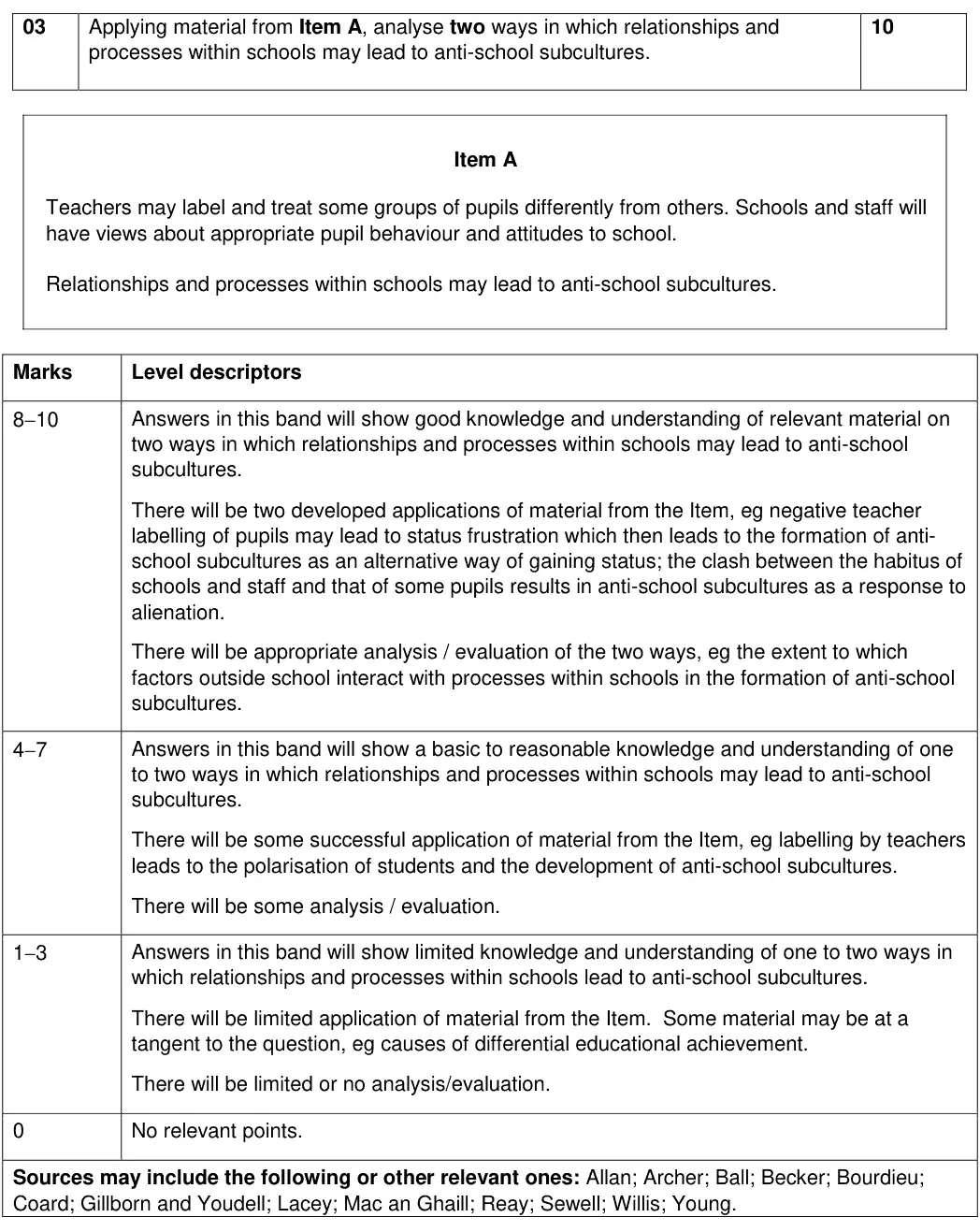
June 2022 · Paper 1 · Q310 marksAO1=3, AO2=4, AO3=3Analyse
Mark scheme, including the levels grid and indicative content
Examiner's comment
The vast majority of students were able to apply at least one way in which relationships and processes within schools may lead to anti school subcultures to the available hooks. Most students were able to develop the hook that ‘teachers may label’ pupils and were able to explain how this may result in the development of anti-school subcultures. Many students were able to apply sociological studies such as from Becker, Rosenthal & Jacobson and Woods etc. More successful answers referred to a range of sociological concepts in their answers which included the ‘self- fulfilling prophecy’ and ‘polarisation’. Some answers offered some effective explicit evaluation in explaining that some students may reject these labels,with some references to Fuller’s study. However, many students struggled to get into the 8-10 mark band. This was usually the result of not offering a clearly separate way (often overlapping very similar ideas in both parts of the answer) that relationships and processes within schools may lead to anti-school subcultures using the hooks. The most successful answers tended to utilise the second hook about schools having ‘views about appropriate pupil behaviour’ and apply this in the intended way in explaining that some pupils experience ‘symbolic violence’ due to the differences in ‘habitus’ between some teachers and some pupils which may result in some pupils joining anti school subcultures as a form of resistance.
Notes from the mark scheme and report
two developed applications from Item A, e.g. labelling leading to status frustration or polarisation, clash between school habitus and pupils' habitus (symbolic violence)
drift into causes of differential achievement is a tangent
many failed to reach 8–10 because both ways overlapped
best used the second hook about schools' views of appropriate behaviour
evaluation via pupils rejecting labels (Fuller)
November 2021 · Paper 1 · Q26 marksAO1=3, AO2=3Outline
Mark scheme
Examiner's comment
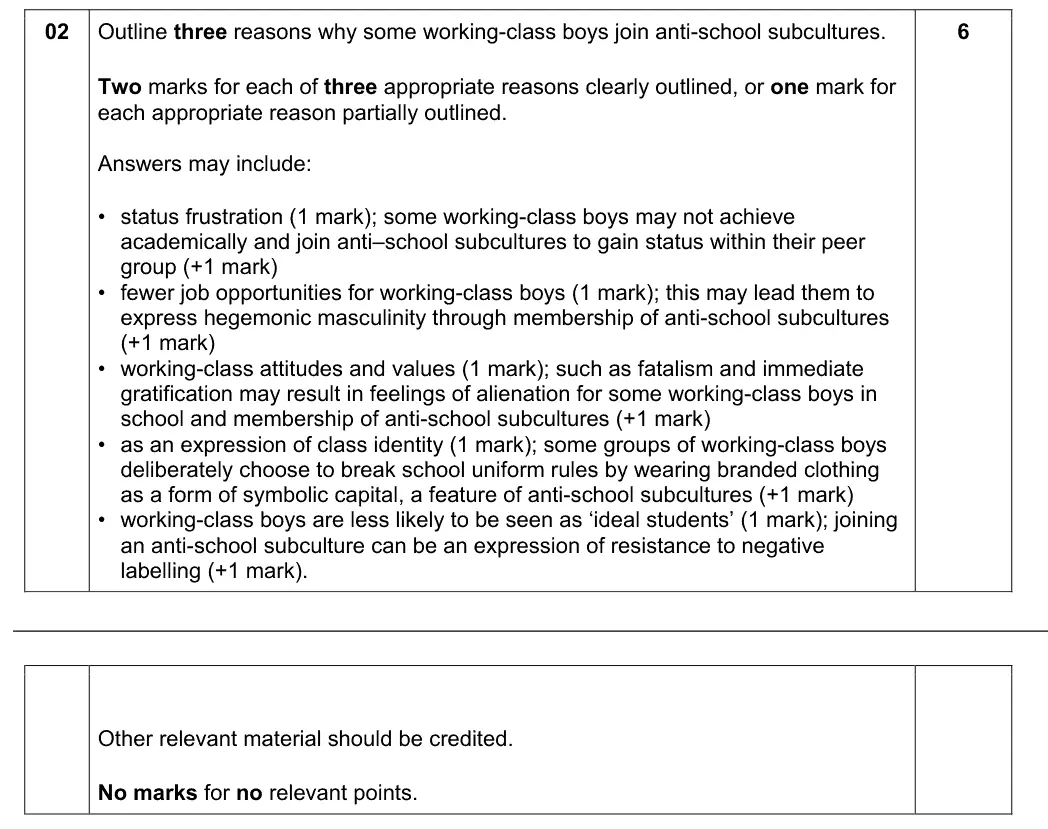
Similarly to previous years, some students wrote lengthy answers to the 4-mark and 6-mark questions which may explain why a few of these students seemed to run out of time in answering the final question(s). Most students could offer at least one or two reasons why some working-class boys join anti- school subcultures. Answers tended to refer to labelling and the self-fulfilling prophecy as well as expressions of identity and/ or fatalistic attitudes. Some students outlined reasons linked more specifically to ethnicity, such as the ethnocentric curriculum, rather than working class boys and therefore were less successful in gaining marks.
Notes from the mark scheme and report
2 marks for each of three reasons clearly outlined
credited: status frustration, labelling and not being the 'ideal pupil', fatalism and immediate gratification, class identity, hegemonic masculinity with fewer jobs
reasons tied to ethnicity (e.g. ethnocentric curriculum) rather than working-class boys were less successful
November 2021 · Paper 1 · Q310 marksAO1=3, AO2=4, AO3=3Analyse
Mark scheme, including the levels grid and indicative content
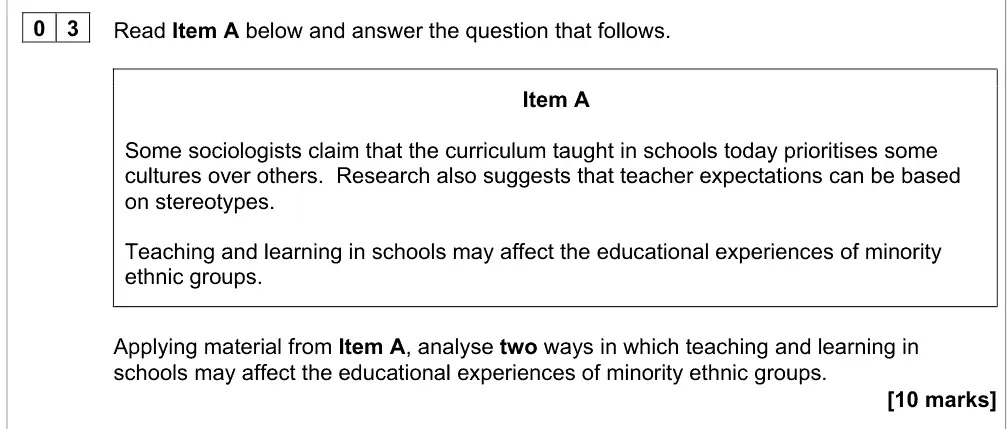
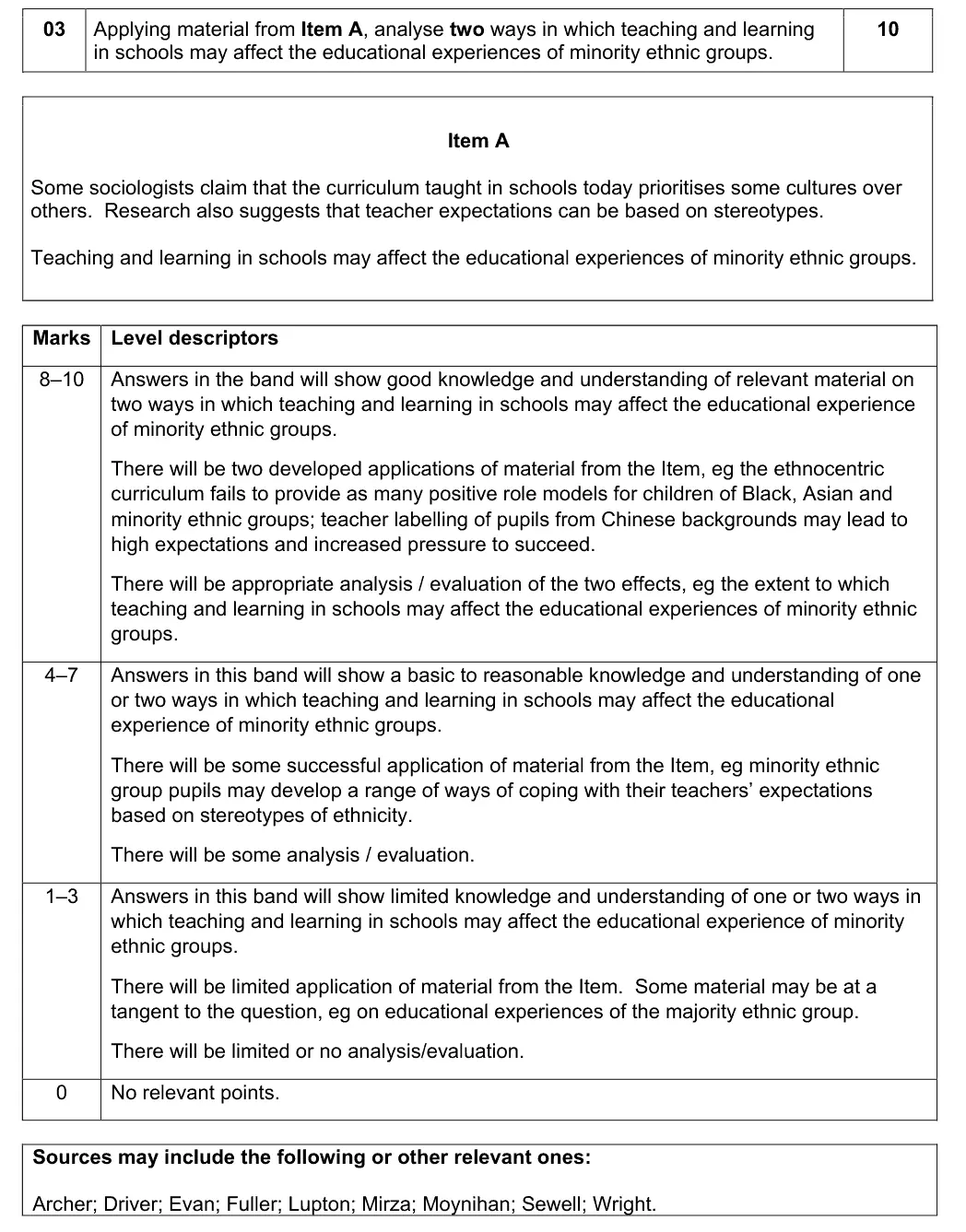
Examiner's comment
In general, this was a well answered question. Most students were able to identify the hooks in the item i.e ‘curriculum prioritising some cultures’ and ‘teacher expectations based on stereotypes’. Many were then able to develop these hooks in explaining ways in which the ethnocentric curriculum and teacher labelling may affect the experiences of some minority ethnic groups, for example, leading to the self-fulfilling prophecy and affecting their self-esteem. Additionally, the most successful answers were able to apply studies and research in providing further detail and analysis of the ways in which minority ethnic groups may be affected by these processes. Furthermore, some were able to provide some explicit evaluation and discussion of the extent to which minority ethnic groups are affected, for example by labelling, in applying Fuller’s research that outlines the ways that pupils may reject their labels.
Notes from the mark scheme and report
must develop hooks from Item A (curriculum prioritising some cultures, stereotyped teacher expectations)
the last line restates the question and is not a hook
credited: ethnocentric curriculum and lack of role models, labelling and self-fulfilling prophecy, high expectations of Chinese pupils
best answers evaluated, e.g. Fuller on rejecting labels
drift into the majority ethnic group = 1–3
November 2020 · AS Paper 1 · Q22 marksAO2=2Brief explain
Mark scheme
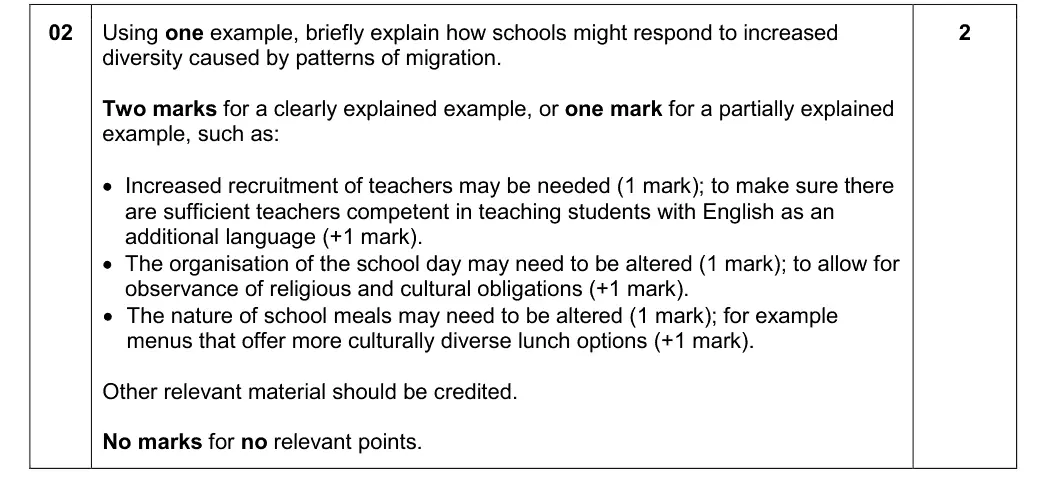
Notes from the mark scheme and report
1 mark for the school response +1 for explaining it (recruiting EAL-competent teachers, adjusting the school day for religious observance, culturally diverse menus)
no examiners' report for this series
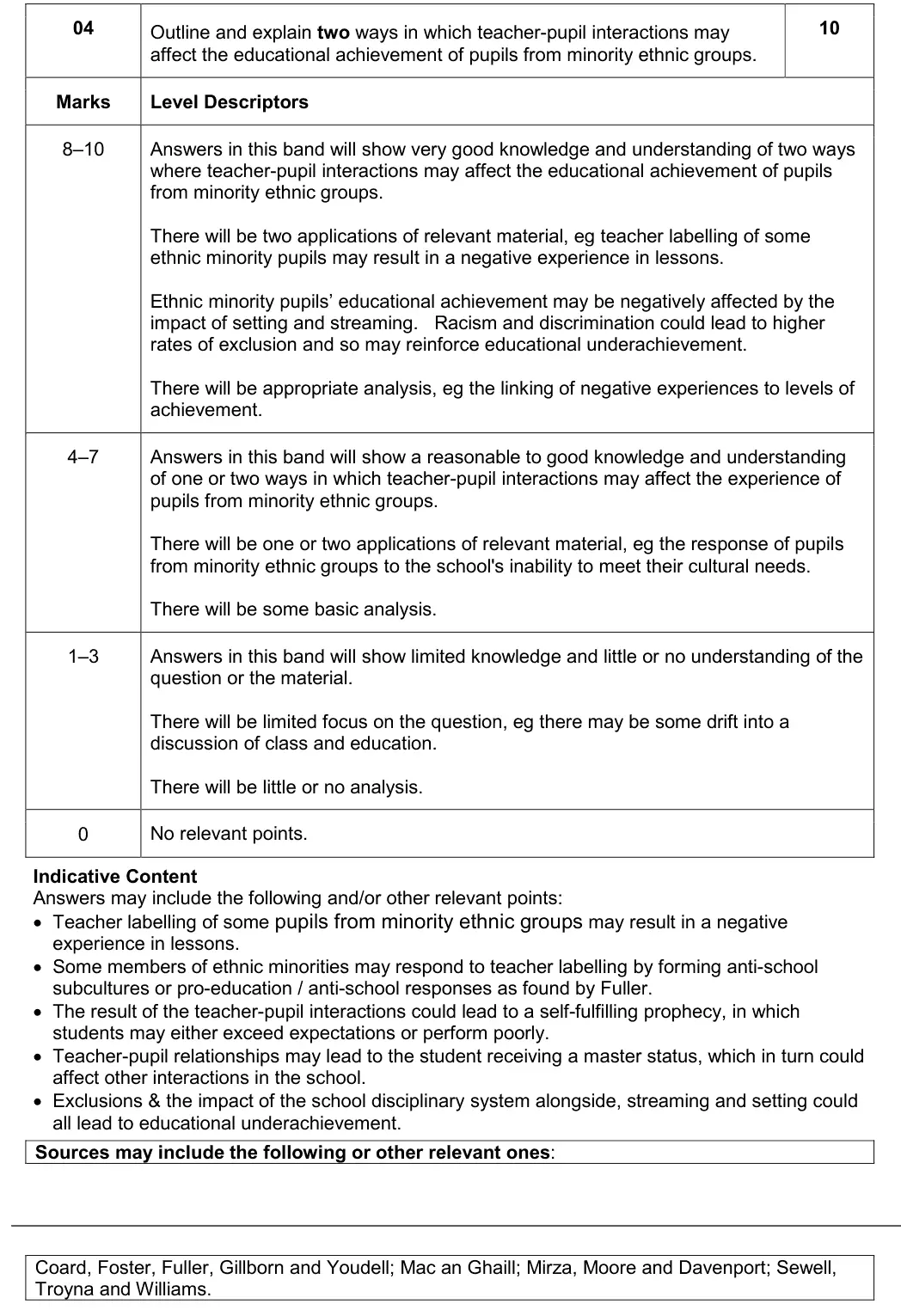
November 2020 · AS Paper 1 · Q410 marksAO1=5, AO2=3, AO3=2Outline and explain
Mark scheme, including the levels grid and indicative content
Notes from the mark scheme and report
must link teacher-pupil interaction to minority ethnic achievement (labelling and self-fulfilling prophecy, setting and streaming, exclusions and racism, pupil responses such as subcultures)
drift into class and education = 1–3
no examiners' report for this series
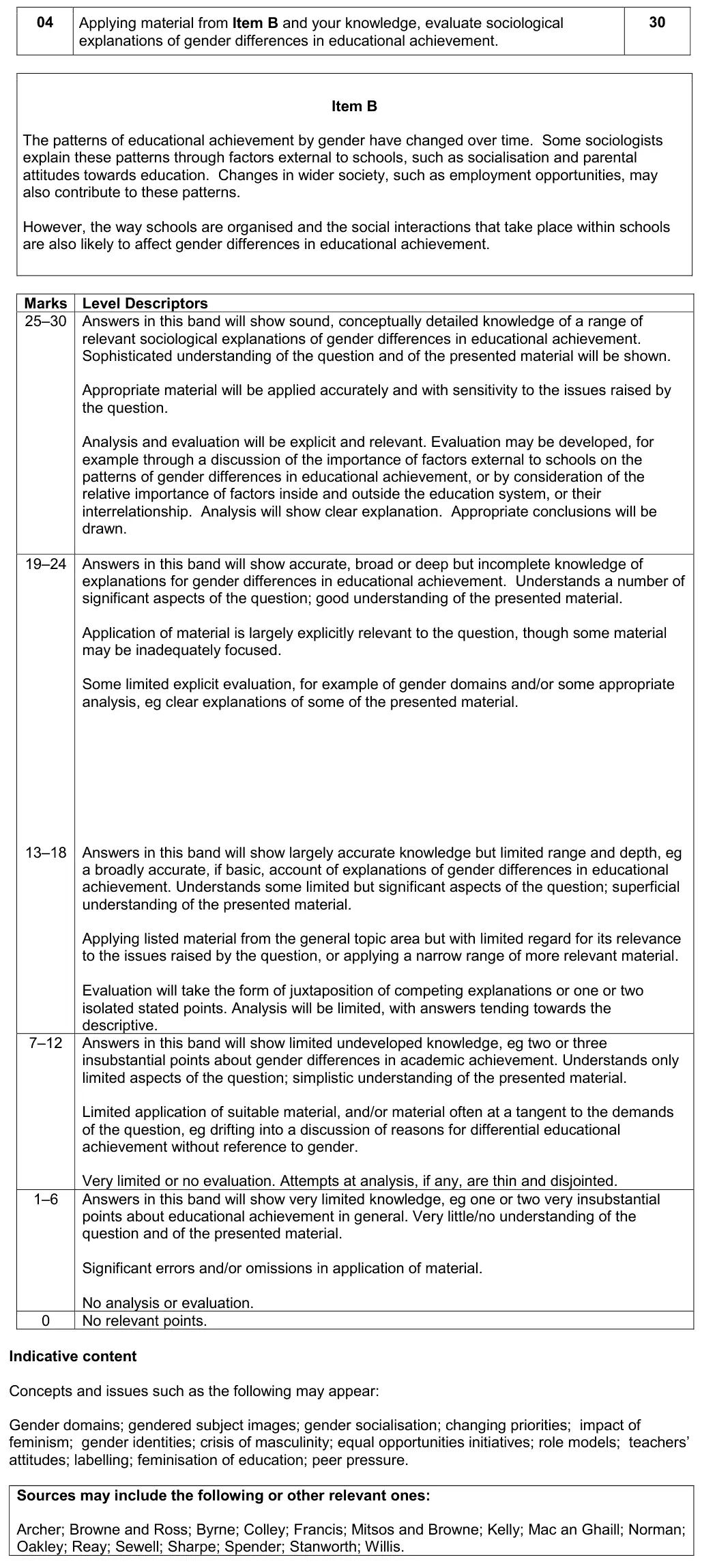
November 2020 · Paper 1 · Q430 marksAO1=12, AO2=9, AO3=930-mark essay
Mark scheme, including the levels grid and indicative content
Examiner's comment
There were a range of responses to this question with a variety of explanations offered - both internal and external to schools. For example, explanations offered included differences in socialisation, feminism, labelling and the self-fulfilling prophecy. Less effective responses tended to be descriptive and limited in the range of explanations offered. A small number of students seemed to focus almost entirely on explaining why ‘girls are underachieving’ and appeared to offer a rather historical account of these differences. More successful answers referred to more recent studies and relevant concepts as they covered a broader range of explanations. Some less effective answers were descriptive of explanations and studies and general to gender differences in schools. Others drifted into explanations of gender differences in subject choice or gender identity without explaining their relevance to achievement. Furthermore, some answers drifted into accounts of social class and/or ethnicity without any reference to differences in gender and achievement. However, more effective answers indicated how these social groups may be interrelated or that, for example, that males and females are not homogenous groups. The better responses clearly applied explanations for gender differences with a focus on achievement. Many students offered basic analysis in their explanations of gender differences in educational achievement, for example, applying these explanations to either males or females separately. A number of responses offered juxtaposed evaluation of internal versus external factors in explaining these gender differences. More successful answers were able to apply some of the explanations in a more analytical way by comparing and contrasting males and females in explaining differences in achievement. Furthermore, these answers were able to offer more critical evaluation in discussing ways that internal and external explanations are interrelated and contribute to differences in gender and achievement. The more effective answers were able to offer explicit evaluation.
Notes from the mark scheme and report
top band weighs external against internal factors or their interrelationship
drift into general differential achievement without gender = 7–12
drift into subject choice or gender identity without linking to achievement
dated accounts of girls underachieving
best compared boys and girls directly, noted they are not homogeneous groups, and used recent studies
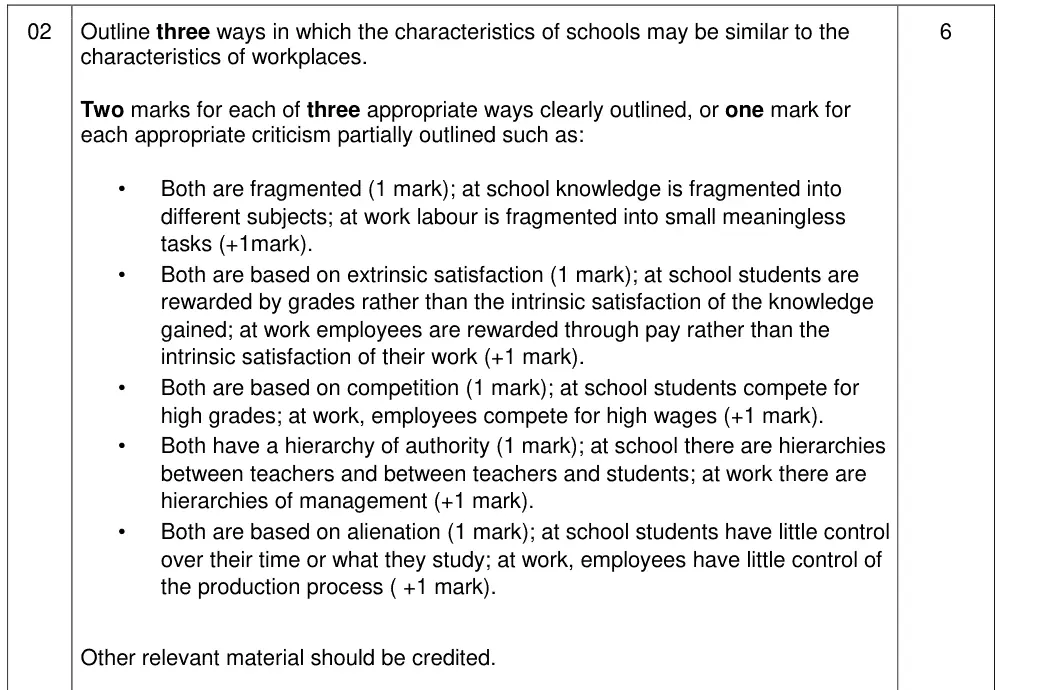
June 2019 · Paper 1 · Q26 marksAO1=3, AO2=3OutlineEasy
Mark scheme
Examiner's comment
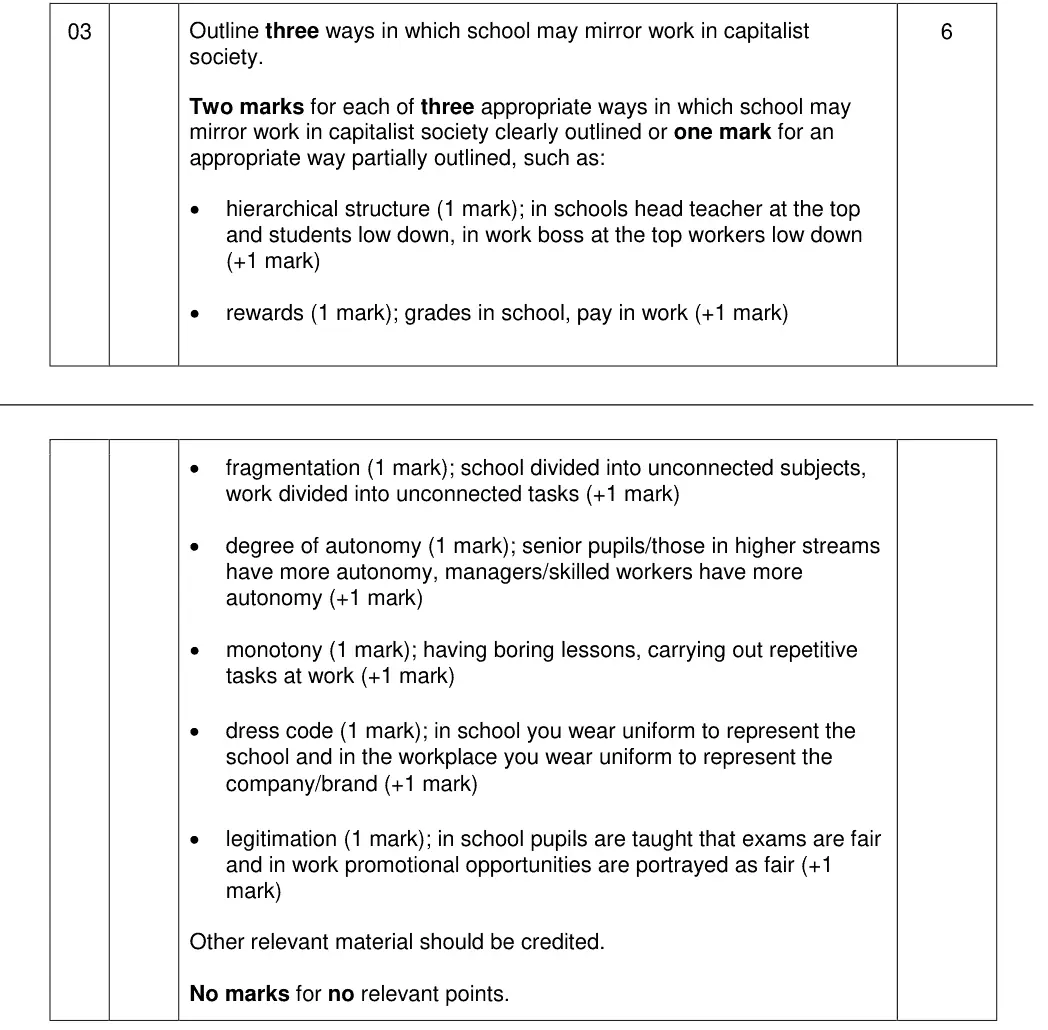
A significant number of students wrote too much for the 4-mark and 6-mark questions, although fewer than in the two previous years. Centres are reminded that these small-mark questions are best answered with a clear ‘point’ and ‘development’ structure, rather than lengthy continuous prose. The question produced a wide range of answers, with most students able to identify and explain at least two reasons. This question had the highest mean mark (79%), as a percentage of maximum mark. Common successful responses gave the examples of hierarchy, dress codes, attendance and punctuality, rewards and punishments and fragmentation of tasks. Students who wrote about the functions of schools from a theoretical perspective, without referring to a characteristic, were less successful. Many students were not awarded a second mark because they failed to give an example of how the characteristics of the school were mirrored in the workplace.
Notes from the mark scheme and report
2 marks for each of three ways clearly outlined
each characteristic must be shown in both school and workplace for the second mark
theoretical accounts of school functions without naming a characteristic did less well
highest-scoring question on the paper
June 2019 · Paper 1 · Q310 marksAO1=3, AO2=4, AO3=3Analyse
Mark scheme, including the levels grid and indicative content
Examiner's comment
The 10-mark item question continues to provide a good illustration of application skills; fewer students than previously failed to identify a ‘hook’ in the item, and fewer failed to apply points successfully from the item, as this question requires. The majority of students were able to explicitly refer to one or two ‘hooks’ from the Item. The hooks that were most commonly used were concerned with the curriculum, teacher-pupil relationships and interaction with peers. The majority of students were able to apply at least one of these key hooks and then successfully link this to processes such as labelling, the use of language codes, subcultures and streaming and how it impacted on the pupil’s identity. Many of the successful responses also drew on the work of Bernstein, Bourdieu, Becker, Lacey and Archer and were able to use studies on pupil identity based on class, gender or ethnicity. Less successful responses mentioned students ‘feeling negative’ and often drifted into issues relating to achievement. However, a minority of students were unable to refer to hooks from the item and wrote about labelling, streaming and pupil subcultures. Despite often giving a detailed knowledge of a process, these responses were unable to score beyond the 1-3 band. Many students found it difficult to relate the process to the appropriate hook, or had limited application to identity, so ended in the 4-7 band. Only a minority of answers were able to get into the 8-10 band by taking two hooks, explaining two processes and applying these to identity, through analysis and evaluation. Often attempts to evaluate were generic and so did not score well. More successful examples of evaluation were applied specifically to the question, such as identify being shaped by external factors, rather than processes in schools.
Notes from the mark scheme and report
must develop hooks from Item A (curriculum and middle-class cultural capital, teacher–pupil relationships, peer groups)
no reference to the item = max 3 marks
focus is pupils' class identity, not achievement
drift into external factors = 1–3
best answers linked two hooks to labelling, streaming, subcultures or speech codes and then to identity
generic evaluation scored poorly
June 2019 · Paper 1 · Q430 marksAO1=12, AO2=9, AO3=930-mark essay
Mark scheme, including the levels grid and indicative content
Examiner's comment
There was also evidence of some very well taught and well prepared students, which was particularly evident amongst responses for Question 04. Most students were able to demonstrate a range of external and internal factors that have an impact on differences in educational achievement between ethnic groups. The majority of students used the item to structure their answers, particularly focussing on “home and family life”, in terms of external factors and ideas around labelling to explore “factors within school”. Many students demonstrated clearly a large amount of conceptual knowledge and a significant number of studies that were accurately applied to the question, particularly the work of Sewell, Bereiter and Engelmann, Fuller, Mirza, Gillborn and Youdell and Archer. The large majority of students were able to get into the 13-18 mark band, and the mean mark for the question was ‘18’. Stronger responses showed both breadth and depth of knowledge with a good range of concepts. Materials were presented analytically with explanations being unpacked. These responses typically identified specific ethnic groups, rather than applying an explanation to all ethnic minorities or to a supposed homogenous group such as ‘Asians’, and therefore were successful in highlighting which ethnic groups over-achieved and which ones underachieved. The very best answers contained specific evaluation and could identify and explain links between internal and external factors, for example in the way language crosses over from the home background to the school. However, only a minority of students mentioned that these factors could be interrelated and most that did failed to discuss explicitly how external and internal factors impacted on each other. Less effective answers were often class-based rather than referring specifically to ethnicity. Some answers offered only highly generic material which was equally applicable to social class as to ethnicity, especially on material deprivation and labelling. Few responses were able to show the evaluation required for the very top band. Evaluation was often by juxtaposition, mainly of internal and external factors. Better evaluation occurred when students were critical throughout their answer, rather than giving a few instances of undeveloped points. The majority of students had conclusions that were not evaluative and were largely a recap of previous points, and so did not score well.
Notes from the mark scheme and report
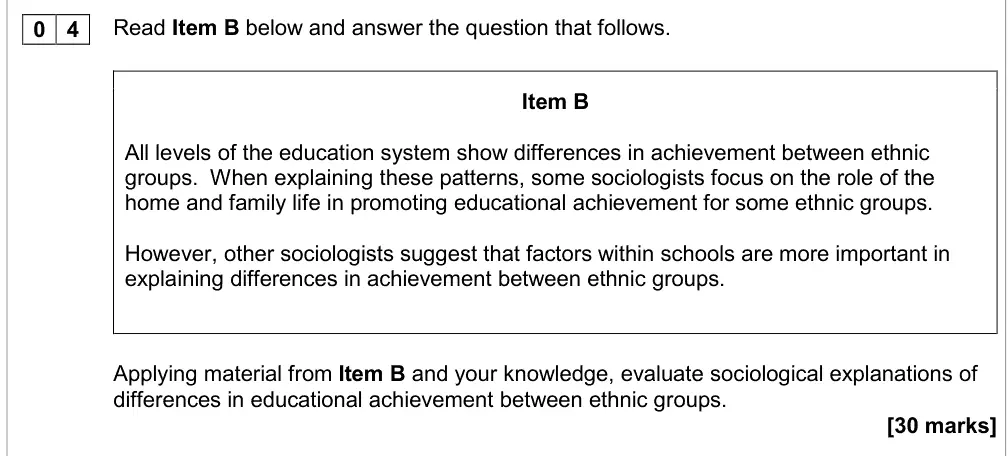
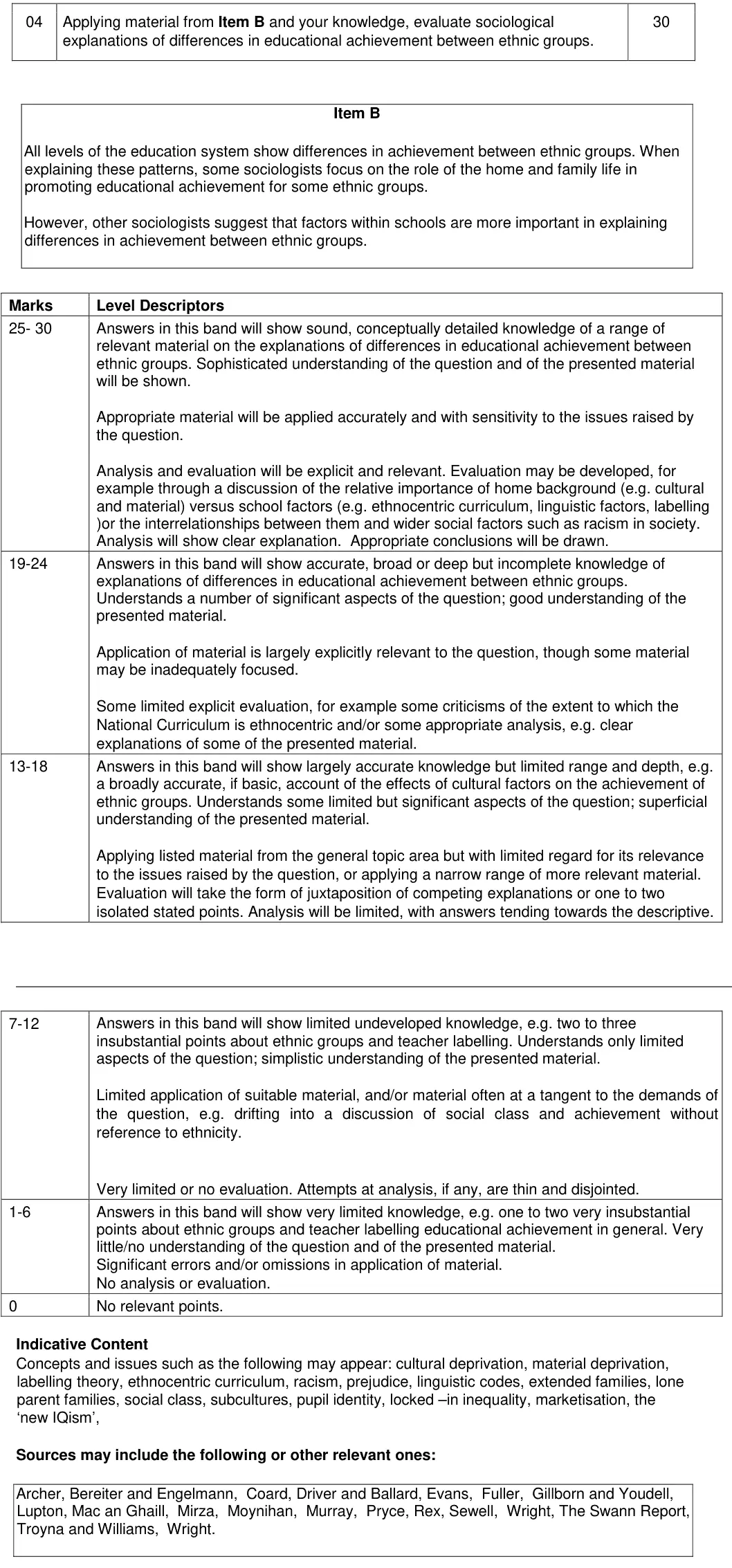
must apply Item B (home and family vs factors within schools)
top band: relative importance of home and school factors and how they interrelate with wider racism
best answers named specific ethnic groups rather than 'ethnic minorities' or 'Asians'
drifting into class without ethnicity = 7–12
evaluation often juxtaposition of internal and external factors
June 2019 · AS Paper 1 · Q520 marksAO1=8, AO2=6, AO3=620-mark essay
Mark scheme, including the levels grid and indicative content
Examiner's comment
Students confidently offered a wide range of factors, from both inside and outside the school, to explain the differences in achievement between social classes. Some were able to use the item to gear the answer in exploring issues relating to labelling and other internal processes, as well as cultural and material factors. Less successful answers did not apply their answer explicitly to the question, for example by focusing on differences in achievement, and often became descriptive rather than analytical. Others insisted on giving large accounts of studies, for example by Becker and Rist, but without explaining the relevance to the question, and therefore were presented as a regurgitation of revised notes about social class and education more generally, rather than a reasoned response to the question. In general, students appeared to prefer external factors that related to material and cultural deprivation, in particular language and cultural capital deprivation, and provided only a very thin account of internal factors. Furthermore, there was an overwhelming tendency to offer a range of internal and external factors in a list like fashion which were juxtaposed and lacked a clear debate for the top bands. More sophisticated answers were able to explore, in depth, a range of internal factors and offered some explicit evaluation of the significance of these factors in relation to both working class and middle class achievement. Successful evaluation also included the ability to explore how internal and external factors were inextricably linked, and being able to offer a well-informed conclusion to the question.
Notes from the mark scheme and report
must evaluate labelling and other in-school factors against out-of-school factors
top band recognises not all pupils respond to labelling in the same way and weighs internal factors against each other and against external factors
many gave thin internal factors and long material/cultural deprivation accounts
list-like juxtaposition and retold studies (Becker, Rist) without relevance limited marks
best answers showed how internal and external factors interlink
June 2018 · AS Paper 1 · Q22 marksAO2=2Brief explain
Mark scheme
Examiner's comment
This question produced a wide range of answers. Successful responses clearly identified an aspect of boys’ behaviour which could lead to educational underachievement. The most common behaviours identified included ‘messing around/ being disruptive’, ‘truanting’ and ‘not bothering with work’. Many were then able to go on and explain, for example, that ‘therefore boys miss out on their learning and underachieve’. Some students were able to offer an example of boys’ behaviour but were less successful in explaining how this leads to them doing less well in education. Unsuccessful answers were unable to explicitly identify an example of boys’ behaviour, for example, mentioning ‘laddish subcultures’ or ‘anti-school subcultures’ more generally. Others referred to ‘teacher labelling’ but did not link this to how boys’ behaviours change as a result and so did not gain credit.
Notes from the mark scheme and report
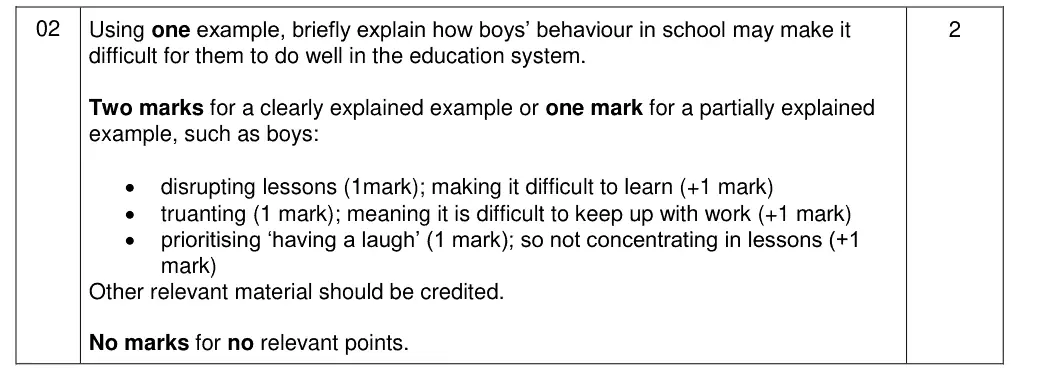
1 mark for a specific behaviour, +1 for explaining how it hinders achievement (e.g. disrupting lessons, truanting, 'having a laugh')
naming 'laddish' or anti-school subcultures in general without a specific behaviour gained nothing
teacher labelling only credited if linked to boys' behaviour
June 2018 · AS Paper 1 · Q410 marksAO1=5, AO2=3, AO3=2Outline and explain
Mark scheme, including the levels grid and indicative content
Examiner's comment
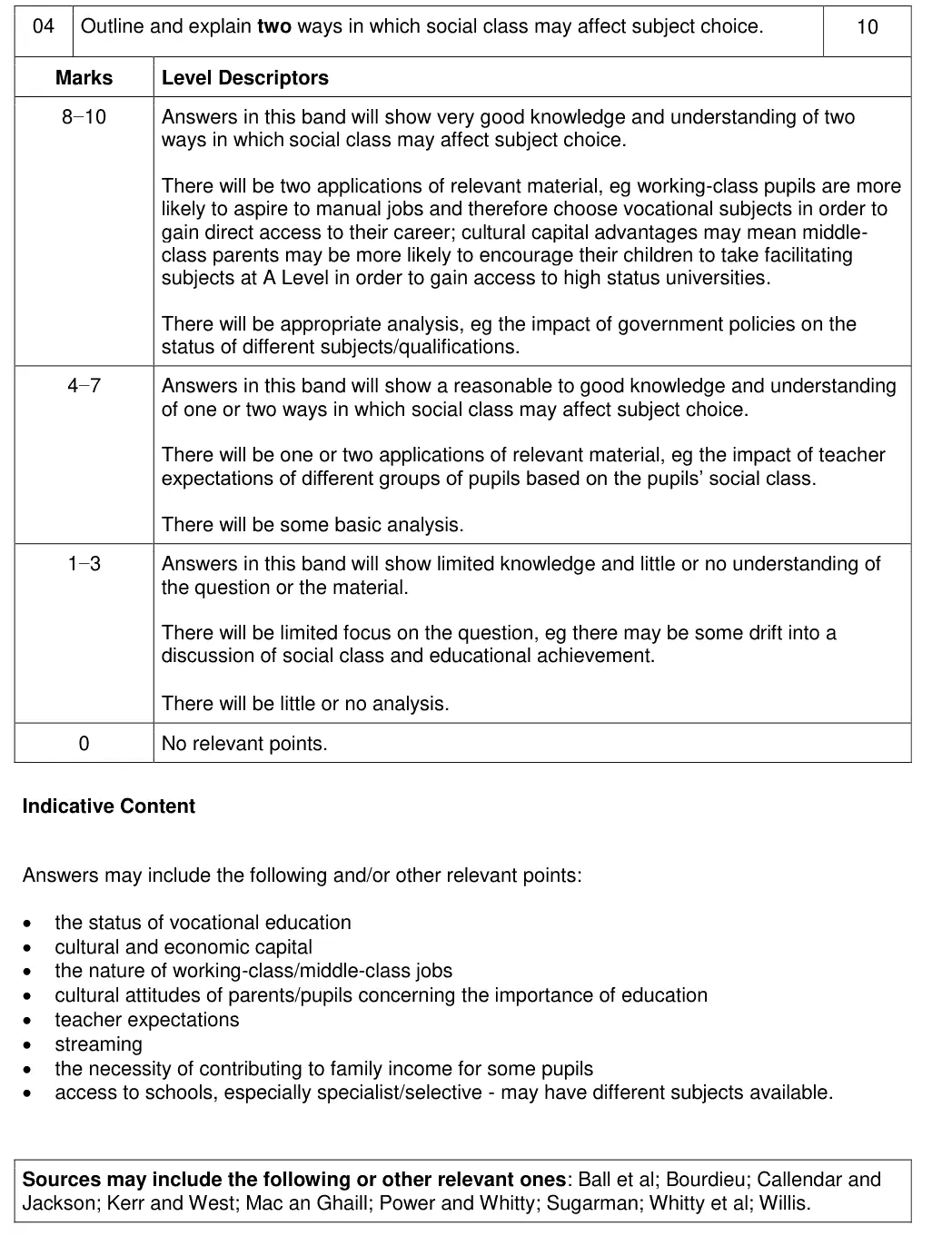
This question required students to apply their knowledge of one area of the specification (external factors and processes within schools that influence class achievement) to another area (subject choice). Many students had been well prepared for this question and structured their answer with two distinct paragraphs (without the need to include an introduction and conclusion) and demonstrated skills of application and analysis by connecting different aspects of the question. However, weaker answers often focused solely on outlining some of the factors affecting social class and achievement without attempting to link these to subject choice. Additionally, a significant number of responses focused solely on gender and subject choice and therefore did not score as highly. Better answers unpacked knowledge on factors such as parental aspirations, cultural capital, language codes and teacher labelling and applied this in explaining how they affect the subject choices of working and middle class pupils. The most successful responses referred to specific subject choices such as the working class being more likely to opt for vocational courses such as engineering or health and beauty due to their working class habitus.
Notes from the mark scheme and report
must link class to subject choice, not class and achievement in general (drift = 1–3 band)
answers on gender and subject choice scored low
two distinct developed ways, no introduction or conclusion needed
best answers used habitus, cultural capital, parental aspirations and labelling to explain specific choices such as vocational courses
June 2018 · Paper 1 · Q430 marksAO1=12, AO2=9, AO3=930-mark essay
Mark scheme, including the levels grid and indicative content
Examiner's comment
This was balanced with some very strong responses to the 30-mark social class and educational achievement question. Most students managed their time appropriately however a small minority left some questions unanswered. This mainly occurred for Question 06, often resulting from students giving a very broad answer for Question 04. Most students were able to demonstrate a range of external and internal factors that have an impact on social class and achievement. The vast majority of students were at least able to get into the 13-18 mark band. Stronger responses showed both breadth and depth of knowledge with a good range of concepts. Material was presented analytically with explanations being unpacked. They also offered strong evaluation by comparing the experience of different social classes and how social policies had been introduced to support disadvantage. The very best answers contained specific evaluation and could identify and explain links between factors, for example, in the way language crosses over from the home background to the school. Weaker responses had a narrower range of explanations and factors or could not present much in the way of studies to support their claims. Such answers tended to be descriptive, limited in terms of concepts and lacked analysis and evaluation. They were also not always applied to social class or achievement, often drifting into a discussion of ethnicity and gender.
Notes from the mark scheme and report
top band weighs material vs cultural and internal vs external factors or their interaction (hook in Item B)
cultural deprivation as victim-blaming is credited evaluation
drift into ethnicity or gender lowers marks
best answers linked factors (e.g. language from home to school) and used policy in evaluation
June 2017 · AS Paper 1 · Q12 marksAO1=2Define
Mark scheme
Examiner's comment
Most students answered this well or at least offered a partial answer. Many were able to offer examples such as norms and values, respecting authority, hierarchy and roles, while others referred simply to being taught or to the learning in school. The best students recognised that there were two elements to the term ‘hidden curriculum’ and also referred to the notion of being hidden, with references to, for example, the learning being indirect or not official. A small number of students reused the words from the question and therefore could not score for repeating the term.
Notes from the mark scheme and report
2 marks for things taught in school that are not on the official curriculum
1 mark for a partial definition or an example only (e.g. obeying rules)
best answers covered both the learning and its hidden/unofficial nature
repeating the words of the term scores nothing
June 2017 · Paper 1 · Q26 marksAO1=3, AO2=3Outline
Mark scheme
Examiner's comment
However, in the 4 and 6 mark questions, some students are writing far too much, thereby losing focus on the precise wording of the question. This question was, in the main, dealt with very effectively, with most students able to identify and explain at least two factors. Common successful responses included coursework, peer group pressure, textbooks containing gender stereotypes and the gender of teachers. Many of these were then able to go on and explain how it influenced their subject choice. Where marks were not awarded was often the result of overlapping factors being presented, or through making general points about gender and achievement, losing focus on subject choice. Other incorrect responses discussed external socialisation or career expectations without linking these to internal factors.
Notes from the mark scheme and report
2 marks for each of three in-school factors clearly outlined, 1 if only partially outlined
common answers: peer pressure, gender of teachers, stereotyped textbooks, coursework
overlapping factors, drift into gender and achievement, or external socialisation/career expectations not linked to school lost marks
June 2017 · AS Paper 1 · Q36 marksAO1=3, AO2=3Outline
Mark scheme
Examiner's comment
This question required students to outline ways in which schools mirror work in a capitalist society, which then needed development to show how each one is found in both school and in the work place. Many students were keen to show their knowledge of the correspondence principle and were able to identify Bowles and Gintis as authors of the study. Although this showed good knowledge, it was not explicitly necessary in this question. Popular responses referred to hierarchy, rewards, dress codes and fragmentation. A number of responses did not score an additional mark for an outline due to not identifying a specific example from school and work, with some referring to capitalist society in general. Some students missed the second point, having assumed that the mirror didn't need further, explicit development when only providing an example from either school or work. Some students gave two ways, which were too similar to both be credited, for example, the existence of a hierarchy and the requirement to show respect to superiors. Some students described functions rather than mirroring.
Notes from the mark scheme and report
2 marks for each of three ways clearly outlined, 1 if partial
each way needs a parallel in both school and work (e.g. hierarchy, rewards, fragmentation, uniform, legitimation)
naming Bowles and Gintis not required
two ways too similar (hierarchy and respect for superiors) not both credited
describing functions rather than mirroring missed the point
June 2017 · AS Paper 1 · Q520 marksAO1=8, AO2=6, AO3=620-mark essay
Mark scheme, including the levels grid and indicative content
Examiner's comment
There were a range of different responses to this question and many made appropriate use of the item. Weaker answers reflected a limited knowledge and understanding of internal factors and only offered a thin, undeveloped account of one or two of these, with few, if any sociological concepts. Others showed more developed knowledge and understanding of relevant material, such as educational policies (eg GIST & WISE), the feminisation of education, GCSEs and coursework, labelling and issues relating to pupil identities. Many students were able to apply a range of factors to the attainment of girls but fewer were able to deal with both boys and girls, and/or apply knowledge in explaining differences in achievement. There was a tendency for some students to drift into an account of subject choice and did not apply this specifically to differences in achievement. Better answers demonstrated application of knowledge explicitly to gender differences in achievement. Many went on to consider factors outside of school, such as the impact of feminism, changes in the family and changing girls’ priorities. However, a significant number of responses failed to link these factors explicitly to internal factors and therefore were awarded for juxtaposition, rather than developed evaluation. Many answers lacked explicit evaluation of the role or importance of the factors that they had discussed. Explicit evaluation in terms of the relative weight attached to each (internal and external), or the interaction between the two was rare. The very best responses were able to give a wide range of factors, connected to concepts and studies with external factors being used in an evaluative way, ie they were clearly linked back to internal factors to stay focused on the question.
Notes from the mark scheme and report
top band must deal with both male and female achievement
evaluation through relative weight of school vs home/out-of-school factors
external factors merely juxtaposed rather than linked back to in-school factors limit marks
drift into subject choice not linked to achievement
good material: GIST/WISE, feminisation, coursework, pupil identities, labelling
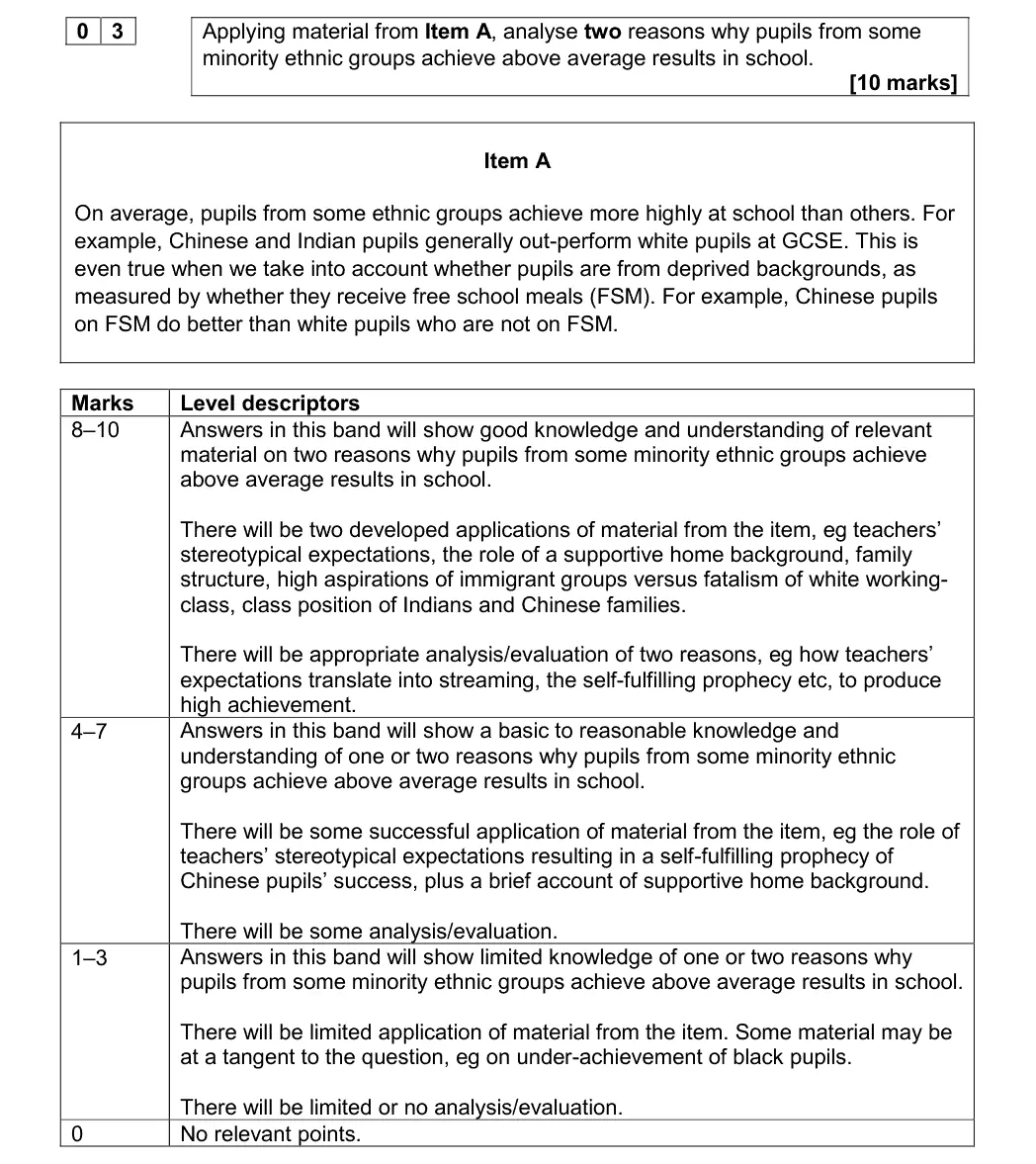
Specimen set 1 · Paper 1 · Q310 marksAO1=3, AO2=4, AO3=3Analyse
Mark scheme, including the levels grid and indicative content
Notes from the mark scheme and report
specimen paper, no examiners' report
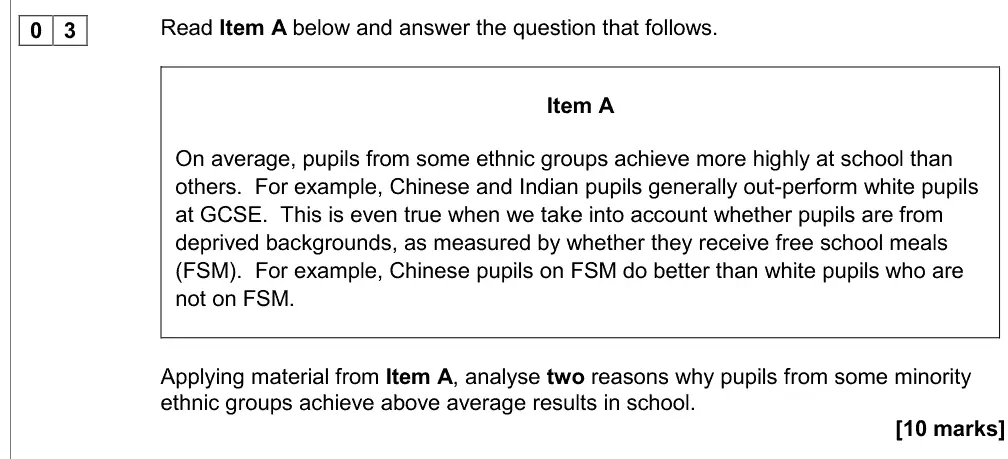
must develop hooks from Item A (Chinese and Indian pupils out-perform white pupils even on FSM)
focus is above-average achievement
credited: positive teacher stereotypes and self-fulfilling prophecy, supportive home and family structure, immigrant aspirations vs white working-class fatalism, class position of Indian and Chinese families
drift into black underachievement = 1–3
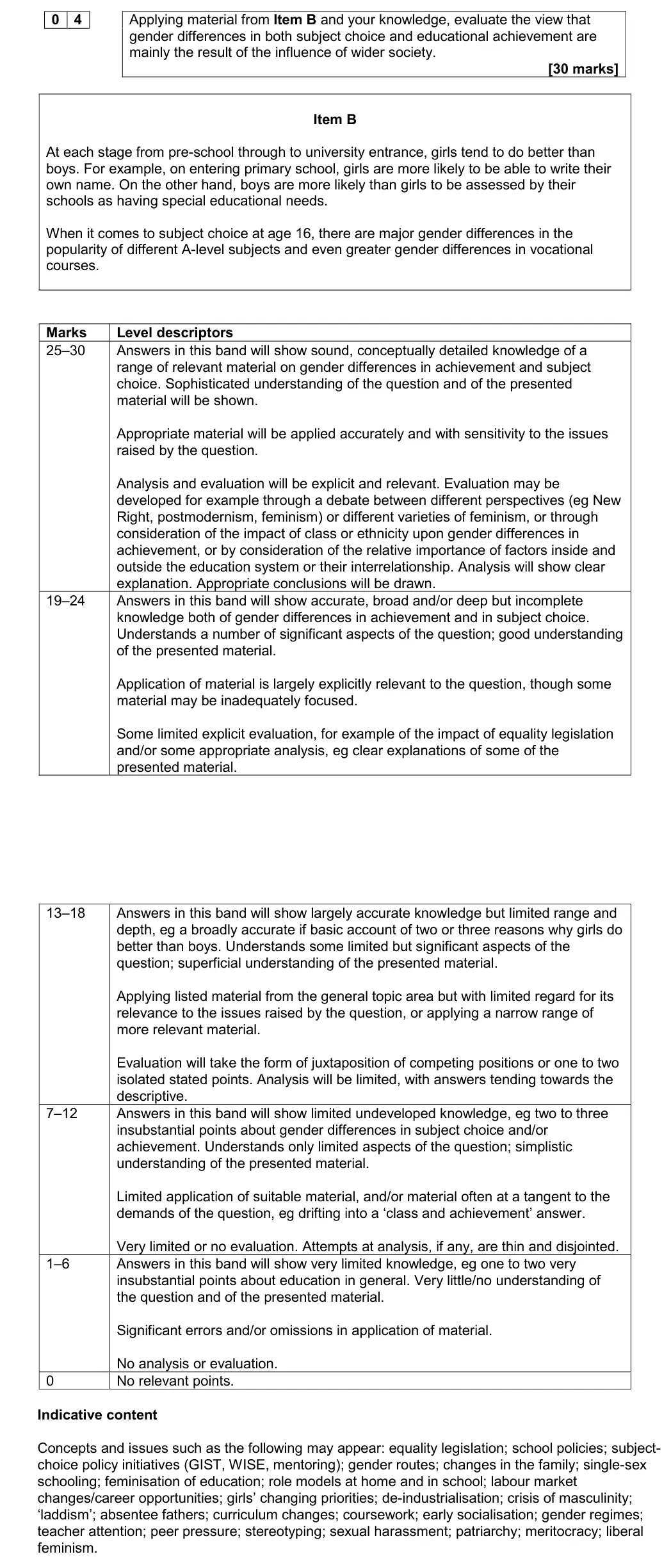
Specimen set 1 · Paper 1 · Q430 marksAO1=12, AO2=9, AO3=930-mark essay
Mark scheme, including the levels grid and indicative content
Notes from the mark scheme and report
specimen paper, no examiners' report
must address both subject choice and achievement (top two bands need both)
must apply Item B
top band: debate between perspectives (New Right, postmodernism, varieties of feminism), impact of class and ethnicity, or relative importance of factors inside vs outside school
drift into class and achievement = 7–12
Work with an AQA sociology tutor
Essays stuck in the middle band, or losing marks on the 10-markers? Book a trial lesson with Mark, a former AQA examiner.