Examiner's comment
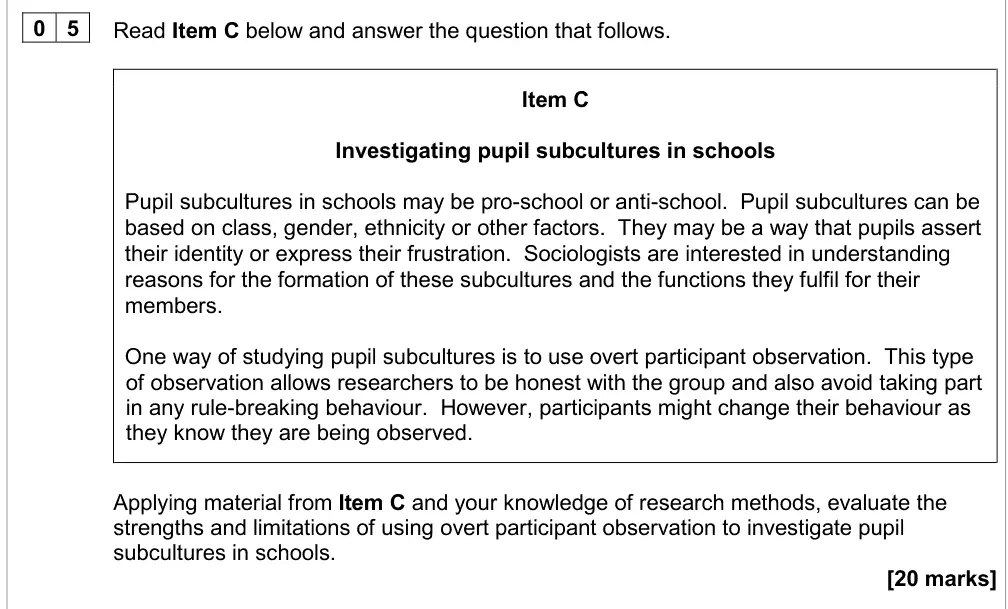
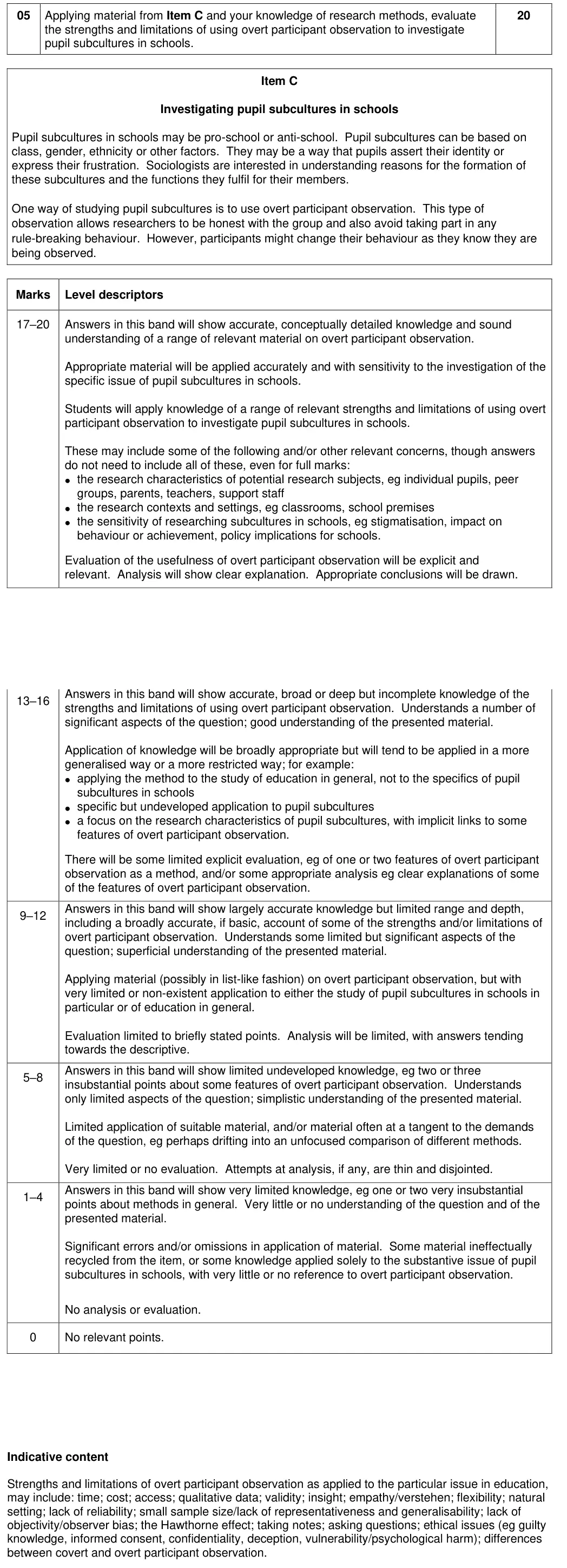
Students seemed to find this question more accessible than last year's, showing varying degrees of understanding of overt participant observation. Many discussed concepts like the ‘Hawthorne effect’, noting that the presence of a researcher might alter the behaviour of participants who know they are being observed. Some students effectively linked the aspects of being both a participant and overt, highlighting how this dual role can influence the research, such as by introducing biases due to the researcher's visible presence and potential influence on participants' behaviour. However, most students tackled the aspects of overt and participant observation separately, discussing them as distinct components rather than integrating them fully. These responses could still gain good credit if they were developed well and/ or applied to the specific issue of studying pupil subcultures. Additionally, some weaker answers referred to observations more generally, discussing advantages and disadvantages that could apply to any type of observation. These responses were more limited in terms of the marks awarded, as they lacked specificity in addressing overt participant observation and the context of studying pupil subcultures. Amongst the highest performing answers are those that can apply the advantages of aspects of overt participant observation to the study of pupil subcultures. For example, some students applied the concept of the ‘Hawthorne effect’ more specifically in explaining how student subcultures in schools might alter their behaviour, becoming either more conformist or rebellious (perhaps due to peer pressure), knowing they are being observed by a researcher who is visibly present (and may present as a ‘teacher in disguise’). This example effectively demonstrated the potential disadvantages of this method, highlighting issues such as reduced authenticity of the data collected. There was also a trend of students providing accounts of issues in educational research more generally, such as difficulties in gaining access past ‘gatekeepers’, without specifically linking these points to overt participant observation and/ or the issue of studying pupil subcultures. The strongest responses provided specific applications and detailed discussions, effectively linking relevant concepts, such as gaining more verstehen, to the specific disadvantages of overt participant observation in the study of pupil subcultures. Weaker answers tended to rely on rote-learned material without adequate context.