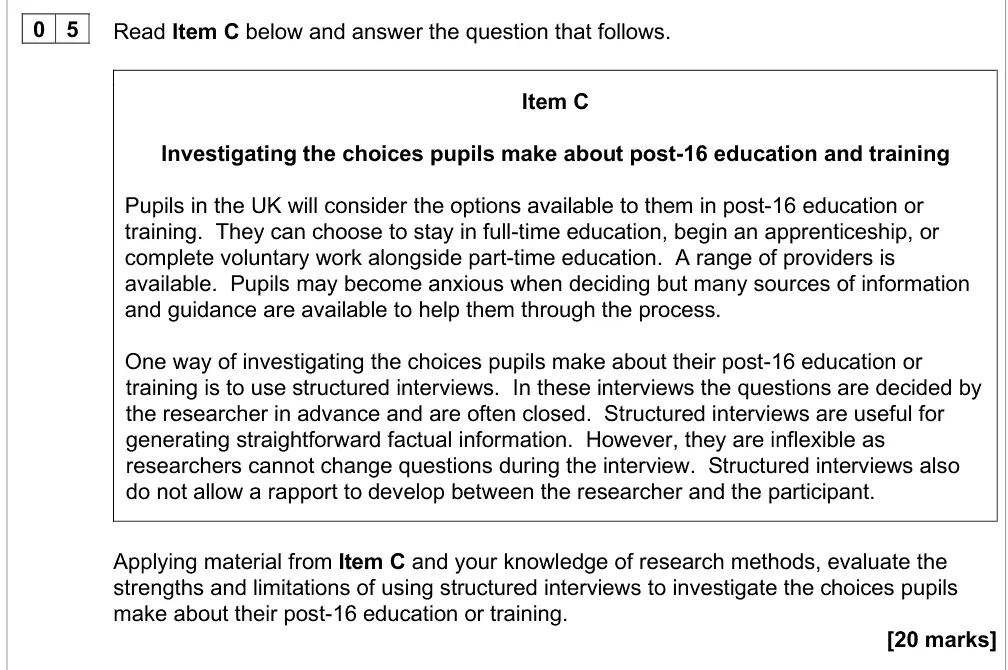
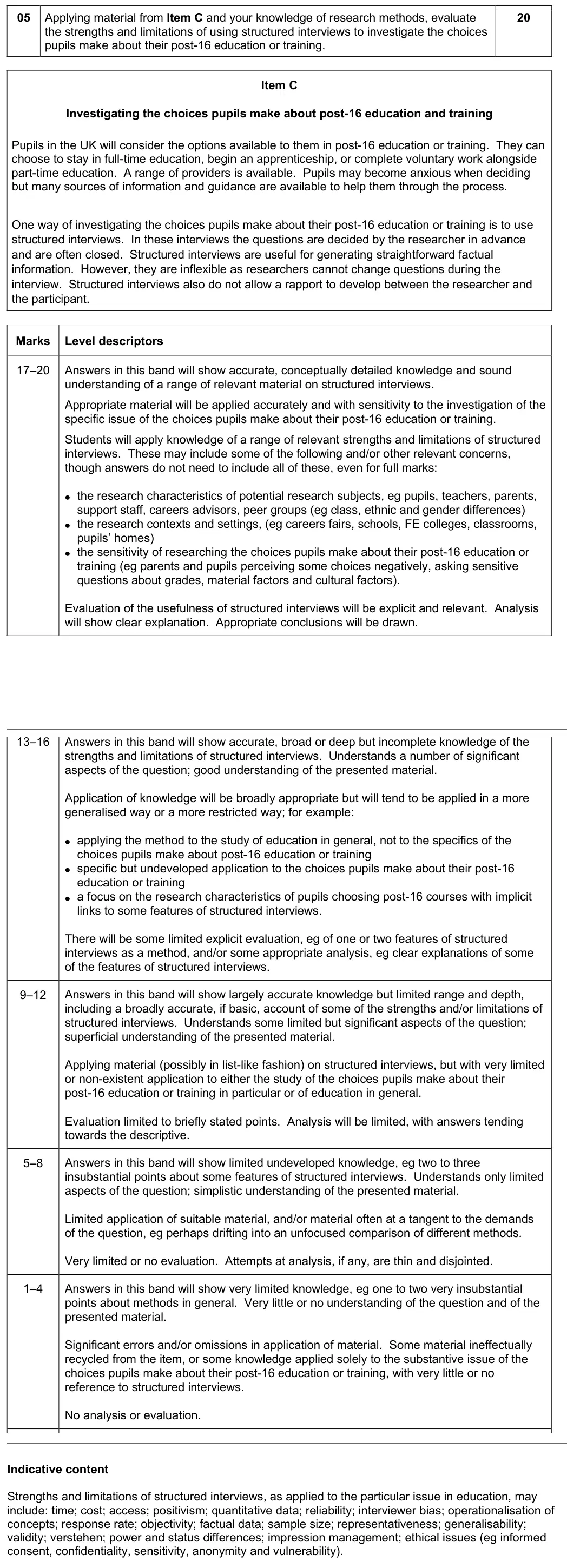
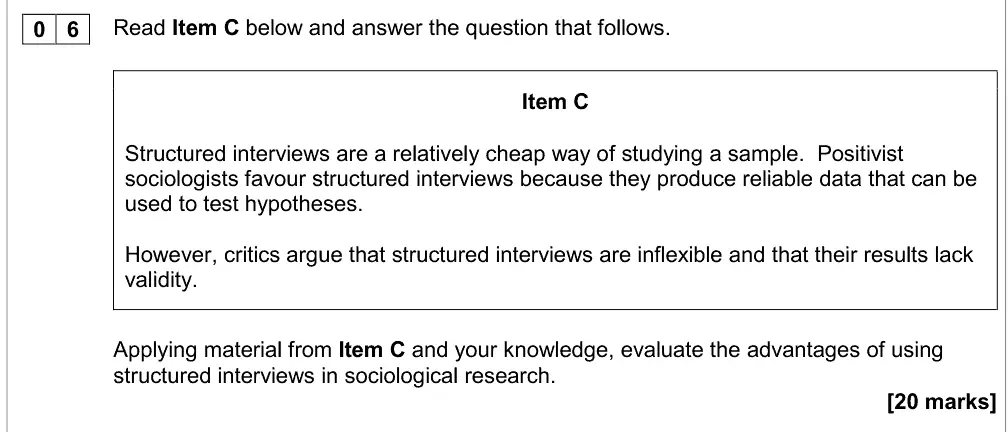
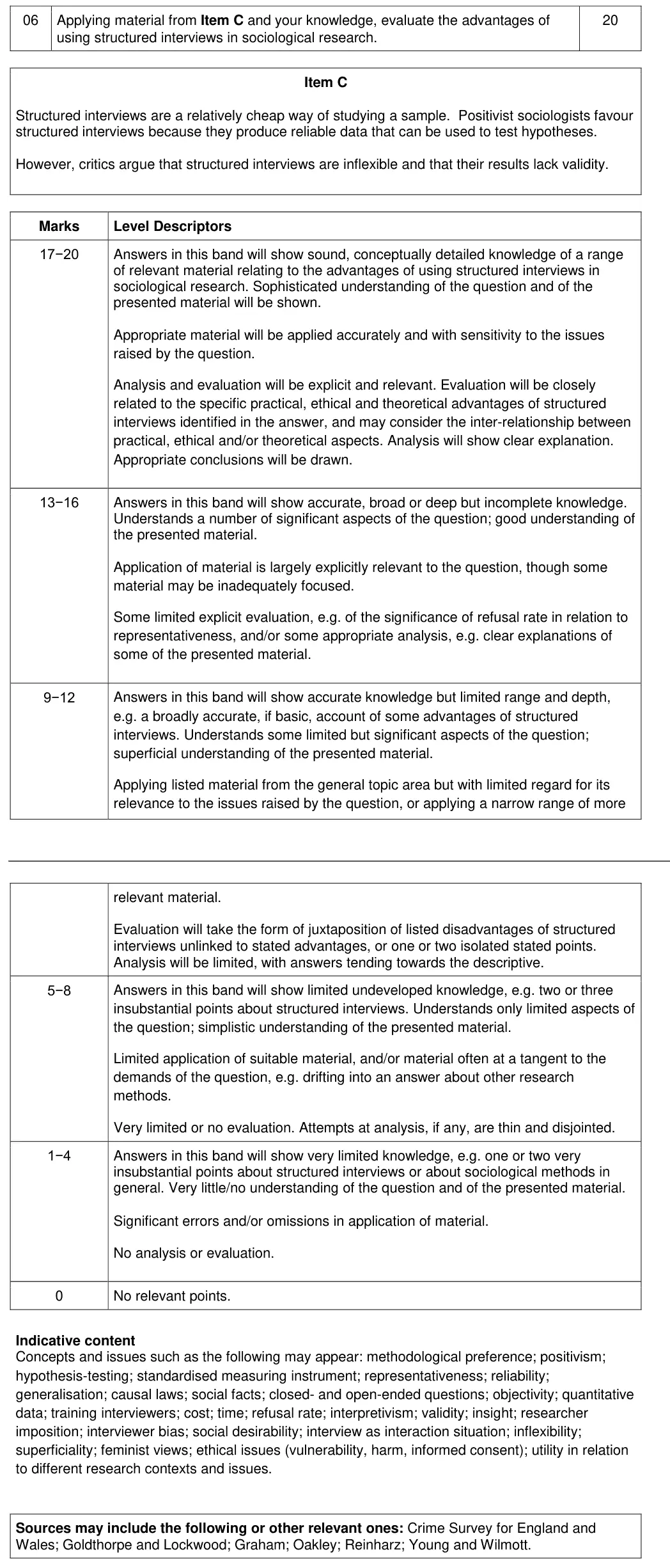
Applying material from Item C and your knowledge of research methods, evaluate the strengths and limitations of using structured interviews to investigate the choices pupils make about their post-16 education or training.
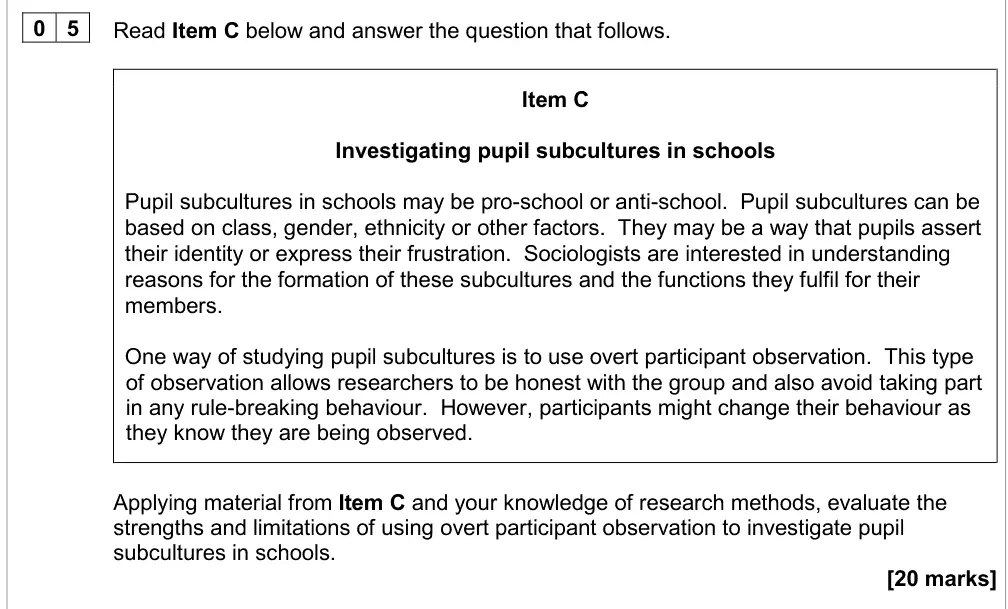
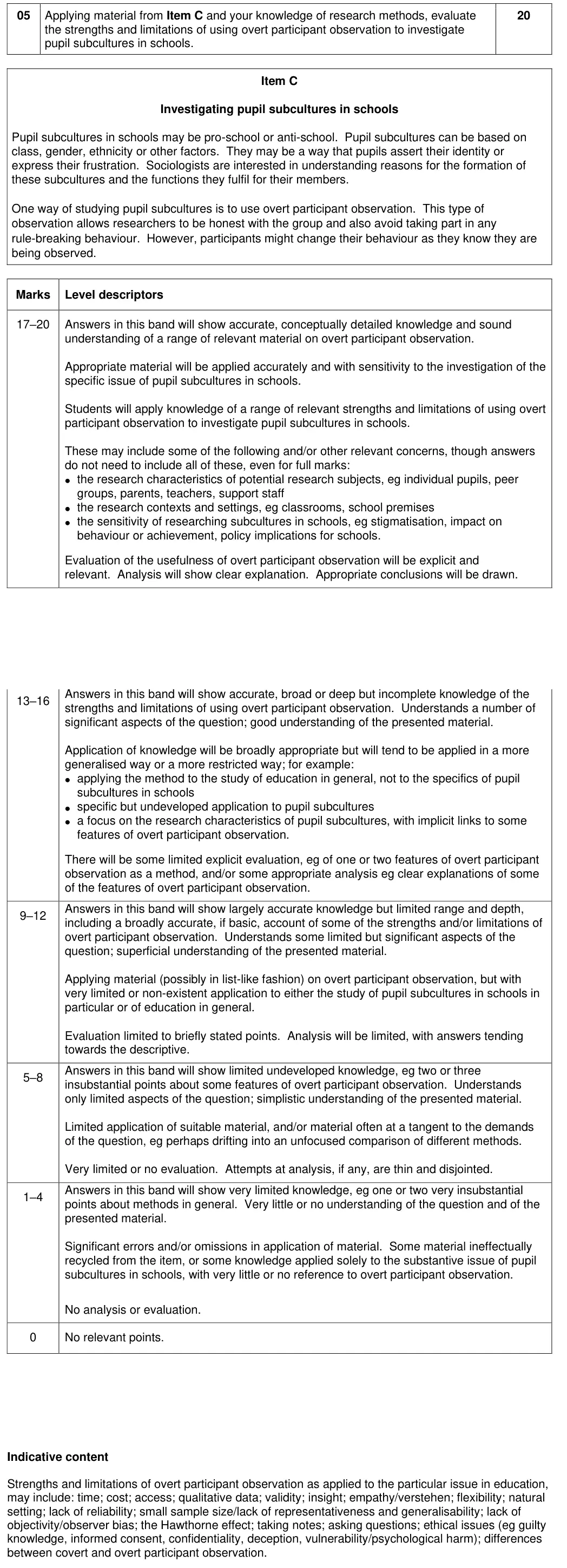
Applying material from Item C and your knowledge of research methods, evaluate the strengths and limitations of using overt participant observation to investigate pupil subcultures in schools.
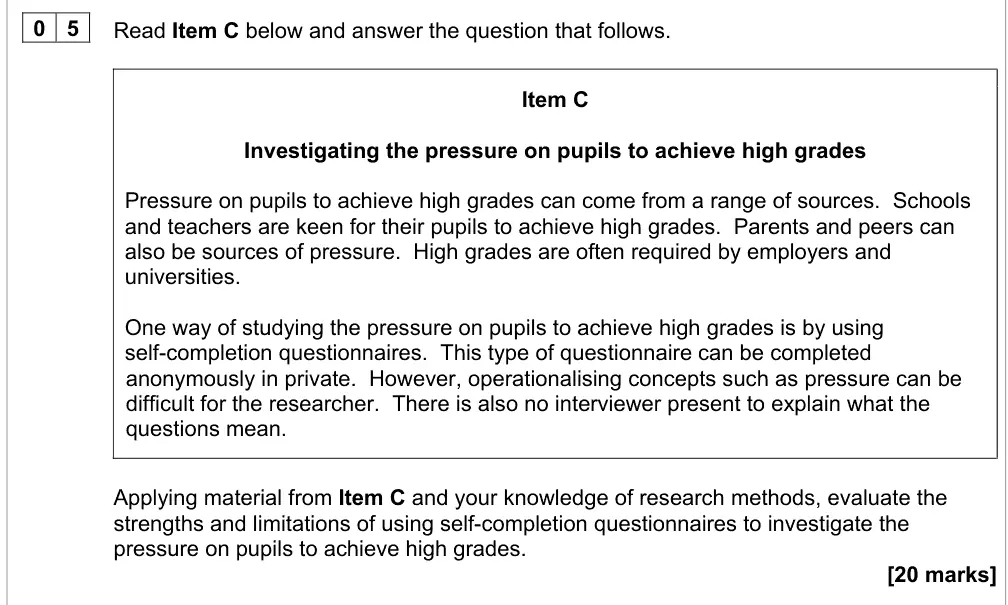
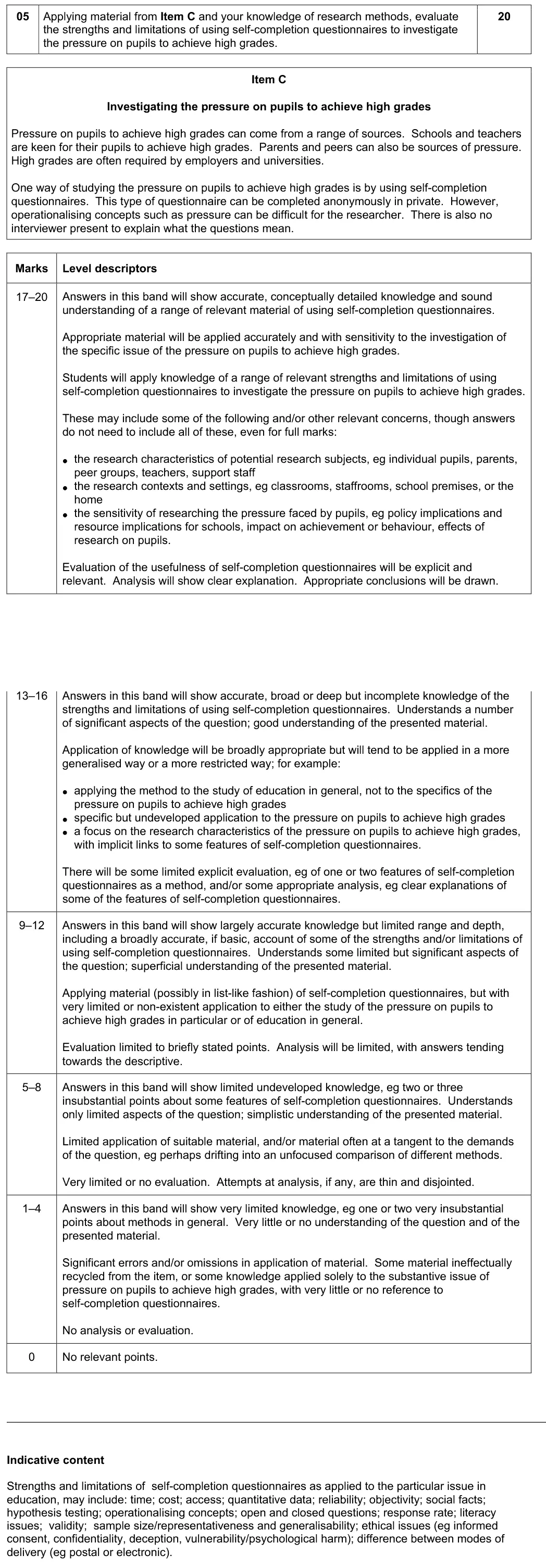
Applying material from Item C and your knowledge of research methods, evaluate the strengths and limitations of using self-completion questionnaires to investigate the pressure on pupils to achieve high grades.
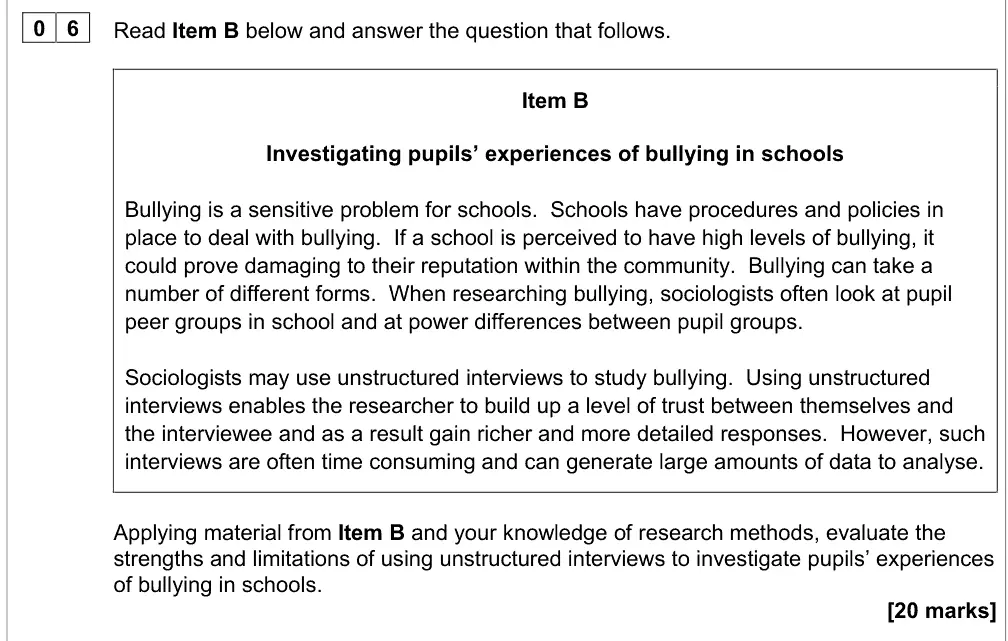
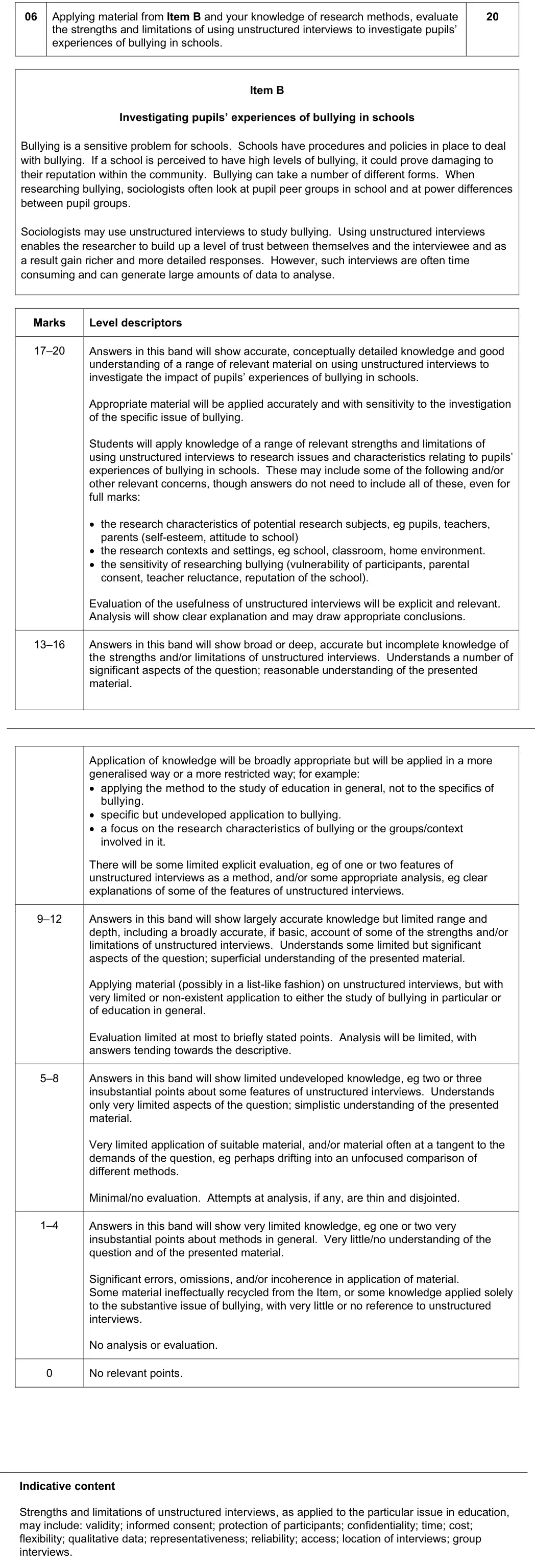
Applying material from Item B and your knowledge of research methods, evaluate the strengths and limitations of using unstructured interviews to investigate pupils’ experiences of bullying in schools.
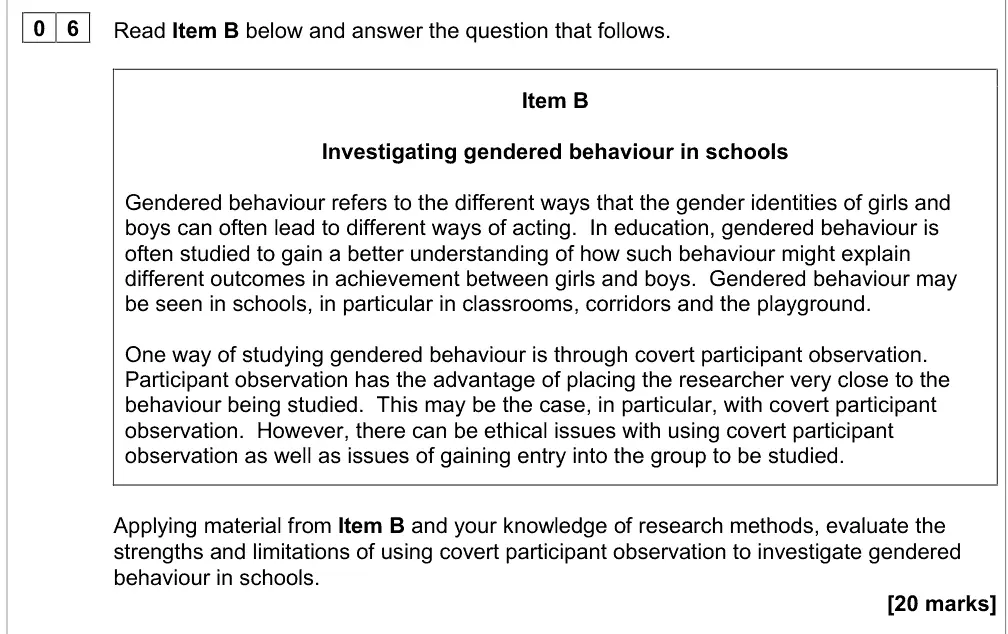
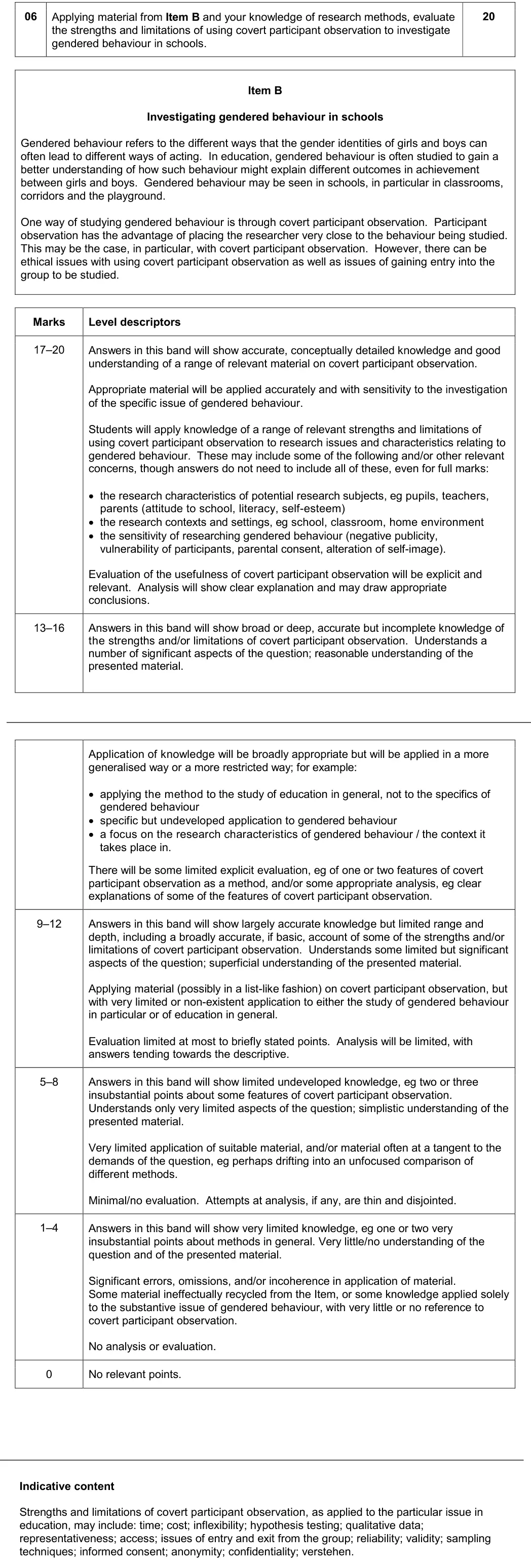
Applying material from Item B and your knowledge of research methods, evaluate the strengths and limitations of using covert participant observation to investigate gendered behaviour in schools.
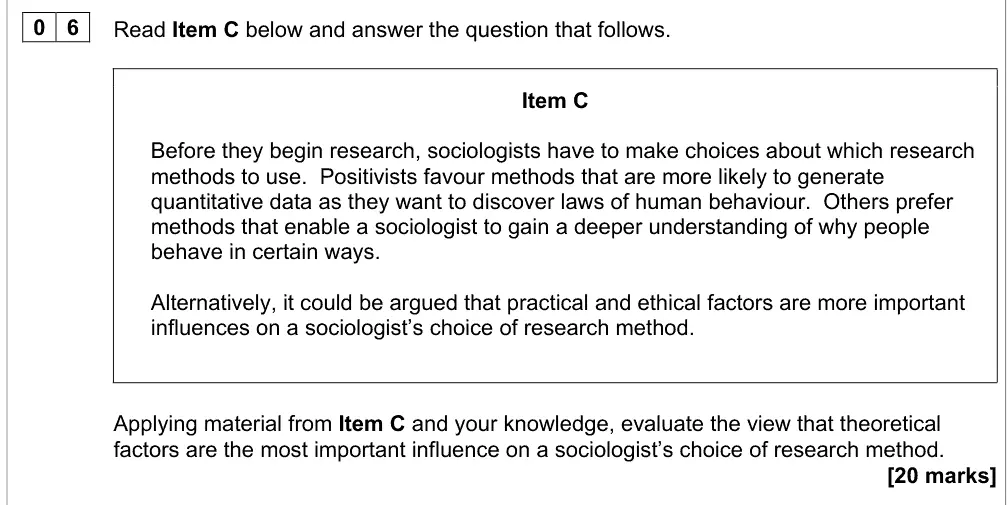
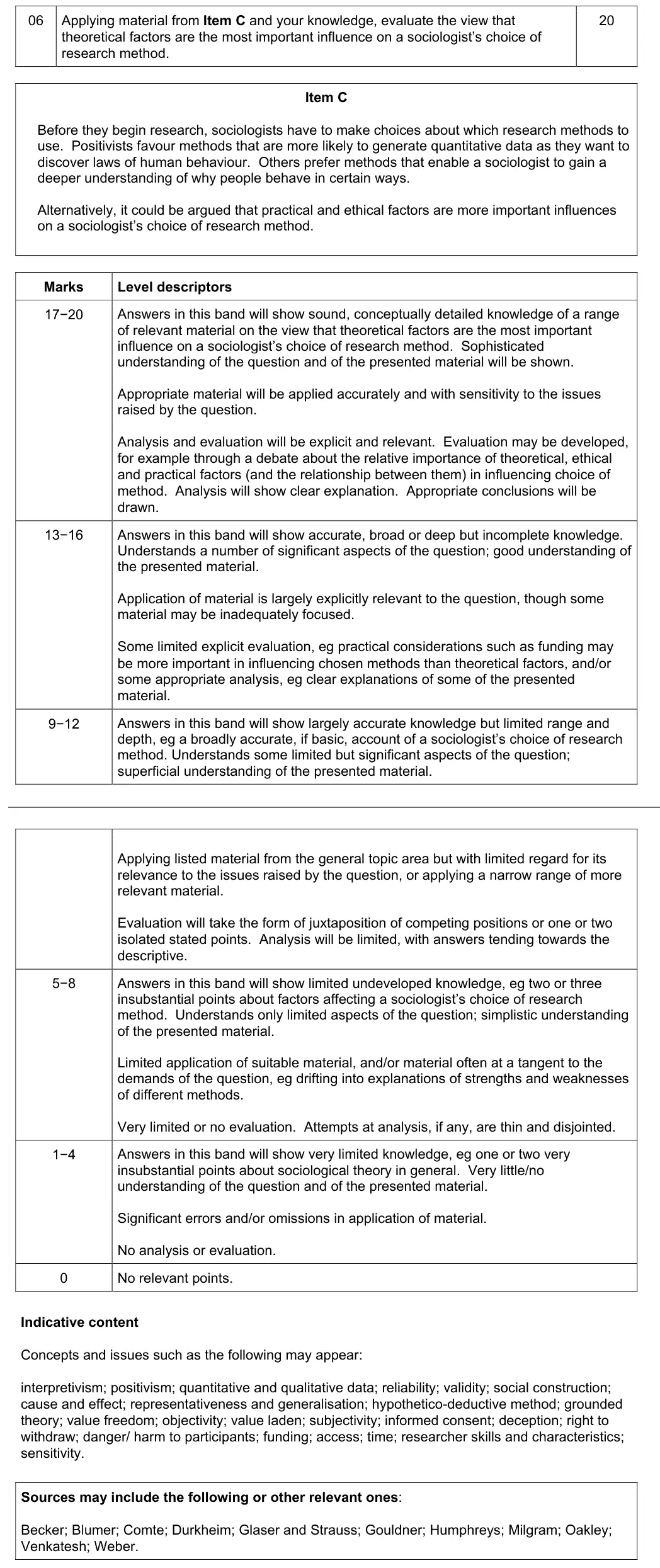
Applying material from Item C and your knowledge, evaluate the view that theoretical factors are the most important influence on a sociologist’s choice of research method.
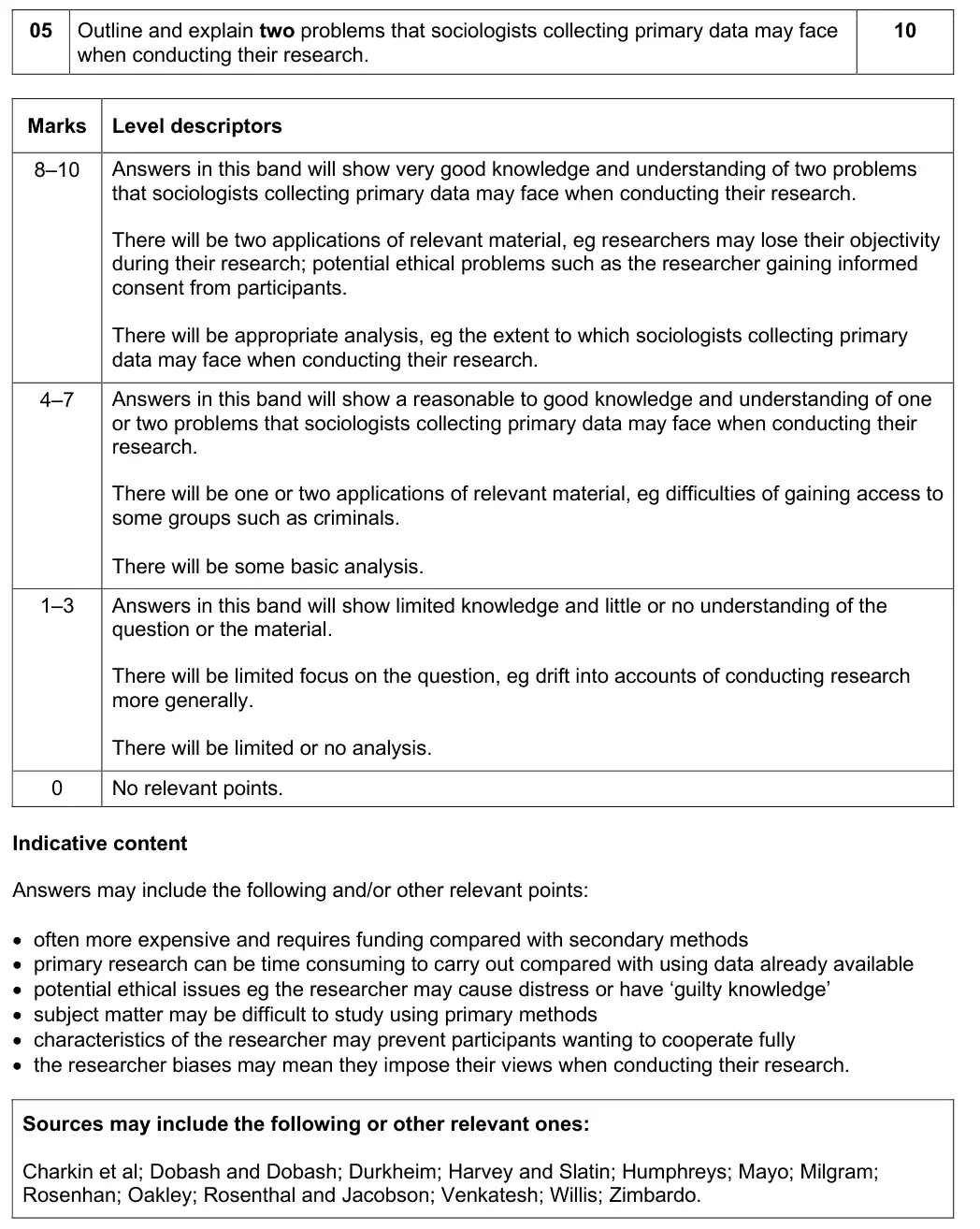
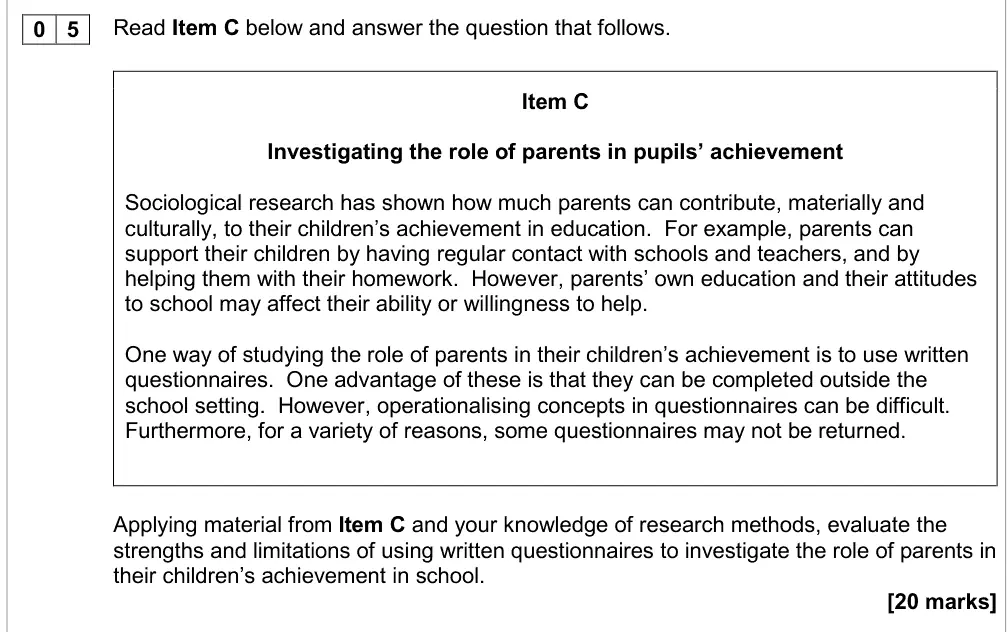
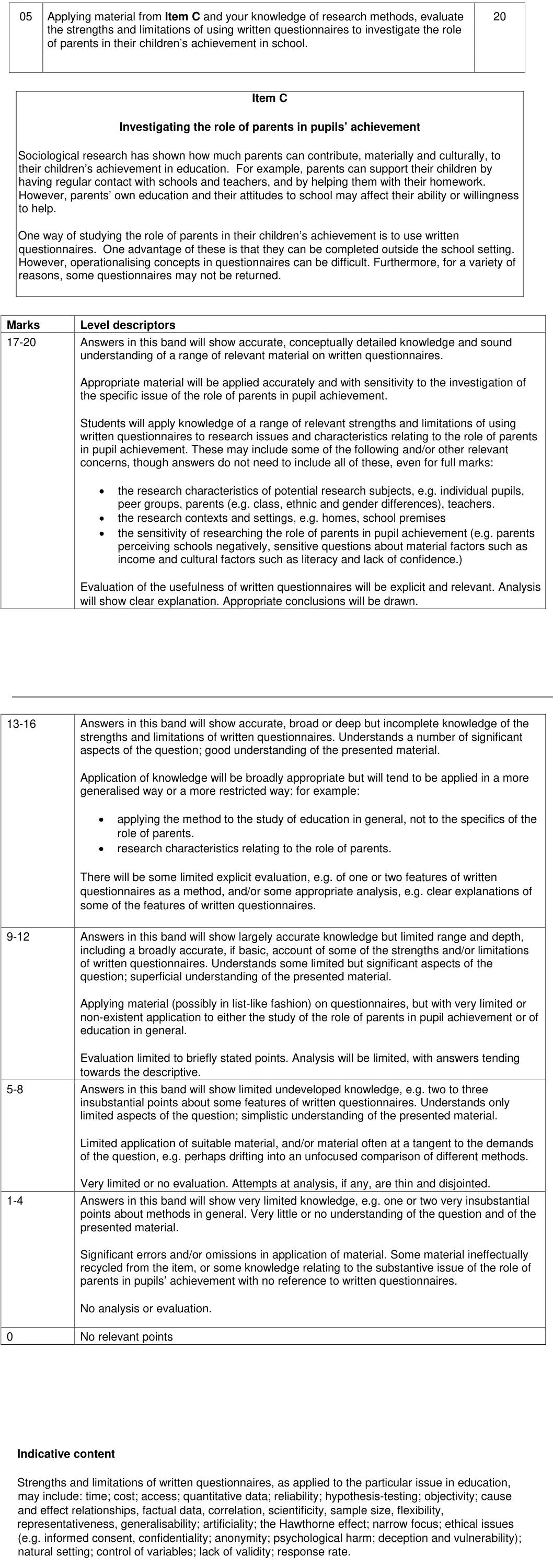
Applying material from Item C and your knowledge of research methods, evaluate the strengths and limitations of using written questionnaires to investigate the role of parents in their children’s achievement in school.
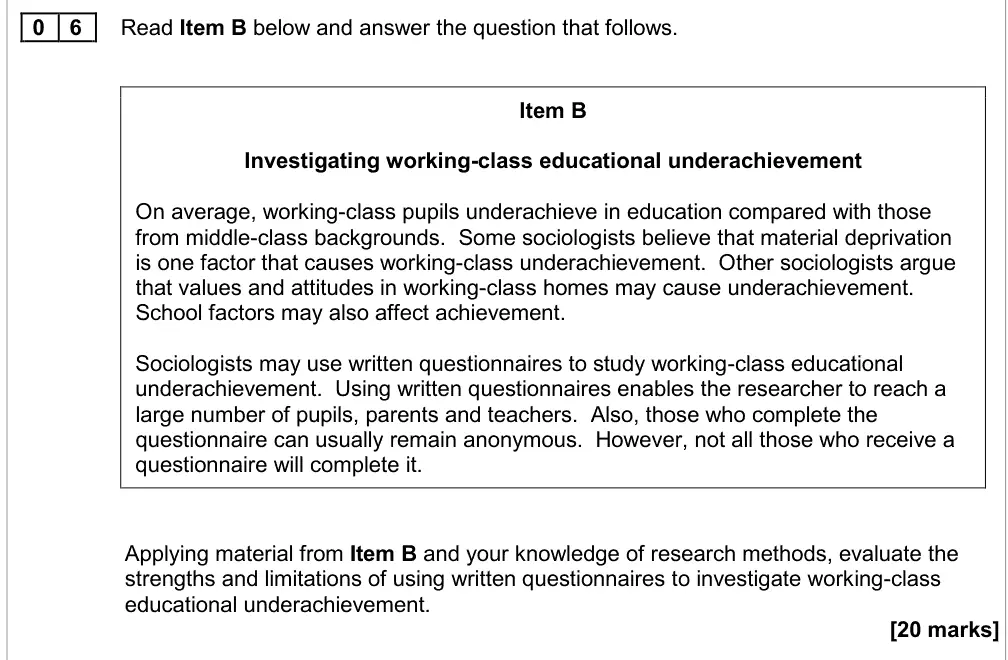
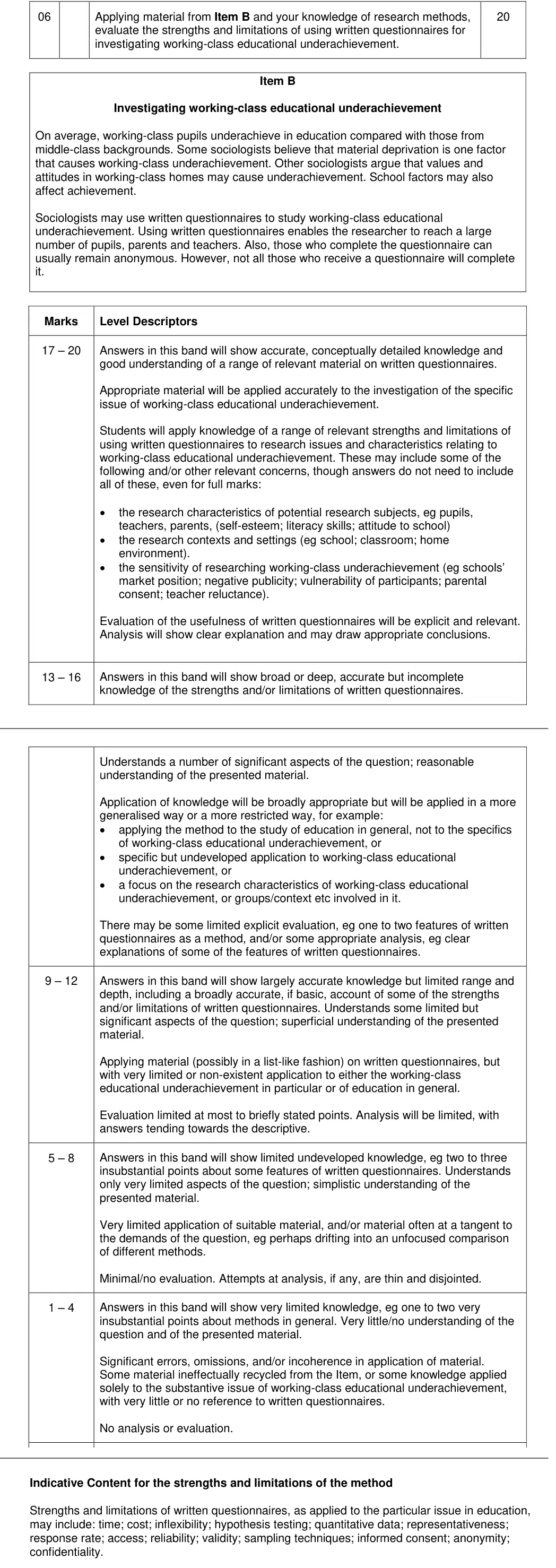
Applying material from Item B and your knowledge of research methods, evaluate the strengths and limitations of using written questionnaires to investigate working-class educational underachievement.
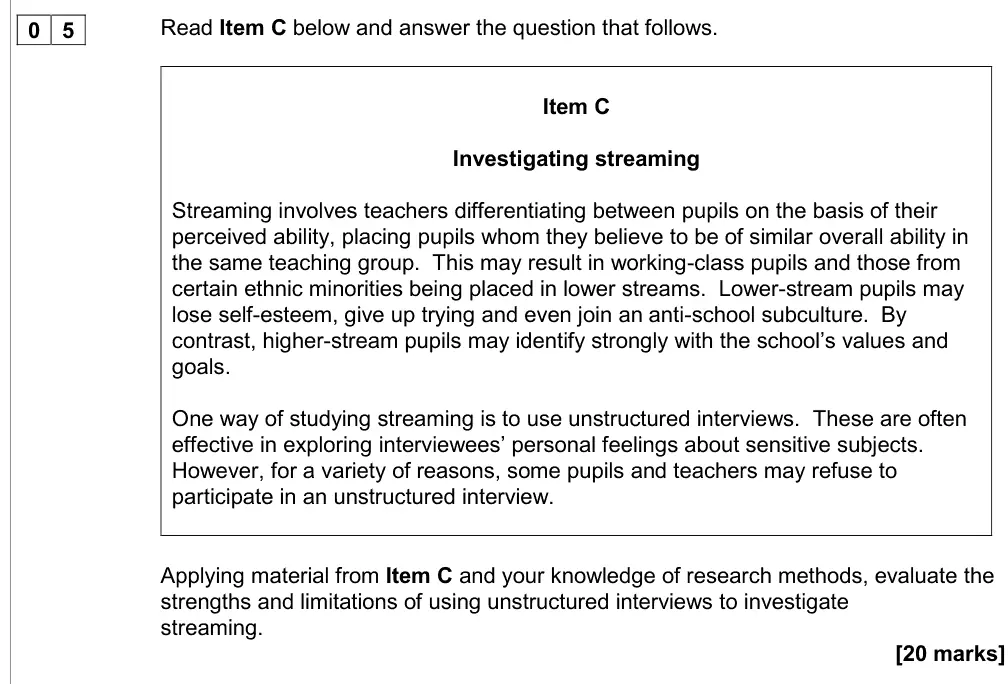
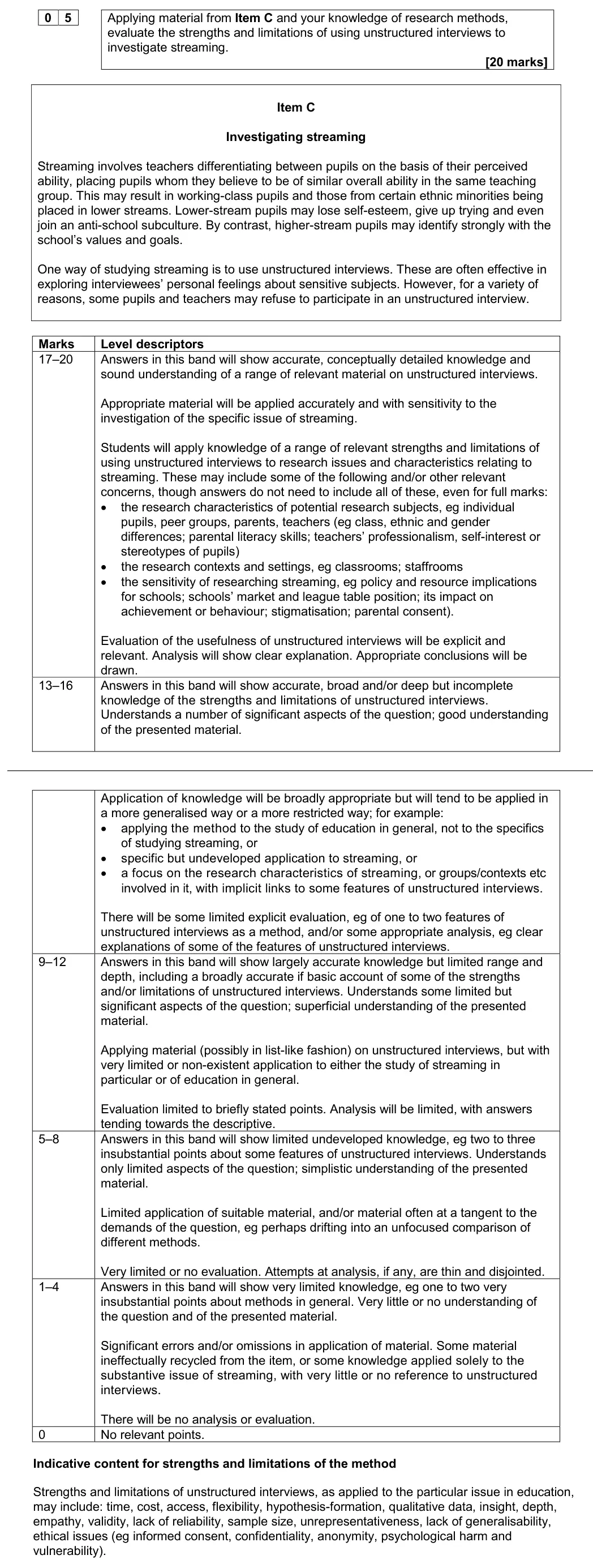
Applying material from Item C and your knowledge of research methods, evaluate the strengths and limitations of using unstructured interviews to investigate streaming.
Tap a question to zoom it. The mark scheme (with the level descriptors and indicative content) and the examiner's comment open underneath.
June 2025 · Paper 1 · Q520 marksAO1=8, AO2=8, AO3=4Methods in context
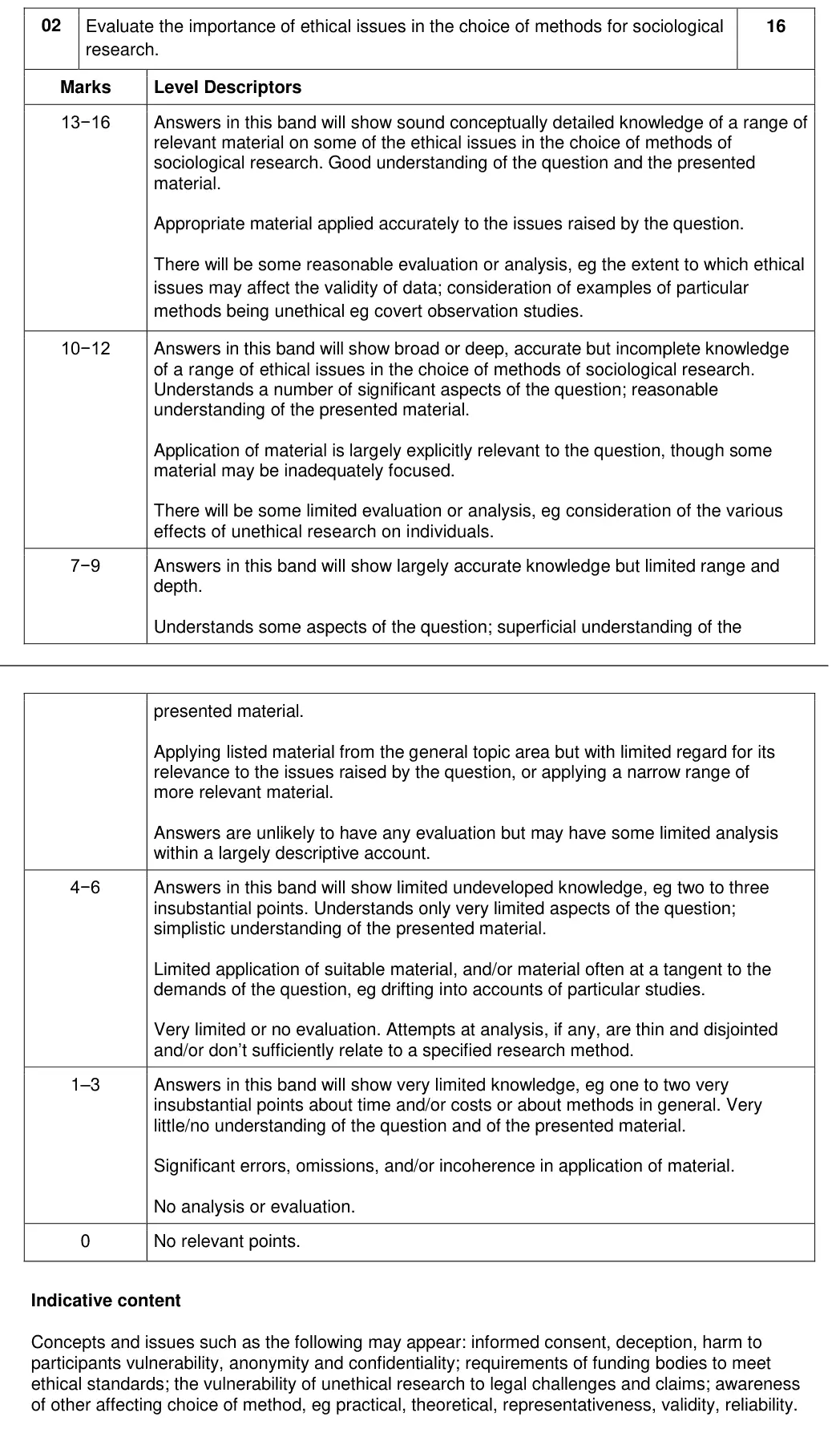
Mark scheme, including the levels grid and indicative content
Notes from the mark scheme and report
must apply structured interviews to post-16 choices specifically
education in general or undeveloped application = max 13-16
writing on post-16 choices with little reference to structured interviews = 1-4
sensitivity e.g. questions about grades, family attitudes to choices, material and cultural factors
content includes reliability, interviewer bias, operationalisation, rapport and validity
no examiners' report published
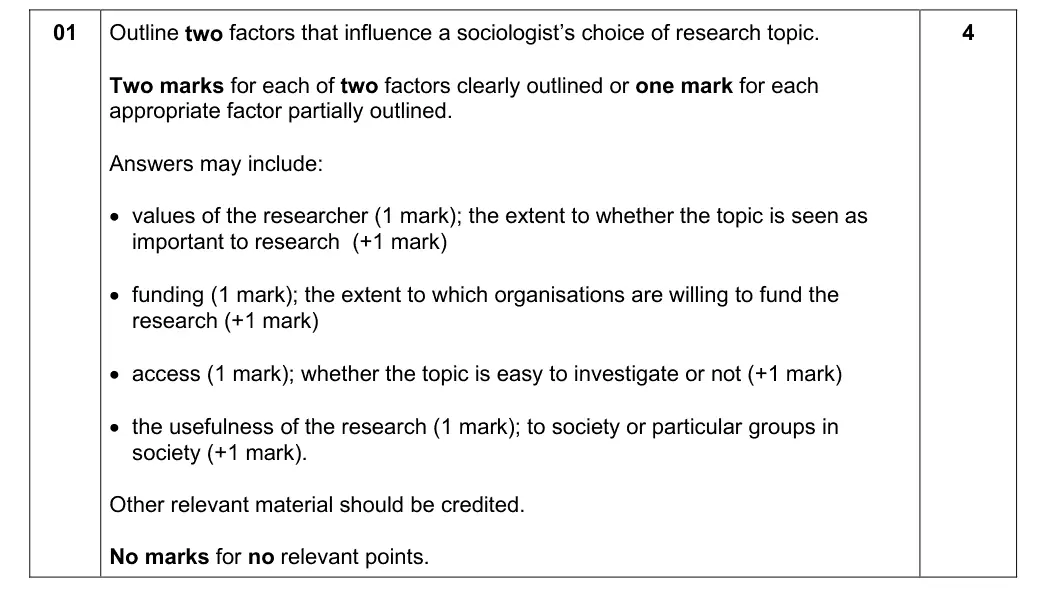
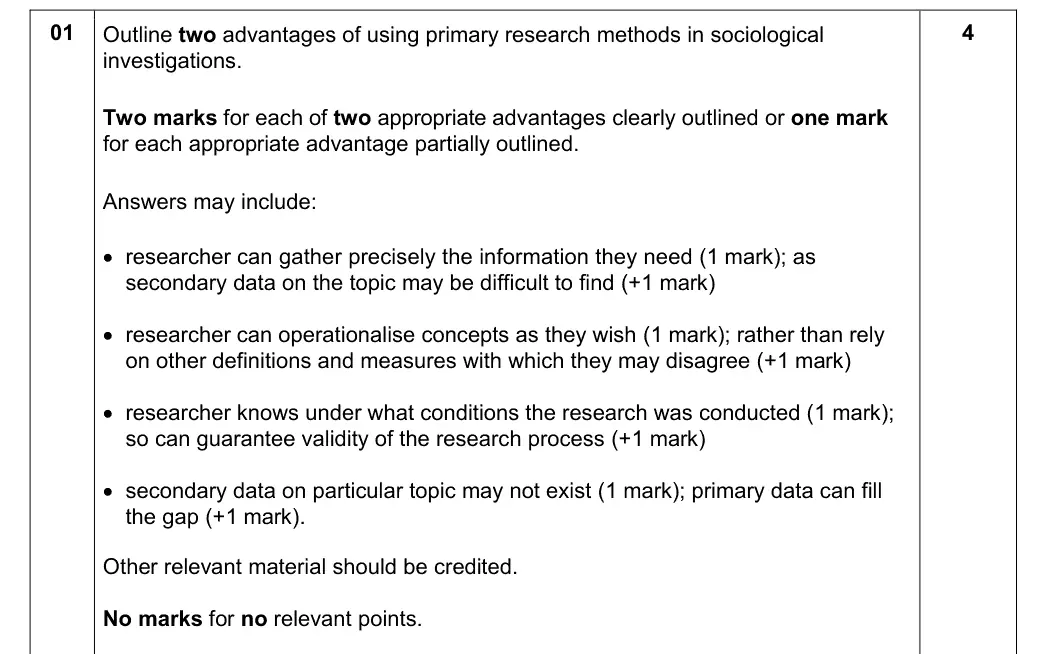
June 2025 · AS Paper 2 · Q14 marksAO1=2, AO3=2Outline
Mark scheme
Examiner's comment
For students who focused on the idea of factors influencing research topic a range of possible and straight forward factors could be selected which would get credit. For example, a topic of personal interest to the researcher or a topic being currently debated and in the “news”. Some students, however, restricted their responses to considering factors influencing the choice of research method: such as those of validity or reliability. These responses did not meet the demands of the question and could not be rewarded.
Notes from the mark scheme and report
factors influencing choice of TOPIC, not of method
credited: researcher's values, funding, access, usefulness to society, topical/news issues, personal interest
answers about validity or reliability (choice of method) gained no marks
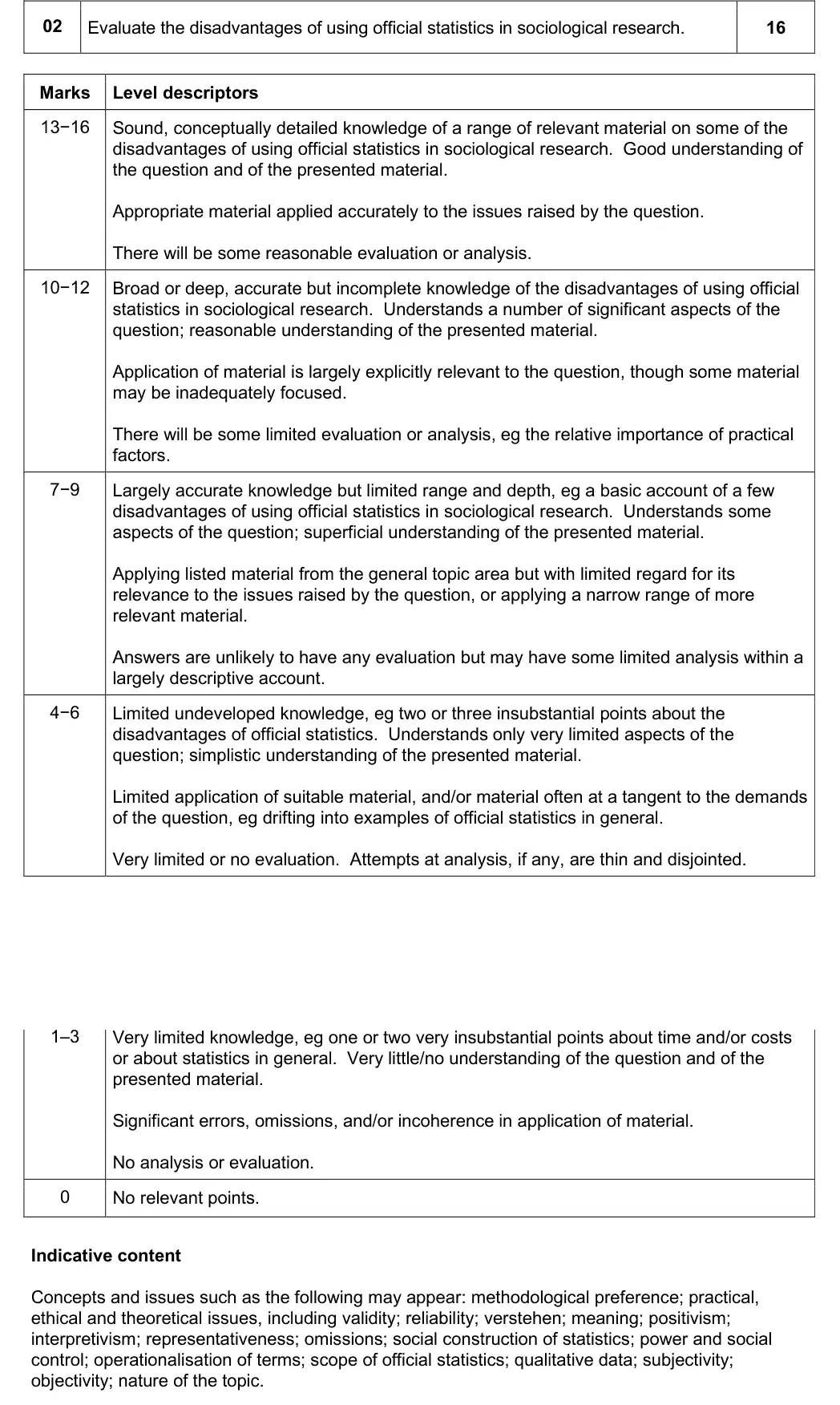
June 2025 · AS Paper 2 · Q216 marksAO1=6, AO2=5, AO3=516-mark essay
Mark scheme, including the levels grid and indicative content
Examiner's comment
This question for most students was one they could answer, as official statistics feature as a main stay of sociological research methods. Obvious disadvantages, such as official statistics being often gathered for a purpose different to which the sociologist wishes to use them, gained credit. Where a student suggested a disadvantage that was not self-evident, they needed to explain and unpack the point to gain credit. For example, some students suggested official statistics are time consuming to use. This disadvantage could gain credit if it were developed, for example by suggesting that analysing and working though large amounts of statistics could be laborious. Ethics was an area which a significant minority of students declared as a problem but were unable to show how ethical concerns were an issue regarding official statistics. The most successful answers made links to perspectives and the objections of interpretivists to the use of official statistics.
Notes from the mark scheme and report
focus is disadvantages of official statistics
content: validity, reliability, social construction of statistics, verstehen, interpretivist objections, collected for other purposes, operationalisation
drift into examples of statistics in general = 4-6
points like 'time-consuming' or 'ethics' need explaining to earn credit
best linked to interpretivist critique
June 2025 · Paper 3 · Q510 marksAO1=5, AO2=3, AO3=2Outline and explain
Mark scheme, including the levels grid and indicative content
Examiner's comment
Question five presented mixed responses. Students who did less well found it hard to keep to just two problems and accounts of validity drifted off into access or representativeness. Students needed to focus on the question set and find two problems with primary methods. Students who performed well gave a problem and were able to link this to a relevant primary research method. They were also able to give an example of a study such as Milgram or Oakley to further illustrate their point.
Notes from the mark scheme and report
no marks for evaluation in this question type
two problems each developed, e.g. loss of objectivity, ethical issues such as informed consent or guilty knowledge, access, cost and time
best answers linked each problem to a specific primary method and a study (Milgram, Oakley)
weaker answers drifted from validity into access or representativeness and could not keep to two
June 2024 · Paper 1 · Q520 marksAO1=8, AO2=8, AO3=4Methods in context
Mark scheme, including the levels grid and indicative content
Examiner's comment
Students seemed to find this question more accessible than last year's, showing varying degrees of understanding of overt participant observation. Many discussed concepts like the ‘Hawthorne effect’, noting that the presence of a researcher might alter the behaviour of participants who know they are being observed. Some students effectively linked the aspects of being both a participant and overt, highlighting how this dual role can influence the research, such as by introducing biases due to the researcher's visible presence and potential influence on participants' behaviour. However, most students tackled the aspects of overt and participant observation separately, discussing them as distinct components rather than integrating them fully. These responses could still gain good credit if they were developed well and/ or applied to the specific issue of studying pupil subcultures. Additionally, some weaker answers referred to observations more generally, discussing advantages and disadvantages that could apply to any type of observation. These responses were more limited in terms of the marks awarded, as they lacked specificity in addressing overt participant observation and the context of studying pupil subcultures. Amongst the highest performing answers are those that can apply the advantages of aspects of overt participant observation to the study of pupil subcultures. For example, some students applied the concept of the ‘Hawthorne effect’ more specifically in explaining how student subcultures in schools might alter their behaviour, becoming either more conformist or rebellious (perhaps due to peer pressure), knowing they are being observed by a researcher who is visibly present (and may present as a ‘teacher in disguise’). This example effectively demonstrated the potential disadvantages of this method, highlighting issues such as reduced authenticity of the data collected. There was also a trend of students providing accounts of issues in educational research more generally, such as difficulties in gaining access past ‘gatekeepers’, without specifically linking these points to overt participant observation and/ or the issue of studying pupil subcultures. The strongest responses provided specific applications and detailed discussions, effectively linking relevant concepts, such as gaining more verstehen, to the specific disadvantages of overt participant observation in the study of pupil subcultures. Weaker answers tended to rely on rote-learned material without adequate context.
Notes from the mark scheme and report
must apply overt participant observation to pupil subcultures specifically
education in general caps at 13–16
little or no reference to overt participant observation = max 4
many treated 'overt' and 'participant' separately
generic observation points limited marks
best answers applied the Hawthorne effect to subcultures acting more conformist or rebellious in front of a visible researcher
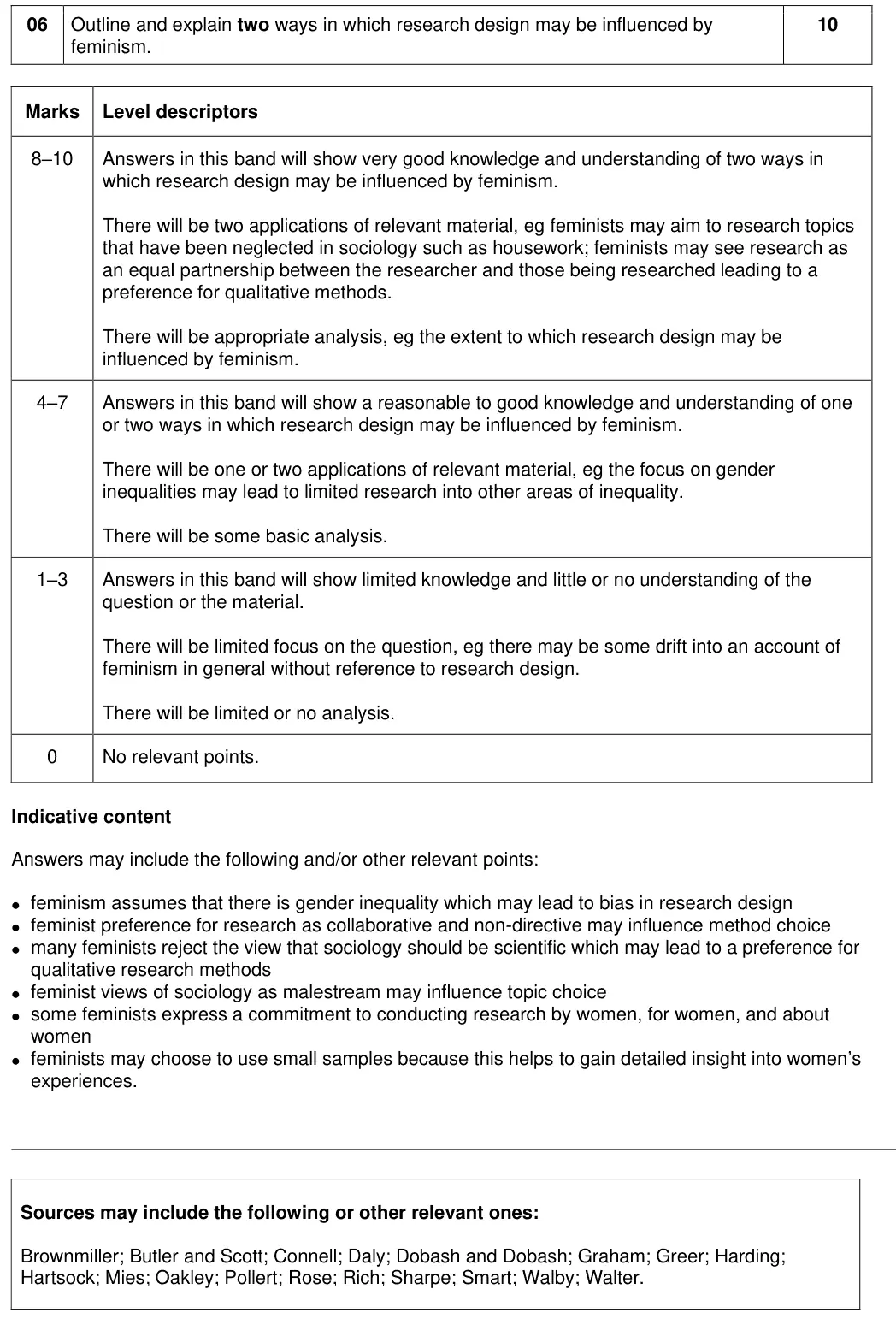
June 2024 · Paper 1 · Q610 marksAO1=5, AO2=3, AO3=2Outline and explain
Mark scheme, including the levels grid and indicative content
Examiner's comment
This question presented significant challenges, with many students struggling to understand and address the concept of ‘research design’ as influenced by feminism. Despite this concept being explicitly included in the specification, many responses discussed the impact of feminism in general terms without linking it specifically to aspects of research design. However, there were examples of students who interpreted the question as intended and effectively discussed, for instance, feminist preferences for qualitative methods and the importance of building rapport. Many of the more successful answers referred to feminist researchers often favouring qualitative approaches, such as unstructured interviews, to explore sensitive topics and prioritise participants' perspectives. In addition, some students then cited studies such as Dobash and Dobash's research on domestic violence, illustrating how feminist methodologies can provide deeper insights into women's experiences. They discussed how these methods aim to challenge traditional power dynamics in research, emphasising collaboration and empathy. Despite these strong examples, there were still many responses that failed to connect feminist theoretical perspectives with specific methodological choices, limiting the depth and specificity of the analysis.
Notes from the mark scheme and report
must link feminism to research design (topic choice such as housework, collaborative research and preference for qualitative methods, small samples, research by and for women)
drift into feminism in general = 1–3
many did not grasp 'research design' though it is in the spec
good answers used unstructured interviews, rapport and Dobash and Dobash
June 2024 · Paper 3 · Q510 marksAO1=5, AO2=3, AO3=2Outline and explain
Mark scheme, including the levels grid and indicative content
Examiner's comment
This question was not accessed well. Students found it hard to stick to just two reasons, and often one reason would list others or drift into others. This meant they found it hard to develop points and in turn access the highest level of the mark scheme. Students also found it challenging to apply examples. Examples of statistics could have included the census, the crime survey for England and Wales, health or education statistics.
Notes from the mark scheme and report
no marks for evaluation in this question type
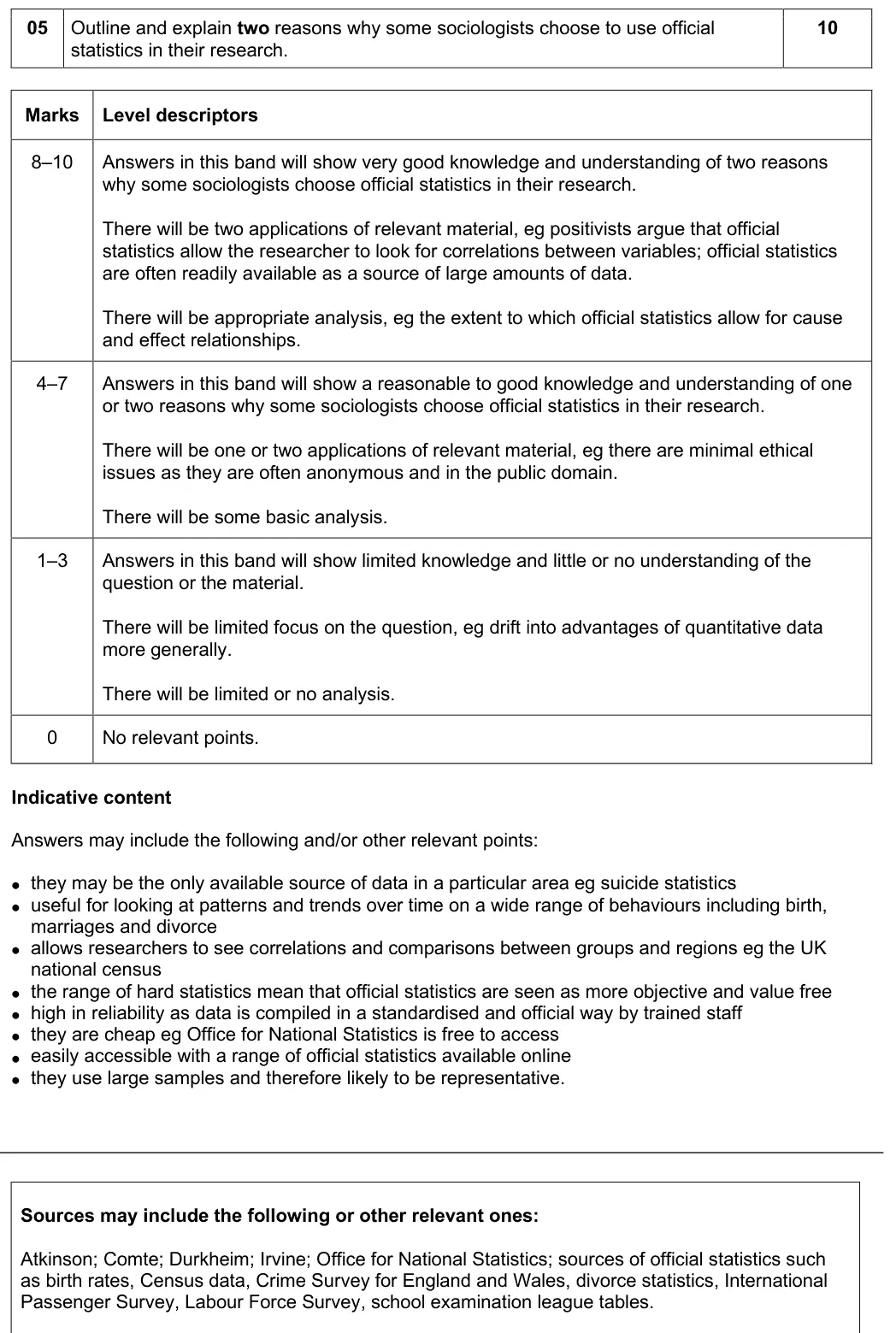
two reasons each developed (e.g. positivist search for correlations, large readily available data, only source on some topics such as suicide, trends over time, cheap, few ethical issues)
drift into advantages of quantitative data in general = 1–3
students blurred several reasons into one and rarely gave examples (census, Crime Survey for England and Wales)
June 2023 · Paper 1 · Q520 marksAO1=8, AO2=8, AO3=4Methods in context
Mark scheme, including the levels grid and indicative content
Examiner's comment
This question showed a range of knowledge and understanding of strengths and limitations of self-completion questionnaires. For example, many students outlined strengths and limitations linked to practical issues (such as costs and distribution), response rates and accuracy of the information gained from self-completion questionnaires. Whilst some were able to develop these strengths and limitations using correct conceptual language, others did conflate and/or confuse concepts such as validity and reliability. Some answers also made assertions about self-completion questions (eg ‘not being valid’) whereas better answers were able to explain that issues of validity and reliability are more nuanced. Similarly, to previous series, a number of students developed some of these strengths and limitations of self-completion questionnaires to issues of studying education more generally. For example, some students explained that self-completion questionnaires are more likely to get permission from gatekeepers (school leaders and parents) as they are less likely to interrupt lessons in the same way as other methods. The most successful students were able to apply the strengths and limitations to the specifics of the issue in the question. For example, as self-completion questionnaires are often completed in private and are anonymous, respondents (such as students) may be more likely to express their opinions about the pressures that their parents or teachers may be putting on them without fear of any repercussions or upsetting them. Additionally, some were able to develop the issue of ‘operationalising’ in the item, in explaining the issue with measuring and defining ‘pressure’ and ‘high grades’ when completing a questionnaire in the absence of any researcher that may be able to clarify any misunderstanding.
Notes from the mark scheme and report
must apply the method to the specific issue (pressure on pupils to achieve high grades)
application to education in general only caps at 13–16
little or no reference to self-completion questionnaires = max 4
validity and reliability often conflated
best answers used anonymity/privacy and the difficulty of operationalising 'pressure'
June 2023 · AS Paper 1 · Q620 marksAO1=8, AO2=8, AO3=4Methods in context
Mark scheme, including the levels grid and indicative content
Examiner's comment
In the questions where extended prose was required (10 and 20 mark questions) most students showed their understanding of the different balance of skills required in each question. Question 06: Both the method (unstructured interviews) and the issue (experience of bullying) were well understood by students in this paper. Centres have prepared their students well to understand that the practical, ethical and theoretical strengths/ limitations of the method are of upmost importance and that writing about the issue without linking it to the method will attain limited credit. We saw many cases where students were able to successfully link the idea that schools would be concerned about Ofsted, league tables and falling numbers on roll if the researcher were to uncover significant issues with bullying and that, as a consequence, access would be difficult for a researcher. Another popular response was that unstructured interviews take longer than other methods, especially when discussing bullying, as time to build rapport and trust is required. They then inferred that teachers and parents would be less likely to give consent for students to miss out on learning. Weaker responses tended to include descriptions of learned sociological studies or discussed alternative methods. It is important that students only consider the strengths and limitations of the method in the question and that they avoid comparing/ contrasting with another method.
Notes from the mark scheme and report
must apply unstructured interviews to the specific issue of pupils' bullying experiences
application to education in general only = max 13-16
writing about bullying without the method = 1-4
sensitivity (vulnerable pupils, parental consent, school reputation) central
best answers linked school concern over Ofsted, league tables and rolls to difficulty of access
June 2023 · AS Paper 2 · Q14 marksAO1=2, AO3=2Outline
Mark scheme
Examiner's comment
Students generally understood the difference between primary and secondary data. Some were less adept at identifying the advantages of such data. Students who claimed that primary sources were more valid; reliable; representative were required to explain how this is the case to gain credit as such qualities could equally be a feature of secondary sources of data. More successful responses were able to use the fact that the researcher was in control over the entirety of the research process to formulate effective answers.
Notes from the mark scheme and report
2 marks for each of two advantages clearly outlined, 1 if partial (e.g. researcher gathers exactly what is needed, operationalises concepts their own way, knows how the data were produced, fills gaps where no secondary data exist)
bare claims that primary data are more valid, reliable or representative need explaining, since secondary data can share these qualities
best answers stressed the researcher's control of the whole process
June 2023 · AS Paper 2 · Q216 marksAO1=6, AO2=5, AO3=516-mark essay
Mark scheme, including the levels grid and indicative content
Examiner's comment
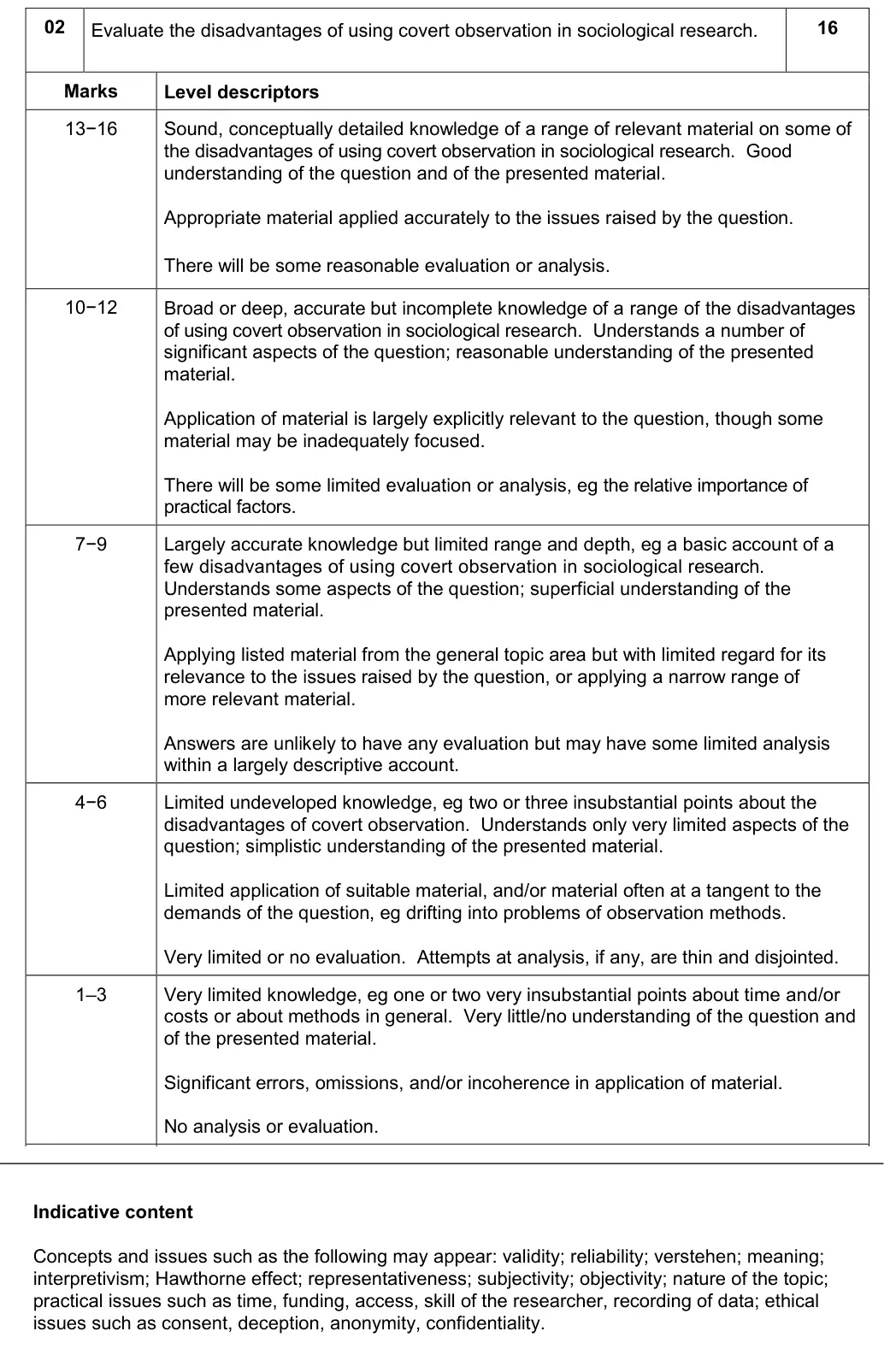
This was a question that many students found straightforward to engage with. The most popular approach to this question was to begin with the more unique issues relevant to covert observation – which were the ethical problems relating to consent, the right to withdraw and so on. Some students ran out of steam at this point but better informed students were able to raise issues to do with reliability relating to repeating the observation, representativeness concerning small sample sizes and validity regarding ease of recording data. Some students were able to place the above in the positivist anti positivist perspectives debate and gained credit for this. One issue for students with good knowledge of the topic was the application challenge of not drifting into talking about advantages rather than disadvantages, which unless used evaluatively could not gain credit.
Notes from the mark scheme and report
AS essay, 16 marks
top band needs a range of disadvantages with reasonable evaluation
drift into problems of observation in general = 4–6
most began with ethical problems (consent, deception, right to withdraw) and better answers added reliability, representativeness and recording difficulties
placing points in the positivist/interpretivist debate was credited
advantages only count if used evaluatively
June 2022 · AS Paper 1 · Q620 marksAO1=8, AO2=8, AO3=4Methods in context
Mark scheme, including the levels grid and indicative content
Examiner's comment
The majority of students were able to give a good account of the strengths and limitations of using covert participant observation to investigate education. Many had a good understanding of the ethical implications of deception and the theoretical benefit of validity. Students were often able to show application of one part of the method (eg covert or participant) to the problem of gaining entry to a school. To receive marks in the top level, students needed to be able to show that they had understood each element of the method (covert and participant and observation) and be able to apply this to gendered behaviour in schools. The difficulty of doing this is reflected in the mark scheme that the full application is only required for the top level. However, lots of students were successful in partial application and it was clear that they had been prepared to think practically about completing research in an educational setting.
Notes from the mark scheme and report
must apply covert participant observation to gendered behaviour in schools
education in general caps at 13–16
little or no reference to covert participant observation = max 4
most knew ethics of deception and validity well
application often only to gaining entry to a school
June 2022 · AS Paper 2 · Q216 marksAO1=6, AO2=5, AO3=516-mark essay
Mark scheme, including the levels grid and indicative content
Examiner's comment
Answers to essay questions were sometimes disjointed; it would be worth students considering making a brief plan for the 16 and 20 mark questions. This was an accessible question that attracted a wide range of responses. The most common approach to this question was to use the practical, ethical and theoretical factors framework. The best responses used relevant examples and studies to illustrate the disadvantages of personal documents. However, responses were often disjointed and repetitive with little reference to relevant research. Some generic material on qualitative research methods was evidenced and there was evidence of drift into secondary sources more generally. Some students showed a limited understanding of private documents, confusing them with information like medical records, however, even then most managed to score some marks. As with question 1, the biggest weakness seemed to be mentioning a disadvantage and then not developing it. Another common error was drifting into unrelated advantages.
Notes from the mark scheme and report
16-mark evaluate
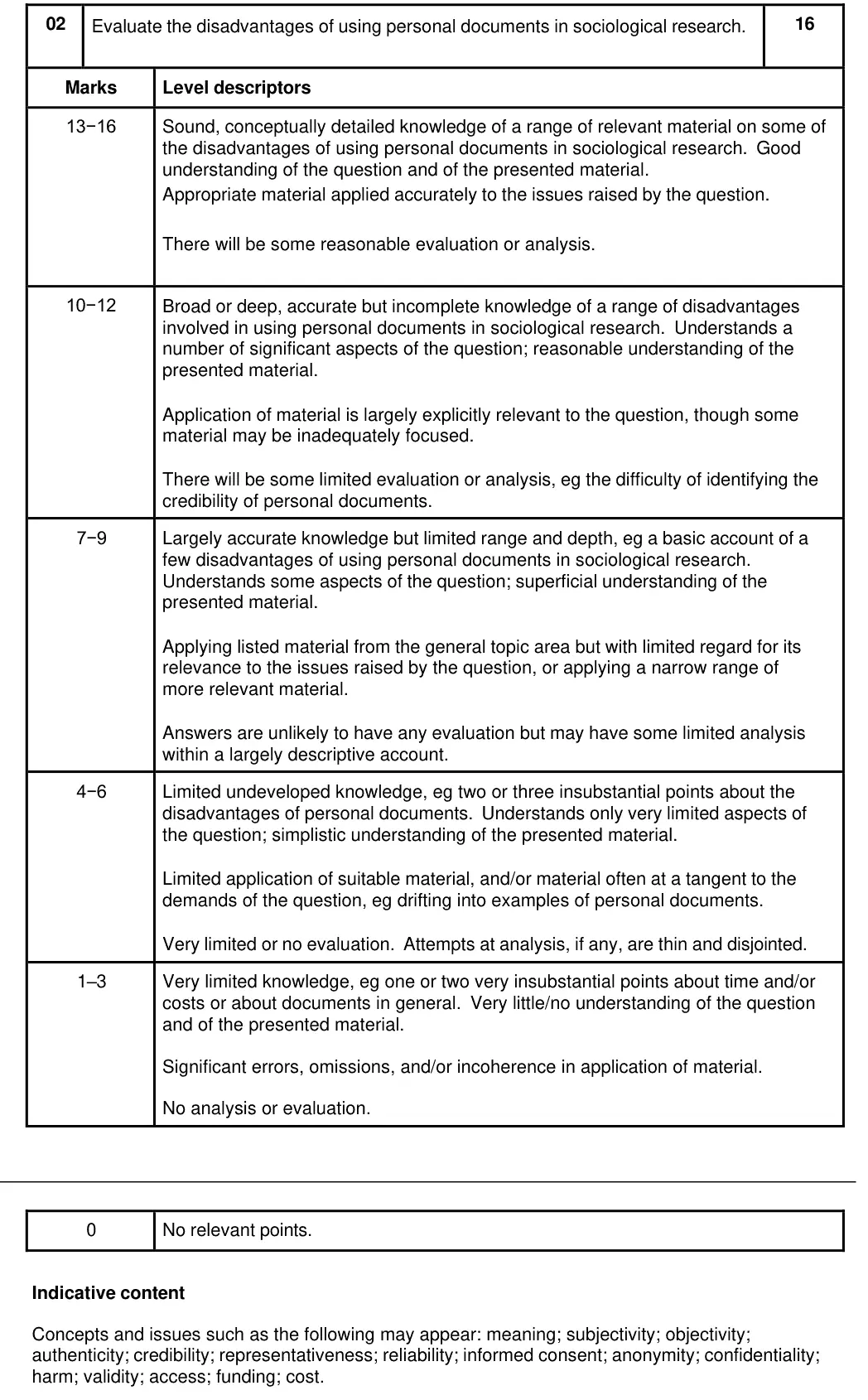
disadvantages such as authenticity, credibility, representativeness, subjectivity, ethics and access
drift into examples of personal documents = 4–6
usual approach was the practical/ethical/theoretical framework
weaknesses: undeveloped points, generic qualitative material, drift into secondary sources or advantages, confusing personal documents with records
November 2021 · Paper 3 · Q620 marksAO1=8, AO2=6, AO3=620-mark essay
Mark scheme, including the levels grid and indicative content
Examiner's comment
This question needed development. Students were able to use the item, but many found it difficult to go beyond this. Those students who did answer this well used examples such as Durkheim and his study on suicide. AO1 was the strongest skill in this question. AO3 needed focused development. If students did run out of time, there was an impact on this question. This could be addressed by centres via the process of timing practice in assessments.
Notes from the mark scheme and report
top band weighs theoretical against practical and ethical factors and how they relate
drift into strengths and weaknesses of methods = 5–8 band
many could not go beyond the item
best answers used Durkheim's study of suicide
evaluation needed more focus
the report notes Theory and Methods was weaker than previous series in this small November cohort
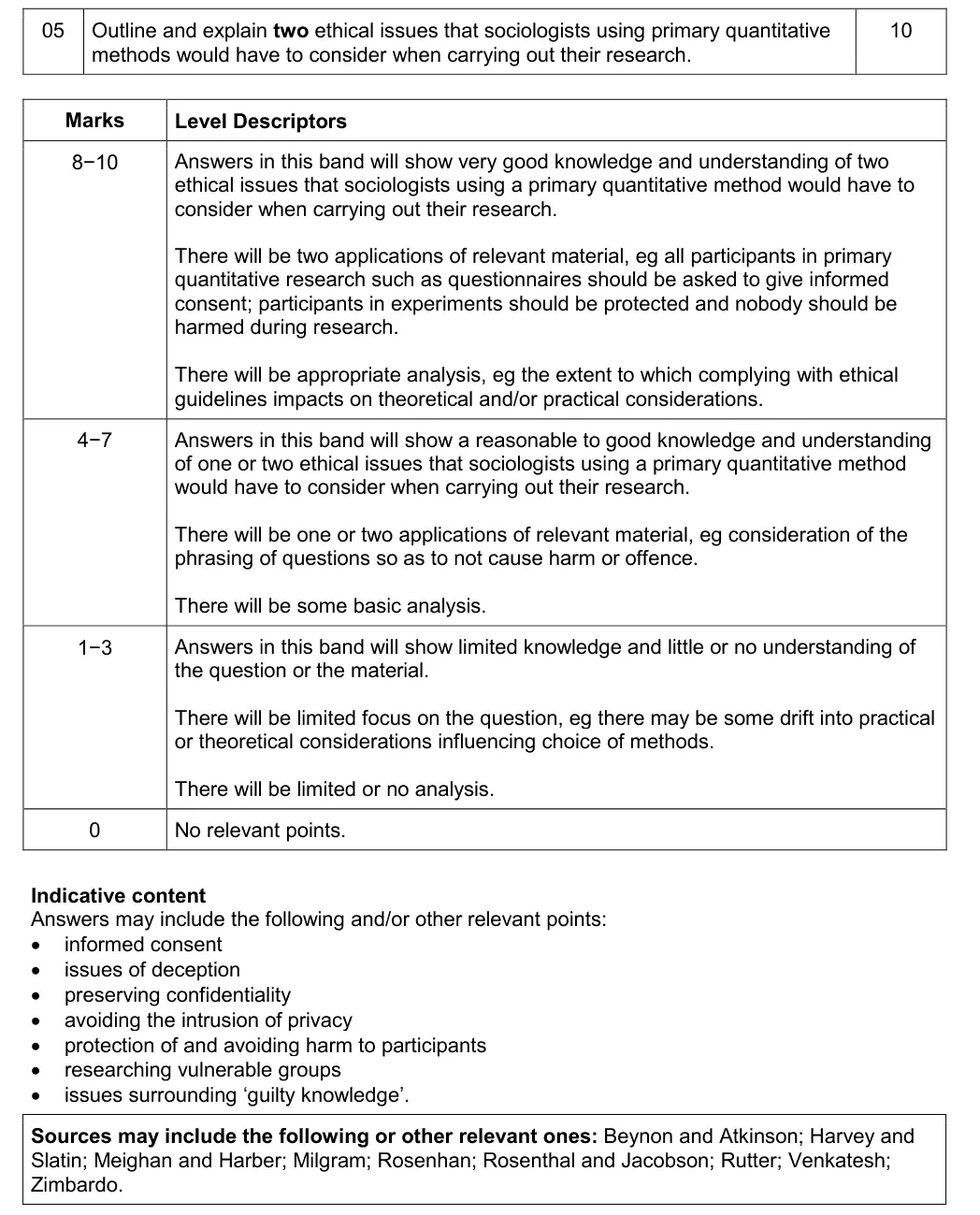
November 2020 · Paper 3 · Q510 marksAO1=5, AO2=3, AO3=2Outline and explain
Mark scheme, including the levels grid and indicative content
Examiner's comment
The majority of responses could identify two ethical issues. However, there was confusion over which research methods were primary quantitative methods. Some students did not address this at all, and this had an impact on the marks awarded. Other students who answered this question well were able to link the ethical consideration to an appropriate study. This displayed excellent knowledge and understanding of both ethical concerns and primary quantitative research methods. Generally, more attention to detail in the research methods 10-mark question (Question 5) must be given.
Notes from the mark scheme and report
ethical issues must be applied to primary quantitative methods (questionnaires, structured interviews, experiments)
many were unsure which methods these are or ignored the method
drift into practical or theoretical issues = 1–3
best answers linked each issue to a study
June 2019 · Paper 1 · Q520 marksAO1=8, AO2=8, AO3=4Methods in context
Mark scheme, including the levels grid and indicative content
Examiner's comment
However, for the Methods in Context question few students were able to apply their knowledge of the given research method to the issue specified in the question. The majority of students appeared to be confident in their understanding of written questionnaires and could include a range of practical, ethical and theoretical issues relating to the method. Most students provided balanced answers which examined both strengths and weaknesses. Less effective answers were often relatively strong on their understanding of written questionnaires, but the strengths and limitations of the method were not applied effectively to either the issue or to the study of education in general. The significant number of students who focused on the method alone, even when this was done well, could get no higher than the 9-12 mark band, without making reference to the research issue. A significant minority of students interpreted written questionnaires as ‘open questions’ and confused written questionnaires as being an interpretivist approach. They therefore incorrectly described the method as providing qualitative data with higher levels of depth and validity. A smaller minority seemed unsure about whether the method was a qualitative or quantitative one. There were also a larger number of students who wrote a ‘catch all’ conclusion which recapped previous points and referred to alternative methods and the need to triangulate. This type of conclusion tended to add little or nothing to the response. The majority of students were able to make use of the Item, for example, by applying ‘some questionnaires may not be returned’ to low response rate and ‘completed outside the home’ to parents being able to complete them in their own time. However, the ‘hook’ of ‘operationalising of concepts’ was less well applied, such as to the issue of it leading to a lack of validity in responses. With weaker responses, students just repeated sections of the item without any significant development. The main limitation of many responses was not explicitly addressing the link to ‘their children’s achievement’. Most attempts at application to the issue stopped at the ‘role of parents’ although often implicitly referring to achievement by discussing parental involvement in their child’s education. Many students focused on the differences between working-class and middle-class parents in relation to issues such as linguistic and literary skills, on parents’ own experience of education, and on the likelihood of impression management as they represented themselves as ‘good’ parents. However, very few responses offered one or more application of the method to the specific issue of the role of parents in pupils’ achievement, for example in the way parents may give socially desirable responses that lack validity, such as ticking boxes stating that they ‘strongly agree’ with the statement that they are very involved in helping their child achieve in school. It was good to see that a large number of students were able to advance characteristics of the method such as access and development of a gatekeeper issue beyond education in general. However, few students were able to apply a characteristic of the role of parents in pupils’ achievement to the method of written questionnaires to reach the requirements of the top band.
Notes from the mark scheme and report
must apply the method to the specific issue (role of parents in children's achievement)
application to education in general caps at 13–16
method only with no link to the issue = max 12
some wrongly treated written questionnaires as open, qualitative and interpretivist
best answers used the item hooks (completed outside school, response rate, operationalising)
'catch-all' triangulation conclusions added little
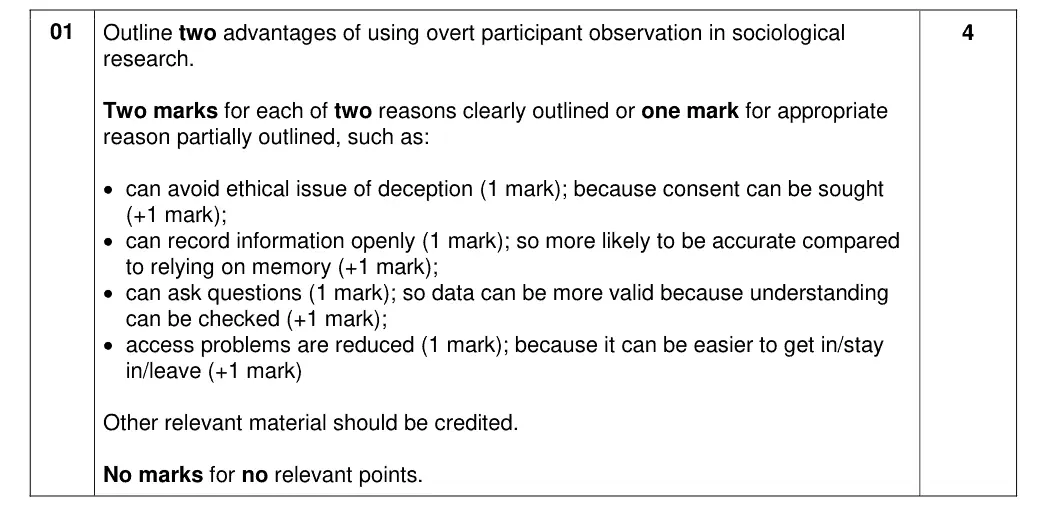
June 2019 · AS Paper 2 · Q14 marksAO1=2, AO3=2Outline
Mark scheme
Examiner's comment
Students who recognised that the key to this question was the idea of overt observation were largely successful. The most common responses then identified the ethical advantage of gaining consent from those being observed. Many answers pointed out the advantage of being able to record information openly and not rely on memory. It is helpful for students to explain how the suggested advantage is an advantage. For example, answers that just said that one of the advantages was that overt observation allowed questions to be asked without elaborating on how or why that was an advantage were credited as partial answers. There were a number of students who identified generic advantages of observation in general. These answers failed to score any marks.
Notes from the mark scheme and report
AO grid not printed
2 marks for each of two advantages clearly outlined, 1 if partial
credited: avoids deception because consent can be sought, open recording is more accurate than memory, questions can check understanding, easier access
the advantage must be specific to overt observation and explained (just 'can ask questions' = partial)
generic advantages of observation scored nothing
AO split from AQA's standard grid for this paper (this year's mark scheme does not print it).
June 2019 · AS Paper 2 · Q216 marksAO1=6, AO2=5, AO3=516-mark essay
Mark scheme, including the levels grid and indicative content
Examiner's comment
This attracted a wide range of responses. Better answers explored ethical issues and how these impacted on choice of methods and then analysed and evaluated these issues. A number of students made reference to methods without any reference to ethical issues or alternatively referred to ethical issues without any mention of methods. Many students gave long accounts of particular studies such as Milgram without specific application to the question. Some answers were structured around the practical, ethical and theoretical factors framework. Unfortunately, many of these had a lot more to say about practical and theoretical factors than ethical issues. The ethical issues that students tended to discuss most effectively were consent, deception and harm to participants.
Notes from the mark scheme and report
AO grid not printed
top band: range of ethical issues (consent, deception, harm, confidentiality, funding-body standards) linked to choice of method, with evaluation e.g. how ethics affects validity or examples of unethical methods such as covert observation
drift into accounts of particular studies (e.g. Milgram) = 4–6
points only about time, cost or methods in general = 1–3
many said more about practical and theoretical factors than ethics
AO split from AQA's standard grid for this paper (this year's mark scheme does not print it).
June 2018 · AS Paper 2 · Q216 marksAO1=6, AO2=5, AO3=516-mark essay
Mark scheme, including the levels grid and indicative content
Examiner's comment
This attracted a wide range of responses. Better answers explored issues of validity, reliability, representativeness and generalisability. However, a significant number appeared uncertain about what some of these key concepts meant. Many students used a framework of practical, ethical and theoretical factors to help structure their answers and this often proved a successful approach. Others took different examples of qualitative methods and went through them in a descriptive rather than analytical manner. Better responses were able to identify a range of disadvantages of qualitative methods and discuss some advantages that came out of those disadvantages. For example using qualitative methods may mean that there is a problem with subjectivity and the researcher becoming too involved with the subjects of the research. On the other hand, this involvement may mean that rapport is built up and this may improve the depth and quality of the research, which boosts validity. Answers that took this approach were more successful than those that listed disadvantages and advantages with little connection between them. Some students used examples of research to help illustrate the points they were making. While this proved helpful in some cases, there was tendency to discuss issues related to the particular subject of research rather than draw conclusions about the nature of qualitative methods.
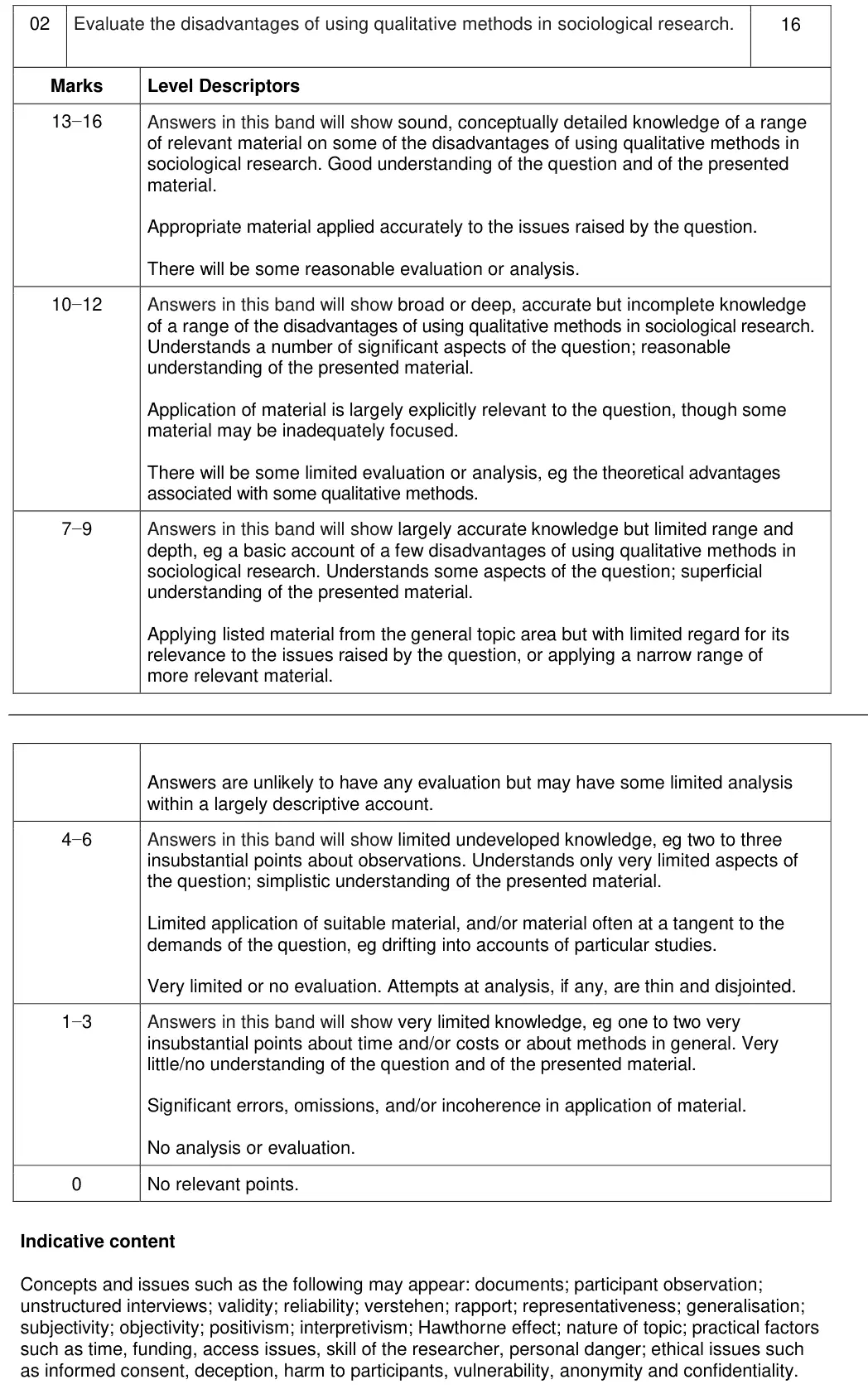
Notes from the mark scheme and report
focus is disadvantages of qualitative methods (documents, participant observation, unstructured interviews)
10-12 band evaluation e.g. theoretical advantages of some qualitative methods
drift into accounts of particular studies = 4-6
many unsure of key concepts
best evaluated each disadvantage (e.g. over-involvement vs rapport and validity) rather than listing pros and cons
AO split from AQA's standard grid for this paper (this year's mark scheme does not print it).
June 2018 · Paper 3 · Q510 marksAO1=5, AO2=3, AO3=2Outline and explain
Mark scheme, including the levels grid and indicative content
Examiner's comment
Most students could offer two disadvantages of laboratory experiments. Most often these included the artificiality of the setting (often conflated with the Hawthorne effect), while other disadvantages included difficulties in identifying and controlling variables, a lack of representativeness or ethical problems. However, many answers failed to explain or develop these points successfully; some simply described an example of an experiment that experienced such problems. Some students did not know the difference between reliability and validity. A minority of students included evaluation, for which no marks were available on this question.
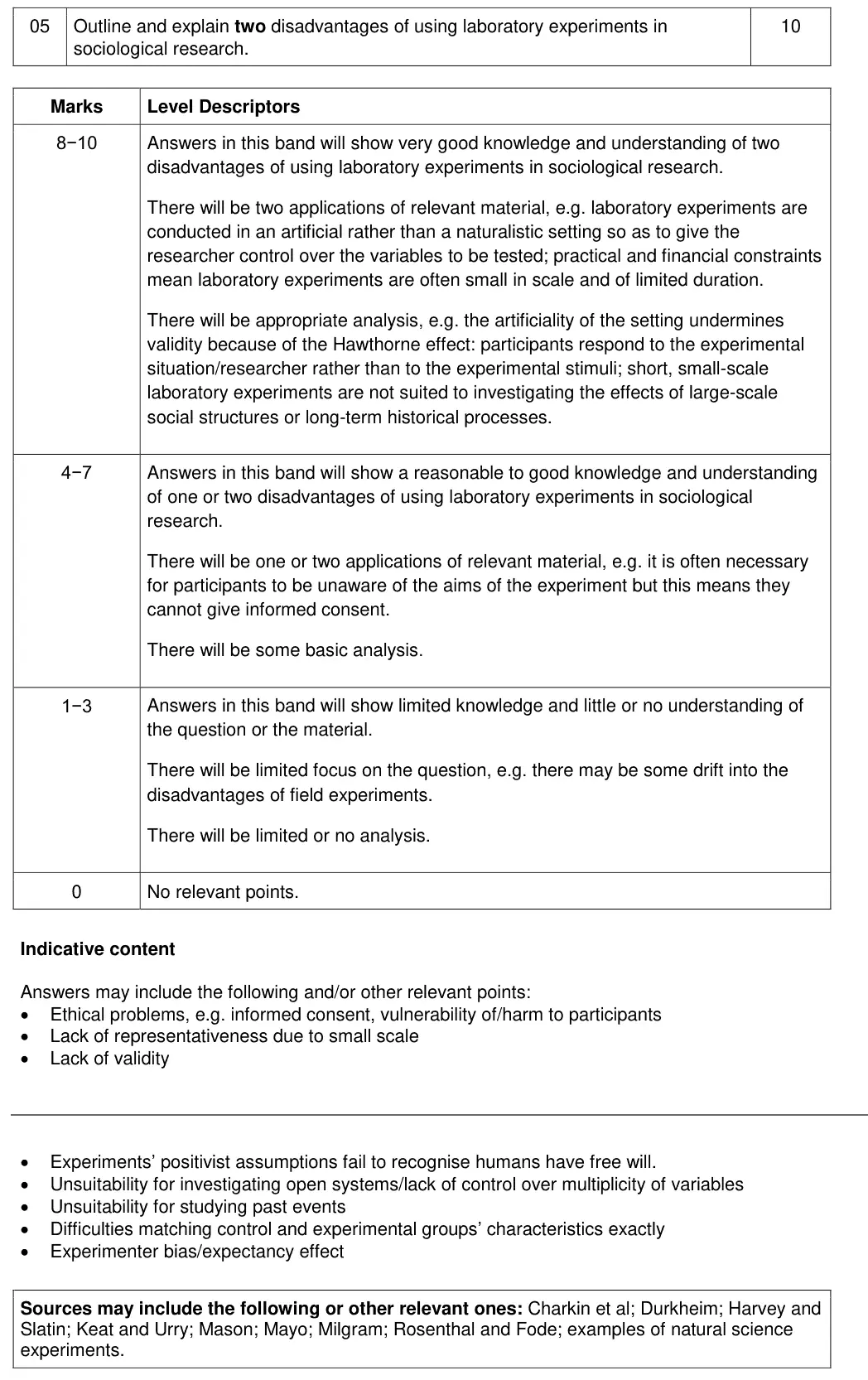
Notes from the mark scheme and report
no marks for evaluation in this question type
two disadvantages each developed (e.g. artificiality and Hawthorne effect undermining validity, small scale and short duration, informed consent)
drift into field experiments = 1–3
many just described an example experiment
artificiality conflated with Hawthorne effect
reliability and validity confused
AO split from AQA's standard grid for this paper (this year's mark scheme does not print it).
June 2018 · Paper 3 · Q620 marksAO1=8, AO2=6, AO3=620-mark essay
Mark scheme, including the levels grid and indicative content
Examiner's comment
This question proved to be quite challenging for some students. Most were able to put together a list of positivist characteristics as advantages, such as objectivity, reliability, quantification and generalisability. However, most could not evaluate these advantages. Instead a typical response, having provided a paragraph or two on the advantages, gave a list of disadvantages, or a list of reasons why interpretivist sociologists would not like the method. The result was an essay of two halves with little to link them into a coherent answer to the set question. Some generic ‘methods’ material appeared in weaker responses, for example drifting into a description of an alternative research method that the student asserted were ‘better’ than structured interviews. The weakest answers sometimes confused structured and unstructured interviews, reliability and validity, and even positivism and interpretivism.
Notes from the mark scheme and report
top band evaluates each practical, ethical and theoretical advantage directly and may link them
listing disadvantages unlinked to stated advantages = juxtaposition, max 9–12
drifting into other methods = 5–8
typical answers were two halves (positivist advantages then interpretivist objections)
weakest confused structured and unstructured interviews, reliability and validity, positivism and interpretivism
AO split from AQA's standard grid for this paper (this year's mark scheme does not print it).
June 2017 · AS Paper 1 · Q620 marksAO1=8, AO2=8, AO3=4Methods in context
Mark scheme, including the levels grid and indicative content
Examiner's comment
Schools and colleges have been more adept in preparing their students for the methods in context question than last year. Many students were able to apply the method to researching education as a closed space, especially in terms of understanding access issues. Good responses identified specific characteristics of working-class underachievement, for example that students may be members of class based, anti-school subcultures, and may therefore refuse to cooperate or fill out the questionnaire accurately. Some responses were able to meet the criteria for the top band in developing the point that working-class parents may not return the questionnaire or may give socially desirable responses due to not wanting to appear to be seen as a bad parent if their child is underachieving and from a working class background. A few answers pursued tangents describing research findings on this topic. Most students were confident in their understanding of questionnaires, although a minority assumed that written questionnaires must use open questions that produce qualitative data and are therefore favoured by interpretivists. Similarly, it was often asserted that anonymity would lead to honesty, without an explanation as to why. Anonymity was often confounded with confidentiality, and the advantage of more candid answers was often stated to be ethical, when it is one of validity. The ethical issue of upsetting respondents with a sensitive question is not removed by anonymity, though it is likely to reduce embarrassment. Another widespread assertion was that this is a sensitive topic. This needs some explanation since sociologists rarely investigate phenomena that are not sensitive, especially in the context of schools. Some students were content with simply presenting a range of strengths and limitations of the method without applying them to the issue in the question. Some of these answers picked up on the idea in the item that questionnaires could be distributed to a large number of people but failed to apply this point beyond the item. Better answers made good use of formulae to help them cover a range of factors, and were able to make some connections to the research setting (school, classroom, homes) and/or the likely participants (pupils and parents). Few students thought to consider teachers as sources of information. There were many attempts to link the method with the issue, but often the students focused too much on the sensitivity of studying working class underachievement rather than linking this issue specifically to questionnaires. There were many cases of students reaching level 4 rather than fully developing their point to get into level 5. On the whole, many were able to connect using questionnaires to social class, but found it more difficult to add in the additional final layer of educational achievement.
Notes from the mark scheme and report
must apply written questionnaires to working-class underachievement specifically
application to education in general only caps at 13–16
knowledge applied only to the substantive issue with little reference to questionnaires = 1–4
good answers: anti-school subcultures refusing to cooperate, working-class parents not returning questionnaires or giving socially desirable answers
errors: assuming questionnaires must be open/qualitative, anonymity confused with confidentiality, candour treated as an ethical rather than validity gain, 'sensitive topic' asserted without explanation
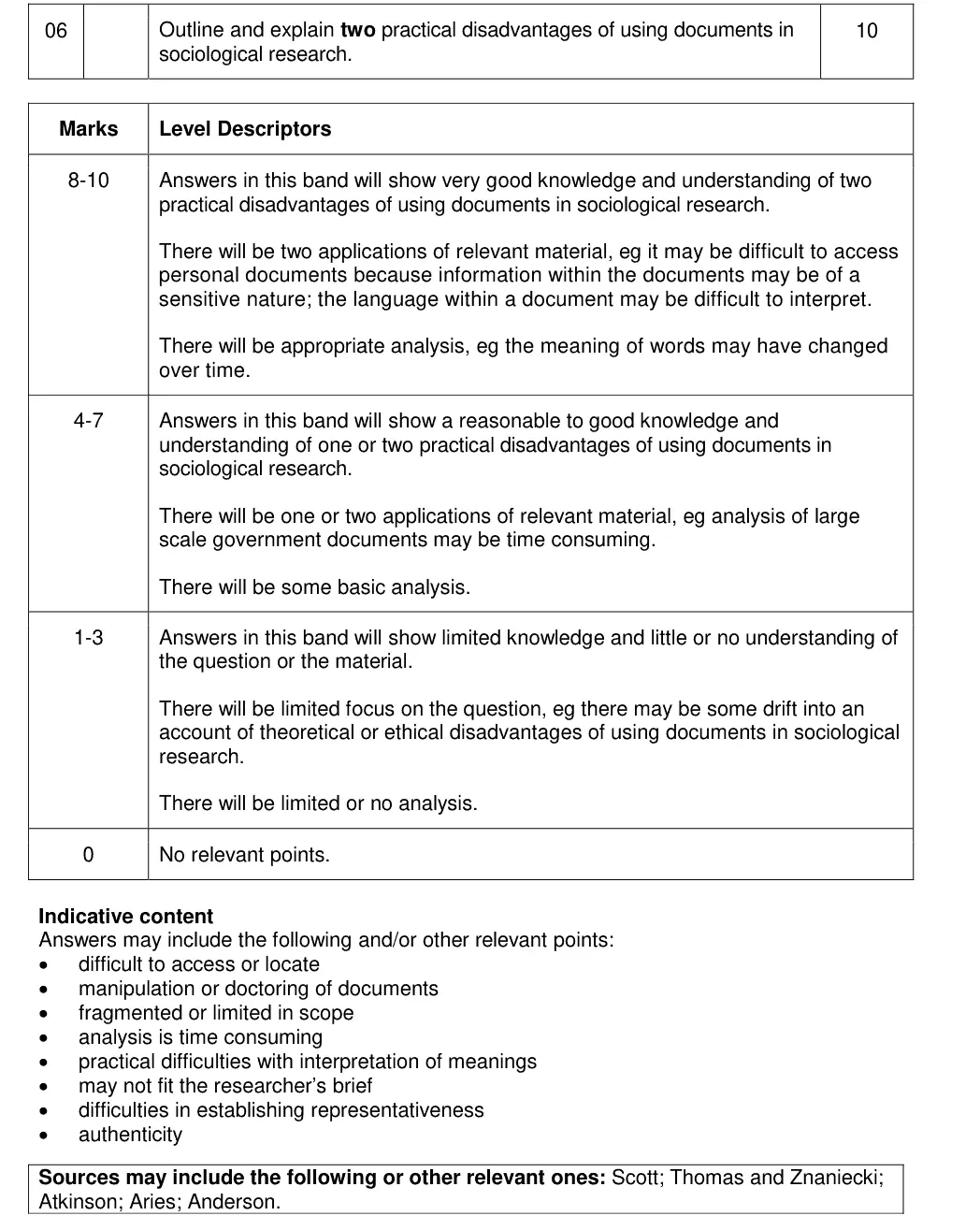
June 2017 · Paper 1 · Q610 marksAO1=5, AO2=3, AO3=2Outline and explain
Mark scheme, including the levels grid and indicative content
Examiner's comment
The majority of students were able to present two practical disadvantages of documents. Common answers included reference to time, cost, access and authenticity. Stronger answers could explain the problem in some detail and show good application and analysis in relation to both public and personal documents. More developed responses were able to link the disadvantage to a specific piece of research where documents had been used, or linked the disadvantage to a particular issue. However, relatively few students could offer a sustained development of the practical disadvantages they had identified and many responses were quite short in length. Some answers were not rewarded beyond the 1-3 band, as they discussed theoretical or, to a lesser extent, ethical issues, rather than practical disadvantages. Some students identified a practical issue but drifted into explaining it in relation to theoretical concerns. Schools and colleges are reminded that there are no marks for evaluation for this question. A significant number of students had evaluative statements regarding the advantages of documents tagged on to the end of responses that were not relevant to the question.
Notes from the mark scheme and report
practical disadvantages only: drift into theoretical or ethical problems = 1–3 band
no marks for evaluation (bolted-on advantages not credited)
common answers: time, cost, access, authenticity
best answers linked each to public/personal documents or a named study
June 2017 · AS Paper 2 · Q216 marksAO1=6, AO2=5, AO3=516-mark essay
Mark scheme, including the levels grid and indicative content
Examiner's comment
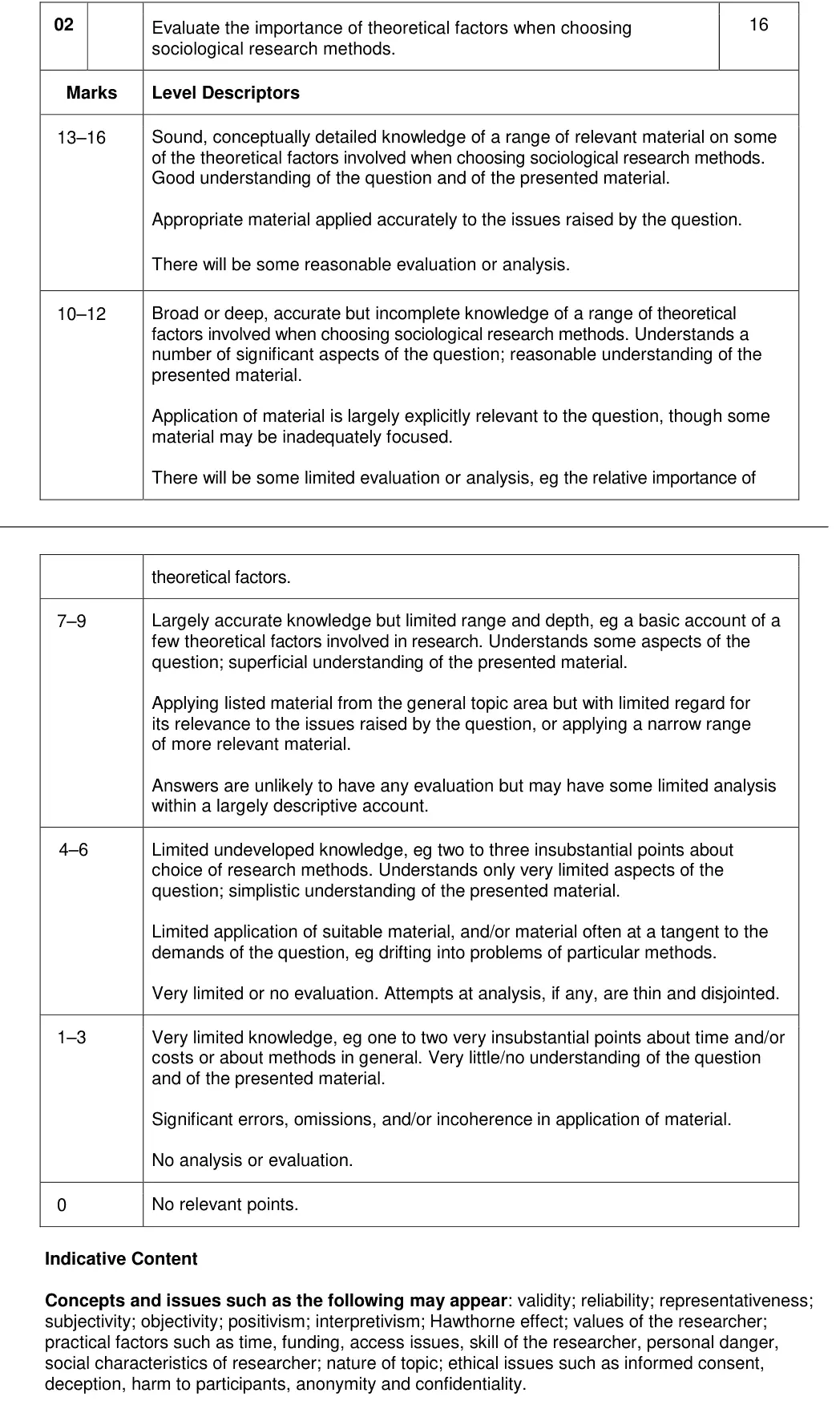
This question attracted a wide range of responses. Better answers explored issues of validity, reliability, representativeness and generalisability. However, a significant number appeared uncertain about what some of these key concepts meant. There were also some students who had little understanding of what theoretical factors were, and cited practical and ethical issues in their place. Some students gave long accounts of examples of research and their methods without really getting to grips with the question. The best answers were able to explain the link between positivist and interpretivist approaches and choice of method. Key theoretical terms were explained and analysed. The very best answers were able to come to a conclusion about the relative importance of theoretical factors when choosing sociological research methods.
Notes from the mark scheme and report
focus is theoretical factors (validity, reliability, representativeness, positivism vs interpretivism)
many confused theoretical with practical and ethical factors
long descriptions of studies without addressing the question
best answers linked positivist and interpretivist approaches to method choice and concluded on the relative importance of theoretical factors
June 2017 · Paper 3 · Q510 marksAO1=5, AO2=3, AO3=2Outline and explain
Mark scheme, including the levels grid and indicative content
Examiner's comment
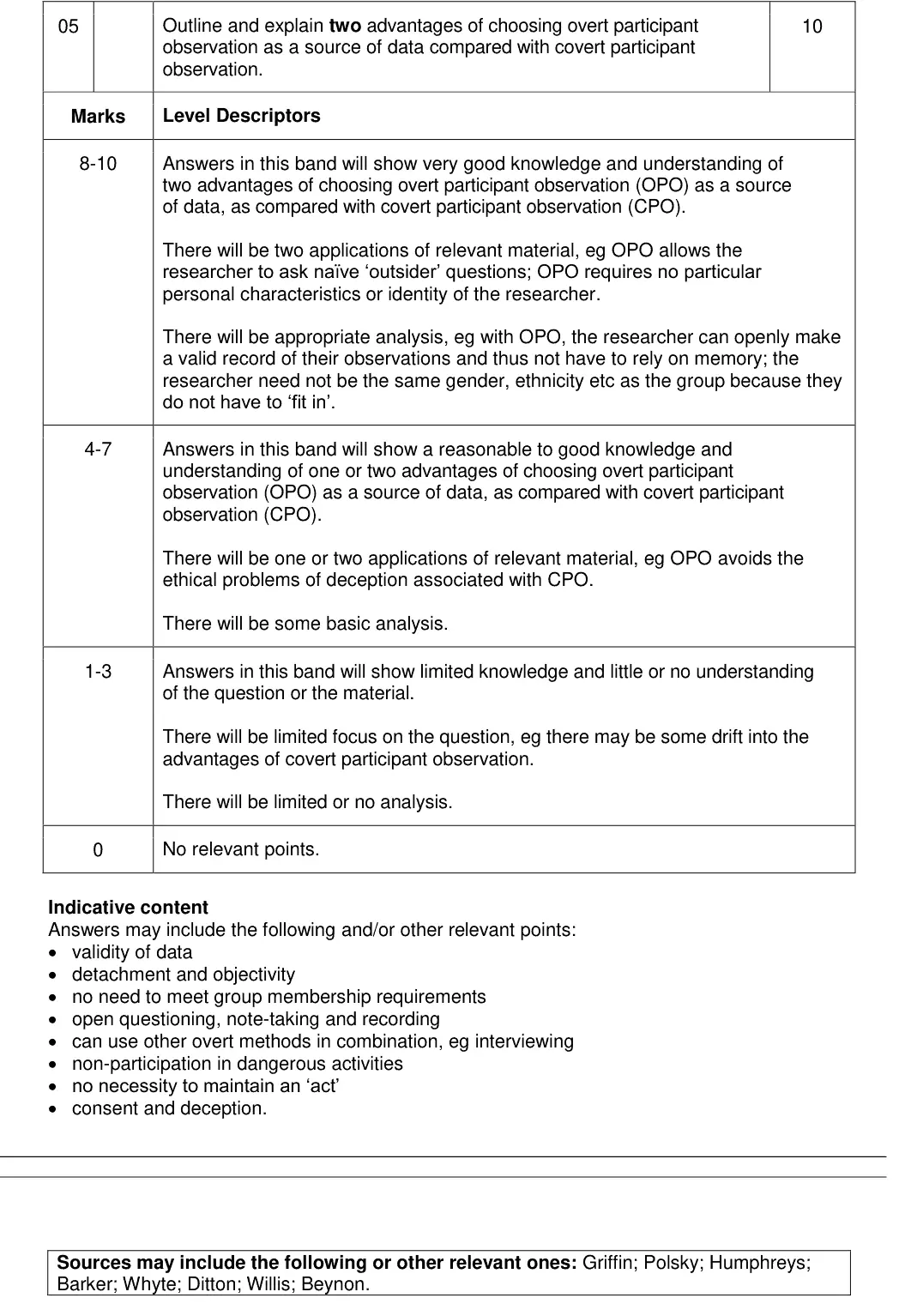
Most students were able to identify two appropriate advantages of overt participant observation (OPO) and to offer at least some limited development of one or both of these. The advantages commonly identified included ethical ones (generally, informed consent or avoidance of deception) and ones such as the ability to make notes or to avoid being drawn into dangerous activities. Although the question asked for advantages of OPO compared with covert participant observation (CPO), some students focused on one without reference to the other, leaving the examiner to deduce that, for example, the disadvantage of CPO outlined in the answer meant that there must be a corresponding advantage of OPO. This approach left the relevant point partly implicit and resulted in fewer marks being awarded. By contrast, the best answers made explicit and detailed comparisons, and elaborated on the nature of the advantages (notably, by explaining why or how the advantages were advantages), but weaker answers did not go beyond a basic identification of the advantage(s) with little or no development. Some answers offered a string of advantages in this way, but only the best two of those presented could be credited. Schools and colleges should familiarise students with this rubric requirement and the wording of the question here. Many students drew dubious and over-generalised inferences from some of the stated advantages. For example, some asserted that by researchers being open about their identity and purpose, this would facilitate access or even build rapport, when this is often not the case in such research. Some very weak answers were unable to address any advantages specific to OPO and offered points about the advantages of participant observation in general, such as validity, that are arguably as true or even truer of CPO. A few students unfortunately mixed up OPO and CPO. Although the question was about the advantages of OPO, some students presented extensive but irrelevant evaluative material on either the disadvantages of OPO (eg the Hawthorne effect) or the advantages of CPO (eg greater insight). Schools and colleges should make students aware that there are no marks for evaluation in question 05.
Notes from the mark scheme and report
no marks for evaluation in this question type
advantages must be of overt compared with covert participant observation, made explicit
credited: open note-taking, informed consent and no deception, avoiding dangerous activities, no need to fit in
general advantages of participant observation such as validity not specific to overt
only the best two of a list credited
some mixed up overt and covert
June 2016 · AS Paper 2 · Q14 marksAO1=2, AO3=2Outline
Mark scheme
Examiner's comment
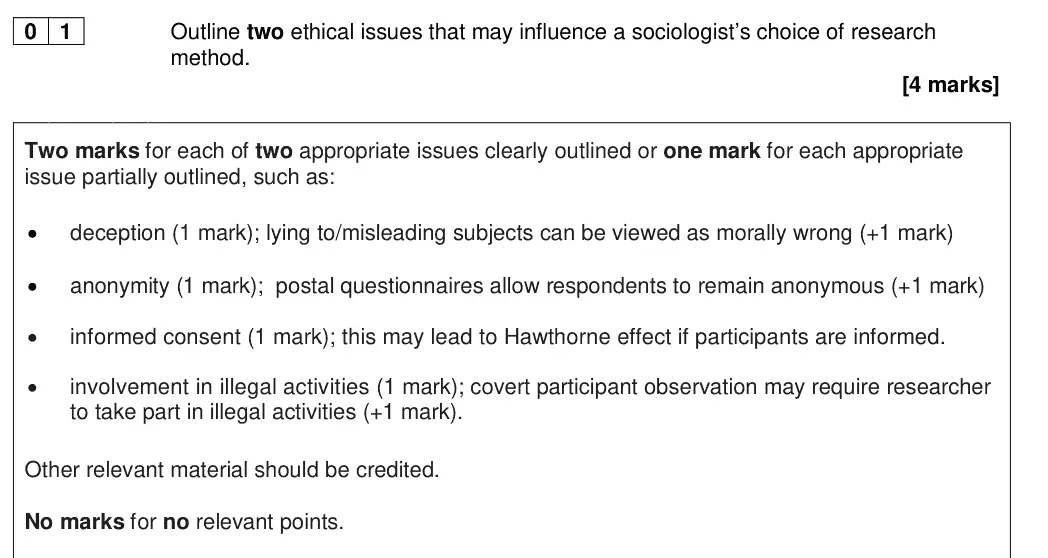
Most students could identify two ethical issues, but some were unable to develop their answer sufficiently for the second mark. Informed consent was the issue most cited, often with reference to covert observation. Harm, illegality, deceit and anonymity also often appeared. The most frequent mistakes were to discuss practical issues rather than ethical ones, such as danger for the researcher; getting permission (particularly for children); and to offer vulnerable groups as an issue, without explaining an ethical problem.
Notes from the mark scheme and report
2 marks for each of two ethical issues clearly outlined, 1 if partially outlined
credited issues include deception, anonymity, informed consent, involvement in illegal activity
informed consent most common, often linked to covert observation
common error: practical issues (researcher danger, getting permission) instead of ethical ones
naming vulnerable groups without an ethical problem not enough
mark scheme omits the +1 on the informed consent bullet (misprint)
June 2016 · AS Paper 2 · Q216 marksAO1=6, AO2=5, AO3=516-mark essay
Mark scheme, including the levels grid and indicative content
Examiner's comment
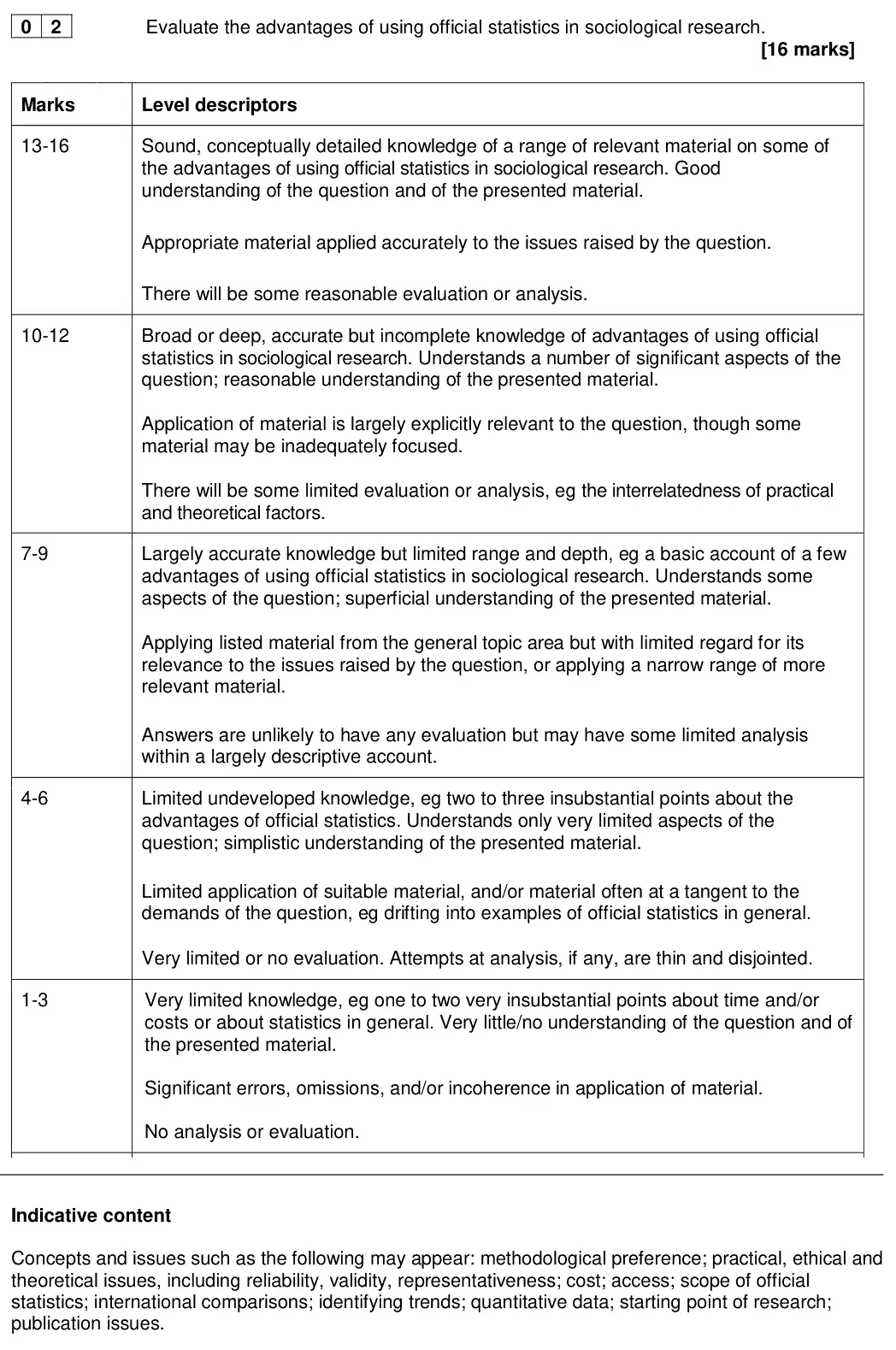
Many students followed a practical, ethical and theoretical factors framework, but there was often confusion over the theoretical concepts, especially reliability and validity. Many simply listed advantages and then disadvantages, showing little awareness of evaluation. Students often used phrases such as 'positivists like quantitative data because it's reliable' without any real development or sense that they understood what that meant. Better answers showed good knowledge and understanding of official statistics, and developed the response through examples and analysis. Strong responses were also able to evaluate those advantages explicitly rather than just juxtaposing a disadvantage, for example: ‘official statistics had the ethical advantage of informed consent for the original data, but the participants were not aware of its use for further sociological research’, or: ‘although official statistics generated large amounts of data, this might mean problems of complex and lengthy analysis’.