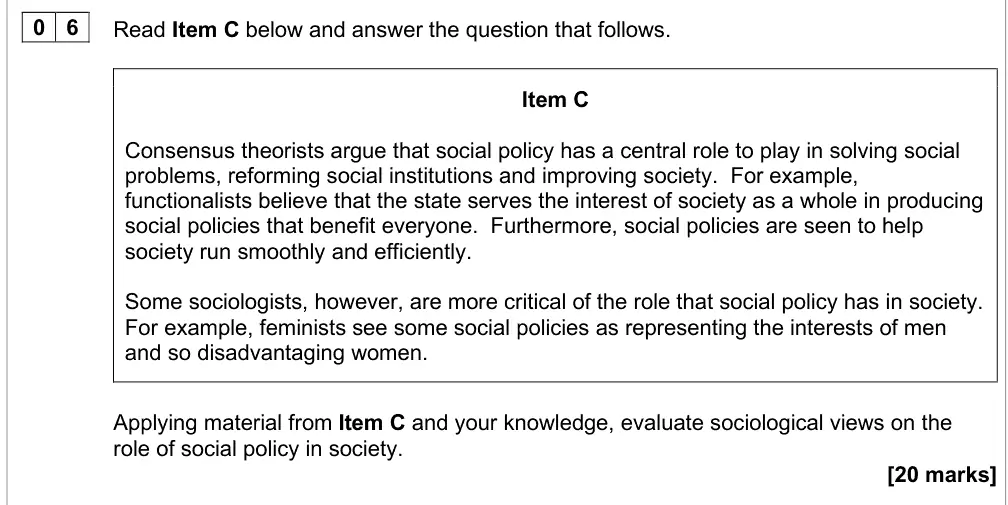
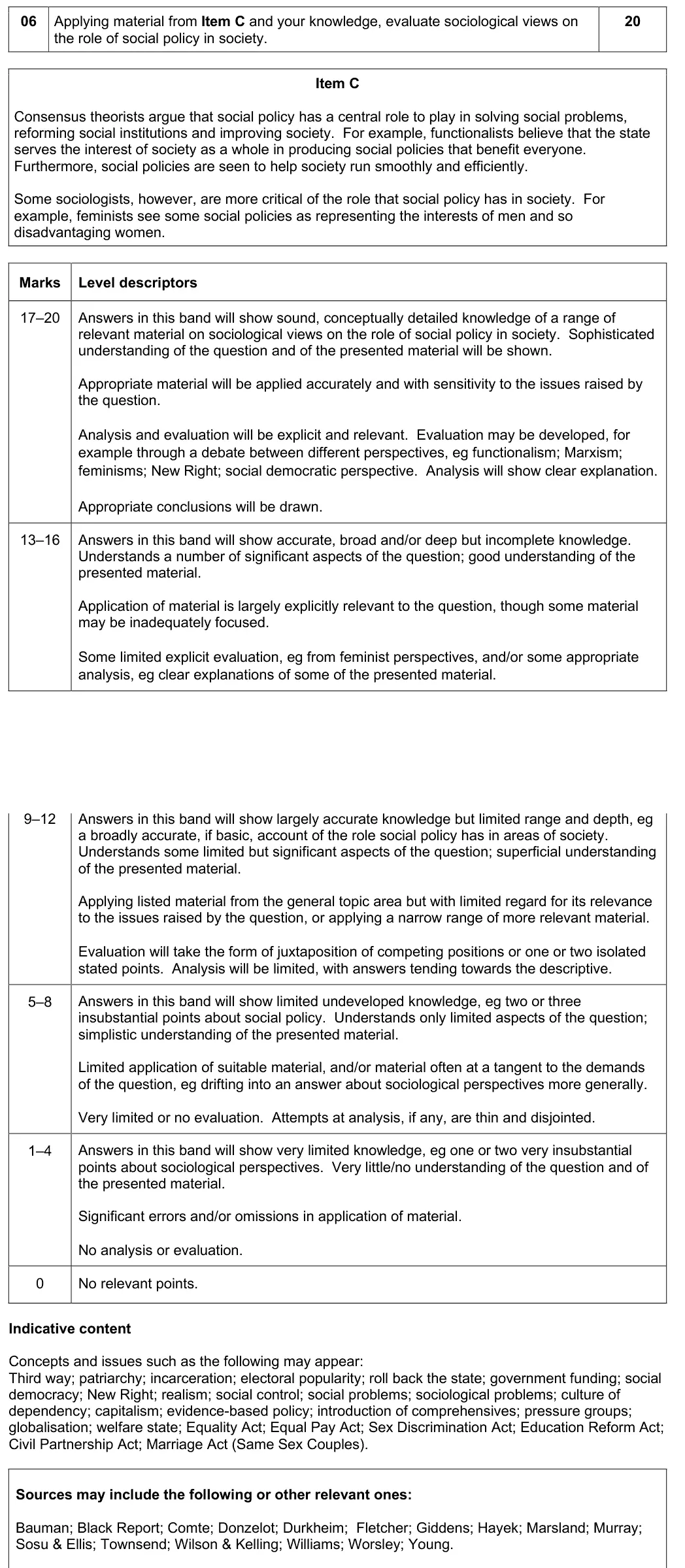
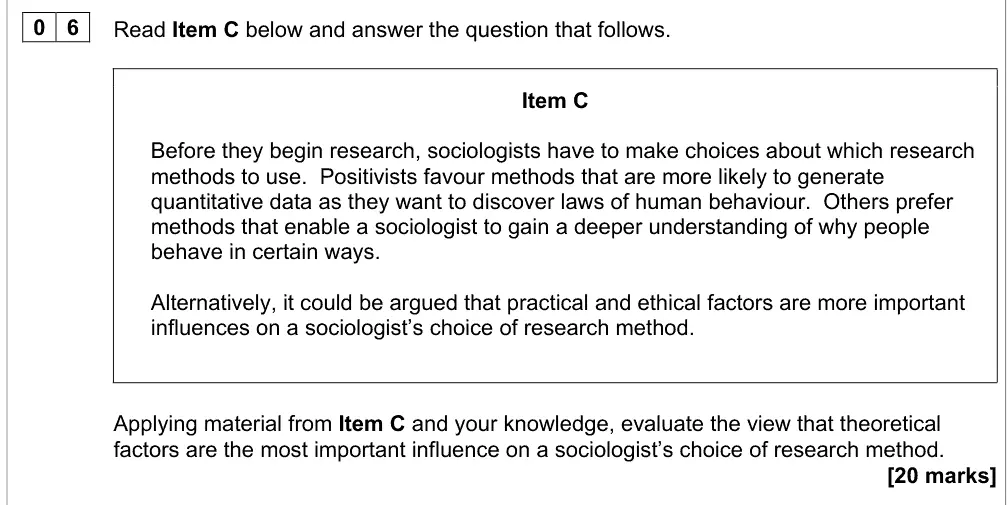
Applying material from Item C and your knowledge, evaluate the view that theoretical factors are the most important influence on a sociologist’s choice of research method.
Tap a question to zoom it. The mark scheme (with the level descriptors and indicative content) and the examiner's comment open underneath.
June 2025 · Paper 3 · Q620 marksAO1=8, AO2=6, AO3=620-mark essay
Mark scheme, including the levels grid and indicative content
Examiner's comment
Question six was an area of the specification which students found challenging. Those who did well were able to use the item and develop ideas with their own knowledge. Those students understood the theoretical nature of the debate but also social policy. They were able to give examples of social policy such as education acts or the Equality Act. For students who performed well, evaluation was a skill they were able to showcase, often using radical feminist views on policy as the knowledge point and the use of liberal feminism and the Equal Pay Act to evaluate. Students who did less well overused the item and repeated large parts of it. A number of students could not write much or give any examples of social policy. Lengthy introductions are not required for this question as students are under time constraints.
Notes from the mark scheme and report
must apply Item C (functionalist consensus view, feminist critique)
top band: debate between functionalism, Marxism, feminisms, New Right and social democratic views with real policy examples (Equality Act, education acts)
many could not give examples of social policy or repeated the item
drift into perspectives in general = 5–8
June 2024 · Paper 1 · Q610 marksAO1=5, AO2=3, AO3=2Outline and explain
Mark scheme, including the levels grid and indicative content
Examiner's comment
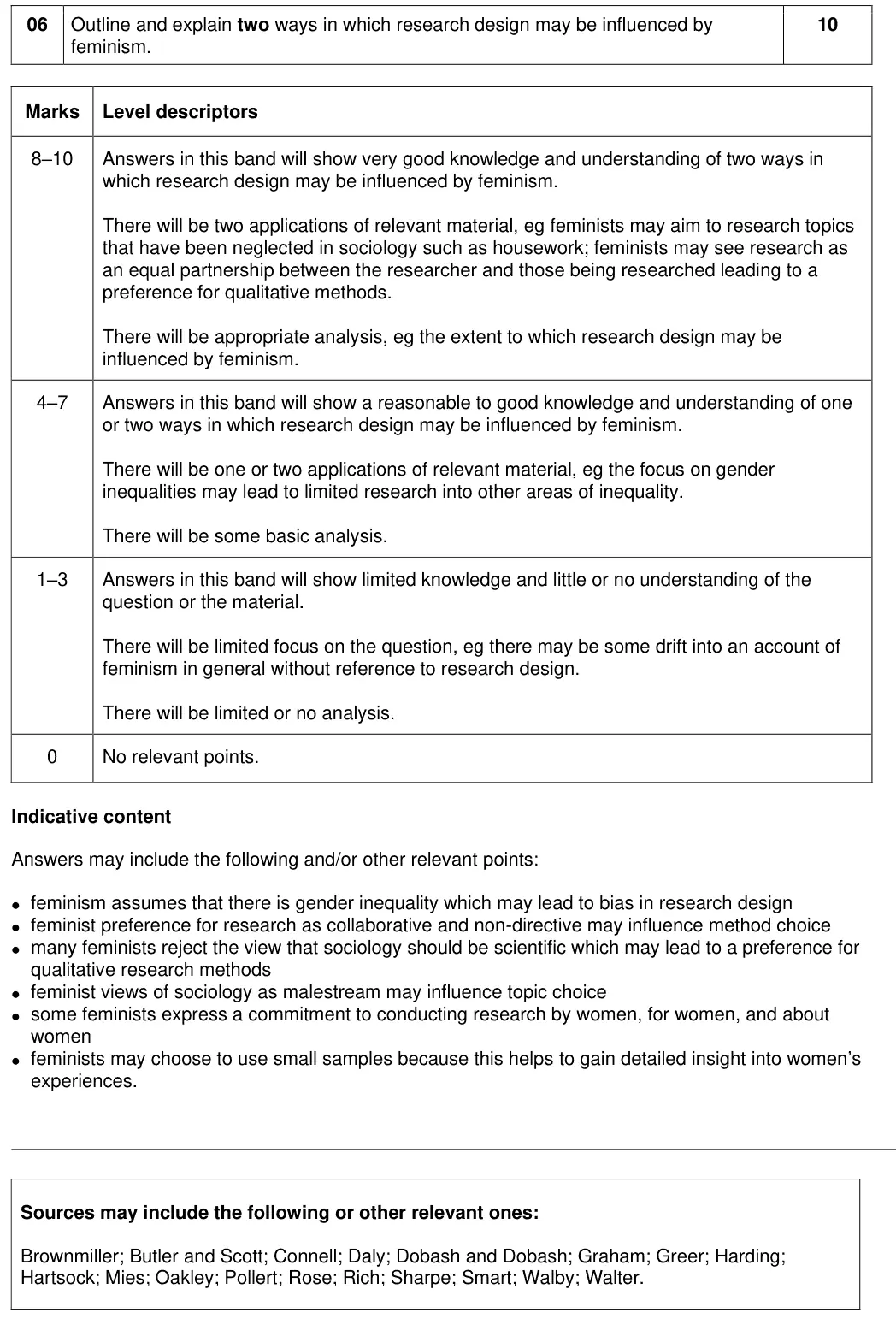
This question presented significant challenges, with many students struggling to understand and address the concept of ‘research design’ as influenced by feminism. Despite this concept being explicitly included in the specification, many responses discussed the impact of feminism in general terms without linking it specifically to aspects of research design. However, there were examples of students who interpreted the question as intended and effectively discussed, for instance, feminist preferences for qualitative methods and the importance of building rapport. Many of the more successful answers referred to feminist researchers often favouring qualitative approaches, such as unstructured interviews, to explore sensitive topics and prioritise participants' perspectives. In addition, some students then cited studies such as Dobash and Dobash's research on domestic violence, illustrating how feminist methodologies can provide deeper insights into women's experiences. They discussed how these methods aim to challenge traditional power dynamics in research, emphasising collaboration and empathy. Despite these strong examples, there were still many responses that failed to connect feminist theoretical perspectives with specific methodological choices, limiting the depth and specificity of the analysis.
Notes from the mark scheme and report
must link feminism to research design (topic choice such as housework, collaborative research and preference for qualitative methods, small samples, research by and for women)
drift into feminism in general = 1–3
many did not grasp 'research design' though it is in the spec
good answers used unstructured interviews, rapport and Dobash and Dobash
November 2021 · Paper 3 · Q510 marksAO1=5, AO2=3, AO3=2Outline and explain
Mark scheme, including the levels grid and indicative content
Examiner's comment
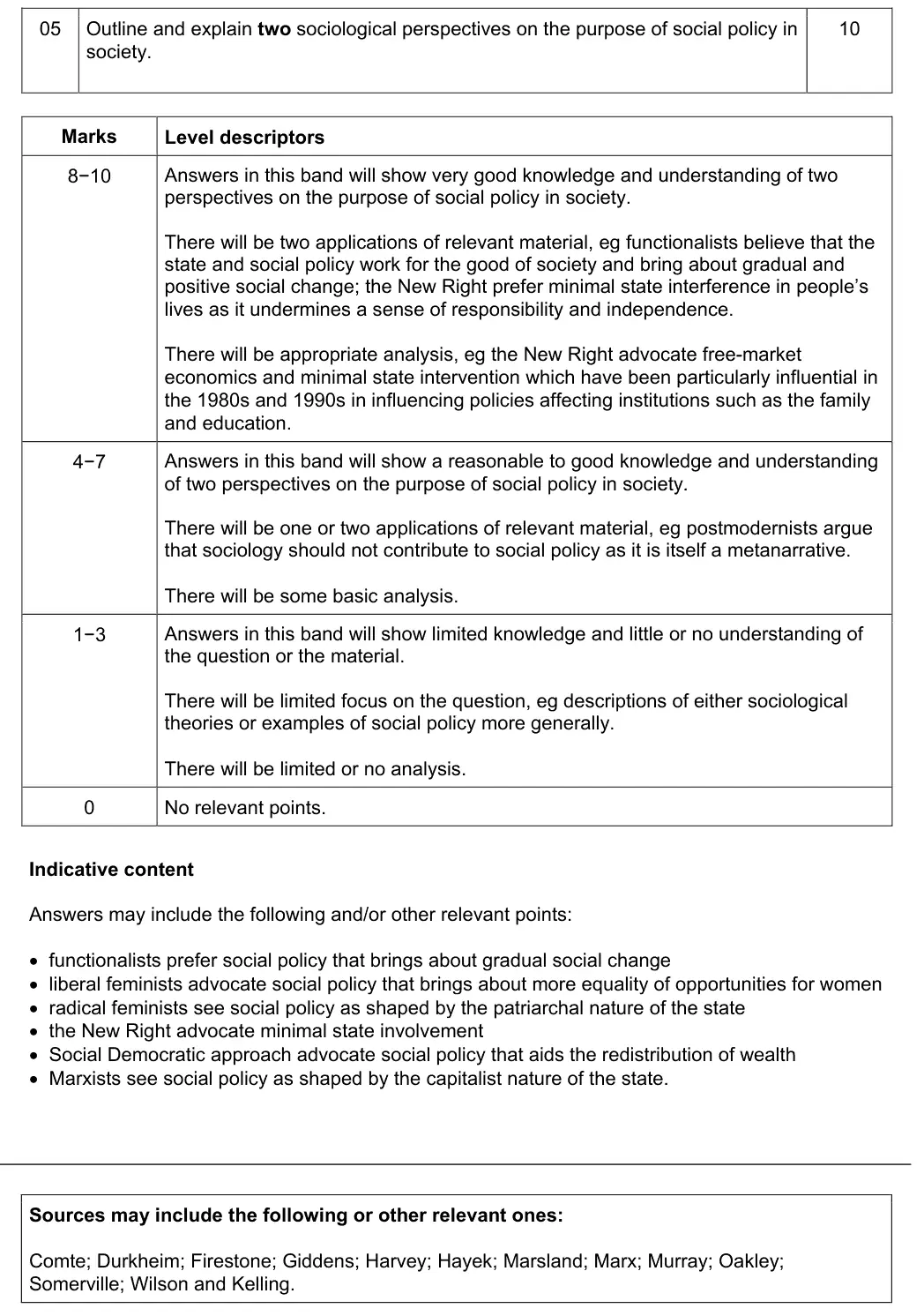
This question provided the most varied range of responses, with a few students not attempting the question at all. Some students were able to describe two theories but were not able to link this to social policy. Some students could describe ideas around policy but were not able to give specific examples of social policy.
Notes from the mark scheme and report
must link each perspective to the purpose of social policy (e.g. functionalist gradual reform, New Right minimal state, Marxist and feminist views of the state, social democratic redistribution)
describing theories or policies alone = 1–3 band
widest spread of responses and some left it blank
many could not link theory to policy or give specific policy examples
November 2021 · Paper 3 · Q620 marksAO1=8, AO2=6, AO3=620-mark essay
Mark scheme, including the levels grid and indicative content
Examiner's comment
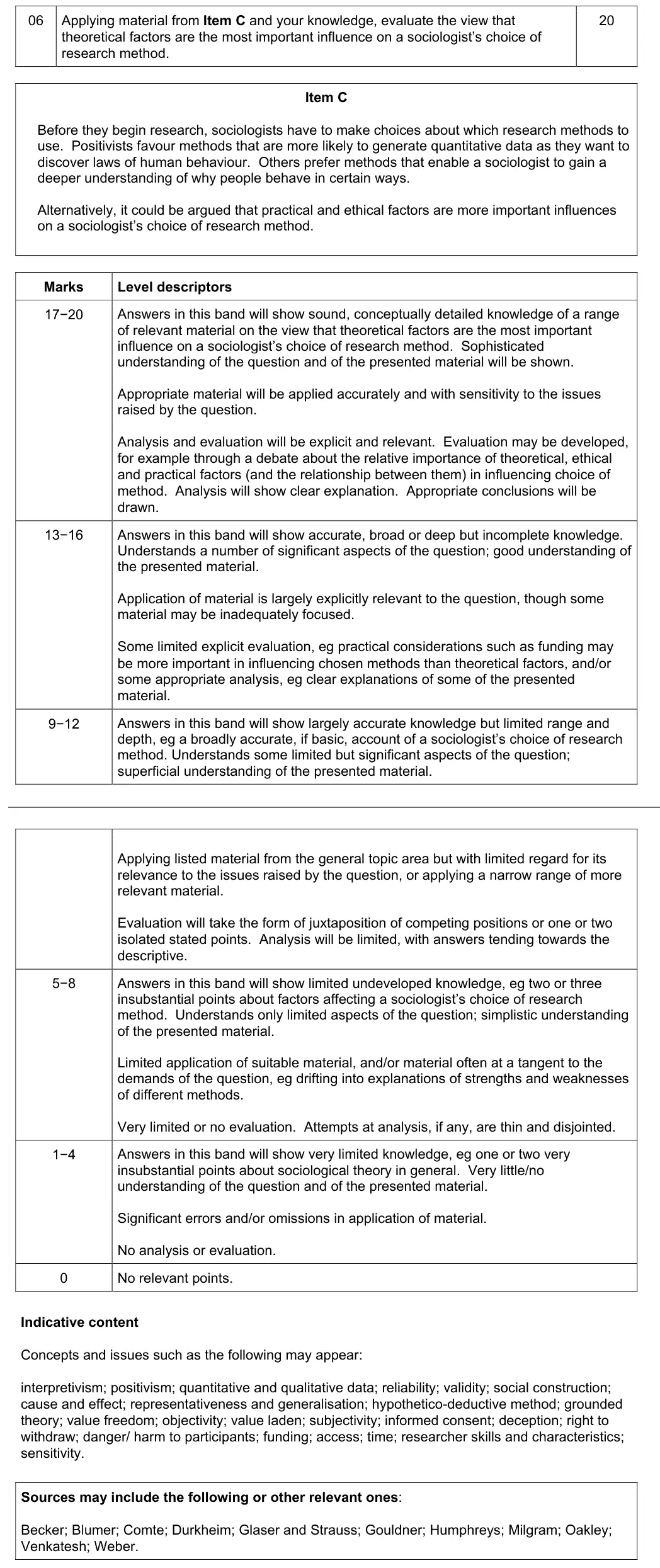
This question needed development. Students were able to use the item, but many found it difficult to go beyond this. Those students who did answer this well used examples such as Durkheim and his study on suicide. AO1 was the strongest skill in this question. AO3 needed focused development. If students did run out of time, there was an impact on this question. This could be addressed by centres via the process of timing practice in assessments.
Notes from the mark scheme and report
top band weighs theoretical against practical and ethical factors and how they relate
drift into strengths and weaknesses of methods = 5–8 band
many could not go beyond the item
best answers used Durkheim's study of suicide
evaluation needed more focus
the report notes Theory and Methods was weaker than previous series in this small November cohort
June 2019 · Paper 3 · Q510 marksAO1=5, AO2=3, AO3=2Outline and explain
Mark scheme, including the levels grid and indicative content
Examiner's comment
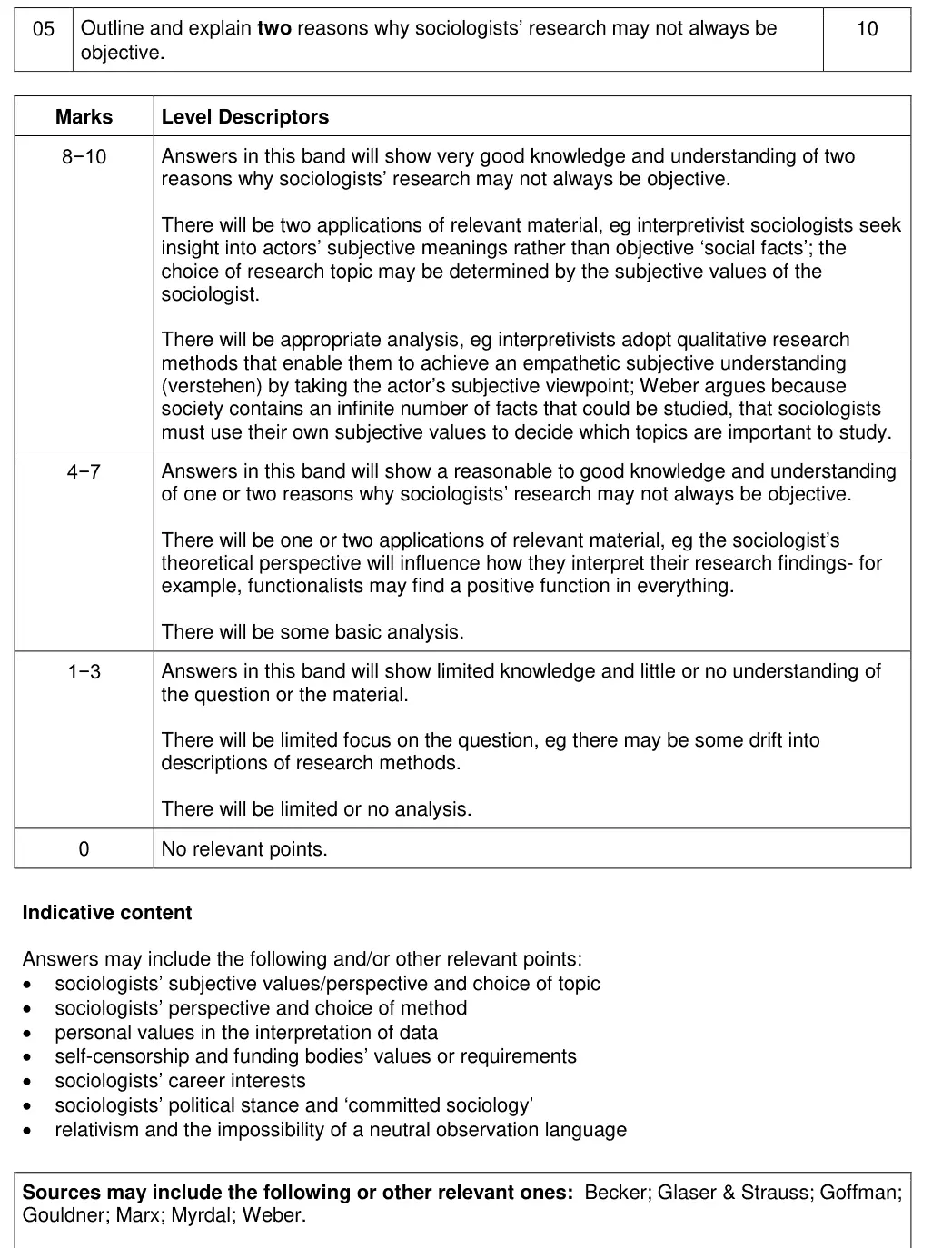
This question proved difficult for many students. Some had no real idea as to what objectivity meant, often confusing it with reliability, representativeness or validity. At best, these answers made a passing connection with relevant issues in a largely tangential response. Somewhat better responses had an understanding of the meaning of objectivity, but were unable to sustain a discussion for long. For example, some focused on how the participants in research might all have different subjective views, rather than focusing on the idea that it is the researcher's subjectivity that is at issue here. Strong answers developed explanations focusing on the influence of the researcher's preferred perspective, personal values, political commitment or career interests, or on the influence of funding bodies. These answers often addressed the impact of such factors on methodology, research findings and their interpretation. Reference to the work of Becker, Gouldner, Weber and interpretivists often appeared in these answers.
Notes from the mark scheme and report
AO grid not printed
many confused objectivity with reliability, validity or representativeness
the point is the researcher's subjectivity, not participants' differing views
drift into describing methods = 1–3 band
best answers used values in choice of topic (Weber), perspective, political commitment (Becker, Gouldner), career interests and funding bodies
AO split from AQA's standard grid for this paper (this year's mark scheme does not print it).
Work with an AQA sociology tutor
Essays stuck in the middle band, or losing marks on the 10-markers? Book a trial lesson with Mark, a former AQA examiner.