Specimen set 1: Paper 1

80 marks · 6 question parts · Paper, mark scheme and report on AQA's site

Question by question

QTopicMarksAOType
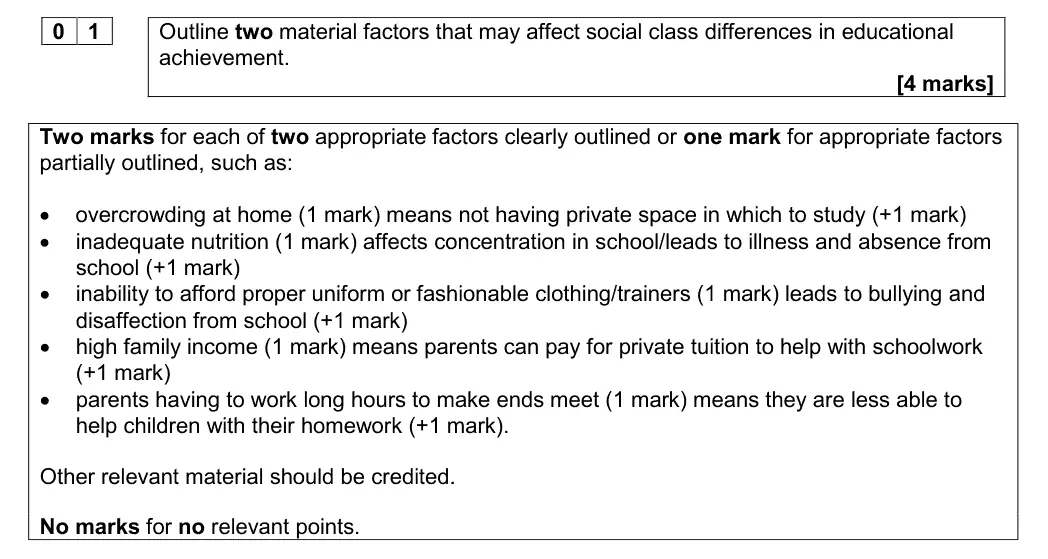
1 Differential educational achievement: class, gender and ethnicity 4AO1=4Outline
2 Educational policy, marketisation and globalisation, Differential educational achievement: class, gender and ethnicity 6AO1=3,AO2=3Outline
3 Differential educational achievement: class, gender and ethnicity, Processes within schools: labelling, subcultures and the hidden curriculum 10AO1=3,AO2=4,AO3=3Analyse
4 Differential educational achievement: class, gender and ethnicity, Processes within schools: labelling, subcultures and the hidden curriculum 30AO1=12,AO2=9,AO3=9Essay
5 Methods in Context: research methods applied to education, Research methods: questionnaires, interviews, observation, experiments, documents and official statistics, Theoretical, practical and ethical issues in research 20AO1=8,AO2=8,AO3=4Methods in context
6 Is sociology a science?, Positivism, interpretivism and social facts 10AO1=5,AO2=3,AO3=2Outline and explain

The questions

123456
Specimen set 1 · Paper 1 · Q1 4 marks AO1=4 Outline educational achievement
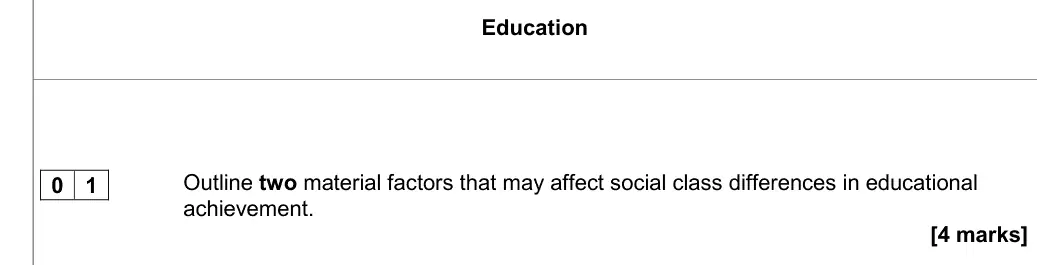
Education
0 1
Outline two material factors that may affect social class differences in educational
achievement.
[4 marks]
Specimen set 1 · Paper 1 · Q2 6 marks AO1=3, AO2=3 Outline education policyeducational achievement
0 2
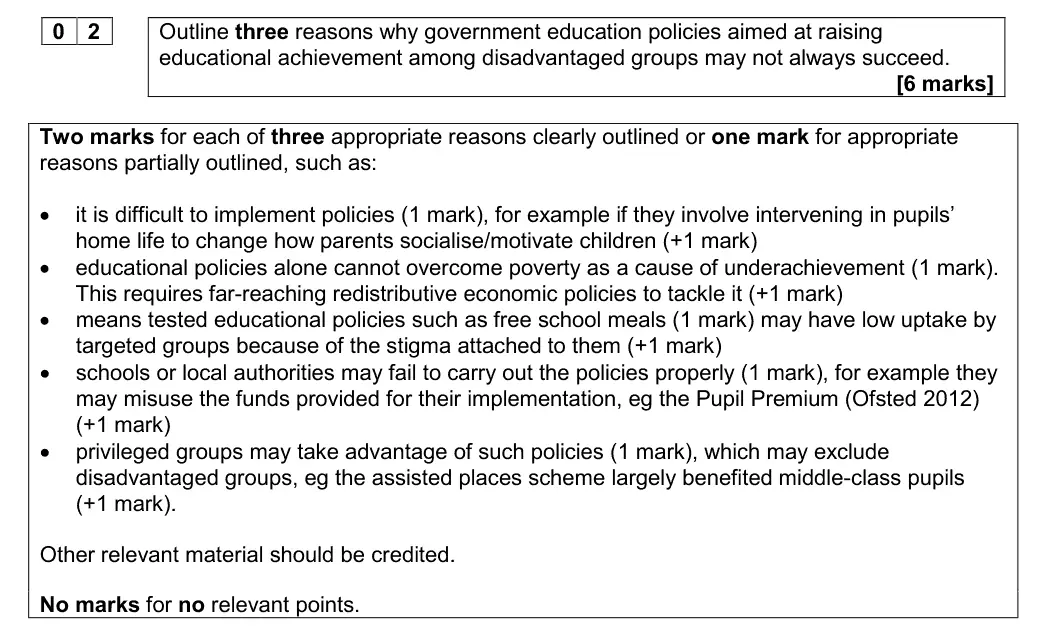
Outline three reasons why government education policies aimed at raising educational
achievement among disadvantaged groups may not always succeed.
[6 marks]
Specimen set 1 · Paper 1 · Q3 10 marks AO1=3, AO2=4, AO3=3 Analyse educational achievementprocesses within schools
0 3
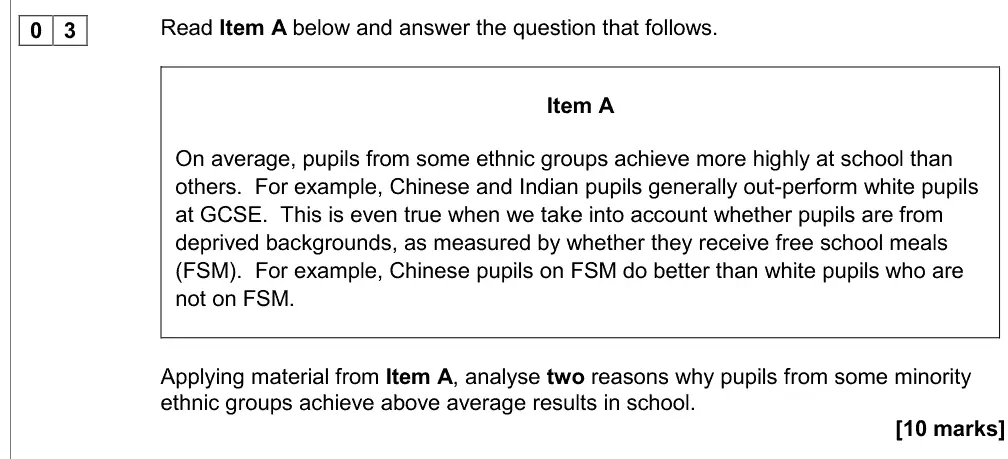
Read Item A below and answer the question that follows.
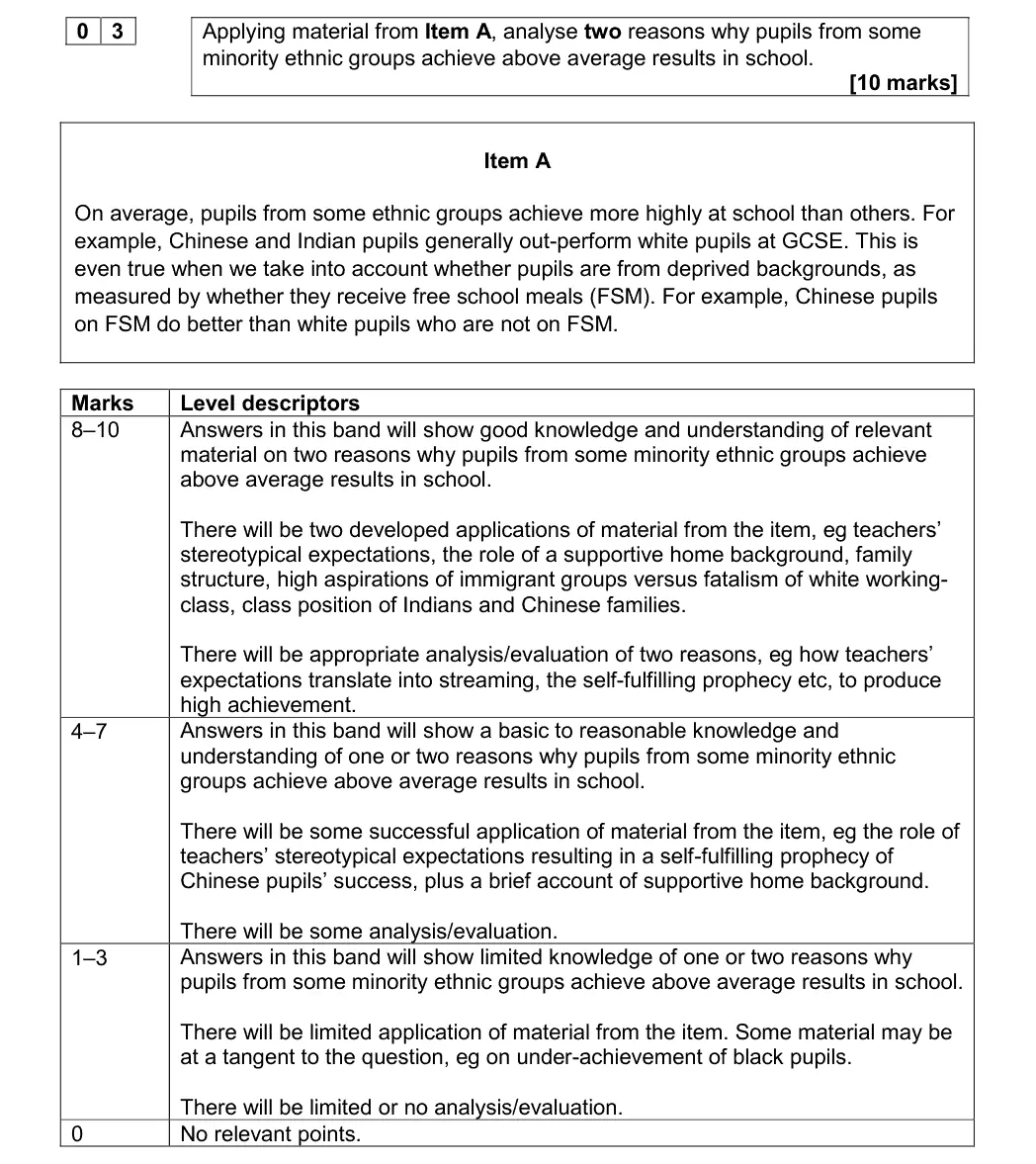
Item A
On average, pupils from some ethnic groups achieve more highly at school than
others.  For example, Chinese and Indian pupils generally out-perform white pupils
at GCSE.  This is even true when we take into account whether pupils are from
deprived backgrounds, as measured by whether they receive free school meals
(FSM).  For example, Chinese pupils on FSM do better than white pupils who are
not on FSM.
Applying material from Item A, analyse two reasons why pupils from some minority
ethnic groups achieve above average results in school.
[10 marks]
Specimen set 1 · Paper 1 · Q4 30 marks AO1=12, AO2=9, AO3=9 30-mark essay educational achievementprocesses within schools
0 4
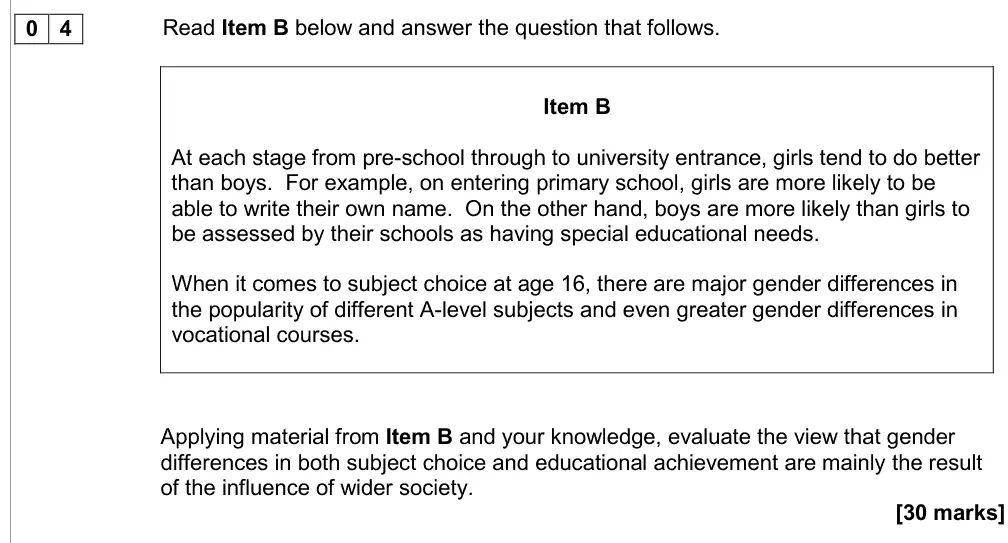
Read Item B below and answer the question that follows.
Item B
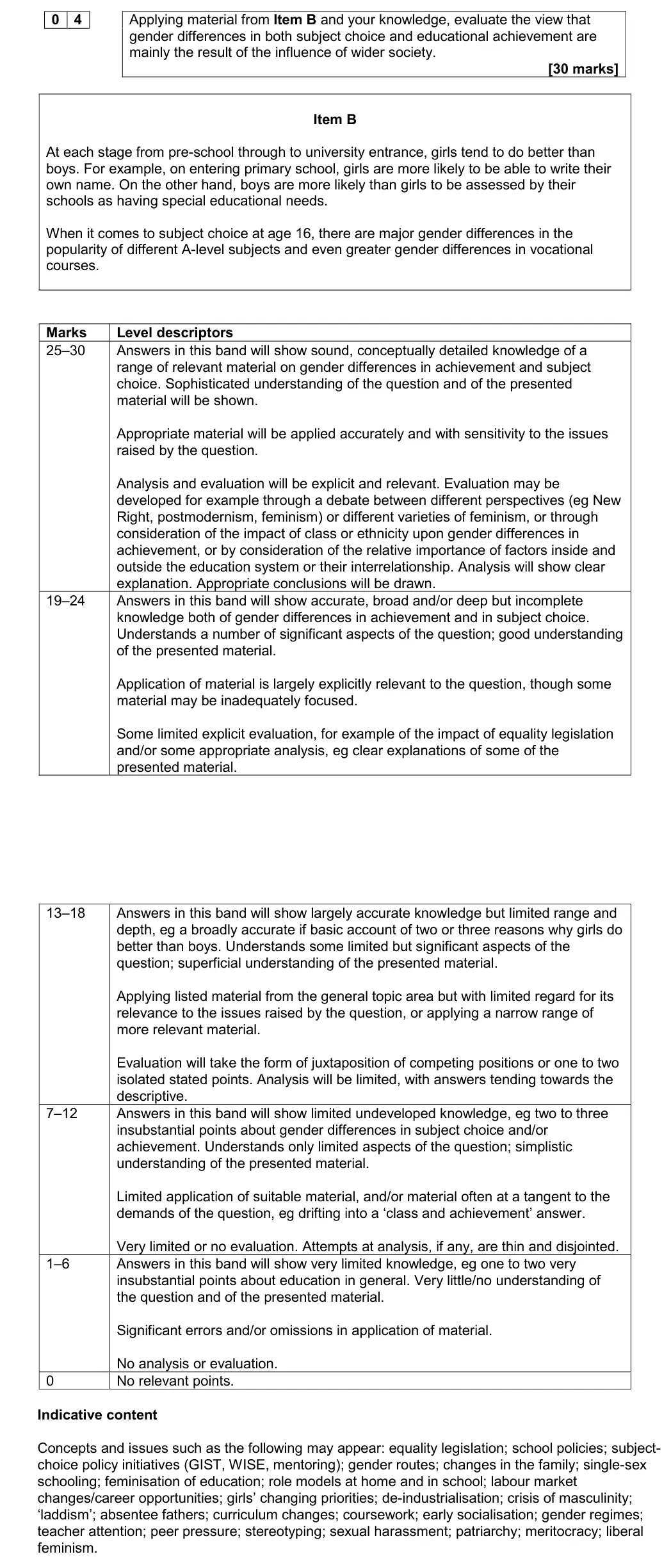
At each stage from pre-school through to university entrance, girls tend to do better
than boys.  For example, on entering primary school, girls are more likely to be
able to write their own name.  On the other hand, boys are more likely than girls to
be assessed by their schools as having special educational needs.
When it comes to subject choice at age 16, there are major gender differences in
the popularity of different A-level subjects and even greater gender differences in
vocational courses.
Applying material from Item B and your knowledge, evaluate the view that gender
differences in both subject choice and educational achievement are mainly the result
of the influence of wider society.
[30 marks]
Extra space
Specimen set 1 · Paper 1 · Q5 20 marks AO1=8, AO2=8, AO3=4 Methods in context methods in contextresearch methodschoice of research method
0 5
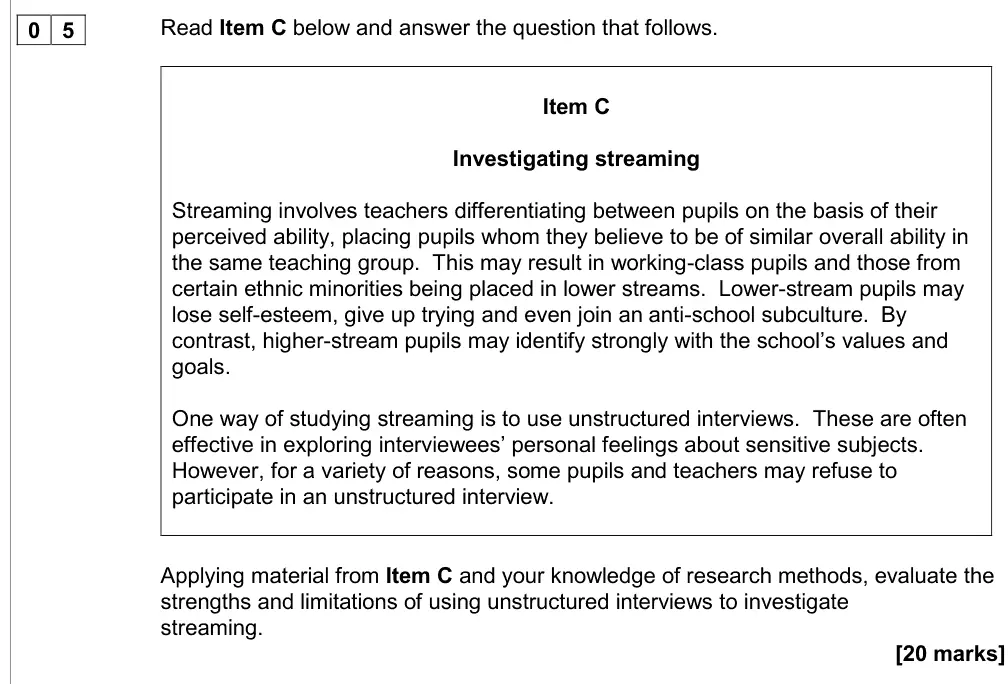
Read Item C below and answer the question that follows.
Item C
Investigating streaming
Streaming involves teachers differentiating between pupils on the basis of their
perceived ability, placing pupils whom they believe to be of similar overall ability in
the same teaching group.  This may result in working-class pupils and those from
certain ethnic minorities being placed in lower streams.  Lower-stream pupils may
lose self-esteem, give up trying and even join an anti-school subculture.  By
contrast, higher-stream pupils may identify strongly with the school’s values and
goals.
One way of studying streaming is to use unstructured interviews.  These are often
effective in exploring interviewees’ personal feelings about sensitive subjects.
However, for a variety of reasons, some pupils and teachers may refuse to
participate in an unstructured interview.
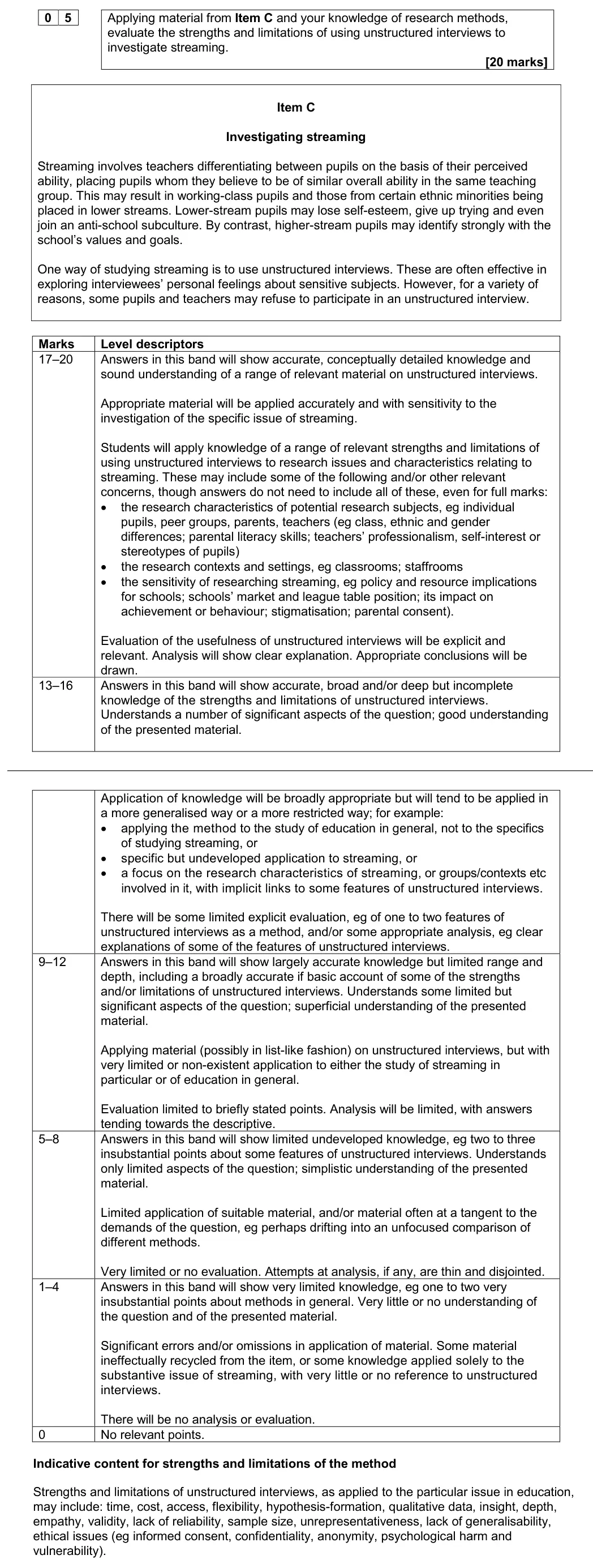
Applying material from Item C and your knowledge of research methods, evaluate the
strengths and limitations of using unstructured interviews to investigate
streaming.
[20 marks]
Extra space
Specimen set 1 · Paper 1 · Q6 10 marks AO1=5, AO2=3, AO3=2 Outline and explain is sociology a sciencepositivism and interpretivism
0 6
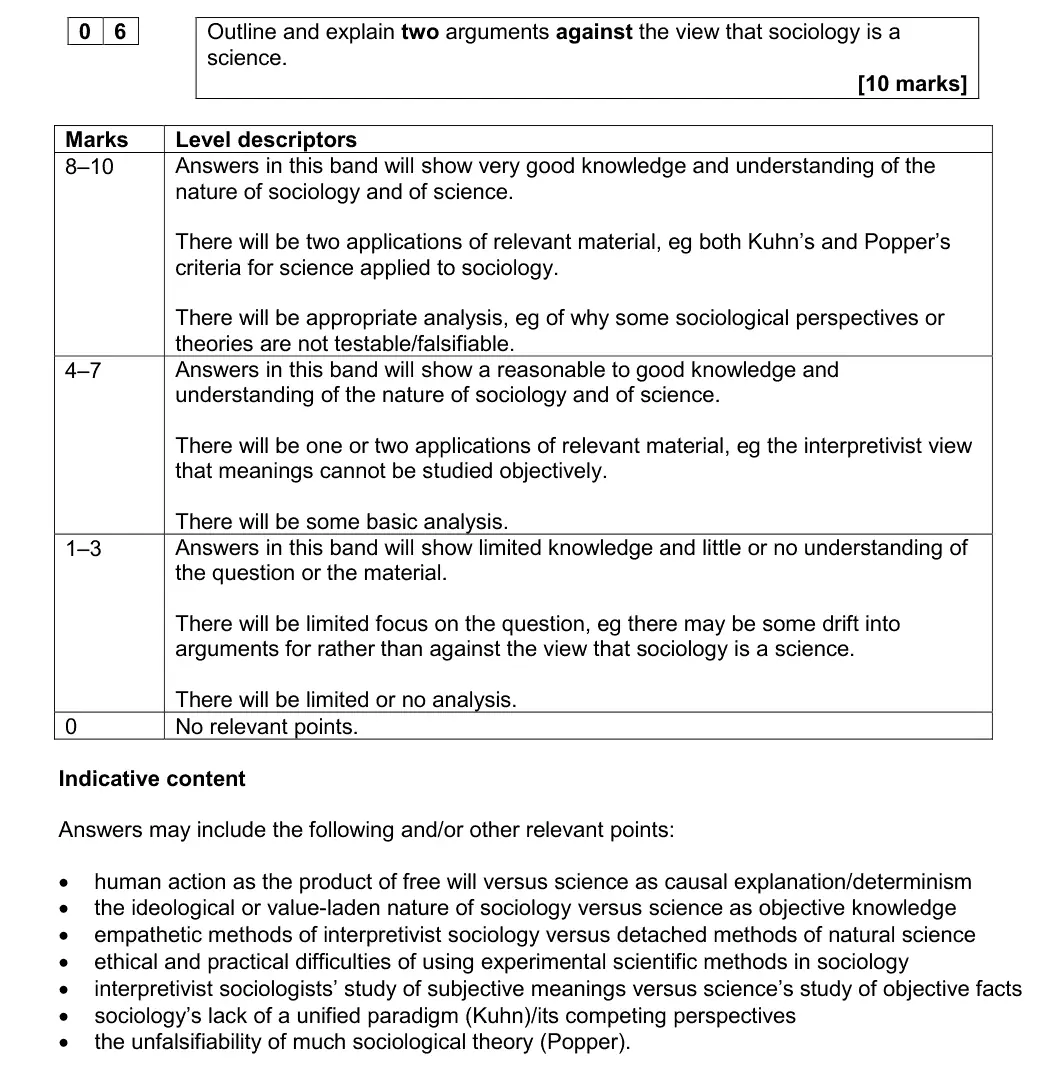
Outline and explain two arguments against the view that sociology is a science.
[10 marks]

Work with an AQA sociology tutor

Want a paper marked and gone through with you? Message us.

Prefer email? Send an enquiry

If you are under 18, please include a parent's contact details. Enquiries go to enquiries@alevelsociologytutor.com and are deleted once handled. All tutoring is online.