Methods in Context (20 marks)

Paper 1 Section B (and AS Paper 1): evaluate a research method for studying a particular issue in education. The top band needs the method, the issue and the research characteristics of the people and settings involved. 19 questions.

Other types: Define the term (2 marks) · Using one example, briefly explain (2 marks) · Outline two or three (4 and 6 marks) · Outline and explain two (10 marks) · Applying material from the Item, analyse two (10 marks) · Essays (16, 20 and 30 marks)

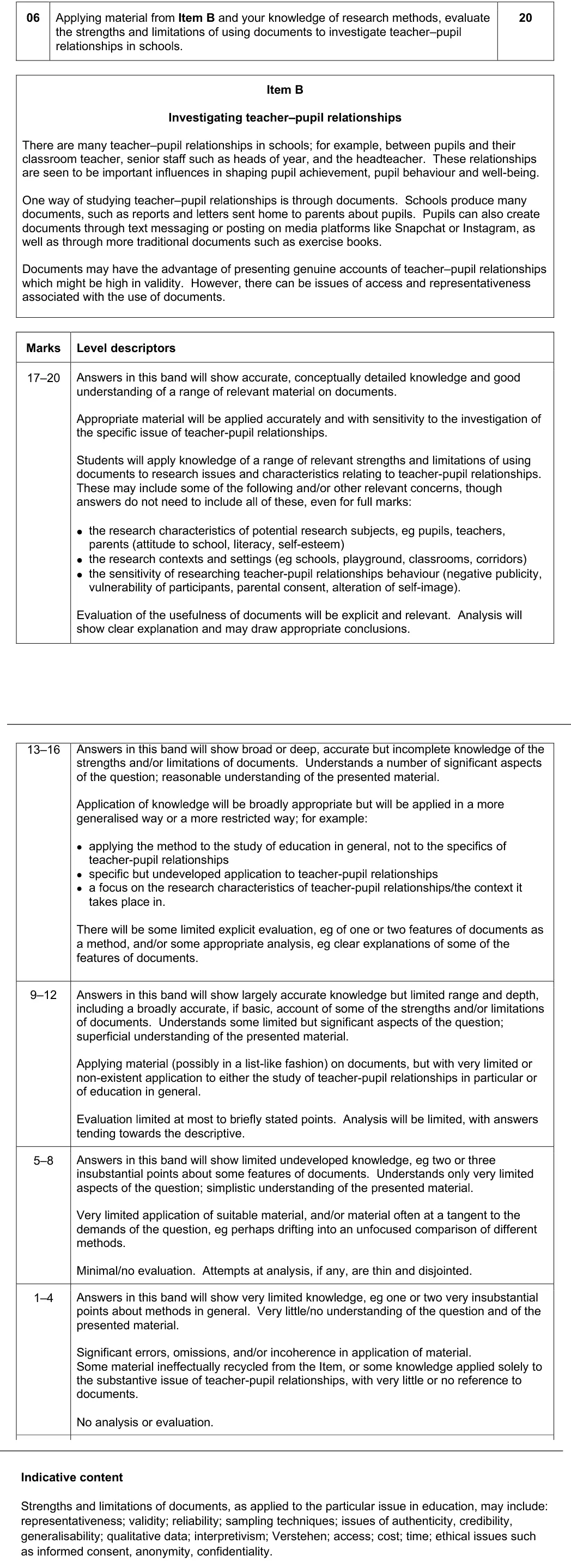
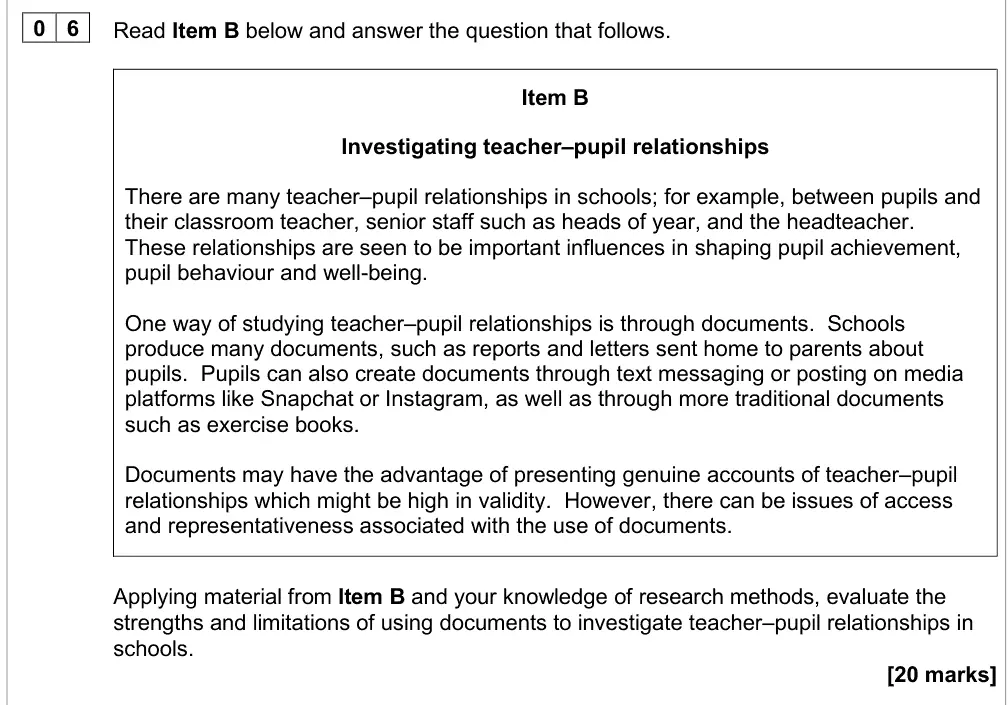
June 2025 · AS Paper 1 · Q6 20 marks AO1=8, AO2=8, AO3=4 Methods in context methods in contextresearch methodsprimary and secondary data
0 6
Read Item B below and answer the question that follows.
Item B
Investigating teacher–pupil relationships
There are many teacher–pupil relationships in schools; for example, between pupils and
their classroom teacher, senior staff such as heads of year, and the headteacher.
These relationships are seen to be important influences in shaping pupil achievement,
pupil behaviour and well-being.
One way of studying teacher–pupil relationships is through documents.  Schools
produce many documents, such as reports and letters sent home to parents about
pupils.  Pupils can also create documents through text messaging or posting on media
platforms like Snapchat or Instagram, as well as through more traditional documents
such as exercise books.
Documents may have the advantage of presenting genuine accounts of teacher–pupil
relationships which might be high in validity.  However, there can be issues of access
and representativeness associated with the use of documents.
Applying material from Item B and your knowledge of research methods, evaluate the
strengths and limitations of using documents to investigate teacher–pupil relationships in
schools.
[20 marks]
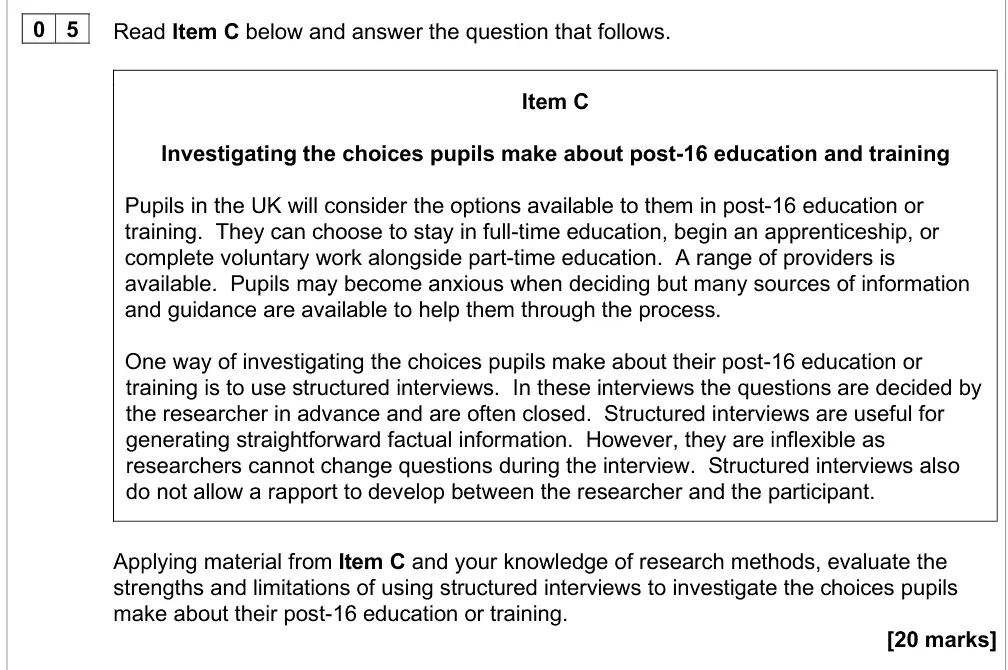
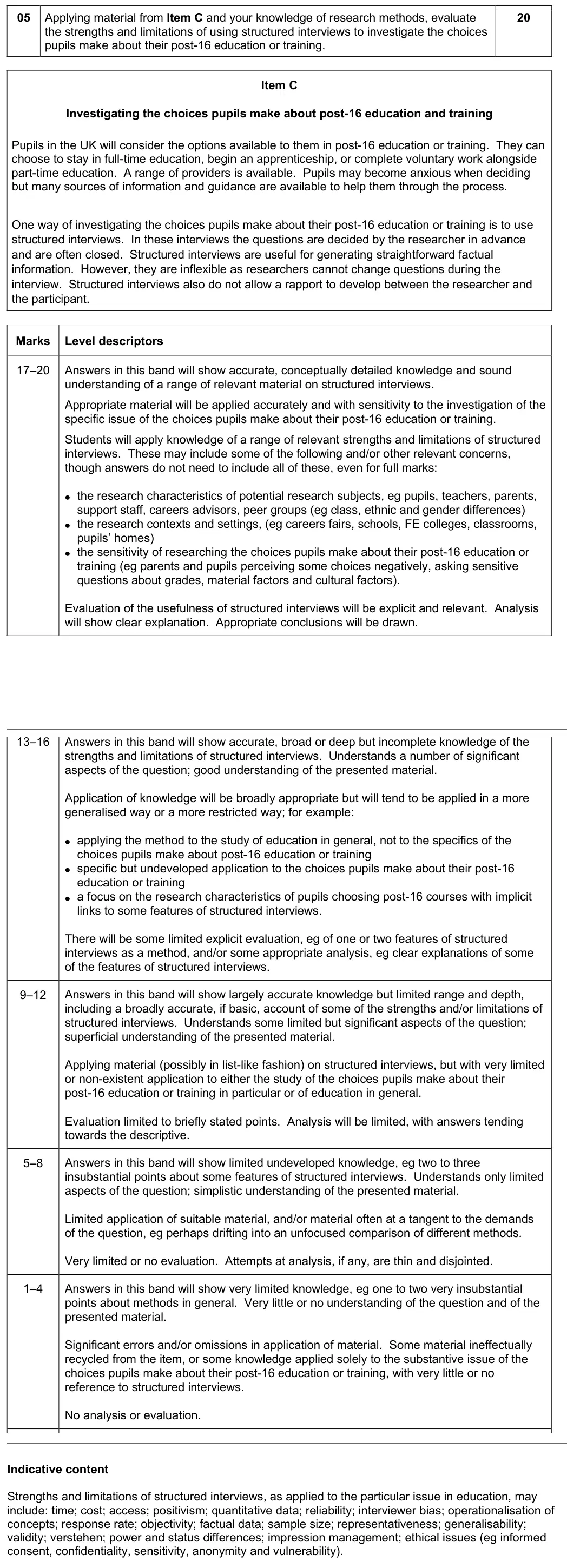
June 2025 · Paper 1 · Q5 20 marks AO1=8, AO2=8, AO3=4 Methods in context methods in contextresearch methodschoice of research method
0 5
Read Item C below and answer the question that follows.
Item C
Investigating the choices pupils make about post-16 education and training
Pupils in the UK will consider the options available to them in post-16 education or
training.  They can choose to stay in full-time education, begin an apprenticeship, or
complete voluntary work alongside part-time education.  A range of providers is
available.  Pupils may become anxious when deciding but many sources of information
and guidance are available to help them through the process.
One way of investigating the choices pupils make about their post-16 education or
training is to use structured interviews.  In these interviews the questions are decided by
the researcher in advance and are often closed.  Structured interviews are useful for
generating straightforward factual information.  However, they are inflexible as
researchers cannot change questions during the interview.  Structured interviews also
do not allow a rapport to develop between the researcher and the participant.
Applying material from Item C and your knowledge of research methods, evaluate the
strengths and limitations of using structured interviews to investigate the choices pupils
make about their post-16 education or training.
[20 marks]
Extra space
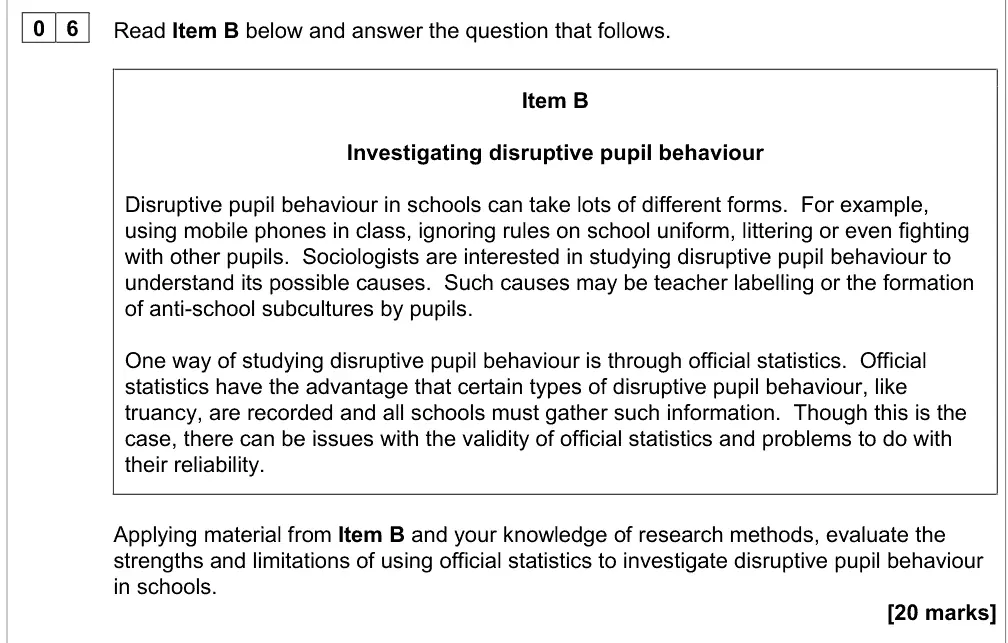
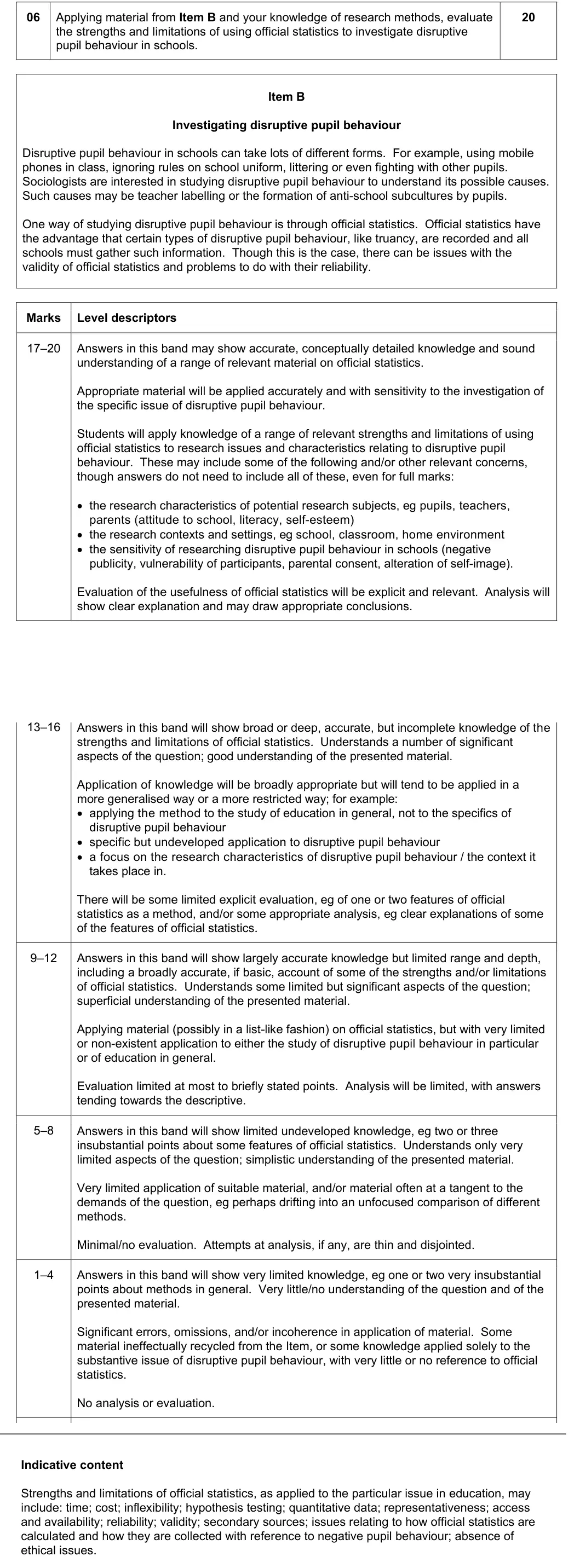
June 2024 · AS Paper 1 · Q6 20 marks AO1=8, AO2=8, AO3=4 Methods in context methods in contextresearch methodsprimary and secondary data
0 6
Read Item B below and answer the question that follows.
Item B
Investigating disruptive pupil behaviour
Disruptive pupil behaviour in schools can take lots of different forms.  For example,
using mobile phones in class, ignoring rules on school uniform, littering or even fighting
with other pupils.  Sociologists are interested in studying disruptive pupil behaviour to
understand its possible causes.  Such causes may be teacher labelling or the formation
of anti-school subcultures by pupils.
One way of studying disruptive pupil behaviour is through official statistics.  Official
statistics have the advantage that certain types of disruptive pupil behaviour, like
truancy, are recorded and all schools must gather such information.  Though this is the
case, there can be issues with the validity of official statistics and problems to do with
their reliability.
Applying material from Item B and your knowledge of research methods, evaluate the
strengths and limitations of using official statistics to investigate disruptive pupil behaviour
in schools.
[20 marks]
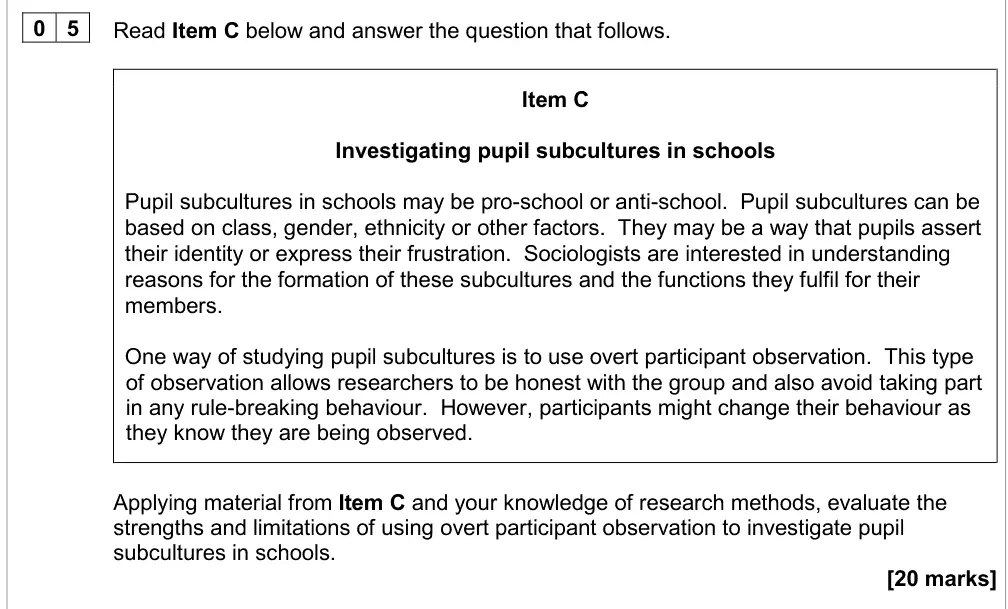
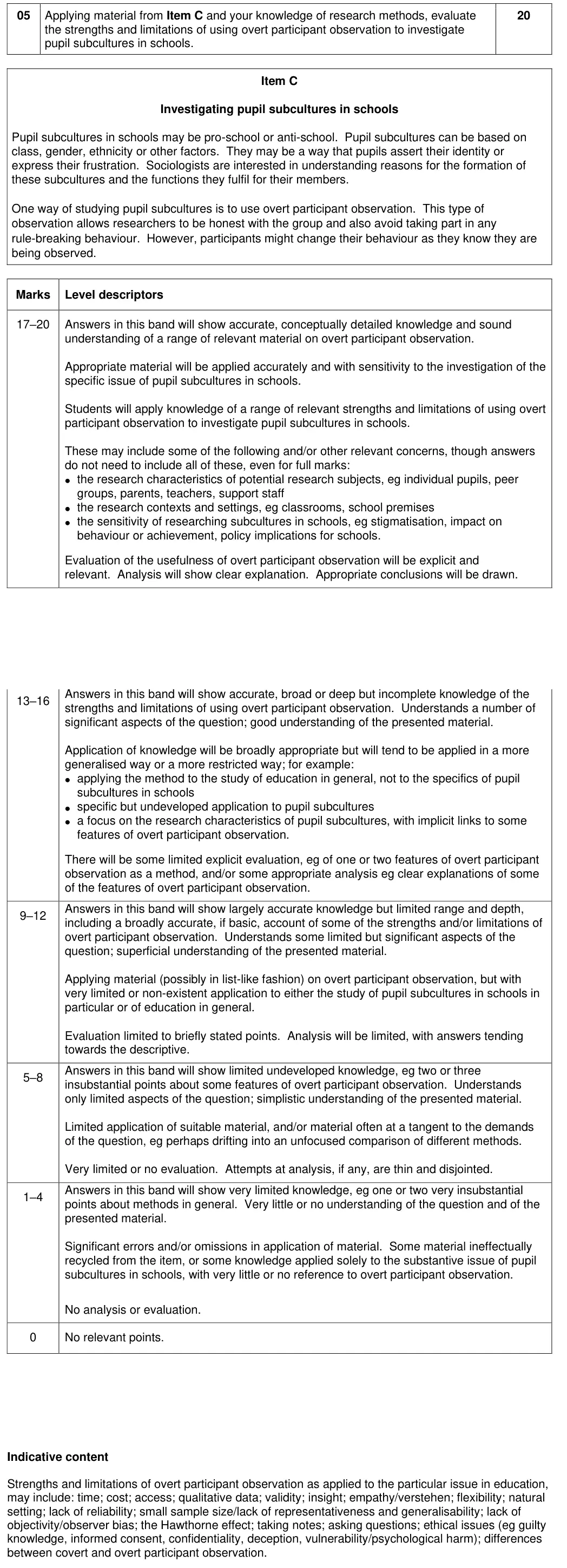
June 2024 · Paper 1 · Q5 20 marks AO1=8, AO2=8, AO3=4 Methods in context methods in contextresearch methodschoice of research method
0 5
Read Item C below and answer the question that follows.
Item C
Investigating pupil subcultures in schools
Pupil subcultures in schools may be pro-school or anti-school.  Pupil subcultures can be
based on class, gender, ethnicity or other factors.  They may be a way that pupils assert
their identity or express their frustration.  Sociologists are interested in understanding
reasons for the formation of these subcultures and the functions they fulfil for their
members.
One way of studying pupil subcultures is to use overt participant observation.  This type
of observation allows researchers to be honest with the group and also avoid taking part
in any rule-breaking behaviour.  However, participants might change their behaviour as
they know they are being observed.
Applying material from Item C and your knowledge of research methods, evaluate the
strengths and limitations of using overt participant observation to investigate pupil
subcultures in schools.
[20 marks]
Extra space
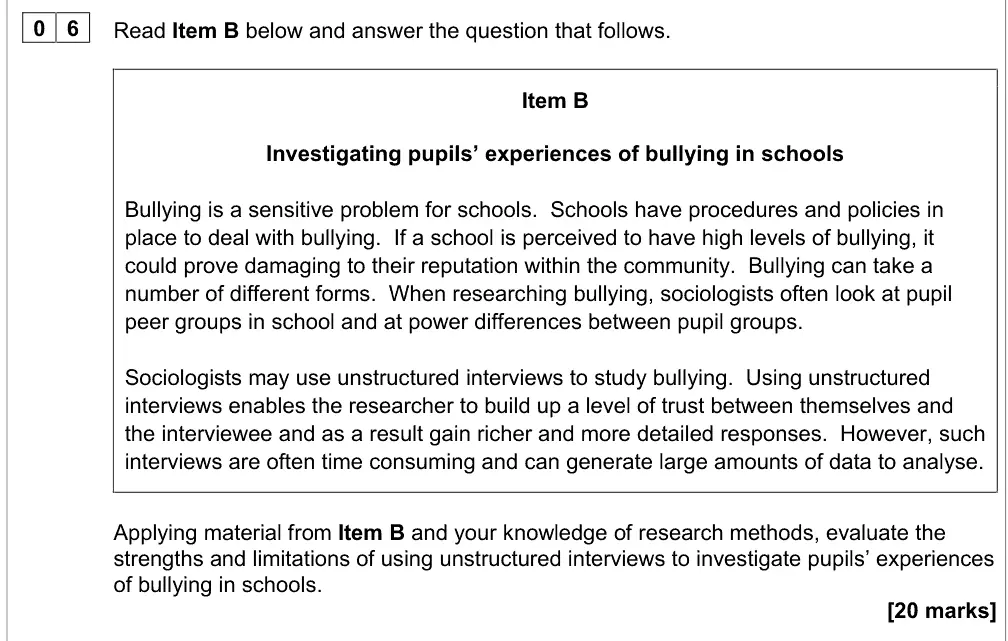
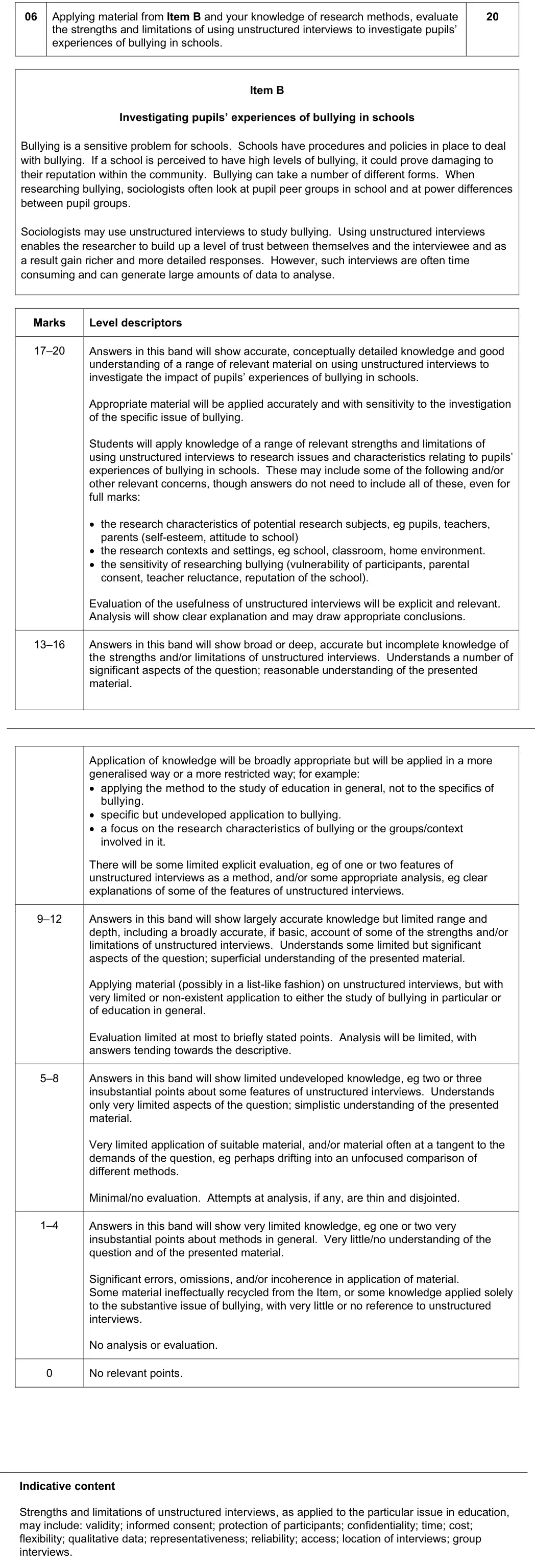
June 2023 · AS Paper 1 · Q6 20 marks AO1=8, AO2=8, AO3=4 Methods in context methods in contextresearch methodschoice of research method
0 6
Read Item B below and answer the question that follows.
Item B
Investigating pupils’ experiences of bullying in schools
Bullying is a sensitive problem for schools.  Schools have procedures and policies in
place to deal with bullying.  If a school is perceived to have high levels of bullying, it
could prove damaging to their reputation within the community.  Bullying can take a
number of different forms.  When researching bullying, sociologists often look at pupil
peer groups in school and at power differences between pupil groups.
Sociologists may use unstructured interviews to study bullying.  Using unstructured
interviews enables the researcher to build up a level of trust between themselves and
the interviewee and as a result gain richer and more detailed responses.  However, such
interviews are often time consuming and can generate large amounts of data to analyse.
Applying material from Item B and your knowledge of research methods, evaluate the
strengths and limitations of using unstructured interviews to investigate pupils’ experiences
of bullying in schools.
[20 marks]
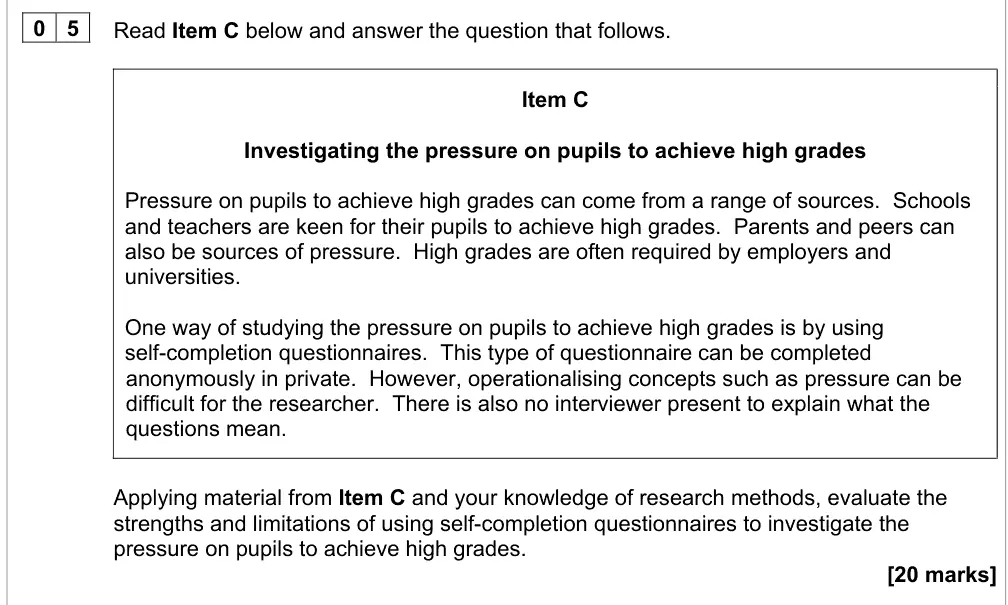
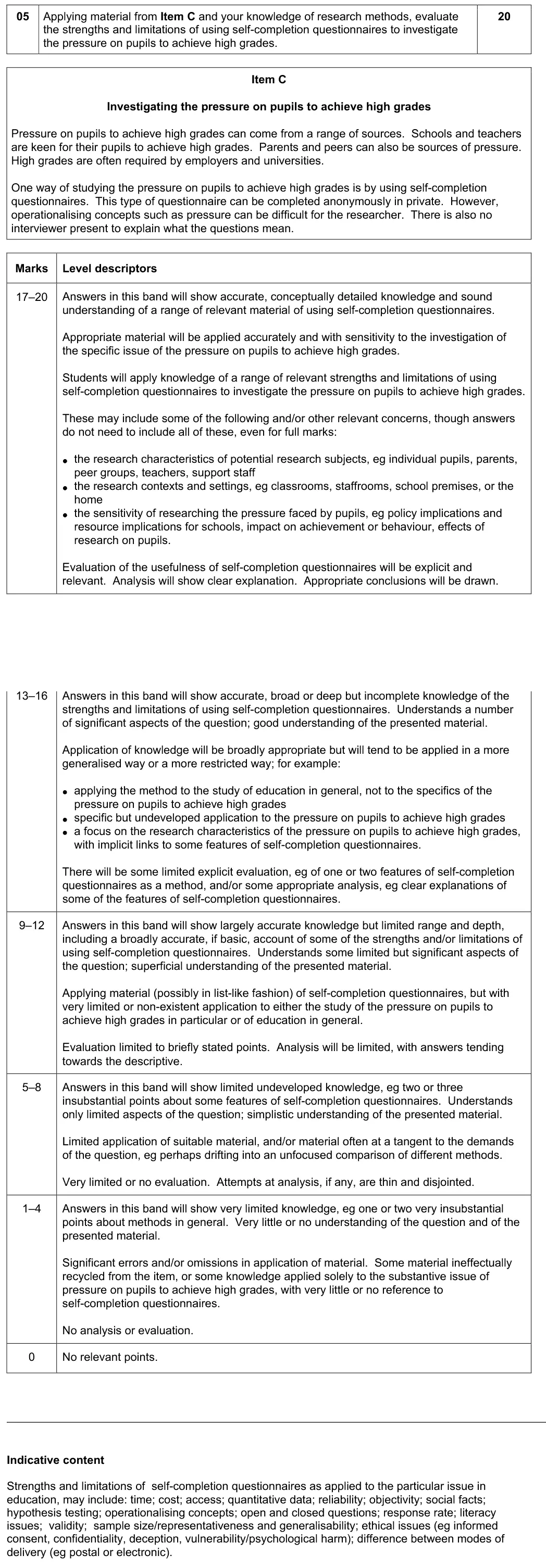
June 2023 · Paper 1 · Q5 20 marks AO1=8, AO2=8, AO3=4 Methods in context methods in contextresearch methodschoice of research method
0 5
Read Item C below and answer the question that follows.
Item C
Investigating the pressure on pupils to achieve high grades
Pressure on pupils to achieve high grades can come from a range of sources.  Schools
and teachers are keen for their pupils to achieve high grades.  Parents and peers can
also be sources of pressure.  High grades are often required by employers and
universities.
One way of studying the pressure on pupils to achieve high grades is by using
self-completion questionnaires.  This type of questionnaire can be completed
anonymously in private.  However, operationalising concepts such as pressure can be
difficult for the researcher.  There is also no interviewer present to explain what the
questions mean.
Applying material from Item C and your knowledge of research methods, evaluate the
strengths and limitations of using self-completion questionnaires to investigate the
pressure on pupils to achieve high grades.
[20 marks]
Extra space
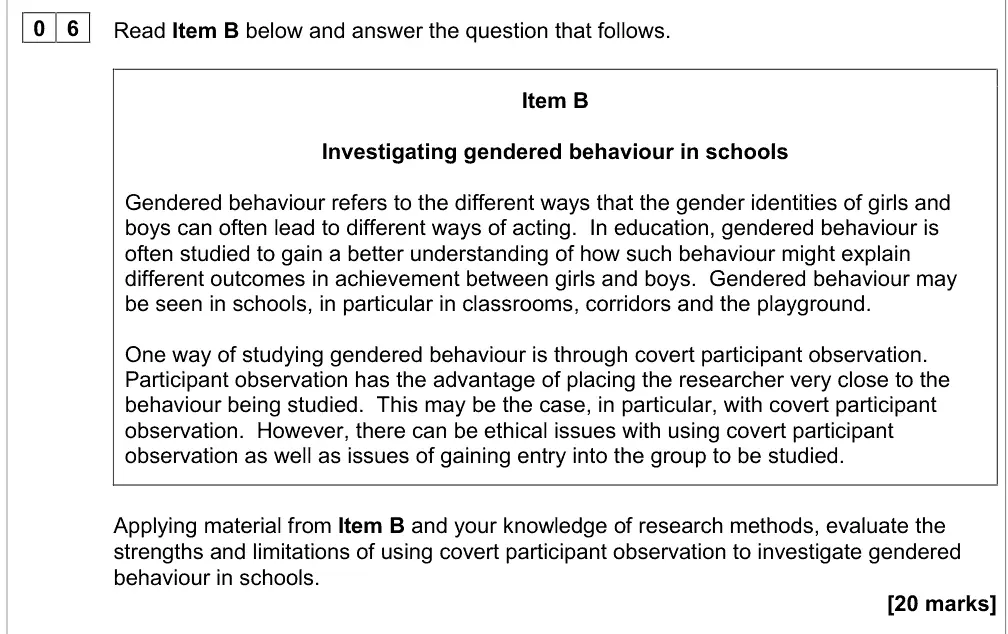
June 2022 · AS Paper 1 · Q6 20 marks AO1=8, AO2=8, AO3=4 Methods in context methods in contextresearch methodschoice of research method
0 6
Read Item B below and answer the question that follows.
Item B
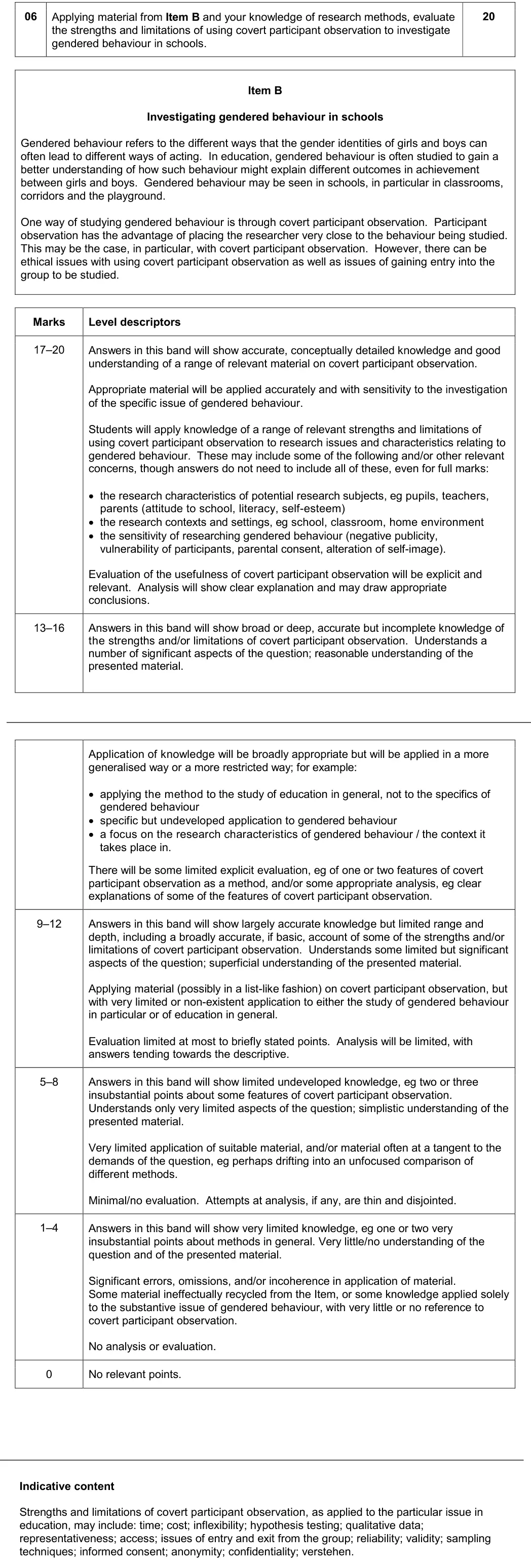
Investigating gendered behaviour in schools
Gendered behaviour refers to the different ways that the gender identities of girls and
boys can often lead to different ways of acting.  In education, gendered behaviour is
often studied to gain a better understanding of how such behaviour might explain
different outcomes in achievement between girls and boys.  Gendered behaviour may
be seen in schools, in particular in classrooms, corridors and the playground.
One way of studying gendered behaviour is through covert participant observation.
Participant observation has the advantage of placing the researcher very close to the
behaviour being studied.  This may be the case, in particular, with covert participant
observation.  However, there can be ethical issues with using covert participant
observation as well as issues of gaining entry into the group to be studied.
Applying material from Item B and your knowledge of research methods, evaluate the
strengths and limitations of using covert participant observation to investigate gendered
behaviour in schools.
[20 marks]
June 2022 · Paper 1 · Q5 20 marks AO1=8, AO2=8, AO3=4 Methods in context methods in contextresearch methods
0 5
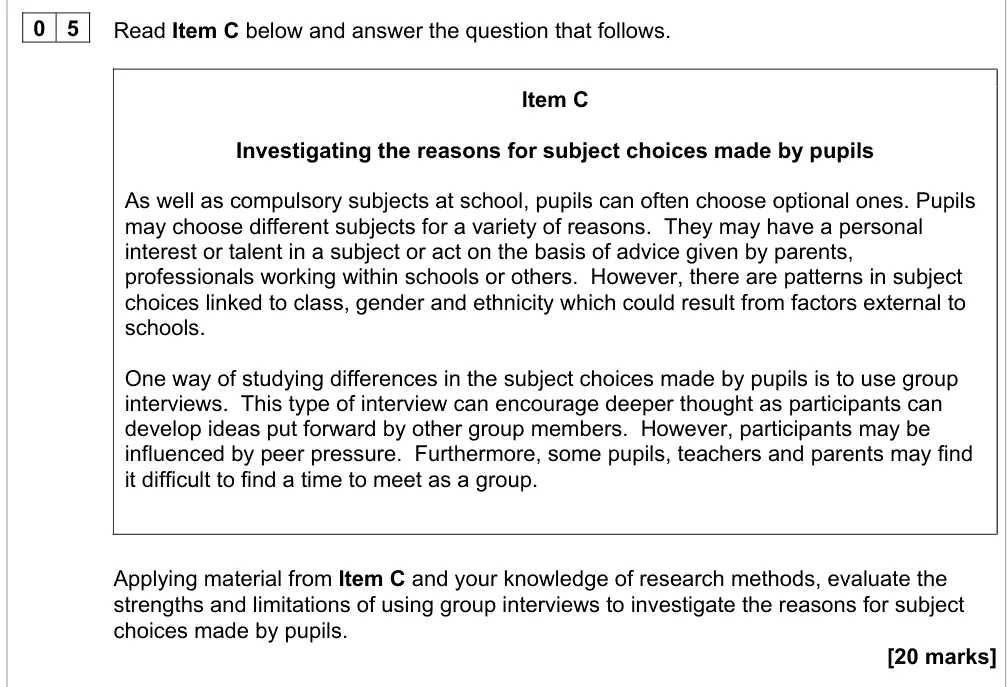
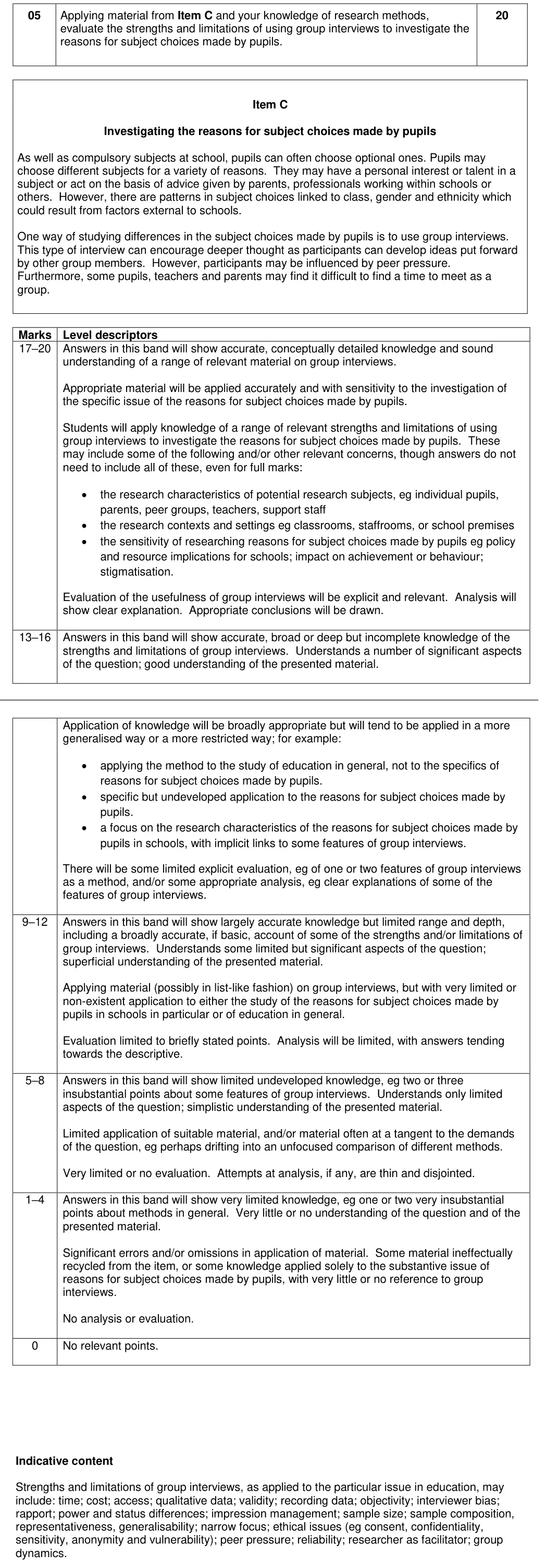
Read Item C below and answer the question that follows.
Item C
Investigating the reasons for subject choices made by pupils
As well as compulsory subjects at school, pupils can often choose optional ones. Pupils
may choose different subjects for a variety of reasons.  They may have a personal
interest or talent in a subject or act on the basis of advice given by parents,
professionals working within schools or others.  However, there are patterns in subject
choices linked to class, gender and ethnicity which could result from factors external to
schools.
One way of studying differences in the subject choices made by pupils is to use group
interviews.  This type of interview can encourage deeper thought as participants can
develop ideas put forward by other group members.  However, participants may be
influenced by peer pressure.  Furthermore, some pupils, teachers and parents may find
it difficult to find a time to meet as a group.
Applying material from Item C and your knowledge of research methods, evaluate the
strengths and limitations of using group interviews to investigate the reasons for subject
choices made by pupils.
[20 marks]
Extra space
November 2021 · Paper 1 · Q5 20 marks AO1=8, AO2=8, AO3=4 Methods in context methods in contextresearch methodsprimary and secondary data
0 5
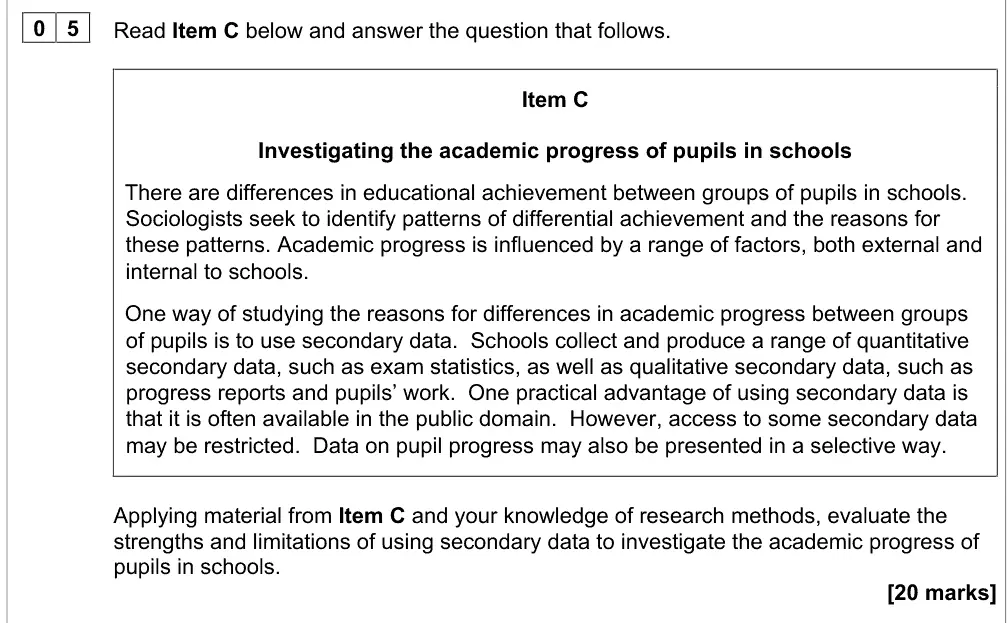
Read Item C below and answer the question that follows.
Item C
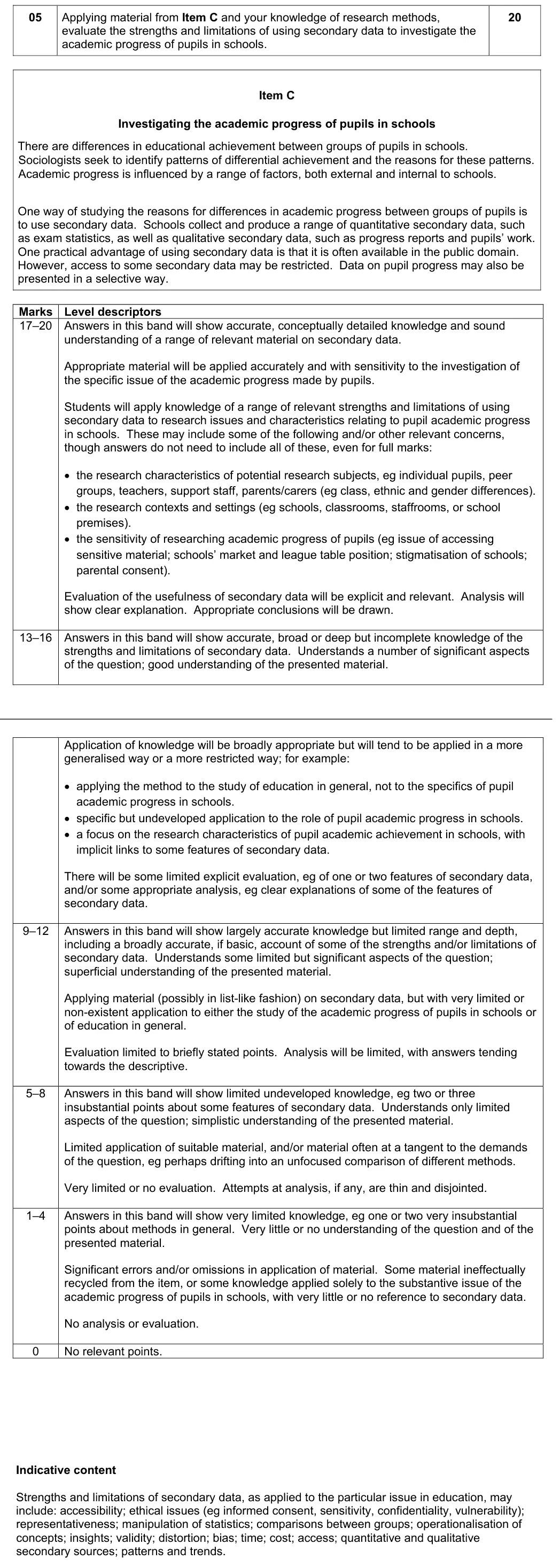
Investigating the academic progress of pupils in schools
There are differences in educational achievement between groups of pupils in schools.
Sociologists seek to identify patterns of differential achievement and the reasons for
these patterns. Academic progress is influenced by a range of factors, both external and
internal to schools.
One way of studying the reasons for differences in academic progress between groups
of pupils is to use secondary data.  Schools collect and produce a range of quantitative
secondary data, such as exam statistics, as well as qualitative secondary data, such as
progress reports and pupils’ work.  One practical advantage of using secondary data is
that it is often available in the public domain.  However, access to some secondary data
may be restricted.  Data on pupil progress may also be presented in a selective way.
Applying material from Item C and your knowledge of research methods, evaluate the
strengths and limitations of using secondary data to investigate the academic progress of
pupils in schools.
[20 marks]
Extra space
November 2020 · AS Paper 1 · Q6 20 marks AO1=8, AO2=8, AO3=4 Methods in context methods in contextresearch methodsprimary and secondary data
0 6
Read Item B below and answer the question that follows.
Item B
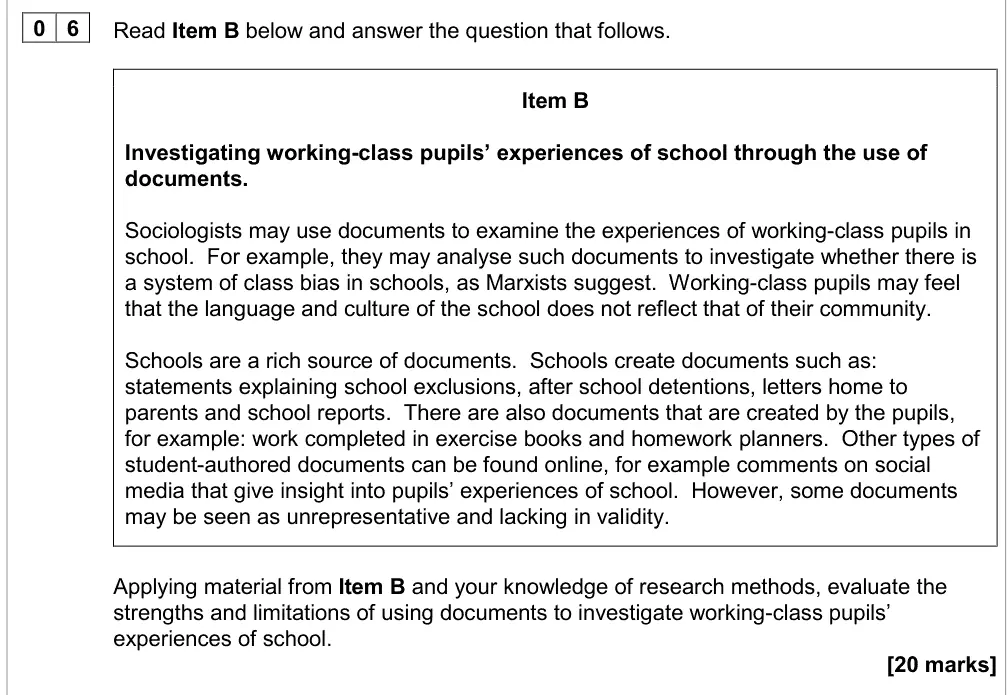
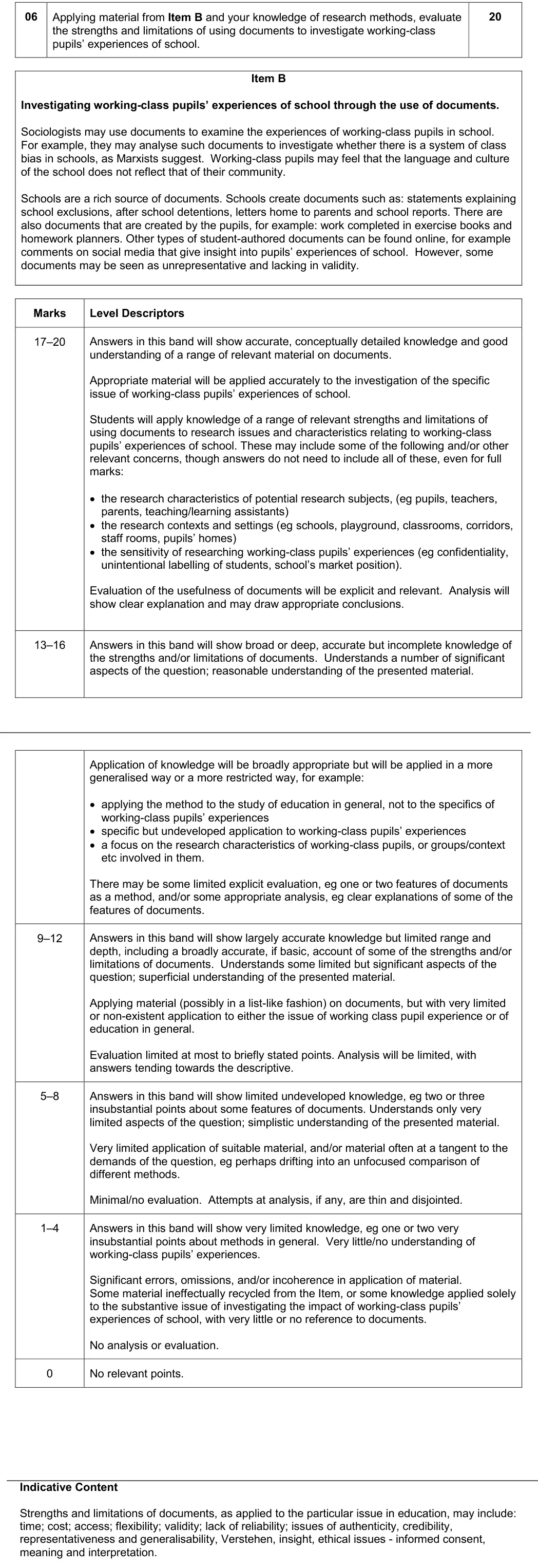
Investigating working-class pupils’ experiences of school through the use of
documents.
Sociologists may use documents to examine the experiences of working-class pupils in
school.  For example, they may analyse such documents to investigate whether there is
a system of class bias in schools, as Marxists suggest.  Working-class pupils may feel
that the language and culture of the school does not reflect that of their community.
Schools are a rich source of documents.  Schools create documents such as:
statements explaining school exclusions, after school detentions, letters home to
parents and school reports.  There are also documents that are created by the pupils,
for example: work completed in exercise books and homework planners.  Other types of
student-authored documents can be found online, for example comments on social
media that give insight into pupils’ experiences of school.  However, some documents
may be seen as unrepresentative and lacking in validity.
Applying material from Item B and your knowledge of research methods, evaluate the
strengths and limitations of using documents to investigate working-class pupils’
experiences of school.
[20 marks]
November 2020 · Paper 1 · Q5 20 marks AO1=8, AO2=8, AO3=4 Methods in context methods in contextresearch methodsquantitative and qualitative methods
0 5
Read Item C below and answer the question that follows.
Item C
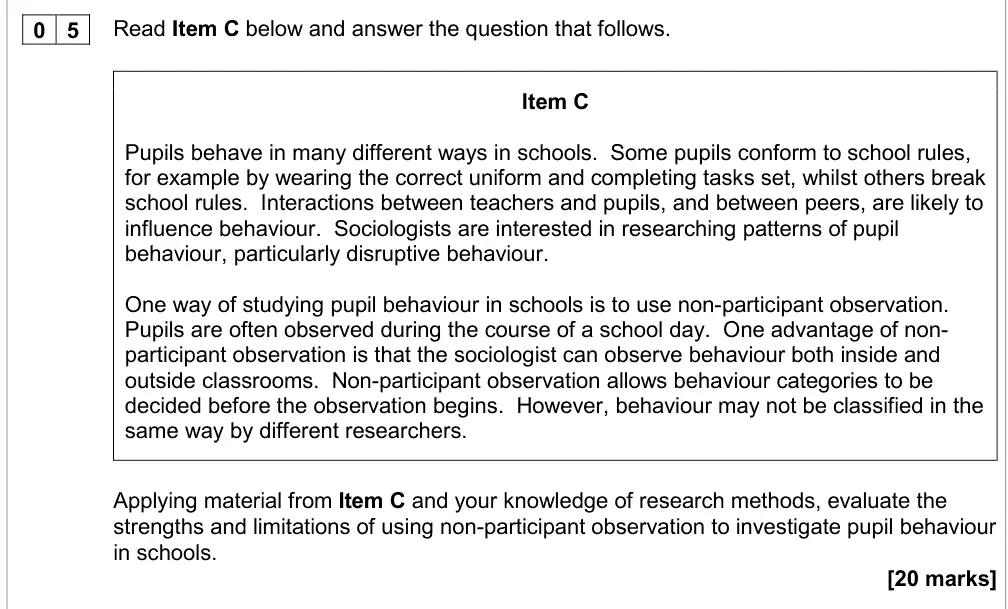
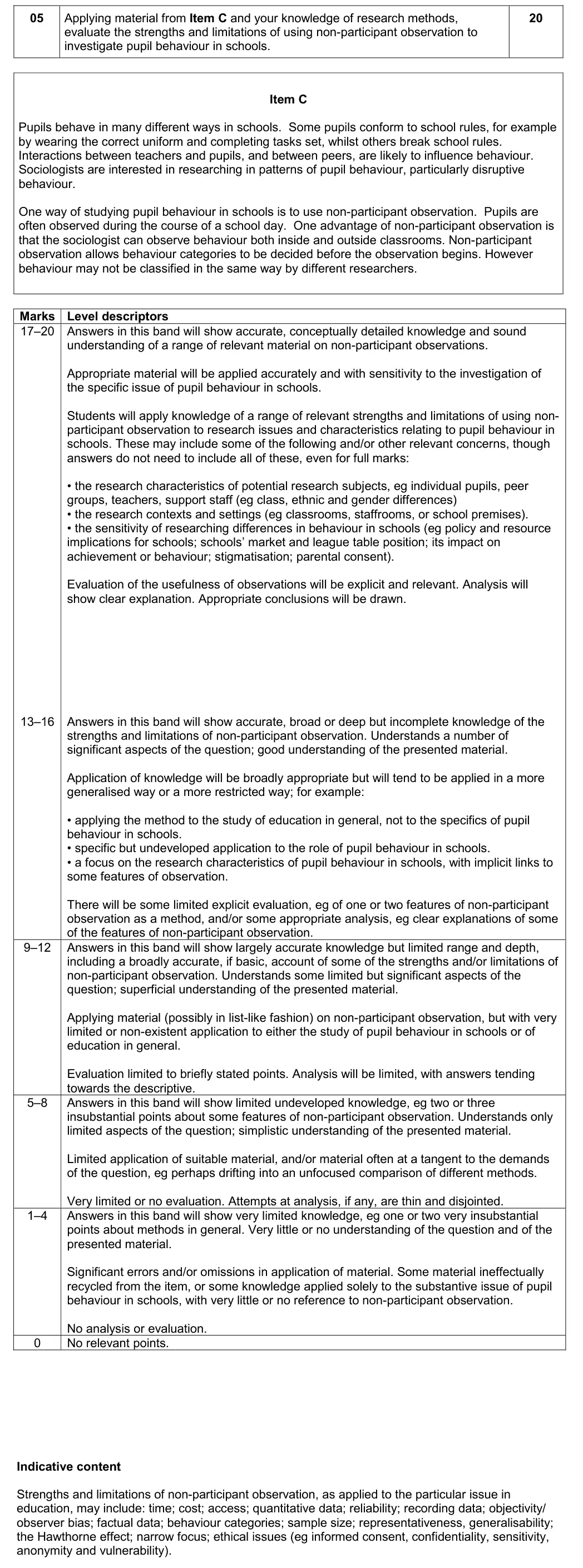
Pupils behave in many different ways in schools.  Some pupils conform to school rules,
for example by wearing the correct uniform and completing tasks set, whilst others break
school rules.  Interactions between teachers and pupils, and between peers, are likely to
influence behaviour.  Sociologists are interested in researching patterns of pupil
behaviour, particularly disruptive behaviour.
One way of studying pupil behaviour in schools is to use non-participant observation.
Pupils are often observed during the course of a school day.  One advantage of non-
participant observation is that the sociologist can observe behaviour both inside and
outside classrooms.  Non-participant observation allows behaviour categories to be
decided before the observation begins.  However, behaviour may not be classified in the
same way by different researchers.
Applying material from Item C and your knowledge of research methods, evaluate the
strengths and limitations of using non-participant observation to investigate pupil behaviour
in schools.
[20 marks]
Extra space
June 2019 · AS Paper 1 · Q6 20 marks AO1=8, AO2=8, AO3=4 Methods in context methods in contextresearch methodspositivism and interpretivism
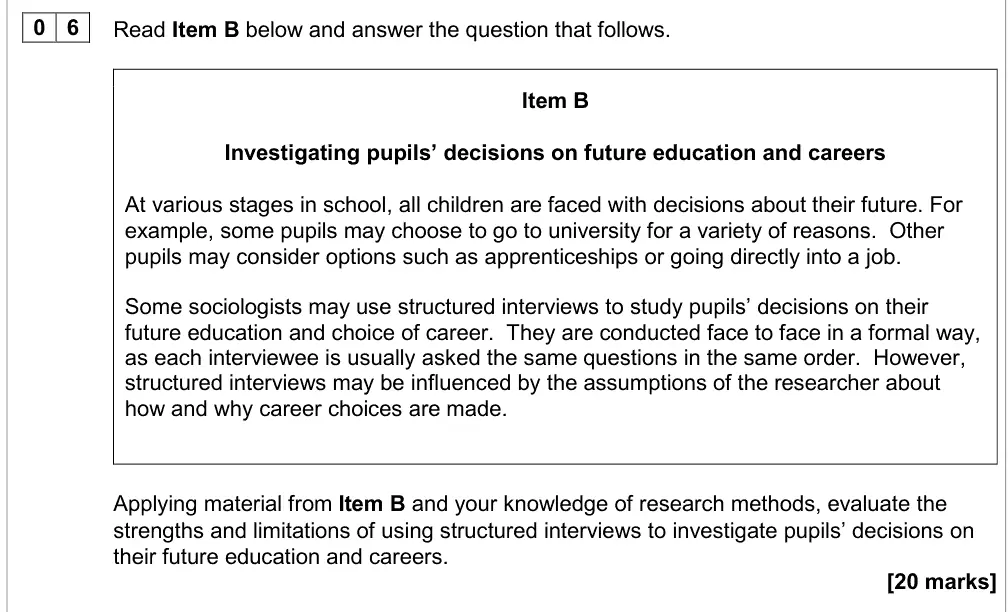
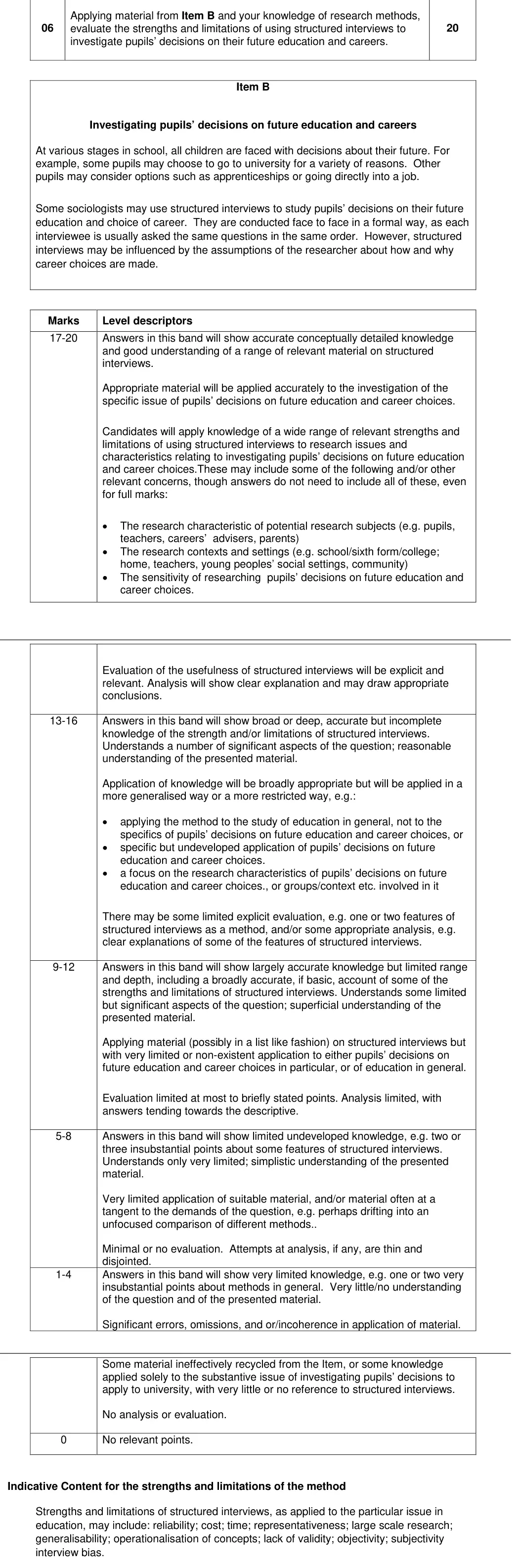
0 6
Read Item B below and answer the question that follows.
Item B
Investigating pupils’ decisions on future education and careers
At various stages in school, all children are faced with decisions about their future. For
example, some pupils may choose to go to university for a variety of reasons.  Other
pupils may consider options such as apprenticeships or going directly into a job.
Some sociologists may use structured interviews to study pupils’ decisions on their
future education and choice of career.  They are conducted face to face in a formal way,
as each interviewee is usually asked the same questions in the same order.  However,
structured interviews may be influenced by the assumptions of the researcher about
how and why career choices are made.
Applying material from Item B and your knowledge of research methods, evaluate the
strengths and limitations of using structured interviews to investigate pupils’ decisions on
their future education and careers.
[20 marks]
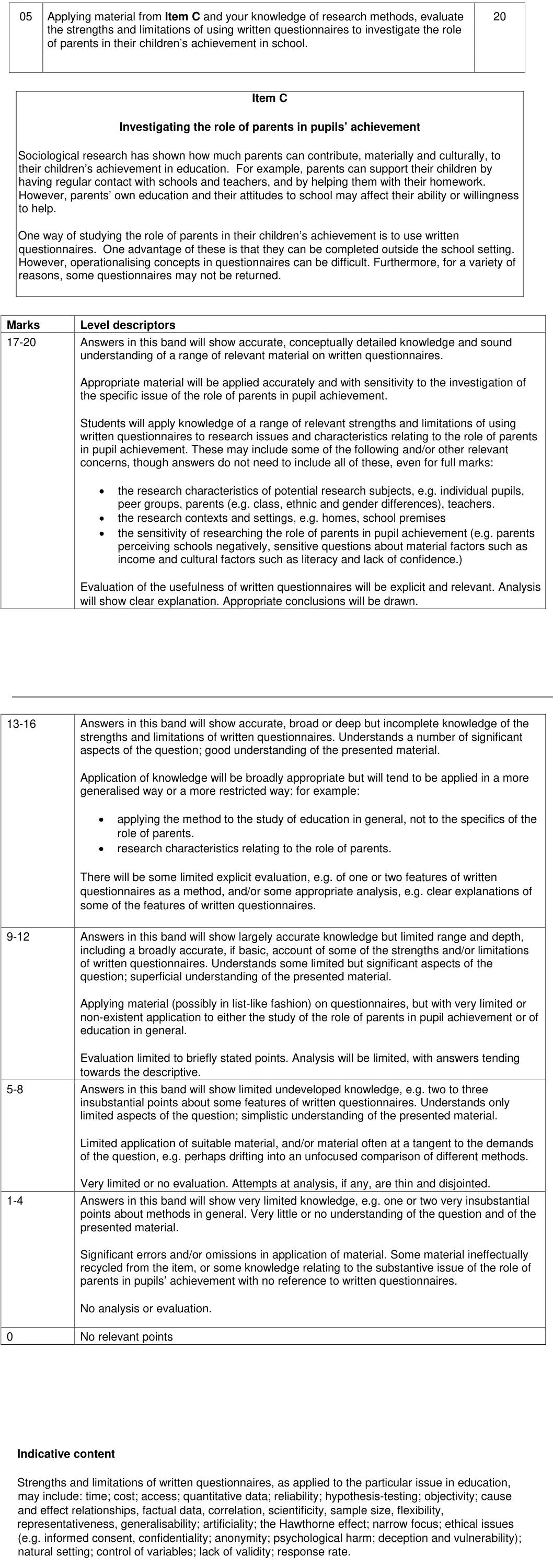
June 2019 · Paper 1 · Q5 20 marks AO1=8, AO2=8, AO3=4 Methods in context methods in contextresearch methodschoice of research method
0 5
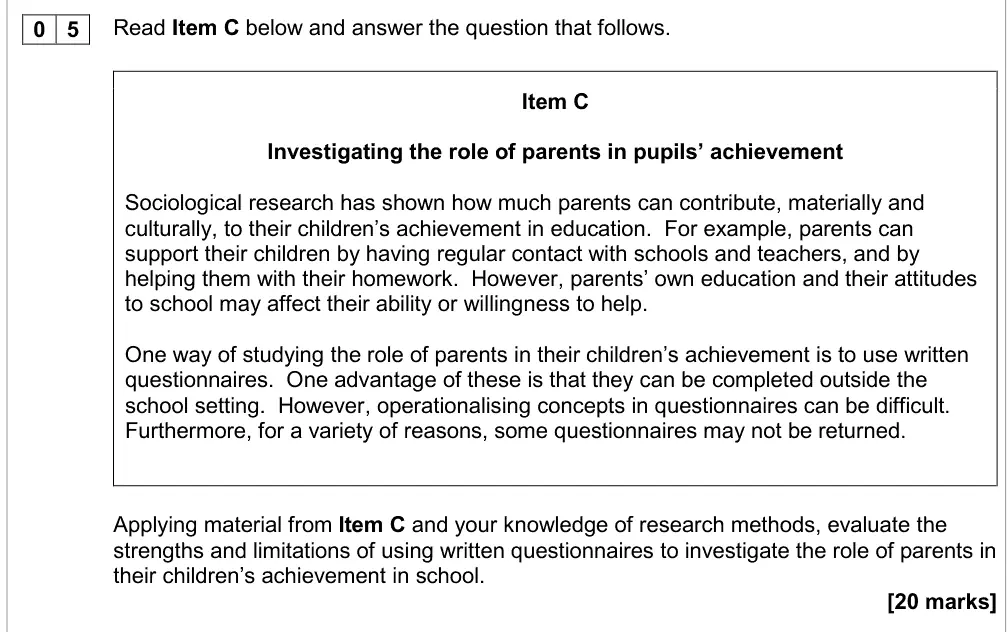
Read Item C below and answer the question that follows.
Item C
Investigating the role of parents in pupils’ achievement
Sociological research has shown how much parents can contribute, materially and
culturally, to their children’s achievement in education.  For example, parents can
support their children by having regular contact with schools and teachers, and by
helping them with their homework.  However, parents’ own education and their attitudes
to school may affect their ability or willingness to help.
One way of studying the role of parents in their children’s achievement is to use written
school setting.  However, operationalising concepts in questionnaires can be difficult.
Furthermore, for a variety of reasons, some questionnaires may not be returned.
Applying material from Item C and your knowledge of research methods, evaluate the
strengths and limitations of using written questionnaires to investigate the role of parents in
their children’s achievement in school.
[20 marks]
Extra space
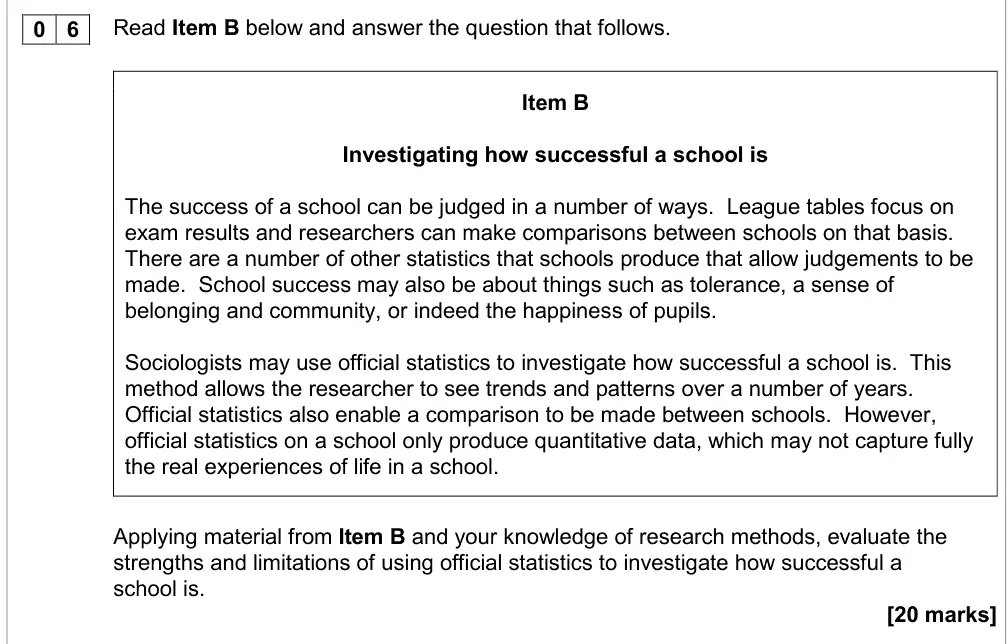
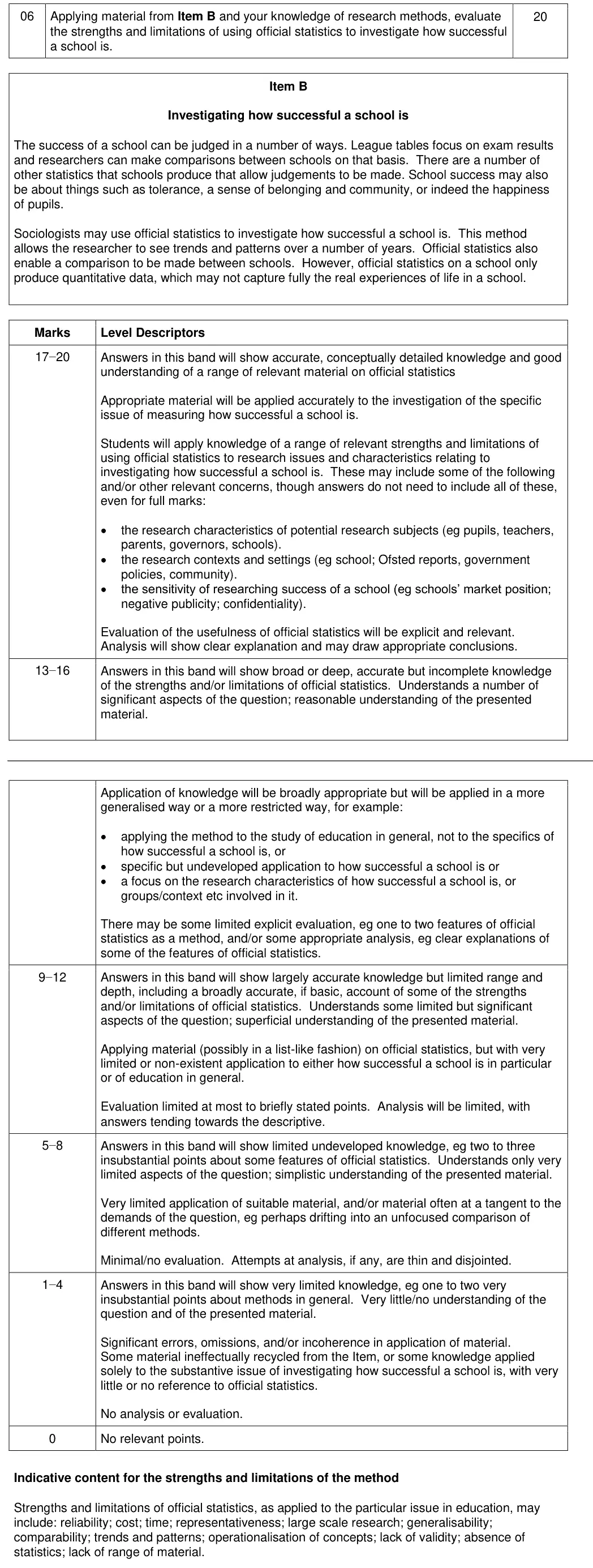
June 2018 · AS Paper 1 · Q6 20 marks AO1=8, AO2=8, AO3=4 Methods in context methods in contextresearch methodsprimary and secondary data
0 6
Read Item B below and answer the question that follows.
Item B
Investigating how successful a school is
The success of a school can be judged in a number of ways.  League tables focus on
exam results and researchers can make comparisons between schools on that basis.
There are a number of other statistics that schools produce that allow judgements to be
made.  School success may also be about things such as tolerance, a sense of
belonging and community, or indeed the happiness of pupils.
Sociologists may use official statistics to investigate how successful a school is.  This
method allows the researcher to see trends and patterns over a number of years.
Official statistics also enable a comparison to be made between schools.  However,
official statistics on a school only produce quantitative data, which may not capture fully
the real experiences of life in a school.
Applying material from Item B and your knowledge of research methods, evaluate the
strengths and limitations of using official statistics to investigate how successful a
school is.
[20 marks]
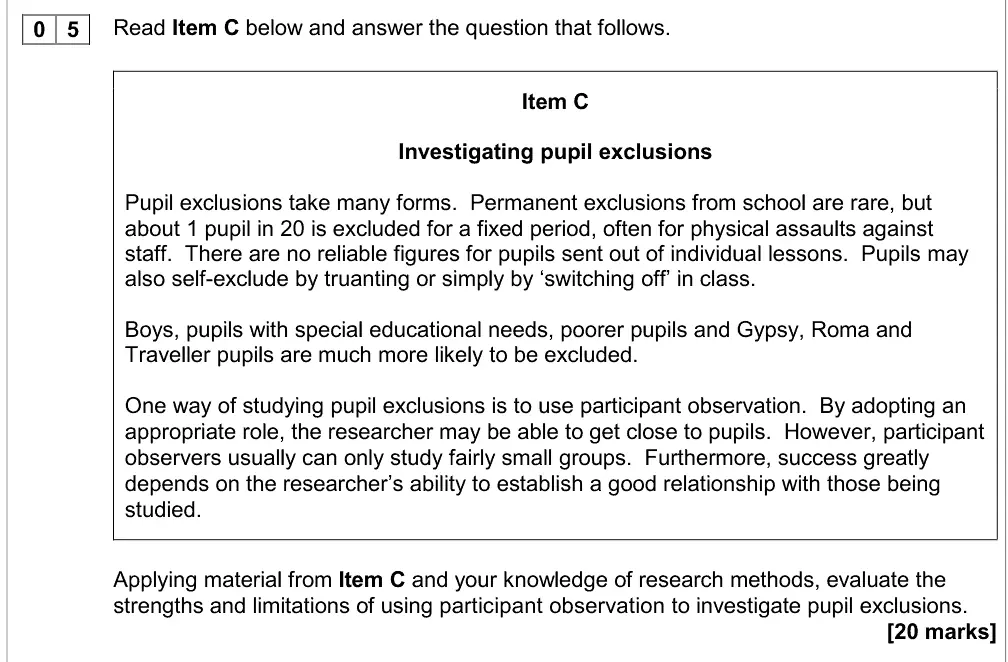
June 2018 · Paper 1 · Q5 20 marks AO1=8, AO2=8, AO3=4 Methods in context methods in contextresearch methods
0 5
Read Item C below and answer the question that follows.
Item C
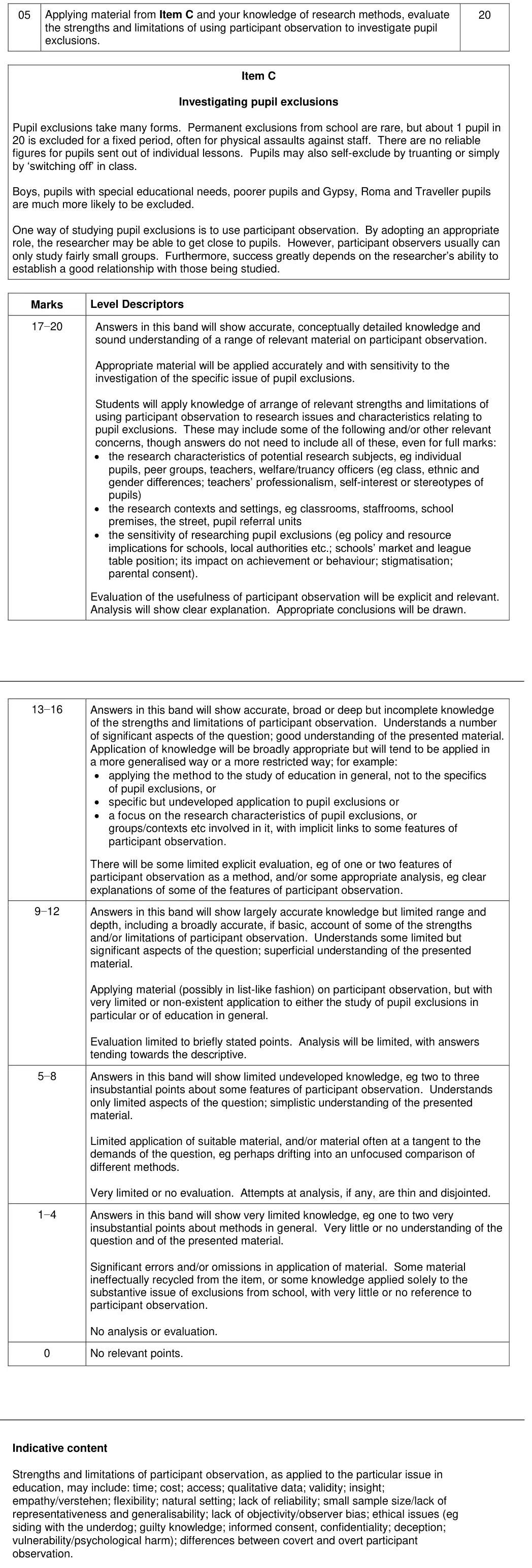
Investigating pupil exclusions
Pupil exclusions take many forms.  Permanent exclusions from school are rare, but
about 1 pupil in 20 is excluded for a fixed period, often for physical assaults against
staff.  There are no reliable figures for pupils sent out of individual lessons.  Pupils may
also self-exclude by truanting or simply by ‘switching off’ in class.
Boys, pupils with special educational needs, poorer pupils and Gypsy, Roma and
Traveller pupils are much more likely to be excluded.
One way of studying pupil exclusions is to use participant observation.  By adopting an
appropriate role, the researcher may be able to get close to pupils.  However, participant
observers usually can only study fairly small groups.  Furthermore, success greatly
depends on the researcher’s ability to establish a good relationship with those being
studied.
Applying material from Item C and your knowledge of research methods, evaluate the
strengths and limitations of using participant observation to investigate pupil exclusions.
[20 marks]
Extra space
June 2017 · AS Paper 1 · Q6 20 marks AO1=8, AO2=8, AO3=4 Methods in context methods in contextresearch methodschoice of research method
0 6
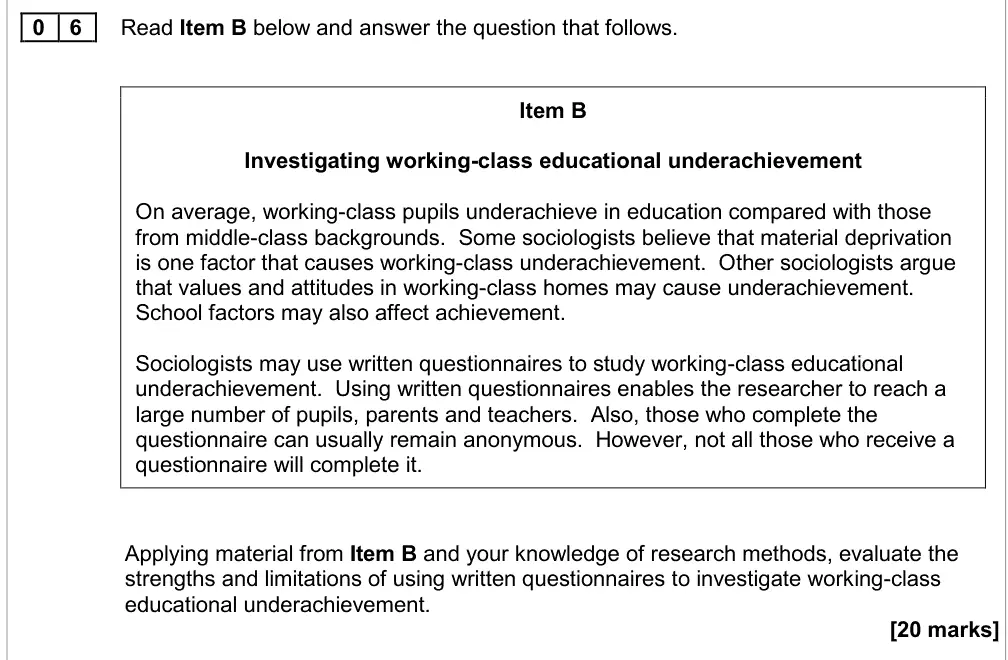
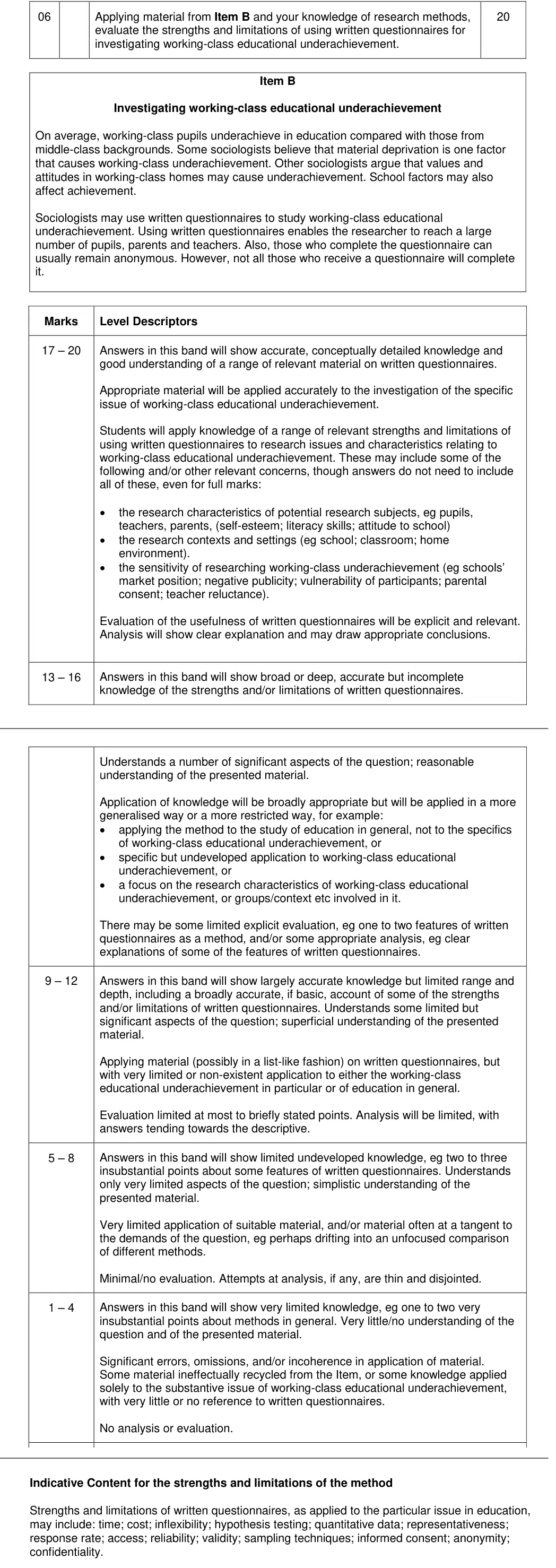
Read Item B below and answer the question that follows.
Item B
Investigating working-class educational underachievement
On average, working-class pupils underachieve in education compared with those
from middle-class backgrounds.  Some sociologists believe that material deprivation
is one factor that causes working-class underachievement.  Other sociologists argue
that values and attitudes in working-class homes may cause underachievement.
School factors may also affect achievement.
Sociologists may use written questionnaires to study working-class educational
underachievement.  Using written questionnaires enables the researcher to reach a
large number of pupils, parents and teachers.  Also, those who complete the
questionnaire can usually remain anonymous.  However, not all those who receive a
questionnaire will complete it.
Applying material from Item B and your knowledge of research methods, evaluate the
strengths and limitations of using written questionnaires to investigate working-class
educational underachievement.
[20 marks]
June 2017 · Paper 1 · Q5 20 marks AO1=8, AO2=8, AO3=4 Methods in context methods in contextresearch methods
0 5
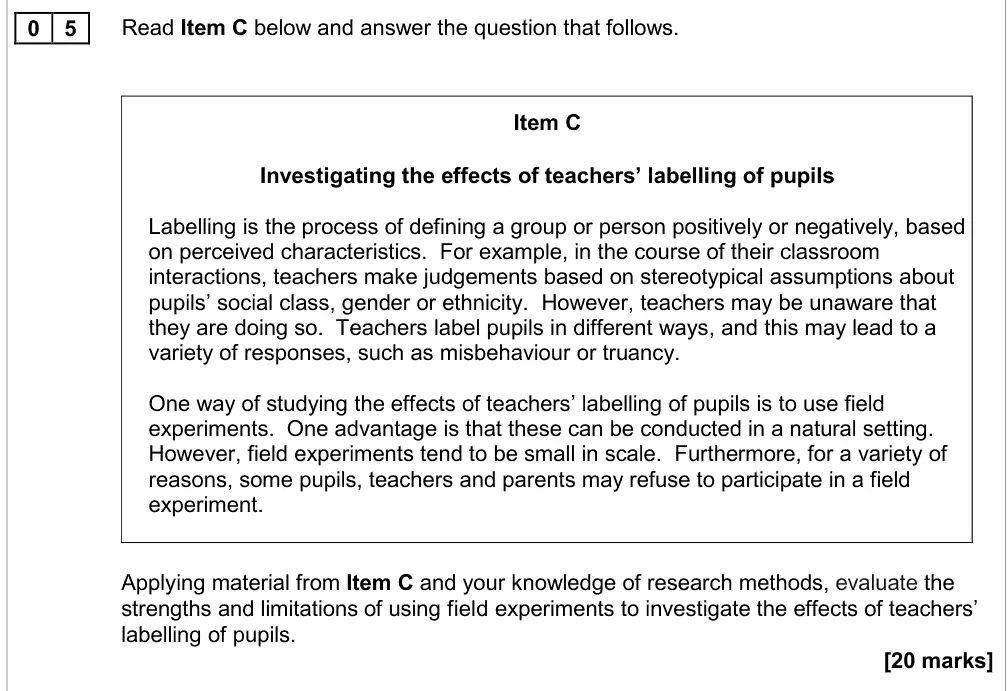
Read Item C below and answer the question that follows.
Item C
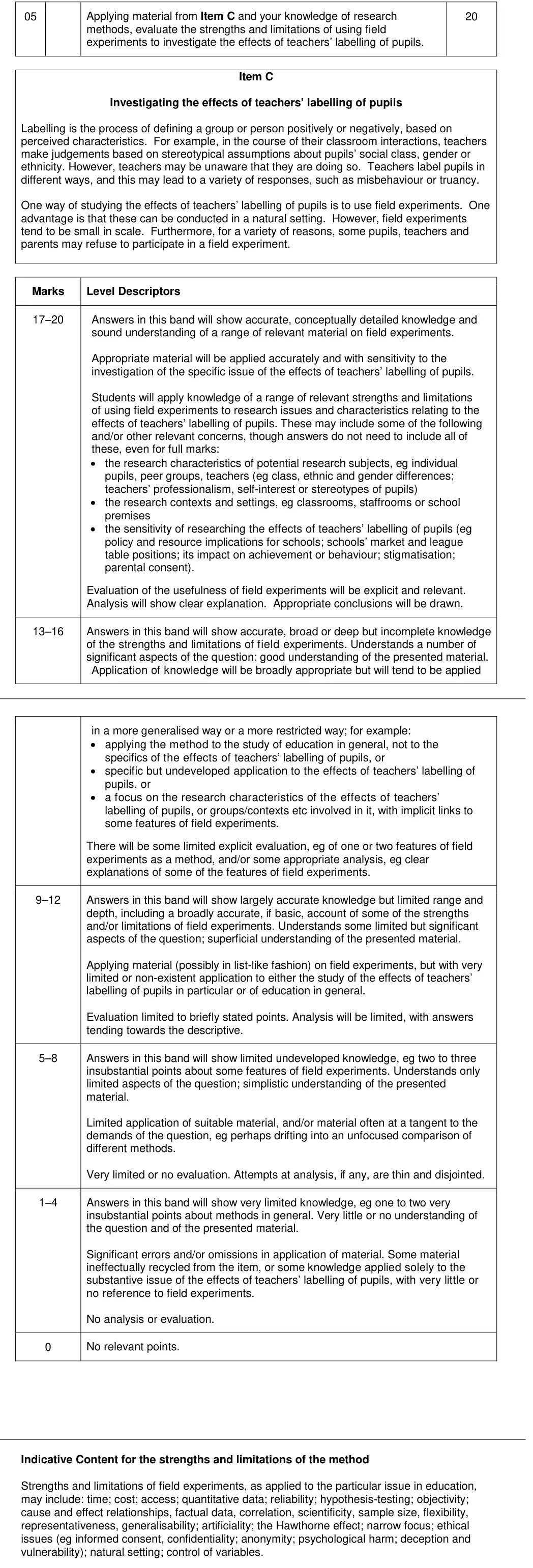
Investigating the effects of teachers’ labelling of pupils
Labelling is the process of defining a group or person positively or negatively, based
on perceived characteristics.  For example, in the course of their classroom
interactions, teachers make judgements based on stereotypical assumptions about
pupils’ social class, gender or ethnicity.  However, teachers may be unaware that
they are doing so.  Teachers label pupils in different ways, and this may lead to a
variety of responses, such as misbehaviour or truancy.
One way of studying the effects of teachers’ labelling of pupils is to use field
experiments.  One advantage is that these can be conducted in a natural setting.
However, field experiments tend to be small in scale.  Furthermore, for a variety of
reasons, some pupils, teachers and parents may refuse to participate in a field
experiment.
Applying material from Item C and your knowledge of research methods, evaluate the
strengths and limitations of using field experiments to investigate the effects of teachers’
labelling of pupils.
[20 marks]
Extra space
June 2016 · AS Paper 1 · Q6 20 marks AO1=8, AO2=8, AO3=4 Methods in context methods in contextresearch methods
0 6
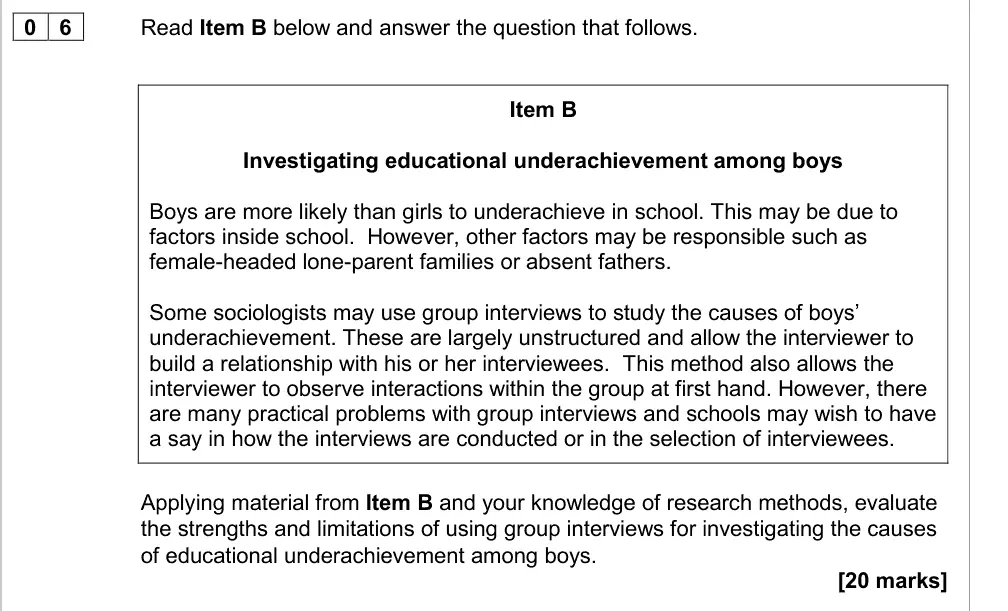
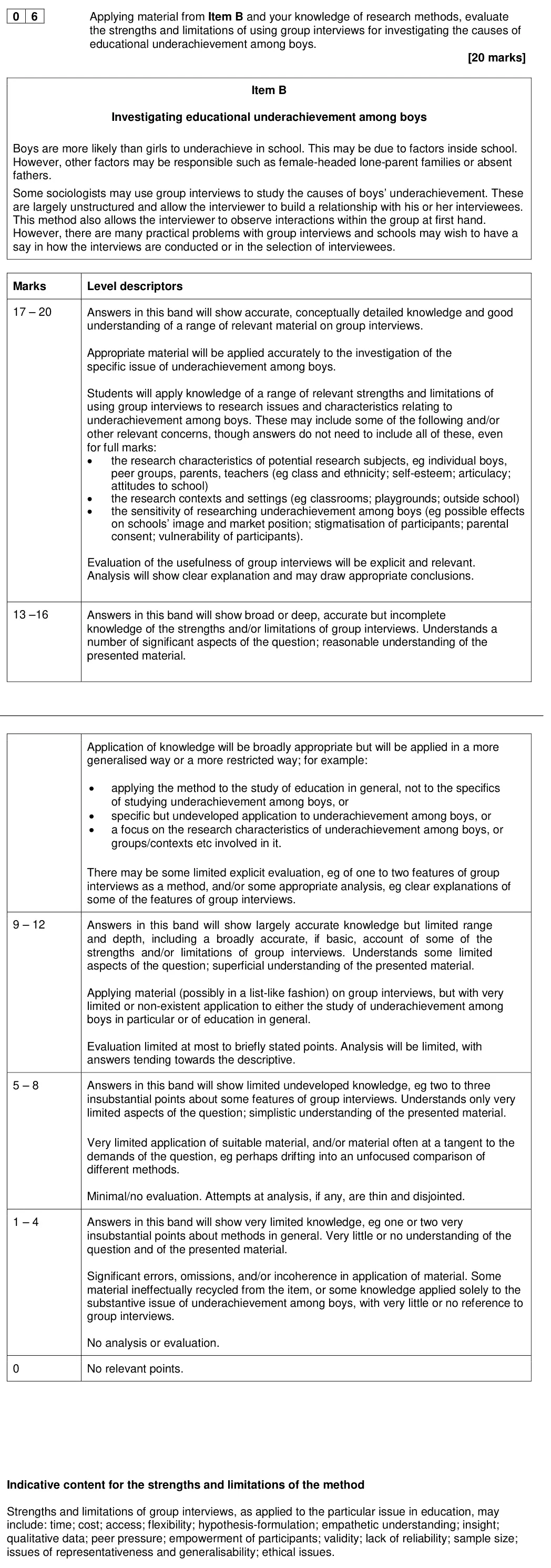
Read Item B below and answer the question that follows.
Item B
Investigating educational underachievement among boys
Boys are more likely than girls to underachieve in school. This may be due to
factors inside school.  However, other factors may be responsible such as
female-headed lone-parent families or absent fathers.
Some sociologists may use group interviews to study the causes of boys’
underachievement. These are largely unstructured and allow the interviewer to
build a relationship with his or her interviewees.  This method also allows the
interviewer to observe interactions within the group at first hand. However, there
are many practical problems with group interviews and schools may wish to have
a say in how the interviews are conducted or in the selection of interviewees.
Applying material from Item B and your knowledge of research methods, evaluate
the strengths and limitations of using group interviews for investigating the causes
of educational underachievement among boys.
[20 marks]
Extra space
20
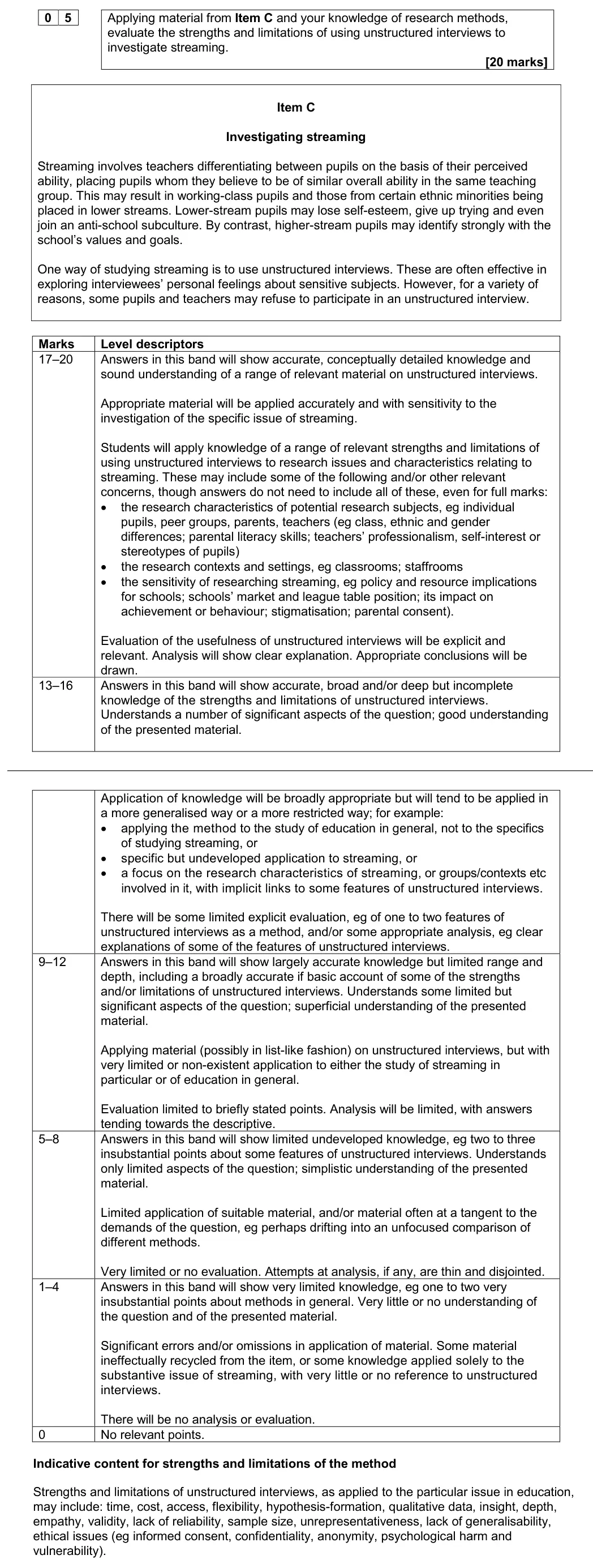
Specimen set 1 · Paper 1 · Q5 20 marks AO1=8, AO2=8, AO3=4 Methods in context methods in contextresearch methodschoice of research method
0 5
Read Item C below and answer the question that follows.
Item C
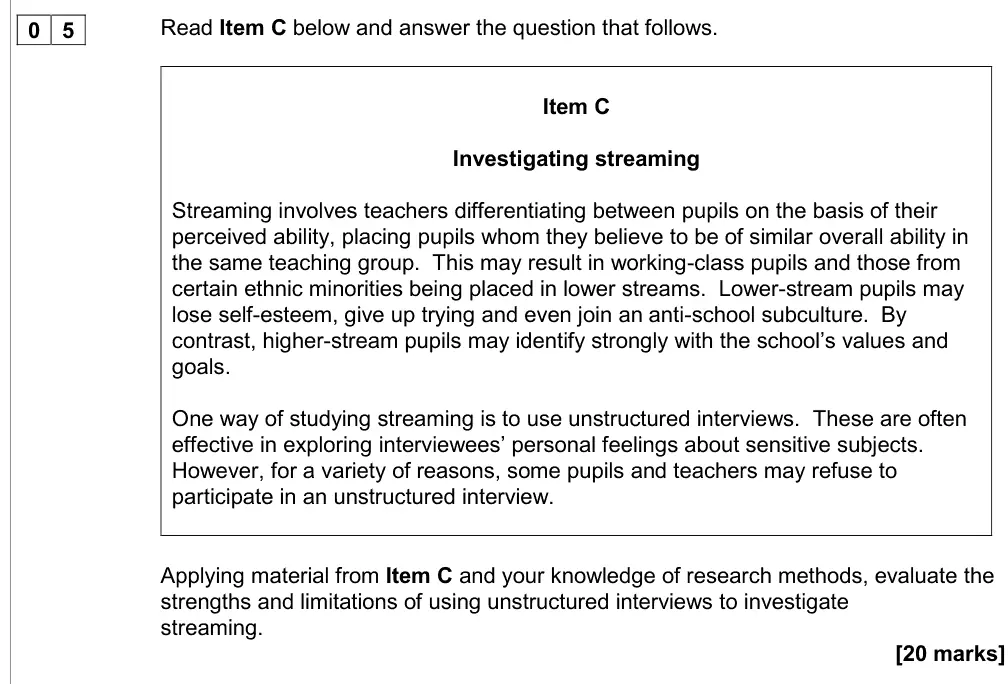
Investigating streaming
Streaming involves teachers differentiating between pupils on the basis of their
perceived ability, placing pupils whom they believe to be of similar overall ability in
the same teaching group.  This may result in working-class pupils and those from
certain ethnic minorities being placed in lower streams.  Lower-stream pupils may
lose self-esteem, give up trying and even join an anti-school subculture.  By
contrast, higher-stream pupils may identify strongly with the school’s values and
goals.
One way of studying streaming is to use unstructured interviews.  These are often
effective in exploring interviewees’ personal feelings about sensitive subjects.
However, for a variety of reasons, some pupils and teachers may refuse to
participate in an unstructured interview.
Applying material from Item C and your knowledge of research methods, evaluate the
strengths and limitations of using unstructured interviews to investigate
streaming.
[20 marks]
Extra space

Work with an AQA sociology tutor

Essays stuck in the middle band, or losing marks on the 10-markers? Book a trial lesson with Mark, a former AQA examiner.

Prefer email? Send an enquiry

If you are under 18, please include a parent's contact details. Enquiries go to enquiries@alevelsociologytutor.com and are deleted once handled. All tutoring is online.