June 2022: AS Paper 1

60 marks · 6 question parts · Paper, mark scheme and report on AQA's site

Question by question

QTopicMarksAOType
1 Educational policy, marketisation and globalisation 2AO1=2Define
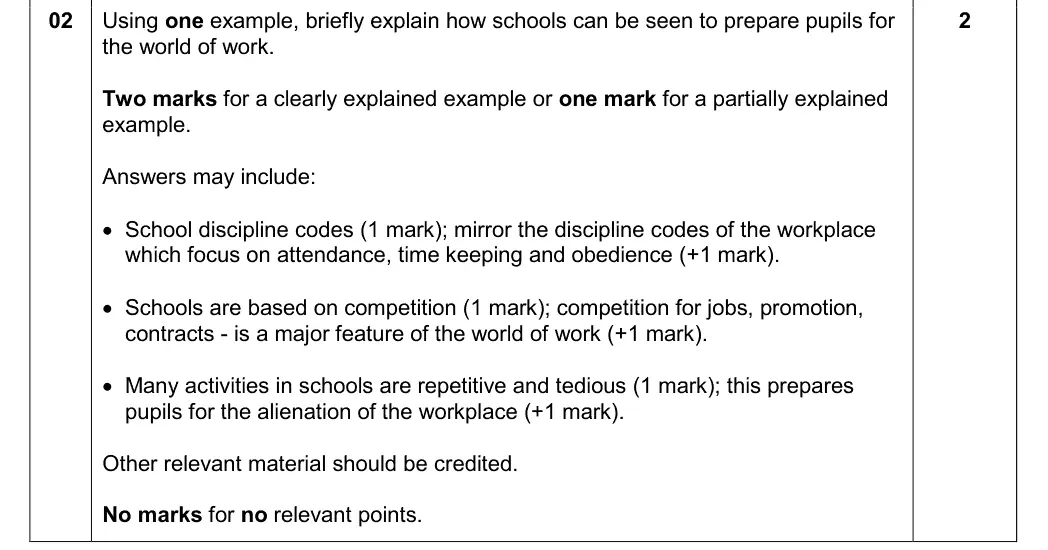
2 Role and functions of education (functionalist, Marxist, New Right), Processes within schools: labelling, subcultures and the hidden curriculum 2AO2=2Brief explain
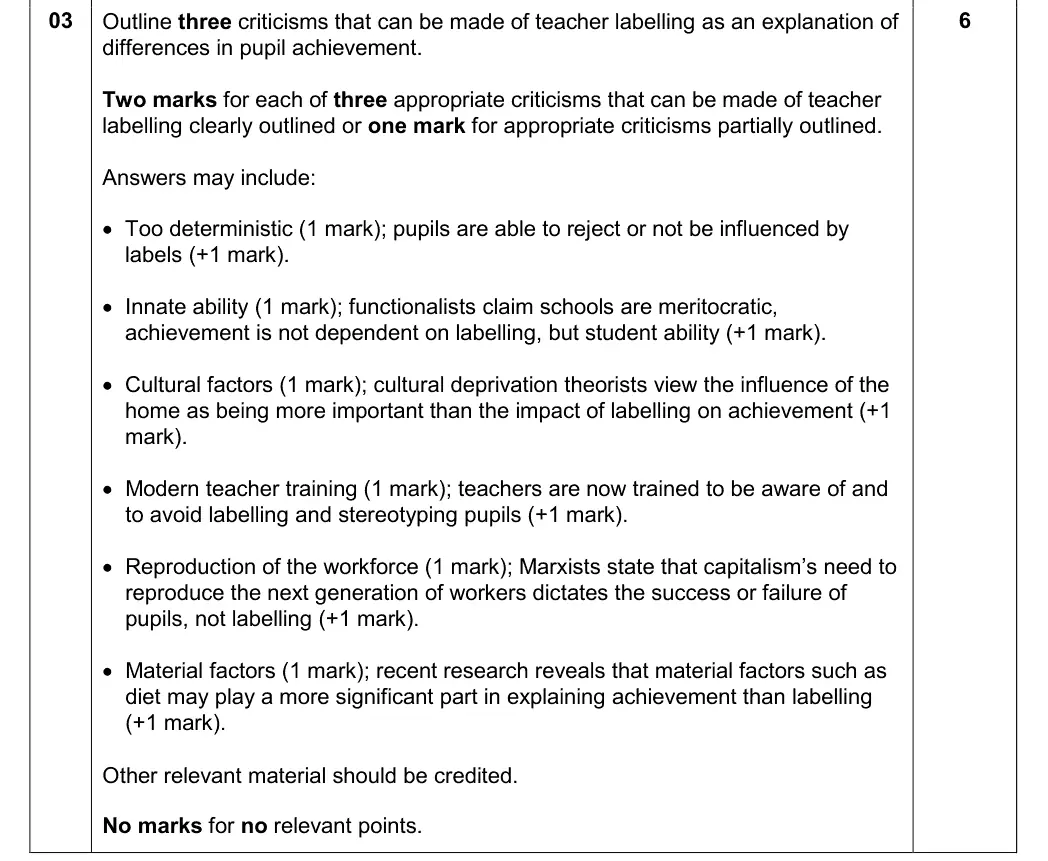
3 Processes within schools: labelling, subcultures and the hidden curriculum, Differential educational achievement: class, gender and ethnicity 6AO1=3,AO2=3Outline
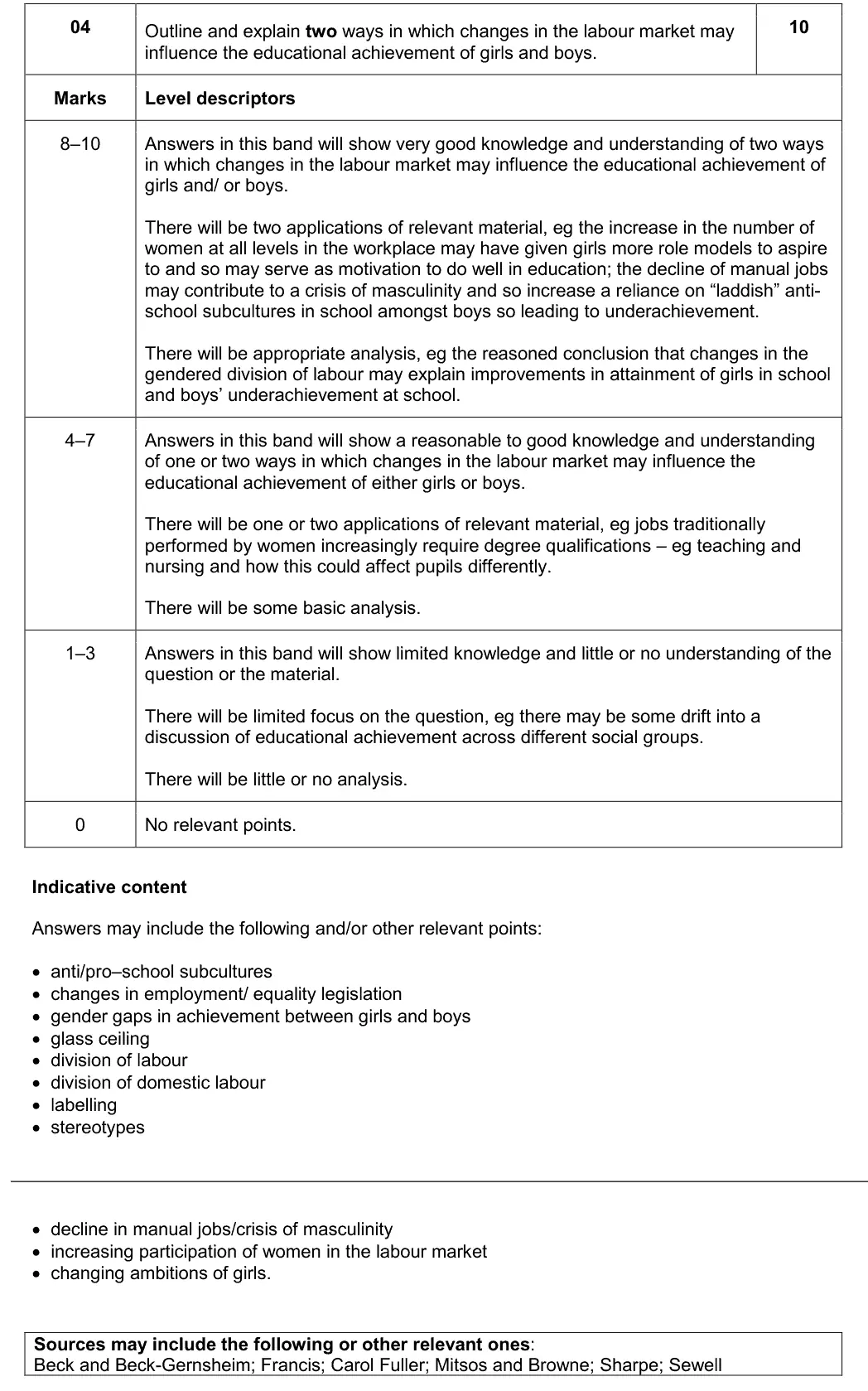
4 Differential educational achievement: class, gender and ethnicity 10AO1=5,AO2=3,AO3=2Outline and explain
5 Educational policy, marketisation and globalisation, Differential educational achievement: class, gender and ethnicity 20AO1=8,AO2=6,AO3=6Essay
6 Methods in Context: research methods applied to education, Research methods: questionnaires, interviews, observation, experiments, documents and official statistics, Theoretical, practical and ethical issues in research 20AO1=8,AO2=8,AO3=4Methods in context

The questions

123456
June 2022 · AS Paper 1 · Q1 2 marks AO1=2 Define education policy
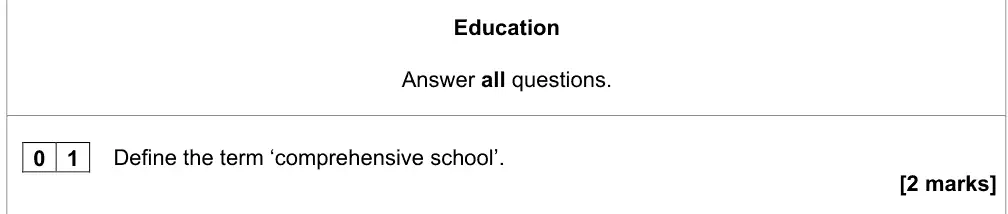
Education
0 1
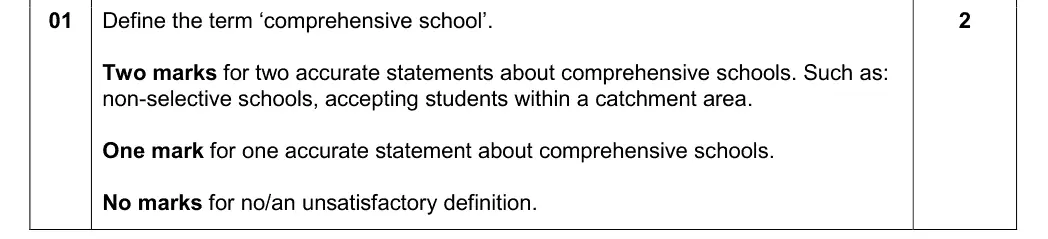
Define the term ‘comprehensive school’.
[2 marks]
June 2022 · AS Paper 1 · Q2 2 marks AO2=2 Brief explain role of educationprocesses within schools
0 2
Using one example, briefly explain how schools can be seen to prepare pupils for the
world of work.
[2 marks]
June 2022 · AS Paper 1 · Q3 6 marks AO1=3, AO2=3 Outline processes within schoolseducational achievement
0 3
Outline three criticisms that can be made of teacher labelling as an explanation of
differences in pupil achievement.
[6 marks]
June 2022 · AS Paper 1 · Q4 10 marks AO1=5, AO2=3, AO3=2 Outline and explain educational achievement
0 4
Outline and explain two ways in which changes in the labour market may influence the
educational achievement of girls and boys.
[10 marks]
June 2022 · AS Paper 1 · Q5 20 marks AO1=8, AO2=6, AO3=6 20-mark essay education policyeducational achievement
0 5
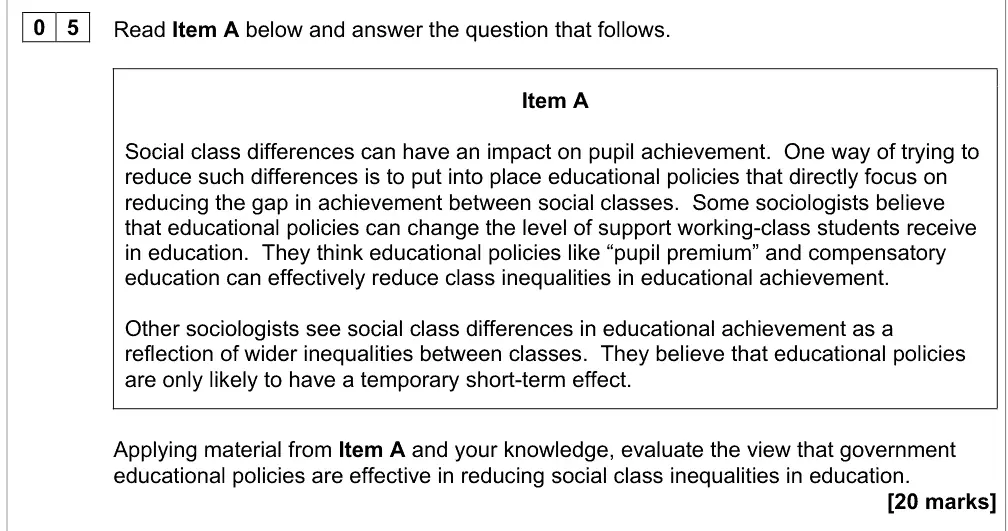
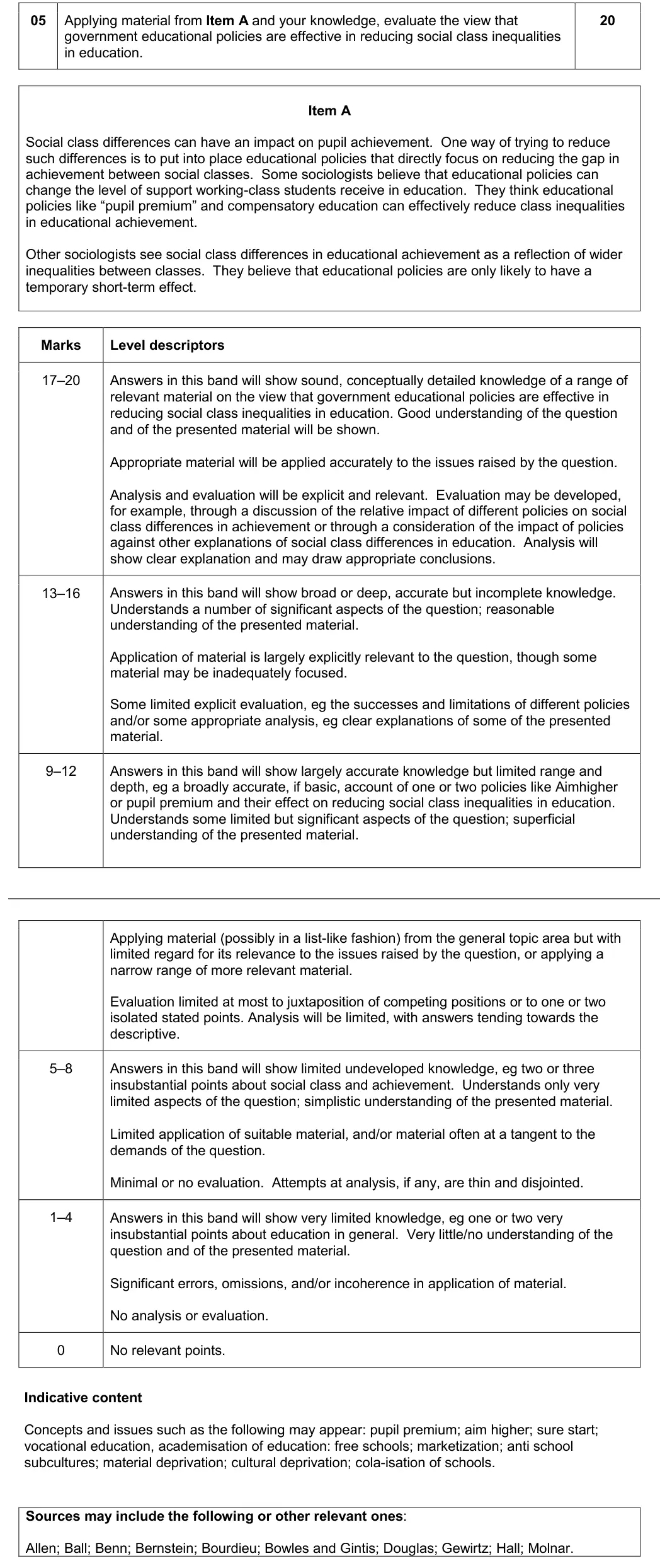
Read Item A below and answer the question that follows.
Item A
Social class differences can have an impact on pupil achievement.  One way of trying to
reduce such differences is to put into place educational policies that directly focus on
reducing the gap in achievement between social classes.  Some sociologists believe
that educational policies can change the level of support working-class students receive
in education.  They think educational policies like “pupil premium” and compensatory
education can effectively reduce class inequalities in educational achievement.
Other sociologists see social class differences in educational achievement as a
reflection of wider inequalities between classes.  They believe that educational policies
are only likely to have a temporary short-term effect.
Applying material from Item A and your knowledge, evaluate the view that government
educational policies are effective in reducing social class inequalities in education.
[20 marks]
Extra space
June 2022 · AS Paper 1 · Q6 20 marks AO1=8, AO2=8, AO3=4 Methods in context methods in contextresearch methodschoice of research method
0 6
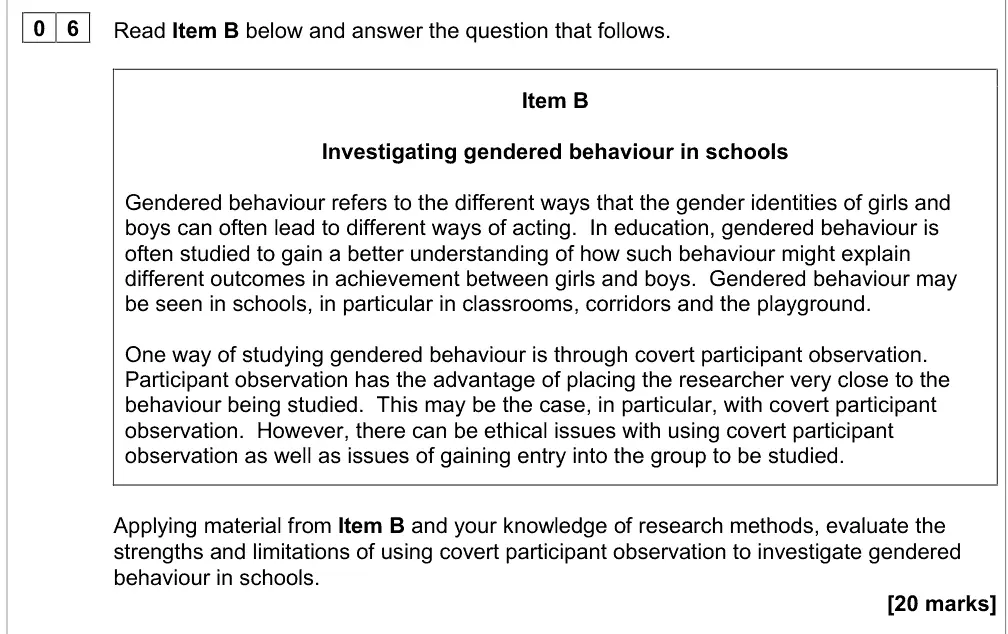
Read Item B below and answer the question that follows.
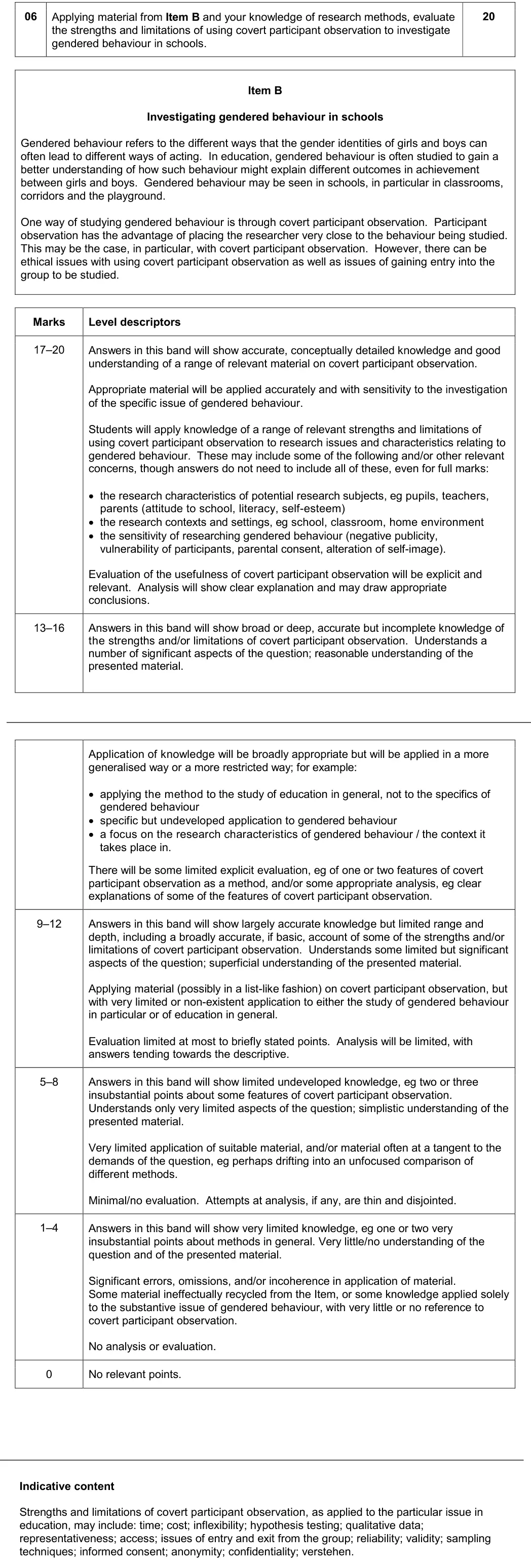
Item B
Investigating gendered behaviour in schools
Gendered behaviour refers to the different ways that the gender identities of girls and
boys can often lead to different ways of acting.  In education, gendered behaviour is
often studied to gain a better understanding of how such behaviour might explain
different outcomes in achievement between girls and boys.  Gendered behaviour may
be seen in schools, in particular in classrooms, corridors and the playground.
One way of studying gendered behaviour is through covert participant observation.
Participant observation has the advantage of placing the researcher very close to the
behaviour being studied.  This may be the case, in particular, with covert participant
observation.  However, there can be ethical issues with using covert participant
observation as well as issues of gaining entry into the group to be studied.
Applying material from Item B and your knowledge of research methods, evaluate the
strengths and limitations of using covert participant observation to investigate gendered
behaviour in schools.
[20 marks]

Work with an AQA sociology tutor

Want a paper marked and gone through with you? Message us.

Prefer email? Send an enquiry

If you are under 18, please include a parent's contact details. Enquiries go to enquiries@alevelsociologytutor.com and are deleted once handled. All tutoring is online.