June 2019: AS Paper 1

60 marks · 6 question parts · Paper, mark scheme and report on AQA's site · AQA no longer hosts this series; the questions are from a copy of AQA's original paper

Question by question

QTopicMarksAOType
1 Differential educational achievement: class, gender and ethnicity 2AO1=2Define
2 Educational policy, marketisation and globalisation 2AO2=2Brief explain
3 Role and functions of education (functionalist, Marxist, New Right) 6AO1=3,AO2=3Outline
4 Educational policy, marketisation and globalisation, Differential educational achievement: class, gender and ethnicity 10AO1=5,AO2=3,AO3=2Outline and explain
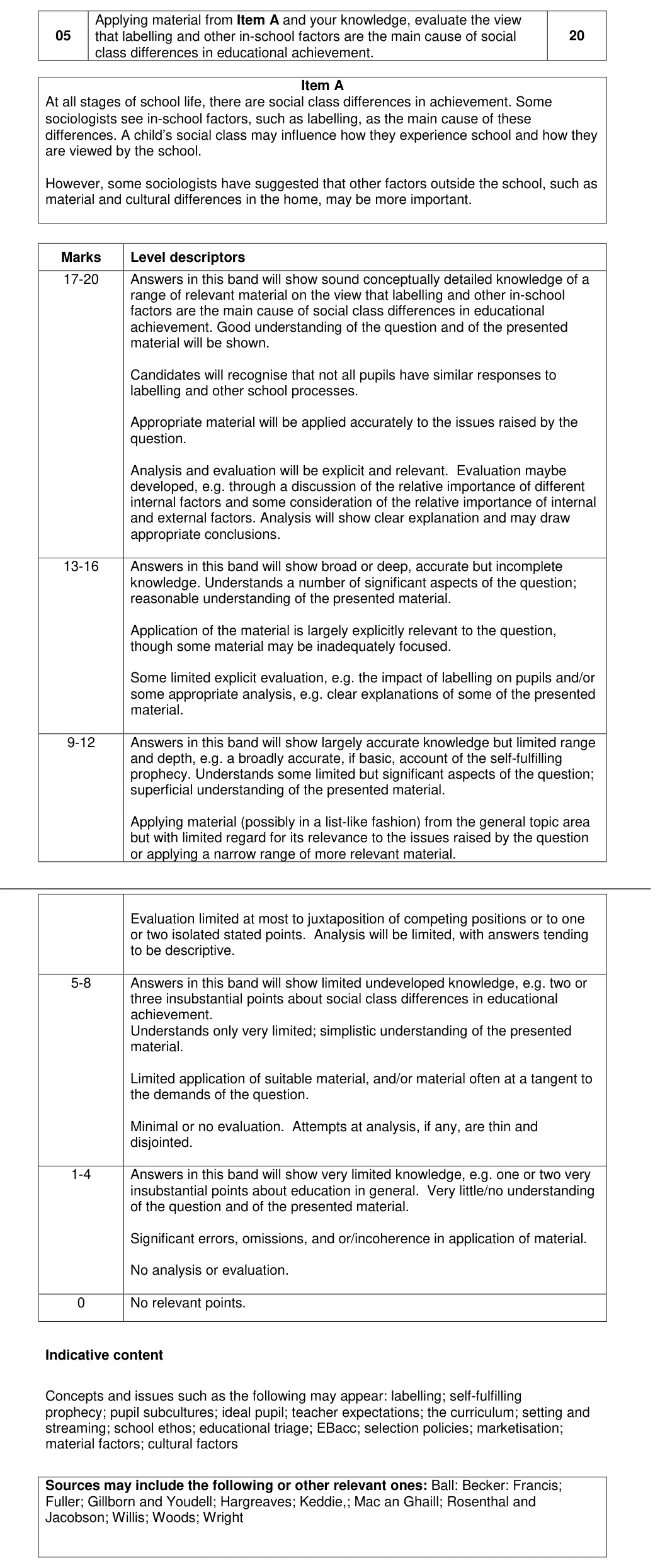
5 Processes within schools: labelling, subcultures and the hidden curriculum, Differential educational achievement: class, gender and ethnicity 20AO1=8,AO2=6,AO3=6Essay
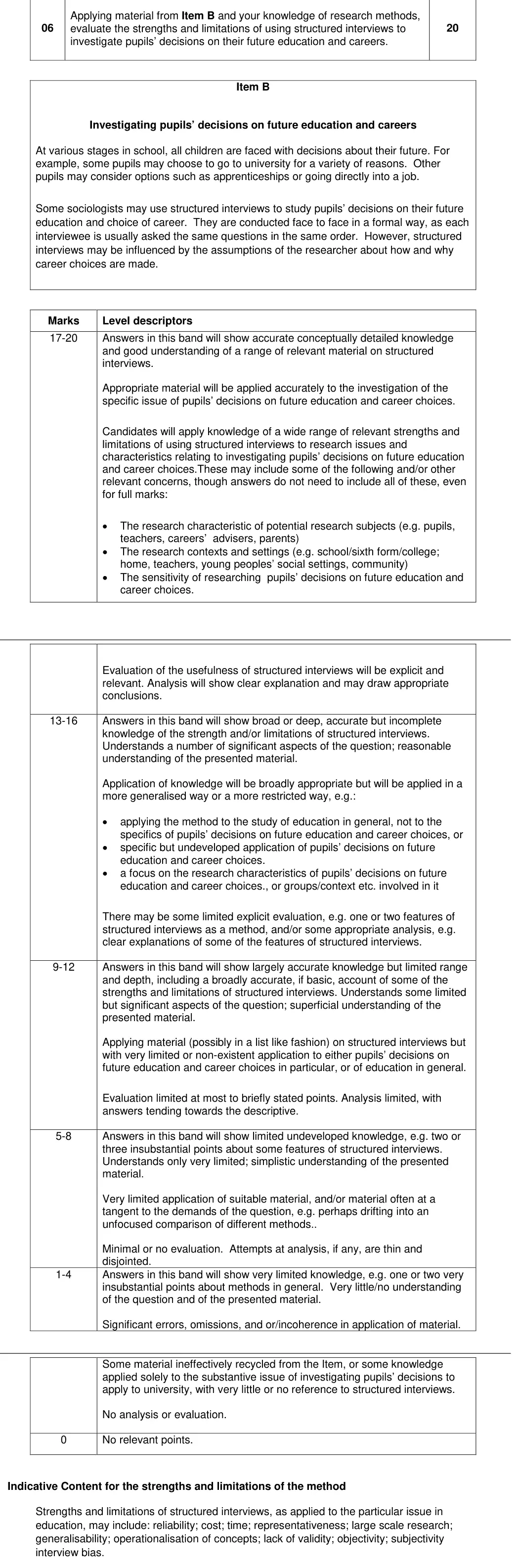
6 Methods in Context: research methods applied to education, Research methods: questionnaires, interviews, observation, experiments, documents and official statistics, Positivism, interpretivism and social facts 20AO1=8,AO2=8,AO3=4Methods in context

The questions

123456
June 2019 · AS Paper 1 · Q1 2 marks AO1=2 Define educational achievement
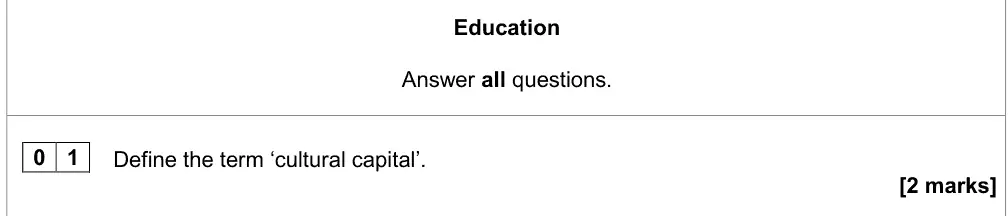
Education
0 1
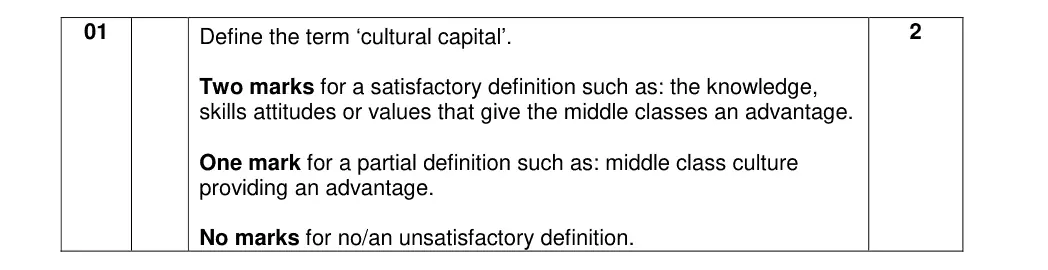
Define the term ‘cultural capital’.
[2 marks]
June 2019 · AS Paper 1 · Q2 2 marks AO2=2 Brief explain education policy
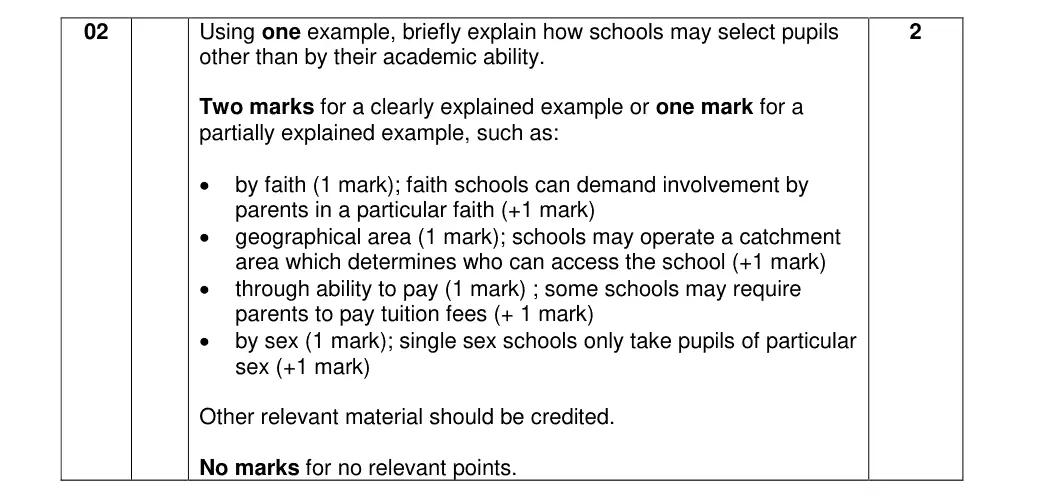
0 2
Using one example, briefly explain how schools may select pupils, other than by their
academic ability.
[2 marks]
June 2019 · AS Paper 1 · Q3 6 marks AO1=3, AO2=3 Outline role of education
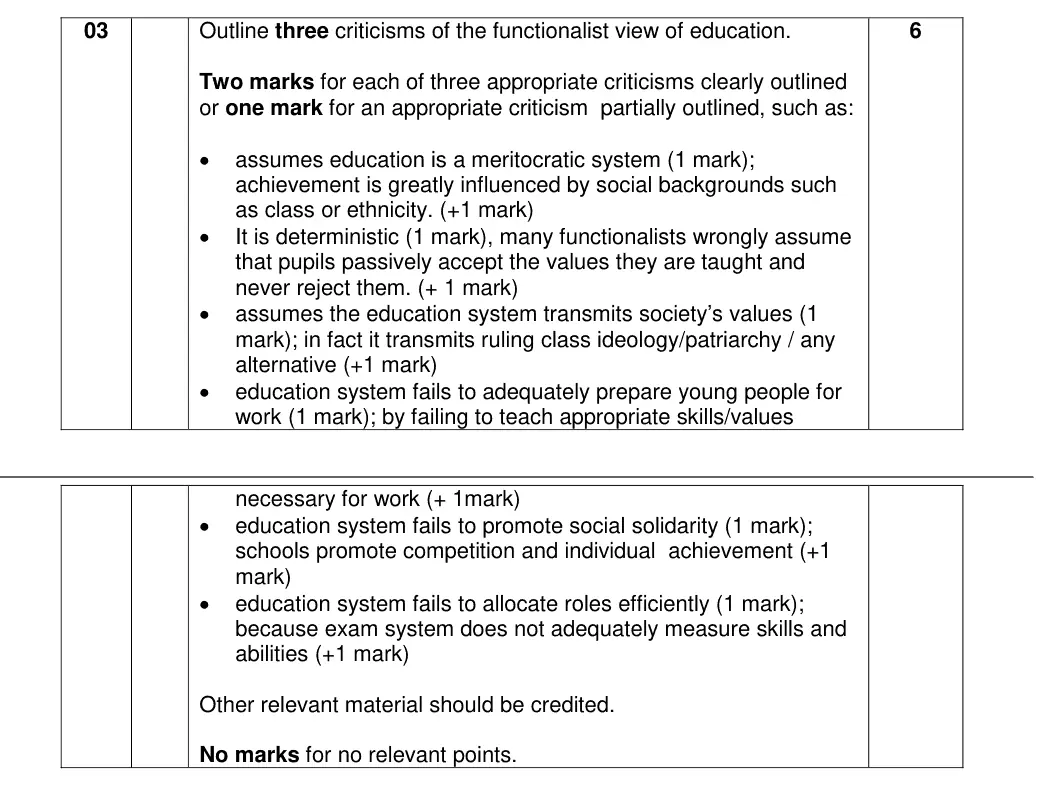
0 3
Outline three criticisms of the functionalist view of education.
[6 marks]
June 2019 · AS Paper 1 · Q4 10 marks AO1=5, AO2=3, AO3=2 Outline and explain education policyeducational achievement
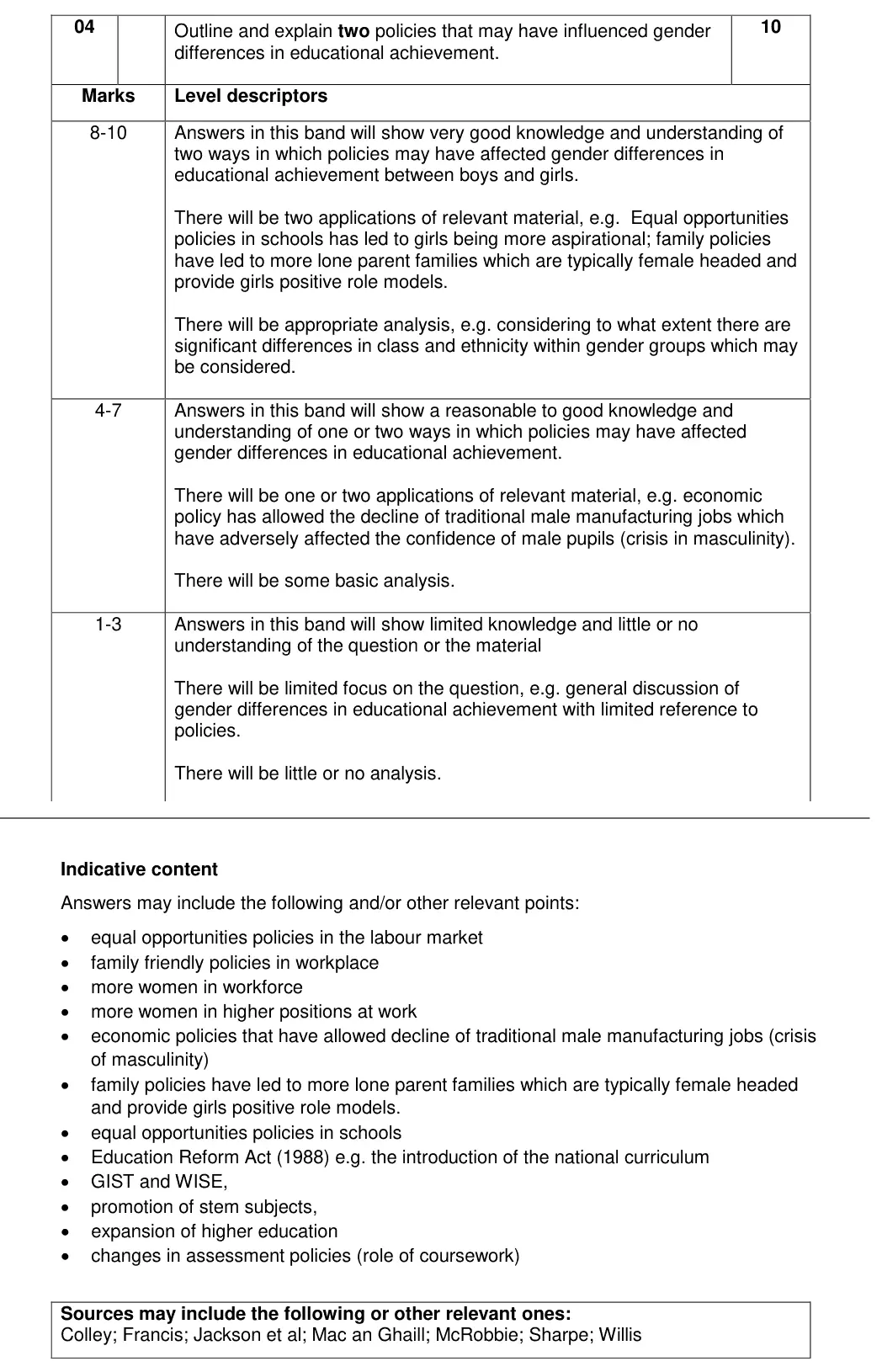
0 4
Outline and explain two policies that may have influenced gender differences in
educational achievement.
[10 marks]
June 2019 · AS Paper 1 · Q5 20 marks AO1=8, AO2=6, AO3=6 20-mark essay processes within schoolseducational achievement
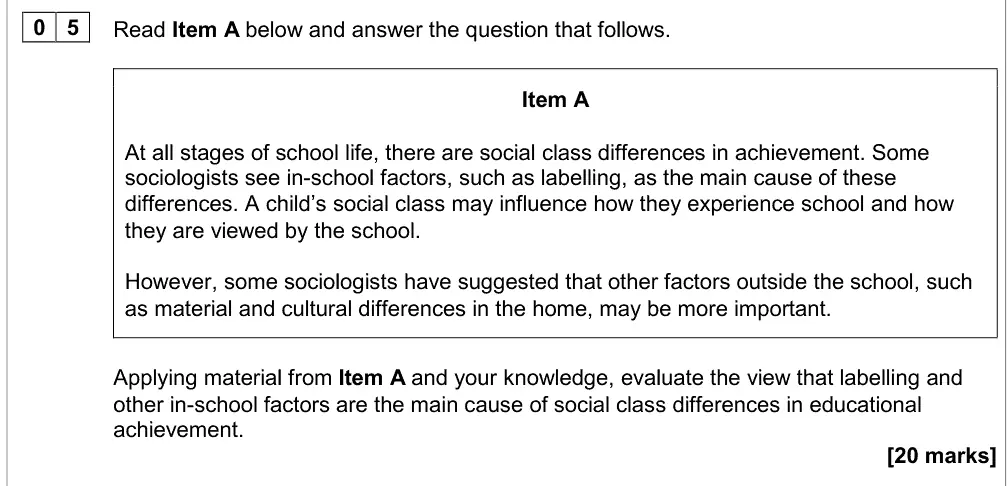
0 5
Read Item A below and answer the question that follows.
Item A
At all stages of school life, there are social class differences in achievement. Some
sociologists see in-school factors, such as labelling, as the main cause of these
differences. A child’s social class may influence how they experience school and how
they are viewed by the school.
as material and cultural differences in the home, may be more important.
Applying material from Item A and your knowledge, evaluate the view that labelling and
other in-school factors are the main cause of social class differences in educational
achievement.
[20 marks]
Extra space
June 2019 · AS Paper 1 · Q6 20 marks AO1=8, AO2=8, AO3=4 Methods in context methods in contextresearch methodspositivism and interpretivism
0 6
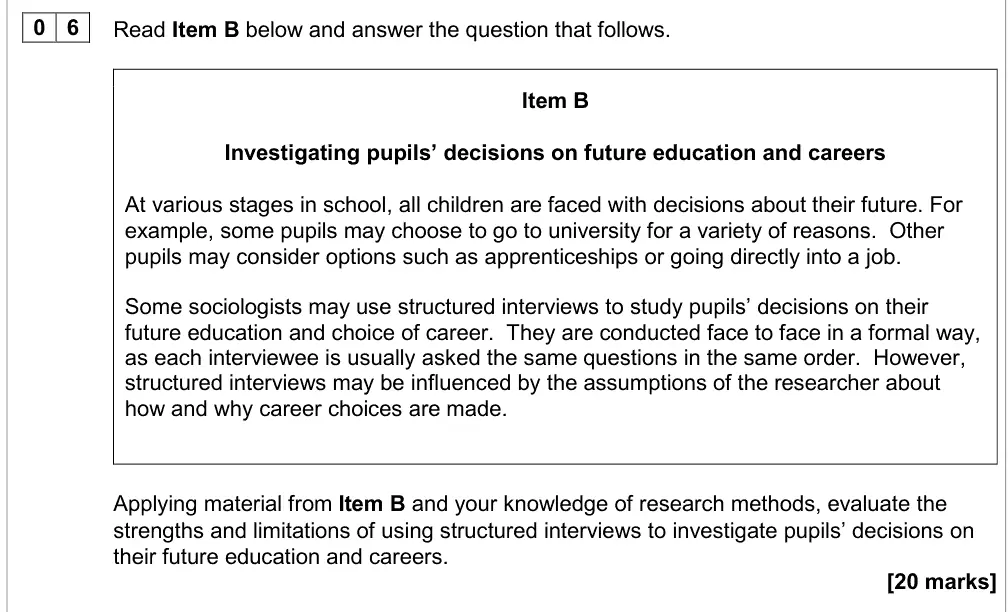
Read Item B below and answer the question that follows.
Item B
Investigating pupils’ decisions on future education and careers
At various stages in school, all children are faced with decisions about their future. For
example, some pupils may choose to go to university for a variety of reasons.  Other
pupils may consider options such as apprenticeships or going directly into a job.
Some sociologists may use structured interviews to study pupils’ decisions on their
future education and choice of career.  They are conducted face to face in a formal way,
as each interviewee is usually asked the same questions in the same order.  However,
structured interviews may be influenced by the assumptions of the researcher about
how and why career choices are made.
Applying material from Item B and your knowledge of research methods, evaluate the
strengths and limitations of using structured interviews to investigate pupils’ decisions on
their future education and careers.
[20 marks]

Work with an AQA sociology tutor

Want a paper marked and gone through with you? Message us.

Prefer email? Send an enquiry

If you are under 18, please include a parent's contact details. Enquiries go to enquiries@alevelsociologytutor.com and are deleted once handled. All tutoring is online.