June 2018: Paper 1

80 marks · 6 question parts · Paper, mark scheme and report on AQA's site · AQA no longer hosts this series; the questions are from a copy of AQA's original paper

Question by question

QTopicMarksAOType
1 Educational policy, marketisation and globalisation, Differential educational achievement: class, gender and ethnicity 4AO1=4Outline
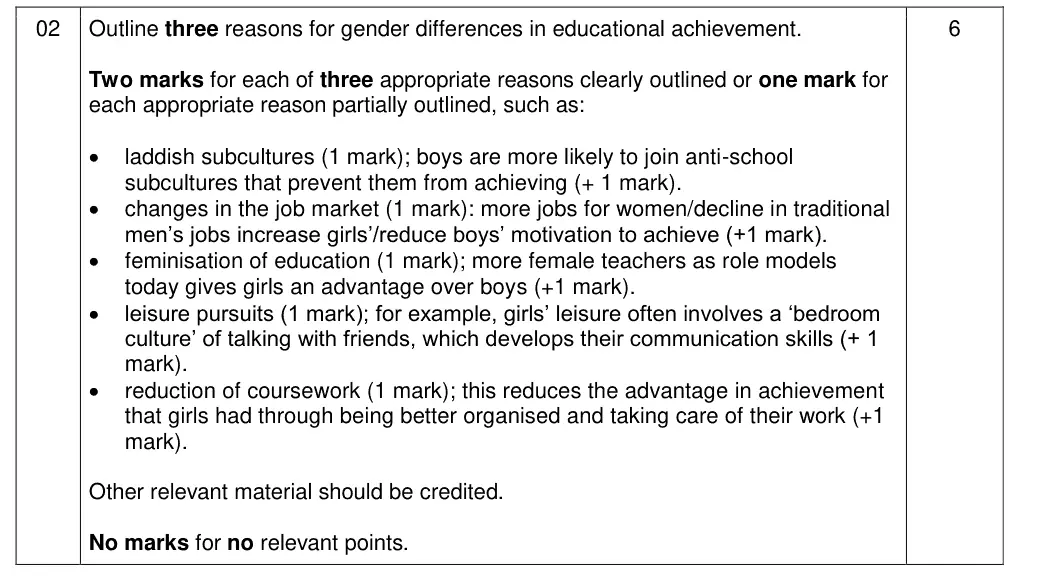
2 Differential educational achievement: class, gender and ethnicity 6AO1=3,AO2=3Outline
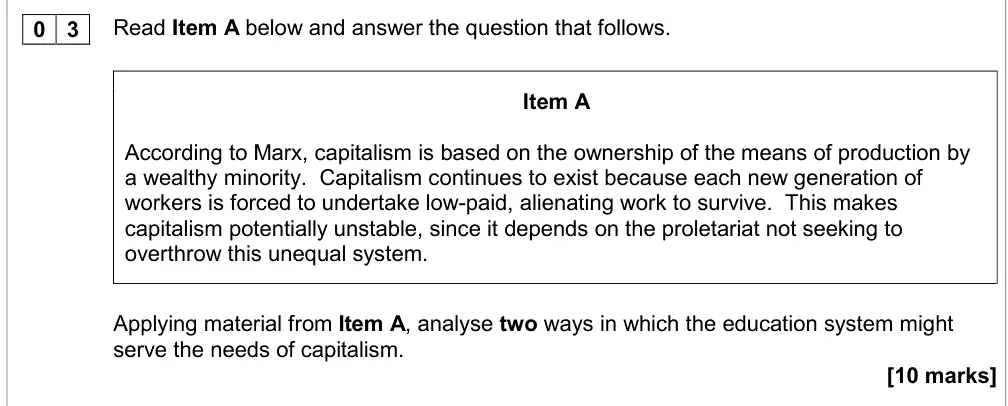
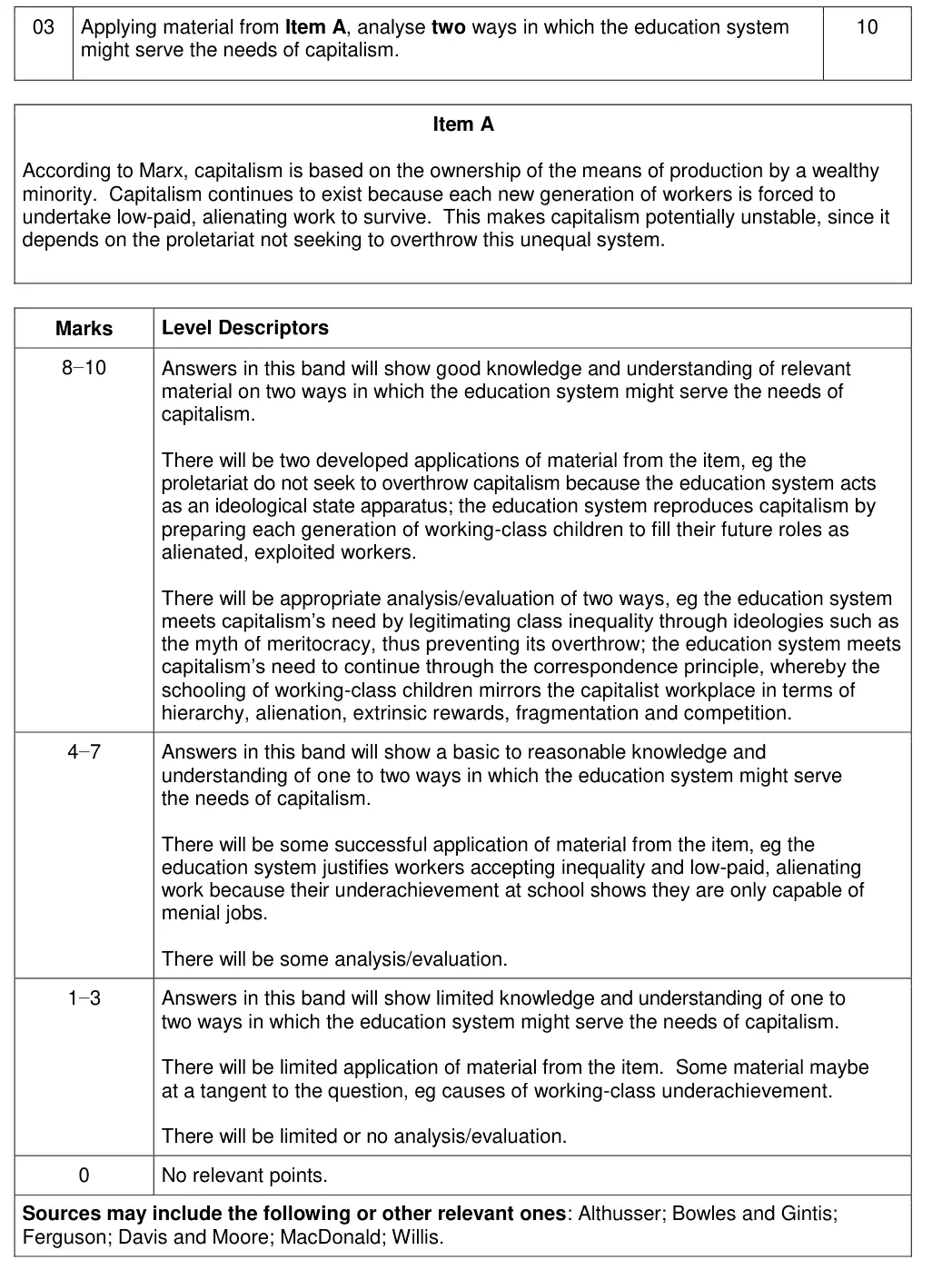
3 Role and functions of education (functionalist, Marxist, New Right) 10AO1=3,AO2=4,AO3=3Analyse
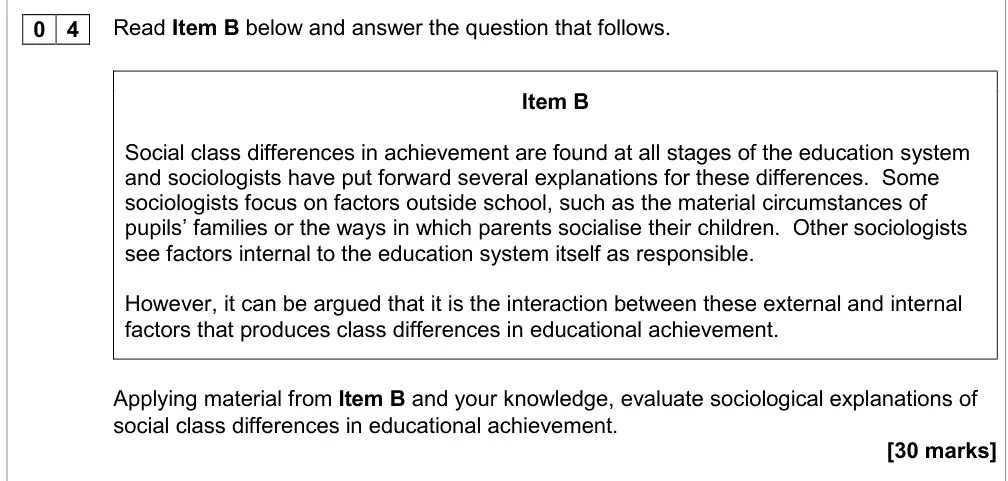
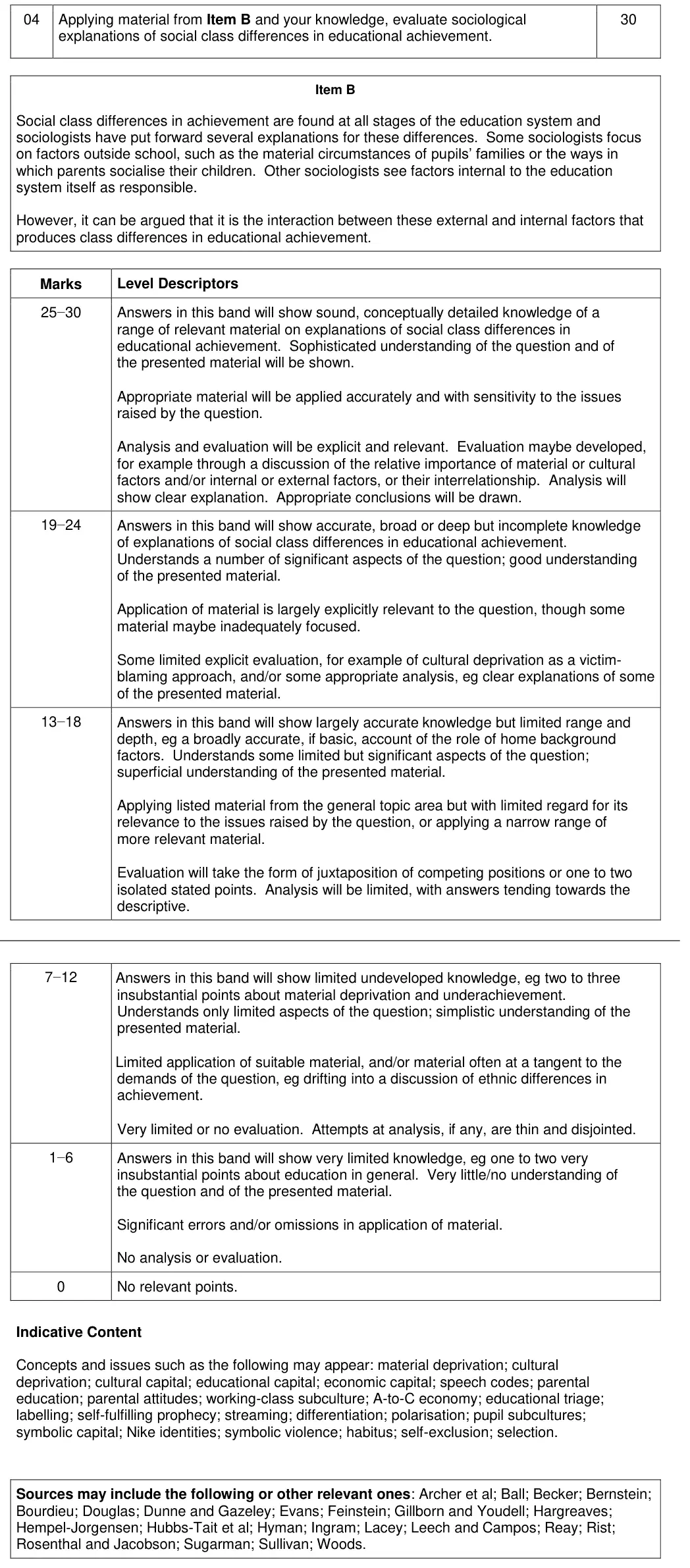
4 Differential educational achievement: class, gender and ethnicity, Processes within schools: labelling, subcultures and the hidden curriculum 30AO1=12,AO2=9,AO3=9Essay
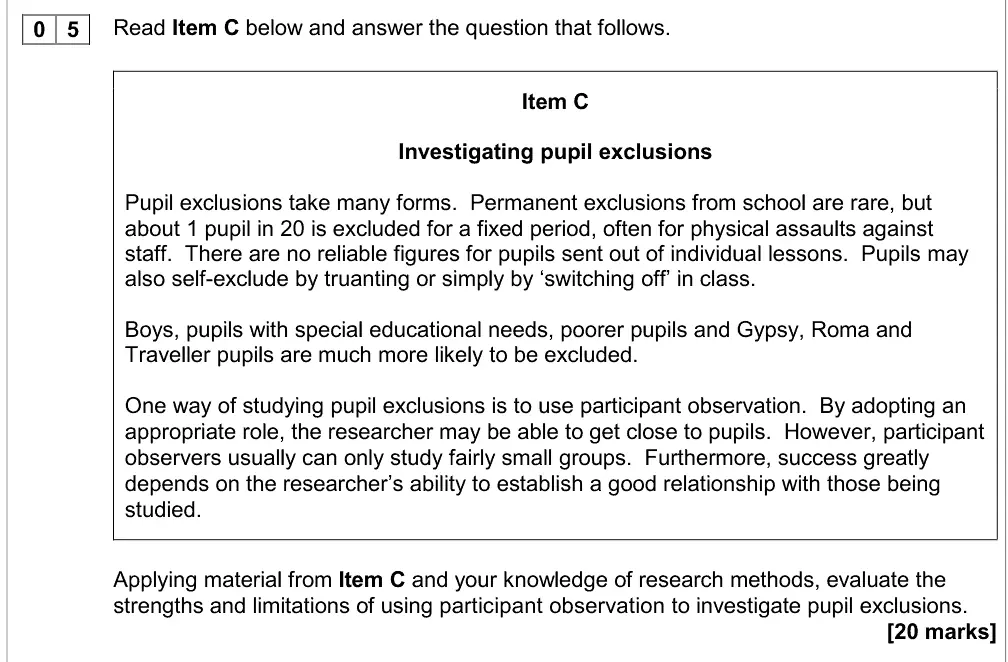
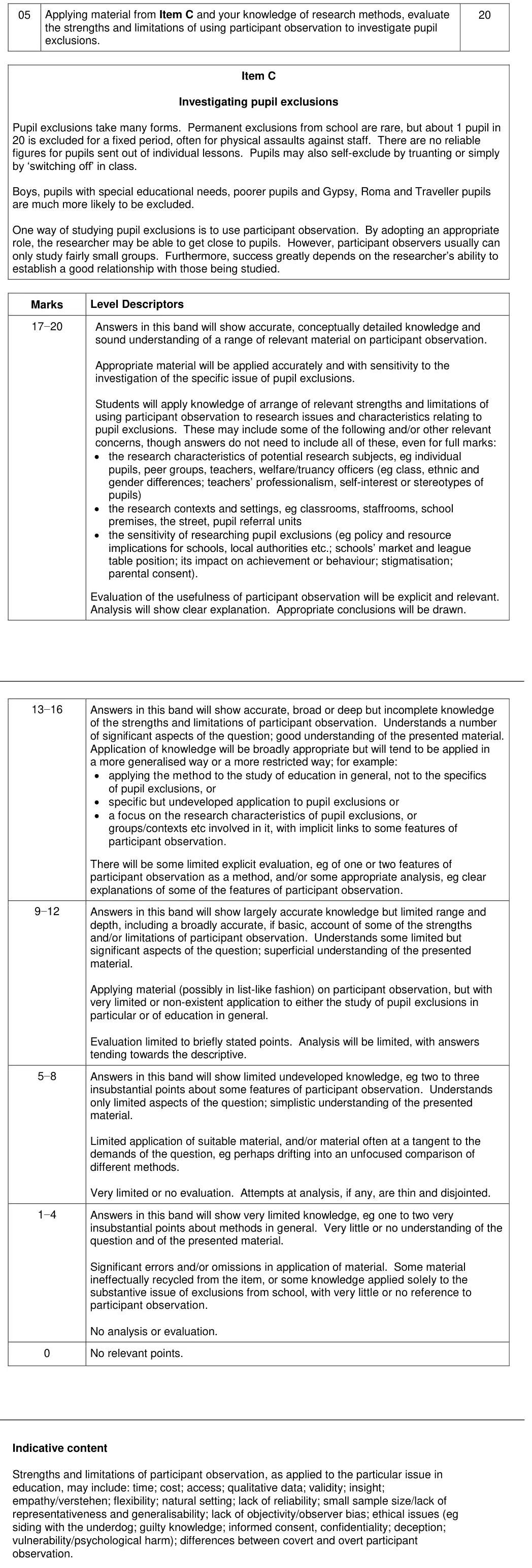
5 Methods in Context: research methods applied to education, Research methods: questionnaires, interviews, observation, experiments, documents and official statistics 20AO1=8,AO2=8,AO3=4Methods in context
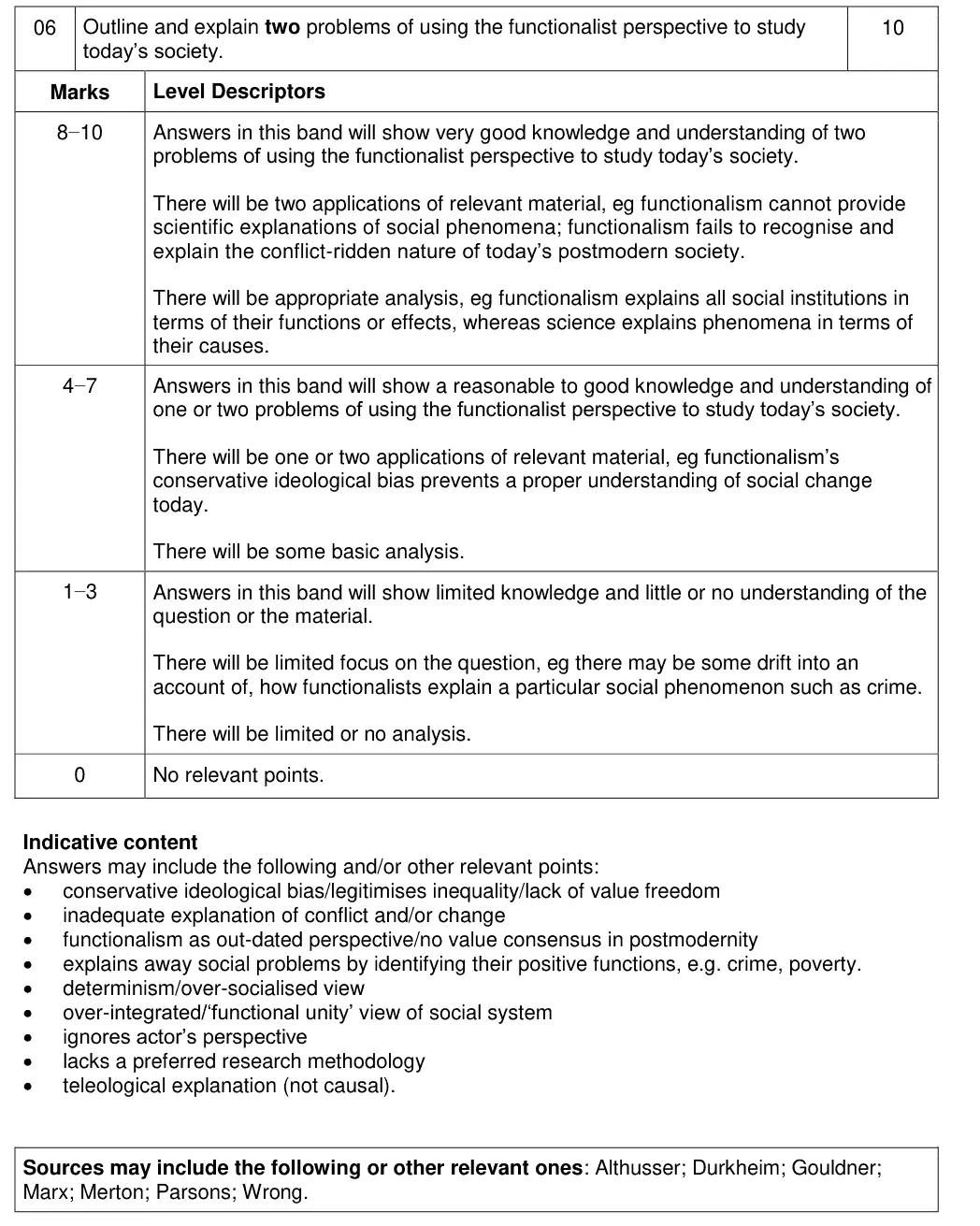
6 Consensus, conflict, structural and social action theories, Modernity and postmodernity 10AO1=5,AO2=3,AO3=2Outline and explain

The questions

123456
June 2018 · Paper 1 · Q1 4 marks AO1=4 Outline education policyeducational achievement
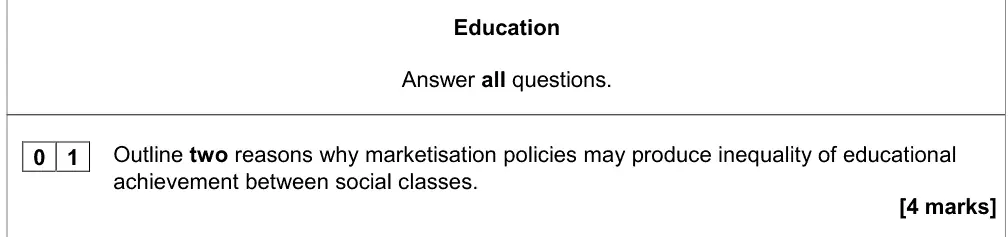
Education
0 1
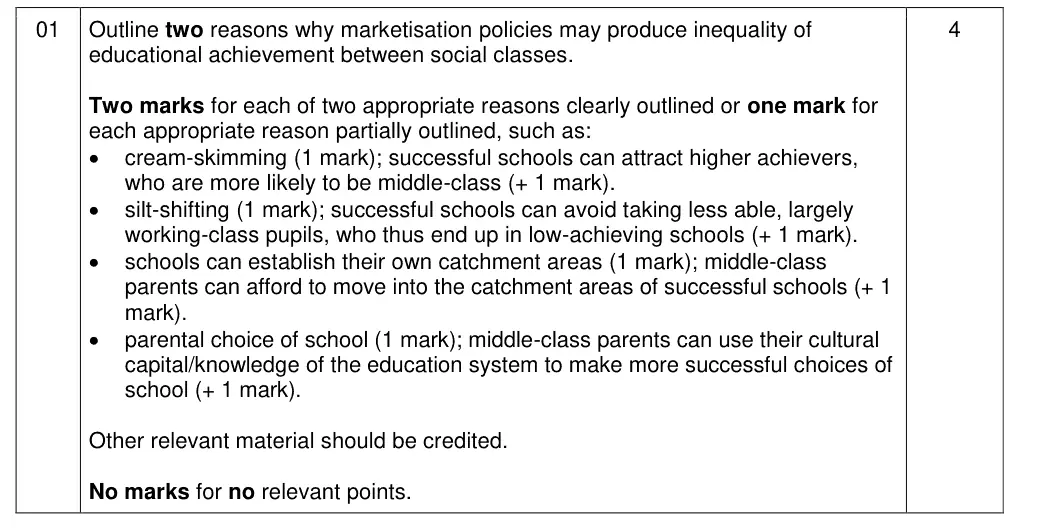
Outline two reasons why marketisation policies may produce inequality of educational
achievement between social classes.
[4 marks]
June 2018 · Paper 1 · Q2 6 marks AO1=3, AO2=3 Outline educational achievement
0 2
Outline three reasons for gender differences in educational achievement.
[6 marks]
June 2018 · Paper 1 · Q3 10 marks AO1=3, AO2=4, AO3=3 Analyse role of education
0 3
Read Item A below and answer the question that follows.
Item A
According to Marx, capitalism is based on the ownership of the means of production by
a wealthy minority.  Capitalism continues to exist because each new generation of
workers is forced to undertake low-paid, alienating work to survive.  This makes
capitalism potentially unstable, since it depends on the proletariat not seeking to
overthrow this unequal system.
Applying material from Item A, analyse two ways in which the education system might
serve the needs of capitalism.
[10 marks]
June 2018 · Paper 1 · Q4 30 marks AO1=12, AO2=9, AO3=9 30-mark essay educational achievementprocesses within schools
0 4
Read Item B below and answer the question that follows.
Item B
Social class differences in achievement are found at all stages of the education system
and sociologists have put forward several explanations for these differences.  Some
sociologists focus on factors outside school, such as the material circumstances of
pupils’ families or the ways in which parents socialise their children.  Other sociologists
see factors internal to the education system itself as responsible.
However, it can be argued that it is the interaction between these external and internal
factors that produces class differences in educational achievement.
Applying material from Item B and your knowledge, evaluate sociological explanations of
social class differences in educational achievement.
[30 marks]
Extra space
June 2018 · Paper 1 · Q5 20 marks AO1=8, AO2=8, AO3=4 Methods in context methods in contextresearch methods
0 5
Read Item C below and answer the question that follows.
Item C
Investigating pupil exclusions
Pupil exclusions take many forms.  Permanent exclusions from school are rare, but
about 1 pupil in 20 is excluded for a fixed period, often for physical assaults against
staff.  There are no reliable figures for pupils sent out of individual lessons.  Pupils may
also self-exclude by truanting or simply by ‘switching off’ in class.
Boys, pupils with special educational needs, poorer pupils and Gypsy, Roma and
Traveller pupils are much more likely to be excluded.
One way of studying pupil exclusions is to use participant observation.  By adopting an
appropriate role, the researcher may be able to get close to pupils.  However, participant
observers usually can only study fairly small groups.  Furthermore, success greatly
depends on the researcher’s ability to establish a good relationship with those being
studied.
Applying material from Item C and your knowledge of research methods, evaluate the
strengths and limitations of using participant observation to investigate pupil exclusions.
[20 marks]
Extra space
June 2018 · Paper 1 · Q6 10 marks AO1=5, AO2=3, AO3=2 Outline and explain sociological theoriesmodernity and postmodernity
0 6
Outline and explain two problems of using the functionalist perspective to study today’s
society.
[10 marks]

Work with an AQA sociology tutor

Want a paper marked and gone through with you? Message us.

Prefer email? Send an enquiry

If you are under 18, please include a parent's contact details. Enquiries go to enquiries@alevelsociologytutor.com and are deleted once handled. All tutoring is online.