Examiner's comment
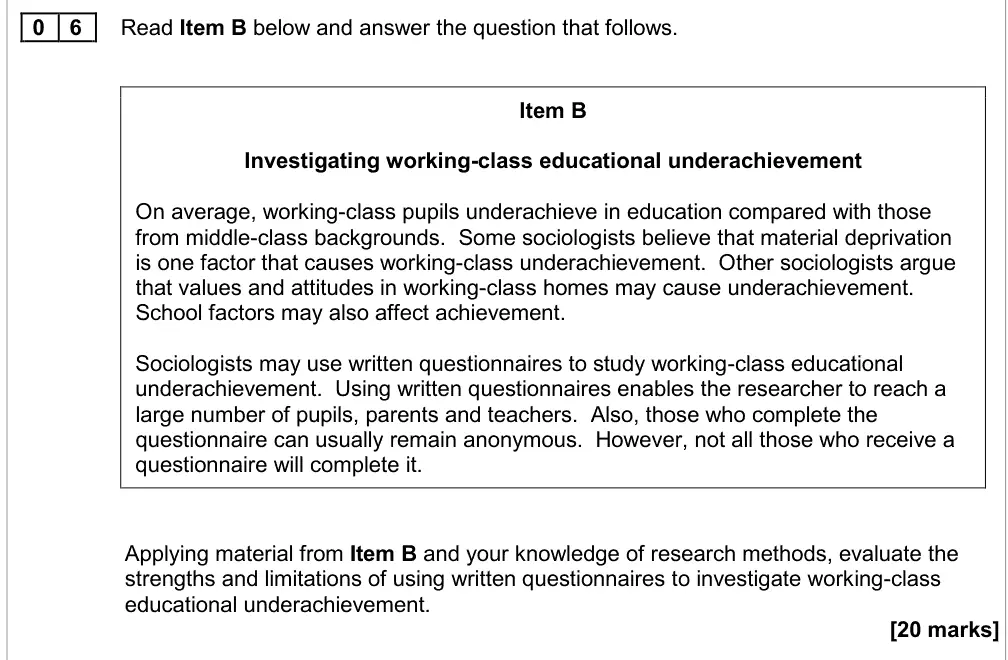
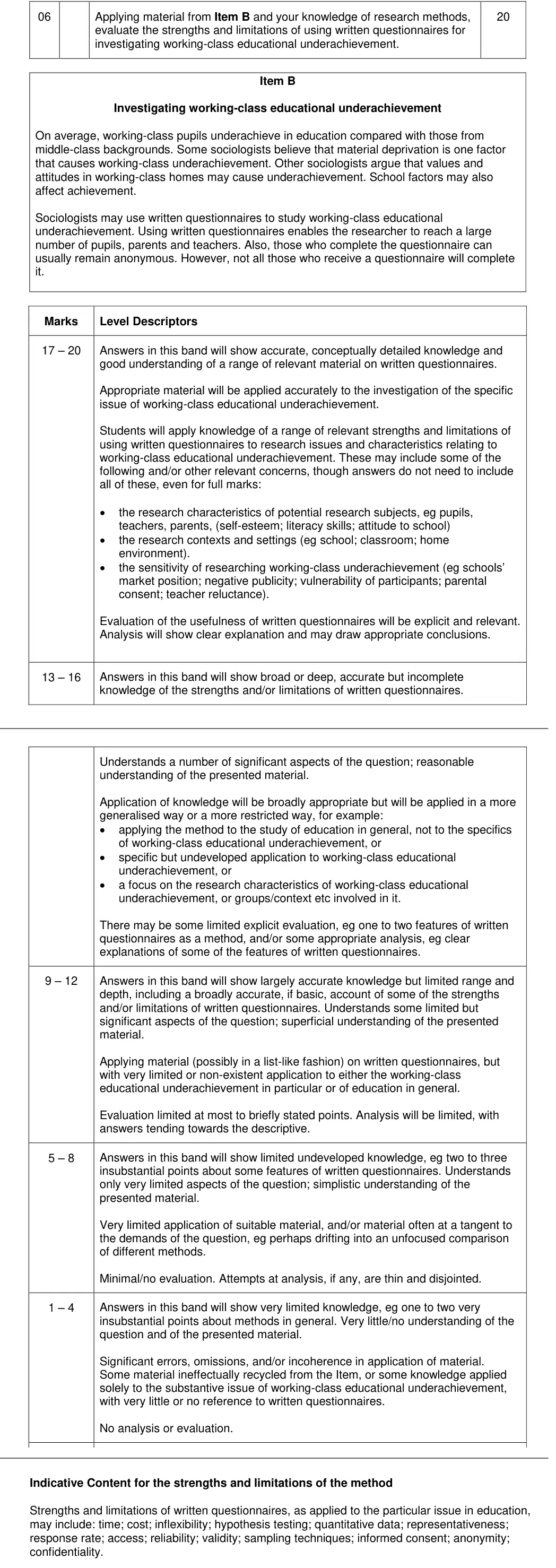
Schools and colleges have been more adept in preparing their students for the methods in context question than last year. Many students were able to apply the method to researching education as a closed space, especially in terms of understanding access issues. Good responses identified specific characteristics of working-class underachievement, for example that students may be members of class based, anti-school subcultures, and may therefore refuse to cooperate or fill out the questionnaire accurately. Some responses were able to meet the criteria for the top band in developing the point that working-class parents may not return the questionnaire or may give socially desirable responses due to not wanting to appear to be seen as a bad parent if their child is underachieving and from a working class background. A few answers pursued tangents describing research findings on this topic. Most students were confident in their understanding of questionnaires, although a minority assumed that written questionnaires must use open questions that produce qualitative data and are therefore favoured by interpretivists. Similarly, it was often asserted that anonymity would lead to honesty, without an explanation as to why. Anonymity was often confounded with confidentiality, and the advantage of more candid answers was often stated to be ethical, when it is one of validity. The ethical issue of upsetting respondents with a sensitive question is not removed by anonymity, though it is likely to reduce embarrassment. Another widespread assertion was that this is a sensitive topic. This needs some explanation since sociologists rarely investigate phenomena that are not sensitive, especially in the context of schools. Some students were content with simply presenting a range of strengths and limitations of the method without applying them to the issue in the question. Some of these answers picked up on the idea in the item that questionnaires could be distributed to a large number of people but failed to apply this point beyond the item. Better answers made good use of formulae to help them cover a range of factors, and were able to make some connections to the research setting (school, classroom, homes) and/or the likely participants (pupils and parents). Few students thought to consider teachers as sources of information. There were many attempts to link the method with the issue, but often the students focused too much on the sensitivity of studying working class underachievement rather than linking this issue specifically to questionnaires. There were many cases of students reaching level 4 rather than fully developing their point to get into level 5. On the whole, many were able to connect using questionnaires to social class, but found it more difficult to add in the additional final layer of educational achievement.