June 2017: Paper 3

80 marks · 6 question parts · Paper, mark scheme and report on AQA's site · AQA no longer hosts this series; the questions are from a copy of AQA's original paper

Question by question

QTopicMarksAOType
1 Crime by ethnicity, gender and social class 4AO1=4Outline
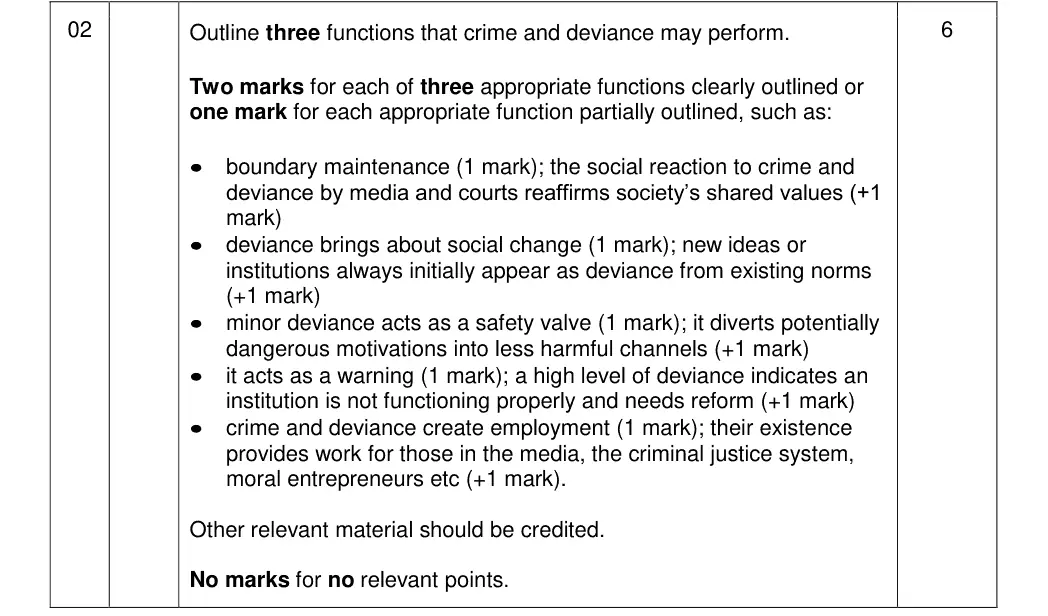
2 Crime, deviance, social order and social control 6AO1=6Outline
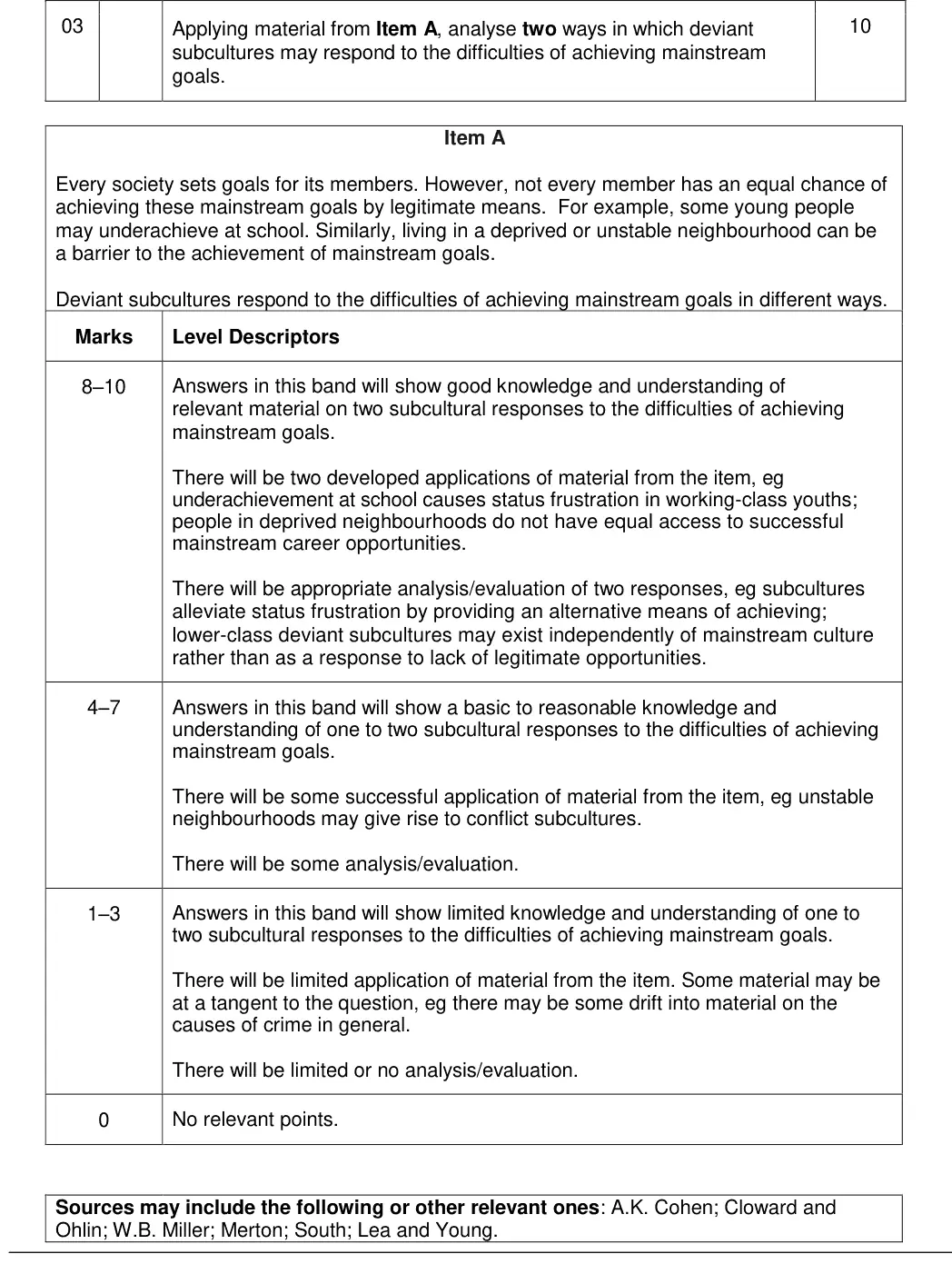
3 Crime, deviance, social order and social control, Crime by ethnicity, gender and social class 10AO1=3,AO2=4,AO3=3Analyse
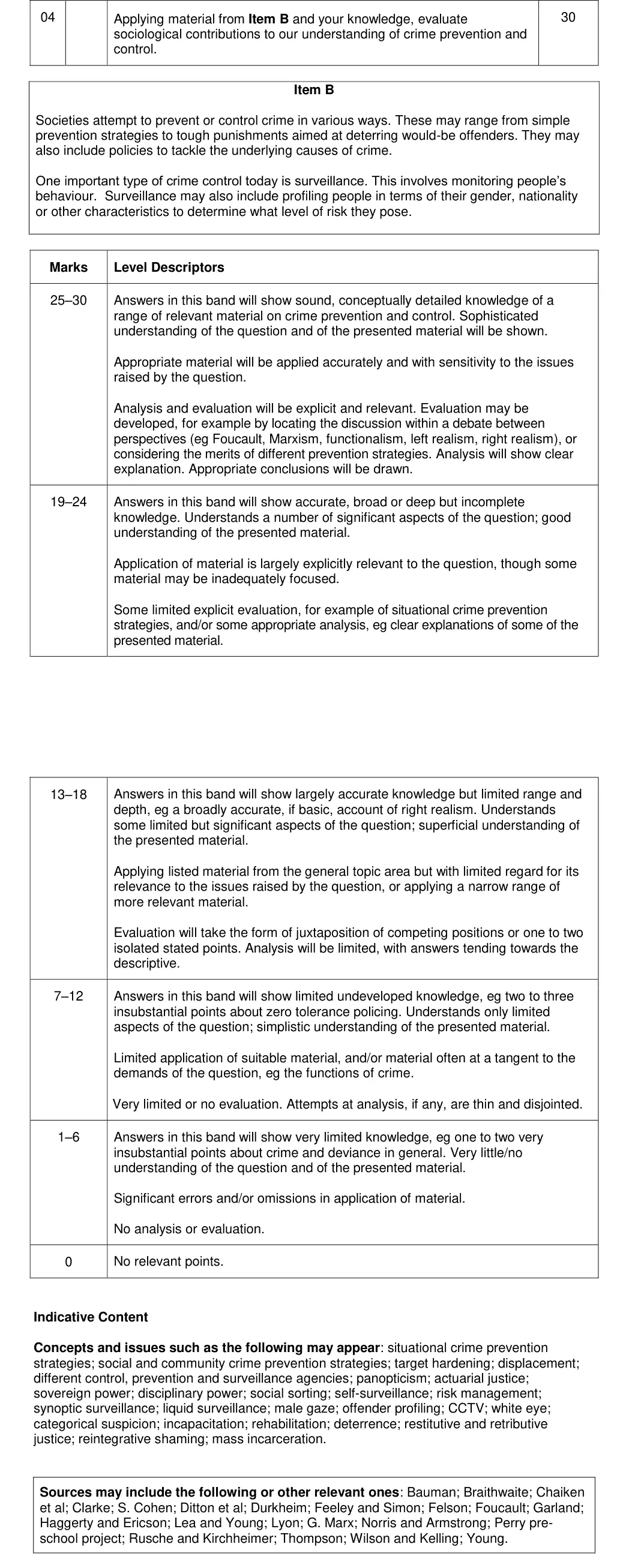
4 Crime control, surveillance, punishment and victims 30AO1=12,AO2=9,AO3=9Essay
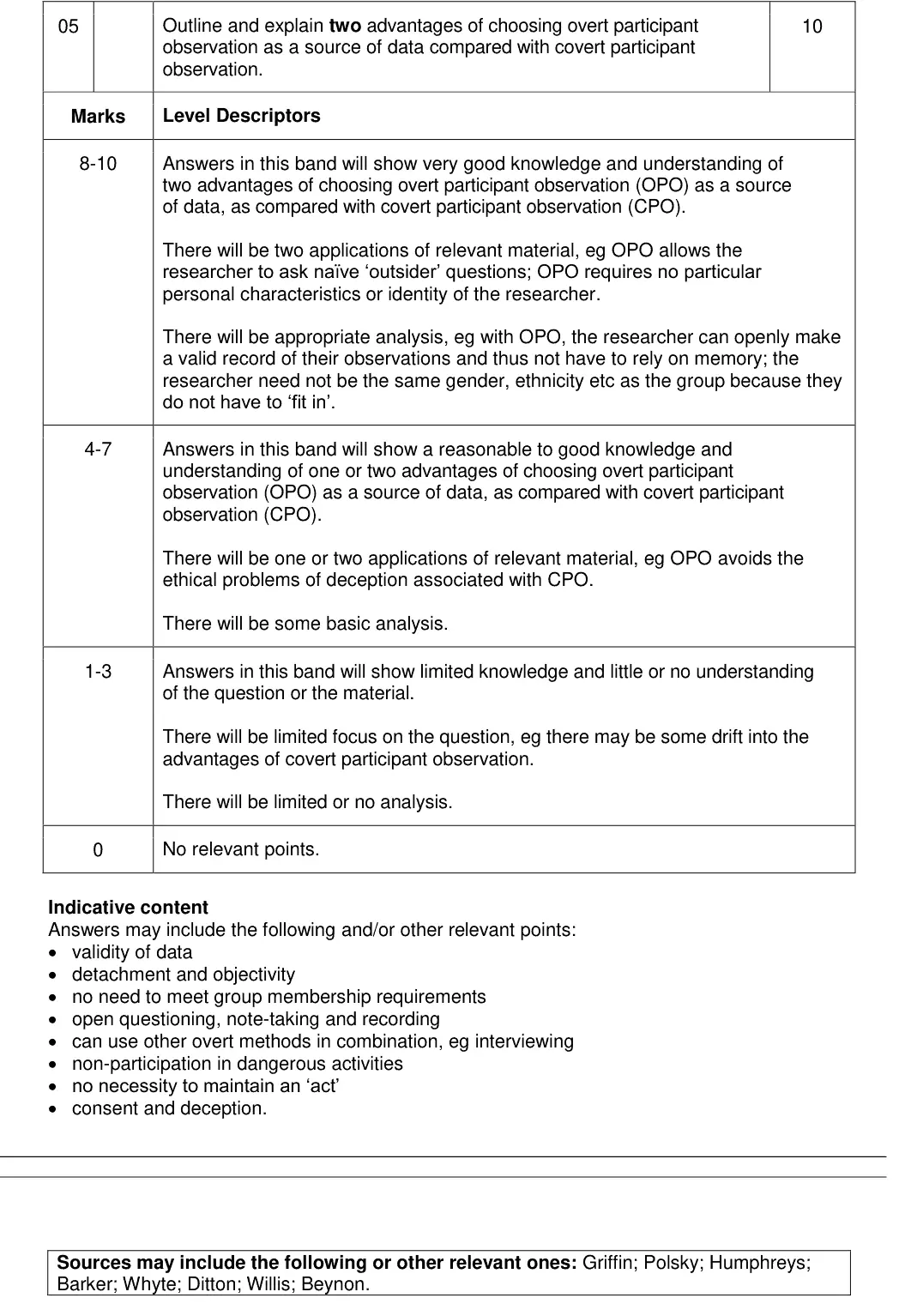
5 Research methods: questionnaires, interviews, observation, experiments, documents and official statistics, Theoretical, practical and ethical issues in research 10AO1=5,AO2=3,AO3=2Outline and explain
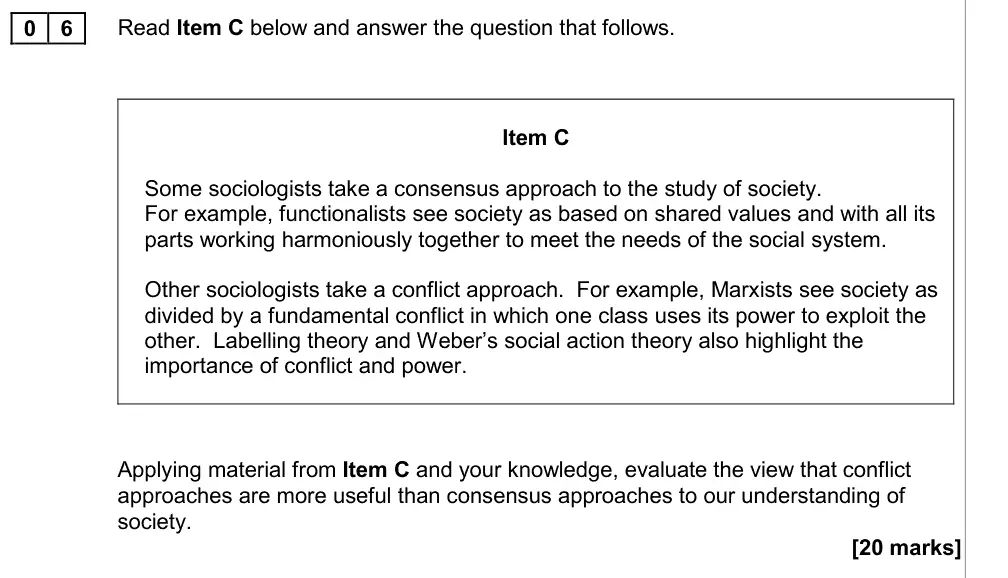
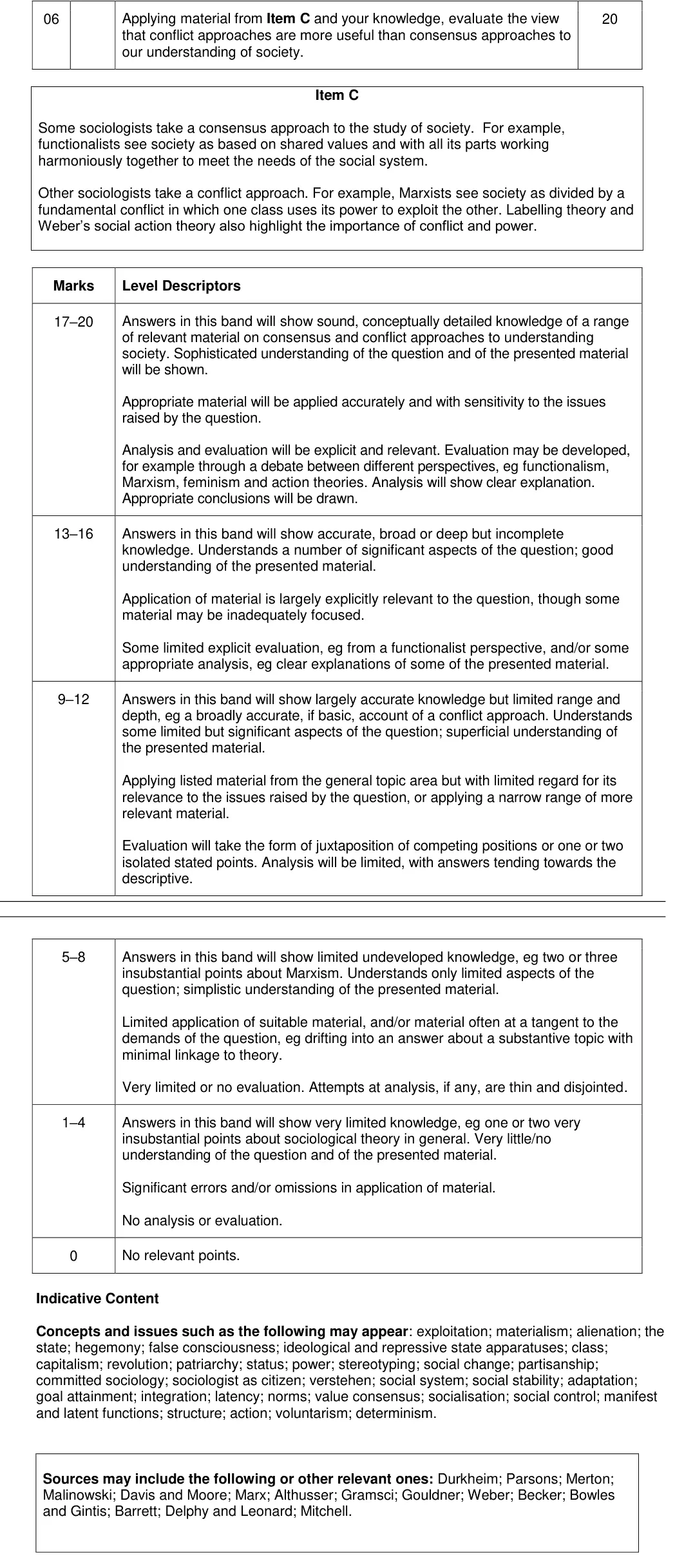
6 Consensus, conflict, structural and social action theories 20AO1=8,AO2=6,AO3=6Essay

The questions

123456
June 2017 · Paper 3 · Q1 4 marks AO1=4 Outline social distribution of crime
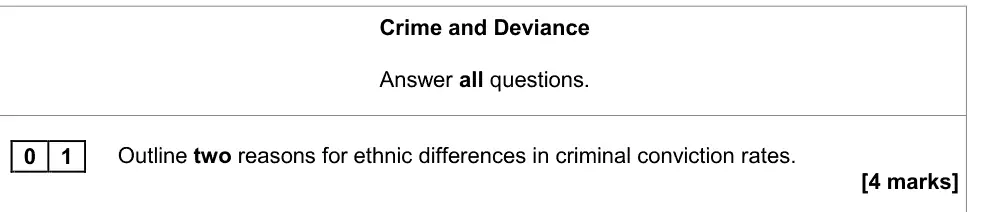
Crime and Deviance
0 1
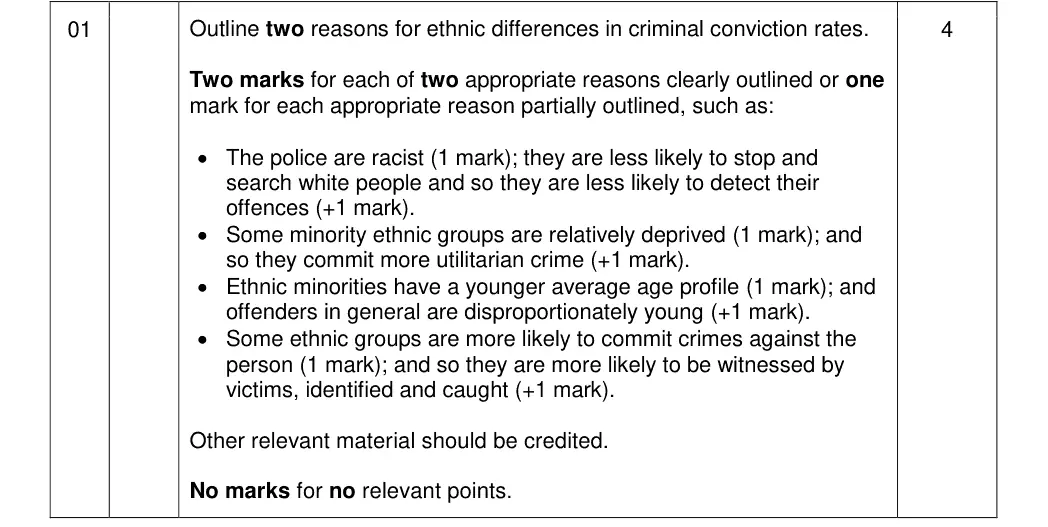
Outline two reasons for ethnic differences in criminal conviction rates.
[4 marks]
June 2017 · Paper 3 · Q2 6 marks AO1=6 Outline crime deviance and social control
0 2
Outline three functions that crime and deviance may perform.
[6 marks]
June 2017 · Paper 3 · Q3 10 marks AO1=3, AO2=4, AO3=3 Analyse crime deviance and social controlsocial distribution of crime
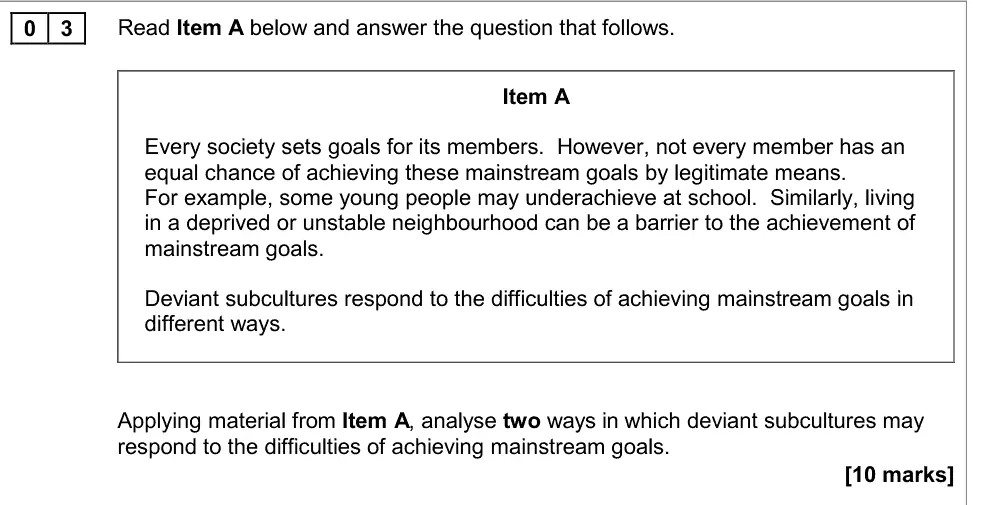
0 3
Read Item A below and answer the question that follows.
Item A
Every society sets goals for its members.  However, not every member has an
equal chance of achieving these mainstream goals by legitimate means.
For example, some young people may underachieve at school.  Similarly, living
in a deprived or unstable neighbourhood can be a barrier to the achievement of
mainstream goals.
Deviant subcultures respond to the difficulties of achieving mainstream goals in
different ways.
Applying material from Item A, analyse two ways in which deviant subcultures may
respond to the difficulties of achieving mainstream goals.
[10 marks]
June 2017 · Paper 3 · Q4 30 marks AO1=12, AO2=9, AO3=9 30-mark essay crime control and punishment
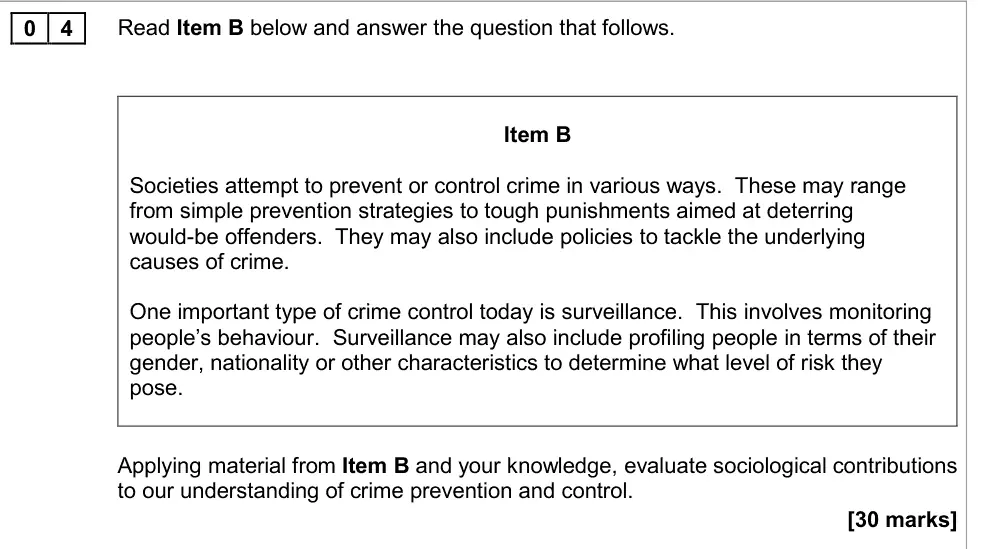
0 4
Read Item B below and answer the question that follows.
Item B
Societies attempt to prevent or control crime in various ways.  These may range
from simple prevention strategies to tough punishments aimed at deterring
would-be offenders.  They may also include policies to tackle the underlying
causes of crime.
One important type of crime control today is surveillance.  This involves monitoring
people’s behaviour.  Surveillance may also include profiling people in terms of their
gender, nationality or other characteristics to determine what level of risk they
pose.
Applying material from Item B and your knowledge, evaluate sociological contributions
to our understanding of crime prevention and control.
[30 marks]
Extra space
June 2017 · Paper 3 · Q5 10 marks AO1=5, AO2=3, AO3=2 Outline and explain research methodschoice of research method
0 5
Outline and explain two advantages of choosing overt participant observation as a
source of data compared with covert participant observation.
[10 marks]
June 2017 · Paper 3 · Q6 20 marks AO1=8, AO2=6, AO3=6 20-mark essay sociological theories
0 6
Read Item C below and answer the question that follows.
Item C
Some sociologists take a consensus approach to the study of society.
For example, functionalists see society as based on shared values and with all its
parts working harmoniously together to meet the needs of the social system.
Other sociologists take a conflict approach.  For example, Marxists see society as
divided by a fundamental conflict in which one class uses its power to exploit the
other.  Labelling theory and Weber’s social action theory also highlight the
importance of conflict and power.
Applying material from Item C and your knowledge, evaluate the view that conflict
approaches are more useful than consensus approaches to our understanding of
society.
[20 marks]
Extra space
20

Work with an AQA sociology tutor

Want a paper marked and gone through with you? Message us.

Prefer email? Send an enquiry

If you are under 18, please include a parent's contact details. Enquiries go to enquiries@alevelsociologytutor.com and are deleted once handled. All tutoring is online.