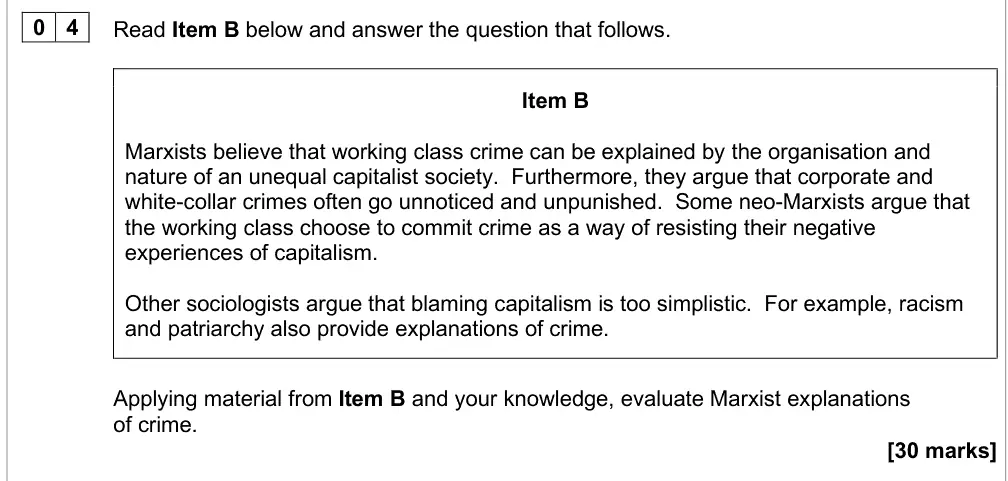
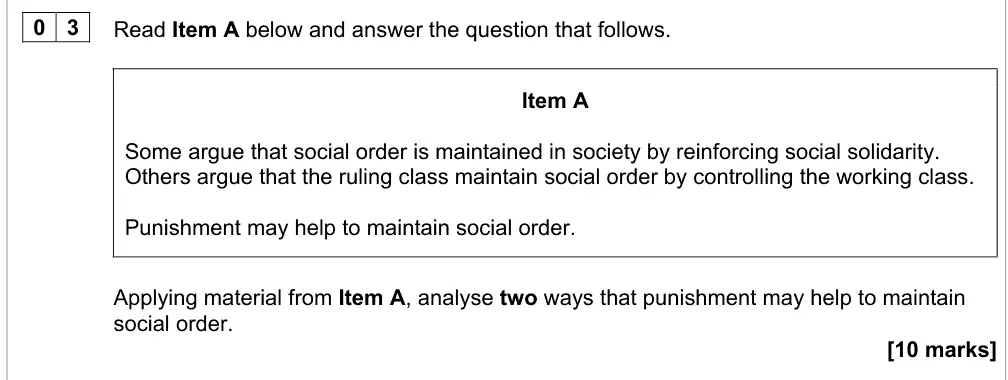
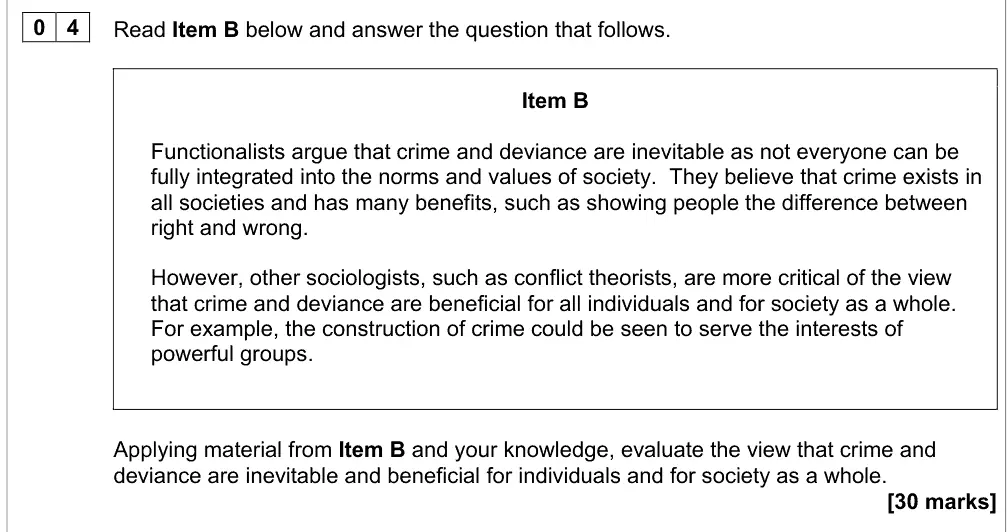
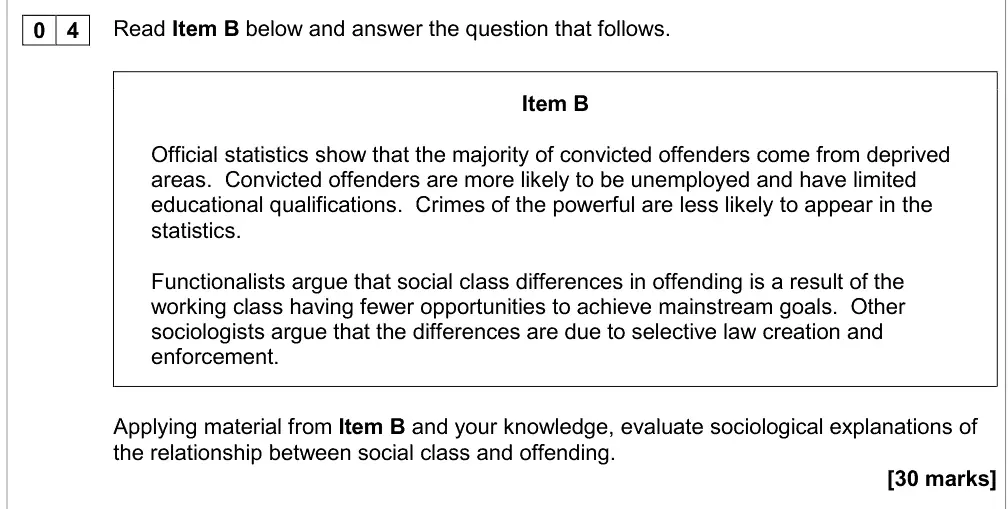
Applying material from Item B and your knowledge, evaluate the view that crime and deviance are inevitable and beneficial for individuals and for society as a whole.
Tap a question to zoom it. The mark scheme (with the level descriptors and indicative content) and the examiner's comment open underneath.
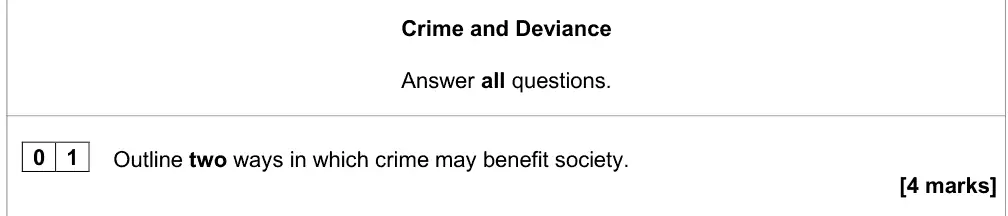
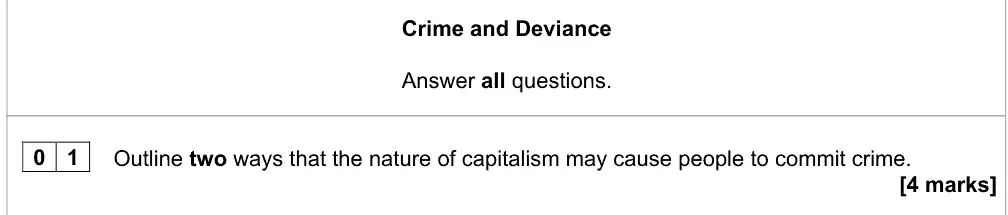
June 2025 · Paper 3 · Q14 marksAO1=4Outline
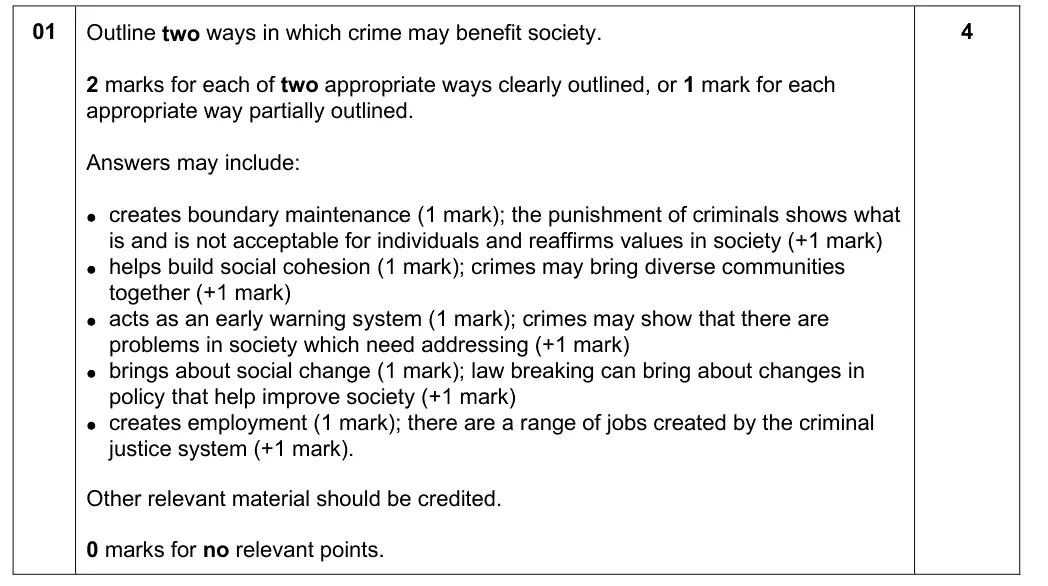
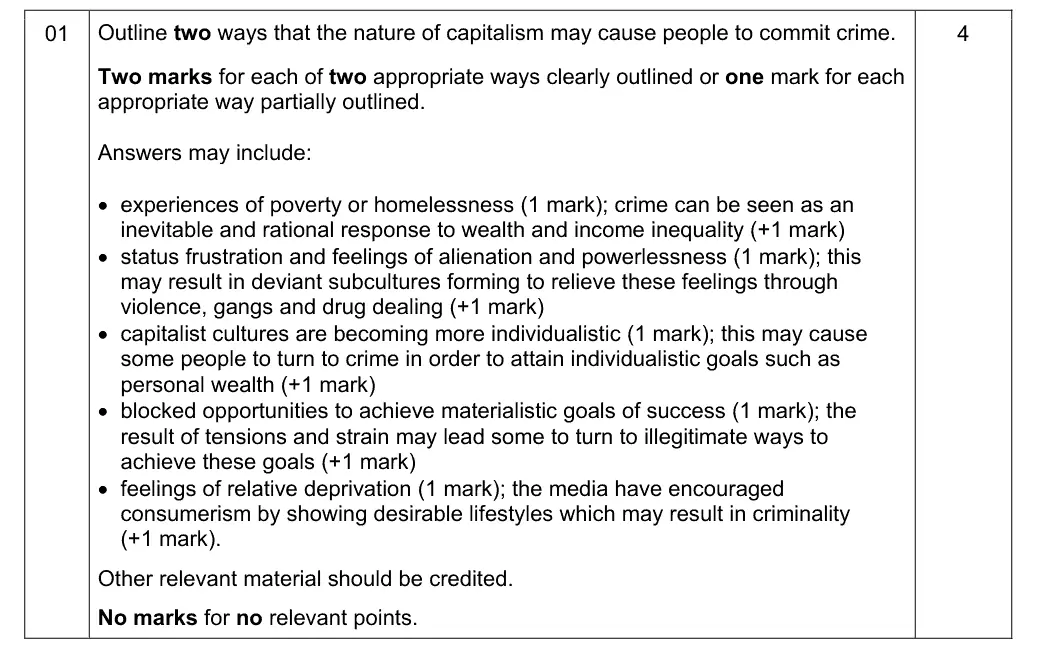
Mark scheme
Examiner's comment
Question one was accessed well with many students scoring full marks. Boundary maintenance was the most popular response and even though it is not a requirement of the question to include the work of a sociologist to get the development mark, many students could identify Durkheim in this question. There was a range of identification points students used such as social cohesion and the warning device. When students used these, they were able to showcase their knowledge of contemporary affairs well and there were good examples such the Manchester bombings. There is a tendency to overwrite these smaller questions. The mark scheme highlights how the identification mark can be awarded, with a general idea on the detail required in the development mark.
Notes from the mark scheme and report
2 marks for each of two ways clearly outlined, 1 if partial
credited: boundary maintenance, social cohesion, warning device, social change, employment
naming Durkheim not required for the development mark
well answered but many overwrote
June 2025 · Paper 3 · Q430 marksAO1=12, AO2=9, AO3=930-mark essay
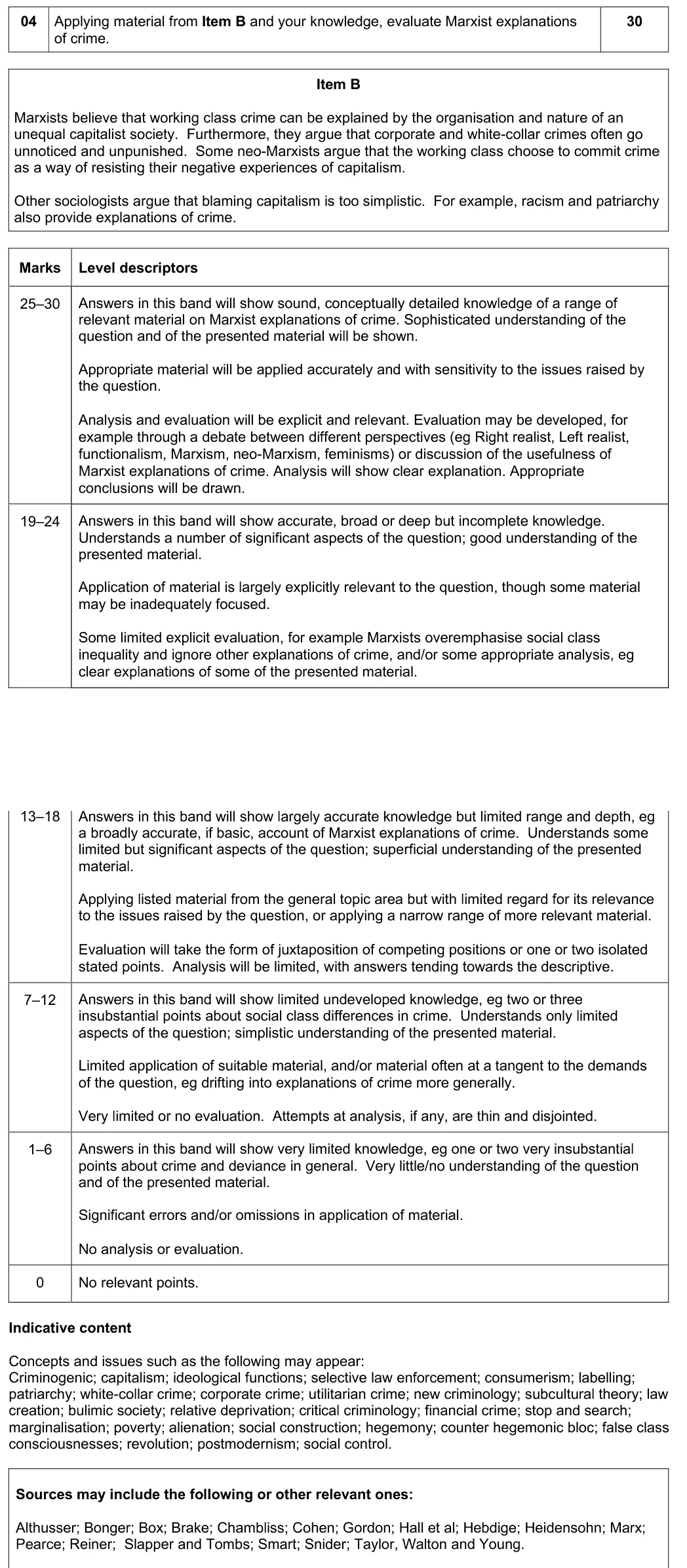
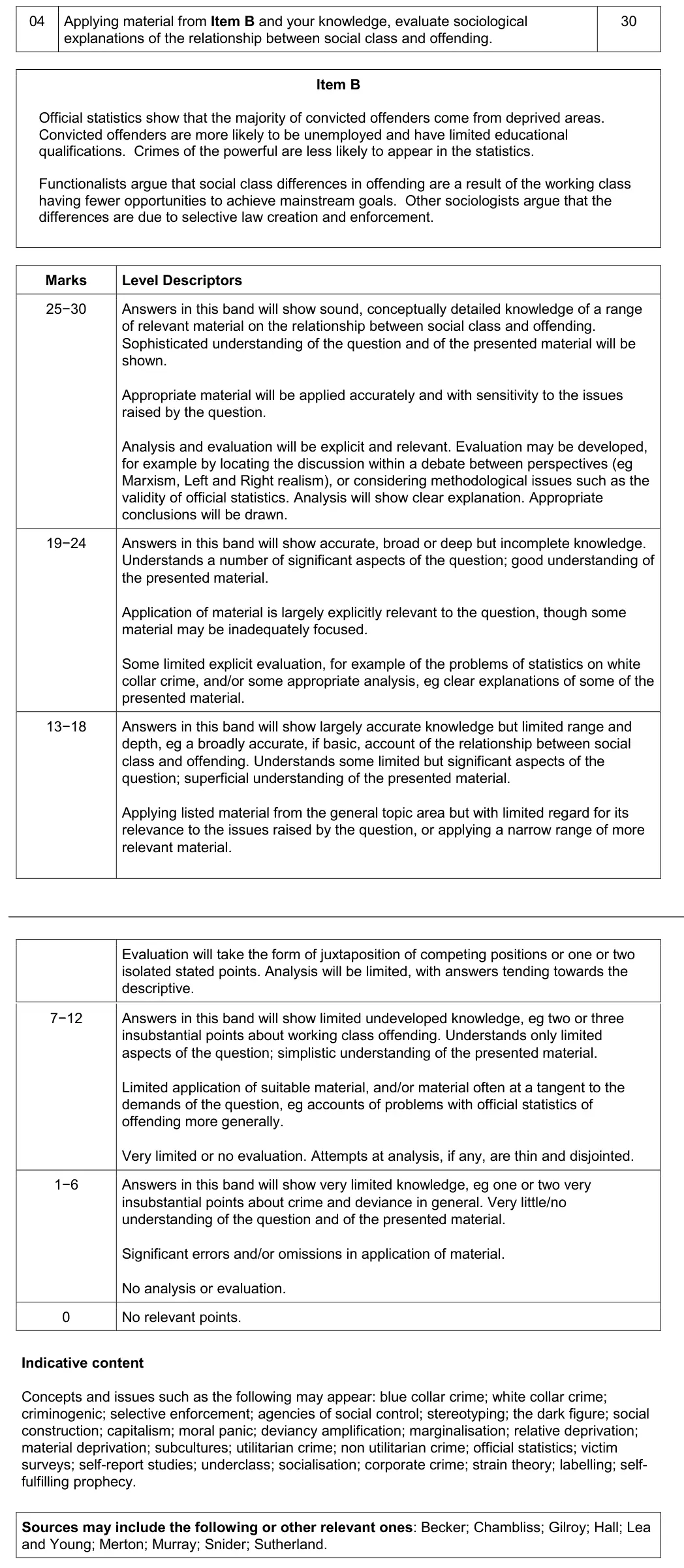
Mark scheme, including the levels grid and indicative content
Examiner's comment
Question four presented a variety of marks demonstrating that the question was differentiated appropriately. Students who did well were able to use the item for guidance and go beyond this with their own knowledge. Students who did well were able to use a variety of Marxist thinkers, with the work of Chambliss and Snider being the most frequently discussed. There were also some good examples of types of white-collar crime, selective law enforcement and punishment enabling students to fully showcase their knowledge. Where punishment was used as a knowledge point students were able to evaluate explicitly and give examples, of either people who have evaded punishment or those who have not, often people who hold political power were given as examples. Given this was a theory-based question it opens itself up more for juxtaposition in the form of evaluation. Some students wrote lengthy paragraphs about alternative theories such as ‘interactionism’ with no link or focus on the question set. The item did give some suggestive evaluation hooks in ‘patriarchy’ and ‘racism’. Students who did well were able to use these and apply these hooks to Marxism. Students should be encouraged to evaluate the points they have made using appropriate theory. There was a tendency to use non-Marxist writers as knowledge points, such as Merton and Cohen. Focus should be given to the target theory in the question. Lengthy introductions are not required for this question as students are under time constraints.
Notes from the mark scheme and report
must apply Item B (capitalism and working-class crime, unpunished corporate crime, neo-Marxist resistance, racism and patriarchy)
top band: debate with realists, functionalism, feminisms or usefulness of Marxist explanations
best answers used Marxist writers (Chambliss, Snider) and examples of selective law enforcement
non-Marxist writers (Merton, Cohen) used as knowledge points and long accounts of other theories drift off the target theory
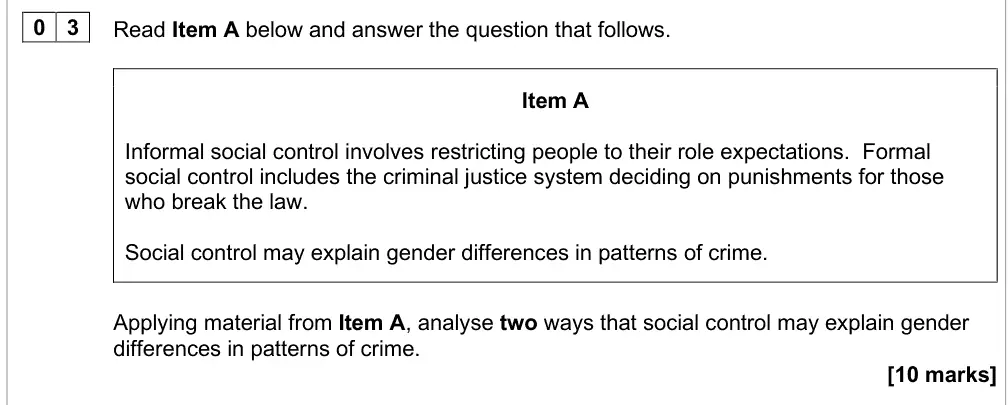
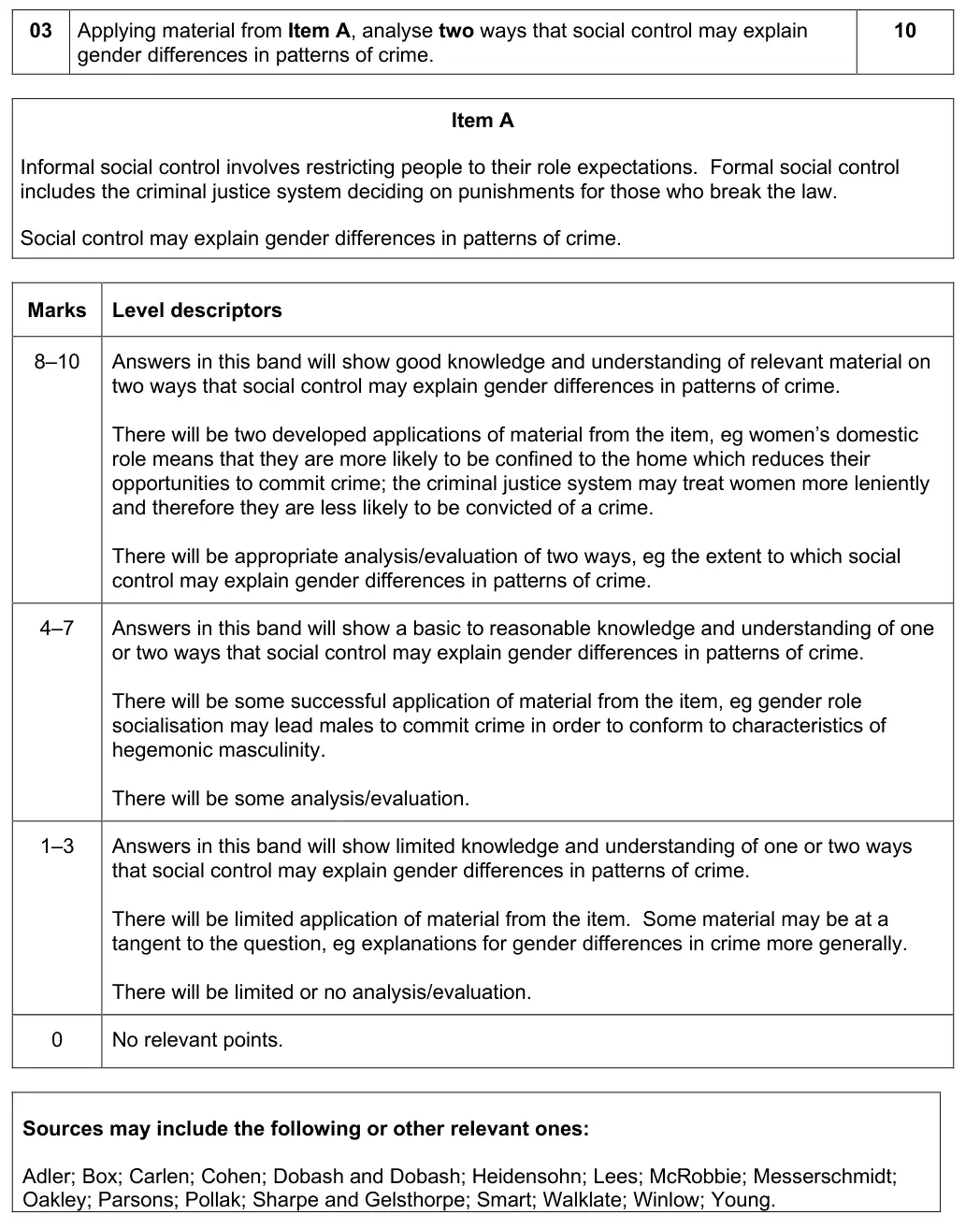
June 2024 · Paper 3 · Q310 marksAO1=3, AO2=4, AO3=3Analyse
Mark scheme, including the levels grid and indicative content
Examiner's comment
This question was answered well by students. Most students were able to use the item effectively to find the “hooks”, and many were able to use theory such as Pollack to develop their answer. A focus is needed on referring to all parts of the question to avoid drift, in this case onto general patterns of gender and offending. The focus needed to be on social control.
Notes from the mark scheme and report
two developed applications from Item A (informal control through role expectations
formal control by the CJS), e.g. women confined to the home, chivalry thesis and lenient treatment (Pollak)
drift into general explanations of gender and crime not tied to social control = 1–3
answered well
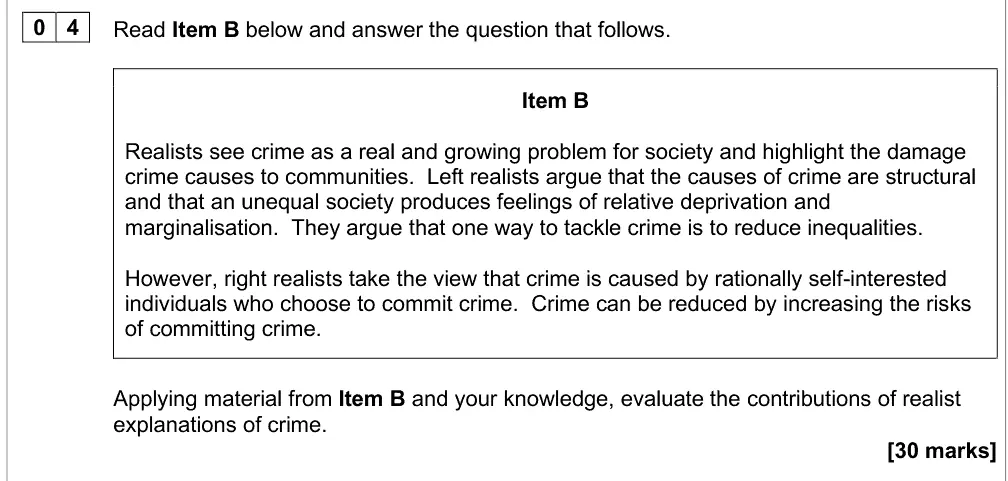
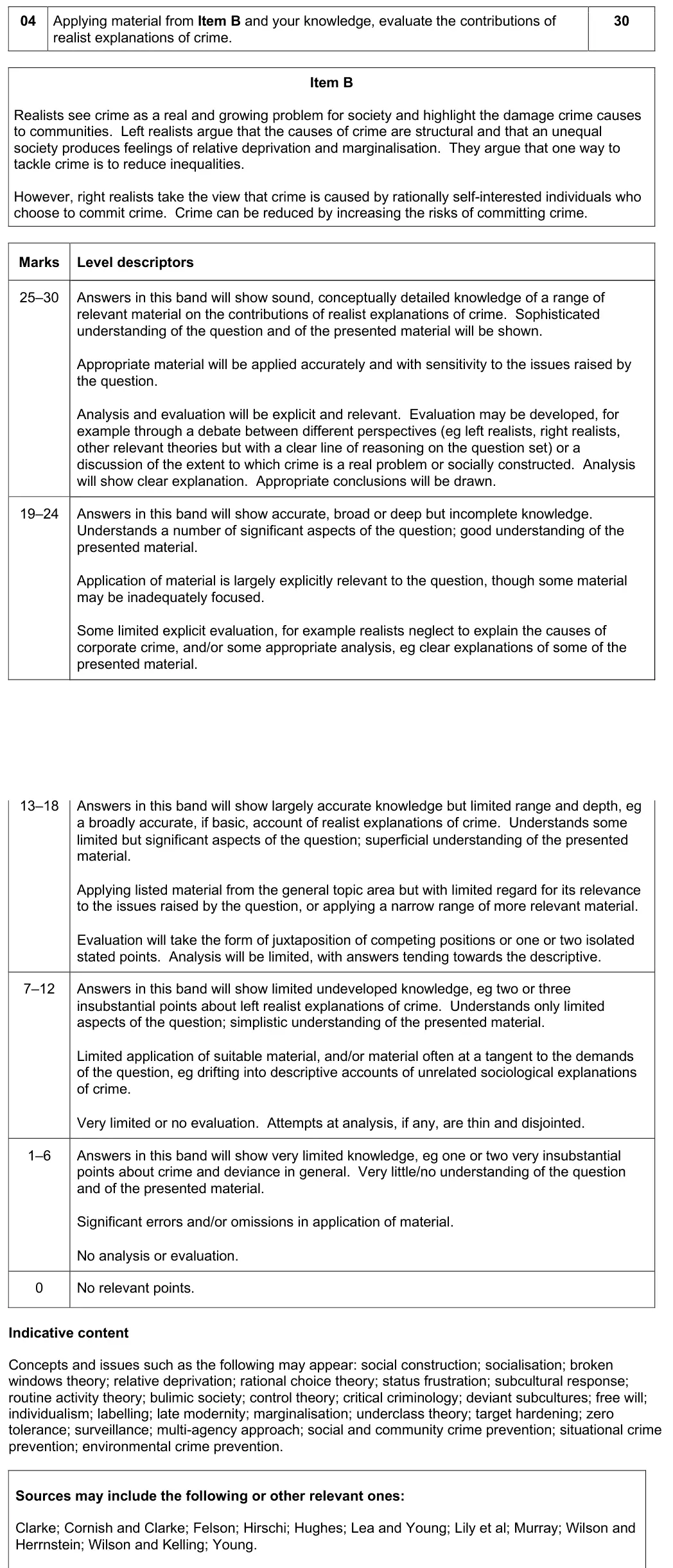
June 2024 · Paper 3 · Q430 marksAO1=12, AO2=9, AO3=930-mark essay
Mark scheme, including the levels grid and indicative content
Examiner's comment
This question presented a variety of marks, demonstrating that this question differentiated appropriately. Many students were able to name realist thinkers and discuss realist crime prevention and reduction strategies. Given this was a theory-based question it opens itself up more for juxtaposition in the form of evaluation. Some students wrote lengthy paragraphs about alternative theory such as ‘functionalism’ with no link or focus on the question set. Students must be encouraged to evaluate the points they have made using appropriate theory. Note lengthy introductions are not required for this question; students are under time constraints.
Notes from the mark scheme and report
top band debates left and right realism (and other theories with a clear line of argument) or whether crime is real or socially constructed
drift into unrelated crime theories (e.g. long functionalism paragraphs) = 7–12
good use of realist thinkers and prevention strategies
evaluation often juxtaposition
long introductions unnecessary
June 2023 · Paper 3 · Q310 marksAO1=3, AO2=4, AO3=3Analyse
Mark scheme, including the levels grid and indicative content
Examiner's comment
Students should be made aware that there are two types of ten mark questions. These have different requirements and different mark schemes. There are different marks available for the assessment objectives. The items for 10 mark “analyse” questions are written to give prompts or “hooks” for student answers. These have to be used to access application marks. Answers can indicate use of hooks by quoting, by a reference in parentheses or by wording (eg “As the item says…”). Items end with a sentence restating the question; the hooks are in the preceding part of the item. Some students are not able to develop the hook effectively and recycle parts of the item. Students need to be able to link the parts of the question for example punishment and social order together.
Notes from the mark scheme and report
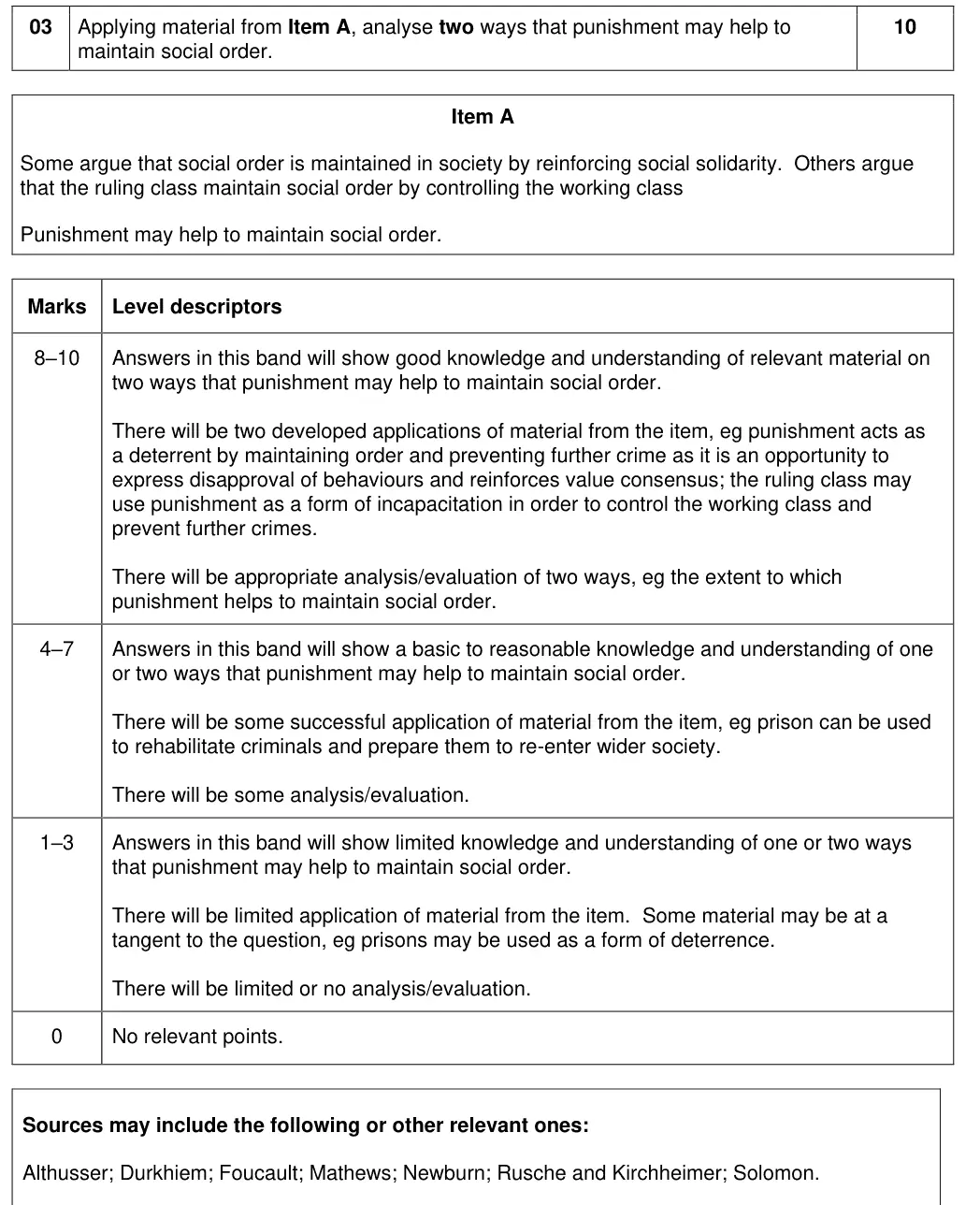
must develop hooks from Item A (social solidarity, ruling-class control of the working class)
the last line of the item restates the question and is not a hook
top band links punishment to social order, e.g. reinforcing value consensus (Durkheim) and incapacitating or controlling the working class (Marxists, Foucault)
recycling the item without development limits marks
June 2022 · Paper 3 · Q430 marksAO1=12, AO2=9, AO3=930-mark essay
Mark scheme, including the levels grid and indicative content
Examiner's comment
Question 4 was accessed well with the vast majority students making some attempt at the question. The item was used well and students were able to use the hooks in the item. This question provided a full range of responses. There was some drift from the focus of the question, for example on functions of crime. Students were able to draw from a wide range of knowledge to support the item and develop it; many were able to name sociologists. The most common sociologist used was Durkheim. The weakest skill in this question was AO3, evaluation. Many students offered juxtaposed alternatives of other theories; some students were not able to offer much evaluation. Centre recommendations are to practise the AO3 skill and support students to move away from juxtaposition to explicit evaluation.
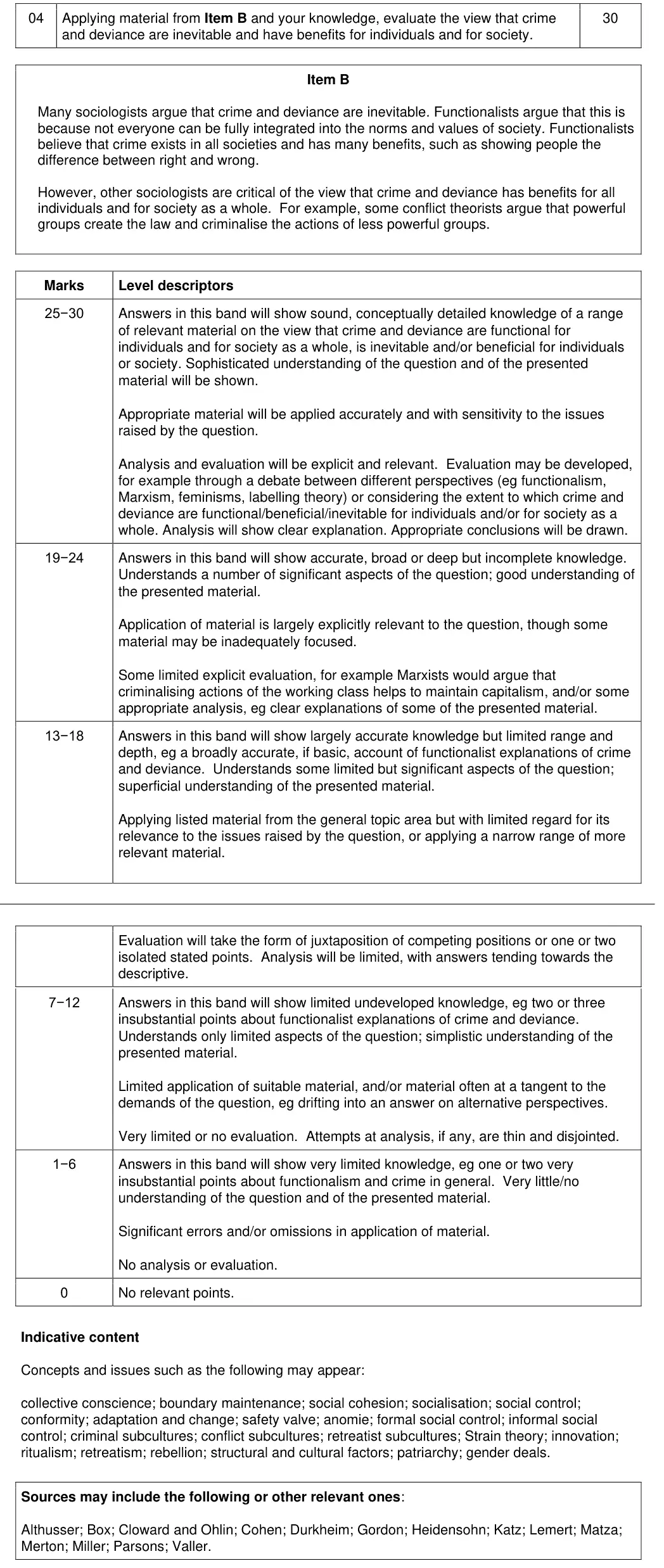
Notes from the mark scheme and report
QP and MS differ in the wording of Item B and the question (QP 'beneficial for individuals and for society as a whole', MS 'have benefits for individuals and for society')
must address inevitable and beneficial
drift into alternative perspectives or just the functions of crime limits marks
evaluation was the weakest skill, mostly juxtaposed theories
Durkheim most used
November 2021 · Paper 3 · Q14 marksAO1=4Outline
Mark scheme
Examiner's comment
Similarly to previous years, a significant number of students wrote lengthy answers to the 4-mark and 6-mark questions; this should be a focus for centres. All students attempted this question. Most students could identify two ways in which capitalism may cause people to commit crime. There was a tendency to write too much for this question, some students explained and named sociologists, and although this displayed excellent knowledge, it is not a requirement for this question and may have had an impact on the timing. This is something for centres to address.
Notes from the mark scheme and report
2 marks for each of two ways clearly outlined, 1 if partial
creditable: poverty and inequality, status frustration and alienation, individualism, blocked opportunities, relative deprivation via consumerism
most identified two ways
many wrote far too much and named sociologists, which is not required and costs time
November 2020 · Paper 3 · Q430 marksAO1=12, AO2=9, AO3=930-mark essay
Mark scheme, including the levels grid and indicative content
Examiner's comment
This question provided varied levels of challenge for students and marks were widely differentiated. Most students were able to use the item and develop the ideas within the item. The most used study was Merton and strain theory. This was done well; many students knew this study and could apply it in a focused way. Most students were able to provide a range of points with some development. Several students were confused with the work of Albert Cohen and Merton and mixed the two studies up. Marxism was another commonly used theory and in some instances was developed with the work of Gordon, Snider and Pearce. AO1 was the best developed skill in this question whereas the AO3 skill was the most challenging and not always addressed well. Students need to make explicit evaluative statements which link with the points they make, however few were able to do this. This should be an area of focus for schools and colleges. Specific assessment for learning AFL strategies should be considered to develop these essays. When students did provide a conclusion, it was often not critical and did not add to the essay. Again, this is an area that schools and colleges should focus upon.
Notes from the mark scheme and report
top band debates Marxism, left and right realism and functionalist strain theory, or the validity of official statistics
general problems with crime statistics = 7–12
Merton used most and well, but some confused Merton with Albert Cohen
evaluation and conclusions weak and often juxtaposed
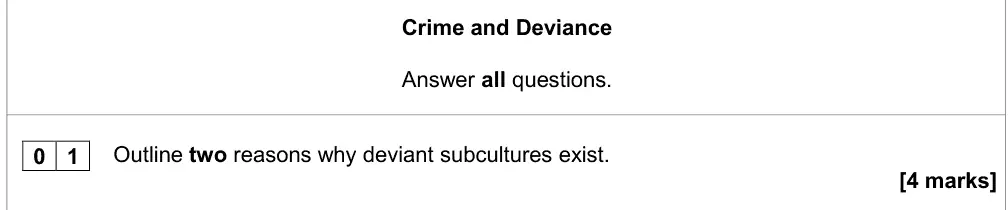
June 2019 · Paper 3 · Q14 marksAO1=4Outline
Mark scheme
Examiner's comment
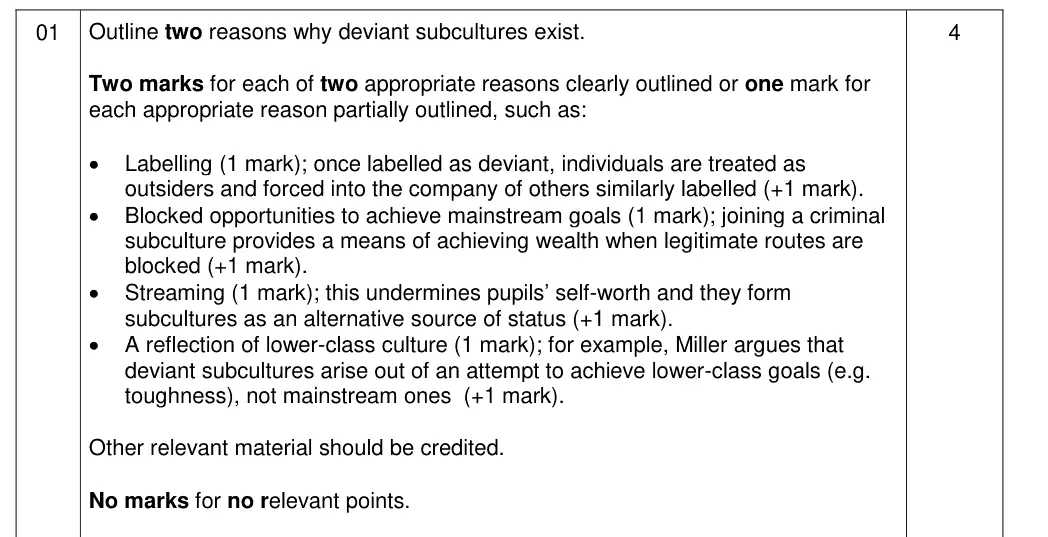
This was generally well answered. Most students were able to identify two appropriate reasons why deviant subcultures exist, the most common being as some form of response to: blocked opportunities, status frustration or inability to achieve a society’s mainstream goals. A few students cited labelling, marginalisation or a criminal environment as their reasons. Some considered the role of gang subcultures in offering boys the male role models that their lone parent families may have failed to provide. However, a number of answers gave minimal explanation of either of their chosen reasons and others presented essentially the same reason twice, usually variants of blocked opportunities.
Notes from the mark scheme and report
AO grid not printed in the mark scheme
2 marks for each of two reasons clearly outlined, 1 if partial
creditable reasons include blocked opportunities, status frustration, labelling, streaming, lower-class focal concerns (Miller)
generally well answered
marks lost for giving the same reason twice (usually variants of blocked opportunities) or minimal explanation
AO split from AQA's standard grid for this paper (this year's mark scheme does not print it).
June 2018 · Paper 3 · Q26 marksAO1=6Outline
Mark scheme
Examiner's comment
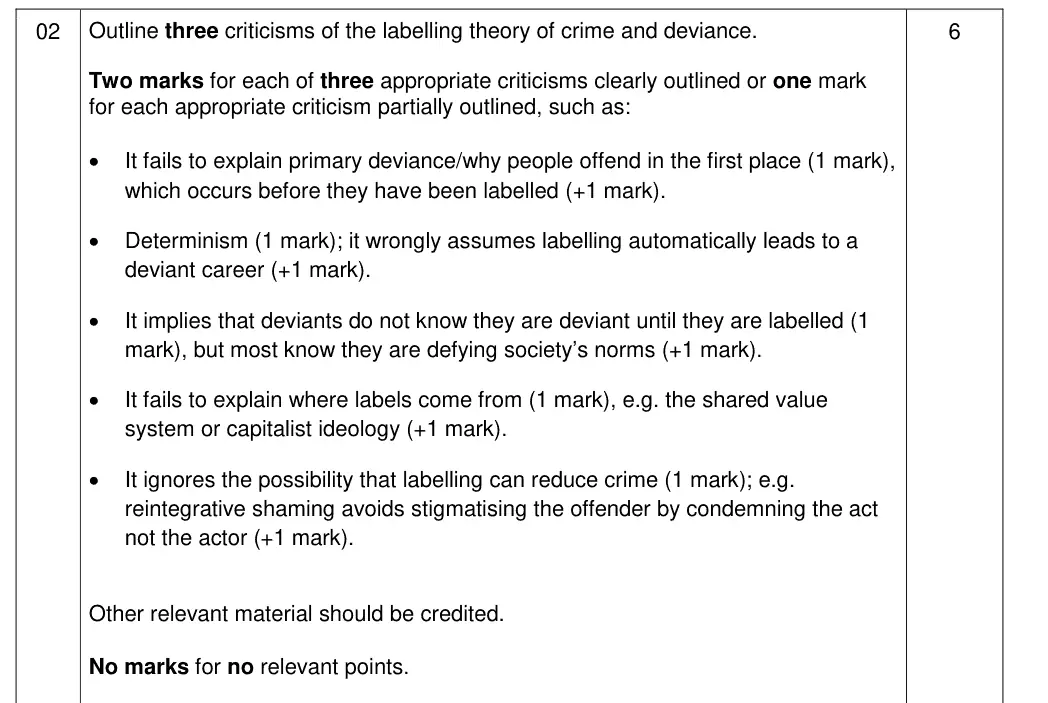
This question was generally answered well. The most frequently cited criticism was that labelling theory is deterministic; this was usually explained correctly. Other frequently cited criticisms included the theory’s failure to explain primary deviance, its romanticised view of deviants or its neglect of structural factors. A significant minority of answers outlined criticisms of the labelling process (for example that labelling is discriminatory or unfair), rather than of the theory. Some students tended to recycle the same criticism in different guises. A few wrote excessively long answers to this question.
Notes from the mark scheme and report
2 marks for each of three criticisms clearly outlined, 1 if partial (e.g. ignores primary deviance, deterministic, ignores where labels come from, ignores reintegrative shaming)
criticisms of the labelling process (unfair, discriminatory) rather than of the theory not credited
same criticism recycled in different guises
over-long answers
AO split from AQA's standard grid for this paper (this year's mark scheme does not print it).
June 2017 · Paper 3 · Q26 marksAO1=6Outline
Mark scheme
Examiner's comment
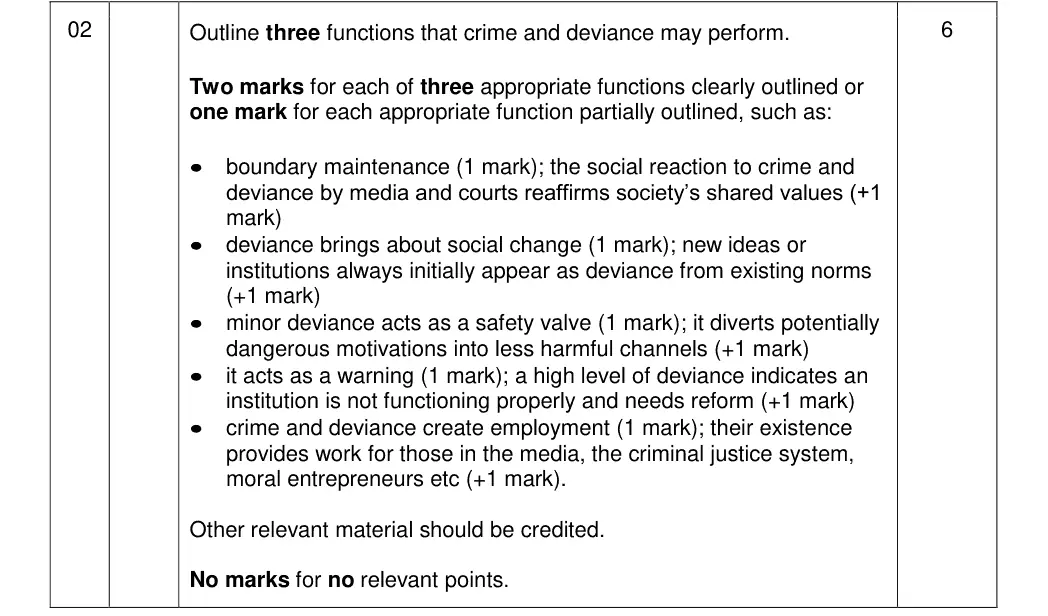
This question was generally well answered. The functions most commonly outlined were crime and deviance as boundary maintenance, as a source of adaption and change, as a safety valve, as a warning sign and as a source of employment. Some were able to identify ways in which crime and deviance might perform functions for capitalism, although others drifted into a ‘functions of law’ response. A few legitimately identified a function of crime as that of providing an alternative route to material success.
Notes from the mark scheme and report
2 marks for each of three functions clearly outlined
credited: boundary maintenance, social change, safety valve, warning, employment, and functions for capitalism
drifting into functions of law not credited
June 2017 · Paper 3 · Q310 marksAO1=3, AO2=4, AO3=3Analyse
Mark scheme, including the levels grid and indicative content
Examiner's comment
In relation to AO2 (application), teachers should note in particular the comments below on Question 03, where failure to apply material from Item A was a significant problem in many answers and meant that students often failed to gain marks for application. The most successful answers were able to apply material from Item A appropriately and to combine this with knowledge and understanding of relevant sociological material on deviant subcultures’ responses to the difficulties of achieving mainstream goals. In these good answers, the elements selected from Item A were generally underachievement at school and living in a deprived neighbourhood or an unstable neighbourhood. The sociological material deployed usually came from Cohen (in relation underachievement) and/or Cloward and Ohlin (in relation to deprived neighbourhoods and/or unstable neighbourhoods). Knowledge was accurate and included relevant concepts such as cultural deprivation, status frustration, alternative status hierarchy, inversion of values, different types of subculture (eg criminal, conflict, retreatist, anti-school), utilitarian and non- utilitarian crime, legitimate and illegitimate opportunity structures, population turnover, ‘turf wars’, ‘double failures’ and criminal apprenticeships. Material from Item A was integrated successfully into these accounts of subcultural responses (eg underachievement at school was linked to knowledge about the cultural deprivation of the working-class boys in Cohen’s study). Throughout, the focus was on analysing the ways in which subcultures respond. Many less successful answers were able to present some knowledge of deviant subcultures but failed to make appropriate use (or in some cases, any use at all) of the material in Item A, and this was a major source of failure to score good marks. There was often a tendency to conflate different sociological sources and concepts or to render them inaccurately (eg accounts of Cohen in which status frustration was said to give rise to utilitarian rather than non-utilitarian crime). Some answers misapplied Merton, failing to recognise that his typology was of individual rather than subcultural responses. Others misinterpreted Willis or Miller as describing ‘reactive’ subcultures (those formed by reaction to failure to achieve mainstream goals) rather than as independent subcultures that had never subscribed to such goals. Many answers attempted some evaluation, though often this was inappropriate to the set question. These answers were typically along the lines of “not all who fail to achieve mainstream goals join deviant subcultures”, rather than, for example, offering criticisms of how sociologists have explained the subcultural responses, which is what the question was focused on.
Notes from the mark scheme and report
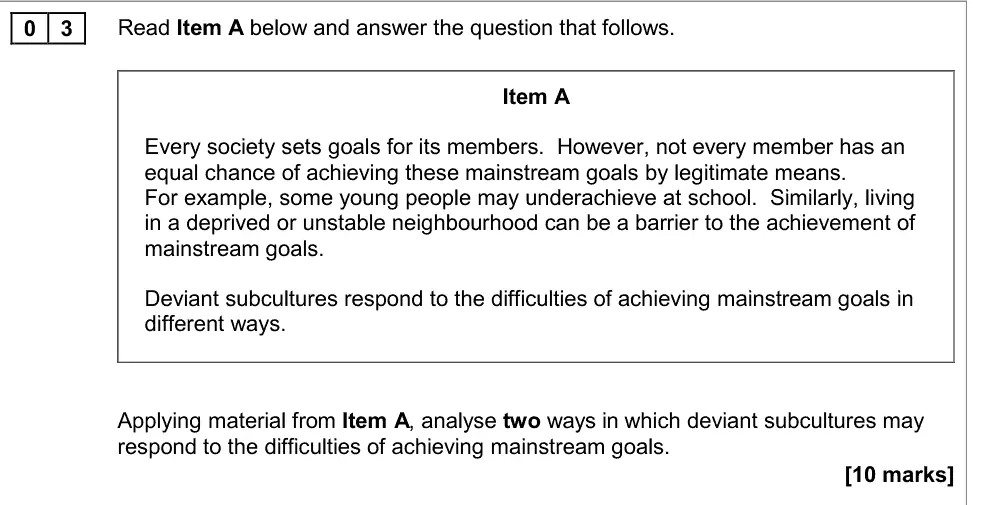
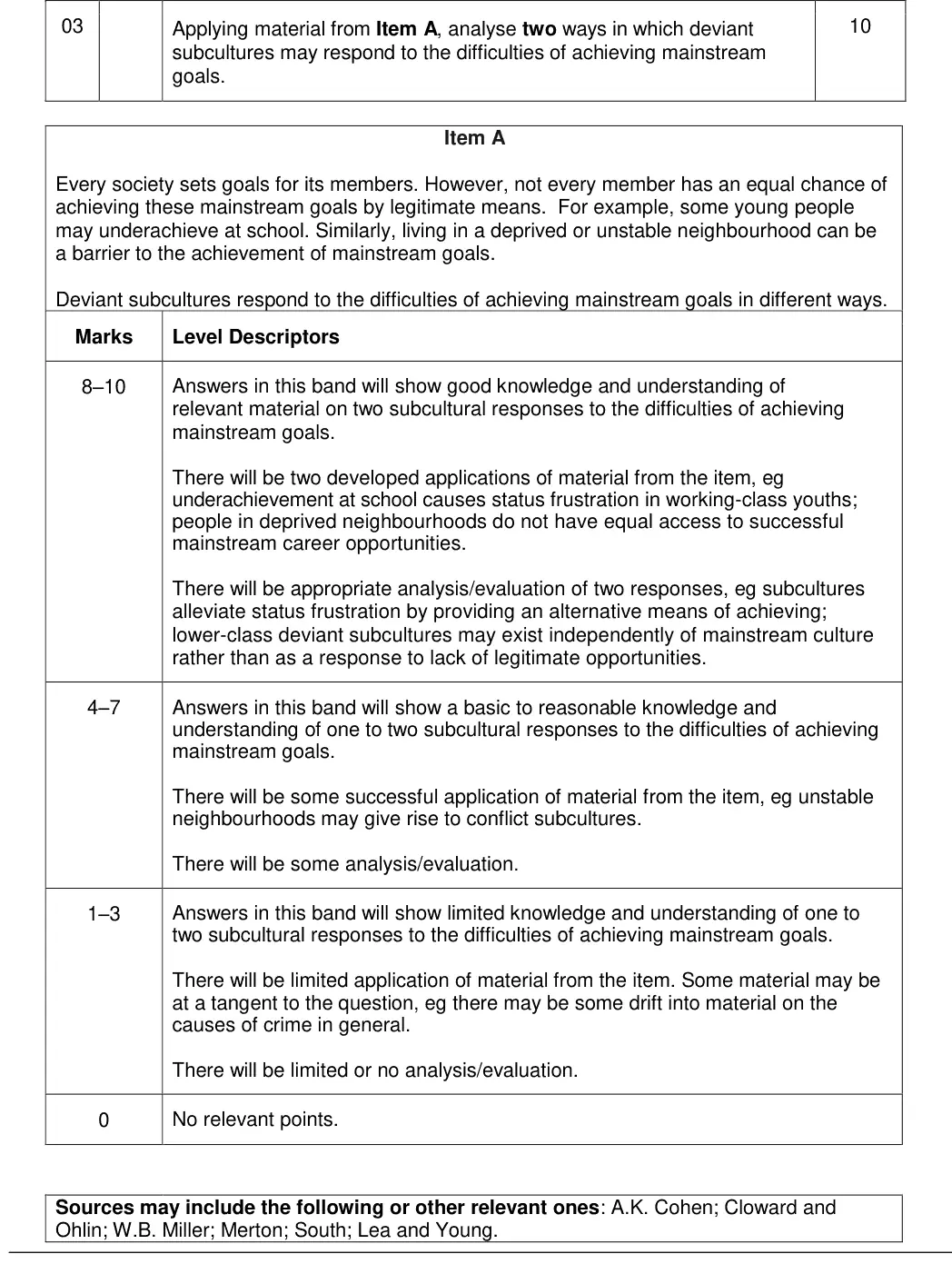
must develop hooks from Item A (school underachievement, deprived or unstable neighbourhoods)
best answers linked underachievement to Cohen's status frustration and neighbourhoods to Cloward and Ohlin
drift into causes of crime in general = 1–3
common errors: Cohen's status frustration leading to utilitarian crime, Merton's individual adaptations treated as subcultures, Willis or Miller treated as reactive subcultures
Specimen set 1 · Paper 3 · Q430 marksAO1=12, AO2=9, AO3=930-mark essay
Mark scheme, including the levels grid and indicative content
Notes from the mark scheme and report
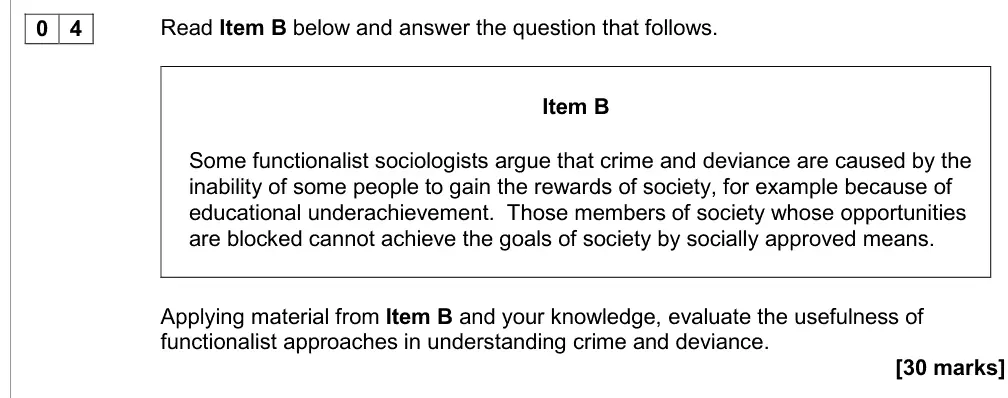
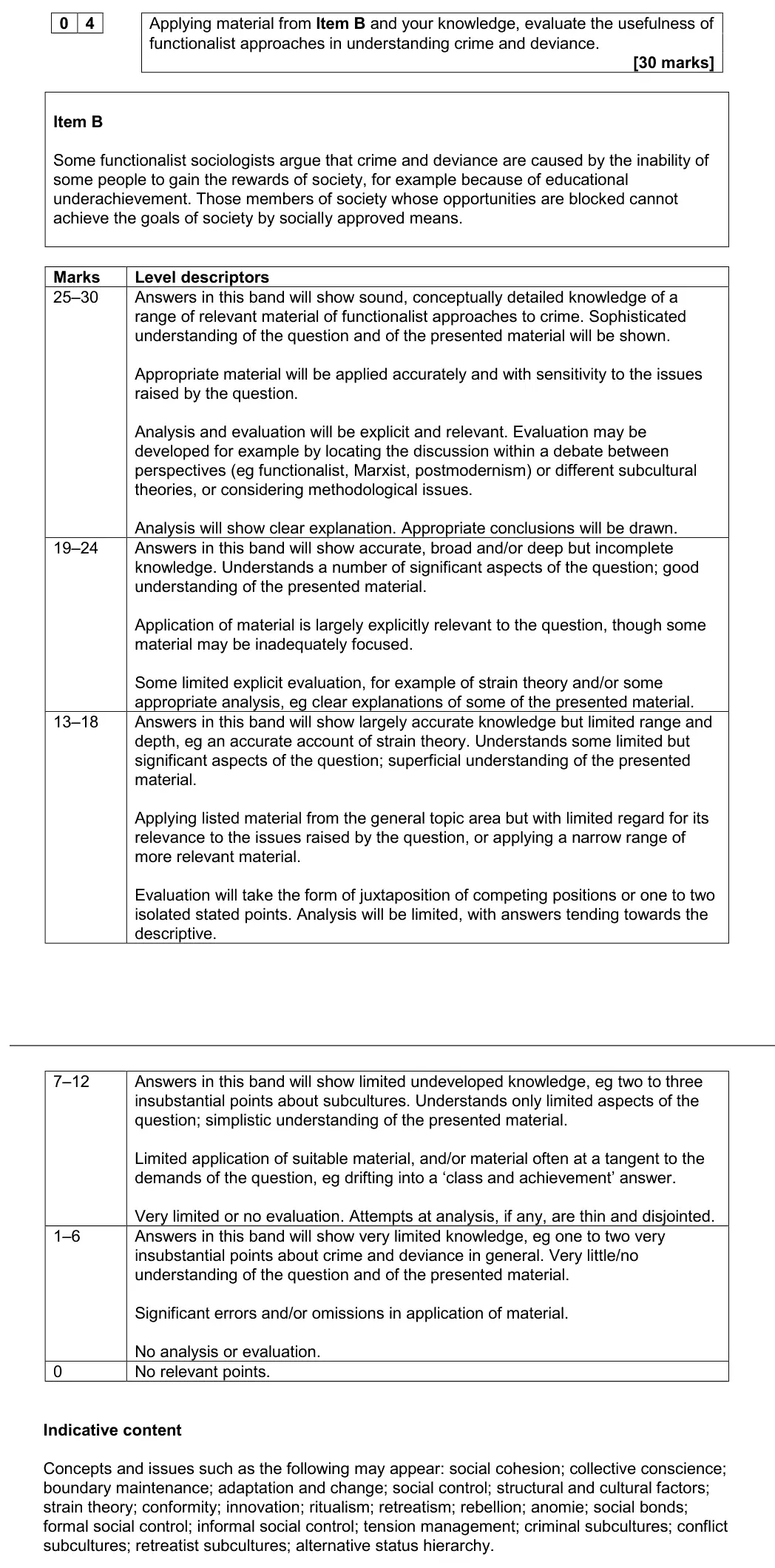
item gives strain theory (blocked opportunities)
top band debates functionalism against Marxism or postmodernism, different subcultural theories, or methodological issues
an accurate account of strain theory alone = 13–18
drifting into class and educational achievement = 7–12
Work with an AQA sociology tutor
Essays stuck in the middle band, or losing marks on the 10-markers? Book a trial lesson with Mark, a former AQA examiner.