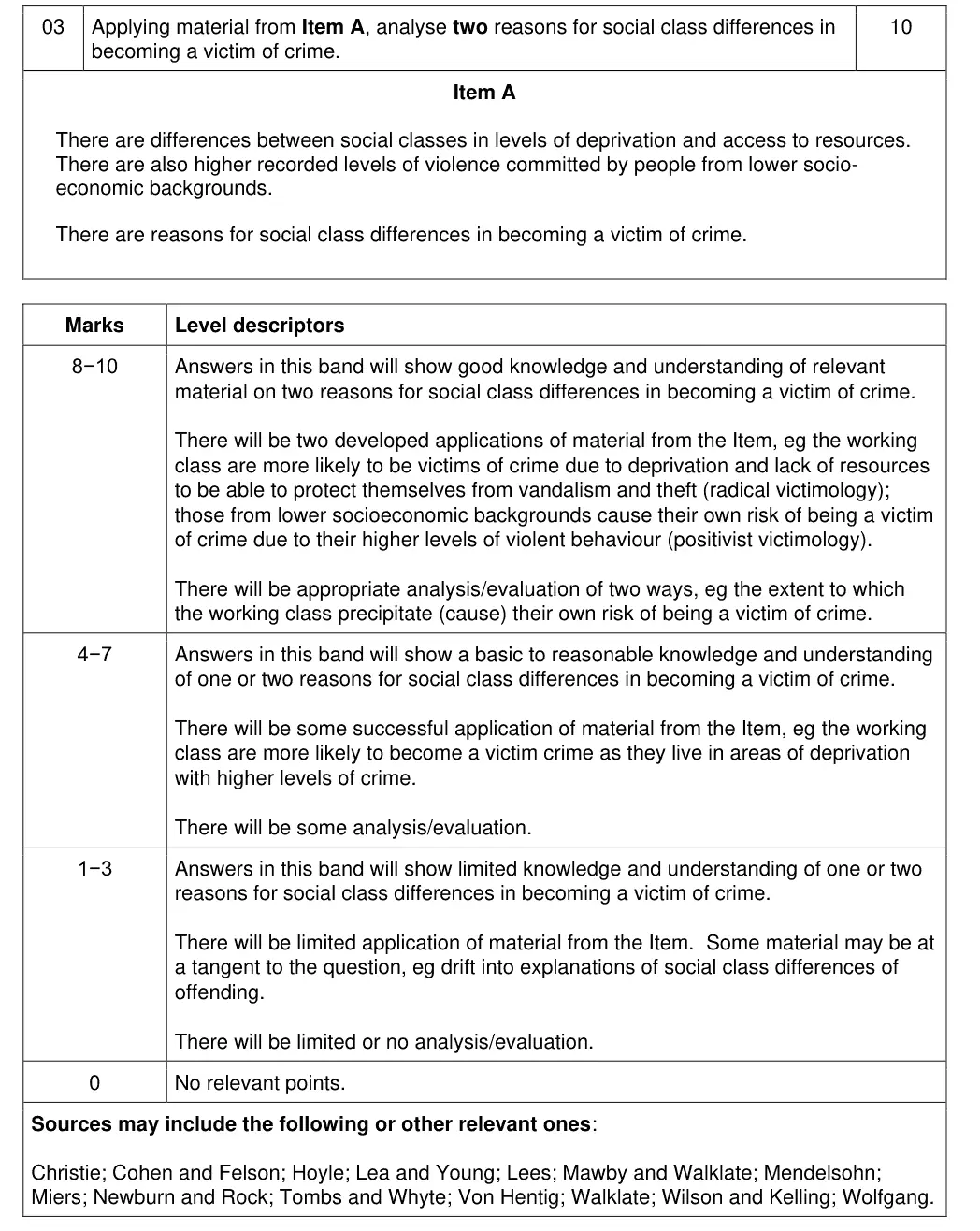
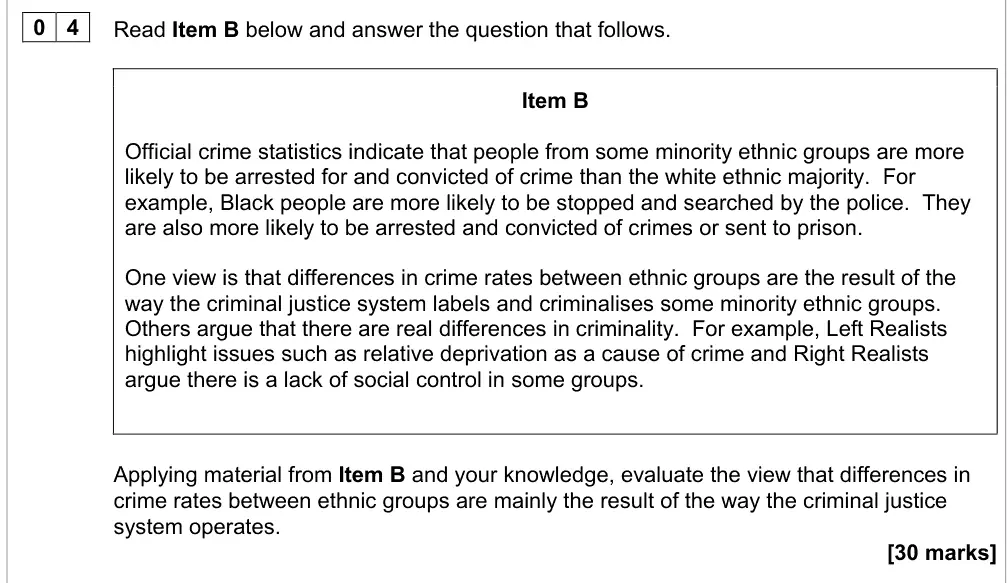
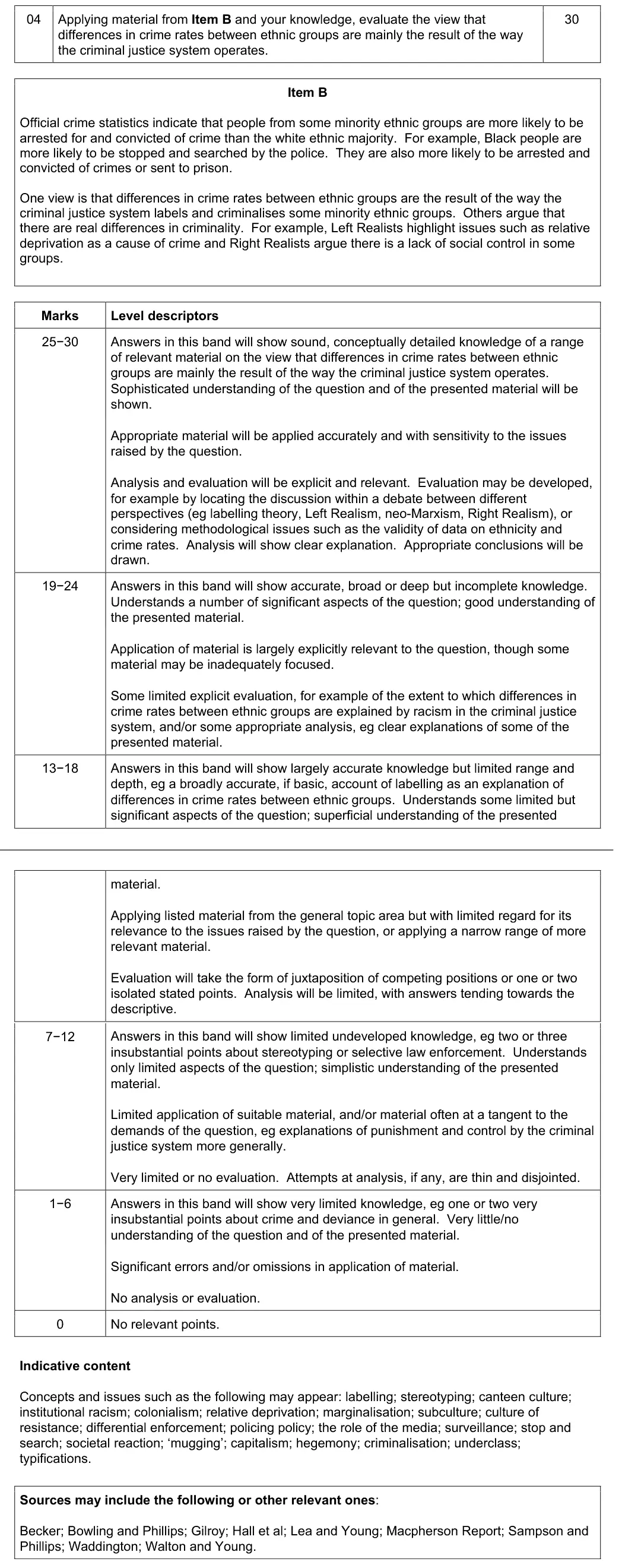
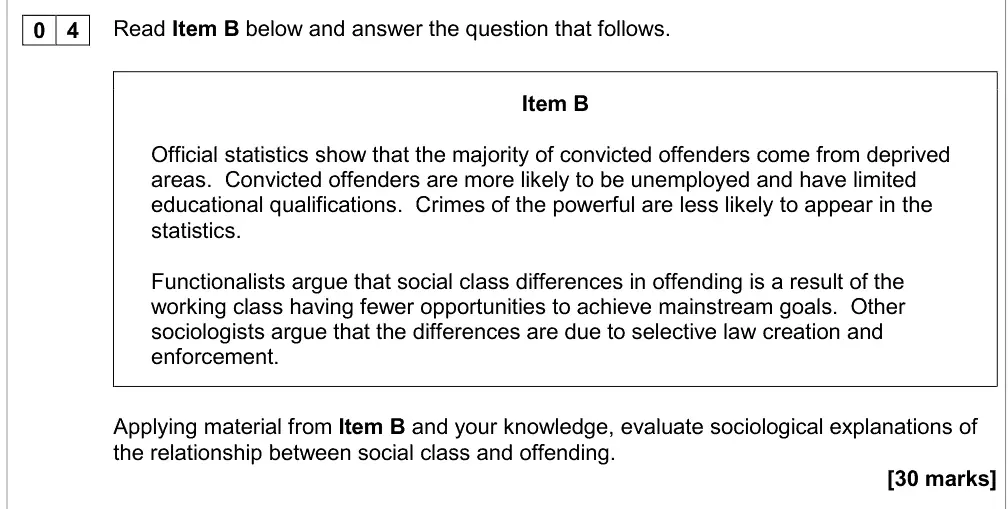
Applying material from Item B and your knowledge, evaluate the view that differences in crime rates between ethnic groups are mainly the result of the way the criminal justice system operates.
Tap a question to zoom it. The mark scheme (with the level descriptors and indicative content) and the examiner's comment open underneath.
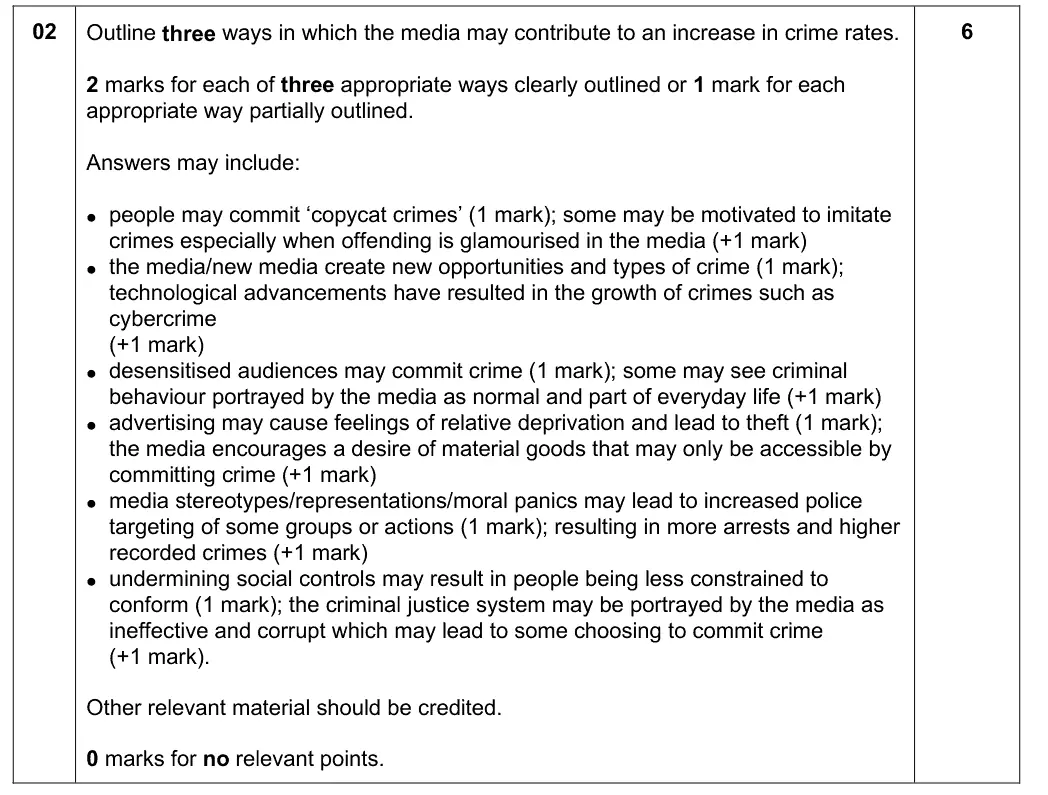
June 2025 · Paper 3 · Q26 marksAO1=6Outline
Mark scheme
Examiner's comment
Question two was on the whole answered well and there was a wide range of different responses provided, some with more success than others. There were some challenges faced with repetition, in particular with students who had used moral panics as their identification and then tried another identification with stereotyping, which led to repetition of the self- fulfilling prophecy. Many students also used the deviancy amplification spiral and discussion of the ‘mods and rockers’. Where this was used, students did not always focus on the question set as they did not discuss the increase in crime. A small number of students drifted away from the question set and discussed the lack of media representation of some groups. Some students made use of new media in this question, and when this was given as an identification, they were able to develop it by using examples of new types of media such as social media platforms and new types of crime such as hate crime or hacking. This showcased the range of knowledge in answers to this question.
Notes from the mark scheme and report
2 marks for each of three ways clearly outlined
credited: copycat crime, new media creating new crimes, desensitisation, relative deprivation from advertising, moral panics and stereotypes leading to targeting, undermining social controls
moral panic then stereotyping repeated the same self-fulfilling prophecy point
deviancy amplification often not linked to rising crime
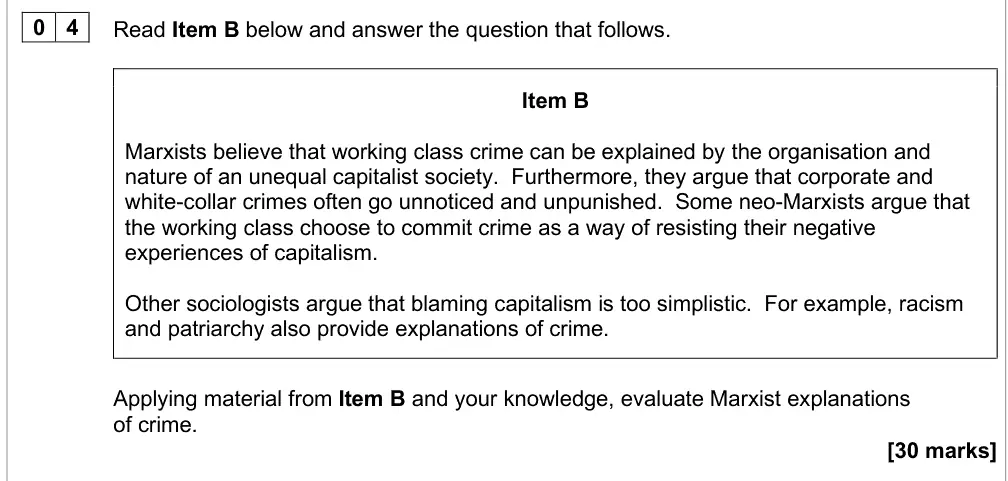
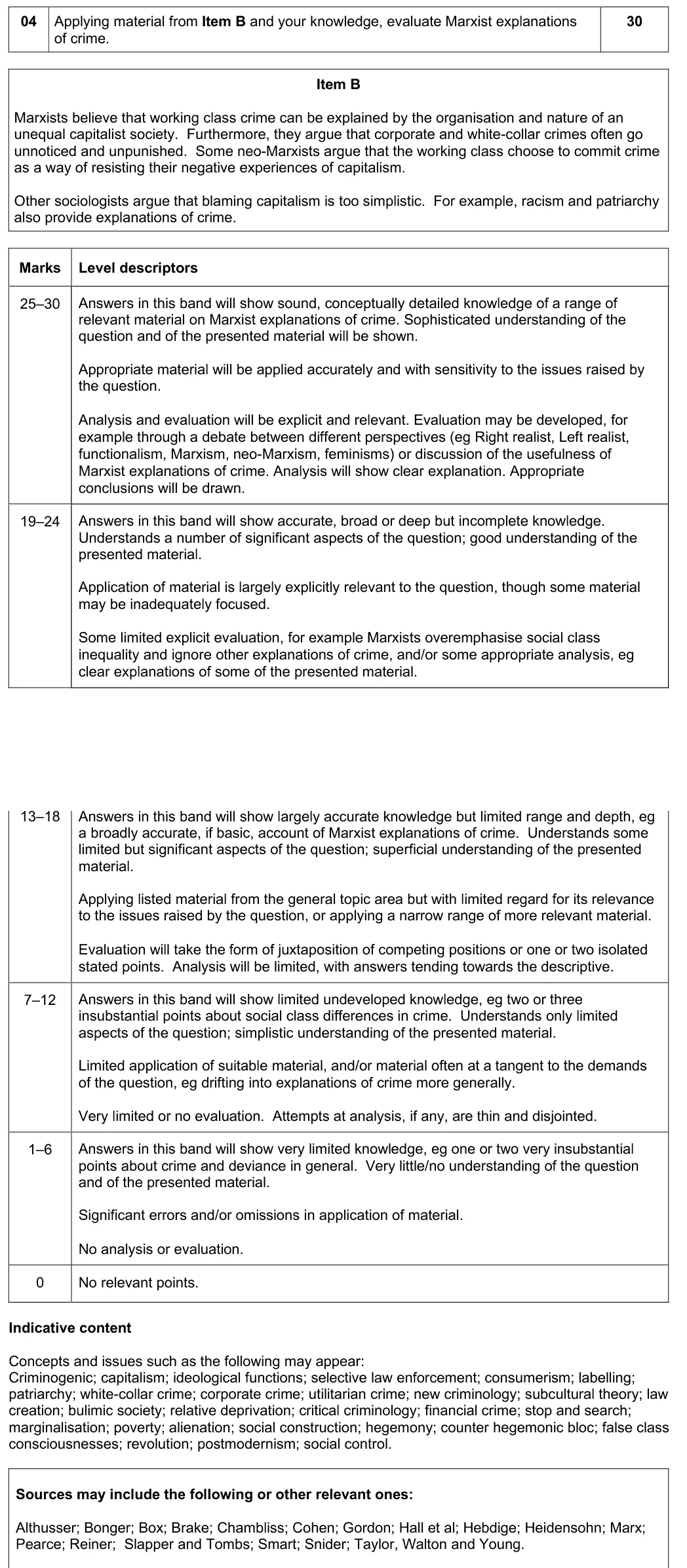
June 2025 · Paper 3 · Q430 marksAO1=12, AO2=9, AO3=930-mark essay
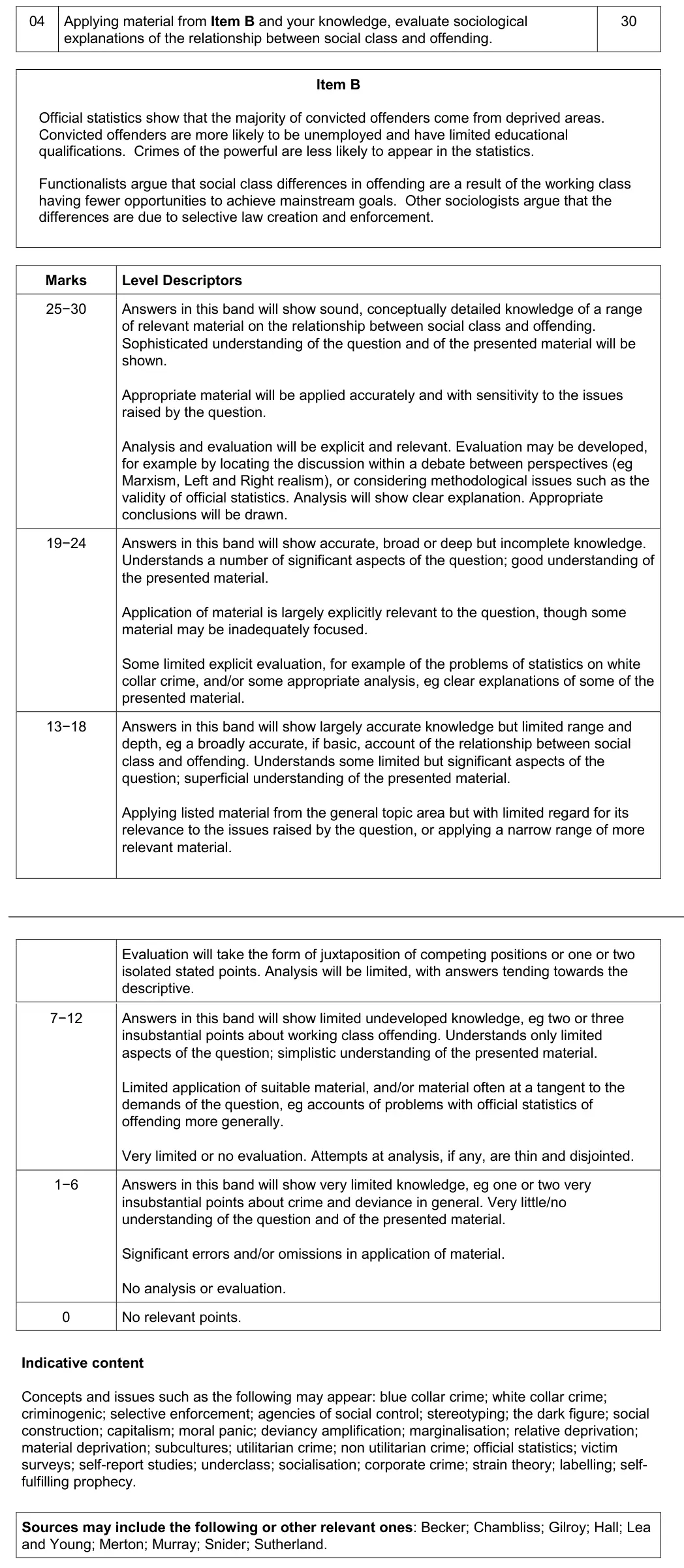
Mark scheme, including the levels grid and indicative content
Examiner's comment
Question four presented a variety of marks demonstrating that the question was differentiated appropriately. Students who did well were able to use the item for guidance and go beyond this with their own knowledge. Students who did well were able to use a variety of Marxist thinkers, with the work of Chambliss and Snider being the most frequently discussed. There were also some good examples of types of white-collar crime, selective law enforcement and punishment enabling students to fully showcase their knowledge. Where punishment was used as a knowledge point students were able to evaluate explicitly and give examples, of either people who have evaded punishment or those who have not, often people who hold political power were given as examples. Given this was a theory-based question it opens itself up more for juxtaposition in the form of evaluation. Some students wrote lengthy paragraphs about alternative theories such as ‘interactionism’ with no link or focus on the question set. The item did give some suggestive evaluation hooks in ‘patriarchy’ and ‘racism’. Students who did well were able to use these and apply these hooks to Marxism. Students should be encouraged to evaluate the points they have made using appropriate theory. There was a tendency to use non-Marxist writers as knowledge points, such as Merton and Cohen. Focus should be given to the target theory in the question. Lengthy introductions are not required for this question as students are under time constraints.
Notes from the mark scheme and report
must apply Item B (capitalism and working-class crime, unpunished corporate crime, neo-Marxist resistance, racism and patriarchy)
top band: debate with realists, functionalism, feminisms or usefulness of Marxist explanations
best answers used Marxist writers (Chambliss, Snider) and examples of selective law enforcement
non-Marxist writers (Merton, Cohen) used as knowledge points and long accounts of other theories drift off the target theory
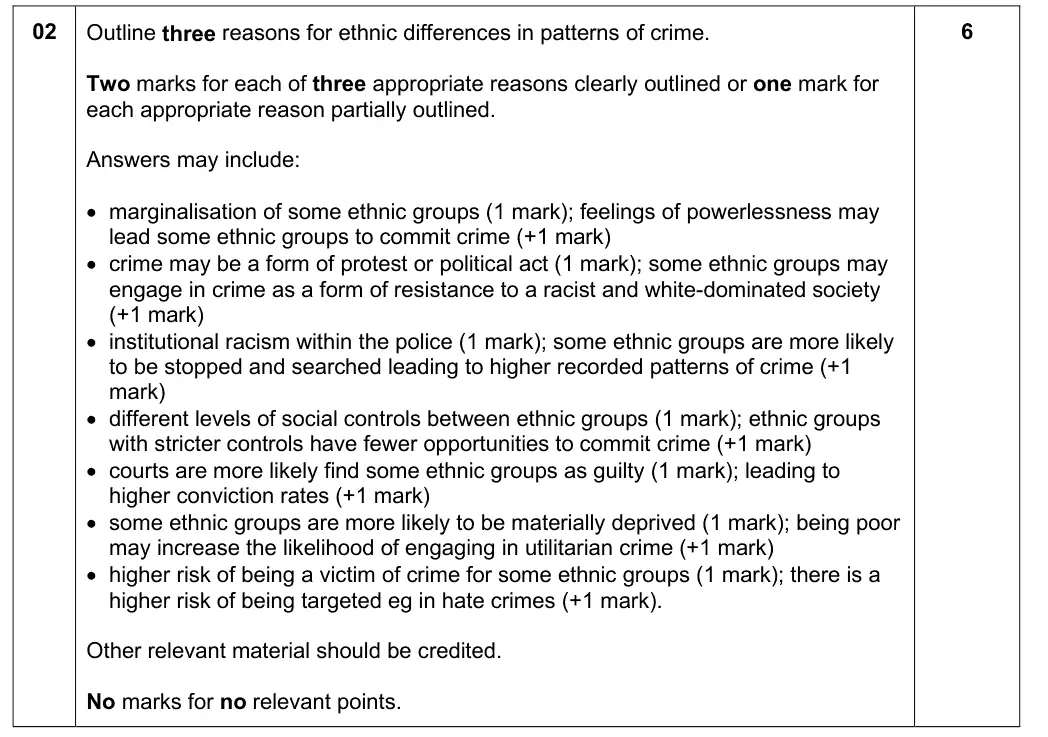
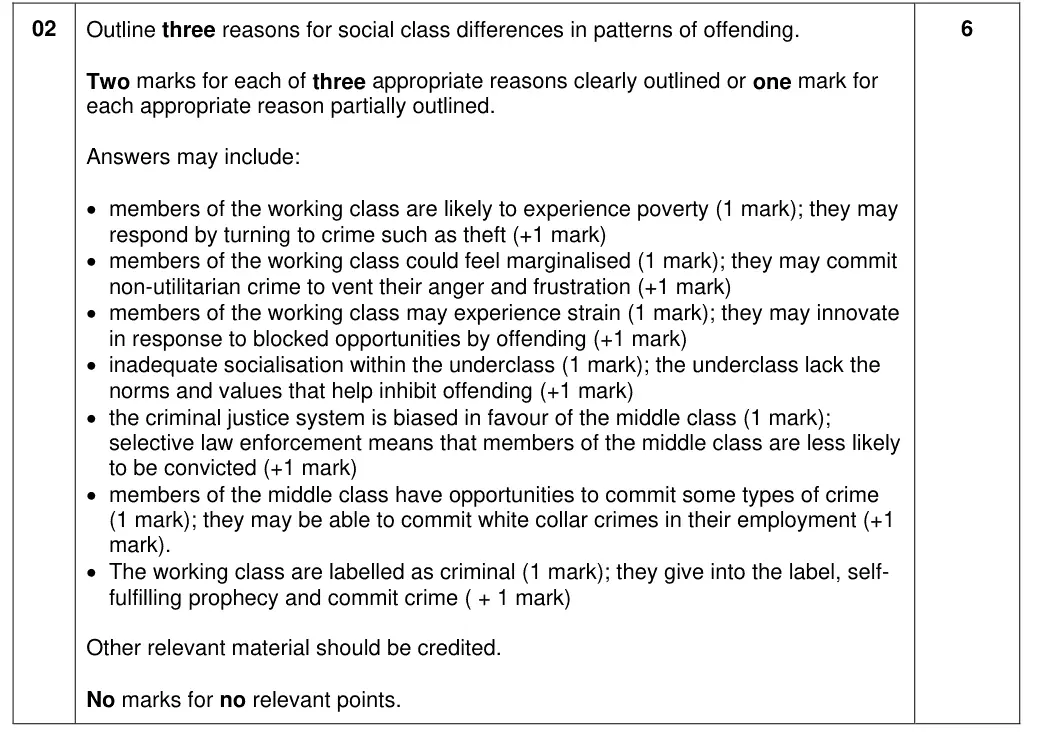
June 2024 · Paper 3 · Q26 marksAO1=6Outline
Mark scheme
Examiner's comment
This question was in large part answered well, although it is worth noting that despite the vast variety of material a student could present there was some repetition. This was mainly when students had used racist police practices or the family as an explanation, and these could not be credited twice. As with Question 1, there was a tendency to overwrite this question. A focus should be on writing one word or statement for the identification (1 mark) and a short development of this.
Notes from the mark scheme and report
2 marks for each of three reasons clearly outlined, 1 if partial (e.g. marginalisation, crime as protest, police racism and stop and search, court bias, social control in families, material deprivation, victimisation)
answered well
repeated reasons (racist policing, family) credited only once
over-writing common
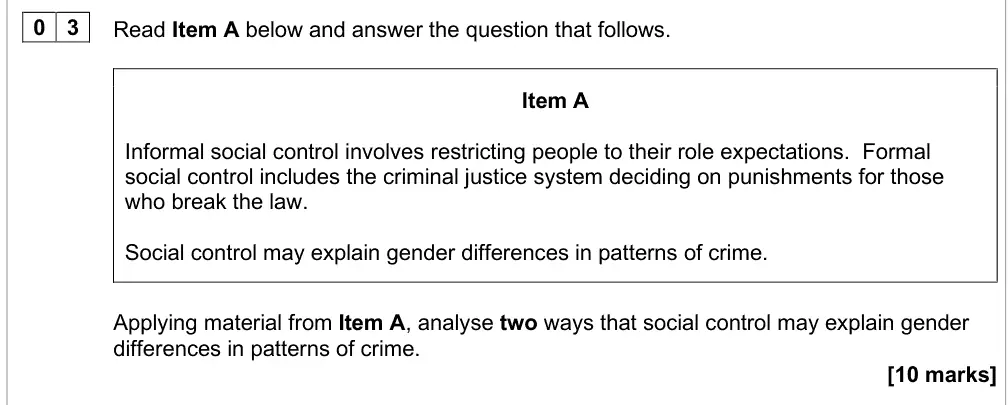
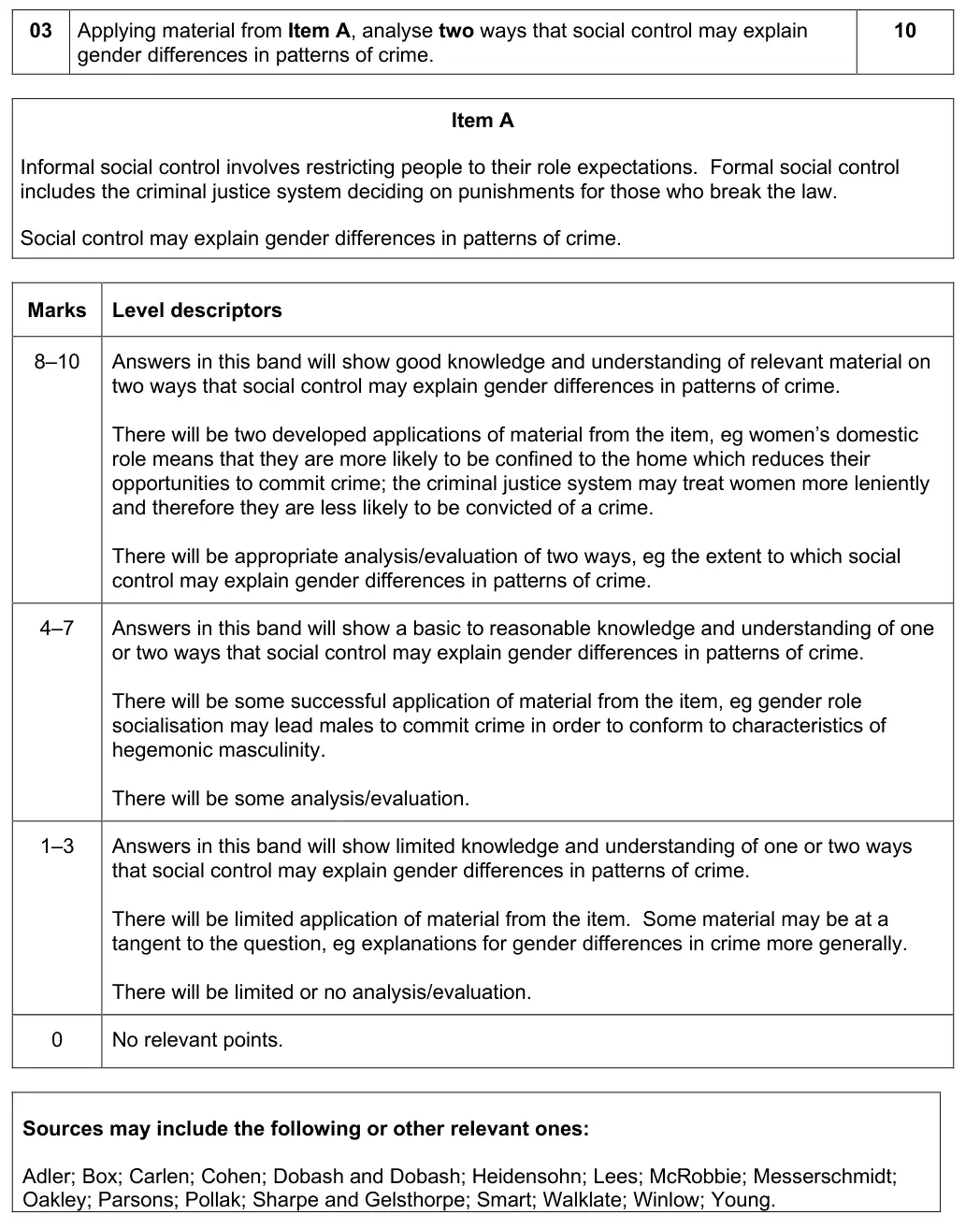
June 2024 · Paper 3 · Q310 marksAO1=3, AO2=4, AO3=3Analyse
Mark scheme, including the levels grid and indicative content
Examiner's comment
This question was answered well by students. Most students were able to use the item effectively to find the “hooks”, and many were able to use theory such as Pollack to develop their answer. A focus is needed on referring to all parts of the question to avoid drift, in this case onto general patterns of gender and offending. The focus needed to be on social control.
Notes from the mark scheme and report
two developed applications from Item A (informal control through role expectations
formal control by the CJS), e.g. women confined to the home, chivalry thesis and lenient treatment (Pollak)
drift into general explanations of gender and crime not tied to social control = 1–3
answered well
June 2023 · Paper 3 · Q26 marksAO1=6Outline
Mark scheme
Examiner's comment
Some students had a tendency to overwrite responses to question 1 and 2, with some being written in an essay style, which is not what the question demands. This could lead to timing issues for other questions in the paper. This question was answered well, a large majority of students did give three reasons. There was a tendency to overwrite, for example writing on Strain theory, or relative deprivation in depth. This may impact timing for other questions.
Notes from the mark scheme and report
2 marks for each of three reasons clearly outlined
well answered but many overwrote (e.g. strain theory in depth), costing time
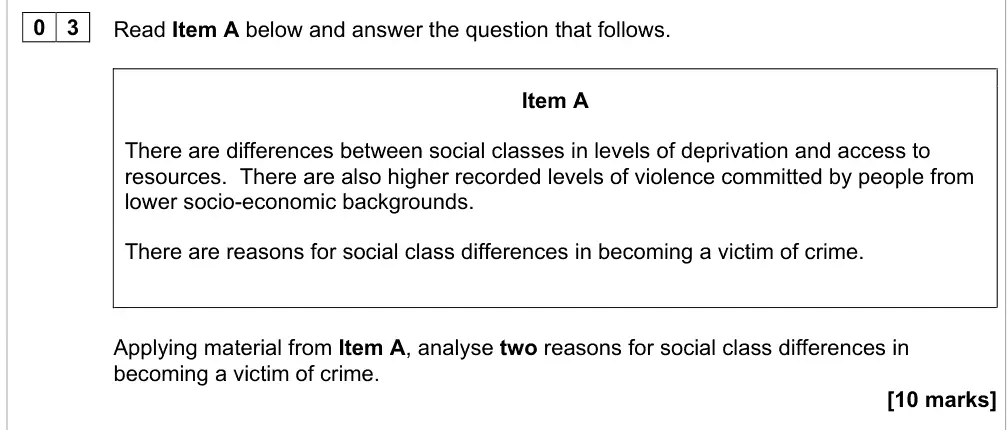
June 2022 · Paper 3 · Q310 marksAO1=3, AO2=4, AO3=3Analyse
Mark scheme, including the levels grid and indicative content
Examiner's comment
Question 3 was the most challenging question on the paper for students this series. Students had some difficulty drawing hooks from the item and developing them. There was a lack of developed knowledge on victims. Despite this the question was well attempted with very few no responses. There was a tendency to drift onto explanations of offending. Some students displayed deep holistic knowledge of this topic area. Centre recommendations are to provide exemplars and practice activities where students are required to use/identify hooks.
Notes from the mark scheme and report
must be reasons for class differences in victimisation
drift into class differences in offending = 1–3
item hooks: deprivation and lack of resources (radical victimology), higher violence in lower classes (positivist victimology, victim precipitation)
the last line of the item restates the question
hardest question on the paper, with weak knowledge of victims and difficulty using hooks
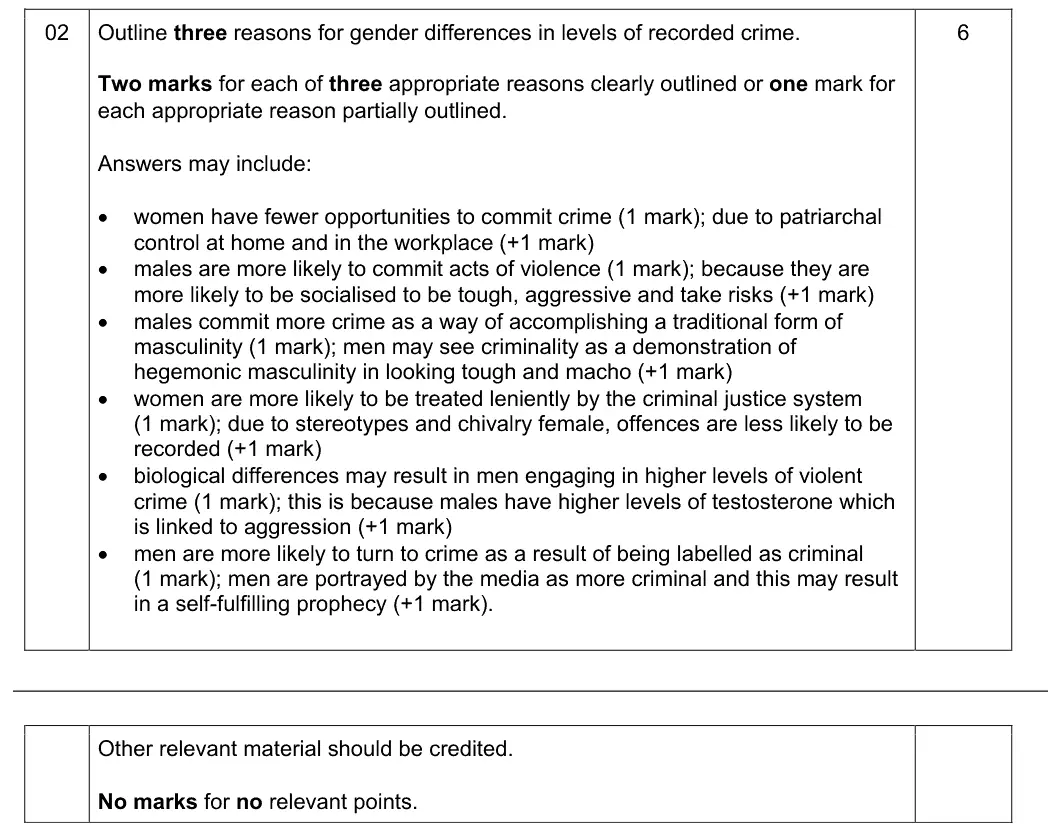
November 2021 · Paper 3 · Q26 marksAO1=6Outline
Mark scheme
Examiner's comment
Similarly to previous years, a significant number of students wrote lengthy answers to the 4-mark and 6-mark questions; this should be a focus for centres. This question was answered well; all students attempted the question. Most students could identify three reasons for gender differences in levels of rerecorded crime. There were some common errors, mainly that students discussed reported crime and victims of crime, this was a common error, as the question stated recorded crime.
Notes from the mark scheme and report
2 marks for each of three reasons clearly outlined, 1 if partial
creditable: fewer opportunities under patriarchal control, male socialisation, accomplishing masculinity, chivalry, biology, labelling
common error was writing about reported crime or victims instead of recorded crime
November 2021 · Paper 3 · Q430 marksAO1=12, AO2=9, AO3=930-mark essay
Mark scheme, including the levels grid and indicative content
Examiner's comment
This question provided varied levels of challenge for students and marks were widely differentiated. Most students were able to use the item and develop the ideas within the item. The most used sociological evidence was from Lea and Young. This was done well; students knew this study and could apply it in a focused way. Most students were able to provide a range of points with some development. The AO1 skill was the best developed skill in this question, however, the AO3 skills of analysis and evaluation werethe most challenging, and not always addressed well or focused on the question set. Students need to make explicit evaluative statements which link to the points they make, however, few were able to do this. This should be an area of focus for centres. Specific assessment for learning strategies are needed to develop these essays. When students did provide a conclusion, it was often not critical and did not add to the essay. Again, this is an area which centres should focus upon.
Notes from the mark scheme and report
top band debates labelling, Left Realism, neo-Marxism and Right Realism, or questions validity of ethnicity and crime data
general accounts of punishment and control by the criminal justice system = 7–12 band
Lea and Young was the most used and well applied source
evaluation (AO3) was weakest: points need explicit evaluative links, and conclusions were often not critical
November 2020 · Paper 3 · Q430 marksAO1=12, AO2=9, AO3=930-mark essay
Mark scheme, including the levels grid and indicative content
Examiner's comment
This question provided varied levels of challenge for students and marks were widely differentiated. Most students were able to use the item and develop the ideas within the item. The most used study was Merton and strain theory. This was done well; many students knew this study and could apply it in a focused way. Most students were able to provide a range of points with some development. Several students were confused with the work of Albert Cohen and Merton and mixed the two studies up. Marxism was another commonly used theory and in some instances was developed with the work of Gordon, Snider and Pearce. AO1 was the best developed skill in this question whereas the AO3 skill was the most challenging and not always addressed well. Students need to make explicit evaluative statements which link with the points they make, however few were able to do this. This should be an area of focus for schools and colleges. Specific assessment for learning AFL strategies should be considered to develop these essays. When students did provide a conclusion, it was often not critical and did not add to the essay. Again, this is an area that schools and colleges should focus upon.
Notes from the mark scheme and report
top band debates Marxism, left and right realism and functionalist strain theory, or the validity of official statistics
general problems with crime statistics = 7–12
Merton used most and well, but some confused Merton with Albert Cohen
evaluation and conclusions weak and often juxtaposed
June 2019 · Paper 3 · Q430 marksAO1=12, AO2=9, AO3=930-mark essay
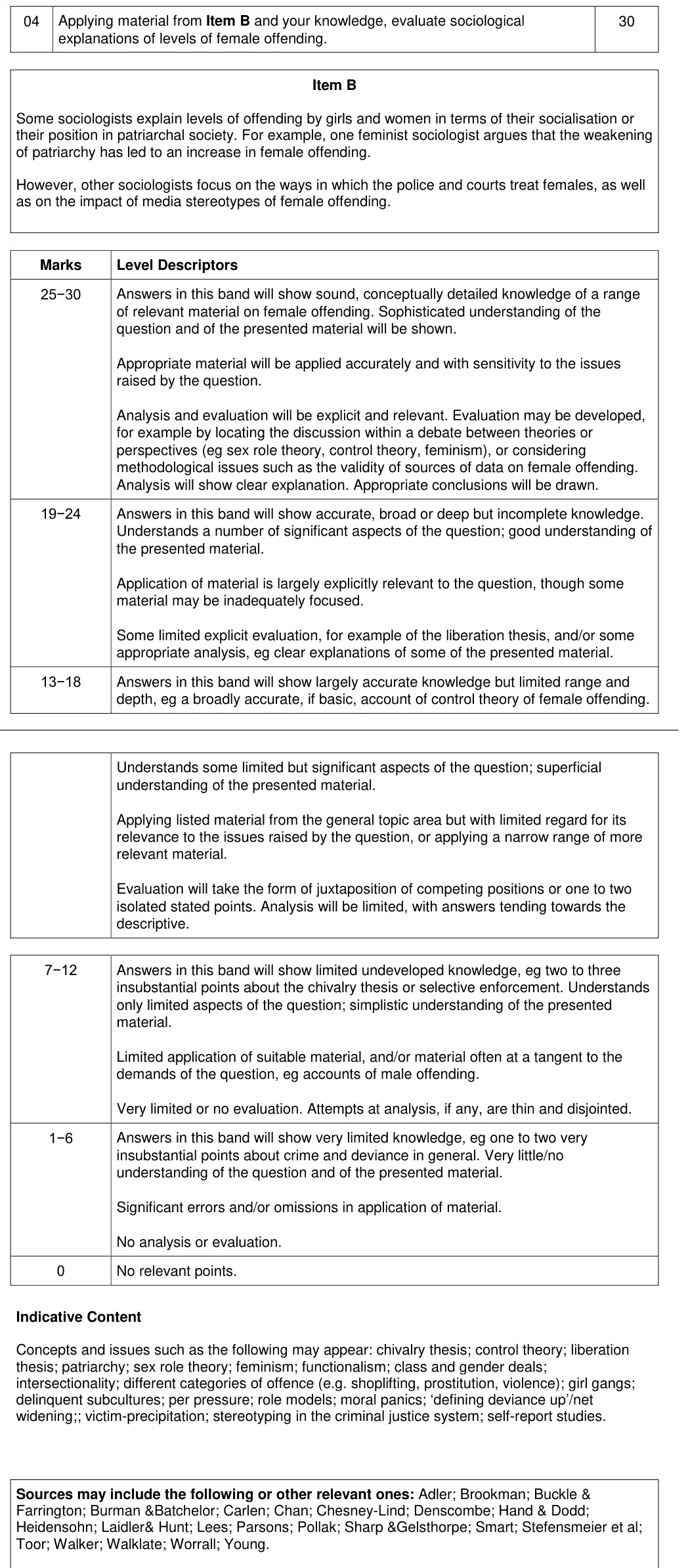
Mark scheme, including the levels grid and indicative content
Examiner's comment
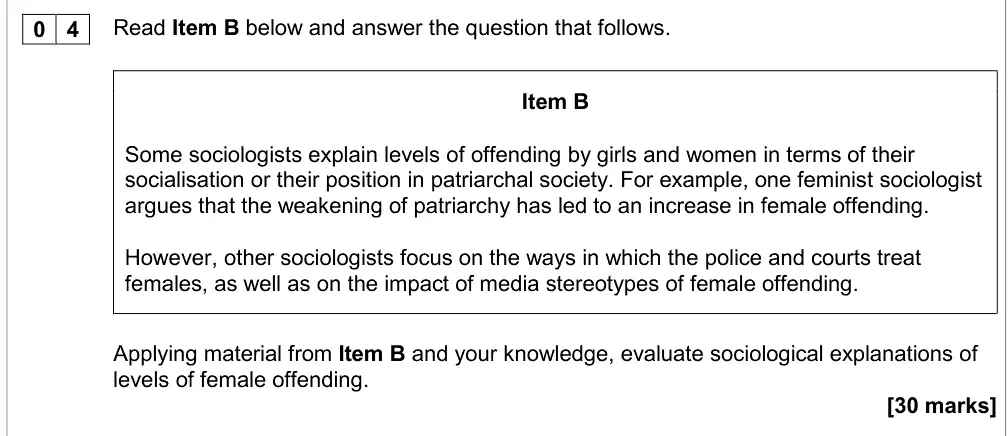
This question produced responses at all levels of quality. Some weaker answers became side- tracked into explanations of male criminality, or of females as victims rather than as offenders. Other responses lacked knowledge of material, specifically on female offending, and attempted, often with only limited success, to apply other theories of crime and deviance, usually strain and subcultural theories. However, in general at all levels of response, students made an effort to apply material from Item B. Weaker answers tended to offer somewhat commonsensical accounts of one or two theories that reflected points in the Item, or accounts that were light on conceptual detail. Most students struggled to develop the Item's reference to media stereotyping satisfactorily, though a few higher- level responses engaged successfully with the idea that a moral panic about young female offending had led to increased social control and criminalisation of females. Good answers were able to discuss some or all of the following, using appropriate concepts and evidence: sex role theory and gender socialisation: Heidensohn and control theory; Adler's liberation thesis and the weakening of patriarchy; Carlen on class and gender deals; and the chivalry thesis. The best answers made good analytical and evaluative points throughout their essay. For example, in discussing Heidensohn and control theory, some questioned the extent to which changing gender roles may have made the theory less relevant in today's society, often then going on to link this evaluation to the liberation thesis. Similarly, some better answers questioned the continuing relevance of the chivalry thesis in the context of greater gender equality and increased numbers of women working in the criminal justice system.
Notes from the mark scheme and report
AO grid not printed
must be about female offending, not male crime or women as victims (tangent = 7–12 band)
top band locates discussion in debates between sex role theory, control theory and feminism, or questions validity of data on female offending
few developed the item's media stereotypes hook (moral panic about girl gangs, net widening)
best answers covered Heidensohn, Adler's liberation thesis, Carlen's class and gender deals and the chivalry thesis, questioning their relevance today
AO split from AQA's standard grid for this paper (this year's mark scheme does not print it).
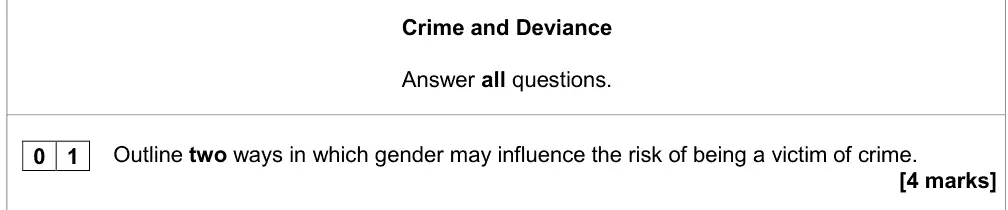
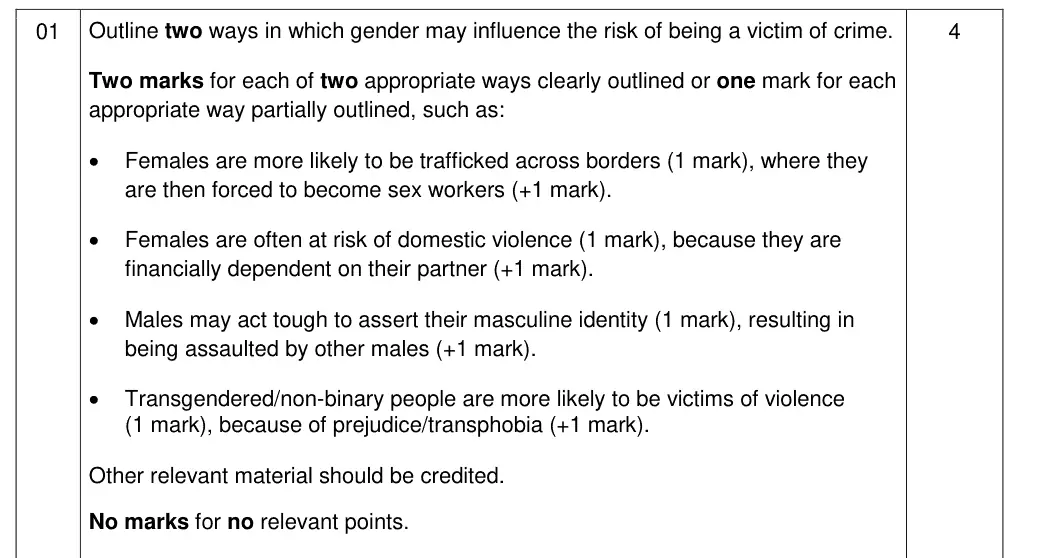
June 2018 · Paper 3 · Q14 marksAO1=4Outline
Mark scheme
Examiner's comment
Most students successfully identified two ways in which gender may influence being a victim of crime. Most answers referred to the vulnerability of women or the influence of patriarchy; many linked this with domestic abuse or sexual crimes. References to male victims usually referred to socialisation and/or to violence related to masculinity, leading to men becoming victims of the violence of other men when they became gang members or spent time in the wrong places. The main reason for failing to score marks was to write about committing crime rather than about being a victim. Some gained partial reward for identifying a particular type of crime of which men or women are likely to be victims but without going on to elaborate on this.
Notes from the mark scheme and report
2 marks for each of two ways clearly outlined, 1 if partial (e.g. trafficking of women, domestic violence and financial dependence, men's tough masculinity leading to assaults, transphobic violence)
main reason for losing marks was writing about committing rather than suffering crime
naming a crime type without elaborating = partial
AO split from AQA's standard grid for this paper (this year's mark scheme does not print it).
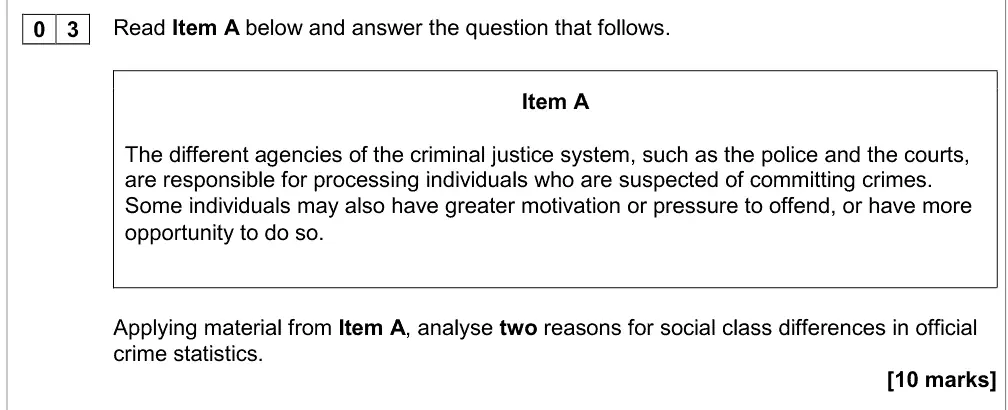
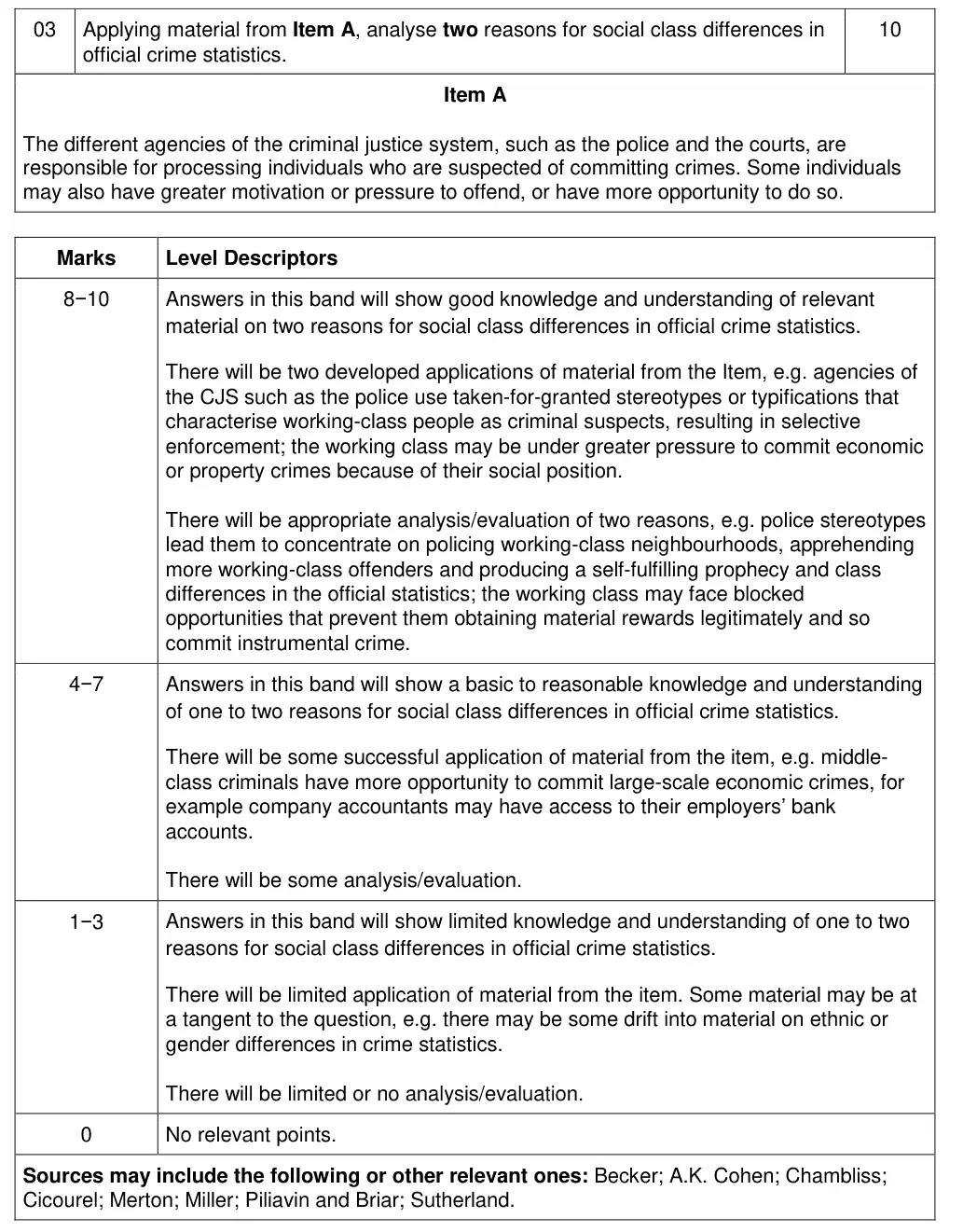
June 2018 · Paper 3 · Q310 marksAO1=3, AO2=4, AO3=3Analyse
Mark scheme, including the levels grid and indicative content
Examiner's comment
Most students were able to draw on one or two appropriate points from the Item. More effective answers then developed these points appropriately by employing relevant sociological concepts and studies. For example, some students took ‘agencies of the criminal justice system, such as the police’ and applied it in terms of the way in which police use typifications in activities such as stop and search, how justice may be negotiated etc. Similarly, some students took ‘some individuals may also have greater… pressure to offend’ and applied this to utilitarian crime via relative deprivation or blocked opportunities faced by the working class. In less effective answers, the connection between the potential point from the Item and the material presented was less clearly made. In some cases, this was because the sociological material offered was more about ethnicity than social class. In a minority of cases, students simply offered various sociological explanations of class differences in the statistics but with no application of material from the Item, for example via accounts of how the ruling class can make the laws so as to avoid incriminating themselves.
Notes from the mark scheme and report
two developed applications from Item A (CJS agencies processing suspects
motivation, pressure or opportunity), e.g. police typifications and selective enforcement, blocked opportunities and utilitarian crime
drift into ethnic or gender differences is a tangent
explanations with no link to the item (e.g. ruling class making laws) score little
AO split from AQA's standard grid for this paper (this year's mark scheme does not print it).
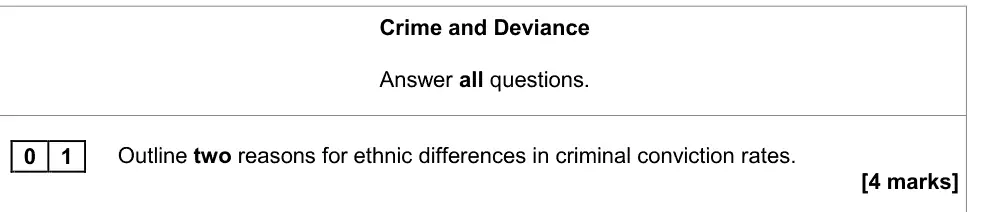
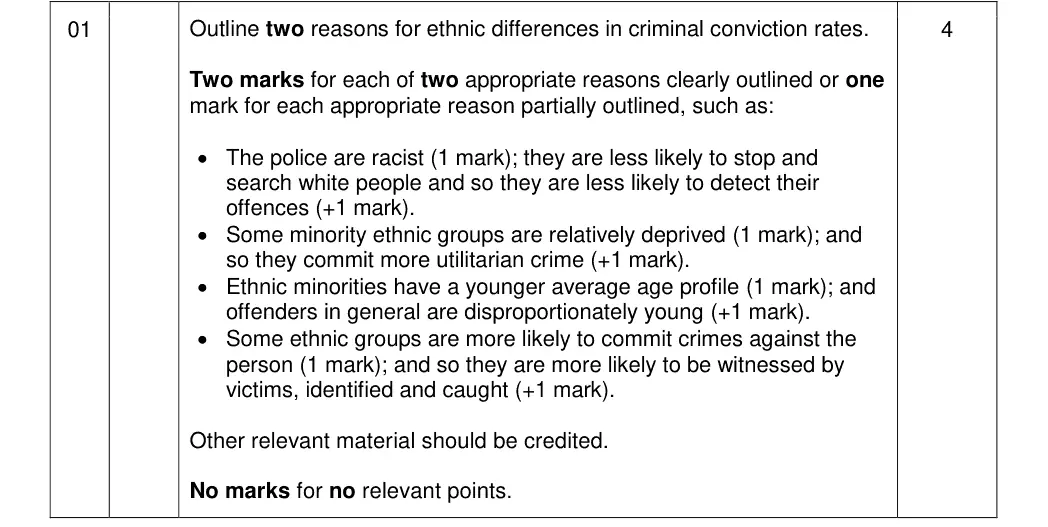
June 2017 · Paper 3 · Q14 marksAO1=4Outline
Mark scheme
Examiner's comment
This was generally well answered. The most common responses identified racism (institutional or other), stereotyping or labelling by police or other actors in the criminal justice system, which then leads to the targeting of ethnic minorities. Other popular responses identified material deprivation, lack of parental role models, and the targeting of urban, working-class areas for policing as possible reasons. Where students failed to score full marks, this was usually due to repetition of the same point or a failure to explain the consequence of the point identified, such as the impact of racist attitudes among the police upon their behaviour in terms of targeting particular ethnic groups for arrest. A number of answers gave accounts of ethnic differences in sentencing (that is, of those already convicted), rather than of differences in conviction rates, which was not creditworthy.
Notes from the mark scheme and report
2 marks for each of two reasons clearly outlined, 1 if partial
common answers: police racism, stereotyping and targeting, relative deprivation, younger age profile
marks lost by repeating a point or not explaining its consequence
accounts of sentencing (after conviction) not credited
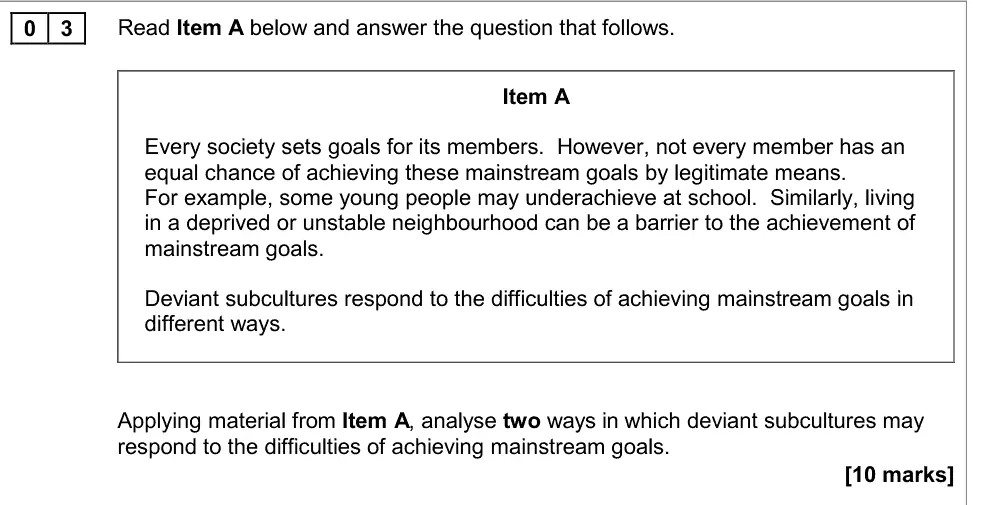
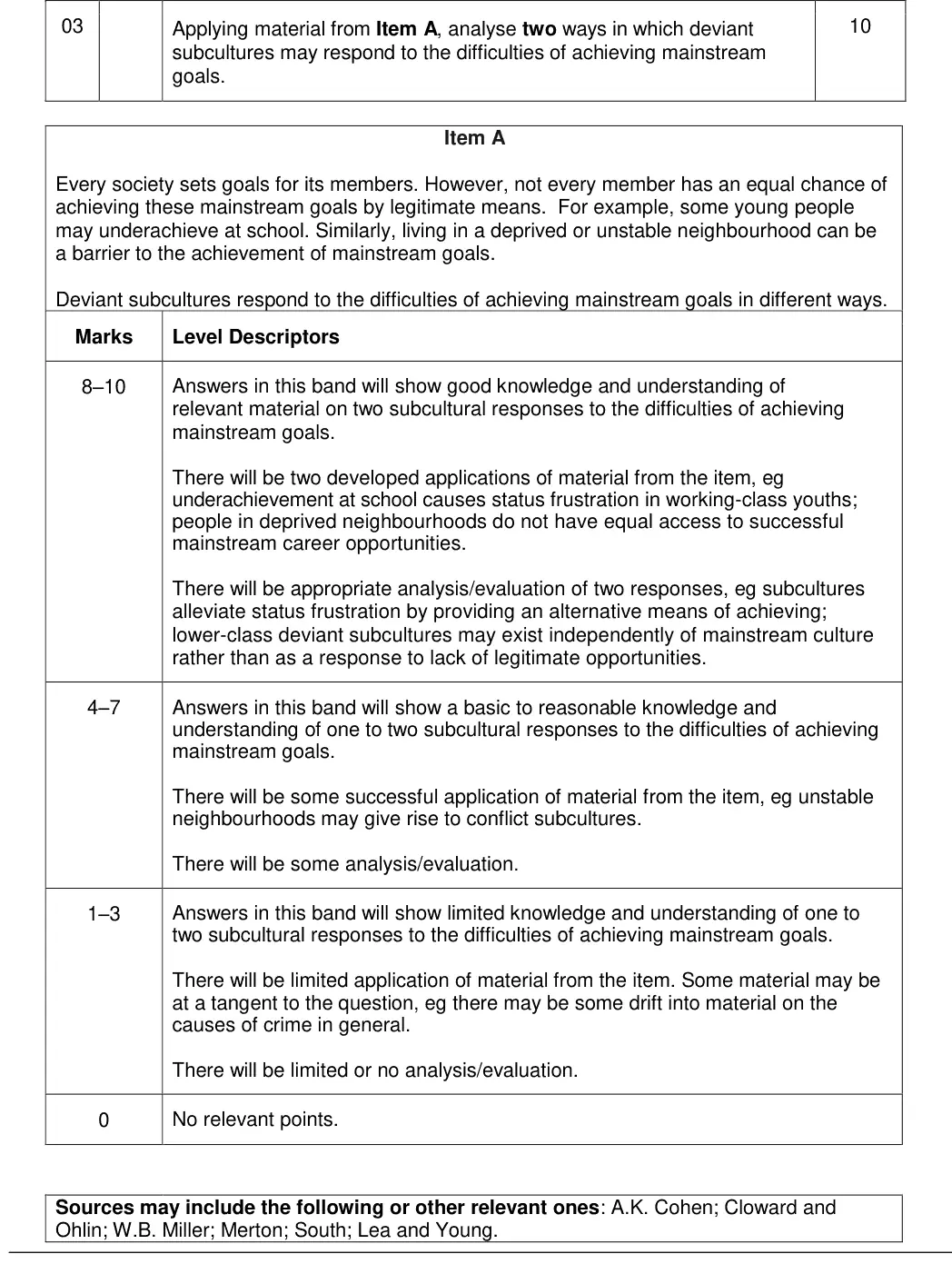
June 2017 · Paper 3 · Q310 marksAO1=3, AO2=4, AO3=3Analyse
Mark scheme, including the levels grid and indicative content
Examiner's comment
In relation to AO2 (application), teachers should note in particular the comments below on Question 03, where failure to apply material from Item A was a significant problem in many answers and meant that students often failed to gain marks for application. The most successful answers were able to apply material from Item A appropriately and to combine this with knowledge and understanding of relevant sociological material on deviant subcultures’ responses to the difficulties of achieving mainstream goals. In these good answers, the elements selected from Item A were generally underachievement at school and living in a deprived neighbourhood or an unstable neighbourhood. The sociological material deployed usually came from Cohen (in relation underachievement) and/or Cloward and Ohlin (in relation to deprived neighbourhoods and/or unstable neighbourhoods). Knowledge was accurate and included relevant concepts such as cultural deprivation, status frustration, alternative status hierarchy, inversion of values, different types of subculture (eg criminal, conflict, retreatist, anti-school), utilitarian and non- utilitarian crime, legitimate and illegitimate opportunity structures, population turnover, ‘turf wars’, ‘double failures’ and criminal apprenticeships. Material from Item A was integrated successfully into these accounts of subcultural responses (eg underachievement at school was linked to knowledge about the cultural deprivation of the working-class boys in Cohen’s study). Throughout, the focus was on analysing the ways in which subcultures respond. Many less successful answers were able to present some knowledge of deviant subcultures but failed to make appropriate use (or in some cases, any use at all) of the material in Item A, and this was a major source of failure to score good marks. There was often a tendency to conflate different sociological sources and concepts or to render them inaccurately (eg accounts of Cohen in which status frustration was said to give rise to utilitarian rather than non-utilitarian crime). Some answers misapplied Merton, failing to recognise that his typology was of individual rather than subcultural responses. Others misinterpreted Willis or Miller as describing ‘reactive’ subcultures (those formed by reaction to failure to achieve mainstream goals) rather than as independent subcultures that had never subscribed to such goals. Many answers attempted some evaluation, though often this was inappropriate to the set question. These answers were typically along the lines of “not all who fail to achieve mainstream goals join deviant subcultures”, rather than, for example, offering criticisms of how sociologists have explained the subcultural responses, which is what the question was focused on.
Notes from the mark scheme and report
must develop hooks from Item A (school underachievement, deprived or unstable neighbourhoods)
best answers linked underachievement to Cohen's status frustration and neighbourhoods to Cloward and Ohlin
drift into causes of crime in general = 1–3
common errors: Cohen's status frustration leading to utilitarian crime, Merton's individual adaptations treated as subcultures, Willis or Miller treated as reactive subcultures
Specimen set 1 · Paper 3 · Q26 marksAO1=6Outline
Mark scheme
Notes from the mark scheme and report
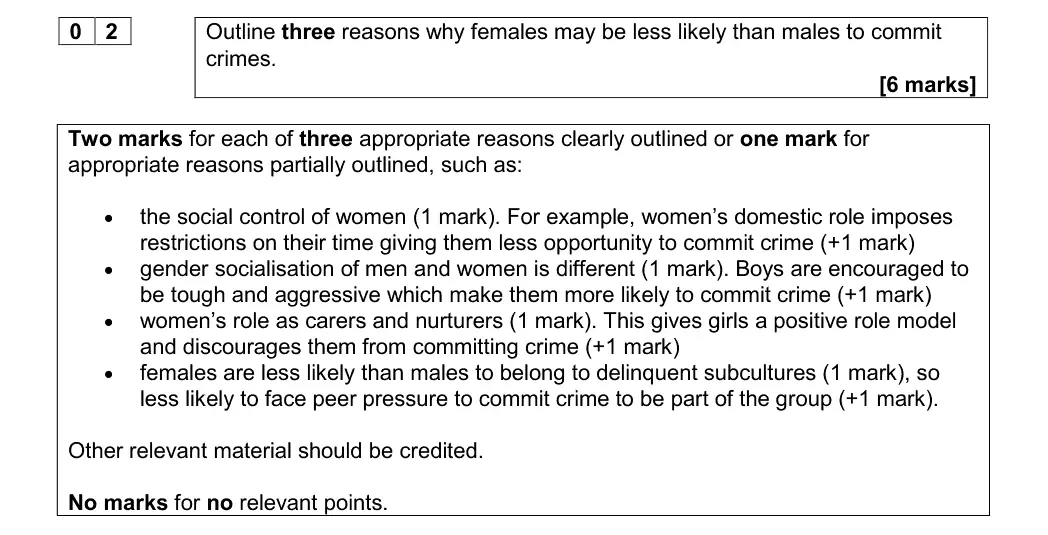
2 marks for each of three reasons clearly outlined, 1 if partial
creditable: social control of women, gender socialisation, caring and nurturing roles, less involvement in delinquent subcultures
Work with an AQA sociology tutor
Essays stuck in the middle band, or losing marks on the 10-markers? Book a trial lesson with Mark, a former AQA examiner.