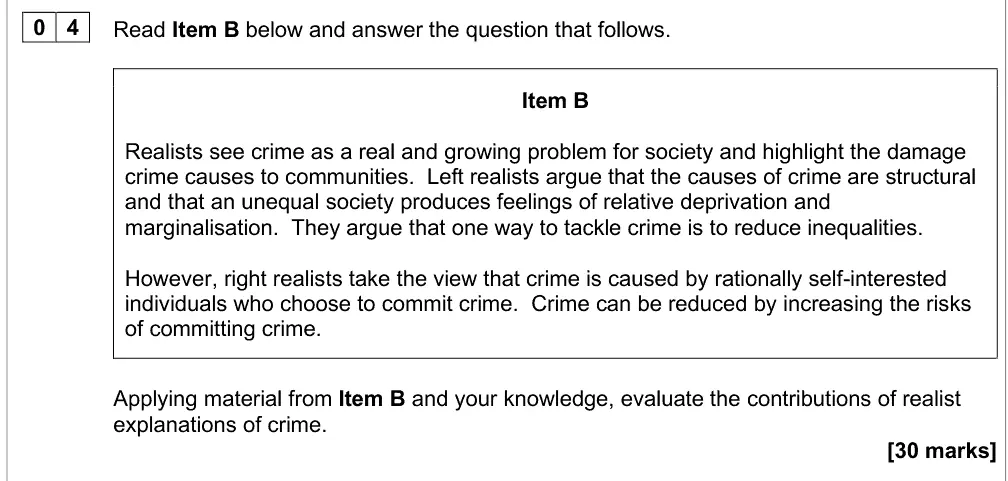
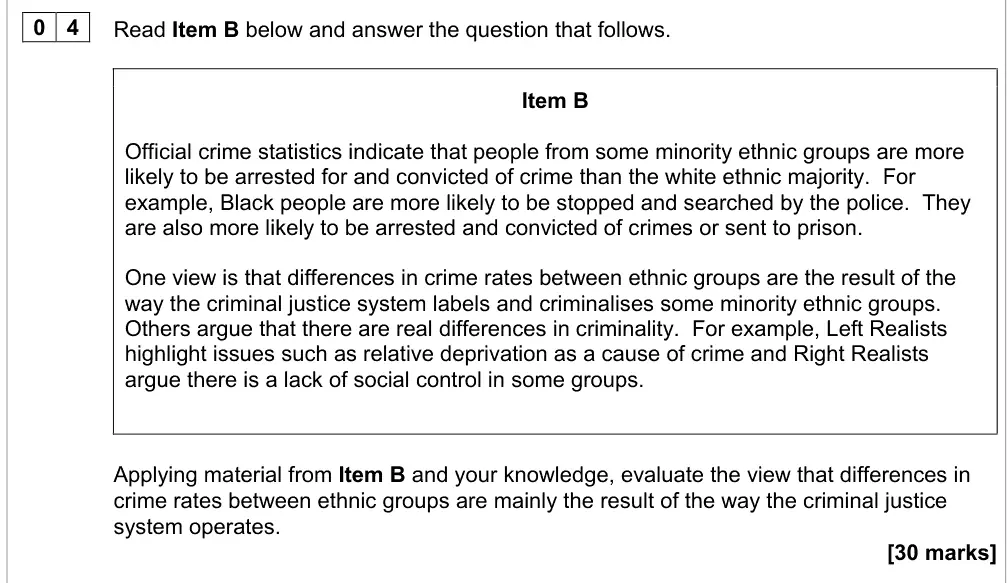
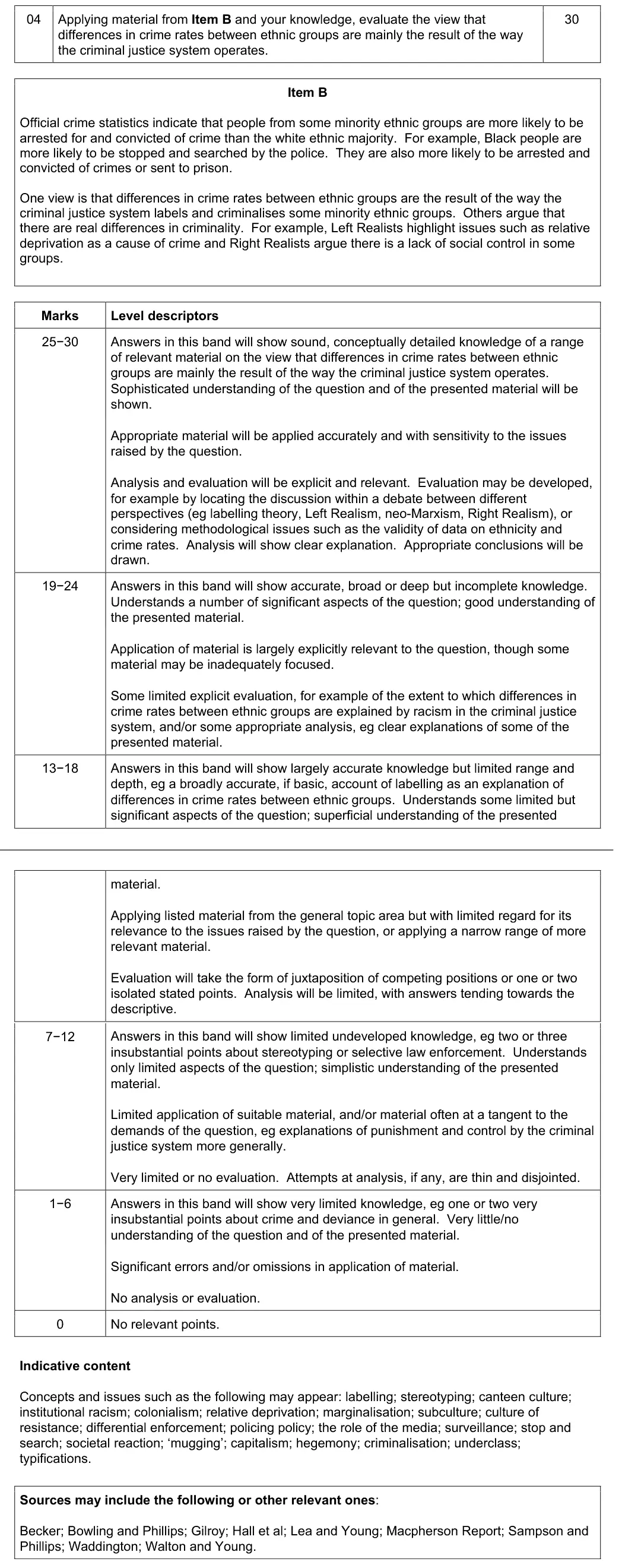
Applying material from Item B and your knowledge, evaluate the view that differences in crime rates between ethnic groups are mainly the result of the way the criminal justice system operates.
Tap a question to zoom it. The mark scheme (with the level descriptors and indicative content) and the examiner's comment open underneath.
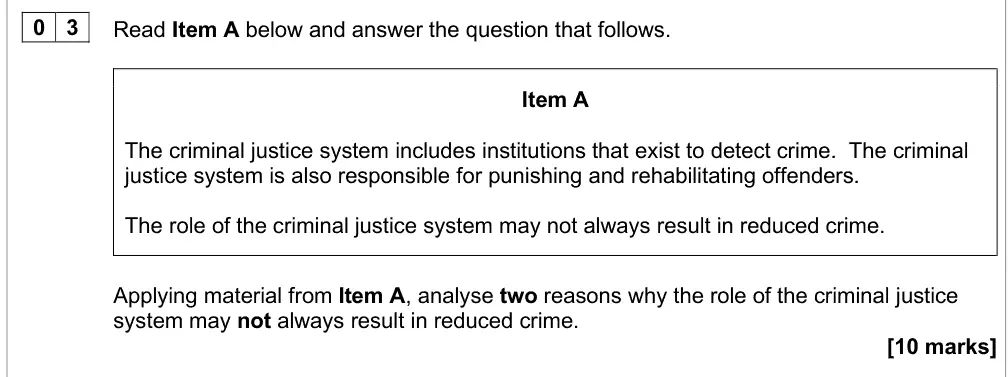
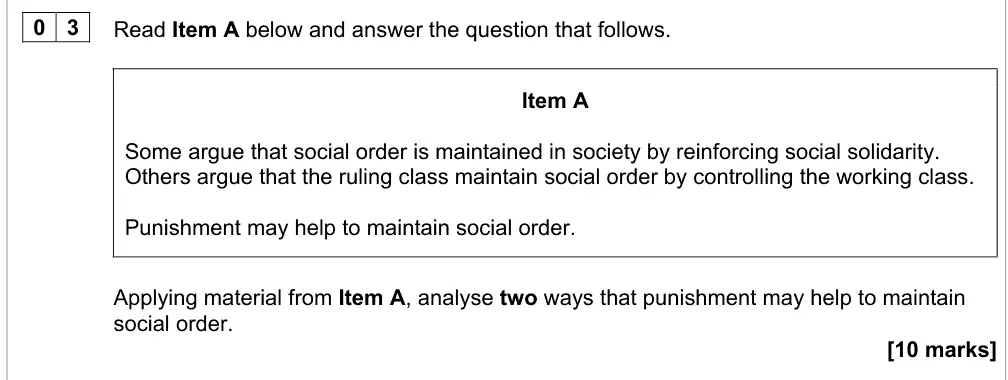
June 2025 · Paper 3 · Q310 marksAO1=3, AO2=4, AO3=3Analyse
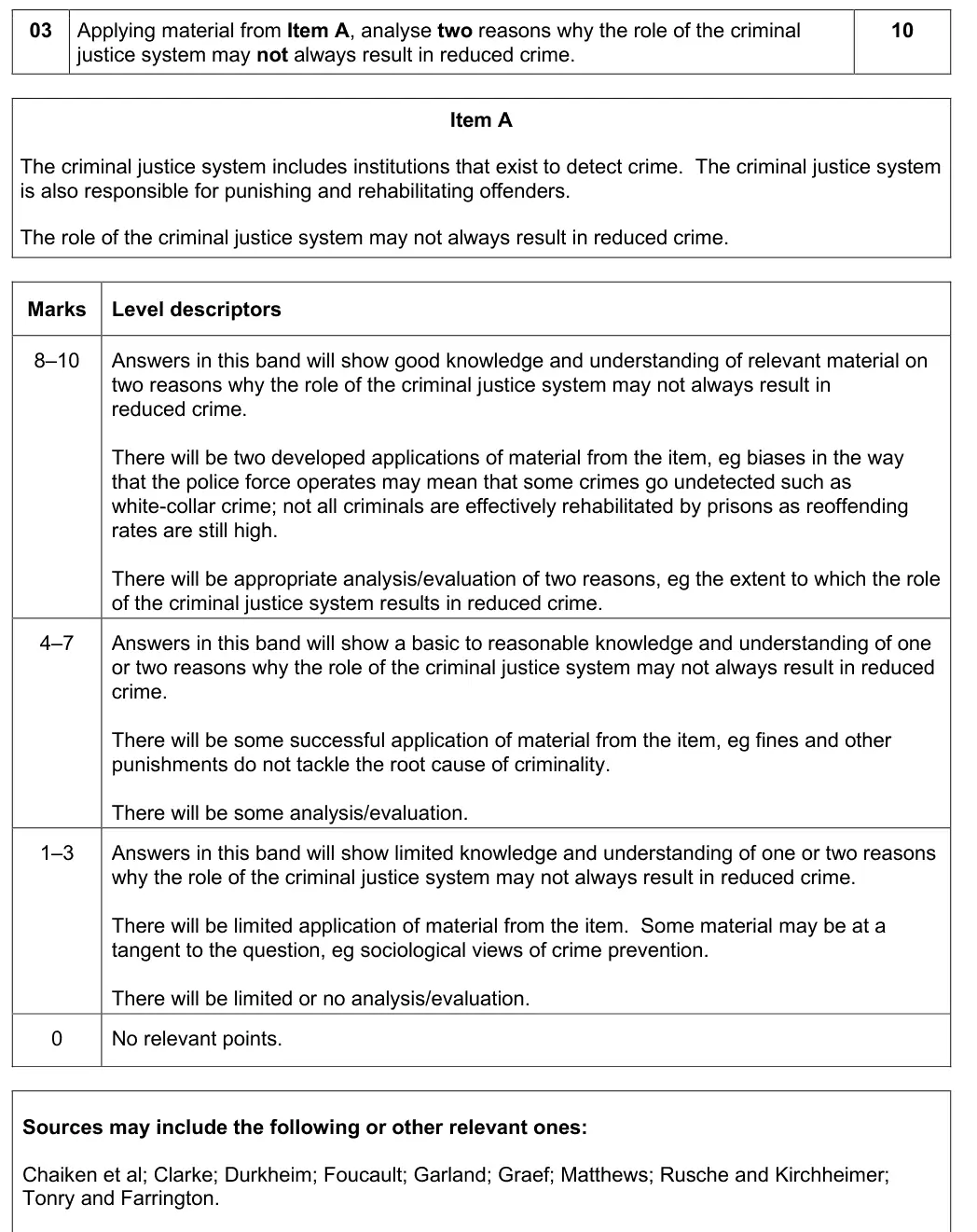
Mark scheme, including the levels grid and indicative content
Examiner's comment
In question three students found the hooks a challenge to access. Students read ‘punishment and rehabilitation’ as one hook. These could have been separated enabling students to write one point about punishment and one point about rehabilitation. Where students did this, they were more successful. Students found the ‘deter’ hook a challenge to access. Some students were able to talk about surveillance, however when students did this, they were not always able to develop their ideas or make links to the criminal justice system. Some students were able to make the link between policing and crime detection. This meant they were able to offer more development in the form of biased policing with regards to gender, social class or ethnicity. On occasion students could not apply the item and gave reasons which were not linked to the criminal justice system at all, such as tackling the root cause of crime and poverty.
Notes from the mark scheme and report
must develop hooks from Item A (detecting crime, punishing, rehabilitating)
the last line restates the question and is not a hook
punishing and rehabilitating work best as two separate hooks
credited: biased policing leaving some crimes undetected, high reoffending after prison
root causes such as poverty with no link to the CJS not credited
the examiners' report mentions a 'deter' hook that does not appear in the item
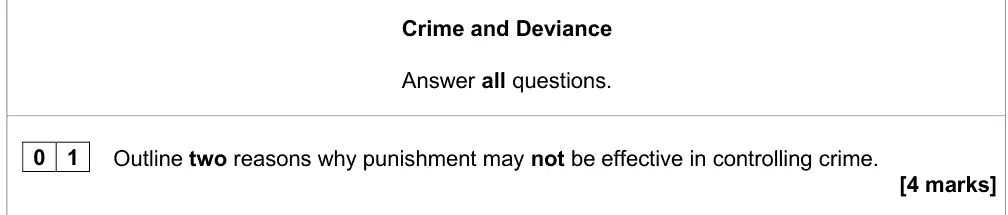
June 2024 · Paper 3 · Q14 marksAO1=4Outline
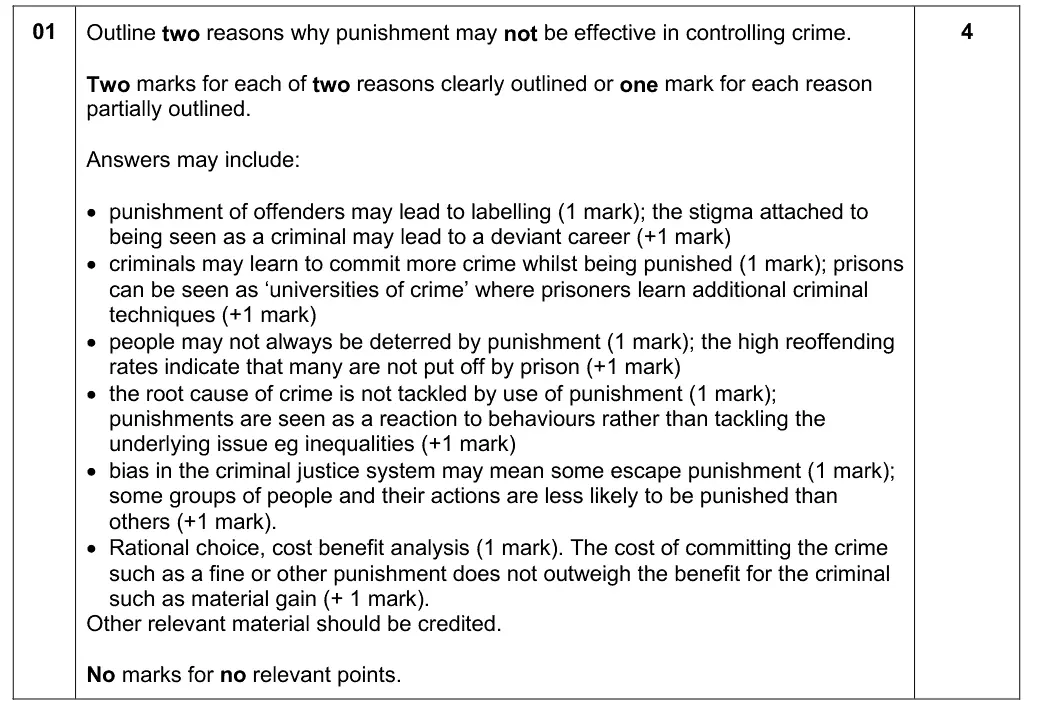
Mark scheme
Examiner's comment
This question was a challenge for some students. Many did not really mention punishment, and answers were vague, for example referencing displacement. There was a need to know about types of punishment and why they wouldn’t control crime, which was the latter part of the question. Students did write some very good answers about prison being a university of crime. Many had some sensitive and thoughtful things to write about rehabilitation. The most popular answer was about the cost benefit analysis, and in lots of cases this was done well. There was a tendency to overwrite this question. A focus should be on writing one word or statement for the identification (1 mark) and a short development of this.
Notes from the mark scheme and report
2 marks for each of two reasons clearly outlined, 1 if partial (e.g. labelling and deviant careers, prisons as universities of crime, high reoffending, root causes such as inequality untouched, CJS bias, rational choice where gains outweigh penalties)
many never mentioned punishment and wrote vaguely (e.g. displacement)
cost-benefit was the most popular answer
over-writing common, a short identification plus brief development is enough
June 2024 · Paper 3 · Q430 marksAO1=12, AO2=9, AO3=930-mark essay
Mark scheme, including the levels grid and indicative content
Examiner's comment
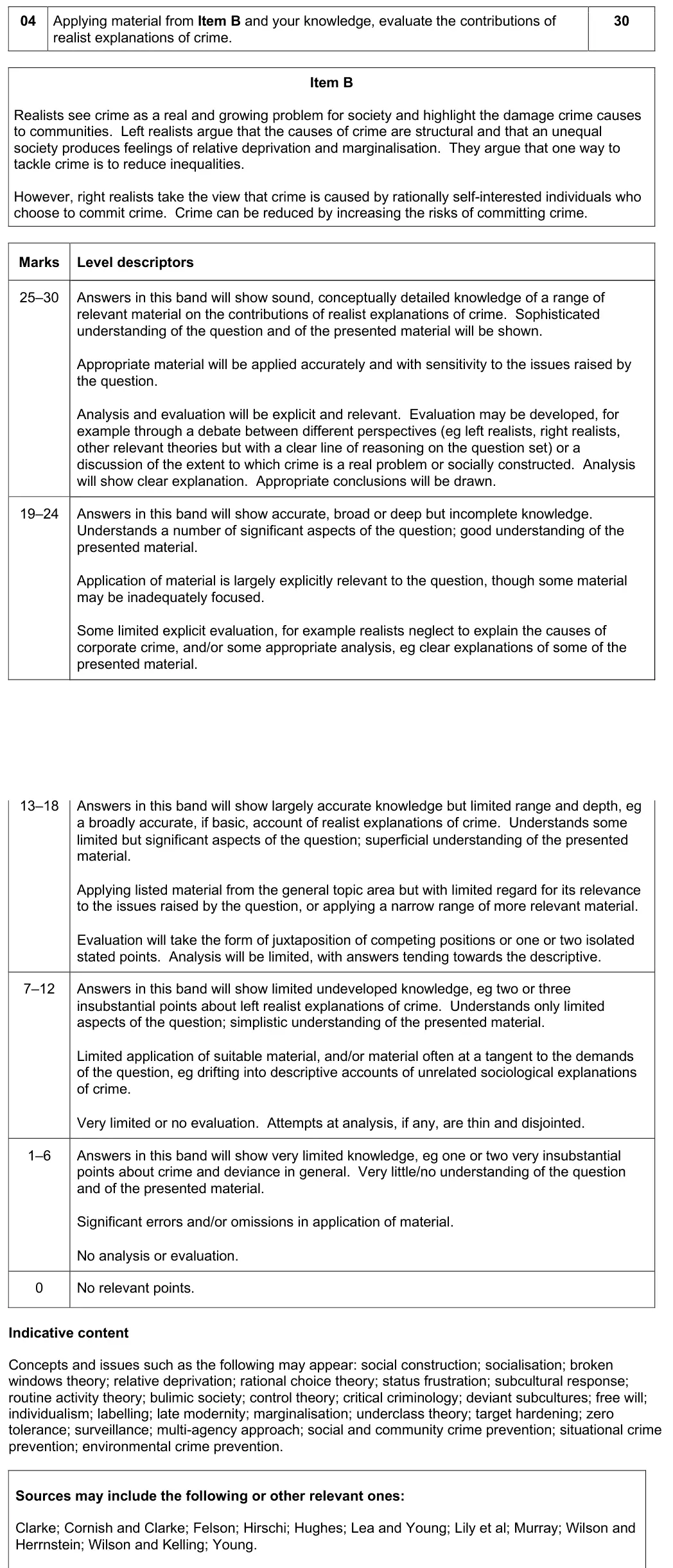
This question presented a variety of marks, demonstrating that this question differentiated appropriately. Many students were able to name realist thinkers and discuss realist crime prevention and reduction strategies. Given this was a theory-based question it opens itself up more for juxtaposition in the form of evaluation. Some students wrote lengthy paragraphs about alternative theory such as ‘functionalism’ with no link or focus on the question set. Students must be encouraged to evaluate the points they have made using appropriate theory. Note lengthy introductions are not required for this question; students are under time constraints.
Notes from the mark scheme and report
top band debates left and right realism (and other theories with a clear line of argument) or whether crime is real or socially constructed
drift into unrelated crime theories (e.g. long functionalism paragraphs) = 7–12
good use of realist thinkers and prevention strategies
evaluation often juxtaposition
long introductions unnecessary
June 2023 · Paper 3 · Q14 marksAO1=4Outline
Mark scheme
Examiner's comment
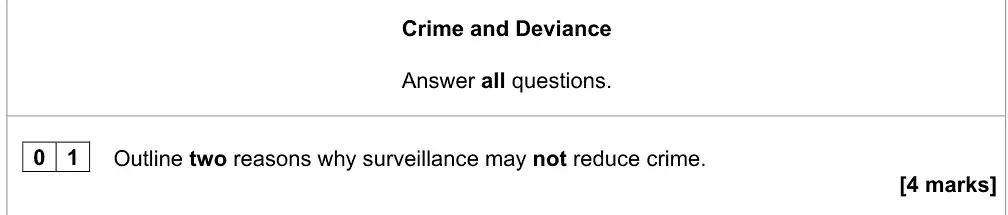
Some students had a tendency to overwrite responses to question 1 and 2, with some being written in an essay style, which is not what the question demands. This could lead to timing issues for other questions in the paper. Some students did not read the question fully, or they were unable to link surveillance to not reducing crime. Comments were on offending in general. Some answers were too general to gain credit. Students should be encouraged to be specific.
Notes from the mark scheme and report
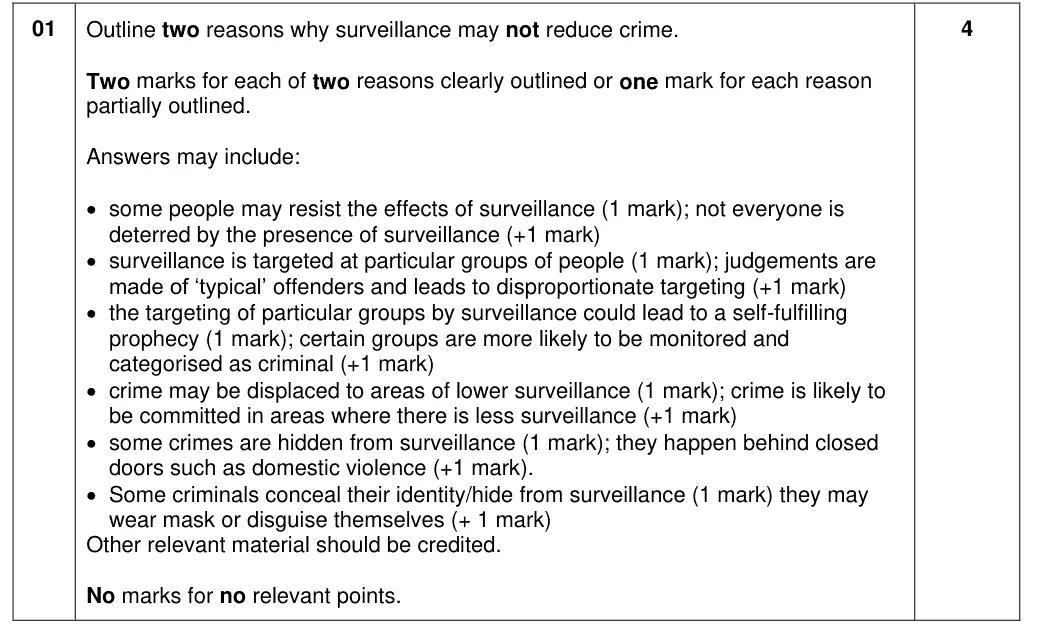
2 marks for each of two reasons clearly outlined, 1 if partial
credited: displacement, crimes hidden from surveillance (e.g. domestic violence), offenders concealing identity, not everyone deterred, targeting of typical offenders and self-fulfilling prophecy
some did not link surveillance to failing to reduce crime and wrote about offending in general
answers must be specific
June 2023 · Paper 3 · Q310 marksAO1=3, AO2=4, AO3=3Analyse
Mark scheme, including the levels grid and indicative content
Examiner's comment
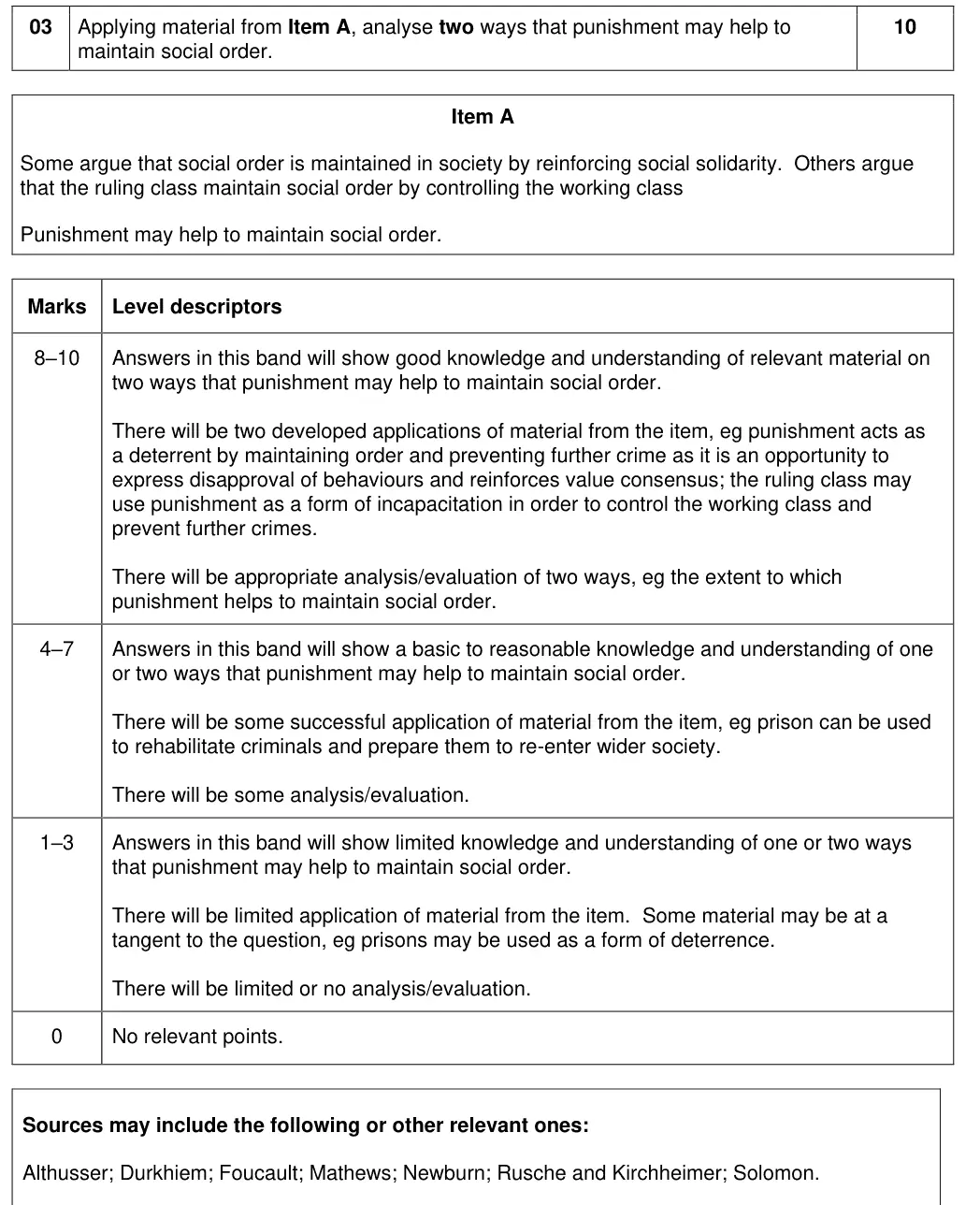
Students should be made aware that there are two types of ten mark questions. These have different requirements and different mark schemes. There are different marks available for the assessment objectives. The items for 10 mark “analyse” questions are written to give prompts or “hooks” for student answers. These have to be used to access application marks. Answers can indicate use of hooks by quoting, by a reference in parentheses or by wording (eg “As the item says…”). Items end with a sentence restating the question; the hooks are in the preceding part of the item. Some students are not able to develop the hook effectively and recycle parts of the item. Students need to be able to link the parts of the question for example punishment and social order together.
Notes from the mark scheme and report
must develop hooks from Item A (social solidarity, ruling-class control of the working class)
the last line of the item restates the question and is not a hook
top band links punishment to social order, e.g. reinforcing value consensus (Durkheim) and incapacitating or controlling the working class (Marxists, Foucault)
recycling the item without development limits marks
June 2022 · Paper 3 · Q26 marksAO1=6Outline
Mark scheme
Examiner's comment
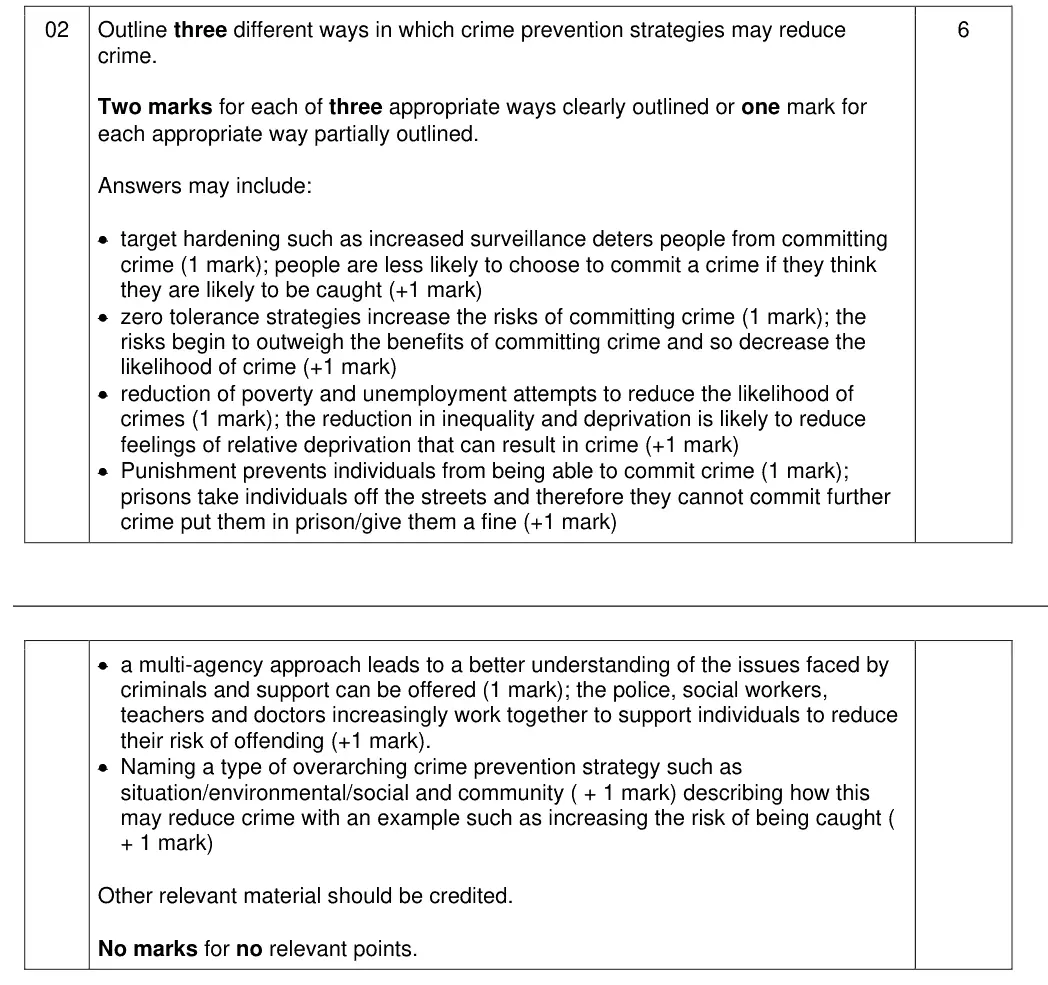
Question 2 was answered well. The vast majority of students were able to provide three different crime prevention strategies. Students had deep and holistic knowledge of this area. There was some drift onto theory without providing a strategy and some students repeated their strategy. This question saw the most overwriting from students which may have had an impact on their timing in other questions. Centre recommendations are to assist students to not overwrite by sequencing practice style questions into teaching, underlining key aspects of the question, and to provide exemplars.
Notes from the mark scheme and report
2 marks for each of three different ways clearly outlined, 1 if only partially outlined
naming a type of strategy (situational, environmental, social/community) plus how it reduces crime is credited
drift into theory without a strategy and repeated strategies lost marks
widely overwritten
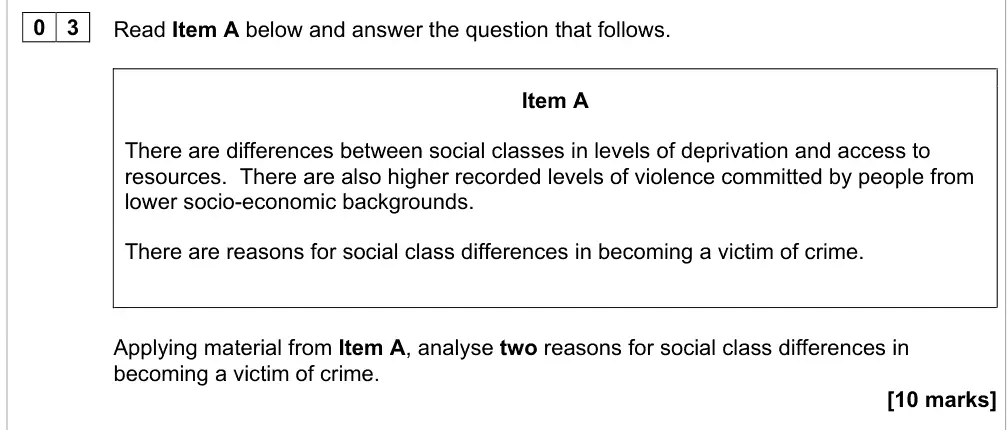
June 2022 · Paper 3 · Q310 marksAO1=3, AO2=4, AO3=3Analyse
Mark scheme, including the levels grid and indicative content
Examiner's comment
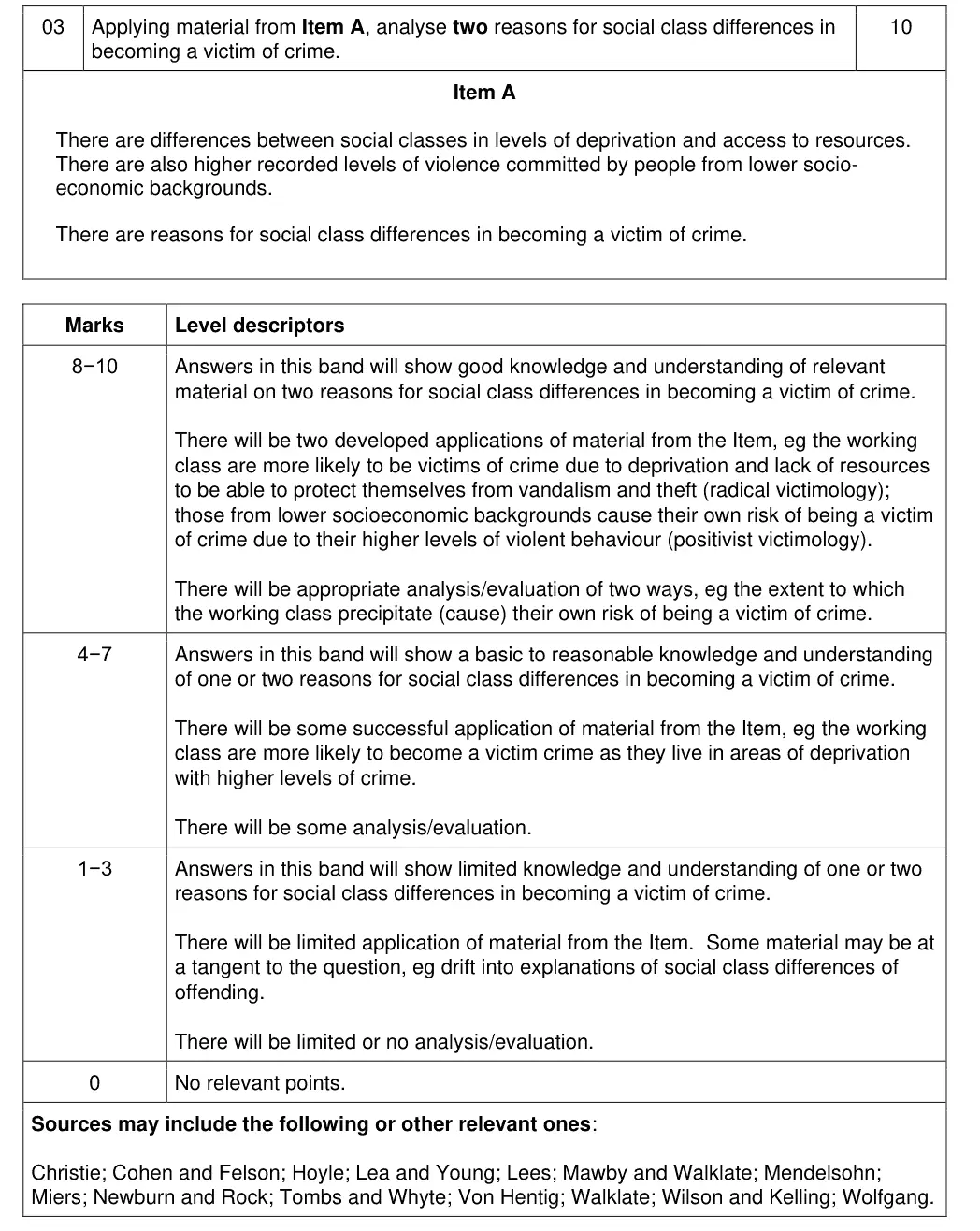
Question 3 was the most challenging question on the paper for students this series. Students had some difficulty drawing hooks from the item and developing them. There was a lack of developed knowledge on victims. Despite this the question was well attempted with very few no responses. There was a tendency to drift onto explanations of offending. Some students displayed deep holistic knowledge of this topic area. Centre recommendations are to provide exemplars and practice activities where students are required to use/identify hooks.
Notes from the mark scheme and report
must be reasons for class differences in victimisation
drift into class differences in offending = 1–3
item hooks: deprivation and lack of resources (radical victimology), higher violence in lower classes (positivist victimology, victim precipitation)
the last line of the item restates the question
hardest question on the paper, with weak knowledge of victims and difficulty using hooks
November 2021 · Paper 3 · Q430 marksAO1=12, AO2=9, AO3=930-mark essay
Mark scheme, including the levels grid and indicative content
Examiner's comment
This question provided varied levels of challenge for students and marks were widely differentiated. Most students were able to use the item and develop the ideas within the item. The most used sociological evidence was from Lea and Young. This was done well; students knew this study and could apply it in a focused way. Most students were able to provide a range of points with some development. The AO1 skill was the best developed skill in this question, however, the AO3 skills of analysis and evaluation werethe most challenging, and not always addressed well or focused on the question set. Students need to make explicit evaluative statements which link to the points they make, however, few were able to do this. This should be an area of focus for centres. Specific assessment for learning strategies are needed to develop these essays. When students did provide a conclusion, it was often not critical and did not add to the essay. Again, this is an area which centres should focus upon.
Notes from the mark scheme and report
top band debates labelling, Left Realism, neo-Marxism and Right Realism, or questions validity of ethnicity and crime data
general accounts of punishment and control by the criminal justice system = 7–12 band
Lea and Young was the most used and well applied source
evaluation (AO3) was weakest: points need explicit evaluative links, and conclusions were often not critical
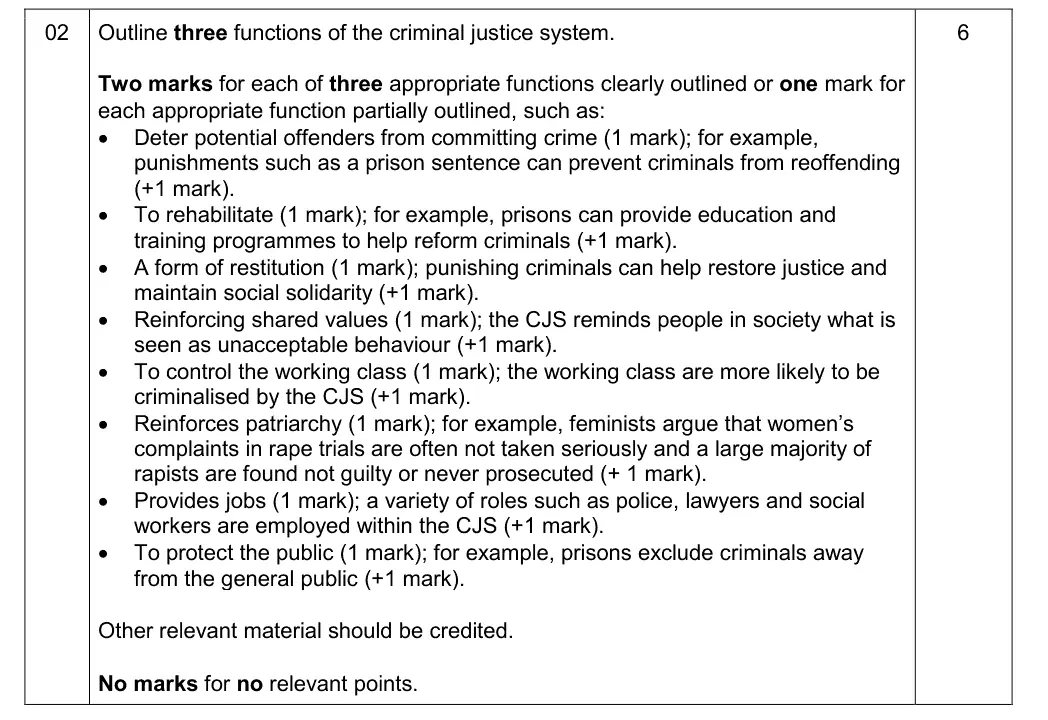
November 2020 · Paper 3 · Q26 marksAO1=6Outline
Mark scheme
Examiner's comment
This question was answered well. Most students could identify three functions of the criminal justice system. A common error was that students presented a positive function of crime but did not link this to the criminal justice system. For example, using the warning device or safety valve function but not linking this to anything within the CJS or agents within the criminal justice system.
Notes from the mark scheme and report
2 marks for each of three functions clearly outlined, 1 if only partially outlined
credited: deterrence, rehabilitation, restitution, reinforcing values, protecting the public, plus conflict views (controlling the working class, reinforcing patriarchy)
common error: functions of crime (warning device, safety valve) not linked to the CJS
June 2019 · Paper 3 · Q26 marksAO1=6Outline
Mark scheme
Examiner's comment
This question was also generally well done, with most students able to score four marks and many gaining all six. The reasons most frequently outlined were: lack of confidence or trust in the police's ability or their willingness to help, fear of retribution from the offender, the crime being too trivial to report, shame or embarrassment about being a victim, being unaware that one had been victimised, and unwillingness to go through the ordeal of giving evidence and re-living the experience. Domestic abuse or sexual assault and rape were often used to illustrate some of the reasons offered. Failure to gain full marks was generally due either to repetition of essentially the same reason, or to failure to explain the suggested reason clearly. Some students wrote unnecessarily long answers for this six-mark question for which they could not be credited.
Notes from the mark scheme and report
AO grid not printed
2 marks for each of three reasons clearly outlined, 1 if partial
common answers: lack of confidence in police, fear of retribution, crime too trivial, shame, unaware of being victimised, protecting the offender, victim precipitation
marks lost for repeating essentially the same reason
overlong answers gain nothing extra
AO split from AQA's standard grid for this paper (this year's mark scheme does not print it).
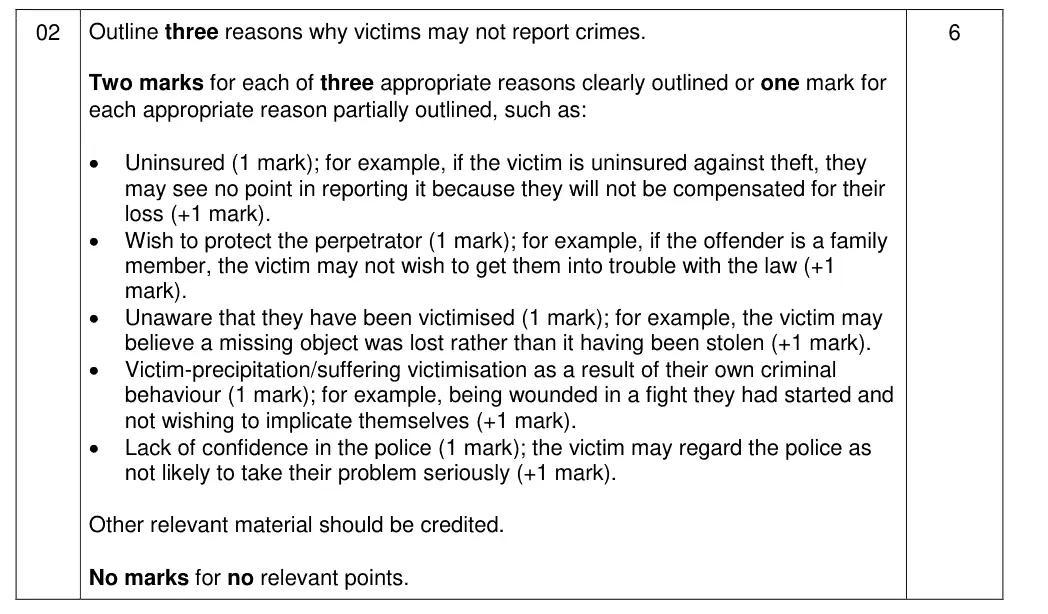
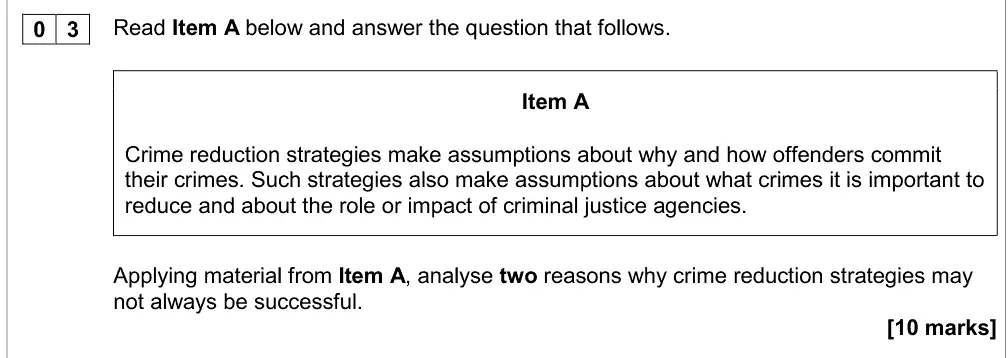
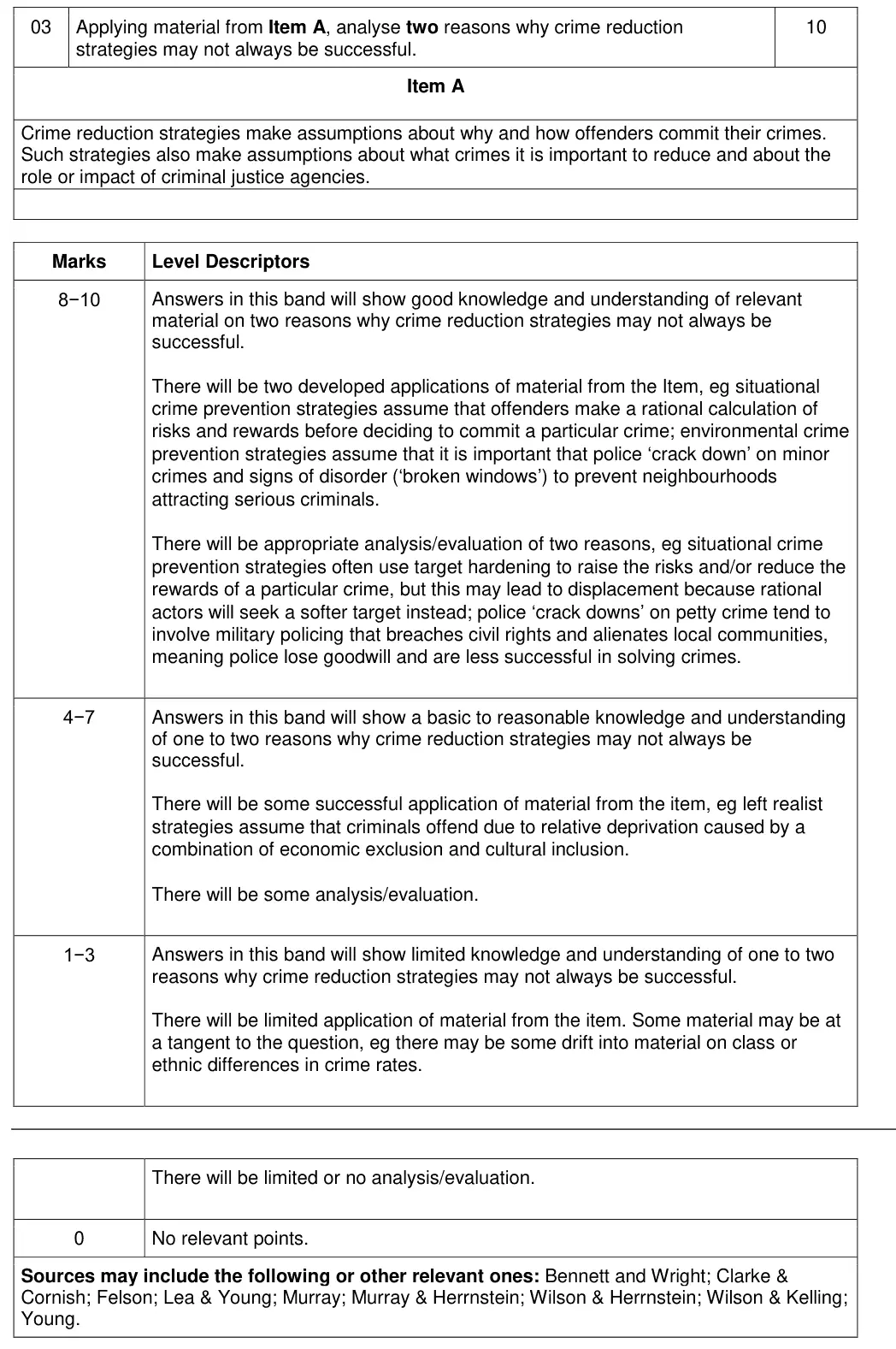
June 2019 · Paper 3 · Q310 marksAO1=3, AO2=4, AO3=3Analyse
Mark scheme, including the levels grid and indicative content
Examiner's comment
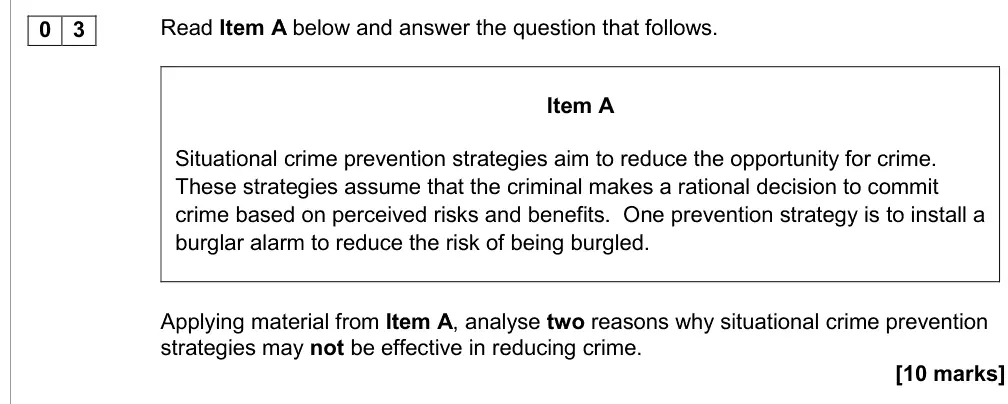
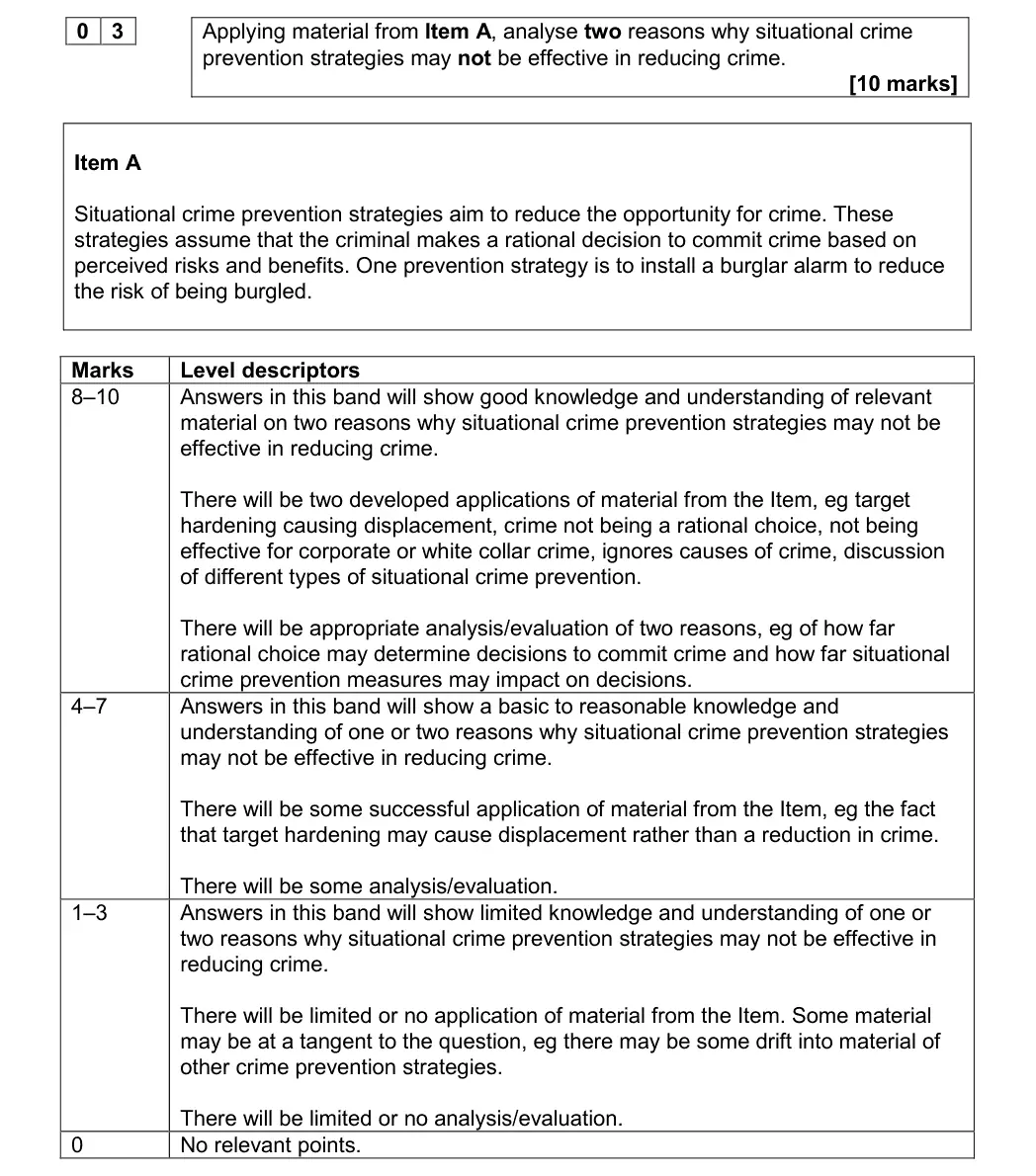
In general, this question was less well answered. Many students failed to develop any application from Item A in their response. Some answers failed to identify any specific crime reduction strategy; alternatively, they described such a strategy (often at some length) but without identifying any reason why it might not be successful. There were also instances where students wasted time by discussing how such strategies might be successful, rather than unsuccessful as the question asked for. The best answers applied the Item to their response by linking assumptions taken from within it about how or why: offenders commit crimes; and/or about what crimes it is important to reduce; or, less commonly about the role or impact of criminal justice agencies, to the underlying rationale of a specific crime reduction strategy or strategies. These answers then went on to explain reasons why the strategies might not work. In terms of specific crime reduction strategies, the most popular choices were ‘target hardening’ and ‘zero tolerance’. Reasons offered for the failure of such strategies included: failure to understand that offenders' motivations were not always rational, and that a strategy focusing on street crime neglects more harmful crimes such as corporate or state crime.
Notes from the mark scheme and report
AO grid not printed
must apply item hooks (assumptions about why offenders offend, which crimes matter, role of criminal justice agencies) to a named strategy
many identified no specific strategy or described one without saying why it may fail
discussing why strategies succeed wastes time
drift into class or ethnic crime rates = 1–3 band
best answers used target hardening (displacement) and zero tolerance (alienates communities, neglects corporate and state crime)
AO split from AQA's standard grid for this paper (this year's mark scheme does not print it).
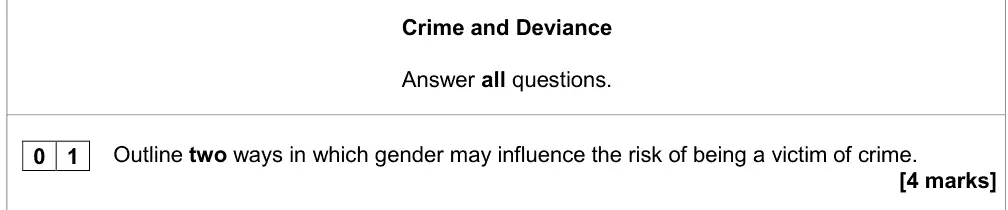
June 2018 · Paper 3 · Q14 marksAO1=4Outline
Mark scheme
Examiner's comment
Most students successfully identified two ways in which gender may influence being a victim of crime. Most answers referred to the vulnerability of women or the influence of patriarchy; many linked this with domestic abuse or sexual crimes. References to male victims usually referred to socialisation and/or to violence related to masculinity, leading to men becoming victims of the violence of other men when they became gang members or spent time in the wrong places. The main reason for failing to score marks was to write about committing crime rather than about being a victim. Some gained partial reward for identifying a particular type of crime of which men or women are likely to be victims but without going on to elaborate on this.
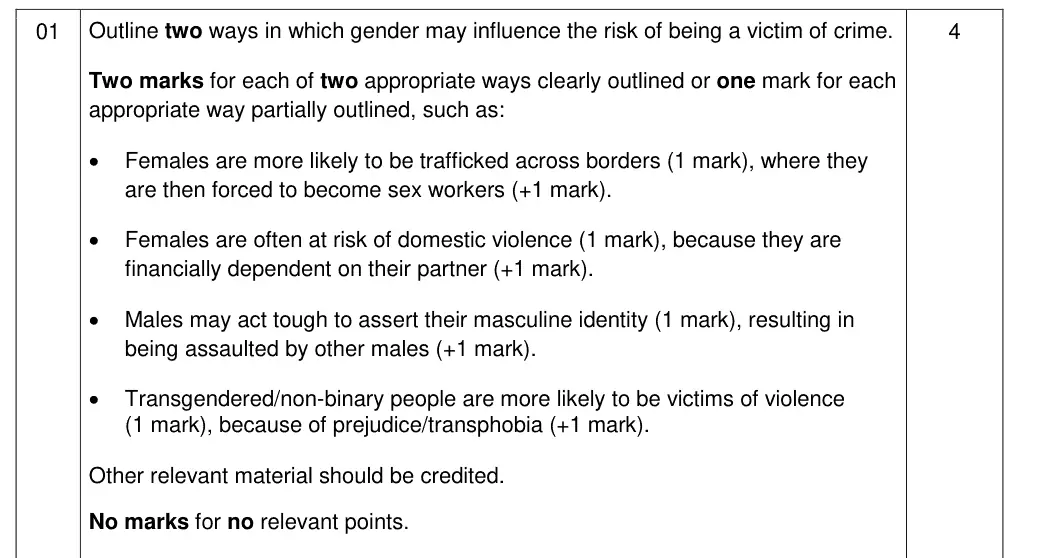
Notes from the mark scheme and report
2 marks for each of two ways clearly outlined, 1 if partial (e.g. trafficking of women, domestic violence and financial dependence, men's tough masculinity leading to assaults, transphobic violence)
main reason for losing marks was writing about committing rather than suffering crime
naming a crime type without elaborating = partial
AO split from AQA's standard grid for this paper (this year's mark scheme does not print it).
June 2017 · Paper 3 · Q430 marksAO1=12, AO2=9, AO3=930-mark essay
Mark scheme, including the levels grid and indicative content
Examiner's comment
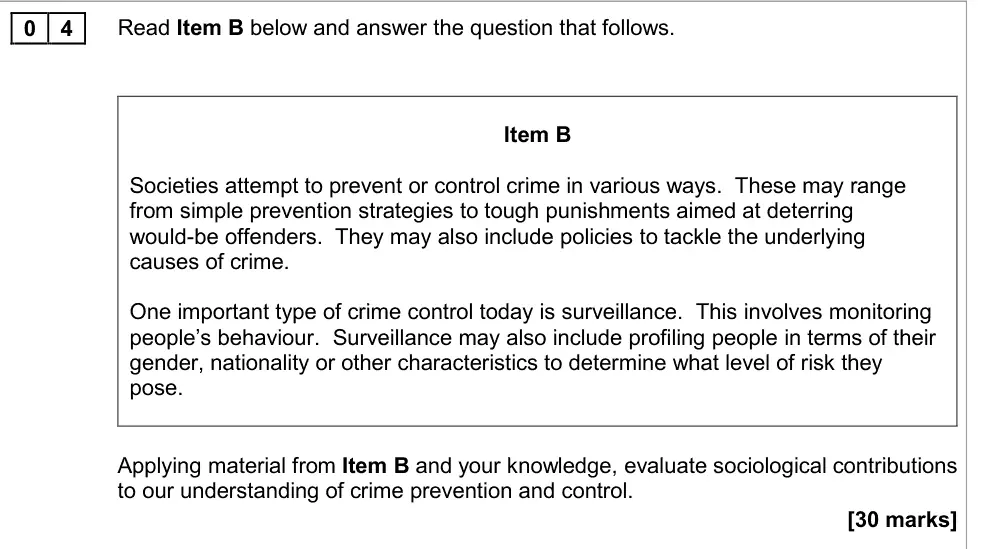
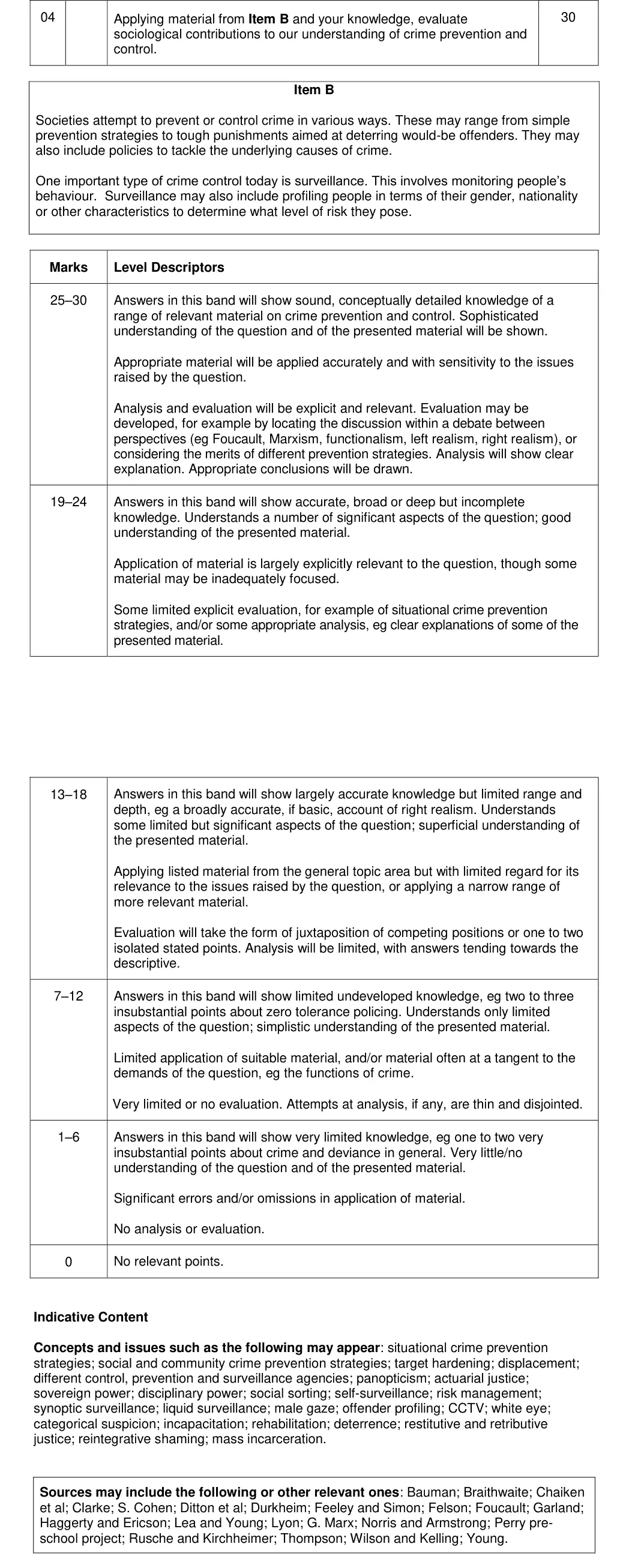
Similarly, in relation to AO3 skills (analysis and evaluation), opportunities to gain marks on the longer questions (04 and 06) were often missed. In these two questions, many students focused on recounting knowledge at the expense of the discussions and debates that could yield marks for AO3 skills. Many students wrote at length on questions 04 and 06. Most students had some knowledge of sociological material on crime prevention and control. However, evaluation tended to be limited and, where present, mostly confined to brief one- sentence add-ons at the end of accounts of particular crime prevention strategies. Among the weakest responses were some very basic, anecdotal or common sense accounts of a few crime reduction methods. Somewhat better answers were able to make a small number of undeveloped sociological points, though these often focused on the causes of crime, with a brief reference to crime prevention and control tacked on at the end of each cause as a corollary. More successful students knew about a number of different relevant contributions, though their answers varied greatly in depth, breadth and accuracy. Typically they featured situational crime prevention, environmental crime prevention/’broken windows’, zero tolerance policing, forms of punishment, addressing deprivation and policing issues, social and community crime prevention, surveillance and profiling. The best answers gave conceptually detailed and accurate accounts of some of these contributions and embedded them within one or more debates (usually left versus right realism, or debates about surveillance). These answers had explicit, relevant and well developed evaluation of the presented material. More often, however, sociological contributions were presented as a descriptive list, and sometimes with different contributions conflated. A minority of students attempted a ‘perspectives’ answer (usually Marxism and functionalism) but often struggled to apply these consistently to crime prevention. A few students were unable to resist moralising, detailing exotic punishments, or recommending the death penalty or long, harsh sentences as solutions to control or prevent crime.
Notes from the mark scheme and report
must apply Item B (prevention strategies, punishment, underlying causes, surveillance and profiling)
top band: debate between perspectives (e.g. Foucault, left and right realism) or merits of strategies
evaluation often one-line add-ons
weaker answers turned into causes of crime or moralised about harsh punishments
Specimen set 1 · Paper 3 · Q310 marksAO1=3, AO2=4, AO3=3Analyse
Mark scheme, including the levels grid and indicative content